UPTET · Topic Collection

Mathematics and Science PYQs

Elementary mathematics and science content with the pedagogical issues of teaching both subjects, as asked in upper-primary teacher papers.

300 Total Questions5 Official PapersYears: 2016–2021Search in Mathematics and Science
Showing questions 101–120 of 300Page 6 of 15
UPTET 2019 Paper 2 (Maths & Science) (Hindi / English / Sanskrit) (Previous Year Paper)·Mathematics and Science
View full paper

Question 101

UPTET 2019• Mathematics and Science• Mathematics and Science

Which one of the following is not an electromagnetic wave?

  1. AOption (a)

    Microwave

  2. BOption (b)

    Ultrasonic

  3. COption (c)

    Infrared

  4. DOption (d)

    X-rays

View answer & explanation

Correct answer

Answer: (b)B.

Ultrasonic

Why this answer is correct

The correct answer is Ultrasonic.

Key Points

  • Electromagnetic waves are created as a result of vibrations between an electric field and a magnetic field.
  • We can say that these are composed of oscillating magnetic and electric fields.
  • Ultrasonic waves are sound waves which are greater than 20,000 Hz.
  • Humans can detect sounds in a frequency range from about 20 Hz to 20 kHz.
  • Humans cannot hear Ultrasonic waves.
  • EM Waves are- radio waves, microwaves, infrared, light, ultraviolet, X-rays, and gamma rays.
  • Depending on the variations in wavelength and frequency, these waves have different applications.

Important Points

  • Infrared radiations are basically thermal waves.
  • These are used in electronic applications like TV remote sensors.
  • It is also used in thermal imaging cameras.
  • Microwaves are extensively used for point-to-point telecommunications.
  • Since it can be transmitted at large distances, these are also used in spacecraft communication.
  • X-rays waves are produced by accelerating electrons. 
  • These are used to view images of the bones and other structures in the body.
UPTET 2019 Paper 2 (Maths & Science) (Hindi / English / Sanskrit) (Previous Year Paper)·Mathematics and Science
View full paper

Question 102

UPTET 2019• Mathematics and Science• Mathematics and Science

The angle of dip at magnetic equator of earth is

  1. AOption (a)

    45° 

  2. BOption (b)

    90° 

  3. COption (c)

    180° 

  4. DOption (d)

    0° 

View answer & explanation

Correct answer

Answer: (d)D.

0° 

Why this answer is correct

The correct answer is 0°.

Key Points

  • The magnetic equator is an imaginary line roughly parallel to the geographical equator.
  • At the magnetic equator, the dip or inclination is zero.

Additional Information

  • The magnetic equator is not fixed but slowly changes.
  • There is no vertical (Z) component to the magnetic field.
  • The north of the magnetic equator (the north end of the dip needle) dips below the horizontal, I and Z are positive.
  • The south of the magnetic equator (the south end dips below the horizontal), I and Z are measured negative.
  • As one moves away from the magnetic equator, I and Z increase.
UPTET 2019 Paper 2 (Maths & Science) (Hindi / English / Sanskrit) (Previous Year Paper)·Mathematics and Science
View full paper

Question 103

UPTET 2019• Mathematics and Science• Mathematics and Science

Decibel is

  1. AOption (a)

    The wavelength of noise

  2. BOption (b)

    A measure of sound level

  3. COption (c)

    A musical note

  4. DOption (d)

    A musical instrument

View answer & explanation

Correct answer

Answer: (b)B.

A measure of sound level

Why this answer is correct

The correct answer is A measure of sound level.

Key Points

  • A decibel is a logarithmic unit used to measure sound level.
  • It is also widely used in electronics, signals and communication.
  • The higher the decibel level, the louder the noise.
  • On the decibel scale, the level increase of 10 means that a sound is actually 10 times more intense, or powerful.
  • A whisper is about 30 dB and a normal conversation is about 60 dB.
  • Noise above 70 dB over a prolonged period of time may start to damage our hearing and Loud noise above 120 dB can cause immediate harm to our ears.

​

Important Points

  • The Central Pollution Control Board laid down the permissible noise level in India for different areas.
  • In industrial areas, the permissible limit is 75 dB for daytime and 70 dB at night.
  • In commercial areas, it is 65 dB and 55 dB while in residential areas it is 55 dB and 45 dB during daytime and night respectively.
UPTET 2019 Paper 2 (Maths & Science) (Hindi / English / Sanskrit) (Previous Year Paper)·Mathematics and Science
View full paper

Question 104

UPTET 2019• Mathematics and Science• Mathematics and Science

Kirchhoff's current law is based on the conservation of

  1. AOption (a)

    mass

  2. BOption (b)

    charge

  3. COption (c)

    none of these

  4. DOption (d)

    momentum

View answer & explanation

Correct answer

Answer: (b)B.

charge

Why this answer is correct

The correct answer is the charge.

Important Points

  • Kirchhoff's Circuit Laws are used to solve complex circuit problems by defining a set of basic network laws and theorems for the voltages and currents around a circuit.
  • Kirchhoffs Current Law
  • It states that the "total current or charge entering a junction or node is exactly equal to the charge leaving the node as it has no other place to go except to leave, as no charge is lost within the node".
  • It is based on the conservation of charge.
  • The algebraic sum of ALL the currents entering and leaving a node must be equal to zero.

Additional Information

  • Kirchhoffs Voltage Law
  • It states that “in any closed-loop network, the total voltage around the loop is equal to the sum of all the voltage drops within the same loop” which is also equal to zero.
  • It is based on the conservation of energy.
  • The algebraic sum of all voltages within the loop must be equal to zero.
UPTET 2019 Paper 2 (Maths & Science) (Hindi / English / Sanskrit) (Previous Year Paper)·Mathematics and Science
View full paper

Question 105

UPTET 2019• Mathematics and Science• Mathematics and Science

The kinetic energy of a particle having mass m is E. Its momentum will be

  1. AOption (a)

    2 mE

  2. BOption (b)

    \(\sqrt{\dfrac{1}{2} mE}\)

  3. COption (c)

    \(\sqrt{2 mE}\)

  4. DOption (d)

    \(\dfrac{1}{2} mE\)

View answer & explanation

Correct answer

Answer: (c)C.

\(\sqrt{2 mE}\)

Why this answer is correct

The correct answer is (2mE)1/2.

Important Points

  • Kinetic Energy - It is the energy possessed by an object due to virtue of its motion.
  • The kinetic energy of a body in motion can be calculated as half its mass (m) times the square of its velocity (v): E = ½mv2.
  • Kinetic Energy is a scalar quantity.
  • Momentum - It is the quantity of motion of a moving body.
  • It is a vector quantity.
  • It is the product of the mass of a particle and its velocity.
  • The calculation for simplification:-
  • Energy, E = ½mv2
  • Momentum, P = mv
  • E = P2/2M
  • Hence, P (momentum) = (2mE)1/2.
UPTET 2019 Paper 2 (Maths & Science) (Hindi / English / Sanskrit) (Previous Year Paper)·Mathematics and Science
View full paper

Question 106

UPTET 2019• Mathematics and Science• Mathematics and Science

If the image of an object having length x1 with convex mirror has length x2, then

  1. AOption (a)

    x1 > x2

  2. BOption (b)

    x1 = x2

  3. COption (c)

    \(x_1 \dfrac{<}{>} x_2\)

  4. DOption (d)

    x1 < x2

View answer & explanation

Correct answer

Answer: (a)A.

x1 > x2

Why this answer is correct

The correct answer is x1 > x2.

Important Points

  • Convex Mirror is a curved mirror in which the reflective surface bulges out towards the light source.
  • It refers to as a diverging mirror because the incident light originating from the same point and reflects off the mirror surface and diverges.
  • These mirrors form a virtual image as the focal point and the centre of curvature are imaginary points in the mirror that cannot be reached.
  • The relation x1 > x2 stands correct in the given statement.

Key Points

Properties of the image formed

Position of the objectPosition of the imageSize of the imageNature of the image
Between P and infinityBehind the mirror between P and FDiminishedVirtual and Erect
At infinityBehind the mirror at FHighly diminishedVirtual and Erect
UPTET 2019 Paper 2 (Maths & Science) (Hindi / English / Sanskrit) (Previous Year Paper)·Mathematics and Science
View full paper

Question 107

UPTET 2019• Mathematics and Science• Mathematics and Science

The SI unit of heat is

  1. AOption (a)

    Kilocalorie

  2. BOption (b)

    Erg

  3. COption (c)

    Joule

  4. DOption (d)

    Calorie

View answer & explanation

Correct answer

Answer: (c)C.

Joule

Why this answer is correct

The correct answer is Joule.

  • Heat is the energy that is transferred from one body to another as the result of a difference in temperature.
  • The S.I unit of heat is Joule.
  • One joule equals the work done (or energy expended) by a force of one newton acting over a distance of one meter.

Additional Information

  • A calorie is the amount of heat needed to raise the temperature of one gram of water by one degree Celsius.
  • A kilocalorie is equal to one thousand calories.
  • The erg is equal to 10−7 joules. It is the unit of energy or work in the cgs system.

Mistake Points

  • The unit of heat is joule (J) in SI unit system and calorie is used in BTU system of units.
UPTET 2019 Paper 2 (Maths & Science) (Hindi / English / Sanskrit) (Previous Year Paper)·Mathematics and Science
View full paper

Question 108

UPTET 2019• Mathematics and Science• Mathematics and Science

In a fluid medium, the nature of sound waves is

  1. AOption (a)

    only transverse

  2. BOption (b)

    both longitudinal and transverse

  3. COption (c)

    neither longitudinal nor transverse

  4. DOption (d)

    only longitudinal

View answer & explanation

Correct answer

Answer: (d)D.

only longitudinal

Why this answer is correct

The correct answer is only longitudinal.

Concept:

  • Sound wave: The longitudinal wave in an elastic medium that produces an audible sensation is called a sound wave.
  • As sound waves are longitudinal waves, the air particles vibrate to and fro in the direction of propagation of sound.
  • It is a wave of compression and rarefaction.
  • Compressions and rarefactions are part of a sound wave.
  • Compression: A region in a longitudinal wave where the particles are closest together is called compression. Compression has high density and high pressure

Rarefaction: A region in a longitudinal wave where the particles are furthest apart is called rarefaction. The rarefaction has a low density and low pressure

Key Points

  • Longitudinal waves- The particles displaced in this type of waves are parallel to the direction the wave travels.
  • Sound waves are longitudinal waves.
  • The sound waves are longitudinal waves because particles of the medium through which the sound travels vibrate parallel to the direction that the sound wave moves.

Additional Information

  • Transverse wave - The particles displaced in this type of waves are perpendicular to the direction the wave travels.
  • In light waves, the oscillations of the electric and magnetic fields are transverse.
UPTET 2019 Paper 2 (Maths & Science) (Hindi / English / Sanskrit) (Previous Year Paper)·Mathematics and Science
View full paper

Question 109

UPTET 2019• Mathematics and Science• Mathematics and Science

The value of one Angstrom is ________ (in microns)

  1. AOption (a)

    10-4 micron

  2. BOption (b)

    10-6 micron

  3. COption (c)

    10-10 micron

  4. DOption (d)

    10-2 micron

View answer & explanation

Correct answer

Answer: (a)A.

10-4 micron

Why this answer is correct

The correct answer is 10-4 microns.

Key Points

Read the question ,it is asking value  in microns not meter.

If asked in meters then the value will be 1 Angstroms  = 10-10 m.

But asked in microns

  • 1 mm = 10-3 m
  • 1 micron = 10-3 mm
  • ⇒ 1 micron = 10-6 m
  • 1 Angstrom = 10-10 m
  • 1 Angstrom = 10-10 m = 10-10 × 106 micron = 10-4 micron.

Confusion Points

1 Angstrom = 10-10 meter

1 Angstrom =  10-4 micron

Additional Information

  • An Angstrom is a unit of length used to measure very small distances.
  • 1 Angstroms to = 0.0001 Microns
  • It is named after Anders Jonas Ångström (Swedish physicist).
  • A micron is one-millionth of a meter (10−6 m) and one Angstrom is 10-4 micron.
UPTET 2019 Paper 2 (Maths & Science) (Hindi / English / Sanskrit) (Previous Year Paper)·Mathematics and Science
View full paper

Question 110

UPTET 2019• Mathematics and Science• Mathematics and Science

The speed of sound wave is maximum in

  1. AOption (a)

    Air

  2. BOption (b)

    Steel

  3. COption (c)

    Vacuum

  4. DOption (d)

    Water

View answer & explanation

Correct answer

Answer: (b)B.

Steel

Why this answer is correct

The correct answer is Steel.

Important Points

  • The speed of the sound depends on the density of the medium through which it is travelling.
  • The particles in the solid medium are closely packed.
  • Hence, the density is high.
  • The information from one molecule to another molecule travels faster in the solid medium.
  • In liquid, the molecules are little farther apart than in solids.
  • Hence, the density is low for liquids.
  • In gas, the molecules are very loosely dispersed.
  • The speed of the sound wave will be maximum in steel.

Additional Information

  • The velocity of sound waves in air is 330 m/s.
  • The velocity of sound waves in steel is 5920 m/s.
  • The velocity of sound waves in a vacuum is zero.
  • The velocity of sound waves in water is 1480 m/s.
UPTET 2019 Paper 2 (Maths & Science) (Hindi / English / Sanskrit) (Previous Year Paper)·Mathematics and Science
View full paper

Question 111

UPTET 2019• Mathematics and Science• Mathematics and Science

Which is the aquatic bryophyte?

  1. AOption (a)

    Marchantia polymorpha

  2. BOption (b)

    Riccia fluitans

  3. COption (c)

    Marchantia palmata

  4. DOption (d)

    Riccia discolor

View answer & explanation

Correct answer

Answer: (b)B.

Riccia fluitans

Why this answer is correct

The correct answer is Riccia fluitans.

Important Points

  • Bryophyte
  • It is the collective term for mosses, hornworts and liverworts.
  • These are non-vascular plants.
  • They play a vital role in regulating ecosystems because they provide an important buffer system for other plants, which live alongside and benefit from the water and nutrients that bryophytes collect.
  • Many bryophytes are found in association with freshwater.
  • Riccia fluitans - It is an aquatic floating plant of the liverwort. 
  • It normally grows quickly at the surface.
  • It can be found floating in ponds and under the water surface.

Additional Information

  • Marchantia polymorpha - It grows on moist soil and rocks in damp habitats.
  • The most varieties grow on dry substrates and some are found in marshes.
  • Marchantia palmata - It is a species of Marchantia genus.
  • The genus is mainly confined to temperate regions and is found to grow in moist, cool, and shady places.
  • Riccia discolor - It is a genus of liverworts.
  • These plants are small and thalloid, that is not differentiated into root, stem and leaf.
  • It grows on damp soil and only sometimes found floating in ponds
UPTET 2019 Paper 2 (Maths & Science) (Hindi / English / Sanskrit) (Previous Year Paper)·Mathematics and Science
View full paper

Question 112

UPTET 2019• Mathematics and Science• Mathematics and Science

Which of the following is 'total stem parasite'?

  1. AOption (a)

    Raflesia

  2. BOption (b)

    Santalum

  3. COption (c)

    Viscum

  4. DOption (d)

    Cuscuta

View answer & explanation

Correct answer

Answer: (d)D.

Cuscuta

Why this answer is correct

The correct answer is Cuscuta.

Important Points

  • As the name, "Total stem parasite" suggests, it is the parasite that is solely depended on the stem for its function.
  • Cuscuta
  • It is a total stem parasite.
  • It is a rootless, yellow coloured, slender stem with small scale leaves, which twines around the host.
  • It develops haustoria which enter the host plant forming contact with xylem and phloem of the host.
  • It also absorbs prepared food, water and minerals from the host plant.

Additional Information

  • Rafflesia - It is a genus of parasitic flowering plants in the family Rafflesiaceae.
  • It has no roots, shoots, stems, or leaves.
  • It is a parasite to roots.
  • The flowers of Rafflesia arnoldii are the largest in the world.
  • Santalum - It is a genus of woody flowering plants.
  • It is a partial root parasite because it can photosynthesize its own food.
  • It takes help from roots for water and inorganic nutrients.
  • Viscum - It is a partial stem parasite.
  • We are saying partial because it is capable of photosynthesizing.
  • It draws water and nutrients from other trees.
UPTET 2019 Paper 2 (Maths & Science) (Hindi / English / Sanskrit) (Previous Year Paper)·Mathematics and Science
View full paper

Question 113

UPTET 2019• Mathematics and Science• Mathematics and Science

Match the following events in plants.

A.Absorption of wateri.Xylem
B.Absorption of mineralsii.Phloem
C.Transport of wateriii.Root hairs
D.Transport of sucroseiv.Epiblema
  1. AOption (a)

    A - iv, B - iii, C - ii, D - i

  2. BOption (b)

    A - iii, B - iv, C - ii, D - i

  3. COption (c)

    A - iv, B - iii, C - i, D - ii

  4. DOption (d)

    A - iii, B - iv, C - i, D - ii

View answer & explanation

Correct answer

Answer: (d)D.

A - iii, B - iv, C - i, D - ii

Why this answer is correct

The correct answer is Option 4.

Key Points

  • Xylem
  • It is a type of tissue in vascular plants that transports water and some nutrients from the roots to the leaves.
  • The tissue consists of a variety of specialized, water-conducting cells known as tracheary elements.
  • Phloem
  • It is the complex tissue which acts as a transport system for soluble organic compounds within vascular plants.
  • It transports the food made in leaves to other parts of plants.
  • The transport of food is mainly in the form of sucrose.
  • It is made up of living tissue, which uses turgor pressure and energy in the form of ATP to actively transport sugars to the plant organs.
  • Root hairs
  • These are cylindrical extensions of root epidermal cells.
  • The primary function is to collect water and mineral nutrients from the soil. It takes the solution up by the roots to the rest of the plant.
  • Epiblema
  • Epidermis with root hairs is called epiblema.
  • It is composed of one layer of compactly arranged parenchymatous cells.
  • It is usually located between the epidermis and cortex in the root or stem of a plant.
  • The root hairs and thin-walled epiblema cells absorb water and minerals salts from the soil.
UPTET 2019 Paper 2 (Maths & Science) (Hindi / English / Sanskrit) (Previous Year Paper)·Mathematics and Science
View full paper

Question 114

UPTET 2019• Mathematics and Science• Mathematics and Science

Endemic species are

  1. AOption (a)

    Wild species which are under threat of extinction

  2. BOption (b)

    Wild species which are rescued from poachers.

  3. COption (c)

    Plants and animals which are very common and distributed throughout globe.

  4. DOption (d)

    Plants and animals which are found exclusively in a particular geographical area.

View answer & explanation

Correct answer

Answer: (d)D.

Plants and animals which are found exclusively in a particular geographical area.

Why this answer is correct

The correct answer is "Plants and animals which are found exclusively in a particular geographical area".

Important Points

  • Endemic species
  • These are plant and animal species that are confined to a particular geographical region.
  • These species are generally confined to one region because they are highly adapted to the particular niche.
  • They may rely on plants that cannot be found anywhere else.
  • Endemic species which are restricted to low and isolated mountains in the temperate and tropical zones are threatened with extinction because of increasing concern of climate warming.

Additional Information

  • Examples of endemic species
  • Asiatic Lion is also known as the Indian Lion.
  • It can be only found in Gir Forest National Park, Gujarat.
  • These are listed as endangered species.
  • Kashmir Stag is found in the dense forests of Dachigum National Park, Kasmir Valley and Chamba district, Himachal Pradesh.
  • Sangai Deer is also known as Brow Antlered Deer.
  • They are exclusively found in Keibul Lamjao National Park of Manipur.
  • The purple frog is only found in the rainforests of western ghats in India.
UPTET 2019 Paper 2 (Maths & Science) (Hindi / English / Sanskrit) (Previous Year Paper)·Mathematics and Science
View full paper

Question 115

UPTET 2019• Mathematics and Science• Mathematics and Science

The correct sequence of parts of female reproductive organ in plants

  1. AOption (a)

    Ovary, Style, Thalamus and Stigma

  2. BOption (b)

    Stigma, Style, Ovary and Thalamus

  3. COption (c)

    Ovary, Stigma, Style and Thalamus

  4. DOption (d)

    Style, Stigma, Ovary and Thalamus

View answer & explanation

Correct answer

Answer: (b)B.

Stigma, Style, Ovary and Thalamus

Why this answer is correct

The correct answer is Stigma, Style, Ovary and Thalamus.

Key Points

  • Stigma - It is the head of the pistil.
  • It receives pollen, which begins the process of fertilization.
  • Style - It the stalk of the pistil.
  • It is a long, slender stalk that connects the stigma and the ovary.
  • When pollen reaches the stigma, it begins to grow a tube through the style called a pollen tube, which eventually reaches the ovary.
  • Ovary - It is the base of the pistil.
  • It holds the ovules for fertilization.
  • Thalamus - It is present near the stalk of the flower.
  • It supplies nutrients to the flower.
  • It is a condensed axis of the flower from which all floral parts arise.

Additional Information

  • Stamens are the male reproductive parts of flowers.
  • A stamen consists of an anther (which produces pollen) and a filament.
UPTET 2019 Paper 2 (Maths & Science) (Hindi / English / Sanskrit) (Previous Year Paper)·Mathematics and Science
View full paper

Question 116

UPTET 2019• Mathematics and Science• Mathematics and Science

Which represents calcination?

  1. AOption (a)

    2 Zn + O2 → 2 ZnO

  2. BOption (b)

    2 ZnS + 3 O2 → 2 ZnO + 2 SO2

  3. COption (c)

    MgCO3 → MgO + CO2

  4. DOption (d)

    2 Ag + 2 HCl + [O] → 2 AgCl + H2O

View answer & explanation

Correct answer

Answer: (c)C.

MgCO3 → MgO + CO2

Why this answer is correct

The correct answer is MgCO3 → MgO + CO2.


  • Calcination
  • It is the process in which the ore of the metal is heated to high temperature in the absence or limited supply of air or oxygen.
  • Example - The limestone is brought to a temperature high enough to expel the carbon dioxide and the lime is produced.
  • In option 3, the thermal decomposition of magnesium carbonate produces magnesium oxide and carbon dioxide.
  • This reaction takes place at a temperature of over 650°C.
  • Since we know that the absence of oxygen is essential for calcination, only the third option satisfies this condition.
UPTET 2019 Paper 2 (Maths & Science) (Hindi / English / Sanskrit) (Previous Year Paper)·Mathematics and Science
View full paper

Question 117

UPTET 2019• Mathematics and Science• Mathematics and Science

Which colourless gas turns lead acetate paper black?

  1. AOption (a)

    H2S

  2. BOption (b)

    Br2

  3. COption (c)

    SO2

  4. DOption (d)

    Cl2

View answer & explanation

Correct answer

Answer: (a)A.

H2S

Why this answer is correct

The correct answer is H2S.

Key Points

  • Hydrogen sulphide (H2S) is released by some bacteria when they break down sulfur-containing amino acids.
  • Lead acetate paper is a reagent paper used for the detection of hydrogen sulphide or sulphides.
  • The colour changes from white to brown-black colour.
  • The bacteria growing in peptone water release the hydrogen sulphide (a colourless gas) reacts with lead acetate in the filter paper strip and forms black lead sulphide.

Important Points

  • The reaction:-
  • H2​S+(CH3​COO)2​Pb→PbS↓+2CH3​COOH
UPTET 2019 Paper 2 (Maths & Science) (Hindi / English / Sanskrit) (Previous Year Paper)·Mathematics and Science
View full paper

Question 118

UPTET 2019• Mathematics and Science• Mathematics and Science

Consider the following compounds:

I. BF3

II. IF7

III. CO2

IV. PCl5

Among these compounds, the electrophiles are

  1. AOption (a)

    III and IV

  2. BOption (b)

    I, III 

  3. COption (c)

    I, II, III and IV

  4. DOption (d)

    I and II

View answer & explanation

Correct answer

Answer: (b)B.

I, III 

Why this answer is correct

The correct answer is I, III

  • Electrophiles
  • It is the molecule or ion that is electron-deficient and in some way could accept a pair of electrons to make a new covalent bond.
  • Electrophilic reagents are Lewis acids.
  • They react by accepting an electron pair in order to form a bond to a nucleophile including the interactions of a proton and a base.
  • Lewis acid: It is an electron-pair acceptor.
  • These are the chemical species which have empty orbitals and are able to accept electron pairs from Lewis bases.
  • Positively charged electrophile - H+, Cl+ (Chloronium ion), Br+ (Bromonium ion), I+ (Iodonium ion), NO2+, NO+, NH4+, and other carbonium ions.
  • Neutral electrophile - SO3, FeCl3, AlCl3, BF3, ZnCl2 etc.

Important Points

  • Boron has an empty 2p orbital.
  • There is also a strong partial positive charge on the boron due to the extremely electronegative fluorine atoms covalently bound to boron.
  • BF3 is a potent Lewis acid and thus an electrophile.
  • In Carbon dioxide, the carbon is central and is bound to two oxygen atoms.
  • The electronegativity of oxygen gives carbon a partial positive charge, making carbon dioxide an electrophile.
  • The pentahalides of phosphorus are Lewis acids because of the empty valence d orbitals of phosphorus.
  • IF7 (Iodine Heptafluoride): Iodine in IF7 has a complete octet and even an expanded octet, so it’s not typically electrophilic under standard conditions.
  • PCl5 (Phosphorus Pentachloride): Similar to IF7, phosphorus in PCl5 has an expanded octet and is not typically considered an electrophile under standard conditions.
UPTET 2019 Paper 2 (Maths & Science) (Hindi / English / Sanskrit) (Previous Year Paper)·Mathematics and Science
View full paper

Question 119

UPTET 2019• Mathematics and Science• Mathematics and Science

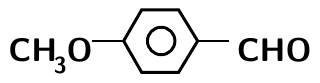
Which of the following is most reactive for nucleophilic addition reaction?

  1. AOption (a)

  2. BOption (b)

  3. COption (c)

  4. DOption (d)

    C6H5CHO

View answer & explanation

Correct answer

Answer: (c)C.

Why this answer is correct

The correct answer is

  • Nucleophilic addition reaction:
  • These are an important class of reactions that allow the interconversion of C=O (Carbonyl group) into a range of important functional groups.
  • A nucleophile forms a sigma bond with an electron-deficient species under this reaction.

Key Points

  • A nucleophilic addition reaction includes three steps:-
  • formation of the new sigma bond between the nucleophile, Nu, to the electrophilic C of the C=O group
  • breaking of the p bond to the O resulting in the formation of an intermediate alkoxide
  • protonation of the intermediate alkoxide to give an alcohol derivative
  • The reactivity of carbonyl compounds towards nucleophilic addition reactions depends on the presence of the substituted group.
  • Please note that Electron Withdrawing Group (-I, -M) increases reactivity towards nucleophilic addition reaction.
  • In option 3, NO2 shows -M effect. Hence, option 3 is the most reactive for nucleophilic addition reaction.
UPTET 2019 Paper 2 (Maths & Science) (Hindi / English / Sanskrit) (Previous Year Paper)·Mathematics and Science
View full paper

Question 120

UPTET 2019• Mathematics and Science• Mathematics and Science

On coming down, the group in periodic table.

A. The value of electronegativity decreases.

B. Atomic radius increases

C. The value of ionisation enthalpy decreases

Choose the correct option:

  1. AOption (a)

    Only B

  2. BOption (b)

    Only C

  3. COption (c)

    A, B and C

  4. DOption (d)

    Only A

View answer & explanation

Correct answer

Answer: (c)C.

A, B and C

Why this answer is correct

The correct answer is A, B and C.

Important Points

  • Electronegativity
  • It is a measure of the tendency of an atom to attract a bonding pair of electrons.
  • The higher the electronegativity of an atom, the greater its ability to attract shared electrons.
  • The atoms of each element have an increasing number of energy levels as one goes from top to bottom in the group. The electrons in a bond are thus farther away from the nucleus and are held less tightly.
  • Hence, the value of electronegativity decreases from top to bottom in the group of the periodic table.
  • Atomic radius
  • It is the distance from the atom's nucleus to the outer edge of the electron cloud.
  • Atomic radius increases from top to bottom within a group. This is caused by electron shielding.
  • Electron shielding prevents the outer electrons from being attracted to the nucleus.
  • Ionisation enthalpy
  • It the amount of energy required by an isolated gaseous atom to lose an electron in its ground state.
  • The value of ionisation enthalpy decreases as moving from top to bottom in the group.
  • The atomic number increases and the number of shells also increases. As a result, the outermost electrons far away from the nucleus can be removed easily.

Hint

  • Looking at the options, if statement 1 and statement 2 are correct, we do not need to check the statement 3.We can mark option 3 as correct.

How should I prepare for Mathematics and Science in UPTET?

Solving previous year questions by topic helps identify recurring concepts, question patterns, and frequently asked sub-topics. Attempt each question, review the step-by-step explanation, and note down key formulas or facts for quick revision before the exam.