Official Paper

UPTET 2019 Paper 2 (Maths & Science) (Hindi / English / Sanskrit) (Previous Year Paper)

150 questions · 150 minutes · with answers · free

Child Development and Pedagogy (30 questions)

1

Which of the following teaching method is not democratic?

  1. ((a))

    Lecture method

  2. ((b))

    Group discussion

  3. ((c))

    Project method

  4. ((d))

    Participatory method

Show Answer
Answer: ((a))

Lecture method

Lecture Method: It is a method of teaching whereby the teacher attempts to explain facts, principles, or relationships to help students to understand. It is an autocratic method where;

  • The teacher is an active participant, the students are passive listeners.
  • The teacher talks more or less continuously to the class.
  • The class listens, writes, and notes facts and the ideas for remembering and to think them over later.
  • Usually, the students do not converse with the teacher during a lecture by the teacher.
  • It is a one-way method.
  • A few questions may be asked by the students to clarify a point but no discussion is usually held.

 

The Democratic Method is called the student center method because in this type of method students actively participate in the teaching-learning process. These methods are:

  • The discussion method is a method of considering various facts about the topic under consideration; understanding of these facts by studying their relationships and drawing out conclusions of the facts and their relationship studied. A discussion method of teaching is a democratic method.
  • Project Method: The project method of teaching is one of the modern methods of teaching in which the curriculum content is considered from the child's point of view and is related to his needs and interest in the context of real-life situations.
  • Participatory Method: In this learning is focused on increased student participation, so it is basically student-centered.

Hence, we conclude that the Lecture method is not the democratic method of teaching-learning.
2

Which of the following is not related to the affective domain of Bloom's taxonomy of educational objectives?

  1. ((a))

    Receiving

  2. ((b))

    Knowledge

  3. ((c))

    Organisation

  4. ((d))

    Responding

Show Answer
Answer: ((b))

Knowledge

Benjamin Bloom's taxonomy is a set of three hierarchical models that refers to the classification of educational learning objectives. In the taxonomy, Bloom identified three domains of learning which include cognitive, affective, and psychomotor.


These three domains have been divided in a way that proceeds from the simplest process to the complex.

  • Cognitive domains: In this domain, a child deals with knowledge and hence, learns to create, evaluate, analyze, etc.
  • Psychomotor domains: It is concerned with acquiring skills that require the integration of mental and physical movements.
  • Affective domains: This domain comes into play when we grow in emotional areas such as feelings, attitudes, etc. It includes how we deal with things emotionally, such as feelings, values, appreciation, enthusiasms, motivations, and attitudes.

Key Points

Let's Understand the Levels of Affective Domain in Brief:

  • Receiving: When a learner shows sensitivity to certain stimuli.
  • Responding:  It is defined as the tendency to respond to an object or stimuli.
  • Valuing: It refers to the acceptance of behavior and commitment to it. One values certain behaviors not by desires but by commitment.
  • Organizing: It refers to organizing the value system which is attained when one develops one’s code of conduct or standard of public life.
  • Characterizing: It deals with behavior as per values or attitudes a child has imbibed; children show teamwork.

Hence, it could be concluded that the is knowledge is not related to the affective domain of Bloom's taxonomy of educational objectives.

NOTE: Knowledge is related to the cognitive domain of Bloom's taxonomy of educational objectives.

3

Which of the following is not the level of teaching?

  1. ((a))

    Memory level

  2. ((b))

    Understanding level

  3. ((c))

    Reflective level

  4. ((d))

    Motivation level

Show Answer
Answer: ((d))

Motivation level

There are three different levels of teaching and teaching takes place at three levels progressively- memory level of teaching, understanding level of teaching, and reflective level of teaching. Teachers must keep in mind the developmental stage of the learners so that desired educational objectives can be achieved.

Key Points

There are three levels of teaching effectively:

  1. Memory level:
  • ​It involves memorizing factual information.
  • It is the least thoughtful method since it encourages rote memorization.
  • The teacher focuses on the recall, recognition, and retention of learning.
  • It is mostly employed by the teachers at the primary classes to teach basic skills such as rules of grammar, arithmetic, spelling, etc.
  1. Understanding level: ​This level focuses on comprehension and understanding of the meaning of the topic being studied. It involves breaking down complex topics into a logical sequence of steps.
  2. Reflective level: It implies the highest level of thoughtfulness on the part of the learners. It involves the method of the scientific method of understanding a problem. It makes use of the ‘problem-solving approach to find a solution to a difficult problem. This level of teaching is usually employed at the college/university level.

Hence, it becomes clear that the Motivation level is not the level of teaching.

4

Learning is an association between stimulus and

  1. ((a))

    Response

  2. ((b))

    Animal

  3. ((c))

    Past experience

  4. ((d))

    Behaviour

Show Answer
Answer: ((a))

Response

Learning: Learning is the total of an individual’s life experience acquitted through the socialization process.

Key Points

  • Learning is the modification of behavior through experience and training.
  • It is an association between stimulus-response  (S-R) is based on the Law of contiguity (things occurring closer in time and space get associated).
  • It is an association between stimulus and response (S-R) is based on the law of effect (effect of reward and punishing)
  • It exceeds a mere acquisition of factual information or mastering of skills, as it also includes the total of an individual’s life experiences which are relatively permanent in nature and have survived values for him.

Hence, we can conclude that learning is an association between stimulus and response.

5

Which one of the following teaching methods is based on progressive theory?

  1. ((a))

    Questioning

  2. ((b))

    Deductive

  3. ((c))

    Inductive

  4. ((d))

    Problem solving

Show Answer
Answer: ((d))

Problem solving

Progressive Theory of Education: It is defined as change or movement in the direction of the end; and, conversely, movement in any other direction toward any other end is regressive.

Key Points

  • This theory stated education through experience or experiment or solving problems.
  • It emphasized the value and importance of experience, experiment, purposeful learning, freedom, etc.
  • The problem-solving method is based upon the progressive theory. This theory stresses that students should test ideas through active experimentation.
  • Learning is rooted in the questions of learners that arise through experiencing the world.

Additional Information

Deductive MethodThe ability to draw logical conclusions from known statements or evidence or principles.
Inductive MethodIt starts from specific observations which then leads to a general conclusion.


Hence, we conclude that the Problem-solving teaching method is based on progressive theory.

6

Which of the following set is correct about the elements of creativity?

  1. ((a))

    Frequency, Flexibility, Originality, Elaboration

  2. ((b))

    Fluency, Feasibility, Originality, Elaboration

  3. ((c))

    Fluency, Flexibility, Originality, Collaboration

  4. ((d))

    Fluency, Flexibility, Originality, Elaboration

Show Answer
Answer: ((d))

Fluency, Flexibility, Originality, Elaboration

Creativity is defined as something different from intelligence and as a parallel construct to intelligence, but it differs from intelligence in that it is not restricted to cognitive or intellectual functioning or behaviour. 

Key Points

Elements of Creativity

Creative thinking as involving divergent thinking, which emphasizes fluency, flexibility, originality, and elaboration. These elements of creativity are:

Fluency- Shows an ability to produce a number of figural images, retrieval of information from memory. - It refers to how rapidly the person comes up with ideas. - For example, enlist the words containing a specified letter like p, ‘pot’, ‘hop’, ‘option’ etc. (word fluency); list out the fluids that will burn (ideational fluency), and write words similar in meaning (associational fluency).
Flexibility- It refers to the ability to produce a large variety of ideas. - the ability to transform, reinterpret, redefine information, adapt it to new uses such as thinking of varied uses of a particular object, - For example, list the different ways of using a rope or a newspaper. It also includes activities to make objects, e.g., drawing specified objects using a set of given figures.
Originality- The number of statistically infrequent ideas; shows an ability to produce uncommon or unique responses. - It is the ability to produce ideas that are unusual, statistically infrequent, and not obvious.
Elaboration- The number of added ideas; demonstrates the subject’s ability to develop and elaborate on ideas. - e.g., what would happen if no sleep is required?


Hence, we conclude that the correct sequence of elements of creativity is Fluency, Flexibility, Originality, Elaboration.

7

At the age of 4 - 5 years, a male child develops a more profound attachment towards his mother as compared to his father. What was the term coined by Freud for this change of behaviour of child?

  1. ((a))

    Oedipus complex

  2. ((b))

    Electra complex

  3. ((c))

    Super ego

  4. ((d))

    Narcissism

Show Answer
Answer: ((a))

Oedipus complex

Freud’s Psychosexual Stages of Development: 

Freud proposed a five-stage model of development of personality. According to him, the core aspects of one’s personality developed by the age of five and remain unchanged throughout. Further, he stated that to move from one stage to another, a child needs to resolve conflicts of each stage successfully.

Key Points

Psychosexual Stages of DevelopmentFeatures
Stage I: Oral Stage (birth to 18 months)- Over gratification or under gratification may lead to the fixation that resulting in the development of overeating behavior, drinking, or smoking in adulthood.
Stage II: Anal Stage (18 months to three years)- Too harsh or too lenient toilet training may cause fixation that resulting in the development either being messy, lesser self-control but generous or being tidy, orderly but mean.
Stage III: Phallic Stage (three to five years)- Oedipus's complex-experience by a male child which involves a child develops a more profound attachment towards his mother as compared to his father**,** feeling of rivalry for the father, as well as a threat of getting punished by the father for having a desire for mother. - Electra complex-experienced by a female child. It involves a child develops a more profound attachment towards her father, feeling of rivalry for mother, and a threat of getting punished by the mother for having this feeling towards her father. - Successful resolution of this complex develops a mature sexual identity.
Stage IV: Latency Stage (six to twelve years)- The sexual energy during this stage is channelized towards educational, sports, and social activities. - This leads to no or little interest in the opposite gender.
Stage V: Genital Stage (thirteen years to adulthood)- Successful completion of previous stages will help in developing a mature intimate relationship with the opposite sex.


Hence, we conclude from the above information that At the age of 4 - 5 years, a male child develops a more profound attachment towards his mother as compared to his father is known as the Oedipus complex.

8

Which one of the following is not included in the Thorndike's secondary laws of learning?

  1. ((a))

    Law of partial activity

  2. ((b))

    Law of action-reaction

  3. ((c))

    Law of analogy

  4. ((d))

    Law of multiple response

Show Answer
Answer: ((b))

Law of action-reaction

E. L. Thorndike, an American psychologist, is known as the founder of modern educational psychology.

  • He propounded 'Trial and Error Theory' which represents that learning is the result of associations forming between stimulus and responses.
  • "Mistakes teaches individual" statement is based on 'Trial and Error Theory'.

Based on the Trial and Error Learning Theory, Thorndike gave certain secondary laws of Learning.
Key Points

The all eight secondary laws of learning are:

Secondary Laws of LearningModification In Behaviour
Law of PrimacyLearning that takes place in the beginning is the best and lasting’.
Law of RecencyThings learned some time ago are remembered with more difficulty
Law of Intensity of StimulusIf the stimulus is real, the more likely there is to be a change in behavior.
Law of Multiple ResponseConfronted with a new situation the learner responds in a variation in the correct response.
Law of Set AttitudeLearning is guided by a total set or attitude of the learner.
Law of Analogy & AssimilationMake use of old experiences or acquisitions while learning a new situation
Law of Associative LearningGet a response of which a learner is capable, associated with any other situation to which he is sensitive.
Law of PartialThe learner reacts selectively to the important in the situation and neglects the other features.


Hence, we conclude that the Law of action-reaction is not included in Thorndike's secondary laws of learning.
9

If a person is getting help from his previous experiences of driving scooter during the learning of car driving, what type of transfer of learning is depicted in this example?

  1. ((a))

    Vertical transfer

  2. ((b))

    Bilateral transfer

  3. ((c))

    Horizontal transfer

  4. ((d))

    Positive transfer

Show Answer
Answer: ((d))

Positive transfer

Transfer of learning: It refers to the influence of learning one task on the learning of another. Transfer of learning is considered to be the basis of curriculum development as it provides a foundation for the arrangement of the sequence of skills to be learned. This transfer could either be positive, negative, or neutral. 

Key Points

Types of Transfer of Learning:

Positive TransferIt occurs when learning in one context improves the performance of learning in another.For example, the learning of riding a bicycle is helpful while learning to ride a scooter later and learning of driving a scooter is helpful in driving a car
Negative TransferIt occurs when learning in one context affects negatively or interferes with the performance in another.For example, a left-hand drive vehicle hindering the learning of the right-hand drive vehicle.
Neutral/Zero TransferWhen learning of one task does not facilitate or obstruct the learning of another task, then it is known as zero transfer.For example, knowledge of history in no way affects the learning of bicycle riding.


Additional Information 

Other Types of Transfer of Learning:

Vertical TransferAcquisition of new responses contingent on the learning of prerequisite, subordinate capabilities.For example, learning the law of demand in Economics is dependent on the learners' pre-requisite knowledge about the concepts of demand and supply.
Lateral/Horizontal  TransferUnderstanding and skills acquired by learners are required to be utilized in learning situations outside the learning environmentsFor example,  experiences of driving scooter during Motorcycle driving,


Hence, we can conclude from the above information that if a person is getting help from his previous experiences of driving a scooter during the learning of car driving, then it shows Positive Transfer of Learning.
10

Disability related with communication is

  1. ((a))

    Dyslexia

  2. ((b))

    Dyscalculia

  3. ((c))

    Dysphasia

  4. ((d))

    Dysgraphia

Show Answer
Answer: ((c))

Dysphasia

Learning disabilities refer to certain kinds of disorders in the basic psychological processes of an individual. These disorders are mainly caused by nervous system dysfunction (brain or neurological damage impending one's motor or learning abilities) and also by genetic factors.

Key Points

Dysphasia

  • A language disorder that affects a person's ability to communicate.
  • It can occur suddenly after a stroke or head injury or develop slowly from a growing brain tumor or disease.
  • Aphasia affects a person's ability to express and understand written and spoken language.
  • Once the underlying cause is treated, the main treatment for aphasia is speech therapy.

Additional Information

Types of Learning Disabilities:

  • Dyslexia: Dyslexia is a disability in reading, difficulty in understanding words and letters recognition.
  • Dyscalculia: It is a disability to solve mathematic problems such as addition, subtraction and so on.
  • Dysgraphia: It is the difficulty in writing such as forming words and letters.
  • Dyspraxia: It is the difficulty in coordination between mind and motor skills.

Hence, we conclude that disability-related with communication is ​Dysphasia.

11

Which approach is suitable for the education of 'Mentally Retarded' children?

  1. ((a))

    Enrichment approach

  2. ((b))

    High level curriculum

  3. ((c))

    Individualized instructions

  4. ((d))

    Acceleration approach

Show Answer
Answer: ((c))

Individualized instructions

Mental Retardation is a term used when a person has certain limitations in mental functioning and in skills such as communicating, taking care of himself or herself, and social skills. These limitations will cause a child to learn and develop more slowly than a typical child.

Key Points 

Approaches for the education of 'Mentally Retarded' children:

  • Individualized Instruction: Instructions of teaching materials should be based on the principle of self placing. It should be the educational ability of the child and then match the learning materials with that ability. They can learn better if teaching is adapted to the needs of these children.
  • Systematic Instruction: Educable mentally retarded children lack a high level of generalization and usually unable to learn material incidentally without instruction as the average children do. Thus learning materials should be presented to the educable mentally retarded in sequential order following systematic and hierarchical procedure.
  • Special Learning Principle: (a) Principle of simple, complex, (b) Principle of known to unknown, (c) Principle of use to disuse, (d) Principle of repetition, (e) Principle of reinforcement and reward.
  • Assessment: The mentally retarded children must have a special diagnosis including medical, social-psychological, and educational evaluations before starting the remedial teaching. It should be made on a periodic basis.

Hence, we conclude that Individualize instruction is the best suitable approach for the education of 'Mentally Retarded' children.

12

Which of the following statement is not correct?

  1. ((a))

    Development is a quantitative process.

  2. ((b))

    Education is a goal oriented process.

  3. ((c))

    Learning is a process of behavioural change.

  4. ((d))

    Growth is a biological process.

Show Answer
Answer: ((a))

Development is a quantitative process.

Growth refers to an increase in physical dimensions of an individual, e.g., an increase in height, weight, etc. or various parts and organs of the body.

  • It implies an increase in size or general bodily growth.
  • It is a biological process like an individual’s physical attributes, inherited diseases, temperament level.
  • The increase is limited by biological factors and is influenced by environmental factors, such as ethnicity, climate, diet, and many other factors.

Development refers to enhancement in the functioning of the human body. It entails changes in structure, form, or shape.

  • "Development implies qualitative change”. This means that development is just not adding inches to one's height or refining one’s ability but it is a complex process that involves the integration of many structures and functions.
  • Development is evaluated by improvement in the performance of the human body.
  • Development is always gradual, progressive, and diversified in form according to different periods of growth.

Learning: Learning is the total of an individual’s life experience acquitted through the socialization process.

  • Learning is the modification of behavior through experience and training.
  • It exceeds a mere acquisition of factual information or mastering of skills, as it also includes the total of an individual’s life experience which are relatively permanent in nature and have survived values for him.

Education is a goal-oriented process. There may be the individual goals of learner, the institutional goals or the social goals. Depending upon the nature of goals, the goal-oriented education can be defined as:

  • Excellence in Education
  • Value addition in Education
  • Fitness of Educational outcomes
  • Conformances of Educational out-put to planned goals

Hence, we can conclude that Development is not a quantitative process, it is a Qualitative process.

13

Child's specific ability and specific potentiality in particular field is known as

  1. ((a))

    Aptitude

  2. ((b))

    Interest

  3. ((c))

    Value

  4. ((d))

    Motivation

Show Answer
Answer: ((a))

Aptitude

Psychological assessment is the appropriate understanding of the psychological attributes or characteristics of an individual or group of individuals using objective techniques of measurement. 

Key Points

  • Aptitude is a child's relative fitness of which one essential aspect is his readiness to acquire proficiency, his potential ability, and another in his readiness to develop an interest in exercising that ability. Ability means, the power to perform responsive acts.
  • Aptitude is symptomatic or indicative of one’s potentialities. z Aptitude is the result of the interaction of heredity and environment.
  • An individual is born with certain potentialities. After that, the environment helps or hinders the expression of these potentialities.

Additional Information

  • Interest: Interest is an aspect of behavior, not an entity itself. Experimentally an interest is a response of liking, an aversion is a response of disliking.
  • Value: Value is the characteristic of a thing or activity which helps in the conservation and furtherance of our life.
  • Motivation: Motivation is the way in which urges, desires, aspirations, and strivings or needs direct, control, or explain the behavior of human beings.

Hence, we conclude that the Child's specific ability and specific potentiality in a particular field is known as Aptitude.

14

Iconic stage of Bruner is similar to which stage of Piaget's cognitive development?

  1. ((a))

    Concrete-operational stage

  2. ((b))

    Sensory-motor stage

  3. ((c))

    Formal operational stage

  4. ((d))

    Pre-operational stage

Show Answer
Answer: ((d))

Pre-operational stage

Compare and Contrast the Piaget and Bruner's theory of Cognitive Development

  • Piaget and Bruner were two influential theorists of cognitive development and both agreed that cognitive development took place in stages but the proposition of their theories is different.
  • Piaget and Bruner both said that ‘a child should be introduced to the “knowledge getting process” as a move towards acquiring active knowledge.

Key Points

Piaget stagesDevelopmentJerome BrunerDevelopment
Sensorimotor (birth to 2 years)Object permanenceEnactive stage (Birth to 2 yrs)Representation of knowledge through actions.
Preoperational (2-7 years)Think about things symbolically and ImaginingIconic stage (3-7 yrs)Knowledge comes through imagination
Concrete operational (Ages 7 to 12 year)Logical ThinkingSymbolic stage (starts from 7 yrs)use of words and other symbols to describe experiences
Formal operational (Adolescence to adulthood)Ability to think abstractly, metacognition and problem solving


The above information given in the table shows that the Piagets Pre-operation stage of cognitive development is similar to Bruner's Iconic stage of cognitive development because at this stage, the child thinks symbolically and imaging things but he/she does not use the symbols for conversation.

15

Which one is not related with trait theory of personality?

  1. ((a))

    Cattell

  2. ((b))

    Eysenck

  3. ((c))

    Freud

  4. ((d))

    Allport

Show Answer
Answer: ((c))

Freud

Personality refers to the different aspects of a person's character such as his/her interest, behaviour, cognition, etc. It is a system that has both psychological and physical aspects, which interact between themselves.

  • The interacting factors include at the physiological level are the endocrine system and the various glands in the system.
  • As for the interacting factors in the psychological aspects include traits, emotions, intellect, temperament, character, and motives.
  • According to trait theory, personality is made up of different traits. Traits are the building blocks and human behaviour can be described in terms of these traits.
  • A trait generally is a description of behaviour, for example, friendliness, social, assertive, etc.

Trait approach got maximum impetus from the work of Cattell, Eysenck, and Allport. 

Key Points

Let's Understand in Brief:

Trait TheoristProposed Traits
R.B. CattellCattell mentioned two types of traits: - Surface traits: These are found on the periphery of personality and are reflected in day-to-day interactions. - Source traits: These represent the structure of personality and are not observable in day to day interactions.
H.J. EysenckEysenck mentioned two types of traits: - Extraversion-Introversion: - Introversion involves directing attention to inner experiences. - Extraversion relates to focusing attention on the outside world. - Neuroticism: It refers to an individual’s tendency to become nervous, upset or emotional.
Gordon AllportAllport mentioned two types of taits: - Common traits: The traits found in the majority of persons living in a society or culture. - Personal traits: This refers to the unique characteristics of a person and not shared by other members.

Important Points

Sigmund Freud had proposed the 'Psycho-analytical Theory of Personality Development' which was not related to the trait.

According to his theory:

  • Human behavior is determined largely by unconscious motives.
  • Our actions are determined by thoughts and feelings contained in the unconscious mind.

Hence, it could be concluded that Freud is not related to the trait theory of personality.

16

Which one of the following is not an obstacle in problem solving?

  1. ((a))

    Anxiety

  2. ((b))

    Negative mental set

  3. ((c))

    Insight

  4. ((d))

    Frustration

Show Answer
Answer: ((c))

Insight

Problem-solving is a process of overcoming difficulties that appear to interfere with the attainment of a goal. 

  • It is a mental process and is part of the larger problem process that includes problem finding and problem shaping.
  • Considered the most complex of all intellectual functions, problem-solving has been defined as a higher-order cognitive process that requires the modulation and control of more routine or fundamental skills.
  • It is the framework or pattern within which creative thinking and reasoning take place. It is a basic skill needed by today's learners.
  • There are several elements that work as an obstacle in the development and process of problem-solving such as anxiety, negative mental set, frustration, low self-efficacy, etc.

Key Points

Insighis not an obstacle in problem-solving as insight :

  • is the solution to a problem arrives ‘all of a sudden’ flash of insight when a person is struggling.
  • enhances an individual's ability to perceive and understand something or someone instinctively.
  • doesn't rely on behavior or observation, it is the sudden realization of a problem's solution using intuition.

Hence, it could be concluded that 'Insight' is not an obstacle in problem-solving.

17

Which one of the following is an emotion?

  1. ((a))

    Amusement

  2. ((b))

    Attention

  3. ((c))

    Stimulus

  4. ((d))

    Memory

Show Answer
Answer: ((a))

Amusement

Emotion is a mental state or a feeling such as amusement, hatred, happiness, anger, surprise, love, and fear which can be caused by the situation an individual is going through.

Key Points

  • Amusement is an emotion as it is the state or feeling of experiencing something funny and entertaining.
  • Emotions are experienced as positive feelings, negative feelings, and undesired reactions to any stressful situation, these often impact decision-making.
  • Emotions activate and direct behaviour in the same way biological and psychological motives do. Human beings are often more aware of our emotions than our underlying motives.
  • Emotions can sometimes interfere with motivated behaviour. For example, an irritated child will not be able to focus on completing his homework.

Hence, from the above-mentioned points, it becomes clear that 'Amusement' is an emotion.

18

Who is basically linked with 'FIACS'?

  1. ((a))

    Flander

  2. ((b))

    Morrison

  3. ((c))

    Herbert

  4. ((d))

    Lippitt

Show Answer
Answer: ((a))

Flander

Flanders Interaction Analysis Categories System (FIACS)

  • This (FIACS) technique was developed by Dr. Ned A. Flander.
  • It is an observation technique that records classroom interaction in ten categories.
  • This system measures only the verbal behavior of teachers.
  • Interaction analysis is primarily concerned with analyzing the influence patterns of the teacher and distinguishes those acts of the teacher which increases pupils' freedom of action from those acts that decrease it.

Description of Categories:

In the Flanders ten category system, all the events that occur in the classroom are classified into three major sections:

  1. Teacher-talk,
  2. Student-talk,
  3. Silence or confusion.

These sections are subdivided in order to make the total pattern of teacher-pupil interaction more meaningful.

  1. Teacher talk is divided into two sub-heads viz., indirect influence, and direct influence.
  1. Indirect influence consists of four observation categories:
  2. accepting feeling
  3. praising or encouraging
  4. accepting ideas
  5. asking questions
  6. Direct influence is divided into three categories:
  7. lecturing
  8. giving directions,
  9. criticizing or justifying authority.

2) Student talk consists of only two categories:

  1. responding to the teacher
  2. initiating talk
  1. the last category which is silence or confusion used to handle anything else that is not the teacher or student talk.

Hence, it could be concluded that Flander is basically linked with 'FIACS'.

19

Which of the following statement is not correct regarding 'Questioning skill'?

  1. ((a))

    Increasing the number of questions with yes or no

  2. ((b))

    Develop sensitivity towards listening

  3. ((c))

    Using encouraging methods while questioning

  4. ((d))

    Encourage questioning

Show Answer
Answer: ((a))

Increasing the number of questions with yes or no

Teaching Skills are defined as a group of teaching acts or behaviors intended to facilitate students learning directly or indirectly. It is employed extensively in daily teaching.

  • A few of the essential skills employed by a teacher are communication, creativity, questioning, explaining, reinforcing, classroom management, etc.

Key Points

Benefits of Questioning:

  • Questioning skill works at it best when it:  
  • develops sensitivity towards listening.
  • is used through encouraging methods.
  • encourages questioning among students.
  • arises curiosity and inquisitiveness in children.
  • develops divergent and critical thinking in learners.
  • The purpose of questioning is to get a clear idea about how much the students have learned and understood the lesson.
  • It helps the teacher in assessing the understanding level of students.
  • Asking quality questions from time to time can monitor student’s progress of learning and instil confidence in them
  • Questions can be rephrased in many different ways to encourage them to answer.
  • It helps the teacher in knowing which student is facing difficulty and in which specific lesson so that he/she can provide more clarity.​

Important Points

Increasing the number of questions with yes or no is not correct regarding 'Questioning skill' as it refers to a close-ended question which:

  • allows a learner to choose one answer from a limited list of possible answers.
  • requires one-word answer thus minimize the subjective inference and judgment.

Hence, it could be concluded that 'increasing the number of questions with yes or no' is not correct regarding 'Questioning skill'.

20

Which of the following is projective technique of personality measurement?

  1. ((a))

    Rating scale

  2. ((b))

    Observation

  3. ((c))

    Interview

  4. ((d))

    Thematic Apperception test

Show Answer
Answer: ((d))

Thematic Apperception test

Projective techniques of personality measurement are the tests which are designed to:

  • reveal those central aspects of personality that lie in the unconscious mind of an individual.
  • evaluate a person's interests, attitudes, pattern of thought, etc while giving responses to ambiguous test materials.

Key Points

There are different kinds of Projective techniques of personality measurement and 'Thematic Apperception Test' is one of them.

  • Henry Murray, an American psychologist, created history by constructing the 'Thematic Appreciation Test'.
  • In this test, ambiguous pictures or test materials are given to participants.
  • This test can uncover a person’s true personality, and their capacity for emotional control.
  • It is designed to reveal and evaluate a person's interests, attitudes, observation power, pattern of thought, etc while giving responses to ambiguous test materials.

Hence, it could be concluded that the 'Thematic Apperception Test' is a projective technique of personality measurement.

Additional Information

  • Rating scale: In it, either the psychologist or the client assigns a numeric rating on some specific behaviour. On the other hand, in a frequency count, the frequency of certain behaviours in a specified time limit is counted.
  • Observation: It requires the psychologist to observe the client while engaged in ordinary, daily-routine behaviour, at home, school, workplace or any other natural setting.
  • Interview: A method of personality assessment in which the interviewer asks questions to the clients and the client is allowed to answer either in a structured or an unstructured fashion
21

The stage of creative problem solving in which an individual do not give attention to irrelevant information is known as

  1. ((a))

    Illumination

  2. ((b))

    Incubation

  3. ((c))

    Preparation

  4. ((d))

    Translation

Show Answer
Answer: ((b))

Incubation

Creativity is the phenomenon whereby imaginative and original ideas are turned into reality.

  • It is the ability possesses by people who are creative, persistent, and imaginative.
  • Creativity is a cognitive ability to produce something original by offering a fresh perspective.

Key Points

Graham Wallas (1926) outlined the creative thinking process into four stages:

  1. Preparation: It involves collecting information regarding a problem in order to solve it through trial and error, recalling personal experiences, and investigating in all possible directions.
  2. Incubation: It is a slow process in which the individual sinks into the unconscious and reflects on the problem. In this stage, individuals forget irrelevant information or unsuccessful attempts and engage with the task effectively.
  3. Illumination: It is the stage the individual is most active and conscious. It is in this stage that an insight to the problem is experienced suddenly and a new idea or solution emerges.
  4. Verification: This stage might involve modifications to the solution reached in the previous stage by adding or subtracting, or making new connections. The final solution achieved is tested in reality. If the solution does not apply to the problem then the whole process is repeated.

Hence, it could be concluded that the stage of creative problem solving in which an individual does not give attention to irrelevant information is known as incubation.

22

The smallest unit of 'Spoken language' is

  1. ((a))

    Phoneme

  2. ((b))

    Syntax

  3. ((c))

    Semantics

  4. ((d))

    Morpheme

Show Answer
Answer: ((a))

Phoneme

A  language is a symbolic system used to convey a message. It is composed of symbols that are shared by a group of people. 

Language is a rule-governed system, shared by a group of people to express their thoughts and feelings. Language is expressed through gestures, speech, and writing.

Important Points

According to Psycholinguists, a Language Consists of the Following Components:

ComponentsFeatures
Phoneme- It is the smallest or basic unit of spoken language. - The smallest unit of sound makes a difference in pronunciation and meaning. - The word “pen” has three phonemes viz. ‘p,’ ‘I and, ‘n’.
Syntax- These are the grammatical rules which explain how different words can be combined to make a meaningful sentence.
Semantics- It refers to the set of rules by which we understand the meaning of words and sentences. - For example, adding “ed” at the end of the word refers to the past tense.
Morpheme- The morpheme is the smallest unit of meaning. - Phonemes are combined to make morpheme, such as the word “remake”, consists of two words “re” and “make”.
Pragmatics- The societal rules related to language. Pragmatics refers to the social rules of language. - As language is a social tool of interaction, it has some underlying rules such as how to behave as a listener.


Hence, it could be concluded that the smallest unit of 'Spoken language' is Phoneme.

23

From 'Which of the following questions' creative thinking can be best predicted?

  1. ((a))

    Can you tell its answer ?

  2. ((b))

    What can be different ways to solve it?

  3. ((c))

    Who can answer it?

  4. ((d))

    Tell the right answer.

Show Answer
Answer: ((b))

What can be different ways to solve it?

Creative Thinking: This type of thinking is associated with one’s ability to create or construct something new or unusual. 

Key Points

The individual himself usually formulates the problem and is also free to collect the evidence and to fashion the tools for its solution. 

  • It involves divergent thinking and is not restricted by any pre-established rules.
  • The mind must have complete freedom to wander around to create a new idea.  For example, When the teacher gives chances to students to solve a problem in different ways he/she started to think in a divergent way because we didn’t set any kind of pre-established rules.
  • Creative thinking involves the production of novel and original ideas or solutions to problems.
  • Sometimes, creative thinking is understood just as a new way of thinking or thinking differently.
  • However, it is important to know that, besides novelty, originality is also an important characteristic of creative thinking.
  • Creative thinking thus refers to the originality and uniqueness of ideas or solutions that did not previously exist.

Hence, we conclude that "What can be different ways to solve it?" is the best question when it comes to creative thinking.

24

Micro-teaching is

  1. ((a))

    Scaled down teaching

  2. ((b))

    Effective teaching

  3. ((c))

    Evaluation teaching

  4. ((d))

    Real teaching

Show Answer
Answer: ((a))

Scaled down teaching

Microteaching:

  • Microteaching has been considered an effective technique for the development of teaching skills in teachers.
  • Microteaching is like the simulation technique for developing teaching skills.
  • This approach is used to shape the teacher's behavior based on an effective feedback mechanism.

Key PointsAs the term itself indicates, microteaching is scaled-down teaching in which the teacher teaches a short lesson to a small group of students for a short period. One teaching skill is practiced at a time. Thus microteaching is a miniature form of teaching in which teaching is scaled down in terms of class size, time, complexity, and activities with a focus on developing a specific teaching skill.

 Confusion PointsAssumptions in microteaching: The following are the essential assumptions in microteaching:

  • microteaching is real teaching but it aims at developing teaching skills in teachers and not developing students' abilities.
  • Microteaching is carried out under a non-complex environment (in contrast with a complex classroom environment),
  • Microteaching ensures mastery learning. The teacher practices the skill till he/she achieves perfection in his/her behavior.
  • Microteaching brings a high degree of control in practicing teachers
  • Microteaching is a highly individualized approach to training, and
  • Microteaching depends highly on an effective feedback mechanism.

Hence, we can conclude that Micro-teaching is scaled-down teaching. 

Hint"Microteaching is a real teaching" this is an assumption in microteaching because it has nothing to do with students' learning. It totally focuses on teachers' teaching skills.

Additional Information 

  • In this technique, the student-teacher is required to teach a small group of students for up to 15-20 minutes, focusing on a particular aspect of teaching. E.g. Skill of set induction, Skill of Questioning, Skill of Blackboard Writing, etc.

25

Match the list A and list B.

List - AList - B
a.HullI.Need theory
b.McDougallII.Instinct theory
c.FreudIII.Psycho-analytical theory
d.MaslowIV.Drive-reduction theory
  1. ((a))

    a-IV, b-II, c-I, d-III

  2. ((b))

    a-IV, b-I, c-II, d-III

  3. ((c))

    a-I, b-II, c-III, d-IV

  4. ((d))

    a-IV, b-II, c-III, d-I

Show Answer
Answer: ((d))

a-IV, b-II, c-III, d-I

There are many theories in psychology that are related to different schools of psychology such as cognitive, humanistic, behavioristic, etc. These theories are propounded by eminent psychologists to provide a framework to understand different aspects of human behavior.

Key Points

Let's Understand in Brief:

PropounderTheoryMain Idea
Clark HullDrive-reduction theory- Drives create an unpleasant state that needs to be reduced. - When the need is satisfied, the drive to satisfy that need is reduced and the organism returns to homeostasis.
McDougallInstinct Theory- Instinct drives all behaviors and instincts are purposive and goal-directed. - All organisms are born with natural biological tendencies that assist them to survive.
FreudPsycho-analytical Theory- Human behavior is determined largely by unconscious motives. - Our behavior and actions are determined by thoughts and feelings contained in the unconscious mind.
MaslowNeed Theory- Individuals are motivated by needs and all needs are driven to satisfy the lower level needs first. - It proposed a series of needs to be fulfilled in life and the first need of this theory is the physiological need.


Hence, it could be concluded that in option number (4 - a-IV, b-II, c-III, d-I), the name of theories and propounders are correctly matched.

26

Which of the following principle is not included in Programmed Learning?

  1. ((a))

    Principle of active responding

  2. ((b))

    Principle of reinforcement

  3. ((c))

    Principle of practice

  4. ((d))

    Principle of small steps

Show Answer
Answer: ((c))

Principle of practice

Programmed Learning is an innovative step whose goal is the individualization of instruction. It consists of a planned sequence of learning activities for achieving mastery. 

  • Programmed learning is a research-based system that helps learners work successfully. The learning material is in a kind of textbook or teaching machine or computer.

Key Points

Principles of Programmed Learning:

  • Principle of small steps: In Programmed Learning, the medium presents the text in small steps to make it easily accessible to the learners.
  • Principle of active responding: After each step, learners are given a question to test their comprehension. Then immediately the correct answer is shown. This means the learner at all stages makes responses and is given immediate knowledge of results.
  • Principle of reinforcement: It involves giving reinforcement to the learners to make them know that their responses are right or wrong.
  • Principles of Immediate feedback: It emphasizes to make learners know whether their answer is right or wrong immediately. It helps learners to proceed to the further learning activity.
  • Principle of learner verification: It emphasizes to not verify the quality of the program based on a specialist's opinion rather on the actual establishment of learning.

Hence, it could be concluded that the Principle of practice is not included in Programmed Learning.

27

Which one is not important in the learning process of Thorndike's Stimulus-Response Theory (S-R Theory)?

  1. ((a))

    Motive

  2. ((b))

    Stimulus

  3. ((c))

    Operant behaviour

  4. ((d))

    Drive

Show Answer
Answer: ((c))

Operant behaviour

Thorndike's Stimulus-Response theory (S-R Theory) is the principle of conditioning. Thorndike’s theory of trial and error explains the process of learning among animals and human beings on the basis of actual experiments. He stressed the importance of mental readiness (motive), meaningful practice (drive) and incentive (stimulus) in the learning process.

Key Points

Thorndike's theory falls under 'Behaviouristic theory' as:

  • The approach which describes learning as a connection between stimulus and response is the behaviouristic approach.
  • Stimulus-Response is a concept that implies that behaviour manifests as a result of the interplay between stimulus and response.
  • The main idea behind the behaviouristic theory of learning is that learning is a change in, overt behaviour of the learner occurring as a result of reinforced practice.

Thus, Operant behaviour is not important in the learning process of Thorndike’s Stimulus-Response Theory (SR Theory).

HintOperant Conditioning is for conditioning the behaviour obtained which means most of our behaviours are not so simply generated by the environment. You are not forced by the environment to look at this book, to talk, to sing, and to eat. These behaviours are emitted by you, the individual. Through such behaviours, you operate upon the environment. These are called operant behaviours.

  • It is based on reinforcement and punishment.  For example, parents reinforce their kid to study well, and if he does not, he is punished or else he is offered a reward.
28

Which of the following learning is placed on the lowest level in Gagne's Hierarchy of Learning?

  1. ((a))

    Signal learning

  2. ((b))

    Chain learning

  3. ((c))

    Concept learning

  4. ((d))

    Verbal learning

Show Answer
Answer: ((a))

Signal learning

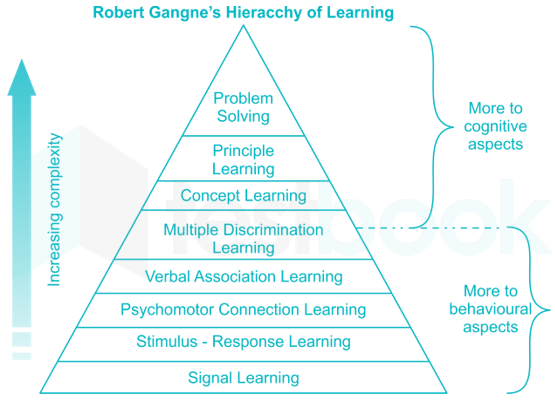
Robert Gagne put forward the conditions or events of learning theory. According to Gagne, learning is supposed to result in the enhancement of a person’s performance and capabilities by acquiring new ways of behaving. His theory emphasized that different internal and external conditions or events are necessary for each type or level of learning.

Key Points

Types of Gagne’s Hierarchical Structure of Learning:

  • Signal Learning – Signal learning is the simplest form of learning. It consist essentially of Pavlov’s Classical conditioning. Learner learns to make a generalized response to a signal or stimulus (known as conditioned stimulus).
  • Stimulus-Response Learning (S-R Learning): This is a sophisticated form of learning, which is also known as Operant conditioning originally developed by Skinner. It involves developing desired stimulus-response bonds. Here, a stimulus is properly discriminated for a response.
  • Chaining: This is a more advance form of learning in which two or more than two Stimulus-Response (S-R) connections are joined together into a linked sequence.
  • Verbal Association: During this type of learning, the learner is formed to emit chained responses of S-R type by making verbal association. It’s one among the key processes within the development of language skills.
  • Multiple Discrimination: This is a stage of good discrimination to learn making different responses to different stimuli. This process is made more complex by the phenomenon of interference.
  • Concept Learning: In this type of learning, one learns to provide a common response to a class of stimuli. It forms the idea of the power to generalize, classify etc.
  • Rule Learning: Rule learning also known as learning of Principles. Principles are generated through the chaining of two or more concepts. This is a very high-level cognitive process, forms the basis of the learning of general rules, procedures etc.
  • Problem Solving: This is the highest form of cognitive process which involves higher mental or cognitive abilities for making use of the concept and rules for solving one or the other problem.

Hence, it could be concluded that signal learning is placed on the lowest level in Gagne's Hierarchy of Learning.

29

Voice modulation during teaching is the example of

  1. ((a))

    Skill of reinforcement

  2. ((b))

    Skill of closure

  3. ((c))

    Skill of stimulus variation

  4. ((d))

    Skill of introduction

Show Answer
Answer: ((c))

Skill of stimulus variation

Voice modulation (changing the pitch, tone, pace, and volume of the voice) is a core component of the Skill of Stimulus Variation.

Key Points

  • The Skill of Stimulus Variation refers to the intentional change in the teacher's behavior and teaching strategies within the classroom to keep students attentive and engaged.

The main components of the Skill of Stimulus Variation include:

  • Teacher Movement: Moving around the classroom.
  • Teacher Gestures: Using hand and body movements.
  • Focusing: Directing student attention to a key point.
  • Shifting Sensory Channels: Moving from verbal to visual, or vice-versa.
  • Pausing: Using silence effectively.
  • Voice Modulation (Change in Speech Pattern): Varying the voice to emphasize key points, create drama, or signal a shift in topic. This directly matches the action described in the question.

Hence, the correct answer is skill of stimulus variation.

Hint

  • Skill of Reinforcement: Involves using positive or negative verbal and non-verbal cues to encourage desired student behavior.
  • Skill of Closure: Involves wrapping up the lesson at the end by summarizing key points and testing comprehension.
  • Skill of Introduction: Involves preparing students for the lesson, linking new material to prior knowledge, and stating the objectives.
30

Which of the following is not the element of communication process?

  1. ((a))

    Feedback

  2. ((b))

    Reinforcement

  3. ((c))

    Medium

  4. ((d))

    Interaction

Show Answer
Answer: ((b))

Reinforcement

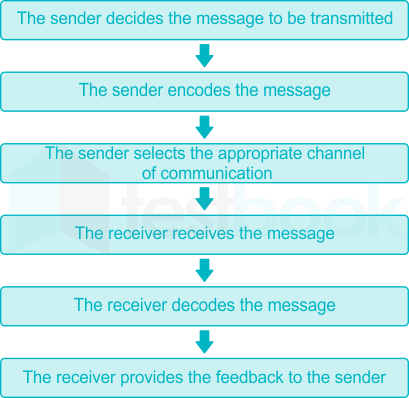
Communication: Communication is the act of transmitting information, ideas and attitudes from one person to another person. It is a two-way process.

Key Points

Elements of Communication Process:

  • Communicator/Sender: Sender is a person who speaks out or sends or transmits or communicates message. It is the first starter of the communication process.
  • Communicatee/Receiver: The receiver is directed audience of the message. He gets the message interprets and tries to the total meaning of the message as transmitted by the sender.
  • Message: Message is information. It may be spoken or written. It is to be sent from one person to another. The information, orders, observations, report that communicated.
  • Medium of Communication/Channel: Channel is the vehicle or medium of conveying message to the receiver. It may be written, oral, audiovisual or live projections. The written medium can be in forms of letters, memos, reports, manuals, etc.
  • Reaction/Interaction: The receiver has to extract the meaning from the symbols sent by the sender and understand completely what he/she needs.
  • Feedback: It is the process in which the receiver and the sender are ensuring that they understood each other correctly and they are proceeding to find a solution.

HintReinforcement is simply defined as an effect that increases the probability of a response. It is, therefore, discussed in terms of observable or measurable events. We reward people, we reinforce the behavior.

Hence, Reinforcement is not an element of the communication process.

Hindi (30 questions)

31

निम्नलिखित में से कौन-सा विकल्प विलोम की दृष्टी से सही नहीं है?

  1. ((a))

    उत्कर्ष – अपकर्ष

  2. ((b))

    कीर्ति – अपकीर्ति

  3. ((c))

    सुबुद्धि – असुबुद्धि

  4. ((d))

    आरोह – अवरोह

Show Answer
Answer: ((c))

सुबुद्धि – असुबुद्धि

उपर्युक्त शब्द युग्मों में विलोम की दृष्टि से 'सुबुद्धि असुबुद्धि' ठीक नहीं है। 'सुबुद्धि' शब्द का विलोम 'दुर्बुद्धि' होगा। अन्य विकल्प विलोम की दृष्टि से सही हैं। इस प्रकार सही विकल्प 'सुबुद्धि – असुबुद्धि' है।

Additional Information

अन्य विकल्प

शब्दअर्थशब्दअर्थ
उत्कर्षउन्नति, ऊपर खींचनाअपकर्षअवनति, उतार, ह्रास
कीर्तियश, प्रसिद्धि, ख्यातिअपकीर्तिअपयश, बदनामी
सुबुद्धिअच्छी या उत्तम बुद्धिदुर्बुद्धिकुबुद्धि, नीच बुद्धि,
आरोहआरोहण, ऊंचे स्वर से उच्चारणअवरोहउतार, पतन


Important Pointsविशेष

शब्दपरिभाषाउदाहरण
विलोम/विपरीतार्थकविपरीत (उल्टा) अर्थ बताने वाले शब्दों को विलोम शब्द कहते हैं।1. आकाश - पाताल 2. राजा - रंक
32

निम्न शब्दों को सुमेलित कीजिए।

IतलवारAवृक्ष
IIटेढ़ाBप्रवीण
IIIतरुCवक्र
IVपटुDकृपाण
  1. ((a))

    I – B, II – A, III – C, IV - D

  2. ((b))

    I – C, II – D, III – B, IV - A

  3. ((c))

    I – D, II – C, III – A, IV - B

  4. ((d))

    I – A, II – B, III – C, IV - D

Show Answer
Answer: ((c))

I – D, II – C, III – A, IV - B

सही विकल्प 'I – D, II – C, III – A, IV - B' है। उपर्युक्त पर्यायवाची शब्दों का सुमेल निम्न प्रकार है।

IतलवारAवृक्ष
IIटेढ़ाBप्रवीण
IIIतरुCवक्र
IVपटुDकृपाण


विकल्पों के अन्य पर्यायवाची -

शब्दपर्यायवाची
तलवारखड्ग, असि, चन्द्रहास, करवाल, शमशीर
टेड़ाबंक, कुटिल, तिरछा
तरुतरुवर, रूंख, द्रुम, पादप, विटप, पेड़
पटुचतुर, विज्ञ, दक्ष, नागर, कुशल, निपुण, योग्य
33

निम्नलिखित में से कौन-सा मिश्र वाक्य है?

  1. ((a))

    यज्ञदत्त देवदत्त को व्याकरण पढ़ता है।

  2. ((b))

    वह उड़ती हुई चिड़िया पहचानता है।

  3. ((c))

    उसमें न पत्ते थे, न फुल थे।

  4. ((d))

    मैंने सुना है कि आपके देश में अच्छा राजप्रबंध है।

Show Answer
Answer: ((d))

मैंने सुना है कि आपके देश में अच्छा राजप्रबंध है।

'मैंने सुना है कि आपके देश में अच्छा राजप्रबंध है।' एक मिश्र वाक्य है।

  • 'यज्ञदत्त देवदत्त को व्याकरण पढ़ाता है।' यह सरल वाक्य है।
  • 'वह उड़ती हुई चिड़िया पहचानता है।' यह सरल वाक्य है।
  • 'उसमें न पत्ते थे, न फूल थे।' यह संयुक्त वाक्य है।
  • इस प्रकार सही विकल्प है 'मैंने सुना है कि आपके देश में अच्छा राजप्रबंध है।'

Key Points

स्पष्टीकरण -

विकल्पवाक्यस्पष्टीकरण
मैंने सुना है कि आपके देश में अच्छा राजप्रबंध है।मिश्रितइसमें प्रधान वाक्य और आश्रित वाक्य है।
यज्ञदत्त देवदत्त को व्याकरण पढ़ाता है।सरलइसमें एक मुख्य क्रिया है।
वह उड़ती हुई चिड़िया पहचानता है।सरलइसमें एक मुख्य क्रिया है।
उसमें न पत्ते थे, न फूल थे।संयुक्तइसमें दो उपवाक्य हैं।

Additional Information

वाक्य - 

रचना की दृष्टि से वाक्य के भेद -
1. सरल - जिन वाक्यों में एक मुख्य क्रिया हो उन्हें सरल या साधारण वाक्य कहते हैं।
2. जटिल - ऐसे वाक्य जिनमें एक से अधिक उपवाक्य हों। जटिल वाक्य के दो भेद हैं - संयुक्त वाक्य और मिश्र वाक्य, संयुक्त वाक्य - जिस वाक्य में दो या दो से अधिक उपवाक्य मिले हों, परन्तु सभी वाक्य प्रधान हो तो ऐसे वाक्य को संयुक्त वाक्य कहते है। मिश्र वाक्य - जिस वाक्य में एक से अधिक वाक्य मिले हों, किन्तु एक प्रधान उपवाक्य तथा शेष आश्रित उपवाक्य हों, मिश्रित वाक्य कहलाता है। मिश्र वाक्य के तीन प्रकार हैं - संज्ञा, विशेषण और क्रिया - विशेषण उपवाक्य।
34

‘वह द्वार-द्वार भीख मांगते चलता है’ वाक्य में कौन-सा कारक है?

  1. ((a))

    अधिकरण

  2. ((b))

    सम्बोधन

  3. ((c))

    सम्बन्ध

  4. ((d))

    अपादान

Show Answer
Answer: ((a))

अधिकरण

‘वह द्वार-द्वार भीख माँगता चलता है’ वाक्य में 'अधिकरण' कारक है क्योंकि इसमें 'द्वार-द्वार' के बाद 'पर' का लोप हो रहा है। इसीलिए यहाँ अधिकरण कारक है। अधिकरण कारक का विभक्ति चिन्ह या परसर्ग 'में, पर' होता है। शेष विकल्प असंगत हैं। अतः यही विकल्प 'अधिकरण' है। 

स्पष्टीकरण

कारकपरिभाषाउदाहरण
अधिकरणशब्द के जिस रूप से क्रिया के आधार का ज्ञान हो, इसकी विभक्ति 'में' और 'पर' है।मोहन मैदान में खेल रहा है, मनोज छत पर पढ़ रहा है।
संबोधनसंज्ञा के जिस रूप से किसी के पुकारने या संकेत करने के भाव का बोध हो, इसकी विभक्ति ‘अरे’ और ‘हे’ है।हे श्याम! इधर आओ!
सम्बन्धसंज्ञा या सर्वनाम के जिस रूप से किसी अन्य शब्द के साथ संबंध का बोध हो, इसकी विभक्ति 'का', 'की', और 'के' है।सीता का भाई आया है, राम की किताब।
अपादानजब दो वस्तुओं के अलग होने का बोध को, चिन्ह – से है।पेड़ से पत्ता गिरा।


कारक चिह्न

परसर्ग - ये वे अक्षर हैं जो किसी शब्द के बाद आते हैं और कोई विशेषता लाते हैं। जैसे - का, की, रे, ने, द्वारा, से आदि।
कारक - संज्ञा या सर्वनाम के जिस रूप से वाक्य के अन्य शब्दों के साथ उसके सम्बन्ध का बोध होता है, उसे कारक कहते हैं।
विभक्तिकारकचिन्ह/ परसर्ग
प्रथमकर्ता कारकने
द्वितीयकर्म कारकको
तृतीयकरण कारकसे, के द्वारा
चतुर्थीसम्प्रदान कारकको, के लिए (देने का भाव)
पंचमीअपादान कारकसे, (अलग होने के लिए)
षष्ठीसंबंध कारकका, की, के, रा, री, रे
सप्तमीअधिकरण कारकमें, पर
अष्टमीसंबोधनहे ! ओ ! अरे !
35

‘आयुष्मान’ का स्त्रीलिंग क्या है?

  1. ((a))

    आयुषी

  2. ((b))

    आयुश्यमयी

  3. ((c))

    आयुष्मती

  4. ((d))

    आयुष्मयी

Show Answer
Answer: ((c))

आयुष्मती

‘आयुष्मान’ का स्त्रीलिंग शब्द 'आयुष��मती' है। अन्य विकल्प वर्तनी की दृष्टि से अशुद्ध हैं। इस प्रकार सही विकल्प 'आयुष्मती' है।

शब्दार्थ

'आयुष्मान' का अर्थ चिरंजीवी, दीर्घायु है। 'आयुष्मती' का अर्थ 'चिरंजीवी या अधिक आयु पाने वाली' है।

विशेष

लिंग - संज्ञा के जिस रूप से उसके नर या मादा जाति का बोध हो उसे लिंग कहते हैं। लिंग के भेद -
पुल्लिंग - पुरुष जाति का बोध कराने वाले शब्द पुल्लिंग कहलाते हैं। जैसे - मनुष्य, मस्तक, प्रश्न, चित्र आदि।
स्त्रीलिंग - स्त्री जाति का बोध कराने वाले शब्द स्त्रीलिंग कहलाते हैं। जैसे - सभा, महिला, दया, शिक्षा आदि।

निर्देश – निम्नलिखित गद्यांश के आधार पर सही विकल्प चुनिए।

कला और जीवन का सम्बन्ध अन्योंन्याश्रित है। कलाकार, कल्पना और यथार्थ का समन्वय कर समाज के समक्ष आदर्श रूप प्रस्तुत कर्ता है। इसी कारण जीवन का कला के स्वरूप पर व्यापक प्रभाव पड़ता है। कलाकार जीवन के यथार्थ रूप को ही चित्रित नहीं करता, वरन् वह आदर्श रूप को भी प्रस्तुत करता है। इस प्रकार जीवन का कला पर और कला का जीवन पर व्यापक प्रभाव पड़ता है। कलावाद अर्थात कला, कला के लिए सम्बन्धी विचारो में जीवन के लिए उपयोगी कला ही श्रेयस्कर मानी गयी है।

36

कौन-सी कला श्रेष्ठ मानी गई है?

  1. ((a))

    जो कल्पना पर आधारित हो।

  2. ((b))

    जो जीवनोपयोगी हो।

  3. ((c))

    जो कलावाद पर आधारित हो।

  4. ((d))

    जो प्रकृति का चित्रण करती हो।

Show Answer
Answer: ((b))

जो जीवनोपयोगी हो।

'जो जीवनोपयोगी हो।' कला श्रेष्ठ मानी गई है। गद्यांश में प्रस्तुत पंक्ति 'कलावाद अर्थात कला, कला के लिए सम्बन्धी विचारो में जीवन के लिए उपयोगी कला ही श्रेयस्कर मानी गयी है।' से स्पष्ट होता है। अन्य विकल्प असंगत हैं। अतः सही विकल्प ' जो जीवनोपयोगी हो।' है।

अन्य जानकारी -

'जीवनोपयोगी' में गुण स्वर संधि है - 'जीवन + उपयोगी = जीवनोपयोगी' 

नियम - अ + उ = ओ

37

कला और जीवन अन्योंन्याश्रित है का तात्पर्य है

  1. ((a))

    एक दूसरे पर आश्रित है |

  2. ((b))

    किसी अन्य तत्व पर आश्रित है |

  3. ((c))

    जीवन में दोनों उपयोगी है |

  4. ((d))

    एक दूसरे से पृथक है

Show Answer
Answer: ((a))

एक दूसरे पर आश्रित है |

कला और जीवन अन्योंन्याश्रित है का तात्पर्य है 'एक दूसरे पर आश्रित है।' शेष विकल्प असंगत हैं। अतः सही विकल्प 'एक दूसरे पर आश्रित है।'

निर्देश : दिए गए गद्यांश को पढ़कर निम्नलिखित सही विकल्प छांटिए।

“स्याम गौर किमि कहीं बखानी

गिरा अनयन नयन बिनु बानी ।।

38

यह पद्यांश किस कवि का है ?

  1. ((a))

    तुलसीदास

  2. ((b))

    नाभादास

  3. ((c))

    कुंभनदास

  4. ((d))

    सूरदास

Show Answer
Answer: ((a))

तुलसीदास

यह पद्यांश 'तुलसीदास' कवि द्वारा रचित 'रामचरितमानस' के बालकाण्ड से लिया गया है। अन्य विकल्प असंगत हैं। अतः सही विकल्प 'तुलसीदास' है।

पद्यांश का अर्थ है "दो राजकुमार बाग देखने आए हैं। किशोर अवस्था के हैं और सब प्रकार से सुंदर हैं।"

39

इस पद में कौन-सा भाव है?

  1. ((a))

    सुकुमार भाव

  2. ((b))

    मधुर भाव

  3. ((c))

    करुण भाव

  4. ((d))

    ओज भाव

Show Answer
Answer: ((b))

मधुर भाव

उपर्युक्त पद्य में 'मधुर भाव' है क्योंकि इसमें सीता जी की सखियों द्वारा राम और लक्ष्मण के सौंदर्य का वर्णन हो रहा है, ऐसा सुनकर सीता जी के मन में मधुरता का भाव जाग रहा है। अन्य विकल्प असंगत हैं। अतः सही विकल्प 'मधुर भाव' है।

40

“चाँदनी चौक” में कौन-सी संज्ञा है ?

  1. ((a))

    व्यक्तिवाचक संज्ञा

  2. ((b))

    भाववाचक संज्ञा

  3. ((c))

    द्रव्यवाचक संज्ञा

  4. ((d))

    जातिवाचक संज्ञा

Show Answer
Answer: ((a))

व्यक्तिवाचक संज्ञा

'चाँदनी चौक' में 'व्यक्तिवाचक संज्ञा' है। जहाँ किसी ख़ास व्यक्ति, स्थान अथवा वस्तु के नाम का बोध हो वहां व्यक्तिवाचक संज्ञा होती है। अन्य विकल्प असंगत हैं। अतः सही विकल्प 'व्यक्तिवाचक संज्ञा' है।

विशेष

संज्ञा - किसी प्राणी, वस्तु, स्थान, गुण या भाव के नाम को संज्ञा कहते है। संज्ञा के प्रकार -
संज्ञापरिभाषाउदाहरण
व्यक्तिवाचकजो किसी व्यक्ति, स्थान या वस्तु के नाम का बोध कराती है।राम, गंगा, पटना
जातिवाचकजो संज्ञा एक ही प्रकार की वस्तुओं का (पूरी जाति का) बोध कराती है।नदी, पर्वत, लड़की
द्रव्यवाचकजिस संज्ञा शब्द से उस सामग्री या पदार्थ का बोध होता है जिससे कोई वस्तु बनी है।सोना, चाँदी, पानी
समूहवाचकजो संज्ञा शब्द किसी एक व्यक्ति का वाचक न होकर पूरे समूह या समुदाय का वाचक हो।वर्ग, तीम, सभा
भाववाचकजो संज्ञा किसी भाव, गुण, दशा आदि का बोध कराती है।क्रोध, मिठास, यौवन
41

उपचारात्मक शिक्षण का आधार निम्न में से कौन-सा है?

  1. ((a))

    पाठ्य-पुस्तक परीक्षण

  2. ((b))

    निदानात्मक परीक्षण

  3. ((c))

    व्याख्यान परीक्षण

  4. ((d))

    स्व परीक्षण

Show Answer
Answer: ((b))

निदानात्मक परीक्षण

निदानात्मक शिक्षण विधि का अर्थ है बालक की अधिगम संबंधी कठिनाईयों को पहचानना। कठिनाईयों को पहचानने के बाद इन कठिनाईयों को दूर करने के लिए उपचारात्मक शिक्षण किया जाता है।

Important Points

  • निदान में जहॉ बच्चों की कठिनाइयों का पता लगाया जाता है वहीं उपचारात्मक शिक्षण में इन कठिनाइयों को दूर करते हुय शिक्षण किया जाता है।
  • रोग के निदान के उपरान्त उसका उपचार आवश्यक होता है।
  • शिक्षा क्षेत्र में उपचारात्मक शिक्षण एक नवीन प्रयोग है।
  • यह सामान्य शिक्षण से अधिक प्रभावकारी, सरल एवं मनोवैज्ञानिक है।
  • यह शिक्षण व सीखने के दूषित एवं अशुद्ध ढ़ग को मिटाने के लिये तथा उन्हें सुधारात्मक रूप व दिशा प्रदान करता है।
  • यह प्रत्येक प्रकार के सीखने की अशुद्धियों में सुधार करके विकासात्मक एवं उपचारात्मक शिक्षण दोनों एक दूसरे के सहयोगी है।
  • निदान के बिना उपचार नहीं हो सकता है। उसी प्रकार निदानात्मक शिक्षण के बिना उपचारात्मक शिक्षण नहीं दिया जा सकता।
  • निदानात्मक एवं उपचारात्मक शिक्षण एक ही सिक्‍के के दो पहलू के समान है।
  • बिना एक दूसरे के दोनों अधूरे है।

अतः हम कह सकते हैं कि उपचारात्मक शिक्षण का आधार निदानात्मक परीक्षण है।

42

‘अयोगवाह’ किसे कहते है?

  1. ((a))

    महाप्राण को

  2. ((b))

    संयुक्त व्यंजन को

  3. ((c))

    अल्पप्राण को

  4. ((d))

    विसर्ग को

Show Answer
Answer: ((d))

विसर्ग को

‘अयोगवाह’ 'विसर्ग को' कहा जाता है। अन्य विकल्प असंगत हैं। अतः सही विकल्प 'विसर्ग को' है।

अयोगवाह — अयोगवाह अनुस्वार (ं) और विसर्ग (ः) को कहते हैं क्योंकि यह ना तो स्वर के अंतर्गत आते हैं और ना ही व्यंजन के अन्तर्गत आते हैं। लेकिन यह स्वर के अंत में अवश्य लगते हैं।
43

निम्नलिखित शब्दों का सुमेल कीजिए।

Iसत्यार्थ प्रकाशAनाभादास
IIरामचरितमानसBसूरदास
IIIसूरसागरCदयानंद सरस्वती
IVभक्तमालDतुलसीदास
  1. ((a))

    I – C, II – D, III – B, IV - A

  2. ((b))

    I – D, II – C, III – B, IV - A

  3. ((c))

    I – B, II – C, III – D, IV - A

  4. ((d))

    I – A, II – B, III – C, IV - D

Show Answer
Answer: ((a))

I – C, II – D, III – B, IV - A

रचनाकारों की रचनाओं के अनुसार सही विकल्प 'I – C, II – D, III – B, IV - A' है। सुमेल निम्न प्रकार है।

Iसत्यार्थ प्रकाशCदयानंद सरस्वती
IIरामचरितमानसDतुलसीदास
IIIसूरसागरBसूरदास
IVभक्तमालAनाभादास


विशेष -

रचनारचनाकार
सत्यार्थ प्रकाशसत्यार्थ प्रकाश आर्य समाज का प्रमुख ग्रन्थ है जिसकी रचना महर्षि दयानन्द सरस्वती ने 1875 ई में हिन्दी में की थी।
रामचरितमानसतुलसीदास की सबसे प्रमुख कृति है। इसकी रचना संवत 1631 ई. की रामनवमी को अयोध्या में प्रारम्भ हुई थी।
सूरसागरयह ब्रजभाषा में महाकवि सूरदास द्वारा रचे गए कीर्तनों-पदों का एक सुंदर संकलन है।
भक्तमालभक्तमाल हिन्दी का एक ऐतिहासिक ग्रन्थ है। इसके रचयिता नाभादास या नाभाजी हैं।
44

निम्न में कौन सा विकल्प भाव वाच्य का उदाहरण है?

I. उससे बैठा नहीं जाता।

II. राम से खाया नहीं जाता।

III. राम पत्र लिखता है।

IV. सीता पुस्तक पढ़ती है।

  1. ((a))

    I, II एवं III

  2. ((b))

    I, II, III एवं IV

  3. ((c))

    I, II एवं IV

  4. ((d))

    I एवं II

Show Answer
Answer: ((d))

I एवं II

उपर्युक्त में भाव वाच्य का उदहारण 'I. उससे बैठा नहीं जाता। II. राम से खाया नहीं जाता।' है। अन्य विकल्प उचित नहीं हैं। अतः सही विकल्प 'I एवं II' है।

वाच्य - क्रिया के जिस रूप से यह ज्ञात हो कि वाक्य में क्रिया द्वारा बताए गए विषय में कर्ता, कर्म, अथवा भाव में से कौन प्रमुख है, उसे वाच्य कहते हैं।
वाच्यवाक्य
कर्तृ वाच्य - जहाँ क्रिया का संबंध सीधा कर्ता से हो तथा क्रिया का लिंग तथा वचन कर्ता के अनुसार ही उसे कर्तृ वाच्य कहते हैं।1. रोहित क्रिकेट खेलता है।
कर्म वाच्य - जहाँ क्रिया का संबंध सीधा कर्म से हो तथा क्रिया का लिंग तथा वचन कर्म के अनुसार हो, उसे कर्म वाच्य कहते हैं।2. रोहित द्वारा क्रिकेट खेला जाता है।
भाव वाच्य - जहाँ कर्ता और कर्म की नहीं बल्कि भाव की प्रधानता हो, उस वाक्य को भाव वाच्य कहते हैं।3. रोहित से क्रिकेट खेला जाता है।
45

निम्नलिखित में से कौन-सा उत्तर सही है?

I. अनुस्वार पूर्ण अनुनासिक ध्वनि है |

II. वर्ग का पंचमाक्षर अनुस्वार होता है |

III. अनुनासिक के उच्चारण के दौरान नाक से बहुत कम सांस निकलती है और मुँह से अधिक |

  1. ((a))

    केवल I एवं II

  2. ((b))

    केवल I

  3. ((c))

    केवल III

  4. ((d))

    I, II एवं III

Show Answer
Answer: ((d))

I, II एवं III

उपर्युक्त में से तीनों कथन :

  • 'I. अनुस्वार पूर्ण अनुनासिक ध्वनि है |
  • II. वर्ग का पंचमाक्षर अनुस्वार होता है |
  • III. अनुनासिक के उच्चारण के दौरान नाक से बहुत कम सांस निकलती है और मुँह से अधिक |' सही हैं।
  • अतः सही विकल्प 'I, II एवं  III' है।​

Key Points

  • अनुस्वार और अनुनासिक के उच्चारण में भिन्नता है।
  • अनुस्वार के उच्चारण में वायु नाक से निकलती है, जबकि अनुनासिक  के उच्चारण के समय वायु नाक और मुँह दोनों से निकलती है।
  • जैसे – हंस और हँसना।

Additional Information

जिन वर्णों पर अनुस्वार और विसर्ग लगे होते है, उन्हें अयोगवाह वर्ण कहते है।

  • अयोगवाह स्वर तथा व्यंजन के साथ लगते हैं।
  • अयोगवाह के भेद- 
  1. अनुस्वार
  2. विसर्ग
  3. अनुनासिक
46

“मिट्टी का माधो” होने से क्या अर्थ है?

  1. ((a))

    कृष्ण की मूर्ति

  2. ((b))

    बहुत ही मुर्ख

  3. ((c))

    समझदार होना

  4. ((d))

    मिट्टी की मूर्ति 

Show Answer
Answer: ((b))

बहुत ही मुर्ख

उपर्युक्त मुहावरा 'मिट्टी का माधो' का अर्थ 'बहुत ही मुर्ख' है। अन्य विकल्प असंगत हैं। अतः सही विकल्प 'बहुत ही मुर्ख' है।

वाक्य प्रयोग - सोहन को कुछ भी समझाना व्यर्थ है वह तो 'मिटटी का माधो' है।

अन्य महत्वपूर्ण मुहावरे

मुहावरेअर्थउदाहरण
गर्दन पर छुरी चलानानुकसान पहुंचानामुझे पता चल गया कि विरोधियों से मिलकर किस तरह मेरे गले पर छुरी चला रहे थे।
घी के दीए जलानाअप्रत्याशित लाभ पर प्रसत्रताजिससे तुम्हारी बराबर ठनती रही, वह बेचारा कल शाम कूच कर गया। अब क्या है, घी के दीये जलाओ।
घात लगानामौका ताकनावह चोर दरवान इसी दिन के लिए तो घात लगाये था, वर्ना विश्र्वास का ऐसा रँगीला नाटक खेलकर सेठ की तिजोरी-चाबी तक कैसे समझे रहता?
47

‘तद्धित’ का सन्धि-विच्छेद क्या है?

  1. ((a))

    तत् + हित

  2. ((b))

    तद + हित

  3. ((c))

    तत + धित

  4. ((d))

    तद + धित

Show Answer
Answer: ((a))

तत् + हित

‘तद्धित’ का सन्धि-विच्छेद 'तत् + हित' है। यहाँ व्यंजन संधि है। इस प्रकार सही विकल्प 'तत् + हित' है।

स्पष्टीकरण

  • व्यंजन संधि में वर्गों के अंतिम वर्णों को छोड़, शेष वर्णों के बाद 'ह' आये, तो 'ह' पूर्व वर्ण के वर्ग का चतुर्थ वर्ण में बदल जाता है और 'ह' के पूर्व वर्ण अपने वर्ग का तृतीय वर्ण हो जाता है। जैसे – उत् + हरण = उद्धरण, पद् + हती = पद्धति।

विशेष

संधि - दो शब्दों के मेल से जो विकार (परिवर्तन) होता है उसे संधि कहते हैं। संधि के तीन प्रकार हैं - 1. स्वर, 2. व्यंजन और 3. विसर्ग
संधिपरिभाषाउदाहरण
स्वरस्वर वर्ण के साथ स्वर वर्ण के मेल से विकार उत्पन्न होता है।विद्या + अर्थी = विद्यार्थी महा + ईश = महेश
व्यंजनएक व्यंजन से दूसरे व्यंजन या स्वर के मेल से विकार उत्पन्न होता है।अहम् + कार = अहंकार उत् + लास = उल्लास
विसर्गविसर्ग के साथ स्वर या व्यंजन के मेल से विकार उत्पन्न होता है।दुः + आत्मा = दुरात्मा निः + कपट = निष्कपट
48

'उद्विग्न’ का सन्धि-विच्छेद क्या है?

  1. ((a))

    उत् + विग्न

  2. ((b))

    उत + विन्न

  3. ((c))

    उड़ + दिन्न

  4. ((d))

    उत + दिग्न

Show Answer
Answer: ((a))

उत् + विग्न

‘उद्विग्न’ का सन्धि-विच्छेद 'उत् + विग्न' है। यहाँ में व्यंजन संधि है। अतः सही विकल्प 'उत् + विग्न' है।

स्पष्टीकरण

- व्यंजन संधि के नियम के अनुसार किसी भी वर्ग का पहला वर्ण (क, च, त आदि) + घोष वर्ण (तीसरा या चौथा वर्ण, स्वर तथा अन्तस्थ (य, र, ल, व) ) आये तो पहला वर्ण अपने वर्ग के तीसरे वर्ण में रूपांतरित हो जाता है।

विशेष

संधि - दो शब्दों के मेल से जो विकार (परिवर्तन) होता है उसे संधि कहते हैं। संधि के तीन प्रकार हैं - 1. स्वर, 2. व्यंजन और 3. विसर्ग,
संधिपरिभाषाउदाहरण
स्वरस्वर वर्ण के साथ स्वर वर्ण के मेल से विकार उत्पन्न होता है।विद्या + अर्थी = विद्यार्थी महा + ईश = महेश
व्यंजनएक व्यंजन से दूसरे व्यंजन या स्वर के मेल से विकार उत्पन्न होता है।अहम् + कार = अहंकार उत् + लास = उल्लास
विसर्गविसर्ग के साथ स्वर या व्यंजन के मेल से विकार उत्पन्न होता है।दुः + आत्मा = दुरात्मा निः + कपट = निष्कपट
49

निम्नलिखित पंक्तियों में कौन-सा अलंकार है?   

‘बीती विभावरी जागरी

अम्बर पनघट में डुबो रही

तारघट उषा नागरी’

  1. ((a))

    रूपक

  2. ((b))

    उपमा

  3. ((c))

    यमक

  4. ((d))

    उत्प्रेक्षा

Show Answer
Answer: ((a))

रूपक

  • उपर्युक्त पद्य में 'रूपक' अलंकार है क्योंकि इसमें 'अम्बर' (उपमेय) पर 'पनघट' (उपमान) का 'तारा' (उपमेय) पर 'घट' (उपमान) का तथा 'उषा' (उपमेय) पर 'नागरी' (उपमान) का अभेद आरोप है।
  • इस प्रकार इसमें 'रूपक अलंकार' प्रयुक्त है। अन्य विकल्प असंगत हैं। अतः सही विकल्प 'रूपक' है।

Additional Information

अन्य विकल्प

अलंकारपरिभाषाउदाहरण
रूपकजब उपमान और उपमेय में अभिन्नता या अभेद दिखाया जाए।“मैया मैं तो चन्द्र-खिलौना लैहों” में चन्द्रमा और खिलौने में समानता न दिखाकर चन्द्र को ही खिलौना बोल दिया गया है।
उपमाउपमा शब्द का अर्थ होता है ‘तुलना’। जब किसी व्यक्ति या वस्तु की तुलना किसी दूसरे यक्ति या वस्तु से की जाए, वहाँ पर उपमा अलंकार होता है।कर कमल-सा कोमल है।
यमकजहाँ एक ही शब्द जितनी बार आए उतने ही अलग-अलग अर्थ दे।काली ‘घटा’ का घमंड ‘घटा’।
उत्प्रेक्षाजहाँ उपमेय में उपमान के होने की संभावना का वर्णन होता हो।“मुख मानो चन्द्रमा है” में मुख को चंद्रमा कहा जा रहा है।
50

निम्न में कौन सा अलंकार प्रयुक्त है?

<br>

बिन घनस्याम धाम – धाम ब्रज मण्डल में,

उधौ नित बसति बहार बरसा की है ||

  1. ((a))

    यमक

  2. ((b))

    श्लेष

  3. ((c))

    रूपक

  4. ((d))

    उपमा

Show Answer
Answer: ((b))

श्लेष

उपर्युक्त पद्य में 'श्लेष' अलंकार है। इसमें 'घनश्याम' शब्द के एक से अधिक अर्थ हैं। एक अर्थ 'श्रीकृष्ण' दूसरा अर्थ 'बादल' है इसीलिए यहाँ 'श्लेष अलंकार' है। शेष विकल्प असंगत हैं। अतः सही विकल्प 'श्लेष' है।

स्पष्टीकरण

अलंकारपरिभाषाउदाहरण
रूपकजब उपमान और उपमेय में अभिन्नता या अभेद दिखाया जाए।“मैया मैं तो चन्द्र-खिलौना लैहों” में चन्द्रमा और खिलौने में समानता न दिखाकर चन्द्र को ही खिलौना बोल दिया गया है।
उपमाउपमा शब्द का अर्थ होता है ‘तुलना’। जब किसी व्यक्ति या वस्तु की तुलना किसी दूसरे यक्ति या वस्तु से की जाए, वहाँ पर उपमा अलंकार होता है।कर कमल-सा कोमल है।
यमकजहाँ एक ही शब्द जितनी बार आए उतने ही अलग-अलग अर्थ दे।काली ‘घटा’ का घमंड ‘घटा’।
श्लेषजब एक ही शब्द के विभिन्न अर्थ निकलते हों।‘रहिमन पानी राखिए बिन पानी सब सून ‘पानी’ गए ऊबरे मोती मानस चून’ यहाँ ‘पानी’ मोती के सन्दर्भ में ‘चमक’, मनुष्य के सन्दर्भ में ‘विनम्रता’ तथा ‘चून (आटा)’ के सन्दर्भ में ‘जल अर्थात पानी’ है।
51

निम्नलिखित में कौन-सा शब्द एकवचन तथा बहुवचन दोनों में प्रयोग हो सकता है?

  1. ((a))

    लड़का

  2. ((b))

    बेटा

  3. ((c))

    मुनि

  4. ((d))

    बालिका

Show Answer
Answer: ((c))

मुनि

'मुनि' शब्द एकवचन तथा बहुवचन दोनों में प्रयोग हो सकता है। अन्य विकल्प असंगत हैं। अतः सही विकल्प 'मुनि' है।

निम्नलिखित उदाहरण से स्पष्ट है -

  1. एकवचन - मुनि ने बालक को आशीर्वाद दिया। 2. बहुवचन - मुनि भोजन कर रहे हैं। 

अन्य विकल्प -

एकवचनबहुवचन
लड़कालड़के
बेटाबेटे
बालिकाबालिकाएं


विशेष - 

वचन - संज्ञा, सर्वनाम, विशेषण और क्रिया के जिस रूप से संख्या का बोध हो उसे वचन कहते हैं।
वचन के दो प्रकार हैं - 1. एकवचन, 2. बहुवचन
वचनपरिभाषाउदाहरण
एकवचनशब्द के जिस रूप से किसी व्यक्ति, वस्तु आदि के एक होने का बोध हो, उसे एकवचन कहते हैंस्त्री, घोड़ा, नदी, रुपया
बहुवचनशब्द के जिस रूप से एक से अधिक व्यक्तियों या वस्तुओं आदि का बोध हो, उसे बहुवचन कहते हैं।स्त्रियाँ, घोड़े, नदियाँ, रुपये
52

तत्सम और तद्भव का कौन-सा युग्म सही है?

  1. ((a))

    कुक्षि - कोख

  2. ((b))

    कपित्थ – कैथा

  3. ((c))

    कर्हाट – कड़ाह  

  4. ((d))

    अगम – अगम

Show Answer
Answer: ((a))

कुक्षि - कोख

तत्सम और तद्भव का 'कुक्षि - कोख' सही युग्म है। अतः सही विकल्प 'कुक्षि - कोख' है।

Key Points

तत्समतद्भव
कपित्थकैथ
कटाहकड़ाह
अगम्यअगम

Additional Information

शब्दपरिभाषाउदाहरण
तत्सम शब्दऐसे शब्द जो संस्कृत से ज्यों - के - त्यों ले लिए गए हैं।आम्र, उष्ट्र, ऐश्वर्य, षष्ठी आदि।
अर्धतत्सम शब्दऐसे शब्द जो संस्कृत से थोड़ा परिवर्तित होकर हिंदी में आये हैं।कार्य से कारज, धैर्य से धीरज आदि।
तद्भव शब्दऐसे शब्द जो संस्कृत से हिंदी में आने पर उनका रूप बदल गया।आग, खीर, छत आदि।
53

निम्नलिखित शब्दों में किस में उपसर्ग का निर्देश अशुद्ध है?

  1. ((a))

    अध + सेरा = अधसेरा

  2. ((b))

    उत् + ग्रीव = उदग्रीव

  3. ((c))

    निम् + अज्जित = निमज्जित

  4. ((d))

    नि + खरा = निखरा

Show Answer
Answer: ((c))

निम् + अज्जित = निमज्जित

'निम् + अज्जित = निमज्जित' उपसर्ग के निर्देशानुसार अशुद्ध है।

  • इसका शुद्ध रूप 'नि + मज्जित = निमज्जित' है।
  • 'निमज्जित' का अर्थ 'नहाया हुआ' होता है। शेष विकल्प अनुपयुक्त हैं।
  • अतः सही विकल्प 'निम् + अज्जित = निमज्जित' है।

Additional Information

उपसर्गप्रत्यय
उपसर्ग उस अक्षर या अक्षर समूह को कहते हैं जो किसी शब्द के पहले जुड़कर उसके अर्थ में परिवर्तन लाता है।शब्द के उपरांत जिस शब्द का प्रयोग किया जाता है वह प्रत्यय है।
जैसे - प्र, सु, अति, अधि, अनु, नि प्र + हार = प्रहारजैसे - ता, औना, अन, अत श्रो + ता = श्रोता
54

किस शब्द में तत्पुरुष समास है?

  1. ((a))

    पीताम्बर

  2. ((b))

    त्रिभुवन

  3. ((c))

    दौड़धूप 

  4. ((d))

    मधुमक्खी

Show Answer
Answer: ((d))

मधुमक्खी

उपर्युक्त विकल्पों में से 'मधुमक्खी' में तत्पुरुष समास है। इसका समास विग्रह 'मधु की मक्खी' होग��� तथा इसमें 'की' का लोप होने से ये 'सबंध तत्पुरुष समास' है। अतः सही विकल्प 'मधुमक्खी' है।

अन्य विकल्पों का समास विग्रह निम्न प्रकार है:

शब्दसमास विग्रहसमास का नाम
पीताम्बरपीला है अम्बर जिसका अर्थात विष्णुबहुव्रीहि समास
त्रिभुवनतीन भुवन का समूहद्विगु समास
दौड़धूपदौड़ या धूपद्वंद्व समास


विशेष

समासपरिभाषाउदाहरण
बहुव्रीहि समासजिस समास में दोनों पद प्रधान नहीं होते हैं और दोनों पद मिलकर किसी अन्य विशेष अर्थ की ओर संकेत कर रहे होते हैं।जैसे - जो महान वीर है = महावीर अर्थात हनुमान। - तीन आँखों वाला = त्रिलोचन अर्थात शिव।
द्विगु समासजिस समास में पूर्वपद (पहला पद) संख्यावाचक विशेषण हो।जैसे - दो पहरों का समूह = दोपहर। - तीनों लोकों का समाहार = त्रिलोक।
विशेष
द्विगु तथा बहुव्रीहि समास में अंतर :
द्विगु समास का पहला पद संख्यावाचक विशेषण होता है और दूसरा पद विशेष्य होता है जबकि बहुव्रीहि समास में समस्त पद ही विशेषण का कार्य करता है। जैसे – दोपहर- दो पहरों का समूह (द्विगु समास), चतुर्भुज- चार है भुजाएँ जिसकी अर्थात विष्णु (बहुव्रीहि समास)।
55

‘सर पर सवार रहना’ मुहावरे का अर्थ क्या है?

  1. ((a))

    भाग जाना

  2. ((b))

    मरने-मारने पर उतारू होना  

  3. ((c))

    पीछे पड़ना

  4. ((d))

    बाधक होना

Show Answer
Answer: ((c))

पीछे पड़ना

‘सर पर सवार रहना’ मुहावरे का अर्थ 'पीछे पड़ना' है। जैसे - परीक्षा के वक़्त शिक्षकगण सर पर सवार रहते हैं। अतः सही विकल्प 'पीछे पड़ना' है। 

अन्य विकल्प

मुहावरेअर्थउदाहरण
नौ दो ग्यारह होनाभाग जानावह बदमाश गठरी लेकर नौ दो ग्यारह हो गया।
जान पर खेलना/ सिर पर खून सवार होनामरने-मारने पर उतारू होनातुम अपना मुँह बंद रखो, अभी मेरे सिर पर खून सवार है
रास्ते का काँटा होनाबाधक होनाउस चुगलखोर के यहाँ से चले जाने से तुम्हारें रास्ते का काँटा निकल गया।
56

‘वह बहुत अच्छा लड़का है’ वाक्य में ‘वह’ कौन-सा सर्वनाम है?

  1. ((a))

    अनिश्चयवाचक सर्वनाम

  2. ((b))

    सम्बन्धवाचक सर्वनाम

  3. ((c))

    निजवाचक सर्वनाम

  4. ((d))

    निश्चयवाचक सर्वनाम

Show Answer
Answer: ((d))

निश्चयवाचक सर्वनाम

‘वह बहुत अच्छा लड़का है’ वाक्य में ‘वह’ 'निश्चयवाचक सर्वनाम' है। शेष विकल्प असंगत हैं। अतः सही विकल्प 'निश्चयवाचक सर्वनाम' है।

Key Points

उपर्युक्त वाक्य में 'बहुत' 'प्रविशेषण' है, 'अच्छा' 'गुणवाचक विशेषण' है, 'लड़का' 'जातिवाचक संज्ञा, विशेष्य' है, 'है' 'सहायक क्रिया' है। 'वह' 'निश्चयवाचक सर्वनाम' है। 

सर्वनाम - संज्ञा के स्थान पर प्रयुक्त होने वाले शब्दों को सर्वनाम कहते हैं। जैसे - मैं, वह, वे, उन्हें, अपने तुम, हम आदि। हिंदी में सर्वनामों की संख्या 11 है – ‘मैं, तू, आप, यह, वह, जो, सो, कोई, कुछ, कौन, क्या’ सर्वनाम के छः भेद हैं –
सर्वनामपरिभाषाउदाहरण
निश्चयवाचकजो सर्वनाम शब्द किसी व्यक्ति, वस्तु आदि का निश्चयपूर्वक बोध कराते हैं वे निश्चयवाचक सर्वनाम कहलाते हैं।वे, यह, वह
पुरुषवाचक (व्यक्तिवाचक)जिस सर्वनाम का प्रयोग वक्ता द्वारा स्वयं के लिए या अन्य व्यक्ति के लिए किया जाता है।मैं, हम, मुझे, तू, तुम, तुझे, तुम्हारा, वह, वे, उसने
निजवाचकजहाँ स्वयं के लिए 'आप, अपना, अपने आप' शब्दों का प्रयोग हो।अपने आप, स्वतः
प्रश्नवाचक सर्वनामजो सर्वनाम शब्द संज्ञा के स्थान पर आकर वाक्य को प्रश्वाचक बनाते हैं।क्या, कौन
अनिश्चयवाचकजिन सर्वनाम शब्द��ं से वस्तु, व्यक्ति, स्थान आदि की निश्चितता का बोध नही होता वे अनिश्चयवाचक सर्वनाम कहलाते हैं।कुछ, कोई
सम्बन्धवाचकजिन सर्वनाम शब्दों का प्रयोग किसी वस्तु या व्यक्ति का सम्बन्ध बताने के लिए किया जाए वे शब्द सम्बन्धवाचक सर्वनाम कहलाते हैं।जो-सो, जैसा-वैसा
57

‘मनोहर जीवनभर पूरा सुख भोगता रहा’ इस वाक्य में 'पूरा' कौन-सा विशेषण है ?

  1. ((a))

    गुणवाचक विशेषण

  2. ((b))

    सार्वनामिक विशेषण

  3. ((c))

    संख्यावाचक विशेषण

  4. ((d))

    परिमाणवाचक विशेषण

Show Answer
Answer: ((d))

परिमाणवाचक विशेषण

‘मनोहर जीवनभर पूरा सुख भोगता रहा’ इस वाक्य में 'परिमाणवाचक विशेषण' है। अन्य विकल्प असंगत हैं। अतः सही विकल्प 'परिमाणवाचक विशेषण' है।

Key Points

  • उपर्युक्त वाक्य में 'पूरा' शब्द मात्रा या परिमाण के बारे में बता रहा है।
  • परिमाणवाचक विशेषण - ऐसे शब्द जो संज्ञा या सर्वनाम की मात्रा का बोध कराते हैं। जैसे - चार किलो, एक मीटर, दो लीटर, थोड़ा, बहुत आदि।


अन्य विकल्प

गुणवाचक विशेषणवे शब्द जो संज्ञा या सर्वनाम के गुण, धर्म, स्वाभाव आदि का बोध कराये। जैसे - बलशाली, पुराण, नया, तीक्ष्ण, कमजोर, मोटा, दुर्बल, पठारी आदि।
सार्वनामिक विशेषणवे सर्वनाम शब्द जो संज्ञा से पहले आयें और विशेषण की तरह उस संज्ञा शब्द की विशेषता बताएं। जैसे - यह लड़की वही है जिसने मेरा पेन लिया था।
संख्यावाचक विशेषणऐसे शब्द जो संज्ञा या सर्वनाम की संख्या का बोध कराते हैं। जैसे - दो, तीनों, चार गुना, प्रत्येक आदि।


Important Points

विशेषण - जो शब्द संज्ञा या सर्वनाम शब्दों की विशेषता बताते हैं।

विशेष्य - जिसकी विशेषता बताई जाती है उसे विशेष्य कहते हैं। जैसे - खीरा (विशेष्य) कड़वा (विशेषण) है।

प्रविशेषण - जिन शब्दों से विशेषण की विशेषता का पता चलता है। जैसे - यह आम बहुत मीठा है।

उद्देश्य विशेषण - विशेष्य से पहले जो विशेषण लगते हैं। जैसे - सुंदर लडकी

विधेय विशेषण - जो विशेष्य संज्ञा और सर्वनाम आदि के बाद प्रयुक्त होते हैं। जैसे - ये फल मीठे हैं।

58

दांत और जीभ के स्पर्श से बोले जाने वाले वर्ण को क्या कहते है?

  1. ((a))

    दंतोष्टय

  2. ((b))

    कंठोष्टय

  3. ((c))

    मूर्द्धन्य

  4. ((d))

    दंत्य

Show Answer
Answer: ((d))

दंत्य

दांत और जीभ के स्पर्श से बोले जाने वाले वर्ण को 'दन्त्य' वर्ण कहते है, त, थ, द, ध, न दन्त्य वर्ण हैं। शेष विकल्प असंगत हैं। अतः सही विकल्प 'दन्त्य' है।

दन्तोष्ठ्य - व

कंठोष्ठ्य - ओ, औ

मूर्द्धन्य - ऋ, ट, ठ, ड, ढ, ण, र, ष

59

निम्नलिखित ध्वनियो की निर्दिष्ट विशेषताओं में कौन-सा अशुद्ध है ?

  1. ((a))

    त – अल्पप्राण, दंत्य  

  2. ((b))

    म – ओष्ठ्य, सघोष  

  3. ((c))

    च – तालव्य, महाप्राण  

  4. ((d))

    ख – महाप्राण, कंठ्य  

Show Answer
Answer: ((c))

च – तालव्य, महाप्राण  

उपर्युक्त ध्वनियो की निर्दिष्ट विशेषताओं में 'च – तालव्य, महाप्राण' अशुद्ध है। शेष विकल्प असंगत हैं।

  • अतः सही विकल्प 'च – तालव्य, महाप्राण' है, क्योंकि यह अशुद्ध युग्म है।

Additional Information

विशेष - 

वर्गउच्चारण स्थानअघोष अल्पप्राणअघोष महाप्राणसघोष अल्पप्राणसघोष महाप्राणनासिक्य
तालव्यतालु

Important Points 

  • अल्पप्राण जिन व्यंजनों के उच्चारण में सांस की मात्रा कम लगानी पड़ती है, उन्हें अल्पप्राण कहते है।
  • वर्गो का पहला,तीसरा, और पांचवां वर्ण(क ग ड़ च ज ञ ट ड ण त द न प ब म)
  • तथा य र ल व
  • और सभी स���वर अल्प प्राण है।
प्राण का अर्थ है वायु। व्यंजनों का उच्चारण करते समय बाहर आने वाली श्वास-वायु की मात्रा के आधार पर व्यंजनों के दो भेद हैं- (1) अल्पप्राण (2) महाप्राण
(1) अल्पप्राण व्यंजनजिन व्यंजनों के उच्चारण से मुख से कम हवा निकलती है, वे अल्प प्राण कहलाते हैंजैसे- क, ग, ङ; ज, ञ; ट, ड, ण; त, द, न; प, ब, म,।
अन्तःस्थ (य, र, ल, व ) भी अल्पप्राण ही हैं।
(2) महाप्राण व्यंजनजिन व्यंजनों के उच्चारण में अधिक वायु मुख से निकलती है, वे महाप्राण कहलाते हैं।जैसे- ख, घ; छ, झ; ठ, ढ; थ, ध; फ, भ और श, ष, स, ह।
संक्षेप में अल्पप्राण वर्णों की अपेक्षा महाप्राणों में प्राणवायु का उपयोग अधिक श्रमपूर्वक करना पड़ता हैं।

Additional Information 

वर्ण
वह सबसे छोटी ध्वनि जिसके और टुकड़े नहीं किए जा सकते, वर्ण कहलाती है। जैसे- अ, ई, व, च, क, ख् इत्यादि।
हिंदी भाषा में वर्ण दो प्रकार के होते है- (1) स्वर (vowel) (2) व्यंजन (Consonant)
(1) स्वर (vowel)वे वर्ण जिनके उच्चारण में किसी अन्य वर्ण की सहायता की आवश्यकता नहीं होती, स्वर कहलाता है।हिंदी वर्णमाला में के  स्वर है।
जैसे- अ आ इ ई उ ऊ ए ऐ ओ औ अं अः ऋ।
(2) व्यंजन
(Consonant)
जिन वर्णो को बोलने के लिए स्वर की सहायता लेनी पड़ती है उन्हें व्यंजन कहते है।क् से ह् तक हिन्दी वर्णमाला में कुल 33 व्यंजन हैं। जैसे- क, ख, ग, च, छ, त, थ, द, भ, म इत्यादि।
60

कौन सा विकल्प ‘बाण’ का पर्यायवाची नहीं है?

  1. ((a))

    आशुग

  2. ((b))

    सारंग

  3. ((c))

    शिलीमुख

  4. ((d))

    विशिख

Show Answer
Answer: ((b))

सारंग

‘बाण’ का पर्यायवाची 'सारंग' नहीं है। शेष विकल्प 'आशुग, शिलीमुख, विशिख' बाण के पर्यायवाची शब्द हैं।

Key Points

  • ‘बाण’ के अन्य पर्यायवाची शब्द-  ‘सर, इषु, सायक, तीर, नाराच’ आदि हैं।
  • ‘सारंग’ शब्द के अन्य पर्यायवाची - ‘हिरण, सुरभी, मृग, हिरन, कुरग’ आदि हैं।
  • अतः सही विकल्प 'सारंग' है।

Additional Information

आशुगतीर, बाण, इषु, नाराच, विशिख, शर, शायक, शिलीमुख
शिलीमुखसर, तीर, सायक, विशिख,बाण, आशुग, इषु, शिलीमुख, नाराच।
विशिखशर , तीर , बाण, शिलीमुख , अनी , सायक।

Important Points

शब्दपरिभाषाउदाहरण
पर्यायवाचीएक ही अर्थ में प्रयुक्त होने ��ाले शब्द, जो बनावट में भले ही अलग हों। 'पर्यायवाची-शब्द' को 'समानार्थी-शब्द' भी कहा जाता है|आग - अनल, पावक, दहन, वह्नि, कृशानु, हुताशन आदि।

English (30 questions)

61

Directions: Complete the following sentence with the most appropriate word:

Priya is not _______ for this kind of a job.

  1. ((a))

    cut cup

  2. ((b))

    cut through

  3. ((c))

    cut out

  4. ((d))

    cut in

Show Answer
Answer: ((c))

cut out

The correct answer is option 3), i.e. cut out.

Explanation:

  • 'cut cup' is not a meaningful phrase. Hence, option 1) should not be used.
  • 'cut through' means 'to make a path or way'. This cannot be used here as it is not making the sentence meaningful. Hence, option 2) is not the answer.
  • 'cut in' means 'to interrupt'. 
  • Example: Do not cut in as I have to discuss some important issues.
  • It cannot be used because the phrase is not relevant.
  • 'cut out' means 'to take the place of someone or something' and according to the sentence 'Priya cannot take the place of someone else'. Hence, option 3) is the best fit for the sentence.

So the correct sentence is: Priya is not cut out for this kind of a job.

Hinglish

  • 'cut cup' कोई अर्थपूर्ण मुहावरा नहीं है। इसलिए, विकल्प 1) का उपयोग नहीं किया जाना चाहिए।
  • 'cut through' का अर्थ है 'रास्ता या रास्ता बनाना'। इसका उपयोग यहाँ नहीं किया जा सकता क्योंकि यह वाक्य को अर्थपूर्ण नहीं बना रहा है। अत: विकल्प 2) उत्तर नहीं है।
  • 'cut in' का अर्थ है 'बाधित करना'।
  • उदाहरण: Do not cut in as I have to discuss some important issues.
  • इसका उपयोग नहीं किया जा सकता क्योंकि वाक्यांश प्रासंगिक नहीं है।
  • 'cut out' का अर्थ है 'किसी की या किसी चीज की जगह लेना' और वाक्य के अनुसार 'Priya किसी और की जगह नहीं ले सकती'। इसलिए, विकल्प 3) वाक्य के लिए सबसे उपयुक्त है।
62

Directions: Which of the following nouns is a material noun?

  1. ((a))

    Irony

  2. ((b))

    Class

  3. ((c))

    Kalidas

  4. ((d))

    Iron

Show Answer
Answer: ((d))

Iron

The correct answer is option 4), i.e. Iron.

Explanation

  • The word 'Irony' means 'satire' or 'mockery' and it is an abstract noun.('विडंबना'(abstract noun) का अर्थ है 'व्यंग्य' या 'मजाक')
  • The word 'class' means 'a group' or 'category' and it is a collective noun.('वर्ग'(collective noun) का अर्थ है 'एक समूह' या 'श्रेणी')
  • The word 'Kalidas' is the name of a person and it is a proper noun.('कालिदास'(proper noun) एक व्यक्ति का नाम है)
  • The word 'Iron' is the name of the metal and it is a material noun.('लोहा'(material noun) धातु का नाम है)
  • Hence, option 4) is the answer.

Important Points

  • The nouns which express qualities, ideas, emotions are called abstract noun.(संज्ञाएं जो गुणों, विचारों, भावनाओं को व्यक्त करती हैं)
  • Example: sadness, honesty, etc.
  • The nouns which refer to a group or class of things or objects or people are called collective noun.(संज्ञाएं जो किसी समूह या चीजों या वस्तुओं या लोगों के वर्ग को संदर्भित करती हैं)
  • Example: team, class, etc.
  • The noun which refers to a particular person or object or a place is called a proper noun.(संज्ञा जो किसी विशेष व्यक्ति या वस्तु या स्थान का बोध कराती है)
  • Example: Ram, Delhi, etc.
  • The noun which refers to a certain or specific matter is called a material noun.(संज्ञा जो किसी निश्चित या विशिष्ट पदार्थ को संदर्भित करती है)
  • Example: gold, iron, etc.
63

Directions: Which of the following is a grammatically acceptable sentence?

  1. ((a))

    Give me four five rupee notes.

  2. ((b))

    Give me four five rupees notes.

  3. ((c))

    Give me four fives rupees notes.

  4. ((d))

    Give me four five rupee note.

Show Answer
Answer: ((a))

Give me four five rupee notes.

The correct answer is Give me four-five rupee notes.

Key Points 

  • 'Four' is a cardinal adjective, and this adjective is used to qualify the noun 'notes' and not the word 'five rupees'.('Four' एक कार्डिनल विशेषण है, और इस विशेषण का प्रयोग संज्ञा 'notes' को योग्य बनाने के लिए किया जाता है, न कि 'five rupees' शब्द को।)
  • Therefore, the word 'rupee' should be used in the singular number, and the word 'note' should be used in the plural numbers.(इसलिए एकवचन संख्या में 'rupee' शब्द का प्रयोग किया जाना चाहिए और बहुवचन में 'note' शब्द का प्रयोग किया जाना चाहिए।)
  • Only option 1) is a grammatically acceptable sentence.
  • Hence, option 1) is the answer.


  • With cardinal adjectives like two, three, the, etc. plural noun is used.(दो, तीन, आदि जैसे कार्डिनल विशेषणों के साथ बहुवचन संज्ञा का प्रयोग किया जाता है।)
  • Example: Three books.
64

Directions: Identify the subject of the verb in the following sentence:

Every boy along with his parents is waiting in the next room.

  1. ((a))

    Every boy along with his parents

  2. ((b))

    His parents

  3. ((c))

    Boy along with

  4. ((d))

    Every

Show Answer
Answer: ((a))

Every boy along with his parents

The correct answer is option 1), i.e. Every boy along with his parents.

Explanation

  • In the sentence, it is mentioned that every boy is waiting and they are accompanied by their parents.(वाक्य में यह उल्लेख किया गया है कि हर लड़का इंतजार कर रहा है और उनके साथ उनके माता-पिता भी हैं।)
  • Therefore, it is 'every boy' and not the 'parents' which is the subject of the verb 'waiting'.(इसलिए, यह 'every boy' है न कि 'parents' जो क्रिया 'waiting' का विषय है।)
  • Hence, option 1) is the answer.
<br>

Important Points

  • A subject in a sentence is the person or thing or object that does something or is described as something.(एक वाक्य में subject वह व्यक्ति या वस्तु या वस्तु है जो कुछ करता है या कुछ के रूप में वर्णित है।)
  • Example: The flower is beautiful.

                                     The boy is reading a novel.

65

Directions: Which of the following sentence has an adjective clause?

  1. ((a))

    I bought a chain because it was beautiful

  2. ((b))

    I bought a chain and it was beautiful

  3. ((c))

    I bought a beautiful chain

  4. ((d))

    I bought a chain which was beautiful

Show Answer
Answer: ((d))

I bought a chain which was beautiful

The correct answer is '4' i.e. I bought a chain which was beautiful .

Key Points

  • An adjective clause is a dependent clause that describes a noun or pronoun in a sentence.
  • In the sentence "I bought a chain which was beautiful," the clause "which was beautiful" is an adjective clause that modifies the noun "chain."
  • This type of clause begins with a relative pronoun such as "which," "who," or "that," and provides additional information about the noun it modifies.

Correct sentence: I bought a chain which was beautiful.

Additional Information

  • Types of Clauses:
  • Noun Clause: Acts as a noun in the sentence. Example: "What he said is true."
  • Adjective Clause: Describes or modifies a noun or pronoun. Example: "The book that you gave me is interesting."
  • Adverb Clause: Acts as an adverb, modifying a verb, adjective, or another adverb. Example: "She sings better than I do."
  • How to Identify an Adjective Clause:
  • Usually begins with a relative pronoun (e.g., which, who, that).
  • Provides additional details about a noun or pronoun.

Read the following stanza carefully and answer the questions that follow it:

Break, break, break,

On thy cold gray stones, O Sea !

And I would that my tongue could utter

The thoughts that arise in me.

66

What is the mood of the poet?

  1. ((a))

    None of these

  2. ((b))

    Pessimistic

  3. ((c))

    Optimistic

  4. ((d))

    Both (2) and (3)

Show Answer
Answer: ((b))

Pessimistic

The correct answer is option 2), i.e. Pessimistic.

Explanation: From the given lines of the poem it is clear that the poet is expressing sadness.(कविता की दी गई पंक्तियों से स्पष्ट है कि कवि दुख व्यक्त कर रहा है।)

  • So, the mood of the poet is not optimistic or positive or cheerful.(अतः कवि की मनोदशा आशावादी या सकारात्मक या प्रफुल्लित करने वाली नहीं है।)
  • He is certainly in a negative mood as he is only anticipating negative outcome. So the mood of the poet is pessimistic.(वह निश्चित रूप से एक नकारात्मक मूड में है क्योंकि वह केवल नकारात्मक परिणाम की आशंका कर रहा है। अतः कवि की मनोदशा निराशावादी है।)
  • Hence, option 2) is the answer.
67

What is the meaning of the word 'utter'?

  1. ((a))

    Stifle

  2. ((b))

    Speak

  3. ((c))

    Suppress

  4. ((d))

    Silence

Show Answer
Answer: ((b))

Speak

The correct answer is option 2), i.e. Speak.

Explanation: The meaning of the word 'utter' is 'to speak or put into words'.('utter' शब्द का अर्थ है 'बोलना या शब्दों में डालना'।)

  • The meaning of the given words:
  • Stifle: to suffocate or make unable to breathe(दम घुटना या सांस लेने में असमर्थ होना)
  • Speak: to say something(कुछ कहना)
  • Suppress: to put an end to something forcibly(किसी बात को जबरन समाप्त करना)
  • Silence: quietness(शांति)
  • So, the meaning of the word 'utter' is 'speak'.
  • Hence, option 2) is the answer.

Read the passage given below and answer the questions that follow it:

The first step is for us to realize that a city need not to be a frustrater of life; it can be among other things, a mechanism of living which are not to be realized except through cities. But, for that to happen, deliberate and drastic planning is needed. Towns as much as animals, must have their systems of organs - those for transport nd circulation are an obvious example.

68

The word 'drastic' in the passage means

  1. ((a))

    Powerful

  2. ((b))

    Consistent

  3. ((c))

    Determined

  4. ((d))

    Orderly

Show Answer
Answer: ((a))

Powerful

The correct answer is option 1), i.e. 'Powerful'.

Explanation: The meaning of the word 'drastic' is 'extreme' or 'forceful'.('drastic' शब्द का अर्थ 'चरम' या 'बलवान' है।)

  • The meaning of the given words:
  • Powerful: forceful(सशक्त)
  • Consistent: steady or stable(स्थिर)
  • Determined: firm about something(किसी बात को लेकर दृढ़)
  • Orderly: neat or in order(साफ या क्रम में)
  • Clearly, the word 'drastic' in the passage means 'powerful'.
  • So, option 1) is the answer.
69

Directions: Which one of the following has a opposite meaning to the word 'frustrater' in the passage?

  1. ((a))

    Applauder

  2. ((b))

    Approve

  3. ((c))

    Executor

  4. ((d))

    Promoter

Show Answer
Answer: ((d))

Promoter

The correct answer is option 4), i.e. Promoter.

Explanation: The meaning of the word 'frustrater' is 'the one that upsets someone'.('frustrater' शब्द का अर्थ है 'वह जो किसी को परेशान करे'।)

  • The meaning of the given words:
  • Applauder: the one who expresses approval by clapping(वह जो ताली बजाकर स्वीकृति व्यक्त करता है)
  • Approve: to agree to(सहमत होने के लिए)
  • Executor: the one who put something into effect(वह जो किसी चीज को प्रभाव में डालता हो)
  • Promoter: a person who supports a cause(एक व्यक्ति जो एक अभियोग का समर्थन करता है)
  • Clearly, option 4) is the word that has opposite meaning to the word 'frustrater'.
  • Hence, option 4) is the answer.
70

Directions: Fill in the blanks with correct preposition:

Napolean had genius _______ military tactics, without doubt he was genius _________ Mathematics.

  1. ((a))

    in, for

  2. ((b))

    at, in

  3. ((c))

    in, at

  4. ((d))

    for, in

Show Answer
Answer: ((d))

for, in

The correct answer is option 4), i.e. for, in.

Explanation: In the given sentence, the word 'genius' is used as a noun at first and as an 'adjective' before the second blank space.(दिए गए वाक्य में, 'genius' शब्द का प्रयोग पहले संज्ञा के रूप में और दूसरे रिक्त स्थान से पहले 'विशेषण' के रूप में किया जाता है।)

  • The preposition 'in' can be used with the word 'genius' when this is used as an adjective.( preposition 'in' का प्रयोग  'genius'  शब्द के साथ किया जा सकता है जब इसे विशेषण के रूप में प्रयोग किया जाता है।)
  • ExampleRita is a genius in Physics.
  • Hence, the preposition 'in' should be chosen for the second blank space.(इसलिए, दूसरे रिक्त स्थान के लिए preposition 'in' को चुना जाना चाहिए।)
  • The preposition 'at' is used before a place or to express the position of something.(preposition 'at' का प्रयोग किसी स्थान से पहले या किसी वस्तु की स्थिति को व्यक्त करने के लिए किया जाता है।)
  • Example: She will stay at my house.
  • Hence, option 2) should be eliminated.(इसलिए, विकल्प 2) को हटा दिया जाना चाहिए।)
  • 'Someone may have a genius for something'. So, the preposition 'for' can be chosen for the first blank space because the word is used here as a 'noun'. Hence, option 4) is the best fit.('किसी के पास किसी काम के लिए प्रतिभा हो सकती है'। तो, पहले रिक्त स्थान के लिए preposition 'for' चुना जा सकता है क्योंकि शब्द का प्रयोग यहां 'संज्ञा' के रूप में किया गया है। इसलिए, विकल्प 4) सबसे उपयुक्त है।)
<br>

Important Points

  • A preposition shows the relationship of a noun or a pronoun to another word.(पूर्वसर्ग संज्ञा या सर्वनाम का दूसरे शब्द से संबंध दर्शाता है।)  
  • Example: He is sitting on the chair.

                I was standing before the judge.

71

Directions: Which part of speech is the word 'ingenious'?

  1. ((a))

    Adjective

  2. ((b))

    Pronoun

  3. ((c))

    Adverb

  4. ((d))

    Noun

Show Answer
Answer: ((a))

Adjective

The correct answer is option 1), i.e. Adjective.

Explanation: The word 'ingenious' means 'a person who is clever and creative'.(वह शब्द 'सरल' का अर्थ है 'एक व्यक्ति जो चतुर और रचनात्मक है'।)

  • The given word is an adjective as it can be used to qualify a noun.(दिया गया शब्द एक adjective है क्योंकि इसका उपयोग संज्ञा को योग्य बनाने के लिए किया जा सकता है।)
  • Hence, option 1) is the answer.

Important Points

The function and example of the given parts of speech:

Parts of speechFunctionExample
Adjectivemodifies a noun or pronoun(संज्ञा या सर्वनाम को संशोधित करता है)Testbook is an amazing online learning platform.
A pronounreplaces a noun to avoid repetition(पुनरावृत्ति से बचने के लिए संज्ञा की जगह लेता है)Emma is very kind. She never hurts anyone.
Adverbmodifies a verb, adjective, or another adverb(एक क्रिया, विशेषण, या किसी अन्य क्रिया विशेषण को संशोधित करता है)They are extremely poor.
I walk very slow.
Nounnaming people, places, things, and ideas(लोगों, स्थानों, चीजों और विचारों का नामकरण)Mike has bought a new car.
Love is the most beautiful feeling.
72

Directions: The feminine gender of the word 'Bachelor' is-

  1. ((a))

    Steward

  2. ((b))

    Spinster

  3. ((c))

    Wizard

  4. ((d))

    Woman

Show Answer
Answer: ((b))

Spinster

The correct answer is option 2), i.e. Spinster.

Explanation: The meaning of the word 'Bachelor' is 'an unmarried man' and it is a masculine noun.('Bachelor' शब्द का अर्थ 'एक अविवाहित आदमी' है और यह एक पुल्लिंग संज्ञा है।)

  • The meaning of the given words:
  • Steward: a cabin attendant(एक केबिन अटेंडेंट)
  • Spinster: an unmarried woman(एक अविवाहित महिला)
  • Wizard: a person who has magical power(एक व्यक्ति जिसके पास जादुई शक्ति है)
  • Woman: an adult female(एक वयस्क महिला)

So, option 2) is the feminine gender of the word 'Bachelor'.

73

Directions: Change the following sentence into a negative one:

This boy plays football.

  1. ((a))

    This boy no plays football.

  2. ((b))

    This boy do not plays football.

  3. ((c))

    This boy does not play football.

  4. ((d))

    This boy not plays football.

Show Answer
Answer: ((c))

This boy does not play football.

The correct answer is option 3), i.e. This boy does not play football.

Explanation: The given is a positive statement.(दिया गया एक सकारात्मक कथन है।)

  • There is no auxiliary verb in this sentence.(इस वाक्य में कोई auxiliary verb नहीं है।)
  • In order to change the sentence from positive to negative, the auxiliary verb 'do' should be used.(वाक्य को positive to negative में बदलने के लिए सहायक क्रिया 'do' का प्रयोग करना चाहिए।)
  • The subject of the verb is a third-person singular number.(क्रिया का विषय एक  third-person singular number है।)
  • So, 'does not' should be used before the main verb, i.e. 'play'.(तो, मुख्य क्रिया, यानी 'play' से पहले 'does not' का प्रयोग किया जाना चाहिए।)
  • Hence, option 3) is the answer.(अत: विकल्प 3) उत्तर है।)
<br>

The correct sentenceThis boy does not play football.

74

Directions: Change the following sentence into a question:

Madhusudan knows how to cheat.

  1. ((a))

    Does Madhusudan knows how to cheat?

  2. ((b))

    Does Madhusudan know how to cheat?

  3. ((c))

    Do Madhusudan knows how to cheat?

  4. ((d))

    What Madhusudan knows how to cheat?

Show Answer
Answer: ((b))

Does Madhusudan know how to cheat?

The correct answer is option 2), i.e. Does Madhusudan know how to cheat?

Explanation: The given is an assertive sentence and there is no auxiliary verb in this sentence.(दिया गया एक assertive वाक्य है और इस वाक्य में कोई सहायक क्रिया नहीं है।)

  • In order to change this sentence into a question or an interrogative sentence, an auxiliary verb should be used in the beginning.(इस वाक्य को प्रश्न या प्रश्नवाचक वाक्य में बदलने के लिए शुरुआत में सहायक क्रिया का प्रयोग करना चाहिए।)
  • The auxiliary verb 'does' should be used in this sentence as the subject is a third-person singular number.(इस वाक्य में सहायक क्रिया 'does' का प्रयोग किया जाना चाहिए क्योंकि विषय एक तीसरे व्यक्ति एकवचन संख्या है।)
  • The auxiliary verb should be followed by the subject(Madhusudan) and the main verb(know).(सहायक क्रिया के बाद विषय (Madhusudan) और मुख्य क्रिया (know) आना चाहिए।)


  • Both option 1) and option 2) begin with the word 'does'. In option 1) the main verb, i.e. 'knows' is incorrect.(दोनों विकल्प 1) और विकल्प 2) 'करता है' शब्द से शुरू होते हैं।विकल्प 1 में) मुख्य क्रिया, यानी 'knows' गलत है।)
  • Hence, option 1) should be eliminated and option 2) is the answer.(इसलिए, विकल्प 1) को हटा दिया जाना चाहिए और विकल्प 2) उत्तर है।)
<br>


  • A sentence that asks a question is called an interrogative sentence.(प्रश्न पूछने वाले वाक्य को प्रश्नवाचक वाक्य कहते हैं।)
  • Example: What is your sister's name?
  • An informative or fact-based sentence is called an assertive sentence.(एक सूचनात्मक या तथ्य-आधारित वाक्य को मुखर वाक्य कहा जाता है।)
  • Example: Mira is my classmate.
75

Directions: Which suffix should be used to pluralize the following word?

taxi

  1. ((a))
    • es
  2. ((b))
    • en
  3. ((c))
    • ren
  4. ((d))
    • s
Show Answer
Answer: ((d))
  • s

The correct answer is option 4), i.e. '- s'.

Explanation: The root word is 'taxi' which is a 'motor vehicle'.(मूल शब्द 'टैक्सी' है जो एक 'मोटर वाहन' है।)

  • The given options are suffixes.(दिए गए विकल्प प्रत्यय हैं।)
  • Only the suffix '-s' can be added to the root word to pluralize the word 'taxi'.('टैक्सी' शब्द का बहुवचन करने के लिए मूल शब्द में केवल प्रत्यय '-s' जोड़ा जा सकता है।)
  • Hence, option 4) is the answer.
<br>

The correct word: taxis.

Important Points

  • A root word is a word that can form the basis of a new word with the help of prefixes and suffixes. (एक मूल शब्द एक ऐसा शब्द है जो उपसर्ग और प्रत्यय की सहायता से एक नए शब्द का आधार बना सकता है।)
76

Directions: Fill in the blank with the right word from the alternatives:

Sardar Patel ________ the farmers of Bardoli in their fight against the government.

  1. ((a))

    lead

  2. ((b))

    leed

  3. ((c))

    led

  4. ((d))

    lad

Show Answer
Answer: ((c))

led

The correct answer is option 3), i.e. led.

Explanation: The given sentence is about a past event.

  • The meaning of the given words:
  • lead: to guide or be at the front of(मार्गदर्शन करना या सामने होना)
  • led: the past form of the word 'lead'(lead शब्द का भूतकाल)
  • lad: a boy(एक लड़का)
  • Option 2) 'leed' is not a meaningful word. So, option 2) should not be chosen.(विकल्प 2) 'leed' एक अर्थपूर्ण शब्द नहीं है।)
  • Option 4) 'lad' is not a suitable word for this sentence.(विकल्प 4) 'lad' इस वाक्य के लिए उपयुक्त शब्द नहीं है।)
  • Instead of the word 'lead', option 3) 'led' should be chosen as Sardar Patel guided the farmers to fight against the government.(विकल्प 3) 'led' को चुना जाना चाहिए क्योंकि सरदार पटेल ने किसानों को सरकार के खिलाफ लड़ने के लिए निर्देशित किया था।)
  • Hence, option 3) is the answer.
77

Directions: Choose the masculine gender from the options given below:

  1. ((a))

    Countess

  2. ((b))

    Peahen

  3. ((c))

    Drake

  4. ((d))

    Roe

Show Answer
Answer: ((c))

Drake

The correct answer is option 3), i.e. 'Drake'.

Explanation:

  • The meaning of the given words:
  • Countess: the wife of a count(count की पत्नी)
  • Peahen: a female peacock(मोरनी)
  • Drake: a male duck(एक नर बतख)
  • Roe: fish eggs(मछली के अंडे)
  • Clearly, The word 'drake' is a masculine noun.('drake' एक पुल्लिंग संज्ञा है।)
  • Hence, option 3) is the answer.
78

Directions: Which of the following sentences has a request?

  1. ((a))

    Wish you a happy journey together.

  2. ((b))

    "I got the concert tickets !".

  3. ((c))

    How fast you ran !

  4. ((d))

    "Could I borrow some money from you, please?"

Show Answer
Answer: ((d))

"Could I borrow some money from you, please?"

The correct answer is option 4), i.e. "Could I borrow some money from you, please?"

Explanation: 

  • The first sentence is expressing a wish. Therefore, it is an optative sentence. Hence, option 1) is not the answer.
  • The second sentence is expressing a sudden excitement. Therefore, it is an exclamatory sentence. Hence, option 2) is not the answer.
  • In the third sentence, someone is being admired. So, it is an exclamatory sentence. Hence, option 3) is not the answer.
  • The word 'please' is used to make a 'request'. So, the fourth sentence has a request. Hence, option 4) is the answer.


  • The sentence which is used to give advice or order or to make a request is called an imperative sentence.(जिस वाक्य का प्रयोग सलाह या आदेश देने या अनुरोध करने के लिए किया जाता है, imperative sentence कहलाता है।)
  • Example: You should go back now.

Hinglish

  • पहला वाक्य एक इच्छा व्यक्त कर रहा है। अतः यह एक optative sentence है। अत: विकल्प 1) उत्तर नहीं है।
  • दूसरा वाक्य उत्तेजना व्यक्त कर रहा है। अतः यह exclamatory sentence है। अत: विकल्प 2) उत्तर नहीं है।
  • तीसरे वाक्य में किसी की प्रशंसा की जा रही है। अत: यह exclamatory sentence है। अत: विकल्प 3) उत्तर नहीं है।
  • 'please' शब्द का प्रयोग 'request' करने के लिए किया जाता है। तो, चौथे वाक्य में एक request है। अत: विकल्प 4) उत्तर है।
79

Directions: Which of the following word does not have silent letter/letters ?

  1. ((a))

    Knowledge

  2. ((b))

    Cattle

  3. ((c))

    Psychology

  4. ((d))

    Doubt

Show Answer
Answer: ((b))

Cattle

The correct answer is option 2), i.e. Cattle.

Explanation

  • In the word 'Knowledge', 'K' is the silent letter because it is not pronounced.
  • In the word 'Psychology', 'P' is the silent letter.
  • In the word 'Doubt', 'b' is the silent letter.
  • In the word 'Cattle', there is no silent letter as all the words are pronounced.
  • Hence, option 2) is the answer.

Hinglish

  • 'Knowledge' शब्द में 'K' मूक अक्षर है क्योंकि इसका उच्चारण नहीं किया जाता है।
  • 'Psychology' शब्द में 'P' मौन अक्षर है।
  • 'Doubt' शब्द में 'b' मौन अक्षर है।
  • 'Cattle' शब्द में कोई मूक अक्षर नहीं है क्योंकि सभी शब्दों का उच्चारण किया जाता है।
  • अत: विकल्प 2) उत्तर है।
80

Directions: Which conjunction will be the most appropriate to join the following sentences?

You will not succeed. You work harder.

  1. ((a))

    unless

  2. ((b))

    than

  3. ((c))

    none of these

  4. ((d))

    until

Show Answer
Answer: ((a))

unless

The correct answer is option 1, i.e. 'unless'.

Key Points

 Two different sentences are given which should be added by conjunction.(दो अलग-अलग वाक्य दिए गए हैं जिन्हें संयोजन द्वारा जोड़ा जाना चाहिए।)

  • 'than' is a conjunction that is used to introduce another object or person to compare with the previously mentioned object or person.('than' एक conjunction है जिसका उपयोग किसी अन्य वस्तु या व्यक्ति को पहले उल्लिखित वस्तु या व्यक्ति के साथ तुलना करने के लिए किया जाता है।)
  • Example: She is taller than her brother.
  • Option 2) cannot be chosen to join these two sentences.(विकल्प 2) इन दो वाक्यों को जोड़ने के लिए नहीं चुना जा सकता है।)
  • 'until' is a conjunction which means 'up to the time of'.('until' एक संयोजन है जिसका अर्थ है 'के समय तक'।)
  • Example: They cannot complete the project until you share the information.
  • Clearly, option 4) should not be used here.(स्पष्ट रूप से, विकल्प 4) का उपयोग यहां नहीं किया जाना चाहिए।)
  • 'unless' is used to express 'except'('unless'  का प्रयोग 'except' को व्यक्त करने के लिए किया जाता है)
  • Example: She will not be able to complete the task unless you help her.
  • The given sentence can be joined with the conjunction 'unless'.(दिए गए वाक्य को 'unless' संयोजन के साथ जोड़ा जा सकता है।)
  • The correct sentence: You will not succeed unless you work harder.
  • Hence, option 1) is the answer.(इसलिए, विकल्प 1) उत्तर है।)
<br>

Important Points

  • A conjunction is a word that joins two words, phrases, or sentences.(conjunction एक शब्द है जो दो शब्दों, वाक्यांशों या वाक्यों को जोड़ता है।)
  • Example: Vijay is poor but he is honest.

                Sam and Mark are joining us for lunch.

81

Directions: Which of the following sentences has been punctuated correctly?

  1. ((a))

    Renu said give me a pencil and a book.

  2. ((b))

    Renu said "Give me a pen a pencil and a book."

  3. ((c))

    Renu said, "Give me a pen, a pencil and a book."

  4. ((d))

    Renu said Give me a pen, a pencil and a book.

Show Answer
Answer: ((c))

Renu said, "Give me a pen, a pencil and a book."

The correct answer is option 3), i.e. Renu said, "Give me a pen, a pencil, and a book."

Explanation: The given sentences are written in direct speech.(दिए गए वाक्य direct speech में लिखे गए हैं।)

  • The first sentence is not correctly punctuated as no 'quotation mark' is used while introducing the reported speech.(पहला वाक्य सही ढंग से punctuated नहीं है क्योंकि reported speech को पेश करते समय 'quotation mark' का उपयोग नहीं किया जाता है।)
  • The correct sentenceRenu said, "Give me a pencil and a book."
  • Hence, option 1) is not the correctly punctuated sentence.(इसलिए, विकल्प 1) सही punctuation वाला वाक्य नहीं है।)
  • In the second sentence, 'comma' should be used after the reporting verb 'said' and the word 'pen'.(दूसरे वाक्य में, reporting verb 'said' और 'pen' शब्द के बाद 'comma' का प्रयोग किया जाना चाहिए।)
  • The correct sentenceRenu said, "Give me a pen, a pencil, and a book."
  • Hence, option 2) is not the correctly punctuated sentence.(इसलिए, विकल्प 2) सही punctuation वाला वाक्य नहीं है।)
  • In the fourth sentence, the 'quotation mark' should be used to write the reported speech and a comma should be used after the reporting verb 'said'.
  • The correct sentenceRenu said, "Give me a pen, a pencil, and a book."
  • Hence, option 4) is not the correctly punctuated sentence.(इसलिए, विकल्प 4) सही punctuation वाला वाक्य नहीं है।)
  • Only the third sentence is appropriately punctuated. Hence, option 3) is the answer.(विकल्प 3) सही punctuation वाला वाक्य है।)
<br>

Important Points

  • The quotation mark(" ") is used to introduce a direct speech.(प्रत्यक्ष भाषण को पेश करने के लिए उद्धरण चिह्न ("") का उपयोग किया जाता है।)
  • ExampleShe said, “I love cats.”
  • The comma (,) is used when someone is directly addressed or to separate two clauses or to separate ideas, objects, names in a sentence.(अल्पविराम (,) का उपयोग तब किया जाता है जब किसी को सीधे संबोधित किया जाता है या दो खंडों को अलग करने के लिए या वाक्य में विचारों, वस्तुओं, नामों को अलग करने के लिए उपयोग किया जाता है।)
  • ExampleI will go to Goa, Mumbai, and Pune.
82

Directions: Fill in the blank in the following sentence with the correct alternative:

I did not inform ________ at all.

  1. ((a))

    Anybody

  2. ((b))

    Any

  3. ((c))

    None

  4. ((d))

    Nobody

Show Answer
Answer: ((a))

Anybody

The correct answer is option 1), i.e. 'Anybody'.

Explanation: An indefinite pronoun should be chosen for the blank space.(रिक्त स्थान के लिए indefinite pronoun का चयन करना चाहिए।)

  • The given is a negative statement. Therefore, the pronouns 'none' or 'nobody' cannot be used here. These pronouns are used in positive statements.(दिया गया एक negative statement है। इसलिए, यहाँ ''none' या 'nobody' सर्वनामों का उपयोग नहीं किया जा सकता है। इन सर्वनामों का उपयोग positive statementsमें किया जाता है।)
  • Example: None of them helped us.

Nobody was there to help us.

  • The pronoun 'any' means 'some'.(सर्वनाम 'any' का अर्थ है 'some'Example: I don't have any books.
  • The pronoun 'anybody' means 'anyone'.(सर्वनाम 'anybody' का अर्थ है  'anyone'।)Example: I didn't give your book to anybody.
  • Instead of 'any', the pronoun 'anybody' should be used.('any' के स्थान पर 'anybody' सर्वनाम का प्रयोग करना चाहिए।)
  • Hence, option 1) is the correct answer.

  • An indefinite pronoun is used to denote indefinite persons or objects.(indefinite pronoun का प्रयोग अनिश्चित व्यक्तियों या वस्तुओं के बोध के लिए किया जाता है।)
  • ExampleSomebody has taken my watch.
83

Directions: The antonym of 'Justice' is

  1. ((a))

    Injustice

  2. ((b))

    Disjustice

  3. ((c))

    Illjustice

  4. ((d))

    Unjustice

Show Answer
Answer: ((a))

Injustice

The correct answer is option 1), i.e. 'Injustice'.


  • The meaning of the word 'Justice' is 'being fair and reasonable'.
  • The words 'disjustice', 'illjustice' and 'unjustice' are not meaningful.
  • Only the word 'Injustice' is correct. It means 'lack of justice'.
  • Hence, option 1) is the antonym of the word 'justice'.

Hinglish

  • 'Justice' शब्द का अर्थ 'निष्पक्ष और उचित होना' है।
  • 'अन्याय', 'अन्याय' और 'अन्याय' शब्द अर्थपूर्ण नहीं हैं।
  • केवल 'injustice' शब्द ही सही है। इसका अर्थ है 'न्याय की कमी'।
  • इसलिए, विकल्प 1) 'justice' शब्द का विलोम है।
84

Directions: The synonym of 'Adroit' is

  1. ((a))

    Clever

  2. ((b))

    Powerful

  3. ((c))

    Potent

  4. ((d))

    Skilled

Show Answer
Answer: ((d))

Skilled

The correct answer is option 4), i.e. skilled.

Explanation: The meaning of the word 'Adroit' is 'skilful'.(कुशल)

  • The meaning of the given words:
  • clever: intelligent or smart(बुद्धिमान)
  • powerful: strong(शक्तिशाली)
  • potent: powerful or strong(शक्तिशाली या मजबूत)
  • skilled: proficient or skilful(कुशल)

Clearly, option 4) is the synonym of the word 'Adroit'.

85

In the following question, a sentence is given in Direct/Indirect speech. Out of the four alternatives choose the one which best expresses the sentence in Indirect/Direct Speech.

He said to me, "When will you come back?"

  1. ((a))

    He asked me when you would go back.

  2. ((b))

    He asked to me when i would go back.

  3. ((c))

    He asked me when he would go back.

  4. ((d))

    He asked me when I would go back.

Show Answer
Answer: ((d))

He asked me when I would go back.

The correct answer is option 4), i.e. He asked me when I would go back.

Explanation: The given is an interrogative sentence and it is written in the simple future tense.(दिया गया एक interrogative sentence है और यह simple future tense में लिखा गया है।)

  • The Reporting verb is in the simple past tense. So, in indirect speech, the tense of the reported speech would also change.(reporting verb simple past tense में है। तो, indirect speech में, reported speech का tense भी बदल जाएगा।)
<br>

The construction of the given sentence:

Hesaid tome,"When will you come back?"
Subjectreporting verbobjectreported speech(simple future tense)


  • In the indirect speech the verb 'asked' should be used as the reporting verb and in the reported speech the modal verb 'would' is used as the past form of 'will'.(indirect speech में क्रिया 'asked' का प्रयोग reporting verb के रूप में किया जाना चाहिए और reported speech में modal verb 'would' का प्रयोग 'will' के past form के रूप में किया जाता है।)
<br>

The given sentence will get converted to:

Heaskedmewhen I would go back.
Subjectreporting verbobjectreported speech


Mistake Points

  • Both option 2) and option 4) have a similar sentence. In option 2) the pronoun 'I' is written in a small letter which is incorrect.(विकल्प 2) और विकल्प 4) दोनों का वाक्य एक समान है। विकल्प 2 में सर्वनाम 'I' एक छोटे अक्षर में लिखा गया है जो गलत है।)
  • Hence, option 4) is the best fit.(इसलिए, विकल्प 4) सबसे उपयुक्त है।)

Important Points

When a sentence is converted from Direct speech into Indirect speech:(जब एक वाक्य को प्रत्यक्ष भाषण से अप्रत्यक्ष भाषण में परिवर्तित किया जाता है:)

  • If the reporting verb is in the past tense, the 'Reported speech' would undergo a backshift of tense.(यदि reporting verb, past tense में है, तो 'reported speech' tense के बैकशिफ्ट से गुजरेगा।)
  • Modal verbs(Will, may, can) would take their past forms (would, might, could).(Modal verbs(Will, may, can) अपने past forms ले लेंगे (would, might, could)
  • Pronouns would change according to the subject of the reporting verb.(reporting verb के विषय के अनुसार सर्वनाम बदल जाएगा।)
  • "said to" will get converted to "told", "asked", "commanded", "requested" etc. depending on the tone of the narrator.("said to" को "told", "asked", "command", "requested" आदि में बदल दिया जाएगा। कथाकार के tone के आधार पर।)
  • Example:
  • Direct speech: Nayan said, "I like to eat ice cream."
  • Indirect speech: Nayan said that she liked to eat ice cream.
86

Directions: Change the following sentence into Active voice :

The bird was killed by a cruel boy.

  1. ((a))

    A cruel boy had killed the bird.

  2. ((b))

    A cruel boy killed the bird.

  3. ((c))

    A cruel boy was killed the bird

  4. ((d))

    A boy killed the cruel bird

Show Answer
Answer: ((b))

A cruel boy killed the bird.

The correct answer is option 2), i.e. A cruel boy killed the bird.

Explanation: The given sentence is written in passive voice and 'simple past tense' is used here.(दिया गया एक sentence, passive voice है और यह simple past tense में लिखा गया है।)

The construction of the given sentence:

The birdwaskilledbya cruel boy.
Subjectwas/wereverb3byagent


  • In the active voice the agent will become the subject(subject1). The subject of the passive voice will become the object of the active voice.(active voice में agent subject (subject 1) बन जाएगा। passive voice का subject active voice का विषय बन जाएगा।)
<br>

The construction of the active voice:

A cruel boykilledthe bird.
Subject1Verb2object
<br>

Hence, option 2) is the answer.

Important Points

The rules of conversion of voice:

  • Identify the subject, the verb and the objectS+V+O. (विषय, क्रिया और वस्तु को पहचानें: S+V+O)
  • The subject of the active voice becomes the object of the passive voice and the object of the active voice becomes the subject of the passive voice.(active voice का विषय passive voice का subject बन जाता है और active voice का विषय passive voice का subject बन जाता है।)
  • Put the suitable helping verb or auxiliary verb.(उपयुक्त helping verb या auxiliary verb डालें।)
  • Change the verb into past participle of the verb.(क्रिया को क्रिया के past participle में बदलें।)
  • Add the preposition by before the agent.(agent से पहले preposition जोड़ें।)
  • The manner of the tense remains unchanged when we convert the sentence.(जब हम sentence को convert करते हैं तो tense का manner अपरिवर्तित रहता है।)
  • Example:
  • Active voice: Lila wrote a story. (Subject)+(verb)+(object)
  • Passive voice: A story was written by Lila.(Object)+(auxiliary verb)+(past participle)+(by subject).
87

Directions: Change the following sentence into Passive voice :

He kept me waiting.

  1. ((a))

    I had been waited by him.

  2. ((b))

    I waited by him.

  3. ((c))

    I was kept waiting by him.

  4. ((d))

    I was waited by him.

Show Answer
Answer: ((c))

I was kept waiting by him.

The correct answer is option 3), i.e. I was kept waiting by him.

Explanation: The given sentence is written in an active voice and it is in 'simple past tense'.(दिया गया एक sentence, active voice है और यह simple past tense में लिखा गया है।)

The construction of the given sentence:

Hekeptmewaiting.
Subjectverb2object


  • The object of the active voice will become the subject(subject1) of the passive voice and the subject of the active voice will become the 'agent' of the passive voice.(active voice में object passive voice का subject (subject 1) बन जाएगा। active voice का subject passive voice का 'agent' बन जाएगा।)
<br>

The construction of the sentence in the passive voice:

Iwaskeptwaitingbyhim
Subject1was/wereVerb3byagent
<br>

Hence, option 3) is the answer.

Important Points

 The rules of conversion of voice:

  • Identify the subject, the verb, and the objectS+V+O(विषय, क्रिया और वस्तु को पहचानें: S+V+O)
  • The subject of the active voice becomes the object of the passive voice and the object of the active voice becomes the subject of the passive voice.(active voice का विषय passive voice का subject बन जाता है और active voice का विषय passive voice का subject बन जाता है।)
  • Put the suitable helping verb or auxiliary verb.(उपयुक्त helping verb या auxiliary verb डालें।)
  • Change the verb into the past participle of the verb.(क्रिया को क्रिया के past participle में बदलें।)
  • Add the preposition by before the agent.(agent से पहले preposition जोड़ें।)
  • The manner of the tense remains unchanged when we convert the sentence. (जब हम sentence को convert करते हैं तो tense का manner अपरिवर्तित रहता है।)
  • Example:
  • Active voice: Lila wrote a story. (Subject)+(verb)+(object)
  • Passive voice: A story was written by Lila. (Object)+(auxiliary verb)+(past participle)+(by subject).
88

Directions: Which of the following sentences has a 'modal verb'?

  1. ((a))

    Seeing is believing.

  2. ((b))

    Her sister known to me.

  3. ((c))

    She comes here to study.

  4. ((d))

    You must improve your spelling.

Show Answer
Answer: ((d))

You must improve your spelling.

The correct answer is option 4), i.e. You must improve your spelling.

Explanation

  • In the first sentence, 'seeing' and 'is' are used which are verbs. The word 'seeing' is a gerund and the word 'is' is an auxiliary verb. So, in option 1) no modal verb is used.(पहले वाक्य में 'seeing' और 'is' का प्रयोग किया गया है जो क्रिया हैं। 'seeing' शब्द gerund है और 'is' auxiliary verb है। तो, विकल्प 1 में) किसी प्रकार की क्रिया का प्रयोग नहीं किया गया है।)
  • The verb 'known' is the verb3 form of the word 'know'. So, no modal verb is used in option 2).(क्रिया 'known' 'know' शब्द का verb3 रूप है। तो, विकल्प 2 में किसी भी प्रकार की क्रिया का उपयोग नहीं किया गया है)
  • The word 'comes' is the main verb of the sentence. So, option 3) also does not have any modal verb.('comes' इस वाक्य की मुख्य क्रिया है। तो, विकल्प 3) में भी कोई क्रियात्मक क्रिया नहीं है।)
  • The word 'must' is a modal verb that is used to express 'compulsion'. Hence, option 4) is the answer.('must' शब्द एक क्रियात्मक क्रिया है जिसका प्रयोग 'compulsion' को व्यक्त करने के लिए किया जाता है। अत: विकल्प 4) उत्तर है।)

Important Points

  • Words like 'may', 'must', 'can', 'shall', 'should' are called modal verbs which are used with other verbs or main verbs to express 'possibilities', 'obligation', 'abilities' etc.('may', 'must', 'can', 'shall', 'should' जैसे शब्द modal verbs कहलाते हैं जो अन्य क्रियाओं या मुख्य क्रियाओं के साथ 'possibilities', 'obligation', 'abilities' आदि को व्यक्त करने के लिए उपयोग किए जाते हैं।)
  • Example: You should help the child.
89

Directions: Fill in the blank in the following sentence with the correct word from the alternatives :

He solved all the questions with ______.

  1. ((a))

    easy

  2. ((b))

    easily

  3. ((c))

    easier

  4. ((d))

    ease

Show Answer
Answer: ((d))

ease

The correct answer is option 4), i.e. 'ease'.

Explanation: In the blank space we need to mention how did he solve the questions.(रिक्त स्थान में हमें यह उल्लेख करना होगा कि उन्होंने प्रश्नों को कैसे हल किया।)

  • Therefore, a noun should be chosen as the answer.(एक संज्ञा को उत्तर के रूप में चुना जाना चाहिए।)
  • The word 'easy', which means 'not difficult', is an adjective.('easy' जिसका अर्थ है 'मुश्किल नहीं', एक विशेषण है।) Therefore, option 1) cannot be chosen.
  • The word 'easily', which means 'effortlessly', is an adverb.('easily' शब्द, जिसका अर्थ है 'आसानी से', एक क्रिया विशेषण है।) Therefore, option 2) cannot be chosen.
  • The word 'easier' is the superlative degree of the adjective 'easy'.('easier' शब्द विशेषण 'easy' का superlative degree है।) Therefore, option 3) cannot be the answer.
  • The word 'ease' which means 'effortlessness', is a noun. Therefore, option 4) is the best fit.('ease' शब्द का अर्थ है 'सरलता', एक संज्ञा है।)

  • A noun is a word that is used for naming people, places, things, and ideas.(संज्ञा एक ऐसा शब्द है जिसका उपयोग लोगों, स्थानों, चीजों और विचारों के नामकरण के लिए किया जाता है।)
  • Example: Mike has bought a new car.

Love is the most beautiful feeling.

90

Direction: Fill in the blank with the correct form of the pronoun in the following sentence:

Rama and __________ were present.

  1. ((a))

    None of these

  2. ((b))

    I

  3. ((c))

    Me

  4. ((d))

    Both (2) and (3)

Show Answer
Answer: ((b))

I

The correct answer is option 2), i.e. 'I'.

Explanation: In the given sentence a noun, i.e. 'Rama' and a 'pronoun' are joined by the 'conjunction', i.e. 'and'.

  • The noun and the pronoun are the subjects of this sentence.
  • The pronoun should be used here in the nominative case.
  • Option 3) 'Me' cannot be used because it is an objective case pronoun.
  • Therefore, 'I' is the correct pronoun. So, option 2) is the answer.
<br>

Important Points

  • A pronoun is a word that replaces a noun to avoid repetition.(सर्वनाम एक ऐसा शब्द है जो किसी संज्ञा की repetition से बचने के लिए उसकी जगह लेता है)
  • Example: Emma is very kind.

                                    She never hurts anyone.

  • The nominative case is used when the pronoun acts as the subject of the sentence.(nominative case का उपयोग तब किया जाता है जब सर्वनाम वाक्य के subject के रूप में कार्य करता है।)
  • Example: I have bought a new car.
  • The pronoun 'I' is the subject, so it is a nominative case pronoun.(सर्वनाम 'I' subject है, इसलिए यह एक nominative case सर्वनाम है।)
  • The objective case is used when the pronoun acts as an object of the sentence.(objective case का उपयोग तब किया जाता है जब सर्वनाम वाक्य के object के रूप में कार्य करता है।)
  • Example: Give him your phone number.
  • The pronoun 'him' is the object, so it is an objective case pronoun.(सर्वनाम 'him' object है, इसलिए यह एक objective case सर्वनाम है।)

Mathematics and Science (60 questions)

91

For a natural number m, where m is even and prime number, the product m (m + 2)(m + 4) is not divisible by:

  1. ((a))

    3

  2. ((b))

    5

  3. ((c))

    6

  4. ((d))

    2

Show Answer
Answer: ((b))

5

Concept:

The only number which is even and prime both is 2

∴ m = 2

Calculation:

According to question:

2 × (2 + 2) × (2 + 4) = 48

Now, 48/3 = 16, 48/6 = 8 and 48/2 = 24

We can see that 48 is divisible by 3, 6 and 2.

∴ From the options given 48 is not divisible by 5

92

If (97)3×(4981)2x6=(79)9\left(\dfrac{9}{7}\right)^3 \times \left(\dfrac{49}{81}\right)^{2x-6}=\left(\dfrac{7}{9}\right)^9, then the value of x is

  1. ((a))

    9

  2. ((b))

    8

  3. ((c))

    6

  4. ((d))

    12

Show Answer
Answer: ((c))

6

Concept used:

am ÷ an = a(m - n)

(am)n = amn

Calculation:

(9/7)3 × (7/9)2(2x - 6) = (7/9)9

⇒ (7/9)4x - 12 = (7/9)9 × (7/9)3

⇒ (7/9)4x - 12 = (7/9)12

⇒ 4x -12 = 12 (∵ Same base can be equated)

⇒ 4x = 24 or x = 6

∴ The value of x is 6.

93

An umbrella is made by stitching 10 triangular pieces of cloth of two different colours. Each piece measuring 20 cm, 50 cm and 50 cm. How much cloth of each colour is required for umbrella?

  1. ((a))

    106 sq.cm10 \sqrt{6} \ \rm sq.cm

  2. ((b))

    50006 sq.cm5000 \sqrt{6} \ \rm sq.cm

  3. ((c))

    10006 sq.cm1000 \sqrt{6} \ \rm sq.cm

  4. ((d))

    100006 sq.cm10000 \sqrt{6} \ \rm sq.cm

Show Answer
Answer: ((c))

10006 sq.cm1000 \sqrt{6} \ \rm sq.cm

Given:

There are 10 triangles, out of which 5 are black and 5 are of grey colour.

Formula used:

Area of triangle = √s(s − a)(s − b)(s − c),

s = (a + b + c)/2​

Calculation:

Area of of each cloth = 5 × area of 1 triangle

s = (a + b + c)/2​ = (50 + 20 + 50​)/2

∴ s = 60 cm.

∴ Area Δ = 60(60 − 50)(60 − 20)(60 − 50) = 60 × 10 × 40 × 10

6 × 10 × 10 × 4 × 10 × 10 = 2 × 10 × 106 = 200√6 cm2

Area of each cloth required = 5 × 200√6 cm2 = 1000√6 cm2

94

If one root of the quadratic equation ax2 + bx + c = 0 is the reciprocal of the other, then which of the following is correct?

  1. ((a))

    a = c

  2. ((b))

    ac = 1

  3. ((c))

    b = c

  4. ((d))

    a = b

Show Answer
Answer: ((a))

a = c

Let a be the first root of the quadratic equation,

Then the other root = 1/a

The quadratic equation ax2 + bx + c = 0 

∴ Product of root = c/a

⇒ c/a = a × 1/a or c = a

95

A sum of money doubles itself in 10 years at simple interest. What is the rate of interest?

  1. ((a))

    5%

  2. ((b))

    8%

  3. ((c))

    10%

  4. ((d))

    2%

Show Answer
Answer: ((c))

10%

Given:

Time = 10 years

Formula used:

SI = (PRT/100)

Amount = P + SI

Where, SI → Simple interest, P → Principal, R → Rate, T → Time

Calculation:

Let the principal be P

Sum of money is doubled = 2P

∴ Interest = amount – principal = 2P – P = P

Time = 10 years

SI = (PRT/100)

⇒ P = (P × R × 10)/100

⇒ R = 10

∴ The rate of interest is 10%

96

If B1, B2, and B3 are three kinds of birds on a tree in the ratio 3 ∶ 7 ∶ 5 and the number of B2 birds is more than B1 birds by a multiple of 9 and 7 both, then the minimum number of birds on the tree are

  1. ((a))

    630

  2. ((b))

    238

  3. ((c))

    942

  4. ((d))

    945

Show Answer
Answer: ((d))

945

Given:

Number of B2 birds are more than B1 birds  by a multiple of 9 and 7,

B1, B2, and B3 are three kinds of birds on a tree in the ratio 3 ∶ 7 ∶ 5 

Calculation:

Let the ratio be 3x: 7x: 5x

According to the question:

7x - 3x = Multiple of 9 and 7

⇒ 4x = Multiple of 9 and 7

Number of birds on the tree will be = 3x + 7x + 5x = 15x or multiple of 15

According to option,  630 and 945 is divisible by 15

Let 630 be the number of birds, then x = 630/15 = 42

Now it must satisfy, 4x =  Multiple of 9 and 7

4x = 4 × 42 = 168 is not multiple of 9

Let 945 be the number of birds, then x = 945/15 = 63

4x = 4 × 63 = 252 is divisible by both 7 and 9.

The minimum number of birds on the tree are 945

97

If x=(23)1 x=(2-\sqrt{3})^{-1}, then the value of x32x27x+5 x^3-2x^2-7x+5 is

  1. ((a))

    2

  2. ((b))

    1

  3. ((c))

    0

  4. ((d))

    3

Show Answer
Answer: ((d))

3

Given:

x = 1/(2 - √3)

Formula used:

(a + b)2 = a2 + b2 + 2ab

Calculation:

x = 1/(2 - √3)

Rationalizing

x = {1/(2 - √3)} × {(2 + √3)/(2 + √3)}

⇒ x = (2 + √3)/(4 - 3)

⇒ x = 2 +√3

⇒ (x - 2) = √3

Squaring both sides

⇒ x2 – 4x + 4 = 3

⇒ x2 – 4x + 1 = 0 ---(i)

⇒ x2 = 4x -1

Multiplying x in both side

x3 = 4x2 - x

According to question:

x3 -2x2 – 7x + 5 = 0

putting value of x3

4x2 – x – 2x2 – 7x + 5 = 0

⇒ 2x2 – 8x + 5

⇒ 2(x2 – 4) +5 ---(ii)

Equation (i) can be written as

x2 – 4x = -1 ---(iii)

value of equation (iii) can be put in equation (ii)

⇒ 2(-1) + 5 = -2 + 5 = 3

∴ the required value = 3

98

If 103 A + A is a perfect square, then the minimum numbers of digits in A is

  1. ((a))

    3

  2. ((b))

    4

  3. ((c))

    undetermined 

  4. ((d))

    2

Show Answer
Answer: ((b))

4

103 A + A can be written as 1000A + A

⇒ A(1000 + 1)

⇒ 1001 × A

⇒ 7 × 11 × 13 × A

Here 7, 11, and 13 are prime numbers so to make it a perfect square we have to multiply with 7, 11, and 13

For this to be a perfect square:

7 × 11 × 13 × A = (7 × 11 × 13) × (7 × 11 × 13)

1001 × A = 1001 × 1001 

∴ A = 1001

∴ Minimum number of digits in A = 4

99

The sum of the present ages of father and son is 68 years. 8 years ago, the ratio of their ages was 12 ∶ 1. The ratio of their ages after 4 years is

  1. ((a))

    15 ∶ 4

  2. ((b))

    14 ∶ 3

  3. ((c))

    16 ∶ 5

  4. ((d))

    13 ∶ 2

Show Answer
Answer: ((a))

15 ∶ 4

Given:

Sum of the present ages of father and son = 68 years

The ratio of their ages 8 years ago = 12: 1

Calculation:

Let the present age of father and son be x and y

According to question:

(x - 8)/(y - 8) = 12/1

⇒ x - 8 = 12 y - 96

⇒ x - 12y = - 88

And x + y = 68

From above equations:

⇒ -13y = - 156 or y = 12 years

∴ x = 56 years

4 years hence means 4 years after present age.

The ratio of their ages after 4 years hence = 60: 16 = 15: 4

100

The sum of the reciprocals of the roots of the equation abx2 = (a2 + b2 + 2ab) (x – 1) is

  1. ((a))

    2

  2. ((b))

    12\dfrac{1}{2}

  3. ((c))

    23\dfrac{2}{3}

  4. ((d))

    1

Show Answer
Answer: ((d))

1

Given: 

abx2 = (a2 + b2 + 2ab) (x – 1) 

Formula used:

(a + b)2 = (a2 + b2 + 2ab)

Concept used:

The general equation of the quadratic equation in terms of roots

x2 – (α + β)x + αβ = 0 

Here, α  and β be the roots of the quadratic equation:

Calculation:

abx2 = (a + b)2x - (a + b)2

⇒ x2 = {(a + b)2/ab}x - {(a + b)2/ab}

⇒ x2 – {(a + b)2/ab}x + {(a + b)2/ab} = 0

Now, comparing the above equation with the general quadratic equation we'll get

α + β = {(a + b)2/ab} and αβ = {(a + b)2/ab}

Sum of the reciprocals of the root = 1/α + 1/β = (α + β)/αβ

⇒ (α + β)/αβ = {(a + b)2/ab}/{(a + b)2/ab} = 1

101

If the radius of a sphere is increased by 50%, then how much percentage increases in its surface area?

  1. ((a))

    125%

  2. ((b))

    150%

  3. ((c))

    200%

  4. ((d))

    100%

Show Answer
Answer: ((a))

125%

Calculation:

The surface area of sphere = 4πr2

<br>

Let r1 and r2 be the initial and final radius.

<br>

Initial surface area = 4πr12

<br>

Increase in new radius by 50%

<br>

∴ r2 = r1 + 50% of r1 = (3/2)r1

<br>

New surface area = 4π × (9/4)r12 = 9πr12

<br>

∴ Percentage increase in surface area = [(9πr12 - 4πr12)/4πr12] × 100

<br>

∴ Percentage increase = (5/4) × 100 = 125%

102

The co-ordinate of point of intersection of lines x + y = 1 and 2x + 2y = 4 is

  1. ((a))

    (1, 0)

  2. ((b))

    (1, 1)

  3. ((c))

    (0, 0)

  4. ((d))

    No Intersection point exists

Show Answer
Answer: ((d))

No Intersection point exists

We know equation of line: y = mx + c

y = −x + 1    

y = − x + 2  

Both the slopes are same = -1

We know that 2 lines never intersect each other if they have same slope

∴ No intersection point exists.

103

If arithmetic and geometric mean of two positive numbers are 5 and 3, then numbers are

  1. ((a))

    9, 1

  2. ((b))

    4, 16

  3. ((c))

    4, 8

  4. ((d))

    2, 4

Show Answer
Answer: ((a))

9, 1

Arithmetic mean of two +ve number a and b = (a + b)/2

The geometric mean of two positive numbers a and b = √ab

(a + b)/2 = 5

⇒ a + b = 10       ---- (i)

and √ab = 3

⇒ ab = 9       ---- (ii)

from (i) , b = 10 - a

⇒ a(10 - a) = 9

⇒ a2 -10a + 9 = 0

⇒ (a - 9)(a + 1) = 0 or a = 9, (neglecting -ve, since +ve number is asked)

∴ b = 9/9 = 1

∴ a = 9 and b = 1

104

The ratio of volume of two cubes is 27 ∶ 64, then ratio of their total surface area is 

  1. ((a))

    3 ∶ 4

  2. ((b))

    9 ∶ 16

  3. ((c))

    27 ∶ 64

  4. ((d))

    3 ∶ 8

Show Answer
Answer: ((b))

9 ∶ 16

Let the two volume be a1 and a2

Volume of cube = a3

Total surface area of cube = 6a2

a13/a23 = 27/64

⇒ a1/a2 = 3/4

Then, 6a12/6a22 = (6 × 9)/(6 × 16)

Ratio of their total surface area = 9: 16

105

If x4+1x4=14x^4+\dfrac{1}{x^4}=14, then value of x3+1x3x^3+\dfrac{1}{x^3} is

A. 363\sqrt{6}

B. 186\dfrac{18}{\sqrt{6}}

C. 9239\sqrt{\dfrac{2}{3}}

D. 323\sqrt{2}

  1. ((a))

    A, C, D

  2. ((b))

    B, C, D

  3. ((c))

    A, B, D

  4. ((d))

    A, B, C

Show Answer
Answer: ((d))

A, B, C

x⁴ + 1/x⁴ = 14

⇒ x⁴+ 1/x⁴ + 2 – 2 = 14

⇒ {(x²)² + (2x² × 1/x²) + (1/x²)²} = 14 + 2

⇒ (x² + 1/x²)² = 16

⇒ (x² + 1/x²)² = 4²

⇒ x² + 1/x² = 4

⇒ x² + 1/x² + 2 – 2 = 4

⇒ x² + (2x² × 1/x²) + 1/x² = 4 + 2

⇒ (x + 1/x)² = 6

⇒ x + 1/x = √6

⇒ x³ + 1/x³ = (x + 1/x)³ - 3x × (1/x) (x + 1/x)

⇒ (√6)3 – 3(√6) = 6√6 - 3√6

⇒ 3√6

106

If O be the incentre of a triangle ABC and ∠BOC = 110°, then value of ∠BAC will be

  1. ((a))

    40° 

  2. ((b))

    55° 

  3. ((c))

    110° 

  4. ((d))

    20° 

Show Answer
Answer: ((a))

40° 

Given:

∠BOC = 110°

Concept:

The single point in which the three bisectors of the interior angles of a triangle intersect and which is the centre of the inscribed circle

Here from triangle:

When bisectors of ∠B and ∠C intersect at O, then

∠BOC = 90 + ∠A/2

Calculation:

∠BOC = 90 + ∠A/2

⇒ 110° = 90° + ∠A/2

⇒ ∠A/2 = 20°

⇒ ∠A = 40°

∴ The value of ∠BAC is 40°

107

If 75 is added into 75% of a number, gets that number itself, then that number will be

  1. ((a))

    270

  2. ((b))

    225

  3. ((c))

    325

  4. ((d))

    300

Show Answer
Answer: ((d))

300

Calculation:

Let the number be x

75% of x + 75 = x

⇒ 3/4 of x = x - 75

⇒ x/4 = 75 or x = 300

∴ The number is 300

108

Greatest number among the 250, 340, 430 and 520 is

  1. ((a))

    340

  2. ((b))

    430

  3. ((c))

    520

  4. ((d))

    250

Show Answer
Answer: ((a))

340

250 = (25)10 = 3210

340 = (34)10 = 8110

430 = (43)10 = 6410

520 = (52)10 = 2510

∴ 340 is the greatest number.

109

AB is a diameter of a circle and ABCD is a cyclic quadrilateral in that. If ∠ACD = 40°, then measurement of ∠BAD is   

  1. ((a))

    40° 

  2. ((b))

    80° 

  3. ((c))

    90° 

  4. ((d))

    50° 

Show Answer
Answer: ((d))

50° 

∠ACD = 40° 

We know ∠ACB = 90° (∵ Angle subtended by half circle at the circumference of a circle is equal to 90 degrees)

∠BCD =∠ACB + ∠ACD = 40 + 90 = 130°

We know that in a cyclic quadrilateral,

Sum of opposite angles of cyclic quadrilateral = 180° 

∠BAD + ∠BCD = 180° 

∴ ∠BAD = 180 - 130 = 50°

110

If 0 ≤ x ≤ 5 and 5 ≤ y ≤ 10, then the maximum value of (xy)\left(\dfrac{x}{y}\right) will be

  1. ((a))

    1

  2. ((b))

    12\dfrac{1}{2}

  3. ((c))

    2

  4. ((d))

    0

Show Answer
Answer: ((a))

1

Given:

The given range is: 0 ≤ x ≤ 5 and 5 ≤ y ≤ 10

Concept used:

The maximum value of (x/y) will be when we will take maximum value of x and minimum value of y

Calculation:

Maximum value of x = 5 and minimum value of y = 5

∴ The maximum value of (x/y) is 5/5 = 1

111

For the equation y = 7x - 2, which of the following statement is true?

  1. ((a))

    It has a unique solution.

  2. ((b))

    It has two solutions

  3. ((c))

    It has infinite number of solutions

  4. ((d))

    It has no solution

Show Answer
Answer: ((c))

It has infinite number of solutions

Calculation:

For the equation y = 7x - 2

To find the number of solutions we need to calculate the 

Substituting x = 0

y = -2

Similarly,

for y = 0, x = 2/7

The given equation y = 7x - 2 is similar to equation of straight line y = mx + c,

As we know that, a straight line has an infinite number of solutions;

∴ y = 7x - 2 has an infinite number of solutions.

112

(49)15 - 1 is completely divisible by which number?

i. 50

ii. 48

iii. 29

iv. 8

  1. ((a))

    ii and iv

  2. ((b))

    iii and iv

  3. ((c))

    i and iii

  4. ((d))

    i and ii

Show Answer
Answer: ((a))

ii and iv

a- bn is divisible by a - b for all n.

an - bn is divisible by a + b if n is Even.

a+ bn is divisible by a + b if n is Odd.

(49)15 - (1)15, here n = 15 i.e. odd

So it will be divisible by 49 - 1 = 48

(49)15 can also be written as (72)15 = (7)30

∴ (49)15 - (1)15 = (7)30 - (1)30 

So it will also be divisible by 7 + 1 = 8

113

Value of cos135sin210cos150sin270cos315\dfrac{\cos 135^\circ \sin 210^\circ \cos 150^\circ}{\sin 270^\circ \cos 315^\circ} is

  1. ((a))

    13\dfrac{1}{\sqrt{3}}

  2. ((b))

    34\dfrac{\sqrt{3}}{4}

  3. ((c))

    3\sqrt{3}

  4. ((d))

    32\dfrac{\sqrt{3}}{2}

Show Answer
Answer: ((b))

34\dfrac{\sqrt{3}}{4}

Concept Used:

Trigo - Formula.PNG

Trigo - Angles and Radian.PNG

Calculation:

cos135° = cos(45 + 90) = - cos45° = - 1/√2

sin210° = sin(180 + 30) = - sin30° = - 1/2

cos150° = cos(90 + 60) = - sin60° = - √3/2

sin270° = sin(90 + 180) = - sin90 = - 1

cos315° = cos(360 - 45) = cos45° = 1/√2

Put the above value in equation:

{(-1/√2) × (-1/2) × (-√3/2)} / {(-1) × (1/√2)}

⇒ (- √3 / 4√2) / (- 1/ √2)

⇒ √3 / 4

∴ The required simplified value is √3/4.

114

The multiplication of two consecutive odd numbers is 6723, then square root of the smaller number is

  1. ((a))

    7

  2. ((b))

    729

  3. ((c))

    91

  4. ((d))

    9

Show Answer
Answer: ((d))

9

Let the two odd numbers be x and x + 2

According to question:

x( x + 2) = 6723

x² + 2x = 6723

x² + 2x - 6723 = 0

So x = 81 and x + 2 = 83

Smaller number = 81

Square root of 81 = 9

115

If highest common factor of x2 + px - q and 5x2 - 3px - 15q is (x - 3), then value of p and q will be

  1. ((a))

    53,4-\dfrac{5}{3}, 4

  2. ((b))

    53,4-\dfrac{5}{3}, -4

  3. ((c))

    53,4\dfrac{5}{3}, 4

  4. ((d))

    4,354, - \dfrac{3}{5}

Show Answer
Answer: ((a))

53,4-\dfrac{5}{3}, 4

GIVEN:

x2 + px - q      ----(1)

5x2 - 3px - 15q      ----(2)

(x - 3) is a factor 

CALCULATION:

As (x - 3) is a factor

On substituting x = 3, the equations (1) and (2) will be 0

Now, equation (1) becomes

9 + 3p - q = 0      ----(3)

Similarly, equation (2) becomes

45 - 9p -15q = 0      ----(4)

On solving (3) and (4) simultaneously, we get

∴ p = -5/3, q = 4

116

A hemisphere and a cone is having same base and same height. Their area of curved surfaces are in the ratio

  1. ((a))

    1:21 :\sqrt{2}

  2. ((b))

    3:1 \sqrt{3}: 1

  3. ((c))

    1:3 1 : \sqrt{3}

  4. ((d))

    2:1 \sqrt{2} : 1

Show Answer
Answer: ((d))

2:1 \sqrt{2} : 1

Given:

Hemisphere and a cone is having the same base and the same height

Formula used:

The curved surface area of hemisphere = 2πr2

Curved surface area of cone = πrl = πr(√r2 + h2)

Calculation:

Given that base is also the same, so their radius will also be the same.

Also, the height of the hemisphere is equal to its Radius = r

Height of both hemisphere and cone = r or r = h

Curved surface area of cone = πrl = πr(√r2 + h2) = πr(√r2 + r2) = πr√2 × r

∴ Ratio = 2πr2 : πr√2 × r = √2 : 1

117

If the difference between the selling price of the article when there is 15% loss and 15% gain is Rs. 450, then the cost price is.

  1. ((a))

    Rs. 1,500

  2. ((b))

    Rs. 2,000

  3. ((c))

    Rs. 2,200

  4. ((d))

    Rs. 1,200

Show Answer
Answer: ((a))

Rs. 1,500

Calculation:

Let CP = Rs. 100

Profit = Cost Price + Profit on CP

15% gain = 100 + 15% of 100 = Rs. 115 

15% loss = 100 - 15% of 100 = Rs. 85

According to the question:

(115 - 85) unit = Rs. 450 (given)

∴  1 unit = Rs. 15

∴ Cost price = 100 × 15 = Rs. 1500

118

If ΔABC is an isosceles triangle such that ∠ABC = 90°, then the true statement about ΔABC is    

  1. ((a))

    2(AC)2 = (AB)2

  2. ((b))

    (AB)2 + (AC)2 = (BC)2

  3. ((c))

    (BC)2 + (AC)2 = (AB)2

  4. ((d))

    (AC)2 = 2(AB)2

Show Answer
Answer: ((d))

(AC)2 = 2(AB)2

Calculation:

In isosceles triangle, 2 sides are equal,

 ∠ABC = 90°, then AB = BC  and AC will be hypotenuse.

By Pythagoras theorem

∴ AC2 = AB2 + BC2 = 2AB2

(AC)2 = 2(AB)2

119

If a man covers 45th\frac{4}{5}^{\rm th} part of a circular track in m minutes, at the same rate, how many minutes does he take to complete one revolution around the entire track?

  1. ((a))

    4m4\frac{4 m}{4} minutes

  2. ((b))

    4m5\frac{4 m}{5} minutes

  3. ((c))

    5m4\frac{5m }{4} minutes

  4. ((d))

    m4\frac{m}{4} minutes

Show Answer
Answer: ((c))

5m4\frac{5m }{4} minutes

Calculation:

Time taken to cover (4/5)th of the track = m minutes

Time taken to cover 1 revolution = m × (5/4) = 5m/4 minutes

4/5 part of the circular track is covered in m minutes.

Total Part = 5 unit

Part covered in m minutes = 4 unit

Efficiency is inversely proportional to the Time taken when the amount of work done is constant.

∴ Time taken to cover entire track is 5m/4 minutes

Alternate Method

Time taken to cover (4/5)th of the track = m minutes

Time taken to cover 1 revolution = m × (5/4) = 5m/4 minutes

∴ Time taken to cover entire track is 5m/4 minutes

120

If x + y = 2z, then the value of xxz+zyz\dfrac{x}{x-z}+\dfrac{z}{y-z} is

  1. ((a))

    1

  2. ((b))

    2

  3. ((c))

    xyz

  4. ((d))

    0

Show Answer
Answer: ((a))

1

Given:

x + y = 2z

Calculation:

x/(x - z) + z/(y - z)

⇒ (xy - xz + zx - z2)/(x - z)(y - z)     (Taking LCM of (x - z)(y - z))

⇒ (xy - z2)/xy - z(x + y) + z2

⇒ (xy - z2)/xy - z(2z) + z2 (∵ x + y = 2z)

⇒ (xy - z2)/(xy - z2) = 1

121

Which of the following vitamins acts as hormone?

  1. ((a))

    Vitamin C

  2. ((b))

    Vitamin D

  3. ((c))

    Vitamin E

  4. ((d))

    Vitamin B

Show Answer
Answer: ((b))

Vitamin D

The correct answer is Vitamin D.

  • Vitamin D
  • It is a hormone produced by the kidneys.
  • The liver and kidneys convert vitamin D into the active hormone, which is called calcitriol.
  • It primarily helps in controlling the concentration of calcium in the blood.
  • It is also vital for the development of strong bones.

Additional Information

VitaminChemical nameDisease due to deficiency
Vitamin CAscorbic acidScurvy
Vitamin Dergocalciferol-D2, cholecalciferol-D3Rickets
Vitamin ETocopherolsIt can cause nerve and muscle damage
Vitamin Bthiamin (B1) riboflavin (B2) niacin (B3) pantothenic acid (B5) pyridoxine (B6) biotin (B7) cyanocobalamin (B12)Beriberi (B1) Pellagra (B3) Anaemia (B6 and B12)
122

According to the five-kingdom system of classification, bacteria and blue-green algae are included in

  1. ((a))

    Fungi

  2. ((b))

    Monera

  3. ((c))

    Plantae

  4. ((d))

    Protista

Show Answer
Answer: ((b))

Monera

The correct answer is Monera.

Important Points

  • The Monera Kingdom is classified into three sub-kingdoms- Archaebacteria, Eubacteria, and Cyanobacteria.
  • Blue-green algae are cyanobacteria.
  • They are found in the aquatic region.
  • Characteristics of Monera-
  • These are unicellular organisms.
  • They reproduce asexually by binary fission or budding.
  • It lacks organelles like mitochondria, lysosomes, plastids, Golgi bodies, endoplasmic reticulum, centrosome, etc.

Additional Information

  • Fungi are eukaryotic organisms that include microorganisms such as yeasts, moulds, and mushrooms. 
  • Fungi store their food in the form of starch.
  • Kingdom Plantae includes all the plants. 
  • They reproduce asexually by vegetative propagation or sexually.
  • They make their own food hence are called autotrophs.
  • Protists are eukaryotic organisms that are neither plants nor animals or fungi. 
  • Most protists live in water, damp terrestrial environments, or even as parasites.
123

Which of the following is a tissue?

  1. ((a))

    Blood

  2. ((b))

    Kidney

  3. ((c))

    Lung

  4. ((d))

    Ovary

Show Answer
Answer: ((a))

Blood

The correct answer is Blood.

Important Points

  • Connective tissues are composed of a matrix consisting of living cells and a non-living substance, called the ground substance.
  • It provides support, binds together, and protects tissues and organs of the body.
  • Blood is a connective tissue because it has a matrix.
  • The living cell types are red blood cells and white blood cells.
  • The fluid portion of whole blood, its matrix, is commonly called plasma.

Additional Information

  • The kidneys are bean-shaped organs in the renal system.
  • It helps in regulating and filtering minerals from blood.
  • It also helps in filtering waste materials from food and toxic substances.
  • The lungs are the centre of the respiratory system.
  • The primary function is to help oxygen enter the red cells in the blood.
  • The ovaries produce and release eggs into the female reproductive tract at the mid-point of each menstrual cycle.
  • They also produce the female hormones oestrogen and progesterone.
124

Name of the hormone which is at the peak during ovulation is

  1. ((a))

    Estrogen

  2. ((b))

    FSH

  3. ((c))

    LH

  4. ((d))

    Progesterone

Show Answer
Answer: ((c))

LH

The correct answer is LH.

Key Points

  • Ovulation is the release of a mature egg from one of the ovaries
  • After the egg is released, it travels down the fallopian tube, where fertilization by a sperm cell may occur.
  • LH-Luteinizing Hormone.
  • When the level of estrogen is sufficiently high, it produces a sudden release of LH. It usually takes place around day thirteen of the cycle.
  • LH at the peak during ovulation.
  • Luteinizing hormone is produced and released in the anterior pituitary gland. It stimulates the ovaries to produce oestradiol. If fertilization occurs, luteinizing hormone will stimulate the corpus luteum, which produces progesterone to sustain the pregnancy.

Additional Information

  • Estrogen
  • This hormone is responsible for female physical features and reproduction.
  • The ovaries, adrenal glands, and fat tissues produce estrogen.
  • Both female and male bodies have this hormone, but females create more of it.
  • It contributes to cognitive health, bone health, the function of the cardiovascular system, and other essential bodily processes.
  • FSH
  • The full form is Follicle-stimulating hormone.
  • It is synthesized and secreted by the gonadotropic cells of the anterior pituitary gland.
  • It regulates the development, growth, pubertal maturation, and reproductive processes of the body.
  • Progesterone
  • It is a female hormone that regulates the menstrual cycle.
  • It is released by the corpus luteum in the ovary.
  • It helps the uterus thicken in anticipation of receiving a fertilized egg.
125

Hippocampus is a

  1. ((a))

    Protochordate

  2. ((b))

    Fish

  3. ((c))

    Mammal

  4. ((d))

    Coelenterate

Show Answer
Answer: ((b))

Fish

The correct answer is Fish.

Key Points

  • The genus Hippocampus contains more than 70 species found mostly in shallow tropical and temperate marine and estuarine waters throughout the world.
  • Seahorse is the name given to 54 species of small marine fishes in the genus Hippocampus.
  • Their habitats include coral reefs, mangroves, seagrass beds, and estuaries.

Additional Information

  • Coelenterata
  • Phylum Coelenterata is a group of aquatic, or marine organisms.
  • They are diploblastic animals, in which, the body is made up of two layers of cells: Ectoderm and Endoderm.
  • The nervous system and the circulatory system is absent.
  • Coelenterates are classified into three different classes: Anthozoa, Hydrozoa, and Scyphozoa.
  • Protochordate
  • It is an informal category of organisms to describe the invertebrates that are closely related to vertebrates.
  • Their body is bilaterally symmetrical, triploblastic, and coelomated.
126

The ore copper pyrite is concentrated by

  1. ((a))

    Froth floatation process

  2. ((b))

    Gravitational method

  3. ((c))

    None of these

  4. ((d))

    Magnetic process

Show Answer
Answer: ((a))

Froth floatation process

The correct answer is Froth floatation process.

Key Points

  • Froth floatation
  • It is a process that selectively separates materials based upon whether they are water-repelling (hydrophobic) or have an affinity for water (hydrophilic).
  • If the minerals are of Hydrophobic nature then only can get attracted toward froth and not with water.
  • Ores containing multiple metals such as lead, copper and zinc can be selectively extracted by using froth floatation.
  • Froth flotation can primarily be done under two common techniques:
  • Direct floatation technique- The mineral sticks to the air bubble and the remaining gangue settles down at the bottom.
  • Reverse floatation technique- The gangue sticks to the air bubble and ore particle settle down in the bottom.

Important Points

  • Copper is extracted from its principal ore Copper pyrites (CuFeS2).
  • The ore is concentrated by froth flotation process.
  • Then, the concentrated ore is roasted in a furnace where reactions remove sulphur and Arsenic gases:
  • S+O2 ​ →SO2​ and 4As+3O2 ​ ⟶2As2 ​O3
  • The copper pyrite gets converted to a mixture of Cu2S and FeS by the reactions given below:
  • 2CuFeS2 ​ +O2 ​ ⟶ Cu2 ​S+2FeS+SO2
  • These Sulphides are then oxidized and smelted. Hence, copper is extracted.
127

Number of 3°-carbons in 2-methyl propane is 

  1. ((a))

    3

  2. ((b))

    Zero

  3. ((c))

    2

  4. ((d))

    1

Show Answer
Answer: ((d))

1

The correct answer is 1.

Key Points

  • 2-methyl propane is  H3C−CH(CH3)−CH3.
  • A methyl group substitutes the chain at C2.
  • There is one "three-carbon" longest chain in 2-methyl propane.
  • 2-methyl propane is also known as Isobutane.
  • It is a colourless, odourless gas.
  • It is obtained by isomerization of butane.
  • It is also the principal feedstock in alkylation units of refineries.
128

IUPAC name of the following compound is 

  1. ((a))

    2-methoxy-2-methyl ethane

  2. ((b))

    2-methoxy propane

  3. ((c))

    Isopropyl methyl ether

  4. ((d))

    1-methoxy-1-methyl ethane

Show Answer
Answer: ((b))

2-methoxy propane

The correct answer is 2-methoxy propane.

Key Points

  • The International Union of Pure and Applied Chemistry (IUPAC) is an international federation of National Adhering Organizations that represents chemists in individual countries.
  • It is best known for its works standardizing nomenclature in chemistry.
  • The IUPAC nomenclature of organic chemistry is a method of naming organic chemical compounds as recommended by IUPAC.
  • It is published in the Nomenclature of Organic Chemistry.
  • 2-methoxy propane is an ether compound having methyl and isopropyl as the two alkyl groups. The molecular formula is C4H10O.

Additional Information

  • The molecular formula of 2-methoxy-2-methyl ethane is C8H18O.
  • The molecular formula of 1-methoxy-1-methyl ethane is C5H12O2.

  • The molecular formula of Isopropyl methyl ether is C4H10O. But, it cannot be the answer as it is not the IUPAC name of the compound given.
129

The bond energy for catenation next to carbon is

  1. ((a))

    S

  2. ((b))

    Si

  3. ((c))

    P

  4. ((d))

    N

Show Answer
Answer: ((b))

Si

The correct answer is Si.

Important Points

  • Catenation is the binding of an element to itself through covalent bonds to form chain or ring molecules.
  • Carbon is the most common element that exhibits catenation.
  • It can form long hydrocarbon chains and rings like benzene.
  • Please note that the smaller the atom, the stronger the tendency of catenation.
  • All the elements of the carbon family or group 4 family exhibit catenation property.
  • The carbon family includes carbon (C), silicon (Si), germanium (Ge), tin (Sn), lead (Pb), and flerovium (Fl).
  • The ability of an element to catenate is primarily based on the bond energy of the element to itself, which decreases with more diffuse orbitals.
  • The bond length decreases across a row in the periodic table and increases down a group.
  • The bond energy of S-S is 266 Kj/mol.
  • The bond energy of Si-Si is 340 Kj/mol.
  • The bond energy of P-P is 54 Kj/mol.
  • The bond energy of N-N is 160 Kj/mol.

Additional Information

  • Catenation tendency decreases down the group.
  • This happens because the atomic size increases down the group and the strength of the covalent bond decreases.
130

nx mole of substance x was dissolved in ny mole of substance y.

A. The total of mole fractions of substance x and y remain 1.

B. Mole fraction of x=No. of moles of xNo. of moles of solution\rm x=\dfrac{\rm No. \ of \ moles \ of \ x}{\rm No. \ of \ moles \ of \ solution}

C. Mole fraction of y=nynx+ny\rm y = \dfrac{n_y}{n_x + n_y}

D. Mole fraction of x=nxny+ny\rm x = \dfrac{n_x}{n_y + n_y}

The correct statements is /are:

  1. ((a))

    Only A

  2. ((b))

    Only A, B

  3. ((c))

    A, B and C

  4. ((d))

    Only D

Show Answer
Answer: ((c))

A, B and C

The correct answer is A, B and C.

Key Points

  • Mole fraction is the total number of moles of a solute divided by the total number of moles in a solution.
  • It is given that nx mole of substance x (solute) was dissolved in ny mole of substance y (solvent).
  • Mole fraction of x = Total number of moles of substance x /(Total number of moles of substance x + Total number of moles of substance y)
  • Mole fraction of x = nx/(nx + ny)
  • Mole fraction of y = Total number of moles of substance y /(Total number of moles of substance x + Total number of moles of substance y)
  • Mole fraction of y = ny/(nx + ny)
  • The total mole fractions = nx/(nx + ny) + ny/(nx + ny) = (nx + ny) /(nx + ny)  = 1
  • Hence, the total of mole fractions of substance x and y remain 1.


  • The statement in option D is incorrect since the total number of moles in a solution is not considered in denominator.
131

Which one of the following is not an electromagnetic wave?

  1. ((a))

    Microwave

  2. ((b))

    Ultrasonic

  3. ((c))

    Infrared

  4. ((d))

    X-rays

Show Answer
Answer: ((b))

Ultrasonic

The correct answer is Ultrasonic.

Key Points

  • Electromagnetic waves are created as a result of vibrations between an electric field and a magnetic field.
  • We can say that these are composed of oscillating magnetic and electric fields.
  • Ultrasonic waves are sound waves which are greater than 20,000 Hz.
  • Humans can detect sounds in a frequency range from about 20 Hz to 20 kHz.
  • Humans cannot hear Ultrasonic waves.
  • EM Waves are- radio waves, microwaves, infrared, light, ultraviolet, X-rays, and gamma rays.
  • Depending on the variations in wavelength and frequency, these waves have different applications.

Important Points

  • Infrared radiations are basically thermal waves.
  • These are used in electronic applications like TV remote sensors.
  • It is also used in thermal imaging cameras.
  • Microwaves are extensively used for point-to-point telecommunications.
  • Since it can be transmitted at large distances, these are also used in spacecraft communication.
  • X-rays waves are produced by accelerating electrons. 
  • These are used to view images of the bones and other structures in the body.
132

The angle of dip at magnetic equator of earth is

  1. ((a))

    45° 

  2. ((b))

    90° 

  3. ((c))

    180° 

  4. ((d))

    0° 

Show Answer
Answer: ((d))

0° 

The correct answer is .

Key Points

  • The magnetic equator is an imaginary line roughly parallel to the geographical equator.
  • At the magnetic equator, the dip or inclination is zero.

Additional Information

  • The magnetic equator is not fixed but slowly changes.
  • There is no vertical (Z) component to the magnetic field.
  • The north of the magnetic equator (the north end of the dip needle) dips below the horizontal, I and Z are positive.
  • The south of the magnetic equator (the south end dips below the horizontal), I and Z are measured negative.
  • As one moves away from the magnetic equator, I and Z increase.
133

Decibel is

  1. ((a))

    The wavelength of noise

  2. ((b))

    A measure of sound level

  3. ((c))

    A musical note

  4. ((d))

    A musical instrument

Show Answer
Answer: ((b))

A measure of sound level

The correct answer is A measure of sound level.

Key Points

  • A decibel is a logarithmic unit used to measure sound level.
  • It is also widely used in electronics, signals and communication.
  • The higher the decibel level, the louder the noise.
  • On the decibel scale, the level increase of 10 means that a sound is actually 10 times more intense, or powerful.
  • A whisper is about 30 dB and a normal conversation is about 60 dB.
  • Noise above 70 dB over a prolonged period of time may start to damage our hearing and Loud noise above 120 dB can cause immediate harm to our ears.

Important Points

  • The Central Pollution Control Board laid down the permissible noise level in India for different areas.
  • In industrial areas, the permissible limit is 75 dB for daytime and 70 dB at night.
  • In commercial areas, it is 65 dB and 55 dB while in residential areas it is 55 dB and 45 dB during daytime and night respectively.
134

Kirchhoff's current law is based on the conservation of

  1. ((a))

    mass

  2. ((b))

    charge

  3. ((c))

    none of these

  4. ((d))

    momentum

Show Answer
Answer: ((b))

charge

The correct answer is the charge.

Important Points

  • Kirchhoff's Circuit Laws are used to solve complex circuit problems by defining a set of basic network laws and theorems for the voltages and currents around a circuit.
  • Kirchhoffs Current Law
  • It states that the "total current or charge entering a junction or node is exactly equal to the charge leaving the node as it has no other place to go except to leave, as no charge is lost within the node".
  • It is based on the conservation of charge.
  • The algebraic sum of ALL the currents entering and leaving a node must be equal to zero.

Additional Information

  • Kirchhoffs Voltage Law
  • It states that “in any closed-loop network, the total voltage around the loop is equal to the sum of all the voltage drops within the same loop” which is also equal to zero.
  • It is based on the conservation of energy.
  • The algebraic sum of all voltages within the loop must be equal to zero.
135

The kinetic energy of a particle having mass m is E. Its momentum will be

  1. ((a))

    2 mE

  2. ((b))

    12mE\sqrt{\dfrac{1}{2} mE}

  3. ((c))

    2mE\sqrt{2 mE}

  4. ((d))

    12mE\dfrac{1}{2} mE

Show Answer
Answer: ((c))

2mE\sqrt{2 mE}

The correct answer is (2mE)1/2.

Important Points

  • Kinetic Energy - It is the energy possessed by an object due to virtue of its motion.
  • The kinetic energy of a body in motion can be calculated as half its mass (m) times the square of its velocity (v): E = ½mv2.
  • Kinetic Energy is a scalar quantity.
  • Momentum - It is the quantity of motion of a moving body.
  • It is a vector quantity.
  • It is the product of the mass of a particle and its velocity.
  • The calculation for simplification:-
  • Energy, E = ½mv2
  • Momentum, P = mv
  • E = P2/2M
  • Hence, P (momentum) = (2mE)1/2.
136

If the image of an object having length x1 with convex mirror has length x2, then

  1. ((a))

    x1 > x2

  2. ((b))

    x1 = x2

  3. ((c))

    x1<>x2x_1 \dfrac{<}{>} x_2

  4. ((d))

    x1 < x2

Show Answer
Answer: ((a))

x1 > x2

The correct answer is x1 > x2.

Important Points

  • Convex Mirror is a curved mirror in which the reflective surface bulges out towards the light source.
  • It refers to as a diverging mirror because the incident light originating from the same point and reflects off the mirror surface and diverges.
  • These mirrors form a virtual image as the focal point and the centre of curvature are imaginary points in the mirror that cannot be reached.
  • The relation x1 > x2 stands correct in the given statement.

Key Points

Properties of the image formed

Position of the objectPosition of the imageSize of the imageNature of the image
Between P and infinityBehind the mirror between P and FDiminishedVirtual and Erect
At infinityBehind the mirror at FHighly diminishedVirtual and Erect
137

The SI unit of heat is

  1. ((a))

    Kilocalorie

  2. ((b))

    Erg

  3. ((c))

    Joule

  4. ((d))

    Calorie

Show Answer
Answer: ((c))

Joule

The correct answer is Joule.

  • Heat is the energy that is transferred from one body to another as the result of a difference in temperature.
  • The S.I unit of heat is Joule.
  • One joule equals the work done (or energy expended) by a force of one newton acting over a distance of one meter.

Additional Information

  • A calorie is the amount of heat needed to raise the temperature of one gram of water by one degree Celsius.
  • A kilocalorie is equal to one thousand calories.
  • The erg is equal to 10−7 joules. It is the unit of energy or work in the cgs system.

Mistake Points

  • The unit of heat is joule (J) in SI unit system and calorie is used in BTU system of units.
138

In a fluid medium, the nature of sound waves is

  1. ((a))

    only transverse

  2. ((b))

    both longitudinal and transverse

  3. ((c))

    neither longitudinal nor transverse

  4. ((d))

    only longitudinal

Show Answer
Answer: ((d))

only longitudinal

The correct answer is only longitudinal.

Concept:

  • Sound wave: The longitudinal wave in an elastic medium that produces an audible sensation is called a sound wave.
  • As sound waves are longitudinal waves, the air particles vibrate to and fro in the direction of propagation of sound.
  • It is a wave of compression and rarefaction.
  • Compressions and rarefactions are part of a sound wave.
  • Compression: A region in a longitudinal wave where the particles are closest together is called compression. Compression has high density and high pressure

Rarefaction: A region in a longitudinal wave where the particles are furthest apart is called rarefaction. The rarefaction has a low density and low pressure

Key Points

  • Longitudinal waves- The particles displaced in this type of waves are parallel to the direction the wave travels.
  • Sound waves are longitudinal waves.
  • The sound waves are longitudinal waves because particles of the medium through which the sound travels vibrate parallel to the direction that the sound wave moves.

Additional Information

  • Transverse wave - The particles displaced in this type of waves are perpendicular to the direction the wave travels.
  • In light waves, the oscillations of the electric and magnetic fields are transverse.

139

The value of one Angstrom is ________ (in microns)

  1. ((a))

    10-4 micron

  2. ((b))

    10-6 micron

  3. ((c))

    10-10 micron

  4. ((d))

    10-2 micron

Show Answer
Answer: ((a))

10-4 micron

The correct answer is 10-4 microns.

Key Points

Read the question ,it is asking value  in microns not meter.

If asked in meters then the value will be 1 Angstroms  = 10-10 m.

But asked in microns

  • 1 mm = 10-3 m
  • 1 micron = 10-3 mm
  • 1 micron = 10-6 m
  • 1 Angstrom = 10-10 m
  • 1 Angstrom = 10-10 m = 10-10 × 106 micron = 10-4 micron.

Confusion Points

1 Angstrom = 10-10 meter

1 Angstrom =  10-4 micron

Additional Information

  • An Angstrom is a unit of length used to measure very small distances.
  • 1 Angstroms to = 0.0001 Microns
  • It is named after Anders Jonas Ångström (Swedish physicist).
  • A micron is one-millionth of a meter (10−6 m) and one Angstrom is 10-4 micron.
140

The speed of sound wave is maximum in

  1. ((a))

    Air

  2. ((b))

    Steel

  3. ((c))

    Vacuum

  4. ((d))

    Water

Show Answer
Answer: ((b))

Steel

The correct answer is Steel.

Important Points

  • The speed of the sound depends on the density of the medium through which it is travelling.
  • The particles in the solid medium are closely packed.
  • Hence, the density is high.
  • The information from one molecule to another molecule travels faster in the solid medium.
  • In liquid, the molecules are little farther apart than in solids.
  • Hence, the density is low for liquids.
  • In gas, the molecules are very loosely dispersed.
  • The speed of the sound wave will be maximum in steel.

Additional Information

  • The velocity of sound waves in air is 330 m/s.
  • The velocity of sound waves in steel is 5920 m/s.
  • The velocity of sound waves in a vacuum is zero.
  • The velocity of sound waves in water is 1480 m/s.
141

Which is the aquatic bryophyte?

  1. ((a))

    Marchantia polymorpha

  2. ((b))

    Riccia fluitans

  3. ((c))

    Marchantia palmata

  4. ((d))

    Riccia discolor

Show Answer
Answer: ((b))

Riccia fluitans

The correct answer is Riccia fluitans.

Important Points

  • Bryophyte
  • It is the collective term for mosses, hornworts and liverworts.
  • These are non-vascular plants.
  • They play a vital role in regulating ecosystems because they provide an important buffer system for other plants, which live alongside and benefit from the water and nutrients that bryophytes collect.
  • Many bryophytes are found in association with freshwater.
  • Riccia fluitans - It is an aquatic floating plant of the liverwort. 
  • It normally grows quickly at the surface.
  • It can be found floating in ponds and under the water surface.

Additional Information

  • Marchantia polymorpha - It grows on moist soil and rocks in damp habitats.
  • The most varieties grow on dry substrates and some are found in marshes.
  • Marchantia palmata - It is a species of Marchantia genus.
  • The genus is mainly confined to temperate regions and is found to grow in moist, cool, and shady places.
  • Riccia discolor - It is a genus of liverworts.
  • These plants are small and thalloid, that is not differentiated into root, stem and leaf.
  • It grows on damp soil and only sometimes found floating in ponds
142

Which of the following is 'total stem parasite'?

  1. ((a))

    Raflesia

  2. ((b))

    Santalum

  3. ((c))

    Viscum

  4. ((d))

    Cuscuta

Show Answer
Answer: ((d))

Cuscuta

The correct answer is Cuscuta.

Important Points

  • As the name, "Total stem parasite" suggests, it is the parasite that is solely depended on the stem for its function.
  • Cuscuta
  • It is a total stem parasite.
  • It is a rootless, yellow coloured, slender stem with small scale leaves, which twines around the host.
  • It develops haustoria which enter the host plant forming contact with xylem and phloem of the host.
  • It also absorbs prepared food, water and minerals from the host plant.

Additional Information

  • Rafflesia - It is a genus of parasitic flowering plants in the family Rafflesiaceae.
  • It has no roots, shoots, stems, or leaves.
  • It is a parasite to roots.
  • The flowers of Rafflesia arnoldii are the largest in the world.
  • Santalum - It is a genus of woody flowering plants.
  • It is a partial root parasite because it can photosynthesize its own food.
  • It takes help from roots for water and inorganic nutrients.
  • Viscum - It is a partial stem parasite.
  • We are saying partial because it is capable of photosynthesizing.
  • It draws water and nutrients from other trees.
143

Match the following events in plants.

A.Absorption of wateri.Xylem
B.Absorption of mineralsii.Phloem
C.Transport of wateriii.Root hairs
D.Transport of sucroseiv.Epiblema
  1. ((a))

    A - iv, B - iii, C - ii, D - i

  2. ((b))

    A - iii, B - iv, C - ii, D - i

  3. ((c))

    A - iv, B - iii, C - i, D - ii

  4. ((d))

    A - iii, B - iv, C - i, D - ii

Show Answer
Answer: ((d))

A - iii, B - iv, C - i, D - ii

The correct answer is Option 4.

Key Points

  • Xylem
  • It is a type of tissue in vascular plants that transports water and some nutrients from the roots to the leaves.
  • The tissue consists of a variety of specialized, water-conducting cells known as tracheary elements.
  • Phloem
  • It is the complex tissue which acts as a transport system for soluble organic compounds within vascular plants.
  • It transports the food made in leaves to other parts of plants.
  • The transport of food is mainly in the form of sucrose.
  • It is made up of living tissue, which uses turgor pressure and energy in the form of ATP to actively transport sugars to the plant organs.
  • Root hairs
  • These are cylindrical extensions of root epidermal cells.
  • The primary function is to collect water and mineral nutrients from the soil. It takes the solution up by the roots to the rest of the plant.
  • Epiblema
  • Epidermis with root hairs is called epiblema.
  • It is composed of one layer of compactly arranged parenchymatous cells.
  • It is usually located between the epidermis and cortex in the root or stem of a plant.
  • The root hairs and thin-walled epiblema cells absorb water and minerals salts from the soil.
144

Endemic species are

  1. ((a))

    Wild species which are under threat of extinction

  2. ((b))

    Wild species which are rescued from poachers.

  3. ((c))

    Plants and animals which are very common and distributed throughout globe.

  4. ((d))

    Plants and animals which are found exclusively in a particular geographical area.

Show Answer
Answer: ((d))

Plants and animals which are found exclusively in a particular geographical area.

The correct answer is "Plants and animals which are found exclusively in a particular geographical area".

Important Points

  • Endemic species
  • These are plant and animal species that are confined to a particular geographical region.
  • These species are generally confined to one region because they are highly adapted to the particular niche.
  • They may rely on plants that cannot be found anywhere else.
  • Endemic species which are restricted to low and isolated mountains in the temperate and tropical zones are threatened with extinction because of increasing concern of climate warming.

Additional Information

  • Examples of endemic species
  • Asiatic Lion is also known as the Indian Lion.
  • It can be only found in Gir Forest National Park, Gujarat.
  • These are listed as endangered species.
  • Kashmir Stag is found in the dense forests of Dachigum National Park, Kasmir Valley and Chamba district, Himachal Pradesh.
  • Sangai Deer is also known as Brow Antlered Deer.
  • They are exclusively found in Keibul Lamjao National Park of Manipur.
  • The purple frog is only found in the rainforests of western ghats in India.
145

The correct sequence of parts of female reproductive organ in plants

  1. ((a))

    Ovary, Style, Thalamus and Stigma

  2. ((b))

    Stigma, Style, Ovary and Thalamus

  3. ((c))

    Ovary, Stigma, Style and Thalamus

  4. ((d))

    Style, Stigma, Ovary and Thalamus

Show Answer
Answer: ((b))

Stigma, Style, Ovary and Thalamus

The correct answer is Stigma, Style, Ovary and Thalamus.

Key Points

  • Stigma - It is the head of the pistil.
  • It receives pollen, which begins the process of fertilization.
  • Style - It the stalk of the pistil.
  • It is a long, slender stalk that connects the stigma and the ovary.
  • When pollen reaches the stigma, it begins to grow a tube through the style called a pollen tube, which eventually reaches the ovary.
  • Ovary - It is the base of the pistil.
  • It holds the ovules for fertilization.
  • Thalamus - It is present near the stalk of the flower.
  • It supplies nutrients to the flower.
  • It is a condensed axis of the flower from which all floral parts arise.

Additional Information

  • Stamens are the male reproductive parts of flowers.
  • A stamen consists of an anther (which produces pollen) and a filament.
146

Which represents calcination?

  1. ((a))

    2 Zn + O2 → 2 ZnO

  2. ((b))

    2 ZnS + 3 O2 → 2 ZnO + 2 SO2

  3. ((c))

    MgCO3 → MgO + CO2

  4. ((d))

    2 Ag + 2 HCl + [O] → 2 AgCl + H2O

Show Answer
Answer: ((c))

MgCO3 → MgO + CO2

The correct answer is MgCO3 → MgO + CO2.


  • Calcination
  • It is the process in which the ore of the metal is heated to high temperature in the absence or limited supply of air or oxygen.
  • Example - The limestone is brought to a temperature high enough to expel the carbon dioxide and the lime is produced.
  • In option 3, the thermal decomposition of magnesium carbonate produces magnesium oxide and carbon dioxide.
  • This reaction takes place at a temperature of over 650°C.
  • Since we know that the absence of oxygen is essential for calcination, only the third option satisfies this condition.
147

Which colourless gas turns lead acetate paper black?

  1. ((a))

    H2S

  2. ((b))

    Br2

  3. ((c))

    SO2

  4. ((d))

    Cl2

Show Answer
Answer: ((a))

H2S

The correct answer is H2S.

Key Points

  • Hydrogen sulphide (H2S) is released by some bacteria when they break down sulfur-containing amino acids.
  • Lead acetate paper is a reagent paper used for the detection of hydrogen sulphide or sulphides.
  • The colour changes from white to brown-black colour.
  • The bacteria growing in peptone water release the hydrogen sulphide (a colourless gas) reacts with lead acetate in the filter paper strip and forms black lead sulphide.

Important Points

  • The reaction:-
  • H2​S+(CH3​COO)2​Pb→PbS↓+2CH3​COOH
148

Consider the following compounds:

I. BF3

II. IF7

III. CO2

IV. PCl5

Among these compounds, the electrophiles are

  1. ((a))

    III and IV

  2. ((b))

    I, III 

  3. ((c))

    I, II, III and IV

  4. ((d))

    I and II

Show Answer
Answer: ((b))

I, III 

The correct answer is I, III

  • Electrophiles
  • It is the molecule or ion that is electron-deficient and in some way could accept a pair of electrons to make a new covalent bond.
  • Electrophilic reagents are Lewis acids.
  • They react by accepting an electron pair in order to form a bond to a nucleophile including the interactions of a proton and a base.
  • Lewis acid: It is an electron-pair acceptor.
  • These are the chemical species which have empty orbitals and are able to accept electron pairs from Lewis bases.
  • Positively charged electrophile - H+, Cl+ (Chloronium ion), Br+ (Bromonium ion), I+ (Iodonium ion), NO2+, NO+, NH4+, and other carbonium ions.
  • Neutral electrophile - SO3, FeCl3, AlCl3, BF3, ZnCl2 etc.

Important Points

  • Boron has an empty 2p orbital.
  • There is also a strong partial positive charge on the boron due to the extremely electronegative fluorine atoms covalently bound to boron.
  • BF3 is a potent Lewis acid and thus an electrophile.
  • In Carbon dioxide, the carbon is central and is bound to two oxygen atoms.
  • The electronegativity of oxygen gives carbon a partial positive charge, making carbon dioxide an electrophile.
  • The pentahalides of phosphorus are Lewis acids because of the empty valence d orbitals of phosphorus.
  • IF7 (Iodine Heptafluoride): Iodine in IF7 has a complete octet and even an expanded octet, so it’s not typically electrophilic under standard conditions.
  • PCl5 (Phosphorus Pentachloride): Similar to IF7, phosphorus in PCl5 has an expanded octet and is not typically considered an electrophile under standard conditions.
149

Which of the following is most reactive for nucleophilic addition reaction?

  1. ((a))

  2. ((b))

  3. ((c))

  4. ((d))

    C6H5CHO

Show Answer
Answer: ((c))

The correct answer is

  • Nucleophilic addition reaction:
  • These are an important class of reactions that allow the interconversion of C=O (Carbonyl group) into a range of important functional groups.
  • A nucleophile forms a sigma bond with an electron-deficient species under this reaction.

Key Points

  • A nucleophilic addition reaction includes three steps:-
  • formation of the new sigma bond between the nucleophile, Nu, to the electrophilic C of the C=O group
  • breaking of the p bond to the O resulting in the formation of an intermediate alkoxide
  • protonation of the intermediate alkoxide to give an alcohol derivative
  • The reactivity of carbonyl compounds towards nucleophilic addition reactions depends on the presence of the substituted group.
  • Please note that Electron Withdrawing Group (-I, -M) increases reactivity towards nucleophilic addition reaction.
  • In option 3, NO2 shows -M effect. Hence, option 3 is the most reactive for nucleophilic addition reaction.
150

On coming down, the group in periodic table.

A. The value of electronegativity decreases.

B. Atomic radius increases

C. The value of ionisation enthalpy decreases

Choose the correct option:

  1. ((a))

    Only B

  2. ((b))

    Only C

  3. ((c))

    A, B and C

  4. ((d))

    Only A

Show Answer
Answer: ((c))

A, B and C

The correct answer is A, B and C.

Important Points

  • Electronegativity
  • It is a measure of the tendency of an atom to attract a bonding pair of electrons.
  • The higher the electronegativity of an atom, the greater its ability to attract shared electrons.
  • The atoms of each element have an increasing number of energy levels as one goes from top to bottom in the group. The electrons in a bond are thus farther away from the nucleus and are held less tightly.
  • Hence, the value of electronegativity decreases from top to bottom in the group of the periodic table.
  • Atomic radius
  • It is the distance from the atom's nucleus to the outer edge of the electron cloud.
  • Atomic radius increases from top to bottom within a group. This is caused by electron shielding.
  • Electron shielding prevents the outer electrons from being attracted to the nucleus.
  • Ionisation enthalpy
  • It the amount of energy required by an isolated gaseous atom to lose an electron in its ground state.
  • The value of ionisation enthalpy decreases as moving from top to bottom in the group.
  • The atomic number increases and the number of shells also increases. As a result, the outermost electrons far away from the nucleus can be removed easily.

Hint

  • Looking at the options, if statement 1 and statement 2 are correct, we do not need to check the statement 3.We can mark option 3 as correct.

Attempt this paper under real exam conditions

Timed interface, section switching, instant scoring, and question-by-question analytics — free.

Start Timed Attempt