SSC CPO · Topic Collection

Quantitative Aptitude PYQs

Arithmetic, number systems, percentages, ratios, profit and loss, time and work, algebra, geometry, mensuration, and trigonometry.

3100 Total Questions62 Official PapersYears: 2017–2025Search in Quantitative Aptitude
Showing questions 1881–1900 of 3100Page 95 of 100
SSC CPO Tier- I Previous Year Paper (Held On: 24 November 2020 Shift 1)·Quantitative Aptitude
View full paper

Question 1881

SSC CPO 2020• Quantitative Aptitude• Quantitative Aptitude

A solid metallic cube of side 9 cm and a solid metallic cuboid having dimensions 5 cm, 13 cm, 31 cm are melted to from a single cube. How much (in Rs.) is the cost to polish the new cube at a rate of Rs. 10 per cm2?

  1. AOption (a)

    8,650

  2. BOption (b)

    11,760

  3. COption (c)

    13,620

  4. DOption (d)

    27,440

View answer & explanation

Correct answer

Answer: (b)B.

11,760

Why this answer is correct

Given:

Dimensions of a solid metallic cube = 9 cm

Dimensions of a solid metallic cuboid = 5 cm, 13 cm, 31 cm

Rate of Polishing a new cube = Rs. 10 per cm2

Formula Used:

Total Surface area of a cube = 6(side)2

Volume of cube = (side)3

Volume of cuboid = (length × breadth × height)

Amount to polish the cube = Rate × Total surface area of cube

Calculation:

Volume of the new cube = Volume of solid metallic cube + Volume of solid metallic cuboid

Volume of solid metallic cube = (9 cm)3 = 729 cm3

Volume of solid metallic cuboid = (5 cm × 13 cm × 31 cm) = 2015 cm3

⇒ Volume of the new cube = (729 cm3 + 2015 cm3) = 2744 cm3 

⇒ (side)3 = 2744 cm3 

⇒ side of new cube = 14 cm  

Total surface area of the new cube = 6(14 cm)2 = 6 × 196 cm2 = 1176 cm2

Amount to polish the cube = Rs. 10 per cm2 × 1176 cm2 = Rs. 11,760

∴ Cost to polish the new cube is Rs. 11,760

SSC CPO Tier- I Previous Year Paper (Held On: 24 November 2020 Shift 1)·Quantitative Aptitude
View full paper

Question 1882

SSC CPO 2020• Quantitative Aptitude• Quantitative Aptitude

The given histogram shows the frequency distribution of the speed of cars passing through a particular spot on a highway. Read the graph and answer the following question.

What percentage of cars were running with the speed of 90 km/hr and above?

  1. AOption (a)

    10%

  2. BOption (b)

    21.25%

  3. COption (c)

    11.25%

  4. DOption (d)

    15.75%

View answer & explanation

Correct answer

Answer: (c)C.

11.25%

Why this answer is correct

Given: 

Number of cars having speed between (40-50)kmph = 50 

Number of cars having speed between (50-60)kmph = 70 

Number of cars having speed between (60-70)kmph = 85 

Number of cars having speed between (70-80)kmph = 90 

Number of cars having speed between (80-90)kmph = 60 

Number of cars having speed between (90-100)kmph = 45 

Calculations:

Total cars on highway = 50 + 70 + 85 + 90 + 60 + 45 = 400

Cars running with the speed of 90 km/hr and above = 45

Percentage of cars running with the speed of 90km/hr and above = (45/400) × 100 = 11.25%

∴ 11.25% cars were running with the speed of 90 km/hr and above.

SSC CPO Tier- I Previous Year Paper (Held On: 24 November 2020 Shift 1)·Quantitative Aptitude
View full paper

Question 1883

SSC CPO 2020• Quantitative Aptitude• Quantitative Aptitude

If the difference between the compounded interest and simple interest at 17% on a sum of money for 2 years (compounded annually) is Rs. 433.50, then compound interest (in Rs.) is:

  1. AOption (a)

    Rs. 5,533.50

  2. BOption (b)

    Rs. 2,735.50

  3. COption (c)

    Rs. 5,100

  4. DOption (d)

    Rs. 2,500

View answer & explanation

Correct answer

Answer: (a)A.

Rs. 5,533.50

Why this answer is correct

Given:

R = 17%

Difference between compound interest and simple interest for 2 years = Rs. 433.50

Formula used:

Difference between compound interest and simple interest for 2 years = P × R/100 × R/100

Compound interest = P × (1 + R/100)T - P

Calculation:

Difference between compound interest and simple interest for 2 years = P × R/100 × R/100

⇒ 433.50 = P × 17/100 × 17/100

⇒ 43350 × 100 = P × 289

⇒ P = 4335000/289 = 15000

Compound interest = P × (1+R/100)T - P

⇒ 15000 × (1 + 17/100)2 - 15000

⇒ 15000 × [(117/100 × 117/100) – 1]

⇒ 15000 × (13689 – 10000)/10000

⇒ (15 × 3689)/10

⇒ Rs. 5533.5

∴ Compound interest for two years is Rs. 5533.5 

Alternate Method

2 years Effective rate for S.I. = RT 

⇒ 17 × 2 = 34% 

2 years Effective rate for C.I = 2R + R2/100 

⇒ 2 × 17 + 172/100

⇒ 34 + 2.89 = 36.89% 

Difference in rates = 36.89% – 34% = 2.89% 

Now, 2.89% = 433.50 

Here we have to find C.I so = (433.50/2.89) × 36.89 = 5533.5 

∴ The compound interest for two years is Rs. 5533.5

SSC CPO Tier- I Previous Year Paper (Held On: 24 November 2020 Shift 1)·Quantitative Aptitude
View full paper

Question 1884

SSC CPO 2020• Quantitative Aptitude• Quantitative Aptitude

A solid sphere of radius 11 cm is melted and recast into small solid spheres of radius 2 cm each. How many maximum number (in integer) of such spheres can be made?

  1. AOption (a)

    125

  2. BOption (b)

    166

  3. COption (c)

    100

  4. DOption (d)

    30

View answer & explanation

Correct answer

Answer: (b)B.

166

Why this answer is correct

Given:

Radius of solid sphere = 11 cm

Radius of small solid sphere = 2 cm 

Formula Used:

Volume of a sphere = (4/3)πr3

Number of small sphere = (Volume of solid sphere)/(Volume of small solid sphere)

Where, r = Radius of the sphere 

Calculation:

Volume of the solid sphere with radius 11 cm = (4/3) × π × 113

Volume of the small solid sphere with radius 2 cm = (4/3) × π × 23

Number of small solid sphere = (4/3) × π × 113/(4/3) × π × 23 = 1331/8 = 166.37 ≈ 166

∴ Maximum 166 of such spheres can be made.

SSC CPO Tier- I Previous Year Paper (Held On: 24 November 2020 Shift 1)·Quantitative Aptitude
View full paper

Question 1885

SSC CPO 2020• Quantitative Aptitude• Quantitative Aptitude

The monthly salary of a person was Rs. 75,000. He used to spend on Family Expenses (E), Taxes (T), Charity (C) and rest were his savings. E was 60% of the income, T was 20% of E, and C was 15% of T. When his salary got raised by 40% he maintained the percentage level of E, but T became 30% of E and C became 20% of T. The ratio of the savings of his earlier salary to that of his present salary is:

  1. AOption (a)

    337 : 325

  2. BOption (b)

    644 : 655

  3. COption (c)

    655 : 644

  4. DOption (d)

    325 : 337

View answer & explanation

Correct answer

Answer: (c)C.

655 : 644

Why this answer is correct

Given:

The monthly salary of a person = Rs. 75,000

E was 60% of the income, T was 20% of E, and C was 15% of T

When his salary got raised by 40% he maintained the percentage level of E, but T

became 30% of E and C became 20% of T.

Calculation :

Family expense (E) = 60% of income

⇒ 60% of 75000 = (60 × 75000)/100 = 45000

Taxes (T) = 20% of (E)

⇒ 20% of 45000 = (20 × 45000)/100 = 9000

Charity (C) = 15% of (T)

⇒ 15% of 9000 = (15 × 9000)/100 = 1350

Total saving = 75000 – (45000 + 9000 + 1350) = 75000 – 55350 = 19650

New salary = 75000 + 40% of 75000

⇒ 75000 + (40 × 75000)/100 = 75000 + 30000 = 105000

Family expense (E) = 60% of income

⇒ 60% of 105000 = (60 × 105000)/100 = 63000

Taxes (T) = 30% of (E)

⇒ (30 × 63000)/100 = 18900

Charity (C) = 20% of (T)

= (20 × 18900)/100

= 3780

Total saving = 105000 – (63000 + 18900 + 3780) = 19320

Ratio of the savings of his earlier salary to that of his present salary = 19650 ∶ 19320

= 655 ∶ 644

∴ Ratio of the savings of his earlier salary to that of his present salary is 655 ∶ 644.

SSC CPO Tier- I Previous Year Paper (Held On: 24 November 2020 Shift 1)·Quantitative Aptitude
View full paper

Question 1886

SSC CPO 2020• Quantitative Aptitude• Quantitative Aptitude

The given histogram shows the frequency distribution of the speed of cars passing through a particular spot on a highway. Read the graph and answer the following questions.

The number of cars with speed (km/h) in the interval (60 - 70) km/h is what percentage less than the number of cars with speed (km/h) in the interval (70 - 80) km/h? (correct to one decimal place)

  1. AOption (a)

    5.6%

  2. BOption (b)

    8.6%

  3. COption (c)

    7.5%

  4. DOption (d)

    5.9%

View answer & explanation

Correct answer

Answer: (a)A.

5.6%

Why this answer is correct

Given:

Speed Of Cars (In Km/h)Number of Cars
40 – 5050
50 – 6070
60 – 7085
70 – 8090
80 – 9060
90 - 10045


Calculation:

Number of Cars Between the Speed Interval of (60 - 70) Km/h = 85

Number of Cars between the Speed Interval of (70 - 80) Km/h = 90

Difference between the Two Speed Intervals = 90 – 85 = 5

Less Percentage = (Difference/Number of Cars between Interval (70 - 80)Km/h) × 100

⇒ Less Percentage = (5/90) × 100

⇒ 50/9 = 5.6%

∴ The Number of Cars between speed intervals (60 - 70) Km/h is 5.6% less than the Number of Cars between speed intervals (70 - 80) Km/h

SSC CPO Tier- I Previous Year Paper (Held On: 24 November 2020 Shift 1)·Quantitative Aptitude
View full paper

Question 1887

SSC CPO 2020• Quantitative Aptitude• Quantitative Aptitude

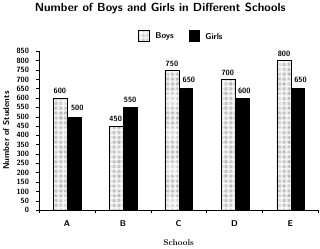
The given bar graph represents the number of boys and girls in five different schools. read the graph and answer the question that follows.

What is the ratio of the girls from schools A, B and C taken together to the boys from all schools taken together?

  1. AOption (a)

    59 : 66

  2. BOption (b)

    33 : 17

  3. COption (c)

    66 : 59

  4. DOption (d)

    17 : 33

View answer & explanation

Correct answer

Answer: (d)D.

17 : 33

Why this answer is correct

Total number of girls from A,B and C = 500 + 550 + 650 = 1700

Total number of boys from all school = 600 + 450 + 750 + 700 + 800 = 3300

⇒ 1700/3300 = 17/33

∴ The required ratio is 17 ∶ 33

SSC CPO Tier- I Previous Year Paper (Held On: 24 November 2020 Shift 1)·Quantitative Aptitude
View full paper

Question 1888

SSC CPO 2020• Quantitative Aptitude• Quantitative Aptitude

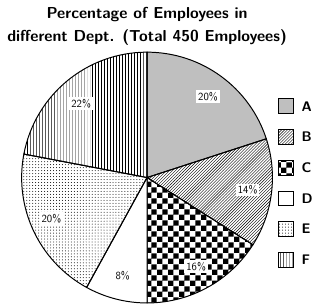
The given pie chart shows the percentage distribution of 450 employees in an organisation. Read the pie chart and answer the question that follows.

What is the central angle of the sector representing the number of employees in department E?

  1. AOption (a)

    36° 

  2. BOption (b)

    108°

  3. COption (c)

    90°

  4. DOption (d)

    72°

View answer & explanation

Correct answer

Answer: (d)D.

72°

Why this answer is correct

Given:

Total numbers of employee = 450

Concept used :

Central angle = [(Value)/(sum of the total values)] × 360° 

Calculation:

Number of employees in department E = 20% of 450

⇒ Required number = (20 × 450)/ 100

⇒ 90

The central angle of the employees in department E = (90/450) × 360°

⇒ 72° 

∴ The central angle of the employees in department E is 72°

SSC CPO Tier- I Previous Year Paper (Held On: 24 November 2020 Shift 1)·Quantitative Aptitude
View full paper

Question 1889

SSC CPO 2020• Quantitative Aptitude• Quantitative Aptitude

When operated separately, pipe A takes 5 hours less than pipe B to fill a cistern, and when operated together, the cistern gets filled in 6 hours. In how much time (in hours) will pipe A fill the cistern, if operated separately?

  1. AOption (a)

    15

  2. BOption (b)

    10

  3. COption (c)

    9

  4. DOption (d)

    18

View answer & explanation

Correct answer

Answer: (b)B.

10

Why this answer is correct

Given:

The cistern gets filled together (A + B) in 6 hours.

Concept used:

Effeciency = 1/(Total time)

Calculation:

Let the time taken by B be X hr.

Work done by B in 1 hr. = 1/X

Now, time taken by A = (X – 5) hr.

So, work done by in 1 hr. = 1/(X – 5) hr.

Again, work done by (A +B) in 1 hr = 1/6

According to the question:

(1/X) + 1/(X – 5) = 1/6

⇒(X – 5 + X)/{X × (X – 5)} = 1/6

⇒ 6(2X – 5) = X2 – 5X

⇒ 12X - 30 = X2 – 5X

⇒ X2 – 5X – 12X + 30 = 0

⇒ X2 – 17X + 30 = 0

⇒ X2 – 15X – 2X + 30 = 0

⇒ X (X – 15) – 2 (X – 15) = 0

⇒ (X – 2) (X – 15) = 0

⇒ X – 2 = 0

⇒ X = 2 (B can never fill the tank in 2 hours because if it fills it in 2 hours that means time taken by A in negative and it is not possible)

Either,

X – 15 = 0

⇒ X = 15

⇒ A = 15 – 5 = 10 hr.

∴ Time taken by A is 10 hr.

SSC CPO Tier- I Previous Year Paper (Held On: 24 November 2020 Shift 1)·Quantitative Aptitude
View full paper

Question 1890

SSC CPO 2020• Quantitative Aptitude• Quantitative Aptitude

The given bar graph represents the number of boys and girls in five different schools. Read the graph and answer the question that follows.

What is the average number of students (girls and boys) in schools A, B, C, D and E?

  1. AOption (a)

    596

  2. BOption (b)

    1250

  3. COption (c)

    625

  4. DOption (d)

    660

View answer & explanation

Correct answer

Answer: (b)B.

1250

Why this answer is correct

Concept used:

Average = (Total sum)/(Total numbers)

Calculations:

Total number of girls and boys in school

⇒ 600 +500 + 450 + 550 + 750 + 650 + 700 + 600 + 800 + 650 = 6250

⇒ Average = 6250/5 = 1250

∴ The required average is 1250

SSC CPO Tier- I Previous Year Paper (Held On: 24 November 2020 Shift 1)·Quantitative Aptitude
View full paper

Question 1891

SSC CPO 2020• Quantitative Aptitude• Quantitative Aptitude

If the average price of three chairs is Rs. 14,014 and their prices are in the ratio of 3 : 4 : 7, then the highest price (in Rs.) of chair is:

  1. AOption (a)

    15,015

  2. BOption (b)

    3,003

  3. COption (c)

    9,009

  4. DOption (d)

    21,021

View answer & explanation

Correct answer

Answer: (d)D.

21,021

Why this answer is correct

Given:

Average Price of Three Chairs = Rs. 14,014

Ratio of the Prices of three Chairs = 3 : 4 : 7

Formula Used:

Average = Sum of Prices of Articles/ Number of Articles

Concept Used:

Sum of Ratios will be equal to the Sum of Prices of All Chairs

Calculation:

14,014 = Sum of Prices of Chairs/3

⇒ Sum of Prices Of chairs = 14,014 × 3 = 42,042

Sum of Prices of Chairs is also equal to the sum of Ratios given

i.e. 3 + 4 + 7 = 14 Units

⇒ 14 Units = Rs. 42,042

⇒ 1 Unit = 42,042/14 = Rs. 3003

Since, we have to find the Value of Highest Price Chair i.e. 7 Units

⇒ 7 Units = 3003 × 7 = Rs. 21021

∴ The Highest price of Chair is Rs. 21,021

SSC CPO Tier- I Previous Year Paper (Held On: 24 November 2020 Shift 1)·Quantitative Aptitude
View full paper

Question 1892

SSC CPO 2020• Quantitative Aptitude• Quantitative Aptitude

The value of \(\frac{0.325 \ \times \ 0.325\ + \ 0.175 \ \times\ 0.175\ + \ 25\ \times \ 0.00455}{5 \ \times \ 0.0065 \ \times \ 3.25\ - \ 7\ \times \ 0.175\ \times\ 0.025}\ + \ \frac{0.5}{1.5}\) is:

  1. AOption (a)

    0

  2. BOption (b)

    \(\frac{7}{3}\)

  3. COption (c)

    3

  4. DOption (d)

    \(\frac{11}{3}\)

View answer & explanation

Correct answer

Answer: (d)D.

\(\frac{11}{3}\)

Why this answer is correct

Given:

\(\frac{0.325 \ \times \ 0.325\ + \ 0.175 \ \times\ 0.175\ + \ 25\ \times \ 0.00455}{5 \ \times \ 0.0065 \ \times \ 3.25\ - \ 7\ \times \ 0.175\ \times\ 0.025}\ + \ \frac{0.5}{1.5}\)

Formula Used:

(a + b)2 = a2 + b2 + 2ab

(a2 – b2) = (a + b) (a - b)

Concept Used:

We need to identify the numbers to fit them into the above-stated formula.

Calculation:

Let a = 0.325 and b = 0.175

In the numerator,

25 × 0.00455 = 2 × 0.325 × 0.175 = 2ab

In the denominator,

5 × 0.0065 × 3.25 = (0.325)2 = a2

7 × 0.175 × 0.025 = (0.175)2 = b2

On Comparing Formulas with a given equation we get,

\(⇒ \frac{{{{\left( {0.325\ + \ 0.175} \right)}^2}}}{{\left( {0.325\ +\ 0.175} \right)\left( {0.325\ -\ 0.175} \right)}} + \frac{{0.5}}{{1.5}} \)

⇒ \(\frac{(0.325 + 0.175)}{(0.325 - 0.175)} + \frac{0.5}{1.5}\)

\(= \frac{{0.5}}{{0.15}} + \frac{{0.5}}{{1.5}} \)

= (5.5)/(1.5)

= 11/3

∴ The simplified Value of this Expression is 11/3

SSC CPO Tier- I Previous Year Paper (Held On: 24 November 2020 Shift 1)·Quantitative Aptitude
View full paper

Question 1893

SSC CPO 2020• Quantitative Aptitude• Quantitative Aptitude

If x2 – 3x + 1 = 0, then the value of \((x^4 + \frac{1}{x^2}) \div (x^2+1)\) is:

  1. AOption (a)

    9

  2. BOption (b)

    5

  3. COption (c)

    6

  4. DOption (d)

    7

View answer & explanation

Correct answer

Answer: (c)C.

6

Why this answer is correct

Given:

x2 - 3x + 1 = 0

Formula used:

x3 + 1/x3 = (x + 1/x)3 – 3(x + 1/x)

Calculation:

x2 – 3x + 1 = 0

⇒ x2 + 1 = 3x

⇒ x + 1/x = 3

⇒ x3 + 1/x3 = (x + 1/x)3 – 3(x + 1/x)

⇒ x3 + 1/x3 = 27 – 9

⇒ x3 + 1/x3 = 18

Required value = (x4 + 1/x2) ÷ (x2 + 1)

⇒ x(x3 + 1/x3) ÷ x(x + 1/x)

⇒ (x3 + 1/x3) ÷ (x + 1/x)

⇒ 18 ÷ 3 = 6

∴ The correct answer is 6

SSC CPO Tier- I Previous Year Paper (Held On: 24 November 2020 Shift 1)·Quantitative Aptitude
View full paper

Question 1894

SSC CPO 2020• Quantitative Aptitude• Quantitative Aptitude

The average weight of a group of 3 people A, B and C is 70 kg. When D joins this group, the average becomes 60 kg. E's weight is 5 kg more than that of D, replaces A and the average weight of B, C, D, and E now becomes 59 kg. What is the average weight (in kg) of A, D and E? (Correct to the nearest integer)

  1. AOption (a)

    40

  2. BOption (b)

    35

  3. COption (c)

    39

  4. DOption (d)

    30

View answer & explanation

Correct answer

Answer: (b)B.

35

Why this answer is correct

Given:

Average weight of A, B and C = 70 kg

Average weight of A, B, C and D = 60 kg

Weight of E = Weight of D + 5 kg

Average Weight of B, C, D and E = 59 kg

Formula Used:

Average = (Sum of Values)/(Total Number) 

Calculation:

Sum of weight of A, B and C = 3 × 70 kg = 210 kg

Sum of weight of A, B, C and D = 4 × 60 kg = 240 kg

Weight of D = (Sum of weight of A, B, C and D) – (Sum of weight of A, B, and C)

⇒ Weight of D =  (240 – 210) = 30 kg

Weight of E = 30 kg + 5 kg = 35 kg

Sum of weight of B, C, D and E = 4 × 59 kg = 236 kg

Weight of A = (Sum of weight of A, B, C and D + Weight of E) – (Sum of weight of B, C, D and E)

⇒ Weight of A = 240 kg + 35 kg – 236 kg = 39 kg

Average weight of A, D and E = (Sum of weight of A, D and E)/3 = (39 kg + 30 kg + 35 kg)/3

⇒ Average weight of A, D and E = (104 kg)/3 = 34.66 kg ≈ 35 kg

∴ Average weight of A, D and E is 35 kg.

SSC CPO Tier- I Previous Year Paper (Held On: 24 November 2020 Shift 1)·Quantitative Aptitude
View full paper

Question 1895

SSC CPO 2020• Quantitative Aptitude• Quantitative Aptitude

A man spends 75% of his income. If his income increases by 28% and his expenditure increases by 20%, then what is the increase or decrease percentage in his savings?

  1. AOption (a)

    13% increase

  2. BOption (b)

    52% decrease

  3. COption (c)

    13% decrease

  4. DOption (d)

    52% increase

View answer & explanation

Correct answer

Answer: (d)D.

52% increase

Why this answer is correct

Given:

Man spends 75% of his income.

Income increases by 28% 

Expenditure increases by 20%

Concept:

Saving = Income – Expenditure 

Solution:

Let the Income of a man = 100

Expenditure = 75% of 100

⇒ (75/100) × 100 = 75

Saving = Income – Expenditure 

Initial Saving = 100 – 75 = 25      ----(1)

Now as per the question,

His income increased by 28%

⇒ His new income = Old income + 28% of Old income

⇒ His new income = (128/100) × 100 = 128

Similarly, his expenditure increased by 20%

⇒ His new expenditure = (120/100) × 75

⇒ His new expenditure = 90

Saving(new) = Income(new) – Expenditure(new)

⇒ Saving(new) = 128 - 90 = 38      ----(2)

Now, % increase in savings = {(38 – 25)/25} × 100      ----(from 1 and 2)

⇒ 13 × 4 = 52%

∴ The % increase in saving is 52%

Shortcut Trick

IncomeexpenditureSaving
1007525
12875 + 75× 20/100 = 90128 - 90 = 38


∴ The % increase in saving = (38 - 25) ×  100/25 = 13 × 4 = 52%

SSC CPO Tier- I Previous Year Paper (Held On: 24 November 2020 Shift 1)·Quantitative Aptitude
View full paper

Question 1896

SSC CPO 2020• Quantitative Aptitude• Quantitative Aptitude

A and B can do a piece of work in 36 days. B and C can do the same work in 60 days. A and C can do the same work in 45 days. In how many days can B alone complete the same work?

  1. AOption (a)

    120

  2. BOption (b)

    45

  3. COption (c)

    60

  4. DOption (d)

    90

View answer & explanation

Correct answer

Answer: (d)D.

90

Why this answer is correct

Given:

A and B can do a piece of work in 36 days,

B and C can do the same work in 60 days,

A and C can do the same work in 45 days.

Concept used:

Efficiency = 1/(Total time)

Calculation:

(A + B)’s 1 day work = 1/36      ----(i) 

(B + C)’s 1 day work = 1/60      ----(ii) 

(C + A)’s 1 day work = 1/45      ----(iii)

From equations (i), (ii) and (iii),

2(A + B + C)’s 1 day work = 1/36 + 1/60 + 1/45

⇒ (5 + 3 + 4)/180 = 1/15

⇒ (A + B + C)’s 1 day work = 1/(15 × 2) = 1/30      ----(iv)

From equations (iii) and (iv) we get

B’s 1 day work = 1/30 – 1/45 = (3 – 2)/90 = 1/90

Time taken by B alone to complete the work = 90

∴ B alone can complete the same work in 90 days

 Alternate Method

Let us find the LCM of  36, 60 and 45

LCM of 36, 60 and 45 = 180

Let the total work be 180 units. 

A + B can do = 180/36 = 5 units/day      ----(i)

B + C can do = 180/60 = 3 units/day      ----(ii)

C + A can do = 180/45 = 4 units/day      ----(iii) 

Adding the above equations, we get 

2(A + B + C) = 5 + 3 + 4 

⇒ A + B + C = 12/2 = 6      ----(iv)

Subtracting equation (iii) from (iv) 

B = 6 - 4 = 2units/day 

⇒ Time taken by B = 180/2 = 90days

∴ B alone can complete the same work in 90 days

SSC CPO Tier- I Previous Year Paper (Held On: 24 November 2020 Shift 1)·Quantitative Aptitude
View full paper

Question 1897

SSC CPO 2020• Quantitative Aptitude• Quantitative Aptitude

A man bought an article and sold it at a gain of 10%. If he had bought the article at 20% less and sold it for Rs. 1,000 more, he would have made a profit of 40%. The earlier selling price of the article (in Rs.) is:

  1. AOption (a)

    50,000

  2. BOption (b)

    40,000

  3. COption (c)

    55,000

  4. DOption (d)

    60,000

View answer & explanation

Correct answer

Answer: (c)C.

55,000

Why this answer is correct

Given:

A man sold an article at a gain of 10% and if he had bought the article at 20% less and sold it for Rs. 1000 more, he would have made a profit of 40%.

Formula used:

S.P = C.P × (1 + P%/100)

P = S.P – C.P

P% = (P/C.P) × 100

Where,

S.P = Selling price 

C.P = Cost price 

P = Profit

Calculation:

Let CP be x

Then, SP = 110x/100 = 11x/10

New CP = 80% of x = 80x/100 = 4x/5

Gain = 40%

New SP = 140% of 4x/5 = (140/100) × 4x/5 = 28x/25

According to the question,

(28x/25) – (11x/10) = 1000

⇒ (56x – 55x)/50 = 1000

⇒ x/50 = 1000

⇒ x = Rs. 50,000

Hence, CP = Rs. 50,000

And SP = (11/10) × 50000 = Rs. 55000

∴ The earlier selling price of the article is Rs. 55000

SSC CPO Tier- I Previous Year Paper (Held On: 24 November 2020 Shift 1)·Quantitative Aptitude
View full paper

Question 1898

SSC CPO 2020• Quantitative Aptitude• Quantitative Aptitude

Pipes A, B and C can fill an empty tank in (30/7) hours if all the three pipes are opened simultaneously. A and B are filling pipes and C is an emptying pipe. Pipe A can fill the tank in 15 hours and pipe C can empty it in 12 hours. In how long (in hours) can pipe B alone fill the empty tank?

  1. AOption (a)

    6

  2. BOption (b)

    3

  3. COption (c)

    4

  4. DOption (d)

    5

View answer & explanation

Correct answer

Answer: (c)C.

4

Why this answer is correct

Given:

Pipes A, B and C can fill an empty tank in 30/7 hours

A and B are filling pipes and C is an emptying pipe.

Time taken by A and B together to fill the tank = 15 hours 

Time taken by C to empty the tank alone = 12 hours 

Concept:

Efficiency = 1/(Total time)

Calculation: 

let time taken by B be X hr.

Work done by B in 1 hr = 1/X hr.

Work done by  (A + B – C) in 1 hr = 7/30

According to the question:

⇒ (1/15) + (1/X) – (1/12) = 7/30

⇒ 1/X = (7/30) + (1/12) – (1/15)

⇒ 1/X = (14 + 5 – 4)/60

⇒ 1/X = 15/60

⇒ 1/X = 1/4

⇒ X = 4

∴ Time taken by B is 4 hr.

Alternate Method 

TimeTotal WorkEfficiency
A15604
(-)C12-5
A + B + C30/714


A + B + C = 14 (Total Efficiency)

⇒ 4 + B + (-5) = 14

⇒ B = 15

Total work done by B = 60/15 = 4hr

∴ Time taken by B is 4 hr.

SSC CPO Tier- I Previous Year Paper (Held On: 24 November 2020 Shift 1)·Quantitative Aptitude
View full paper

Question 1899

SSC CPO 2020• Quantitative Aptitude• Quantitative Aptitude

If x + y + z = 17, xyz = 171 and xy + yz + zx = 111, then the value of \(\sqrt[3]{{(x^3+y^3+z^3+xyz)}}\) is:

  1. AOption (a)

    0

  2. BOption (b)

    -4

  3. COption (c)

    4

  4. DOption (d)

    -64

View answer & explanation

Correct answer

Answer: (b)B.

-4

Why this answer is correct

Given:

x + y + z = 17

xy + yz + zx = 111

xyz = 171 

Concept used:

1.) (x + y + z)2 = x2 + y2 + z2 + 2(xy + yz + zx)

2.) x3 + y3 + z3 – 3xyz = (x + y + z)[x2 + y2 + z2​ – (xy + yz + zx)]

Calculations:

(x + y + z)2 = x2 + y2 + z2 + 2(xy + yz + zx)

⇒ 172 = x2 + y2 + z2 + 2 × 111

⇒ x2 + y2 + z2  = 289 – 222

⇒ x2 + y2 + z2  = 67

Using algebraic identity

x3 + y3 + z3 – 3xyz = (x + y + z)[x2 + y2 + z2​ – (xy + yz + zx)]

⇒ x3 + y3 + z3 – 3 × 171 = 17 × (67 – 111)

⇒ x3 + y3 + z3 – 513 = -748

⇒ x3 + y3 + z3 = -748 + 513

⇒ x3 + y3 + z3 = -235

\(\sqrt[3]{{(x^3+y^3+z^3+xyz)}}\) = ∛(-235 + 171)

⇒ -4

∴ The correct answer is -4

SSC CPO Tier- I Previous Year Paper (Held On: 24 November 2020 Shift 1)·Quantitative Aptitude
View full paper

Question 1900

SSC CPO 2020• Quantitative Aptitude• Quantitative Aptitude

The value of \(;\left( {5\frac{1}{{4;}} \div ;\frac{{3;}}{7}of;\frac{1}{2}} \right) \div \left( {5\frac{1}{9} - 7\frac{7}{{8;}} \div ;9\frac{9}{{20}}} \right) \times \frac{{11}}{{21}} - \left( {5 \div 2;of\frac{1}{2}} \right)\)is:

  1. AOption (a)

    \(\frac{35}{24}\)

  2. BOption (b)

    \(\frac{15}{28}\)

  3. COption (c)

    -2

  4. DOption (d)

    8

View answer & explanation

Correct answer

Answer: (c)C.

-2

Why this answer is correct

Given:

\(;\left( {5\frac{1}{{4;}} ÷ ;\frac{{3;}}{7}of;\frac{1}{2}} \right) ÷ \left( {5\frac{1}{9} - 7\frac{7}{{8;}} ÷ ;9\frac{9}{{20}}} \right) × \frac{{11}}{{21}} - \left( {5 ÷ 2;of\frac{1}{2}} \right)\)

Concept used:

Follow the BODMAS rule according to the table given below:

Calculation:

\(;\left( {5\frac{1}{{4;}} ÷ ;\frac{{3;}}{7}of;\frac{1}{2}} \right) ÷ \left( {5\frac{1}{9} - 7\frac{7}{{8;}} ÷ ;9\frac{9}{{20}}} \right) × \frac{{11}}{{21}} - \left( {5 ÷ 2;of\frac{1}{2}} \right)\)

⇒ [(21/4) ÷ (3/14)] ÷ [(46/9) – (63/8) ÷ (189/20)] × 11/21 – (5 ÷ 1)

⇒ [(21/4) × (14/3)] ÷ [(46/9) – (63/8) × (20/189)] × 11/21 – 5

⇒ (49/2) ÷ [(46/9 – 5/6)] × (11/21) – 5

⇒ (49/2) ÷ [(92 – 15)/18] × (11/21) – 5

⇒ (49/2) ÷ (77/18) × (11/21) – 5

⇒ (49/2 × 18/77 × 11/21) – 5

⇒ 3 – 5

⇒ –2

∴ The value of ? is –2.

How should I prepare for Quantitative Aptitude in SSC CPO?

Solving previous year questions by topic helps identify recurring concepts, question patterns, and frequently asked sub-topics. Attempt each question, review the step-by-step explanation, and note down key formulas or facts for quick revision before the exam.