SSC CPO · Topic Collection

Quantitative Aptitude PYQs

Arithmetic, number systems, percentages, ratios, profit and loss, time and work, algebra, geometry, mensuration, and trigonometry.

3100 Total Questions62 Official PapersYears: 2017–2025Search in Quantitative Aptitude
Showing questions 1861–1880 of 3100Page 94 of 100
SSC CPO Tier- I Previous Year Paper (Held On: 24 November 2020 Shift 1)·Quantitative Aptitude
View full paper

Question 1861

SSC CPO 2020• Quantitative Aptitude• Quantitative Aptitude

If the annual rate of simple interest increases from 11% to \(17 \frac{1}{2}\)%, then a person's yearly income increases by Rs. 1,071.20. The simple interest (in Rs.) on the same sum at 10% for 5 years is:

  1. AOption (a)

    9,120

  2. BOption (b)

    8,240

  3. COption (c)

    16,480

  4. DOption (d)

    7,250

View answer & explanation

Correct answer

Answer: (b)B.

8,240

Why this answer is correct

Given:

Rate of interest changes from 11% to \(17\frac{1}{2}\)%

Due to change of rate of interest yearly income increases by Rs. 1071.20

Formula used:

Simple Interest = (P × R × T)/100

Where,

P → Principal 

R → Rate 

T → Time

Calculation:

Difference between two interest rates = \(17\frac{1}{2}\)% – 11% = (13/2)%

⇒ Increased income = (P × R × T)/100

⇒ 1071.20 = (P × (13/2) × 1)/100

⇒ (107120 × 2)/13 = P

⇒ P = 16480 

Simple Interest = (P × R × T)/100

⇒ (16480 × 10 × 5)/100

⇒ 1648 × 5

⇒ 8240 Rs.

∴ The simple interest for five years at 10% is 8240 Rs.

Alternate Method Difference between two interest rates = \(17\frac{1}{2}\)% – 11% = (13/2)%

Increased income = (P × R × T)/100

⇒ 1071.20 = (P × (13/2) × 1)/100

⇒ P = 16480 

Simple Interest = (P × R × T)/100

⇒ (16480 × 10 × 5)/100

⇒ 8240
SSC CPO Tier- I Previous Year Paper (Held On: 24 November 2020 Shift 1)·Quantitative Aptitude
View full paper

Question 1862

SSC CPO 2020• Quantitative Aptitude• Quantitative Aptitude

If six - digit number 5x2y6z is divisible by 7, 11 and 13, then the value of (x – y + 3z) is:

  1. AOption (a)

    9

  2. BOption (b)

    0

  3. COption (c)

    7

  4. DOption (d)

    4

View answer & explanation

Correct answer

Answer: (c)C.

7

Why this answer is correct

Ans: 3

Given:

5x2y6z is divisible by 7, 11 and 13

Concept used:

7 × 11 × 13 = 1001, when any 3 digit number multiplied by 1001 then it repeats itself and always completely divisible by 7,11 and 13.

Calculation:

Let 3 digit number be pqr.

⇒ pqr × 1001 = 5x2y6z

⇒ pqrpqr = 5x2y6z

Compare both sides

⇒ p = 5, q = 6 and r = 2

Hence, that number is 562562.

⇒ 5x2y6z = 562562

by comparing both numbers, x = 6, y = 5, and z = 2 

Required value = (x – y + 3z)

⇒ 6 – 5 + 3 × 2

⇒ 7

∴ The required value is 7.

Alternate Method When any 3 digit number multiplied by 1001 then it repeats itself and always completely divisible by 7,11 and 13.

Let 3 digit number be PQR.

⇒ PQRPQR = 5x2y6z

⇒ p = 5, q = 6 and r = 2

Hence, that number is 562562.

⇒ 5x2y6z = 562562

⇒ x = 6, y = 5, and z = 2 

Required value = (x – y + 3z)

⇒ 6 – 5 + 3 × 2

⇒ 7

SSC CPO Tier- I Previous Year Paper (Held On: 24 November 2020 Shift 1)·Quantitative Aptitude
View full paper

Question 1863

SSC CPO 2020• Quantitative Aptitude• Quantitative Aptitude

The remainder when 72 × 73 × 78 × 76 is divided by 35 is: 

  1. AOption (a)

    12

  2. BOption (b)

    22

  3. COption (c)

    8

  4. DOption (d)

    15

View answer & explanation

Correct answer

Answer: (c)C.

8

Why this answer is correct

Given:

(72 × 73 × 78 × 76) divided by 35

Concept Used:

We divide every number individually by 35 and remainder left will be operated as signs given in the original equation, and if the operated value is more than 35 then we will divide it further till we get values less than 35 and that value will be remainder for the given equation.

Calculation:

(72 × 73 × 78 × 76)/35

⇒ (2 × 3 × 8 × 6)/35

⇒ 288/35

⇒ 8/35

Since 8 cannot be divided further by 35

∴ The remainder of the given equation is 8

SSC CPO Tier- I Previous Year Paper (Held On: 24 November 2020 Shift 1)·Quantitative Aptitude
View full paper

Question 1864

SSC CPO 2020• Quantitative Aptitude• Quantitative Aptitude

ABCD is a cyclic quadrilateral such that AB is a diameter of the circle circumscribing it and ∠ADC = 118°. What is the measure of ∠BAC?

  1. AOption (a)

    32° 

  2. BOption (b)

    28°

  3. COption (c)

    45°

  4. DOption (d)

    30°

View answer & explanation

Correct answer

Answer: (b)B.

28°

Why this answer is correct

Given: 

AB is a diameter.

ABCD is a cyclic quadrilateral in which ∠ADC = 118°

Concept used:

The angle formed by the diameter of the circle at the circumference of the circle is always 90°   

ABCD is a cyclic quadrilateral 

So, ∠ADC + ∠ABC = 180° 

Calculation:

In a cyclic quadrilateral, the sum of each pair of opposite angles is 180 degrees.

⇒ ∠ADC + ∠ABC = 180°

⇒ 118° + ∠ABC = 180°

⇒ ∠ABC = 62°

∠ACB = 90°      ----(The angle formed by the diameter of the circle at the circumference of the circle always 90°)

In ΔABC,

∠BAC + ∠ACB + ∠ABC = 180°

⇒ ∠BAC + 90° + 62° = 180°

⇒ ∠BAC = 28°

∴ The value of ∠BAC is 28°

SSC CPO Tier- I Previous Year Paper (Held On: 24 November 2020 Shift 1)·Quantitative Aptitude
View full paper

Question 1865

SSC CPO 2020• Quantitative Aptitude• Quantitative Aptitude

Asha and Suman's mud forts have heights 9 cm and 16 cm. If the fort tops are at 25 cm apart from each other, then the distance (in cm) between two forts is:

  1. AOption (a)

    7

  2. BOption (b)

    16

  3. COption (c)

    25

  4. DOption (d)

    24

View answer & explanation

Correct answer

Answer: (d)D.

24

Why this answer is correct

Given :

Asha fort height  = 9 cm

Suman fort height = 16 cm

Distance between the top of the forts = 25 cm 

Formula Used:

Pythagoras theorem: (Base)2 + (Perpendicular)2  = (Hypotenuous)2  

Calculation:

Let the distance between the fort  CD be x

From the above diagram

Height of the Suman fort AC = 16 cm 

Height of the Asha fort ED = 9 cm 

Here the BCDE forms a rectangle 

The opposite side is equal BE = CD = x and BC = DE = 9 cm                                            

By Pythagoras theorem 

AB2 + BE2  = AE2 

⇒ 72 + x2 = 252

⇒ x2 = 625 – 49 

⇒ x = √576

⇒ x = 24 

∴ The Distance between forts = 24 cm

SSC CPO Tier- I Previous Year Paper (Held On: 24 November 2020 Shift 1)·Quantitative Aptitude
View full paper

Question 1866

SSC CPO 2020• Quantitative Aptitude• Quantitative Aptitude

The students of a class donated a sum of Rs. 2,809 to the Fund.

Each student donated as many rupees as the number of students in the class. The number of students in the class is:

  1. AOption (a)

    51

  2. BOption (b)

    53

  3. COption (c)

    49

  4. DOption (d)

    47

View answer & explanation

Correct answer

Answer: (b)B.

53

Why this answer is correct

Given:

Class donated a sum of Rs. 2,809

Each student donated as many rupees as the number of students in the class.

Calculation:

Let the total number of the students be 'x'

Each student will donate 'x' amount of rupees.

So, total class fund = Donation of each student × Total number of students

⇒ 2,809 = x × x

⇒ 2,809 = x2 

⇒ x = 53

∴ Total number of students in class is 53

SSC CPO Tier- I Previous Year Paper (Held On: 24 November 2020 Shift 1)·Quantitative Aptitude
View full paper

Question 1867

SSC CPO 2020• Quantitative Aptitude• Quantitative Aptitude

The value of \(\frac{{{{\sin }^2}30^\circ + {{\cos }^2}60^\circ + sec45^\circ .sin45^\circ }}{{sec60^\circ + cosec30^\circ }}\) is:

  1. AOption (a)

    \(\frac{1}{4}\)

  2. BOption (b)

    \(\frac{3}{8}\)

  3. COption (c)

    \(-\frac{1}{4}\)

  4. DOption (d)

    \(-\frac{3}{8}\)

View answer & explanation

Correct answer

Answer: (b)B.

\(\frac{3}{8}\)

Why this answer is correct

Given:

\(\frac{{{{\sin }^2}30^\circ + {{\cos }^2}60^\circ + sec45^\circ .sin45^\circ }}{{sec60^\circ + cosec30^\circ }}\)

Important Trigonometric Identities:

​

Calculation:

\(\frac{{\left[ {{{\left( {\frac{1}{2}} \right)}^2} + ;{{\left( {\frac{1}{2}} \right)}^2} + \left( {\sqrt 2 \ \times\ \frac{1}{{\sqrt 2 }}} \right)} \right]}}{{2\ + \ 2}} \)

= (3/2)/4

= 3/8

∴ Simplified value of given equation is 3/8

SSC CPO Tier- I Previous Year Paper (Held On: 24 November 2020 Shift 1)·Quantitative Aptitude
View full paper

Question 1868

SSC CPO 2020• Quantitative Aptitude• Quantitative Aptitude

If sin3x = cos(3x – 45°), 0° < 3x < 90°, then x is equal to:

  1. AOption (a)

    27.5° 

  2. BOption (b)

    45°

  3. COption (c)

    35°

  4. DOption (d)

    22.5°

View answer & explanation

Correct answer

Answer: (d)D.

22.5°

Why this answer is correct

Given:

sin3x = cos(3x – 45°)

Formula Used :

sin(90° – θ) = cosθ 

Calculations:

sin3x = cos(3x – 45°)

⇒ cos(90° – 3x) = cos(3x – 45°)

⇒ 90° – 3x = 3x – 45°

⇒ 6x = 135°

⇒ x = 22.5

∴  The value of x is 22.5°

SSC CPO Tier- I Previous Year Paper (Held On: 24 November 2020 Shift 1)·Quantitative Aptitude
View full paper

Question 1869

SSC CPO 2020• Quantitative Aptitude• Quantitative Aptitude

Let Δ ABC ∼ Δ RPQ and \(\frac{{ar(\Delta ABC)}}{{ar(\Delta RPQ)}} = \frac{4}{9}\). If AB = 3 cm, BC = 4 cm and AC = 5 cm, then RP (in cm) is equal to:

  1. AOption (a)

    4.5 cm

  2. BOption (b)

    12 cm 

  3. COption (c)

    5 cm

  4. DOption (d)

    6 cm

View answer & explanation

Correct answer

Answer: (a)A.

4.5 cm

Why this answer is correct

Given:

Δ ABC ∼ Δ RPQ

\(\frac{{ar\left( {ABC} \right)}}{{ar\left( {RPQ} \right)}}\) =  \(\frac{4}{9}\)

AB = 3 cm

BC = 4 cm

AC = 5 cm

Concept used:

Δ ABC ∼ Δ RPQ

 \(\frac{{AB}}{{RP}} = ;\frac{{BC}}{{PQ}} = ;\frac{{AC}}{{QR}} = √\frac{{ar\left( {ABC} \right)}}{{ar\left( {RPQ} \right)}}\)

Calculation: 

AB/RP = √(4/9)

⇒ AB/RP = 2/3 

⇒ RP = (3/2) × AB

⇒ (3/2) × 3 = 4.5

∴ The value of RP is 4.5 cm.

Shortcut TrickΔ ABC ∼ Δ RPQ

AB/RP = √(4/9) 

RP = 3/2 × 3  (∵ AB = 3)

RP = 4.5

SSC CPO Tier- I Previous Year Paper (Held On: 24 November 2020 Shift 1)·Quantitative Aptitude
View full paper

Question 1870

SSC CPO 2020• Quantitative Aptitude• Quantitative Aptitude

The two parallel sides of a trapezium are 17 cm and 15 cm, respectively. If the height of the trapezium is 6 cm, then its area (in m2) is:

  1. AOption (a)

    0.96 m2

  2. BOption (b)

    0.0096 m2

  3. COption (c)

    9.6 m2

  4. DOption (d)

    960 m2

View answer & explanation

Correct answer

Answer: (b)B.

0.0096 m2

Why this answer is correct

Given:

L1 = 17 cm

L2 = 15 cm

Height (H) = 6 cm

Concept used:

Area of trapezium = (1/2) × (Sum of parallel side) × Height 

1 cm = (1/100) m 

Calculation:

Let two parallel side be L1 and L2

Area of trapezium = (1/2) × (17 + 15) × 6

⇒ 96 cm2

⇒ 96/10000 m2 = 0.0096 m2

∴ The area of the trapezium is 0.0096 m2.

Shortcut Trick Area of trapezium = (1/2) × (17 + 15) × 6

⇒ 96 cm2

= 0.0096 m2

SSC CPO Tier- I Previous Year Paper (Held On: 24 November 2020 Shift 1)·Quantitative Aptitude
View full paper

Question 1871

SSC CPO 2020• Quantitative Aptitude• Quantitative Aptitude

A rectangular lawn whose length is twice of its breadth is extended by having four semi-circular portions on its sides. What is the total area (in m2) of the lawn if the smaller side of the rectangle is 12 m? (Take π = 3.14)

  1. AOption (a)

    548.32

  2. BOption (b)

    444

  3. COption (c)

    853.2

  4. DOption (d)

    308.64

View answer & explanation

Correct answer

Answer: (c)C.

853.2

Why this answer is correct

Given: 

Breadth of rectangle (B) = 12 m

Length of rectangle (L) = 2 × Breadth = 24 m

Formula used:

Area of rectangle = L × B

Area of semicircle = πr2/2

Where, 

L → Length of the rectangle 

B → Breadth of the rectangle 

r → Radius of circle 

Calculation:

Four semi-circular portions are constructed on the sides of the rectangle

Let radius of small semi-circle be r and big semi-circle be R

⇒ AD = 2r and AB = 2R

⇒ r = 6 and R = 12

Total area of the newly constructed lawn = Area of rectangle + Area of the four semi-circles

⇒ L × B + 2(small semi-circle area) + 2(Big semi-circle area)

⇒ 12 × 24 + 2(3.14 × 36)/2 + 2(3.14 × 144)/2

⇒ 288 + (3.14 × 36) + (3.14 × 144)

⇒ 288 + 3.14 × 180

⇒ 288 + 565.2

⇒ 853.2 m2

∴ Total area of lawn is 853.2 m2

Alternate Method Breadth of rectangle (B) = 12 m

Length of rectangle (L) = 2 × Breadth = 24 m

⇒ AD = 2r and AB = 2R

⇒ r = 6 and R = 12

Total area of the newly constructed lawn = Area of rectangle + Area of the four semi-circles

⇒ L × B + 2(small semi-circle area) + 2(Big semi-circle area)

⇒ 12 × 24 + 2(3.14 × 36)/2 + 2(3.14 × 144)/2

⇒ 288 + (3.14 × 36) + (3.14 × 144)

⇒ 288 + 565.2

⇒ 853.2 m2

SSC CPO Tier- I Previous Year Paper (Held On: 24 November 2020 Shift 1)·Quantitative Aptitude
View full paper

Question 1872

SSC CPO 2020• Quantitative Aptitude• Quantitative Aptitude

The area of a field in the shape of a hexagon is 1944√3 m2. What will be the cost (in Rs.) of fencing it at the rate of Rs. 11.50 per metre?

  1. AOption (a)

    Rs. 2,256

  2. BOption (b)

    Rs. 2,785

  3. COption (c)

    Rs. 2,484

  4. DOption (d)

    Rs. 3,200

View answer & explanation

Correct answer

Answer: (c)C.

Rs. 2,484

Why this answer is correct

Given:

Area of the hexagon field = 1944\(√ {3}\) m2  

Rate of fencing the area = 11.50 per metre 

Formula Used :

Area of the hexagon = 3√3 × (a2/2)

The perimeter of the hexagon = 6a

Cost of the fencing = 6a × Rate per metre

Where,

a → side of the hexagon

Calculation:

Substituting the values in the Formula

3√3 × (a2/2) = 1944√3

⇒ a = 36 m

The perimeter of the hexagon = 6a = 6 × 36 = 216 m 

Cost of fencing = 216 × 11.50 = Rs. 2,484

∴ Cost of fencing field in the shape of a hexagon is Rs. 2,484

SSC CPO Tier- I Previous Year Paper (Held On: 24 November 2020 Shift 1)·Quantitative Aptitude
View full paper

Question 1873

SSC CPO 2020• Quantitative Aptitude• Quantitative Aptitude

The value of \(2 \frac{1}{3} \div 2 \frac{1}{2} \ of \ 1 \frac{3}{5} + (\frac{3}{8} + \frac{1}{7} \times 1 \frac{3}{4})\) is:

  1. AOption (a)

    25/24

  2. BOption (b)

    29/24

  3. COption (c)

    35/24

  4. DOption (d)

    5/24

View answer & explanation

Correct answer

Answer: (b)B.

29/24

Why this answer is correct

Given:

\(2 \frac{1}{3} ÷ 2 \frac{1}{2} \ of \ 1 \frac{3}{5} + (\frac{3}{8} + \frac{1}{7} \times 1 \frac{3}{4})\)

Concept used:

Follow BODMAS rule to solve this question, as per the order given below,

Calculations:

\(2 \frac{1}{3} ÷ 2 \frac{1}{2} \ of \ 1 \frac{3}{5} + (\frac{3}{8} + \frac{1}{7} \times 1 \frac{3}{4})\)

⇒ (7/3) ÷ (5/2) of (8/5) + {(3/8) + (1/7) × (7/4)}                

⇒ (7/3)/(4) + {(3/8) + (1/4)}

⇒ (7/12) + (5/8)

⇒ (14 + 15)/24 = 29/24

∴ The correct value is (29/24).

SSC CPO Tier- I Previous Year Paper (Held On: 24 November 2020 Shift 1)·Quantitative Aptitude
View full paper

Question 1874

SSC CPO 2020• Quantitative Aptitude• Quantitative Aptitude

If house tax is paid before the due date, one gets a reduction of 12% on the amount of the bill. By paying the tax before the due date, a person got a reduction of Rs. 2,100. The amount (in Rs.) of house tax paid was:

  1. AOption (a)

    25,000

  2. BOption (b)

    21,000

  3. COption (c)

    15,400

  4. DOption (d)

    17,500

View answer & explanation

Correct answer

Answer: (c)C.

15,400

Why this answer is correct

Given:

Percentage reduction on the amount of bill if paid before due date = 12%

Reduction amount = Rs.2100

Formula Used: 

Total Tax Amount = (100/reduction%) × reduction amount 

Tax amount paid = Total Tax amount - reduced amount

Calculation:

Total tax amount = (100/12) × 2100 = Rs .17500

Total amount paid = 17500 – 2100 = Rs.15400

∴ The amount of house tax paid was is Rs. 15400

SSC CPO Tier- I Previous Year Paper (Held On: 24 November 2020 Shift 1)·Quantitative Aptitude
View full paper

Question 1875

SSC CPO 2020• Quantitative Aptitude• Quantitative Aptitude

The least number which is exactly divisible by 4, 5, 8, 10 and 12 is:

  1. AOption (a)

    120

  2. BOption (b)

    150

  3. COption (c)

    180

  4. DOption (d)

    240

View answer & explanation

Correct answer

Answer: (a)A.

120

Why this answer is correct

Given:

Numbers 4, 5, 8, 10, 12

Concept Used:

Least Number divisible by a set of Number = Least common multiple (LCM) of that set of numbers

Calculation:

4 = 22

5 = 51

8 = 23

10 = 21 × 51

12 = 22 × 31

Least Common Multiple (LCM) of 4, 5, 8, 10, 12 = 23 × 31 × 51 

⇒ 8 × 3 × 5 = 120

∴ 120 is the least number which is exactly divisible by 4, 5, 8, 10, 12.

Additional Information

Least common multiple: The least common multiple of numbers is the smallest non-zero common numbers which are the multiple of all the numbers.

SSC CPO Tier- I Previous Year Paper (Held On: 24 November 2020 Shift 1)·Quantitative Aptitude
View full paper

Question 1876

SSC CPO 2020• Quantitative Aptitude• Quantitative Aptitude

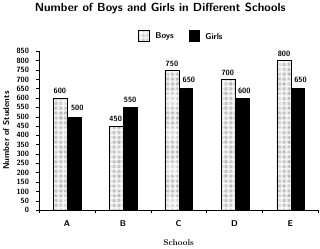
The given bar graph represents the number of boys and girls in five different schools. Read the graph and answer the question that follows.

In which school is the percentage of boys more than 55%?

  1. AOption (a)

    C

  2. BOption (b)

    B

  3. COption (c)

    E

  4. DOption (d)

    A

View answer & explanation

Correct answer

Answer: (c)C.

E

Why this answer is correct

Calculations:

Percentage of boys in school A = (600/1100) × 100 = 54.54%

Percentage of boys in school B = (450/1000) × 100 = 45%

Percentage of boys in school C = (750/1400) × 100 = 53.57%

Percentage of boys in school D = (700/1300) × 100 = 53.84%

Percentage of boys in school E = (800/1450) × 100 = 55.68%

∴ In school E percentage of boys is more than 55%

SSC CPO Tier- I Previous Year Paper (Held On: 24 November 2020 Shift 1)·Quantitative Aptitude
View full paper

Question 1877

SSC CPO 2020• Quantitative Aptitude• Quantitative Aptitude

If x2 + 8y2 + 12y - 4xy + 9 = 0, then the value of (7x + 8y) is:

  1. AOption (a)

    9

  2. BOption (b)

    -33

  3. COption (c)

    -9

  4. DOption (d)

    33

View answer & explanation

Correct answer

Answer: (b)B.

-33

Why this answer is correct

Given:

x2 + 8y2 + 12y – 4xy + 9 = 0

Formula used:

(A - B)2 = A2 – 2AB + B2

(A + B)2 = A2 + 2AB + B2

Calculation:

x2 + 8y2 + 12y – 4xy + 9 = 0

⇒ x2 – 4xy + 4y2 + 4y2 + 12y + 9 = 0

⇒ (x – 2y)2 + (2y + 3)2 = 0

⇒ x – 2y = 0, 2y + 3 = 0  

⇒ x = 2y, 2y = -3  

⇒ x = -3, y = -3/2

Now,

7x + 8y = 7 × (-3) + 8 × (-3/2)

⇒ -21 – 12 = -33

∴ The correct answer is -33

SSC CPO Tier- I Previous Year Paper (Held On: 24 November 2020 Shift 1)·Quantitative Aptitude
View full paper

Question 1878

SSC CPO 2020• Quantitative Aptitude• Quantitative Aptitude

A sum of Rs. 8,200 was divided among A, B and C in such a way that A had Rs. 500 more than B and C had Rs. 300 more than A. How much C's share (in Rs.)?

  1. AOption (a)

    Rs. 2,300

  2. BOption (b)

    Rs. 3,100

  3. COption (c)

    Rs. 2,800

  4. DOption (d)

    Rs. 2,000

View answer & explanation

Correct answer

Answer: (b)B.

Rs. 3,100

Why this answer is correct

Given :

Total sum of money = 8200

A had Rs. 500 more than B and C had Rs. 300 more than A.

Concept used:

Using linear equation. 

Calculation :

Let the money of B be 'x'

So, money of A = x + 500

Now, money of C = x + 500 + 300 = x + 800

According to the Question ,

x + x + 500 + x + 800 = 8200

⇒ 3x + 1300 = 8200

⇒ 3x = 8200 – 1300

⇒ 3x = 6900

⇒ x = 2300

So, C's share = 2300 + 800 = Rs. 3100

∴ C's share is Rs. 3100.

SSC CPO Tier- I Previous Year Paper (Held On: 24 November 2020 Shift 1)·Quantitative Aptitude
View full paper

Question 1879

SSC CPO 2020• Quantitative Aptitude• Quantitative Aptitude

A single discount equivalent to three successive discounts of 6%, 15% and 14% is:

  1. AOption (a)

    34.357%

  2. BOption (b)

    17.5%

  3. COption (c)

    68.714%

  4. DOption (d)

    31.286%

View answer & explanation

Correct answer

Answer: (d)D.

31.286%

Why this answer is correct

Given:

Successive discount = 6%, 15% and 14%

Concept used:

S.P = M.P × (100 – D1)/100 × (100 – D2)/100 × (100 – D3)/100

Discount = M.P – S.P 

Discount% = ((Discount)/(M.P)) × 100

Calcualtions:

Let MP be 100x

⇒ S.P = 100x × (100 – 6)/100 × (100 – 15)/100 × (100 – 14)/100

⇒ (100x × 94 × 85 × 86)/100 × 100 × 100)

⇒ 68.714x

Discount = 100x – 68.714x = 31.286x

Discount% = (31.286x/100x) × 100 = 31.286%

∴ The equivalent discount% is 31.286%

Alternate Method Let MP be 100x

⇒ S.P = 100x × (100 – 6)/100 × (100 – 15)/100 × (100 – 14)/100

⇒ (100x × 94 × 85 × 86)/100 × 100 × 100)

⇒ 68.714x

Discount = 100x – 68.714x = 31.286x

Discount% = (31.286x/100x) × 100 = 31.286%

SSC CPO Tier- I Previous Year Paper (Held On: 24 November 2020 Shift 1)·Quantitative Aptitude
View full paper

Question 1880

SSC CPO 2020• Quantitative Aptitude• Quantitative Aptitude

A and B can do a piece of work in 25 days. B alone can do \(66 \frac{2}{3}\)% of the same work in 30 days. In how many days can A alone do (4/15) part of same work?

  1. AOption (a)

    12

  2. BOption (b)

    18

  3. COption (c)

    20

  4. DOption (d)

    15

View answer & explanation

Correct answer

Answer: (d)D.

15

Why this answer is correct

Given:

Days taken by  A and  B together to do total work = 25 days

Days taken by B to do \(66\frac{2}{3}\)% of total work = 30 days

Formula used:

No of days taken = (Total work)/(Efficiency)

Calculation:

Days taken by B to do (\(66\frac{2}{3}\)% = 2/3) ​of total work = 30

⇒ Days taken by B to do total work = 30 × 3/2 = 45 days

Total work = LCM of (25, 45) = 225 

The efficiency of A and B together = 225/25 = 9

The efficiency of  B  = 225/45 = 5

The efficiency of  A = 9 – 5 = 4

Days taken by A to do (4/15) part of total work = (225/4) × (4/15) = 15 days

∴ Time taken by A to do (4/15) part of the total work is 15 days

Alternate Method 

 Days taken by  A and  B together to do total work = 25 days

 Days taken by B to do total work = 30 × 3/2 = 45 days

Total work = LCM of (25, 45) = 225

The efficiency of A and B together = 225/25 = 9

The efficiency of  B  = 225/45 = 5

The efficiency of  A = 9 – 5 = 4

Days taken by A to do (4/15) part of total work = (225/4) × (4/15) = 15 days

How should I prepare for Quantitative Aptitude in SSC CPO?

Solving previous year questions by topic helps identify recurring concepts, question patterns, and frequently asked sub-topics. Attempt each question, review the step-by-step explanation, and note down key formulas or facts for quick revision before the exam.