SSC CPO · Topic Collection

Quantitative Aptitude PYQs

Arithmetic, number systems, percentages, ratios, profit and loss, time and work, algebra, geometry, mensuration, and trigonometry.

3100 Total Questions62 Official PapersYears: 2017–2025Search in Quantitative Aptitude
Showing questions 1841–1860 of 3100Page 93 of 100
SSC CPO Tier- I Previous Year Paper (Held On: 23 November 2020 Shift 2)·Quantitative Aptitude
View full paper

Question 1841

SSC CPO 2020• Quantitative Aptitude• Quantitative Aptitude

The monthly salary of a person was Rs. 50,000. He used to spend on Family expenses (E), Taxes (T), Charity (C), and the rest were his savings. E was 60% of the income, T was 20% of E, and C was 15% of T. When his salary got raised by 40%, he maintained the percentage level of E, but T becomes 30% of E and C becomes 20% of T. The difference between the two savings (in Rs.) is:

  1. AOption (a)

    220

  2. BOption (b)

    250

  3. COption (c)

    130

  4. DOption (d)

    128

View answer & explanation

Correct answer

Answer: (a)A.

220

Why this answer is correct

Given:

Monthly salary = Rs. 50,000

E = 60% of income

T = 20% of E

C = 15% of T

After salary got raised by 40%,

E = 60% of income

T = 30% of E

C = 20% of T

Calculations:

Let the initial salary be 1000x.

E = 60% of 1000x

⇒ 600x

T = 20% of 600x

⇒ 120x

C = 15% of 120x

⇒ 18x

Total expense = 600x + 120x + 18x

⇒ 738x

Initial savings = 1000x - 738x

⇒ 262x

After salary got raised by 40%,

New salary = 1000x + 1000x × 40%

⇒ 1400x

New E = 60% of 1400x

⇒ 840x

New T = 30% of 840x

⇒ 252x

New C = 20% of 252x

⇒ 50.4x

New Total expense = 840x + 252x + 50.4x

⇒ 1142.4x

New savings = 1400x - 1142.4x

⇒ 257.6x

Difference in savings = 262x - 257.6x

⇒ 4.4x

∵ 1000x = Rs. 50,000

⇒ x = 50

Difference in savings = 4.4x

⇒ 4.4 × 50

⇒ Rs. 220

∴ The difference between the two savings is Rs. 220.

SSC CPO Tier- I Previous Year Paper (Held On: 23 November 2020 Shift 2)·Quantitative Aptitude
View full paper

Question 1842

SSC CPO 2020• Quantitative Aptitude• Quantitative Aptitude

The value of \(3 \frac 1 3 \div 2 \frac 1 2 \rm;of;1 \frac 3 5 + \left(\frac 3 8 + \frac 1 7 \times 1 \frac 3 4\right)\) is:

  1. AOption (a)

    35 / 24

  2. BOption (b)

    55 / 24

  3. COption (c)

    5 / 24

  4. DOption (d)

    25 / 24

View answer & explanation

Correct answer

Answer: (a)A.

35 / 24

Why this answer is correct

Given:

\(3 \frac 1 3 ÷ 2 \frac 1 2 \rm;of;1 \frac 3 5 + \left(\frac 3 8 + \frac 1 7 × 1 \frac 3 4\right)\)

Concept Used:

Calculation:

\(3 \frac 1 3 ÷ 2 \frac 1 2 \rm;of;1 \frac 3 5 + \left(\frac 3 8 + \frac 1 7 × 1 \frac 3 4\right)\)

⇒ (10/3) ÷ [(5/2) × (8/5)] + [(3/8) + (1/7) × (7/4)]

⇒ (10/3) ÷ 4 + [(3/8) + (1/7) × (7/4)]

⇒ (5/6) + [(3/8) + (1/4)]

⇒ (5/6) + (5/8)

⇒ 70/48

⇒ 35/24

∴ The value is 35/24.

SSC CPO Tier- I Previous Year Paper (Held On: 23 November 2020 Shift 2)·Quantitative Aptitude
View full paper

Question 1843

SSC CPO 2020• Quantitative Aptitude• Quantitative Aptitude

When operated separately, pipe A takes 5 hours less than pipe B to fill a cistern, and when both pipes are operated together, the cistern gets filled in 6 hours. In how much time (in hours) will pipe B fill the cistern, if operated separately?

  1. AOption (a)

    9

  2. BOption (b)

    10

  3. COption (c)

    15

  4. DOption (d)

    18

View answer & explanation

Correct answer

Answer: (c)C.

15

Why this answer is correct

Given:

Pipe A takes 5 hours less than pipe B to fill a cistern.

Time to fill the tank by pipe A and B together = 6 hours

Formula used:

Efficiency = Total work/total time

Concept used:

Let time to fill the whole tank by pipe B alone be x hours.

So, time to fill the whole tank by pipe A will be (x - 5) hours.

Let capacity of total tank be 6x(x - 5) units.

Efficiency of pipe A = 6x(x - 5)/(x - 5)

⇒ 6x units/hour

Efficiency of pipe B = 6x(x - 5)/x

⇒ 6(x - 5) units/hour

Efficiency of A and B together = 6x(x - 5)/6

⇒ x(x - 5) units/hour

Equating combined efficiency,

6x + 6(x - 5) = x(x - 5)

⇒ 6x + 6x - 30 = x2 - 5x

⇒ 12x - 30 = x2 - 5x

⇒ x2 - 5x - 12x + 30 = 0

⇒ x2 - 17x + 30 = 0

⇒ (x - 15)(x - 2) = 0

Taking (x - 15) = 0

⇒ x = 15 hours

∴ Pipe B will fill the cistern in 15 hours.

Shortcut Trick Let total work = x(x-5)

AB
Efficiencyxx-5


Total efficiency = x + x - 5 = 2x - 5

Time to fill the tank = x(x - 5)/(2x -5) = 6

⇒ x2 - 5x = 12x - 30

⇒ x2 - 17x + 30 =0

⇒ (x - 15)(x - 2) = 0

∴ x = 15, 2

∴ Pipe B will fill the cistern in 15 hours.

SSC CPO Tier- I Previous Year Paper (Held On: 23 November 2020 Shift 2)·Quantitative Aptitude
View full paper

Question 1844

SSC CPO 2020• Quantitative Aptitude• Quantitative Aptitude

The length of the shadow of a vertical pole on the ground is 18 m. If the angle of elevation of the sun at that time is θ, such that \(\cos \theta = \frac {12}{13}\), then what is the height (in m) of the pole?

  1. AOption (a)

    7.5

  2. BOption (b)

    9

  3. COption (c)

    18

  4. DOption (d)

    12

View answer & explanation

Correct answer

Answer: (a)A.

7.5

Why this answer is correct

Given:

Length of shadow = 18 m

cos θ = 12/13

Concept used:

In a right angled triangle,

Cos θ = Base/Hypotenuse

Calculations:

Let height of pole be h.

In ΔABC,

cos θ = BC/AC = 12/13

Let BC and AC be 12x and 13x respectively.

12x = 18

⇒ x = 3/2

By pythagoras theorem,

(AC)2 = (AB)2 + (BC)2

⇒ (13x)2 = (h)2 + (12x)2

⇒ 169x2 = (h)2 + 144x2

⇒ 169x2 - 144x2 = (h)2

⇒ 25x2 = (h)2

⇒ h = 5x

⇒ h = 5 × (3/2)

⇒ h = 7.5 m

∴ The height of the pole is 7.5 m

SSC CPO Tier- I Previous Year Paper (Held On: 23 November 2020 Shift 2)·Quantitative Aptitude
View full paper

Question 1845

SSC CPO 2020• Quantitative Aptitude• Quantitative Aptitude

The two parallel sides of a trapezium are 27 cm and 13 cm, respectively. If the height of the trapezium is 7 cm, then what is its area in m2?

  1. AOption (a)

    140

  2. BOption (b)

    1.4

  3. COption (c)

    0.014

  4. DOption (d)

    0.14

View answer & explanation

Correct answer

Answer: (c)C.

0.014

Why this answer is correct

Given:

Dimensions of parallel sides of trapezium = 27 cm and 13 cm

Height of trapezium = 7 cm

Formula used:

(i) Area of trapezium = {(Sum of parallel sides)/2} × height

(ii) 1 cm = 0.01m

Calculations:

27 cm = 0.27 m

13 cm = 0.13 m

7 cm = 0.07 m

Area of trapezium = {(0.27 + 0.13)/2} × 0.07

⇒ (0.40/2) × 0.07

⇒ 0.20 × 0.07

⇒ 0.014 m2

∴ The area of trapezium is 0.014 m2

SSC CPO Tier- I Previous Year Paper (Held On: 23 November 2020 Shift 2)·Quantitative Aptitude
View full paper

Question 1846

SSC CPO 2020• Quantitative Aptitude• Quantitative Aptitude

The value of \(\left(5 \frac 1 4 \div \frac 3 7 \rm;of;\frac 1 2\right) \div \left(5 \frac 1 9 - 7 \frac 7 8 \div 9 \frac 9 {20}\right) \times \frac {11}{21} - \left(5 \div 2 \rm ;of;\frac 1 2\right)\) is:

  1. AOption (a)

    \(\frac {35}{24}\)

  2. BOption (b)

    0

  3. COption (c)

    -2

  4. DOption (d)

    \(\frac {15}{28}\)

View answer & explanation

Correct answer

Answer: (c)C.

-2

Why this answer is correct

Given:

\(\left( {5\frac{1}{4} \div ;\frac{3}{7};of;\frac{1}{2}} \right) \div ;\left( {5\frac{1}{9} - 7\frac{7}{8} \div 9\frac{9}{{20}}} \right) \times ;\frac{{11}}{{21}} - ;\left( {5 \div 2;of;\frac{1}{2}} \right)\)

Concept used:

Calculation:

\(\left( {5\frac{1}{4} \div ;\frac{3}{7};of;\frac{1}{2}} \right) \div ;\left( {5\frac{1}{9} - 7\frac{7}{8} \div 9\frac{9}{{20}}} \right) \times ;\frac{{11}}{{21}} - ;\left( {5 \div 2;of;\frac{1}{2}} \right)\)

\( \Rightarrow \left( {\frac{{21}}{4} \div ;\frac{3}{7};of;\frac{1}{2}} \right) \div ;\left( {\frac{{46}}{9} - \frac{{63}}{8} \div \frac{{189}}{{20}}} \right) \times ;\frac{{11}}{{21}} - ;\left( {5 \div 2;of;\frac{1}{2}} \right)\)

\( \Rightarrow \left( {\frac{{21}}{4} \div ;\frac{3}{{14}};;} \right) \div ;\left( {\frac{{46}}{9} - \frac{{63}}{8} \times \frac{{20}}{{189}}} \right) \times ;\frac{{11}}{{21}} - ;\left( {5 \div 1} \right)\)

\( \Rightarrow \left( {\frac{{21}}{4}; \times ;\frac{{14}}{3};;} \right) \div ;\left( {\frac{{46}}{9} - \frac{{63}}{8} \times \frac{{20}}{{189}}} \right) \times ;\frac{{11}}{{21}} - 5\)

\(\Rightarrow ;\frac{{49}}{2}; \div ;\left( {\frac{{46}}{9} - \frac{5}{6}} \right) \times ;\frac{{11}}{{21}} - 5\)

\( \Rightarrow ;\frac{{49}}{2}; \div ;\left( {\frac{{92 - 15}}{{18}}} \right) \times ;\frac{{11}}{{21}} - 5\)

\( \Rightarrow ;\frac{{49}}{2} \div ;\frac{{77}}{{18}}; \times ;\frac{{11}}{{21}} - 5\)

\( \Rightarrow ;\frac{{49}}{2} \times \frac{{18}}{{77}}; \times ;\frac{{11}}{{21}} - 5\)

⇒ 3 – 5

⇒ -2

∴ The value is -2.

SSC CPO Tier- I Previous Year Paper (Held On: 23 November 2020 Shift 2)·Quantitative Aptitude
View full paper

Question 1847

SSC CPO 2020• Quantitative Aptitude• Quantitative Aptitude

The given histogram shows the frequency distribution of the speed of cars passing though at a particular spot on a highway. Study the graph and answer the question that follows.

 The number of cars with speed between 70 km/h and 80 km/h is what percentage more than the number of the cars with speed between 50 km/h and 60 km/h? (correct to one decimal place)

  1. AOption (a)

    29.7%

  2. BOption (b)

    15.5%

  3. COption (c)

    22.2%

  4. DOption (d)

    28.6%

View answer & explanation

Correct answer

Answer: (d)D.

28.6%

Why this answer is correct

Given:

The number of cars with speed between 70 - 80 km/h = 90

The number of cars with speed between 50 - 60 km/h = 70

Formula used:

Percentage increased = (greater value - smaller value)/smaller value × 100

Calculation:

Percentage increased = (greater value - smaller value)/smaller value × 100

⇒ Percentage increased = (90 - 70)/70 × 100

⇒ Percentage increased = 20/70 × 100

⇒ Percentage increased = 28.6%

∴ The percentage increase is 28.6%.

SSC CPO Tier- I Previous Year Paper (Held On: 23 November 2020 Shift 2)·Quantitative Aptitude
View full paper

Question 1848

SSC CPO 2020• Quantitative Aptitude• Quantitative Aptitude

A person's salary increased from Rs. 8,100 to Rs. 9,000. What is the percentage increase in his salary?

  1. AOption (a)

    \(6 \frac 1 9 %\)

  2. BOption (b)

    \(11 \frac 1 9 %\)

  3. COption (c)

    \(9 \frac 1 9 %\)

  4. DOption (d)

    \(13 \frac 7 9 %\)

View answer & explanation

Correct answer

Answer: (b)B.

\(11 \frac 1 9 %\)

Why this answer is correct

Given:

Initial salary = Rs. 8100

Increased salary = Rs. 9000

Formula used:

Percentage increased = (Initial salary – Increased salary)/Initial salary × 100

Calculation:

Initial salary = Rs. 8100

Increased salary = Rs. 9000

Percentage increased = (Initial salary – Increased salary)/Initial salary × 100

⇒ Required percent = (9000 – 8100)/8100 × 100

⇒ Required percent = 900/8100 × 100

⇒ Required percent = 1/9 × 100

⇒ Required percent = 100/9%

⇒ Required percent = \(11\frac{1}{9}% \)

∴ The percentage increase in his salary is \(11\frac{1}{9}% \).

SSC CPO Tier- I Previous Year Paper (Held On: 23 November 2020 Shift 2)·Quantitative Aptitude
View full paper

Question 1849

SSC CPO 2020• Quantitative Aptitude• Quantitative Aptitude

A and B started a business investing amounts of Rs. 92,500 and Rs. 1,12,500 respectively. If B's share in the profit earned by them is Rs. 9,000, what is the total profit (in Rs.) earned by them together?

  1. AOption (a)

    19,000

  2. BOption (b)

    20,000

  3. COption (c)

    21,240

  4. DOption (d)

    16,400

View answer & explanation

Correct answer

Answer: (d)D.

16,400

Why this answer is correct

Given:

Investment of A  = Rs. 92,500

Investment of B = Rs. 1,12,500

B's share in profit = Rs. 9,000

Concept used:

If time of investment is equal for A and B then, ratio of profit earned by A and B is same as the ratio of investment done.

Calculations:

Ratio of profit = 92,500 : 1,12,500

⇒ 37 : 45

Let total profit be y.

B's share in the profit = {45/(45 + 37)} × y

⇒ (45/82) × y = 9,000

⇒ y = 7,38,000/45

⇒ y = 16,400

∴ The total profit earned by them together is Rs. 16,400

SSC CPO Tier- I Previous Year Paper (Held On: 23 November 2020 Shift 2)·Quantitative Aptitude
View full paper

Question 1850

SSC CPO 2020• Quantitative Aptitude• Quantitative Aptitude

If x + y + z = 19, xyz = 216 and xy + yz + zx = 114, then the value of x3 + y3 + z3 + xyz is:

  1. AOption (a)

    1225

  2. BOption (b)

    1441

  3. COption (c)

    577

  4. DOption (d)

    361

View answer & explanation

Correct answer

Answer: (a)A.

1225

Why this answer is correct

Given:

x + y + z = 19, xyz = 216 and xy + yz + zx = 114

Formula used:

(x + y + z)2 = x2 + y2 + z2 + 2(xy + yz + zx)

x3 + y3 + z3 - 3xyz = (x + y + z)[x2 + y2 + z2 - (xy + yz + zx)]

Calculation:

x + y + z = 19

squaring both side

⇒ (x + y + z)2 = 192

⇒ x2 + y2 + z2 + 2(xy + yz + zx) = 361

⇒ x2 + y2 + z2 = 361 - 2 × 114

⇒ x2 + y2 + z2 = 133

x3 + y3 + z3 - 3xyz = (x + y + z)[x2 + y2 + z2 - (xy + yz + zx)]

⇒ x3 + y3 + z3 = 19(133 - 114) + 648

⇒ x3 + y3 + z3 = 19 × 19 + 648

⇒ x3 + y3 + z3 = 1009

x3 + y3 + z3 + xyz

⇒ 1009 + 216

⇒ 1225

∴ The value is 1225.

SSC CPO Tier- I Previous Year Paper (Held On: 24 November 2020 Shift 1)·Quantitative Aptitude
View full paper

Question 1851

SSC CPO 2020• Quantitative Aptitude• Quantitative Aptitude

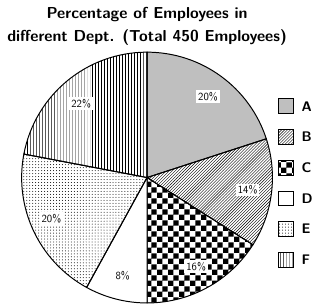
The given pie chart shows the percentage distribution of 450 employees in an organization. Read the pie chart and answer the question that follows.

If 75% of the employees in department D are males, how many female employees are there in that department?

  1. AOption (a)

    9

  2. BOption (b)

    36

  3. COption (c)

    27

  4. DOption (d)

    18

View answer & explanation

Correct answer

Answer: (a)A.

9

Why this answer is correct

Given:

Percentage distribution of employees in an organization

Department A = 20%

Department B = 14%

Department C = 16%

Department D = 8%

Department E = 20% 

Department F = 22%

Total employees in the organization = 450 = 100%

Calculations:

Number of employees in Department D = (8 × 450)/100 = 36

75% of employees of Department D are male 

So, 25% of employees of Department D are female

Number of female Employees in Department D = (25 × 36)/100 = 9

∴ The number of female employees in Department D is 9.

SSC CPO Tier- I Previous Year Paper (Held On: 24 November 2020 Shift 1)·Quantitative Aptitude
View full paper

Question 1852

SSC CPO 2020• Quantitative Aptitude• Quantitative Aptitude

The given histogram shows the frequency distribution of the speed of cars passing through a particular spot on a highway. Read the graph and answer the following question.

What is the ratio of the number of cars with speed less than 60 km/h to the number of cars with speed more than 70 km/h?

  1. AOption (a)

    13 : 8

  2. BOption (b)

    8 : 5

  3. COption (c)

    8 : 13

  4. DOption (d)

    5 : 8

View answer & explanation

Correct answer

Answer: (c)C.

8 : 13

Why this answer is correct

Given:

Number of cars between 40-50 speed = 50 

Number of cars between 50-60 speed = 70

Number of cars between 60-70 speed = 85

Number of cars between 70-80 speed = 90

Number of cars between 80-90 speed = 60

Number of cars between 90-100 speed = 45

Calculations: 

Total number of cars with speed less than 60 km/h = 50 + 70 = 120

Total  number of cars with speed more than 70 km/h = 90 + 60 + 45 = 195 km/h

The ratio of the number of cars with a speed less than 60 km/h to the number of cars with speed more than 70 km/h = 120/195

⇒ 8 ∶ 13

∴ The ratio of the number of cars with a speed less than 60 km/h to the number of cars with speed more than 70 km/h is 8 ∶ 13.

SSC CPO Tier- I Previous Year Paper (Held On: 24 November 2020 Shift 1)·Quantitative Aptitude
View full paper

Question 1853

SSC CPO 2020• Quantitative Aptitude• Quantitative Aptitude

A bus covers a 60 kilometre distance in 1 hour 30 minutes, whereas the same distance is covered by a car in 45 minutes. What is the ratio of the speed of the car to the speed of the bus?

  1. AOption (a)

    5 : 3

  2. BOption (b)

    1 : 2

  3. COption (c)

    2 : 1

  4. DOption (d)

    3 : 5

View answer & explanation

Correct answer

Answer: (c)C.

2 : 1

Why this answer is correct

Given:

Distance covered by bus and car = 60 km.

Time taken by bus to cover the distance = 1 hour 30 minutes.

Time taken by car to cover the same distance = 45 minutes.

Formula used:

Speed = Distance/time

Calculation:

Time taken by bus = 1hr 30 min.

⇒ T = (1 + 30/60) = 3/2 hr.

Time taken by car to cover the same distance = 45 minutes.

⇒ T = 45/60 hr = 3/4 hr.

According to question:

Speed of car ∶ Speed of bus 

⇒ [60/(3/4)] ∶ [60/(3/2)] 

⇒ 80 ∶ 40

⇒ 2 ∶ 1

∴ The ratio of the speed of car and bus is 2 : 1

Alternate Method

Concept used:

When the distance is constant, then the speed is inversely proportional to time.

Calculation:

Time covered by bus = 1hr 30 min.

⇒ T2 = (1 + 30/60) hr.

⇒ T2 = 3/2 hr.

again,

Time covered by car = 45 min

⇒ T1 = 45/60 hr.

⇒  T1 = 3/4 hr.

S1 ∶ S2 = (1/T1) ∶ (1/T2)

⇒ 1/(3/4) ∶ 1/(3/2)

⇒ 4/3 ∶ 2/3 = 2 ∶ 1

∴ The ratio of the speed of car and bus is 2 : 1

SSC CPO Tier- I Previous Year Paper (Held On: 24 November 2020 Shift 1)·Quantitative Aptitude
View full paper

Question 1854

SSC CPO 2020• Quantitative Aptitude• Quantitative Aptitude

A and B started a business investing amounts of Rs. 92,500 and Rs. 1,12,500, respectively. If B's share in the profit earned by them is Rs. 9,000, what is the profit (in Rs.) earned by A?

  1. AOption (a)

    10,000

  2. BOption (b)

    11,240

  3. COption (c)

    7,400

  4. DOption (d)

    9,000

View answer & explanation

Correct answer

Answer: (c)C.

7,400

Why this answer is correct

Given:

Amount invested by A =Rs. 92,500

Amount invested by B = Rs. 1,12,500

B's share in profit = Rs. 9,000

Concept used:

Divide the total profit according to investment ratio.

Calculation:

Let the profit earned by A be Rs. X

According to the question,

(92500/112500) = (X/9000)

⇒ X = (92500 × 9000)/112500

⇒ X =  37 × 200

⇒ X = 7400

∴ The profit earned by A is Rs. 7400

SSC CPO Tier- I Previous Year Paper (Held On: 24 November 2020 Shift 1)·Quantitative Aptitude
View full paper

Question 1855

SSC CPO 2020• Quantitative Aptitude• Quantitative Aptitude

The given pie chart shows the percentage distribution of 450 employees in an organisation. Read the pie chart and answer the question that follows.

What is the number of employees working in department F?

  1. AOption (a)

    36

  2. BOption (b)

    99

  3. COption (c)

    63

  4. DOption (d)

    72

View answer & explanation

Correct answer

Answer: (b)B.

99

Why this answer is correct

Given:

Employees working in department F = 22%

Total percent population = 100%

Calculation:

Out of 100%, 22% of Employees work in the department 'F'

Total number of Employees in Department 'F' = (22/100) × 450 = 99

∴ Total number of Employees in Department 'F' is 99

SSC CPO Tier- I Previous Year Paper (Held On: 24 November 2020 Shift 1)·Quantitative Aptitude
View full paper

Question 1856

SSC CPO 2020• Quantitative Aptitude• Quantitative Aptitude

A person covers a distance of 300 km and then returns to the starting point. The time taken by him for the outward journey is 5 hours more than time taken for the return journey. If he returned at a speed of 10 km/h more than the speed of going. What was the speed (in km/h) for the outward journey?

  1. AOption (a)

    15 km/h

  2. BOption (b)

    20 km/h

  3. COption (c)

    30 km/h

  4. DOption (d)

    25 km/h

View answer & explanation

Correct answer

Answer: (b)B.

20 km/h

Why this answer is correct

Given:

Distance covered by the person in a single journey = 300km

Time taken by him for the outward journey = 5 hours more than the time taken for the return journey.

The return speed is 10km/h more than the speed of going.

Formula used:

Distance covered = Speed × Time taken

Calculation:

Let the speed of outward journey be ‘x’ km/h

Hence, the speed of return journey will be (x + 10) km/h

So, time taken in return journey = 300/(x + 10) hours

Time taken in outward journey = (300/x) hours

According to the question,

⇒ (300/x) – 300/(x + 10) = 5

⇒ [300(x + 10) – 300x]/x(x + 10) = 5

⇒ [300x + 3000 – 300x] = 5x(x + 10)

⇒ 3000 = 5x2 + 50x

⇒ 5x2 + 50x – 3000 = 0

⇒ x2 + 10x – 600 = 0

⇒ x2 + 30x – 20x – 600 = 0

⇒ x(x + 30) – 20(x + 30) = 0

⇒ (x – 20)(x + 30) = 0

⇒ x = 20, -30

⇒ x = 20km/h as negative speed is not possible.

∴ The speed for the outward journey is 20km/h

Shortcut Trick Concept:

[(Speed 1 × Speed 2) / Speed difference] × Time difference = Total distance

Calculation:

Let the speed of outward journey be ‘x’ km/h

Hence, the speed of return journey will be (x + 10) km/h

So, 

\(\frac{x \times (x+10)}{10} \times 5 = 300\)

⇒ \(x \times (x+10) = 600\)

⇒ \(x \times (x+10) = 20 \times 30\)

⇒ x = 20

∴ The speed for the outward journey is 20km/h

SSC CPO Tier- I Previous Year Paper (Held On: 24 November 2020 Shift 1)·Quantitative Aptitude
View full paper

Question 1857

SSC CPO 2020• Quantitative Aptitude• Quantitative Aptitude

The length of the shadow of a vertical pole on the ground in 36 m. If the angle of elevation of the sun at that time is θ, such that secθ = (13/12) then what is the height (in m) of the pole?

  1. AOption (a)

    12

  2. BOption (b)

    15

  3. COption (c)

    18

  4. DOption (d)

    9

View answer & explanation

Correct answer

Answer: (b)B.

15

Why this answer is correct

Given:

Length of shadow = 36m.

Let the height of pole = (x) m.

Formula Used:

sec2θ = tan2θ + 1

tanθ = P/B 

Where, 

P = Perpendicular 

B =Base

Calculations:

secθ = 13/12  

⇒ sec2θ = tan2θ + 1

⇒ (13/12)2 = tan2θ + 1

⇒ tan2θ = 1 - (13/12)2  

⇒ tan2θ = 1 - 169/144

⇒ tan2θ = 25/144

⇒ tanθ = 5/12  

tanθ = P/B 

tanθ = x/36

⇒ 5/12 = x/36

⇒ x = 36 × (5/12)

⇒ x = 15

∴ The height of pole is 15 m.

SSC CPO Tier- I Previous Year Paper (Held On: 24 November 2020 Shift 1)·Quantitative Aptitude
View full paper

Question 1858

SSC CPO 2020• Quantitative Aptitude• Quantitative Aptitude

PA and PB are two tangents from a point P outside the circle with center O at the point A and B on it. If ∠APB = 130°, then ∠OAB is equal to:

  1. AOption (a)

    45° 

  2. BOption (b)

    65°

  3. COption (c)

    35°

  4. DOption (d)

    50°

View answer & explanation

Correct answer

Answer: (b)B.

65°

Why this answer is correct

Given:

∠APB = 130°

Formula Used:

Sum of angles of quadrilateral = 360° 

Sum of angles of triangle = 180° 

Concept Used:

The radius of a circle always perpendicular to the tangent of the circle

In a triangle opposite angle of two equal sides always equal 

Calculation:

∠OAP = ∠OBP = 90°       ----(Radius of a circle always perpendicular to the tangent of the circle)

Now consider □OAPB,

∠OAP + ∠APB + ∠PBO + ∠BOA = 360°

⇒ 90° + 130° + 90° + ∠BOA = 360°

⇒ 310° + ∠BOA = 360°

⇒ ∠BOA = 50°    

In ΔOAB,

OA = OB (Radius of the circle)

So, ∠OAB = ∠OBA      ----(In a triangle opposite angle of two equal side always equal )

⇒ ∠OAB + ∠ABO + ∠BOA = 180°

⇒ 2∠OAB + 50° = 180°

⇒ 2∠OAB = 130°

⇒ ∠OAB = 65°

∴ The value of ∠OAB is 65°        

Shortcut Trick

∠OAB = ∠OBA  = (1/2) × ∠APB 

⇒ ∠OAB = (1/2) × 130 = 65°

∴ The value of ∠OAB is 65°

SSC CPO Tier- I Previous Year Paper (Held On: 24 November 2020 Shift 1)·Quantitative Aptitude
View full paper

Question 1859

SSC CPO 2020• Quantitative Aptitude• Quantitative Aptitude

A person's salary has increased from Rs. 7,000 to Rs. 12,000. What is the percentage increase in his salary?

  1. AOption (a)

    \(61 \frac{1}{7}\)%

  2. BOption (b)

    \(76 \frac{4}{7}\)%

  3. COption (c)

    \(69 \frac{1}{7}\)%

  4. DOption (d)

    \(71 \frac{3}{7}\)%

View answer & explanation

Correct answer

Answer: (d)D.

\(71 \frac{3}{7}\)%

Why this answer is correct

Given:

Initial salary = Rs. 7000

Increased salary = Rs. 12,000

Calculation:

Increase in salary = Rs. 12000 – Rs. 7000 = Rs. 5000

Increase % in salary = (5000/7000) × 100 

\(⇒ 71\frac{3}{7}\)%

∴ The percentage increase in the salary is \(71\frac{3}{7}\)%

Shortcut Trick Increase % in salary = (5000/7000) × 100 

⇒ \(71\frac{3}{7}\)%

SSC CPO Tier- I Previous Year Paper (Held On: 24 November 2020 Shift 1)·Quantitative Aptitude
View full paper

Question 1860

SSC CPO 2020• Quantitative Aptitude• Quantitative Aptitude

In ΔABC, AB and AC are produced to points D and E, respectively. If the bisectors of ∠CBD and ∠BCE meet at the point O, and ∠BOC = 57°, then ∠A is equal to:

  1. AOption (a)

    66° 

  2. BOption (b)

    93°

  3. COption (c)

    114°

  4. DOption (d)

    57°

View answer & explanation

Correct answer

Answer: (a)A.

66° 

Why this answer is correct

Given:

BO and CO is the angle bisector of ∠CBD and ∠BCE respectively

∠ BOC = 57° 

Concept used:

BO and CO is the angle bisector of ∠CBD and ∠BCE respectively.

Then ∠BOC = 90° – (∠BAC/2)

Calculations:

∠BOC = 57° 

⇒ ∠BOC = 90° – (∠BAC/2)

⇒ ∠BAC/2 = 90 – 57

⇒ ∠BAC/2 = 33° 

⇒ ∠BAC = 66° 

∴ The value of ∠BAC is 66° 

Shortcut Trick  ∠BOC = 90° – (∠BAC/2)

⇒ ∠BAC/2 = 90 – 57

⇒ ∠BAC/2 = 33° 

⇒ ∠BAC = 66°

How should I prepare for Quantitative Aptitude in SSC CPO?

Solving previous year questions by topic helps identify recurring concepts, question patterns, and frequently asked sub-topics. Attempt each question, review the step-by-step explanation, and note down key formulas or facts for quick revision before the exam.