SSC CPO · Topic Collection

Quantitative Aptitude PYQs

Arithmetic, number systems, percentages, ratios, profit and loss, time and work, algebra, geometry, mensuration, and trigonometry.

3100 Total Questions62 Official PapersYears: 2017–2025Search in Quantitative Aptitude
Showing questions 1821–1840 of 3100Page 92 of 100
SSC CPO Tier- I Previous Year Paper (Held On: 23 November 2020 Shift 2)·Quantitative Aptitude
View full paper

Question 1821

SSC CPO 2020• Quantitative Aptitude• Quantitative Aptitude

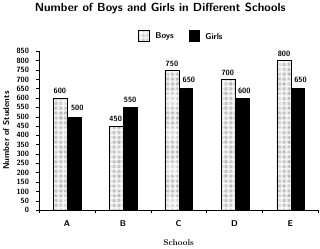
The given bar graph represents the number of boys and girls in five different schools. Study the graph and answer the question that follows.

What is the average number of boys in schools A, B, C, D and E?

  1. AOption (a)

    660

  2. BOption (b)

    616

  3. COption (c)

    596

  4. DOption (d)

    569

View answer & explanation

Correct answer

Answer: (a)A.

660

Why this answer is correct

Given:

Number of boys of:

A = 600

B = 450

C = 750

D = 700

E = 800

Formula used:

Average = (Sum of Boys)/Number of school

Calculation:

Average = (Sum of Boys)/Number of school

⇒ Average = (600 + 450 + 750 + 700 + 800)/5

⇒ Average = 3300/5

⇒ Average = 660

∴ The average of boys in schools A, B, C, D and E is 660.

SSC CPO Tier- I Previous Year Paper (Held On: 23 November 2020 Shift 2)·Quantitative Aptitude
View full paper

Question 1822

SSC CPO 2020• Quantitative Aptitude• Quantitative Aptitude

In ΔABC, ∠A = 66°. AB and AC are produced to points D and E, respectively. If the bisectors of angle CBD and angle BCE meet at the point O, then ∠BOC is equal to:

  1. AOption (a)

    57°

  2. BOption (b)

    93°

  3. COption (c)

    114°

  4. DOption (d)

    66°

View answer & explanation

Correct answer

Answer: (a)A.

57°

Why this answer is correct

Given:

∠A = 66°

Formula used:

Angle between exterior angle bisector = 90° – 1/2 × Angle of opposite vertex

∠BOC = 90° – ∠A/2

Calculation:

∠BOC = 90° – ∠A/2

⇒ ∠BOC = 90° – 66°/2

⇒ ∠BOC = 90° – 33°

⇒ ∠BOC = 57°

∴ ∠BOC is equal to 57°.

SSC CPO Tier- I Previous Year Paper (Held On: 23 November 2020 Shift 2)·Quantitative Aptitude
View full paper

Question 1823

SSC CPO 2020• Quantitative Aptitude• Quantitative Aptitude

The given histogram shows the frequency distribution of the speed of cars passing though at a particular spot on a highway. Study the graph and answer the question that follows.

What is the ratio of the number of cars with speed less than 60 km / h to the number of cars with speed more than 80 km / h?

  1. AOption (a)

    7 : 8

  2. BOption (b)

    8 : 7

  3. COption (c)

    4 : 5

  4. DOption (d)

    5 : 4

View answer & explanation

Correct answer

Answer: (b)B.

8 : 7

Why this answer is correct

Given:

Number of cars with speed less than 60 km/h = 50 + 70 = 120

Number of cars with speed more than 80 km/h = 60 + 45 = 105

Concept used:

Using the concept of ratio

Calculation:

Required ratio = Number of cars with speed less than 60 km/h ∶ Number of cars with speed more than 80 km/h

⇒ Required ratio = 120 ∶ 105

⇒ Required ratio = 8 ∶ 7

∴ The required ratio is 8 ∶ 7.

SSC CPO Tier- I Previous Year Paper (Held On: 23 November 2020 Shift 2)·Quantitative Aptitude
View full paper

Question 1824

SSC CPO 2020• Quantitative Aptitude• Quantitative Aptitude

If a wheel has diameter 42 cm, then how far does the wheel go (in metres) in 12 revolutions? (Take π \(= \frac {22} 7\))

  1. AOption (a)

    21.45

  2. BOption (b)

    15.84

  3. COption (c)

    23.27

  4. DOption (d)

    17.64

View answer & explanation

Correct answer

Answer: (b)B.

15.84

Why this answer is correct

Given:

Diameter = 42 cm

Number of revolution = 12

Concept used:

Circumference = 2πr

Total distance = Number of revolution × Circumference

Calculation:

Radius = Diameter/2

⇒ Radius = 42/2

⇒ Radius = 21

Circumference = 2πr

⇒ Circumference = 2 × 22/7 × 21

⇒ Circumference = 2 × 22 × 3

⇒ Circumference = 132

Total distance = Number of revolution × Circumference

⇒ Total distance = 12 × 132

⇒ Total distance = 1584 cm

⇒ Total distance = 1584/100 m

⇒ Total distance = 15.84 m

∴ The wheel go 15.84 m.

SSC CPO Tier- I Previous Year Paper (Held On: 23 November 2020 Shift 2)·Quantitative Aptitude
View full paper

Question 1825

SSC CPO 2020• Quantitative Aptitude• Quantitative Aptitude

A single discount equivalent to three successive discounts of 8%, 15% and 12% is:

  1. AOption (a)

    68.816%

  2. BOption (b)

    31.184%

  3. COption (c)

    17.5%

  4. DOption (d)

    35%

View answer & explanation

Correct answer

Answer: (b)B.

31.184%

Why this answer is correct

Given:

The successive discounts are 8%, 15% and 12%.

Concept used:

Using the concept of percentage.

Calculation:

Let the initial value be 100.

Discounted value = (100 – 8)% of (100 – 15)% of (100 – 12)% of 100

⇒ Discounted value = 92% of 85% of 88% of 100

⇒ Discounted value = 92/100 × 85/100 × 88/100 × 100

⇒ Discounted value = 68.816

Equivalent discount = (100 – Discounted value)/Initial value × 100

⇒ Equivalent discount = (100 – 68.816)/100 × 100

⇒ Equivalent discount = 31.184%

∴ A single discount equivalent to three successive discounts is 31.184%.

Alternate Method 8% = 8/100 = 2/25

15% = 15/100 = 3/20

12% = 12/100 = 3/25

8%2523
15%2017
12%2522
25 × 20 × 2523 × 17 × 22

25 × 20 × 25 = 12500

23 × 17 × 22 = 8602 

Discount % = \(\frac{12500-8602}{12500}\) × 100 = 389800/12500 = 31.184 %

 ∴ A single discount equivalent to three successive discounts is 31.184%. 

Shortcut Trick 

x + y -\(\frac{x \times y}{100}\)

8 + 15 - ​\(\frac{8 \times 15}{100}\)= 23 - 1.2 = 21.8​21.8 + 12 -\(\frac{21.8 \times 12}{100}\)= 33.8 - 2.616 = 31.184 %

SSC CPO Tier- I Previous Year Paper (Held On: 23 November 2020 Shift 2)·Quantitative Aptitude
View full paper

Question 1826

SSC CPO 2020• Quantitative Aptitude• Quantitative Aptitude

The value of \(\frac {0.325 \times 0.325 + 0.175 \times 0.175 + 25 \times 0.00455}{5 \times 0.0065 \times 3.25 - 7 \times 0.175 \times 0.025} - \frac {0.5}{1.5}\) is:

  1. AOption (a)

    0

  2. BOption (b)

    -3

  3. COption (c)

    3

  4. DOption (d)

    -1

View answer & explanation

Correct answer

Answer: (c)C.

3

Why this answer is correct

Given:

\(\frac {0.325 \times 0.325 + 0.175 \times 0.175 + 25 \times 0.00455}{5 \times 0.0065 \times 3.25 - 7 \times 0.175 \times 0.025} - \frac {0.5}{1.5}\) 

Calculations:

\(\frac {0.325 \times 0.325 + 0.175 \times 0.175 + 25 \times 0.00455}{5 \times 0.0065 \times 3.25 - 7 \times 0.175 \times 0.025} - \frac {0.5}{1.5}\)

\(⇒ \frac {325 \times 325 + 175 \times 175 + 25 0\times 455}{5 \times 65 \times 325 - 7 \times 175 \times 25} - \frac {0.5}{1.5}\)

\(⇒\frac {(625)(13 \times 13 + 7 \times 7 + 2 \times 91)}{(625)(1 \times 13 \times 13 - 7 \times 7 \times 1)} - \frac {0.5}{1.5}\)

\(⇒\frac {169 + 49 + 182}{169 - 49 } - \frac {0.5}{1.5}\)

\(⇒\frac {400}{120 } - \frac {0.5}{1.5}\)

\(⇒\frac {10}{3 } - \frac {1}{3}\)

\(⇒\frac {9}{3 }\)

⇒ 3

∴ The value of \(\frac {0.325 \times 0.325 + 0.175 \times 0.175 + 25 \times 0.00455}{5 \times 0.0065 \times 3.25 - 7 \times 0.175 \times 0.025} - \frac {0.5}{1.5}\) is 3.

SSC CPO Tier- I Previous Year Paper (Held On: 23 November 2020 Shift 2)·Quantitative Aptitude
View full paper

Question 1827

SSC CPO 2020• Quantitative Aptitude• Quantitative Aptitude

A rectangular lawn whose length is twice of its breadth is extended by having four semi-circular portions on its sides. What is the total cost (in Rs.) of levelling the entire lawn at the rate of Rs. 100 per square metre, if the smaller side of the rectangular lawn is 12 m? (Take π = 3.14)

  1. AOption (a)

    86,540

  2. BOption (b)

    78,650

  3. COption (c)

    85,320

  4. DOption (d)

    97,625

View answer & explanation

Correct answer

Answer: (c)C.

85,320

Why this answer is correct

Given:

Length = 2 × Breadth

Breadth = 12m

Cost of levelling = Rs. 100/m2

Formula used:

Area of rectangle = Length × Breadth 

Area of semi-circle = 1/2 × πr2

Calculation:

Length = 2 × Breadth

⇒ Length = 2 × 12

⇒ Length = 24 m

Area of rectangle = Length × Breadth 

⇒ Area of rectangle = 12 × 24

⇒ Area of rectangle = 288 m2

Area of semi-circle on larger side = 1/2 × π × 122

⇒ Area of semi-circle on larger side = 72π m2

Area of semi-circle on smaller side = 1/2 × π × 62

⇒ Area of semi-circle on smaller side = 18π m2

Total area of lawn = Area of rectangle + 2 × Area of semi-circle on larger side + 2 × Area of semi-circle on smaller side

⇒ Total area of lawn = 288 + (2 × 72π ) + (2 × 18π)

⇒ Total area of lawn = 288 + 2π(72 + 18)

⇒ Total area of lawn = 288 + 2 × 3.14 × 90

⇒ Total area of lawn = 288 + 565.2

⇒ Total area of lawn = 853.2 m2

Total cost of levelling = Total area of lawn × 100

⇒ Total cost of levelling = 853.2 × 100

⇒ Total cost of levelling = Rs. 85320

∴ The total cost of levelling the entire lawn is Rs. 85320.

Alternate Method 

Length = 2 × Breadth

⇒ Length = 2 × 12

⇒ Length = 24 m

Area of rectangle = Length × Breadth 

⇒ 12 × 24 = 288 m2

Area of semi-circle on larger side = 1/2 × π × 122

⇒ 72π m2

Area of semi-circle on smaller side = 1/2 × π × 62

⇒  18π m2

Total area of lawn = Area of rectangle + 2 × Area of semi-circle on larger side + 2 × Area of semi-circle on smaller side

⇒ 288 + (2 × 72π ) + (2 × 18π)

⇒ 288 + 2π(72 + 18)

⇒ 288 + 2 × 3.14 × 90

⇒ 288 + 565.2

⇒ 853.2 m2

Total cost of levelling = Total area of lawn × 100

⇒ 853.2 × 100

⇒ 85320

SSC CPO Tier- I Previous Year Paper (Held On: 23 November 2020 Shift 2)·Quantitative Aptitude
View full paper

Question 1828

SSC CPO 2020• Quantitative Aptitude• Quantitative Aptitude

If x2 - 5x + 1 = 0, then the value of \(\left(x^4 + \frac 1 {x^2}\right) \div \left(x^2 + 1\right)\) is:

  1. AOption (a)

    25

  2. BOption (b)

    21

  3. COption (c)

    22

  4. DOption (d)

    24

View answer & explanation

Correct answer

Answer: (c)C.

22

Why this answer is correct

Given:

x2 - 5x + 1 = 0

Formula used:

(a + b)3 = a3 + b3 + 3ab(a + b)

Calculations:

x2 - 5x + 1 = 0

⇒ x(x - 5 + 1/x) = 0

⇒ (x - 5 + 1/x) = 0

⇒ (x + 1/x) = 5

Taking cube both sides,

⇒ (x + 1/x)3 = (5)3

⇒ x3 + 1/x3 + 3(x)(1/x)(x + 1/x) = 125

⇒ x3 + 1/x3 + 3(5) = 125

⇒ x3 + 1/x3 + 15 = 125

⇒ x3 + 1/x3 = 125 - 15

⇒ x3 + 1/x3 = 110

(x4 + 1/x2)/(x2 + 1)

Dividing the numerator and denominator by x,

(1/x)(x4 + 1/x2)/(x2 + 1)(1/x)

⇒ (x3 + 1/x3)/(x + 1/x)

⇒ 110/5

⇒ 22

∴ The value of \(\left(x^4 + \frac 1 {x^2}\right) \div \left(x^2 + 1\right)\) is 22.

SSC CPO Tier- I Previous Year Paper (Held On: 23 November 2020 Shift 2)·Quantitative Aptitude
View full paper

Question 1829

SSC CPO 2020• Quantitative Aptitude• Quantitative Aptitude

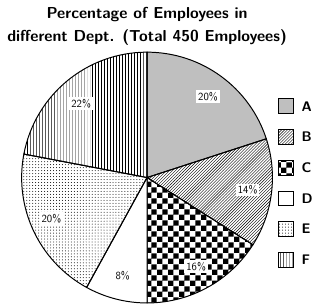
The given pie chart shows the percentage distribution of 450 employees in an organisation. Study the pie chart and answer the question that follows.

What is the central angel of the sector representing the number of employees in department A?

  1. AOption (a)

    72°

  2. BOption (b)

    108°

  3. COption (c)

    90°

  4. DOption (d)

    36°

View answer & explanation

Correct answer

Answer: (a)A.

72°

Why this answer is correct

Given:

Percentage of employees in department A

Formula used:

Central angle = 360° × (Percentage of employees in department A)/100%

Calculation:

Central angle = 360° × (Percentage of employees in department A)/100%

⇒ Central angle = 360° × 20%/100%

⇒ Central angle = 360°/5

⇒ Central angle = 72° 

∴ Central angel of the sector representing the number of employees in department A is 72°.

Shortcut Trick 

⇒ 100% = 360°

⇒ 1% = 360 / 100

∴ 20% = (360 / 100) × 20

⇒ 72°

SSC CPO Tier- I Previous Year Paper (Held On: 23 November 2020 Shift 2)·Quantitative Aptitude
View full paper

Question 1830

SSC CPO 2020• Quantitative Aptitude• Quantitative Aptitude

X can do a work in 3 days, Y does three times the same work in 8 days, and Z does five times the same work in 12 days if they have to work for 6 hours in a day. Then in how much time can they complete the work together?

  1. AOption (a)

    4 hours

  2. BOption (b)

    5 hours 20 minutes

  3. COption (c)

    4 hours 10 minutes

  4. DOption (d)

    5 hours

View answer & explanation

Correct answer

Answer: (b)B.

5 hours 20 minutes

Why this answer is correct

Given:

X can complete the work in 3 days.

Y can do three times the same work in 8 days.

Z does five times the same work in 12 days.

Working hours per day = 6 hours

Formula used:

Efficiency = Total work/Total Time

Calculations:

Let the total work be 1 unit.

Time to complete 1 unit by X alone = 3 × 6 = 18 hours

Time to complete the 3 units by Y alone =  8 × 6 = 48 hours

Time to complete the 1 unit by Y alone = 48/3 = 16 hours

Time to complete the 5 units by Z alone =  12 × 6 = 72 hours

Time to complete the 1 unit by Z alone = 72/5 hours

Efficiency of X = 1/18 units/hour

Efficiency of Y = 1/16 units/hour

Efficiency of Z = 5/72 units/hour

Combined efficiency of X, Y and Z = (1/18) + (1/16) + (5/72)

⇒ (8 + 9 + 10)/144

⇒ 27/144 units/hour

Time to complete total work by X, Y and Z together

⇒ 1/(27/144)

⇒ 144/27 hours

⇒ 5 hours 20 minutes

∴ They can complete the work in 5 hours 20 minutes.

SSC CPO Tier- I Previous Year Paper (Held On: 23 November 2020 Shift 2)·Quantitative Aptitude
View full paper

Question 1831

SSC CPO 2020• Quantitative Aptitude• Quantitative Aptitude

The given histogram shows the frequency distribution of the speed of cars passing through at a particular spot on a highway. Study the graph and answer the question that follows.

What percentage of cars were running with a speed of less than or equal to 70 km/h?

  1. AOption (a)

    30%

  2. BOption (b)

    51.25%

  3. COption (c)

    60%

  4. DOption (d)

    45.75%

View answer & explanation

Correct answer

Answer: (b)B.

51.25%

Why this answer is correct

Given:

Total number of cars 

50 + 70 + 85 + 90 + 60 + 45 = 400

Total number of cars with speeds less than 70 km/h

50 + 70 + 85 = 205

Formula used:

Percentage = (Part value/Original value) × 100

Calculation:

Percentage of cars running with a speed less than 70 km/h

⇒ (205/400) × 100

⇒ 51.25%

∴ The percentage value is 51.25%.

SSC CPO Tier- I Previous Year Paper (Held On: 23 November 2020 Shift 2)·Quantitative Aptitude
View full paper

Question 1832

SSC CPO 2020• Quantitative Aptitude• Quantitative Aptitude

A sum of Rs. 8,200 was divided among A, B and C in such a way that A has Rs. 500 more than B, and C has Rs. 300 more than A. How much was A's share (in Rs.)?

  1. AOption (a)

    2,800

  2. BOption (b)

    2,300

  3. COption (c)

    3,100

  4. DOption (d)

    2,000

View answer & explanation

Correct answer

Answer: (a)A.

2,800

Why this answer is correct

Given:

Total money = Rs. 8,200

A's share = Rs. 500 more than B

C's share = Rs. 300 more than A

Calculations:

Let share of A, B and C are A, B and C respectively.

A = 500 + B

⇒ B = A - 500

C = 300 + A

⇒ C = 300 + A

A + B + C = 8,200

⇒ A + A - 500 + 300 + A = 8,200

⇒ 3A - 200 = 8,200

⇒ 3A = 8,400

⇒ A = 2,800

∴ A's share was Rs. 2,800

SSC CPO Tier- I Previous Year Paper (Held On: 23 November 2020 Shift 2)·Quantitative Aptitude
View full paper

Question 1833

SSC CPO 2020• Quantitative Aptitude• Quantitative Aptitude

Asha and Suman's mud forts have heights 9 cm and 16 cm. They are 24 cm apart. How far (in cm) are the fort tops from each other?

  1. AOption (a)

    25

  2. BOption (b)

    16

  3. COption (c)

    24

  4. DOption (d)

    7

View answer & explanation

Correct answer

Answer: (a)A.

25

Why this answer is correct

Given:

Height of Asha's mud fort = AB = 9 cm

Height of Suman's mud fort = DE = 16 cm

Distance between mud forts = BD = 24 cm

AB = CD

AC = BD

Calculations:

From the above figure,

DE = CD + CE

⇒ DE = AB + CE

⇒ CE = DE - AB

⇒ CE = 16 - 9

⇒ CE = 7 cm

In ΔACE, By using Pythagoras theorem,

(AE)2 = (AC)2 + (CE)2

⇒ (AE)2 = (24)2 + (7)2

⇒ (AE)2 = 576 + 49

⇒ (AE)2 = 625

⇒ AE = √625

⇒ AE = 25 cm

∴ The fort tops are 25 cm far from each other.

SSC CPO Tier- I Previous Year Paper (Held On: 23 November 2020 Shift 2)·Quantitative Aptitude
View full paper

Question 1834

SSC CPO 2020• Quantitative Aptitude• Quantitative Aptitude

If the difference between the compound interest and simple interest at 17% on a sum of money for 2 years (compounded annually) is Rs. 433.50, then the sum (in Rs.) is:

  1. AOption (a)

    12,000

  2. BOption (b)

    20,000

  3. COption (c)

    15,000

  4. DOption (d)

    25,000

View answer & explanation

Correct answer

Answer: (c)C.

15,000

Why this answer is correct

Given:

Rate of interest = 17%

Time = 2 years

The difference between CI and SI = Rs. 433.50

Formula used:

Simple interest = P × R% × T

Calculation:

Let the principal be Rs.

x. SI = P × R% × T

⇒ SI = x × 17% × 2

⇒ SI = x × 17/100 × 2

⇒ SI = 34x/100

⇒ SI = 0.34x

In the case of CI:

1st year CI = P × R% × T

⇒ 1st year CI = x × 17% × 1

⇒ 1st year CI = 17x/100

⇒ 1st year CI = 0.17x

Amount after 1st year = P + CI 

⇒ Amount = x + 0.17x

⇒ Amount = 1.17x

2nd year CI = 1.17x × 17% × 1

⇒ 2nd year CI = 0.1989x

Total CI = 1st year CI + 2nd year CI

⇒ CI = 0.17x + 0.1989x

⇒ CI = 0.3689x

Required difference = CI – SI

⇒ 433.50 = 0.3689x – 0.34x

⇒ 433.50 = 0.0289x

⇒ x = 433.50/0.0289

⇒ x = Rs. 15000

∴ The sum is Rs. 15000.

SSC CPO Tier- I Previous Year Paper (Held On: 23 November 2020 Shift 2)·Quantitative Aptitude
View full paper

Question 1835

SSC CPO 2020• Quantitative Aptitude• Quantitative Aptitude

The given pie chart shows the percentage distribution of 450 employees in an organisation. Study the pie chart and answer the question that follows.

What is the number of employees working in department B?

  1. AOption (a)

    90

  2. BOption (b)

    72

  3. COption (c)

    36

  4. DOption (d)

    63

View answer & explanation

Correct answer

Answer: (d)D.

63

Why this answer is correct

Given:

Total employees = 450

Number of employees working in department B = 14%

Calculations:

Number of employees working in department B = 450 × 14%

⇒ 63

∴ The number of employees working in department B is 63.

SSC CPO Tier- I Previous Year Paper (Held On: 23 November 2020 Shift 2)·Quantitative Aptitude
View full paper

Question 1836

SSC CPO 2020• Quantitative Aptitude• Quantitative Aptitude

If x2 + 8y2 - 12y - 4xy + 9 = 0, then the value of (7x - 8y) is:

  1. AOption (a)

    12

  2. BOption (b)

    9

  3. COption (c)

    21

  4. DOption (d)

    5

View answer & explanation

Correct answer

Answer: (b)B.

9

Why this answer is correct

Given:

x2 + 8y2 – 12y – 4xy + 9 = 0

Concept used:

(a – b)2 = a2 + b2 – 2ab

Calculation:

x2 + 8y2 – 12y – 4xy + 9 = 0

⇒ x2 + 4y2 + 4y2 – 12y – 4xy + 9 = 0

⇒ (x2 + 4y2 – 4xy) + (4y2 – 12y + 9) = 0 

⇒ (x – 2y)2 + (2y – 3)2 = 0

Either (2y – 3)2 = 0

⇒ (2y – 3) = 0

⇒ 2y = 3

⇒ y = 3/2

Or (x – 2y)2 = 0

⇒ (x – 2y) = 0

⇒ x = 2 × 3/2

⇒ x = 3

(7x – 8y) = 7 × 3 – 8 × 3/2

⇒ (7x – 8y) = 21 – 12

⇒ (7x – 8y) = 9

∴ The value of (7x – 8y) is 9.

SSC CPO Tier- I Previous Year Paper (Held On: 23 November 2020 Shift 2)·Quantitative Aptitude
View full paper

Question 1837

SSC CPO 2020• Quantitative Aptitude• Quantitative Aptitude

If the annual rate of simple interest increases from 11% to \(17 \frac 1 2%\), a person's yearly income increases by Rs. 1,071.20. The principal amount invested (in Rs.) is:

  1. AOption (a)

    16,480

  2. BOption (b)

    19,120

  3. COption (c)

    17,250

  4. DOption (d)

    10,710

View answer & explanation

Correct answer

Answer: (a)A.

16,480

Why this answer is correct

Given:

Rate = 11%

Rate = \(17 \frac 1 2%\)

Increase in Amount = Rs. 1,071.20

Formula used:

(i) SI = PRT/100

Where, P = principal

R = rate

T = time

(ii) A = SI + P

Where, A = Amount

SI = simple interest

Calculations:

A = SI + P

⇒ A = PRT/100 + P

⇒ A = P{(PRT/100) + 1}

For R = 11%

⇒ A1 = P{(11/100) + 1}

For R = \(17 \frac 1 2%\)

⇒ A2 = P{(35/200) + 1}

A2 - A1 = P{(35/200) + 1} - P{(11/100) + 1}

⇒ P{35/200 + 1 - 11/100 - 1}

⇒ P{35/200 - 11/100}

⇒ P{(35 - 22)/200}

⇒ 13P/200 = 1,071.20

⇒ P = 214240/13

⇒ 16,480

∴ The principal amount invested is Rs.16,480.

SSC CPO Tier- I Previous Year Paper (Held On: 23 November 2020 Shift 2)·Quantitative Aptitude
View full paper

Question 1838

SSC CPO 2020• Quantitative Aptitude• Quantitative Aptitude

A person travels a distance of 300 km and then returns to the starting point. The time taken by him for the outward journey is 5 hours more than the time taken for the return journey. If he returns at a speed of 10 km / h more than the speed of going, what is the average speed (in km / h) for the entire journey?

  1. AOption (a)

    15

  2. BOption (b)

    24

  3. COption (c)

    20

  4. DOption (d)

    30

View answer & explanation

Correct answer

Answer: (b)B.

24

Why this answer is correct

Given:

Distance travelled = 300 km

Time is taken by outward journey = Time taken for return journey + 5 hrs

Speed of returning journey = Speed of going journey + 10 km/h

Concept used:

Average speed = (Total distance traveled)/(Total time is taken)

Calculation:

Let the speed of the outward journey be x km/h.

Speed of returning journey = (x + 10) km/h

Time is taken by outward journey = 300/x hrs

Time is taken by returning journey = 300/(x + 10) hrs

According to the question, 

Time is taken by outward journey = Time taken for return journey + 5 hrs

⇒ 300/x = 300/(x + 10) + 5

⇒ 300/x – 300/(x + 10) = 5

⇒ (300x + 3000 – 300x)/(x2 + 10x) = 5

⇒ 3000 = 5x2 + 50x

⇒ x2 + 10x – 600 = 0

⇒ x2 + 30x – 20x – 600 = 0

⇒ x(x + 30) – 20(x + 30) = 0

⇒ (x + 30)(x – 20) = 0

⇒ (x + 30) = 0 or (x – 20) = 0

⇒ x = -30 or x = 20

Speed of outward journey = 20 hrs

Time is taken by outward journey = 300/x hrs

⇒ Outward journey time = 300/20

⇒ Outward journey time = 15 hrs

Time is taken by outward journey = Time taken for return journey + 5 hrs

⇒ 15 = Returning time + 5

⇒ Returning time = 10 hrs

Average speed = (Total distance traveled)/(Total time is taken)

⇒ Average speed = (300 + 300)/(15 + 10)

⇒ Average speed = 600/25

⇒ Average speed = 24 km/h

∴ The average speed for the entire journey is 24 km/h.

Alternate Method Let speed of the outward journey = s1 = x km/h.

Speed of returning journey = s2 = (x + 10) km/h

Distance = \(\frac{s_1× s_2}{s_2 - s_1}\) × (Difference in time)

300 = \(\frac{x× (x+10)}{(x + 10)-x}\) × 5

⇒ 600 = x(x + 10)

⇒ 600 = 20 × (20 + 10)

By Comparing

x = 20

Average speed = \(\frac{2\times 20 \times30}{20 + 30}\) = 1200/50 = 24 km/h.
SSC CPO Tier- I Previous Year Paper (Held On: 23 November 2020 Shift 2)·Quantitative Aptitude
View full paper

Question 1839

SSC CPO 2020• Quantitative Aptitude• Quantitative Aptitude

A and B can do a piece of work in 36 days. B and C can do the same work in 60 days. A and C can do the same work in 45 days. In how many days can A alone complete the same work?

  1. AOption (a)

    120

  2. BOption (b)

    90

  3. COption (c)

    45

  4. DOption (d)

    60

View answer & explanation

Correct answer

Answer: (d)D.

60

Why this answer is correct

Given:

A and B can do a piece of work in 36 days

B and C can do the same work in 60 days

A and C can do the same work in 45 days

Concept used:

Total days of work = Work/(One day work)

Calculation:

1 day work of (A + B) = 1/36           …………..(1)

1 day work of (B + C) = 1/60           …………..(2)

1 day work of (A + C) = 1/45           …………..(3)

Adding (1), (2), and (3)

1 day work of 2(A + B + C) = 1/36 + 1/60 + 1/45

⇒ 1/36 + 1/60 + 1/45

⇒ (5 + 3 + 4)/180

⇒ 12/180

⇒ 1/15

⇒ 1 day work of (A + B + C) = 1/30

1 day work of A = 1 day work of (A + B + C) – 1 day work of (B + C)

⇒ 1 day work of A = 1/30 – 1/60

⇒ (2 – 1)/60

⇒ 1/60

Total number of days completed by A = Work/(1 day work of A)

⇒ Total number of days completed by A = 1/(1/60)

⇒ Total number of days completed by A = 60 days

∴ Total number of days completed by A is 60 days.

SSC CPO Tier- I Previous Year Paper (Held On: 23 November 2020 Shift 2)·Quantitative Aptitude
View full paper

Question 1840

SSC CPO 2020• Quantitative Aptitude• Quantitative Aptitude

If sec3x = cosec(3x - 45°), where 3x is an acute angle, then x is equal to:

  1. AOption (a)

    35°

  2. BOption (b)

    45°

  3. COption (c)

    22.5°

  4. DOption (d)

    27.5°

View answer & explanation

Correct answer

Answer: (c)C.

22.5°

Why this answer is correct

Given:

sec3x = cosec(3x - 45°)

Concept used:

cosec(90 - θ) = secθ 

Calculation:

sec3x = cosec(3x - 45°)

⇒ cosec(90° - 3x) = cosec(3x - 45°)

⇒ 90 - 3x = 3x - 45°

⇒ 6x = 135° 

⇒ x = 22.5° 

∴ The value of x is 22.5°.

How should I prepare for Quantitative Aptitude in SSC CPO?

Solving previous year questions by topic helps identify recurring concepts, question patterns, and frequently asked sub-topics. Attempt each question, review the step-by-step explanation, and note down key formulas or facts for quick revision before the exam.