SSC CPO · Topic Collection

Quantitative Aptitude PYQs

Arithmetic, number systems, percentages, ratios, profit and loss, time and work, algebra, geometry, mensuration, and trigonometry.

3100 Total Questions62 Official PapersYears: 2017–2025Search in Quantitative Aptitude
Showing questions 1801–1820 of 3100Page 91 of 100
SSC CPO Tier- I Previous Year Paper (Held On: 23 November 2020 Shift 2)·Quantitative Aptitude
View full paper

Question 1801

SSC CPO 2020• Quantitative Aptitude• Quantitative Aptitude

The given bar graph represents the number of boys and girls in five different schools. Study the graph and answer the question that follows.
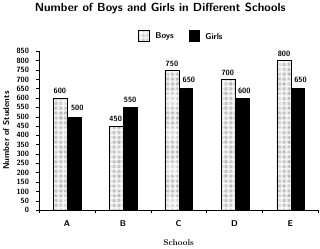
What is the ratio of girls and boys from all the schools taken together?

  1. AOption (a)

    59 : 66

  2. BOption (b)

    61 : 59

  3. COption (c)

    59 : 61

  4. DOption (d)

    66 : 59

View answer & explanation

Correct answer

Answer: (a)A.

59 : 66

Why this answer is correct

Given:

Total number of girls = 500 + 550 + 650 + 600 + 650 = 2950

Total number of boys = 600 + 450 + 750 + 700 + 800 = 3300

Concept used:

Using the concept of ratio.

Calculation:

Required ratio = Total number of girls ∶ Total number of boys

⇒ Required ratio = 2950 ∶ 3300

⇒ Required ratio = 59 ∶ 66

∴ The ratio of girls and boys from all the schools taken together is 59 ∶ 66.
SSC CPO Tier- I Previous Year Paper (Held On: 23 November 2020 Shift 2)·Quantitative Aptitude
View full paper

Question 1802

SSC CPO 2020• Quantitative Aptitude• Quantitative Aptitude

The ratio of two numbers is 7 : 13 and their HCF is 8. Their LCM is:

  1. AOption (a)

    728

  2. BOption (b)

    872

  3. COption (c)

    628

  4. DOption (d)

    782

View answer & explanation

Correct answer

Answer: (a)A.

728

Why this answer is correct

Given:

Ratio of two numbers = 7 : 13

HCF = 8

Concept used:

(i) If a and b are two numbers, then a × b = HCF × LCM

(ii) HCF of two numbers is the highest common factor of both of them. 

Calculations:

Let the numbers be 7x and 13x.

Then, H.C.F. = x

As we have given, x = 8

First number is,

⇒ 7x

⇒ 7 × 8 = 56

Second number is,

⇒ 13x

⇒ 13 × 8 = 104

a × b = HCF × LCM

⇒ 56 × 104 = 8 × LCM

⇒ LCM = 728

∴ The LCM is 728.

SSC CPO Tier- I Previous Year Paper (Held On: 23 November 2020 Shift 2)·Quantitative Aptitude
View full paper

Question 1803

SSC CPO 2020• Quantitative Aptitude• Quantitative Aptitude

The students of a class donated a sum of Rs. 2,209. If each student donated as many rupees as the number of students in the class, then the number of students in the class is:

  1. AOption (a)

    49

  2. BOption (b)

    53

  3. COption (c)

    47

  4. DOption (d)

    51

View answer & explanation

Correct answer

Answer: (c)C.

47

Why this answer is correct

Given:

Total sum donated by class = Rs. 2209

Total number of student in class = Money donated by each student

Concept used:

Total sum = Total number of students in class × Money donated by each student.

Calculation:

Let each student donated Rs.

x. Total number of student in class = Money donated by each student

⇒ Total number of student in class = x

According to the question,

Total sum = Total number of student in class × Money donated by each student

⇒ 2209 = x × x

⇒ x2 = 2209

⇒ x = √2209

⇒ x = 47

∴ The number of students in the class is 47.

SSC CPO Tier- I Previous Year Paper (Held On: 23 November 2020 Shift 2)·Quantitative Aptitude
View full paper

Question 1804

SSC CPO 2020• Quantitative Aptitude• Quantitative Aptitude

ABCD is a cyclic quadrilateral such that AB is a diameter of the circle circumscribing it and ∠ADC = 148°. What is the measure of the ∠BAC?

  1. AOption (a)

    45°

  2. BOption (b)

    60°

  3. COption (c)

    58°

  4. DOption (d)

    32°

View answer & explanation

Correct answer

Answer: (c)C.

58°

Why this answer is correct

Given:

ABCD is a cyclic quadrilateral.

∠ADC = 148°

Concept used:

(i) Angle formed by drawing lines from the ends of the diameter of a circle to its circumference form a right angle.

(ii) Sum of opposite angles of cyclic quadrilateral is 180°

Calculations:


In quadrilateral ABCD,

∠ADC + ∠CBA = 180°

⇒ 148° + ∠CBA = 180°

⇒ ∠CBA = 180° - 148° 

⇒ ∠CBA = 32°

In ΔABC,

∠BAC + 90° + ∠CBA = 180°

⇒ ∠BAC + 90° + 32° = 180° 

⇒ ∠BAC + 122° = 180° 

⇒ ∠BAC = 180° - 122°

⇒ ∠BAC = 58°

∴ The measure of the ∠BAC is 58°

SSC CPO Tier- I Previous Year Paper (Held On: 23 November 2020 Shift 2)·Quantitative Aptitude
View full paper

Question 1805

SSC CPO 2020• Quantitative Aptitude• Quantitative Aptitude

Let ΔABC ~ ΔRPQ and \(\frac {ar (\Delta ABC)}{ar(\Delta RPQ)} = \frac 4 9\). If AB = 3 cm, BC = 4 cm and AC = 5 cm, then PQ (in cm) is equal to:

  1. AOption (a)

    12

  2. BOption (b)

    6

  3. COption (c)

    5

  4. DOption (d)

    4.5

View answer & explanation

Correct answer

Answer: (b)B.

6

Why this answer is correct

Given:

ΔABC ~ ΔRPQ and \(\frac {ar (\Delta ABC)}{ar(\Delta RPQ)} = \frac 4 9\)

AB = 3 cm, BC = 4 cm and AC = 5 cm

Concept used:

When ΔABC is similar to ΔRPQ

\(\frac{{{\rm{area;of;\Delta ABC}}}}{{{\rm{area;of;\Delta RPQ}}}} = ;\frac{{{\rm{A}}{{\rm{B}}^2}}}{{{\rm{R}}{{\rm{P}}^2}}} = ;\frac{{{\rm{B}}{{\rm{C}}^2}}}{{{\rm{P}}{{\rm{Q}}^2}}} = ;\frac{{{\rm{A}}{{\rm{C}}^2}}}{{{\rm{R}}{{\rm{Q}}^2}}}\)

Calculation:

\(\frac{{{\rm{area;of;\Delta ABC}}}}{{{\rm{area;of;\Delta RPQ}}}} = ;\frac{{{\rm{A}}{{\rm{B}}^2}}}{{{\rm{R}}{{\rm{P}}^2}}} = ;\frac{{{\rm{B}}{{\rm{C}}^2}}}{{{\rm{P}}{{\rm{Q}}^2}}} = ;\frac{{{\rm{A}}{{\rm{C}}^2}}}{{{\rm{R}}{{\rm{Q}}^2}}}\)

⇒ 4/9 = BC2/PQ2

⇒ PQ2 = (42 × 9)/4

⇒ PQ2 = 36

⇒ PQ = 6 cm

∴ The value of PQ is 6 cm.

SSC CPO Tier- I Previous Year Paper (Held On: 23 November 2020 Shift 2)·Quantitative Aptitude
View full paper

Question 1806

SSC CPO 2020• Quantitative Aptitude• Quantitative Aptitude

If the area of a square is decreased by 19%, then the diagonal of the square is decreased by:

  1. AOption (a)

    15%

  2. BOption (b)

    5%

  3. COption (c)

    10%

  4. DOption (d)

    12%

View answer & explanation

Correct answer

Answer: (c)C.

10%

Why this answer is correct

Given:

The area of the square is decreased by 19%.

Formula used:

Area of the square = side2 = (diagonal)2/2

Diagonal of square = √2 × side

Percentage = (part value/original value) × 100

Calculation:

Let the side of the square is 10 cm.

Area of the square

⇒ 10 × 10

⇒ 100 cm2

Diagonal of square 

⇒ √2 × 10

The area is decreased by 19%, the new area is

⇒ 100 × (81/100)

⇒ 81

Diagonal of the new square

⇒ 81 = (diagonal)2/2

⇒ diagonal = 9√2

Diagonal decreased by

⇒ 10√2 - 9√2

⇒ √2 

Percentage decrease

⇒ (√2/10√2) × 100

⇒ 10%

∴ The percentage decreased in diagonal is 10%.

SSC CPO Tier- I Previous Year Paper (Held On: 23 November 2020 Shift 2)·Quantitative Aptitude
View full paper

Question 1807

SSC CPO 2020• Quantitative Aptitude• Quantitative Aptitude

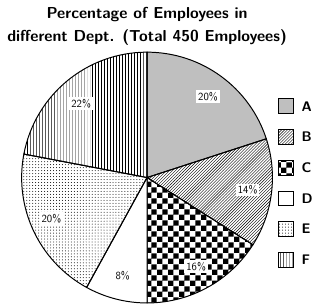
The given pie chart shows the percentage distribution of 450 employees in an organisation. Study the pie chart and answer the question that follows.

If 60% of the employees in department E are females, how many male employees are there in that department?

  1. AOption (a)

    18

  2. BOption (b)

    54

  3. COption (c)

    72

  4. DOption (d)

    36

View answer & explanation

Correct answer

Answer: (d)D.

36

Why this answer is correct

Given:

Total employees = 450

Females in department E = 60% of the total employees in department E

Calculations:

Total employees in department E = 450 × 20%

⇒ 90

Females in department E = 60% × 90

⇒ 54

Males in department E = 90 - 54

⇒ 36

∴ There are 36 male employees in department E.

SSC CPO Tier- I Previous Year Paper (Held On: 23 November 2020 Shift 2)·Quantitative Aptitude
View full paper

Question 1808

SSC CPO 2020• Quantitative Aptitude• Quantitative Aptitude

The average weight of a group of 3 people A, B and C is 70 kg. When D joins this group, the average becomes 60 kg, One man E, whose weight is 5 kg more than that of D, replaces A and the average weight of B, C, D, and E now becomes 59 kg. A's weight (in kg) is:

  1. AOption (a)

    40

  2. BOption (b)

    50

  3. COption (c)

    59

  4. DOption (d)

    39

View answer & explanation

Correct answer

Answer: (d)D.

39

Why this answer is correct

Given:

Average weight of A, B, and C = 70 kg

Average weight of A, B, C, and D = 60 kg

Weight of E = Weight of D + 5 kg

Average weight of B, C, D and E = 59 kg

Concept used:

Sum of weight = Average × Number of observation

Calculation:

A + B + C = 70 × 3

⇒ A + B + C = 210 kg               .............(1)

A + B + C + D = 60 × 4

⇒ A + B + C + D = 240 kg        .............(2)

B + C + D + E = 59 × 4

⇒ B + C + D + E = 236 kg         ............ (3) Subtracrt (1) in (2),

(A + B + C + D) – (A + B + C) = 240 – 210

⇒ D = 30 kg

Weight of E = Weight of D + 5 kg

⇒ E = 30 + 5

⇒ E = 35 kg

B + C + D + E = 236                 [Using eqn (3)]

⇒ B + C + 30 + 35 = 236

⇒ B + C = 236 – 65

⇒ B + C = 171 kg                ------------(4)

Subtract (4) in (1)

(A + B + C) – (B + C) = 210 – 171

⇒ A = 39 kg

∴ The weight of A is 39 kg

SSC CPO Tier- I Previous Year Paper (Held On: 23 November 2020 Shift 2)·Quantitative Aptitude
View full paper

Question 1809

SSC CPO 2020• Quantitative Aptitude• Quantitative Aptitude

Two pipes can fill a tank in 15 hours and 4 hours, respectively, while a third pipe can empty it in 12 hours. How long (in hours) will it take to fill the empty tank if all the three pipes are opened simultaneously?

  1. AOption (a)

    30 / 7

  2. BOption (b)

    20 / 7

  3. COption (c)

    50 / 7

  4. DOption (d)

    15 / 7

View answer & explanation

Correct answer

Answer: (a)A.

30 / 7

Why this answer is correct

Given:

Time to fill the tank by two pipes = 15 hours and 4 hours

Time to empty the tank by third pipe = 12 hours

Concept used:

If Pipe A take ‘x’ hours and Pipe B takes ‘y’ hours to fill a tank then assume the total capacity of the tank is equal to LCM of ‘x’ and ‘y’ or a multiple of them.

Formula used:

Efficiency = Total work/total time

Calculations:

Let the total capacity of the tank be LCM of 15, 4, and 12 i.e. 60 units.

The efficiency of the first pipe = 60/15

⇒ 4 units/hour

The efficiency of the second pipe = 60/4

⇒ 15 units/hour

The efficiency of the third pipe = 60/12

⇒ 5 units/hour

Combined efficiency of three pipes = 4 + 15 - 5

⇒ 14 units/hour

Time to empty the tank by all the pipes together = 60/14

⇒ 30/7 hours

∴ It takes 30/7 hours to fill the empty tank if all three pipes are opened simultaneously.

Shortcut Trick Total work = 60 unit

ABC
Efficiency415-5


Total efficiency = 4 + 15 - 5 = 14

∴ Time is taken to fill the tank = 60/14 = 30/7 hours

SSC CPO Tier- I Previous Year Paper (Held On: 23 November 2020 Shift 2)·Quantitative Aptitude
View full paper

Question 1810

SSC CPO 2020• Quantitative Aptitude• Quantitative Aptitude

If house tax is paid before the due date, one gets a reduction of 12% on the amount of the bill. By paying the tax before the due date, a person got a reduction of Rs. 2,100. The amount (in Rs.) of house tax was:

  1. AOption (a)

    25,000

  2. BOption (b)

    17,500

  3. COption (c)

    18,000

  4. DOption (d)

    21,000

View answer & explanation

Correct answer

Answer: (b)B.

17,500

Why this answer is correct

Given:

Reduction on amount of bill before due date(in %) = 12%

Reduction on amount of bill before due date(in Rs.) = Rs. 2,100

Calculations:

Let the house tax be x.

x × 12% = 2,100

⇒ 0.12x = 2,100

⇒ x = 2,100/0.12

⇒ x = 17,500

∴ The amount of house tax was Rs. 17,500

SSC CPO Tier- I Previous Year Paper (Held On: 23 November 2020 Shift 2)·Quantitative Aptitude
View full paper

Question 1811

SSC CPO 2020• Quantitative Aptitude• Quantitative Aptitude

The remainder when 75 × 73 × 78 × 76 is divided by 34 is:

  1. AOption (a)

    18

  2. BOption (b)

    15

  3. COption (c)

    12

  4. DOption (d)

    22

View answer & explanation

Correct answer

Answer: (c)C.

12

Why this answer is correct

Given:

The number is 75 × 73 × 78 × 76.

Concept used:

Divide each number individually by 34 and break it into a small number and find a number smaller than 34.

Calculation:

75 × 73 × 78 × 76 is divided by 34.

⇒ (75 × 73 × 78 × 76)/34

⇒ (75/34) × (73/34) × (78/34) × (76/34)

⇒ 7 × 5 × 10 × 8

⇒ (35 × 80)/34

⇒ (35/34) × (80/34)

⇒ 1 × 12

⇒ 12

∴ The remainder is 12.

SSC CPO Tier- I Previous Year Paper (Held On: 23 November 2020 Shift 2)·Quantitative Aptitude
View full paper

Question 1812

SSC CPO 2020• Quantitative Aptitude• Quantitative Aptitude

A man bought an article and sold it at a gain of 10%. If he had bought the article at 20% less and sold it for Rs. 1,000 more, he would have made a profit of 40%. The cost price of the article (in Rs.) is:

  1. AOption (a)

    60,000

  2. BOption (b)

    50,000

  3. COption (c)

    40,000

  4. DOption (d)

    25,000

View answer & explanation

Correct answer

Answer: (b)B.

50,000

Why this answer is correct

Given:

Profit = 10%

New profit% = 40%

Concept used:

SP = (100 + Profit%)/100 × CP

Calculation:

Let the original CP of the article be x.

Case 1:

SP = (100 + Profit%)/100 × CP

⇒ SP = (100 + 10%)/100 × x

⇒ SP = 11x/10

Case2:

New CP is 20% less than the original CP and sold for Rs. 1000 more

New CP = x – 20% of x

⇒ New CP = x – 20/100 × x

⇒ New CP = 80/100 × x

⇒ New CP = 4/5 × x

According to the question,

(SP + 1000) – New CP = 40% of New CP

⇒ (11x/10 + 1000) – 4x/5 = 40% of 4x/5

⇒ 11x/10  – 4x/5 + 1000 = 40/100 × 4x/5

⇒ (11x – 8x)/10 – 8x/25 = -1000

⇒ 3x/10 – 8x/25 = -1000

⇒ (15x – 16x)/50 = -1000

⇒ -x/50 = -1000

⇒ x = Rs. 50000

∴ The Cost Price of the article is Rs. 50000.

Shortcut Trick 

Let the CP of the article = X

man sold it at 10% profit which means he sold it at 1.1X

⇒ Had he bought it at 0.8X and sold at 1.1X + 1000 

⇒ Means 1.1X+1000- 0.8X = 40 % of 0.8X

⇒ 0.3X+1000 = 0.32X

⇒ 1000 = 0.02X

⇒ X = 50000

∴ The Cost Price of the article is Rs. 50000.

SSC CPO Tier- I Previous Year Paper (Held On: 23 November 2020 Shift 2)·Quantitative Aptitude
View full paper

Question 1813

SSC CPO 2020• Quantitative Aptitude• Quantitative Aptitude

A bus covers a 60-kilometre distance in 1 hour 15 minutes, whereas the same distance is covered by a car in 45 minutes. What is the ratio of the speed of the bus to the speed of the car?

  1. AOption (a)

    5 : 3

  2. BOption (b)

    1 : 3

  3. COption (c)

    3 : 1

  4. DOption (d)

    3 : 5

View answer & explanation

Correct answer

Answer: (d)D.

3 : 5

Why this answer is correct

Shortcut Trick

When the distance is constant, speed is inversely proportional to the time taken.

Time taken by the bus = 1 hr 15 min = 75 min

Time taken by the car = 45 min

Ratio of time taken (Bus : Car) = 75 : 45 = 5 : 3

Ratio of their speeds (Bus : Car) = 3 : 5

∴ The correct answer is 3 : 5.

Alternate Method

Distance = 60 km (Constant)

Bus

Time = 1 hr 15 min = 75 min

Car

Time = 45 min

Given:

Total distance = 60 km

Time taken by bus (TB) = 1 hour 15 minutes = 75 minutes = 75/60 hours = 5/4 hours

Time taken by car (TC) = 45 minutes = 45/60 hours = 3/4 hours

Formula Used:

Speed = Distance ÷ Time

Calculations:

⇒ Speed of bus (SB) = 60 ÷ (5/4)

⇒ SB = 60 × (4/5) = 48 km/hr

⇒ Speed of car (SC) = 60 ÷ (3/4)

⇒ SC = 60 × (4/3) = 80 km/hr

⇒ Ratio of speed of bus to speed of car = SB : SC

⇒ Ratio = 48 : 80

⇒ Ratio = 3 : 5

∴ The correct answer is 3 : 5.

Additional Information

Proportionality in Speed, Time, and Distance

If distance is constant, Speed ∝ 1 / Time. If speed is constant, Distance ∝ Time. If time is constant, Distance ∝ Speed.

Average Speed

Average Speed = Total Distance ÷ Total Time. If a body covers equal distances at speeds S1 and S2, then Average Speed = (2 × S1 × S2) ÷ (S1 + S2).

Relative Speed

When two objects move in the same direction, their relative speed is the difference of their individual speeds (S1 − S2). In opposite directions, it is the sum of their speeds (S1 + S2).

SSC CPO Tier- I Previous Year Paper (Held On: 23 November 2020 Shift 2)·Quantitative Aptitude
View full paper

Question 1814

SSC CPO 2020• Quantitative Aptitude• Quantitative Aptitude

The least number which is exactly divisible by 5, 6, 8, 10 and 12 is:

  1. AOption (a)

    120

  2. BOption (b)

    240

  3. COption (c)

    150

  4. DOption (d)

    180

View answer & explanation

Correct answer

Answer: (a)A.

120

Why this answer is correct

Given:

The numbers are 5, 6, 8, 10 and 12

Concept used:

The least number which is exactly divisible by some numbers equals the LCM of these numbers.

Calculation:

LCM of 5, 6, 8, 10 and 12 = 120

∴ The least number which is exactly divisible by 5, 6, 8, 10, and 12 is 120.

SSC CPO Tier- I Previous Year Paper (Held On: 23 November 2020 Shift 2)·Quantitative Aptitude
View full paper

Question 1815

SSC CPO 2020• Quantitative Aptitude• Quantitative Aptitude

A 9 cm solid metallic cube and a solid metallic cuboid having dimensions 5 cm, 13 cm, 31 cm are melted and recast into a single cube. What is the total surface area (in cm2) of the new cube?

  1. AOption (a)

    1362

  2. BOption (b)

    865

  3. COption (c)

    2744

  4. DOption (d)

    1176

View answer & explanation

Correct answer

Answer: (d)D.

1176

Why this answer is correct

Given:

Side of cube = 9 cm

Cuboid Dimensions

Length = 5 cm, breadth = 13 cm, height = 31 cm

Formula used:

Volume of cube = (side)3

Volume of cuboid = length × breadth × height

Total surface area of cube = 6 × side2

Calculation:

Volume of Solid metallic cube

⇒ 93

⇒ 729 cm3

Volume of Solid metallic cuboid

⇒ 5 × 13 × 31

⇒ 2015 cm3

Volume of Recast single cube

⇒ Volume of Solid metallic cube + Volume of Solid metallic cuboid

⇒ 729 + 2015

⇒ 2744 cm3

Side of Recast cube

⇒ (Side)3 = 2744

⇒ side = 14 cm

Total surface area of cube

⇒ 6 × 14 × 14

⇒ 1176 cm2

∴ The total surface area of recast cube is 1176 cm2.

SSC CPO Tier- I Previous Year Paper (Held On: 23 November 2020 Shift 2)·Quantitative Aptitude
View full paper

Question 1816

SSC CPO 2020• Quantitative Aptitude• Quantitative Aptitude

If A is \(\frac 1 6\) of C, and B is twice of A, and the average of A, B and C is 30, then the difference between A and C is:

  1. AOption (a)

    60

  2. BOption (b)

    40

  3. COption (c)

    80

  4. DOption (d)

    50

View answer & explanation

Correct answer

Answer: (d)D.

50

Why this answer is correct

Given:

A = C/6

B = 2A

Average of A, B and C = 30

Formula used:

Average = (Sum of values)/(Number of values)

Calculations:

A = C/6

⇒ A : C = 1 : 6

⇒ C : A = 6 : 1

B = 2A

⇒ A : B = 1 : 2

C : A : B = 6 : 1 : 2

Let C, A and B be 6x, x, 2x respectively.

(A + B + C)/3 = 30

⇒ (x + 2x + 6x)/3 = 30

⇒ 9x/3 = 30

⇒ 3x = 30

⇒ x = 10

A = x = 10

C = 6x

⇒ 6 × 10

⇒ 60

C - A = 60 - 10

⇒ 50

∴  The difference between A and C is 50.

SSC CPO Tier- I Previous Year Paper (Held On: 23 November 2020 Shift 2)·Quantitative Aptitude
View full paper

Question 1817

SSC CPO 2020• Quantitative Aptitude• Quantitative Aptitude

The given bar graph represents the number of boys and girls in five different schools. Study the graph and answer the question that follows.

In which school is the percentage of girls the lowest?

  1. AOption (a)

    A

  2. BOption (b)

    B

  3. COption (c)

    E

  4. DOption (d)

    C

View answer & explanation

Correct answer

Answer: (c)C.

E

Why this answer is correct

Given:

Number of girls in school:

A = 500, B = 550, C = 650, D = 600, E = 650

Total number of student in school:

A = 1100, B = 1000, C = 1400, D = 1300, E = 1450

Concept used:

Percentage of girls = Number of girls/Total number of student × 100

Calculation:

Percentage of girls in school:

A = 500/1100 × 100

⇒ A = 45.4%

B = 550/1000 × 100

⇒ B = 55%

C = 650/1400 × 100

⇒ C = 46.4%

D = 600/1300 × 100

⇒ D = 46.1%

E = 650/1450 × 100

⇒ E = 44.8%

∴ The percentage of girls the lowest in school E.

SSC CPO Tier- I Previous Year Paper (Held On: 23 November 2020 Shift 2)·Quantitative Aptitude
View full paper

Question 1818

SSC CPO 2020• Quantitative Aptitude• Quantitative Aptitude

Rice is now being sold at Rs. 29 per kg. During the last month, its cost was Rs. 25 per kg. By how much percentage should a family reduce its consumption, so as to keep the expenditure the same as before?

(correct to nearest integer)

  1. AOption (a)

    13%

  2. BOption (b)

    15%

  3. COption (c)

    14%

  4. DOption (d)

    12%

View answer & explanation

Correct answer

Answer: (c)C.

14%

Why this answer is correct

Given:

New selling price = Rs. 29 per kg

Old selling price = Rs. 25 per kg

Expenditure = constant

Formula used:

(i) Expenditure = Price × Quantity

(ii) Percentage difference = {(Old price - New price)/Old price} × 100

Calculations:

Let expenditure, initial selling price and initial quantity be C, P1 and Q1 respectively.

C = P1 × Q1

⇒ C = 25 × Q1

⇒ Q1 = C/25

Let final selling price and final quantity be P2 and Q2 respectively.

C = P2 × Q2

⇒ C = 29 × Q2

⇒ Q2 = C/29

Percentage difference = (Q2 - Q1)/Q1 ×100

⇒ {(C/29 - C/25)/(C/25)} ×100

⇒ [{(25C - 29C)/(25 × 29)}/(C/25)] × 100

⇒ {–(4C/725)/(C/25)} × 100

⇒ {–(4C × 25)/725C} × 100

⇒ –13.79% ≈ –14%

∴ By 14% should a family reduce its consumption, so as to keep the expenditure the same as before.

Shortcut Trick

                         Price           Consumption

Old                   25                29

New                 29                25

Expenditure     25 × 29        29 × 25

Thus, family should reduce their consumption by 4 kg

% Reduction = (4/29) × 100 = 13.79 ≈ 14%

∴ The family should reduce the consumption by 14%.

SSC CPO Tier- I Previous Year Paper (Held On: 23 November 2020 Shift 2)·Quantitative Aptitude
View full paper

Question 1819

SSC CPO 2020• Quantitative Aptitude• Quantitative Aptitude

The value of \(\frac {\sin^2 30^\circ + \cos^2 60^\circ - \sec 35^\circ.\sin 55^\circ}{\sec 60^\circ + \rm cosec;30^\circ}\) is equal to:

  1. AOption (a)

    \(\frac 1 4\)

  2. BOption (b)

    \(-\frac 1 4\)

  3. COption (c)

    \(\frac 1 8\)

  4. DOption (d)

    \(-\frac 1 8\)

View answer & explanation

Correct answer

Answer: (d)D.

\(-\frac 1 8\)

Why this answer is correct

Given:

\(\frac {\sin^2 30^\circ + \cos^2 60^\circ - \sec 35^\circ.\sin 55^\circ}{\sec 60^\circ + \rm cosec;30^\circ}\) 

Calculations:

\(\Rightarrow\frac {\sin^2 30^\circ + \cos^2 60^\circ - \sec 35^\circ.\sin 55^\circ}{\sec 60^\circ + \rm cosec;30^\circ}\)

\(\Rightarrow\frac {(1/2)^2 + (1/2)^2 - \sec 35^\circ.\sin (90 - 55)^\circ}{2 + 2}\)

\(\Rightarrow\frac {(1/4) + (1/4) - \sec 35^\circ.\cos 35^\circ}{2 + 2}\)

\(\Rightarrow\frac {(2/4) - (1/\cos 35^\circ).\cos 35^\circ}{4}\)

\(\Rightarrow\frac {(1/2) - 1}{4}\)

\(\Rightarrow\frac {-1}{8}\)

∴ The answer is -1/8

SSC CPO Tier- I Previous Year Paper (Held On: 23 November 2020 Shift 2)·Quantitative Aptitude
View full paper

Question 1820

SSC CPO 2020• Quantitative Aptitude• Quantitative Aptitude

PA and PB are two tangents from a point P outside the circle with centre O. If A and B are points on the circle such that ∠APB = 100°, then ∠OAB is equal to:

  1. AOption (a)

    45°

  2. BOption (b)

    70°

  3. COption (c)

    50°

  4. DOption (d)

    35°

View answer & explanation

Correct answer

Answer: (c)C.

50°

Why this answer is correct

Given:

∠APB = 100°

O is the centre of the circle.

PA and PB are two tangents drawn from P outside the circle

Concept used:

A tangent to a circle forms a right angle with the circle's radius.

The Sum of all angles of a quadrilateral is 360°.

Calculation:

A tangent to a circle forms a right angle with the circle's radius

⇒ ∠OAP = ∠OBP = 90°

The Sum of all angles of a quadrilateral is 360°

⇒ ∠OAP + ∠OBP + ∠APB + ∠AOB = 360°

⇒ 90° + 90° + 100° + ∠AOB = 360°

⇒ ∠AOB = 360° - 280°

⇒ ∠AOB = 80°

In ΔAOB

⇒ ∠AOB + ∠OAB + ∠OBA = 180°

⇒ 80° + x + x = 180°

⇒ 2x = 100°

⇒ x = 50°

∴ The value of ∠OAB is 50°.

How should I prepare for Quantitative Aptitude in SSC CPO?

Solving previous year questions by topic helps identify recurring concepts, question patterns, and frequently asked sub-topics. Attempt each question, review the step-by-step explanation, and note down key formulas or facts for quick revision before the exam.