SSC CPO · Topic Collection

Quantitative Aptitude PYQs

Arithmetic, number systems, percentages, ratios, profit and loss, time and work, algebra, geometry, mensuration, and trigonometry.

3100 Total Questions62 Official PapersYears: 2017–2025Search in Quantitative Aptitude
Showing questions 1901–1920 of 3100Page 96 of 100
SSC CPO Tier- I Previous Year Paper (Held On: 24 November 2020 Shift 2)·Quantitative Aptitude
View full paper

Question 1901

SSC CPO 2020• Quantitative Aptitude• Quantitative Aptitude

A train travelling at the speed of x km/h crossed a 300 m long platform in 30 seconds, and overtook a man walking in the same direction at 6 km/h in 20 seconds. What is the value of x?

  1. AOption (a)

    102

  2. BOption (b)

    48

  3. COption (c)

    60

  4. DOption (d)

    96

View answer & explanation

Correct answer

Answer: (d)D.

96

Why this answer is correct

Given:

Length of the platform is 300m = 0.3 km

Speed of the train is x km/hr

Speed of a man is 6 km/hr 

Formula Used:

Time taken = Total distance/Total time

Calculation:

Let the length of train be y

Time taken by train to cross a 300m long platform = (y + 0.3)/x

⇒ (y + 0.3)/x = 30/3600

⇒ (y + 0.3)/x = 1/120

⇒ y +  0.3 = x/120

⇒ y = x/120 - 0.3

Time taken by train to cross a man walking in same direction = y/(x - 6) 

⇒ y/(x - 6) = 20/3600

On putting the value of y in the equation 

⇒ (x/120 - 0.3)/(x - 6) = 1/180

⇒ x/120 - 0.3 = (x- 6)/180

⇒ x/120 - 0.3 = x/180 - 1/30

⇒ x/120 - x/180 = 0.3 - 1/30

⇒ x/360 = 8/30

⇒ x= 96

∴ The value of x is 96 km/hr

Shortcut Trick

Length of the platform is 300m = 0.3 km

Speed of a man is 6 km/hr 

Let the length of train be y m

Speed of the train is x km/hr

According to the question,

x × 5/18 = (y + 300)/30

x × 5/18 = (y/30 + 10)      ----(1)

and

(x - 6) × 5/18 = y/20       ----(2)

on solving both we get 

⇒ x= 96

∴ The value of x is 96 km/hr
SSC CPO Tier- I Previous Year Paper (Held On: 24 November 2020 Shift 2)·Quantitative Aptitude
View full paper

Question 1902

SSC CPO 2020• Quantitative Aptitude• Quantitative Aptitude

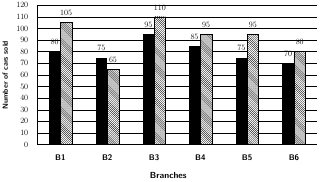
The given bar graph shows the sales of cars from six branches of a dealer B1, B2, B3, B4, B5, B6, during two consecutive years 2018 and 2019. The 1st bar corresponds to the year 2018 and the 2nd bar corresponds to the year 2019.

In the bar graph, the ratio of the total sales from branches B1, B2 and B3 taken together for the year 2018 to the sales from the branches B6, B4 and B5 for the year 2019, is:

  1. AOption (a)

    25 : 27

  2. BOption (b)

    25 : 29

  3. COption (c)

    27 : 25

  4. DOption (d)

    29 : 25

View answer & explanation

Correct answer

Answer: (a)A.

25 : 27

Why this answer is correct

Total sales of (B1 + B2 + B3) in 2018 = 250

Total sales of (B6 + B4 + B5) in 2019 = 270

⇒ 250 : 270

⇒ 25 : 27

∴ Ratio is 25 : 27

SSC CPO Tier- I Previous Year Paper (Held On: 24 November 2020 Shift 2)·Quantitative Aptitude
View full paper

Question 1903

SSC CPO 2020• Quantitative Aptitude• Quantitative Aptitude

When a number is successively divided by 3, 4 and 7, the remainders obtained are 2, 3 and 5, respectively. What will be the remainder when 84 divides the same number?

  1. AOption (a)

    30

  2. BOption (b)

    71

  3. COption (c)

    53

  4. DOption (d)

    48

View answer & explanation

Correct answer

Answer: (b)B.

71

Why this answer is correct

Given:

Remainders corresponding to the divisor

Formula used:

(Divisor × Quotient) + Remainder = Dividend

Calculation:

Start from last digits

The number gives a remainder of 5 when it is divided by 7

⇒ (7x + 5)

The number gives remainder 3 when it is divided 4

⇒ [4 × (7x + 5) + 3]

Also, the number when divided by 3 gives remainder 2

⇒ [3 × {4 × (7x + 5) + 3} + 2]

⇒ [3 × (28x + 20 + 3) + 2]

⇒ 84x + 71

The number is 71 more than a multiple of 84

Hence, if the number is divided by 84

∴ The remainder will be 71


Let x be the number

⇒ z = 7 × 1 + 5 = 12

⇒ y = 4 × z + 3 = 51

⇒ x = 3 × y + 2 = 155

On dividing 155 by 84

∴ Remainder = 71

Important Points

If the quotient of the dividend is taken and this is used as the dividend in the next division, such as division is called Successive division. A successive division process can continue up to any number of steps until the quotient in a division became zero for the first time, i.e., the quotient in the first division is taken and divided in the second division; the quotient in the second division is taken as the dividend in the third division; the quotient in the third division is taken as the dividend in the fourth division and so on.


We will have to follow the rule of Successive Division (Not Normal Division). Hence, LCM Method is not followed there.

SSC CPO Tier- I Previous Year Paper (Held On: 24 November 2020 Shift 2)·Quantitative Aptitude
View full paper

Question 1904

SSC CPO 2020• Quantitative Aptitude• Quantitative Aptitude

If a3 + b3 = 217 and a + b = 7, then the value of ab is:

  1. AOption (a)

    -1

  2. BOption (b)

    6

  3. COption (c)

    -6

  4. DOption (d)

    7

View answer & explanation

Correct answer

Answer: (b)B.

6

Why this answer is correct

Given:

a3 + b3 = 217

(a + b) = 7

Formula Used:

(a + b)3 = a3 + b3 + 3ab (a + b)

Calculation:

Substituting the values in the formula

(7)3 = 217 + 3ab (7)

343 – 217 = 21ab

126/21 = ab

∴The value of ab is = 6

SSC CPO Tier- I Previous Year Paper (Held On: 24 November 2020 Shift 2)·Quantitative Aptitude
View full paper

Question 1905

SSC CPO 2020• Quantitative Aptitude• Quantitative Aptitude

Three partners shared the profit in a business in the ratio 8 : 7 : 5. They invested their capitals for 7 months, 8 months and 14 months, respectively. What was the ratio of their capitals?

  1. AOption (a)

    20 : 64 : 49

  2. BOption (b)

    64 : 49 : 20

  3. COption (c)

    20 : 49 : 64

  4. DOption (d)

    49 : 64 : 20

View answer & explanation

Correct answer

Answer: (b)B.

64 : 49 : 20

Why this answer is correct

Given:

Profit ratio of three partners = 8 : 7 : 5

Period of investment of 1st partner = 7 months

Period of investment of 2nd partner = 8 months

Period of investment of 3rd partner = 14 months

Concept used:

Person’s Profit = Investment × time period

Calculation:

Let the investment and time period be 7x : 8y : 14z

7x/8y = 8/7

⇒ 49x = 64y

⇒ y = 49x/64

7x/14z = 8/5

⇒ 35x = 112z

⇒ z = 35x/112

⇒ z = 5x/16

x : y : z = x : 49x/64 : 5x/16

⇒ Multiply by 64

x : y : z = 64 : 49 : 20

∴ The investment ratio is 64 : 49 : 20

Shortcut Trick We know that, 

⇒ Profit = Invested Capital × Invested Time 

Let the invested capital of all 3 be a, b, and c respectively, 

⇒ 

Now we get,

⇒ a × 7 = 8

⇒ a = 8/7

similarly, we get, b = 7/8 & c = 5/14

Now we have a = 8/7, b = 7/8,  and c = 5/14

Multiplying by 56, we get, 

⇒ 8/7(56), 7/8(56), and 5/14(56)

⇒ 64, 49, and 20

∴ The investment ratio is 64 : 49 : 20.

SSC CPO Tier- I Previous Year Paper (Held On: 24 November 2020 Shift 2)·Quantitative Aptitude
View full paper

Question 1906

SSC CPO 2020• Quantitative Aptitude• Quantitative Aptitude

The value of \(\frac{2}{3} \div \frac{3}{{10}}of\frac{4}{9} - \frac{4}{5} \times 1\frac{1}{9} \div \frac{8}{{15}} - \frac{3}{4} + \frac{3}{4} \div \frac{1}{2}\) is:

  1. AOption (a)

    \(\frac{17}{{9}}\)

  2. BOption (b)

    \(\frac{25}{{6}}\)

  3. COption (c)

    \(\frac{14}{{3}}\)

  4. DOption (d)

    \(\frac{49}{{12}}\)

View answer & explanation

Correct answer

Answer: (d)D.

\(\frac{49}{{12}}\)

Why this answer is correct

We have to follow the BODMAS rule.

Calculation: 

    = \([\frac{2}{3}; \div ;\frac{3}{{10}};of;\frac{4}{9}; - ;\frac{4}{5}; \times ;1\frac{1}{9}; \div ;\frac{8}{{15}};; - ;\frac{3}{4}; + \frac{3}{4}; \div \frac{1}{2}]\)

    ⇒\([\frac{2}{3}; \div ;\frac{3}{{10}}; \times ;\frac{4}{9}; - ;\frac{4}{5}; \times ;\frac{{10}}{9}; \times ;\frac{{15}}{8};; - ;\frac{3}{4}; + \frac{3}{4}; \times 2]\) 

    ⇒\([\frac{2}{3}; \div ;\frac{2}{{15}} - ;\frac{5}{3};; - ;\frac{3}{4}; + \frac{3}{2};]\)

    ⇒\([\frac{2}{3}; \times ;\frac{{15}}{2} - ;\frac{5}{3};; + ;\frac{3}{4};;]\)

    ⇒\([5; - ;\frac{{11}}{{12}};]\) = \([\frac{{49}}{{12}}]\)

∴The value of \(\frac{2}{3} \div \frac{3}{{10}}of\frac{4}{9} - \frac{4}{5} \times 1\frac{1}{9} \div \frac{8}{{15}} - \frac{3}{4} + \frac{3}{4} \div \frac{1}{2}\) is \([\frac{{49}}{{12}}]\)

SSC CPO Tier- I Previous Year Paper (Held On: 24 November 2020 Shift 2)·Quantitative Aptitude
View full paper

Question 1907

SSC CPO 2020• Quantitative Aptitude• Quantitative Aptitude

The base of a triangle is equal to the perimeter of a square whose diagonal is \(6\sqrt 2\) cm, and its height is equal to the side of a square whose area is 144 cm2. The area of the triangle (in cm2) is:

  1. AOption (a)

    144

  2. BOption (b)

    216

  3. COption (c)

    288

  4. DOption (d)

    72

View answer & explanation

Correct answer

Answer: (a)A.

144

Why this answer is correct

Given:

Base of triangle is equal to the perimeter of square whose diagonal if 6√2

Formula used:

diagonal of square = a√2

Area of triangle = 1/2 base × height 

Perimeter of square = 4 × side 

Calculation: 

a√2 = 6√2 

a = 6 side of square 

4 × 6 = 24

24 = base of triangle according to question

now height is equal to side of square whose area is 144cm2 

b2 = 144

b = 12

⇒ height of the triangle is equal to side of square

⇒ Area of triangle =1/2× 12× 24

So, Area of triangle = 144 cm2

SSC CPO Tier- I Previous Year Paper (Held On: 24 November 2020 Shift 2)·Quantitative Aptitude
View full paper

Question 1908

SSC CPO 2020• Quantitative Aptitude• Quantitative Aptitude

Study the given histogram that shows the marks obtained by students in an examination and answer the question that follows.

The number of students who obtained less than 350 marks is what per cent more than the number of students who obtained 400 or more marks?

(correct to one decimal place)

  1. AOption (a)

    350%

  2. BOption (b)

    375.8%

  3. COption (c)

    385.7%

  4. DOption (d)

    100%

View answer & explanation

Correct answer

Answer: (c)C.

385.7%

Why this answer is correct

Calculation:

Number of student obtained less than 350 = (30 + 45 + 60 + 35) = 170

Number of student obtained 400 or more = 35

Difference between number of students obtained less than 350 and number of students obtained 400 or more = (170 - 35) = 135

Percentage = 135/35 × 100 = 385.714% ≈ 385.7%

∴ The required percentage is 385.7%

SSC CPO Tier- I Previous Year Paper (Held On: 24 November 2020 Shift 2)·Quantitative Aptitude
View full paper

Question 1909

SSC CPO 2020• Quantitative Aptitude• Quantitative Aptitude

A can complete some work in 35 days and B can complete the same work in 15 days. They worked together for 8 days, then B left the work. In how many days will A alone complete 60% of the remaining work?

  1. AOption (a)

    5

  2. BOption (b)

    8

  3. COption (c)

    10

  4. DOption (d)

    15

View answer & explanation

Correct answer

Answer: (a)A.

5

Why this answer is correct

Given :

A can complete a work in = 35 days

B can complete a work in = 15 days

Formula used: Work = Efficiency× Time

Calculation :

Let :

Total work = LCM of 35,15 = 105

Efficiency of A = 105/35 = 3 unit 

Efficiency of B = 105/15 = 7 unit 

According to Question they work together for 8 days, B left then A will complete the work 

⇒ (A+B)8 +AX = 105

⇒ 10 × 8 + 3X= 105×

⇒ 80 +3X = 105

⇒ 3X = 25× 3/5      ( In Question it is mentioned that A alone complete 60% of remaining work )

⇒ X = 5 days

So, A alone complete 60% of the remaining work in 5 days.

Alternate Method

TimeTotal workEfficiency
A351053
B157


Efficiency of  work of A and B in one days = 3 + 7

⇒ 10 

Total work done by A and B both in 8 days = 10 × 8

⇒ 80 

According to Question they work together for 8 days and B left then remaining work = 105 - 80 = 25

60% of remaining work = 25 × 60% = 15

A alone complete 60% of remaining work = 15/3 = 5

So, A alone complete 60% of the remaining work in 5 days.

SSC CPO Tier- I Previous Year Paper (Held On: 24 November 2020 Shift 2)·Quantitative Aptitude
View full paper

Question 1910

SSC CPO 2020• Quantitative Aptitude• Quantitative Aptitude

In ΔABC, D is the median from A to BC. AB = 6 cm, AC = 8 cm, and BC = 10 cm. The length of median AD (in cm) is:

  1. AOption (a)

    3

  2. BOption (b)

    4.5

  3. COption (c)

    5

  4. DOption (d)

    4

View answer & explanation

Correct answer

Answer: (c)C.

5

Why this answer is correct

Given:

AB = 6cm

BC = 10cm

AC = 8cm

AD is the median bisects BC

Concept Used:

Pythagoras theorem

AB2 + AC2 = BC2

Circumcentre theorem

Circumcentre of a right-angled triangle lies on the mid-point of the hypotenuse

AD = BD = DC

Calculation:

AB2 + AC2 = BC2 

62 + 82 = 102 

Since it obeys the Pythagoras theorem

It is a right-angled triangle

Circumcentre of a right-angled triangle lies on the mid-point of the hypotenuse

AD = BD = DC

AD is a median which bisects BC into two equal parts

BD = DC = 5cm

AD = BD = DC = 5cm.

∴ The length of the median AD is 5 cm

SSC CPO Tier- I Previous Year Paper (Held On: 24 November 2020 Shift 2)·Quantitative Aptitude
View full paper

Question 1911

SSC CPO 2020• Quantitative Aptitude• Quantitative Aptitude

Let A and B be two towers with same base. From the midpoint of the line joining their feet, the angles of elevation of the tops of A and B are 30° and 60°, respectively. The ratio of the heights of B and A is:

  1. AOption (a)

    3 : 1

  2. BOption (b)

    \(1: \sqrt 3\)

  3. COption (c)

    1 : 2

  4. DOption (d)

    1 : 3

View answer & explanation

Correct answer

Answer: (a)A.

3 : 1

Why this answer is correct

Given:

There are two tower A and B

The angles of elevation of the tops of A and B are 30° and 60°, respectively

⇒ angle AOC = 30° , angle BOD = 60° 

OC = OD

Formula Used:

\(tan\theta = \frac{p}{b}\)

Calculation:

Let AC = h

Then, BD = H

In triangle AOC,

\(tan30^\circ = \frac{h}{OC}\)

⇒ \(\frac{1}{{\sqrt 3 }} = \frac{h}{{OC}}\)  ...........

(I) In triangle BOD,

\(tan60^\circ = \frac{H}{OD}\)

⇒ \(\frac{{\sqrt 3 }}{1} = \frac{H}{{OD}}\)   ..........

(II) By Dividing eq (I) and eq (II)

⇒ \(\frac{1}{3} = \frac{h}{H}\)

Then the ratio of height of tower B to tower A = 3 : 1

SSC CPO Tier- I Previous Year Paper (Held On: 24 November 2020 Shift 2)·Quantitative Aptitude
View full paper

Question 1912

SSC CPO 2020• Quantitative Aptitude• Quantitative Aptitude

The given bar graph shows the sales of cars from six branches of a dealer B1, B2, B3, B4, B5, B6, during two consecutive years 2018 and 2019. Blue colour corresponds to the year 2018 and white shaded line colour corresponds to the year 2019.

The average sales of cars (from all branches) for the year 2018 is:

  1. AOption (a)

    85

  2. BOption (b)

    80

  3. COption (c)

    90

  4. DOption (d)

    78

View answer & explanation

Correct answer

Answer: (b)B.

80

Why this answer is correct

Given:

Company name20182019
B180105
B27565
B395110
B48595
B57595
B67080
Total480550


Formula used:

Average = (sum of all observation)/(total number of observation)

Calculation:

Total number of car sold in 2018 = 480

Total number of dealer = 6

Average = (sum of all observation)/(total number of observation)

⇒ Average = 480/6 ⇒ 80

∴ The average sales of cars in 2018 is 80

SSC CPO Tier- I Previous Year Paper (Held On: 24 November 2020 Shift 2)·Quantitative Aptitude
View full paper

Question 1913

SSC CPO 2020• Quantitative Aptitude• Quantitative Aptitude

The following pie chart shows percentage expenditure of a country on different heads. The total expenditure is Rs. 1,680 (in billions). Study the chart and answer the question.

The total amount of expenditure for education and Health (in billions Rs.) is:

  1. AOption (a)

    84

  2. BOption (b)

    168

  3. COption (c)

    126

  4. DOption (d)

    186

View answer & explanation

Correct answer

Answer: (b)B.

168

Why this answer is correct

Given:

Expenditure = 1680 billions

And this is 100%.

Calculation:

The total amount of expenditure for education and Health = 6% + 4%

⇒ 10%

But 100% expenditure = 1680 billions

⇒ 1% expenditure = (1680/100) billions

⇒ 10% expenditure = 16.80 × 10 billions

⇒ 10% expenditure = 168 billions

∴ The total amount of expenditure for education and Health is 168 billions.

SSC CPO Tier- I Previous Year Paper (Held On: 24 November 2020 Shift 2)·Quantitative Aptitude
View full paper

Question 1914

SSC CPO 2020• Quantitative Aptitude• Quantitative Aptitude

The simple interest on a sum of money at 10% per annum for 2 years is Rs. 8,100. Compounded annually, what would be the compound interest (in Rs.) on the same sum for the same period at the same rate of interest?

  1. AOption (a)

    8,100

  2. BOption (b)

    8,505

  3. COption (c)

    8,715

  4. DOption (d)

    9,000

View answer & explanation

Correct answer

Answer: (b)B.

8,505

Why this answer is correct

Shortcut Trick

Effective Simple Interest (SI) rate for 2 years = 10% × 2 = 20%

Effective Compound Interest (CI) rate for 2 years = 10% + 10% + (10 × 10) ÷ 100 = 21%

If 20% → Rs. 8,100, then 1% → 8,100 ÷ 20 = 405

⇒ CI (21%) = 405 × 21 = 8,505

∴ The correct answer is Rs. 8,505.

Alternate Method

Given:

Simple Interest (SI) = Rs. 8,100

Rate (R) = 10%

Time (T) = 2 years

Formula Used:

SI = (P × R × T) ÷ 100

CI = P × [(1 + R/100)T − 1]

10%
10%
10%

P = 40,500

Yr 1: 4,050

Yr 2: 4,050

CI on Yr 1: 405

Total CI = 4050 + 4050 + 405 = Rs. 8,505

Calculations:

⇒ P = (SI × 100) ÷ (R × T)

⇒ P = (8100 × 100) ÷ (10 × 2)

⇒ P = 810000 ÷ 20 = 40,500

Now, finding the Compound Interest on the Principal calculated:

⇒ CI = 40500 × [(1 + 10/100)2 − 1]

⇒ CI = 40500 × [(11/10)2 − 1]

⇒ CI = 40500 × [121/100 − 1]

⇒ CI = 40500 × (21/100)

⇒ CI = 405 × 21 = 8,505

∴ The correct answer is Rs. 8,505.

Additional Information

Direct Relation between CI and SI for 2 years

When rate (R) and time (T = 2 years) are the same, CI can be directly found using: CI = SI × (1 + R/200).

Difference between CI and SI for 2 years

The difference between compound and simple interest on a sum P for 2 years is: Difference = P × (R/100)2.

Effective Rate of Compound Interest

The total effective CI rate for 2 years can be calculated using the successive percentage formula: X + Y + (X × Y)/100.

SSC CPO Tier- I Previous Year Paper (Held On: 24 November 2020 Shift 2)·Quantitative Aptitude
View full paper

Question 1915

SSC CPO 2020• Quantitative Aptitude• Quantitative Aptitude

A sum of Rs. 27,000 is divided into two parts A and B such that the simple interest at the rate of 15% p.a. on A and B after two years and four years, respectively, is equal. The total interest (in Rs.) received together from A and B is:

  1. AOption (a)

    18,000

  2. BOption (b)

    9,600

  3. COption (c)

    5,400

  4. DOption (d)

    10,800

View answer & explanation

Correct answer

Answer: (d)D.

10,800

Why this answer is correct

Given:

A sum divided into A and B = Rs 27,000

Rate of simple interest = 15%

A invests for 2 years and B invests for 4 years

Formula Used:

SI = P × R × T/100

Calculation:

Let the sum of A be x

Then, the sum of B be (27,000 - x)

SI of A for 2 years = x × 2 × 15/100

⇒ 30x/100

SI of B for 4 years = (27,000 - x) × 4 × 15/100

⇒ (27,000 - x) × 60/100

⇒ 27000 × 60/100 - 60x/100

⇒ 16200 - 60x/100

According to the question:

SI of A = SI of B

⇒ 30x/100 = 16200 - 60x/100

⇒ 90x/100 = 16200

⇒ x = 18000

Sum of A = Rs 18,000

Sum of B = Rs (27,000 - 18,000) = Rs 9,000

SI of A = 30x/100 = 30 × 18000/100 = Rs 5400

SI of A = SI of B = Rs 5400

Total interest of A and B = 5400 + 5400 = Rs 10800

∴ Total interest of A and B is Rs 10800.

SSC CPO Tier- I Previous Year Paper (Held On: 24 November 2020 Shift 2)·Quantitative Aptitude
View full paper

Question 1916

SSC CPO 2020• Quantitative Aptitude• Quantitative Aptitude

The perimeter of a right triangle is 60 cm and its hypotenuse is 26 cm. What is the area (in cm2) of the triangle?

  1. AOption (a)

    96 

  2. BOption (b)

    60 

  3. COption (c)

    120 

  4. DOption (d)

    90 

View answer & explanation

Correct answer

Answer: (c)C.

120 

Why this answer is correct

Given:

Perimeter of a right triangle = 60 cm

And hypotenuse = 26 cm

Formula used:

Area of right angle triangle = (1/2) × base × height

In right angle triangle, hypotenuse length2 = base length2 + perpendicular length2

Concept used:

Triplet of 10 is 10, 24, 26

Calculation:

We can see (10)2 + (24)2 = 100 + 576

⇒ 676 = (26)2 = hypotenuse2

And perimeter = 10 + 24 +26

⇒ 60 = given perimeter

So our assumed triplet is correct.

Hence apart from hypotenuse, remains should be either base length or perpendicular length.

Therefore, base length= 10cm or 24cm

And perpendicular length = 24cm or 10cm

Now area of triangle = (1/2) × 10 × 24

⇒ 120 cm2

∴ The area of a right angle triangle is 120 cm2.

SSC CPO Tier- I Previous Year Paper (Held On: 24 November 2020 Shift 2)·Quantitative Aptitude
View full paper

Question 1917

SSC CPO 2020• Quantitative Aptitude• Quantitative Aptitude

If 49% of X = Y, then Y% of 50 is:

  1. AOption (a)

    24.5% of Y

  2. BOption (b)

    24.5% of X

  3. COption (c)

    40% of Y

  4. DOption (d)

    50% of X

View answer & explanation

Correct answer

Answer: (b)B.

24.5% of X

Why this answer is correct

Given:

49% of X = Y

Calculation:

49% of X = Y

⇒ Y = (49/100) × X

Now,

Y% of 50

After putting the value of Y in above

⇒ (49/100) × X × (1/100) × 50

⇒ (2450/10000) × X

⇒ 0.245 × X

For percentage, we have to multiply the above number with 100

⇒ 0.245 × X × 100

⇒ 24.5% × X

∴ Y% of 50 is 24.5% of X

SSC CPO Tier- I Previous Year Paper (Held On: 24 November 2020 Shift 2)·Quantitative Aptitude
View full paper

Question 1918

SSC CPO 2020• Quantitative Aptitude• Quantitative Aptitude

A number is first increased by 40% and then decreased by 25%, again increased by 15% and then decreased by 20%. What is the net increase/decrease per cent in the number?

  1. AOption (a)

    7.2% decrease

  2. BOption (b)

    6.4% increase

  3. COption (c)

    3.4% decrease

  4. DOption (d)

    3.4% increase

View answer & explanation

Correct answer

Answer: (c)C.

3.4% decrease

Why this answer is correct

Given:

Number is first increased by 40% and then decreased by 25%, again increased by 15% and then decreased by 20%. 

Calculation:

Let the number be x

⇒ \({\rm{x;}} \times \frac{{7}}{{5{\rm{;}}}} \times \frac{{3}}{{4{\rm{;}}}} \times \frac{{23}}{{20{\rm{;}}}} \times \frac{{4}}{{5}}\)

⇒ \({\rm{x;}} \times \frac{{483}}{{500{\rm{;}}}}\)

⇒ 0.966x

⇒ 0.966x is less than x

⇒ Decrease per cent in the number = \(\frac{{{\rm{x}} - 0.996{\rm{x}}}}{{100}} = 3.4{\rm{% ;}}\)

∴ Net decrease per cent in the number is 3.4%

SSC CPO Tier- I Previous Year Paper (Held On: 24 November 2020 Shift 2)·Quantitative Aptitude
View full paper

Question 1919

SSC CPO 2020• Quantitative Aptitude• Quantitative Aptitude

The following pie chart shows the percentage expenditure of a country on different heads. The total expenditure is Rs. 1,680 (in billions). Study the chart and answer the question.

The amount of expenditure on Defence is what percentage more than the expenditure on Education?

  1. AOption (a)

    150%

  2. BOption (b)

    125%

  3. COption (c)

    50%

  4. DOption (d)

    100%

View answer & explanation

Correct answer

Answer: (d)D.

100%

Why this answer is correct

Given:

Total Expenditure = 1680 (in billions)

Expenditure % on Defence = 12%

Expenditure % on Education = 6%

Expenditure % on Employee = 7%

Expenditure % on Subsidy = 21%

Expenditure % on Health = 4%

Expenditure % on Interest payment  = 15%

Expenditure % on proceeds to states = 34%

Expenditure % on Misc = 1%

Formula Used:

Amount of expenditure % on defence more than = \([\frac{{Defence;% ; - ;Education;% }}{{Education;% }}]\) × 100

Calculation:

Substituting the value in formula

 = \([\frac{{12; - ;6}}{6}]\) × 100 ⇒ 100%

∴Amount of expenditure  on defence is 100 % more than Education

SSC CPO Tier- I Previous Year Paper (Held On: 24 November 2020 Shift 2)·Quantitative Aptitude
View full paper

Question 1920

SSC CPO 2020• Quantitative Aptitude• Quantitative Aptitude

If the selling price of 50 articles is equal to the cost price of 42 articles, the what is the approximate loss or profit percentage?

  1. AOption (a)

    16% loss

  2. BOption (b)

    20% profit

  3. COption (c)

    10% loss

  4. DOption (d)

    8% profit

View answer & explanation

Correct answer

Answer: (a)A.

16% loss

Why this answer is correct

Given:

Article purchased = 42

Article sold = 50

Formula used:

Profit% or Loss% = [(the difference between S.P and CP.)/C.P]/100

If S.P is more than C.P then it is profit 

If C.P is more than S.P then it is Loss

Calculation:

Let the C.P of one article be x 

and the S.P of one article be y

C.P for the 42 articles will be = 42x

S.P for the 50 articles will be = 50y

Now according to the question

⇒ C.P = S.P

⇒ 42x = 50y

⇒ x : y =50 : 42 ⇒ 25 : 21

Here C.P is 25 and S.P is 21. so, C.P is greater than S.P which means loss

Loss = C.P - S.P = 25 - 21 = 4

Loss% = (4/25) × 100 = 4 × 4 = 16%

∴ The loss% is 16%


We can deal in articles also

Formula Used:

Profit% or Loss% = (d/sold article) × 100

where d = difference between the no. article sold and bought

Loss = no. of articles sold is more than bought

Profit = no. of articles brought is more than sold

Calculation:

d = 50 - 42 =8

Loss% = (8/50)× 100 = 16%

∴ The loss% is 16%.

How should I prepare for Quantitative Aptitude in SSC CPO?

Solving previous year questions by topic helps identify recurring concepts, question patterns, and frequently asked sub-topics. Attempt each question, review the step-by-step explanation, and note down key formulas or facts for quick revision before the exam.