SBI Probationary Officer (PO) Β· Topic Collection

Quantitative Aptitude PYQs

Arithmetic, number systems, percentages, ratios, profit and loss, time and work, algebra, geometry, mensuration, and trigonometry.

1345 Total Questions41 Official PapersYears: 2018–2025Search in Quantitative Aptitude
Showing questions 161–180 of 1345Page 9 of 68
SBI PO Prelims Memory Based Paper (Held On: 8 March 2025 Shift 3) (Previous Year Paper)Β·Quantitative Aptitude
View full paper

Question 161

SBI Probationary Officer (PO) 2025β€’ Quantitative Aptitudeβ€’ Quantitative Aptitude

Directions: Read the data carefully and answer the following questions.Β 

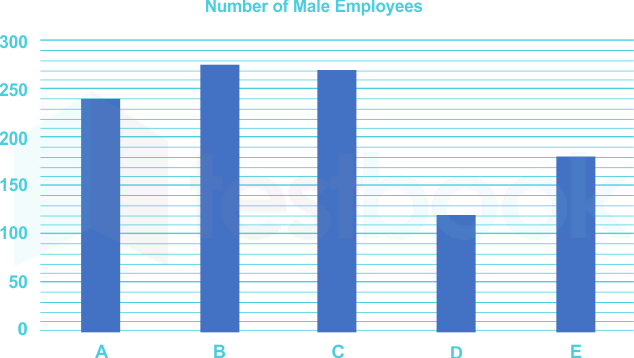
The bar graph given below shows the number ofΒ male employees workingΒ inΒ five different companiesΒ and the table shows the percentage of females out of totalΒ employees working in a company.Β 

Total employees = Males + Females

Companies% of Female Employees
A40%
B45%
C55%
D60%
E50%

If the number of male employees in Company A increases by 25%, the number of male employees in Company B decreases by 20%, and the number of male employees in Company C increases by 10%, what will be the new ratio of the total number of employees in Company A to Company B to Company C?

  1. AOption (a)

    25:20:33

  2. BOption (b)

    12:15:8

  3. COption (c)

    28:29:11

  4. DOption (d)

    19:13:17

  5. EOption (e)

    16:17:26

View answer & explanation

Correct answer

Answer: (a)A.

25:20:33

Why this answer is correct

General Solution:

The total employees in a company = Males + Females.

From the given data, we can calculate the total employees for each company using the percentage of female employees.

Formula: Total Employees = Males / (1 - Percentage of Females)

Company A:

Males = 240

Percentage of Females = 40%

Total Employees = 240 / (1 - 0.40) = 240 / 0.60 = 400

Females = 400 - 240 = 160Β 

Company B:

Males = 275

Percentage of Females = 45%

Total Employees = 275Β / (1 - 0.45) = 275 / 0.55 = 500

Females = 500 - 275 = 225Β 

Company C:

Males = 270

Percentage of Females = 55%

Total Employees =270Β / (1Β -Β 0.55) = 270 / 0.45 = 600

Females = 600 - 270 = 330Β 

Company D:

Males = 120

Percentage of Females = 60%

Total Employees =120Β / (1Β -Β 0.60) = 120 / 0.40 = 300

Females = 300 - 120 = 180Β 

Company E:

Males = 180

Percentage of Females = 50%

Total Employees =180Β / (1Β -Β 0.50) = 180Β /Β 0.50 = 360

Females = 360Β -Β 180 = 180Β 

Calculations:

Company A:

Original males = 240

Increase by 25% = 240 Γ— 1.25 = 300

Company B:

Original males = 275

Decrease by 20% = 275 Γ— 0.80 = 220

Company C:

Original males = 270

Increase by 10% = 270 Γ— 1.10 = 297

Company A:

Percentage of females = 40%

Total employees = 300 / (1 - 0.40) = 300 / 0.60 = 500

Company B:

Percentage of females = 45%

Total employees = 220 / (1 - 0.45) = 220 / 0.55 = 400

Company C:

Percentage of females = 55%

Total employees = 297 / (1 - 0.55) = 297 / 0.45 = 660

Total employees in A : B : C = 500 : 400 : 660Β = 25 : 20 : 33

Thus, theΒ new ratio is 25:20:33.

SBI PO Prelims Memory Based Paper (Held On: 8 March 2025 Shift 3) (Previous Year Paper)Β·Quantitative Aptitude
View full paper

Question 162

SBI Probationary Officer (PO) 2025β€’ Quantitative Aptitudeβ€’ Quantitative Aptitude

Investments of A, B and C are Rs. 4500, Rs. 5500 and Rs. 6000 respectively. Started a business after y months and (y + 3) months A and B withdrawn respectively and C continued till the end of the year. The profit share of A, B and C are 63: 110: 144. The total profit is Rs. 79250 and 20% were given to charity. Find the profit share of A is how many times the y.

  1. AOption (a)

    2000

  2. BOption (b)

    1800

  3. COption (c)

    1600

  4. DOption (d)

    1400

  5. EOption (e)

    1200

View answer & explanation

Correct answer

Answer: (b)B.

1800

Why this answer is correct

Shortcut Trick

Ratio of Profit share = (InvestmentA Γ— TimeA) : (InvestmentB Γ— TimeB) : (InvestmentC Γ— TimeC).

From A and B's profit ratio: (4500 Γ— y) : (5500 Γ— (y + 3)) = 63 : 110.

9y : 11(y + 3) = 63 : 110 β‡’ 9y Γ· (11y + 33) = 63 Γ· 110 β‡’ y Γ· (y + 3) = 7 Γ· 10.

10y = 7y + 21 β‡’ 3y = 21 β‡’ y = 7.

Total Profit = 79250, Charity = 20%, Remaining = 80% of 79250 = 63400.

Profit share of A = [63 Γ· (63 + 110 + 144)] Γ— 63400 = (63 Γ· 317) Γ— 63400 = 12600. Required ratio = 12600 Γ· 7 = 1800.

∴ The correct answer is 1800.

Alternate Method

Given β†’ Investments: A = 4500, B = 5500, C = 6000. Time: A = y, B = y + 3, C = 12. Profit Ratio = 63 : 110 : 144. Total Profit = 79250.
Formulas: Profit Share = Investment Γ— Time | Remaining Profit = Total Γ— (100 βˆ’ Charity%) Γ· 100.

β‡’ Calculate y using A and C: (4500 Γ— y) Γ· (6000 Γ— 12) = 63 Γ· 144.
β‡’ 4500y Γ· 72000 = 63 Γ· 144 β‡’ y Γ· 16 = 63 Γ· 144 β‡’ y = (63 Γ— 16) Γ· 144 = 7.
β‡’ Net Profit after charity = 79250 Γ— 0.8 = 63400.
β‡’ Profit of A = [63 Γ· (63 + 110 + 144)] Γ— 63400 = (63 Γ· 317) Γ— 63400 = 63 Γ— 200 = 12600.
β‡’ Required value = Profit of A Γ· y = 12600 Γ· 7 = 1800.

∴ The correct answer is 1800.

Additional Information

Partnership Basics

In a partnership, profits are distributed in the ratio of the product of Investment and Time period. Profit Share = Capital Γ— Time.

Effective Profit

When a portion of profit is donated to charity or kept as a reserve, the remaining profit is distributed among partners based on their investment-time ratios.

SBI PO Prelims Memory Based Paper (Held On: 8 March 2025 Shift 3) (Previous Year Paper)Β·Quantitative Aptitude
View full paper

Question 163

SBI Probationary Officer (PO) 2025β€’ Quantitative Aptitudeβ€’ Quantitative Aptitude

Person A invested Rs.1500 in scheme P at 11.25% per annum rate of simple interest for 4 years and invested Rs.1200 in scheme Q at 25% per annum rate of simple interest for 'X' years. The interest received from both schemes is equal. If he invests Rs. 2000Β in another scheme R at 4X% per annum rate of simple interest for 2 years then, find interest earned by him in scheme R.

  1. AOption (a)

    380 Rs.

  2. BOption (b)

    330 Rs.

  3. COption (c)

    360 Rs.

  4. DOption (d)

    350 Rs.

  5. EOption (e)

    390 Rs.

View answer & explanation

Correct answer

Answer: (c)C.

360 Rs.

Why this answer is correct

Shortcut Trick

Interest from Scheme P = 1500 Γ— 11.25% Γ— 4 = 1500 Γ— 45% = β‚Ή675.

Interest from Scheme Q = 1200 Γ— 25% Γ— X = 300X.

Equating both: 300X = 675 β‡’ X = 2.25 years.

Rate for Scheme R = 4X% = 4 Γ— 2.25 = 9%.

Interest from Scheme R = 2000 Γ— 9% Γ— 2 = β‚Ή360.

∴ The correct answer is 360 Rs.

Alternate Method

Given: Principal P1 = β‚Ή1500, R1 = 11.25%, T1 = 4 years; Principal P2 = β‚Ή1200, R2 = 25%, T2 = X years; Principal P3 = β‚Ή2000, R3 = 4X%, T3 = 2 years.

Formula Used: Simple Interest (SI) = (P Γ— R Γ— T) Γ· 100

β‡’ SIP = (1500 Γ— 11.25 Γ— 4) Γ· 100 = 15 Γ— 45 = β‚Ή675

β‡’ SIQ = (1200 Γ— 25 Γ— X) Γ· 100 = 12 Γ— 25 Γ— X = 300X

β‡’ Since SIP = SIQ, 300X = 675 β‡’ X = 675 Γ· 300 = 2.25

β‡’ For Scheme R: Rate = 4X% = 4 Γ— 2.25 = 9%

β‡’ Interest in Scheme R = (2000 Γ— 9 Γ— 2) Γ· 100 = 20 Γ— 18 = β‚Ή360

∴ The correct answer is 360 Rs.

Additional Information

Simple Interest Property

Simple Interest is calculated only on the Principal amount. It remains constant for every year if the rate and principal are unchanged.

Effective Rate of Interest

The total interest percentage over a period is the product of Rate (R) and Time (T). Total Interest = (R Γ— T)% of Principal.

Comparison of Interests

When interests are equal, P1R1T1 = P2R2T2. This relation can be used to find any missing variable directly.

SBI PO Prelims Memory Based Paper (Held On: 8 March 2025 Shift 3) (Previous Year Paper)Β·Quantitative Aptitude
View full paper

Question 164

SBI Probationary Officer (PO) 2025β€’ Quantitative Aptitudeβ€’ Quantitative Aptitude

The total time taken by the boat to cover 72 km upstream and 180 km downstream is 16 hours. The total time taken by the same boat to cover 108 km upstream and 126 km downstream is 16 hours. If the sum of the upstream speed and downstream speed of the boat is 30 kmph, then find the speed of the stream.Β 

  1. AOption (a)

    2 kmph

  2. BOption (b)

    5 kmph

  3. COption (c)

    3 kmph

  4. DOption (d)

    4 kmph

  5. EOption (e)

    1.5 kmph

View answer & explanation

Correct answer

Answer: (c)C.

3 kmph

Why this answer is correct

Shortcut Trick

Let Upstream speed be U and Downstream speed be D.

Given U + D = 30. Using trial values from the sum: If U = 9 and D = 21 (since 9+21=30):

Case 1: 72/9 + 180/21 = 8 + 8.57 β‰  16. If U = 12 and D = 18: 72/12 + 180/18 = 6 + 10 = 16 hours (Satisfied).

Case 2: 108/12 + 126/18 = 9 + 7 = 16 hours (Satisfied). U = 12 kmph, D = 18 kmph.

Speed of stream = (D βˆ’ U) Γ· 2 = (18 βˆ’ 12) Γ· 2 = 3 kmph.

∴ The correct answer is 3 kmph.

Alternate Method

Given:

Distance Upstream1 = 72 km, Distance Downstream1 = 180 km, Time1 = 16 hours

Distance Upstream2 = 108 km, Distance Downstream2 = 126 km, Time2 = 16 hours

Formula Used: Time = Distance Γ· Speed; Stream Speed = (D βˆ’ U) Γ· 2

β‡’ 72/U + 180/D = 16 ---- (i)

β‡’ 108/U + 126/D = 16 ---- (ii)

β‡’ Since both equal 16: 72/U + 180/D = 108/U + 126/D

β‡’ 180/D βˆ’ 126/D = 108/U βˆ’ 72/U

β‡’ 54/D = 36/U β‡’ D/U = 54/36 = 3/2

β‡’ Let D = 3k and U = 2k. Given U + D = 30 β‡’ 5k = 30 β‡’ k = 6

β‡’ D = 18 kmph, U = 12 kmph

β‡’ Speed of stream = (18 βˆ’ 12) Γ· 2 = 6 Γ· 2 = 3 kmph

∴ The correct answer is 3 kmph.

Additional Information

Boat Speed in Still Water

It is the average of downstream and upstream speeds: B = (D + U) Γ· 2.

Speed of Stream

It is half the difference between downstream and upstream speeds: S = (D βˆ’ U) Γ· 2.

Relative Speed in Water

Downstream Speed (D) = Speed of Boat (B) + Speed of Stream (S); Upstream Speed (U) = B βˆ’ S.

SBI PO Prelims Memory Based Paper (Held On: 8 March 2025 Shift 3) (Previous Year Paper)Β·Quantitative Aptitude
View full paper

Question 165

SBI Probationary Officer (PO) 2025β€’ Quantitative Aptitudeβ€’ Quantitative Aptitude

The ratio of the age of P five years ago to the age of Q five years hence is 2: 3. The ratio of the present age of Q to the present age of R is 11: 15. If the sum of the present age of P and R is 120, If the age of P y years after and the age of Q 5 years after are in the ratio 1:

  1. Find the value of y.
  1. AOption (a)

    20

  2. BOption (b)

    18

  3. COption (c)

    15

  4. DOption (d)

    12

  5. EOption (e)

    10

View answer & explanation

Correct answer

Answer: (c)C.

15

Why this answer is correct

Shortcut Trick

Let Q's present age be 11x and R's present age be 15x.

From (P βˆ’ 5) : (11x + 5) = 2 : 3 β‡’ P = (22x + 10)/3 + 5.

Using P + R = 120 β‡’ (22x + 25)/3 + 15x = 120 β‡’ 67x = 335 β‡’ x = 5.

P = 45 years, Q = 55 years. Since (P + y) : (Q + 5) = 1 : 1 β‡’ 45 + y = 60.

∴ The correct answer is 15 years.

Alternate Method

Given: Ratio (P βˆ’ 5) : (Q + 5) = 2 : 3, Q : R = 11 : 15, P + R = 120.

β‡’ Let Q = 11x and R = 15x.

β‡’ (P βˆ’ 5) / (11x + 5) = 2 / 3

β‡’ 3P βˆ’ 15 = 22x + 10 β‡’ 3P βˆ’ 22x = 25 --- (Eq. 1)

β‡’ P + 15x = 120 β‡’ P = 120 βˆ’ 15x --- (Eq. 2)

β‡’ Substitute Eq. 2 in Eq. 1: 3(120 βˆ’ 15x) βˆ’ 22x = 25

β‡’ 360 βˆ’ 45x βˆ’ 22x = 25 β‡’ 335 = 67x β‡’ x = 5.

β‡’ Present Age of Q = 11 Γ— 5 = 55 years.

β‡’ Present Age of P = 120 βˆ’ 15(5) = 45 years.

β‡’ (P + y) / (Q + 5) = 1 / 1 β‡’ 45 + y = 55 + 5

β‡’ 45 + y = 60 β‡’ y = 15.

∴ The correct answer is 15.

Additional Information

Ratio of Ages

If the ratio of ages is a:b, we assume ages as ax and bx. The difference between ages remains constant over time.

Linear Equations in Ages

Age n years ago = (Present Age βˆ’ n). Age n years hence = (Present Age + n).

Proportion Rule

If two quantities are in ratio 1:1, it implies they are equal to each other.

SBI PO Prelims Memory Based Paper (Held On: 8 March 2025 Shift 3) (Previous Year Paper)Β·Quantitative Aptitude
View full paper

Question 166

SBI Probationary Officer (PO) 2025β€’ Quantitative Aptitudeβ€’ Quantitative Aptitude

In the following number series, a wrong number is given. Find out the wrong number.

9, 10, 22, 70, 280, 1405

  1. AOption (a)

    9

  2. BOption (b)

    10

  3. COption (c)

    70

  4. DOption (d)

    22

  5. EOption (e)

    280

View answer & explanation

Correct answer

Answer: (c)C.

70

Why this answer is correct

Considering the given series

9, 10, 22, 70, 280, 1405

The logic of the given series can be explained as

9 Γ— 1 + 1 = 10

10 Γ— 2 + 2 = 22

22 Γ— 3 + 3 = 69

69 Γ— 4 + 4= 280

280 Γ— 5 + 5 = 1405

∴ Wrong term in given number series is 70.

SBI PO Prelims Memory Based Paper (Held On: 8 March 2025 Shift 3) (Previous Year Paper)Β·Quantitative Aptitude
View full paper

Question 167

SBI Probationary Officer (PO) 2025β€’ Quantitative Aptitudeβ€’ Quantitative Aptitude

Find the wrong number in the following series.

144, 2197, 196, 3375, 256, 4903

  1. AOption (a)

    4903

  2. BOption (b)

    3375

  3. COption (c)

    256

  4. DOption (d)

    144

  5. EOption (e)

    None of these

View answer & explanation

Correct answer

Answer: (a)A.

4903

Why this answer is correct

GIVEN:

144, 2197, 196, 3375, 256, 4903

CALCULATION:

β‡’ 173 = 4913

β‡’ So, 4903 is the wrong term.

SBI PO Prelims Memory Based Paper (Held On: 8 March 2025 Shift 3) (Previous Year Paper)Β·Quantitative Aptitude
View full paper

Question 168

SBI Probationary Officer (PO) 2025β€’ Quantitative Aptitudeβ€’ Quantitative Aptitude

In the following number series, a wrong number is given. Find out the wrong number.

49, 110, 174, 244, 323, 412, 520

  1. AOption (a)

    520

  2. BOption (b)

    110

  3. COption (c)

    174

  4. DOption (d)

    412

  5. EOption (e)

    None of these

View answer & explanation

Correct answer

Answer: (d)D.

412

Why this answer is correct

Considering the given series

49, 110, 174, 244, 323, 412, 520

The logic of the given series can be explained as

49110174244323414520
+61+64+70+79+91+106
+3+6+9+12+15

Β 

∴ Wrong term in given number series is 412.

SBI PO Prelims Memory Based Paper (Held On: 8 March 2025 Shift 3) (Previous Year Paper)Β·Quantitative Aptitude
View full paper

Question 169

SBI Probationary Officer (PO) 2025β€’ Quantitative Aptitudeβ€’ Quantitative Aptitude

Income of A and B are x and y respectively. A spends 25% of the income and B spends 33.333% of the income and the savings of A and B are Rs. 9000 and Rs. 10000 respectively. If the income of A and B is increased by 50% and 40% respectively then the expenditure percentage remains the same. Find the difference between the new savings of A and B.

  1. AOption (a)

    Rs. 1500

  2. BOption (b)

    Rs. 750

  3. COption (c)

    Rs. 1000

  4. DOption (d)

    Rs. 500

  5. EOption (e)

    Rs. 1250

View answer & explanation

Correct answer

Answer: (d)D.

Rs. 500

Why this answer is correct

Shortcut Trick

Initial Savings: A = β‚Ή9000 (75% of x), B = β‚Ή10000 (66.67% of y).

New Savings: Since expenditure percentage remains same, savings percentage also remains same.

New Savings of A = 9000 Γ— 1.5 = β‚Ή13500 | New Savings of B = 10000 Γ— 1.4 = β‚Ή14000.

Difference = 14000 βˆ’ 13500 = β‚Ή500.

∴ The correct answer is Rs. 500.

Alternate Method

Given:

Savings of A = 75% of x = β‚Ή9000 β‡’ x = 9000 Γ· 0.75 = β‚Ή12000

Savings of B = 66.67% of y = β‚Ή10000 β‡’ y = 10000 Γ· (2/3) = β‚Ή15000

New Calculations:

β‡’ New Income A = 12000 Γ— 150% = β‚Ή18000

β‡’ New Expenditure A = 25% of 18000 = β‚Ή4500

β‡’ New Savings A = 18000 βˆ’ 4500 = β‚Ή13500

β‡’ New Income B = 15000 Γ— 140% = β‚Ή21000

β‡’ New Expenditure B = 33.333% of 21000 = 1/3 Γ— 21000 = β‚Ή7000

β‡’ New Savings B = 21000 βˆ’ 7000 = β‚Ή14000

β‡’ Difference = 14000 βˆ’ 13500 = β‚Ή500

∴ The correct answer is Rs. 500.

Additional Information

Income, Expenditure and Savings Relationship

The basic formula is Income = Expenditure + Savings. If the expenditure percentage remains constant, savings will grow at the same rate as income.

Percentage to Fraction Conversion

Useful conversions: 25% = 1/4, 75% = 3/4, 33.333% = 1/3, and 66.666% = 2/3.

SBI PO Prelims Memory Based Paper (Held On: 8 March 2025 Shift 3) (Previous Year Paper)Β·Quantitative Aptitude
View full paper

Question 170

SBI Probationary Officer (PO) 2025β€’ Quantitative Aptitudeβ€’ Quantitative Aptitude

A can complete the work in 8 days and B can complete the same work in 12 days and C can complete the same work in 6 days. If B and C worked for x days and the remaining work completed by A in (x + 2) days. Find the how much percentage of work completed if A alone worked for (x + 4) days.

  1. AOption (a)

    95%

  2. BOption (b)

    90%

  3. COption (c)

    75%

  4. DOption (d)

    100%

  5. EOption (e)

    80%

View answer & explanation

Correct answer

Answer: (c)C.

75%

Why this answer is correct

Shortcut Trick

Total Work (LCM of 8, 12, 6) = 24 units.

Efficiencies: A = 3, B = 2, C = 4. Combined B+C = 6.

Work Equation: (B+C)Γ—x + AΓ—(x+2) = 24 β‡’ 6x + 3(x+2) = 24 β‡’ 9x = 18 β‡’ x = 2.

Work by A in (x+4) = 6 days: 3 Γ— 6 = 18 units.

Percentage = (18/24) Γ— 100 = 75%.

∴ The correct answer is 75%.

Alternate Method

Given: Time taken by A = 8 days, B = 12 days, C = 6 days.

Formula Used: Total Work = Efficiency Γ— Time; Efficiency = Total Work Γ· Time.

PersonDaysTotal WorkEfficiency
A8243
B122
C64

Calculations:

β‡’ Work done by B and C in x days = (2 + 4) Γ— x = 6x units.

β‡’ Work done by A in (x + 2) days = 3 Γ— (x + 2) = 3x + 6 units.

β‡’ Total Work: 6x + 3x + 6 = 24

β‡’ 9x = 18 β‡’ x = 2.

β‡’ If A alone works for (x + 4) days = (2 + 4) = 6 days.

β‡’ Work done by A in 6 days = 3 Γ— 6 = 18 units.

β‡’ Percentage of work completed = (18 Γ· 24) Γ— 100

β‡’ Percentage = 0.75 Γ— 100 = 75%.

∴ The correct answer is 75%.

Additional Information

Efficiency and Time Relationship

Efficiency is inversely proportional to the time taken to complete the work (E ∝ 1/T).

Remaining Work Calculation

Remaining Work = Total Work βˆ’ Work already completed by previous group of workers.

Combined Efficiency

When people work together, their individual efficiencies are added to find the total rate of work (ETotal = E1 + E2 + ...).

SBI PO Prelims Memory Based Paper (Held On: 8 March 2025 Shift 3) (Previous Year Paper)Β·Quantitative Aptitude
View full paper

Question 171

SBI Probationary Officer (PO) 2025β€’ Quantitative Aptitudeβ€’ Quantitative Aptitude

Directions: Read the data carefully and answer the following questions.Β 

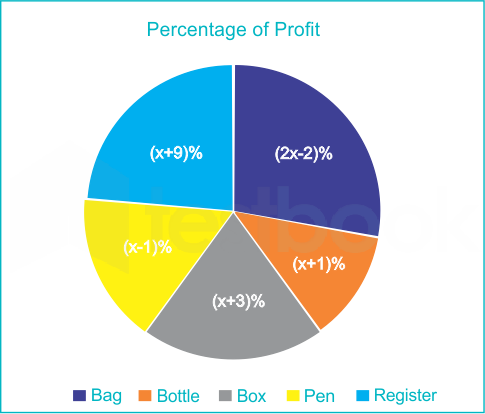
The pie chart below shows the percentage of total profit earned by a shopkeeper earned from each item.

Note: The shopkeeper's total profit across all items is Rs. 25,000.

If the shopkeeper decides to reinvest 45% of the profit earned from bags and 60% of the profit earned from registers into purchasing new inventory, what is the total amount reinvested from these two items?

  1. AOption (a)

    Rs. 5,550

  2. BOption (b)

    Rs. 6,150

  3. COption (c)

    Rs. 6,300

  4. DOption (d)

    Rs. 6,450

  5. EOption (e)

    Rs. 6,750

View answer & explanation

Correct answer

Answer: (e)E.

Rs. 6,750

Why this answer is correct

General Solution:

Determine the value of 'x':

The sum of the percentages of profit from all items must equal 100%.

Therefore: (2x - 2) + (x + 1) + (x + 3) + (x - 1) + (x + 9) = 100

6x + 10 = 100

6x = 90

x = 15

Now, let's calculate the percentage of profit earned from each item:

Bag: (2 Γ—Β 15 - 2)% = 28%

Bottle: (15 + 1)% = 16%

Box: (15 + 3)% = 18%

Pen: (15 - 1)% = 14%

Register: (15 + 9)% = 24%

Now, let's calculate the actual profit (in Rupees) earned from each item:

Bag: 28% of Rs. 25,000 = 0.28 Γ—Β 25,000 = Rs. 7,000

Bottle: 16% of Rs. 25,000 = 0.16 Γ—Β 25,000 = Rs. 4,000

Box: 18% of Rs. 25,000 = 0.18 Γ—Β 25,000 = Rs. 4,500

Pen: 14% of Rs. 25,000 = 0.14 Γ—Β 25,000 = Rs. 3,500

Register: 24% of Rs. 25,000 = 0.24 Γ—Β 25,000 = Rs. 6,000

Calculations:

Profit from bags = Rs. 7,000

Percentage reinvested = 45%

Amount reinvested = (45/100) Γ— 7,000 = Rs. 3,150

Profit from registers = Rs. 6,000

Percentage reinvested = 60%

Amount reinvested = (60/100) Γ— 6,000 = Rs. 3,600

Total reinvested = 3,150 + 3,600 = Rs. 6,750

Thus, the correct answer is Rs. 6,750

SBI PO Prelims Memory Based Paper (Held On: 8 March 2025 Shift 3) (Previous Year Paper)Β·Quantitative Aptitude
View full paper

Question 172

SBI Probationary Officer (PO) 2025β€’ Quantitative Aptitudeβ€’ Quantitative Aptitude

Directions: Read the data carefully and answer the following questions.Β 

The pie chart below shows the percentage of total profit earned by a shopkeeper earned from each item.

Note: The shopkeeper's total profit across all items is Rs. 25,000.

If the cost price of all registers was Rs. 19,000, and the shopkeeper had initially marked up the price by 40% before applying a discount to reach the final selling price, what was the approximate percentage discount applied to the marked price?

  1. AOption (a)

    6%

  2. BOption (b)

    7%

  3. COption (c)

    9%

  4. DOption (d)

    10%

  5. EOption (e)

    11%

View answer & explanation

Correct answer

Answer: (a)A.

6%

Why this answer is correct

General Solution:

Determine the value of 'x':

The sum of the percentages of profit from all items must equal 100%.

Therefore: (2x - 2) + (x + 1) + (x + 3) + (x - 1) + (x + 9) = 100

6x + 10 = 100

6x = 90

x = 15

Now, let's calculate the percentage of profit earned from each item:

Bag: (2 Γ—Β 15 - 2)% = 28%

Bottle: (15 + 1)% = 16%

Box: (15 + 3)% = 18%

Pen: (15 - 1)% = 14%

Register: (15 + 9)% = 24%

Now, let's calculate the actual profit (in Rupees) earned from each item:

Bag: 28% of Rs. 25,000 = 0.28 Γ—Β 25,000 = Rs. 7,000

Bottle: 16% of Rs. 25,000 = 0.16 Γ—Β 25,000 = Rs. 4,000

Box: 18% of Rs. 25,000 = 0.18 Γ—Β 25,000 = Rs. 4,500

Pen: 14% of Rs. 25,000 = 0.14 Γ—Β 25,000 = Rs. 3,500

Register: 24% of Rs. 25,000 = 0.24 Γ—Β 25,000 = Rs. 6,000

Calculations:

We are given:

The cost price CP of all registers = β‚Ή19,000

Profit earned on registers = β‚Ή6,000

The total selling price SP of all registers = CP + Profit = β‚Ή19,000 + β‚Ή6,000 = β‚Ή25,000

The marked price MP of all registers is 40% above the cost price

Since the marked price is 40% more than the cost price, we calculate:

MP = CP + 40% of CP

MP = 19000 + (40 / 100 Γ— 19000)

MP = 19000 + 7600 = 26600

The discount is given on the marked price to reach the selling price.

So, the discount amount is:

Discount = MP βˆ’ SP = 26600 βˆ’ 25000 = 1600

Now, the discount percentage is:

Discount % = Discount / Marked Price Γ— 100Β = 1600 / 26600 Γ— 100Β β‰ˆ 6.02%

Thus, the approximate percentage discount applied to the marked price is 6%.

SBI PO Prelims Memory Based Paper (Held On: 8 March 2025 Shift 3) (Previous Year Paper)Β·Quantitative Aptitude
View full paper

Question 173

SBI Probationary Officer (PO) 2025β€’ Quantitative Aptitudeβ€’ Quantitative Aptitude

Directions: Read the data carefully and answer the following questions.Β 

The pie chart below shows the percentage of total profit earned by a shopkeeper earned from each item.

Note: The shopkeeper's total profit across all items is Rs. 25,000.

If the shopkeeper introduces a new item, "Notebook," and the profit percentage for the notebook is (0.5x + 5)%, what percentage of the total profit does the notebook represent, and what is the new percentage of profit from the pen if the total percentage of profit is now distributed among 6 items?

  1. AOption (a)

    12.5%, 12.25%

  2. BOption (b)

    12.5%, 11.67%

  3. COption (c)

    13%, 12.16%

  4. DOption (d)

    13%, 11.5%

  5. EOption (e)

    None of these

View answer & explanation

Correct answer

Answer: (a)A.

12.5%, 12.25%

Why this answer is correct

General Solution:

Determine the value of 'x':

The sum of the percentages of profit from all items must equal 100%.

Therefore: (2x - 2) + (x + 1) + (x + 3) + (x - 1) + (x + 9) = 100

6x + 10 = 100

6x = 90

x = 15

Now, let's calculate the percentage of profit earned from each item:

Bag: (2 Γ—Β 15 - 2)% = 28%

Bottle: (15 + 1)% = 16%

Box: (15 + 3)% = 18%

Pen: (15 - 1)% = 14%

Register: (15 + 9)% = 24%

Now, let's calculate the actual profit (in Rupees) earned from each item:

Bag: 28% of Rs. 25,000 = 0.28 Γ—Β 25,000 = Rs. 7,000

Bottle: 16% of Rs. 25,000 = 0.16 Γ—Β 25,000 = Rs. 4,000

Box: 18% of Rs. 25,000 = 0.18 Γ—Β 25,000 = Rs. 4,500

Pen: 14% of Rs. 25,000 = 0.14 Γ—Β 25,000 = Rs. 3,500

Register: 24% of Rs. 25,000 = 0.24 Γ—Β 25,000 = Rs. 6,000

Calculations:

Given that the profit percentage for the Notebook is:

(0.5x + 5)%

Substituting x = 15 from the general solution:

0.5 Γ— 15 + 5 = 7.5 + 5 = 12.5%

Thus, the Notebook represents 12.5% of the total profit.

Now, the total profit percentage must still sum to 100%, but we have added the Notebook while keeping the total profit constant.

The original sum of the profit percentages was 100% from 5 items. Now, the Notebook takes 12.5%, meaning the remaining 87.5% must be redistributed among the previous five items in the same proportion.

The adjusted percentage for each previous item is calculated as:

New Percentage = Old Percentage / 100 Γ— 87.5

Bag: 28 / 100 Γ— 87.5 = 24.5%

Bottle: 16 / 100 Γ— 87.5 = 14%

Box: 18 / 100 Γ— 87.5 = 15.75%

Pen: 14 / 100 Γ— 87.5 = 12.25%

Register: 24 / 100 Γ— 87.5 = 21%

Thus, the new percentage of profit from the Pen is 12.25%.

Thus,

Notebook represents 12.5% of the total profit.

New profit percentage of the Pen: 12.25%.

SBI PO Prelims Memory Based Paper (Held On: 8 March 2025 Shift 3) (Previous Year Paper)Β·Quantitative Aptitude
View full paper

Question 174

SBI Probationary Officer (PO) 2025β€’ Quantitative Aptitudeβ€’ Quantitative Aptitude

Directions: Read the data carefully and answer the following questions.Β 

The pie chart below shows the percentage of total profit earned by a shopkeeper earned from each item.

Note: The shopkeeper's total profit across all items is Rs. 25,000.

If the shopkeeper decided to donate 15% of the profit from pens and 20% of the profit from bottles to a local charity, and then used 30% of the remaining profit from pens to purchase a new display stand, how much profit from pens remains after these actions?

  1. AOption (a)

    Rs. 1,932.5

  2. BOption (b)

    Rs. 2,082.5

  3. COption (c)

    Rs. 2,021.5

  4. DOption (d)

    Rs. 2,149.5

  5. EOption (e)

    Rs. 1,194.5

View answer & explanation

Correct answer

Answer: (b)B.

Rs. 2,082.5

Why this answer is correct

General Solution:

Determine the value of 'x':

The sum of the percentages of profit from all items must equal 100%.

Therefore: (2x - 2) + (x + 1) + (x + 3) + (x - 1) + (x + 9) = 100

6x + 10 = 100

6x = 90

x = 15

Now, let's calculate the percentage of profit earned from each item:

Bag: (2 Γ—Β 15 - 2)% = 28%

Bottle: (15 + 1)% = 16%

Box: (15 + 3)% = 18%

Pen: (15 - 1)% = 14%

Register: (15 + 9)% = 24%

Now, let's calculate the actual profit (in Rupees) earned from each item:

Bag: 28% of Rs. 25,000 = 0.28 Γ—Β 25,000 = Rs. 7,000

Bottle: 16% of Rs. 25,000 = 0.16 Γ—Β 25,000 = Rs. 4,000

Box: 18% of Rs. 25,000 = 0.18 Γ—Β 25,000 = Rs. 4,500

Pen: 14% of Rs. 25,000 = 0.14 Γ—Β 25,000 = Rs. 3,500

Register: 24% of Rs. 25,000 = 0.24 Γ—Β 25,000 = Rs. 6,000

Calculations:

Profit from pens = Rs. 3,500

15% donation from pens = 15 / 100 Γ— 3,500 = 525

Profit from bottles = Rs. 4,000

20% donation from bottles = 20 / 100 Γ— 4,000 = 800

Remaining profit after donation = 3,500 βˆ’ 525 = 2,975

30% of remaining profit from pens = 30 / 100 Γ— 2,975 = 892.5

Final remaining profit = 2,975 βˆ’ 892.5 = 2,082.5

Thus, the correct answer is β‚Ή2,082.50

SBI PO Prelims Memory Based Paper (Held On: 8 March 2025 Shift 3) (Previous Year Paper)Β·Quantitative Aptitude
View full paper

Question 175

SBI Probationary Officer (PO) 2025β€’ Quantitative Aptitudeβ€’ Quantitative Aptitude

Directions: Read the data carefully and answer the following questions.Β 

The pie chart below shows the percentage of total profit earned by a shopkeeper earned from each item.

Note: The shopkeeper's total profit across all items is Rs. 25,000.

The shopkeeper decides to increase the selling price of Box by 20% and decrease the selling price of Pen by 10%. If the cost price of Box is Rs. 15,000 and the cost price of Pen is Rs. 20,000, what will be the new total profit earned by the shopkeeper after these changes?

  1. AOption (a)

    Rs. 24,630

  2. BOption (b)

    Rs. 27,380

  3. COption (c)

    Rs. 26,550

  4. DOption (d)

    Rs. 25,460

  5. EOption (e)

    Rs. 28,505

View answer & explanation

Correct answer

Answer: (c)C.

Rs. 26,550

Why this answer is correct

General Solution:

Determine the value of 'x':

The sum of the percentages of profit from all items must equal 100%.

Therefore: (2x - 2) + (x + 1) + (x + 3) + (x - 1) + (x + 9) = 100

6x + 10 = 100

6x = 90

x = 15

Now, let's calculate the percentage of profit earned from each item:

Bag: (2 Γ—Β 15 - 2)% = 28%

Bottle: (15 + 1)% = 16%

Box: (15 + 3)% = 18%

Pen: (15 - 1)% = 14%

Register: (15 + 9)% = 24%

Now, let's calculate the actual profit (in Rupees) earned from each item:

Bag: 28% of Rs. 25,000 = 0.28 Γ—Β 25,000 = Rs. 7,000

Bottle: 16% of Rs. 25,000 = 0.16 Γ—Β 25,000 = Rs. 4,000

Box: 18% of Rs. 25,000 = 0.18 Γ—Β 25,000 = Rs. 4,500

Pen: 14% of Rs. 25,000 = 0.14 Γ—Β 25,000 = Rs. 3,500

Register: 24% of Rs. 25,000 = 0.24 Γ—Β 25,000 = Rs. 6,000

Calculations:

From the general solution:

Profit on Box = Rs. 4,500

Profit on Pen = Rs. 3,500

Selling Price of Box:

Cost Price (CP) of Box = Rs. 15,000

Profit = Rs. 4,500

Selling Price (SP) of Box = CP + Profit = 15,000 + 4,500 = Rs. 19,500

Selling Price of Pen:

Cost Price CP of Pen = Rs. 20,000

Profit = Rs. 3,500

Selling Price (SP) of Pen = CP + Profit = 20,000 + 3,500 = Rs. 23,500

Box: Selling price increases by 20%

New SP of Box = 19,500 Γ— 1.20 = Rs. 23,400

Pen: Selling price decreases by 10%

New SP of Pen = 23,500 Γ— 0.90 = Rs. 21,150

New Profit on Box:

New SP of Box = Rs. 23,400

CP of Box = Rs. 15,000

New Profit = 23,400 15,000 = Rs. 8,400

New Profit on Pen:

New SP of Pen = Rs. 21,150

CP of Pen = Rs. 20,000

New Profit = 21,150 - 20,000 = Rs. 1,150

From the general solution, the original profits on other items are:

Bag = Rs. 7,000

Bottle = Rs. 4,000

Register = Rs. 6,000

New profits:

Box = Rs. 8,400

Pen = Rs. 1,150

Total new profit = 7,000 + 4,000 + 8,400 + 1,150 + 6,000 = Rs. 26,550

Thus, theΒ new total profit earned by the shopkeeper is Rs. 26,550.

SBI PO Prelims Memory Based Paper (Held On: 8 March 2025 Shift 3) (Previous Year Paper)Β·Quantitative Aptitude
View full paper

Question 176

SBI Probationary Officer (PO) 2025β€’ Quantitative Aptitudeβ€’ Quantitative Aptitude

Directions: Read the data carefully and answer the following questions.Β 

The pie chart below shows the percentage of total profit earned by a shopkeeper earned from each item.

Note: The shopkeeper's total profit across all items is Rs. 25,000.

It is also known that 20% of the bottles sold were found to be defective and had to be sold at a 15% loss compared to their original selling price.Β The total number of bottles sold is 500 and the cost price per bottle is Rs. 50. The shopkeeper originally sold all bottles at a 20% profit on the cost price.

Find the net profit earned from bottles after accounting for defective items.

  1. AOption (a)

    Rs. 4,020

  2. BOption (b)

    Rs. 3,100

  3. COption (c)

    Rs. 3,080

  4. DOption (d)

    Rs. 3,250

  5. EOption (e)

    Rs. 3,310

View answer & explanation

Correct answer

Answer: (d)D.

Rs. 3,250

Why this answer is correct

General Solution:

Determine the value of 'x':

The sum of the percentages of profit from all items must equal 100%.

Therefore: (2x - 2) + (x + 1) + (x + 3) + (x - 1) + (x + 9) = 100

6x + 10 = 100

6x = 90

x = 15

Now, let's calculate the percentage of profit earned from each item:

Bag: (2 Γ—Β 15 - 2)% = 28%

Bottle: (15 + 1)% = 16%

Box: (15 + 3)% = 18%

Pen: (15 - 1)% = 14%

Register: (15 + 9)% = 24%

Now, let's calculate the actual profit (in Rupees) earned from each item:

Bag: 28% of Rs. 25,000 = 0.28 Γ—Β 25,000 = Rs. 7,000

Bottle: 16% of Rs. 25,000 = 0.16 Γ—Β 25,000 = Rs. 4,000

Box: 18% of Rs. 25,000 = 0.18 Γ—Β 25,000 = Rs. 4,500

Pen: 14% of Rs. 25,000 = 0.14 Γ—Β 25,000 = Rs. 3,500

Register: 24% of Rs. 25,000 = 0.24 Γ—Β 25,000 = Rs. 6,000

Calculations:

We are given:

Total bottles sold = 500

Cost price per bottle = Rs. 50

Originally, all bottles were sold at a 20% profit.

Selling price per bottle = Cost price + 20% profitΒ = 50 + 20 / 100 Γ— 50Β = 50 + 10 = 60Β 

20% of bottles are defective

20 / 100 Γ— 500 = 100 defective bottles

These defective bottles were sold at a 15% loss.

Selling price per defective bottle = Cost price βˆ’ 15% loss = 50 βˆ’ 15 / 100 Γ— 50 = 50 βˆ’ 7.5 = 42.5

Total loss from defective bottles:

Total loss = 50 βˆ’ 42.5 Γ— 100 = 7.5 Γ— 100 = 750Β 

We initially had a profit of Rs. 4,000 from bottles.

Net profit = Initial profit βˆ’ Loss from defective bottles = 4,000 βˆ’ 750Β = 3,250

Thus, theΒ net profit earned from bottles after accounting for defective items is Rs. 3,250.

SBI PO Prelims Memory Based Paper (Held On: 8 March 2025 Shift 3) (Previous Year Paper)Β·Quantitative Aptitude
View full paper

Question 177

SBI Probationary Officer (PO) 2025β€’ Quantitative Aptitudeβ€’ Quantitative Aptitude

The speed of car A is y kmph less than that of B. The time taken by car A to cover the 120 km distance is 1 hour more than the time taken by car B to cover the same distance. When car B increases his speed by 10 kmph, both the persons are 160 km apart and moving in opposite directions, then they meet after 2 hours. Find the speed of car A. (

Note:

Speed of car A and car B are less than 100 kmph)

  1. AOption (a)

    36 kmph

  2. BOption (b)

    40 kmph

  3. COption (c)

    30 kmph

  4. DOption (d)

    25 kmph

  5. EOption (e)

    45 kmph

View answer & explanation

Correct answer

Answer: (c)C.

30 kmph

Why this answer is correct

Shortcut Trick

Let speed of Car A be SA and Car B be SB.

From the second condition: Total Distance = (Relative Speed) Γ— Time

β‡’ 160 = [SA + (SB + 10)] Γ— 2 β‡’ SA + SB = 70 kmph.

Using the first condition (distance 120 km, 1 hr difference): Try values that sum to 70.

If SA = 30 and SB = 40: (120/30) βˆ’ (120/40) = 4 βˆ’ 3 = 1 hour. This satisfies all conditions.

∴ The correct answer is 30 kmph.

Alternate Method

Given: Distance = 120 km, Time difference = 1 hr, Distance apart = 160 km, Meeting time = 2 hr.

Case 1: Movement in opposite directions

β‡’ Relative Speed = SA + (SB + 10)

β‡’ 160 / 2 = SA + SB + 10

β‡’ 80 = SA + SB + 10 β‡’ SA + SB = 70 --- (i)

Case 2: Time difference for 120 km

β‡’ (120 / SA) βˆ’ (120 / SB) = 1

β‡’ 120 Γ— (SB βˆ’ SA) = SA Γ— SB

Substitute SB = 70 βˆ’ SA from (i):

β‡’ 120 Γ— (70 βˆ’ SA βˆ’ SA) = SA(70 βˆ’ SA)

β‡’ 120(70 βˆ’ 2SA) = 70SA βˆ’ SA2

β‡’ 8400 βˆ’ 240SA = 70SA βˆ’ SA2

β‡’ SA2 βˆ’ 310SA + 8400 = 0

β‡’ (SA βˆ’ 30)(SA βˆ’ 280) = 0

β‡’ Since speed < 100 kmph, SA = 30 kmph.

∴ The correct answer is 30 kmph.

Additional Information

Relative Speed

When two objects move in opposite directions, relative speed is the sum of their individual speeds (u + v). When moving in the same direction, it is the difference (u βˆ’ v).

Time, Speed, and Distance Relation

For a constant distance, time is inversely proportional to speed. T1/T2 = S2/S1.

Meeting Time Formula

Meeting Time = (Initial distance between objects) Γ· (Relative Speed).

SBI PO Prelims Memory Based Paper (Held On: 8 March 2025 Shift 3) (Previous Year Paper)Β·Quantitative Aptitude
View full paper

Question 178

SBI Probationary Officer (PO) 2025β€’ Quantitative Aptitudeβ€’ Quantitative Aptitude

In a class with a certain number of students if one new student weighing 30 kg is added, then the average weight of the class is increased by 2 kg. If 2 new student having an average weight of 27 kg is added, then the average weight of the class increases by 3kg over the original average. What is the original average weight (in kg) of the class?

  1. AOption (a)

    15 kg

  2. BOption (b)

    12 kg

  3. COption (c)

    14 kg

  4. DOption (d)

    10 kg

  5. EOption (e)

    8 kg

View answer & explanation

Correct answer

Answer: (b)B.

12 kg

Why this answer is correct

Shortcut Trick

Let n be the number of students and A be the original average.

Case 1: 30 βˆ’ A = 2(n + 1) β‡’ 30 βˆ’ A = 2n + 2 β‡’ 2n + A = 28

Case 2: 54 βˆ’ 2A = 3(n + 2) β‡’ 54 βˆ’ 2A = 3n + 6 β‡’ 3n + 2A = 48

Multiply Case 1 by 2: 4n + 2A = 56. Subtract Case 2: (4n βˆ’ 3n) = 56 βˆ’ 48 β‡’ n = 8.

Substitute n = 8 in Case 1: 2(8) + A = 28 β‡’ 16 + A = 28 β‡’ A = 12 kg.

∴ The correct answer is 12 kg.

Alternate Method

Given: Original average = A, Total students = n.

Formula: Total Weight = Average Γ— Number of students.

β‡’ Case 1: (nA + 30) = (n + 1)(A + 2)

β‡’ nA + 30 = nA + 2n + A + 2 β‡’ 2n + A = 28 ...

(i) β‡’ Case 2: (nA + 2 Γ— 27) = (n + 2)(A + 3)

β‡’ nA + 54 = nA + 3n + 2A + 6 β‡’ 3n + 2A = 48 ...

(ii) β‡’ From (i), A = 28 βˆ’ 2n. Substitute in (ii):

β‡’ 3n + 2(28 βˆ’ 2n) = 48 β‡’ 3n + 56 βˆ’ 4n = 48

β‡’ βˆ’n = βˆ’8 β‡’ n = 8 students

β‡’ A = 28 βˆ’ 2(8) = 28 βˆ’ 16 = 12 kg

∴ The correct answer is 12 kg.

Additional Information

Net Deviation Method

In average problems, the sum of deviations from the original average is equal to the total increase or decrease in weight across all members (Net Deviation = Change in Average Γ— New Total Count).

Weighted Average

When two groups are combined, the new average Aw = (n1A1 + n2A2) Γ· (n1 + n2).

SBI PO Prelims Memory Based Paper (Held On: 8 March 2025 Shift 3) (Previous Year Paper)Β·Quantitative Aptitude
View full paper

Question 179

SBI Probationary Officer (PO) 2025β€’ Quantitative Aptitudeβ€’ Quantitative Aptitude

The total surface area of the cylinder is 960 cm2. The height of the cylinder is x cm and its radius is (x - 4) cm. The height of the cylinder is equal to the breadth of the rectangle . If the curved surface area of the cylinder is 492 more than the perimeter of the rectangle. Find the area of the rectangle.(Use Ο€ = 3)

  1. AOption (a)

    270 cm2

  2. BOption (b)

    360 cm2

  3. COption (c)

    330 cm2

  4. DOption (d)

    320 cm2

  5. EOption (e)

    None of these

View answer & explanation

Correct answer

Answer: (b)B.

360 cm2

Why this answer is correct

Shortcut Trick
Using Total Surface Area (TSA) formula: 2Ο€r(r + h) = 960 with Ο€ = 3.
β‡’ 2 Γ— 3 Γ— (x βˆ’ 4)(x βˆ’ 4 + x) = 960 β‡’ (x βˆ’ 4)(2x βˆ’ 4) = 160.
β‡’ (x βˆ’ 4)(x βˆ’ 2) = 80. By inspection, if x = 12, then 8 Γ— 10 = 80.
Breadth (b) = x = 12 cm. CSA = 2 Γ— 3 Γ— 8 Γ— 12 = 576 cm2.
Perimeter (P) = 576 βˆ’ 492 = 84 cm. 2(L + 12) = 84 β‡’ L = 30 cm.
Area = 30 Γ— 12 = 360 cm2.
∴ The correct answer is 360 cm2.
Alternate Method
Given: TSA = 960 cm2, Ο€ = 3, Height (h) = x, Radius (r) = x βˆ’ 4, Breadth (b) = x.
Formula Used: TSA = 2Ο€r(h + r); CSA = 2Ο€rh; Perimeter = 2(L + b); Area = L Γ— b.

β‡’ 2 Γ— 3 Γ— (x βˆ’ 4)(x + x βˆ’ 4) = 960
β‡’ 6 Γ— (x βˆ’ 4)(2x βˆ’ 4) = 960
β‡’ (x βˆ’ 4) Γ— 2(x βˆ’ 2) = 160
β‡’ x2 βˆ’ 6x + 8 = 80 β‡’ x2 βˆ’ 6x βˆ’ 72 = 0
β‡’ (x βˆ’ 12)(x + 6) = 0 β‡’ x = 12 cm (as x > 0)
β‡’ Radius (r) = 12 βˆ’ 4 = 8 cm; Height (h) = 12 cm; Breadth (b) = 12 cm
β‡’ CSA of Cylinder = 2 Γ— 3 Γ— 8 Γ— 12 = 576 cm2
β‡’ Perimeter of Rectangle = CSA βˆ’ 492 = 576 βˆ’ 492 = 84 cm
β‡’ 2(L + 12) = 84 β‡’ L + 12 = 42 β‡’ L = 30 cm
β‡’ Area of Rectangle = 30 Γ— 12 = 360 cm2
∴ The correct answer is 360 cm2.
Additional Information
Cylinder Formulas
Curved Surface Area = 2Ο€rh. Total Surface Area = 2Ο€r(h + r). Volume = Ο€r2h.
Rectangle Properties
Perimeter = 2(Length + Breadth). Area = Length Γ— Breadth. Diagonal = √(L2 + B2).
Quadratic Roots Shortcut
For ax2 + bx + c = 0, find two numbers that multiply to ac and add to b, then change signs and divide by a.

SBI PO Prelims Memory Based Paper (Held On: 8 March 2025 Shift 3) (Previous Year Paper)Β·Quantitative Aptitude
View full paper

Question 180

SBI Probationary Officer (PO) 2025β€’ Quantitative Aptitudeβ€’ Quantitative Aptitude

There are three vessels 'Y' 'Z' and 'T' such that each contain a mixture of honey and water in the ratio of 7 : 3, 3 : 2 and 5 : 3 respectively. If (x + 20) ml, (x-30) ml and 2x ml mixture from 'Y', 'Z' and 'T' is mixed and the ratio of honey to water in the resultant mixture becomes 20 : 11 respectively then find the value of '2.5X'?

  1. AOption (a)

    100

  2. BOption (b)

    120

  3. COption (c)

    150

  4. DOption (d)

    180

  5. EOption (e)

    200

View answer & explanation

Correct answer

Answer: (e)E.

200

Why this answer is correct

Shortcut Trick

Equate the sum of individual honey parts to the total honey in the final mixture.

Total Honey = (7/10)Γ—(x+20) + (3/5)Γ—(xβˆ’30) + (5/8)Γ—(2x)

Total Water = (3/10)Γ—(x+20) + (2/5)Γ—(xβˆ’30) + (3/8)Γ—(2x)

Ratio 20:11 β‡’ 11Γ—Honey = 20Γ—Water. Solving gives x = 80.

Calculate 2.5x = 2.5 Γ— 80 = 200 ml.

∴ The correct answer is 200 ml.

Alternate Method

Given: Ratio of Honey : Water in Y = 7:3, Z = 3:2, T = 5:3. Final Ratio = 20:11.

β‡’ Honey from Y = 0.7(x + 20) = 0.7x + 14

β‡’ Honey from Z = 0.6(x βˆ’ 30) = 0.6x βˆ’ 18

β‡’ Honey from T = (5/8) Γ— 2x = 1.25x

β‡’ Total Honey = 0.7x + 14 + 0.6x βˆ’ 18 + 1.25x = 2.55x βˆ’ 4

β‡’ Total Mixture = (x + 20) + (x βˆ’ 30) + 2x = 4x βˆ’ 10

β‡’ (Total Honey) / (Total Mixture) = 20 / (20 + 11) = 20/31

β‡’ (2.55x βˆ’ 4) / (4x βˆ’ 10) = 20 / 31

β‡’ 31(2.55x βˆ’ 4) = 20(4x βˆ’ 10)

β‡’ 79.05x βˆ’ 124 = 80x βˆ’ 200

β‡’ 0.95x = 76 β‡’ x = 76 / 0.95 = 80

β‡’ 2.5x = 2.5 Γ— 80 = 200

∴ The correct answer is 200 ml.

Additional Information

Mixture Rule

When multiple mixtures are combined, the total quantity of a specific component is the sum of that component in each individual mixture.

Ratio to Fraction

If the ratio of A:B is m:n, then the quantity of A in a total volume V is [m/(m+n)] Γ— V.

Weighted Average of Ratios

Final concentration C = (q1c1 + q2c2 + ... + qncn) / (q1 + q2 + ... + qn).

How should I prepare for Quantitative Aptitude in SBI Probationary Officer (PO)?

Solving previous year questions by topic helps identify recurring concepts, question patterns, and frequently asked sub-topics. Attempt each question, review the step-by-step explanation, and note down key formulas or facts for quick revision before the exam.