SBI Probationary Officer (PO) · Topic Collection

Quantitative Aptitude PYQs

Arithmetic, number systems, percentages, ratios, profit and loss, time and work, algebra, geometry, mensuration, and trigonometry.

1345 Total Questions41 Official PapersYears: 2018–2025Search in Quantitative Aptitude
Showing questions 141–160 of 1345Page 8 of 68
SBI PO Prelims Memory Based Paper (Held On: 4 August 2025 Shift 2) (Previous Year Paper)·Quantitative Aptitude
View full paper

Question 141

SBI Probationary Officer (PO) 2025• Quantitative Aptitude• Quantitative Aptitude

If a train [x + 20] metre long passes a pole in 11 seconds, and cross [ x -20] m long bridge in 20 sec. Find the value of x?

  1. AOption (a)

    200

  2. BOption (b)

    260

  3. COption (c)

    320

  4. DOption (d)

    360

  5. EOption (e)

    240

View answer & explanation

Correct answer

Answer: (a)A.

200

Why this answer is correct

Shortcut Trick

Since the speed of the train is constant, the ratio of distances covered is equal to the ratio of time taken.

Distance 1 (Pole) = [x + 20] in 11 seconds.

Distance 2 (Bridge) = [x + 20] + [x − 20] = 2x in 20 seconds.

⇒ (x + 20) ÷ 11 = 2x ÷ 20 ⇒ (x + 20) ÷ 11 = x ÷ 10

⇒ 10x + 200 = 11x ⇒ x = 200.

∴ The correct answer is 200.

Alternate Method

Given:

Length of train = [x + 20] m

Time to cross pole = 11 sec

Length of bridge = [x − 20] m

Time to cross bridge = 20 sec

Formula Used:

Speed = Distance ÷ Time

Calculations:

⇒ Speed = Length of Train ÷ Time to cross pole

⇒ Speed = (x + 20) ÷ 11 --- (i)

⇒ While crossing a bridge, total distance = Length of Train + Length of Bridge

⇒ Speed = [(x + 20) + (x − 20)] ÷ 20

⇒ Speed = 2x ÷ 20 = x ÷ 10 --- (ii)

⇒ Equating (i) and (ii):

⇒ (x + 20) ÷ 11 = x ÷ 10

⇒ 10(x + 20) = 11x

⇒ 10x + 200 = 11x

⇒ x = 200

∴ The correct answer is 200.

Additional Information

Train Crossing a Point Object

When a train crosses a pole, tree, or stationary person, the distance covered is equal to the length of the train.

Train Crossing a Platform/Bridge

When a train crosses a platform or bridge, the total distance covered is the sum of the length of the train and the length of the platform/bridge.

Unit Conversion

To convert km/hr to m/s, multiply by 5/18. To convert m/s to km/hr, multiply by 18/5.
SBI PO Prelims Memory Based Paper (Held On: 4 August 2025 Shift 2) (Previous Year Paper)·Quantitative Aptitude
View full paper

Question 142

SBI Probationary Officer (PO) 2025• Quantitative Aptitude• Quantitative Aptitude

Aryan goes downstream with a boat to some destination and returns upstream to his original place in 8 hours. If the speed of the boat is 6 km/h and speed of the stream is 3 km/h respectively. Find the distance travelled by a boat.

  1. AOption (a)

    13 km

  2. BOption (b)

    12 km

  3. COption (c)

    14 km

  4. DOption (d)

    15 km

  5. EOption (e)

    36 km

View answer & explanation

Correct answer

Answer: (e)E.

36 km

Why this answer is correct

Shortcut Trick

Speed Downstream (D) = 6 + 3 = 9 km/h

Speed Upstream (U) = 6 − 3 = 3 km/h

One-way Distance = [Total Time × (D × U)] ÷ (D + U)

One-way Distance = [8 × (9 × 3)] ÷ (9 + 3) = (8 × 27) ÷ 12 = 18 km

Total Distance travelled = 18 × 2 = 36 km

∴ The correct answer is 36 km.

Alternate Method

Given: Speed of boat (u) = 6 km/h, Speed of stream (v) = 3 km/h, Total time (T) = 8 hours.

Formula Used: Time = Distance ÷ Speed

⇒ Downstream Speed = 6 + 3 = 9 km/h

⇒ Upstream Speed = 6 − 3 = 3 km/h

⇒ Let the one-way distance be d km.

⇒ (d ÷ 9) + (d ÷ 3) = 8

⇒ (d + 3d) ÷ 9 = 8

⇒ 4d ÷ 9 = 8

⇒ 4d = 72

⇒ d = 18 km

⇒ Total Distance travelled = distance to destination + distance back = 18 + 18 = 36 km

∴ The correct answer is 36 km.

Additional Information

Downstream and Upstream Speed

Downstream Speed = Speed of boat in still water + Speed of stream. Upstream Speed = Speed of boat in still water − Speed of stream.

Average Speed for Equal Distance

When a boat covers equal distance upstream and downstream, Average Speed = (2 × U × D) ÷ (U + D).

Speed of Boat and Stream

Speed of boat = (Downstream + Upstream) ÷ 2. Speed of stream = (Downstream − Upstream) ÷ 2.

SBI PO Prelims Memory Based Paper (Held On: 4 August 2025 Shift 2) (Previous Year Paper)·Quantitative Aptitude
View full paper

Question 143

SBI Probationary Officer (PO) 2025• Quantitative Aptitude• Quantitative Aptitude

Over a three-day period, Sunday, Monday, and Tuesday difference number of male and female visit in a park.  The number of male visitors on Sunday which is 12.5% more than the number on Tuesday. Ratio of number of male visitors On Monday and Sunday is 11:9. Number of female visitors on Monday is 20 more than the number of male visitors on same day. Total number of males on Monday is 37.5% more than Tuesday. On Tuesday saw the lowest number of female visitors, Ratio number male and female visitors on Sunday is 9:13. Difference between number of females visit on Sunday and Tuesday is 110. Total number of visitors in all three days together is 1210.

If 20% of the male visitors and 25% of the female visitors on each day visited the park again the next day (except Tuesday), then what is the total number of repeat visitors across Sunday and Monday?

(

Note:

Tuesday has no repeat visits.)

  1. AOption (a)

    205

  2. BOption (b)

    245

  3. COption (c)

    265

  4. DOption (d)

    235

  5. EOption (e)

    325

View answer & explanation

Correct answer

Answer: (a)A.

205

Why this answer is correct

Common Calculation

Let,

Number of male visitors on Tuesday = 8x

Male visitors on Sunday = 12.5% more than Tuesday

Male (Sunday) = [8x + 12.5%⋅of 8x] = 8x + x = 9x

Ratio of Male (Monday) : Male (Sunday) = 11:9

Male (Monday) = [11/9] × 9x = 11x

Female (Monday) = Male (Monday) + 20

Female (Monday) = 11x + 20

Male (Monday) = 37.5% more than Male (Tuesday)

So, 11x = 8x + [37.5% of 8x] = 8x + 3x = 11x

Male : Female on Sunday = 9 : 13

Male (Sunday) = 9x

⇒ Female (Sunday) = [13/9] × 9x = 13x

Difference of Female (Sunday) – Female (Tuesday) = 110

Let female on Tuesday = y

Or, 13x – y = 110

⇒y = 13x − 110

Total visitors in all 3 days = 1210

Add all values:

Sunday: 9x (M) + 13x (F) = 22x

Monday: 11x (M) + (11x + 20) (F) = 22x + 20

Or, 9x + 13x + 11x + 11x + 20 + 13x – 110 + 8x = 1210

Or, 65x = 1300

Or, x = 1300 / 65 = 20

Male Visitors:

Tuesday: 8x = 160

Sunday: 9x = 180

Monday: 11x = 220

Female Visitors:

Sunday: 13x = 260

Monday: 11x + 20 = 240

Tuesday: y = 13x − 110 = 260 − 110 = 150


DayNumber of male visits in the ParkNumber of females Visit in the Park
Sunday180260
Monday220240
Tuesday160150

Calculation

Repeat from Sunday to Monday:

Males: 20% of 180 = 36

Females: 25% of 260 = 65

Total = 101

Repeat from Monday to Tuesday:

Males: 20% of 220 = 44

Females: 25% of 240 = 60

Total = 104

Total repeat visitors = 101 + 104 = 205

SBI PO Prelims Memory Based Paper (Held On: 4 August 2025 Shift 2) (Previous Year Paper)·Quantitative Aptitude
View full paper

Question 144

SBI Probationary Officer (PO) 2025• Quantitative Aptitude• Quantitative Aptitude

Over a three-day period, Sunday, Monday, and Tuesday difference number of male and female visit in a park.  The number of male visitors on Sunday which is 12.5% more than the number on Tuesday. Ratio of number of male visitors On Monday and Sunday is 11:9. Number of female visitors on Monday is 20 more than the number of male visitors on same day. Total number of males on Monday is 37.5% more than Tuesday. On Tuesday saw the lowest number of female visitors, Ratio number male and female visitors on Sunday is 9:13. Difference between number of females visit on Sunday and Tuesday is 110. Total number of visitors in all three days together is 1210.

The number of female visitors on Sunday is what percent more than the average number of female visitors on Monday and Tuesday combined?

  1. AOption (a)

    55%

  2. BOption (b)

    33.33%

  3. COption (c)

    205.55%

  4. DOption (d)

    147.5%

  5. EOption (e)

    212.5%

View answer & explanation

Correct answer

Answer: (b)B.

33.33%

Why this answer is correct

Given:

Let Tuesday male = x

Sunday male = 1.125x = 9/8 x

Monday male = 37.5% more than Tuesday = 11/8 x

Ratio (Sunday M:F) = 9:13 ⇒ Sunday female = 13/8 x

Monday female = Monday male + 20 = 11/8 x + 20

Sunday − Tuesday female difference = 110

Total visitors = 1210

Formula used:

Total visitors = Sum of (Male + Female) for all days

Percentage = (Difference / Average) × 100

Calculation:

Tuesday female = 13/8 x − 110

Sunday total = (9/8 x + 13/8 x) = 11/4 x

Monday total = (11/8 x + 11/8 x + 20) = 11/4 x + 20

Tuesday total = x + (13/8 x − 110) = 21/8 x − 110

⇒ Total = 11/4 x + (11/4 x + 20) + (21/8 x − 110) = 1210

⇒ 22/8 x + 22/8 x + 21/8 x − 90 = 1210

⇒ 65/8 x = 1300

⇒ x = 160

Sunday female = 13/8 × 160 = 260

Monday female = 11/8 × 160 + 20 = 240

Tuesday female = 260 − 110 = 150

Average (Mon & Tue female) = (240 + 150)/2 = 195

⇒ % more = (260 − 195)/195 × 100

⇒ 65/195 × 100 = 33.33%

∴ Required answer = 33.33%

SBI PO Prelims Memory Based Paper (Held On: 4 August 2025 Shift 2) (Previous Year Paper)·Quantitative Aptitude
View full paper

Question 145

SBI Probationary Officer (PO) 2025• Quantitative Aptitude• Quantitative Aptitude

Over a three-day period, Sunday, Monday, and Tuesday difference number of male and female visit in a park.  The number of male visitors on Sunday which is 12.5% more than the number on Tuesday. Ratio of number of male visitors On Monday and Sunday is 11:9. Number of female visitors on Monday is 20 more than the number of male visitors on same day. Total number of males on Monday is 37.5% more than Tuesday. On Tuesday saw the lowest number of female visitors, Ratio number male and female visitors on Sunday is 9:13. Difference between number of females visit on Sunday and Tuesday is 110. Total number of visitors in all three days together is 1210.

On Tuesday, 30% of the total visitors were found to have also visited the park on Sunday, while 20% were repeat visitors from Monday. The rest were first-time visitors. The number of first-time visitors on Tuesday?

  1. AOption (a)

    155

  2. BOption (b)

    165

  3. COption (c)

    247

  4. DOption (d)

    354

  5. EOption (e)

    455

View answer & explanation

Correct answer

Answer: (a)A.

155

Why this answer is correct

Common Calculation

Let,

Number of male visitors on Tuesday = 8x

Male visitors on Sunday = 12.5% more than Tuesday

Male (Sunday) = [8x + 12.5%⋅of 8x] = 8x + x = 9x

Ratio of Male (Monday) : Male (Sunday) = 11:9

Male (Monday) = [11/9] × 9x = 11x

Female (Monday) = Male (Monday) + 20

Female (Monday) = 11x + 20

Male (Monday) = 37.5% more than Male (Tuesday)

So, 11x = 8x + [37.5% of 8x] = 8x + 3x = 11x

Male : Female on Sunday = 9 : 13

Male (Sunday) = 9x

⇒ Female (Sunday) = [13/9] × 9x = 13x

Difference of Female (Sunday) – Female (Tuesday) = 110

Let female on Tuesday = y

Or, 13x – y = 110

⇒y = 13x − 110

Total visitors in all 3 days = 1210

Add all values:

Sunday: 9x (M) + 13x (F) = 22x

Monday: 11x (M) + (11x + 20) (F) = 22x + 20

Or, 9x + 13x + 11x + 11x + 20 + 13x – 110 + 8x = 1210

Or, 65x = 1300

Or, x = 1300 / 65 = 20

Male Visitors:

Tuesday: 8x = 160

Sunday: 9x = 180

Monday: 11x = 220

Female Visitors:

Sunday: 13x = 260

Monday: 11x + 20 = 240

Tuesday: y = 13x − 110 = 260 − 110 = 150


DayNumber of male visits in the ParkNumber of females Visit in the Park
Sunday180260
Monday220240
Tuesday160150

Calculation

Total visitors on Tuesday = Male + Female = 160 + 150 = 310

Repeat from Sunday = 30% of 310 = 93

Repeat from Monday = 20% of 310 = 62

Total repeat visitors = 93 + 62 = 155

So, First-time visitors = 310 – 155 = 155

SBI PO Prelims Memory Based Paper (Held On: 4 August 2025 Shift 2) (Previous Year Paper)·Quantitative Aptitude
View full paper

Question 146

SBI Probationary Officer (PO) 2025• Quantitative Aptitude• Quantitative Aptitude

Over a three-day period, Sunday, Monday, and Tuesday difference number of male and female visit in a park.  The number of male visitors on Sunday which is 12.5% more than the number on Tuesday. Ratio of number of male visitors On Monday and Sunday is 11:9. Number of female visitors on Monday is 20 more than the number of male visitors on same day. Total number of males on Monday is 37.5% more than Tuesday. On Tuesday saw the lowest number of female visitors, Ratio number male and female visitors on Sunday is 9:13. Difference between number of females visit on Sunday and Tuesday is 110. Total number of visitors in all three days together is 1210.

What is the percentage increase in the number of female visitors on Sunday compared to Tuesday?

  1. AOption (a)

    73.33%

  2. BOption (b)

    42.5%

  3. COption (c)

    37.5%

  4. DOption (d)

    18.5%

  5. EOption (e)

    95.5%

View answer & explanation

Correct answer

Answer: (a)A.

73.33%

Why this answer is correct

Common Calculation

Let,

Number of male visitors on Tuesday = 8x

Male visitors on Sunday = 12.5% more than Tuesday

Male (Sunday) = [8x + 12.5%⋅of 8x] = 8x + x = 9x

Ratio of Male (Monday) : Male (Sunday) = 11:9

Male (Monday) = [11/9] × 9x = 11x

Female (Monday) = Male (Monday) + 20

Female (Monday) = 11x + 20

Male (Monday) = 37.5% more than Male (Tuesday)

So, 11x = 8x + [37.5% of 8x] = 8x + 3x = 11x

Male : Female on Sunday = 9 : 13

Male (Sunday) = 9x

⇒ Female (Sunday) = [13/9] × 9x = 13x

Difference of Female (Sunday) – Female (Tuesday) = 110

Let female on Tuesday = y

Or, 13x – y = 110

⇒y = 13x − 110

Total visitors in all 3 days = 1210

Add all values:

Sunday: 9x (M) + 13x (F) = 22x

Monday: 11x (M) + (11x + 20) (F) = 22x + 20

Or, 9x + 13x + 11x + 11x + 20 + 13x – 110 + 8x = 1210

Or, 65x = 1300

Or, x = 1300 / 65 = 20

Male Visitors:

Tuesday: 8x = 160

Sunday: 9x = 180

Monday: 11x = 220

Female Visitors:

Sunday: 13x = 260

Monday: 11x + 20 = 240

Tuesday: y = 13x − 110 = 260 − 110 = 150


DayNumber of male visits in the ParkNumber of females Visit in the Park
Sunday180260
Monday220240
Tuesday160150

Calculation

Sunday female = 260

Tuesday female = 150

Percentage increase = [[260 – 150] /150] ×100

= [110/150] × 100 = 73.33%

SBI PO Prelims Memory Based Paper (Held On: 4 August 2025 Shift 2) (Previous Year Paper)·Quantitative Aptitude
View full paper

Question 147

SBI Probationary Officer (PO) 2025• Quantitative Aptitude• Quantitative Aptitude

Over a three-day period, Sunday, Monday, and Tuesday difference number of male and female visit in a park.  The number of male visitors on Sunday which is 12.5% more than the number on Tuesday. Ratio of number of male visitors On Monday and Sunday is 11:9. Number of female visitors on Monday is 20 more than the number of male visitors on same day. Total number of males on Monday is 37.5% more than Tuesday. On Tuesday saw the lowest number of female visitors, Ratio number male and female visitors on Sunday is 9:13. Difference between number of females visit on Sunday and Tuesday is 110. Total number of visitors in all three days together is 1210.

If 10% of total visitors on Sunday did not enter the main garden area, and 5% of Monday’s female visitors went back without entering, how many visitors entered the garden area on both days?

  1. AOption (a)

    844

  2. BOption (b)

    244

  3. COption (c)

    444

  4. DOption (d)

    644

  5. EOption (e)

    842

View answer & explanation

Correct answer

Answer: (a)A.

844

Why this answer is correct

Common Calculation

Let,

Number of male visitors on Tuesday = 8x

Male visitors on Sunday = 12.5% more than Tuesday

Male (Sunday) = [8x + 12.5%⋅of 8x] = 8x + x = 9x

Ratio of Male (Monday) : Male (Sunday) = 11:9

Male (Monday) = [11/9] × 9x = 11x

Female (Monday) = Male (Monday) + 20

Female (Monday) = 11x + 20

Male (Monday) = 37.5% more than Male (Tuesday)

So, 11x = 8x + [37.5% of 8x] = 8x + 3x = 11x

Male : Female on Sunday = 9 : 13

Male (Sunday) = 9x

⇒ Female (Sunday) = [13/9] × 9x = 13x

Difference of Female (Sunday) – Female (Tuesday) = 110

Let female on Tuesday = y

Or, 13x – y = 110

⇒y = 13x − 110

Total visitors in all 3 days = 1210

Add all values:

Sunday: 9x (M) + 13x (F) = 22x

Monday: 11x (M) + (11x + 20) (F) = 22x + 20

Or, 9x + 13x + 11x + 11x + 20 + 13x – 110 + 8x = 1210

Or, 65x = 1300

Or, x = 1300 / 65 = 20

Male Visitors:

Tuesday: 8x = 160

Sunday: 9x = 180

Monday: 11x = 220

Female Visitors:

Sunday: 13x = 260

Monday: 11x + 20 = 240

Tuesday: y = 13x − 110 = 260 − 110 = 150


DayNumber of male visits in the ParkNumber of females Visit in the Park
Sunday180260
Monday220240
Tuesday160150

Calculation

10% of Sunday total = 10% of 440 = 44

→ Entered = 440 – 44 = 396

5% of female (Monday) = 5% of 240 = 12

→ Entered = 460 – 12 = 448

Total = 396 + 448 = 844

SBI PO Prelims Memory Based Paper (Held On: 4 August 2025 Shift 2) (Previous Year Paper)·Quantitative Aptitude
View full paper

Question 148

SBI Probationary Officer (PO) 2025• Quantitative Aptitude• Quantitative Aptitude

Three members A, B, and C contested the election. 12 ½ % of the votes cast are invalid. Out of the valid votes, A secured 24% votes, B secured 44% votes and won by 231 votes with respect to C. Find the total number of votes cast

  1. AOption (a)

    2200

  2. BOption (b)

    2100

  3. COption (c)

    2000

  4. DOption (d)

    1900

  5. EOption (e)

    None of these 

View answer & explanation

Correct answer

Answer: (a)A.

2200

Why this answer is correct

Shortcut Trick

Let the total valid votes be 100%.

A = 24%, B = 44% ⇒ C = 100% − (24% + 44%) = 32%.

Difference between B and C = 44% − 32% = 12%.

12% of valid votes = 231 ⇒ Valid votes = (231 ÷ 12) × 100 = 1925.

Invalid votes = 12.5% = 1/8, so Valid votes = 7/8 of Total Votes.

Total Votes = 1925 × (8 ÷ 7) = 2200.

∴ The correct answer is 2200.

Alternate Method

Given: Invalid votes = 12.5%; A = 24%, B = 44% of valid votes; B − C = 231.

Calculations:

⇒ Let Valid Votes = V

⇒ Percentage of votes for C = 100% − (24% + 44%) = 32%

⇒ Difference between B and C = 44% − 32% = 12%

⇒ 12% of V = 231

⇒ V = (231 × 100) ÷ 12 = 1925

⇒ Since 12.5% (1/8) are invalid, Valid votes = 87.5% (7/8) of Total Votes (T)

⇒ (7/8) × T = 1925

⇒ T = (1925 × 8) ÷ 7

⇒ T = 275 × 8 = 2200

∴ The correct answer is 2200.

Additional Information

Election Calculations

Total Cast Votes = Valid Votes + Invalid Votes. Winning margins are always calculated on Valid Votes unless stated otherwise.

Percentage to Fraction Conversion

Standard values: 12.5% = 1/8, 37.5% = 3/8, 62.5% = 5/8, 87.5% = 7/8. Using these simplifies multiplication and division.

Base Change in Percentage

If valid votes are x% of total, then Total = (Valid Votes ÷ x) × 100.

SBI PO Prelims Memory Based Paper (Held On: 4 August 2025 Shift 2) (Previous Year Paper)·Quantitative Aptitude
View full paper

Question 149

SBI Probationary Officer (PO) 2025• Quantitative Aptitude• Quantitative Aptitude

The average of the 7 consecutive positive integers is [x + 9]. The product of largest and smallest integer is 4752. Find the value of x?

  1. AOption (a)

    60

  2. BOption (b)

    45

  3. COption (c)

    55

  4. DOption (d)

    69

  5. EOption (e)

    72

View answer & explanation

Correct answer

Answer: (a)A.

60

Why this answer is correct

Shortcut Trick

For 7 consecutive integers, the average is always the middle (4th) term.

Let the integers be n−3, n−2, n−1, n, n+1, n+2, n+3. Here, Average = n = x + 9.

Product of smallest and largest: (n−3)(n+3) = n2 − 9 = 4752.

n2 = 4752 + 9 = 4761 ⇒ n = √4761 = 69.

x + 9 = 69 ⇒ x = 60.

∴ The correct answer is 60.

Alternate Method

Given: Average = x + 9, Total numbers = 7, Product of extremes = 4752.

Formula: Average of consecutive terms = Middle term.

⇒ Let the numbers be a, a+1, a+2, a+3, a+4, a+5, a+6.

⇒ Average = a + 3 = x + 9.

⇒ Smallest integer = a; Largest integer = a + 6.

⇒ a × (a + 6) = 4752

⇒ a2 + 6a − 4752 = 0

⇒ a2 + 72a − 66a − 4752 = 0

⇒ a(a + 72) − 66(a + 72) = 0

⇒ (a − 66)(a + 72) = 0

⇒ a = 66 (Since integers are positive).

⇒ x + 9 = a + 3 ⇒ x + 9 = 66 + 3

⇒ x + 9 = 69

⇒ x = 60

∴ The correct answer is 60.

Additional Information

Average of Consecutive Integers

For an odd number of consecutive terms (n), the average is exactly the middle term at position (n+1)/2.

Property of Extremes

In an arithmetic progression, the sum of the first and last term is equal to twice the average of the series.

Square Root Shortcut

To find √4761: since 602 = 3600 and 702 = 4900, and the last digit is 1, the root must be 61 or 69. 69 is closer to 70.

SBI PO Prelims Memory Based Paper (Held On: 4 August 2025 Shift 2) (Previous Year Paper)·Quantitative Aptitude
View full paper

Question 150

SBI Probationary Officer (PO) 2025• Quantitative Aptitude• Quantitative Aptitude

A bag contains 2 gel pens, 4 ink pens and 6 sketch pens. If two pens were chosen at random what is the probability that one is ink pen and one is sketch pen?

  1. AOption (a)

    5/33

  2. BOption (b)

    9/11

  3. COption (c)

    1/3

  4. DOption (d)

    2/11

  5. EOption (e)

    4/11

View answer & explanation

Correct answer

Answer: (e)E.

4/11

Why this answer is correct

Shortcut Trick

Total pens = 2 + 4 + 6 = 12

Probability = (Selection of 1 ink pen × Selection of 1 sketch pen) ÷ (Selection of any 2 pens)

Probability = (4 × 6) ÷ (12 × 11 / 2) = 24 ÷ 66 = 4/11

∴ The correct answer is 4/11.

Alternate Method

Given:

Number of gel pens = 2

Number of ink pens = 4

Number of sketch pens = 6

Total pens (n) = 2 + 4 + 6 = 12

Formula Used:

Probability P(E) = n(E) / n(S)

Combination Formula: nCr = n! / [r!(n − r)!]

Calculations:

⇒ Total ways to choose 2 pens, n(S) = 12C2

⇒ n(S) = (12 × 11) / (2 × 1) = 66

⇒ Ways to choose 1 ink pen and 1 sketch pen, n(E) = 4C1 × 6C1

⇒ n(E) = 4 × 6 = 24

⇒ P(E) = 24 / 66

⇒ P(E) = 4 / 11

∴ The correct answer is 4/11.

Additional Information

Classical Probability

The probability of an event is the ratio of the number of favorable outcomes to the total number of equally likely outcomes in the sample space.

Combination Selection

When items are selected 'at random' without replacement, the order does not matter, necessitating the use of nCr.

Multiplication Rule for Independent Events

When selecting one item from group A and one from group B, the total favorable outcomes are found by multiplying the individual counts: n(A) × n(B).

SBI PO Prelims Memory Based Paper (Held On: 8 March 2025 Shift 3) (Previous Year Paper)·Quantitative Aptitude
View full paper

Question 151

SBI Probationary Officer (PO) 2025• Quantitative Aptitude• Quantitative Aptitude

Directions: Read the data carefully and answer the following questions. 

Three companies, A, B, and C, manufacture and sell two types of vehicles: Cars and Buses. The number of Buses sold by company C is 20 less than that of company A. The total number of Buses sold by all three companies is 245. The total number of Buses and Cars sold by company A is 275. The number of Cars sold by company C is equal to the number of Cars sold by company B, which is 120. The ratio of the number of Cars sold by company A and C is 23:15.

If Company A's Cars have a 20% higher fuel efficiency than Company B's Cars, and Company B's Cars have a 10% higher fuel efficiency than Company C's Cars, what is the approximate percentage difference in fuel efficiency between Company A's Cars and Company C's Cars?

  1. AOption (a)

    28%

  2. BOption (b)

    30%

  3. COption (c)

    32%

  4. DOption (d)

    34%

  5. EOption (e)

    36%

View answer & explanation

Correct answer

Answer: (c)C.

32%

Why this answer is correct

General Solution:

Let:

AC : Number of Cars sold by Company A

AB : Number of Buses sold by Company A

BC : Number of Cars sold by Company B

BB : Number of Buses sold by Company B

CC : Number of Cars sold by Company C

CB : Number of Buses sold by Company C

  1. The number of Buses sold by Company C is 20 less than that of Company A:

CB = AB - 20

  1. The total number of Buses sold by all three companies is 245:

AB + BB + CB = 245

  1. The total number of Buses and Cars sold by Company A is 275:

AC + AB = 275

  1. The number of Cars sold by Company C is equal to the number of Cars sold by Company B, which is 120:

CC = BC = 120

  1. The ratio of the number of Cars sold by Company A and C is 23:15:

AC / CC = 23 / 15

Since CC = 120:

AC / 120 = 23 / 15

AC = (23 / 15) × 120 = 184

  1. From Equation 3:

AC + AB = 275

184 + AB = 275

AB = 91

  1. From Equation 1:

CB = AB - 20 = 91 - 20 = 71

  1. From Equation 2:

AB + BB + CB = 245

91 + BB + 71 = 245

BB = 245 - 162 = 83

Thus,

CompanyCars SoldBuses SoldTotal Vehicles Sold
A18491275
B12083203
C12071191


Calculations:

CC : Fuel efficiency of Company C's Cars in km/l or any unit.

BC : Fuel efficiency of Company B's Cars.

AC : Fuel efficiency of Company A's Cars.

Company B's Cars have a 10% higher fuel efficiency than Company C's Cars:

BC = CC + 0.10 × CC = 1.10 × CC 2. Company A's Cars have a 20% higher fuel efficiency than Company B's Cars:

AC = BC + 0.20 × BC = 1.20 × BC

We know BC = 1.10 × CC. Substitute this into the equation for AC:

AC = 1.20 × BC = 1.20 × 1.10 × CC = 1.32 × CC

So, the fuel efficiency of Company A's Cars is 1.32 × the fuel efficiency of Company C's Cars.

The percentage difference between Company A's Cars and Company C's Cars is:

Percentage Difference = (1.32 - 1) × 100 = 0.32 × 100 = 32%

Thus, the approximate percentage difference in fuel efficiency between Company A's Cars and Company C's Cars is 32%.

SBI PO Prelims Memory Based Paper (Held On: 8 March 2025 Shift 3) (Previous Year Paper)·Quantitative Aptitude
View full paper

Question 152

SBI Probationary Officer (PO) 2025• Quantitative Aptitude• Quantitative Aptitude

Directions: Read the data carefully and answer the following questions. 

Three companies, A, B, and C, manufacture and sell two types of vehicles: Cars and Buses. The number of Buses sold by company C is 20 less than that of company A. The total number of Buses sold by all three companies is 245. The total number of Buses and Cars sold by company A is 275. The number of Cars sold by company C is equal to the number of Cars sold by company B, which is 120. The ratio of the number of Cars sold by company A and C is 23:15.

If Company A decides to increase the selling price of each Car by 15% and each Bus by 10%, and the original selling price of a Car was Rs. 500,000 and a Bus was Rs. 800,000, what is the total increase in revenue for Company A?

  1. AOption (a)

    Rs. 20,440,000

  2. BOption (b)

    Rs. 21,560,000

  3. COption (c)

    Rs. 22,780,000

  4. DOption (d)

    Rs. 23,900,000

  5. EOption (e)

    Rs. 21,080,000

View answer & explanation

Correct answer

Answer: (e)E.

Rs. 21,080,000

Why this answer is correct

General Solution:

Let:

AC : Number of Cars sold by Company A

AB : Number of Buses sold by Company A

BC : Number of Cars sold by Company B

BB : Number of Buses sold by Company B

CC : Number of Cars sold by Company C

CB : Number of Buses sold by Company C

  1. The number of Buses sold by Company C is 20 less than that of Company A:

CB = AB - 20

  1. The total number of Buses sold by all three companies is 245:

AB + BB + CB = 245

  1. The total number of Buses and Cars sold by Company A is 275:

AC + AB = 275

  1. The number of Cars sold by Company C is equal to the number of Cars sold by Company B, which is 120:

CC = BC = 120

  1. The ratio of the number of Cars sold by Company A and C is 23:15:

AC / CC = 23 / 15

Since CC = 120:

AC / 120 = 23 / 15

AC = (23 / 15) × 120 = 184

  1. From Equation 3:

AC + AB = 275

184 + AB = 275

AB = 91

  1. From Equation 1:

CB = AB - 20 = 91 - 20 = 71

  1. From Equation 2:

AB + BB + CB = 245

91 + BB + 71 = 245

BB = 245 - 162 = 83

Thus,

CompanyCars SoldBuses SoldTotal Vehicles Sold
A18491275
B12083203
C12071191


Calculations:

Original price of a Car: Rs. 500,000

Original price of a Bus: Rs. 800,000

Increase in price of a Car by 15%:

New price of a Car = 500,000 + 0.15 × 500,000 = 500,000 + 75,000 = 575,000

Increase in price of a Bus by 10%:

New price of a Bus = 800,000 + 0.10 × 800,000 = 800,000 + 80,000 = 880,000

Original revenue from Cars = 184 × 500,000 = 92,000,000

Original revenue from Buses = 91 × 800,000 = 72,800,000

Total original revenue:

92,000,000 + 72,800,000 = 164,800,000

New revenue from Cars = 184 × 575,000 = 105,800,000

New revenue from Buses = 91 × 880,000 = 80,080,000

Total new revenue:

105,800,000 + 80,080,000 = 185,880,000

Total increase in revenue = New revenue - Original revenue

Total increase in revenue = 185,880,000 - 164,800,000 = 21,080,000

Thus, the total increase in revenue for Company A is Rs. 21,080,000.

SBI PO Prelims Memory Based Paper (Held On: 8 March 2025 Shift 3) (Previous Year Paper)·Quantitative Aptitude
View full paper

Question 153

SBI Probationary Officer (PO) 2025• Quantitative Aptitude• Quantitative Aptitude

Directions: Read the data carefully and answer the following questions. 

Three companies, A, B, and C, manufacture and sell two types of vehicles: Cars and Buses. The number of Buses sold by company C is 20 less than that of company A. The total number of Buses sold by all three companies is 245. The total number of Buses and Cars sold by company A is 275. The number of Cars sold by company C is equal to the number of Cars sold by company B, which is 120. The ratio of the number of Cars sold by company A and C is 23:15.

What is the difference between the total number of vehicles sold by Company A and the total number of vehicles sold by Company B and C combined?

  1. AOption (a)

    101

  2. BOption (b)

    123

  3. COption (c)

    147

  4. DOption (d)

    169

  5. EOption (e)

    119

View answer & explanation

Correct answer

Answer: (e)E.

119

Why this answer is correct

General Solution:

Let:

AC : Number of Cars sold by Company A

AB : Number of Buses sold by Company A

BC : Number of Cars sold by Company B

BB : Number of Buses sold by Company B

CC : Number of Cars sold by Company C

CB : Number of Buses sold by Company C

  1. The number of Buses sold by Company C is 20 less than that of Company A:

CB = AB - 20

  1. The total number of Buses sold by all three companies is 245:

AB + BB + CB = 245

  1. The total number of Buses and Cars sold by Company A is 275:

AC + AB = 275

  1. The number of Cars sold by Company C is equal to the number of Cars sold by Company B, which is 120:

CC = BC = 120

  1. The ratio of the number of Cars sold by Company A and C is 23:15:

AC / CC = 23 / 15

Since CC = 120:

AC / 120 = 23 / 15

AC = (23 / 15) × 120 = 184

  1. From Equation 3:

AC + AB = 275

184 + AB = 275

AB = 91

  1. From Equation 1:

CB = AB - 20 = 91 - 20 = 71

  1. From Equation 2:

AB + BB + CB = 245

91 + BB + 71 = 245

BB = 245 - 162 = 83

Thus,

CompanyCars SoldBuses SoldTotal Vehicles Sold
A18491275
B12083203
C12071191


Calculations:

Total vehicles sold by Company A = 275

Total vehicles sold by Company B = 203

Total vehicles sold by Company C = 191

Total vehicles sold by B and C combined = 203 + 191 = 394

Difference = 394 − 275 = 119.

Thus, the correct answer is 119.

SBI PO Prelims Memory Based Paper (Held On: 8 March 2025 Shift 3) (Previous Year Paper)·Quantitative Aptitude
View full paper

Question 154

SBI Probationary Officer (PO) 2025• Quantitative Aptitude• Quantitative Aptitude

There are three vessels P, Q and R, Vessel P and Q filled with mixture of milk and Water in the ratio of 5: 4 and 5: 3 respectively. 25% of mixture from vessel P taken out and mixed in vessel R, which contains 45 L pure milk. If in resulting mixture milk is 250% more than water in vessel R and initial quantity of mixture in vessel Q is 20 l less than that of mixture in vessel P, then find the quantity of milk in vessel Q?

  1. AOption (a)

    100 L

  2. BOption (b)

    110 L

  3. COption (c)

    150 L

  4. DOption (d)

    180 L

  5. EOption (e)

    103 L

View answer & explanation

Correct answer

Answer: (a)A.

100 L

Why this answer is correct

Shortcut Trick

In vessel R, milk is 250% more than water → Milk : Water = 350 : 100 = 7 : 2.

Let 25% of P be 9x → Milk = 5x, Water = 4x. In R: (45 + 5x) / 4x = 7 / 2.

⇒ 90 + 10x = 28x → 18x = 90 → x = 5.

25% of P = 9 × 5 = 45 L → Total P = 180 L. Q = 180 − 20 = 160 L.

Milk in Q = (5/8) × 160 = 100 L.

∴ The correct answer is 100 L.

Alternate Method

Given: Ratio in P = 5:4, Ratio in Q = 5:3, Milk in R = 45 L, Milk = 3.5 × Water in R.

Step 1: Calculate quantities from P to R

⇒ Let 25% of mixture P = 9x. Milk = 5x, Water = 4x.

⇒ In vessel R, Total Milk = 45 + 5x, Total Water = 4x.

⇒ Given: Milk = Water + 250% of Water ⇒ Milk = 3.5 × Water.

⇒ 45 + 5x = 3.5 × 4x ⇒ 45 + 5x = 14x.

⇒ 9x = 45 ⇒ x = 5.

Step 2: Find total quantity of P and Q

⇒ 25% of P = 9 × 5 = 45 L ⇒ Total P = 45 × 4 = 180 L.

⇒ Total Q = Total P − 20 = 180 − 20 = 160 L.

Step 3: Find Milk in Q

⇒ Ratio of Milk : Water in Q = 5 : 3 (Total parts = 8).

⇒ Milk in Q = (5 / 8) × 160 = 100 L.

∴ The correct answer is 100 L.

Additional Information

Mixture Ratio Preservation

When any quantity of a mixture is taken out, the ratio of ingredients in the removed part and the remaining part stays the same as the initial ratio.

Percentage to Ratio Conversion

A value 250% more than x is x + 2.5x = 3.5x. In ratio form, 3.5 : 1 is same as 7 : 2.

Alligation Application

Used to find the mean proportion or the ratio in which two mixtures are mixed. Rule: (Quantity 1 / Quantity 2) = (C2 − M) / (M − C1).

SBI PO Prelims Memory Based Paper (Held On: 8 March 2025 Shift 3) (Previous Year Paper)·Quantitative Aptitude
View full paper

Question 155

SBI Probationary Officer (PO) 2025• Quantitative Aptitude• Quantitative Aptitude

The selling price of the Toy car is Rs.850. The ratio of the marked price to the cost price of the Toy car is 10 : 9 respectively and the ratio of the marked price to the cost price of toy bus is 11: 9 respectively. If the ratio of the cost price of the toy car to the toy bus is 2: 1 respectively and the discount offered for the toy car is 15%, then what is the marked price of the toy bus? 

  1. AOption (a)

    250

  2. BOption (b)

    400

  3. COption (c)

    550

  4. DOption (d)

    275

  5. EOption (e)

    300

View answer & explanation

Correct answer

Answer: (c)C.

550

Why this answer is correct

Shortcut Trick

Ratio of Marked Price (MP) to Selling Price (SP) for Toy Car based on 15% discount is 100 : 85 or 20 : 17.

Given SP of Toy Car = 850, so 17 units = 850 ⇒ 1 unit = 50.

MP of Toy Car = 20 × 50 = 1000.

From MP:CP ratio (10:9), CP of Toy Car = 900.

Using CP Car : CP Bus (2:1), CP of Toy Bus = 900 ÷ 2 = 450.

Using MP:CP ratio for Bus (11:9), 9 units = 450 ⇒ 11 units = 550.

∴ The correct answer is 550.

Alternate Method

Given: SPCar = 850, MPCar:CPCar = 10:9, MPBus:CPBus = 11:9, CPCar:CPBus = 2:1, DiscountCar = 15%.

Formulas: SP = MP × (100 − Discount%) ÷ 100 | MP = (SP × 100) ÷ (100 − Discount%).

⇒ MP of Toy Car = (850 × 100) ÷ (100 − 15) = 85000 ÷ 85 = 1000.

⇒ Since MPCar : CPCar = 10 : 9, then 10 units = 1000 ⇒ CP of Toy Car = 900.

⇒ Given CPCar : CPBus = 2 : 1, then 2 units = 900 ⇒ CP of Toy Bus = 450.

⇒ Given MPBus : CPBus = 11 : 9, then 9 units = 450 ⇒ 1 unit = 50.

⇒ MP of Toy Bus = 11 × 50 = 550.

∴ The correct answer is 550.

Additional Information

Marked Price and Discount

Discount is always calculated on the Marked Price (MP). SP = MP − Discount.

Ratio and Proportion in CP/SP

When common terms (like CP) are shared between two ratios, they must be scaled to a common value to compare different articles.

SBI PO Prelims Memory Based Paper (Held On: 8 March 2025 Shift 3) (Previous Year Paper)·Quantitative Aptitude
View full paper

Question 156

SBI Probationary Officer (PO) 2025• Quantitative Aptitude• Quantitative Aptitude

Two persons A and ‘B' started the business with an initial investment of Rs. 2,000 and Rs. 3,000 respectively. ‘A’ invested Rs. 1,000 additionally after every 4 months and B invested Rs. 1,000 additionally after every 6 months. At the end of the year  A and B separated their profit after the deduction of Rs. x from charity. If the total amount separated is Rs. 26000 and Total share given by A including charity amount is Rs. 15000. Find the value of x.

  1. AOption (a)

    Rs. 3200

  2. BOption (b)

    Rs. 3600

  3. COption (c)

    Rs. 3000

  4. DOption (d)

    Rs. 2000

  5. EOption (e)

    Rs. 2400

View answer & explanation

Correct answer

Answer: (c)C.

Rs. 3000

Why this answer is correct

Shortcut Trick

Ratio of Profit = Ratio of (Investment × Time).

Equivalent capital for 1 month for A = (2000 × 4) + (3000 × 4) + (4000 × 4) = 8000 + 12000 + 16000 = 36000.

Equivalent capital for 1 month for B = (3000 × 6) + (4000 × 6) = 18000 + 24000 = 42000.

Profit ratio A : B = 36000 : 42000 = 6 : 7.

Total separated amount = 26000 ⇒ A share + B share = 26000.

Total share of A including charity = A share + x = 15000. Since A share = (6/13) × 26000 = 12000, then x = 15000 − 12000 = 3000.

∴ The correct answer is Rs. 3000.

Alternate Method

Formulas: Profit Ratio = (Capital1 × Time1) : (Capital2 × Time2) | Total Profit = Amount Separated + Charity (x).

⇒ Total investment of A = (2000 × 4) + (2000+1000) × 4 + (3000+1000) × 4 = 8000 + 12000 + 16000 = Rs. 36,000.
⇒ Total investment of B = (3000 × 6) + (3000+1000) × 6 = 18000 + 24000 = Rs. 42,000.
⇒ Ratio of profits A : B = 36000 : 42000 = 6 : 7.
⇒ Total amount separated = Rs. 26,000.
⇒ Profit share of A = (6 / (6 + 7)) × 26000 = (6 / 13) × 26000 = Rs. 12,000.
⇒ Given: Share given by A including charity (x) = Rs. 15,000.
⇒ x = 15000 − 12000 = Rs. 3,000.

∴ The correct answer is Rs. 3000.

Additional Information

Partnership Rules

In a partnership, profit is distributed based on the product of Capital and Time. If investments change periodically, calculate the weighted sum.

Charity Deduction

If an amount x is deducted for charity from the total profit, the remaining profit is distributed among partners in their investment ratio.

SBI PO Prelims Memory Based Paper (Held On: 8 March 2025 Shift 3) (Previous Year Paper)·Quantitative Aptitude
View full paper

Question 157

SBI Probationary Officer (PO) 2025• Quantitative Aptitude• Quantitative Aptitude

Directions: Read the data carefully and answer the following questions. 

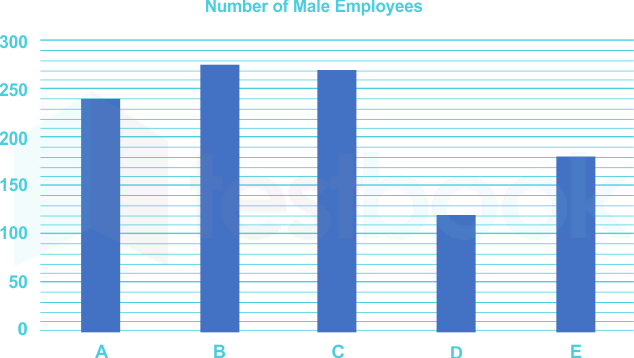
The bar graph given below shows the number of male employees working in five different companies and the table shows the percentage of females out of total employees working in a company. 

Total employees = Males + Females

Companies% of Female Employees
A40%
B45%
C55%
D60%
E50%

Average employees working in D and F together are 275, while female employees in both companies together is 270. Find male employees in C is how much percentage more or less than that on F.

  1. AOption (a)

    75% More

  2. BOption (b)

    67.5% Less 

  3. COption (c)

    62.5% More

  4. DOption (d)

    68.75% More

  5. EOption (e)

    None of these

View answer & explanation

Correct answer

Answer: (d)D.

68.75% More

Why this answer is correct

General Solution:

The total employees in a company = Males + Females.

From the given data, we can calculate the total employees for each company using the percentage of female employees.

Formula: Total Employees = Males / (1 - Percentage of Females)

Company A:

Males = 240

Percentage of Females = 40%

Total Employees = 240 / (1 - 0.40) = 240 / 0.60 = 400

Females = 400 - 240 = 160 

Company B:

Males = 275

Percentage of Females = 45%

Total Employees = 275 / (1 - 0.45) = 275 / 0.55 = 500

Females = 500 - 275 = 225 

Company C:

Males = 270

Percentage of Females = 55%

Total Employees =270 / (1 - 0.55) = 270 / 0.45 = 600

Females = 600 - 270 = 330 

Company D:

Males = 120

Percentage of Females = 60%

Total Employees =120 / (1 - 0.60) = 120 / 0.40 = 300

Females = 300 - 120 = 180 

Company E:

Males = 180

Percentage of Females = 50%

Total Employees =180 / (1 - 0.50) = 180 / 0.50 = 360

Females = 360 - 180 = 180 

Calculations:

Average employees in D and F = 275

Total employees in D and F = 275 × 2 = 550

From Step 1, total employees in D = 300

So, total employees in F = 550 - 300 = 250 

Total female employees in D and F = 270

From Step 1, female employees in D = 180

So, female employees in F = 270 - 180 = 90 

Total employees in F = 250

Female employees in F = 90

Male employees in F = 250 - 90 = 160 

Male employees in C = 270

Male employees in F = 160

Difference = 270 -160 = 110

Percentage difference = 110 / 160 × 100 = 68.75% 

Thus, the Male employees in C are 68.75% more than male employees in F.

SBI PO Prelims Memory Based Paper (Held On: 8 March 2025 Shift 3) (Previous Year Paper)·Quantitative Aptitude
View full paper

Question 158

SBI Probationary Officer (PO) 2025• Quantitative Aptitude• Quantitative Aptitude

Directions: Read the data carefully and answer the following questions. 

The bar graph given below shows the number of male employees working in five different companies and the table shows the percentage of females out of total employees working in a company. 

Total employees = Males + Females

Companies% of Female Employees
A40%
B45%
C55%
D60%
E50%

Find the difference between male employees in A and B together and female employees in D and E together.

  1. AOption (a)

    275

  2. BOption (b)

    225

  3. COption (c)

    155

  4. DOption (d)

    285

  5. EOption (e)

    145

View answer & explanation

Correct answer

Answer: (c)C.

155

Why this answer is correct

General Solution:

The total employees in a company = Males + Females.

From the given data, we can calculate the total employees for each company using the percentage of female employees.

Formula: Total Employees = Males / (1 - Percentage of Females)

Company A:

Males = 240

Percentage of Females = 40%

Total Employees = 240 / (1 - 0.40) = 240 / 0.60 = 400

Females = 400 - 240 = 160 

Company B:

Males = 275

Percentage of Females = 45%

Total Employees = 275 / (1 - 0.45) = 275 / 0.55 = 500

Females = 500 - 275 = 225 

Company C:

Males = 270

Percentage of Females = 55%

Total Employees =270 / (1 - 0.55) = 270 / 0.45 = 600

Females = 600 - 270 = 330 

Company D:

Males = 120

Percentage of Females = 60%

Total Employees =120 / (1 - 0.60) = 120 / 0.40 = 300

Females = 300 - 120 = 180 

Company E:

Males = 180

Percentage of Females = 50%

Total Employees =180 / (1 - 0.50) = 180 / 0.50 = 360

Females = 360 - 180 = 180 

Calculations:

Male Employees in A and B Together:

240 (A) + 275 (B) = 515

Female Employees in D and E Together:

180 (D) + 180 (E) = 360

Difference:

515 - 360 = 155

Thus, the difference is 155.

SBI PO Prelims Memory Based Paper (Held On: 8 March 2025 Shift 3) (Previous Year Paper)·Quantitative Aptitude
View full paper

Question 159

SBI Probationary Officer (PO) 2025• Quantitative Aptitude• Quantitative Aptitude

Directions: Read the data carefully and answer the following questions. 

The bar graph given below shows the number of male employees working in five different companies and the table shows the percentage of females out of total employees working in a company. 

Total employees = Males + Females

Companies% of Female Employees
A40%
B45%
C55%
D60%
E50%

In A, 60% of total employees aged above 40 years, out of which half are females, find number of males aged ≤ 40 years.

  1. AOption (a)

    140

  2. BOption (b)

    40

  3. COption (c)

    180

  4. DOption (d)

    120

  5. EOption (e)

    60

View answer & explanation

Correct answer

Answer: (d)D.

120

Why this answer is correct

General Solution:

The total employees in a company = Males + Females.

From the given data, we can calculate the total employees for each company using the percentage of female employees.

Formula: Total Employees = Males / (1 - Percentage of Females)

Company A:

Males = 240

Percentage of Females = 40%

Total Employees = 240 / (1 - 0.40) = 240 / 0.60 = 400

Females = 400 - 240 = 160 

Company B:

Males = 275

Percentage of Females = 45%

Total Employees = 275 / (1 - 0.45) = 275 / 0.55 = 500

Females = 500 - 275 = 225 

Company C:

Males = 270

Percentage of Females = 55%

Total Employees =270 / (1 - 0.55) = 270 / 0.45 = 600

Females = 600 - 270 = 330 

Company D:

Males = 120

Percentage of Females = 60%

Total Employees =120 / (1 - 0.60) = 120 / 0.40 = 300

Females = 300 - 120 = 180 

Company E:

Males = 180

Percentage of Females = 50%

Total Employees =180 / (1 - 0.50) = 180 / 0.50 = 360

Females = 360 - 180 = 180 

Calculations:

60% of total employees in Company A are aged above 40 years.

Number of employees aged above 40 = 60% × 400 = 240 

Half of the employees aged above 40 are females.

Number of females aged above 40 = 240 / 2 = 120 

Total employees aged above 40 = 240

Females aged above 40 = 120

Males aged above 40 = 240 - 120 = 120 

Or

Males aged ≤ 40 = 240 - 120 = 120

Thus, the number of males aged ≤ 40 years in Company A is 120.

SBI PO Prelims Memory Based Paper (Held On: 8 March 2025 Shift 3) (Previous Year Paper)·Quantitative Aptitude
View full paper

Question 160

SBI Probationary Officer (PO) 2025• Quantitative Aptitude• Quantitative Aptitude

Directions: Read the data carefully and answer the following questions. 

The bar graph given below shows the number of male employees working in five different companies and the table shows the percentage of females out of total employees working in a company. 

Total employees = Males + Females

Companies% of Female Employees
A40%
B45%
C55%
D60%
E50%

If 30% of the male employees in Company C are promoted to senior positions, and 35% of the female employees in Company A are given additional responsibilities, and then 40% of the total employees (males and females combined) in Company E are given a performance bonus, what is the total number of employees in these three companies who did not receive any promotion, responsibility, or bonus?

  1. AOption (a)

    1085

  2. BOption (b)

    1079

  3. COption (c)

    1143

  4. DOption (d)

    1205

  5. EOption (e)

    994

View answer & explanation

Correct answer

Answer: (b)B.

1079

Why this answer is correct

General Solution:

The total employees in a company = Males + Females.

From the given data, we can calculate the total employees for each company using the percentage of female employees.

Formula: Total Employees = Males / (1 - Percentage of Females)

Company A:

Males = 240

Percentage of Females = 40%

Total Employees = 240 / (1 - 0.40) = 240 / 0.60 = 400

Females = 400 - 240 = 160 

Company B:

Males = 275

Percentage of Females = 45%

Total Employees = 275 / (1 - 0.45) = 275 / 0.55 = 500

Females = 500 - 275 = 225 

Company C:

Males = 270

Percentage of Females = 55%

Total Employees =270 / (1 - 0.55) = 270 / 0.45 = 600

Females = 600 - 270 = 330 

Company D:

Males = 120

Percentage of Females = 60%

Total Employees =120 / (1 - 0.60) = 120 / 0.40 = 300

Females = 300 - 120 = 180 

Company E:

Males = 180

Percentage of Females = 50%

Total Employees =180 / (1 - 0.50) = 180 / 0.50 = 360

Females = 360 - 180 = 180 

Calculations:

Let's calculate the number of employees receiving benefits:

Company C (Promotions):

Male employees in C: 270

Promoted males: 30% of 270 = 0.30 × 270 = 81

Company A (Responsibilities):

Female employees in A: 160

Females with responsibilities: 35% of 160 = 0.35 × 160 = 56

Company E (Bonuses):

Total employees in E: 360

Employees with bonuses: 40% of 360 = 0.40 × 360 = 144

Now, let's calculate the number of employees NOT receiving benefits:

Company C:

Total employees in C: 600

Employees without promotions: 600 - 81 = 519

Company A:

Total employees in A: 400

Employees without responsibilities: 400 - 56 = 344

Company E:

Total employees in E: 360

Employees without bonuses: 360 - 144 = 216

So,

Total employees without benefits: 519 (C) + 344 (A) + 216 (E) = 1079

Therefore, the total number of employees in these three companies who did not receive any promotion, responsibility, or bonus is 1079.

How should I prepare for Quantitative Aptitude in SBI Probationary Officer (PO)?

Solving previous year questions by topic helps identify recurring concepts, question patterns, and frequently asked sub-topics. Attempt each question, review the step-by-step explanation, and note down key formulas or facts for quick revision before the exam.