SBI Clerk · Topic Collection

Quantitative Aptitude PYQs

Arithmetic, number systems, percentages, ratios, profit and loss, time and work, algebra, geometry, mensuration, and trigonometry.

1495 Total Questions38 Official PapersYears: 2018–2025Search in Quantitative Aptitude
Showing questions 121–140 of 1495Page 7 of 75
SBI Clerk Prelims Memory Based Paper (Held On: 21 September 2025 Shift 2) (Previous Year Paper)·Numerical Ability
View full paper

Question 121

SBI Clerk 2025• Numerical Ability• Numerical Ability

What will come in place of question mark ‘?’ in the following question?

(216)7/3 × 642 × 815/4 = 3-7 × 6?

  1. AOption (a)

    16

  2. BOption (b)

    10

  3. COption (c)

    19

  4. DOption (d)

    84

  5. EOption (e)

    18

View answer & explanation

Correct answer

Answer: (c)C.

19

Why this answer is correct

To solve questions of this type, follow the laws of “Surds and indices’’ given below -

Laws of Indices:

  1. am × an = a{m + n}
  2. am ÷ an = a{m - n}
  3. (am)n = amn
  4. (a)-m = 1/am
  5. (a)m/n = n√am
  6. (a)0 = 1

By using this laws:

⇒ (216)7/3 × 642 × 815/4 = 3-7 × 6?

⇒ (63)7/3 × (26)2 × (34)5/4 = 3-7 × 6?

⇒ 67 × 212 × 35 = 3-7 × 6?

⇒ 67 × 212 × 35 = 3-7 × 6?

⇒ 67 × 212 × 35 ÷ 3-7 = 6?

⇒ 67 × 212 × 312 = 67

⇒ 67 × 612 = 6?

⇒ ? = 19
SBI Clerk Prelims Memory Based Paper (Held On: 21 September 2025 Shift 2) (Previous Year Paper)·Numerical Ability
View full paper

Question 122

SBI Clerk 2025• Numerical Ability• Numerical Ability

What will come in place of '?' in the following question?

 [3132 ÷ 29 × 48] ÷ 18 = 12 × ?

  1. AOption (a)

    36

  2. BOption (b)

    38

  3. COption (c)

    52

  4. DOption (d)

    24

  5. EOption (e)

    28

View answer & explanation

Correct answer

Answer: (d)D.

24

Why this answer is correct

[3132 ÷ 29 × 48] ÷ 18 = 12 × ?

⇒ (3132/29) × 48 × ( 1/18) = 12 × ?

⇒ (108 × 48)/18 = 12 × ?

⇒ 12 × ? = 6 × 48

⇒ ? = 24

∴ ? = 24.

SBI Clerk Prelims Memory Based Paper (Held On: 21 September 2025 Shift 2) (Previous Year Paper)·Numerical Ability
View full paper

Question 123

SBI Clerk 2025• Numerical Ability• Numerical Ability

What value should come in the place of question mark (?) in the following question?

76% of 395 + 48% of 135 =?

  1. AOption (a)

    356

  2. BOption (b)

    365

  3. COption (c)

    347

  4. DOption (d)

    373

  5. EOption (e)

    None of these 

View answer & explanation

Correct answer

Answer: (b)B.

365

Why this answer is correct

⇒ 76% of 395 + 48% of 135 =?

⇒ ? = 76/100 × 395 + 48/100 × 135

⇒ ? = 300.2 + 64.8

⇒ ? = 365

SBI Clerk Prelims Memory Based Paper (Held On: 21 September 2025 Shift 2) (Previous Year Paper)·Numerical Ability
View full paper

Question 124

SBI Clerk 2025• Numerical Ability• Numerical Ability

What will come in place of question mark '?' in the following question?

3 + {3 + (4 - 1 × 2)} × 4 = 759 ÷ ?

  1. AOption (a)

    12

  2. BOption (b)

    66

  3. COption (c)

    30

  4. DOption (d)

    33

  5. EOption (e)

    44

View answer & explanation

Correct answer

Answer: (d)D.

33

Why this answer is correct

Follow BODMAS rule to solve this question, as per the order given below,

Step-1: Parts of an equation enclosed in 'Brackets' must be solved first, and in the bracket,

Step-2: Any mathematical 'Of' or 'Exponent' must be solved next,

Step-3: Next, the parts of the equation that contain 'Division' and 'Multiplication' are calculated,

Step-4: Last but not least, the parts of the equation that contain 'Addition' and 'Subtraction' should be calculated.

Given expression is,

⇒ 3 + {3 + (4 - 1 × 2)} × 4 = 759 ÷ ?

⇒ 3 + {3 + (4 - 2)} × 4 = 759 ÷ ?

⇒ 3 + {3 + 2} × 4 = 759 ÷ ?

⇒ 3 + 5 × 4 = 759 ÷ ?

⇒ 3 + 20 = 759 ÷ ?

⇒ 23 = 759 ÷ ?

⇒ ? = 759/23 = 33

⇒ ? = 33

SBI Clerk Prelims Memory Based Paper (Held On: 21 September 2025 Shift 2) (Previous Year Paper)·Numerical Ability
View full paper

Question 125

SBI Clerk 2025• Numerical Ability• Numerical Ability

What will come in place of question mark (?) in the following question?

12% of (75% of (25% of (8% of 4800))) = ?

  1. AOption (a)

    86.4

  2. BOption (b)

    0.0864

  3. COption (c)

    864

  4. DOption (d)

    0.864

  5. EOption (e)

    8.64

View answer & explanation

Correct answer

Answer: (e)E.

8.64

Why this answer is correct

Given expression is,

⇒ 12% of (75% of (25% of (8% of 4800))) = ?

\(\begin{array}{l} \Rightarrow \frac{{12}}{{100}} \times \left( {\frac{{75}}{{100}} \times \left( {\frac{{25}}{{100}} \times \left( {\frac{8}{{100}} \times 4800} \right)} \right)} \right) = ;?\ \Rightarrow \frac{3}{{25}} \times \left( {\frac{3}{4} \times \left( {\frac{1}{4} \times \left( {48 \times 8} \right)} \right)} \right) = ;?\ \Rightarrow \frac{3}{{25}} \times \left( {\frac{3}{4} \times 96} \right) = ;?\ \Rightarrow \frac{3}{{25}} \times 3 \times 24 = ;? \end{array}\)

⇒ ? = 216/25 = 8.64

⇒ ? = 8.64

SBI Clerk Prelims Memory Based Paper (Held On: 21 September 2025 Shift 2) (Previous Year Paper)·Numerical Ability
View full paper

Question 126

SBI Clerk 2025• Numerical Ability• Numerical Ability

The simple interest on a sum of money is 1/16th of the principal, and the number of years is equal to rate per annum. Find the rate percentage.

  1. AOption (a)

    10%

  2. BOption (b)

    15%

  3. COption (c)

    5%

  4. DOption (d)

    2.5%

  5. EOption (e)

    6%

View answer & explanation

Correct answer

Answer: (d)D.

2.5%

Why this answer is correct

Shortcut Trick

When Simple Interest is a fraction (1/n) of Principal and Time (T) equals Rate (R).

Formula: Rate (R) = √(Fraction × 100)

R = √(1/16 × 100) = √(100/16)

R = 10/4 = 2.5%

∴ The correct answer is 2.5%.

Alternate Method

Given:

Simple Interest (SI) = 1/16 × Principal (P)

Number of years (T) = Rate per annum (R)

Formula Used:

SI = (P × R × T) ÷ 100

Calculations:

⇒ P/16 = (P × R × R) ÷ 100

⇒ 1/16 = R2 ÷ 100

⇒ R2 = 100 ÷ 16

⇒ R = √(100/16)

⇒ R = 10/4

⇒ R = 2.5%

∴ The correct answer is 2.5%.

Additional Information

Simple Interest Formula

The basic formula is SI = (P × R × T) / 100, where P is Principal, R is Rate, and T is Time.

Case when R = T

If numerical values of Rate and Time are equal, then R = T = 10 × √(SI/P).

Amount Calculation

Total Amount (A) is the sum of Principal and Simple Interest: A = P + SI.

SBI Clerk Prelims Memory Based Paper (Held On: 21 September 2025 Shift 2) (Previous Year Paper)·Numerical Ability
View full paper

Question 127

SBI Clerk 2025• Numerical Ability• Numerical Ability

Directions: Read the following information carefully and answer the questions based on it.

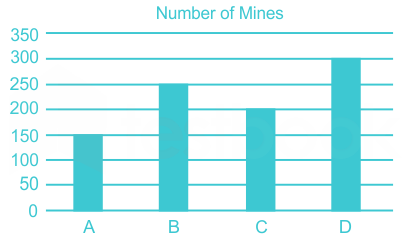
The bar graph below illustrates the number of mines (in hundreds) located in four different places: A, B, C, and D. 

If the number of mines in Place A increases by 20% and those in Place D decrease by 10%, what will be the ratio of mines in A to D?

  1. AOption (a)

    7:8

  2. BOption (b)

    8:9

  3. COption (c)

    3:4

  4. DOption (d)

    5:6

  5. EOption (e)

    2:3

View answer & explanation

Correct answer

Answer: (e)E.

2:3

Why this answer is correct

New mines in A = 150 + 20% of 150 = 150 + 30 = 180

New mines in D = 300 − 10% of 300 = 300 − 30 = 270

Ratio (A:D) = 180 : 270 = 2 : 3

Hence, the correct answer is 2 : 3.

SBI Clerk Prelims Memory Based Paper (Held On: 21 September 2025 Shift 2) (Previous Year Paper)·Numerical Ability
View full paper

Question 128

SBI Clerk 2025• Numerical Ability• Numerical Ability

Directions: Read the following information carefully and answer the questions based on it.

The bar graph below illustrates the number of mines (in hundreds) located in four different places: A, B, C, and D. 

If the number of mines in Place C were to double, what would be the percentage of the new number of mines in Place C to the total number of mines in all four places?

  1. AOption (a)

    27.27%

  2. BOption (b)

    36.36%

  3. COption (c)

    66.67%

  4. DOption (d)

    53.53%

  5. EOption (e)

    44.44%

View answer & explanation

Correct answer

Answer: (b)B.

36.36%

Why this answer is correct

Original mines in C = 200

If doubled ⇒ New mines in C = 200 × 2 = 400

New total mines = 150 + 250 + 400 + 300 = 1100

Required percentage = (400 ÷ 1100) × 100 = 36.36%

Hence, the correct answer is 36.36%.

SBI Clerk Prelims Memory Based Paper (Held On: 21 September 2025 Shift 2) (Previous Year Paper)·Numerical Ability
View full paper

Question 129

SBI Clerk 2025• Numerical Ability• Numerical Ability

Directions: Read the following information carefully and answer the questions based on it.

The bar graph below illustrates the number of mines (in hundreds) located in four different places: A, B, C, and D. 

What is the difference between the average number of mines in Place A and B, and the average number of mines in Place C and D?

  1. AOption (a)

    80

  2. BOption (b)

    75

  3. COption (c)

    50

  4. DOption (d)

    60

  5. EOption (e)

    45

View answer & explanation

Correct answer

Answer: (c)C.

50

Why this answer is correct

Average number of mines in Place A and B = (150 + 250) ÷ 2 = 400 ÷ 2 = 200

Average number of mines in Place C and D = (200 + 300) ÷ 2 = 500 ÷ 2 = 250

Difference = 250 − 200 = 50

Hence, the correct answer is 50.

SBI Clerk Prelims Memory Based Paper (Held On: 21 September 2025 Shift 2) (Previous Year Paper)·Numerical Ability
View full paper

Question 130

SBI Clerk 2025• Numerical Ability• Numerical Ability

Directions: Read the following information carefully and answer the questions based on it.

The bar graph below illustrates the number of mines (in hundreds) located in four different places: A, B, C, and D. 

By what percentage is the number of mines in Place B more than the number of mines in Place A?

  1. AOption (a)

    12.5%

  2. BOption (b)

    14.28%

  3. COption (c)

    33.33%

  4. DOption (d)

    66.67%

  5. EOption (e)

    90.09%

View answer & explanation

Correct answer

Answer: (d)D.

66.67%

Why this answer is correct

Mines in Place A = 150

Mines in Place B = 250

Difference = 250 − 150 = 100

Percentage increase = (Difference ÷ Place A) × 100

= (100 ÷ 150) × 100 = 66.67%

Hence, the correct answer is 66.67%.

SBI Clerk Prelims Memory Based Paper (Held On: 21 September 2025 Shift 2) (Previous Year Paper)·Numerical Ability
View full paper

Question 131

SBI Clerk 2025• Numerical Ability• Numerical Ability

Directions: Read the following information carefully and answer the questions based on it.

The bar graph below illustrates the number of mines (in hundreds) located in four different places: A, B, C, and D. 

What is the ratio of the total number of mines in Place A and Place C to the total number of mines in Place B and Place D?

  1. AOption (a)

    11:7

  2. BOption (b)

    7:11

  3. COption (c)

    3:5

  4. DOption (d)

    5:3

  5. EOption (e)

    5:7

View answer & explanation

Correct answer

Answer: (b)B.

7:11

Why this answer is correct

Mines in Place A = 15 hundreds = 150

Mines in Place C = 20 hundreds = 200

Total (A + C) = 150 + 200 = 350

Mines in Place B = 250

Mines in Place D = 300

Total (B + D) = 250 + 300 = 550

Ratio (A + C) : (B + D) = 350 : 550 → 7 : 11

Hence, the correct answer is 7 : 11.

SBI Clerk Prelims Memory Based Paper (Held On: 21 September 2025 Shift 2) (Previous Year Paper)·Numerical Ability
View full paper

Question 132

SBI Clerk 2025• Numerical Ability• Numerical Ability

The radius of the semicircle is equal to the half of the side of the square. The area of the square is 1764 sq cm. Find the perimeter of the semicircle?

  1. AOption (a)

     105cm

  2. BOption (b)

     112cm

  3. COption (c)

     108cm

  4. DOption (d)

     115cm

  5. EOption (e)

     120cm

View answer & explanation

Correct answer

Answer: (c)C.

 108cm

Why this answer is correct

Shortcut Trick

Side of Square = √1764 = 42 cm.

Radius of Semicircle (r) = 42 ÷ 2 = 21 cm.

Perimeter of Semicircle = r × (36 ÷ 7).

Perimeter = 21 × (36 ÷ 7) = 3 × 36 = 108 cm.

∴ The correct answer is 108 cm.

Alternate Method

Given: Area of Square = 1764 cm2; Radius = Side / 2.

Formula Used: Area of Square = a2; Perimeter of Semicircle = πr + 2r.

⇒ Side of Square (a) = √1764

⇒ a = 42 cm

⇒ Radius of Semicircle (r) = 42 ÷ 2 = 21 cm

⇒ Perimeter = (π × r) + (2 × r)

⇒ Perimeter = (22/7 × 21) + (2 × 21)

⇒ Perimeter = 66 + 42 = 108 cm

∴ The correct answer is 108 cm.

Additional Information

Area of Semicircle

The Area is half of the circle's area, given by (πr2) ÷ 2.

Diagonal of a Square

The Diagonal of a square with side 'a' is calculated as a√2.

Simplified Perimeter Constant

The Perimeter of a semicircle can be expressed as r × (36/7) when using π = 22/7.

SBI Clerk Prelims Memory Based Paper (Held On: 21 September 2025 Shift 2) (Previous Year Paper)·Numerical Ability
View full paper

Question 133

SBI Clerk 2025• Numerical Ability• Numerical Ability

A invested Rs. 76,000 in a business. After a few months, B joined him with Rs. 57,000. At the end of the year, the total profit was divided between them in the ratio 2 : 1, After how many months did B join?

  1. AOption (a)

    6

  2. BOption (b)

    4

  3. COption (c)

    3

  4. DOption (d)

    8

  5. EOption (e)

    5

View answer & explanation

Correct answer

Answer: (b)B.

4

Why this answer is correct

Shortcut Trick

Profit ratio = (CapitalA × TimeA) : (CapitalB × TimeB)

Ratio of Capitals A : B = 76,000 : 57,000 = 4 : 3

Let B joined for x months. A was there for 12 months.

(4 × 12) : (3 × x) = 2 : 1 ⇒ 48 : 3x = 2 : 1

3x × 2 = 48 × 1 ⇒ 6x = 48 ⇒ x = 8 months.

B joined after = 12 − 8 = 4 months.

∴ The correct answer is 4 months.

Alternate Method

Given → Investment of A = Rs. 76,000, Investment of B = Rs. 57,000, Profit Ratio = 2 : 1, Time for A = 12 months. Formulas: Profit = Investment × Time | Investment1 × T1 ÷ Investment2 × T2 = P1 ÷ P2

⇒ Let B invested for t months. ⇒ (76000 × 12) ÷ (57000 × t) = 2 ÷ 1 ⇒ (4 × 12) ÷ (3 × t) = 2 ÷ 1 ⇒ 48 ÷ 3t = 2 ÷ 1 ⇒ 16 ÷ t = 2 ⇒ t = 8 months. ⇒ Since the business ran for 12 months and B was in for 8 months, B joined after 12 − 8 = 4 months.

∴ The correct answer is 4 months.

Additional Information

Partnership Basics

In a partnership, the profit is distributed based on the weighted investment, which is the product of Capital and Time Period.

Time Calculation

Always distinguish between the duration of investment and the time after which a partner joins. Time joined after = Total time − Duration of investment.

SBI Clerk Prelims Memory Based Paper (Held On: 21 September 2025 Shift 2) (Previous Year Paper)·Numerical Ability
View full paper

Question 134

SBI Clerk 2025• Numerical Ability• Numerical Ability

Directions: Read the following information carefully and answer the questions based on it.

The following data shows the number of male and female visitors to a shopping mall on Monday and Tuesday. 

On Monday, the total number of visitors was 390. The number of males on Tuesday was 35 more than the number of females on Monday. The number of females on Monday was 62.5% of the number of males on Monday.

If the number of males on Monday had been 20% less, what would have been the new total number of visitors on Monday?

  1. AOption (a)

    348

  2. BOption (b)

    349

  3. COption (c)

    346

  4. DOption (d)

    342

  5. EOption (e)

    344

View answer & explanation

Correct answer

Answer: (d)D.

342

Why this answer is correct

General Solution:

Given:

Total visitors on Monday = 390

Females on Monday = 62.5% of Males on Monday

Males on Tuesday = Females on Monday + 35

Let MMon = males on Monday, FMon = females on Monday.

Calculations:

FMon = 62.5% of MMon = (5/8)·MMon

MMon + FMon = 390 ⇒ MMon + (5/8)MMon = 390

⇒ (13/8)MMon = 390 ⇒ MMon = 390 × 8 / 13 = 240

⇒ FMon = 390 − 240 = 150

Males on Tuesday = FMon + 35 = 150 + 35 = 185

Thus,

Males on Monday = 240

Females on Monday = 150

Males on Tuesday = 185

Calculations:

Original males on Monday = 240

Reduced by 20% ⇒ New males = 240 − 0.2 × 240 = 240 − 48 = 192

Females remain the same = 150

New total visitors = 192 + 150 = 342

Hence, the correct answer is 342.

SBI Clerk Prelims Memory Based Paper (Held On: 21 September 2025 Shift 2) (Previous Year Paper)·Numerical Ability
View full paper

Question 135

SBI Clerk 2025• Numerical Ability• Numerical Ability

Directions: Read the following information carefully and answer the questions based on it.

The following data shows the number of male and female visitors to a shopping mall on Monday and Tuesday. 

On Monday, the total number of visitors was 390. The number of males on Tuesday was 35 more than the number of females on Monday. The number of females on Monday was 62.5% of the number of males on Monday.

What is the ratio of the number of males on Monday to the number of males on Tuesday?

  1. AOption (a)

    44:31

  2. BOption (b)

    48:37

  3. COption (c)

    40:29

  4. DOption (d)

    27:22

  5. EOption (e)

    25:17

View answer & explanation

Correct answer

Answer: (b)B.

48:37

Why this answer is correct

General Solution:

Given:

Total visitors on Monday = 390

Females on Monday = 62.5% of Males on Monday

Males on Tuesday = Females on Monday + 35

Let MMon = males on Monday, FMon = females on Monday.

Calculations:

FMon = 62.5% of MMon = (5/8)·MMon

MMon + FMon = 390 ⇒ MMon + (5/8)MMon = 390

⇒ (13/8)MMon = 390 ⇒ MMon = 390 × 8 / 13 = 240

⇒ FMon = 390 − 240 = 150

Males on Tuesday = FMon + 35 = 150 + 35 = 185

Thus,

Males on Monday = 240

Females on Monday = 150

Males on Tuesday = 185

Calculations:

Males on Monday = 240

Males on Tuesday = 185

Ratio = Males(Monday) : Males(Tuesday) = 240 : 185 → 48 : 37

Hence, the correct answer is 48 : 37.

SBI Clerk Prelims Memory Based Paper (Held On: 21 September 2025 Shift 2) (Previous Year Paper)·Numerical Ability
View full paper

Question 136

SBI Clerk 2025• Numerical Ability• Numerical Ability

Directions: Read the following information carefully and answer the questions based on it.

The following data shows the number of male and female visitors to a shopping mall on Monday and Tuesday. 

On Monday, the total number of visitors was 390. The number of males on Tuesday was 35 more than the number of females on Monday. The number of females on Monday was 62.5% of the number of males on Monday.

The number of males on Tuesday is what percentage of the total visitors on Monday?

  1. AOption (a)

    48.52%

  2. BOption (b)

    49.12%

  3. COption (c)

    46.54%

  4. DOption (d)

    45.69%

  5. EOption (e)

    47.44%

View answer & explanation

Correct answer

Answer: (e)E.

47.44%

Why this answer is correct

General Solution:

Given:

Total visitors on Monday = 390

Females on Monday = 62.5% of Males on Monday

Males on Tuesday = Females on Monday + 35

Let MMon = males on Monday, FMon = females on Monday.

Calculations:

FMon = 62.5% of MMon = (5/8)·MMon

MMon + FMon = 390 ⇒ MMon + (5/8)MMon = 390

⇒ (13/8)MMon = 390 ⇒ MMon = 390 × 8 / 13 = 240

⇒ FMon = 390 − 240 = 150

Males on Tuesday = FMon + 35 = 150 + 35 = 185

Thus,

Males on Monday = 240

Females on Monday = 150

Males on Tuesday = 185

Calculations:

Males on Tuesday = 185

Total visitors on Monday = 390

Percentage = (185 ÷ 390) × 100

= 47.44% (approx)

Hence, the correct answer is 47.44%.

SBI Clerk Prelims Memory Based Paper (Held On: 21 September 2025 Shift 2) (Previous Year Paper)·Numerical Ability
View full paper

Question 137

SBI Clerk 2025• Numerical Ability• Numerical Ability

Directions: Read the following information carefully and answer the questions based on it.

The following data shows the number of male and female visitors to a shopping mall on Monday and Tuesday. 

On Monday, the total number of visitors was 390. The number of males on Tuesday was 35 more than the number of females on Monday. The number of females on Monday was 62.5% of the number of males on Monday.

If the total number of visitors on both the days are 755 then find the number of females visitors on Tuesday.

  1. AOption (a)

    180

  2. BOption (b)

    190

  3. COption (c)

    160

  4. DOption (d)

    150

  5. EOption (e)

    140

View answer & explanation

Correct answer

Answer: (a)A.

180

Why this answer is correct

General Solution:

Given:

Total visitors on Monday = 390

Females on Monday = 62.5% of Males on Monday

Males on Tuesday = Females on Monday + 35

Let MMon = males on Monday, FMon = females on Monday.

Calculations:

FMon = 62.5% of MMon = (5/8)·MMon

MMon + FMon = 390 ⇒ MMon + (5/8)MMon = 390

⇒ (13/8)MMon = 390 ⇒ MMon = 390 × 8 / 13 = 240

⇒ FMon = 390 − 240 = 150

Males on Tuesday = FMon + 35 = 150 + 35 = 185

Thus,

Males on Monday = 240

Females on Monday = 150

Males on Tuesday = 185

Calculations:

Total visitors on Monday = 390

Total visitors on Monday + Tuesday = 755

Males on Tuesday = 185 

Total visitors on Tuesday = 755 − 390 = 365

Females on Tuesday = Total visitors − Males on Tuesday = 365 − 185 = 180

Hence, the correct answer is 180.

SBI Clerk Prelims Memory Based Paper (Held On: 21 September 2025 Shift 2) (Previous Year Paper)·Numerical Ability
View full paper

Question 138

SBI Clerk 2025• Numerical Ability• Numerical Ability

E is 1/4 more efficient than F. E alone can complete a particular task in 15 days. Then, in how many days F and E completes a particular task, if both work together.

  1. AOption (a)

    12/17 days

  2. BOption (b)

    25/3 days

  3. COption (c)

    15/19 days

  4. DOption (d)

    17/15 days

  5. EOption (e)

    13/16 days

View answer & explanation

Correct answer

Answer: (b)B.

25/3 days

Why this answer is correct

Shortcut Trick

Efficiency ratio E : F = (1 + 1/4) : 1 = 5/4 : 1 = 5 : 4

Total Work = Efficiency of E × Days taken by E = 5 × 15 = 75 units

Combined efficiency of E + F = 5 + 4 = 9 units/day

Days taken together = 75 ÷ 9 = 25/3 days

∴ The correct answer is 25/3 days.

Alternate Method

Given:

Efficiency of E is 1/4 more than F.

Time taken by E = 15 days.

PersonEfficiencyDaysTotal Work
E51575
F418.75

Calculations:

⇒ Let efficiency of F = 4 units/day

⇒ Efficiency of E = 4 + (1/4 × 4) = 5 units/day

⇒ Total Work = Efficiency × Time = 5 × 15 = 75 units

⇒ Time taken by E and F together = Total Work ÷ (EffE + EffF)

⇒ Time = 75 ÷ (5 + 4) = 75/9 days

⇒ Time = 25/3 days

∴ The correct answer is 25/3 days.

Additional Information

Efficiency and Time Relationship

Efficiency is inversely proportional to the time taken to complete a work. If the ratio of efficiency is x : y, the ratio of time taken is y :

x. Work Formula

Total Work = Efficiency × Time. Combined time for two people working together is (Total Work) ÷ (Sum of individual efficiencies).

SBI Clerk Prelims Memory Based Paper (Held On: 21 September 2025 Shift 2) (Previous Year Paper)·Numerical Ability
View full paper

Question 139

SBI Clerk 2025• Numerical Ability• Numerical Ability

The present ages of A and B are in the ratio 3 : 4 and ratio of B and C is 1 : 2 and ratio of C and D is 4 : 3. If the age of D is 72 years, then find the age of the oldest of the four.

  1. AOption (a)

    86 yrs

  2. BOption (b)

    80 yrs

  3. COption (c)

    78 yrs

  4. DOption (d)

    82 yrs

  5. EOption (e)

    96 yrs

View answer & explanation

Correct answer

Answer: (e)E.

96 yrs

Why this answer is correct

Shortcut Trick

Combine the ratio of A : B : C : D using the common terms.

A : B = 3 : 4 | B : C = 1 : 2 (or 4 : 8) | C : D = 4 : 3 (or 8 : 6).

Combined ratio A : B : C : D = 3 : 4 : 8 : 6.

Given D = 6 units = 72 years → 1 unit = 12 years.

Oldest is C = 8 units = 8 × 12 = 96 years.

∴ The correct answer is 96 yrs.

Alternate Method

Given:

Ratio A : B = 3 : 4

Ratio B : C = 1 : 2

Ratio C : D = 4 : 3

Age of D = 72 years

Calculations:

⇒ To combine, make B same: A : B = 3 : 4, B : C = 4 : 8

⇒ Now make C same: C : D is 4 : 3, but in combined it is 8. So, C : D = 8 : 6

⇒ Combined Ratio A : B : C : D = 3 : 4 : 8 : 6

⇒ Value of D = 6x = 72

⇒ x = 72 ÷ 6 = 12

⇒ Oldest is C (highest ratio part)

⇒ Age of C = 8 × 12 = 96 years

∴ The correct answer is 96 yrs.

Additional Information

Combined Ratio Rule

To combine A:B and B:C, multiply the ratios so that the common term (B) has the same value in both sets.

Ratio & Proportion Basics

If a : b = c : d, then the product of extremes equals the product of means (a × d = b × c).

Age Related Problems

The difference between the ages of two persons remains constant throughout their lives regardless of the time elapsed.

SBI Clerk Prelims Memory Based Paper (Held On: 21 September 2025 Shift 2) (Previous Year Paper)·Numerical Ability
View full paper

Question 140

SBI Clerk 2025• Numerical Ability• Numerical Ability

A solution of syrup has 15% water. Another solution has 35% water. How many litres of the first solution must be added to the 40L of second solution to make a solution of 23% water?

  1. AOption (a)

    30

  2. BOption (b)

    40

  3. COption (c)

    60

  4. DOption (d)

    55

  5. EOption (e)

    50

View answer & explanation

Correct answer

Answer: (c)C.

60

Why this answer is correct

Shortcut Trick

By Alligation Method, the ratio of Solution 1 to Solution 2 is calculated using the water concentrations.

Ratio = (35 − 23) : (23 − 15) = 12 : 8 = 3 : 2

Given: 2 units (Solution 2) = 40 L

⇒ 1 unit = 20 L

⇒ 3 units (Solution 1) = 3 × 20 L = 60 L

∴ The correct answer is 60 L.

Alternate Method

Given:

Water in Solution 1 = 15%

Water in Solution 2 = 35%

Target water concentration = 23%

Quantity of Solution 2 = 40 L

Calculations:

⇒ Let the quantity of Solution 1 be x L.

⇒ By Alligation Rule: (Quantity of 1) / (Quantity of 2) = (35 − 23) / (23 − 15)

⇒ x / 40 = 12 / 8

⇒ x / 40 = 3 / 2

⇒ x = (3 × 40) ÷ 2

⇒ x = 120 ÷ 2 = 60 L

∴ The correct answer is 60 L.

Additional Information

Rule of Alligation

Used to find the ratio in which two ingredients at given prices or concentrations must be mixed to produce a mixture at a desired mean value.

Weighted Average Formula

Mean Concentration = (n1c1 + n2c2) ÷ (n1 + n2), where n is quantity and c is concentration.

Successive Dilution

Final Quantity = Initial Quantity × (1 − x/V)n, where x is quantity replaced and V is total volume.

How should I prepare for Quantitative Aptitude in SBI Clerk?

Solving previous year questions by topic helps identify recurring concepts, question patterns, and frequently asked sub-topics. Attempt each question, review the step-by-step explanation, and note down key formulas or facts for quick revision before the exam.