Official Paper

SBI Clerk Prelims Memory Based Paper (Held On: 21 September 2025 Shift 2) (Previous Year Paper)

100 questions · 60 minutes · with answers · free

English Language (30 questions)

1

Directions: Read the following sentences carefully, choose the one that is grammatically/contextually incorrect, and mark it as your answer.

  1. ((a))

    A flock of birds were flying south for the winter.

  2. ((b))

    She writes every day to improve her storytelling skills.

  3. ((c))

    Driving carefully in rainy weather can prevent many accidents.

  4. ((d))

    His innovative approach to problem-solving sets him apart from his peers.

  5. ((e))

    It's important to drink plenty of water throughout the day.

Show Answer
Answer: ((a))

A flock of birds were flying south for the winter.

The correct answer is option 1.

Key Points

To answer this question, let's have a look at all the given sentences as options:

  • Option 1: A flock of birds were flying south for the winter.
  • This sentence is erroneous because the subject 'a flock' is singular, and the verb should therefore also be singular: 'was' instead of 'were'.
  • The correct sentence would be: "A flock of birds was flying south for the winter."
  • Option 2: She writes every day to improve her storytelling skills.
  • This sentence is grammatically and contextually correct.
  • Option 3: Driving carefully in rainy weather can prevent many accidents.
  • This sentence is grammatically and contextually correct.
  • Option 4: His innovative approach to problem-solving sets him apart from his peers.
  • This sentence is grammatically and contextually correct.
  • Option 5: It's important to drink plenty of water throughout the day.
  • This sentence is grammatically and contextually correct.

So, out of the given sentences, only option 1 is a grammatically/contextually incorrect sentence.

Therefore, the correct answer is "A flock of birds was flying south for the winter."
2

Directions: Read the following sentences carefully, choose the one that is grammatically/contextually incorrect, and mark it as your answer.

  1. ((a))

    The new store opens at 9 AM every morning.

  2. ((b))

    He always ask interesting questions during the lecture.

  3. ((c))

    I enjoy reading books that challenge my understanding of the world.

  4. ((d))

    They played chess until midnight, each move more strategic than the last.

  5. ((e))

    Creativity often thrives under constraints.

Show Answer
Answer: ((b))

He always ask interesting questions during the lecture.

The correct answer is option 2.

Key Points

To answer this question, let's have a look at all the given sentences as options:

  • Option 1: The new store opens at 9 AM every morning.
  • This sentence is grammatically and contextually correct.
  • Option 2: He always ask interesting questions during the lecture.
  • This sentence is incorrect because the verb should agree with the singular subject 'He', thus it should be 'asks' instead of 'ask'.
  • The correct sentence would be: "He always asks interesting questions during the lecture."
  • Option 3: I enjoy reading books that challenge my understanding of the world.
  • This sentence is grammatically and contextually correct.
  • Option 4: They played chess until midnight, each move more strategic than the last.
  • This sentence is grammatically and contextually correct.
  • Option 5: Creativity often thrives under constraints.
  • This sentence is grammatically and contextually correct.

So, out of the given sentences, only option 2 is a grammatically/contextually incorrect sentence.

Therefore, the correct answer is "He always asks interesting questions during the lecture."

3

In the following sentence, four words are given in bold out of which one word is misspelled. Find the misspelled word.

After reading my arguments (A), you may or may not beleive (B) the future I describe (C) is inevitable (D), as I say it is.

  1. ((a))

    A

  2. ((b))

    B

  3. ((c))

    C

  4. ((d))

    D

  5. ((e))

    All are correct

Show Answer
Answer: ((b))

B

The correct answer is 'beleive'.

Key Points

  • The word 'beleive' has been incorrectly spelled in the given sentence.
  • The correct spelling and its meaning has been listed below - 
  • believe -  accept that (something) is true, especially without proof.
  • Example - You may believe the story that you like best.

Hint

  • “I before E except after C” is a grammar rule that will help you with remembering the spelling of some words.
  • The entire saying is “I before E, except after C or when sounded as A, as in neighbor and weigh. And weird is just weird.”
  • It is also important to remember that there are exceptions to this rule like neighbor, Einstein, neither, efficient etc.

Additional Information

The following are the meanings of the other highlighted words in the given sentence - 

  • arguments - Plural form of 'argument' which means an exchange of diverging or opposite views, typically a heated or angry one.
  • describe - give a detailed account in words of.
  • inevitable -  certain to happen.
4

In the following sentence, four words are given in bold out of which one word is misspelled. Find the misspelled word.

Use a calander (A) to drain (B) the water and thoroughly (C) rinse (D) the seeds.

  1. ((a))

    A

  2. ((b))

    B

  3. ((c))

    C

  4. ((d))

    D

  5. ((e))

    No error

Show Answer
Answer: ((a))

A

The correct answer is 'calander'.

Key Points

  • The word 'calander' has been incorrectly spelled in the given sentence.
  • The correct spelling and its meaning has been listed below - 
  • colander -  a perforated bowl used to strain off liquid from food after washing or cooking.
  • Example - Shruti said as he strained the spaghetti into a colander.

Additional Information

The following are the meanings of the other highlighted words in the given sentence - 

  • drain - cause or allow (liquid) to run off or out of something.
  • thoroughly - in a thorough manner.
  • rinse -  wash (something) with clean water to remove soap, detergent, dirt, or impurities.
5

In the following sentence, four words are given in bold out of which one word is misspelled. Find the misspelled word.

Desert (A) is where the menu really shines, (B) as you can choose among(C) house specialty fondues such as bananas foster (D) or cookies and cream dream.

  1. ((a))

    A

  2. ((b))

    B

  3. ((c))

    C

  4. ((d))

    D

  5. ((e))

    All are correct

Show Answer
Answer: ((a))

A

The correct answer is 'desert'.

Key Points

  • The word 'desert' has been incorrectly spelled in the given sentence.
  • The correct spelling and its meaning has been listed below - 
  • dessert -  the sweet course eaten at the end of a meal.
  • Example - Guests finish with an indulgent dessert, baked on premises by the resident pastry chef.

Confusion Points

  • 'Desert'  spelled in this manner means a water less, desolate area of land with little or no vegetation, typically one covered with sand.
  • Hence, although the spelling is correct, the meaning is not valid for the given sentence.

Additional Information

The following are the meanings of the other highlighted words in the given sentence - 

  • shines - be exceptionally good.
  • among- surrounded by; in the middle of
  • foster -  encourage the development of (something, especially something desirable). But in context of the given sentence we need to consider the phrase 'Bananas Foster' which refers to a dessert made from bananas and vanilla ice cream
6

In the following sentence, four words are given in bold out of which one word is misspelt. Find the misspelt word.

On the fourt (A) day he came home from work (B) to find her at the stove,(C) cooking supper(D)

  1. ((a))

    A

  2. ((b))

    B

  3. ((c))

    C

  4. ((d))

    D

  5. ((e))

    All are correct

Show Answer
Answer: ((a))

A

The correct answer is 'fourt'.

Key Points

  • The word 'fourt' has been incorrectly spelled in the given sentence.
  • The correct spelling and its meaning has been listed below - 
  • fourth -  constituting number four in a sequence; 4th.
  • Example - After the fourth week she knew he wouldn't be back.

Additional Information

The following are the meanings of the other highlighted words in the given sentence - 

  • work - activity involving mental or physical effort done in order to achieve a purpose or result.
  • stove - an apparatus for cooking or heating that operates by burning fuel or using electricity.
  • supper -  an evening meal, typically a light or informal one.
7

In the following sentence, four words are given in bold out of which one word is misspelled. Find the misspelled word.

With a bag-less vacum (A) cleaner, you need to shake out the dust, dirt, hair, and food particles (B) into another trash receptacle (C), and it's not the easiest process (D) out there.

  1. ((a))

    A

  2. ((b))

    B

  3. ((c))

    C

  4. ((d))

    D

  5. ((e))

    No error

Show Answer
Answer: ((a))

A

The correct answer is 'vacum '.

Key Points

  • The word 'vacum' has been incorrectly spelled in the given sentence.
  • The correct spelling and its meaning has been listed below - 
  • vacuum -  a space or container from which the air has been completely or partly removed. A 'vacuum cleaner' is an electrical apparatus that by means of suction collects dust and small particles from floors and other surfaces.
  • Example - There is no such thing really as a vacuum, any more than there are atoms or ultimate indivisible particles.

​​                           You'll have to do a lot more stooping when you use an upright vacuum cleaner.

Additional Information

The following are the meanings of the other highlighted words in the given sentence - 

  • particles - the least possible amount.
  • receptacle - a hollow object used to contain something.
  • process -   a series of actions or steps taken in order to achieve a particular end.

Direction: In the following passage, some of the words have been left out. Read the passage carefully and select the correct answer for the given blanks out of the given alternatives.

A radiological examination of an ancient mummy said to have been__(1)____ in royal tombs in Thebes, Upper Egypt, has proved it is the body of a pregnant woman. She came from the elite of the Theban community and was carefully (2), wrapped in fabrics, and equipped with a rich set of amulets. Closer examination has revealed that the woman died between 20 (3) 30 years of age together with the fetus in age between the 26th and 30th week of the pregnancy. This finding is the only known case of an (4) pregnant individual. This mummy provides new possibilities for pregnancy studies in ancient times, which can be compared with and related to current cases. Furthermore, this specimen sheds a light on an unresearched aspect of ancient Egyptian burial customs and interpretations of pregnancy in the context of ancient (5) religion.

8

Which of the following words fits the blank labelled as 1?

  1. ((a))

    finding

  2. ((b))

    found

  3. ((c))

    finds

  4. ((d))

    founds

  5. ((e))

    find

Show Answer
Answer: ((b))

found

The correct answer is 'found'

Key Points

  • In the given blank, we need to use a third form of the verb because there is a usage of 'been' and 'have' is an auxiliary verb so in this sense, we need to use a third form of the verb which is written only in Option 2 i.e. 'found'
  • So the correct sentence is- A radiological examination of an ancient mummy said to have been found in royal tombs in Thebes
9

Which of the following words fits the blank labelled as 2?

  1. ((a))

    mummification

  2. ((b))

    typified

  3. ((c))

    mummified

  4. ((d))

    decomposified

  5. ((e))

    Nourishment

Show Answer
Answer: ((c))

mummified

The correct answer is 'mummified'.


Key Points

  • The passage describes an ancient Egyptian mummy of a pregnant woman who was carefully preserved according to burial customs.
  • The blank requires a word that describes the process of preserving a dead body, especially in ancient Egypt.
  • "Mummified" means preserved a dead body by embalming, drying, and wrapping it in cloth. This fits perfectly in the context of Egyptian burial practices. (ममीकृत)
  • The sentence "She came from the elite of the Theban community and was carefully mummified" is grammatically and contextually correct.

Therefore, the correct answer is 'Option 3'.


Complete Sentence: She came from the elite of the Theban community and was carefully mummified*, wrapped in fabrics, and equipped with a rich set of amulets.*


Additional Information

  • Mummification (ममीकरण): The process of preserving a body; it is a noun, so it does not fit grammatically in the blank.
  • Typified (प्रतिनिधित्व करना): Means represented or symbolized; it does not suit the context of body preservation.
  • Decomposified: This is not a standard English word and is incorrect in this context.
  • Nourishment (पोषण): Means food or nutrition, which is unrelated to the context of preserving a mummy.
10

Which of the following words fits the blank labelled as 3?

  1. ((a))

    to

  2. ((b))

    from

  3. ((c))

    as

  4. ((d))

    for

  5. ((e))

    and

Show Answer
Answer: ((e))

and

The correct answer is 'and'

Key Points

  • According to the rule of grammar, between...and is correlative conjunction hence we need to use Option 5 i.e. 'and'
  • Let's see an example-
  • The Ministry plans to construct between 50 and 60 cyclone shelters.

So the correct sentence is- Closer examination has revealed that the woman died between 20 and 30 years

11

Which of the following words fits the blank labelled as 4?

  1. ((a))

    embalmed

  2. ((b))

    decay

  3. ((c))

    embank

  4. ((d))

    neglect

  5. ((e))

    embodiment

Show Answer
Answer: ((a))

embalmed

The correct answer is 'embalmed'

Key Points

  • Let's see the meanings of the given words-
  • Embalmed- preserve from decay.
  • Decay- rot or cause to rot through the action of bacteria or fungi.
  • Embank- protect or provide with an embankment.
  • Neglect- Fail to give proper care or attention to.
  • Embodiment- A tangible or visible form of an idea or quality.
  • Hence, according to the meaning of the given words, the correct answer is 'Embalmed'.
  • We use the mummification process to preserve the body of the person hence, we need to use Option 1 as the answer.
12

Which of the following words fits the blank labelled as 5?

  1. ((a))

    Spanish

  2. ((b))

    Indian

  3. ((c))

    Caucasian

  4. ((d))

    Egyptian

  5. ((e))

    Mongoloid

Show Answer
Answer: ((d))

Egyptian

The correct answer is 'Egyptian'

Key Points

  • Since the passage is talking about Egyptian burial customs hence, we need to use the word Egyptian in the blank because no other religion has been mentioned in the passage. So the correct answer is Option 4 i.e. Egyptian.

So the correct sentence is- Furthermore, this specimen sheds a light on an unresearched aspect of ancient Egyptian burial customs and interpretations of pregnancy in the context of ancient Egyptian religion.

13

Direction: In the following question, two columns are given containing three phrases each. The phrases are labelled A, B, and C in the first column and P, Q, and R in the second column. A phrase from the first column may or may not connect with a phrase in the second column to make a grammatically and contextually meaningful sentence. Identify the correct option from those given below that gives the correct sequence in which one or more sentences can be formed. If none of the options makes it possible for a meaningful sentence to be formed, indicate 'None of these' as your answer.


Column 1Column 2
(A) A crane is used to(P) highest mountain in India.
(B) The Kanchenjunga is the(Q) to the exam hall.
(C) She was on her way(R) lift heavy objects.
  1. ((a))

    C-R

  2. ((b))

    A-Q

  3. ((c))

    B-R and C-P

  4. ((d))

    A-P

  5. ((e))

    None of these

Show Answer
Answer: ((e))

None of these

The correct answer is None of these.

Key Points

None of the combinations in the given options can be used to make a meaningful sentence.

Let us take a look at the sentence combinations:

  • A is combined with R to form a meaningful sentence: A crane is used to lift heavy objects.
  • A cannot be used with either P or Q because it would not make a meaningful sentence.

A crane is used to highest mountain in India.

A crane is used to to the exam hall.

  • The next combination would have to be B-P: The Kanchenjunga is the​ highest mountain in India.
  • The combination B-Q does not make any meaningful sentence:

The Kanchenjunga is the to the exam hall.

  • Then, the final combination is C-Q: She was on her way to the exam hall.

The correct combination of sentences from the given options is A-R, B-P, and C-Q - none of which are given in the options.

<br>

Thus, the correct answer is: None of these.

Additional Information

We use both 'tall' and 'high' as adjectives for the height of an object.

But when referring to the height measurement of mountains, there is a slight difference.

  • The peak of the highest mountain is the furthest away from sea level.

The highest mountain in the world is Mount Everest. Its peak is 29,035 feet above sea level.

  • The peak of the tallest mountain is the furthest away from the base of the mountain.

The tallest mountain in the world is Mauna Kea. Its height from its base below sea level to its peak is 33,465 feet.

Here is an illustration of this difference:

<br>
14

Direction: In the following question, two columns are given containing three phrases each. The phrases are labelled A, B, and C in the first column and P, Q, and R in the second column. A phrase from the first column may or may not connect with a phrase in the second column to make a grammatically and contextually meaningful sentence. Identify the correct option from those given below that gives the correct sequence in which one or more sentences can be formed. If none of the options makes it possible for a meaningful sentence to be formed, indicate 'None of these' as your answer.


Column 1Column 2
(A) The school is closed(P) for the summer break.
(B) I sent him a postcard(Q) from Mussoorie.
(C) Rhinoceros are known for(R) their thick skin.
  1. ((a))

    C-R

  2. ((b))

    A-Q

  3. ((c))

    B-R

  4. ((d))

    A-R and C-Q

  5. ((e))

    None of these

Show Answer
Answer: ((a))

C-R

The correct answer is C-R.

Key Points

The right combination from the given options that makes a meaningful sentence is C and R.

Let us take a look at the sentence combinations:

  • A is combined with P to form a meaningful sentence: The school is closed for the summer break.
  • A cannot be used with either Q or R because it would not make a meaningful sentence.

The school is closed from Mussoorie.

The school is closed their thick skin.

  • The next combination would have to be B-Q: I sent him a postcard from Mussoorie.
  • If we consider the combination B-R, it does not make any meaningful sentence:

I sent him a postcard their thick skin.

  • Then, the final combination is C-R: Rhinoceros are known for their thick skin.

Thus, the correct combination of sentences from the given options is: (C) Rhinoceros are known for (R) their thick skin.

Additional Information

There are some animal names that remain the same in both singular and plural forms. Whether referring to one animal or a group of them, we use the same word.

  • Some examples include: deer, moose, sheep, elk, walrus, antelope, buffalo, salmon.
15

Direction: In the following question, two columns are given containing three phrases each. The phrases are labelled A, B, and C in the first column and P, Q, and R in the second column. A phrase from the first column may or may not connect with a phrase in the second column to make a grammatically and contextually meaningful sentence. Identify the correct option from those given below that gives the correct sequence in which one or more sentences can be formed. If none of the options makes it possible for a meaningful sentence to be formed, indicate 'None of these' as your answer.


Column 1Column 2
(A) Please wash your hands(P) as large as a city.
(B) An asteroid can be(Q) in case it rained.
(C) I carried an umbrella(R) before having food.
  1. ((a))

    B-R

  2. ((b))

    A-P and C-R

  3. ((c))

    A-R

  4. ((d))

    C-P

  5. ((e))

    None of these

Show Answer
Answer: ((c))

A-R

The correct answer is A-R.

Key Points

The right combination from the given options that makes a meaningful sentence is A and R.

Let us take a look at the sentence combinations:

  • A is combined with R to form a meaningful sentence: Please wash your hands before having food.
  • A cannot be used with either P or Q because it would not make a meaningful sentence.

Please wash your hands as large as a city.

Please wash your hands in case it rained.

  • The next combination would have to be B-P: An asteroid can be as large as a city.
  • Next, if we consider the combination B-Q, it does not make any meaningful sentence:

An asteroid can be in case it rained.

  • Then, the final combination is C-QI carried an umbrella in case it rained.

Thus, the correct combination of sentences from the given options is: (A) Please wash your hands (R) before having food.

Directions: Read the given passage carefully to answer the following questions. Each question will have five alternatives as its answer. Choose the correct option as your answer.

In the mid-2000s, GlamourThreads, a prominent fashion company, was established in New York. Originally recognized for its avant-garde designs and sustainable approach, the brand quickly gained popularity among fashion enthusiasts across North America and Asia. GlamourThreads's commitment to quality and innovative fashion meant that it was soon marked as a trendsetter in the industry. Driven by its success, the company sought to expand its horizons. In 2015, GlamourThreads initiated a merger with leading fashion brands based in Australia and Europe. This strategic move aimed to keep the brand at the forefront of global fashion trends, hoping to leverage the diverse styles and market strengths of these continents. Initially, the merger seemed promising, as it was seen as a means to enhance the brand's reach and diversify its design portfolio. However, the merger brought unforeseen challenges. Cultural clashes and differing market dynamics led to a series of management conflicts within GlamourThreads. The European and Australian partners ________ different levels of autonomy and control, which resulted in strategic mishaps and misaligned goals. To compound the problem, the global fashion market was already facing economic downturns and shifts in consumer preferences, affecting sales and overall profitability.

By 2018, the situation had deteriorated significantly. Unable to keep pace with the rapidly changing market and internal discord, both the Australian and European entities decided to cut off ties with GlamourThreads. This decision meant that the brand not only lost significant market presence in these regions but also faced a substantial financial setback. The aftermath of this fallout was immediate. Without the support and markets of Europe and Australia, GlamourThreads experienced a steep decline. The company struggled to regain its footing, leading to a decrease in innovation and quality that once set it apart. By 2020, the once-celebrated fashion house was a shadow of its former self, a cautionary tale of how rapid expansion and misaligned mergers can lead to downfall. The narrative of GlamourThreads underscores the importance of strategic coherence and the complexities involved in international business ventures. For companies seeking global presence, it means carefully navigating cultural and market differences while maintaining core values that keep the brand's identity intact.

16

Which market regions did GlamourThreads originally gain popularity in?

  1. ((a))

    South America and Europe

  2. ((b))

    North America and Asia

  3. ((c))

    Australia and Africa

  4. ((d))

    Europe and Africa

  5. ((e))

    Australia and South America

Show Answer
Answer: ((b))

North America and Asia

The correct answer is Option 2.


Key Points

  • The passage explicitly states that GlamourThreads gained popularity among fashion enthusiasts across North America and Asia.
  • The brand was originally recognized for its avant-garde designs and sustainable approach, which attracted attention in these regions.
  • There is no mention of its initial popularity in South America, Europe, Australia, or Africa.

Therefore, the correct answer is Option 2.


Reference Sentence: "Originally recognized for its avant-garde designs and sustainable approach, the brand quickly gained popularity among fashion enthusiasts across North America and Asia."


Additional Information

  • Option 1: South America and Europe are not mentioned as the initial markets where GlamourThreads gained popularity.
  • Option 3: Australia and Africa are also not mentioned as initial target markets for the brand.
  • Option 4: Europe and Africa do not fit the description provided in the passage regarding the brand's early popularity.
  • Option 5: Australia and South America are not listed as regions where the brand initially found success.
17

According to the passage, which factor contributed to GlamourThreads's initial success?

  1. ((a))

    Late delivery of products

  2. ((b))

    Exclusivity agreement with American designers

  3. ((c))

    Focus on sustainable fashion

  4. ((d))

    Partnership with emerging brands in Africa

  5. ((e))

    High pricing of products

Show Answer
Answer: ((c))

Focus on sustainable fashion

The correct answer is Option 3.


Key Points

  • The passage mentions that GlamourThreads was originally recognized for its avant-garde designs and sustainable approach, which contributed to its early popularity and success.
  • The brand's commitment to quality and innovation also played a significant role in setting it apart as a trendsetter in the fashion industry.
  • Options such as late delivery of products, exclusivity agreements, partnerships with emerging brands in Africa, or high pricing are not mentioned as factors contributing to the brand's initial success.

Therefore, the correct answer is Option 3.


Reference Sentence: "Originally recognized for its avant-garde designs and sustainable approach, the brand quickly gained popularity among fashion enthusiasts across North America and Asia."


Additional Information

  • Option 1: Late delivery of products is generally a negative factor and is not mentioned in the passage as contributing to the brand's success.
  • Option 2: Exclusivity agreements with American designers are not mentioned in the passage.
  • Option 4: Partnerships with emerging brands in Africa are not discussed as a factor in the passage.
  • Option 5: High pricing of products is not mentioned as a contributing factor to the brand's initial success.
18

What was one of the primary reasons for the eventual fallout of the merger between GlamourThreads and the Australian & European entities?

  1. ((a))

    Lack of social media presence

  2. ((b))

    Different levels of autonomy and control expected

  3. ((c))

    Insufficient funding for marketing

  4. ((d))

    Inability to create unique designs

  5. ((e))

    Overproduction of fashion items

Show Answer
Answer: ((b))

Different levels of autonomy and control expected

The correct answer is Option 2.


Key Points

  • The passage mentions that the merger led to unforeseen challenges, specifically citing differing market dynamics and management conflicts caused by the European and Australian partners expecting different levels of autonomy and control.
  • These conflicts resulted in strategic mishaps and misaligned goals, contributing to the eventual fallout of the merger.
  • Options such as lack of social media presence, insufficient funding for marketing, inability to create unique designs, or overproduction of fashion items are not mentioned as primary reasons for the merger's failure.

Therefore, the correct answer is Option 2.


Reference Sentence: "Cultural clashes and differing market dynamics led to a series of management conflicts within GlamourThreads. The European and Australian partners expected different levels of autonomy and control, which resulted in strategic mishaps and misaligned goals."


Additional Information

  • Option 1: Lack of social media presence is not mentioned in the passage as a factor leading to the merger's fallout.
  • Option 3: Insufficient funding for marketing is not mentioned in the passage.
  • Option 4: Inability to create unique designs is not cited as a primary reason in the passage.
  • Option 5: Overproduction of fashion items is also not mentioned as a contributing factor in the passage.
19

According to the passage, which of the given statements is correct?

A) GlamourThreads was able to maintain its market presence in Europe after the merger.

B) The merger brought unforeseen challenges due to cultural clashes.

C) By 2020, GlamourThreads had regained its innovation and quality.

  1. ((a))

    Only A

  2. ((b))

    Only B

  3. ((c))

    Only C

  4. ((d))

    A and B

  5. ((e))

    B and C

Show Answer
Answer: ((b))

Only B

The correct answer is Option 2.


Key Points

  • Statement A: GlamourThreads was able to maintain its market presence in Europe after the merger.
  • This statement is incorrect as the passage mentions that by 2018, GlamourThreads had lost its market presence in Europe due to the fallout of the merger.
  • Statement B: The merger brought unforeseen challenges due to cultural clashes.
  • This statement is correct as it aligns with the information provided in the passage about the cultural clashes and differing market dynamics leading to management conflicts after the merger.
  • Statement C: By 2020, GlamourThreads had regained its innovation and quality.
  • This statement is incorrect as the passage states that by 2020, GlamourThreads had experienced a steep decline and struggled to regain its footing, leading to a decrease in innovation and quality.
  • Hence, the statement B is identified as correct in the context of the passage.

Therefore, the correct answer is: ‘Only B’.

20

According to the passage, which of the given statements is incorrect?

A) GlamourThreads initiated its merger in 2015.

B) The merger aimed to leverage diverse styles and market strengths.

C) The global fashion market was facing economic growth during the merger.

  1. ((a))

    Only A

  2. ((b))

    Only B

  3. ((c))

    Only C

  4. ((d))

    A and C

  5. ((e))

    B and C

Show Answer
Answer: ((c))

Only C

The correct answer is Option 3.


Key Points

  • Statement A: GlamourThreads initiated its merger in 2015.
  • This statement is correct as per the passage which mentions that GlamourThreads initiated the merger in 2015.
  • Statement B: The merger aimed to leverage diverse styles and market strengths.
  • This statement is correct according to the passage, which states that the merger aimed to leverage the diverse styles and market strengths of Australia and Europe.
  • Statement C: The global fashion market was facing economic growth during the merger.
  • This statement is incorrect because the passage mentions that the global fashion market was facing economic downturns during the merger.
  • Hence, the statement C is identified as incorrect in the context of the passage.

Therefore, the correct answer is: ‘Only C’.

21

What will fit in the blank taken from the passage: “The European and Australian partners ________ different levels of autonomy and control, which resulted in strategic mishaps and misaligned goals.”

  1. ((a))

    expected

  2. ((b))

    tolerated

  3. ((c))

    ignored

  4. ((d))

    appreciated

  5. ((e))

    compromised

Show Answer
Answer: ((a))

expected

The correct answer is 'expected'.


Key Points

  • The word "expected" means considered likely or anticipated.
  • Here, the European and Australian partners anticipated or had different expectations regarding autonomy and control.
  • The other options: "tolerated," "ignored," "appreciated," and "compromised" do not fit the context as appropriately.

​Therefore, the correct answer is 'expected'.

Complete Sentence: The European and Australian partners expected different levels of autonomy and control, which resulted in strategic mishaps and misaligned goals.

Additional Information

  • Tolerated (सहन करना): means allowing the existence, occurrence, or practice of something that one does not necessarily like.
  • Ignored (उपेक्षित): means refusing to take notice of or acknowledge.
  • Appreciated (प्रशंसा की): means recognizing the full worth of something.
  • Compromised (समझौता किया): means reaching an agreement by making mutual concessions.
22

Which of the following words is similar in meaning to "keep" in the context of maintaining the brand's identity?

  1. ((a))

    Abandon

  2. ((b))

    Preserve

  3. ((c))

    Remove

  4. ((d))

    Cease

  5. ((e))

    Neglect

Show Answer
Answer: ((b))

Preserve

The correct answer is: Option 2 i.e., 'Preserve'.

Key Points

  • The word "keep" in the context of maintaining the brand's identity means to continue having or holding onto something. (रखना, बनाए रखना)
  • Example: It is important to keep your promises to maintain trust.
  • "Preserve" refers to maintaining something as it is, especially in order to prevent it from decaying or being damaged. (संरक्षित रखना)
  • Example: Efforts are being made to preserve the historic building.
  • Hence, we can infer that the meaning of "keep" in this context is similar to "preserve".

​Therefore, the correct answer is: Preserve.

Additional Information

Here are the other options explained along with their Hindi meanings and example sentences:

  • Abandon (त्यागना): To leave something or someone completely.
  • Example: He decided to abandon his old lifestyle and start anew.
  • Remove (हटाना): To take something away from a place or position.
  • Example: Please remove your shoes before entering the house.
  • Cease (बंद करना): To stop something.
  • Example: The factory will cease operations next month.
  • Neglect (अवहेलना करना): To fail to care for something or someone properly.
  • Example: He was accused of neglecting his duties.
23

Which of the following words is opposite in meaning to "mean" in the context of the passage?

  1. ((a))

    Intend

  2. ((b))

    Signify

  3. ((c))

    Suggest

  4. ((d))

    Conceal

  5. ((e))

    Represent

Show Answer
Answer: ((d))

Conceal

The correct answer is: Option 4 i.e., 'Conceal'.

Key Points

  • The word "mean" in the context of the passage refers to something that conveys or signifies a particular sense or meaning. (अर्थ रखना)
  • Example: His words mean that he is unhappy with the current situation.
  • "Conceal" refers to keeping something hidden or secret. (छिपाना)
  • Example: She tried to conceal her disappointment from her friends.
  • Hence, we can infer that the opposite of "mean" in this context is "conceal".

Therefore, the correct answer is: Conceal.

Additional Information

Here are the other options explained along with their Hindi meanings and example sentences:

  • Intend (इरादा रखना): To plan or have in mind to do something.
  • Example: I intend to start a new project next month.
  • Signify (अर्थ दर्शाना): To indicate or be a sign of something.
  • Example: His nod signified his agreement.
  • Suggest (सुझाव देना): To put forward an idea or plan for consideration.
  • Example: Can you suggest a good place for dinner?
  • Represent (प्रतिनिधित्व करना): To stand for or symbolize something.
  • Example: The flag represents our country.
24

In the following question, parts of a sentence have been jumbled and labelled as P, Q, R, and S. You are required to rearrange the jumbled parts of the sentence and mark your response accordingly by selecting the correct option.

P. there is strong empirical evidence to /  Q. suggest that money in the /  R. hands of the mother /  S. increases expenditure on children

  1. ((a))

    PQRS

  2. ((b))

    QPRS

  3. ((c))

    SRQP

  4. ((d))

    SPRQ

  5. ((e))

    RPQS

Show Answer
Answer: ((a))

PQRS

The correct answer is option 1) i.e. PQRS.

Key Points

  • While arranging the parts of the sentence given in options, we have to find some grammatical or contextual connections between them, so let’s find out.
  • 'Suggest' is a verb and here it cannot be the first part of the given sequence.
  • PQ is a pair because P ends with “to” and Q starts with Verb's first form i.e. “suggest”. They together make the infinitive.
  • If we put S after Q and then R at last, the sentence does not make any sense. The meaning becomes vague.
  • But, if R is put after Q and then S at last, the order makes the sentence meaningful.

Thus, the correct order is PQRS.

Correct sentence: “There is strong empirical evidence to suggest that money in the hands of the mother increases expenditure on children.

25

In the following question, parts of a sentence have been jumbled and labelled as P, Q, R, and S. You are required to rearrange the jumbled parts of the sentence and mark your response accordingly by selecting the correct option.

P. are averse to thinking of / Q. so common that people now  / R. corruption in India has become / S. public life with it.

  1. ((a))

    RSPQ

  2. ((b))

    SQPR

  3. ((c))

    SPRQ

  4. ((d))

    RQPS

  5. ((e))

    PQRS

Show Answer
Answer: ((d))

RQPS

The correct answer is option 4) i.e. RQPS.

Key Points

  • While arranging the parts of the sentence given in options, we have to find some grammatical or contextual connections between them, so let’s find out.
  • An adverb is a word that modifies (describes) a verb, an adjective, another adverb, or even a whole sentence. Adverbs often end in -ly, but some look exactly the same as their adjective counterparts e.g. She spoke softly.
  • Part Q starts with the adverb 'so', so we can say that it has been used to modify something. Here, 'so' means to a very great extent or degree i.e. something is too common.
  • Auxiliary verb 'are' here in part P signifies that there will be a subject for it. Thus, we cannot start the sentence with either of them.
  • R must come at the beginning as it has both the subject (corruption) and the finite verb (has become) of the sentence.
  • Next will come Q as it has the starting point, i.e. the conjunction (that), for the subordinating clause. Thus, RQ becomes a pair and comes at the beginning of the sequence.
  • We can see that only in the fourth option RQ comes at the beginning.
  • Thus, the correct order is RQPS.

Correct sentence: “Corruption in India has become so common that people now are averse to thinking of public life with it.”

26

In the following question, parts of a sentence have been jumbled and labelled as P, Q, R, and S. You are required to rearrange the jumbled parts of the sentence and mark your response accordingly by selecting the correct option.

P. literature exists so that / Q. afterward live finely too / R. ten thousand others may / S. where a man has lived finely.

  1. ((a))

    RQPS

  2. ((b))

    PSRQ

  3. ((c))

    PRQS

  4. ((d))

    QPSR

  5. ((e))

    SPRQ

Show Answer
Answer: ((b))

PSRQ

The correct answer is option 2) i.e. PSRQ.

Key Points

  • While arranging the parts of the sentence given in options, we have to find some grammatical or contextual connections between them, so let’s find out.
  • P is the first fragment because it introduces the subject 'literature'.
  • S should be put after P because P ends with “so that” which is a conjunction of the subordinate clause and connects with S.
  • R follows S contextually.
  • Q has “too”, which makes it an additional statement connecting with R.
  • Thus, the correct order is PSRQ.

Correct sentence: “Literature exists so that where a man has lived finely ten thousand others may afterward live finely too.

27

Direction: In the following question, arrange the jumbled words or phrases to make a meaningful sentence.

P. Raman talks to me as / Q. if he were the General / R. manager of NIPPO company although / S. all know he is not.

  1. ((a))

    RSPQ

  2. ((b))

    PQRS

  3. ((c))

    PRQS

  4. ((d))

    QRPS

  5. ((e))

    SQPR

Show Answer
Answer: ((b))

PQRS

The correct answer is: 'PQRS'

Key Points

  • We need to check the grammatical and contextual connection between the parts of the sentence to find the correct sequence.
  • Part P starts with a noun.
  • It will become the subject of the sentence.
  • So it will be the first part of the sentence.
  • Part P ends with 'as'
  • Part Q starts with 'if'
  • 'As if' is a coordinate conjunction.
  • So Q will follow P and will become the second part of the sentence.
  • Part Q ends with 'general'
  • Part R starts with 'manager'
  • 'General Manager' is a proper noun.
  • So R will follow Q and will be the third part of the sentence.
  • Part S becomes the last part of the sentence maintaining the continuity of the sentence.
  • Thus the correct sequence is: PQRS

The complete sentence is: Raman talks to me as if he were the General manager of NIPPO company although all know he is not.

28

Direction: In the question given below, a sentence is divided into parts. One of the parts may contain an error. Identify the part that contains the error and mark it as the answer. Ignore errors of punctuation, if any. In case the sentence is correct as it is, mark option (e), that is, 'No error' as your answer.

  1. ((a))

    In our earnest attempt to promote kindness and consideration

  2. ((b))

    during the event, we asked old people to raise their hand

  3. ((c))

    so that we, with sincere regard for their comfort, could manage

  4. ((d))

    their accommodations efficiently and with care.

  5. ((e))

    No error

Show Answer
Answer: ((b))

during the event, we asked old people to raise their hand

The correct answer is:  option (2).

Key Points

  • The sentence has an error: it uses "hand" (INCORRECT) instead of "hands" (CORRECT) after the plural determiner "their."
  • This disrupts subject-verb agreement in grammar because "their" indicates more than one person.
  • For proper Subject-verb agreement, the verb form should match the number (singular or plural) of the subject.
  • The sentence is talking about multiple people raising their hands, so the plural form is required.
  • Hence, the correct answer is "during the event, we asked old people to raise their hand".

The correct sentence is: "In our earnest attempt to promote kindness and consideration during the event, we asked old people to raise their hands so that we, with sincere regard for their comfort, could manage their accommodations efficiently and with care."

Additional Information

  • Let's check the other correct parts:
  • The nouns "kindness"  and "consideration" fit coherently in the sentence.
  • The adjectives "sincere" and "old" modify the nouns "regard" and "people" respectively. The adverb "efficiently" correctly modifies the verb "manage."​
  • Accommodations : (आवास) - A place to live, work, stay, etc.
  • Example: The hotel we stayed in during our vacation offered excellent accommodations.
29

Direction: In the question given below, a sentence is divided into parts. One of the parts may contain an error. Identify the part that contains the error and mark it as the answer. Ignore errors of punctuation, if any. In case the sentence is correct as it is, mark option (e), that is, 'No error' as your answer.

  1. ((a))

    Travelling is a leisure hobby 

  2. ((b))

    that requires a lot

  3. ((c))

    of capital and financially

  4. ((d))

    aid to do it regularly

  5. ((e))

    No error

Show Answer
Answer: ((c))

of capital and financially

The correct answer is: of capital and financially

Key Points

  • The error in this sentence is the use of the adverb "financially" to qualify the noun "aid."
  • "Financially" is an adverb and cannot be used to describe a noun. Instead, an adjective is needed.
  • Adjectives, are used to modify nouns, providing information about the qualities or attributes of the noun.
  • In this sentence, "financially" is used to modify the noun "aid," which is incorrect.
  • The adjective form "financial" should be used to correctly describe "aid."
  • The sentence discusses the need for "financial aid," which means assistance in terms of money or funds. (वित्तीय सहायता)

Therefore, the correct answer is option 3.

The correct sentence is: "Travelling is a leisure hobby that requires a lot of capital and financial aid to do it regularly."

Additional Information 

  • Adverbs are used to modify verbs, adjectives, or other adverbs. They provide information about how, when, where, or to what degree an action is performed.
  • Example: The man became financially stable after years of hard work.
30

Direction: In the question given below, a sentence is divided into parts. One of the parts may contain an error. Identify the part that contains the error and mark it as the answer. Ignore errors of punctuation, if any. In case the sentence is correct as it is, mark option (e), that is, 'No error' as your answer.

  1. ((a))

    My sister spent all the money

  2. ((b))

    that I saved

  3. ((c))

    for my father's new laptop 

  4. ((d))

    for the last 4 months.

  5. ((e))

    No error

Show Answer
Answer: ((b))

that I saved

The correct answer is: option (2).

Key Points

  • The error is in the segment "that I saved". The correct version should be "that I had been saving".
  • "I saved" suggests a one-time, completed action in the past, which doesn't match the ongoing action implied by "for the last 4 months".
  • "Had been saving" is the past perfect continuous tense, depicting an action that started and continued in the past.
  • The ongoing nature of saving over a period of time is best captured by using "had been saving" rather than "saved".
  • Hence, the correct answer is  "that I saved".

Therefore, the correct and complete sentence is "My sister spent all the money "that I had been saving" for my father's new laptop for the last 4 months."

Numerical Ability (35 questions)

Directions: Read the following information carefully and answer the questions based on it.

The table below provides data on the number of two types of shoes, Leather) and Non-leather, sold by different retailers.

RetailerLeatherNon-leather
A450320
B510480
C480500
D550450
E620580
31

The total number of shoes sold by retailer E is what percentage of the total number of shoes sold by A?

  1. ((a))

    152.28%

  2. ((b))

    150.09%

  3. ((c))

    156.12%

  4. ((d))

    155.84%

  5. ((e))

    None of these

Show Answer
Answer: ((d))

155.84%

Total shoes sold by Retailer E = 620 + 580 = 1200

Total shoes sold by Retailer A = 450 + 320 = 770

Percentage = (Total E ÷ Total A) × 100 = (1200 ÷ 770) × 100 ≈ 155.84%

Hence, the correct answer is 155.84%.

32

What is the average number of Non-leather shoes sold per retailer?

  1. ((a))

    472

  2. ((b))

    484

  3. ((c))

    466

  4. ((d))

    458

  5. ((e))

    None of these

Show Answer
Answer: ((c))

466

Total Non-leather shoes sold by all retailers:

320 + 480 + 500 + 450 + 580 = 2330

Number of retailers = 5

Average = Total ÷ Number of retailers = 2330 ÷ 5 = 466

Hence, the correct answer is 466.

33

What is the ratio of the total number of Leather shoes sold by A and B to the total number of Non-leather shoes sold by B and C?

  1. ((a))

    48:49

  2. ((b))

    80:99

  3. ((c))

    66:67

  4. ((d))

    54:59

  5. ((e))

    None of these

Show Answer
Answer: ((a))

48:49

Total Leather shoes sold by A and B:

Leather (A + B) = 450 + 510 = 960

Total Non-leather shoes sold by B and C:

Non-leather (B + C) = 480 + 500 = 980

Leather (A + B) : Non-leather (B + C) = 960 : 980 = 48 : 49

Hence, the correct answer is 48 : 49.

34

By what percentage are the sales of Leather shoes less in B as compared to D? 

  1. ((a))

    4.69%

  2. ((b))

    10.23%

  3. ((c))

    7.27%

  4. ((d))

    2.51%

  5. ((e))

    5.48%

Show Answer
Answer: ((c))

7.27%

Leather shoes sold:

Retailer B = 510

Retailer D = 550

Difference = 550 − 510 = 40

Percentage less = (Difference ÷ D) × 100 = (40 ÷ 550) × 100 ≈ 7.27%

Hence, the correct answer is ≈ 7.27%.

35

What is the total number of shoes (Leather + Non-leather) sold by Retailer C & E?

  1. ((a))

    2150

  2. ((b))

    2180

  3. ((c))

    2260

  4. ((d))

    2250

  5. ((e))

    None of these

Show Answer
Answer: ((b))

2180

Retailer C → Leather = 480, Non-leather = 500 → Total = 480 + 500 = 980  

Retailer E → Leather = 620, Non-leather = 580 → Total = 620 + 580 = 1200  

Combined total = 980 + 1200 = 2180

Hence, the correct answer is 2180.

36

A boat covers the distance of 11 km in 2 hours along the stream and the same distance in 4 hours against the stream. Find the speed of the boat in still water and current respectively.

  1. ((a))

    4.152 km/h and 1.375 km/h

  2. ((b))

    4.5 km/h and 1.5 km/h

  3. ((c))

    4.125 km/h and 1.375 km/h 

  4. ((d))

    4.125 km/h and 1.357 km/h

  5. ((e))

    4.215 km/h and 1.735 km/h

Show Answer
Answer: ((c))

4.125 km/h and 1.375 km/h 

Shortcut Trick

Downstream Speed (u) = 11 ÷ 2 = 5.5 km/h

Upstream Speed (v) = 11 ÷ 4 = 2.75 km/h

Boat Speed = (u + v) ÷ 2 = (5.5 + 2.75) ÷ 2 = 8.25 ÷ 2 = 4.125 km/h

Current Speed = (u − v) ÷ 2 = (5.5 − 2.75) ÷ 2 = 2.75 ÷ 2 = 1.375 km/h

∴ The correct answer is 4.125 km/h and 1.375 km/h.

Alternate Method

Given:

Distance (D) = 11 km

Time taken along the stream (t1) = 2 hours

Time taken against the stream (t2) = 4 hours

Formula Used:

Speed = Distance ÷ Time

Downstream Speed (u) = x + y | Upstream Speed (v) = x − y

Speed of boat in still water (x) = (u + v) ÷ 2

Speed of current (y) = (u − v) ÷ 2

Calculations:

⇒ Downstream Speed (u) = 11 ÷ 2 = 5.5 km/h

⇒ Upstream Speed (v) = 11 ÷ 4 = 2.75 km/h

⇒ Speed of boat (x) = (5.5 + 2.75) ÷ 2

⇒ x = 8.25 ÷ 2 = 4.125 km/h

⇒ Speed of current (y) = (5.5 − 2.75) ÷ 2

⇒ y = 2.75 ÷ 2 = 1.375 km/h

∴ The correct answer is 4.125 km/h and 1.375 km/h.

Additional Information

Relative Speed in Water

When moving with the flow, the speeds add up (x + y). When moving against the flow, the stream speed is subtracted from the boat speed (x − y).

Average Speed of Boat

If the boat covers equal distance upstream and downstream, Average Speed = (u × v) / x = (x2 − y2) / x km/h.

Time Ratio Property

The ratio of Speed of Boat to Speed of Current is given by (tup + tdown) : (tup − tdown).

37

A merchant sells 980 kg of fruits in two parts. One at 11% profit and other at 18% profit. He gains 14% on overall selling. Find how much quantity he sold at 18% profit?

  1. ((a))

    490 kg

  2. ((b))

    430 kg

  3. ((c))

    410 kg

  4. ((d))

    420 kg

  5. ((e))

    None of these

Show Answer
Answer: ((d))

420 kg

Shortcut Trick

Use the Alligation Method to find the ratio of quantities.

Profit 1: 11%, Profit 2: 18%, Mean Profit: 14%.

Ratio = (18 − 14) : (14 − 11) = 4 : 3.

Total units = 4 + 3 = 7 units.

7 units = 980 kg ⇒ 1 unit = 140 kg.

Quantity at 18% profit = 3 × 140 = 420 kg.

∴ The correct answer is 420 kg.

Alternate Method

Given: Total quantity = 980 kg, Part 1 profit = 11%, Part 2 profit = 18%, Overall profit = 14%.

Formulas: Profit = SP − CP | Weighted Average = (n1x1 + n2x2) ÷ (n1 + n2)

⇒ Let quantity at 18% be x kg, then quantity at 11% is (980 − x) kg.

⇒ 11(980 − x) + 18x = 14 × 980

⇒ 10780 − 11x + 18x = 13720

⇒ 7x = 13720 − 10780

⇒ 7x = 2940

⇒ x = 420 kg.

∴ The correct answer is 420 kg.

Additional Information

Alligation Rule

It is used to find the ratio in which two ingredients at given prices/profits are mixed to produce a mixture of a mean price/profit.

Profit and Loss on Quantities

When overall profit % is given for two parts of a total quantity, the ratio of quantities is inversely proportional to the deviation of their profit % from the mean profit %.

38

What should come in place of question mark ‘?’ in the following number series?

5, 12, 17, 29, 46, 75, 121, ?

  1. ((a))

    196

  2. ((b))

    192

  3. ((c))

    185

  4. ((d))

    188

  5. ((e))

    216

Show Answer
Answer: ((a))

196

The pattern of the given series is a Fibonacci series. Every number from third number is a sum of the previous two numbers.

⇒ 17 = 5 + 12

⇒ 29 = 17 + 12

⇒ 46 = 29 + 17

⇒ 75 = 46 + 29

⇒ 121 = 75 + 46

⇒ 196 = 121 + 75

39

What should come in place of question mark ‘?’ in the following series?

3, 4, 13, ?, 87, 168

  1. ((a))

    13

  2. ((b))

    87

  3. ((c))

    38

  4. ((d))

    168

  5. ((e))

    None of these

Show Answer
Answer: ((c))

38

The series is formed by the following logic

⇒ 3 + 12 = 4

⇒ 4 + 32 = 13

⇒ 13 + 52 = 38

⇒ 38 + 72 = 87

⇒ 87 + 92 = 168

∴ the answer is 38

40

What will come in place of the question mark (?) in the following number series?

17, 38, 80, 164, 332, 668, ?

  1. ((a))

    1380

  2. ((b))

    1320

  3. ((c))

    1360

  4. ((d))

    1340

  5. ((e))

    1260

Show Answer
Answer: ((d))

1340

The pattern of the number series is as follows:

17 × 2 + 4 = 38

38 × 2 + 4 = 80

80 × 2 + 4 = 164

164 × 2 + 4 = 332

332 × 2 + 4 = 668

668 × 2 + 4 = 1340

∴ The required next number is 1340.

41

The population of a town is 63400. It increases by 15% in the first year and decreases by 20% in the second year. what is the population of the town at the end of 2 year?

  1. ((a))

    56300

  2. ((b))

    57300

  3. ((c))

    58300

  4. ((d))

    58328

  5. ((e))

    None of these

Show Answer
Answer: ((d))

58328

Given:

Population of town is 63400

In the first year 15% and second year decreases by 20%

Calculation:

According to question,

⇒ {63400 × (115/100) × (80/100)}

⇒ 58328

∴ After 2 year later population of town is 58328


Formula used:

[X + Y + {(XY)/100}%]

⇒ X = 15%, and Y = - 20%

Applying the net% effect formula

⇒ [(+15 - 20) - {15 × 20}/100]

⇒ - 5 - 3 

⇒ - 8

So, (100 - 8)% of 63400

⇒ 92% of 63400

⇒ 58328

∴ After 2 year later population of town is 58328


1st year 15% increase(3/20) , 2nd year 20% decrease(1/5)

   year  =           Present pop.                last pop.

1st year =          20                                     23

2nd yrs =            5                                      4

After 2 yrs present pop. 100  and last pop. 92 

Given to 100 unit = 63400

⇒ 1 unit = 634

⇒ last population = 634 × 92

⇒ 58328

∴ After 2 year later population of town is 58328

42

Train A started its journey from Vashi at 9 a.m. and arrives Mulund at 2 p.m. on the same day. Train is travelling at a speed of 37 km/h. find the distance between Vashi and Mulund.

  1. ((a))

    200 km

  2. ((b))

    210 km

  3. ((c))

    130 km

  4. ((d))

    185 km

  5. ((e))

    100 km

Show Answer
Answer: ((d))

185 km

Shortcut Trick

Total Time taken from 9 a.m. to 2 p.m. = 5 hours.

Distance = Speed × Time

Distance = 37 × 5 = 185 km.

∴ The correct answer is 185 km.

Alternate Method

Given:

Starting time = 9 a.m.

Arrival time = 2 p.m.

Speed of Train A = 37 km/h

Formula Used:

Distance = Speed × Time

Calculations:

⇒ Time duration = 2 p.m. − 9 a.m.

⇒ Time duration = (12 − 9) + 2 = 5 hours

⇒ Distance = 37 km/h × 5 hours

⇒ Distance = 185 km

∴ The correct answer is 185 km.

Additional Information

Speed-Distance Relation

The fundamental relation is Distance = Speed × Time. If Speed is in km/h and Time is in hours, Distance will be in km.

Unit Conversion

To convert Speed from km/h to m/s, multiply by 5/18. To convert m/s to km/h, multiply by 18/5.

Average Speed

Average Speed = Total Distance ÷ Total Time. For two equal distances with speeds x and y, Average Speed = 2xy ÷ (x + y).

43

What will come in the place of the question mark ‘?’ in the following question?

 48% of 250 + 1050 ÷ 3 – √(?) = 423

  1. ((a))

    2205

  2. ((b))

    2209

  3. ((c))

    2289

  4. ((d))

    2286

  5. ((e))

    None of these

Show Answer
Answer: ((b))

2209

Given expression:

⇒ 48% of 250 + 1050 ÷ 3 – √(?) = 423

⇒ (48/100) × 250 + 1050 ÷ 3 – √(?) = 423

⇒ (48/100) × 250 + 350 – √(?) = 423

⇒ 120 + 350 – √(?) = 423

⇒ 470 – √(?) = 423

⇒ √(?) = 470 – 423

⇒ √(?) = 47

⇒ ? = 2209

44

What approximate value should come in place of the question mark (?) in the following equation

139% of 459 + 5125\frac{1}{2} of 384 = ?

  1. ((a))

    2760

  2. ((b))

    2860

  3. ((c))

    2960

  4. ((d))

    2660

  5. ((e))

    2560

Show Answer
Answer: ((a))

2760

Given, 139% of 459 + 5125\frac{1}{2} of 384

Approximating terms to the closest values, we get

⇒ 140% of 460 + 11/2 × 384

⇒ (140 × 460)/100 + 11/2 × 384

⇒ 644 + 2112 = 2756 ≈ 2760

∴ Approx value of the expression is 2760

45

What should come in the place of question mark ‘?’ in the following question?

150 + 45 × 2(36 – 16) ÷ 18 = ?

  1. ((a))

    500

  2. ((b))

    450

  3. ((c))

    250

  4. ((d))

    350

  5. ((e))

    None of these

Show Answer
Answer: ((c))

250

⇒ 150 + 45 × 2(36 – 16) ÷ 18 = ?

⇒ 150 + 45 × 2(20) ÷ 18

⇒ 150 + 100 = 250

46

What will come in place of question mark ‘?’ in the following question?

(216)7/3 × 642 × 815/4 = 3-7 × 6?

  1. ((a))

    16

  2. ((b))

    10

  3. ((c))

    19

  4. ((d))

    84

  5. ((e))

    18

Show Answer
Answer: ((c))

19

To solve questions of this type, follow the laws of “Surds and indices’’ given below -

Laws of Indices:

  1. am × an = a{m + n}
  2. am ÷ an = a{m - n}
  3. (am)n = amn
  4. (a)-m = 1/am
  5. (a)m/n = n√am
  6. (a)0 = 1

By using this laws:

⇒ (216)7/3 × 642 × 815/4 = 3-7 × 6?

⇒ (63)7/3 × (26)2 × (34)5/4 = 3-7 × 6?

⇒ 67 × 212 × 35 = 3-7 × 6?

⇒ 67 × 212 × 35 = 3-7 × 6?

⇒ 67 × 212 × 35 ÷ 3-7 = 6?

⇒ 67 × 212 × 312 = 67

⇒ 67 × 612 = 6?

⇒ ? = 19

47

What will come in place of '?' in the following question?

 [3132 ÷ 29 × 48] ÷ 18 = 12 × ?

  1. ((a))

    36

  2. ((b))

    38

  3. ((c))

    52

  4. ((d))

    24

  5. ((e))

    28

Show Answer
Answer: ((d))

24

[3132 ÷ 29 × 48] ÷ 18 = 12 × ?

⇒ (3132/29) × 48 × ( 1/18) = 12 × ?

⇒ (108 × 48)/18 = 12 × ?

⇒ 12 × ? = 6 × 48

⇒ ? = 24

∴ ? = 24.

48

What value should come in the place of question mark (?) in the following question?

76% of 395 + 48% of 135 =?

  1. ((a))

    356

  2. ((b))

    365

  3. ((c))

    347

  4. ((d))

    373

  5. ((e))

    None of these 

Show Answer
Answer: ((b))

365

⇒ 76% of 395 + 48% of 135 =?

⇒ ? = 76/100 × 395 + 48/100 × 135

⇒ ? = 300.2 + 64.8

⇒ ? = 365

49

What will come in place of question mark '?' in the following question?

3 + {3 + (4 - 1 × 2)} × 4 = 759 ÷ ?

  1. ((a))

    12

  2. ((b))

    66

  3. ((c))

    30

  4. ((d))

    33

  5. ((e))

    44

Show Answer
Answer: ((d))

33

Follow BODMAS rule to solve this question, as per the order given below,

Step-1: Parts of an equation enclosed in 'Brackets' must be solved first, and in the bracket,

Step-2: Any mathematical 'Of' or 'Exponent' must be solved next,

Step-3: Next, the parts of the equation that contain 'Division' and 'Multiplication' are calculated,

Step-4: Last but not least, the parts of the equation that contain 'Addition' and 'Subtraction' should be calculated.

Given expression is,

⇒ 3 + {3 + (4 - 1 × 2)} × 4 = 759 ÷ ?

⇒ 3 + {3 + (4 - 2)} × 4 = 759 ÷ ?

⇒ 3 + {3 + 2} × 4 = 759 ÷ ?

⇒ 3 + 5 × 4 = 759 ÷ ?

⇒ 3 + 20 = 759 ÷ ?

⇒ 23 = 759 ÷ ?

⇒ ? = 759/23 = 33

⇒ ? = 33

50

What will come in place of question mark (?) in the following question?

12% of (75% of (25% of (8% of 4800))) = ?

  1. ((a))

    86.4

  2. ((b))

    0.0864

  3. ((c))

    864

  4. ((d))

    0.864

  5. ((e))

    8.64

Show Answer
Answer: ((e))

8.64

Given expression is,

⇒ 12% of (75% of (25% of (8% of 4800))) = ?

12100×(75100×(25100×(8100×4800)))=;? 325×(34×(14×(48×8)))=;? 325×(34×96)=;? 325×3×24=;?\begin{array}{l} \Rightarrow \frac{{12}}{{100}} \times \left( {\frac{{75}}{{100}} \times \left( {\frac{{25}}{{100}} \times \left( {\frac{8}{{100}} \times 4800} \right)} \right)} \right) = ;?\ \Rightarrow \frac{3}{{25}} \times \left( {\frac{3}{4} \times \left( {\frac{1}{4} \times \left( {48 \times 8} \right)} \right)} \right) = ;?\ \Rightarrow \frac{3}{{25}} \times \left( {\frac{3}{4} \times 96} \right) = ;?\ \Rightarrow \frac{3}{{25}} \times 3 \times 24 = ;? \end{array}

⇒ ? = 216/25 = 8.64

⇒ ? = 8.64

51

The simple interest on a sum of money is 1/16th of the principal, and the number of years is equal to rate per annum. Find the rate percentage.

  1. ((a))

    10%

  2. ((b))

    15%

  3. ((c))

    5%

  4. ((d))

    2.5%

  5. ((e))

    6%

Show Answer
Answer: ((d))

2.5%

Shortcut Trick

When Simple Interest is a fraction (1/n) of Principal and Time (T) equals Rate (R).

Formula: Rate (R) = √(Fraction × 100)

R = √(1/16 × 100) = √(100/16)

R = 10/4 = 2.5%

∴ The correct answer is 2.5%.

Alternate Method

Given:

Simple Interest (SI) = 1/16 × Principal (P)

Number of years (T) = Rate per annum (R)

Formula Used:

SI = (P × R × T) ÷ 100

Calculations:

⇒ P/16 = (P × R × R) ÷ 100

⇒ 1/16 = R2 ÷ 100

⇒ R2 = 100 ÷ 16

⇒ R = √(100/16)

⇒ R = 10/4

⇒ R = 2.5%

∴ The correct answer is 2.5%.

Additional Information

Simple Interest Formula

The basic formula is SI = (P × R × T) / 100, where P is Principal, R is Rate, and T is Time.

Case when R = T

If numerical values of Rate and Time are equal, then R = T = 10 × √(SI/P).

Amount Calculation

Total Amount (A) is the sum of Principal and Simple Interest: A = P + SI.

Directions: Read the following information carefully and answer the questions based on it.

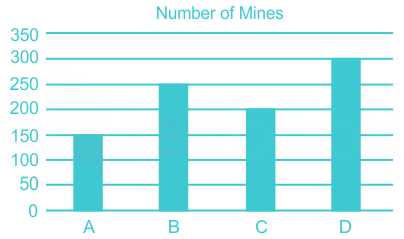
The bar graph below illustrates the number of mines (in hundreds) located in four different places: A, B, C, and D. 

52

If the number of mines in Place A increases by 20% and those in Place D decrease by 10%, what will be the ratio of mines in A to D?

  1. ((a))

    7:8

  2. ((b))

    8:9

  3. ((c))

    3:4

  4. ((d))

    5:6

  5. ((e))

    2:3

Show Answer
Answer: ((e))

2:3

New mines in A = 150 + 20% of 150 = 150 + 30 = 180

New mines in D = 300 − 10% of 300 = 300 − 30 = 270

Ratio (A:D) = 180 : 270 = 2 : 3

Hence, the correct answer is 2 : 3.

53

If the number of mines in Place C were to double, what would be the percentage of the new number of mines in Place C to the total number of mines in all four places?

  1. ((a))

    27.27%

  2. ((b))

    36.36%

  3. ((c))

    66.67%

  4. ((d))

    53.53%

  5. ((e))

    44.44%

Show Answer
Answer: ((b))

36.36%

Original mines in C = 200

If doubled ⇒ New mines in C = 200 × 2 = 400

New total mines = 150 + 250 + 400 + 300 = 1100

Required percentage = (400 ÷ 1100) × 100 = 36.36%

Hence, the correct answer is 36.36%.

54

What is the difference between the average number of mines in Place A and B, and the average number of mines in Place C and D?

  1. ((a))

    80

  2. ((b))

    75

  3. ((c))

    50

  4. ((d))

    60

  5. ((e))

    45

Show Answer
Answer: ((c))

50

Average number of mines in Place A and B = (150 + 250) ÷ 2 = 400 ÷ 2 = 200

Average number of mines in Place C and D = (200 + 300) ÷ 2 = 500 ÷ 2 = 250

Difference = 250 − 200 = 50

Hence, the correct answer is 50.

55

By what percentage is the number of mines in Place B more than the number of mines in Place A?

  1. ((a))

    12.5%

  2. ((b))

    14.28%

  3. ((c))

    33.33%

  4. ((d))

    66.67%

  5. ((e))

    90.09%

Show Answer
Answer: ((d))

66.67%

Mines in Place A = 150

Mines in Place B = 250

Difference = 250 − 150 = 100

Percentage increase = (Difference ÷ Place A) × 100

= (100 ÷ 150) × 100 = 66.67%

Hence, the correct answer is 66.67%.

56

What is the ratio of the total number of mines in Place A and Place C to the total number of mines in Place B and Place D?

  1. ((a))

    11:7

  2. ((b))

    7:11

  3. ((c))

    3:5

  4. ((d))

    5:3

  5. ((e))

    5:7

Show Answer
Answer: ((b))

7:11

Mines in Place A = 15 hundreds = 150

Mines in Place C = 20 hundreds = 200

Total (A + C) = 150 + 200 = 350

Mines in Place B = 250

Mines in Place D = 300

Total (B + D) = 250 + 300 = 550

Ratio (A + C) : (B + D) = 350 : 550 → 7 : 11

Hence, the correct answer is 7 : 11.

57

The radius of the semicircle is equal to the half of the side of the square. The area of the square is 1764 sq cm. Find the perimeter of the semicircle?

  1. ((a))

     105cm

  2. ((b))

     112cm

  3. ((c))

     108cm

  4. ((d))

     115cm

  5. ((e))

     120cm

Show Answer
Answer: ((c))

 108cm

Shortcut Trick

Side of Square = √1764 = 42 cm.

Radius of Semicircle (r) = 42 ÷ 2 = 21 cm.

Perimeter of Semicircle = r × (36 ÷ 7).

Perimeter = 21 × (36 ÷ 7) = 3 × 36 = 108 cm.

∴ The correct answer is 108 cm.

Alternate Method

Given: Area of Square = 1764 cm2; Radius = Side / 2.

Formula Used: Area of Square = a2; Perimeter of Semicircle = πr + 2r.

Side of Square (a) = √1764

⇒ a = 42 cm

Radius of Semicircle (r) = 42 ÷ 2 = 21 cm

Perimeter = (π × r) + (2 × r)

Perimeter = (22/7 × 21) + (2 × 21)

Perimeter = 66 + 42 = 108 cm

∴ The correct answer is 108 cm.

Additional Information

Area of Semicircle

The Area is half of the circle's area, given by (πr2) ÷ 2.

Diagonal of a Square

The Diagonal of a square with side 'a' is calculated as a√2.

Simplified Perimeter Constant

The Perimeter of a semicircle can be expressed as r × (36/7) when using π = 22/7.

58

A invested Rs. 76,000 in a business. After a few months, B joined him with Rs. 57,000. At the end of the year, the total profit was divided between them in the ratio 2 : 1, After how many months did B join?

  1. ((a))

    6

  2. ((b))

    4

  3. ((c))

    3

  4. ((d))

    8

  5. ((e))

    5

Show Answer
Answer: ((b))

4

Shortcut Trick

Profit ratio = (CapitalA × TimeA) : (CapitalB × TimeB)

Ratio of Capitals A : B = 76,000 : 57,000 = 4 : 3

Let B joined for x months. A was there for 12 months.

(4 × 12) : (3 × x) = 2 : 1 ⇒ 48 : 3x = 2 : 1

3x × 2 = 48 × 1 ⇒ 6x = 48 ⇒ x = 8 months.

B joined after = 12 − 8 = 4 months.

∴ The correct answer is 4 months.

Alternate Method

Given → Investment of A = Rs. 76,000, Investment of B = Rs. 57,000, Profit Ratio = 2 : 1, Time for A = 12 months. Formulas: Profit = Investment × Time | Investment1 × T1 ÷ Investment2 × T2 = P1 ÷ P2

⇒ Let B invested for t months. ⇒ (76000 × 12) ÷ (57000 × t) = 2 ÷ 1 ⇒ (4 × 12) ÷ (3 × t) = 2 ÷ 1 ⇒ 48 ÷ 3t = 2 ÷ 1 ⇒ 16 ÷ t = 2 ⇒ t = 8 months. ⇒ Since the business ran for 12 months and B was in for 8 months, B joined after 12 − 8 = 4 months.

∴ The correct answer is 4 months.

Additional Information

Partnership Basics

In a partnership, the profit is distributed based on the weighted investment, which is the product of Capital and Time Period.

Time Calculation

Always distinguish between the duration of investment and the time after which a partner joins. Time joined after = Total time − Duration of investment.

Directions: Read the following information carefully and answer the questions based on it.

The following data shows the number of male and female visitors to a shopping mall on Monday and Tuesday. 

On Monday, the total number of visitors was 390. The number of males on Tuesday was 35 more than the number of females on Monday. The number of females on Monday was 62.5% of the number of males on Monday.

59

If the number of males on Monday had been 20% less, what would have been the new total number of visitors on Monday?

  1. ((a))

    348

  2. ((b))

    349

  3. ((c))

    346

  4. ((d))

    342

  5. ((e))

    344

Show Answer
Answer: ((d))

342

General Solution:

Given:

Total visitors on Monday = 390

Females on Monday = 62.5% of Males on Monday

Males on Tuesday = Females on Monday + 35

Let MMon = males on Monday, FMon = females on Monday.

Calculations:

FMon = 62.5% of MMon = (5/8)·MMon

MMon + FMon = 390 ⇒ MMon + (5/8)MMon = 390

⇒ (13/8)MMon = 390 ⇒ MMon = 390 × 8 / 13 = 240

⇒ FMon = 390 − 240 = 150

Males on Tuesday = FMon + 35 = 150 + 35 = 185

Thus,

Males on Monday = 240

Females on Monday = 150

Males on Tuesday = 185

Calculations:

Original males on Monday = 240

Reduced by 20% ⇒ New males = 240 − 0.2 × 240 = 240 − 48 = 192

Females remain the same = 150

New total visitors = 192 + 150 = 342

Hence, the correct answer is 342.

60

What is the ratio of the number of males on Monday to the number of males on Tuesday?

  1. ((a))

    44:31

  2. ((b))

    48:37

  3. ((c))

    40:29

  4. ((d))

    27:22

  5. ((e))

    25:17

Show Answer
Answer: ((b))

48:37

General Solution:

Given:

Total visitors on Monday = 390

Females on Monday = 62.5% of Males on Monday

Males on Tuesday = Females on Monday + 35

Let MMon = males on Monday, FMon = females on Monday.

Calculations:

FMon = 62.5% of MMon = (5/8)·MMon

MMon + FMon = 390 ⇒ MMon + (5/8)MMon = 390

⇒ (13/8)MMon = 390 ⇒ MMon = 390 × 8 / 13 = 240

⇒ FMon = 390 − 240 = 150

Males on Tuesday = FMon + 35 = 150 + 35 = 185

Thus,

Males on Monday = 240

Females on Monday = 150

Males on Tuesday = 185

Calculations:

Males on Monday = 240

Males on Tuesday = 185

Ratio = Males(Monday) : Males(Tuesday) = 240 : 185 → 48 : 37

Hence, the correct answer is 48 : 37.

61

The number of males on Tuesday is what percentage of the total visitors on Monday?

  1. ((a))

    48.52%

  2. ((b))

    49.12%

  3. ((c))

    46.54%

  4. ((d))

    45.69%

  5. ((e))

    47.44%

Show Answer
Answer: ((e))

47.44%

General Solution:

Given:

Total visitors on Monday = 390

Females on Monday = 62.5% of Males on Monday

Males on Tuesday = Females on Monday + 35

Let MMon = males on Monday, FMon = females on Monday.

Calculations:

FMon = 62.5% of MMon = (5/8)·MMon

MMon + FMon = 390 ⇒ MMon + (5/8)MMon = 390

⇒ (13/8)MMon = 390 ⇒ MMon = 390 × 8 / 13 = 240

⇒ FMon = 390 − 240 = 150

Males on Tuesday = FMon + 35 = 150 + 35 = 185

Thus,

Males on Monday = 240

Females on Monday = 150

Males on Tuesday = 185

Calculations:

Males on Tuesday = 185

Total visitors on Monday = 390

Percentage = (185 ÷ 390) × 100

= 47.44% (approx)

Hence, the correct answer is 47.44%.

62

If the total number of visitors on both the days are 755 then find the number of females visitors on Tuesday.

  1. ((a))

    180

  2. ((b))

    190

  3. ((c))

    160

  4. ((d))

    150

  5. ((e))

    140

Show Answer
Answer: ((a))

180

General Solution:

Given:

Total visitors on Monday = 390

Females on Monday = 62.5% of Males on Monday

Males on Tuesday = Females on Monday + 35

Let MMon = males on Monday, FMon = females on Monday.

Calculations:

FMon = 62.5% of MMon = (5/8)·MMon

MMon + FMon = 390 ⇒ MMon + (5/8)MMon = 390

⇒ (13/8)MMon = 390 ⇒ MMon = 390 × 8 / 13 = 240

⇒ FMon = 390 − 240 = 150

Males on Tuesday = FMon + 35 = 150 + 35 = 185

Thus,

Males on Monday = 240

Females on Monday = 150

Males on Tuesday = 185

Calculations:

Total visitors on Monday = 390

Total visitors on Monday + Tuesday = 755

Males on Tuesday = 185 

Total visitors on Tuesday = 755 − 390 = 365

Females on Tuesday = Total visitors − Males on Tuesday = 365 − 185 = 180

Hence, the correct answer is 180.

63

E is 1/4 more efficient than F. E alone can complete a particular task in 15 days. Then, in how many days F and E completes a particular task, if both work together.

  1. ((a))

    12/17 days

  2. ((b))

    25/3 days

  3. ((c))

    15/19 days

  4. ((d))

    17/15 days

  5. ((e))

    13/16 days

Show Answer
Answer: ((b))

25/3 days

Shortcut Trick

Efficiency ratio E : F = (1 + 1/4) : 1 = 5/4 : 1 = 5 : 4

Total Work = Efficiency of E × Days taken by E = 5 × 15 = 75 units

Combined efficiency of E + F = 5 + 4 = 9 units/day

Days taken together = 75 ÷ 9 = 25/3 days

∴ The correct answer is 25/3 days.

Alternate Method

Given:

Efficiency of E is 1/4 more than F.

Time taken by E = 15 days.

PersonEfficiencyDaysTotal Work
E51575
F418.75

Calculations:

⇒ Let efficiency of F = 4 units/day

⇒ Efficiency of E = 4 + (1/4 × 4) = 5 units/day

Total Work = Efficiency × Time = 5 × 15 = 75 units

⇒ Time taken by E and F together = Total Work ÷ (EffE + EffF)

⇒ Time = 75 ÷ (5 + 4) = 75/9 days

⇒ Time = 25/3 days

∴ The correct answer is 25/3 days.

Additional Information

Efficiency and Time Relationship

Efficiency is inversely proportional to the time taken to complete a work. If the ratio of efficiency is x : y, the ratio of time taken is y : x.

Work Formula

Total Work = Efficiency × Time. Combined time for two people working together is (Total Work) ÷ (Sum of individual efficiencies).

64

The present ages of A and B are in the ratio 3 : 4 and ratio of B and C is 1 : 2 and ratio of C and D is 4 : 3. If the age of D is 72 years, then find the age of the oldest of the four.

  1. ((a))

    86 yrs

  2. ((b))

    80 yrs

  3. ((c))

    78 yrs

  4. ((d))

    82 yrs

  5. ((e))

    96 yrs

Show Answer
Answer: ((e))

96 yrs

Shortcut Trick

Combine the ratio of A : B : C : D using the common terms.

A : B = 3 : 4 | B : C = 1 : 2 (or 4 : 8) | C : D = 4 : 3 (or 8 : 6).

Combined ratio A : B : C : D = 3 : 4 : 8 : 6.

Given D = 6 units = 72 years → 1 unit = 12 years.

Oldest is C = 8 units = 8 × 12 = 96 years.

∴ The correct answer is 96 yrs.

Alternate Method

Given:

Ratio A : B = 3 : 4

Ratio B : C = 1 : 2

Ratio C : D = 4 : 3

Age of D = 72 years

Calculations:

⇒ To combine, make B same: A : B = 3 : 4, B : C = 4 : 8

⇒ Now make C same: C : D is 4 : 3, but in combined it is 8. So, C : D = 8 : 6

⇒ Combined Ratio A : B : C : D = 3 : 4 : 8 : 6

⇒ Value of D = 6x = 72

⇒ x = 72 ÷ 6 = 12

Oldest is C (highest ratio part)

⇒ Age of C = 8 × 12 = 96 years

∴ The correct answer is 96 yrs.

Additional Information

Combined Ratio Rule

To combine A:B and B:C, multiply the ratios so that the common term (B) has the same value in both sets.

Ratio & Proportion Basics

If a : b = c : d, then the product of extremes equals the product of means (a × d = b × c).

Age Related Problems

The difference between the ages of two persons remains constant throughout their lives regardless of the time elapsed.

65

A solution of syrup has 15% water. Another solution has 35% water. How many litres of the first solution must be added to the 40L of second solution to make a solution of 23% water?

  1. ((a))

    30

  2. ((b))

    40

  3. ((c))

    60

  4. ((d))

    55

  5. ((e))

    50

Show Answer
Answer: ((c))

60

Shortcut Trick

By Alligation Method, the ratio of Solution 1 to Solution 2 is calculated using the water concentrations.

Ratio = (35 − 23) : (23 − 15) = 12 : 8 = 3 : 2

Given: 2 units (Solution 2) = 40 L

⇒ 1 unit = 20 L

⇒ 3 units (Solution 1) = 3 × 20 L = 60 L

∴ The correct answer is 60 L.

Alternate Method

Given:

Water in Solution 1 = 15%

Water in Solution 2 = 35%

Target water concentration = 23%

Quantity of Solution 2 = 40 L

Calculations:

⇒ Let the quantity of Solution 1 be x L.

⇒ By Alligation Rule: (Quantity of 1) / (Quantity of 2) = (35 − 23) / (23 − 15)

⇒ x / 40 = 12 / 8

⇒ x / 40 = 3 / 2

⇒ x = (3 × 40) ÷ 2

⇒ x = 120 ÷ 2 = 60 L

∴ The correct answer is 60 L.

Additional Information

Rule of Alligation

Used to find the ratio in which two ingredients at given prices or concentrations must be mixed to produce a mixture at a desired mean value.

Weighted Average Formula

Mean Concentration = (n1c1 + n2c2) ÷ (n1 + n2), where n is quantity and c is concentration.

Successive Dilution

Final Quantity = Initial Quantity × (1 − x/V)n, where x is quantity replaced and V is total volume.

Reasoning Ability (35 questions)

Directions: Read the information and answer the given questions.

Eight persons, namely, E, F, G, H, I, J, K, L, bought different toys in an order, but not necessarily in the same order. Two people bought their toys between E and H; H bought their toy either just before or just after I. Only one person bought a toy after K. Not more than three people bought their toys between F and J. F bought their toy before H. There are three people between G and K. Only one person bought a toy between I and G.

66

Find the odd one out.

  1. ((a))

    E - F

  2. ((b))

    G - H

  3. ((c))

    I - J

  4. ((d))

    G - J

  5. ((e))

    K - L

Show Answer
Answer: ((d))

G - J

Given: Eight persons, namely, E, F, G, H, I, J, K, L, bought different toys in an order, but not necessarily in the same order.

  1. Only one person bought a toy after K.
Persons
K


  1. There are three persons between G and K.
Persons
G
K


  1. Only one person bought a toy between I and G.

Here, we have 2 Cases, i.e, Case 1 and Case 2.

Persons
Case 1Case 2
I
GG
I
KK


  1. Two people bought their toys between E and H; H bought their toy either just before or just after I.
Persons
Case 1Case 2
IE
H
GG
H
EI
KK


5. F bought their toy before H.

Now, we can eliminate Case 1. (Because there is no vacant place before H)

Persons
Case 2
E
F
G
H
I
K


6. Not more than three persons bought their toys between F and J.

Persons
Case 2
E
F
G
H
I
J
K


This is our final arrangement,

Persons
Case 2
E
F
G
H
I
J
K
L


Except for G - J, all others are adjacent to each other.

Hence, the correct answer is G - J.

67

Who among the following bought the toy immediately after H?

  1. ((a))

    E

  2. ((b))

    F

  3. ((c))

    G

  4. ((d))

    I

  5. ((e))

    J

Show Answer
Answer: ((d))

I

Given: Eight persons, namely, E, F, G, H, I, J, K, L, bought different toys in an order, but not necessarily in the same order.

  1. Only one person bought a toy after K.
Persons
K


  1. There are three persons between G and K.
Persons
G
K


  1. Only one person bought a toy between I and G.

Here, we have 2 Cases, i.e, Case 1 and Case 2.

Persons
Case 1Case 2
I
GG
I
KK


  1. Two people bought their toys between E and H; H bought their toy either just before or just after I.
Persons
Case 1Case 2
IE
H
GG
H
EI
KK


5. F bought their toy before H.

Now, we can eliminate Case 1. (Because there is no vacant place before H)

Persons
Case 2
E
F
G
H
I
K


6. Not more than three persons bought their toys between F and J.

Persons
Case 2
E
F
G
H
I
J
K


This is our final arrangement,

Persons
Case 2
E
F
G
H
I
J
K
L


Hence, the correct answer is I.

68

Which of the following statements is true?

  1. ((a))

    Only one person bought a toy before G

  2. ((b))

    G bought the toy immediately after F

  3. ((c))

    E bought the toy immediately before H

  4. ((d))

    H bought the toy immediately before L

  5. ((e))

    All of the above

Show Answer
Answer: ((b))

G bought the toy immediately after F

Given: Eight persons, namely, E, F, G, H, I, J, K, L, bought different toys in an order, but not necessarily in the same order.

  1. Only one person bought a toy after K.
Persons
K


  1. There are three persons between G and K.
Persons
G
K


  1. Only one person bought a toy between I and G.

Here, we have 2 Cases, i.e, Case 1 and Case 2.

Persons
Case 1Case 2
I
GG
I
KK


  1. Two people bought their toys between E and H; H bought their toy either just before or just after I.
Persons
Case 1Case 2
IE
H
GG
H
EI
KK


5. F bought their toy before H.

Now, we can eliminate Case 1. (Because there is no vacant place before H)

Persons
Case 2
E
F
G
H
I
K


6. Not more than three persons bought their toys between F and J.

Persons
Case 2
E
F
G
H
I
J
K


This is our final arrangement,

Persons
Case 2
E
F
G
H
I
J
K
L


Hence, the correct answer is G bought the toy immediately after F.

69

How many persons bought their toys between F and K?

  1. ((a))

    None

  2. ((b))

    One

  3. ((c))

    Two

  4. ((d))

    Three

  5. ((e))

    Four

Show Answer
Answer: ((e))

Four

Given: Eight persons, namely, E, F, G, H, I, J, K, L, bought different toys in an order, but not necessarily in the same order.

  1. Only one person bought a toy after K.
Persons
K


  1. There are three persons between G and K.
Persons
G
K


  1. Only one person bought a toy between I and G.

Here, we have 2 Cases, i.e, Case 1 and Case 2.

Persons
Case 1Case 2
I
GG
I
KK


  1. Two people bought their toys between E and H; H bought their toy either just before or just after I.
Persons
Case 1Case 2
IE
H
GG
H
EI
KK


5. F bought their toy before H.

Now, we can eliminate Case 1. (Because there is no vacant place before H)

Persons
Case 2
E
F
G
H
I
K


6. Not more than three persons bought their toys between F and J.

Persons
Case 2
E
F
G
H
I
J
K


This is our final arrangement,

Persons
Case 2
E
F
G
H
I
J
K
L


Hence, the correct answer is Four.

70

Who among the following bought a toy immediately before J?

  1. ((a))

    H

  2. ((b))

    I

  3. ((c))

    F

  4. ((d))

    K

  5. ((e))

    L

Show Answer
Answer: ((b))

I

Given: Eight persons, namely, E, F, G, H, I, J, K, L, bought different toys in an order, but not necessarily in the same order.

  1. Only one person bought a toy after K.
Persons
K


  1. There are three persons between G and K.
Persons
G
K


  1. Only one person bought a toy between I and G.

Here, we have 2 Cases, i.e, Case 1 and Case 2.

Persons
Case 1Case 2
I
GG
I
KK


  1. Two people bought their toys between E and H; H bought their toy either just before or just after I.
Persons
Case 1Case 2
IE
H
GG
H
EI
KK


  1. F bought their toy before H.

Now, we can eliminate Case 1. (Because there is no vacant place before H)

Persons
Case 2
E
F
G
H
I
K


6. Not more than three persons bought their toys between F and J.

Persons
Case 2
E
F
G
H
I
J
K


This is our final arrangement,

Persons
Case 2
E
F
G
H
I
J
K
L


Hence, the correct answer is I.

Directions: Read the information and answer the given questions.

A certain number of players are standing in a line facing north. The number of players standing between A and D is one more than the number of players standing between A and F. L stands immediately to the right of F. A stands third to the right of D. Y stands to the left of B. No player stands between L and K. B stands immediately to the left of D. The number of players standing between F and K is the same as the number of players standing between Y and B.

71

Who among the following player is at the extreme right end of the line?

  1. ((a))

    The one who stands second to the right of L

  2. ((b))

    F

  3. ((c))

    The one who stands fourth to the right of A

  4. ((d))

    L

  5. ((e))

    D

Show Answer
Answer: ((c))

The one who stands fourth to the right of A

Given: A certain number of players are standing in a line facing north.

1. A stands third to the right of D.

  1. The number of players standing between A and D is one more than the number of players standing between A and F.

Here, we have 2 Cases, i.e., Case 1 and Case 2.

  1. L stands immediately to the right of F.

  1. No player stands between L and K.

Now, we can eliminate Case 2.

  1. B stands immediately to the left of D.

  1. The number of players standing between F and K is the same as the number of players standing between Y and B.
  2. Y stands to the left of B.

This is our final arrangement,

Hence, the correct answer is The one who stands fourth to the right of A.

72

How many players are standing between B and L?

  1. ((a))

    Six

  2. ((b))

    Five

  3. ((c))

    Four

  4. ((d))

    Three

  5. ((e))

    Two

Show Answer
Answer: ((a))

Six

Given: A certain number of players are standing in a line facing north.

1. A stands third to the right of D.

  1. The number of players standing between A and D is one more than the number of players standing between A and F.

Here, we have 2 Cases, i.e., Case 1 and Case 2.

  1. L stands immediately to the right of F.

  1. No player stands between L and K.

Now, we can eliminate Case 2.

  1. B stands immediately to the left of D.

  1. The number of players standing between F and K is the same as the number of players standing between Y and B.
  2. Y stands to the left of B.

This is our final arrangement,

Hence, the correct answer is Six.

73

How many possible number of players are standing in the line?

  1. ((a))

    10

  2. ((b))

    11

  3. ((c))

    12

  4. ((d))

    13

  5. ((e))

    14

Show Answer
Answer: ((b))

11

Given: A certain number of players are standing in a line facing north. 

  1. A stands third to the right of D.

  1. The number of players standing between A and D is one more than the number of players standing between A and F.

Here, we have 2 Cases, i.e., Case 1 and Case 2.

  1. L stands immediately to the right of F.

  1. No player stands between L and K.

Now, we can eliminate Case 2.

  1. B stands immediately to the left of D.

  1. The number of players standing between F and K is the same as the number of players standing between Y and B.
  2. Y stands to the left of B.

This is our final arrangement,

Hence, the correct answer is 11.

74

Directions: In the following question assuming the given statements to be true, find which of the conclusion among the given conclusions is/ are definitely true and then give your answers accordingly

Statements: A ≥ X = N > Y; O ≥ A = L; N = Z

Conclusions:

I. O > Z

II. O = Z

  1. ((a))

    Only I is true

  2. ((b))

    Only II is true

  3. ((c))

    Either I or II is true

  4. ((d))

    Both I and II is true

  5. ((e))

    Neither I nor II is true

Show Answer
Answer: ((c))

Either I or II is true

Given statements:  A ≥ X = N > Y; O ≥ A = L; N = Z

On combining: O ≥ A ≥ X = N > Y;  O ≥ A = L; N = Z; O ≥ A ≥ X = N = Z

Conclusions:

I. O > Z → False (as O ≥ A ≥ X = N = Z, thus clear relation cannot be determined as either O > Z or O = Z)

II. O = Z → False (as O ≥ A ≥ X = N = Z , thus clear relation cannot be determined as either O > Z or O = Z)

Therefore, Conclusion I and Conclusion II forms complementary pair

Hence, Either I or II is true

Key Points

Conditions for Either - or

I. Subject and predicate should be same

II. Both the individual conclusions must be false

75

Directions: In the following question assuming the given statements to be true, find which of the conclusion among the given conclusions is/ are definitely true and then give your answers accordingly

Statements: C ≤ H = M ≥ Y; Y ≤ A ≥ X < P > L

Conclusions:

I. A > C

II. A = M

  1. ((a))

    Only I is true

  2. ((b))

    Only II is true

  3. ((c))

    Either I or II is true

  4. ((d))

    Both I and II is true

  5. ((e))

    Neither I nor II is true

Show Answer
Answer: ((e))

Neither I nor II is true

Given statements: C ≤ H = M ≥ Y; Y ≤ A ≥ X < P > L

On combining: C ≤ H = M ≥ Y ≤ A ≥ X < P > L

Conclusions:

I. A > C → False (as C ≤ H = M ≥ Y ≤ A, thus clear relation between C and A cannot be determined as the signs are different)

II. A = M → False (as  M ≥ Y ≤ A, thus clear relation between M and A cannot be determined as the signs are different)

Hence, neither I nor II is true

76

Directions: In the following question assuming the given statements to be true, find which of the conclusion among the given conclusions is/ are definitely true and then give your answers accordingly

Statements: J ≥ G > T = M; R < Y < U = J ≤ O > T

Conclusions:

I. J > R

II. U > G

  1. ((a))

    Only I is true

  2. ((b))

    Only II is true

  3. ((c))

    Either I or II is true

  4. ((d))

    Both I and II is true

  5. ((e))

    Neither I nor II is true

Show Answer
Answer: ((a))

Only I is true

Given statements: J ≥ G > T = M; R < Y < U = J ≤ O > T

On combining: R < Y < U = J ≥ G > T = M; J ≤ O > T

Conclusions:

I. J > R → True (as R < Y < U = J, so R < J)

II. U > G → False (as U = J ≥ G, so either U > G or U = G)

Hence, only I conclusion is true

77

Direction: Study the information given below carefully and answer the questions that follow.

How many pairs of letters are there in the word “INTERPRISE” that have the same number of letters between them in the word (in both forward and backward directions), as they have in the English alphabetical series?

  1. ((a))

    Four

  2. ((b))

    Three

  3. ((c))

    Two

  4. ((d))

    One

  5. ((e))

    None of the above

Show Answer
Answer: ((b))

Three

Given word: INTERPRISE

The given word can be represented as follows:

Thus, there is three pairs → Forward: EI, PS; Backward: RT

Hence, Three is the correct answer.

Directions: Read the information and answer the given questions.

Eight persons, namely, P, Q, R, S, T, U, V, and W, attend a workshop in different months: September, October, November, and December, on two different dates: 11 and 22, but not necessarily in the same order. T attends the workshop on an even date before R and after W. W attends the workshop on the 11th of a month having 30 days. S attends immediately before R. Three persons attend between W and R. Q attends the workshop in a month having 31 days, but not on an odd-numbered date. Three people attend between T and U, where T attended before U. V attends after P.

78

Which one of these statements is true?

  1. ((a))

    U visits on 11th December

  2. ((b))

    V visits before T

  3. ((c))

    V visits on an odd date

  4. ((d))

    S visits in September

  5. ((e))

    P visits on 22nd September

Show Answer
Answer: ((c))

V visits on an odd date

Given: Eight persons, namely, P, Q, R, S, T, U, V, and W, attend a workshop in different months: September, October, November, and December, on two different dates: 11 and 22, but not necessarily in the same order.

  1. W attends the workshop on the 11th of a month having 30 days.
MonthsDatesPersons
Case 1Case 2
September (30)11W
22
October (31)11
22
November (30)11W
22
December (31)11
22


  1. Three persons attend between W and R.
MonthsDatesPersons
Case 1Case 2
September (30)11WR
22
October (31)11
22
November (30)11RW
22
December (31)11
22


  1. T attends the workshop on an even date before R and after W.

Now, we can eliminate Case 2, but we have a subcase of Case 1, i.e., Case 1a.

MonthsDatesPersons
Case 1Case 1a
September (30)11WW
22T
October (31)11
22T
November (30)11RR
22
December (31)11
22


  1. S attends immediately before R.

Now, we can eliminate Case 1a.

MonthsDatesPersons
Case 1
September (30)11W
22T
October (31)11
22S
November (30)11R
22
December (31)11
22


  1. Three people attend between T and U, where T attended before U.
MonthsDatesPersons
Case 1
September (30)11W
22T
October (31)11
22S
November (30)11R
22U
December (31)11
22


  1. Q attends the workshop in a month having 31 days, but not on an odd-numbered date.
MonthsDatesPersons
Case 1
September (30)11W
22T
October (31)11
22S
November (30)11R
22U
December (31)11
22Q


  1. V attends after P.

This is our final arrangement,

MonthsDatesPersons
Case 1
September (30)11W
22T
October (31)11P
22S
November (30)11R
22U
December (31)11V
22Q


Hence, the correct answer is V visits on an odd date.

79

Four of the following are logically followed in the same order. Find the odd one.

  1. ((a))

    P

  2. ((b))

    Q

  3. ((c))

    V

  4. ((d))

    S

  5. ((e))

    T

Show Answer
Answer: ((e))

T

Given: Eight persons, namely, P, Q, R, S, T, U, V, and W, attend a workshop in different months: September, October, November, and December, on two different dates: 11 and 22, but not necessarily in the same order.

  1. W attends the workshop on the 11th of a month having 30 days.
MonthsDatesPersons
Case 1Case 2
September (30)11W
22
October (31)11
22
November (30)11W
22
December (31)11
22


  1. Three persons attend between W and R.
MonthsDatesPersons
Case 1Case 2
September (30)11WR
22
October (31)11
22
November (30)11RW
22
December (31)11
22


  1. T attends the workshop on an even date before R and after W.

Now, we can eliminate Case 2, but we have a subcase of Case 1, i.e., Case 1a.

MonthsDatesPersons
Case 1Case 1a
September (30)11WW
22T
October (31)11
22T
November (30)11RR
22
December (31)11
22


  1. S attends immediately before R.

Now, we can eliminate Case 1a.

MonthsDatesPersons
Case 1
September (30)11W
22T
October (31)11
22S
November (30)11R
22
December (31)11
22


  1. Three people attend between T and U, where T attended before U.
MonthsDatesPersons
Case 1
September (30)11W
22T
October (31)11
22S
November (30)11R
22U
December (31)11
22


  1. Q attends the workshop in a month having 31 days, but not on an odd-numbered date.
MonthsDatesPersons
Case 1
September (30)11W
22T
October (31)11
22S
November (30)11R
22U
December (31)11
22Q


  1. V attends after P.

This is our final arrangement,

MonthsDatesPersons
Case 1
September (30)11W
22T
October (31)11P
22S
November (30)11R
22U
December (31)11V
22Q


Except for T, all others attend the workshop in the month of 31 days.

Hence, the correct answer is T.

80

How many people attend the workshop between P and R?

  1. ((a))

    None

  2. ((b))

    One

  3. ((c))

    Two

  4. ((d))

    Three

  5. ((e))

    More than three

Show Answer
Answer: ((b))

One

Given: Eight persons, namely, P, Q, R, S, T, U, V, and W, attend a workshop in different months: September, October, November, and December, on two different dates: 11 and 22, but not necessarily in the same order.

  1. W attends the workshop on the 11th of a month having 30 days.
MonthsDatesPersons
Case 1Case 2
September (30)11W
22
October (31)11
22
November (30)11W
22
December (31)11
22


  1. Three persons attend between W and R.
MonthsDatesPersons
Case 1Case 2
September (30)11WR
22
October (31)11
22
November (30)11RW
22
December (31)11
22


  1. T attends the workshop on an even date before R and after W.

Now, we can eliminate Case 2, but we have a subcase of Case 1, i.e., Case 1a.

MonthsDatesPersons
Case 1Case 1a
September (30)11WW
22T
October (31)11
22T
November (30)11RR
22
December (31)11
22


  1. S attends immediately before R.

Now, we can eliminate Case 1a.

MonthsDatesPersons
Case 1
September (30)11W
22T
October (31)11
22S
November (30)11R
22
December (31)11
22


  1. Three people attend between T and U, where T attended before U.
MonthsDatesPersons
Case 1
September (30)11W
22T
October (31)11
22S
November (30)11R
22U
December (31)11
22


  1. Q attends the workshop in a month having 31 days, but not on an odd-numbered date.
MonthsDatesPersons
Case 1
September (30)11W
22T
October (31)11
22S
November (30)11R
22U
December (31)11
22Q


  1. V attends after P.

This is our final arrangement,

MonthsDatesPersons
Case 1
September (30)11W
22T
October (31)11P
22S
November (30)11R
22U
December (31)11V
22Q


Hence, the correct answer is One.

81

Who among the following attends the workshop immediately before V?

  1. ((a))

    P

  2. ((b))

    U

  3. ((c))

    T

  4. ((d))

    Q

  5. ((e))

    R

Show Answer
Answer: ((b))

U

Given: Eight persons, namely, P, Q, R, S, T, U, V, and W, attend a workshop in different months: September, October, November, and December, on two different dates: 11 and 22, but not necessarily in the same order.

  1. W attends the workshop on the 11th of a month having 30 days.
MonthsDatesPersons
Case 1Case 2
September (30)11W
22
October (31)11
22
November (30)11W
22
December (31)11
22


  1. Three persons attend between W and R.
MonthsDatesPersons
Case 1Case 2
September (30)11WR
22
October (31)11
22
November (30)11RW
22
December (31)11
22


  1. T attends the workshop on an even date before R and after W.

Now, we can eliminate Case 2, but we have a subcase of Case 1, i.e., Case 1a.

MonthsDatesPersons
Case 1Case 1a
September (30)11WW
22T
October (31)11
22T
November (30)11RR
22
December (31)11
22


  1. S attends immediately before R.

Now, we can eliminate Case 1a.

MonthsDatesPersons
Case 1
September (30)11W
22T
October (31)11
22S
November (30)11R
22
December (31)11
22


  1. Three people attend between T and U, where T attended before U.
MonthsDatesPersons
Case 1
September (30)11W
22T
October (31)11
22S
November (30)11R
22U
December (31)11
22


  1. Q attends the workshop in a month having 31 days, but not on an odd-numbered date.
MonthsDatesPersons
Case 1
September (30)11W
22T
October (31)11
22S
November (30)11R
22U
December (31)11
22Q


  1. V attends after P.

This is our final arrangement,

MonthsDatesPersons
Case 1
September (30)11W
22T
October (31)11P
22S
November (30)11R
22U
December (31)11V
22Q


Hence, the correct answer is U.

82

Who among the following attends the workshop on 11th November?

  1. ((a))

    Q

  2. ((b))

    W

  3. ((c))

    R

  4. ((d))

    V

  5. ((e))

    S

Show Answer
Answer: ((c))

R

Given: Eight persons, namely, P, Q, R, S, T, U, V, and W, attend a workshop in different months: September, October, November, and December, on two different dates: 11 and 22, but not necessarily in the same order.

  1. W attends the workshop on the 11th of a month having 30 days.
MonthsDatesPersons
Case 1Case 2
September (30)11W
22
October (31)11
22
November (30)11W
22
December (31)11
22


  1. Three persons attend between W and R.
MonthsDatesPersons
Case 1Case 2
September (30)11WR
22
October (31)11
22
November (30)11RW
22
December (31)11
22


  1. T attends the workshop on an even date before R and after W.

Now, we can eliminate Case 2, but we have a subcase of Case 1, i.e., Case 1a.

MonthsDatesPersons
Case 1Case 1a
September (30)11WW
22T
October (31)11
22T
November (30)11RR
22
December (31)11
22


  1. S attends immediately before R.

Now, we can eliminate Case 1a.

MonthsDatesPersons
Case 1
September (30)11W
22T
October (31)11
22S
November (30)11R
22
December (31)11
22


  1. Three people attend between T and U, where T attended before U.
MonthsDatesPersons
Case 1
September (30)11W
22T
October (31)11
22S
November (30)11R
22U
December (31)11
22


  1. Q attends the workshop in a month having 31 days, but not on an odd-numbered date.
MonthsDatesPersons
Case 1
September (30)11W
22T
October (31)11
22S
November (30)11R
22U
December (31)11
22Q


  1. V attends after P.

This is our final arrangement,

MonthsDatesPersons
Case 1
September (30)11W
22T
October (31)11P
22S
November (30)11R
22U
December (31)11V
22Q


Hence, the correct answer is R.

Directions: These questions are based on the following arrangement. Study the arrangement carefully to answer these questions.

I 4 N 5 6 C 7 5 O 6 8 G 3 N 8 I 4 T O 8 M 5 O 3 D 3 4 6 E

83

How many such numbers are there in the above series, each of which is immediately followed by a consonant as well as preceded by a vowel?

  1. ((a))

    5

  2. ((b))

    3

  3. ((c))

    8

  4. ((d))

    4

  5. ((e))

    7

Show Answer
Answer: ((d))

4

Given series: I 4 N 5 6 C 7 5 O 6 8 G 3 N 8 I 4 T O 8 M 5 O 3 D 3 4 6 E

We know, consonants are the letters other than vowels (A, E, I, O, U)

I 4 N 5 6 C 7 5 O 6 8 G 3 N 8 I 4 T O 8 M 5 O 3 D 3 4 6 E

Here we get four numbers which are immediately followed by a consonant and immediately preceded by a vowel.

Hence, the correct answer is 4.

84

After dropping all the consonants, which element will be third to the left of the third vowel from the right end?

  1. ((a))

    I

  2. ((b))

    N

  3. ((c))

    O

  4. ((d))

    3

  5. ((e))

    8

Show Answer
Answer: ((e))

8

Given series: I 4 N 5 6 C 7 5 O 6 8 G 3 N 8 I 4 T O 8 M 5 O 3 D 3 4 6 E

New series: I 4 5 6 7 5 O 6 8 3 8 I 4 O 8 5 O 3 3 4 6 E

Here we have 3rd vowel is O and the third element to the left of it is 8.

Hence, the correct answer is 8.

85

After dropping all the numbers, which letter will be second to the right of the sixth letter from the left end?

  1. ((a))

    I

  2. ((b))

    N

  3. ((c))

    O

  4. ((d))

    T

  5. ((e))

    C

Show Answer
Answer: ((d))

T

Given series: I 4 N 5 6 C 7 5 O 6 8 G 3 N 8 I 4 T O 8 M 5 O 3 D 3 4 6 E

New series: I N C O G N I T O M O D E

If we have a combination of different directions like Left and Right or Right and left then we does the addition of the number to find the final positions.

Therefore, 6 + 2 = 8

Here we get T as the eighth letter from left end.

Hence, the correct answer is option d) T**.**

86

Which of the following element is fourth to the left of the fourteenth element from the right?

  1. ((a))

    G

  2. ((b))

    I

  3. ((c))

    8

  4. ((d))

    3

  5. ((e))

    O

Show Answer
Answer: ((a))

G

Given series: I 4 N 5 6 C 7 5 O 6 8 G 3 N 8 I 4 T O 8 M 5 O 3 D 3 4 6 E

If we have a combination of different directions like Left and Right or Right and left then we does the addition of the number to find the final positions.

Like, 14 + 4 = 18 and then we count the elements.

I 4 N 5 6 C 7 5 O 6 8 G 3 N 8 I 4 T O 8 M 5 O 3 D 3 4 6 E

Hence, the correct answer is G.

87

How many consonants are there in the above series which are immediately followed as well as preceded by a number? 

  1. ((a))

    5

  2. ((b))

    6

  3. ((c))

    8

  4. ((d))

    4

  5. ((e))

    7

Show Answer
Answer: ((b))

6

Given series: I 4 N 5 6 C 7 5 O 6 8 G 3 N 8 I 4 T O 8 M 5 O 3 D 3 4 6 E

We know, consonants are the letters other than vowels (A, E, I, O, U)

I 4 N 5 6 C 7 5 O 6 8 G 3 N 8 I 4 T O 8 M 5 O 3 D 3 4 6 E

From above we get six consonants that are immediately followed as well as preceded by a number.

Hence, the correct answer is 6.

88

Direction: In the question below are given some statements followed by some conclusions. You have to take the given statements to be true even if they seem to be at variance with commonly known facts. Read all the conclusions and then decide which of the given conclusions logically follows from the given statements disregarding commonly known facts.

Statements:

Only a few Fox are Box

Only a few Box are Desk

No Desk is Help

Conclusions:

I. Some Help are Box

II. Some Box are Fox

  1. ((a))

    Both I and II follows

  2. ((b))

    Only II follows

  3. ((c))

    Either I or II follows

  4. ((d))

    Only I follows

  5. ((e))

    Neither I nor II follows

Show Answer
Answer: ((b))

Only II follows

The least possible Venn diagram is shown below,

<br>

i) Some Help are Box ⇒ False (This is possible but not definite)

ii) Some Box are Fox ⇒ True (As only a few fox are box hence some box will definitely be fox.)

Hence, only II follows.

89

Directions: In the question below are given three statements followed by two conclusions numbered I and  II You have to take the given statements to be true even if they seem to be at variance with commonly known facts. Read all the conclusions and then decide which of the given conclusions logically follows from the given statements disregarding commonly known facts.

Statements:

All bus is Train.

Some Car is Train.

All Cycle is Car

Conclusions

I. All Car is Cycle

II.No Bus is Car

  1. ((a))

     None follows

  2. ((b))

    Either I or III follows

  3. ((c))

    Both follows

  4. ((d))

    Only I follow

  5. ((e))

    Only II follow

Show Answer
Answer: ((a))

 None follows

The least possible Venn diagram for the given statements is as follows,

Conclusions:

I. All Car is Cycle → False ( Some Car is Train so we cannot say that All Car is Cycle it is possible but not definite so conclusion false )

II.No Bus is Car → False (There is no direct relation between Bus and Car it is possible but not definite so conclusion false )

Hence, None follow.

90

Direction: The question below is given three statements followed by two conclusions: I and II. You have to take the given statements to be true even if they seem to be at variance with commonly known facts. Read all the conclusions and then decide which of the given conclusions logically follows from the given statements disregarding commonly known facts.

Statement:

No brick is cement

All cement is soil

No soil is a rod

Conclusion:

I. Some soil is not brick

II. No rod is brick

  1. ((a))

    Only I follows

  2. ((b))

    Only II follows

  3. ((c))

    Either I or II follows

  4. ((d))

    Both I and II follows

  5. ((e))

    Neither I nor II follows

Show Answer
Answer: ((a))

Only I follows

The least possible Venn diagram for the given statements is as follows:

Conclusion:

I. Some soil is not brick → True (As all cement is soil and no cement is brick so the part of the soil which is cement is not brick, So, it is true)

II. No rod is brick → False (As there is no relation between rod and brick)

Hence, Only I follows.

91

If each of the odd digits in the number 8463247 is increased by ‘1’ and each of the even digits is decreased by ‘1’, then which of the following will be the sum of the digits of the number?

  1. ((a))

    32

  2. ((b))

    31

  3. ((c))

    28

  4. ((d))

    29

  5. ((e))

    30

Show Answer
Answer: ((b))

31

Given number**:** 8463247

After changing as per the question, the number becomes: 7354138

So, the sum of digits of the number is = 7 + 3 + 5 + 4 + 1 + 3 + 8 = 31.

Hence, 31 is the correct ans.

Directions: Read the information and answer the given questions.

Eight individuals, namely, P, X, M, J, R, T, K, and Z, are seated around a square table. Four of them occupy the corners of the table, while the remaining four sit at the midpoints of each side, but not necessarily in the same order. Those sitting at the corners face outward from the center, while those at the sides face inward toward the center. R is seated third to the right of K, but is not positioned next to P. Z neither sits adjacent to K nor R. P sits third to the right of Z. The person sitting second to the left of P faces M. T and X are sitting immediate right to each other. Counting clockwise from J, exactly two persons sit between T and J.

92

Which of the following statement(s) is/are true?

  1. ((a))

    J sits opposite to the one who sits immediately left of M

  2. ((b))

    M sits immediately left of P

  3. ((c))

    Z sits immediately left of T

  4. ((d))

    K sits opposite to P

  5. ((e))

    None is true

Show Answer
Answer: ((c))

Z sits immediately left of T

Given: Eight individuals, namely, P, X, M, J, R, T, K, and Z, are seated around a square table. Four of them occupy the corners of the table, while the remaining four sit at the midpoints of each side, but not necessarily in the same order. 

1. Counting clockwise from J, exactly two persons sit between T and J.

Here, we have 2 Cases, i.e., Case 1 and Case 2.

2. T and X are sitting immediately right to each other. 

3. P sits third to the right of Z. 

Here, we have 1 more subcase of Case 1, i.e., Case 1a.

  1. R is seated third to the right of K, but is not positioned next to P. (Because there is no vacant place for R and K)

Now, we can eliminate Case 2.

5. Z neither sits adjacent to K nor R. (Also from point 4)

  1. The person sitting second to the left of P faces M. 

Now, we can eliminate Case 1. (Because, there is no vacant place for M)

This is our final arrangement,

Hence, the correct answer is Z sits immediately left of T.

93

Find the odd one out.

  1. ((a))

    The one who sits immediate right of R

  2. ((b))

    K

  3. ((c))

    The one who sits immediately left of T

  4. ((d))

    P

  5. ((e))

    X

Show Answer
Answer: ((d))

P

Given: Eight individuals, namely, P, X, M, J, R, T, K, and Z, are seated around a square table. Four of them occupy the corners of the table, while the remaining four sit at the midpoints of each side, but not necessarily in the same order. 

1. Counting clockwise from J, exactly two persons sit between T and J.

Here, we have 2 Cases, i.e., Case 1 and Case 2.

2. T and X are sitting immediately right to each other. 

3. P sits third to the right of Z. 

Here, we have 1 more subcase of Case 1, i.e., Case 1a.

  1. R is seated third to the right of K, but is not positioned next to P. (Because there is no vacant place for R and K)

Now, we can eliminate Case 2.

5. Z neither sits adjacent to K nor R. (Also from point 4)

  1. The person sitting second to the left of P faces M. 

Now, we can eliminate Case 1. (Because, there is no vacant place for M)

This is our final arrangement,

Except for P, all others face outside.

Hence, the correct answer is P.

94

Who among the following sits immediately to the right of K?

  1. ((a))

    P

  2. ((b))

    The one who sits second to the left of J

  3. ((c))

    J

  4. ((d))

    The one who sits opposite to Z

  5. ((e))

    X

Show Answer
Answer: ((a))

P

Given: Eight individuals, namely, P, X, M, J, R, T, K, and Z, are seated around a square table. Four of them occupy the corners of the table, while the remaining four sit at the midpoints of each side, but not necessarily in the same order. 

1. Counting clockwise from J, exactly two persons sit between T and J.

Here, we have 2 Cases, i.e., Case 1 and Case 2.

2. T and X are sitting immediately right to each other. 

3. P sits third to the right of Z. 

Here, we have 1 more subcase of Case 1, i.e., Case 1a.

  1. R is seated third to the right of K, but is not positioned next to P. (Because there is no vacant place for R and K)

Now, we can eliminate Case 2.

5. Z neither sits adjacent to K nor R. (Also from point 4)

  1. The person sitting second to the left of P faces M. 

Now, we can eliminate Case 1. (Because, there is no vacant place for M)

This is our final arrangement,

Hence, the correct answer is P.

95

How many persons are seated between P and R when counted from the right of P?

  1. ((a))

    One

  2. ((b))

    Two

  3. ((c))

    Three

  4. ((d))

    Four

  5. ((e))

    More than four

Show Answer
Answer: ((e))

More than four

Given: Eight individuals, namely, P, X, M, J, R, T, K, and Z, are seated around a square table. Four of them occupy the corners of the table, while the remaining four sit at the midpoints of each side, but not necessarily in the same order. 

1. Counting clockwise from J, exactly two persons sit between T and J.

Here, we have 2 Cases, i.e., Case 1 and Case 2.

2. T and X are sitting immediately right to each other. 

3. P sits third to the right of Z. 

Here, we have 1 more subcase of Case 1, i.e., Case 1a.

  1. R is seated third to the right of K, but is not positioned next to P. (Because there is no vacant place for R and K)

Now, we can eliminate Case 2.

5. Z neither sits adjacent to K nor R. (Also from point 4)

  1. The person sitting second to the left of P faces M. 

Now, we can eliminate Case 1. (Because, there is no vacant place for M)

This is our final arrangement,

Hence, the correct answer is More than four.

96

What is the position of J with respect to R?

  1. ((a))

    Third to the left

  2. ((b))

    Second to the right

  3. ((c))

    Immediate right

  4. ((d))

    Second to the left

  5. ((e))

    Fourth to the right

Show Answer
Answer: ((c))

Immediate right

Given: Eight individuals, namely, P, X, M, J, R, T, K, and Z, are seated around a square table. Four of them occupy the corners of the table, while the remaining four sit at the midpoints of each side, but not necessarily in the same order. 

  1. Counting clockwise from J, exactly two persons sit between T and J.

Here, we have 2 Cases, i.e., Case 1 and Case 2.

2. T and X are sitting immediately right to each other. 

  1. P sits third to the right of Z. 

Here, we have 1 more subcase of Case 1, i.e., Case 1a.

  1. R is seated third to the right of K, but is not positioned next to P. (Because there is no vacant place for R and K)

Now, we can eliminate Case 2.

5. Z neither sits adjacent to K nor R. (Also from point 4)

  1. The person sitting second to the left of P faces M. 

Now, we can eliminate Case 1. (Because, there is no vacant place for M)

This is our final arrangement,

So, the position of J with respect to R is immediately right.

Hence, the correct answer is Immediate right.

97

If it is possible to make only one meaningful English word with the 3rd, 4th, 8th, and 9th letters of the word ACCREDITED, which of the following will be the second letter of that word? If no such word can be made give ‘X’ as the answer and if more than one such word can be made give ‘Y’ as the answer.

  1. ((a))

    X

  2. ((b))

    A

  3. ((c))

    T

  4. ((d))

    E

  5. ((e))

    Y

Show Answer
Answer: ((a))

X

Given WordACCREDITED
Chosen lettersC, R, T, E
possible wordNo possible word.


Hence, X is the correct answer.

NOTE - 'CERT' means an official piece of paper that says that something is true or correct.

Direction: Study the following information carefully and answer the questions given below.

There are seven people Y, T, A, U, W, B and K who belongs to a family having three generation.

B is the only child of K. K is father in law of A. U is only son of W, who is husband of Y. U is brother of A. T is granddaughter of K.

98

How is U related to T?

  1. ((a))

    Paternal Aunt

  2. ((b))

    Maternal Uncle

  3. ((c))

    Father

  4. ((d))

    Brother

  5. ((e))

    Grandfather

Show Answer
Answer: ((b))

Maternal Uncle

From the given information,

  1. B is the only child of K.
  2. K is father in law of A.
  3. U is only son of W, who is husband of Y. It means, A is the daughter of W.
  4. U is brother of A.
  5. T is granddaughter of K.

The family tree diagram is as,

Hence, U is Maternal Uncle of T.

99

If K is married to F, then how is F related to A?

  1. ((a))

    Mother

  2. ((b))

    Father

  3. ((c))

    Mother in law

  4. ((d))

    Daughter in law

  5. ((e))

    Cannot be determined

Show Answer
Answer: ((c))

Mother in law

From the given information,

  1. B is the only child of K.
  2. K is father in law of A.
  3. U is only son of W, who is husband of Y. It means, A is the daughter of W.
  4. U is brother of A.
  5. T is granddaughter of K.

If F married to K then the family tree diagram is as,

Hence, F is mother in law of A.

100

How many female members are there in the family?

  1. ((a))

    3

  2. ((b))

    1

  3. ((c))

    2

  4. ((d))

    5

  5. ((e))

    4

Show Answer
Answer: ((a))

3

From the given information,

  1. B is the only child of K.
  2. K is father in law of A.
  3. U is only son of W, who is husband of Y. It means, A is the daughter of W.
  4. U is brother of A.
  5. T is granddaughter of K.

The family tree diagram is as,

Hence, there are “3” female members in the family.

Attempt this paper under real exam conditions

Timed interface, section switching, instant scoring, and question-by-question analytics — free.

Start Timed Attempt