SBI Clerk · Topic Collection

Quantitative Aptitude PYQs

Arithmetic, number systems, percentages, ratios, profit and loss, time and work, algebra, geometry, mensuration, and trigonometry.

1495 Total Questions38 Official PapersYears: 2018–2025Search in Quantitative Aptitude
Showing questions 801–820 of 1495Page 41 of 75
SBI Clerk Mains Memory Based Paper (Held On: 15 Jan 2023 Shift 1) (Previous Year Paper)·Quantitative Aptitude
View full paper

Question 801

SBI Clerk 2023• Quantitative Aptitude• Quantitative Aptitude

Salary of Ahaan is 37.5% of the total salary of Ahaan and Kunal. Kunal saves 60% of his salary and total savings of Ahaan and Kunal is 50% of their total income. Their average expenditure is Rs. 32,000. What is the total salary of Ahaan and Kunal?

  1. AOption (a)

    Rs. 1,24,000

  2. BOption (b)

    Rs. 1,28,000

  3. COption (c)

    Rs. 1,42,000

  4. DOption (d)

    Can't be determined

  5. EOption (e)

    None of the above

View answer & explanation

Correct answer

Answer: (b)B.

Rs. 1,28,000

Why this answer is correct

Shortcut Trick

Let total income of Ahaan and Kunal be 800 units (as 37.5% = 3/8).

Income: Ahaan = 300, Kunal = 500. Total = 800.

Total Savings = 50% of 800 = 400. Total Expenditure = 800 − 400 = 400.

Average Expenditure = 400 ÷ 2 = 200 units.

200 units = ₹32,000 ⇒ 1 unit = ₹160.

Total Salary (800 units) = 800 × 160 = ₹1,28,000.

∴ The correct answer is ₹1,28,000.

Alternate Method

Given: Average Expenditure = ₹32,000; Total Savings = 50% of Total Income.

Formula: Total Income = Total Expenditure + Total Savings

⇒ Total Expenditure = Average Expenditure × 2

⇒ Total Expenditure = 32,000 × 2 = ₹64,000

⇒ Since Total Savings is 50% of Total Income, Total Expenditure must also be 50% of Total Income.

⇒ 50% of Total Salary = ₹64,000

⇒ Total Salary = 64,000 × 2 = ₹1,28,000

∴ The correct answer is ₹1,28,000.

Additional Information

Income, Expenditure and Savings

The fundamental relation is Income = Expenditure + Savings. Percentage changes in these components are often solved using the linear equation or alligation method.

Percentage to Fraction Conversion

Standard conversions simplify calculations: 37.5% = 3/8, 62.5% = 5/8, 87.5% = 7/8. Using these ratios avoids decimal multiplication.

Average Concept

Average = Total Sum ÷ Number of observations. To find the Total Sum from the average, multiply the average by the number of entities.
SBI Clerk Mains Memory Based Paper (Held On: 15 Jan 2023 Shift 1) (Previous Year Paper)·Quantitative Aptitude
View full paper

Question 802

SBI Clerk 2023• Quantitative Aptitude• Quantitative Aptitude

A cone with the height of 10 cm and base radius of 9 cm is filled with water and there is a cylinderical tank with height of 20 cm and radius of 6 cm. The water of the cone was filled in the tank. Find the percentage of the water level in the tank.

  1. AOption (a)

    33.33%

  2. BOption (b)

    37.5%

  3. COption (c)

    40.5%

  4. DOption (d)

    33%

  5. EOption (e)

    None of these

View answer & explanation

Correct answer

Answer: (b)B.

37.5%

Why this answer is correct

Shortcut Trick

Volume ratio = [(1/3) × rcone2 × hcone] / [rtank2 × htank]

Ratio = [(1/3) × 9 × 9 × 10] / [6 × 6 × 20]

Ratio = [270] / [720] = 3/8

Percentage = (3/8) × 100 = 37.5%

∴ The correct answer is 37.5%.

Alternate Method

Given: Height of cone (h1) = 10 cm, Radius of cone (r1) = 9 cm. Height of cylindrical tank (h2) = 20 cm, Radius of tank (r2) = 6 cm.

Formula Used: Volume of cone = (1/3)πr2h; Volume of cylinder = πr2h

⇒ Volume of water in cone = (1/3) × π × 9 × 9 × 10 = 270π cm3

⇒ Total capacity of cylindrical tank = π × 6 × 6 × 20 = 720π cm3

⇒ Percentage of water level = (Volume of water / Total capacity) × 100

⇒ Percentage = (270π / 720π) × 100

⇒ Percentage = (27/72) × 100 = (3/8) × 100 = 37.5%

∴ The correct answer is 37.5%.

Additional Information

Volume of 3D Figures

The volume of a cylinder is exactly three times the volume of a cone if they share the same radius and height.

Percentage Calculations

To find what percent X is of Y, use the formula: (X ÷ Y) × 100. Fractions like 3/8 are commonly used in exams and equal 37.5%.

Surface Area of Cone

Curved Surface Area = πrl, where l is slant height √(r2 + h2). Total Surface Area = πr(l + r).

SBI Clerk Mains Memory Based Paper (Held On: 15 Jan 2023 Shift 1) (Previous Year Paper)·Quantitative Aptitude
View full paper

Question 803

SBI Clerk 2023• Quantitative Aptitude• Quantitative Aptitude

A invested Rs. X and B invested Rs. (X + 900) in a business for 12 months and 8 months respectively. If the total profit earned at the end of the year is Rs. 5800 and the profit share of B is Rs. 1000 more than the profit share of A, then find the amount invested by B in the business.

  1. AOption (a)

    Rs. 1200

  2. BOption (b)

    Rs. 1700

  3. COption (c)

    Rs. 1500

  4. DOption (d)

    Rs. 1800

  5. EOption (e)

    Rs. 2000

View answer & explanation

Correct answer

Answer: (b)B.

Rs. 1700

Why this answer is correct

Shortcut Trick

Total profit = 5800; Profit difference (B − A) = 1000.

Individual profits: B = (5800 + 1000) ÷ 2 = 3400; A = 5800 − 3400 = 2400.

Profit ratio A : B = 2400 : 3400 = 12 : 17.

Investment ratio × Time ratio = Profit ratio ⇒ (X × 12) : ((X + 900) × 8) = 12 : 17.

3X : 2(X + 900) = 12 : 17 ⇒ 51X = 24X + 21600 ⇒ 27X = 21600 ⇒ X = 800.

B investment = X + 900 = 800 + 900 = 1700.

∴ The correct answer is Rs. 1700.

Alternate Method

Given → Profit(A+B) = 5800, Profit(B−A) = 1000. Time A = 12, Time B = 8.
Formulas: Profit Ratio = (Investment1 × Time1) : (Investment2 × Time2)

⇒ Let Profit of A be PA and Profit of B be PB.
⇒ PA + PB = 5800 and PB − PA = 1000.
⇒ Adding equations: 2PB = 6800 ⇒ PB = 3400.
⇒ Subtracting: PA = 5800 − 3400 = 2400.
⇒ Ratio of Profit A : B = 2400 : 3400 = 12 : 17.
⇒ (X × 12) / ((X + 900) × 8) = 12 / 17.
⇒ 12X / (8X + 7200) = 12 / 17.
⇒ X / (8X + 7200) = 1 / 17 ⇒ 17X = 8X + 7200.
⇒ 9X = 7200 ⇒ X = 800.
⇒ Amount invested by B = X + 900 = 800 + 900 = 1700.

∴ The correct answer is Rs. 1700.

Additional Information

Partnership Basics

When time periods are different, the profit is divided in the ratio of the product of Investment and Time.

Investment Calculation

If Profit Ratio and Time Ratio are known, Investment Ratio = (Profit / Time) Ratio.

SBI Clerk Mains Memory Based Paper (Held On: 15 Jan 2023 Shift 1) (Previous Year Paper)·Quantitative Aptitude
View full paper

Question 804

SBI Clerk 2023• Quantitative Aptitude• Quantitative Aptitude

Sachin is shopkeeper of whole sale items brought a sofa from a manufacturer at a certain price. He sold the sofa in his shop at P% profit. Had he bought the sofa at 20% less price from manufacturer and sold that article at (P+5)% profit. Difference of the two selling prices of the sofa is Rs 357. If the new selling price is Rs 1768, then the original cost price is ?

  1. AOption (a)

     Rs 850

  2. BOption (b)

     Rs 1020

  3. COption (c)

     Rs 1500

  4. DOption (d)

     Rs 1700

  5. EOption (e)

     Rs 1800

View answer & explanation

Correct answer

Answer: (d)D.

 Rs 1700

Why this answer is correct

Shortcut Trick
New Selling Price (SP2) = Rs 1768.
Difference between SP1 and SP2 = Rs 357 ⇒ SP1 = 1768 + 357 = Rs 2125 (since buying cheaper and higher profit % usually implies SP2 < SP1, but here SP2 = 1768, so SP1 = 2125).
Let Original CP be 100x. New CP = 80x.
Ratio SP1 / SP2 = [100x × (100+P)/100] / [80x × (105+P)/100] = 2125 / 1768.
Solving for P and x gives the original cost price directly.
∴ The correct answer is Rs 1700.

Alternate Method
Given → New SP = Rs 1768, Difference = Rs 357, New CP = 80% of Original CP.
Formulas: SP = CP × (100 + P%) ÷ 100 | Profit = SP − CP.

⇒ Let Original Cost Price (CP1) = Rs C.
⇒ Original Selling Price (SP1) = C × (100 + P) / 100.
⇒ New Cost Price (CP2) = 0.8C.
⇒ New Selling Price (SP2) = 0.8C × (100 + P + 5) / 100 = Rs 1768.
⇒ Since buying cheaper and a slightly higher profit % results in a lower SP here: SP1 − SP2 = 357 or SP2 − SP1 = 357. Checking values: SP1 = 1768 + 357 = 2125.
⇒ From SP2 eq: 0.8C × (105 + P) = 176800 ⇒ C(105 + P) = 221000.
⇒ From SP1 eq: C(100 + P) = 212500.
⇒ Subtracting equations: C(105 + P) − C(100 + P) = 221000 − 212500.
⇒ 5C = 8500 ⇒ C = 1700.
∴ The correct answer is Rs 1700.

Additional Information
Profit Percentage Change
When both Cost Price and Profit Percentage change, the new Selling Price is calculated on the adjusted base price.
Cost Price Calculation
If SP and Profit% are known, CP = (SP × 100) ÷ (100 + P%).

SBI Clerk Mains Memory Based Paper (Held On: 15 Jan 2023 Shift 1) (Previous Year Paper)·Quantitative Aptitude
View full paper

Question 805

SBI Clerk 2023• Quantitative Aptitude• Quantitative Aptitude

The ratio of present ages of A and B is 7 : 8. After 6 years from now, the ratio of their ages will be 8 : 9. If C's present age is 10 years more than the present age of A, then the present age (in years) of C is:

  1. AOption (a)

    59

  2. BOption (b)

    56

  3. COption (c)

    45

  4. DOption (d)

    52

  5. EOption (e)

    55

View answer & explanation

Correct answer

Answer: (d)D.

52

Why this answer is correct

Shortcut Trick

Ratio of A : B is 7 : 8 (Present) and 8 : 9 (After 6 years).

Change in ratio units for both is 8 − 7 = 1 unit and 9 − 8 = 1 unit.

Since the time gap is 6 years, 1 unit → 6 years.

A's present age = 7 units × 6 = 42 years.

C's present age = 42 + 10 = 52 years.

∴ The correct answer is 52 years.

Alternate Method

Given: Present age ratio A : B = 7 : 8. After 6 years, ratio A : B = 8 : 9. C = A + 10.

Calculation:

⇒ Let present ages of A and B be 7x and 8x.

⇒ (7x + 6) ÷ (8x + 6) = 8 ÷ 9

⇒ 9 × (7x + 6) = 8 × (8x + 6)

⇒ 63x + 54 = 64x + 48

⇒ 64x − 63x = 54 − 48

⇒ x = 6

⇒ A's present age = 7 × 6 = 42 years

⇒ C's present age = 42 + 10 = 52 years

∴ The correct answer is 52 years.

Additional Information

Age Difference Property

The difference between ages of two people remains constant regardless of the number of years passed.

Ratio Balancing Method

If the difference in ratio parts is not equal, multiply the ratios by the difference of the other ratio to balance them before solving.

Linear Equation in Ages

For any 'n' years after/before, add/subtract 'n' to the current age variables to form the equation: (Ax + n) / (Bx + n) = New Ratio.

SBI Clerk Mains Memory Based Paper (Held On: 15 Jan 2023 Shift 1) (Previous Year Paper)·Quantitative Aptitude
View full paper

Question 806

SBI Clerk 2023• Quantitative Aptitude• Quantitative Aptitude

(x – 7) men or (x – 1) woman or (x + 5) children working 4 hours a day can plough a field in 15 days. If a man is 75% more efficient than a woman, then in how many days will (x – 11) men and (x – 5) children together working 6 hours a day plough the same field?

  1. AOption (a)

    15

  2. BOption (b)

    12

  3. COption (c)

    10

  4. DOption (d)

    14

  5. EOption (e)

    8

View answer & explanation

Correct answer

Answer: (c)C.

10

Why this answer is correct

Shortcut Trick

Efficiency ratio Man : Woman = 175 : 100 = 7 : 4.

Equating work: (x − 7) × 7 = (x − 1) × 4 ⇒ 7x − 49 = 4x − 4 ⇒ 3x = 45 ⇒ x = 15.

Efficiency of Child: (x − 1) × 4 = (x + 5) × Child ⇒ 14 × 4 = 20 × Child ⇒ Child = 2.8.

Total Work = (15 − 7) × 7 × 4 × 15 = 3360 units.

New Work Rate = [(15 − 11) × 7 + (15 − 5) × 2.8] × 6 = (28 + 28) × 6 = 56 × 6 = 336.

Days = 3360 ÷ 336 = 10 days.

∴ The correct answer is 10 days.

Alternate Method

Given: Efficiency of Man (M) = 1.75 × Woman (W). Time = 15 days, 4 hrs/day.

Formula Used: Total Work = Number of people × Efficiency × Hours × Days

⇒ Let efficiency W = 4, then M = 4 × 1.75 = 7.

⇒ (x − 7) × 7 = (x − 1) × 4 ⇒ 7x − 49 = 4x − 4 ⇒ 3x = 45 ⇒ x = 15.

⇒ Now, Work of (x − 1) W = Work of (x + 5) C

⇒ (15 − 1) × 4 = (15 + 5) × C ⇒ 56 = 20C ⇒ C = 2.8.

⇒ Total Work (TW) = (15 − 7) × 7 × 4 × 15 = 8 × 7 × 4 × 15 = 3360.

⇒ Required Days (D) for (15 − 11) M and (15 − 5) C at 6 hrs/day:

⇒ 3360 = [4 × 7 + 10 × 2.8] × 6 × D

⇒ 3360 = [28 + 28] × 6 × D ⇒ 3360 = 56 × 6 × D

⇒ D = 3360 ÷ 336 = 10 days.

∴ The correct answer is 10 days.

Additional Information

Work Equivalence Formula

The basic principle is M1D1H1E1 = M2D2H2E2, where M is number of persons, D is days, H is hours, and E is efficiency.

Efficiency and Time Relationship

Efficiency is inversely proportional to the time taken to complete a specific task. If A is 75% more efficient than B, Ratio of Efficiency A:B = 175:100 = 7:4.

SBI Clerk Mains Memory Based Paper (Held On: 15 Jan 2023 Shift 1) (Previous Year Paper)·Quantitative Aptitude
View full paper

Question 807

SBI Clerk 2023• Quantitative Aptitude• Quantitative Aptitude

Instructions: 28 Men can do a work in x days and 35 women can do the same work in (x + 7) days. The ratio of work done by 20 men and 12 women in the same time is 5 : 2.

Find the value of x.

  1. AOption (a)

    35 days

  2. BOption (b)

    45 days

  3. COption (c)

    25 days

  4. DOption (d)

    30 days

  5. EOption (e)

    None of these

View answer & explanation

Correct answer

Answer: (a)A.

35 days

Why this answer is correct

Shortcut Trick

Ratio of efficiency M : W = (5/20) : (2/12) = 1/4 : 1/6 = 3 : 2.

Equate work: 28M × x = 35W × (x + 7).

Substitute ratio: 28(3) × x = 35(2) × (x + 7) ⇒ 84x = 70(x + 7).

6x = 5x + 35 ⇒ x = 35 days.

∴ The correct answer is 35 days.

Alternate Method

Given:

Number of men = 28, Time = x days

Number of women = 35, Time = (x + 7) days

Work ratio (20M : 12W) in same time = 5 : 2

Formula Used:

Total Work = Number of persons × Efficiency × Time

Calculations:

⇒ Let efficiency of one man be m and one woman be w.

⇒ (20 × m) / (12 × w) = 5 / 2

⇒ m / w = (5 × 12) / (20 × 2) = 60 / 40 = 3 / 2

⇒ Total work by men = Total work by women

⇒ 28 × m × x = 35 × w × (x + 7)

⇒ 28 × 3 × x = 35 × 2 × (x + 7)

⇒ 84x = 70x + 490

⇒ 14x = 490

⇒ x = 490 ÷ 14

⇒ x = 35 days

∴ The correct answer is 35 days.

Additional Information

Man-Days Concept

The total work is constant and can be expressed as M1D1H1E1 = M2D2H2E2, where M is men, D is days, H is hours, and E is efficiency.

Efficiency and Time Relationship

Efficiency is inversely proportional to the time taken to complete a specific task. If efficiency ratio is a:b, time ratio is b:a.

SBI Clerk Mains Memory Based Paper (Held On: 15 Jan 2023 Shift 1) (Previous Year Paper)·Quantitative Aptitude
View full paper

Question 808

SBI Clerk 2023• Quantitative Aptitude• Quantitative Aptitude

Instructions: 28 Men can do a work in x days and 35 women can do the same work in (x + 7) days. The ratio of work done by 20 men and 12 women in the same time is 5 : 2.

Number of days taken by 1 men to complete same work is how much less than the number of days taken by 1 women to complete this work?

  1. AOption (a)

    375 days

  2. BOption (b)

    390 days

  3. COption (c)

    470 days

  4. DOption (d)

    480 days

  5. EOption (e)

    None of these

View answer & explanation

Correct answer

Answer: (e)E.

None of these

Why this answer is correct

Shortcut Trick

Ratio of efficiency M : W = (5/20) : (2/12) = 1/4 : 1/6 = 3 : 2.

Work Equivalence: 28 × 3 × x = 35 × 2 × (x + 7) ⇒ 84x = 70x + 490 ⇒ 14x = 490 ⇒ x = 35.

Time for 1 Man = 28 × 35 = 980 days.

Time for 1 Woman = 35 × 42 = 1470 days.

Difference = 1470 − 980 = 490 days.

∴ The correct answer is 490 days.

Alternate Method

Given: 28 men do work in x days; 35 women do work in (x + 7) days. Ratio of work by 20 men and 12 women in same time = 5 : 2.

Formula Used: Total Work = Number of persons × Days × Efficiency.

EntityCountEfficiency (e)Time
Men28mx
Women35wx + 7

⇒ Efficiency Ratio: (20 × m) / (12 × w) = 5 / 2

⇒ m / w = (5 × 12) / (2 × 20) = 60 / 40 = 3 / 2

⇒ Total Work Equality: 28 × 3 × x = 35 × 2 × (x + 7)

⇒ 84x = 70x + 490

⇒ 14x = 490 ⇒ x = 35 days

⇒ Days taken by 1 Man = 28 × 35 = 980 days

⇒ Days taken by 1 Woman = 35 × (35 + 7) = 35 × 42 = 1470 days

⇒ Difference = 1470 − 980 = 490 days

∴ The correct answer is 490 days.

Additional Information

Man-Days Concept

Total work remains constant. If number of persons is reduced to 1, the time taken increases proportionately: T1 = M × D.

Efficiency and Time

Efficiency is inversely proportional to time taken. If the ratio of efficiencies of A and B is a:b, then the ratio of time taken is b:a.

Work and Wages

Wages are generally distributed in the ratio of the work done, which is (Efficiency × Time).

SBI Clerk Mains Memory Based Paper (Held On: 15 Jan 2023 Shift 1) (Previous Year Paper)·Quantitative Aptitude
View full paper

Question 809

SBI Clerk 2023• Quantitative Aptitude• Quantitative Aptitude

I. \(\frac{16x}{x^{3/2}}-\frac{63}{x^{3/2}} = x^{1/2}\)

II. \(\frac{75y}{2^2}+\frac{y^2}{2^2} = (-)\sqrt(5041)\)

  1. AOption (a)

    x > y

  2. BOption (b)

    x < y

  3. COption (c)

    x ≥ y

  4. DOption (d)

    x ≤ y

  5. EOption (e)

    x = y or no relation can be established

View answer & explanation

Correct answer

Answer: (a)A.

x > y

Why this answer is correct

Solution:

I. \(\frac{16x}{x^{3/2}}-\frac{63}{x^{3/2}} = x^{1/2}\)

16x - 63 = x1/2 * x3/2

16x - 63 = x2

x2 - 16x + 63 = 0

x2 - 9x - 7x + 63 = 0

x(x - 9) - 7(x - 9) = 0

(x - 9) (x - 7)(x - 9)

x = 9 , 7

II. \(\frac{75y}{2^2}+\frac{y^2}{2^2} = (-)\sqrt(5041)\)

75y + y2 = -71 × 4

75y + y2 + 284 = 0

y2 + 71y + 4y + 284 = 0

(y + 71) (y + 4) = 0

y = -71, -4

Comparison between x and y (via Tabulation):

Value of yValue of xRelation
-719x > y
-717x > y
-49x > y
-47x > y

So, x > y

Hence Option 1 is correct.

SBI Clerk Mains Memory Based Paper (Held On: 15 Jan 2023 Shift 1) (Previous Year Paper)·Quantitative Aptitude
View full paper

Question 810

SBI Clerk 2023• Quantitative Aptitude• Quantitative Aptitude

If 12x2 - ax + 7 = ax2 + 9x + 3 has only one (repeated) solution, then the positive integral solution of a is:

  1. AOption (a)

    2

  2. BOption (b)

    4

  3. COption (c)

    3

  4. DOption (d)

    5

  5. EOption (e)

    None of these

View answer & explanation

Correct answer

Answer: (c)C.

3

Why this answer is correct

12x2 - ax + 7 = ax2 + 9x + 3

⇒ 12x2 - ax + 7 - ax2 - 9x - 3 = 0

⇒ (12 - a)x2 - x(a + 9) + 4 = 0

For only one (repeated) solution, b2 - 4ac = 0

⇒ (a + 9)2 - 16(12 - a) = 0

⇒ a2 + 18a + 81 - 192 + 16a = 0

⇒ a2 + 34a - 111 = 0

⇒ (a + 37)(a - 3) = 0

∴ Positive integral solution of a = 3

SBI Clerk Mains Memory Based Paper (Held On: 15 Jan 2023 Shift 2) (Previous Year Paper)·Quantitative Aptitude
View full paper

Question 811

SBI Clerk 2023• Quantitative Aptitude• Quantitative Aptitude

Directions: Study the following information carefully and answer based on it.

There are three Companies A, B and C in which some employees are graduated and some employees are Post graduated. The ratio of graduated and post graduated in company A  is 3:2. Graduated employees in company B is 120. The ratio of post graduated employee in company B and Post graduated employee in company C is 4:5. Post graduated employee in company C is double the 41(2/3)% of the Graduated employee in company B. The graduated employee in company C is 1/3rd times the average of graduated employee in company A and company B. The graduated employee in company A is 2.5 times the graduated employee in company B.

Find the average of post graduated employees in all the companies A, B and C? (approx)

  1. AOption (a)

    75

  2. BOption (b)

    127

  3. COption (c)

    90

  4. DOption (d)

    110

  5. EOption (e)

    150

View answer & explanation

Correct answer

Answer: (b)B.

127

Why this answer is correct

Let, graduated employee in company A = 3x

And, Post graduated employee in company A = 2x

Graduated employee in company B = 120

Let, post graduated employee in company B = 4y

And, post graduated employee in company C = 5y

So, 5y = 2 ×5/12 × 120 = 100 [41(2/3)% = 5/12]

⇒y = 20

Therefore, post graduated employee in company B = 4 × 20 = 80

Graduated employee in company A = 3x  = 2.5 × 120 = 300

So, x = 100

Therefore, post graduated employee in company A = 2 × 100 = 200

Graduated employee in company C = 1/3 × (300 + 120) / 2 = 70

CompanyGraduatedPost graduated
A300200
B12080
C70100

Required average = (200 + 80 + 100) / 3 = 126.6 ≈ 127

Hence, correct answer is option 2.

SBI Clerk Mains Memory Based Paper (Held On: 15 Jan 2023 Shift 2) (Previous Year Paper)·Quantitative Aptitude
View full paper

Question 812

SBI Clerk 2023• Quantitative Aptitude• Quantitative Aptitude

Directions: Study the following information carefully and answer based on it.

There are three Companies A, B and C in which some employees are graduated and some employees are Post graduated. The ratio of graduated and post graduated in company A  is 3:2. Graduated employees in company B is 120. The ratio of post graduated employee in company B and Post graduated employee in company C is 4:5. Post graduated employee in company C is double the 41(2/3)% of the Graduated employee in company B. The graduated employee in company C is 1/3rd times the average of graduated employee in company A and company B. The graduated employee in company A is 2.5 times the graduated employee in company B.

If company D, the graduated employees are 30% more than the graduated employee in company C and total number of employees in company D is 85% more than the total number of employees in company B. Then find the post graduated employees in company D ? 

  1. AOption (a)

    300

  2. BOption (b)

    250

  3. COption (c)

    358

  4. DOption (d)

    267

  5. EOption (e)

    279

View answer & explanation

Correct answer

Answer: (e)E.

279

Why this answer is correct

Let, graduated employee in company A = 3x

And, Post graduated employee in company A = 2x

Graduated employee in company B = 120

Let, post graduated employee in company B = 4y

And, post graduated employee in company C = 5y

So, 5y = 2 ×5/12 × 120 = 100 [41(2/3)% = 5/12]

⇒y = 20

Therefore, post graduated employee in company B = 4 × 20 = 80

Graduated employee in company A = 3x  = 2.5 × 120 = 300

So, x = 100

Therefore, post graduated employee in company A = 2 × 100 = 200

Graduated employee in company C = 1/3 × (300 + 120) / 2 = 70

CompanyGraduatedPost graduated
A300200
B12080
C70100

Total graduated employees in company D = 70 × 130/100 = 91

Total employees in company D = (120 + 80) × 185/100 = 370

So, total post graduated employees in company D = 370 - 91 = 279

Hence, correct answer is option 5.

SBI Clerk Mains Memory Based Paper (Held On: 15 Jan 2023 Shift 2) (Previous Year Paper)·Quantitative Aptitude
View full paper

Question 813

SBI Clerk 2023• Quantitative Aptitude• Quantitative Aptitude

Directions: Study the following information carefully and answer based on it.

There are three Companies A, B and C in which some employees are graduated and some employees are Post graduated. The ratio of graduated and post graduated in company A  is 3:2. Graduated employees in company B is 120. The ratio of post graduated employee in company B and Post graduated employee in company C is 4:5. Post graduated employee in company C is double the 41(2/3)% of the Graduated employee in company B. The graduated employee in company C is 1/3rd times the average of graduated employee in company A and company B. The graduated employee in company A is 2.5 times the graduated employee in company B.

If 30% of post graduated employees in company A play table tennis and 25% play cricket. Find the number of post graduated employees in company A play football. If the ratio of post graduated employees play football and basketball in company A is 11:7.

  1. AOption (a)

    55

  2. BOption (b)

    40

  3. COption (c)

    64

  4. DOption (d)

    50

  5. EOption (e)

    36

View answer & explanation

Correct answer

Answer: (a)A.

55

Why this answer is correct

Let, graduated employee in company A = 3x

And, Post graduated employee in company A = 2x

Graduated employee in company B = 120

Let, post graduated employee in company B = 4y

And, post graduated employee in company C = 5y

So, 5y = 2 ×5/12 × 120 = 100 [41(2/3)% = 5/12]

⇒y = 20

Therefore, post graduated employee in company B = 4 × 20 = 80

Graduated employee in company A = 3x  = 2.5 × 120 = 300

So, x = 100

Therefore, post graduated employee in company A = 2 × 100 = 200

Graduated employee in company C = 1/3 × (300 + 120) / 2 = 70

EmployeeGraduatedPost graduated
A300200
B12080
C70100

Post graduated employees in company A play table tennis = 200 × 30/100 = 60

Post graduated employees in company A play cricket = 200 × 25/100 = 50

So, post graduated employees in company A play football = (200 - 110) / 18 × 11 = 90/18 × 11 = 55

Hence, correct answer is option 1.

SBI Clerk Mains Memory Based Paper (Held On: 15 Jan 2023 Shift 2) (Previous Year Paper)·Quantitative Aptitude
View full paper

Question 814

SBI Clerk 2023• Quantitative Aptitude• Quantitative Aptitude

Directions: Study the following information carefully and answer based on it.

There are three Companies A, B and C in which some employees are graduated and some employees are Post graduated. The ratio of graduated and post graduated in company A  is 3:2. Graduated employees in company B is 120. The ratio of post graduated employee in company B and Post graduated employee in company C is 4:5. Post graduated employee in company C is double the 41(2/3)% of the Graduated employee in company B. The graduated employee in company C is 1/3rd times the average of graduated employee in company A and company B. The graduated employee in company A is 2.5 times the graduated employee in company B.

Find the ratio of number of employees graduated from company C and D together and number of employees post graduated from company A and B together. The total number of employees in company D is 300 and the ratio of the number of employees post graduated from company D and B is 3 : 2.

  1. AOption (a)

    31 : 33

  2. BOption (b)

    22 : 35

  3. COption (c)

    25 : 28

  4. DOption (d)

    33 : 47

  5. EOption (e)

    18 : 35

View answer & explanation

Correct answer

Answer: (c)C.

25 : 28

Why this answer is correct

Let, graduated employee in company A = 3x

And, Post graduated employee in company A = 2x

Graduated employee in company B = 120

Let, post graduated employee in company B = 4y

And, post graduated employee in company C = 5y

So, 5y = 2 ×5/12 × 120 = 100 [41(2/3)% = 5/12]

⇒y = 20

Therefore, post graduated employee in company B = 4 × 20 = 80

Graduated employee in company A = 3x  = 2.5 × 120 = 300

So, x = 100

Therefore, post graduated employee in company A = 2 × 100 = 200

Graduated employee in company C = 1/3 × (300 + 120) / 2 = 70

EmployeeGraduatedPost graduated
A300200
B12080
C70100

Post graduated employees in company D = 80/2 × 3 = 120

Graduated employees in company D = 300 - 120 = 180

Total number of employees = 180 + 70 = 250 

Required Ratio = 250 : 280 = 25 : 28

Hence, correct answer is option 3.

SBI Clerk Mains Memory Based Paper (Held On: 15 Jan 2023 Shift 2) (Previous Year Paper)·Quantitative Aptitude
View full paper

Question 815

SBI Clerk 2023• Quantitative Aptitude• Quantitative Aptitude

Directions: Study the following information carefully and answer based on it.

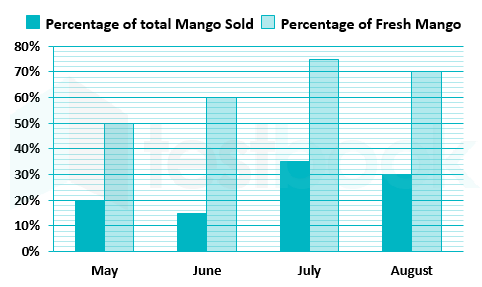
The bar graph represents the percentage of number of mangoes sold and percentage of number of fresh mangoes sold in four months i.e. May, June, July, and August. 

Total number of mangoes sold in all four months = 1080

Total number of mangoes mango sold = Total number of fresh mangoes sold + Total number of rotten mangoes sold.

If seller purchased all mangoes in Rs. 1400 in the month of May. Then seller sold his fresh mango in Rs. 10 for each mango in the month of May. If the seller sold his rotten mango with 60% discount on his actual price for each mango sold. Then find his profit percent in the month of May ?

  1. AOption (a)

    10%

  2. BOption (b)

    12%

  3. COption (c)

    25%

  4. DOption (d)

    8%

  5. EOption (e)

    20%

View answer & explanation

Correct answer

Answer: (d)D.

8%

Why this answer is correct

Total number of mangoes sold in May = 1080 × 20/100 = 216

Total number of Fresh mangoes sold in May = 216 × 50/100 = 108

Cost price of all mangoes in May = 1400

Selling price of all fresh mangoes sold in May = 108 × 10 = 1080

Selling price of all rotten mango  = 108 × 10 × 40/100 = 432 (Given 60% discount on actual price of each mango)

Total selling price of all mangoes = 1512

Profit = 1512 = 1400 = 112

So, profit% = 112/1400 × 100 = 8%

Hence, correct answer is option 4.

SBI Clerk Mains Memory Based Paper (Held On: 15 Jan 2023 Shift 2) (Previous Year Paper)·Quantitative Aptitude
View full paper

Question 816

SBI Clerk 2023• Quantitative Aptitude• Quantitative Aptitude

A worker works 4 hours per day for the first week, 5 hours per day for the second week, and 6 hours per day for the third and fourth week. If his salary is calculated on the basis of Rs. 100 for every 30 minutes, then the amount he would receive at the end of four weeks is(there is no holiday on any day of the week) -

  1. AOption (a)

    Rs. 29400

  2. BOption (b)

    Rs. 29600

  3. COption (c)

    Rs 29450

  4. DOption (d)

    Rs. 30000

  5. EOption (e)

    Rs. 33220

View answer & explanation

Correct answer

Answer: (a)A.

Rs. 29400

Why this answer is correct

Shortcut Trick

Rate of salary = ₹100 per 30 mins = ₹200 per hour.

Total hours = (4 hours × 7 days) + (5 hours × 7 days) + (6 hours × 14 days).

Total hours = 28 + 35 + 84 = 147 hours.

Total Amount = 147 × 200 = ₹29400.

∴ The correct answer is ₹29400.

Alternate Method

Given: Salary rate = ₹100 / 30 min; Week 1 = 4 hrs/day; Week 2 = 5 hrs/day; Week 3 & 4 = 6 hrs/day.

Formula: Total Salary = (Total Working Hours) × (Hourly Rate)

⇒ Hourly rate = (100 ÷ 30) × 60 = ₹200/hour

⇒ Total hours = (7 × 4) + (7 × 5) + (14 × 6)

⇒ Total hours = 28 + 35 + 84 = 147 hours

⇒ Total salary = 147 × 200 = ₹29400

∴ The correct answer is ₹29400.

Additional Information

Unitary Method in Salary

Salary is usually calculated by multiplying the Total Work Units (hours/days) by the Rate per Unit.

Work and Wages

Wages are distributed in proportion to the Work Done. If time is constant, wages ∝ Efficiency × Days.

SBI Clerk Mains Memory Based Paper (Held On: 15 Jan 2023 Shift 2) (Previous Year Paper)·Quantitative Aptitude
View full paper

Question 817

SBI Clerk 2023• Quantitative Aptitude• Quantitative Aptitude

An amount of Rs. 15000 is gained after the simple interest at 20 % annum for the 3 years. The simple interest amount is x.

Quantity I: Find simple interest for the (x + 4750) for 3 years at 10% annum.

Quantity II: Compound interest compounded half-yearly at (x + 4375) for 1.5 years at 10% per annum

  1. AOption (a)

    Quantity I > Quantity II

  2. BOption (b)

    Quantity I < Quantity II

  3. COption (c)

    Quantity I = Quantity II or the relationship cannot be established

  4. DOption (d)

    Quantity I ≥ Quantity II

  5. EOption (e)

    Quantity I ≤ Quantity II

View answer & explanation

Correct answer

Answer: (a)A.

Quantity I > Quantity II

Why this answer is correct

Solution:

To find out the principal amount 

SI = Pnr/100

x = (15000 – x) × 20 × 3/100

5x = (45000 – 3x)

8x = 45000

x = 5625

So the principal is (15000 – 5625) = Rs. 9375

Quantity I:

Simple Interest for 3 years at 10 % per annum

SI = (10375 × 3 × 10)/100 = 3112.5

Simple interest for 3 years = 3112.5

Quantity II:

Compound Interest at (x + 4375) 

CI = P( 1+ R/100)3

CI = 10000 [(1+ 5/100)3 – 1]

CI = 10000 × [(213/203) - 1]

CI = 10000[(9261 - 8000)/8000]

CI = Rs 1576.25

Thus, Quantity I > Quantity II

SBI Clerk Mains Memory Based Paper (Held On: 15 Jan 2023 Shift 2) (Previous Year Paper)·Quantitative Aptitude
View full paper

Question 818

SBI Clerk 2023• Quantitative Aptitude• Quantitative Aptitude

What approximate value should come in the place of question mark (?) in the following question?

17.972 × 4.99 ÷ 44.78 + 299.99 ÷ √5624.96 × 12.97 = ?

  1. AOption (a)

    71

  2. BOption (b)

    68

  3. COption (c)

    88

  4. DOption (d)

    70

  5. EOption (e)

    None of These

View answer & explanation

Correct answer

Answer: (c)C.

88

Why this answer is correct

Concept Used:

Follow the BODMAS rule according to the table given below:

Calculation:

17.972 × 4.99 ÷ 44.78 + 299.99 ÷ √5624.96 × 12.97 = ?

⇒ 182 × 5 ÷ 45 + 300 ÷ √5625 × 13 = ?

⇒ 324 × 1 ÷ 9 + 300 ÷ 75 × 13 = ?

⇒ 36 + 4 × 13 = ?

⇒ 36 + 52 = ?

⇒ 88 = ?

∴ Required value of ? is 88.

SBI Clerk Mains Memory Based Paper (Held On: 15 Jan 2023 Shift 2) (Previous Year Paper)·Quantitative Aptitude
View full paper

Question 819

SBI Clerk 2023• Quantitative Aptitude• Quantitative Aptitude

What approximate value should come in the place of the question mark ‘?’ in the following question?

11.11% of 99.17 + 22.22% of 98.87 - 9.89% of 100.12 = ?

  1. AOption (a)

    24

  2. BOption (b)

    22

  3. COption (c)

    23

  4. DOption (d)

    33

  5. EOption (e)

    20

View answer & explanation

Correct answer

Answer: (c)C.

23

Why this answer is correct

Given:

11.11% of 99.11 + 22.22% of 98.97 – 9.99% of 100 = ?

Concept Used:

Follow the BODMAS rule according to the table given below:

Calculation:

Since we need to find out the approximate value, we can write these values to their nearest integers.

11.11% of 99.17 + 22.22% of 98.87 - 9.89% of 100.12 = ?

⇒ 11.11% of 99 + 22.22% of 99 - 10% of 100 = ?

⇒ (1/9) × 99 + (2/9) × 99 - (1/10) × 100 = ?

⇒ 11 + 22  - 10 = ?

⇒ 33 - 10 = ?

⇒ ? = 23

∴ The value of ‘?’ Is 23.

Alternate Method

11.11% of 99 + 22.22% of 99 - 10% of 100 = ?

⇒ (1/9) × 99 + (2/9) × 99 - (1/10) × 100 = ?

⇒ {(1/9) + (2/9)} × 99 - 10 = ?

⇒ (1/3) × 99 - 10 = ?

⇒ 33 - 10 = ?

⇒ ? = 23

∴ The value of ‘?’ Is 23.

SBI Clerk Mains Memory Based Paper (Held On: 15 Jan 2023 Shift 2) (Previous Year Paper)·Quantitative Aptitude
View full paper

Question 820

SBI Clerk 2023• Quantitative Aptitude• Quantitative Aptitude

Find the relation between Quantity 1 and Quantity 2.

Quantity 1. \(X^2 - 3\frac{1}{5}X + 2\frac{2}{5} = 0\)

Quantity 2. \(Y^2 - 2\frac{1}{6}Y + \frac{5}{6} = 0\)

  1. AOption (a)

    Quantity 1 ≥ Quantity 2

  2. BOption (b)

    Quantity 1 < Quantity 2

  3. COption (c)

    Quantity 1 ≤ Quantity 2

  4. DOption (d)

    Quantity 1 = Quantity 2 or No Relation

  5. EOption (e)

    Quantity 1 > Quantity 2

View answer & explanation

Correct answer

Answer: (d)D.

Quantity 1 = Quantity 2 or No Relation

Why this answer is correct

Quantity 1 -

\(X^2 - 3\frac{1}{5}X + 2\frac{2}{5} = 0\) 

X2 - 16/5X + 12/5 = 0

5X2 - 16X + 12 = 0

5X2 - 10X - 6X + 12 = 0

5X(X - 2) - 6 (X - 2) = 0

X = 2 , 6/5

Quantity 2-

\(Y^2 - 2\frac{1}{6}Y + \frac{5}{6} = 0\)

Y2 - 13/6Y + 5/6 = 0

6Y2 - 13Y + 5 = 0

6Y2 - 10Y - 3Y + 5 = 0

2Y(3Y - 5) - (3Y - 5) = 0

Y = 1/2, 5/3

So, we can not determine the relation between Quantity 1 and Quantity 2.

Hence, correct answer is option 4.

How should I prepare for Quantitative Aptitude in SBI Clerk?

Solving previous year questions by topic helps identify recurring concepts, question patterns, and frequently asked sub-topics. Attempt each question, review the step-by-step explanation, and note down key formulas or facts for quick revision before the exam.