SBI Clerk · Topic Collection

Quantitative Aptitude PYQs

Arithmetic, number systems, percentages, ratios, profit and loss, time and work, algebra, geometry, mensuration, and trigonometry.

1495 Total Questions38 Official PapersYears: 2018–2025Search in Quantitative Aptitude
Showing questions 821–840 of 1495Page 42 of 75
SBI Clerk Mains Memory Based Paper (Held On: 15 Jan 2023 Shift 2) (Previous Year Paper)·Quantitative Aptitude
View full paper

Question 821

SBI Clerk 2023• Quantitative Aptitude• Quantitative Aptitude

Find the relation between Quantity 1 and Quantity 2.

Quantity 1. 1(1/4)X2 + 3(1/4)X + 2 = 0

Quantity 2. Y2 + 1(1/2)Y + 1/2 = 0

  1. AOption (a)

    Quantity 1 < Quantity 2

  2. BOption (b)

    Quantity 1 ≥ Quantity 2

  3. COption (c)

    Quantity 1 > Quantity 2

  4. DOption (d)

    Quantity 1 ≤ Quantity 2

  5. EOption (e)

    Quantity 1 = Quantity 2 or No Relation

View answer & explanation

Correct answer

Answer: (d)D.

Quantity 1 ≤ Quantity 2

Why this answer is correct

Quantity 1-

1(1/4)X2 + 3(1/4)X + 2 = 0

5/4X2 + 13/4X + 2 = 0

5X2 + 13X + 8 = 0

5X2 + 5X + 8X + 8 = 0

5X(X + 1) + 8(X + 1) = 0

(5X + 8) (X + 1) = 0

X = -8/5 , -1

Quantity 2-

 Y2 + 1(1/2)Y + 1/2 = 0

Y2 + 3/2Y + 1/2 = 0

2Y2 + 3Y + 1 = 0

2Y2 + 2Y + Y + 1 = 0

2Y(Y + 1) + 1(Y + 1) = 0

(2Y + 1)(Y + 1)

Y = -1/2, -1

So, Quantity 1  ≤  Quantity 2

Hence, correct answer is option 4.
SBI Clerk Mains Memory Based Paper (Held On: 15 Jan 2023 Shift 2) (Previous Year Paper)·Quantitative Aptitude
View full paper

Question 822

SBI Clerk 2023• Quantitative Aptitude• Quantitative Aptitude

Directions- Study the following information carefully and answer based on it.

There are Two missing number series, which follow the same pattern

(a)        232         257       321         330         338

120       (b)          (c)         288         292        293

Find the value of (a) ?

  1. AOption (a)

    18

  2. BOption (b)

    16

  3. COption (c)

    22

  4. DOption (d)

    24

  5. EOption (e)

    21

View answer & explanation

Correct answer

Answer: (b)B.

16

Why this answer is correct

16(a) + 216 = 232

232 + 25 = 257

257 + 64 = 321

321 + 9 = 330

330 + 8 = 338

So, a = 16

Now, 

120 + 125 = 245

245 + 16 = 261

261 + 27 = 288

288 + 4 = 292

292 + 1 = 293

Hence, correct answer is option 2.

SBI Clerk Mains Memory Based Paper (Held On: 15 Jan 2023 Shift 2) (Previous Year Paper)·Quantitative Aptitude
View full paper

Question 823

SBI Clerk 2023• Quantitative Aptitude• Quantitative Aptitude

Directions- Study the following information carefully and answer based on it.

There are Two missing number series, which follow the same pattern

(a)        232         257       321         330         338

120       (b)          (c)         288         292        293

Find that which sentence is/are correct ?

  1. The sum of value of (a) and (c) is a prime number.
  2. The value of 2b + c is 750.
  3. Difference of b & 3a is 195.
  1. AOption (a)

    Only statement 1 is correct

  2. BOption (b)

    Neither statement 1 nor statement 2 is correct

  3. COption (c)

    Both Statement 1 & 2 is correct

  4. DOption (d)

    All statement 1, 2 & 3 is correct

  5. EOption (e)

    Only statement 3 is correct

View answer & explanation

Correct answer

Answer: (a)A.

Only statement 1 is correct

Why this answer is correct

16(a) + 216 = 232

232 + 25 = 257

257 + 64 = 321

321 + 9 = 330

330 + 8 = 338

So, a = 16

Now, 

120 + 125 = 245

245 + 16 = 261

261 + 27 = 288

288 + 4 = 292

292 + 1 = 293

Statement 1 - 

a + c = 16 + 261 = 277

277 is a prime number.

So, statement 1 is correct.

Statement 2 -

2b + c = 2 × 245 + 261 = 751.

So, statement 2 is false.

Statement 3 - 

b - 3a = 245 - 48 = 197

So, statement 3 is false.

Hence, the correct answer is option 1.

SBI Clerk Mains Memory Based Paper (Held On: 15 Jan 2023 Shift 2) (Previous Year Paper)·Quantitative Aptitude
View full paper

Question 824

SBI Clerk 2023• Quantitative Aptitude• Quantitative Aptitude

Find the wrong number term from both the number series given -

Series 1 - 70     75     80     90    130    420     5570

Series 2 - 10     37     68    130    222    350    520

  1. AOption (a)

    5570, 10

  2. BOption (b)

    80, 68

  3. COption (c)

    420, 37

  4. DOption (d)

    90, 520

  5. EOption (e)

    70, 232

View answer & explanation

Correct answer

Answer: (c)C.

420, 37

Why this answer is correct

Series 1-

Series 2-

10         30          68           130           222              350            520   

      20          38           62             92             128              170

             18           24            30             36                  42

                     6                6               6               6 

Hence, correct answer is option 3.

SBI Clerk Mains Memory Based Paper (Held On: 15 Jan 2023 Shift 2) (Previous Year Paper)·Quantitative Aptitude
View full paper

Question 825

SBI Clerk 2023• Quantitative Aptitude• Quantitative Aptitude

Directions: Study the following information carefully and answer based on it.

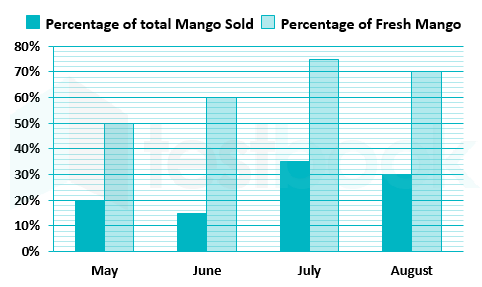
The bar graph represents the percentage of number of mangoes sold and percentage of number of fresh mangoes sold in four months i.e. May, June, July, and August. 

Total number of mangoes sold in all four months = 1080

Total number of mangoes mango sold = Total number of fresh mangoes sold + Total number of rotten mangoes sold.

Find the total selling price of all the mangoes sold in the month of August by the seller. The selling price of rotten mangoes is 50% less than the selling price of fresh mangoes. If seller purchase all the mangoes for all four months in Rs. 14364 and his total profit percent in all the mangoes sold for all the four months is 25%.

  1. AOption (a)

    5508

  2. BOption (b)

    8820

  3. COption (c)

    4000

  4. DOption (d)

    5870

  5. EOption (e)

    6690

View answer & explanation

Correct answer

Answer: (a)A.

5508

Why this answer is correct

Let, Total selling price for all fresh mangoes sold in each month = 2x

And, Total selling price for all rotten mangoes sold in each month = x

Now, Total selling price of all mangoes sold in all four months = (108 × 2x + 108 × x ) + (97.2 × 2x + 64.8 × x ) + (283.5 × 2x + 94.5 × x ) + (226.8 × 2x + 97.2 × x ) 

Total selling price of all mangoes sold in all four months = 1795.5x

Therefore, Total selling price of all mangoes sold in all four months = 14364 × 125/100 = 17955

So, 1795.5x = 17955

x = 10

Total selling price for all fresh mangoes sold in each month = 2x = 20

Total selling price for all rotten mangoes sold in each month = x = 10

So, total selling price for all mangoes sold in the months of August = (226.8 × 20 + 97.2 × 10 ) = 5508

Hence, correct answer is option 1.

SBI Clerk Mains Memory Based Paper (Held On: 15 Jan 2023 Shift 2) (Previous Year Paper)·Quantitative Aptitude
View full paper

Question 826

SBI Clerk 2023• Quantitative Aptitude• Quantitative Aptitude

Directions: Study the following information carefully and answer based on it.

The bar graph represents the percentage of number of mangoes sold and percentage of number of fresh mangoes sold in four months i.e. May, June, July, and August. 

Total number of mangoes sold in all four months = 1080

Total number of mangoes mango sold = Total number of fresh mangoes sold + Total number of rotten mangoes sold.

Find the ratio of Total number of rotten mangoes sold in the month of May and July together and total fresh mangoes sold in the month of June and August together ?

  1. AOption (a)

    405 : 548

  2. BOption (b)

    413 : 617

  3. COption (c)

    405 : 648

  4. DOption (d)

    548 : 413

  5. EOption (e)

    413 : 648

View answer & explanation

Correct answer

Answer: (c)C.

405 : 648

Why this answer is correct

Total number of rotten mangoes sold in the month of May and July = (1080 × 20/100 × 50/100 ) + (1080 × 35/100 × 25/100) = 108 + 94.5 = 202.5

Total number of fresh mangoes sold in the month of June and August = (1080 × 15/100 × 60/100 ) + (1080 × 30/100 × 70/100) = 97.2 + 226.8 = 324

So, required ratio = 202.5 : 324 = 405 : 648.

Hence, correct answer is option 3.

SBI Clerk Mains Memory Based Paper (Held On: 15 Jan 2023 Shift 2) (Previous Year Paper)·Quantitative Aptitude
View full paper

Question 827

SBI Clerk 2023• Quantitative Aptitude• Quantitative Aptitude

Directions: Study the following information carefully and answer based on it.

The bar graph represents the percentage of number of mangoes sold and percentage of number of fresh mangoes sold in four months i.e. May, June, July, and August. 

Total number of mangoes sold in all four months = 1080

Total number of mangoes mango sold = Total number of fresh mangoes sold + Total number of rotten mangoes sold.

The cost price of all mangoes sold in the month of June is 1200 and seller markup the price of all the mangoes sold in the month of June is 50%, then the seller gave two successive discount percentage of 10% and 20%. If the selling price of all the fresh mangoes sold in the month of June is 972 then find the selling price of each rotten mango sold in the month of June ?

  1. AOption (a)

    10

  2. BOption (b)

    7

  3. COption (c)

    5

  4. DOption (d)

    6

  5. EOption (e)

    3

View answer & explanation

Correct answer

Answer: (c)C.

5

Why this answer is correct

Total mangoes sold in June = 1080 × 15/100 = 162

Rotten mangoes sold in June = 162 × 40/100 = 64.8

CP of all the mangoes sold in June = ₹1200

MP of all the mangoes sold in June = 1200 × 150/100 = ₹1800

SP of all the mangoes sold in June  = 1800 × 90/100 × 80/100 = ₹1296

SP of rotten mangoes sold in June = 1296 - 972 = ₹324

SP of each rotten mango sold in June = 324 ÷ 64.8 = ₹5

Hence, correct answer is option 3.

SBI Clerk Mains Memory Based Paper (Held On: 15 Jan 2023 Shift 2) (Previous Year Paper)·Quantitative Aptitude
View full paper

Question 828

SBI Clerk 2023• Quantitative Aptitude• Quantitative Aptitude

A shopkeeper purchased an article at a 20% discount from the marked price for her wholesale purchase; if he purchased it individually, there is only a 10% discount. The difference between the two discounts is Rs. 45. The total purchase price for two types of sugar, sugar A and sugar B is equal to the marked price of the article.

Quantity I: If the shopkeeper purchased 10 kg of Sugar A for Rs 35/kg and ‘x’ kg of Sugar B for Rs 20/kg. What is the value of ‘x’.

Quantity II: If the price of the marked price is increased by 20%, then find how many kg of sugar (A and B) he purchased for Rs. 50/kg.

  1. AOption (a)

    Quantity I < Quantity II

  2. BOption (b)

    Quantity I ≥ Quantity II

  3. COption (c)

    Quantity I > Quantity II

  4. DOption (d)

    Quantity I = Quantity II or the relationship cannot be established

  5. EOption (e)

    Quantity I ≤ Quantity II

View answer & explanation

Correct answer

Answer: (a)A.

Quantity I < Quantity II

Why this answer is correct

Solution:

Quantity I:

Difference between 20% discount and 10% is 45

Therefore, 100% as the marked price and the difference between 20% and 10 % is 45

So

90% - 80% = 45

10% = 45

100% = 450

Then the marked price = Rs. 450

Quantity I:

Sugar A is purchased for 35 × 10 = 350

Then there is the remaining = 450 – 350 = Rs. 100 

For x = 100/20 = 5 kg of sugar, B is purchased

Quantity II:

The, marked price is increased by 20% then the amount is 540

Price of the sugar (A + B) = Rs.  50

Then in 540/50 = 10.8 kg purchased

Thus, Quantity I < Quantity II

SBI Clerk Mains Memory Based Paper (Held On: 15 Jan 2023 Shift 2) (Previous Year Paper)·Quantitative Aptitude
View full paper

Question 829

SBI Clerk 2023• Quantitative Aptitude• Quantitative Aptitude

What approximate value will come in the place of the question mark ‘?’ in the following question?

9.99% of 29.906 + 299.84% of 54.908 – 49.86% of 149.59 = ?

  1. AOption (a)

    98

  2. BOption (b)

    68

  3. COption (c)

    58

  4. DOption (d)

    88

  5. EOption (e)

    93

View answer & explanation

Correct answer

Answer: (e)E.

93

Why this answer is correct

Given:

​9.99% of 29.906 + 299.84% of 54.908 – 59.86% of 149.59 = ?

Concept used:

Follow the BODMAS rule according to the table given below:

Calculation:

​9.99% of 29.906 + 299.84% of 54.908 – 49.86% of 149.59 = ?

⇒ ​10% of 30 + 300% of 55 – 50% of 150 = ?

⇒ ​(10/100) × 30 + (300/100) × 55 – (50/100) × 150 = ?

⇒ 3 + 165 – 75 = ?

⇒ ? = 93

∴ The value of ? is 93.

SBI Clerk Mains Memory Based Paper (Held On: 15 Jan 2023 Shift 2) (Previous Year Paper)·Quantitative Aptitude
View full paper

Question 830

SBI Clerk 2023• Quantitative Aptitude• Quantitative Aptitude

What approximate will come in the place of the question mark ‘?’ in the following question?

5.78% of 799.94 + ?% of 9.67 = 10.94 × 2.99 + √100 × 2.98

  1. AOption (a)

    600

  2. BOption (b)

    150

  3. COption (c)

    580

  4. DOption (d)

    610

  5. EOption (e)

    None of these.

View answer & explanation

Correct answer

Answer: (b)B.

150

Why this answer is correct

Given:

5.78% of 799.94 + ?% of 9.67 = 10.94 × 2.99 + √100 × 2.98

Concept used:

Follow the BODMAS rule according to the table given below:

Calculation:

5.78% of 799.94 + ?% of 9.67 = 10.94 × 2.99 + √100 × 2.98

⇒ 6% of 800 + ?% of 10 = 11 × 3 + √100 × 3

⇒ (6/100) × 800 + (?/100) × 10 = 33 + 10 × 3

⇒ 48 + (?/10) = 33 + 30

⇒ 48 + (?/10) = 63

⇒ (?/10) = 63 - 48 

⇒ (?/10) = 15 

⇒ ? = 15 × 10 = 150

∴ The value of ? is 150.

SBI Clerk Mains Memory Based Paper (Held On: 15 Jan 2023 Shift 2) (Previous Year Paper)·Quantitative Aptitude
View full paper

Question 831

SBI Clerk 2023• Quantitative Aptitude• Quantitative Aptitude

What approximate value should come in the place of the question mark ‘?’ in the following question?

728.821/3 + √1155.98 + 6.142 ÷ 2.992 + 1.970 = √?

  1. AOption (a)

    7

  2. BOption (b)

    49

  3. COption (c)

    343

  4. DOption (d)

    2401

  5. EOption (e)

    98

View answer & explanation

Correct answer

Answer: (d)D.

2401

Why this answer is correct

Given:

728.921/3 + √1155.78 + 6.042 ÷ 2.962 + 1.990 = √?

Concept Used:

Follow the BODMAS rule according to the table given below:

Calculation:

Since we need to find out the approximate value, we can write these values to their nearest integers.

728.821/3 + √1155.98 + 6.142 ÷ 2.992 + 1.970 = √?

⇒ ∛729 + √1156 + 62 ÷ 32 + 2 = √?

⇒ 9 + 34 + 36/9 + 2 = √?

⇒ 9 + 34 + 4 + 2 = √?

⇒ √? = 49

⇒ ? = 492

⇒ ? = 2401

∴ The value of ‘?’ Is 2401.

SBI Clerk Mains Memory Based Paper (Held On: 15 Jan 2023 Shift 2) (Previous Year Paper)·Quantitative Aptitude
View full paper

Question 832

SBI Clerk 2023• Quantitative Aptitude• Quantitative Aptitude

Quantity I: In class A ratio of number of boys and girls are on the ratio 5: 4.If 20% of the boys and 25% of the girls were removed respectively, and 20 boys were added then the ratio of number of boys to number of girls in the ratio 2:

  1. Find the total number of students in class A initially.

Quantity II: In class B the number of boys in class B is x and the number of girls in the class is (x - 20). The average weight of the boys and girls is 50 kg and 20 kg respectively. Then the average weight of the whole class is 37.5 kg. Find the Total number of students in Class B

  1. AOption (a)

    Quantity I > Quantity II

  2. BOption (b)

    Quantity I < Quantity II

  3. COption (c)

    Quantity I = Quantity II or the relationship cannot be established

  4. DOption (d)

    Quantity I ≥ Quantity II

  5. EOption (e)

    Quantity I ≤ Quantity II

View answer & explanation

Correct answer

Answer: (b)B.

Quantity I < Quantity II

Why this answer is correct

Solution:

Quantity I:

Number of boys in the class A = 5x

Number of girls in the class B = 4x

If 20% of boys and 25%of the girls were removed and 20 more boys were added 

To find the number of students in the class A

[5x - 5x × (20/100) + 20]/[4x - 4x × 25/100] = 2/1

(4x + 20)/(3x) = 2/1

(4x + 20) = 6x

2x = 20

x = 10

Total number of boys and girls in the class = (9)×  10 = 90

Quantity II:

Number of boys in the class B = x

Number of girls in the class B = (x - 20) 

To find the value of x

[(x × 50) + (20 × (x - 20))]/(x + x - 20) = 37.5

[50x + 20x - 400] =  [75x - 750]

[70x - 400] = [75x - 750]

-5x = - 350

x = 70

Total number of students in the class = 70 + 50 = 120

Thus, Quantity I < Quantity II

SBI Clerk Mains Memory Based Paper (Held On: 15 Jan 2023 Shift 2) (Previous Year Paper)·Quantitative Aptitude
View full paper

Question 833

SBI Clerk 2023• Quantitative Aptitude• Quantitative Aptitude

Average score of three persons A, B and C is y. If Score of A is 10 less than B and 5 less than  that of C. If the average score of person A and D is (y + 10). If the Score of D is 65, find the average score of B and A.

  1. AOption (a)

    30

  2. BOption (b)

    40

  3. COption (c)

    35

  4. DOption (d)

    45

  5. EOption (e)

    50

View answer & explanation

Correct answer

Answer: (b)B.

40

Why this answer is correct

Shortcut Trick

Given Average(A, D) = y + 10 and D = 65 ⇒ A + 65 = 2y + 20 ⇒ A = 2y − 45.

From Average(A, B, C) = y: A + (A + 10) + (A + 5) = 3y ⇒ 3A + 15 = 3y ⇒ A + 5 = y.

Equating A: y − 5 = 2y − 45 ⇒ y = 40 ∴ A = 35, B = 45.

Average of B and A = (45 + 35) ÷ 2 = 40.

∴ The correct answer is 40.

Alternate Method

Given: Score of A = x, then B = x + 10 and C = x + 5.

Formula: Average = Sum of observations ÷ Number of observations

⇒ Average(A, B, C) = (x + x + 10 + x + 5) ÷ 3 = y

⇒ 3x + 15 = 3y ⇒ x + 5 = y --- (Eq 1)

⇒ Average(A, D) = (x + 65) ÷ 2 = y + 10

⇒ x + 65 = 2y + 20 ⇒ x − 2y = −45 --- (Eq 2)

⇒ Substitute y = x + 5 in Eq 2: x − 2(x + 5) = −45

⇒ x − 2x − 10 = −45 ⇒ −x = −35 ⇒ x = 35

⇒ A = 35 and B = 35 + 10 = 45

⇒ Average(B, A) = (45 + 35) ÷ 2 = 80 ÷ 2 = 40

∴ The correct answer is 40.

Additional Information

Weighted Average

When two groups with averages A1 and A2 and sizes n1 and n2 are combined, the new average is (n1A1 + n2A2) ÷ (n1 + n2).

Net Deviation Method

The sum of deviations of all observations from their mean is always zero. This helps in finding missing values quickly.

SBI Clerk Mains Memory Based Paper (Held On: 15 Jan 2023 Shift 2) (Previous Year Paper)·Quantitative Aptitude
View full paper

Question 834

SBI Clerk 2023• Quantitative Aptitude• Quantitative Aptitude

A can fill the tank in 6 minutes, B can fill the tank in 12 minutes C is emptying pipe whose efficiency is 80% of the efficiency of the Pipe B. If all the (A + B + C) are opened for 4 minutes, then pipe C alone is opened for x minutes, after that the remaining tank will be filled by A and B in 4 minutes. find the value of x.

  1. AOption (a)

    9 minutes

  2. BOption (b)

    11 minutes

  3. COption (c)

    13 minutes

  4. DOption (d)

    12 minutes

  5. EOption (e)

    6 minutes

View answer & explanation

Correct answer

Answer: (b)B.

11 minutes

Why this answer is correct

Shortcut Trick

Let Total Work (Capacity) = 12 units (LCM of 6 and 12).

Efficiency: A = 2, B = 1, C = 0.8 × 1 = 0.8 (emptying → −0.8).

Net Work: (A+B+C) × 4 + (−C) × x + (A+B) × 4 = 12.

⇒ (2+1−0.8) × 4 − 0.8x + (2+1) × 4 = 12 ⇒ 8.8 − 0.8x + 12 = 12.

⇒ 0.8x = 8.8 ⇒ x = 11.

∴ The correct answer is 11 min.

Alternate Method

Given: Time for Pipe A = 6 min, Pipe B = 12 min. Pipe C efficiency = 80% of Pipe B.

PersonDaysTotal WorkEfficiency
Pipe A612 units2
Pipe B121

Calculations:

⇒ Efficiency of Pipe C (emptying) = 80% of 1 = 0.8 units/min.

⇒ Total work done by (A + B + C) in 4 minutes = (2 + 1 − 0.8) × 4 = 2.2 × 4 = 8.8 units.

⇒ Total work done by (A + B) in the last 4 minutes = (2 + 1) × 4 = 12 units.

⇒ Since total capacity is 12 units, the equation for the whole process is:

⇒ 8.8 − (0.8 × x) + 12 = 12

⇒ 8.8 − 0.8x = 0

⇒ 0.8x = 8.8

⇒ x = 8.8 ÷ 0.8 = 11

∴ The correct answer is 11 min.

Additional Information

Pipes & Cisterns Efficiency

Efficiency is inversely proportional to time. If an emptying pipe is present, its efficiency is taken as negative in calculations.

Total Work Calculation

Total work is generally assumed to be the LCM of the individual times taken by the pipes to fill or empty the tank.

Combined Rate Rule

When multiple pipes work together, the net rate is the algebraic sum of their individual efficiencies (Filling = +, Emptying = −).

SBI Clerk Mains Memory Based Paper (Held On: 15 Jan 2023 Shift 2) (Previous Year Paper)·Quantitative Aptitude
View full paper

Question 835

SBI Clerk 2023• Quantitative Aptitude• Quantitative Aptitude

​ The length of the train is x meter and the platform is 3x if the train can cover the platform running at the speed of 20m/s and can cross the platform in 48 seconds. The other train covers the 1.5x length of the train running at the speed of 108kmph and crosses the platform of length y meter in 20 seconds. Find the value of (x + y).

  1. AOption (a)

    440m

  2. BOption (b)

    480m

  3. COption (c)

    540m

  4. DOption (d)

    520m

  5. EOption (e)

    420m

View answer & explanation

Correct answer

Answer: (b)B.

480m

Why this answer is correct

Shortcut Trick

Total distance for first train = x + 3x = 4x.

4x = Speed × Time ⇒ 4x = 20 × 48 ⇒ 4x = 960 ⇒ x = 240 m.

Second train speed = 108 × 5/18 = 30 m/s. Length = 1.5 × 240 = 360 m.

Distance for second train = 360 + y = 30 × 20 = 600 ⇒ y = 240 m.

Value of (x + y) = 240 + 240 = 480 m.

∴ The correct answer is 480 m.

Alternate Method

Given:

Length of first train = x, Length of platform = 3x.

Speed of first train = 20 m/s, Time = 48 s.

Length of second train = 1.5x, Speed = 108 kmph, Time = 20 s.

Calculations:

⇒ Total distance in Case 1 = x + 3x = 4x

⇒ 4x = 20 × 48 = 960

⇒ x = 960 ÷ 4 = 240 m

⇒ Speed of second train in m/s = 108 × (5/18) = 30 m/s

⇒ Length of second train = 1.5 × 240 = 360 m

⇒ Total distance in Case 2 = 360 + y = 30 × 20

⇒ 360 + y = 600

⇒ y = 600 − 360 = 240 m

⇒ (x + y) = 240 + 240 = 480 m

∴ The correct answer is 480 m.

Additional Information

Crossing Stationary Objects

When a train crosses a platform or another stationary train, the total distance covered is the sum of the length of the train and the length of the object.

Unit Conversion

To convert speed from kmph to m/s, multiply by 5/18. To convert m/s to kmph, multiply by 18/5.

Relative Speed

If two objects move in the opposite direction, relative speed is the sum (S1 + S2); in the same direction, it is the difference |S1 − S2|.

SBI Clerk Mains Memory Based Paper (Held On: 15 Jan 2023 Shift 2) (Previous Year Paper)·Quantitative Aptitude
View full paper

Question 836

SBI Clerk 2023• Quantitative Aptitude• Quantitative Aptitude

The cost price of an article is Rs.550 and marked up by X% above its cost price. The shopkeeper also allowed a discount of 30% on marked price and earned a profit of 12%. If the cost price of another article is Rs. (X + 450) and the shopkeeper suffered a loss of 20% on it, then find the selling price of the new article.

  1. AOption (a)

    Rs. 416

  2. BOption (b)

    Rs. 408

  3. COption (c)

    Rs. 442

  4. DOption (d)

    Rs. 412

  5. EOption (e)

    Rs. 444

View answer & explanation

Correct answer

Answer: (b)B.

Rs. 408

Why this answer is correct

Shortcut Trick

Relation between Marked Price (MP) and Cost Price (CP): MP÷CP = (100 + Profit%)÷(100 − Discount%).

MP÷CP = (100 + 12)÷(100 − 30) = 112÷70 = 8÷5.

Markup % (X) = (8 − 5)÷5 × 100 = 3÷5 × 100 = 60%.

New CP = X + 450 = 60 + 450 = Rs. 510. New SP = 510 × (100 − 20)÷100 = 510 × 0.8 = Rs. 408. ∴ The correct answer is Rs. 408.

Alternate Method

Given → CP1 = Rs. 550, Profit = 12%, Discount = 30%, Loss = 20%.
Formulas: SP = CP × (100 + P%)÷100 | MP = SP × 100÷(100 − D%) | Markup % = (MP − CP)÷CP × 100.

⇒ First Selling Price (SP1) = 550 × 112÷100 = Rs. 616. ⇒ Marked Price (MP) = 616 × 100÷(100 − 30) = 616 × 100÷70 = Rs. 880. ⇒ Markup Value = MP − CP1 = 880 − 550 = Rs. 330. ⇒ X% = (330÷550) × 100 = 60%, so X = 60.
⇒ New Cost Price (CP2) = X + 450 = 60 + 450 = Rs. 510. ⇒ New Selling Price (SP2) = 510 × (100 − 20)÷100 = 510 × 80÷100 = Rs. 408. ∴ The correct answer is Rs. 408.

Additional Information

Marked Price & Markup

Marked price is the price displayed on the tag. Markup = MP − CP. Markup % = (Markup ÷ CP) × 100.

Relationship Formula

The ratio of MP to CP can be directly found using CP × (100 + P%) = MP × (100 − D%).

SBI Clerk Mains Memory Based Paper (Held On: 15 Jan 2023 Shift 2) (Previous Year Paper)·Quantitative Aptitude
View full paper

Question 837

SBI Clerk 2023• Quantitative Aptitude• Quantitative Aptitude

The table given below shows the Cost price, Discount percent and Profit percent for sellers A, B, C and D selling different articles.

Name of sellersCost Price (Rs.)Discount PercentageProfit Percentage
A450010%30%
B-20%40%
C4000-20%
D--25%

 If the profit amount of article A is increased by Rs. 50.Find the approximate change in the Marked price of the article A.

  1. AOption (a)

    Rs. 56

  2. BOption (b)

    Rs. 54

  3. COption (c)

    Rs. 52

  4. DOption (d)

    Rs . 60

  5. EOption (e)

    Rs. 62

View answer & explanation

Correct answer

Answer: (a)A.

Rs. 56

Why this answer is correct

Solution:

Selling price of the article = 4500 × (130/100) = Rs.5850

Marked price of the article = (5850/90) × 100 = 6500

Profit amount of the article = (5850 - 4500) = Rs.1350

New profit amount of the article = (1350 + 50) = 1400

New selling price = (4500 + 1400) = 5900

New marked price = 5900/90 ×  100 = 6555.556 = ~ 6556 

So required change = (6556 - 6500) = Rs. 56

SBI Clerk Mains Memory Based Paper (Held On: 15 Jan 2023 Shift 2) (Previous Year Paper)·Quantitative Aptitude
View full paper

Question 838

SBI Clerk 2023• Quantitative Aptitude• Quantitative Aptitude

The table given below shows the Cost price, Discount percent and Profit percent for sellers A, B, C and D selling different articles.

Name of sellersCost Price (Rs.)Discount PercentageProfit Percentage
A450010%30%
B-20%40%
C4000-20%
D--25%

If the marked price of the article E is the same as the selling price of the article C. Discount percent of the article E is 25% which is sold at  20% profit. Find the CP of article E.

  1. AOption (a)

    Rs. 3300

  2. BOption (b)

    Rs. 3500

  3. COption (c)

    Rs. 3000

  4. DOption (d)

    Rs. 3200

  5. EOption (e)

    Rs. 3700

View answer & explanation

Correct answer

Answer: (c)C.

Rs. 3000

Why this answer is correct

Solution:

Cost price of article C = 4000

Selling price of article C = 4000 × (120/100) = 4800

Marked price of article E = 4800

Selling price of article E = 4800 × (100 - 25)/100 = 3600

To find the cost price of the article E = (3600/120) × 100 = 3000

SBI Clerk Mains Memory Based Paper (Held On: 15 Jan 2023 Shift 2) (Previous Year Paper)·Quantitative Aptitude
View full paper

Question 839

SBI Clerk 2023• Quantitative Aptitude• Quantitative Aptitude

The table given below shows the Cost price, Discount percent and Profit percent for sellers A, B, C and D selling different articles.

Name of sellersCost Price (Rs.)Discount PercentageProfit Percentage
A450010%30%
B-20%40%
C4000-20%
D--25%

If the ratio between the cost price of article B and D are in the ratio 25: 24 and the difference between the selling price of article B and D is Rs. 1000. Find the ratio between the marked price of article B and D.If the discount percentage of article D is 25%.

  1. AOption (a)

    31: 38

  2. BOption (b)

    35: 39

  3. COption (c)

    33: 37

  4. DOption (d)

    35: 32

  5. EOption (e)

    32: 29

View answer & explanation

Correct answer

Answer: (d)D.

35: 32

Why this answer is correct

Solution:

Cost price of article B and D are in the ratio 25x: 24x

Profit percentage of article B and D is 40% and 25% respectively

Selling price of article B  = 25x × (140/100) = 35x

Selling price of article D = 24x × (125/100) = 30x

(35x - 30x) = 1000

5x = 1000

x = 200

Selling price of article B = 35 × 200 = 7000

Selling price of article D = 30 × 200 = 6000

Marked price of the article B = (7000/80) × 100 = 8750

Marked price of the article D = (6000/75) × 100 = 8000

Required ratio = 8750: 8000 = 35: 32

SBI Clerk Mains Memory Based Paper (Held On: 15 Jan 2023 Shift 2) (Previous Year Paper)·Quantitative Aptitude
View full paper

Question 840

SBI Clerk 2023• Quantitative Aptitude• Quantitative Aptitude

The table given below shows the Cost price, Discount percent and Profit percent for sellers A, B, C and D selling different articles.

Name of sellersCost Price (Rs.)Discount PercentageProfit Percentage
A450010%30%
B-20%40%
C4000-20%
D--25%

If the selling price of the article C is increased by Rs.200 and the profit percentage of the article C is the same as the discount percentage, find the marked price of the article 

  1. AOption (a)

    Rs. 5750.50

  2. BOption (b)

    Rs. 6250

  3. COption (c)

    Rs. 6666.66

  4. DOption (d)

    Rs. 5500.25

  5. EOption (e)

    Rs. 5250

View answer & explanation

Correct answer

Answer: (c)C.

Rs. 6666.66

Why this answer is correct

Solution:

Cost price of the article C = 4000

Selling price of the article  4000 × (120/100) = 4800

New selling price of the article C = (4800 + 200) = 5000 

Now, the profit percentage = (5000 - 4000)/4000 x 100 = 25%

If the discount percentage and the profit percentage of the article C is same, then the discount percentage of the article = 25%

Marked price of the article = (5000)/75 × 100 = Rs.6666.66

How should I prepare for Quantitative Aptitude in SBI Clerk?

Solving previous year questions by topic helps identify recurring concepts, question patterns, and frequently asked sub-topics. Attempt each question, review the step-by-step explanation, and note down key formulas or facts for quick revision before the exam.