Previous Year Paper

SBI Clerk Mains Memory Based Paper (Held On: 15 Jan 2023 Shift 1) (Previous Year Paper)

Held in 2023

190 questions160 minutes
With answers
Free

Paper last updated:

Practise under exam conditions

Take this paper as a timed mock test. Review your answers after you submit.

Attempt timed test

Questions & answers

Read the paper at your pace. Open an explanation when you need it.

General/Financial Awareness (50 questions)

Question 1

KLEMS database refers to broad categories of intermediate inputs that are consumed by industries in their production of goods and services. In KLEMS K stands for____, L for labor, E for energy, M for materials, and S for services)

  1. AOption (a)

    Knowledge 

  2. BOption (b)

    Known

  3. COption (c)

    Kotak

  4. DOption (d)

    Kissan

  5. EOption (e)

    None of these

View answer & explanation

Correct answer

Answer: (e)E.

None of these

Why this answer is correct

The correct answer is None of these.

Key Points

  • In KLEMS K stand for Capital.
  • KLEMS K- capital, L- labor, E- energy, M- materials, and S- service.
  • The database is part of a research project supported by the Reserve Bank of India to analyze productivity performance in the Indian economy at disaggregated industry level.
  • Its main objective is to create sustainable growth, employment, and productivity database in the industry.
  • Measuring productivity at the Industry Level and generating statistics and other essential information as inputs to evaluate goals related to productivity and economic growth potential.

Question 2

The Economic Intelligence Unit published the annual report on the Global Liveability Index (2022) in which New Delhi has been ranked ____ out of 173 countries on the list as the most liveable city in the world.

  1. AOption (a)

    98th

  2. BOption (b)

    100th

  3. COption (c)

    112th

  4. DOption (d)

    88th

  5. EOption (e)

    143th

View answer & explanation

Correct answer

Answer: (c)C.

112th

Why this answer is correct

The correct answer is 140th.

Key Points

  • New Delhi has been placed 112th on the list of the most liveable city in the world.
  • Followed by Mumbai at 117th, Chennai at 142nd, and Ahmedabad at 146th positions respectively.
  • The most livable city according to the index is Vienna, Austria followed by Copenhagen (Denmark) and Zurich (Switzerland).
  • Damascus, Syria worst liveable city in the world in 2022.
  • Osaka city of Japan is the only Asian country to secure a position in the best top 10 countries according to the Global Liveability Index 2022.

Additional Information

  • Global Liveability Report is published by the Economic Intelligence Unit.
  • Economic Intelligence Unit is an organization that provides research and advisory services to assist entrepreneurs, financiers, and government officials.
  • It was founded in 1946 and its headquarter is located in London, England.
  • ​Global Liveability ranking is based on their performance and is dependent on various parameters like Education, Environment, Healthcare, the standard of living, etc.
  • The Ministry of Housing and Urban Affairs published the report on the Ease of Living Index India.

Question 3

Sberbank is the largest Bank in Central and Eastern Europe and one of the leading international financial institutions. The Sberbank is majorly owned by_______.

  1. AOption (a)

    Scotland

  2. BOption (b)

    Russia

  3. COption (c)

    Switzerland

  4. DOption (d)

    Belgium

  5. EOption (e)

    Czech Republic

View answer & explanation

Correct answer

Answer: (b)B.

Russia

Why this answer is correct

The correct answer is Russia.

Key Points

  • The Sberbank is majorly owned by Russia.
  • It is a Russian majority state-owned banking and financial services company.
  • The majority shareholder of Sberbank is the Russian National Wealth Fund which is managed by the Government of Russia.
  • It was established in 1841.
  • Its headquarter is located in Moscow.
  • It was founded under the Central Bank of the Russian Federation.

Important Points

  • ​Russia (The Russian Federation) is the world's largest country.
  • Russia is the only country in the world that is a transcontinental nation that spread in both Asia and Eastern Europe continent.
  • Capital: Moscow
  • President: Vladimir Putin
  • Prime minister: Mikhail Mishustin
  • Population: 14.34 crores
  • Currency: Russian Ruble

Question 4

In States' Startup Ranking 2021 Gujarat, Karnataka, and Meghalaya topped the list. Which of the following bodies published the annual report on The States’ Startup Ranking?

  1. AOption (a)

    Department of Industrial Policy & Promotion

  2. BOption (b)

    Board of Investments

  3. COption (c)

    Department for Promotion of Industry and Internal Trade

  4. DOption (d)

    Department of Trade and Industry

  5. EOption (e)

    Both 1 & 3

View answer & explanation

Correct answer

Answer: (c)C.

Department for Promotion of Industry and Internal Trade

Why this answer is correct

The correct answer is Department for Promotion of Industry and Internal Trade.

Key Points

  • The States’ Startup Ranking is an annual report presented by the Department for Promotion of Industry and Internal Trade.
  • The idea of the framework was first launched in February 2018.
  • Gujarat and Karnataka have secured a position as the ‘best performers’ in Category A, while Meghalaya was nominated as the ‘best performer’ in Category B.
  • Category A consists of states and Union territories with a population of over 1 Crore.
  • Category  B consists of states and Union territories with a population under 1 Crore.
  • Further, it is also divided into best performers, top performers, leaders, aspiring leaders, and emerging startup ecosystems.
  • Department for Promotion of Industry and Internal Trade (DPIIT) comes under the Ministry of Commerce and Industry.
  • Anurag Jain is the current head of Department for Promotion of Industry and Internal Trade.
  • Piyush Goyal is the chairperson of the Ministry of Commerce and Industry.

Additional Information

  • The Department of Industrial Policy & Promotion was founded in 1995 and renamed as the Department for Promotion of Industry and Internal Trade.
  • ​The Board of Investments is the lead investment promotion agency of the Philippine government.
  • The Department of Trade and Industry's main aim is to develop policies and programs aimed at sustaining the growth and development of the Philippine economy.

Question 5

'Education 4.0 India Report' aims to address the inequalities in the education sector and recommends strategies to improve the Indian school system. Which of the following body launched the 'Education 4.0 India Report'?

  1. AOption (a)

    Ministry of Education

  2. BOption (b)

    University Of Grand Commission

  3. COption (c)

    UNESCO

  4. DOption (d)

    World Economic Forum

  5. EOption (e)

    UNICEF

View answer & explanation

Correct answer

Answer: (d)D.

World Economic Forum

Why this answer is correct

The correct answer is World Economic Forum.

Key Points

  • The World Economic Forum has launched a new Education 4.0 India Report.
  • World Economic Forum partnered with UNICEF and YuWaah (Generation Unlimited India) for the final report.
  • The report explains how digital and other technologies can address learning gaps and make education accessible to all.
  • It tracks the progress and findings of the Education 4.0 India initiative, which focuses on how Fourth Industrial Revolution technologies can enhance learning and reduce inequalities in access to education among children in India.
  • The report basically aims to address the disparities in India’s education sector and to empower and engage young people.
  • A UNICEF-initiated YuWaah is a global platform, that aims to prepare young people to transition from education and learning to productive work.

Additional Information

  • ​World Economic Forum (WEF) is an international organization that works on projects and initiatives that make a real difference.
  • Klaus Schwab founded the World Economic Forum in 1971.
  • Its headquarters is located in Cologny, Switzerland.
  • Borge Brende is the current president of the World Economic Forum.

Question 6

In September 2022, Adani Group buys an acquisition of Ambuja Cements and its subsidiary ACC Ltd from Holcim Group for $6.4 billion. Holcim Group is _______  based multinational company. 

  1. AOption (a)

    Switzerland

  2. BOption (b)

    New Zealand

  3. COption (c)

    England

  4. DOption (d)

    Germany

  5. EOption (e)

    Netherland

View answer & explanation

Correct answer

Answer: (a)A.

Switzerland

Why this answer is correct

The correct answer is Switzerland.

Key Points

  • Holcim Limited is a Switzerland-based multinational company.
  • Adani Group will acquire 63.1 percent of Ambuja Cements along with related assets.
  • The value for the Holcim stake and open offer consideration for Ambuja Cements and ACC is $10.5 billion, which makes this the largest-ever acquisition by the Adani Group
  • The new Ambuja Cements board comprises Gautam Adani as chairman.
  • With this Adani Group becomes India's second-largest cement maker.
  • Ultratech Cement of Aditya Birla Group is the largest cement company in India.

Question 7

Officially in _____ the Indian government officially declared the extinction of Cheetahs from the country.

  1. AOption (a)

    1974

  2. BOption (b)

    1952

  3. COption (c)

    1993

  4. DOption (d)

    1999

  5. EOption (e)

    2003

View answer & explanation

Correct answer

Answer: (b)B.

1952

Why this answer is correct

The correct answer is 1952.

Key Points

  • In 1952 government officially declared the extinction of Cheetahs from the country.
  • The cheetah is believed to have disappeared from India in 1947 when they hunted down and shot the last three recorded Asiatic cheetahs in India.
  • Hunting was a major contributing factor to the cheetah’s extinction.
  • In 2022 Cheetahs bring from Namibia to India's Kuno-Palpur National Park in Madhya Pradesh.
  • The International Union for the Conservation of Nature (IUCN) declared Cheetahs as “Vulnerable” and The Asiatic cheetah has been listed as Critically Endangered.
  • Namibia today maintains the largest population of wild cheetahs.

Additional Information

  • ​The International Union for the Conservation of Nature is an international organization working in the field of nature conservation and ensuring that any use of natural resources is equitable and ecologically sustainable.
  • IUCN divides threatened species into three categories: Vulnerable, Endangered, and Critically Endangered.
  • The motto of IUCN is 'United for Life and Livelihoods'.
  • Founded: 1948
  • Headquarters: Gland, Switzerland
  • Founder: Julian Huxley
  • Director General: Bruno Oberle

Question 8

The government has decided to extend the existing five-year foreign trade policy 2015-2020 by another six months till March 2023. Who unveiled the Foreign Trade Policy (FTP) 2015-2020?

  1. AOption (a)

    Narendra Modi

  2. BOption (b)

    Nirmala Sitharaman

  3. COption (c)

    S. Jay Shankar

  4. DOption (d)

    Arun Jaitley

  5. EOption (e)

    Rajnath Singh 

View answer & explanation

Correct answer

Answer: (b)B.

Nirmala Sitharaman

Why this answer is correct

The correct answer is Nirmala Sitharaman.

Key Points

  • Nirmala Sitharaman unveiled the Foreign Trade Policy (FTP) 2015-2020. Back then she was Minister of State for Commerce & Industry.
  • In September 2022 the government decided to extend the existing five-year foreign trade policy by another six months because of global economic uncertainty and currency volatility.
  • These are the main key points of FTP 2015-2020:
  • It provides a framework for increasing exports of goods and services.
  • Generation of employment and increasing value addition in the country. Inauguration of the ‘Make in India’ program.
  • It introduces two schemes: The Merchandise Exports from India Scheme and the Services Exports from India Scheme.
  • E-Commerce exports of handloom products, etc.
  • Facilitating & Encouraging Export of Defense Exports.
  • Work towards paperless working in a 24x7 environment.

Additional Information

  • Syama Prasad Mukherjee was the first Minister of Commerce and Industry.
  • Piyush Goyal is the current officeholder of the Ministry of Commerce and Industry.
  • In 1957 Ministry of Commerce and Consumer Industries and the Ministry of Heavy Industries were merged to form the Ministry of Commerce and Industry.

Question 9

China is the largest producer of Cement in the World. Which of the following countries is the second largest cement producer in the world?

  1. AOption (a)

    U.S.A

  2. BOption (b)

    Vietnam

  3. COption (c)

    Brazil

  4. DOption (d)

    Egypt

  5. EOption (e)

    India

View answer & explanation

Correct answer

Answer: (e)E.

India

Why this answer is correct

The correct answer is India.

Key Points

  • India is the world's second-largest cement producer in the world.
  • In 2021, it amounted to a distant 330 million metric tons of production.
  • China produces an estimated 2.5 billion metric tons in 2021 almost equates to over half of the world's cement.
  • Bangladesh, Sri Lanka, and Nepal are India's top Cement importers.
  • Madhya Pradesh is the largest cement producer with 23 plants in India followed by Andhra Pradesh with 19 plants.
  • Satna, Madhya Pradesh knowns as the cement city in India.

Question 10

Recently, the Vice President has suggested ISRO (Indian Space Research Organization) make Indian regional navigation satellite system-NaVIC for global use. 'C' in NaVIC stands for______.

  1. AOption (a)

    Constellation

  2. BOption (b)

    Calculation

  3. COption (c)

    Candidate 

  4. DOption (d)

    Capital

  5. EOption (e)

    Captain

View answer & explanation

Correct answer

Answer: (a)A.

Constellation

Why this answer is correct

The correct answer is Constellation.

Key Points

  • In 2016 The Indian Space Research Organisation (ISRO) and its commercial wing ANTRIX renamed the Indian Regional Navigation Satellite System (IRNSS) as NAVIC.
  • NAVIC stands for Navigation in Indian Constellation.
  • Navigation with the Indian Constellation works as the Indian version of GPS.
  • It was first approved in 2006 but became operational only in 2018.
  • Presently, it consists of 08 satellites, that cover the whole of India and up to 1,500 km from its boundaries.

Additional Information

  • ​​Indian Space Research Organisation:
  • Founded: 1969
  • Headquarters: Bengaluru
  • Founder: Vikram Sarabhai
  • President (current): S Somanath

Question 11

Which of the following statements is/are correct regarding the Global Innovation Index report 2022?

A. Global Innovation Index rankings released by International Monetary Fund.

B. In 2022, India was ranked 39th position out of 190 countries.

C. Japan is the most innovative economy in the world in 2022 ranked 01st on the list.

D. India and Turkiye enter the top 40 for the first time as innovation leaders.

  1. AOption (a)

    A,B,C & D

  2. BOption (b)

    B & C

  3. COption (c)

    B, C & D

  4. DOption (d)

    Only D

  5. EOption (e)

    A & D

View answer & explanation

Correct answer

Answer: (d)D.

Only D

Why this answer is correct

The correct answer is Only D. 

Key Points

  • ​The Global Innovation Index 2022 rankings released by World Intellectual Property Organization. Hence, statement A is incorrect.
  • In 2022, India was ranked 40th position out of 132 countries. Hence, statement B is incorrect.
  • Switzerland is the most innovative economy in the world in 2022 ranked 01st on the list. Hence, statement C is incorrect.
  • India and Turkiye enter the top 40 for the first time as innovation leaders. Hence, statement D is correct.

Additional Information

  • World Intellectual Property Organization published the Global Innovation Index ranking the countries and their economies through innovational measures, environments, and outputs.
  • It was first published in 2007 by INSEAD and World Business, a British magazine until 2020. In 2021 it was published by the World Intellectual Property Organization.
  • ​The theme for 2022 is What is the future of innovation-driven growth?
  • In 2021 India was ranked 46th on the list.
  • Consecutively, Switzerland has ranked first from 2011 up to 2022.
  • South Korea is the only Asian country holding the 06th position in the top 10 in 2022.

Important Points

  • ​World Intellectual Property Organization (WIPO):
  • Founded: 14 July 1967
  • Headquarters: Geneva, Switzerland
  • Director General: Daren Tang;

Question 12

Ben S Bernanke, Douglas W Diamond and Philip H Dybvig have won the Nobel Economics Science Prize for which of the following research?

  1. AOption (a)

    The Labour market impacts of minimum wage, immigration and education

  2. BOption (b)

    Research on banks and financial crises.

  3. COption (c)

    Improvements to auction theory.

  4. DOption (d)

    Experimental approach to alleviating global poverty.

  5. EOption (e)

    Integrating climate change into long-run macroeconomic analysis

View answer & explanation

Correct answer

Answer: (b)B.

Research on banks and financial crises.

Why this answer is correct

The correct answer is Research on banks and financial crises.

Key Points

  • Ben S Bernanke, Douglas W Diamond, and Philip H Dybvig have won the Nobel Economics Science Prize for Research on banks and financial crises.
  • Their research analyses have been of great practical importance in regulating financial markets and dealing with financial crises.
  • Ben S. Bernanke was the former chair of the U.S. Federal Reserve.
  • Amartya Sen was awarded the Nobel Economics Prize in 1998.

Additional Information

  • In 1901 the first Nobel Prizes were awarded.
  • Originally, Nobel Prize has been given in Physics, Chemistry, Physiology or Medicine, Literature, and Peace.
  • Later Nobel Prize for Economics Sciences was instituted in 1968 and was first awarded in 1969.
  • The Nobel Prize is given in the name of Alfred Nobel, a Swedish scientist.
  • The Nobel Prizes in Physics, Chemistry, Medicine, and Literature are awarded in Stockholm, Sweden.
  • While the Nobel Peace Prize is awarded in Oslo, Norway.
  • The Nobel Prize is presented every year on 10th December.

Question 13

The Prompt Corrective Action (PCA) framework is a system that the Reserve Bank India imposes on banks with poor financial performance. RBI introduced the PCA framework in 2002. The PCA Framework for Non-Banking Financial Company came into effect in which of the following year?    

  1. AOption (a)

    2011

  2. BOption (b)

    2014

  3. COption (c)

    2022

  4. DOption (d)

    2023

  5. EOption (e)

    2019

View answer & explanation

Correct answer

Answer: (c)C.

2022

Why this answer is correct

The correct answer is 2022.

Key Points

  • The PCA Framework for Non-Banking Financial Companies came into effect in 2022.
  • The Reserve Bank of India has introduced the prompt corrective action framework for non-banking financial companies (NBFCs).
  • Its goal is to address the issue of non-performing assets in India's banking system.
  • Based on the recommendations of the Financial Stability and Development Council's working group on Resolution Regimes for Financial Institutions in India and the Financial Sector Legislative Reforms Commission, the framework was reviewed in 2017.
  • The Capital Adequacy Ratio, known as the capital-to-risk-weighted-assets ratio, is used to protect depositors and promote financial system stability and efficiency around the world.

Question 14

Who has been appointed as part-time chairman of Yes Bank?

  1. AOption (a)

     R Gandhi

  2. BOption (b)

    Raghu Ram Rajan

  3. COption (c)

    Deepak Parekh

  4. DOption (d)

    Shaktikanta Das

  5. EOption (e)

    Dipak Baviskar

View answer & explanation

Correct answer

Answer: (a)A.

 R Gandhi

Why this answer is correct

The correct answer is R Gandhi.

Key Points

  • Former RBI Deputy Governor R Gandhi has been appointed as part-time chairman of Yes Bank.
  • RBI has approved his appointment as the Non-Executive (Parttime) Chairman of the Bank for a period of 3 years effective from September 20, 2022.
  • Gandhi is currently a financial sector policy expert and adviser.
  • He was a Deputy Governor of the RBI for three years from 2014 to 2017.

Additional Information

  • The Reserve Bank of India, chiefly known as RBI, is India's central bank and regulatory body responsible for the regulation of the Indian banking system.
  • It is under the ownership of the Ministry of Finance, Government of India.
  • It is responsible for the control, issue, and maintaining the supply of the Indian rupee.
  • Founded: 1 April 1935, Kolkata
  • Ownership: Ministry of Finance, Government of India
  • Governor: Shaktikanta Das

Question 15

According to recent news  GST registered businesses with annual turnover of _______ or more will have to generate e-invoices for B2B transactions from October 1.

  1. AOption (a)

    Rs 1 crore

  2. BOption (b)

    Rs 10 crore

  3. COption (c)

    Rs 50 crore

  4. DOption (d)

    Rs 20 crore

  5. EOption (e)

    Rs 5 crore

View answer & explanation

Correct answer

Answer: (b)B.

Rs 10 crore

Why this answer is correct

The solution is Rs 10 crore.

Key Points

  • GST-registered businesses with an annual turnover of Rs 10 crore or more will have to generate e-invoices for B2B transactions from October 1, the finance ministry said. Currently, businesses with a turnover of Rs 20 crore and above are required to generate an electronic invoice for all B2B transactions.
  • The Central Board of Indirect Taxes and Customs (CBIC) on August 1 notified lowering the e-invoice threshold to Rs 10 crore and above from October 1. The GST Council, comprising finance mini

Question 16

A SpaceX rocket soared into orbit from Florida carrying the next long-term International Space Station crew, with a Russian cosmonaut, two Americans, and a Japanese astronaut flying together in a demonstration of US-Russian teamwork in space despite Ukraine war tensions. What is the altitude of the International Space Station from the Ground?

  1. AOption (a)

    400 kilometers

  2. BOption (b)

    420 kilometers

  3. COption (c)

    350 kilometers

  4. DOption (d)

    200 kilometers

  5. EOption (e)

    None of these

View answer & explanation

Correct answer

Answer: (b)B.

420 kilometers

Why this answer is correct

The correct answer is 420 kilometers.

Key Points

  • A SpaceX rocket soared into orbit from Florida carrying the next long-term International Space Station crew, with a Russian cosmonaut, two Americans and a Japanese astronaut flying together in a demonstration of US-Russian teamwork in space despite Ukraine war tensions.

About The Crew Members:

  • SpaceX Crew5 astronauts, Russian cosmonaut Anna Kikina, NASA astronaut Josh Cassada, NASA astronaut Nicole Mann and Japan Aerospace Exploration Agency astronaut Koichi Wakata pose for a photo as they leave the Operations and Checkout building before heading to Launch Pad 39-A at the Kennedy Space Center in Cape Canaveral, for a mission to the International Space Station.

The ISS Mission:

  • The mission, designated Crew-5, marks the fifth full-fledged ISS crew NASA has flown aboard a SpaceX vehicle since the private rocket venture founded by Tesla CEO Elon Musk began sending US astronauts aloft in May 2020. The SpaceX launch vehicle, consisting of a Falcon 9 rocket topped with a Crew Dragon capsule dubbed Endurance, lifted off into clear skies at noon from NASA’s Kennedy Space Center in Cape Canaveral. The two-stage, 23-story-tall Falcon 9 ascended from the launch tower as its nine Merlin engines roared to life in billowing clouds of vapor and a reddish-orange fireball.

The Russian Cosmonaut:

  • The mission is notable for the inclusion of Anna Kikina, 38, the lone female cosmonaut on active duty with Roscosmos, making it the first spaceflight with a Russian launched from US soil in two decades. As the spacecraft entered Earth’s orbit, Kikina radioed her thanks to NASA, Roscosmos and their International Space Station partners for “giving us this great opportunity.”

About The International Space Station(ISS):

  • ISS, the length of a football field, has been continuously occupied since 2000, operated by a U.S.-Russian-led consortium that includes Canada, Japan and 11 European countries. It was born in part to improve relations between Washington and Moscow following the Soviet Union’s collapse and the end of Cold War rivalries that spurred the original American-Soviet space race.

Question 17

Industry Chamber FICCI recently said in its recommendation for the forthcoming annual budget that the government should scrap the windfall profit tax on domestically-produced crude oil as the levy is adversely impacting the capex-intensive exploration of oil and gas. 

India first imposed windfall profit taxes in ______________

  1. AOption (a)

    January 2022

  2. BOption (b)

    December 2021

  3. COption (c)

    July 2022

  4. DOption (d)

    April 2021

  5. EOption (e)

    March 2020

View answer & explanation

Correct answer

Answer: (c)C.

July 2022

Why this answer is correct

The correct answer is July 2022.

In News

  • The government should scrap the windfall profit tax on domestically-produced crude oil as the levy is adversely impacting the capex-intensive exploration of oil and gas, FICCI said in its recommendation for the forthcoming annual budget.

Key Points

  • India first imposed windfall profit taxes on 01 July 2022, joining a growing number of nations that tax super normal profits of energy companies.
  • At that time, a ₹23,250 per tonne ($40 per barrel) windfall profit tax on domestic crude production was levied.
  • The new tax, which was also slapped on the export of petrol, diesel and ATF, is calibrated every fortnight in step with international oil prices.
  • Industry chamber FICCI in its recommendations for the Budget, said such levy is in addition to all other existing levies.
  • It is recommended that the Special Additional Excise Duty (SAED) on petroleum crude should be removed or if there is a need to continue the levy for some time as an extraordinary measure then the rate be changed to an ad-valorem levy of 20% of incremental crude price over $100.
  • IT also said that the windfall tax was over and above the heavy burden of royalty (20% of oil price for onshore fields and 10% for offshore areas) and oil industry development (OID) cess (20% of oil price).

Additional Information

  • A windfall tax is a higher tax rate on profits that ensue from a sudden windfall gain to a particular company or industry.
  • There have been windfall taxes in various countries across the world, including Mongolia, Australia, and on wind power in Turkey.
  • Federation of Indian Chambers of Commerce & Industry (FICCI):
  • ​It was established in 1927, on the advice of Mahatma Gandhi by Indian businessman G.D. Birla and Purshottamdas Thakurdas.
  • It is the largest, one of the oldest and the apex business organisation in India.
  • It is a non-government, not-for-profit organisation.
  • Headquarters: New Delhi
  • FICCI President: Sanjiv Mehta

Question 18

What is the minimum amount a beneficiary can deposit per year in the recently launched ‘Donate-a-Pension’ programme under the Pradhan Mantri Shram Yogi Maan-Dhan (PM-SYM)?

  1. AOption (a)

    Rs 110

  2. BOption (b)

    Rs 220

  3. COption (c)

    Rs 330

  4. DOption (d)

    Rs 550

  5. EOption (e)

    Rs 660

View answer & explanation

Correct answer

Answer: (e)E.

Rs 660

Why this answer is correct

The correct answer is ‘Rs 660’


Key Points


  • Union Labour and Employment Minister Bhupender Yadav launched the ‘Donate-a-Pension’ programme under Pradhan Mantri Shram Yogi Maan-Dhan (PM-SYM) for people to contribute to the pension fund of their support staff.
  • The Minister launched the ‘Donate-a-Pension’ programme at my residence by donating to the gardener.
  • It is an initiative under (PM-SYM) pension scheme where citizens can donate the premium contribution of their immediate support staff such as domestic workers, drivers, helpers etc. Under PM-SYM, Workers of the unorganised sector in the age group of 18-40 years can register themselves.
  • The beneficiary has to deposit a minimum of Rs 660 to 2400 every year depending on their age. After attaining the age of 60 years they will receive the minimum assured pension of Rs 3,000 per month.
  • The ‘Donate-a-Pension’ programme which was launched today is part of many initiatives by the Labour Ministry to be launched in the ‘Iconic Week’ being celebrated by the Ministry from March 7 to 13.
  • These activities include celebrating 25 crore registrations under e-SHRAM, launching e-SHRAM on the UMANG app across India.

Question 19

Out of  USD  650 billion, 400 billion target of merchandise exports is within sight and the services sector should strive for USD ______billion exports.

  1. AOption (a)

    350 billion

  2. BOption (b)

    750 billion

  3. COption (c)

    250 billion

  4. DOption (d)

    650 billion

  5. EOption (e)

    150 billion

View answer & explanation

Correct answer

Answer: (c)C.

250 billion

Why this answer is correct

The correct answer is 250 billion.

Key Points

  • India can achieve exports target of $650 billion in the current financial year, the Minister of Commerce and Industry, Consumer Affairs, Food and Public Distribution and Textiles, Piyush Goyal.
  • Chairing a review meeting of all major Export Promotion Councils (EPCs), Goyal said the 400billiontargetofmerchandiseexportsiswithinsightandtheservicessectorshouldstrivefor400 billion target of merchandise exports is within sight and the services sector should strive for 250 billion exports, during various FTA negotiations.
  • The country has already achieved $300 billion merchandise exports in the first nine months of the financial year and expressed hope that the country can set a much higher target in the last quarter of FY22.

Question 20

Nobel Peace Prize winner and the former Soviet leader, ____________ has passed away in August 2022.

  1. AOption (a)

    Mikhail Gorbachev

  2. BOption (b)

    Leonid Brezhnev

  3. COption (c)

    Nikita Khrushchev

  4. DOption (d)

    Konstantin Chernenko

  5. EOption (e)

    None of the above

View answer & explanation

Correct answer

Answer: (a)A.

Mikhail Gorbachev

Why this answer is correct

The correct answer is Mikhail Gorbachev.

Key Points

  • The former Soviet leader Mikhail Gorbachev passed away in August 2022.
  • Mr. Gorbachev became general secretary of the Soviet Communist Party and de facto leader of the country in 1985.
  • At the time, he was the youngest member of the ruling council known as the Politburo.
  • He won the Nobel Peace Prize for negotiating a historic nuclear arms pact with US leader Ronald Reagan.

Additional Information

  • It is the largest country in the world by area.
  • It is encompassing one-eighth of Earth's inhabitable landmass.
  • Russia extends across eleven time zones and borders sixteen sovereign nations.
  • Russia:
  • President: Vladimir Putin
  • Capital: Moscow
  • Currency: Russian ruble
  • Prime minister: Mikhail Mishustin
  • Continent: Europe, Asia

Question 21

Which of the following will host the 2026 Commonwealth Games?

  1. AOption (a)

    Queensland

  2. BOption (b)

    New South Wales

  3. COption (c)

    Western Australia

  4. DOption (d)

    Australian state of Victoria

  5. EOption (e)

    Northern Territory

View answer & explanation

Correct answer

Answer: (d)D.

Australian state of Victoria

Why this answer is correct

The correct answer is Victoria.

Key Points

  • The Australian state of Victoria will host the 2026 Commonwealth Games.
  • The 2026 Games will be held in four regional hubs in the towns of Geelong, Ballarat, Bendigo and Gippsland.
  • The state has confirmed 16 sports for the Games so far, including aquatics, cycling, and Twenty20 cricket.
  • The 2022 Commonwealth Games are due to be held in Birmingham, England, from July 28 to August 8, 2022.

Important Points

  • It will be the sixth time that Australia has staged the Commonwealth Games and the second time in Victoria after Melbourne hosted the 2006 event.
  • The opening ceremony will be held at Australia's largest sports stadium, the Melbourne Cricket Ground, which can hold more than 100,000 spectators.
  • The Games, held every four years, attract more than 4,000 athletes from the 54 nations of the Commonwealth, almost all of whom are former territories of the British Empire.

Question 22

Wholesale Price-based Inflation (WPI) for October 2022 dropped down to ________% which was 10.70% in September 2022.

  1. AOption (a)

    8.35

  2. BOption (b)

    8.53

  3. COption (c)

    8.39

  4. DOption (d)

    9.38

  5. EOption (e)

    9.39

View answer & explanation

Correct answer

Answer: (c)C.

8.39

Why this answer is correct

The correct answer is 8.39.

Key Points

  • Dropping below the double-digit mark for the first time since March 2021, Wholesale Price-based Inflation (WPI) for October eased to 8.39% in October from 10.70% in September 2022.
  • The vegetable prices segment eased to 17.61% in the reported period against 39.66% in September.
  • The fuel and power segment eased to 23.17% in October from 32.61% in the preceding month.

Important Points

  • WPI inflation stood at 19 month low level amid ease in the food articles segment which slipped to 8.33 per cent in October.
  • The manufactured products segment also eased to 4.42 per cent in October from 6.34 per cent a month ago.
  • The prices of cereals spiked to 12.03 per cent in October from 11.91 per cent in September.
  • During the same period, paddy rose to 6.63 per cent from 5.79 per cent and that of wheat rose to 16.25 per cent from 16.09 per cent.
  • Eggs, meat & fish rose to 3.97 per cent from 3.63 per cent a month ago.

Question 23

Which bank will be the lead sponsor of National Asset Reconstruction Company Limited (NARCL) or a bad bank with a 12 percent stake in the entity?

  1. AOption (a)

    Canara Bank

  2. BOption (b)

    Axis Bank

  3. COption (c)

    Bank of India

  4. DOption (d)

    Kotak Mahindra Bank

  5. EOption (e)

    HDFC Bank

View answer & explanation

Correct answer

Answer: (a)A.

Canara Bank

Why this answer is correct

The correct answer is Canara Bank.

  • Canara Bank will be the lead sponsor of National Asset Reconstruction Company Limited (NARCL) or a bad bank with a 12 percent stake in the entity.
  • A bad bank refers to a financial institution that takes over the bad assets of lenders and undertakes resolution.
  • The bank has sought approval from the Reserve Bank of India for participating in NARCL as a sponsor contributing a 12 percent stake.

Question 24

Which of the following has collaborated with TP Renewable Microgrid (TPRMG), a subsidiary of Tata Power, to launch 1,000 green energy enterprises across India?

  1. AOption (a)

    SIDBI

  2. BOption (b)

    SBI

  3. COption (c)

    PNB

  4. DOption (d)

    ICICI

  5. EOption (e)

    HDFC

View answer & explanation

Correct answer

Answer: (a)A.

SIDBI

Why this answer is correct

The correct answer is SIDBI.

Key Points

  • Small Industries Development Bank of India (SIDBI) has collaborated with TP Renewable Microgrid (TPRMG), a subsidiary of Tata Power, to launch 1,000 green energy enterprises across the country.
  • The initiative is aimed at promoting sustainable entrepreneurship models and empowering rural entrepreneurs.
  • The ‘Sustainable is Attainable’ program of Tata Power and the ‘Empowering MSMEs’ campaign of SIDBI are the driving forces behind this partnership.

Additional Information

  • The entrepreneurs shortlisted under the initiative will have to complete a capacity-building activity organized by TPRMG to receive an impetus called Go REsponsive, ENterprise incentive (GREENi) from SIDBI.
  • The latter will also assist rural entrepreneurs in credit linkages to facilitate loans and financing to set up or expand their businesses through its PRAYAAS scheme or partner institutions.
  • TPRMG will be responsible to shortlist entrepreneurs both from their existing Microgrid network and from new areas to provide them with affordable green energy solutions and technical knowledge.
  • This innovative program intends to develop skills to enable low-carbon futures for rural entrepreneurs and economies and to assist in the Ease of Doing Business in rural parts of the country.
  • CEO and MD, Tata Power: Praveer Sinha.
  • CMD, SIDBI: Sivasubramanian Ramann.

Question 25

According to the Swachh Survekshan Report 2022, which is the cleanest city in the country?

  1. AOption (a)

    Indore

  2. BOption (b)

    Mysore

  3. COption (c)

    Visakhapatnam

  4. DOption (d)

    Kanpur

  5. EOption (e)

    None of the Above

View answer & explanation

Correct answer

Answer: (a)A.

Indore

Why this answer is correct

The correct answer is Indore.

Key Points 

Swachh Survekshan, 2022:

  • Swachh Survekshan has been conducted since 2016 and is the world’s largest urban sanitation and cleanliness survey.
  • It has been instrumental in fostering a spirit of healthy competition among towns and cities to improve their service delivery to citizens and towards creating cleaner cities.
  • It is conducted under the ambit of the Swachh Bharat Mission (Urban).

Swachh Survekshan Awards 2022:

  • More than 1 lakh Population: Indore, the city of lakes and palaces, walked away with the Cleanest City title, while Surat was adjudged the second cleanest city, for the second time in a row, Navi Mumbai bagged the third spot.
  • Less than 1 lakh Population: Panchgani and Karad from Maharashtra bagged the first and third positions respectively, while Patan from Chhattisgarh bagged the second position.
  • Best Ganga Town: Haridwar in Uttarakhand received the award for the best Ganga town in more than one lakh population cities.
  • Fast Mover City Award: Shivamogga in Karnataka.
  • The title of 5-star Garbage Free city was conferred to
  • Surat,
  • Bhopal,
  • Mysuru,
  • Vishakhapatnam,
  • Navi Mumbai and
  • Tirupati.

Question 26

As per the states/UTs startup ranking 2021 by the department for the report on promotion of industry and internal trade (DPIIT), _______________ was not categorized as top performers.

  1. AOption (a)

    Maharashtra

  2. BOption (b)

    Kerala

  3. COption (c)

    Odisha

  4. DOption (d)

    Telangana

  5. EOption (e)

    Gujarat

View answer & explanation

Correct answer

Answer: (e)E.

Gujarat

Why this answer is correct

The correct answer is ‘Gujarat’

Key Points

  • The department for the promotion of industry and internal trade (DPIIT) has published the ranking of states and Union territories in providing strong ecosystem for startups.
  • The states' startup ranking 2021 was released by Commerce and Industry Minister Piyush Goyal.
  • Gujarat, Meghalaya, and Karnataka have emerged as the best performer states in developing a startup ecosystem for budding entrepreneurs.
  • Kerala, Maharashtra, Odisha, and Telangana were categorized as top performers.
  • A total of 24 states and 7 Union territories (UTs) participated in the exercise.
  • The states and Union territories (UTs) were ranked under five categories -- best performers, top performers, leaders, aspiring leaders, and emerging startup ecosystems.
  • The rankings are based on the initiatives taken to develop the startup ecosystem for promoting budding entrepreneurs.

Question 27

Recently, the Indian government has given _______, a state-run telco, a sovereign guarantee of Rs 19,000 crore. Through which it would be able to restructure its debt.

  1. AOption (a)

    BSNL

  2. BOption (b)

    jio

  3. COption (c)

    Airtel

  4. DOption (d)

    Vodaphone

  5. EOption (e)

    None of these

View answer & explanation

Correct answer

Answer: (a)A.

BSNL

Why this answer is correct

The correct answer is BSNL.

Key Points

  • The Indian government has given Bharat Sanchar Nigam Limited (BSNL), a state-run telco, a sovereign guarantee of Rs 19,000 crore.
  • Through this, BSNL would be able to restructure its debt along with that of MTNL's (Mahanagar Telephone Nigam Limited) debt. According to an ET Telecom report, BSNL and MTNL have a combined debt of Rs 60,000 crore.
  • Over Rs 33,000 crore debt is in the books of BSNL, and the remaining is of MTNL.
  • The report mentions that a similar amount will be offered to BSNL again in the next financial year.

Question 28

Which athlete scored first position in the London Marathon held on 4th October, 2020?

  1. AOption (a)

    Eliud Kipchoge

  2. BOption (b)

    Shura Kitata

  3. COption (c)

    Vincent Kipchumba

  4. DOption (d)

    Sisay Lemma

  5. EOption (e)

    Jemima Sumgong

View answer & explanation

Correct answer

Answer: (b)B.

Shura Kitata

Why this answer is correct

The correct answer is Shura Kitata.

  • Shura Kitata (Ethiopian) defeated World record holder Eliud Kipchoge (Kenya) & won London Marathon, 2020.
  • In women's, Brigid Kosgei (Kenya) defended her title.

Important Points

  • London Marathon:
  • It was the 40th edition of the London Marathon.
  • Distance to be covered: 26.2 miles.
  • It is an annual marathon event held in London.
  • It was founded by athletes Chris Brasher and John Disley in 1981.
  • Race Formats:
  • 10km (6.21 miles).
  • Half Marathon: 21.1km (13.1 miles).
  • Marathon: 42.2km (26.2 miles).
  • Ultra-Marathon:  > 42.2km.
  • The Biggest 5 marathon races in the world: Berlin, Boston, Chicago, London and New York City.
  • Eluid Kipchoge: 
  • In 2016, he became the fastest ever runner at the London Marathon.
  • He made a record to complete the course in a track in 2:03:05 hrs time.
  • He holds the world record for the event of 2:01:39 hrs time which he ran in Berlin in 2018.
  • Marathon entered the Olympics in 1896.
  • The marathon was instituted in commemoration of the Greek soldier Pheidippides.
  • He was a messenger from the Battle of Marathon to Athens, who reported the victory.

Additional Information

  • Shura Kitata (Ethiopian):
  • He won the race in a time of 2:05:41.
  • He won a silver medal in both New York & London marathon in 2018.
  • Vincent Kipchumba (Kenya):
  • He won:
  • Adana Half Marathon (2019).
  • Vienna City Marathon (2019).
  • Amsterdam Marathon (2019).
  • Runner up in London Marathon (2020) in 2:05:42.

Question 29

________ is a type of fraud where a small electronic device is used to steal debit/credit card information during an authorised banking transaction.

  1. AOption (a)

    Skimming

  2. BOption (b)

    Phishing

  3. COption (c)

    Smishing

  4. DOption (d)

    Vishing

  5. EOption (e)

    Surfing

View answer & explanation

Correct answer

Answer: (a)A.

Skimming

Why this answer is correct

The correct answer is Skimming.

Key Points

  • Skimming is a type of fraud where a small electronic device is used to steal debit/credit card information during an authorised banking transaction.
  • Skimming is an illegal practice used by identity thieves to capture credit card information from a cardholder surreptitiously.
  • Fraudsters often use a device called a skimmer that can be installed at gas pumps or ATM machines to collect card data.
  • Some machines act like point-of-sale technology. An acquired card is swiped, and a touchpad allows the user to enter a security code.
  • Card users are warned to keep their cards in their sight at all times and to cover the pin pad when inputting security codes at ATMs.

Additional Information

  • Phishing is a fraudulent attempt to obtain sensitive information or data, such as usernames, passwords and credit card details.
  • When the user is tricked into downloading a Trojan horse or other malware onto his mobile through SMS is called Smishing.
  • Voice phishing or vishing is the criminal practice of using social engineering over the telephone system to gain access to private personal and financial information from the public for the purpose of financial reward.

Question 30

PM CARES Fund is a public charitable trust with the Prime Minister as its Chairman. Who among the following has been appointed as trustee of the PM CARES Fund in September 2022?

  1. AOption (a)

    Ratan Tata

  2. BOption (b)

    K.T. Thomas

  3. COption (c)

    Kariya Munda

  4. DOption (d)

    Both 1 and 2

  5. EOption (e)

    All of the above

View answer & explanation

Correct answer

Answer: (e)E.

All of the above

Why this answer is correct

The correct answer is All of the above.

Key Points

  • The Union government appointed Ratan Tata, former Supreme Court judge K.T. Thomas, and former Lok Sabha Deputy Speaker Kariya Munda as trustees of the PM CARES Fund.

PM-CARES Fund

  • The government has set up the Prime Minister’s Citizen Assistance and Relief in Emergency Situations Fund (PM-CARES Fund) to deal with any kind of emergency or distress situation like posed by the Covid-19 pandemic.
  • The Fund is a public charitable trust with the Prime Minister as its Chairman. Other Members include Defence Minister, Home Minister and Finance Minister. Hence, statement 1 is incorrect.
  • The Fund enables micro-donations as a result of which a large number of people will be able to contribute with the smallest of denominations. Hence, statement 2 is correct.
  • It will strengthen disaster management capacities and encourage research on protecting citizens.
  • Contribution to PM - CARES Fund Qualifies as CSR (Corporate Social Responsibility) Expenditure. Hence, statement 3 is incorrect.
  • The fund consists entirely of voluntary contributions from individuals or organisations and does not get any budgetary support.
  • Donations to PM CARES Fund would qualify for 100% exemption under the Income Tax Act, 1961.
  • PM CARES Fund has also got exemption under the Foreign Contribution Regulation Act (FCRA) and a separate account for receiving foreign donations has been opened.
  • This is consistent with respect to the Prime Minister’s National Relief Fund (PMNRF).
  • PMNRF has also received foreign contributions as a public trust since 2011.

Question 31

When did the Indian Super League begin?

  1. AOption (a)

    October 2013

  2. BOption (b)

    August 2014

  3. COption (c)

    October 2014

  4. DOption (d)

    November 2014

  5. EOption (e)

    October 2015

View answer & explanation

Correct answer

Answer: (c)C.

October 2014

Why this answer is correct

Concept:

Football:

  • Football or soccer is a team sport that is played between two teams of 11 players.
  • The players typically kick the ball around a rectangular surface known as a pitch using their feet.

Explanation:

Indian Super League:

  • The Hero Indian Super League is the official name of the Indian Super League, which is a professional men's association football league in India.
  • On October 21, 2013, the competition was established with the goal of developing football in India and broadening its appeal there.
  • With eight teams, the competition got underway in October 2014.
  • There are 11 clubs in the league, and each season typically lasts from November to March.

Thus, in October 2014 the Indian Super League begin.

Additional Information

IPL:

  • A men's T20 franchise cricket league in India is called the Indian Premier League.
  • Ten teams representing seven Indian cities and three Indian states compete in it every year.
  • The Board of Control for Cricket in India established the league in 2007.

Question 32

Which of the following is not a category of banks?

  1. AOption (a)

    Regional Rural Bank

  2. BOption (b)

    Small and Payment Banks

  3. COption (c)

    Central Bank

  4. DOption (d)

    Commercial Banks

  5. EOption (e)

    Stock Exchange Banks

View answer & explanation

Correct answer

Answer: (e)E.

Stock Exchange Banks

Why this answer is correct

The correct answer is the Stock Exchange Banks.

  • Scheduled banks are those which are included in the Second Schedule to the Reserve Bank of India Act, 1934.
  • The banks in India include:
  • Central Bank i.e. RBI
  • Scheduled Commercial Banks (SCBs)
  • SBI and its assosciates.
  • Nationalized Banks.
  • Scheduled Private Sector Banks
  • Scheduled Small Finance Banks
  • Scheduled Payments Banks
  • Scheduled Regional Rural Banks
  • Scheduled Foreign Banks in India
  • Scheduled Co-operative Banks
  • Scheduled State Co-operative Banks
  • Scheduled Urban Co-operative Banks
  • There is no bank like Stock Exchange Banks.
  • Stock Exchange is a place where shares or securities of publicly listed companies are traded.
  • India has 2 stock exchanges namely, the Bombay Stock Exchange (oldest in Asia) and National Stock Exchange.
  • They are managed by the Securities and Exchange Board of India (SEBI).
  • SEBI was established in April 1992 to regulate the stock market.
  • Madhabi Puri Buch is the current chairman of SEBI.(March 2022)

Question 33

Which of the following is not a Credit Rating Agency (CRA)?

  1. AOption (a)

    ICRA Ltd. 

  2. BOption (b)

    CRISIL 

  3. COption (c)

    Ind-Ra 

  4. DOption (d)

    SMERA 

  5. EOption (e)

    SIDBI

View answer & explanation

Correct answer

Answer: (e)E.

SIDBI

Why this answer is correct

  • CRA is an organisation that defines the creditworthiness of an individual, organisation or countries and these are regulated by SEBI(Securities and Exchange Board of India). Different credit rating agencie use different methods to evaluate the credit score with the highest score as AAA and lowest as C/D.
  • Standard and Poors, Fitch and Moody's are the big three credit rating agencies.
  • SIDBI(Small industrial Development Bank of India)-It is a developmental bank focusing on the MSME (Micro, Small and Medium Enterprise) segment.
  • SIDBI HQ- Lucknow
  • SIDBI Chairman-  Shri Sivasubramanian Ramann
ICRA Ltd.Moody's and other financial organizationsGurugramMD & CEO- Ramnath Krishnan Interim COO-Vipul Agarwal
CRISILStandards and Poor Majority Share holderMumbaiMD& CEO- Amish Mehta
Ind-ra(India Ratings & Research)100 percent owned subsidy of FitchMumbaiMD & CEO -Ananda Bhoumik
SMERA (SME rating Agency of India)Founded by Small Industries Development Bank of India (SIDBI),Dun & Bradstreet Information Services India Private Limited (D&B) and several leading Govt., Public, Private and MNC banksMumbaiSankar Chakraborti

Question 34

Which of the following are the components of India’s Foreign Exchange Reserves?  

  1. Special Drawing Rights  
  2. Investment in US treasury bonds  
  3. NRI Deposits  
  4. Reserve tranche position with International Monetary Fund  

Select the correct answer from the options given below.

  1. AOption (a)

    1, 2, and 4 only  

  2. BOption (b)

    2 and 3 only  

  3. COption (c)

    1 and 4 only  

  4. DOption (d)

    1, 3, and 4 only

  5. EOption (e)

    All of the above

View answer & explanation

Correct answer

Answer: (a)A.

1, 2, and 4 only  

Why this answer is correct

The correct answer is 1, 2, and 4 only.

In News

  • India’s foreign exchange reserves fell to $532.66 billion in the week through September 30, their lowest level since July 2020, the Reserve Bank of India’s (RBI) weekly statistical supplement showed.
  • The country’s reserves declined for the ninth consecutive week. They were $537.52 billion at the end of the previous week ended September 23.

Key PointsForeign Exchange Reserves

  • The Special Drawing Rights (SDR) is a forex reserve asset created by the IMF to supplement the official reserves of its member countries.
  • The SDR is not a currency.
  • It is a potential claim on the freely usable currencies of IMF members.
  • As such, SDRs can provide a country with liquidity.
  • India's Foreign Exchange Reserves comprise Foreign Currency Assets, Gold, SDR's and Reserve tranche position with International Monetary Fund (IMF).
  • Foreign currency assets include investments in US Treasury bonds, Bonds/Treasury Bills of other selected Governments, deposits with foreign central banks, foreign commercial banks etc.
  • A reserve tranche is a part of the country’s forex reserve.
  • A reserve tranche is a portion of the required quota of currency each member country must provide to the International Monetary Fund (IMF) that can be utilized for its own purposes—without a service fee or economic reform conditions.
  • NRI Deposits are not components of Forex Reserve.
  • NRI Deposit accounts are maintained in Indian rupees (INR).
  • This means that when you deposit the money in the NRE Account, the foreign currency is converted to Indian rupees at the prevailing foreign exchange rates. Hence, option 1 is correct.

Question 35

In which state Kumbhalgarh fort is situated?

  1. AOption (a)

    Madhya Pradesh

  2. BOption (b)

    Rajasthan

  3. COption (c)

    Gujrat

  4. DOption (d)

    Himachal Pradesh 

  5. EOption (e)

    Uttar Pradesh

View answer & explanation

Correct answer

Answer: (b)B.

Rajasthan

Why this answer is correct

The correct answer is Rajasthan.

Key Points

  • Kumbhalgarh also known as the Great Wall of India is a Mewar fortress on the westerly range of Aravalli Hills, just about 48 km from Rajsamand city in the Rajsamand district of Rajasthan.
  • It is a World Heritage Site (Declared by UNESCO in 2013) and included in Hill Forts of Rajasthan.
  • It was built during the 15th century by Rana Kumbha.
  • The chief architect who built this fort was Mandan, who documented his style of work in his text, Rajvallabh.
  • The fort is among the largest fort complexes in the world.

 Rana Kumbha

  • Kumbhakarna Singh popularly known as Maharana Kumbha was the Maharana of the Mewar kingdom in India.
  • He belonged to the Sisodia clan of Rajputs.
  • Rana Kumbha is known for his illustrious military career against various sultanates and patronization of art and music and architecture.

As of October 2022, there are a total of 9 UNESCO World Heritage Sites in Rajasthan.

SiteYear of Induction
Chittorgarh Fort2013
Kumbhalgarh Fort2013
Ranthambhor Fort2013
Jaisalmer Fort2013
Amber Fort2013
Gagron Fort2013
Jantar Mantar2010
Keoladeo National Park1985
Jaipur City2019

Additional Information 

  • As of 2022, there are 40 World Heritage Sites located in India.
  • Out of these**, 32 are cultural, 7 are natural,** and one the Khangchendzonga National Park is of mixed type.
  • India has the sixth-largest number of sites in the world.

Madhya Pradesh

  • Three sites in Madhya Pradesh have been declared World Heritage Sites by UNESCO:
  • The Khajuraho Group of Monuments (1986)
  • Buddhist Monuments at Sanchi (1989)
  • The Rock Shelters of Bhimbetka (2003)
  • The city of Gwalior and Orchha(2020) ( Not included as world heritage sites, pilot cities for the Historic Urban Landscape program and survey )

Gujrat

  • UNESCO World Heritage Sites in GUJARAT
  • Rani ki Vav (2014)
  • Champaner-Pavagadh Archaeological Park (2004)
  • Old Ahmedabad (2017)
  • Dholavira (updated in 2022).

Himachal Pradesh

  • UNESCO World Heritage Sites in Himachal Pradesh
  • The thousand-year-old Buddhist monastery of Tabo in Spiti with its fine wall paintings and stucco statues has been declared a World Heritage Site by UNESCO.
  • The village of Pragpur with its age-old and well-preserved architecture and cobbled streets has been declared a 'Heritage village'.

Question 36

In September 2022, Hurun Richest Self-Made Women In The World 2022 was released by the Hurun Research Institute. According to the list, there are 124 Self-Made Women Billionaires in World and China contributes to two-thirds of the world’s self-made women billionaires with 78 followed by the United States with 25 and the United Kingdom with 5. Name the Indian woman who made the Top 10 Self-Made Richest Women In The World 2022 list.

  1. AOption (a)

    Vineeta Singh

  2. BOption (b)

    Radha Vembu

  3. COption (c)

    Kiran Mazumdar-Shaw

  4. DOption (d)

    Falguni Nayar

  5. EOption (e)

    None of the above

View answer & explanation

Correct answer

Answer: (d)D.

Falguni Nayar

Why this answer is correct

The correct answer is Falguni Nayar.

Key Points

  • The list of Hurun Richest Self-Made Women In The World 2022 released by the Hurun Research Institute.
  • According to the list, there are 124 Self-Made Women Billionaires in World and China contributes to two-thirds of the world’s self-made women billionaires with 78 followed by the United States with 25 and the United Kingdom with 5.
  • Falguni Nayar, Founder and Chief Executive Officer of Nykaa, is ranked 10th with a wealth of USD 7.6 billion. She is the only Indian among the top 10.
  • Radha Vembu, co-founder & product manager of Zoho is the second-richest self-made woman billionaire in India with US$ 3.9 bn & ranked 25th in the global list. Radha Vembu is top in India, and second across the world, in the list of Biggest Risers.

Additional Information

  • Hurun Report is a leading research group established in London in 1998.
  • It has presence in India, China, France, the UK, the USA, Australia, Japan, Canada and Luxembourg.
  • Hurun Report is the largest compiler of the rich list globally.

Question 37

RBI monitors on which of the following parameters under Prompt Corrective Action(PCA) framework?

  1. AOption (a)

    Profitability

  2. BOption (b)

    Asset Quality

  3. COption (c)

    Capital

  4. DOption (d)

    None of the above

  5. EOption (e)

    All of the above

View answer & explanation

Correct answer

Answer: (e)E.

All of the above

Why this answer is correct

The correct answer is All of the above

  • RBI analyses the performance of any bank on the basis of its profitability, asset quality, and capital.
  • Asset quality is the potential credit risk associated with the loan and investment.
  • If the loan given by a bank is paid on time then the asset quality is in good condition.
  • A non-performing asset (NPA) is a loan or advance for which the principal or interest payment remained overdue for a period of 90 days.
  • Banks are required to classify NPAs further into Substandard, Doubtful, and Loss assets:
  • Substandard assets*:* Assets which has remained NPA for a period less than or equal to 12 months.
  • Doubtful assets*:* An asset would be classified as doubtful if it has remained in the substandard category for a period of 12 months.
  • Loss assets*:* As per RBI, “Loss asset is considered uncollectible and of such little value that its continuance as a bankable asset is not warranted, although there may be some salvage or recovery value.”

Question 38

What is the minimum amount which can be remitted through Real Time Gross Settlement (RTGS)?

  1. AOption (a)

     ₹5,00,000 

  2. BOption (b)

     ₹2,00,000 

  3. COption (c)

    ₹3,00,000 

  4. DOption (d)

    ₹1,00,000

  5. EOption (e)

    None of the above

View answer & explanation

Correct answer

Answer: (b)B.

 ₹2,00,000 

Why this answer is correct

The correct answer is ₹2,00,000.

Key Points

  • Rs. 2,00,000 is the minimum amount that can be remitted through Real Time Gross Settlement (RTGS).
  • The acronym "RTGS" stands for Real-Time Gross Settlement, which can be described as a mechanism where fund transfers are settled continuously and in real-time, individually on a transaction basis (without netting).
  • "Real-Time" means the delivery of instructions at the time of receipt; "Gross Settlement" means the settlement of instructions for the transfer of funds happens separately.
  • The RTGS system is intended specifically for large-value transactions.

Question 39

The demarcation of the regulatory structure for NBFCs in the different layers shall be based on certain fundamental triggers such as Comprehensive Risk Perception, Size of Operations, and Activities of NBFCs. Which of  the following statements is/are true about the base layer of the NBFC?

1. Non-deposit taking NBFCs with asset size of ₹1000 crore and above 2. NBFC-Peer to Peer Lending Platform (NBFC-P2P) 3. NBFC-Account Aggregator (NBFC-AA) 4. on-Operative Financial Holding Company (NOFHC)

  1. AOption (a)

    Only 1 

  2. BOption (b)

    1 and 2

  3. COption (c)

    2 and 4

  4. DOption (d)

    2, 3, and 4

  5. EOption (e)

    only 3

View answer & explanation

Correct answer

Answer: (d)D.

2, 3, and 4

Why this answer is correct

The correct answer is 2, 3, and 4

Key Points

  • All Scheduled Commercial Banks, Non-Banking Financial Companies (NBFCs), and Payment Banks are regulated by the Reserve Bank of India.

Additional Information

  • A Non-Banking Financial Company (NBFC) is a company registered under the Companies Act, 1956 engaged in the business of loans and advances, acquisition of shares/stocks/bonds/debentures/securities issued by Government or local authority or other marketable securities of a like nature, leasing, hire-purchase, insurance business, chit business but does not include any institution whose principal business is that of agriculture activity, industrial activity, purchase or sale of any goods (other than securities) or providing any services and sale/purchase/construction of the immovable property
  • The demarcation of the regulatory structure for NBFCs in the different layers shall be based on certain fundamental triggers such as Comprehensive Risk Perception, Size of Operations, and Activities of NBFCs. All existing types of NBFCs will be defined in terms of following layers:

Base Layer

  • Non-deposit-taking NBFCs below the asset size of ₹1000 crore
  • NBFCs undertaking the following activities will always remain in the Base Layer of the Regulatory Structure:
  • NBFC-Peer to Peer Lending Platform (NBFC-P2P)
  • NBFC-Account Aggregator (NBFC-AA)
  • Non-Operative Financial Holding Company (NOFHC)
  • NBFCs that are not availing public funds and do not have any customer interface.

Middle Layer

  • All deposit-taking NBFCs (NBFC-Ds), irrespective of the asset sizeNon-deposit taking NBFCs with asset size of ₹1000 crore and above.

Question 40

What is the name of the India’s First National Electric Freight Platform launched by NITI Aayog & WRI?

  1. AOption (a)

    e-QUICK

  2. BOption (b)

    e-FREIGHT

  3. COption (c)

    e-FAST

  4. DOption (d)

    e-FACT

  5. EOption (e)

    e-FLEET

View answer & explanation

Correct answer

Answer: (c)C.

e-FAST

Why this answer is correct

The correct answer is e-FAST.

Key Points

  • NITI Aayog, in collaboration with World Resources Institute (WRI), India, launched the country’s first national electric freight platform – e-FAST India (Electric Freight Accelerator for Sustainable Transport – India).
  • Supported by the World Economic Forum, CALSTART, and RMI India, the platform brings different stakeholders together, from across the freight ecosystem.
  • It will help strengthen partnerships and identify and support innovative freight solutions.

Additional Information

  • The platform also aims to raise awareness of freight electrification bolstered by on-ground demonstration pilots and evidence-based research.
  • It will also support scalable pilots and inform policies aimed at accelerating freight electrification in India.
  • The launch of the e-FAST India platform witnessed participation from major automobile industry players, logistics companies, development banks, and fin-tech companies.
  • The launch was followed by WRI India unveiling its Total Cost of Ownership (TCO) EValuator.
  • The TCO Evaulator is an intuitive excel-based application.
  • It analyses cost components and performance parameters of light/medium/heavy-duty freight and compares electric variants with their diesel/petrol/CNG counterparts, to identify their impact on TCO per km.

Question 41

NARCL a government entity, has been incorporated on 7th July 2021 with majority stake held by Public Sector Banks and balance by Private Banks with _______ Bank being the Sponsor Bank.

  1. AOption (a)

    Axis

  2. BOption (b)

    Canara

  3. COption (c)

    ICICI

  4. DOption (d)

    HDFC

  5. EOption (e)

    SBI

View answer & explanation

Correct answer

Answer: (b)B.

Canara

Why this answer is correct

The correct answer is Canara.

Key Points

  • The National Asset Reconstruction Company Limited (NARCL) has received a license from the Reserve Bank of India (RBI), enabling it to start operations as a so-called bad bank, an entity formed to take over and dispose of the identified stressed assets worth Rs 2 lakh crore of commercial banks.
  • NARCL a government entity, has been incorporated on 7th July 2021 with majority stake held by Public Sector Banks and balance by private banks with Canara Bank being the sponsor bank. It is registered with the Reserve Bank of India as an Asset Reconstruction Company under Securitisation and Reconstruction of Financial Assets and Enforcement of Security Interest Act, 2002.

Additional Information

  • NARCL started with total capital of Rs 6,000 crore; it was incorporated in Mumbai in July 2021.
  • SBI, Union Bank of India and Indian Bank have picked up a 13.27 percent stake each in NARCL. Punjab National Bank has acquired a 12 percent stake.
  • IDRCL is a service company/operational entity established to manage stressed assets and engage with market professionals including turnaround experts.
  • Public sector banks and state-owned financial institutions will own a 49 per cent stake in the entity and the rest by private sector lenders.
  • The government-promoted bad bank National Asset Reconstruction Company of India Ltd (NARCL) offered to acquire five distressed loan accounts, including those of Future Retail and GTL Ltd in August 2022.

Question 42

The National Stock Exchange’s subsidiary NSE Indices has announced to launch of one more index under the Nifty Bharat Bond Index series in December 2022. The headquarters of NSE is located at ____________.

  1. AOption (a)

    Ahmedabad

  2. BOption (b)

    New Delhi

  3. COption (c)

    Mumbai

  4. DOption (d)

    Chennai

  5. EOption (e)

    Pune

View answer & explanation

Correct answer

Answer: (c)C.

Mumbai

Why this answer is correct

The correct answer is Mumbai.

Key Points

  • The National Stock Exchange’s subsidiary NSE Indices has announced to launch of one more index under the Nifty Bharat Bond Index series in December 2022.
  • The Bharat Bond Index series follows a target maturity date structure wherein each index in the series measures.
  • The performance of a portfolio of AAA-rated bonds issued by government-owned entities maturing in a specific year.
  • NSE Headquarters: Mumbai

Additional Information

  • National Stock Exchange of India Limited is the leading stock exchange under the ownership of various groups of domestic and global financial institutions, public and privately owned entities, and individuals.
  • Founded: 1992
  • Chairperson: Girish Chandra Chaturvedi
  • MD & CEO: Ashishkumar Chauhan
  • Indices: NIFTY 50, NIFTY Next 50, NIFTY 500

Question 43

Saraswati Samman, instituted by the KK Birla Foundation, is given annually for outstanding contributions to literature. Who was the first recipient of this award?

  1. AOption (a)

    Rustam Singh 

  2. BOption (b)

    Harivansh Rai Bachchan 

  3. COption (c)

    Kailash Vajpeyi

  4. DOption (d)

    Jaishankar Prasad 

  5. EOption (e)

    Nagarjun

View answer & explanation

Correct answer

Answer: (b)B.

Harivansh Rai Bachchan 

Why this answer is correct

The correct answer is Harivansh Rai Bachchan.

Key Points

  • Saraswati Samman is instituted by KK Birla Foundation.
  • It was instituted in 1991.
  • Harivansh Rai Bachchan was the first recipient of this award in 1991.
  • It is an annual award for outstanding prose or poetry literary works in any of the 22 languages of India listed in Schedule VIII of the Constitution of India.
  • The award carries a cash award of 15 lakh rupees, a citation and a plaque
  • Eminent Sindhi writer Vasdev Mohi was conferred with 29th Saraswati Samman.
  • He was selected for this prestigious literary award for his short stories collection - Chequebook.
  • It is a collection of short stories that talks about the agonies and sufferings of marginalized sections of the society.

Question 44

The Nobel Prize in Chemistry 2022 is about making difficult processes easier and was given for the topic "for the development of click chemistry and bioorthogonal chemistry”.  Which of the following scientists were awarded for the same?

1. Carolyn R. Bertozzi 2. Morten Meldal 3. Alain Aspect 4. John F. Clauser 5. K. Barry Sharpless

  1. AOption (a)

    Only 1

  2. BOption (b)

    Both 1 and 2

  3. COption (c)

    1,2, and 5

  4. DOption (d)

    2,4, and 5

  5. EOption (e)

    Only 4

View answer & explanation

Correct answer

Answer: (c)C.

1,2, and 5

Why this answer is correct

The correct answer is 1,2, and 5.

Key Points

  • The 2022 Nobel Prize in Chemistry has been jointly awarded to Carolyn Bertozzi, Morton Meldal & Barry Sharpless for their work on snipping molecules together, known as 'click chemistry'.
  • Their work is used to explore cells & track biological processes and can be applied in cancer treatment drugs.
  • Barry Sharpless also won a Nobel Prize in 2001 for his work on chirally catalysed oxidation reactions.

Additional Information

  • Nobel Prize is a prestigious prize awarded separately in six different fields “to those who, during the preceding year, have conferred the greatest benefit to humankind”.
  • Originally, the prize was awarded in the fields of Physics, Chemistry, Physiology or Medicine, Literature, and Peace.
  • Later in 1968, a sixth prize was added in the field of economic sciences.
  • The Prize is officially not a Nobel Prize but it is called as "The Sveriges Riksbank Prize in Economic Sciences in Memory of Alfred Nobel".
  • It was established by Sveriges Riksbank (Sweden’s central bank).
  • Alfred Nobel was a Swedish chemist, engineer, and industrialist most famously known for the invention of dynamite.
  • The first Nobel Prize was given on 10 December 1901.

Question 45

Which of the following is/are correct regarding the role and remit of RCAP?

  1. AOption (a)

    The RCAP also supports the Financial Stability Board's (FSB)

  2. BOption (b)

    The RCAP monitors adoption of Basel III standards by member jurisdictions

  3. COption (c)

    Through the RCAP the Basel Committee seeks to ensure full, timely and consistent implementation of the Basel III framework

  4. DOption (d)

    The RCAP contribute in a so that the global financial stability can be maintained

  5. EOption (e)

    All of the above

View answer & explanation

Correct answer

Answer: (e)E.

All of the above

Why this answer is correct

  • Through the RCAP, the Committee seeks to ensure full, timely and consistent implementation of the Basel III framework, and thus to contribute to global financial stability.
  • The RCAP monitors adoption of Basel III standards by member jurisdictions (timeliness), assesses implementation across member jurisdictions (consistency) and assesses implementation across banks (outcomes).
  • The RCAP also supports the Financial Stability Board's (FSB) monitoring of the implementation of the agreed G20 financial reforms.

Question 46

The Monetary Policy Committee (MPC) of the Reserve Bank of India (RBI) released the Monetary Policy Statement, 2022-23 Resolution of the MPC. Bringing the repo rate up to 6.25% caused the increment in Repo rate by______bps.

  1. AOption (a)

    40

  2. BOption (b)

    24

  3. COption (c)

    26

  4. DOption (d)

    35

  5. EOption (e)

    28

View answer & explanation

Correct answer

Answer: (d)D.

35

Why this answer is correct

The correct answer is 35.

Key Points

  • Ready Forward Contracts (Repos) are mechanisms under which the Reserve Bank lends on a short-term basis to banks on the security of the government bonds (Repo).
  • Banks undertake to repurchase the security at a later date overnight or a few days.
  • The Monetary Policy Committee (MPC) of the Reserve Bank of India (RBI) released the Monetary Policy Statement, 2022-23 Resolution of the MPC.
  • RBI’s MPC also hiked the repo rate by 35 basis points (bps) or 0.35% to 6.25%  from 5.9% with immediate effect.
  • The dispensation of enhanced Held to Maturity limit (23%) of deposits wrt the Statutory Liquidity Ratio (SLR) securities was extended by the MPC up to March 31, 2024.

Question 47

The goal of the National Logistics Policy is to lower the cost of logistics from its current 14% of GDP to less than 10% by 2022 despite the highly fragmented nature of India’s logistics industry. The policy aims to make Indian goods more competitive while also promoting economic growth and expanding job possibilities. Which of the following sectors is considered while designing the logistic policy?

  1. Roads
  2. Railways
  3. Airways
  1. AOption (a)

    Only 1

  2. BOption (b)

    Only 2

  3. COption (c)

    Both 1 and 2

  4. DOption (d)

    Both 2 and 3

  5. EOption (e)

    All of the above 

View answer & explanation

Correct answer

Answer: (e)E.

All of the above 

Why this answer is correct

The correct answer is All of the above. 

Key Points


  • The goal of the National Logistics Policy is to lower the cost of logistics from its current 14% of GDP to less than 10% by 2022 despite the highly fragmented nature of India’s logistics industry.
  • The policy aims to make Indian goods more competitive while also promoting economic growth and expanding job possibilities.
  • The Policy establishes a broad, multi-jurisdictional, cross-sectoral framework for the growth of the entire logistics ecosystem in an effort to address concerns of high cost and inefficiency.
  • These sectors is considered while designing the logistic policy:
  • Roads
  • Railways
  • Airways

Additional Information

  • ​The World Bank is an international financial institution that provides loans and grants to the governments of low and middle-income countries.
  • Headquarters: Washington, D.C
  • President: David Malpass
  • Founded: July 1944
  • Motto: Working for a World Free of Poverty
  • Subsidiaries: International Finance Corporation, MORE
  • Parent organization: United Nations
  • Founders: John Maynard Keynes, Harry Dexter White

Question 48

Goldsikka ATM is India's first Gold ATM and World's first real-time gold ATM allow people to withdraw gold coins just like cash from this gold ATM using their debit or credit cards. This ATM was recently launched in which of the following cities?

  1. AOption (a)

    Mumbai

  2. BOption (b)

    Kolkata

  3. COption (c)

    Gandhinagar

  4. DOption (d)

    Hyderabad

  5. EOption (e)

    Indore

View answer & explanation

Correct answer

Answer: (d)D.

Hyderabad

Why this answer is correct

The correct answer is 'Hyderabad'.

Key Points

  • Goldsikka ATM is India's first Gold ATM and World's first real-time gold ATM allow people to withdraw gold coins just like cash from this gold ATM using their debit or credit cards.
  • The gold ATM was recently launched in Begumpet, Hyderabad.
  • Goldsikka Pvt Ltd a gold distributor company, installed its first gold ATM on December 3 in collaboration with OpenCube Technologies Pvt Ltd-a Hyderabad-based startup for technology support.
  • The gold ATM enables customers to buy gold without going to a physical jewellery store. It is available 24x7 and allows customers to buy gold within budget.
  • It has a capacity of storing 5kgs and offers eight options for the quantity of gold starting from 0.5 grams to 100 grams.

Additional Information

  • All of the gold currency found at Gold ATMs is 24-carat gold, which is regarded as the purest type of gold.
  • Additionally, it displays the current gold price to keep clients informed of changes in the market.
  • No one may purchase less than 0.5 gms or more than 100 gms.

Question 49

Which of the following countries is not a member of NATO?

  1. AOption (a)

    United Kingdom

  2. BOption (b)

    Ukraine

  3. COption (c)

    France

  4. DOption (d)

    USA

  5. EOption (e)

    Poland

View answer & explanation

Correct answer

Answer: (b)B.

Ukraine

Why this answer is correct

The correct answer is ​Ukraine.

Important Points 

  • About North Atlantic Treaty Organization:
  • It is an intergovernmental military alliance.
  • Established by the Washington treaty.
  • Treaty that was signed on 4 April 1949.
  • Headquarters: Brussels, Belgium.
  • Headquarters of Allied Command Operations — Mons, Belgium.
  • Composition:
  • Since its founding, the admission of new member states has increased the alliance from the original 12 countries to 30.
  • The most recent member state to be added to NATO was North Macedonia on 27 March 2020.
  • NATO membership is open to “any other European state in a position to further the principles of this Treaty and to contribute to the security of the North Atlantic area.”

Question 50

Which of the following statements is/are correct with respect to Pradhan Mantri Employment Generation Programme (PMEGP)?

1. The scheme is implemented by Khadi and Village Industries Commission (KVIC).
2. The maximum cost of the project/unit admissible in the manufacturing sector is ₹ 10 lakhs.
3. The maximum cost of the project/unit admissible in the business/service sector is ₹ 25 lakhs.

  1. AOption (a)

    Only 1

  2. BOption (b)

    Only 2 

  3. COption (c)

    Only 3

  4. DOption (d)

    Both 2 and 3

  5. EOption (e)

    All 1, 2 and 3

View answer & explanation

Correct answer

Answer: (a)A.

Only 1

Why this answer is correct

The correct answer is Only 1.

Key Points

  • Prime Minister Employment Generation Programme (PMEGP) is implemented by Khadi and Village Industries Commission (KVIC) functioning as the nodal agency at the national level.
  • The maximum cost of the project/unit admissible in the manufacturing sector is ₹ 25 lakhs and in the business/service sector, it is ₹ 10 lakhs.

Additional Information

  • At the state level, the scheme is implemented through State KVIC Directorates, State Khadi and Village Industries Boards (KVIBs), District Industries Centres (DICs) and banks.
  • Categories of Beneficiary’s Rate of subsidy under PMEGP (of project cost) -

Area (location of project/unit) General category 15%(Urban), 25%(Rural), Special 25%(Urban), 35%(Rural)

(including SC/ ST/ OBC/ Minorities/Women, Ex-servicemen, Physically handicapped, NER, Hill and Border areas, etc.)

  • The balance amount of the total project cost will be provided by the banks in the form of term loans and working capital.

General English (40 questions)

Question 51

Directions

Select the most appropriate word to fill in the blank.**

In a ________ move, the CEO implemented significant changes to boost company performance.

  1. AOption (a)

    naive

  2. BOption (b)

    decisive

  3. COption (c)

    oxymoronic

  4. DOption (d)

    pummel

  5. EOption (e)

    sudden

View answer & explanation

Correct answer

Answer: (b)B.

decisive

Why this answer is correct

The correct answer is 'decisive'.

Key Points

  • The sentence talks about a move by the CEO that significantly boosted the company's performance.
  • Therefore, the most appropriate word for the given blank would be 'decisive'.
  • 'Decisive' refers to the ability to make decisions quickly and effectively. (निर्णायक, ठोस)
  • Example: A decisive victory in the battle marked a turning point in the war.
  • Hence, the correct answer is 'Option 2'.

The complete sentence would be: In a decisive move, the CEO implemented significant changes to boost company performance.

Additional Information Let's understand the meaning of the other options: 

  • Naive: Lacking experience, wisdom, or sophistication; innocent and trusting. (सादा, भोला-भाला)
  • Oxymoronic: A figure of speech in which contradictory terms are combined, typically for emphasis or to express a paradox. (विरोधाभासी)
  • Pummel: To repeatedly and forcefully strike or beat, typically with the fists. (मारना, पीटना)
  • Sudden: Occurring or done quickly and unexpectedly; without warning. (अचानक, आकस्मिक)

Question 52

Directions

Select the most appropriate word to fill in the blank.**

The manager is _______ of the challenges the team is facing and is working on solutions.

  1. AOption (a)

    cognizant

  2. BOption (b)

    potent

  3. COption (c)

    liable

  4. DOption (d)

    palpable

  5. EOption (e)

    accountable

View answer & explanation

Correct answer

Answer: (a)A.

cognizant

Why this answer is correct

The correct answer is 'cognizant'.

Key Points

  • The given sentence talks about the manager being aware of the challenges faced by the team and working on solutions.
  • Therefore, the most appropriate word for the given blank would be 'cognizant'.
  • 'Cognizant' means aware, knowledgeable, or informed about something. (जानकार)
  • Example: Employees should be cognizant of company policies to ensure a smooth working environment.
  • Hence, the correct answer is 'Option 1'.

The complete sentence would be: The manager is cognizant of the challenges the team is facing and is working on solutions.

Additional Information Let's understand the meaning of the other given options -

  • Potent: Having great power, influence, or effectiveness; strong and impactful. (प्रबल, शक्तिशाली)
  • Liable: Responsible by law; likely to experience or do something undesirable, such as being legally responsible for a debt. (उत्तरदाता, जिम्मेदार)
  • Palpable: Perceptible or easily noticeable; capable of being touched or felt. (स्पर्शयोग्य, सुस्पष्ट)
  • Accountable: Responsible or answerable for one's actions; required to justify decisions or conduct to someone. (जवाबदेह, जिम्मेदार)

Question 53

Directions

Select the most appropriate word to fill in the blank.**

The prosecutor attempted to ________ the responsibility for the financial fraud to the CEO.

  1. AOption (a)

    dilute

  2. BOption (b)

    force

  3. COption (c)

    impute

  4. DOption (d)

    impasse

  5. EOption (e)

    Desiccate

View answer & explanation

Correct answer

Answer: (c)C.

impute

Why this answer is correct

The correct answer is 'Impute'.

Key Points

  • The given sentence talks about the prosecutor's attempts to hold the CEO responsible for the financial fraud.
  • Therefore, the most appropriate word for the given sentence would be 'impute'.
  • 'Impute' means to attribute or ascribe a quality, especially a fault or undesirable trait, to someone or something. (दोष लगाना) 
  • Example: It is unfair to impute blame on her without proper evidence.
  • Hence, the correct answer is 'Option 3'.

The complete sentence would be: The prosecutor attempted to impute the responsibility for the financial fraud to the CEO.

Additional Information Let's understand the meaning of the other given options -

  • Dilute: To make a substance thinner or weaker by adding water or another solvent. (पतला करना, घोलना)
  • Force: To compel or make someone or something do something against their will; strength or energy as an attribute of physical action or movement. (मजबूर करना - Verb, बल - Noun)
  • Impasse: A situation in which no progress is possible, especially because of disagreement; a deadlock or stalemate. (गतिरोध, विवाद स्थिति)
  • Desiccate: To remove the moisture from something; to dry thoroughly. (शुष्क करना, सूखा होना)

Question 54

Directions

The given question has one blank indicating that something has been omitted. Choose the word for the given options that could fit in the blank correctly.

The president is known for his ability to _______ his thoughts in front of millions of people.

  1. AOption (a)

    Reluctant

  2. BOption (b)

    Articulate

  3. COption (c)

    Dubious

  4. DOption (d)

    Indecisive

  5. EOption (e)

    Diffident

View answer & explanation

Correct answer

Answer: (b)B.

Articulate

Why this answer is correct

The correct answer is 'Articulate.'

Key Points

  • The given sentence is talking about, the ability of the President to express his thoughts and feelings in front of millions of people.
  • Therefore, the most appropriate word to be filled in the blank is, 'Articulate'.
  • Also, the use of the word ''thoughts'' in the sentence indicates the use of the word 'articulate' in the blank.
  • The word 'Articulate' means To say something clearly or to express your ideas or feelings. ( )
  • Example: When I get nervous, it is very hard for me to articulate my thoughts.

Hence, the correct answer is option 2.

Complete Sentence: The president is known for his ability to articulate his thoughts in front of millions of people.

Additional Information

  • Let us explore  the other options:
  • Reluctant means Not wanting to do something because you are not sure it is the right thing to do. (कोई विशेष कार्य करने का अनिच्‍छुक उसके औचित्‍य में कुछ संदेह के कारण)
  • Dubious means Not sure or certain. (अनिश्चित, शंकालु, सशंक, संदिग्‍ध)
  • Indecisive means Not able to make decisions easily. (शीघ्र निर्णय करने में असमर्थ)
  • Diffident means Not having confidence in your own strengths or abilities. (आत्‍मसंशयी, अपनी शक्ति या योग्‍यता में विश्‍वास न रखने वाला; आत्‍मविश्‍वासहीन)

Question 55

Directions

The given question has one blank indicating that something has been omitted. Choose the word for the given options that could fit in the blank correctly.

Finally coming out of his coma, the boy was alert and no longer _______.

  1. AOption (a)

    Intentional

  2. BOption (b)

    Voluntary

  3. COption (c)

    Convenient

  4. DOption (d)

    Unconscious

  5. EOption (e)

    Unfortunate

View answer & explanation

Correct answer

Answer: (d)D.

Unconscious

Why this answer is correct

The correct answer is 'Unconscious.'

Key Points

  • The given sentence is talking about, a boy who finally came out of his coma.
  • Therefore, the most appropriate word to be filled in the blank is, 'Unconscious'.
  • Also, the use of the word ''coma'' in the sentence indicates the use of the word 'unconscious' in the blank.
  • The word 'Unconscious' means Comatose and unaware of what is going on. (बेहोश, बेसुध, अचेत, किसी बात से अनजान, किसी बात से बेख़बर)
  • Example: The robber knocked the man unconscious and ran off with his briefcase.

Hence, the correct answer is option 4.

Complete Sentence: Finally coming out of his coma, the boy was alert and no longer unconscious.

Additional Information

  • Let us explore  the other options:
  • Intentional means Done on purpose; deliberate. (सोद्देश्‍य किया गया; साभिप्राय)
  • Voluntary means Done or given because you want to do it, not because you have to do it. (अपनी इच्‍छा से न कि विवशता से किया या दिया गया; स्‍वैच्‍छिक)
  • Convenient means Suitable or practical for a particular purpose; not causing difficulty. (विशेष उद्देश्‍य की दृष्टि से उपयुक्त या व्‍यावहारिक; आसान, सुविधाजनक)
  • Unfortunate means Not lucky. (दुर्भाग्य)

Question 56

Directions

Choose the combination that creates a grammatically and contextually coherent sentence.**

A. The study highlighted the ecological benefits of the initiative,i. in the final analysis,D. its innovative approach helped it swiftly recover from challenges.
B. She excelled in mathematics,ii. to the contrary,E. dominating the tournament against larger opponents.
C. The team showcased remarkable skill and unity,iii. albeit few in number,F. his volunteer work significantly contributed to the community's welfare.
  1. AOption (a)

    A-i-D

  2. BOption (b)

    B-ii-E

  3. COption (c)

    C-i-D

  4. DOption (d)

    A-ii-F

  5. EOption (e)

    C-iii-E

View answer & explanation

Correct answer

Answer: (e)E.

C-iii-E

Why this answer is correct

The correct answer is option 5.

Key Points

To answer this question, first, let's look at the given phrases in the table:

  • A. The study highlighted the ecological benefits of the initiative,
  • This phrase discusses the positive environmental outcomes of a project.
  • B. She excelled in mathematics,
  • This phrase highlights her exceptional performance and skill in math.
  • C. The team showcased remarkable skill and unity,
  • This phrase praises the team's exceptional teamwork and abilities.
  • D. its innovative approach helped it swiftly recover from challenges.
  • This phrase praises how a new way of doing things helped overcome problems.
  • E. dominating the tournament against larger opponents.
  • This phrase highlights success despite facing bigger competitors in the tournament.
  • F. his volunteer work significantly contributed to the community's welfare.
  • This phrase highlights how someone helped their community through volunteering.


Now, let's understand the meanings of the given connectors in the question:

  • i. in the final analysis
  • It means "when everything has been considered" or "ultimately."
  • For Example:
  • In the final analysis, hard work and dedication determine success.
  • ii. to the contrary
  • It means "opposite to what has been stated" or "contrary to expectations."
  • For Example:
  • She expected him to be upset, but to the contrary, he was quite understanding.
  • iii. albeit few in number
  • It means "although" or "even though" with emphasis on a small quantity.
  • For Example:
  • The participants, albeit few in number, displayed immense enthusiasm.
  • So, after understanding the given phrases and the connectors, we can conclude that only the combination C-iii-E can make a grammatically and contextually meaningful sentence.
  • The complete coherent sentence would be: "Albeit few in number, the team showcased remarkable skill and unity, dominating the tournament against larger opponents."
  • This sentence praises a small team for their impressive talent and teamwork, overpowering bigger rivals in a tournament.
  • Therefore, the correct answer is "C-iii-E."

Question 57

Directions

Choose the combination that creates a grammatically and contextually coherent sentence.**

A. The project progressed smoothly without any major hiccupsi. not to mentionD. the added stress of last-minute changes in the schedule.
B. The conference required exhaustive preparationii. in consequenceE. she persevered with unwavering determination to achieve her goals.
C. The initial experiment yielded inconclusive resultsiii. ergoF. the overall message of the artwork remained enigmatic.
  1. AOption (a)

    A-ii-E

  2. BOption (b)

    C-iii-F

  3. COption (c)

    B-i-D

  4. DOption (d)

    A-i-D

  5. EOption (e)

    B-iii-E

View answer & explanation

Correct answer

Answer: (c)C.

B-i-D

Why this answer is correct

The correct answer is option 3.

Key Points

To answer this question, first, let's look at the given phrases in the table:

  • A. The project progressed smoothly without any major hiccups
  • This phrase expresses that the project went well without big problems.
  • B. The conference required exhaustive preparation
  • This phrase indicates the need for thorough planning and readiness for the conference.
  • C. The initial experiment yielded inconclusive results
  • This phrase indicates that the first test didn't give clear or definite outcomes.
  • D. the added stress of last-minute changes in the schedule.
  • This phrase refers to feeling pressure from sudden schedule changes.
  • E. she persevered with unwavering determination to achieve her goals.
  • This phrase praises her strong, persistent drive to reach her goals.
  • F. the overall message of the artwork remained enigmatic.
  • This phrase suggests that the main idea of the artwork is unclear.


Now, let's understand the meanings of the given connectors in the question:

  • i. not to mention
  • It means "in addition to," introducing something noteworthy.
  • For Example:
  • The house is spacious, not to mention its stunning view of the mountains.
  • ii. in consequence
  • It means "as a result" or "due to this."
  • For Example:
  • He missed the train; in consequence, he arrived late to the meeting.
  • iii. ergo
  • It means "therefore" or "consequently," indicating a logical conclusion.
  • For Example:
  • She studied hard; ergo, she aced the exam.
  • So, after understanding the given phrases and the connectors, we can conclude that only the combination B-i-D can make a grammatically and contextually meaningful sentence.
  • The complete coherent sentence would be: "The conference required exhaustive preparation, not to mention the added stress of last-minute changes in the schedule."
  • This sentence points out the extensive prep needed for a conference, along with stress from sudden schedule changes.
  • Therefore, the correct answer is "B-i-D."

Question 58

Directions

Choose the combination that creates a grammatically and contextually coherent sentence.**

A. The demand increased significantly,i. conversely,D. she had to rearrange all her meetings, causing significant inconvenience.
B. The company experienced financial growth;ii. accordingly,E. her paintings displayed serene and harmonious compositions.
C. The artist claimed inspiration from chaosiii. insofar asF. it sparked a divisive debate among the community.
  1. AOption (a)

    C-i-E

  2. BOption (b)

    A-ii-D

  3. COption (c)

    B-i-E

  4. DOption (d)

    C-iii-F

  5. EOption (e)

    A-i-F

View answer & explanation

Correct answer

Answer: (a)A.

C-i-E

Why this answer is correct

The correct answer is option 1.

Key Points

To answer this question, first, let's look at the given phrases in the table:

  • A. The demand increased significantly,
  • This phrase indicates a notable rise in the need for something.
  • B. The company experienced financial growth;
  • This phrase indicates the company made more money or improved financially.
  • C. The artist claimed inspiration from chaos
  • This phrase suggests the artist finds creativity in disorder or unpredictability.
  • D. she had to rearrange all her meetings, causing significant inconvenience.
  • This phrase indicates the trouble caused by changing her meeting schedule.
  • E. her paintings displayed serene and harmonious compositions.
  • This phrase praises the peaceful and balanced nature of her artwork.
  • F. it sparked a divisive debate among the community.
  • This phrase indicates that people disagreed strongly about a certain topic.


Now, let's understand the meanings of the given connectors in the question:

  • i. conversely
  • It means "in contrast" or "on the other hand," presenting an opposite idea.
  • For Example:
  • She loves hot weather; conversely, her brother prefers colder climates.
  • ii. accordingly
  • It means "as a result of" or "in accordance with," indicating a logical consequence.
  • For Example:
  • She studied diligently, and accordingly, she scored well on the test.
  • iii. insofar as
  • It means "to the extent that" or "as far as," specifying the limit or degree of something.
  • For Example:
  • He agreed to help insofar as his time allowed amidst his busy schedule.
  • So, after understanding the given phrases and the connectors, we can conclude that only the combination C-i-E can make a grammatically and contextually meaningful sentence.
  • The complete coherent sentence would be: "The artist claimed inspiration from chaos; conversely, her paintings displayed serene and harmonious compositions."
  • The sentence describes an artist finding calm and balance in their work despite drawing inspiration from disorder and turmoil.
  • Therefore, the correct answer is "C-i-E."

Question 59

Directions

Choose the combination that creates a grammatically and contextually coherent sentence.**

A. She excelled in academicsi. henceforthD. her leadership skills in extracurricular activities were exceptional.
B. His vibrant artwork bursts with colour,ii. albeitE. revolutionizing the way we live and work.
C. Both candidates possess commendable skills;iii. furthermore,F. she adapted by refining his time management skills.
  1. AOption (a)

    C-ii-D

  2. BOption (b)

    A-iii-D

  3. COption (c)

    B-iii-E

  4. DOption (d)

    C-iii-F

  5. EOption (e)

    B-i-D

View answer & explanation

Correct answer

Answer: (b)B.

A-iii-D

Why this answer is correct

The correct answer is option 2.

Key Points

To answer this question, first, let's look at the given phrases in the table:

  • A. She excelled in academics
  • This phrase praises her high performance and achievements in her studies.
  • B. His vibrant artwork bursts with colour,
  • This phrase praises the lively and colourful nature of his art.
  • C. Both candidates possess commendable skills;
  • This phrase acknowledges the impressive abilities of both candidates.
  • D. her leadership skills in extracurricular activities were exceptional.
  • This phrase praises her outstanding abilities in leading outside school.
  • E. revolutionizing the way we live and work.
  • This phrase suggests changing how we do things significantly for improvement.
  • F. she adapted by refining his time management skills.
  • This phrase highlights her improvement in managing her time efficiently.


Now, let's understand the meanings of the given connectors in the question:

  • i. henceforth
  • It means "from this point forward" or "from now on."
  • For Example:
  • Henceforth, all employees must clock in using the new system.
  • ii. albeit
  • It means "although" or "even though," introducing a concession or contrast.
  • For Example:
  • She enjoyed the trip, albeit it was shorter than expected.
  • iii. furthermore
  • It means "moreover" or "in addition," introducing extra information or emphasizing a point.
  • For Example:
  • He was skilled at coding; furthermore, his problem-solving abilities were remarkable.
  • So, after understanding the given phrases and the connectors, we can conclude that only the combination A-iii-D can make a grammatically and contextually meaningful sentence.
  • The complete coherent sentence would be: "She excelled in academics; furthermore, her leadership skills in extracurricular activities were exceptional."
  • This sentence praises someone for being great in studies and having outstanding leadership abilities in activities outside of school.
  • Therefore, the correct answer is "A-iii-D."

Question 60

Directions

Choose the combination that creates a grammatically and contextually coherent sentence.**

A. She faced criticism for her unorthodox methodsi. in lieu ofD. fostering a sense of possibility within the community.
B. We decided to proceed with the outdoor eventii. nonetheless,E. their perseverance remained unshaken throughout the challenging project.
C. She politely declined due to prior commitmentsiii. be that as it may,F. she persisted, eventually proving their effectiveness.
  1. AOption (a)

    B-ii-D

  2. BOption (b)

    A-ii-F

  3. COption (c)

    C-i-F

  4. DOption (d)

    B-iii-E

  5. EOption (e)

    A-i-E

View answer & explanation

Correct answer

Answer: (b)B.

A-ii-F

Why this answer is correct

The correct answer is option 2.

Key Points

To answer this question, first, let's look at the given phrases in the table:

  • A. She faced criticism for her unorthodox methods
  • This phrase describes disapproval of her unconventional approaches or techniques.
  • B. We decided to proceed with the outdoor event
  • The phrase mentions that they chose to go ahead with an outdoor event.
  • C. She politely declined due to prior commitments
  • This phrase mentions that she said no politely because of previous plans.
  • D. fostering a sense of possibility within the community.
  • This phrase mentions encouraging hope and potential in the community.
  • E. their perseverance remained unshaken throughout the challenging project.
  • This phrase highlights their unwavering determination during a difficult project.
  • F. she persisted, eventually proving their effectiveness.
  • This phrase highlights her determination and success despite the challenges faced.

Additional Information

Now, let's understand the meanings of the given connectors in the question:

  • i. in lieu of
  • It means "instead of" or "in place of."
  • For Example:
  • He chose to have fruit salad in lieu of a dessert.
  • ii. nonetheless
  • It means "however" or "nevertheless," indicating contrast or contradiction.
  • For Example:
  • It was raining; nonetheless, they decided to go for a walk.
  • iii. be that as it may
  • It means "despite that" or "nevertheless," acknowledging a point but continuing the argument.
  • For Example:
  • He didn't like the plan, but, be that as it may, he agreed to go along with it.
  • So, after understanding the given phrases and the connectors, we can conclude that only the combination B-ii-F can make a grammatically and contextually meaningful sentence.
  • The complete coherent sentence would be: "She faced criticism for her unorthodox methods; nonetheless, she persisted, eventually proving their effectiveness."
  • This sentence highlights someone facing criticism but persevering to show that their unconventional methods were effective in the end.
  • Therefore, the correct answer is "A-ii-F."

Directions: Read the given passage carefully to answer the following questions. Each question will have five alternatives as its answer. Choose the correct option as your answer.

Dr. Patel: The COVID-19 pandemic illuminated the glaring inequalities entrenched in global public health systems. It acted as a stark reminder of the pressing need to reassess and fortify our global health infrastructure. One of the pivotal elements among various strategies being endorsed by policymakers worldwide is the enhancement of our global health architecture. This, undoubtedly, serves as a catalyst not just for economic growth but also for safeguarding the planet's future. As we delve into these crucial strategies, I can't help but emphasize the significance of prioritizing access to blood and its products in the quest to construct a resilient global health framework.

Dr. Khan: I couldn't agree more, Dr. Patel. The role of blood and its myriad products across a spectrum of medical contexts cannot be overstated. From scheduled surgeries to emergency interventions, and the treatment of conditions like cancer, thalassemia, and postpartum hemorrhage, their irreplaceable significance in upholding patient health is undeniable. Yet, a recent World Health Organization report brought into focus the profound global disparities in blood collection. It's astounding how regions like the WHO African region, housing 14% of the global population, only manage to collect 5% of global donations. Comparable patterns emerged in low-income and lower-middle-income nations, underscoring the need for concerted efforts to bridge this stark gap in access to vital medical resources.

Dr. Patel: Indeed, Dr. Khan. Even countries like India, despite improvements in their blood management systems, grapple with persistent shortages. Consider this, according to WHO standards for self-sufficiency, India collected approximately 1.27 crore blood units in 2019-20 but faced a shortage of over six lakh units. The repercussions of such shortages are substantial, impacting not just critical healthcare services but also endangering lives. Take, for instance, the implications for accident victims - a shortage significant enough to put approximately 12,000 lives at risk. This deficit also jeopardizes around 1,00,000 heart surgeries and nearly 30,000 bone marrow transplants. It's a systemic issue that requires urgent attention and action.

Dr. Khan: Absolutely, Dr. Patel. One crucial avenue to address these inequities lies in establishing robust public-private partnerships (PPPs). Collaborations between leading industry players harbour immense potential in devising innovative models for blood collection and distribution. The hub and spoke model, for instance, stands out as a promising solution. Especially in resource-constrained settings within Low- and Middle-Income Countries (LMIC), this model can effectively bridge critical gaps in blood availability and distribution, thereby bolstering accessibility and availability of blood and its derivatives. Furthermore, optimizing the utilization of blood and its products becomes more feasible through such innovative approaches, minimizing losses due to expiration and ensuring maximal utilization.

Dr. Patel: True, Dr. Khan. It's disheartening to note that over three years, from 2014-15 to 2016-17, a surplus of 30 lakh blood units and related products were discarded in our country due to various reasons, including expiration and storage-related degradation. Implementing models like the hub and spoke can revolutionize blood distribution, ensuring safer and more efficient utilization, particularly in community health centres and smaller hospitals, even in geographically challenging terrains. However, beyond logistics, another substantial challenge revolves around dispelling myths and misconceptions about voluntary blood donation. Targeted awareness campaigns, driven by both government and private sectors, leveraging platforms like social media and innovative tools, could play a pivotal role in reshaping perceptions and encouraging voluntary donations.

Dr. Khan: Absolutely, Dr. Patel. As we navigate beyond the shadows of the COVID-19 pandemic and chart a course for a more equitable and sustainable future, the spotlight must remain on fortifying our health systems. Blood and its products are foundational to modern medicine, and strengthening the blood management ecosystem should remain a priority for policymakers and leaders worldwide. It's not merely about policy changes; it's about instigating a cultural shift towards voluntary donation and ensuring seamless access to these life-saving resources. A collective effort involving government, industry, and society at large is essential to sculpt a more resilient and inclusive global health architecture.

Question 61

Which of the following words can replace the word "feasible" in the passage?

  1. AOption (a)

    suitable

  2. BOption (b)

    implausible

  3. COption (c)

    attainable

  4. DOption (d)

    unrealistic

  5. EOption (e)

    None of these

View answer & explanation

Correct answer

Answer: (c)C.

attainable

Why this answer is correct

The correct answer is option 3.

Key Points

To answer this question, let's first understand the context in which the highlighted word "feasible" is used in the passage:

"Furthermore, optimizing the utilization of blood and its products becomes more feasible through such innovative approaches, minimizing losses due to expiration and ensuring maximal utilization."

  • This sentence discusses that innovative methods, like the hub and spoke model, can enhance the efficient use of blood and its derivatives, reducing wastage due to expiry and ensuring maximum utilization in healthcare, benefiting more people.
  • Now, let's understand the meaning of the highlighted word "feasible" and the words given as options to replace it:
  • Feasible - capable of being done, achieved, or accomplished; possible within practical constraints (संभाव्य)
  • For Example -
  • After careful planning, the team concluded that the project was feasible within the given budget and timeline.
  • Suitable - appropriate or fitting for a particular purpose, person, or occasion; well-suited (उपयुक्त)
  • For Example -
  • The candidate's experience and skills made her highly suitable for the managerial role.
  • Implausible - not seeming reasonable or likely to happen; improbable (असंभावनीय)
  • For Example -
  • The theory presented by the researcher seemed implausible without substantial evidence to support its claims.
  • Attainable - able to be achieved or obtained, within reach (प्राप्तियोग्य)
  • For Example -
  • With dedication and effort, the set targets became attainable for the team.
  • Unrealistic - not based on reality or practicality; improbable or impractical (अवास्तविक)
  • For Example -
  • Setting a goal to become a billionaire overnight is unrealistic and doesn't align with practical expectations.
  • So, after understanding the context in which the highlighted word is used and the meaning of all the given words, we can conclude that "attainable" is the appropriate word to replace the highlighted word "feasible"  because it captures the essence of making something achievable in the context of improving blood distribution and utilization, as highlighted in the passage.
  • Therefore, the correct answer is "attainable."

Question 62

According to the passage, what significant role do public-private partnerships (PPPs) play in addressing global disparities in blood collection and distribution?

  1. AOption (a)

    They primarily focus on governmental policies for better blood management.

  2. BOption (b)

    They offer financial assistance to low-income countries for blood collection.

  3. COption (c)

    They emphasize the importance of blood donations in developing countries.

  4. DOption (d)

    They collaborate to devise innovative models for blood collection and distribution.

  5. EOption (e)

    They support the World Health Organization in managing blood shortages.

View answer & explanation

Correct answer

Answer: (d)D.

They collaborate to devise innovative models for blood collection and distribution.

Why this answer is correct

The correct answer is option 4.

Key Points

  • To answer this question, let's refer to Dr. Khan's statements in the passage, specifically discussing the role of public-private partnerships (PPPs) in addressing global disparities in blood collection and distribution:
  • "Dr. Khan: Absolutely, Dr. Patel. One crucial avenue to address these inequities lies in establishing robust public-private partnerships (PPPs). Collaborations between leading industry players harbour immense potential in devising innovative models for blood collection and distribution. The hub and spoke model, for instance, stands out as a promising solution."
  • From this part of the passage, it's evident that PPPs play a crucial role in addressing global disparities in blood collection and distribution by collaborating with industry players to devise innovative models such as the hub and spoke model. These partnerships aim to bridge gaps in blood availability, particularly in resource-constrained settings, thereby enhancing accessibility to blood and its derivatives.
  • Therefore, the correct answer is "They collaborate to devise innovative models for blood collection and distribution."

Question 63

What aspect of implementing the hub and spoke model does Dr. Patel highlight as particularly advantageous?

  1. AOption (a)

    Its effectiveness in reducing expiration-related losses in blood units.

  2. BOption (b)

    Its potential to revolutionize blood collection centres in LMICs.

  3. COption (c)

    Its role in reshaping perceptions about voluntary blood donation.

  4. DOption (d)

    Its ability to minimize losses due to storage-related degradation.

  5. EOption (e)

    Its contribution to fostering a cultural shift towards voluntary donation.

View answer & explanation

Correct answer

Answer: (d)D.

Its ability to minimize losses due to storage-related degradation.

Why this answer is correct

The correct answer is option 4.

Key Points

  • To answer this question, let's refer to Dr. Patel's statement regarding the advantages of implementing the hub and spoke model in the passage:
  • "Implementing models like the hub and spoke can revolutionize blood distribution, ensuring safer and more efficient utilization, particularly in community health centres and smaller hospitals, even in geographically challenging terrains."
  • From this part of the passage, it's evident that Dr. Patel highlights the ability of the hub and spoke model to ensure safer and more efficient utilization of blood, especially in smaller healthcare facilities and challenging geographical locations. The emphasis is on enhancing distribution and utilization, minimizing losses due to storage-related degradation.
  • Therefore, the correct answer is "Its ability to minimize losses due to storage-related degradation."

Question 64

Which of the following sentence(s) can be inferred from the passage?

A. Dr. Khan was inspired to pursue medicine after a life-changing incident involving a blood transfusion in their childhood.

B. Inadequate blood collection in various regions, including low-income countries, poses a significant challenge in providing essential medical resources.

C. The hub and spoke model is a promising solution to enhance the accessibility and availability of blood in Low- and Middle-Income Countries (LMIC).

  1. AOption (a)

    Only A

  2. BOption (b)

    Only B

  3. COption (c)

    Only C

  4. DOption (d)

    All A, B, and C

  5. EOption (e)

    None of these

View answer & explanation

Correct answer

Answer: (e)E.

None of these

Why this answer is correct

The correct answer is option 5.

Key Points

  • To answer this question, let's break down the sentences given in the question:
  • Sentence A - "Dr. Khan was inspired to pursue medicine after a life-changing incident involving a blood transfusion in their childhood."
  • This sentence cannot be inferred from the passage. There is no information provided in the passage regarding Dr. Khan's personal motivations or experiences that led them to pursue medicine.
  • Sentence B - "Inadequate blood collection in various regions, including low-income countries, poses a significant challenge in providing essential medical resources."
  • This sentence can be inferred from the passage. Dr. Khan discusses the profound global disparities in blood collection, especially in regions like the WHO African region and low-income countries, highlighting the challenges these disparities pose in providing essential medical resources.
  • Sentence C - "The hub and spoke model is a promising solution to enhance the accessibility and availability of blood in Low- and Middle-Income Countries (LMIC)."
  • This sentence can be inferred from the passage. Dr. Khan and Dr. Patel discuss the potential of establishing robust public-private partnerships (PPPs) and specifically mention the hub and spoke model as a promising solution to bridge critical gaps in blood availability and distribution in Low- and Middle-Income Countries (LMIC).
  • So, out of the three sentences given in the question, sentences B and C can be inferred from the passage, while sentence A cannot be inferred from the passage.
  • Therefore, the correct answer is "None of these."

Question 65

Which of the following titles best suits the passage?

  1. AOption (a)

    "Redefining Healthcare Priorities: The Economic Impact"

  2. BOption (b)

    "The Importance of Public-Private Partnerships in Healthcare"

  3. COption (c)

    "The Blood Management System Needs A Fresh Infusion"

  4. DOption (d)

    "Healthcare Innovations Amidst Global Challenges"

  5. EOption (e)

    "Revolutionizing Healthcare Logistics: The Hub and Spoke Model"

View answer & explanation

Correct answer

Answer: (c)C.

"The Blood Management System Needs A Fresh Infusion"

Why this answer is correct

The correct answer is option 3.

Key Points

To answer this question, read the passage carefully and try to understand its overall theme. 

The conversation between Dr. Patel and Dr. Khan revolves around the challenges and disparities within the blood management system on a global scale. They highlight the importance of blood and its products in healthcare, the significant disparities in blood collection across different regions and income levels, persistent shortages impacting critical healthcare services, and the potential solutions through public-private partnerships and innovative distribution models like the hub and spoke.

  • Now, let's review the options:
  • Option 1: "Redefining Healthcare Priorities: The Economic Impact"
  • While the passage touches upon the economic implications of blood shortages and the significance of blood in healthcare, it primarily focuses on the challenges within the blood management system rather than an overarching redefinition of healthcare priorities.
  • Option 2: "The Importance of Public-Private Partnerships in Healthcare"
  • The passage does discuss the role of public-private partnerships in addressing blood collection disparities and enhancing distribution. However, this title doesn't encapsulate the entirety of the passage, which also addresses other critical aspects beyond partnerships.
  • Option 3: "The blood management system needs a fresh infusion"
  • This option aligns most closely with the passage's central theme. The passage encapsulates the discussion around shortages, disparities, innovative models, and the need for a revamp in the blood management system.
  • Option 4: "Healthcare Innovations Amidst Global Challenges"
  • Although innovations in healthcare are discussed in the passage, the primary emphasis is on blood management systems specifically rather than healthcare innovations in a broader sense.
  • Option 5: "Revolutionizing Healthcare Logistics: The Hub and Spoke Model"
  • The hub and spoke model is indeed discussed as a potential solution, but the passage encompasses more than just the logistics aspect of healthcare, focusing on blood shortages, disparities, and the need for cultural change.
  • So, after careful consideration, the most appropriate title that encapsulates the main theme of the passage is Option 3: "The Blood Management System Needs A Fresh Infusion." This title accurately reflects the challenges and the required improvements in the blood management system, which constitute the core discussion of the passage.
  • Therefore, the correct answer is "The Blood Management System Needs A Fresh Infusion."

Question 66

According to the passage, what is highlighted as a crucial challenge beyond logistical issues in blood management?

  1. AOption (a)

    Inadequate funding for blood collection centres

  2. BOption (b)

    Dispelling myths and misconceptions about voluntary blood donation

  3. COption (c)

    Transportation-related difficulties in distributing blood products

  4. DOption (d)

    Acquiring adequate storage facilities for blood units

  5. EOption (e)

    The lack of governmental support for blood donation campaigns

View answer & explanation

Correct answer

Answer: (b)B.

Dispelling myths and misconceptions about voluntary blood donation

Why this answer is correct

The correct answer is option 2.

Key Points

  • To address this question, let's turn to the part of the passage where Dr. Patel and Dr. Khan discuss challenges beyond logistical issues in blood management:
  • "However, beyond logistics, another substantial challenge revolves around dispelling myths and misconceptions about voluntary blood donation. Targeted awareness campaigns, driven by both government and private sectors, leveraging platforms like social media and innovative tools, could play a pivotal role in reshaping perceptions and encouraging voluntary donations."
  • In this segment of the passage,  Dr. Patel states that a significant challenge in blood management extends beyond logistical concerns. He emphasizes the need to dispel myths and misconceptions about voluntary blood donation. And suggests that targeted awareness campaigns by government and private sectors using social media and innovative tools are crucial in reshaping perceptions and encouraging voluntary donations.
  • Therefore, the correct answer is "Dispelling myths and misconceptions about voluntary blood donation."

Question 67

Directions

Select the phrase from the options below that should replace the underlined phrase in the sentence to make it grammatically and contextually correct. If the sentence is already correct, select 'No correction required' as your answer.**

Kolkata, deemed to be safest city by crime statistics, instils confidence through safe streets despite underlying poverty and scepticism around reported data.

  1. AOption (a)

    considered the most populous city

  2. BOption (b)

    regarded as most secure city

  3. COption (c)

    deemed the safest city

  4. DOption (d)

    deemed to be the safer city

  5. EOption (e)

    No correction required

View answer & explanation

Correct answer

Answer: (c)C.

deemed the safest city

Why this answer is correct

The correct answer is option 3.

Key Points

  • The correct phrase is "deemed the safest city."
  • The underlined phrase "deemed to be safest city" is erroneous as it lacks the definite article 'the' before the superlative adjective "safest." It should be "the safest city" to specify a particular city among others.
  • Here, the phrase "deemed the safest city" corrects this error by specifying Kolkata as the safest city among others, aligning with the sentence's context and grammar.
  • The correct sentence after phrase replacement would be: "Kolkata, deemed the safest city by crime statistics, instils confidence through safe streets despite underlying poverty and scepticism around reported data."


Additional Information

Let's understand the degrees of Adjectives and their usage:

  • Adjectives have three degrees: positive, comparative, and superlative. The positive degree stands alone, the comparative compares two things, and the superlative compares three or more. For example:
  • For Example:
  • Positive: She is tall.
  • Comparative: She is taller than him.
  • Superlative: She is the tallest in the class.
  • When forming comparatives, use "than" to compare two things. For superlatives, precede the adjective with "the" to indicate the highest degree within a group.

Question 68

Directions

Select the phrase from the options below that should replace the underlined phrase in the sentence to make it grammatically and contextually correct. If the sentence is already correct, select 'No correction required' as your answer.**

Bengaluru, India's innovation hub, being home for a wealth of talent across diverse fields, yet aims to enhance research culture and collaboration for breakthroughs.

  1. AOption (a)

    is home to a talented pool

  2. BOption (b)

    boasts a rich talent pool

  3. COption (c)

    is home to a wealth for talent

  4. DOption (d)

    boast a richer talents pool

  5. EOption (e)

    No correction required

View answer & explanation

Correct answer

Answer: (b)B.

boasts a rich talent pool

Why this answer is correct

The correct answer is option 2.

Key Points

  • The correct phrase is "boasts a rich talent pool."
  • The underlined phrase "being home for a wealth of talent" is incorrect because it uses 'being' as a continuous form of the verb 'to be,' which doesn't fit the sentence structure. Instead, 'is' is needed as a linking verb to maintain consistency in tense and structure within the sentence.
  • Also, the preposition "for" should be replaced with "to" because "home to" is the correct phrase to express the idea of a place where something exists.
  • Here, the correct phrase to replace the underlined phrase is "boasts a rich talent pool" as it conveys the sense of pride and possession that aligns with Bengaluru's diverse talent resources, making the sentence grammatically and contextually correct.
  • The correct sentence after phrase replacement would be: "Bengaluru, India's innovation hub, boasts a rich talent pool across diverse fields, yet aims to enhance research culture and collaboration for breakthroughs."


Additional Information

  • When expressing abundance or richness in a particular quality or attribute, the phrase "boasts a rich" (noun) is used to highlight the abundance of that particular characteristic or feature. 
  • For Example:
  • Singapore boasts a rich cultural tapestry, weaving together influences from diverse ethnicities across centuries of history.
  • The university's library boasts a rich collection of rare manuscripts and first-edition texts dating back several centuries.
  • In this context, "boasts a rich talent pool" effectively communicates the idea of Bengaluru having a substantial concentration of talent.

Question 69

Directions

Select the phrase from the options below that should replace the underlined phrase in the sentence to make it grammatically and contextually correct. If the sentence is already correct, select 'No correction required' as your answer.**

Mumbai offers diverse educational opportunities, evolving institutes, prestigious universities, and vibrant city life, drawing talent nationwide with it's academically excellence.

  1. AOption (a)

    with its academic excellence

  2. BOption (b)

    with it's exceptional educational standards

  3. COption (c)

    owing for its academic excellence

  4. DOption (d)

    on account of academically excellence

  5. EOption (e)

    No correction required

View answer & explanation

Correct answer

Answer: (a)A.

with its academic excellence

Why this answer is correct

The correct answer is option 1.

Key Points

  • The correct phrase is "with its academic excellence."
  • The underlined phrase "with it's academically excellence," is erroneous as uses "it's" instead of "its." "It's" is a contraction of "it is" or "it has," whereas the possessive form needed here should be "its" without an apostrophe.
  • Also, "academically excellence" is not grammatically correct either. The correct phrase should be "academic excellence," using the adjective 'academic' to define the noun 'excellence' instead of the adverb 'academically.'
  • The correct sentence after phrase replacement would be: "Mumbai offers diverse educational opportunities, evolving institutes, prestigious universities, and vibrant city life, drawing talent nationwide with its academic excellence."


Additional Information

  • Let's understand the meaning of its and it's:
  • "Its" is a possessive pronoun, showing ownership, while "It's" is a contraction of "it is" or "it has."
  • For Example:
  • Its colour is blue. (possessive)
  • It's raining heavily. (contraction for "it is")
  • The dog chased its tail. (possessive)
  • It's been a long day. (contraction for "it has")

Question 70

Directions

Select the phrase from the options below that should replace the underlined phrase in the sentence to make it grammatically and contextually correct. If the sentence is already correct, select 'No correction required' as your answer.**

Indore, the cleanest city in India on the course of six continuing years, manages waste effectively, generating bio-CNG and promoting citizen responsibility for urban hygiene.

  1. AOption (a)

    over six years in the row

  2. BOption (b)

    across six continuous years

  3. COption (c)

    for six successively years

  4. DOption (d)

    for six consecutive years

  5. EOption (e)

    No correction required

View answer & explanation

Correct answer

Answer: (d)D.

for six consecutive years

Why this answer is correct

The correct answer is option 4.

Key Points

  • The correct phrase is "for six consecutive years."
  • The underlined phrase "on the course of six continuing years" is erroneous as it doesn't convey the intended meaning of an uninterrupted duration.
  • The correct phrase to use here is "over the course of" as it accurately denotes a span or duration throughout six years.
  • Also, "continuing" should be replaced with "continuous" for grammatical accuracy as "continuing" suggests ongoing actions, while "continuous" is correct as it denotes an uninterrupted, unbroken sequence, fitting the context of consecutive, uninterrupted years better.
  • Here, the phrase "for six consecutive years" accurately denotes the uninterrupted duration for which Indore has held the title of the cleanest city in India, ensuring both grammatical correctness and contextual accuracy.
  • The correct sentence after phrase replacement would be: "Indore, the cleanest city in India for six consecutive years, manages waste effectively, generating bio-CNG and promoting citizen responsibility for urban hygiene."

Question 71

Directions

Read the following sentences (A, B, C, and D) and determine which of these sentences is/are grammatically and contextually correct.**

A. Witnessing a hit-and-run incident as a child instilled a deep fear of traffic rules, making me cautious at green signals.

B. The homework task highlighted derogatory terms associated with women, revealing the absent of similar negative terms for men.

C. Teaching children orderliness prevent misplacing items, maximizing study time and fostering lifelong beneficial habits through exemplary behaviour.

D. Me and him will be attending the conference, hoping to enhance our understanding of quantum physics.

  1. AOption (a)

    Only A

  2. BOption (b)

    Both A and B

  3. COption (c)

    Both B and C

  4. DOption (d)

    Only D

  5. EOption (e)

    All A, B, C, and D

View answer & explanation

Correct answer

Answer: (a)A.

Only A

Why this answer is correct

The correct answer is option 1.

Key Points

To answer this question, let's break down each sentence to identify the grammatically and contextually correct ones:

  • A. Witnessing a hit-and-run incident as a child instilled a deep fear of traffic rules, making me cautious at green signals.
  • The sentence describes how witnessing a hit-and-run as a child made someone afraid of traffic rules, causing them to be extra careful at green lights.
  • This sentence is grammatically and contextually correct.
  • B. The homework task highlighted derogatory terms associated with women, revealing the absent of similar negative terms for men.
  • This sentence points out unfair language biases against women, showing the lack of equivalent negative terms for men.
  • The sentence is erroneous because "absent" is an adjective, not a noun and here, the noun "absence" is needed to describe the lack of negative terms for men.
  • The correct sentence would be: "The homework task highlighted derogatory terms associated with women, revealing the absence of similar negative terms for men."
  • C. Teaching children orderliness prevent misplacing items, maximizing study time and fostering lifelong beneficial habits through exemplary behaviour.
  • This sentence highlights how teaching kids to be organized helps them avoid losing things, use study time well, and develop good habits.
  • The sentence is erroneous because it lacks subject-verb agreement. Here, "teaching" is a singular subject requiring a singular verb, so "prevent" should be replaced with "prevents" to match the singular subject.
  • The correct sentence would be: "Teaching children orderliness prevents misplacing items, maximizing study time and fostering lifelong beneficial habits through exemplary behaviour."
  • D. Me and him will be attending the conference, hoping to enhance our understanding of quantum physics.
  • This sentence mentions attending a conference to improve understanding of quantum physics together.
  • This sentence is erroneous as it uses "me and him" which are objective pronouns. Instead, it should be "He and I" as subjective pronouns for the subject of the sentence.
  • The correct sentence would be: "He and I will be attending the conference, hoping to enhance our understanding of quantum physics."
  • So, out of the given sentences, only sentence A is grammatically and contextually correct, while all the other three sentences (B, C, and D) are erroneous.
  • Therefore, the correct answer is "Only A."

Question 72

Directions

Read the following sentences (A, B, C, and D) and determine which of these sentences is/are grammatically and contextually correct.**

A. I couldn't barely make out any of the instructions, which were written in such small print that even with my glasses, it was so confusing and frustrating.

B. Oversight, transparency, and technology integration can enhance assessment credibility and mitigate fraudulence in the examination process.

C. Clutter conceals and leads to frustration, highlighting the value of orderliness for an aesthetically pleasing and organized life.

D. Online education compounds the existing issues in the education system, adding in the challenges faced by students and academia.

  1. AOption (a)

    Both A and B

  2. BOption (b)

    Both B and C

  3. COption (c)

    Both C and D

  4. DOption (d)

    All A, B, C, and D

  5. EOption (e)

    All are incorrect

View answer & explanation

Correct answer

Answer: (b)B.

Both B and C

Why this answer is correct

The correct answer is option 2.

Key Points

To answer this question, let's break down each sentence to identify the grammatically and contextually correct ones:

  • A. I couldn't barely make out any of the instructions, which were written in such small print that even with my glasses, it was so confusing and frustrating.
  • This sentence describes someone struggling to read tiny instructions despite wearing glasses, causing confusion and frustration.
  • The sentence is erroneous as it contains a double negative ("couldn't barely"), which creates confusion. It should be either "could barely make out" or "couldn't make out" to convey the intended meaning clearly.
  • The correct sentence would be: "I could barely make out any of the instructions, which were written in such small print that even with my glasses, it was so confusing and frustrating."
  • B. Oversight, transparency, and technology integration can enhance assessment credibility and mitigate fraudulence in the examination process.
  • This sentence explores how oversight, transparency, and tech can improve trust in exams by reducing fraud.
  • This sentence is grammatically and contextually correct.
  • C. Clutter conceals and leads to frustration, highlighting the value of orderliness for an aesthetically pleasing and organized life.
  • This sentence emphasizes how keeping things neat and organized can prevent frustration caused by clutter.
  • This sentence is also grammatically and contextually correct.
  • D. Online education compounds the existing issues in the education system, adding in the challenges faced by students and academia.
  • This sentence highlights how online education worsens problems in education by adding new difficulties for students and teachers.
  • The sentence is erroneous because "adding in" is the incorrect phrase and it should be replaced with "adding to." The correct phrasal verb is "add to" to convey the contribution.
  • The correct sentence would be: "Online education compounds the existing issues in the education system, adding to the challenges faced by students and academia."
  • So, out of the given sentences, only sentences B and C are grammatically and contextually correct, while sentences A and D are erroneous.
  • Therefore, the correct answer is "Both B and C."

Question 73

Directions

Read the following sentences (A, B, C, and D) and determine which of these sentences is/are grammatically and contextually correct.**

A. Higher education's expansion led to increased private colleges, causing quality decline and structure issues in the system.

B. She will have already completed the entire project by the time the deadline passed, ensuring comprehensive analysis.

C. The observations underscored a global disparity regarding road laws, revealing even the powerful flouting rules with impunity.

D. Global public debt surged to USD 92 trillions by 2022, with developing countries, including India, bearing a significant burden.

  1. AOption (a)

    Only A

  2. BOption (b)

    Only B

  3. COption (c)

    Only C

  4. DOption (d)

    Only D

  5. EOption (e)

    All A, B, C, and D

View answer & explanation

Correct answer

Answer: (c)C.

Only C

Why this answer is correct

The correct answer is option 3.

Key Points

To answer this question, let's break down each sentence to identify the grammatically and contextually correct ones:

  • A. Higher education's expansion led to increased private colleges, causing quality decline and structure issues in the system.
  • This sentence addresses how the growth of private colleges due to increased higher education led to declining quality and structural problems in the education system.
  • This sentence is erroneous as the noun 'issues' in the sentence is preceded by another noun 'structure' and it should be replaced with the adjective 'structural' to correctly define the noun.
  • The correct sentence would be: "Higher education's expansion led to increased private colleges, causing quality decline and structural issues in the system."
  • B. She will have already completed the entire project by the time the deadline passed, ensuring meticulous details and comprehensive analysis within the stipulated time frame.
  • This sentence describes someone finishing a project with thoroughness before the deadline, emphasizing detailed work and timely completion.
  • The sentence is erroneous because it uses the word "passed," which should be "passes" to match the future tense of the sentence correctly.
  • The correct sentence would be: "She will have already completed the entire project by the time the deadline passes, ensuring meticulous details and comprehensive analysis within the stipulated time frame."
  • C. The observations underscored a global disparity regarding road laws, revealing even the powerful flouting rules with impunity.
  • This sentence highlights how people worldwide, including influential figures, break road rules without consequences, showing a global imbalance in enforcement.
  • This sentence is grammatically and contextually correct.
  • D. Global public debt surged to USD 92 trillions by 2022, with developing countries, including India, bearing a significant burden.
  • The sentence highlights a major increase in worldwide debt, especially affecting developing nations like India.
  • The sentence is erroneous because it should be "USD 92 trillion" as it's a specific amount, not multiple trillions.
  • The correct sentence would be: "Global public debt surged to USD 92 trillion by 2022, with developing countries, including India, bearing a significant burden."
  • So, out of the given sentences, only sentence C is grammatically and contextually correct, while all the other three sentences (A, B, and D) are erroneous.
  • Therefore, the correct answer is "Only C."

Question 74

Directions

Read the following sentences (A, B, C, and D) and determine which of these sentences is/are grammatically and contextually correct.**

A. Successful individuals prioritize rest as rigorously as work, acknowledging the importance of 'doing nothing' for their careers and well-being.

B. Despite economic growth, India’s credit rating remains at the lowest investment grade, influenced by fiscal weakness and high debt.

C. Ego often hinders owning up to errors, especially for those in higher positions, impacting reputation and fostering disrepute.

D. Through dialogue and reflection, the teacher instigated a fundamental shift in the students' perception of gendered language and its implications.

  1. AOption (a)

    Only A

  2. BOption (b)

    Only C

  3. COption (c)

    Both B and C

  4. DOption (d)

    Both A and D

  5. EOption (e)

    All A, B, C, and D

View answer & explanation

Correct answer

Answer: (e)E.

All A, B, C, and D

Why this answer is correct

The correct answer is option 5.

Key Points

To answer this question, let's break down each sentence to identify the grammatically and contextually correct ones:

  • A. Successful individuals prioritize rest as rigorously as work, acknowledging the importance of 'doing nothing' for their careers and well-being.
  • This sentence highlights valuing rest as crucial for success and well-being, challenging the idea of constant work.
  • This sentence is grammatically and contextually correct.
  • B. Despite economic growth, India’s credit rating remains at the lowest investment grade, influenced by fiscal weakness and high debt.
  • This sentence highlights India's low credit rating due to financial weaknesses despite its growing economy.
  • This sentence is grammatically and contextually correct.
  • C. Ego often hinders owning up to errors, especially for those in higher positions, impacting reputation and fostering disrepute.
  • This sentence highlights how pride can make it hard for leaders to admit mistakes, affecting their reputation and causing distrust.
  • This sentence is grammatically and contextually correct.
  • D. Through dialogue and reflection, the teacher instigated a fundamental shift in the students' perception of gendered language and its implications.
  • This sentence describes how a teacher changed how students view gender-specific words through conversation and thinking.
  • This sentence is also grammatically and contextually correct.
  • So, out of the given sentences, all sentences (A, B, C, and D) are correct.
  • Therefore, the correct answer is "All A, B, C, and D."

Directions: Read the given passage carefully to answer the following questions. Each question will have five alternatives as its answer. Choose the correct option as your answer.

Paragraph - 1

To gain legitimacy, any global order needs convergence among major powers and the presentation of outcomes as a global public good. The Global Nuclear Order (GNO) emerged amid the Cold War tensions, with the U.S. and the U.S.S.R. leading opposing blocs. The Cuban Missile Crisis in 1962 acted as a catalyst for bilateral mechanisms between these superpowers to prevent nuclear escalation. Consequently, the GNO took shape, marked by measures like the hotline and arms control negotiations. The Nuclear Non-Proliferation Treaty (NPT) of 1968, initially with fewer than 60 signatories, grew to 191, becoming a cornerstone of this order. Moreover, initiatives like the Nuclear Suppliers Group (NSG) were established to regulate nuclear technology transfer. Despite strains, the GNO upheld the taboo against nuclear weapons and effectively curbed proliferation, with only a few additional nations acquiring nuclear capabilities post-1968.

Paragraph - 2

The GNO achieved significant success in maintaining a nuclear taboo since 1945 and preventing extensive proliferation beyond the initial five nuclear powers. Arms control efforts between the U.S. and the U.S.S.R. contributed to managing their arsenals, although the overall count grew initially. The concept of 'strategic stability' and assured second-strike capability shaped their deterrence strategies, maintaining a semblance of equilibrium. However, changing geopolitics has strained key treaties. The U.S. faces a different rivalry with a resurgent China, marked by increased naval capabilities and territorial disputes. Treaties like the ABM and INF have collapsed, while the New START agreement hangs precariously. Relations between the U.S. and Russia have deteriorated, impacting strategic stability talks and raising concerns about nuclear testing.

Paragraph - 3

The evolution of geopolitical dynamics challenges the Cold War-era foundations of the GNO. The U.S. approach towards nuclear proliferation has been pragmatic, occasionally turning a blind eye to certain nations acquiring nuclear capabilities. Instances like the AUKUS deal and shifts in regional dynamics raise concerns about NPT compliance. Nations like South Korea, previously considering nuclear programs, and Japan, historically anti-nuclear, display shifts in sentiment toward nuclear deterrence. In East Asia, questions arise regarding the efficacy of U.S. extended deterrence, potentially prompting nations like Japan, South Korea, and Taiwan to explore independent nuclear deterrent capabilities. The GNO faces increasing instability in this evolving global landscape.

Question 75

What recent geopolitical developments have prompted shifts in sentiment toward nuclear deterrence in nations like Japan and South Korea?

  1. AOption (a)

    The collapse of key treaties like the New START agreement.

  2. BOption (b)

    Increased naval capabilities and territorial disputes in East Asia.

  3. COption (c)

    Instances like the AUKUS deal and concerns about NPT compliance.

  4. DOption (d)

    The pragmatic approach of the U.S. towards nuclear proliferation.

  5. EOption (e)

    The efficacy of U.S. extended deterrence in East Asia.

View answer & explanation

Correct answer

Answer: (c)C.

Instances like the AUKUS deal and concerns about NPT compliance.

Why this answer is correct

The correct answer is option 3.

Key Points

  • To answer this question, refer to the third paragraph of the passage, which delves into the recent geopolitical developments prompting shifts in sentiment toward nuclear deterrence in nations like Japan and South Korea:
  • "The evolution of geopolitical dynamics challenges the Cold War-era foundations of the GNO. The U.S. approach towards nuclear proliferation has been pragmatic, occasionally turning a blind eye to certain nations acquiring nuclear capabilities. Instances like the AUKUS deal and shifts in regional dynamics raise concerns about NPT compliance. Nations like South Korea, previously considering nuclear programs, and Japan, historically anti-nuclear, display shifts in sentiment toward nuclear deterrence."
  • From this part of the passage, it's evident that the shifts in sentiment toward nuclear deterrence in nations like Japan and South Korea are prompted by instances like the AUKUS deal and concerns about NPT compliance. These instances, coupled with shifts in regional dynamics, have led historically anti-nuclear nations like Japan to display a change in sentiment toward nuclear deterrence.
  • Therefore, the correct answer is "Instances like the AUKUS deal and concerns about NPT compliance."

Question 76

Which statement accurately represents the impact of changing geopolitics on key treaties, as discussed in the passage?

  1. AOption (a)

    The collapse of the New START agreement led to increased naval capabilities of major powers.

  2. BOption (b)

    The collapse of the ABM and INF treaties was due to the increased rivalry between the U.S. and China.

  3. COption (c)

    The collapse of key treaties like ABM and INF resulted in improved relations between the U.S. and Russia.

  4. DOption (d)

    The deteriorating relations between the U.S. and China contributed to the collapse of the ABM and INF treaties.

  5. EOption (e)

    The collapse of key treaties, such as ABM and INF, strained U.S.-Russia relations, impacting stability talks.

View answer & explanation

Correct answer

Answer: (e)E.

The collapse of key treaties, such as ABM and INF, strained U.S.-Russia relations, impacting stability talks.

Why this answer is correct

The correct answer is option 5.

Key Points

  • To answer this question, let's refer to the second paragraph of the passage, which discusses the impact of changing geopolitics on key treaties:
  • "The collapse of the ABM and INF treaties, while the New START agreement hangs precariously, has strained relations between the U.S. and Russia. Relations between the U.S. and Russia have deteriorated, impacting strategic stability talks and raising concerns about nuclear testing."
  • From this part of the passage, it's clear that the collapse of key treaties such as the ABM and INF has strained relations between the U.S. and Russia. This strain has impacted strategic stability talks and raised concerns about nuclear testing.
  • Therefore, the correct answer is "The collapse of key treaties, such as ABM and INF, strained U.S.-Russia relations, impacting stability talks."

Question 77

Which of the following sentence(s) can be inferred from the passage?

A. The AUKUS deal and shifts in regional dynamics will inevitably lead to these nations immediately pursuing independent nuclear programs.

B. The Nuclear Non-Proliferation Treaty (NPT) expanded massively from its inception in 1968, becoming a cornerstone of the global nuclear order.

C. The concept of 'strategic stability' and assured second-strike capability completely prevents any nuclear conflict among major powers.

  1. AOption (a)

    Only A

  2. BOption (b)

    Only B

  3. COption (c)

    Both B and C

  4. DOption (d)

    All A, B, and C

  5. EOption (e)

    None of these

View answer & explanation

Correct answer

Answer: (b)B.

Only B

Why this answer is correct

The correct answer is option 2.

Key Points

  • To answer this question, let's break down the sentences given in the question:
  • Sentence A - "The AUKUS deal and shifts in regional dynamics will inevitably lead to these nations immediately pursuing independent nuclear programs."
  • This sentence cannot be inferred from the passage. While the passage discusses concerns about shifts in regional dynamics and potential impacts on the Nuclear Non-Proliferation Treaty (NPT), it doesn't suggest an immediate pursuit of independent nuclear programs by nations due to the AUKUS deal or regional changes.
  • Sentence B - "The Nuclear Non-Proliferation Treaty (NPT) expanded massively from its inception in 1968, becoming a cornerstone of the global nuclear order."
  • This sentence can be inferred from the passage. The passage highlights how the NPT, initially signed by fewer than 60 nations in 1968, grew significantly to 191 signatories, making it a cornerstone of the global nuclear order.
  • Sentence C - "The concept of 'strategic stability' and assured second-strike capability completely prevents any nuclear conflict among major powers."
  • This sentence cannot be inferred from the passage. The passage discusses how the concept of 'strategic stability' and second-strike capability contributed to deterrence strategies between major powers during the Cold War, but it does not claim that these concepts completely prevent any nuclear conflict among major powers.
  • So, out of the three sentences given in the question, only sentence B can be inferred from the passage, while sentences A and C cannot be inferred from the passage.
  • Therefore, the correct answer is "Only B."

Question 78

Which of the following sentences are TRUE/FALSE according to the passage?

A. South Korea and Japan have maintained consistent anti-nuclear sentiments despite regional shifts in dynamics.

B. Evolving geopolitical dynamics challenge Cold War-era foundations, leading to shifts in sentiment toward nuclear deterrence.

C. The Nuclear Non-Proliferation Treaty (NPT) expanded from 60 to 191 signatories, solidifying the global nuclear order.

D. The overall count of nuclear arsenals reduced consistently due to arms control efforts between the U.S. and the U.S.S.R.

E. The GNO successfully maintained all treaties intact and unstrained amid changing global dynamics.

  1. AOption (a)

    Both B and C are true

  2. BOption (b)

    Only D is false

  3. COption (c)

    All B, D, and E are true

  4. DOption (d)

    Both B and D are false

  5. EOption (e)

    All A, B, and C are true

View answer & explanation

Correct answer

Answer: (a)A.

Both B and C are true

Why this answer is correct

The correct answer is option 1.

Key Points

  • To answer this question, let's examine each sentence given in the question:
  • Sentence A: South Korea and Japan have maintained consistent anti-nuclear sentiments despite regional shifts in dynamics.
  • This sentence is false. The passage mentions shifts in sentiment toward nuclear deterrence in both South Korea and Japan due to evolving geopolitical dynamics, suggesting a change from their historical positions of consistent anti-nuclear sentiments.
  • Sentence B: Evolving geopolitical dynamics challenge Cold War-era foundations, leading to shifts in sentiment toward nuclear deterrence.
  • This sentence is true. The passage explicitly discusses how changing geopolitical dynamics challenge the Cold War-era foundations of the Global Nuclear Order, prompting shifts in sentiment toward nuclear deterrence in various nations.
  • Sentence C: The Nuclear Non-Proliferation Treaty (NPT) expanded from 60 to 191 signatories, solidifying the global nuclear order.
  • This sentence is true. The passage indicates that the NPT initially had fewer than 60 signatories but grew to encompass 191 signatories, emphasizing its role as a cornerstone of the global nuclear order.
  • Sentence D: The overall count of nuclear arsenals reduced consistently due to arms control efforts between the U.S. and the U.S.S.R.
  • This sentence is false. While arms control efforts were made between the U.S. and the U.S.S.R., the overall count of nuclear arsenals did not consistently reduce. The passage mentions that initially, the overall count grew despite these efforts.
  • Sentence E: The GNO successfully maintained all treaties intact and unstrained amid changing global dynamics.
  • This sentence is false. The passage highlights strains on key treaties within the Global Nuclear Order, citing collapses of treaties like ABM and INF, along with concerns about the New START agreement hanging precariously. It indicates that the GNO did not maintain all treaties intact amid changing global dynamics.
  • So, out of the given sentences, sentences B and C are true, while sentences A, D and E are false.
  • Therefore, the correct answer is "Both B and C are true."

Question 79

Which of the following titles best summarizes the passage?

  1. AOption (a)

    "Nuclear Arms Control: Cold War Legacies and Current Challenges"

  2. BOption (b)

    "The Global Nuclear Order: Historical Foundations and Modern Strains"

  3. COption (c)

    "The Evolution of Nuclear Proliferation: A Global Perspective"

  4. DOption (d)

    "Geopolitical Shifts and the Fragility of Nuclear Stability"

  5. EOption (e)

    "The U.S., China, and Russia: A Nuclear Power Struggle"

View answer & explanation

Correct answer

Answer: (b)B.

"The Global Nuclear Order: Historical Foundations and Modern Strains"

Why this answer is correct

The correct answer is option 2.

Key Points

To answer this question, read the passage carefully and try to understand its overall theme.   

The passage discusses the historical foundations and contemporary challenges facing the Global Nuclear Order (GNO). It covers the emergence of the GNO during the Cold War, its success in maintaining a nuclear taboo, arms control efforts, evolving geopolitical dynamics, strains on key treaties, and concerns about nuclear proliferation. The central focus revolves around the historical evolution of the GNO and the current strains due to changing geopolitical scenarios.

  • Now, let's review the options:
  • Option 1: "Nuclear Arms Control: Cold War Legacies and Current Challenges"
  • This option accurately reflects the discussion on nuclear arms control, Cold War legacies, and the challenges existing in the contemporary era. However, it doesn't entirely encapsulate the broader scope of the passage, which extends beyond arms control to encompass the overall structure and challenges to the Global Nuclear Order.
  • Option 2: "The Global Nuclear Order: Historical Foundations and Modern Strains"
  • This option aligns closely with the passage's central theme. It effectively captures the historical evolution of the GNO, its foundations during the Cold War, and the contemporary challenges that threaten its stability. This choice comprehensively summarizes the passage's primary focus on the GNO's historical roots and present strains.
  • Option 3: "The Evolution of Nuclear Proliferation: A Global Perspective"
  • While the passage touches on the evolution of nuclear proliferation, its scope is not solely about the proliferation itself but also about the broader Global Nuclear Order, its successes, and contemporary challenges. Hence, this title doesn’t encapsulate the passage's complete theme.
  • Option 4: "Geopolitical Shifts and the Fragility of Nuclear Stability"
  • This title emphasizes geopolitical shifts and nuclear stability's fragility, which are indeed significant aspects of the passage. However, it doesn't encompass the entirety of the discussion, which also includes the historical background and the structure of the Global Nuclear Order.
  • Option 5: "The U.S., China, and Russia: A Nuclear Power Struggle"
  • While the relationships between these nations and their nuclear dynamics are discussed in the passage, this title overly narrows the focus to the power struggle among these specific countries, neglecting the broader context of the GNO, its historical development, and contemporary challenges.
  • So, after a careful analysis of the passage and the options provided, the most fitting title that encapsulates the primary theme is Option 2: "The Global Nuclear Order: Historical Foundations and Modern Strains." This title effectively summarizes the passage's focus on the historical formation of the GNO, its evolution, and the contemporary challenges it faces, providing a comprehensive overview of the discussed content.
  • Therefore, the correct answer is "The Global Nuclear Order: Historical Foundations and Modern Strains."

Question 80

What concept shaped deterrence strategies between the U.S. and the U.S.S.R., maintaining a semblance of equilibrium despite the growth in their arsenals?

  1. AOption (a)

    Strategic stability and assured first-strike capability

  2. BOption (b)

    The collapse of the ABM and INF treaties

  3. COption (c)

    Strategic instability and mutual distrust

  4. DOption (d)

    Strategic stability and assured second-strike capability

  5. EOption (e)

    The establishment of the Nuclear Suppliers Group (NSG)

View answer & explanation

Correct answer

Answer: (d)D.

Strategic stability and assured second-strike capability

Why this answer is correct

The correct answer is option 4.

Key Points

  • To answer this question, refer to the second paragraph of the passage, which discusses the shaping of deterrence strategies between the U.S. and the U.S.S.R. despite the growth in their arsenals:
  • "Arms control efforts between the U.S. and the U.S.S.R. contributed to managing their arsenals, although the overall count grew initially. The concept of 'strategic stability' and assured second-strike capability shaped their deterrence strategies, maintaining a semblance of equilibrium."
  • From this part of the passage, it's evident that the concept that shaped deterrence strategies between the U.S. and the U.S.S.R., despite the growth in their arsenals, was "strategic stability" and assured "second-strike capability." This strategic approach ensured a balance and deterred each side from engaging in direct conflict by guaranteeing the ability to retaliate effectively in case of a nuclear attack.
  • Therefore, the correct answer is "Strategic stability and assured second-strike capability."

Directions: Given below is a set of six sentences that, when properly sequenced, form a coherent paragraph. Arrange the sentences in the correct sequence and answer the questions that follow. The third sentence, given in bold, is fixed.

A. Within India's diverse educational landscape, varied assessment modes across institutions create inconsistencies in the validity and comparability of examinations, triggering significant concerns.

B. Emphasizing transparency, challenge, and reliability in assessments becomes paramount, countering institutional deficiencies and aiming for a more robust examination system.

C. These inconsistencies manifest in flawed question papers, indiscriminate grading, and inadequate certifications that fail to nurture higher-order learning, pushing employers to seek independent assessments.

D. Rectifying these shortcomings demands transparency, oversight, and technological integration, necessitating external audits and modern assessment tools to bolster credibility.

E. System's credibility and effectiveness (A) achieving this necessitates establishing (B) through a transparent oversight model, (C) uniform standards while fostering innovation (D) essential for enhancing the examination. (E)

F. The credibility of educational examination systems heavily influences teaching methodologies, often favouring ________ over critical thinking skills, shaping how students are taught.

Question 81

Which of the following words should fill in the blank in sentence F?

  1. AOption (a)

    application

  2. BOption (b)

    innovation

  3. COption (c)

    problem-solving

  4. DOption (d)

    memorization

  5. EOption (e)

    understanding

View answer & explanation

Correct answer

Answer: (d)D.

memorization

Why this answer is correct

The correct answer is option 4.

Key Points

​The paragraph delves into the complexities of India's educational assessment system, discussing the need for improvements to ensure credibility and effectiveness.

To answer this question, let's first understand sentence F:

The credibility of educational examination systems heavily influences teaching methodologies, often favouring ________ over critical thinking skills, shaping how students are taught.

  • This sentence discusses how the trustworthiness of educational exams impacts teaching styles, sometimes prioritizing rote learning instead of fostering critical thinking, affecting students' learning approaches.
  • The blank should be filled with a word suggesting a method that encourages rote learning.
  • Now, let's understand the meaning of the words given as options to fill in the blank in sentence F:
  • Application - the use of something, such as a method, idea, or tool, in a particular situation or for a specific purpose (अनुप्रयोग)
  • For Example -
  • The application of artificial intelligence in healthcare has revolutionized diagnostics and treatment methods.
  • Innovation - the introduction of new ideas, methods, or technologies resulting in significant change or improvement (नवाचार)
  • For Example -
  • The company's constant focus on innovation has helped it stay ahead in the competitive market.
  • Problem-solving - the process of finding solutions to difficult or complex issues or situations (समस्या समाधान)
  • For Example -
  • Effective problem-solving skills are crucial in both personal and professional life.
  • Memorization - the process of committing something to memory through repetition or other techniques (स्मृतिकरण)
  • For Example -
  • Students often use various mnemonic devices to aid in the memorization of complex information.
  • Understanding - the ability to comprehend, grasp, or comprehend the meaning or significance of something (समझ)
  • For Example -
  • Effective communication requires not just speaking but also ensuring mutual understanding between the parties involved.
  • So, considering the context of the sentence, the word that aligns best with favouring rote learning over critical thinking skills is "memorization." Rote learning involves the memorization of information through repetition, often without a deeper understanding or critical analysis.
  • Therefore, the correct answer is "memorization."


Additional Information

​​Coherent paragraph after rearrangement: "The credibility of educational examination systems heavily influences teaching methodologies, often favouring memorization over critical thinking skills, shaping how students are taught. Within India's diverse educational landscape, varied assessment modes across institutions create inconsistencies in the validity and comparability of examinations, triggering significant concerns. These inconsistencies manifest in flawed question papers, indiscriminate grading, and inadequate certifications that fail to nurture higher-order learning, pushing employers to seek independent assessments. Rectifying these shortcomings demands transparency, oversight, and technological integration, necessitating external audits and modern assessment tools to bolster credibility. Emphasizing transparency, challenge, and reliability in assessments becomes paramount, countering institutional deficiencies and aiming for a more robust examination system. Achieving this necessitates establishing uniform standards while fostering innovation through a transparent oversight model, essential for enhancing the examination system's credibility and effectiveness."

Question 82

Which of the following sequences correctly arranges the jumbled-up segments of sentence E to form a coherent sentence?

  1. AOption (a)

    EDCBA

  2. BOption (b)

    ACDBE

  3. COption (c)

    BDCEA

  4. DOption (d)

    CBDAE

  5. EOption (e)

    DABCE

View answer & explanation

Correct answer

Answer: (c)C.

BDCEA

Why this answer is correct

The correct answer is option 3.

Key Points

​​The correct sequence of the scattered segments is BDCEA.

  • B, "achieving this necessitates establishing," is the first part as it sets the context by stating what is necessary to achieve credibility and effectiveness in the system.
  • D, "uniform standards while fostering innovation," logically follows as it elaborates on what needs to be established to achieve the goal mentioned in the first part.
  • C, "through a transparent oversight model," is the third part, explaining how the establishment of uniform standards and fostering innovation should occur.
  • E, "essential for enhancing the examination," is the fourth part, emphasizing the importance of the aforementioned factors (uniform standards while fostering innovation,) for improving the examination system's credibility and effectiveness.
  • A, "system's credibility and effectiveness," is the last part, concluding the sentence by specifying the purpose of establishing uniform standards and fostering innovation.


The complete sentence would be: "Achieving this necessitates establishing uniform standards while fostering innovation through a transparent oversight model, essential for enhancing the examination system's credibility and effectiveness."

Question 83

Which of the following pairs represent the SECOND and SIXTH sentences, respectively, in the correct arrangement?

  1. AOption (a)

    AB

  2. BOption (b)

    AE

  3. COption (c)

    BA

  4. DOption (d)

    EF

  5. EOption (e)

    DA

View answer & explanation

Correct answer

Answer: (b)B.

AE

Why this answer is correct

The correct answer is option 2.

Key Points

The paragraph delves into the complexities of India's educational assessment system, discussing the need for improvements to ensure credibility and effectiveness.

  • Sentence F is the first sentence as it introduces the paragraph by discussing how the credibility of educational examination systems impacts teaching methodologies, often favouring rote learning over critical thinking, thus shaping students' learning approaches.
  • Sentence A comes next, as the second sentence, highlighting the inconsistencies in assessment modes across Indian educational institutions, which raise concerns about the validity and comparability of examinations.
  • Sentence C is the third sentence, elaborating on the manifestations of these inconsistencies in flawed question papers, grading, and certifications, prompting employers to seek independent assessments for higher-order learning.
  • Sentence D continues as the fourth sentence, addressing the rectification of these shortcomings, necessitating transparency, oversight, and technological integration through external audits and modern assessment tools.
  • Sentence B comes next as the fifth sentence, emphasizing the need for transparency, challenge, and reliability in assessments to counter institutional deficiencies and establish a more robust examination system.
  • Sentence E concludes the paragraph by reiterating the necessity of a transparent oversight model and uniform standards while fostering innovation to enhance the credibility and effectiveness of the examination system.
  • The correct sequence is FACDBE.
  • Therefore, the correct answer is "AE."


Additional Information

Coherent paragraph after rearrangement: "The credibility of educational examination systems heavily influences teaching methodologies, often favouring memorization over critical thinking skills, shaping how students are taught. Within India's diverse educational landscape, varied assessment modes across institutions create inconsistencies in the validity and comparability of examinations, triggering significant concerns. These inconsistencies manifest in flawed question papers, indiscriminate grading, and inadequate certifications that fail to nurture higher-order learning, pushing employers to seek independent assessments. Rectifying these shortcomings demands transparency, oversight, and technological integration, necessitating external audits and modern assessment tools to bolster credibility. Emphasizing transparency, challenge, and reliability in assessments becomes paramount, countering institutional deficiencies and aiming for a more robust examination system. Achieving this necessitates establishing uniform standards while fostering innovation through a transparent oversight model, essential for enhancing the examination system's credibility and effectiveness."

Question 84

Which of the following is the correct arrangement of the six given sentences to form a coherent paragraph?

  1. AOption (a)

    FACDBE

  2. BOption (b)

    DACFEB

  3. COption (c)

    BDFCEA

  4. DOption (d)

    CEDBAF

  5. EOption (e)

    EFBCDA

View answer & explanation

Correct answer

Answer: (a)A.

FACDBE

Why this answer is correct

The correct answer is option 1.

Key Points

The paragraph delves into the complexities of India's educational assessment system, discussing the need for improvements to ensure credibility and effectiveness.

  • Sentence F is the first sentence as it introduces the paragraph by discussing how the credibility of educational examination systems impacts teaching methodologies, often favouring rote learning over critical thinking, thus shaping students' learning approaches.
  • Sentence A comes next, as the second sentence, highlighting the inconsistencies in assessment modes across Indian educational institutions, which raise concerns about the validity and comparability of examinations.
  • Sentence C is the third sentence, elaborating on the manifestations of these inconsistencies in flawed question papers, grading, and certifications, prompting employers to seek independent assessments for higher-order learning.
  • Sentence D continues as the fourth sentence, addressing the rectification of these shortcomings, necessitating transparency, oversight, and technological integration through external audits and modern assessment tools.
  • Sentence B comes next as the fifth sentence, emphasizing the need for transparency, challenge, and reliability in assessments to counter institutional deficiencies and establish a more robust examination system.
  • Sentence E concludes the paragraph by reiterating the necessity of a transparent oversight model and uniform standards while fostering innovation to enhance the credibility and effectiveness of the examination system.
  • Therefore, the correct arrangement of the six given sentences is "FACDBE."


Additional Information

​​Coherent paragraph after rearrangement: "The credibility of educational examination systems heavily influences teaching methodologies, often favouring memorization over critical thinking skills, shaping how students are taught. Within India's diverse educational landscape, varied assessment modes across institutions create inconsistencies in the validity and comparability of examinations, triggering significant concerns. These inconsistencies manifest in flawed question papers, indiscriminate grading, and inadequate certifications that fail to nurture higher-order learning, pushing employers to seek independent assessments. Rectifying these shortcomings demands transparency, oversight, and technological integration, necessitating external audits and modern assessment tools to bolster credibility. Emphasizing transparency, challenge, and reliability in assessments becomes paramount, countering institutional deficiencies and aiming for a more robust examination system. Achieving this necessitates establishing uniform standards while fostering innovation through a transparent oversight model, essential for enhancing the examination system's credibility and effectiveness."

Question 85

Which sentence (after the final rearrangement) emphasizes the impact of flawed educational examination systems on the teaching approach?

  1. AOption (a)

    Fifth

  2. BOption (b)

    Sixth

  3. COption (c)

    First 

  4. DOption (d)

    Third

  5. EOption (e)

    Fourth

View answer & explanation

Correct answer

Answer: (c)C.

First 

Why this answer is correct

The correct answer is option 3.

Key Points

​​The paragraph delves into the complexities of India's educational assessment system, discussing the need for improvements to ensure credibility and effectiveness.

  • Sentence F is the first sentence as it introduces the paragraph by discussing how the credibility of educational examination systems impacts teaching methodologies, often favouring rote learning over critical thinking, thus shaping students' learning approaches.
  • Sentence A comes next, as the second sentence, highlighting the inconsistencies in assessment modes across Indian educational institutions, which raise concerns about the validity and comparability of examinations.
  • Sentence C is the third sentence, elaborating on the manifestations of these inconsistencies in flawed question papers, grading, and certifications, prompting employers to seek independent assessments for higher-order learning.
  • Sentence D continues as the fourth sentence, addressing the rectification of these shortcomings, necessitating transparency, oversight, and technological integration through external audits and modern assessment tools.
  • Sentence B comes next as the fifth sentence, emphasizing the need for transparency, challenge, and reliability in assessments to counter institutional deficiencies and establish a more robust examination system.
  • Sentence E concludes the paragraph by reiterating the necessity of a transparent oversight model and uniform standards while fostering innovation to enhance the credibility and effectiveness of the examination system.
  • The correct sequence is FACDBE.
  • So, after the rearrangement, the sentence that underscores the impact of flawed educational examination systems on the teaching approach is the first sentence (Sentence F), which emphasizes how the credibility of these systems heavily influences teaching methodologies, often favouring rote learning over critical thinking skills.
  • Therefore, the correct answer is "First."


Additional Information

​Coherent paragraph after rearrangement: "The credibility of educational examination systems heavily influences teaching methodologies, often favouring memorization over critical thinking skills, shaping how students are taught. Within India's diverse educational landscape, varied assessment modes across institutions create inconsistencies in the validity and comparability of examinations, triggering significant concerns. These inconsistencies manifest in flawed question papers, indiscriminate grading, and inadequate certifications that fail to nurture higher-order learning, pushing employers to seek independent assessments. Rectifying these shortcomings demands transparency, oversight, and technological integration, necessitating external audits and modern assessment tools to bolster credibility. Emphasizing transparency, challenge, and reliability in assessments becomes paramount, countering institutional deficiencies and aiming for a more robust examination system. Achieving this necessitates establishing uniform standards while fostering innovation through a transparent oversight model, essential for enhancing the examination system's credibility and effectiveness."

Question 86

Directions

Read the following five sentences, each containing a word highlighted in bold. Determine which sentence(s) correctly use(s) its highlighted word and mark it as your answer.**

A. The old writer dipped his quell into the inkwell before composing a beautifully crafted letter.

B. The garden flourished with vibrant colours, each flower showcasing its vice in the gentle morning sunlight.

C. Despite his attempts to reconcile, she continued to shun him, avoiding any interaction or acknowledgement in public.

D. The chef attempted to deter the soup from simmering by adding more ingredients to the pot.

E. Carrying the heft of responsibility, she navigated the challenges with grace and determination, inspiring her team consistently.

  1. AOption (a)

    A and B

  2. BOption (b)

    C and E

  3. COption (c)

    A, B, and E

  4. DOption (d)

    C, D, and E

  5. EOption (e)

    All A, B, C, D, and E

View answer & explanation

Correct answer

Answer: (b)B.

C and E

Why this answer is correct

The correct answer is option 2.

Key Points

To answer this question, let's first understand the meanings of the highlighted words from all five sentences:

  • Quell - to suppress or extinguish something such as an emotion, feeling, or disturbance (शांत करना)
  • For Example:
  • The police were called in to quell the protest before it turned violent.
  • Vice - a moral fault or wickedness; an immoral or harmful habit or practice (दोष)
  • For Example:
  • His vice of excessive gambling led to financial ruin.
  • Shun - to persistently avoid, ignore, or reject someone or something (त्यागना)
  • For Example:
  • She chose to shun social media to focus on her mental well-being.
  • Deter - to discourage or prevent someone from doing something by instilling fear or doubt (रोकना)
  • For Example:
  • The warning signs were meant to deter trespassers from entering the property.
  • Heft - the weight or significance of something, often in a literal or metaphorical sense (भार)
  • For Example:
  • The heft of responsibilities on her shoulders was evident in her stressed demeanour.


Now, let's break down the sentences to analyze which of them use(s) the highlighted words correctly:

  • A. The old writer dipped his quell into the inkwell before composing a beautifully crafted letter.
  • The highlighted word "quell" is not correctly used here, it should be "quill," referring to the old writer's pen, dipped into the inkwell, while "quell" means to suppress or extinguish.
  • B. The garden flourished with vibrant colours, each flower showcasing its vice in the gentle morning sunlight.
  • The highlighted word "vice" is not correctly used here; it typically refers to a bad habit or immoral behaviour. A more fitting word in its place could be "beauty" or "charm" to convey the flowers' attractive appearance.
  • C. Despite his attempts to reconcile, she continued to shun him, avoiding any interaction or acknowledgement in public.
  • The highlighted word "shun" is used correctly here. It conveys her deliberate avoidance and rejection of him, refusing any interaction or acknowledgement despite his efforts.
  • D. The chef attempted to deter the soup from simmering by adding more ingredients to the pot.
  • The highlighted word "deter" is not used correctly here. It means to discourage (someone) from doing something by instilling doubt or fear of the consequences. Something like "prevent" fits better in this context.
  • E. Carrying the heft of responsibility, she navigated the challenges with grace and determination, inspiring her team consistently.
  • The highlighted word "heft" is used correctly in this context. It conveys the weight and significance of the responsibility she (subject) carries.
  • So, out of the given sentences, only C and E use their highlighted words correctly, while sentences A, B, and D don't use their highlighted words correctly.
  • Therefore, the correct answer is "C and E."

Question 87

Directions

Read the following five sentences, each containing a word highlighted in bold. Determine which sentence(s) correctly use(s) its highlighted word and mark it as your answer.**

A. The onus of completing the project on time falls squarely on the shoulders of the project manager.

B. The abandoned house stood devoid of life, its empty rooms echoing memories of past laughter and warmth.

C. The buffer in the system ensures a smooth flow of data, preventing overload and ensuring optimal performance.

D. The insipid soup lacked seasoning, leaving a bland taste that failed to excite anyone at the dinner table.

E. The queen's arrival was met with great pomp as the orchestra played and the crowd cheered in admiration.

  1. AOption (a)

    A and D

  2. BOption (b)

    B and C

  3. COption (c)

    A, C, and D

  4. DOption (d)

    A, B, D, and E

  5. EOption (e)

    All A, B, C, D, and E

View answer & explanation

Correct answer

Answer: (e)E.

All A, B, C, D, and E

Why this answer is correct

The correct answer is option 5.

Key Points

To answer this question, let's first understand the meanings of the highlighted words from all five sentences:

  • Onus - the responsibility or obligation for something (दायित्व)
  • For Example:
  • The onus is on the company to provide a safe working environment for its employees.
  • Devoid - entirely lacking or free from (विहीन)
  • For Example:
  • The room was devoid of any furniture, giving it a stark and empty feel.
  • Buffer - a person or thing that reduces a shock or that forms a protective barrier
  • For Example:
  • The green belt acted as a buffer between the industrial area and the residential neighbourhood.
  • Insipid - lacking flavour or interest; dull (नीरस)
  • For Example:
  • The insipid movie failed to capture the audience's attention due to its predictable storyline.
  • Pomp - ceremonial or splendid display; impressive and magnificent show (शान और गरिमा)
  • For Example:
  • The royal wedding was filled with grandeur and pomp, with extravagant decorations and elaborate ceremonies.


Now, let's break down the sentences to analyze which of them use(s) the highlighted words correctly:

  • A. The onus of completing the project on time falls squarely on the shoulders of the project manager.
  • The highlighted word "onus" is used correctly here. It refers to the responsibility or burden that the project manager has for finishing the project punctually.
  • B. The abandoned house stood devoid of life, its empty rooms echoing memories of past laughter and warmth.
  • The highlighted word "devoid" is used correctly in the sentence. It accurately conveys the absence or lack of life within the abandoned house.
  • C. The buffer in the system ensures a smooth flow of data, preventing overload and ensuring optimal performance.
  • The highlighted word "buffer" is used correctly. It refers to a temporary storage area that manages data flow for smoother performance.
  • D. The insipid soup lacked seasoning, leaving a bland taste that failed to excite anyone at the dinner table.
  • The highlighted word "insipid" is used correctly here. It describes the soup as lacking flavour, supporting the sentence's depiction of a bland, unexciting taste.
  • E. The queen's arrival was met with great pomp as the orchestra played and the crowd cheered in admiration.
  • The highlighted word "pomp" is used correctly here. It signifies a grand and ceremonial display, aligning with the elaborate welcome for the queen's arrival.
  • So, out of the given sentences, all A, B, C, D, and E use their respective highlighted words correctly.
  • Therefore, the correct answer is "All A, B, C, D, and E."

Question 88

Directions

Read the following five sentences, each containing a word highlighted in bold. Determine which sentence(s) correctly use(s) its highlighted word and mark it as your answer.**

A. The dolphin swam gracefully through the clear waters, enjoying the spat of sunlight breaking through the waves.

B. The company's ambitious goals extended far beyond the usual ambit of their industry, pushing boundaries relentlessly.

C. The scientist's gullible research findings significantly impacted the field, gaining widespread recognition and respect among peers.

D. The lag in the video game caused me to miss a crucial moment, frustrating my gaming experience.

E. The dawn of the digital age revolutionized communication, ushering in unprecedented connectivity and global interaction like never before.

  1. AOption (a)

    A and B

  2. BOption (b)

    C and D

  3. COption (c)

    A, C, and E

  4. DOption (d)

    B, D, and E

  5. EOption (e)

    A, C, D, and E

View answer & explanation

Correct answer

Answer: (d)D.

B, D, and E

Why this answer is correct

The correct answer is option 4.

Key Points

To answer this question, let's first understand the meanings of the highlighted words from all five sentences:

  • Spat - a brief, petty quarrel, argument, or dispute (तकरार)
  • For Example:
  • After their spat over household chores, they decided to communicate better to avoid future conflicts.
  • Ambit - the scope, extent, or bounds of something (सीमा)
  • For Example:
  • The project's ambit extended beyond mere financial gains to encompass social impact as well.
  • Gullible - easily deceived or tricked because of being too trusting or naïve (भोला-भाला)
  • For Example:
  • His gullible nature made him an easy target for scam artists.
  • Lag - to fall behind or fail to keep pace with others (पिछडना)
  • For Example:
  • The company's outdated technology caused it to lag behind its competitors in the market.
  • Dawn - the first appearance or beginning of something, especially a period of time or daybreak (सवेरा/आरंभ)
  • For Example:
  • The dawn of the digital age revolutionized the way we communicate and access information.


Now, let's break down the sentences to analyze which of them use(s) the highlighted words correctly:

  • A. The dolphin swam gracefully through the clear waters, enjoying the spat of sunlight breaking through the waves.
  • The highlighted word "spat" is not used correctly here. Instead, something like "shaft" or "beam" fits better here, referring to a direct beam of sunlight.
  • B. The company's ambitious goals extended far beyond the usual ambit of their industry, pushing boundaries relentlessly.
  • The word "ambit" is used correctly here. It refers to the scope or boundaries, emphasizing the company's goals reaching further than typical industry limits.
  • C. The scientist's gullible research findings significantly impacted the field, gaining widespread recognition and respect among peers.
  • The word "gullible" means easily deceived, which doesn't fit in this context. Instead, something like "groundbreaking" or "significant" should be used here to convey significant impact accurately.
  • D. The lag in the video game caused me to miss a crucial moment, frustrating my gaming experience.
  • The word "lag" is used correctly here. It refers to a delay or latency in the game's response, impacting the player's experience negatively.
  • E. The dawn of the digital age revolutionized communication, ushering in unprecedented connectivity and global interaction like never before.
  • The word "dawn" is correctly used here to signify the beginning or onset of the digital age, indicating a pivotal transformative period.
  • So, out of the given sentences, only B, D, and E correctly use their respective highlighted words, while sentences A and C don't use their highlighted words correctly.
  • Therefore, the correct answer is "B, D, and E."

Question 89

Directions

Read the following five sentences, each containing a word highlighted in bold. Determine which sentence(s) correctly use(s) its highlighted word and mark it as your answer.**

A. I reckon you'll find the best deals at that store, they always have a great selection.

B. His deft laughter echoed through the room, filling it with joy and infectious happiness.

C. The chef faced the ire of the customers when the restaurant ran out of their favourite dish.

D. Reaching the pinnacle of success in her career, she felt an overwhelming sense of achievement.

E. The children played joyfully in the park, their laughter filling the air with a sense of grave.

  1. AOption (a)

    B and E

  2. BOption (b)

    A, C, and D

  3. COption (c)

    C and D

  4. DOption (d)

    A, B, C, and E

  5. EOption (e)

    A and E

View answer & explanation

Correct answer

Answer: (b)B.

A, C, and D

Why this answer is correct

The correct answer is option 2.

Key Points

To answer this question, let's first understand the meanings of the highlighted words from all five sentences:

  • Reckon - to consider or think; to have a belief or opinion (अनुमान लगाना)
  • For Example:
  • He reckoned that the best course of action was to wait for further instructions.
  • Deft - skilful and quick in one's movements or actions; demonstrating dexterity (निपुण)
  • For Example:
  • The artist's deft strokes with the brush brought life to the painting.
  • Ire - intense anger; wrath (क्रोध)
  • For Example:
  • His constant interruptions during the meeting provoked her ire.
  • Pinnacle - the highest point; culmination or apex of something (शिखर)
  • For Example:
  • Receiving the award was the pinnacle of her career in the entertainment industry.
  • Grave - serious or solemn in manner or appearance; giving cause for alarm or concern (गंभीर)
  • For Example:
  • The doctor's grave expression indicated the severity of the patient's condition.


Now, let's break down the sentences to analyze which of them use(s) the highlighted words correctly:

  • A. I reckon you'll find the best deals at that store, they always have a great selection.
  • The highlighted word "reckon" is used correctly in the sentence. It means "believe" or "think," expressing the speaker's opinion about the store.
  • B. His deft laughter echoed through the room, filling it with joy and infectious happiness.
  • The highlighted word "deft" doesn't align with laughter in the context of this sentence. Here, a more fitting word like "joyous" or "infectious" would better describe the laughter's effect accurately.
  • C. The chef faced the ire of the customers when the restaurant ran out of their favourite dish.
  • The highlighted word "ire" is used correctly here. It conveys the customers' anger or wrath due to the restaurant's shortage of their preferred dish.
  • D. Reaching the pinnacle of success in her career, she felt an overwhelming sense of achievement.
  • The word "pinnacle" is used correctly here. It denotes the highest point or culmination, fitting for describing the peak of success attained.
  • E. The children played joyfully in the park, their laughter filling the air with a sense of grave.
  • The word "grave" is not used correctly here. It should be replaced with something like "gaiety" or "joy" to convey a sense of joy or cheerfulness in the context of the sentence.
  • So, out of the given sentences, only A, C, and D use their respective highlighted words correctly, while sentences B and E don't use their highlighted words correctly.
  • Therefore, the correct answer is "A, C, and D."

Question 90

Directions

Read the following five sentences, each containing a word highlighted in bold. Determine which sentence(s) correctly use(s) its highlighted word and mark it as your answer.**

A. She tried to refrain from eating sweets, but the temptation of the chocolate cake was irresistible.

B. He attempted to demit the complex mathematical problem, yet found himself grappling with its intricate equations.

C. The gymnast showcased her nimble movements, effortlessly executing flips and twists.

D. In the realm of imagination, limitless possibilities unfold, granting escape from the constraints of reality.

E. The sun shone brightly, casting dissent over the serene beach, creating a peaceful atmosphere for the vacationers.

  1. AOption (a)

    B and D

  2. BOption (b)

    A, C, and D

  3. COption (c)

    Only A

  4. DOption (d)

    B, C, and E

  5. EOption (e)

    All A, B, C, D, and E

View answer & explanation

Correct answer

Answer: (b)B.

A, C, and D

Why this answer is correct

The correct answer is option 2.

Key Points

To answer this question, let's first understand the meanings of the highlighted words from all five sentences:

  • Refrain - to abstain or hold oneself back from doing something (रोकना)
  • For Example:
  • Despite the temptation, she chose to refrain from eating dessert to stick to her diet plan.
  • Demit - to resign or relinquish a position, especially from a job or office (पदत्याग करना)
  • For Example:
  • He decided to demit his role as CEO due to personal reasons.
  • Nimble - quick and light in movement or action; agile (फुर्तीला)
  • For Example:
  • The gymnast showcased her nimble movements during the routine, impressing the judges.
  • Realm - a field or domain of activity or interest (क्षेत्र)
  • For Example:
  • The novel delves into the realm of fantasy, captivating readers with its imaginative world.
  • Dissent - the expression or holding of opinions at variance with those commonly or officially held (असहमति)
  • For Example:
  • The protest was a form of dissent against the government's new policies on taxation.


Now, let's break down the sentences to analyze which of them use(s) the highlighted words correctly:

  • A. She tried to refrain from eating sweets, but the temptation of the chocolate cake was irresistible.
  • The highlighted word "refrain" is used correctly here. It signifies attempting to resist or hold back from eating sweets.
  • B. He attempted to demit the complex mathematical problem, yet found himself grappling with its intricate equations.
  • The word "demit" isn't used correctly here. Instead, something like "tackle" or "address" fits better here, as "demit" refers to resigning or relinquishing, not solving.
  • C. The gymnast showcased her nimble movements, effortlessly executing flips and twists.
  • The highlighted word "nimble" is used correctly here. It aptly describes the gymnast's agility and quickness, capturing her ability to perform agile movements with ease.
  • D. In the realm of imagination, limitless possibilities unfold, granting escape from the constraints of reality.
  • The highlighted word "realm" is used correctly here. It denotes an abstract domain or sphere, fitting the context of imagination's boundless possibilities and escape.
  • E. The sun shone brightly, casting dissent over the serene beach, creating a peaceful atmosphere for the vacationers.
  • The word "dissent" is not used correctly here. Instead, something like "radiance" would be more fitting here as "dissent" means disagreement, while "radiance" denotes brightness or brilliance.
  • So, out of the given sentences, only A, C, and D use their respective highlighted words correctly, while sentences B and E don't use their highlighted words correctly.
  • Therefore, the correct answer is "A, C, and D."

Quantitative Aptitude (50 questions)

Directions: Read the following direction and answer the following questions:

The below given pie chart shows the number of male and female who visited park on different days of  week.

<br>

<br> <br>

The total number of males and females that visited the park  is 500

The total number of males and females who visited the park on Thursday is 1/4th of total males and females.

Question 91

If the number of males and females visiting parks on Wednesday is considered a pie chart, find the degree value of the number of males and females who visited the park on Wednesday.

  1. AOption (a)

    54°

  2. BOption (b)

    105°

  3. COption (c)

    90°

  4. DOption (d)

    120°

  5. EOption (e)

    None of these

View answer & explanation

Correct answer

Answer: (a)A.

54°

Why this answer is correct

Solution:

The total number of males and females visited the park = 500

Number of males and females who visited the park on Thursday is 1/4th of the total number of males and females who visited the parks on five different days

Number of males and females  visited the park on Thursday (Y) = 500/4 = 125

To find the value of X

(X + 20)/100 ×  500 + (2X)/100 ×  500 + X/100 ×  500 + (X + 5)/100×  500 + 125 = 500

(5X + 100) + (10X) + 5X + (5X + 25) + 125 = 500

25X + 250 = 500

25X = 250

X = 10

The Number of males and females the visited park on Sunday = (10 + 20) = 30% = 30/100 ×  500 = 150

The Number of males and females visited the park on Monday = 2×  10 = 20% = 20/100 ×  500 = 100

The Number of males and females visited the park on Tuesday = 10/100 ×  500 = 50

The Number of males and females visited the park on Wednesday = (10 + 5) = 15/100 ×  500 = 75

The Number of males and female visited the park on Thursday = 125 

Number of males and females visiting parks on Wednesday = (X + 5) = (10 + 5)% = 15/100 ×  500 = 75

To find the required degree = 75/500 ×  360 = 54°

Question 92

If the total number of males who visited park on Monday and Sunday is 100 and the number of females visited park on Sunday is 50% more than the number of females visited park on Monday. Find the number of males who visited the park on Sunday.

  1. AOption (a)

    80

  2. BOption (b)

    60

  3. COption (c)

    50

  4. DOption (d)

    100

  5. EOption (e)

    None of these

View answer & explanation

Correct answer

Answer: (b)B.

60

Why this answer is correct

Solution:

The total number of males and females visited the park = 500

The number of males and females who visited the park on Thursday is 1/4th of the total number of males and females who visited the parks on five different days

Number of males and females who visited the park on Thursday (Y) = 500/4 = 125

To find the value of X

(X + 20)/100 ×  500 + (2X)/100 ×  500 + X/100 ×  500 + (X + 5)/100×  500 + 125 = 500

(5X + 100) + (10X) + 5X + (5X + 25) + 125 = 500

25X + 250 = 500

25X = 250

X = 10

The Number of males and females the visited park on Sunday = (10 + 20) = 30% = 30/100 ×  500 = 150

The Number of males and females visited the park on Monday = 2×  10 = 20% = 20/100 ×  500 = 100

The Number of males and females who visited the park on Tuesday = 10/100 ×  500 = 50

The Number of males and females visited the park on Wednesday = (10 + 5) = 15/100 ×  500 = 75

The Number of males and females visited the park on Thursday = 125 

The number of males who visited the park on Monday and Sunday = 100

Number of females visited park on Monday and Sunday = (150 + 100) - 100 = 150

The number of females who visited the park on Sunday is 50% more than the number of females who visited the park on Monday, So

⇒ The number of females who visited the park on Sunday = 150% of number of females who visited the park on Monday

⇒ 150% of the number of females visited the park on Monday + the number of females visited park on Monday = 150

⇒ 250% of number of females visited the park on Monday = 150

⇒ The number of females visited the park on Monday = 60

Number of male visited the park on Monday = (100 - 60) = 40

Number of males who visited the park on Sunday = 100 - 40 = 60

Question 93

The combined total of males and females on Friday is 20% higher than that of Thursday. If the total number of males on Friday equals the total count of males and females on Tuesday, determine how many females there are on Friday.

  1. AOption (a)

    100

  2. BOption (b)

    120

  3. COption (c)

    80

  4. DOption (d)

    125

  5. EOption (e)

    None of these

View answer & explanation

Correct answer

Answer: (a)A.

100

Why this answer is correct

Solution:

The total number of males and females visited the park = 500

Number of males and females who visited the park on Thursday is 1/4th of the total number of males and females who visited the parks on five different days

Number of males and females  visited the park on Thursday (Y) = 500/4 = 125

To find the value of X

(X + 20)/100 ×  500 + (2X)/100 ×  500 + X/100 ×  500 + (X + 5)/100×  500 + 125 = 500

(5X + 100) + (10X) + 5X + (5X + 25) + 125 = 500

25X + 250 = 500

25X = 250

X = 10

The Number of males and females the visited park on Sunday = (10 + 20) = 30% = 30/100 ×  500 = 150

The Number of males and females visited the park on Monday = 2×  10 = 20% = 20/100 ×  500 = 100

The Number of males and females visited the park on Tuesday = 10/100 ×  500 = 50

The Number of males and females visited the park on Wednesday = (10 + 5) = 15/100 ×  500 = 75

The Number of males and female visited the park on Thursday = 125 

<br>

Number of males and females visited the park on Thursday = 125

Number of males and females visited the park on the Friday = 125 ×  120/100 = 150

Number of males visited the park on Friday is equal to the total males and females visited the park on Tuesday

Number of males and females visited park on Tuesday = 50

So, number of females visited the park on Friday = (150 - 50) = 100

Question 94

If the ratio between the number of males and females visited the park on Monday is 3: 2 and the number of males and females visited the park on Wednesday is 2: 1 respectively. Find the ratio between the number of males visited Monday and Wednesday to the number of females visited Monday and Wednesday..

  1. AOption (a)

    22: 13

  2. BOption (b)

    21: 19

  3. COption (c)

    22: 17

  4. DOption (d)

    19: 17

  5. EOption (e)

    None of these

View answer & explanation

Correct answer

Answer: (a)A.

22: 13

Why this answer is correct

Solution:

The total number of males and females visited the park = 500

Number of males and females who visited the park on Thursday is 1/4th of the total number of males and females who visited the parks on five different days

Number of males and females  visited the park on Thursday (Y) = 500/4 = 125

To find the value of X

(X + 20)/100 ×  500 + (2X)/100 ×  500 + X/100 ×  500 + (X + 5)/100×  500 + 125 = 500

(5X + 100) + (10X) + 5X + (5X + 25) + 125 = 500

25X + 250 = 500

25X = 250

X = 10

The Number of males and females the visited park on Sunday = (10 + 20) = 30% = 30/100 ×  500 = 150

The Number of males and females visited the park on Monday = 2×  10 = 20% = 20/100 ×  500 = 100

The Number of males and females visited the park on Tuesday = 10/100 ×  500 = 50

The Number of males and females visited the park on Wednesday = (10 + 5) = 15/100 ×  500 = 75

The Number of males and female visited the park on Thursday = 125 

<br>

Number of males and females visited parks on Monday = 100

Number of males visited parks on Monday = 100/5 × 3 = 60

Number of females visited parks on Monday = (100 - 60) = 40

Number of males and females visited parks on Wednesday = 75

Number of males visited parks on Wednesday = 75/3 × 2 = 50

Number of females visited parks on Wednesday = (75 - 50) = 25

Required ratio = (60 + 50): (40 + 25) = 110: 65 = 22: 13

Question 95

The total number of males and females visited park on Saturday to Sunday are in the ratio of 1:2 respectively. The total number of females visited on Saturday is 70% of the total number of males and females visited the park on Tuesday. Find the number of males who visited the park Saturday.

  1. AOption (a)

    40

  2. BOption (b)

    60

  3. COption (c)

    50

  4. DOption (d)

    70

  5. EOption (e)

    None of these

View answer & explanation

Correct answer

Answer: (a)A.

40

Why this answer is correct

Solution:

The total number of males and females visited the park = 500

Number of males and females who visited the park on Thursday is 1/4th of the total number of males and females who visited the parks on five different days

Number of males and females  visited the park on Thursday (Y) = 500/4 = 125

To find the value of X

(X + 20)/100 ×  500 + (2X)/100 ×  500 + X/100 ×  500 + (X + 5)/100×  500 + 125 = 500

(5X + 100) + (10X) + 5X + (5X + 25) + 125 = 500

25X + 250 = 500

25X = 250

X = 10

The Number of males and females the visited park on Sunday = (10 + 20) = 30% = 30/100 ×  500 = 150

The Number of males and females visited the park on Monday = 2×  10 = 20% = 20/100 ×  500 = 100

The Number of males and females visited the park on Tuesday = 10/100 ×  500 = 50

The Number of males and females visited the park on Wednesday = (10 + 5) = 15/100 ×  500 = 75

The Number of males and female visited the park on Thursday = 125 

Solution:

The number of males and females visited the park on Sunday = 150

The number of males and females visited the park on Saturday = 150/2 = 75

The total number of males and females visited on Tuesday = 50

The Number of females visited the park on Saturday = (70/100) × 50 = 35

The Number of male visited the park on Saturday = (75 - 35) = 40

Direction: The line chart given below shows the number of people visiting 5 pubs in two years 2010 and 2015.

Question 96

In 2010, if the number of females visiting pub A is thrice the number of females visiting pub E and the total number of males visiting pub A is more than the total number of males visiting pub E in the same year, which of the following value cannot be the number of males visiting pub A?

  1. AOption (a)

    27

  2. BOption (b)

    39

  3. COption (c)

    33

  4. DOption (d)

    36

  5. EOption (e)

    Both options 1) and 2)

View answer & explanation

Correct answer

Answer: (a)A.

27

Why this answer is correct

From the line chart:

Pubs20102015
A6035
B8050
C7080
D9035
E4060

In 2010,

Let the total number of females in pub E be X,

So the number of males in pub E is 40 - X.

The number of females visiting pub A is thrice the number of females visiting pub E,

So the number of females in pub A = 3X,

So the number of males in pub A = 60 - 3X.

The total number of males visiting pub A is more than the total number of males visiting pub E,

So,

60 -3X > 40 - X

So,

20 > 2X

So,

X < 10.

Multiply both sides by 3,

3X < 30,

Subtract both LHS and RHS from 60,

60 - 3X < 60 - 30

60 - 3X < 30

The number of males in pub A is 60 - 3X

So the number of males in pub A must not be less than 30.

And from the given options only 27 < 30,

Hence only 27 cannot be the value.

Question 97

In pub C, the total number of males visiting the pub in 2010 is 5 times the difference between the total number of males and females visiting pub D in the same year. Find the percentage of males who went to pub D in the same year if 3 females in pub C were charged extra fees for coming late which is 15% of the total number of females in pub C?

Assume: The total number of males in pub D is more than the total number of females in the same pub.

  1. AOption (a)

    55.55%

  2. BOption (b)

    66.66%

  3. COption (c)

    46.66%

  4. DOption (d)

    33.33%

  5. EOption (e)

    None of the above

View answer & explanation

Correct answer

Answer: (a)A.

55.55%

Why this answer is correct

From the line chart:

Pubs20102015
A6035
B8050
C7080
D9035
E4060

In 2010,

In pub C,

15% of females were charged extra fees for coming late and the total number of females who were charged were 3,

So,

(3/Total number females) x 100 = 15

So,

the total number of females in pub C = 20.

The total number of people in pub C is 70,

So the number of males in pub C = 70 - 20 = 50.

the total number of males visiting pub C is 5 times the difference between the total number of males and females visiting pub D in the same year,

So the difference between the total number of males and females in pub D = 50/5 = 10.

The total number of people visiting pub D = 90 and the number of males is greater than the number of females in pub D,

So,

the total number of males in pub D = (10 + 90)/2 = 50

and the total number of females in pub D = 90 - 50 = 40.

So the percentage of males who went to pub D in the same year = 50/90 x 100 = 55.55%.

Hence the percentage of males who went to pub D in 2010 is 55.55%.

Question 98

If the ratio of males and females visiting all the pubs in the years 2010 and 2015 is 9:8 and 8:5 respectively and in 2010 and 2015 only 12.5% and 16% of females were fined extra fees for coming late, find the ratio of females in the year 2010 and 2015 who were not fined with any extra fees for not coming late? 

  1. AOption (a)

    6:7

  2. BOption (b)

    5:7

  3. COption (c)

    5:3

  4. DOption (d)

    10:7

  5. EOption (e)

    10:3

View answer & explanation

Correct answer

Answer: (c)C.

5:3

Why this answer is correct

From the line chart:

Pubs20102015
A6035
B8050
C7080
D9035
E4060

In 2010,

The total number of people visiting all the pubs = 60 + 80 + 70 + 90 + 40 = 340

The ratio of males and females is 9:8,

So the total number of males and females is 180 and 160 respectively.

In 2015,

The total number of people visiting all the pubs = 35 + 50 + 80 + 35 + 60 = 260

The ratio of males and females is 8:5,

So the total number of males and females is 160 and 100 respectively.

So the total number of females not charged with late fees in 2010 = (100 - 12.5)% of 160 = 87.5% of 160 = 140.

And the total number of females not charged with late fees in 2015 = (100 - 16)% of 100 = 84% of 100 = 84.

So the ratio of females not charged in 2010 and 2015 is 140:84 = 5:3.

Hence the required ratio is 5:3.

Question 99

In 2015, the total number of males visiting pub C is thrice the difference between the total number of people visiting pubs A and B in the same year. Find the percentage by which the total number of females in pub C in year 2015 is more/less than the difference between the total number of people visiting pubs D and E in the year 2010.

  1. AOption (a)

    10%

  2. BOption (b)

    20%

  3. COption (c)

    33.33%

  4. DOption (d)

    30%

  5. EOption (e)

    50%

View answer & explanation

Correct answer

Answer: (d)D.

30%

Why this answer is correct

From the line chart:

Pubs20102015
A6035
B8050
C7080
D9035
E4060

In 2015,

The total number of people visiting pubs A and B is 35 and 50 respectively,

So the difference between the people is 50 - 35 = 15.

The total number of males visiting pub C is thrice the difference between the total number of people visiting pubs A and B in the same year,

So the total number of males visiting pub C = 3 x 15 = 45.

So the total number of females visiting pub C = 80 - 45 = 35.

the difference between the total number of people visiting pubs D and E in the year 2010 = 90 - 40 = 50.

So,

By ((50 - 35)/50) x 100 = 30%, the percentage of the total number of females in pub C is more/less than the difference between the total number of people visiting pubs D and E in the year 2010.

Hence by 30%, the percentage of the total number of females in pub C is more/less than the difference between the total number of people visiting pubs D and E in the year 2010.

Question 100

Pub D charged extra fees for latecomers in the pub in the year 2015. If the total number of males visiting the pub is 2/5th of the total number of people visiting the same pub in the same year and 500/7% of males and 600/7% of females were charged with extra fines, find the total number of people who were not charged with extra fees?

  1. AOption (a)

    14

  2. BOption (b)

    7

  3. COption (c)

    21

  4. DOption (d)

    6

  5. EOption (e)

    1

View answer & explanation

Correct answer

Answer: (b)B.

7

Why this answer is correct

From the line chart:

Pubs20102015
A6035
B8050
C7080
D9035
E4060

In 2015,

The total number of people visiting Pub D is 35.

The total number of males visiting the pub is 2/5th of the total number of people visiting the same pub,

So the total number of males visiting the pub is 2/5 x 35 = 14,

and the total number of females visiting the pub is 3/5 x 35 = 21.

500/7% of males were charged with extra fines,

So the total number of males = 5/7 x 14 = 10,

and 600/7% of females were charged with extra fines,

So the total number of females charged with extra fines is 6/7 x 21 = 18,

So, the total number of people who were not charged with extra fees = (14 - 10) + (21 - 18) = 7.

Hence the total number of people who were on time were 7.

Directions : Study the following information carefully and answer based on it.

The table given below shows the number of students in two different streams (X and Y), % of students in X and % of students in Y in four different colleges. Some value are missing.

CollegesTotal Students (X + Y)% of students in X% of students in Y
A96850%--
B--65%--
C--44%504
D900----

Question 101

In college D, if the percentage range of students in X stream lies within 15 ≤ X < 30 and X is an even multiple by the sequence of 6 and 8 then find the number of students in stream Y in college D?

  1. AOption (a)

    714

  2. BOption (b)

    684

  3. COption (c)

    812

  4. DOption (d)

    582

  5. EOption (e)

    722

View answer & explanation

Correct answer

Answer: (b)B.

684

Why this answer is correct

X is an even number and in between 15 to 30 so the possible value of X = 16, 18, 20, 22, 24, 26, 28

Even multiple by the sequence of 6 and 8 = 24

So, according to even multiple % range of students in X = 24%

So, Y = 76%

Therefore, Number of students in Y stream = 900 × 76/100 = 684

Hence, correct answer is option 2.

Question 102

If the total number of students in college Z is 3 times the number of students in X stream in college A and the number of students in stream Y in college Z is 3/4th of the total students in that college. Then find the average of total number of students in X stream in college Z and the number of students in stream Y in college A ?

  1. AOption (a)

    422.5

  2. BOption (b)

    250

  3. COption (c)

    340

  4. DOption (d)

    486.2

  5. EOption (e)

    423.5

View answer & explanation

Correct answer

Answer: (e)E.

423.5

Why this answer is correct

Total number of students in college Z = 3 × 968 × 50/100 = 1452

Total number of students In college Z in stream Y = 1452 × 3/4 = 1089

Total number of students In college Z in stream X = 1452 - 1089 = 363

Required Average = (363 + 484) / 2 = 423.5 

Hence, correct answer is option 5.

Question 103

If the number of students in stream Y in college B is 78 more than 4 times the difference between total students in college A and D, then find the sum of total number of students in college C and the number of students in stream X in college B ?

  1. AOption (a)

    1004

  2. BOption (b)

    1440

  3. COption (c)

    1550

  4. DOption (d)

    1620

  5. EOption (e)

    1450

View answer & explanation

Correct answer

Answer: (c)C.

1550

Why this answer is correct

Total number of students in stream Y in college B = 4 × (968 - 900) + 78 = 350

  total number of students in college C = 504/56 × 100 = 900

 total number of students in college B in stream X = 350/35 × 65 = 650

Required Sum = 900 + 650 = 1550

Hence, correct answer is option 3.

Question 104

If the ratio of the total number of students in stream Y in college D and total number of students in stream Y in college A is 3 : 4. Then find the number of students in stream Y in college B, which is 33.33 % more than the number of students in college D in stream X ?

  1. AOption (a)

    650

  2. BOption (b)

    716

  3. COption (c)

    560

  4. DOption (d)

    720

  5. EOption (e)

    810

View answer & explanation

Correct answer

Answer: (b)B.

716

Why this answer is correct

Total number of students in college D in stream Y = 484 × 3/4 = 363

So, Total number of students in college D in stream X = 900 - 363 = 537

Total number of students in college B in stream Y = 537 × 4/3 = 716

Hence, correct answer is option 2.

Question 105

Find the average of all the students in all four colleges A, B, C and D in both (X and Y) streams. If the number of students in college B in stream Y is 25% less than the number of students in college C in stream Y.

  1. AOption (a)

    962

  2. BOption (b)

    822

  3. COption (c)

    920.5

  4. DOption (d)

    850

  5. EOption (e)

    900.3

View answer & explanation

Correct answer

Answer: (a)A.

962

Why this answer is correct

Total number of students in college B in stream Y = 504 × 75/100 = 378

So, total number of students in college B = 378/35 × 100 = 1080

Total number of students in college C = 504/56 × 100 = 900

Required Average = (968 + 900 + 1080 + 900) / 4 = 3848 / 4 = 962

Hence, correct answer is option 1.

Directions : Study the following information  carefully and answer based on it.

The data is given about 3 companies (A, B and C) on Monday to Friday in a week. On Monday and Tuesday A produced 20% and 25% respectively of the total production done by it on all the five days. The ratio of production by A on Friday and Thursday is 1:2. On Wednesday A produced 60 less than Friday. On Monday A produced 60 more than Friday. 2.5 times the production of A on Wednesday is 25% of total production of A on all the five days.

B produced total 2400 products on all five days and C produced 2/3rd of total production by B on all the five days. Out of the total production of B, it produced 15% of the total production each on Thursday and Friday. On Wednesday B produced 960 products. On Monday and Tuesday production of B is in the ratio of 1:2. Out of the total production of C, it produced 12% of the total production each on Tuesday and Wednesday. The sum of production of C on Thursday and Friday is 816 and the ratio of production of C on Thursday and Friday is 1:2.

Question 106

Find the sum of production of A on Tuesday and B on Friday ?

  1. AOption (a)

    400

  2. BOption (b)

    660

  3. COption (c)

    590

  4. DOption (d)

    620

  5. EOption (e)

    540

View answer & explanation

Correct answer

Answer: (b)B.

660

Why this answer is correct

Let production by A on Friday = x and Thursday = 2x

Production by A on Wednesday = x - 60

Production by A on Monday = x + 60

x + 60 = 20% ...........(1)

So, x -60 + 2x + x = 55% (100% - 20% - 25%)

4x - 60 = 55% ....... (2)

Solving equation 1 and 2, we get-

(x + 60) / (4x - 60) = 20% / 55%

(x + 60) / (4x - 60) = 4 / 11

So, x = 180

Production by A on Tuesday = ((180+ 60)/20%) × 25% = 300

Total Production by B = 2400

Total Production by C = 2/3 × 2400 = 1600

Production by B on Thursday = 2400 × 15/100 = 360

Production by B on Friday = 360

Production by B on Tuesday and Monday = (2400 - 960 - 360 - 360) = 720

Production by B on Monday = 720/3 × 1 = 240

Production by B on Tuesday = 720/3 × 2 = 480

Production by C on Wednesday = 1600 × 12/100 = 192

Production by C on Tuesday = 192

Production by C on Monday = 1600 - 192 - 192 - 816 = 400

Production by C on Thursday = 816 × 1/3 = 272

Production by C on Friday =  816 × 2/3 = 544

DaysABC
Monday240240400
Tuesday300480192
Wednesday120960192
Thursday360360272
Friday180360544


Required Sum = 300 + 360 = 660

Hence, correct answer is option 2.

Question 107

What is the ratio of production of A on Friday and Monday together and the production B on Friday and Monday together ?

  1. AOption (a)

    5 : 8

  2. BOption (b)

    6 : 11

  3. COption (c)

    2 : 9

  4. DOption (d)

    7 : 10

  5. EOption (e)

    11 : 12

View answer & explanation

Correct answer

Answer: (d)D.

7 : 10

Why this answer is correct

Let production by A on Friday = x and Thursday = 2x

Production by A on Wednesday = x - 60

Production by A on Monday = x + 60

x + 60 = 20% ...........(1)

So, x -60 + 2x + x = 55% (100% - 20% - 25%)

4x - 60 = 55% ....... (2)

Solving equation 1 and 2, we get-

(x + 60) / (4x - 60) = 20% / 55%

(x + 60) / (4x - 60) = 4 / 11

So, x = 180

Production by A on Tuesday = (180/20%) × 25% = 300

Total Production by B = 2400

Total Production by C = 2/3 × 2400 = 1600

Production by B on Thursday = 2400 × 15/100 = 360

Production by B on Friday = 360

Production by B on Tuesday and Monday = (2400 - 960 - 360 - 360) = 720

Production by B on Monday = 720/3 × 1 = 240

Production by B on Tuesday = 720/3 × 2 = 480

Production by C on Wednesday = 1600 × 12/100 = 192

Production by C on Tuesday = 192

Production by C on Monday = 1600 - 192 - 192 - 816 = 400

Production by C on Thursday = 816 × 1/3 = 272

Production by C on Friday =  816 × 2/3 = 544

DaysABC
Monday240240400
Tuesday300480192
Wednesday120960192
Thursday360360272
Friday180360544

Required Ratio = (180 + 240) / (360 + 240) = 420 / 600 = 7/10

Hence, correct answer is option 4.

Question 108

If production of company C in Saturday increases by 16.66% from Tuesday and production of company B on Saturday decreases by 25% from Wednesday then find the sum of the production of company C and B on Saturday ?

  1. AOption (a)

    726

  2. BOption (b)

    875

  3. COption (c)

    944

  4. DOption (d)

    766

  5. EOption (e)

    926

View answer & explanation

Correct answer

Answer: (c)C.

944

Why this answer is correct

Let production by A on Friday = x and Thursday = 2x

Production by A on Wednesday = x - 60

Production by A on Monday = x + 60

x + 60 = 20% ...........(1)

So, x -60 + 2x + x = 55% (100% - 20% - 25%)

4x - 60 = 55% ....... (2)

Solving equation 1 and 2, we get-

(x + 60) / (4x - 60) = 20% / 55%

(x + 60) / (4x - 60) = 4 / 11

So, x = 180

Production by A on Tuesday = (180/20%) × 25% = 300

Total Production by B = 2400

Total Production by C = 2/3 × 2400 = 1600

Production by B on Thursday = 2400 × 15/100 = 360

Production by B on Friday = 360

Production by B on Tuesday and Monday = (2400 - 960 - 360 - 360) = 720

Production by B on Monday = 720/3 × 1 = 240

Production by B on Tuesday = 720/3 × 2 = 480

Production by C on Wednesday = 1600 × 12/100 = 192

Production by C on Tuesday = 192

Production by C on Monday = 1600 - 192 - 192 - 816 = 400

Production by C on Thursday = 816 × 1/3 = 272

Production by C on Friday =  816 × 2/3 = 544

DaysABC
Monday240240400
Tuesday300480192
Wednesday120960192
Thursday360360272
Friday180360544

Production of company C on Saturday = 192 × 1/6 = 32 = 192 + 32 = 224

Production of company B on Saturday = 960 × 25/100 = 240 = 960 - 240 = 720

Total sum = 720 + 224 = 944

Hence, correct answer is option 3.

Question 109

Find the average of total production by A on Thursday, total production by B on Tuesday, total production by C on Wednesday ?

  1. AOption (a)

    300

  2. BOption (b)

    248

  3. COption (c)

    225

  4. DOption (d)

    344

  5. EOption (e)

    322

View answer & explanation

Correct answer

Answer: (d)D.

344

Why this answer is correct

Let production by A on Friday = x and Thursday = 2x

Production by A on Wednesday = x - 60

Production by A on Monday = x + 60

x + 60 = 20% ...........(1)

So, x -60 + 2x + x = 55% (100% - 20% - 25%)

4x - 60 = 55% ....... (2)

Solving equation 1 and 2, we get-

(x + 60) / (4x - 60) = 20% / 55%

(x + 60) / (4x - 60) = 4 / 11

So, x = 180

Production by A on Tuesday = (180/20%) × 25% = 300

Total Production by B = 2400

Total Production by C = 2/3 × 2400 = 1600

Production by B on Thursday = 2400 × 15/100 = 360

Production by B on Friday = 360

Production by B on Tuesday and Monday = (2400 - 960 - 360 - 360) = 720

Production by B on Monday = 720/3 × 1 = 240

Production by B on Tuesday = 720/3 × 2 = 480

Production by C on Wednesday = 1600 × 12/100 = 192

Production by C on Tuesday = 192

Production by C on Monday = 1600 - 192 - 192 - 816 = 400

Production by C on Thursday = 816 × 1/3 = 272

Production by C on Friday =  816 × 2/3 = 544

DaysABC
Monday240240400
Tuesday300480192
Wednesday120960192
Thursday360360272
Friday180360544

Required Average = (360 + 480 + 192) / 3 = 1032 / 3 = 344

Hence, correct answer is option 4.

Directions : Study the following information carefully and answer based on it.

The data given about number of articles sold by X, Y and Z in three different years 2016 to 2018. Total number of articles sold by X, Y and Z in 2018 is 430. Total number of articles sold in all three years by Y is 390 and that by Z is 158. Articles sold by Z in 2017 and 2018 are in the ratio of 6 : 11. The ratio of articles sold by X and Z in 2016 is 7 : 8. The number of articles sold by Z in 2016 is 20 more than the article sold by it in 2017. The number of articles sold by Y in 2018 is 5 times the number of articles sold by X in 2016. The number of articles sold by Y and Z in 2016 is 25 : 28. In 2017 X sold double the number of articles sold by it previous year.

Question 110

Find the ratio of total number of articles of X in 2017  and total number of articles of Z in 2016 and 2018 together.

  1. AOption (a)

    55 : 63

  2. BOption (b)

    49 : 61

  3. COption (c)

    47 : 51

  4. DOption (d)

    42 : 53

  5. EOption (e)

    51 : 61

View answer & explanation

Correct answer

Answer: (b)B.

49 : 61

Why this answer is correct

Total number of articles sold by X, Y and Z in 2018 = 430 

Total number of articles sold in all three years by Y = 390

Total number of articles sold in all three years by Z = 158

Let, articles sold by Z in 2017 = 6x and Z in 2018 = 11x

Let, articles sold by X in 2016 = 7y and Z in 2016 = 8y

So, 8y = 6x + 20 ............... (1)

Y in 2018 = 7y × 5 = 35y

(articles sold by Y in 2016) / 8y = 25 / 28

So, articles sold by Y in 2016 = 200y/28 

X in 2017 = 14y

Now, 11x + 6x + 8y = 158

17x + 8y = 158 ................... (2)

After solving equation 1 and 2, we get-

x = 6 and y = 7

YearsXYZ
2016495056
2017989536
201811924566
Total266390158

Required ratio = 98 / (56 + 66) = 98 / 122 = 49 / 61

Hence, correct answer is option 2.

Question 111

What is the average of total number of articles sold by X in all the three years and Total number of articles sold by Y in all the three years ?

  1. AOption (a)

    288

  2. BOption (b)

    322

  3. COption (c)

    200

  4. DOption (d)

    220

  5. EOption (e)

    328

View answer & explanation

Correct answer

Answer: (e)E.

328

Why this answer is correct

Total number of articles sold by X, Y and Z in 2018 = 430 

Total number of articles sold in all three years by Y = 390

Total number of articles sold in all three years by Z = 158

Let, articles sold by Z in 2017 = 6x and Z in 2018 = 11x

Let, articles sold by X in 2016 = 7y and Z in 2016 = 8y

So, 8y = 6x + 20 ............... (1)

Y in 2018 = 7y × 5 = 35y

(articles sold by Y in 2016) / 8y = 25 / 28

So, articles sold by Y in 2016 = 200y/28 

X in 2017 = 14y

Now, 11x + 6x + 8y = 158

17x + 8y = 158 ................... (2)

After solving equation 1 and 2, we get-

x = 6 and y = 7

YearsXYZ
2016495056
2017989536
201811924566
Total266390158

Required average = (266 + 390) / 2 = 656 / 2 = 328

Hence, correct answer is option 5.

Question 112

Total number of articles sold by Z in 2019 increased by 50% by number of articles sold by z in 2016. Then find the sum of number of articles sold by X in 2017 and number of articles sold by Z in 2019 ?

  1. AOption (a)

    210

  2. BOption (b)

    150

  3. COption (c)

    182

  4. DOption (d)

    187

  5. EOption (e)

    220

View answer & explanation

Correct answer

Answer: (c)C.

182

Why this answer is correct

Total number of articles sold by X, Y and Z in 2018 = 430 

Total number of articles sold in all three years by Y = 390

Total number of articles sold in all three years by Z = 158

Let, articles sold by Z in 2017 = 6x and Z in 2018 = 11x

Let, articles sold by X in 2016 = 7y and Z in 2016 = 8y

So, 8y = 6x + 20 ............... (1)

Y in 2018 = 7y × 5 = 35y

(articles sold by Y in 2016) / 8y = 25 / 28

So, articles sold by Y in 2016 = 200y/28 

X in 2017 = 14y

Now, 11x + 6x + 8y = 158

17x + 8y = 158 ................... (2)

After solving equation 1 and 2, we get-

x = 6 and y = 7

YearsXYZ
2016495056
2017989536
201811924566
Total266390158

Total number of articles sold by Z in 2019 = 56 × 150/100 = 84

Required sum = 84 + 98 = 182

Hence, correct answer is option 3.

Question 113

If number of articles sold by P in 2016 is 3/5 times the number of articles sold by Y in 2018. The ratio of the number of articles sold by P in 2017 to the number of articles sold by X in 2016 is 9 : 7 and the total number of articles sold by P in all three years is 332, then find the number of articles sold by P in 2018.

  1. AOption (a)

    122

  2. BOption (b)

    188

  3. COption (c)

    98

  4. DOption (d)

    112

  5. EOption (e)

    100

View answer & explanation

Correct answer

Answer: (a)A.

122

Why this answer is correct

Total number of articles sold by X, Y and Z in 2018 = 430 

Total number of articles sold in all three years by Y = 390

Total number of articles sold in all three years by Z = 158

Let, articles sold by Z in 2017 = 6x and Z in 2018 = 11x

Let, articles sold by X in 2016 = 7y and Z in 2016 = 8y

So, 8y = 6x + 20 ............... (1)

Y in 2018 = 7y × 5 = 35y

(articles sold by Y in 2016) / 8y = 25 / 28

So, articles sold by Y in 2016 = 200y/28 

X in 2017 = 14y

Now, 11x + 6x + 8y = 158

17x + 8y = 158 ................... (2)

After solving equation 1 and 2, we get-

x = 6 and y = 7

YearsXYZ
2016495056
2017989536
201811924566
Total266390158

Total number of articles sold by P in 2016 = 245 × 3/5 = 147

Total number of articles sold by P in 2017 = 49 × 9/7 = 63

So, Total number of articles sold by P in 2018 = 332 - 147 - 63 = 122

Hence, correct answer is option 1.

Question 114

360 ml of mixture A containing x% more water than milk in it is mixed with 480 ml of mixture B which contains 1.6x% more water than milk in it. Total quantity of mixture C is 240 ml and it contains (x +5)% of milk and 168 ml of water in it.

Which of the following statements(s) is/are true.

  1. x = 25
  2. Quantity of milk in mixture A is 200 ml.
  3. Quantity of milk in mixture B is 160 ml.
  1. AOption (a)

    Only 1

  2. BOption (b)

    Only 1 and 2

  3. COption (c)

    Only 2

  4. DOption (d)

    Only 1 and 3

  5. EOption (e)

    All 1, 2 and 3

View answer & explanation

Correct answer

Answer: (a)A.

Only 1

Why this answer is correct

Shortcut Trick

From Mixture C: Milk % = 100% − (168 ÷ 240 × 100)% = 100% − 70% = 30%.

Given (x + 5)% = 30% ⇒ x = 25. (Statement 1 is true).

In Mixture A: Water is 25% more than milk ⇒ Ratio M : W = 100 : 125 = 4 : 5. Milk = 4/9 × 360 = 160 ml. (Statement 2 is false).

In Mixture B: Water is 1.6 × 25 = 40% more than milk ⇒ Ratio M : W = 100 : 140 = 5 : 7. Milk = 5/12 × 480 = 200 ml. (Statement 3 is false).

∴ The correct answer is Only 1.

Alternate Method

Given: Total quantity of Mixture C = 240 ml, Water = 168 ml. Mixture A = 360 ml. Mixture B = 480 ml.

Step 1: Solve for x using Mixture C

⇒ Quantity of milk in Mixture C = Total − Water = 240 − 168 = 72 ml

⇒ Percentage of milk in C = (72 ÷ 240) × 100 = 30%

⇒ x + 5 = 30 ⇒ x = 25 (Statement 1 is True)

Step 2: Check Statement 2 (Mixture A)

⇒ Water is x% = 25% more than milk. Let Milk = m, then Water = 1.25m

⇒ m + 1.25m = 360 ⇒ 2.25m = 360

⇒ Milk in A = 360 ÷ 2.25 = 160 ml (Statement 2 is False)

Step 3: Check Statement 3 (Mixture B)

⇒ Water is 1.6x% = 1.6 × 25% = 40% more than milk. Let Milk = n, then Water = 1.4n

⇒ n + 1.4n = 480 ⇒ 2.4n = 480

⇒ Milk in B = 480 ÷ 2.4 = 200 ml (Statement 3 is False)

∴ The correct answer is Only 1.

Additional Information

Percentage Comparison

If A is k% more than B, then A = B × (1 + k/100). The ratio A : B = (100 + k) : 100.

Mixture Concentration

Component Quantity = Total Quantity × (Component % / 100). Sum of all component percentages always equals 100%.

Ratio Division

To divide a quantity Q in ratio a:b, the first part is [a / (a + b)] × Q and the second part is [b / (a + b)] × Q.

Question 115

Ratio of CI earned only for 3rd year to CI earned only for 2nd year on an amount Rs. X at R% per annum is 11/10 and CI earned on Rs. (X + 1500) in 2 years at the same rate is Rs. 1890. Find the value of X.

  1. AOption (a)

    Rs. 6000

  2. BOption (b)

    Rs. 7500

  3. COption (c)

    Rs. 10000

  4. DOption (d)

    Rs. 12000

  5. EOption (e)

    Rs. 18000

View answer & explanation

Correct answer

Answer: (b)B.

Rs. 7500

Why this answer is correct

Shortcut Trick

Ratio of 3rd year CI to 2nd year CI = (1 + r/100) = 11/10.

Rate of interest R% = (1/10) × 100 = 10%.

For 10% rate, Effective CI for 2 years = 10 + 10 + (10×10)/100 = 21%.

Given 21% of (X + 1500) = 1890 ⇒ (X + 1500) = 1890/0.21 = 9000.

X = 9000 − 1500 = 7500.

∴ The correct answer is Rs. 7500.

Alternate Method

Given: Ratio of CI3 / CI2 = 11/10. Time = 2 years, CI = Rs. 1890 on Principal = (X + 1500).

Formula Used: CI for nth year = P(1 + R/100)n−1 × (R/100). Total CI = P[(1 + R/100)n − 1].

⇒ CI3 / CI2 = [P(1 + R/100)2 × (R/100)] / [P(1 + R/100)1 × (R/100)] = 11/10

⇒ 1 + R/100 = 1.1 ⇒ R/100 = 0.1 ⇒ R = 10%

⇒ For 2 years at 10%, CI = (X + 1500) × [(1.1)2 − 1] = 1890

⇒ (X + 1500) × 0.21 = 1890

⇒ X + 1500 = 1890 / 0.21 = 9000

⇒ X = 9000 − 1500 = 7500

∴ The correct answer is Rs. 7500.

Additional Information

Successive Year CI Ratio

The ratio of Compound Interest earned in any two consecutive years (n+1) and n is always (1 + R/100).

Effective Interest Rate

For 2 years, the effective CI rate can be calculated using x + y + (xy/100). For 10%, it is 10 + 10 + 1 = 21%.

CI vs SI Difference

The difference between CI and SI for 2 years is P(R/100)2 and for 3 years is P(R/100)2 × (3 + R/100).

Question 116

What value will come in the place of the question mark ‘?’ in the following question?

[{(1.2 × 2.5) + (0.50 × 18)} – (0.500 ÷ 0.25)] ÷ 10 = ?

  1. AOption (a)

    1

  2. BOption (b)

    0

  3. COption (c)

    2

  4. DOption (d)

    0.5

  5. EOption (e)

    1.5

View answer & explanation

Correct answer

Answer: (a)A.

1

Why this answer is correct

Concept used:

Follow BODMAS rule to solve this question, as per the order given below.

Step - 1: Parts of an equation enclosed in 'Brackets' must be solved second, and following BODMAS rule in the bracket

Step - 2: Any mathematical 'Of' or 'Exponent' must be solved next.

Step - 3: Next, the parts of the equation that contain 'Division' and 'Multiplication' are calculated.

Step - 4: Last but not least, the parts of the equation that contain 'Addition' and 'Subtraction' should be calculated.

Calculations:

[{(1.2 × 2.5) + (0.50 × 18)} – (0.500 ÷ 0.25)] ÷ 10 = ?

⇒ [{3 + 9} – 2] ÷ 10 = ?

⇒  [12 – 2] ÷ 10 = ?

⇒  10 ÷ 10 = ?

⇒ ? = 1

Hence, the correct answer is 1.

Question 117

What approximate value should come in place of the question mark (?) in the following question?

841.30\sqrt841.30 x 3.21 + ? = 116.92 + 81.03 x 8.99\sqrt8.99 - 173.20

  1. AOption (a)

    50

  2. BOption (b)

    75

  3. COption (c)

    100

  4. DOption (d)

    125

  5. EOption (e)

    150

View answer & explanation

Correct answer

Answer: (c)C.

100

Why this answer is correct

Solution :

Concept used :

Follow the BODMAS rule to solve this question, as per the question is given below:

Step 1: Parts of an equation enclosed in ' Brackets ' must be solved first and in the bracket,

Step 2: Any mathematical ' of ' or 'exponent' must be solved next,

Step 3: Next, The part of the equation that contains 'Division' and 'multiplication' are calculated,

Step 4: Last but not least, the parts of the equation that contains 'Addition ' and 'Subtraction' should be calculated.

⇒ 29 x 3 + ? = 117 + 81 x 3 - 173

⇒ 87 + ? = 360 - 173 

⇒ ? = 360 - 173 - 87

⇒ ? = 360 - 260 

⇒ ? = 100

Hence, the correct answer is option 3.

Question 118

What approximate value will come in the place of the question mark '?' in the following question?

74.99% of 499.97 + 359.99 ÷ 59.98 = ? + 15.05 × 3.98 + 14.99 × 5.98

  1. AOption (a)

    431

  2. BOption (b)

    321

  3. COption (c)

    213

  4. DOption (d)

    231

  5. EOption (e)

    201

View answer & explanation

Correct answer

Answer: (d)D.

231

Why this answer is correct

Given:

74.99% of 499.97 + 359.99 ÷ 59.98 = ? + 15.05 × 3.98 + 14.99 × 5.98

Concept used:

Follow the 'BODMAS' Rule

B ⇒ Bracket, O ⇒ of, D ⇒ Division, M ⇒ Multiplication, A ⇒ Addition, S ⇒ Subtraction

Calculation:

⇒ 74.99% of 499.97 + 359.99 ÷ 59.98 = ? + 15.05 × 3.98 + 14.99 × 5.98

⇒ 75/100 × 500 + 360/60 = ? + 15 × 4 + 15 × 6

⇒ 375 + 6 = ? + 60 + 90

⇒ ? = 381 - 150

⇒ ? = 231

∴ The value of '?' is 231.

Question 119

What approximate value will come in the place of the question mark '?' in the following question?

338.99 + 266.98 ÷ 3 + 15.982 + 16.08 = ? × 77.77% of 89.98 - 19.99

  1. AOption (a)

    25

  2. BOption (b)

    15

  3. COption (c)

    20

  4. DOption (d)

    10

  5. EOption (e)

    5

View answer & explanation

Correct answer

Answer: (d)D.

10

Why this answer is correct

Given:

338.99 + 266.98 ÷ 3 + 15.982 + 16.08 = ? × 77.77% of 89.98 - 19.99

Concept used:

Follow the 'BODMAS' Rule

B ⇒ Bracket, O ⇒ of, D ⇒ Division, M ⇒ Multiplication, A ⇒ Addition, S ⇒ Subtraction

Calculation:

⇒ 338.99 + 266.98 ÷ 3 + 15.982 + 16.08 = ? × 77.77% of 89.98 - 19.99

⇒ 339 + 267 ÷ 3 + 162 + 16 = ? × 7/9 × 90 - 20

⇒ 339 + 89 + 256 + 16 = ? × 70 - 20

⇒ ? × 70 =  700 + 20 

⇒ ? = 720/70

⇒? = 10.28 ≈ 10

∴ The value of '?' is 10.

Question 120

What approximate value should come in the place of question mark ?

320.001÷8.041 - 14.99 × 14.01 + 27.02231/3 = ?

  1. AOption (a)

    -175

  2. BOption (b)

    -163

  3. COption (c)

    -179

  4. DOption (d)

    -155

  5. EOption (e)

    -167

View answer & explanation

Correct answer

Answer: (e)E.

-167

Why this answer is correct

Solution :

 Concept used :

 Follow the BODMAS rule to solve this question, as per the question is given below:

 Step 1: Parts of an equation enclosed in ' Brackets ' must be solved first and in the bracket,

 Step 2: Any mathematical ' of ' or 'exponent' must be solved next,

 Step 3: Next, The part of the equation that contains 'Division' and 'multiplication' are calculated,

 Step 4: Last but not least, the parts of the equation that contains 'Addition ' and 'Subtraction' should be calculated

 Given :

⇒ 320.001÷8.041 - 14.99×14.01 + 27.02231/3 = ?

Approximate the number to its nearest value 

⇒ 320÷8 -15×14 +271/3 = ?

⇒ 40 - 210 + (3)3×1/3 = ?

⇒ 40 - 210 + 3 = ?

⇒ -170 + 3 = ?

⇒ ? = -167

Hence - 167 is the correct answer**.**

Directions : If the two Roots of quadratic equation are 1/5 and 2/3 then find the correct answer of the given questions.

Question 121

By using the above information, which of the following options are correct.

  1. AOption (a)

    15x2 + 13x + 2 = 0

  2. BOption (b)

    15x2 - 13x + 2 = 0

  3. COption (c)

    15x2 + 26x + 2 = 0

  4. DOption (d)

    15x2 - 26x - 2 = 0

  5. EOption (e)

    None of these

View answer & explanation

Correct answer

Answer: (b)B.

15x2 - 13x + 2 = 0

Why this answer is correct

Sum of roots = 1/5 + 2/3 = 13/15

Product of roots = 1/5 × 2/3 = 2/15

ax2 + bx + c = 0

Comparing the options with this equation, we get the right answer from option 2.

15x2 - 13x + 2 = 0

sum of roots = -b/a = - (-13/15) = 13/15

Products of roots = c/a = 2/15

So, 15x2 - 13x + 2 = 0 is the correct equation.

Hence, correct answer is option 2.

Question 122

If the equation formed by using roots given above is divided by 2 and add 2.5x2 - 0.5x to the resultant then find the product of roots of the equation that formed.

  1. AOption (a)

    1/10

  2. BOption (b)

    2/5

  3. COption (c)

    7/33

  4. DOption (d)

    4/45

  5. EOption (e)

    1/35

View answer & explanation

Correct answer

Answer: (a)A.

1/10

Why this answer is correct

Sum of roots = 1/5 + 2/3 = 13/15

Product of roots = 1/5 × 2/3 = 2/15

ax2 + bx + c = 0

So, equation will be = 15x2 - 13x + 2 = 0

After diving by 2, equation is = (15x2 - 13x + 2) / 2 = 0 / 2

7.5x2 - 6.5x + 1 = 0

Now,

7.5x2 - 6.5x + 1 +  2.5x2 - 0.5x = 0

10x2 - 7x + 1 = 0

Now, comparing with equation- ax2 + bx + c = 0

Product = c/a = 1/10

Hence, correct answer is option 1.

Question 123

Find the difference between sum and product of the roots ?

  1. AOption (a)

    8/15

  2. BOption (b)

    7/13

  3. COption (c)

    11/15

  4. DOption (d)

    5/17

  5. EOption (e)

    7/15

View answer & explanation

Correct answer

Answer: (c)C.

11/15

Why this answer is correct

Sum of roots = 1/5 + 2/3 = 13/15

Product of roots = 1/5 × 2/3 = 2/15

Required difference = 13/15 - 2/15 = 11/15

Hence, correct answer is option 3.

Question 124

Given below are two quantities named A and B. Based on the given information, you have to determine the relationship between the two quantities. You should use the given data and your knowledge of Mathematics to choose between the possible answers.

Quantity A: A man bought two bags of Rs 800 each and sold first at 12% profit and the other at 8% loss. What is his gain or loss percent in the whole transaction? 

Quantity B: 2% profit

  1. AOption (a)

    Quantity A > Quantity B

  2. BOption (b)

    Quantity A < Quantity B

  3. COption (c)

    Quantity A ≥ Quantity B

  4. DOption (d)

    Quantity A ≤ Quantity B

  5. EOption (e)

    Quantity A = Quantity B or No relation

View answer & explanation

Correct answer

Answer: (e)E.

Quantity A = Quantity B or No relation

Why this answer is correct

Shortcut Trick

When Cost Price (CP) of two articles is the same, net profit or loss percent is the arithmetic mean of individual profit/loss percentages.

Net Gain/Loss% = (P1% − L2%) ÷ 2

Net Change = (12% − 8%) ÷ 2 = 4% ÷ 2 = 2% profit.

Quantity A = 2% profit and Quantity B = 2% profit.

∴ The correct answer is Quantity A = Quantity B.

Alternate Method

Given: CP of each bag = Rs 800, Profit1 = 12%, Loss2 = 8%.

Formulas: Profit/Loss Value = CP × %; Net % = (Total Profit/Loss ÷ Total CP) × 100.

⇒ Profit on first bag = 12% of 800 = (12 ÷ 100) × 800 = Rs 96. ⇒ Loss on second bag = 8% of 800 = (8 ÷ 100) × 800 = Rs 64. ⇒ Overall profit = 96 − 64 = Rs 32. ⇒ Total Cost Price = 800 + 800 = Rs 1600. ⇒ Gain % = (32 ÷ 1600) × 100 = 2%. ⇒ Comparing Quantity A (2%) and Quantity B (2%): Quantity A = Quantity B.

∴ The correct answer is Quantity A = Quantity B or No relation.

Additional Information

Equal CP Case

If two items are bought at the same price, the net gain/loss depends only on the numerical sum of individual percentages.

Equal SP Case

If two items are sold at the same price with x% gain and x% loss, there is always a net loss = x2 ÷ 100 %.

Question 125

In a mixture of ghee and dalda, the ratio of ghee to dalda is 5 : a. When 5 litres of ghee were added in the mixture then, the concentration of dalda becomes 50% but when 2 litres of dalda were added in the mixture then the concentration of ghee becomes 40%. 

Quantity I : ghee will be what part of the mixture when, 10 litres of ghee were added in the original mixture?

Quantity II : Dalda will be what part of the mixture when 3 litres of dalda were added in the original mixture?

  1. AOption (a)

    Quantity 1 > Quantity 2

  2. BOption (b)

    Quantity 1 ≥ Quantity 2

  3. COption (c)

    Quantity 1 < Quantity 2

  4. DOption (d)

    Quantity 1 ≤ Quantity 2

  5. EOption (e)

    Quantity 1 = Quantity 2

View answer & explanation

Correct answer

Answer: (c)C.

Quantity 1 < Quantity 2

Why this answer is correct

Given:

Ghee : Dalda = 5 : a

Calculation:

Let the quantity of ghee = 5x litres

⇒ the quantity of Dalda = ax litres

According to the question, ax = 50% of (5x + ax + 5)

⇒ 2ax = 5x + ax + 5

⇒ ax = 5x + 5 ….(i)

⇒ 5x = 40% of (5x + ax + 2)

⇒ 25x = 10x + 2ax + 4

⇒ ax = (15x – 4)/2 ….(ii)

From the equation (i) and (ii)

⇒ 5x + 5 = (15x – 4)/2

⇒ 5x = 14

⇒ x = 14/5

Put the value of x in the equation (i)

⇒ a = 95/14

The quantity of ghee in the original mixture = 5x = 14 litres

⇒ the quantity of dalda = ax

⇒ quantity of dalda = 19 litres

Quantity I : when, 10 litres of ghee were added in the original mixture

ghee = (14 + 10) / (14 + 19 + 10)

⇒ ghee = 24/43

Quantity II: when 3 litres of dalda were added in the original mixture

⇒ dalda = (19 + 3) / (14 + 19 + 3)

⇒ dalda = 11/18

∴ Quantity I < Quantity II

Question 126

Each question below is followed by two statements I and II. You have to determine whether the data given in the statements are sufficient for answering the question. You should use the data and your knowledge of Mathematics to choose the best possible answer.

What is the cost price of 15 kg Masoor dal?

I. 12 kg Massor dal is mixed with 15 kg of  Arhar dal and the mixture is sold for Rs.36.66/kg after earning a profit of 20%.

II. The ratio of cost price of Masoor dal and Arhar dal is 5 ∶ 7.

  1. AOption (a)

    If the data in statement I alone is sufficient to answer the question, while the data in statement II alone are not sufficient to answer the question.

  2. BOption (b)

    If the data in statement II alone is sufficient to answer the question, while the data in statement I alone are not sufficient to answer the question.

  3. COption (c)

    If the data either in statement I alone or in statement II alone is sufficient to answer the question.

  4. DOption (d)

    If the data even in both the statements I and II together are not sufficient to answer the question.

  5. EOption (e)

    If the data in both statements I and II together are needed to answer the question.

View answer & explanation

Correct answer

Answer: (e)E.

If the data in both statements I and II together are needed to answer the question.

Why this answer is correct

Using statement I

Let the price of Masoor dal and Arhar dal be x and y respectively

Selling price of dal = 36.66/kg 

A profit of 20% is earned

∴ Cost price of dal = 36.66 × (100/120) = 30.56

⇒ (12x + 15y)/27 = 30.56

⇒12x + 15y = 30.56 × 27 = 825.12 ≈ 825

Statement I alone is not sufficient to answer the question

Using statement II

The ratio of cost price of Masoor dal and Arhar dal is 5 ∶ 7

⇒ Cost price of Massor dal and Arhar dal be 5x and 7x respectively 

Statement II alone is not sufficient to answer the question

Using statement I and statement II together 

⇒ (12 × 5x + 15 × 7x) = 825

⇒ 60x + 105x = 825

⇒ x = 825/165 = 5

∴ Cost price of Masoor dal = 5 × 5 = Rs.25/kg

Cost price of 15 kg Masoor dal

⇒ 25 × 15 = Rs.375

∴ The data in both statements I and II together are needed to answer the question.

Question 127

John, Johnny and Janardan are business partners in an investment company. They receive a total profit of Rs. X from a scheme. John receives 90% of the total profit and Johnny and Janardan share the remaining profit equally. When the profit rises from 22% to 25%, John’s income increased by Rs. 540. John’s investment is ______. The total amount invested by Johnny and Janardan ______?

  1. AOption (a)

    Rs. 18000, Rs. 2000

  2. BOption (b)

    Rs. 11000, Rs. 3000

  3. COption (c)

    Rs. 16000, Rs. 2500

  4. DOption (d)

    Rs. 15000, Rs. 3500

  5. EOption (e)

    None of these

View answer & explanation

Correct answer

Answer: (a)A.

Rs. 18000, Rs. 2000

Why this answer is correct

Shortcut Trick

Ratio of profit sharing: John : (Johnny + Janardan) = 90% : 10% = 9 : 1.

Increase in John's income = 25% − 22% = 3% of his investment.

3% of John's investment = Rs. 540 ⇒ 1% = Rs. 180 ⇒ 100% = Rs. 18000.

Since profit is shared in the ratio of investment: 9 units = Rs. 18000.

1 unit (Johnny + Janardan) = Rs. 18000 ÷ 9 = Rs. 2000.

∴ The correct answer is Rs. 18000, Rs. 2000.

Alternate Method

Given → John's Profit Share = 90%, Johnny's = 5%, Janardan's = 5%. Profit rate increase = 3% (25% − 22%). Formulas: Profit = Investment × Rate | Investment Ratio = Profit Sharing Ratio.

⇒ Let John's investment be J1. 3% of J1 = 540. ⇒ (3 ÷ 100) × J1 = 540 ⇒ J1 = (540 × 100) ÷ 3 = Rs. 18000. ⇒ Ratio of John to Others = 90 : 10 = 9 : 1. ⇒ Investment of Johnny + Janardan = (1 ÷ 9) × 18000 = Rs. 2000.

∴ The correct answer is Rs. 18000, Rs. 2000.

Additional Information

Partnership Principle

When the time period is constant, the Profit Sharing Ratio is directly proportional to the Investment Ratio.

Income Change

Change in Income = Investment × Change in Profit Rate.

Question 128

The speed of a boat in still water is 900% of the speed of the stream. The time taken by boat to travel 2(M + 15) km downstream is 50% more than the time taken by boat to travel (M + 31) km upstream. Find M% of 500.

  1. AOption (a)

    1275 

  2. BOption (b)

    1135

  3. COption (c)

    1125 

  4. DOption (d)

    1175

  5. EOption (e)

    1225

View answer & explanation

Correct answer

Answer: (c)C.

1125 

Why this answer is correct

Shortcut Trick

Ratio of Boat speed (u) to Stream speed (v) = 900 : 100 = 9 : 1.

Downstream speed (D) = 9 + 1 = 10 units; Upstream speed (U) = 9 − 1 = 8 units.

Time Ratio: Tdown = 150% of Tup ⇒ Tdown / Tup = 3/2.

Distance Ratio: [2(M + 15) ÷ 10] / [(M + 31) ÷ 8] = 3/2 ⇒ (M + 15) / 5 × 8 / (M + 31) = 3/2.

Solving for M: 16(M + 15) = 15(M + 31) ⇒ 16M + 240 = 15M + 465 ⇒ M = 225.

Value required: 225% of 500 = 2.25 × 500 = 1125.

∴ The correct answer is 1125.

Alternate Method

Given: Still water speed (u) = 900% of stream (v) ⇒ u = 9v.

Downstream speed = u + v = 10v; Upstream speed = u − v = 8v.

Time Downstream (TD) = 2(M + 15) ÷ 10v.

Time Upstream (TU) = (M + 31) ÷ 8v.

According to question: TD = 1.5 × TU

⇒ 2(M + 15) / 10v = 1.5 × (M + 31) / 8v

⇒ (M + 15) / 5 = 3/2 × (M + 31) / 8

⇒ (M + 15) / 5 = 3(M + 31) / 16

⇒ 16(M + 15) = 15(M + 31)

⇒ 16M + 240 = 15M + 465

⇒ M = 225

⇒ Required value = 225% of 500 = (225/100) × 500 = 1125.

∴ The correct answer is 1125.

Additional Information

Relative Speed in Water

Downstream speed = Speed of boat in still water + Speed of stream. Upstream speed = Speed of boat in still water − Speed of stream.

Boat Speed Calculation

Speed in still water (u) = (Downstream speed + Upstream speed) ÷ 2. Stream speed (v) = (Downstream speed − Upstream speed) ÷ 2.

Percentage Conversion

To find x% of y, use the formula (x/100) × y. For example, 225% of 500 is 2.25 × 500 = 1125.

Question 129

The lengths train P and train Q are (x + 10) m and (x + 40) m respectively. Both trains travel at an average speed of 117 km/hr. Train Q crosses a pole in 7 seconds and train P takes 10 seconds to do the same. How long does it take for train P to cross a platform that is 'x' m long?

  1. AOption (a)

    19.6 sec

  2. BOption (b)

    20.5 sec

  3. COption (c)

    18.4 sec

  4. DOption (d)

    14.4 sec

  5. EOption (e)

    None of these

View answer & explanation

Correct answer

Answer: (a)A.

19.6 sec

Why this answer is correct

Shortcut Trick

Speed of both trains is 117 km/hr ⇒ 117 × 5/18 = 32.5 m/s.

Since train P takes 10 seconds to cross a pole: Length of train P = Speed × Time = 32.5 × 10 = 325 m.

Given, Length of P = x + 10 ⇒ x = 315 m (which is the length of the platform).

Time taken by train P to cross the platform = (Length of P + Length of platform) ÷ Speed = (325 + 315) ÷ 32.5 = 640 ÷ 32.5 ≈ 19.69 seconds (approximated to 19.6 seconds as per option constraints).

∴ The correct answer is 19.6 sec.

Alternate Method

Given:

Length of train P = (x + 10) m

Length of train Q = (x + 40) m

Speed of both trains = 117 km/hr

Time taken by train P to cross a pole = 10 seconds

Formula Used:

Speed in m/s = Speed in km/hr × 5/18

Distance = Speed × Time

Calculations:

→ Convert Speed of trains into m/s:

⇒ Speed = 117 × 5/18 = 32.5 m/s

→ Find the length of train P using its pole-crossing time:

⇒ Length of train P = Speed × Time

⇒ x + 10 = 32.5 × 10

⇒ x + 10 = 325

⇒ x = 315 m

→ Find the total distance to cross the platform:

⇒ Total Distance = Length of train P + Length of platform

⇒ Total Distance = 325 + 315 = 640 m

→ Time taken by train P to cross the platform:

⇒ Time = Total Distance ÷ Speed

⇒ Time = 640 ÷ 32.5 ≈ 19.6 sec

∴ The correct answer is 19.6 sec.

Additional Information

Unit Conversion of Speed

To convert km/hr to m/s, multiply the speed by 5/18. To convert m/s to km/hr, multiply the speed by 18/5.

Train Crossing Stationary Objects

When a train crosses a pole or a standing man, the distance covered equals the length of the train. When it crosses a platform or bridge, the distance covered equals the sum of the lengths of the train and the platform.

Relative Speed of Trains

When two trains of lengths L1 and L2 travel in opposite directions with speeds S1 and S2, the relative speed is (S1 + S2). If they travel in the same direction, the relative speed is |S1 − S2|.

Question 130

Aliya invested money at simple interest at r% and it becomes Rs. 25425 after 9 years and Rs. 31725 after 13 years, find the sum received when the same money is invested at (r + 1)% for 12 years?

  1. AOption (a)

    Rs. 32500

  2. BOption (b)

    Rs. 31500

  3. COption (c)

    Rs. 32000

  4. DOption (d)

    Rs. 31000

  5. EOption (e)

    None of these

View answer & explanation

Correct answer

Answer: (b)B.

Rs. 31500

Why this answer is correct

Shortcut Trick

Interest for 4 years (13 − 9) = ₹31725 − ₹25425 = ₹6300.

Interest per year = 6300 ÷ 4 = ₹1575.

Principal (P) = 25425 − (9 × 1575) = 25425 − 14175 = ₹11250.

Original rate r = (1575 ÷ 11250) × 100 = 14%.

New rate = 14 + 1 = 15%. New Amount = 11250 + (11250 × 15% × 12) = 11250 + 20250 = ₹31500.

∴ The correct answer is ₹31500.

Alternate Method

Given: Amount after 9 years (A9) = ₹25425, Amount after 13 years (A13) = ₹31725.

Formula: SI = (P × R × T) ÷ 100 | Amount = P + SI

⇒ SI for 4 years = A13 − A9 = 31725 − 25425 = ₹6300

⇒ SI for 1 year = 6300 ÷ 4 = ₹1575

⇒ SI for 9 years = 1575 × 9 = ₹14175

⇒ Principal (P) = 25425 − 14175 = ₹11250

⇒ Rate (r) = (1575 × 100) ÷ 11250 = 14%

⇒ New Rate = r + 1 = 15%

⇒ SI for 12 years at 15% = (11250 × 15 × 12) ÷ 100 = ₹20250

⇒ Final Amount = 11250 + 20250 = ₹31500

∴ The correct answer is ₹31500.

Additional Information

Simple Interest Property

In Simple Interest, the interest earned remains constant every year because it is always calculated on the original Principal.

Effective Rate of Interest

The total percentage interest earned over T years is (R × T)%. Total Amount as a percentage of Principal is (100 + RT)%.

Difference between Amounts

The difference between the amounts of two different time periods (for the same Principal and Rate) is equal to the Simple Interest for the time difference.

Question 131

Salary of Ahaan is 37.5% of the total salary of Ahaan and Kunal. Kunal saves 60% of his salary and total savings of Ahaan and Kunal is 50% of their total income. Their average expenditure is Rs. 32,000. What is the total salary of Ahaan and Kunal?

  1. AOption (a)

    Rs. 1,24,000

  2. BOption (b)

    Rs. 1,28,000

  3. COption (c)

    Rs. 1,42,000

  4. DOption (d)

    Can't be determined

  5. EOption (e)

    None of the above

View answer & explanation

Correct answer

Answer: (b)B.

Rs. 1,28,000

Why this answer is correct

Shortcut Trick

Let total income of Ahaan and Kunal be 800 units (as 37.5% = 3/8).

Income: Ahaan = 300, Kunal = 500. Total = 800.

Total Savings = 50% of 800 = 400. Total Expenditure = 800 − 400 = 400.

Average Expenditure = 400 ÷ 2 = 200 units.

200 units = ₹32,000 ⇒ 1 unit = ₹160.

Total Salary (800 units) = 800 × 160 = ₹1,28,000.

∴ The correct answer is ₹1,28,000.

Alternate Method

Given: Average Expenditure = ₹32,000; Total Savings = 50% of Total Income.

Formula: Total Income = Total Expenditure + Total Savings

⇒ Total Expenditure = Average Expenditure × 2

⇒ Total Expenditure = 32,000 × 2 = ₹64,000

⇒ Since Total Savings is 50% of Total Income, Total Expenditure must also be 50% of Total Income.

⇒ 50% of Total Salary = ₹64,000

⇒ Total Salary = 64,000 × 2 = ₹1,28,000

∴ The correct answer is ₹1,28,000.

Additional Information

Income, Expenditure and Savings

The fundamental relation is Income = Expenditure + Savings. Percentage changes in these components are often solved using the linear equation or alligation method.

Percentage to Fraction Conversion

Standard conversions simplify calculations: 37.5% = 3/8, 62.5% = 5/8, 87.5% = 7/8. Using these ratios avoids decimal multiplication.

Average Concept

Average = Total Sum ÷ Number of observations. To find the Total Sum from the average, multiply the average by the number of entities.

Question 132

A cone with the height of 10 cm and base radius of 9 cm is filled with water and there is a cylinderical tank with height of 20 cm and radius of 6 cm. The water of the cone was filled in the tank. Find the percentage of the water level in the tank.

  1. AOption (a)

    33.33%

  2. BOption (b)

    37.5%

  3. COption (c)

    40.5%

  4. DOption (d)

    33%

  5. EOption (e)

    None of these

View answer & explanation

Correct answer

Answer: (b)B.

37.5%

Why this answer is correct

Shortcut Trick

Volume ratio = [(1/3) × rcone2 × hcone] / [rtank2 × htank]

Ratio = [(1/3) × 9 × 9 × 10] / [6 × 6 × 20]

Ratio = [270] / [720] = 3/8

Percentage = (3/8) × 100 = 37.5%

∴ The correct answer is 37.5%.

Alternate Method

Given: Height of cone (h1) = 10 cm, Radius of cone (r1) = 9 cm. Height of cylindrical tank (h2) = 20 cm, Radius of tank (r2) = 6 cm.

Formula Used: Volume of cone = (1/3)πr2h; Volume of cylinder = πr2h

⇒ Volume of water in cone = (1/3) × π × 9 × 9 × 10 = 270π cm3

⇒ Total capacity of cylindrical tank = π × 6 × 6 × 20 = 720π cm3

⇒ Percentage of water level = (Volume of water / Total capacity) × 100

⇒ Percentage = (270π / 720π) × 100

⇒ Percentage = (27/72) × 100 = (3/8) × 100 = 37.5%

∴ The correct answer is 37.5%.

Additional Information

Volume of 3D Figures

The volume of a cylinder is exactly three times the volume of a cone if they share the same radius and height.

Percentage Calculations

To find what percent X is of Y, use the formula: (X ÷ Y) × 100. Fractions like 3/8 are commonly used in exams and equal 37.5%.

Surface Area of Cone

Curved Surface Area = πrl, where l is slant height √(r2 + h2). Total Surface Area = πr(l + r).

Question 133

A invested Rs. X and B invested Rs. (X + 900) in a business for 12 months and 8 months respectively. If the total profit earned at the end of the year is Rs. 5800 and the profit share of B is Rs. 1000 more than the profit share of A, then find the amount invested by B in the business.

  1. AOption (a)

    Rs. 1200

  2. BOption (b)

    Rs. 1700

  3. COption (c)

    Rs. 1500

  4. DOption (d)

    Rs. 1800

  5. EOption (e)

    Rs. 2000

View answer & explanation

Correct answer

Answer: (b)B.

Rs. 1700

Why this answer is correct

Shortcut Trick

Total profit = 5800; Profit difference (B − A) = 1000.

Individual profits: B = (5800 + 1000) ÷ 2 = 3400; A = 5800 − 3400 = 2400.

Profit ratio A : B = 2400 : 3400 = 12 : 17.

Investment ratio × Time ratio = Profit ratio ⇒ (X × 12) : ((X + 900) × 8) = 12 : 17.

3X : 2(X + 900) = 12 : 17 ⇒ 51X = 24X + 21600 ⇒ 27X = 21600 ⇒ X = 800.

B investment = X + 900 = 800 + 900 = 1700.

∴ The correct answer is Rs. 1700.

Alternate Method

Given → Profit(A+B) = 5800, Profit(B−A) = 1000. Time A = 12, Time B = 8. Formulas: Profit Ratio = (Investment1 × Time1) : (Investment2 × Time2)

⇒ Let Profit of A be PA and Profit of B be PB. ⇒ PA + PB = 5800 and PB − PA = 1000. ⇒ Adding equations: 2PB = 6800 ⇒ PB = 3400. ⇒ Subtracting: PA = 5800 − 3400 = 2400. ⇒ Ratio of Profit A : B = 2400 : 3400 = 12 : 17. ⇒ (X × 12) / ((X + 900) × 8) = 12 / 17. ⇒ 12X / (8X + 7200) = 12 / 17. ⇒ X / (8X + 7200) = 1 / 17 ⇒ 17X = 8X + 7200. ⇒ 9X = 7200 ⇒ X = 800. ⇒ Amount invested by B = X + 900 = 800 + 900 = 1700.

∴ The correct answer is Rs. 1700.

Additional Information

Partnership Basics

When time periods are different, the profit is divided in the ratio of the product of Investment and Time.

Investment Calculation

If Profit Ratio and Time Ratio are known, Investment Ratio = (Profit / Time) Ratio.

Question 134

Sachin is shopkeeper of whole sale items brought a sofa from a manufacturer at a certain price. He sold the sofa in his shop at P% profit. Had he bought the sofa at 20% less price from manufacturer and sold that article at (P+5)% profit. Difference of the two selling prices of the sofa is Rs 357. If the new selling price is Rs 1768, then the original cost price is ?

  1. AOption (a)

     Rs 850

  2. BOption (b)

     Rs 1020

  3. COption (c)

     Rs 1500

  4. DOption (d)

     Rs 1700

  5. EOption (e)

     Rs 1800

View answer & explanation

Correct answer

Answer: (d)D.

 Rs 1700

Why this answer is correct

Shortcut Trick New Selling Price (SP2) = Rs 1768. Difference between SP1 and SP2 = Rs 357 ⇒ SP1 = 1768 + 357 = Rs 2125 (since buying cheaper and higher profit % usually implies SP2 < SP1, but here SP2 = 1768, so SP1 = 2125). Let Original CP be 100x. New CP = 80x. Ratio SP1 / SP2 = [100x × (100+P)/100] / [80x × (105+P)/100] = 2125 / 1768. Solving for P and x gives the original cost price directly. ∴ The correct answer is Rs 1700.

Alternate Method Given → New SP = Rs 1768, Difference = Rs 357, New CP = 80% of Original CP. Formulas: SP = CP × (100 + P%) ÷ 100 | Profit = SP − CP.

⇒ Let Original Cost Price (CP1) = Rs C. ⇒ Original Selling Price (SP1) = C × (100 + P) / 100. ⇒ New Cost Price (CP2) = 0.8C. ⇒ New Selling Price (SP2) = 0.8C × (100 + P + 5) / 100 = Rs 1768. ⇒ Since buying cheaper and a slightly higher profit % results in a lower SP here: SP1 − SP2 = 357 or SP2 − SP1 = 357. Checking values: SP1 = 1768 + 357 = 2125. ⇒ From SP2 eq: 0.8C × (105 + P) = 176800 ⇒ C(105 + P) = 221000. ⇒ From SP1 eq: C(100 + P) = 212500. ⇒ Subtracting equations: C(105 + P) − C(100 + P) = 221000 − 212500. ⇒ 5C = 8500 ⇒ C = 1700. ∴ The correct answer is Rs 1700.

Additional Information Profit Percentage Change When both Cost Price and Profit Percentage change, the new Selling Price is calculated on the adjusted base price. Cost Price Calculation If SP and Profit% are known, CP = (SP × 100) ÷ (100 + P%).

Question 135

The ratio of present ages of A and B is 7 : 8. After 6 years from now, the ratio of their ages will be 8 : 9. If C's present age is 10 years more than the present age of A, then the present age (in years) of C is:

  1. AOption (a)

    59

  2. BOption (b)

    56

  3. COption (c)

    45

  4. DOption (d)

    52

  5. EOption (e)

    55

View answer & explanation

Correct answer

Answer: (d)D.

52

Why this answer is correct

Shortcut Trick

Ratio of A : B is 7 : 8 (Present) and 8 : 9 (After 6 years).

Change in ratio units for both is 8 − 7 = 1 unit and 9 − 8 = 1 unit.

Since the time gap is 6 years, 1 unit → 6 years.

A's present age = 7 units × 6 = 42 years.

C's present age = 42 + 10 = 52 years.

∴ The correct answer is 52 years.

Alternate Method

Given: Present age ratio A : B = 7 : 8. After 6 years, ratio A : B = 8 : 9. C = A + 10.

Calculation:

⇒ Let present ages of A and B be 7x and 8x.

⇒ (7x + 6) ÷ (8x + 6) = 8 ÷ 9

⇒ 9 × (7x + 6) = 8 × (8x + 6)

⇒ 63x + 54 = 64x + 48

⇒ 64x − 63x = 54 − 48

⇒ x = 6

⇒ A's present age = 7 × 6 = 42 years

⇒ C's present age = 42 + 10 = 52 years

∴ The correct answer is 52 years.

Additional Information

Age Difference Property

The difference between ages of two people remains constant regardless of the number of years passed.

Ratio Balancing Method

If the difference in ratio parts is not equal, multiply the ratios by the difference of the other ratio to balance them before solving.

Linear Equation in Ages

For any 'n' years after/before, add/subtract 'n' to the current age variables to form the equation: (Ax + n) / (Bx + n) = New Ratio.

Question 136

(x – 7) men or (x – 1) woman or (x + 5) children working 4 hours a day can plough a field in 15 days. If a man is 75% more efficient than a woman, then in how many days will (x – 11) men and (x – 5) children together working 6 hours a day plough the same field?

  1. AOption (a)

    15

  2. BOption (b)

    12

  3. COption (c)

    10

  4. DOption (d)

    14

  5. EOption (e)

    8

View answer & explanation

Correct answer

Answer: (c)C.

10

Why this answer is correct

Shortcut Trick

Efficiency ratio Man : Woman = 175 : 100 = 7 : 4.

Equating work: (x − 7) × 7 = (x − 1) × 4 ⇒ 7x − 49 = 4x − 4 ⇒ 3x = 45 ⇒ x = 15.

Efficiency of Child: (x − 1) × 4 = (x + 5) × Child ⇒ 14 × 4 = 20 × Child ⇒ Child = 2.8.

Total Work = (15 − 7) × 7 × 4 × 15 = 3360 units.

New Work Rate = [(15 − 11) × 7 + (15 − 5) × 2.8] × 6 = (28 + 28) × 6 = 56 × 6 = 336.

Days = 3360 ÷ 336 = 10 days.

∴ The correct answer is 10 days.

Alternate Method

Given: Efficiency of Man (M) = 1.75 × Woman (W). Time = 15 days, 4 hrs/day.

Formula Used: Total Work = Number of people × Efficiency × Hours × Days

⇒ Let efficiency W = 4, then M = 4 × 1.75 = 7.

⇒ (x − 7) × 7 = (x − 1) × 4 ⇒ 7x − 49 = 4x − 4 ⇒ 3x = 45 ⇒ x = 15.

⇒ Now, Work of (x − 1) W = Work of (x + 5) C

⇒ (15 − 1) × 4 = (15 + 5) × C ⇒ 56 = 20C ⇒ C = 2.8.

⇒ Total Work (TW) = (15 − 7) × 7 × 4 × 15 = 8 × 7 × 4 × 15 = 3360.

⇒ Required Days (D) for (15 − 11) M and (15 − 5) C at 6 hrs/day:

⇒ 3360 = [4 × 7 + 10 × 2.8] × 6 × D

⇒ 3360 = [28 + 28] × 6 × D ⇒ 3360 = 56 × 6 × D

⇒ D = 3360 ÷ 336 = 10 days.

∴ The correct answer is 10 days.

Additional Information

Work Equivalence Formula

The basic principle is M1D1H1E1 = M2D2H2E2, where M is number of persons, D is days, H is hours, and E is efficiency.

Efficiency and Time Relationship

Efficiency is inversely proportional to the time taken to complete a specific task. If A is 75% more efficient than B, Ratio of Efficiency A:B = 175:100 = 7:4.

Instructions: 28 Men can do a work in x days and 35 women can do the same work in (x + 7) days. The ratio of work done by 20 men and 12 women in the same time is 5 : 2.

Question 137

Find the value of x.

  1. AOption (a)

    35 days

  2. BOption (b)

    45 days

  3. COption (c)

    25 days

  4. DOption (d)

    30 days

  5. EOption (e)

    None of these

View answer & explanation

Correct answer

Answer: (a)A.

35 days

Why this answer is correct

Shortcut Trick

Ratio of efficiency M : W = (5/20) : (2/12) = 1/4 : 1/6 = 3 : 2.

Equate work: 28M × x = 35W × (x + 7).

Substitute ratio: 28(3) × x = 35(2) × (x + 7) ⇒ 84x = 70(x + 7).

6x = 5x + 35 ⇒ x = 35 days.

∴ The correct answer is 35 days.

Alternate Method

Given:

Number of men = 28, Time = x days

Number of women = 35, Time = (x + 7) days

Work ratio (20M : 12W) in same time = 5 : 2

Formula Used:

Total Work = Number of persons × Efficiency × Time

Calculations:

⇒ Let efficiency of one man be m and one woman be w.

⇒ (20 × m) / (12 × w) = 5 / 2

⇒ m / w = (5 × 12) / (20 × 2) = 60 / 40 = 3 / 2

⇒ Total work by men = Total work by women

⇒ 28 × m × x = 35 × w × (x + 7)

⇒ 28 × 3 × x = 35 × 2 × (x + 7)

⇒ 84x = 70x + 490

⇒ 14x = 490

⇒ x = 490 ÷ 14

⇒ x = 35 days

∴ The correct answer is 35 days.

Additional Information

Man-Days Concept

The total work is constant and can be expressed as M1D1H1E1 = M2D2H2E2, where M is men, D is days, H is hours, and E is efficiency.

Efficiency and Time Relationship

Efficiency is inversely proportional to the time taken to complete a specific task. If efficiency ratio is a:b, time ratio is b:a.

Question 138

Number of days taken by 1 men to complete same work is how much less than the number of days taken by 1 women to complete this work?

  1. AOption (a)

    375 days

  2. BOption (b)

    390 days

  3. COption (c)

    470 days

  4. DOption (d)

    480 days

  5. EOption (e)

    None of these

View answer & explanation

Correct answer

Answer: (e)E.

None of these

Why this answer is correct

Shortcut Trick

Ratio of efficiency M : W = (5/20) : (2/12) = 1/4 : 1/6 = 3 : 2.

Work Equivalence: 28 × 3 × x = 35 × 2 × (x + 7) ⇒ 84x = 70x + 490 ⇒ 14x = 490 ⇒ x = 35.

Time for 1 Man = 28 × 35 = 980 days.

Time for 1 Woman = 35 × 42 = 1470 days.

Difference = 1470 − 980 = 490 days.

∴ The correct answer is 490 days.

Alternate Method

Given: 28 men do work in x days; 35 women do work in (x + 7) days. Ratio of work by 20 men and 12 women in same time = 5 : 2.

Formula Used: Total Work = Number of persons × Days × Efficiency.

EntityCountEfficiency (e)Time
Men28mx
Women35wx + 7

⇒ Efficiency Ratio: (20 × m) / (12 × w) = 5 / 2

⇒ m / w = (5 × 12) / (2 × 20) = 60 / 40 = 3 / 2

⇒ Total Work Equality: 28 × 3 × x = 35 × 2 × (x + 7)

⇒ 84x = 70x + 490

⇒ 14x = 490 ⇒ x = 35 days

⇒ Days taken by 1 Man = 28 × 35 = 980 days

⇒ Days taken by 1 Woman = 35 × (35 + 7) = 35 × 42 = 1470 days

⇒ Difference = 1470 − 980 = 490 days

∴ The correct answer is 490 days.

Additional Information

Man-Days Concept

Total work remains constant. If number of persons is reduced to 1, the time taken increases proportionately: T1 = M × D.

Efficiency and Time

Efficiency is inversely proportional to time taken. If the ratio of efficiencies of A and B is a:b, then the ratio of time taken is b:a.

Work and Wages

Wages are generally distributed in the ratio of the work done, which is (Efficiency × Time).

Question 139

I. 16xx3/2−63x3/2=x1/2\frac{16x}{x^{3/2}}-\frac{63}{x^{3/2}} = x^{1/2}

II. 75y22+y222=(−)(5041)\frac{75y}{2^2}+\frac{y^2}{2^2} = (-)\sqrt(5041)

  1. AOption (a)

    x > y

  2. BOption (b)

    x < y

  3. COption (c)

    x ≥ y

  4. DOption (d)

    x ≤ y

  5. EOption (e)

    x = y or no relation can be established

View answer & explanation

Correct answer

Answer: (a)A.

x > y

Why this answer is correct

Solution:

I. 16xx3/2−63x3/2=x1/2\frac{16x}{x^{3/2}}-\frac{63}{x^{3/2}} = x^{1/2}

16x - 63 = x1/2 * x3/2

16x - 63 = x2

x2 - 16x + 63 = 0

x2 - 9x - 7x + 63 = 0

x(x - 9) - 7(x - 9) = 0

(x - 9) (x - 7)(x - 9)

x = 9 , 7

II. 75y22+y222=(−)(5041)\frac{75y}{2^2}+\frac{y^2}{2^2} = (-)\sqrt(5041)

75y + y2 = -71 × 4

75y + y2 + 284 = 0

y2 + 71y + 4y + 284 = 0

(y + 71) (y + 4) = 0

y = -71, -4

Comparison between x and y (via Tabulation):

Value of yValue of xRelation
-719x > y
-717x > y
-49x > y
-47x > y

So, x > y

Hence Option 1 is correct.

Question 140

If 12x2 - ax + 7 = ax2 + 9x + 3 has only one (repeated) solution, then the positive integral solution of a is:

  1. AOption (a)

    2

  2. BOption (b)

    4

  3. COption (c)

    3

  4. DOption (d)

    5

  5. EOption (e)

    None of these

View answer & explanation

Correct answer

Answer: (c)C.

3

Why this answer is correct

12x2 - ax + 7 = ax2 + 9x + 3

⇒ 12x2 - ax + 7 - ax2 - 9x - 3 = 0

⇒ (12 - a)x2 - x(a + 9) + 4 = 0

For only one (repeated) solution, b2 - 4ac = 0

⇒ (a + 9)2 - 16(12 - a) = 0

⇒ a2 + 18a + 81 - 192 + 16a = 0

⇒ a2 + 34a - 111 = 0

⇒ (a + 37)(a - 3) = 0

∴ Positive integral solution of a = 3

Reasoning Ability & Computer Aptitude (50 questions)

Directions: Read the given information carefully and answer the following questions based on the given information.

Sixteen teams participated in the ICC World Cup T20 2022 tournament namely Afghanistan, Australia, Bangladesh, England, India, UAE, West Indies, New Zealand, Sri Lanka, Netherlands, South Africa, Zimbabwe, Namibia, Ireland, Pakistan, and Scotland. There are four rounds i.e.Group Match, Quarter Finals, Semi-final, and Final. In each round, each team will play only 1 match. In the Group match, there will be 16 teams, in the quarter-final, there will be 8 teams, in the semi-final, there will be 4 teams and in the final round, there will be only two teams. Only those teams will go in the next round who will win the match.

In Group Match:- There are two groups i.e. Group-A and group-B. Group A's team (Afghanistan, Australia, Sri Lanka, New Zealand, Bangladesh, England, UAE, and West Indies) will play with Group B's team (the remaining team). New Zealand either plays with Zimbabwe or plays with Namibia. Bangladesh either plays with Namibia or play with Ireland. England either plays with Ireland or play with Pakistan. Pakistan plays with the team which will play with Sri Lanka in the quarter-final. Scotland plays with the team which will play with Australia in the quarter-final. Australia neither played with India nor play with South Africa in the Group match. Sri Lanka does not play with India. Afghanistan plays with the team which will play with Ireland in the quarter-final.

In Quarter-final:- Namibia plays with the team which played with New Zealand in a Group match. Australia does not play with the UAE.

In the Semi-final:- The one which played with West Indies in the quarter-final will play with Ireland. The one which played with Bangladesh in the Group match plays with the team who plays with South Africa in the Group match.

Final round:- The team which played with the Netherlands in the Group match, play with the team which plays with the UAE in the quarter-final and the one who played with the Netherlands in the Group match will win the world cup.

Question 141

UAE played with team in Quarter-Finals?

  1. AOption (a)

    The team which played as Group B team in Group Match.

  2. BOption (b)

    The team which lost in Semi-finals.

  3. COption (c)

    The team which win in Finals.

  4. DOption (d)

    The team which played with Australia in Semi-finals.

  5. EOption (e)

    The team which beat South Africa in Group Match.

View answer & explanation

Correct answer

Answer: (e)E.

The team which beat South Africa in Group Match.

Why this answer is correct

Given:-

Group Match - 16 teams

Quarter Finals - 8 teams

Semi-Finals - 4 teams

Final - 2 teams

Only those teams will go in the next round who will win the match.

Now,

In Group Match, there are two groups -

Group AGroup B
AfghanistanIndia
AustraliaScotland
Sri LankaNetherland
New ZealandSouth Africa
BangladeshZimbabwe
EnglandNamibia
UAEIreland
West IndiesPakistan


Group A's team will play with Group B's team.

Group Match -

1) New Zealand either plays with Zimbabwe or plays with Namibia.

2) Bangladesh either plays with Namibia or play with Ireland.

3) England either plays with Ireland or play with Pakistan. So the possibilities are -

Group Match -

Group A TeamPlays with Group B Team
New ZealandZimbabwe / Namibia
BangladeshNamibia / Ireland
EnglandIreland / Pakistan


4) Pakistan plays with the team which will play with Sri Lanka in the quarter-final. It means Sri Lanka won and played the quarter-final and Pakistan Lost.

5) Scotland plays with the team which will play with Australia in the quarter-final. It means Australia won and played the quarter-final and Scotland Lost.

6) Australia neither played with India nor play with South Africa in the Group match.

Group Match -

Case I

Group A TeamPlays with Group B TeamDoes not Play with Group B Team
New ZealandZimbabwe
BangladeshNamibia
EnglandIreland
Team which will play with Sri Lanka in quarter-final (W)Pakistan (L)
Team will play with Australia in quarter-final (W)Scotland (L)
Australia (W)(L)India, South Africa


Case II -

Group A TeamPlays with Group B TeamDoes not Play with Group B Team
New ZealandZimbabwe / Namibia
BangladeshNamibia / Ireland
England (Team which will play with Sri Lanka in quarter-final) (W)Pakistan (L)
Team will play with Australia in quarter-final (W)Scotland (L)
Australia (W)(L)India, South Africa


7) Sri Lanka does not play with India.

8) Afghanistan plays with the team which will play with Ireland in the quarter-final. It means Ireland won and played the quarter-final.

Group Match -

Case I -

Group A TeamPlays with Group B TeamDoes not Play with Group B Team
New ZealandZimbabwe
BangladeshNamibia
England (L)Ireland (W)
Team which will play with Sri Lanka in quarter-final (W)Pakistan (L)
Team will play with Australia in quarter-final (W)Scotland (L)
Australia (W)(L)India, South Africa
Sri Lanka (W)(L)India
Afghanistan (L)Team which will play with Ireland in quarter-final (W)


Case II -

Group A TeamPlays with Group B TeamDoes not Play with Group B Team
New ZealandZimbabwe / Namibia
BangladeshNamibia / IrelandIreland
England (Team which will play with Sri Lanka in quarter-final) (W)Pakistan (L)
Team will play with Australia in quarter-final (W)Scotland (L)
Australia (W)(L)India, South Africa
Sri Lanka (W)(L)India
Afghanistan (L)Team which will play with Ireland in quarter-final (W)


In the above cases, Team UAE and West Indies from Group A and Team India, Netherlands, and South Africa from Group B are remaining.

In case I, From Group B, India can play only with Afghanistan. It means India plays with Ireland in Quarter-finals. Also, now South Africa can play with Sri Lanka only and the remaining Netherlands plays with Australia. Either UAE or West Indies plays with Pakistan and Scotland.

Group Match -

Case I -

Group A TeamPlays with Group B Team
New ZealandZimbabwe
BangladeshNamibia
England (L)Ireland (W)
UAE / West Indies (Team which will play with Sri Lanka in quarter-final) (W)Pakistan (L)
UAE / West Indies (Team will play with Australia in quarter-final) (W)Scotland (L)
Australia (W)Netherland (L)
Sri Lanka (W)South Africa (L)
Afghanistan (L)India (Team which will play with Ireland in quarter-final) (W)


In case II, multiple possibilities exist:

Case II -New Zealand

Group A TeamPlays with Group B Team
New ZealandZimbabwe / Namibia
BangladeshNamibia / Ireland
England (Team which will play with Sri Lanka in quarter-final) (W)Pakistan (L)
UAE / West Indies (Team will play with Australia in quarter-final) (W)Scotland (L)
Australia (W)Zimbabwe / Namibia / Netherlands (L)
Sri Lanka (W)Zimbabwe / NamibiaNamibia / South Africa / Netherlands (L)
Afghanistan (L)Zimbabwe / Namibia / India / South Africa / Netherlands (Team which will play with Ireland in quarter-final) (W)
UAE / West IndiesZimbabwe / Namibia / Ireland / India / South Africa / Netherlands


Now, Quarter-final -

1) Namibia plays with the team which played with New Zealand in Group Match. It means Namibia won and New Zealand lost in Group Match. In case I, Bangladesh lost and ZimbabweZimbabwe won in Group Match. 

Now in Group Match Case II, New Zealand either played with Zimbabwe or Namibia. Namibia cannot play with itself in the quarter-final. So, it means that New Zealand and Namibia play with Zimbabwe in Group Match and Quarter Final respectively. Also, Australia cannot play with Zimbabwe or Namibia as both teams win so it plays with the Netherlands. Similarly, Sri Lanka plays with South Africa and Afghanistan plays with India. 

Case I -

Group Match -

Group A TeamPlays with Group B Team
New Zealand (L)Zimbabwe (W)
Bangladesh (L)Namibia (W)
England (L)Ireland (W)
UAE / West Indies (Team which will play with Sri Lanka in quarter-final) (W)Pakistan (L)
UAE / West Indies (Team will play with Australia in quarter-final) (W)Scotland (L)
Australia (W)Netherland (L)
Sri Lanka (W)South Africa (L)
Afghanistan (L)India (Team which will play with Ireland in quarter-final) (W)


Quarter-final - 

TeamPlays with
NamibiaZimbabwe
IndiaIreland
UAE / West IndiesSri Lanka
UAE / West IndiesAustralia


Case II -

Group Match -

Group A TeamPlays with Group B Team
New Zealand (L)Zimbabwe (W)
Bangladesh (L)Namibia / Ireland (W)
England (Team which will play with Sri Lanka in Quarter-finals) (W)Pakistan (L)
UAE / West Indies (Team will play with Australia in Quarter-finals) (W)Scotland (L)
Australia (W)Netherland (L)
Sri Lanka (W)South Africa (L)
Afghanistan (L)India (Team which will play with Ireland in Quarter-finals) (W)
US/ West IndiesWest Indies (L)Namibia / Ireland (W)


Quarter-final -

TeamPlays with
NamibiaZimbabwe
IndiaIreland
EnglandSri Lanka
UAE / West IndiesAustralia


2) Australia does not play with the US.

In Case I, in the quarter-final, the UAE plays with Sri Lanka. It means UAE plays with Pakistan, West Indies plays with Scotland in Group Match. West Indies play with Australia in the quarter-final.

In Case II, in the quarter-final, West Indies plays with Australia. In Group Match, West Indies plays with Scotland, and the UAE plays with either Namibia or Ireland.

Case I -

Group Match -

Group A TeamPlays with Group B Team
New Zealand (L)Zimbabwe (W)
Bangladesh (L)Namibia (W)
England (L)Ireland (W)
UAE (W)Pakistan (L)
West Indies (W)Scotland (L)
Australia (W)Netherland (L)
Sri Lanka (W)South Africa (L)
Afghanistan (L)India (W)


Quarter-final -

TeamPlays with
NamibiaZimbabwe
AustraliaWest Indies
USSri Lanka
IrelandIndia


Case II -

Group Match -

Group A TeamPlays with Group B Team
New Zealand (L)Zimbabwe (W)
Bangladesh (L)Namibia / Ireland (W)
England (W)Pakistan (L)
West Indies (W)Scotland (L)
Australia (W)Netherland (L)
Sri Lanka (W)South Africa (L)
Afghanistan (L)India (W)
UAE (L)Namibia / Ireland (W)


Quarter-final -

TeamPlays with
NamibiaZimbabwe
IndiaIreland
EnglandSri Lanka
West IndiesAustralia


Semi-final -

1)  The one which played with West Indies in the quarter-final will play with Ireland. According to both cases of the quarter-final,  Australia will play with Ireland.

  1. The one which played with Bangladesh in Group Match plays with that team who plays with  South Africa in Group Match. According to case I of Group Match, Namibia will play with Sri Lanka. In case II of Group Match, either Namibia or Ireland plays with Bangladesh but as Ireland plays with Australia in Semi-final, Namibia will play with Sri Lanka.

Case I  -

Group Match -

Group A TeamPlays with Group B Team
New Zealand (L)Zimbabwe (W)
Bangladesh (L)Namibia (W)
England (L)Ireland (W)
UAE (W)Pakistan (L)
West Indies (W)Scotland (L)
Australia (W)Netherland (L)
Sri Lanka (W)South Africa (L)
Afghanistan (L)India (W)


Quarter-final -

TeamPlays with
Namibia (W)Zimbabwe (L)
Australia (W)West Indies (L)
UAE (L)Sri Lanka (W)
Ireland (W)India (L)


Semi-final -

TeamPlays with
NamibiaSri Lanka
IrelandAustralia


Case II -

Group Match -

Group A TeamPlays with Group B Team
New Zealand (L)Zimbabwe (W)
Bangladesh (L)Namibia (W)
England (W)Pakistan (L)
West Indies (W)Scotland (L)
Australia (W)Netherland (L)
Sri Lanka (W)South Africa (L)
Afghanistan (L)India (W)
UAE (L)Ireland (W)


Quarter-final -

TeamPlays with
Namibia (W)Zimbabwe (L)
India (L)Ireland (W)
England (L)Sri Lanka (W)
West Indies (L)Australia (W)


Semi-final -

TeamPlays with
NamibiaSri Lanka
IrelandAustralia


Final -

1) Team which played with the Netherlands in Group Match, play with the team which play with the UAE in the quarter-final and the one that played with the Netherlands in Group Match will win the world cup. Case II gets eliminated as UAE didn't play quarter-final in case II.

In case I, Australia played with Sri Lanka and Australia won the World Cup.

The final arrangement is -

Case I  -

Group Match -

Group A TeamPlays with Group B Team
New Zealand (L)Zimbabwe (W)
Bangladesh (L)Namibia (W)
England (L)Ireland (W)
UAE (W)Pakistan (L)
West Indies (W)Scotland (L)
Australia (W)Netherland (L)
Sri Lanka (W)South Africa (L)
Afghanistan (L)India (W)


Quarter-final -

TeamPlays with
Namibia (W)Zimbabwe (L)
Australia (W)West Indies (L)
UAE (L)Sri Lanka (W)
Ireland (W)India (L)


Semi-final -

TeamPlays with
Namibia (L)Sri Lanka (W)
Ireland (L)Australia (W)


Final -

TeamPlays with
Sri Lanka (L)Australia (W)


UAE played with Sri Lanka in Quarter-Finals. Sri Lanka beat South Africa in Group Match.

Hence, the correct answer is 'The team which beat South Africa in Group Match'.

Question 142

Find the odd one out:

  1. AOption (a)

    New Zealand

  2. BOption (b)

    Netherland

  3. COption (c)

    Scotland

  4. DOption (d)

    Ireland

  5. EOption (e)

    England

View answer & explanation

Correct answer

Answer: (d)D.

Ireland

Why this answer is correct

Given:-

Group Match - 16 teams

Quarter Finals - 8 teams

Semi-Finals - 4 teams

Final - 2 teams

Only those teams will go in the next round who will win the match.

Now,

In Group Match, there are two groups -

Group AGroup B
AfghanistanIndia
AustraliaScotland
Sri LankaNetherland
New ZealandSouth Africa
BangladeshZimbabwe
EnglandNamibia
UAEIreland
West IndiesPakistan


Group A's team will play with Group B's team.

Group Match -

1) New Zealand either plays with Zimbabwe or plays with Namibia.

2) Bangladesh either plays with Namibia or play with Ireland.

3) England either plays with Ireland or play with Pakistan. So the possibilities are -

Group Match -

Group A TeamPlays with Group B Team
New ZealandZimbabwe / Namibia
BangladeshNamibia / Ireland
EnglandIreland / Pakistan


4) Pakistan plays with the team which will play with Sri Lanka in the quarter-final. It means Sri Lanka won and played the quarter-final and Pakistan Lost.

5) Scotland plays with the team which will play with Australia in the quarter-final. It means Australia won and played the quarter-final and Scotland Lost.

6) Australia neither played with India nor play with South Africa in the Group match.

Group Match -

Case I

Group A TeamPlays with Group B TeamDoes not Play with Group B Team
New ZealandZimbabwe
BangladeshNamibia
EnglandIreland
Team which will play with Sri Lanka in quarter-final (W)Pakistan (L)
Team will play with Australia in quarter-final (W)Scotland (L)
Australia (W)(L)India, South Africa


Case II -

Group A TeamPlays with Group B TeamDoes not Play with Group B Team
New ZealandZimbabwe / Namibia
BangladeshNamibia / Ireland
England (Team which will play with Sri Lanka in quarter-final) (W)Pakistan (L)
Team will play with Australia in quarter-final (W)Scotland (L)
Australia (W)(L)India, South Africa


7) Sri Lanka does not play with India.

8) Afghanistan plays with the team which will play with Ireland in the quarter-final. It means Ireland won and played the quarter-final.

Group Match -

Case I -

Group A TeamPlays with Group B TeamDoes not Play with Group B Team
New ZealandZimbabwe
BangladeshNamibia
England (L)Ireland (W)
Team which will play with Sri Lanka in quarter-final (W)Pakistan (L)
Team will play with Australia in quarter-final (W)Scotland (L)
Australia (W)(L)India, South Africa
Sri Lanka (W)(L)India
Afghanistan (L)Team which will play with Ireland in quarter-final (W)


Case II -

Group A TeamPlays with Group B TeamDoes not Play with Group B Team
New ZealandZimbabwe / Namibia
BangladeshNamibia / IrelandIreland
England (Team which will play with Sri Lanka in quarter-final) (W)Pakistan (L)
Team will play with Australia in quarter-final (W)Scotland (L)
Australia (W)(L)India, South Africa
Sri Lanka (W)(L)India
Afghanistan (L)Team which will play with Ireland in quarter-final (W)


In the above cases, Team UAE and West Indies from Group A and Team India, Netherlands, and South Africa from Group B are remaining.

In case I, From Group B, India can play only with Afghanistan. It means India plays with Ireland in Quarter-finals. Also, now South Africa can play with Sri Lanka only and the remaining Netherlands plays with Australia. Either UAE or West Indies plays with Pakistan and Scotland.

Group Match -

Case I -

Group A TeamPlays with Group B Team
New ZealandZimbabwe
BangladeshNamibia
England (L)Ireland (W)
UAE / West Indies (Team which will play with Sri Lanka in quarter-final) (W)Pakistan (L)
UAE / West Indies (Team will play with Australia in quarter-final) (W)Scotland (L)
Australia (W)Netherland (L)
Sri Lanka (W)South Africa (L)
Afghanistan (L)India (Team which will play with Ireland in quarter-final) (W)


In case II, multiple possibilities exist:

Case II -New Zealand

Group A TeamPlays with Group B Team
New ZealandZimbabwe / Namibia
BangladeshNamibia / Ireland
England (Team which will play with Sri Lanka in quarter-final) (W)Pakistan (L)
UAE / West Indies (Team will play with Australia in quarter-final) (W)Scotland (L)
Australia (W)Zimbabwe / Namibia / Netherlands (L)
Sri Lanka (W)Zimbabwe / NamibiaNamibia / South Africa / Netherlands (L)
Afghanistan (L)Zimbabwe / Namibia / India / South Africa / Netherlands (Team which will play with Ireland in quarter-final) (W)
UAE / West IndiesZimbabwe / Namibia / Ireland / India / South Africa / Netherlands


Now, Quarter-final -

1) Namibia plays with the team which played with New Zealand in Group Match. It means Namibia won and New Zealand lost in Group Match. In case I, Bangladesh lost and ZimbabweZimbabwe won in Group Match. 

Now in Group Match Case II, New Zealand either played with Zimbabwe or Namibia. Namibia cannot play with itself in the quarter-final. So, it means that New Zealand and Namibia play with Zimbabwe in Group Match and Quarter Final respectively. Also, Australia cannot play with Zimbabwe or Namibia as both teams win so it plays with the Netherlands. Similarly, Sri Lanka plays with South Africa and Afghanistan plays with India. 

Case I -

Group Match -

Group A TeamPlays with Group B Team
New Zealand (L)Zimbabwe (W)
Bangladesh (L)Namibia (W)
England (L)Ireland (W)
UAE / West Indies (Team which will play with Sri Lanka in quarter-final) (W)Pakistan (L)
UAE / West Indies (Team will play with Australia in quarter-final) (W)Scotland (L)
Australia (W)Netherland (L)
Sri Lanka (W)South Africa (L)
Afghanistan (L)India (Team which will play with Ireland in quarter-final) (W)


Quarter-final - 

TeamPlays with
NamibiaZimbabwe
IndiaIreland
UAE / West IndiesSri Lanka
UAE / West IndiesAustralia


Case II -

Group Match -

Group A TeamPlays with Group B Team
New Zealand (L)Zimbabwe (W)
Bangladesh (L)Namibia / Ireland (W)
England (Team which will play with Sri Lanka in Quarter-finals) (W)Pakistan (L)
UAE / West Indies (Team will play with Australia in Quarter-finals) (W)Scotland (L)
Australia (W)Netherland (L)
Sri Lanka (W)South Africa (L)
Afghanistan (L)India (Team which will play with Ireland in Quarter-finals) (W)
US/ West IndiesWest Indies (L)Namibia / Ireland (W)


Quarter-final -

TeamPlays with
NamibiaZimbabwe
IndiaIreland
EnglandSri Lanka
UAE / West IndiesAustralia


2) Australia does not play with the US.

In Case I, in the quarter-final, the UAE plays with Sri Lanka. It means UAE plays with Pakistan, West Indies plays with Scotland in Group Match. West Indies play with Australia in the quarter-final.

In Case II, in the quarter-final, West Indies plays with Australia. In Group Match, West Indies plays with Scotland, and the UAE plays with either Namibia or Ireland.

Case I -

Group Match -

Group A TeamPlays with Group B Team
New Zealand (L)Zimbabwe (W)
Bangladesh (L)Namibia (W)
England (L)Ireland (W)
UAE (W)Pakistan (L)
West Indies (W)Scotland (L)
Australia (W)Netherland (L)
Sri Lanka (W)South Africa (L)
Afghanistan (L)India (W)


Quarter-final -

TeamPlays with
NamibiaZimbabwe
AustraliaWest Indies
USSri Lanka
IrelandIndia


Case II -

Group Match -

Group A TeamPlays with Group B Team
New Zealand (L)Zimbabwe (W)
Bangladesh (L)Namibia / Ireland (W)
England (W)Pakistan (L)
West Indies (W)Scotland (L)
Australia (W)Netherland (L)
Sri Lanka (W)South Africa (L)
Afghanistan (L)India (W)
UAE (L)Namibia / Ireland (W)


Quarter-final -

TeamPlays with
NamibiaZimbabwe
IndiaIreland
EnglandSri Lanka
West IndiesAustralia


Semi-final -

1)  The one which played with West Indies in the quarter-final will play with Ireland. According to both cases of the quarter-final,  Australia will play with Ireland.

  1. The one which played with Bangladesh in Group Match plays with that team who plays with  South Africa in Group Match. According to case I of Group Match, Namibia will play with Sri Lanka. In case II of Group Match, either Namibia or Ireland plays with Bangladesh but as Ireland plays with Australia in Semi-final, Namibia will play with Sri Lanka.

Case I  -

Group Match -

Group A TeamPlays with Group B Team
New Zealand (L)Zimbabwe (W)
Bangladesh (L)Namibia (W)
England (L)Ireland (W)
UAE (W)Pakistan (L)
West Indies (W)Scotland (L)
Australia (W)Netherland (L)
Sri Lanka (W)South Africa (L)
Afghanistan (L)India (W)


Quarter-final -

TeamPlays with
Namibia (W)Zimbabwe (L)
Australia (W)West Indies (L)
UAE (L)Sri Lanka (W)
Ireland (W)India (L)


Semi-final -

TeamPlays with
NamibiaSri Lanka
IrelandAustralia


Case II -

Group Match -

Group A TeamPlays with Group B Team
New Zealand (L)Zimbabwe (W)
Bangladesh (L)Namibia (W)
England (W)Pakistan (L)
West Indies (W)Scotland (L)
Australia (W)Netherland (L)
Sri Lanka (W)South Africa (L)
Afghanistan (L)India (W)
UAE (L)Ireland (W)


Quarter-final -

TeamPlays with
Namibia (W)Zimbabwe (L)
India (L)Ireland (W)
England (L)Sri Lanka (W)
West Indies (L)Australia (W)


Semi-final -

TeamPlays with
NamibiaSri Lanka
IrelandAustralia


Final -

1) Team which played with the Netherlands in Group Match, play with the team which play with the UAE in the quarter-final and the one that played with the Netherlands in Group Match will win the world cup. Case II gets eliminated as UAE didn't play quarter-final in case II.

In case I, Australia played with Sri Lanka and Australia won the World Cup.

The final arrangement is -

Case I  -

Group Match -

Group A TeamPlays with Group B Team
New Zealand (L)Zimbabwe (W)
Bangladesh (L)Namibia (W)
England (L)Ireland (W)
UAE (W)Pakistan (L)
West Indies (W)Scotland (L)
Australia (W)Netherland (L)
Sri Lanka (W)South Africa (L)
Afghanistan (L)India (W)


Quarter-final -

TeamPlays with
Namibia (W)Zimbabwe (L)
Australia (W)West Indies (L)
UAE (L)Sri Lanka (W)
Ireland (W)India (L)


Semi-final -

TeamPlays with
Namibia (L)Sri Lanka (W)
Ireland (L)Australia (W)


Final -

TeamPlays with
Sri Lanka (L)Australia (W)


All the teams given in the option except Ireland, lost in the Group Match.

Hence, the correct answer is 'Ireland'.

Question 143

In how many rounds did Zimbabwe win?

  1. AOption (a)

    1

  2. BOption (b)

    2

  3. COption (c)

    3

  4. DOption (d)

    4

  5. EOption (e)

    Cannot be determined

View answer & explanation

Correct answer

Answer: (a)A.

1

Why this answer is correct

Given:-

Group Match - 16 teams

Quarter Finals - 8 teams

Semi-Finals - 4 teams

Final - 2 teams

Only those teams will go in the next round who will win the match.

Now,

In Group Match, there are two groups -

Group AGroup B
AfghanistanIndia
AustraliaScotland
Sri LankaNetherland
New ZealandSouth Africa
BangladeshZimbabwe
EnglandNamibia
UAEIreland
West IndiesPakistan


Group A's team will play with Group B's team.

Group Match -

1) New Zealand either plays with Zimbabwe or plays with Namibia.

2) Bangladesh either plays with Namibia or play with Ireland.

3) England either plays with Ireland or play with Pakistan. So the possibilities are -

Group Match -

Group A TeamPlays with Group B Team
New ZealandZimbabwe / Namibia
BangladeshNamibia / Ireland
EnglandIreland / Pakistan


4) Pakistan plays with the team which will play with Sri Lanka in the quarter-final. It means Sri Lanka won and played the quarter-final and Pakistan Lost.

5) Scotland plays with the team which will play with Australia in the quarter-final. It means Australia won and played the quarter-final and Scotland Lost.

6) Australia neither played with India nor play with South Africa in the Group match.

Group Match -

Case I

Group A TeamPlays with Group B TeamDoes not Play with Group B Team
New ZealandZimbabwe
BangladeshNamibia
EnglandIreland
Team which will play with Sri Lanka in quarter-final (W)Pakistan (L)
Team will play with Australia in quarter-final (W)Scotland (L)
Australia (W)(L)India, South Africa


Case II -

Group A TeamPlays with Group B TeamDoes not Play with Group B Team
New ZealandZimbabwe / Namibia
BangladeshNamibia / Ireland
England (Team which will play with Sri Lanka in quarter-final) (W)Pakistan (L)
Team will play with Australia in quarter-final (W)Scotland (L)
Australia (W)(L)India, South Africa


7) Sri Lanka does not play with India.

8) Afghanistan plays with the team which will play with Ireland in the quarter-final. It means Ireland won and played the quarter-final.

Group Match -

Case I -

Group A TeamPlays with Group B TeamDoes not Play with Group B Team
New ZealandZimbabwe
BangladeshNamibia
England (L)Ireland (W)
Team which will play with Sri Lanka in quarter-final (W)Pakistan (L)
Team will play with Australia in quarter-final (W)Scotland (L)
Australia (W)(L)India, South Africa
Sri Lanka (W)(L)India
Afghanistan (L)Team which will play with Ireland in quarter-final (W)


Case II -

Group A TeamPlays with Group B TeamDoes not Play with Group B Team
New ZealandZimbabwe / Namibia
BangladeshNamibia / IrelandIreland
England (Team which will play with Sri Lanka in quarter-final) (W)Pakistan (L)
Team will play with Australia in quarter-final (W)Scotland (L)
Australia (W)(L)India, South Africa
Sri Lanka (W)(L)India
Afghanistan (L)Team which will play with Ireland in quarter-final (W)


In the above cases, Team UAE and West Indies from Group A and Team India, Netherlands, and South Africa from Group B are remaining.

In case I, From Group B, India can play only with Afghanistan. It means India plays with Ireland in Quarter-finals. Also, now South Africa can play with Sri Lanka only and the remaining Netherlands plays with Australia. Either UAE or West Indies plays with Pakistan and Scotland.

Group Match -

Case I -

Group A TeamPlays with Group B Team
New ZealandZimbabwe
BangladeshNamibia
England (L)Ireland (W)
UAE / West Indies (Team which will play with Sri Lanka in quarter-final) (W)Pakistan (L)
UAE / West Indies (Team will play with Australia in quarter-final) (W)Scotland (L)
Australia (W)Netherland (L)
Sri Lanka (W)South Africa (L)
Afghanistan (L)India (Team which will play with Ireland in quarter-final) (W)


In case II, multiple possibilities exist:

Case II -New Zealand

Group A TeamPlays with Group B Team
New ZealandZimbabwe / Namibia
BangladeshNamibia / Ireland
England (Team which will play with Sri Lanka in quarter-final) (W)Pakistan (L)
UAE / West Indies (Team will play with Australia in quarter-final) (W)Scotland (L)
Australia (W)Zimbabwe / Namibia / Netherlands (L)
Sri Lanka (W)Zimbabwe / NamibiaNamibia / South Africa / Netherlands (L)
Afghanistan (L)Zimbabwe / Namibia / India / South Africa / Netherlands (Team which will play with Ireland in quarter-final) (W)
UAE / West IndiesZimbabwe / Namibia / Ireland / India / South Africa / Netherlands


Now, Quarter-final -

1) Namibia plays with the team which played with New Zealand in Group Match. It means Namibia won and New Zealand lost in Group Match. In case I, Bangladesh lost and ZimbabweZimbabwe won in Group Match. 

Now in Group Match Case II, New Zealand either played with Zimbabwe or Namibia. Namibia cannot play with itself in the quarter-final. So, it means that New Zealand and Namibia play with Zimbabwe in Group Match and Quarter Final respectively. Also, Australia cannot play with Zimbabwe or Namibia as both teams win so it plays with the Netherlands. Similarly, Sri Lanka plays with South Africa and Afghanistan plays with India. 

Case I -

Group Match -

Group A TeamPlays with Group B Team
New Zealand (L)Zimbabwe (W)
Bangladesh (L)Namibia (W)
England (L)Ireland (W)
UAE / West Indies (Team which will play with Sri Lanka in quarter-final) (W)Pakistan (L)
UAE / West Indies (Team will play with Australia in quarter-final) (W)Scotland (L)
Australia (W)Netherland (L)
Sri Lanka (W)South Africa (L)
Afghanistan (L)India (Team which will play with Ireland in quarter-final) (W)


Quarter-final - 

TeamPlays with
NamibiaZimbabwe
IndiaIreland
UAE / West IndiesSri Lanka
UAE / West IndiesAustralia


Case II -

Group Match -

Group A TeamPlays with Group B Team
New Zealand (L)Zimbabwe (W)
Bangladesh (L)Namibia / Ireland (W)
England (Team which will play with Sri Lanka in Quarter-finals) (W)Pakistan (L)
UAE / West Indies (Team will play with Australia in Quarter-finals) (W)Scotland (L)
Australia (W)Netherland (L)
Sri Lanka (W)South Africa (L)
Afghanistan (L)India (Team which will play with Ireland in Quarter-finals) (W)
US/ West IndiesWest Indies (L)Namibia / Ireland (W)


Quarter-final -

TeamPlays with
NamibiaZimbabwe
IndiaIreland
EnglandSri Lanka
UAE / West IndiesAustralia


2) Australia does not play with the US.

In Case I, in the quarter-final, the UAE plays with Sri Lanka. It means UAE plays with Pakistan, West Indies plays with Scotland in Group Match. West Indies play with Australia in the quarter-final.

In Case II, in the quarter-final, West Indies plays with Australia. In Group Match, West Indies plays with Scotland, and the UAE plays with either Namibia or Ireland.

Case I -

Group Match -

Group A TeamPlays with Group B Team
New Zealand (L)Zimbabwe (W)
Bangladesh (L)Namibia (W)
England (L)Ireland (W)
UAE (W)Pakistan (L)
West Indies (W)Scotland (L)
Australia (W)Netherland (L)
Sri Lanka (W)South Africa (L)
Afghanistan (L)India (W)


Quarter-final -

TeamPlays with
NamibiaZimbabwe
AustraliaWest Indies
USSri Lanka
IrelandIndia


Case II -

Group Match -

Group A TeamPlays with Group B Team
New Zealand (L)Zimbabwe (W)
Bangladesh (L)Namibia / Ireland (W)
England (W)Pakistan (L)
West Indies (W)Scotland (L)
Australia (W)Netherland (L)
Sri Lanka (W)South Africa (L)
Afghanistan (L)India (W)
UAE (L)Namibia / Ireland (W)


Quarter-final -

TeamPlays with
NamibiaZimbabwe
IndiaIreland
EnglandSri Lanka
West IndiesAustralia


Semi-final -

1)  The one which played with West Indies in the quarter-final will play with Ireland. According to both cases of the quarter-final,  Australia will play with Ireland.

  1. The one which played with Bangladesh in Group Match plays with that team who plays with  South Africa in Group Match. According to case I of Group Match, Namibia will play with Sri Lanka. In case II of Group Match, either Namibia or Ireland plays with Bangladesh but as Ireland plays with Australia in Semi-final, Namibia will play with Sri Lanka.

Case I  -

Group Match -

Group A TeamPlays with Group B Team
New Zealand (L)Zimbabwe (W)
Bangladesh (L)Namibia (W)
England (L)Ireland (W)
UAE (W)Pakistan (L)
West Indies (W)Scotland (L)
Australia (W)Netherland (L)
Sri Lanka (W)South Africa (L)
Afghanistan (L)India (W)


Quarter-final -

TeamPlays with
Namibia (W)Zimbabwe (L)
Australia (W)West Indies (L)
UAE (L)Sri Lanka (W)
Ireland (W)India (L)


Semi-final -

TeamPlays with
NamibiaSri Lanka
IrelandAustralia


Case II -

Group Match -

Group A TeamPlays with Group B Team
New Zealand (L)Zimbabwe (W)
Bangladesh (L)Namibia (W)
England (W)Pakistan (L)
West Indies (W)Scotland (L)
Australia (W)Netherland (L)
Sri Lanka (W)South Africa (L)
Afghanistan (L)India (W)
UAE (L)Ireland (W)


Quarter-final -

TeamPlays with
Namibia (W)Zimbabwe (L)
India (L)Ireland (W)
England (L)Sri Lanka (W)
West Indies (L)Australia (W)


Semi-final -

TeamPlays with
NamibiaSri Lanka
IrelandAustralia


Final -

1) Team which played with the Netherlands in Group Match, play with the team which play with the UAE in the quarter-final and the one that played with the Netherlands in Group Match will win the world cup. Case II gets eliminated as UAE didn't play quarter-final in case II.

In case I, Australia played with Sri Lanka and Australia won the World Cup.

The final arrangement is -

Case I  -

Group Match -

Group A TeamPlays with Group B Team
New Zealand (L)Zimbabwe (W)
Bangladesh (L)Namibia (W)
England (L)Ireland (W)
UAE (W)Pakistan (L)
West Indies (W)Scotland (L)
Australia (W)Netherland (L)
Sri Lanka (W)South Africa (L)
Afghanistan (L)India (W)


Quarter-final -

TeamPlays with
Namibia (W)Zimbabwe (L)
Australia (W)West Indies (L)
UAE (L)Sri Lanka (W)
Ireland (W)India (L)


Semi-final -

TeamPlays with
Namibia (L)Sri Lanka (W)
Ireland (L)Australia (W)


Final -

TeamPlays with
Sri Lanka (L)Australia (W)


Zimbabwe played two rounds, Group Match and Quarter-finals but won in only one round i.e, in Group Match. It lost in Quarter-finals.

Hence, the correct answer is '1'.
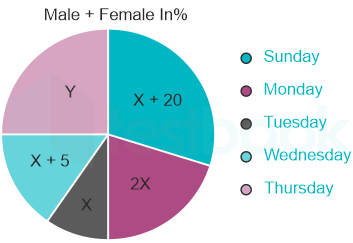
Question 144

Which of the following statements about the teams played in Semi-finals is/are correct?

  1. AOption (a)

    Both the teams which lost played the Group Match as Group B teams.

  2. BOption (b)

    Both the teams which won played the Quarter finals with team who played in the Group Match as Group A teams.

  3. COption (c)

    Both the teams which lost played the Quarter finals with team who played in the Group Match as Group B teams.

  4. DOption (d)

    All of these

  5. EOption (e)

    Only 1 and 2

View answer & explanation

Correct answer

Answer: (d)D.

All of these

Why this answer is correct

Given:-

Group Match - 16 teams

Quarter Finals - 8 teams

Semi-Finals - 4 teams

Final - 2 teams

Only those teams will go in the next round who will win the match.

Now,

In Group Match, there are two groups -

Group AGroup B
AfghanistanIndia
AustraliaScotland
Sri LankaNetherland
New ZealandSouth Africa
BangladeshZimbabwe
EnglandNamibia
UAEIreland
West IndiesPakistan


Group A's team will play with Group B's team.

Group Match -

1) New Zealand either plays with Zimbabwe or plays with Namibia.

2) Bangladesh either plays with Namibia or play with Ireland.

3) England either plays with Ireland or play with Pakistan. So the possibilities are -

Group Match -

Group A TeamPlays with Group B Team
New ZealandZimbabwe / Namibia
BangladeshNamibia / Ireland
EnglandIreland / Pakistan


4) Pakistan plays with the team which will play with Sri Lanka in the quarter-final. It means Sri Lanka won and played the quarter-final and Pakistan Lost.

5) Scotland plays with the team which will play with Australia in the quarter-final. It means Australia won and played the quarter-final and Scotland Lost.

6) Australia neither played with India nor play with South Africa in the Group match.

Group Match -

Case I

Group A TeamPlays with Group B TeamDoes not Play with Group B Team
New ZealandZimbabwe
BangladeshNamibia
EnglandIreland
Team which will play with Sri Lanka in quarter-final (W)Pakistan (L)
Team will play with Australia in quarter-final (W)Scotland (L)
Australia (W)(L)India, South Africa


Case II -

Group A TeamPlays with Group B TeamDoes not Play with Group B Team
New ZealandZimbabwe / Namibia
BangladeshNamibia / Ireland
England (Team which will play with Sri Lanka in quarter-final) (W)Pakistan (L)
Team will play with Australia in quarter-final (W)Scotland (L)
Australia (W)(L)India, South Africa


7) Sri Lanka does not play with India.

8) Afghanistan plays with the team which will play with Ireland in the quarter-final. It means Ireland won and played the quarter-final.

Group Match -

Case I -

Group A TeamPlays with Group B TeamDoes not Play with Group B Team
New ZealandZimbabwe
BangladeshNamibia
England (L)Ireland (W)
Team which will play with Sri Lanka in quarter-final (W)Pakistan (L)
Team will play with Australia in quarter-final (W)Scotland (L)
Australia (W)(L)India, South Africa
Sri Lanka (W)(L)India
Afghanistan (L)Team which will play with Ireland in quarter-final (W)


Case II -

Group A TeamPlays with Group B TeamDoes not Play with Group B Team
New ZealandZimbabwe / Namibia
BangladeshNamibia / IrelandIreland
England (Team which will play with Sri Lanka in quarter-final) (W)Pakistan (L)
Team will play with Australia in quarter-final (W)Scotland (L)
Australia (W)(L)India, South Africa
Sri Lanka (W)(L)India
Afghanistan (L)Team which will play with Ireland in quarter-final (W)


In the above cases, Team UAE and West Indies from Group A and Team India, Netherlands, and South Africa from Group B are remaining.

In case I, From Group B, India can play only with Afghanistan. It means India plays with Ireland in Quarter-finals. Also, now South Africa can play with Sri Lanka only and the remaining Netherlands plays with Australia. Either UAE or West Indies plays with Pakistan and Scotland.

Group Match -

Case I -

Group A TeamPlays with Group B Team
New ZealandZimbabwe
BangladeshNamibia
England (L)Ireland (W)
UAE / West Indies (Team which will play with Sri Lanka in quarter-final) (W)Pakistan (L)
UAE / West Indies (Team will play with Australia in quarter-final) (W)Scotland (L)
Australia (W)Netherland (L)
Sri Lanka (W)South Africa (L)
Afghanistan (L)India (Team which will play with Ireland in quarter-final) (W)


In case II, multiple possibilities exist:

Case II -New Zealand

Group A TeamPlays with Group B Team
New ZealandZimbabwe / Namibia
BangladeshNamibia / Ireland
England (Team which will play with Sri Lanka in quarter-final) (W)Pakistan (L)
UAE / West Indies (Team will play with Australia in quarter-final) (W)Scotland (L)
Australia (W)Zimbabwe / Namibia / Netherlands (L)
Sri Lanka (W)Zimbabwe / NamibiaNamibia / South Africa / Netherlands (L)
Afghanistan (L)Zimbabwe / Namibia / India / South Africa / Netherlands (Team which will play with Ireland in quarter-final) (W)
UAE / West IndiesZimbabwe / Namibia / Ireland / India / South Africa / Netherlands


Now, Quarter-final -

1) Namibia plays with the team which played with New Zealand in Group Match. It means Namibia won and New Zealand lost in Group Match. In case I, Bangladesh lost and ZimbabweZimbabwe won in Group Match. 

Now in Group Match Case II, New Zealand either played with Zimbabwe or Namibia. Namibia cannot play with itself in the quarter-final. So, it means that New Zealand and Namibia play with Zimbabwe in Group Match and Quarter Final respectively. Also, Australia cannot play with Zimbabwe or Namibia as both teams win so it plays with the Netherlands. Similarly, Sri Lanka plays with South Africa and Afghanistan plays with India. 

Case I -

Group Match -

Group A TeamPlays with Group B Team
New Zealand (L)Zimbabwe (W)
Bangladesh (L)Namibia (W)
England (L)Ireland (W)
UAE / West Indies (Team which will play with Sri Lanka in quarter-final) (W)Pakistan (L)
UAE / West Indies (Team will play with Australia in quarter-final) (W)Scotland (L)
Australia (W)Netherland (L)
Sri Lanka (W)South Africa (L)
Afghanistan (L)India (Team which will play with Ireland in quarter-final) (W)


Quarter-final - 

TeamPlays with
NamibiaZimbabwe
IndiaIreland
UAE / West IndiesSri Lanka
UAE / West IndiesAustralia


Case II -

Group Match -

Group A TeamPlays with Group B Team
New Zealand (L)Zimbabwe (W)
Bangladesh (L)Namibia / Ireland (W)
England (Team which will play with Sri Lanka in Quarter-finals) (W)Pakistan (L)
UAE / West Indies (Team will play with Australia in Quarter-finals) (W)Scotland (L)
Australia (W)Netherland (L)
Sri Lanka (W)South Africa (L)
Afghanistan (L)India (Team which will play with Ireland in Quarter-finals) (W)
US/ West IndiesWest Indies (L)Namibia / Ireland (W)


Quarter-final -

TeamPlays with
NamibiaZimbabwe
IndiaIreland
EnglandSri Lanka
UAE / West IndiesAustralia


2) Australia does not play with the US.

In Case I, in the quarter-final, the UAE plays with Sri Lanka. It means UAE plays with Pakistan, West Indies plays with Scotland in Group Match. West Indies play with Australia in the quarter-final.

In Case II, in the quarter-final, West Indies plays with Australia. In Group Match, West Indies plays with Scotland, and the UAE plays with either Namibia or Ireland.

Case I -

Group Match -

Group A TeamPlays with Group B Team
New Zealand (L)Zimbabwe (W)
Bangladesh (L)Namibia (W)
England (L)Ireland (W)
UAE (W)Pakistan (L)
West Indies (W)Scotland (L)
Australia (W)Netherland (L)
Sri Lanka (W)South Africa (L)
Afghanistan (L)India (W)


Quarter-final -

TeamPlays with
NamibiaZimbabwe
AustraliaWest Indies
USSri Lanka
IrelandIndia


Case II -

Group Match -

Group A TeamPlays with Group B Team
New Zealand (L)Zimbabwe (W)
Bangladesh (L)Namibia / Ireland (W)
England (W)Pakistan (L)
West Indies (W)Scotland (L)
Australia (W)Netherland (L)
Sri Lanka (W)South Africa (L)
Afghanistan (L)India (W)
UAE (L)Namibia / Ireland (W)


Quarter-final -

TeamPlays with
NamibiaZimbabwe
IndiaIreland
EnglandSri Lanka
West IndiesAustralia


Semi-final -

1)  The one which played with West Indies in the quarter-final will play with Ireland. According to both cases of the quarter-final,  Australia will play with Ireland.

  1. The one which played with Bangladesh in Group Match plays with that team who plays with  South Africa in Group Match. According to case I of Group Match, Namibia will play with Sri Lanka. In case II of Group Match, either Namibia or Ireland plays with Bangladesh but as Ireland plays with Australia in Semi-final, Namibia will play with Sri Lanka.

Case I  -

Group Match -

Group A TeamPlays with Group B Team
New Zealand (L)Zimbabwe (W)
Bangladesh (L)Namibia (W)
England (L)Ireland (W)
UAE (W)Pakistan (L)
West Indies (W)Scotland (L)
Australia (W)Netherland (L)
Sri Lanka (W)South Africa (L)
Afghanistan (L)India (W)


Quarter-final -

TeamPlays with
Namibia (W)Zimbabwe (L)
Australia (W)West Indies (L)
UAE (L)Sri Lanka (W)
Ireland (W)India (L)


Semi-final -

TeamPlays with
NamibiaSri Lanka
IrelandAustralia


Case II -

Group Match -

Group A TeamPlays with Group B Team
New Zealand (L)Zimbabwe (W)
Bangladesh (L)Namibia (W)
England (W)Pakistan (L)
West Indies (W)Scotland (L)
Australia (W)Netherland (L)
Sri Lanka (W)South Africa (L)
Afghanistan (L)India (W)
UAE (L)Ireland (W)


Quarter-final -

TeamPlays with
Namibia (W)Zimbabwe (L)
India (L)Ireland (W)
England (L)Sri Lanka (W)
West Indies (L)Australia (W)


Semi-final -

TeamPlays with
NamibiaSri Lanka
IrelandAustralia


Final -

1) Team which played with the Netherlands in Group Match, play with the team which play with the UAE in the quarter-final and the one that played with the Netherlands in Group Match will win the world cup. Case II gets eliminated as UAE didn't play quarter-final in case II.

In case I, Australia played with Sri Lanka and Australia won the World Cup.

The final arrangement is -

Case I  -

Group Match -

Group A TeamPlays with Group B Team
New Zealand (L)Zimbabwe (W)
Bangladesh (L)Namibia (W)
England (L)Ireland (W)
UAE (W)Pakistan (L)
West Indies (W)Scotland (L)
Australia (W)Netherland (L)
Sri Lanka (W)South Africa (L)
Afghanistan (L)India (W)


Quarter-final -

TeamPlays with
Namibia (W)Zimbabwe (L)
Australia (W)West Indies (L)
UAE (L)Sri Lanka (W)
Ireland (W)India (L)


Semi-final -

TeamPlays with
Namibia (L)Sri Lanka (W)
Ireland (L)Australia (W)


Final -

TeamPlays with
Sri Lanka (L)Australia (W)


Hence, the correct answer is 'All of these'.

Question 145

Who won the T20 World Cup?

  1. AOption (a)

    The team who played in Group Match as Group B team.

  2. BOption (b)

    The team who played Semi-final with Ireland.

  3. COption (c)

    The team who played Quarter-final with India.

  4. DOption (d)

    The team who beat Namibia in Finals.

  5. EOption (e)

    All of these

View answer & explanation

Correct answer

Answer: (b)B.

The team who played Semi-final with Ireland.

Why this answer is correct

Given:-

Group Match - 16 teams

Quarter Finals - 8 teams

Semi-Finals - 4 teams

Final - 2 teams

Only those teams will go in the next round who will win the match.

Now,

In Group Match, there are two groups -

Group AGroup B
AfghanistanIndia
AustraliaScotland
Sri LankaNetherland
New ZealandSouth Africa
BangladeshZimbabwe
EnglandNamibia
UAEIreland
West IndiesPakistan


Group A's team will play with Group B's team.

Group Match -

1) New Zealand either plays with Zimbabwe or plays with Namibia.

  1. Bangladesh either plays with Namibia or play with Ireland.

  2. England either plays with Ireland or play with Pakistan. So the possibilities are -

Group Match -

Group A TeamPlays with Group B Team
New ZealandZimbabwe / Namibia
BangladeshNamibia / Ireland
EnglandIreland / Pakistan


4) Pakistan plays with the team which will play with Sri Lanka in the quarter-final. It means Sri Lanka won and played the quarter-final and Pakistan Lost.

  1. Scotland plays with the team which will play with Australia in the quarter-final. It means Australia won and played the quarter-final and Scotland Lost.

  2. Australia neither played with India nor play with South Africa in the Group match.

Group Match -

Case I

Group A TeamPlays with Group B TeamDoes not Play with Group B Team
New ZealandZimbabwe
BangladeshNamibia
EnglandIreland
Team which will play with Sri Lanka in quarter-final (W)Pakistan (L)
Team will play with Australia in quarter-final (W)Scotland (L)
Australia (W)(L)India, South Africa


Case II -

Group A TeamPlays with Group B TeamDoes not Play with Group B Team
New ZealandZimbabwe / Namibia
BangladeshNamibia / Ireland
England (Team which will play with Sri Lanka in quarter-final) (W)Pakistan (L)
Team will play with Australia in quarter-final (W)Scotland (L)
Australia (W)(L)India, South Africa


  1. Sri Lanka does not play with India.

  2. Afghanistan plays with the team which will play with Ireland in the quarter-final. It means Ireland won and played the quarter-final.

Group Match -

Case I -

Group A TeamPlays with Group B TeamDoes not Play with Group B Team
New ZealandZimbabwe
BangladeshNamibia
England (L)Ireland (W)
Team which will play with Sri Lanka in quarter-final (W)Pakistan (L)
Team will play with Australia in quarter-final (W)Scotland (L)
Australia (W)(L)India, South Africa
Sri Lanka (W)(L)India
Afghanistan (L)Team which will play with Ireland in quarter-final (W)


Case II -

Group A TeamPlays with Group B TeamDoes not Play with Group B Team
New ZealandZimbabwe / Namibia
BangladeshNamibia / IrelandIreland
England (Team which will play with Sri Lanka in quarter-final) (W)Pakistan (L)
Team will play with Australia in quarter-final (W)Scotland (L)
Australia (W)(L)India, South Africa
Sri Lanka (W)(L)India
Afghanistan (L)Team which will play with Ireland in quarter-final (W)


In the above cases, Team UAE and West Indies from Group A and Team India, Netherlands, and South Africa from Group B are remaining.

In case I, From Group B, India can play only with Afghanistan. It means India plays with Ireland in Quarter-finals. Also, now South Africa can play with Sri Lanka only and the remaining Netherlands plays with Australia. Either UAE or West Indies plays with Pakistan and Scotland.

Group Match -

Case I -

Group A TeamPlays with Group B Team
New ZealandZimbabwe
BangladeshNamibia
England (L)Ireland (W)
UAE / West Indies (Team which will play with Sri Lanka in quarter-final) (W)Pakistan (L)
UAE / West Indies (Team will play with Australia in quarter-final) (W)Scotland (L)
Australia (W)Netherland (L)
Sri Lanka (W)South Africa (L)
Afghanistan (L)India (Team which will play with Ireland in quarter-final) (W)


In case II, multiple possibilities exist:

Case II -New Zealand

Group A TeamPlays with Group B Team
New ZealandZimbabwe / Namibia
BangladeshNamibia / Ireland
England (Team which will play with Sri Lanka in quarter-final) (W)Pakistan (L)
UAE / West Indies (Team will play with Australia in quarter-final) (W)Scotland (L)
Australia (W)Zimbabwe / Namibia / Netherlands (L)
Sri Lanka (W)Zimbabwe / NamibiaNamibia / South Africa / Netherlands (L)
Afghanistan (L)Zimbabwe / Namibia / India / South Africa / Netherlands (Team which will play with Ireland in quarter-final) (W)
UAE / West IndiesZimbabwe / Namibia / Ireland / India / South Africa / Netherlands


Now, Quarter-final -

1) Namibia plays with the team which played with New Zealand in Group Match. It means Namibia won and New Zealand lost in Group Match. In case I, Bangladesh lost and ZimbabweZimbabwe won in Group Match. 

Now in Group Match Case II, New Zealand either played with Zimbabwe or Namibia. Namibia cannot play with itself in the quarter-final. So, it means that New Zealand and Namibia play with Zimbabwe in Group Match and Quarter Final respectively. Also, Australia cannot play with Zimbabwe or Namibia as both teams win so it plays with the Netherlands. Similarly, Sri Lanka plays with South Africa and Afghanistan plays with India. 

Case I -

Group Match -

Group A TeamPlays with Group B Team
New Zealand (L)Zimbabwe (W)
Bangladesh (L)Namibia (W)
England (L)Ireland (W)
UAE / West Indies (Team which will play with Sri Lanka in quarter-final) (W)Pakistan (L)
UAE / West Indies (Team will play with Australia in quarter-final) (W)Scotland (L)
Australia (W)Netherland (L)
Sri Lanka (W)South Africa (L)
Afghanistan (L)India (Team which will play with Ireland in quarter-final) (W)


Quarter-final - 

TeamPlays with
NamibiaZimbabwe
IndiaIreland
UAE / West IndiesSri Lanka
UAE / West IndiesAustralia


Case II -

Group Match -

Group A TeamPlays with Group B Team
New Zealand (L)Zimbabwe (W)
Bangladesh (L)Namibia / Ireland (W)
England (Team which will play with Sri Lanka in Quarter-finals) (W)Pakistan (L)
UAE / West Indies (Team will play with Australia in Quarter-finals) (W)Scotland (L)
Australia (W)Netherland (L)
Sri Lanka (W)South Africa (L)
Afghanistan (L)India (Team which will play with Ireland in Quarter-finals) (W)
US/ West IndiesWest Indies (L)Namibia / Ireland (W)


Quarter-final -

TeamPlays with
NamibiaZimbabwe
IndiaIreland
EnglandSri Lanka
UAE / West IndiesAustralia


  1. Australia does not play with the US.

In Case I, in the quarter-final, the UAE plays with Sri Lanka. It means UAE plays with Pakistan, West Indies plays with Scotland in Group Match. West Indies play with Australia in the quarter-final.

In Case II, in the quarter-final, West Indies plays with Australia. In Group Match, West Indies plays with Scotland, and the UAE plays with either Namibia or Ireland.

Case I -

Group Match -

Group A TeamPlays with Group B Team
New Zealand (L)Zimbabwe (W)
Bangladesh (L)Namibia (W)
England (L)Ireland (W)
UAE (W)Pakistan (L)
West Indies (W)Scotland (L)
Australia (W)Netherland (L)
Sri Lanka (W)South Africa (L)
Afghanistan (L)India (W)


Quarter-final -

TeamPlays with
NamibiaZimbabwe
AustraliaWest Indies
USSri Lanka
IrelandIndia


Case II -

Group Match -

Group A TeamPlays with Group B Team
New Zealand (L)Zimbabwe (W)
Bangladesh (L)Namibia / Ireland (W)
England (W)Pakistan (L)
West Indies (W)Scotland (L)
Australia (W)Netherland (L)
Sri Lanka (W)South Africa (L)
Afghanistan (L)India (W)
UAE (L)Namibia / Ireland (W)


Quarter-final -

TeamPlays with
NamibiaZimbabwe
IndiaIreland
EnglandSri Lanka
West IndiesAustralia


Semi-final -

1)  The one which played with West Indies in the quarter-final will play with Ireland. According to both cases of the quarter-final,  Australia will play with Ireland.

  1. The one which played with Bangladesh in Group Match plays with that team who plays with  South Africa in Group Match. According to case I of Group Match, Namibia will play with Sri Lanka. In case II of Group Match, either Namibia or Ireland plays with Bangladesh but as Ireland plays with Australia in Semi-final, Namibia will play with Sri Lanka.

Case I  -

Group Match -

Group A TeamPlays with Group B Team
New Zealand (L)Zimbabwe (W)
Bangladesh (L)Namibia (W)
England (L)Ireland (W)
UAE (W)Pakistan (L)
West Indies (W)Scotland (L)
Australia (W)Netherland (L)
Sri Lanka (W)South Africa (L)
Afghanistan (L)India (W)


Quarter-final -

TeamPlays with
Namibia (W)Zimbabwe (L)
Australia (W)West Indies (L)
UAE (L)Sri Lanka (W)
Ireland (W)India (L)


Semi-final -

TeamPlays with
NamibiaSri Lanka
IrelandAustralia


Case II -

Group Match -

Group A TeamPlays with Group B Team
New Zealand (L)Zimbabwe (W)
Bangladesh (L)Namibia (W)
England (W)Pakistan (L)
West Indies (W)Scotland (L)
Australia (W)Netherland (L)
Sri Lanka (W)South Africa (L)
Afghanistan (L)India (W)
UAE (L)Ireland (W)


Quarter-final -

TeamPlays with
Namibia (W)Zimbabwe (L)
India (L)Ireland (W)
England (L)Sri Lanka (W)
West Indies (L)Australia (W)


Semi-final -

TeamPlays with
NamibiaSri Lanka
IrelandAustralia


Final -

1) Team which played with the Netherlands in Group Match, play with the team which play with the UAE in the quarter-final and the one that played with the Netherlands in Group Match will win the world cup. Case II gets eliminated as UAE didn't play quarter-final in case II.

In case I, Australia played with Sri Lanka and Australia won the World Cup.

The final arrangement is -

Case I  -

Group Match -

Group A TeamPlays with Group B Team
New Zealand (L)Zimbabwe (W)
Bangladesh (L)Namibia (W)
England (L)Ireland (W)
UAE (W)Pakistan (L)
West Indies (W)Scotland (L)
Australia (W)Netherland (L)
Sri Lanka (W)South Africa (L)
Afghanistan (L)India (W)


Quarter-final -

TeamPlays with
Namibia (W)Zimbabwe (L)
Australia (W)West Indies (L)
UAE (L)Sri Lanka (W)
Ireland (W)India (L)


Semi-final -

TeamPlays with
Namibia (L)Sri Lanka (W)
Ireland (L)Australia (W)


Final -

TeamPlays with
Sri Lanka (L)Australia (W)


Australia won the World Cup and played Semi-final with Ireland.

Hence, the correct answer is 'The one who played Semi-final with Ireland'.

Directions: Study the following information to answer the given questions.

In a certain coded language,

′SING JOKE BEAR DEAR′ is written as ′#&♦ %µ! $µ! @µ!′

′JUG BOAT SUN DESK′ is written as ′%µ♦ $µ! #µ♦ @&♦′

′DOG STOP JUST BALL′ is written as ′@µ♦ #&♦ %&♦ $&!′

‘START JOCKY BOLD DAMAGE′ is written as ′#µ♦ %µ! $&! @&!′

Question 146

What is the code for ‘JEANS’?

  1. AOption (a)

    @&!

  2. BOption (b)

    $&!

  3. COption (c)

    %&♦

  4. DOption (d)

    %µ!

  5. EOption (e)

    @µ♦

View answer & explanation

Correct answer

Answer: (c)C.

%&♦

Why this answer is correct

Logic:

There are 3 symbols in each code. Also, all the words are starting from 4 letters only - B, D, J, and S. So, the first symbol is based on the first letter of the word.

First Symbol -

  1. If the Word starts with S then the symbol used is #.

2) If the Word starts with J then the symbol used is %.

3) If the Word starts with B then the symbol used is $.

4) If the Word starts with D then the symbol used is @.

The second symbol is based on the number of consonants in the word.

Second Symbol -

  1. If the total number of consonants in the word is an odd number then the symbol used is &.

2) If the total number of consonants in the word is an even number then the symbol used is µ.

The third symbol is based on the second last letter of the word.

Third Symbol -

  1. If the second last letter of the word belongs to the first half of the alphabetical series (having place value from 1-13) then the symbol used is !.

2) If the second last letter of the word belongs to the second half of the alphabetical series (having place value from 14-26) then the symbol used is ♦.

So,

WordFirst SymbolSecond SymbolThird SymbolCode
SINGThe first letter is S = #3 consonants = Odd = &Second Last letter = N = 14 > 13 = ♦#&♦
JOKEThe first letter is J = %2 consonants = Even = µSecond Last letter = K = 11 < 13 = !%µ!
BEARThe first letter is B = $2 consonants = Even = µSecond Last letter = A = 1 < 13 = !$µ!
DEARThe first letter is D = @2 consonants = Even = µSecond Last letter = A = 1 < 13 = !@µ!
JUGThe first letter is J = %2 consonants = Even = µSecond Last letter = U = 21 > 13 = ♦%µ♦
BOATThe first letter is B = $2 consonants = Even = µSecond Last letter = A = 1 < 13 = !$µ!
SUNThe first letter is S = #2 consonants = Even = µSecond Last letter = U = 21 > 13 = ♦#µ♦
DESKThe first letter is D = @3 consonants = Odd = &Second Last letter = S = 19 > 13 = ♦@&♦
DOGThe first letter is D = @2 consonants =Even = µSecond Last letter = O = 15 > 13 = ♦@µ♦
STOPThe first letter is S = #3 consonants = Odd = &Second Last letter = O = 15 > 13 = ♦#&♦
JUSTThe first letter is J = %3 consonants = Odd = &Second Last letter = S = 19 > 13 = ♦%&♦
BALLThe first letter is B = $3 consonants = Odd = &Second Last letter = L = 12 < 13 = !$&!
STARTThe first letter is S = #4 consonants =Even = µSecond Last letter = R = 18 > 13 = ♦#µ♦
JOCKYThe first letter is J = %4 consonants =Even = µSecond Last letter = K = 11 < 13 = !%µ!
BOLDThe first letter is B = $3 consonants = Odd = &Second Last letter = L = 12 < 13 = !$&!
DAMAGEThe first letter is D = @3 consonants = Odd = &Second Last letter = G = 7 < 13 = !@&!


Now, the code for ’JEANS’ is -

JEANS → The first letter is J so the first symbol will be %. The number of consonants in the word is 3 (J, N, S) which is an odd number so the second symbol will be &. The second last letter is N which belongs to the second half of the alphabetical series so the third symbol will be ♦. Thus, the code will be %&♦.

Hence, the correct answer is %&♦.

Question 147

Which of following word is coded as $&!?

  1. AOption (a)

    Brick

  2. BOption (b)

    Bat

  3. COption (c)

    Bold

  4. DOption (d)

    Band

  5. EOption (e)

    Butter

View answer & explanation

Correct answer

Answer: (c)C.

Bold

Why this answer is correct

Logic:

There are 3 symbols in each code. Also, all the words are starting from 4 letters only - B, D, J, and S. So, the first symbol is based on the first letter of the word.

First Symbol -

  1. If the Word starts with S then the symbol used is #.

2) If the Word starts with J then the symbol used is %.

3) If the Word starts with B then the symbol used is $.

4) If the Word starts with D then the symbol used is @.

The second symbol is based on the number of consonants in the word.

Second Symbol -

  1. If the total number of consonants in the word is an odd number then the symbol used is &.

2) If the total number of consonants in the word is an even number then the symbol used is µ.

The third symbol is based on the second last letter of the word.

Third Symbol -

  1. If the second last letter of the word belongs to the first half of the alphabetical series (having place value from 1-13) then the symbol used is !.

2) If the second last letter of the word belongs to the second half of the alphabetical series (having place value from 14-26) then the symbol used is ♦.

So,

WordFirst SymbolSecond SymbolThird SymbolCode
SINGThe first letter is S = #3 consonants = Odd = &Second Last letter = N = 14 > 13 = ♦#&♦
JOKEThe first letter is J = %2 consonants = Even = µSecond Last letter = K = 11 < 13 = !%µ!
BEARThe first letter is B = $2 consonants = Even = µSecond Last letter = A = 1 < 13 = !$µ!
DEARThe first letter is D = @2 consonants = Even = µSecond Last letter = A = 1 < 13 = !@µ!
JUGThe first letter is J = %2 consonants = Even = µSecond Last letter = U = 21 > 13 = ♦%µ♦
BOATThe first letter is B = $2 consonants = Even = µSecond Last letter = A = 1 < 13 = !$µ!
SUNThe first letter is S = #2 consonants = Even = µSecond Last letter = U = 21 > 13 = ♦#µ♦
DESKThe first letter is D = @3 consonants = Odd = &Second Last letter = S = 19 > 13 = ♦@&♦
DOGThe first letter is D = @2 consonants =Even = µSecond Last letter = O = 15 > 13 = ♦@µ♦
STOPThe first letter is S = #3 consonants = Odd = &Second Last letter = O = 15 > 13 = ♦#&♦
JUSTThe first letter is J = %3 consonants = Odd = &Second Last letter = S = 19 > 13 = ♦%&♦
BALLThe first letter is B = $3 consonants = Odd = &Second Last letter = L = 12 < 13 = !$&!
STARTThe first letter is S = #4 consonants =Even = µSecond Last letter = R = 18 > 13 = ♦#µ♦
JOCKYThe first letter is J = %4 consonants =Even = µSecond Last letter = K = 11 < 13 = !%µ!
BOLDThe first letter is B = $3 consonants = Odd = &Second Last letter = L = 12 < 13 = !$&!
DAMAGEThe first letter is D = @3 consonants = Odd = &Second Last letter = G = 7 < 13 = !@&!


Now, we need to find the word which is coded as $&!.

WordFirst SymbolSecond SymbolThird SymbolCode
BrickThe first letter is B = $4 consonants =Even = µSecond Last letter = C = 3 < 13 = !$µ!
BatThe first letter is B = $2 consonants =Even = µSecond Last letter = A = 1 < 13 = !$µ!
BoldThe first letter is B = $3 consonants = Odd = &Second Last letter = L = 12 < 13 = !$&!
BandThe first letter is B = $3 consonants = Odd = &Second Last letter = N = 14 > 13 = ♦$&♦
ButterThe first letter is B = $4 consonants =Even = µSecond Last letter = E = 5 < 13 = !$µ!


Hence, the correct answer is Bold.

Question 148

What is the code for ’DONKEY SMOKING’?

  1. AOption (a)

    $&! %&!

  2. BOption (b)

    @µ♦ #&♦

  3. COption (c)

    %&♦ $&!

  4. DOption (d)

    @µ! #&♦

  5. EOption (e)

    Cannot be determined

View answer & explanation

Correct answer

Answer: (d)D.

@µ! #&♦

Why this answer is correct

Logic:

There are 3 symbols in each code. Also, all the words are starting from 4 letters only - B, D, J, and S. So, the first symbol is based on the first letter of the word.

First Symbol -

  1. If the Word starts with S then the symbol used is #.

  2. If the Word starts with J then the symbol used is %.

  3. If the Word starts with B then the symbol used is $.

  4. If the Word starts with D then the symbol used is @.

The second symbol is based on the number of consonants in the word.

Second Symbol -

  1. If the total number of consonants in the word is an odd number then the symbol used is &.

2) If the total number of consonants in the word is an even number then the symbol used is µ.

The third symbol is based on the second last letter of the word.

Third Symbol -

  1. If the second last letter of the word belongs to the first half of the alphabetical series (having place value from 1-13) then the symbol used is !.

2) If the second last letter of the word belongs to the second half of the alphabetical series (having place value from 14-26) then the symbol used is ♦.

So,

WordFirst SymbolSecond SymbolThird SymbolCode
SINGThe first letter is S = #3 consonants = Odd = &Second Last letter = N = 14 > 13 = ♦#&♦
JOKEThe first letter is J = %2 consonants = Even = µSecond Last letter = K = 11 < 13 = !%µ!
BEARThe first letter is B = $2 consonants = Even = µSecond Last letter = A = 1 < 13 = !$µ!
DEARThe first letter is D = @2 consonants = Even = µSecond Last letter = A = 1 < 13 = !@µ!
JUGThe first letter is J = %2 consonants = Even = µSecond Last letter = U = 21 > 13 = ♦%µ♦
BOATThe first letter is B = $2 consonants = Even = µSecond Last letter = A = 1 < 13 = !$µ!
SUNThe first letter is S = #2 consonants = Even = µSecond Last letter = U = 21 > 13 = ♦#µ♦
DESKThe first letter is D = @3 consonants = Odd = &Second Last letter = S = 19 > 13 = ♦@&♦
DOGThe first letter is D = @2 consonants =Even = µSecond Last letter = O = 15 > 13 = ♦@µ♦
STOPThe first letter is S = #3 consonants = Odd = &Second Last letter = O = 15 > 13 = ♦#&♦
JUSTThe first letter is J = %3 consonants = Odd = &Second Last letter = S = 19 > 13 = ♦%&♦
BALLThe first letter is B = $3 consonants = Odd = &Second Last letter = L = 12 < 13 = !$&!
STARTThe first letter is S = #4 consonants =Even = µSecond Last letter = R = 18 > 13 = ♦#µ♦
JOCKYThe first letter is J = %4 consonants =Even = µSecond Last letter = K = 11 < 13 = !%µ!
BOLDThe first letter is B = $3 consonants = Odd = &Second Last letter = L = 12 < 13 = !$&!
DAMAGEThe first letter is D = @3 consonants = Odd = &Second Last letter = G = 7 < 13 = !@&!


Now, the code for ’DONKEY SMOKING’ is -

DONKEY → The first letter is D so the first symbol will be @. The number of consonants in the word is 4 (D, N, K, Y) which is an even number so the second symbol will be µ. The second last letter is E which belongs to the first half of the alphabetical series so the third symbol will be !. Thus, the code will be @µ!.

SMOKING → The first letter is S so the first symbol will be #. The number of consonants in the word is 5 (S, M, K, N, G) which is an odd number so the second symbol will be &. The second last letter is N which belongs to the second half of the alphabetical series so the third symbol will be ♦. Thus, the code will be #&♦.

Hence, the correct answer is @µ! #&♦.

Question 149

Direction: The question given below consists of a statement, followed by four arguments I, II, III and IV. You have to decide which of the arguments is a 'strong' argument and which is a 'weak' argument.

'Andhra Pradesh government has decided to introduce English medium in place of Telugu medium for class 1 to class 6 in government schools from the next academic year'. Is this decision good?

Arguments:

I). Yes, English Medium education to their children is a dream for a large number of parents of backward classes.

II). No, if it is introduced next year, students will be put to inconvenience given the quality of our teachers as they are not proficient enough to teach in English.

III). No, there are many IAS and IPS officers who have studied in their mother tongue.

IV). Yes, English has always been a problem for the students of government schools in competitive exams and Interviews.

  1. AOption (a)

    Only I is strong

  2. BOption (b)

    Only III is strong

  3. COption (c)

    I, III, and IV are strong

  4. DOption (d)

    I, II, and IV are strong

  5. EOption (e)

    All the arguments are strong

View answer & explanation

Correct answer

Answer: (d)D.

I, II, and IV are strong

Why this answer is correct

Let's have a look at all arguments given:

Argument I: It is strong because it can fulfill the dream of a lot of parents who cannot afford English medium education at a higher cost.

Argument II: It is a strong argument because it mentions the problems that would be faced if it is introduced without proper training.

Argument III: It is a weak argument because there may be some people who have succeeded (not all), but just for that reason, the decision of introducing the English medium cannot be considered wrong. 

Argument IV: It is a strong argument because the introduction of the English medium may be a solution to the problem.

Hence, the correct answer will be I, II, and IV are strong.

Question 150

Direction: The following question consists of three statements numbered I, II and III. Decide if data given in the statements are sufficient to answer the question below.

Six persons B1, B2, B3, B4, B5 and B6 go on a trip on two different dates 8 and 19 of three different months- April, May and June but not necessarily in the same order. No two persons appear on the same date. Who went on the trip on 8th June?

I. B4 goes on a trip in a month having 31 days. B6 goes immediately after B3 and in the same month.

II. B1 goes after B5 and in a month having less than 31 days.

III. B4 goes on an odd number date. Two persons go between B6 and B2. B2 goes after B6.

  1. AOption (a)

    Only statement I alone is sufficient to find the answer

  2. BOption (b)

    Only statement I and II are sufficient to find the answer

  3. COption (c)

    Only statement II and III are sufficient to find the answer

  4. DOption (d)

    Only statement I and III are sufficient to find the answer

  5. EOption (e)

    All three statements I, II and III are sufficient to find the answer

View answer & explanation

Correct answer

Answer: (d)D.

Only statement I and III are sufficient to find the answer

Why this answer is correct

Given six persons- B1, B2, B3, B4, B5 and B6 go on a trip on two different dates- 8 and 19.

Three different months- April, May and June.

From statement I,

MonthDatePersons
Case-ICase-IICase-IIICase-IV
April8B3B3
19B6B6
May8B4B4
19B4B4
June8B3B3
19B6B6


From statement II, we can’t get any clarity or possibility because of insufficient information.

Also from statement III, we can’t get any clarity or possibility because of insufficient information. Because we can't determine on which date B4 is going. Also, we know B2 goes after B6. But we can't determine the date.

But combining statement I and III we get that case- I, III and IV are cancelled. Because only in case-II, B4 goes on an odd number date which is 19th May. Also, two persons go between B6 and B2. B2 goes after B6. So, we can find the answer,

MonthDatePersons
Case-II
April8B3
19B6
May8
19B4
June8B2
19


B2 goes on 8th June.

Hence, only statement I and III are sufficient to find the answer.

Direction: In the following questions, the symbols +, #, %, and & are used with the meaning given below. Study the following information and answer the given questions. Below the information, four coded statements are given followed by three coded conclusions. You have to take the given statements to be true even if they seem to be at variance from commonly known facts. Read all the conclusions and then decide which of the given conclusions logically follows from the given statements.

X + Y means No X is Y.

X # Y means All X are Y

X % Y means Some X are Y

X & Y means Some X are not Y

Question 151

Statements:

Producer # Director

Writer % Singer

Singer # Director

Producer + Artist

Conclusions:

I. Singer % Producer

II. Writer % Artist

III. Singer + Producer

  1. AOption (a)

    Either I and II

  2. BOption (b)

    Only III

  3. COption (c)

    Both I and III

  4. DOption (d)

    Either I or III 

  5. EOption (e)

    Both II and III

View answer & explanation

Correct answer

Answer: (d)D.

Either I or III 

Why this answer is correct

Given: 

| Symbols X to Y | + | # | % | & | | --- | --- | --- | --- | --- | | Meaning X to Y | No |
All |
Some | Some Not |
Symbols X to Y+#%&Meaning X to YNo
All

Some
Some Not
Symbols X to Y+#%&
Meaning X to YNo
All

Some
Some Not


Statements: 

I. Producer # Director → All Producer is Director.

II. Writer % Singer → Some Writer is Singer.

III. Singer # Director → All Singer is Director.

IV. Producer + Artist → No Producer is Artist.

Thus, the possible Venn diagram for the given statement is:

Conclusions:

I. Singer % Producer → Some Singer is Producer → False (It is possible but not definite that Some Singer is Producer as there is no direct relation given between them. Hence, it is false)

II. Writer % Artist → Some Writer is Artist → False (It is possible but not definite that Some Writer is Artist as there is no direct relation given between them. Hence, it is false)

III. Singer + Producer → No Singer is Producer. → False (It is possible but not definite that No Singer is Producer as there is no direct relation given between them. Hence, it is false)

But we can see that Conclusions I and III form Complementary Pair. Both the conclusion are individually wrong but on combining we can say that Either I or III follows.

Hence, the correct answer is Either I or III follows.

Important Points

  • Conditions of Either-or case:
  • Individually both conclusions should be false.
  • One conclusion should be positive and one conclusion should be negative (Complementary pair).
  • The two complementary pairs are:
  1. All + Some not
  2. No + Some

Confusion Points

Some + Some not is not a complementary pair. It is possible that both 'some and some not' follow at the same time.

Question 152

Statements:

I. Cherry # Mango

II. Watermelon + Cherry

III. Watermelon # Grapes

IV. Grapes % Kiwi

Conclusions:

I. Mango & Grapes

II. Mango & Watermelon

III. Kiwi # Watermelon

  1. AOption (a)

    Only I

  2. BOption (b)

    Only II

  3. COption (c)

    Both I and II

  4. DOption (d)

    Only III

  5. EOption (e)

    Both II and III

View answer & explanation

Correct answer

Answer: (b)B.

Only II

Why this answer is correct

Given:

Symbols X to Y+#%&
Meaning X to YNo
All

Some
Some Not


Statements: 

I. Cherry # Mango → All Cheery is Mango.

II. Watermelon + Cherry → No Watermelon is Cherry.

III. Watermelon # Grapes  → All Watermelon is Grapes.

IV. Grapes % Kiwi → Some Grapes are Kiwi.

Thus, the possible Venn diagram for the given statement is:

Conclusions:

I. Mango & Grapes → Some Mango is not Grapes → False (It is not definite that Some Mango is not Grapes as there is no direct relation given between them. All Mangoes can be Grapes. Hence, it is false)

II. Mango & Watermelon → Some Mango are not Watermelon → True (Some parts of Mango which is Cherry can never be Watermelon. So Some Mango are not Watermelon follows. Hence, it is true.)

III. Kiwi # Watermelon → All Kiwi are Watermelon → False (As Some Kiwi are Watermelon, it is possible that All Kiwi are Watermelon but not definite. Hence, it is false.)

Hence, the correct answer is Only II.

Directions: Study the following information carefully and answer the questions given below:

When a number arrangement machine is given an input line of numbers, it arranges them following a particular rule. The following is an illustration of input and rearrangement:

Input:    87562   32569   51874   73248   67395   58674

Step I:   32569   87562   73248   51874   58674   67395

Step II:  32554   87512   73232   51828   58628   67345

Step III: 54564 125174 322146 288102 286116 453134

Step IV: 44655 241157 224613 022881 266811 441335

Step V:  14 10   06 14   14 04    20  01   22  02    08 12

And Step V is the last step of the above arrangement as the intended arrangement is obtained.

As per the rules followed in the given steps, find out the appropriate steps for the given input: 

Input: 15876 24938 58743 71562 94136 37925

Question 153

The number 58743 is converted into a six-digit number in which Step?

  1. AOption (a)

    I

  2. BOption (b)

    II

  3. COption (c)

    III

  4. DOption (d)

    IV

  5. EOption (e)

    There is no such step

View answer & explanation

Correct answer

Answer: (c)C.

III

Why this answer is correct

In the given arrangement the machine arranges the numbers in each step.

Step I → Numbers are interchanged in pairs; the first number with the second number, the third number with the fourth number, and the fifth with the sixth number.

Step II → The first three digits in a number are written as it is and the last two digits are multiplied by each other and their product is written next to the three digits.

Step III → The last two digits of a number are written in place of the first two digits, the middle digit is written as it is and the first two digits are multiplied by 2 and then written in place of the last two digits.

Step IV → First, the even digits are arranged in ascending order and then odd numbers are arranged in increasing order within the number.

Step V → Add all the even digits and odd numbers of a number and write their sums separately.

Now, let's solve the given input in a similar way:

Input:    15876   24938   58743   71562   94136   37925

Step I:   24938   15876   71562   58743   37925   94136

Step II:  24924   15842   71512   58712   37910   94118

Step III: 24948  42830  125142  127116  10974  181188

Step IV: 24489  02483  224115   261117   04179   888111

Step V:  18  09   14 03    08  07    08 10    04 17    24 03

The number 58743 is converted into a six-digit number in which Step III.

Hence, the correct answer is III.

Question 154

What is the product of the second smallest digit and the third highest digit of the smallest number of second last step?

  1. AOption (a)

    12

  2. BOption (b)

    4

  3. COption (c)

    6

  4. DOption (d)

    8

  5. EOption (e)

    10

View answer & explanation

Correct answer

Answer: (c)C.

6

Why this answer is correct

In the given arrangement the machine arranges the numbers in each step.

Step I → Numbers are interchanged in pairs; the first number with the second number, the third number with the fourth number, and the fifth with the sixth number.

Step II → The first three digits in a number are written as it is and the last two digits are multiplied by each other and their product is written next to the three digits.

Step III → The last two digits of a number are written in place of the first two digits, the middle digit is written as it is and the first two digits are multiplied by 2 and then written in place of the last two digits.

Step IV → First, the even digits are arranged in ascending order and then odd numbers are arranged in increasing order within the number.

Step V → Add all the even digits and odd numbers of a number and write their sums separately.

Now, let's solve the given input in a similar way:

Input:    15876   24938   58743   71562   94136   37925

Step I:   24938   15876   71562   58743   37925   94136

Step II:  24924   15842   71512   58712   37910   94118

Step III: 24948  42830  125142  127116  10974  181188

Step IV: 24489  02483  224115   261117   04179   888111

Step V:  18  09   14 03    08  07    08 10    04 17    24 03

The smallest number of the second last step is 02483. The second smallest digit is 2 and the third highest digit is 3. Product = 2 x 3 = 6.

Hence, the correct answer is 6.

Question 155

How many odd numbers are there in the last step?

  1. AOption (a)

    2

  2. BOption (b)

    3

  3. COption (c)

    4

  4. DOption (d)

    More than four

  5. EOption (e)

    None

View answer & explanation

Correct answer

Answer: (d)D.

More than four

Why this answer is correct

In the given arrangement the machine arranges the numbers in each step.

Step I → Numbers are interchanged in pairs; the first number with the second number, the third number with the fourth number, and the fifth with the sixth number.

Step II → The first three digits in a number are written as it is and the last two digits are multiplied by each other and their product is written next to the three digits.

Step III → The last two digits of a number are written in place of the first two digits, the middle digit is written as it is and the first two digits are multiplied by 2 and then written in place of the last two digits.

Step IV → First, the even digits are arranged in ascending order and then odd numbers are arranged in increasing order within the number.

Step V → Add all the even digits and odd numbers of a number and write their sums separately.

Now, let's solve the given input in a similar way:

Input:    15876   24938   58743   71562   94136   37925

Step I:   24938   15876   71562   58743   37925   94136

Step II:  24924   15842   71512   58712   37910   94118

Step III: 24948  42830  125142  127116  10974  181188

Step IV: 24489  02483  224115   261117   04179   888111

Step V:  18  09   14 03    08  07    08 10    04 17    24 03

There are 5 odd numbers in the last step.

Hence, the correct answer is More than four.

Question 156

What is the sum of the even digits of the numbers which is second from the left in step II and first from the right in Step I (use a digit once while calculating the sum)?

  1. AOption (a)

    20

  2. BOption (b)

    18

  3. COption (c)

    22

  4. DOption (d)

    45

  5. EOption (e)

    13

View answer & explanation

Correct answer

Answer: (a)A.

20

Why this answer is correct

In the given arrangement the machine arranges the numbers in each step.

Step I → Numbers are interchanged in pairs; the first number with the second number, the third number with the fourth number, and the fifth with the sixth number.

Step II → The first three digits in a number are written as it is and the last two digits are multiplied by each other and their product is written next to the three digits.

Step III → The last two digits of a number are written in place of the first two digits, the middle digit is written as it is and the first two digits are multiplied by 2 and then written in place of the last two digits.

Step IV → First, the even digits are arranged in ascending order and then odd numbers are arranged in increasing order within the number.

Step V → Add all the even digits and odd numbers of a number and write their sums separately.

Now, let's solve the given input in a similar way:

Input:    15876   24938   58743   71562   94136   37925

Step I:   24938   15876   71562   58743   37925   94136

Step II:  24924   15842   71512   58712   37910   94118

Step III: 24948  42830  125142  127116  10974  181188

Step IV: 24489  02483  224115   261117   04179   888111

Step V: 18  09   14 03    08  07    08 10    04 17    24 03

The number which is second from the left in step II is 15842 and the first from the right in Step I is 94136.

The sum of the even digits of the numbers is 8+4+2+6 = 20 (using a digit once while calculating the sum).

Hence, the correct answer is 20.

Question 157

What is the difference between the fourth highest number of step IV and the third highest number from step III?

  1. AOption (a)

    99025

  2. BOption (b)

    125142

  3. COption (c)

    100653

  4. DOption (d)

    651082

  5. EOption (e)

    24489

View answer & explanation

Correct answer

Answer: (c)C.

100653

Why this answer is correct

In the given arrangement the machine arranges the numbers in each step.

Step I → Numbers are interchanged in pairs; the first number with the second number, the third number with the fourth number, and the fifth with the sixth number.

Step II → The first three digits in a number are written as it is and the last two digits are multiplied by each other and their product is written next to the three digits.

Step III → The last two digits of a number are written in place of the first two digits, the middle digit is written as it is and the first two digits are multiplied by 2 and then written in place of the last two digits.

Step IV → First, the even digits are arranged in ascending order and then odd numbers are arranged in increasing order within the number.

Step V → Add all the even digits and odd numbers of a number and write their sums separately.

Now, let's solve the given input in a similar way:

Input:    15876   24938   58743   71562   94136   37925

Step I:   24938   15876   71562   58743   37925   94136

Step II:  24924   15842   71512   58712   37910   94118

Step III: 24948  42830  125142  127116  10974  181188

Step IV: 24489  02483  224115   261117   04179   888111

Step V:  18  09   14 03    08  07    08 10    04 17    24 03

The fourth highest number of step IV is 24489 and the third highest number from step III is 125142.

The difference is 125142 - 24489 = 100653

Hence, the correct answer is 100653.

Directions: Study the following information carefully and answer the questions given below:

Sixteen persons are sitting in two rows parallel to each other. A, B, C, D, P, Q, R, and S are sitting in Row I while E, F, G, H, T, U, V and W are sitting in Row II. Some are facing north while some are facing south in both rows. Facing each other means two persons of different rows sit opposite to each other and face towards each other. Row I is in North of Row II.

V sits third to the left of F, who sits at one of the extreme ends of the row. Only three persons are sitting between E and H. Three persons sit between R and Q. U sits second to the right of the one who sits second to the left of W. Both the neighbours of R are facing south. T sits third right of G who is an immediate neighbour of V. More than 2 people sit between B and S, and D is 2nd to the left of S. Q and T faces same direction i.e. one faces north than another will also face north and same for the south direction. G is facing north. A and P along with B and Q are facing in opposite directions. W is not an immediate neighbour of T. B is 2nd to the left of Q. H sits third to the right of U. C is 2nd to the right of A. E is facing the same direction as G but facing opposite to H. Only three persons sit to the left of R. Neighbours of P are facing in the same direction.

Question 158

What is the position of T with respect to R?

  1. AOption (a)

    Third to the left of the person sitting opposite.

  2. BOption (b)

    Opposite to the person sitting fourth left.

  3. COption (c)

    Second to the left of third to the right.

  4. DOption (d)

    Fourth to the right of the person sitting opposite.

  5. EOption (e)

    Opposite to the person sitting fourth Right.

View answer & explanation

Correct answer

Answer: (d)D.

Fourth to the right of the person sitting opposite.

Why this answer is correct

Given:-

Sixteen persons are sitting in two rows parallel to each other.

Row I - A, B, C, D, P, Q, R, and S

Row II - E, F, G, H, T, U, V, and W

Some are facing north while some are facing south.

Facing each other means two persons of different rows sit opposite to each other and face towards each other. 

Row II is in North of Row I.

1) Only three persons sit to the left of R. R can face north or South direction.

2) Three persons sit between R and Q.

3) Neighbours of R are facing south.

Case I -

Case II -

4) V sits third to the left of F who sits at one of the extreme ends of the row. Here two possibilities exist:

Case I (i) -

Case I (ii) -

Case II (i) -

Case II (ii) -

5) T sits third right of G who is an immediate neighbor of V.

6) G is facing north. 

Here again, two sub-possibilities exist in case I (i) and Case II (i):

Case I (i) (a) -

Case I (i) (b) -

Case I (ii) -

Case II (i) (a) -

Case II (i) (b) -

Case II (ii) -

7) B is 2nd to the left of Q.

8) More than 2 people sit between B and S, and D is 2nd to the left of S.

Case I (i) (a) -

Case I (i) (b) -

Case I (ii) -

Case II (i) (a) -

Case II (i) (b) -

Case II (ii) - 

9) Only three persons are sitting between E and H. So, Case I (i) (a) and Case II (i) (a) get eliminated.

10) E is facing the same direction as G but opposite to H. It means E is facing north and H is facing South.

11) H sits third to the right of U. Now in Case I (i) (b) and Case II (i) (b), two sub-possibilities exist:

Case I (i) (b) (i) -

Case I (i) (b) (ii) -

Case I (ii) -

Case II (i) (b) (i) -

Case II (i) (b) (ii) -

Case II (ii) -

12) U sits second to the right of the one who sits second to the left of W. Now Case I (ii) and Case II (ii) get eliminated.

13) W is not an immediate neighbor of T. So Case I (i) (b) (i) and Case II (i) (b) (i) get eliminated. We cannot determine the direction of T yet.

Case I (i) (b) (ii) -

Case II (i) (b) (ii) -

14) C is 2nd to the right of A. 

15) Neighbours of P face the same direction. The only place left for P in row I is between D and S. But Case II (i) (b) (ii) gets eliminated as D and S are facing opposite directions.

16) A and P face opposite directions and similarly, B and Q face opposite directions too. It means P is facing North and B is facing South.

17) Q and T faces same direction i.e. one faces north than another will also face north and same for the south direction.

The final arrangement is -

Case I (i) (b) (ii) -


T is fourth to the right of the person sitting opposite of R.

Hence, the correct answer is Fourth to the right of the person sitting opposite.

Question 159

Which of the following statement is true about Q?

  1. AOption (a)

    S is an immediate neighbor of Q

  2. BOption (b)

    W sits exactly opposite to Q

  3. COption (c)

    Only two persons are sitting between Q and T

  4. DOption (d)

    U sits third to the left of Q

  5. EOption (e)

    F is sitting diagonally opposite to Q.

View answer & explanation

Correct answer

Answer: (e)E.

F is sitting diagonally opposite to Q.

Why this answer is correct

Given:-

Sixteen persons are sitting in two rows parallel to each other.

Row I - A, B, C, D, P, Q, R, and S

Row II - E, F, G, H, T, U, V, and W

Some are facing north while some are facing south.

Facing each other means two persons of different rows sit opposite to each other and face towards each other. 

Row II is in North of Row I.

1) Only three persons sit to the left of R. R can face north or South direction.

2) Three persons sit between R and Q.

3) Neighbours of R are facing south.

Case I -

Case II -

4) V sits third to the left of F who sits at one of the extreme ends of the row. Here two possibilities exist:

Case I (i) -

Case I (ii) -

Case II (i) -

Case II (ii) -

5) T sits third right of G who is an immediate neighbor of V.

6) G is facing north. 

Here again, two sub-possibilities exist in case I (i) and Case II (i):

Case I (i) (a) -

Case I (i) (b) -

Case I (ii) -

Case II (i) (a) -

Case II (i) (b) -

Case II (ii) -

7) B is 2nd to the left of Q.

8) More than 2 people sit between B and S, and D is 2nd to the left of S.

Case I (i) (a) -

Case I (i) (b) -

Case I (ii) -

Case II (i) (a) -

Case II (i) (b) -

Case II (ii) - 

9) Only three persons are sitting between E and H. So, Case I (i) (a) and Case II (i) (a) get eliminated.

10) E is facing the same direction as G but opposite to H. It means E is facing north and H is facing South.

11) H sits third to the right of U. Now in Case I (i) (b) and Case II (i) (b), two sub-possibilities exist:

Case I (i) (b) (i) -

Case I (i) (b) (ii) -

Case I (ii) -

Case II (i) (b) (i) -

Case II (i) (b) (ii) -

Case II (ii) -

12) U sits second to the right of the one who sits second to the left of W. Now Case I (ii) and Case II (ii) get eliminated.

13) W is not an immediate neighbor of T. So Case I (i) (b) (i) and Case II (i) (b) (i) get eliminated. We cannot determine the direction of T yet.

Case I (i) (b) (ii) -

Case II (i) (b) (ii) -

14) C is 2nd to the right of A. 

15) Neighbours of P face the same direction. The only place left for P in row I is between D and S. But Case II (i) (b) (ii) gets eliminated as D and S are facing opposite directions.

16) A and P face opposite directions and similarly, B and Q face opposite directions too. It means P is facing North and B is facing South.

17) Q and T faces same direction i.e. one faces north than another will also face north and same for the south direction.

The final arrangement is -

Case I (i) (b) (ii) -


Hence, the correct answer is F is sitting diagonally opposite to Q.

Question 160

Who among the following sits to the fourth left of the person who is sitting opposite to the person who sits immediate right of W?

  1. AOption (a)

    No one

  2. BOption (b)

    S

  3. COption (c)

    D

  4. DOption (d)

    C

  5. EOption (e)

    R

View answer & explanation

Correct answer

Answer: (d)D.

C

Why this answer is correct

Given:-

Sixteen persons are sitting in two rows parallel to each other.

Row I - A, B, C, D, P, Q, R, and S

Row II - E, F, G, H, T, U, V, and W

Some are facing north while some are facing south.

Facing each other means two persons of different rows sit opposite to each other and face towards each other. 

Row II is in North of Row I.

1) Only three persons sit to the left of R. R can face north or South direction.

2) Three persons sit between R and Q.

3) Neighbours of R are facing south.

Case I -

Case II -

4) V sits third to the left of F who sits at one of the extreme ends of the row. Here two possibilities exist:

Case I (i) -

Case I (ii) -

Case II (i) -

Case II (ii) -

5) T sits third right of G who is an immediate neighbor of V.

6) G is facing north. 

Here again, two sub-possibilities exist in case I (i) and Case II (i):

Case I (i) (a) -

Case I (i) (b) -

Case I (ii) -

Case II (i) (a) -

Case II (i) (b) -

Case II (ii) -

7) B is 2nd to the left of Q.

8) More than 2 people sit between B and S, and D is 2nd to the left of S.

Case I (i) (a) -

Case I (i) (b) -

Case I (ii) -

Case II (i) (a) -

Case II (i) (b) -

Case II (ii) - 

9) Only three persons are sitting between E and H. So, Case I (i) (a) and Case II (i) (a) get eliminated.

10) E is facing the same direction as G but opposite to H. It means E is facing north and H is facing South.

11) H sits third to the right of U. Now in Case I (i) (b) and Case II (i) (b), two sub-possibilities exist:

Case I (i) (b) (i) -

Case I (i) (b) (ii) -

Case I (ii) -

Case II (i) (b) (i) -

Case II (i) (b) (ii) -

Case II (ii) -

12) U sits second to the right of the one who sits second to the left of W. Now Case I (ii) and Case II (ii) get eliminated.

13) W is not an immediate neighbor of T. So Case I (i) (b) (i) and Case II (i) (b) (i) get eliminated. We cannot determine the direction of T yet.

Case I (i) (b) (ii) -

Case II (i) (b) (ii) -

14) C is 2nd to the right of A. 

15) Neighbours of P face the same direction. The only place left for P in row I is between D and S. But Case II (i) (b) (ii) gets eliminated as D and S are facing opposite directions.

16) A and P face opposite directions and similarly, B and Q face opposite directions too. It means P is facing North and B is facing South.

17) Q and T faces same direction i.e. one faces north than another will also face north and same for the south direction.

The final arrangement is -

Case I (i) (b) (ii) -


F sits immediate right of W and S is sitting oppoite of F and C sits to the fourth left of S.

Thus, C sits to the fourth left of the person who is sitting opposite to the person who sits immediate right of W.

Hence, the correct answer is C.

Question 161

Total number of persons facing North is _________

  1. AOption (a)

    One less than the numbers of persons facing South

  2. BOption (b)

    Two more than the numbers of persons facing South

  3. COption (c)

    Equal to the numbers of persons facing South

  4. DOption (d)

    Three more than the numbers of persons facing South

  5. EOption (e)

    Two less than the numbers of persons facing South

View answer & explanation

Correct answer

Answer: (e)E.

Two less than the numbers of persons facing South

Why this answer is correct

Given:-

Sixteen persons are sitting in two rows parallel to each other.

Row I - A, B, C, D, P, Q, R, and S

Row II - E, F, G, H, T, U, V, and W

Some are facing north while some are facing south.

Facing each other means two persons of different rows sit opposite to each other and face towards each other. 

Row II is in North of Row I.

1) Only three persons sit to the left of R. R can face north or South direction.

2) Three persons sit between R and Q.

3) Neighbours of R are facing south.

Case I -

Case II -

4) V sits third to the left of F who sits at one of the extreme ends of the row. Here two possibilities exist:

Case I (i) -

Case I (ii) -

Case II (i) -

Case II (ii) -

5) T sits third right of G who is an immediate neighbor of V.

6) G is facing north. 

Here again, two sub-possibilities exist in case I (i) and Case II (i):

Case I (i) (a) -

Case I (i) (b) -

Case I (ii) -

Case II (i) (a) -

Case II (i) (b) -

Case II (ii) -

7) B is 2nd to the left of Q.

8) More than 2 people sit between B and S, and D is 2nd to the left of S.

Case I (i) (a) -

Case I (i) (b) -

Case I (ii) -

Case II (i) (a) -

Case II (i) (b) -

Case II (ii) - 

9) Only three persons are sitting between E and H. So, Case I (i) (a) and Case II (i) (a) get eliminated.

10) E is facing the same direction as G but opposite to H. It means E is facing north and H is facing South.

11) H sits third to the right of U. Now in Case I (i) (b) and Case II (i) (b), two sub-possibilities exist:

Case I (i) (b) (i) -

Case I (i) (b) (ii) -

Case I (ii) -

Case II (i) (b) (i) -

Case II (i) (b) (ii) -

Case II (ii) -

12) U sits second to the right of the one who sits second to the left of W. Now Case I (ii) and Case II (ii) get eliminated.

13) W is not an immediate neighbor of T. So Case I (i) (b) (i) and Case II (i) (b) (i) get eliminated. We cannot determine the direction of T yet.

Case I (i) (b) (ii) -

Case II (i) (b) (ii) -

14) C is 2nd to the right of A. 

15) Neighbours of P face the same direction. The only place left for P in row I is between D and S. But Case II (i) (b) (ii) gets eliminated as D and S are facing opposite directions.

16) A and P face opposite directions and similarly, B and Q face opposite directions too. It means P is facing North and B is facing South.

17) Q and T faces same direction i.e. one faces north than another will also face north and same for the south direction.

The final arrangement is -

Case I (i) (b) (ii) -


The number of persons facing North is 7 and the numbers of persons facing South are 9. So, the The number of persons facing North is 9 - 7 = 2 less than the numbers of persons facing South.

Hence, the correct answer is Two less than the numbers of persons facing South.

Directions: Read the following instructions and answer the given questions.

Given below are some coded directions, you have to decode them according to the given example and answer the following questions.

E$F (5) means E is 2 m in the north of F.

E*F (10) means E is 16 m in the east of F.

E^F (11) means E is 7 m in the west of F.

E@F (8) means E is 12 m in the south of F.

The direction between the points are given below:

K@U (8), U*Z (6), B^M (8), ZW(9),OK(12),WV(9),VW (9), O^K (12), W^V (9), VM (12)

Question 162

Find the odd one out:

  1. AOption (a)

    WM

  2. BOption (b)

    WO

  3. COption (c)

    UB

  4. DOption (d)

    ZV

  5. EOption (e)

    VK

View answer & explanation

Correct answer

Answer: (c)C.

UB

Why this answer is correct

Given:-

Code$*^@
DirectionNorthEastWestSouth
Distance-3+6-4+4


Now,

1) K@U (8) means K is to the south of U and the distance between them is 8 + 4 = 12 m.

  1. U*Z (6) means U is to the east of Z and the distance between them is 6 + 6 = 12 m.

3) Z$W (9) means Z is to the north of W and the distance between them is 9 - 3 = 6 m.

  1. O^K (12) means O is to the west of K and the distance between them is 12 - 4 = 8 m.

  2. W^V (9) means W is to the west of V and the distance between them is 9 - 4 = 5 m.

  3. V$M (12) means V is to the north of M and the distance between them is 12 - 3 = 9 m.

  4. B^M (8) means B is to the west of M and the distance between them is 8 - 4 = 4 m.

Thus, the final arrangement is -

Except for pair UB, the first letter of the pair in each option is in the Northwest of the second letter of the pair. In UB, U is in the Northeast direction of B.

Hence, the correct answer is UB.

Question 163

If D*K (3) then what is the distance between O and D?

  1. AOption (a)

    17m

  2. BOption (b)

    18m

  3. COption (c)

    21m

  4. DOption (d)

    16m

  5. EOption (e)

    20m

View answer & explanation

Correct answer

Answer: (a)A.

17m

Why this answer is correct

Given:-

Code$*^@
DirectionNorthEastWestSouth
Distance-3+6-4+4


Now,

1) K@U (8) means K is to the south of U and the distance between them is 8 + 4 = 12 m.

  1. U*Z (6) means U is to the east of Z and the distance between them is 6 + 6 = 12 m.

3) Z$W (9) means Z is to the north of W and the distance between them is 9 - 3 = 6 m.

  1. O^K (12) means O is to the west of K and the distance between them is 12 - 4 = 8 m.

  2. W^V (9) means W is to the west of V and the distance between them is 9 - 4 = 5 m.

  3. V$M (12) means V is to the north of M and the distance between them is 12 - 3 = 9 m.

  4. B^M (8) means B is to the west of M and the distance between them is 8 - 4 = 4 m.

Thus, the final arrangement is -

If D*K (3) then D is in the east of K and the distance between them is 3 + 6 = 9 m.


The distance between O and D = 8 + 9 = 17m.

Hence, the correct answer is 17m.

Question 164

What is the direction of point B with respect to point V?

  1. AOption (a)

    South

  2. BOption (b)

    Southwest

  3. COption (c)

    Northeast

  4. DOption (d)

    Southeast

  5. EOption (e)

    Northwest

View answer & explanation

Correct answer

Answer: (b)B.

Southwest

Why this answer is correct

Given:-

Code$*^@
DirectionNorthEastWestSouth
Distance-3+6-4+4


Now,

1) K@U (8) means K is to the south of U and the distance between them is 8 + 4 = 12 m.

  1. U*Z (6) means U is to the east of Z and the distance between them is 6 + 6 = 12 m.

3) Z$W (9) means Z is to the north of W and the distance between them is 9 - 3 = 6 m.

  1. O^K (12) means O is to the west of K and the distance between them is 12 - 4 = 8 m.

  2. W^V (9) means W is to the west of V and the distance between them is 9 - 4 = 5 m.

  3. V$M (12) means V is to the north of M and the distance between them is 12 - 3 = 9 m.

  4. B^M (8) means B is to the west of M and the distance between them is 8 - 4 = 4 m.

Thus, the final arrangement is -

Point B is in the Southwest direction with respect to point V.

Hence, the correct answer is Southwest.

Question 165

Direction: The following question contains two statements numbered I and II. Decide if data given in the statements are sufficient to answer the questions below.

There is an uncertain number of the person sitting in a row faces north. How many persons are there in a row?

I) Three persons sit between Priya and Queency, who sits left of Priya and one of them sits at extreme ends. Five persons sit between Priya and Rani, who sits fourth from one of the extreme ends. Only three persons sit to the right of Rani.

II) Six persons sit between Priya and Queency, who sit at the extreme left of the row. Omana sits fourth right to Priya. Sree sits fourth left of Priya.

  1. AOption (a)

    Data in statement I alone are sufficient to answer the question, while the data in statement II alone are not sufficient to answer the question.

  2. BOption (b)

    Data in statement II alone are sufficient to answer the question, while the data in statement I alone are not sufficient to answer the question.

  3. COption (c)

    Data given in both the statements I and II together are not sufficient to answer the question.

  4. DOption (d)

    Data in both the statements I and II together are necessary to answer the question.

  5. EOption (e)

    Data either in statement I alone or in statement II alone are sufficient to answer the question.

View answer & explanation

Correct answer

Answer: (a)A.

Data in statement I alone are sufficient to answer the question, while the data in statement II alone are not sufficient to answer the question.

Why this answer is correct

From statement I : Three persons sit between Priya and Queency, who sits left of Priya and one of them sits at extreme ends. Five persons sit between Priya and Rani, who sits fourth from one of the extreme ends. Only three persons sit to the right of Rani.

Thus, 14 persons are sitting in the row. So, statement I alone is sufficient.

From statement II :  Six persons sit between Priya and Queency, who sit at the extreme left of the row. Omana sits fourth right to Priya. Sree sits fourth left of Priya.,

We do not know how many persons sit to the right of Omana. So, statement II alone is not sufficient.

Hence, Data in statement I alone are sufficient to answer the question, while the data in statement II alone are not sufficient to answer the question.

Question 166

Direction: In the question, a statement is given followed by four courses of action. The course of action is a step for the administrative decision to be taken for improvement, follow up or further action in regard to the problem, policy etc. On the basis of the information given in the statement, you have to assume everything in the statement to be true, then decide which of the given suggested courses of action is/are logically worth pursuing.

Statement: Witch hunting is still prevalent in many Indian states. The cruel practice is common in the communities with socio-economical and gender inequalities, inadequate health care and illiteracy. The majority of victims were women.

Courses of action:

(I) The government should give life sentences to all the culprits to stop such incidences completely and immediately.

(II) The government should implement the existing "Prevention Of Witch Hunting Act" and "Human Rights Act" properly.

(III) The government must take an appropriate step for mainstreaming such communities.

(IV) The government should remain passive as such practices have a long history and it can't be abolished completely.

  1. AOption (a)

    Only (I) follows

  2. BOption (b)

    Only (II) follows.

  3. COption (c)

    Only (II) and (III) follow.

  4. DOption (d)

    Only (II) and(IV) follow.

  5. EOption (e)

    Only (I) and (IV) follow.

View answer & explanation

Correct answer

Answer: (c)C.

Only (II) and (III) follow.

Why this answer is correct

The correct answer is option 3 i.e. "Only (II) and (III) follow."

Important Points

  • Such questions are designed to test candidates' decision making ability.
  • Course of action is a plan or a set of intentional actions through which one can achieve a desirable goal.
  • Course of action should either mitigate the problem or improve the nagging situation.
  • It should be noted that course of action must be a simple one. A complex solution sometimes creates more problems.
  • Course of action must be practical and doable.


Additional Information

  • According to the statement the problem is "Witch hunting"
  • Witch hunting refers to persecution of people who are being blamed for misfortune of other people.
  • Literally, it means to hunt (capture and kill) a witch (a person, specially a woman, who has magical powers and uses such powers to harm peoples)

Key Points

  • According to the statement the practice is common in communities with:
  1. Socio-economical inequalities,
  2. Gender inequalities
  3. Inadequate health care
  4. Illiteracy.
  • Courses of action:
  • (I) "The government should give life sentence to all the culprits to stop such incidences completely and immediately."
  • This action will not help solve the problem.
  • Moreover, giving life sentence to each and every culprit is a very complex process and even if the culprits get punished it will not solve the problem completely as the root cause are different (mentioned in the key points.)
  • Hence, this course of action is not suitable.
  • (II) "The government should implement the existing "Prevention Of Witch Hunting Act" and "Human Right Act" properly."
  • This statement implies that there are some laws to stop such actions, but still this practice is prevalent.
  • So, the responsible authority must implement the existing laws properly to curb such incidents.
  • Hence, this course of action is suitable.
  • (III) "The government must take an appropriate step for mainstreaming such communities."
  • "Mainstreaming" means to give additional facilities to the people who do not have resources and/or knowledge and hence they are far away from development.
  • The process of upliftment of such undeveloped or underdeveloped communities or people is called mainstreaming.
  • Their upliftment can be done by:
  1. Removing socio-economical inequalities;
  2. Focusing on gender equalities;
  3. Improving health care system;
  4. Promoting literacy, etc
  • Hence, this course of action is suitable.
  • (IV) "The government should remain passive as such practices have a long history and it can't be abolished completely."
  • This is an absurd course of action, as government is responsible for protection of each and every individual in its territory.
  • Such practices are violation of human rights and they promote superstition, so governments must not remain passive.
  • Hence, this course of action is not suitable.

The correct answer is "Only (II) and (III) follow."

Question 167

Direction: In the following question a statement is given which is followed by four assumptions. Consider the statement and decide which of the given assumption is implicit.

Statement: Turkey is a country that always innovates new ideas to trouble India. But this time it's going to create problems for many South-East Asian countries. Russia is one of the biggest crude oil suppliers to Asian countries. The oil trading route between Russia and the Indian Ocean is "the western part of Russia→ the Black sea→ the Bosphorus strait→ the Mediterranean sea→ the Suez canal→ the Arabian sea→ the Indian ocean." The Bosphorus strait is controlled by Turkey. Since December 1 Turkey has stopped all the oil tankers, which are coming from Russia, at the strait.

Assumptions:

I) Russia will drop a nuclear bomb on Turkey.

II) The affected countries will build a network of oil pipelines to continue the oil supply from Russia.

III) Oil prices will increase in the affected countries.

IV) Countries will completely shift to Electric vehicles, to immune themselves against shortage of crude oil.

  1. AOption (a)

    Only assumption II, III and IV implicit.

  2. BOption (b)

    Only assumption III implicit.

  3. COption (c)

    Only assumption III and IV implicit.

  4. DOption (d)

    Only assumption II and III implicit.

  5. EOption (e)

    All the assumptions implicit.

View answer & explanation

Correct answer

Answer: (d)D.

Only assumption II and III implicit.

Why this answer is correct

The correct answer is option 4 i.e. "Only assumptions II and III implicit."

Important Points 

  • Assumption is something that can be thought to happen or can be supposed on the basis of a given statement.

Key Points

  • According to the statement, the main problem is the blockage of the trade route.
  • So, the answer must revolve around the very problem.

Assumption (I)

  • "Russia will drop a nuclear bomb on Turkey."
  • We can not say anything about this action as the statement doesn't mention anything that can confirm or refute this option.
  • Moreover, this is not an appropriate solution to the problem.
  • Hence, this assumption is not implicit.

Assumption (I)

  • "The affected countries will build a network of oil pipelines to continue oil supply from Russia."
  • As the main concern is the supply of oil, we can assume that the affected countries can build such network.
  • So, this can be assumed through the statement.
  • Hence, this assumption is implicit.

Assumption (III)

  • "Oil prices will increase in the affected countries."
  • It is given that Russia is one of the biggest crud oil suppliers to Asian countries. Any disruption in supply from the country will lead to a shortage of oil. If demand remains constant but supply decreases then it will result in a price hike.
  • Hence, this assumption is implicit.

Assumption (IV)

  • "Countries will completely shift on Electric vehicle, to immune themselves against shortage of crud oil."
  • A complete shift on another source can't happen overnight.
  • The current need is a simple and immediate solution.
  • The statement doesn't mention anything that can confirm or refute this option.
  • Hence, this assumption is not implicit.

Question 168

Directions

Read the given information carefully and answer the following questions.

If in the given word 'LEXICOGRAPHY', the first five letters are replaced by the previous letter, and the last five letters are replaced by the next letter according to the English alphabetical series and then all the letters are arranged in ascending order from left to right according to alphabetical order after eliminating all the vowels and the letters which are repeated, then how many letters appear between the letter which appears third from the left end and fourth from the right end in the English alphabetical series?

  1. AOption (a)

    One

  2. BOption (b)

    Eight

  3. COption (c)

    Sixteen

  4. DOption (d)

    Twelve

  5. EOption (e)

    Four

View answer & explanation

Correct answer

Answer: (b)B.

Eight

Why this answer is correct

Given Word:- LEXICOGRAPHY

According to alphabetical order, the first five letters are replaced by the previous letters, and the last five letters are replaced by the next letter according to the English alphabetical series.

LettersLEXICOGRAPHY
-1 if consonant, +1 if vowel-1-1-1-1-1+1+1+1+1+1
Changed toKDWHBOGSBQIZ
<br>
  1. Eliminate all the vowels and the letters which are repeated in the new word - 

The vowels are I and O and the letter B is repeated twice so eliminate it.

  1. All the letters are arranged in ascending order from left to right -

DGHKQSWZ.

The letter that appears third from the left end is H and fourth from the right end is Q.

Letters in the English alphabetical series between H (8) and Q (17) = 17 - 8 - 1 = 8

Hence, the correct answer is Eight.

Direction: Study the following information and answer the following question.

The first 19 natural numbers are written from top to bottom. The letters of the word "VICTORY" are written in reversed alphabetical order against the seven consecutive prime numbers (one letter against one number from bottom to top). Letters - J, K, L, M, and N are written against 5 of the numbers. Special Character %, #, @, ?, /, >, and < are written against the rest of the numbers. No two symbols are together.

< is written immediately above M. K is written against that number which is 1.5 more than the number that is half of the number against which L is written. The difference in the places between M and @ is the same as the difference in the places between @ and C. There is a gap of two places between % and L, which (both) are not below @. There are more than four numbers between < and # which is written against an even number. There are no symbols below N. The difference between > and < is the same as the difference between > and ?. / is written against a number which is 4 more than the twice of that number which is written against C.

Question 169

Which letter or symbol is written against the number 15?

  1. AOption (a)

    ?

  2. BOption (b)

    J

  3. COption (c)

    >

  4. DOption (d)

    T

  5. EOption (e)

    @

View answer & explanation

Correct answer

Answer: (b)B.

J

Why this answer is correct

Given:-

5 letters -  J, K, L, M and N

7 symbols - %, #, @ $, ?, /, >, and < 

No two symbols are together.

  1. The first 19 natural numbers are written from top to bottom.

  2. The letters of the word "VICTORY" are written in reversed alphabetical order against the seven consecutive prime numbers (one letter against one number from bottom to top). Reverse alphabetical order → Y, V, T, R, O, I, C. From the bottom, the seven consecutive prime numbers are 19, 17, 13, 11, 7, 5, 3

NumbersLetters / Symbols
1
2
3C
4
5I
6
7O
8
9
10
11R
12
13T
14
15
16
17V
18
19Y


3) / is written against a number which is 4 more than the twice of that number which is written against C. The number against which C is written is 3. 2 times 3 is 6 and 4 more than 6 is 6 + 4 = 10. So, the symbol / is written against the number 10.

4) The difference in the places between M and @ is the same as the difference in the places between @ and C. The possible cases are -

NumbersCase ICase IICase III
1M
2@
3CCC
4
5III
6@
7OOO
8
9M@
10///
11RRR
12
13TTT
14
15M
16
17VVV
18
19YYY


5) < is written immediately above M. So, Case I gets eliminated. Also, no two symbols are together so Case III also gets eliminated.

6) There is a gap of two places between % and L, which (both) are not below @. Now, again two possibilities exist -

NumbersCase ICase II
1%L
2
3CC
4L%
5II
6@@
7OO
8<<
9MM
10//
11RR
12
13TT
14
15
16
17VV
18
19YY


7) K is written against that number which is 1.5 more than the number that is half of the number against which L is written. In Case I, 4 is the number against which L is written and half of 4 is 2. 2 + 1.5 = 3.5 but we can't write any letter or symbol against 3.5. So, this case gets eliminated. Now, in Case II, L is written against the number 1, and half of 1 is 0.5. 0.5 + 1.5 = 2. So, K is written against number 2.

  1. The difference between > and < is the same as the difference between > and ?.
NumbersLetters / Symbols
1L
2K
3C
4%
5I
6@
7O
8<
9M
10/
11R
12>
13T
14
15
16?
17V
18
19Y


9) There are more than four numbers between < and # which is written against an even number. In case II, # can be written against 14 or 18.

  1. There are no symbols below N. So, N is written against the number 18. # is written against 16. The remaining J is written against 15.

The final arrangement is -

NumbersLetters / Symbols
1L
2K
3C
4%
5I
6@
7O
8<
9M
10/
11R
12>
13T
14#
15J
16?
17V
18N
19Y
<br>

J is written against the number 15.

Hence, the correct answer is J.

Question 170

What is the sum of the numbers against which a vowel letter is written?

  1. AOption (a)

    12

  2. BOption (b)

    7

  3. COption (c)

    5

  4. DOption (d)

    11

  5. EOption (e)

    13

View answer & explanation

Correct answer

Answer: (a)A.

12

Why this answer is correct

Given:-

5 letters -  J, K, L, M and N

7 symbols - %, #, @ $, ?, /, >, and < 

No two symbols are together.

  1. The first 19 natural numbers are written from top to bottom.

  2. The letters of the word "VICTORY" are written in reversed alphabetical order against the seven consecutive prime numbers (one letter against one number from bottom to top). Reverse alphabetical order → Y, V, T, R, O, I, C. From the bottom, the seven consecutive prime numbers are 19, 17, 13, 11, 7, 5, 3

NumbersLetters / Symbols
1
2
3C
4
5I
6
7O
8
9
10
11R
12
13T
14
15
16
17V
18
19Y


3) / is written against a number which is 4 more than the twice of that number which is written against C. The number against which C is written is 3. 2 times 3 is 6 and 4 more than 6 is 6 + 4 = 10. So, the symbol / is written against the number 10.

4) The difference in the places between M and @ is the same as the difference in the places between @ and C. The possible cases are -

NumbersCase ICase IICase III
1M
2@
3CCC
4
5III
6@
7OOO
8
9M@
10///
11RRR
12
13TTT
14
15M
16
17VVV
18
19YYY


5) < is written immediately above M. So, Case I gets eliminated. Also, no two symbols are together so Case III also gets eliminated.

6) There is a gap of two places between % and L, which (both) are not below @. Now, again two possibilities exist -

NumbersCase ICase II
1%L
2
3CC
4L%
5II
6@@
7OO
8<<
9MM
10//
11RR
12
13TT
14
15
16
17VV
18
19YY


7) K is written against that number which is 1.5 more than the number that is half of the number against which L is written. In Case I, 4 is the number against which L is written and half of 4 is 2. 2 + 1.5 = 3.5 but we can't write any letter or symbol against 3.5. So, this case gets eliminated. Now, in Case II, L is written against the number 1, and half of 1 is 0.5. 0.5 + 1.5 = 2. So, K is written against number 2.

  1. The difference between > and < is the same as the difference between > and ?.
NumbersLetters / Symbols
1L
2K
3C
4%
5I
6@
7O
8<
9M
10/
11R
12>
13T
14
15
16?
17V
18
19Y


9) There are more than four numbers between < and # which is written against an even number. In case II, # can be written against 14 or 18.

  1. There are no symbols below N. So, N is written against the number 18. # is written against 16. The remaining J is written against 15.

The final arrangement is -

NumbersLetters / Symbols
1L
2K
3C
4%
5I
6@
7O
8<
9M
10/
11R
12>
13T
14#
15J
16?
17V
18N
19Y
<br>

The vowel letters are I and O. The sum of the numbers against which these letters are written - 5 (I) + 7 (O) = 12.

Hence, the correct answer is 12.

Question 171

Which symbol is written against a number which is also a perfect cube?

  1. AOption (a)

    >

  2. BOption (b)

  3. COption (c)

    <

  4. DOption (d)

    ?

  5. EOption (e)

    /

View answer & explanation

Correct answer

Answer: (c)C.

<

Why this answer is correct

Given:-

5 letters -  J, K, L, M and N

7 symbols - %, #, @ $, ?, /, >, and < 

No two symbols are together.

  1. The first 19 natural numbers are written from top to bottom.

  2. The letters of the word "VICTORY" are written in reversed alphabetical order against the seven consecutive prime numbers (one letter against one number from bottom to top). Reverse alphabetical order → Y, V, T, R, O, I, C. From the bottom, the seven consecutive prime numbers are 19, 17, 13, 11, 7, 5, 3

NumbersLetters / Symbols
1
2
3C
4
5I
6
7O
8
9
10
11R
12
13T
14
15
16
17V
18
19Y


3) / is written against a number which is 4 more than the twice of that number which is written against C. The number against which C is written is 3. 2 times 3 is 6 and 4 more than 6 is 6 + 4 = 10. So, the symbol / is written against the number 10.

4) The difference in the places between M and @ is the same as the difference in the places between @ and C. The possible cases are -

NumbersCase ICase IICase III
1M
2@
3CCC
4
5III
6@
7OOO
8
9M@
10///
11RRR
12
13TTT
14
15M
16
17VVV
18
19YYY


5) < is written immediately above M. So, Case I gets eliminated. Also, no two symbols are together so Case III also gets eliminated.

6) There is a gap of two places between % and L, which (both) are not below @. Now, again two possibilities exist -

NumbersCase ICase II
1%L
2
3CC
4L%
5II
6@@
7OO
8<<
9MM
10//
11RR
12
13TT
14
15
16
17VV
18
19YY


7) K is written against that number which is 1.5 more than the number that is half of the number against which L is written. In Case I, 4 is the number against which L is written and half of 4 is 2. 2 + 1.5 = 3.5 but we can't write any letter or symbol against 3.5. So, this case gets eliminated. Now, in Case II, L is written against the number 1, and half of 1 is 0.5. 0.5 + 1.5 = 2. So, K is written against number 2.

  1. The difference between > and < is the same as the difference between > and ?.
NumbersLetters / Symbols
1L
2K
3C
4%
5I
6@
7O
8<
9M
10/
11R
12>
13T
14
15
16?
17V
18
19Y


9) There are more than four numbers between < and # which is written against an even number. In case II, # can be written against 14 or 18.

  1. There are no symbols below N. So, N is written against the number 18. # is written against 16. The remaining J is written against 15.

The final arrangement is -

NumbersLetters / Symbols
1L
2K
3C
4%
5I
6@
7O
8<
9M
10/
11R
12>
13T
14#
15J
16?
17V
18N
19Y


8 is a consonant number which is also a perfect cube of 2. < symbol is written against 8.

Hence, the correct answer is <.

Question 172

Who is the youngest among six family members Kavya, Hari, Ram, Sona, Sam and Anu? (Each member is of different age.)

I. Kavya is the daughter-in-law of Sona, and Sam is grandson of Anu, who is the father of Hari.

II. Kavya is not the youngest while Anu is the eldest.

III. Hari is the father of Ram, who is grandson of Anu. Sona is the wife of Sam’s son and Ram’s father.

  1. AOption (a)

    If the data in statement I alone or in the statement II alone or in the statement III alone is sufficient to answer the question.

  2. BOption (b)

    If the data in statement I and II together are sufficient to answer the question, while the data in statement III are not sufficient to answer the question.

  3. COption (c)

    If the data in statement II and III together are sufficient to answer the question, while the data in statement I is not sufficient to answer the question.

  4. DOption (d)

    If the data in statement I and III together are sufficient to answer the question, while the data in statement II is not sufficient to answer the question.

  5. EOption (e)

    If the data in all the statement I, II and III are necessary to answer the question.

View answer & explanation

Correct answer

Answer: (c)C.

If the data in statement II and III together are sufficient to answer the question, while the data in statement I is not sufficient to answer the question.

Why this answer is correct

In all statements I, II and III As all the members were not included in the statement we can not decide who is the youngest.

Combining Statements I and II: There is no information about Ram we can't decide who is youngest.

Combining II and III:

And Kavya is not the youngest. So we can decide that Ram is the youngest member of the family.

Hence, the data in statement II and II are sufficient to answer the question, while the data in statement I are not sufficient to answer the question.

Question 173

Direction: Study the information given carefully and answer the question given below.

There are six box A, B, C, D, E, and F kept in a stack vertically. They all are different colours – red, blue, yellow, green, white, Black. What is the position of D from the bottom?

Statement I: F is at the third place either from the top or from the bottom. E placed four floors below White. White colour box is kept two floors above F. C is black in colour and kept immediately above E. As many boxes kept above C is the same as below D.

Statement II: Box B which is blue kept at the top position. Same number of boxes kept between B and A and A and C. D kept one of the positions above C. E which is yellow in colour kept below C. At least one box is kept between A which is green and B.

  1. AOption (a)

    Statement I is alone sufficient

  2. BOption (b)

    Statement II is alone sufficient

  3. COption (c)

    Neither I nor II sufficient

  4. DOption (d)

    Either I or II sufficient

  5. EOption (e)

    Both statement I and statement I together necessary to answer the question.

View answer & explanation

Correct answer

Answer: (a)A.

Statement I is alone sufficient

Why this answer is correct

From the statement I we get,

  1. F is at the third place either from the top or from the bottom.

  2. White colour box is kept two floors above F.

  3. E placed four floors below White.

Case ICase II
BoxColourBoxColour
White
White
F
F
E
E


  1. C is black in colour and kept immediately above E.

  2. As many boxes kept above C is same as below D. Therefore, case I will be cancelled as D would be at the place of F.

Case ICase II
BoxColourBoxColour
White
DWhite
F
CBlackF
ECBlack
E


Hence, D kept at 5th position from the bottom.

Therefore, statement I alone is sufficient to answer the question.

From statement II we get,

  1. Box B which is blue kept at the top position.

  2. At least one box is kept between A which is green and B.

  3. Same number of boxes kept between B and A and A and C.

Case I
BoxColour
BBlue
AGreen
C


  1. D kept one of the positions above C. Therefore, D can be either at immediate above C or three floor above C.

  2. E which is yellow in colour kept below C.

Case ICase II
BoxColourBoxColour
BBlueBBlue
D
AGreenAGreen
D
CC
EYellowEYellow


Therefore, statement II alone is not sufficient to answer the question.

Directions: Study the following information carefully and answer the questions given below:

Nine persons P to X went to buy a new iPhone on different days of the year. The dates on which they went are the 3rd, 6th, 15th, and 21st of the months i.e. January, March, September, and December. Each of them went on a different day. Further, it is known that four persons went on a prime date and a maximum of two persons went on an even date.

V and W went on the same date but in different months having different numbers of days where V went before W. Q went on the very next date on which U went from the available dates but in different months. T and U went on the same date but in different months where T went in a month having 30 days. P went on 3rd December. At least two people went every month except the first month. Q went in September on an odd date before one of the available dates on which X went. R went on an odd composite date of March but not on the date which is a multiple of 5. X and Q didn't go in the same month. S went before P but not in March. X and U didn't go in the same month.

Question 174

Who was the last person to buy the iPhone?

  1. AOption (a)

    V

  2. BOption (b)

    The one who went after P.

  3. COption (c)

    W

  4. DOption (d)

    U

  5. EOption (e)

    The one who went on 15th December.

View answer & explanation

Correct answer

Answer: (b)B.

The one who went after P.

Why this answer is correct

Given:-

9 persons - P, Q, R, S, T, U, V, W, and X.

4 dates - 3, 6, 15, and 21

4 months - January, March, September, and December

Four persons went on a prime date and maximum two persons went on an even date. It means four persons went on date 3 and maximum two persons went on date 6.

At least two people went every month except the first month. It means in January only one person went.

1) P went on 3rd December.

2) Q went in September on an odd date before one of the available dates on which X went. 3 and 15 are the possible dates for Q.

3) Q went on the very next date on which U went from the available dates but in different months. It means Q went on 15th September.

MonthsDatesPersons
January (31 days)3
6
15
21
March (31 days)3
6
15
21
September (30 days)3
6
15Q
21
December (31 days)3P
6
15
21


4) T and U went on the same date but in different months where T went in a month having 30 days. Combining with condition 3) we get that, U went on the 6 of either March, or December and T went on the 6th September.

Using condition 2), we can say that X went on 21.

MonthsDatesCase ICase IICase III
January (31 days)3
6
15
21
March (31 days)3
6UU
15
21X
September (30 days)3
6TTT
15QQQ
21X
December (31 days)3PPP
6U
15
21X


5) X and U didn't go in the same month. X and Q didn't go in the same month. 

6) R went on an odd composite date of March but not on the date which is a multiple of 5. R went on 21st March. So, Cases I and II get eliminated

7) V and W went on the same date but in different months having different numbers of days where V went before W. Either V or W went in September month. If V went in September then it can be on 21 and W on the 21st December. This is not possible. So W went in September on either the 3 or 21. If W went on 3rd September then V went on 3rd January or 3rd March. If W went on 21st September then V went on 21st January.

Case III -

MonthsDatesCase (i)Case (ii)Case (iii)
January (31 days)3V
6
15
21V
March (31 days)3V
6UUU
15
21RRR
September (30 days)3WW
6TTT
15QQQ
21W
December (31 days)3PPP
6
15
21XXX


Now in Case III (iii), 8 persons are placed already and 1 person is remaining. But 1 person went in each month on the 3rd. So this case gets eliminated.

  1. S went before P but not in March. So case (i) gets eliminated.

The final arrangement is -

Case III -

MonthsDatesCase (ii)
January (31 days)3S
6
15
21
March (31 days)3V
6U
15
21R
September (30 days)3W
6T
15Q
21
December (31 days)3P
6
15
21X


The one who went after P was the last person to buy the iPhone, i.e., X.

Hence, the correct answer is The one who went after P.

Question 175

Find the odd one out:

  1. AOption (a)

    UV

  2. BOption (b)

    RW

  3. COption (c)

    RT

  4. DOption (d)

    WT

  5. EOption (e)

    TQ

View answer & explanation

Correct answer

Answer: (c)C.

RT

Why this answer is correct

Given:-

9 persons - P, Q, R, S, T, U, V, W, and X.

4 dates - 3, 6, 15, and 21

4 months - January, March, September, and December

Four persons went on a prime date and maximum two persons went on an even date. It means four persons went on date 3 and maximum two persons went on date 6.

At least two people went every month except the first month. It means in January only one person went.

1) P went on 3rd December.

2) Q went in September on an odd date before one of the available dates on which X went. 3 and 15 are the possible dates for Q.

3) Q went on the very next date on which U went from the available dates but in different months. It means Q went on 15th September.

MonthsDatesPersons
January (31 days)3
6
15
21
March (31 days)3
6
15
21
September (30 days)3
6
15Q
21
December (31 days)3P
6
15
21


4) T and U went on the same date but in different months where T went in a month having 30 days. Combining with condition 3) we get that, U went on the 6 of either March, or December and T went on the 6th September.

Using condition 2), we can say that X went on 21.

MonthsDatesCase ICase IICase III
January (31 days)3
6
15
21
March (31 days)3
6UU
15
21X
September (30 days)3
6TTT
15QQQ
21X
December (31 days)3PPP
6U
15
21X


5) X and U didn't go in the same month. X and Q didn't go in the same month. 

6) R went on an odd composite date of March but not on the date which is a multiple of 5. R went on 21st March. So, Cases I and II get eliminated

7) V and W went on the same date but in different months having different numbers of days where V went before W. Either V or W went in September month. If V went in September then it can be on 21 and W on the 21st December. This is not possible. So W went in September on either the 3 or 21. If W went on 3rd September then V went on 3rd January or 3rd March. If W went on 21st September then V went on 21st January.

Case III -

MonthsDatesCase (i)Case (ii)Case (iii)
January (31 days)3V
6
15
21V
March (31 days)3V
6UUU
15
21RRR
September (30 days)3WW
6TTT
15QQQ
21W
December (31 days)3PPP
6
15
21XXX


Now in Case III (iii), 8 persons are placed already and 1 person is remaining. But 1 person went in each month on the 3rd. So this case gets eliminated.

  1. S went before P but not in March. So case (i) gets eliminated.

The final arrangement is -

Case III -

MonthsDatesCase (ii)
January (31 days)3S
6
15
21
March (31 days)3V
6U
15
21R
September (30 days)3W
6T
15Q
21
December (31 days)3P
6
15
21X


Except RT, no one went between the pairs given in options.

Hence, the correct answer is RT.

Question 176

How many persons went after the even date of the month having minimum days?

  1. AOption (a)

    No one

  2. BOption (b)

    2

  3. COption (c)

    3

  4. DOption (d)

    1

  5. EOption (e)

    More than three

View answer & explanation

Correct answer

Answer: (c)C.

3

Why this answer is correct

Given:-

9 persons - P, Q, R, S, T, U, V, W, and X.

4 dates - 3, 6, 15, and 21

4 months - January, March, September, and December

Four persons went on a prime date and maximum two persons went on an even date. It means four persons went on date 3 and maximum two persons went on date 6.

At least two people went every month except the first month. It means in January only one person went.

1) P went on 3rd December.

2) Q went in September on an odd date before one of the available dates on which X went. 3 and 15 are the possible dates for Q.

3) Q went on the very next date on which U went from the available dates but in different months. It means Q went on 15th September.

MonthsDatesPersons
January (31 days)3
6
15
21
March (31 days)3
6
15
21
September (30 days)3
6
15Q
21
December (31 days)3P
6
15
21


4) T and U went on the same date but in different months where T went in a month having 30 days. Combining with condition 3) we get that, U went on the 6 of either March, or December and T went on the 6th September.

Using condition 2), we can say that X went on 21.

MonthsDatesCase ICase IICase III
January (31 days)3
6
15
21
March (31 days)3
6UU
15
21X
September (30 days)3
6TTT
15QQQ
21X
December (31 days)3PPP
6U
15
21X


5) X and U didn't go in the same month. X and Q didn't go in the same month. 

6) R went on an odd composite date of March but not on the date which is a multiple of 5. R went on 21st March. So, Cases I and II get eliminated

7) V and W went on the same date but in different months having different numbers of days where V went before W. Either V or W went in September month. If V went in September then it can be on 21 and W on the 21st December. This is not possible. So W went in September on either the 3 or 21. If W went on 3rd September then V went on 3rd January or 3rd March. If W went on 21st September then V went on 21st January.

Case III -

MonthsDatesCase (i)Case (ii)Case (iii)
January (31 days)3V
6
15
21V
March (31 days)3V
6UUU
15
21RRR
September (30 days)3WW
6TTT
15QQQ
21W
December (31 days)3PPP
6
15
21XXX


Now in Case III (iii), 8 persons are placed already and 1 person is remaining. But 1 person went in each month on the 3rd. So this case gets eliminated.

  1. S went before P but not in March. So case (i) gets eliminated.

The final arrangement is -

Case III -

MonthsDatesCase (ii)
January (31 days)3S
6
15
21
March (31 days)3V
6U
15
21R
September (30 days)3W
6T
15Q
21
December (31 days)3P
6
15
21X


The even date is 6 and the month having minimum days is September. So, 3 persons went after 6th September.

Hence, the correct answer is 3.

Question 177

Who went on 15th March?

  1. AOption (a)

    The person who went just after V.

  2. BOption (b)

    The person who went just before W.

  3. COption (c)

    The person who went after T.

  4. DOption (d)

    No one

  5. EOption (e)

    The person who went before S.

View answer & explanation

Correct answer

Answer: (d)D.

No one

Why this answer is correct

Given:-

9 persons - P, Q, R, S, T, U, V, W, and X.

4 dates - 3, 6, 15, and 21

4 months - January, March, September, and December

Four persons went on a prime date and maximum two persons went on an even date. It means four persons went on date 3 and maximum two persons went on date 6.

At least two people went every month except the first month. It means in January only one person went.

1) P went on 3rd December.

2) Q went in September on an odd date before one of the available dates on which X went. 3 and 15 are the possible dates for Q.

3) Q went on the very next date on which U went from the available dates but in different months. It means Q went on 15th September.

MonthsDatesPersons
January (31 days)3
6
15
21
March (31 days)3
6
15
21
September (30 days)3
6
15Q
21
December (31 days)3P
6
15
21


4) T and U went on the same date but in different months where T went in a month having 30 days. Combining with condition 3) we get that, U went on the 6 of either March, or December and T went on the 6th September.

Using condition 2), we can say that X went on 21.

MonthsDatesCase ICase IICase III
January (31 days)3
6
15
21
March (31 days)3
6UU
15
21X
September (30 days)3
6TTT
15QQQ
21X
December (31 days)3PPP
6U
15
21X


5) X and U didn't go in the same month. X and Q didn't go in the same month. 

6) R went on an odd composite date of March but not on the date which is a multiple of 5. R went on 21st March. So, Cases I and II get eliminated

7) V and W went on the same date but in different months having different numbers of days where V went before W. Either V or W went in September month. If V went in September then it can be on 21 and W on the 21st December. This is not possible. So W went in September on either the 3 or 21. If W went on 3rd September then V went on 3rd January or 3rd March. If W went on 21st September then V went on 21st January.

Case III -

MonthsDatesCase (i)Case (ii)Case (iii)
January (31 days)3V
6
15
21V
March (31 days)3V
6UUU
15
21RRR
September (30 days)3WW
6TTT
15QQQ
21W
December (31 days)3PPP
6
15
21XXX


Now in Case III (iii), 8 persons are placed already and 1 person is remaining. But 1 person went in each month on the 3rd. So this case gets eliminated.

  1. S went before P but not in March. So case (i) gets eliminated.

The final arrangement is -

Case III -

MonthsDatesCase (ii)
January (31 days)3S
6
15
21
March (31 days)3V
6U
15
21R
September (30 days)3W
6T
15Q
21
December (31 days)3P
6
15
21X


No one went on 15th March.

Hence, the correct answer is No one.

Question 178

Directions

Read the given statement and with that information answer the following question carefully:

The government has held internal preliminary discussions over a possible infusion of fresh capital in debt-laden IDBI by Life Insurance Corporation of India (LIC) but no decision has been taken on selling its stake in the bank to the insurer, said a senior official. LIC would use that amount to capitalize the bank to maintain its capital adequacy ratio. It would not be a stake sale by the government. The government is expected to hold discussions with banking, insurance, and market regulators before taking a final call. 

Which of the following can be logically deduced from the statement above?

  1. AOption (a)

    IDBI will need more capital infusion and LIC can put that money towards further strengthening the bank. The government may hold informal consultations with Reserve Bank of India (RBI), Insurance Regulatory and Development Authority of India (IRDA) and market regulator Securities and Exchange Board of India (SEBI).

  2. BOption (b)

    The government had in 2015 announced its intention to transform IDBI Bank on the lines of Axis Bank Issuance of new equity will raise more capital and also dilute the government’s stake in the bank

  3. COption (c)

    The insurer already has a 10.82% stake in IDBI Bank and would require regulatory clearance to increase this beyond 15%.

  4. DOption (d)

    The government is considering a preferential capital issue by IDBI Bank to bring its holding below 50% as part of plans to transform its fortunes, along the lines of Axis Bank. 

  5. EOption (e)

    All can be deduced.

View answer & explanation

Correct answer

Answer: (a)A.

IDBI will need more capital infusion and LIC can put that money towards further strengthening the bank. The government may hold informal consultations with Reserve Bank of India (RBI), Insurance Regulatory and Development Authority of India (IRDA) and market regulator Securities and Exchange Board of India (SEBI).

Why this answer is correct

IDBI will need more capital infusion and LIC can put that money towards further strengthening the bank. The government may hold informal consultations with the Reserve Bank of India (RBI), Insurance Regulatory and Development Authority of India (IRDA) and market regulator Securities and Exchange Board of India (SEBI) is logically deduced from the given statement.

Hence, option I is the correct answer.

Question 179

Directions

Answer the question below

In a company ABC, there was a rule for the employees to be on time or their leaves will be deducted. An employee was allowed a grace period of fifteen minutes, which could be used only thrice in a month, if an employee comes late more than three times they get a late mark. On every two late marks an employee gets, a half day's leave is deducted from the employee's regular sanctioned leaves, implying that if an employee gets four late marks in a month, one entire of his available leaves is cancelled. Single late marks are carried forward to the next month. Gabbar is an employee with this company and has already used two graces this month. He has a travel plan made for next month using all of his remaining sanctioned leaves. In which of the following cases would Gabbar have to cancel his travel plan?

  1. AOption (a)

    Gabbar is not feeling well and gets up late one day so he reaches the office late, but he makes sure he is never late again for the rest of the month.

  2. BOption (b)

    Gabbar is hungover from weekend parties he attended and reaches late to work for two consecutive Mondays of this month. He does not get late to work any other day until his trip.

  3. COption (c)

    Gabbar joins a fitness campaign that gets him late to work every friday. There are three fridays remaining in this month.

  4. DOption (d)

    Gabbar's wife needed his help one morning and that got him late to work. This happened one more time before his trip. But those were the only days he got late.

  5. EOption (e)

    All of the above.

View answer & explanation

Correct answer

Answer: (c)C.

Gabbar joins a fitness campaign that gets him late to work every friday. There are three fridays remaining in this month.

Why this answer is correct

From the given information it is clear that Gabbar has two chances - one grace, and one single late mark available this month. So if he gets late to work more than two times in this month, only then will his leave be deducted.

In the options given, 1, 2 and 4 get him late only twice. So his travel plan is safe.

In the case of option 3, he is late thrice, implying that one will go in grace, the other two will make up a half days leave.

Hence the correct answer is option 3.

Question 180

Direction: Read the arguments and answer the questions that follow.

Companies have been using the outsourcing model in order to lower production and service costs, consequently, taking away jobs from their own countrymen. Market analysts observe that this trend is vexing many employees and customers. Hence, they urge companies to minimize their outsourcing. But, to receive tax exemption from the government, companies must have set up at least twenty outsourcing units.

Assuming that the above argument is true, identify which of the following conclusions is supported by the argument.

  1. AOption (a)

    Companies are unable to realize that many of their employees also form a part of their loyal customer base.

  2. BOption (b)

    The government is eventually thinking about the benefit of the people and is justified in giving tax exemptions to companies that use the outsourcing model.

  3. COption (c)

    Minimizing costs is the key to running a successful business which is what most people fail to see.

  4. DOption (d)

    The tax exemption rules of the government work against its own people by causing companies to set outsource units.

  5. EOption (e)

    Businesses are all about making profits, eventually, they cause vexation to someone or the other.

View answer & explanation

Correct answer

Answer: (d)D.

The tax exemption rules of the government work against its own people by causing companies to set outsource units.

Why this answer is correct

Let's have a look at all the conclusions given:

I. Companies are unable to realize that many of their employees also form a part of their loyal customer base. →  It is true that many companies' employees also form a part of their loyal customer base but we can't say that Companies are unable to realize this fact. May be they have realized that but still outsourcing in order to receive tax exemptions. Also, it is given in the passage that market analysts urge companies to minimize outsourcing for the same reason so they may have realized the fact. So, this conclusion is not supported by the argument.

II. The government is eventually thinking about the benefit of the people and is justified in giving tax exemptions to companies that use the outsourcing model. → This statement contradicts with the argument given. So, this conclusion is not supported by the argument.

III. Minimizing costs is the key to running a successful business which is what most people fail to see. → This statement also contradicts with the argument given. So, this conclusion is not supported by the argument.

IV. The tax exemption rules of the government work against its own people by causing companies to set outsource units. → This statement is in accord with the argument given. So, this conclusion is supported by the argument.

V. Businesses are all about making profits, eventually, they cause vexation to someone or the other. → This statement also contradicts with the argument given. So, this conclusion is not supported by the argument.

Hence, the correct answer is 'The tax exemption rules of the government work against its own people by causing companies to set outsource units'.

Direction: Study the following information and answer the following question.

Seven friends A, B, C, D, E, F, and G live in three different cities Chandigarh, Pune, and Gurugram. Not less than two friends live in one city. Each of them likes different colors - Yellow, White, Green, Pink, Orange, Red, and Brown but not necessarily in the same order.

E does not live in Pune. The one who lives in Gurugram likes Brown color but not Orange color. C does not like the Yellow color nor it lives in the same city as F. The one who lives in Chandigarh likes Pink color but it is not B or G. B and G live in the same city but not with the one who likes Yellow color. The one whose favorite color is Green lives in Pune only with one person but it neither lives with the one who likes white color nor with F. Also, A neither like the White color nor the person with whom he is living like the Brown color. The persons whose name starts with a vowel belong to the same city and no other person lives in that city. Nobody likes Brown or Yellow color in the city where the maximum person lives. G neither likes White nor orange color and D neither likes Yellow nor Orange color.

Question 181

The one who likes Pink color does not belong to the city where _________.

  1. AOption (a)

    The person who likes the Red color belongs to.

  2. BOption (b)

    The maximum persons belong to.

  3. COption (c)

    The person who likes the White color belongs to.

  4. DOption (d)

    The person who likes the Brown color belongs to.

  5. EOption (e)

    B and G belongs to.

View answer & explanation

Correct answer

Answer: (d)D.

The person who likes the Brown color belongs to.

Why this answer is correct

Given:-

7 friends - A, B, C, D, E, F, and G

3 cities - Chandigarh, Pune, and Gurugram

7 colors - Yellow, White, Green, Pink, Orange, Red, and Brown

Not less than two friends live in one city.

It means 2 friends belong to 2 cities each and 3 friends live in 1 city. 

1) The persons whose name starts with a vowel belong to the same city and no other person lives in that city. It means A and E belong to the same city.

2) E does not live in Pune. It means A and E either live in Chandigarh or Gurugram.

3) The one whose favorite color is Green lives in Pune only with one person but it neither lives with the one who likes white color nor with F. It means only 2 people live in Pune. The person who likes the White color belongs to either Chandigarh or Gurugram but we cannot place it now.

CitiesCase ICase II
ChandigarhA, EF
Pune(Green)(Green)
GurugramFA, E


4) C does not like the Yellow color nor it lives in the same city as F. It means C lives in Pune.

  1. The one who lives in Chandigarh likes Pink color but it is not B or G. In case I, either A or E likes Pink color, and in Case II, either F or the other person likes Pink color.

6) The one who lives in Gurugram likes Brown color but not Orange color. In Case I, either F or the other person likes brown color and in Case II, either A or E likes Brown color. The person who likes Orange color belongs to either Chandigarh or Pune but we cannot place it now.

Case I -

Cities(i)(ii)(iii)(iv)(v)(vi)(vii)(viii)
ChandigarhA (Pink), EA, E (Pink)A (Pink), EA (Pink), EA, E (Pink)A, E (Pink)A, E (Pink)A (Pink), E
PuneC (Green)C, (Green)C (Green)C, (Green)C (Green)C, (Green)C (Green)C, (Green)
GurugramF (Brown)F, (Brown)F, (Brown)F (Brown)F, (Brown)F (Brown)F (Brown)F, (Brown)


Case II -

Cities(i)(ii)(iiI)(iv)(v)(vi)(vii)(viii)
ChandigarhF (Pink)F (Pink)F (Pink)F (Pink)F, (Pink)F, (Pink)F, (Pink)F, (Pink)
PuneC, (Green)C, (Green)C (Green)C (Green)C, (Green)C, (Green)C (Green)C (Green)
GurugramA (Brown), EA, E (Brown)A, E (Brown)A (Brown), EA, E (Brown)A (Brown), EA (Brown), EA, E (Brown)


7) B and G live in the same city but not with one who likes the Yellow color. It means in Case I, B, and G live in Gurugram and in Case II, B and G live in Chandigarh. F likes the Pink color (from condition 5). So, cases II (v), (vi), (vii), and (viii) get eliminated.

Only D is remaining so he lives in Pune. 

8) Nobody likes Brown or Yellow color in the city where the maximum person lives. So, Case I gets completely eliminated.

Case II -

Cities(i)(ii)(iii)(iv)
ChandigarhF (Pink), B, GF (Pink), B, GF (Pink), B, GF (Pink), B, G
PuneC, D (Green)C, D (Green)C (Green), DC (Green), D
GurugramA (Brown), EA, E (Brown)A, E (Brown)A (Brown), E


10) Also, A does not like the White color nor does the person with whom he is living like the Brown color. On combining with 3), we get, White color is either liked by B or G in conditions (i), (ii), (iii), (iv). A likes Brown color so Case (ii) and (iii) gets eliminated.

11) G neither likes White nor orange color and D neither likes Yellow nor Orange color. So, G likes Red color and D likes Green Color. So condition (iv) gets eliminated.

From condition 6), C likes Orange and the remaining E likes Yellow.

The final arrangement is -

Case II -

Cities(i)
ChandigarhF (Pink), B (White), G (Red)
PuneC (Orange), D (Green)
GurugramA (Brown), E (Yellow)


Hence, the correct answer is The person who likes the Brown color belongs to.

Question 182

Which of the following statements is not correct?

  1. AOption (a)

    B lives in the same city as in which F lives.

  2. BOption (b)

    The one who likes orange belongs to the same city in which two persons live.

  3. COption (c)

    Both vowels do not belong to Chandigarh.

  4. DOption (d)

    The person who likes the White color belongs to the same city in which the person who likes the Red color belongs.

  5. EOption (e)

    Yellow color is liked by the person who belongs to such a city where no vowels belong to.

View answer & explanation

Correct answer

Answer: (e)E.

Yellow color is liked by the person who belongs to such a city where no vowels belong to.

Why this answer is correct

Given:-

7 friends - A, B, C, D, E, F, and G

3 cities - Chandigarh, Pune, and Gurugram

7 colors - Yellow, White, Green, Pink, Orange, Red, and Brown

Not less than two friends live in one city. It means 2 friends belong to 2 cities each and 3 friends live in 1 city. 

1) The persons whose name starts with a vowel belong to the same city and no other person lives in that city. It means A and E belong to the same city.

2) E does not live in Pune. It means A and E either live in Chandigarh or Gurugram.

3) The one whose favorite color is Green lives in Pune only with one person but it neither lives with the one who likes white color nor with F. It means only 2 people live in Pune. The person who likes the White color belongs to either Chandigarh or Gurugram but we cannot place it now.

CitiesCase ICase II
ChandigarhA, EF
Pune(Green)(Green)
GurugramFA, E


4) C does not like the Yellow color nor it lives in the same city as F. It means C lives in Pune.

  1. The one who lives in Chandigarh likes Pink color but it is not B or G. In case I, either A or E likes Pink color, and in Case II, either F or the other person likes Pink color.

6) The one who lives in Gurugram likes Brown color but not Orange color. In Case I, either F or the other person likes brown color and in Case II, either A or E likes Brown color. The person who likes Orange color belongs to either Chandigarh or Pune but we cannot place it now.

Case I -

Cities(i)(ii)(iii)(iv)(v)(vi)(vii)(viii)
ChandigarhA (Pink), EA, E (Pink)A (Pink), EA (Pink), EA, E (Pink)A, E (Pink)A, E (Pink)A (Pink), E
PuneC (Green)C, (Green)C (Green)C, (Green)C (Green)C, (Green)C (Green)C, (Green)
GurugramF (Brown)F, (Brown)F, (Brown)F (Brown)F, (Brown)F (Brown)F (Brown)F, (Brown)


Case II -

Cities(i)(ii)(iiI)(iv)(v)(vi)(vii)(viii)
ChandigarhF (Pink)F (Pink)F (Pink)F (Pink)F, (Pink)F, (Pink)F, (Pink)F, (Pink)
PuneC, (Green)C, (Green)C (Green)C (Green)C, (Green)C, (Green)C (Green)C (Green)
GurugramA (Brown), EA, E (Brown)A, E (Brown)A (Brown), EA, E (Brown)A (Brown), EA (Brown), EA, E (Brown)


7) B and G live in the same city but not with one who likes the Yellow color. It means in Case I, B, and G live in Gurugram and in Case II, B and G live in Chandigarh. F likes the Pink color (from condition 5). So, cases II (v), (vi), (vii), and (viii) get eliminated.

Only D is remaining so he lives in Pune. 

8) Nobody likes Brown or Yellow color in the city where the maximum person lives. So, Case I gets completely eliminated.

Case II -

Cities(i)(ii)(iii)(iv)
ChandigarhF (Pink), B, GF (Pink), B, GF (Pink), B, GF (Pink), B, G
PuneC, D (Green)C, D (Green)C (Green), DC (Green), D
GurugramA (Brown), EA, E (Brown)A, E (Brown)A (Brown), E


10) Also, A does not like the White color nor does the person with whom he is living like the Brown color. On combining with 3), we get, White color is either liked by B or G in conditions (i), (ii), (iii), (iv). A likes Brown color so Case (ii) and (iii) gets eliminated.

11) G neither likes White nor orange color and D neither likes Yellow nor Orange color. So, G likes Red color and D likes Green Color. So condition (iv) gets eliminated.

From condition 6), C likes Orange and the remaining E likes Yellow.

The final arrangement is -

Case II -

Cities(i)
ChandigarhF (Pink), B (White), G (Red)
PuneC (Orange), D (Green)
GurugramA (Brown), E (Yellow)


Yellow color is liked by a person who belongs to such a city where no vowels belong to, it will not be correct as yellow color likes by E and A, E both are Vowel in Gurugram.

Hence, the correct answer is option 5.

Question 183

D lives in which city?

  1. AOption (a)

    Chandigarh

  2. BOption (b)

    Pune

  3. COption (c)

    Gurugram

  4. DOption (d)

    The city in which maximum person lives

  5. EOption (e)

    Both (1) and (4)

View answer & explanation

Correct answer

Answer: (b)B.

Pune

Why this answer is correct

Given:-

7 friends - A, B, C, D, E, F, and G

3 cities - Chandigarh, Pune, and Gurugram

7 colors - Yellow, White, Green, Pink, Orange, Red, and Brown

Not less than two friends live in one city. It means 2 friends belong to 2 cities each and 3 friends live in 1 city. 

1) The persons whose name starts with a vowel belong to the same city and no other person lives in that city. It means A and E belong to the same city.

2) E does not live in Pune. It means A and E either live in Chandigarh or Gurugram.

3) The one whose favorite color is Green lives in Pune only with one person but it neither lives with the one who likes white color nor with F. It means only 2 people live in Pune. The person who likes the White color belongs to either Chandigarh or Gurugram but we cannot place it now.

CitiesCase ICase II
ChandigarhA, EF
Pune(Green)(Green)
GurugramFA, E


4) C does not like the Yellow color nor it lives in the same city as F. It means C lives in Pune.

  1. The one who lives in Chandigarh likes Pink color but it is not B or G. In case I, either A or E likes Pink color, and in Case II, either F or the other person likes Pink color.

6) The one who lives in Gurugram likes Brown color but not Orange color. In Case I, either F or the other person likes brown color and in Case II, either A or E likes Brown color. The person who likes Orange color belongs to either Chandigarh or Pune but we cannot place it now.

Case I -

Cities(i)(ii)(iii)(iv)(v)(vi)(vii)(viii)
ChandigarhA (Pink), EA, E (Pink)A (Pink), EA (Pink), EA, E (Pink)A, E (Pink)A, E (Pink)A (Pink), E
PuneC (Green)C, (Green)C (Green)C, (Green)C (Green)C, (Green)C (Green)C, (Green)
GurugramF (Brown)F, (Brown)F, (Brown)F (Brown)F, (Brown)F (Brown)F (Brown)F, (Brown)


Case II -

Cities(i)(ii)(iiI)(iv)(v)(vi)(vii)(viii)
ChandigarhF (Pink)F (Pink)F (Pink)F (Pink)F, (Pink)F, (Pink)F, (Pink)F, (Pink)
PuneC, (Green)C, (Green)C (Green)C (Green)C, (Green)C, (Green)C (Green)C (Green)
GurugramA (Brown), EA, E (Brown)A, E (Brown)A (Brown), EA, E (Brown)A (Brown), EA (Brown), EA, E (Brown)


7) B and G live in the same city but not with one who likes the Yellow color. It means in Case I, B, and G live in Gurugram and in Case II, B and G live in Chandigarh. F likes the Pink color (from condition 5). So, cases II (v), (vi), (vii), and (viii) get eliminated.

Only D is remaining so he lives in Pune. 

8) Nobody likes Brown or Yellow color in the city where the maximum person lives. So, Case I gets completely eliminated.

Case II -

Cities(i)(ii)(iii)(iv)
ChandigarhF (Pink), B, GF (Pink), B, GF (Pink), B, GF (Pink), B, G
PuneC, D (Green)C, D (Green)C (Green), DC (Green), D
GurugramA (Brown), EA, E (Brown)A, E (Brown)A (Brown), E


10) Also, A does not like the White color nor does the person with whom he is living like the Brown color. On combining with 3), we get, White color is either liked by B or G in conditions (i), (ii), (iii), (iv). A likes Brown color so Case (ii) and (iii) gets eliminated.

11) G neither likes White nor orange color and D neither likes Yellow nor Orange color. So, G likes Red color and D likes Green Color. So condition (iv) gets eliminated.

From condition 6), C likes Orange and the remaining E likes Yellow.

The final arrangement is -

Case II -

Cities(i)
ChandigarhF (Pink), B (White), G (Red)
PuneC (Orange), D (Green)
GurugramA (Brown), E (Yellow)


Hence, D lives in Pune.

Question 184

Yellow color is liked by whom?

  1. AOption (a)

    F

  2. BOption (b)

    A

  3. COption (c)

    E

  4. DOption (d)

    G

  5. EOption (e)

    B

View answer & explanation

Correct answer

Answer: (c)C.

E

Why this answer is correct

Given:-

7 friends - A, B, C, D, E, F, and G

3 cities - Chandigarh, Pune, and Gurugram

7 colors - Yellow, White, Green, Pink, Orange, Red, and Brown

Not less than two friends live in one city. It means 2 friends belong to 2 cities each and 3 friends live in 1 city. 

1) The persons whose name starts with a vowel belong to the same city and no other person lives in that city. It means A and E belong to the same city.

2) E does not live in Pune. It means A and E either live in Chandigarh or Gurugram.

3) The one whose favorite color is Green lives in Pune only with one person but it neither lives with the one who likes white color nor with F. It means only 2 people live in Pune. The person who likes the White color belongs to either Chandigarh or Gurugram but we cannot place it now.

CitiesCase ICase II
ChandigarhA, EF
Pune(Green)(Green)
GurugramFA, E


4) C does not like the Yellow color nor it lives in the same city as F. It means C lives in Pune.

  1. The one who lives in Chandigarh likes Pink color but it is not B or G. In case I, either A or E likes Pink color, and in Case II, either F or the other person likes Pink color.

6) The one who lives in Gurugram likes Brown color but not Orange color. In Case I, either F or the other person likes brown color and in Case II, either A or E likes Brown color. The person who likes Orange color belongs to either Chandigarh or Pune but we cannot place it now.

Case I -

Cities(i)(ii)(iii)(iv)(v)(vi)(vii)(viii)
ChandigarhA (Pink), EA, E (Pink)A (Pink), EA (Pink), EA, E (Pink)A, E (Pink)A, E (Pink)A (Pink), E
PuneC (Green)C, (Green)C (Green)C, (Green)C (Green)C, (Green)C (Green)C, (Green)
GurugramF (Brown)F, (Brown)F, (Brown)F (Brown)F, (Brown)F (Brown)F (Brown)F, (Brown)


Case II -

Cities(i)(ii)(iiI)(iv)(v)(vi)(vii)(viii)
ChandigarhF (Pink)F (Pink)F (Pink)F (Pink)F, (Pink)F, (Pink)F, (Pink)F, (Pink)
PuneC, (Green)C, (Green)C (Green)C (Green)C, (Green)C, (Green)C (Green)C (Green)
GurugramA (Brown), EA, E (Brown)A, E (Brown)A (Brown), EA, E (Brown)A (Brown), EA (Brown), EA, E (Brown)


7) B and G live in the same city but not with one who likes the Yellow color. It means in Case I, B, and G live in Gurugram and in Case II, B and G live in Chandigarh. F likes the Pink color (from condition 5). So, cases II (v), (vi), (vii), and (viii) get eliminated.

Only D is remaining so he lives in Pune. 

8) Nobody likes Brown or Yellow color in the city where the maximum person lives. So, Case I gets completely eliminated.

Case II -

Cities(i)(ii)(iii)(iv)
ChandigarhF (Pink), B, GF (Pink), B, GF (Pink), B, GF (Pink), B, G
PuneC, D (Green)C, D (Green)C (Green), DC (Green), D
GurugramA (Brown), EA, E (Brown)A, E (Brown)A (Brown), E


10) Also, A does not like the White color nor does the person with whom he is living like the Brown color. On combining with 3), we get, White color is either liked by B or G in conditions (i), (ii), (iii), (iv). A likes Brown color so Case (ii) and (iii) gets eliminated.

11) G neither likes White nor orange color and D neither likes Yellow nor Orange color. So, G likes Red color and D likes Green Color. So condition (iv) gets eliminated.

From condition 6), C likes Orange and the remaining E likes Yellow.

The final arrangement is -

Case II -

Cities(i)
ChandigarhF (Pink), B (White), G (Red)
PuneC (Orange), D (Green)
GurugramA (Brown), E (Yellow)


Hence, the E likes Yellow.

Question 185

In the following question, five different words are given in the options. Along with each word, positions of four letters in that word are given and the positions of the letters are counted from the left end of the word. Four lettered meaningful word can be formed from the letters corresponding to the positions given in each option without jumbling the letters. Which of the following options will give a meaningful English word?

  1. AOption (a)

    Environmental – 2, 9, 12, 13

  2. BOption (b)

    Depolarization – 3, 6, 8, 11

  3. COption (c)

    Identification – 2, 8, 10, 14

  4. DOption (d)

    Multiplication – 3, 5, 10, 14

  5. EOption (e)

    Ultrasonography – 6, 7, 8, 10

View answer & explanation

Correct answer

Answer: (e)E.

Ultrasonography – 6, 7, 8, 10

Why this answer is correct

Given wordsSelected lettersNew word
Environmentaln, e, a, l-
Depolarizationp, a, i, t-
Identificationd, i, a, n-
Multiplicationl, i, a, n-
Ultrasonographys, o, n, gSong

Hence, ultrasonography is the correct answer.

Directions: Study the following information carefully and answer the questions given below:

There are seven persons in a family namely M, L, K, J, I, H, and G. All of them relate to each other in order. Also, each person has a different age.

The fourth oldest person in the family is male. L is older than M but younger than I. The third oldest person in the family is 48 years old. L is the sister of M. K is the father of M. The third youngest person in the family is 45 years old. J is the oldest person in the family. L is the niece of H. H is the brother-in-law of G who is not the sister of K. I and J are a married couple. K's mother is 59 years old. K is older than H and G. The oldest person in the family is not a female member. The difference between the age of I and grandson of I is of 37 years.

Question 186

If the difference between the age of J and the age of his unmarried son is 13 years, then what is the age of J?

  1. AOption (a)

    60 years

  2. BOption (b)

    61 years

  3. COption (c)

    59 years

  4. DOption (d)

    65 years

  5. EOption (e)

    70 years

View answer & explanation

Correct answer

Answer: (a)A.

60 years

Why this answer is correct

Given:-

7 persons - M, L, K, J, I, H, and G

Each person has a different age.

1) L is the sister of M.

  1. K is the father of M. 

3) The third oldest person in the family is 48 years old. 

4) The third youngest person in the family is 45 years old. 

Persons (From Oldest to Youngest)Age
48
45


5) L is the niece of H. H can be the brother or sister or brother-in-law or sister-in-law of K.

6) H is the brother-in-law of G who is not the sister of K. It means H is a male so H is the brother of K and G is the wife of K.

7) J is the oldest person in the family.

8) I and J are a married couple. 

9) K's mother is 59 years old. It means K has a mother and it can be either I or J.


Persons (From Oldest to Youngest)Age
J
48
45


10) The oldest person in the family is not a female member. It means J is a male and I is a female. Also, age of I is 59 years old.

  1. L is older than M but younger than I. 

12) K is older than H and G. It means K is the third oldest person and H and G are 4th and 5th oldest persons (not necessarily in the same order).

L is the 6th oldest person and M is the youngest person.

Persons (From Oldest to Youngest)Age
J
I59
K48
H / G
G / H45
L
M


13) The fourth oldest person in the family is male. It means the fourth oldest person is H and G is the 5th oldest person.

14) The difference between the age of I and grandson of I is of 37 years. M can be the grandson of I which means M is a male. Age of M = 59 - 37 = 22 years. 

The age of J, H, and L cannot be determined.

So, the final arrangement is -

Persons (From Oldest to Youngest)Age
J
I59
K48
H
G45
L
M22


The unmarried son of J is H. Age of H can be either 47 or 46 years.

If the difference between the age of J and the age of H is 13 years, then the age of J = 46 + 13 = 59 years which is the age of I so it is not possible. J = 47 + 3 = 60 years. 

Hence, the correct answer is 60 years.

Question 187

What can be the possible age of H from the following options?

  1. AOption (a)

    49 years

  2. BOption (b)

    46 years

  3. COption (c)

    44 years

  4. DOption (d)

    40 years

  5. EOption (e)

    52 years

View answer & explanation

Correct answer

Answer: (b)B.

46 years

Why this answer is correct

Given:-

7 persons - M, L, K, J, I, H, and G

Each person has a different age.

1) L is the sister of M.

  1. K is the father of M. 

3) The third oldest person in the family is 48 years old. 

4) The third youngest person in the family is 45 years old. 

Persons (From Oldest to Youngest)Age
48
45


5) L is the niece of H. H can be the brother or sister or brother-in-law or sister-in-law of K.

6) H is the brother-in-law of G who is not the sister of K. It means H is a male so H is the brother of K and G is the wife of K.

7) J is the oldest person in the family.

8) I and J are a married couple. 

9) K's mother is 59 years old. It means K has a mother and it can be either I or J.


Persons (From Oldest to Youngest)Age
J
48
45


10) The oldest person in the family is not a female member. It means J is a male and I is a female. Also, age of I is 59 years old.

  1. L is older than M but younger than I. 

12) K is older than H and G. It means K is the third oldest person and H and G are 4th and 5th oldest persons (not necessarily in the same order).

L is the 6th oldest person and M is the youngest person.

Persons (From Oldest to Youngest)Age
J
I59
K48
H / G
G / H45
L
M


13) The fourth oldest person in the family is male. It means the fourth oldest person is H and G is the 5th oldest person.

14) The difference between the age of I and grandson of I is of 37 years. M can be the grandson of I which means M is a male. Age of M = 59 - 37 = 22 years. 

The age of J, H, and L cannot be determined.

So, the final arrangement is -

Persons (From Oldest to Youngest)Age
J
I59
K48
H
G45
L
M22


The age of H can be either 47 or 46.

Hence, the correct answer is 46 years.

Question 188

Which of the following statements is not correct about the person who is 45 years old?

  1. AOption (a)

    The person is the wife of K.

  2. BOption (b)

    The person is the daughter-in-law of I.

  3. COption (c)

    The person is the mother-in-law of L.

  4. DOption (d)

    The person is not elder than her brother-in-law.

  5. EOption (e)

    The person is younger than K.

View answer & explanation

Correct answer

Answer: (c)C.

The person is the mother-in-law of L.

Why this answer is correct

Given:-

7 persons - M, L, K, J, I, H, and G

Each person has a different age.

1) L is the sister of M.

  1. K is the father of M. 

3) The third oldest person in the family is 48 years old. 

4) The third youngest person in the family is 45 years old. 

Persons (From Oldest to Youngest)Age
48
45


5) L is the niece of H. H can be the brother or sister or brother-in-law or sister-in-law of K.

6) H is the brother-in-law of G who is not the sister of K. It means H is a male so H is the brother of K and G is the wife of K.

7) J is the oldest person in the family.

8) I and J are a married couple. 

9) K's mother is 59 years old. It means K has a mother and it can be either I or J.


Persons (From Oldest to Youngest)Age
J
48
45


10) The oldest person in the family is not a female member. It means J is a male and I is a female. Also, age of I is 59 years old.

  1. L is older than M but younger than I. 

12) K is older than H and G. It means K is the third oldest person and H and G are 4th and 5th oldest persons (not necessarily in the same order).

L is the 6th oldest person and M is the youngest person.

Persons (From Oldest to Youngest)Age
J
I59
K48
H / G
G / H45
L
M


13) The fourth oldest person in the family is male. It means the fourth oldest person is H and G is the 5th oldest person.

14) The difference between the age of I and grandson of I is of 37 years. M can be the grandson of I which means M is a male. Age of M = 59 - 37 = 22 years. 

The age of J, H, and L cannot be determined.

So, the final arrangement is -

Persons (From Oldest to Youngest)Age
J
I59
K48
H
G45
L
M22


The person who is 45 years old is G and she is mother of L.

Hence, the correct answer is The person is the mother-in-law of L.

Question 189

How is the younger child of J is related to the younger child of G?

  1. AOption (a)

    Uncle

  2. BOption (b)

    Nephew

  3. COption (c)

    Father

  4. DOption (d)

    Aunt

  5. EOption (e)

    Mother

View answer & explanation

Correct answer

Answer: (a)A.

Uncle

Why this answer is correct

Given:-

7 persons - M, L, K, J, I, H, and G

Each person has a different age.

1) L is the sister of M.

  1. K is the father of M. 

3) The third oldest person in the family is 48 years old. 

4) The third youngest person in the family is 45 years old. 

Persons (From Oldest to Youngest)Age
48
45


5) L is the niece of H. H can be the brother or sister or brother-in-law or sister-in-law of K.

6) H is the brother-in-law of G who is not the sister of K. It means H is a male so H is the brother of K and G is the wife of K.

7) J is the oldest person in the family.

8) I and J are a married couple. 

9) K's mother is 59 years old. It means K has a mother and it can be either I or J.


Persons (From Oldest to Youngest)Age
J
48
45


10) The oldest person in the family is not a female member. It means J is a male and I is a female. Also, age of I is 59 years old.

  1. L is older than M but younger than I. 

12) K is older than H and G. It means K is the third oldest person and H and G are 4th and 5th oldest persons (not necessarily in the same order).

L is the 6th oldest person and M is the youngest person.

Persons (From Oldest to Youngest)Age
J
I59
K48
H / G
G / H45
L
M


13) The fourth oldest person in the family is male. It means the fourth oldest person is H and G is the 5th oldest person.

14) The difference between the age of I and grandson of I is of 37 years. M can be the grandson of I which means M is a male. Age of M = 59 - 37 = 22 years. 

The age of J, H, and L cannot be determined.

So, the final arrangement is -

Persons (From Oldest to Youngest)Age
J
I59
K48
H
G45
L
M22


The younger child of J is H and the younger child of G is M.

H is the Uncle of M.

Hence, the correct answer is Uncle.

Question 190

Who went on the same date as X went?

  1. AOption (a)

    U

  2. BOption (b)

    Q

  3. COption (c)

    R

  4. DOption (d)

    T

  5. EOption (e)

    W

View answer & explanation

Correct answer

Answer: (c)C.

R

Why this answer is correct

Given:-

9 persons - P, Q, R, S, T, U, V, W, and X.

4 dates - 3, 6, 15, and 21

4 months - January, March, September, and December

Four persons went on a prime date and maximum two persons went on an even date. It means four persons went on date 3 and maximum two persons went on date 6.

At least two people went every month except the first month. It means in January only one person went.

1) P went on 3rd December.

2) Q went in September on an odd date before one of the available dates on which X went. 3 and 15 are the possible dates for Q.

3) Q went on the very next date on which U went from the available dates but in different months. It means Q went on 15th September.

MonthsDatesPersons
January (31 days)3
6
15
21
March (31 days)3
6
15
21
September (30 days)3
6
15Q
21
December (31 days)3P
6
15
21


4) T and U went on the same date but in different months where T went in a month having 30 days. Combining with condition 3) we get that, U went on the 6 of either March, or December and T went on the 6th September.

Using condition 2), we can say that X went on 21.

MonthsDatesCase ICase IICase III
January (31 days)3
6
15
21
March (31 days)3
6UU
15
21X
September (30 days)3
6TTT
15QQQ
21X
December (31 days)3PPP
6U
15
21X


5) X and U didn't go in the same month. X and Q didn't go in the same month. 

6) R went on an odd composite date of March but not on the date which is a multiple of 5. R went on 21st March. So, Cases I and II get eliminated

7) V and W went on the same date but in different months having different numbers of days where V went before W. Either V or W went in September month. If V went in September then it can be on 21 and W on the 21st December. This is not possible. So W went in September on either the 3 or 21. If W went on 3rd September then V went on 3rd January or 3rd March. If W went on 21st September then V went on 21st January.

Case III -

MonthsDatesCase (i)Case (ii)Case (iii)
January (31 days)3V
6
15
21V
March (31 days)3V
6UUU
15
21RRR
September (30 days)3WW
6TTT
15QQQ
21W
December (31 days)3PPP
6
15
21XXX


Now in Case III (iii), 8 persons are placed already and 1 person is remaining. But 1 person went in each month on the 3rd. So this case gets eliminated.

  1. S went before P but not in March. So case (i) gets eliminated.

The final arrangement is -

Case III -

MonthsDatesCase (ii)
January (31 days)3S
6
15
21
March (31 days)3V
6U
15
21R
September (30 days)3W
6T
15Q
21
December (31 days)3P
6
15
21X


R went on the same date as X went.

Hence, the correct answer is R.

190 questions in the full paper