SBI Clerk · Topic Collection

Quantitative Aptitude PYQs

Arithmetic, number systems, percentages, ratios, profit and loss, time and work, algebra, geometry, mensuration, and trigonometry.

1495 Total Questions38 Official PapersYears: 2018–2025Search in Quantitative Aptitude
Showing questions 41–60 of 1495Page 3 of 75
SBI Clerk Prelims Memory Based Paper (Held On: 20 September 2025 Shift 2) (Previous Year Paper)·Numerical Ability
View full paper

Question 41

SBI Clerk 2025• Numerical Ability• Numerical Ability

5 men and 6 women can finish a work in 12 days whereas 8 men and 4 women can finish the same work in 8 days. How long will 15 men and 18 women can complete the whole work?

  1. AOption (a)

    4

  2. BOption (b)

    5

  3. COption (c)

    6

  4. DOption (d)

    7

  5. EOption (e)

    8

View answer & explanation

Correct answer

Answer: (a)A.

4

Why this answer is correct

Shortcut Trick

Observe the proportionality between the first group and the target group.

First Group: 5 men + 6 women → 12 days

Target Group: 15 men + 18 women = 3 × (5 men + 6 women)

Since the number of workers is multiplied by 3, the time taken will be divided by 3 (inverse proportion).

New Time = 12 ÷ 3 = 4 days.

∴ The correct answer is 4 days.

Alternate Method

PersonDaysTotal WorkEfficiency
5M + 6W12W
8M + 4W8W

Step 1: Find the relation between Men (M) and Women (W)

⇒ (5M + 6W) × 12 = (8M + 4W) × 8

⇒ (5M + 6W) × 3 = (8M + 4W) × 2

⇒ 15M + 18W = 16M + 8W

⇒ 1M = 10W

Step 2: Calculate Total Work in terms of Women

⇒ Total Work = (5 × 10W + 6W) × 12

⇒ Total Work = 56W × 12 = 672W

Step 3: Efficiency of 15 men and 18 women

⇒ Efficiency = 15M + 18W = 15 × (10W) + 18W = 150W + 18W = 168W

Step 4: Calculate Time Required

⇒ Time = Total Work ÷ Efficiency

⇒ Time = 672W ÷ 168W = 4 days

∴ The correct answer is 4 days.

Additional Information

Chain Rule Formula

The general formula is M1D1H1/W1 = M2D2H2/W2, where M is persons, D is days, H is hours, and W is work.

Inverse Proportionality

Time taken to complete a work is inversely proportional to the efficiency or the number of workers. If workers become 'n' times, time becomes 1/n.

Efficiency Comparison

To solve group work problems, always equate the total work (M1D1 = M2D2) to find the ratio of individual efficiencies.
SBI Clerk Prelims Memory Based Paper (Held On: 20 September 2025 Shift 2) (Previous Year Paper)·Numerical Ability
View full paper

Question 42

SBI Clerk 2025• Numerical Ability• Numerical Ability

The speed of a boat in still water is 16 kmph. It travels 12 km upstream in 2 hours. In how much time will it travel 52 km downstream?

  1. AOption (a)

    3 hours

  2. BOption (b)

    4 hours

  3. COption (c)

    1.5 hours

  4. DOption (d)

    2 hours

  5. EOption (e)

    5 hours

View answer & explanation

Correct answer

Answer: (d)D.

2 hours

Why this answer is correct

Shortcut Trick

Upstream speed = 12 / 2 = 6 kmph.

Stream speed = Still water speed − Upstream speed = 16 − 6 = 10 kmph.

Downstream speed = Still water speed + Stream speed = 16 + 10 = 26 kmph.

Downstream time = 52 / 26 = 2 hours.

∴ The correct answer is 2 hr.

Alternate Method

Given:

Speed of boat in still water (u) = 16 kmph

Upstream distance = 12 km, Upstream time = 2 hours

Downstream distance = 52 km

Formula Used:

Speed = Distance ÷ Time

Upstream Speed (vu) = u − v (where v is stream speed)

Downstream Speed (vd) = u + v

⇒ Upstream speed = 12 / 2 = 6 kmph

⇒ 16 − v = 6

⇒ v = 16 − 6 = 10 kmph (Speed of stream)

⇒ Downstream speed = u + v = 16 + 10 = 26 kmph

⇒ Time to travel 52 km downstream = 52 / 26 = 2 hours

∴ The correct answer is 2 hr.

Additional Information

Still Water Speed Calculation

Still water speed (u) = 1/2 × (Downstream Speed + Upstream Speed).

Stream Speed Calculation

Stream speed (v) = 1/2 × (Downstream Speed − Upstream Speed).

Relative Speed Concept

In downstream, the stream helps the boat (add speeds); in upstream, the stream opposes the boat (subtract speeds).

SBI Clerk Prelims Memory Based Paper (Held On: 20 September 2025 Shift 2) (Previous Year Paper)·Numerical Ability
View full paper

Question 43

SBI Clerk 2025• Numerical Ability• Numerical Ability

The ratio of saving of Kunal and Karan is 1 : 3. If the saving of Kunal is Rs 28,000 less than the saving of Karan. Find the total saving of Kunal and Karan.

  1. AOption (a)

    Rs.24,000

  2. BOption (b)

    Rs.52,000

  3. COption (c)

    Rs.56,000

  4. DOption (d)

    Rs 78,000

  5. EOption (e)

    Rs 23,540

View answer & explanation

Correct answer

Answer: (c)C.

Rs.56,000

Why this answer is correct

Shortcut Trick

Ratio of saving (Kunal : Karan) = 1 : 3

Difference in ratio units = 3 − 1 = 2 units

Given 2 units = ₹28,000 ⇒ 1 unit = ₹14,000

Total saving (1 + 3) = 4 units = 4 × ₹14,000 = ₹56,000

∴ The correct answer is ₹56,000.

Alternate Method

Given: Saving ratio of Kunal and Karan = 1 : 3

Formula: Value of one unit = Actual Difference ÷ Difference in Ratio

⇒ Let saving of Kunal = 1x and Karan = 3x

⇒ 3x − 1x = 28,000

⇒ 2x = 28,000

⇒ x = 14,000

⇒ Total saving = 1x + 3x = 4x

⇒ Total saving = 4 × 14,000 = 56,000

∴ The correct answer is ₹56,000.

Additional Information

Ratio and Proportion Basics

If a : b is the ratio of two quantities, the total sum is represented by (a + b) units and the difference by |a − b| units.

Income, Expenditure and Saving Relation

Income = Expenditure + Savings. This fundamental formula is widely used in financial ratio problems.

Unitary Method in Ratios

To find the actual value of any part, divide the known total or difference by its corresponding ratio units to find the value of 1 unit.

SBI Clerk Prelims Memory Based Paper (Held On: 20 September 2025 Shift 2) (Previous Year Paper)·Numerical Ability
View full paper

Question 44

SBI Clerk 2025• Numerical Ability• Numerical Ability

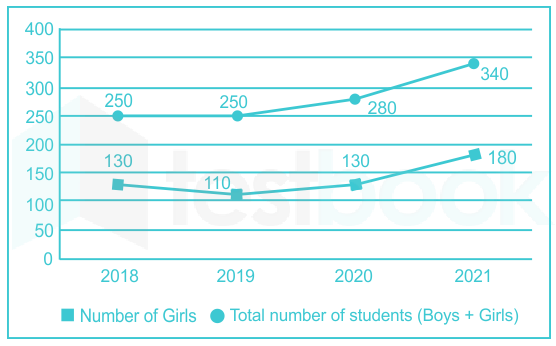
The line graph shows the total number of students [ Boys and Girls] and number of girls in a school in four different years [ 2018, 2019, 2020 and 2021].

Ratio of number of boys in the school on 2021 and 2022 is 2:3. Number of girls on 2022 is 10% less than the number of boys. Find the number of girls on 2022?

  1. AOption (a)

    214

  2. BOption (b)

    220

  3. COption (c)

    230

  4. DOption (d)

    226

  5. EOption (e)

    216

View answer & explanation

Correct answer

Answer: (e)E.

216

Why this answer is correct

Common Calculation

YearNumber of GirlsNumber of Boys
2018130250 – 130 = 120
2019110250 – 110 = 140
2020130280 – 130 = 150
2021180340 – 180 = 160

Calculation

Ratio of boys in 2021 and 2022 = 2:3;

Girls in 2022 are 10% less than boys.

Boys 2022 = 160 × (3/2) = 240

Girls 2022 = 240 × 0.9 = 216

Answer: 216 girls

SBI Clerk Prelims Memory Based Paper (Held On: 20 September 2025 Shift 2) (Previous Year Paper)·Numerical Ability
View full paper

Question 45

SBI Clerk 2025• Numerical Ability• Numerical Ability

The line graph shows the total number of students [ Boys and Girls] and number of girls in a school in four different years [ 2018, 2019, 2020 and 2021].

Difference between number of boys in 2020 and 2019 is 5×. Find the value of 7× + 22?

  1. AOption (a)

    35

  2. BOption (b)

    65

  3. COption (c)

    36

  4. DOption (d)

    75

  5. EOption (e)

    95

View answer & explanation

Correct answer

Answer: (c)C.

36

Why this answer is correct

Common Calculation

YearNumber of GirlsNumber of Boys
2018130250 – 130 = 120
2019110250 – 110 = 140
2020130280 – 130 = 150
2021180340 – 180 = 160

Calculation

Given: Difference between boys in 2020 and 2019 = 5x

Difference = 150 − 140 = 10

5x = 10 → x = 2

7x + 22 = 7 × 2 + 22 = 36

Answer: 36

SBI Clerk Prelims Memory Based Paper (Held On: 20 September 2025 Shift 2) (Previous Year Paper)·Numerical Ability
View full paper

Question 46

SBI Clerk 2025• Numerical Ability• Numerical Ability

The line graph shows the total number of students [ Boys and Girls] and number of girls in a school in four different years [ 2018, 2019, 2020 and 2021].

One teacher per five students in 2019. Find the total number of teachers in school in the year 2019?

  1. AOption (a)

    50

  2. BOption (b)

    60

  3. COption (c)

    5

  4. DOption (d)

    40

  5. EOption (e)

    65

View answer & explanation

Correct answer

Answer: (a)A.

50

Why this answer is correct

Common Calculation

YearNumber of GirlsNumber of Boys
2018130250 – 130 = 120
2019110250 – 110 = 140
2020130280 – 130 = 150
2021180340 – 180 = 160


Calculation

Given: 1 teacher per 5 students

Total students 2019 = 110 + 140 = 250

Teachers = 250 ÷ 5 = 50

Answer: 50 teachers

SBI Clerk Prelims Memory Based Paper (Held On: 20 September 2025 Shift 2) (Previous Year Paper)·Numerical Ability
View full paper

Question 47

SBI Clerk 2025• Numerical Ability• Numerical Ability

The line graph shows the total number of students [ Boys and Girls] and number of girls in a school in four different years [ 2018, 2019, 2020 and 2021].

Find the ratio between total number of students in 2020 and 2018 and total number of boys in 2021 and 2019?

  1. AOption (a)

    7:4

  2. BOption (b)

    8:9

  3. COption (c)

    5:3

  4. DOption (d)

    53:30

  5. EOption (e)

    6:7

View answer & explanation

Correct answer

Answer: (d)D.

53:30

Why this answer is correct

Common Calculation

YearNumber of GirlsNumber of Boys
2018130250 – 130 = 120
2019110250 – 110 = 140
2020130280 – 130 = 150
2021180340 – 180 = 160


Calculation

Total students 2020 + 2018 = 280 + 250 = 530

Total boys 2021 + 2019 = 160 + 140 = 300

Ratio = 530 : 300 = 53 : 30

Answer: 53 : 30

SBI Clerk Prelims Memory Based Paper (Held On: 20 September 2025 Shift 2) (Previous Year Paper)·Numerical Ability
View full paper

Question 48

SBI Clerk 2025• Numerical Ability• Numerical Ability

The line graph shows the total number of students [ Boys and Girls] and number of girls in a school in four different years [ 2018, 2019, 2020 and 2021].

Find the difference between total number of boys and total number of girls in all the given years?

  1. AOption (a)

    20

  2. BOption (b)

    30

  3. COption (c)

    40

  4. DOption (d)

    50

  5. EOption (e)

    60

View answer & explanation

Correct answer

Answer: (a)A.

20

Why this answer is correct

Common Calculation

YearNumber of GirlsNumber of Boys
2018130250 – 130 = 120
2019110250 – 110 = 140
2020130280 – 130 = 150
2021180340 – 180 = 160


Calculation

Total boys = 120 + 140 + 150 + 160 = 570

Total girls = 130 + 110 + 130 + 180 = 550

Difference = 570 − 550 = 20

Answer: 20

SBI Clerk Prelims Memory Based Paper (Held On: 20 September 2025 Shift 2) (Previous Year Paper)·Numerical Ability
View full paper

Question 49

SBI Clerk 2025• Numerical Ability• Numerical Ability

What will come in place of the question mark ‘?’ in the following question?

1347 + 254 + 457 – 3382 + 8745 – 5723 = ?

  1. AOption (a)

    1709

  2. BOption (b)

    1608

  3. COption (c)

    1702

  4. DOption (d)

    1698

  5. EOption (e)

    None of these

View answer & explanation

Correct answer

Answer: (d)D.

1698

Why this answer is correct

Given:

1347 + 254 + 457 – 3382 + 8745 – 5723 = ?

Concept:

Calculation:

1347 + 254 + 457 – 3382 + 8745 – 5723 = ?

⇒ ? = 2058 + 5363 – 5723

⇒ ? = 7421 – 5723

∴ ? = 1698

SBI Clerk Prelims Memory Based Paper (Held On: 20 September 2025 Shift 2) (Previous Year Paper)·Numerical Ability
View full paper

Question 50

SBI Clerk 2025• Numerical Ability• Numerical Ability

What will come in place of question mark (?) in the following equation?

[{(48 ÷ 6 × 3 + 8) ÷ 4 × 5 – 8} × 2 ÷ 4 × 4 + 1] – 3 = ?

  1. AOption (a)

    44

  2. BOption (b)

    56

  3. COption (c)

    62

  4. DOption (d)

    78

  5. EOption (e)

    82

View answer & explanation

Correct answer

Answer: (c)C.

62

Why this answer is correct

Follow BODMAS rule to solve this question, as per the order given below, 

Step-1: Parts of an equation enclosed in 'Brackets' must be solved first, and in the bracket, 

Step-2: Any mathematical 'Of' or 'Exponent' must be solved next, 

Step-3: Next, the parts of the equation that contain 'Division' and 'Multiplication' are calculated, 

Step-4: Last but not least, the parts of the equation that contain 'Addition' and 'Subtraction' should be calculated 

Now, we have

⇒ [{(48 ÷ 6 × 3 + 8) ÷ 4 × 5 – 8} × 2 ÷ 4 × 4 + 1] – 3 = ?

⇒ [{(8 × 3 + 8) ÷ 4 × 5 – 8} × 2 ÷ 4 × 4 + 1] – 3 = ?

⇒ [{(24 + 8) ÷ 4 × 5 – 8} × 2 ÷ 4 × 4 + 1] – 3 = ?

⇒ [{32 ÷ 4 × 5 – 8} × 2 ÷ 4 × 4 + 1] – 3 = ?

⇒ [{8 × 5 – 8} × 2 ÷ 4 × 4 + 1] – 3 = ?

⇒ [{40 – 8} × 2 ÷ 4 × 4 + 1] – 3 = ?

⇒ [32 × 2 ÷ 4 × 4 + 1] – 3 = ?

⇒ [32 × (1/2) × 4 + 1] – 3 = ?

⇒ [64 + 1] – 3 = ?

⇒ 65 – 3 = ?

∴ ? = 62

SBI Clerk Prelims Memory Based Paper (Held On: 20 September 2025 Shift 2) (Previous Year Paper)·Numerical Ability
View full paper

Question 51

SBI Clerk 2025• Numerical Ability• Numerical Ability

What will come in place of question mark ‘?’ in the following question?

(1333 - 339) ÷ 2 + 103 = 21 × 39 - ?

  1. AOption (a)

    126

  2. BOption (b)

    219

  3. COption (c)

    318

  4. DOption (d)

    419

  5. EOption (e)

    200

View answer & explanation

Correct answer

Answer: (b)B.

219

Why this answer is correct

Follow BODMAS rule to solve this question, as per the order given below,

Step-1- Parts of an equation enclosed in 'Brackets' must be solved first, and in the bracket,

Step-2- Any mathematical 'Of' or 'Exponent' must be solved next,

Step-3- Next, the parts of the equation that contain 'Division' and 'Multiplication' are calculated,

Step-4- Last but not least, the parts of the equation that contain 'Addition' and 'Subtraction' should be calculated.

Given expression is,

⇒ (1333 - 339) ÷ 2 + 103 = 21 × 39 - ?

⇒ 994 ÷ 2 + 103 = 21 × 39 - ?

⇒ 497 + 103 = 819 - ?

⇒ 600 = 819 - ?

⇒ ? = 819 - 600

⇒ ? = 219

SBI Clerk Prelims Memory Based Paper (Held On: 20 September 2025 Shift 2) (Previous Year Paper)·Numerical Ability
View full paper

Question 52

SBI Clerk 2025• Numerical Ability• Numerical Ability

What should come in place of question mark ‘?’ in the following number question?

7859 - 1109 + 335 = 20 + 785 × ?

  1. AOption (a)

    3

  2. BOption (b)

    11

  3. COption (c)

    7

  4. DOption (d)

    9

  5. EOption (e)

    5

View answer & explanation

Correct answer

Answer: (d)D.

9

Why this answer is correct

Follow BODMAS rule to solve this question, as per the order given below,

Step-1- Parts of an equation enclosed in 'Brackets' must be solved first, and in the bracket,

Step-2- Any mathematical 'Of' or 'Exponent' must be solved next,

Step-3- Next, the parts of the equation that contain 'Division' and 'Multiplication' are calculated,

Step-4- Last but not least, the parts of the equation that contain 'Addition' and 'Subtraction' should be calculated.

Given expression is,

⇒ 7859 - 1109 + 335 = 20 + 785 × ?

⇒ 8194 - 1109 = 20 + 785 × ?

⇒ 7085 = 20 + 785 × ?

⇒ 7085 - 20 = 785 × ?

⇒ 7065 = 785 × ?

⇒ ? = 7065/785

⇒ ? = 9

SBI Clerk Prelims Memory Based Paper (Held On: 20 September 2025 Shift 2) (Previous Year Paper)·Numerical Ability
View full paper

Question 53

SBI Clerk 2025• Numerical Ability• Numerical Ability

What should come in the place of the question mark (?) in the following question?

[(27 × 10) ÷ 30 + 10500 ÷ 500] = ? × 15

  1. AOption (a)

    1

  2. BOption (b)

    4

  3. COption (c)

    2.65

  4. DOption (d)

    0.90

  5. EOption (e)

    2

View answer & explanation

Correct answer

Answer: (e)E.

2

Why this answer is correct

Given:

[(27 × 10) ÷ 30 + 10500 ÷ 500] = ? × 15

Concept Used:

Calculation:

Suppose x will come in the place of the question mark;

[(27 × 10) ÷ 30 + 10500 ÷ 500] = x × 15

Applying BODMAS Rule;

⇒ [(270) ÷ 30 + 21] = 15x

⇒ 9 + 21 = 15x

⇒ 30 = 15x

∴ x = 2

SBI Clerk Prelims Memory Based Paper (Held On: 20 September 2025 Shift 2) (Previous Year Paper)·Numerical Ability
View full paper

Question 54

SBI Clerk 2025• Numerical Ability• Numerical Ability

What will come in place of question mark ‘?’ in the following question?

{(3654 + 1346) × 2} ÷ 200 = ?

  1. AOption (a)

    50

  2. BOption (b)

    100

  3. COption (c)

    45

  4. DOption (d)

    150

  5. EOption (e)

    70

View answer & explanation

Correct answer

Answer: (a)A.

50

Why this answer is correct

Follow BODMAS rule to solve this question, as per the order given below,

Step 1: Parts of an equation enclosed in 'Brackets' must be solved first, and in the bracket,

Step 2: Any mathematical 'Of' or 'Exponent' must be solved next,

Step 3: Next, the parts of the equation that contain 'Division' and 'Multiplication' are calculated,

Step 4: Last but not least, the parts of the equation that contain 'Addition' and 'Subtraction' should be calculated.

Given expression is,

⇒ {(3654 + 1346) × 2} ÷ 200 = ?

⇒ {(5000) × 2} ÷ 200 = ?

⇒ ? = 10000 ÷ 200

⇒ ? = 50

SBI Clerk Prelims Memory Based Paper (Held On: 20 September 2025 Shift 2) (Previous Year Paper)·Numerical Ability
View full paper

Question 55

SBI Clerk 2025• Numerical Ability• Numerical Ability

What will come in place of question mark '?' in the following question?

579 × 4 + 184 = 1388 ÷ ? + 1112

  1. AOption (a)

    10

  2. BOption (b)

    1

  3. COption (c)

    11

  4. DOption (d)

    100

  5. EOption (e)

    0.1

View answer & explanation

Correct answer

Answer: (b)B.

1

Why this answer is correct

Follow BODMAS rule to solve this question, as per the order given below,

Step-1: Parts of an equation enclosed in 'Brackets' must be solved first, and in the bracket,

Step-2: Any mathematical 'Of' or 'Exponent' must be solved next,

Step-3: Next, the parts of the equation that contain 'Division' and 'Multiplication' are calculated,

Step-4: Last but not least, the parts of the equation that contain 'Addition' and 'Subtraction' should be calculated.

Given expression is,

⇒ 579 × 4 + 184 = 1388 ÷ ? + 1112

⇒ 2316 + 184 = 1388 ÷ ? + 1112

⇒ 2500 = 1388 ÷ ? + 1112

⇒ 2500 – 1112 = 1388 ÷ ?

⇒ 1388 = 1388 ÷ ?

⇒ ? = 1

SBI Clerk Prelims Memory Based Paper (Held On: 20 September 2025 Shift 2) (Previous Year Paper)·Numerical Ability
View full paper

Question 56

SBI Clerk 2025• Numerical Ability• Numerical Ability

What should come in place of question mark (?) in the following question?

5350 - 50 × 3139 ÷ 73 = ? × 64

  1. AOption (a)

    3560

  2. BOption (b)

    50

  3. COption (c)

    150

  4. DOption (d)

    3600

  5. EOption (e)

    75

View answer & explanation

Correct answer

Answer: (b)B.

50

Why this answer is correct

Suppose x will come in place of question mark;

5350 – 50 × 3139 ÷ 73 = x × 64

Applying BODMAS Rule;

⇒ 5350 – 50 × 43 = 64x

⇒ 5350 – 2150 = 64x

⇒ 3200 = 64x

⇒ x = 50

SBI Clerk Prelims Memory Based Paper (Held On: 20 September 2025 Shift 2) (Previous Year Paper)·Numerical Ability
View full paper

Question 57

SBI Clerk 2025• Numerical Ability• Numerical Ability

What will come in place of question (?) in the following question?

(224 ÷ 16 × 33) ÷ 21 = 2 × (? + 3)

  1. AOption (a)

    5

  2. BOption (b)

    10

  3. COption (c)

    11

  4. DOption (d)

    7

  5. EOption (e)

    8

View answer & explanation

Correct answer

Answer: (e)E.

8

Why this answer is correct

Follow BODMAS rule to solve this question, as per the order given below.

Step - 1 - steps of an equation enclosed in ‘Brackets’ must be solved first.

Step - 2 - any mathematical ‘Of’ or ‘Exponent’ must be solved next.

Step - 3 - Next, the parts of the equation that contain ‘Division’ and ‘Multiplication’ are calculated.

Step - 4 - Last but not least, the parts of the equation that contain ‘Addition’ and ‘Subtraction’ should be calculated.

Now, the given expression:

⇒ (224 ÷ 16 × 33) ÷ 21 = 2 × (? + 3)

⇒ (14 × 33) ÷ 21 = 2 × (? + 3)

⇒ 462 ÷ 21 = 2 × ? + 6

⇒ 22 = 2 × ? + 6

⇒ 2 × ? = 22 - 6

⇒ 2 × ? = 16

⇒ ? = 8

SBI Clerk Prelims Memory Based Paper (Held On: 20 September 2025 Shift 2) (Previous Year Paper)·Numerical Ability
View full paper

Question 58

SBI Clerk 2025• Numerical Ability• Numerical Ability

If the compound interest on a certain sum of money for 2 years at 2% per annum  is Rs 323.2. Find the sum.

  1. AOption (a)

    Rs. 8,000

  2. BOption (b)

    Rs. 7,000

  3. COption (c)

    Rs. 4,000

  4. DOption (d)

    Rs. 5,500

  5. EOption (e)

    Rs. 6,500

View answer & explanation

Correct answer

Answer: (a)A.

Rs. 8,000

Why this answer is correct

Shortcut Trick

Effective Rate of Interest for 2 years at 2% = r + r + (r × r)/100 = 2 + 2 + (2 × 2)/100 = 4.04%.

Given Compound Interest (CI) = ₹323.2.

Equating percentage to value: 4.04% of Principal = ₹323.2.

Principal = 323.2 ÷ 0.0404 = ₹8,000.

∴ The correct answer is ₹8,000.

Alternate Method

Given:

Time (T) = 2 years

Rate (R) = 2% per annum

Compound Interest (CI) = ₹323.2

Formula Used:

CI = P[(1 + R/100)T − 1]

Calculations:

⇒ 323.2 = P[(1 + 2/100)2 − 1]

⇒ 323.2 = P[(1.02)2 − 1]

⇒ 323.2 = P[1.0404 − 1]

⇒ 323.2 = P × 0.0404

⇒ P = 323.2 ÷ 0.0404

⇒ P = 3232000 ÷ 404

⇒ P = ₹8,000

∴ The correct answer is ₹8,000.

Additional Information

Effective Interest Rate

For 2 years, the net effective rate for CI is given by x + y + (xy/100). For 2%, it is 2 + 2 + 0.04 = 4.04%.

Difference between CI and SI

The difference for 2 years is P(R/100)2. Here, the difference would be ₹8000 × (0.0004) = ₹3.2.

Amount Formula

Total Amount (A) = Principal (P) + Compound Interest (CI). Also, A = P(1 + R/100)T.

SBI Clerk Prelims Memory Based Paper (Held On: 20 September 2025 Shift 2) (Previous Year Paper)·Numerical Ability
View full paper

Question 59

SBI Clerk 2025• Numerical Ability• Numerical Ability

Two alcohol-water mixtures of ratios 7 ∶ 3 and 3 ∶ 5 are mixed together in the ratio 3 ∶ 4 respectively to form a new mixture. How much alcohol is present in 70 litres of the new mixture?

  1. AOption (a)

    24 litres

  2. BOption (b)

    30 litres

  3. COption (c)

    36 litres

  4. DOption (d)

    42 litres

  5. EOption (e)

    48 litres

View answer & explanation

Correct answer

Answer: (c)C.

36 litres

Why this answer is correct

Shortcut Trick

Proportion of alcohol in Mixture 1 = 7/10 and Mixture 2 = 3/8.

Mixed in ratio 3 : 4 → Total parts = 3 + 4 = 7 units.

Total alcohol in 7 units = [3 × (7/10)] + [4 × (3/8)] = 2.1 + 1.5 = 3.6 units.

Alcohol fraction in final mix = 3.6 / 7.

Alcohol in 70 litres = (3.6 / 7) × 70 = 36 litres.

∴ The correct answer is 36 litres.

Alternate Method

Given: Ratio in Mix 1 = 7 : 3, Ratio in Mix 2 = 3 : 5, Mixing ratio = 3 : 4, Total quantity = 70 litres.

Formula: Total Alcohol = Σ(Quantity × Alcohol Fraction)

⇒ Quantity of Mix 1 = [3 / (3 + 4)] × 70 = 30 litres.

⇒ Quantity of Mix 2 = [4 / (3 + 4)] × 70 = 40 litres.

⇒ Alcohol from Mix 1 = 30 × (7 / (7 + 3)) = 30 × (7/10) = 21 litres.

⇒ Alcohol from Mix 2 = 40 × (3 / (3 + 5)) = 40 × (3/8) = 15 litres.

⇒ Total Alcohol = 21 + 15 = 36 litres.

∴ The correct answer is 36 litres.

Additional Information

Alligation Method

Used to find the ratio in which two ingredients at given prices/concentrations must be mixed to produce a mixture of a desired price/concentration.

Fractional Mixing

When mixing two ratios A:B and C:D in ratio m:n, ensure the sum of parts (A+B and C+D) are made equal or scaled to m and n respectively before adding.

SBI Clerk Prelims Memory Based Paper (Held On: 20 September 2025 Shift 2) (Previous Year Paper)·Numerical Ability
View full paper

Question 60

SBI Clerk 2025• Numerical Ability• Numerical Ability

The given table shows the number of cakes sold in three shops [A, B, and C] in four days [ Sunday, Monday, Tuesday, and Wednesday].  

DayCakes sold in shop ACakes sold in shop BCakes sold in shop C
Sunday845564
Monday483232
Tuesday565048
Wednesday706548

Find the difference between total cakes sold On Sunday in all shops together and total cakes sold in Monday in all shops together?

  1. AOption (a)

    68

  2. BOption (b)

    91

  3. COption (c)

    9

  4. DOption (d)

    147

  5. EOption (e)

    66

View answer & explanation

Correct answer

Answer: (b)B.

91

Why this answer is correct

Calculation

Sunday total = 84 + 55 + 64 = 203

Monday total = 48 + 32 + 32 = 112

Difference = 203 – 112 = 91

How should I prepare for Quantitative Aptitude in SBI Clerk?

Solving previous year questions by topic helps identify recurring concepts, question patterns, and frequently asked sub-topics. Attempt each question, review the step-by-step explanation, and note down key formulas or facts for quick revision before the exam.