Official Paper

SBI Clerk Prelims Memory Based Paper (Held On: 20 September 2025 Shift 2) (Previous Year Paper)

100 questions · 60 minutes · with answers · free

English Language (30 questions)

1

Directions: In the following question, a sentence is given with four words marked as (A), (B), (C), and (D). These words may or may not be placed in the correct order. Four options with different arrangements of these words have been provided. Mark the option with the correct arrangement as the answer. If no rearrangement is required, mark option (5) as your answer.

Doctors could not culprit**(A)** the specific toxin(B) that was making the patient sick(C), so they ordered more tests to look for the identify**(D)**.

  1. ((a))

    A-D

  2. ((b))

    B-C

  3. ((c))

    C-D

  4. ((d))

    B-D

  5. ((e))

    No change required

Show Answer
Answer: ((a))

A-D

The correct answer is 'A-D.'

Key Points

  • The given sentence talks about the doctors who could not recognize the specific poisonous substance that was making the patient ill so they ordered more tests to look for the cause of the problem.
  • Let us explore the meaning of the highlighted words:
  • Culprit - The cause of a problem or defect. (किसी समस्या या दोष का कारण)
  • Toxin - A poisonous substance. (विषैला पदार्थ; जीवविष)
  • Sick - Not well; ill. (स्‍वस्‍थ नहीं; बीमार)
  • Identify - To recognize or be able to say who or what somebody or something is. (व्‍यक्ति या वस्‍तु की पहचान करना या बता सकना कि यह व्‍यक्ति कौन है या यह वस्‍तु क्‍या है)
  • Thus, (A) and (D) must be interchanged.

Hence, the correct answer is option 1.

Correct Sentence: Doctors could not identify the specific toxin that was making the patient sick, so they ordered more tests to look for the culprit.
2

Directions: In the following question, a sentence is given with four words marked as (A), (B), (C), and (D). These words may or may not be placed in the correct order. Four options with different arrangements of these words have been provided. Mark the option with the correct arrangement as the answer. If no rearrangement is required, mark option (5) as your answer.

To ensure(A) the soda doesn’t strategic**(B), try to be spew(C)** about how slowly and carefully(D) you open it.

  1. ((a))

    A-C

  2. ((b))

    A-D

  3. ((c))

    B-C

  4. ((d))

    B-A

  5. ((e))

    No change required

Show Answer
Answer: ((c))

B-C

The correct answer is 'B-C.'

Key Points

  • The given sentence talks about trying to be calculated while opening soda to make sure that it doesn't flow out quickly.
  • Let us explore the meaning of the highlighted words:
  • Ensure - To make sure that something happens or is definite. (किसी बात को सुनिश्‍चित करना, किसी बात का सुनिश्‍चित होना)
  • Strategic - Designed or planned to serve a particular purpose. (लक्ष्‍य की प्राप्ति में सहायक युक्तिपूर्ण; किसी को लाभ की स्थिति में पहुँचाते हुए, अनुकूल)
  • Spew - To flow out quickly or to make something flow out quickly, in large amounts. (तेज़ प्रवाह से बहना या प्रवाहित करना, विशेषतः बड़ी मात्रा में)
  • Carefully - In a way that deliberately avoids harm or errors; cautiously. (ध्यानपूर्वक, सावधानी से)
  • Thus, (B) and (C) must be interchanged.

Hence, the correct answer is option 3.

Correct Sentence: To ensure the soda doesn’t spew, try to be strategic about how slowly and carefully you open it.

3

In the following question, a sentence is given with four words marked as (A), (B) (C), and (D). These words may or may not be placed in the correct order. Four options with different arrangements of these words have been provided

The power(A) of population is so subsistence(B) to the power of the earth to produce superior(C) for man, that premature(D) death must in some shape or other visit the human race.

  1. ((a))

    A-B

  2. ((b))

    A-C

  3. ((c))

    B-C

  4. ((d))

    C-D

  5. ((e))

    B-D

Show Answer
Answer: ((c))

B-C

The correct answer is B-C.

Key Points

  • The words 'subsistence' and 'superior' have been placed incorrectly, they have to be replaced with each other to make the sentence meaningful and contextually correct.
  • Subsistence means 

the action or fact of maintaining or supporting oneself, especially at a minimal level.

  • Superior means 

higher in rank, status, or quality.

  • The correct sentence is: The power of population is so superior to the power of the earth to produce subsistence for man, that premature death must in some shape or other visit the human race.
  • Hence, the correct answer is option 3.


Additional Information

  • Let's look at the meaning of some difficult words from the sentence.
  • premature: 

occurring or done before the usual or proper time; too early.

4

In the following question, a sentence is given with four words marked as (A), (B) (C), and (D). These words may or may not be placed in the correct order. Four options with different arrangements of these words have been provided.

This new and constantly expanding systematic**(A)** of state activity required the sphere**(B)** and regular collection of social(C) statistics – or quantitative data on various aspects(D) of the population and economy.

  1. ((a))

    A-C

  2. ((b))

    B-D

  3. ((c))

    A-B

  4. ((d))

    C-D

  5. ((e))

    B-C

Show Answer
Answer: ((c))

A-B

The correct answer is A-B.

Key Points

  • The words 'sphere' and 'systematic' have been placed incorrectly, they have to be replaced with each other to make the sentence meaningful and contextually correct.
  • A sphere is a geometrical shape here it is used metaphorically to explain the constantly expanding state of activity.
  • Systematic

done or acting according to a fixed plan or system; methodical.

  • The correct sentence is This new and constantly expanding sphere of state activity required the systematic and regular collection of social statistics – or quantitative data on various aspects of the population and economy
  • Hence, the correct answer is option 3.


 Additional Information

  • Let's look at the meaning of some difficult words from the sentence.
  • quantitative:  

relating to, measuring, or measured by the quantity of something rather than its quality.

  • aspects

a particular part or feature of something.

5

Direction: Evaluate the following word, accompanied by three sentences containing it. Determine the sentence(s) that accurately convey the meaning of the given word.

Curse

A. The witch's curse turned the prince into a frog.

B. She mumbled a curse under her breath after stubbing her toe.

C. They decided to curse the meat before cooking it on the grill.

  1. ((a))

    Only A

  2. ((b))

    Both A & B

  3. ((c))

    Only C

  4. ((d))

    All A, B & C

  5. ((e))

    None of these

Show Answer
Answer: ((b))

Both A & B

The correct answer is option 2.

Key Points

  • To answer this question, let's first understand the meaning of the word given in the question:
  • Curse: an appeal to a supernatural power to inflict harm, punishment, or damage on someone or something; a swear word. (शाप / अभिशाप)
  • Now, let's examine the given sentences:
  • Sentence A: The witch's curse turned the prince into a frog.
  • This sentence correctly uses the word "curse" to describe a supernatural power causing harm (turning someone into a frog).
  • Sentence B: She mumbled a curse under her breath after stubbing her toe.
  • This sentence correctly uses the word "curse" to describe uttering a swear word when in pain or frustration.
  • Sentence C: They decided to curse the meat before cooking it on the grill.
  • This sentence does not correctly use the word "curse", as it does not make sense to inflict harm or use swear words in the context of cooking meat.
  • So, both Sentence A and Sentence B correctly use the word "curse", but Sentence C does not.

Therefore, the correct answer is "Both A and B."

Directions: Read the given passage carefully to answer the following questions. Each question will have five alternatives as its answer. Choose the correct option as your answer.

Kanchana, a young tech-savvy lady from the village of Rajapur, has been a whirlwind of innovation and progress ever since she was elected Sarpanch of the village panchayat. Her journey began with a keen interest in technology and a deep-seated concern for the agricultural well-being of her community. Understanding the critical importance of water conservation in farming, Kanchana took the bold action of developing a system that would prevent water waste and improve irrigation facilities. Kanchana's most significant achievement has been the creation of a unique system that alerts residents when their water tanks are full. She installed sensors in the water tanks of eight different villages under the panchayat's jurisdiction. These sensors send real-time data to a central server, which then triggers automated voice messages to the residents' mobile phones. This system ensures that the tanks do not overflow, thereby conserving water—a resource that is invaluable for agriculture.

Beyond her work with water tanks, Kanchana has also focused on comprehensive irrigation improvements. She organised and led initiatives to clean the lakes in the village, which had long been neglected and filled with debris. This not only revived the lakes, making them viable sources of water for irrigation, but also generated employment for the villagers who participated in the cleaning drives. Additionally, she took steps to install solar-powered lights around the lakes, providing both security and utility for the local community. Her leadership has been instrumental in transforming the agricultural landscape of Rajapur. By leveraging technology and mobilising the community, Kanchana has effectively addressed the issues of water scarcity and unemployment. Her innovative approach and dedication to sustainable development have set a benchmark for rural _________. Through her actions, Kanchana is proving that even the most remote villages can thrive with the right combination of traditional wisdom and modern advancements.

6

According to the passage, which of the following technologies did Kanchana use to prevent water tanks from overflowing?

  1. ((a))

    Mobile applications

  2. ((b))

    Water-level sensors

  3. ((c))

    Surveillance cameras

  4. ((d))

    Manual monitoring systems

  5. ((e))

    Drones

Show Answer
Answer: ((b))

Water-level sensors

The correct answer is Option 2.


Key Points

  • Kanchana installed water-level sensors in the water tanks of eight different villages.
  • These sensors send real-time data to a central server, which alerts residents when their water tanks are full.
  • This system helps to prevent the tanks from overflowing, thereby conserving water.

Therefore, the correct answer is Option 2.


Additional Information

  • Options 1, 3, 4, and 5 – These technologies were not mentioned in the context of preventing water tanks from overflowing.
  • Kanchana's innovative use of technology showcases a successful application of modern advancements to traditional agricultural practices.
  • Her approach serves as an excellent model for water conservation in rural areas.
7

The passage states that Kanchana organised initiatives to clean the lakes to achieve which of the following results?

  1. ((a))

    Reduce pollution

  2. ((b))

    Improve fish breeding

  3. ((c))

    Generate employment

  4. ((d))

    Promote tourism

  5. ((e))

    Increase groundwater levels

Show Answer
Answer: ((c))

Generate employment

The correct answer is Option 3.


Key Points

  • Kanchana organised and led initiatives to clean the lakes in the village.
  • This action revived the lakes, making them viable sources of water for irrigation.
  • The cleaning drives also generated employment for the villagers who participated in them.

Therefore, the correct answer is Option 3.


Additional Information

  • Option 1 – While reducing pollution might be a beneficial side effect, it is not explicitly mentioned as a goal in the passage.
  • Option 2 – Improving fish breeding is not mentioned in the passage.
  • Option 4 – Promoting tourism is not mentioned in the passage.
  • Option 5 – Increasing groundwater levels is not mentioned as a primary goal in the passage.
8

Which, out of the following, is true according to the passage?

  1. ((a))

    Kanchana used traditional irrigation techniques.

  2. ((b))

    Kanchana neglected the lakes in favour of water tanks.

  3. ((c))

    Solar-powered lights were installed around the village schools.

  4. ((d))

    Employment was generated through lake cleaning drives.

  5. ((e))

    The central server was managed by government officials.

Show Answer
Answer: ((d))

Employment was generated through lake cleaning drives.

The correct answer is Option 4.


Key Points

  • The passage mentions that Kanchana organised and led initiatives to clean the lakes in the village.
  • These cleaning drives not only revived the lakes but also generated employment for the villagers who participated in them.

Therefore, the correct answer is Option 4.


Additional Information

  • Option 1 – Kanchana leveraged technology, not traditional irrigation techniques, to improve irrigation facilities.
  • Option 2 – Kanchana did not neglect the lakes; she organised initiatives to clean them.
  • Option 3 – Solar-powered lights were installed around the lakes, not the village schools.
  • Option 5 – There is no mention of government officials managing the central server; it is implied to be part of Kanchana's initiative.
9

According to the author, how did Kanchana’s system alert residents when their water tanks were full?

  1. ((a))

    Through radio broadcasts

  2. ((b))

    By sending SMS messages

  3. ((c))

    By triggering automated voice messages

  4. ((d))

    Through community meetings

  5. ((e))

    By using social media notifications

Show Answer
Answer: ((c))

By triggering automated voice messages

The correct answer is Option 3.


Key Points

  • The passage mentions that sensors in the water tanks send real-time data to a central server.
  • This server then triggers automated voice messages to the residents' mobile phones when their water tanks are full.

Therefore, the correct answer is Option 3.


Additional Information

  • Option 1 – The passage does not mention radio broadcasts being used for this purpose.
  • Option 2 – The passage specifies voice messages, not SMS messages.
  • Option 4 – The passage does not mention community meetings being used for this purpose.
  • Option 5 – The passage does not mention social media notifications being used for this purpose.
10

The passage indicates that Kanchana's innovative approach and dedication to sustainable development have set a benchmark for rural _________.

  1. ((a))

    improvement

  2. ((b))

    irrigation

  3. ((c))

    leadership

  4. ((d))

    technology

  5. ((e))

    governance

Show Answer
Answer: ((e))

governance

The correct answer is 'governance'.


Key Points

  • The word "governance" refers to the act or manner of governing or ruling (शासन).
  • Kanchana’s initiatives involve overseeing various improvements in the village, emphasizing good governance.
  • The other options: "improvement," "irrigation," "leadership," and "technology" do not encapsulate the overall impact of Kanchana’s efforts as comprehensively.

​Therefore, the correct answer is 'Option 5'.

Complete Sentence: Her innovative approach and dedication to sustainable development have set a benchmark for rural governance.

Additional Information

  • Improvement (सुधार): means making something better.
  • Irrigation (सिंचाई): refers to the supply of water to land or crops to help growth.
  • Leadership (नेतृत्‍व): relates to the action of leading a group or an organization.
  • Technology (तकनीकी): involves the application of scientific knowledge for practical purposes.
11

Which of the following words is similar in meaning to "action" as used in the passage?

  1. ((a))

    Decision

  2. ((b))

    Effort

  3. ((c))

    Response

  4. ((d))

    Measure

  5. ((e))

    Reaction

Show Answer
Answer: ((d))

Measure

The correct answer is: Measure.

Key Points

  • The word "action" means a deed or act; something done to achieve a purpose. (कार्य)
  • Example: The company's action to reduce waste has received widespread praise.
  • "Measure" refers to a step or action taken to achieve a particular aim. (उपाय)
  • Example: The government implemented several measures to control inflation.
  • Hence, we can infer that "measure" is similar in meaning to "action" as used in the passage.

Therefore, the correct answer is: Measure.

Additional Information

Here are the other options explained along with their Hindi meanings and example sentences:

  • Decision (निर्णय): A conclusion or resolution reached after consideration.
  • Example: Her decision to pursue higher education raised her career prospects.
  • Effort (प्रयास): A vigorous or determined attempt.
  • Example: It took a lot of effort to complete the project on time.
  • Response (प्रतिक्रिया): A reaction to something.
  • Example: Her positive response to the feedback was appreciated by her colleagues.
  • Reaction (प्रतिक्रिया): An action performed or feeling experienced in response to a situation or event.
  • Example: His reaction to the surprise party was one of genuine delight.
12

Which of the following words is opposite in meaning to "leading" as used in the passage?

  1. ((a))

    Following

  2. ((b))

    Participating

  3. ((c))

    Contributing

  4. ((d))

    Managing

  5. ((e))

    Developing

Show Answer
Answer: ((a))

Following

The correct answer is: Following.

Key Points

  • The word "leading" means guiding or directing a group, organisation, or effort. (नेतृत्व करना)
  • Example: She has been leading the project with great skill and dedication.
  • "Following" refers to coming after or behind someone, especially as a subordinate or a less prominent contributor. (पालन करना)
  • Example: He was following the leader's instructions carefully.
  • Hence, we can infer that "following" is opposite in meaning to "leading" as used in the passage.

Therefore, the correct answer is: Following.

Additional Information

Here are the other options explained along with their Hindi meanings and example sentences:

  • Participating (भाग लेना): Taking part in an activity or event.
  • Example: He was actively participating in the workshop.
  • Contributing (योगदान देना): Giving (time, money, effort, etc.) as part of an effort or situation.
  • Example: Many individuals are contributing to the relief fund.
  • Managing (प्रबंध करना): Being in charge of organization, control, or administration.
  • Example: She is managing the entire department efficiently.
  • Developing (विकसित करना): Growing or changing into a more advanced form.
  • Example: The company is developing a new software application.
13

According to the passage, which of the given statements is correct?

A) The sensors in the water tanks sent real-time data to a central server.

B) The lights around the lakes were powered by hydroelectric energy.

C) Kanchana's system sends text messages to the residents' mobile phones.

  1. ((a))

    Only A

  2. ((b))

    Only B

  3. ((c))

    Only C

  4. ((d))

    A and B

  5. ((e))

    B and C

Show Answer
Answer: ((a))

Only A

The correct answer is Option 1.


Key Points

  • Statement A: The sensors in the water tanks sent real-time data to a central server.
  • This statement is correct as it accurately reflects the context provided in the passage.
  • Statement B: The lights around the lakes were powered by hydroelectric energy.
  • The passage mentions that the lights around the lakes were solar-powered, which contradicts this statement.
  • Statement C: Kanchana's system sends text messages to the residents' mobile phones.
  • The passage states that the system triggers automated voice messages, not text messages, which contradicts this statement.

Therefore, the correct answer is: ‘Only A’.

14

The given sentence is divided into four parts; A, B, C and D. Choose the part that contains an error as your answer. If the sentence is error-free, mark E i.e. No error as your answer.

A recent study has shown that (A) / the number of people opting for online banking (B) / are increasing steadily (C) / over the past few years. (D) / No error (E)

  1. ((a))

    A

  2. ((b))

    B

  3. ((c))

    C

  4. ((d))

    D

  5. ((e))

    E

Show Answer
Answer: ((c))

C

The Correct answer is 'Option 3.'

Key Points

  • Part C of the sentence i.e. 'are increasing steadily' is erroneous.
  • The subject of the sentence is "the number of people," which is singular.
  • The verb in the sentence 'has been' singular to agree with the subject. "Are increasing" is plural and does not agree with the singular subject.
  • Hence, The correct answer is 'C'
  • The correct answer is " A recent study has shown that the number of people opting for online banking has been increasing steadily over the past few years."

Additional Information

  • Option 1: "A recent study has shown that" - This part is grammatically correct.
  • Option 2: "the number of people opting for online banking" - This part is grammatically correct.
  • Option 4: "over the past few years" - This part is grammatically correct.
15

Direction: The given sentence is divided into four parts: A, B, C, and D. Choose the part that contains an error as your answer. If the sentence is error-free, mark E i.e. No error as your answer.

<br>

At the last meeting, (A)/ which was held in August  (B)/ last year in Brussels, half of the members (C)/ submitted their resignations on protest. (D)/ No Error (E)

  1. ((a))

    A

  2. ((b))

    B

  3. ((c))

    C

  4. ((d))

    D

  5. ((e))

    E

Show Answer
Answer: ((d))

D

The correct answer is 'Option 4'.

Key Points

  • In the given sentence, the use of the preposition 'on' is incorrect.
  • The preposition 'on' means about something.
  • The use of the word 'protest' in the sentence indicates an action that shows that you do not like or approve of something.
  • Therefore, the preposition 'in' should be used in place of the preposition 'on'.
  • The preposition 'in' is used to show the activity somebody is involved in.

 Therefore, the correct answer is 'submitted their resignations in protest.'

Correct sentence: "At the last meeting, which was held in August last year in Brussels, half of the members submitted their resignations in protest."

16

The given sentence is divided into four parts; A, B, C, and D. Choose the part that contains an error as your answer. If the sentence is error-free, mark E i.e. No error as your answer.

Despite of his busy schedule, (A) / he managed to complete (B) / all his tasks (C) / well before the deadline. (D) / No error (E)

  1. ((a))

    A

  2. ((b))

    B

  3. ((c))

    C

  4. ((d))

    D

  5. ((e))

    E

Show Answer
Answer: ((a))

A

The Correct answer is 'Option 1.'

Key Points

  • Part A of the sentence i.e. 'Despite of  his busy schedule' is erroneous.'
  • The preposition "despite" is followed by a noun clause or a gerund phrase, not a prepositional phrase.
  • "Despite of" is not a common or grammatically correct construction.
  • Hence, The correct answer is 'Option A.'
  • The correct answer is "Despite his busy schedule, he managed to complete all his tasks well before the deadline."

Additional Information

  • Option 2: "he managed to complete" - This part is grammatically correct.
  • Option 3: "all his tasks" - This part is grammatically correct.
  • Option 4: "well before the deadline" - This part is grammatically correct.
17

Direction: The given sentence is divided into four parts: A, B, C, and D. Choose the part that contains an error as your answer. If the sentence is error-free, mark E i.e. No error as your answer.

Each of the students in the class (A)/ are required (B)/ to submit their chemistry assignments (C)/ by the end of the week. (D)/ No error. (E)

  1. ((a))

    A

  2. ((b))

    B

  3. ((c))

    C

  4. ((d))

    D

  5. ((e))

    E

Show Answer
Answer: ((b))

B

The correct answer is "Option 2".

Key Points

  • The erroneous part is the use of the verb "are".
  • The subject of the given sentence is "each" which is singular, so it requires a singular verb.
  • The verb "are" is plural, it should be replaced with the singular form "is" to maintain subject-verb agreement.
  • ExampleEach of the participants was willing to perform.
  • Hence, the erroneous part "are" should be replaced with "is".

Therefore, the correct answer is "Option 2".

Correct Sentence: "Each of the students is required to submit their assignments by the end of the week."

Additional Information

  • Phrases containing "each," "every," "either," and "neither" are always singular and take singular verbs.
  • ExampleEvery book on the shelf belongs to me.
  • ExampleNeither option seems satisfactory.
18

Direction: The given sentence is divided into four parts: A, B, C, and D. Choose the part that contains an error as your answer. If the sentence is error-free, mark E i.e. No error as your answer.

Companies like Infosys are moving fast (A)/ on automation and AI to ensure differentiation at a time (B)/ where the technology industry and business models (C)/ are undergoing rapid changes. (D)/ No Error (E)

  1. ((a))

    B

  2. ((b))

    E

  3. ((c))

    D

  4. ((d))

    A

  5. ((e))

    C

Show Answer
Answer: ((e))

C

The correct answer is: 'Option 5'.

Key Points

  • The error part lies in Part 'C' that is; 'where the technology industry and business models'.
  • The given sentence speaks about a time frame of companies and their future method of working.
  • Generally, we use 'where' in 'place' and 'when' in 'time'.
  • So, replacing 'where' with 'when' will make the sentence correct as the sentence speaks about time, not place.
  • Hence, the correct answer is: 'C'.
  • Correct sentence: Companies like Infosys are moving fast on automation and AI to ensure differentiation at a time when the technology industry and business models are undergoing rapid changes.
19

Directions: Select the phrase from the options below that should replace the underlined phrase in the sentence to make it grammatically and contextually correct. If the sentence is already correct, select 'No correction required' as your answer. 

He quickly adapted to the new role and excelled in his duties from the start.

  1. ((a))

    adapted quick to the new role

  2. ((b))

    adapted quickly to the new role

  3. ((c))

    quickly adapted for the new role

  4. ((d))

    adapted quickly for the new role

  5. ((e))

    No correction required

Show Answer
Answer: ((e))

No correction required

The correct answer is 'No correction required'.


Key Points

  • The original phrase "quickly adapted to the new role" is grammatically and contextually correct.
  • The adverb "quickly" appropriately modifies the verb "adapted" to describe how the action was performed.
  • The preposition "to" is correctly used after "adapt" when it means to adjust to new conditions, environments, or roles.

Therefore, the correct answer is Option 5.


Complete Sentence: "He quickly adapted to the new role and excelled in his duties from the start."


Additional Information

  • Option 1: "adapted quick" is incorrect because "quick" is an adjective, but an adverb is needed to modify the verb.
  • Option 2: "adapted quickly to" is grammatically correct as well, but it does not improve upon the original phrase, hence no correction is required.
  • Options 3 and 4: "adapted for" is incorrect in this context. You adapt to a situation or role, whereas you adapt something for a specific purpose (like adapting a book for a movie).
20

Directions: Select the phrase from the options below that should replace the underlined phrase in the sentence to make it grammatically and contextually correct. If the sentence is already correct, select 'No correction required' as your answer. 

As the boys missed the bus, they couldn’t able to reach the school on time.

  1. ((a))

    couldn’t reach

  2. ((b))

    wasn’t able to reach

  3. ((c))

    could reach

  4. ((d))

    couldn’t able to reach

  5. ((e))

    No correction required

Show Answer
Answer: ((a))

couldn’t reach

The correct answer is 'couldn’t reach'.


Key Points

  • The phrase "couldn’t reach" is the grammatically correct form to express inability in the past.
  • "Couldn’t able to reach" is incorrect because "could" and "able to" should not be used together.
  • "Wasn’t able to reach" is possible, but does not match the given options as closely as "couldn’t reach."

Therefore, the correct answer is Option 1.


Complete Sentence: "As the boys missed the bus, they couldn’t reach the school on time."


Additional Information

  • Option 2: "wasn’t able to reach" is correct in meaning but not the best fit among options provided.
  • Option 3: "could reach" is incorrect as it expresses ability, not inability.
  • Option 4: "couldn’t able to reach" is grammatically incorrect.
  • Option 5: "No correction required" is incorrect because the original sentence contains an error.
21

Directions: Select the most appropriate word to fill in the blank.

Central universities, apparently, have no option but to follow the _______.

  1. ((a))

    Inundate

  2. ((b))

    Validate

  3. ((c))

    Mandate

  4. ((d))

    Accommodate

  5. ((e))

    Predate

Show Answer
Answer: ((c))

Mandate

The correct answer is 'Mandate.'

Key Points

  • The given sentence is talking about Central universities having no option other than to follow the official order.
  • Therefore, the most appropriate word to be filled in the blank is 'Mandate'.
  • Also, the use of the word ''follow'' in the sentence indicates the use of the word 'mandate' in the blank.
  • The word 'Mandate' means An official order or commission to do something.
  • Example: The President had a clear mandate to end the war.

Hence, the correct answer is option 3.

Complete Sentence: Central universities, apparently, have no option but to follow the mandate.

Additional Information

  • Let us explore  the other options:
  • Inundate means To overwhelm someone with things or people to be dealt with.
  • Validate means To show that something is true.
  • Accommodate means To provide somebody with a place to stay, live or work.
  • Predate means To exist or occur at a date earlier than something.
22

Directions: Select the most appropriate word to fill in the blank.

The U.S. remains the world’s pre-eminent power but its _______ to shape global geopolitical outcomes substantially diminished.

  1. ((a))

    Abnormality

  2. ((b))

    Compatibility

  3. ((c))

    Ability

  4. ((d))

    Probability

  5. ((e))

    Agility

Show Answer
Answer: ((c))

Ability

The correct answer is 'Ability.'

Key Points

  • The given sentence is talking about the decrease in the skill of the U.S. to shape global geopolitical outcomes.
  • Therefore, the most appropriate word to be filled in the blank is 'Ability'.
  • Also, the use of the word ''shape'' in the sentence indicates the use of the word 'ability' in the blank.
  • The word 'Ability' means Possession of the means or skill to do something.
  • Example: He has the ability to do his job well.

Hence, the correct answer is option 3.

Complete Sentence: The U.S. remains the world’s pre-eminent power but its ability to shape global geopolitical outcomes substantially diminished.

Additional Information

  • Let us explore  the other options:
  • Abnormality means An abnormal feature, characteristic, or occurrence.
  • Compatibility means A state in which two things are able to exist or occur together without problems or conflict.
  • Probability means The extent to which something is likely to happen or be the case.
  • Agility means The ability to move quickly and easily.
23

Directions: Select the most appropriate word to fill in the blank.

Some have likened the leaked document as being the equivalent of the Pentagon Papers that _______ during the Nixon era.

  1. ((a))

    Disgraced

  2. ((b))

    Ceased

  3. ((c))

    Surfaced

  4. ((d))

    Interceded

  5. ((e))

    Superseded

Show Answer
Answer: ((c))

Surfaced

The correct answer is 'Surfaced.'

Key Points

  • The given sentence is talking about the leaked document equivalent to Pentagon Papers that became apparent or came to people's attention during the Nixon era.
  • Therefore, the most appropriate word to be filled in the blank is 'Surfaced'.
  • Also, the use of the word ''equivalent'' in the sentence indicates the use of the word 'surfaced' in the blank.
  • The word 'Surfaced' means To come to people's attention; become apparent.
  • Example: A rumor has surfaced that the company is about to go out of business.

Hence, the correct answer is option 3.

Complete Sentence: Some have likened the leaked document as being the equivalent of the Pentagon Papers that surfaced during the Nixon era.

Additional Information

  • Let us explore  the other options:
  • Disgraced means To behave badly in a way that makes you or other people feel sorry and embarrassed.
  • Ceased means To stop or end.
  • Interceded means To intervene on behalf of another.
  • Superseded means To take the place of a person or thing previously in authority or use; supplant.
24

Directions: Select the most appropriate word to fill in the blank.

One had to _______ an HMT wristwatch weeks in advance.

  1. ((a))

    Book

  2. ((b))

    Novel

  3. ((c))

    Extent

  4. ((d))

    Harass

  5. ((e))

    Heave

Show Answer
Answer: ((a))

Book

The correct answer is 'Book.'

Key Points

  • The given sentence is talking about the earlier times when one had to reserve an HMT wristwatch beforehand.
  • Therefore, the most appropriate word to be filled in the blank is 'Book'.
  • Also, the use of the word ''advance'' in the sentence indicates the use of the word 'book' in the blank.
  • The word 'Book' means To reserve or buy something in advance.
  • Example: I would like to book a table for tonight.

Hence, the correct answer is option 1.

Complete Sentence: One had to book an HMT wristwatch weeks in advance.

Additional Information

  • Let us explore  the other options:
  • Novel means A book that tells a story about people and events that are not real.
  • Extent means The length, area, size, or importance of something.
  • Harass means To annoy or worry somebody by doing unpleasant things to him/her, especially over a long time.
  • Heave means To throw something heavy.
25

Directions: Select the most appropriate word to fill in the blank.

One of the reasons for celebrating the _______ of 75 years of India is that it has survived as long.

  1. ((a))

    Depletion

  2. ((b))

    Intimidation

  3. ((c))

    Intervention

  4. ((d))

    Attenuation

  5. ((e))

    Completion

Show Answer
Answer: ((e))

Completion

The correct answer is 'Completion.'

Key Points

  • The given sentence is talking about celebrating the process of completing or finishing 75 years of India.
  • Therefore, the most appropriate word to be filled in the blank is 'Completion'.
  • Also, the use of the word ''celebrating'' in the sentence indicates the use of the word 'completion' in the blank.
  • The word 'Completion' means The action or process of completing or finishing something.
  • Example: We congratulated them on the successful completion of the project.

Hence, the correct answer is option 5.

Complete Sentence: One of the reasons for celebrating the completion of 75 years of India is that it has survived as long.

Additional Information

  • Let us explore  the other options:
  • Depletion means A reduction in the number or quantity of something.
  • Intimidation means The action of intimidating someone, or the state of being intimidated.
  • Intervention means The action or process of intervening.
  • Attenuation means The reduction of the force, effect, or value of something.

Rearrange the following five sentences/group of sentences (A), (B), (C), (D), and (E) in the proper sequence to form a meaningful paragraph; then answer the questions given below them.

A. All of these have of late been areas of concern for the regulator.

B. At the meetings, governor Shaktikanta Das asked banks to strengthen their capital and provisioning positions.

C. The other issues discussed in the meeting included an assessment of the current economic situation and outlook.

D. The meetings were also attended by deputy governors of RBI.

E. The governor of the Reserve Bank of India held meetings with the chiefs of public sector banks and some private banks.

26

Which of the following should be the FIRST sentence after the arrangement?

  1. ((a))

    E

  2. ((b))

    B

  3. ((c))

    C

  4. ((d))

    A

  5. ((e))

    D

Show Answer
Answer: ((a))

E

The correct answer is E.

Key Points

  • The first sentence is E as it is introducing the topic by mentioning about a meeting.
  • The second sentence is D as it mentions that the deputy government also attended the meeting.
  • The third sentence is B as it mentions what was said at the meeting.
  • The fourth sentence is C. It informs that some other issues were also discussed at the meeting.
  • The last sentence is A as it is concluding the passage by mentioning the purpose behind the discussion of these issues.
  • Thus the correct sequence is EDBCA.
  • The first sentence is E.

Additional Information

Concern: to relate to or to worry

Regulator: a person or body that supervises a certain industry

Assessment: evaluation or judgement

27

Which of the following should be the THIRD sentence after the arrangement?

  1. ((a))

    A

  2. ((b))

    C

  3. ((c))

    B

  4. ((d))

    D

  5. ((e))

    E

Show Answer
Answer: ((c))

B

The correct answer is B.

  • The first sentence is E as it is introducing the topic by mentioning about a meeting.
  • The second sentence is D as it mentions that the deputy government also attended the meeting.
  • The third sentence is B as it mentions what was said at the meeting.
  • The fourth sentence is C. It informs that some other issues were also discussed at the meeting.
  • The last sentence is A as it is concluding the passage by mentioning the purpose behind the discussion of these issues.
  • Thus the correct sequence is EDBCA.
  • The third sentence is B.

Concern: to relate to or to worry

Regulator: a person or body that supervises a certain industry

Assessment: evaluation or judgement

28

Which of the following should be the FOURTH sentence after the arrangement?

  1. ((a))

    B

  2. ((b))

    D

  3. ((c))

    C

  4. ((d))

    A

  5. ((e))

    E

Show Answer
Answer: ((c))

C

The correct answer is C.

  • The first sentence is E as it is introducing the topic by mentioning about a meeting.
  • The second sentence is D as it mentions that the deputy government also attended the meeting.
  • The third sentence is B as it mentions what was said at the meeting.
  • The fourth sentence is C. It informs that some other issues were also discussed at the meeting.
  • The last sentence is A as it is concluding the passage by mentioning the purpose behind the discussion of these issues.
  • Thus the correct sequence is EDBCA.
  • The fourth sentence is C.

Concern: to relate to or to worry

Regulator: a person or body that supervises a certain industry

Assessment: evaluation or judgement

29

Which of the following should be the FIFTH sentence after the arrangement?

  1. ((a))

    C

  2. ((b))

    D

  3. ((c))

    A

  4. ((d))

    B

  5. ((e))

    E

Show Answer
Answer: ((c))

A

The correct answer is A.

  • The first sentence is E as it is introducing the topic by mentioning about a meeting.
  • The second sentence is D as it mentions that the deputy government also attended the meeting.
  • The third sentence is B as it mentions what was said at the meeting.
  • The fourth sentence is C. It informs that some other issues were also discussed at the meeting.
  • The last sentence is A as it is concluding the passage by mentioning the purpose behind the discussion of these issues.
  • Thus the correct sequence is EDBCA.
  • The fifth sentence is A.

Concern: to relate to or to worry

Regulator: a person or body that supervises a certain industry

Assessment: evaluation or judgement

30

Which of the following should be the SECOND sentence after the arrangement?

  1. ((a))

    B

  2. ((b))

    E

  3. ((c))

    C

  4. ((d))

    D

  5. ((e))

    A

Show Answer
Answer: ((d))

D

The correct answer is D.

  • The first sentence is E as it is introducing the topic by mentioning about a meeting.
  • The second sentence is D as it mentions that the deputy government also attended the meeting.
  • The third sentence is B as it mentions what was said at the meeting.
  • The fourth sentence is C. It informs that some other issues were also discussed at the meeting.
  • The last sentence is A as it is concluding the passage by mentioning the purpose behind the discussion of these issues.
  • Thus the correct sequence is EDBCA.
  • The second sentence is D.

Concern: to relate to or to worry

Regulator: a person or body that supervises a certain industry

Assessment: evaluation or judgement

Numerical Ability (35 questions)

31

The average expenditure of a man for the first 4 months of a year is Rs. 3000 and for the next eight months it is Rs. 2000. He saves Rs. 8000 during the year. His average monthly income is

  1. ((a))

    Rs.3600

  2. ((b))

    Rs.3300

  3. ((c))

    Rs.3000

  4. ((d))

    Rs.2800

  5. ((e))

    Rs.3500

Show Answer
Answer: ((c))

Rs.3000

Shortcut Trick

Total Expenditure = (4 × 3000) + (8 × 2000) = 12000 + 16000 = ₹28000.

Total Income = Total Expenditure + Total Savings = 28000 + 8000 = ₹36000.

Average Monthly Income = Total Income ÷ 12 = 36000 ÷ 12 = ₹3000.

∴ The correct answer is ₹3000.

Alternate Method

Given:

Average Expenditure (Months 1-4) = ₹3000

Average Expenditure (Months 5-12) = ₹2000

Total Savings for 12 months = ₹8000

Formula Used:

Total Income = Total Expenditure + Savings

Average Monthly Income = Total Income ÷ 12

Calculations:

⇒ Total Expenditure = (4 × 3000) + (8 × 2000)

⇒ Total Expenditure = 12000 + 16000 = ₹28000

⇒ Total Income = 28000 + 8000 = ₹36000

⇒ Average Monthly Income = 36000 ÷ 12

⇒ Average Monthly Income = ₹3000

∴ The correct answer is ₹3000.

Additional Information

Income-Expenditure Relation

Income is always the sum of Expenditure and Savings. Income = Expenditure + Savings.

Average Income Formula

Average Monthly Income = (Total Annual Expenditure + Total Annual Savings) ÷ 12.

Weighted Average

If expenditure varies, total expenditure = Σ(Number of months × Average expenditure of those months).

32

A sells goods to B at a profit of 25%, B sells it to C at a profit of 20%, C sells it to D at a loss of 30%, if D pay Rs.2,100 for it, Find the difference between cost price of B and C.

  1. ((a))

    Rs.400

  2. ((b))

    Rs.550

  3. ((c))

    Rs.450

  4. ((d))

    Rs.500

  5. ((e))

    None of these

Show Answer
Answer: ((d))

Rs.500

Shortcut Trick

Successive multiplier method: Let CP of A be x.

x × 1.25 × 1.20 × 0.70 = 2100.

x × (5/4) × (6/5) × (7/10) = 2100 ⇒ x × 21/20 = 2100 ⇒ x = 2000.

CP of B = SP of A = 2000 × 1.25 = 2500.

CP of C = SP of B = 2500 × 1.20 = 3000.

Difference = 3000 − 2500 = 500.

∴ The correct answer is Rs.500.

Alternate Method

Given → Profit A = 25%, Profit B = 20%, Loss C = 30%, Final Price (D) = Rs.2,100. Formulas: SP = CP × (100 + P%)/100 | SP = CP × (100 − L%)/100.

⇒ Let CP of A = 100 units. ⇒ CP of B (SP of A) = 100 + 25% of 100 = 125 units. ⇒ CP of C (SP of B) = 125 + 20% of 125 = 125 + 25 = 150 units. ⇒ CP of D (SP of C) = 150 − 30% of 150 = 150 − 45 = 105 units. ⇒ Given 105 units = Rs.2,100 ⇒ 1 unit = Rs.20. ⇒ CP of B = 125 × 20 = Rs.2,500. ⇒ CP of C = 150 × 20 = Rs.3,000. ⇒ Difference = 3000 − 2500 = Rs.500.

∴ The correct answer is Rs.500.

Additional Information

Successive Percentage Changes

When a value is changed multiple times, the final value is CP × (1 ± r1/100) × (1 ± r2/100)...

Chain Rule in Transactions

The selling price for one person becomes the cost price for the next person in the transaction chain.

33

The ratio of ages of A and B is 2 : 5. The ratio of ages of B and C is 8 : 11. If the sum of the ages of A and C is 71 years, find the age of B. 

  1. ((a))

    42 years

  2. ((b))

    45 years

  3. ((c))

    36 years

  4. ((d))

    40 years

  5. ((e))

    38 years

Show Answer
Answer: ((d))

40 years

Shortcut Trick

Combine the ratios: A : B = 2 : 5 and B : C = 8 : 11.

Equalize B by multiplying first ratio by 8 and second by 5 → A : B : C = 16 : 40 : 55.

Sum of A and C parts = 16 + 55 = 71 units.

Given 71 units = 71 years → 1 unit = 1 year.

Age of B = 40 units = 40 years.

∴ The correct answer is 40 years.

Alternate Method

Given:

Ratio of A : B = 2 : 5

Ratio of B : C = 8 : 11

Sum of ages of A and C = 71 years

Formula Used:

If A : B = a : b and B : C = c : d, then A : B : C = (a × c) : (b × c) : (b × d)

Calculations:

⇒ To combine ratios, make B common: A : B = (2 × 8) : (5 × 8) = 16 : 40

⇒ B : C = (8 × 5) : (11 × 5) = 40 : 55

A : B : C = 16 : 40 : 55

⇒ Let ages be 16x, 40x, and 55x

⇒ Sum of A and C = 16x + 55x = 71x

⇒ 71x = 71

⇒ x = 1

Age of B = 40x = 40 × 1 = 40 years

∴ The correct answer is 40 years.

Additional Information

Compound Ratio

When two or more ratios are multiplied together, the result is the compound ratio. For A:B and C:D, the compound ratio is (A×C):(B×D).

Ratio Proportion Property

If a/b = c/d, then a×d = b×c (Product of extremes = Product of means).

Ages after 'n' years

If current age is x, then age after n years is x + n and age n years ago was x − n.

Container A contains [4x + 5] litres milk and [x + 10] litres water. Difference between milk and water in container A is y. Container B contains [x + y] litres of milk and water in a ratio of 4:3. Ratio of milk and water in container A is 9:4. Difference between milk and water in container B is z.

34

Find the value of x?

  1. ((a))

    12

  2. ((b))

    15

  3. ((c))

    16

  4. ((d))

    18

  5. ((e))

    10

Show Answer
Answer: ((e))

10

Common Calculation

Ratio of milk to water = 9:4

(4x + 5)/(x + 10) = 9/4

4(4x + 5) = 9(x + 10)

16x + 20 = 9x + 90

16x - 9x = 90 - 20

7x = 70

=> x = 10

35

Find the value of z?

  1. ((a))

    9

  2. ((b))

    7

  3. ((c))

    5

  4. ((d))

    6

  5. ((e))

    11

Show Answer
Answer: ((c))

5

Common Calculation

Ratio of milk to water = 9:4

(4x + 5)/(x + 10) = 9/4

4(4x + 5) = 9(x + 10)

16x + 20 = 9x + 90

16x - 9x = 90 - 20

7x = 70

=> x = 10

<br>

y = Milk - Water = (4x + 5) - (x + 10) = 3x - 5 = 3(10) - 5 = 25

<br>

Total mixture = x + y = 10 + 25 = 35 litres

Milk:Water ratio = 4:3

Milk = (4/7) × 35 = 20 litres

Water = (3/7) × 35 = 15 litres

Difference z = 20 - 15 = 5 litres

36

5 men and 6 women can finish a work in 12 days whereas 8 men and 4 women can finish the same work in 8 days. How long will 15 men and 18 women can complete the whole work?

  1. ((a))

    4

  2. ((b))

    5

  3. ((c))

    6

  4. ((d))

    7

  5. ((e))

    8

Show Answer
Answer: ((a))

4

Shortcut Trick

Observe the proportionality between the first group and the target group.

First Group: 5 men + 6 women → 12 days

Target Group: 15 men + 18 women = 3 × (5 men + 6 women)

Since the number of workers is multiplied by 3, the time taken will be divided by 3 (inverse proportion).

New Time = 12 ÷ 3 = 4 days.

∴ The correct answer is 4 days.

Alternate Method

PersonDaysTotal WorkEfficiency
5M + 6W12W
8M + 4W8W

Step 1: Find the relation between Men (M) and Women (W)

⇒ (5M + 6W) × 12 = (8M + 4W) × 8

⇒ (5M + 6W) × 3 = (8M + 4W) × 2

⇒ 15M + 18W = 16M + 8W

⇒ 1M = 10W

Step 2: Calculate Total Work in terms of Women

⇒ Total Work = (5 × 10W + 6W) × 12

⇒ Total Work = 56W × 12 = 672W

Step 3: Efficiency of 15 men and 18 women

⇒ Efficiency = 15M + 18W = 15 × (10W) + 18W = 150W + 18W = 168W

Step 4: Calculate Time Required

⇒ Time = Total Work ÷ Efficiency

⇒ Time = 672W ÷ 168W = 4 days

∴ The correct answer is 4 days.

Additional Information

Chain Rule Formula

The general formula is M1D1H1/W1 = M2D2H2/W2, where M is persons, D is days, H is hours, and W is work.

Inverse Proportionality

Time taken to complete a work is inversely proportional to the efficiency or the number of workers. If workers become 'n' times, time becomes 1/n.

Efficiency Comparison

To solve group work problems, always equate the total work (M1D1 = M2D2) to find the ratio of individual efficiencies.

37

The speed of a boat in still water is 16 kmph. It travels 12 km upstream in 2 hours. In how much time will it travel 52 km downstream?

  1. ((a))

    3 hours

  2. ((b))

    4 hours

  3. ((c))

    1.5 hours

  4. ((d))

    2 hours

  5. ((e))

    5 hours

Show Answer
Answer: ((d))

2 hours

Shortcut Trick

Upstream speed = 12 / 2 = 6 kmph.

Stream speed = Still water speedUpstream speed = 16 − 6 = 10 kmph.

Downstream speed = Still water speed + Stream speed = 16 + 10 = 26 kmph.

Downstream time = 52 / 26 = 2 hours.

∴ The correct answer is 2 hr.

Alternate Method

Given:

Speed of boat in still water (u) = 16 kmph

Upstream distance = 12 km, Upstream time = 2 hours

Downstream distance = 52 km

Formula Used:

Speed = Distance ÷ Time

Upstream Speed (vu) = u − v (where v is stream speed)

Downstream Speed (vd) = u + v

⇒ Upstream speed = 12 / 2 = 6 kmph

⇒ 16 − v = 6

⇒ v = 16 − 6 = 10 kmph (Speed of stream)

⇒ Downstream speed = u + v = 16 + 10 = 26 kmph

⇒ Time to travel 52 km downstream = 52 / 26 = 2 hours

∴ The correct answer is 2 hr.

Additional Information

Still Water Speed Calculation

Still water speed (u) = 1/2 × (Downstream Speed + Upstream Speed).

Stream Speed Calculation

Stream speed (v) = 1/2 × (Downstream Speed − Upstream Speed).

Relative Speed Concept

In downstream, the stream helps the boat (add speeds); in upstream, the stream opposes the boat (subtract speeds).

38

The ratio of saving of Kunal and Karan is 1 : 3. If the saving of Kunal is Rs 28,000 less than the saving of Karan. Find the total saving of Kunal and Karan.

  1. ((a))

    Rs.24,000

  2. ((b))

    Rs.52,000

  3. ((c))

    Rs.56,000

  4. ((d))

    Rs 78,000

  5. ((e))

    Rs 23,540

Show Answer
Answer: ((c))

Rs.56,000

Shortcut Trick

Ratio of saving (Kunal : Karan) = 1 : 3

Difference in ratio units = 3 − 1 = 2 units

Given 2 units = ₹28,000 ⇒ 1 unit = ₹14,000

Total saving (1 + 3) = 4 units = 4 × ₹14,000 = ₹56,000

∴ The correct answer is ₹56,000.

Alternate Method

Given: Saving ratio of Kunal and Karan = 1 : 3

Formula: Value of one unit = Actual Difference ÷ Difference in Ratio

⇒ Let saving of Kunal = 1x and Karan = 3x

⇒ 3x − 1x = 28,000

⇒ 2x = 28,000

⇒ x = 14,000

⇒ Total saving = 1x + 3x = 4x

⇒ Total saving = 4 × 14,000 = 56,000

∴ The correct answer is ₹56,000.

Additional Information

Ratio and Proportion Basics

If a : b is the ratio of two quantities, the total sum is represented by (a + b) units and the difference by |a − b| units.

Income, Expenditure and Saving Relation

Income = Expenditure + Savings. This fundamental formula is widely used in financial ratio problems.

Unitary Method in Ratios

To find the actual value of any part, divide the known total or difference by its corresponding ratio units to find the value of 1 unit.

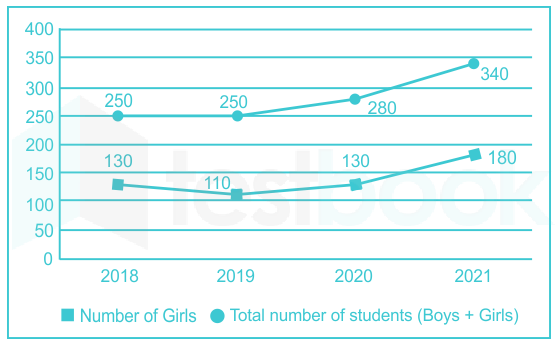
The line graph shows the total number of students [ Boys and Girls] and number of girls in a school in four different years [ 2018, 2019, 2020 and 2021].

39

Ratio of number of boys in the school on 2021 and 2022 is 2:3. Number of girls on 2022 is 10% less than the number of boys. Find the number of girls on 2022?

  1. ((a))

    214

  2. ((b))

    220

  3. ((c))

    230

  4. ((d))

    226

  5. ((e))

    216

Show Answer
Answer: ((e))

216

Common Calculation

YearNumber of GirlsNumber of Boys
2018130250 – 130 = 120
2019110250 – 110 = 140
2020130280 – 130 = 150
2021180340 – 180 = 160

Calculation

Ratio of boys in 2021 and 2022 = 2:3;

Girls in 2022 are 10% less than boys.

Boys 2022 = 160 × (3/2) = 240

Girls 2022 = 240 × 0.9 = 216

Answer: 216 girls

40

Difference between number of boys in 2020 and 2019 is 5×. Find the value of 7× + 22?

  1. ((a))

    35

  2. ((b))

    65

  3. ((c))

    36

  4. ((d))

    75

  5. ((e))

    95

Show Answer
Answer: ((c))

36

Common Calculation

YearNumber of GirlsNumber of Boys
2018130250 – 130 = 120
2019110250 – 110 = 140
2020130280 – 130 = 150
2021180340 – 180 = 160

Calculation

Given: Difference between boys in 2020 and 2019 = 5x

Difference = 150 − 140 = 10

5x = 10 → x = 2

7x + 22 = 7 × 2 + 22 = 36

Answer: 36

41

One teacher per five students in 2019. Find the total number of teachers in school in the year 2019?

  1. ((a))

    50

  2. ((b))

    60

  3. ((c))

    5

  4. ((d))

    40

  5. ((e))

    65

Show Answer
Answer: ((a))

50

Common Calculation

YearNumber of GirlsNumber of Boys
2018130250 – 130 = 120
2019110250 – 110 = 140
2020130280 – 130 = 150
2021180340 – 180 = 160


Calculation

Given: 1 teacher per 5 students

Total students 2019 = 110 + 140 = 250

Teachers = 250 ÷ 5 = 50

Answer: 50 teachers

42

Find the ratio between total number of students in 2020 and 2018 and total number of boys in 2021 and 2019?

  1. ((a))

    7:4

  2. ((b))

    8:9

  3. ((c))

    5:3

  4. ((d))

    53:30

  5. ((e))

    6:7

Show Answer
Answer: ((d))

53:30

Common Calculation

YearNumber of GirlsNumber of Boys
2018130250 – 130 = 120
2019110250 – 110 = 140
2020130280 – 130 = 150
2021180340 – 180 = 160


Calculation

Total students 2020 + 2018 = 280 + 250 = 530

Total boys 2021 + 2019 = 160 + 140 = 300

Ratio = 530 : 300 = 53 : 30

Answer: 53 : 30

43

Find the difference between total number of boys and total number of girls in all the given years?

  1. ((a))

    20

  2. ((b))

    30

  3. ((c))

    40

  4. ((d))

    50

  5. ((e))

    60

Show Answer
Answer: ((a))

20

Common Calculation

YearNumber of GirlsNumber of Boys
2018130250 – 130 = 120
2019110250 – 110 = 140
2020130280 – 130 = 150
2021180340 – 180 = 160


Calculation

Total boys = 120 + 140 + 150 + 160 = 570

Total girls = 130 + 110 + 130 + 180 = 550

Difference = 570 − 550 = 20

Answer: 20

44

What will come in place of the question mark ‘?’ in the following question?

1347 + 254 + 457 – 3382 + 8745 – 5723 = ?

  1. ((a))

    1709

  2. ((b))

    1608

  3. ((c))

    1702

  4. ((d))

    1698

  5. ((e))

    None of these

Show Answer
Answer: ((d))

1698

Given:

1347 + 254 + 457 – 3382 + 8745 – 5723 = ?

Concept:

Calculation:

1347 + 254 + 457 – 3382 + 8745 – 5723 = ?

⇒ ? = 2058 + 5363 – 5723

⇒ ? = 7421 – 5723

∴ ? = 1698

45

What will come in place of question mark (?) in the following equation?

[{(48 ÷ 6 × 3 + 8) ÷ 4 × 5 – 8} × 2 ÷ 4 × 4 + 1] – 3 = ?

  1. ((a))

    44

  2. ((b))

    56

  3. ((c))

    62

  4. ((d))

    78

  5. ((e))

    82

Show Answer
Answer: ((c))

62

Follow BODMAS rule to solve this question, as per the order given below, 

Step-1: Parts of an equation enclosed in 'Brackets' must be solved first, and in the bracket, 

Step-2: Any mathematical 'Of' or 'Exponent' must be solved next, 

Step-3: Next, the parts of the equation that contain 'Division' and 'Multiplication' are calculated, 

Step-4: Last but not least, the parts of the equation that contain 'Addition' and 'Subtraction' should be calculated 

Now, we have

⇒ [{(48 ÷ 6 × 3 + 8) ÷ 4 × 5 – 8} × 2 ÷ 4 × 4 + 1] – 3 = ?

⇒ [{(8 × 3 + 8) ÷ 4 × 5 – 8} × 2 ÷ 4 × 4 + 1] – 3 = ?

⇒ [{(24 + 8) ÷ 4 × 5 – 8} × 2 ÷ 4 × 4 + 1] – 3 = ?

⇒ [{32 ÷ 4 × 5 – 8} × 2 ÷ 4 × 4 + 1] – 3 = ?

⇒ [{8 × 5 – 8} × 2 ÷ 4 × 4 + 1] – 3 = ?

⇒ [{40 – 8} × 2 ÷ 4 × 4 + 1] – 3 = ?

⇒ [32 × 2 ÷ 4 × 4 + 1] – 3 = ?

⇒ [32 × (1/2) × 4 + 1] – 3 = ?

⇒ [64 + 1] – 3 = ?

⇒ 65 – 3 = ?

∴ ? = 62

46

What will come in place of question mark ‘?’ in the following question?

(1333 - 339) ÷ 2 + 103 = 21 × 39 - ?

  1. ((a))

    126

  2. ((b))

    219

  3. ((c))

    318

  4. ((d))

    419

  5. ((e))

    200

Show Answer
Answer: ((b))

219

Follow BODMAS rule to solve this question, as per the order given below,

Step-1- Parts of an equation enclosed in 'Brackets' must be solved first, and in the bracket,

Step-2- Any mathematical 'Of' or 'Exponent' must be solved next,

Step-3- Next, the parts of the equation that contain 'Division' and 'Multiplication' are calculated,

Step-4- Last but not least, the parts of the equation that contain 'Addition' and 'Subtraction' should be calculated.

Given expression is,

⇒ (1333 - 339) ÷ 2 + 103 = 21 × 39 - ?

⇒ 994 ÷ 2 + 103 = 21 × 39 - ?

⇒ 497 + 103 = 819 - ?

⇒ 600 = 819 - ?

⇒ ? = 819 - 600

⇒ ? = 219

47

What should come in place of question mark ‘?’ in the following number question?

7859 - 1109 + 335 = 20 + 785 × ?

  1. ((a))

    3

  2. ((b))

    11

  3. ((c))

    7

  4. ((d))

    9

  5. ((e))

    5

Show Answer
Answer: ((d))

9

Follow BODMAS rule to solve this question, as per the order given below,

Step-1- Parts of an equation enclosed in 'Brackets' must be solved first, and in the bracket,

Step-2- Any mathematical 'Of' or 'Exponent' must be solved next,

Step-3- Next, the parts of the equation that contain 'Division' and 'Multiplication' are calculated,

Step-4- Last but not least, the parts of the equation that contain 'Addition' and 'Subtraction' should be calculated.

Given expression is,

⇒ 7859 - 1109 + 335 = 20 + 785 × ?

⇒ 8194 - 1109 = 20 + 785 × ?

⇒ 7085 = 20 + 785 × ?

⇒ 7085 - 20 = 785 × ?

⇒ 7065 = 785 × ?

⇒ ? = 7065/785

⇒ ? = 9

48

What should come in the place of the question mark (?) in the following question?

[(27 × 10) ÷ 30 + 10500 ÷ 500] = ? × 15

  1. ((a))

    1

  2. ((b))

    4

  3. ((c))

    2.65

  4. ((d))

    0.90

  5. ((e))

    2

Show Answer
Answer: ((e))

2

Given:

[(27 × 10) ÷ 30 + 10500 ÷ 500] = ? × 15

Concept Used:

Calculation:

Suppose x will come in the place of the question mark;

[(27 × 10) ÷ 30 + 10500 ÷ 500] = x × 15

Applying BODMAS Rule;

⇒ [(270) ÷ 30 + 21] = 15x

⇒ 9 + 21 = 15x

⇒ 30 = 15x

∴ x = 2

49

What will come in place of question mark ‘?’ in the following question?

{(3654 + 1346) × 2} ÷ 200 = ?

  1. ((a))

    50

  2. ((b))

    100

  3. ((c))

    45

  4. ((d))

    150

  5. ((e))

    70

Show Answer
Answer: ((a))

50

Follow BODMAS rule to solve this question, as per the order given below,

Step 1: Parts of an equation enclosed in 'Brackets' must be solved first, and in the bracket,

Step 2: Any mathematical 'Of' or 'Exponent' must be solved next,

Step 3: Next, the parts of the equation that contain 'Division' and 'Multiplication' are calculated,

Step 4: Last but not least, the parts of the equation that contain 'Addition' and 'Subtraction' should be calculated.

Given expression is,

⇒ {(3654 + 1346) × 2} ÷ 200 = ?

⇒ {(5000) × 2} ÷ 200 = ?

⇒ ? = 10000 ÷ 200

⇒ ? = 50

50

What will come in place of question mark '?' in the following question?

579 × 4 + 184 = 1388 ÷ ? + 1112

  1. ((a))

    10

  2. ((b))

    1

  3. ((c))

    11

  4. ((d))

    100

  5. ((e))

    0.1

Show Answer
Answer: ((b))

1

Follow BODMAS rule to solve this question, as per the order given below,

Step-1: Parts of an equation enclosed in 'Brackets' must be solved first, and in the bracket,

Step-2: Any mathematical 'Of' or 'Exponent' must be solved next,

Step-3: Next, the parts of the equation that contain 'Division' and 'Multiplication' are calculated,

Step-4: Last but not least, the parts of the equation that contain 'Addition' and 'Subtraction' should be calculated.

Given expression is,

⇒ 579 × 4 + 184 = 1388 ÷ ? + 1112

⇒ 2316 + 184 = 1388 ÷ ? + 1112

⇒ 2500 = 1388 ÷ ? + 1112

⇒ 2500 – 1112 = 1388 ÷ ?

⇒ 1388 = 1388 ÷ ?

⇒ ? = 1

51

What should come in place of question mark (?) in the following question?

5350 - 50 × 3139 ÷ 73 = ? × 64

  1. ((a))

    3560

  2. ((b))

    50

  3. ((c))

    150

  4. ((d))

    3600

  5. ((e))

    75

Show Answer
Answer: ((b))

50

Suppose x will come in place of question mark;

5350 – 50 × 3139 ÷ 73 = x × 64

Applying BODMAS Rule;

⇒ 5350 – 50 × 43 = 64x

⇒ 5350 – 2150 = 64x

⇒ 3200 = 64x

⇒ x = 50

52

What will come in place of question (?) in the following question?

(224 ÷ 16 × 33) ÷ 21 = 2 × (? + 3)

  1. ((a))

    5

  2. ((b))

    10

  3. ((c))

    11

  4. ((d))

    7

  5. ((e))

    8

Show Answer
Answer: ((e))

8

Follow BODMAS rule to solve this question, as per the order given below.

Step - 1 - steps of an equation enclosed in ‘Brackets’ must be solved first.

Step - 2 - any mathematical ‘Of’ or ‘Exponent’ must be solved next.

Step - 3 - Next, the parts of the equation that contain ‘Division’ and ‘Multiplication’ are calculated.

Step - 4 - Last but not least, the parts of the equation that contain ‘Addition’ and ‘Subtraction’ should be calculated.

Now, the given expression:

⇒ (224 ÷ 16 × 33) ÷ 21 = 2 × (? + 3)

⇒ (14 × 33) ÷ 21 = 2 × (? + 3)

⇒ 462 ÷ 21 = 2 × ? + 6

⇒ 22 = 2 × ? + 6

⇒ 2 × ? = 22 - 6

⇒ 2 × ? = 16

⇒ ? = 8

53

If the compound interest on a certain sum of money for 2 years at 2% per annum  is Rs 323.2. Find the sum.

  1. ((a))

    Rs. 8,000

  2. ((b))

    Rs. 7,000

  3. ((c))

    Rs. 4,000

  4. ((d))

    Rs. 5,500

  5. ((e))

    Rs. 6,500

Show Answer
Answer: ((a))

Rs. 8,000

Shortcut Trick

Effective Rate of Interest for 2 years at 2% = r + r + (r × r)/100 = 2 + 2 + (2 × 2)/100 = 4.04%.

Given Compound Interest (CI) = ₹323.2.

Equating percentage to value: 4.04% of Principal = ₹323.2.

Principal = 323.2 ÷ 0.0404 = ₹8,000.

∴ The correct answer is ₹8,000.

Alternate Method

Given:

Time (T) = 2 years

Rate (R) = 2% per annum

Compound Interest (CI) = ₹323.2

Formula Used:

CI = P[(1 + R/100)T − 1]

Calculations:

⇒ 323.2 = P[(1 + 2/100)2 − 1]

⇒ 323.2 = P[(1.02)2 − 1]

⇒ 323.2 = P[1.0404 − 1]

⇒ 323.2 = P × 0.0404

⇒ P = 323.2 ÷ 0.0404

⇒ P = 3232000 ÷ 404

⇒ P = ₹8,000

∴ The correct answer is ₹8,000.

Additional Information

Effective Interest Rate

For 2 years, the net effective rate for CI is given by x + y + (xy/100). For 2%, it is 2 + 2 + 0.04 = 4.04%.

Difference between CI and SI

The difference for 2 years is P(R/100)2. Here, the difference would be ₹8000 × (0.0004) = ₹3.2.

Amount Formula

Total Amount (A) = Principal (P) + Compound Interest (CI). Also, A = P(1 + R/100)T.

54

Two alcohol-water mixtures of ratios 7 ∶ 3 and 3 ∶ 5 are mixed together in the ratio 3 ∶ 4 respectively to form a new mixture. How much alcohol is present in 70 litres of the new mixture?

  1. ((a))

    24 litres

  2. ((b))

    30 litres

  3. ((c))

    36 litres

  4. ((d))

    42 litres

  5. ((e))

    48 litres

Show Answer
Answer: ((c))

36 litres

Shortcut Trick

Proportion of alcohol in Mixture 1 = 7/10 and Mixture 2 = 3/8.

Mixed in ratio 3 : 4 → Total parts = 3 + 4 = 7 units.

Total alcohol in 7 units = [3 × (7/10)] + [4 × (3/8)] = 2.1 + 1.5 = 3.6 units.

Alcohol fraction in final mix = 3.6 / 7.

Alcohol in 70 litres = (3.6 / 7) × 70 = 36 litres.

∴ The correct answer is 36 litres.

Alternate Method

Given: Ratio in Mix 1 = 7 : 3, Ratio in Mix 2 = 3 : 5, Mixing ratio = 3 : 4, Total quantity = 70 litres.

Formula: Total Alcohol = Σ(Quantity × Alcohol Fraction)

⇒ Quantity of Mix 1 = [3 / (3 + 4)] × 70 = 30 litres.

⇒ Quantity of Mix 2 = [4 / (3 + 4)] × 70 = 40 litres.

⇒ Alcohol from Mix 1 = 30 × (7 / (7 + 3)) = 30 × (7/10) = 21 litres.

⇒ Alcohol from Mix 2 = 40 × (3 / (3 + 5)) = 40 × (3/8) = 15 litres.

⇒ Total Alcohol = 21 + 15 = 36 litres.

∴ The correct answer is 36 litres.

Additional Information

Alligation Method

Used to find the ratio in which two ingredients at given prices/concentrations must be mixed to produce a mixture of a desired price/concentration.

Fractional Mixing

When mixing two ratios A:B and C:D in ratio m:n, ensure the sum of parts (A+B and C+D) are made equal or scaled to m and n respectively before adding.

The given table shows the number of cakes sold in three shops [A, B, and C] in four days [ Sunday, Monday, Tuesday, and Wednesday].  

DayCakes sold in shop ACakes sold in shop BCakes sold in shop C
Sunday845564
Monday483232
Tuesday565048
Wednesday706548
55

Find the difference between total cakes sold On Sunday in all shops together and total cakes sold in Monday in all shops together?

  1. ((a))

    68

  2. ((b))

    91

  3. ((c))

    9

  4. ((d))

    147

  5. ((e))

    66

Show Answer
Answer: ((b))

91

Calculation

Sunday total = 84 + 55 + 64 = 203

Monday total = 48 + 32 + 32 = 112

Difference = 203 – 112 = 91

56

Average number of cakes sold on Tuesday in shop B, C and D is 42. Find the difference between number of cakes sold in shop A and D on Tuesday?

  1. ((a))

    44

  2. ((b))

    28

  3. ((c))

    22

  4. ((d))

    26

  5. ((e))

    32

Show Answer
Answer: ((b))

28

Calculation

Given: Average (B + C + D)/3 = 42

→ B + C + D = 42 × 3 = 126

B + C = 50 + 48 = 98 → D = 126 – 98 = 28

Shop A on Tuesday = 56

Difference = 56 – 28 = 28 cakes

57

Ratio of number of cakes sold on Wednesday and Thursday in shop C is 4:5. Number of cakes sold on Thursday in shop B is 19 more than the cakes sold in Thursday in shop C. Find the number of cakes sold in shop B on Thursday?

  1. ((a))

    39

  2. ((b))

    79

  3. ((c))

    66

  4. ((d))

    54

  5. ((e))

    68

Show Answer
Answer: ((b))

79

Calculation

Given: Shop C on Wednesday = 48

Ratio C (Wed) : C (Thu) = 4 : 5

→ C (Thu) = (48 × 5)/4 = 60

Shop B (Thu) = C (Thu) + 19 = 60 + 19 = 79 cakes

58

Find the ratio of number of cakes sold in shop A on Tuesday and Wednesday together and Number of cakes sold in shop C on Wednesday?

  1. ((a))

    19:17

  2. ((b))

    21:8

  3. ((c))

    3:2

  4. ((d))

    4:5

  5. ((e))

    6:5

Show Answer
Answer: ((b))

21:8

Calculation

Shop A (Tue + Wed) = 56 + 70 = 126

Shop C Wed = 48

Ratio = 126 : 48

→ 21 : 8

59

Number of cakes sold in shop C on Monday is what percent more or less than the number of cakes sold in same shop on Wednesday?

  1. ((a))

    19%

  2. ((b))

    33.33%

  3. ((c))

    25%

  4. ((d))

    37.5%

  5. ((e))

    20%

Show Answer
Answer: ((b))

33.33%

Calculation

Shop C Monday = 32, Wednesday = 48

Difference = 48 – 32 = 16

Percentage less = (16 ÷ 48) × 100 = 33.33%

60

A person covers two- third of distance by bus at 60 km/hr and remaining distance by bicycle at 30 km/hr. He takes 3 hours to cover the total distance. What is the distance covered by bicycle?

  1. ((a))

    135 km

  2. ((b))

    45 km

  3. ((c))

    4.5 km

  4. ((d))

    13.5 km

  5. ((e))

    None of these

Show Answer
Answer: ((b))

45 km

Shortcut Trick

Let the total distance be 3x km. Bus distance = 2x, Bicycle distance = x.

Total time = (Distance1 ÷ Speed1) + (Distance2 ÷ Speed2)

⇒ 3 = (2x ÷ 60) + (x ÷ 30) ⇒ 3 = (x ÷ 30) + (x ÷ 30) ⇒ 3 = 2x ÷ 30

⇒ x = (3 × 30) ÷ 2 = 45 km.

∴ The correct answer is 45 km.

Alternate Method

Given: Bus Speed = 60 km/hr, Bicycle Speed = 30 km/hr, Total Time = 3 hours.

Formula: Time = Distance ÷ Speed

Let total distance be D.

⇒ Time taken by bus = (2D/3) ÷ 60 = 2D ÷ 180 = D ÷ 90

⇒ Time taken by bicycle = (D/3) ÷ 30 = D ÷ 90

⇒ Total Time = (D ÷ 90) + (D ÷ 90) = 3

⇒ 2D ÷ 90 = 3

⇒ D = (3 × 90) ÷ 2 = 135 km

⇒ Distance by bicycle = (1/3) × 135

∴ The correct answer is 45 km.

Additional Information

Average Speed Formula

When a distance is divided into parts, Average Speed = Total Distance ÷ Total Time.

Time, Speed, Distance Relationship

For a constant distance, speed is inversely proportional to time (S1/S2 = T2/T1).

Unit Conversion

To convert km/hr to m/s, multiply by 5/18. To convert m/s to km/hr, multiply by 18/5.

61

At an election involving two candidates, 68 votes were declared invalid. The winning candidate secures 52% and wins by 98 votes. The total number of votes polled is ?

  1. ((a))

    2610

  2. ((b))

    2500

  3. ((c))

    2518

  4. ((d))

    2382

  5. ((e))

    3000

Show Answer
Answer: ((c))

2518

Shortcut Trick

Difference in percentage votes = 52% − (100% − 52%) = 52% − 48% = 4%.

Since 4% of valid votes = 98 votes, then 100% of valid votes = (98 ÷ 4) × 100 = 2450.

Total votes polled = Valid votes + Invalid votes = 2450 + 68 = 2518.

∴ The correct answer is 2518 votes.

Alternate Method

Given: Invalid votes = 68, Winner share = 52%, Victory margin = 98 votes.

Let the total valid votes be V.

Winner = 52% of V

Loser = (100 − 52)% of V = 48% of V

⇒ Margin = 52% of V − 48% of V = 4% of V

⇒ 4% of V = 98

⇒ V = (98 × 100) ÷ 4 = 2450

Total votes polled = V + 68 = 2450 + 68 = 2518

∴ The correct answer is 2518 votes.

Additional Information

Percentage Change Base

Always ensure the percentage is calculated on the Valid Votes base unless the question specifies it is on the Total Polled Votes.

Successive Elections

If voters didn't cast votes, subtract them from Total Voters before calculating Invalid Votes: Total → Cast → Valid → Result.

62

After giving a discount of 12%, a laptop is sold for Rs. 22,880. Find the market price of the laptop

  1. ((a))

    Rs. 24,000

  2. ((b))

    Rs. 26,000

  3. ((c))

    Rs. 34,000

  4. ((d))

    Rs. 23,000

  5. ((e))

    Rs. 39,000

Show Answer
Answer: ((b))

Rs. 26,000

Shortcut Trick

Market Price (MP) represents 100%.

Discount = 12% ⇒ Selling Price (SP) = 100% − 12% = 88%.

Given SP = Rs. 22,880.

Using unitary method: 88% = 22,880.

1% = 22,880 ÷ 88 = 260.

100% = 260 × 100 = 26,000.

∴ The correct answer is Rs. 26,000.

Alternate Method

Given → Selling Price (SP) = Rs. 22,880 | Discount Percentage = 12% Formulas: SP = MP × (100 − Discount%) ÷ 100 | MP = (SP × 100) ÷ (100 − Discount%)

⇒ Let the Market Price (MP) be x. ⇒ SP = MP − Discount ⇒ 22,880 = x − (12% of x) ⇒ 22,880 = x − 0.12x ⇒ 22,880 = 0.88x ⇒ x = 22,880 ÷ 0.88 ⇒ x = 26,000

∴ The correct answer is Rs. 26,000.

Additional Information

Market Price & Discount

Market Price (List Price) is the price printed on the product. Discount is always calculated on the Market Price.

Ratio Method

12% discount = 12/100 = 3/25. If MP = 25 units, Discount = 3 units, then SP = 22 units. 22 units = 22,880 ⇒ 1 unit = 1,040 ⇒ 25 units = 26,000.

63

P, Q, R started a business with capital ₹ 35000, ₹ 65000 and ₹ 75000 respectively. At the end of 2 years, the total loss is 70000. What is the loss share of P?

  1. ((a))

    ₹ 14000

  2. ((b))

    ₹ 20000

  3. ((c))

    ₹ 25000

  4. ((d))

    ₹ 30000

  5. ((e))

    ₹ 35000

Show Answer
Answer: ((a))

₹ 14000

Shortcut Trick

Ratio of investments P : Q : R = 35000 : 65000 : 75000 = 7 : 13 : 15.

Total ratio parts = 7 + 13 + 15 = 35 units.

Total loss =  ₹ 70000.

Value of 1 unit = 70000 ÷ 35 =  ₹ 2000.

Loss share of P = 7 units × 2000 =  ₹ 14000.

∴ The correct answer is  ₹ 14000.

Alternate Method

Given: Capital of P =  ₹ 35000, Q =  ₹ 65000, R =  ₹ 75000. Total loss =  ₹ 70000. Time = 2 years (constant).

Formula: Profit/Loss Share = Investment × Time Period.

⇒ Since time is the same for all, the loss is divided in the ratio of their capitals.

⇒ Ratio of loss = 35000 : 65000 : 75000 = 7 : 13 : 15.

⇒ Loss of P = [7 ÷ (7 + 13 + 15)] × 70000.

⇒ Loss of P = (7 ÷ 35) × 70000.

⇒ Loss of P = 7 × 2000 = 14000.

∴ The correct answer is  ₹ 14000.

Additional Information

Partnership Ratios

When the time period for all investments is the same, the profit or loss is shared strictly in the ratio of the capital invested.

Variable Time Investment

If partners invest for different durations, the ratio is calculated as: (C1 × T1) : (C2 × T2) : (C3 × T3).

A and B start a business with Rs. 10000 and Rs. 14000. A invest his money for 12 months and B invest his money for n months. After one year ratio of investment of A and B is 15:14. The share of profit of A is Rs. 1200 where total profit is Rs. 2320. If A invest for n months and B invest for 12 months and total profit is Rs. 7750 then the share of profit of B is Rs. z.

64

Find the value of n?

  1. ((a))

    10

  2. ((b))

    6

  3. ((c))

    5

  4. ((d))

    4

  5. ((e))

    8

Show Answer
Answer: ((e))

8

Profit ratio is proportional to investment × time:

[A × 12] / [B × n] = 15/14

[10000 × 12] / [14000 × n] = 15/ 14

[120000 × 14 = 15 × 14000 × n]

n = 8 months

65

Find the value of z?

  1. ((a))

    4720

  2. ((b))

    5250

  3. ((c))

    6250

  4. ((d))

    4750

  5. ((e))

    3600

Show Answer
Answer: ((b))

5250

Common calculation

Profit ratio is proportional to investment × time:

[A × 12] / [B × n] = 15/14

[10000 × 12] / [14000 × n] = 15/ 14

[120000 × 14 = 15 × 14000 × n]

n = 8 months

Now, New case A invest for n = 8 months and B for 12 months

A invests = 10,000 for 8 months → A × time = 10,000 × 8 = 80,000

B invests = 14,000 for 12 months → B × time = 14,000 × 12 = 168,000

Profit ratio A : B = 80,000 : 168,000 = 10 : 21

Total ratio sum = 10 + 21 = 31

Total profit = 7750

B’s share z = [21/31] × 7750 = 5250

Reasoning Ability (35 questions)

Direction: Read the following information carefully and answer the questions based on given information.

Eight boxes F, G, H, I, J, K, L and M are arranged one over another from bottom to top but not necessarily in same order. Box J is placed three boxes above the box M. Two boxes are placed between Box L and Box K. Box G is placed just below the box J. Two boxes placed between Box M and Box H. Box I is placed above the box F but below the box K. More than two boxes are placed between Box G and Box L.

66

Which of the following box is placed just above the box K?

  1. ((a))

    Box M

  2. ((b))

    Box I

  3. ((c))

    Box J

  4. ((d))

    Box G

  5. ((e))

    None of these

Show Answer
Answer: ((d))

Box G

Here, boxes are F, G, H, I, J, K, L and M.

  1. Box J is placed three boxes above the box M.

  2. Two boxes placed between Box M and Box H.

Case – 1Case – 2
BoxesBoxes
J
J
M
M
H
H


  1. Box G is placed just below the box J.

  2. Two boxes are placed between Box L and Box K.

  3. More than two boxes are placed between Box G and Box L.

Case – 1Case – 2(a)Case – 2(b)
BoxesBoxesBoxes
JJ
JGG
GK
KMM
MK
L
LHH
HL


  1. Box I is placed above the box F but below the box K. Therefore, case 1 and case 2(b) are eliminated. Hence, the final arrangement is as follows
Boxes
J
G
K
M
I
L
H
F


Hence, Box G is placed just above the Box K.

67

As many boxes are placed above the box G as many below which box?

  1. ((a))

    Box L

  2. ((b))

    Box F

  3. ((c))

    Box H

  4. ((d))

    Box M

  5. ((e))

    Box I

Show Answer
Answer: ((c))

Box H

Here, boxes are F, G, H, I, J, K, L and M.

  1. Box J is placed three boxes above the box M.

  2. Two boxes placed between Box M and Box H.

Case – 1Case – 2
BoxesBoxes
J
J
M
M
H
H


  1. Box G is placed just below the box J.

  2. Two boxes are placed between Box L and Box K.

  3. More than two boxes are placed between Box G and Box L.

Case – 1Case – 2(a)Case – 2(b)
BoxesBoxesBoxes
JJ
JGG
GK
KMM
MK
L
LHH
HL


  1. Box I is placed above the box F but below the box K. Therefore, case 1 and case 2(b) are eliminated. Hence, the final arrangement is as follows
Boxes
J
G
K
M
I
L
H
F


Since, only one box is placed above the box G and one box is placed below the box H.

Hence, the correct answer is Box H.

68

How many boxes are placed between the Box M and Box L?

  1. ((a))

    As many boxes are placed between the Box J and Box G.

  2. ((b))

    As many boxes placed below the Box F.

  3. ((c))

    As many boxes placed between M and K.

  4. ((d))

    As many boxes placed between Box J and Box I.

  5. ((e))

    As many boxes placed between Box F and Box L.

Show Answer
Answer: ((e))

As many boxes placed between Box F and Box L.

Here, boxes are F, G, H, I, J, K, L and M.

  1. Box J is placed three boxes above the box M.

  2. Two boxes placed between Box M and Box H.

Case – 1Case – 2
BoxesBoxes
J
J
M
M
H
H


  1. Box G is placed just below the box J.

  2. Two boxes are placed between Box L and Box K.

  3. More than two boxes are placed between Box G and Box L.

Case – 1Case – 2(a)Case – 2(b)
BoxesBoxesBoxes
JJ
JGG
GK
KMM
MK
L
LHH
HL


  1. Box I is placed above the box F but below the box K. Therefore, case 1 and case 2(b) are eliminated. Hence, the final arrangement is as follows
Boxes
J
G
K
M
I
L
H
F


Since, only one box is placed between Box M and Box L and same number of box is placed between the Box F and Box L.

Hence, the correct answer is As many boxes placed between Box F and Box L.

69

Which of the following statement(s) is/are TRUE regarding Box M?

  1. ((a))

    Only two boxes are placed below the Box M.

  2. ((b))

    More than two boxes are placed between Box I and Box M.

  3. ((c))

    The number of boxes placed below the box M is more than that of above it.

  4. ((d))

    Two boxes are placed between Box M and Box L.

  5. ((e))

    None of these

Show Answer
Answer: ((c))

The number of boxes placed below the box M is more than that of above it.

Here, boxes are F, G, H, I, J, K, L and M.

  1. Box J is placed three boxes above the box M.

  2. Two boxes placed between Box M and Box H.

Case – 1Case – 2
BoxesBoxes
J
J
M
M
H
H


  1. Box G is placed just below the box J.

  2. Two boxes are placed between Box L and Box K.

  3. More than two boxes are placed between Box G and Box L.

Case – 1Case – 2(a)Case – 2(b)
BoxesBoxesBoxes
JJ
JGG
GK
KMM
MK
L
LHH
HL


  1. Box I is placed above the box F but below the box K. Therefore, case 1 and case 2(b) are eliminated. Hence, the final arrangement is as follows
Boxes
J
G
K
M
I
L
H
F


Since, four boxes are placed below the Box M not two boxes. Therefore, statement first is incorrect.

No box is placed between Box I and Box M. Therefore, statement second is incorrect.

Four boxes placed below the box M and three boxes are placed above it.  Therefore, statement third is correct.

Only one box is placed between Box M and Box L. Therefore, statement fourth is incorrect.

Hence, the correct statement is The number of boxes placed below the box M is more than that of above it.

70

Which of the following statement(s) is/are correct?

A) Box L is placed two boxes above the Box F.

B) Box I and Box M placed adjacent to each other.

C) Three boxes are placed between Box H and Box K.

  1. ((a))

    Both A and B

  2. ((b))

    Both B and C

  3. ((c))

    Both A and C

  4. ((d))

    All of these

  5. ((e))

    None of these

Show Answer
Answer: ((d))

All of these

Here, boxes are F, G, H, I, J, K, L and M.

  1. Box J is placed three boxes above the box M.

  2. Two boxes placed between Box M and Box H.

Case – 1Case – 2
BoxesBoxes
J
J
M
M
H
H


  1. Box G is placed just below the box J.

  2. Two boxes are placed between Box L and Box K.

  3. More than two boxes are placed between Box G and Box L.

Case – 1Case – 2(a)Case – 2(b)
BoxesBoxesBoxes
JJ
JGG
GK
KMM
MK
L
LHH
HL


  1. Box I is placed above the box F but below the box K. Therefore, case 1 and case 2(b) are eliminated. Hence, the final arrangement is as follows
Boxes
J
G
K
M
I
L
H
F


Since, Box L is placed two boxes above the Box F. Therefore, statement A is correct.

Box I is placed just below the Box M. Therefore, statement B is correct.

Three boxes are placed between Box H and Box K. Therefore, statement C is correct.

Hence, the correct answer is All of these.

Directions: Study the following information carefully to answer the given questions:

1 @ € C D 6 & E 2 F G H 9 $ I @ € J K L 4 # 1 8 9 © H OV J 5 Y 6 ¥ Y K A %

71

Which of the following is the seventh to the left of the twenty-fourth element from the left end of the above arrangement?

  1. ((a))

  2. ((b))

    @

  3. ((c))

  4. ((d))

    5

  5. ((e))

    J

Show Answer
Answer: ((a))

Given series:

1 @ € C D 6 & E 2 F G H 9 $ I @ € J K L 4 # 1 8 9 © H O V J 5 Y 6 ¥ Y K A %

As, Left - Left = Left

24th from the Left - 7th from the Left = 17th from the Left

Clearly, 17th from the Left is €

72

Four of following five are alike in a certain way based on their positions in the above arrangement and so form a group. Which is the one that does not belong to that group?

  1. ((a))

    1 € D

  2. ((b))

    6 E F

  3. ((c))

    2 G 9

  4. ((d))

    9 I €

  5. ((e))

    4 # 1

Show Answer
Answer: ((e))

4 # 1

Given series:

Left Side 1 @ € C D 6 & E 2 F G H 9 $ I @ € J K L 4 # 1 8 9 © H O V J 5 Y 6 ¥ Y K A % Right Side

Here the group is formed in which second element is the second next to the first, and the third element is to the second next of the second element.

Hence, 4 # 1 does not belong to the group.

73

How many such vowels are there in the above arrangement each of which is immediately followed by a consonant but not immediately preceded by a number?

  1. ((a))

    None

  2. ((b))

    One

  3. ((c))

    Two

  4. ((d))

    Three

  5. ((e))

    More than three

Show Answer
Answer: ((b))

One

Given series:

Left Side 1 @ € C D 6 & E 2 F G H 9 $ I @ € J K L 4 # 1 8 9 © H O V J 5 Y 6 ¥ Y K A % Right Side

Vowels which are immediately followed by a consonant but not immediately preceded by a number:

required order is: Not number → Vowel → Consonant

1 @ € C D 6 & E 2 F G H 9 $ I @ € J K L 4 # 1 8 9 © H O V J 5 Y 6 ¥ Y K A %

Hence, there is only one vowel which is immediately followed by a consonant but not immediately preceded by a number: H O V

Hence, the correct answer is one.

74

If all the odd numbers in the above arrangement are dropped, then which of the following element will be the twelfth from the right end?

  1. ((a))

    $

  2. ((b))

    H

  3. ((c))

    ©

  4. ((d))

    9

  5. ((e))

    None of these

Show Answer
Answer: ((c))

©

Given series:

Left Side 1 @ € C D 6 & E 2 F G H 9 $ I @ € J K L 4 # 1 8 9 © H O V J 5 Y 6 ¥ Y K A % Right Side

  1. If all the odd numbers are dropped:

@ € C D 6 & E 2 F G H $ I @ € J K L 4 # 8 © H O V J Y 6 ¥ Y K A %

  1. 12th element from the right end is ©.

Then, element that is twelfth from the right end is ‘©’.

75

How many such symbols are there in the above arrangement each of which are immediately preceded by an odd number and followed by an alphabet?

  1. ((a))

    None

  2. ((b))

    Two 

  3. ((c))

    One

  4. ((d))

    Three

  5. ((e))

    More than three

Show Answer
Answer: ((b))

Two 

Given series:

Left Side 1 @ € C D 6 & E 2 F G H 9 $ I @ € J K L 4 # 1 8 9 © H O V J 5 Y 6 ¥ Y K A % Right Side

Symbols which are immediately preceded by an odd number and followed by an alphabet:

Required order is: Odd number → Symbol → Alphabet

1 @ € C D 6 & E 2 F G H 9 $ I @ € J K L 4 # 1 8 9 © H O V J 5 Y 6 ¥ Y K A %

Hence, there are 2 symbols which is immediately preceded by an odd number and followed by an alphabet: 9 $ I and 9 © H.

Directions: Read the information and answer the given questions.

Ten people are sitting in two parallel rows facing each other. In Row 1, A, B, C, D, and E are seated facing south. In Row 2, P, Q, R, S, and T are seated facing north, but not necessarily in the same order. D doesn't sit at the end. More than one person sits between R and Q, and Q does not sit at any end. D sits second to the right of the person who faces the immediate neighbor of S. Only one person sits between S and the one who faces B. There are two persons sitting between B and the one who faces P. T faces the person who sits third to the right C. A does not sit at any end.

76

Who among the following faces A?

  1. ((a))

    P

  2. ((b))

    Q

  3. ((c))

    R

  4. ((d))

    S

  5. ((e))

    T

Show Answer
Answer: ((d))

S

1. D sits second to the right of the person who faces the immediate neighbor of S.  2. D doesn't sit at the end.

Here, we have 3 Cases, i.e., Case 1, Case 2, and Case 3.

3. Only one person sits between S and the one who faces B. 

4. There are two persons sitting between B and the one who faces P. 

Now, we can eliminate Case 3.

  1. More than one person sits between R and Q, and Q does not sit at any end. 

Now, we can eliminate Case 2, but we have a subcase of Case 1, i.e., Case 1a.

  1. T faces the person who sits third from C.

Now, we can eliminate Case 1.

  1. A does not sit at any end.

This is our final arrangement,

Hence, the correct answer is S.

77

Who among the following is sitting third to the left of the person who faces C?

  1. ((a))

    The person who faces B

  2. ((b))

    The person who faces A

  3. ((c))

    The person who faces E

  4. ((d))

    The person who faces D

  5. ((e))

    No one 

Show Answer
Answer: ((a))

The person who faces B

1. D sits second to the right of the person who faces the immediate neighbor of S.  2. D doesn't sit at the end.

Here, we have 3 Cases, i.e., Case 1, Case 2, and Case 3.

3. Only one person sits between S and the one who faces B. 

4. There are two persons sitting between B and the one who faces P. 

Now, we can eliminate Case 3.

  1. More than one person sits between R and Q, and Q does not sit at any end. 

Now, we can eliminate Case 2, but we have a subcase of Case 1, i.e., Case 1a.

  1. T faces the person who sits third from C.

Now, we can eliminate Case 1.

  1. A does not sit at any end.

This is our final arrangement,

Hence, the correct answer is The person who faces B, i.e., T.

78

Four of the following five are alike in a certain way and hence form a group. Which is the one that does not belong to the group?

  1. ((a))

    B

  2. ((b))

    E

  3. ((c))

    S

  4. ((d))

    T

  5. ((e))

    R

Show Answer
Answer: ((c))

S

1. D sits second to the right of the person who faces the immediate neighbor of S.  2. D doesn't sit at the end.

Here, we have 3 Cases, i.e., Case 1, Case 2, and Case 3.

3. Only one person sits between S and the one who faces B. 

4. There are two persons sitting between B and the one who faces P. 

Now, we can eliminate Case 3.

  1. More than one person sits between R and Q, and Q does not sit at any end. 

Now, we can eliminate Case 2, but we have a subcase of Case 1, i.e., Case 1a.

  1. T faces the person who sits third from C.

Now, we can eliminate Case 1.

  1. A does not sit at any end.

This is our final arrangement,

Except for S, all others sit at the ends.

Hence, the correct answer is S.

79

In a certain way, A is related to R and in the same way C is related to Q, then D is related to which person in the same way?

  1. ((a))

    S

  2. ((b))

    P

  3. ((c))

    T

  4. ((d))

    Can't be determined

  5. ((e))

    R

Show Answer
Answer: ((b))

P

1. D sits second to the right of the person who faces the immediate neighbor of S.  2. D doesn't sit at the end.

Here, we have 3 Cases, i.e., Case 1, Case 2, and Case 3.

3. Only one person sits between S and the one who faces B. 

4. There are two persons sitting between B and the one who faces P. 

Now, we can eliminate Case 3.

  1. More than one person sits between R and Q, and Q does not sit at any end. 

Now, we can eliminate Case 2, but we have a subcase of Case 1, i.e., Case 1a.

  1. T faces the person who sits third from C.

Now, we can eliminate Case 1.

  1. A does not sit at any end.

This is our final arrangement,

A is related to R, and in the same way, C is related to Q, then D is related to P because a one-person gap is there.

Hence, the correct answer is P.

80

How many persons sit between E and the person who faces Q?

  1. ((a))

    One

  2. ((b))

    Two

  3. ((c))

    Three

  4. ((d))

    None

  5. ((e))

    More than three

Show Answer
Answer: ((b))

Two

1. D sits second to the right of the person who faces the immediate neighbor of S.  2. D doesn't sit at the end.

Here, we have 3 Cases, i.e., Case 1, Case 2, and Case 3.

3. Only one person sits between S and the one who faces B. 

  1. There are two persons sitting between B and the one who faces P. 

Now, we can eliminate Case 3.

  1. More than one person sits between R and Q, and Q does not sit at any end. 

Now, we can eliminate Case 2, but we have a subcase of Case 1, i.e., Case 1a.

  1. T faces the person who sits third from C.

Now, we can eliminate Case 1.

  1. A does not sit at any end.

This is our final arrangement,

Hence, the correct answer is Two.

81

Directions: In the following question assuming the given statements to be true, find which of the conclusion among given conclusions is/are definitely true and then give your answers accordingly.

Statements: P > A ≥ R; A = C ≤ H < U = T > E

Conclusion:

I. R = H

II. R < H

  1. ((a))

    Only conclusion I is true

  2. ((b))

    Only conclusion II is true

  3. ((c))

    Both conclusions I and II are true

  4. ((d))

    Either conclusion I or conclusion II is true

  5. ((e))

    None of the conclusion is true

Show Answer
Answer: ((d))

Either conclusion I or conclusion II is true

Given statements: P > A ≥ R; A = C ≤ H < U = T > E

On combining: P > A = C ≥ R; R ≤ A = C ≤ H < U = T > E

Conclusions:

I. R = H → False (as R ≤ A = C ≤ H; R ≤ H)

II. R < H → False (as R ≤ A = C ≤ H; R ≤ H)

Note: conclusion I and II form a complimentary pair.

Hence, Either conclusion I or II is true.

82

Directions: In the following question assuming the given statements to be true, find which of the conclusion among given conclusions is/are definitely true and then give your answers accordingly.

Statements: O > U ≥ T ≤ G; R ≥ O > W

Conclusion:

I. R > G

II. W > U

  1. ((a))

    Only conclusion I is true

  2. ((b))

    Only conclusion II is true

  3. ((c))

    Both conclusions I and II are true

  4. ((d))

    Either conclusion I or conclusion II is true

  5. ((e))

    None of the conclusion is true

Show Answer
Answer: ((e))

None of the conclusion is true

Given statements: O > U ≥ T ≤ G; R ≥ O > W

On combining: R ≥ O > U ≥ T ≤ G; R ≥ O > W

Conclusions:

I. R > G → False (as R ≥ O > U ≥ T ≤ G; as clear relation between R and G cannot be established)

II. W > U → False (as W < O > U; as clear relation between W and U cannot be established)

Hence, none of the conclusion is true.

83

Directions: In the following question assuming the given statements to be true, find which of the conclusion among given conclusions is/are definitely true and then give your answers accordingly.

Statements: P < E = N ≤ T; N ≤ S < U = L < A

Conclusion:

I. P < U

II. E ≤ S

  1. ((a))

    Only conclusion I is true

  2. ((b))

    Only conclusion II is true

  3. ((c))

    Both conclusions I and II are true

  4. ((d))

    Either conclusion I or conclusion II is true

  5. ((e))

    None of the conclusion is true

Show Answer
Answer: ((c))

Both conclusions I and II are true

Given statements: P < E = N ≤ T; N ≤ S < U = L < A

On combining: P < E = N ≤ T; P < E = N ≤ S < U = L < A

Conclusions:

I. P < U → true (as P < E = N < U → P < U)

II. E ≤ S → true (as E = N ≤ S → E ≤ S)

Hence, Both the conclusions I and II are true.

84

Four letter-clusters have been given, out of which three are alike in some manner and one is different. Select the odd letter-cluster.

  1. ((a))

    QSU

  2. ((b))

    UWY

  3. ((c))

    CEG

  4. ((d))

    HJI

  5. ((e))

    None of the above

Show Answer
Answer: ((d))

HJI

The logic followed here is:

Option 1) QSU

Option 2) UWY

Option 3) CEG

Option 4) HJI

Here, 'HJI' is odd among the given options.

Hence, the correct answer is "Option 4".

Direction: Read the following information carefully and answer the questions based on given information.

Seven persons N, O, P, Q, R, S and T went temple on seven different days starting from Monday to Sunday but not necessarily in same order. T went temple two days before O. As many persons went temple before P as many after Q. Three persons went temple between T and N. S went temple before R but not after P. N went temple neither Friday nor Saturday. Q went temple after R.

85

Which of the following statement(s) is/are incorrect regarding R?

A) R went temple on Thursday.

B) O went temple just after R.

C) As many persons went temple before R as many after him.

  1. ((a))

    Both A and B

  2. ((b))

    All of these

  3. ((c))

    Only C

  4. ((d))

    Only A

  5. ((e))

    None of these

Show Answer
Answer: ((e))

None of these

Here, persons are N, O, P, Q, R, S and T.

  1. Three persons went temple between T and N.

  2. T went temple two days before O.

  3. N went temple neither Friday nor Saturday.

DaysCase – 1Case – 2
PersonsPersons
MondayN
Tuesday
WednesdayT
Thursday
FridayTO
Saturday
SundayON


  1. As many persons went temple before P as many after Q.

  2. Q went temple after R.

  3. S went temple before R but not after P. Therefore, case 1 is eliminated.

Hence, the final arrangement is as follows

DaysPersons
MondayS
TuesdayP
WednesdayT
ThursdayR
FridayO
SaturdayQ
SundayN


Since, R went temple on Thursday. Therefore, statement A is correct.

O went temple just after R. Therefore, statement B is correct.

As many persons went temple before R as many after him. Therefore, statement C is correct.

Hence, the incorrect statement is None of these.

86

Which of the following statement(s) is/are correct?

  1. ((a))

    P went temple on Wednesday.

  2. ((b))

    Only one person went temple after O.

  3. ((c))

    R went temple on Tuesday.

  4. ((d))

    As many persons went temple before T as many after R.

  5. ((e))

    None of these.

Show Answer
Answer: ((e))

None of these.

Here, persons are N, O, P, Q, R, S and T.

  1. Three persons went temple between T and N.

  2. T went temple two days before O.

  3. N went temple neither Friday nor Saturday.

DaysCase – 1Case – 2
PersonsPersons
MondayN
Tuesday
WednesdayT
Thursday
FridayTO
Saturday
SundayON


  1. As many persons went temple before P as many after Q.

  2. Q went temple after R.

  3. S went temple before R but not after P. Therefore, case 1 is eliminated. Hence, the final arrangement is as follows

DaysPersons
MondayS
TuesdayP
WednesdayT
ThursdayR
FridayO
SaturdayQ
SundayN


Since, P went temple on Tuesday not on Wednesday. Therefore, statement first is incorrect.

Two persons went temple after O. Therefore, statement second is incorrect.

R went temple on Thursday not on Tuesday. Therefore, statement third is incorrect.

As many persons went temple before T as many after O not R. Therefore, statement fourth is incorrect.

Hence, the correct statement is None of these.

87

How many persons went temple between P and O?

  1. ((a))

    One

  2. ((b))

    Two

  3. ((c))

    Three

  4. ((d))

    None

  5. ((e))

    More than three

Show Answer
Answer: ((b))

Two

Here, persons are N, O, P, Q, R, S and T.

  1. Three persons went temple between T and N.

  2. T went temple two days before O.

  3. N went temple neither Friday nor Saturday.

DaysCase – 1Case – 2
PersonsPersons
MondayN
Tuesday
WednesdayT
Thursday
FridayTO
Saturday
SundayON


  1. As many persons went temple before P as many after Q.

  2. Q went temple after R.

  3. S went temple before R but not after P. Therefore, case 1 is eliminated. Hence, the final arrangement is as follows

DaysPersons
MondayS
TuesdayP
WednesdayT
ThursdayR
FridayO
SaturdayQ
SundayN


Hence, two persons went temple between P and O.

88

Who among the following person went temple on Friday?

  1. ((a))

    P

  2. ((b))

    T

  3. ((c))

    O

  4. ((d))

    Q

  5. ((e))

    R

Show Answer
Answer: ((c))

O

Here, persons are N, O, P, Q, R, S and T.

  1. Three persons went temple between T and N.

  2. T went temple two days before O.

  3. N went temple neither Friday nor Saturday.

DaysCase – 1Case – 2
PersonsPersons
MondayN
Tuesday
WednesdayT
Thursday
FridayTO
Saturday
SundayON


  1. As many persons went temple before P as many after Q.

  2. Q went temple after R.

  3. S went temple before R but not after P. Therefore, case 1 is eliminated. Hence, the final arrangement is as follows

DaysPersons
MondayS
TuesdayP
WednesdayT
ThursdayR
FridayO
SaturdayQ
SundayN


Hence, O went temple on Friday.

89

As many persons went temple before S as many after whom?

  1. ((a))

    N

  2. ((b))

    R

  3. ((c))

    O

  4. ((d))

    T

  5. ((e))

    None of these

Show Answer
Answer: ((a))

N

Here, persons are N, O, P, Q, R, S and T.

  1. Three persons went temple between T and N.

  2. T went temple two days before O.

  3. N went temple neither Friday nor Saturday.

DaysCase – 1Case – 2
PersonsPersons
MondayN
Tuesday
WednesdayT
Thursday
FridayTO
Saturday
SundayON


  1. As many persons went temple before P as many after Q.

  2. Q went temple after R.

  3. S went temple before R but not after P. Therefore, case 1 is eliminated. Hence, the final arrangement is as follows

DaysPersons
MondayS
TuesdayP
WednesdayT
ThursdayR
FridayO
SaturdayQ
SundayN


Since, S is the first person who went temple so no one went temple before him and N is the last person so no one went after him.

Hence, the correct answer is N.

Directions: Read the information and answer the given questions.

Six persons, namely, A, B, C, D, E, F each have a different number of items. D has fewer items than A and C, but more items than E and F. Exactly two persons have more items than B. Exactly one person has fewer items than E.

90

Who among the following has the highest number of items?

  1. ((a))

    A

  2. ((b))

    B

  3. ((c))

    C

  4. ((d))

    D

  5. ((e))

    Can't be determined

Show Answer
Answer: ((e))

Can't be determined

  1. D has fewer items than A and C, but more items than E and F.

A/C > C/A > D > E/F > F/E

  1. Exactly two persons have more items than B.

_ > _ > B > _ > _ > _

  1. Exactly one person has fewer items than E.

A/C > C/A > B > D > E > F

Either A or C has the highest number of items.

Hence, the correct answer is Can't be determined.

91

How many people have more number of items than F?

  1. ((a))

    One

  2. ((b))

    Two

  3. ((c))

    Three

  4. ((d))

    Four

  5. ((e))

    More than four

Show Answer
Answer: ((e))

More than four

1. D has fewer items than A and C, but more items than E and F.

A/C > C/A > D > E/F > F/E

  1. Exactly two persons have more items than B.

_ > _ > B > _ > _ > _

  1. Exactly one person has fewer items than E.

A/C > C/A > B > D > E > F

Hence, the correct answer is More than four, i.e., Five.

92

Who among the following has the third lowest number of items?

  1. ((a))

    A

  2. ((b))

    B

  3. ((c))

    C

  4. ((d))

    D

  5. ((e))

    E

Show Answer
Answer: ((d))

D

1. D has fewer items than A and C, but more items than E and F.

A/C > C/A > D > E/F > F/E

  1. Exactly two persons have more items than B.

_ > _ > B > _ > _ > _

  1. Exactly one person has fewer items than E.

A/C > C/A > B > D > E > F

Hence, the correct answer is D.

93

Direction: In the question below are given three statements followed by two conclusions numbered I and II. You have to take the given statements to be true even if they seem to be at variance with commonly known facts. Read all the conclusions and then decide which of the given conclusions logically follows from the given statements disregarding commonly known facts.

Statements:

Few man is woman.

No boy is girl.

All girl is man.

Conclusions:

I. Some man is boy.

II. No man is boy.

  1. ((a))

    Only I follows

  2. ((b))

    Only II follows

  3. ((c))

    Both I and II follow

  4. ((d))

    Either I or II follows

  5. ((e))

    None follow

Show Answer
Answer: ((d))

Either I or II follows

The least possible Venn diagram for the given statements is as follows:

Conclusions:

I. Some man is boy → False (it is not possible because the negative statement does not follow positive conclusion)

II. No man is boy → False (it is not possible because some man are not boy)

Both conclusions are complementary to each other.

Hence, Either conclusion I or II follows.

Important Points:

Either and or conditions:

  1. One conclusion is positive and one is negative.
  2. The elements are the same in both the conclusions.
  3. Individually both conclusions must be wrong.

Thus, Either I or II follows.

94

Directions: In the question below are given two statements followed by two conclusions numbered I and II. You have to take the given statements to be true even if they seem to be at variance from commonly known facts. Read both the conclusions and then decide which of the given conclusions logically follows from the given statements disregarding commonly known facts.

Statements: 

Only black is blue.

Some white are black.

A few white is pink.

Conclusions:

I.A few pink is black.

II. Some white is blue.

  1. ((a))

    Only I follows

  2. ((b))

    Only II follows

  3. ((c))

    Either I or II follows

  4. ((d))

    None follows

  5. ((e))

    Both follow

Show Answer
Answer: ((d))

None follows

The least possible Venn diagram according to the give statements is as follows:


Conclusions:

I.A few pink is black. → False ( As there is no direct relationship given between pink and black, hence every conclusion will be false.)

II. Some white is blue. → False ( As it is given that only black is blue, hence no other component can be associated with blue.)

Hence, none follows.

Note: In the first statement, Only black is blue is given, hence, no other relationship of blue with any other element can be formed.

95

Direction: In the question below are given two statements followed by two conclusions numbered I and II. You have to take the given statements to be true even if they seem to be at variance with commonly known facts. Read all the conclusions and then decide which of the given conclusions logically follows from the given statements disregarding commonly known facts.

Statement:                                                                                           

Some city are village. 

Only a few city are town.

Conclusion:

I. Some village are town.

II. All city can never be town.

  1. ((a))

    Only I follows

  2. ((b))

    Only II follows

  3. ((c))

    Either I or II follows

  4. ((d))

    Neither I nor II follows

  5. ((e))

    Both I and II follow

Show Answer
Answer: ((b))

Only II follows

The least possible diagram for the given statements is as follows 

Conclusions**:**

I. Some village are town → False (It is possible but not definite) 

II. All city can never be town → True (Only a few city are town)

Hence, only II follows.

96

If we form a four-letter meaningful word by using the 2nd, 4th, 6th, and 8th letters of the word 'SUSPICIOUS', then which of the following will be the third letter of the meaningful word thus formed from the left end? If more than one meaningful word is formed, mark T as your answer. If no meaningful word is formed, mark V as your answer.

  1. ((a))

    C

  2. ((b))

    O

  3. ((c))

    U

  4. ((d))

    T

  5. ((e))

    V

Show Answer
Answer: ((c))

U

Given word: SUSPICIOUS

2nd, 4th, 6th and 8th letters are = U, P, C, and O

Meaningful word = COUP (a clever and successful thing to do)

Third letter from the left end = U

Hence, the correct answer is U.

97

How many such pairs of letters in both forward and backward direction are there in the word "PRIMEVAL", which have as many letters between them in the word as in the English alphabet?

  1. ((a))

    One

  2. ((b))

    Two

  3. ((c))

    Three

  4. ((d))

    Four

  5. ((e))

    More than four

Show Answer
Answer: ((c))

Three

Given word: PRIMEVAL

The pairs are,

Forward - RV, Backward - LR, and MP

Hence, the correct answer is Three.

Directions: Read the information and answer the given questions.

Eight persons, namely, P, M, R, K, T, L, Q, and S, are in a family. The family has only three couples and three generations. There are 4 male members in the family. P is the grandfather of K, who has a cousin R. S is the mother of R. P has no daughters. S has no siblings. L is the sister-in-law of T, who is the son of M. R is the nephew of Q.

98

Four of the following five are alike in a certain way and hence form a group. Which is the one that does not belong to the group?

  1. ((a))

    P

  2. ((b))

    T

  3. ((c))

    K

  4. ((d))

    R

  5. ((e))

    Q

Show Answer
Answer: ((c))

K

The family tree is,

Except for K, all others are males.

Hence, the correct answer is K.

99

What is the relation of M with respect to L?

  1. ((a))

    Grandmother

  2. ((b))

    Mother-in-law

  3. ((c))

    Aunt

  4. ((d))

    Sister-in-law

  5. ((e))

    Cousin

Show Answer
Answer: ((b))

Mother-in-law

The family tree is,

Hence, the correct answer is Mother-in-law.

100

Who among the following is the sister-in-law of Q?

  1. ((a))

    L

  2. ((b))

    S

  3. ((c))

    K

  4. ((d))

    M

  5. ((e))

    R

Show Answer
Answer: ((b))

S

The family tree is,

Hence, the correct answer is S.

Attempt this paper under real exam conditions

Timed interface, section switching, instant scoring, and question-by-question analytics — free.

Start Timed Attempt