SBI Clerk · Topic Collection

Quantitative Aptitude PYQs

Arithmetic, number systems, percentages, ratios, profit and loss, time and work, algebra, geometry, mensuration, and trigonometry.

1495 Total Questions38 Official PapersYears: 2018–2025Search in Quantitative Aptitude
Showing questions 561–580 of 1495Page 29 of 75
SBI Clerk Prelims Memory Based Paper (Held On: 12 January 2024 Shift 1) (Previous Year Paper)·Numerical Ability
View full paper

Question 561

SBI Clerk 2024• Numerical Ability• Numerical Ability

What will come in place of question mark (?) in the following equation?

25% of 480 + 35% of 600 = ? + 40% of 800

  1. AOption (a)

    20

  2. BOption (b)

    30

  3. COption (c)

    50

  4. DOption (d)

    10

  5. EOption (e)

    40

View answer & explanation

Correct answer

Answer: (d)D.

10

Why this answer is correct

Follow BODMAS rule to solve this question, as per the order given below, 

Step-1: Parts of an equation enclosed in 'Brackets' must be solved first, and in the bracket, 

Step-2: Any mathematical 'Of' or 'Exponent' must be solved next, 

Step-3: Next, the parts of the equation that contain 'Division' and 'Multiplication' are calculated, 

Step-4: Last but not least, the parts of the equation that contain 'Addition' and 'Subtraction' should be calculated

25% of 480 + 35% of 600 = ? + 40% of 800

⇒ 120 + 210 = ? + 320

⇒ 330 = ? + 320

∴ ? = 10
SBI Clerk Prelims Memory Based Paper (Held On: 12 January 2024 Shift 1) (Previous Year Paper)·Numerical Ability
View full paper

Question 562

SBI Clerk 2024• Numerical Ability• Numerical Ability

What will come in place of question mark (?) in the following equation?

65% of 200 + 35% of 400 = ?

  1. AOption (a)

    270

  2. BOption (b)

    310

  3. COption (c)

    350

  4. DOption (d)

    240

  5. EOption (e)

    210

View answer & explanation

Correct answer

Answer: (a)A.

270

Why this answer is correct

Follow BODMAS rule to solve this question, as per the order given below, 

Step-1: Parts of an equation enclosed in 'Brackets' must be solved first, and in the bracket, 

Step-2: Any mathematical 'Of' or 'Exponent' must be solved next, 

Step-3: Next, the parts of the equation that contain 'Division' and 'Multiplication' are calculated, 

Step-4: Last but not least, the parts of the equation that contain 'Addition' and 'Subtraction' should be calculated 

65% of 200 + 35% of 400 = ?

⇒ 130 + 140 = ?

∴ ? = 270

SBI Clerk Prelims Memory Based Paper (Held On: 12 January 2024 Shift 1) (Previous Year Paper)·Numerical Ability
View full paper

Question 563

SBI Clerk 2024• Numerical Ability• Numerical Ability

What will come in place of question mark (?) in the following equation?

45% of 300 - ? = 27 × 40 ÷ 9

  1. AOption (a)

    12

  2. BOption (b)

    22

  3. COption (c)

    15

  4. DOption (d)

    25

  5. EOption (e)

    35

View answer & explanation

Correct answer

Answer: (c)C.

15

Why this answer is correct

Follow BODMAS rule to solve this question, as per the order given below, 

Step-1: Parts of an equation enclosed in 'Brackets' must be solved first, and in the bracket, 

Step-2: Any mathematical 'Of' or 'Exponent' must be solved next, 

Step-3: Next, the parts of the equation that contain 'Division' and 'Multiplication' are calculated, 

Step-4: Last but not least, the parts of the equation that contain 'Addition' and 'Subtraction' should be calculated 

45% of 300 - ? = 27 × 40 ÷ 9

⇒ 135 - ? = 120

⇒ 135 - 120 = ?

∴ ? = 15

SBI Clerk Prelims Memory Based Paper (Held On: 12 January 2024 Shift 1) (Previous Year Paper)·Numerical Ability
View full paper

Question 564

SBI Clerk 2024• Numerical Ability• Numerical Ability

What will come in place of question mark (?) in the following equation?

132 ÷ 11 - 15 × 8 + 128 = ?

  1. AOption (a)

    10

  2. BOption (b)

    20

  3. COption (c)

    25

  4. DOption (d)

    15

  5. EOption (e)

    30

View answer & explanation

Correct answer

Answer: (b)B.

20

Why this answer is correct

Given:

132 ÷ 11 - 15 × 8 + 128 = ?

Concept:

Follow BODMAS rule to solve this question, as per the order given below, 


Calculation:

132 ÷ 11 - 15 × 8 + 128 = ?

⇒ 12 - 15 × 8 + 128 = ?

⇒ 12 - 120 + 128 = ?

⇒ 12 - 120 + 128 = ?

⇒ 140 - 120 = ?

∴ ? = 20

SBI Clerk Prelims Memory Based Paper (Held On: 12 January 2024 Shift 1) (Previous Year Paper)·Numerical Ability
View full paper

Question 565

SBI Clerk 2024• Numerical Ability• Numerical Ability

Compound interest accrued on a sum of Rs. 2500 is Rs. 749 at 14% per annum for certain years. What would be the simple interest accrued on the same amount for the same years at 7% per annum?

  1. AOption (a)

    Rs. 230

  2. BOption (b)

    Rs. 350

  3. COption (c)

    Rs. 349

  4. DOption (d)

    Rs. 450

  5. EOption (e)

    Rs. 670

View answer & explanation

Correct answer

Answer: (b)B.

Rs. 350

Why this answer is correct

Shortcut Trick

Principal (P) = ₹2500, Amount (A) = P + CI = 2500 + 749 = ₹3249.

Ratio A/P = 3249/2500 = (57/50)2. Since the rate is 14%, multiplier is (1 + 14/100) = 114/100 = 57/50.

Power 2 implies Time (T) = 2 years.

Simple Interest = P × R × T / 100 = 2500 × 7% × 2 = 14% of 2500 = ₹350.

∴ The correct answer is ₹350.

Alternate Method

Given: Principal (P) = ₹2500, CI = ₹749, Rate (R1) = 14%.

Formula: Amount (A) = P(1 + R/100)T

⇒ 2500 + 749 = 2500(1 + 14/100)T

⇒ 3249/2500 = (114/100)T

⇒ (57/50)2 = (57/50)T ⇒ T = 2 years.

⇒ New Rate (R2) = 7%.

⇒ Simple Interest (SI) = (P × R2 × T) / 100

⇒ SI = (2500 × 7 × 2) / 100 = 25 × 14

⇒ SI = ₹350.

∴ The correct answer is ₹350.

Additional Information

Compound Interest vs Simple Interest

For the first year (if compounded annually), SI and CI are equal. From the second year, CI > SI because interest is earned on previous interest.

Difference for 2 Years

The difference between CI and SI for 2 years is given by the formula: Difference = P(R/100)2.

Effective Rate of Interest

The effective annual rate for CI for 2 years is x + y + (xy/100)%. For 14% it is 14 + 14 + (196/100) = 29.96%.

SBI Clerk Prelims Memory Based Paper (Held On: 12 January 2024 Shift 1) (Previous Year Paper)·Numerical Ability
View full paper

Question 566

SBI Clerk 2024• Numerical Ability• Numerical Ability

(a) persons can complete a job in (a-19) days while (a-9) persons can complete a job in (a-15) days. How many persons can finish twice the job in 54 days ?

  1. AOption (a)

    4

  2. BOption (b)

    8

  3. COption (c)

    9

  4. DOption (d)

    24

  5. EOption (e)

    32

View answer & explanation

Correct answer

Answer: (b)B.

8

Why this answer is correct

Shortcut Trick

Using M1D1 = M2D2: a(a − 19) = (a − 9)(a − 15)

a2 − 19a = a2 − 24a + 135 ⇒ 5a = 135 ⇒ a = 27

Total Work = 27 × (27 − 19) = 216 units

For twice the job (432 units) in 54 days: M = 432 ÷ 54 = 8

∴ The correct answer is 8 persons.

Alternate Method

Given: Case 1: a persons in (a − 19) days. Case 2: (a − 9) persons in (a − 15) days.

Formula Used: M1 × D1 / W1 = M2 × D2 / W2

⇒ a × (a − 19) = (a − 9) × (a − 15)

⇒ a2 − 19a = a2 − 15a − 9a + 135

⇒ a2 − 19a = a2 − 24a + 135

⇒ 24a − 19a = 135

⇒ 5a = 135 ⇒ a = 27

⇒ Total Work (W) = 27 × (27 − 19) = 27 × 8 = 216 units

⇒ New Work = 2 × 216 = 432 units

⇒ Number of persons = New Work ÷ Days = 432 ÷ 54

⇒ Number of persons = 8

∴ The correct answer is 8 persons.

Additional Information

Chain Rule Formula

The general formula is (M1 × D1 × H1) / W1 = (M2 × D2 × H2) / W2, where M is men, D is days, H is hours, and W is work.

Work and Efficiency

Total work is directly proportional to the number of persons and time taken, assuming constant efficiency per person.

Inverse Proportion

For a constant amount of work, the number of persons required is inversely proportional to the number of days taken.

SBI Clerk Prelims Memory Based Paper (Held On: 12 January 2024 Shift 1) (Previous Year Paper)·Numerical Ability
View full paper

Question 567

SBI Clerk 2024• Numerical Ability• Numerical Ability

Virat Kohli made 160 runs in his 16th innings and after that, his average run increased by 5. Find his average run after 16 innings.

  1. AOption (a)

    80

  2. BOption (b)

    85

  3. COption (c)

    75

  4. DOption (d)

    60

  5. EOption (e)

    None of these

View answer & explanation

Correct answer

Answer: (b)B.

85

Why this answer is correct

Shortcut Trick

New Average = Runs in last innings − [(Total innings − 1) × Increase in average]

New Average = 160 − [15 × 5]

New Average = 160 − 75 = 85 runs

∴ The correct answer is 85 runs.

Alternate Method

Given: Runs in 16th innings = 160, Increase in average = 5.

Formula: Average = Total Runs ÷ Number of Innings

⇒ Let the average after 15 innings be x.

⇒ Total runs after 15 innings = 15 × x = 15x

⇒ Total runs after 16 innings = 15x + 160

⇒ New average = x + 5

⇒ Total runs = 16 × (x + 5) = 16x + 80

⇒ 15x + 160 = 16x + 80

⇒ 16x − 15x = 160 − 80

⇒ x = 80

⇒ Average after 16 innings = x + 5 = 80 + 5 = 85

∴ The correct answer is 85 runs.

Additional Information

Average Change Formula

New Average = Old Average + Change in Average. Also, Total increase = Number of terms × Increase in Average.

Batting Average

In cricket, batting average is Total Runs scored ÷ Number of times the batsman got out (usually treated as total innings in basic math problems).

Weighted Average

When two groups are combined, the new average A = (n1A1 + n2A2) ÷ (n1 + n2).

SBI Clerk Prelims Memory Based Paper (Held On: 12 January 2024 Shift 1) (Previous Year Paper)·Numerical Ability
View full paper

Question 568

SBI Clerk 2024• Numerical Ability• Numerical Ability

If length and breadth of a rectangle are in the ratio of 8 ∶ 7 and its area is 224 cm2. Find the perimeter of the rectangle.

  1. AOption (a)

    40 cm

  2. BOption (b)

    50 cm

  3. COption (c)

    56 cm

  4. DOption (d)

    60 cm

  5. EOption (e)

    64 cm

View answer & explanation

Correct answer

Answer: (d)D.

60 cm

Why this answer is correct

Shortcut Trick

Ratio of Length (L) × Breadth (B) = 8 × 7 = 56 units2.

Value of 1 unit2 = 224 ÷ 56 = 4.

Value of 1 unit = √4 = 2 cm.

Perimeter = 2 × (8 + 7) units = 2 × 15 units = 30 units.

Perimeter = 30 × 2 = 60 cm.

∴ The correct answer is 60 cm.

Alternate Method

Given:

Ratio of Length (L) to Breadth (B) = 8 : 7

Area of rectangle = 224 cm2

Formula Used:

Area = Length × Breadth

Perimeter = 2 × (Length + Breadth)

Calculations:

⇒ Let Length = 8x and Breadth = 7x

⇒ Area = 8x × 7x = 56x2

⇒ 56x2 = 224

⇒ x2 = 224 ÷ 56 = 4

⇒ x = √4 = 2

⇒ Length = 8 × 2 = 16 cm

⇒ Breadth = 7 × 2 = 14 cm

⇒ Perimeter = 2 × (16 + 14) = 2 × 30

⇒ Perimeter = 60 cm

∴ The correct answer is 60 cm.

Additional Information

Area and Perimeter of Rectangle

The Area is the product of adjacent sides (L × B), while Perimeter is the total boundary length 2(L + B).

Diagonal of Rectangle

The length of the diagonal (d) can be found using the Pythagorean theorem: d = √(L2 + B2).

Square as a Special Case

When length equals breadth (L = B = a), the rectangle becomes a square with Area = a2 and Perimeter = 4a.

SBI Clerk Prelims Memory Based Paper (Held On: 12 January 2024 Shift 1) (Previous Year Paper)·Numerical Ability
View full paper

Question 569

SBI Clerk 2024• Numerical Ability• Numerical Ability

Trains A and B started from X and Y respectively at the same time towards each other. They crossed each other after 4 hours. A travels the distance XY in 10 hours. Find the time taken by B to travel XY.

  1. AOption (a)

    6.4 hours

  2. BOption (b)

    4.8 hours

  3. COption (c)

    7.2 hours

  4. DOption (d)

    6.67 hours

  5. EOption (e)

    4.5 hours

View answer & explanation

Correct answer

Answer: (d)D.

6.67 hours

Why this answer is correct

Shortcut Trick

Let Total Distance XY be 20 units (LCM of 4 and 10).

Speed of A = 20 ÷ 10 = 2 units/hr.

Combined Speed (A + B) = 20 ÷ 4 = 5 units/hr.

Speed of B = 5 − 2 = 3 units/hr.

Time taken by B = 20 ÷ 3 = 6.67 hr.

∴ The correct answer is 6.67 hr.

Alternate Method

Given: Time for A to cover XY = 10 hr, Meeting time = 4 hr.

Formula Used: Speed = Distance ÷ Time; Relative Speed = SA + SB.

⇒ Let Distance XY = D.

⇒ Speed of Train A (SA) = D/10.

⇒ In 4 hours, Train A covers distance = 4 × (D/10) = 0.4D.

⇒ In the same 4 hours, Train B covers the remaining distance = D − 0.4D = 0.6D.

⇒ Speed of Train B (SB) = 0.6D / 4 = 0.15D.

⇒ Time taken by B to travel XY = D / 0.15D = 100/15 hr.

⇒ Time = 6.67 hr.

∴ The correct answer is 6.67 hr.

Additional Information

Relative Speed Concept

When two objects move towards each other, their Relative Speed is the sum of their individual speeds (S1 + S2).

Time and Distance Relation

For a constant distance, Speed is inversely proportional to Time (S ∝ 1/T). Ratio of speeds SA:SB is equal to the ratio of times TB:TA.

Meeting Point Formula

Meeting Time = (Total Distance) ÷ (Relative Speed). This applies when both start at the same time.

SBI Clerk Prelims Memory Based Paper (Held On: 12 January 2024 Shift 1) (Previous Year Paper)·Numerical Ability
View full paper

Question 570

SBI Clerk 2024• Numerical Ability• Numerical Ability

A student got 30% marks in an exam of 150 marks and failed by few marks. If he had got 10% more of his present marks, he would have passed by 1.5 marks. Calculate the passing marks.

  1. AOption (a)

    50

  2. BOption (b)

    48

  3. COption (c)

    46

  4. DOption (d)

    47

  5. EOption (e)

    51

View answer & explanation

Correct answer

Answer: (b)B.

48

Why this answer is correct

Shortcut Trick

Marks obtained = 30% of 150 = 45 marks.

Additional marks gained = 10% of present marks = 10% of 45 = 4.5 marks.

New total marks = 45 + 4.5 = 49.5 marks.

Since he passes by 1.5 marks at 49.5, Passing Marks = 49.5 − 1.5 = 48 marks.

∴ The correct answer is 48 marks.

Alternate Method

Given:

Maximum Marks = 150

Initial Score % = 30%

Increase % = 10% of present marks

Calculations:

⇒ Present marks = (30 ÷ 100) × 150 = 45 marks

⇒ Increase in marks = 10% of 45 = (10 ÷ 100) × 45 = 4.5 marks

⇒ Total marks obtained after increase = 45 + 4.5 = 49.5 marks

⇒ Passing marks = New marks − Surplus marks

⇒ Passing marks = 49.5 − 1.5 = 48 marks

∴ The correct answer is 48 marks.

Additional Information

Percentage Increase

To increase a value by x%, multiply the value by (1 + x/100). In this case, 10% more of 45 is 45 × 1.1 = 49.5.

Passing Percentage Formula

Passing Percentage = (Passing Marks ÷ Maximum Marks) × 100. For this problem, it would be (48 ÷ 150) × 100 = 32%.

SBI Clerk Prelims Memory Based Paper (Held On: 11 January 2024 Shift 2) (Previous Year Paper)·Numerical Ability
View full paper

Question 571

SBI Clerk 2024• Numerical Ability• Numerical Ability

X, Y, and Z are partners in a Law Firm. During a particular year X received one-fourth of the profit, Y received one-third of the profit and Z received the remaining Rs. 20,000. How much did Y receive?

  1. AOption (a)

    Rs. 10,000

  2. BOption (b)

    Rs. 12,000

  3. COption (c)

    Rs. 24,000

  4. DOption (d)

    Rs. 18,000

  5. EOption (e)

    Rs. 16,000

View answer & explanation

Correct answer

Answer: (e)E.

Rs. 16,000

Why this answer is correct

Shortcut Trick

Total profit is assumed as LCM of 4 and 3, which is 12 units.

X's share = 1/4 × 12 = 3 units.

Y's share = 1/3 × 12 = 4 units.

Z's share = 12 − (3 + 4) = 5 units.

Given 5 units = Rs. 20,000 ⇒ 1 unit = Rs. 4,000.

Y's share = 4 units = 4 × 4,000 = Rs. 16,000.

∴ The correct answer is Rs. 16,000.

Alternate Method

Given → X receives 1/4 of profit, Y receives 1/3 of profit, Z receives Rs. 20,000.
Formulas → Total Profit = X + Y + Z | Share = Fraction × Total Profit.

⇒ Let total profit be P.
⇒ X + Y + Z = P.
⇒ (1/4)P + (1/3)P + 20,000 = P.
⇒ (3P + 4P)/12 + 20,000 = P.
⇒ 7P/12 + 20,000 = P.
⇒ P − 7P/12 = 20,000 ⇒ 5P/12 = 20,000.
⇒ P = (20,000 × 12) ÷ 5 = Rs. 48,000.
⇒ Y's share = (1/3) × 48,000 = Rs. 16,000.

∴ The correct answer is Rs. 16,000.

Additional Information

Partnership Profit Sharing

Profit is generally shared in the ratio of investment and time duration (Profit = Investment × Time).

Fractional Parts

The sum of all fractional shares in a partnership must always equal 1 (Total Whole).

SBI Clerk Prelims Memory Based Paper (Held On: 11 January 2024 Shift 2) (Previous Year Paper)·Numerical Ability
View full paper

Question 572

SBI Clerk 2024• Numerical Ability• Numerical Ability

A man swims a certain distance downstream in 3 hours and returns the same distance upstream in 5 hours. If the speed of the stream is 11 km/hr, then find the speed of the man in still water.

  1. AOption (a)

    44 km/hr

  2. BOption (b)

    33 km/hr

  3. COption (c)

    55 km/hr

  4. DOption (d)

    66 km/hr

  5. EOption (e)

    None of these

View answer & explanation

Correct answer

Answer: (a)A.

44 km/hr

Why this answer is correct

Shortcut Trick

Speed ratio is inverse of Time ratio for constant distance.

Downstream Speed (D) : Upstream Speed (U) = 5 : 3

Ratio of Man speed (x) to Stream speed (y) = (5+3)/2 : (5−3)/2 = 4 : 1

Given y = 11 km/hr (1 unit), so x = 4 × 11 = 44 km/hr.

∴ The correct answer is 44 km/hr.

Alternate Method

Given: Downstream time (td) = 3 hours, Upstream time (tu) = 5 hours, Stream speed (y) = 11 km/hr.

Formula Used: Distance = Speed × Time; Downstream speed = x + y; Upstream speed = x − y.

⇒ Let Speed of man in still water be x km/hr.

⇒ Distance downstream = 3 × (x + 11)

⇒ Distance upstream = 5 × (x − 11)

⇒ Since distances are equal: 3(x + 11) = 5(x − 11)

⇒ 3x + 33 = 5x − 55

⇒ 2x = 88

⇒ x = 44 km/hr

∴ The correct answer is 44 km/hr.

Additional Information

Speed Relations in Boats

Speed of man in still water (x) = (Downstream speed + Upstream speed) ÷ 2.

Stream Speed Formula

Speed of stream (y) = (Downstream speed − Upstream speed) ÷ 2.

Average Speed for Round Trip

Average speed = (Downstream speed × Upstream speed) ÷ Speed in still water.

SBI Clerk Prelims Memory Based Paper (Held On: 11 January 2024 Shift 2) (Previous Year Paper)·Numerical Ability
View full paper

Question 573

SBI Clerk 2024• Numerical Ability• Numerical Ability

What will come in place of the question mark (?) in the following series?

36, 38, 41, 46, 53, 64, ?

  1. AOption (a)

    72

  2. BOption (b)

    77

  3. COption (c)

    66

  4. DOption (d)

    74

  5. EOption (e)

    68

View answer & explanation

Correct answer

Answer: (b)B.

77

Why this answer is correct

The pattern of the series is as follows:-

Consecutive prime numbers are being added

⇒ 36 + 2 = 38

⇒ 38 + 3 = 41

⇒ 41 + 5 = 46

⇒ 46 + 7 = 53

⇒ 53 + 11 = 64

⇒ 64 + 13 = 77

∴ The value of ? is 77

SBI Clerk Prelims Memory Based Paper (Held On: 11 January 2024 Shift 2) (Previous Year Paper)·Numerical Ability
View full paper

Question 574

SBI Clerk 2024• Numerical Ability• Numerical Ability

What should come in place of the question mark '?' in the following number series?

11, 12, 26, 81, ?, 1645

  1. AOption (a)

    328

  2. BOption (b)

    168

  3. COption (c)

    648

  4. DOption (d)

    88

  5. EOption (e)

    1288

View answer & explanation

Correct answer

Answer: (a)A.

328

Why this answer is correct

Calculation:

The series follows the following pattern:

⇒ 11 × 1 + 1 = 12

⇒ 12 × 2 + 2 = 26

⇒ 26 × 3 + 3 = 81

⇒ 81 × 4 + 4 = 328

⇒ 328 × 5 + 5 = 1645

∴ The missing term in the series is 328

SBI Clerk Prelims Memory Based Paper (Held On: 11 January 2024 Shift 2) (Previous Year Paper)·Numerical Ability
View full paper

Question 575

SBI Clerk 2024• Numerical Ability• Numerical Ability

What should come in place of the question mark '?' in the following number series?

6, 19, 59, 180, 544, ?

  1. AOption (a)

    1613

  2. BOption (b)

    1597

  3. COption (c)

    1625

  4. DOption (d)

    1637

  5. EOption (e)

    1583

View answer & explanation

Correct answer

Answer: (d)D.

1637

Why this answer is correct

The pattern of the series is

6 × 3 + 1 = 19

19 × 3 + 2 = 59

59 × 3 + 3 = 180

180 × 3 + 4 = 544

544 × 3 + 5 = 1637

SBI Clerk Prelims Memory Based Paper (Held On: 11 January 2024 Shift 2) (Previous Year Paper)·Numerical Ability
View full paper

Question 576

SBI Clerk 2024• Numerical Ability• Numerical Ability

What should come in place of the question mark '?' in the following number series?

4, 6, 12, 30, ?, 315

  1. AOption (a)

    75

  2. BOption (b)

    60

  3. COption (c)

    120

  4. DOption (d)

    90

  5. EOption (e)

    108

View answer & explanation

Correct answer

Answer: (d)D.

90

Why this answer is correct

The series follows the following pattern:

4 × 1.5 = 6

6 × 2 = 12

12 × 2.5 = 30

30 × 3 = 90

90 × 3.5 = 315

∴ The required term will be 90

SBI Clerk Prelims Memory Based Paper (Held On: 11 January 2024 Shift 2) (Previous Year Paper)·Numerical Ability
View full paper

Question 577

SBI Clerk 2024• Numerical Ability• Numerical Ability

What should come in place of the question mark '?' in the following number series?

3600, 360, 36, ?, 0.36

  1. AOption (a)

    3.6

  2. BOption (b)

    36.1

  3. COption (c)

    .036

  4. DOption (d)

    0.36

  5. EOption (e)

    3.65

View answer & explanation

Correct answer

Answer: (a)A.

3.6

Why this answer is correct

Calculation:

The logic behind the given series is as follows:

3600 ÷ 10 = 360

360 ÷ 10 = 36

36 ÷ 10 = 3.6

3.6 ÷ 10 = 0.36

∴ The value of '?' is 3.6.

SBI Clerk Prelims Memory Based Paper (Held On: 11 January 2024 Shift 2) (Previous Year Paper)·Numerical Ability
View full paper

Question 578

SBI Clerk 2024• Numerical Ability• Numerical Ability

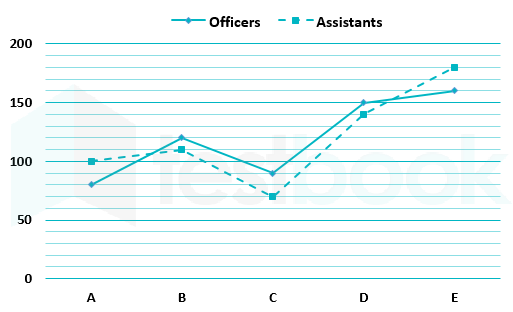
Directions : The following line graph shows the number of employees (Officers + Assistant) working in five different companies A, B, C, D,  and E.


1/4th of the number of officers working in company A is selected for promotion and the total number of employees selected for promotion is 70. Find the number of assistants who didn't get a promotion in company A.

  1. AOption (a)

    45

  2. BOption (b)

    65

  3. COption (c)

    55

  4. DOption (d)

    50

  5. EOption (e)

    60

View answer & explanation

Correct answer

Answer: (d)D.

50

Why this answer is correct

Solution:

Number of officers working in company A is selected for promotion= 80 × 1/4 = 20

Number of Assistants working in company A selected for promotion = (70 - 20) = 50

Number of assistants who didn't get promotion = (100 - 50) = 50.

SBI Clerk Prelims Memory Based Paper (Held On: 11 January 2024 Shift 2) (Previous Year Paper)·Numerical Ability
View full paper

Question 579

SBI Clerk 2024• Numerical Ability• Numerical Ability

Directions : The following line graph shows the number of employees (Officers + Assistant) working in five different companies A, B, C, D,  and E.


If the number of officers working in Company F is 20 more than the number of officers working in company E, the number of assistants working in company F is 30 more than the number of assistants working in company D. Find the difference between number of assistants and number of officers working in company F.

  1. AOption (a)

    30

  2. BOption (b)

    20

  3. COption (c)

    10

  4. DOption (d)

    15

  5. EOption (e)

    25

View answer & explanation

Correct answer

Answer: (c)C.

10

Why this answer is correct

Solution:

Number of officers working in company E = 160

Number of officers working in company F = (160 + 20) = 180

Number of assistants working in company D = 140

Number of assistants working in company F = (140 + 30) = 170

Required difference = (180 - 170) = 10

SBI Clerk Prelims Memory Based Paper (Held On: 11 January 2024 Shift 2) (Previous Year Paper)·Numerical Ability
View full paper

Question 580

SBI Clerk 2024• Numerical Ability• Numerical Ability

Directions : The following line graph shows the number of employees (Officers + Assistant) working in five different companies A, B, C, D,  and E.


Find the ratio between the number of officers working in company  A and B to the number of assistants working in B and C.

  1. AOption (a)

    13: 6

  2. BOption (b)

    10: 9

  3. COption (c)

    11: 4

  4. DOption (d)

    12: 5

  5. EOption (e)

    14: 9

View answer & explanation

Correct answer

Answer: (b)B.

10: 9

Why this answer is correct

Solution:

Number of officers working in company A =  80

Number of officers working in company B = 120

Number of assistants working in company B = 110

Number of assistants working in company C = 70

Required ratio = (80 + 120): (110 + 70) = 200: 180 = 10: 9

How should I prepare for Quantitative Aptitude in SBI Clerk?

Solving previous year questions by topic helps identify recurring concepts, question patterns, and frequently asked sub-topics. Attempt each question, review the step-by-step explanation, and note down key formulas or facts for quick revision before the exam.