Previous Year Paper

SBI Clerk Prelims Memory Based Paper (Held On: 11 January 2024 Shift 2) (Previous Year Paper)

Held in 2024

100 questions60 minutes
With answers
Free

Paper last updated:

Practise under exam conditions

Take this paper as a timed mock test. Review your answers after you submit.

Attempt timed test

Questions & answers

Read the paper at your pace. Open an explanation when you need it.

English Language (30 questions)

Directions: Read the given passage carefully to answer the following questions. Each question will have five alternatives as its answer. Choose the correct option as your answer.

Soil nutrition and organic fertilization are critical components of sustainable agriculture, impacting crop productivity and environmental health. The essence of soil nutrition lies in the soil's ability to supply essential nutrients that plants require for growth, development, and reproduction. Understanding and managing these nutrients sustainably, particularly through organic fertilization, can lead to healthier crops and reduced environmental impact.

Soil is a complex ecosystem teeming with life and is the primary source of nutrients for plants. These nutrients include macronutrients like nitrogen (N), phosphorus (P), and potassium (K), which are required in large amounts, and micronutrients like zinc (Zn) and copper (Cu), needed in smaller quantities but equally vital for plant health. Organic fertilization plays a crucial role in maintaining these nutrient levels without the adverse effects associated with synthetic fertilizers.

Organic fertilizers, derived from natural sources such as compost, manure, bone meal, and green manure, offer a multitude of benefits. These materials contribute not only nutrients but also organic matter, which enhances soil structure, improves water retention, and fosters beneficial microbial activity. The gradual breakdown of organic matter releases nutrients slowly, matching plant uptake and reducing the risk of leaching into water bodies. This slow release also ensures a sustained supply of nutrients over a longer period, supporting crop growth throughout the season.

Moreover, organic fertilization supports the biodiversity of soil organisms by providing food and a healthy environment for worms, fungi, bacteria, and other microbes. These organisms play essential roles in decomposing organic material, fixing nitrogen, and breaking down soil minerals into forms accessible to plants.

Recognizing the benefits of organic methods, many agricultural professionals have begun to pilot new techniques that address the need for sustainable nutrient management. This initiative aims to optimize organic fertilization practices, tailoring them to specific crops and regional soil conditions. By incorporating these practices, farmers can enhance soil fertility naturally, reduce dependence on chemical inputs, and support ecological balance within their farming systems.

Question 1

Which of the following words is similar in meaning to "pilot" in the context of the passage?

  1. AOption (a)

    Navigate

  2. BOption (b)

    Experiment

  3. COption (c)

    Guide

  4. DOption (d)

    Control

  5. EOption (e)

    Launch

View answer & explanation

Correct answer

Answer: (b)B.

Experiment

Why this answer is correct

The correct answer is 'Experiment'.

Key Points

  • The word 'pilot' as used in the passage refers to the trial or initial implementation of new techniques in organic fertilization.
  • For example, the passage mentions "agricultural professionals have begun to pilot new techniques." This context implies testing or trying out something new, which aligns with the meaning of 'Experiment'.
  • Let us see the word meanings and usage of the words given in the options:
  • Navigate ⇒ to plan and direct the route or course.
  • Experiment ⇒ a test or trial to discover something unknown.
  • Guide ⇒ to direct or influence the course or direction.
  • Control ⇒ to command, direct, or rule.
  • Launch ⇒ to start or set in motion.
  • From the above discussion, we can see that the word 'Experiment' aligns closely with the use of 'pilot' in the context of the passage.

Hence, the correct answer is Option 2.
Question 2

According to the passage, why is organic matter important for soil health?

  1. AOption (a)

    It mainly boosts the soil's appearance and feel.

  2. BOption (b)

     It contributes to the chemical binding of soil particles.

  3. COption (c)

     It improves soil structure and water retention.

  4. DOption (d)

    It increases the soil's susceptibility to pests.

  5. EOption (e)

     It decreases the biodiversity of soil organisms.

View answer & explanation

Correct answer

Answer: (c)C.

 It improves soil structure and water retention.

Why this answer is correct

The correct answer is option C.

Key Points

  • To answer this question, let's refer to the following information from the passage:
  • "These materials contribute not only nutrients but also organic matter, which enhances soil structure, improves water retention, and fosters beneficial microbial activity."
  • This explains that organic matter is crucial for improving soil structure and its ability to retain water, which are vital for soil health.
  • Therefore, the correct answer is "It improves soil structure and water retention."

Question 3

Which of the following words is similar in meaning to "address" in the context of the passage?

  1. AOption (a)

    Speak

  2. BOption (b)

    Confront

  3. COption (c)

    Manage

  4. DOption (d)

    Write

  5. EOption (e)

    Adjust

View answer & explanation

Correct answer

Answer: (c)C.

Manage

Why this answer is correct

The correct answer is 'Manage'.

Key Points

  • The word 'address' in this context refers to dealing with or managing specific issues or challenges in the passage.
  • For example, the passage discusses "tailoring organic fertilization practices to address specific crops and regional soil conditions." This suggests dealing with or managing specific agricultural challenges.
  • Let us see the word meanings and usage of the words given in the options:
  • Speak ⇒ to talk or express in speech.
  • Confront ⇒ to face, especially in challenge.
  • Manage ⇒ to handle, direct, govern, or control in action or use.
  • Write ⇒ to form letters, words, or symbols on a surface.
  • Adjust ⇒ to alter or move slightly to achieve desired fit, appearance, or result.
  • From the above discussion, we can see that the word 'Manage' is synonymous with 'address' in the context provided by the passage.

Hence, the correct answer is Option 3.

Question 4

What role do soil organisms play in organic fertilization as mentioned in the passage?

  1. AOption (a)

    They predominantly consume plant roots, enhancing growth.

  2. BOption (b)

    They fix nitrogen, decompose organic material, and make soil minerals accessible to plants.

  3. COption (c)

    They solely aerate the soil without affecting nutrient levels.

  4. DOption (d)

    They prevent any organic matter from decomposing.

  5. EOption (e)

    They convert all organic matter into harmful chemicals.

View answer & explanation

Correct answer

Answer: (b)B.

They fix nitrogen, decompose organic material, and make soil minerals accessible to plants.

Why this answer is correct

The correct answer is option B.

Key Points

  • To answer this question, let's refer to the following information from the passage:
  • "These organisms play essential roles in decomposing organic material, fixing nitrogen, and breaking down soil minerals into forms accessible to plants."
  • This statement directly supports the role of soil organisms in organic fertilization by highlighting their functions in nutrient cycling and availability for plant growth.
  • Therefore, the correct answer is "They fix nitrogen, decompose organic material, and make soil minerals accessible to plants."

Question 5

Which of the following is true as per the passage?:

A) Organic fertilizers release nutrients slowly, matching plant uptake.

B) Organic matter primarily serves to reduce soil biodiversity.

C) The slow release of nutrients by organic matter reduces the risk of nutrient leaching into water bodies.

  1. AOption (a)

    Only A

  2. BOption (b)

    Only B

  3. COption (c)

    Only C

  4. DOption (d)

    Both A and C

  5. EOption (e)

    Both B and C

View answer & explanation

Correct answer

Answer: (d)D.

Both A and C

Why this answer is correct

The correct answer is option 4.

Key PointsLet's have a look at all the given sentences in the question -

Sentence A - Organic fertilizers release nutrients slowly, matching plant uptake.

  • The passage directly supports this statement, mentioning that "the gradual breakdown of organic matter releases nutrients slowly, matching plant uptake and reducing the risk of leaching into water bodies," confirming that this statement is true.

Sentence B - Organic matter primarily serves to reduce soil biodiversity.

  • This statement is false. The passage states that organic fertilization supports the biodiversity of soil organisms by providing a food source and a healthy environment, thus enhancing, not reducing, biodiversity.

Sentence C - The slow release of nutrients by organic matter reduces the risk of nutrient leaching into water bodies.

  • This statement is also supported by the passage, which explains that the slow nutrient release from organic matter coincides with plant uptake rates, minimizing nutrient runoff into water bodies, making this statement true.

Therefore, out of the three given sentences, both A & C are true as per the passage.

Question 6

What is the purpose of piloting new techniques in organic fertilization as described in the passage?

  1. AOption (a)

     To make organic fertilizers less effective but more affordable.

  2. BOption (b)

     To increase the chemical fertilizer dependency.

  3. COption (c)

    To tailor organic fertilization practices to specific crops and regional conditions.

  4. DOption (d)

    To completely eliminate the use of organic fertilizers in agriculture.

  5. EOption (e)

    To reduce the biodiversity supported by organic fertilizers.

View answer & explanation

Correct answer

Answer: (c)C.

To tailor organic fertilization practices to specific crops and regional conditions.

Why this answer is correct

The correct answer is option C.

Key Points

  • To answer this question, let's refer to the following information from the passage:
  • "This initiative aims to optimize organic fertilization practices, tailoring them to specific crops and regional soil conditions."
  • This indicates that the purpose of piloting new techniques is to customize and enhance the effectiveness of organic fertilization for various crops and conditions.
  • Therefore, the correct answer is "To tailor organic fertilization practices to specific crops and regional conditions."

Question 7

Fill in the blank: The gradual breakdown of organic matter releases nutrients slowly, matching plant uptake and reducing the risk of __________ into water bodies.

  1. AOption (a)

    Erosion

  2. BOption (b)

    Pollution

  3. COption (c)

    Leaching

  4. DOption (d)

    Acidification

  5. EOption (e)

    Contamination

View answer & explanation

Correct answer

Answer: (c)C.

Leaching

Why this answer is correct

The correct answer is option 3, 'Leaching'.

Key Points

  • To determine the correct term, let's review the context in which it is used in the passage:
  • The passage states, "The gradual breakdown of organic matter releases nutrients slowly, matching plant uptake and reducing the risk of __________ into water bodies."
  • Leaching - is the process by which nutrients are lost from the soil due to rain and irrigation water carrying them below the root zone of plants, often leading to contamination of groundwater and surface waters.

Now, let's consider the options:

  • Erosion - involves the physical wearing and removal of soil, but does not specifically relate to the nutrient loss discussed in the passage.
  • Pollution - generally refers to contamination but is not specific to the process by which nutrients are washed out from soil.
  • Leaching - correctly describes the process by which nutrients are carried away from the soil by water, as detailed in the passage.
  • Acidification - refers to the decrease in pH levels of soil, not directly related to the movement of nutrients through water.
  • Contamination - while related to pollution, it does not specifically describe the movement of nutrients out of the soil as intended in the context.

Given that 'leaching' accurately describes the nutrient movement that the passage aims to reduce through slow nutrient release, the correct answer is 'Leaching'.

Question 8

Which of the following is false as per the passage?

A) Soil organisms contribute to soil health by fixing nitrogen.

B) Chemical fertilizers are favored over organic methods for sustainable agriculture.

C) New techniques in organic fertilization are being tested to adapt to specific regional soil conditions.

  1. AOption (a)

    Only A

  2. BOption (b)

    Only B

  3. COption (c)

    Only C

  4. DOption (d)

    Both B and C

  5. EOption (e)

    Both A and C

View answer & explanation

Correct answer

Answer: (b)B.

Only B

Why this answer is correct

The correct answer is option 2.

Key PointsLet's have a look at all the given sentences in the question -

Sentence A - Soil organisms contribute to soil health by fixing nitrogen.

  • This statement is true as per the passage, which states, "These organisms play essential roles in decomposing organic material, fixing nitrogen, and breaking down soil minerals into forms accessible to plants," confirming their role in nitrogen fixation.

Sentence B - Chemical fertilizers are favored over organic methods for sustainable agriculture.

  • This statement is false according to the passage. It emphasizes that understanding and managing nutrients sustainably, particularly through organic fertilization, leads to healthier crops and reduced environmental impact, suggesting a preference for organic over chemical methods.

Sentence C - New techniques in organic fertilization are being tested to adapt to specific regional soil conditions.

  • This statement is true. The passage mentions that agricultural professionals are piloting new techniques to tailor organic fertilization practices to specific crops and regional conditions, indicating efforts to adapt to local needs.

Therefore, out of the three given sentences, Only B is false as per the passage.

Question 9

What is the primary benefit of using organic fertilizers according to the passage?

  1. AOption (a)

    They increase the speed of plant growth.

  2. BOption (b)

    They provide a slow, sustained release of nutrients.

  3. COption (c)

    They eliminate the need for water in agricultural practices.

  4. DOption (d)

    They instantly improve the color of the crops.

  5. EOption (e)

    They can replace all plant micronutrients synthetically.

View answer & explanation

Correct answer

Answer: (b)B.

They provide a slow, sustained release of nutrients.

Why this answer is correct

The correct answer is option B.

Key Points

  • To answer this question, let's refer to the following information from the passage:
  • "Organic fertilizers...release nutrients slowly, matching plant uptake and reducing the risk of leaching into water bodies. This slow release also ensures a sustained supply of nutrients over a longer period, supporting crop growth throughout the season."
  • This passage clearly outlines that organic fertilizers provide a slow, sustained release of nutrients, which is their primary benefit over synthetic options.
  • Therefore, the correct answer is "They provide a slow, sustained release of nutrients."

Question 10

Directions

In the following question, a sentence is given with four words marked as (A), (B), (C), and (D). These words may or may not be placed in the correct order. Four options with different arrangements of these words have been provided. Mark the option with the correct arrangement as the answer. If no rearrangement is required, mark option (5) as your answer.

The troops had to surround(A) the enemy(B) from all sides to escape(C) that they didn’t ensure(D).

  1. AOption (a)

    D-C

  2. BOption (b)

    C-A

  3. COption (c)

    B-C

  4. DOption (d)

    A-D

  5. EOption (e)

    No change required

View answer & explanation

Correct answer

Answer: (a)A.

D-C

Why this answer is correct

The correct answer is 'D-C.'

Key Points

  • The given sentence talks about the troops who had to surround the enemy from all sides to make sure that they didn’t run away.
  • Let us explore the meaning of the highlighted words:
  • Surround - To be or go all around somebody or something. (किसी के चारों ओर होना या किसी को चारों ओर से घेरना)
  • Enemy - A person who hates and tries to harm you. (शत्रु, दुश्‍मन, विरोधी)
  • Escape - To manage to get away from a place where you do not want to be; to get free. (अनचाहे स्‍थान से निकल भागना; निकल जाना)
  • Ensure - To make sure that something happens or is definite. (किसी बात को सुनिश्‍चित करना, किसी बात का सुनिश्‍चित होना)
  • Thus, (D) and (C) must be interchanged.

Hence, the correct answer is option 1.

Correct Sentence: The troops had to surround the enemy from all sides to ensure that they didn’t escape.

Question 11

Directions

In the following question, a sentence is given with four words marked as (A), (B), (C), and (D). These words may or may not be placed in the correct order. Four options with different arrangements of these words have been provided. Mark the option with the correct arrangement as the answer. If no rearrangement is required, mark option (5) as your answer.

The thief sobbed(A) and begged, pretending(B) to be apologetic(C) so he could avoid(D) going to jail.

  1. AOption (a)

    D-C

  2. BOption (b)

    B-D

  3. COption (c)

    A-D

  4. DOption (d)

    C-A

  5. EOption (e)

    No change required

View answer & explanation

Correct answer

Answer: (e)E.

No change required

Why this answer is correct

The correct answer is 'No change required.'

Key Points

  • The given sentence talks about a thief who cried and begged, pretending to be sorry so he could keep away from going to jail.
  • Let us explore the meaning of the highlighted words:
  • Sobbed - To cry while taking in sudden, sharp breaths; to speak while you are crying. (छोटे-छोटे साँस भरते हुए रोना, सिसकना; सिसकते हुए कुछ कहना)
  • Pretending - To behave in a particular way to make other people believe something that is not true. (प्रदर्शन, ढोंग या दिखावा करना)
  • Apologetic - Feeling or showing that you are sorry for something you have done. (खेदपूर्ण; क्षमा माँगते हुए)
  • Avoid - To prevent something from happening. (कुछ होने से रोकना)
  • Thus, no change is required in the sentence.

Hence, the correct answer is option 5.

Correct Sentence: The thief sobbed and begged, pretending to be apologetic so he could avoid going to jail.

Question 12

Directions

In the following question, a sentence is given with four words marked as (A), (B), (C), and (D). These words may or may not be placed in the correct order. Four options with different arrangements of these words have been provided. Mark the option with the correct arrangement as the answer. If no rearrangement is required, mark option (5) as your answer.

Even though the alibi**(A)** could not substantiate(B) his defendant(C) for the night of the murder, he was still found innocent(D) of all charges.

  1. AOption (a)

    D-A

  2. BOption (b)

    C-B

  3. COption (c)

    B-D

  4. DOption (d)

    A-C

  5. EOption (e)

    B- A

View answer & explanation

Correct answer

Answer: (d)D.

A-C

Why this answer is correct

The correct answer is **'**A-C.'

Key Points

  • The given sentence talks about a defendant who was found innocent of all charges even though he could not provide any proof or evidence of his statement that says he was in a different place at the time of the murder.
  • Let us explore the meaning of the highlighted words:
  • Alibi - A statement by somebody that says you were in a different place at the time of a crime and so cannot be guilty of the crime. (अपराध के समय अन्‍यत्र उपस्थित होने का कथन यह सिद्ध करने के लिए की वह दोषी नहीं है)
  • Substantiate - To give evidence or provide information to prove that something is true. (पुष्टि के लिए सूचना या प्रमाण देना, सही साबित करना, पुष्टि करना)
  • Defendant - A person who is accused of a crime in a court of law. (वह व्यक्ति जिसपर न्यायालय में आरोप लगाया गया हो, प्रतिवादी, अभियुक्त)
  • Innocent - Not having done wrong. (जिसने ग़लत काम नहीं किया; निर्दोष, बेगुनाह, बेक़सूर)
  • Thus, (A) and (C) must be interchanged.

Hence, the correct answer is option 4.

Correct Sentence: Even though the defendant could not substantiate his alibi for the night of the murder, he was still found innocent of all charges.

Question 13

Directions

In the following question, a sentence is given with four words marked as (A), (B), (C), and (D). These words may or may not be placed in the correct order. Four options with different arrangements of these words have been provided. Mark the option with the correct arrangement as the answer. If no rearrangement is required, mark option (5) as your answer.

If you want to maintain(A) your lawn, you will need to fresh(B) the grass and water it frequently(C) so it stays nice and mow(D).

  1. AOption (a)

    A-C

  2. BOption (b)

    B-D

  3. COption (c)

    C-D

  4. DOption (d)

    A-B

  5. EOption (e)

    A-D

View answer & explanation

Correct answer

Answer: (b)B.

B-D

Why this answer is correct

The correct answer is 'B-D.'

Key Points

  • The given sentence says that if someone wants to maintain his or her lawn, they have to cut the grass using a machine and water it regularly so it stays nice and fresh.
  • Let us explore the meaning of the highlighted words:
  • Maintain - To keep something in good condition by checking and repairing it regularly. (किसी वस्‍तु की नियमित जाँच और मरम्‍मत करते हुए उसे सही हालत में रखना, किसी वस्‍तु का रख-रखाव करना)
  • Fresh - Pleasantly clean or bright. (एकदम साफ़, चमकदार या रोशनीदार)
  • Frequently - Regularly or habitually; often. (बार-बार)
  • Mow - To cut grass using a machine. (विशेष मशीन से घास काटना)
  • Thus, (B) and (D) must be interchanged.

Hence, the correct answer is option 2.

Correct Sentence: If you want to maintain your lawn, you will need to mow the grass and water it frequently so it stays nice and fresh.

Question 14

Directions

In the following question, a sentence is given with four words marked as (A), (B), (C), and (D). These words may or may not be placed in the correct order. Four options with different arrangements of these words have been provided. Mark the option with the correct arrangement as the answer. If no rearrangement is required, mark option (5) as your answer.

Some people believe(A) that they must do something validate(B) with their lives to significant(C) their existence(D) in this world.

  1. AOption (a)

    B-C

  2. BOption (b)

    B-D

  3. COption (c)

    A-D

  4. DOption (d)

    C-A

  5. EOption (e)

    No change required

View answer & explanation

Correct answer

Answer: (a)A.

B-C

Why this answer is correct

The correct answer is 'B-C.'

Key Points

  • The given sentence talks about some people who believe that they must do something worthy or remarkable with their lives to prove their existence in this world.
  • Let us explore the meaning of the highlighted words:
  • Believe - To feel sure that something is true or that somebody is telling the truth. (विश्‍वास करना, सही मान लेना)
  • Validate - To show that something is true. (किसी बात को सत्‍य सिद्घ करना)
  • Significant - Important or large enough to be noticed. (महत्वपूर्ण, काफ़ी बड़ा)
  • Existence - The fact or state of living or having objective reality. (अस्तित्‍व)
  • Thus, (B) and (C) must be interchanged.

Hence, the correct answer is option 1.

Correct Sentence: Some people believe that they must do something significant with their lives to validate their existence in this world.

Question 15

Directions

Select the phrase from the options below that should replace the underlined phrase in the sentence to make it grammatically and contextually correct. If the sentence is already correct, select 'No correction required' as your answer

Each of the employees need to submit his or her reports by Friday.

  1. AOption (a)

    Each of the employees needs

  2. BOption (b)

    All employees need

  3. COption (c)

    Every employee needs

  4. DOption (d)

    Each employee needed

  5. EOption (e)

    No correction required

View answer & explanation

Correct answer

Answer: (a)A.

Each of the employees needs

Why this answer is correct

The correct answer is option 1.

Key Points

  • The correct phrase is "Each of the employees needs."
  • The underlined phrase "Each of the employees need" is grammatically incorrect because "each" requires a singular verb form, despite the plural noun "employees."
  • The correct sentence after phrase replacement would be: "Each of the employees needs to submit his or her reports by Friday."

Question 16

Directions

Select the phrase from the options below that should replace the underlined phrase in the sentence to make it grammatically and contextually correct. If the sentence is already correct, select 'No correction required' as your answer

Despite the many challenges, the project were completed on time.

  1. AOption (a)

    the project was completed

  2. BOption (b)

    the projects were completed

  3. COption (c)

    the project had been completed

  4. DOption (d)

    the project has been completed

  5. EOption (e)

    No correction required

View answer & explanation

Correct answer

Answer: (a)A.

the project was completed

Why this answer is correct

The correct answer is option 1.

Key Points

  • The correct phrase is "the project was completed."
  • The underlined phrase "the project were completed" incorrectly uses the plural form "were" with the singular noun "the project."
  • The sentence structure requires a singular verb to agree with the singular subject.
  • The correct sentence after phrase replacement would be: "Despite the many challenges, the project was completed on time."

Question 17

Directions

Select the phrase from the options below that should replace the underlined phrase in the sentence to make it grammatically and contextually correct. If the sentence is already correct, select 'No correction required' as your answer.

They plans to travel to Japan once the travel restrictions are lifted.

  1. AOption (a)

    are planning to travel

  2. BOption (b)

    plan to travel

  3. COption (c)

    are planned traveling

  4. DOption (d)

    will plan to travel

  5. EOption (e)

    No correction required

View answer & explanation

Correct answer

Answer: (b)B.

plan to travel

Why this answer is correct

The correct answer is option 2.

Key Points

  • The correct phrase is "plan to travel."
  • The underlined phrase "plans to travel" is incorrect due to a mismatch in number between the plural subject 'They' and the singular verb form 'plans.'
  • Correcting the verb form aligns it with the plural subject:
  • For Example: They plan to travel to Japan once the travel restrictions are lifted, indicating their future intentions.
  • The correct sentence after phrase replacement would be: "They plan to travel to Japan once the travel restrictions are lifted."

Additional Information

Planning and Future Intentions in English:

  • English uses several structures to express future plans and intentions, each with its context and usage nuances.
  • Going to + verb: Used for plans decided before the moment of speaking. E.g., They are going to visit Japan next year.
  • Will + verb: Often used for decisions made at the moment of speaking. E.g., I'll take a cup of coffee.

Question 18

Directions

Select the phrase from the options below that should replace the underlined phrase in the sentence to make it grammatically and contextually correct. If the sentence is already correct, select 'No correction required' as your answer.**

She have decided to enroll in a cooking class to enhance her culinary skills.

  1. AOption (a)

    has decided

  2. BOption (b)

    had decided

  3. COption (c)

    will have decided

  4. DOption (d)

    have been decided

  5. EOption (e)

    No correction required

View answer & explanation

Correct answer

Answer: (a)A.

has decided

Why this answer is correct

The correct answer is option 1.

Key Points

  • The correct phrase is "has decided."
  • The underlined phrase "have decided" incorrectly pairs the plural verb with the singular subject 'She.'
  • The correct verb form should reflect the singular subject:
  • For Example: She has decided to enroll in a cooking class to enhance her culinary skills, reflecting her recent decision.
  • The correct sentence after phrase replacement would be: "She has decided to enroll in a cooking class to enhance her culinary skills."

Additional Information

Subject-Verb Agreement Basics:

  • Always match the verb to the subject in number (singular or plural).
  • Common rule: Singular subjects take singular verbs, and plural subjects take plural verbs.
  • Example: He runs every morning. They run every weekend.

Question 19

Directions

Select the phrase from the options below that should replace the underlined phrase in the sentence to make it grammatically and contextually correct. If the sentence is already correct, select 'No correction required' as your answer

One of the keys to success are maintaining a positive attitude.

  1. AOption (a)

    is maintaining

  2. BOption (b)

    are to maintain

  3. COption (c)

    is to maintaining

  4. DOption (d)

    are maintained

  5. EOption (e)

    No correction required

View answer & explanation

Correct answer

Answer: (a)A.

is maintaining

Why this answer is correct

The correct answer is Option 1.


Key Points

  • The phrase "One of the keys" is a singular subject.
  • Singular subjects require singular verbs.
  • The verb "are" should be replaced with "is" to match the singular subject.

Therefore, the correct answer is Option 1.


Correct Sentence: "One of the keys to success is maintaining a positive attitude."

Question 20

Direction: Evaluate the following word, accompanied by three sentences containing it. Determine the sentence(s) that accurately convey the meaning of the given word.

Edition

A. The second edition of the fantasy novel included exclusive illustrations.

B. The chef prepared a special edition of the dessert, using a recipe from his grandmother.

C. Due to heavy traffic, she took an edition route to work this morning.

  1. AOption (a)

    Only A

  2. BOption (b)

    Both A & B

  3. COption (c)

    Only C

  4. DOption (d)

    All A, B & C

  5. EOption (e)

    None of these

View answer & explanation

Correct answer

Answer: (b)B.

Both A & B

Why this answer is correct

The correct answer is: Option 2.

Key Points

  • The word "Edition" refers to a particular form or version of a published text. It often implies a variation or an update from an earlier version. (संस्करण)
  • Example: The latest edition of the encyclopedia includes updates on recent scientific discoveries.
  • Sentence A correctly uses "edition" to describe a version of a novel that includes exclusive illustrations, indicating it is a special or updated version. (संस्करण)
  • Example: The collector's edition of the book comes with autographed illustrations by the author.
  • Sentence B uses "edition" in a metaphorical sense to describe a special version of a dessert, which is an acceptable creative use of the term to imply a variation based on an old recipe. (संस्करण)
  • Example: For the holiday season, the bakery is offering a limited edition of their famous pies, featuring rare ingredients.
  • Sentence C is a misuse of the term since "edition" does not relate to routes or directions.
  • Therefore, sentences A and B correctly convey the meaning of "edition," making Option 2 the correct answer.

Therefore, the correct answer is: Both A & B.

Additional Information

Here are the other options explained along with their Hindi meanings and example sentences:

  • Option 1: This option selects only sentence A as correct, overlooking the metaphorical yet acceptable use of "edition" in sentence B.
  • Example: The first edition of the novel is now considered a rare collector's item.
  • Option 3: This option incorrectly identifies sentence C as using "edition" correctly, which is a misuse of the term since "edition" does not relate to routes or directions.
  • Example: Incorrect usage; hence, no example aligns with the term "edition" in this context.
  • Option 4: This option erroneously includes sentence C, which does not correctly use "edition" in the context of its meaning.
  • Example: N/A - Sentence C is not a correct application of the word "edition."
  • Option 5: This option would imply that none of the sentences correctly use "edition," which is incorrect based on the explanations above.
  • Example: N/A - Incorrect option as sentences A and B do use "edition" appropriately.

Question 21

Direction: Evaluate the following word, accompanied by three sentences containing it. Determine the sentence(s) that accurately convey the meaning of the given word.

Systemic

A. He suggested a systemic change in the way schools evaluate students.

B. The doctor prescribed a systemic antibiotic for the widespread infection.

C. The event planner organized a systemic reception at the beach.

  1. AOption (a)

    Only A

  2. BOption (b)

    Both A & B

  3. COption (c)

    Only C

  4. DOption (d)

    All A, B & C

  5. EOption (e)

    None of these

View answer & explanation

Correct answer

Answer: (b)B.

Both A & B

Why this answer is correct

The correct answer is: Option 2.

Key Points

  • The word "Systemic" refers to something that relates to a system as a whole, rather than to particular parts. It often implies a deep-seated, ingrained issue or a comprehensive approach affecting all parts of a system. (प्रणालीगत)
  • Example: Systemic issues within the corporation were causing widespread inefficiency and dissatisfaction.
  • Sentence A correctly uses "Systemic" to describe a change that affects the entire system of how schools evaluate students, implying a fundamental and comprehensive shift.
  • Example: Implementing a systemic change in the healthcare system can significantly improve patient outcomes.
  • Sentence B uses "Systemic" in the context of medicine, where a systemic antibiotic is intended to work throughout the body to treat a widespread infection, accurately conveying the meaning of affecting the whole system.
  • Example: A systemic treatment plan was necessary to address the full scope of the patient's condition.
  • Sentence C's use of "Systemic" to describe the organization of a reception does not fit the typical meaning of affecting the whole system in a deep-seated or comprehensive manner.
  • Therefore, sentences A and B correctly convey the meaning of "Systemic," making Option 2 the correct choice.

Therefore, the correct answer is: Both A & B.

Additional Information

Here are the other options explained along with their Hindi meanings and example sentences:

  • Only A: This option would suggest that only sentence A correctly uses the term "Systemic," which is not accurate since sentence B also correctly uses the term.
  • Example: Focusing on only one aspect of reform may overlook the need for systemic changes.
  • Only C: Sentence C's use of "Systemic" to describe the organization of a reception does not fit the typical meaning of affecting the whole system in a deep-seated or comprehensive manner.
  • Example: Organizing an event, though requiring thorough planning, doesn't necessarily imply a systemic approach unless it addresses broader systemic issues within event planning.
  • All A, B & C: This option incorrectly includes sentence C as a correct usage of "Systemic."
  • Example: While sentences A and B correctly describe systemic concepts, C does not align with the systemic approach's comprehensive or whole-system implications.
  • None of these: This option would be incorrect as sentences A and B accurately use "Systemic" in their contexts.

Question 22

Direction: Evaluate the following word, accompanied by three sentences containing it. Determine the sentence(s) that accurately convey the meaning of the given word.

Cruel

A. The teacher's harsh grading was seen as cruel by many students.

B. They went on a lovely cruel around the Caribbean.

C. The cruel winter left many without adequate heating.

  1. AOption (a)

    Only A

  2. BOption (b)

    Only C

  3. COption (c)

    Both A & C

  4. DOption (d)

    Only B

  5. EOption (e)

    None of these

View answer & explanation

Correct answer

Answer: (c)C.

Both A & C

Why this answer is correct

The correct answer is: Option 3.

Key Points

  • The word "Cruel" means willfully causing pain or suffering to others, or feeling no concern about it. (क्रूर)
  • Example: The cruel treatment of animals in some shelters has led to widespread outrage.
  • Cruel in Option A Implies strict or severe judgement. (कठोर मूल्यांकन)
  • Example: The professor's harsh grading on the final exam left many students disappointed.
  • "Cruel" in the context of weather (Option C) refers to harsh, severe conditions that can cause suffering. (कठोर)
  • Example: The cruel winter made it difficult for the homeless population to find shelter.
  • Hence, sentences A and C accurately convey the meaning of 'cruel', making the correct answer Option 3.

Therefore, the correct answer is: Both A & C.

Additional Information

Here are the other options explained along with their Hindi meanings and example sentences:

  • Cruel around the Caribbean (Option B): This is a misuse of the word "cruel". The intended word might be "cruise", which means a voyage on a ship or boat taken for pleasure or as a vacation and usually calling in at several places. (कैरेबियन के आसपास क्रूज)
  • Example: They planned a luxurious cruise around the Caribbean to celebrate their anniversary.
  • Cruel winter (Option C): Refers to extremely cold and harsh winter conditions. (कठोर सर्दी)
  • Example: The cruel winter this year resulted in numerous power outages and difficulties for residents.

Directions: Below, you will find a set of five sentences. You need to arrange these sentences in the correct sequence to form a coherent paragraph. After doing so, answer the questions that follow.

A) In addition, digital records enable rapid information sharing between departments, improving coordination and efficiency.

B) Modern medical centers now often include advanced diagnostic tools and specialized wings for diverse medical fields, enhancing patient outcomes.

C) The introduction of cutting-edge technology has significantly changed how patient care is administered in these facilities.

D) Another key advancement is the implementation of streamlined patient admission and discharge processes to minimize wait times.

E) Medical centers have evolved from simple clinics to complex institutions that are equipped to handle a wide range of health issues.

Question 23

Which of the following will be the FIRST sentence after rearrangement?

  1. AOption (a)

    A

  2. BOption (b)

    D

  3. COption (c)

    C

  4. DOption (d)

    B

  5. EOption (e)

    E

View answer & explanation

Correct answer

Answer: (e)E.

E

Why this answer is correct

The correct answer is option E.

Key Points

  • The given paragraph discusses the evolution of medical centers.
  • Sentence E is the first sentence because it provides a broad introduction to how medical centers have evolved from simple clinics to complex institutions equipped to handle diverse health issues, effectively setting the stage for further details.
  • This sentence lays the foundational context for understanding the transformation in the healthcare infrastructure and its impact on patient care.

Question 24

Which of the following will be the SECOND sentence after rearrangement?

  1. AOption (a)

    B

  2. BOption (b)

    C

  3. COption (c)

    A

  4. DOption (d)

    D

  5. EOption (e)

    E

View answer & explanation

Correct answer

Answer: (b)B.

C

Why this answer is correct

The correct answer is option C.

Key Points

  • Sentence C is the second sentence because it delves deeper into the specifics of technological advancements, explaining how these changes have revolutionized patient care in medical centers.
  • It directly connects to the introduction by discussing the role of technology, a critical element in the evolution of modern healthcare facilities.

Question 25

Which of the following will be the THIRD sentence after rearrangement?

  1. AOption (a)

    A

  2. BOption (b)

    B

  3. COption (c)

    C

  4. DOption (d)

    D

  5. EOption (e)

    E

View answer & explanation

Correct answer

Answer: (b)B.

B

Why this answer is correct

The correct answer is option B.

Key Points

  • Sentence B is the third sentence as it provides examples of the types of advancements (like specialized wings and advanced diagnostic tools) introduced in Sentence C.
  • This sentence enriches the narrative by detailing how specific technological innovations have been implemented, enhancing the overall patient outcomes.

Question 26

Which of the following will be the FOURTH sentence after rearrangement?

  1. AOption (a)

    C

  2. BOption (b)

    D

  3. COption (c)

    E

  4. DOption (d)

    A

  5. EOption (e)

    B

View answer & explanation

Correct answer

Answer: (b)B.

D

Why this answer is correct

The correct answer is option D.

Key Points

  • Sentence D is the fourth sentence because it builds on the previously mentioned technological advancements and focuses on operational improvements, such as streamlined patient flow and management processes.
  • This sentence effectively links advancements in medical equipment and facilities to enhancements in administrative processes, illustrating a holistic improvement in medical center operations.

Question 27

Which of the following will be the LAST sentence after rearrangement?

  1. AOption (a)

    B

  2. BOption (b)

    D

  3. COption (c)

    C

  4. DOption (d)

    E

  5. EOption (e)

    A

View answer & explanation

Correct answer

Answer: (e)E.

A

Why this answer is correct

The correct answer is option A.

Key Points

  • Sentence A is the last sentence because it caps off the discussion by emphasizing the role of digital records in enhancing coordination and efficiency across departments within medical centers.
  • This conclusion draws together the themes of technological and operational advancements discussed in previous sentences, highlighting the comprehensive benefits these improvements bring to the efficiency of medical centers.

Additional Information

  • Paragraph after rearrangement - Medical centers have evolved from simple clinics to complex institutions that are equipped to handle a wide range of health issues. The introduction of cutting-edge technology has significantly changed how patient care is administered in these facilities. Modern medical centers now often include advanced diagnostic tools and specialized wings for diverse medical fields, enhancing patient outcomes. Another key advancement is the implementation of streamlined patient admission and discharge processes to minimize wait times. In addition, digital records enable rapid information sharing between departments, improving coordination and efficiency.

Question 28

​Directions: Read the following sentences carefully, choose the one that is grammatically/contextually incorrect, and mark it as your answer.

  1. AOption (a)

    She rarely misses an opportunity to learn something new.

  2. BOption (b)

    Everyone have a role to play in protecting the environment.

  3. COption (c)

    The documentary provided a deep dive into the history of the Roman Empire.

  4. DOption (d)

    Maintaining a balanced diet contributes to overall health and well-being.

  5. EOption (e)

    Our team's efforts were instrumental in the project's success.

View answer & explanation

Correct answer

Answer: (b)B.

Everyone have a role to play in protecting the environment.

Why this answer is correct

The correct answer is option 2.

Key Points

To answer this question, let's have a look at all the given sentences as options:

  • Option 1: She rarely misses an opportunity to learn something new.
  • This sentence is grammatically and contextually correct.
  • Option 2: Everyone have a role to play in protecting the environment.
  • This sentence is incorrect because the subject 'Everyone' is singular, requiring the singular verb form 'has' instead of 'have'.
  • The correct sentence would be: "Everyone has a role to play in protecting the environment."
  • Option 3: The documentary provided a deep dive into the history of the Roman Empire.
  • This sentence is grammatically and contextually correct.
  • Option 4: Maintaining a balanced diet contributes to overall health and well-being.
  • This sentence is grammatically and contextually correct.
  • Option 5: Our team's efforts were instrumental in the project's success.
  • This sentence is grammatically and contextually correct.

So, out of the given sentences, only option 2 is a grammatically/contextually incorrect sentence.

Therefore, the correct answer is "Everyone has a role to play in protecting the environment."

Question 29

Directions: Read the following sentences carefully, choose the one that is grammatically/contextually incorrect, and mark it as your answer.

  1. AOption (a)

    The CEO, along with his managers, are planning a restructuring.

  2. BOption (b)

    He who hesitates is lost.

  3. COption (c)

    Miscommunications can lead to unnecessary complications.

  4. DOption (d)

    I appreciate all the effort you put into this project.

  5. EOption (e)

    Playing an instrument well requires years of practice.

View answer & explanation

Correct answer

Answer: (a)A.

The CEO, along with his managers, are planning a restructuring.

Why this answer is correct

The correct answer is option 1.

Key Points

To answer this question, let's have a look at all the given sentences as options:

  • Option 1: The CEO, along with his managers, are planning a restructuring.
  • This sentence is incorrect because the subject 'The CEO' is singular, and despite the phrase 'along with his managers,' the verb should remain singular. Thus, it should be 'is' instead of 'are'.
  • The correct sentence would be: "The CEO, along with his managers, is planning a restructuring."
  • Option 2: He who hesitates is lost.
  • This sentence is grammatically and contextually correct.
  • Option 3: Miscommunications can lead to unnecessary complications.
  • This sentence is grammatically and contextually correct.
  • Option 4: I appreciate all the effort you put into this project.
  • This sentence is grammatically and contextually correct.
  • Option 5: Playing an instrument well requires years of practice.
  • This sentence is grammatically and contextually correct.

So, out of the given sentences, only option 1 is a grammatically/contextually incorrect sentence.

Therefore, the correct answer is "The CEO, along with his managers, is planning a restructuring."

Question 30

Directions: Read the following sentences carefully, choose the one that is grammatically/contextually incorrect, and mark it as your answer.

  1. AOption (a)

    We need to buy new furnitures for the office.

  2. BOption (b)

    She adjusted quickly to her new role at the company.

  3. COption (c)

    Negotiations between the two countries are ongoing.

  4. DOption (d)

    Understanding complex theories demands a high level of concentration.

  5. EOption (e)

    They cheered loudly when their team won the championship.

View answer & explanation

Correct answer

Answer: (a)A.

We need to buy new furnitures for the office.

Why this answer is correct

The correct answer is option 1.

Key Points

To answer this question, let's have a look at all the given sentences as options:

  • Option 1: We need to buy new furnitures for the office.
  • This sentence is incorrect because 'furniture' is an uncountable noun and should not be made plural with an 's'.
  • The correct sentence would be: "We need to buy new furniture for the office."
  • Option 2: She adjusted quickly to her new role at the company.
  • This sentence is grammatically and contextually correct.
  • Option 3: Negotiations between the two countries are ongoing.
  • This sentence is grammatically and contextually correct.
  • Option 4: Understanding complex theories demands a high level of concentration.
  • This sentence is grammatically and contextually correct.
  • Option 5: They cheered loudly when their team won the championship.
  • This sentence is grammatically and contextually correct.

So, out of the given sentences, only option 1 is a grammatically/contextually incorrect sentence.

Therefore, the correct answer is "We need to buy new furniture for the office."

Numerical Ability (35 questions)

Question 31

X, Y, and Z are partners in a Law Firm. During a particular year X received one-fourth of the profit, Y received one-third of the profit and Z received the remaining Rs. 20,000. How much did Y receive?

  1. AOption (a)

    Rs. 10,000

  2. BOption (b)

    Rs. 12,000

  3. COption (c)

    Rs. 24,000

  4. DOption (d)

    Rs. 18,000

  5. EOption (e)

    Rs. 16,000

View answer & explanation

Correct answer

Answer: (e)E.

Rs. 16,000

Why this answer is correct

Shortcut Trick

Total profit is assumed as LCM of 4 and 3, which is 12 units.

X's share = 1/4 × 12 = 3 units.

Y's share = 1/3 × 12 = 4 units.

Z's share = 12 − (3 + 4) = 5 units.

Given 5 units = Rs. 20,000 ⇒ 1 unit = Rs. 4,000.

Y's share = 4 units = 4 × 4,000 = Rs. 16,000.

∴ The correct answer is Rs. 16,000.

Alternate Method

Given → X receives 1/4 of profit, Y receives 1/3 of profit, Z receives Rs. 20,000. Formulas → Total Profit = X + Y + Z | Share = Fraction × Total Profit.

⇒ Let total profit be P. ⇒ X + Y + Z = P. ⇒ (1/4)P + (1/3)P + 20,000 = P. ⇒ (3P + 4P)/12 + 20,000 = P. ⇒ 7P/12 + 20,000 = P. ⇒ P − 7P/12 = 20,000 ⇒ 5P/12 = 20,000. ⇒ P = (20,000 × 12) ÷ 5 = Rs. 48,000. ⇒ Y's share = (1/3) × 48,000 = Rs. 16,000.

∴ The correct answer is Rs. 16,000.

Additional Information

Partnership Profit Sharing

Profit is generally shared in the ratio of investment and time duration (Profit = Investment × Time).

Fractional Parts

The sum of all fractional shares in a partnership must always equal 1 (Total Whole).

Question 32

A man swims a certain distance downstream in 3 hours and returns the same distance upstream in 5 hours. If the speed of the stream is 11 km/hr, then find the speed of the man in still water.

  1. AOption (a)

    44 km/hr

  2. BOption (b)

    33 km/hr

  3. COption (c)

    55 km/hr

  4. DOption (d)

    66 km/hr

  5. EOption (e)

    None of these

View answer & explanation

Correct answer

Answer: (a)A.

44 km/hr

Why this answer is correct

Shortcut Trick

Speed ratio is inverse of Time ratio for constant distance.

Downstream Speed (D) : Upstream Speed (U) = 5 : 3

Ratio of Man speed (x) to Stream speed (y) = (5+3)/2 : (5−3)/2 = 4 : 1

Given y = 11 km/hr (1 unit), so x = 4 × 11 = 44 km/hr.

∴ The correct answer is 44 km/hr.

Alternate Method

Given: Downstream time (td) = 3 hours, Upstream time (tu) = 5 hours, Stream speed (y) = 11 km/hr.

Formula Used: Distance = Speed × Time; Downstream speed = x + y; Upstream speed = x − y.

⇒ Let Speed of man in still water be x km/hr.

⇒ Distance downstream = 3 × (x + 11)

⇒ Distance upstream = 5 × (x − 11)

⇒ Since distances are equal: 3(x + 11) = 5(x − 11)

⇒ 3x + 33 = 5x − 55

⇒ 2x = 88

⇒ x = 44 km/hr

∴ The correct answer is 44 km/hr.

Additional Information

Speed Relations in Boats

Speed of man in still water (x) = (Downstream speed + Upstream speed) ÷ 2.

Stream Speed Formula

Speed of stream (y) = (Downstream speed − Upstream speed) ÷ 2.

Average Speed for Round Trip

Average speed = (Downstream speed × Upstream speed) ÷ Speed in still water.

Question 33

What will come in place of the question mark (?) in the following series?

36, 38, 41, 46, 53, 64, ?

  1. AOption (a)

    72

  2. BOption (b)

    77

  3. COption (c)

    66

  4. DOption (d)

    74

  5. EOption (e)

    68

View answer & explanation

Correct answer

Answer: (b)B.

77

Why this answer is correct

The pattern of the series is as follows:-

Consecutive prime numbers are being added

⇒ 36 + 2 = 38

⇒ 38 + 3 = 41

⇒ 41 + 5 = 46

⇒ 46 + 7 = 53

⇒ 53 + 11 = 64

⇒ 64 + 13 = 77

∴ The value of ? is 77

Question 34

What should come in place of the question mark '?' in the following number series?

11, 12, 26, 81, ?, 1645

  1. AOption (a)

    328

  2. BOption (b)

    168

  3. COption (c)

    648

  4. DOption (d)

    88

  5. EOption (e)

    1288

View answer & explanation

Correct answer

Answer: (a)A.

328

Why this answer is correct

Calculation:

The series follows the following pattern:

⇒ 11 × 1 + 1 = 12

⇒ 12 × 2 + 2 = 26

⇒ 26 × 3 + 3 = 81

⇒ 81 × 4 + 4 = 328

⇒ 328 × 5 + 5 = 1645

∴ The missing term in the series is 328

Question 35

What should come in place of the question mark '?' in the following number series?

6, 19, 59, 180, 544, ?

  1. AOption (a)

    1613

  2. BOption (b)

    1597

  3. COption (c)

    1625

  4. DOption (d)

    1637

  5. EOption (e)

    1583

View answer & explanation

Correct answer

Answer: (d)D.

1637

Why this answer is correct

The pattern of the series is

6 × 3 + 1 = 19

19 × 3 + 2 = 59

59 × 3 + 3 = 180

180 × 3 + 4 = 544

544 × 3 + 5 = 1637

Question 36

What should come in place of the question mark '?' in the following number series?

4, 6, 12, 30, ?, 315

  1. AOption (a)

    75

  2. BOption (b)

    60

  3. COption (c)

    120

  4. DOption (d)

    90

  5. EOption (e)

    108

View answer & explanation

Correct answer

Answer: (d)D.

90

Why this answer is correct

The series follows the following pattern:

4 × 1.5 = 6

6 × 2 = 12

12 × 2.5 = 30

30 × 3 = 90

90 × 3.5 = 315

∴ The required term will be 90

Question 37

What should come in place of the question mark '?' in the following number series?

3600, 360, 36, ?, 0.36

  1. AOption (a)

    3.6

  2. BOption (b)

    36.1

  3. COption (c)

    .036

  4. DOption (d)

    0.36

  5. EOption (e)

    3.65

View answer & explanation

Correct answer

Answer: (a)A.

3.6

Why this answer is correct

Calculation:

The logic behind the given series is as follows:

3600 ÷ 10 = 360

360 ÷ 10 = 36

36 ÷ 10 = 3.6

3.6 ÷ 10 = 0.36

∴ The value of '?' is 3.6.

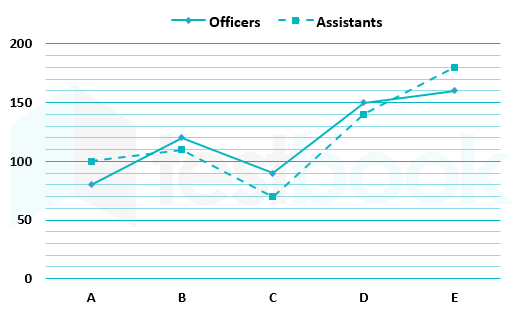
Directions : The following line graph shows the number of employees (Officers + Assistant) working in five different companies A, B, C, D,  and E.


Question 38

1/4th of the number of officers working in company A is selected for promotion and the total number of employees selected for promotion is 70. Find the number of assistants who didn't get a promotion in company A.

  1. AOption (a)

    45

  2. BOption (b)

    65

  3. COption (c)

    55

  4. DOption (d)

    50

  5. EOption (e)

    60

View answer & explanation

Correct answer

Answer: (d)D.

50

Why this answer is correct

Solution:

Number of officers working in company A is selected for promotion= 80 × 1/4 = 20

Number of Assistants working in company A selected for promotion = (70 - 20) = 50

Number of assistants who didn't get promotion = (100 - 50) = 50.

Question 39

If the number of officers working in Company F is 20 more than the number of officers working in company E, the number of assistants working in company F is 30 more than the number of assistants working in company D. Find the difference between number of assistants and number of officers working in company F.

  1. AOption (a)

    30

  2. BOption (b)

    20

  3. COption (c)

    10

  4. DOption (d)

    15

  5. EOption (e)

    25

View answer & explanation

Correct answer

Answer: (c)C.

10

Why this answer is correct

Solution:

Number of officers working in company E = 160

Number of officers working in company F = (160 + 20) = 180

Number of assistants working in company D = 140

Number of assistants working in company F = (140 + 30) = 170

Required difference = (180 - 170) = 10

Question 40

Find the ratio between the number of officers working in company  A and B to the number of assistants working in B and C.

  1. AOption (a)

    13: 6

  2. BOption (b)

    10: 9

  3. COption (c)

    11: 4

  4. DOption (d)

    12: 5

  5. EOption (e)

    14: 9

View answer & explanation

Correct answer

Answer: (b)B.

10: 9

Why this answer is correct

Solution:

Number of officers working in company A =  80

Number of officers working in company B = 120

Number of assistants working in company B = 110

Number of assistants working in company C = 70

Required ratio = (80 + 120): (110 + 70) = 200: 180 = 10: 9

Question 41

Number of officers working in company D and E is what percentage of total assistants working in all the companies A, B, C, D and E.

  1. AOption (a)

    56.7%

  2. BOption (b)

    53.6%

  3. COption (c)

    51.6%

  4. DOption (d)

    43.8%

  5. EOption (e)

    57.8%

View answer & explanation

Correct answer

Answer: (c)C.

51.6%

Why this answer is correct

Solution:

Number of officers working in D and E = (150 + 160) = 310

Total number of assistants working in all companies = (100 + 110 + 70 + 140 + 180) = 600

Required percentage = 310/600 × 100 = 51.6%

Question 42

1/3rd of the officers working in Company C and 3/7th of the assistants working in company C are females. Find the number of males working in the company C.

  1. AOption (a)

    180

  2. BOption (b)

    100

  3. COption (c)

    120

  4. DOption (d)

    150

  5. EOption (e)

    80

View answer & explanation

Correct answer

Answer: (b)B.

100

Why this answer is correct

Solution:

Number of female officers working in company C = 90 × 1/3 = 30

Number of males officers working in company C = (90 - 30) = 60

Number of female assistants working in company C = 70 × 3/7 = 30

Number of male assistants working in company C = (70 - 30) = 40

Required sum = (60 + 40) = 100

Question 43

In an election between two candidates, one got 55% of the total valid votes, 20% of the votes were invalid. If the total number of votes was 7500, then find the number of valid votes that the other candidate got

  1. AOption (a)

    2500

  2. BOption (b)

    1700

  3. COption (c)

    2600

  4. DOption (d)

    2800

  5. EOption (e)

    2700

View answer & explanation

Correct answer

Answer: (e)E.

2700

Why this answer is correct

Shortcut Trick

Total Votes = 7500

Valid Votes = 80% of 7500 = 6000

Winner got 55% of valid votes → Loser got 45% of valid votes

Other candidate votes = 45% of 6000 = 0.45 × 6000 = 2700

∴ The correct answer is 2700.

Alternate Method

Given:

Total number of votes = 7500

Percentage of invalid votes = 20%

Calculations:

⇒ Percentage of valid votes = 100% − 20% = 80%

⇒ Total valid votes = 80% of 7500 = (80/100) × 7500 = 6000

⇒ One candidate got 55% of valid votes.

⇒ The other candidate got = 100% − 55% = 45% of valid votes

⇒ Number of votes for the other candidate = 45% of 6000

⇒ Other candidate votes = (45/100) × 6000 = 45 × 60 = 2700

∴ The correct answer is 2700.

Additional Information

Election Base Values

In election problems, winner/loser percentages are usually calculated on Valid Votes unless specified as a percentage of Total Votes.

Successive Percentage Method

Required Value = Total × (Valid % / 100) × (Required Candidate % / 100). Here: 7500 × 0.80 × 0.45 = 2700.

Majority Margin

The margin of victory is the difference between winner and loser votes: (55% − 45%) = 10% of valid votes.

Question 44

A and B invested their capitals in the ratio of 3 : 1. After "x" months, A leaves and C joins with some capital. If they share the annual profit equally, then the capital invested by C was what % of the capital invested by A?

  1. AOption (a)

    50%

  2. BOption (b)

    40%

  3. COption (c)

    60%

  4. DOption (d)

    45%

  5. EOption (e)

    55%

View answer & explanation

Correct answer

Answer: (a)A.

50%

Why this answer is correct

Shortcut Trick

Ratio of Profit is Investment × Time.

Let A investment be 3 and B investment be 1.

Annual profit is shared equally, so Profit A = Profit B = Profit C.

Profit B = 1 × 12 = 12 units. Thus, Profit C = 12 units.

C joins after x months, so C stays for (12 − x) months. Also A stays for x months.

Profit A = 3 × x = 12 ⇒ x = 4. Time for C = 12 − 4 = 8 months.

Investment C × 8 = 12 ⇒ C = 1.5. % of A = (1.5 ÷ 3) × 100 = 50%.

∴ The correct answer is 50%.

Alternate Method

Given → Investment ratio A : B = 3 : 1, Annual profit ratio A : B : C = 1 : 1 : 1. Formulas: Profit = Investment × Time | Investment = Profit ÷ Time.

⇒ Profit of B = 1 (investment) × 12 (months) = 12 units. ⇒ Since profits are equal, Profit of A = 12 units and Profit of C = 12 units. ⇒ For A: 3 × x = 12 ⇒ x = 4 months. ⇒ Time for C = 12 − x = 12 − 4 = 8 months. ⇒ Investment of C × 8 = 12 ⇒ Investment of C = 1.5 units. ⇒ Required % = (Investment of C ÷ Investment of A) × 100 = (1.5 ÷ 3) × 100 = 50%.

∴ The correct answer is 50%.

Additional Information

Partnership Ratio

In a partnership, the profit is distributed in the ratio of the product of capital and the time period for which the capital is invested.

Annual Profit Calculation

Annual profit implies a total time frame of 12 months. If a person joins after x months, their money is invested for (12 − x) months.

Question 45

An alloy contains silver, aluminium and copper in ratio 5 ∶ 4 ∶ 7, the quantity of copper in kg that must be added to 320 kg of mixture, to have the alloy that contain silver, aluminium and copper in the ratio 5 ∶ 4 ∶ 8?

  1. AOption (a)

    10 kg

  2. BOption (b)

    15 kg

  3. COption (c)

    20 kg

  4. DOption (d)

    50 kg

  5. EOption (e)

    30 kg

View answer & explanation

Correct answer

Answer: (c)C.

20 kg

Why this answer is correct

Shortcut Trick

Initial Ratio of Silver : Aluminium : Copper = 5 : 4 : 7

Total units in initial mixture = 5 + 4 + 7 = 16 units

Given, 16 units = 320 kg → 1 unit = 20 kg

New Ratio = 5 : 4 : 8 (Only Copper units change from 7 to 8)

Change in Copper = 8 − 7 = 1 unit → 20 kg

∴ The correct answer is 20 kg.

Alternate Method

Given: Initial weight = 320 kg, Initial Ratio = 5 : 4 : 7, Final Ratio = 5 : 4 : 8

⇒ Sum of ratio parts = 5 + 4 + 7 = 16

⇒ Quantity of 1 unit = 320 ÷ 16 = 20 kg

⇒ Initial Copper = (7 ÷ 16) × 320 = 140 kg

⇒ In new alloy, Silver (100 kg) and Aluminium (80 kg) remain constant.

⇒ Ratio 5 : 4 : 8 matches the constant parts (5 units = 100 kg, 4 units = 80 kg).

⇒ New Copper quantity = 8 units × 20 kg = 160 kg

⇒ Copper added = 160 − 140 = 20 kg

∴ The correct answer is 20 kg.

Additional Information

Constant Part Rule

When one component is added to a mixture, the quantities (or ratios) of the other components must remain constant. If the ratio values differ, multiply by a factor to equalize them.

Ratio to Quantity Conversion

Total Quantity = (Sum of ratio parts) × (Value of 1 unit). This is the fastest way to map weights to ratio differences.

Alligation in Mixtures

For two-component mixtures, the Alligation rule (Quantity 1 / Quantity 2 = Difference 2 / Difference 1) can also be used to find addition amounts.

Question 46

A shopkeeper purchase some Onion of Rs. 200 per kg. 20% of Onion is rotten, At what price (per kg) should he sell the remaining Onion so as to earn a profit of 25% ?

  1. AOption (a)

    Rs. 340

  2. BOption (b)

    Rs. 312.5

  3. COption (c)

    Rs. 302.5

  4. DOption (d)

    Rs. 315

  5. EOption (e)

    Rs. 300

View answer & explanation

Correct answer

Answer: (b)B.

Rs. 312.5

Why this answer is correct

Shortcut Trick

Let total quantity be 100 kg. Total CP = 100 × 200 = Rs. 20,000.

Desired SP = 20,000 × 1.25 = Rs. 25,000.

Remaining quantity = 80% of 100 = 80 kg.

Required SP per kg = 25,000 ÷ 80 = Rs. 312.5.

∴ The correct answer is Rs. 312.5.

Alternate Method

Given: CP = Rs. 200/kg, Rotten = 20%, Desired Profit = 25%.

Formulas: Total SP = Total CP × (100 + P%) ÷ 100 | Selling Price per kg = Total SP ÷ Available Quantity.

⇒ Let purchase be 1 kg. Total CP = Rs. 200.

⇒ Target Total Revenue = 200 × (125 ÷ 100) = Rs. 250.

⇒ Remaining usable weight = 1kg − (20% of 1kg) = 0.8 kg.

⇒ Selling Price per kg = 250 ÷ 0.8 = Rs. 312.5.

∴ The correct answer is Rs. 312.5.

Additional Information

Effective Cost Price

When goods are lost or rotten, the effective CP per unit increases. Effective CP = Total CP ÷ Net usable quantity.

Profit Calculation

Profit is always calculated on the initial Total Investment, regardless of how much quantity is lost or wasted during the process.

Question 47

What will come in place of question mark (?) in the following equation?

75% of 500 + 40% of 650 = ?

  1. AOption (a)

    625

  2. BOption (b)

    630

  3. COption (c)

    640

  4. DOption (d)

    635

  5. EOption (e)

    645

View answer & explanation

Correct answer

Answer: (d)D.

635

Why this answer is correct

Follow BODMAS rule to solve this question, as per the order given below, 

Step-1: Parts of an equation enclosed in 'Brackets' must be solved first, and in the bracket, 

Step-2: Any mathematical 'Of' or 'Exponent' must be solved next, 

Step-3: Next, the parts of the equation that contain 'Division' and 'Multiplication' are calculated, 

Step-4: Last but not least, the parts of the equation that contain 'Addition' and 'Subtraction' should be calculated 

75% of 500 + 40% of 650 = ?

⇒ (75/100) × 500 + (40/100) × 650 = ?

⇒ 375 + 260 = ?

∴ ? = 635

Question 48

What will come in place of question mark (?) in the following question?

256 × 2-5 × ? = (2/25) of 50 × 75

  1. AOption (a)

    25

  2. BOption (b)

    37.5

  3. COption (c)

    22.5

  4. DOption (d)

    50

  5. EOption (e)

    16

View answer & explanation

Correct answer

Answer: (b)B.

37.5

Why this answer is correct

256 × 2-5 × ? = (2/25) of 50 × 75

⇒ 28 × 2-5 × ? = (2/25) of 50 × 75

⇒ 28 × 2-5 × ? = (2/25) ×  50 × 75

⇒ 28 × 2-5 × ? = 2 ×  2 × 75

⇒ 28/25 × ? = 4 × 75

⇒ 8 × ? = 4 × 75

⇒ ? = 75/2

⇒ ? = 37.5

Question 49

What will come in place of question mark (?) in the following question?

37% of 700 - 39% of 400 = ? - 31% of 300

  1. AOption (a)

    187

  2. BOption (b)

    168

  3. COption (c)

    196

  4. DOption (d)

    202

  5. EOption (e)

    205

View answer & explanation

Correct answer

Answer: (c)C.

196

Why this answer is correct

37% of 700 - 39% of 400 = ? - 31% of 300

⇒ 37 × 7 - 39 × 4 = ? - 31 × 3

As all unit digits in options are different, hence we can reach to answer by only calculating unit digits

⇒ 7 × 7 - 9 × 4 = ? - 1 × 3

⇒ ? = 9 - 6 + 3 = 6

Hence, answer will be 196

Question 50

What will come in place of question mark (?) in the following question?

150% of 220 + 83 + 10% of ? = 302

  1. AOption (a)

    58

  2. BOption (b)

    80

  3. COption (c)

    360

  4. DOption (d)

    580

  5. EOption (e)

    630

View answer & explanation

Correct answer

Answer: (d)D.

580

Why this answer is correct

150% of 220 + 83 + 10% of ? = 302

⇒ 330 + 512 + ?/10 = 900

⇒ ?/10 = 900 - 330 - 512

⇒ ?/10 = 58

⇒ ? = 580

Question 51

What will come in place of question mark (?) in the following question?

? + 308 - 25% of 4036 = 182

  1. AOption (a)

    325

  2. BOption (b)

    525

  3. COption (c)

    725

  4. DOption (d)

    1025

  5. EOption (e)

    1225

View answer & explanation

Correct answer

Answer: (d)D.

1025

Why this answer is correct

? + 308 - 25% of 4036 = 182​

⇒ ? + 308 - 4036/4 = 324

⇒ ? + 308 - 1009 = 324

⇒ ? = 1009 + 324 - 308

⇒ ? = 1025

Question 52

What will come in place of question mark (?) in the following question?

20% of (28 × 40) - √? = 156 × 30 ÷ 26

  1. AOption (a)

    144

  2. BOption (b)

    784

  3. COption (c)

    1296

  4. DOption (d)

    1936

  5. EOption (e)

    2116

View answer & explanation

Correct answer

Answer: (d)D.

1936

Why this answer is correct

20% of (28 × 40) - √? = 156 × 30 ÷ 26

⇒ 28 × 40/5 - √? = 6 × 30

⇒ 224 - √? = 180

⇒ √? = 224 - 180

⇒ √? = 44

⇒ ? = 1936

Question 53

What will come in place of question mark (?) in the following equation?

80 – 42 ÷ 14 – 19 × 3 = ?

  1. AOption (a)

    18

  2. BOption (b)

    12

  3. COption (c)

    15

  4. DOption (d)

    20

  5. EOption (e)

    25

View answer & explanation

Correct answer

Answer: (d)D.

20

Why this answer is correct

Follow BODMAS rule to solve this question, as per the order given below, 

Step-1: Parts of an equation enclosed in 'Brackets' must be solved first, and in the bracket, 

Step-2: Any mathematical 'Of' or 'Exponent' must be solved next, 

Step-3: Next, the parts of the equation that contain 'Division' and 'Multiplication' are calculated, 

Step-4: Last but not least, the parts of the equation that contain 'Addition' and 'Subtraction' should be calculated 

80 – 42 ÷ 14 – 19 × 3 = ?

⇒ 80 – 3 – 19 × 3 = ?

⇒ 80 – 3 – 57 = ?

⇒ 80 – 60 = ?

∴ ? = 20

Question 54

What will come in place of the question mark ‘?’ in the following question?

4532 ÷ √1936 + 524 ÷ 4 = ?

  1. AOption (a)

    210

  2. BOption (b)

    214

  3. COption (c)

    226

  4. DOption (d)

    234

  5. EOption (e)

    242

View answer & explanation

Correct answer

Answer: (d)D.

234

Why this answer is correct

Given:

4532 ÷ √1936 + 524 ÷ 4 = ?

Concept:

Calculation:

⇒ 4532 ÷ 44 + 131 = ?

⇒ 103 + 131 = ?

⇒ 234 = ?

Question 55

What will come in place of the question mark ‘?’ in the following question?

√676 × 34 + 125 × 7 = ? - 41

  1. AOption (a)

    1500

  2. BOption (b)

    1600

  3. COption (c)

    1800

  4. DOption (d)

    2000

  5. EOption (e)

    2100

View answer & explanation

Correct answer

Answer: (c)C.

1800

Why this answer is correct

√676 × 34 + 125 × 7 = ? - 41

⇒ 26 × 34 + 125 × 7 = ? - 41

⇒ 884 + 875 = ? - 41

⇒ 1759 = ? - 41

⇒ ? = 1759 + 41 = 1800

Question 56

What will come in place of the question mark ‘?’ in the following question?

(256 - 196 + 169 - 144) ÷ ? = 500

  1. AOption (a)

    0.17

  2. BOption (b)

    0.26

  3. COption (c)

    0.37

  4. DOption (d)

    0.47

  5. EOption (e)

    0.58

View answer & explanation

Correct answer

Answer: (a)A.

0.17

Why this answer is correct

Given:

(256 - 196 + 169 - 144) ÷ ? = 500

Concept used:

Calculation:

(256 - 196 + 169 - 144) ÷ ? = 500

⇒ (425 - 340) ÷ ? = 500

⇒ 85 ÷ ? = 500

⇒ ? = 0.17

Question 57

What will come in place of question mark (?) in the following equation?

65% of 400 + 35% of 600 = ?

  1. AOption (a)

    430

  2. BOption (b)

    510

  3. COption (c)

    450

  4. DOption (d)

    470

  5. EOption (e)

    490

View answer & explanation

Correct answer

Answer: (d)D.

470

Why this answer is correct

Follow BODMAS rule to solve this question, as per the order given below, 

Step-1: Parts of an equation enclosed in 'Brackets' must be solved first, and in the bracket, 

Step-2: Any mathematical 'Of' or 'Exponent' must be solved next, 

Step-3: Next, the parts of the equation that contain 'Division' and 'Multiplication' are calculated, 

Step-4: Last but not least, the parts of the equation that contain 'Addition' and 'Subtraction' should be calculated.

65% of 400 + 35% of 600 = ?

⇒ 260 + 210 = ?

∴ ? = 470

Question 58

What will come in place of question mark (?) in the following equation?

40% of 600 + ∛729 – 132 = ?

  1. AOption (a)

    60

  2. BOption (b)

    120

  3. COption (c)

    80

  4. DOption (d)

    90

  5. EOption (e)

    50

View answer & explanation

Correct answer

Answer: (c)C.

80

Why this answer is correct

Follow BODMAS rule to solve this question, as per the order given below, 

Step-1: Parts of an equation enclosed in 'Brackets' must be solved first, and in the bracket, 

Step-2: Any mathematical 'Of' or 'Exponent' must be solved next, 

Step-3: Next, the parts of the equation that contain 'Division' and 'Multiplication' are calculated, 

Step-4: Last but not least, the parts of the equation that contain 'Addition' and 'Subtraction' should be calculated 

40% of 600 + ∛729 – 132 = ?

⇒ 240 + 9 – 169 = ?

⇒ 249 – 169 = ?

∴ ? = 80

Question 59

What will come in place of question mark ‘?’ in the following question?

24 × 16.67% + 36 × 11.11% + 42 × 14.28% = ?

  1. AOption (a)

    10

  2. BOption (b)

    12

  3. COption (c)

    14

  4. DOption (d)

    16

  5. EOption (e)

    18

View answer & explanation

Correct answer

Answer: (c)C.

14

Why this answer is correct

24 × 16.67% + 36 × 11.11% + 42 × 14.28% = ?

⇒ 24 × 1/6 + 36 × 1/9 + 42 × 1/7 = ?

⇒ 4 + 4 + 6 = ?

⇒ ? = 14

Question 60

What will come in place of question mark ‘?’ in the following question?

35 × 25 + 55 × 45 + 75 × 65 = ? × 5

  1. AOption (a)

    1220

  2. BOption (b)

    1330

  3. COption (c)

    1455

  4. DOption (d)

    1665

  5. EOption (e)

    1645

View answer & explanation

Correct answer

Answer: (e)E.

1645

Why this answer is correct

35 × 25 + 55 × 45 + 75 × 65 = ? × 5

⇒ (30 + 5)(30 - 5) + (50 + 5)(50 - 5) + (70 + 5)(70 - 5) = ? × 5

⇒ 302 - 52 + 502 - 52 + 702 - 52 = ? × 5

⇒ 900 - 25 + 2500 - 25 + 4900 - 25 = ? × 5

⇒ (900 + 2500 + 4900) - (25) × 3 = ? × 5

⇒ 8300 - 75 = ? × ?

⇒ ? = 8225/5 = 1645

Question 61

What will come in place of question mark (?) in the following equation?

630 ÷ 9 × {(118 - 106) + 3} = ?

  1. AOption (a)

    1150

  2. BOption (b)

    1050

  3. COption (c)

    950

  4. DOption (d)

    1250

  5. EOption (e)

    850

View answer & explanation

Correct answer

Answer: (b)B.

1050

Why this answer is correct

Follow BODMAS rule to solve this question, as per the order given below, 

Step-1: Parts of an equation enclosed in 'Brackets' must be solved first, and in the bracket, 

Step-2: Any mathematical 'Of' or 'Exponent' must be solved next, 

Step-3: Next, the parts of the equation that contain 'Division' and 'Multiplication' are calculated, 

Step-4: Last but not least, the parts of the equation that contain 'Addition' and 'Subtraction' should be calculated 

630 ÷ 9 × {(118 - 106) + 3} = ?

⇒ 630 ÷ 9 × {12 + 3} = ?

⇒ 630 × 1/9 × 15 = ?

⇒ 70 × 15 = ?

∴ ? = 1050

Question 62

Prashant borrowed Rs. 15000 from his friend at a rate of 10% compound interest compounded annually. Find out how much amount he will return after 3 years?

  1. AOption (a)

    Rs. 19,500

  2. BOption (b)

    Rs. 18,500

  3. COption (c)

    Rs. 19,965

  4. DOption (d)

    Rs. 18,065

  5. EOption (e)

    Rs. 19,000

View answer & explanation

Correct answer

Answer: (c)C.

Rs. 19,965

Why this answer is correct

Shortcut Trick

Rate = 10% → Multiplying factor for 1 year = 1.1

For 3 years, Amount = Principal × (1.1)3

⇒ 15000 × 1.331 = 19965

∴ The correct answer is Rs. 19,965.

Alternate Method

Given:

Principal (P) = Rs. 15000

Rate (R) = 10% per annum

Time (n) = 3 years

Formula Used:

Amount (A) = P(1 + R/100)n

Calculations:

⇒ A = 15000 × (1 + 10/100)3

⇒ A = 15000 × (11/10) × (11/10) × (11/10)

⇒ A = 15 × 11 × 11 × 11

⇒ A = 15 × 1331

⇒ A = 19965

∴ The correct answer is Rs. 19,965.

Additional Information

Effective Rate Method

For 10% interest for 3 years, the effective compound interest rate is 33.1%. CI = 33.1% of 15000 = 4965. Amount = 15000 + 4965 = 19965.

Difference between SI and CI

For 3 years, the difference between CI and SI is given by P(R/100)2 × (3 + R/100).

Compound Interest Formula

CI = Amount − Principal = P[(1 + R/100)n − 1].

Question 63

The circumferences of two circles are in the ratio of 3 ∶ 5. Then by what percentage the area of bigger circle is greater than the area of smaller circle.

  1. AOption (a)

    200 %

  2. BOption (b)

    185.56 %

  3. COption (c)

    156.75 %

  4. DOption (d)

    177.78 %

  5. EOption (e)

    64 %

View answer & explanation

Correct answer

Answer: (d)D.

177.78 %

Why this answer is correct

Shortcut Trick

Ratio of Circumferences (C1 : C2) = 3 : 5

Ratio of Radii (r1 : r2) = 3 : 5 (since C ∝ r)

Ratio of Areas (A1 : A2) = 32 : 52 = 9 : 25

Percentage increase = [(25 − 9) ÷ 9] × 100 = (16 ÷ 9) × 100 = 177.78%

∴ The correct answer is 177.78 %.

Alternate Method

Given: Ratio of Circumferences = 3 : 5

Formula Used: Circumference = 2πr; Area = πr2

⇒ 2πr1 ÷ 2πr2 = 3 ÷ 5

⇒ r1 ÷ r2 = 3 ÷ 5

⇒ Area1 = π × (3x)2 = 9πx2

⇒ Area2 = π × (5x)2 = 25πx2

⇒ Difference in Area = 25πx2 − 9πx2 = 16πx2

⇒ Percentage Greater = (16πx2 ÷ 9πx2) × 100

⇒ Percentage Greater = (16 ÷ 9) × 100 ≈ 177.78%

∴ The correct answer is 177.78 %.

Additional Information

Ratio Relationships in Circles

If the ratio of radii or circumferences is a : b, then the ratio of their areas is always a2 : b2.

Percentage Change Formula

Percentage change = [(Final Value − Initial Value) ÷ Initial Value] × 100. In this case, "greater than" refers to the smaller circle as the base.

Common Fractional Conversions

The fraction 1/9 ≈ 11.11%, hence 16/9 = 1 + 7/9 = 100% + 77.77% = 177.78%.

Question 64

Pipe A can fill the tank in 3 hours and pipe B can fill the tank in 5 hours pipe C can empty tank 15 hours then find in how many hours tank will be filled when they work alternatively starting from B?

  1. AOption (a)

    11/3

  2. BOption (b)

    19/3

  3. COption (c)

    25/9

  4. DOption (d)

    12/5

  5. EOption (e)

    None of these

View answer & explanation

Correct answer

Answer: (b)B.

19/3

Why this answer is correct

Shortcut Trick

Total Capacity (LCM of 3, 5, 15) = 15 units.

Efficiencies: A = 5, B = 3, C = −1. Sequence: B, A, C.

Work in 1 cycle (3 hours): 3 + 5 − 1 = 7 units.

In 2 cycles (6 hours): 7 × 2 = 14 units. Remaining work = 15 − 14 = 1 unit.

Next is B: Time taken = 1/3 hour. Total time = 6 + 1/3 = 19/3 hours.

∴ The correct answer is 19/3 hours.

Alternate Method

Given: Pipe A fills in 3 hours, Pipe B fills in 5 hours, Pipe C empties in 15 hours. Working alternatively starting from B.

PipeTime (hrs)Total Work (LCM)Efficiency
Pipe A (Fill)315 units15 ÷ 3 = +5
Pipe B (Fill)515 ÷ 5 = +3
Pipe C (Empty)1515 ÷ 15 = −1

The sequence of work is B → A → C.

⇒ Work in Hour 1 (B) = 3 units

⇒ Work in Hour 2 (A) = 5 units

⇒ Work in Hour 3 (C) = −1 unit

⇒ Total work in 1 cycle (3 hours) = 3 + 5 − 1 = 7 units

⇒ Work in 2 cycles (6 hours) = 7 × 2 = 14 units

⇒ Remaining work = 15 − 14 = 1 unit

⇒ Remaining work will be done by Pipe B in 1/3 hour.

⇒ Total time = 6 + 1/3 = 19/3 hours

∴ The correct answer is 19/3 hours.

Additional Information

Alternate Work Concept

When pipes work alternatively, calculate the work done in one complete cycle before repeating the process for the total capacity.

Negative Efficiency

For an outlet or emptying pipe, the efficiency is always taken as negative in the total work calculation.

Pipes and Cisterns Formula

Total Work = Time × Efficiency. If multiple pipes work together, add their efficiencies: (E1 + E2 − E3) × T = Total Work.

Question 65

8 years hence, the ratio of Munna’s and Guddu’s age will be 6 : 5. At present Munna is twice the age of Guddu. What will be the age of Munna after 6 years? 

  1. AOption (a)

    26

  2. BOption (b)

    10

  3. COption (c)

    12

  4. DOption (d)

    32

  5. EOption (e)

    None of the above

View answer & explanation

Correct answer

Answer: (b)B.

10

Why this answer is correct

Shortcut Trick

Present ratio Munna : Guddu = 2 : 1 (Difference = 1 unit)

Ratio after 8 years = 6 : 5 (Difference = 1 unit)

Difference in Munna's age parts = 6 − 2 = 4 units

4 units → 8 years ⇒ 1 unit → 2 years

Munna's present age = 2 × 2 = 4 years

Munna's age after 6 years = 4 + 6 = 10 years

∴ The correct answer is 10 years.

Alternate Method

Given:

Present age of Guddu = x

Present age of Munna = 2x

Formula Used: Ratio = (Munna's Age + 8) / (Guddu's Age + 8)

Calculations:

⇒ (2x + 8) / (x + 8) = 6 / 5

⇒ 5 × (2x + 8) = 6 × (x + 8)

⇒ 10x + 40 = 6x + 48

⇒ 10x − 6x = 48 − 40

⇒ 4x = 8

⇒ x = 2

⇒ Munna's present age = 2 × 2 = 4 years

⇒ Munna's age after 6 years = 4 + 6 = 10 years

∴ The correct answer is 10 years.

Additional Information

Ratio Adjustment Method

If the difference between ratio parts is not the same, multiply the ratios by the difference of the other ratio to equalize the age gap.

Age Problems Tip

The difference between the ages of two people always remains constant regardless of the number of years passed.

Reasoning Ability (35 questions)

Direction: Read the following information carefully and answer the questions that follow.

There are 8 persons namely M, N, O, P, Q, R, S, and T. They all stay in an 8-storey building, where the bottom floor is numbered 1 and the top floor is numbered 8 but not necessarily in the same order. Only one person stays on one floor.

R stays on the only even prime numbered floor. N stays on one of the floors which is below floor 4. Q stays on floor 5. Three persons stay between N and T. S stays just below Q. O stays two floors above M.

Question 66

Who stays on the sixth floor?

  1. AOption (a)

    T

  2. BOption (b)

    O

  3. COption (c)

    M

  4. DOption (d)

    S

  5. EOption (e)

    Q

View answer & explanation

Correct answer

Answer: (c)C.

M

Why this answer is correct

Names given: M, N, O, P, Q, R, S, and T.

Floors given: 1 (bottom floor) to 8 (top floor)

  1. R stays on the only even prime numbered floor.

(The only even prime number is 2, so R stays on the second floor).

  1. Q stays on floor 5.
FloorsNames
8
7
6
5Q
4
3
2R
1
  1. S stays just below Q.

  2. N stays on one of the floors which is below floor 4.

(As, R is already on floor 2, N can be on floor 1 or floor 3. So, we have two cases. Case 1: when N is on floor 3, and Case 2: when N is on floor 1).

Case 1: when N is on floor 3

FloorsNames
8
7
6
5Q
4S
3N
2R
1

Case 2: when N is on floor 1

FloorsNames
8
7
6
5Q
4S
3
2R
1N
  1. Three persons stay between N and T.

(As, Q is already on floor 5, statement 5 cannot be arranged in case 2, so we can eliminate case 2).

FloorsNames
8
7T
6
5Q
4S
3N
2R
1
  1. O stays two floors above M.

(The only floors which satisfy the statement 6 are floor 8 and floor 6, so M stays on floor 6 and O stays on floor 8).

As, the only person left is P and the only floor left is floor 1, P will be on floor 1.

Hence, the final arrangement will be as follows:

FloorsNames
8O
7T
6M
5Q
4S
3N
2R
1P

Hence, M stays on the sixth floor.

Question 67

How many persons are staying between P and M?

  1. AOption (a)

    3

  2. BOption (b)

    1

  3. COption (c)

    2

  4. DOption (d)

    6

  5. EOption (e)

    4

View answer & explanation

Correct answer

Answer: (e)E.

4

Why this answer is correct

Names given: M, N, O, P, Q, R, S, and T.

Floors given: 1 (bottom floor) to 8 (top floor)

  1. R stays on the only even prime numbered floor.

(The only even prime number is 2, so R stays on the second floor).

  1. Q stays on floor 5.
FloorsNames
8
7
6
5Q
4
3
2R
1
  1. S stays just below Q.

  2. N stays on one of the floors which is below floor 4.

(As, R is already on floor 2, N can be on floor 1 or floor 3. So, we have two cases. Case 1: when N is on floor 3, and Case 2: when N is on floor 1).

Case 1: when N is on floor 3

FloorsNames
8
7
6
5Q
4S
3N
2R
1

Case 2: when N is on floor 1

FloorsNames
8
7
6
5Q
4S
3
2R
1N
  1. Three persons stay between N and T.

(As, Q is already on floor 5, statement 5 cannot be arranged in case 2, so we can eliminate case 2).

FloorsNames
8
7T
6
5Q
4S
3N
2R
1
  1. O stays two floors above M.

(The only floors which satisfy the statement 6 are floor 8 and floor 6, so M stays on floor 6 and O stays on floor 8).

As, the only person left is P and the only floor left is floor 1, P will be on floor 1.

Hence, the final arrangement will be as follows:

FloorsNames
8O
7T
6M
5Q
4S
3N
2R
1P

Hence, four persons are staying between P and M.

Question 68

Who stays two floors above the floor of Q?

  1. AOption (a)

    T

  2. BOption (b)

    S

  3. COption (c)

    N

  4. DOption (d)

    M

  5. EOption (e)

    P

View answer & explanation

Correct answer

Answer: (a)A.

T

Why this answer is correct

Names given: M, N, O, P, Q, R, S, and T.

Floors given: 1 (bottom floor) to 8 (top floor)

  1. R stays on the only even prime numbered floor.

(The only even prime number is 2, so R stays on the second floor).

  1. Q stays on floor 5.
FloorsNames
8
7
6
5Q
4
3
2R
1
  1. S stays just below Q.

  2. N stays on one of the floors which is below floor 4.

(As, R is already on floor 2, N can be on floor 1 or floor 3. So, we have two cases. Case 1: when N is on floor 3, and Case 2: when N is on floor 1).

Case 1: when N is on floor 3

FloorsNames
8
7
6
5Q
4S
3N
2R
1

Case 2: when N is on floor 1

FloorsNames
8
7
6
5Q
4S
3
2R
1N
  1. Three persons stay between N and T.

(As, Q is already on floor 5, statement 5 cannot be arranged in case 2, so we can eliminate case 2).

FloorsNames
8
7T
6
5Q
4S
3N
2R
1
  1. O stays two floors above M.

(The only floors which satisfy the statement 6 are floor 8 and floor 6, so M stays on floor 6 and O stays on floor 8).

As, the only person left is P and the only floor left is floor 1, P will be on floor 1.

Hence, the final arrangement will be as follows:

FloorsNames
8O
7T
6M
5Q
4S
3N
2R
1P

Hence, T stays two floors above the floor of Q.

Question 69

Among the given options, one option is different from the others in some way, choose the option which is different from the other options.

  1. AOption (a)

    T, O

  2. BOption (b)

    R, S

  3. COption (c)

    Q, M

  4. DOption (d)

    N, S

  5. EOption (e)

    P, R

View answer & explanation

Correct answer

Answer: (b)B.

R, S

Why this answer is correct

Names given: M, N, O, P, Q, R, S, and T.

Floors given: 1 (bottom floor) to 8 (top floor)

  1. R stays on the only even prime numbered floor.

(The only even prime number is 2, so R stays on the second floor).

  1. Q stays on floor 5.
FloorsNames
8
7
6
5Q
4
3
2R
1
  1. S stays just below Q.

  2. N stays on one of the floors which is below floor 4.

(As, R is already on floor 2, N can be on floor 1 or floor 3. So, we have two cases. Case 1: when N is on floor 3, and Case 2: when N is on floor 1).

Case 1: when N is on floor 3

FloorsNames
8
7
6
5Q
4S
3N
2R
1

Case 2: when N is on floor 1

FloorsNames
8
7
6
5Q
4S
3
2R
1N
  1. Three persons stay between N and T.

(As Q is already on floor 5, statement 5 cannot be arranged in case 2, so we can eliminate case 2).

FloorsNames
8
7T
6
5Q
4S
3N
2R
1
  1. O stays two floors above M.

(The only floors which satisfy statement 6 are floor 8 and floor 6, so M stays on floor 6 and O stays on floor 8).

As the only person left is P and the only floor left is floor 1, P will be on floor 1.

Hence, the final arrangement will be as follows:

FloorsNames
8O
7T
6M
5Q
4S
3N
2R
1P

In all the options the second person is immediately above the first person, but S is not immediately above R.

Hence, R, S is different from the other options.

Question 70

Which pair of name – floor number is incorrect?

  1. AOption (a)

    O – floor 8

  2. BOption (b)

    Q – floor 5

  3. COption (c)

    M – floor 6

  4. DOption (d)

    N – floor 4

  5. EOption (e)

    T – floor 7

View answer & explanation

Correct answer

Answer: (d)D.

N – floor 4

Why this answer is correct

Names given: M, N, O, P, Q, R, S, and T.

Floors given: 1 (bottom floor) to 8 (top floor)

  1. R stays on the only even prime numbered floor.

(The only even prime number is 2, so R stays on the second floor).

  1. Q stays on floor 5.
FloorsNames
8
7
6
5Q
4
3
2R
1
  1. S stays just below Q.

  2. N stays on one of the floors which is below floor 4.

(As, R is already on floor 2, N can be on floor 1 or floor 3. So, we have two cases. Case 1: when N is on floor 3, and Case 2: when N is on floor 1).

Case 1: when N is on floor 3

FloorsNames
8
7
6
5Q
4S
3N
2R
1

Case 2: when N is on floor 1

FloorsNames
8
7
6
5Q
4S
3
2R
1N
  1. Three persons stay between N and T.

(As, Q is already on floor 5, statement 5 cannot be arranged in case 2, so we can eliminate case 2).

FloorsNames
8
7T
6
5Q
4S
3N
2R
1
  1. O stays two floors above M.

(The only floors which satisfy the statement 6 are floor 8 and floor 6, so M stays on floor 6 and O stays on floor 8).

As, the only person left is P and the only floor left is floor 1, P will be on floor 1.

Hence, the final arrangement will be as follows:

FloorsNames
8O
7T
6M
5Q
4S
3N
2R
1P

Hence, N – floor 4 is incorrect.

Question 71

Directions

In the following question assuming the given statements to be true, find which of the conclusion(s) among given conclusions is/are definitely true and then give your answers accordingly.

Statement:

T ≥ D, T ≥ K, Z = K

Conclusions:

I. D > Z

II. Z ≥ D

  1. AOption (a)

    Only I follows

  2. BOption (b)

    Only II follows

  3. COption (c)

    Either I or II follow

  4. DOption (d)

    Neither I nor II follow

  5. EOption (e)

    Both I and II follow

View answer & explanation

Correct answer

Answer: (c)C.

Either I or II follow

Why this answer is correct

Concept:

The either-or case for 2 elements A and B is used if any one of the following conditions is satisfied:

  1. When the two conclusions, A < B and A ≥ B, are false, and a definite relationship cannot be established using the given information. Here, we have A < B or A > B, or A = B
  2. When the two conclusions, A > B and A ≤ B, are false, and a definite relationship cannot be established using the given information. Here, we have A < B or A > B, or A = B
  3. When the two conclusions, A > B and A < B, are false, and a definite relationship cannot be established using the given information. Also, it is already clear from the given information that A ≠ B. Here, we have A < B or A > B, and A ≠ B

Explanation:

Given statements: T ≥ D, T ≥ K, Z = K

On combining we get, Z = K ≤ T ≥ D

Conclusions:

I. D > Z → False (As we can see that Z = K ≤ T ≥ D, here the relation between D and Z cannot be determined. So, D < Z is false)

II. Z ≥ D → False (As we can see that Z = K ≤ T ≥ D, here the relation between D and Z cannot be determined. So, Z ≥ D is false)

Here, both the conclusions are individually false, all the conclusions have common terms and three operators are used.

Z can be equal to, greater than, or smaller than D.

⇒ Z < D or Z > D, or Z = D

  • Here, point 2 of the above-mentioned concept is satisfied. So, the either-or condition is applicable.
  • Hence, either I or II follows.

Mistake Points

D > Z is the same as Z < D.

Question 72

Directions

In the following question assuming the given statements to be true, find which of the conclusion(s) among given conclusions is/are definitely true and then give your answers accordingly.

Statement:

Y ≥ D < F = R > L < X

Conclusions:

I. X < F

II. R > D

  1. AOption (a)

    Only I follows

  2. BOption (b)

    Only II follows

  3. COption (c)

    Either I or II follow

  4. DOption (d)

    Neither I nor II follow

  5. EOption (e)

    Both I and II follow

View answer & explanation

Correct answer

Answer: (b)B.

Only II follows

Why this answer is correct

Given statement,

Y ≥ D < F = R > L < X

Conclusions:

I. X < F → False (As we can see that F = R > L < X, here relation between X and F cannot be determined. So, X < F is false)

II. R > D → True (As we can see that D < F = R, so R > D is true)

Hence, only II follows.

Question 73

Directions

In each of the following questions assuming the given statement to be true, find which of the conclusions among given conclusions is / are definitely true and then give your answers accordingly.

Statements:

 A ≥ X < S = T > W ≤ Y, O > V < X

Conclusions:

I. A > O

II. V < T

  1. AOption (a)

    Only Conclusion I follows

  2. BOption (b)

    Only Conclusion II follows

  3. COption (c)

    Either Conclusion I or II follows

  4. DOption (d)

    Neither Conclusion I nor II follows

  5. EOption (e)

    Both Conclusion I and II follows

View answer & explanation

Correct answer

Answer: (b)B.

Only Conclusion II follows

Why this answer is correct

Given Statements:

 A ≥ X < S = T > W ≤ Y, O > V < X

Conclusions:

I. A > O → False (A ≥ X > V < O, no relationship between A and O can be determined)

II. V < T → True (O > V < X < S = T → V < T)

Hence, Only Conclusion II follows.

Question 74

Direction: In the question below are given three statements followed by three conclusions numbered I, II and III. You have to take the given statements to be true even if they seem to be at variance with commonly known facts. Read all the conclusions and then decide which of the given conclusions logically follows from the given statements disregarding commonly known facts.

Statements:

Only a few black are public

All metro are black

All metro are City

Conclusions:

All public can never be black

All city are public

Some black are metro

  1. AOption (a)

    Only I follows

  2. BOption (b)

    Only II follows

  3. COption (c)

    Only I and II follows

  4. DOption (d)

    Only III follows

  5. EOption (e)

    Only I and III follows

View answer & explanation

Correct answer

Answer: (d)D.

Only III follows

Why this answer is correct

The least possible Venn diagram for the given statements is as follows

Conclusions:

All public can never be black → False (It is possible but not definite)

All city are public → False (It is possible but not definite)

Some black are metro  → True (As all metro are black)

Hence, Only III follows.

Question 75

Direction: In the question below are given three statements followed by three conclusions numbered I, II and III. You have to take the given statements to be true even if they seem to be at variance with commonly known facts. Read all the conclusions and then decide which of the given conclusions logically follows from the given statements disregarding commonly known facts.

Statements:

All shirts are pant

All pant are top

Some top are sticks.

Conclusions:

Some sticks are pant

Some sticks are shirts

Some top are shirt

  1. AOption (a)

    Only I follows

  2. BOption (b)

    Only II follows

  3. COption (c)

    Only II and III follows

  4. DOption (d)

    Only III follows

  5. EOption (e)

    None follows

View answer & explanation

Correct answer

Answer: (d)D.

Only III follows

Why this answer is correct

The least possible Venn diagram for the given statements is as follows

Conclusions:

Some sticks are pant → False (It is possible but not definite)

Some sticks are shirts → False (It is possible but not definite)

Some top are shirt → True (All shirts are pant and all pant are top)

Hence, Only III follows.

Question 76

Direction: In the question below are given three statements followed by three conclusions numbered I, II and III. You have to take the given statements to be true even if they seem to be at variance with commonly known facts. Read all the conclusions and then decide which of the given conclusions logically follows from the given statements disregarding commonly known facts.

Statements:

Only a few LEDs are bulbs

All the LEDs are tubes.

Only a few tubes are lights.

Conclusions:

I.A few tubes are bulbs.

II.Some lights are LEDs.

III.Some lights are not LEDs.

  1. AOption (a)

    Only I follows.

  2. BOption (b)

    Either II or III follows.

  3. COption (c)

    Both II and III follows.

  4. DOption (d)

    All I, II and III follows.

  5. EOption (e)

    Either II or III and I follows.

View answer & explanation

Correct answer

Answer: (a)A.

Only I follows.

Why this answer is correct

The least possible Venn diagram for the given statements is as follows

Conclusion:

I. A few tubes are bulbs → True ( As tubes which are LED will also be the bulb )

II. Some lights are LEDs → False ( As there is no relation given between the lights and LEDs )

III. Some lights are not LEDs →False ( As there is no relation given between the lights ans LEDs )

Hence, Only I follows.​  

Important Points 

Conditions of Either-or case:

  1. The elements should be same in both statements.
  2. Individually both the conclusions should be false.
  3. One conclusion should be positive and one conclusion should be negative (Complementary pair).

The two complementary pairs are only when either or case will be applied :

  1. All + Some not

  2. No + Some

Note: 'Some + Some not' is not a complimentary pair.

'Either or case' is true when only one of either conditions is true. But in the case of 'Some + some not' both the conditions can be true at the same time, hence the given answer is absolutely correct.

Question 77

Direction: In the question below are given three statements followed by three conclusions I, II, and III. You have to take the given statements to be true even if they seem to be at variance from commonly known facts. Read all the conclusions and then decide which of the given conclusions logically follows from the given statements disregarding commonly known facts.

Statements:

Only a few cones are candies

All candies are chips

Only a few chips are chewing gums

Conclusions:

I. Some chewing gums can never be chips

II. Some candies can never be chewing gums

III. Some cones can never be candies

  1. AOption (a)

    Only I follows

  2. BOption (b)

    Only III follows

  3. COption (c)

    Either I or II follows

  4. DOption (d)

    Either I or III follows

  5. EOption (e)

    None of the conclusions follow

View answer & explanation

Correct answer

Answer: (b)B.

Only III follows

Why this answer is correct

The least possible Venn diagram for the given statements is as follows

Conclusions:

I. Some chewing gums can never be chips → False ( as it is given that only a few chips are chewing gums, nothing is given about chewing gums)

II. Some candies can never be chewing gums → False (as all candies can be chewing gums)

III. Some cones can never be candies → True ( as it is given that one a few cones are candies that implies that some cones are not candies)

Hence, only conclusion III follow

A, B, C, D, E, F and G are seven people standing at a certain distance from one another. C is 10 m east of A. D is 10 m north of A. C is 5m south of B. F is 18 m west of E. E is 11m north of C. G is 8 m west of D.

Question 78

What is the distance between G and F?

  1. AOption (a)

    1m

  2. BOption (b)

    5m

  3. COption (c)

    10m

  4. DOption (d)

    4m

  5. EOption (e)

    2m

View answer & explanation

Correct answer

Answer: (a)A.

1m

Why this answer is correct

Drawn the figure according to the information given in the question.

Hence,  From the above diagram the distance between G and F is 1m.

Question 79

What is the direction of E with respect to A?

  1. AOption (a)

    North-West

  2. BOption (b)

    North

  3. COption (c)

    East

  4. DOption (d)

    North-East

  5. EOption (e)

    West

View answer & explanation

Correct answer

Answer: (d)D.

North-East

Why this answer is correct

Drawn the figure according to the information given in the question.

Hence,  From the above diagram E is in North-East direction with respect to A.

Question 80

What is the shortest distance between E and A

  1. AOption (a)

    √221

  2. BOption (b)

    221

  3. COption (c)

    20

  4. DOption (d)

    19

  5. EOption (e)

    √222

View answer & explanation

Correct answer

Answer: (a)A.

√221

Why this answer is correct

Drawn the figure according to the information given in the question.

By using Pythagoras Theorem

AE2 = EC2 + AC2

AE2 = 112 + 102

AE2 = 121 + 100

AE = √221

Hence,  From the above diagram the shortest distance between A and E is √221.

Directions: Study the following information and answer the given questions.

There are 8 person P, Q, R, S, T, U, V, and W sitting around the circular table facing towards the centre. P is sitting two places away from T but, Third from the right of R. R is not the immediate neighbour of S. Only three people sit between S and T. S is not an immediate neighbour of Q. T is not an immediate neighbour of U. W is sitting two places away from R. Q is sitting third to the right of U. Only one person sits between U and V. Q and W are not the immediate neighbours.

Question 81

How many person sit between P and V when counted from the left of P?

  1. AOption (a)

    2

  2. BOption (b)

    4

  3. COption (c)

    3

  4. DOption (d)

    5

  5. EOption (e)

    None

View answer & explanation

Correct answer

Answer: (b)B.

4

Why this answer is correct

Person: P, Q, R, S, T, U, V, and W

1). P is sitting two places away from T but third from the right of R.

It means P is sitting next to next of T and third to the right of R.

2). R is not the immediate neighbour of S.

R and S are not sitting next to each other.

3). Only three people sit between S and T.

We can also say that S is sitting fourth from T.

(Case II  eliminates because R is not the immediate neighbour of S )

4). S is not an immediate neighbour of Q.

5). T is not an immediate neighbour of U.

6). W is sitting second to R.

W is sitting next to next of R.

7). Q is sitting third to the right of U.

8). Only one person sits between U and V.

9). Q and W are not the immediate neighbours.

Hence, there are four people sitting between P and V when counted from the left of P.

Confusion Points

1). When we say two places away then the first places and the next place where the person will be sitting is counted.

2). When we say 3 places away then the very next place will be counted as first then next to it will be second and the next place will be third and the person will be sitting on that very place.

Question 82

Who are immediate neighbours of W?

  1. AOption (a)

    P and S

  2. BOption (b)

    P and T

  3. COption (c)

    R and S

  4. DOption (d)

    T and Q

  5. EOption (e)

    S and Q

View answer & explanation

Correct answer

Answer: (b)B.

P and T

Why this answer is correct

Person: P, Q, R, S, T, U, V, and W

1). P is sitting two places away from T but third from the right of R.

It means P is sitting next to next of T and third to the right of R.

2). R is not the immediate neighbour of S.

R and S are not sitting next to each other.

3). Only three people sit between S and T.

We can also say that S is sitting fourth from T.

(Case II  eliminates because R is not the immediate neighbour of S )

4). S is not an immediate neighbour of Q.

5). T is not an immediate neighbour of U.

6). W is sitting second to R.

W is sitting next to next of R.

7). Q is sitting third to the right of U.

8). Only one person sits between U and V.

9). Q and W are not the immediate neighbours.

Hence, P and T are immediate neighbours of W.

Confusion Points

1). When we say two places away then the first places and the next place where the person will be sitting is counted.

2). When we say 3 places away then the very next place will be counted as first then next to it will be second and the next place will be third and the person will be sitting on that very place.

Question 83

Which of the following statement is true?

  1. AOption (a)

    T is immediate neighbour of U

  2. BOption (b)

    V is sitting third to the left of S

  3. COption (c)

    U sits exactly between Q and T (When counted clockwise from Q)

  4. DOption (d)

    R is immediate neighbour of U

  5. EOption (e)

    P is immediate neighbour of Q

View answer & explanation

Correct answer

Answer: (c)C.

U sits exactly between Q and T (When counted clockwise from Q)

Why this answer is correct

Person: P, Q, R, S, T, U, V, and W

1). P is sitting two places away from T but third from the right of R.

It means P is sitting next to next of T and third to the right of R.

2). R is not the immediate neighbour of S.

R and S are not sitting next to each other.

3). Only three people sit between S and T.

We can also say that S is sitting fourth from T.

(Case II  eliminates because R is not the immediate neighbour of S )

4). S is not an immediate neighbour of Q.

5). T is not an immediate neighbour of U.

6). W is sitting second to R.

W is sitting next to next of R.

7). Q is sitting third to the right of U.

8). Only one person sits between U and V.

9). Q and W are not the immediate neighbours.

Hence, U is sitting exactly between Q and T.

Confusion Points

1). When we say two places away then the first places and the next place where the person will be sitting is counted.

2). When we say 3 places away then the very next place will be counted as first then next to it will be second and the next place will be third and the person will be sitting on that very place.

Question 84

Who is sitting third to the left of R?

  1. AOption (a)

    V

  2. BOption (b)

    T

  3. COption (c)

    P

  4. DOption (d)

    S

  5. EOption (e)

    U

View answer & explanation

Correct answer

Answer: (d)D.

S

Why this answer is correct

Person: P, Q, R, S, T, U, V, and W

1). P is sitting two places away from T but third from the right of R.

It means P is sitting next to next of T and third to the right of R.

2). R is not the immediate neighbour of S.

R and S are not sitting next to each other.

3). Only three people sit between S and T.

We can also say that S is sitting fourth from T.

(Case II  eliminates because R is not the immediate neighbour of S )

4). S is not an immediate neighbour of Q.

5). T is not an immediate neighbour of U.

6). W is sitting second to R.

W is sitting next to next of R.

7). Q is sitting third to the right of U.

8). Only one person sits between U and V.

9). Q and W are not the immediate neighbours.

Hence, S is sitting third to the left of R.

Confusion Points

1). When we say two places away then the first places and the next place where the person will be sitting is counted.

2). When we say 3 places away then the very next place will be counted as first then next to it will be second and the next place will be third and the person will be sitting on that very place.

Question 85

How many person sit between R and W when counted from the left of R?

  1. AOption (a)

    4

  2. BOption (b)

    6

  3. COption (c)

    1

  4. DOption (d)

    2

  5. EOption (e)

    5

View answer & explanation

Correct answer

Answer: (e)E.

5

Why this answer is correct

Person: P, Q, R, S, T, U, V, and W

1). P is sitting two places away from T but third from the right of R.

It means P is sitting next to next of T and third to the right of R.

2). R is not the immediate neighbour of S.

R and S are not sitting next to each other.

3). Only three people sit between S and T.

We can also say that S is sitting fourth from T.

(Case II  eliminates because R is not the immediate neighbour of S )

4). S is not an immediate neighbour of Q.

5). T is not an immediate neighbour of U.

6). W is sitting second to R.

W is sitting next to next of R.

7). Q is sitting third to the right of U.

8). Only one person sits between U and V.

9). Q and W are not the immediate neighbours.

Hence, Five people are sitting between R and W when counted from the left of R.

Confusion Points

1). When we say two places away then the first places and the next place where the person will be sitting is counted.

2). When we say 3 places away then the very next place will be counted as first then next to it will be second and the next place will be third and the person will be sitting on that very place.

Directions: Study the following information carefully to answer the given questions:

2 P J # 8 @ L B 1 V * Q 6 < G W 9 K C D 3 & % > 5 F R 7 A Y 4

Question 86

How many symbols and numbers are there in the sequence which are either immediately preceded or immediately followed by the letter which is from the first half of the English alphabet?

  1. AOption (a)

    4

  2. BOption (b)

    8

  3. COption (c)

    9

  4. DOption (d)

    10

  5. EOption (e)

    None of these

View answer & explanation

Correct answer

Answer: (b)B.

8

Why this answer is correct

Given series is:

Left Side 2 P J # 8 @ L B 1 V * Q 6 < G W 9 K C D 3 & % > 5 F R 7 A Y 4 Right Side

Arrangement required: Letter(A-M) → Symbol/Number → Letter(A-M)

We have to find symbols and numbers each of which is either immediately preceded or immediately followed by any of the English letters from A to M

Left Side 2 P J # 8 @ L B 1 V * Q 6 < G W 9 K C D 3 & %  > 5 F R 7 A Y 4 Right Side

Hence, there are 8 symbols and numbers that follow the above condition.

Question 87

Four of the following five are similar in relation to their positions in the above sequence and hence form a group. Which one does not belong to that group?

  1. AOption (a)

    Q K 5

  2. BOption (b)

    L 6 D

  3. COption (c)

    P L <

  4. DOption (d)

    1 G &

  5. EOption (e)

    K > 4 

View answer & explanation

Correct answer

Answer: (c)C.

P L <

Why this answer is correct

Given series is:

Left Side 2 P J # 8 @ L B 1 V * Q 6 < G W 9 K C D 3 & %  > 5 F R 7 A Y 4 Right Side

In all other groups, there are five elements between first element and the second element, six elements between the second and the third element except in P L <.

Hence, P L < does not belong to the group.

Question 88

If each symbol exchanges its position with its immediate right symbol/letter/number. Now, how many letters are there in the sequence which are immediately followed by a number and immediately preceded by a symbol?

  1. AOption (a)

    None

  2. BOption (b)

    One

  3. COption (c)

    Two

  4. DOption (d)

    Three

  5. EOption (e)

    More than three 

View answer & explanation

Correct answer

Answer: (c)C.

Two

Why this answer is correct

Given series is:

Left Side 2 P J # 8 @ L B 1 V * Q 6 < G W 9 K C D 3 & % > 5 F R 7 A Y 4 Right Side

The series after rearrangement is:

Left Side 2 P J 8 # L @ B 1 V Q * 6 G < W 9 K C D 3 % & 5 > F R 7 A Y 4 Right Side

Arrangement required: Symbol → Letter → Number

Hence, there are two such pairs:  @ B 1, < W 9.

Question 89

P # L is related to Y 7 5 in the same way as @ 1 * is to?

  1. AOption (a)

    R > &

  2. BOption (b)

    F > 3

  3. COption (c)

    5 > &

  4. DOption (d)

    5 % D

  5. EOption (e)

    F % 3

View answer & explanation

Correct answer

Answer: (e)E.

F % 3

Why this answer is correct

Given series:

Left Side 2 P J # 8 @ L B 1 V * Q 6 < G W 9 K C D 3 & % > 5 F R 7 A Y 4 Right Side

In each pair, the corresponding elements of both the terms occupy the same position from the beginning and end of the given sequence. In the same @ **1 *** is related to F % 3.

Hence, @ 1 * is related to F % 3.

Question 90

Which of the following indicates the total number of symbols, letters and numbers respectively which get eliminated from the sequence when every second element of the sequence from your left is dropped from the sequence?

  1. AOption (a)

    5, 9 & 1

  2. BOption (b)

    1, 5 & 9

  3. COption (c)

    9, 1 & 5

  4. DOption (d)

    8, 0 & 6

  5. EOption (e)

    None of these

View answer & explanation

Correct answer

Answer: (a)A.

5, 9 & 1

Why this answer is correct

Given series:

Left Side 2 P J # 8 @ L B 1 V * Q 6 < G W 9 K C D 3 & % > 5 F R 7 A Y 4 Right Side

The elements eliminated from the sequence are: P # @ B V Q < W K D & > F 7 Y

Number of symbols = 5; Number of letters = 9; Number of numbers =1

Hence, symbols, letters and numbers eliminated respectively are 5, 9 & 1.

Directions: Read the following comprehension carefully and answer the questions below.

A certain number of people are sitting in a linear row facing North. Only two people are sitting between E and Q. E is sitting on one of the ends. One person is sitting between Q and R. R is not an immediate neighbor of E. D sits third to the left of R and only five people are sitting between D and S. S is not an immediate neighbor of Q. B is sitting second to the right of S. S is sitting fourth to the right of C. Only six people are sitting between C and U. U is sitting on one end. Only Two people sitting between A and U.

Question 91

How many people are sitting in the row?

  1. AOption (a)

    Seventeen

  2. BOption (b)

    Thirteen

  3. COption (c)

    Sixteen

  4. DOption (d)

    Eleven

  5. EOption (e)

    Twenty Six

View answer & explanation

Correct answer

Answer: (e)E.

Twenty Six

Why this answer is correct

1- Only two people are sitting between E and Q. 

2- E is sitting on one of the ends. 

3- One person is sitting between Q and R. 

4- R is not an immediate neighbor of E. 

Case-1

Case-2


5- D sits third to the left of R and only five people are sitting between D and S. 

6- S is not an immediate neighbor of Q. 

7- B is sitting second to the right of S. 

8- S is sitting fourth to the right of C. 

9- Only six people are sitting between C and U. 

10- U is sitting on one end. 

Case-1

Case-2

11- Only Two people sitting between A and U. So, case-1 gets eliminated.

So, Final arrangement;


Hence, Twenty six people are siiting in the row.

Question 92

How many people are sitting between A and C?

  1. AOption (a)

    Three

  2. BOption (b)

    Two

  3. COption (c)

    Nine

  4. DOption (d)

    Five

  5. EOption (e)

    Zero

View answer & explanation

Correct answer

Answer: (a)A.

Three

Why this answer is correct

1- Only two people are sitting between E and Q. 

2- E is sitting on one of the ends. 

3- One person is sitting between Q and R. 

4- R is not an immediate neighbor of E.

Case-1

Case-2


5- D sits third to the left of R and only five people are sitting between D and S. 

6- S is not an immediate neighbor of Q. 

7- B is sitting second to the right of S. 

8- S is sitting fourth to the right of C. 

9- Only six people are sitting between C and U. 

10- U is sitting on one end. 

Case-1

Case-2

11- Only Two people sitting between A and U. So, case-1 gets eliminated.

So, Final arrangement;

Hence, Three people are sitting between A and C.

Question 93

Who is sitting on the extreme left end of the row?

  1. AOption (a)

    R

  2. BOption (b)

    E

  3. COption (c)

    U

  4. DOption (d)

    S

  5. EOption (e)

    C

View answer & explanation

Correct answer

Answer: (c)C.

U

Why this answer is correct

1- Only two people are sitting between E and Q. 

2- E is sitting on one of the ends. 

3- One person is sitting between Q and R. 

4- R is not an immediate neighbor of E. 

Case-1

Case-2


5- D sits third to the left of R and only five people are sitting between D and S. 

6- S is not an immediate neighbor of Q. 

7- B is sitting second to the right of S. 

8- S is sitting fourth to the right of C. 

9- Only six people are sitting between C and U. 

10- U is sitting on one end. 

Case-1

Case-2

11- Only Two people sitting between A and U. So, case-1 gets eliminated.

So, Final arrangement;

Hence, U sitting on the extreme left end of the row.

Direction: Study the following information carefully to answer the given questions.

Ten people are sit in 2 rows of 5 seats each. P, Q, R, S, and T sit in Row 2 facing North, while A, B, C, D, and E sit in the Row 1 facing South. People sitting in Row 1 face the people sitting in Row 2. A sits beside C, neither of whom sit at the end of the row. E sits opposite the one who sits to the immediate right of Q, who sits in the middle of the row. D sits to the right of B. Two people sit between S and P, who sits at an end of the row. T sits to the left of R. S does not sit opposite E, who does not sit beside A.

Question 94

Who sits in the middle of Row 1?

  1. AOption (a)

    A

  2. BOption (b)

    B

  3. COption (c)

    C

  4. DOption (d)

    D

  5. EOption (e)

    E

View answer & explanation

Correct answer

Answer: (c)C.

C

Why this answer is correct

Given:

10 people – A, B, C, D, E, P, Q, R, S, and T

People in Row 1 face South.

People in Row 2 face North.

  1. E sits opposite the one who sits to the immediate right of Q, who sits in the middle of the row.
  2. A sits beside C, neither of whom sit at the end of the row.
  3. D sits to the right of B.
<br>
  1. 2 people sit between S and P, who sits at an end of the row.
  2. T sits to the left of R.
  3. S does not sit opposite E, who does not sit beside A.
<br>

Final Arrangement:

<br>

Hence, C sits in the middle of Row 1.

Question 95

How many people sit between S and T?

  1. AOption (a)

    Nobody

  2. BOption (b)

    1 person - S

  3. COption (c)

    2 people - A and C

  4. DOption (d)

    2 people - A and B

  5. EOption (e)

    3 people - S, P, and Q

View answer & explanation

Correct answer

Answer: (a)A.

Nobody

Why this answer is correct

Given:

10 people – A, B, C, D, E, P, Q, R, S, and T

People in Row 1 face South.

People in Row 2 face North.

  1. E sits opposite the one who sits to the immediate right of Q, who sits in the middle of the row.
  2. A sits beside C, neither of whom sit at the end of the row.
  3. D sits to the right of B.
<br>
  1. 2 people sit between S and P, who sits at an end of the row.
  2. T sits to the left of R.
  3. S does not sit opposite E, who does not sit beside A.
<br>

Final Arrangement:

<br>

Hence, nobody sits between S and T.

Question 96

Who sits on the right end of Row 2?

  1. AOption (a)

    P

  2. BOption (b)

    Q

  3. COption (c)

    R

  4. DOption (d)

    S

  5. EOption (e)

    T

View answer & explanation

Correct answer

Answer: (a)A.

P

Why this answer is correct

Given:

10 people – A, B, C, D, E, P, Q, R, S, and T

People in Row 1 face South.

People in Row 2 face North.

  1. E sits opposite the one who sits to the immediate right of Q, who sits in the middle of the row.
  2. A sits beside C, neither of whom sit at the end of the row.
  3. D sits to the right of B.
<br>
  1. 2 people sit between S and P, who sits at an end of the row.
  2. T sits to the left of R.
  3. S does not sit opposite E, who does not sit beside A.
<br>


<br>

Final Arrangement:

<br>

Hence, P sits at the right end of Row 2.

Question 97

Who sits opposite the one who sits second to the left of the one who sits opposite S?

  1. AOption (a)

    P

  2. BOption (b)

    Q

  3. COption (c)

    R

  4. DOption (d)

    S

  5. EOption (e)

    T

View answer & explanation

Correct answer

Answer: (c)C.

R

Why this answer is correct

Given:

10 people – A, B, C, D, E, P, Q, R, S, and T

People in Row 1 face South.

People in Row 2 face North.

  1. E sits opposite the one who sits to the immediate right of Q, who sits in the middle of the row.
  2. A sits beside C, neither of whom sit at the end of the row.
  3. D sits to the right of B.
<br>
  1. 2 people sit between S and P, who sits at an end of the row.
  2. T sits to the left of R.
  3. S does not sit opposite E, who does not sit beside A.
<br>


<br>

Final Arrangement:


A sits opposite S.

E sits second to the left of A.

Hence, R sits opposite E.

Question 98

Who sits opposite T?

  1. AOption (a)

    A

  2. BOption (b)

    B

  3. COption (c)

    C

  4. DOption (d)

    D

  5. EOption (e)

    E

View answer & explanation

Correct answer

Answer: (d)D.

D

Why this answer is correct

Given:

10 people – A, B, C, D, E, P, Q, R, S, and T

People in Row 1 face South.

People in Row 2 face North.

  1. E sits opposite the one who sits to the immediate right of Q, who sits in the middle of the row.
  2. A sits beside C, neither of whom sit at the end of the row.
  3. D sits to the right of B.
<br>
  1. 2 people sit between S and P, who sits at an end of the row.
  2. T sits to the left of R.
  3. S does not sit opposite E, who does not sit beside A.
<br>


<br>

Final Arrangement:

<br>

Hence, D sits opposite T.

Question 99

How many such pairs of letters are there in the word ‘COMBINE’, each of which has as many letters between them in the word (both forward and backward direction) as they have between them in the English Alphabet?

  1. AOption (a)

    Two

  2. BOption (b)

    Three

  3. COption (c)

    One

  4. DOption (d)

    Four

  5. EOption (e)

    None of these

View answer & explanation

Correct answer

Answer: (c)C.

One

Why this answer is correct

First of all we will write number of position of ‘COMBINE’ word according to English alpahbet i.e. C is written as 3 and O will be written as 15 and so on.

Here we can see that only B and E is making one pair.

Hence, One pair is there in the word ‘COMBINE’, each of which has as many letters between them in the word (both forward and backward direction) as they have between them in the English Alphabet.

Question 100

If it is possible to make only one meaningful English word with the second, the third, the sixth, and the ninth letters of the word SACRIFICE, which of the following will be the third letter of that word? If no such word can be made give ‘X’ as the answer and if more than one such word can be made give ‘Y’ as the answer.

  1. AOption (a)

    C

  2. BOption (b)

    E

  3. COption (c)

    A

  4. DOption (d)

    X

  5. EOption (e)

    Y

View answer & explanation

Correct answer

Answer: (e)E.

Y

Why this answer is correct

Given WordS A C R I F I C E
Chosen LettersA C F E
Only possible wordF A C E, C A F E
<br>

Hence, the third letter is Y.

100 questions in the full paper