SBI Clerk · Topic Collection

Quantitative Aptitude PYQs

Arithmetic, number systems, percentages, ratios, profit and loss, time and work, algebra, geometry, mensuration, and trigonometry.

1495 Total Questions38 Official PapersYears: 2018–2025Search in Quantitative Aptitude
Showing questions 361–380 of 1495Page 19 of 75
SBI Clerk Mains Memory Based Paper (Held On: 12 April 2025) (Previous Year Paper)·Quantitative Aptitude
View full paper

Question 361

SBI Clerk 2025• Quantitative Aptitude• Quantitative Aptitude

Directions

Given below are two quantities named I and II. Based on the given information, you have to determine the relation between the two quantities. You should use the given data and your knowledge of Mathematics to choose among the possible answers.

Quantity I: Rs. 7, 000 is divided between X and Y in the ratio 2 : 3.What is the difference between thrice the share of X and the share of Y?

Quantity II: A sum of money Rs. 1, 25, 000 is divided among 4 persons P, Q, R and S. It is divided in such a way that P’s share is (1 / 3)rd of Q's share, R's share is Rs. 25000 and S’s share is equals to P’s share. Find the share of Q.

  1. AOption (a)

    Quantity I ≤ Quantity II

  2. BOption (b)

    Quantity I ˃ Quantity II

  3. COption (c)

    Quantity I ≥ Quantity II

  4. DOption (d)

    Quantity I ˂ Quantity II

  5. EOption (e)

    Quantity I = Quantity II

View answer & explanation

Correct answer

Answer: (d)D.

Quantity I ˂ Quantity II

Why this answer is correct

Quantity I:

X’s share = Rs. [7000 × (2/5)] ⇒ Rs. 2800

Y’s share = Rs. [7000 × (3/5)] ⇒ Rs. 4200

Thrice the share of X = Rs. 8400

⇒ Difference between thrice the share of X and the share of Y = Rs. 8400 - Rs. 4200

= Rs. 4200

Quantity II:

Let the Q's share be Rs. x

P's share + Q's share + R's share + S's share = 1, 25, 000

⇒ (x/3) + x + 25, 000 + [x/3] = 1, 25, 000

⇒ (5x/3) + 25000 = 1, 25, 000

⇒ 5x/3 = 1, 25, 000 - 25000

⇒ 5x = 3, 00, 000

⇒ x = 60, 000

∴ Quantity I < Quantity II
SBI Clerk Mains Memory Based Paper (Held On: 12 April 2025) (Previous Year Paper)·Quantitative Aptitude
View full paper

Question 362

SBI Clerk 2025• Quantitative Aptitude• Quantitative Aptitude

Anil travels from his home to his office, a total distance of 100 km. His usual speed is S km/hr. On Monday, after traveling D km, he hits a patch of construction, which reduces his speed to 25% of his usual speed for the rest of the journey. He reaches the office 3 hours late. On Tuesday, the construction patch has moved 20 km further down the road, so he hits it after traveling (d + 20) km. He again travels the rest of the journey at 25% of his usual speed and reaches the office 2 hours late. What is the time taken by him to travel (2d + 40) km at his usual speed S?

  1. AOption (a)

    1.5 hours

  2. BOption (b)

    2 hours

  3. COption (c)

    2.5 hours

  4. DOption (d)

    3 hours

  5. EOption (e)

    None of these

View answer & explanation

Correct answer

Answer: (b)B.

2 hours

Why this answer is correct

Shortcut Trick

Shift in distance of construction = 20 km.

Reduction in delay = 3 hours − 2 hours = 1 hour.

Speed ratio at patch = 1 : 0.25 = 4 : 1 → Time ratio = 1 : 4 (Gap = 3 units).

For 20 km, 3 units of late time = 1 hour ∴ 1 unit (usual time for 20 km) = 1/3 hour.

Usual speed S = 20 ÷ (1/3) = 60 km/hr. Since 3 hours late for (100−d) km → (100−d)/15 − (100−d)/60 = 3 ⇒ d = 40 km.

Time for (2×40 + 40) = 120 km at 60 km/hr = 2 hours.

∴ The correct answer is 2 hr.

Alternate Method

Given: Total distance = 100 km, Reduced speed = 0.25S.

Formula: Time = Distance ÷ Speed | Delay = Timeslow − Timeusual

⇒ Delay for distance (100 − d) = (100 − d)/(0.25S) − (100 − d)/S = 3

⇒ (100 − d)/S × (4 − 1) = 3 ⇒ (100 − d)/S = 1 ... (Eq 1)

⇒ Delay for distance (100 − (d + 20)) = (80 − d)/(0.25S) − (80 − d)/S = 2

⇒ (80 − d)/S × 3 = 2 ⇒ (80 − d)/S = 2/3 ... (Eq 2)

⇒ Subtracting Eq 2 from Eq 1: (100 − d − 80 + d)/S = 1 − 2/3

⇒ 20/S = 1/3 ⇒ S = 60 km/hr

⇒ Put S in Eq 1: (100 − d)/60 = 1 ⇒ 100 − d = 60 ⇒ d = 40 km

⇒ Required Distance = 2d + 40 = 2(40) + 40 = 120 km

⇒ Time = 120 / 60 = 2 hours.

∴ The correct answer is 2 hr.

Additional Information

Speed-Time Relationship

When distance is constant, speed is inversely proportional to time (S ∝ 1/T). If speed becomes 1/n, time becomes n times the original.

Concept of Delay

Delay = Distance × [ (1/Sreduced) − (1/Susual) ]. This formula helps isolate the specific patch causing the time difference.

Relative Delay Shift

A shift in the point of speed reduction directly correlates the change in delay to the distance between the two points.

SBI Clerk Mains Memory Based Paper (Held On: 12 April 2025) (Previous Year Paper)·Quantitative Aptitude
View full paper

Question 363

SBI Clerk 2025• Quantitative Aptitude• Quantitative Aptitude

Priya purchased two types of electronics – Laptops and Mobiles, and paid a total of Rs. 1,80,000. The number of mobiles she purchased is 40% less than the number of laptops. The cost price of one laptop is 80% more than the cost price of one mobile. She sold all laptops at a 15% profit and all mobiles at a 35% profit. Her overall profit percentage on the entire transaction was (0.5X + 5)%. Find the value of X.

  1. AOption (a)

    20

  2. BOption (b)

    25

  3. COption (c)

    30

  4. DOption (d)

    35

  5. EOption (e)

    40

View answer & explanation

Correct answer

Answer: (c)C.

30

Why this answer is correct

Shortcut Trick

Ratio of Quantity (Mobiles : Laptops) = 60 : 100 = 3 : 5.

Ratio of Unit CP (Mobile : Laptop) = 100 : 180 = 5 : 9.

Ratio of Total CP (Mobile : Laptop) = (3 × 5) : (5 × 9) = 15 : 45 = 1 : 3.

Weighted Profit % = [(1 × 35) + (3 × 15)] ÷ (1 + 3) = (35 + 45) ÷ 4 = 20%.

Given 0.5X + 5 = 20 ⇒ 0.5X = 15 ⇒ X = 30.

∴ The correct answer is 30.

Alternate Method

Given: Total CP = Rs. 1,80,000 | Mobile quantity = Laptop quantity − 40% | Laptop CP = Mobile CP + 80% | Laptop Profit = 15% | Mobile Profit = 35%.

Formulas: Overall Profit % = (Total Profit ÷ Total CP) × 100 | Weighted Average = (n1p1 + n2p2) ÷ (n1 + n2).

⇒ Let Number of Laptops = 100n, then Number of Mobiles = 60n.

⇒ Let CP of one Mobile = 100c, then CP of one Laptop = 180c.

⇒ Total CP of Mobiles = 60n × 100c = 6000nc.

⇒ Total CP of Laptops = 100n × 180c = 18000nc.

⇒ Total Profit = (35% of 6000nc) + (15% of 18000nc) = 2100nc + 2700nc = 4800nc.

⇒ Overall Profit % = (4800nc ÷ 24000nc) × 100 = 20%.

⇒ 0.5X + 5 = 20 ⇒ 0.5X = 15 ⇒ X = 30.

∴ The correct answer is 30.

Additional Information

Weighted Average Profit

When different quantities are sold at different profit percentages, the net profit % is the weighted average of individual profit percentages based on their total cost values.

Percentage Change

Profit or loss is always calculated on the Cost Price (CP) unless stated otherwise. Profit = Selling Price (SP) − Cost Price (CP).

SBI Clerk Mains Memory Based Paper (Held On: 12 April 2025) (Previous Year Paper)·Quantitative Aptitude
View full paper

Question 364

SBI Clerk 2025• Quantitative Aptitude• Quantitative Aptitude

Rohan and Karan entered into a business with initial investments of Rs. (x2 + 2x) and Rs. 7x respectively. After 4 months, Rohan added Rs. 2x more to his investment, and Karan added Rs. (x + 10) more to his investment. If the ratio of the profit share of Rohan to Karan at the end of the year is 8:5, then find the value of x (given that x > 4).

  1. AOption (a)

    5

  2. BOption (b)

    8

  3. COption (c)

    10

  4. DOption (d)

    12

  5. EOption (e)

    None of these

View answer & explanation

Correct answer

Answer: (c)C.

10

Why this answer is correct

Shortcut Trick
Ratio of profit shares = Ratio of (Investment × Time).
Rohan's investment: [(x2 + 2x) × 4] + [(x2 + 4x) × 8] = 12x2 + 40x.
Karan's investment: [7x × 4] + [(8x + 10) × 8] = 92x + 80.
Ratio (12x2 + 40x) ÷ (92x + 80) = 8 ÷ 5.
On solving, 60x2 + 200x = 736x + 640 ⇒ 60x2 − 536x − 640 = 0.
∴ The correct answer is 10.

Alternate Method
Given: Rohan's initial investment = Rs. (x2 + 2x), Karan's initial = Rs. 7x.
Time = 12 months. Change after 4 months. Profit ratio Rohan : Karan = 8 : 5.
Formulas: Profit Share = Investment × Time.

⇒ Rohan total investment-months = (x2 + 2x) × 4 + (x2 + 2x + 2x) × 8
⇒ 4x2 + 8x + 8x2 + 32x = 12x2 + 40x
⇒ Karan total investment-months = 7x × 4 + (7x + x + 10) × 8
⇒ 28x + 64x + 80 = 92x + 80
⇒ (12x2 + 40x) ÷ (92x + 80) = 8 ÷ 5
⇒ 5(12x2 + 40x) = 8(92x + 80) ⇒ 60x2 + 200x = 736x + 640
⇒ 60x2 − 536x − 640 = 0 ⇒ 15x2 − 134x − 160 = 0
⇒ 15x2 − 150x + 16x − 160 = 0 ⇒ 15x(x − 10) + 16(x − 10) = 0
⇒ (x − 10)(15x + 16) = 0. Since x > 4, x = 10.
∴ The correct answer is 10.

Additional Information
Partnership Basics
Profit is divided in the ratio of the product of capital and time period: P1 : P2 = C1T1 : C2T2.
Change in Capital
When capital changes during the period, calculate equivalent capital for one month by summing (Amount × Duration) for each segment.

SBI Clerk Mains Memory Based Paper (Held On: 12 April 2025) (Previous Year Paper)·Quantitative Aptitude
View full paper

Question 365

SBI Clerk 2025• Quantitative Aptitude• Quantitative Aptitude

The amount of money Sumit gave to a charity is approximately 68.89% of the amount remaining with him. Had Sumit given 20% less money than he has given to the charity now, he would have Rs. 434 more than he has now. What approximate percent is Rs. 1596 of the total amount of money he had?

  1. AOption (a)

    25%

  2. BOption (b)

    30%

  3. COption (c)

    35%

  4. DOption (d)

    20%

  5. EOption (e)

    40%

View answer & explanation

Correct answer

Answer: (b)B.

30%

Why this answer is correct

Shortcut Trick

Let the amount given to charity be C and remaining amount be R.

If charity is reduced by 20%, that 20% of C becomes the extra amount he has: 20% of C = ₹434.

⇒ C = 434 × 5 = ₹2170.

Given C ≈ 68.89% of R → 2170 ≈ 0.6889 × R ⇒ R ≈ ₹3150.

Total amount = C + R = 2170 + 3150 = ₹5320.

Required % = (1596 ÷ 5320) × 100 = 30%.

∴ The correct answer is 30%.

Alternate Method

Given: Charity (C) = 68.89% of Remaining (R); Change in savings = ₹434 when charity decreases by 20%.

⇒ 20% of C = 434

⇒ C = (434 ÷ 20) × 100 = ₹2170

⇒ 2170 = 0.6889 × R

⇒ R = 2170 ÷ 0.6889 ≈ ₹3150

⇒ Total Money = C + R = 2170 + 3150 = ₹5320

⇒ Percentage = (1596 ÷ 5320) × 100

⇒ Percentage = 0.3 × 100 = 30%

∴ The correct answer is 30%.

Additional Information

Percentage Conversion

To convert a fraction to a percentage, multiply by 100. To find a value from a percentage, multiply the total by (percentage/100).

Approximation in Percentages

When dealing with values like 68.89%, check if they represent standard fractions (e.g., 68.89% ≈ 31/45 or similar) to simplify calculations in banking exams.

Income and Expenditure Logic

Total Money = Amount Spent (Charity) + Amount Saved (Remaining). Any reduction in expenditure directly increases the savings by the same absolute amount.

SBI Clerk Mains Memory Based Paper (Held On: 10 April 2025 Shift 2) (Previous Year Paper)·Quantitative Aptitude
View full paper

Question 366

SBI Clerk 2025• Quantitative Aptitude• Quantitative Aptitude

Study the following information carefully and answer the questions given below.

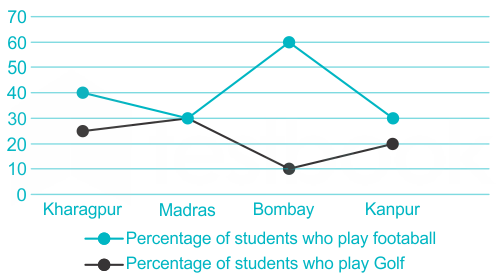
There are four IIT colleges namely, Kharagpur, Madras, Bombay, and Kanpur. The following line-graph shows the percentage of students who play football and percentage of number of students who play golf, in each of the college out of total number of students in that college.

Note: Each student in the given four colleges plays one of the games among football, tennis and golf. 

The total number of students in Kanpur are 1200 less than total number of students in Kharagpur. If the difference between number of students who play football and number of students who play golf in Kanpur is 2480, then find the total number of students in Kharagpur. 

  1. AOption (a)

    26,000 

  2. BOption (b)

    24,800 

  3. COption (c)

    28,800 

  4. DOption (d)

    30,000 

  5. EOption (e)

    22,000 

View answer & explanation

Correct answer

Answer: (a)A.

26,000 

Why this answer is correct

Common explanation

For Kharagpur:

Percentage of students who play Tennis = (100 - 40 - 25) % = 35%

Similarly, 

CollegePercentage of students who play footballPercentage of students who play tennisPercentage of students who play golf
Kharagpur40%35%25%
Madras30%40%30%
Bombay60%30%10%
Kanpur30%50%20%


Let the total number of students in Kanpur be 'x'.

So, total number of students in Kharagpur = x + 1200

ATQ,

(30% of x) - (20% of x) = 2480

Or, 10% of x = 2480

Or, 0.1 × x = 2480

So, x = (2480/0.1) = 24800

Total number of students in Kharagpur = x + 1200 = 24800 + 1200 = 26,000

SBI Clerk Mains Memory Based Paper (Held On: 10 April 2025 Shift 2) (Previous Year Paper)·Quantitative Aptitude
View full paper

Question 367

SBI Clerk 2025• Quantitative Aptitude• Quantitative Aptitude

Study the following information carefully and answer the questions given below.

There are four IIT colleges namely, Kharagpur, Madras, Bombay, and Kanpur. The following line-graph shows the percentage of students who play football and percentage of number of students who play golf, in each of the college out of total number of students in that college.

Note: Each student in the given four colleges plays one of the games among football, tennis and golf. 

The total number of students in Madras are 6,000. Sum of number of students who play tennis from Madras and Bombay is 5100. Find the ratio of number of students who play football in Madras to those who play football in Bombay.

  1. AOption (a)

    3:2

  2. BOption (b)

    1:3

  3. COption (c)

    3:1

  4. DOption (d)

    1:2

  5. EOption (e)

    2:3

View answer & explanation

Correct answer

Answer: (b)B.

1:3

Why this answer is correct

Common explanation

For Kharagpur:

Percentage of students who play Tennis = (100 - 40 - 25) % = 35%

Similarly, 

CollegePercentage of students who play footballPercentage of students who play tennisPercentage of students who play golf
Kharagpur40%35%25%
Madras30%40%30%
Bombay60%30%10%
Kanpur30%50%20%


Let total number of students in Bombay be 'x'.

Sum of number of students who play tennis from Madras and Bombay = 40% × 6000 + 30% × x = 5100

Or, 2400 + 0.3x = 5100

Or, 0.3x = 5100 - 2400

So, x = (2700/0.3) = 9000

Number of students who play football in Madras = 30% × 6000 = 1800

Number of students who play football in Bombay = 60% of x = 0.6 × 9000 = 5400

Required ratio = 1800:5400 = 1:3

SBI Clerk Mains Memory Based Paper (Held On: 10 April 2025 Shift 2) (Previous Year Paper)·Quantitative Aptitude
View full paper

Question 368

SBI Clerk 2025• Quantitative Aptitude• Quantitative Aptitude

Study the following information carefully and answer the questions given below.

There are four IIT colleges namely, Kharagpur, Madras, Bombay, and Kanpur. The following line-graph shows the percentage of students who play football and percentage of number of students who play golf, in each of the college out of total number of students in that college.

Note: Each student in the given four colleges plays one of the games among football, tennis and golf. 

The ratio of total number of students in Kanpur to that in Kharagpur is 3:2. If the sum of number of students who play tennis in the given two colleges is 5,280, then find the total number of students in Kanpur.

  1. AOption (a)

    5400

  2. BOption (b)

    2400

  3. COption (c)

    3600

  4. DOption (d)

    4800

  5. EOption (e)

    7200

View answer & explanation

Correct answer

Answer: (e)E.

7200

Why this answer is correct

Common explanation

For Kharagpur:

Percentage of students who play Tennis = (100 - 40 - 25) % = 35%

Similarly, 

CollegePercentage of students who play footballPercentage of students who play tennisPercentage of students who play golf
Kharagpur40%35%25%
Madras30%40%30%
Bombay60%30%10%
Kanpur30%50%20%


Let the total number of students in Kanpur and Kharagpur be '3x' and '2x', respectively.

ATQ;

Sum of students who play tennis in the given two colleges

= (50% × 3x) + (35% × 2x) = 5280

Or, 1.5x  + 0.7x = 5280

Or, 2.2x = 5280

So, x = (5280/2.2) = 2400

Total number of students in Kanpur = 3x = 3 × 2400 = 7,200

SBI Clerk Mains Memory Based Paper (Held On: 10 April 2025 Shift 2) (Previous Year Paper)·Quantitative Aptitude
View full paper

Question 369

SBI Clerk 2025• Quantitative Aptitude• Quantitative Aptitude

Study the following information carefully and answer the questions given below.

There are four IIT colleges namely, Kharagpur, Madras, Bombay, and Kanpur. The following line-graph shows the percentage of students who play football and percentage of number of students who play golf, in each of the college out of total number of students in that college.

Note: Each student in the given four colleges plays one of the games among football, tennis and golf. 

In Bombay, difference between sum of number of students who play football and tennis and sum of number of students who play golf and football is 1440. Find the number of students in Bombay who play football.

  1. AOption (a)

    4480

  2. BOption (b)

    4900

  3. COption (c)

    5160

  4. DOption (d)

    4320

  5. EOption (e)

    4720

View answer & explanation

Correct answer

Answer: (d)D.

4320

Why this answer is correct

Common explanation

For Kharagpur:

Percentage of students who play Tennis = (100 - 40 - 25) % = 35%

Similarly, 

CollegePercentage of students who play footballPercentage of students who play tennisPercentage of students who play golf
Kharagpur40%35%25%
Madras30%40%30%
Bombay60%30%10%
Kanpur30%50%20%


Let the total number of students in Bombay be 'x'.

ATQ,

(60 + 30) % of x - (60 + 10) % of x = 1440

Or, 90% of x - 70% of x = 1440

Or, 20% of x = 1440

Or, 0.2 × x = 1440

So, x = (1440/0.2) = 7200

Number of students who play football from Bombay = 60% of x = 0.6 × 7200 = 4320

SBI Clerk Mains Memory Based Paper (Held On: 10 April 2025 Shift 2) (Previous Year Paper)·Quantitative Aptitude
View full paper

Question 370

SBI Clerk 2025• Quantitative Aptitude• Quantitative Aptitude

Study the following information carefully and answer the questions given below.

There are four IIT colleges namely, Kharagpur, Madras, Bombay, and Kanpur. The following line-graph shows the percentage of students who play football and percentage of number of students who play golf, in each of the college out of total number of students in that college.

Note: Each student in the given four colleges plays one of the games among football, tennis and golf. 

The difference between the number of students who play tennis and golf in Madras is 500. Average of number of students who play football and tennis in Kharagpur is 3600. Find the difference between total number of students in Kharagpur and Madras.

  1. AOption (a)

    4500

  2. BOption (b)

    4200

  3. COption (c)

    4600

  4. DOption (d)

    4000

  5. EOption (e)

    4800

View answer & explanation

Correct answer

Answer: (c)C.

4600

Why this answer is correct

Common explanation

For Kharagpur:

Percentage of students who play Tennis = (100 - 40 - 25) % = 35%

Similarly, 

CollegePercentage of students who play footballPercentage of students who play tennisPercentage of students who play golf
Kharagpur40%35%25%
Madras30%40%30%
Bombay60%30%10%
Kanpur30%50%20%


Let the total number of students in Madras and Kharagpur be 'x' and 'y', respectively.

Difference between the number of students who play tennis and golf from Madras:

(40% of x) - (30% of x) = 105 of 'x' = 500

Or, 0.1 × x = 500

So, x = (500/0.1) = 5000

Average of number of students who play football and tennis from Kharagpur

{(40% of y) + (35% of y)}/2 = 3600

Or, 75% of y = 3600 × 2

Or, 0.75 × y = 7200

So, y = (7200/0.75) = 9600

Required difference = 9600 – 5000 = 4600

SBI Clerk Mains Memory Based Paper (Held On: 10 April 2025 Shift 2) (Previous Year Paper)·Quantitative Aptitude
View full paper

Question 371

SBI Clerk 2025• Quantitative Aptitude• Quantitative Aptitude

The question consists of three statements numbered "I, and II" given below it. You have to decide whether the data provided in the statements are sufficient to answer the question.

Aman, Akash and Anil started a business by investing Rs. (x - 1,200) , Rs. (2x - 1,800) and Rs. (x - 1,800) respectively. Find the difference between the investment of Akash and Anil.

Statement I: 15 months after starting the business, ratio of profit share of Aman and Akash was 3:7 respectively.

Statement II: 17 months after starting the business, profit share of Aman was 25% of the total profit share of Aman, Akash and Anil together.

  1. AOption (a)

    The data in statement I alone is sufficient to answer the question, while the data in statement II alone is not sufficient to answer the question.

  2. BOption (b)

    The data in statement II alone is sufficient to answer the question, while the data in statement I alone is not sufficient to answer the question.

  3. COption (c)

    The data either in statement I alone or in statement II alone is sufficient to answer the question.

  4. DOption (d)

    The data given in both statements I and II together is not sufficient to answer the question.

  5. EOption (e)

    The data in both statements I and II together is necessary to answer the question.

View answer & explanation

Correct answer

Answer: (a)A.

The data in statement I alone is sufficient to answer the question, while the data in statement II alone is not sufficient to answer the question.

Why this answer is correct

Statement I:

Ratio of profit share of Aman, Akash and Anil at the end of 15 months:

= [(x - 1,200) × 15] : [(2x - 1,800) × 15] : [(x - 1,800) × 15]

= (x - 1,200) : (2x - 1,800) : (x - 1,800)

So, (x - 1,200) : (2x - 1,800) = 3 : 7

Or, 7 × (x - 1,200) = 3 × (2x - 1,800)

Or, 7x - 8,400 = 6x - 5,400

Or, 'x' = 3,000

Investment of Akash = 2 × 3,000 - 1,800 = Rs. 4,200

Investment of Anil = 3,000 - 1,800 = Rs. 1,200

Required difference = 4,200 - 1,200 = Rs. 3,000

So, data in statement I alone is sufficient to answer the question.

Statement II:

Ratio of profit share of Aman, Akash and Anil at the end of 17 months:

= [(x - 1,200) × 17] : [(2x - 1,800) × 17] : [(x - 1,800) × 17]

= (x - 1,200) : (2x - 1,800) : (x - 1,800)

So, (x - 1,200) = 0.25 × [(x - 1,200) + (2x - 1,800) + (x - 1,800)]

Or, x - 1,200 = (1/4) × (4x - 4,800)

Or, x - 1,200 = x - 1,200

We cannot solve this equation further.

So, data in statement II alone is not sufficient to answer the question.

Therefore, data in statement I alone is sufficient to answer the question, while the data in statement II alone is not sufficient to answer the question.

Hence, option a.

SBI Clerk Mains Memory Based Paper (Held On: 10 April 2025 Shift 2) (Previous Year Paper)·Quantitative Aptitude
View full paper

Question 372

SBI Clerk 2025• Quantitative Aptitude• Quantitative Aptitude

The question consists of three statements numbered "I, and II" given below it. You have to decide whether the data provided in the statements are sufficient to answer the question.

Find the value of (n + 5)²

Statement I: (20% of 60n² - 11n²) + 25% of (400 - 76) = 40n + 10n - 32n

Statement II: (17n + 34n - 50n - 70 + 64)² - 16 = (36 ÷ 18)n - (101 - 1) ÷ 4

  1. AOption (a)

    Statement II alone is sufficient while Statement I alone is not sufficient

  2. BOption (b)

    Statement I alone is sufficient while Statement II alone is not sufficient

  3. COption (c)

    Either I alone or II alone is sufficient

  4. DOption (d)

    Both together are not sufficient

  5. EOption (e)

    Both statements together are necessary

View answer & explanation

Correct answer

Answer: (b)B.

Statement I alone is sufficient while Statement II alone is not sufficient

Why this answer is correct

Statement I:

(20% of 60n² - 11n²) + 25% of (400 - 76) = 40n + 10n - 32n

Or, (12n² - 11n²) + 25% of 324 = 50n - 32n

Or, n² + 81 = 18n

Or, n² - 18n + 81 = 0

Or, n² - 9n - 9n + 81 = 0

Or, n(n - 9) - 9(n - 9) = 0

Or, (n - 9)(n - 9) = 0

So, n = 9

Therefore, required value = (9 + 5)² = 196

So, data in Statement I alone is sufficient to answer the question.

Statement II:

(17n + 34n - 50n - 70 + 64)² - 16 = (36 ÷ 18)n - (101 - 1) ÷ 4

Or, (n - 6)² - 16 = 2n - 25

Or, n² - 12n + 36 - 16 = 2n - 25

Or, n² - 12n + 20 = 2n - 25

Or, n² - 14n + 45 = 0

Or, n² - 9n - 5n + 45 = 0

Or, n(n - 9) - 5(n - 9) = 0

Or, (n - 9)(n - 5) = 0

So, n = 9 or n = 5

Since there are two possible values of n, Statement II alone is not sufficient.

Therefore, data in statement I alone is sufficient to answer the question, while the data in statement II alone is not sufficient to answer the question

Hence, option b.

SBI Clerk Mains Memory Based Paper (Held On: 10 April 2025 Shift 2) (Previous Year Paper)·Quantitative Aptitude
View full paper

Question 373

SBI Clerk 2025• Quantitative Aptitude• Quantitative Aptitude

The question consists of three statements numbered "I, and II" given below it. You have to decide whether the data provided in the statements are sufficient to answer the question.

There are three classes ‘A’, ‘B’ and ‘C’. The average number of students in ‘A’, ‘B’ and ‘C’ is 180. Find the number of students in ‘B’ is how much percent more or less than total number of students in ‘A’ and ‘C’.

Statement I: Number of students in ‘B’ is ‘k’ more than the number of students in ‘C’ and the number of students in ‘C’ is ‘k’ more than that in ‘A’.

Statement II: The difference between number of students in ‘A’ and ‘B’ is 120.

  1. AOption (a)

    Statement II alone is sufficient while Statement I alone is not sufficient

  2. BOption (b)

    Statement I alone is sufficient while Statement II alone is not sufficient

  3. COption (c)

    Either I alone or II alone is sufficient

  4. DOption (d)

    Both together are not sufficient

  5. EOption (e)

    Both statements together are necessary 

View answer & explanation

Correct answer

Answer: (e)E.

Both statements together are necessary 

Why this answer is correct

Let the number of students in ‘A’, ‘B’ and ‘C’ be ‘p’, ‘q’ and ‘r’ respectively.

So, sum of the number of students in ‘A’, ‘B’ and ‘C’ = 180 × 3

So, (p + q + r) = 540

Statement I:

Given, (q − r) = k ........(I)

Or, (r − p) = k ........(II)

Or, q − r = r − p

So, p + q = 2r

So, (p + q) + r = 2r + r = 3r = 540

So, ‘r’ = 180

But we cannot determine the value of ‘k’

So, data in statement I alone is not sufficient to answer the question.

Statement II:

Case I:

We have, q = p + 120

Case II:

We have, q = p − 120

But we do not have any other data.

So, data in statement II alone is not sufficient to answer the question.

From Statement I and Statement II:

So, ‘r’ = 180

So, p + q = 540 − 180 = 360

And q − p = 120

So, q = (360 + 120) / 2 = 240

And ‘p’ = (360 − 120) / 2 = 120

So, total number of students in ‘A’ and ‘C’ = 120 + 180 = 300

Number of students in ‘B’ = 240

So, required percentage = {(300 − 240) / 300} × 100 = 20% less

The data in both statements I and II together is necessary to answer the question.

Hence, option e.

SBI Clerk Mains Memory Based Paper (Held On: 10 April 2025 Shift 2) (Previous Year Paper)·Quantitative Aptitude
View full paper

Question 374

SBI Clerk 2025• Quantitative Aptitude• Quantitative Aptitude

The question consists of three statements numbered "I, II and III" given below it. You have to decide whether the data provided in the statements are sufficient to answer the question.

What is the cost price of article (in Rs.)?

Statement I: Marked price of article is Rs. 540 more than its selling price.

Statement II: Article was marked Rs. 900 above its cost price and sold after giving a discount of 12%.

Statement III: Article was marked up by 25% on its cost price and sold at a profit of 10%.

  1. AOption (a)

    The data given in any one of the three statements alone is sufficient to answer the question

  2. BOption (b)

    The data given any of the two statements combined together is sufficient to answer the question.

  3. COption (c)

    The data given either in statement I and II together or in statement II and III together is sufficient to answer the question.

  4. DOption (d)

    The data given either in statement I and III together or data in statement II and III together are sufficient to answer the question.

  5. EOption (e)

    The data given in all three statements combined together is sufficient to answer the question.

View answer & explanation

Correct answer

Answer: (b)B.

The data given any of the two statements combined together is sufficient to answer the question.

Why this answer is correct

Statement I:

Let the marked price of article be Rs. m.

Selling price of article = Rs. (m - 540)

But we have no data regarding the cost price.

So, data in statement I alone is not sufficient to answer the question.

Statement II:

Let the cost price of article be Rs. C.

Marked price of article = Rs. (C + 900)

Selling price of article = 0.88 × (C + 900) = Rs. (0.88C + 792)

But we cannot solve further to obtain the cost price of the article.

So, data in statement II alone is not sufficient to answer the question.

Statement III:

Let the cost price of article be Rs. C.

Marked price of article = Rs. 1.25C

Selling price of article = Rs. 1.10C

But we cannot solve further to obtain the cost price of the article.

So, data in statement III alone is not sufficient to answer the question.

Statement I and II together:

Let the cost price of article be Rs. C.

Marked price of article = Rs. (C + 900)

Selling price of article = 0.88 × (C + 900) = Rs. (0.88C + 792)

So,

(C + 900) − (0.88C + 792) = 540

⇒ 0.12C + 108 = 540

⇒ 0.12C = 432

⇒ C = 3,600

Therefore, cost price of article is Rs. 3,600.

So, data in statement I and II together is sufficient to answer the question.

Statement II and III together:

Let the cost price of article be Rs. C.

From Statement II: Marked price = C + 900

From Statement III: Marked price = 1.25C

So,

1.25C = C + 900

⇒ 0.25C = 900

⇒ C = 3,600

Therefore, cost price of article is Rs. 3,600.

So, data in statement II and III together is sufficient to answer the question.

Statement I and III together:

Let the cost price of article be Rs. C.

Marked price of article = Rs. 1.25C

Selling price of article = Rs. 1.10C

So,

1.25C − 1.10C = 540

⇒ 0.15C = 540

⇒ C = 3,600

Therefore, cost price of article is Rs. 3,600.

So, data in statement I and III together is sufficient to answer the question.

Therefore, data given any of the two statements combined together is sufficient to answer the question.

Hence, option b.

SBI Clerk Mains Memory Based Paper (Held On: 10 April 2025 Shift 2) (Previous Year Paper)·Quantitative Aptitude
View full paper

Question 375

SBI Clerk 2025• Quantitative Aptitude• Quantitative Aptitude

The question consists of three statements numbered "I, II and III" given below it. You have to decide whether the data provided in the statements are sufficient to answer the question.

What is the length of train 'P'?

Statement I: Ratio of speed of trains 'P' and 'Q' is 9:7 respectively.

Statement II: Length of train 'Q' is 960 metres and difference between speed of trains 'P' and 'Q' is 36 km/h.

Statement III: On travelling in opposite directions, 'P' and 'Q' can cross each other in 24 seconds.

  1. AOption (a)

    The data given in any one of the three statements alone is sufficient to answer the question

  2. BOption (b)

    The data given any of the two statements combined is sufficient to answer the question.

  3. COption (c)

    The data given either in statement I and II together or in statement II and III together is sufficient to answer the question.

  4. DOption (d)

    The data given either in statement I and III together or data in statement II and III together are sufficient to answer the question.

  5. EOption (e)

    The data given in all three statements combined is sufficient to answer the question.

View answer & explanation

Correct answer

Answer: (e)E.

The data given in all three statements combined is sufficient to answer the question.

Why this answer is correct

Statement I:

Let the speed of train 'P' and 'Q' be '9v' and '7v' m/s respectively.

We cannot solve further.

So, data in statement I alone is not sufficient to answer the question.

Statement II:

Length of train 'Q' = 960 metres

We do not know whose speed is greater between 'P' and 'Q'.

We cannot solve further.

So, data in statement II alone is not sufficient to answer the question.

Statement III:

We do not know the speed of trains. So, we cannot solve further.

So, data in statement III alone is not sufficient to answer the question.

Statement I and II together:

Let the speed of train 'P' and 'Q' be '9v' and '7v' m/s respectively.

9v - 7v = 36 × (5/18) = 10

Or, 2v = 10

Or, 'v' = 5

So, speed of train 'P' and 'Q' is 45 m/s and 35 m/s respectively.

Length of train 'Q' = 960 metres

But we do not have any further data, so we cannot solve further.

So, data in statement I and II together is not sufficient to answer the question.

Statement II and III together:

Length of train 'Q' = 960 metres

Time taken by trains 'P' and 'Q' to cross each other = 24 seconds

But we do not know whose speed is greater between 'P' and 'Q'.

We cannot solve further.

So, data in statement II and III together is not sufficient to answer the question.

Statement I and III together:

Let the speed of train 'P' and 'Q' be '9v' and '7v' m/s respectively.

Sum of length of train 'P' and 'Q' = (9v + 7v) × 24 = 384v metres

We cannot solve further.

So, data in statement I and III together is not sufficient to answer the question.

Statement I, II and III together:

Let the speed of train 'P' and 'Q' be '9v' and '7v' m/s respectively.

9v - 7v = 36 × (5/18) = 10

Or, 2v = 10

Or, 'v' = 5

So, speed of train 'P' = 9 × 5 = 45 m/s

Speed of train 'Q' = 7 × 5 = 35 m/s

Sum of length of train 'P' and 'Q' = (45 + 35) × 24 = 80 × 24 = 1920 metres

Given that length of train 'Q' = 960 metres

So, length of train 'P' = 1920 - 960 = 960 metres

So, data in statement I, II and III together is sufficient to answer the question.

Therefore, data given in all three statements combined is sufficient to answer the question.

Hence, option e**.**

SBI Clerk Mains Memory Based Paper (Held On: 10 April 2025 Shift 2) (Previous Year Paper)·Quantitative Aptitude
View full paper

Question 376

SBI Clerk 2025• Quantitative Aptitude• Quantitative Aptitude

**What approximate value will come in place of the question mark (?) in the following question? (

Note:

You are not expected to calculate the exact value.)**

75.01 + 344.923 - 179.93 = ?3 of (√678 + 3.89)

  1. AOption (a)

    2

  2. BOption (b)

    5

  3. COption (c)

    8

  4. DOption (d)

    11

  5. EOption (e)

    14

View answer & explanation

Correct answer

Answer: (a)A.

2

Why this answer is correct

75.01 + 344.923 - 179.93 = ?3 of (√678 + 3.89)

75 + 345 - 180 = ?3 of (√676 + 4)

420 - 180 = ?3 × (26 + 4)

240 = ?3 × 30

?3 = 8

? = 2

SBI Clerk Mains Memory Based Paper (Held On: 10 April 2025 Shift 2) (Previous Year Paper)·Quantitative Aptitude
View full paper

Question 377

SBI Clerk 2025• Quantitative Aptitude• Quantitative Aptitude

**What approximate value will come in place of the question mark (?) in the following question? (

Note:

You are not expected to calculate the exact value.)**

74.89% of (16.03 of 49.91) = ?2 + 28.98 of √17

  1. AOption (a)

    4

  2. BOption (b)

    12

  3. COption (c)

    22

  4. DOption (d)

    44

  5. EOption (e)

    78

View answer & explanation

Correct answer

Answer: (c)C.

22

Why this answer is correct

74.89% of (16.03 of 49.91) = ?2 + 28.98 of √17

75% of (16 of 50) = ?2 + 29 of √16

0.75 × 800 = ?2 + 29 × 4

600 = ?2 + 116

?2 = 600 - 116 = 484

? = ±22

SBI Clerk Mains Memory Based Paper (Held On: 10 April 2025 Shift 2) (Previous Year Paper)·Quantitative Aptitude
View full paper

Question 378

SBI Clerk 2025• Quantitative Aptitude• Quantitative Aptitude

**What approximate value will come in place of the question mark (?) in the following question? (

Note:

You are not expected to calculate the exact value.)**

√575.89 × 15.982 ÷ 47.78 = √? of (24.78% of 31.89)

  1. AOption (a)

    484

  2. BOption (b)

    196

  3. COption (c)

    144

  4. DOption (d)

    324

  5. EOption (e)

    256

View answer & explanation

Correct answer

Answer: (e)E.

256

Why this answer is correct

√575.89 × 15.982 ÷ 47.78 = √? of (24.78% of 31.89)

√576 × 162 ÷ 48 = √? of 25% of 32

(24 × 16 × 16) ÷ 48 = √? × 8

16 = √?

? = 256

SBI Clerk Mains Memory Based Paper (Held On: 10 April 2025 Shift 2) (Previous Year Paper)·Quantitative Aptitude
View full paper

Question 379

SBI Clerk 2025• Quantitative Aptitude• Quantitative Aptitude

**What approximate value will come in place of the question mark (?) in the following question? (

Note:

You are not expected to calculate the exact value.)**

12.032 + 25.9972 - 10.0132 = ?2 + 15.9822 - √400.03

  1. AOption (a)

    64

  2. BOption (b)

    8

  3. COption (c)

    34

  4. DOption (d)

    22

  5. EOption (e)

    96

View answer & explanation

Correct answer

Answer: (d)D.

22

Why this answer is correct

12.032 + 25.9972 - 10.0132 = ?2 + 15.9822 - √400.03

122 + 262 - 102 = ?2 + 162 - √400

144 + 576 - 100 = ?2 + 256 - 20

820 - 100 = ?2 + 236

?2 = 484

? = 22

SBI Clerk Mains Memory Based Paper (Held On: 10 April 2025 Shift 2) (Previous Year Paper)·Quantitative Aptitude
View full paper

Question 380

SBI Clerk 2025• Quantitative Aptitude• Quantitative Aptitude

**What approximate value will come in place of the question mark (?) in the following question? (

Note:

You are not expected to calculate the exact value.)**

127.76 ÷ 7.983 × 14.83 + 159.89 = 80.09 of ?

  1. AOption (a)

    15

  2. BOption (b)

    5

  3. COption (c)

    30

  4. DOption (d)

    45

  5. EOption (e)

    90

View answer & explanation

Correct answer

Answer: (b)B.

5

Why this answer is correct

127.76 ÷ 7.983 × 14.83 + 159.89 = 80.09 of ?

128 ÷ 8 × 15 + 160 = 80 of ?

16 × 15 + 160 = 80 of ?

240 + 160 = 80 of ?

400 = 80 of ?

? = 5

Hence, option b

How should I prepare for Quantitative Aptitude in SBI Clerk?

Solving previous year questions by topic helps identify recurring concepts, question patterns, and frequently asked sub-topics. Attempt each question, review the step-by-step explanation, and note down key formulas or facts for quick revision before the exam.