SBI Clerk · Topic Collection

Quantitative Aptitude PYQs

Arithmetic, number systems, percentages, ratios, profit and loss, time and work, algebra, geometry, mensuration, and trigonometry.

1495 Total Questions38 Official PapersYears: 2018–2025Search in Quantitative Aptitude
Showing questions 381–400 of 1495Page 20 of 75
SBI Clerk Mains Memory Based Paper (Held On: 10 April 2025 Shift 2) (Previous Year Paper)·Quantitative Aptitude
View full paper

Question 381

SBI Clerk 2025• Quantitative Aptitude• Quantitative Aptitude

Study the following information and answer the given questions:

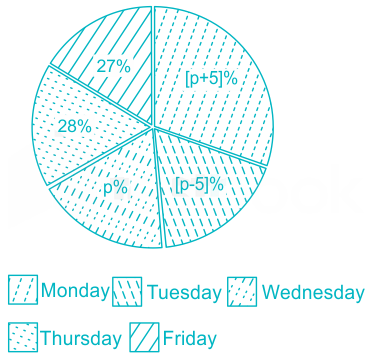
The pie chart shows the % distribution of the number of online bus ticket bookings from Monday to Friday on the RedBus app.
 

Note:

I). The combined average number of online bus tickets booked on Wednesday and Friday is 90 higher than the combined average number of online bus tickets booked on Monday and Tuesday.

If a pie chart shows the number of bus tickets booked on Monday, Tuesday, and Wednesday only, then what would be the angle corresponding to the number of tickets booked on Tuesday?

  1. AOption (a)

    72º

  2. BOption (b)

    64º

  3. COption (c)

    80º

  4. DOption (d)

    96º

  5. EOption (e)

    108º

View answer & explanation

Correct answer

Answer: (c)C.

80º

Why this answer is correct

Common explanation:

From the pie chart, the percentages are:

Monday: (p + 5)%

Tuesday: (p − 5)%

Wednesday: p%

Thursday: 28%

Friday: = 27%

Total of all percentages = 27 + (p + 5) + 28 + (p − 5) + p =55 + 3p

Now, 100 = 55 + 3p

Or, 3p = 45

Or, p = 45/5 = 15

Now, Monday: (p + 5)% = 20%

Tuesday: (p − 5)% = 10%

Wednesday: p% = 15%

Thursday: 28%

Friday: = 27%

According to the question, 

DaysNumber of online Bus tickets booked
Monday1500 × 20% = 300
Tuesday1500 × 10% = 150
Wednesday1500 × 15% = 225
Thursday1500 × 28% = 420
Friday1500 × 27% = 405


ATQ,

The number of bus tickets booked on Monday, Tuesday and Wednesday together = (300 + 150 + 225) = 675

Tuesday = (150/675) × 100 = 22.22%

Required answer = (22.22/100) × 360º = 80º

SBI Clerk Mains Memory Based Paper (Held On: 10 April 2025 Shift 2) (Previous Year Paper)·Quantitative Aptitude
View full paper

Question 382

SBI Clerk 2025• Quantitative Aptitude• Quantitative Aptitude

Study the following information and answer the given questions:

The pie chart shows the % distribution of the number of online bus ticket bookings from Monday to Friday on the RedBus app.


Note:

I). The combined average number of online bus tickets booked on Wednesday and Friday is 90 higher than the combined average number of online bus tickets booked on Monday and Tuesday.

On Saturday, the total number of bus tickets booked is 25 fewer than the combined number of tickets booked on Friday and Thursday. Out of the total number of tickets booked, 37.5% are booked by girls, and the remaining tickets are booked by boys. Determine how many bus tickets were booked by boys. 

  1. AOption (a)

    500

  2. BOption (b)

    450

  3. COption (c)

    400

  4. DOption (d)

    550

  5. EOption (e)

    600

View answer & explanation

Correct answer

Answer: (a)A.

500

Why this answer is correct

Common explanation:

From the pie chart, the percentages are:

Monday: (p + 5)%

Tuesday: (p − 5)%

Wednesday: p%

Thursday: 28%

Friday: = 27%

Total of all percentages = 27 + (p + 5) + 28 + (p − 5) + p =55 + 3p

Now, 100 = 55 + 3p

Or, 3p = 45

Or, p = 45/5 = 15

Now, Monday: (p + 5)% = 20%

Tuesday: (p − 5)% = 10%

Wednesday: p% = 15%

Thursday: 28%

Friday: = 27%

According to the question, 

DaysNumber of online Bus tickets booked
Monday1500 × 20% = 300
Tuesday1500 × 10% = 150
Wednesday1500 × 15% = 225
Thursday1500 × 28% = 420
Friday1500 × 27% = 405


ATQ,

Total number of bus tickets booked on Saturday = (405 + 420) - 25 = 825 - 25 = 800

Number of bus tickets booked by girls on Saturday = 37.5% of 800 = 800 × (3/8) = 300

Number of bus tickets booked by boys on Saturday = 800 - 300 = 500

SBI Clerk Mains Memory Based Paper (Held On: 10 April 2025 Shift 2) (Previous Year Paper)·Quantitative Aptitude
View full paper

Question 383

SBI Clerk 2025• Quantitative Aptitude• Quantitative Aptitude

Study the following information and answer the given questions:

The pie chart shows the % distribution of the number of online bus ticket bookings from Monday to Friday on the RedBus app.


Note:

I). The combined average number of online bus tickets booked on Wednesday and Friday is 90 higher than the combined average number of online bus tickets booked on Monday and Tuesday.

On Friday, there are two time slots: Evening and Night, and the total number of tickets booked is the sum of both. The ratio of the number of bus tickets booked for the evening to the night is 11:4. The total revenue generated by the night time slot is Rs. 21,600. Determine the total revenue generated by the evening time slot, knowing that the price of an evening ticket is Rs. 75 less than the price of a night ticket. 

  1. AOption (a)

    Rs.36125

  2. BOption (b)

    Rs.35125

  3. COption (c)

    ​Rs.39125

  4. DOption (d)

    Rs.38125

  5. EOption (e)

    Rs.37125

View answer & explanation

Correct answer

Answer: (e)E.

Rs.37125

Why this answer is correct

Common explanation:

From the pie chart, the percentages are:

Monday: (p + 5)%

Tuesday: (p − 5)%

Wednesday: p%

Thursday: 28%

Friday: = 27%

Total of all percentages = 27 + (p + 5) + 28 + (p − 5) + p =55 + 3p

Now, 100 = 55 + 3p

Or, 3p = 45

Or, p = 45/5 = 15

Now, Monday: (p + 5)% = 20%

Tuesday: (p − 5)% = 10%

Wednesday: p% = 15%

Thursday: 28%

Friday: = 27%

ATQ,

According to the question, 

DaysNumber of online Bus tickets booked
Monday1500 × 20% = 300
Tuesday1500 × 10% = 150
Wednesday1500 × 15% = 225
Thursday1500 × 28% = 420
Friday1500 × 27% = 405


ATQ,

Number of evening time slot bus tickets booked = 405 × (11/15) = 297

Number of night time slot bus tickets booked = 405 - 297 = 108

ATQ,

Let the price of night time slot per ticket be Rs. ‘a’

108a = 21600

a = 21600/108

a = 200

The price of evening time slot per ticket = 200 - 75 = Rs.125

Required revenue = 297 × 125 = Rs.37125

SBI Clerk Mains Memory Based Paper (Held On: 10 April 2025 Shift 2) (Previous Year Paper)·Quantitative Aptitude
View full paper

Question 384

SBI Clerk 2025• Quantitative Aptitude• Quantitative Aptitude

Study the following information and answer the given questions:

The pie chart shows the % distribution of the number of online bus ticket bookings from Monday to Friday on the RedBus app.


Note:

I). The combined average number of online bus tickets booked on Wednesday and Friday is 90 higher than the combined average number of online bus tickets booked on Monday and Tuesday.

Out of all the online bus tickets booked on Tuesday, 1 in every 5 tickets was for a vacant seat. On Wednesday, out of the total number of online bus tickets booked, 3 in every 5 tickets were for vacant seats. What is the total number of filled seats on Tuesday and Wednesday combined?

  1. AOption (a)

    180

  2. BOption (b)

    150

  3. COption (c)

    210

  4. DOption (d)

    240

  5. EOption (e)

    300

View answer & explanation

Correct answer

Answer: (c)C.

210

Why this answer is correct

Common explanation:

From the pie chart, the percentages are:

Monday: (p + 5)%

Tuesday: (p − 5)%

Wednesday: p%

Thursday: 28%

Friday: = 27%

Total of all percentages = 27 + (p + 5) + 28 + (p − 5) + p =55 + 3p

Now, 100 = 55 + 3p

Or, 3p = 45

Or, p = 45/5 = 15

Now, Monday: (p + 5)% = 20%

Tuesday: (p − 5)% = 10%

Wednesday: p% = 15%

Thursday: 28%

Friday: = 27%

ATQ,

According to the question,

DaysNumber of online Bus tickets booked
Monday1500 × 20% = 300
Tuesday1500 × 10% = 150
Wednesday1500 × 15% = 225
Thursday1500 × 28% = 420
Friday1500 × 27% = 405


Number of vacant seats on Tuesday = 150 × (1/5) = 30

Number of filled seats on Tuesday = 150 - 30 = 120

Number of vacant seats on Wednesday = 225 × (3/5) = 135

Number of filled seats on Wednesday = 225 - 135 = 90

Required sum = 120 + 90 = 210

SBI Clerk Mains Memory Based Paper (Held On: 10 April 2025 Shift 2) (Previous Year Paper)·Quantitative Aptitude
View full paper

Question 385

SBI Clerk 2025• Quantitative Aptitude• Quantitative Aptitude

Study the following information and answer the given questions:

The pie chart shows the % distribution of the number of online bus ticket bookings from Monday to Friday on the RedBus app.


Note:

I). The combined average number of online bus tickets booked on Wednesday and Friday is 90 higher than the combined average number of online bus tickets booked on Monday and Tuesday.

If (7/20)th of the tickets reserved online for Thursday are moved to Tuesday, what is the ratio of the number of online bus tickets booked for Thursday to those booked for Tuesday?

  1. AOption (a)

    81:89

  2. BOption (b)

    71:79

  3. COption (c)

    93:97

  4. DOption (d)

    91:99

  5. EOption (e)

    None of these

View answer & explanation

Correct answer

Answer: (d)D.

91:99

Why this answer is correct

Common explanation:

From the pie chart, the percentages are:

Monday: (p + 5)%

Tuesday: (p − 5)%

Wednesday: p%

Thursday: 28%

Friday: = 27%

Total of all percentages = 27 + (p + 5) + 28 + (p − 5) + p =55 + 3p

Now, 100 = 55 + 3p

Or, 3p = 45

Or, p = 45/5 = 15

Now, Monday: (p + 5)% = 20%

Tuesday: (p − 5)% = 10%

Wednesday: p% = 15%

Thursday: 28%

Friday: = 27%

ATQ,

According to the question, 

DaysNumber of online Bus tickets booked
Monday1500 × 20% = 300
Tuesday1500 × 10% = 150
Wednesday1500 × 15% = 225
Thursday1500 × 28% = 420
Friday1500 × 27% = 405


ATQ,

Number of Online Bus tickets reserved Thursday to Tuesday = 420 × (7/20) = 147

Now, the number of Online Bus tickets booked on Thursday = 420 - 147 = 273

Now, the number of Online Bus tickets booked on Tuesday = 150 + 147 = 297

Required ratio = 273:297 = 91:99

SBI Clerk Mains Memory Based Paper (Held On: 10 April 2025 Shift 2) (Previous Year Paper)·Quantitative Aptitude
View full paper

Question 386

SBI Clerk 2025• Quantitative Aptitude• Quantitative Aptitude

Three number series 'I', 'II' and 'III' are given below. Series 'I', and 'III' contain a missing term each namely 'P' and 'R', respectively whereas series 'II' has an odd one out term (wrong number) namely 'Q'. You have to find the values of 'P', 'Q' and 'R' and establish correct relation among them.

I. 60, 108, 178, ?, 384, 520

II. 36, 118, 200, 292, 364, 446

III. 85, 111, 163, 241, ?, 475

Find the value of 5Q - (P + R).

  1. AOption (a)

    665

  2. BOption (b)

    750

  3. COption (c)

    585

  4. DOption (d)

    845

  5. EOption (e)

    838

View answer & explanation

Correct answer

Answer: (d)D.

845

Why this answer is correct

Series I:

So, 'P' = 270

Series II:

36 + 82 = 118

118 + 82 = 200

200 + 82 = 282

282 + 82 = 364

364 + 82 = 446

So, 'Q' = 282

Series III:

85 + (13 × 2) = 111

111 + (13 × 4) = 163

163 + (13 × 6) = 241

241 + (13 × 8) = 345

345 + (13 × 10) = 475

So, 'R' = 345

Required value = 5 × 292 - (270 + 345) = 1,460 - 615 = 845

Hence, option d.

SBI Clerk Mains Memory Based Paper (Held On: 10 April 2025 Shift 2) (Previous Year Paper)·Quantitative Aptitude
View full paper

Question 387

SBI Clerk 2025• Quantitative Aptitude• Quantitative Aptitude

Three number series 'I', 'II' and 'III' are given below. Series 'I', and 'III' contain a missing term each namely 'P' and 'R', respectively whereas series 'II' has an odd one out term (wrong number) namely 'Q'. You have to find the values of 'P', 'Q' and 'R' and establish correct relation among them.

I. 60, 108, 178, ?, 384, 520

II. 36, 118, 200, 292, 364, 446

III. 85, 111, 163, 241, ?, 475

Which of the following relations is correct regarding the values of 'P', 'Q' and 'R'?

  1. AOption (a)

    P < Q > R

  2. BOption (b)

    P < Q < R

  3. COption (c)

    P > Q > R

  4. DOption (d)

    P > Q < R

  5. EOption (e)

    P > Q = R

View answer & explanation

Correct answer

Answer: (b)B.

P < Q < R

Why this answer is correct

Series I:

So, 'P' = 270

Series II:

36 + 82 = 118

118 + 82 = 200

200 + 82 = 282

282 + 82 = 364

364 + 82 = 446

So, 'Q' = 282

Series III:

85 + (13 × 2) = 111

111 + (13 × 4) = 163

163 + (13 × 6) = 241

241 + (13 × 8) = 345

345 + (13 × 10) = 475

So, 'R' = 345

270 < 292 < 345

So, P < Q < R

Hence, option b.

SBI Clerk Mains Memory Based Paper (Held On: 10 April 2025 Shift 2) (Previous Year Paper)·Quantitative Aptitude
View full paper

Question 388

SBI Clerk 2025• Quantitative Aptitude• Quantitative Aptitude

Two number series 'I', 'II' are given below. Series 'I' contains a wrong term and II contains a missing term each namely 'P' and 'R', respectively. Find the sum of 'P' and 'R' and both the series follow the same pattern.

I. 15.6, 17.4, 21, 26.4, 33.4, 42.6

II. 12.6, ___, ___, ___, R

  1. AOption (a)

    56

  2. BOption (b)

    60

  3. COption (c)

    64

  4. DOption (d)

    70

  5. EOption (e)

    72

View answer & explanation

Correct answer

Answer: (c)C.

64

Why this answer is correct

In series I,

15.6 + 18 × 0.1 = 17.4

17.4 + 18 × 0.2 = 21

21 + 18 × 0.3 = 26.4

26.4 + 18 × 0.4 = 33.6

33.6 + 18 × 0.5 = 42.6

Therefore, 33.6 should come in place of 33.4

So, 'P' = 33.4

In series II,

12.6 + 18 × 0.1 = 14.4

14.4 + 18 × 0.2 = 18

18 + 18 × 0.3 = 23.4

23.4 + 18 × 0.4 = 30.6

So, 'R' = 30.6

So, (P + R) = 33.4 + 30.6 = 64

Hence, option c.

SBI Clerk Mains Memory Based Paper (Held On: 10 April 2025 Shift 2) (Previous Year Paper)·Quantitative Aptitude
View full paper

Question 389

SBI Clerk 2025• Quantitative Aptitude• Quantitative Aptitude

The series given below contains a missing number 'P'. Find the value of 'P' and determine which among the given three statement(s) is/are true.

113, 238, 202, 545, 481, 'P', 1110

I: The nearest perfect square number to 'P' is 1225

II: 'P' is divisible by 11

III: (P + 28) is a multiple of 50

  1. AOption (a)

    Only I

  2. BOption (b)

    Only II

  3. COption (c)

    Only I and II

  4. DOption (d)

    Only II and III

  5. EOption (e)

    Only III

View answer & explanation

Correct answer

Answer: (c)C.

Only I and II

Why this answer is correct

The given number series follows the pattern of alternate addition and subtraction of cubes and squares, respectively. 

113 + 5³ = 238

238 - 6² = 202

202 + 7³ = 545

545 - 8² = 481

481 + 9³ = 1210

1210 - 10² = 1110

So, 'P' = 1210.

For I:

Nearest perfect square number of 1210, is 35² = 1225

So, statement I is true.

For II:

1210 ÷ 11 = 110

So, statement II is true.

For III:

P + 28 = 1210 + 28 = 1238

1238 is not a multiple of 50

So, statement III is false.

Hence, option c.

SBI Clerk Mains Memory Based Paper (Held On: 10 April 2025 Shift 2) (Previous Year Paper)·Quantitative Aptitude
View full paper

Question 390

SBI Clerk 2025• Quantitative Aptitude• Quantitative Aptitude

Given below are two numbers series I and II where the wrong number in series I and II is 'P' and 'Q', respectively. Find the value of 'P' and 'Q' and find which among the given statement(s) is/are true.

I: 168, 147, 128, 105, 84, 63, 42

II: 90, 101, 79, 112, 70, 123

Statement I: The L.C.M of 'P' and 'Q' is 4480

Statement II: The difference between 'Q' and 'P' is at most 60

Statement III: Sum of 'P' and 'Q' is at least 200.

  1. AOption (a)

    Only II

  2. BOption (b)

    Only I and II

  3. COption (c)

    Only III

  4. DOption (d)

    Only II and III

  5. EOption (e)

    None

View answer & explanation

Correct answer

Answer: (b)B.

Only I and II

Why this answer is correct

For series I:

168 × (7/8) = 147

147 × (6/7) = 126

126 × (5/6) = 105

105 × (4/5) = 84

84 × (3/4) = 63

63 × (2/3) = 42

So, P = 128

For series II:

90 + 11 × 1 = 101

101 − 11 × 2 = 79

79 + 11 × 3 = 112

112 − 11 × 4 = 68

68 + 11 × 5 = 123

So, Q = 70

Statement I:

P = 128 and Q = 70

L.C.M of P and Q = 4480

So, statement I is true.

Statement II:

Q - P = 70 - 128 = 58

Since, 58 < 60

So, statement II is true.

Statement III:

Sum of 'P' and 'Q' = 128 + 70 = 198

Since 198 < 200

So, statement III is false.

Hence, option b.

SBI Clerk Mains Memory Based Paper (Held On: 10 April 2025 Shift 2) (Previous Year Paper)·Quantitative Aptitude
View full paper

Question 391

SBI Clerk 2025• Quantitative Aptitude• Quantitative Aptitude

Speed of the stream is 6 km/h. While travelling upstream a boat takes 3 hours more to travel 160 km than the time taken by it to cover same distance in downstream.

Which of the following statement(s) is/are false according to the given data?

(I) If the upstream speed of the boat is 'A' km/h and the downstream speed of the boat is 'B' km/h, then (A + B) = 54

(II) Boat takes 8 hours to travel 160 km in upstream.

(III) The speed of the boat in still water is 'C' km/h. √C is a composite number.

  1. AOption (a)

    Only III

  2. BOption (b)

    All I, II and III

  3. COption (c)

    Both I and II

  4. DOption (d)

    Only II

  5. EOption (e)

    Both I and III

View answer & explanation

Correct answer

Answer: (e)E.

Both I and III

Why this answer is correct

Shortcut Trick

Let Boat speed be x. Upstream speed = x − 6, Downstream speed = x + 6.

Time difference formula: [Distance × 2 × Stream Speed] ÷ [x2 − (Stream Speed)2] = Time Difference.

⇒ [160 × 2 × 6] ÷ [x2 − 36] = 3 ⇒ 640 = x2 − 36 ⇒ x2 = 676 ⇒ x = 26 km/h.

Statement I: A + B = (26−6) + (26+6) = 20 + 32 = 52 (False). Statement II: 160 ÷ 20 = 8 hours (True). Statement III: √26 is not a composite number (False).

∴ The correct answer is Both I and III.

Alternate Method

Given: Stream speed (y) = 6 km/h, Distance (D) = 160 km, Time difference = 3 hours.

Formula: Time = Distance ÷ Speed; Upstream speed (A) = x − y; Downstream speed (B) = x + y.

⇒ 160/(x − 6) − 160/(x + 6) = 3

⇒ 160 [ (x + 6 − x + 6) / (x2 − 36) ] = 3

⇒ 160 × 12 = 3 × (x2 − 36) ⇒ 640 = x2 − 36 ⇒ x2 = 676 ⇒ x = 26 km/h

⇒ Upstream speed (A) = 26 − 6 = 20 km/h; Downstream speed (B) = 26 + 6 = 32 km/h.

⇒ Statement I: A + B = 20 + 32 = 52. (Given 54, so I is False)

⇒ Statement II: Time Upstream = 160 ÷ 20 = 8 hours. (Given 8, so II is True)

⇒ Statement III: Speed in still water (C) = 26. √26 ≈ 5.09 (Not an integer/composite, so III is False)

∴ The correct answer is Both I and III.

Additional Information

Downstream and Upstream

Downstream speed = Speed of boat + Speed of stream. Upstream speed = Speed of boat − Speed of stream.

Still Water Speed Calculation

Speed of boat in still water = (Downstream speed + Upstream speed) ÷ 2.

Composite Numbers

A composite number is a positive integer greater than 1 that has at least one divisor other than 1 and itself.

SBI Clerk Mains Memory Based Paper (Held On: 10 April 2025 Shift 2) (Previous Year Paper)·Quantitative Aptitude
View full paper

Question 392

SBI Clerk 2025• Quantitative Aptitude• Quantitative Aptitude

Nitin and Arnav started a business by investing Rs. (P – 1,500) and Rs. (P + 3,000) respectively. After 8 months, Nitin increased his investment by Rs. 1,500 whereas Arnav reduced his investment to two-thirds of his initial investment. At the end of 20 months, profit shares of Arnav and Nitin were Rs. 1,600 and Rs. 1,200 respectively. Find the ratio of initial investment of Nitin and Arnav respectively.

  1. AOption (a)

    3:5

  2. BOption (b)

    1:2

  3. COption (c)

    5:7

  4. DOption (d)

    4:7

  5. EOption (e)

    2:3

View answer & explanation

Correct answer

Answer: (b)B.

1:2

Why this answer is correct

Shortcut Trick

Profit ratio of Arnav and Nitin is 1600 : 1200 = 4 : 3.

Nitin investment: (P − 1500) for 8 months + P for 12 months.

Arnav investment: (P + 3000) for 8 months + 2/3(P + 3000) for 12 months.

Effective investment ratio = Arnav : Nitin = 4 : 3.

Equating ratios: [8(P + 3000) + 8(P + 3000)] / [8(P − 1500) + 12P] = 4/3.

Solving for P gives P = 4500. Initial ratio = (4500 − 1500) : (4500 + 3000) = 3000 : 7500 = 2 : 5.

∴ The correct answer is 1:2.

Alternate Method

Given → Investment of Nitin = (P − 1500), Arnav = (P + 3000). Time = 20 months.
Formulas: Profit Share = Investment × Time | Profit Ratio = (I1 × T1) : (I2 × T2)

⇒ Nitin Total Investment = (P − 1500) × 8 + (P − 1500 + 1500) × 12 = 8P − 12000 + 12P = 20P − 12000.
⇒ Arnav Total Investment = (P + 3000) × 8 + 2/3(P + 3000) × 12 = 8(P + 3000) + 8(P + 3000) = 16P + 48000.
⇒ Ratio: (20P − 12000) / (16P + 48000) = 1200 / 1600 = 3/4.
⇒ 4(20P − 12000) = 3(16P + 48000) ⇒ 80P − 48000 = 48P + 144000.
⇒ 32P = 192000 ⇒ P = 6000.
⇒ Initial Nitin = 6000 − 1500 = 4500; Initial Arnav = 6000 + 3000 = 9000.
⇒ Ratio = 4500 : 9000 = 1 : 2.

∴ The correct answer is 1:2.

Additional Information

Partnership Basics

When investments change over time, we calculate the equivalent investment for one unit of time (months) to find the profit sharing ratio.

Profit Allocation

Profit is directly proportional to the product of Capital and Time. If time is constant, Profit ∝ Capital.

SBI Clerk Mains Memory Based Paper (Held On: 10 April 2025 Shift 2) (Previous Year Paper)·Quantitative Aptitude
View full paper

Question 393

SBI Clerk 2025• Quantitative Aptitude• Quantitative Aptitude

Study the following information carefully and answer the questions given below.

In a school, each student must choose at least one subject from Hindi, English, and Maths as their favourite.

  • The total number of students opting for Maths, English, and Hindi are in the ratio 7: 8: 5.
  • The ratio of students who chose only Hindi to those who chose only English is 2: 5.
  • A total of 320 students chose all three subjects.
  • Among students who selected exactly two subjects, the ratio of those who chose Hindi & English, English & Maths, and Maths & Hindi is 5: 6: 4.
  • The number of students who chose only Hindi is 40% of the number of students who chose both Hindi & English.
  • The number of students who chose only Maths is 520.

Find the ratio of number of students who choose both Hindi and English but not Maths to the number of students who choose both English and Maths but not Hindi.

  1. AOption (a)

    7:10

  2. BOption (b)

    9:11

  3. COption (c)

    3:4

  4. DOption (d)

    5:8

  5. EOption (e)

    4:7

View answer & explanation

Correct answer

Answer: (a)A.

7:10

Why this answer is correct

Common explanation

Let the number of students who choose Maths, English, and Hindi be 7a, 8a, and 5a, respectively.

Let the number of students who choose both Hindi and English, both English and Maths, and both Maths and Hindi be 5b, 6b, and 4b, respectively.

Number of students who choose only Hindi = 40% × 5b = 2b

Number of students who choose only English = (5/2) × 2b = 5b

So,

4b + 6b – 320 + 520 = 7a

⇒ 7a – 10b = 200 --------- (I)

And,

5a = 2b + 5b + 4b – 320

⇒ 11b – 5a = 320 --------- (II)

On solving 5 × equation (I) + 7 * equation (II), we have:

5 × (7a – 10b) + 7 × (11b – 5a) = 5 × 200 + 7 × 320

⇒ 35a – 50b + 77b – 35a = 1000 + 2240

⇒ 27b = 3240

⇒ b = 120

Putting the value of b in equation (I):

7a – 10 × 120 = 200

⇒ 7a – 1200 = 200

⇒ 7a = 1400

⇒ a = 200

Now,

  • Number of students who choose Maths = 7 × 200 = 1400
  • Number of students who choose Hindi = 5 × 200 = 1000
  • Number of students who choose English = 8 × 200 = 1600
  • Number of students who choose only Hindi = 2 × 120 = 240
  • Number of students who choose only English = 5 × 120 = 600
  • Number of students who choose both Hindi and English but not Maths = 5 × 120 – 320 = 280
  • Number of students who choose both Hindi and Maths but not English = 4 × 120 – 320 = 160
  • Number of students who choose both Maths and English but not Hindi = 6 × 120 – 320 = 400

So, 

Required ratio = 280:400 = 7:10

SBI Clerk Mains Memory Based Paper (Held On: 10 April 2025 Shift 2) (Previous Year Paper)·Quantitative Aptitude
View full paper

Question 394

SBI Clerk 2025• Quantitative Aptitude• Quantitative Aptitude

Study the following information carefully and answer the questions given below.

In a school, each student must choose at least one subject from Hindi, English, and Maths as their favourite.

  • The total number of students opting for Maths, English, and Hindi are in the ratio 7: 8: 5.
  • The ratio of students who chose only Hindi to those who chose only English is 2: 5.
  • A total of 320 students chose all three subjects.
  • Among students who selected exactly two subjects, the ratio of those who chose Hindi & English, English & Maths, and Maths & Hindi is 5: 6: 4.
  • The number of students who chose only Hindi is 40% of the number of students who chose both Hindi & English.
  • The number of students who chose only Maths is 520.

Find the difference between number of students who choose only Hindi and both Hindi and English.

  1. AOption (a)

    240

  2. BOption (b)

    300

  3. COption (c)

    120

  4. DOption (d)

    480

  5. EOption (e)

    360

View answer & explanation

Correct answer

Answer: (e)E.

360

Why this answer is correct

Common explanation

Let the number of students who choose Maths, English, and Hindi be 7a, 8a, and 5a, respectively.

Let the number of students who choose both Hindi and English, both English and Maths, and both Maths and Hindi be 5b, 6b, and 4b, respectively.

Number of students who choose only Hindi = 40% × 5b = 2b

Number of students who choose only English = (5/2) × 2b = 5b

So,

4b + 6b – 320 + 520 = 7a

⇒ 7a – 10b = 200 --------- (I)

And,

5a = 2b + 5b + 4b – 320

⇒ 11b – 5a = 320 --------- (II)

On solving 5 × equation (I) + 7 * equation (II), we have:

5 × (7a – 10b) + 7 × (11b – 5a) = 5 × 200 + 7 × 320

⇒ 35a – 50b + 77b – 35a = 1000 + 2240

⇒ 27b = 3240

⇒ b = 120

Putting the value of b in equation (I):

7a – 10 × 120 = 200

⇒ 7a – 1200 = 200

⇒ 7a = 1400

⇒ a = 200

Now,

  • Number of students who choose Maths = 7 × 200 = 1400
  • Number of students who choose Hindi = 5 × 200 = 1000
  • Number of students who choose English = 8 × 200 = 1600
  • Number of students who choose only Hindi = 2 × 120 = 240
  • Number of students who choose only English = 5 × 120 = 600
  • Number of students who choose both Hindi and English but not Maths = 5 × 120 – 320 = 280
  • Number of students who choose both Hindi and Maths but not English = 4 × 120 – 320 = 160
  • Number of students who choose both Maths and English but not Hindi = 6 × 120 – 320 = 400

So, 

Required difference = 600 - 240 = 360

SBI Clerk Mains Memory Based Paper (Held On: 10 April 2025 Shift 2) (Previous Year Paper)·Quantitative Aptitude
View full paper

Question 395

SBI Clerk 2025• Quantitative Aptitude• Quantitative Aptitude

Study the following information carefully and answer the questions given below.

In a school, each student must choose at least one subject from Hindi, English, and Maths as their favourite.

  • The total number of students opting for Maths, English, and Hindi are in the ratio 7: 8: 5.
  • The ratio of students who chose only Hindi to those who chose only English is 2: 5.
  • A total of 320 students chose all three subjects.
  • Among students who selected exactly two subjects, the ratio of those who chose Hindi & English, English & Maths, and Maths & Hindi is 5: 6: 4.
  • The number of students who chose only Hindi is 40% of the number of students who chose both Hindi & English.
  • The number of students who chose only Maths is 520.

If the ratio of number of boys to girls who choose exactly two subjects is 5:2, then the number of boys who choose exactly two subjects is what percent of the number of students who choose only English?

  1. AOption (a)

    75%

  2. BOption (b)

    90%

  3. COption (c)

    50%

  4. DOption (d)

    100%

  5. EOption (e)

    80%

View answer & explanation

Correct answer

Answer: (d)D.

100%

Why this answer is correct

Common explanation 

Let the number of students who choose Maths, English, and Hindi be 7a, 8a, and 5a, respectively.

Let the number of students who choose both Hindi and English, both English and Maths, and both Maths and Hindi be 5b, 6b, and 4b, respectively.

Number of students who choose only Hindi = 40% × 5b = 2b

Number of students who choose only English = (5/2) × 2b = 5b

So,

4b + 6b – 320 + 520 = 7a

⇒ 7a – 10b = 200 --------- (I)

And,

5a = 2b + 5b + 4b – 320

⇒ 11b – 5a = 320 --------- (II)

On solving 5 × equation (I) + 7 * equation (II), we have:

5 × (7a – 10b) + 7 × (11b – 5a) = 5 × 200 + 7 × 320

⇒ 35a – 50b + 77b – 35a = 1000 + 2240

⇒ 27b = 3240

⇒ b = 120

Putting the value of b in equation (I):

7a – 10 × 120 = 200

⇒ 7a – 1200 = 200

⇒ 7a = 1400

⇒ a = 200

Now,

  • Number of students who choose Maths = 7 × 200 = 1400
  • Number of students who choose Hindi = 5 × 200 = 1000
  • Number of students who choose English = 8 × 200 = 1600
  • Number of students who choose only Hindi = 2 × 120 = 240
  • Number of students who choose only English = 5 × 120 = 600
  • Number of students who choose both Hindi and English but not Maths = 5 × 120 – 320 = 280
  • Number of students who choose both Hindi and Maths but not English = 4 × 120 – 320 = 160
  • Number of students who choose both Maths and English but not Hindi = 6 × 120 – 320 = 400

So, 

Number of boys who choose only two subjects = (5/7) × (160 + 280 + 400) = 600

Therefore, required percent = (600/600) × 100 = 100%

SBI Clerk Mains Memory Based Paper (Held On: 10 April 2025 Shift 2) (Previous Year Paper)·Quantitative Aptitude
View full paper

Question 396

SBI Clerk 2025• Quantitative Aptitude• Quantitative Aptitude

Study the following information carefully and answer the questions given below.

In a school, each student must choose at least one subject from Hindi, English, and Maths as their favourite.

  • The total number of students opting for Maths, English, and Hindi are in the ratio 7: 8: 5.
  • The ratio of students who chose only Hindi to those who chose only English is 2: 5.
  • A total of 320 students chose all three subjects.
  • Among students who selected exactly two subjects, the ratio of those who chose Hindi & English, English & Maths, and Maths & Hindi is 5: 6: 4.
  • The number of students who chose only Hindi is 40% of the number of students who chose both Hindi & English.
  • The number of students who chose only Maths is 520.

Find sum of number of students who choose exactly one subject and number of students who choose both Hindi and Maths but not English.

  1. AOption (a)

    1200

  2. BOption (b)

    1280

  3. COption (c)

    1440

  4. DOption (d)

    1520

  5. EOption (e)

    1620

View answer & explanation

Correct answer

Answer: (d)D.

1520

Why this answer is correct

Common explanation

Let the number of students who choose Maths, English, and Hindi be 7a, 8a, and 5a, respectively.

Let the number of students who choose both Hindi and English, both English and Maths, and both Maths and Hindi be 5b, 6b, and 4b, respectively.

Number of students who choose only Hindi = 40% × 5b = 2b

Number of students who choose only English = (5/2) × 2b = 5b

So,

4b + 6b – 320 + 520 = 7a

⇒ 7a – 10b = 200 --------- (I)

And,

5a = 2b + 5b + 4b – 320

⇒ 11b – 5a = 320 --------- (II)

On solving 5 × equation (I) + 7 * equation (II), we have:

5 × (7a – 10b) + 7 × (11b – 5a) = 5 × 200 + 7 × 320

⇒ 35a – 50b + 77b – 35a = 1000 + 2240

⇒ 27b = 3240

⇒ b = 120

Putting the value of b in equation (I):

7a – 10 × 120 = 200

⇒ 7a – 1200 = 200

⇒ 7a = 1400

⇒ a = 200

Now,

  • Number of students who choose Maths = 7 × 200 = 1400
  • Number of students who choose Hindi = 5 × 200 = 1000
  • Number of students who choose English = 8 × 200 = 1600
  • Number of students who choose only Hindi = 2 × 120 = 240
  • Number of students who choose only English = 5 × 120 = 600
  • Number of students who choose both Hindi and English but not Maths = 5 × 120 – 320 = 280
  • Number of students who choose both Hindi and Maths but not English = 4 × 120 – 320 = 160
  • Number of students who choose both Maths and English but not Hindi = 6 × 120 – 320 = 400

So, 

Required sum = (240 + 600 + 520) + 160 = 1520

SBI Clerk Mains Memory Based Paper (Held On: 10 April 2025 Shift 2) (Previous Year Paper)·Quantitative Aptitude
View full paper

Question 397

SBI Clerk 2025• Quantitative Aptitude• Quantitative Aptitude

Study the following information carefully and answer the questions given below.

In a school, each student must choose at least one subject from Hindi, English, and Maths as their favourite.

  • The total number of students opting for Maths, English, and Hindi are in the ratio 7: 8: 5.
  • The ratio of students who chose only Hindi to those who chose only English is 2: 5.
  • A total of 320 students chose all three subjects.
  • Among students who selected exactly two subjects, the ratio of those who chose Hindi & English, English & Maths, and Maths & Hindi is 5: 6: 4.
  • The number of students who chose only Hindi is 40% of the number of students who chose both Hindi & English.
  • The number of students who chose only Maths is 520.

Find number of students who choose at least one subject.

  1. AOption (a)

    2520

  2. BOption (b)

    2640

  3. COption (c)

    3100

  4. DOption (d)

    2880

  5. EOption (e)

    3240

View answer & explanation

Correct answer

Answer: (a)A.

2520

Why this answer is correct

Common explanation

Let the number of students who choose Maths, English, and Hindi be 7a, 8a, and 5a, respectively.

Let the number of students who choose both Hindi and English, both English and Maths, and both Maths and Hindi be 5b, 6b, and 4b, respectively.

Number of students who choose only Hindi = 40% × 5b = 2b

Number of students who choose only English = (5/2) × 2b = 5b

So,

4b + 6b – 320 + 520 = 7a

⇒ 7a – 10b = 200 --------- (I)

And,

5a = 2b + 5b + 4b – 320

⇒ 11b – 5a = 320 --------- (II)

On solving 5 × equation (I) + 7 * equation (II), we have:

5 × (7a – 10b) + 7 × (11b – 5a) = 5 × 200 + 7 × 320

⇒ 35a – 50b + 77b – 35a = 1000 + 2240

⇒ 27b = 3240

⇒ b = 120

Putting the value of b in equation (I):

7a – 10 × 120 = 200

⇒ 7a – 1200 = 200

⇒ 7a = 1400

⇒ a = 200

Now,

  • Number of students who choose Maths = 7 × 200 = 1400
  • Number of students who choose Hindi = 5 × 200 = 1000
  • Number of students who choose English = 8 × 200 = 1600
  • Number of students who choose only Hindi = 2 × 120 = 240
  • Number of students who choose only English = 5 × 120 = 600
  • Number of students who choose both Hindi and English but not Maths = 5 × 120 – 320 = 280
  • Number of students who choose both Hindi and Maths but not English = 4 × 120 – 320 = 160
  • Number of students who choose both Maths and English but not Hindi = 6 × 120 – 320 = 400

So, 

Required number of students = 240 + 280 + 160 + 320 + 520 + 400 + 600 = 2520

SBI Clerk Mains Memory Based Paper (Held On: 10 April 2025 Shift 2) (Previous Year Paper)·Quantitative Aptitude
View full paper

Question 398

SBI Clerk 2025• Quantitative Aptitude• Quantitative Aptitude

The shopkeeper marked up an article by ___% and sold it after a discount of 25%. The profit earned by the shopkeeper is Rs. ___ and the cost price of the article is Rs. 1800.

The values given in which of the following options will fill the blanks in the same order so as to make the above statement true?

I. 40, 90

II. 50, 225

III. 60, 270

  1. AOption (a)

    Only I

  2. BOption (b)

    Only II

  3. COption (c)

    Both I and III

  4. DOption (d)

    Both I and II

  5. EOption (e)

    All I, II and III

View answer & explanation

Correct answer

Answer: (d)D.

Both I and II

Why this answer is correct

Shortcut Trick

Net Profit% formula: P% = m − d − (m × d) ÷ 100, where m is markup% and d is discount%.

Profit amount = CP × P% ÷ 100. Given CP = Rs. 1800 and d = 25%.

For I: P% = 40 − 25 − (40 × 25) ÷ 100 = 15 − 10 = 5%. Profit = 1800 × 5% = Rs. 90 (Matches).

For II: P% = 50 − 25 − (50 × 25) ÷ 100 = 25 − 12.5 = 12.5%. Profit = 1800 × 12.5% = Rs. 225 (Matches).

For III: P% = 60 − 25 − (60 × 25) ÷ 100 = 35 − 15 = 20%. Profit = 1800 × 20% = Rs. 360 (Does not match 270).

∴ The correct answer is Both I and II.

Alternate Method

Given → CP = Rs. 1800, Discount = 25%.
Formulas: MP = CP × (100 + m%) ÷ 100 | SP = MP × (100 − d%) ÷ 100 | Profit = SP − CP

⇒ For Case I (Markup = 40%): MP = 1800 × 1.40 = Rs. 2520.
⇒ SP = 2520 × 0.75 = Rs. 1890. Profit = 1890 − 1800 = Rs. 90. (Statement I is True).
⇒ For Case II (Markup = 50%): MP = 1800 × 1.50 = Rs. 2700.
⇒ SP = 2700 × 0.75 = Rs. 2025. Profit = 2025 − 1800 = Rs. 225. (Statement II is True).
⇒ For Case III (Markup = 60%): MP = 1800 × 1.60 = Rs. 2880.
⇒ SP = 2880 × 0.75 = Rs. 2160. Profit = 2160 − 1800 = Rs. 360. (Statement III is False).

∴ The correct answer is Both I and II.

Additional Information

Relation between CP, MP, and Profit

The formula relating Cost Price and Marked Price is CP ÷ MP = (100 − Discount%) ÷ (100 + Profit%).

Markup Percentage

Markup is the extra value added to the CP to decide the MP. Markup% = (MP − CP) ÷ CP × 100.

SBI Clerk Mains Memory Based Paper (Held On: 10 April 2025 Shift 2) (Previous Year Paper)·Quantitative Aptitude
View full paper

Question 399

SBI Clerk 2025• Quantitative Aptitude• Quantitative Aptitude

The age of Aarav after 5 years from now is (2y + 1) years. The ratio of the present age of Aarav and Bhavya is 6:5. The ratio of the present age of Bhavya to the age of Chetan 3 years ago is 7:5. If the average of the present ages of Aarav and Chetan is 35 years, then the present age of Bhavya can be:

I. (y + 12) years

II. (2y − 3) years

III. \({(y + 1)/2 + 22} \) years

  1. AOption (a)

    Only I

  2. BOption (b)

    Only II

  3. COption (c)

    Both II and III

  4. DOption (d)

    Both I and II

  5. EOption (e)

    All I, II and III

View answer & explanation

Correct answer

Answer: (a)A.

Only I

Why this answer is correct

Shortcut Trick

Let Aarav (A), Bavya (B), and Chetan (C) be their present ages.

A + C = 35 × 2 = 70. Given A:B = 6:5 ⇒ A = 1.2B.

B:(C−3) = 7:5 ⇒ C−3 = 5B/7 ⇒ C = 5B/7 + 3.

Substitute in A+C: 1.2B + 5B/7 + 3 = 70 ⇒ 8.4B + 5B = 67 × 7 ⇒ 13.4B = 469 ⇒ B = 35 years.

A = 1.2 × 35 = 42 years. After 5 years, A = 47. So, 2y + 1 = 47 ⇒ y = 23.

Test options:

I. 23+12=35 (True); II. 46−3=43 (False); III. 12+22=34 (False).

∴ The correct answer is 35 years.

Alternate Method

Given:

Aarav age after 5 years = (2y + 1) years ⇒ Aarav present age (A) = 2y − 4.

Ratio A:B = 6:5 ⇒ Bhavya present age (B) = 5A/6.

Ratio B:(C − 3) = 7:5 ⇒ Chetan age 3 years ago = 5B/7.

Average (A + C)/2 = 35 ⇒ A + C = 70.

⇒ Let B = 35k. From A:B = 6:5, A = 6/5 × 35k = 42k.

⇒ From B:(C−3) = 7:5, C − 3 = 5/7 × 35k = 25k ⇒ C = 25k + 3.

⇒ Sum A + C = 42k + 25k + 3 = 70

⇒ 67k = 67 ⇒ k = 1.

⇒ Bhavya age (B) = 35 years; Aarav age (A) = 42 years.

⇒ 2y − 4 = 42 ⇒ 2y = 46 ⇒ y = 23.

⇒ Case I: y + 12 = 23 + 12 = 35 (Matches B).

⇒ Case II: 2y − 3 = 46 − 3 = 43 (Incorrect).

⇒ Case III: \({(23 + 1)/2 + 22} \) = 12 + 22 = 34 (Incorrect).

∴ The correct answer is 35 years.

Additional Information

Ratio and Proportions in Ages

If the ratio of ages of two people is a:b, their actual ages can be taken as ax and bx. The ratio changes when years are added or subtracted from both.

Average Age Formula

Average age = (Sum of ages of all persons) ÷ (Number of persons). Sum = Average × Number of persons.

Age Relation after 'n' years

If present age is 'x', age after 'n' years is (x + n) and age 'n' years ago was (x − n).

SBI Clerk Mains Memory Based Paper (Held On: 10 April 2025 Shift 2) (Previous Year Paper)·Quantitative Aptitude
View full paper

Question 400

SBI Clerk 2025• Quantitative Aptitude• Quantitative Aptitude

The monthly income of a designer is Rs. 30000, from which 25% is spent on studio rent, (x − 5)% of total income on software/tools, and x% of the remaining income on online ads. The designer also invests a certain amount of income in a scheme that offers simple interest at the rate of 12% per annum and keeps Rs. 2400 as savings. If the interest received from the scheme after two years is Rs. 2880, then find the amount spent on online ads.

  1. AOption (a)

    Rs. 3400

  2. BOption (b)

    Rs. 3600

  3. COption (c)

    Rs. 3200

  4. DOption (d)

    Rs. 3000

  5. EOption (e)

    Rs. 3800

View answer & explanation

Correct answer

Answer: (b)B.

Rs. 3600

Why this answer is correct

Shortcut Trick

Interest for 2 years is ₹2880 → 1 year Interest = ₹1440.

At 12%, Investment = 1440 ÷ 0.12 = ₹12000.

Total Expenses + Savings = 30000 − 12000 = ₹18000.

Remaining income after rent and tools = 30000 − 7500 − 300(x−5) = 24000 − 300x.

Through substitution from options, if Online Ads = ₹3600, then x = 20 satisfies the total balance equation.

∴ The correct answer is Rs. 3600.

Alternate Method

Given: Total Income = ₹30000, Studio Rent = 25%, Tools = (x − 5)%, Savings = ₹2400, Interest = ₹2880 (2 years at 12% PA).

⇒ Principal (Investment) = (Interest × 100) ÷ (Rate × Time)

⇒ Principal = (2880 × 100) ÷ (12 × 2) = 288000 ÷ 24 = ₹12000.

⇒ Rent = 25% of 30000 = ₹7500.

⇒ Software/Tools = (x − 5)% of 30000 = 300(x − 5) = 300x − 1500.

⇒ Remaining Income = 30000 − 7500 − (300x − 1500) = 24000 − 300x.

⇒ Online Ads = x% of (24000 − 300x) = (x/100) × 300(80 − x) = 3x(80 − x).

⇒ Total Income = Rent + Tools + Ads + Investment + Savings

⇒ 30000 = 7500 + (300x − 1500) + (240x − 3x2) + 12000 + 2400

⇒ 30000 = 20400 + 540x − 3x2 ⇒ 3x2 − 540x + 9600 = 0

⇒ x2 − 180x + 3200 = 0 ⇒ (x − 20)(x − 160) = 0

⇒ x = 20 (as x cannot be 160%).

⇒ Online Ads = 3(20)(80 − 20) = 60 × 60 = ₹3600.

∴ The correct answer is Rs. 3600.

Additional Information

Simple Interest Formula

SI = (P × R × T) ÷ 100, where P is Principal, R is Rate of Interest, and T is Time.

Percentage of Remaining

When a percentage is calculated on remaining income, it must be applied after subtracting all previous expenditures from the total base.

Quadratic Roots

For x2 − (Sum of roots)x + (Product of roots) = 0, the values of x must be logically consistent with the context (e.g., total % ≤ 100).

How should I prepare for Quantitative Aptitude in SBI Clerk?

Solving previous year questions by topic helps identify recurring concepts, question patterns, and frequently asked sub-topics. Attempt each question, review the step-by-step explanation, and note down key formulas or facts for quick revision before the exam.