RRB NTPC · Topic Collection

Quantitative Aptitude PYQs

Arithmetic, number systems, percentages, ratios, profit and loss, time and work, algebra, geometry, mensuration, and trigonometry.

1020 Total Questions34 Official PapersYears: 2016–2026Search in Quantitative Aptitude
Showing questions 141–160 of 1020Page 8 of 51
RRB NTPC (UG) CBT-I Official Paper (Held On 08 May, 2026 Shift 2) (Previous Year Paper)·Mathematics
View full paper

Question 141

RRB NTPC 2026• Mathematics• Mathematics

The 5-digit number 7a35b is divisible by 45, where a and b are positive integers. What is the value of (a + b)?

  1. AOption (a)

    14

  2. BOption (b)

    5

  3. COption (c)

    12

  4. DOption (d)

    7

View answer & explanation

Correct answer

Answer: (c)C.

12

Why this answer is correct

Shortcut Trick

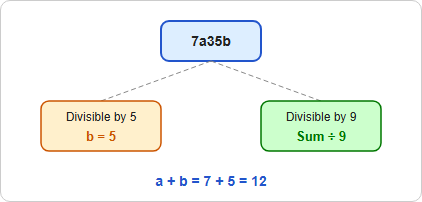
For a number to be divisible by 45, it must be divisible by both 5 and 9.

Divisibility by 5: The last digit b must be 0 or 5. Since b is a positive integer, b = 5.

Divisibility by 9: The sum of digits (7 + a + 3 + 5 + 5) = 20 + a must be a multiple of 9.

The nearest multiple of 9 greater than 20 is 27. Therefore, 20 + a = 27 ⇒ a = 7.

The value of (a + b) = 7 + 5 = 12.

∴ The correct answer is 12.

Alternate Method

Given: The 5-digit number is 7a35b and it is divisible by 45.

Conditions: a and b are positive integers (a, b ∈ {1, 2, 3, 4, 5, 6, 7, 8, 9}).
Step 1: Divisibility by 5

⇒ For a number to be divisible by 5, its last digit must be 0 or 5.

⇒ Since b is a positive integer, b cannot be 0. Thus, b = 5.

Step 2: Divisibility by 9

⇒ Sum of digits = 7 + a + 3 + 5 + b

⇒ Sum = 15 + a + 5 = 20 + a

⇒ For 20 + a to be divisible by 9, the possible values for (20 + a) are 27, 36, ...

⇒ If 20 + a = 27, then a = 7.

⇒ If 20 + a = 36, then a = 16 (which is not a single-digit integer).

Step 3: Calculate (a + b)

⇒ a + b = 7 + 5 = 12.

∴ The correct answer is 12.

Additional Information

Divisibility Rule of 9

A number is divisible by 9 if the sum of its digits is divisible by 9.

Divisibility Rule of 5

A number is divisible by 5 if its last digit is either 0 or 5.

Composite Divisibility

To check divisibility by a composite number like 45, check divisibility by its coprime factors (5 and 9).
RRB NTPC (UG) CBT-I Official Paper (Held On 08 May, 2026 Shift 2) (Previous Year Paper)·Mathematics
View full paper

Question 142

RRB NTPC 2026• Mathematics• Mathematics

Yogesh invested a certain sum of money at 10% per annum. After 2 years, he received ₹147 as compound interest, compounded annually. Find the corresponding simple interest (in ₹) for 2 years at the same rate.

  1. AOption (a)

    140

  2. BOption (b)

    130

  3. COption (c)

    125

  4. DOption (d)

    135

View answer & explanation

Correct answer

Answer: (a)A.

140

Why this answer is correct

Shortcut Trick

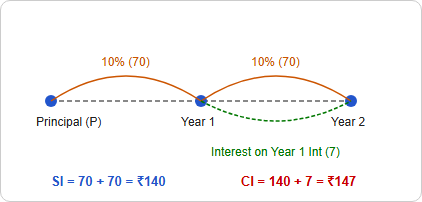
Effective rate of Compound Interest (CI) for 2 years at 10% = 10 + 10 + (10 × 10 / 100) = 21%.

Effective rate of Simple Interest (SI) for 2 years at 10% = 10 × 2 = 20%.

According to the question: 21% = ₹147.

So, 1% = 147 ÷ 21 = ₹7.

Therefore, 20% (SI) = 20 × 7 = ₹140.

∴ The correct answer is ₹140.

Alternate Method

Given:

Compound Interest (CI) = ₹147

Rate (R) = 10% per annum

Time (T) = 2 years

Formula Used:

CI = P[(1 + R/100)T − 1]

SI = (P × R × T) ÷ 100

Calculations:

⇒ 147 = P[(1 + 10/100)2 − 1]

⇒ 147 = P[(11/10)2 − 1]

⇒ 147 = P[121/100 − 1]

⇒ 147 = P[21/100]

⇒ P = (147 × 100) ÷ 21 = 7 × 100 = ₹700

⇒ Now, SI for 2 years = (700 × 10 × 2) ÷ 100

⇒ SI = 7 × 10 × 2 = ₹140

∴ The correct answer is ₹140.

Additional Information

Direct SI-CI Relation for 2 Years

For a period of 2 years, the relationship is given by: SI = CI × 200 ÷ (200 + R). In this case, 147 × 200 ÷ 210 = ₹140.

Difference between CI and SI

The difference (D) for 2 years is calculated as: D = CI − SI = P(R/100)2. Here, D = 147 − 140 = ₹7.

Successive Rate Formula

Compound interest for 2 years can be treated as a successive percentage change: Effective Rate = x + y + (xy/100).

RRB NTPC (UG) CBT-I Official Paper (Held On 08 May, 2026 Shift 2) (Previous Year Paper)·Mathematics
View full paper

Question 143

RRB NTPC 2026• Mathematics• Mathematics

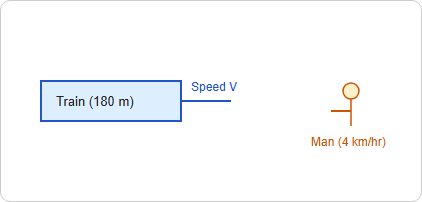
A man is walking at 4 km/hr. A 180 m long train crosses him in 12 seconds while coming from the opposite direction. What is the speed of the train (in km/hr)?

  1. AOption (a)

    61

  2. BOption (b)

    50

  3. COption (c)

    45

  4. DOption (d)

    32

View answer & explanation

Correct answer

Answer: (b)B.

50

Why this answer is correct

Shortcut Trick

Relative Speed = 180 / 12 = 15 m/s

Convert to km/hr: 15 × (18 / 5) = 54 km/hr

In opposite direction, Relative Speed = SpeedTrain + SpeedMan

54 = SpeedTrain + 4 ⇒ SpeedTrain = 50 km/hr

∴ The correct answer is 50 km/hr.

Alternate Method

Given:

Speed of walking man = 4 km/hr

Length of the train (Distance) = 180 m

Crossing time = 12 seconds

Formula Used:

Relative Speed = Total Distance / Total Time

Speed (km/hr) = Speed (m/s) × (18/5)

Calculations:

⇒ Relative Speed = 180 / 12 = 15 m/s

⇒ Relative Speed in km/hr = 15 × (18 / 5)

⇒ Relative Speed = 3 × 18 = 54 km/hr

⇒ Since they are moving in the opposite direction:

⇒ Relative Speed = Speed of Train + Speed of Man

⇒ 54 = Speed of Train + 4

⇒ Speed of Train = 54 − 4 = 50 km/hr

∴ The correct answer is 50 km/hr.

Additional Information

Relative Speed Concept

When two objects move in opposite directions, their relative speed is the sum of their individual speeds (u + v). If they move in the same direction, it is the difference (u − v).

Speed Conversion

To convert m/s to km/hr, multiply by 18/5. To convert km/hr to m/s, multiply by 5/18.

Crossing a Stationary Point/Man

When a train crosses a man, a pole, or a point object, the distance traveled is equal to the length of the train itself.

RRB NTPC (UG) CBT-I Official Paper (Held On 08 May, 2026 Shift 2) (Previous Year Paper)·Mathematics
View full paper

Question 144

RRB NTPC 2026• Mathematics• Mathematics

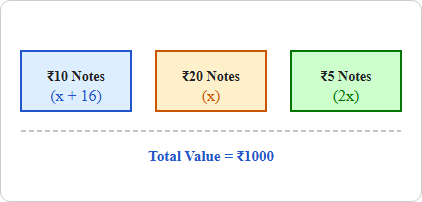
Ram has ₹1000 in the denomination of ₹10, ₹20 and ₹5 notes. If the number of ₹10 notes is 16 more than that of ₹20 notes and the number of ₹5 notes is twice the number of ₹20 notes, find the total number of notes that Ram has.

  1. AOption (a)

    90

  2. BOption (b)

    120

  3. COption (c)

    100

  4. DOption (d)

    80

View answer & explanation

Correct answer

Answer: (c)C.

100

Why this answer is correct

Shortcut Trick

Let the number of ₹20 notes be x. Then ₹10 notes = x + 16 and ₹5 notes = 2x.

Subtract the value of extra 16 notes of ₹10: 1000 − (16 × 10) = ₹840.

Effective value per unit: ₹10 (from x) + ₹20 (from x) + ₹10 (from 2x of ₹5) = ₹40.

Number of units (x) = 840 ÷ 40 = 21.

Total notes = 4x + 16 = 4(21) + 16 = 100.

∴ The correct answer is 100 notes.

Alternate Method

Given:

Total amount with Ram = ₹1000

Denominations are ₹10, ₹20, and ₹5.

Let the number of ₹20 notes be x.

Number of ₹10 notes = x + 16

Number of ₹5 notes = twice of ₹20 notes = 2x

Calculations:

⇒ Total Value = (Value of ₹10 notes) + (Value of ₹20 notes) + (Value of ₹5 notes)

⇒ 1000 = 10 × (x + 16) + 20 × (x) + 5 × (2x)

⇒ 1000 = 10x + 160 + 20x + 10x

⇒ 1000 − 160 = 40x

⇒ 840 = 40x

⇒ x = 840 ÷ 40 = 21

⇒ Number of ₹20 notes = 21

⇒ Number of ₹10 notes = 21 + 16 = 37

⇒ Number of ₹5 notes = 2 × 21 = 42

⇒ Total number of notes = 37 + 21 + 42 = 100

∴ The correct answer is 100 notes.

Additional Information

Currency Denomination Formula

The total value of money is calculated as: Total Value = ∑(Face Value of Note × Number of Notes).

Linear Equation Application

When multiple variables are related to a single base (like ₹20 notes here), express all terms in that base variable to solve the equation easily.

Verification Technique

Always verify the final count by multiplying back: (37 × 10) + (21 × 20) + (42 × 5) = 370 + 420 + 210 = 1000.

RRB NTPC (UG) CBT-I Official Paper (Held On 08 May, 2026 Shift 2) (Previous Year Paper)·Mathematics
View full paper

Question 145

RRB NTPC 2026• Mathematics• Mathematics

Two taps can fill a cistern in 4 hours and 8 hours, respectively. A third tap can empty it in 4 hours. How long (in hours) will it take to fill one-fourth of the empty cistern if all the taps are opened together?

  1. AOption (a)

    8

  2. BOption (b)

    4

  3. COption (c)

    6

  4. DOption (d)

    2

View answer & explanation

Correct answer

Answer: (d)D.

2

Why this answer is correct

Shortcut Trick

Net filling rate per hour = (1/4 + 1/8 − 1/4) = 1/8 of the cistern.

Time to fill the full cistern = 1 ÷ (1/8) = 8 hours.

Time to fill one-fourth of the cistern = 8 × 1/4 = 2 hours.

∴ The correct answer is 2 hr.

Alternate Method

Given: Filling time of Tap A = 4 hr, Tap B = 8 hr. Emptying time of Tap C = 4 hr.

Formula Used: Efficiency = Total Work ÷ Time; Time = Work ÷ Total Efficiency.

TapTime (hr)Total Work (LCM)Efficiency
Tap A (+)48 units+2
Tap B (+)8+1
Tap C (−)4−2

⇒ Total Efficiency when all taps are open = 2 + 1 − 2 = 1 unit/hr.

⇒ One-fourth capacity of the cistern = 8 × 1/4 = 2 units.

⇒ Required Time = 2 units ÷ 1 unit/hr = 2 hours.

∴ The correct answer is 2 hr.

Additional Information

Inlet and Outlet Pipes

An Inlet pipe fills the cistern (positive efficiency) while an Outlet pipe empties it (negative efficiency).

Net Efficiency Rule

If multiple pipes operate, the net rate of filling is the algebraic sum of their individual efficiencies (Rates).

Work & Wages in Pipes

If workers or pipes are paid based on work, the wage ratio is equal to the ratio of their individual efficiencies.

RRB NTPC (UG) CBT-I Official Paper (Held On 08 May, 2026 Shift 2) (Previous Year Paper)·Mathematics
View full paper

Question 146

RRB NTPC 2026• Mathematics• Mathematics

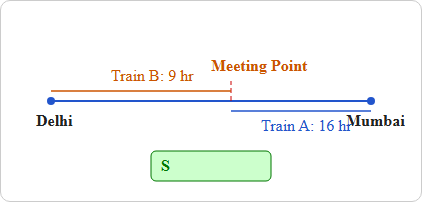
Two trains, A and B, start simultaneously from stations Delhi and Mumbai respectively towards each other on parallel tracks. After meeting, train A takes 16 hours to reach Mumbai, and train B takes 9 hours to reach Delhi. If train A’s speed is 60 km/h, what is the length of train B (in meters), given that it crosses a pole in 18 seconds?

  1. AOption (a)

    300

  2. BOption (b)

    420

  3. COption (c)

    400

  4. DOption (d)

    280

View answer & explanation

Correct answer

Answer: (c)C.

400

Why this answer is correct

Shortcut Trick

Ratio of speeds after meeting: SA / SB = √(TimeB / TimeA)

60 / SB = √(9 / 16) = 3 / 4

SB = (60 × 4) / 3 = 80 km/h

Speed of Train B in m/s = 80 × (5 / 18) = 400 / 18 m/s

Length of Train B = Speed × Crossing Time = (400 / 18) × 18 = 400 m

∴ The correct answer is 400 m.

Alternate Method

Given:

Speed of Train A (SA) = 60 km/h

Time taken by Train A to reach Mumbai after meeting (tA) = 16 hr

Time taken by Train B to reach Delhi after meeting (tB) = 9 hr

Time taken by Train B to cross a pole = 18 sec

Formula Used:

  1. SA / SB = √(tB / tA)
  2. Distance = Speed × Time
  3. km/h to m/s conversion: Speed × (5 / 18)

Calculations:

⇒ 60 / SB = √(9 / 16)

⇒ 60 / SB = 3 / 4

⇒ 3 × SB = 60 × 4

⇒ SB = 240 / 3 = 80 km/h

⇒ Speed of Train B in m/s = 80 × (5 / 18) = 400 / 18 m/s

⇒ Length of Train B = Speed × Time to cross pole

⇒ Length of Train B = (400 / 18) × 18

⇒ Length of Train B = 400 m

∴ The correct answer is 400 m.

Additional Information

Meeting Time Formula

If two objects start at the same time and meet at a point, the time they take to meet is T = √(t1 × t2), where t1 and t2 are times taken to reach destinations after meeting.

Train Crossing a Pole

When a train crosses a stationary object of negligible length (pole, man, tree), the distance traveled is equal to the length of the train itself.

Unit Conversion

To convert speed from km/h to m/s, multiply by 5/18. To convert m/s to km/h, multiply by 18/5.

RRB NTPC (UG) CBT-I Official Paper (Held On 08 May, 2026 Shift 2) (Previous Year Paper)·Mathematics
View full paper

Question 147

RRB NTPC 2026• Mathematics• Mathematics

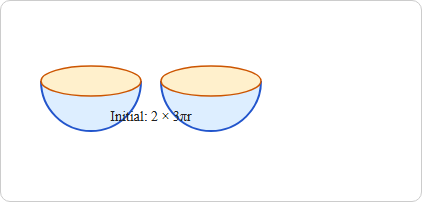
Two solid hemispheres are joined together to make a sphere. The total surface area of solids reduced by approximately ___%.

  1. AOption (a)

    50

  2. BOption (b)

    33.33

  3. COption (c)

    66.67

  4. DOption (d)

    25

View answer & explanation

Correct answer

Answer: (b)B.

33.33

Why this answer is correct

Shortcut Trick

Total surface area (TSA) of one solid hemisphere = 3 units (πr2 factor).

TSA of two separate hemispheres = 3 + 3 = 6 units.

Surface area of the resulting sphere = 4 units.

Reduction = 6 − 4 = 2 units.

Percentage Reduction = (2 ÷ 6) × 100 = 33.33%.

∴ The correct answer is 33.33%.

Alternate Method

Given: Two identical solid hemispheres are joined at their flat bases to form a sphere of the same radius r.

Formula Used:

⇒ Total Surface Area of a Solid Hemisphere = 3πr2

⇒ Surface Area of a Sphere = 4πr2

Calculations:

⇒ Combined TSA of two separate hemispheres = 2 × 3πr2 = 6πr2

⇒ Surface Area of the single sphere formed = 4πr2

⇒ Reduction in Surface Area = 6πr2 − 4πr2 = 2πr2

⇒ Percentage Reduction = (Reduction ÷ Original Area) × 100

⇒ Percentage Reduction = (2πr2 ÷ 6πr2) × 100

⇒ Percentage Reduction = (1 ÷ 3) × 100 ≈ 33.33%

∴ The correct answer is 33.33%.

Additional Information

Curved Surface Area (CSA) of Hemisphere

The area of only the curved part of a hemisphere is 2πr2. The flat base has an area of πr2.

Volume Conservation

When solids are joined or melted, the total volume remains constant. Volume of sphere = (4/3)πr3.

Total Surface Area of Solid Hemisphere

TSA = CSA + Base Area = 2πr2 + πr2 = 3πr2.

RRB NTPC (UG) CBT-I Official Paper (Held On 08 May, 2026 Shift 2) (Previous Year Paper)·Mathematics
View full paper

Question 148

RRB NTPC 2026• Mathematics• Mathematics

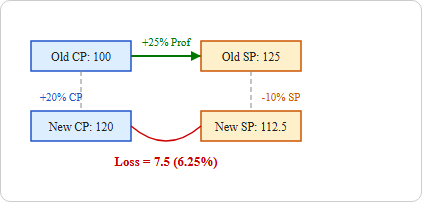
Lekhraj sells an article at a profit of 25%. If the cost price is increased by 20% and the selling price is reduced by 10%, what percentage loss will Lekhraj incur?

  1. AOption (a)

    6.5%

  2. BOption (b)

    7.25%

  3. COption (c)

    7.5%

  4. DOption (d)

    6.25%

View answer & explanation

Correct answer

Answer: (d)D.

6.25%

Why this answer is correct

Shortcut Trick

Let initial Cost Price (CP) = 100, then initial Selling Price (SP) = 125.

New CP = 100 × 1.20 = 120.

New SP = 125 × 0.90 = 112.5.

Net Loss = 120 − 112.5 = 7.5.

Loss Percentage = (7.5 ÷ 120) × 100 = 6.25%.

∴ The correct answer is 6.25%.

Alternate Method

Given: Initial profit = 25%, CP increase = 20%, SP reduction = 10%.

Formula: Profit/Loss % = (SP − CP) ÷ CP × 100.

⇒ Let the initial Cost Price be ₹100.

⇒ Initial Selling Price = 100 + 25% of 100 = ₹125.

⇒ New Cost Price = 100 + 20% of 100 = ₹120.

⇒ New Selling Price = 125 − 10% of 125 = 125 − 12.5 = ₹112.5.

⇒ Loss = New CP − New SP = 120 − 112.5 = ₹7.5.

⇒ Loss % = (7.5 ÷ 120) × 100 = (1 ÷ 16) × 100 = 6.25%.

∴ The correct answer is 6.25%.

Additional Information

Profit and Loss Percentage

Profit % = (Profit ÷ CP) × 100 and Loss % = (Loss ÷ CP) × 100. The denominator is always the Cost Price unless specified otherwise.

Successive Changes

When multiple changes occur, always update the base. For example, a 10% reduction on 125 is 125 × 0.90, not 125 − 10.

Base Change Rule

If CP changes, the new profit or loss must be calculated on the revised CP to find the effective percentage.

RRB NTPC (UG) CBT-I Official Paper (Held On 08 May, 2026 Shift 2) (Previous Year Paper)·Mathematics
View full paper

Question 149

RRB NTPC 2026• Mathematics• Mathematics

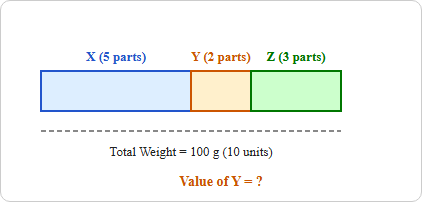
In a science experiment, chemicals X, Y, and Z are mixed in the ratio 5:2:3. If the total weight of the mixture is 100 grams, how much of chemical Y is present?

  1. AOption (a)

    50 grams

  2. BOption (b)

    10 grams

  3. COption (c)

    20 grams

  4. DOption (d)

    30 grams

View answer & explanation

Correct answer

Answer: (c)C.

20 grams

Why this answer is correct

Shortcut Trick

Sum of ratio parts = 5 + 2 + 3 = 10 units.

10 units = 100 g (Total weight).

1 unit = 10 g.

Chemical Y share = 2 units = 2 × 10 = 20 g.

∴ The correct answer is 20 g.

Alternate Method

Given:

Ratio of Chemical X : Chemical Y : Chemical Z = 5 : 2 : 3

Total weight of the mixture = 100 g

Calculations:

Let the weight of Chemical X be 5k, Chemical Y be 2k, and Chemical Z be 3k.

⇒ Total weight = 5k + 2k + 3k = 10k

⇒ 10k = 100

⇒ k = 100 ÷ 10

⇒ k = 10 g

⇒ Weight of Chemical Y = 2k = 2 × 10

⇒ Weight of Chemical Y = 20 g

∴ The correct answer is 20 g.

Additional Information

Ratio and Proportions

A ratio indicates how many times one number contains another. To divide a quantity in a given ratio, the total quantity is divided by the sum of the ratio terms to find the value of one unit.

Percentage in Mixtures

The percentage of any component can be found by (Component Ratio / Total Ratio) × 100. In this case, Chemical Y is (2/10) × 100 = 20% of the total mixture.

RRB NTPC (UG) CBT-I Official Paper (Held On 08 May, 2026 Shift 2) (Previous Year Paper)·Mathematics
View full paper

Question 150

RRB NTPC 2026• Mathematics• Mathematics

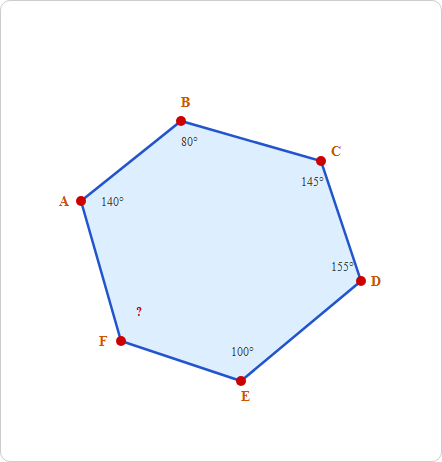
Find the measure of the unknown interior angle in an irregular hexagon with angles 140°, 80°, 145°, 155°, and 100°.

  1. AOption (a)

    100°

  2. BOption (b)

    120°

  3. COption (c)

    105°

  4. DOption (d)

    110°

View answer & explanation

Correct answer

Answer: (a)A.

100°

Why this answer is correct

Shortcut Trick

Total sum of interior angles of a hexagon (n = 6) = (6 − 2) × 180° = 720°.

Sum of 5 given angles = 140° + 80° + 145° + 155° + 100° = 620°.

Unknown angle = 720° − 620° = 100°.

∴ The correct answer is 100°.

Alternate Method

Given: Angles of an irregular hexagon are 140°, 80°, 145°, 155°, and 100°.

Formula Used: Sum of interior angles of a polygon = (n − 2) × 180°, where n is the number of sides.

For a hexagon, n = 6:

⇒ Sum = (6 − 2) × 180°

⇒ Sum = 4 × 180°

⇒ Sum = 720°

Let the unknown 6th angle be x.

⇒ 140° + 80° + 145° + 155° + 100° + x = 720°

⇒ 620° + x = 720°

⇒ x = 720° − 620°

⇒ x = 100°

∴ The correct answer is 100°.

Additional Information

Polygon Interior Angles Theorem

The sum of the interior angles of any convex polygon is given by (n − 2) × 180°, where n represents the number of sides.

Exterior Angle Sum

For any convex polygon, the sum of the exterior angles (one at each vertex) is always equal to 360° regardless of the number of sides.

Regular Hexagon

In a regular hexagon, all interior angles are equal, and each angle measures 720° ÷ 6 = 120°.

RRB NTPC (UG) CBT-I Official Paper (Held On 08 May, 2026 Shift 3) (Previous Year Paper)·Mathematics
View full paper

Question 151

RRB NTPC 2026• Mathematics• Mathematics

Pipes A and B together can fill a cistern in 10 hours. Pipes B and C together can fill the same cistern in 20 hours, and pipes C and A together can fill it in 12 hours. Find the time taken by pipe B alone to fill the cistern.

  1. AOption (a)

    24 hours

  2. BOption (b)

    25 hours

  3. COption (c)

    28 hours

  4. DOption (d)

    30 hours

View answer & explanation

Correct answer

Answer: (d)D.

30 hours

Why this answer is correct

Shortcut Trick

Let the total capacity of the cistern be the LCM of (10, 20, 12) = 60 units.

Combined Efficiency: (A+B) = 6, (B+C) = 3, (C+A) = 5.

Summing them: 2(A+B+C) = 6 + 3 + 5 = 14 ⇒ A+B+C = 7 units/hr.

Efficiency of Pipe B = (A+B+C) − (C+A) = 7 − 5 = 2 units/hr.

Time taken by B = 60 ÷ 2 = 30 hr.

∴ The correct answer is 30 hr.

Alternate Method

Given:

Time taken by (Pipe A + Pipe B) = 10 hr

Time taken by (Pipe B + Pipe C) = 20 hr

Time taken by (Pipe C + Pipe A) = 12 hr

Formula Used:

Efficiency = Total Work ÷ Time taken

PipesTime (hr)Total Work (LCM)Efficiency (units/hr)
A + B106060 ÷ 10 = 6
B + C2060 ÷ 20 = 3
C + A1260 ÷ 12 = 5

Calculations:

⇒ Adding efficiencies: (A + B) + (B + C) + (C + A) = 6 + 3 + 5

⇒ 2(A + B + C) = 14

⇒ A + B + C = 14 ÷ 2 = 7 units/hr

⇒ We know efficiency of (C + A) = 5 units/hr

⇒ Efficiency of B = (A + B + C) − (C + A) = 7 − 5 = 2 units/hr

⇒ Time taken by Pipe B alone = Total Work ÷ Efficiency of B

⇒ Time = 60 ÷ 2 = 30 hr

∴ The correct answer is 30 hr.

Additional Information

Combined Efficiency Rule

When pipes work in pairs, the sum of their individual efficiencies is half the sum of their pairwise efficiencies: (A+B+C) = [(A+B) + (B+C) + (C+A)] ÷ 2.

Pipes and Cisterns Basics

Inlet pipes perform positive work (filling), while outlet pipes perform negative work (emptying). Total work is the volume of the tank/cistern.

Time and Work Relation

Time taken and efficiency are inversely proportional to each other. Time = 1 ÷ Efficiency (for constant work).

RRB NTPC (UG) CBT-I Official Paper (Held On 08 May, 2026 Shift 3) (Previous Year Paper)·Mathematics
View full paper

Question 152

RRB NTPC 2026• Mathematics• Mathematics

A shopkeeper offers the following schemes on toys of the same marked price.

(A) Successive discounts of 21% and 8% on any number of toys bought.

(B) Successive discounts of 38%, 42% and 30% on any number of toys bought.

(C) 17% discount on the first 8 toys and 20% discount on each toy thereon.

(D) 7 toys free of cost on buying 10 toys.

A customer wants to buy 10 toys. Which of the above schemes is the least beneficial to her?

  1. AOption (a)

    A

  2. BOption (b)

    B

  3. COption (c)

    C

  4. DOption (d)

    D

View answer & explanation

Correct answer

Answer: (c)C.

C

Why this answer is correct

Shortcut Trick

Approximate Effective Discount for each Scheme:

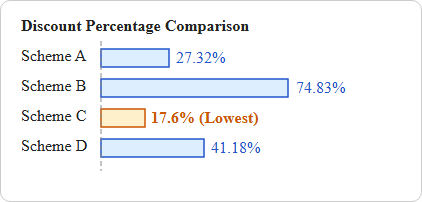
(A) 21 + 8 − (21 × 8 / 100) = 27.32%

(B) Successive 38%, 42%, 30% → clearly much higher than 50% (≈ 74.8%)

(C) Weighted Average = [(8 × 17) + (2 × 20)] ÷ 10 = 17.6%

(D) Buy 10 Get 7 Free = [7 ÷ (10 + 7)] × 100 ≈ 41.18%

Comparing the values, 17.6% is the lowest discount, making it the least beneficial.

∴ The correct answer is C.

Alternate Method

Given:

⇒ Total Toys to buy = 10

⇒ Let Marked Price (MP) of 1 toy = ₹100

⇒ Total Marked Price for 10 toys = ₹1000

Formula Used:

⇒ Successive Discount = a + b − (ab/100)

⇒ Buy X Get Y Free Discount % = [Y ÷ (X + Y)] × 100

Calculations:

Scheme (A): Successive 21% and 8%

⇒ Effective Discount = 21 + 8 − (21 × 8 / 100) = 29 − 1.68 = 27.32%

Scheme (B): Successive 38%, 42%, 30%

⇒ First two: 38 + 42 − (38 × 42 / 100) = 80 − 15.96 = 64.04%

⇒ Final: 64.04 + 30 − (64.04 × 30 / 100) = 94.04 − 19.21 = 74.83%

Scheme (C): 17% on first 8, 20% on next 2

⇒ Discount on 8 toys = 8 × 17 = ₹136

⇒ Discount on 2 toys = 2 × 20 = ₹40

⇒ Total Discount = 136 + 40 = ₹176

⇒ Effective % = (176 ÷ 1000) × 100 = 17.6%

Scheme (D): Buy 10 Get 7 Free

⇒ Effective Discount % = [7 ÷ (10 + 7)] × 100 = (7 ÷ 17) × 100 ≈ 41.18%

⇒ Comparing all schemes, 17.6% is the minimum discount.

∴ The correct answer is C.

Additional Information

Successive Discounts

When multiple discounts are applied one after another, the total discount is always less than the sum of individual percentages. Formula: a + b − (ab/100).

Buy X Get Y Free

The effective discount percentage in such offers is calculated as: [Free Items ÷ Total Items (Bought + Free)] × 100.

Least Beneficial vs Most Beneficial

For a customer, the least beneficial scheme is the one offering the lowest effective discount percentage, while the most beneficial offers the highest.

RRB NTPC (UG) CBT-I Official Paper (Held On 08 May, 2026 Shift 3) (Previous Year Paper)·Mathematics
View full paper

Question 153

RRB NTPC 2026• Mathematics• Mathematics

Simplify: (0.25 × 1.6) ÷ (0.04 × 0.5)

  1. AOption (a)

    10

  2. BOption (b)

    8

  3. COption (c)

    2

  4. DOption (d)

    20

View answer & explanation

Correct answer

Answer: (d)D.

20

Why this answer is correct

Shortcut Trick

Convert decimals to fractions for faster calculation: 0.25 = 1/4 and 0.5 = 1/2.

Numerator: (1/4) × 1.6 = 0.4

Denominator: 0.04 × (1/2) = 0.02

Result = 0.4 ÷ 0.02 = 40 ÷ 2 = 20

∴ The correct answer is 20.

Alternate Method

Given: (0.25 × 1.6) ÷ (0.04 × 0.5)

Method Used: Apply the BODMAS rule (perform operations inside Brackets first).

⇒ Step 1 (First bracket): 0.25 × 1.6 = 0.400 = 0.4

⇒ Step 2 (Second bracket): 0.04 × 0.5 = 0.020 = 0.02

⇒ Step 3 (Division): 0.4 ÷ 0.02

⇒ To remove the decimal from the divisor, multiply both numerator and denominator by 100.

⇒ (0.4 × 100) ÷ (0.02 × 100) = 40 ÷ 2

⇒ Result = 20

∴ The correct answer is 20.

Additional Information

BODMAS Rule

It stands for Brackets, Of, Division, Multiplication, Addition, and Subtraction. Operations must be performed in this specific order to get the correct result.

Multiplying Decimals

Multiply the numbers as if they were whole numbers, then place the decimal point in the product so that it has the same number of decimal places as the sum of the decimal places in the factors.

Dividing by Decimals

Move the decimal point in the divisor to the right until it is a whole number, and move the decimal point in the dividend the same number of places to the right before dividing.

RRB NTPC (UG) CBT-I Official Paper (Held On 08 May, 2026 Shift 3) (Previous Year Paper)·Mathematics
View full paper

Question 154

RRB NTPC 2026• Mathematics• Mathematics

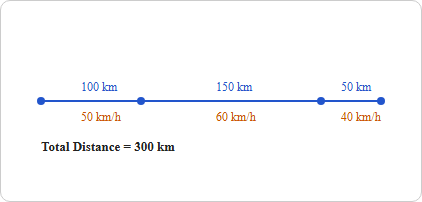
A delivery van covers the first 100 km at 50 km/h, the next 150 km at 60 km/h, and the last 50 km at 40 km/h. What is the average speed for the entire journey (correct to two places of decimal)?

  1. AOption (a)

    52.17 km/h

  2. BOption (b)

    48.29 km/h

  3. COption (c)

    50.05 km/h

  4. DOption (d)

    54.54 km/h

View answer & explanation

Correct answer

Answer: (a)A.

52.17 km/h

Why this answer is correct

Shortcut Trick

Average Speed = Total Distance ÷ Total Time

Total Distance = 100 + 150 + 50 = 300 km

Total Time = (100/50) + (150/60) + (50/40) = 2 + 2.5 + 1.25 = 5.75 hours

Average Speed = 300 ÷ 5.75 ≈ 52.17 km/h

∴ The correct answer is 52.17 km/h.

Alternate Method

Given:

Distance1 = 100 km, Speed1 = 50 km/h

Distance2 = 150 km, Speed2 = 60 km/h

Distance3 = 50 km, Speed3 = 40 km/h

Formula Used:

Time = Distance ÷ Speed

Average Speed = (Total Distance) ÷ (Total Time)

Calculations:

⇒ Time for first part (t1) = 100 ÷ 50 = 2 hours

⇒ Time for second part (t2) = 150 ÷ 60 = 2.5 hours

⇒ Time for third part (t3) = 50 ÷ 40 = 1.25 hours

⇒ Total Time (T) = 2 + 2.5 + 1.25 = 5.75 hours

⇒ Average Speed = 300 ÷ 5.75

⇒ Average Speed = 30000 ÷ 575 = 1200 ÷ 23

⇒ Average Speed ≈ 52.1739... km/h

∴ The correct answer is 52.17 km/h.

Additional Information

Average Speed for Equal Distances

When a journey is divided into two equal distances with speeds x and y, the Average Speed is the harmonic mean: (2 × x × y) ÷ (x + y).

Average Speed for Equal Time Intervals

If an object travels at speed x for time T and then at speed y for the same time T, the Average Speed is the arithmetic mean: (x + y) ÷ 2.

Unit Conversion

To convert km/h to m/s, multiply by 5/18. To convert m/s to km/h, multiply by 18/5.

RRB NTPC (UG) CBT-I Official Paper (Held On 08 May, 2026 Shift 3) (Previous Year Paper)·Mathematics
View full paper

Question 155

RRB NTPC 2026• Mathematics• Mathematics

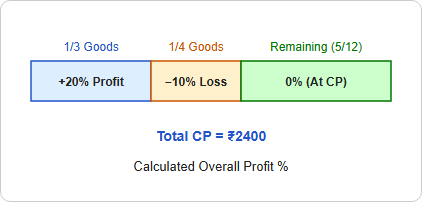
A trader buys a consignment of goods for ₹2400. He sells one-third​ of the goods at a 20% profit, and one-fourth​ of the goods at a 10% loss, and the remaining goods at cost price. What is the overall profit or loss percentage?

  1. AOption (a)

    4 15\frac{1}{5}  %loss

  2. BOption (b)

    4 16\frac{1}{6} % loss

  3. COption (c)

    4 15\frac{1}{5} % profit

  4. DOption (d)

    4 16\frac{1}{6} % profit

View answer & explanation

Correct answer

Answer: (d)D.

4 16\frac{1}{6} % profit

Why this answer is correct

Shortcut Trick

Assume the total quantity is 12 units (LCM of 3 and 4).

Net profit/loss units = (1/3 × 12 × 20) + (1/4 × 12 × (−10)) + (5/12 × 12 × 0)

Net effect = 80 − 30 + 0 = 50 units.

Overall percentage = 50 ÷ 12 = 25/6 = 4 1/6%.

∴ The correct answer is 4 1/6% profit.

Alternate Method

Given: Total Cost Price (CP) = ₹2400

Formula Used: Profit % = (Total Profit ÷ Total CP) × 100

⇒ Profit on first part = (1/3) × 2400 × 20% = 800 × 0.20 = ₹160

⇒ Loss on second part = (1/4) × 2400 × 10% = 600 × 0.10 = ₹60

⇒ Remaining goods = 1 − (1/3 + 1/4) = 1 − 7/12 = 5/12

⇒ Profit/Loss on remaining part = (5/12) × 2400 × 0 = ₹0

⇒ Total Net Profit = 160 − 60 + 0 = ₹100

⇒ Overall Profit Percentage = (100 ÷ 2400) × 100 = 100/24 = 25/6 = 4 1/6%

∴ The correct answer is 4 1/6% profit.

Additional Information

Weighted Average Profit/Loss

When goods are sold in parts, the net profit/loss percentage is the weighted average: % = (w1p1 + w2p2 + ...) ÷ (w1 + w2 + ...).

Cost Price Selling

Selling an item at its Cost Price (CP) implies there is no profit and no loss (0% change).

Fractional Parts Calculation

Always ensure the sum of all fractional parts equals 1 (e.g., 1/3 + 1/4 + 5/12 = 12/12 = 1).

RRB NTPC (UG) CBT-I Official Paper (Held On 08 May, 2026 Shift 3) (Previous Year Paper)·Mathematics
View full paper

Question 156

RRB NTPC 2026• Mathematics• Mathematics

Three numbers are in the ratio 3 : 7 : 2, and their LCM is 8820. Their HCF is:

  1. AOption (a)

    240

  2. BOption (b)

    210

  3. COption (c)

    235

  4. DOption (d)

    208

View answer & explanation

Correct answer

Answer: (b)B.

210

Why this answer is correct

Shortcut Trick

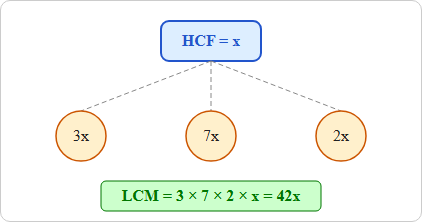
Let the HCF of the three numbers be x.

The numbers are then 3x, 7x, and 2x.

LCM of (3x, 7x, 2x) = x × LCM(3, 7, 2) = x × 42.

Given, 42x = 8820.

x = 8820 ÷ 42 = 210.

∴ The correct answer is 210.

Alternate Method

Given:

Ratio of three numbers = 3 : 7 : 2

LCM of the numbers = 8820

Formula Used:

If numbers are in the ratio a : b : c, then the numbers can be represented as ax, bx, and cx, where x is their HCF.

The LCM of these numbers = x × LCM(a, b, c).

Calculations:

⇒ Let the numbers be 3x, 7x, and 2x.

⇒ LCM(3, 7, 2) = 3 × 7 × 2 = 42 (as they are co-prime).

⇒ LCM of (3x, 7x, 2x) = 42x.

⇒ 42x = 8820.

⇒ x = 8820 ÷ 42.

⇒ x = 210.

∴ The correct answer is 210.

Additional Information

HCF (Highest Common Factor)

The greatest number that divides two or more numbers without leaving a remainder.

LCM (Least Common Multiple)

The smallest non-zero number that is a multiple of two or more numbers.

Product Rule for Two Numbers

For any two numbers A and B: A × B = HCF(A, B) × LCM(A, B).

Co-prime Numbers

Two or more numbers are co-prime if their HCF is 1. Their LCM is simply the product of the numbers.

RRB NTPC (UG) CBT-I Official Paper (Held On 08 May, 2026 Shift 3) (Previous Year Paper)·Mathematics
View full paper

Question 157

RRB NTPC 2026• Mathematics• Mathematics

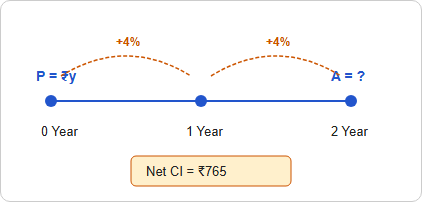
If the interest on a sum of ₹y at 4% per annum compounded annually for 2 years is ₹765, then the total amount payable at the end of the two-year period will be _________.

  1. AOption (a)

    ₹10,351

  2. BOption (b)

    ₹10,140

  3. COption (c)

    ₹10,210

  4. DOption (d)

    ₹10,115

View answer & explanation

Correct answer

Answer: (b)B.

₹10,140

Why this answer is correct

Shortcut Trick

Effective Interest Rate for 2 years at 4% = 4 + 4 + (4 × 4)/100 = 8.16%.

Given that 8.16% of the Principal (y) = ₹765.

The Total Amount (A) percentage = 100% + 8.16% = 108.16%.

⇒ Amount = (765 ÷ 8.16) × 108.16

⇒ Amount = 93.75 × 108.16 = ₹10,140.

∴ The correct answer is ₹10,140.

Alternate Method

Given: Principal (P) = ₹y, Rate (R) = 4% p.a., Time (n) = 2 years, Compound Interest (CI) = ₹765.

Formula Used: CI = P[(1 + R/100)n − 1] and Amount (A) = P + CI

⇒ 765 = y[(1 + 4/100)2 − 1]

⇒ 765 = y[(1 + 1/25)2 − 1]

⇒ 765 = y[(26/25)2 − 1]

⇒ 765 = y[676/625 − 1]

⇒ 765 = y[(676 − 625)/625]

⇒ 765 = y[51/625]

⇒ y = (765 × 625) ÷ 51

⇒ y = 15 × 625 = ₹9,375

⇒ Amount (A) = Principal (y) + CI

⇒ A = 9,375 + 765 = ₹10,140

∴ The correct answer is ₹10,140.

Additional Information

Compound Interest Formula

The amount A is calculated as A = P(1 + r/100)n, where P is principal, r is rate, and n is time.

Effective Rate for 2 Years

The net percentage interest for two years is given by x + y + (xy/100), where x and y are annual rates.

Difference between CI and SI

For 2 years, the difference between Compound Interest and Simple Interest is P(R/100)2.

RRB NTPC (UG) CBT-I Official Paper (Held On 08 May, 2026 Shift 3) (Previous Year Paper)·Mathematics
View full paper

Question 158

RRB NTPC 2026• Mathematics• Mathematics

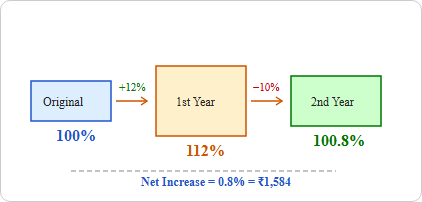
Sangeeta’s salary is revised twice in two consecutive years. In the first year, the salary is increased by 12%. In the second year, it is decreased by 10%. Despite this, her salary after the second revision is ₹1,584 more than the original salary. What is Sangeeta’s original monthly salary (in ₹)?

  1. AOption (a)

    1,75,000

  2. BOption (b)

    1,98,000

  3. COption (c)

    1,89,000

  4. DOption (d)

    2,00,000

View answer & explanation

Correct answer

Answer: (b)B.

1,98,000

Why this answer is correct

Shortcut Trick

Net percentage change = a + b + (ab ÷ 100)

Here, a = +12% and b = −10%

Net change = 12 − 10 + (12 × (−10) ÷ 100) = 2 − 1.2 = 0.8%

Given, 0.8% increase = ₹1,584

Original Salary (100%) = (1,584 ÷ 0.8) × 100 = 1,980 × 100 = ₹1,98,000

∴ The correct answer is ₹1,98,000.

Alternate Method

Given:

First year revision = increased by 12%

Second year revision = decreased by 10%

Increase in original monthly salary = ₹1,584

Formula Used:

Final Value = Initial Value × (1 + r1/100) × (1 + r2/100)

Calculations:

Let Sangeeta's salary be ₹x.

⇒ Salary after 1st year = x × (112 ÷ 100) = 1.12x

⇒ Salary after 2nd year = 1.12x × (90 ÷ 100) = 1.008x

⇒ Total increase in salary = 1.008x − x = 0.008x

⇒ 0.008x = 1,584

⇒ x = 1,584 ÷ 0.008

⇒ x = 1,584,000 ÷ 8

⇒ x = 1,98,000

∴ The correct answer is ₹1,98,000.

Additional Information

Successive Percentage Change

When a value is changed by a% and then by b%, the net effective change is (a + b + ab/100)%.

Multiplying Factor Method

For an increase of r%, the factor is (1 + r/100). For a decrease, the factor is (1 − r/100). Final value = Initial value × Factor1 × Factor2.

Base Value Property

Percentage changes are always calculated on the preceding value in a series of successive changes, not on the original base value each time.

RRB NTPC (UG) CBT-I Official Paper (Held On 08 May, 2026 Shift 3) (Previous Year Paper)·Mathematics
View full paper

Question 159

RRB NTPC 2026• Mathematics• Mathematics

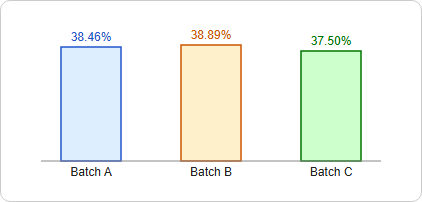
In a college, the ratio of science to arts students is different for each of its three batches. In Batch A, the ratio is 5:8, in Batch B it is 7:11, and in Batch C it is 3:5. Which batch has the highest proportion of science students?

  1. AOption (a)

    Batch B

  2. BOption (b)

    All have the same proportion

  3. COption (c)

    Batch A

  4. DOption (d)

    Batch C

View answer & explanation

Correct answer

Answer: (a)A.

Batch B

Why this answer is correct

Shortcut Trick

Convert science-to-total ratios into decimals to compare proportions:

Batch A: 5 ÷ (5 + 8) = 5/13 ≈ 0.3846

Batch B: 7 ÷ (7 + 11) = 7/18 ≈ 0.3888

Batch C: 3 ÷ (3 + 5) = 3/8 = 0.3750

Since 0.3888 > 0.3846 > 0.3750, Batch B has the highest proportion.

∴ The correct answer is Batch B.

Alternate Method

Given:

Ratio of Science to Arts students:

Batch A = 5 : 8 | Batch B = 7 : 11 | Batch C = 3 : 5

Formula Used:

Proportion of Science students = Science ÷ (Science + Arts)

Calculations:

⇒ Batch A proportion = 5 / (5 + 8) = 5/13

⇒ Batch B proportion = 7 / (7 + 11) = 7/18

⇒ Batch C proportion = 3 / (3 + 5) = 3/8

⇒ Comparing 5/13 and 7/18 by cross-multiplication: 5 × 18 = 90 and 7 × 13 = 91. Since 91 > 90, Batch B > Batch A.

⇒ Comparing 7/18 and 3/8 by cross-multiplication: 7 × 8 = 56 and 3 × 18 = 54. Since 56 > 54, Batch B > Batch C.

⇒ Batch B has the highest proportion of science students.

∴ The correct answer is Batch B.

Additional Information

Ratio to Proportion Conversion

If the ratio of two components is a:b, the proportion of the first component in the total is given by a/(a+b).

Comparing Fractions Shortcut

To compare a/b and c/d without division, compare the products (a × d) and (b × c). If ad > bc, then a c/d.

Percentage Share

The percentage share of a component is (Value / Total) × 100, which is useful for comparing proportions across different group sizes.

RRB NTPC (UG) CBT-I Official Paper (Held On 08 May, 2026 Shift 3) (Previous Year Paper)·Mathematics
View full paper

Question 160

RRB NTPC 2026• Mathematics• Mathematics

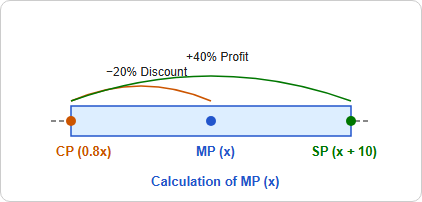
If a man bought an article at 20% less than its marked price and sold it for ₹10 more than its marked price, his profit was 40%. What was the marked price (in ₹) of the article (correct to two decimal places)?

  1. AOption (a)

    ₹86.66

  2. BOption (b)

    ₹83.33

  3. COption (c)

    ₹73.33

  4. DOption (d)

    ₹76.66

View answer & explanation

Correct answer

Answer: (b)B.

₹83.33

Why this answer is correct

Shortcut Trick

Let Marked Price (MP) = 100 units.

Cost Price (CP) = 100 − 20% = 80 units.

Selling Price (SP) = 80 + 40% of 80 = 112 units.

Difference (SP − MP) = 112 − 100 = 12 units → ₹10.

Marked Price = (10 ÷ 12) × 100 = 1000 ÷ 12 = 83.33.

∴ The correct answer is ₹83.33.

Alternate Method

Given:

Discount on Marked Price = 20%

Selling Price (SP) = Marked Price (MP) + ₹10

Profit Percentage = 40%

⇒ Let the Marked Price be x.

⇒ Cost Price (CP) = x − 20% of x = 0.8x.

⇒ Selling Price (SP) = x + 10.

⇒ Profit = SP − CP = (x + 10) − 0.8x = 0.2x + 10.

⇒ Profit Percentage = (Profit ÷ CP) × 100

⇒ 40 = [(0.2x + 10) ÷ 0.8x] × 100

⇒ 0.40 = (0.2x + 10) ÷ 0.8x

⇒ 0.32x = 0.2x + 10

⇒ 0.12x = 10

⇒ x = 10 ÷ 0.12 = 83.333...

∴ The correct answer is ₹83.33.

Additional Information

Relationship between CP and MP

The direct ratio between Cost Price and Marked Price is given by: CP/MP = (100 − Discount%) / (100 + Profit%).

Successive Discounts

Two successive discounts of a% and b% are equivalent to a single discount of [a + b − (a × b)/100]%.

Mark-up Percentage

Mark-up % = [(MP − CP) ÷ CP] × 100. It represents how much more the Marked Price is compared to the Cost Price.

How should I prepare for Quantitative Aptitude in RRB NTPC?

Solving previous year questions by topic helps identify recurring concepts, question patterns, and frequently asked sub-topics. Attempt each question, review the step-by-step explanation, and note down key formulas or facts for quick revision before the exam.