RRB NTPC · Topic Collection

Quantitative Aptitude PYQs

Arithmetic, number systems, percentages, ratios, profit and loss, time and work, algebra, geometry, mensuration, and trigonometry.

1020 Total Questions34 Official PapersYears: 2016–2026Search in Quantitative Aptitude
Showing questions 121–140 of 1020Page 7 of 51
RRB NTPC (UG) CBT-I Official Paper (Held On 08 May, 2026 Shift 2) (Previous Year Paper)·Mathematics
View full paper

Question 121

RRB NTPC 2026• Mathematics• Mathematics

Evaluate 203 + (-9)3 + (-11)3

  1. AOption (a)

    5930

  2. BOption (b)

    5950

  3. COption (c)

    5940

  4. DOption (d)

    5992

View answer & explanation

Correct answer

Answer: (c)C.

5940

Why this answer is correct

Shortcut Trick

Use the algebraic identity: If a + b + c = 0, then a3 + b3 + c3 = 3abc.

Here, a = 20, b = −9, and c = −11.

Sum = 20 + (−9) + (−11) = 20 − 20 = 0.

∴ 203 + (−9)3 + (−11)3 = 3 × 20 × (−9) × (−11) = 60 × 99 = 5940.

∴ The correct answer is 5940.

Alternate Method

Given: 203 + (−9)3 + (−11)3

Formula Used: Direct calculation of cubes.

⇒ 203 = 20 × 20 × 20 = 8000

⇒ (−9)3 = (−9) × (−9) × (−9) = −729

⇒ (−11)3 = (−11) × (−11) × (−11) = −1331

⇒ 8000 + (−729) + (−1331)

⇒ 8000 − (729 + 1331)

⇒ 8000 − 2060

⇒ 5940

∴ The correct answer is 5940.

Additional Information

Special Algebraic Identity

The conditional identity states that if a + b + c = 0, then the sum of their cubes is exactly 3abc.

General Cube Formula

a3 + b3 + c3 − 3abc = (a + b + c)(a2 + b2 + c2 − ab − bc − ca). This formula explains why the sum equals 3abc when the first factor is zero.

Negative Base Property

The cube of a negative number is always negative: (−x)3 = −(x3).
RRB NTPC (UG) CBT-I Official Paper (Held On 08 May, 2026 Shift 2) (Previous Year Paper)·Mathematics
View full paper

Question 122

RRB NTPC 2026• Mathematics• Mathematics

If x = 225\sqrt{225} + 484\sqrt{484}, what is the value of x2 - [(225\sqrt{225})2 + (32)2]?

  1. AOption (a)

    484

  2. BOption (b)

    0

  3. COption (c)

    100

  4. DOption (d)

    120

View answer & explanation

Correct answer

Answer: (d)D.

120

Why this answer is correct

Shortcut Trick

Directly substitute the perfect squares: √225 = 15 and √484 = 22.

Find variable x: x = 15 + 22 = 37.

Solve target expression: 372 − (152 + 322).

Simplify: 1369 − (225 + 1024) = 1369 − 1249 = 120.

∴ The correct answer is 120.

Alternate Method

Given:

x = √225 + √484

Expression to solve: x2 − [(√225)2 + (32)2]

Step-by-step Calculation:

⇒ First, determine the value of x by calculating square roots:

⇒ √225 = 15

⇒ √484 = 22

⇒ x = 15 + 22 = 37

⇒ Now, substitute x into the expression:

⇒ (37)2 − [(15)2 + (32)2]

⇒ 1369 − [225 + 1024]

⇒ 1369 − 1249

⇒ 120

∴ The correct answer is 120.

Additional Information

Perfect Square Roots

Memorizing squares up to 40 helps in simplification; for example, 152 = 225, 222 = 484, 322 = 1024, and 372 = 1369.

BODMAS Rule

Always prioritize Brackets, then Orders (powers/roots), followed by Division, Multiplication, Addition, and lastly Subtraction.

Algebraic Identity Shortcut

If x = a + b, then x2 = a2 + b2 + 2ab. In this problem, substituting a = √225 and b = √484 can also simplify the calculation steps.

RRB NTPC (UG) CBT-I Official Paper (Held On 08 May, 2026 Shift 2) (Previous Year Paper)·Mathematics
View full paper

Question 123

RRB NTPC 2026• Mathematics• Mathematics

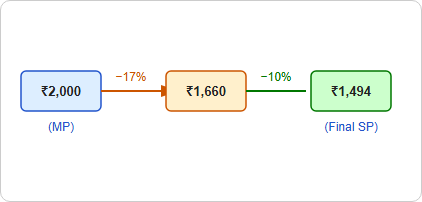
Pooja gets a discount of 17% on a dryer whose marked price is ₹2,000. Since she pays by credit card, she gets an additional 10% discount. How much does she pay (in ₹)?

  1. AOption (a)

    1,491

  2. BOption (b)

    1,493

  3. COption (c)

    1,495

  4. DOption (d)

    1,494

View answer & explanation

Correct answer

Answer: (d)D.

1,494

Why this answer is correct

Shortcut Trick

Net successive discounts are 17% and 10% on the Marked Price.

Final Selling Price = Marked Price × (100 − d1)% × (100 − d2)%

Final Selling Price = 2000 × 83% × 90%

Final Selling Price = 2000 × 0.83 × 0.9 = 1494

∴ The correct answer is ₹1494.

Alternate Method

Given:

Marked Price (MP) = ₹2,000

First Discount = 17%

Additional Discount (Credit Card) = 10%

Calculations:

⇒ Price after 17% discount = 2000 − (17/100 × 2000)

⇒ Price after 17% discount = 2000 − 340 = ₹1,660

⇒ Additional 10% discount on ₹1,660 = 10/100 × 1660 = ₹166

⇒ Final amount paid by Pooja = 1660 − 166 = ₹1,494

∴ The correct answer is ₹1494.

Additional Information

Effective Successive Discount

For two successive discounts of a% and b%, the single equivalent discount is (a + b − ab/100)%.

Discount and Selling Price

Selling Price (SP) = Marked Price (MP) − Discount. Also, Discount % = (Discount ÷ MP) × 100.

Marked Price vs Cost Price

The relation between CP and MP is given by MP ÷ CP = (100 + Profit%) ÷ (100 − Discount%).

RRB NTPC (UG) CBT-I Official Paper (Held On 08 May, 2026 Shift 2) (Previous Year Paper)·Mathematics
View full paper

Question 124

RRB NTPC 2026• Mathematics• Mathematics

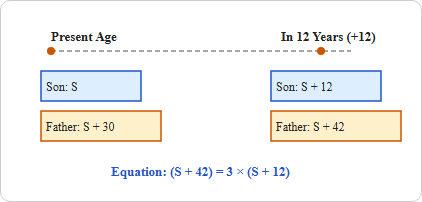
At present, a father is 30 years older than his son. In 12 years, the father will be three times as old as his son. What is the present age of the son?

  1. AOption (a)

    4 years

  2. BOption (b)

    3 years

  3. COption (c)

    5 years

  4. DOption (d)

    6 years

View answer & explanation

Correct answer

Answer: (b)B.

3 years

Why this answer is correct

Shortcut Trick

The age difference between two people always remains constant (30 years).

In 12 years, the ratio of Father : Son = 3 : 1.

Difference in ratio parts = 3 − 1 = 2 units ⇒ 30 years.

1 unit = 15 years (This is the son's age after 12 years).

Present age of son = 15 − 12 = 3 years.

∴ The correct answer is 3 years.

Alternate Method

Given: Current age difference = 30 years. Multiplier after 12 years = 3.

Formula Used: Age after n years = Present age + n.

⇒ Let the Present age of the son be S.

⇒ Then, Father's present age = S + 30.

⇒ After 12 years, Father's age = (S + 30) + 12 = S + 42.

⇒ After 12 years, Son's age = S + 12.

⇒ According to the question: S + 42 = 3 × (S + 12)

⇒ S + 42 = 3S + 36

⇒ 42 − 36 = 3S − S

⇒ 6 = 2S

⇒ S = 3

∴ The correct answer is 3 years.

Additional Information

Constant Age Difference

The numerical difference between the ages of two individuals never changes, regardless of how many years pass.

Ratio Method in Ages

When ages are given in ratios at different times, adjust the ratio difference to match the actual age difference to find values quickly.

Average Age Calculation

If the average age of n people is A, then after k years, their new average age will be A + k.

RRB NTPC (UG) CBT-I Official Paper (Held On 08 May, 2026 Shift 2) (Previous Year Paper)·Mathematics
View full paper

Question 125

RRB NTPC 2026• Mathematics• Mathematics

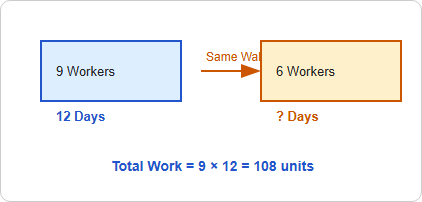
If 9 workers can build a wall in 12 days, how many days will 6 workers take to build the same wall, assuming they work at the same rate?

  1. AOption (a)

    18

  2. BOption (b)

    15

  3. COption (c)

    17

  4. DOption (d)

    16

View answer & explanation

Correct answer

Answer: (a)A.

18

Why this answer is correct

Shortcut Trick

Total work is constant, so use the formula: M1 × D1 = M2 × D2.

9 workers × 12 days = 6 workers × D2

108 = 6 × D2

D2 = 108 ÷ 6 = 18 days.

∴ The correct answer is 18 days.

Alternate Method

Given:

Initial number of workers (M1) = 9

Initial time taken (D1) = 12 days

New number of workers (M2) = 6

Formula Used:

Total Work = Number of Workers × Number of Days

Calculations:

⇒ Total work done by 9 workers in 12 days = 9 × 12 = 108 man-days

⇒ Since the wall is the same, 6 workers must complete the same 108 man-days of work.

⇒ Days taken by 6 workers = Total Work ÷ M2

⇒ Days = 108 ÷ 6

⇒ Days = 18 days

∴ The correct answer is 18 days.

Additional Information

Inverse Variation in Work

When the rate of work is constant, the number of workers is inversely proportional to the time taken. If workers decrease, time increases proportionally.

The Chain Rule (M-D-H Formula)

For different work quantities or hours per day: (M1×D1×H1)/W1 = (M2×D2×H2)/W2, where H is hours and W is units of work.

Efficiency Concept

Efficiency × Time = Total Work. Efficiency is the work done per unit of time (e.g., 1 day or 1 hour).

RRB NTPC (UG) CBT-I Official Paper (Held On 08 May, 2026 Shift 2) (Previous Year Paper)·Mathematics
View full paper

Question 126

RRB NTPC 2026• Mathematics• Mathematics

Find the value of m which satisfies

(1910)7×(1019)6×(1910)10=(1019)6m+18 (\frac{19}{10})^7 \times (\frac{10}{19})^6 \times (\frac{19}{10})^{10} = (\frac{10}{19})^{6m + 18}

  1. AOption (a)

    −276-\frac{27}{6}

  2. BOption (b)

    −206-\frac{20}{6}

  3. COption (c)

    −386-\frac{38}{6}

  4. DOption (d)

    −296-\frac{29}{6}

View answer & explanation

Correct answer

Answer: (d)D.

−296-\frac{29}{6}

Why this answer is correct

Shortcut Trick

Convert all terms to the same base (19/10) to compare the exponents directly.

LHS total power = 7 + (−6) + 10 = 11.

RHS power = −(6m + 18) = −6m − 18.

Equating powers: 11 = −6m − 18 ⇒ 6m = −29.

∴ The correct answer is −29/6.

Alternate Method

Given:

((19)/(10))7 × ((10)/(19))6 × ((19)/(10))10 = ((10)/(19))6m + 18

Formula Used:

Product Law: ax × ay = ax+y

Reciprocal Rule: (a/b)x = (b/a)−x

Calculations:

⇒ ((19)/(10))7 × ((19)/(10))−6 × ((19)/(10))10 = ((10)/(19))6m + 18 ⇒ ((19)/(10))(7 − 6 + 10) = ((19)/(10))−(6m + 18) ⇒ ((19)/(10))11 = ((19)/(10))−6m − 18

Since the bases are equal, we can equate the exponents:

⇒ 11 = −6m − 18 ⇒ 6m = −18 − 11 ⇒ 6m = −29 ⇒ m = −29/6

∴ The correct answer is −29/6.

Additional Information

Product Rule of Exponents

When multiplying terms with the same base, the powers are added: am × an = am+n.

Negative Exponent Rule

A negative power indicates the reciprocal of the base with a positive power: (a/b)−n = (b/a)n.

Property of Equality

In an equation where the bases are the same (and not 0, 1, or −1), the powers must be equal: ax = ay ⇒ x = y.

RRB NTPC (UG) CBT-I Official Paper (Held On 08 May, 2026 Shift 2) (Previous Year Paper)·Mathematics
View full paper

Question 127

RRB NTPC 2026• Mathematics• Mathematics

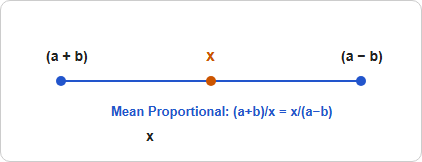
If x is the mean proportional between (a+b) and (a-b), then find the value of x.

  1. AOption (a)

    a−b\sqrt{a - b}

  2. BOption (b)

    a+b\sqrt{a + b}

  3. COption (c)

    a2−b2\sqrt{a^2-b^2}

  4. DOption (d)

    a2+b2\sqrt{a^2+b^2}

View answer & explanation

Correct answer

Answer: (c)C.

a2−b2\sqrt{a^2-b^2}

Why this answer is correct

Shortcut Trick

The mean proportional x between two numbers m and n is calculated using x = √(m × n).

Substitute m = (a + b) and n = (a − b).

x = √((a + b) × (a − b))

Using the identity (a + b)(a − b) = a2 − b2, we get x = √(a2 − b2).

∴ The correct answer is √(a2 − b2).

Alternate Method

Given: The terms are (a + b) and (a − b), and their mean proportional is x.

Formula Used: If three quantities A, B, and C are in continued proportion, then A : B = B : C, which means B2 = A × C. Here, B is the mean proportional.

⇒ (a + b) / x = x / (a − b)

⇒ x2 = (a + b) × (a − b)

⇒ We know that (x + y)(x − y) = x2 − y2

⇒ x2 = a2 − b2

⇒ x = √(a2 − b2)

∴ The correct answer is √(a2 − b2).

Additional Information

Third Proportional

For two numbers a and b, the third proportional c is calculated as c = b2 / a, where a : b = b : c.

Fourth Proportional

For three numbers a, b, and c, the fourth proportional d is calculated as d = (b × c) / a, where a : b = c : d.

Continued Proportion

Quantities a, b, c, d are in continued proportion if a/b = b/c = c/d.

RRB NTPC (UG) CBT-I Official Paper (Held On 08 May, 2026 Shift 2) (Previous Year Paper)·Mathematics
View full paper

Question 128

RRB NTPC 2026• Mathematics• Mathematics

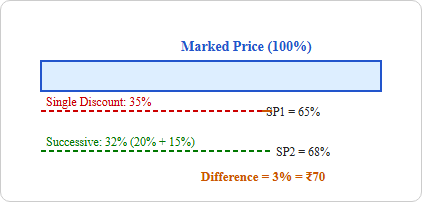
The difference between a discount of 35% and two successive discounts of 20% and 15% on a certain marked price is ₹70. Find the marked price (rounded off to the nearest integer).

  1. AOption (a)

    ₹2,333

  2. BOption (b)

    ₹2,433

  3. COption (c)

    ₹2,367

  4. DOption (d)

    ₹2,467

View answer & explanation

Correct answer

Answer: (a)A.

₹2,333

Why this answer is correct

Shortcut Trick

Effective successive discount of 20% and 15% = 20 + 15 − (20 × 15)/100 = 32%.

Difference between 35% and 32% = 3%.

Given, 3% of Marked Price = ₹70.

Total MP (100%) = (70 ÷ 3) × 100 = 7000 ÷ 3 ≈ ₹2,333.

∴ The correct answer is ₹2,333.

Alternate Method

Given:

Single discount percentage = 35%

Two successive discount percentages = 20% and 15%

Difference between the two discount amounts = ₹70

Formula Used:

Equivalent single discount for two successive discounts a% and b% = [a + b − (ab/100)]%

Discount Amount = (Discount% / 100) × Marked Price

Calculations:

⇒ Let the Marked Price be M.

⇒ Equivalent of successive discounts = 20 + 15 − (20 × 15)/100 = 35 − 3 = 32%

⇒ First discount amount = 0.35M

⇒ Second discount amount = 0.32M

⇒ Difference = 0.35M − 0.32M = 0.03M

⇒ 0.03M = 70

⇒ M = 70 / 0.03 = 7000 / 3

⇒ M = 2333.333...

⇒ Rounded to nearest integer, M = 2,333.

∴ The correct answer is ₹2,333.

Additional Information

Successive Discount Formula

For three successive discounts a%, b%, and c%, first find equivalent of a and b as x%, then find equivalent of x and c. Effective = x + c − (xc/100).

Relationship between MP and CP

MP/CP = (100 + Profit%) / (100 − Discount%). This is used when both profit and discount percentages are given.

Selling Price Calculation

SP = MP × (1 − d1/100) × (1 − d2/100) for multiple discounts.

RRB NTPC (UG) CBT-I Official Paper (Held On 08 May, 2026 Shift 2) (Previous Year Paper)·Mathematics
View full paper

Question 129

RRB NTPC 2026• Mathematics• Mathematics

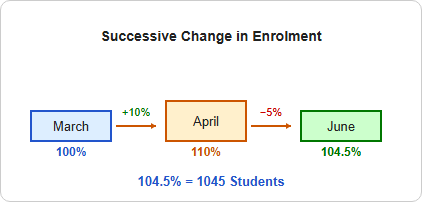
The enrolment of students in an institution increased by 10% in April compared to the number of students in March and then decreased by 5%, resulting in 1045 students in June. Find the number of students in March.

  1. AOption (a)

    1050

  2. BOption (b)

    900

  3. COption (c)

    1000

  4. DOption (d)

    1085

View answer & explanation

Correct answer

Answer: (c)C.

1000

Why this answer is correct

Shortcut Trick

Net percentage change = 10 − 5 − (10 × 5 ÷ 100) = 4.5% increase.

Final enrolment in June = 100% + 4.5% = 104.5%.

Given, 104.5% = 1045 students.

March enrolment (100%) = (1045 ÷ 104.5) × 100 = 1000.

∴ The correct answer is 1000.

Alternate Method

Given:

Enrolment in June = 1045

Increase in April = 10%

Decrease in May/June = 5%

Let the number of students in March be x.

⇒ Students in April = x + (10 ÷ 100) × x = 1.1x

⇒ Students in June = 1.1x − (5 ÷ 100) × 1.1x

⇒ 1045 = 1.1x × 0.95

⇒ 1045 = 1.045x

⇒ x = 1045 ÷ 1.045

⇒ x = 1000

∴ The correct answer is 1000.

Additional Information

Successive Percentage Change

If a value is changed by a% and then by b%, the net percentage change is given by the formula: [a + b + (ab/100)]%.

Multiplying Factor Method

An increase of r% is equivalent to multiplying by (1 + r/100), and a decrease of r% is equivalent to multiplying by (1 − r/100).

Base Value Property

The original value (March in this case) is always considered the 100% base for initial calculations.

RRB NTPC (UG) CBT-I Official Paper (Held On 08 May, 2026 Shift 2) (Previous Year Paper)·Mathematics
View full paper

Question 130

RRB NTPC 2026• Mathematics• Mathematics

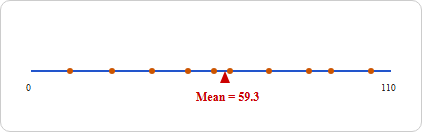
What is the arithmetic mean of the dataset {12, 25, 37, 48, 56, 61, 73, 85, 92, 104}?

  1. AOption (a)

    57.3

  2. BOption (b)

    58.3

  3. COption (c)

    56.3

  4. DOption (d)

    59.3

View answer & explanation

Correct answer

Answer: (d)D.

59.3

Why this answer is correct

Shortcut Trick

Assume an Assumed Mean (A) = 60.

Deviations from 60: −48, −35, −23, −12, −4, +1, +13, +25, +32, +44.

Sum of deviations (Σd) = −7.

Average deviation = Σd ÷ n = −7 ÷ 10 = −0.7.

Actual Mean = Assumed Mean + Average Deviation = 60 − 0.7 = 59.3.

∴ The correct answer is 59.3.

Alternate Method

Given:

Dataset = {12, 25, 37, 48, 56, 61, 73, 85, 92, 104}

Formula Used:

Arithmetic Mean = (Sum of all observations) ÷ (Total number of observations)

Calculations:

⇒ Sum = 12 + 25 + 37 + 48 + 56 + 61 + 73 + 85 + 92 + 104

⇒ Sum = 593

⇒ Total count (n) = 10

⇒ Arithmetic Mean = 593 ÷ 10

⇒ Arithmetic Mean = 59.3

∴ The correct answer is 59.3.

Additional Information

Median

The middle value of a sorted dataset. For even n, it is the average of the two middle terms: (56 + 61) ÷ 2 = 58.5.

Range

The difference between the maximum and minimum values: 104 − 12 = 92.

Relation between Mean, Median, and Mode

Empirical formula: Mode = 3 × Median − 2 × Mean.

RRB NTPC (UG) CBT-I Official Paper (Held On 08 May, 2026 Shift 2) (Previous Year Paper)·Mathematics
View full paper

Question 131

RRB NTPC 2026• Mathematics• Mathematics

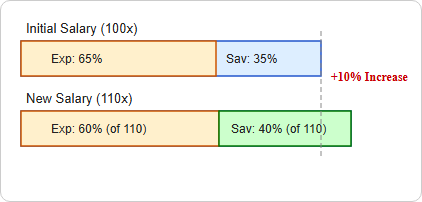
The expenditures of R are 65% of his salary. If his salary increased by 10% and his savings are ₹3,150 more than previous savings, his expenditures are now 60% of his salary. His present salary is ₹______.

  1. AOption (a)

    38,500

  2. BOption (b)

    37,500

  3. COption (c)

    39,000

  4. DOption (d)

    35,000

View answer & explanation

Correct answer

Answer: (a)A.

38,500

Why this answer is correct

Shortcut Trick

Ratio of Initial Salary to New Salary = 100 : 110

Initial Savings = 35% of 100 = 35 units

New Savings = 40% of 110 = 44 units (Since new Expenditure is 60%)

Difference in Savings = 44 − 35 = 9 units → ₹3,150

1 unit = 3150 ÷ 9 = 350

Present Salary = 110 × 350 = ₹38,500

∴ The correct answer is ₹38,500.

Alternate Method

Given:

Initial Expenditure = 65% of Salary

Salary increase = 10%

Savings increase = ₹3,150

New Expenditure = 60% of New Salary

Formula Used:

Salary = Expenditure + Savings

Calculations:

Let the Initial Salary be 100x.

⇒ Initial Savings = 100x − 65% of 100x = 35x

⇒ New Salary = 100x + 10% of 100x = 110x

⇒ New Expenditure = 60% of 110x = 0.60 × 110x = 66x

⇒ New Savings = 110x − 66x = 44x

⇒ Difference in Savings = 44x − 35x = 9x

⇒ 9x = 3,150

⇒ x = 3,150 ÷ 9 = 350

⇒ Present Salary = 110x = 110 × 350

⇒ Present Salary = ₹38,500

∴ The correct answer is ₹38,500.

Additional Information

Basic Salary Relation

Income is always the sum of Expenditure and Savings. Income = Expenditure + Savings.

Percentage Change Formula

Percentage Change = (Final Value − Initial Value) ÷ Initial Value × 100.

Effective Percentage increase

When a base increases by a% and the component share changes from b% to c%, the net change depends on the product of the new base and the new percentage.

RRB NTPC (UG) CBT-I Official Paper (Held On 08 May, 2026 Shift 2) (Previous Year Paper)·Mathematics
View full paper

Question 132

RRB NTPC 2026• Mathematics• Mathematics

The value of (2.3)3+(1.5)3+(1.2)3−3×2.3×1.5×1.2(2.3)2+(1.5)2+(1.2)2−2.3×1.5−1.5×1.2−1.2×2.3 \frac{(2.3)^3 + (1.5)^3 + (1.2)^3 - 3 \times 2.3 \times 1.5 \times 1.2}{(2.3)^2 + (1.5)^2 + (1.2)^2 - 2.3 \times 1.5 - 1.5 \times 1.2 - 1.2 \times 2.3} is equal to:

  1. AOption (a)

    4

  2. BOption (b)

    1

  3. COption (c)

    5

  4. DOption (d)

    2

View answer & explanation

Correct answer

Answer: (c)C.

5

Why this answer is correct

Shortcut Trick

The given expression is in the standard form of the algebraic identity: (a3 + b3 + c3 − 3abc) ÷ (a2 + b2 + c2 − ab − bc − ca).

This identity simplifies directly to (a + b + c).

Here, a = 2.3, b = 1.5, and c = 1.2.

Required Value = 2.3 + 1.5 + 1.2 = 5.0.

∴ The correct answer is 5.

Alternate Method

Given:

a = 2.3

b = 1.5

c = 1.2

Formula Used:

The sum of cubes identity states: a3 + b3 + c3 − 3abc = (a + b + c)(a2 + b2 + c2 − ab − bc − ca)

Calculations:

⇒ Expression = ((2.3)3 + (1.5)3 + (1.2)3 − 3 × 2.3 × 1.5 × 1.2) ÷ ((2.3)2 + (1.5)2 + (1.2)2 − 2.3 × 1.5 − 1.5 × 1.2 − 1.2 × 2.3)

⇒ Let a = 2.3, b = 1.5, c = 1.2

⇒ Expression = (a3 + b3 + c3 − 3abc) ÷ (a2 + b2 + c2 − ab − bc − ca)

⇒ Expression = [(a + b + c)(a2 + b2 + c2 − ab − bc − ca)] ÷ (a2 + b2 + c2 − ab − bc − ca)

⇒ Expression = a + b + c

⇒ Expression = 2.3 + 1.5 + 1.2

⇒ Expression = 5

∴ The correct answer is 5.

Additional Information

Special Case of the Identity

If a + b + c = 0, then the identity simplifies to a3 + b3 + c3 = 3abc.

Alternative Form of the Quadratic Part

The term (a2 + b2 + c2 − ab − bc − ca) can also be written as 1/2[(a − b)2 + (b − c)2 + (c − a)2].

Basic Algebraic Identities

Remember (a + b + c)2 = a2 + b2 + c2 + 2(ab + bc + ca), which is often used to find missing components of the cubic identity.

RRB NTPC (UG) CBT-I Official Paper (Held On 08 May, 2026 Shift 2) (Previous Year Paper)·Mathematics
View full paper

Question 133

RRB NTPC 2026• Mathematics• Mathematics

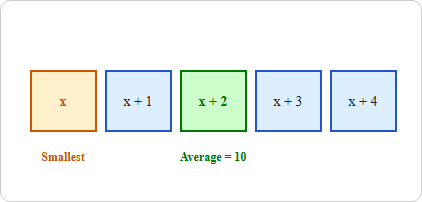
The average of 5 consecutive integers is 10. What is the smallest integer?

  1. AOption (a)

    8

  2. BOption (b)

    7

  3. COption (c)

    6

  4. DOption (d)

    9

View answer & explanation

Correct answer

Answer: (a)A.

8

Why this answer is correct

Shortcut Trick

For an odd number of consecutive integers, the average is always the middle term.

Middle term (3rd term) = 10.

The sequence is: 8, 9, 10, 11, 12.

The smallest integer is the first term of this sequence.

∴ The correct answer is 8.

Alternate Method

Given:

Number of consecutive integers (n) = 5

Average of the integers = 10

Formula Used:

Average = (Sum of all observations) ÷ (Total number of observations)

Calculations:

Let the five consecutive integers be x, (x + 1), (x + 2), (x + 3), and (x + 4).

⇒ Sum = x + (x + 1) + (x + 2) + (x + 3) + (x + 4) = 5x + 10

⇒ Average = (5x + 10) ÷ 5 = 10

⇒ x + 2 = 10

⇒ x = 10 − 2

⇒ x = 8

∴ The correct answer is 8.

Additional Information

Average of Arithmetic Progression

For any sequence in Arithmetic Progression, Average = (First term + Last term) ÷ 2.

Sum of Consecutive Integers

The sum of n consecutive integers starting from x is given by n × x + [n × (n − 1) ÷ 2].

Middle Term Property

If n is odd, the average is exactly the {(n + 1) ÷ 2}th term of the consecutive sequence.

RRB NTPC (UG) CBT-I Official Paper (Held On 08 May, 2026 Shift 2) (Previous Year Paper)·Mathematics
View full paper

Question 134

RRB NTPC 2026• Mathematics• Mathematics

Three numbers are in the ratio 17 : 13 : 8, and their LCM is 7072. Their HCF is:

  1. AOption (a)

    23

  2. BOption (b)

    3

  3. COption (c)

    4

  4. DOption (d)

    12

View answer & explanation

Correct answer

Answer: (c)C.

4

Why this answer is correct

Shortcut Trick

Product of the ratio parts = 17 × 13 × 8 = 1768.

Since the ratio parts 17, 13, and 8 are pairwise co-prime, their LCM is their product multiplied by the HCF.

HCF = Given LCM ÷ Product of ratio parts.

HCF = 7072 ÷ 1768 = 4.

∴ The correct answer is 4.

Alternate Method

Given: Ratio of numbers = 17 : 13 : 8, LCM = 7072.

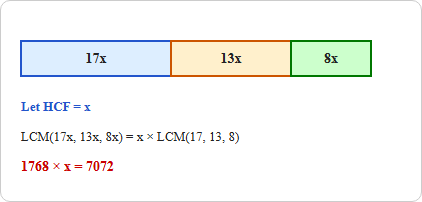
Formula: If numbers are in ratio a : b : c and their HCF is x, then the numbers are ax, bx, and cx. Their LCM is x × LCM(a, b, c).

⇒ Let the three numbers be 17x, 13x, and 8x, where x is the HCF.

⇒ The LCM of 17x, 13x, and 8x is calculated by taking the common factor x and the LCM of (17, 13, 8).

⇒ LCM = x × 17 × 13 × 8

⇒ 7072 = 1768 × x

⇒ x = 7072 ÷ 1768

⇒ x = 4

∴ The correct answer is 4.

Additional Information

Product Property of HCF and LCM

For two numbers a and b: Product of numbers = HCF × LCM. This property does not directly apply to three or more numbers.

Co-prime Numbers

Numbers that have only 1 as their common factor are called co-prime. The LCM of a set of pairwise co-prime numbers is always their product.

HCF and LCM of Fractions

HCF = (HCF of Numerators) ÷ (LCM of Denominators) | LCM = (LCM of Numerators) ÷ (HCF of Denominators).

RRB NTPC (UG) CBT-I Official Paper (Held On 08 May, 2026 Shift 2) (Previous Year Paper)·Mathematics
View full paper

Question 135

RRB NTPC 2026• Mathematics• Mathematics

If the third proportional to 4 and 6 is used as the base of a rectangle, and the first number (4) is its height, what is the area of the rectangle?

  1. AOption (a)

    30 unit2

  2. BOption (b)

    36 unit2

  3. COption (c)

    48 unit2

  4. DOption (d)

    24 unit2

View answer & explanation

Correct answer

Answer: (b)B.

36 unit2

Why this answer is correct

Shortcut Trick

Third proportional to 4 and 6 = (6 × 6) ÷ 4 = 9 units.

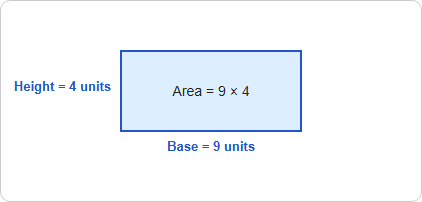
Base of the rectangle = 9 units.

Height of the rectangle = 4 units.

Area of Rectangle = Base × Height = 9 × 4 = 36 unit2.

∴ The correct answer is 36 unit2.

Alternate Method

Given:

First number (a) = 4

Second number (b) = 6

Formula Used:

  1. If a, b, and c are in continuous proportion, then a : b :: b : c, where c is the third proportional (c = b2 ÷ a).
  2. Area of a rectangle = Base × Height.

Calculations:

⇒ Let the third proportional be x.

⇒ 4 : 6 :: 6 : x

⇒ x = (6 × 6) ÷ 4

⇒ x = 36 ÷ 4 = 9 units.

⇒ Base of the rectangle = 9 units.

⇒ Height of the rectangle = 4 units (given as the first number).

⇒ Area = 9 × 4 = 36 unit2.

∴ The correct answer is 36 unit2.

Additional Information

Mean Proportional

The mean proportional between two numbers a and b is given by √(a × b).

Fourth Proportional

For three numbers a, b, and c, the fourth proportional d is calculated such that a : b = c : d, which means d = (b × c) ÷ a.

Perimeter of Rectangle

The perimeter of a rectangle is the total distance around its boundary, calculated as 2 × (Base + Height).

RRB NTPC (UG) CBT-I Official Paper (Held On 08 May, 2026 Shift 2) (Previous Year Paper)·Mathematics
View full paper

Question 136

RRB NTPC 2026• Mathematics• Mathematics

A sum of ₹25,000 is invested at 2% per annum compounded annually. Find the compound interest after 2 years.

  1. AOption (a)

    ₹1,130

  2. BOption (b)

    ₹1,050

  3. COption (c)

    ₹1,230

  4. DOption (d)

    ₹1,010

View answer & explanation

Correct answer

Answer: (d)D.

₹1,010

Why this answer is correct

Shortcut Trick

For 2 years, the effective Compound Interest rate = R + R + (R×R)/100.

Effective Rate = 2 + 2 + (2×2)/100 = 4.04%.

Compound Interest = 4.04% of ₹25,000.

CI = 25,000 × (4.04/100) = 250 × 4.04 = ₹1,010.

∴ The correct answer is ₹1,010.

Alternate Method

Given:

Principal (P) = ₹25,000

Rate (R) = 2% per annum

Time (T) = 2 years

Formula Used:

Amount (A) = P(1 + R/100)T

Compound Interest (CI) = Amount − Principal

Calculations:

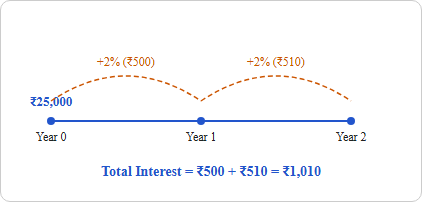
⇒ A = 25,000 × (1 + 2/100)2

⇒ A = 25,000 × (102/100) × (102/100)

⇒ A = 25,000 × 1.02 × 1.02

⇒ A = 25,000 × 1.0404

⇒ A = 26,010

⇒ CI = 26,010 − 25,000

⇒ CI = 1,010

∴ The correct answer is ₹1,010.

Additional Information

Difference between CI and SI for 2 years

The difference (D) between CI and SI for two years is given by D = P(R/100)2.

Compounding Half-Yearly

When interest is compounded half-yearly, the rate is halved (R/2) and the time is doubled (2n).

Effective Rate Formula

For successive percentage changes (like CI), the net change is a + b + (ab/100). For two years, it is R + R + (R2/100).

RRB NTPC (UG) CBT-I Official Paper (Held On 08 May, 2026 Shift 2) (Previous Year Paper)·Mathematics
View full paper

Question 137

RRB NTPC 2026• Mathematics• Mathematics

A shopkeeper offers the following schemes on toys of the same marked price.

(A) Successive discounts of 35% and 4% on any number of toys bought.

(B) Successive discounts of 45%, 46% and 50% on any number of toys bought.

(C) 15% discount on the first 3 toys and 5% discount on each toy thereon.

(D) 2 toys free of cost on buying 9 toys.

A customer wants to buy 9 toys. Which of the above schemes is the least beneficial to her?

  1. AOption (a)

    D

  2. BOption (b)

    B

  3. COption (c)

    A

  4. DOption (d)

    C

View answer & explanation

Correct answer

Answer: (d)D.

C

Why this answer is correct

Shortcut Trick

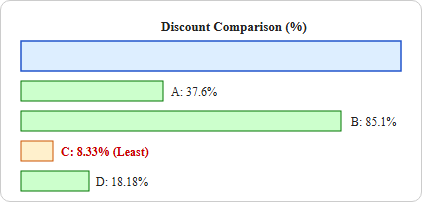
Evaluate Discount % for all schemes:

(A) 35 + 4 − (35 × 4)/100 = 39 − 1.4 = 37.6%

(B) Successive 45%, 46%, 50% will be > 85% (highest discount).

(C) For 9 toys: (3 × 15% + 6 × 5%) ÷ 9 = (45 + 30) ÷ 9 = 8.33%

(D) 2 free on 9 bought (Total 11): (2 ÷ 11) × 100 ≈ 18.18%

∴ The correct answer is Scheme C.

Alternate Method

Assume the Marked Price (MP) of each toy = ₹100. For 9 toys, Total MP = ₹900.

Formula Used:

  1. Equivalent Discount (2 successive) = x + y − (xy/100)
  2. Discount % (Buy X get Y free) = [Y / (X + Y)] × 100

Calculations:

Scheme A: Successive 35% and 4%

⇒ Total Discount % = 35 + 4 − (35 × 4)/100 = 39 − 1.4 = 37.6%

Scheme B: Successive 45%, 46% and 50%

⇒ Final Multiplier = 0.55 × 0.54 × 0.50 = 0.1485

⇒ Total Discount % = (1 − 0.1485) × 100 = 85.15%

Scheme C: 15% on first 3, 5% on next 6

⇒ Discount on first 3 = 15% of 300 = ₹45

⇒ Discount on next 6 = 5% of 600 = ₹30

⇒ Total Discount % = [(45 + 30) / 900] × 100 = 75 / 9 = 8.33%

Scheme D: 2 free on buying 9

⇒ Total toys received = 9 + 2 = 11

⇒ Total Discount % = (2 / 11) × 100 ≈ 18.18%

Comparing all, 8.33% is the minimum discount, making it the least beneficial for the customer.

∴ The correct answer is Scheme C.

Additional Information

Successive Discount

When two discounts d1 and d2 are given, effective discount = d1 + d2 − (d1 × d2)/100. For more than two, apply the formula to the first two and then use the result with the third.

Buy X Get Y Free

In such offers, the discount is always calculated on the total number of items (Paid + Free). Discount % = [Free Items / (Paid + Free)] × 100.

Marked Price & Discount

Discount is always calculated on the Marked Price (MP). Selling Price (SP) = MP − Discount. To be least beneficial for a customer, the SP should be the highest (minimum discount).

RRB NTPC (UG) CBT-I Official Paper (Held On 08 May, 2026 Shift 2) (Previous Year Paper)·Mathematics
View full paper

Question 138

RRB NTPC 2026• Mathematics• Mathematics

A keg is fitted with three taps A, B and C. If opened together, all the three taps will drain the full keg in 112 1\frac{1}{2} minutes. Taps A and B together take 3 minutes to drain the keg while taps B and C together take 412 4\frac{1}{2} minutes to drain it. How long (in minutes) taps A and C together take to drain the keg?

  1. AOption (a)

    97 \frac{9}{7}

  2. BOption (b)

    47 \frac{4}{7}

  3. COption (c)

    49 \frac{4}{9}

  4. DOption (d)

    57 \frac{5}{7}

View answer & explanation

Correct answer

Answer: (a)A.

97 \frac{9}{7}

Why this answer is correct

Shortcut Trick

Assume Total Work as the LCM of 1.5, 3, and 4.5 = 9 units.

Efficiency of (A+B+C) = 9 ÷ 1.5 = 6 units/min.

Efficiency of (A+B) = 3 units/min and (B+C) = 2 units/min.

Efficiency of Tap A = 6 − 2 = 4; Efficiency of Tap C = 6 − 3 = 3.

Efficiency of (A+C) = 4 + 3 = 7 units/min.

∴ The correct answer is 9/7 min.

Alternate Method

Given:

Time taken by (A + B + C) = 1.5 min

Time taken by (A + B) = 3 min

Time taken by (B + C) = 4.5 min

Formula Used:

Efficiency = Total Work ÷ Time

Person/TapsTime (min)Total WorkEfficiency (units/min)
A + B + C1.59 units6
A + B33
B + C4.52

Calculations:

⇒ Efficiency of Tap C = Efficiency(A+B+C) − Efficiency(A+B)

⇒ Efficiency of Tap C = 6 − 3 = 3 units/min

⇒ Efficiency of Tap A = Efficiency(A+B+C) − Efficiency(B+C)

⇒ Efficiency of Tap A = 6 − 2 = 4 units/min

⇒ Combined Efficiency of (A + C) = 4 + 3 = 7 units/min

⇒ Time taken by (A + C) = Total Work ÷ Combined Efficiency

⇒ Time taken by (A + C) = 9 ÷ 7 = 9/7 min

∴ The correct answer is 9/7 min.

Additional Information

Efficiency and Time

Efficiency is inversely proportional to the time taken to complete the work (E = W/T).

Combined Work

When multiple pipes or taps work together, their individual efficiencies are added to find the net draining or filling rate.

LCM Method

Using the Least Common Multiple (LCM) of the given times as the total work simplifies complex fraction calculations into simple integer arithmetic.

RRB NTPC (UG) CBT-I Official Paper (Held On 08 May, 2026 Shift 2) (Previous Year Paper)·Mathematics
View full paper

Question 139

RRB NTPC 2026• Mathematics• Mathematics

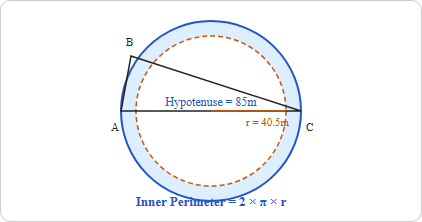
A park is designed in the shape of a right-angled triangle, where the two shorter sides measure 13 m and 84 m. A circular track with a uniform width of 2 m is constructed such that its outer boundary coincides with the circumcircle of the triangular park. Determine the perimeter of the inner boundary of this circular track.

  1. AOption (a)

    81π m

  2. BOption (b)

    89π m

  3. COption (c)

    85π m

  4. DOption (d)

    82π m

View answer & explanation

Correct answer

Answer: (a)A.

81π m

Why this answer is correct

Shortcut Trick

In a right-angled triangle, the hypotenuse acts as the diameter of the circumcircle.

Hypotenuse = √(132 + 842) = √(169 + 7056) = 85 m.

Outer radius (R) = 85 ÷ 2 = 42.5 m.

Inner radius (r) = 42.5 − 2 = 40.5 m (subtracting the 2 m track width).

Perimeter of the inner boundary = 2 × π × 40.5 = 81π m.

∴ The correct answer is 81π m.

Alternate Method

Given:

Shorter sides of the right-angled triangle = 13 m and 84 m.

Width of the circular track = 2 m.

Calculations:

⇒ First, find the hypotenuse (c) using Pythagoras theorem:

⇒ c = √(132 + 842)

⇒ c = √(169 + 7056) = √7225 = 85 m.

⇒ The outer boundary coincides with the circumcircle, so the outer radius (R) is:

⇒ R = Hypotenuse ÷ 2 = 85 ÷ 2 = 42.5 m.

⇒ The track has a uniform width of 2 m, so the inner radius (r) is:

⇒ r = R − width = 42.5 − 2 = 40.5 m.

⇒ The perimeter (circumference) of the inner boundary is given by:

⇒ Perimeter = 2 × π × r

⇒ Perimeter = 2 × π × 40.5 = 81π m.

∴ The correct answer is 81π m.

Additional Information

Circumradius of a Right Triangle

For any right-angled triangle, the circumradius (R) is always equal to half of the hypotenuse. The circumcenter is located at the midpoint of the hypotenuse.

Inradius of a Right Triangle

The radius of the inscribed circle (inradius) of a right triangle with legs a and b and hypotenuse c is given by r = (a + b − c) ÷ 2.

Area of a Circular Track

The area of a circular track with outer radius R and inner radius r is given by Area = π(R2 − r2).

RRB NTPC (UG) CBT-I Official Paper (Held On 08 May, 2026 Shift 2) (Previous Year Paper)·Mathematics
View full paper

Question 140

RRB NTPC 2026• Mathematics• Mathematics

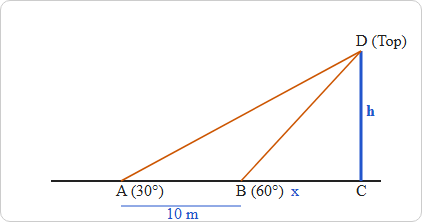
The angle of elevation of the top of a tree from a point on the ground is 30°. After moving 10 m towards the tree, the angle of elevation becomes 60°. Find the height of the tree.

  1. AOption (a)

    63 6\sqrt{3} m

  2. BOption (b)

    53 5\sqrt{3} m

  3. COption (c)

    43 4\sqrt{3} m

  4. DOption (d)

    33 3\sqrt{3} m

View answer & explanation

Correct answer

Answer: (b)B.

53 5\sqrt{3} m

Why this answer is correct

Shortcut Trick

For two angles of elevation θ1 and θ2 from two points at a distance d apart on the same side of a tree of height h:

h = d / (cot θ1 − cot θ2)

Here, d = 10 m, θ1 = 30°, and θ2 = 60°.

⇒ h = 10 / (cot 30° − cot 60°) = 10 / (√3 − 1/√3)

⇒ h = 10 / ((3 − 1) / √3) = (10 × √3) / 2 = 5√3 m.

∴ The correct answer is 5√3 m.

Alternate Method

Given: Angle of elevation at point A = 30°, angle at point B = 60°, and distance AB = 10 m.

Formula Used: tan θ = Perpendicular / Base

⇒ Let the height of the tree CD be h and distance BC be x.

⇒ In right ΔBCD: tan 60° = h / x

⇒ √3 = h / x ⇒ x = h / √3

⇒ In right ΔACD: tan 30° = h / (AB + BC)

⇒ 1 / √3 = h / (10 + x)

⇒ 1 / √3 = h / (10 + h / √3)

⇒ 10 + h / √3 = h√3

⇒ 10 = h√3 − h / √3

⇒ 10 = (3h − h) / √3

⇒ 10 = 2h / √3

⇒ 2h = 10√3 ⇒ h = 5√3 m.

∴ The correct answer is 5√3 m.

Additional Information

Angle of Elevation

The angle formed by the line of sight with the horizontal when an observer looks at an object above the horizontal level.

Trigonometric Ratios for 30° and 60°

tan 30° = 1/√3 and tan 60° = √3. Note that as the observer moves towards the object, the angle of elevation increases.

General Formula for Distance

The distance d between two points of observation is given by d = h(cot θ1 − cot θ2), where h is the height.

How should I prepare for Quantitative Aptitude in RRB NTPC?

Solving previous year questions by topic helps identify recurring concepts, question patterns, and frequently asked sub-topics. Attempt each question, review the step-by-step explanation, and note down key formulas or facts for quick revision before the exam.