RRB NTPC · Topic Collection

Quantitative Aptitude PYQs

Arithmetic, number systems, percentages, ratios, profit and loss, time and work, algebra, geometry, mensuration, and trigonometry.

1020 Total Questions34 Official PapersYears: 2016–2026Search in Quantitative Aptitude
Showing questions 101–120 of 1020Page 6 of 51
RRB NTPC (UG) CBT-I Official Paper (Held On 08 May, 2026 Shift 1) (Previous Year Paper)·Mathematics
View full paper

Question 101

RRB NTPC 2026• Mathematics• Mathematics

The diagonals of a rhombus are mutually perpendicular and bisect each other. One diagonal is 10 cm longer than the other. If the area of the rhombus is 600 cm2, the perimeter (in cm) of the rhombus is:

  1. AOption (a)

    120 cm

  2. BOption (b)

    96 cm

  3. COption (c)

    100 cm

  4. DOption (d)

    84 cm

View answer & explanation

Correct answer

Answer: (c)C.

100 cm

Why this answer is correct

Shortcut Trick

Product of diagonals = 2 × Area = 2 × 600 = 1200.

Identify two numbers with product 1200 and difference 10: 40 and 30.

Semi-diagonals are 20 cm and 15 cm. Using Pythagorean triplet (15, 20, 25), the side is 25 cm.

Perimeter = 4 × 25 = 100 cm.

∴ The correct answer is 100 cm.

Alternate Method

Given: Area of Rhombus = 600 cm2, difference between diagonals = 10 cm.

Formula Used: Area = (1/2) × d1 × d2; Side (s) = √[(d1/2)2 + (d2/2)2]; Perimeter = 4s.
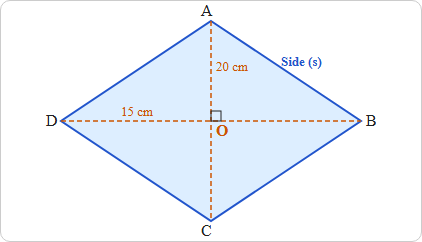
Let the smaller diagonal be d cm. Then the longer diagonal is (d + 10) cm.

⇒ Area = (1/2) × d × (d + 10) = 600

⇒ d2 + 10d = 1200

⇒ d2 + 10d − 1200 = 0

⇒ d2 + 40d − 30d − 1200 = 0

⇒ d(d + 40) − 30(d + 40) = 0

⇒ (d − 30)(d + 40) = 0

⇒ d = 30 cm (Since length cannot be negative)

⇒ d1 = 30 cm and d2 = 30 + 10 = 40 cm

⇒ Side of rhombus (s) = √[(30/2)2 + (40/2)2]

⇒ s = √[152 + 202] = √[225 + 400]

⇒ s = √625 = 25 cm

⇒ Perimeter = 4 × 25 = 100 cm

∴ The correct answer is 100 cm.

Additional Information

Properties of a Rhombus

All sides are equal, and diagonals bisect each other at 90°. Opposite angles are equal, and adjacent angles are supplementary (sum = 180°).

Relation Between Side and Diagonals

The sum of the squares of the diagonals is equal to four times the square of the side: d12 + d22 = 4s2.

Area of Rhombus

Area can also be calculated using base and height: Area = Base × Height, or using trigonometry: Area = s2 × sin(θ).
RRB NTPC (UG) CBT-I Official Paper (Held On 08 May, 2026 Shift 1) (Previous Year Paper)·Mathematics
View full paper

Question 102

RRB NTPC 2026• Mathematics• Mathematics

Simplify: 3+653−212−32+50 \frac{3+\sqrt{6}}{5\sqrt{3}-2\sqrt{12}-\sqrt{32}+\sqrt{50}}

  1. AOption (a)

    5\sqrt5

  2. BOption (b)

    2\sqrt2

  3. COption (c)

    3\sqrt3

  4. DOption (d)

    6\sqrt6

View answer & explanation

Correct answer

Answer: (c)C.

3\sqrt3

Why this answer is correct

Shortcut Trick

Break down the denominator terms: 2√12 = 4√3, √32 = 4√2, and √50 = 5√2.

Combine like terms: (5√3 − 4√3) + (5√2 − 4√2) = √3 + √2.

Factorize the numerator: 3 + √6 = √3 × √3 + √3 × √2 = √3(√3 + √2).

The expression simplifies to: √3(√3 + √2) ÷ (√3 + √2) = √3.

∴ The correct answer is √3.

Alternate Method

Given Expression: (3 + √6) ÷ (5√3 − 2√12 − √32 + √50)

Step 1: Simplify the Denominator

⇒ Denominator = 5√3 − 2√(4 × 3) − √(16 × 2) + √(25 × 2)

⇒ Denominator = 5√3 − 2(2√3) − 4√2 + 5√2

⇒ Denominator = 5√3 − 4√3 − 4√2 + 5√2

⇒ Denominator = (5 − 4)√3 + (5 − 4)√2 = √3 + √2

Step 2: Factorize the Numerator

⇒ Numerator = 3 + √6

⇒ Numerator = (√3 × √3) + (√3 × √2)

⇒ Numerator = √3(√3 + √2)

Step 3: Simplify the Ratio

⇒ Result = [√3(√3 + √2)] ÷ (√3 + √2)

⇒ Result = √3

∴ The correct answer is √3.

Additional Information

Simplification of Surds

To simplify a surd, extract the largest perfect square factor from under the radical sign, such as √12 = √(4 × 3) = 2√3.

Addition and Subtraction of Surds

Only like surds (those with the same irrational part) can be added or subtracted together, e.g., 5√2 + 3√2 = 8√2.

Conjugate Surds

The conjugate of (√a + √b) is (√a − √b). Multiplying a surd by its conjugate results in a rational number: (√a + √b)(√a − √b) = a − b.

RRB NTPC (UG) CBT-I Official Paper (Held On 08 May, 2026 Shift 1) (Previous Year Paper)·Mathematics
View full paper

Question 103

RRB NTPC 2026• Mathematics• Mathematics

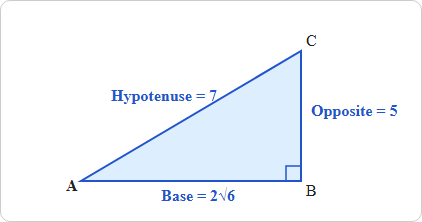
If sin A = 57 \frac{5}{7} , find the value of 5cosec⁡A−7sin⁡A26sec⁡A+7cos⁡2A \frac{5 \operatorname{cosec} A - 7 \sin A}{2\sqrt{6} \sec A + 7 \cos^2 A} .

  1. AOption (a)

    319\frac{3}{19}

  2. BOption (b)

    1146\frac{11}{46}

  3. COption (c)

    1473\frac{14}{73}

  4. DOption (d)

    923\frac{9}{23}

View answer & explanation

Correct answer

Answer: (c)C.

1473\frac{14}{73}

Why this answer is correct

Shortcut Trick

Given sin A = 5/7, then cosec A = 7/5, cos2 A = 1 − (5/7)2 = 24/49, and sec A = 7/√24 = 7/2√6.

Numerator = 5(7/5) − 7(5/7) = 7 − 5 = 2.

Denominator = 2√6(7/2√6) + 7(24/49) = 7 + 24/7 = 73/7.

Final value = 2 ÷ (73/7) = 14/73.

∴ The correct answer is 14/73.

Alternate Method

Given:

sin A = 5/7

Formula Used:

sin A = Opposite/Hypotenuse | cos2 A = 1 − sin2 A | sec A = 1/cos A | cosec A = 1/sin A

⇒ Base = √(Hypotenuse2 − Opposite2) = √(72 − 52) = √(49 − 25) = √24 = 2√6

⇒ cosec A = 7/5

⇒ sec A = 7/2√6

⇒ cos2 A = (2√6/7)2 = 24/49

⇒ Numerator = 5 × (7/5) − 7 × (5/7) = 7 − 5 = 2

⇒ Denominator = 2√6 × (7/2√6) + 7 × (24/49) = 7 + 24/7 = (49 + 24)/7 = 73/7

⇒ Required Value = 2 ÷ (73/7) = 14/73

∴ The correct answer is 14/73.

Additional Information

Trigonometric Identities

The fundamental identity is sin2 A + cos2 A = 1, from which we derive sec2 A − tan2 A = 1 and cosec2 A − cot2 A = 1.

Reciprocal Ratios

The primary ratios and their reciprocals are: cosec A = 1/sin A, sec A = 1/cos A, and cot A = 1/tan A.

Double Angle Formula

cos 2A can be expressed in terms of sin and cos as: cos 2A = cos2 A − sin2 A = 2cos2 A − 1 = 1 − 2sin2 A.

RRB NTPC (UG) CBT-I Official Paper (Held On 08 May, 2026 Shift 1) (Previous Year Paper)·Mathematics
View full paper

Question 104

RRB NTPC 2026• Mathematics• Mathematics

Which of the following numbers is not divisible by 88?

  1. AOption (a)

    1232

  2. BOption (b)

    968

  3. COption (c)

    1144

  4. DOption (d)

    1058

View answer & explanation

Correct answer

Answer: (d)D.

1058

Why this answer is correct

Shortcut Trick

A number is divisible by 88 if it is divisible by both its co-prime factors 8 and 11.

Quick check for 8: The last three digits must be divisible by 8.

For 1058, the last three digits are 058, which is not divisible by 8 (58 ÷ 8 = 7.25).

Therefore, 1058 cannot be divisible by 88.

∴ The correct answer is 1058.

Alternate Method

Given: The numbers are 1232, 968, 1144, and 1058.

Formula: Divisibility by 88 ⇒ Divisibility by 8 AND 11.

⇒ For 1232: Last 3 digits 232 ÷ 8 = 29 (Yes); Difference of sums (1+3) − (2+2) = 0 (Yes). Divisible by 88.

⇒ For 968: Last 3 digits 968 ÷ 8 = 121 (Yes); Difference of sums (9+8) − 6 = 11 (Yes). Divisible by 88.

⇒ For 1144: Last 3 digits 144 ÷ 8 = 18 (Yes); Difference of sums (1+4) − (1+4) = 0 (Yes). Divisible by 88.

⇒ For 1058: Last 3 digits 058 ÷ 8 = 7.25 (No). Difference of sums (1+5) − (0+8) = −2 (No).

⇒ Since 1058 fails both tests, it is not divisible by 88.

∴ The correct answer is 1058.

Additional Information

Divisibility Rule of 8

A number is divisible by 8 if its last three digits are divisible by 8 or if the last three digits are 000.

Divisibility Rule of 11

A number is divisible by 11 if the difference between the sum of digits at odd positions and the sum of digits at even positions is either 0 or a multiple of 11.

Composite Divisibility

If a number is divisible by two co-prime numbers a and b, then it must also be divisible by their product a × b.

RRB NTPC (UG) CBT-I Official Paper (Held On 08 May, 2026 Shift 1) (Previous Year Paper)·Mathematics
View full paper

Question 105

RRB NTPC 2026• Mathematics• Mathematics

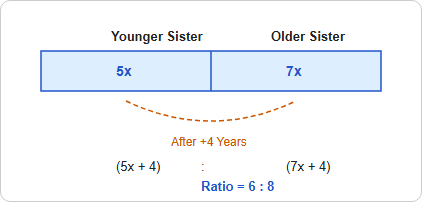
The present ages of two sisters are in the ratio 5:7. After 4 years, their ages will be in the ratio 6:8. Find the present age of the younger sister.

  1. AOption (a)

    20 years

  2. BOption (b)

    18 years

  3. COption (c)

    24 years

  4. DOption (d)

    22 years

View answer & explanation

Correct answer

Answer: (a)A.

20 years

Why this answer is correct

Shortcut Trick

Compare the ratios: Present (5:7) and After 4 years (6:8).

The difference between parts is equal: (6 − 5) = 1 unit and (8 − 7) = 1 unit.

This 1 unit difference corresponds to the time gap of 4 years.

⇒ 1 unit = 4 years.

⇒ Younger sister's present age = 5 units = 5 × 4 = 20 years.

∴ The correct answer is 20 years.

Alternate Method

Given:

Ratio of present ages = 5 : 7

Ratio after 4 years = 6 : 8

Calculation:

Let the present ages be 5x and 7x.

⇒ (5x + 4) / (7x + 4) = 6 / 8

⇒ (5x + 4) / (7x + 4) = 3 / 4

⇒ 4 × (5x + 4) = 3 × (7x + 4)

⇒ 20x + 16 = 21x + 12

⇒ 21x − 20x = 16 − 12

⇒ x = 4

⇒ Present age of younger sister = 5x = 5 × 4 = 20 years.

∴ The correct answer is 20 years.

Additional Information

Ratio and Age Problems

When the difference between the ratio parts is same for both subjects, the change in value is directly proportional to the change in ratio units.

Equating Differences

If the difference between ratios is not equal, multiply the ratios by the difference of the other ratio to make the unit gap constant.

Age Gap Property

The difference between the ages of two people remains constant throughout their lives, regardless of the number of years passed.

RRB NTPC (UG) CBT-I Official Paper (Held On 08 May, 2026 Shift 1) (Previous Year Paper)·Mathematics
View full paper

Question 106

RRB NTPC 2026• Mathematics• Mathematics

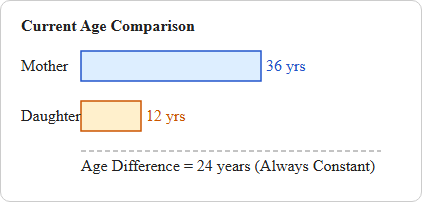
The ages of a mother and daughter are 36 years and 12 years, respectively. In how many years will the mother be twice the age of the daughter?

  1. AOption (a)

    8 years

  2. BOption (b)

    10 years

  3. COption (c)

    12 years

  4. DOption (d)

    15 years

View answer & explanation

Correct answer

Answer: (c)C.

12 years

Why this answer is correct

Shortcut Trick

The age difference between the mother and daughter is 36 − 12 = 24 years.

Since the age difference remains constant, when the mother is twice the daughter's age (ratio 2:1), the difference of 1 unit must equal 24 years.

Therefore, the daughter's age at that time will be 1 unit = 24 years.

The number of years required is 24 − 12 = 12 years.

∴ The correct answer is 12 years.

Alternate Method

Given:

Current age of Mother = 36 years

Current age of Daughter = 12 years

Let the required number of years be x.

After x years:

Mother's age = 36 + x

Daughter's age = 12 + x

According to the condition (Mother = 2 × Daughter):

⇒ 36 + x = 2 × (12 + x)

⇒ 36 + x = 24 + 2x

⇒ 36 − 24 = 2x − x

⇒ x = 12

∴ The correct answer is 12 years.

Additional Information

Constant Age Difference

The difference between the ages of two people always remains the same, regardless of how many years pass (Difference = Age1 − Age2).

Ratio Method for Ages

If the ratio of ages changes from a:b to c:d over time, the difference between the ratio parts (scaled appropriately) must correspond to the constant age difference.

Age after 'n' years

If the current age is A, then the age after n years is A + n, and the age n years ago was A − n.

RRB NTPC (UG) CBT-I Official Paper (Held On 08 May, 2026 Shift 1) (Previous Year Paper)·Mathematics
View full paper

Question 107

RRB NTPC 2026• Mathematics• Mathematics

Evaluate 213 + (-2)3 + (-19)3

  1. AOption (a)

    2397

  2. BOption (b)

    2354

  3. COption (c)

    2394

  4. DOption (d)

    2468

View answer & explanation

Correct answer

Answer: (c)C.

2394

Why this answer is correct

Shortcut Trick

If the sum of three numbers is zero (a + b + c = 0), then a3 + b3 + c3 = 3abc.

Here, a = 21, b = −2, and c = −19.

Checking the sum: 21 + (−2) + (−19) = 21 − 21 = 0.

Therefore, the value is 3 × 21 × (−2) × (−19) = 63 × 38 = 2394.

∴ The correct answer is 2394.

Alternate Method

Given: Expression 213 + (−2)3 + (−19)3

Calculation:

⇒ Calculate 213 = 21 × 21 × 21 = 9261

⇒ Calculate (−2)3 = (−2) × (−2) × (−2) = −8

⇒ Calculate (−19)3 = (−19) × (−19) × (−19) = −6859

⇒ Sum = 9261 + (−8) + (−6859)

⇒ Sum = 9261 − 8 − 6859

⇒ Sum = 9261 − 6867 = 2394

∴ The correct answer is 2394.

Additional Information

Algebraic Identity for Cubes

The fundamental identity is a3 + b3 + c3 − 3abc = (a + b + c)(a2 + b2 + c2 − ab − bc − ca).

The Conditional Property

When (a + b + c) = 0, the entire expression (a + b + c)(a2 + b2 + c2 − ab − bc − ca) becomes zero, which simplifies the equation to a3 + b3 + c3 = 3abc.

Cubes of Negative Numbers

The cube of a negative number is always negative, i.e., (−x)3 = −(x3).

RRB NTPC (UG) CBT-I Official Paper (Held On 08 May, 2026 Shift 1) (Previous Year Paper)·Mathematics
View full paper

Question 108

RRB NTPC 2026• Mathematics• Mathematics

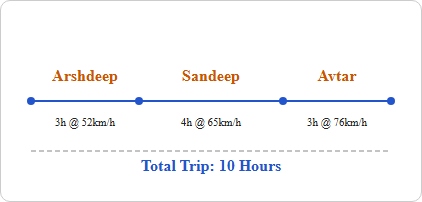
Three friends Arshdeep, Sandeep and Avtar are on a trip by a car. Arshdeep drives during the first 3 hours at an average speed of 52 km/hr. Sandeep drives during the next 4 hours at an average speed of 65 km/hr. Avtar drives for the next 3 hours at an average speed of 76 km/hr. They reached their destination after exactly 10 hours. Their average speed during the journey was:

  1. AOption (a)

    60.2 km/hr

  2. BOption (b)

    56.4 km/hr

  3. COption (c)

    64.4 km/hr

  4. DOption (d)

    65.2 km/hr

View answer & explanation

Correct answer

Answer: (c)C.

64.4 km/hr

Why this answer is correct

Shortcut Trick

Use the weighted average formula where Time acts as the weight.

Average Speed = (S1t1 + S2t2 + S3t3) ÷ (t1 + t2 + t3)

Average Speed = (52 × 3 + 65 × 4 + 76 × 3) ÷ 10

Average Speed = (156 + 260 + 228) ÷ 10 = 644 ÷ 10 = 64.4 km/hr.

∴ The correct answer is 64.4 km/hr.

Alternate Method

Given:

Time spent by Arshdeep = 3 hr, Speed = 52 km/hr

Time spent by Sandeep = 4 hr, Speed = 65 km/hr

Time spent by Avtar = 3 hr, Speed = 76 km/hr

Formula Used:

Distance = Speed × Time

Average Speed = Total Distance ÷ Total Time

Calculations:

⇒ Distance covered by Arshdeep = 52 × 3 = 156 km

⇒ Distance covered by Sandeep = 65 × 4 = 260 km

⇒ Distance covered by Avtar = 76 × 3 = 228 km

⇒ Total Distance = 156 + 260 + 228 = 644 km

⇒ Total Time = 3 + 4 + 3 = 10 hr

⇒ Average Speed = 644 ÷ 10 = 64.4 km/hr

∴ The correct answer is 64.4 km/hr.

Additional Information

Average Speed for Equal Distance

When a person travels two equal distances at speeds x and y, the average speed is given by 2xy ÷ (x + y).

Average Speed for Equal Time

If a person travels at speeds x and y for equal intervals of time, the average speed is simply the arithmetic mean: (x + y) ÷ 2.

Relative Speed

Speed of one object with respect to another. For opposite directions, add speeds (S1 + S2); for the same direction, subtract them (S1 − S2).

RRB NTPC (UG) CBT-I Official Paper (Held On 08 May, 2026 Shift 1) (Previous Year Paper)·Mathematics
View full paper

Question 109

RRB NTPC 2026• Mathematics• Mathematics

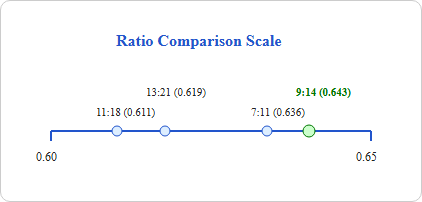
Which of the following ratios is the greatest?

a) 7 : 11

b) 9 : 14

c) 11 : 18

d) 13 : 21

  1. AOption (a)

    9 : 14

  2. BOption (b)

    11 : 18

  3. COption (c)

    13 : 21

  4. DOption (d)

    7 : 11

View answer & explanation

Correct answer

Answer: (a)A.

9 : 14

Why this answer is correct

Shortcut Trick

Compare pairs using Cross-Multiplication: a c/d if (a × d) > (b × c).

  1. 7/11 and 9/14 → 7×14 = 98, 9×11 = 99 ∴ 9:14 is larger.
  2. 9/14 and 11/18 → 9×18 = 162, 11×14 = 154 ∴ 9:14 is larger.
  3. 9/14 and 13/21 → 9×21 = 189, 13×14 = 182 ∴ 9:14 is larger.

∴ The correct answer is 9 : 14.

Alternate Method

Given: Ratios are 7 : 11, 9 : 14, 11 : 18, and 13 : 21.

Formula Used: Convert each ratio into its Decimal Equivalent for direct comparison.

Calculations:

⇒ 7 ÷ 11 ≈ 0.6363

⇒ 9 ÷ 14 ≈ 0.6428

⇒ 11 ÷ 18 ≈ 0.6111

⇒ 13 ÷ 21 ≈ 0.6190

⇒ Comparing the values: 0.6428 > 0.6363 > 0.6190 > 0.6111

⇒ Therefore, 9 : 14 is the greatest ratio.

∴ The correct answer is 9 : 14.

Additional Information

Comparison of Fractions

For any two fractions a/b and c/d, if ad > bc, then a c/d. If ad < bc, then a/b < c/d.

Duplicate and Sub-duplicate Ratio

The duplicate ratio of a : b is a2 : b2, and the sub-duplicate ratio is √a : √b.

Compounded Ratio

The compounded ratio of (a : b) and (c : d) is calculated as (a × c) : (b × d).

RRB NTPC (UG) CBT-I Official Paper (Held On 08 May, 2026 Shift 1) (Previous Year Paper)·Mathematics
View full paper

Question 110

RRB NTPC 2026• Mathematics• Mathematics

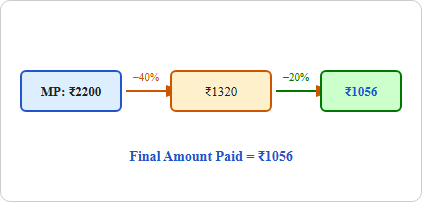
Chitra gets a discount of 40% on a water cooler whose marked price is ₹2,200. Since she pays by credit card, she gets an additional 20% discount. How much does she pay (in ₹)?

  1. AOption (a)

    1,059

  2. BOption (b)

    1,055

  3. COption (c)

    1,058

  4. DOption (d)

    1,056

View answer & explanation

Correct answer

Answer: (d)D.

1,056

Why this answer is correct

Shortcut Trick

Use the Successive Multiplying Factor method for effective discounts.

Net Multiplier = (100 − 40)% × (100 − 20)% = 0.6 × 0.8 = 0.48

Final Price = 2200 × 0.48 = 22 × 48 = 1056

∴ The correct answer is ₹1056.

Alternate Method

Given: Marked Price (MP) = ₹2,200 | First Discount = 40% | Additional Discount (Credit Card) = 20%

Formula Used: Selling Price (SP) = MP × (1 − d1/100) × (1 − d2/100)

⇒ Price after 40% discount = 2200 − (40% of 2200)

⇒ Price = 2200 − 880 = ₹1320

⇒ Price after 20% additional discount = 1320 − (20% of 1320)

⇒ Price = 1320 − 264 = ₹1056

∴ The correct answer is ₹1056.

Additional Information

Net Successive Discount Formula

For two successive discounts of a% and b%, the Equivalent Single Discount = (a + b − ab/100)%.

Marked Price (MP) and Selling Price (SP)

The price printed on the label is MP. The actual price after deducting the Discount from MP is the SP.

Successive Percentage Change

Final Value = Initial Value × (1 ± r1/100) × (1 ± r2/100). Use '+' for increase and '−' for decrease (discount).

RRB NTPC (UG) CBT-I Official Paper (Held On 08 May, 2026 Shift 1) (Previous Year Paper)·Mathematics
View full paper

Question 111

RRB NTPC 2026• Mathematics• Mathematics

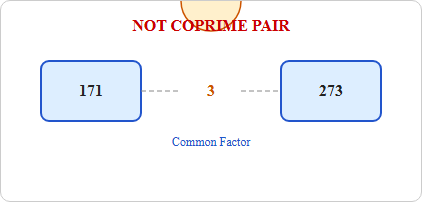
Which of the following pairs of numbers is not coprime?

  1. AOption (a)

    (173, 351)

  2. BOption (b)

    (177, 827)

  3. COption (c)

    (171, 273)

  4. DOption (d)

    (127, 257)

View answer & explanation

Correct answer

Answer: (c)C.

(171, 273)

Why this answer is correct

Shortcut Trick

Identify the pair where both numbers share a common factor using divisibility rules.

For the pair (171, 273):

Sum of digits of 171 = 1 + 7 + 1 = 9 (Divisible by 3).

Sum of digits of 273 = 2 + 7 + 3 = 12 (Divisible by 3).

Since both numbers are divisible by 3, their HCF is at least 3, making them not coprime.

∴ The correct answer is (171, 273).

Alternate Method

Given: Pairs of numbers to check for coprimality.

Definition: Two numbers are coprime if their Highest Common Factor (HCF) is 1.

Testing the pairs:

⇒ (173, 351): 173 is a prime number. 351 is not divisible by 173. HCF = 1 (Coprime).

⇒ (177, 827): 177 = 3 × 59. 827 is a prime number not divisible by 3 or 59. HCF = 1 (Coprime).

⇒ (171, 273):

⇒ Prime factors of 171 = 32 × 19

⇒ Prime factors of 273 = 3 × 7 × 13

⇒ HCF (171, 273) = 3

⇒ Since HCF ≠ 1, the numbers are not coprime.

⇒ (127, 257): Both 127 and 257 are prime numbers. HCF = 1 (Coprime).

∴ The correct answer is (171, 273).

Additional Information

Coprime Numbers

Two numbers a and b are called coprime or relatively prime if the only positive integer that divides both of them is 1, i.e., HCF(a, b) = 1.

Divisibility Rule of 3

A number is divisible by 3 if the sum of its digits is a multiple of 3. This is the fastest way to check for a common factor of 3 in large numbers.

Properties of Coprime Pairs

Any two consecutive integers are always coprime. Any two prime numbers are always coprime. The Least Common Multiple (LCM) of two coprime numbers is always their product (a × b).

RRB NTPC (UG) CBT-I Official Paper (Held On 08 May, 2026 Shift 1) (Previous Year Paper)·Mathematics
View full paper

Question 112

RRB NTPC 2026• Mathematics• Mathematics

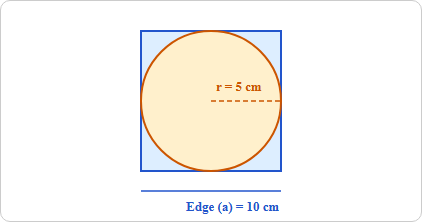
The length of each edge of a cube is 10 cm. If a sphere is inscribed inside the cube, what is the ratio of the surface area of the sphere to the outer surface area of the cube?

  1. AOption (a)

    π : 6

  2. BOption (b)

    3 : π

  3. COption (c)

    π : 3

  4. DOption (d)

    6 : π

View answer & explanation

Correct answer

Answer: (a)A.

π : 6

Why this answer is correct

Shortcut Trick

For a sphere inscribed inside a cube, the diameter (d) of the sphere is equal to the edge (a) of the cube (d = a).

Radius of sphere (r) = a / 2

Ratio = (Surface Area of Sphere) : (Surface Area of Cube)

Ratio = 4 × π × (a / 2)2 : 6a2 = 4 × π × (a2 / 4) : 6a2 = πa2 : 6a2

Ratio = π : 6

∴ The correct answer is pi : 6.

Alternate Method

Given: Edge of the cube (a) = 10 cm.

Formula Used:

  1. Surface Area of Sphere = 4 × π × r2
  2. Surface Area of Cube = 6 × a2

⇒ Diameter of inscribed sphere = Edge of cube = 10 cm

⇒ Radius (r) of sphere = 10 ÷ 2 = 5 cm

⇒ Surface Area of Sphere = 4 × π × (5)2 = 4 × π × 25 = 100π cm2

⇒ Surface Area of Cube = 6 × (10)2 = 6 × 100 = 600 cm2

⇒ Required Ratio = (100π) : 600

⇒ Ratio = π : 6

∴ The correct answer is pi : 6.

Additional Information

Volume Ratio for Inscribed Sphere

The ratio of the volume of an inscribed sphere to the volume of the cube is π : 6.

Circumscribed Sphere

If a sphere is circumscribed around a cube, its diameter equals the body diagonal of the cube (a√3).

Cube Diagonals

Face diagonal of a cube = a√2 | Body diagonal of a cube = a√3.

RRB NTPC (UG) CBT-I Official Paper (Held On 08 May, 2026 Shift 1) (Previous Year Paper)·Mathematics
View full paper

Question 113

RRB NTPC 2026• Mathematics• Mathematics

The average of 5 numbers is 18.5. If one number is removed, the average of the remaining 4 numbers becomes 16. Find the number that was removed.

  1. AOption (a)

    28.5

  2. BOption (b)

    29

  3. COption (c)

    29.5

  4. DOption (d)

    28

View answer & explanation

Correct answer

Answer: (a)A.

28.5

Why this answer is correct

Shortcut Trick

In averages, when a value is removed, the formula is:

Removed Number = Old Average + [Remaining Count × (Old Average − New Average)]

⇒ Removed Number = 18.5 + [4 × (18.5 − 16)]

⇒ Removed Number = 18.5 + [4 × 2.5] = 18.5 + 10 = 28.5

∴ The correct answer is 28.5.

Alternate Method

Given:

Initial count of numbers (n1) = 5

Initial average (A1) = 18.5

Remaining count of numbers (n2) = 4

New average (A2) = 16

Formula Used:

Sum of values = Average × Total numbers

Calculations:

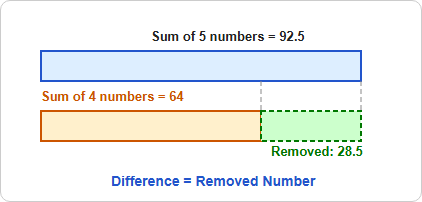
⇒ Total sum of 5 numbers = 5 × 18.5 = 92.5

⇒ Total sum of remaining 4 numbers = 4 × 16 = 64

⇒ Removed number = (Sum of 5 numbers) − (Sum of 4 numbers)

⇒ Removed number = 92.5 − 64

⇒ Removed number = 28.5

∴ The correct answer is 28.5.

Additional Information

Net Deviation Rule

The sum of deviations from the average is always zero. If a value is removed, the total deviation caused by its removal must be balanced by the remaining items.

Effect of Adding/Removing

If the removed number is greater than the average, the new average decreases. If the removed number is less than the average, the new average increases.

Weighted Average Formula

Total Average = (n1A1 + n2A2) ÷ (n1 + n2). This is used when two groups are combined.

RRB NTPC (UG) CBT-I Official Paper (Held On 08 May, 2026 Shift 1) (Previous Year Paper)·Mathematics
View full paper

Question 114

RRB NTPC 2026• Mathematics• Mathematics

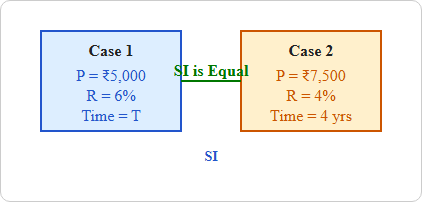
If the simple interest on ₹5,000 for T years at 6% p.a. equals the simple interest on ₹7,500 for 4 years at 4% per annum, then find the value of T.

  1. AOption (a)

    4

  2. BOption (b)

    3

  3. COption (c)

    2

  4. DOption (d)

    1

View answer & explanation

Correct answer

Answer: (a)A.

4

Why this answer is correct

Shortcut Trick

Since the Simple Interest is the same for both cases, equate the product of (P × R × T).

5000 × 6 × T = 7500 × 4 × 4

⇒ 30000 × T = 120000

⇒ T = 120000 ÷ 30000

⇒ T = 4

∴ The correct answer is 4 years.

Alternate Method

Given:

First case: Principal (P1) = ₹5,000, Rate (R1) = 6%, Time (T1) = T years.

Second case: Principal (P2) = ₹7,500, Rate (R2) = 4%, Time (T2) = 4 years.

Formula Used:

Simple Interest (SI) = (P × R × T) ÷ 100

Calculations:

⇒ SI1 = (5000 × 6 × T) ÷ 100 = 300T

⇒ SI2 = (7500 × 4 × 4) ÷ 100 = 75 × 16 = 1200

⇒ According to the question, SI1 = SI2

⇒ 300T = 1200

⇒ T = 1200 ÷ 300

⇒ T = 4 years

∴ The correct answer is 4 years.

Additional Information

Simple Interest Definition

Simple Interest is calculated only on the initial Principal amount of a loan or deposit. Formula: SI = (P × R × T) ÷ 100.

Total Amount

The Total Amount (A) accumulated at the end of the time period is given by the sum of the Principal and the Simple Interest: A = P + SI.

Rate of Interest conversion

Always ensure the Rate of Interest (R) and Time (T) are in the same units (usually per annum and years). If time is in months, divide by 12; if in days, divide by 365.

RRB NTPC (UG) CBT-I Official Paper (Held On 08 May, 2026 Shift 1) (Previous Year Paper)·Mathematics
View full paper

Question 115

RRB NTPC 2026• Mathematics• Mathematics

A shopkeeper offers the following schemes on toys of the same marked price.

(A) Successive discounts of 43% and 19% on any number of toys bought.

(B) Successive discounts of 41%, 21% and 49% on any number of toys bought.

(C) 35% discount on the first 5 toys and 3% discount on each toy thereon.

(D) 4 toys free of cost on buying 5 toys.

A customer wants to buy 5 toys. Which of the above schemes is the least beneficial to her?

  1. AOption (a)

    B

  2. BOption (b)

    C

  3. COption (c)

    A

  4. DOption (d)

    D

View answer & explanation

Correct answer

Answer: (b)B.

C

Why this answer is correct

Shortcut Trick

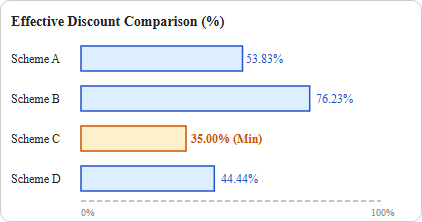
Scheme A: Net discount = 43 + 19 − (43 × 19)/100 = 53.83%

Scheme B: Successive discounts of 41%, 21% and 49% results in > 70% discount.

Scheme C: For exactly 5 toys, the discount is fixed at 35%.

Scheme D: Discount % = [Free / Total] × 100 = [4 / (5 + 4)] × 100 ≈ 44.44%

Comparing all: 35% (C) is the minimum discount, making it the least beneficial.

∴ The correct answer is Scheme C.

Alternate Method

Given: A customer buys 5 toys of the same Marked Price (MP).

Formula Used:

  1. Successive Discount (x%, y%) = [x + y − (xy / 100)]%
  2. Buy X Get Y Free Discount % = [Y / (X + Y)] × 100

⇒ Scheme A: Successive discounts of 43% and 19%

⇒ Net Discount = 43 + 19 − (43 × 19)/100 = 62 − 8.17 = 53.83%

⇒ Scheme B: Successive 41%, 21% and 49%

⇒ First two: 41 + 21 − (41 × 21)/100 = 62 − 8.61 = 53.39%

⇒ With 49%: 53.39 + 49 − (53.39 × 49)/100 = 102.39 − 26.16 = 76.23%

⇒ Scheme C: Customer buys 5 toys. According to the scheme, the discount is 35% on the first 5 toys. Since the purchase is exactly 5 toys, the effective discount is 35%.

⇒ Scheme D: 4 toys free on buying 5 toys. Total toys = 5 + 4 = 9.

⇒ Discount % = (4 / 9) × 100 ≈ 44.44%

⇒ The least beneficial scheme is the one with the lowest discount percentage.

⇒ Minimum value among {53.83%, 76.23%, 35%, 44.44%} is 35%.

∴ The correct answer is Scheme C.

Additional Information

Successive Discounts

For three successive discounts a%, b%, and c%, the final multiplier is (1 − a/100) × (1 − b/100) × (1 − c/100). The effective discount is (1 − Multiplier) × 100.

Buy X Get Y Free

In this offer, the customer pays for X items and receives X + Y items. The discount percentage is calculated as [Free Items / Total Items] × 100.

Profit and Loss Relationship

Discount is always calculated on the Marked Price (MP). Selling Price (SP) = MP × (100 − Discount%)/100.

RRB NTPC (UG) CBT-I Official Paper (Held On 08 May, 2026 Shift 1) (Previous Year Paper)·Mathematics
View full paper

Question 116

RRB NTPC 2026• Mathematics• Mathematics

Pipe A can fill a cistern in 12 hours and another pipe B can empty it in 18 hours. Pipe A is opened first and after 4 hours, pipe B is also opened. In how much total time will the cistern be filled?

  1. AOption (a)

    28 hours

  2. BOption (b)

    24 hours

  3. COption (c)

    36 hours

  4. DOption (d)

    32 hours

View answer & explanation

Correct answer

Answer: (a)A.

28 hours

Why this answer is correct

Shortcut Trick

Total Capacity = LCM(12, 18) = 36 units.

Efficiency of Pipe A = +3 and Pipe B = −2.

Work done by A alone in 4 hr = 3 × 4 = 12 units.

Remaining work = 36 − 12 = 24 units.

Combined efficiency (A + B) = 3 − 2 = 1 unit/hr.

∴ The correct answer is 28 hr.

Alternate Method

Given:

Time taken by Pipe A to fill = 12 hr

Time taken by Pipe B to empty = 18 hr

Initial time Pipe A runs alone = 4 hr

PipesTime (hr)Total Work (LCM)Efficiency
Pipe A (Fill)1236 units+3
Pipe B (Empty)18−2

Calculations:

⇒ Total Capacity of cistern = LCM(12, 18) = 36 units.

⇒ Part filled by Pipe A in the first 4 hours = 3 × 4 = 12 units.

⇒ Remaining part to be filled = 36 − 12 = 24 units.

⇒ Combined efficiency when both pipes are open = 3 − 2 = 1 unit/hr.

⇒ Time taken to fill the remaining part = 24 ÷ 1 = 24 hr.

⇒ Total time taken = Initial 4 hr + Next 24 hr = 28 hr.

∴ The correct answer is 28 hr.

Additional Information

Filling vs Emptying Pipes

Filling pipes have positive efficiency (+), while emptying pipes (leaks) have negative efficiency (−).

Net Efficiency

When multiple pipes work together, the net efficiency is the algebraic sum of their individual efficiencies.

Pipes and Cisterns Formula

If pipe A fills in 'x' hours and pipe B empties in 'y' hours, net work in 1 hr = (1/x) − (1/y).

RRB NTPC (UG) CBT-I Official Paper (Held On 08 May, 2026 Shift 1) (Previous Year Paper)·Mathematics
View full paper

Question 117

RRB NTPC 2026• Mathematics• Mathematics

A sum of money amounts to ₹4,600 in 3 years at 5% simple interest per annum. What is the sum?

  1. AOption (a)

    ₹3,800

  2. BOption (b)

    ₹4,200

  3. COption (c)

    ₹4,000

  4. DOption (d)

    ₹3,500

View answer & explanation

Correct answer

Answer: (c)C.

₹4,000

Why this answer is correct

Shortcut Trick

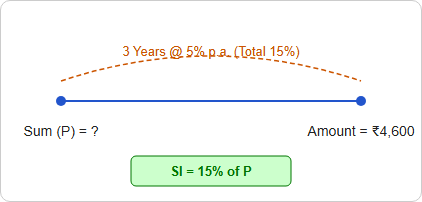
Net Simple Interest percentage = Rate × Time = 5% × 3 = 15%.

Total Amount percentage = 100% (Principal) + 15% (Interest) = 115%.

According to the question, 115% = ₹4,600.

Therefore, 100% (Sum) = (4,600 ÷ 115) × 100 = 40 × 100 = ₹4,000.

∴ The correct answer is ₹4,000.

Alternate Method

Given:

Amount (A) = ₹4,600

Time (T) = 3 years

Rate (R) = 5% per annum

Formula Used:

Amount (A) = Principal (P) + Simple Interest (SI)

A = P + (P × R × T) ÷ 100

Calculations:

⇒ 4,600 = P + (P × 5 × 3) ÷ 100

⇒ 4,600 = P + (15P ÷ 100)

⇒ 4,600 = (100P + 15P) ÷ 100

⇒ 4,600 = 115P ÷ 100

⇒ P = (4,600 × 100) ÷ 115

⇒ P = 40 × 100

⇒ P = 4,000

∴ The correct answer is ₹4,000.

Additional Information

Simple Interest Formula

The basic formula for Simple Interest is SI = (P × R × T) ÷ 100, where P is the principal sum.

Relationship between SI and Amount

Amount is calculated as A = P + SI, which can also be written as A = P[1 + (R × T) ÷ 100].

Calculating Rate and Time

To find Rate (R): (SI × 100) ÷ (P × T). To find Time (T): (SI × 100) ÷ (P × R).

RRB NTPC (UG) CBT-I Official Paper (Held On 08 May, 2026 Shift 1) (Previous Year Paper)·Mathematics
View full paper

Question 118

RRB NTPC 2026• Mathematics• Mathematics

Find the value of m which satisfies

(146)8×(614)3×(146)10=(614)9m+9 (\frac{14}{6})^8 \times (\frac{6}{14})^3 \times (\frac{14}{6})^{10} = (\frac{6}{14})^{9m+9}

  1. AOption (a)

    −83-\frac{8}{3}

  2. BOption (b)

    −329-\frac{32}{9}

  3. COption (c)

    −289-\frac{28}{9}

  4. DOption (d)

    −259-\frac{25}{9}

View answer & explanation

Correct answer

Answer: (a)A.

−83-\frac{8}{3}

Why this answer is correct

Shortcut Trick

Convert the middle term to the same base (14/6): (6/14)3 = (14/6)−3.

Total power of LHS with respect to base (14/6) = 8 − 3 + 10 = 15.

Convert LHS to base (6/14): (14/6)15 = (6/14)−15.

Equate exponents: 9m + 9 = −15 ⇒ 9m = −24 ⇒ m = −8/3.

∴ The correct answer is −8/3.

Alternate Method

Given:

Equation: (14/6)8 × (6/14)3 × (14/6)10 = (6/14)9m+9

Formula Used:

  1. Multiplication Law: ax × ay = ax+y
  2. Negative Exponent Law: (a/b)n = (b/a)−n
  3. Equality of Bases: If ax = ay, then x = y

Calculations:

⇒ (14/6)8 × (14/6)−3 × (14/6)10 = (6/14)9m+9

⇒ (14/6)(8 − 3 + 10) = (6/14)9m+9

⇒ (14/6)15 = (6/14)9m+9

⇒ (6/14)−15 = (6/14)9m+9

⇒ −15 = 9m + 9

⇒ 9m = −15 − 9

⇒ 9m = −24

⇒ m = −24/9 = −8/3

∴ The correct answer is −8/3.

Additional Information

Product of Powers Rule

When multiplying two powers with the same base, add their exponents: am × an = am+n.

Negative Exponent Rule

To change the sign of an exponent, take the reciprocal of the base: (a/b)−n = (b/a)n.

Property of Equality for Exponential Equations

If the bases on both sides of an equation are equal, the exponents must also be equal, provided the base is not 0, 1, or −1.

RRB NTPC (UG) CBT-I Official Paper (Held On 08 May, 2026 Shift 1) (Previous Year Paper)·Mathematics
View full paper

Question 119

RRB NTPC 2026• Mathematics• Mathematics

A cricketer has scored an average of 55 runs in 9 matches. In the 10th match, he scores 85 runs. What is his new average?

  1. AOption (a)

    55

  2. BOption (b)

    57

  3. COption (c)

    56

  4. DOption (d)

    58

View answer & explanation

Correct answer

Answer: (d)D.

58

Why this answer is correct

Shortcut Trick

Extra runs over average = 85 − 55 = 30

Distributed increase per match = 30 ÷ 10 = 3

New average = 55 + 3 = 58

∴ The correct answer is 58.

Alternate Method

Given: Average of 9 matches = 55, 10th match score = 85

Formula: Total = Average × Number of items

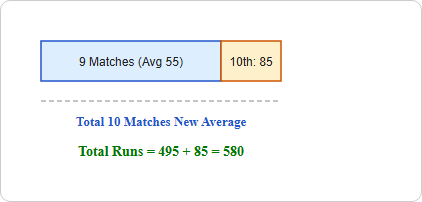
⇒ Total runs in 9 matches = 55 × 9 = 495

⇒ Total runs in 10 matches = 495 + 85 = 580

⇒ New average = 580 ÷ 10 = 58

∴ The correct answer is 58.

Additional Information

Net Deviation Concept

The sum of deviations of all observations from the average is always zero. This is used to find the effect of adding or removing an item from the data set.

Weighted Average Formula

Combined Average = (n1A1 + n2A2) ÷ (n1 + n2), where n is the quantity and A is the average of each group.

RRB NTPC (UG) CBT-I Official Paper (Held On 08 May, 2026 Shift 1) (Previous Year Paper)·Mathematics
View full paper

Question 120

RRB NTPC 2026• Mathematics• Mathematics

A student initially scored equal marks in Mathematics and Physics. Later, the marks in Mathematics increase by 20% of the original Mathematics marks, while the marks in Physics decrease by 10% of the original Physics marks. Taking the initial total marks as the base, what is the overall percentage change in the total marks?

  1. AOption (a)

    No change

  2. BOption (b)

    10% increase

  3. COption (c)

    5% increase

  4. DOption (d)

    5% decrease

View answer & explanation

Correct answer

Answer: (c)C.

5% increase

Why this answer is correct

Shortcut Trick

When the initial values are equal, the overall percentage change is simply the average of the individual percentage changes.

Mathematics change = +20% | Physics change = −10%

Overall % Change = (+20% − 10%) ÷ 2

Overall % Change = 10% ÷ 2 = 5% increase.

∴ The correct answer is 5% increase.

Alternate Method

Given: Initial marks in Mathematics = Initial marks in Physics.

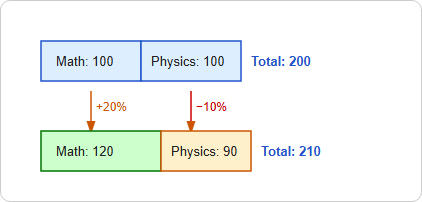
⇒ Let initial marks in Mathematics = 100 and Physics = 100.

⇒ Initial Total Marks = 100 + 100 = 200.

⇒ New Mathematics marks = 100 + (20% of 100) = 100 + 20 = 120.

⇒ New Physics marks = 100 − (10% of 100) = 100 − 10 = 90.

⇒ New Total Marks = 120 + 90 = 210.

⇒ Net change in total marks = 210 − 200 = 10.

⇒ Percentage Change = (Change ÷ Initial Total) × 100

⇒ Percentage Change = (10 ÷ 200) × 100 = 5%.

∴ The correct answer is 5% increase.

Additional Information

Percentage Change Formula

The percentage change is calculated as [(Final Value − Initial Value) ÷ Initial Value] × 100.

Weighted Average Percentage

If components have different weights w1 and w2, the net change is (w1×p1 + w2×p2) ÷ (w1 + w2).

Successive Percentage Change

When a value changes by a% and then b%, the net effective change is [a + b + (a×b)/100]%.

How should I prepare for Quantitative Aptitude in RRB NTPC?

Solving previous year questions by topic helps identify recurring concepts, question patterns, and frequently asked sub-topics. Attempt each question, review the step-by-step explanation, and note down key formulas or facts for quick revision before the exam.