RRB NTPC · Topic Collection

Quantitative Aptitude PYQs

Arithmetic, number systems, percentages, ratios, profit and loss, time and work, algebra, geometry, mensuration, and trigonometry.

1020 Total Questions34 Official PapersYears: 2016–2026Search in Quantitative Aptitude
Showing questions 81–100 of 1020Page 5 of 51
RRB NTPC (UG) CBT-I Official Paper (Held On 07 May, 2026 Shift 3) (Previous Year Paper)·Mathematics
View full paper

Question 81

RRB NTPC 2026• Mathematics• Mathematics

The cost price of 25 articles is the same as the selling price of x articles. If the profit is 25%, then the value of x is:

  1. AOption (a)

    23

  2. BOption (b)

    18

  3. COption (c)

    16

  4. DOption (d)

    20

View answer & explanation

Correct answer

Answer: (d)D.

20

Why this answer is correct

Shortcut Trick

Profit % = 25% = 1/4

Ratio of Price per article (CP : SP) = 4 : 5

Since Total Cost Price = Total Selling Price, the quantity ratio is inversely proportional to the price ratio.

Quantity Ratio (CP items : SP items) = 5 : 4

According to the question, 5 units = 25 articles ⇒ 1 unit = 5 articles

Therefore, x = 4 units = 4 × 5 = 20

∴ The correct answer is 20.

Alternate Method

Given:

Cost Price (CP) of 25 articles = Selling Price (SP) of x articles.

Profit percentage = 25%.

Formula Used:

Profit % = [(Articles Bought − Articles Sold) ÷ Articles Sold] × 100
Calculations:

⇒ Let the Cost Price of 1 article be ₹1.

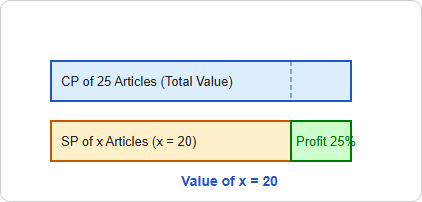
⇒ Total Cost Price of 25 articles = 25 × 1 = ₹25.

⇒ Given, Selling Price of x articles = ₹25.

⇒ Cost Price of x articles = x × 1 = ₹x.

⇒ Profit = SP − CP = 25 − x.

⇒ Profit % = [(25 − x) ÷ x] × 100

⇒ 25 = [(25 − x) ÷ x] × 100

⇒ 25 ÷ 100 = (25 − x) ÷ x

⇒ 1 ÷ 4 = (25 − x) ÷ x

⇒ x = 4 × (25 − x)

⇒ x = 100 − 4x

⇒ 5x = 100

⇒ x = 20

∴ The correct answer is 20.

Additional Information

Profit/Loss on Articles

When the Cost Price of m items equals the Selling Price of n items, the Profit/Loss % = [(m − n) ÷ n] × 100. If positive, it is a profit; if negative, it is a loss.

Inverse Variation

For a constant total amount, the quantity of articles is inversely proportional to the price per article. Ratio of Price (a:b) ⇒ Ratio of Quantity (b:a).

Markup and Discount

The relationship between Marked Price, Cost Price, and Selling Price is defined by: SP = CP × (1 + Profit%) and SP = MP × (1 − Discount%).
RRB NTPC (UG) CBT-I Official Paper (Held On 07 May, 2026 Shift 3) (Previous Year Paper)·Mathematics
View full paper

Question 82

RRB NTPC 2026• Mathematics• Mathematics

A train, 380 meters long, crosses a stationary train of length 340 m in 16 seconds. Find the speed of the train.

  1. AOption (a)

    160 km/h

  2. BOption (b)

    164 km/h

  3. COption (c)

    162 km/h

  4. DOption (d)

    166 km/h

View answer & explanation

Correct answer

Answer: (c)C.

162 km/h

Why this answer is correct

Shortcut Trick

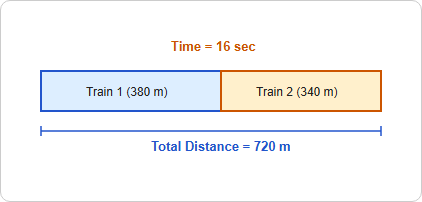
Total Distance = 380 + 340 = 720 m

Speed (m/s) = 720 ÷ 16 = 45 m/s

Speed (km/h) = 45 × (18/5) = 162 km/h

∴ The correct answer is 162 km/h.

Alternate Method

Given:

Length of the moving train (L1) = 380 m

Length of the stationary train (L2) = 340 m

Time taken (t) = 16 sec

Formula Used:

Speed = Total Distance ÷ Total Time

To convert m/s to km/h, multiply by 18/5.

Calculations:

⇒ Total Distance = L1 + L2

⇒ Total Distance = 380 + 340 = 720 m

⇒ Speed = 720 ÷ 16

⇒ Speed = 45 m/s

⇒ Speed in km/h = 45 × (18/5)

⇒ Speed in km/h = 9 × 18

⇒ Speed in km/h = 162 km/h

∴ The correct answer is 162 km/h.

Additional Information

Speed Conversion

To convert speed from m/s to km/h, multiply by 18/5. To convert from km/h to m/s, multiply by 5/18.

Train Crossing a Pole/Point Object

When a train crosses a pole, tree, or person, the distance covered is equal to the length of the train itself.

Relative Speed

If two objects move in the opposite direction, relative speed = S1 + S2. If they move in the same direction, relative speed = |S1 − S2|.

RRB NTPC (UG) CBT-I Official Paper (Held On 07 May, 2026 Shift 3) (Previous Year Paper)·Mathematics
View full paper

Question 83

RRB NTPC 2026• Mathematics• Mathematics

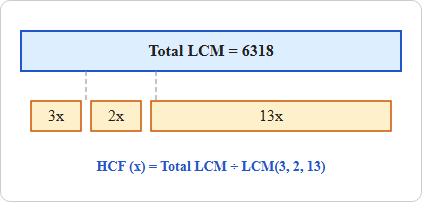
Three numbers are in the ratio 3 : 2 : 13, and their LCM is 6318. Their HCF is:

  1. AOption (a)

    128

  2. BOption (b)

    80

  3. COption (c)

    124

  4. DOption (d)

    81

View answer & explanation

Correct answer

Answer: (d)D.

81

Why this answer is correct

Shortcut Trick

The given ratio is 3 : 2 : 13.

Since the numbers in the ratio are pairwise co-prime (GCD of any two is 1).

LCM of ratio parts = 3 × 2 × 13 = 78 units.

Given LCM = 6318.

1 unit (HCF) = 6318 ÷ 78 = 81.

∴ The correct answer is 81.

Alternate Method

Given: Ratio of three numbers = 3 : 2 : 13 and their LCM = 6318.

Formula Used: LCM of (ax, bx, cx) = x × LCM(a, b, c), where x is the HCF of the numbers.

⇒ Let the three numbers be 3x, 2x, and 13x, where x is the HCF.

⇒ LCM of (3x, 2x, 13x) = x × LCM(3, 2, 13).

⇒ Since 3, 2, and 13 are prime numbers (or pairwise co-prime), their LCM is their product.

⇒ LCM(3, 2, 13) = 3 × 2 × 13 = 78.

⇒ Given that the LCM is 6318, we have: 78x = 6318.

⇒ x = 6318 ÷ 78.

⇒ x = 81.

∴ The correct answer is 81.

Additional Information

Relationship between HCF and LCM

For any two numbers a and b, the product of the numbers is equal to the product of their HCF and LCM: a × b = HCF × LCM.

HCF of Co-prime Numbers

The Highest Common Factor (HCF) of any two or more co-prime numbers is always 1.

LCM of Fractions

To find the LCM of fractions, use the formula: LCM = (LCM of Numerators) ÷ (HCF of Denominators).

RRB NTPC (UG) CBT-I Official Paper (Held On 07 May, 2026 Shift 3) (Previous Year Paper)·Mathematics
View full paper

Question 84

RRB NTPC 2026• Mathematics• Mathematics

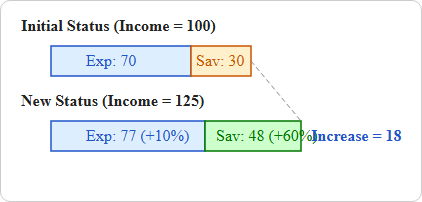
Ravi spends 70% of his income. If his income increases by 25% and his expenditure increases by 10%, by what percentage do his savings increase?

  1. AOption (a)

    Savings increase by 40%

  2. BOption (b)

    Savings increase by 30%

  3. COption (c)

    Savings increase by 60%

  4. DOption (d)

    Savings increase by 50%

View answer & explanation

Correct answer

Answer: (c)C.

Savings increase by 60%

Why this answer is correct

Shortcut Trick

Let Income = 100, then Expenditure = 70 and Savings = 30.

Change in Income = 25% of 100 = 25.

Change in Expenditure = 10% of 70 = 7.

Change in Savings = 25 − 7 = 18.

Percentage Increase in Savings = (18 ÷ 30) × 100 = 60%.

∴ The correct answer is 60%.

Alternate Method

Given:

Initial Expenditure = 70% of Income

Increase in Income = 25%

Increase in Expenditure = 10%

Let initial Income be ₹100.

⇒ Initial Expenditure = 70% of 100 = ₹70

⇒ Initial Savings = 100 − 70 = ₹30

⇒ New Income = 100 + 25% of 100 = ₹125

⇒ New Expenditure = 70 + 10% of 70 = 70 + 7 = ₹77

⇒ New Savings = 125 − 77 = ₹48

⇒ Increase in Savings = 48 − 30 = ₹18

⇒ Percentage Increase = (18 ÷ 30) × 100 = 60%

∴ The correct answer is 60%.

Additional Information

Income, Expenditure and Savings Relation

The fundamental relation is Income = Expenditure + Savings. Any change in one or two components directly affects the third.

Percentage Change Formula

Percentage Change = [(Final Value − Initial Value) ÷ Initial Value] × 100. It is used to calculate the relative growth or decline.

Net Deviation Method

For weighted averages or income problems, Net Change in Income = (Weight of Exp × % Change in Exp) + (Weight of Sav × % Change in Sav).

RRB NTPC (UG) CBT-I Official Paper (Held On 07 May, 2026 Shift 3) (Previous Year Paper)·Mathematics
View full paper

Question 85

RRB NTPC 2026• Mathematics• Mathematics

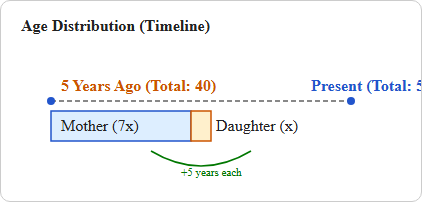
The sum of the present ages of a mother and her daughter is 50 years. Five years ago, the mother's age was 7 times the daughter's age. What is the present age of the mother?

  1. AOption (a)

    35 years

  2. BOption (b)

    42 years

  3. COption (c)

    40 years

  4. DOption (d)

    38 years

View answer & explanation

Correct answer

Answer: (c)C.

40 years

Why this answer is correct

Shortcut Trick

Sum of ages 5 years ago = 50 − (5 × 2) = 40 years.

Ratio of Mother : Daughter (5 years ago) = 7 : 1.

Total ratio parts = 7 + 1 = 8 units.

8 units = 40 years ⇒ 1 unit = 5 years.

Mother's age 5 years ago = 7 units = 7 × 5 = 35 years.

Mother's present age = 35 + 5 = 40 years.

∴ The correct answer is 40 years.

Alternate Method

Given:

Sum of present ages = 50 years.

Condition: 5 years ago, Mother = 7 × Daughter.

Calculations:

Let the present age of the daughter be x years.

Then, the present age of the mother = (50 − x) years.

5 years ago:

⇒ Daughter's age = (x − 5)

⇒ Mother's age = (50 − x − 5) = (45 − x)

According to the problem:

⇒ (45 − x) = 7 × (x − 5)

⇒ 45 − x = 7x − 35

⇒ 7x + x = 45 + 35

⇒ 8x = 80

⇒ x = 10

Mother's present age = 50 − 10 = 40 years.

∴ The correct answer is 40 years.

Additional Information

Sum of Ages Change

If there are n people, the sum of their ages changes by n × t years over a period of t years.

Age Difference Property

The difference between the ages of two individuals remains constant regardless of the number of years passed.

Ratio Method for Ages

When ratios at two different times are given, use the constant age difference to balance the ratio units for faster calculation.

RRB NTPC (UG) CBT-I Official Paper (Held On 07 May, 2026 Shift 3) (Previous Year Paper)·Mathematics
View full paper

Question 86

RRB NTPC 2026• Mathematics• Mathematics

If x of 2601=(1089+324)×35 \sqrt{x} \text{ of } \sqrt{2601} = (\sqrt{1089} + \sqrt{324}) \times 35 . Find the value of x.

  1. AOption (a)

    1225

  2. BOption (b)

    1227

  3. COption (c)

    1223

  4. DOption (d)

    1221

View answer & explanation

Correct answer

Answer: (a)A.

1225

Why this answer is correct

Shortcut Trick

Convert perfect squares to integers: √2601 = 51 and (√1089 + √324) = 33 + 18 = 51.

The equation becomes: √x × 51 = 51 × 35.

Divide both sides by 51: √x = 35.

Square both sides: x = 352 = 1225.

∴ The correct answer is 1225.

Alternate Method

Given Expression: √x of √2601 = (√1089 + √324) × 35

Formula Used: √a × √b = √(a × b) and (n5)2 = [n × (n+1)]25

⇒ First, calculate the square root of the constants:

⇒ √2601 = 51

⇒ √1089 = 33

⇒ √324 = 18

⇒ Substitute these values into the equation: √x × 51 = (33 + 18) × 35

⇒ √x × 51 = 51 × 35

⇒ √x = (51 × 35) ÷ 51

⇒ √x = 35

⇒ x = 352

⇒ x = 1225

∴ The correct answer is 1225.

Additional Information

Squaring Numbers ending in 5

For a number ending in 5 (say A5), the square is calculated by multiplying A with (A + 1) and suffixing 25. Example: 352 = (3 × 4)25 = 1225.

Square Root Estimation

To find √2601, note that 502 = 2500. Since 2601 ends in 1, the possible root is 51 or 59. Since 2601 is very close to 2500, the root is 51.

BODMAS Rule

Always follow the order: Brackets, Of, Division, Multiplication, Addition, and Subtraction for multi-step calculations.

RRB NTPC (UG) CBT-I Official Paper (Held On 07 May, 2026 Shift 3) (Previous Year Paper)·Mathematics
View full paper

Question 87

RRB NTPC 2026• Mathematics• Mathematics

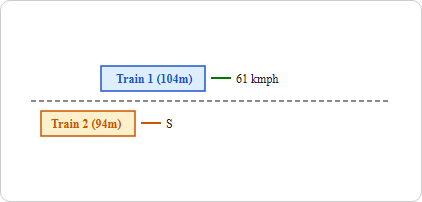
A 104-metre-long train crosses another 94-metre-long train running in the same direction in 16.2 seconds. If the speed of the first train is 61 kmph, what is the speed of the second train in kmph?

  1. AOption (a)

    105 km/hr

  2. BOption (b)

    101 km/hr

  3. COption (c)

    17 km/hr

  4. DOption (d)

    109 km/hr

View answer & explanation

Correct answer

Answer: (c)C.

17 km/hr

Why this answer is correct

Shortcut Trick

Total distance = Sum of lengths = 104 + 94 = 198 m.

Relative Speed (kmph) = (Distance ÷ Time) × (18 ÷ 5)

Relative Speed = (198 ÷ 16.2) × (18 ÷ 5) = 110/9 × 18/5 = 44 kmph.

In same direction, Speed Difference = 44 kmph.

Speed of second train = 61 − 44 = 17 kmph.

∴ The correct answer is 17 km/hr.

Alternate Method

Given:

Length of Train 1 (L1) = 104 m

Length of Train 2 (L2) = 94 m

Speed of Train 1 (S1) = 61 kmph

Time taken (T) = 16.2 seconds

Formula Used:

Relative Speed = Total Distance ÷ Total Time

To convert m/s to kmph, multiply by 18/5.

Calculations:

⇒ Total Distance = L1 + L2 = 104 + 94 = 198 m

⇒ Relative Speed (Vrel) = Distance ÷ Time

⇒ Vrel = 198 ÷ 16.2 m/s

⇒ Vrel in kmph = (198 ÷ 16.2) × (18 ÷ 5)

⇒ Vrel = (1980 ÷ 162) × (18 ÷ 5)

⇒ Vrel = (110 ÷ 9) × (18 ÷ 5)

⇒ Vrel = 22 × 2 = 44 kmph

⇒ Since trains are in the same direction, Vrel = S1 − S2 (assuming Train 1 is faster)

⇒ 44 = 61 − S2

⇒ S2 = 61 − 44 = 17 kmph

∴ The correct answer is 17 km/hr.

Additional Information

Relative Speed Rules

When two objects move in the same direction, Relative Speed = S1 − S2. When they move in the opposite direction, Relative Speed = S1 + S2.

Unit Conversion

To convert Speed from km/hr to m/s, multiply by 5/18. To convert from m/s to km/hr, multiply by 18/5.

Train Crossing Distance

When a train crosses another train or a bridge, the total distance covered is the sum of the lengths of both entities.

RRB NTPC (UG) CBT-I Official Paper (Held On 07 May, 2026 Shift 3) (Previous Year Paper)·Mathematics
View full paper

Question 88

RRB NTPC 2026• Mathematics• Mathematics

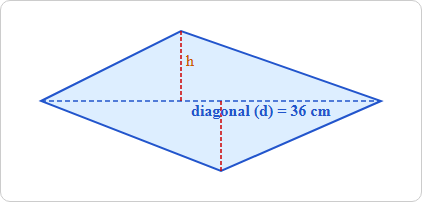
A quadrilateral has one diagonal of length 36 cm, and the perpendiculars from the other two vertices to this diagonal are 20 cm and 10 cm. What is the area of this quadrilateral?

  1. AOption (a)

    540 cm2

  2. BOption (b)

    600 cm2

  3. COption (c)

    360 cm2

  4. DOption (d)

    480 cm2

View answer & explanation

Correct answer

Answer: (a)A.

540 cm2

Why this answer is correct

Shortcut Trick

The Area of a Quadrilateral given one diagonal (d) and two offsets (h1 and h2) is calculated using the formula: 1/2 × d × (h1 + h2).

Given: diagonal (d) = 36 cm, perpendiculars (h1) = 20 cm and (h2) = 10 cm.

Area = 1/2 × 36 × (20 + 10)

Area = 18 × 30 = 540 cm2.

∴ The correct answer is 540 cm2.

Alternate Method

Given:

Length of the diagonal (AC) = 36 cm

Perpendicular distance (h1) from vertex B to AC = 20 cm

Perpendicular distance (h2) from vertex D to AC = 10 cm

Formula Used:

Area of quadrilateral = Area of ΔABC + Area of ΔADC

Area of a triangle = 1/2 × base × height

Calculations:

⇒ Area of ΔABC = 1/2 × 36 × 20

⇒ Area of ΔABC = 36 × 10 = 360 cm2

⇒ Area of ΔADC = 1/2 × 36 × 10

⇒ Area of ΔADC = 18 × 10 = 180 cm2

⇒ Total Area = 360 + 180

⇒ Total Area = 540 cm2

∴ The correct answer is 540 cm2.

Additional Information

Area of a Rhombus

If the diagonals of a quadrilateral are perpendicular to each other (like in a rhombus), the area is 1/2 × d1 × d2.

Area of a Trapezium

For a quadrilateral with one pair of parallel sides, Area = 1/2 × (sum of parallel sides) × height.

Heron's Formula for Quadrilaterals

For a cyclic quadrilateral with sides a, b, c, and d, Area = √((s−a)(s−b)(s−c)(s−d)), where s is the semi-perimeter.

RRB NTPC (UG) CBT-I Official Paper (Held On 07 May, 2026 Shift 3) (Previous Year Paper)·Mathematics
View full paper

Question 89

RRB NTPC 2026• Mathematics• Mathematics

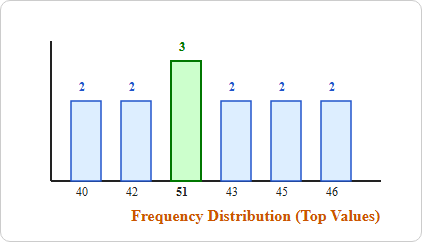
What is the mode of the following data?

40, 41, 42, 51, 45, 43, 45, 43, 51, 40, 51, 54, 46, 50, 55, 47, 42, 46

  1. AOption (a)

    51

  2. BOption (b)

    42

  3. COption (c)

    40

  4. DOption (d)

    41

View answer & explanation

Correct answer

Answer: (a)A.

51

Why this answer is correct

Shortcut Trick

Identify the number that repeats the maximum number of times (highest frequency).

Count occurrences: 40 (2), 42 (2), 43 (2), 45 (2), 46 (2), and 51 (3).

Since 51 has the highest frequency (3), it is the mode.

∴ The correct answer is 51.

Alternate Method

Given: Data set = 40, 41, 42, 51, 45, 43, 45, 43, 51, 40, 51, 54, 46, 50, 55, 47, 42, 46

Formula Used: Mode = Value with the maximum frequency.

⇒ Frequency of 40 = 2

⇒ Frequency of 42 = 2

⇒ Frequency of 43 = 2

⇒ Frequency of 45 = 2

⇒ Frequency of 46 = 2

⇒ Frequency of 51 = 3

⇒ Other values (41, 54, 50, 55, 47) appear only 1 time each.

⇒ Maximum frequency = 3, which corresponds to the value 51.

∴ The correct answer is 51.

Additional Information

Definition of Mode

The mode is the observation that occurs most frequently in a data set. A set can have no mode, one mode (unimodal), or multiple modes (bimodal/multimodal).

Empirical Relationship

The relationship between the three measures of central tendency is: Mode = 3 × Median − 2 × Mean.

Median

The median is the middle value of a data set when it is arranged in ascending or descending order.

Mean

The arithmetic mean is the sum of all observations divided by the total number of observations.

RRB NTPC (UG) CBT-I Official Paper (Held On 07 May, 2026 Shift 3) (Previous Year Paper)·Mathematics
View full paper

Question 90

RRB NTPC 2026• Mathematics• Mathematics

The 7-digit number 32A776B is divisible by 24. What is the minimum value of (A + B)?

  1. AOption (a)

    4

  2. BOption (b)

    2

  3. COption (c)

    6

  4. DOption (d)

    8

View answer & explanation

Correct answer

Answer: (b)B.

2

Why this answer is correct

Shortcut Trick

A number is divisible by 24 if it is divisible by its coprime factors, 3 and 8.

For divisibility by 8, the last three digits 76B must be divisible by 8 ⇒ B = 0 (760) or B = 8 (768).

For divisibility by 3, the sum of digits (25 + A + B) must be divisible by 3.

Case 1: If B = 0, then 25 + A + 0 = 27 ⇒ A = 2. Here, A + B = 2.

Case 2: If B = 8, then 25 + A + 8 = 33 ⇒ A = 0. Here, A + B = 8.

Comparing both cases, the minimum value of (A + B) is 2.

∴ The correct answer is 2.

Alternate Method

Given: The 7-digit number 32A776B is divisible by 24.

Formula Used:

  1. Divisibility by 8: The number formed by the last three digits must be divisible by 8.
  2. Divisibility by 3: The sum of all digits must be divisible by 3.

Calculations:

⇒ For 32A776B to be divisible by 24, it must be divisible by 8 and 3.

⇒ Checking divisibility by 8 for 76B: 760 ÷ 8 = 95 (rem = 0) and 768 ÷ 8 = 96 (rem = 0). Thus, B ∈ {0, 8}.

⇒ Checking divisibility by 3: Sum = 3 + 2 + A + 7 + 7 + 6 + B = 25 + A + B.

⇒ If B = 0, Sum = 25 + A + 0 = 25 + A. For 25 + A to be divisible by 3, A can be 2, 5, or 8.

⇒ Value of (A + B) for B = 0: (2 + 0) = 2, (5 + 0) = 5, (8 + 0) = 8.

⇒ If B = 8, Sum = 25 + A + 8 = 33 + A. For 33 + A to be divisible by 3, A can be 0, 3, 6, or 9.

⇒ Value of (A + B) for B = 8: (0 + 8) = 8, (3 + 8) = 11, (6 + 8) = 14, (9 + 8) = 17.

⇒ The possible values for (A + B) are {2, 5, 8, 11, 14, 17}.

⇒ The minimum value among these is 2.

∴ The correct answer is 2.

Additional Information

Divisibility Rule of 3

A number is divisible by 3 if the sum of its digits is a multiple of 3.

Divisibility Rule of 8

A number is divisible by 8 if the number formed by its last three digits is divisible by 8 or if the last three digits are 000.

Composite Divisibility

To check divisibility by a composite number N, check divisibility by its coprime factors a and b where a × b = N and HCF(a, b) = 1.

RRB NTPC (UG) CBT-I Official Paper (Held On 08 May, 2026 Shift 1) (Previous Year Paper)·Mathematics
View full paper

Question 91

RRB NTPC 2026• Mathematics• Mathematics

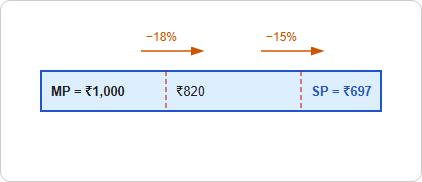
A shopkeeper offers two successive discounts of 18% and 15% on a frock whose marked price is ₹1,000. What is the final selling price (in ₹) of the frock?

  1. AOption (a)

    697

  2. BOption (b)

    723

  3. COption (c)

    679

  4. DOption (d)

    796

View answer & explanation

Correct answer

Answer: (a)A.

697

Why this answer is correct

Shortcut Trick

Effective Selling Price percentage = (100 − 18)% × (100 − 15)%

Effective Multiplier = 0.82 × 0.85 = 0.697

Final Selling Price = 1000 × 0.697 = 697

∴ The correct answer is ₹697.

Alternate Method

Given:

Marked Price (MP) = ₹1,000

Discount 1 (d1) = 18%

Discount 2 (d2) = 15%

Formula Used:

Final Selling Price = MP × (100 − d1)/100 × (100 − d2)/100

Calculations:

⇒ Price after 1st discount = 1000 − (18% of 1000)

⇒ Price after 1st discount = 1000 − 180 = ₹820

⇒ Final Selling Price = 820 − (15% of 820)

⇒ Final Selling Price = 820 − 123 = ₹697

∴ The correct answer is ₹697.

Additional Information

Successive Discount Formula

The single equivalent discount for two successive discounts x% and y% is given by (x + y − xy/100)%.

Marked Price and Cost Price Relation

The relationship is given by: MP/CP = (100 + Profit%)/(100 − Discount%).

Effective Percentage Change

For successive changes of a% and b%, the net percentage change is (a + b + ab/100)%, where negative values represent decreases/discounts.

RRB NTPC (UG) CBT-I Official Paper (Held On 08 May, 2026 Shift 1) (Previous Year Paper)·Mathematics
View full paper

Question 92

RRB NTPC 2026• Mathematics• Mathematics

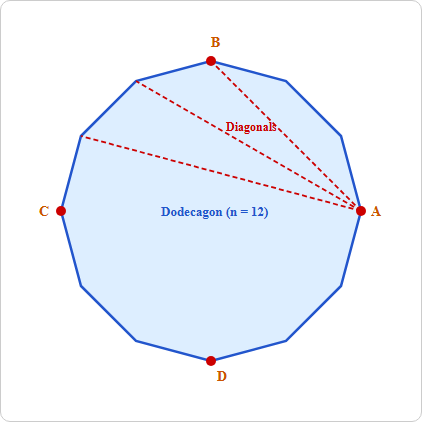
The sum of all interior angles of a regular polygon is 1800°. How many diagonals does the polygon have?

  1. AOption (a)

    51

  2. BOption (b)

    54

  3. COption (c)

    50

  4. DOption (d)

    53

View answer & explanation

Correct answer

Answer: (b)B.

54

Why this answer is correct

Shortcut Trick

Number of sides (n) in a regular polygon − 2 = (Sum of interior angles) ÷ 180°

⇒ n − 2 = 1800 ÷ 180 = 10

⇒ n = 12

Number of diagonals = [n × (n − 3)] ÷ 2

⇒ [12 × (12 − 3)] ÷ 2 = 6 × 9 = 54

∴ The correct answer is 54 diagonals.

Alternate Method

Given: Sum of all interior angles of a regular polygon = 1800°

Formula Used:

  1. Sum of interior angles of an n-sided polygon = (n − 2) × 180°
  2. Number of diagonals = [n × (n − 3)] ÷ 2

Calculations:

⇒ (n − 2) × 180 = 1800

⇒ n − 2 = 1800 ÷ 180

⇒ n − 2 = 10

⇒ n = 10 + 2 = 12

Now, calculate the number of diagonals for a polygon with 12 sides:

⇒ Number of diagonals = [12 × (12 − 3)] ÷ 2

⇒ Number of diagonals = [12 × 9] ÷ 2

⇒ Number of diagonals = 108 ÷ 2

⇒ Number of diagonals = 54

∴ The correct answer is 54 diagonals.

Additional Information

Sum of Exterior Angles

The sum of the exterior angles of any convex polygon is always equal to 360°.

Individual Angle Formulas

For a regular polygon, each interior angle = [(n − 2) × 180°] ÷ n, and each exterior angle = 360° ÷ n.

Relationship between Interior and Exterior Angles

At each vertex of a polygon, the sum of the interior angle and the exterior angle is always 180°.

RRB NTPC (UG) CBT-I Official Paper (Held On 08 May, 2026 Shift 1) (Previous Year Paper)·Mathematics
View full paper

Question 93

RRB NTPC 2026• Mathematics• Mathematics

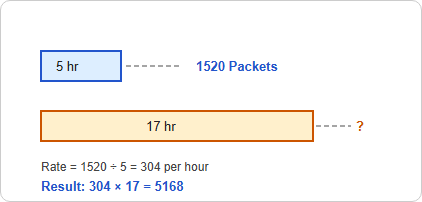
A Company produces 1,520 packets of noodles in 5 hours. How many packets will it produce in 17 hours at the same rate?

  1. AOption (a)

    5,861

  2. BOption (b)

    5,168

  3. COption (c)

    5,816

  4. DOption (d)

    5,618

View answer & explanation

Correct answer

Answer: (b)B.

5,168

Why this answer is correct

Shortcut Trick

In 5 hr, the company produces 1520 packets.

Find the packets produced in 1 hr: 1520 ÷ 5 = 304.

Find the production for 17 hr: 304 × 17.

Calculation: 304 × 17 = 5168.

∴ The correct answer is 5168 packets.

Alternate Method

Given:

Production in 5 hr (P1) = 1520 packets

Time period 1 (T1) = 5 hr

Time period 2 (T2) = 17 hr

Since the rate of production is constant, this is a case of Direct Proportion.

Formula Used:

(Packets1 / Time1) = (Packets2 / Time2)

Calculations:

⇒ Rate = P1 / T1

⇒ Rate = 1520 ÷ 5

⇒ Rate = 304 packets/hr

⇒ P2 = Rate × T2

⇒ P2 = 304 × 17

⇒ P2 = 5168

∴ The correct answer is 5168 packets.

Additional Information

Direct Proportion

Two quantities are in direct proportion if an increase in one leads to a proportional increase in the other, expressed as x/y = k (constant).

Unitary Method

A technique where you find the value of a single unit first (e.g., 1 hour) and then multiply to find the value for the required number of units.

Rate of Work

Rate = Total Work ÷ Total Time. In this problem, the rate of production is the number of packets produced per unit time.

RRB NTPC (UG) CBT-I Official Paper (Held On 08 May, 2026 Shift 1) (Previous Year Paper)·Mathematics
View full paper

Question 94

RRB NTPC 2026• Mathematics• Mathematics

The largest four-digit number which when divided by 15, 12 and 14 leaves remainder 5 in each case is:

  1. AOption (a)

    9665

  2. BOption (b)

    9595

  3. COption (c)

    9192

  4. DOption (d)

    9988

View answer & explanation

Correct answer

Answer: (a)A.

9665

Why this answer is correct

Shortcut Trick

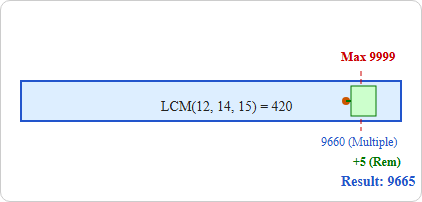
Find the LCM of divisors 15, 12, and 14, which is 420.

Divide the largest 4-digit number (9999) by 420 to find the remainder: 9999 ÷ 420 ⇒ Remainder = 339.

Largest 4-digit multiple of 420 = 9999 − 339 = 9660.

Required number = Multiple + Common Remainder = 9660 + 5 = 9665.

∴ The correct answer is 9665.

Alternate Method

Given:

Divisors: 15, 12, 14

Common Remainder (R) = 5

Target: Largest 4-digit number (N ≤ 9999)

Formula Used:

Required Number = [LCM(Divisors) × k] + Remainder

Step-by-step Calculations:

⇒ Prime factorization: 15 = 3 × 5, 12 = 22 × 3, 14 = 2 × 7

⇒ LCM = 22 × 3 × 5 × 7 = 4 × 3 × 35 = 420

⇒ Divide 9999 by 420 to find the nearest multiple:

⇒ 9999 = 420 × 23 + 339

⇒ Largest multiple = 420 × 23 = 9660

⇒ Required number = 9660 + 5

⇒ Required number = 9665

∴ The correct answer is 9665.

Additional Information

LCM and Common Remainder

When a number N is divided by a, b, and c and leaves the same remainder R in each case, the general form is N = LCM(a, b, c) × k + R.

LCM and Different Remainders

If the remainders are r1, r2, r3 such that (a−r1) = (b−r2) = (c−r3) = d (constant difference), then N = LCM(a, b, c) × k − d.

HCF and Remainder

To find the largest number that divides x, y, and z leaving the same remainder R, find the HCF of (x−R), (y−R), and (z−R).

RRB NTPC (UG) CBT-I Official Paper (Held On 08 May, 2026 Shift 1) (Previous Year Paper)·Mathematics
View full paper

Question 95

RRB NTPC 2026• Mathematics• Mathematics

A, B, and C start a business by investing ₹60,000, ₹80,000, and ₹1,20,000, respectively. After one year, the total profit earned is ₹78,000. By how much does C’s share exceed B’s share?

  1. AOption (a)

    ₹10,600

  2. BOption (b)

    ₹9,800

  3. COption (c)

    ₹12,000

  4. DOption (d)

    ₹9,400

View answer & explanation

Correct answer

Answer: (c)C.

₹12,000

Why this answer is correct

Shortcut Trick

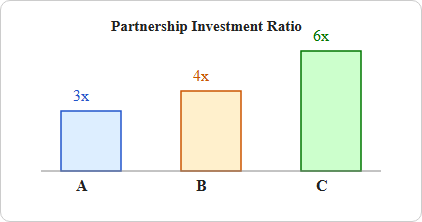
Profit ratio of A, B, and C = 60,000 : 80,000 : 1,20,000 = 3 : 4 : 6

Total units = 3 + 4 + 6 = 13 units

Given: 13 units = ₹78,000 ⇒ 1 unit = ₹6,000

Required difference (C − B) = (6 − 4) = 2 units

Value = 2 × 6,000 = ₹12,000

∴ The correct answer is ₹12,000.

Alternate Method

Given:

Capital of A = ₹60,000

Capital of B = ₹80,000

Capital of C = ₹1,20,000

Total Profit = ₹78,000

Formula Used:

In a partnership business, Profit Ratio = Capital × Time

Calculations:

Since the time period for all partners is 1 year, the profit will be divided in the ratio of their investments.

⇒ Profit Ratio (A : B : C) = 60,000 : 80,000 : 1,20,000

⇒ Ratio = 6 : 8 : 12 = 3 : 4 : 6

⇒ Total sum of ratios = 3 + 4 + 6 = 13 units

⇒ 13 units = ₹78,000

⇒ 1 unit = 78,000 ÷ 13 = ₹6,000

⇒ B’s share = 4 × 6,000 = ₹24,000

⇒ C’s share = 6 × 6,000 = ₹36,000

⇒ Difference = C’s share − B’s share = 36,000 − 24,000 = ₹12,000

∴ The correct answer is ₹12,000.

Additional Information

Partnership Profit Division

If partners invest C1, C2, C3 capitals for times T1, T2, T3, the profit is shared in the ratio (C1 × T1) : (C2 × T2) : (C3 × T3).

Working vs Sleeping Partner

A Working Partner receives a fixed salary or percentage for managing the business, while the remaining profit is shared according to investment ratios.

Compound Partnership

When partners invest capital for different time durations, it is termed a compound partnership, and time must be multiplied with capital for calculations.

RRB NTPC (UG) CBT-I Official Paper (Held On 08 May, 2026 Shift 1) (Previous Year Paper)·Mathematics
View full paper

Question 96

RRB NTPC 2026• Mathematics• Mathematics

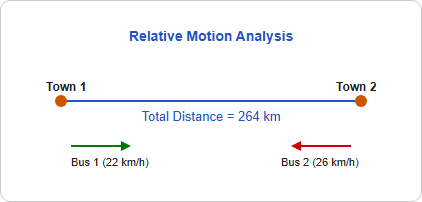
Two buses start at the same time from two towns that are 264 km apart and travel towards each other along the same highway. The first bus travels at a speed of 22 km/h, while the second bus travels at a speed of 26 km/h. After how much time will they meet?

  1. AOption (a)

    5 hours

  2. BOption (b)

    6.25 hours

  3. COption (c)

    5.5 hours

  4. DOption (d)

    6.5 hours

View answer & explanation

Correct answer

Answer: (c)C.

5.5 hours

Why this answer is correct

Shortcut Trick

Relative speed (opposite direction) = 22 + 26 = 48 km/h.

Meeting time = Total distance ÷ Relative speed.

Meeting time = 264 ÷ 48 = 5.5 hours.

∴ The correct answer is 5.5 hr.

Alternate Method

Given:

Total distance between two towns = 264 km

Speed of the first bus (S1) = 22 km/h

Speed of the second bus (S2) = 26 km/h

Formula Used:

Time = Distance ÷ Relative Speed

Calculations:

⇒ Since the buses are traveling towards each other, they are in opposite directions.

⇒ Relative Speed = S1 + S2

⇒ Relative Speed = 22 + 26 = 48 km/h

⇒ Time taken to meet = 264 ÷ 48

⇒ Time taken = 132 ÷ 24 = 66 ÷ 12 = 11 ÷ 2

⇒ Time taken = 5.5 hours

∴ The correct answer is 5.5 hr.

Additional Information

Relative Speed Rules

For two objects with speeds u and v: if moving in the opposite direction, Relative Speed = u + v; if moving in the same direction, Relative Speed = |u − v|.

Average Speed Formula

When a person travels equal distances at speeds x and y, the average speed for the whole journey is (2xy) ÷ (x + y).

Time and Distance Relation

Distance = Speed × Time. For a constant distance, speed is inversely proportional to time (S ∝ 1/T).

RRB NTPC (UG) CBT-I Official Paper (Held On 08 May, 2026 Shift 1) (Previous Year Paper)·Mathematics
View full paper

Question 97

RRB NTPC 2026• Mathematics• Mathematics

A tank can be filled by pipe P in 8 hours and by pipe Q in 4 hours. If they open alternately for one hour each with Q starting first, what is the total time taken to fill the tank?

  1. AOption (a)

    4 hours and 40 minutes

  2. BOption (b)

    6 hours

  3. COption (c)

    5 hours and 20 minutes

  4. DOption (d)

    5 hours

View answer & explanation

Correct answer

Answer: (d)D.

5 hours

Why this answer is correct

Shortcut Trick

Efficiency of Pipe P = 1 unit/hr and Pipe Q = 2 units/hr (Total 8 units).

Work done in 1 cycle (2 hours: Q then P) = 2 + 1 = 3 units.

Work done in 2 cycles (4 hours) = 3 × 2 = 6 units.

Remaining work = 8 − 6 = 2 units, which Pipe Q fills in exactly 1 hour.

Total time = 4 + 1 = 5 hr.

∴ The correct answer is 5 hr.

Alternate Method

Given: Filling time for Pipe P = 8 hr, Pipe Q = 4 hr.

Method: LCM method to find Total Work and Efficiency.

PersonDaysTotal WorkEfficiency
Pipe P8 hr8 units1 unit/hr
Pipe Q4 hr2 units/hr

⇒ Total capacity of the tank = LCM(8, 4) = 8 units.

⇒ In the 1st hour, Pipe Q is opened: Work done = 2 units.

⇒ In the 2nd hour, Pipe P is opened: Work done = 1 unit.

⇒ Total work done in 2 hours = 2 + 1 = 3 units.

⇒ Total work done in 4 hours (2 such cycles) = 3 × 2 = 6 units.

⇒ Remaining work = 8 − 6 = 2 units.

⇒ In the 5th hour, it is Pipe Q's turn again.

⇒ Time taken by Pipe Q to fill 2 units = 2 ÷ 2 = 1 hr.

⇒ Total time taken = 4 hr + 1 hr = 5 hr.

∴ The correct answer is 5 hr.

Additional Information

Pipes and Cisterns Basics

If a pipe fills a tank in x hours, its efficiency is 1/x of the tank per hour. For emptying pipes, efficiency is taken as negative.

Alternate Work Concept

When pipes work alternately, calculate the combined work in one full cycle (sum of individual hours) and then determine how many full cycles fit into the total work.

Total Time Calculation

Total Time = (Number of full cycles × hours per cycle) + (Remaining work ÷ Efficiency of the next pipe in sequence).

RRB NTPC (UG) CBT-I Official Paper (Held On 08 May, 2026 Shift 1) (Previous Year Paper)·Mathematics
View full paper

Question 98

RRB NTPC 2026• Mathematics• Mathematics

A group of 3 adults and 4 children pay ₹380 for movie tickets. Another group of 2 adults and 3 children pay ₹270 for the same tickets. What is the price of one adult ticket?

  1. AOption (a)

    ₹70

  2. BOption (b)

    ₹80

  3. COption (c)

    ₹60

  4. DOption (d)

    ₹50

View answer & explanation

Correct answer

Answer: (c)C.

₹60

Why this answer is correct

Shortcut Trick

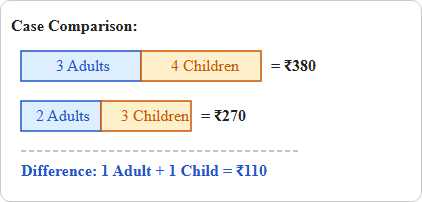
Find the difference: (3 Adults + 4 Children) − (2 Adults + 3 Children) = ₹380 − ₹270

⇒ 1 Adult + 1 Child = ₹110

From the second group: 2(1 Adult + 1 Child) + 1 Child = ₹270

⇒ 2 × ₹110 + 1 Child = ₹270 ⇒ Child ticket = ₹270 − ₹220 = ₹50

⇒ Adult ticket = ₹110 − ₹50 = ₹60

∴ The correct answer is ₹60.

Alternate Method

Given:

Case 1: 3 adults and 4 children pay ₹380.

Case 2: 2 adults and 3 children pay ₹270.

Let the price of an adult ticket be ₹x and a child ticket be ₹y.

⇒ 3x + 4y = 380 --- (i)

⇒ 2x + 3y = 270 --- (ii)

To find x, eliminate y by multiplying (i) by 3 and (ii) by 4:

⇒ 3 × (3x + 4y) = 3 × 380 ⇒ 9x + 12y = 1140 --- (iii)

⇒ 4 × (2x + 3y) = 4 × 270 ⇒ 8x + 12y = 1080 --- (iv)

Subtract equation (iv) from (iii):

⇒ (9x − 8x) + (12y − 12y) = 1140 − 1080

⇒ x = 60

∴ The correct answer is ₹60.

Additional Information

Linear Equations in Two Variables

Equations of the form ax + by + c = 0 where a and b are coefficients and x and y are variables.

Elimination Method

A process of solving a system of equations by adding or subtracting them to remove one variable.

Substitution Method

Solving one equation for one variable and replacing that expression in the other equation.

RRB NTPC (UG) CBT-I Official Paper (Held On 08 May, 2026 Shift 1) (Previous Year Paper)·Mathematics
View full paper

Question 99

RRB NTPC 2026• Mathematics• Mathematics

A bookseller bought 7 identical sets of books at ₹375 each. He sold 3 sets at a profit of 16% per set and the remaining sets at a profit of 24% per set. What was his total profit (in ₹) from selling all the sets?

  1. AOption (a)

    ₹504

  2. BOption (b)

    ₹588

  3. COption (c)

    ₹540

  4. DOption (d)

    ₹572

View answer & explanation

Correct answer

Answer: (c)C.

₹540

Why this answer is correct

Shortcut Trick

Total profit is calculated using the weighted average of the profit percentages.

Overall Profit % = [ (3 × 16) + (4 × 24) ] ÷ 7 = (48 + 96) ÷ 7 = 144/7 %

Total Profit = (Total CP) × (Overall Profit %)

Total Profit = (7 × 375) × (144 ÷ 7 ÷ 100) = 375 × 1.44 = ₹540

∴ The correct answer is ₹540.

Alternate Method

Given:

Cost Price (CP) of 1 set = ₹375

Number of sets sold at 16% profit = 3

Remaining sets sold at 24% profit = 7 − 3 = 4

Formula Used:

Profit = CP × Profit%

Total Profit = (Profit per set1 × n1) + (Profit per set2 × n2)

Calculations:

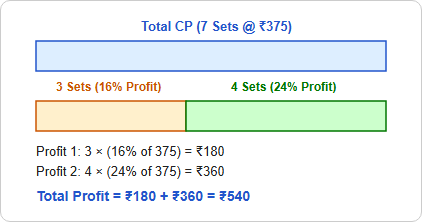
⇒ Profit from 3 sets = 3 × (16 ÷ 100 × 375) = 3 × 60 = ₹180

⇒ Profit from 4 sets = 4 × (24 ÷ 100 × 375) = 4 × 90 = ₹360

⇒ Total Profit = ₹180 + ₹360 = ₹540

∴ The correct answer is ₹540.

Additional Information

Net Profit Percentage

It is the total profit earned on all items divided by the total cost price of all items, multiplied by 100: (Total Profit ÷ Total CP) × 100.

Weighted Average Profit

When quantities are different, the overall profit % = (n1p1 + n2p2 + ...) ÷ (n1 + n2 + ...), where n is the quantity and p is the profit %.

Relation between CP and SP

Selling Price (SP) = CP + Profit. If profit is given in percentage, SP = CP × (100 + Profit%) ÷ 100.

RRB NTPC (UG) CBT-I Official Paper (Held On 08 May, 2026 Shift 1) (Previous Year Paper)·Mathematics
View full paper

Question 100

RRB NTPC 2026• Mathematics• Mathematics

If the salary of a person is first increased by 15% and thereafter decreased by 12%, what is the net change in his salary?

  1. AOption (a)

    1.2% decrease

  2. BOption (b)

    1.2% increase

  3. COption (c)

    1.32% decrease

  4. DOption (d)

    1.4% decrease

View answer & explanation

Correct answer

Answer: (b)B.

1.2% increase

Why this answer is correct

Shortcut Trick

Net percentage change formula = a + b + (a × b)/100.

Here, a = +15 (increase) and b = −12 (decrease).

Net change = 15 − 12 + (15 × −12)/100 = 3 − 1.8 = 1.2%.

Since the result is positive, it is a 1.2% increase.

∴ The correct answer is 1.2% increase.

Alternate Method

Given:

Initial increase in salary = 15%

Subsequent decrease in salary = 12%

Formula Used:

Final Value = Initial Value × (1 + r1/100) × (1 + r2/100)

Calculations:

⇒ Let the initial salary of the person be ₹100.

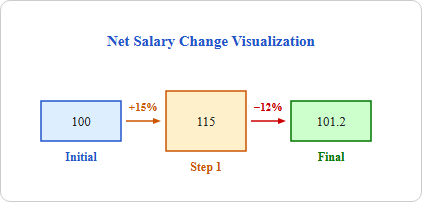
⇒ Salary after 15% increase = 100 + (15% of 100) = 100 + 15 = ₹115.

⇒ Salary after 12% decrease = 115 − (12% of 115)

⇒ New Salary = 115 − (12/100 × 115) = 115 − 13.8 = ₹101.2.

⇒ Net Change in salary = 101.2 − 100 = 1.2.

⇒ Net percentage change = (1.2 / 100) × 100 = 1.2%.

⇒ Since the final value is more than the initial value, it is an increase.

∴ The correct answer is 1.2% increase.

Additional Information

Successive Percentage Change

When a value is changed by a% and then by b%, the net change is given by [a + b + (ab/100)]%.

Multiplying Factor Method

For an increase of r%, the factor is (1 + r/100). For a decrease, it is (1 − r/100). Net change = (Factor1 × Factor2 − 1) × 100.

Applications in Revenue

This logic is widely used in questions involving Price × Consumption = Expenditure or Length × Breadth = Area.

How should I prepare for Quantitative Aptitude in RRB NTPC?

Solving previous year questions by topic helps identify recurring concepts, question patterns, and frequently asked sub-topics. Attempt each question, review the step-by-step explanation, and note down key formulas or facts for quick revision before the exam.