RRB NTPC · Topic Collection

Quantitative Aptitude PYQs

Arithmetic, number systems, percentages, ratios, profit and loss, time and work, algebra, geometry, mensuration, and trigonometry.

1020 Total Questions34 Official PapersYears: 2016–2026Search in Quantitative Aptitude
Showing questions 61–80 of 1020Page 4 of 51
RRB NTPC (UG) CBT-I Official Paper (Held On 07 May, 2026 Shift 3) (Previous Year Paper)·Mathematics
View full paper

Question 61

RRB NTPC 2026• Mathematics• Mathematics

The salary of an employee is increased by 5% in the first year and again by 5% in the second year. What is the overall percentage increase in the salary after two years?

  1. AOption (a)

    10%

  2. BOption (b)

    10.5%

  3. COption (c)

    10.25%

  4. DOption (d)

    11%

View answer & explanation

Correct answer

Answer: (c)C.

10.25%

Why this answer is correct

Shortcut Trick

Use the Successive Percentage formula: Net % Change = a + b + (a × b) ÷ 100

Here, both first and second year increases are 5%, so a = 5 and b = 5.

Net Increase = 5 + 5 + (5 × 5) ÷ 100

Net Increase = 10 + 0.25 = 10.25%

∴ The correct answer is 10.25%.

Alternate Method

Assume the Initial Salary of the employee is 100 units.
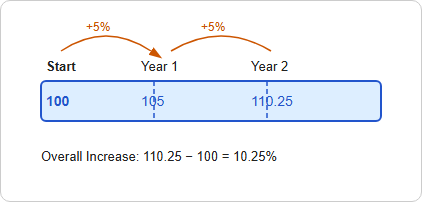
⇒ Let initial salary = 100

⇒ Salary after 1st year = 100 + (5% of 100) = 100 + 5 = 105

⇒ Salary after 2nd year = 105 + (5% of 105) = 105 + 5.25 = 110.25

⇒ Total Percentage Increase = ((110.25 − 100) ÷ 100) × 100 = 10.25%

∴ The correct answer is 10.25%.

Additional Information

Successive Percentage Increase/Decrease

When a value changes by x% and then y%, the net change is given by [x + y + (xy/100)]%. Use positive signs for increase and negative signs for decrease.

Multiplying Factor Method

For a 5% increase, the multiplying factor is 1.05. For two successive 5% increases, the final value is Initial × 1.05 × 1.05 = Initial × 1.1025.

Successive Discounts

If two successive discounts of d1% and d2% are given, the single equivalent discount is [d1 + d2 − (d1d2/100)]%.

RRB NTPC (UG) CBT-I Official Paper (Held On 07 May, 2026 Shift 3) (Previous Year Paper)·Mathematics
View full paper

Question 62

RRB NTPC 2026• Mathematics• Mathematics

Two numbers are in the ratio 4 : 5. If their LCM is 240, what is the sum of the two numbers?

  1. AOption (a)

    108

  2. BOption (b)

    96

  3. COption (c)

    120

  4. DOption (d)

    100

View answer & explanation

Correct answer

Answer: (a)A.

108

Why this answer is correct

Shortcut Trick

Ratio of numbers = 4 : 5 → LCM of ratio parts = 4 × 5 = 20 units

Given LCM = 240 ⇒ 20 units = 240 ⇒ 1 unit = 12 (this is the HCF)

Sum of ratio parts = 4 + 5 = 9 units

Sum of numbers = 9 units × 12 = 108

∴ The correct answer is 108.

Alternate Method

Given: Ratio = 4 : 5 and LCM = 240.

⇒ Let the two numbers be 4x and 5x (where x is the HCF).

⇒ LCM of 4x and 5x = 4 × 5 × x = 20x

⇒ 20x = 240

⇒ x = 240 ÷ 20 = 12

⇒ First number = 4 × 12 = 48

⇒ Second number = 5 × 12 = 60

⇒ Sum of the numbers = 48 + 60 = 108

∴ The correct answer is 108.

Additional Information

Product of Two Numbers

For any two numbers, Product of numbers = HCF × LCM.

HCF and LCM Relation

The HCF (Highest Common Factor) is always a factor of the LCM (Least Common Multiple).

LCM of Ratios

If two numbers are in the ratio a : b, then their LCM = a × b × HCF and their Sum = (a + b) × HCF.

RRB NTPC (UG) CBT-I Official Paper (Held On 07 May, 2026 Shift 3) (Previous Year Paper)·Mathematics
View full paper

Question 63

RRB NTPC 2026• Mathematics• Mathematics

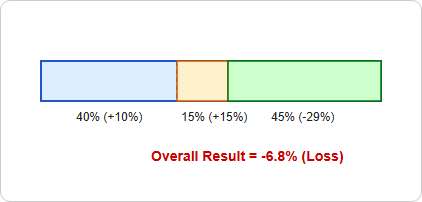
During a sale, 40% of the goods are sold at a profit of 10%. Of the remaining goods, 25% are sold at a profit of 15%, and the rest are sold at a loss of 29%. If there is an overall loss of x%, find the value of x.

  1. AOption (a)

    3.5

  2. BOption (b)

    6.8

  3. COption (c)

    1.5

  4. DOption (d)

    2

View answer & explanation

Correct answer

Answer: (b)B.

6.8

Why this answer is correct

Shortcut Trick

Ratio of goods = 40 : (25% of 60) : (100 − 40 − 15) = 40 : 15 : 45 = 8 : 3 : 9.

Net change % = (Sum of weight × Value) ÷ Total weight

Net change % = (8 × 10 + 3 × 15 − 9 × 29) ÷ 20

Net change % = (80 + 45 − 261) ÷ 20 = −136 ÷ 20 = −6.8%.

Negative sign indicates loss, so x = 6.8.

∴ The correct answer is 6.8.

Alternate Method

Given:

Part 1 = 40% of goods, Profit = 10%

Part 2 = 25% of remaining (60%) = 15% of total, Profit = 15%

Part 3 = Rest (100% − 40% − 15%) = 45% of total, Loss = 29%

Formula Used:

Overall Profit/Loss % = (Σ Percentage Part × Profit/Loss %) ÷ 100

Calculations:

⇒ Let total quantity be 100 units and CP per unit be 1.

⇒ Total CP = 100

⇒ Profit from 40 units = 40 × 10% = 4

⇒ Profit from 15 units = 15 × 15% = 2.25

⇒ Loss from 45 units = 45 × 29% = 13.05

⇒ Net Profit/Loss = 4 + 2.25 − 13.05

⇒ Net Profit/Loss = 6.25 − 13.05 = −6.8

⇒ Overall Loss % = (6.8 ÷ 100) × 100 = 6.8%

⇒ Comparing with overall loss of x%, we get x = 6.8.

∴ The correct answer is 6.8.

Additional Information

Weighted Average Profit/Loss

When goods are divided into different parts sold at different profit/loss rates, the overall result is the weighted average: Net % = (Σ ni × ri) ÷ (Σ ni).

Relation between Loss and x

If a problem states an 'overall loss of x%', the value of x is always positive. The 'loss' keyword itself accounts for the negative sign of the net result.

Successive Percentage vs Weighted Average

Weighted average is used for different parts of a whole, whereas successive percentage change [x + y + (xy/100)] is used when changes occur on the same value one after another.

RRB NTPC (UG) CBT-I Official Paper (Held On 07 May, 2026 Shift 3) (Previous Year Paper)·Mathematics
View full paper

Question 64

RRB NTPC 2026• Mathematics• Mathematics

The fourth proportional to 1.2, 4.8, and 7.15 is:

  1. AOption (a)

    28.6

  2. BOption (b)

    28.8

  3. COption (c)

    28.2

  4. DOption (d)

    28.4

View answer & explanation

Correct answer

Answer: (a)A.

28.6

Why this answer is correct

Shortcut Trick

Identify the scaling factor between the first two terms: 4.8 ÷ 1.2 = 4.

Since the terms are in proportion, the same factor applies to the third and fourth terms.

Fourth proportional = 7.15 × 4 = 28.6.

∴ The correct answer is 28.6.

Alternate Method

Given:

First term (a) = 1.2

Second term (b) = 4.8

Third term (c) = 7.15

Formula Used:

If a, b, c, and d are in proportion (a : b :: c : d), then a × d = b × c.

Calculations:

⇒ Let the fourth proportional be d.

⇒ 1.2 : 4.8 :: 7.15 : d

⇒ 1.2 ÷ 4.8 = 7.15 ÷ d

⇒ 1 ÷ 4 = 7.15 ÷ d

⇒ d = 7.15 × 4

⇒ d = 28.6

∴ The correct answer is 28.6.

Additional Information

Mean Proportional

The mean proportional between two numbers a and b is given by √(a × b).

Third Proportional

If a, b, and c are in continued proportion (a : b :: b : c), then c is the third proportional, where c = b2 ÷ a.

Product Rule of Proportion

In any proportion, the Product of Extremes (first and fourth terms) is always equal to the Product of Means (second and third terms).

RRB NTPC (UG) CBT-I Official Paper (Held On 07 May, 2026 Shift 3) (Previous Year Paper)·Mathematics
View full paper

Question 65

RRB NTPC 2026• Mathematics• Mathematics

Simplify:

(1.5×0.2)0.3 \frac{(1.5 \times 0.2)}{0.3}

  1. AOption (a)

    0.1

  2. BOption (b)

    1

  3. COption (c)

    10

  4. DOption (d)

    0.01

View answer & explanation

Correct answer

Answer: (b)B.

1

Why this answer is correct

Shortcut Trick

Directly multiply 1.5 × 0.2 to get 0.3.

Divide the result by the denominator 0.3.

Simplification: 0.3 ÷ 0.3 = 1

∴ The correct answer is 1.

Alternate Method

Given:

Expression: ((1.5 × 0.2)) / 0.3

Formula Used:

Follow the BODMAS order of operations, starting with multiplication in the numerator followed by division.

Calculations:

⇒ (1.5 × 0.2) ÷ 0.3

⇒ 0.3 ÷ 0.3

⇒ 1

∴ The correct answer is 1.

Additional Information

BODMAS Rule

The rule defines the correct sequence: Brackets, Of/Orders, Division, Multiplication, Addition, and Subtraction.

Decimal Multiplication

Multiply digits as whole numbers (15 × 2 = 30) and then shift the decimal point left by the total number of decimal places (1 + 1 = 2) to get 0.30.

Division of Decimals

Multiplying both the numerator and denominator by a power of 10 (like 10 or 100) can simplify the division by removing decimals.

RRB NTPC (UG) CBT-I Official Paper (Held On 07 May, 2026 Shift 3) (Previous Year Paper)·Mathematics
View full paper

Question 66

RRB NTPC 2026• Mathematics• Mathematics

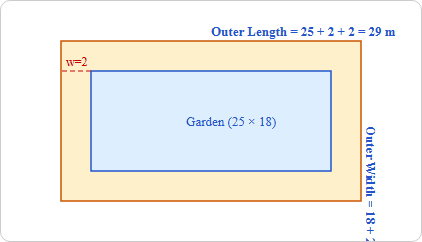
A rectangular garden has a length of 25 meters and a width of 18 meters. If a path of uniform width 2 meters is constructed around the outside of the garden, what is the perimeter of the outer edge of the path?

  1. AOption (a)

    86 meters

  2. BOption (b)

    102 meters

  3. COption (c)

    112 meters

  4. DOption (d)

    98 meters

View answer & explanation

Correct answer

Answer: (b)B.

102 meters

Why this answer is correct

Shortcut Trick

For a rectangular garden of length L and width W with a path of uniform width w outside:

Outer Perimeter = 2 × (L + W) + 8w

⇒ Outer Perimeter = 2 × (25 + 18) + 8 × 2

⇒ Outer Perimeter = 2 × 43 + 16 = 86 + 16 = 102 m

∴ The correct answer is 102 m.

Alternate Method

Given:

Length of garden (L) = 25 m

Width of garden (W) = 18 m

Width of path (w) = 2 m (outside)

When a path is constructed outside, it adds to the dimensions on both sides:

⇒ Outer Length = L + 2w = 25 + 2 × 2 = 29 m

⇒ Outer Width = W + 2w = 18 + 2 × 2 = 22 m

The perimeter of a rectangle is given by the formula: 2 × (Length + Width)

⇒ Perimeter of outer edge = 2 × (29 + 22)

⇒ Perimeter of outer edge = 2 × 51 = 102 m

∴ The correct answer is 102 m.

Additional Information

Area of Outer Path

The area of a path built outside a rectangle is calculated as: Area = (L + 2w)(W + 2w) − LW = 2w(L + W + 2w).

Area of Inner Path

If the path is built inside the garden, the Inner Dimensions become (L − 2w) and (W − 2w). Area = 2w(L + W − 2w).

Perimeter of Inner Path

The perimeter of the inner edge (when path is inside) is: Perimeter = 2(L + W − 4w) or 2 × (L + W) − 8w.

RRB NTPC (UG) CBT-I Official Paper (Held On 07 May, 2026 Shift 3) (Previous Year Paper)·Mathematics
View full paper

Question 67

RRB NTPC 2026• Mathematics• Mathematics

A and B can do a piece of work in 12 days and 36 days, respectively. Both work for 4 days and then A leaves. How long (in days) will B take to complete the remaining work?

  1. AOption (a)

    19

  2. BOption (b)

    20

  3. COption (c)

    22

  4. DOption (d)

    21

View answer & explanation

Correct answer

Answer: (b)B.

20

Why this answer is correct

Shortcut Trick

Total work (LCM of 12 and 36) = 36 units.

Efficiency of A = 3 units/day; Efficiency of B = 1 unit/day.

Combined efficiency = 3 + 1 = 4 units/day.

Work done in 4 days = 4 × 4 = 16 units.

Remaining work = 36 − 16 = 20 units.

Days taken by B = 20 ÷ 1 = 20 days.

∴ The correct answer is 20 days.

Alternate Method

Given:

Time taken by A = 12 days

Time taken by B = 36 days

Working duration together = 4 days

PersonDaysTotal WorkEfficiency
A1236 (LCM)3
B361

Calculations:

⇒ Efficiency of A + B = 3 + 1 = 4 units/day

⇒ Work done by A and B in 4 days = 4 × 4 = 16 units

⇒ Remaining Work = Total Work − Completed Work

⇒ Remaining Work = 36 − 16 = 20 units

⇒ Time taken by B = Remaining Work ÷ Efficiency of B

⇒ Time taken by B = 20 ÷ 1 = 20 days

∴ The correct answer is 20 days.

Additional Information

Work-Efficiency Relation

Total Work = Efficiency × Time. Efficiency is inversely proportional to the time taken to complete a task.

Pipes and Cisterns

Similar logic applies where efficiency of inlet pipes is positive and outlet/leakage efficiency is negative.

Work and Wages

Wages are distributed in the ratio of work done or the ratio of efficiencies when workers work for the same duration.

RRB NTPC (UG) CBT-I Official Paper (Held On 07 May, 2026 Shift 3) (Previous Year Paper)·Mathematics
View full paper

Question 68

RRB NTPC 2026• Mathematics• Mathematics

Simplify:

30 + [{-9 × (26 - 11 + 6)}]

  1. AOption (a)

    -162

  2. BOption (b)

    -160

  3. COption (c)

    -159

  4. DOption (d)

    -161

View answer & explanation

Correct answer

Answer: (c)C.

-159

Why this answer is correct

Shortcut Trick

Apply the BODMAS rule sequence: Brackets → Multiplication → Addition.

Solve inner parentheses first: (26 − 11 + 6) = 21.

Multiply by −9: −9 × 21 = −189.

Final calculation: 30 + (−189) = 30 − 189 = −159.

∴ The correct answer is −159.

Alternate Method

Given: 30 + [{−9 × (26 − 11 + 6)}]

Method Used: BODMAS/VBODMAS Rule for order of operations.

⇒ Step 1: Simplify the value inside the small brackets ().

⇒ (26 − 11 + 6) = 15 + 6 = 21

⇒ Step 2: Substitute this value back into the braces {}.

⇒ {−9 × 21} = −189

⇒ Step 3: Now the expression is 30 + [−189].

⇒ 30 − 189 = −159

∴ The correct answer is −159.

Additional Information

BODMAS Rule

It specifies the order: Brackets, Orders (powers, roots, etc.), Division, Multiplication, Addition, and Subtraction.

Types of Brackets

The order of opening brackets is Bar/Vinculum, then Parentheses ( ), then Braces { }, and finally Square Brackets [ ].

Integer Multiplication Rules

Multiplying a positive number by a negative number always results in a negative product (+ × − = −).

RRB NTPC (UG) CBT-I Official Paper (Held On 07 May, 2026 Shift 3) (Previous Year Paper)·Mathematics
View full paper

Question 69

RRB NTPC 2026• Mathematics• Mathematics

A tank is normally filled by pipe A in 10 hours. Due to a leak, the tank takes 12 hours to fill. Find the time taken by the leak alone to empty a full tank.

  1. AOption (a)

    30 hours

  2. BOption (b)

    60 hours

  3. COption (c)

    80 hours

  4. DOption (d)

    40 hours

View answer & explanation

Correct answer

Answer: (b)B.

60 hours

Why this answer is correct

Shortcut Trick

When an inlet pipe takes T1 hours and with a leak it takes T2 hours:

Time taken by leak alone to empty = (T1 × T2) ÷ (T2 − T1)

Time = (10 × 12) ÷ (12 − 10)

Time = 120 ÷ 2 = 60 hr

∴ The correct answer is 60 hr.

Alternate Method

Given:

Filling time of Pipe A = 10 hr

Filling time with leakage (A + Leak) = 12 hr

Formula Used:

Total Capacity = LCM of individual times

Efficiency = Total Capacity ÷ Time

Pipe/LeakTime (hr)Total Work (units)Efficiency (units/hr)
Pipe A10606
Pipe A − Leak125

⇒ Efficiency of Pipe A = 6 units/hr

⇒ Net efficiency with leak = 5 units/hr

⇒ Efficiency of Leak alone = 6 − 5 = 1 unit/hr

⇒ Time taken by leak to empty the tank = Total Work ÷ Leak Efficiency

⇒ Time = 60 ÷ 1 = 60 hr

∴ The correct answer is 60 hr.

Additional Information

Negative Work Concept

In pipes and cisterns, an outlet pipe or a leak performs negative work, which reduces the overall efficiency of the filling system.

Net Efficiency Rule

If multiple pipes operate, the net efficiency is the algebraic sum of individual efficiencies (positive for inlet, negative for outlet).

Capacity and Time Relation

The time taken to fill or empty is inversely proportional to the efficiency: Time = Work ÷ Efficiency.

RRB NTPC (UG) CBT-I Official Paper (Held On 07 May, 2026 Shift 3) (Previous Year Paper)·Mathematics
View full paper

Question 70

RRB NTPC 2026• Mathematics• Mathematics

If a sum of ₹70,000 amounts to ₹74,263 in X years under compound interest, compounded annually at 3% per annum, find X.

  1. AOption (a)

    5

  2. BOption (b)

    2

  3. COption (c)

    3

  4. DOption (d)

    4

View answer & explanation

Correct answer

Answer: (b)B.

2

Why this answer is correct

Shortcut Trick

Total interest earned = ₹74,263 − ₹70,000 = ₹4,263.

Total interest percentage = (4,263 ÷ 70,000) × 100 = 6.09%.

Using successive percentage for 3%: 3 + 3 + (3 × 3)/100 = 6.09%.

This matches for a time period of 2 years.

∴ The correct answer is 2 years.

Alternate Method

Given:

Principal (P) = ₹70,000

Amount (A) = ₹74,263

Rate (R) = 3% p.a. compounded annually.

The formula for Amount (A) under Compound Interest is:

A = P(1 + R/100)X

⇒ 74263 = 70000(1 + 3/100)X

⇒ 74263 ÷ 70000 = (1 + 0.03)X

⇒ 10609 ÷ 10000 = (1.03)X

⇒ 1.0609 = (1.03)X

⇒ (1.03)2 = (1.03)X

⇒ X = 2 years.

∴ The correct answer is 2 years.

Additional Information

Compound Interest Formula

The amount is given by A = P(1 + r/n)nt, where n is the number of times interest is compounded per year.

Effective Interest Rate

For compounding annually, the effective rate for 2 years at r% is r + r + (r×r)/100.

Difference between CI and SI

For 2 years, the difference between Compound Interest and Simple Interest is CI − SI = P(R/100)2.

RRB NTPC (UG) CBT-I Official Paper (Held On 07 May, 2026 Shift 3) (Previous Year Paper)·Mathematics
View full paper

Question 71

RRB NTPC 2026• Mathematics• Mathematics

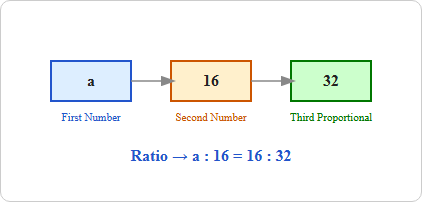
If the third proportional to two numbers is 32 and the second number is 16, find the first number.

  1. AOption (a)

    7

  2. BOption (b)

    6

  3. COption (c)

    5

  4. DOption (d)

    8

View answer & explanation

Correct answer

Answer: (d)D.

8

Why this answer is correct

Shortcut Trick

The third proportional (c) of two numbers a and b is given by the relation: c = b2 ÷ a.

Given: Second number (b) = 16 and Third proportional (c) = 32.

Substituting values: 32 = 162 ÷ a ⇒ 32 = 256 ÷ a.

a = 256 ÷ 32 = 8.

∴ The correct answer is 8.

Alternate Method

Given:

Second number (b) = 16

Third proportional (c) = 32

Let the first number be a.

Formula Used:

If three numbers a, b, and c are in continued proportion, then a : b = b : c.

Calculations:

⇒ a ÷ 16 = 16 ÷ 32

⇒ a × 32 = 16 × 16 (Product of extremes = Product of means)

⇒ 32a = 256

⇒ a = 256 ÷ 32

⇒ a = 8

∴ The correct answer is 8.

Additional Information

Mean Proportional

The mean proportional between two numbers x and y is defined as √(x × y).

Fourth Proportional

If four numbers a, b, c, and d are in proportion (a:b = c:d), then d is the fourth proportional, calculated as d = (b × c) ÷ a.

Continued Proportion Property

For three numbers to be in continued proportion, the middle term squared must equal the product of the first and third terms: b2 = a × c.

RRB NTPC (UG) CBT-I Official Paper (Held On 07 May, 2026 Shift 3) (Previous Year Paper)·Mathematics
View full paper

Question 72

RRB NTPC 2026• Mathematics• Mathematics

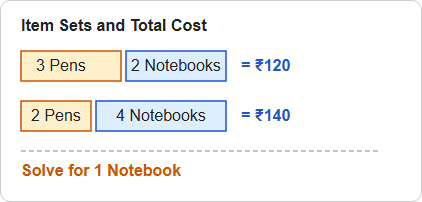
A store sells pens and notebooks. If 3 pens and 2 notebooks cost ₹120, and 2 pens and 4 notebooks cost ₹140, what is the price of one notebook?

  1. AOption (a)

    ₹22.50

  2. BOption (b)

    ₹25.00

  3. COption (c)

    ₹35.00

  4. DOption (d)

    ₹32.50

View answer & explanation

Correct answer

Answer: (a)A.

₹22.50

Why this answer is correct

Shortcut Trick

Equate the number of pens by multiplying the first set by 2 and the second set by 3.

First Set: 6 Pens + 4 Notebooks = ₹240

Second Set: 6 Pens + 12 Notebooks = ₹420

Difference: 8 Notebooks = ₹180

Price of 1 Notebook = 180 ÷ 8 = ₹22.50

∴ The correct answer is ₹22.50.

Alternate Method

Given:

Cost of 3 pens and 2 notebooks = ₹120

Cost of 2 pens and 4 notebooks = ₹140

Calculations:

Let the price of one pen be P and one notebook be N.

⇒ 3P + 2N = 120 --- (Eq. 1)

⇒ 2P + 4N = 140 --- (Eq. 2)

⇒ From (Eq. 2), simplify by dividing by 2: P + 2N = 70

⇒ Express P in terms of N: P = 70 − 2N

⇒ Substitute P in (Eq. 1): 3 × (70 − 2N) + 2N = 120

⇒ 210 − 6N + 2N = 120

⇒ 210 − 4N = 120

⇒ 4N = 210 − 120

⇒ 4N = 90

⇒ N = 90 ÷ 4 = 22.50

∴ The correct answer is ₹22.50.

Additional Information

Linear Equations in Two Variables

Equations in the form ax + by = c that can be solved using substitution, elimination, or cross-multiplication.

Elimination Method

Making the coefficients of one variable equal in both equations and then adding or subtracting them to solve for the other variable.

Substitution Method

Expressing one variable in terms of the other from one equation and substituting this value into the second equation.

RRB NTPC (UG) CBT-I Official Paper (Held On 07 May, 2026 Shift 3) (Previous Year Paper)·Mathematics
View full paper

Question 73

RRB NTPC 2026• Mathematics• Mathematics

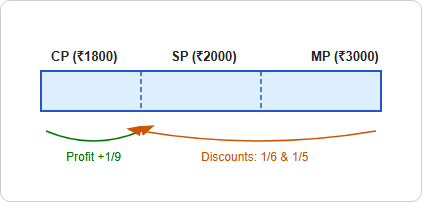
A shopkeeper wants to earn a profit of 11 19\frac{1}{9}% even after giving two successive discounts of 16 23\frac{2}{3}% and 20% on the marked price of an article. If the cost price of the article for the shopkeeper is ₹1800, what should its marked price be?

  1. AOption (a)

    ₹3000

  2. BOption (b)

    ₹3200

  3. COption (c)

    ₹2800

  4. DOption (d)

    ₹2500

View answer & explanation

Correct answer

Answer: (a)A.

₹3000

Why this answer is correct

Shortcut Trick

Ratio of Cost Price (CP) to Selling Price (SP) ⇒ 100 : 111 1/9 = 9 : 10

Ratio of Marked Price (MP) to Selling Price (SP) ⇒ 1 : [(1 − 1/6) × (1 − 1/5)] = 1 : (5/6 × 4/5) = 1 : 2/3 = 3 : 2

Combined ratio CP : SP : MP ⇒ 9 : 10 : 15 (as SP is 10 and 2, common SP = 10)

Given CP = 9 units = ₹1800 ⇒ 1 unit = ₹200

Marked Price (MP) = 15 units = 15 × 200 = ₹3000

∴ The correct answer is ₹3000.

Alternate Method

Given:

Cost Price (CP) of the article = ₹1800

Profit percentage = 11 1/9% = 1/9

Successive discounts = 16 2/3% (1/6) and 20% (1/5)

Formula Used:

  1. Selling Price (SP) = CP × (1 + Profit%)
  2. Selling Price (SP) = MP × (1 − Discount1%) × (1 − Discount2%)

Calculations:

⇒ Profit amount = 1/9 × 1800 = ₹200

⇒ Selling Price (SP) = 1800 + 200 = ₹2000

⇒ Total multiplier for successive discounts = (1 − 1/6) × (1 − 1/5) = 5/6 × 4/5 = 4/6 = 2/3

⇒ Selling Price (SP) = Marked Price (MP) × 2/3

⇒ 2000 = MP × 2/3

⇒ MP = (2000 × 3) ÷ 2 = ₹3000

∴ The correct answer is ₹3000.

Additional Information

Effective Successive Discount Formula

For two successive discounts of a% and b%, the single equivalent discount is (a + b − ab/100)%.

CP and MP Relation

The direct ratio of Marked Price to Cost Price is given by MP/CP = (100 + P%) / (100 − D%), where P is profit and D is discount.

Fraction Conversions

Standard percentages to fractions: 11 1/9% = 1/9, 16 2/3% = 1/6, 20% = 1/5, 25% = 1/4, and 33 1/3% = 1/3.

RRB NTPC (UG) CBT-I Official Paper (Held On 07 May, 2026 Shift 3) (Previous Year Paper)·Mathematics
View full paper

Question 74

RRB NTPC 2026• Mathematics• Mathematics

Given the data set: 12, 36, 22, 27, 31, 17.

What is the median value?

  1. AOption (a)

    27

  2. BOption (b)

    22

  3. COption (c)

    24.5

  4. DOption (d)

    26.5

View answer & explanation

Correct answer

Answer: (c)C.

24.5

Why this answer is correct

Shortcut Trick

Arrange the data in ascending order: 12, 17, 22, 27, 31, 36.

Total number of terms (n) = 6 (which is even).

Median = Average of the two middle terms (3rd and 4th terms).

Median = (22 + 27) ÷ 2 = 49 ÷ 2 = 24.5.

∴ The correct answer is 24.5.

Alternate Method

Given Data: 12, 36, 22, 27, 31, 17

Formula: If n is even, Median = [ (n/2)th term + (n/2 + 1)th term ] ÷ 2

Calculations:

⇒ Arranging in Ascending order: 12, 17, 22, 27, 31, 36

⇒ Number of observations (n) = 6

⇒ Median = [ (6/2)th term + (6/2 + 1)th term ] ÷ 2

⇒ Median = [ 3rd term + 4th term ] ÷ 2

⇒ Median = [ 22 + 27 ] ÷ 2

⇒ Median = 49 ÷ 2

⇒ Median = 24.5

∴ The correct answer is 24.5.

Additional Information

Median for Odd Number of Terms

When n is odd, the median is the exactly middle term: ((n + 1) ÷ 2)th term.

Arithmetic Mean

The average of all values: Mean = (Sum of all observations) ÷ (Total number of observations).

Mode

The value that appears most frequently in a data set. A set can have one mode, more than one, or none.

Range

The difference between the maximum and minimum values in the data set: Range = Max − Min.

RRB NTPC (UG) CBT-I Official Paper (Held On 07 May, 2026 Shift 3) (Previous Year Paper)·Mathematics
View full paper

Question 75

RRB NTPC 2026• Mathematics• Mathematics

The mean proportional between two positive numbers is 30. If the difference between the two numbers is 45, what is the smaller of the two numbers?

  1. AOption (a)

    15

  2. BOption (b)

    21

  3. COption (c)

    12

  4. DOption (d)

    18

View answer & explanation

Correct answer

Answer: (a)A.

15

Why this answer is correct

Shortcut Trick

The product of the two positive numbers is the square of their mean proportional: 302 = 900.

Find factors of 900 whose difference is 45: 60 × 15 = 900 and 60 − 15 = 45.

The numbers are 60 and 15, where 15 is the smaller number.

∴ The correct answer is 15.

Alternate Method

Given:

Mean proportional = 30

Difference between numbers = 45

Formula Used:

Mean Proportional = √(a × b)

(a + b)2 = (a − b)2 + 4ab

Calculations:

⇒ Let the smaller number be b and the larger number be a.

⇒ √(ab) = 30 ⇒ ab = 900

⇒ a − b = 45

⇒ (a + b)2 = (a − b)2 + 4ab

⇒ (a + b)2 = (45)2 + 4 × 900

⇒ (a + b)2 = 2025 + 3600 = 5625

⇒ a + b = √5625 = 75

⇒ Subtracting (a − b) from (a + b): (a + b) − (a − b) = 75 − 45

⇒ 2b = 30

⇒ b = 15

∴ The correct answer is 15.

Additional Information

Mean Proportional

The mean proportional between two numbers x and y is given by the geometric mean, which is √(xy).

Third Proportional

If three numbers a, b, and c are in continued proportion (a:b = b:c), then c is the third proportional and c = b2 ÷ a.

Fourth Proportional

For three numbers a, b, and c, the fourth proportional d is such that a:b = c:d, which gives d = (b × c) ÷ a.

Algebraic Identity

The relation between sum, difference, and product of two numbers is (a + b)2 − (a − b)2 = 4ab.

RRB NTPC (UG) CBT-I Official Paper (Held On 07 May, 2026 Shift 3) (Previous Year Paper)·Mathematics
View full paper

Question 76

RRB NTPC 2026• Mathematics• Mathematics

A shopkeeper offers the following schemes on toys of the same marked price.

(A) Successive discounts of 39% and 3% on any number of toys bought.

(B) Successive discounts of 36%, 13% and 8% on any number of toys bought.

(C) 18% discount on the first 2 toys and 41% discount on each toy thereon.

(D) 5 toys free of cost on buying 7 toys.

A customer wants to buy 7 toys. Which of the above schemes is the least beneficial to her?

  1. AOption (a)

    D

  2. BOption (b)

    B

  3. COption (c)

    A

  4. DOption (d)

    C

View answer & explanation

Correct answer

Answer: (d)D.

C

Why this answer is correct

Shortcut Trick

Net Discount % for each scheme:

(A) 39 + 3 − (39 × 3 / 100) = 42 − 1.17 = 40.83%

(B) Successive 36%, 13%, 8% → First two = 44.32%, Total ≈ 44.3 + 8 − 3.5 = 48.8%

(C) Weighted Average = (18 × 2 + 41 × 5) ÷ 7 = 241 ÷ 7 ≈ 34.4%

(D) Buy 7 Get 5 Free → (5 ÷ 12) × 100 ≈ 41.7%

Comparing the values: 34.4% (C) < 40.83% (A) < 41.7% (D) < 48.8% (B). The least beneficial scheme is the one with the minimum discount.

∴ The correct answer is C.

Alternate Method

Given: Total toys to buy = 7. Marked Price (MP) per toy = ₹100. Total MP = ₹700.

Calculation of Selling Price (SP) and Discount for each scheme:

Scheme A: Successive 39% and 3%

⇒ SP = 700 × (61/100) × (97/100) = 414.19

⇒ Total Discount = 700 − 414.19 = 285.81

⇒ Discount % = (285.81 ÷ 700) × 100 = 40.83%

Scheme B: Successive 36%, 13%, and 8%

⇒ SP = 700 × 0.64 × 0.87 × 0.92 = 358.58

⇒ Total Discount = 700 − 358.58 = 341.42

⇒ Discount % = (341.42 ÷ 700) × 100 = 48.77%

Scheme C: 18% on first 2, 41% on remaining 5

⇒ Discount on 2 toys = 2 × (18% of 100) = 36

⇒ Discount on 5 toys = 5 × (41% of 100) = 205

⇒ Total Discount = 36 + 205 = 241

⇒ Discount % = (241 ÷ 700) × 100 = 34.43%

Scheme D: 5 toys free on buying 7 toys (Standard Buy 7 Get 5 Free)

⇒ Total items = 7 + 5 = 12

⇒ Discount % = (Free items ÷ Total items) × 100 = (5 ÷ 12) × 100 = 41.67%

Scheme C provides the lowest discount percentage (34.43%), making it the least beneficial for the customer.

∴ The correct answer is C.

Additional Information

Successive Discount Formula

For two successive discounts x% and y%, the single equivalent discount is (x + y − xy/100)%.

Buy X Get Y Free

The effective discount percentage for this offer is calculated as: [Y ÷ (X + Y)] × 100.

Weighted Average Discount

When different quantities have different discounts, use (n1d1 + n2d2) ÷ (n1 + n2) to find the total discount percentage.

RRB NTPC (UG) CBT-I Official Paper (Held On 07 May, 2026 Shift 3) (Previous Year Paper)·Mathematics
View full paper

Question 77

RRB NTPC 2026• Mathematics• Mathematics

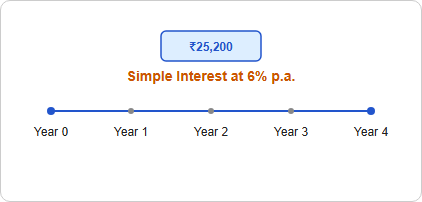
If ₹25,200 is invested at a simple interest rate of 6% per annum for 4 years, find the interest earned.

  1. AOption (a)

    ₹6,025

  2. BOption (b)

    ₹8,021

  3. COption (c)

    ₹6,048

  4. DOption (d)

    ₹6,070

View answer & explanation

Correct answer

Answer: (c)C.

₹6,048

Why this answer is correct

Shortcut Trick

Effective Interest Rate for 4 years = 6% × 4 = 24%.

Interest earned = 24% of the Principal (₹25,200).

Interest = 0.24 × 25200 = 24 × 252 = 6048.

∴ The correct answer is ₹6,048.

Alternate Method

Given:

Principal (P) = ₹25,200

Rate (R) = 6% per annum

Time (T) = 4 years

Formula Used:

Simple Interest (SI) = (P × R × T) ÷ 100

⇒ SI = (25200 × 6 × 4) ÷ 100

⇒ SI = 25200 × 24 ÷ 100

⇒ SI = 252 × 24

⇒ SI = ₹6,048

∴ The correct answer is ₹6,048.

Additional Information

Total Amount Calculation

The total sum payable at the end of the tenure is Amount = Principal + Simple Interest. Here, A = 25200 + 6048 = ₹31,248.

Calculation of Rate or Time

The rate (R) can be found using R = (SI × 100) ÷ (P × T) and time (T) using T = (SI × 100) ÷ (P × R).

Simple Interest vs Compound Interest

For the first year, Simple Interest and Compound Interest are identical if the compounding is annual.

RRB NTPC (UG) CBT-I Official Paper (Held On 07 May, 2026 Shift 3) (Previous Year Paper)·Mathematics
View full paper

Question 78

RRB NTPC 2026• Mathematics• Mathematics

If 2cos⁡2x−1=12 2\cos^2x - 1 = \frac{1}{2} for 0° < x < 90°, then the value of sec2x + cosecx + cot²x is

  1. AOption (a)

    11

  2. BOption (b)

    7

  3. COption (c)

    9

  4. DOption (d)

    5

View answer & explanation

Correct answer

Answer: (b)B.

7

Why this answer is correct

Shortcut Trick

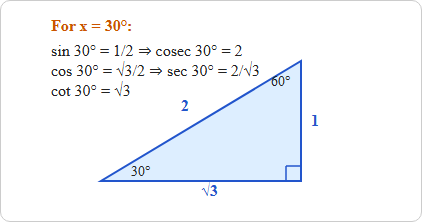
Simplify the equation: 2cos2x − 1 = 1/2 ⇒ cos 2x = 1/2.

Identify the angle: cos 60° = 1/2, so 2x = 60° and x = 30°.

Substitute x = 30° into the expression sec 2x + cosec x + cot2x.

Calculation: sec 60° + cosec 30° + cot2 30° = 2 + 2 + 3 = 7.

∴ The correct answer is 7.

Alternate Method

Given: 2cos2x − 1 = 1/2 and 0° < x < 90°

Formula Used: cos 2x = 2cos2x − 1

⇒ 2cos2x − 1 = 1/2

⇒ cos 2x = 1/2

⇒ 2x = 60° (Since cos 60° = 1/2)

⇒ x = 30°

⇒ sec 2x = sec 60° = 2

⇒ cosec x = cosec 30° = 2

⇒ cot2x = (cot 30°)2 = (√3)2 = 3

⇒ Value of expression = 2 + 2 + 3 = 7

∴ The correct answer is 7.

Additional Information

Double Angle Formulas

Fundamental identities include cos 2x = 2cos2x − 1 = 1 − 2sin2x = cos2x − sin2x.

Reciprocal Identities

Trigonometric ratios are related as sec x = 1/cos x, cosec x = 1/sin x, and cot x = 1/tan x.

Standard Trigonometric Values

For 30°: sin = 1/2, cos = √3/2, tan = 1/√3. For 60°: sin = √3/2, cos = 1/2, tan = √3.

RRB NTPC (UG) CBT-I Official Paper (Held On 07 May, 2026 Shift 3) (Previous Year Paper)·Mathematics
View full paper

Question 79

RRB NTPC 2026• Mathematics• Mathematics

The sum of two positive numbers is 30 and their product is 176. The positive difference between them is:

  1. AOption (a)

    10

  2. BOption (b)

    14

  3. COption (c)

    7

  4. DOption (d)

    24

View answer & explanation

Correct answer

Answer: (b)B.

14

Why this answer is correct

Shortcut Trick

Identify factors of 176 that add up to 30.

Pairs of factors for 176: (1, 176), (2, 88), (4, 44), (8, 22), (11, 16).

Check the Sum: 8 + 22 = 30.

Required Positive Difference = 22 − 8 = 14.

∴ The correct answer is 14.

Alternate Method

Given:

Sum of numbers (x + y) = 30

Product of numbers (xy) = 176

Formula Used:

(x − y)2 = (x + y)2 − 4xy

Calculations:

⇒ (x − y)2 = (30)2 − 4 × 176

⇒ (x − y)2 = 900 − 704

⇒ (x − y)2 = 196

⇒ (x − y) = √196

⇒ x − y = 14

∴ The correct answer is 14.

Additional Information

Quadratic Relation

If the sum (S) and product (P) of two numbers are known, the numbers are the roots of the quadratic equation z2 − Sz + P = 0.

Algebraic Identity

The relationship between the square of the sum and square of the difference is given by: (a + b)2 − (a − b)2 = 4ab.

Difference of Squares

a2 − b2 = (a − b)(a + b). This is useful when the difference and sum are both known to find the difference of their squares.

RRB NTPC (UG) CBT-I Official Paper (Held On 07 May, 2026 Shift 3) (Previous Year Paper)·Mathematics
View full paper

Question 80

RRB NTPC 2026• Mathematics• Mathematics

The total surface area of a cube having side 86 cm is:

  1. AOption (a)

    44,325 cm2

  2. BOption (b)

    44,462 cm2

  3. COption (c)

    44,376 cm2

  4. DOption (d)

    44,294 cm2

View answer & explanation

Correct answer

Answer: (c)C.

44,376 cm2

Why this answer is correct

Shortcut Trick

Given side (a) = 86 cm.

Total Surface Area (TSA) = 6 × a2 = 6 × 862.

Apply unit digit method: 6 × (...6 × ...6) = 6 × 36 = 216 → last digit is 6.

The final result must end with the digit 6.

Only the value 44376 satisfies this condition.

∴ The correct answer is 44376 cm2.

Alternate Method

Given:

Side (a) of the cube = 86 cm

Formula Used:

Total Surface Area (TSA) of a cube = 6 × a2

Calculations:

⇒ TSA = 6 × (86)2

⇒ TSA = 6 × (86 × 86)

⇒ TSA = 6 × 7396

⇒ TSA = 44376 cm2

∴ The correct answer is 44376 cm2.

Additional Information

Lateral Surface Area (LSA)

It is the sum of the areas of all the side faces of the cube, excluding the top and bottom: LSA = 4 × a2.

Volume of a Cube

The total space occupied by the cube in three dimensions is given by the formula: Volume = a3.

Diagonal of a Cube

The longest distance between any two corners of the cube is calculated as: Diagonal = a√3.

How should I prepare for Quantitative Aptitude in RRB NTPC?

Solving previous year questions by topic helps identify recurring concepts, question patterns, and frequently asked sub-topics. Attempt each question, review the step-by-step explanation, and note down key formulas or facts for quick revision before the exam.