RRB NTPC · Topic Collection

Quantitative Aptitude PYQs

Arithmetic, number systems, percentages, ratios, profit and loss, time and work, algebra, geometry, mensuration, and trigonometry.

1020 Total Questions34 Official PapersYears: 2016–2026Search in Quantitative Aptitude
Showing questions 41–60 of 1020Page 3 of 51
RRB NTPC (UG) CBT-I Official Paper (Held On 07 May, 2026 Shift 2) (Previous Year Paper)·Mathematics
View full paper

Question 41

RRB NTPC 2026• Mathematics• Mathematics

Find the single discount equivalent to three successive discounts of 10% on a commodity.

  1. AOption (a)

    25.8%

  2. BOption (b)

    27.1%

  3. COption (c)

    28.2%

  4. DOption (d)

    26.9%

View answer & explanation

Correct answer

Answer: (b)B.

27.1%

Why this answer is correct

Shortcut Trick

Use the Ratio Method: 10% discount = 1/10 (MP = 10, SP = 9).

For three successive discounts: (10 × 10 × 10) : (9 × 9 × 9) ⇒ 1000 : 729.

Total discount = 1000 − 729 = 271 units.

Equivalent discount % = (271 ÷ 1000) × 100 = 27.1%.

∴ The correct answer is 27.1%.

Alternate Method

Given: Three successive discounts of 10% each.

Formula: Net Discount for two successive discounts a and b = (a + b − (a × b ÷ 100))%.
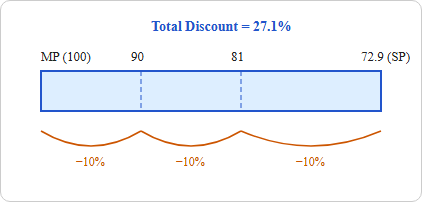
⇒ Let the Marked Price (MP) be ₹100.

⇒ First discount = 10% of 100 = ₹10. Price becomes = 100 − 10 = ₹90.

⇒ Second discount = 10% of 90 = ₹9. Price becomes = 90 − 9 = ₹81.

⇒ Third discount = 10% of 81 = ₹8.1. Price becomes = 81 − 8.1 = ₹72.9.

⇒ Total Single Discount = MP − Final Selling Price (SP)

⇒ Total Discount = 100 − 72.9 = 27.1.

⇒ Equivalent Discount Percentage = (27.1 ÷ 100) × 100 = 27.1%.

∴ The correct answer is 27.1%.

Additional Information

Successive Discount for n periods

The final multiplier for successive discounts d1, d2, ... dn is (1 − d1/100) × (1 − d2/100) × ... × (1 − dn/100).

Difference between Discount and Profit

Discount is always calculated on the Marked Price (MP), while Profit or Loss is calculated on the Cost Price (CP).

Mark-up Percentage

The percentage by which the cost price is increased to set the marked price: Mark-up % = [(MP − CP) ÷ CP] × 100.

RRB NTPC (UG) CBT-I Official Paper (Held On 07 May, 2026 Shift 2) (Previous Year Paper)·Mathematics
View full paper

Question 42

RRB NTPC 2026• Mathematics• Mathematics

A tank is being filled by two taps, M and N. M fills the tank completely in 18 hours and N fills it in 9 hours. A leakage at the bottom of the tank can empty the completely filled tank in 27 hours. How long will it take to fill the empty tank completely if both taps are opened while the leakage continues?

  1. AOption (a)

    737 7\frac{3}{7} hours

  2. BOption (b)

    7 57\frac{5}{7} hours

  3. COption (c)

    6 47\frac{4}{7} hours

  4. DOption (d)

    6 57\frac{5}{7} hours

View answer & explanation

Correct answer

Answer: (b)B.

7 57\frac{5}{7} hours

Why this answer is correct

Shortcut Trick

Let the total capacity of the tank be LCM(18, 9, 27) = 54 units.

Efficiency: M = +3, N = +6, and Leakage = −2.

Net efficiency when all are open = 3 + 6 − 2 = 7 units/hr.

Time required = Total capacity ÷ Net efficiency = 54 ÷ 7 = 7 5/7 hr.

∴ The correct answer is 7 5/7 hr.

Alternate Method

Given:

Time taken by Tap M = 18 hr

Time taken by Tap N = 9 hr

Time taken by Leakage to empty = 27 hr

Person/TapTime (hr)Total Work (LCM)Efficiency
Tap M1854+3
Tap N9+6
Leakage27−2

Calculations:

⇒ Net efficiency of (M + N + Leakage) = 3 + 6 − 2

⇒ Net efficiency = 7 units/hr

⇒ Time taken to fill the tank = Total Work ÷ Net Efficiency

⇒ Time = 54 ÷ 7 hr

⇒ Time = 7 5/7 hr

∴ The correct answer is 7 5/7 hr.

Additional Information

Efficiency and Time Relationship

Efficiency is inversely proportional to time. If a pipe fills a tank in 'x' hours, its 1-hour work is 1/x.

Negative Work (Leakage)

In pipes and cisterns, a filling tap does positive work, while a leakage or outlet pipe does negative work.

Combined Rate Formula

Net Rate = (1/M) + (1/N) − (1/L), where L is the time taken by the leakage to empty the tank.

RRB NTPC (UG) CBT-I Official Paper (Held On 07 May, 2026 Shift 2) (Previous Year Paper)·Mathematics
View full paper

Question 43

RRB NTPC 2026• Mathematics• Mathematics

Which of the following digits should replace X so that the three-digit number 2X2 is divisible by 4?

  1. AOption (a)

    1

  2. BOption (b)

    2

  3. COption (c)

    0

  4. DOption (d)

    4

View answer & explanation

Correct answer

Answer: (a)A.

1

Why this answer is correct

Shortcut Trick

Check the divisibility rule of 4: the last two digits must be divisible by 4.

The last two digits of 2X2 are X2.

Test the options: If X = 1, the number is 12, which is divisible by 4 (12 ÷ 4 = 3).

Testing other digits: 02, 22, and 42 are not divisible by 4.

∴ The correct answer is 1.

Alternate Method

Given: A three-digit number 2X2.

Formula Used: A number is divisible by 4 if the number formed by its last two digits is a multiple of 4.

Calculations:

⇒ Let the digits be checked for X2:

⇒ If X = 1 → 12 ÷ 4 = 3 (Remainder = 0) ∴ Divisible

⇒ If X = 2 → 22 ÷ 4 = 5.5 (Remainder ≠ 0) ∴ Not Divisible

⇒ If X = 0 → 02 ÷ 4 = 0.5 (Remainder ≠ 0) ∴ Not Divisible

⇒ If X = 4 → 42 ÷ 4 = 10.5 (Remainder ≠ 0) ∴ Not Divisible

∴ The correct answer is 1.

Additional Information

Divisibility by 2

A number is divisible by 2 if its last digit is even (0, 2, 4, 6, or 8).

Divisibility by 8

A number is divisible by 8 if the number formed by its last three digits is divisible by 8.

Divisibility by 3

A number is divisible by 3 if the sum of its digits is divisible by 3.

Divisibility by 5

A number is divisible by 5 if its last digit is either 0 or 5.

RRB NTPC (UG) CBT-I Official Paper (Held On 07 May, 2026 Shift 2) (Previous Year Paper)·Mathematics
View full paper

Question 44

RRB NTPC 2026• Mathematics• Mathematics

Two taps can fill a cistern in 4 hours and 11 hours, respectively. A third tap can empty it in 11 hours. How long (in hours) will it take to fill one-fourth of the empty cistern if all the taps are opened together?

  1. AOption (a)

    4

  2. BOption (b)

    3

  3. COption (c)

    2

  4. DOption (d)

    1

View answer & explanation

Correct answer

Answer: (d)D.

1

Why this answer is correct

Shortcut Trick

Net efficiency of Tap B (filling in 11 hr) and Tap C (emptying in 11 hr) is zero.

Therefore, the effective rate of filling the cistern depends only on Tap A.

Rate of Tap A = 1 cistern per 4 hr ⇒ 1/4 cistern per hour.

To fill 1/4th of the empty cistern, time = (1/4) ÷ (1/4) = 1 hr.

∴ The correct answer is 1 hr.

Alternate Method

Given: Tap A (filling) = 4 hr, Tap B (filling) = 11 hr, Tap C (emptying) = 11 hr.

Assume Total Capacity of the cistern = LCM of (4, 11, 11) = 44 units.

TapHoursTotal WorkEfficiency
Tap A (+)444 units11
Tap B (+)114
Tap C (−)11−4

⇒ Combined Efficiency of all taps = 11 + 4 − 4 = 11 units/hr

⇒ Target to fill one-fourth of the cistern = 1/4 × 44 = 11 units

⇒ Required Time = Target Work ÷ Combined Efficiency

⇒ Required Time = 11 ÷ 11 = 1 hr

∴ The correct answer is 1 hr.

Additional Information

Inlet and Outlet Pipes

Inlet pipes fill the tank (positive efficiency), while outlet pipes or leaks empty the tank (negative efficiency).

LCM Method for Capacity

Assuming the cistern capacity as the LCM of individual times makes calculation easier by providing integer efficiency values.

Total Time Formula

If multiple taps work together, the total time is calculated as: 1/Ttotal = 1/T1 + 1/T2 − 1/T3.

RRB NTPC (UG) CBT-I Official Paper (Held On 07 May, 2026 Shift 2) (Previous Year Paper)·Mathematics
View full paper

Question 45

RRB NTPC 2026• Mathematics• Mathematics

A student scores 75, 80 and 90 in three tests with weights 2,3 and 5 respectively. What is the weighted average score?

  1. AOption (a)

    84

  2. BOption (b)

    85

  3. COption (c)

    83

  4. DOption (d)

    82

View answer & explanation

Correct answer

Answer: (a)A.

84

Why this answer is correct

Shortcut Trick

Direct Calculation: Weighted Average = Σ(Score × Weight) ÷ ΣWeights

Weighted Sum = (75 × 2) + (80 × 3) + (90 × 5)

Weighted Sum = 150 + 240 + 450 = 840

Total Weight = 2 + 3 + 5 = 10

Weighted Average = 840 ÷ 10 = 84

∴ The correct answer is 84.

Alternate Method

Given: Scores of the student are 75, 80, and 90 with respective weights 2, 3, and 5.

Formula Used: Weighted Average = [(w1 × x1) + (w2 × x2) + (w3 × x3)] ÷ (w1 + w2 + w3)

⇒ Total weighted points = (75 × 2) + (80 × 3) + (90 × 5)

⇒ Total weighted points = 150 + 240 + 450

⇒ Total weighted points = 840

⇒ Total sum of weights = 2 + 3 + 5 = 10

⇒ Weighted Average = 840 ÷ 10 = 84

∴ The correct answer is 84.

Additional Information

Weighted Mean Formula

The weighted mean is calculated as x̄w = (Σwixi) ÷ Σwi, where w is the weight and x is the value.

Simple Average vs Weighted Average

A simple average treats all data points equally (weights = 1), whereas a weighted average assigns relative importance to different values.

Deviation Method

Assume a mean 'A', then Average = A + [Σwi(xi − A) ÷ Σwi]. This simplifies calculations with large numbers.

RRB NTPC (UG) CBT-I Official Paper (Held On 07 May, 2026 Shift 2) (Previous Year Paper)·Mathematics
View full paper

Question 46

RRB NTPC 2026• Mathematics• Mathematics

A shopkeeper offers the following schemes on toys of the same marked price.

(A) Successive discounts of 44% and 12% on any number of toys bought.

(B) Successive discounts of 18%, 43% and 23% on any number of toys bought.

(C) 8% discount on the first 4 toys and 38% discount on each toy thereon.

(D) On buying ten items, the customer is billed for only seven items.

A customer wants to buy 10 toys. Which of the above schemes is the least beneficial to her?

  1. AOption (a)

    A

  2. BOption (b)

    B

  3. COption (c)

    D

  4. DOption (d)

    C

View answer & explanation

Correct answer

Answer: (d)D.

C

Why this answer is correct

Shortcut Trick

Scheme A discount: 44 + 12 − (44 × 12) ÷ 100 = 50.72%

Scheme B discount: 1 − (0.82 × 0.57 × 0.77) ≈ 64% (highest)

Scheme C discount: (4 × 8 + 6 × 38) ÷ 10 = 26%

Scheme D discount: 3 ÷ 10 × 100 = 30%

Least beneficial scheme for customer is the one with the minimum discount.

∴ The correct answer is Scheme C.

Alternate Method

Given: Total toys to buy = 10. Let Marked Price (MP) of each toy = ₹100.

Formula Used: Total Discount % = (Total Discount ÷ Total MP) × 100

⇒ Total MP for 10 toys = 10 × 100 = ₹1000.

⇒ Scheme A: Successive 44% and 12% ⇒ Discount = 1000 − [1000 × 0.56 × 0.88] = ₹507.2 (50.72%)

⇒ Scheme B: Successive 18%, 43%, 23% ⇒ Final Price = 1000 × 0.82 × 0.57 × 0.77 ≈ ₹359.9 ⇒ Discount ≈ ₹640.1 (64.01%)

⇒ Scheme C: 8% on 1st 4 toys + 38% on next 6 toys ⇒ Discount = (4 × 8) + (6 × 38) = 32 + 228 = ₹260 (26%)

⇒ Scheme D: Buy 10, pay for 7 ⇒ 3 items are free ⇒ Discount = (3 ÷ 10) × 100 = 30%

⇒ Comparing all discounts: 64.01% > 50.72% > 30% > 26%.

⇒ Since 26% is the lowest discount, Scheme C is the least beneficial to the customer.

∴ The correct answer is Scheme C.

Additional Information

Successive Discount Formula

For two successive discounts x% and y%, the effective discount is (x + y − xy/100)%.

Buy X Get Y Free

The discount percentage in "Buy X Get Y Free" schemes is calculated as: [Y ÷ (X + Y)] × 100.

Customer Benefit Rule

A scheme is most beneficial when the discount is maximum and least beneficial when the discount is minimum.

RRB NTPC (UG) CBT-I Official Paper (Held On 07 May, 2026 Shift 2) (Previous Year Paper)·Mathematics
View full paper

Question 47

RRB NTPC 2026• Mathematics• Mathematics

The average of k numbers is x. If 48 is subtracted from each of any two of the numbers, then we get (x-12) as the new average.

Find the value of k.

  1. AOption (a)

    5

  2. BOption (b)

    10

  3. COption (c)

    8

  4. DOption (d)

    3

View answer & explanation

Correct answer

Answer: (c)C.

8

Why this answer is correct

Shortcut Trick

Total reduction in the sum = 48 × 2 = 96.

Total reduction in the average = 12.

Number of terms (k) = (Total change in sum) ÷ (Change in average).

k = 96 ÷ 12 = 8.

∴ The correct answer is 8.

Alternate Method

Given:

Original average of k numbers = x

Reduction = 48 from any two numbers

New average = x − 12

Formula Used:

Average = Sum of observations ÷ Number of observations

Calculations:

⇒ Original Sum = k × x

⇒ Total reduction from the sum = 48 + 48 = 96

⇒ New Sum = (k × x) − 96

⇒ New Average = New Sum ÷ k

⇒ x − 12 = (kx − 96) ÷ k

⇒ k × (x − 12) = kx − 96

⇒ kx − 12k = kx − 96

⇒ 12k = 96

⇒ k = 96 ÷ 12

⇒ k = 8

∴ The correct answer is 8.

Additional Information

Arithmetic Change in Average

If a value 'n' is subtracted from every observation in a set, the average also decreases by 'n'.

Sum of Observations

Total Sum = Average × Number of items. Any change in the sum affects the average proportionally to the number of items.

Net Deviation Method

The sum of deviations of all items from their average is always zero. New average can be found by adding (Total Change ÷ Count) to the old average.

RRB NTPC (UG) CBT-I Official Paper (Held On 07 May, 2026 Shift 2) (Previous Year Paper)·Mathematics
View full paper

Question 48

RRB NTPC 2026• Mathematics• Mathematics

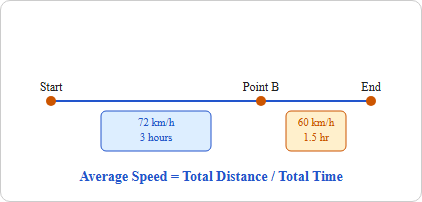
A train runs at 72 km/h for 3 hours and then at 60 km/h for 1.5 hours.

What is the average speed of the train?

  1. AOption (a)

    67 km/h

  2. BOption (b)

    66 km/h

  3. COption (c)

    65 km/h

  4. DOption (d)

    68 km/h

View answer & explanation

Correct answer

Answer: (d)D.

68 km/h

Why this answer is correct

Shortcut Trick

Average Speed = (Total Distance) ÷ (Total Time)

Total Distance = (72 × 3) + (60 × 1.5) = 216 + 90 = 306 km

Total Time = 3 + 1.5 = 4.5 hr

Average Speed = 306 ÷ 4.5 = 68 km/h

∴ The correct answer is 68 km/h.

Alternate Method

Given:

Speed1 = 72 km/h, Time1 = 3 hr

Speed2 = 60 km/h, Time2 = 1.5 hr

Formula Used:

Distance = Speed × Time

Average Speed = Total Distance ÷ Total Time

Calculations:

⇒ Distance in first part (D1) = 72 × 3 = 216 km

⇒ Distance in second part (D2) = 60 × 1.5 = 90 km

⇒ Total Distance = 216 + 90 = 306 km

⇒ Total Time = 3 + 1.5 = 4.5 hr

⇒ Average Speed = 306 ÷ 4.5

⇒ Average Speed = 3060 ÷ 45

⇒ Average Speed = 68 km/h

∴ The correct answer is 68 km/h.

Additional Information

Average Speed for Equal Distance

If a journey is divided into two equal distances with speeds x and y, the average speed is given by (2xy) ÷ (x + y).

Unit Conversion

To convert speed from km/h to m/s, multiply the value by 5 ÷ 18. To convert from m/s to km/h, multiply by 18 ÷ 5.

Relative Speed

When two objects move in the opposite direction, relative speed is (u + v). In the same direction, relative speed is (u − v).

RRB NTPC (UG) CBT-I Official Paper (Held On 07 May, 2026 Shift 2) (Previous Year Paper)·Mathematics
View full paper

Question 49

RRB NTPC 2026• Mathematics• Mathematics

Evaluate 243 + (-7)3 + (-17)3

  1. AOption (a)

    8396

  2. BOption (b)

    8450

  3. COption (c)

    8568

  4. DOption (d)

    8345

View answer & explanation

Correct answer

Answer: (c)C.

8568

Why this answer is correct

Shortcut Trick

Identify the values as a = 24, b = −7, and c = −17.

Check the sum: 24 + (−7) + (−17) = 24 − 24 = 0.

Apply the Algebraic Identity: If a + b + c = 0, then a3 + b3 + c3 = 3abc.

Calculation: 3 × 24 × (−7) × (−17) = 72 × 119 = 8568.

∴ The correct answer is 8568.

Alternate Method

Given:

Expression: 243 + (−7)3 + (−17)3

Formula Used:

The standard algebraic identity is a3 + b3 + c3 − 3abc = (a + b + c)(a2 + b2 + c2 − ab − bc − ca).

Calculations:

⇒ Let a = 24, b = −7, and c = −17.

⇒ First, evaluate the sum (a + b + c).

⇒ a + b + c = 24 + (−7) + (−17) = 24 − 24 = 0.

⇒ Substituting (a + b + c) = 0 into the identity:

⇒ a3 + b3 + c3 − 3abc = 0 × (a2 + b2 + c2 − ab − bc − ca) = 0.

⇒ a3 + b3 + c3 = 3abc.

⇒ Now, calculate the value of 3abc:

⇒ Value = 3 × 24 × (−7) × (−17).

⇒ Value = 72 × 119.

⇒ Value = 8568.

∴ The correct answer is 8568.

Additional Information

Special Case of Cubic Identity

If a + b + c = 0, then a3 + b3 + c3 = 3abc. This is widely used in simplifying sum of cubes when the bases sum to zero.

Alternate Condition for 3abc

The expression a3 + b3 + c3 also equals 3abc if a = b = c, as the second bracket (a2 + b2 + c2 − ab − bc − ca) becomes zero.

Square of Trinomial

Related identity: (a + b + c)2 = a2 + b2 + c2 + 2(ab + bc + ca).

RRB NTPC (UG) CBT-I Official Paper (Held On 07 May, 2026 Shift 2) (Previous Year Paper)·Mathematics
View full paper

Question 50

RRB NTPC 2026• Mathematics• Mathematics

A transaction code 92419 is not divisible by 13. To make it divisible by 13, the least digit should be appended at the end of the number. What is that digit?

  1. AOption (a)

    6

  2. BOption (b)

    2

  3. COption (c)

    5

  4. DOption (d)

    4

View answer & explanation

Correct answer

Answer: (a)A.

6

Why this answer is correct

Shortcut Trick

To make the number 92419x divisible by 13, first find the remainder of 924190 ÷ 13.

924190 ÷ 13 → Remainder is 7.

Required digit = Divisor − Remainder

Required digit = 13 − 7 = 6.

∴ The correct answer is 6.

Alternate Method

Given: Original transaction code = 92419. Divisor = 13.

Let the least digit to be appended at the end be x.

The new number becomes 924190 + x.

⇒ Perform division of 924190 by 13 to find the remainder:

⇒ 92 ÷ 13 = 7, Remainder = 1

⇒ 14 ÷ 13 = 1, Remainder = 1

⇒ 11 ÷ 13 = 0, Remainder = 11

⇒ 119 ÷ 13 = 9, Remainder = 2

⇒ 20 ÷ 13 = 1, Remainder = 7

⇒ So, 924190 ≡ 7 (mod 13).

⇒ For the number to be divisible by 13, (7 + x) must be a multiple of 13.

⇒ 7 + x = 13

⇒ x = 13 − 7 = 6.

∴ The correct answer is 6.

Additional Information

Divisibility Rule of 13

Multiply the last digit of the number by 4 and add it to the rest of the number. If the resulting sum is divisible by 13, the original number is also divisible.

Remainder Addition Rule

To make a number N divisible by D, the smallest number to add is (D − R), where R is the remainder obtained when N is divided by D.

Unit Digit Concept

Appending a digit to the end of a number N is equivalent to shifting the existing number one place to the left: Nnew = 10 × N + x.

RRB NTPC (UG) CBT-I Official Paper (Held On 07 May, 2026 Shift 2) (Previous Year Paper)·Mathematics
View full paper

Question 51

RRB NTPC 2026• Mathematics• Mathematics

The diagonals of a rhombus-shaped field are 224 m and 420 m long.

What is the perimeter (in m) of the field?

  1. AOption (a)

    952

  2. BOption (b)

    922

  3. COption (c)

    904

  4. DOption (d)

    944

View answer & explanation

Correct answer

Answer: (a)A.

952

Why this answer is correct

Shortcut Trick

Ratio of half-diagonals = (224/2) : (420/2) = 112 : 210 = 8 : 15 (divided by 14).

Using Pythagorean triplet (8, 15, 17), the side ratio is 17.

Actual side of rhombus = 17 × 14 = 238 m.

Perimeter = 4 × Side = 4 × 238 = 952 m.

∴ The correct answer is 952 m.

Alternate Method

Given:

Diagonal 1 (d1) = 224 m

Diagonal 2 (d2) = 420 m

Formula Used:

Side of rhombus (a) = √[(d1/2)2 + (d2/2)2]

Perimeter of rhombus = 4 × a

Calculations:

⇒ Half of Diagonal 1 = 224 ÷ 2 = 112 m

⇒ Half of Diagonal 2 = 420 ÷ 2 = 210 m

⇒ Side (a) = √(1122 + 2102)

⇒ Side (a) = √(12544 + 44100)

⇒ Side (a) = √56644

⇒ Side (a) = 238 m

⇒ Perimeter = 4 × 238

⇒ Perimeter = 952 m

∴ The correct answer is 952 m.

Additional Information

Properties of a Rhombus

A rhombus is a quadrilateral with all sides equal. Its diagonals bisect each other at right angles (90°).

Area of Rhombus

The area of a rhombus can be calculated using diagonals as: Area = 1/2 × d1 × d2.

Relation between Side and Diagonals

For a rhombus with side 'a' and diagonals d1 and d2, the relation is: 4a2 = d12 + d22.

RRB NTPC (UG) CBT-I Official Paper (Held On 07 May, 2026 Shift 2) (Previous Year Paper)·Mathematics
View full paper

Question 52

RRB NTPC 2026• Mathematics• Mathematics

The speeds of two cars are in the ratio 5 : 7. The faster car covers 140 km in 2 hours.

How much distance will the slower car cover in the same time?

  1. AOption (a)

    70 km

  2. BOption (b)

    90 km

  3. COption (c)

    140 km

  4. DOption (d)

    100 km

View answer & explanation

Correct answer

Answer: (d)D.

100 km

Why this answer is correct

Shortcut Trick

When time is constant, the distance covered is directly proportional to the speed.

Ratio of Speeds = 5 : 7 ⇒ Ratio of Distances = 5 : 7.

Given Faster car (7 units) covers 140 km.

1 unit = 140 ÷ 7 = 20 km.

Slower car (5 units) distance = 5 × 20 = 100 km.

∴ The correct answer is 100 km.

Alternate Method

Given:

Ratio of Speeds = 5 : 7

Faster car distance = 140 km | Time = 2 hr

Formula Used:

Speed = Distance ÷ Time

Calculations:

⇒ Speed of the faster car = 140 ÷ 2 = 70 kmph

⇒ According to the ratio, if the speeds are 5x and 7x, then:

⇒ 7x = 70 kmph

⇒ x = 10 kmph

⇒ Speed of the slower car = 5 × 10 = 50 kmph

⇒ Distance covered by the slower car in 2 hours = Speed × Time

⇒ Distance = 50 × 2 = 100 km

∴ The correct answer is 100 km.

Additional Information

Direct Proportionality of Distance

If time is constant, the ratio of distances covered is equal to the ratio of speeds: D1/D2 = S1/S2.

Inverse Proportionality of Time

If distance is constant, the ratio of speeds is inversely proportional to the ratio of time taken: S1/S2 = T2/T1.

Average Speed Formula

When a person travels equal distances at speeds x and y, the average speed is (2 × x × y) ÷ (x + y).

RRB NTPC (UG) CBT-I Official Paper (Held On 07 May, 2026 Shift 2) (Previous Year Paper)·Mathematics
View full paper

Question 53

RRB NTPC 2026• Mathematics• Mathematics

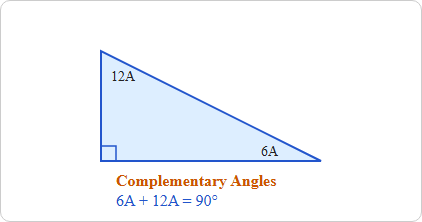
If sin 6A = cos 12A,

find the value of tan 9A + cot 9A.

  1. AOption (a)

    0

  2. BOption (b)

    -2

  3. COption (c)

    1

  4. DOption (d)

    2

View answer & explanation

Correct answer

Answer: (d)D.

2

Why this answer is correct

Shortcut Trick

For complementary angles, sin α = cos β implies α + β = 90°.

Equating the angles: 6A + 12A = 90° ⇒ 18A = 90°.

Dividing by 2 gives the target angle: 9A = 45°.

Substitute the value: tan 45° + cot 45° = 1 + 1 = 2.

∴ The correct answer is 2.

Alternate Method

Given: sin 6A = cos 12A

Formula Used: sin θ = cos(90° − θ) or cos θ = sin(90° − θ)

⇒ sin 6A = cos 12A

⇒ sin 6A = sin(90° − 12A)

⇒ 6A = 90° − 12A

⇒ 18A = 90°

⇒ A = 5°

⇒ 9A = 9 × 5° = 45°

⇒ tan 9A + cot 9A = tan 45° + cot 45°

⇒ Since tan 45° = 1 and cot 45° = 1

⇒ 1 + 1 = 2

∴ The correct answer is 2.

Additional Information

Co-function Identities

Trigonometric functions of complementary angles are related as sin θ = cos(90° − θ), tan θ = cot(90° − θ), and sec θ = cosec(90° − θ).

Reciprocal Relations

Tangent and cotangent are reciprocals of each other, where tan θ × cot θ = 1.

Sum of tan and cot

The expression tan θ + cot θ can be simplified to 2 / sin 2θ, which equals 2 when θ = 45°.

RRB NTPC (UG) CBT-I Official Paper (Held On 07 May, 2026 Shift 2) (Previous Year Paper)·Mathematics
View full paper

Question 54

RRB NTPC 2026• Mathematics• Mathematics

ABCD is a quadrilateral in which AB || DC, and E and F are the mid points of the diagonals AC and BD, respectively. If AB = 74 cm, BC = 91 cm, DC = 26 cm, and AD = 39 cm,

then what is the length (in cm) of EF?

  1. AOption (a)

    24

  2. BOption (b)

    22

  3. COption (c)

    21

  4. DOption (d)

    25

View answer & explanation

Correct answer

Answer: (a)A.

24

Why this answer is correct

Shortcut Trick

In a trapezoid (where AB || DC), the length of the line segment joining the midpoints of the diagonals is always equal to half the absolute difference between the lengths of the parallel sides.

Formula: EF = (AB − DC) ÷ 2

⇒ EF = (74 − 26) ÷ 2

⇒ EF = 48 ÷ 2 = 24 cm.

∴ The correct answer is 24 cm.

Alternate Method

Given: Parallel sides AB = 74 cm and DC = 26 cm. E and F are midpoints of diagonals AC and BD.

Formula Used: In ▵ADC and ▵ADB, the line segment joining the midpoints of two sides is parallel to the third side and half its length.

Let M be the midpoint of the non-parallel side AD.

⇒ In ▵ADC, M and E are midpoints of AD and AC respectively.

⇒ ME = DC ÷ 2 = 26 ÷ 2 = 13 cm.

⇒ In ▵ADB, M and F are midpoints of AD and BD respectively.

⇒ MF = AB ÷ 2 = 74 ÷ 2 = 37 cm.

⇒ Since AB || DC, the points M, E, and F are collinear.

⇒ EF = MF − ME

⇒ EF = 37 − 13 = 24 cm.

∴ The correct answer is 24 cm.

Additional Information

Median of a Trapezoid

The segment connecting the midpoints of the non-parallel sides is called the median, and its length is (a + b) ÷ 2.

Midsegment Theorem

The line segment joining the midpoints of two sides of a triangle is parallel to the third side and half as long.

Area of a Trapezoid

The area is calculated as ½ × (sum of parallel sides) × height, or Area = ½ × (a + b) × h.

RRB NTPC (UG) CBT-I Official Paper (Held On 07 May, 2026 Shift 2) (Previous Year Paper)·Mathematics
View full paper

Question 55

RRB NTPC 2026• Mathematics• Mathematics

The largest four-digit number which when divided by 7, 6 and 10 leaves the remainder 5 in each case, is:

  1. AOption (a)

    9793

  2. BOption (b)

    9875

  3. COption (c)

    9909

  4. DOption (d)

    9964

View answer & explanation

Correct answer

Answer: (b)B.

9875

Why this answer is correct

Shortcut Trick

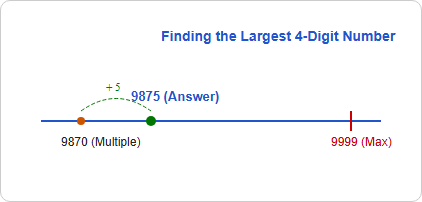
Find the LCM of divisors 7, 6, and 10, which is 210.

Identify the largest 4-digit multiple of 210 by dividing 9999 ÷ 210.

9999 ÷ 210 = 47 with a remainder of 129.

Subtract the remainder from 9999 to get 9870, then add the common remainder 5.

Required Number = 9870 + 5 = 9875.

∴ The correct answer is 9875.

Alternate Method

Given: Divisors are 7, 6, and 10. The common remainder in each case is 5.

Formula Used: Required Number = (LCM of divisors × k) + Remainder, where k is a constant to find the largest 4-digit number.

Step-by-step Calculation:

⇒ LCM of 7, 6, and 10:

7 = 7

6 = 2 × 3

10 = 2 × 5

⇒ LCM = 2 × 3 × 5 × 7 = 210.

⇒ Largest 4-digit number = 9999.

⇒ Divide 9999 by 210: 9999 ÷ 210 = 47.614...

⇒ Largest multiple of 210 below 9999 = 210 × 47 = 9870.

⇒ Adding the remainder: 9870 + 5 = 9875.

∴ The correct answer is 9875.

Additional Information

General Form for LCM Remainders

If a number leaves the same remainder r when divided by x, y, and z, the general form of the number is LCM(x, y, z) × k + r.

Finding N-digit Largest Number

To find the largest n-digit number divisible by L, calculate (Largest n-digit number − Remainder of [Largest n-digit number ÷ L]).

Dividend Rule

Dividend = (Divisor × Quotient) + Remainder. This rule helps verify divisibility and remainder constraints.

RRB NTPC (UG) CBT-I Official Paper (Held On 07 May, 2026 Shift 2) (Previous Year Paper)·Mathematics
View full paper

Question 56

RRB NTPC 2026• Mathematics• Mathematics

Four numbers a, b, c and d satisfy the relation

(a + 2) : (b − 2) = (c + 4) : (d − 4).

If a = 6, b = 8 and c = 12,

find the value of d.

  1. AOption (a)

    20

  2. BOption (b)

    18

  3. COption (c)

    14

  4. DOption (d)

    16

View answer & explanation

Correct answer

Answer: (d)D.

16

Why this answer is correct

Shortcut Trick

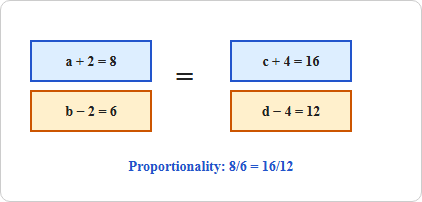
First ratio (a + 2) : (b − 2) = (6 + 2) : (8 − 2) = 8 : 6 = 4 : 3.

Second ratio (c + 4) : (d − 4) = (12 + 4) : (d − 4) = 16 : (d − 4).

Since the ratios are equal: 4 / 3 = 16 / (d − 4).

By comparison, 16 is 4 × 4, so (d − 4) must be 3 × 4 = 12.

Solving for d: d = 12 + 4 = 16.

∴ The correct answer is 16.

Alternate Method

Given: a = 6, b = 8, c = 12 and the proportion (a + 2) / (b − 2) = (c + 4) / (d − 4).

Formula: If x : y = p : q, then x/y = p/q.

Calculations:

⇒ (6 + 2) / (8 − 2) = (12 + 4) / (d − 4)

⇒ 8 / 6 = 16 / (d − 4)

⇒ 4 / 3 = 16 / (d − 4)

⇒ 4 × (d − 4) = 16 × 3

⇒ 4d − 16 = 48

⇒ 4d = 48 + 16

⇒ 4d = 64

⇒ d = 64 / 4 = 16

∴ The correct answer is 16.

Additional Information

Definition of Proportion

A proportion is an equation that states that two ratios are equal. If a : b = c : d, then a × d = b × c.

Cross-Multiplication Rule

For any fractional equation a/b = c/d, the product of the extremes (a and d) equals the product of the means (b and c).

Fourth Proportional

In the proportion a : b = c : d, the term d is called the fourth proportional to a, b, and c, calculated as d = (b × c) / a.

RRB NTPC (UG) CBT-I Official Paper (Held On 07 May, 2026 Shift 2) (Previous Year Paper)·Mathematics
View full paper

Question 57

RRB NTPC 2026• Mathematics• Mathematics

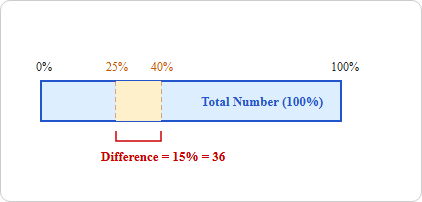
If 40% of a number exceeds 25% of it by 36, then the number is:

  1. AOption (a)

    260

  2. BOption (b)

    280

  3. COption (c)

    240

  4. DOption (d)

    220

View answer & explanation

Correct answer

Answer: (c)C.

240

Why this answer is correct

Shortcut Trick

Difference in percentage = 40% − 25% = 15%

According to the question, 15% of the number corresponds to 36.

⇒ 1% of the number = 36 ÷ 15 = 2.4

⇒ 100% of the number = 2.4 × 100 = 240

∴ The correct answer is 240.

Alternate Method

Given:

Percentage 1 = 40%

Percentage 2 = 25%

Difference in values = 36

Formula Used:

Number = (Difference in values × 100) ÷ (Difference in percentages)

Calculations:

Let the number be x.

⇒ 40% of x − 25% of x = 36

⇒ 0.40x − 0.25x = 36

⇒ 0.15x = 36

⇒ x = 36 ÷ 0.15

⇒ x = 3600 ÷ 15

⇒ x = 240

∴ The correct answer is 240.

Additional Information

Percentage Change Formula

Percentage change = (Difference ÷ Original Value) × 100. This is useful for finding percentage increases or decreases.

Fractional Conversion

Converting percentages to fractions can simplify calculations: 25% = 1/4 and 40% = 2/5. The difference (2/5 − 1/4) = 3/20.

Base Value Concept

In problems where a number is unknown, always assume the base number to be 100% or 100 units for easier calculation.

RRB NTPC (UG) CBT-I Official Paper (Held On 07 May, 2026 Shift 2) (Previous Year Paper)·Mathematics
View full paper

Question 58

RRB NTPC 2026• Mathematics• Mathematics

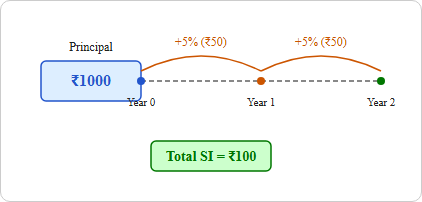
If the principal is ₹1000, the rate is 5% per annum, and the time is 2 years,

what is the simple interest?

  1. AOption (a)

    ₹50

  2. BOption (b)

    ₹100

  3. COption (c)

    ₹200

  4. DOption (d)

    ₹500

View answer & explanation

Correct answer

Answer: (b)B.

₹100

Why this answer is correct

Shortcut Trick

Net Interest Percentage = Rate × Time

Net Interest Percentage = 5% × 2 = 10%

Simple Interest = 10% of 1000

Simple Interest = ₹100

∴ The correct answer is ₹100.

Alternate Method

Given:

Principal (P) = ₹1000

Rate (R) = 5% per annum

Time (T) = 2 years

Formula Used:

Simple Interest (SI) = (P × R × T) ÷ 100

Calculations:

⇒ SI = (1000 × 5 × 2) ÷ 100

⇒ SI = (1000 × 10) ÷ 100

⇒ SI = 10000 ÷ 100

⇒ SI = ₹100

∴ The correct answer is ₹100.

Additional Information

Amount Formula

The total sum payable after a specific time is the Amount, calculated as A = Principal + Simple Interest.

SI vs CI for First Year

For the first year, if interest is compounded annually, both Simple Interest and Compound Interest remain exactly the same.

Relationship of SI to Variables

Simple Interest is directly proportional to the Principal, Rate, and Time. If any of these double, the interest also doubles.

RRB NTPC (UG) CBT-I Official Paper (Held On 07 May, 2026 Shift 2) (Previous Year Paper)·Mathematics
View full paper

Question 59

RRB NTPC 2026• Mathematics• Mathematics

The ages of two siblings add up to 44 years. If one sibling is 4 years younger than twice the other's age,

what is the difference between their ages?

  1. AOption (a)

    8 years

  2. BOption (b)

    12 years

  3. COption (c)

    14 years

  4. DOption (d)

    10 years

View answer & explanation

Correct answer

Answer: (b)B.

12 years

Why this answer is correct

Shortcut Trick

Let the age of the younger sibling be x.

Equation based on condition: x + (2x − 4) = 44 years.

⇒ 3x − 4 = 44 ⇒ 3x = 48 ⇒ x = 16 years.

The two ages are 16 and (44 − 16) = 28 years.

Difference = 28 − 16 = 12 years.

∴ The correct answer is 12 years.

Alternate Method

Given:

Total sum of ages = 44 years

Relation: One sibling = 2 × (Other sibling) − 4 years

Calculations:

⇒ Let the age of the younger sibling = x

⇒ Age of the older sibling = 2x − 4

⇒ x + 2x − 4 = 44

⇒ 3x = 44 + 4

⇒ 3x = 48

⇒ x = 16

⇒ Younger sibling age = 16 years

⇒ Older sibling age = 2(16) − 4 = 32 − 4 = 28 years

⇒ Difference = 28 − 16 = 12 years

∴ The correct answer is 12 years.

Additional Information

Constant Age Difference

The difference between the ages of two individuals always remains constant, regardless of how many years pass.

Age Ratio Problems

If the current ages are in the ratio a:b, then after n years, their ages will be (a+n) and (b+n). The ratio changes but the difference (b−a) stays same.

Sum of Ages in 'n' Years

If the current sum of ages of k people is S, then after n years, the new sum will be S + (k × n).

RRB NTPC (UG) CBT-I Official Paper (Held On 07 May, 2026 Shift 2) (Previous Year Paper)·Mathematics
View full paper

Question 60

RRB NTPC 2026• Mathematics• Mathematics

Simplify 10.5−[6.5−3.3−(3.2−2.2−1.8‾)] 10.5 - [6.5 - {3.3 - (3.2 - \overline{2.2 - 1.8})}]

  1. AOption (a)

    10.5

  2. BOption (b)

    0

  3. COption (c)

    1

  4. DOption (d)

    4.5

View answer & explanation

Correct answer

Answer: (d)D.

4.5

Why this answer is correct

Shortcut Trick

Solve the expression from innermost to outermost using VBODMAS logic.

Vinculum and Small Bracket: (3.2 − 0.4) = 2.8

Curly Braces: {3.3 − 2.8} = 0.5

Square Brackets: [6.5 − 0.5] = 6.0

Final Step: 10.5 − 6.0 = 4.5

∴ The correct answer is 4.5.

Alternate Method

Given: 10.5 − [6.5 − {3.3 − (3.2 − (2.2 − 1.8))}]

Method: Using the VBODMAS rule (Vinculum, Brackets, Of, Division, Multiplication, Addition, Subtraction).

⇒ 10.5 − [6.5 − {3.3 − (3.2 − 0.4)}]

⇒ 10.5 − [6.5 − {3.3 − 2.8}]

⇒ 10.5 − [6.5 − 0.5]

⇒ 10.5 − 6.0

⇒ 4.5

∴ The correct answer is 4.5.

Additional Information

VBODMAS Rule

It defines the sequence of operations: Vinculum (bar), Brackets, Of, Division, Multiplication, Addition, and Subtraction.

Brackets Order

Solve brackets in this specific order: Round Brackets ( ) → Curly Braces { } → Square Brackets [ ].

Vinculum (Bar)

A horizontal line over an expression indicates that it must be simplified first, even before the round brackets.

How should I prepare for Quantitative Aptitude in RRB NTPC?

Solving previous year questions by topic helps identify recurring concepts, question patterns, and frequently asked sub-topics. Attempt each question, review the step-by-step explanation, and note down key formulas or facts for quick revision before the exam.