IBPS Probationary Officer (PO) Β· Topic Collection

Quantitative Aptitude PYQs

Arithmetic, number systems, percentages, ratios, profit and loss, time and work, algebra, geometry, mensuration, and trigonometry.

1305 Total Questions38 Official PapersYears: 2021–2026Search in Quantitative Aptitude
Showing questions 141–160 of 1305Page 8 of 66
IBPS PO Prelims Memory Based Paper (Held On: 23 August 2025 Shift 1) (Previous Year Paper)Β·Quantitative Aptitude
View full paper

Question 141

IBPS Probationary Officer (PO) 2025β€’ Quantitative Aptitudeβ€’ Quantitative Aptitude

The total time taken by the boat to cover 108 km upstream and 114 km downstream in 18 hours. The speed of the boat and the speed of the stream is x + 4 km and x – 5 km/hr respectively. Find the speed of the stream.

  1. AOption (a)

    7 km/hr

  2. BOption (b)

    5 km/hr

  3. COption (c)

    3 km/hr

  4. DOption (d)

    4 km/hr

  5. EOption (e)

    6 km/hr

View answer & explanation

Correct answer

Answer: (b)B.

5 km/hr

Why this answer is correct

Shortcut Trick

Upstream speed (U) = (x + 4) βˆ’ (x βˆ’ 5) = 9 km/hr.

Downstream speed (D) = (x + 4) + (x βˆ’ 5) = 2x βˆ’ 1 km/hr.

Upstream time = 108 Γ· 9 = 12 hours.

Downstream time = 18 βˆ’ 12 = 6 hours.

Downstream speed (D) = 114 Γ· 6 = 19 km/hr β‡’ 2x βˆ’ 1 = 19 β‡’ x = 10.

Speed of stream = x βˆ’ 5 = 10 βˆ’ 5 = 5 km/hr.

∴ The correct answer is 5 km/hr.

Alternate Method

Given:

Speed of boat in still water (u) = x + 4 km/hr

Speed of stream (v) = x βˆ’ 5 km/hr

Formula Used:

Upstream Speed = u βˆ’ v | Downstream Speed = u + v | Time = Distance Γ· Speed

Calculations:

β‡’ Upstream Speed = (x + 4) βˆ’ (x βˆ’ 5) = 9 km/hr

β‡’ Downstream Speed = (x + 4) + (x βˆ’ 5) = (2x βˆ’ 1) km/hr

β‡’ Total Time = Upstream Time + Downstream Time

β‡’ 18 = 108 Γ· 9 + 114 Γ· (2x βˆ’ 1)

β‡’ 18 = 12 + 114 Γ· (2x βˆ’ 1)

β‡’ 6 = 114 Γ· (2x βˆ’ 1)

β‡’ 2x βˆ’ 1 = 114 Γ· 6 = 19

β‡’ 2x = 20 β‡’ x = 10

β‡’ Speed of stream = x βˆ’ 5 = 10 βˆ’ 5 = 5 km/hr

∴ The correct answer is 5 km/hr.

Additional Information

Upstream and Downstream Basics

When a boat moves against the current, it is upstream (u βˆ’ v). When it moves with the current, it is downstream (u + v).

Average Speed of Boat

Average Speed = (Upstream Speed Γ— Downstream Speed) Γ· Speed of Boat in Still Water (when distances are equal).

Speed Conversion

To convert km/hr to m/s, multiply by 5/18. To convert m/s to km/hr, multiply by 18/5.
IBPS PO Prelims Memory Based Paper (Held On: 23 August 2025 Shift 1) (Previous Year Paper)Β·Quantitative Aptitude
View full paper

Question 142

IBPS Probationary Officer (PO) 2025β€’ Quantitative Aptitudeβ€’ Quantitative Aptitude

In the given question, two equations numbered l and II are given. Solve both the equations and mark the appropriate answer.

I. x2Β + 11xΒ βˆ’ 80 = 0

II. y2Β βˆ’ 27y + 110 = 0

  1. AOption (a)

    x > y

  2. BOption (b)

    x < y

  3. COption (c)

    xΒ β‰₯ y

  4. DOption (d)

    x ≀ y

  5. EOption (e)

    xΒ =Β y or relationship between x and y cannot be established.

View answer & explanation

Correct answer

Answer: (d)D.

x ≀ y

Why this answer is correct

I. x2Β + 11xΒ βˆ’ 80 = 0

β‡’ x2Β + 16xΒ βˆ’Β 5xΒ βˆ’ 80 = 0

β‡’ (x + 16), (x βˆ’ 5) = 0

x =Β βˆ’Β 16, 5

II. y2Β βˆ’ 27y + 110 = 0

β‡’ (yΒ βˆ’Β 22)(y βˆ’ 5) = 0

Β y =Β 22, 5

Value of xValue of yRelation
-165x < y
-1622x < y
55x = y
522x < y

∴ x ≀ y

IBPS PO Prelims Memory Based Paper (Held On: 23 August 2025 Shift 1) (Previous Year Paper)Β·Quantitative Aptitude
View full paper

Question 143

IBPS Probationary Officer (PO) 2025β€’ Quantitative Aptitudeβ€’ Quantitative Aptitude

In these question, two equations (I) and (II) are given. You have to solve both the equations and answer accordingly:

(I) 2x2 + 15x + 28 = 0

(II) 3y2 + 11y + 6 = 0

  1. AOption (a)

    If x > y

  2. BOption (b)

    If Β x β‰₯ y

  3. COption (c)

    If y > x

  4. DOption (d)

    If y β‰₯ x

  5. EOption (e)

    xΒ =Β y or the relationship between x and y cannot be established.

View answer & explanation

Correct answer

Answer: (c)C.

If y > x

Why this answer is correct

Calculation:

2x2 + 15x + 28 = 0

β‡’ 2x2 + 8x + 7x + 28 = 0

β‡’ 2x(xΒ + 4) + 7(x + 4)

β‡’ x = -4, -7/2

3y2 + 11y + 6 = 0

β‡’Β 3y2Β + 9y + 2y + 6 = 0

β‡’ 3y(yΒ + 3)Β + 2(y + 3)

β‡’ Y = -3, -2/3

Comparison between X and Y (via tabulation):

Value of xValue of yRelation
-4-3x < y
-4-2/3x < y
-7/2-3x < y
-7/2-2/3x < y

∴ x < y

IBPS PO Prelims Memory Based Paper (Held On: 23 August 2025 Shift 1) (Previous Year Paper)Β·Quantitative Aptitude
View full paper

Question 144

IBPS Probationary Officer (PO) 2025β€’ Quantitative Aptitudeβ€’ Quantitative Aptitude

In the given question, two equations numbered l and II are given. Solve both the equations and mark the appropriate answer.

I. x2Β +Β 28x + 147Β = 0

II. y2 – 15y – 154Β = 0

  1. AOption (a)

    x > y

  2. BOption (b)

    x β‰₯ y

  3. COption (c)

    y > x

  4. DOption (d)

    y β‰₯ x

  5. EOption (e)

    xΒ =Β y or relationship between x and y cannot be established.

View answer & explanation

Correct answer

Answer: (d)D.

y β‰₯ x

Why this answer is correct

According to given equations

I.Β x2Β +Β 28x + 147Β = 0

β‡’ x2Β +Β 21x + 7x + 147Β = 0

β‡’ x(x +Β 21) + 7(x +Β 2)Β = 0

β‡’ (x +Β 21) (x +Β 7)Β = 0

β‡’ x = -21, -7

II. y2 – 15y – 154Β = 0Β 

β‡’ y2 – 22y + 7y – 154Β = 0

β‡’ y(y – 22) +Β 7(y – 22) = 0

β‡’ (y – 22) (y +Β 7) = 0

β‡’ y = 22, -7

Comparison between x and y (via Tabulation):

xyRelation
-2122x<y
-21-7x<y
-722x<y
-7-7x=y

 ∴ y β‰₯ x

IBPS PO Prelims Memory Based Paper (Held On: 23 August 2025 Shift 1) (Previous Year Paper)Β·Quantitative Aptitude
View full paper

Question 145

IBPS Probationary Officer (PO) 2025β€’ Quantitative Aptitudeβ€’ Quantitative Aptitude

In the given question, two equations numbered l and II are given. Solve both the equations and mark the appropriate answer.

I. x2 –  15x + 44 = 0

II. 3y2 –  22y + 35 = 0

  1. AOption (a)

    x > y

  2. BOption (b)

    x β‰₯ y

  3. COption (c)

    y > x

  4. DOption (d)

    y β‰₯ x

  5. EOption (e)

    xΒ =Β y or relationship between x and y cannot be established.

View answer & explanation

Correct answer

Answer: (e)E.

xΒ =Β y or relationship between x and y cannot be established.

Why this answer is correct

According to given equations

I. x2 – 15x + 44 = 0

β‡’ x2 – 11x – 4x + 44Β = 0

β‡’ x(x – 11) – 4(x – 11)Β = 0

β‡’ (x – 4) (x – 11)Β = 0

β‡’ x = 11, 4

II. 3y2 – 22y + 35Β = 0

β‡’ 3y2 – 15y – 7y + 35 = 0

β‡’ 3y(y – 5) – 7(y – 5) = 0

β‡’ (y – 5) (3y – 7) = 0

β‡’ y = 7/3, 5

Comparison between x and y (via Tabulation):

xyRelation
117/3x > y
115x > y
47/3x > y
45x < y

∴ The relationship between x and y cannot be established.

IBPS PO Prelims Memory Based Paper (Held On: 23 August 2025 Shift 1) (Previous Year Paper)Β·Quantitative Aptitude
View full paper

Question 146

IBPS Probationary Officer (PO) 2025β€’ Quantitative Aptitudeβ€’ Quantitative Aptitude

The average weight of 50 people group is 48kg. There are new 10 peoples added in the group of average weight 45kg. From original group, there are 5 peoples of average weight 50kg are removed. Find the approximate average weight of newly formed group.

  1. AOption (a)

    50 kg

  2. BOption (b)

    47 kg

  3. COption (c)

    40 kg

  4. DOption (d)

    51 kg

  5. EOption (e)

    43 kg

View answer & explanation

Correct answer

Answer: (b)B.

47 kg

Why this answer is correct

Shortcut Trick

Net change in weight = (10 Γ— (45 βˆ’ 48)) βˆ’ (5 Γ— (50 βˆ’ 48))

Net change = βˆ’30 βˆ’ 10 = βˆ’40 kg

New total people = 50 + 10 βˆ’ 5 = 55

New Average = 48 + (βˆ’40 Γ· 55) β‰ˆ 48 βˆ’ 0.72 = 47.28 kg

∴ The correct answer is 47 kg.

Alternate Method

Given: Initial 50 people (avg 48kg), Added 10 people (avg 45kg), Removed 5 people (avg 50kg).

Formula: Average = Total Weight Γ· Number of People

β‡’ Total Weight = (50 Γ— 48) + (10 Γ— 45) βˆ’ (5 Γ— 50)

β‡’ Total Weight = 2400 + 450 βˆ’ 250 = 2600 kg

β‡’ Total Number of People = 50 + 10 βˆ’ 5 = 55

β‡’ New Average = 2600 Γ· 55 = 47.2727... kg

β‡’ Approximate Average β‰ˆ 47 kg

∴ The correct answer is 47 kg.

Additional Information

Weighted Average Formula

Average = (n1x1 + n2x2 βˆ’ n3x3) Γ· (n1 + n2 βˆ’ n3) where x represents the average and n represents number of observations.

Deviation Method for Averages

Net Deviation = βˆ‘(Individual Values βˆ’ Assumed Average). New Average = Assumed Average + (Net Deviation Γ· Total Number).

IBPS PO Prelims Memory Based Paper (Held On: 23 August 2025 Shift 1) (Previous Year Paper)Β·Quantitative Aptitude
View full paper

Question 147

IBPS Probationary Officer (PO) 2025β€’ Quantitative Aptitudeβ€’ Quantitative Aptitude

A train covers a distance of 450 km at an uniform speed. Had the speed been 10 kmph more, it would have taken 30 minutes less for the journey. How much time does this train take to cover 3/5th of the journey?

  1. AOption (a)

    2 hours

  2. BOption (b)

    3Β hours

  3. COption (c)

    5Β hours

  4. DOption (d)

    4Β hours

  5. EOption (e)

    6Β hours

View answer & explanation

Correct answer

Answer: (b)B.

3Β hours

Why this answer is correct

Shortcut Trick

Let original speed be S kmph. Using the product of speed formula: Distance = [S1 Γ— S2 / (S2 βˆ’ S1)] Γ— Time Difference.

450 = [S Γ— (S + 10) / 10] Γ— (30/60) β‡’ 450 = [S(S + 10) / 10] Γ— 1/2.

S(S + 10) = 9000 β‡’ S = 90 kmph (as 90 Γ— 100 = 9000).

Time for 3/5th journey = (3/5 Γ— 450) Γ· 90 = 270 Γ· 90 = 3 hr.

∴ The correct answer is 3 hr.

Alternate Method

Given: Total distance = 450 km, Speed increase = 10 kmph, Time saved = 30 mins = 0.5 hr.

Formula Used: Time = Distance / Speed

β‡’ (450 / S) βˆ’ [450 / (S + 10)] = 1/2

β‡’ 450 [ (S + 10 βˆ’ S) / (S(S + 10)) ] = 1/2

β‡’ 450 [ 10 / (S2 + 10S) ] = 1/2

β‡’ 4500 Γ— 2 = S2 + 10S

β‡’ S2 + 10S βˆ’ 9000 = 0

β‡’ S2 + 100S βˆ’ 90S βˆ’ 9000 = 0 β‡’ (S + 100)(S βˆ’ 90) = 0

β‡’ S = 90 kmph (Speed cannot be negative)

β‡’ 3/5th Distance = 3/5 Γ— 450 = 270 km

β‡’ Time required = 270 / 90 = 3 hr

∴ The correct answer is 3 hr.

Additional Information

Speed-Time Inversely Proportional

For a constant distance, speed is inversely proportional to time (S1/S2 = T2/T1).

Distance Formula for Speed Change

Distance = [v1v2 / |v1βˆ’v2|] Γ— Ξ”t, where Ξ”t is the difference in time taken at speeds v1 and v2.

Average Speed

Average Speed = Total Distance Γ· Total Time. For two equal halves of a journey with speeds x and y, it is 2xy/(x+y).

IBPS PO Prelims Memory Based Paper (Held On: 23 August 2025 Shift 1) (Previous Year Paper)Β·Quantitative Aptitude
View full paper

Question 148

IBPS Probationary Officer (PO) 2025β€’ Quantitative Aptitudeβ€’ Quantitative Aptitude

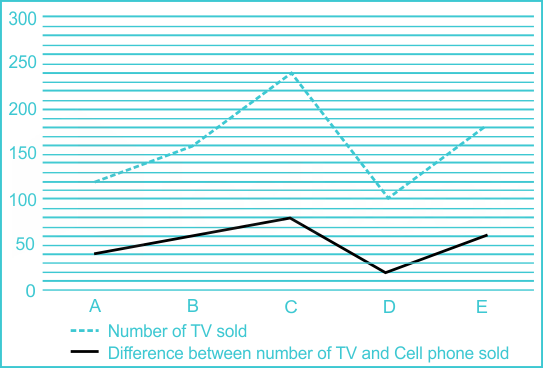
The line graph shows the number of Tv sold and number of differences between number of Tv and cell phone sold in five different shops [A, B, C, D and E]. Number of Tv sold is more than the number of cell phone in each shop.

If the selling price of each TV is β‚Ή15,000 and each Cell phone is β‚Ή8,000, then what is the total revenue difference between Shop C and Shop B?

  1. AOption (a)

    1680000

  2. BOption (b)

    145000

  3. COption (c)

    147000

  4. DOption (d)

    194500

  5. EOption (e)

    254000

View answer & explanation

Correct answer

Answer: (a)A.

1680000

Why this answer is correct

Common Calculation

Number of TV sold in shop A is 120.

Difference between number of TV and cell phone sold in shop A is 40.

Number of TV sold in each shop is more than number of cell phone sold.

So, Number of cell phone sold in shop A is 120 – 40 = 80.

Similarly, we can calculate others shops values also.

ShopNumber of TV soldNumber of Cell phone sold
A12080
B160100
C240160
D10080
E180120

Calculation

Shop C revenue = (240 Γ— 15000) + (160 Γ— 8000) = 48,80,000

Shop B revenue = (160 Γ— 15000) + (100 Γ— 8000) = 32,00,000

Difference = 4880000 - 3200000 = 16,80,000

IBPS PO Prelims Memory Based Paper (Held On: 23 August 2025 Shift 1) (Previous Year Paper)Β·Quantitative Aptitude
View full paper

Question 149

IBPS Probationary Officer (PO) 2025β€’ Quantitative Aptitudeβ€’ Quantitative Aptitude

The line graph shows the number of Tv sold and number of differences between number of Tv and cell phone sold in five different shops [A, B, C, D and E]. Number of Tv sold is more than the number of cell phone in each shop.

Average number of TVs sold across all 5 shops is what percent more than the average number of Cell phones sold across all 5 shops?

  1. AOption (a)

    48%

  2. BOption (b)

    62%

  3. COption (c)

    55%

  4. DOption (d)

    39%

  5. EOption (e)

    28%

View answer & explanation

Correct answer

Answer: (a)A.

48%

Why this answer is correct

Common Calculation

Number of TV sold in shop A is 120.

Difference between number of TV and cell phone sold in shop A is 40.

Number of TV sold in each shop is more than number of cell phone sold.

So, Number of cell phone sold in shop A is 120 – 40 = 80.

Similarly, we can calculate others shops values also.

ShopNumber of TV soldNumber of Cell phone sold
A12080
B160100
C240160
D10080
E180120

Calculation

Total TVs = 800 β†’ Avg = 160

Total Cell phones = 540 β†’ Avg = 108

% more = [(160 - 108)/108] Γ— 100 β‰ˆ 48.15%

IBPS PO Prelims Memory Based Paper (Held On: 23 August 2025 Shift 1) (Previous Year Paper)Β·Quantitative Aptitude
View full paper

Question 150

IBPS Probationary Officer (PO) 2025β€’ Quantitative Aptitudeβ€’ Quantitative Aptitude

The line graph shows the number of Tv sold and number of differences between number of Tv and cell phone sold in five different shops [A, B, C, D and E]. Number of Tv sold is more than the number of cell phone in each shop.

What is the ratio of total number of TVs sold in Shops A and C together to the total number of Cell phones sold in Shops B and D together?

  1. AOption (a)

    2:1

  2. BOption (b)

    3:2

  3. COption (c)

    5:4

  4. DOption (d)

    7:9

  5. EOption (e)

    9:7

View answer & explanation

Correct answer

Answer: (a)A.

2:1

Why this answer is correct

Common Calculation

Number of TV sold in shop A is 120.

Difference between number of TV and cell phone sold in shop A is 40.

Number of TV sold in each shop is more than number of cell phone sold.

So, Number of cell phone sold in shop A is 120 – 40 = 80.

Similarly, we can calculate others shops values also.

ShopNumber of TV soldNumber of Cell phone sold
A12080
B160100
C240160
D10080
E180120

Calculation

TVs in A + C = 120 + 240 = 360

Cell phones in B + D = 100 + 80 = 180

Ratio = 360 : 180 = 2 : 1

IBPS PO Prelims Memory Based Paper (Held On: 23 August 2025 Shift 1) (Previous Year Paper)Β·Quantitative Aptitude
View full paper

Question 151

IBPS Probationary Officer (PO) 2025β€’ Quantitative Aptitudeβ€’ Quantitative Aptitude

The line graph shows the number of Tv sold and number of differences between number of Tv and cell phone sold in five different shops [A, B, C, D and E]. Number of Tv sold is more than the number of cell phone in each shop.

By what percentage is the total number of items (TVs + Cell phones) sold in Shop E greater than that in Shop A?

  1. AOption (a)

    50%

  2. BOption (b)

    48%

  3. COption (c)

    64%

  4. DOption (d)

    28%

  5. EOption (e)

    55%

View answer & explanation

Correct answer

Answer: (a)A.

50%

Why this answer is correct

Common Calculation

Number of TV sold in shop A is 120.

Difference between number of TV and cell phone sold in shop A is 40.

Number of TV sold in each shop is more than number of cell phone sold.

So, Number of cell phone sold in shop A is 120 – 40 = 80.

Similarly, we can calculate others shops values also.

ShopNumber of TV soldNumber of Cell phone sold
A12080
B160100
C240160
D10080
E180120

Calculation

Shop A total = 120 + 80 = 200

Shop E total = 180 + 120 = 300

Increase = 100

% Increase = (100/200) Γ— 100 = 50%

IBPS PO Prelims Memory Based Paper (Held On: 23 August 2025 Shift 1) (Previous Year Paper)Β·Quantitative Aptitude
View full paper

Question 152

IBPS Probationary Officer (PO) 2025β€’ Quantitative Aptitudeβ€’ Quantitative Aptitude

The line graph shows the number of Tv sold and number of differences between number of Tv and cell phone sold in five different shops [A, B, C, D and E]. Number of Tv sold is more than the number of cell phone in each shop.

If 25% of TVs sold in Shop D were returned and 20% of Cell phones sold in Shop A were defective, then what is the ratio of remaining good items in Shop D to those in Shop A?

  1. AOption (a)

    155:184

  2. BOption (b)

    162:147

  3. COption (c)

    137:157

  4. DOption (d)

    121:159

  5. EOption (e)

    161:137

View answer & explanation

Correct answer

Answer: (a)A.

155:184

Why this answer is correct

Common Calculation

Number of TV sold in shop A is 120.

Difference between number of TV and cell phone sold in shop A is 40.

Number of TV sold in each shop is more than number of cell phone sold.

So, Number of cell phone sold in shop A is 120 – 40 = 80.

Similarly, we can calculate others shops values also.

ShopNumber of TV soldNumber of Cell phone sold
A12080
B160100
C240160
D10080
E180120

Calculation

Shop D: TVs good =Β [100 Γ— 75/100] =75, Cell phones = 80 β†’ Total = 155

Shop A: TVs = 120, Cell phones good =Β [80 Γ— 80/100] = 64Β β†’ Total = 184

Ratio = 155 : 184

IBPS PO Prelims Memory Based Paper (Held On: 23 August 2025 Shift 1) (Previous Year Paper)Β·Quantitative Aptitude
View full paper

Question 153

IBPS Probationary Officer (PO) 2025β€’ Quantitative Aptitudeβ€’ Quantitative Aptitude

Laxmi borrowed certain sum from Raj. Simple interest on that sum for 3 years at 8% per annum is half the compound interest on Rs. 4000 for 2 years at 10% per annum. The sum placed on simple interest is:

  1. AOption (a)

    Rs 1750

  2. BOption (b)

    Rs 2000

  3. COption (c)

    Rs 1500

  4. DOption (d)

    Rs 1800

  5. EOption (e)

    None of these

View answer & explanation

Correct answer

Answer: (a)A.

Rs 1750

Why this answer is correct

Shortcut Trick

Compound Interest (CI) on β‚Ή4000 at 10% for 2 years: Effective rate = 10 + 10 + (10Γ—10)/100 = 21%.

CI = 21% of 4000 = β‚Ή840.

Simple Interest (SI) = 1/2 Γ— 840 = β‚Ή420.

SI % for 3 years at 8% = 3 Γ— 8 = 24%.

Principal = 420 Γ· 24% = 420 Γ· 0.24 = β‚Ή1750.

∴ The correct answer is β‚Ή1750.

Alternate Method

Given:

Compound Interest: P = β‚Ή4000, R = 10%, T = 2 years.

Simple Interest: R = 8%, T = 3 years.

Formula Used:

CI = P[(1 + R/100)T βˆ’ 1]

SI = (P Γ— R Γ— T) / 100

Calculations:

β‡’ CI = 4000 Γ— [(1 + 10/100)2 βˆ’ 1]

β‡’ CI = 4000 Γ— [1.21 βˆ’ 1] = 4000 Γ— 0.21 = β‚Ή840.

β‡’ Given: SI = 1/2 Γ— 840 = β‚Ή420.

β‡’ 420 = (Sum Γ— 8 Γ— 3) / 100

β‡’ 420 = (Sum Γ— 24) / 100

β‡’ Sum = (420 Γ— 100) / 24

β‡’ Sum = β‚Ή1750.

∴ The correct answer is β‚Ή1750.

Additional Information

Effective Rate for Compound Interest

For 2 years, the effective rate is calculated as (x + y + xy/100)%. This helps avoid long power calculations.

Difference between CI and SI

The difference for 2 years is P(R/100)2. For 3 years, it is P(R/100)2 Γ— (3 + R/100).

Simple Interest Property

Simple interest remains constant every year on the same principal, unlike compound interest where interest is earned on interest.

IBPS PO Prelims Memory Based Paper (Held On: 23 August 2025 Shift 1) (Previous Year Paper)Β·Quantitative Aptitude
View full paper

Question 154

IBPS Probationary Officer (PO) 2025β€’ Quantitative Aptitudeβ€’ Quantitative Aptitude

The present age of A and B are in the ratio 11 : 9. 2 years from nowΒ the age of A is 2/3rd of the C. If the present age of C is 34. 4 years ago the age of A is 50% of the age of D. Find the difference between the age of A 3 years ago and age of D 5 years hence.

  1. AOption (a)

    34

  2. BOption (b)

    26

  3. COption (c)

    24

  4. DOption (d)

    30

  5. EOption (e)

    32

View answer & explanation

Correct answer

Answer: (b)B.

26

Why this answer is correct

Shortcut Trick

C present age = 34 years β†’ C (2 yrs later) = 36 years.

A (2 yrs later) = 2/3 Γ— 36 = 24 years β†’ A present age = 22 years.

A (4 yrs ago) = 18 years, which is 50% of D (4 yrs ago) β†’ D (4 yrs ago) = 36 years.

D present = 40 years. Required Difference = |(22 βˆ’ 3) βˆ’ (40 + 5)| = |19 βˆ’ 45| = 26 years.

∴ The correct answer is 26 years.

Alternate Method

Given: Ratio A:B = 11:9 | C present = 34 | A (present + 2) = 2/3 Γ— C (present + 2)

β‡’ C (2 years hence) = 34 + 2 = 36 years

β‡’ A (2 years hence) = (2/3) Γ— 36 = 24 years

β‡’ A (Present age) = 24 βˆ’ 2 = 22 years

β‡’ Since A:B is 11:9, 11 units = 22 β†’ 1 unit = 2 (B = 18 years, though not needed)

β‡’ A (4 years ago) = 22 βˆ’ 4 = 18 years

β‡’ A (4 years ago) = 50% of D (4 years ago) β‡’ 18 = 0.5 Γ— D4_ago β‡’ D (4 years ago) = 36 years

β‡’ D (Present age) = 36 + 4 = 40 years

β‡’ Age of A 3 years ago = 22 βˆ’ 3 = 19 years

β‡’ Age of D 5 years hence = 40 + 5 = 45 years

β‡’ Difference = 45 βˆ’ 19 = 26 years

∴ The correct answer is 26 years.

Additional Information

Ratio and Proportions in Ages

When the ratio of ages at two different time points is given, the difference between the ages remains constant. Use 1 unit value to find actual ages.

Percentage and Fraction conversion

50% of a value is equivalent to 1/2 of the value. If X is 50% of Y, then Y = 2 Γ— X.

Age Difference Consistency

The difference between the ages of two people always remains the same regardless of how many years pass or have passed.

IBPS PO Prelims Memory Based Paper (Held On: 23 August 2025 Shift 1) (Previous Year Paper)Β·Quantitative Aptitude
View full paper

Question 155

IBPS Probationary Officer (PO) 2025β€’ Quantitative Aptitudeβ€’ Quantitative Aptitude

In a town 60% of the population is males and remaining are females, out of the males 40% are literate and remaining areΒ illiterate, out of 25% female are literate and remaining are illiterate. If total number of literate population is 102000 what is the population of the town ?

  1. AOption (a)

    Β 280000

  2. BOption (b)

    Β 300000

  3. COption (c)

    Β 400000

  4. DOption (d)

    Β 216000

  5. EOption (e)

    Β 288000

View answer & explanation

Correct answer

Answer: (b)B.

Β 300000

Why this answer is correct

Shortcut Trick

Assume total population = 100 units.

Males = 60; Females = 40.

Literate Males = 40% of 60 = 24; Literate Females = 25% of 40 = 10.

Total Literate = 24 + 10 = 34 units β†’ 102000.

1 unit = 3000 ∴ 100 units = 300000.

∴ The correct answer is 300000.

Alternate Method

Given:

Total literate population = 102000

Calculations:

β‡’ Let total population be x.

β‡’ Males = 60% of x = 0.60x

β‡’ Females = 40% of x = 0.40x

β‡’ Literate Males = 40% of 0.60x = 0.24x

β‡’ Literate Females = 25% of 0.40x = 0.10x

β‡’ Total Literate = 0.24x + 0.10x = 0.34x

β‡’ 0.34x = 102000

β‡’ x = 102000 Γ· 0.34

β‡’ x = 300000

∴ The correct answer is 300000.

Additional Information

Percentage Base Change

When calculating percentages of sub-groups, always multiply the sub-group percentage by its parent group percentage (e.g., % of Literate Males = % Literate Γ— % Males).

Successive Percentage

If a value changes by a% and then b%, the effective change is [a + b + (ab/100)]%.

Unitary Method in Percentage

If p% of a total is known (V), then the total 100% is calculated as (V Γ· p) Γ— 100.

IBPS PO Prelims Memory Based Paper (Held On: 23 August 2025 Shift 2) (Previous Year Paper)Β·Quantitative Aptitude
View full paper

Question 156

IBPS Probationary Officer (PO) 2025β€’ Quantitative Aptitudeβ€’ Quantitative Aptitude

Directions: Study the following information carefully and answer the questions.

The table below shows the total number of pencils produced (Wooden + Mechanical) and the total revenue generated from their sales by five different manufacturers (P, Q, R, S, and T).

ManufacturerTotal Pencils Produced (Wooden + Mechanical)Total Revenue (in β‚Ή)
P120018,000
Q150025,500
R90011,700
S180029,700
T200036,000

Β 

Note: The selling price per Wooden pencil is β‚Ή12, and the selling price per Mechanical pencil is β‚Ή18. Assume that all pencils produced were sold.

What is the ratio of the total number of Wooden pencils manufactured by P and Q together to the total number of Mechanical pencils manufactured by R and S together?

  1. AOption (a)

    13:28

  2. BOption (b)

    17:30

  3. COption (c)

    3:2

  4. DOption (d)

    5:4

  5. EOption (e)

    None of these

View answer & explanation

Correct answer

Answer: (b)B.

17:30

Why this answer is correct

General Solution:

Let’s find how many Wooden and Mechanical pencils each manufacturer sold.

Equation (per manufacturer):

Let W = wooden count, M = mechanical count.

W + M = Total

12W + 18M = Revenue

Reduce: divide the revenue equation by 6 β†’ 2W + 3M = Revenue/6.

Substitute W = Total βˆ’ M β†’ 2(Total βˆ’ M) + 3M = Revenue/6 β†’ 2Β Γ—Β Total + M = Revenue/6

So

β‡’ M = Revenue/6 βˆ’ 2 Γ— Total

β‡’ W = Total βˆ’ M

Now let's compute for each manufacturer:

P:

Revenue/6 = 18,000 Γ· 6 = 3,000

M = 3,000 βˆ’ 2Γ—1,200 = 3,000 βˆ’ 2,400 = 600

W = 1,200 βˆ’ 600 = 600

Q:

Revenue/6 = 25,500 Γ· 6 = 4,250

M = 4,250 βˆ’ 2Γ—1,500 = 4,250 βˆ’ 3,000 = 1,250

W = 1,500 βˆ’ 1,250 = 250

R:

Revenue/6 = 11,700 Γ· 6 = 1,950

M = 1,950 βˆ’ 2Γ—900 = 1,950 βˆ’ 1,800 = 150

W = 900 βˆ’ 150 = 750

S:

Revenue/6 = 29,700 Γ· 6 = 4,950

M = 4,950 βˆ’ 2Γ—1,800 = 4,950 βˆ’ 3,600 = 1,350

W = 1,800 βˆ’ 1,350 = 450

T:

Revenue/6 = 36,000 Γ· 6 = 6,000

M = 6,000 βˆ’ 2Γ—2,000 = 6,000 βˆ’ 4,000 = 2,000

W = 2,000 βˆ’ 2,000 = 0

Thus,

ManufacturerTotalWooden (W)Mechanical (M)
P1200600600
Q15002501250
R900750150
S18004501350
T200002000

Β 

Calculations:

Wooden (P + Q) = 600 + 250 = 850

Mechanical (R + S) = 150 + 1350 = 1500

Required ratio = Wooden (P + Q) : Mechanical (R + S)

= 850 : 1500

= 17 : 30

Hence, the correct answer is 17:30.

IBPS PO Prelims Memory Based Paper (Held On: 23 August 2025 Shift 2) (Previous Year Paper)Β·Quantitative Aptitude
View full paper

Question 157

IBPS Probationary Officer (PO) 2025β€’ Quantitative Aptitudeβ€’ Quantitative Aptitude

Directions: Study the following information carefully and answer the questions.

The table below shows the total number of pencils produced (Wooden + Mechanical) and the total revenue generated from their sales by five different manufacturers (P, Q, R, S, and T).

ManufacturerTotal Pencils Produced (Wooden + Mechanical)Total Revenue (in β‚Ή)
P120018,000
Q150025,500
R90011,700
S180029,700
T200036,000

Β 

Note: The selling price per Wooden pencil is β‚Ή12, and the selling price per Mechanical pencil is β‚Ή18. Assume that all pencils produced were sold.

By what percentage did the total number of pencils produced by Manufacturer T increase compared to Manufacturer Q?

  1. AOption (a)

    14.28%

  2. BOption (b)

    66.67%

  3. COption (c)

    33.33%

  4. DOption (d)

    16.67%

  5. EOption (e)

    None of these

View answer & explanation

Correct answer

Answer: (c)C.

33.33%

Why this answer is correct

General Solution:

Let’s find how many Wooden and Mechanical pencils each manufacturer sold.

Equation (per manufacturer):

Let W = wooden count, M = mechanical count.

W + M = Total

12W + 18M = Revenue

Reduce: divide the revenue equation by 6 β†’ 2W + 3M = Revenue/6.

Substitute W = Total βˆ’ M β†’ 2(Total βˆ’ M) + 3M = Revenue/6 β†’ 2Β Γ—Β Total + M = Revenue/6

So

β‡’ M = Revenue/6 βˆ’ 2 Γ— Total

β‡’ W = Total βˆ’ M

Now let's compute for each manufacturer:

P:

Revenue/6 = 18,000 Γ· 6 = 3,000

M = 3,000 βˆ’ 2Γ—1,200 = 3,000 βˆ’ 2,400 =Β 600

W = 1,200 βˆ’ 600 =Β 600

Q:

Revenue/6 = 25,500 Γ· 6 = 4,250

M = 4,250 βˆ’ 2Γ—1,500 = 4,250 βˆ’ 3,000 =Β 1,250

W = 1,500 βˆ’ 1,250 =Β 250

R:

Revenue/6 = 11,700 Γ· 6 = 1,950

M = 1,950 βˆ’ 2Γ—900 = 1,950 βˆ’ 1,800 =Β 150

W = 900 βˆ’ 150 =Β 750

S:

Revenue/6 = 29,700 Γ· 6 = 4,950

M = 4,950 βˆ’ 2Γ—1,800 = 4,950 βˆ’ 3,600 =Β 1,350

W = 1,800 βˆ’ 1,350 =Β 450

T:

Revenue/6 = 36,000 Γ· 6 = 6,000

M = 6,000 βˆ’ 2Γ—2,000 = 6,000 βˆ’ 4,000 =Β 2,000

W = 2,000 βˆ’ 2,000 =Β 0

Thus,

ManufacturerTotalWooden (W)Mechanical (M)
P1200600600
Q15002501250
R900750150
S18004501350
T200002000

Β 

Calculations:

Manufacturer Q = 1500

Manufacturer T = 2000

Percentage Increase = ((New Value - Old Value) / Old Value) Γ— 100

Percentage Increase = ((2000 - 1500) / 1500) Γ— 100

= (500 / 1500) Γ— 100

= (1/3) Γ— 100

= 33.33%

The total number of pencils produced by Manufacturer T increased by 33.33% compared to Manufacturer Q.

Hence, the correct answer is 33.33%.

IBPS PO Prelims Memory Based Paper (Held On: 23 August 2025 Shift 2) (Previous Year Paper)Β·Quantitative Aptitude
View full paper

Question 158

IBPS Probationary Officer (PO) 2025β€’ Quantitative Aptitudeβ€’ Quantitative Aptitude

Directions: Study the following information carefully and answer the questions.

The table below shows the total number of pencils produced (Wooden + Mechanical) and the total revenue generated from their sales by five different manufacturers (P, Q, R, S, and T).

ManufacturerTotal Pencils Produced (Wooden + Mechanical)Total Revenue (in β‚Ή)
P120018,000
Q150025,500
R90011,700
S180029,700
T200036,000

Β 

Note: The selling price per Wooden pencil is β‚Ή12, and the selling price per Mechanical pencil is β‚Ή18. Assume that all pencils produced were sold.

What is the average number of Wooden pencils manufactured by manufacturers P, R, and S?

  1. AOption (a)

    400

  2. BOption (b)

    1050

  3. COption (c)

    600

  4. DOption (d)

    550

  5. EOption (e)

    800

View answer & explanation

Correct answer

Answer: (c)C.

600

Why this answer is correct

General Solution:

Let’s find how many Wooden and Mechanical pencils each manufacturer sold.

Equation (per manufacturer):

Let W = wooden count, M = mechanical count.

W + M = Total

12W + 18M = Revenue

Reduce: divide the revenue equation by 6 β†’ 2W + 3M = Revenue/6.

Substitute W = Total βˆ’ M β†’ 2(Total βˆ’ M) + 3M = Revenue/6 β†’ 2Β Γ—Β Total + M = Revenue/6

So

β‡’ M = Revenue/6 βˆ’ 2 Γ— Total

β‡’ W = Total βˆ’ M

Now let's compute for each manufacturer:

P:

Revenue/6 = 18,000 Γ· 6 = 3,000

M = 3,000 βˆ’ 2Γ—1,200 = 3,000 βˆ’ 2,400 =Β 600

W = 1,200 βˆ’ 600 =Β 600

Q:

Revenue/6 = 25,500 Γ· 6 = 4,250

M = 4,250 βˆ’ 2Γ—1,500 = 4,250 βˆ’ 3,000 =Β 1,250

W = 1,500 βˆ’ 1,250 =Β 250

R:

Revenue/6 = 11,700 Γ· 6 = 1,950

M = 1,950 βˆ’ 2Γ—900 = 1,950 βˆ’ 1,800 =Β 150

W = 900 βˆ’ 150 =Β 750

S:

Revenue/6 = 29,700 Γ· 6 = 4,950

M = 4,950 βˆ’ 2Γ—1,800 = 4,950 βˆ’ 3,600 =Β 1,350

W = 1,800 βˆ’ 1,350 =Β 450

T:

Revenue/6 = 36,000 Γ· 6 = 6,000

M = 6,000 βˆ’ 2Γ—2,000 = 6,000 βˆ’ 4,000 =Β 2,000

W = 2,000 βˆ’ 2,000 =Β 0

Thus,

ManufacturerTotalWooden (W)Mechanical (M)
P1200600600
Q15002501250
R900750150
S18004501350
T200002000

Β 

Calculations:

Wooden (P) = 600

Wooden (R) = 750

Wooden (S) = 450

Average = (600 + 750 + 450) Γ· 3

= 1800 Γ· 3

= 600

Thus, the average number of Wooden pencils manufactured by P, R, and S is 600.

IBPS PO Prelims Memory Based Paper (Held On: 23 August 2025 Shift 2) (Previous Year Paper)Β·Quantitative Aptitude
View full paper

Question 159

IBPS Probationary Officer (PO) 2025β€’ Quantitative Aptitudeβ€’ Quantitative Aptitude

Directions: Study the following information carefully and answer the questions.

The table below shows the total number of pencils produced (Wooden + Mechanical) and the total revenue generated from their sales by five different manufacturers (P, Q, R, S, and T).

ManufacturerTotal Pencils Produced (Wooden + Mechanical)Total Revenue (in β‚Ή)
P120018,000
Q150025,500
R90011,700
S180029,700
T200036,000

Β 

Note: The selling price per Wooden pencil is β‚Ή12, and the selling price per Mechanical pencil is β‚Ή18. Assume that all pencils produced were sold.

If the price of a Mechanical pencil from Manufacturer Q were increased by 20% and all pencils produced were still sold, what would be the total revenue for Manufacturer Q?

  1. AOption (a)

    β‚Ή30,000

  2. BOption (b)

    β‚Ή20,000

  3. COption (c)

    β‚Ή10,000

  4. DOption (d)

    β‚Ή40,000

  5. EOption (e)

    None of these

View answer & explanation

Correct answer

Answer: (a)A.

β‚Ή30,000

Why this answer is correct

General Solution:

Let’s find how many Wooden and Mechanical pencils each manufacturer sold.

Equation (per manufacturer):

Let W = wooden count, M = mechanical count.

W + M = Total

12W + 18M = Revenue

Reduce: divide the revenue equation by 6 β†’ 2W + 3M = Revenue/6.

Substitute W = Total βˆ’ M β†’ 2(Total βˆ’ M) + 3M = Revenue/6 β†’ 2Β Γ—Β Total + M = Revenue/6

So

β‡’ M = Revenue/6 βˆ’ 2 Γ— Total

β‡’ W = Total βˆ’ M

Now let's compute for each manufacturer:

P:

Revenue/6 = 18,000 Γ· 6 = 3,000

M = 3,000 βˆ’ 2Γ—1,200 = 3,000 βˆ’ 2,400 =Β 600

W = 1,200 βˆ’ 600 =Β 600

Q:

Revenue/6 = 25,500 Γ· 6 = 4,250

M = 4,250 βˆ’ 2Γ—1,500 = 4,250 βˆ’ 3,000 =Β 1,250

W = 1,500 βˆ’ 1,250 =Β 250

R:

Revenue/6 = 11,700 Γ· 6 = 1,950

M = 1,950 βˆ’ 2Γ—900 = 1,950 βˆ’ 1,800 =Β 150

W = 900 βˆ’ 150 =Β 750

S:

Revenue/6 = 29,700 Γ· 6 = 4,950

M = 4,950 βˆ’ 2Γ—1,800 = 4,950 βˆ’ 3,600 =Β 1,350

W = 1,800 βˆ’ 1,350 =Β 450

T:

Revenue/6 = 36,000 Γ· 6 = 6,000

M = 6,000 βˆ’ 2Γ—2,000 = 6,000 βˆ’ 4,000 =Β 2,000

W = 2,000 βˆ’ 2,000 =Β 0

Thus,

ManufacturerTotalWooden (W)Mechanical (M)
P1200600600
Q15002501250
R900750150
S18004501350
T200002000

Β 

Calculations:

Price of Mechanical pencil increased by 20% β†’ New price = 18 Γ— 1.2 = β‚Ή21.6

Pencil TypeNumber ProducedOriginal PriceNew Price
Wooden250β‚Ή12β‚Ή12
Mechanical1250β‚Ή18β‚Ή21.6

Β 

Revenue from Wooden pencils = 250 Γ— 12 = β‚Ή3,000

Revenue from Mechanical pencils = 1250 Γ— 21.6 = β‚Ή27,000

Total New Revenue = 3,000 + 27,000 = β‚Ή30,000

Hence, the correct answer isΒ β‚Ή30,000.

IBPS PO Prelims Memory Based Paper (Held On: 23 August 2025 Shift 2) (Previous Year Paper)Β·Quantitative Aptitude
View full paper

Question 160

IBPS Probationary Officer (PO) 2025β€’ Quantitative Aptitudeβ€’ Quantitative Aptitude

Directions: Study the following information carefully and answer the questions.

The table below shows the total number of pencils produced (Wooden + Mechanical) and the total revenue generated from their sales by five different manufacturers (P, Q, R, S, and T).

ManufacturerTotal Pencils Produced (Wooden + Mechanical)Total Revenue (in β‚Ή)
P120018,000
Q150025,500
R90011,700
S180029,700
T200036,000

Β 

Note: The selling price per Wooden pencil is β‚Ή12, and the selling price per Mechanical pencil is β‚Ή18. Assume that all pencils produced were sold.

What is the difference between the total number of Wooden pencils and the total number of Mechanical pencils manufactured across all five manufacturers?

  1. AOption (a)

    1400

  2. BOption (b)

    3300

  3. COption (c)

    1200

  4. DOption (d)

    500

  5. EOption (e)

    600

View answer & explanation

Correct answer

Answer: (b)B.

3300

Why this answer is correct

General Solution:

Let’s find how many Wooden and Mechanical pencils each manufacturer sold.

Equation (per manufacturer):

Let W = wooden count, M = mechanical count.

W + M = Total

12W + 18M = Revenue

Reduce: divide the revenue equation by 6 β†’ 2W + 3M = Revenue/6.

Substitute W = Total βˆ’ M β†’ 2(Total βˆ’ M) + 3M = Revenue/6 β†’ 2Β Γ—Β Total + M = Revenue/6

So

β‡’ M = Revenue/6 βˆ’ 2 Γ— Total

β‡’ W = Total βˆ’ M

Now let's compute for each manufacturer:

P:

Revenue/6 = 18,000 Γ· 6 = 3,000

M = 3,000 βˆ’ 2Γ—1,200 = 3,000 βˆ’ 2,400 =Β 600

W = 1,200 βˆ’ 600 =Β 600

Q:

Revenue/6 = 25,500 Γ· 6 = 4,250

M = 4,250 βˆ’ 2Γ—1,500 = 4,250 βˆ’ 3,000 =Β 1,250

W = 1,500 βˆ’ 1,250 =Β 250

R:

Revenue/6 = 11,700 Γ· 6 = 1,950

M = 1,950 βˆ’ 2Γ—900 = 1,950 βˆ’ 1,800 =Β 150

W = 900 βˆ’ 150 =Β 750

S:

Revenue/6 = 29,700 Γ· 6 = 4,950

M = 4,950 βˆ’ 2Γ—1,800 = 4,950 βˆ’ 3,600 =Β 1,350

W = 1,800 βˆ’ 1,350 =Β 450

T:

Revenue/6 = 36,000 Γ· 6 = 6,000

M = 6,000 βˆ’ 2Γ—2,000 = 6,000 βˆ’ 4,000 =Β 2,000

W = 2,000 βˆ’ 2,000 =Β 0

Thus,

ManufacturerTotalWooden (W)Mechanical (M)
P1200600600
Q15002501250
R900750150
S18004501350
T200002000

Β 

Calculations:

Total Wooden Pencils = 600 + 250 + 740 + 450 + 0 = 2050

Total Mechanical Pencils = 600 + 1250 + 150 + 1350 + 2000 = 5350

Difference = 5350 βˆ’ 2050 = 3300

The difference between the total number of Wooden and Mechanical pencils is 3300.

Hence, the correct answer isΒ 3300.

How should I prepare for Quantitative Aptitude in IBPS Probationary Officer (PO)?

Solving previous year questions by topic helps identify recurring concepts, question patterns, and frequently asked sub-topics. Attempt each question, review the step-by-step explanation, and note down key formulas or facts for quick revision before the exam.