IBPS Probationary Officer (PO) Β· Topic Collection

Quantitative Aptitude PYQs

Arithmetic, number systems, percentages, ratios, profit and loss, time and work, algebra, geometry, mensuration, and trigonometry.

1305 Total Questions38 Official PapersYears: 2021–2026Search in Quantitative Aptitude
Showing questions 161–180 of 1305Page 9 of 66
IBPS PO Prelims Memory Based Paper (Held On: 23 August 2025 Shift 2) (Previous Year Paper)Β·Quantitative Aptitude
View full paper

Question 161

IBPS Probationary Officer (PO) 2025β€’ Quantitative Aptitudeβ€’ Quantitative Aptitude

Out of Rs. 8800, Samar lent some of it at a simple interest of 11% per annum and remaining at a simple interest of 7% per annum. If he received Rs. 4824 as the total simple interest at the end of 6 years, then find the sum he lent at 11% per annum.

  1. AOption (a)

    4700

  2. BOption (b)

    4800

  3. COption (c)

    5000

  4. DOption (d)

    5200

  5. EOption (e)

    5800

View answer & explanation

Correct answer

Answer: (a)A.

4700

Why this answer is correct

Shortcut Trick

Total Interest for 1 year = 4824 Γ· 6 = β‚Ή804

Overall Average Rate = (804 Γ· 8800) Γ— 100 = 201/22 %

Using Alligation: (11% βˆ’ 201/22%) : (201/22% βˆ’ 7%) = 41/22 : 47/22 = 47 : 41

Sum at 11% = (47 Γ· 88) Γ— 8800 = β‚Ή4700

∴ The correct answer is β‚Ή4700.

Alternate Method

Given: Total Principal = β‚Ή8800, Total Time = 6 years, Total SI = β‚Ή4824

Formula: SI = (P Γ— R Γ— T) Γ· 100

β‡’ Let sum at 11% be x and sum at 7% be (8800 βˆ’ x)

β‡’ [(x Γ— 11 Γ— 6) Γ· 100] + [((8800 βˆ’ x) Γ— 7 Γ— 6) Γ· 100] = 4824

β‡’ 66x + 42(8800 βˆ’ x) = 482400

β‡’ 66x + 369600 βˆ’ 42x = 482400

β‡’ 24x = 482400 βˆ’ 369600

β‡’ 24x = 112800

β‡’ x = 112800 Γ· 24 = 4700

∴ The correct answer is β‚Ή4700.

Additional Information

Simple Interest Formula

The basic formula is SI = P Γ— R Γ— T / 100, where P is principal, R is rate per annum, and T is time in years.

Alligation in Interest

When a sum is divided into two parts with different rates, the ratio of the parts is found by the difference between individual rates and the average rate.

Effective Rate of Interest

The effective rate for a period is R Γ— T. For 11% over 6 years, the total interest is 66% of the principal part.
IBPS PO Prelims Memory Based Paper (Held On: 23 August 2025 Shift 2) (Previous Year Paper)Β·Quantitative Aptitude
View full paper

Question 162

IBPS Probationary Officer (PO) 2025β€’ Quantitative Aptitudeβ€’ Quantitative Aptitude

Ram and Shyam started the company with the investment of Rs. 3000 and Rs.5000 respectively and the investment period of Ram and Shyam is x months and ( x+ 4 ) months respectively. If the total profit of the company is Rs.2500 and Ram's share in the profit is Rs.625, then find the value of x ?

  1. AOption (a)

    5

  2. BOption (b)

    8

  3. COption (c)

    2

  4. DOption (d)

    6

  5. EOption (e)

    10

View answer & explanation

Correct answer

Answer: (a)A.

5

Why this answer is correct

Shortcut Trick

Ratio of Profit Share = Ratio of (Investment Γ— Time).

Ram profit : Shyam profit = 625 : (2500 βˆ’ 625) = 625 : 1875 = 1 : 3.

Profit Ratio = (3000 Γ— x) : (5000 Γ— (x + 4)) = 3x : 5(x + 4).

1 Γ· 3 = 3x Γ· (5x + 20) β‡’ 5x + 20 = 9x β‡’ 4x = 20 β‡’ x = 5.

∴ The correct answer is 5.

Alternate Method

Given β†’ Investment (Ram = 3000, Shyam = 5000), Time (Ram = x, Shyam = x + 4), Total Profit = 2500.
Formulas: Profit Share = (Investment Γ— Time) | Total Profit = Ram Profit + Shyam Profit.

β‡’ Ram profit share = 625.
β‡’ Shyam profit share = 2500 βˆ’ 625 = 1875.
β‡’ (Ram Investment Γ— Ram Time) Γ· (Shyam Investment Γ— Shyam Time) = Ram Profit Γ· Shyam Profit.
β‡’ (3000 Γ— x) Γ· (5000 Γ— (x + 4)) = 625 Γ· 1875.
β‡’ 3x Γ· 5(x + 4) = 1 Γ· 3.
β‡’ 9x = 5x + 20 β‡’ 4x = 20 β‡’ x = 5.

∴ The correct answer is 5.

Additional Information

Partnership Basics

In a partnership, the profit is distributed in the ratio of the product of capital invested and the time period of investment.

Ratio and Proportion

If P1 and P2 are profit shares, C1 and C2 are capitals, and T1 and T2 are time periods, then P1/P2 = (C1 Γ— T1) / (C2 Γ— T2).

IBPS PO Prelims Memory Based Paper (Held On: 23 August 2025 Shift 2) (Previous Year Paper)Β·Quantitative Aptitude
View full paper

Question 163

IBPS Probationary Officer (PO) 2025β€’ Quantitative Aptitudeβ€’ Quantitative Aptitude

What approximate value should come in the place of question mark ?

119% of 89 + 161% of 61 - 79% of 131 = ?

  1. AOption (a)

    100

  2. BOption (b)

    96

  3. COption (c)

    92

  4. DOption (d)

    110

  5. EOption (e)

    115

View answer & explanation

Correct answer

Answer: (a)A.

100

Why this answer is correct

Solution :

Β Concept used :

Β Follow the BODMAS rule to solve this question, as per the question is given below:

Β Step 1: Parts of an equation enclosed in ' Brackets ' must be solved first and in the bracket,

Β Step 2: Any mathematical ' of ' or 'exponent' must be solved next,

Β Step 3: Next, The part of the equation that contains 'Division' and 'multiplication' are calculated,

Β Step 4: Last but not least, the parts of the equation that contains 'Addition ' and 'Subtraction' should be calculated

Β Given :

β‡’ 119% of 89 + 161% of 61 - 79% of 131 = ?

Approximate the number to its nearest valueΒ 

β‡’ 120% of 90 + 160% of 60 - 80% of 130 = ?

β‡’ 120Β Γ— 90 / 100 + 160Γ—60 / 100 - 80Β Γ— 130 / 100 = ?

β‡’ 12Γ—Β 9 + 16Γ—6 - 8Γ—13 = ?

β‡’ 108 + 96 - 104 = ?

β‡’ 204 - 104 = ?

β‡’ ? = 100

Hence 100 is the correct answer.

IBPS PO Prelims Memory Based Paper (Held On: 23 August 2025 Shift 2) (Previous Year Paper)Β·Quantitative Aptitude
View full paper

Question 164

IBPS Probationary Officer (PO) 2025β€’ Quantitative Aptitudeβ€’ Quantitative Aptitude

What approximate value should come in the place of question mark ?

3.99Γ—1295.82Β Γ· (35.71)2Β + 75.13% of 59.78 = ?

  1. AOption (a)

    58

  2. BOption (b)

    36

  3. COption (c)

    42

  4. DOption (d)

    56

  5. EOption (e)

    49

View answer & explanation

Correct answer

Answer: (e)E.

49

Why this answer is correct

Solution :

Β Concept used :

Β Follow the BODMAS rule to solve this question, as per the question is given below:

Β Step 1: Parts of an equation enclosed in ' Brackets ' must be solved first and in the bracket,

Β Step 2: Any mathematical ' of ' or 'exponent' must be solved next,

Β Step 3: Next, The part of the equation that contains 'Division' and 'multiplication' are calculated,

Β Step 4: Last but not least, the parts of the equation that contains 'Addition ' and 'Subtraction' should be calculated

Β Given :

β‡’ 3.99Β Γ— 1295.82Β Γ· (35.71)2Β + 75.13% of 59.78 = ?

Approximate the number to its nearest valueΒ 

β‡’ 4Β Γ— 1296Β Γ· (36)2Β + 75% of 60 = ?

β‡’ 4Β Γ— 1296Β Γ· 1296 + 75Β Γ— 60 / 100 = ?

β‡’ 4Β Γ— 1 + 45 = ?

β‡’ ? = 49

Hence 49 is the correct answer.

IBPS PO Prelims Memory Based Paper (Held On: 23 August 2025 Shift 2) (Previous Year Paper)Β·Quantitative Aptitude
View full paper

Question 165

IBPS Probationary Officer (PO) 2025β€’ Quantitative Aptitudeβ€’ Quantitative Aptitude

What approximate value should come in place of question mark?

(32.97+43.12)Β Γ· 2.15Β Γ— 40.32 = ?Γ—5.13 + 19.98

  1. AOption (a)

    395

  2. BOption (b)

    295

  3. COption (c)

    300

  4. DOption (d)

    215

  5. EOption (e)

    420

View answer & explanation

Correct answer

Answer: (c)C.

300

Why this answer is correct

Solution :

Β Concept used :

Β Follow the BODMAS rule to solve this question, as per the question is given below:

Β Step 1: Parts of an equation enclosed in ' Brackets ' must be solved first and in the bracket,

Β Step 2: Any mathematical ' of ' or 'exponent' must be solved next,

Β Step 3: Next, The part of the equation that contains 'Division' and 'multiplication' are calculated,

Β Step 4: Last but not least, the parts of the equation that contains 'Addition ' and 'Subtraction' should be calculated

Β Given :

β‡’ ( 32.97 + 43.12)Β Γ· 2.15Β Γ— 40.32 =Β  ?Β Γ— 5.13 + 19.98

Approximate the number to its nearest valueΒ 

β‡’Β ( 33 + 43 )Β Γ·Β 2Β Γ—Β 40 = ?Β Γ—Β 5 + 20

β‡’ 76Β Γ· 2Β Γ— 40 = ?Β Γ— 5 + 20

β‡’ 38Β Γ— 40 = ?Β Γ— 5 + 20

β‡’Β  1520 - 20 = ?Β Γ— 5

β‡’ 1500 = ?Β Γ— 5

β‡’ ? = 1500 / 5

β‡’ ? = 300

Hence 300 is the correct answer.

IBPS PO Prelims Memory Based Paper (Held On: 23 August 2025 Shift 2) (Previous Year Paper)Β·Quantitative Aptitude
View full paper

Question 166

IBPS Probationary Officer (PO) 2025β€’ Quantitative Aptitudeβ€’ Quantitative Aptitude

What approximate value should come in place of the question mark (?) in the following question?

24.96% of 2015.76 - √(575.98) = 119.87 Γ— (?)2

  1. AOption (a)

    1

  2. BOption (b)

    3

  3. COption (c)

    2

  4. DOption (d)

    4

  5. EOption (e)

    5

View answer & explanation

Correct answer

Answer: (c)C.

2

Why this answer is correct

Given:

24.96% of 2015.76 - √(575.98) = 119.87 Γ— (?)2

Concept Used:

Follow the BODMAS rule according to the table given below:

Calculation:

24.96% of 2015.76 - √(575.98) = 119.87 Γ— (?)2

β‡’Β 25% of 2016 - √(576) = 120 Γ— (?)2

β‡’ (25/100)Β Γ—Β 2016 - 24 = 120Β Γ— (?)2

β‡’ (2016/4) - 24 = 120Β Γ— (?)2

β‡’ 504 - 24 = 120Β Γ— (?)2

β‡’ 480 = 120Β Γ— (?)2

β‡’ (?)2Β = 480/120

β‡’ (?)2Β = 4

β‡’ ? = 2

∴ 2 will come in place of the question mark ('?').

IBPS PO Prelims Memory Based Paper (Held On: 23 August 2025 Shift 2) (Previous Year Paper)Β·Quantitative Aptitude
View full paper

Question 167

IBPS Probationary Officer (PO) 2025β€’ Quantitative Aptitudeβ€’ Quantitative Aptitude

A family consists of four persons A, B, C and D.Sum of the ages of person A and Person C is 85, and sum of the ages of Person B and Person D is 60. The age of C is 15 more than D.The age of B is 5 less than C. Find the age of B after 10 years.

  1. AOption (a)

    65

  2. BOption (b)

    45

  3. COption (c)

    35

  4. DOption (d)

    55

  5. EOption (e)

    25

View answer & explanation

Correct answer

Answer: (b)B.

45

Why this answer is correct

Shortcut Trick

Given: B + D = 60 and C = D + 15, B = C βˆ’ 5.

Substitute C in B: B = (D + 15) βˆ’ 5 = D + 10.

Now, (D + 10) + D = 60 β‡’ 2D = 50 β‡’ D = 25.

Then B = 25 + 10 = 35 years.

Age of B after 10 years = 35 + 10 = 45 years.

∴ The correct answer is 45 years.

Alternate Method

Given:

  1. A + C = 85

  2. B + D = 60

  3. C = D + 15

  4. B = C βˆ’ 5

Calculations:

β‡’ From (4), substitute C: B = (D + 15) βˆ’ 5

β‡’ B = D + 10

β‡’ Substitute B in (2): (D + 10) + D = 60

β‡’ 2D + 10 = 60 β‡’ 2D = 50 β‡’ D = 25

β‡’ Present age of B = D + 10 = 25 + 10 = 35 years

β‡’ Age of B after 10 years = 35 + 10 = 45 years

∴ The correct answer is 45 years.

Additional Information

Ages involving Multiple Variables

When multiple relations are given, express all variables in terms of a single common variable to simplify calculations.

Future Age Calculation

If the present age is x, the age after n years is always x + n. Always identify if the question asks for present or future age.

IBPS PO Prelims Memory Based Paper (Held On: 23 August 2025 Shift 2) (Previous Year Paper)Β·Quantitative Aptitude
View full paper

Question 168

IBPS Probationary Officer (PO) 2025β€’ Quantitative Aptitudeβ€’ Quantitative Aptitude

Perimeter of the semi - circle A is 25 cm whose radius is x cm less than the circle B whose area is 147 cmΒ². If another circle C whose radius is (x + 4) cm.Find the sum of the perimeter of the circle B and C. (Use Ο€ = 3)

  1. AOption (a)

    56 cm

  2. BOption (b)

    78 cm

  3. COption (c)

    72 cm

  4. DOption (d)

    64 cm

  5. EOption (e)

    42 cm

View answer & explanation

Correct answer

Answer: (b)B.

78 cm

Why this answer is correct

Shortcut Trick

Using Ο€ = 3, Perimeter of Semi-circle A = r(Ο€ + 2) = r(3 + 2) = 5r = 25 β‡’ rA = 5 cm.

Area of Circle B = Ο€rB2 = 3 Γ— rB2 = 147 β‡’ rB2 = 49 β‡’ rB = 7 cm.

Difference x = rB βˆ’ rA = 7 βˆ’ 5 = 2 cm.

Radius of Circle C = x + 4 = 2 + 4 = 6 cm.

Total Perimeter = 2Ο€(rB + rC) = 2 Γ— 3 Γ— (7 + 6) = 6 Γ— 13 = 78 cm.

∴ The correct answer is 78 cm.

Alternate Method

Given: Perimeter of Semi-circle A = 25 cm, Area of Circle B = 147 cm2, Ο€ = 3.

Formula: Perimeter of semi-circle = Ο€r + 2r; Area of circle = Ο€r2; Circumference = 2Ο€r.

β‡’ 3rA + 2rA = 25 β‡’ 5rA = 25 β‡’ rA = 5 cm.

β‡’ 3 Γ— (rB)2 = 147 β‡’ rB2 = 49 β‡’ rB = 7 cm.

β‡’ x = rB βˆ’ rA = 7 βˆ’ 5 = 2 cm.

β‡’ rC = x + 4 = 2 + 4 = 6 cm.

β‡’ Perimeter of B = 2 Γ— 3 Γ— 7 = 42 cm.

β‡’ Perimeter of C = 2 Γ— 3 Γ— 6 = 36 cm.

β‡’ Total Sum = 42 + 36 = 78 cm.

∴ The correct answer is 78 cm.

Additional Information

Properties of Semi-circle

The perimeter includes the curved arc (Ο€r) and the straight diameter (2r). Total Perimeter = r(Ο€ + 2).

Circle Mensuration

For a circle with radius r, the Area = Ο€r2 and the Circumference = 2Ο€r. When Ο€ is given as a specific value like 3, always use that instead of 22/7.

IBPS PO Prelims Memory Based Paper (Held On: 23 August 2025 Shift 2) (Previous Year Paper)Β·Quantitative Aptitude
View full paper

Question 169

IBPS Probationary Officer (PO) 2025β€’ Quantitative Aptitudeβ€’ Quantitative Aptitude

The average amount spent on meals for x students is Rs. 12. If 2 more students are added and the average amount spent is increased by Rs. 1.If the average amount spent by the both two new of them is Rs. 17. Find the total amount spent by the (x + 2) students.

  1. AOption (a)

    134

  2. BOption (b)

    138

  3. COption (c)

    146

  4. DOption (d)

    130

  5. EOption (e)

    168

View answer & explanation

Correct answer

Answer: (d)D.

130

Why this answer is correct

Shortcut Trick

Change in total amount = New Total βˆ’ Old Total

Total of 2 new students = 2 Γ— 17 = β‚Ή34

New average = 12 + 1 = β‚Ή13

New total = (x + 2) Γ— 13. Also, New total = 12x + 34.

β‡’ 13x + 26 = 12x + 34 β‡’ x = 8. Total amount = 10 Γ— 13 = β‚Ή130.

∴ The correct answer is β‚Ή130.

Alternate Method

Given:

β‡’ Initial number of students = x

β‡’ Initial average = β‚Ή12

β‡’ Average of 2 new students = β‚Ή17

β‡’ New average = 12 + 1 = β‚Ή13

Calculations:

β‡’ Initial total expenditure = 12 Γ— x = 12x

β‡’ Total spent by 2 new students = 2 Γ— 17 = β‚Ή34

β‡’ New total expenditure = 12x + 34

β‡’ Also, New total = (x + 2) Γ— 13

β‡’ 12x + 34 = 13x + 26

β‡’ 13x βˆ’ 12x = 34 βˆ’ 26

β‡’ x = 8

β‡’ Total students = 8 + 2 = 10

β‡’ Total amount spent = 10 Γ— 13 = β‚Ή130

∴ The correct answer is β‚Ή130.

Additional Information

Average Expenditure Formula

Total Expenditure = Average Γ— Number of Persons.

Net Deviation Method

The sum of deviations of all observations from the average is always zero.

Average of New Joiners

New Average = (Old Sum + New Sum) Γ· (Old Count + New Count).

IBPS PO Prelims Memory Based Paper (Held On: 23 August 2025 Shift 2) (Previous Year Paper)Β·Quantitative Aptitude
View full paper

Question 170

IBPS Probationary Officer (PO) 2025β€’ Quantitative Aptitudeβ€’ Quantitative Aptitude

Directions: Study the following information carefully and answer the questions.

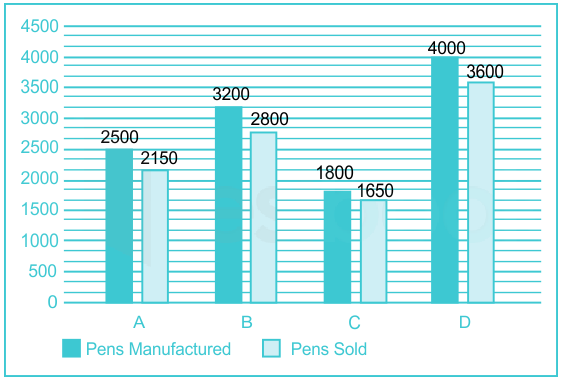
The bar graph below provides the number ofΒ pens manufactured and sold by four different companies (A, B, C, and D).

Note:

​The profit perΒ pen for each company is given as follows:

​Company A: β‚Ή20 perΒ pen

Company B: β‚Ή25 per pen

Company C: β‚Ή85 perΒ pen

Company D: β‚Ή90 perΒ pen

The number of unsold pens from Company A is what percentage of the number of sold pens from Company B?

  1. AOption (a)

    15%

  2. BOption (b)

    12.5%

  3. COption (c)

    18%

  4. DOption (d)

    17.5%

  5. EOption (e)

    20%

View answer & explanation

Correct answer

Answer: (b)B.

12.5%

Why this answer is correct

General Solution:

CompanyPens ManufacturedPens Sold
A25002150
B32002800
C18001650
D40003600

Β 

Calculations:

Given:

Company A: Manufactured = 2500, Sold = 2150 β‡’ Unsold = 2500 βˆ’ 2150 = 350

Company B: Sold = 2800

Formula used:

Percentage = (Part Γ· Whole) Γ— 100

Calculation:

β‡’ (350 Γ· 2800) Γ— 100

β‡’ 350/2800 = 1/8 = 0.125

β‡’ 0.125 Γ— 100 = 12.5%

Thus, theΒ unsold pens from Company A are 12.5% of the sold pens of Company B.

IBPS PO Prelims Memory Based Paper (Held On: 23 August 2025 Shift 2) (Previous Year Paper)Β·Quantitative Aptitude
View full paper

Question 171

IBPS Probationary Officer (PO) 2025β€’ Quantitative Aptitudeβ€’ Quantitative Aptitude

Directions: Study the following information carefully and answer the questions.

The bar graph below provides the number ofΒ pens manufactured and sold by four different companies (A, B, C, and D).

Note:

​The profit perΒ pen for each company is given as follows:

​Company A: β‚Ή20 perΒ pen

Company B: β‚Ή25 per pen

Company C: β‚Ή85 perΒ pen

Company D: β‚Ή90 perΒ pen

The total profit earned by Company D is how much more or less than the total profit earned by Company B?

  1. AOption (a)

    β‚Ή2,56,000 more

  2. BOption (b)

    β‚Ή2,55,000 less

  3. COption (c)

    β‚Ή2,54,000 more

  4. DOption (d)

    β‚Ή2,53,000 less

  5. EOption (e)

    None of the above

View answer & explanation

Correct answer

Answer: (c)C.

β‚Ή2,54,000 more

Why this answer is correct

General Solution:

CompanyPens ManufacturedPens Sold
A25002150
B32002800
C18001650
D40003600

Β 

Calculations:

Given Data:

Company B:

Pens Sold = 2800

Profit per pen = β‚Ή25

Total Profit =Β 2800 Γ— 25 = β‚Ή70,000

Company D:

Pens Sold = 3600

Profit per pen = β‚Ή90

Total Profit =Β 3600 Γ— 90 = β‚Ή3,24,000

Difference: 3,24,000 βˆ’ 70,000 = 2,54,000

Thus, theΒ total profit earned by Company D is β‚Ή2,54,000 more than that of Company B.

IBPS PO Prelims Memory Based Paper (Held On: 23 August 2025 Shift 2) (Previous Year Paper)Β·Quantitative Aptitude
View full paper

Question 172

IBPS Probationary Officer (PO) 2025β€’ Quantitative Aptitudeβ€’ Quantitative Aptitude

Directions: Study the following information carefully and answer the questions.

The bar graph below provides the number ofΒ pens manufactured and sold by four different companies (A, B, C, and D).

Note:

​The profit perΒ pen for each company is given as follows:

​Company A: β‚Ή20 perΒ pen

Company B: β‚Ή25 per pen

Company C: β‚Ή85 perΒ pen

Company D: β‚Ή90 perΒ pen

Find the ratio of the number of sold pens from Company A and C together to the number of unsold pens from Company B and D together.

  1. AOption (a)

    18:5

  2. BOption (b)

    19:4

  3. COption (c)

    16:3

  4. DOption (d)

    12:7

  5. EOption (e)

    None of these

View answer & explanation

Correct answer

Answer: (b)B.

19:4

Why this answer is correct

General Solution:

CompanyPens ManufacturedPens Sold
A25002150
B32002800
C18001650
D40003600

Β 

Calculations:

Company A sold = 2150

Company C sold = 1650

Together = 2150 + 1650 = 3800

Company B manufactured = 3200, sold = 2800 β†’ Unsold = 3200 - 2800 = 400

Company D manufactured = 4000, sold = 3600 β†’ Unsold = 4000 - 3600 = 400

Together = 400 + 400 = 800

Ratio = 3800 / 800 = 19 / 4

Hence, the correct answer isΒ 19:4.

IBPS PO Prelims Memory Based Paper (Held On: 23 August 2025 Shift 2) (Previous Year Paper)Β·Quantitative Aptitude
View full paper

Question 173

IBPS Probationary Officer (PO) 2025β€’ Quantitative Aptitudeβ€’ Quantitative Aptitude

Directions: Study the following information carefully and answer the questions.

The bar graph below provides the number ofΒ pens manufactured and sold by four different companies (A, B, C, and D).

Note:

​The profit perΒ pen for each company is given as follows:

​Company A: β‚Ή20 perΒ pen

Company B: β‚Ή25 per pen

Company C: β‚Ή85 perΒ pen

Company D: β‚Ή90 perΒ pen

If the profit per pen for Company A was increased by 25%, and the number of sold pens remained the same, what would be the total profit for Company A?

  1. AOption (a)

    β‚Ή58,550

  2. BOption (b)

    β‚Ή62,250

  3. COption (c)

    β‚Ή60,100

  4. DOption (d)

    β‚Ή54,250

  5. EOption (e)

    β‚Ή53,750

View answer & explanation

Correct answer

Answer: (e)E.

β‚Ή53,750

Why this answer is correct

General Solution:

CompanyPens ManufacturedPens Sold
A25002150
B32002800
C18001650
D40003600

Β 

Calculations:

Original profit per pen = β‚Ή20

Increase 25% β‡’ new profit per pen = 20 Γ— (1 + 25/100) = 20 Γ— 1.25 = β‚Ή25

Pens sold = 2150

Total profit = 25 Γ— 2150 = β‚Ή53,750

Hence, the correct answer isΒ β‚Ή53,750

IBPS PO Prelims Memory Based Paper (Held On: 23 August 2025 Shift 2) (Previous Year Paper)Β·Quantitative Aptitude
View full paper

Question 174

IBPS Probationary Officer (PO) 2025β€’ Quantitative Aptitudeβ€’ Quantitative Aptitude

Directions: Study the following information carefully and answer the questions.

The bar graph below provides the number ofΒ pens manufactured and sold by four different companies (A, B, C, and D).

Note:

​The profit perΒ pen for each company is given as follows:

​Company A: β‚Ή20 perΒ pen

Company B: β‚Ή25 per pen

Company C: β‚Ή85 perΒ pen

Company D: β‚Ή90 perΒ pen

What is the average number of manufactured pens across all four companies?

  1. AOption (a)

    2435

  2. BOption (b)

    2750

  3. COption (c)

    2875

  4. DOption (d)

    2960

  5. EOption (e)

    3125

View answer & explanation

Correct answer

Answer: (c)C.

2875

Why this answer is correct

General Solution:

CompanyPens ManufacturedPens Sold
A25002150
B32002800
C18001650
D40003600

Β 

Calculations:

Manufactured pens by each company:

A = 2500, B = 3200, C = 1800, D = 4000

Total Manufactured = 2500 + 3200 + 1800 + 4000 = 11,500

Average = Total Γ· Number of Companies = 11,500 Γ· 4 =Β 2875

Hence, the correct answer isΒ 2875.

IBPS PO Prelims Memory Based Paper (Held On: 23 August 2025 Shift 2) (Previous Year Paper)Β·Quantitative Aptitude
View full paper

Question 175

IBPS Probationary Officer (PO) 2025β€’ Quantitative Aptitudeβ€’ Quantitative Aptitude

Directions: Study the following information carefully and answer the questions.

The bar graph below provides the number ofΒ pens manufactured and sold by four different companies (A, B, C, and D).

Note:

​The profit perΒ pen for each company is given as follows:

​Company A: β‚Ή20 perΒ pen

Company B: β‚Ή25 per pen

Company C: β‚Ή85 perΒ pen

Company D: β‚Ή90 perΒ pen

If 80% of the unsold pens from Company C were sold in the following year at a 20% less profit per pen, what would be the total profit earned from those additional sales?

  1. AOption (a)

    β‚Ή7,240

  2. BOption (b)

    β‚Ή8,160

  3. COption (c)

    β‚Ή6,420

  4. DOption (d)

    β‚Ή9,030

  5. EOption (e)

    None of these

View answer & explanation

Correct answer

Answer: (b)B.

β‚Ή8,160

Why this answer is correct

General Solution:

CompanyPens ManufacturedPens Sold
A25002150
B32002800
C18001650
D40003600

Β 

Calculations:

Given:

Company C: Manufactured = 1800, Sold = 1650

Unsold pens = 1800 βˆ’ 1650 = 150

80% of unsold are sold next year

Original profit per pen = β‚Ή85

Next year profit per pen = 20% less than β‚Ή85

Formula used:

Unsold = Manufactured βˆ’ Sold

Number sold next year = Unsold Γ— 80%

Reduced profit per pen = Original profit Γ— (1 βˆ’ 20%)

Total profit from additional sales = (Number sold next year) Γ— (Reduced profit per pen)

Calculations:

Unsold = 1800 βˆ’ 1650 = 150

Number sold next year = 150 Γ— 80% = 150 Γ— 0.8 = 120

Reduced profit per pen = 85 Γ— (1 βˆ’ 0.20) = 85 Γ— 0.8 = 68

Total profit = 120 Γ— 68 = 8160

Hence, the correct answer isΒ β‚Ή8,160.

IBPS PO Prelims Memory Based Paper (Held On: 23 August 2025 Shift 2) (Previous Year Paper)Β·Quantitative Aptitude
View full paper

Question 176

IBPS Probationary Officer (PO) 2025β€’ Quantitative Aptitudeβ€’ Quantitative Aptitude

A solution of milk and water is to be diluted by adding water till the ratio gets reversed. The amount of water added is equal to the initial quantity of the mixture. If in the initial mixture the quantity of milk was 8 litres, find the quantity of water added.

  1. AOption (a)

    15 litresΒ 

  2. BOption (b)

    20 litresΒ 

  3. COption (c)

    12 litresΒ 

  4. DOption (d)

    21 litresΒ 

  5. EOption (e)

    10 litresΒ 

View answer & explanation

Correct answer

Answer: (c)C.

12 litresΒ 

Why this answer is correct

Shortcut Trick

Initial Ratio Milk : Water = x : y. Final Ratio = y :

x. Condition: Water added = Initial total mixture (x + y).

In dilution, Milk remains constant. x = y Γ— (y / (x + (x + y))).

Using ratio logic: (x)/(y) β†’ (y)/(x + added). Since milk is constant, equate parts: x = y Γ— (x+y+y)/(x). Solving gives x = 8, y = 4.

Water added = Total Initial = 8 + 4 = 12 litres.

∴ The correct answer is 12 litres.

Alternate Method

Given: Initial Milk = 8 litres. Let initial Water = W litres.

Formula: Ratio = Milk / Water. Initial Ratio = 8/W. Final Ratio = W/8.

β‡’ Total initial mixture = 8 + W

β‡’ Water added = 8 + W

β‡’ Final Water = Initial Water + Added Water = W + (8 + W) = 2W + 8

β‡’ Final Ratio (Milk : Water) = 8 : (2W + 8)

β‡’ According to question, Final Ratio = W : 8

β‡’ 8 / (2W + 8) = W / 8

β‡’ 64 = 2W2 + 8W

β‡’ W2 + 4W βˆ’ 32 = 0

β‡’ (W + 8)(W βˆ’ 4) = 0 β‡’ W = 4 (as quantity cannot be negative)

β‡’ Water added = Initial mixture = 8 + 4 = 12 litres.

∴ The correct answer is 12 litres.

Additional Information

Constant Quantity Concept

When only one component (like water) is added to a mixture, the quantity of the other component (like milk) remains unchanged in absolute terms.

Ratio Reversal Rule

If initial ratio is a:b and final is b:a, the multiplier for the non-added substance must be adjusted to keep its units consistent across both ratios.

Replacement vs Addition

Replacement keeps the total volume constant, whereas addition increases the total volume of the mixture by the amount added.

IBPS PO Prelims Memory Based Paper (Held On: 23 August 2025 Shift 2) (Previous Year Paper)Β·Quantitative Aptitude
View full paper

Question 177

IBPS Probationary Officer (PO) 2025β€’ Quantitative Aptitudeβ€’ Quantitative Aptitude

A man covered a certain distance in his car. Had he travelled at 8kmph faster than the normal speed, he would have taken 4hrs less but if he drives 8kmph slower than the normal speed he takes 6hrs more. Find the distance covered by him when driving with normal speed?

  1. AOption (a)

    900km

  2. BOption (b)

    960km

  3. COption (c)

    920km

  4. DOption (d)

    930km

  5. EOption (e)

    910km

View answer & explanation

Correct answer

Answer: (b)B.

960km

Why this answer is correct

Shortcut Trick

Using the speed-time relation for constant distance: Snormal = [2 Γ— S1 Γ— S2] Γ· [S2 βˆ’ S1] where S1 and S2 are speed changes.

However, since time differences differ, we use: [S(S+8)/8] Γ— 4 = [S(Sβˆ’8)/8] Γ— 6

β‡’ 4(S + 8) = 6(S βˆ’ 8) β†’ 4S + 32 = 6S βˆ’ 48 β†’ 2S = 80 β†’ S = 40 kmph.

Distance = [40 Γ— (40+8) Γ· 8] Γ— 4 = 5 Γ— 48 Γ— 4 = 960 km.

∴ The correct answer is 960 km.

Alternate Method

Given: Speed increase = 8 kmph, Time decrease = 4 hrs; Speed decrease = 8 kmph, Time increase = 6 hrs.

Formula Used: Distance (D) = [S Γ— (S Β± Ξ”S) Γ· Ξ”S] Γ— Ξ”T

β‡’ Case 1: D = [S(S + 8) Γ· 8] Γ— 4

β‡’ Case 2: D = [S(S βˆ’ 8) Γ· 8] Γ— 6

β‡’ [S(S + 8) Γ· 8] Γ— 4 = [S(S βˆ’ 8) Γ· 8] Γ— 6

β‡’ 4S + 32 = 6S βˆ’ 48

β‡’ 2S = 80 β‡’ S = 40 kmph

β‡’ D = [40 Γ— (40 + 8) Γ· 8] Γ— 4

β‡’ D = 5 Γ— 48 Γ— 4 = 960 km

∴ The correct answer is 960 km.

Additional Information

Constant Distance Formula

When a person changes speed from S1 to S2 and the time difference is Ξ”T, Distance = (S1 Γ— S2 Γ— Ξ”T) Γ· |S1 βˆ’ S2|.

Average Speed

For two equal distances covered at speeds x and y, Average Speed = (2xy) Γ· (x + y).

Speed-Time Relationship

If distance is constant, speed is inversely proportional to time (S ∝ 1/T). Ratio of speeds S1:S2 = T2:T1.

IBPS PO Prelims Memory Based Paper (Held On: 23 August 2025 Shift 2) (Previous Year Paper)Β·Quantitative Aptitude
View full paper

Question 178

IBPS Probationary Officer (PO) 2025β€’ Quantitative Aptitudeβ€’ Quantitative Aptitude

In each of the following number series, the wrong number is given, find out that number.

9, 31, 64, 110, 171, 259

  1. AOption (a)

    259

  2. BOption (b)

    64

  3. COption (c)

    110

  4. DOption (d)

    31

  5. EOption (e)

    None of these

View answer & explanation

Correct answer

Answer: (a)A.

259

Why this answer is correct

Given That,

Series 1:Β  Β  Β  Β  Β  Β 

β‡’Β 9 +Β 22 = 31Β 

β‡’ 31 +Β 33 = 64

β‡’ Β 64 +Β 46 = 110

β‡’ 110 +Β 61 =171

β‡’ 171 + 78 = 249Β 

22, 33, 46, 61, 78

Series 2:

β‡’ 22 + 11 = 33

β‡’ 33 + 13 = 46

β‡’ 46 + 15 = 61

β‡’ 61 + 17 = 78

Series 3:

Difference of 2

∴ 259 is the wrong number in the given pattern.

IBPS PO Prelims Memory Based Paper (Held On: 23 August 2025 Shift 2) (Previous Year Paper)Β·Quantitative Aptitude
View full paper

Question 179

IBPS Probationary Officer (PO) 2025β€’ Quantitative Aptitudeβ€’ Quantitative Aptitude

In each of the following number series, the wrong number is given, find out that number.

11, 89, 24, 76, 36, 63, 50

  1. AOption (a)

    76

  2. BOption (b)

    63

  3. COption (c)

    36

  4. DOption (d)

    89

  5. EOption (e)

    50

View answer & explanation

Correct answer

Answer: (c)C.

36

Why this answer is correct

Given that,

Series 1

β‡’ 11 + 78 = 89

β‡’ 89 - 65 = 24

β‡’ 24Β  + 52 = 76

β‡’ 76 - 39 = 37Β 

β‡’ 37 + 26 = 63

β‡’ 63 - 13 = 50

Series 2

β‡’ 13Β Γ— 6 = 78

β‡’ 13Β Γ— 5 = 65

β‡’ 13Β Γ— 4 = 52

β‡’ 13Β Γ— 3 = 39

β‡’ 13Β Γ— 2 = 26

β‡’ 13Β Γ— 1 = 13

∴ The wrong number in the series is 36

IBPS PO Prelims Memory Based Paper (Held On: 23 August 2025 Shift 2) (Previous Year Paper)Β·Quantitative Aptitude
View full paper

Question 180

IBPS Probationary Officer (PO) 2025β€’ Quantitative Aptitudeβ€’ Quantitative Aptitude

In each of the following number series, the wrong number is given, find out that number.

256, 260, 251, 267, 243, 278

  1. AOption (a)

    243

  2. BOption (b)

    278

  3. COption (c)

    251

  4. DOption (d)

    260

  5. EOption (e)

    267

View answer & explanation

Correct answer

Answer: (a)A.

243

Why this answer is correct

Given that,

256, 260, 251, 267, 243, 278

β‡’ 256 + 22Β = 260

β‡’ 260Β -Β 32Β = 251

β‡’ 251Β + 42Β = 267

β‡’ 267 -Β 52Β = 242

β‡’ 242Β + 62Β = 278

∴ 243 is the wrong number in the given pattern

How should I prepare for Quantitative Aptitude in IBPS Probationary Officer (PO)?

Solving previous year questions by topic helps identify recurring concepts, question patterns, and frequently asked sub-topics. Attempt each question, review the step-by-step explanation, and note down key formulas or facts for quick revision before the exam.