IBPS Probationary Officer (PO) · Topic Collection

Quantitative Aptitude PYQs

Arithmetic, number systems, percentages, ratios, profit and loss, time and work, algebra, geometry, mensuration, and trigonometry.

1305 Total Questions38 Official PapersYears: 2021–2026Search in Quantitative Aptitude
Showing questions 821–840 of 1305Page 42 of 66
IBPS PO Prelims Memory Based Paper (Held On: 23 September 2023 Shift 1) (Previous Year Paper)·Quantitative Aptitude
View full paper

Question 821

IBPS Probationary Officer (PO) 2023• Quantitative Aptitude• Quantitative Aptitude

In the given question, two equations numbered l and II are given. Solve both the equations and mark the appropriate answer.

I. x2 – 16x + 55 = 0

II. y2 – 17y + 52 = 0

  1. AOption (a)

    x > y

  2. BOption (b)

    x ≥ y

  3. COption (c)

    x < y

  4. DOption (d)

    x ≤ y

  5. EOption (e)

    x = y or relationship between x and y cannot be established

View answer & explanation

Correct answer

Answer: (e)E.

x = y or relationship between x and y cannot be established

Why this answer is correct

Calculation:

I. x2 – 16x + 55 = 0

⇒ x2 – 11x – 5x + 55 = 0

⇒ x(x – 11) – 5(x – 11) = 0 

⇒ (x – 11) (x – 5) = 0

⇒ x = 11, 5

II. y2 – 17y + 52 = 0

⇒ y2 – 13y – 4y + 52 = 0

⇒ y(y – 13) – 4(y – 13) = 0

⇒ (y – 13) (y – 4) = 0

⇒ y = 13, 4

Comparison between x and y (via tabulation):

XYRelation
1113x < y
114x > y
513x < y
54x > y


∴ The relation between x and y cannot be determined.
IBPS PO Prelims Memory Based Paper (Held On: 23 September 2023 Shift 1) (Previous Year Paper)·Quantitative Aptitude
View full paper

Question 822

IBPS Probationary Officer (PO) 2023• Quantitative Aptitude• Quantitative Aptitude

In the given questions, two equations numbered l and II are given. You have to solve both the equations and mark the appropriate answer.

I. 2x2 – 7x – 15 = 0

ll. 3y2 – 6y – 9 = 0

  1. AOption (a)

    x > y

  2. BOption (b)

    x < y

  3. COption (c)

    x ≥ y

  4. DOption (d)

    x ≤ y

  5. EOption (e)

    x = y or relation between them cannot be established

View answer & explanation

Correct answer

Answer: (e)E.

x = y or relation between them cannot be established

Why this answer is correct

Calculation:

I. 2x2 – 7x – 15 = 0

⇒ 2x2 – 10x + 3x – 15 = 0

⇒ 2x (x - 5) + 3 (x - 5) = 0

⇒ (2x + 3) (x - 5) = 0

⇒ x = -3/2, 5


II. 3y2 – 6y – 9 = 0

⇒ 3y2 – 9y + 3y – 9 = 0

⇒ 3y (y - 3) + 3 (y - 3) = 0

⇒ (3y + 3) (y - 3) = 0

⇒ y = -1, 3

Comparison between x and y (via Tabulation):

Value of xValue of yRelation
-3/2 = -1.5-1x < y
-3/2 = -1.53x < y
5-1x > y
53x > y

∴ x = y or relationship between x and y cannot be established

IBPS PO Prelims Memory Based Paper (Held On: 23 September 2023 Shift 1) (Previous Year Paper)·Quantitative Aptitude
View full paper

Question 823

IBPS Probationary Officer (PO) 2023• Quantitative Aptitude• Quantitative Aptitude

In the following question to equations are given. You have to solve the question and mark the answer accordingly.

l. 5x2 + 8x + 3 = 0

ll. 6y2 + 7y – 3 = 0

  1. AOption (a)

    x > y

  2. BOption (b)

    x < y

  3. COption (c)

    x ≥ y

  4. DOption (d)

    x ≤ y

  5. EOption (e)

    x = y or relation between cannot be established

View answer & explanation

Correct answer

Answer: (e)E.

x = y or relation between cannot be established

Why this answer is correct

Calculation:

⇒ 5x2 + 8x + 3 = 0

⇒ 5x2 + 5x + 3x + 3 = 0

⇒ 5x(x + 1) + 3(x + 1) = 0

⇒ (5x + 3) (x + 1) = 0

⇒ x = -3/5, -1

⇒ 6y2 + 7y – 3 = 0

⇒ 6y2 + 9y – 2y – 3 = 0

⇒ 3y × (2y + 3) – 1(2y + 3) = 0

⇒ (3y - 1) (2y + 3) = 0

⇒ y = 1/3, -3/2

Value of xValue of yRelation between x and y
-3/5 = -0.601/3 = 0.33x < y
-3/5 = -0.60-3/2 = -1.5x > y
-11/3 = 0.33x < y
-1-3/2 = -1.5x > y

∴ The relation between x and y cannot determine.

IBPS PO Prelims Memory Based Paper (Held On: 23 September 2023 Shift 1) (Previous Year Paper)·Quantitative Aptitude
View full paper

Question 824

IBPS Probationary Officer (PO) 2023• Quantitative Aptitude• Quantitative Aptitude

In the given question, two equations numbered l and II are given. Solve both the equations and mark the appropriate answer.

I. 4x2 – 10x + 4 = 0

II. 3y2 – 11y + 6 = 0

  1. AOption (a)

    x > y

  2. BOption (b)

    x < y

  3. COption (c)

    x ≥ y

  4. DOption (d)

    x ≤ y

  5. EOption (e)

    Relation can't be formed or x = y

View answer & explanation

Correct answer

Answer: (e)E.

Relation can't be formed or x = y

Why this answer is correct

I. 4x2 – 10x + 4 = 0

⇒ 4x2 – 8x – 2x + 4 = 0

⇒ 4x(x – 2) – 2(x - 2) = 0

⇒ (x – 2)(4x – 2) = 0

⇒ x = 2 or 1/2

II. 3y2 – 11y + 6 = 0

⇒ 3y2 – 9y – 2y + 6 = 0

⇒ 3y(y – 3) – 2(y – 3) = 0

⇒ (y – 3)(3y – 2) = 0

⇒ y = 3 or 2/3

Comparison between x and y (via Tabulation):
Value of xValue of yRelation
23x < y
22/3x > y
0.53x < y
0.52/3x < y


∴ Relation can't be formed or x = y

IBPS PO Prelims Memory Based Paper (Held On: 23 September 2023 Shift 1) (Previous Year Paper)·Quantitative Aptitude
View full paper

Question 825

IBPS Probationary Officer (PO) 2023• Quantitative Aptitude• Quantitative Aptitude

In the given question, two equations numbered l and II are given. Solve both the equations and mark the appropriate answer.

I. 2x2 – 11x + 15 = 0

II. 2y2 – 9y + 10 = 0

  1. AOption (a)

    x > y

  2. BOption (b)

    x < y

  3. COption (c)

    x ≥ y

  4. DOption (d)

    x ≤ y

  5. EOption (e)

    relation can't be established or x = y

View answer & explanation

Correct answer

Answer: (c)C.

x ≥ y

Why this answer is correct

I. 2x2 – 11x + 15 = 0

⇒ 2x2 – 6x – 5x + 15 = 0

⇒ 2x(x – 3) – 5(x – 3) = 0

⇒ (x – 3)(2x – 5) = 0

⇒ x = 3 or 5/2

II. 2y2 – 9y + 10 = 0

⇒ 2y2 – 4y – 5y + 10 = 0

⇒ 2y(y – 2) – 5(y – 2) = 0

⇒ (y – 2)(2y – 5) = 0

⇒ y = 2 or 5/2

xsigny
5/2=5/2
5/2>2
3>5/2
3>2

∴ x ≥ y

IBPS PO Prelims Memory Based Paper (Held On: 23 September 2023 Shift 1) (Previous Year Paper)·Quantitative Aptitude
View full paper

Question 826

IBPS Probationary Officer (PO) 2023• Quantitative Aptitude• Quantitative Aptitude

Directions: Answer the questions based on the information given below.

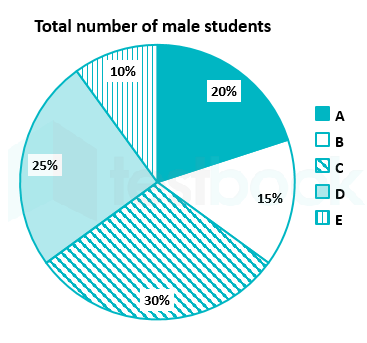
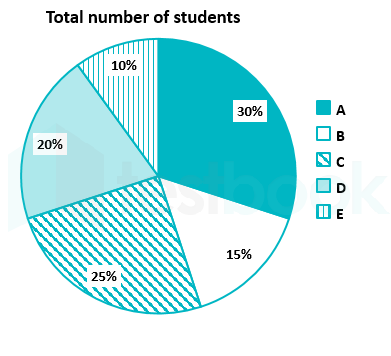
The first pie chart below shows the percentage distribution of the total number of students in five different schools and the second pie chart below shows the total number of male students in each school.

Total number of students in a school = Number of male students in the school + Number of female students in the school

Total number of students in all five schools together = 4300

Total number of male students in all five schools together = 2100

If the total number of students (male + female) in another school 'Z' is 30% more than that in school 'D' and the respective ratio between the number of male to female students in school 'Z' is 6 : 7 respectively then find the average total number of female students in school 'A' and school 'Z' together?

  1. AOption (a)

    726

  2. BOption (b)

    736

  3. COption (c)

    746

  4. DOption (d)

    756

  5. EOption (e)

    766

View answer & explanation

Correct answer

Answer: (b)B.

736

Why this answer is correct

Calculation:

SchoolTotal number of students (male + female)Number of male studentsNumber of female students
A30% × 4300 = 129020% × 2100 = 4201290 - 420 = 870
B15% × 4300 = 64515% × 2100 = 315645 - 315 = 330
C25% × 4300 = 107530% × 2100 = 6301075 - 630 = 445
D20% × 4300 = 86025% × 2100 = 525860 - 525 = 335
E10% × 4300 = 43010% × 2100 = 210430 - 210 = 220
Total430021002200


The total number of students (male + female) in another school 'Z' = (100+30)% × 860

⇒ 130% × 860 = 1118

∵ The ratio of male to female in school Z = 6:7

∴ The number of female students in school 'Z' = (7/13) × 1118 = 602

The average total number of female students in school 'A' and school 'Z' together = (870 + 602)/2 = 736

Hence, the correct answer is 736.

IBPS PO Prelims Memory Based Paper (Held On: 23 September 2023 Shift 1) (Previous Year Paper)·Quantitative Aptitude
View full paper

Question 827

IBPS Probationary Officer (PO) 2023• Quantitative Aptitude• Quantitative Aptitude

Directions: Answer the questions based on the information given below.

The first pie chart below shows the percentage distribution of the total number of students in five different schools and the second pie chart below shows the total number of male students in each school.

Total number of students in a school = Number of male students in the school + Number of female students in the school

Total number of students in all five schools together = 4300

Total number of male students in all five schools together = 2100

If (p - 15)% of the number of female students in school 'D' and (p + 10)% of that in school 'E' are selected for a 'quiz' competition and the average total number of female students who are selected for the 'quiz' competition from school 'D' and that from school 'E' together is 83 then find the value of 'p'?

  1. AOption (a)

    25

  2. BOption (b)

    30

  3. COption (c)

    35

  4. DOption (d)

    40

  5. EOption (e)

    45

View answer & explanation

Correct answer

Answer: (c)C.

35

Why this answer is correct

Calculation:

SchoolTotal number of students (male + female)Number of male studentsNumber of female students
A30% × 4300 = 129020% × 2100 = 4201290 - 420 = 870
B15% × 4300 = 64515% × 2100 = 315645 - 315 = 330
C25% × 4300 = 107530% × 2100 = 6301075 - 630 = 445
D20% × 4300 = 86025% × 2100 = 525860 - 525 = 335
E10% × 4300 = 43010% × 2100 = 210430 - 210 = 220
Total430021002200


Number of female students who are selected from school 'D' = (p - 15)% × 335

Number of female students who are selected from school 'E' = (p + 10)% × 220

∵ The average number of females selected for quizzes in schools D & E is 83,

⇒ [(p - 15)% × 335 + (p + 10)% × 220]/2 = 83

⇒ (p - 15)% × 335 + (p + 10)% × 220 = 83 × 2

⇒ (p - 15)% × 335 + (p + 10)% × 220 = 166

⇒ 335p - 15% × 335 + 220p + 10% × 220 = 166

⇒ 555p - 50.25 + 22 = 166

⇒ 555p - 28.25 = 166 

⇒ 555p = 166 + 28.25

⇒ 555p = 194.25

⇒ p = 194.25/555

⇒ p = 0.35

∵ The percentage value of p is 0.35

∴ The numerical value of p is 0.35 × 100 = 35

Hence, the value of p is 35.

IBPS PO Prelims Memory Based Paper (Held On: 23 September 2023 Shift 1) (Previous Year Paper)·Quantitative Aptitude
View full paper

Question 828

IBPS Probationary Officer (PO) 2023• Quantitative Aptitude• Quantitative Aptitude

Directions: Answer the questions based on the information given below.

The first pie chart below shows the percentage distribution of the total number of students in five different schools and the second pie chart below shows the total number of male students in each school.

Total number of students in a school = Number of male students in the school + Number of female students in the school

Total number of students in all five schools together = 4300

Total number of male students in all five schools together = 2100

If the average total number of female students in school 'C' and school 'X' together is 498 then the number of female students in school 'X is what percentage of that in school 'A'?

  1. AOption (a)

    63.33%

  2. BOption (b)

    64.44%

  3. COption (c)

    65.55%

  4. DOption (d)

    66.66%

  5. EOption (e)

    67.77%

View answer & explanation

Correct answer

Answer: (a)A.

63.33%

Why this answer is correct

Calculation:

SchoolTotal number of students (male + female)Number of male studentsNumber of female students
A30% × 4300 = 129020% × 2100 = 4201290 - 420 = 870
B15% × 4300 = 64515% × 2100 = 315645 - 315 = 330
C25% × 4300 = 107530% × 2100 = 6301075 - 630 = 445
D20% × 4300 = 86025% × 2100 = 525860 - 525 = 335
E10% × 4300 = 43010% × 2100 = 210430 - 210 = 220
Total430021002200


The total number of female students in school C = 445

The total number of female students in school A = 870

The average total number of female students in school 'C' and school 'X' = 498

Total number of female students in school 'C' and school 'X' = 498 × 2 = 996

Number of female students in school 'X' = 996 - 445 = 551

Required percentage = (551/870) × 100 = 63.33%

Hence, the correct answer is 63.33%.

IBPS PO Prelims Memory Based Paper (Held On: 23 September 2023 Shift 1) (Previous Year Paper)·Quantitative Aptitude
View full paper

Question 829

IBPS Probationary Officer (PO) 2023• Quantitative Aptitude• Quantitative Aptitude

Directions: Answer the questions based on the information given below.

The first pie chart below shows the percentage distribution of the total number of students in five different schools and the second pie chart below shows the total number of male students in each school.

Total number of students in a school = Number of male students in the school + Number of female students in the school

Total number of students in all five schools together = 4300

Total number of male students in all five schools together = 2100

If the difference between the number of male students in school 'A' to that in school 'E' is same as that in school 'C' to school 'M' and the number of male students in school 'M' is more than that in school 'C' then find the sum of the number of male students in school 'M' and that in school 'B' together?

  1. AOption (a)

    1150

  2. BOption (b)

    1155

  3. COption (c)

    1160

  4. DOption (d)

    1165

  5. EOption (e)

    1170

View answer & explanation

Correct answer

Answer: (b)B.

1155

Why this answer is correct

Calculation:

SchoolTotal number of students (male + female)Number of male studentsNumber of female students
A30% × 4300 = 129020% × 2100 = 4201290 - 420 = 870
B15% × 4300 = 64515% × 2100 = 315645 - 315 = 330
C25% × 4300 = 107530% × 2100 = 6301075 - 630 = 445
D20% × 4300 = 86025% × 2100 = 525860 - 525 = 335
E10% × 4300 = 43010% × 2100 = 210430 - 210 = 220
Total430021002200


Difference between the number of male students in school 'A' to that in school 'E' = 420 - 210 = 210

Let the number of male students in school 'M' = m

ATQ, m - 630 = 210

⇒ m = 840

Required sum = 315 + 840 = 1155

Hence, the correct answer is 1155.

IBPS PO Prelims Memory Based Paper (Held On: 23 September 2023 Shift 1) (Previous Year Paper)·Quantitative Aptitude
View full paper

Question 830

IBPS Probationary Officer (PO) 2023• Quantitative Aptitude• Quantitative Aptitude

Directions: Answer the questions based on the information given below.

The first pie chart below shows the percentage distribution of the total number of students in five different schools and the second pie chart below shows the total number of male students in each school.

Total number of students in a school = Number of male students in the school + Number of female students in the school

Total number of students in all five schools together = 4300

Total number of male students in all five schools together = 2100

If the central angle corresponding to the total number of students (male + female) in school 'D' and school 'G' together is 120º then find the difference between the total number of students in school 'A' to that in school 'G'?

  1. AOption (a)

    410

  2. BOption (b)

    420

  3. COption (c)

    430

  4. DOption (d)

    440

  5. EOption (e)

    450

View answer & explanation

Correct answer

Answer: (c)C.

430

Why this answer is correct

SchoolTotal number of students (male + female)Number of male studentsNumber of female students
A30% × 4300 = 129020% × 2100 = 4201290 - 420 = 870
B15% × 4300 = 64515% × 2100 = 315645 - 315 = 330
C25% × 4300 = 107530% × 2100 = 6301075 - 630 = 445
D20% × 4300 = 86025% × 2100 = 525860 - 525 = 335
E10% × 4300 = 43010% × 2100 = 210430 - 210 = 220
Total430021002200


Let the total number of students in school 'G' = T

ATQ, [(T + 860)/(4300 + T)] × 360° = 120°

⇒ (T + 860)/(4300 + T) = 1/3

⇒ 3T + 2580 = 4300 + T

⇒ T = 860

Required difference = 1290 - 860 = 430

Hence, the correct answer is 430.

IBPS PO Prelims Memory Based Paper (Held On: 23 September 2023 Shift 1) (Previous Year Paper)·Quantitative Aptitude
View full paper

Question 831

IBPS Probationary Officer (PO) 2023• Quantitative Aptitude• Quantitative Aptitude

The second lowest number of five consecutive odd number series is four more than the 5/12th of the third highest number of five consecutive even numbers series. If the average of five consecutive even number series is 60, then find the difference between the highest number of both series.

  1. AOption (a)

    37

  2. BOption (b)

    27

  3. COption (c)

    33

  4. DOption (d)

    29

  5. EOption (e)

    31

View answer & explanation

Correct answer

Answer: (d)D.

29

Why this answer is correct

Shortcut Trick

Average of 5 even numbers is 60, so middle (3rd) is 60 → highest is 64.

3rd highest even number is the middle one = 60.

2nd lowest odd number = (5/12 × 60) + 4 = 25 + 4 = 29.

If 2nd lowest odd is 29, then 3rd is 31, 4th is 33, and highest (5th) is 35.

Difference = 64 − 35 = 29.

∴ The correct answer is 29.

Alternate Method

Given: Average of 5 consecutive even numbers = 60.

⇒ Let numbers be x−4, x−2, x, x+2, x+4. Average x = 60.

⇒ Third highest even number (which is also the middle number) = 60.

⇒ Highest even number = 60 + 4 = 64.

⇒ Second lowest odd number = (5/12 × 60) + 4 = 25 + 4 = 29.

⇒ Let 5 consecutive odd numbers be y, y+2, y+4, y+6, y+8.

⇒ Second lowest is y+2 = 29 ⇒ y = 27.

⇒ Highest odd number = 27 + 8 = 35.

⇒ Difference = 64 − 35 = 29.

∴ The correct answer is 29.

Additional Information

Average of Consecutive Series

For any odd number of terms in an arithmetic progression, the average is always the middle term.

Consecutive Even/Odd Numbers

Both consecutive even and consecutive odd numbers have a common difference of 2. If the first term is a, the nth term is a + 2(n−1).

Difference between Extremes

In a series of n consecutive even/odd numbers, the difference between the largest and smallest number is always 2 × (n − 1).

IBPS PO Prelims Memory Based Paper (Held On: 23 September 2023 Shift 1) (Previous Year Paper)·Quantitative Aptitude
View full paper

Question 832

IBPS Probationary Officer (PO) 2023• Quantitative Aptitude• Quantitative Aptitude

Raman scored 456 marks in an exam and Seeta got 54% marks in the same exam which is 24 marks less than Raman. If the minimum passing marks in the exam is 34%, then how much more marks did Raman score than the minimum passing marks?

  1. AOption (a)

    180

  2. BOption (b)

    190

  3. COption (c)

    184

  4. DOption (d)

    196

  5. EOption (e)

    None of these

View answer & explanation

Correct answer

Answer: (c)C.

184

Why this answer is correct

Shortcut Trick

Seeta marks = 456 − 24 = 432 marks.

54% of Maximum Marks = 432 ⇒ 1% = 8 marks.

Passing Marks (34%) = 34 × 8 = 272 marks.

Difference = 456 − 272 = 184 marks.

∴ The correct answer is 184 marks.

Alternate Method

Given:

Marks scored by Raman = 456

Marks scored by Seeta = 54% of Total Marks

Difference between Raman and Seeta = 24 marks

Minimum Passing Percentage = 34%

Calculations:

⇒ Marks of Seeta = Marks of Raman − 24

⇒ Marks of Seeta = 456 − 24 = 432

⇒ 54% of Maximum Marks = 432

⇒ Maximum Marks = (432 × 100) ÷ 54 = 800

⇒ Passing Marks = 34% of 800

⇒ Passing Marks = (34 × 800) ÷ 100 = 272

⇒ Required Difference = 456 − 272 = 184

∴ The correct answer is 184 marks.

Additional Information

Percentage to Value Conversion

To find the absolute value from a percentage: Value = (Percentage ÷ 100) × Total Value.

Passing Marks Concept

Passing marks is the threshold required to qualify. If a student gets 'x' marks and fails by 'y' marks, Passing Marks = x + y.

Unitary Method in Percentage

If p% = V, then 1% = V/p. This helps in calculating any other percentage (like 100% or passing %) quickly.

IBPS PO Prelims Memory Based Paper (Held On: 23 September 2023 Shift 1) (Previous Year Paper)·Quantitative Aptitude
View full paper

Question 833

IBPS Probationary Officer (PO) 2023• Quantitative Aptitude• Quantitative Aptitude

In a family of four members A, B, C, and D, Rs. 50,000 was divided among them. A took 2/3 of the money, B took 1/5 of the remaining amount, and the rest was divided between C and D in the ratio of 2 : 3 respectively. How much(approx.) did C get as his share?

  1. AOption (a)

    Rs. 5,334

  2. BOption (b)

    Rs. 5,000

  3. COption (c)

    Rs. 6,000

  4. DOption (d)

    Rs. 7,000

  5. EOption (e)

    None of these

View answer & explanation

Correct answer

Answer: (a)A.

Rs. 5,334

Why this answer is correct

Shortcut Trick

Total amount = ₹50,000

Remaining after A = 1 − 2/3 = 1/3

Remaining after B = 1/3 × (1 − 1/5) = 1/3 × 4/5 = 4/15

Share of C = 4/15 × 2/5 = 8/75 of total

C's share = 50,000 × 8/75 = 2,000 × 8/3 = 16,000/3 ≈ ₹5,333.33

∴ The correct answer is ₹5,334.

Alternate Method

Given: Total = ₹50,000 | A's share = 2/3 | B's share = 1/5 of remaining | C : D = 2 : 3

⇒ Share of A = 50,000 × 2/3 = ₹33,333.33

⇒ Remaining amount = 50,000 − 33,333.33 = ₹16,666.67

⇒ Share of B = 16,666.67 × 1/5 = ₹3,333.33

⇒ Amount left for C and D = 16,666.67 − 3,333.33 = ₹13,333.34

⇒ Ratio C : D = 2 : 3 (Total parts = 5)

⇒ Share of C = (2/5) × 13,333.34

⇒ Share of C = ₹5,333.336 ≈ ₹5,334

∴ The correct answer is ₹5,334.

Additional Information

Ratio and Proportion

If an amount X is divided in ratio a:b, then share of first part = [a/(a+b)] × X.

Successive Fractions

When dealing with remainders, the final remaining fraction is (1 − f1) × (1 − f2) × ... × (1 − fn).

IBPS PO Prelims Memory Based Paper (Held On: 23 September 2023 Shift 1) (Previous Year Paper)·Quantitative Aptitude
View full paper

Question 834

IBPS Probationary Officer (PO) 2023• Quantitative Aptitude• Quantitative Aptitude

The present age of mother is four times the present age of her son. 8 years hence, the ratio of ages of mother and son becomes 16:5. If x is the square of the present age of son, then what will be the value of (x+2)?

  1. AOption (a)

    450

  2. BOption (b)

    481

  3. COption (c)

    486

  4. DOption (d)

    485

  5. EOption (e)

    480

View answer & explanation

Correct answer

Answer: (c)C.

486

Why this answer is correct

Shortcut Trick

Ratio of Mother to Son: Present = 4 : 1 and After 8 years = 16 : 5.

Equating ratio difference: (4:1)×11 and (16:5)×3 → 44:11 and 48:15.

Change in units = 15 − 11 = 4 units → 8 years. So, 1 unit = 2 years.

Present age of son = 11 units × 2 = 22 years.

Value of x = 222 = 484. Then, x + 2 = 484 + 2 = 486.

∴ The correct answer is 486.

Alternate Method

Given: Present ratio M : S = 4 :

  1. Let ages be 4s and s.

Formula: Ratio = (Initial Age + Time) ÷ (Initial Age + Time)

⇒ (4s + 8) ÷ (s + 8) = 16 ÷ 5

⇒ 5 × (4s + 8) = 16 × (s + 8)

⇒ 20s + 40 = 16s + 128

⇒ 4s = 88

⇒ s = 22

⇒ x = s2 = 222 = 484

⇒ x + 2 = 484 + 2 = 486

∴ The correct answer is 486.

Additional Information

Ratio Difference Method

To solve age problems quickly, ensure the difference between ratio parts remains constant over time by multiplying with the cross-difference.

Square of Numbers

Memorizing squares up to 30 helps in fast calculations. For example, 212 = 441, 222 = 484, 232 = 529.

Ages Property

The difference between the ages of two people always remains constant, regardless of how many years pass.

IBPS PO Prelims Memory Based Paper (Held On: 23 September 2023 Shift 1) (Previous Year Paper)·Quantitative Aptitude
View full paper

Question 835

IBPS Probationary Officer (PO) 2023• Quantitative Aptitude• Quantitative Aptitude

One card is randomly chosen from a deck of 52 cards. If the red face cards have been removed, find the probability that the picked card is a face card.

  1. AOption (a)

    3 / 23

  2. BOption (b)

    3 / 46

  3. COption (c)

    6 / 23

  4. DOption (d)

    3 / 26

  5. EOption (e)

    None of these

View answer & explanation

Correct answer

Answer: (a)A.

3 / 23

Why this answer is correct

Shortcut Trick

Total cards = 52. Red face cards (King, Queen, Jack of Hearts and Diamonds) = 2 × 3 = 6.

Remaining Total Outcome = 52 − 6 = 46.

Total face cards in a deck = 12. Remaining face cards = 12 − 6 = 6.

Probability = Favorable / Total = 6 / 46 = 3 / 23.

∴ The correct answer is 3 / 23.

Alternate Method

Given:

Total cards in a standard deck = 52.

Face cards include King, Queen, and Jack for each of the 4 suits.

⇒ Total face cards = 4 suits × 3 cards/suit = 12.

⇒ Red face cards = 2 suits (Hearts, Diamonds) × 3 cards/suit = 6.

Calculations:

⇒ Total cards after removing red face cards (n(S)) = 52 − 6 = 46.

⇒ Remaining face cards in the deck (n(E)) = 12 − 6 = 6 (only black face cards remain).

⇒ Probability P(E) = n(E) / n(S)

⇒ P(E) = 6 / 46

⇒ P(E) = 3 / 23

∴ The correct answer is 3 / 23.

Additional Information

Standard Deck Composition

A deck has 52 cards: 26 Red (Hearts, Diamonds) and 26 Black (Spades, Clubs). Each suit has 13 cards: Ace, 2-10, and 3 Face cards.

Probability Formula

P(Event) = (Number of favorable outcomes) ÷ (Total number of possible outcomes).

Face Cards vs Number Cards

Face cards (K, Q, J) total 12. Number cards (2-10) total 36. Aces are generally not considered face cards unless specified.

IBPS PO Prelims Memory Based Paper (Held On: 23 September 2023 Shift 1) (Previous Year Paper)·Quantitative Aptitude
View full paper

Question 836

IBPS Probationary Officer (PO) 2023• Quantitative Aptitude• Quantitative Aptitude

What should come in place of (?) in the given series?

20, 32, 47, 57, ?, 80

  1. AOption (a)

    72

  2. BOption (b)

    74

  3. COption (c)

    78

  4. DOption (d)

    77

  5. EOption (e)

    79

View answer & explanation

Correct answer

Answer: (b)B.

74

Why this answer is correct

Solution:

The series follows the following pattern:

Hence, the correct answer is 74.

IBPS PO Prelims Memory Based Paper (Held On: 23 September 2023 Shift 1) (Previous Year Paper)·Quantitative Aptitude
View full paper

Question 837

IBPS Probationary Officer (PO) 2023• Quantitative Aptitude• Quantitative Aptitude

What should come in the place of (?) in the given series?

500, 50, 10, 3, 1.2, ?

  1. AOption (a)

    0.4

  2. BOption (b)

    0.8

  3. COption (c)

    0.3

  4. DOption (d)

    0.6

  5. EOption (e)

    1.4

View answer & explanation

Correct answer

Answer: (d)D.

0.6

Why this answer is correct

Solution:

The logic followed here is as follows:

⇒ 500 ×  0.1 = 50

⇒ 50 × 0.2 = 10

⇒ 10 × 0.3 = 3

⇒ 3 × 0.4 = 1.2

⇒ 1.2 × 0.5 = 0.6

Hence, 0.6 will come in the place of '?'.

IBPS PO Prelims Memory Based Paper (Held On: 23 September 2023 Shift 1) (Previous Year Paper)·Quantitative Aptitude
View full paper

Question 838

IBPS Probationary Officer (PO) 2023• Quantitative Aptitude• Quantitative Aptitude

What should come in the place of (?) in the given series?

100, ?, 228, 299, 372, 451

  1. AOption (a)

    161

  2. BOption (b)

    165

  3. COption (c)

    171

  4. DOption (d)

    164

  5. EOption (e)

    173

View answer & explanation

Correct answer

Answer: (a)A.

161

Why this answer is correct

Solution:

The logic followed here is as follows:

The series follows the difference of prime numbers start from 61.

Hence, 161 will come in the place of '?'.

IBPS PO Prelims Memory Based Paper (Held On: 23 September 2023 Shift 1) (Previous Year Paper)·Quantitative Aptitude
View full paper

Question 839

IBPS Probationary Officer (PO) 2023• Quantitative Aptitude• Quantitative Aptitude

What should come in the place of (?) in the given series?

80, ?, 117, 168, 271, 478

  1. AOption (a)

    92

  2. BOption (b)

    95

  3. COption (c)

    89

  4. DOption (d)

    91

  5. EOption (e)

    87

View answer & explanation

Correct answer

Answer: (a)A.

92

Why this answer is correct

Solution:

The series follows the following pattern :


Hence, 92 is the correct answer.

IBPS PO Prelims Memory Based Paper (Held On: 23 September 2023 Shift 1) (Previous Year Paper)·Quantitative Aptitude
View full paper

Question 840

IBPS Probationary Officer (PO) 2023• Quantitative Aptitude• Quantitative Aptitude

What should come in the place of (?) in the given series?

40, 66, 116, 198, 320, ?

  1. AOption (a)

    480

  2. BOption (b)

    510

  3. COption (c)

    490

  4. DOption (d)

    500

  5. EOption (e)

    495

View answer & explanation

Correct answer

Answer: (c)C.

490

Why this answer is correct

Solution:

The series follows the following pattern :

⇒ 40 + 52 + 1 = 66

⇒ 66 + 72 + 1 = 116

⇒ 116 + 92 + 1 = 198

⇒ 198 + 112 + 1 = 320

⇒ 320 + 132 + 1 = 490

⇒ The next term in the series will be 490.

Hence, 490 is the correct answer.

How should I prepare for Quantitative Aptitude in IBPS Probationary Officer (PO)?

Solving previous year questions by topic helps identify recurring concepts, question patterns, and frequently asked sub-topics. Attempt each question, review the step-by-step explanation, and note down key formulas or facts for quick revision before the exam.