IBPS Probationary Officer (PO) · Topic Collection

Quantitative Aptitude PYQs

Arithmetic, number systems, percentages, ratios, profit and loss, time and work, algebra, geometry, mensuration, and trigonometry.

1305 Total Questions38 Official PapersYears: 2021–2026Search in Quantitative Aptitude
Showing questions 801–820 of 1305Page 41 of 66
IBPS PO Prelims Memory Based Paper (Held On: 23 September 2023 Shift 2) (Previous Year Paper)·Quantitative Aptitude
View full paper

Question 801

IBPS Probationary Officer (PO) 2023• Quantitative Aptitude• Quantitative Aptitude

Width of a rectangle is 6 cm and length of rectangle is equal to the side of a square. If side of a square is decreased by 4, then area of square becomes 3 cm2 more than the area of rectangle, then find the area of rectangle.

  1. AOption (a)

    67

  2. BOption (b)

    54

  3. COption (c)

    78

  4. DOption (d)

    88

  5. EOption (e)

    90

View answer & explanation

Correct answer

Answer: (c)C.

78

Why this answer is correct

Shortcut Trick
Let the side of the square (and length of rectangle) be s.
New square area − Rectangle area = 3
(s − 4)2 − (6 × s) = 3
Testing option 3: Area of rectangle = 78 ⇒ 6 × s = 78 ⇒ s = 13.
Check: (13 − 4)2 − 78 = 92 − 78 = 81 − 78 = 3. (Satisfied)
∴ The correct answer is 78 cm2.
Alternate Method

Given:
Width of rectangle (w) = 6 cm
Length of rectangle (l) = Side of square (s)
New side of square = s − 4
Formula Used:
Area of Rectangle = length × width
Area of Square = (side)2
Calculations:
⇒ Area of Rectangle = 6 × s
⇒ Area of New Square = (s − 4)2
⇒ (s − 4)2 = 6s + 3
⇒ s2 − 8s + 16 = 6s + 3
⇒ s2 − 14s + 13 = 0
⇒ (s − 13)(s − 1) = 0
⇒ s = 13 (Since s − 4 must be positive, s > 4)
⇒ Area of rectangle = 6 × 13 = 78 cm2
∴ The correct answer is 78 cm2.
Additional Information
Area and Perimeter of Rectangle
Area = length × width; Perimeter = 2 × (length + width).
Area and Perimeter of Square
Area = side2; Perimeter = 4 × side; Diagonal = side × √2.
Quadratic Roots
For ax2 + bx + c = 0, roots are found by factorisation or x = [−b ± √(b2 − 4ac)] / 2a.
IBPS PO Prelims Memory Based Paper (Held On: 23 September 2023 Shift 2) (Previous Year Paper)·Quantitative Aptitude
View full paper

Question 802

IBPS Probationary Officer (PO) 2023• Quantitative Aptitude• Quantitative Aptitude

Train A running with the speed of 36 km/hr crosses a pole in 20 seconds. Another train B whose length is 100 metre more than length of train A is running with the speed of 18 km/hr. Find the time taken by train B to cross a platform of length 500 metre.

  1. AOption (a)

    200 seconds

  2. BOption (b)

    150 seconds

  3. COption (c)

    160 seconds

  4. DOption (d)

    140 seconds

  5. EOption (e)

    None of these

View answer & explanation

Correct answer

Answer: (c)C.

160 seconds

Why this answer is correct

Shortcut Trick

Speed of Train A = 36 × (5/18) = 10 m/s. Length A = 10 × 20 = 200 m.

Length B = 200 + 100 = 300 m. Platform = 500 m.

Total Distance for B = 300 + 500 = 800 m. Speed B = 18 × (5/18) = 5 m/s.

Time taken by B = 800 ÷ 5 = 160 sec.

∴ The correct answer is 160 sec.

Alternate Method

Given: Speed of Train A = 36 km/hr, Time to cross pole = 20 sec, Length of Train B = Length A + 100 m, Speed of Train B = 18 km/hr, Platform length = 500 m.

Formula Used: Distance = Speed × Time; Time = Distance ÷ Speed; 1 km/hr = 5/18 m/s.

⇒ Speed of Train A in m/s = 36 × (5/18) = 10 m/s.

⇒ Length of Train A = Speed × Time = 10 × 20 = 200 m.

⇒ Length of Train B = 200 + 100 = 300 m.

⇒ Speed of Train B in m/s = 18 × (5/18) = 5 m/s.

⇒ Total Distance to be covered by B = Length of B + Length of Platform = 300 + 500 = 800 m.

⇒ Time taken by B = 800 ÷ 5 = 160 sec.

∴ The correct answer is 160 sec.

Additional Information

Unit Conversion

To convert km/hr to m/s, multiply by 5/18. To convert m/s to km/hr, multiply by 18/5.

Train Crossing Concepts

When a train crosses a pole or stationary person, distance = length of train. When it crosses a platform or bridge, distance = length of train + length of platform.

Relative Speed

If two trains move in the same direction, relative speed = S1 − S2. If they move in opposite directions, relative speed = S1 + S2.

IBPS PO Prelims Memory Based Paper (Held On: 23 September 2023 Shift 2) (Previous Year Paper)·Quantitative Aptitude
View full paper

Question 803

IBPS Probationary Officer (PO) 2023• Quantitative Aptitude• Quantitative Aptitude

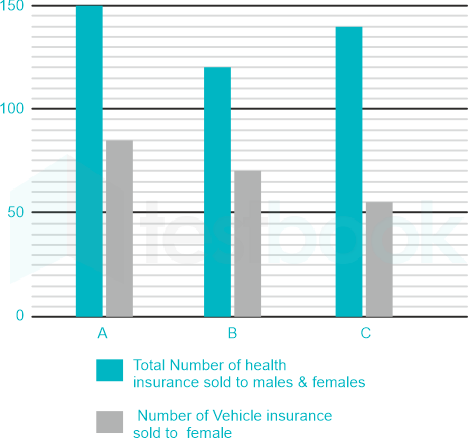
The given bar - graph shows the total number of health insurance sold to male and females, and the number of vehicle insurance sold to females by three different agents A, B and C.

Note:

1)All the agents each sold health insurance to 50 males

  1. Ratio of vehicle insurance sold to female to male by each agent is 5: 4 respectively.

If agent A sold '2y' more health and 'y' more vehicle insurance such that total number of vehicle insurance sold by him becomes 27 less than total number of health insurance sold by him. Find the value of 'y'.

  1. AOption (a)

    25

  2. BOption (b)

    45

  3. COption (c)

    30

  4. DOption (d)

    35

  5. EOption (e)

    40

View answer & explanation

Correct answer

Answer: (c)C.

30

Why this answer is correct

General solution:

Agent A

Number of health insurance sold to males and females = 150

Number of health insurance sold to males = 50

Number of health insurance sold to females = (150 - 50) = 100

Number of vehicle insurance sold to females = 85

Number of vehicle insurance sold to males = 85/5 ×  4 = 68

Agent B

Number of health insurance sold to males and females = 120

Number of health insurance sold to males = 50

Number of health insurance sold to females = (120 - 50) = 70

Number of vehicle insurance sold to females = 70

Number of vehicle insurance sold to males = 70/5 ×  4 = 56 

Agent C

Number of health insurance sold to males and females = 140

Number of health insurance sold to males = 50

Number of health insurance sold to females = (140 - 50) = 90

Number of vehicle insurance sold to females = 55

Number of vehicle insurance sold to males = 55/5 ×  4 = 44

AgentsHealth insurance sold to malesHealth insurance sold to femalesVehicle insurance sold to malesVehicle insurance sold to females
A501006885
B50705670
C50904455


Solution:

Number of health insurance sold by A = 150

Number of vehicle insurance sold by A = 153

If agent A sold '2y' more health and 'y' more vehicle insurance then

(150 + 2y) - (153 + y) = 27

-3 + y =  27

y = 30

IBPS PO Prelims Memory Based Paper (Held On: 23 September 2023 Shift 2) (Previous Year Paper)·Quantitative Aptitude
View full paper

Question 804

IBPS Probationary Officer (PO) 2023• Quantitative Aptitude• Quantitative Aptitude

The given bar - graph shows the total number of health insurance sold to male and females, and the number of vehicle insurance sold to females by three different agents A, B and C.

Note:

1)All the agents each sold health insurance to 50 males

  1. Ratio of vehicle insurance sold to female to male by each agent is 5: 4 respectively.

Find the ratio between the health and vehicle insurance sold by A to the number of health and vehicle insurance sold by C.

  1. AOption (a)

    322: 351

  2. BOption (b)

    303: 239

  3. COption (c)

    301: 334

  4. DOption (d)

    327: 329

  5. EOption (e)

    None of these

View answer & explanation

Correct answer

Answer: (b)B.

303: 239

Why this answer is correct

General solution:

Agent A

Number of health insurance sold to males and females = 150

Number of health insurance sold to males = 50

Number of health insurance sold to females = (150 - 50) = 100

Number of vehicle insurance sold to females = 85

Number of vehicle insurance sold to males = 85/5 ×  4 = 68

Agent B

Number of health insurance sold to males and females = 120

Number of health insurance sold to males = 50

Number of health insurance sold to females = (120 - 50) = 70

Number of vehicle insurance sold to females = 70

Number of vehicle insurance sold to males = 70/5 ×  4 = 56 

Agent C

Number of health insurance sold to males and females = 140

Number of health insurance sold to males = 50

Number of health insurance sold to females = (140 - 50) = 90

Number of vehicle insurance sold to females = 55

Number of vehicle insurance sold to males = 55/5 ×  4 = 44


AgentsHealth insurance sold to malesHealth insurance sold to femalesVehicle insurance sold to malesVehicle insurance sold to females
A501006885
B50705670
C50904455


Solution:

Number of health and vehicle insurance sold by A = (100 + 50 + 68 + 85) = 303

Number of health and vehicle insurance sold by C = (50 + 90 + 44 + 55) = 239

Required ratio = (303: 239)

IBPS PO Prelims Memory Based Paper (Held On: 23 September 2023 Shift 2) (Previous Year Paper)·Quantitative Aptitude
View full paper

Question 805

IBPS Probationary Officer (PO) 2023• Quantitative Aptitude• Quantitative Aptitude

The given bar - graph shows the total number of health insurance sold to male and females, and the number of vehicle insurance sold to females by three different agents A, B and C.

Note:

1)All the agents each sold health insurance to 50 males

  1. Ratio of vehicle insurance sold to female to male by each agent is 5: 4 respectively.

If cost per person of health insurance and vehicle insurance policy is ₹1500 and 2000 respectively, then find the difference between total cost of all the health insurance done by B and total cost of all the vehicle insurance done by C?

  1. AOption (a)

    21000

  2. BOption (b)

    18000

  3. COption (c)

    12000

  4. DOption (d)

    15000

  5. EOption (e)

    19000

View answer & explanation

Correct answer

Answer: (b)B.

18000

Why this answer is correct

General solution:

Agent A

Number of health insurance sold to males and females = 150

Number of health insurance sold to males = 50

Number of health insurance sold to females = (150 - 50) = 100

Number of vehicle insurance sold to females = 85

Number of vehicle insurance sold to males = 85/5 ×  4 = 68

Agent B

Number of health insurance sold to males and females = 120

Number of health insurance sold to males = 50

Number of health insurance sold to females = (120 - 50) = 70

Number of vehicle insurance sold to females = 70

Number of vehicle insurance sold to males = 70/5 ×  4 = 56 

Agent C

Number of health insurance sold to males and females = 140

Number of health insurance sold to males = 50

Number of health insurance sold to females = (140 - 50) = 90

Number of vehicle insurance sold to females = 55

Number of vehicle insurance sold to males = 55/5 ×  4 = 44


AgentsHealth insurance sold to malesHealth insurance sold to femalesVehicle insurance sold to malesVehicle insurance sold to females
A501006885
B50705670
C50904455


Solution: 

Number of health insurance done by B = (50 + 70) = 120

Number of vehicle insurance done by C = (55 + 44) = 99

Difference between the total cost = 99 ×  2000 - 120 ×  1500 = (198000 - 180000) = 18000

IBPS PO Prelims Memory Based Paper (Held On: 23 September 2023 Shift 2) (Previous Year Paper)·Quantitative Aptitude
View full paper

Question 806

IBPS Probationary Officer (PO) 2023• Quantitative Aptitude• Quantitative Aptitude

The given bar - graph shows the total number of health insurance sold to male and females, and the number of vehicle insurance sold to females by three different agents A, B and C.

Note:

1)All the agents each sold health insurance to 50 males

  1. Ratio of vehicle insurance sold to female to male by each agent is 5: 4 respectively.

Health insurance sold to females by agent A is what percentage of the total  number of health insurance sold to females by all the agents.

  1. AOption (a)

    43.78%

  2. BOption (b)

    28.89%

  3. COption (c)

    34.78%

  4. DOption (d)

    38.46%

  5. EOption (e)

    26.68%

View answer & explanation

Correct answer

Answer: (d)D.

38.46%

Why this answer is correct

General solution:

Agent A

Number of health insurance sold to males and females = 150

Number of health insurance sold to males = 50

Number of health insurance sold to females = (150 - 50) = 100

Number of vehicle insurance sold to females = 85

Number of vehicle insurance sold to males = 85/5 ×  4 = 68

Agent B

Number of health insurance sold to males and females = 120

Number of health insurance sold to males = 50

Number of health insurance sold to females = (120 - 50) = 70

Number of vehicle insurance sold to females = 70

Number of vehicle insurance sold to males = 70/5 ×  4 = 56 

Agent C

Number of health insurance sold to males and females = 140

Number of health insurance sold to males = 50

Number of health insurance sold to females = (140 - 50) = 90

Number of vehicle insurance sold to females = 55

Number of vehicle insurance sold to males = 55/5 ×  4 = 44


AgentsHealth insurance sold to malesHealth insurance sold to femalesVehicle insurance sold to malesVehicle insurance sold to females
A501006885
B50705670
C50904455

Solution:

Number of persons sold health insurance = 100

Total number of health insurance sold to females by all the agents = (100 + 70 + 90) = 260

Required percentage = 100/260 ×  100 = 38.46%

IBPS PO Prelims Memory Based Paper (Held On: 23 September 2023 Shift 2) (Previous Year Paper)·Quantitative Aptitude
View full paper

Question 807

IBPS Probationary Officer (PO) 2023• Quantitative Aptitude• Quantitative Aptitude

The given bar - graph shows the total number of health insurance sold to male and females, and the number of vehicle insurance sold to females by three different agents A, B and C.

Note:

1)All the agents each sold health insurance to 50 males

  1. Ratio of vehicle insurance sold to female to male by each agent is 5: 4 respectively.

If the vehicle insurance sold by B to all the people is 21% of ‘x ‘then the health insurance sold by B to all the people is what percent value of x?

  1. AOption (a)

    10%

  2. BOption (b)

    15%

  3. COption (c)

    30%

  4. DOption (d)

    20%

  5. EOption (e)

    25%

View answer & explanation

Correct answer

Answer: (d)D.

20%

Why this answer is correct

General solution:


Agent A

Number of health insurance sold to males and females = 150

Number of health insurance sold to males = 50

Number of health insurance sold to females = (150 - 50) = 100

Number of vehicle insurance sold to females = 85

Number of vehicle insurance sold to males = 85/5 ×  4 = 68

Agent B

Number of health insurance sold to males and females = 120

Number of health insurance sold to males = 50

Number of health insurance sold to females = (120 - 50) = 70

Number of vehicle insurance sold to females = 70

Number of vehicle insurance sold to males = 70/5 ×  4 = 56 

Agent C

Number of health insurance sold to males and females = 140

Number of health insurance sold to males = 50

Number of health insurance sold to females = (140 - 50) = 90

Number of vehicle insurance sold to females = 55

Number of vehicle insurance sold to males = 55/5 ×  4 = 44


AgentsHealth insurance sold to malesHealth insurance sold to femalesVehicle insurance sold to malesVehicle insurance sold to females
A501006885
B50705670
C50904455


Solution:

Vehicle insurance sold by B to all the people is = (56 + 70) = 126

21% = 126

100% = 600

Then the health insurance sold by all the people = (50 + 70) = 120

Required percentage = 120/600 × 100 = 20%

IBPS PO Prelims Memory Based Paper (Held On: 23 September 2023 Shift 2) (Previous Year Paper)·Quantitative Aptitude
View full paper

Question 808

IBPS Probationary Officer (PO) 2023• Quantitative Aptitude• Quantitative Aptitude

A and B are two inlet pipes connected to a cistern, can alone fill it in 20 hours and 24 hours respectively. There is third pipe C which can empty 160 litres of water in one hour from the cistern. If all three pipes are opened together cistern gets filled in 40 hours. Find the total capacity of the cistern.

  1. AOption (a)

    1920 liters

  2. BOption (b)

    2400 liters 

  3. COption (c)

    2240 liters

  4. DOption (d)

    2720 liters

  5. EOption (e)

    3000 liters

View answer & explanation

Correct answer

Answer: (b)B.

2400 liters 

Why this answer is correct

Shortcut Trick
Combined efficiency of A + B + C = 1/40, A = 1/20, B = 1/24.
Efficiency of Emptying Pipe C = (1/20 + 1/24) − 1/40 = (6 + 5 − 3)/120 = 8/120 = 1/15.
Time taken by C to empty the cistern = 15 hours.
Total Capacity = Emptying Rate × Time = 160 × 15 = 2400 liters.
∴ The correct answer is 2400 liters.
Alternate Method
Pipe Time (Hours) Total Work (LCM) Efficiency A (Inlet) 20 120 units +6 B (Inlet) 24 +5 A + B + C 40 +3
⇒ Total efficiency of A + B = 6 + 5 = 11 units/hr.
⇒ Efficiency of Pipe C = (A + B + C) − (A + B) = 3 − 11 = −8 units/hr.
⇒ Time taken by Pipe C alone to empty = 120 ÷ 8 = 15 hours.
⇒ Given: Pipe C empties 160 liters in 1 hour.
⇒ Total Capacity = 160 liters/hr × 15 hours = 2400 liters.
∴ The correct answer is 2400 liters.
Additional Information
Inlet and Outlet Pipes
Inlet pipes carry a positive efficiency (filling), while outlet/leakage pipes carry a negative efficiency (emptying).
Capacity Formula
Total Capacity = Rate of flow × Total time taken to fill or empty the tank.
Pipes & Cisterns Logic
If a tank is filled in 'x' hours and emptied in 'y' hours (y > x), the net part filled in 1 hour is (1/x − 1/y).

IBPS PO Prelims Memory Based Paper (Held On: 23 September 2023 Shift 2) (Previous Year Paper)·Quantitative Aptitude
View full paper

Question 809

IBPS Probationary Officer (PO) 2023• Quantitative Aptitude• Quantitative Aptitude

A mixture contains Alcohol and water in the ratio 7 : 5. When 5 litres of water and 6 litres of alcohol is added to the mixture, the ratio of alcohol to water in the resultant mixture becomes 34 : 25. Find the initial quantity of the mixture.

  1. AOption (a)

    189 litres

  2. BOption (b)

    190 litres

  3. COption (c)

    48 litres

  4. DOption (d)

    58 litres

  5. EOption (e)

    None of these.

View answer & explanation

Correct answer

Answer: (c)C.

48 litres

Why this answer is correct

Shortcut Trick

Initial Ratio Alcohol : Water = 7 : 5 (Total 12 units)

Add 6L Alcohol and 5L Water → New Ratio = 34 : 25

Using Cross-Multiplication Method: (7 × 25) − (34 × 5) units = (34 × 5) − (25 × 6)

⇒ |175 − 170| units = |170 − 150| ⇒ 5 units = 20 litres ⇒ 1 unit = 4 litres

⇒ Initial Total Mixture = 12 units = 12 × 4 = 48 litres

∴ The correct answer is 48 litres.

Alternate Method

Given: Initial ratio = 7 : 5. Added Alcohol = 6L, Added Water = 5L. Final ratio = 34 : 25.

Let initial quantity of Alcohol be 7x and Water be 5x.

⇒ (7x + 6) / (5x + 5) = 34 / 25

⇒ 25 × (7x + 6) = 34 × (5x + 5)

⇒ 175x + 150 = 170x + 170

⇒ 175x − 170x = 170 − 150

⇒ 5x = 20 ⇒ x = 4

⇒ Initial Mixture = 7x + 5x = 12x = 12 × 4 = 48 litres.

∴ The correct answer is 48 litres.

Additional Information

Cross-Multiplication Technique

Useful for ratio problems where different constants are added/subtracted to parts: (a × d − b × c) units = (c × k2 − d × k1).

Mixture Replacement Formula

Final Quantity = Initial Quantity × (1 − Replacement/Total)n, where n is the number of times the process is repeated.

Alligation Rule

Used to find the ratio in which two mixtures of different concentrations are mixed to get a desired mean concentration.

IBPS PO Prelims Memory Based Paper (Held On: 23 September 2023 Shift 2) (Previous Year Paper)·Quantitative Aptitude
View full paper

Question 810

IBPS Probationary Officer (PO) 2023• Quantitative Aptitude• Quantitative Aptitude

What should come in place of the question mark '?' in the following number series?

63, 80, 99, ?, 143, 168

  1. AOption (a)

    121

  2. BOption (b)

    122

  3. COption (c)

    124

  4. DOption (d)

    126

  5. EOption (e)

    120

View answer & explanation

Correct answer

Answer: (e)E.

120

Why this answer is correct

The series follows the following pattern:

82 – 1 = 63

92 – 1 = 80

102 – 1 = 99

112 – 1 = 120

122 – 1 = 143

132 – 1 = 168

IBPS PO Prelims Memory Based Paper (Held On: 23 September 2023 Shift 2) (Previous Year Paper)·Quantitative Aptitude
View full paper

Question 811

IBPS Probationary Officer (PO) 2023• Quantitative Aptitude• Quantitative Aptitude

What should come in place of the question mark '?' in the following number series?

7, 8, 17, 52, ?, 1046

  1. AOption (a)

    209

  2. BOption (b)

    316

  3. COption (c)

    329

  4. DOption (d)

    263

  5. EOption (e)

    291

View answer & explanation

Correct answer

Answer: (a)A.

209

Why this answer is correct

The series follows the following pattern:

7 × 1 + 1 = 8 

8 × 2 + 1 = 17 

17 × 3 + 1 = 52

52 × 4 + 1 = 209 

209 × 5 + 1 = 1046

IBPS PO Prelims Memory Based Paper (Held On: 23 September 2023 Shift 2) (Previous Year Paper)·Quantitative Aptitude
View full paper

Question 812

IBPS Probationary Officer (PO) 2023• Quantitative Aptitude• Quantitative Aptitude

What should come in place of the question mark '?' in the following number series?

16, 160, 281, 381, ?, 526

  1. AOption (a)

    432

  2. BOption (b)

    442

  3. COption (c)

    462

  4. DOption (d)

    452

  5. EOption (e)

    472

View answer & explanation

Correct answer

Answer: (c)C.

462

Why this answer is correct

The series follows the following pattern:

16 + 144 = 160

160 + 121 = 281

281 + 100 = 381

381 + 81 = 462

462 + 64 = 526

IBPS PO Prelims Memory Based Paper (Held On: 23 September 2023 Shift 2) (Previous Year Paper)·Quantitative Aptitude
View full paper

Question 813

IBPS Probationary Officer (PO) 2023• Quantitative Aptitude• Quantitative Aptitude

What will come in place of the question mark (?) in the following series?

103, 615, 958, 1174, 1299, 1363, ?

  1. AOption (a)

    1390

  2. BOption (b)

    1408

  3. COption (c)

    1583

  4. DOption (d)

    1498

  5. EOption (e)

    2458

View answer & explanation

Correct answer

Answer: (a)A.

1390

Why this answer is correct

103 + 83 = 615

615 + 73 = 958

958 + 63 = 1174

1174 + 53 = 1299

1299 + 43 = 1363

1363 + 33 = 1390

IBPS PO Prelims Memory Based Paper (Held On: 23 September 2023 Shift 2) (Previous Year Paper)·Quantitative Aptitude
View full paper

Question 814

IBPS Probationary Officer (PO) 2023• Quantitative Aptitude• Quantitative Aptitude

What should come in place of the question mark '?' in the following number series?

7, 7, 14, ?, 168, 840

  1. AOption (a)

    39

  2. BOption (b)

    40

  3. COption (c)

    41

  4. DOption (d)

    42

  5. EOption (e)

    43

View answer & explanation

Correct answer

Answer: (d)D.

42

Why this answer is correct

Calculation:

The series follows the following pattern:

⇒ 7 × 1 = 7

⇒ 7 × 2 = 14

⇒ 14 × 3 = 42

⇒ 42 × 4 = 168

⇒ 168 × 5 = 840

∴ The missing term in the series is 42

IBPS PO Prelims Memory Based Paper (Held On: 23 September 2023 Shift 2) (Previous Year Paper)·Quantitative Aptitude
View full paper

Question 815

IBPS Probationary Officer (PO) 2023• Quantitative Aptitude• Quantitative Aptitude

Tickets numbered 1 to 50 are mixed up and then a ticket is drawn at random. What is the probability that the ticket drawn bears a number which is a multiple of 8?

  1. AOption (a)

    1/7

  2. BOption (b)

    7/26

  3. COption (c)

    3/25

  4. DOption (d)

    2/5

  5. EOption (e)

    3/5

View answer & explanation

Correct answer

Answer: (c)C.

3/25

Why this answer is correct

Shortcut Trick

Total outcomes = 50 (numbers 1 to 50).

Multiples of 8 up to 50 = 50 ÷ 8 ≈ 6 (Specifically: 8, 16, 24, 32, 40, 48).

Probability = Favorable outcomes ÷ Total outcomes = 6 ÷ 50 = 3/25.

∴ The correct answer is 3/25.

Alternate Method

Given:

Total number of tickets = 50.

Condition: Drawn ticket must be a multiple of 8.

Formula Used:

Probability P(E) = n(E) ÷ n(S)

Calculations:

⇒ Sample space n(S) = {1, 2, 3, ..., 50} = 50.

⇒ Favorable outcomes E = {8, 16, 24, 32, 40, 48}.

⇒ Number of favorable outcomes n(E) = 6.

⇒ P(E) = 6 ÷ 50

⇒ P(E) = 3 ÷ 25

∴ The correct answer is 3/25.

Additional Information

Definition of Probability

Probability is the measure of likelihood of an event occurring, calculated as favorable outcomes divided by total possible outcomes. 0 ≤ P(E) ≤ 1.

Complementary Event

The probability of an event not occurring is P(E') = 1 − P(E). For this problem, probability of not picking a multiple of 8 is 1 − 3/25 = 22/25.

Multiples in a Range

The count of multiples of 'k' in the range 1 to 'n' is given by the greatest integer function [n/k]. Here, [50/8] = 6.

IBPS PO Prelims Memory Based Paper (Held On: 23 September 2023 Shift 2) (Previous Year Paper)·Quantitative Aptitude
View full paper

Question 816

IBPS Probationary Officer (PO) 2023• Quantitative Aptitude• Quantitative Aptitude

Set A contains 3 consecutive prime numbers while set B contains 2 consecutive odd numbers. Sum of largest number of set A and set B is 64 while largest number of set A is 4 less than the 3 times of largest number of set B. Find the smallest number of set A.

  1. AOption (a)

    47

  2. BOption (b)

    43

  3. COption (c)

    53

  4. DOption (d)

    59

  5. EOption (e)

    41

View answer & explanation

Correct answer

Answer: (e)E.

41

Why this answer is correct

Shortcut Trick

Let the largest prime number in Set A be P and the largest odd number in Set B be Q.

Given: P + Q = 64 and P = 3Q − 4.

Substitute P: (3Q − 4) + Q = 64 ⇒ 4Q = 68 ⇒ Q = 17.

Then P = 64 − 17 = 47.

Set A consists of 3 consecutive prime numbers ending in 47: 41, 43, 47.

∴ The correct answer is 41.

Alternate Method

Given: Largest number of Set A = P, Largest number of Set B = Q.

Equations:

⇒ P + Q = 64 --- (i)

⇒ P = 3Q − 4 --- (ii)

Calculation:

⇒ Put (ii) in (i): (3Q − 4) + Q = 64

⇒ 4Q = 68

⇒ Q = 17 (Largest odd number of Set B)

⇒ P = 64 − 17 = 47 (Largest prime number of Set A)

⇒ Set A contains 3 consecutive primes: 41, 43, 47.

⇒ Smallest number = 41.

∴ The correct answer is 41.

Additional Information

Prime Numbers

A number greater than 1 with exactly two factors: 1 and itself. Consecutive primes after 40 are 41, 43, 47, 53, 59.

Consecutive Odd Numbers

Numbers of the form 2n + 1. The difference between two consecutive odd numbers is always 2.

Linear Equations

Solving systems of equations using substitution or elimination methods to find unknown variables.

IBPS PO Prelims Memory Based Paper (Held On: 23 September 2023 Shift 2) (Previous Year Paper)·Quantitative Aptitude
View full paper

Question 817

IBPS Probationary Officer (PO) 2023• Quantitative Aptitude• Quantitative Aptitude

Subhash spends 40% of his monthly income on household items, 20% of his monthly income on buying clothes, 10% of his monthly income on investing in recurring deposits, and the remaining amount of Rs. 15,000 he saves. What is Subhash's monthly income?

  1. AOption (a)

    Rs. 25,000

  2. BOption (b)

    Rs. 1,00,000

  3. COption (c)

    Rs. 50,000

  4. DOption (d)

    Rs. 45,000

  5. EOption (e)

    Rs. 48,000

View answer & explanation

Correct answer

Answer: (c)C.

Rs. 50,000

Why this answer is correct

Shortcut Trick

Total percentage spent = 40% + 20% + 10% = 70%

Remaining savings percentage = 100% − 70% = 30%

Given, 30% of income = ₹15,000

100% of income = (15,000 ÷ 30) × 100 = ₹50,000

∴ The correct answer is ₹50,000.

Alternate Method

Given:

Expenditure on household items = 40%

Expenditure on clothes = 20%

Investment in recurring deposits (RD) = 10%

Actual savings = ₹15,000

Calculations:

⇒ Total percentage utilized = 40% + 20% + 10% = 70%

⇒ Percentage saved = 100% − 70% = 30%

⇒ Let total income be X.

⇒ 30% of X = 15,000

⇒ (30 ÷ 100) × X = 15,000

⇒ X = (15,000 × 100) ÷ 30

⇒ X = 500 × 100

⇒ X = 50,000

∴ The correct answer is ₹50,000.

Additional Information

Successive Percentage Spending

If a person spends X% and then Y% of the remaining amount, the final value is calculated as Initial × (100−X)/100 × (100−Y)/100.

Income-Expenditure Relationship

Monthly Income = Total Expenditure + Savings. This basic identity is used to solve most percentage-based budget problems.

Fractional Conversions

Convert percentages to fractions to speed up calculations: 20% = 1/5, 40% = 2/5, 10% = 1/10.

IBPS PO Prelims Memory Based Paper (Held On: 23 September 2023 Shift 2) (Previous Year Paper)·Quantitative Aptitude
View full paper

Question 818

IBPS Probationary Officer (PO) 2023• Quantitative Aptitude• Quantitative Aptitude

Directions: Given below are two quantities named I and II. Based on the given information, you have to determine the relation between the two quantities. You should use the given data and your knowledge of Mathematics to choose among the possible answers.

a = -3, b = -1 and c = 6

Quantity I: Find the value of (a3 + b2 + c2) / 4

Quantity II: Find the value of [a / (a3 + b2)]

  1. AOption (a)

    Quantity I = Quantity II

  2. BOption (b)

    Quantity I ≥ Quantity II

  3. COption (c)

    Quantity I ≤ Quantity II

  4. DOption (d)

    Quantity I ˂ Quantity II

  5. EOption (e)

    Quantity I ˃ Quantity II

View answer & explanation

Correct answer

Answer: (e)E.

Quantity I ˃ Quantity II

Why this answer is correct

Shortcut Trick
Evaluate values directly for given a = −3, b = −1, c = 6.
Quantity I = (−27 + 1 + 36) ÷ 4 = 10 ÷ 4 = 2.5
Quantity II = −3 ÷ (−27 + 1) = −3 ÷ −26 = 3/26 ≈ 0.115
Since 2.5 > 0.115, Quantity I > Quantity II.
∴ The correct answer is Quantity I > Quantity II.
Alternate Method
Given: a = −3, b = −1, c = 6
Quantity I Calculation:
⇒ a3 = (−3)3 = −27
⇒ b2 = (−1)2 = 1
⇒ c2 = (6)2 = 36
⇒ Quantity I = (−27 + 1 + 36) ÷ 4
⇒ Quantity I = 10 ÷ 4 = 2.5
Quantity II Calculation:
⇒ a / (a3 + b2) = −3 / [(−3)3 + (−1)2]
⇒ Quantity II = −3 / (−27 + 1)
⇒ Quantity II = −3 / −26 = 3/26 ≈ 0.115
Comparison:
⇒ 2.5 > 0.115
∴ The correct answer is Quantity I > Quantity II.
Additional Information
Power of Negative Numbers
A negative number raised to an odd power results in a negative value: (−x)n = −xn. A negative number raised to an even power results in a positive value: (−x)n = xn.
Comparison of Quantities
Always ensure both quantities are in the same form (decimal or fraction) before comparing. For fractions, cross-multiplication can be used to determine which is larger.

IBPS PO Prelims Memory Based Paper (Held On: 23 September 2023 Shift 2) (Previous Year Paper)·Quantitative Aptitude
View full paper

Question 819

IBPS Probationary Officer (PO) 2023• Quantitative Aptitude• Quantitative Aptitude

Direction: Given below are two quantities named A and B. Based on the given information you have to determine the relation between the two quantities. You should use the given data and your knowledge of Mathematics to choose between the possible answers.

The perimeter of a square is equal to twice the perimeter of a rectangle of length 11 cm and breadth 10 cm.

Quantity A: What is the circumference of the semicircle whose diameter is equal to the side of the square?

Quantity B: What is the circumference of the circle which is inscribed inside the square?

  1. AOption (a)

    Quantity A > Quantity B

  2. BOption (b)

    Quantity A < Quantity B

  3. COption (c)

    Quantity A ≥ Quantity B

  4. DOption (d)

    Quantity A ≤ Quantity B

  5. EOption (e)

    Quantity A = Quantity B or No relation

View answer & explanation

Correct answer

Answer: (b)B.

Quantity A < Quantity B

Why this answer is correct

Perimeter of a square = 2 × 2 × (11 + 10) = 84 cm

⇒ Side of the square = 84/4 = 21 cm

Quantity A:

Circumference of the semicircle whose diameter is equal to the side of the square = 21 + 22/7 × 21/2

⇒ 21 + 33 = 54 cm

Quantity B:

Circumference of the circle which is inscribed inside the square = 2 × 22/7 × 21/2 = 66 cm

∴ Quantity A < Quantity B

IBPS PO Prelims Memory Based Paper (Held On: 23 September 2023 Shift 2) (Previous Year Paper)·Quantitative Aptitude
View full paper

Question 820

IBPS Probationary Officer (PO) 2023• Quantitative Aptitude• Quantitative Aptitude

Directions

Two quantities A and B are given in the following questions. You have to find the value to both A and B by using your knowledge of mathematics and choose the most suitable relation between the magnitude of A and B from the given options.

Quantity A - Distance between trains after 3 hours. Train X travels 420 km in 7 hours. Ratio of speeds of train X and Y is 5 : 3. Trains are 100 km apart and are travelling towards each other.

Quantity B - Distance (in km) travelled in 2 hours. Bus can travel 300 m in 12 seconds.

  1. AOption (a)

    Quantity A ≥ Quantity B

  2. BOption (b)

    Quantity A ≤ Quantity B

  3. COption (c)

    Quantity A = Quantity B or no relationship can be established

  4. DOption (d)

    Quantity A > Quantity B

  5. EOption (e)

    Quantity A < Quantity B

View answer & explanation

Correct answer

Answer: (d)D.

Quantity A > Quantity B

Why this answer is correct

Shortcut TrickQuantity A: Speed X = 420/7 = 60 kmph. Ratio 5:3 → Speed Y = (3/5)×60 = 36 kmph. Relative speed = 60 + 36 = 96 kmph. Distance in 3 hrs = 96×3 = 288 km. Initial gap = 100 km. Crossing occurs, then new distance = 288 − 100 = 188 km.Quantity B: Speed = 300/12 = 25 m/s = 25×18/5 = 90 kmph. Distance in 2 hrs = 90×2 = 180 km.Comparison: 188 km > 180 km ⇒ A > B.∴ The correct answer is Quantity A > Quantity B.Alternate MethodQuantity A:⇒ Speed of Train X = 420 km ÷ 7 hours = 60 kmph.⇒ Speed of Train Y = (60 ÷ 5) × 3 = 36 kmph.⇒ Relative Speed (Towards each other) = 60 + 36 = 96 kmph.⇒ Total Distance covered in 3 hours = 96 × 3 = 288 km.⇒ Final Distance between them = |Initial distance − Distance covered| = |100 − 288| = 188 km.Quantity B:⇒ Speed of Bus = 300 m ÷ 12 s = 25 m/s.⇒ Speed in kmph = 25 × (18 ÷ 5) = 90 kmph.⇒ Distance in 2 hours = 90 × 2 = 180 km.⇒ Comparing Quantity A (188 km) and Quantity B (180 km), A > B.∴ The correct answer is Quantity A > Quantity B.Additional InformationRelative SpeedWhen two objects move towards each other, relative speed is the sum of their individual speeds (S1 + S2). If moving in the same direction, it is the difference |S1 − S2|.Unit ConversionTo convert speed from m/s to kmph, multiply by 18/5. To convert kmph to m/s, multiply by 5/18.Distance After CrossingIf objects cover more distance than the initial gap, they cross each other. New distance = |Initial Gap − Relative Distance Covered|.

How should I prepare for Quantitative Aptitude in IBPS Probationary Officer (PO)?

Solving previous year questions by topic helps identify recurring concepts, question patterns, and frequently asked sub-topics. Attempt each question, review the step-by-step explanation, and note down key formulas or facts for quick revision before the exam.