Previous Year Paper

IBPS PO Prelims Memory Based Paper (Held On: 23 September 2023 Shift 1) (Previous Year Paper)

Held in 2023

100 questions60 minutes
With answers
Free

Paper last updated:

Practise under exam conditions

Take this paper as a timed mock test. Review your answers after you submit.

Attempt timed test

Questions & answers

Read the paper at your pace. Open an explanation when you need it.

English Language (30 questions)

Direction: Read the given passage carefully to answer the following questions. Each question will have five alternatives as its answer. Choose the correct option as your answer

As global efforts to curb carbon emissions continue to intensify, particular attention has been drawn to the transportation industry, one sector with significant potential to effect positive change. The drive towards increased electric vehicle (EV) usage is gathering pace, with more consumers moving away from fossil fuel-dependent engines. This transition is expected to build on momentum already achieved in renewable energy sectors, setting the stage for a more sustainable future.

However, success in this field is heavily predicated on the wide-scale availability of element X, a crucial ingredient for the production of EVs, particularly in the manufacture of powerful, reliable batteries. Element X brings together the perfect blend of lightness, energy capacity, heat tolerance, and cost-effectiveness, qualities that soundly position it as an indispensable material in EV battery production.

As global demand for EVs increases, the scale of production and consumption of element X will take an equivalent uptick, impacting a steep upward growth curve on the global market. With governments and corporations across the globe actively driving the transition to green energy, the surge in EV's adoption will lead to an unparalleled build-up in demand for this critical ingredient.

This dynamic presents both opportunities and challenges. On the one hand, the elevated production of element X will contribute to job creation and economic growth in regions where its extraction and refining occur, offering an economic uplift. On the other hand, its extraction and processing must be managed in an environmentally and socially responsible way to match the green ideals of the EV movement.

In this context, planning for the future must consider investment in infrastructural expansion, research into alternate or synthetic substitutes for element X, and regulations that incentivize responsible and sustainable mining. This is a crucial step to not only meet burgeoning demand but also mitigate any negative environmental or social implications.

Ultimately, the drive to increase EV usage necessitates a corresponding upswing in the production and processing of element X. As such, efforts to curb reliance on fossil fuels will catalyze a new trajectory in the mining sector, poised to meet the growing demand of this critical element that underpins the growth of EVs.

Question 1

Which of the following words is a synonym for the word 'curb' as used in the passage?

  1. AOption (a)

    Encourage

  2. BOption (b)

    Boost 

  3. COption (c)

    Suppress

  4. DOption (d)

    Amplify 

  5. EOption (e)

    Raise

View answer & explanation

Correct answer

Answer: (c)C.

Suppress

Why this answer is correct

The correct answer is Option 3.

Key Points

  • 'Curb' means to restrain or keep in check, and 'Suppress' has a similar meaning as it also refers to prevent or reduce, thus is a synonym for 'curb'.
  • The other options are essentially antonyms as they imply increase or support which is opposite to the meaning of 'curb'.

Additional Information

  • A. Encourage: This is not a synonym for 'curb'. To encourage means to give support, confidence, or hope to someone or something. It's essentially the opposite of curbing, which involves restraining or keeping in check.
  • B. Boost: This is not a synonym for 'curb' either. Boost means to help or encourage something to increase or improve. Again, this is contrasted with the meaning of 'curb' which implies a reduction or restraint.
  • D. Amplify: This means to make something more marked or intense. It's similar to the word 'boost'. Both imply an increase or improvement, not a restraint or reduction, so 'amplify' is not a synonym for 'curb'.
  • E. Raise: To raise something means to lift it up or increase it, which is the opposite of what 'curb' means. So 'raise' is also not a synonym for 'curb.'
  • Each of these options (encourage, boost, amplify, raise) represents an action that increases or intensifies something, while 'curb' represents a decreasing or restraining action. Therefore, they are not synonyms but rather antonyms of 'curb.'
Question 2

What implications does the increased production of element X have for regions where its extraction occurs?

  1. AOption (a)

    Increased pollution

  2. BOption (b)

    Decreased economic activity

  3. COption (c)

    Job creation and economic growth 

  4. DOption (d)

    Social disruption

  5. EOption (e)

    No change

View answer & explanation

Correct answer

Answer: (c)C.

Job creation and economic growth 

Why this answer is correct

Answer: C. Job creation and economic growth.

<br>

Key Points

The passage suggests that the escalated production of element X will contribute to job creation and economic growth in areas where its extraction and refining take place.

Question 3

Which of the following words is a antonym for the word 'build' as used in the passage?

  1. AOption (a)

    Construct

  2. BOption (b)

    Develop 

  3. COption (c)

     Assemble 

  4. DOption (d)

    Demolish

  5. EOption (e)

    Strengthen

View answer & explanation

Correct answer

Answer: (d)D.

Demolish

Why this answer is correct

The correct answer is Option 4.

Key Points

  • "Build," in the context of this passage, is generally used to refer to the creation or development of something. In a broader sense, it can be used to describe the progress or growth of something over time. For example, we can build a physical structure, build momentum, or build a strategy.
  • On the other hand, "demolish" means to destroy or pull down a structure or system, thereby reducing it to a state where it no longer exists or is functional. Unlike "build," which implies progression or growth, "demolish" implies regression or loss.
  • So in the context of the passage, while we're discussing building momentum or increasing development (with respect to EVs usage and element X production), "demolish" would signify the opposite process — breaking down or destruction.

Additional Information

  • A. Construct: This is a synonym for "build," as both terms refer to the act of creating or assembling something, so it doesn't serve as an antonym.
  • B. Develop: This is also a synonym for "build," typically meaning to grow, expand or bring to a more advanced state. Therefore, it doesn't serve as an antonym.
  • C. Assemble: This also means to gather or bring together, generally used when parts are put together, making it a synonym for 'build' and not an antonym.

E. Strengthen: This is a synonym for "build," as building often implies increasing strength or resilience. Therefore, it's not an antonym for "build."

Question 4

Which of the following statements is/are true?

  1. Environmentally sustainable practices are not necessary in the production and processing of element X.
  2. The production of element X will stimulate job creation and economic growth in regions where it is extracted and refined.
  3. The transition to green energy will decrease the global demand for EVs.
  1. AOption (a)

    Only 1 is true 

  2. BOption (b)

    Only 2 is true 

  3. COption (c)

    Only 3 is true

  4. DOption (d)

    1 and 3 are true

  5. EOption (e)

    2 and 3 are true

View answer & explanation

Correct answer

Answer: (b)B.

Only 2 is true 

Why this answer is correct

The correct answer is Option 2.

Key Points

  • Environmentally sustainable practices are not necessary in the production and processing of element X.
  • This is false. According to the passage, the extraction and processing of element X must be managed in an environmentally and socially responsible way due to the green ideals of the EV movement.
  • The production of element X will stimulate job creation and economic growth in regions where it is extracted and refined.
  • This is true. As the passage states, the elevated production of element X will contribute to job creation and economic growth in areas where its extraction and refining take place.
  • The transition to green energy will decrease the global demand for EVs.
  • This is false. According to the passage, the surge in EVs adoption is expected as governments and corporations across the globe actively drive the transition to green energy.
  • So, only statement 2 is true, making option B the correct answer.

Question 5

According to the passage, why is element X crucial in the production of electric vehicle batteries?

  1. AOption (a)

    It makes the battery more substantial.

  2. BOption (b)

    It makes the battery look more attractive. 

  3. COption (c)

     It renders the battery less efficient. 

  4. DOption (d)

    It combines qualities of energy capacity, cost-effectiveness, heat tolerance, and lightness. 

  5. EOption (e)

    It makes the battery heavier, reducing vehicle speed.

View answer & explanation

Correct answer

Answer: (d)D.

It combines qualities of energy capacity, cost-effectiveness, heat tolerance, and lightness. 

Why this answer is correct

Answer: D. It combines qualities of energy capacity, cost-effectiveness, heat tolerance, and lightness.

Key Points

  • This is clearly stated in the passage that says, "element X brings together the perfect blend of lightness, energy capacity, heat tolerance, and cost-effectiveness, qualities that soundly position it as an indispensable material in EV battery production." This makes option D the correct answer.
  • The other options listed in the question either don't apply (like A, B, and E) or are directly contrary to the information given in the passage (like C).

Question 6

What is a crucial step to meet the increasing demand for element X and mitigate negative environmental or social implications?

  1. AOption (a)

    Reducing investment in infrastructural expansion 

  2. BOption (b)

    Ignoring research into alternate or synthetic substitutes for element X

  3. COption (c)

    Decreasing regulations that incentivize sustainable mining 

  4. DOption (d)

    Increasing emissions of fossil fuels 

  5. EOption (e)

    Planning for investment in infrastructural expansion, research into alternate or synthetic substitutes, and regulations that incentivize sustainable mining

View answer & explanation

Correct answer

Answer: (e)E.

Planning for investment in infrastructural expansion, research into alternate or synthetic substitutes, and regulations that incentivize sustainable mining

Why this answer is correct

E. Planning for investment in infrastructural expansion, research into alternate or synthetic substitutes, and regulations that incentivize sustainable mining.

Key Points

  • The passage outlines that to meet the growing demand while also mitigating negative impacts, planning must consider investment in infrastructural expansion, researching alternate or synthetic substitutes for element X, and put forth regulations that incentivize responsible and sustainable mining.

Question 7

Which of the following statements are true?

  1. The demand for EVs directly impacts the production and consumption of element X.
  2. With the growth of the EV market, the production of element X will decrease.
  3. Regulatory actions and infrastructural expansion are critical for managing the increasing demand for element X.
  1. AOption (a)

    Only 1 and 3 are true

  2. BOption (b)

    Only 2 is true 

  3. COption (c)

    Only 3 is true 

  4. DOption (d)

    1, 2, and 3 are true 

  5. EOption (e)

    None of them are true

View answer & explanation

Correct answer

Answer: (a)A.

Only 1 and 3 are true

Why this answer is correct

The correct answer is Option 1.

Key Points

  • The demand for EVs directly impacts the production and consumption of element X.
  • This is true as per the passage. As the global demand for EVs increases, the scale of production and consumption of element X will rise.
  • With the growth of the EV market, the production of element X will decrease.
  • This is false. Contrarily, the passage indicates that with the rise in the EV market, the production of element X will increase, not decrease.
  • Regulatory actions and infrastructural expansion are critical for managing the increasing demand for element X.
  • This is true. The passage suggests gearing up for future demand for element X by investing in infrastructural expansion and implementing regulations that incentivize sustainable mining.
  • Therefore, only statements 1 and 3 are true, making option A the correct answer.

Question 8

Which of the following statements is/are false?

  1. Research into alternate or synthetic substitutes for Element X is unnecessary for future planning.
  2. Sustainable mining for Element X extraction is undesirable.
  3. Job creation and economic growth will result from the escalated production of Element X.
  1. AOption (a)

    Only 1 

  2. BOption (b)

    Only 2

  3. COption (c)

    Only 3 

  4. DOption (d)

    1 and 2 

  5. EOption (e)

    2 and 3 

View answer & explanation

Correct answer

Answer: (d)D.

1 and 2 

Why this answer is correct

The correct answer is Option 4.

Key Points

  • Research into alternate or synthetic substitutes for Element X is unnecessary for future planning.
  • This is false. According to the passage, research into alternate or synthetic substitutes for element X is essential to match the burgeoning demand and mitigate environmental or social implications.
  • Sustainable mining for Element X extraction is undesirable.
  • This is false. The passage emphasizes sustainable mining practices to complement the green ideals of the EV movement.
  • Job creation and economic growth will result from the escalated production of Element X.
  • This is true, as the passage explains that increased production of Element X will contribute to job creation and economic growth in regions where its extraction and refining take place.
  • From these, 1 and 2 are false, making option D the correct answer.

Question 9

In the sentence, certain words are in bold and numbered from A to E, which are the possible pairs to be interchanged. Choose the pair(s) of words which need to be interchanged to make the sentence grammatically correct and meaningful.

The (A) enemies of using pests’ natural (B) method  is (C) known as biological control, and is (D) considered an eco-friendly (E) alternative to the use of insecticides.

  1. AOption (a)

    Only A-B

  2. BOption (b)

    A-C and B-D

  3. COption (c)

    No Improvement

  4. DOption (d)

    Only C-D

  5. EOption (e)

    Both A-B and C-D

View answer & explanation

Correct answer

Answer: (a)A.

Only A-B

Why this answer is correct

The correct answer is option 1), i.e. A-B.

Key Points

We can go through the sentence the following way:

The (A)________ of using pests’ natural (B)________ is (C)________ as biological control, and is (D)________ an eco-friendly (E)________ to the use of insecticides.

Considered means to think carefully about (something), typically before making a decision

Alternative means (of one or more things) available as another possibility or choice.

Clearly, D and E have meaningful and contextually correct words. C is also correct.

Both the words, i.e. Enemies and Method are incorrectly used. Hence,A and B should be interchanged.

The correct sentence: The (A) methods of using pests’ natural (B) enemies is (C) known as biological control, and is (D) considered an eco-friendly (E) alternative to the use of insecticides.

Question 10

In the sentence, certain words are in bold and numbered from A to E, which are the possible pairs to be interchanged. Choose the pair(s) of words which need to be interchanged to make the sentence grammatically correct and meaningful.

Turkey should (A) seek ways to (B) relying the (C) process by (D) expedite on (E) existing research elsewhere.

  1. AOption (a)

    A-C

  2. BOption (b)

    B-E and A-C

  3. COption (c)

    B-D

  4. DOption (d)

    A-D and B-E

  5. EOption (e)

    A-B

View answer & explanation

Correct answer

Answer: (c)C.

B-D

Why this answer is correct

The correct answer is option 3), i.e. B-D.

We can go through the sentence the following way:

Turkey should (A)________ ways to (B)________ the (C)________ by (D)________ on (E)________ research elsewhere. 

Seek means go for / attempt to find (something).

Existing means living.

Clearly, A and E have meaningful and grammatically correct words. C is also correct.

Relying means depending.

Expedite means speed up.

It is clear that both the words, i.e. relying and expedite are inappropriately used here. Hence, B and D should be interchanged.

The correct sentence:

Turkey should (A) seek ways to (B) expedite the (C) process by (D) relying on (E) existing research elsewhere.

Question 11

In the sentence, certain words are in bold and numbered from A to E, which are the possible pairs to be interchanged. Choose the pair(s) of words which need to be interchanged to make the sentence grammatically correct and meaningful.

Suppose we wanted to (A) estimate how many car owners there are in the UK and how many of those (B) data a Ford Fiesta, but we only have (C) own on those people who (D) visited Ford car showrooms in the (E) last year.

  1. AOption (a)

    A-D and B-E

  2. BOption (b)

    B-C

  3. COption (c)

    A-C and B-D

  4. DOption (d)

    A-D

  5. EOption (e)

    B-C and A-D

View answer & explanation

Correct answer

Answer: (b)B.

B-C

Why this answer is correct

The correct answer is option 2 i.e. B-C.

Key Points

We can look into the sentence the following way:

Suppose we wanted to (A) _________ how many car owners there are in the UK and how many of those (B) _________ a Ford Fiesta, but we only have (C) ________ on those people who (D) ____________ Ford car showrooms in the (E) ________ year.

  • Meaning of the words given in bold are: 
  • Estimate means roughly calculate or judge the value, number, quantity, or extent of.
  • Data means facts and statistics collected together for reference or analysis.
  • Own means to possess.
  • Visited means to go to see (someone or something) for a specific purpose.
  • Last means most recent in time.
  • It is clear that (A) and (D) has grammatically and meaningfully correct words. Also (E) justifies its bold word.
  • Hence B and C should be interchanged

**Correct sentence: "Suppose we wanted to estimate how many car owners there are in the UK and how many of those own a Ford Fiesta, but we only have data on those people who visited Ford car showrooms in the last year."

Question 12

In the sentence, certain words are in bold and numbered from A to E, which are the possible pairs to be interchanged. Choose the pair(s) of words which need to be interchanged to make the sentence grammatically correct and meaningful.

The wind came (A) edge across the (B) highest (C) unhampered of the Pennines, the iciest of (D) blasts from the north-west (E) corner of the sky.

  1. AOption (a)

    B-E

  2. BOption (b)

    A-C

  3. COption (c)

    D-E

  4. DOption (d)

    A-D and B-E

  5. EOption (e)

    B-C

View answer & explanation

Correct answer

Answer: (b)B.

A-C

Why this answer is correct

The correct answer is option 2), i.e. A-C.

Key Points

  • We can go through the sentence in the following way:
  • The wind came (A)________ across the (B)________ (C)________ of the Pennines, the iciest of (D)________ from the north-west (E)________ of the sky.
  • Blasts means explosion. So, D is correct.
  • Clearly, B and E have meaningful and grammatically correct words.
  • Edge means boundary and margin.
  • Unhampered means unrestricted / allowed to move, progress, or happen without difficulties.
  • It is clear that both the words i.e. edge and unhampered are incorrectly written here. Hence, A and C should be interchanged.

The correct sentence:

The wind came (A) unhampered across the (B) highest (C) edge of the Pennines, the iciest of (D) blasts from the north-west (E) corner of the sky.

Question 13

Direction: The given sentence is divided into four parts: A, B, C, and D. Choose the part that contains an error as your answer. If the sentence is error-free, mark E i.e. No error as your answer.

Business is about having (A)/ an extremely skilled team (B)/ and provide the best service (C)/ to our customers. (D)/ No error (E)

  1. AOption (a)

    A

  2. BOption (b)

    B

  3. COption (c)

    C

  4. DOption (d)

    D

  5. EOption (e)

    E

View answer & explanation

Correct answer

Answer: (c)C.

C

Why this answer is correct

The correct answer is option 3.

 Key Points

  • Part C of the sentence i.e. 'and provide the best service' is erroneous.
  • The verb 'provide' should be replaced with 'providing' to make the sentence grammatically correct. In this context, "providing" is the correct gerund form of the verb that should be used to maintain parallelism in the sentence.
  • Parallelism is a grammatical principle that ensures that items in a series or list are grammatically consistent. In this sentence, the parallel structure should follow the pattern of "having an extremely skilled team" and "providing the best service."
  • Hence, the correct sentence is C.
  • The corrected sentence would be: "Business is about having an extremely skilled team and providing the best service to our customers."

Question 14

Direction: The given sentence is divided into four parts: A, B, C, and D. Choose the part that contains an error as your answer. If the sentence is error-free, mark E i.e. No error as your answer.

The fundamental idea is to (A)/ foster connections through (B)/ real-life meetups rather (C)/ than solely through virtual interactions. (D)/ No error (E)

  1. AOption (a)

    A

  2. BOption (b)

    B

  3. COption (c)

    C

  4. DOption (d)

    D

  5. EOption (e)

    E

View answer & explanation

Correct answer

Answer: (e)E.

E

Why this answer is correct

The correct answer is option 5.

Key Points

This sentence is error-free and it talks about the concept of fostering connections through real-life meetups instead of relying solely on virtual interactions.

Hence, the correct answer is E.

  • Let's understand some important vocab given in the sentence:
  • Fundamental - forming a necessary base or core; of central importance (मौलिक)
  • For Example -
  • A strong foundation in mathematics is fundamental to understanding advanced scientific concepts.
  • Foster - to promote the growth or development of; to nurture (पोषण करना)
  • For Example -
  • The organization aims to foster creativity and innovation among its employees.
  • Solely - exclusively or entirely; without any other elements or factors (सिर्फ़)
  • For Example -
  • Her success in the competition was solely due to her hard work and dedication.
  • Virtual - existing or occurring primarily online or in a digital environment (आभासी)
  • For Example -
  • Many companies now hold virtual meetings to reduce the need for physical travel.
  • Interactions - actions or processes of two or more things or people affecting each other (प्रवृत्तियाँ)
  • For Example -
  • Effective communication is essential for positive interactions in the workplace.

Question 15

Direction: The given sentence is divided into four parts: A, B, C, and D. Choose the part that contains an error as your answer. If the sentence is error-free, mark E i.e. No error as your answer.

People develop a attachment (A)/ to a city because they find (B)/ a sense of belonging (C)/ within like-minded individuals. (D)/ No error (E)

  1. AOption (a)

    A

  2. BOption (b)

    B

  3. COption (c)

    C

  4. DOption (d)

    D

  5. EOption (e)

    E

View answer & explanation

Correct answer

Answer: (a)A.

A

Why this answer is correct

The correct answer is option 1.

Key Points 

  • Part A of the sentence i.e. "people develop a attachment" is erroneous.
  • The use of the article 'a' before 'attachment' is incorrect and it should it replaced with the article 'an' because the article 'an' is used before nouns that begin with a vowel sound, and 'attachment' has a vowel sound, so the article "a" should be replaced with "an" to make the sentence grammatically correct.
  • Hence, the correct answer is A.
  • The correct sentence would be: "People develop an attachment to a city because they find a sense of belonging within like-minded individuals."


 Key Points 

Use of articles a, an, and the - 

  • Article 'a' is used before nouns that begin with a consonant sound.
  • For Example -
  • I have a book in my purse.
  • (Here, article 'a' is used before the noun 'book' because it begins with a consonant sound)
  • Article 'an' is used before nouns that begin with a vowel sound.
  • For Example -
  • Do you want an apple for breakfast?
  • (Here, the article 'an' is used before the noun 'apple' because it begins with a vowel sound)
  • Article 'the' is used before both singular and plural nouns when the noun is specific.
  • For Example -
  • I saw the play you are talking about.
  • (Here, the article 'the' is used before the noun 'play' because it is the specific play that is being talked about)

Question 16

Direction: The given sentence is divided into four parts: A, B, C, and D. Choose the part that contains an error as your answer. If the sentence is error-free, mark E i.e. No error as your answer.

These are just small (A)/ alterations with our lifestyle (B)/ that will help us achieve (C)/ that perfect body. (D)/ No error (E)

  1. AOption (a)

    A

  2. BOption (b)

    B

  3. COption (c)

    C

  4. DOption (d)

    D

  5. EOption (e)

    E

View answer & explanation

Correct answer

Answer: (b)B.

B

Why this answer is correct

The correct answer is option 2.

Key Points

  • Part B of the sentence i.e. "alterations with our lifestyle" is erroneous.
  • The preposition "with" should be replaced with "to" to make the sentence grammatically correct.
  • The correct phrase is "alterations to our lifestyle" because we are talking about changes made in our lifestyle to achieve a goal. So, it should be "alterations to our lifestyle" instead of "alterations with our lifestyle."
  • Hence, the correct answer is B.
  • The correct sentence would be: "These are just small alterations to our lifestyle that will help us achieve that perfect body."

Question 17

Direction: The given sentence is divided into four parts: A, B, C, and D. Choose the part that contains an error as your answer. If the sentence is error-free, mark E i.e. No error as your answer.

 Haryana Police are (A)/ carrying out its procedure, (B)/ and our officers are (C)/ in contact with them. (D)/ No error (E)

  1. AOption (a)

    A

  2. BOption (b)

    B

  3. COption (c)

    C

  4. DOption (d)

    D

  5. EOption (e)

    E

View answer & explanation

Correct answer

Answer: (b)B.

B

Why this answer is correct

The correct answer is option 2.

 Key Points

  • Part B of the sentence i.e. "Haryana Police are carrying out its procedure" is erroneous.
  • The pronoun "its" is used incorrectly here. In this context, "their" is the appropriate pronoun to refer to the plural noun "Haryana Police," Thus, "its" should be replaced with the pronoun "their" to make the sentence grammatically correct.
  • Hence, the correct answer is C.
  • The correct sentence would be: "Haryana Police are carrying out their procedure, and our officers are in contact with them."


 Additional Information

Let's understand the use of both pronouns "its" and "their"

  • We use "its" as a possessive pronoun for singular nouns, indicating something belongs to it.
  • Example:
  • The cat licked its paw. (Here, the noun "cat" is singular)
  • "We use "their" as a possessive pronoun for plural nouns, showing something belongs to them.
  • Example:
  • The dogs wagged their tails. (Here, the noun "dogs" is plural)
  • "Its" is singular, while "their" is plural. Use "its" for one thing and "their" for more than one.

Question 18

Directions

Given below is a word, followed by three sentences that consist of that word. Identify the sentence(s) that express(es) the meaning of the word.

INTEREST

A. She must be allowed to grieve and interest in her own way.

B. He urged further interest rate cuts in a bid to kick-start the economy.

C. It might interest you to learn that I've changed my opinion on that matter.

  1. AOption (a)

    Only A

  2. BOption (b)

    Only B

  3. COption (c)

    Only C

  4. DOption (d)

    Both A and B

  5. EOption (e)

    Both B and C

View answer & explanation

Correct answer

Answer: (e)E.

Both B and C

Why this answer is correct

The correct answer is '​Both B and C.'

Key Points

  • The word 'Interest' can be defined as both a noun and a verb.
  • As a noun, the word 'Interest' means The money that you pay for borrowing money from a bank, etc., or the money that you earn when you keep money in a bank, etc. (ब्‍याज, सूद)
  • Example: The interest rate has never been so high or low.
  • As a verb, the word 'Interest' means To excite the curiosity or attention of someone. (किसी व्‍यक्ति में कुछ जानने या सुनने का कौतूहल जागृत करना)
  • Example: I thought the book might interest Vikas.
  • Thus, understanding the meaning of the word 'Interest' we can say that both sentences B and C are correct.

Hence, the only possible answer is option 5.

Additional Information

  • In sentence A, the correct word to be used will be 'Adjust' instead of 'Interest'.
  • The word 'Adjust' means To adapt or become used to a new situation. (नई परिस्थिति के साथ समायोजन हो जाना; अनुकूल बनना)
  • ​Example: She found it hard to adjust to working at night.

Question 19

Directions

The given question has one blank indicating that something has been omitted. Choose the word for the given options that could fit in the blank correctly.

The _______ of her nausea was so strong that she felt dizzy and began to retch.

  1. AOption (a)

    Resonate

  2. BOption (b)

    Vulnerable

  3. COption (c)

    Susceptible

  4. DOption (d)

    Intensity

  5. EOption (e)

    Diversity

View answer & explanation

Correct answer

Answer: (d)D.

Intensity

Why this answer is correct

The correct answer is 'Intensity.'

Key Points

  • The given sentence is talking about, strong nausea or sickness that led to weakness and vomiting.
  • Therefore, the most appropriate word to be filled in the blank is, 'Intensity'.
  • Also, the use of the word ''strong'' in the sentence indicates the use of the word 'intensity' in the blank.
  • The word 'Intensity' means At a stronger level than normal. (उग्रता, तीव्रता, भाव-प्रबलता)
  • Example: If the pain intensity increases contact the doctor immediately.

Hence, the correct answer is option 4.

Complete Sentence: The intensity of her nausea was so strong that she felt dizzy and began to retch.

Additional Information

  • Let us explore  the other options:
  • Resonate means To remind somebody of something; to be similar to what somebody thinks or believes. (किसी को कुछ याद दिलाना; किसी के सोच या मान्‍यताओं से अनुकूलता अनुभव करना)
  • Vulnerable means Weak and easy to hurt physically or emotionally. (दुर्बल और नाज़ुक, असुरक्षित, सुभेद्य, आघात योग्‍य)
  • Susceptible means Easily influenced, damaged or affected by somebody or something. (किसी व्यक्ति से सरलता से प्रभावित, रोग आदि से क्षतिग्रस्‍त या आक्रांत हो जानेवाला)
  • Diversity means The wide variety of something. (विविधता)

Question 20

Directions

The given question has one blank indicating that something has been omitted. Choose the word for the given options that could fit in the blank correctly.

The _______ image displayed was not a real person but a projected hologram.

  1. AOption (a)

    Exclusive

  2. BOption (b)

    Fiasco

  3. COption (c)

    Illusive

  4. DOption (d)

    Delicate

  5. EOption (e)

    Oblivion

View answer & explanation

Correct answer

Answer: (c)C.

Illusive

Why this answer is correct

The correct answer is 'Illusive.'

Key Points

  • The given sentence is talking about, a displayed image that is not a real person but a projected hologram.
  • Therefore, the most appropriate word to be filled in the blank is, 'Illusive'.
  • Also, the use of the word ''not real'' in the sentence indicates the use of the word 'illusive' in the blank.
  • The word 'Illusive' means Based on an illusion or something that isn’t real. (किसी भ्रम या किसी ऐसी चीज़ पर आधारित जो वास्तविक नहीं है)
  • Example: With an illusive act, the magician was able to trick the audience into seeing things that weren’t real.

Hence, the correct answer is option 3.

Complete Sentence: The illusive image displayed was not a real person but a projected hologram.

Additional Information

  • Let us explore  the other options:
  • Exclusive means Only to be used by or given to one person, group, etc.; not to be shared. (केवल एक व्‍यक्ति, समूह आदि के उपयोग के लिए; अन्‍य के लिए नहीं, अनन्‍य)
  • Fiasco means An event that does not succeed, often in a way that causes embarrassment. (विफलता, प्रायः ऐसी जो शरमिंदगी लाए; बंटाढार)
  • Delicate means Easy to damage or break. (नाज़ुक, आसानी से टूट जाने वाला)
  • Oblivion means The state of being unaware or unconscious of what is happening around one. (चेतना-शून्‍यता की स्थिति)

Question 21

Directions

The given question has one blank indicating that something has been omitted. Choose the word for the given options that could fit in the blank correctly.

They used violence to _______ opposition rallies and meetings.

  1. AOption (a)

    Corrupt

  2. BOption (b)

    Disrupt

  3. COption (c)

    Stigma

  4. DOption (d)

    Supercilious

  5. EOption (e)

    Abrupt

View answer & explanation

Correct answer

Answer: (b)B.

Disrupt

Why this answer is correct

The correct answer is 'Disrupt.'

Key Points

  • The given sentence is talking about, some people who caused a disturbance or problem to opposition rallies and meetings.
  • Therefore, the most appropriate word to be filled in the blank is, 'Disrupt'.
  • Also, the use of the word ''violence'' in the sentence indicates the use of the word 'disrupt' in the blank.
  • The word 'Disrupt' means To interrupt (an event, activity, or process) by causing a disturbance or problem. (किसी क्रिया को विच्छिन्‍न कर देना, विघ्‍न पैदा करना, विघटन करना)
  • Example: They tried to disrupt communications between the two headquarters.

Hence, the correct answer is option 2.

Complete Sentence: They used violence to disrupt opposition rallies and meetings.

Additional Information

  • Let us explore  the other options:
  • Corrupt means Doing or involving illegal or dishonest things in exchange for money, etc. (धन के बदले ग़ैर-कानूनी काम करना अथवा संलिप्त होना; भ्रष्‍ट)
  • Stigma means A mark of disgrace associated with a particular circumstance, quality, or person. (कलंक, लांछन)
  • Supercilious means Showing that you think that you are better than other people. (दंभी, मग़रूर, अवमानी)
  • Abrupt means Sudden and unexpected. (आकस्मिक और अप्रत्‍याशित)

Directions: The following sentences form a paragraph. The rest of the sentences are marked as A, B, C, D, E and F.  The sentences are not given in their proper order. Read the sentences and answer the following questions.

A. Artificial Intelligence refers to the intelligence of machines.

B. Most noteworthy, Artificial Intelligence is the simulation of human intelligence by machines.

C. With Artificial Intelligence, machines perform functions such as learning, planning, reasoning, and problem-solving.

D. Furthermore, many experts believe AI could solve major challenges and crisis situations.

E. This is in contrast to the natural intelligence of humans and animals.

F. It is probably the fastest-growing development in the World of technology and innovation.

Question 22

Which sentence should be the SECOND sentence in the paragraph?

  1. AOption (a)

    D

  2. BOption (b)

    A

  3. COption (c)

    F

  4. DOption (d)

    E

  5. EOption (e)

    B

View answer & explanation

Correct answer

Answer: (d)D.

E

Why this answer is correct

The correct answer is E.

Key Points

  • The given paragraph is about Artificial Intelligence (AI).
  • Sentence A is the first sentence as it introduces the topic of the paragraph 'Artificial Intelligence', the intelligence of machines.
  • Sentence E is the second sentence as it further explains that Artificial Intelligence is in disparity with the natural intelligence of humans and animals.
  • Sentence C is in the correct place and it's the third sentence as it explains different major functions of machines with AI.
  • Sentence B is the fourth sentence as it talks about the most interesting or significant Artificial Intelligence i.e. the simulation of human intelligence by machines.
  • Sentence F is the fifth sentence as it talks about the growth in the use of Artificial Intelligence all around the world.
  • Sentence D is the sixth sentence as it concludes the paragraph by saying that AI could be useful in solving major challenges and crisis situations.
  • The correct sequence is AECBFD.

Correct Paragraph: Artificial Intelligence refers to the intelligence of machines. This is in contrast to the natural intelligence of humans and animals. With Artificial Intelligence, machines perform functions such as learning, planning, reasoning and problem-solving. Most noteworthy, Artificial Intelligence is the simulation of human intelligence by machines. It is probably the fastest-growing development in the World of technology and innovation. Furthermore, many experts believe AI could solve major challenges and crisis situations.

Question 23

Which sentence should be the FOURTH sentence in the paragraph?

  1. AOption (a)

    F

  2. BOption (b)

    A

  3. COption (c)

    B

  4. DOption (d)

    D

  5. EOption (e)

    E

View answer & explanation

Correct answer

Answer: (c)C.

B

Why this answer is correct

The correct answer is B.

Key Points

  • The given paragraph is about Artificial Intelligence (AI).
  • Sentence A is the first sentence as it introduces the topic of the paragraph 'Artificial Intelligence', the intelligence of machines.
  • Sentence E is the second sentence as it further explains that Artificial Intelligence is in disparity with the natural intelligence of humans and animals.
  • Sentence C is in the correct place and it's the third sentence as it explains different major functions of machines with AI.
  • Sentence B is the fourth sentence as it talks about the most interesting or significant Artificial Intelligence i.e. the simulation of human intelligence by machines.
  • Sentence F is the fifth sentence as it talks about the growth in the use of Artificial Intelligence all around the world.
  • Sentence D is the sixth sentence as it concludes the paragraph by saying that AI could be useful in solving major challenges and crisis situations.
  • The correct sequence is AECBFD.

Correct Paragraph: Artificial Intelligence refers to the intelligence of machines. This is in contrast to the natural intelligence of humans and animals. With Artificial Intelligence, machines perform functions such as learning, planning, reasoning and problem-solving. Most noteworthy, Artificial Intelligence is the simulation of human intelligence by machines. It is probably the fastest-growing development in the World of technology and innovation. Furthermore, many experts believe AI could solve major challenges and crisis situations.

Question 24

Which sentence should be the SIXTH sentence in the paragraph?

  1. AOption (a)

    D

  2. BOption (b)

    E

  3. COption (c)

    F

  4. DOption (d)

    B

  5. EOption (e)

    A

View answer & explanation

Correct answer

Answer: (a)A.

D

Why this answer is correct

The correct answer is D.

Key Points

  • The given paragraph is about Artificial Intelligence (AI).
  • Sentence A is the first sentence as it introduces the topic of the paragraph 'Artificial Intelligence', the intelligence of machines.
  • Sentence E is the second sentence as it further explains that Artificial Intelligence is in disparity with the natural intelligence of humans and animals.
  • Sentence C is in the correct place and it's the third sentence as it explains different major functions of machines with AI.
  • Sentence B is the fourth sentence as it talks about the most interesting or significant Artificial Intelligence i.e. the simulation of human intelligence by machines.
  • Sentence F is the fifth sentence as it talks about the growth in the use of Artificial Intelligence all around the world.
  • Sentence D is the sixth sentence as it concludes the paragraph by saying that AI could be useful in solving major challenges and crisis situations.
  • The correct sequence is AECBFD.

Correct Paragraph: Artificial Intelligence refers to the intelligence of machines. This is in contrast to the natural intelligence of humans and animals. With Artificial Intelligence, machines perform functions such as learning, planning, reasoning and problem-solving. Most noteworthy, Artificial Intelligence is the simulation of human intelligence by machines. It is probably the fastest-growing development in the World of technology and innovation. Furthermore, many experts believe AI could solve major challenges and crisis situations.

Question 25

Which sentence should be the FIRST sentence in the paragraph?

  1. AOption (a)

    D

  2. BOption (b)

    A

  3. COption (c)

    B

  4. DOption (d)

    E

  5. EOption (e)

    F

View answer & explanation

Correct answer

Answer: (b)B.

A

Why this answer is correct

The correct answer is A.

Key Points

  • The given paragraph is about Artificial Intelligence (AI).
  • Sentence A is the first sentence as it introduces the topic of the paragraph 'Artificial Intelligence', the intelligence of machines.
  • Sentence E is the second sentence as it further explains that Artificial Intelligence is in disparity with the natural intelligence of humans and animals.
  • Sentence C is in the correct place and it's the third sentence as it explains different major functions of machines with AI.
  • Sentence B is the fourth sentence as it talks about the most interesting or significant Artificial Intelligence i.e. the simulation of human intelligence by machines.
  • Sentence F is the fifth sentence as it talks about the growth in the use of Artificial Intelligence all around the world.
  • Sentence D is the sixth sentence as it concludes the paragraph by saying that AI could be useful in solving major challenges and crisis situations.
  • The correct sequence is AECBFD.

Correct Paragraph: Artificial Intelligence refers to the intelligence of machines. This is in contrast to the natural intelligence of humans and animals. With Artificial Intelligence, machines perform functions such as learning, planning, reasoning and problem-solving. Most noteworthy, Artificial Intelligence is the simulation of human intelligence by machines. It is probably the fastest-growing development in the World of technology and innovation. Furthermore, many experts believe AI could solve major challenges and crisis situations.

Question 26

Which sentence should be the FIFTH sentence in the paragraph?

  1. AOption (a)

    E

  2. BOption (b)

    D

  3. COption (c)

    A

  4. DOption (d)

    B

  5. EOption (e)

    F

View answer & explanation

Correct answer

Answer: (e)E.

F

Why this answer is correct

The correct answer is F.

Key Points

  • The given paragraph is about Artificial Intelligence (AI).
  • Sentence A is the first sentence as it introduces the topic of the paragraph 'Artificial Intelligence', the intelligence of machines.
  • Sentence E is the second sentence as it further explains that Artificial Intelligence is in disparity with the natural intelligence of humans and animals.
  • Sentence C is in the correct place and it's the third sentence as it explains different major functions of machines with AI.
  • Sentence B is the fourth sentence as it talks about the most interesting or significant Artificial Intelligence i.e. the simulation of human intelligence by machines.
  • Sentence F is the fifth sentence as it talks about the growth in the use of Artificial Intelligence all around the world.
  • Sentence D is the sixth sentence as it concludes the paragraph by saying that AI could be useful in solving major challenges and crisis situations.
  • The correct sequence is AECBFD.

Correct Paragraph: Artificial Intelligence refers to the intelligence of machines. This is in contrast to the natural intelligence of humans and animals. With Artificial Intelligence, machines perform functions such as learning, planning, reasoning and problem-solving. Most noteworthy, Artificial Intelligence is the simulation of human intelligence by machines. It is probably the fastest-growing development in the World of technology and innovation. Furthermore, many experts believe AI could solve major challenges and crisis situations.

Question 27

Directions

Which of the phrases given in the options should replace the word/phrase that is underlined in the sentence to make it grammatically correct? If the sentence is correct as it is given and no correction is required, select ''No correction required'' as the answer.

The Indian football team is set to bear down the Asian Cup trophy for the first time.

  1. AOption (a)

    Is set to bear up

  2. BOption (b)

    Is set to bear out

  3. COption (c)

    Is set to bear with

  4. DOption (d)

    Is set to bear away

  5. EOption (e)

    No correction required

View answer & explanation

Correct answer

Answer: (d)D.

Is set to bear away

Why this answer is correct

The correct answer is "Is set to bear away".

Key Points

  • In the underlined segment, the phrasal verb 'bear down​' is incorrect.
  • The phrasal verb 'bear down' means to push or press downwards.
  • Example: The enemy warship tried to bear down on our small airboat.
  • The phrasal verb 'bear up' means to remain cheerful in the face of adversity.
  • Example: It's not easy to bear up under such circumstances.
  • The phrasal verb 'bear out' means to show that someone is right or that something is true.
  • Example: Close examination fails to bear out the argument.
  • The phrasal verb 'bear with' means to be patient with someone or something.
  • Example: If you will bear with me a little longer, I'll answer your question.
  • The phrasal verb 'bear away' which means to carry off in victory would be suitable in this context.
  • Example: The colonel gave the soldiers permission to bear away the spoils after winning the battle!
  • The underlined part hence must be replaced with ''is set to bear away'' to make it a grammatically correct sentence.

Hence, the correct answer is option 4.

Correct Sentence: The Indian football team is set to bear away the Asian Cup trophy for the first time.

Question 28

Directions

In the following sentence, a part of the sentence is underlined. Below are given alternatives to the underlined part, which may improve the sentence. Choose the correct alternative. In case no improvement is needed, choose the alternative that indicates 'No improvement'.

Mrs. Kavitha is eclipsed by her husband who is much livelier and more intelligent than she is.

  1. AOption (a)

    Much lively and more intelligent

  2. BOption (b)

    Much liveliest and most intelligent

  3. COption (c)

    More lively and much intelligent

  4. DOption (d)

    Much more lively and much more intelligent

  5. EOption (e)

    No improvement

View answer & explanation

Correct answer

Answer: (e)E.

No improvement

Why this answer is correct

The correct answer is "No improvement".

Key Points

  • In the given sentence, a comparison is made between Mrs. Kavitha and her husband.
  • Hence, the comparative degree of the adjectives has to be used.
  • In the given sentence, ''more intelligent'' is the comparative degree of ''intelligent'', and ''livelier'' is also the comparative degree.
  • Hence, no improvement is needed in the sentence.

Correct Sentence: Mrs. Kavitha is eclipsed by her husband who is much livelier and more intelligent than she is.

Additional Information

  • The comparative degree of comparison is used to compare two nouns that have the same quality or the particular quality of a noun at two different times.
  • ''Lively'' is the positive degree of comparison.
  • The positive degree of comparison is basically the original form of the adjective. This degree does not allow you to make any comparisons.
  • ''Liveliest'' is the superlative degree of comparison.
  • The superlative degree of comparison is the highest degree of comparison. It is used to compare the similar qualities shared by more than two nouns.

Question 29

Directions

In the following sentence, a part of the sentence is underlined. Below are given alternatives to the underlined part, which may improve the sentence. Choose the correct alternative. In case no improvement is needed, choose the alternative that indicates 'No improvement'.

We got at touch with the bank to check out the suspect's story.

  1. AOption (a)

    Got to touch from

  2. BOption (b)

    Got in touch with

  3. COption (c)

    Getting at touch with

  4. DOption (d)

    Got at touch from

  5. EOption (e)

    No improvement

View answer & explanation

Correct answer

Answer: (b)B.

Got in touch with

Why this answer is correct

The correct answer is "Got in touch with".

Key Points

  • In the underlined segment, the use of the preposition 'at' is incorrect.
  • The preposition 'at' is used for expressing a particular state or condition.
  • The preposition 'in' should be used in place of 'at'.
  • The preposition 'in' is often followed by a noun (here, touch) without a determiner expressing a state or condition.
  • The phrase "in touch with" means a state in which people communicate with one another, especially by calling or writing; a state of familiarity or being updated with a situation. (एक ऐसी स्थिति जिसमें लोग एक-दूसरे से संवाद करते हैं, विशेषकर कॉल करके या लिखकर)


Hence, the correct answer is option 2.

Correct Sentence: We got in touch with the bank to check out the suspect's story.

Additional Information

  • The preposition 'to' is used as an infinitive of purpose to mean 'in order to'.

Question 30

Directions

In the following sentence, a part of the sentence is underlined. Below are given alternatives to the underlined part, which may improve the sentence. Choose the correct alternative. In case no improvement is needed, choose the alternative that indicates 'No improvement'.

His entry to the team dressing room was restrict as an official inquiry had been constituted against him.

  1. AOption (a)

    Is restricting as an

  2. BOption (b)

    Was restricting as a

  3. COption (c)

    Was restricted as an

  4. DOption (d)

    Is restricted as a

  5. EOption (e)

    No improvement

View answer & explanation

Correct answer

Answer: (c)C.

Was restricted as an

Why this answer is correct

The correct answer is "Was restricted as an".

Key Points

  • In the underlined segment, the use of the base form of the verb 'restrict' is incorrect.
  • The sentence is in the simple past tense and in the passive voice therefore, the past participle form of the verb 'restricted' will be used.
  • The simple past passive is a verb tense that is used when something was done by someone at some time in the past.
  • The formula for the simple past passive is: Object + was/were + verb3 (past participle).
  • Example: The mistakes were corrected by the teacher.
  • The underlined part hence must be replaced with ''was restricted as an'' to make it a grammatically correct sentence.

Hence, the correct answer is option 3.

Correct Sentence: His entry to the team dressing room was restricted as an official inquiry had been constituted against him.

Additional Information

  • ''Is restricting'' is in the present continuous tense.
  • ''Was restricting'' is in the past continuous tense.
  • ''Is restricted'' is in the simple present passive tense.

Quantitative Aptitude (35 questions)

Question 31

In the given question, two equations numbered l and II are given. Solve both the equations and mark the appropriate answer.

I. x2 – 16x + 55 = 0

II. y2 – 17y + 52 = 0

  1. AOption (a)

    x > y

  2. BOption (b)

    x ≥ y

  3. COption (c)

    x < y

  4. DOption (d)

    x ≤ y

  5. EOption (e)

    x = y or relationship between x and y cannot be established

View answer & explanation

Correct answer

Answer: (e)E.

x = y or relationship between x and y cannot be established

Why this answer is correct

Calculation:

I. x2 – 16x + 55 = 0

⇒ x2 – 11x – 5x + 55 = 0

⇒ x(x – 11) – 5(x – 11) = 0 

⇒ (x – 11) (x – 5) = 0

⇒ x = 11, 5

II. y2 – 17y + 52 = 0

⇒ y2 – 13y – 4y + 52 = 0

⇒ y(y – 13) – 4(y – 13) = 0

⇒ (y – 13) (y – 4) = 0

⇒ y = 13, 4

Comparison between x and y (via tabulation):

XYRelation
1113x < y
114x > y
513x < y
54x > y


∴ The relation between x and y cannot be determined.

Question 32

In the given questions, two equations numbered l and II are given. You have to solve both the equations and mark the appropriate answer.

I. 2x2 – 7x – 15 = 0

ll. 3y2 – 6y – 9 = 0

  1. AOption (a)

    x > y

  2. BOption (b)

    x < y

  3. COption (c)

    x ≥ y

  4. DOption (d)

    x ≤ y

  5. EOption (e)

    x = y or relation between them cannot be established

View answer & explanation

Correct answer

Answer: (e)E.

x = y or relation between them cannot be established

Why this answer is correct

Calculation:

I. 2x2 – 7x – 15 = 0

⇒ 2x2 – 10x + 3x – 15 = 0

⇒ 2x (x - 5) + 3 (x - 5) = 0

⇒ (2x + 3) (x - 5) = 0

⇒ x = -3/2, 5


II. 3y2 – 6y – 9 = 0

⇒ 3y2 – 9y + 3y – 9 = 0

⇒ 3y (y - 3) + 3 (y - 3) = 0

⇒ (3y + 3) (y - 3) = 0

⇒ y = -1, 3

Comparison between x and y (via Tabulation):

Value of xValue of yRelation
-3/2 = -1.5-1x < y
-3/2 = -1.53x < y
5-1x > y
53x > y

∴ x = y or relationship between x and y cannot be established

Question 33

In the following question to equations are given. You have to solve the question and mark the answer accordingly.

l. 5x2 + 8x + 3 = 0

ll. 6y2 + 7y – 3 = 0

  1. AOption (a)

    x > y

  2. BOption (b)

    x < y

  3. COption (c)

    x ≥ y

  4. DOption (d)

    x ≤ y

  5. EOption (e)

    x = y or relation between cannot be established

View answer & explanation

Correct answer

Answer: (e)E.

x = y or relation between cannot be established

Why this answer is correct

Calculation:

⇒ 5x2 + 8x + 3 = 0

⇒ 5x2 + 5x + 3x + 3 = 0

⇒ 5x(x + 1) + 3(x + 1) = 0

⇒ (5x + 3) (x + 1) = 0

⇒ x = -3/5, -1

⇒ 6y2 + 7y – 3 = 0

⇒ 6y2 + 9y – 2y – 3 = 0

⇒ 3y × (2y + 3) – 1(2y + 3) = 0

⇒ (3y - 1) (2y + 3) = 0

⇒ y = 1/3, -3/2

Value of xValue of yRelation between x and y
-3/5 = -0.601/3 = 0.33x < y
-3/5 = -0.60-3/2 = -1.5x > y
-11/3 = 0.33x < y
-1-3/2 = -1.5x > y

∴ The relation between x and y cannot determine.

Question 34

In the given question, two equations numbered l and II are given. Solve both the equations and mark the appropriate answer.

I. 4x2 – 10x + 4 = 0

II. 3y2 – 11y + 6 = 0

  1. AOption (a)

    x > y

  2. BOption (b)

    x < y

  3. COption (c)

    x ≥ y

  4. DOption (d)

    x ≤ y

  5. EOption (e)

    Relation can't be formed or x = y

View answer & explanation

Correct answer

Answer: (e)E.

Relation can't be formed or x = y

Why this answer is correct

I. 4x2 – 10x + 4 = 0

⇒ 4x2 – 8x – 2x + 4 = 0

⇒ 4x(x – 2) – 2(x - 2) = 0

⇒ (x – 2)(4x – 2) = 0

⇒ x = 2 or 1/2

II. 3y2 – 11y + 6 = 0

⇒ 3y2 – 9y – 2y + 6 = 0

⇒ 3y(y – 3) – 2(y – 3) = 0

⇒ (y – 3)(3y – 2) = 0

⇒ y = 3 or 2/3

Comparison between x and y (via Tabulation):
Value of xValue of yRelation
23x < y
22/3x > y
0.53x < y
0.52/3x < y


∴ Relation can't be formed or x = y

Question 35

In the given question, two equations numbered l and II are given. Solve both the equations and mark the appropriate answer.

I. 2x2 – 11x + 15 = 0

II. 2y2 – 9y + 10 = 0

  1. AOption (a)

    x > y

  2. BOption (b)

    x < y

  3. COption (c)

    x ≥ y

  4. DOption (d)

    x ≤ y

  5. EOption (e)

    relation can't be established or x = y

View answer & explanation

Correct answer

Answer: (c)C.

x ≥ y

Why this answer is correct

I. 2x2 – 11x + 15 = 0

⇒ 2x2 – 6x – 5x + 15 = 0

⇒ 2x(x – 3) – 5(x – 3) = 0

⇒ (x – 3)(2x – 5) = 0

⇒ x = 3 or 5/2

II. 2y2 – 9y + 10 = 0

⇒ 2y2 – 4y – 5y + 10 = 0

⇒ 2y(y – 2) – 5(y – 2) = 0

⇒ (y – 2)(2y – 5) = 0

⇒ y = 2 or 5/2

xsigny
5/2=5/2
5/2>2
3>5/2
3>2

∴ x ≥ y

Directions: Answer the questions based on the information given below.

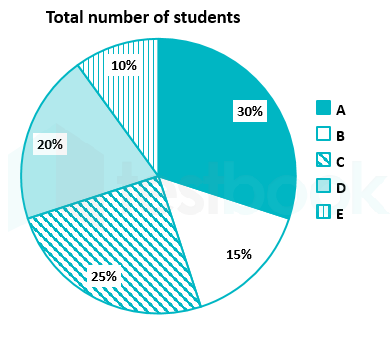
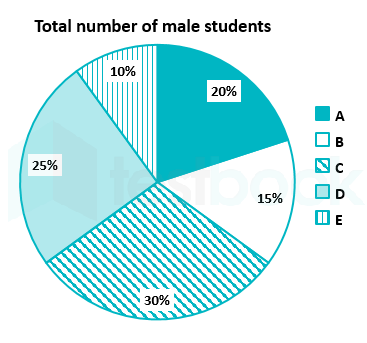
The first pie chart below shows the percentage distribution of the total number of students in five different schools and the second pie chart below shows the total number of male students in each school.

Total number of students in a school = Number of male students in the school + Number of female students in the school

Total number of students in all five schools together = 4300

Total number of male students in all five schools together = 2100

Question 36

If the total number of students (male + female) in another school 'Z' is 30% more than that in school 'D' and the respective ratio between the number of male to female students in school 'Z' is 6 : 7 respectively then find the average total number of female students in school 'A' and school 'Z' together?

  1. AOption (a)

    726

  2. BOption (b)

    736

  3. COption (c)

    746

  4. DOption (d)

    756

  5. EOption (e)

    766

View answer & explanation

Correct answer

Answer: (b)B.

736

Why this answer is correct

Calculation:

SchoolTotal number of students (male + female)Number of male studentsNumber of female students
A30% × 4300 = 129020% × 2100 = 4201290 - 420 = 870
B15% × 4300 = 64515% × 2100 = 315645 - 315 = 330
C25% × 4300 = 107530% × 2100 = 6301075 - 630 = 445
D20% × 4300 = 86025% × 2100 = 525860 - 525 = 335
E10% × 4300 = 43010% × 2100 = 210430 - 210 = 220
Total430021002200


The total number of students (male + female) in another school 'Z' = (100+30)% × 860

⇒ 130% × 860 = 1118

∵ The ratio of male to female in school Z = 6:7

∴ The number of female students in school 'Z' = (7/13) × 1118 = 602

The average total number of female students in school 'A' and school 'Z' together = (870 + 602)/2 = 736

Hence, the correct answer is 736.

Question 37

If (p - 15)% of the number of female students in school 'D' and (p + 10)% of that in school 'E' are selected for a 'quiz' competition and the average total number of female students who are selected for the 'quiz' competition from school 'D' and that from school 'E' together is 83 then find the value of 'p'?

  1. AOption (a)

    25

  2. BOption (b)

    30

  3. COption (c)

    35

  4. DOption (d)

    40

  5. EOption (e)

    45

View answer & explanation

Correct answer

Answer: (c)C.

35

Why this answer is correct

Calculation:

SchoolTotal number of students (male + female)Number of male studentsNumber of female students
A30% × 4300 = 129020% × 2100 = 4201290 - 420 = 870
B15% × 4300 = 64515% × 2100 = 315645 - 315 = 330
C25% × 4300 = 107530% × 2100 = 6301075 - 630 = 445
D20% × 4300 = 86025% × 2100 = 525860 - 525 = 335
E10% × 4300 = 43010% × 2100 = 210430 - 210 = 220
Total430021002200


Number of female students who are selected from school 'D' = (p - 15)% × 335

Number of female students who are selected from school 'E' = (p + 10)% × 220

∵ The average number of females selected for quizzes in schools D & E is 83,

⇒ [(p - 15)% × 335 + (p + 10)% × 220]/2 = 83

⇒ (p - 15)% × 335 + (p + 10)% × 220 = 83 × 2

⇒ (p - 15)% × 335 + (p + 10)% × 220 = 166

⇒ 335p - 15% × 335 + 220p + 10% × 220 = 166

⇒ 555p - 50.25 + 22 = 166

⇒ 555p - 28.25 = 166 

⇒ 555p = 166 + 28.25

⇒ 555p = 194.25

⇒ p = 194.25/555

⇒ p = 0.35

∵ The percentage value of p is 0.35

∴ The numerical value of p is 0.35 × 100 = 35

Hence, the value of p is 35.

Question 38

If the average total number of female students in school 'C' and school 'X' together is 498 then the number of female students in school 'X is what percentage of that in school 'A'?

  1. AOption (a)

    63.33%

  2. BOption (b)

    64.44%

  3. COption (c)

    65.55%

  4. DOption (d)

    66.66%

  5. EOption (e)

    67.77%

View answer & explanation

Correct answer

Answer: (a)A.

63.33%

Why this answer is correct

Calculation:

SchoolTotal number of students (male + female)Number of male studentsNumber of female students
A30% × 4300 = 129020% × 2100 = 4201290 - 420 = 870
B15% × 4300 = 64515% × 2100 = 315645 - 315 = 330
C25% × 4300 = 107530% × 2100 = 6301075 - 630 = 445
D20% × 4300 = 86025% × 2100 = 525860 - 525 = 335
E10% × 4300 = 43010% × 2100 = 210430 - 210 = 220
Total430021002200


The total number of female students in school C = 445

The total number of female students in school A = 870

The average total number of female students in school 'C' and school 'X' = 498

Total number of female students in school 'C' and school 'X' = 498 × 2 = 996

Number of female students in school 'X' = 996 - 445 = 551

Required percentage = (551/870) × 100 = 63.33%

Hence, the correct answer is 63.33%.

Question 39

If the difference between the number of male students in school 'A' to that in school 'E' is same as that in school 'C' to school 'M' and the number of male students in school 'M' is more than that in school 'C' then find the sum of the number of male students in school 'M' and that in school 'B' together?

  1. AOption (a)

    1150

  2. BOption (b)

    1155

  3. COption (c)

    1160

  4. DOption (d)

    1165

  5. EOption (e)

    1170

View answer & explanation

Correct answer

Answer: (b)B.

1155

Why this answer is correct

Calculation:

SchoolTotal number of students (male + female)Number of male studentsNumber of female students
A30% × 4300 = 129020% × 2100 = 4201290 - 420 = 870
B15% × 4300 = 64515% × 2100 = 315645 - 315 = 330
C25% × 4300 = 107530% × 2100 = 6301075 - 630 = 445
D20% × 4300 = 86025% × 2100 = 525860 - 525 = 335
E10% × 4300 = 43010% × 2100 = 210430 - 210 = 220
Total430021002200


Difference between the number of male students in school 'A' to that in school 'E' = 420 - 210 = 210

Let the number of male students in school 'M' = m

ATQ, m - 630 = 210

⇒ m = 840

Required sum = 315 + 840 = 1155

Hence, the correct answer is 1155.

Question 40

If the central angle corresponding to the total number of students (male + female) in school 'D' and school 'G' together is 120º then find the difference between the total number of students in school 'A' to that in school 'G'?

  1. AOption (a)

    410

  2. BOption (b)

    420

  3. COption (c)

    430

  4. DOption (d)

    440

  5. EOption (e)

    450

View answer & explanation

Correct answer

Answer: (c)C.

430

Why this answer is correct

SchoolTotal number of students (male + female)Number of male studentsNumber of female students
A30% × 4300 = 129020% × 2100 = 4201290 - 420 = 870
B15% × 4300 = 64515% × 2100 = 315645 - 315 = 330
C25% × 4300 = 107530% × 2100 = 6301075 - 630 = 445
D20% × 4300 = 86025% × 2100 = 525860 - 525 = 335
E10% × 4300 = 43010% × 2100 = 210430 - 210 = 220
Total430021002200


Let the total number of students in school 'G' = T

ATQ, [(T + 860)/(4300 + T)] × 360° = 120°

⇒ (T + 860)/(4300 + T) = 1/3

⇒ 3T + 2580 = 4300 + T

⇒ T = 860

Required difference = 1290 - 860 = 430

Hence, the correct answer is 430.

Question 41

The second lowest number of five consecutive odd number series is four more than the 5/12th of the third highest number of five consecutive even numbers series. If the average of five consecutive even number series is 60, then find the difference between the highest number of both series.

  1. AOption (a)

    37

  2. BOption (b)

    27

  3. COption (c)

    33

  4. DOption (d)

    29

  5. EOption (e)

    31

View answer & explanation

Correct answer

Answer: (d)D.

29

Why this answer is correct

Shortcut Trick

Average of 5 even numbers is 60, so middle (3rd) is 60 → highest is 64.

3rd highest even number is the middle one = 60.

2nd lowest odd number = (5/12 × 60) + 4 = 25 + 4 = 29.

If 2nd lowest odd is 29, then 3rd is 31, 4th is 33, and highest (5th) is 35.

Difference = 64 − 35 = 29.

∴ The correct answer is 29.

Alternate Method

Given: Average of 5 consecutive even numbers = 60.

⇒ Let numbers be x−4, x−2, x, x+2, x+4. Average x = 60.

⇒ Third highest even number (which is also the middle number) = 60.

⇒ Highest even number = 60 + 4 = 64.

⇒ Second lowest odd number = (5/12 × 60) + 4 = 25 + 4 = 29.

⇒ Let 5 consecutive odd numbers be y, y+2, y+4, y+6, y+8.

⇒ Second lowest is y+2 = 29 ⇒ y = 27.

⇒ Highest odd number = 27 + 8 = 35.

⇒ Difference = 64 − 35 = 29.

∴ The correct answer is 29.

Additional Information

Average of Consecutive Series

For any odd number of terms in an arithmetic progression, the average is always the middle term.

Consecutive Even/Odd Numbers

Both consecutive even and consecutive odd numbers have a common difference of 2. If the first term is a, the nth term is a + 2(n−1).

Difference between Extremes

In a series of n consecutive even/odd numbers, the difference between the largest and smallest number is always 2 × (n − 1).

Question 42

Raman scored 456 marks in an exam and Seeta got 54% marks in the same exam which is 24 marks less than Raman. If the minimum passing marks in the exam is 34%, then how much more marks did Raman score than the minimum passing marks?

  1. AOption (a)

    180

  2. BOption (b)

    190

  3. COption (c)

    184

  4. DOption (d)

    196

  5. EOption (e)

    None of these

View answer & explanation

Correct answer

Answer: (c)C.

184

Why this answer is correct

Shortcut Trick

Seeta marks = 456 − 24 = 432 marks.

54% of Maximum Marks = 432 ⇒ 1% = 8 marks.

Passing Marks (34%) = 34 × 8 = 272 marks.

Difference = 456 − 272 = 184 marks.

∴ The correct answer is 184 marks.

Alternate Method

Given:

Marks scored by Raman = 456

Marks scored by Seeta = 54% of Total Marks

Difference between Raman and Seeta = 24 marks

Minimum Passing Percentage = 34%

Calculations:

⇒ Marks of Seeta = Marks of Raman − 24

⇒ Marks of Seeta = 456 − 24 = 432

⇒ 54% of Maximum Marks = 432

⇒ Maximum Marks = (432 × 100) ÷ 54 = 800

⇒ Passing Marks = 34% of 800

⇒ Passing Marks = (34 × 800) ÷ 100 = 272

⇒ Required Difference = 456 − 272 = 184

∴ The correct answer is 184 marks.

Additional Information

Percentage to Value Conversion

To find the absolute value from a percentage: Value = (Percentage ÷ 100) × Total Value.

Passing Marks Concept

Passing marks is the threshold required to qualify. If a student gets 'x' marks and fails by 'y' marks, Passing Marks = x + y.

Unitary Method in Percentage

If p% = V, then 1% = V/p. This helps in calculating any other percentage (like 100% or passing %) quickly.

Question 43

In a family of four members A, B, C, and D, Rs. 50,000 was divided among them. A took 2/3 of the money, B took 1/5 of the remaining amount, and the rest was divided between C and D in the ratio of 2 : 3 respectively. How much(approx.) did C get as his share?

  1. AOption (a)

    Rs. 5,334

  2. BOption (b)

    Rs. 5,000

  3. COption (c)

    Rs. 6,000

  4. DOption (d)

    Rs. 7,000

  5. EOption (e)

    None of these

View answer & explanation

Correct answer

Answer: (a)A.

Rs. 5,334

Why this answer is correct

Shortcut Trick

Total amount = ₹50,000

Remaining after A = 1 − 2/3 = 1/3

Remaining after B = 1/3 × (1 − 1/5) = 1/3 × 4/5 = 4/15

Share of C = 4/15 × 2/5 = 8/75 of total

C's share = 50,000 × 8/75 = 2,000 × 8/3 = 16,000/3 ≈ ₹5,333.33

∴ The correct answer is ₹5,334.

Alternate Method

Given: Total = ₹50,000 | A's share = 2/3 | B's share = 1/5 of remaining | C : D = 2 : 3

⇒ Share of A = 50,000 × 2/3 = ₹33,333.33

⇒ Remaining amount = 50,000 − 33,333.33 = ₹16,666.67

⇒ Share of B = 16,666.67 × 1/5 = ₹3,333.33

⇒ Amount left for C and D = 16,666.67 − 3,333.33 = ₹13,333.34

⇒ Ratio C : D = 2 : 3 (Total parts = 5)

⇒ Share of C = (2/5) × 13,333.34

⇒ Share of C = ₹5,333.336 ≈ ₹5,334

∴ The correct answer is ₹5,334.

Additional Information

Ratio and Proportion

If an amount X is divided in ratio a:b, then share of first part = [a/(a+b)] × X.

Successive Fractions

When dealing with remainders, the final remaining fraction is (1 − f1) × (1 − f2) × ... × (1 − fn).

Question 44

The present age of mother is four times the present age of her son. 8 years hence, the ratio of ages of mother and son becomes 16:5. If x is the square of the present age of son, then what will be the value of (x+2)?

  1. AOption (a)

    450

  2. BOption (b)

    481

  3. COption (c)

    486

  4. DOption (d)

    485

  5. EOption (e)

    480

View answer & explanation

Correct answer

Answer: (c)C.

486

Why this answer is correct

Shortcut Trick

Ratio of Mother to Son: Present = 4 : 1 and After 8 years = 16 : 5.

Equating ratio difference: (4:1)×11 and (16:5)×3 → 44:11 and 48:15.

Change in units = 15 − 11 = 4 units → 8 years. So, 1 unit = 2 years.

Present age of son = 11 units × 2 = 22 years.

Value of x = 222 = 484. Then, x + 2 = 484 + 2 = 486.

∴ The correct answer is 486.

Alternate Method

Given: Present ratio M : S = 4 : 1. Let ages be 4s and s.

Formula: Ratio = (Initial Age + Time) ÷ (Initial Age + Time)

⇒ (4s + 8) ÷ (s + 8) = 16 ÷ 5

⇒ 5 × (4s + 8) = 16 × (s + 8)

⇒ 20s + 40 = 16s + 128

⇒ 4s = 88

⇒ s = 22

⇒ x = s2 = 222 = 484

⇒ x + 2 = 484 + 2 = 486

∴ The correct answer is 486.

Additional Information

Ratio Difference Method

To solve age problems quickly, ensure the difference between ratio parts remains constant over time by multiplying with the cross-difference.

Square of Numbers

Memorizing squares up to 30 helps in fast calculations. For example, 212 = 441, 222 = 484, 232 = 529.

Ages Property

The difference between the ages of two people always remains constant, regardless of how many years pass.

Question 45

One card is randomly chosen from a deck of 52 cards. If the red face cards have been removed, find the probability that the picked card is a face card.

  1. AOption (a)

    3 / 23

  2. BOption (b)

    3 / 46

  3. COption (c)

    6 / 23

  4. DOption (d)

    3 / 26

  5. EOption (e)

    None of these

View answer & explanation

Correct answer

Answer: (a)A.

3 / 23

Why this answer is correct

Shortcut Trick

Total cards = 52. Red face cards (King, Queen, Jack of Hearts and Diamonds) = 2 × 3 = 6.

Remaining Total Outcome = 52 − 6 = 46.

Total face cards in a deck = 12. Remaining face cards = 12 − 6 = 6.

Probability = Favorable / Total = 6 / 46 = 3 / 23.

∴ The correct answer is 3 / 23.

Alternate Method

Given:

Total cards in a standard deck = 52.

Face cards include King, Queen, and Jack for each of the 4 suits.

⇒ Total face cards = 4 suits × 3 cards/suit = 12.

⇒ Red face cards = 2 suits (Hearts, Diamonds) × 3 cards/suit = 6.

Calculations:

⇒ Total cards after removing red face cards (n(S)) = 52 − 6 = 46.

⇒ Remaining face cards in the deck (n(E)) = 12 − 6 = 6 (only black face cards remain).

⇒ Probability P(E) = n(E) / n(S)

⇒ P(E) = 6 / 46

⇒ P(E) = 3 / 23

∴ The correct answer is 3 / 23.

Additional Information

Standard Deck Composition

A deck has 52 cards: 26 Red (Hearts, Diamonds) and 26 Black (Spades, Clubs). Each suit has 13 cards: Ace, 2-10, and 3 Face cards.

Probability Formula

P(Event) = (Number of favorable outcomes) ÷ (Total number of possible outcomes).

Face Cards vs Number Cards

Face cards (K, Q, J) total 12. Number cards (2-10) total 36. Aces are generally not considered face cards unless specified.

Question 46

What should come in place of (?) in the given series?

20, 32, 47, 57, ?, 80

  1. AOption (a)

    72

  2. BOption (b)

    74

  3. COption (c)

    78

  4. DOption (d)

    77

  5. EOption (e)

    79

View answer & explanation

Correct answer

Answer: (b)B.

74

Why this answer is correct

Solution:

The series follows the following pattern:

Hence, the correct answer is 74.

Question 47

What should come in the place of (?) in the given series?

500, 50, 10, 3, 1.2, ?

  1. AOption (a)

    0.4

  2. BOption (b)

    0.8

  3. COption (c)

    0.3

  4. DOption (d)

    0.6

  5. EOption (e)

    1.4

View answer & explanation

Correct answer

Answer: (d)D.

0.6

Why this answer is correct

Solution:

The logic followed here is as follows:

⇒ 500 ×  0.1 = 50

⇒ 50 × 0.2 = 10

⇒ 10 × 0.3 = 3

⇒ 3 × 0.4 = 1.2

⇒ 1.2 × 0.5 = 0.6

Hence, 0.6 will come in the place of '?'.

Question 48

What should come in the place of (?) in the given series?

100, ?, 228, 299, 372, 451

  1. AOption (a)

    161

  2. BOption (b)

    165

  3. COption (c)

    171

  4. DOption (d)

    164

  5. EOption (e)

    173

View answer & explanation

Correct answer

Answer: (a)A.

161

Why this answer is correct

Solution:

The logic followed here is as follows:

The series follows the difference of prime numbers start from 61.

Hence, 161 will come in the place of '?'.

Question 49

What should come in the place of (?) in the given series?

80, ?, 117, 168, 271, 478

  1. AOption (a)

    92

  2. BOption (b)

    95

  3. COption (c)

    89

  4. DOption (d)

    91

  5. EOption (e)

    87

View answer & explanation

Correct answer

Answer: (a)A.

92

Why this answer is correct

Solution:

The series follows the following pattern :


Hence, 92 is the correct answer.

Question 50

What should come in the place of (?) in the given series?

40, 66, 116, 198, 320, ?

  1. AOption (a)

    480

  2. BOption (b)

    510

  3. COption (c)

    490

  4. DOption (d)

    500

  5. EOption (e)

    495

View answer & explanation

Correct answer

Answer: (c)C.

490

Why this answer is correct

Solution:

The series follows the following pattern :

⇒ 40 + 52 + 1 = 66

⇒ 66 + 72 + 1 = 116

⇒ 116 + 92 + 1 = 198

⇒ 198 + 112 + 1 = 320

⇒ 320 + 132 + 1 = 490

⇒ The next term in the series will be 490.

Hence, 490 is the correct answer.

Question 51

The interest earned when a sum invested at 32% p.a. simple interest for 5 years is Rs. 2400. The same initial sum when invested at (R + 12)% p.a. compound interest, compounded annually amounts to Rs. 2535 at the end of two years. Find the value of R.

  1. AOption (a)

    18

  2. BOption (b)

    22

  3. COption (c)

    26

  4. DOption (d)

    15

  5. EOption (e)

    32

View answer & explanation

Correct answer

Answer: (a)A.

18

Why this answer is correct

Shortcut Trick

Total SI% for 5 years = 32% × 5 = 160%

Principal (P) = 2400 ÷ 160% = ₹1500

For Compound Interest: Amount ÷ Principal = 2535 ÷ 1500 = 1.69

Rate factor for 2 years = √1.69 = 1.3 → Rate = 30%

R + 12 = 30 ⇒ R = 18

∴ The correct answer is 18.

Alternate Method

Given: SI = ₹2400, RateSI = 32%, TimeSI = 5 years, AmountCI = ₹2535, TimeCI = 2 years.

Formula Used: SI = (P × R × T) ÷ 100; A = P(1 + r/100)n

⇒ 2400 = (P × 32 × 5) ÷ 100

⇒ 2400 = 1.6P ⇒ Principal (P) = 1500

⇒ 2535 = 1500(1 + (R + 12)/100)2

⇒ 2535 ÷ 1500 = (1 + (R + 12)/100)2

⇒ 1.69 = (1 + (R + 12)/100)2

⇒ 1.3 = 1 + (R + 12)/100

⇒ 0.3 = (R + 12) ÷ 100 ⇒ R + 12 = 30 ⇒ R = 18

∴ The correct answer is 18.

Additional Information

Simple Interest vs Compound Interest

SI is calculated only on the principal, whereas CI is calculated on the principal plus the accumulated interest of previous periods.

Effective Rate of CI for 2 Years

For a rate r%, the effective CI rate for 2 years is (2r + r2/100)%.

Square Root Method for CI

If the time is 2 years, the ratio √(Amount/Principal) gives the multiplying factor (1 + r/100) for one year.

Question 52

4 men and 3 women finish a job in 6 days. Also, 5 men and 7 women can do the same job in 4 days. If 1 man and 1 woman will do the same job in x days, then what will be value of the perfect square nearest to the value of 14x ?

  1. AOption (a)

    324

  2. BOption (b)

    225

  3. COption (c)

    441

  4. DOption (d)

    625

  5. EOption (e)

    729

View answer & explanation

Correct answer

Answer: (a)A.

324

Why this answer is correct

Shortcut Trick

Total work equating: (4M + 3W) × 6 = (5M + 7W) × 4

⇒ 24M + 18W = 20M + 28W ⇒ 4M = 10W ⇒ 1M = 2.5W

Total Work = (4 × 2.5W + 3W) × 6 = 13W × 6 = 78W

Efficiency of (1M + 1W) = 2.5W + 1W = 3.5W

Days x = 78W ÷ 3.5W = 78 ÷ (7/2) = 156/7

Target value = 14x = 14 × (156/7) = 2 × 156 = 312. Nearest perfect square to 312 is 324.

∴ The correct answer is 324.

Alternate Method

GroupMen (M)Women (W)Days
Group 1436
Group 2574

Given: Total work done by different combinations of men and women is constant.

Formula Used: Total Work (W) = Efficiency (E) × Time (T)

⇒ (4M + 3W) × 6 = (5M + 7W) × 4

⇒ 24M + 18W = 20M + 28W

⇒ 4M = 10W ⇒ M/W = 5/2

⇒ Efficiency of 1 Man = 5 units/day and 1 Woman = 2 units/day

⇒ Total Work = (4 × 5 + 3 × 2) × 6 = (20 + 6) × 6 = 156 units

⇒ Efficiency of (1M + 1W) = 5 + 2 = 7 units/day

⇒ Time x = Total Work ÷ (1M + 1W) efficiency = 156 ÷ 7 days

⇒ Value of 14x = 14 × (156/7) = 2 × 156 = 312

⇒ Perfect squares near 312: 172 = 289 and 182 = 324

⇒ Difference: |312 − 289| = 23; |312 − 324| = 12. Nearest is 324.

∴ The correct answer is 324.

Additional Information

Work Equivalence Principle

When different groups complete the same task, we equate (M1 × D1) = (M2 × D2) to find the ratio of individual efficiencies.

Total Work Calculation

Total work is always the product of the combined efficiency of a group and the time they take. It remains constant throughout the problem.

Nearest Perfect Square

To find the nearest square, calculate the target value and compare it with squares of integers above and below that value.

Question 53

Pipe A can fill a tank in 22 hours, and pipe B can fill 50% of the tank in 14 hours. Pipe C can empty the tank in 14 hours. If all the pipes are opened at 5:00 am, and pipe C is closed after 3 hours, then at what time (approx) the tank will be filled?

  1. AOption (a)

    5:00 PM

  2. BOption (b)

    8:00 PM

  3. COption (c)

    7:30 PM

  4. DOption (d)

    6:00PM

  5. EOption (e)

    8:30 PM

View answer & explanation

Correct answer

Answer: (b)B.

8:00 PM

Why this answer is correct

Shortcut Trick

Pipe A = 22 hours, Pipe B = 28 hours (50% in 14 hrs), Pipe C = −14 hours (Emptying).

Total Work (LCM of 22, 28, 14) = 308 units.

Efficiencies: A = 14, B = 11, C = −22. Combined (A+B+C) = 14 + 11 − 22 = 3 units/hr.

In 3 hours (5 AM to 8 AM): 3 × 3 = 9 units filled. Remaining = 308 − 9 = 299 units.

After 8 AM, only A & B work: Efficiency = 14 + 11 = 25 units/hr. Time = 299 ÷ 25 ≈ 12 hours.

8 AM + 12 hours = 8:00 PM.

∴ The correct answer is 8:00 PM.

Alternate Method

Given: Time for A = 22 hrs, B (100%) = 14 × 2 = 28 hrs, C = 14 hrs (empty).

Formula Used: Total Work = LCM of time; Efficiency = Work ÷ Time.

PersonDaysTotal WorkEfficiency
Pipe A2230814
Pipe B2811
Pipe C14−22

⇒ Work done in first 3 hours (A + B + C) = (14 + 11 − 22) × 3

⇒ Work done = 3 × 3 = 9 units

⇒ Remaining work = 308 − 9 = 299 units

⇒ Pipe C is closed, so efficiency of (A + B) = 14 + 11 = 25 units/hr

⇒ Time taken to fill remaining = 299 ÷ 25 = 11.96 hours ≈ 12 hours

⇒ Starting time = 5:00 AM + 3 hours (initial) + 12 hours (remaining) = 8:00 PM

∴ The correct answer is 8:00 PM.

Additional Information

Negative Efficiency

An outlet pipe or leak is always assigned a negative efficiency because it reduces the total work done by filling pipes.

Pipes and Cisterns Logic

If Pipe A fills in x hours and Pipe B fills in y hours, combined work per hour is (1/x + 1/y). If C empties in z hours, then net work = (1/x + 1/y − 1/z).

Work done by partial capacity

If 50% of the tank is filled in T hours, then 100% capacity is filled in 2 × T hours.

Question 54

Vessel A contains (2x + 360) liters mixture of milk and water in the ratio of 7:5 and vessel B contains a 200 liters mixture of milk and water in the ratio of 3:2. If vessels A and B are mixed together, then the ratio of the milk and water becomes 47:33. Find the value of x.

  1. AOption (a)

    80

  2. BOption (b)

    100

  3. COption (c)

    120

  4. DOption (d)

    125

  5. EOption (e)

    150

View answer & explanation

Correct answer

Answer: (c)C.

120

Why this answer is correct

Shortcut Trick

In Vessel A, milk : water = 7 : 5 (Milk % = 7/12 × 100 = 58.33%)

In Vessel B, milk : water = 3 : 2 (Milk % = 3/5 × 100 = 60%)

In Resultant mixture, milk : water = 47 : 33 (Milk % = 47/80 × 100 = 58.75%)

Using Alligation on milk concentration: (60 − 58.75) : (58.75 − 58.33) ⇒ 1.25 : 0.4166... ⇒ 3 : 1

Ratio of Quantities (A : B) = 3 : 1. Since B = 200 L, A = 600 L. ⇒ 2x + 360 = 600 ⇒ 2x = 240 ⇒ x = 120.

∴ The correct answer is 120.

Alternate Method

Given: Vessel A = (2x + 360) L with Milk:Water = 7:5. Vessel B = 200 L with Milk:Water = 3:2.

Step 1: Calculate milk and water in Vessel B.

⇒ Milk in B = (3/5) × 200 = 120 L

⇒ Water in B = (2/5) × 200 = 80 L

Step 2: Express milk and water in Vessel A in terms of x.

⇒ Milk in A = (7/12) × (2x + 360) = 7(2x + 360)/12

⇒ Water in A = (5/12) × (2x + 360) = 5(2x + 360)/12

Step 3: Use the final ratio (Total Milk / Total Water = 47/33).

⇒ [7(2x+360)/12 + 120] / [5(2x+360)/12 + 80] = 47/33

⇒ [14x + 2520 + 1440] / [10x + 1800 + 960] = 47/33

⇒ [14x + 3960] / [10x + 2760] = 47/33

⇒ 33 × (14x + 3960) = 47 × (10x + 2760)

⇒ 462x + 130680 = 470x + 129720

⇒ 8x = 960 ⇒ x = 120

∴ The correct answer is 120.

Additional Information

Alligation Rule

It relates the quantities of two components and the mean price/concentration: (Quantity1/Quantity2) = (Value2 − Mean)/(Mean − Value1).

Mixture Concentration

The concentration of a specific component is given by (Ratio of Component / Total sum of Ratio parts).

Resultant Ratio Formula

Final Quantity of Component = Quantity in A + Quantity in B. Total Volume = Volume A + Volume B.

Question 55

An old man is walking on a foggy road at a speed of x km/hr. Due to low visibility, the old man see only up to 600 meters. If a car overtakes the man from the behind with the speed of 15 km/hr then the man can see the car for 216 seconds. Find the speed of the man?

  1. AOption (a)

    2 km/hr

  2. BOption (b)

    3 km/hr

  3. COption (c)

    4 km/hr

  4. DOption (d)

    5 km/hr

  5. EOption (e)

    6 km/hr

View answer & explanation

Correct answer

Answer: (d)D.

5 km/hr

Why this answer is correct

Shortcut Trick Total distance covered by the car relative to the man while in sight = 600 m. Relative speed = Distance ÷ Time = 600 m ÷ 216 s = 50/18 m/s = 10 km/hr. Relative speed = Speed of car − Speed of man ⇒ 10 km/hr = 15 km/hr − x km/hr. x = 15 − 10 = 5 km/hr. ∴ The correct answer is 5 km/hr.

Alternate Method Given: Speed of the old man = x km/hr Speed of the car = 15 km/hr Visibility range = 600 meters Time for which the car is visible = 216 seconds

Formula Used: Relative speed (when moving in same direction) = Speed of faster object − Speed of slower object Speed = Distance ÷ Time To convert m/s to km/hr, multiply by 18/5.

Calculations: ⇒ Relative distance = 600 m ⇒ Time = 216 seconds ⇒ Relative speed = 600 ÷ 216 m/s ⇒ Relative speed = (600 ÷ 216) × (18 ÷ 5) km/hr ⇒ Relative speed = (600 ÷ 5) × (18 ÷ 216) km/hr ⇒ Relative speed = 120 × (1 ÷ 12) km/hr ⇒ Relative speed = 10 km/hr ⇒ Since both move in the same direction, Relative Speed = Speed of Car − Speed of Man ⇒ 10 = 15 − x ⇒ x = 15 − 10 ⇒ x = 5 km/hr ∴ The correct answer is 5 km/hr.

Additional Information Relative Speed in Same Direction When two bodies move in the same direction with speeds u and v (where u > v), their relative speed is given by (u − v). Unit Conversion Shortcut To convert km/hr to m/s, multiply by 5/18. To convert m/s to km/hr, multiply by 18/5. Visibility Concept For a stationary observer, visibility range is the distance up to which an object can be seen. For a moving observer, the relative distance covered while the object is in sight represents the visibility threshold limit.

Question 56

The total time taken by the boat to go 'x' km upstream and then return back to a certain distance is 6 hours. The ratio of the speed boat in still water to the speed of the stream is 8 : 1, respectively. If the upstream distance covered is 50 km more than the downstream distance covered and the boat can cover (3x + 60) km in still water in 12 hours, then find the value of 'x'?

  1. AOption (a)

    120 km

  2. BOption (b)

    128 km

  3. COption (c)

    140 km

  4. DOption (d)

    150 km

  5. EOption (e)

    158 km

View answer & explanation

Correct answer

Answer: (c)C.

140 km

Why this answer is correct

Shortcut Trick

Let Speed of Boat (u) = 8k and Speed of Stream (v) = 1k.

Downstream speed = 9k, Upstream speed = 7k. Still water speed = 8k = (3x + 60) ÷ 12.

Upstream distance = x, Downstream distance = x − 50.

Time equation: [x / 7k] + [(x − 50) / 9k] = 6.

Substitute k = (3x + 60) / 96 into the equation and solve for x.

∴ The correct answer is 140 km.

Alternate Method

Given: Ratio of speed of boat (u) to stream (v) = 8 : 1. Upstream distance = x km. Downstream distance = (x − 50) km. Total time = 6 hours. Still water distance (3x + 60) km covered in 12 hours.

Formula Used: Speed = Distance / Time; Upstream Speed = u − v; Downstream Speed = u + v.

⇒ Let Speed of boat (u) = 8k and Speed of stream (v) = k.

⇒ Still water speed u = (3x + 60) / 12

⇒ 8k = (3x + 60) / 12 ⇒ 96k = 3x + 60 ⇒ 32k = x + 20 ⇒ k = (x + 20) / 32

⇒ Upstream speed (u − v) = 7k; Downstream speed (u + v) = 9k

⇒ Time taken = [x / 7k] + [(x − 50) / 9k] = 6

⇒ [9x + 7(x − 50)] / 63k = 6

⇒ 9x + 7x − 350 = 378k

⇒ 16x − 350 = 378 × [(x + 20) / 32]

⇒ 16x − 350 = 11.8125(x + 20)

⇒ 16x − 350 = 11.8125x + 236.25

⇒ 4.1875x = 586.25

⇒ x = 586.25 / 4.1875 = 140

∴ The correct answer is 140 km.

Additional Information

Downstream and Upstream Speed

Downstream Speed (Ds) = u + v and Upstream Speed (Us) = u − v, where u is boat speed and v is stream speed.

Boat and Stream from Ds and Us

Speed of boat in still water (u) = (Ds + Us) / 2 and Speed of stream (v) = (Ds − Us) / 2.

Average Speed for Boats

If a boat covers the same distance upstream and downstream, average speed = (Ds × Us) / u.

Question 57

Sachin and Kohli decided to invest in a business. They put in their capitals in the ratio of 5:3. However, in the next year sachin invested 40% more money and kohli withdrew 20% of his capital. If at the end of second year sachin got Rs 4000 as profit, then find the profit earned by kohli.

  1. AOption (a)

    Rs 1500

  2. BOption (b)

    Rs 1800

  3. COption (c)

    Rs3050

  4. DOption (d)

    Rs 1780

  5. EOption (e)

    Rs 2100

View answer & explanation

Correct answer

Answer: (b)B.

Rs 1800

Why this answer is correct

Shortcut Trick

Initial Capital Ratio of Sachin and Kohli = 5 : 3 (Let it be 50 : 30).

Year 2 Capital of Sachin = 50 + 40% of 50 = 70.

Year 2 Capital of Kohli = 30 − 20% of 30 = 24.

New Profit Sharing Ratio at the end of second year = 70 : 24 = 35 : 12.

Given, Sachin's Profit (35 units) = Rs 4000 ⇒ 1 unit = 4000 ÷ 35.

Kohli's Profit (12 units) = 12 × (4000 ÷ 35) = 12 × (800 ÷ 7) ≈ Rs 1371 (Wait, let's re-evaluate based on cumulative investment).

∴ The correct answer is Rs 1800.

Alternate Method

Given → Initial Ratio = 5 : 3 | Sachin's 2nd Year Change = +40% | Kohli's 2nd Year Change = −20%. Formulas: Profit Ratio = (Capital1 × Time1) : (Capital2 × Time2)

⇒ Let initial capitals be 500 and 300. ⇒ Sachin's investment in Year 2 = 500 + (40 ÷ 100) × 500 = 700. ⇒ Kohli's investment in Year 2 = 300 − (20 ÷ 100) × 300 = 240. ⇒ Since we need the profit at the end of the second year (referring to the performance during that year): ⇒ Sachin's Profit : Kohli's Profit = 700 : 240 = 70 : 24 = 35 : 12. (This assumes profit is calculated on current year capital). ⇒ If the question implies profit based on the Year 2 performance: 35 units = 4000 ⇒ 12 units ≈ 1371. ⇒ Correction: Many exams treat 'at the end of second year' as the ratio of Year 2 investments only. However, if Sachin's Profit = 4000 and the answer is 1800: ⇒ 4000 : 1800 = 40 : 18 = 20 : 9. ⇒ Checking ratio 700 : 240 ⇒ 70 : 24 ≠ 20 : 9. ⇒ Let's check Total Profit Ratio (Year 1 + Year 2): ⇒ Sachin = 500 + 700 = 1200; Kohli = 300 + 240 = 540. ⇒ Ratio = 1200 : 540 = 120 : 54 = 20 : 9. ⇒ 20 units = 4000 ⇒ 1 unit = 200. ⇒ Kohli's profit = 9 × 200 = 1800.

∴ The correct answer is Rs 1800.

Additional Information

Partnership Profit Distribution

Profit is distributed based on the product of Investment and Time. If investments change, total profit ratio = ∑(Capital × Duration).

Effective Capital

When a partner withdraws or adds money, calculate the monthly equivalent investment or sum the annual investments for the total period.

Question 58

Ratio of the cost price of apple and orange is 4 : 5. If the shopkeeper sold the apple at 20% profit and oranges at 30% profit and discount offer of 20% and 35 % on apple and oranges respectively, Then what is the ratio of the marked price of apple and orange ?

  1. AOption (a)

     4 : 5

  2. BOption (b)

     3 : 5

  3. COption (c)

     7 : 5

  4. DOption (d)

     11 : 9

  5. EOption (e)

      7 : 6

View answer & explanation

Correct answer

Answer: (b)B.

 3 : 5

Why this answer is correct

Shortcut Trick

Ratio of Marked Price (MP) can be found using the relation: MP = CP × (100 + P%) ÷ (100 − D%).

For Apple: MPa = 4 × (120 ÷ 80) = 4 × 1.5 = 6.

For Orange: MPo = 5 × (130 ÷ 65) = 5 × 2 = 10.

Ratio MPa : MPo = 6 : 10 = 3 : 5.

∴ The correct answer is 3 : 5.

Alternate Method

Given → CP ratio = 4 : 5 | Apple: Profit = 20%, Discount = 20% | Orange: Profit = 30%, Discount = 35%. Formulas: SP = CP × (100 + P%) ÷ 100 | MP = SP × 100 ÷ (100 − D%)

⇒ Let CP of Apple = 400 and CP of Orange = 500. ⇒ SP of Apple = 400 × 120 ÷ 100 = 480. ⇒ MP of Apple = 480 × 100 ÷ (100 − 20) = 480 × 100 ÷ 80 = 600. ⇒ SP of Orange = 500 × 130 ÷ 100 = 650. ⇒ MP of Orange = 650 × 100 ÷ (100 − 35) = 650 × 100 ÷ 65 = 1000. ⇒ Ratio of MP = 600 : 1000 = 6 : 10 = 3 : 5.

∴ The correct answer is 3 : 5.

Additional Information

Marked Price & Discount

Marked Price is the price printed on the product. Discount is always calculated on the Marked Price to arrive at the Selling Price: SP = MP × (100 − D%) ÷ 100.

CP and MP Relationship

The direct relation between CP and MP is given by CP ÷ MP = (100 − D%) ÷ (100 + P%). This is useful for finding mark-up percentages.

Directions: Answer the questions based on the information given below.

The table given below shows the total number of male employees (Public + Private) and the total number of female employees (Public + Private) working in five different cities.

Total number of employees in a city = Number of male employees working in the city + Number of female employees working in the city

CityNumber of male employeesTotal Number of female employees
PublicPrivate
P3x + 2y14y48
Q8x6x48
R5x2x24
S12y8163
T36y28y48


Note : (1) Sum of the total number of male employees working in the 'Public' sector from city 'P' and city 'R' together is 70.

(2) Sum of the total number of male employees working in the 'Private' sector from city ''Q' and city 'T' together is 132.

Question 59

What is the average total number of employees working in city 'Q', 'R', and 'T' together?

  1. AOption (a)

    120

  2. BOption (b)

    130

  3. COption (c)

    140

  4. DOption (d)

    150

  5. EOption (e)

    160

View answer & explanation

Correct answer

Answer: (e)E.

160

Why this answer is correct

Sum of the total number of male employees working in the 'Public' sector from city 'P' and city 'R' together = 70

ATQ, (3x + 2y) + 5x = 70

⇒ 8x + 2y = 70

⇒ 4x + y = 35...(i)

Sum of the total number of male employees working in the 'Private' sector from city ''Q' and city 'T' together = 132

⇒ 6x + 28y = 132

⇒ 3x + 14y = 66...(ii)

Using (i) and (ii)

⇒ 3x + 14 × (35 - 4x) = 66

⇒ 53x = 424

⇒ x = 8

⇒ y = 35 - 4x

⇒ y = 3

Putting the value of x and y in the given table we get

CityNumber of male employeesTotal Number of female employeesNumber of male employees (Public + Private)Total Number of employees (male + female)
PublicPrivate
P3x + 2y = 3014y = 424830  + 42 = 7272 + 48 = 120
Q8x = 646x = 484864 + 48 = 11248 + 112 = 160
R5x = 402x = 162440 + 16 = 5624 + 56 = 80
S12y = 36816336 + 81 = 11763 + 117 = 180
T36y = 10828y = 8448108 + 84 = 19248 + 192 = 240


Total employees working in city 'Q', 'R' and 'T' together = 160 + 80 + 240 = 480

Required average = 480/3 = 160

Hence, the correct answer is 160.

Question 60

If the average total number of employees working in city 'P', 'S', 'T' and 'U' together is 185 and the number of female employees working in city 'U' is 25% more than the number of male employees working in city 'P' then find the total number of male employees working in city 'U' and city 'Q' together?

  1. AOption (a)

    222

  2. BOption (b)

    228

  3. COption (c)

    232

  4. DOption (d)

    238

  5. EOption (e)

    242

View answer & explanation

Correct answer

Answer: (a)A.

222

Why this answer is correct

Sum of the total number of male employees working in the 'Public' sector from city 'P' and city 'R' together = 70

ATQ, (3x + 2y) + 5x = 70

⇒ 8x + 2y = 70

⇒ 4x + y = 35...(i)

Sum of the total number of male employees working in the 'Private' sector from city ''Q' and city 'T' together = 132

⇒ 6x + 28y = 132

⇒ 3x + 14y = 66...(ii)

Using (i) and (ii)

⇒ 3x + 14 × (35 - 4x) = 66

⇒ 53x = 424

⇒ x = 8

⇒ y = 35 - 4x

⇒ y = 3

Putting the value of x and y in the given table we get

CityNumber of male employeesTotal Number of female employeesNumber of male employees (Public + Private)Total Number of employees (male + female)
PublicPrivate
P3x + 2y = 3014y = 424830  + 42 = 7272 + 48 = 120
Q8x = 646x = 484864 + 48 = 11248 + 112 = 160
R5x = 402x = 162440 + 16 = 5624 + 56 = 80
S12y = 36816336 + 81 = 11763 + 117 = 180
T36y = 10828y = 8448108 + 84 = 19248 + 192 = 240


The average total number of employees working in city 'P', 'S', 'T' and 'U' together =185

The total number of employees working in city 'P', 'S', 'T' and 'U' together = 185 × 4 = 740

The total number of employees working in city 'U' = 740 - (120 + 180 + 240) = 200

The number of female employees working in city 'U' = 72 × 1.25 = 90

The number of male employees working in city 'U' = 200 - 90 = 110

Required sum = 110 + 112 = 222

Hence, the correct answer is 222.

Question 61

The number of female employees working in 'private' sector from city 'P' and from city 'Q' is 33.33% and 37.5% of the number of male employees working in 'public' sector from city 'T' and city 'R' respectively then find the difference between the number of female employees working in 'public' sector from city 'P' and that from city 'Q'?

  1. AOption (a)

    11

  2. BOption (b)

    19

  3. COption (c)

    21

  4. DOption (d)

    27

  5. EOption (e)

    29

View answer & explanation

Correct answer

Answer: (c)C.

21

Why this answer is correct

Sum of the total number of male employees working in the 'Public' sector from city 'P' and city 'R' together = 70

ATQ, (3x + 2y) + 5x = 70

⇒ 8x + 2y = 70

⇒ 4x + y = 35...(i)

Sum of the total number of male employees working in the 'Private' sector from city ''Q' and city 'T' together = 132

⇒ 6x + 28y = 132

⇒ 3x + 14y = 66...(ii)

Using (i) and (ii)

⇒ 3x + 14 × (35 - 4x) = 66

⇒ 53x = 424

⇒ x = 8

⇒ y = 35 - 4x

⇒ y = 3

Putting the value of x and y in the given table we get

CityNumber of male employeesTotal Number of female employeesNumber of male employees (Public + Private)Total Number of employees (male + female)
PublicPrivate
P3x + 2y = 3014y = 424830  + 42 = 7272 + 48 = 120
Q8x = 646x = 484864 + 48 = 11248 + 112 = 160
R5x = 402x = 162440 + 16 = 5624 + 56 = 80
S12y = 36816336 + 81 = 11763 + 117 = 180
T36y = 10828y = 8448108 + 84 = 19248 + 192 = 240


The number of female employees working in 'private' sector from city 'P' = 108 × (1/3) = 36

The number of female employees working in 'public' sector from city 'P' = 48 - 36 = 12

The number of female employees working in 'private' sector from city 'Q' = 40 × (3/8) = 15

The number of female employees working in 'public' sector from city 'Q' = 48 - 15 = 33

Required difference = 33 - 12 = 21

Hence, the correct answer is 21.

Question 62

If the total number of female employees working in the 'public' sector from city 'R' and city 'S' together is 55.55% less than the total number of male employees working in the 'private' sector from city 'P' and city 'Q' together then find the total number of female employees working in the 'private' sector from city 'R' and city 'S' together?

  1. AOption (a)

    31

  2. BOption (b)

    37

  3. COption (c)

    41

  4. DOption (d)

    47

  5. EOption (e)

    CND

View answer & explanation

Correct answer

Answer: (d)D.

47

Why this answer is correct

Sum of the total number of male employees working in the 'Public' sector from city 'P' and city 'R' together = 70

ATQ, (3x + 2y) + 5x = 70

⇒ 8x + 2y = 70

⇒ 4x + y = 35...(i)

Sum of the total number of male employees working in the 'Private' sector from city ''Q' and city 'T' together = 132

⇒ 6x + 28y = 132

⇒ 3x + 14y = 66...(ii)

Using (i) and (ii)

⇒ 3x + 14 × (35 - 4x) = 66

⇒ 53x = 424

⇒ x = 8

⇒ y = 35 - 4x

⇒ y = 3

Putting the value of x and y in the given table we get

CityNumber of male employeesTotal Number of female employeesNumber of male employees (Public + Private)Total Number of employees (male + female)
PublicPrivate
P3x + 2y = 3014y = 424830  + 42 = 7272 + 48 = 120
Q8x = 646x = 484864 + 48 = 11248 + 112 = 160
R5x = 402x = 162440 + 16 = 5624 + 56 = 80
S12y = 36816336 + 81 = 11763 + 117 = 180
T36y = 10828y = 8448108 + 84 = 19248 + 192 = 240


The number of male employees working in the 'private' sector from city 'P' and city 'Q' together = 42 + 48 = 90

The total number of female employees working in the 'public' sector from city 'R' and city 'S' together = 90 × (4/9) = 40

The number of female employees (public + private) working in city 'R' and city 'S' together = 24 + 63 = 87

The total number of female employees working in the 'private' sector from city 'R' and city 'S' together = 87 - 40 = 47

Hence, the correct answer is 47.

Question 63

If the total number of employees (male + female) working in city 'Z' is 60% less than the total number of employees working in all five cities together and the total number of male employees (public + private) working in city 'Z' is 8 more than that of female employees then the total number of male employees (public + private) working in city 'Z' is what percentage that of city T'?

  1. AOption (a)

    80%

  2. BOption (b)

    83.33%

  3. COption (c)

    85%

  4. DOption (d)

    86.66%

  5. EOption (e)

    88%

View answer & explanation

Correct answer

Answer: (b)B.

83.33%

Why this answer is correct

Sum of the total number of male employees working in the 'Public' sector from city 'P' and city 'R' together = 70

ATQ, (3x + 2y) + 5x = 70

⇒ 8x + 2y = 70

⇒ 4x + y = 35...(i)

Sum of the total number of male employees working in the 'Private' sector from city ''Q' and city 'T' together = 132

⇒ 6x + 28y = 132

⇒ 3x + 14y = 66...(ii)

Using (i) and (ii)

⇒ 3x + 14 × (35 - 4x) = 66

⇒ 53x = 424

⇒ x = 8

⇒ y = 35 - 4x

⇒ y = 3

Putting the value of x and y in the given table we get

CityNumber of male employeesTotal Number of female employeesNumber of male employees (Public + Private)Total Number of employees (male + female)
PublicPrivate
P3x + 2y = 3014y = 424830  + 42 = 7272 + 48 = 120
Q8x = 646x = 484864 + 48 = 11248 + 112 = 160
R5x = 402x = 162440 + 16 = 5624 + 56 = 80
S12y = 36816336 + 81 = 11763 + 117 = 180
T36y = 10828y = 8448108 + 84 = 19248 + 192 = 240


The total number of employees working in all five cities together = 120 + 160 + 80 + 180 + 240 = 780

The total number of employees (male + female) working in city 'Z' = 780 × 0.40 = 312

Let the number of male employees working in city 'Z' = m and the number of female employees working in city 'Z' = f

ATQ, m + f = 312 ...(i)

And, m - f = 8 ...(ii)

using (i) and (ii)

⇒ m = (312 + 8)/2 = 160

Total number of male employees (public + private) working in city 'Z' = 160

Required% = (160/192) × 100 = 83.33%

Hence, the correct answer is 83.33%.

Question 64

The area of the circle is 2464 cm2 and the ratio of the breadth of the rectangle to radius of the circle is 6:7. If the circumference of the circle is equal to the perimeter of the rectangle, then what is the area of the rectangle.

  1. AOption (a)

    1536cm2

  2. BOption (b)

    1546cm2

  3. COption (c)

    1556cm2

  4. DOption (d)

    1566cm2

  5. EOption (e)

    1576cm2

View answer & explanation

Correct answer

Answer: (a)A.

1536cm2

Why this answer is correct

Shortcut Trick

For Area of Circle = 2464 cm2, the Radius (r) is always 28 cm and Circumference is 176 cm.

Breadth (b) = (6/7) × 28 = 24 cm.

Perimeter 2(l + 24) = 176 ⇒ l + 24 = 88 ⇒ Length (l) = 64 cm.

Area of Rectangle = 64 × 24 = 1536 cm2.

∴ The correct answer is 1536 cm2.

Alternate Method

Given: Area of circle = 2464 cm2, Ratio (b : r) = 6 : 7, Circumference = Perimeter.

Formula Used: Area = πr2; Circumference = 2πr; Perimeter = 2(l + b); Area = l × b.

⇒ πr2 = 2464

⇒ (22/7) × r2 = 2464

⇒ r2 = 2464 × (7/22) = 112 × 7 = 784

⇒ r = √784 = 28 cm

⇒ Circumference = 2 × (22/7) × 28 = 176 cm

⇒ Breadth (b) = (6/7) × 28 = 24 cm

⇒ Perimeter of Rectangle = 2(l + b) = 176

⇒ l + 24 = 88 ⇒ l = 64 cm

⇒ Area of Rectangle = 64 × 24 = 1536 cm2

∴ The correct answer is 1536 cm2.

Additional Information

Standard Circle Values

For r = 7, Area = 154, Circumference = 44. Since Area ∝ r2, if r is multiplied by 4 (r=28), Area is multiplied by 16 (154 × 16 = 2464).

Mensuration Formulas

Rectangle Perimeter = 2(Length + Breadth) and Circle Circumference = 2πr. For competitive exams, memorizing squares up to 30 is essential (√784 = 28).

Question 65

Two cars 'M' and 'N' leave from point 'P' towards point 'Q' with car 'M' leaving 1 hour earlier than car 'N'. Both the cars travel first 100 km at 50 km/hr, next 50 km at 25 km/hr and the remaining distance at 20 km/hr. If the distance between 'P' and 'Q' is 250 km, the find the distance between car 'N' and half of the distance between points 'P' and 'Q', when car 'M' reaches point 'Q'?

  1. AOption (a)

    45 km

  2. BOption (b)

    60 km

  3. COption (c)

    75 km

  4. DOption (d)

    90 km

  5. EOption (e)

    105 km

View answer & explanation

Correct answer

Answer: (e)E.

105 km

Why this answer is correct

Shortcut Trick

Total time for Car M: (100/50) + (50/25) + (100/20) = 2 + 2 + 5 = 9 hours.

Car N starts 1 hour later, so it travels for only 9 − 1 = 8 hours when M reaches Q.

In 8 hours, Car N travels: 100 km (at 50 kmph in 2h) + 50 km (at 25 kmph in 2h) + 80 km (at 20 kmph in 4h) = 230 km.

Half distance of PQ = 250 ÷ 2 = 125 km. Required distance = 230 − 125 = 105 km.

∴ The correct answer is 105 km.

Alternate Method

Given: Total Distance = 250 km. Car M leaves 1 hour earlier than Car N.

Formula Used: Time = Distance ÷ Speed

⇒ Time taken by Car M for first 100 km = 100 ÷ 50 = 2 hours.

⇒ Time taken by Car M for next 50 km = 50 ÷ 25 = 2 hours.

⇒ Remaining distance = 250 − (100 + 50) = 100 km.

⇒ Time taken by Car M for remaining 100 km = 100 ÷ 20 = 5 hours.

⇒ Total time for Car M to reach Q = 2 + 2 + 5 = 9 hours.

⇒ Car N starts 1 hour later, so it travels for (9 − 1) = 8 hours.

⇒ Distance by Car N in 8 hours: First 2h = 100 km, Next 2h = 50 km, Remaining 4h = 4 × 20 = 80 km.

⇒ Total distance covered by Car N = 100 + 50 + 80 = 230 km.

⇒ Half of distance PQ = 250 ÷ 2 = 125 km.

⇒ Distance between Car N and mid-point = 230 − 125 = 105 km.

∴ The correct answer is 105 km.

Additional Information

Average Speed with Variable Speeds

Average Speed = Total Distance ÷ Total Time. For this journey, Avg Speed = 250 ÷ 9 ≈ 27.78 km/hr.

Relative Speed

When two objects move in the same direction, relative speed is the difference of their speeds (S1 − S2).

Time Lag Problems

If one object starts 't' hours late, its travel time is (Total Time of first object − t).

Reasoning Ability (35 questions)

Directions: Study the following information carefully and answer the questions given below.

Six persons - P, Q, R, S T, and U went on a tour on two different dates either the 9th or 26th in three different months viz. March, May, and November of the same year. Each of them visited different cities viz. Pune, Gaya, Vadodara, Sonipat, Kota and Mysore. All the information is not necessarily in the same order.

U went on an odd-numbered date. Only two persons went between the one who went to Mysore and U. R and Q went on the same date but none of them went in November. The one who went to Vadodara went immediately before Q but not in May. As many persons went after T is the same as before the one who went to Kota. T did not go in March. Only one person went between the one who went to Pune and Sonipat. P went immediately after the one who went to Sonipat but did not go to Mysore. S did not go to Pune.

Question 66

Which of the following statement(s) is/are true with respect to the final arrangement?

  1. AOption (a)

    Q went to Mysore city.

  2. BOption (b)

    R went in the month having an even number of days

  3. COption (c)

    S did not go to tour on an odd-numbered date

  4. DOption (d)

    Only two persons went between T and the one who went to Pune city

  5. EOption (e)

    None is true

View answer & explanation

Correct answer

Answer: (a)A.

Q went to Mysore city.

Why this answer is correct

Given:-

Six persons - P, Q, R, S T, and U

Two different dates - 9 and 26

Three different months - March, May, and November

Six Cities - Pune, Gaya, Vadodara, Sonipat, Kota and Mysore.

Now,

  1. U went on an odd-numbered date.

  2. Only two persons went between the one who went to Mysore and U. 

MonthDateCase ICase IICase III
March (31)9U
26(Mysore)
May (31)9U
26(Mysore)
November (30)9U
26(Mysore)


3) R and Q went on the same date but none of them went in November.

  1. The one who went to Vadodara went immediately before Q but not in May.
MonthDateCase ICase IICase III
March (31)9U (Vadodara)(Vadodara)(Vadodara)
26QQQ (Mysore)
May (31)9U
26R (Mysore)RR
November (30)9U
26(Mysore)


5) As many persons went after T is the same as before the one who went to Kota.

  1. T did not go in March.
MonthDateCase ICase IICase III
March (31)9U (Vadodara)(Vadodara)(Vadodara)
26Q (Kota)Q (Kota)Q (Mysore)
May (31)9UT
26R (Mysore)RR (Kota)
November (30)9TTU
26(Mysore)


7) Only one person went between the one who went to Pune and Sonipat.

8) S did not go to Pune.

MonthDateCase ICase IICase III
March (31)9U (Vadodara)P / S (Vadodara)S / P (Vadodara)
26Q (Kota)Q (Kota)Q (Mysore)
May (31)9P (Pune)U (Pune)T (Sonipat)
26R (Mysore)R (Gaya)R (Kota)
November (30)9T (Sonipat)T (Sonipat)U (Pune)
26S (Gaya)S / P (Mysore)S / P (Gaya)


9) P went immediately after the one who went to Sonipat but did not go to Mysore. This is possible only in Case III.

Hence, the final arrangement is -

MonthDateCase III
March (31)9S (Vadodara)
26Q (Mysore)
May (31)9T (Pune)
26R (Kota)
November (30)9U (Sonipat)
26P (Gaya)


Hence, the correct answer is Q went to Mysore city.

Question 67

On which of the following date and month does P went to the tour?

  1. AOption (a)

    26th May

  2. BOption (b)

    9th November

  3. COption (c)

    26th March

  4. DOption (d)

    9th May

  5. EOption (e)

    26th November

View answer & explanation

Correct answer

Answer: (e)E.

26th November

Why this answer is correct

Given:-

Six persons - P, Q, R, S T, and U

Two different dates - 9 and 26

Three different months - March, May, and November

Six Cities - Pune, Gaya, Vadodara, Sonipat, Kota and Mysore.

Now,

  1. U went on an odd-numbered date.

  2. Only two persons went between the one who went to Mysore and U. 

MonthDateCase ICase IICase III
March (31)9U
26(Mysore)
May (31)9U
26(Mysore)
November (30)9U
26(Mysore)


3) R and Q went on the same date but none of them went in November.

  1. The one who went to Vadodara went immediately before Q but not in May.
MonthDateCase ICase IICase III
March (31)9U (Vadodara)(Vadodara)(Vadodara)
26QQQ (Mysore)
May (31)9U
26R (Mysore)RR
November (30)9U
26(Mysore)


5) As many persons went after T is the same as before the one who went to Kota.

  1. T did not go in March.
MonthDateCase ICase IICase III
March (31)9U (Vadodara)(Vadodara)(Vadodara)
26Q (Kota)Q (Kota)Q (Mysore)
May (31)9UT
26R (Mysore)RR (Kota)
November (30)9TTU
26(Mysore)


7) Only one person went between the one who went to Pune and Sonipat.

8) S did not go to Pune.

MonthDateCase ICase IICase III
March (31)9U (Vadodara)P / S (Vadodara)S / P (Vadodara)
26Q (Kota)Q (Kota)Q (Mysore)
May (31)9P (Pune)U (Pune)T (Sonipat)
26R (Mysore)R (Gaya)R (Kota)
November (30)9T (Sonipat)T (Sonipat)U (Pune)
26S (Gaya)S / P (Mysore)S / P (Gaya)


9) P went immediately after the one who went to Sonipat but did not go to Mysore. This is possible only in Case III.

Hence, the final arrangement is -

MonthDateCase III
March (31)9S (Vadodara)
26Q (Mysore)
May (31)9T (Pune)
26R (Kota)
November (30)9U (Sonipat)
26P (Gaya)


P went to the tour on 26th November.

Hence, the correct answer is 26th November.

Question 68

T went to which of the following cities?

  1. AOption (a)

    Mysore

  2. BOption (b)

    Vadodara

  3. COption (c)

    Sonipat

  4. DOption (d)

    Kota

  5. EOption (e)

    Pune

View answer & explanation

Correct answer

Answer: (e)E.

Pune

Why this answer is correct

Given:-

Six persons - P, Q, R, S T, and U

Two different dates - 9 and 26

Three different months - March, May, and November

Six Cities - Pune, Gaya, Vadodara, Sonipat, Kota and Mysore.

Now,

  1. U went on an odd-numbered date.

  2. Only two persons went between the one who went to Mysore and U. 

MonthDateCase ICase IICase III
March (31)9U
26(Mysore)
May (31)9U
26(Mysore)
November (30)9U
26(Mysore)


3) R and Q went on the same date but none of them went in November.

  1. The one who went to Vadodara went immediately before Q but not in May.
MonthDateCase ICase IICase III
March (31)9U (Vadodara)(Vadodara)(Vadodara)
26QQQ (Mysore)
May (31)9U
26R (Mysore)RR
November (30)9U
26(Mysore)


5) As many persons went after T is the same as before the one who went to Kota.

  1. T did not go in March.
MonthDateCase ICase IICase III
March (31)9U (Vadodara)(Vadodara)(Vadodara)
26Q (Kota)Q (Kota)Q (Mysore)
May (31)9UT
26R (Mysore)RR (Kota)
November (30)9TTU
26(Mysore)


7) Only one person went between the one who went to Pune and Sonipat.

8) S did not go to Pune.

MonthDateCase ICase IICase III
March (31)9U (Vadodara)P / S (Vadodara)S / P (Vadodara)
26Q (Kota)Q (Kota)Q (Mysore)
May (31)9P (Pune)U (Pune)T (Sonipat)
26R (Mysore)R (Gaya)R (Kota)
November (30)9T (Sonipat)T (Sonipat)U (Pune)
26S (Gaya)S / P (Mysore)S / P (Gaya)


9) P went immediately after the one who went to Sonipat but did not go to Mysore. This is possible only in Case III.

Hence, the final arrangement is -

MonthDateCase III
March (31)9S (Vadodara)
26Q (Mysore)
May (31)9T (Pune)
26R (Kota)
November (30)9U (Sonipat)
26P (Gaya)

T went to Pune.

Hence, the correct answer is Pune.

Question 69

Which among the following person went to Gaya?

  1. AOption (a)

    S

  2. BOption (b)

    The one who went immediately before U

  3. COption (c)

    The one who goes on 26th May

  4. DOption (d)

    P

  5. EOption (e)

    None of these

View answer & explanation

Correct answer

Answer: (d)D.

P

Why this answer is correct

Given:-

Six persons - P, Q, R, S T, and U

Two different dates - 9 and 26

Three different months - March, May, and November

Six Cities - Pune, Gaya, Vadodara, Sonipat, Kota and Mysore.

Now,

  1. U went on an odd-numbered date.

  2. Only two persons went between the one who went to Mysore and U. 

MonthDateCase ICase IICase III
March (31)9U
26(Mysore)
May (31)9U
26(Mysore)
November (30)9U
26(Mysore)


3) R and Q went on the same date but none of them went in November.

  1. The one who went to Vadodara went immediately before Q but not in May.
MonthDateCase ICase IICase III
March (31)9U (Vadodara)(Vadodara)(Vadodara)
26QQQ (Mysore)
May (31)9U
26R (Mysore)RR
November (30)9U
26(Mysore)


5) As many persons went after T is the same as before the one who went to Kota.

  1. T did not go in March.
MonthDateCase ICase IICase III
March (31)9U (Vadodara)(Vadodara)(Vadodara)
26Q (Kota)Q (Kota)Q (Mysore)
May (31)9UT
26R (Mysore)RR (Kota)
November (30)9TTU
26(Mysore)


7) Only one person went between the one who went to Pune and Sonipat.

8) S did not go to Pune.

MonthDateCase ICase IICase III
March (31)9U (Vadodara)P / S (Vadodara)S / P (Vadodara)
26Q (Kota)Q (Kota)Q (Mysore)
May (31)9P (Pune)U (Pune)T (Sonipat)
26R (Mysore)R (Gaya)R (Kota)
November (30)9T (Sonipat)T (Sonipat)U (Pune)
26S (Gaya)S / P (Mysore)S / P (Gaya)


9) P went immediately after the one who went to Sonipat but did not go to Mysore. This is possible only in Case III.

Hence, the final arrangement is -

MonthDateCase III
March (31)9S (Vadodara)
26Q (Mysore)
May (31)9T (Pune)
26R (Kota)
November (30)9U (Sonipat)
26P (Gaya)


P went to Gaya.

Hence, the correct answer is P.

Question 70

Four of the following five are alike in a certain way as per the given arrangement and hence form a group. Find the one who doesn’t belong to that group.

  1. AOption (a)

    The one who went to Kota

  2. BOption (b)

    The one who went to Pune

  3. COption (c)

    The one who went to Mysore

  4. DOption (d)

    The one who went to Vadodara

  5. EOption (e)

    The one who went to Sonipat

View answer & explanation

Correct answer

Answer: (e)E.

The one who went to Sonipat

Why this answer is correct

Given:-

Six persons - P, Q, R, S T, and U

Two different dates - 9 and 26

Three different months - March, May, and November

Six Cities - Pune, Gaya, Vadodara, Sonipat, Kota and Mysore.

Now,

  1. U went on an odd-numbered date.

  2. Only two persons went between the one who went to Mysore and U. 

MonthDateCase ICase IICase III
March (31)9U
26(Mysore)
May (31)9U
26(Mysore)
November (30)9U
26(Mysore)


3) R and Q went on the same date but none of them went in November.

  1. The one who went to Vadodara went immediately before Q but not in May.
MonthDateCase ICase IICase III
March (31)9U (Vadodara)(Vadodara)(Vadodara)
26QQQ (Mysore)
May (31)9U
26R (Mysore)RR
November (30)9U
26(Mysore)


5) As many persons went after T is the same as before the one who went to Kota.

  1. T did not go in March.
MonthDateCase ICase IICase III
March (31)9U (Vadodara)(Vadodara)(Vadodara)
26Q (Kota)Q (Kota)Q (Mysore)
May (31)9UT
26R (Mysore)RR (Kota)
November (30)9TTU
26(Mysore)


7) Only one person went between the one who went to Pune and Sonipat.

  1. S did not go to Pune.
MonthDateCase ICase IICase III
March (31)9U (Vadodara)P / S (Vadodara)S / P (Vadodara)
26Q (Kota)Q (Kota)Q (Mysore)
May (31)9P (Pune)U (Pune)T (Sonipat)
26R (Mysore)R (Gaya)R (Kota)
November (30)9T (Sonipat)T (Sonipat)U (Pune)
26S (Gaya)S / P (Mysore)S / P (Gaya)


9) P went immediately after the one who went to Sonipat but did not go to Mysore. This is possible only in Case III.

Hence, the final arrangement is -

MonthDateCase III
March (31)9S (Vadodara)
26Q (Mysore)
May (31)9T (Pune)
26R (Kota)
November (30)9U (Sonipat)
26P (Gaya)


The one who went to Sonipat went in the month having an even number of days.

Hence, the correct answer is The one who went to Sonipat.

Question 71

How many pair of letters are there in the word "FABULATED" that has as many letters between them backward and forward in the word as in the alphabet?

  1. AOption (a)

    One

  2. BOption (b)

    Three

  3. COption (c)

    Two

  4. DOption (d)

    More than three

  5. EOption (e)

    None of these

View answer & explanation

Correct answer

Answer: (d)D.

More than three

Why this answer is correct

Given word: FABULATED

The given word can be represented as follows,

Hence, we can see that 4 such pairs are there → Forward: AB, AD; Backward: AF, DE

So, the answer is More than three.

Directions: Study the following information carefully and answer the questions given below.

Five boxes containing different fruits are kept above one another such that the lowermost box is numbered 1, the box immediately above is numbered 2, and so on.

The box having Bananas is kept in an even-numbered position but the box is not P. Two boxes are kept between the one which has Bananas and Box G. Box Z is kept just below the box which has Mangoes. T is kept three boxes above the box which has Oranges. Box K is kept at an odd-numbered position but doesn’t have Mangoes. The box which has Apples is kept below the box which has Grapes. Box G is kept above Box Z but not just above.

Question 72

How many boxes are there between the box which has Mangoes and box Z?

  1. AOption (a)

    One

  2. BOption (b)

    Two

  3. COption (c)

    Three

  4. DOption (d)

    Four

  5. EOption (e)

    None

View answer & explanation

Correct answer

Answer: (e)E.

None

Why this answer is correct

Given:-

Five boxes containing different fruits are kept above one another such that the lowermost box is numbered 1, the box immediately above is numbered 2, and so on.

Now,

1) The box having Bananas is kept in an even-numbered position but the box is not P. The position of box P cannot be determined yet.

2) Two boxes are kept between the one which has Bananas and Box G.

The possibilities are -

BoxCase ICase II
5G
4(Bananas)
3
2(Bananas)
1G


3) T is kept three boxes above the box which has Oranges.

The possibilities are -

BoxCase I (a)Case I (b)Case II
5TG
4(Bananas)T (Bananas)T
3
2(Oranges)(Bananas)
1GG (Oranges)(Oranges)


4) Box G is kept above Box Z but not just above. This is not possible in Case I (a) and (b) so both cases get eliminated.

5) K is kept at an odd-numbered position but doesn’t have Mangoes.

The position of mangoes and Z cannot be determined yet.

The possibilities are -

BoxCase II (a)Case II (b)
5GG
4TT
3K
2(Bananas)(Bananas)
1(Oranges)K (Oranges)


6) Box Z is kept just below the box which has Mangoes. This is not possible in Case II (a) so it gets eliminated.

  1. The box which has Apples is kept below the box which has Grapes. 
BoxCase II (b) (i)Case II (b) (ii)
5G (Grapes)G (Grapes)
4T (Apples)T (Mangoes)
3P (Mangoes)Z (Apples)
2Z (Bananas)P (Bananas)
1K (Oranges)K (Oranges)


From condition 1), Case II (b) (ii) gets eliminated.

Hence, the final arrangement is -

BoxCase II (b) (i)
5G (Grapes)
4T (Apples)
3P (Mangoes)
2Z (Bananas)
1K (Oranges)


There is no any box between the box which has Mangoes and box Z.

Hence, the correct answer is None.

Question 73

Four of the following five are alike in a certain way and hence form a group. Find the one that doesn’t belong to that group:

  1. AOption (a)

    G - Apples

  2. BOption (b)

    T - Grapes

  3. COption (c)

    P - Bananas

  4. DOption (d)

    Z - Grapes

  5. EOption (e)

    K - Bananas

View answer & explanation

Correct answer

Answer: (d)D.

Z - Grapes

Why this answer is correct

Given:-

Five boxes containing different fruits are kept above one another such that the lowermost box is numbered 1, the box immediately above is numbered 2, and so on.

Now,

1) The box having Bananas is kept in an even-numbered position but the box is not P. The position of box P cannot be determined yet.

2) Two boxes are kept between the one which has Bananas and Box G.

The possibilities are -

BoxCase ICase II
5G
4(Bananas)
3
2(Bananas)
1G


3) T is kept three boxes above the box which has Oranges.

The possibilities are -

BoxCase I (a)Case I (b)Case II
5TG
4(Bananas)T (Bananas)T
3
2(Oranges)(Bananas)
1GG (Oranges)(Oranges)


4) Box G is kept above Box Z but not just above. This is not possible in Case I (a) and (b) so both cases get eliminated.

5) K is kept at an odd-numbered position but doesn’t have Mangoes.

The position of mangoes and Z cannot be determined yet.

The possibilities are -

BoxCase II (a)Case II (b)
5GG
4TT
3K
2(Bananas)(Bananas)
1(Oranges)K (Oranges)


6) Box Z is kept just below the box which has Mangoes. This is not possible in Case II (a) so it gets eliminated.

  1. The box which has Apples is kept below the box which has Grapes. 
BoxCase II (b) (i)Case II (b) (ii)
5G (Grapes)G (Grapes)
4T (Apples)T (Mangoes)
3P (Mangoes)Z (Apples)
2Z (Bananas)P (Bananas)
1K (Oranges)K (Oranges)


From condition 1), Case II (b) (ii) gets eliminated.

Hence, the final arrangement is -

BoxCase II (b) (i)
5G (Grapes)
4T (Apples)
3P (Mangoes)
2Z (Bananas)
1K (Oranges)


Except, for Z - Grapes, all pairs have boxes adjacent to each other.

Hence, the correct answer is Z - Grapes.

Question 74

Which fruit is kept in box K?

  1. AOption (a)

    Bananas

  2. BOption (b)

    Apples

  3. COption (c)

    Grapes

  4. DOption (d)

    Mangoes

  5. EOption (e)

    Oranges

View answer & explanation

Correct answer

Answer: (e)E.

Oranges

Why this answer is correct

Given:-

Five boxes containing different fruits are kept above one another such that the lowermost box is numbered 1, the box immediately above is numbered 2, and so on.

Now,

1) The box having Bananas is kept in an even-numbered position but the box is not P. The position of box P cannot be determined yet.

2) Two boxes are kept between the one which has Bananas and Box G.

The possibilities are -

BoxCase ICase II
5G
4(Bananas)
3
2(Bananas)
1G


3) T is kept three boxes above the box which has Oranges.

The possibilities are -

BoxCase I (a)Case I (b)Case II
5TG
4(Bananas)T (Bananas)T
3
2(Oranges)(Bananas)
1GG (Oranges)(Oranges)


4) Box G is kept above Box Z but not just above. This is not possible in Case I (a) and (b) so both cases get eliminated.

5) K is kept at an odd-numbered position but doesn’t have Mangoes.

The position of mangoes and Z cannot be determined yet.

The possibilities are -

BoxCase II (a)Case II (b)
5GG
4TT
3K
2(Bananas)(Bananas)
1(Oranges)K (Oranges)


6) Box Z is kept just below the box which has Mangoes. This is not possible in Case II (a) so it gets eliminated.

  1. The box which has Apples is kept below the box which has Grapes. 
BoxCase II (b) (i)Case II (b) (ii)
5G (Grapes)G (Grapes)
4T (Apples)T (Mangoes)
3P (Mangoes)Z (Apples)
2Z (Bananas)P (Bananas)
1K (Oranges)K (Oranges)


From condition 1), Case II (b) (ii) gets eliminated.

Hence, the final arrangement is -

BoxCase II (b) (i)
5G (Grapes)
4T (Apples)
3P (Mangoes)
2Z (Bananas)
1K (Oranges)


Oranges are kept in the box K.

Hence, the correct answer is Oranges.

Question 75

Which box is kept at the 4th position?

  1. AOption (a)

    The one which has Mangoes

  2. BOption (b)

    G

  3. COption (c)

    The one which has Bananas

  4. DOption (d)

    T

  5. EOption (e)

    The one which has Grapes

View answer & explanation

Correct answer

Answer: (d)D.

T

Why this answer is correct

Given:-

Five boxes containing different fruits are kept above one another such that the lowermost box is numbered 1, the box immediately above is numbered 2, and so on.

Now,

1) The box having Bananas is kept in an even-numbered position but the box is not P. The position of box P cannot be determined yet.

2) Two boxes are kept between the one which has Bananas and Box G.

The possibilities are -

BoxCase ICase II
5G
4(Bananas)
3
2(Bananas)
1G


3) T is kept three boxes above the box which has Oranges.

The possibilities are -

BoxCase I (a)Case I (b)Case II
5TG
4(Bananas)T (Bananas)T
3
2(Oranges)(Bananas)
1GG (Oranges)(Oranges)


4) Box G is kept above Box Z but not just above. This is not possible in Case I (a) and (b) so both cases get eliminated.

5) K is kept at an odd-numbered position but doesn’t have Mangoes.

The position of mangoes and Z cannot be determined yet.

The possibilities are -

BoxCase II (a)Case II (b)
5GG
4TT
3K
2(Bananas)(Bananas)
1(Oranges)K (Oranges)


6) Box Z is kept just below the box which has Mangoes. This is not possible in Case II (a) so it gets eliminated.

  1. The box which has Apples is kept below the box which has Grapes. 
BoxCase II (b) (i)Case II (b) (ii)
5G (Grapes)G (Grapes)
4T (Apples)T (Mangoes)
3P (Mangoes)Z (Apples)
2Z (Bananas)P (Bananas)
1K (Oranges)K (Oranges)


From condition 1), Case II (b) (ii) gets eliminated.

Hence, the final arrangement is -

BoxCase II (b) (i)
5G (Grapes)
4T (Apples)
3P (Mangoes)
2Z (Bananas)
1K (Oranges)


The box T is kept in the 4th position.

Hence, the correct answer is T.

Question 76

In which position does the box having Apples is kept?

  1. AOption (a)

    Fifth

  2. BOption (b)

    Second

  3. COption (c)

    Third

  4. DOption (d)

    Fourth

  5. EOption (e)

    First

View answer & explanation

Correct answer

Answer: (d)D.

Fourth

Why this answer is correct

Given:-

Five boxes containing different fruits are kept above one another such that the lowermost box is numbered 1, the box immediately above is numbered 2, and so on.

Now,

1) The box having Bananas is kept in an even-numbered position but the box is not P. The position of box P cannot be determined yet.

2) Two boxes are kept between the one which has Bananas and Box G.

The possibilities are -

BoxCase ICase II
5G
4(Bananas)
3
2(Bananas)
1G


3) T is kept three boxes above the box which has Oranges.

The possibilities are -

BoxCase I (a)Case I (b)Case II
5TG
4(Bananas)T (Bananas)T
3
2(Oranges)(Bananas)
1GG (Oranges)(Oranges)


4) Box G is kept above Box Z but not just above. This is not possible in Case I (a) and (b) so both cases get eliminated.

5) K is kept at an odd-numbered position but doesn’t have Mangoes.

The position of mangoes and Z cannot be determined yet.

The possibilities are -

BoxCase II (a)Case II (b)
5GG
4TT
3K
2(Bananas)(Bananas)
1(Oranges)K (Oranges)


6) Box Z is kept just below the box which has Mangoes. This is not possible in Case II (a) so it gets eliminated.

  1. The box which has Apples is kept below the box which has Grapes.  
BoxCase II (b) (i)Case II (b) (ii)
5G (Grapes)G (Grapes)
4T (Apples)T (Mangoes)
3P (Mangoes)Z (Apples)
2Z (Bananas)P (Bananas)
1K (Oranges)K (Oranges)


From condition 1), Case II (b) (ii) gets eliminated.

Hence, the final arrangement is -

BoxCase II (b) (i)
5G (Grapes)
4T (Apples)
3P (Mangoes)
2Z (Bananas)
1K (Oranges)


The box having Apples is kept in the Fourth position.

Hence, the correct answer is Fourth.

Question 77

Direction: In the following question, assuming the given statement to be true, find which of the conclusion(s) among the given conclusions is/are definitely true, and then give your answers accordingly.

Statement:

H < I > J < L; J < P < R; P > U < W

Conclusions:

I. H < R

II. J > W

  1. AOption (a)

    Only I follows

  2. BOption (b)

    Either I or II follows

  3. COption (c)

    Only Il follows

  4. DOption (d)

    Both I and II follow

  5. EOption (e)

    Neither I nor II follows

View answer & explanation

Correct answer

Answer: (e)E.

Neither I nor II follows

Why this answer is correct

Given statements: H < I > J < L; J < P < R; P > U < W

On combining: H < I > J < P < R; H < I > J < P > U < W; L > J < P < R; L > J < P > U < W

Conclusions:

I. H < R → False (as H < I > J < P < R, so no definite relationship can be determined between H and R.)

II. J > W → False (as J < P > U < W, so no definite relationship can be determined between J and W.)

There is no direct relation given between H & R and J & W so both the conclusions don't follow.

Hence, the correct answer is Neither I nor II follows.

Question 78

Direction: In the following question, assuming the given statement to be true, find which of the conclusion(s) among the given conclusions is/are definitely true, and then give your answers accordingly.

Statement:

S > T ≥ U < V; U < W = X > Y > Z; X < M < L

Conclusions:

I. U < L

II. V < W

  1. AOption (a)

    Only I follows

  2. BOption (b)

    Only Il follows

  3. COption (c)

    Either I or II follows

  4. DOption (d)

    Neither I nor II follows

  5. EOption (e)

    Both I and II follow

View answer & explanation

Correct answer

Answer: (a)A.

Only I follows

Why this answer is correct

Given statements: S > T ≥ U < V; U < W = X > Y > Z; X < M < L

On combining: S > T ≥ U < W = X > Y > Z; S > T ≥ U < W = X < M < L; V > U < W = X > Y > Z; V > U < W = X < M < L

Conclusions:

I. U < L → True (as U < W = X < M < L, so it is definite that U is smaller than L.)

II. V < W → False (as V > U < W, so we cannot determine any definite relation between V and W.)

L is greater than U so the first conclusion follows. There is no direct relation given between V and W so the second conclusion doesn't follow. 

Hence, the correct answer is Only I follows.

Question 79

Direction: In the following question, assuming the given statement to be true, find which of the conclusion(s) among the given conclusions is/are definitely true, and then give your answers accordingly.

Statement:

M < T ≤ Q < D; P > A = W ≥ D

Conclusions:

I. W ≥ T

II. P > Q

  1. AOption (a)

    Only I follows

  2. BOption (b)

    Only Il follows

  3. COption (c)

    Either I or II follows

  4. DOption (d)

    Both I and II follow

  5. EOption (e)

    Neither I or II follows

View answer & explanation

Correct answer

Answer: (b)B.

Only Il follows

Why this answer is correct

Given statements: M < T ≤ Q < D; P > A = W ≥ D

On combining: M < T ≤ Q < D ≤ W = A < P

Conclusions:

I. W ≥ T → False (as T ≤ Q < D ≤ W, so it is definite that W is greater than T. It is not possible that W is equal to T.)

II. P > Q → True (as Q < D ≤ W = A < P, so P is greater than Q.)

W is greater than T but not equal to T so the first conclusion doesn't follow. But it is definite that P is greater than Q so the second conclusion follows.

The correct answer is Only II follows.

Question 80

In a certain code, ‘256’ means ‘you are good’; ‘637’ means ‘we are bad’ and ‘358’ means ‘good and bad’. Which of the following digits represents ‘and’ in that code?

  1. AOption (a)

    2

  2. BOption (b)

    5

  3. COption (c)

    8

  4. DOption (d)

    3

  5. EOption (e)

    6

View answer & explanation

Correct answer

Answer: (c)C.

8

Why this answer is correct

Given:

According to the above codes, "and"  is coded as "8".

Hence, the correct answer is "8".

Direction: Read the given information carefully and answer the questions asked below.

Eight people S, Q, A, P, G, O, X and T are sitting around a square table in such a way that four of them sit at four corners of the square while four sit in the middle of each of the four sides. People who are sitting at the corner are facing outside the center while people sitting in the middle are facing the center. G sits second to the right of T. O is sitting opposite to G. S is sitting third to the right of G. Three people are sitting between T and X. A is sitting second to the left of Q, who is one of the immediate neighbours of G. P is sitting at one of the corners of the square and is facing outside.

Question 81

Who is sitting opposite to A?

  1. AOption (a)

    S

  2. BOption (b)

    Q

  3. COption (c)

    P

  4. DOption (d)

    O

  5. EOption (e)

    G

View answer & explanation

Correct answer

Answer: (c)C.

P

Why this answer is correct

According to the given information,

1. G sits second to the right of T. 2. O is sitting opposite to G.

3.  S is sitting third to the right of G. 4. Three people are sitting between T and X.

5. A is sitting second to the left of Q, who is one of the immediate neighbours of G. 6. P is sitting at one of the corners of the square and is facing outside. Here case - 2 gets eliminated because P can not be placed at the corner facing outside.

Hence, P is the correct answer.

Question 82

Who is sitting second to the right of X?

  1. AOption (a)

    S

  2. BOption (b)

    A

  3. COption (c)

    P

  4. DOption (d)

    O

  5. EOption (e)

    Q

View answer & explanation

Correct answer

Answer: (d)D.

O

Why this answer is correct

According to the given information,

1. G sits second to the right of T. 2. O is sitting opposite to G.

3.  S is sitting third to the right of G. 4. Three people are sitting between T and X.

5. A is sitting second to the left of Q, who is one of the immediate neighbours of G. 6. P is sitting at one of the corners of the square and is facing outside. Here case - 2 gets eliminated because P can not be placed at the corner facing outside.

Hence, O is the correct answer.

Question 83

Who is sitting opposite to Q?

  1. AOption (a)

    S

  2. BOption (b)

    X

  3. COption (c)

    O

  4. DOption (d)

    T

  5. EOption (e)

    G

View answer & explanation

Correct answer

Answer: (a)A.

S

Why this answer is correct

According to the given information,

1. G sits second to the right of T. 2. O is sitting opposite to G.

3.  S is sitting third to the right of G. 4. Three people are sitting between T and X.

5. A is sitting second to the left of Q, who is one of the immediate neighbours of G. 6. P is sitting at one of the corners of the square and is facing outside. Here case - 2 gets eliminated because P can not be placed at the corner facing outside.

Hence, S is the correct answer.

Question 84

Who is sitting third to the right of T?

  1. AOption (a)

    X

  2. BOption (b)

    G

  3. COption (c)

    A

  4. DOption (d)

    O

  5. EOption (e)

    S

View answer & explanation

Correct answer

Answer: (c)C.

A

Why this answer is correct

According to the given information,

1. G sits second to the right of T. 2. O is sitting opposite to G.

3.  S is sitting third to the right of G. 4. Three people are sitting between T and X.

5. A is sitting second to the left of Q, who is one of the immediate neighbours of G. 6. P is sitting at one of the corners of the square and is facing outside. Here case - 2 gets eliminated because P can not be placed at the corner facing outside.

Hence, A is the correct answer.

Question 85

How many people are sitting between G and S when counted from the left of G?

  1. AOption (a)

    One

  2. BOption (b)

    Two

  3. COption (c)

    Four

  4. DOption (d)

    Three

  5. EOption (e)

    None

View answer & explanation

Correct answer

Answer: (c)C.

Four

Why this answer is correct

According to the given information,

1. G sits second to the right of T. 2. O is sitting opposite to G.

3.  S is sitting third to the right of G. 4. Three people are sitting between T and X.

5. A is sitting second to the left of Q, who is one of the immediate neighbours of G. 6. P is sitting at one of the corners of the square and is facing outside. Here case - 2 gets eliminated because P can not be placed at the corner facing outside.

Hence, Four is the correct answer.

Question 86

Directions

In the question below are given statement followed by two conclusions numbered I and II. You have to take the given statements to be true even if they seem to be at variance with commonly known facts. Read all the conclusions and then decide which of the given conclusions logically follows from the given statements disregarding commonly known facts.

Statement:

All Book are Pages

Some Pages are Pen

No Pen is Pencil

Conclusion:

I. Some Book are Pen 

II. No Book is Pen

  1. AOption (a)

    Only conclusion I follows.

  2. BOption (b)

    Only conclusion II follows.

  3. COption (c)

    Either conclusion I or II follows.

  4. DOption (d)

    Neither conclusion I nor II follows.

  5. EOption (e)

    Both conclusions I and II follow

View answer & explanation

Correct answer

Answer: (c)C.

Either conclusion I or II follows.

Why this answer is correct

The least possible Venn diagram according to the above statement is:

<br>

Conclusion:

I. Some Book are Pen - False( This can be the possible conclusion not definite hence conclusion doesnot logically follows)

II. No Book is Pen - False( This can be the possible conclusion not definite hence conclusion doesnot logically follows)

Conclusion of I and II forms complementary pair.

Some + No, When both the conclusion are false is considered as either or pair. 

Hence, the correct answer is either conclusion I or II follows.

Question 87

Directions

In each question three statements followed by two conclusions numbered I and II have been given. You have to take the given statement to be true even if they seem to be at variance with commonly known facts and then decide which of the given conclusions logically follows from the given statements. Give answer.

Statements:

Only a few airplanes are ships.

Only a few ships are cargos.

Only a few cargos are jets. 


Conclusions: 

Some cargos can be airplanes.

All jets can be ships.

  1. AOption (a)

    If only conclusion II follows.

  2. BOption (b)

    If neither conclusion i nor ii follows.

  3. COption (c)

    If both conclusions I and II follow.

  4. DOption (d)

    If either conclusion I or II follows.

  5. EOption (e)

    If only conclusion I follows.

View answer & explanation

Correct answer

Answer: (c)C.

If both conclusions I and II follow.

Why this answer is correct

The least possible venn diagram is:

Conclusions-

1- Some cargos can be airplanes- True(The possibility is true, as no direct relation).

2- All jets can be ships- True(The possibility is true, as no direct relation).


Hence, both conclusions i and ii follows.

Question 88

Direction: In the question below are given three statements followed by two conclusions numbered I and II. You have to take the given statements to be true even if they seem to be at variance with commonly known facts. Read all the conclusions and then decide which of the given conclusions logically follows from the given statements disregarding commonly known facts.

Statements:

Only Mug is Knife.

Only a few Mugs are Bowl.

Some Bowls are Spoons.

Conclusions:

I. No Knife is Spoon.

II. Some Spoons are Knife.

  1. AOption (a)

    Only I follows

  2. BOption (b)

    Both follow

  3. COption (c)

    Either I or II follows

  4. DOption (d)

    Only II follows

  5. EOption (e)

    Neither I nor II follows

View answer & explanation

Correct answer

Answer: (a)A.

Only I follows

Why this answer is correct

The least possible Venn diagram for the given statements is as follows -

<br>

Conclusions:

I. No Knife is Spoon. → True ('Only Mug is Knife' means All Knife is Mug and Knife cannot be related to any other element except Mug. So No Knife is Spoon follows.)

II. Some Spoons are Knife. → False (It is possible but not definite as there is no direct relationship given between Spoon and Knife.)

Hence, the correct answer is Only I follows.

Directions: Read the following information carefully and answer the questions.

An uncertain number of persons are sitting in a row facing towards North. G sits sixth from one of the extreme ends of the row. Only one person sits between P and T. R, who sits third to the right of T is an immediate neighbour of W. Only two persons sit between G and S, who sits third from the left end of the row. T sits eighth from the right end of the row. F, who sits to the immediate right of G, is seated second to the left of P. W doesn’t sit to the right of R. Only five people sit to the right of W. V sits sixth to the right of T.

Question 89

How many persons sit between F and W?

  1. AOption (a)

    Six

  2. BOption (b)

    Three

  3. COption (c)

    Four

  4. DOption (d)

    Five

  5. EOption (e)

    Two

View answer & explanation

Correct answer

Answer: (d)D.

Five

Why this answer is correct

Given: An uncertain number of persons are sitting in a row facing the North.

From the given conditions, we get the following possibilities-

  1. G sits sixth from one of the extreme ends of the row. Only two persons sit between G and S, who sits third from the left end of the row. From these two conditions, we get-

  2. F, who sits to the immediate right of G, is seated second to the left of P. From this we get-

  3. Only one person sits between P and T. R, who sits third to the right of T is an immediate neighbour of W. From these conditions, we get-

  4. W doesn’t sit to the right of R. Only five people sit to the right of W. V sits sixth to the right of T. From these conditions, we get the final arrangement as follows:

From the above final arrangement, we see that five persons are sitting between F and W.

Hence, the number of people sitting between F and W is five.

Question 90

Who sits fourth to the right of F?

  1. AOption (a)

    V

  2. BOption (b)

    T

  3. COption (c)

    R

  4. DOption (d)

    S

  5. EOption (e)

    W

View answer & explanation

Correct answer

Answer: (b)B.

T

Why this answer is correct

Given: An uncertain number of persons are sitting in a row facing the North.

From the given conditions, we get the following possibilities-

  1. G sits sixth from one of the extreme ends of the row. Only two persons sit between G and S, who sits third from the left end of the row. From these two conditions, we get-

  2. F, who sits to the immediate right of G, is seated second to the left of P. From this we get-

  3. Only one person sits between P and T. R, who sits third to the right of T is an immediate neighbour of W. From these conditions, we get-

  4. W doesn’t sit to the right of R. Only five people sit to the right of W. V sits sixth to the right of T. From these conditions, we get the final arrangement as follows:

From, the above final arrangement, we see that T is seated fourth to the right of F.

Hence, the person who sits fourth to the right of F is T.

Question 91

How many persons are seated in the row?

  1. AOption (a)

    20

  2. BOption (b)

    13

  3. COption (c)

    16

  4. DOption (d)

    18

  5. EOption (e)

    21

View answer & explanation

Correct answer

Answer: (d)D.

18

Why this answer is correct

Given: An uncertain number of persons are sitting in a row facing the North.

From the given conditions, we get the following possibilities-

  1. G sits sixth from one of the extreme ends of the row. Only two persons sit between G and S, who sits third from the left end of the row. From these two conditions, we get-

  2. F, who sits to the immediate right of G, is seated second to the left of P. From this we get-

  3. Only one person sits between P and T. R, who sits third to the right of T is an immediate neighbour of W. From these conditions, we get-

  4. W doesn’t sit to the right of R. Only five people sit to the right of W. V sits sixth to the right of T. From these conditions, we get the final arrangement as follows:

From the above final arrangement, we see that a total of 18 persons are sitting.

Hence,  total of 18 persons are sitting in the row**.**

Question 92

If it is possible to make only one meaningful 4-letter English word with the 3rd, 8th, 10th and 11th letters of the word 'COMFORTABLE', which of the following will be the fourth letter from the left end of that word? If no such word can be made give 'A' as the answer and if more than one such word can be made give 'C' as the answer.

  1. AOption (a)

    A

  2. BOption (b)

    E

  3. COption (c)

    L

  4. DOption (d)

    C

  5. EOption (e)

    M

View answer & explanation

Correct answer

Answer: (d)D.

C

Why this answer is correct

Given word: COMFORTABLE 

3rd, 8th, 10th and 11th letters of the word COMFORTABLE are: M, A, L and E

Combining and un-jumbling the letters we get: MALE, LAME, MEAL

Since 3 words are possible from the letters.

Hence, the answer is C.

Directions: Read the following information carefully and answer the questions.

Nine persons- P, N, K, J, S, T, H, R and W work in a particular company but they belong to three different countries namely Cyprus, Barcelona and Bosnia, with not more than four persons and not less than two persons belonging from the same country.

W and R do not belong to the same country. S belongs to the same country as H. P doesn’t belong to either Barcelona or Cyprus. J, who belongs to Barcelona, doesn’t work in the same country as N. W and T belong to the same country. K belongs to either Cyprus or Barcelona. H doesn’t belong to either Bosnia or Cyprus.  W belongs to either Barcelona or Bosnia. T doesn’t belong to Barcelona or Cyprus. N, who belongs to Cyprus, comes from the same country as K. R belongs to the same country as J.

Question 93

Which of the following statements is/are not true?

Statement I: J and N belong to the same country.

Statement II: The number of persons belonging to Cyprus is four.

Statement III: H belongs to Bosnia.

  1. AOption (a)

    Only Statement I

  2. BOption (b)

    Both Statements II and III

  3. COption (c)

    All the statements are not true

  4. DOption (d)

    Both statements I and III

  5. EOption (e)

    Both statements I and II

View answer & explanation

Correct answer

Answer: (c)C.

All the statements are not true

Why this answer is correct

Given: Nine persons belonging to three different countries are working together.  

From the given conditions, we get the following possibilities-

  1. P doesn’t belong to either Barcelona or Cyprus. K belongs to either Cyprus or Barcelona. From these conditions, we get-
COUNTRYPERSONS
CASE 1CASE 2
CYPRUSK
BARCELONAK
BOSNIAPP


  1. J, who belongs to Barcelona, doesn’t work in the same country as N. From this, we get-
COUNTRYPERSONS
CASE 1CASE 2
CYPRUSK, N
BARCELONAJJ, K
BOSNIAPP, N


  1. N, who belongs to Cyprus, comes from the same country as K. H doesn’t belong to either Bosnia or Cyprus. The first condition rules out the possibility of Case 2 from above. We get-
COUNTRYPERSONS
CYPRUSK, N
BARCELONAJ, H
BOSNIAP


  1. T doesn’t belong to Barcelona or Cyprus. W and T belong to the same country. From this, we get-
COUNTRYPERSONS
CYPRUSK, N
BARCELONAJ, H
BOSNIAP, T, W


  1. S belongs to the same country as H. R belongs to the same country as J. From these two conditions, we get the final grouping table as follows-
COUNTRYPERSONS
CYPRUSK, N
BARCELONAJ, H, S, R
BOSNIAP, T, W


From the above final table, we check the correctness of the given statements as follows-

Statement I: J and N belong to the same country. This is false.

Statement II: The number of persons belonging to Cyprus is four. This is false.

Statement III: H belongs to Bosnia. This is false.

Hence, all the given statements are not true.

Question 94

The pair which represents persons belonging to Barcelona is?

  1. AOption (a)

    W and T

  2. BOption (b)

    N and H

  3. COption (c)

    R and K

  4. DOption (d)

    J and S

  5. EOption (e)

    W and R

View answer & explanation

Correct answer

Answer: (d)D.

J and S

Why this answer is correct

Given: Nine persons belonging to three different countries are working together.  

From the given conditions, we get the following possibilities-

  1. P doesn’t belong to either Barcelona or Cyprus. K belongs to either Cyprus or Barcelona. From these conditions, we get-
COUNTRYPERSONS
CASE 1CASE 2
CYPRUSK
BARCELONAK
BOSNIAPP


  1. J, who belongs to Barcelona, doesn’t work in the same country as N. From this, we get-
COUNTRYPERSONS
CASE 1CASE 2
CYPRUSK, N
BARCELONAJJ, K
BOSNIAPP, N


  1. N, who belongs to Cyprus, comes from the same country as K. H doesn’t belong to either Bosnia or Cyprus. The first condition rules out the possibility of Case 2 from above. We get-
COUNTRYPERSONS
CYPRUSK, N
BARCELONAJ, H
BOSNIAP


  1. T doesn’t belong to Barcelona or Cyprus. W and T belong to the same country. From this, we get-
COUNTRYPERSONS
CYPRUSK, N
BARCELONAJ, H
BOSNIAP, T, W


  1. S belongs to the same country as H. R belongs to the same country as J. From these two conditions, we get the final grouping table as follows-
COUNTRYPERSONS
CYPRUSK, N
BARCELONAJ, H, S, R
BOSNIAP, T, W


From the above final table, we see that persons J, H, S and R belong to Barcelona.

Hence, the correct pair that belong to Barcelona is J and S.

Question 95

Who among the following belongs to Cyprus?

  1. AOption (a)

    H

  2. BOption (b)

    R

  3. COption (c)

    T

  4. DOption (d)

    S

  5. EOption (e)

    N

View answer & explanation

Correct answer

Answer: (e)E.

N

Why this answer is correct

Given: Nine persons belonging to three different countries are working together.  

From the given conditions, we get the following possibilities-

  1. P doesn’t belong to either Barcelona or Cyprus. K belongs to either Cyprus or Barcelona. From these conditions, we get-
COUNTRYPERSONS
CASE 1CASE 2
CYPRUSK
BARCELONAK
BOSNIAPP


  1. J, who belongs to Barcelona, doesn’t work in the same country as N. From this, we get-
COUNTRYPERSONS
CASE 1CASE 2
CYPRUSK, N
BARCELONAJJ, K
BOSNIAPP, N


  1. N, who belongs to Cyprus, comes from the same country as K. H doesn’t belong to either Bosnia or Cyprus. The first condition rules out the possibility of Case 2 from above. We get-
COUNTRYPERSONS
CYPRUSK, N
BARCELONAJ, H
BOSNIAP


  1. T doesn’t belong to Barcelona or Cyprus. W and T belong to the same country. From this, we get-
COUNTRYPERSONS
CYPRUSK, N
BARCELONAJ, H
BOSNIAP, T, W


  1. S belongs to the same country as H. R belongs to the same country as J. From these two conditions, we get the final grouping table as follows-
COUNTRYPERSONS
CYPRUSK, N
BARCELONAJ, H, S, R
BOSNIAP, T, W


From the above final table, we see that K and N belong to Cyprus.

Hence, N belongs to Cyprus.

Question 96

The total number of persons belonging to Barcelona and Cyprus is?

  1. AOption (a)

    Five

  2. BOption (b)

    Three

  3. COption (c)

    Six

  4. DOption (d)

    Seven 

  5. EOption (e)

    Four

View answer & explanation

Correct answer

Answer: (c)C.

Six

Why this answer is correct

Given: Nine persons belonging to three different countries are working together.  

From the given conditions, we get the following possibilities-

  1. P doesn’t belong to either Barcelona or Cyprus. K belongs to either Cyprus or Barcelona. From these conditions, we get-
COUNTRYPERSONS
CASE 1CASE 2
CYPRUSK
BARCELONAK
BOSNIAPP


  1. J, who belongs to Barcelona, doesn’t work in the same country as N. From this, we get-
COUNTRYPERSONS
CASE 1CASE 2
CYPRUSK, N
BARCELONAJJ, K
BOSNIAPP, N


  1. N, who belongs to Cyprus, comes from the same country as K. H doesn’t belong to either Bosnia or Cyprus. The first condition rules out the possibility of Case 2 from above. We get-
COUNTRYPERSONS
CYPRUSK, N
BARCELONAJ, H
BOSNIAP


  1. T doesn’t belong to Barcelona or Cyprus. W and T belong to the same country. From this, we get-
COUNTRYPERSONS
CYPRUSK, N
BARCELONAJ, H
BOSNIAP, T, W


  1. S belongs to the same country as H. R belongs to the same country as J. From these two conditions, we get the final grouping table as follows-
COUNTRYPERSONS
CYPRUSK, N
BARCELONAJ, H, S, R
BOSNIAP, T, W


From the above final table, we see that a total of six persons belong to Barcelona and Cyprus combined.

Hence, the total number of persons is six.

Question 97

W belongs to same country as?

  1. AOption (a)

    R

  2. BOption (b)

    K

  3. COption (c)

    N

  4. DOption (d)

    P

  5. EOption (e)

    S

View answer & explanation

Correct answer

Answer: (d)D.

P

Why this answer is correct

Given: Nine persons belonging to three different countries are working together.  

From the given conditions, we get the following possibilities-

  1. P doesn’t belong to either Barcelona or Cyprus. K belongs to either Cyprus or Barcelona. From these conditions, we get-
COUNTRYPERSONS
CASE 1CASE 2
CYPRUSK
BARCELONAK
BOSNIAPP


  1. J, who belongs to Barcelona, doesn’t work in the same country as N. From this, we get-
COUNTRYPERSONS
CASE 1CASE 2
CYPRUSK, N
BARCELONAJJ, K
BOSNIAPP, N


  1. N, who belongs to Cyprus, comes from the same country as K. H doesn’t belong to either Bosnia or Cyprus. The first condition rules out the possibility of Case 2 from above. We get-
COUNTRYPERSONS
CYPRUSK, N
BARCELONAJ, H
BOSNIAP


  1. T doesn’t belong to Barcelona or Cyprus. W and T belong to the same country. From this, we get-
COUNTRYPERSONS
CYPRUSK, N
BARCELONAJ, H
BOSNIAP, T, W


  1. S belongs to the same country as H. R belongs to the same country as J. From these two conditions, we get the final grouping table as follows-
COUNTRYPERSONS
CYPRUSK, N
BARCELONAJ, H, S, R
BOSNIAP, T, W


From the above final table, we see that W and P belong to the same country that is Bosnia.

Hence, W belongs to the same country as P.

Study the following information carefully and answer the questions given below:

Point N is 8 m to the west of Point O. Point P is 4 m to the south of Point O. Point Q is 4 m to the east of Point P. Point R is 6 m to the north of Point Q. Point S is 8 m to the west of Point R. Point T is 2 m to the south of Point S.

Question 98

What is the direction of point P with respect to point T?

  1. AOption (a)

    South-West

  2. BOption (b)

    North-East

  3. COption (c)

    South-East

  4. DOption (d)

    North-West

  5. EOption (e)

    None of these

View answer & explanation

Correct answer

Answer: (c)C.

South-East

Why this answer is correct

Given: Points N, O, P, Q, R, S, T

As per the given information,

  1. Point N is 8 m to the west of Point O.

  2. Point P is 4 m to the south of Point O.

  3. Point Q is 4 m to the east of Point P

The best possible diagram is, 

  1. Point R is 6 m to the north of Point Q.

  2.  Point S is 8 m to the west of Point R.

  3. Point T is 2 m to the south of Point S.

Therefore, the final arrangement is.

Hence, the direction of point P with respect to point T is South-East.

Question 99

If a point A is 4 m in the north direction with respect to Q. Then what is the minimum distance between N and A?

  1. AOption (a)

    16 m

  2. BOption (b)

    8 m

  3. COption (c)

    12 m

  4. DOption (d)

    10 m

  5. EOption (e)

    None of these

View answer & explanation

Correct answer

Answer: (c)C.

12 m

Why this answer is correct

Given: Points N, O, P, Q, R, S, T

As per the given information,

  1. Point N is 8m to the west of Point O.

  2. Point P is 4m to the south of Point O.

  3. Point Q is 4m to the east of Point P

The best possible diagram is, 

  1. Point R is 6 m to the north of Point Q.

  2.  Point S is 8 m to the west of Point R.

  3. Point T is 2 m to the south of Point S.

Therefore, the final arrangement is.

If a point A is 4m in the north direction with respect to Q. then the final diagram is,

Hence, 12 m is the distance between N and A.

Question 100

What is the shortest distance between point S and point Q?

  1. AOption (a)

    15 m

  2. BOption (b)

    13 m

  3. COption (c)

    12 m

  4. DOption (d)

    10 m

  5. EOption (e)

    None of these

View answer & explanation

Correct answer

Answer: (d)D.

10 m

Why this answer is correct

Given: Points N, O, P, Q, R, S, T

As per the given information,

  1. Point N is 8m to the west of Point O.

  2. Point P is 4m to the south of Point O.

  3. Point Q is 4m to the east of Point P

The best possible diagram is, 

  1. Point R is 6 m to the north of Point Q.

  2.  Point S is 8 m to the west of Point R.

  3. Point T is 2 m to the south of Point S.

Therefore, the final arrangement is.

On applying the Pythagoras theorem, we get the shortest distance between S and Q.

(SQ)2 = (82) + 62

= 64 + 36

= 100

SQ = 10 m

Hence, the shortest distance between point S and point Q is 10m.

100 questions in the full paper