IBPS Probationary Officer (PO) Β· Topic Collection

Quantitative Aptitude PYQs

Arithmetic, number systems, percentages, ratios, profit and loss, time and work, algebra, geometry, mensuration, and trigonometry.

1305 Total Questions38 Official PapersYears: 2021–2026Search in Quantitative Aptitude
Showing questions 41–60 of 1305Page 3 of 66
SBI PO Prelims Memory Based Paper (Held On: 2 August 2026 Shift 1) (Previous Year Paper)Β·Quantitative Aptitude
View full paper

Question 41

IBPS Probationary Officer (PO) 2026β€’ Quantitative Aptitudeβ€’ Quantitative Aptitude

In the following number series, a wrong number is given. Find out the wrong number.

225, 226, 231, 257, 273, 398

  1. AOption (a)

    225

  2. BOption (b)

    226

  3. COption (c)

    231

  4. DOption (d)

    273

  5. EOption (e)

    398

View answer & explanation

Correct answer

Answer: (c)C.

231

Why this answer is correct

Calculation:

The logic follows here is:

β‡’ 225 + 13Β = 226

β‡’ 226 + 22Β = 230

β‡’ 230 + 33Β = 257

β‡’ 257 + 42Β = 273

β‡’ 273 + 53Β = 398

∴ 230 is the wrong term.

SBI PO Prelims Memory Based Paper (Held On: 2 August 2026 Shift 1) (Previous Year Paper)Β·Quantitative Aptitude
View full paper

Question 42

IBPS Probationary Officer (PO) 2026β€’ Quantitative Aptitudeβ€’ Quantitative Aptitude

In the following number series, a wrong number is given. Find out the wrong number.

Β 2, 26, 286, 2004, 10010, 30030

  1. AOption (a)

    26

  2. BOption (b)

    2004

  3. COption (c)

    286

  4. DOption (d)

    2

  5. EOption (e)

    30030

View answer & explanation

Correct answer

Answer: (b)B.

2004

Why this answer is correct

2 Γ— 13 = 26,Β 

26Β Γ—Β  11 = 286,

286Β Γ—Β  7 = 2002,Β 

2002Β Γ—Β  5 = 10010,

10010Β Γ—Β  3 = 30030.

The wrong term isΒ 2004.

SBI PO Prelims Memory Based Paper (Held On: 2 August 2026 Shift 1) (Previous Year Paper)Β·Quantitative Aptitude
View full paper

Question 43

IBPS Probationary Officer (PO) 2026β€’ Quantitative Aptitudeβ€’ Quantitative Aptitude

In each of the following number series, the wrong number is given, find out that number.

30, 16, 18, 26, 64, 165

  1. AOption (a)

    30

  2. BOption (b)

    64

  3. COption (c)

    165

  4. DOption (d)

    18

  5. EOption (e)

    26

View answer & explanation

Correct answer

Answer: (e)E.

26

Why this answer is correct

The series follows the following pattern:

30Β Γ— 0.5 + 1 = 16

16 Γ— 1Β + 2Β = 18

18Β Γ— 1.5 + 3 = 30

30 Γ— 2 + 4 = 64

64 Γ— 2.5 + 5 = 165

∴ The wrong term in the series is 26.

SBI PO Prelims Memory Based Paper (Held On: 2 August 2026 Shift 1) (Previous Year Paper)Β·Quantitative Aptitude
View full paper

Question 44

IBPS Probationary Officer (PO) 2026β€’ Quantitative Aptitudeβ€’ Quantitative Aptitude

The number of shirts sold by Shop A is [4/3]​ times the number of pants sold by Shop A. Ratio of number of shirts and pants sold in shop D is 7:6. The total number of pants sold by A, B and C together is 163. Shop B sold 10 more shirts than the number of pants it sold. The total number of items (shirts + pants) sold by Shop C is 90. The number of pants sold by Shop C is 25% more than the number of shirts sold by Shop C. Number of pants sold in shop B is 17 more than the pants sold in shop A. Number of shirts sold in shop D is five less than the same in shop B.

The total number of items (shirts + pants) sold by Shop A and B together is [n + 22]. Find the value of 8n + 22?

  1. AOption (a)

    1147

  2. BOption (b)

    1642

  3. COption (c)

    1442

  4. DOption (d)

    1112

  5. EOption (e)

    1862

View answer & explanation

Correct answer

Answer: (e)E.

1862

Why this answer is correct

Common Calculation

Let, Pants sold in Shop A is x.

Then, shirts sold in A = [4/3]x

Shop B sold 10 more shirts than pants

Let pants sold in B = y

β†’ shirts sold in B = y + 10

Pants in B is 17 more than in A

β†’ y =x + 17

β‡’ x = y – 17

Total pants in A, B, and C = 163

Let pants sold in C = z

So: [x + y + z] = 163Β Β Β Β 

Shop C total items = 90

Let shirts in C = a

Then: [a + z ] = 90 ---------Γ  (II)

Pants in C = 25% more than shirts

β†’ z = 1.25a

z = 1.25a,

So, a + z = 90

β‡’ a + 1.25a = 90

β‡’ 2.25a = 90

β‡’ a = 40,Β z = [1.25 Γ— 40] = 50

So, x + y = 113

Or, y – 17 + y = 113

Or, y = [130/2] = 65

So, x = 65 – 17 = 48

Now, Shirts sold in A = [4/3] Γ— 48 = 64

Shirts sold in B = y + 10=75

Shirts in D is 5 less than in B

β†’ Shirts sold in D = y + 10 βˆ’ 5 = y + 5 = 65 + 5 = 70

Ratio of shirts : pants in D = 7 : 6

So, Number of pants sold in D is 70 Γ— 6 / 7 = 60

ShopNumber of shirts soldNumber Pants sold
A6448
B7565
C4050
D7060

Β 

Calculation

Total items in A + B = [n + 22]

Items in A = 64 + 48 = 112

Items in B = 75 + 65 = 140

β†’ Total = 112 + 140 = 252

So, n + 22 = 252

β‡’ n = 230

β‡’8n + 22 = [(8 Γ— 230) + 22] = 1840 + 22 = 1862

SBI PO Prelims Memory Based Paper (Held On: 2 August 2026 Shift 1) (Previous Year Paper)Β·Quantitative Aptitude
View full paper

Question 45

IBPS Probationary Officer (PO) 2026β€’ Quantitative Aptitudeβ€’ Quantitative Aptitude

The number of shirts sold by Shop A is [4/3]​ times the number of pants sold by Shop A. Ratio of number of shirts and pants sold in shop D is 7:6. The total number of pants sold by A, B and C together is 163. Shop B sold 10 more shirts than the number of pants it sold. The total number of items (shirts + pants) sold by Shop C is 90. The number of pants sold by Shop C is 25% more than the number of shirts sold by Shop C. Number of pants sold in shop B is 17 more than the pants sold in shop A. Number of shirts sold in shop D is five less than the same in shop B.

Number of watches sold in shop D is the average number of pants sold in Shops A and C. Number of watch sold in shop C is 25 more than the number of watches sold in D. Find number of watches sold in shop C.

  1. AOption (a)

    76

  2. BOption (b)

    88

  3. COption (c)

    96

  4. DOption (d)

    74

  5. EOption (e)

    99

View answer & explanation

Correct answer

Answer: (d)D.

74

Why this answer is correct

Common Calculation

Let, Pants sold in Shop A is x.

Then, shirts sold in A = [4/3]x

Shop B sold 10 more shirts than pants

Let pants sold in B = y

β†’ shirts sold in B = y + 10

Pants in B is 17 more than in A

β†’ y =x + 17

β‡’ x = y – 17

Total pants in A, B, and C = 163

Let pants sold in C = z

So: [x + y + z] = 163Β Β Β Β 

Shop C total items = 90

Let shirts in C = a

Then: [a + z ] = 90 ---------Γ  (II)

Pants in C = 25% more than shirts

β†’ z = 1.25a

z = 1.25a,

So, a + z = 90

β‡’ a + 1.25a = 90

β‡’ 2.25a = 90

β‡’ a = 40,Β z = [1.25 Γ— 40] = 50

So, x + y = 113

Or, y – 17 + y = 113

Or, y = [130/2] = 65

So, x = 65 – 17 = 48

Now, Shirts sold in A = [4/3] Γ— 48 = 64

Shirts sold in B = y + 10=75

Shirts in D is 5 less than in B

β†’ Shirts sold in D = y + 10 βˆ’ 5 = y + 5 = 65 + 5 = 70

Ratio of shirts : pants in D = 7 : 6

So, Number of pants sold in D is 70 Γ— 6 / 7 = 60

ShopNumber of shirts soldNumber Pants sold
A6448
B7565
C4050
D7060

Β 

Calculation

Watches in D = Average of pants in A and C

β†’ A pants = 48, C pants = 50

β†’ Average = (48 + 50)/2 = 49

β†’ D watches = 49

β†’ C watches = 49 + 25 = 74

SBI PO Prelims Memory Based Paper (Held On: 2 August 2026 Shift 1) (Previous Year Paper)Β·Quantitative Aptitude
View full paper

Question 46

IBPS Probationary Officer (PO) 2026β€’ Quantitative Aptitudeβ€’ Quantitative Aptitude

The number of shirts sold by Shop A is [4/3]​ times the number of pants sold by Shop A. Ratio of number of shirts and pants sold in shop D is 7:6. The total number of pants sold by A, B and C together is 163. Shop B sold 10 more shirts than the number of pants it sold. The total number of items (shirts + pants) sold by Shop C is 90. The number of pants sold by Shop C is 25% more than the number of shirts sold by Shop C. Number of pants sold in shop B is 17 more than the pants sold in shop A. Number of shirts sold in shop D is five less than the same in shop B.

Across all four shops A to D, if each shirt sold earns Rs. 500 and each pant sold earns Rs. 400, Find the difference between total revenue generated by selling shirt and pants?

  1. AOption (a)

    36500

  2. BOption (b)

    36940

  3. COption (c)

    35300

  4. DOption (d)

    32000

  5. EOption (e)

    34500

View answer & explanation

Correct answer

Answer: (c)C.

35300

Why this answer is correct

Common Calculation

Let, Pants sold in Shop A is x.

Then, shirts sold in A = [4/3]x

Shop B sold 10 more shirts than pants

Let pants sold in B = y

β†’ shirts sold in B = y + 10

Pants in B is 17 more than in A

β†’ y =x + 17

β‡’ x = y – 17

Total pants in A, B, and C = 163

Let pants sold in C = z

So: [x + y + z] = 163Β Β Β Β 

Shop C total items = 90

Let shirts in C = a

Then: [a + z ] = 90 ---------Γ  (II)

Pants in C = 25% more than shirts

β†’ z = 1.25a

z = 1.25a,

So, a + z = 90

β‡’ a + 1.25a = 90

β‡’ 2.25a = 90

β‡’ a = 40,Β z = [1.25 Γ— 40] = 50

So, x + y = 113

Or, y – 17 + y = 113

Or, y = [130/2] = 65

So, x = 65 – 17 = 48

Now, Shirts sold in A = [4/3] Γ— 48 = 64

Shirts sold in B = y + 10=75

Shirts in D is 5 less than in B

β†’ Shirts sold in D = y + 10 βˆ’ 5 = y + 5 = 65 + 5 = 70

Ratio of shirts : pants in D = 7 : 6

So, Number of pants sold in D is 70 Γ— 6 / 7 = 60

ShopNumber of shirts soldNumber Pants sold
A6448
B7565
C4050
D7060

Β 

Calculation

Shirts earn Rs. 500, pants Rs. 400

We calculate shirt revenue and pant revenue across A–D

Shirts Total: A: 64, B: 75, C: 40 , D: 70

β†’ Total = 64 + 75 + 40 + 70 = 249

Pants Total: A: 48, B: 65 , C: 50 , D: 60

β†’ Total = 48 + 65 + 50 + 60 = 223

Revenue: Shirt revenue = 249 Γ— 500 = Rs. 124500

Pant revenue = 223 Γ— 400 = Rs. 89200

Difference = 124500 βˆ’ 89200 = 35300

SBI PO Prelims Memory Based Paper (Held On: 2 August 2026 Shift 1) (Previous Year Paper)Β·Quantitative Aptitude
View full paper

Question 47

IBPS Probationary Officer (PO) 2026β€’ Quantitative Aptitudeβ€’ Quantitative Aptitude

The number of shirts sold by Shop A is [4/3]​ times the number of pants sold by Shop A. Ratio of number of shirts and pants sold in shop D is 7:6. The total number of pants sold by A, B and C together is 163. Shop B sold 10 more shirts than the number of pants it sold. The total number of items (shirts + pants) sold by Shop C is 90. The number of pants sold by Shop C is 25% more than the number of shirts sold by Shop C. Number of pants sold in shop B is 17 more than the pants sold in shop A. Number of shirts sold in shop D is five less than the same in shop B.

The difference between shirts sold by Shop C and pants sold by Shop D is m. Find the value of 7m?

  1. AOption (a)

    190

  2. BOption (b)

    140

  3. COption (c)

    150

  4. DOption (d)

    160

  5. EOption (e)

    170

View answer & explanation

Correct answer

Answer: (b)B.

140

Why this answer is correct

Common Calculation

Let, Pants sold in Shop A is x.

Then, shirts sold in A = [4/3]x

Shop B sold 10 more shirts than pants

Let pants sold in B = y

β†’ shirts sold in B = y + 10

Pants in B is 17 more than in A

β†’ y =x + 17

β‡’ x = y – 17

Total pants in A, B, and C = 163

Let pants sold in C = z

So: [x + y + z] = 163Β Β Β Β 

Shop C total items = 90

Let shirts in C = a

Then: [a + z ] = 90 ---------Γ  (II)

Pants in C = 25% more than shirts

β†’ z = 1.25a

z = 1.25a,

So, a + z = 90

β‡’ a + 1.25a = 90

β‡’ 2.25a = 90

β‡’ a = 40,Β z = [1.25 Γ— 40] = 50

So, x + y = 113

Or, y – 17 + y = 113

Or, y = [130/2] = 65

So, x = 65 – 17 = 48

Now, Shirts sold in A = [4/3] Γ— 48 = 64

Shirts sold in B = y + 10=75

Shirts in D is 5 less than in B

β†’ Shirts sold in D = y + 10 βˆ’ 5 = y + 5 = 65 + 5 = 70

Ratio of shirts : pants in D = 7 : 6

So, Number of pants sold in D is 70 Γ— 6 / 7 = 60

ShopNumber of shirts soldNumber Pants sold
A6448
B7565
C4050
D7060

Β 

Calculation

m= Difference between shirts in C and pants in D

β†’ C shirts = 40, D pants = 60

So, m = 60 – 40 = 20

β‡’ 7m = 7 Γ— 20 = 140

SBI PO Prelims Memory Based Paper (Held On: 2 August 2026 Shift 1) (Previous Year Paper)Β·Quantitative Aptitude
View full paper

Question 48

IBPS Probationary Officer (PO) 2026β€’ Quantitative Aptitudeβ€’ Quantitative Aptitude

The number of shirts sold by Shop A is [4/3]​ times the number of pants sold by Shop A. Ratio of number of shirts and pants sold in shop D is 7:6. The total number of pants sold by A, B and C together is 163. Shop B sold 10 more shirts than the number of pants it sold. The total number of items (shirts + pants) sold by Shop C is 90. The number of pants sold by Shop C is 25% more than the number of shirts sold by Shop C. Number of pants sold in shop B is 17 more than the pants sold in shop A. Number of shirts sold in shop D is five less than the same in shop B.

The number of shirts sold in shop E is 20 more than the number of shirts sold in shop C. Number pants sold in shop E is same as shop B. Find total number of items [ shirt + pant] sold in shop E?

  1. AOption (a)

    124

  2. BOption (b)

    159

  3. COption (c)

    137

  4. DOption (d)

    224

  5. EOption (e)

    125

View answer & explanation

Correct answer

Answer: (e)E.

125

Why this answer is correct

Common Calculation

Let, Pants sold in Shop A is x.

Then, shirts sold in A = [4/3]x

Shop B sold 10 more shirts than pants

Let pants sold in B = y

β†’ shirts sold in B = y + 10

Pants in B is 17 more than in A

β†’ y =x + 17

β‡’ x = y – 17

Total pants in A, B, and C = 163

Let pants sold in C = z

So: [x + y + z] = 163Β Β Β Β 

Shop C total items = 90

Let shirts in C = a

Then: [a + z ] = 90 ---------Γ  (II)

Pants in C = 25% more than shirts

β†’ z = 1.25a

z = 1.25a,

So, a + z = 90

β‡’ a + 1.25a = 90

β‡’ 2.25a = 90

β‡’ a = 40,Β z = [1.25 Γ— 40] = 50

So, x + y = 113

Or, y – 17 + y = 113

Or, y = [130/2] = 65

So, x = 65 – 17 = 48

Now, Shirts sold in A = [4/3] Γ— 48 = 64

Shirts sold in B = y + 10=75

Shirts in D is 5 less than in B

β†’ Shirts sold in D = y + 10 βˆ’ 5 = y + 5 = 65 + 5 = 70

Ratio of shirts : pants in D = 7 : 6

So, Number of pants sold in D is 70 Γ— 6 / 7 = 60

ShopNumber of shirts soldNumber Pants sold
A6448
B7565
C4050
D7060

Β 

Calculation

Shirts in E = 20 more than shirts in C

β†’ Shirts in E = 40 + 20 = 60

Pants in E = same as in B = 65

TotalΒ itemsΒ inΒ E = 60 + 65 = 125

SBI PO Prelims Memory Based Paper (Held On: 2 August 2026 Shift 1) (Previous Year Paper)Β·Quantitative Aptitude
View full paper

Question 49

IBPS Probationary Officer (PO) 2026β€’ Quantitative Aptitudeβ€’ Quantitative Aptitude

A, B, and C can complete a work in 16, 24, and 32 days respectively. They all started the work together, but B left after working 3 days, and C left 5 days before the completion of the work. In how may days the work get completed?

  1. AOption (a)

    8 days

  2. BOption (b)

    9 days

  3. COption (c)

    10 days

  4. DOption (d)

    11 days

  5. EOption (e)

    12 days

View answer & explanation

Correct answer

Answer: (d)D.

11 days

Why this answer is correct

Given:

A, B, and C can complete a work in 16, 24, and 32 days respectively

They all started the work together, but B left after working 3Β days

C left 5 days before the completion of the work

Concept Used:

Work done = efficiencyΒ Γ— time

Calculation:

Total work = LCM of (16, 24, 32) = 96 units

The efficiency of A = 96/16 = 6 unit/day

The efficiency of B = 96/24 = 4 unit/day

The efficiency of C = 96/32 = 3 unit/day

Let, the work get completed in T days

According to the question,

β‡’ 6T + 4Β Γ— 3Β + 3Β Γ— (T - 5) = 96

β‡’ 6T + 12Β +3T - 15 = 96

β‡’ 9T = 99

β‡’ T = 11 days

∴ The work is completed in 11 days

SBI PO Prelims Memory Based Paper (Held On: 2 August 2026 Shift 1) (Previous Year Paper)Β·Quantitative Aptitude
View full paper

Question 50

IBPS Probationary Officer (PO) 2026β€’ Quantitative Aptitudeβ€’ Quantitative Aptitude

The difference between simple interest and compound interest on a certain amount of money for 2 years is Rs. 4.20. The rate of interest per annum is 5% (both S.I and C.I). Find the sum of money.

  1. AOption (a)

    Rs. 1180

  2. BOption (b)

    Rs. 1680

  3. COption (c)

    Rs. 1580

  4. DOption (d)

    Rs. 1980

  5. EOption (e)

    Rs. 1780

View answer & explanation

Correct answer

Answer: (b)B.

Rs. 1680

Why this answer is correct

Shortcut Trick

Sum = DifferenceΒ Γ— (100/rate)2Β [Only for two years]

Here, Difference = Rs. 4.20, Rate = 5%,Β 

Sum = (4.20)Β Γ— (100/5)2Β = Rs. 1680

∴ The sum of money is Rs. 1680.

Traditional method:

Given:

The difference between simple interest and compound interest is Rs. 4.20

Total time period = 2 years

Rate = 5%

Formula used:

S.I = (PRT)/100

Where S.I = Simple interest, P = Principal, R = Rate, T = Time

C.I = P[{1 + (r/100)}nΒ - 1]

Where C.I = Compound interest, P = Pricipal, r = rate, n = time period

Calculation:

Let, the sum be P

Here, T = 2 years, R = 5%

So, S.I = (PΒ Γ— 5Β Γ— 2)/100 = (P/10)

Again, n = 2 years, r = 5%

So, C.I =Β P[{1 + (5/100)}2Β - 1]

β‡’ C.I = P[{1 + (1/20)}2Β - 1]

β‡’ C.I = P[(441/400) - 1]

β‡’ C.I = P[41/400]

Now, according to the question, we can say,

P[41/400] -Β (P/10) = 4.2

β‡’ P[(41/400) - (1/10)] = 4.2

β‡’ P[(41 - 40)/400] = 4.2

β‡’ P[1/400] = 4.2

β‡’ P = 4.2Β Γ— 400 = 1680

∴ The sum of money is Rs. 1680.

SBI PO Prelims Memory Based Paper (Held On: 2 August 2026 Shift 1) (Previous Year Paper)Β·Quantitative Aptitude
View full paper

Question 51

IBPS Probationary Officer (PO) 2026β€’ Quantitative Aptitudeβ€’ Quantitative Aptitude

Train A of length 120 meters moving with a speed of 90 km/h cross a platform of a certain length in 40 seconds. Train B, of a certain length moving with a speed of 30 m/s crosses the same platform in 55 seconds. What will be the time taken by both trains to cross each other if both the trains are moving in the opposite direction?

  1. AOption (a)

    \(13\frac{{2;}}{{3;}}\)Β seconds

  2. BOption (b)

    \(23\frac{1}{4}\)Β seconds

  3. COption (c)

    \(16\frac{2}{{11}}\)Β seconds

  4. DOption (d)

    \(13\frac{1}{3}\)Β seconds

  5. EOption (e)

    \(15\frac{1}{{11}}\)Β seconds

View answer & explanation

Correct answer

Answer: (c)C.

\(16\frac{2}{{11}}\)Β seconds

Why this answer is correct

Given:

Length of train A = 120 meters

Speed of train = 90 km/h

Speed of train B = 30 m/s

Formula used:

Time = distance/speed

Relative speed = (sum of the length of train 1 and 2) / (sum of the speed of train 1 and 2)

Calculation:

Speed of train A = 90 Γ— (5/18) = 25 m/s

Let the length of the platform be x meters.

β‡’ (120 + x)/25 = 40

β‡’ 120 + x = 1000

β‡’ x = 1000 – 120

β‡’ x = 880 meters

Speed of train B = 30 m/s

Let the length of train B be y meters

β‡’ (y + 880)/30 = 55

β‡’ y + 880 = 1650

β‡’ y = 1650 – 880

β‡’ y = 770 meters

∴ Required time = (120 + 770) / (25 + 30)

β‡’ 890/55

β‡’Β \(16\frac{2}{{11}}\)Β seconds

SBI PO Prelims Memory Based Paper (Held On: 2 August 2026 Shift 1) (Previous Year Paper)Β·Quantitative Aptitude
View full paper

Question 52

IBPS Probationary Officer (PO) 2026β€’ Quantitative Aptitudeβ€’ Quantitative Aptitude

A boat covered an upstream distance of 200 km and a downstream distance of 300 km. Time taken by boat to travel upstream distance is equal to the time taken by boat in downstream. The speed of the boat in still water is 5 km/h. Then, find the speed of the stream.

  1. AOption (a)

    1 km/h

  2. BOption (b)

    2 km/h

  3. COption (c)

    5 km/h

  4. DOption (d)

    7 km/h

  5. EOption (e)

    3 km/h

View answer & explanation

Correct answer

Answer: (a)A.

1 km/h

Why this answer is correct

Given:

Distance covered by boat in upstream = 200 km

Distance covered by boat in downstream = 300 km

Formula used:

Time = distance/speed

Calculation:

Let the speed of stream be s km/h

Upstream speed = (5 – s) km/h

Downstream speed = (5 + s) km/h

According to question:

200/(5 – s) = 300/(5 + s)

β‡’ 200(5 + s) = 300(5 – s)

β‡’ 1000 + 200s = 1500 – 300s

β‡’ -500 = - 500s

β‡’ s = 1 km/h

∴ Speed of stream is 1 km/h

SBI PO Prelims Memory Based Paper (Held On: 2 August 2026 Shift 1) (Previous Year Paper)Β·Quantitative Aptitude
View full paper

Question 53

IBPS Probationary Officer (PO) 2026β€’ Quantitative Aptitudeβ€’ Quantitative Aptitude

Directions: Study the following pie chart carefully and answer the questions that follow.

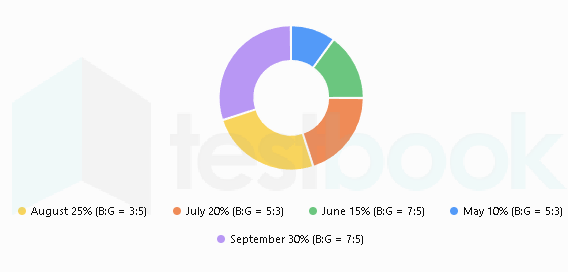
The pie chart shows the percentage distribution of the 640 balls manufactured by a company during five monthsβ€”May, June, July, August and September. The figures given with each sector indicate the percentage share of total production and the ratio of Blue balls to Green balls in that month.

The total number of Blue balls manufactured during June and September together is what percent more than the total number of Green balls manufactured during May and July together?

  1. AOption (a)

    85%

  2. BOption (b)

    93 2/3%

  3. COption (c)

    133 1/3%

  4. DOption (d)

    142%

  5. EOption (e)

    145%

View answer & explanation

Correct answer

Answer: (c)C.

133 1/3%

Why this answer is correct

Common Calculation

Given:

MonthShareBlue : Green
May10%5 : 3
June15%7 : 5
July20%5 : 3
August25%3 : 5
September30%7 : 5

Total Balls Manufactured = 640

Formula:

Total Balls = Total Γ— Percentage/100

Blue Balls = Total Balls Γ— Blue Parts / Total Parts

Green Balls = Total Balls Γ— Green Parts / Total Parts

Calculation:

β‡’ May Total Balls = 10% of 640 = (10/100) Γ— 640 = 64

β‡’ Blue Balls in May = (5/8) Γ— 64 = 40

β‡’ Green Balls in May = (3/8) Γ— 64 = 24

β‡’ June Total Balls = 15% of 640 = (15/100) Γ— 640 = 96

β‡’ Blue Balls in June = (7/12) Γ— 96 = 56

β‡’ Green Balls in June = (5/12) Γ— 96 = 40

β‡’ July Total Balls = 20% of 640 = (20/100) Γ— 640 = 128

β‡’ Blue Balls in July = (5/8) Γ— 128 = 80

β‡’ Green Balls in July = (3/8) Γ— 128 = 48

β‡’ August Total Balls = 25% of 640 = (25/100) Γ— 640 = 160

β‡’ Blue Balls in August = (3/8) Γ— 160 = 60

β‡’ Green Balls in August = (5/8) Γ— 160 = 100

β‡’ September Total Balls = 30% of 640 = (30/100) Γ— 640 = 192

β‡’ Blue Balls in September = (7/12) Γ— 192 = 112

β‡’ Green Balls in September = (5/12) Γ— 192 = 80

Given:

Blue Balls (June) = 56

Blue Balls (September) = 112

Green Balls (May) = 24

Green Balls (July) = 48

Formula:

Required Percentage

= [(First Quantity βˆ’ Second Quantity)/Second Quantity] Γ— 100

Calculation:

β‡’ Total Blue Balls (June & September) = 56 + 112 = 168

β‡’ Total Green Balls (May & July) = 24 + 48 = 72

β‡’ Difference = 168 – 72 = 96

β‡’ Required Percentage = (96/72) Γ— 100 = 133(1/3)%

∴ Answer = 133(1/3)%

SBI PO Prelims Memory Based Paper (Held On: 2 August 2026 Shift 1) (Previous Year Paper)Β·Quantitative Aptitude
View full paper

Question 54

IBPS Probationary Officer (PO) 2026β€’ Quantitative Aptitudeβ€’ Quantitative Aptitude

Directions: Study the following pie chart carefully and answer the questions that follow.

The pie chart shows the percentage distribution of the 640 balls manufactured by a company during five monthsβ€”May, June, July, August and September. The figures given with each sector indicate the percentage share of total production and the ratio of Blue balls to Green balls in that month.

What is the ratio of the total number of Green balls manufactured during August and September together to the total number of Blue balls manufactured during May, June and July together?

  1. AOption (a)

    45:41

  2. BOption (b)

    45:42

  3. COption (c)

    7:6

  4. DOption (d)

    13:12

  5. EOption (e)

    33:32

View answer & explanation

Correct answer

Answer: (b)B.

45:42

Why this answer is correct

Common Calculation

Given:

MonthShareBlue : Green
May10%5 : 3
June15%7 : 5
July20%5 : 3
August25%3 : 5
September30%7 : 5

Total Balls Manufactured = 640

Formula:

Total Balls = Total Γ— Percentage/100

Blue Balls = Total Balls Γ— Blue Parts / Total Parts

Green Balls = Total Balls Γ— Green Parts / Total Parts

Calculation:

β‡’ May Total Balls = 10% of 640 = (10/100) Γ— 640 = 64

β‡’ Blue Balls in May = (5/8) Γ— 64 = 40

β‡’ Green Balls in May = (3/8) Γ— 64 = 24

β‡’ June Total Balls = 15% of 640 = (15/100) Γ— 640 = 96

β‡’ Blue Balls in June = (7/12) Γ— 96 = 56

β‡’ Green Balls in June = (5/12) Γ— 96 = 40

β‡’ July Total Balls = 20% of 640 = (20/100) Γ— 640 = 128

β‡’ Blue Balls in July = (5/8) Γ— 128 = 80

β‡’ Green Balls in July = (3/8) Γ— 128 = 48

β‡’ August Total Balls = 25% of 640 = (25/100) Γ— 640 = 160

β‡’ Blue Balls in August = (3/8) Γ— 160 = 60

β‡’ Green Balls in August = (5/8) Γ— 160 = 100

β‡’ September Total Balls = 30% of 640 = (30/100) Γ— 640 = 192

β‡’ Blue Balls in September = (7/12) Γ— 192 = 112

β‡’ Green Balls in September = (5/12) Γ— 192 = 80

Given:

Green Balls (August & September)

Blue Balls (May, June & July)

Formula:

Required Ratio

= First Quantity : Second Quantity

Calculation:

β‡’ Green Balls in August and September = 100 + 80 = 180

β‡’ Blue Balls in May, June and July = 40 + 56 + 80 = 176

β‡’ Required Ratio = 180 : 176 = 45 : 44

∴ Answer = 45 : 44

SBI PO Prelims Memory Based Paper (Held On: 2 August 2026 Shift 1) (Previous Year Paper)Β·Quantitative Aptitude
View full paper

Question 55

IBPS Probationary Officer (PO) 2026β€’ Quantitative Aptitudeβ€’ Quantitative Aptitude

Directions: Study the following pie chart carefully and answer the questions that follow.

The pie chart shows the percentage distribution of the 640 balls manufactured by a company during five monthsβ€”May, June, July, August and September. The figures given with each sector indicate the percentage share of total production and the ratio of Blue balls to Green balls in that month.

If 20 Blue balls are transferred from September to August, then what will be the ratio of Blue balls in August to Blue balls in September?

  1. AOption (a)

    4:5

  2. BOption (b)

    5:7

  3. COption (c)

    9:11

  4. DOption (d)

    13:16

  5. EOption (e)

    20:23

View answer & explanation

Correct answer

Answer: (e)E.

20:23

Why this answer is correct

Common Calculation

Given:

MonthShareBlue : Green
May10%5 : 3
June15%7 : 5
July20%5 : 3
August25%3 : 5
September30%7 : 5

Total Balls Manufactured = 640

Formula:

Total Balls = Total Γ— Percentage/100

Blue Balls = Total Balls Γ— Blue Parts / Total Parts

Green Balls = Total Balls Γ— Green Parts / Total Parts

Calculation:

β‡’ May Total Balls = 10% of 640 = (10/100) Γ— 640 = 64

β‡’ Blue Balls in May = (5/8) Γ— 64 = 40

β‡’ Green Balls in May = (3/8) Γ— 64 = 24

β‡’ June Total Balls = 15% of 640 = (15/100) Γ— 640 = 96

β‡’ Blue Balls in June = (7/12) Γ— 96 = 56

β‡’ Green Balls in June = (5/12) Γ— 96 = 40

β‡’ July Total Balls = 20% of 640 = (20/100) Γ— 640 = 128

β‡’ Blue Balls in July = (5/8) Γ— 128 = 80

β‡’ Green Balls in July = (3/8) Γ— 128 = 48

β‡’ August Total Balls = 25% of 640 = (25/100) Γ— 640 = 160

β‡’ Blue Balls in August = (3/8) Γ— 160 = 60

β‡’ Green Balls in August = (5/8) Γ— 160 = 100

β‡’ September Total Balls = 30% of 640 = (30/100) Γ— 640 = 192

β‡’ Blue Balls in September = (7/12) Γ— 192 = 112

β‡’ Green Balls in September = (5/12) Γ— 192 = 80

Β 

Given:

Blue Balls in August = 60

Blue Balls in September = 112

Transferred Blue Balls = 20

Formula:

New Quantity

= Original Quantity Β± Transferred Balls

Required Ratio

= New Blue Balls in August : New Blue Balls in September

Calculation:

β‡’ New Blue Balls in August = 60 + 20 = 80

β‡’ New Blue Balls in September = 112 – 20 = 92

β‡’ Required Ratio = 80 : 92 = 20 : 23

∴ Answer = 20 : 23

SBI PO Prelims Memory Based Paper (Held On: 2 August 2026 Shift 1) (Previous Year Paper)Β·Quantitative Aptitude
View full paper

Question 56

IBPS Probationary Officer (PO) 2026β€’ Quantitative Aptitudeβ€’ Quantitative Aptitude

Directions: Study the following pie chart carefully and answer the questions that follow.

The pie chart shows the percentage distribution of the 640 balls manufactured by a company during five monthsβ€”May, June, July, August and September. The figures given with each sector indicate the percentage share of total production and the ratio of Blue balls to Green balls in that month.

The average number of balls manufactured during June, July and August is how much more than the average number of balls manufactured during May and September?

  1. AOption (a)

    5

  2. BOption (b)

    0

  3. COption (c)

    8

  4. DOption (d)

    6

  5. EOption (e)

    10

View answer & explanation

Correct answer

Answer: (b)B.

0

Why this answer is correct

Common Calculation

Given:

MonthShareBlue : Green
May10%5 : 3
June15%7 : 5
July20%5 : 3
August25%3 : 5
September30%7 : 5

Total Balls Manufactured = 640

Formula:

Total Balls = Total Γ— Percentage/100

Blue Balls = Total Balls Γ— Blue Parts / Total Parts

Green Balls = Total Balls Γ— Green Parts / Total Parts

Calculation:

β‡’ May Total Balls = 10% of 640 = (10/100) Γ— 640 = 64

β‡’ Blue Balls in May = (5/8) Γ— 64 = 40

β‡’ Green Balls in May = (3/8) Γ— 64 = 24

β‡’ June Total Balls = 15% of 640 = (15/100) Γ— 640 = 96

β‡’ Blue Balls in June = (7/12) Γ— 96 = 56

β‡’ Green Balls in June = (5/12) Γ— 96 = 40

β‡’ July Total Balls = 20% of 640 = (20/100) Γ— 640 = 128

β‡’ Blue Balls in July = (5/8) Γ— 128 = 80

β‡’ Green Balls in July = (3/8) Γ— 128 = 48

β‡’ August Total Balls = 25% of 640 = (25/100) Γ— 640 = 160

β‡’ Blue Balls in August = (3/8) Γ— 160 = 60

β‡’ Green Balls in August = (5/8) Γ— 160 = 100

β‡’ September Total Balls = 30% of 640 = (30/100) Γ— 640 = 192

β‡’ Blue Balls in September = (7/12) Γ— 192 = 112

β‡’ Green Balls in September = (5/12) Γ— 192 = 80

Β 

Given:

Balls Manufactured during June, July and August

Balls Manufactured during May and September

Formula:

Average

= Sum of Quantities/Number of Quantities

Required Difference

= First Average βˆ’ Second Average

Calculation:

β‡’ Average Balls Manufactured during June, July and August = (96 + 128 + 160)/3 = 384/3 = 128

β‡’ Average Balls Manufactured during May and September = (64 + 192)/2 = 256/2 = 128

β‡’ Required Difference = 128 – 128 = 0

∴ Answer = 0

SBI PO Prelims Memory Based Paper (Held On: 2 August 2026 Shift 1) (Previous Year Paper)Β·Quantitative Aptitude
View full paper

Question 57

IBPS Probationary Officer (PO) 2026β€’ Quantitative Aptitudeβ€’ Quantitative Aptitude

Directions: Study the following pie chart carefully and answer the questions that follow.

The pie chart shows the percentage distribution of the 640 balls manufactured by a company during five monthsβ€”May, June, July, August and September. The figures given with each sector indicate the percentage share of total production and the ratio of Blue balls to Green balls in that month.

Green balls manufactured during August are what percent of the total Blue balls manufactured during June and July together?

  1. AOption (a)

    73.5%

  2. BOption (b)

    76%

  3. COption (c)

    67.5%

  4. DOption (d)

    65%

  5. EOption (e)

    70%

View answer & explanation

Correct answer

Answer: (a)A.

73.5%

Why this answer is correct

Common Calculation

Given:

MonthShareBlue : Green
May10%5 : 3
June15%7 : 5
July20%5 : 3
August25%3 : 5
September30%7 : 5

Total Balls Manufactured = 640

Formula:

Total Balls = Total Γ— Percentage/100

Blue Balls = Total Balls Γ— Blue Parts / Total Parts

Green Balls = Total Balls Γ— Green Parts / Total Parts

Calculation:

β‡’ May Total Balls = 10% of 640 = (10/100) Γ— 640 = 64

β‡’ Blue Balls in May = (5/8) Γ— 64 = 40

β‡’ Green Balls in May = (3/8) Γ— 64 = 24

β‡’ June Total Balls = 15% of 640 = (15/100) Γ— 640 = 96

β‡’ Blue Balls in June = (7/12) Γ— 96 = 56

β‡’ Green Balls in June = (5/12) Γ— 96 = 40

β‡’ July Total Balls = 20% of 640 = (20/100) Γ— 640 = 128

β‡’ Blue Balls in July = (5/8) Γ— 128 = 80

β‡’ Green Balls in July = (3/8) Γ— 128 = 48

β‡’ August Total Balls = 25% of 640 = (25/100) Γ— 640 = 160

β‡’ Blue Balls in August = (3/8) Γ— 160 = 60

β‡’ Green Balls in August = (5/8) Γ— 160 = 100

β‡’ September Total Balls = 30% of 640 = (30/100) Γ— 640 = 192

β‡’ Blue Balls in September = (7/12) Γ— 192 = 112

β‡’ Green Balls in September = (5/12) Γ— 192 = 80

Given:

Green Balls in August = 100

Blue Balls in June = 56

Blue Balls in July = 80

Formula:

Required Percentage

= (Required Quantity/Base Quantity) Γ— 100

Calculation:

β‡’ Total Blue Balls in June and July = 56 + 80 = 136

β‡’ Green Balls in August = 100

β‡’ Required Percentage = (100/136) Γ— 100 = 73.53% β‰ˆ 73.5%

∴ Answer = 73.5%

SBI PO Prelims Memory Based Paper (Held On: 2 August 2026 Shift 1) (Previous Year Paper)Β·Quantitative Aptitude
View full paper

Question 58

IBPS Probationary Officer (PO) 2026β€’ Quantitative Aptitudeβ€’ Quantitative Aptitude

The population of the village is x and 2/7th of them are graduates and from the remaining are non graduates. If 30% of non graduates isΒ  2100.The 25% of the graduates are employed and 42.85% of the non - graduates are unemployed. Find the difference between unemployed graduates and employed non - graduates.

  1. AOption (a)

    1800

  2. BOption (b)

    2200

  3. COption (c)

    2300

  4. DOption (d)

    2100

  5. EOption (e)

    1900

View answer & explanation

Correct answer

Answer: (e)E.

1900

Why this answer is correct

Given:

Total population of the village = x

2/7 of them are graduates

Remaining are non-graduates

30% of non-graduates = 2100

25% of graduates are employed

42.85% of non-graduates are unemployed

Formula used:

Number of non-graduates = Total population - Number of graduates

Number of unemployed graduates = 75% of graduates

Number of employed non-graduates = 57.15% of non-graduates

Calculations:

Let the total population be x.

Number of graduates:

2/7 of x = 2x/7

Number of non-graduates:

Remaining = x - 2x/7 = 5x/7

Given 30% of non-graduates = 2100:

0.3 Γ— 5x/7 = 2100

β‡’ 1.5x/7 = 2100

β‡’ 1.5x = 2100 Γ— 7

β‡’ 1.5x = 14700

β‡’ x = 14700 / 1.5

β‡’ x = 9800

Total population = 9800

Number of graduates:

2/7 of 9800 = 2/7 Γ— 9800 = 2800

Number of non-graduates:

5/7 of 9800 = 5/7 Γ— 9800 = 7000

Number of employed graduates:

25% of 2800 = 0.25 Γ— 2800 = 700

Number of unemployed graduates:

75% of 2800 = 0.75 Γ— 2800 = 2100

Number of unemployed non-graduates:

42.85% of 7000 = 0.4285 Γ— 7000 = 2999.5 β‰ˆ 3000

Number of employed non-graduates:

Remaining non-graduates after accounting for unemployed non-graduates:

Total non-graduates - Unemployed non-graduates = 7000 - 3000 = 4000

Difference between unemployed graduates and employed non-graduates:

Difference = 2100 - 4000

∴ The difference between unemployed graduates and employed non-graduates is 1900.

SBI PO Prelims Memory Based Paper (Held On: 2 August 2026 Shift 1) (Previous Year Paper)Β·Quantitative Aptitude
View full paper

Question 59

IBPS Probationary Officer (PO) 2026β€’ Quantitative Aptitudeβ€’ Quantitative Aptitude

There is a group of dogs playing in a pet house. Their average weight is 9.5 kg. If 5 dogs with an average weight of 6.5 kg leave the group by getting exhausted and 4 dogs of average weight 12.5 kg join the group, the average of the group increases by 3 kg. How many dogs were there in the group initially?

  1. AOption (a)

    12

  2. BOption (b)

    17

  3. COption (c)

    11

  4. DOption (d)

    7

  5. EOption (e)

    10

View answer & explanation

Correct answer

Answer: (e)E.

10

Why this answer is correct

Given:

Average weight initially = 9.5 kg

5 dogs with average weight 6.5 kgΒ leave and 4 dogs with average weight 12.5 kg join the group

Average increases by 3 kg

Formula used:

Average = sum of observations / no. of observations

Calculation:

Let the no. of dogs be x

According to question,

(9.5x - 5 Γ— 6.5 + 4Β Γ— 12.5) / x - 5 + 4 = 12.5

β‡’ (9.5x - 32.5 + 50) / x- 1 = 12.5

β‡’ 9.5x + 17.5 / x - 1 = 12.5

β‡’ 9.5x + 17.5 = (x - 1)Β Γ— 12.5

β‡’ 12.5x - 9.5x = 17.5 + 12.5

β‡’ 3x = 30

β‡’ x = 10

∴ The number of dogs initially in the group is 10.

SBI PO Prelims Memory Based Paper (Held On: 2 August 2026 Shift 1) (Previous Year Paper)Β·Quantitative Aptitude
View full paper

Question 60

IBPS Probationary Officer (PO) 2026β€’ Quantitative Aptitudeβ€’ Quantitative Aptitude

A and B started a business by investing amounts in the ratio 4:5, respectively. After 7 months, C joined the business by investing β‚Ή18,000. At the end of one year, the profit earned by A, B and C was distributed in the ratio 8: 10: 5, respectively. Find the amount invested by B.Β 

  1. AOption (a)

    β‚Ή12,000

  2. BOption (b)

    β‚Ή15,000

  3. COption (c)

    β‚Ή18,000

  4. DOption (d)

    β‚Ή20,000

  5. EOption (e)

    β‚Ή24,000

View answer & explanation

Correct answer

Answer: (b)B.

β‚Ή15,000

Why this answer is correct

Let the investments of A and B be β‚Ή4x and β‚Ή5x, respectively.

A and B invested their amounts for 12 months, while C invested for 12 – 7 = 5 months

Ratio of profits = 4x Γ— 12: 5x Γ— 12: 18000 Γ— 5 = 48x:60x:90000

Given profit ratio = 8:10:5

Therefore, 48x/8 = 90000/5

Or, 6x = 18000

So, x = 3000

Investment of B = 5x = 5 Γ— 3000 = β‚Ή 15,000

How should I prepare for Quantitative Aptitude in IBPS Probationary Officer (PO)?

Solving previous year questions by topic helps identify recurring concepts, question patterns, and frequently asked sub-topics. Attempt each question, review the step-by-step explanation, and note down key formulas or facts for quick revision before the exam.