IBPS Probationary Officer (PO) · Topic Collection

Quantitative Aptitude PYQs

Arithmetic, number systems, percentages, ratios, profit and loss, time and work, algebra, geometry, mensuration, and trigonometry.

1305 Total Questions38 Official PapersYears: 2021–2026Search in Quantitative Aptitude
Showing questions 21–40 of 1305Page 2 of 66
SBI PO Prelims Memory Based Paper (Held On: 1 August 2026 Shift 2) (Previous Year Paper)·Quantitative Aptitude
View full paper

Question 21

IBPS Probationary Officer (PO) 2026• Quantitative Aptitude• Quantitative Aptitude

Two stations A and B are 180 km apart. A local train leaves station A and starts moving towards station B, at the same time, from station B a goods train starts to move towards station A. Two trains meet after 5 hours. If the local train is 4 km/hr faster than the goods train, then find the speed of the local train.

  1. AOption (a)

    20 km/hr

  2. BOption (b)

    16 km/hr

  3. COption (c)

    18 km/hr

  4. DOption (d)

    15 km/hr

  5. EOption (e)

    25 km/hr

View answer & explanation

Correct answer

Answer: (a)A.

20 km/hr

Why this answer is correct

Given:

Two stations A and B are 180 km apart

Two trains meet after 5 hours

The local train is 4 km/hr faster than the goods train

Concept Used:

Distance = speed × time

Calculation:

Let, the speed of the goods train = A km/hr

And, speed of local train = (A + 4) km/hr

According to the question,

⇒ 180/(A + A + 4) = 5

⇒ 2A = 32

⇒ A = 16

The speed of the local train = (16 + 4) = 20 km/hr

∴ The correct answer is option 1
SBI PO Prelims Memory Based Paper (Held On: 1 August 2026 Shift 2) (Previous Year Paper)·Quantitative Aptitude
View full paper

Question 22

IBPS Probationary Officer (PO) 2026• Quantitative Aptitude• Quantitative Aptitude

A and B can complete a work in 40 days, and B and C together can complete a work in 60 days. A and C together can complete a work in 30 days. If A, B and C complete 3/2 part of work together and total wage is Rs. 5400 then find the share of C?

  1. AOption (a)

    1600

  2. BOption (b)

    1200

  3. COption (c)

    1400

  4. DOption (d)

    1300

  5. EOption (e)

    1800

View answer & explanation

Correct answer

Answer: (e)E.

1800

Why this answer is correct

Calculation

A + B can complete work in 40 days

B + C can complete work in 60 days

A + C can complete work in 30 days

A + B + C complete 3/2 work together

Total wage = Rs. 5400

We are to find C's share.

Take total work as LCM of 40, 60, 30

LCM of 40, 60, and 30 = 120 units

Now we compute the combined efficiencies:

A + B = 120 / 40 = 3 units/day

B + C = 120 / 60 = 2 units/day

A + C = 120 / 30 = 4 units/day

Let’s add:

(A+B) + (B+C) + (A+C) = 3+2+4=9 units/day

A+B+C = 9/2 = 4.5 units/day

Total work done by A + B + C

They complete 3/2 of total work.

Total work = 120 units

⇒ 3/2 × 120 = 180 units

Since A + B + C = 4.5 units/day:

Days = 180 / 4.5 = 40 days

C’s efficiency = 4.5 – 3 = 1.5

In 40 days C did 40  × 1.5 = 60 unit work

Wage for per unit work is 5400 / 180 = 30

So, C’s wage = 60 × 30 = 1800

SBI PO Prelims Memory Based Paper (Held On: 1 August 2026 Shift 2) (Previous Year Paper)·Quantitative Aptitude
View full paper

Question 23

IBPS Probationary Officer (PO) 2026• Quantitative Aptitude• Quantitative Aptitude

What should come in place of the question mark '?' in the following number series?

3375, 289, 6859, 441, 12167, (?)

  1. AOption (a)

    1331

  2. BOption (b)

    625

  3. COption (c)

    343

  4. DOption (d)

    729

  5. EOption (e)

    216

View answer & explanation

Correct answer

Answer: (b)B.

625

Why this answer is correct

Given Series:

3375, 289, 6859, 441, 12167, (?)

The logic followed here is as follows:

⇒ (15)3 = 3375

⇒ (17)2 = 289

⇒ (19)3 = 6859

⇒ (21)2 = 441

⇒ (23)3 = 12167

⇒ (25)2 = 625

Hence, 625 will come in the place of (?).

SBI PO Prelims Memory Based Paper (Held On: 1 August 2026 Shift 2) (Previous Year Paper)·Quantitative Aptitude
View full paper

Question 24

IBPS Probationary Officer (PO) 2026• Quantitative Aptitude• Quantitative Aptitude

What should come in place of the question mark '?' in the following number series?

1220, 1617, 2086, 2633, 3264, (?)

  1. AOption (a)

    3990

  2. BOption (b)

    3985

  3. COption (c)

    3980

  4. DOption (d)

    3975

  5. EOption (e)

    3970

View answer & explanation

Correct answer

Answer: (b)B.

3985

Why this answer is correct

Given Series:

1220, 1617, 2086, 2633, 3264, (?)

The logic followed here is as follows:

⇒ (11)3 - 111 = 1220

⇒ (12)3 - 111 = 1617

⇒  (13)3 - 111 = 2086

⇒  (14)3 - 111 = 2633

⇒  (15)3 - 111 = 3264

⇒  (16)3 - 111 = 3985

Hence, 3985 will come in the place of (?).

SBI PO Prelims Memory Based Paper (Held On: 1 August 2026 Shift 2) (Previous Year Paper)·Quantitative Aptitude
View full paper

Question 25

IBPS Probationary Officer (PO) 2026• Quantitative Aptitude• Quantitative Aptitude

What should come in place of the question mark '?' in the following number series?

2, 12, 130, 56, (?), 132

  1. AOption (a)

    744

  2. BOption (b)

    740

  3. COption (c)

    735

  4. DOption (d)

    738

  5. EOption (e)

    742

View answer & explanation

Correct answer

Answer: (d)D.

738

Why this answer is correct

Given Series:

2, 12, 130, 56, (?), 132

The logic followed here is as follows:

⇒ 1 + 13 = 2

⇒ 3 + 32 = 12

⇒ 5 + 53 = 130

⇒ 7 + 72 = 56

⇒ 9 + 93 = 738

⇒ 11 + 112 = 132

Hence, 738 will come in the place of (?).

SBI PO Prelims Memory Based Paper (Held On: 1 August 2026 Shift 2) (Previous Year Paper)·Quantitative Aptitude
View full paper

Question 26

IBPS Probationary Officer (PO) 2026• Quantitative Aptitude• Quantitative Aptitude

The line graph shows the total number of candidates (Male + Female) in five examination centers A, B, C, D and E.

The table shows the percentage by which the number of male candidates is more than the number of female candidates at each center.


CentrePercentage of Male more than Female
A25%
B20%
C30%
D40%
E10%

70 candidates are transferred from centre E to centre A in the ratio of 4 : 3 between males and females. At the same time, 20% of the original female candidates of centre A are transferred to centre E. Find the new ratio of male to female candidates in centre A.

  1. AOption (a)

    27:17

  2. BOption (b)

    28:19

  3. COption (c)

    29:19

  4. DOption (d)

    30:19

  5. EOption (e)

    31:22

View answer & explanation

Correct answer

Answer: (c)C.

29:19

Why this answer is correct

CentreTotal CandidatesMaleFemale
A450250200
B550300250
C460260200
D360210150
E630330300


Original candidates in centre A,

Male = 250 and Female = 200

Seventy candidates are transferred from E to A in the ratio = 4:3

Total parts = 4 + 3 = 7

Male candidates transferred to A = 70 x 4/7 = 40

Female candidates transferred to A = 70 x 3/7 = 30

Also, 20% of the original female candidates of A are transferred to E.

20% x 200 = 40

Therefore, the new number of male candidates in A = 250 + 40 = 290

The new number of female candidates in A = 200 + 30 – 40 = 190

Required ratio = 290:190 = 29:19

SBI PO Prelims Memory Based Paper (Held On: 1 August 2026 Shift 2) (Previous Year Paper)·Quantitative Aptitude
View full paper

Question 27

IBPS Probationary Officer (PO) 2026• Quantitative Aptitude• Quantitative Aptitude

The line graph shows the total number of candidates (Male + Female) in five examination centers A, B, C, D and E.

The table shows the percentage by which the number of male candidates is more than the number of female candidates at each center.


CentrePercentage of Male more than Female
A25%
B20%
C30%
D40%
E10%

If the number of male candidates in centre D increases by 20%, while the number of female candidates decreases by 10%, what will be the difference between the new total candidates in D and the original total candidates in B?

  1. AOption (a)

    153

  2. BOption (b)

    158

  3. COption (c)

    163

  4. DOption (d)

    168

  5. EOption (e)

    173

View answer & explanation

Correct answer

Answer: (c)C.

163

Why this answer is correct

CentreTotal CandidatesMaleFemale
A450250200
B550300250
C460260200
D360210150
E630330300


New males in D = 120% x 210 = 252

New females = 90% x 150 = 135

New total = 252 + 135 = 387

Required Difference = 550 – 387 = 163

SBI PO Prelims Memory Based Paper (Held On: 2 August 2026 Shift 1) (Previous Year Paper)·Quantitative Aptitude
View full paper

Question 28

IBPS Probationary Officer (PO) 2026• Quantitative Aptitude• Quantitative Aptitude

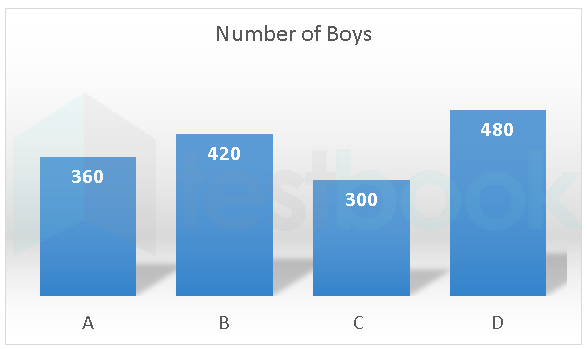
Directions : Study the bar graph and the accompanying table carefully and answer the questions that follow. The bar graph shows the number of Boys studying in four schools, namely A, B, C and D. The table shows the difference between the number of Boys and Girls in each school.

Table

SchoolDifference between Boys and Girls
A40
B84
C60
D120

Note

In Schools A and D, the number of Boys is more than the number of Girls.

In Schools B and C, the number of Girls is more than the number of Boys.

If the number of Girls in School A increases by 25% and the number of Boys in School B decreases by 20%, then what will be the ratio of Girls in School A to Boys in School B?

  1. AOption (a)

    25:19

  2. BOption (b)

    25:21

  3. COption (c)

    25:24

  4. DOption (d)

    5:4

  5. EOption (e)

    5:6

View answer & explanation

Correct answer

Answer: (b)B.

25:21

Why this answer is correct

Common Calculation

Given:

SchoolBoysDifferenceRelation
A36040Boys are more
B42084Girls are more
C30060Girls are more
D480120Boys are more

Formula:

Girls = Boys − Difference (when Boys are more)

Girls = Boys + Difference (when Girls are more)

Calculation:

⇒ Girls in School A = 360 – 40 = 320

⇒ Girls in School B = 420 + 84 = 504

⇒ Girls in School C = 300 + 60 = 360

⇒ Girls in School D = 480 – 120 = 360

Given:

Girls in School A = 320

Boys in School B = 420

Formula:

New Value

= Original Value × (100 ± Percentage)/100

Required Ratio

= New Girls : New Boys

Calculation:

⇒ New Girls in School A = 320 × 125/100 = 400

⇒ New Boys in School B = 420 × 80/100 = 336

⇒ Required Ratio = 400 : 336 = 25 : 21

∴ Answer = 25 : 21

SBI PO Prelims Memory Based Paper (Held On: 2 August 2026 Shift 1) (Previous Year Paper)·Quantitative Aptitude
View full paper

Question 29

IBPS Probationary Officer (PO) 2026• Quantitative Aptitude• Quantitative Aptitude

Directions : Study the bar graph and the accompanying table carefully and answer the questions that follow. The bar graph shows the number of Boys studying in four schools, namely A, B, C and D. The table shows the difference between the number of Boys and Girls in each school.

Table

SchoolDifference between Boys and Girls
A40
B84
C60
D120

Note

In Schools A and D, the number of Boys is more than the number of Girls.

In Schools B and C, the number of Girls is more than the number of Boys.

Girls in School B are approximately what percent more than the Girls in School A?

  1. AOption (a)

    45.5%

  2. BOption (b)

    50%

  3. COption (c)

    55%

  4. DOption (d)

    57.5%

  5. EOption (e)

    62.5%

View answer & explanation

Correct answer

Answer: (d)D.

57.5%

Why this answer is correct

Common Calculation

Given:

SchoolBoysDifferenceRelation
A36040Boys are more
B42084Girls are more
C30060Girls are more
D480120Boys are more

Formula:

Girls = Boys − Difference (when Boys are more)

Girls = Boys + Difference (when Girls are more)

Calculation:

⇒ Girls in School A = 360 – 40 = 320

⇒ Girls in School B = 420 + 84 = 504

⇒ Girls in School C = 300 + 60 = 360

⇒ Girls in School D = 480 – 120 = 360

Given:

Girls in School A = 320

Girls in School B = 504

Formula:

Required Percentage

= (Difference/Base Quantity) × 100

Calculation:

⇒ Difference = 504 – 320 = 184

⇒ Required Percentage = (184/320) × 100 = 57.5%

∴ Answer = 57.5%

SBI PO Prelims Memory Based Paper (Held On: 2 August 2026 Shift 1) (Previous Year Paper)·Quantitative Aptitude
View full paper

Question 30

IBPS Probationary Officer (PO) 2026• Quantitative Aptitude• Quantitative Aptitude

Directions : Study the bar graph and the accompanying table carefully and answer the questions that follow. The bar graph shows the number of Boys studying in four schools, namely A, B, C and D. The table shows the difference between the number of Boys and Girls in each school.

Table

SchoolDifference between Boys and Girls
A40
B84
C60
D120

Note

In Schools A and D, the number of Boys is more than the number of Girls.

In Schools B and C, the number of Girls is more than the number of Boys.

If 40 boys are transferred from School D to School C, then what will be the ratio of Boys in School C to Boys in School D?

  1. AOption (a)

    17:18

  2. BOption (b)

    17:20

  3. COption (c)

    17:22

  4. DOption (d)

    22:25

  5. EOption (e)

    25:27

View answer & explanation

Correct answer

Answer: (c)C.

17:22

Why this answer is correct

Common Calculation

Given:

SchoolBoysDifferenceRelation
A36040Boys are more
B42084Girls are more
C30060Girls are more
D480120Boys are more

Formula:

Girls = Boys − Difference (when Boys are more)

Girls = Boys + Difference (when Girls are more)

Calculation:

⇒ Girls in School A = 360 – 40 = 320

⇒ Girls in School B = 420 + 84 = 504

⇒ Girls in School C = 300 + 60 = 360

⇒ Girls in School D = 480 – 120 = 360

Given:

Boys in School C = 300

Boys in School D = 480

Transferred Boys = 40

Formula:

New Number of Boys

= Original Number of Boys ± Transferred Boys

Required Ratio

= New Boys in School C : New Boys in School D

Calculation:

⇒ New Boys in School C = 300 + 40 = 340

⇒ New Boys in School D = 480 – 40 = 440

⇒ Required Ratio = 340 : 440 = 17 : 22

∴ Answer = 17 : 22

SBI PO Prelims Memory Based Paper (Held On: 2 August 2026 Shift 1) (Previous Year Paper)·Quantitative Aptitude
View full paper

Question 31

IBPS Probationary Officer (PO) 2026• Quantitative Aptitude• Quantitative Aptitude

Directions : Study the bar graph and the accompanying table carefully and answer the questions that follow. The bar graph shows the number of Boys studying in four schools, namely A, B, C and D. The table shows the difference between the number of Boys and Girls in each school.

Table

SchoolDifference between Boys and Girls
A40
B84
C60
D120

Note

In Schools A and D, the number of Boys is more than the number of Girls.

In Schools B and C, the number of Girls is more than the number of Boys.

The total number of Girls in Schools B and C together is what percent of the total number of Boys in Schools A and D together?

  1. AOption (a)

    92%

  2. BOption (b)

    96%

  3. COption (c)

    103%

  4. DOption (d)

    111%

  5. EOption (e)

    121%

View answer & explanation

Correct answer

Answer: (c)C.

103%

Why this answer is correct

Common Calculation

Given:

SchoolBoysDifferenceRelation
A36040Boys are more
B42084Girls are more
C30060Girls are more
D480120Boys are more

Formula:

Girls = Boys − Difference (when Boys are more)

Girls = Boys + Difference (when Girls are more)

Calculation:

⇒ Girls in School A = 360 – 40 = 320

⇒ Girls in School B = 420 + 84 = 504

⇒ Girls in School C = 300 + 60 = 360

⇒ Girls in School D = 480 – 120 = 360

Given:

Girls in Schools B and C

Boys in Schools A and D

Formula:

Required Percentage

= (Required Quantity/Base Quantity) × 100

Calculation:

⇒ Total Girls in Schools B and C = 504 + 360 = 864

⇒ Total Boys in Schools A and D = 360 + 480 = 840

⇒ Required Percentage = (864/840) × 100 = 102.86% ≈ 103%

∴ Answer = 103%

SBI PO Prelims Memory Based Paper (Held On: 2 August 2026 Shift 1) (Previous Year Paper)·Quantitative Aptitude
View full paper

Question 32

IBPS Probationary Officer (PO) 2026• Quantitative Aptitude• Quantitative Aptitude

Directions : Study the bar graph and the accompanying table carefully and answer the questions that follow. The bar graph shows the number of Boys studying in four schools, namely A, B, C and D. The table shows the difference between the number of Boys and Girls in each school.

Table

SchoolDifference between Boys and Girls
A40
B84
C60
D120

Note

In Schools A and D, the number of Boys is more than the number of Girls.

In Schools B and C, the number of Girls is more than the number of Boys.

By how many does the average number of students in Schools B and D exceed the average number of students in Schools A and C?

  1. AOption (a)

    200

  2. BOption (b)

    204

  3. COption (c)

    207

  4. DOption (d)

    209

  5. EOption (e)

    212

View answer & explanation

Correct answer

Answer: (e)E.

212

Why this answer is correct

Common Calculation

Given:

SchoolBoysDifferenceRelation
A36040Boys are more
B42084Girls are more
C30060Girls are more
D480120Boys are more

Formula:

Girls = Boys − Difference (when Boys are more)

Girls = Boys + Difference (when Girls are more)

Calculation:

⇒ Girls in School A = 360 – 40 = 320

⇒ Girls in School B = 420 + 84 = 504

⇒ Girls in School C = 300 + 60 = 360

⇒ Girls in School D = 480 – 120 = 360

Given:

Students in Schools B and D

Students in Schools A and C

Formula:

Average

= Sum of Students/Number of Schools

Required Difference

= Average of (B & D) − Average of (A & C)

Calculation:

⇒ Average Students in Schools B and D = (924 + 840)/2 = 1764/2 = 882

⇒ Average Students in Schools A and C = (680 + 660)/2 = 1340/2 = 670

⇒ Required Difference = 882 – 670 = 212

∴ Answer = 212

SBI PO Prelims Memory Based Paper (Held On: 2 August 2026 Shift 1) (Previous Year Paper)·Quantitative Aptitude
View full paper

Question 33

IBPS Probationary Officer (PO) 2026• Quantitative Aptitude• Quantitative Aptitude

Directions : Study the bar graph and the accompanying table carefully and answer the questions that follow. The bar graph shows the number of Boys studying in four schools, namely A, B, C and D. The table shows the difference between the number of Boys and Girls in each school.

Table

SchoolDifference between Boys and Girls
A40
B84
C60
D120

Note

In Schools A and D, the number of Boys is more than the number of Girls.

In Schools B and C, the number of Girls is more than the number of Boys.

What is the ratio of the total number of students in Schools A and C together to the total number of students in Schools B and D together?

  1. AOption (a)

    27:32

  2. BOption (b)

    32:45

  3. COption (c)

    45:57

  4. DOption (d)

    57:59

  5. EOption (e)

    None

View answer & explanation

Correct answer

Answer: (e)E.

None

Why this answer is correct

Common Calculation

Given:

SchoolBoysDifferenceRelation
A36040Boys are more
B42084Girls are more
C30060Girls are more
D480120Boys are more

Formula:

Girls = Boys − Difference (when Boys are more)

Girls = Boys + Difference (when Girls are more)

Calculation:

⇒ Girls in School A = 360 – 40 = 320

⇒ Girls in School B = 420 + 84 = 504

⇒ Girls in School C = 300 + 60 = 360

⇒ Girls in School D = 480 – 120 = 360

Given:

Total Students in Schools A and C

Total Students in Schools B and D

Formula:

Required Ratio

= Total Students in Schools A and C : Total Students in Schools B and D

Calculation:

⇒ Total Students in Schools A and C = 680 + 660 = 1340

⇒ Total Students in Schools B and D = 924 + 840 = 1764

⇒ Required Ratio = 1340 : 1764 = 335 : 441

SBI PO Prelims Memory Based Paper (Held On: 2 August 2026 Shift 1) (Previous Year Paper)·Quantitative Aptitude
View full paper

Question 34

IBPS Probationary Officer (PO) 2026• Quantitative Aptitude• Quantitative Aptitude

A vessel contains 140 litres of a mixture of milk and water in the ratio 4: 3. From the mixture, 25% of the total quantity of water is removed. After that, a quantity of pure milk equal to the quantity of water removed is added to the vessel. Find the final ratio of milk to water.

  1. AOption (a)

    17:9

  2. BOption (b)

    19:9

  3. COption (c)

    19:11

  4. DOption (d)

    20:9

  5. EOption (e)

    21:10

View answer & explanation

Correct answer

Answer: (b)B.

19:9

Why this answer is correct

Initial milk = 140 x 4/7 = 80 litres

Initial water = 140 x 3/7 = 60 litres

Water removed = 25% of 60 = 15 litres

Therefore, remaining water = 60 – 15 = 45 litres

An equal quantity, that is 15 litres of milk, is added.

Final milk = 80 + 15 = 95 litres

Required ratio = 19:9

SBI PO Prelims Memory Based Paper (Held On: 2 August 2026 Shift 1) (Previous Year Paper)·Quantitative Aptitude
View full paper

Question 35

IBPS Probationary Officer (PO) 2026• Quantitative Aptitude• Quantitative Aptitude

A shopkeeper purchased an article for ₹1,500. He marked the article 40% above its cost price and offered a discount of 15% on the marked price. If he had sold the article for ₹90 less, then find the profit percentage earned by him. 

  1. AOption (a)

    13%

  2. BOption (b)

    14%

  3. COption (c)

    15%

  4. DOption (d)

    16%

  5. EOption (e)

    18%

View answer & explanation

Correct answer

Answer: (a)A.

13%

Why this answer is correct

Cost Price = ₹1,500

Marked Price = 1500 x 140% = ₹ 2100

Selling Price after 15% discount = 2100 x 85% = ₹1785

New Selling Price = 1785 – 90 = ₹ 1695

Profit = ₹1695 – 1500 = ₹195

Profit percentage = (195/1500) x 100 = 13%

How should I prepare for Quantitative Aptitude in IBPS Probationary Officer (PO)?

Solving previous year questions by topic helps identify recurring concepts, question patterns, and frequently asked sub-topics. Attempt each question, review the step-by-step explanation, and note down key formulas or facts for quick revision before the exam.