Combined Defence Services (CDS) · Topic Collection

Quantitative Aptitude PYQs

Arithmetic, number systems, percentages, ratios, profit and loss, time and work, algebra, geometry, mensuration, and trigonometry.

2000 Total Questions20 Official PapersYears: 2016–2025Search in Quantitative Aptitude
Showing questions 361–380 of 2000Page 19 of 100
CDS Elementary Mathematics 21 April 2024 Official Paper (Previous Year Paper)·Elementary Mathematics
View full paper

Question 361

Combined Defence Services (CDS) 2024• Elementary Mathematics• Elementary Mathematics

Consider the following for the next ten (10) items that follow:

Each item contains a Question followed by two Statements. Answer each item using the following instructions:

Let a, b, c and d be positive integers.

Question : Which one of a, b, c, d is closest to the product abcd?

Statement - I : a > b > c

Statement - II : c is not the smallest.

  1. AOption (a)

    If the Question can be answered by one of the Statements alone, but not by the other.

  2. BOption (b)

    If the Question can be answered by either Statement alone.

  3. COption (c)

    If the Question can be answered by using both the Statements together, but cannot be answered by using either Statement alone.

  4. DOption (d)

    If the Question cannot be answered even by using both Statements together.

View answer & explanation

Correct answer

Answer: (c)C.

If the Question can be answered by using both the Statements together, but cannot be answered by using either Statement alone.

Why this answer is correct

Calculation:

Statement 1: a > b > c

We can not be sure about the value of d from the given statement,

Hence, statement 1 is not sufficient to answer the question.

Statement 2: c is not the smallest.

This statement also does not provide any sufficient information to answer the question.

Using both the statement we can conclude that,

a > b > c > d

Since all the numbers are positive integers,

The product of these numbers will always be closer to the biggest number.

So, the answer is a will be closer to abcd.

∴ The correct answer is option 3.
CDS Elementary Mathematics 21 April 2024 Official Paper (Previous Year Paper)·Elementary Mathematics
View full paper

Question 362

Combined Defence Services (CDS) 2024• Elementary Mathematics• Elementary Mathematics

Consider the following for the next ten (10) items that follow:

Each item contains a Question followed by two Statements. Answer each item using the following instructions:

Let mn = k, where m and n are prime numbers and k is an even number.

Question : What is the value of mn - n  + 1?

Statement - I : m > n

Statement - II : One of the numbers is 2.

  1. AOption (a)

    If the Question can be answered by one of the Statements alone, but not by the other.

  2. BOption (b)

    If the Question can be answered by either Statement alone.

  3. COption (c)

    If the Question can be answered by using both the Statements together, but cannot be answered by using either Statement alone.

  4. DOption (d)

    If the Question cannot be answered even by using both Statements together.

View answer & explanation

Correct answer

Answer: (d)D.

If the Question cannot be answered even by using both Statements together.

Why this answer is correct

Given:

mn = k, k = even number

m and n are prime numbers

If the product of 2 numbers are even it means one number must be an even number.

Calculation:

Statement 1: m > n

It does not give any information about values of m and n.

Statement - II: One of the numbers is 2.

This statement also does not provide sufficient information to calculate the value of m and n.

Using both the statements together,

n = 2 but still we are not sure about the value of m.

∴ The correct answer is option 4.

CDS Elementary Mathematics 21 April 2024 Official Paper (Previous Year Paper)·Elementary Mathematics
View full paper

Question 363

Combined Defence Services (CDS) 2024• Elementary Mathematics• Elementary Mathematics

Consider the following for the next ten (10) items that follow:

Each item contains a Question followed by two Statements. Answer each item using the following instructions:

Question : If p is a positive integer, then what is the remainder when pn is divided by p + 1?

Statement - I : n is even.

Statement - II : p is even.

  1. AOption (a)

    If the Question can be answered by one of the Statements alone, but not by the other.

  2. BOption (b)

    If the Question can be answered by either Statement alone.

  3. COption (c)

    If the Question can be answered by using both the Statements together, but cannot be answered by using either Statement alone.

  4. DOption (d)

    If the Question cannot be answered even by using both Statements together.

View answer & explanation

Correct answer

Answer: (a)A.

If the Question can be answered by one of the Statements alone, but not by the other.

Why this answer is correct

Calculation:

Statement 1: n is even.

p2/(p + 1) = peven/(p + 1)

Example:

let p = 4,

42/5 = 16/5

The remainder will be 1.

Hence, Statement 1 is sufficient to answer the question.

Statement 2: p is even.

Example let p = 2 and 4

22/(3) , remainder = 1

41/(5), remainder = 4

Hence, this statement alone is not sufficient to answer the question.

∴ The correct answer is option 1.

CDS Elementary Mathematics 21 April 2024 Official Paper (Previous Year Paper)·Elementary Mathematics
View full paper

Question 364

Combined Defence Services (CDS) 2024• Elementary Mathematics• Elementary Mathematics

Consider the following for the next ten (10) items that follow:

Each item contains a Question followed by two Statements. Answer each item using the following instructions:

Question : Is xy positive?

Statement - I : x = \(\sqrt[3]{-0.19683}\)

Statement - II : y = \(\sqrt[3]{x}\)

  1. AOption (a)

    If the Question can be answered by one of the Statements alone, but not by the other.

  2. BOption (b)

    If the Question can be answered by either Statement alone.

  3. COption (c)

    If the Question can be answered by using both the Statements together, but cannot be answered by using either Statement alone.

  4. DOption (d)

    If the Question cannot be answered even by using both Statements together.

View answer & explanation

Correct answer

Answer: (a)A.

If the Question can be answered by one of the Statements alone, but not by the other.

Why this answer is correct

Calculation:

Statement - I : x = \(\sqrt[3]{-0.19683}\)

We can not find real values of x and y from this statement.

Statement - II : y = \(\sqrt[3]{x}\)

y = \(\sqrt[3]{x}\)

y3 = x

y4 = xy

Power 4 is always a positive number.

Hence statement 2 alone is sufficient to answer the question.

∴ The correct answer is option 1.

CDS Elementary Mathematics 21 April 2024 Official Paper (Previous Year Paper)·Elementary Mathematics
View full paper

Question 365

Combined Defence Services (CDS) 2024• Elementary Mathematics• Elementary Mathematics

Consider the following for the next ten (10) items that follow:

Each item contains a Question followed by two Statements. Answer each item using the following instructions:

Let a, b and c be the sides of a triangle ABC.

Question : Is the triangle equilateral?

Statement - I : a2 + b2 + c2 = (ab + bc + ca)

Statement - II : 3a2 + 3b2 + 4c2 = 2ab + 4bc + 4ca

  1. AOption (a)

    If the Question can be answered by one of the Statements alone, but not by the other.

  2. BOption (b)

    If the Question can be answered by either Statement alone.

  3. COption (c)

    If the Question can be answered by using both the Statements together, but cannot be answered by using either Statement alone.

  4. DOption (d)

    If the Question cannot be answered even by using both Statements together.

View answer & explanation

Correct answer

Answer: (b)B.

If the Question can be answered by either Statement alone.

Why this answer is correct

Calculation:

Statement 1: a2 + b2 + c2 = (ab + bc + ca)

If a2 + b2 + c2 = (ab + bc + ca) than a = b = c

The triangle is equilateral, hence statement 1 alone is sufficient to answer the question.

Statement 2: 3a2 + 3b2 + 4c2 = 2ab + 4bc + 4ca

⇒ 3a2 + 3b2 + 4c2- 2ab - 4bc - 4ca = 0

⇒ (a2 + b2 - 2ab) + (2b2 + 2c2 - 4bc) + (2c2 + 2a2 - 4ca) = 0

⇒ (a - b)2 + (√2b - √2c)2 + (√2c - √2a)2 = 0

a = b and b = c

Hence both statements alone are sufficient to answer the question.

∴ The correct answer is option 2.

CDS Elementary Mathematics 21 April 2024 Official Paper (Previous Year Paper)·Elementary Mathematics
View full paper

Question 366

Combined Defence Services (CDS) 2024• Elementary Mathematics• Elementary Mathematics

Consider the following for the next ten (10) items that follow:

Each item contains a Question followed by two Statements. Answer each item using the following instructions:

Area of a rectangle with length x and breadth y is P and area of a parallelogram (which is strictly not a rectangle) with adjacent sides of length x and y is Q.

Question : Is P > Q?

Statement - I : x ∶ y = 2 ∶ 1

Statement - II: The angle between the two adjacent sides of the parallelogram is 60°.

  1. AOption (a)

    If the Question can be answered by one of the Statements alone, but not by the other.

  2. BOption (b)

    If the Question can be answered by either Statement alone.

  3. COption (c)

    If the Question can be answered by using both the Statements together, but cannot be answered by using either Statement alone.

  4. DOption (d)

    If the Question cannot be answered even by using both Statements together.

View answer & explanation

Correct answer

Answer: (b)B.

If the Question can be answered by either Statement alone.

Why this answer is correct

Calculation:

Area of the rectangle (P) = x × y

Area of parallelogram (Q) = x × h

where h = perpendicular to side x

y > h since y is the hypotenuse

hence we can conclude that,

P > Q without using any statements

∴ The correct answer is option 2.

CDS Elementary Mathematics 21 April 2024 Official Paper (Previous Year Paper)·Elementary Mathematics
View full paper

Question 367

Combined Defence Services (CDS) 2024• Elementary Mathematics• Elementary Mathematics

Consider the following for the next ten (10) items that follow:

Each item contains a Question followed by two Statements. Answer each item using the following instructions:

A circle touches all the four sides AB, BC, CD, DA of a quadrilateral ABCD.

Question : What is the perimeter of the quadrilateral ?

Statement - I : AB + DC = 10 cm

Statement - II : AD + BC = 10 cm

  1. AOption (a)

    If the Question can be answered by one of the Statements alone, but not by the other.

  2. BOption (b)

    If the Question can be answered by either Statement alone.

  3. COption (c)

    If the Question can be answered by using both the Statements together, but cannot be answered by using either Statement alone.

  4. DOption (d)

    If the Question cannot be answered even by using both Statements together.

View answer & explanation

Correct answer

Answer: (b)B.

If the Question can be answered by either Statement alone.

Why this answer is correct

Given:

Calculation:

Statement - I : AB + DC = 10 cm

If AB + DC = 10 cm than AD + BC = 10 cm

hence we can calculate the perimeter by using statement 1

Statement - II : AD + BC = 10 cm

If AD + BC = 10 cm than AB + DC = 10 cm

hence we can calculate the perimeter by using statement 2.

∴ The correct answer is option 2.

CDS Elementary Mathematics 21 April 2024 Official Paper (Previous Year Paper)·Elementary Mathematics
View full paper

Question 368

Combined Defence Services (CDS) 2024• Elementary Mathematics• Elementary Mathematics

Consider the following for the next ten (10) items that follow:

Each item contains a Question followed by two Statements. Answer each item using the following instructions:

Question : What is the ratio of the lengths of diagonals of a rhombus ?

Statement - I : One diagonal of the rhombus is equal to its side.

Statement - II : The longer diagonal of the rhombus is equal to \(\sqrt3\) times its side.

  1. AOption (a)

    If the Question can be answered by one of the Statements alone, but not by the other.

  2. BOption (b)

    If the Question can be answered by either Statement alone.

  3. COption (c)

    If the Question can be answered by using both the Statements together, but cannot be answered by using either Statement alone.

  4. DOption (d)

    If the Question cannot be answered even by using both Statements together.

View answer & explanation

Correct answer

Answer: (b)B.

If the Question can be answered by either Statement alone.

Why this answer is correct

Calculation:

Statement - I : One diagonal of the rhombus is equal to its side.

ABCD is a Rhombus hence AC bisect BD

Δ ABD and Δ BDC are equilateral triangles.

AC intersects BD at 90°

AC = 2 × \(\frac{a √3}{2}\) = √3 

BD = a

BD/AC = 1/√3

Hence statement 1 is sufficient to answer the question.

Statement 2: The longer diagonal of the rhombus is equal to \(\sqrt3\) times its side.

Same figure can be drawn and the question can be answered.

∴ The correct answer is option 2.

CDS Elementary Mathematics 21 April 2024 Official Paper (Previous Year Paper)·Elementary Mathematics
View full paper

Question 369

Combined Defence Services (CDS) 2024• Elementary Mathematics• Elementary Mathematics

Consider the following for the next ten (10) items that follow:

Each item contains a Question followed by two Statements. Answer each item using the following instructions:

Area of a rectangle with length x and breadth y is P and area of a parallelogram (which is strictly not a rectangle) with adjacent sides of length x and y is Q.

The chord of a circle of radius R touches at a point on the circumference of a concentric circle of radius r. The length of the chord is 24 units.

Question : What are the values of r and R?

Statement - I : r is an integer.

Statement - II : R is an integer.

  1. AOption (a)

    If the Question can be answered by one of the Statements alone, but not by the other.

  2. BOption (b)

    If the Question can be answered by either Statement alone.

  3. COption (c)

    If the Question can be answered by using both the Statements together, but cannot be answered by using either Statement alone.

  4. DOption (d)

    If the Question cannot be answered even by using both Statements together.

View answer & explanation

Correct answer

Answer: (c)C.

If the Question can be answered by using both the Statements together, but cannot be answered by using either Statement alone.

Why this answer is correct

Calculation:

R2 - r2 = 144

(R - r)(R + r) = 144

Statement - I: r is an integer.

Statement - II : R is an integer.

(R - r)(R + r) = 144 = 72 × 2 = 36 × 4

Using this we can find the values of R and r,

Since we are using both statements to answer the question.

∴ The correct answer is option 3.

CDS Elementary Mathematics 21 April 2024 Official Paper (Previous Year Paper)·Elementary Mathematics
View full paper

Question 370

Combined Defence Services (CDS) 2024• Elementary Mathematics• Elementary Mathematics

Consider the following for the next ten (10) items that follow:

Each item contains a Question followed by two Statements. Answer each item using the following instructions:

Area of a rectangle with length x and breadth y is P and area of a parallelogram (which is strictly not a rectangle) with adjacent sides of length x and y is Q.

P, Q, R, S are the mid - points of sides AB, BC, CD, DA respectively of a quadrilateral ABCD.

Question : What is the difference in the area of the quadrilateral ABCD and the area of the quadrilateral PQRS ?

Statement - I : Area of the quadrilateral ABCD is 100 square unit.

Statement - II : Area of the quadrilateral PQRS is 50 square unit.

  1. AOption (a)

    If the Question can be answered by one of the Statements alone, but not by the other.

  2. BOption (b)

    If the Question can be answered by either Statement alone.

  3. COption (c)

    If the Question can be answered by using both the Statements together, but cannot be answered by using either Statement alone.

  4. DOption (d)

    If the Question cannot be answered even by using both Statements together.

View answer & explanation

Correct answer

Answer: (b)B.

If the Question can be answered by either Statement alone.

Why this answer is correct

Calculation:

Statement - I : Area of the quadrilateral ABCD is 100 square unit.

If mid points are joined to make the quadrilateral PQRS than the area will be half of the original quadrilateral,

Hence we can calculate the area of quadrilateral using the statement

  1. Statement - II : Area of the quadrilateral PQRS is 50 square unit.

Using the same concept we can find the area of both the quadrilaterals.

Hence both statements are alone sufficient to answer the question.

∴ The correct answer is option 2.

CDS Elementary Mathematics 21 April 2024 Official Paper (Previous Year Paper)·Elementary Mathematics
View full paper

Question 371

Combined Defence Services (CDS) 2024• Elementary Mathematics• Elementary Mathematics

Consider the following for the next two (02) items that follow:

In a pie - diagram (with radius 7 cm), the central angles of the sectors are in the ratio 2 ∶ 3 ∶ 7 ∶ 5 ∶ 1.(Takе π = \(\frac{22}{7}\))

If P is the area of the smallest sector and Q is the area of the largest sector, then what is P + Q equal to ?

  1. AOption (a)

    ​​\(\frac{88}{3}\) square cm​​

  2. BOption (b)

    \(\frac{77}{3}\) square cm

  3. COption (c)

    \(\frac{149}{6}\) square cm

  4. DOption (d)

    \(\frac{616}{9}\) square cm

View answer & explanation

Correct answer

Answer: (d)D.

\(\frac{616}{9}\) square cm

Why this answer is correct

Given:

The central angles of the sectors are in the ratio 2 ∶ 3 ∶ 7 ∶ 5 ∶ 1

Radius = 7 cm

Calculation:

Total ratio of all the sectors = 2 + 3 + 7 + 5 + 1 = 18

Angle of smallest sector = 360∘ /180 = 20∘ 

Angle of largest sector = (360∘ × 7) /180 = 140∘

Total angle of sector P + Q = 20 + 140 = 160∘ 

Area of the sector P + Q = π R2 × 160∘/360∘

⇒ Area of the sector P + Q = (22/7)× 49 × (4/9) =  616/9 square cm

∴ The correct answer is 616/9 square cm.

CDS Elementary Mathematics 21 April 2024 Official Paper (Previous Year Paper)·Elementary Mathematics
View full paper

Question 372

Combined Defence Services (CDS) 2024• Elementary Mathematics• Elementary Mathematics

Consider the following for the next two (02) items that follow:

In a pie - diagram (with radius 7 cm), the central angles of the sectors are in the ratio 2 ∶ 3 ∶ 7 ∶ 5 ∶ 1.(Takе π = \(\frac{22}{7}\))

If p is the perimeter of the smallest sector, then what is the value of 9p?

  1. AOption (a)

    142 cm

  2. BOption (b)

    148 cm

  3. COption (c)

    156 cm

  4. DOption (d)

    221 cm

View answer & explanation

Correct answer

Answer: (b)B.

148 cm

Why this answer is correct

Given:

The central angles of the sectors are in the ratio 2 ∶ 3 ∶ 7 ∶ 5 ∶ 1

Radius = 7 cm

Calculation:

Total ratio of all the sectors = 2 + 3 + 7 + 5 + 1 = 18

Angle of smallest sector = 360∘ /180 = 20∘ 

Perimeter of smallest sector = 2 × π × 7 × (20∘/360∘) + 2 × 7

⇒  P = 2 × π × 7 × (20∘/360∘) + 14 = 2.44 + 14 = 16.444cm

9p = 9 × 16.44 = 148 cm

∴ The correct answer is 148 cm.

CDS Elementary Mathematics 21 April 2024 Official Paper (Previous Year Paper)·Elementary Mathematics
View full paper

Question 373

Combined Defence Services (CDS) 2024• Elementary Mathematics• Elementary Mathematics

Consider the following for the next three (03) items that follow:

Two trains A and B started from stations P and Q respectively towards each other. Train A started at 7 p.m. at a speed of 60 km / hr and train B started at 4 a.m. (next day) at a speed of 90 km / hr. The distance between the two stations P and Q is 800 km.

How far from station Q will the two trains meet?

  1. AOption (a)

    104 km

  2. BOption (b)

    144 km

  3. COption (c)

    156 km

  4. DOption (d)

    504 km

View answer & explanation

Correct answer

Answer: (c)C.

156 km

Why this answer is correct

Given:

Speed of train A = 60km/h

Speed of train B = 90km/h

Distance between P and Q = 800km

Train A started at 7 pm and Train B started at 4 am the next day.

Calculation:

Train A traveled for 9 hours before train B started,

Distance covered by train A  = Time × Speed = 9 × 60 = 540km

Remaining Distance = 800 - 540 = 260km

Since the trains are moving toward each other,

The relative speed = 60 + 90 = 150 km/h

Time required for both the trains to meet after 4 am = Remaining distance/Relative Speed

⇒ Time = 260/150 = 1.733 hours

Distance traveled by train B in 1.733 hours = Speed × time

⇒ 90 × 1.733 = 156km

∴ The correct answer is 156km.

CDS Elementary Mathematics 21 April 2024 Official Paper (Previous Year Paper)·Elementary Mathematics
View full paper

Question 374

Combined Defence Services (CDS) 2024• Elementary Mathematics• Elementary Mathematics

Consider the following for the next three (03) items that follow:

Two trains A and B started from stations P and Q respectively towards each other. Train A started at 7 p.m. at a speed of 60 km / hr and train B started at 4 a.m. (next day) at a speed of 90 km / hr. The distance between the two stations P and Q is 800 km.

At what time will the two trains meet?

  1. AOption (a)

    5 : 28 a.m.

  2. BOption (b)

    5 : 44 a.m.

  3. COption (c)

    4 : 56 a.m.

  4. DOption (d)

    6 : 24 a.m.

View answer & explanation

Correct answer

Answer: (b)B.

5 : 44 a.m.

Why this answer is correct

Given:

Speed of train A = 60km/h

Speed of train B = 90km/h

Distance between P and Q = 800km

Train A started at 7 pm and Train B started at 4 am the next day.

Calculation:

Train A traveled for 9 hours before train B started,

Distance covered by train A  = Time × Speed = 9 × 60 = 540km

Remaining Distance = 800 - 540 = 260km

Since the trains are moving toward each other,

The relative speed = 60 + 90 = 150 km/h

Time required for both the trains to meet after 4 am = Remaining distance/Relative Speed

⇒ Time = 260/150 = 1.733 hours = 1 hours 44 min

Time at which both trains meet = 4 am + 1 hours 44 min = 5:44 am

∴ The correct answer is 5:44 am.

CDS Elementary Mathematics 21 April 2024 Official Paper (Previous Year Paper)·Elementary Mathematics
View full paper

Question 375

Combined Defence Services (CDS) 2024• Elementary Mathematics• Elementary Mathematics

Consider the following for the next three (03) items that follow:

Two trains A and B started from stations P and Q respectively towards each other. Train A started at 7 p.m. at a speed of 60 km / hr and train B started at 4 a.m. (next day) at a speed of 90 km / hr. The distance between the two stations P and Q is 800 km.

If the lengths of the two trains A and B are 400 m and 500 m respectively, then what is the time taken by them to cross each other?

  1. AOption (a)

    21.6 seconds

  2. BOption (b)

    18.2 seconds

  3. COption (c)

    17.4 seconds

  4. DOption (d)

    15.4 seconds

View answer & explanation

Correct answer

Answer: (a)A.

21.6 seconds

Why this answer is correct

Given:

Speed of train A = 60km/h

Speed of train B = 90km/h

Calculation:

Since the trains are moving toward each other,

The relative speed = 60 + 90 = 150 km/h = 41.67 m/s

Total Distance = 400 + 500 = 900 m 

Time taken by them to cross each other = 900/41.67

⇒ t = 21.60 seconds.

∴ The correct answer is 21.6 seconds.

CDS Elementary Mathematics 21 April 2024 Official Paper (Previous Year Paper)·Elementary Mathematics
View full paper

Question 376

Combined Defence Services (CDS) 2024• Elementary Mathematics• Elementary Mathematics

Consider the following for the next three (03) items that follow:

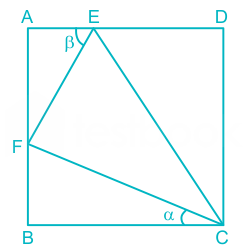
A triangle CEF is drawn inside a square ABCD as shown in the figure given below. Given: CF = 8 cm, EF = 6 cm and CE = 10 cm.

What is the area of the square?

  1. AOption (a)

    \(\frac{512}{17}\) square cm

  2. BOption (b)

    \(\frac{625}{13}\) square cm

  3. COption (c)

    \(\frac{1024}{17}\) square cm

  4. DOption (d)

    \(\frac{1296}{13}\) square cm

View answer & explanation

Correct answer

Answer: (c)C.

\(\frac{1024}{17}\) square cm

Why this answer is correct

Given:

EF = 6 cm

EC = 10 cm

FC = 8 cm

Calculation:

Δ EFC is a right-angle triangle because 6, 7, and 10 are a Pythagorean triplet.

∠ BFC = 90° - α 

∠ EFA = α        [∠EFA + ∠EFC + ∠BFC = 180°]

β = 90° - α       [∠FEA + ∠EAF + ∠EFA = 180°]

In Δ FBC and Δ EAF, all three angles are equal, hence both triangles are similar.

So, \(\frac{AF}{BC} = \frac{6}{8} = \frac{3}{4}\)

Let AF = 3x and BC = 4x

Since ABCD is a square, FB = x

Applying Pythagoras theorem in Δ FBC,

FB2 + BC2 = 82

⇒ x2 + 16x2 = 64

⇒ x2 = 64/17

Area of square ABCD = BC2 = (4x)2 = 16x2

Putting the value of x2 from above,

Area of square ABCD = 16 × (64/17) = \(\frac{1024}{17}\) sq cm.

∴ The correct answer is option 3.

CDS Elementary Mathematics 21 April 2024 Official Paper (Previous Year Paper)·Elementary Mathematics
View full paper

Question 377

Combined Defence Services (CDS) 2024• Elementary Mathematics• Elementary Mathematics

Consider the following for the next three (03) items that follow:

A triangle CEF is drawn inside a square ABCD as shown in the figure given below. Given: CF = 8 cm, EF = 6 cm and CE = 10 cm.

What is tan α + tan β equal to ?

  1. AOption (a)

    \(\frac{13}{16}\)

  2. BOption (b)

    \(\frac{15}{16}\)

  3. COption (c)

    \(\frac{17}{16}\)

  4. DOption (d)

    \(\frac{17}{4}\)

View answer & explanation

Correct answer

Answer: (d)D.

\(\frac{17}{4}\)

Why this answer is correct

Given:

EF = 6 cm

EC = 10 cm

FC = 8 cm

Calculation:

Δ EFC is a right-angle triangle because 6, 7, and 10 are a Pythagorean triplet.

∠ BFC = 90° - α 

∠ EFA = α        [∠EFA + ∠EFC + ∠BFC = 180°]

β = 90° - α       [∠FEA + ∠EAF + ∠EFA = 180°]

In Δ FBC and Δ EAF, all three angles are equal, hence both triangles are similar.

So, \(\frac{AF}{BC} = \frac{6}{8} = \frac{3}{4}\)

Let AF = 3x and BC = 4x

Since ABCD is a square, FB = x

tan α = FB/BC = x/4x = 1/4

tan β = tan(90° - α) = cot α = BC/FB = 4x/x = 4 

Putting values:

tan α + tan β = 1/4 + 4 = 17/4

∴ The correct answer is option 4.

CDS Elementary Mathematics 21 April 2024 Official Paper (Previous Year Paper)·Elementary Mathematics
View full paper

Question 378

Combined Defence Services (CDS) 2024• Elementary Mathematics• Elementary Mathematics

Consider the following for the next three (03) items that follow:

A triangle CEF is drawn inside a square ABCD as shown in the figure given below. Given: CF = 8 cm, EF = 6 cm and CE = 10 cm.

What is the area of triangle CDE?

  1. AOption (a)

    \(\frac{416}{17}\) square cm

  2. BOption (b)

    \(\frac{312}{13}\) square cm

  3. COption (c)

    \(\frac{208}{17}\) square cm

  4. DOption (d)

    \(\frac{156}{13}\) square cm

View answer & explanation

Correct answer

Answer: (a)A.

\(\frac{416}{17}\) square cm

Why this answer is correct

Given:

EF = 6 cm

EC = 10 cm

FC = 8 cm

Calculation:

Δ EFC is a right-angle triangle because 6, 7, and 10 are a Pythagorean triplet.

∠ BFC = 90° - α 

∠ EFA = α        [∠EFA + ∠EFC + ∠BFC = 180°]

β = 90° - α       [∠FEA + ∠EAF + ∠EFA = 180°]

In Δ FBC and Δ EAF, all three angles are equal, hence both triangles are similar.

So, \(\frac{AF}{BC} = \frac{6}{8} = \frac{3}{4}\)

Let AF = 3x and BC = 4x

Since ABCD is a square, FB = x

Applying Pythagoras theorem in Δ FBC,

FB2 + BC2 = 82

⇒ x2 + 16x2 = 64

⇒ x2 = 64/17

⇒ x = \(√{\frac{64}{17}} = \frac{8}{√{17}}\) cm

CD = 4x =  = \(\frac{32}{√{17}}\) cm

Applying Pythagoras theorem in Δ EDC,

102 = CD2 + ED2

⇒ 100 = \([\frac{32}{√{17}}]^2\) + ED2

⇒ ED2 = 100 - 1024/17 = 676/17

⇒ ED = 26/√17 cm.

Area of Δ CDE = (1/2) × ED × CD

⇒ Area of Δ CDE = (1/2) × (26/√17) × (32/√17)

⇒ Area of Δ CDE = (1/2) × (26/√17) × (32/√17)

⇒ Area of Δ CDE = \(\frac{416}{17}\) square cm

∴ The correct answer is option 1.

CDS Elementary Mathematics 21 April 2024 Official Paper (Previous Year Paper)·Elementary Mathematics
View full paper

Question 379

Combined Defence Services (CDS) 2024• Elementary Mathematics• Elementary Mathematics

Consider the following for the next two (02) items that follow:

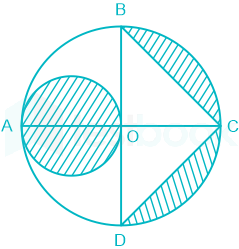
ABCD is a circle with centre O and taking OC as a diameter, a circle is drawn as shown in the figure given below. Let OB = 7 cm. (Usе π = \(\frac{22}{7}\))

What is the area of the shaded region?

  1. AOption (a)

    38.5 square cm

  2. BOption (b)

    48 square cm

  3. COption (c)

    52.5 square cm

  4. DOption (d)

    66.5 square cm

View answer & explanation

Correct answer

Answer: (d)D.

66.5 square cm

Why this answer is correct

We use the concepts of areas of circles and areas of triangles to solve the problem.

CA and BD are diameters of the circle with center O.

∴ OC = OA = OD = OB = Radius of the circle R = 7 cm 

BD = 2R = 14 cm

Radius of shaded circular region, r = OC/2 = 7/2 cm.

Area of the shaded smaller circular region = πr²

= π (7/2 cm)2

= 22/7 × 7/2 × 7/2 cm2

= 77/2 cm2

= 38.5 cm2

Area of the shaded segment of larger circular region = Area of semicircle DAB -  Area of ΔDBA

= 1/2 π(OD)2 - 1/2 × DB × OA

= 1/2 πR2 - 1/2 × 2R × R

= 1/2 × 22/7 × 72 - 1/2 × 14 × 7

= 77 -  49 

= 28 cm2

Area of the shaded region = Area of the shaded smaller circular region + Area of the shaded segment of larger circular region.

= 38.5 cm2 + 28 cm2

= 66.5 cm2

CDS Elementary Mathematics 21 April 2024 Official Paper (Previous Year Paper)·Elementary Mathematics
View full paper

Question 380

Combined Defence Services (CDS) 2024• Elementary Mathematics• Elementary Mathematics

Consider the following for the next two (02) items that follow:

ABCD is a circle with centre O and taking OC as a diameter, a circle is drawn as shown in the figure given below. Let OB = 7 cm. (Usе π = \(\frac{22}{7}\))

What is the ratio of the area of the shaded region to the area of the non - shaded region?

  1. AOption (a)

    \(\frac{19}{25}\)

  2. BOption (b)

    \(\frac{18}{25}\)

  3. COption (c)

    \(\frac{17}{25}\)

  4. DOption (d)

    \(\frac{16}{25}\)

View answer & explanation

Correct answer

Answer: (a)A.

\(\frac{19}{25}\)

Why this answer is correct

Given:

The ratio of the area of the shaded region to the area of the non - shaded region

Formula:

Area of non-shaded region = Area of big circle – Area of shaded region

Calculation:

We have to find first Area of the shaded region,

We use the concepts of areas of circles and areas of triangles to solve the problem.

CA and BD are diameters of the circle with center O.

∴ OC = OA = OD = OB = Radius of the circle R = 7 cm 

BD = 2R = 14 cm

Radius of shaded circular region, r = OC/2 = 7/2 cm.

Area of the shaded smaller circular region = πr²

= π (7/2 cm)2

= 22/7 × 7/2 × 7/2 cm2

= 77/2 cm2

Area of the shaded segment of larger circular region = Area of semicircle DAB -  Area of ΔDBA

= 1/2 π(OD)2 - 1/2 × DB × OA

= 1/2 πR2 - 1/2 × 2R × R

= 1/2 × 22/7 × 72 - 1/2 × 14 × 7

= 77 -  49 

= 28 cm2

Area of the shaded region = Area of the shaded smaller circular region + Area of the shaded segment of larger circular region.

= 77/2 cm2+ 28 cm2

= 133/2 cm2

Now, we have to find Area of big circle,

Area of big circle = πR2 

Area of big circle = 22/7 × 72

Area of big circle = 154 cm2

According to the formula 

Area of non-shaded region = Area of big circle – Area of shaded region

Area of non-shaded region = 154 - 133/2 

Area of non-shaded region = 175/2 cm2

Required ratio = area of the shaded region :  area of the non - shaded region

Required ratio = 133/2 : 175/2

∴ Required ratio = 133/175 = 19/25

How should I prepare for Quantitative Aptitude in Combined Defence Services (CDS)?

Solving previous year questions by topic helps identify recurring concepts, question patterns, and frequently asked sub-topics. Attempt each question, review the step-by-step explanation, and note down key formulas or facts for quick revision before the exam.