Combined Defence Services (CDS) · Topic Collection

Quantitative Aptitude PYQs

Arithmetic, number systems, percentages, ratios, profit and loss, time and work, algebra, geometry, mensuration, and trigonometry.

2000 Total Questions20 Official PapersYears: 2016–2025Search in Quantitative Aptitude
Showing questions 381–400 of 2000Page 20 of 100
CDS Elementary Mathematics 21 April 2024 Official Paper (Previous Year Paper)·Elementary Mathematics
View full paper

Question 381

Combined Defence Services (CDS) 2024• Elementary Mathematics• Elementary Mathematics

Consider the following for the next two (02) items that follow:

Let two parallel line segments PQ = 5 cm and RS = 3 cm be perpendicular to a horizontal line AB, as shown in the figure given below. The point of intersection of PS and QR is M and MN is perpendicular to QS.
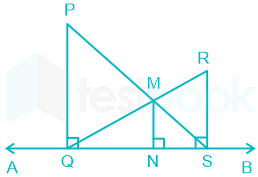
What is the length of MN ?

  1. AOption (a)

    \(\frac{3}{8}\) cm

  2. BOption (b)

    \(\frac{5}{8}\) cm

  3. COption (c)

    \(\frac{9}{8}\) cm

  4. DOption (d)

    \(\frac{15}{8}\) cm

View answer & explanation

Correct answer

Answer: (d)D.

\(\frac{15}{8}\) cm

Why this answer is correct

Given:

two parallel line segments PQ = 5

RS = 3 cm

Concept Used:

If three lines are parallel as shown below,

then, \(\frac{1}{c} = \frac{1}{a} + \frac{1}{b}\)

Calculation:

Using the above formula,

\(\frac{1}{MN} = \frac{1}{PQ} + \frac{1}{RS}\)

\(\frac{1}{MN} = \frac{1}{5} + \frac{1}{3}\)

\(\frac{1}{MN} = \frac{8}{15}\)

MN  = 15/8 cm

∴ The correct answer is 15/8 cm.
CDS Elementary Mathematics 21 April 2024 Official Paper (Previous Year Paper)·Elementary Mathematics
View full paper

Question 382

Combined Defence Services (CDS) 2024• Elementary Mathematics• Elementary Mathematics

Consider the following for the next two (02) items that follow:

Let two parallel line segments PQ = 5 cm and RS = 3 cm be perpendicular to a horizontal line AB, as shown in the figure given below. The point of intersection of PS and QR is M and MN is perpendicular to QS.

What is the ratio of the area of the quadrilateral PQNM to the area of the quadrilateral RSNM?

  1. AOption (a)

    \(\frac{200}{117}\)

  2. BOption (b)

    \(\frac{212}{117}\)

  3. COption (c)

    \(\frac{275}{117}\)

  4. DOption (d)

    \(\frac{250}{117}\)

View answer & explanation

Correct answer

Answer: (c)C.

\(\frac{275}{117}\)

Why this answer is correct

Given:

two parallel line segments PQ = 5

RS = 3 cm

Concept Used:

If three lines are parallel as shown below,

then, \(\frac{1}{c} = \frac{1}{a} + \frac{1}{b}\)

Area of Trapezium = \(\frac{1}{2}\times (sum\ of\ parallel\ sides) \times Height\)

Calculation:

Using the above formula,

\(\frac{1}{MN} = \frac{1}{PQ} + \frac{1}{RS}\)

\(\frac{1}{MN} = \frac{1}{5} + \frac{1}{3}\)

\(\frac{1}{MN} = \frac{8}{15}\)​

MN  = 15/8 cm

ΔPQS and ΔMNS are similar,

So,

\(\frac{h2}{h1\ +\ h2} = \frac{\frac{15}{8}}{5} = 3/8\)

h2 = 3 and h1 = 5

Area of trapezium PQNM =  \(\frac{1}{2} \times [5 + \frac{15}{8}]\times 5\)

Area of trapezium RSNM = \(\frac{1}{2} \times [3 + \frac{15}{8}]\times 3\)

Ratio of area of both trapezium = \(\frac{\frac{1}{2} \times [5 + \frac{15}{8}]\times 5}{\frac{1}{2} \times [3 + \frac{15}{8}]\times 3}\) = 275/117

∴ The correct answer is 275/117.

CDS Elementary Mathematics 21 April 2024 Official Paper (Previous Year Paper)·Elementary Mathematics
View full paper

Question 383

Combined Defence Services (CDS) 2024• Elementary Mathematics• Elementary Mathematics

Consider the following for the next three (03) items that follow:

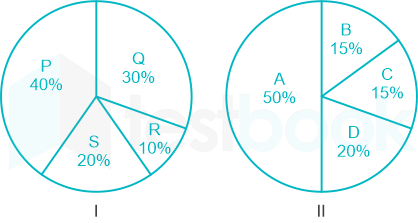
The following Pie - Chart - I shows the people migrating to Delhi from different Indian States (P, Q and R are three different States and S is the combined group of other States) and Pie - Chart - II indicates the different age groups A, B, C and D of these migrating people for each State.

If the people coming from a particular State belonging to S are 15% and 24,000 in number, then what is the total number of migrating people belonging to the age group B ?

  1. AOption (a)

    1.2 lac

  2. BOption (b)

    1.25 lac

  3. COption (c)

    1.30 lac

  4. DOption (d)

    1.50 lac

View answer & explanation

Correct answer

Answer: (a)A.

1.2 lac

Why this answer is correct

Given:

If the people coming from a particular State belonging to S are 15% and 24,000 in number

Calculation:

According to the question,

Total People × 20% × 15% = 24000

⇒ Total People = 24000 × 10000/300

⇒ 800000

The total number of migrating people belonging to the age group B 15%

⇒ 800000 × 15/100

⇒ 1.2 lac

∴ The total number of migrating people belonging to the age group B is 1.2 Lac

CDS Elementary Mathematics 21 April 2024 Official Paper (Previous Year Paper)·Elementary Mathematics
View full paper

Question 384

Combined Defence Services (CDS) 2024• Elementary Mathematics• Elementary Mathematics

Consider the following for the next three (03) items that follow:

The following Pie - Chart - I shows the people migrating to Delhi from different Indian States (P, Q and R are three different States and S is the combined group of other States) and Pie - Chart - II indicates the different age groups A, B, C and D of these migrating people for each State.

What is the maximum of differences between the number of people coming from different groups P, Q, R and S? (We can use the data given in the previous questions)

  1. AOption (a)

    1.6 lac

  2. BOption (b)

    1.8 lac

  3. COption (c)

    2.4 lac

  4. DOption (d)

    2.6 lac

View answer & explanation

Correct answer

Answer: (c)C.

2.4 lac

Why this answer is correct

Solution:

Total People = 800000

According to the question,

The maximum of differences between the number of people coming from different groups P, Q, R and S is 40% - 10%

⇒ 30%

⇒ 30% of 800000

⇒ 2.4 lac

∴ The maximum of differences between the number of people coming from different groups P, Q, R and S is 2.4 lac

CDS Elementary Mathematics 21 April 2024 Official Paper (Previous Year Paper)·Elementary Mathematics
View full paper

Question 385

Combined Defence Services (CDS) 2024• Elementary Mathematics• Elementary Mathematics

Consider the following for the next three (03) items that follow:

The following Pie - Chart - I shows the people migrating to Delhi from different Indian States (P, Q and R are three different States and S is the combined group of other States) and Pie - Chart - II indicates the different age groups A, B, C and D of these migrating people for each State.

What is the difference between number of people coming from R having age group A and those coming from Q having age group D? (We can use the data given in the previous questions)

  1. AOption (a)

    6,000

  2. BOption (b)

    8,000

  3. COption (c)

    12,000

  4. DOption (d)

    18,000

View answer & explanation

Correct answer

Answer: (b)B.

8,000

Why this answer is correct

Solution:

Total number of People = 800000

The number of people coming from R having age group A 

⇒ 800000 × 10/100 × 50/100

⇒ 40000

The number of people coming from Q having age group D

⇒ 800000 × 30/100 × 20/100

⇒ 48000

The difference between number of people coming from R having age group A and those coming from Q having age group D 

⇒ 48000 - 40000

⇒ 8000

∴ The difference between number of people coming from R having age group A and those coming from Q having age group D is 8000.

CDS Elementary Mathematics 21 April 2024 Official Paper (Previous Year Paper)·Elementary Mathematics
View full paper

Question 386

Combined Defence Services (CDS) 2024• Elementary Mathematics• Elementary Mathematics

Consider the following for the next two (02) items that follow:

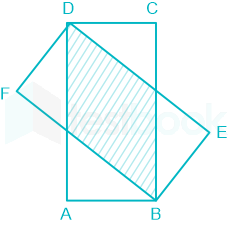
Consider two identical rectangles ABCD and BEDF as shown in the figure given below. Let AB = 1 cm and BC = 2 cm.

What is the area of the overlapping region?

  1. AOption (a)

    \(\frac{8}{5}\) square cm

  2. BOption (b)

    \(\frac{5}{4}\) square cm

  3. COption (c)

    \(\frac{4}{5}\) square cm

  4. DOption (d)

    \(\frac{3}{4}\) square cm

View answer & explanation

Correct answer

Answer: (b)B.

\(\frac{5}{4}\) square cm

Why this answer is correct

Calculation:

Let the DG = a = GB

In Δ AGB

⇒ a2 = (2 - a)2 + 12

⇒ a2 = 4 + a2 – 4a + 1

⇒ 4a = 5 

⇒ a = 5/4 cm.

So, required area = Area of rectangle – 2 (area of Δ AGB)

⇒ (1 × 2) - 2 × [1/2 × 1 × (2 - 5/4)]

⇒ (2 - 3/4) = 5/4 cm2.

CDS Elementary Mathematics 21 April 2024 Official Paper (Previous Year Paper)·Elementary Mathematics
View full paper

Question 387

Combined Defence Services (CDS) 2024• Elementary Mathematics• Elementary Mathematics

Consider the following for the next two (02) items that follow:

Consider two identical rectangles ABCD and BEDF as shown in the figure given below. Let AB = 1 cm and BC = 2 cm.

What is the area of the non - overlapping region?

  1. AOption (a)

    \(\frac{3}{4}\) square cm

  2. BOption (b)

    \(\frac{11}{4}\) square cm

  3. COption (c)

    \(\frac{3}{2}\) square cm

  4. DOption (d)

    \(\frac{5}{4}\) square cm

View answer & explanation

Correct answer

Answer: (c)C.

\(\frac{3}{2}\) square cm

Why this answer is correct

Concept :

 Area of non-overlapping region = 2 [Area of rectangle] – 2 [area of overlapping region]

Calculation:

We have to find first Area of overlapping region

Let the DG = a = GB

In Δ AGB

⇒ a2 = (2 - a)2 + 12

⇒ a2 = 4 + a2 – 4a + 1

⇒ 4a = 5 

⇒ a = 5/4 cm.

So,

Area of overlapping region = Area of rectangle – 2 (area of Δ AGB)

⇒ (1 × 2) - 2 × [1/2 × 1 × (2 - 5/4)]

⇒ (2 - 3/4) = 5/4 cm2.

Now, we have  to find Area of non-overlapping region 

Area of non-overlapping region = 2 [Area of rectangle] – 2 [area of overlapping region]

⇒ 2 × 1 × 2 - 2 ×  5/4

⇒ 4 - 5/2 = 3/2 cm2

∴ Area of non-overlapping region is 3/2 cm 2

CDS Elementary Mathematics 21 April 2024 Official Paper (Previous Year Paper)·Elementary Mathematics
View full paper

Question 388

Combined Defence Services (CDS) 2024• Elementary Mathematics• Elementary Mathematics

Consider the following for the next three (03) items that follow:

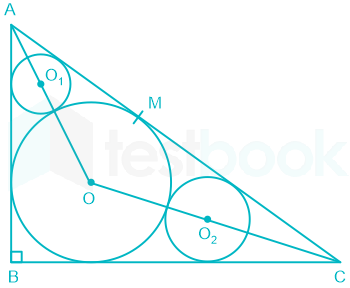
ABC is a right - angled triangle with ∠ABC = 90°. The centre of the incircle of the given triangle is at O, whose radius is 2 cm. Two more circles with centres at O1 and O2, touch this circle and the two sides as shown in the figure given below.

Further, MA ∶ MC = 2 ∶ 3.

What is AB + BC equal to ?

  1. AOption (a)

    10 cm

  2. BOption (b)

    12 cm

  3. COption (c)

    13 cm

  4. DOption (d)

    14 cm

View answer & explanation

Correct answer

Answer: (d)D.

14 cm

Why this answer is correct

Given:

ABC is a right-angled triangle with ∠ABC = 90°.

The radius of circle having radius O is 2 cm.

MA ∶ MC = 2 ∶ 3.

Concept:

  1. In a right-angled triangle, Hypotenuse2 = Base2 + Perpendicular2
  2. Tangents drawn from an external point to a circle are equal.

Calculation:

In an ΔABC, using the Pythagoras theorem

⇒ (5x)2 = (2x + 2)2 + (3x + 2)2    

⇒ 25x2 = 4x2 + 4 + 8x + 9x2 + 4 + 12x

⇒ 25x2 = 13x2 + 20x + 8

⇒ 12x2 - 20x - 8 = 0

⇒ 3x2 - 5x - 2 = 0

⇒ 3x2 - 6x + x - 2 = 0

⇒ 3x(x - 2) + 1(x - 2) = 0

⇒ (3x + 1)(x - 2) = 0

x = 2 & x = -1/3 (not possible) 

Now, 

AB + BC = 2x + 2 + 3x + 2

⇒ AB + BC = 5x + 4

⇒ AB + BC = 5 × 2 + 4 

⇒ AB + BC = 14

∴ AB + BC equal to 14.

CDS Elementary Mathematics 21 April 2024 Official Paper (Previous Year Paper)·Elementary Mathematics
View full paper

Question 389

Combined Defence Services (CDS) 2024• Elementary Mathematics• Elementary Mathematics

Consider the following for the next three (03) items that follow:

ABC is a right - angled triangle with ∠ABC = 90°. The centre of the incircle of the given triangle is at O, whose radius is 2 cm. Two more circles with centres at O1 and O2, touch this circle and the two sides as shown in the figure given below.

Further, MA ∶ MC = 2 ∶ 3.

What is the radius of the circle with centre at O1?

  1. AOption (a)

    4 - \(\sqrt{5}\)

  2. BOption (b)

    1 + \(\sqrt{5}\)

  3. COption (c)

    2 + ​\(\sqrt{5}\)​​

  4. DOption (d)

    3 - \(\sqrt{5}\)

View answer & explanation

Correct answer

Answer: (d)D.

3 - \(\sqrt{5}\)

Why this answer is correct

Given:

ABC is a right-angled triangle with ∠ABC = 90°.

The radius of circle having radius O is 2 cm.

MA ∶ MC = 2 ∶ 3.

Concept:

  1. In a right-angled triangle, Hypotenuse2 = Base2 + Perpendicular2
  2. Tangents drawn from an external point to a circle are equal.
  3. \(\frac{r_1}{r_2} = \frac{1-sin θ }{1 + sin θ}​​\)

Calculation:

Let the radius of circle of center O1 is r1

In an ΔABC, using the Pythagoras theorem

⇒ (5x)2 = (2x + 2)2 + (3x + 2)2    

⇒ 25x2 = 4x2 + 4 + 8x + 9x2 + 4 + 12x

⇒ 25x2 = 13x2 + 20x + 8

⇒ 12x2 - 20x - 8 = 0

⇒ 3x2 - 5x - 2 = 0

⇒ 3x2 - 6x + x - 2 = 0

⇒ 3x(x - 2) + 1(x - 2) = 0

⇒ (3x + 1)(x - 2) = 0

x = 2 & x = -1/3 (not possible) 

Now, 

2x = 4

Using the Pythagoras theorem 

AO2 = 22 + 42

AO = 2√5

Let, ∠ OAM = θ 

sin θ = 2/2√5 = 1/√5

We know that 

\(\frac{r_1}{r} = \frac{1-sin θ }{1 + sin θ}\)

\(\frac{r_1}{2} = \frac{1-1/√ 5 }{1 +1/√ 5}\)

\(\frac{r_1}{2} = \frac{√5-1 }{√5 +1}\)

\(\frac{r_1}{2} = \frac{√5-1 }{√5 +1}\times \frac{√5-1 }{√5 -1}\)

\(\frac{r_1}{2} = \frac{6-2√5 }{4}\)

r1 = 3 - √5

CDS Elementary Mathematics 21 April 2024 Official Paper (Previous Year Paper)·Elementary Mathematics
View full paper

Question 390

Combined Defence Services (CDS) 2024• Elementary Mathematics• Elementary Mathematics

Consider the following for the next three (03) items that follow:

ABC is a right - angled triangle with ∠ABC = 90°. The centre of the incircle of the given triangle is at O, whose radius is 2 cm. Two more circles with centres at O1 and O2, touch this circle and the two sides as shown in the figure given below.

Further, MA ∶ MC = 2 ∶ 3.

What is the radius of the circle with centre at O2?

  1. AOption (a)

    5 - \(\sqrt{10}\)

  2. BOption (b)

    1 + \(2 \sqrt{5}\)

  3. COption (c)

    \(\frac{22-4 \sqrt{10}}{9}\)

  4. DOption (d)

    \(\frac{22-2 \sqrt{10}}{9}\)

View answer & explanation

Correct answer

Answer: (c)C.

\(\frac{22-4 \sqrt{10}}{9}\)

Why this answer is correct

Given:

ABC is a right-angled triangle with ∠ABC = 90°.

The radius of circle having radius O is 2 cm.

MA ∶ MC = 2 ∶ 3.

Concept:

  1. In a right-angled triangle, Hypotenuse2 = Base2 + Perpendicular2
  2. Tangents drawn from an external point to a circle are equal.
  3. \(\frac{r_1}{r_2} = \frac{1-sin θ }{1 + sin θ}​​\)

Calculation:

Let the radius of circle of center O1 is r2

In an ΔABC, using the Pythagoras theorem

⇒ (5x)2 = (2x + 2)2 + (3x + 2)2    

⇒ 25x2 = 4x2 + 4 + 8x + 9x2 + 4 + 12x

⇒ 25x2 = 13x2 + 20x + 8

⇒ 12x2 - 20x - 8 = 0

⇒ 3x2 - 5x - 2 = 0

⇒ 3x2 - 6x + x - 2 = 0

⇒ 3x(x - 2) + 1(x - 2) = 0

⇒ (3x + 1)(x - 2) = 0

x = 2 & x = -1/3 (not possible) 

Now, 

3x = 6

Using the Pythagoras theorem 

CO2 = 22 + 62

CO = 2√10

Let, ∠ MCO = ϕ  

sin ϕ  = 2/(2√10) = 1/√10

We know that 

\(\frac{r_1}{r} = \frac{1-sin θ }{1 + sin θ}\)

\(\frac{r_2}{2} = \frac{1-{1\over\sqrt{10}} }{1+{1\over\sqrt{10}}}\)

\(\frac{r_2}{2} = \frac{\sqrt{10}-1 }{\sqrt{10} +1}\)

\(\frac{r_2}{2} = \frac{\sqrt{10}-1 }{\sqrt{10} +1} \times \frac{\sqrt{10}-1 }{\sqrt{10} -1}\)

\(\frac{r_2}{2} = \frac{(\sqrt{10}-1)^2 }{(\sqrt{10})^2-1^2}\)

\(\frac{r_2}{2} = \frac{10 + 1- 2\sqrt{10} }{(10-1)}\)

\(\frac{r_2}{2} = \frac{11- 2\sqrt{10} }{(9)}\)

r2 = \(\frac{22-4 \sqrt{10}}{9}\)

CDS Elementary Mathematics 21 April 2024 Official Paper (Previous Year Paper)·Elementary Mathematics
View full paper

Question 391

Combined Defence Services (CDS) 2024• Elementary Mathematics• Elementary Mathematics

Consider the following for the next three (03) items that follow:

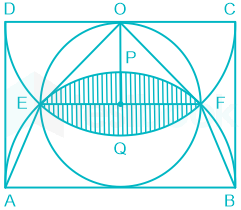
Consider two identical semicircles and one circle inscribed in a rectangle of length 10 cm as shown in the figure given below.

(Take π = 3.14 and \(\sqrt2\) = 1.4).

What is the area of triangle EOF?

  1. AOption (a)

    12.5 \(\sqrt3\) square cm

  2. BOption (b)

    6.25 \(\sqrt3\) square cm

  3. COption (c)

    12.5 square cm

  4. DOption (d)

    6.25 square cm

View answer & explanation

Correct answer

Answer: (c)C.

12.5 square cm

Why this answer is correct

Given:

Two identical semicircles and one circle inscribed in a rectangle of length 10 cm

Calculation:

DC is the diameter of semi circle,

DO = OC = EO = FO all radius of semicircle,

Since, EF is the diameter of a circle angle between EO and FO = 90° 

Area of a right angle triangle EOF = (EO × FO)/2 = 5 × 5/2 = 12.5 square cm

∴ The correct answer is 12.5 square cm.

CDS Elementary Mathematics 21 April 2024 Official Paper (Previous Year Paper)·Elementary Mathematics
View full paper

Question 392

Combined Defence Services (CDS) 2024• Elementary Mathematics• Elementary Mathematics

Consider the following for the next three (03) items that follow:

Consider two identical semicircles and one circle inscribed in a rectangle of length 10 cm as shown in the figure given below.

(Take π = 3.14 and \(\sqrt2\) = 1.4).

What is the area of trapezium AEFB?

  1. AOption (a)

    30 square cm

  2. BOption (b)

    25 square cm

  3. COption (c)

    20 square cm

  4. DOption (d)

    18.75 square cm

View answer & explanation

Correct answer

Answer: (a)A.

30 square cm

Why this answer is correct

Given:

Two identical semicircles and one circle inscribed in a rectangle of length 10 cm

Calculation:

DC is the diameter of semi circle,

DO = OC = EO = FO all radius of semicircle,

∠OEF = ∠ AOQ = 45° 

Using pythagorous in ΔEOF,

EF = 5√2

AB = 10 (given)

Height of the trapezium AEFB = EF/2 =  5/√2

Area of trapezium = Height × (Sum of parallel sides)/2

Area of trapezium = \(\frac{5}{\sqrt2} × (\frac{10 + 5\sqrt2}{2}) = \frac{5× (10\sqrt2 + 10)}{\sqrt2× 2\sqrt2}\)

⇒ 120 × 4 = 30

∴ The correct answer is 30 square cm.

CDS Elementary Mathematics 21 April 2024 Official Paper (Previous Year Paper)·Elementary Mathematics
View full paper

Question 393

Combined Defence Services (CDS) 2024• Elementary Mathematics• Elementary Mathematics

Consider the following for the next three (03) items that follow:

Consider two identical semicircles and one circle inscribed in a rectangle of length 10 cm as shown in the figure given below.

(Take π = 3.14 and \(\sqrt2\) = 1.4).

What is the area of the shaded region ?

  1. AOption (a)

    14.75 square cm

  2. BOption (b)

    14.25 square cm

  3. COption (c)

    7.225 square cm 

  4. DOption (d)

    7.625 square cm

View answer & explanation

Correct answer

Answer: (b)B.

14.25 square cm

Why this answer is correct

Given:

Two identical semicircles and one circle inscribed in a rectangle of length 10 cm

Calculation:

DC is the diameter of semi circle,

DO = OC = EO = FO all radius of semicircle,

Area of shaded region = 2 ×  area of segment EQF,

∠EOF = 90°

Area of segment = π r2 ×  (90° /360° ) - Area of ΔEOF,

Area of segment =  [3.14 × 25 × (1/4) - 25/2]

Area of segment = 7.125 cm2

The area of the shaded region = 2 × 7/125 = 14.25 square cm.

∴ The correct answer is 14.25 square cm.

CDS Elementary Mathematics 21 April 2024 Official Paper (Previous Year Paper)·Elementary Mathematics
View full paper

Question 394

Combined Defence Services (CDS) 2024• Elementary Mathematics• Elementary Mathematics

Consider the following for the next two (02) items that follow:

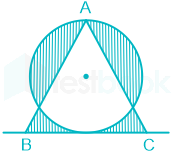
Consider a circle of area 9π square unit and an equilateral triangle ABC as shown in the figure given below.

What is the length of the side of the triangle ABC?

  1. AOption (a)

    2\(\sqrt3\) unit

  2. BOption (b)

    4\(\sqrt3\) unit

  3. COption (c)

    6\(\sqrt3\) unit

  4. DOption (d)

    8\(\sqrt3\) unit

View answer & explanation

Correct answer

Answer: (b)B.

4\(\sqrt3\) unit

Why this answer is correct

Given:

Circle of area = 9π square unit,

Equilateral triangle ABC

Formula Used:

Height of equilateral triangle = √3a/2 

Calculation:

Let side of the equilateral triangle = a

Radius of the circle = r

Height of the equilateral triangle = 2 × r

⇒ √3a/2 = 2r

⇒ a = 4r/√ 3

Area of circle = πr2

9π = π r2

r = 3

a = (4 × 3)/√3 = 4√3 

∴ The correct answer is 4√3.

CDS Elementary Mathematics 21 April 2024 Official Paper (Previous Year Paper)·Elementary Mathematics
View full paper

Question 395

Combined Defence Services (CDS) 2024• Elementary Mathematics• Elementary Mathematics

Consider the following for the next two (02) items that follow:

Consider a circle of area 9π square unit and an equilateral triangle ABC as shown in the figure given below.

What is the area of the shaded region?

  1. AOption (a)

    6(π + \(\sqrt3\)) square unit

  2. BOption (b)

    3(π + 2\(\sqrt3\)) square unit

  3. COption (c)

    1.5(3π + 8\(\sqrt3\)) square unit​​​

  4. DOption (d)

    6(π + 2\(\sqrt3\)) square unit

View answer & explanation

Correct answer

Answer: (a)A.

6(π + \(\sqrt3\)) square unit

Why this answer is correct

Given:

Circle of area = 9π square unit,

Equilateral triangle ABC

Formula Used:

Height of equilateral triangle = √3a/2 

Calculation:

Let side of the equilateral triangle = a

Radius of the circle = r

Height of the equilateral triangle = 2 × r

⇒ √3a/2 = 2r

⇒ a = 4r/√ 3

Area of circle = πr2

9π = π r2

r = 3

a = (4 × 3)/√3 = 4√3 

Area of equilateral triangle = √3a2/4

Area of equilateral = √3 × 48/4 = 12√3 cm2.

Area of circle = 9π 

Area of circle + area of equilateral = 12√3 + 9π 

∠A = 60° 

Area of unshaded region = [2 × (1/2 × 3 × 3 × sin 120° + 9π (120/360))]

Area of unshaded Region = (9√3/2) + 3π 

Total area of shaded region = 12√3 + 9π - 2 × (9√3/2) + 3π)

Total area of shaded region = 12√3 + 9π - 9√3 - 6π 

Total area of shaded region = 3π  + 3√3

∴ The correct answer is 3π  + 3√3.

CDS Elementary Mathematics 21 April 2024 Official Paper (Previous Year Paper)·Elementary Mathematics
View full paper

Question 396

Combined Defence Services (CDS) 2024• Elementary Mathematics• Elementary Mathematics

Consider the following for the next three (03) items that follow:

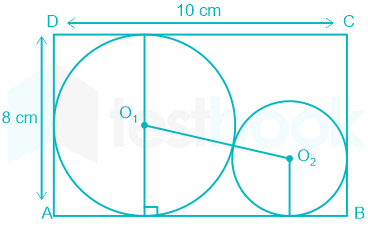
Two circles with centres at O1 and O2 touching each other are placed inside a rectangle of sides 10 cm and 8 cm as shown in the figure given below.

What is the sum of the areas of the two circles?

  1. AOption (a)

    17 π square unit

  2. BOption (b)

    16.75 π square unit

  3. COption (c)

    16.5 π square unit

  4. DOption (d)

    16.25 π square unit

View answer & explanation

Correct answer

Answer: (a)A.

17 π square unit

Why this answer is correct

Given:

Two circles with centers at O1 and O2 touching each other are placed inside a rectangle of sides 10 cm and 8 cm 

Calculation:

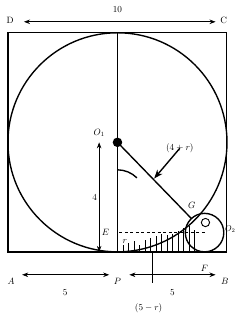
Radius of bigger circle = 4 cm

Radius of smaller circle = r cm

Area of the bigger circle = π R2 = 16π cm2

O1O2 = 4 + r

O1E = 4 - r

EO2 = 5 - r

Using pythagorous Theorm in ΔO1EO2, 

(4 + r)2 = (4 - r)2 + (5 - r)2

r2 + 16 + 8r = 16 + r2 -8r + 25 + r2 -  10r

r2 + 26r -25 = 0

⇒ r = 25, 1

Since r can not be 25,

r = 1

Area of smaller circle = π × 1

The sum of the areas of the two circles = 16π + π = 17π

∴ The correct answer is 17π square unit.

CDS Elementary Mathematics 21 April 2024 Official Paper (Previous Year Paper)·Elementary Mathematics
View full paper

Question 397

Combined Defence Services (CDS) 2024• Elementary Mathematics• Elementary Mathematics

Consider the following for the next three (03) items that follow:

Two circles with centres at O1 and O2 touching each other are placed inside a rectangle of sides 10 cm and 8 cm as shown in the figure given below.

Which one of the following is correct in respect of angle θ ?

  1. AOption (a)

    0 < θ < 30°

  2. BOption (b)

    30°< θ < 45°

  3. COption (c)

    45° < θ < 60°

  4. DOption (d)

    60° < θ < 90°

View answer & explanation

Correct answer

Answer: (c)C.

45° < θ < 60°

Why this answer is correct

Given:

Two circles with centers at O1 and O2 touching each other are placed inside a rectangle of sides 9 cm and 8 cm 

Calculation:

Radius of bigger circle = 4 cm

Radius of smaller circle = r cm

Area of the bigger circle = π R2 = 16π cm2

O1O2 = 4 + r

O1E = 4 - r

EO2 = 5 - r

Using pythagorous Theorm in ΔO1EO2, 

(4 + r)2 = (4 - r)2 + (5 - r)2

r2 + 16 + 8r = 16 + r2 -8r + 25 + r2 -  10r

r2 + 26r -25 = 0

⇒ r = 25, 1

Since r can not be 25,

r = 1

O1O2 = 4 + 1 = 5

O1E = 4 - 1 = 3

EO2 = 5 - 1 = 4

tan θ = EO2/O1E = 4/3 = 1.333

tan 45° = 1 and tan 60° = 1.73

Since tanθ lies between both values,

θ lie between 45°  and 60° 

∴ The correct answer is 45° < θ < 60°.

CDS Elementary Mathematics 21 April 2024 Official Paper (Previous Year Paper)·Elementary Mathematics
View full paper

Question 398

Combined Defence Services (CDS) 2024• Elementary Mathematics• Elementary Mathematics

Consider the following for the next three (03) items that follow:

Two circles with centres at O1 and O2 touching each other are placed inside a rectangle of sides 10 cm and 8 cm as shown in the figure given below.

What is the area of the shaded region?

  1. AOption (a)

    \(\frac{240-10 \pi-\pi \theta}{24} \) square unit

  2. BOption (b)

    \(\frac{240-6 \pi-\pi \theta}{24}\) square unit

  3. COption (c)

    \(\frac{120-12 \pi-\pi \theta}{24}\) square unit

  4. DOption (d)

    \(\frac{240-12 \pi-\pi \theta}{24}\) square unit

View answer & explanation

Correct answer

Answer: (d)D.

\(\frac{240-12 \pi-\pi \theta}{24}\) square unit

Why this answer is correct

Given:

Two circles with centers at O1 and O2 touching each other are placed inside a rectangle of sides 9 cm and 8 cm 

Calculation:

Radius of bigger circle = 4 cm

Radius of smaller circle = r cm

Area of the bigger circle = π R2 = 16π cm2

O1O2 = 4 + r

O1E = 4 - r

EO2 = 5 - r

Using pythagorous Theorm in ΔO1EO2, 

(4 + r)2 = (4 - r)2 + (5 - r)2

r2 + 16 + 8r = 16 + r2 -8r + 25 + r2 -  10r

r2 + 26r -25 = 0

⇒ r = 25, 1

Since r can not be 25,

r = 1

O1O2 = 4 + 1 = 5

O1P = 4

PF = 5 - 1 = 4

O2B = 1

Trapezium O1O2FE,

Area of trapezium = \(\frac{1}{2} × (Sum\ of \ parallel\ sides) × Height\)

= \(\frac{1}{2}× 5× 4 = 10\)

Area of sector O1GP = 16π (θ/360°) 

∠O1O2E = 180 - θ (Parallel line property)

Area of Sector GO2F = π × 1 × (180 - θ)/360 

Area of the shaded region = Area of trapezium - (Area of big circle sector + Area of small circle sector)

⇒ 10 - [16π (θ/360°) + π (180 - θ)/360]

⇒ 10 - [16πθ/360 + π/2 - πθ/360]

⇒ 10 - 15πθ/350 + π/2

⇒ \(\frac{240-12 \pi-\pi \theta}{24}\)

∴ The correct answer is option 4.

CDS Elementary Mathematics 21 April 2024 Official Paper (Previous Year Paper)·Elementary Mathematics
View full paper

Question 399

Combined Defence Services (CDS) 2024• Elementary Mathematics• Elementary Mathematics

Consider the following for the next two (02) items that follow:

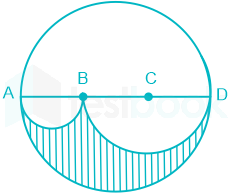
Let ABCD be the diameter of a circle of radius 6 cm. The lengths AB, BC and CD are equal. Semi - circles are drawn with AB and BD as diameters as shown in the figure given below.

What is the ratio of the area of the shaded region to that of the non - shaded region?

  1. AOption (a)

    2 ∶ 7 

  2. BOption (b)

    2 ∶ 5

  3. COption (c)

    3 ∶ 5

  4. DOption (d)

    5 ∶ 8

View answer & explanation

Correct answer

Answer: (a)A.

2 ∶ 7 

Why this answer is correct

Given:

ABCD be the diameter of a circle of radius 6 cm

The lengths AB, BC and CD are equal

Calculation:

Area of Shaded area = Area of semi circle - area of 2 small semi circles

⇒  π × 36/2 - [2π + 8π] = 8π

Unshaded Area = area of semi circle + area of other small semi circles

⇒ 18π + 2π + 8π = 28π 

Required Ratio = 8π/28π = 2/7

∴ The correct answer is 2:7.

CDS Elementary Mathematics 21 April 2024 Official Paper (Previous Year Paper)·Elementary Mathematics
View full paper

Question 400

Combined Defence Services (CDS) 2024• Elementary Mathematics• Elementary Mathematics

Consider the following for the next two (02) items that follow:

Let ABCD be the diameter of a circle of radius 6 cm. The lengths AB, BC and CD are equal. Semi - circles are drawn with AB and BD as diameters as shown in the figure given below.

What is the perimeter of the shaded region?

  1. AOption (a)

    24 π cm

  2. BOption (b)

    18 π cm

  3. COption (c)

    15 π cm

  4. DOption (d)

    12 π cm

View answer & explanation

Correct answer

Answer: (d)D.

12 π cm

Why this answer is correct

Given:

ABCD be the diameter of a circle of radius 6 cm

The lengths AB, BC and CD are equal

Calculation:

Perimeter of semi circle without Diameter = πR

Required perimeter = sum of perimeter of all three semi circle.

Required Perimeter = 6π + 2π + 4π = 12π cm

∴ The correct answer is 12π.

How should I prepare for Quantitative Aptitude in Combined Defence Services (CDS)?

Solving previous year questions by topic helps identify recurring concepts, question patterns, and frequently asked sub-topics. Attempt each question, review the step-by-step explanation, and note down key formulas or facts for quick revision before the exam.