SSC CPO · Topic Collection

Quantitative Aptitude PYQs

Arithmetic, number systems, percentages, ratios, profit and loss, time and work, algebra, geometry, mensuration, and trigonometry.

3100 Total Questions62 Official PapersYears: 2017–2025Search in Quantitative Aptitude
Showing questions 1961–1980 of 3100Page 99 of 100
SSC CPO Tier- I Previous Year Paper (Held On: 25 November 2020 Shift 1)·Quantitative Aptitude
View full paper

Question 1961

SSC CPO 2020• Quantitative Aptitude• Quantitative Aptitude

The price of diesel is increased by 26%. A person wants to increase his expenditure by 15% only. By what percentage, correct to one decimal place, should he decrease his consumption ?

  1. AOption (a)

    9.5%

  2. BOption (b)

    6.5%

  3. COption (c)

    7.2%

  4. DOption (d)

    8.7%

View answer & explanation

Correct answer

Answer: (d)D.

8.7%

Why this answer is correct

Given:

Percentage increase in the price of diesel = 26%

Percentage increase in total expenditure = 15%

Concept used:

P × C = E

Where P is Price, C is Consumption and E is expenditure

Calculation:

Let initial price be P1, consumption be C1, and expenditure be E1 

P1 × C1 = E1 

⇒ C1 = E1/P1

Let new price be P2, new quantity consumed be C2, and new expenditure be E2 

P2 = P1 + 26% of P1 

⇒ P2 = 1.26P1 

E2 = E1 + 15% of E1 

⇒ E2 = 1.15E1 

As, P2 × C2 = E2 

⇒ 1.26P1 × C2 = 1.15E1 

⇒ C2 = (1.15E1)/(1.26P1)

⇒ C2 = 0.9126 × E1/P1 

⇒ C2 = 0.9126C1 

Decrease in consumption = C1 – C2 

⇒ Decrease in consumption = C1 – 0.9126C1 = 0.0874C1 

Percentage decrease in consumption = (Decrease in consumption/Initial consumption) × 100

⇒ Percentage decrease in consumption = (0.0874C1/C1) × 100

∴ The percentage decrease in consumption is 8.7% (correct to 1 decimal place)

Shortcut Trick 26% = 26/100

(Initial price)P1(After increasing price)P2
Rs. 100/litRs. 126/lit


InitialAfter increasing
Price100115
consumption diesel in a liter1 lit115/126 lit


∴ Consumption decrease = 1 - (115/126) = (126 - 115)/126 = 11/126

∴ The percentage decrease in consumption is 8.7%

SSC CPO Tier- I Previous Year Paper (Held On: 25 November 2020 Shift 1)·Quantitative Aptitude
View full paper

Question 1962

SSC CPO 2020• Quantitative Aptitude• Quantitative Aptitude

The value of 1 - 3 ÷ 6 of 2 + (4 ÷ 4 of \(\frac{1}{4}\)) ÷ 8 + (4 × 8 ÷ \(\frac{1}{4}\)) × \(\frac{1}{8}\) is:

  1. AOption (a)

    69/4

  2. BOption (b)
    • 69/4
  3. COption (c)

    7/4

  4. DOption (d)
    • 7/4
View answer & explanation

Correct answer

Answer: (a)A.

69/4

Why this answer is correct

Given:

We have to find the value of 1 - 3 ÷ 6 of 2 + (4 ÷ 4 of \(\frac{1}{4}\)) ÷ 8 + (4 × 8 ÷ \(\frac{1}{4}\)) × \(\frac{1}{8}\)

Concept Used:

Follow the BODMAS rule to solve this question, as per the order given below

Calculation:

1 - 3 ÷ 6 of 2 + (4 ÷ 4 of ) ÷ 8 + (4 × 8 ÷ \(\frac{1}{4}\)) × \(\frac{1}{8}\)

⇒ 1 - 3 ÷ 12 + (4 ÷ 1) ÷ 8 + (4 × 8 × 4) × 1/8

⇒ 1 - 1/4 + 4 ÷ 8 + 16

⇒ 1 - 1/4 + 1/2 + 16

⇒ 69/4

∴ The required value is 69/4

SSC CPO Tier- I Previous Year Paper (Held On: 25 November 2020 Shift 1)·Quantitative Aptitude
View full paper

Question 1963

SSC CPO 2020• Quantitative Aptitude• Quantitative Aptitude

A person sold an article at a loss of 16%. Had he sold it for Rs. 660 more, he would have gained 8%. If the article is sold at Rs. 3080, then how much profit percentage is gained ?

  1. AOption (a)

    15%

  2. BOption (b)

    20%

  3. COption (c)

    12%

  4. DOption (d)

    10%

View answer & explanation

Correct answer

Answer: (c)C.

12%

Why this answer is correct

Concept used:

Profit% = (Profit/cost price) × 100

Calculation:

Let the cost price be 'X'.

⇒ 108X/100 - 84X/100 = 660

⇒ 24X = 66000

⇒ X = 2750

When article sold at Rs. 3080

⇒ Profit = 3080 - 2750 = 330

Profit%

⇒ (330/2750) × 100

⇒ 12%

∴ The profit% is 12%.

SSC CPO Tier- I Previous Year Paper (Held On: 25 November 2020 Shift 1)·Quantitative Aptitude
View full paper

Question 1964

SSC CPO 2020• Quantitative Aptitude• Quantitative Aptitude

A takes 2 hours 30 minutes more than B to walk 40 km. If A doubles his speed, then he can make it in 1 hour less than B. What is the average time taken by A and B to walk a 40 km distance?

  1. AOption (a)

    5 hours 15 minutes

  2. BOption (b)

    7 hours 15 minutes

  3. COption (c)

    6 hours

  4. DOption (d)

    5 hours 45 minutes

View answer & explanation

Correct answer

Answer: (d)D.

5 hours 45 minutes

Why this answer is correct

Given:

A takes 2 hours 30 minutes more than B to walk 40 km.

If A doubles his speed, then he can make it in 1 hour less than B.

Formula used:

Speed = Distance/Time

Calculations:

Let the initial speeds of A and B be x and y respectively and the time taken by A and B be tA and tB respectively.

tA = 40/x

tB = 40/y

tA - tB = 40/x - 40/y

⇒ 40/x - 40/y = 2.5      ----(i)

After A doubles his speed,

⇒ 40/y - 40/2x = 1      ----(ii)

On adding equation (i) and (ii),

40/x - 40/2x = 2.5 + 1

⇒ 40/x - 20/x = 3.5

⇒ 20/x = 3.5

⇒ x = 40/7 km/h

From equation (ii),

40/y - 40/2x = 1

⇒ 40/y - 40/2(40/7) = 1

⇒ 40/y - 7/2 = 1

⇒ 40/y = 1 + 7/2

⇒ 40/y = 9/2

⇒ y = 80/9 km/h

tA = 40/x

⇒ tA = 40/(40/7)

⇒ tA = 7 hours

tB = 40/y

⇒ 40/(80/9)

⇒ 9/2 hours

Average time of A and B = {7 + (9/2)}/2

⇒ 23/4 hours

⇒ 5 hours 45 minutes

∴ The average time taken by A and B to walk a 40 km distance is 5 hours 45 minutes. 

Shortcut Trick 

Speed ratio of A      Old   :  New 

Speed ratio of A       1            2

Time Ratio of A         2            1 

Here, time difference is 1 unit.

And according to question time difference is 2.5 + 1 = 3.5 hr

​⇒ 1 unit = 3.5 hr

​⇒ 2 unit = 7 hr 

So, the time taken by A is = 7 h

​⇒ Time taken by B is = 7 - 2.5 = 4.5 h

​⇒ Average time taken = (7 + 4.5)/2 = 5.75 hr 

​⇒ 5.75 hr = 5 hour and 45 minutes 

∴ The average time taken by A and B to walk a 40 km distance is 5 hours 45 minutes.

SSC CPO Tier- I Previous Year Paper (Held On: 25 November 2020 Shift 1)·Quantitative Aptitude
View full paper

Question 1965

SSC CPO 2020• Quantitative Aptitude• Quantitative Aptitude

The given histogram shows the height of the students.

What is the percentage of student whose height is in the class interval 165-175 ?

  1. AOption (a)

    34

  2. BOption (b)

    39

  3. COption (c)

    37

  4. DOption (d)

    25

View answer & explanation

Correct answer

Answer: (c)C.

37

Why this answer is correct

Given:

Height in the interval 165-175 = 26

Total student = 70

Concept used:

Percentage = Given interval/Total student × 100

Calculation:

Percentage of student = (Number of student in 165-175)/(Total student) × 100

⇒ Percentage of student = 26/70 × 100

⇒ Percentage of student = 37.14%

∴ The percentage of student whose height is in the class interval 165-175 is 37%.

SSC CPO Tier- I Previous Year Paper (Held On: 25 November 2020 Shift 1)·Quantitative Aptitude
View full paper

Question 1966

SSC CPO 2020• Quantitative Aptitude• Quantitative Aptitude

A, B and C started a business investing amounts of Rs. 13,750, Rs. 16,250 and Rs. 18,750 respectively. lf B's share in the profit earned by them is Rs. 5,200. what is the difference in the profit (in Rs.) earned by A and C ?

  1. AOption (a)

    1,200

  2. BOption (b)

    1,600

  3. COption (c)

    1,800

  4. DOption (d)

    1,500

View answer & explanation

Correct answer

Answer: (b)B.

1,600

Why this answer is correct

Given:

A, B and C started a business investing amounts of Rs. 13,750, Rs. 16,250 and Rs. 18,750 respectively.

Concept Used:

In the partnership business profit is distributed in the ratio of their Investment.

Calculation:

Ratio of investment of A, B and C is 13750 : 16250 : 18750

⇒ 11 : 13 : 15

B's share is 13 units → 5200

⇒ 1 unit → 400

Difference in the profit earned by A and C is (15 - 11) = 4 unit

1 unit → Rs. 400

⇒ 4 unit → Rs. 400 × 4 = Rs. 1600

∴ The difference in the profit earned by A and C is Rs. 1600.

SSC CPO Tier- I Previous Year Paper (Held On: 25 November 2020 Shift 1)·Quantitative Aptitude
View full paper

Question 1967

SSC CPO 2020• Quantitative Aptitude• Quantitative Aptitude

A person invested Rs. 2,000 on simple interest for 7 years to obtain a total amount of Rs. 3,400 on a certain annual rate of interest. What was the rate of interest to obtain the above amount?

  1. AOption (a)

    8%

  2. BOption (b)

    9%

  3. COption (c)

    10%

  4. DOption (d)

    7%

View answer & explanation

Correct answer

Answer: (c)C.

10%

Why this answer is correct

Given:

The person invested Rs. 2,000 on simple interest for 7 years and obtain a total amount of Rs. 3,400 on a certain annual rate of interest.

Concept Used:

If P be the principal and r be the rate of interest then interest after t year will be (prt/100)

Amount (A) = Principal (P) + Interest

Calculation:

Here,

Principal (P) = Rs. 2000

Time (t) = 7 years

Amount after 7 years (A) = 3400

Interest = A - P

⇒ 3400 - 2000

⇒ 1400

Let, the rate of interest be r%

Accordingly,

(2000 × r × 7)/100 = 1400

⇒ r = 10

∴ The rate of interest was 10%

Alternate Method SI in 7 years = 3400 - 2000 = 1400

∴ SI in 1 year = 1400/7 = 200

Rate(%) = \(\frac{SI}{P}\times100\) = \(\frac{200}{2000}\times100\) = 10 %

∴ The rate of interest was 10%

SSC CPO Tier- I Previous Year Paper (Held On: 25 November 2020 Shift 1)·Quantitative Aptitude
View full paper

Question 1968

SSC CPO 2020• Quantitative Aptitude• Quantitative Aptitude

If 1433 × 1433 × 1422 × 1425 is divided by 10, what is the remainder ?

  1. AOption (a)

    9

  2. BOption (b)

    8

  3. COption (c)

    3

  4. DOption (d)

    0

View answer & explanation

Correct answer

Answer: (d)D.

0

Why this answer is correct

Given,1433 × 1433 × 1422 × 1425

Looking at the unit digits of the terms, the last two terms contain digits 2 and 5 respectively.

So, when we multiply all the terms, the last digit will be zero, as 2 × 5 = 10.

The product will be completely divisible by 10. Thus, the remainder will be 0.

Alternate Method

Given:

1433 × 1433 × 1422 × 1425

Concept used:

Divide individually to get a smaller number than 10.

Calculation:

(1433 × 1433 × 1422 × 1425) ÷ 10

⇒ (1433/10) × (1433/10) × (1422/10) × (1425/10)

⇒ (3 × 3 × 2 × 5)/10

⇒ (9/10) × (10/10) 

The remainder of the above terms are 9 and 0. Then,

⇒ 9 × 0

⇒ 0

∴ The remainder is 0.

SSC CPO Tier- I Previous Year Paper (Held On: 25 November 2020 Shift 1)·Quantitative Aptitude
View full paper

Question 1969

SSC CPO 2020• Quantitative Aptitude• Quantitative Aptitude

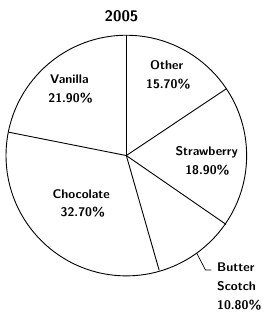
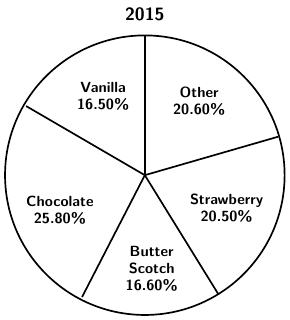
The given pie charts represent the popularity of ice-cream flavours in the years 2005 and 2015.


If a percentage point shift results in annual additional sales of Rs. 5,000. how much (in Rs.) did the combined annual strawberry and butterscotch sales increase from 2005 to 2015 ?

  1. AOption (a)

    37,000

  2. BOption (b)

    74,000

  3. COption (c)

    65,000

  4. DOption (d)

    10,000

View answer & explanation

Correct answer

Answer: (a)A.

37,000

Why this answer is correct

Given:

1% = Rs. 5000

In 2005,

Strawberry = 18.90%, Butterscotch = 10.80%

In 2015,

Strawberry = 20.50%, Butterscotch = 16.60%

Calculation:

Total sales in 2005

⇒ 18.90 + 10.80

⇒ 29.70%

Total sales in 2015

⇒ 20.50 + 16.60

⇒ 37.10%

Percentage Increase

⇒ 37.10 - 29.70

⇒ 7.4%

⇒ 7.4 × 5000

⇒ 37000

∴ The percentage increase from 2005 to 2015 is Rs. 37000.

SSC CPO Tier- I Previous Year Paper (Held On: 25 November 2020 Shift 1)·Quantitative Aptitude
View full paper

Question 1970

SSC CPO 2020• Quantitative Aptitude• Quantitative Aptitude

Two pipes A and B can fill a tank in 12 hours and 18 hours, respectively. Both pipes are opened simultaneously. In how much time will the empty tank be filled completely ?

  1. AOption (a)

    10 hours 24 minutes

  2. BOption (b)

    9 hours 30 minutes

  3. COption (c)

    8 hours

  4. DOption (d)

    7 hours 12 minutes

View answer & explanation

Correct answer

Answer: (d)D.

7 hours 12 minutes

Why this answer is correct

Given:

Time is taken by A to fill the tank = 12 hrs

Time is taken by B to fill the tank = 18 hrs

Concept used:

Total time = Volume/Volume filled in 1 hour

Calculation:

Volume filled by A in 1 hr = 1/12

Volume filled by B in 1 hr = 1/18

Volume filled by both A and B in 1 hr = 1/12 + 1/18

⇒ Volume filled by both A + B in 1 hr = (3 + 2)/36

⇒ Volume filled by both (A + B) in 1 hr = 5/36

Total Time to fill the tank = (Total volume of the tank)/(Volume filled by both (A + B) in 1 hr)

⇒ Total Time to fill the tank = 1/(5/36)

⇒ Total Time to fill the tank = 36/5 hr

⇒ Total Time to fill the tank = 7 hours 12 minutes

∴ The total time to the filled the empty tank is 7 hours 12 minutes.

 Alternate Method

Efficiency of A is 3

Efficiency of B is 2

Total efficiency of A & B is 3 + 2 = 5

So total time taken to fill the tank = 36/5 = 71/5 hour = 7 hour 12 minutes

SSC CPO Tier- I Previous Year Paper (Held On: 25 November 2020 Shift 1)·Quantitative Aptitude
View full paper

Question 1971

SSC CPO 2020• Quantitative Aptitude• Quantitative Aptitude

The given graph shows the number of students of two schools over a period of six years.

In the bar graph, in which year is the absolute difference of the students from schools A to B taken together is maximum ?

  1. AOption (a)

    2013

  2. BOption (b)

    2010

  3. COption (c)

    2011

  4. DOption (d)

    2012

View answer & explanation

Correct answer

Answer: (d)D.

2012

Why this answer is correct

Given:

Students in School A in 2008 = 640

Students in School B in 2008 = 550

Students in School A in 2009 = 800

Students in School B in 2009 = 820

Students in School A in 2010 = 500

Students in School B in 2010 = 600

Students in School A in 2011 = 700

Students in School B in 2011 = 750

Students in School A in 2012 = 900

Students in School B in 2012 = 500

Students in School A in 2013 = 750

Students in School B in 2013 = 480

Calculations:

Absolute difference of the students from schools A to B in 2008 = 640 - 550

⇒ 90

Absolute difference of the students from schools A to B in 2009 = 820 - 800

⇒ 20

Absolute difference of the students from schools A to B in 2010 = 600 - 500

⇒ 100

Absolute difference of the students from schools A to B in 2011 = 750 - 700

⇒ 50

Absolute difference of the students from schools A to B in 2012 = 900 - 500

⇒ 400

Absolute difference of the students from schools A to B in 2013 = 750 - 480

⇒ 270

∴ In 2012, the absolute difference of the students from schools A to B taken together is maximum.

SSC CPO Tier- I Previous Year Paper (Held On: 25 November 2020 Shift 1)·Quantitative Aptitude
View full paper

Question 1972

SSC CPO 2020• Quantitative Aptitude• Quantitative Aptitude

Seven years ago, the ratio of the ages of A and B was 4 : 5. Eight years hence, the ratio of the ages of A and B will be 9 : 10. What is the difference between their present ages in years ?

  1. AOption (a)

    2

  2. BOption (b)

    6

  3. COption (c)

    3

  4. DOption (d)

    4

View answer & explanation

Correct answer

Answer: (c)C.

3

Why this answer is correct

Given:

Seven years ago the ratio of ages of A and B = 4 : 5

After 8 years from present the ratio of ages of A and B = 9 : 10

Calculation:

Seven years ago the ratio of ages of A and B

⇒ 4x : 5x

Ratio of Present ages of A and B

⇒ 4x + 7 : 5x + 7

After 8 years the ratio of ages of A and B

⇒ (4x + 7 + 8) : (5x + 7 + 8) = 9 : 10

⇒ 40x + 150 = 45x + 135

⇒ 5x = 15

⇒ x = 3

Difference of present ages of A and B

⇒ (5 × 3 + 7) - (4 × 3 + 7)

⇒ 3 years

∴ The difference of present ages of A and B is 3 years.

SSC CPO Tier- I Previous Year Paper (Held On: 25 November 2020 Shift 1)·Quantitative Aptitude
View full paper

Question 1973

SSC CPO 2020• Quantitative Aptitude• Quantitative Aptitude

PA and PB are two tangents from a point P outside the circle with centre O. If A and B are points on the circle such that ∠APB = 142°, then ∠OAB is equal to:

  1. AOption (a)

    58°

  2. BOption (b)

    64°

  3. COption (c)

    31°

  4. DOption (d)

    71°

View answer & explanation

Correct answer

Answer: (d)D.

71°

Why this answer is correct

Given:

∠APB = 142°

Concept used:

Radius makes 90° to the point of contact of tangent.

Line joining centre and meeting point of two tangents bisects the angle.

Line joining centre makes 90° to the chord.

Calculation:

∠APO = 1/2 × ∠APB

⇒ ∠APO = 1/2 × 142°

⇒ ∠APO = 71°

∠OAP = 90°

In ΔAMP,

∠OAP + ∠APO + ∠POA = 180°                [Angle sum property]

⇒ 90° + 71° + ∠PAM = 180°

⇒ ∠POA = 180° – 161°

⇒ ∠POA = 19°

∠OAP = 90°

⇒ ∠OAB + AMO+ MOA = 180

⇒ ∠OAB = 71°

∴ ∠OAB is equal to 71°.

SSC CPO Tier- I Previous Year Paper (Held On: 25 November 2020 Shift 1)·Quantitative Aptitude
View full paper

Question 1974

SSC CPO 2020• Quantitative Aptitude• Quantitative Aptitude

A is twice as good a workman as B, and together they finish a piece of work in 13 days. In how many days will A alone finish the work ?

  1. AOption (a)

    39

  2. BOption (b)

    \(19 \frac{1}{2}\)

  3. COption (c)

    41

  4. DOption (d)

    \(9 \frac{1}{4}\)

View answer & explanation

Correct answer

Answer: (b)B.

\(19 \frac{1}{2}\)

Why this answer is correct

Given:

The efficiency of A = 2 × Efficiency of B 

Total time is taken to do work together = 13 days

Concept used:

Time = 1/Efficiency

Calculation:

Let the time taken by A to complete work alone be x days. 

The time is taken by B to complete work alone is x days. 

1 day work of A = 1/x

1 day work of B = 1/2x

1 day work of A and B together = 1/13

⇒ 1 day work of A + B = 1/x + 1/2x

⇒ 1/13 = (2 + 1)/2x

⇒ 2x = 39

⇒ x = 39/2 days

⇒ x = \(19 \frac{1}{2}\) days

∴ The time taken by A alone to finish the work is \(19 \frac{1}{2}\) days.

Shortcut Trick

EfficiencyThe efficiency of (A + B)
A23
B1


Total Work = 3 × 13 = 39

Total time is taken by A = Total work/Efficiency of A

⇒ 39/2 = 19\(\frac{1}{2}\)

∴ The time taken by A alone to finish the work is 19\(\frac{1}{2}\)  days

SSC CPO Tier- I Previous Year Paper (Held On: 25 November 2020 Shift 1)·Quantitative Aptitude
View full paper

Question 1975

SSC CPO 2020• Quantitative Aptitude• Quantitative Aptitude

If decreasing 110 by x% gives the same result as increasing 50 by x%, then x% of 650 is what percentage (correct to the nearest integer) more than (x - 10)% of 780 ?

  1. AOption (a)

    12%

  2. BOption (b)

    17%

  3. COption (c)

    14%

  4. DOption (d)

    18%

View answer & explanation

Correct answer

Answer: (c)C.

14%

Why this answer is correct

Given:

Decreasing 110 by x% gives the same result as increasing 50 by x%.

Calculations:

110 × (100 - x)/100 = 50 × (100 + x)/100

⇒ 11 × (100 - x) = 5 × (100 + x)

⇒ 1100 - 11x = 500 + 5x

⇒ 16x = 600

⇒ x = 600/16

⇒ x = 37.5

x% of 650 = 37.5% × 650

⇒ 243.75

(x - 10)% of 780 = (37.5 - 10)% × 780

⇒ 27.5% × 780

⇒ 214.50

Percentage difference = {(243.75 - 214.50)/214.50} × 100

⇒ (29.25/214.50) × 100

⇒ 13.63% ≈ 14%

∴ x% of 650 is 14% more than (x - 10)% of 780.

SSC CPO Tier- I Previous Year Paper (Held On: 25 November 2020 Shift 1)·Quantitative Aptitude
View full paper

Question 1976

SSC CPO 2020• Quantitative Aptitude• Quantitative Aptitude

If (5√5x3 – 3√3y3) ÷ (√5x – √3y) = (Ax2 + By2 + Cxy), then what is the value of 3A – B – √15C ?

  1. AOption (a)

    -5

  2. BOption (b)

    12

  3. COption (c)

    8

  4. DOption (d)

    -3

View answer & explanation

Correct answer

Answer: (d)D.

-3

Why this answer is correct

Given:

(5√5x3 – 3√3y3) ÷ (√5x – √3y) = (Ax2 + By2 + Cxy)

Identity used:

(a3 – b3) = (a – b) × (a2 + b2 + ab)

Calculation:

(5√5x3 – 3√3y3) = (√5x)3 – (√3y)3 

(√5x)3 – (√3y)3 = (√5x – √3y) × (5x2 + 3y2 + √15xy)

As, (5√5x3 – 3√3y3) ÷ (√5x – √3y) = (Ax2 + By2 + Cxy)

⇒ [(√5x – √3y) × (5x2 + 3y2 + √15xy)] ÷ (√5x – √3y) = Ax2 + By2 + Cxy

⇒ 5x2 + 3y2 + √15xy = Ax2 + By2 + Cxy

Comparing both sides we'll get

A = 5, B = 3 and C = √15

According to question we have to find 3A – B – √15C

⇒ 3A – B – √15C = 3 × 5 – 3 – √15 × √15

∴ 3A – B – √15C is –3

SSC CPO Tier- I Previous Year Paper (Held On: 25 November 2020 Shift 1)·Quantitative Aptitude
View full paper

Question 1977

SSC CPO 2020• Quantitative Aptitude• Quantitative Aptitude

A train x running at 74 km/h crosses another train y running at 52 km/h in the opposite direction in 12 seconds. If the length of y is two-thirds that of x*,* then what is the length of y (in m) ?

  1. AOption (a)

    210

  2. BOption (b)

    200

  3. COption (c)

    168

  4. DOption (d)

    252

View answer & explanation

Correct answer

Answer: (c)C.

168

Why this answer is correct

Given:

Speed of train x = 74 km/h

Speed of train y = 52 km/h

Train x crosses train y in opposite direction in 12 seconds.

Length of train y = 2/3 of length of train x

Concept used:

(i) If speed of body A is x and speed of body B is y then, Relative speed of two bodies moving in opposite direction = (x + y)

(ii) 1 km/h = 5/18 m/s

Formula used:

Relative speed = Total length/Time taken to cross

Calculations:

Relative speed = Total length/Time taken to cross

⇒ (74 + 52)(5/18) = Total length/12

⇒ (126)(5/18) = Total length/12

⇒ Total length = 35 × 12

⇒ Total length = 420 m

Let the length of train x be 3a.

So, length of train y = 2/3 × 3a = 2a

⇒ 2a + 3a = 420

⇒ 5a = 420

⇒ a = 84

Length of train y = 2a

= 2 × 84

= 168 m

∴ The length of train y is 168 m.

SSC CPO Tier- I Previous Year Paper (Held On: 25 November 2020 Shift 1)·Quantitative Aptitude
View full paper

Question 1978

SSC CPO 2020• Quantitative Aptitude• Quantitative Aptitude

X4 + X-4 = 194, X > 0, then what is the value of \(X + \frac{1}{X} + 2\) ?

  1. AOption (a)

    14

  2. BOption (b)

    4

  3. COption (c)

    8

  4. DOption (d)

    6

View answer & explanation

Correct answer

Answer: (d)D.

6

Why this answer is correct

Given:

X4 + 1/X4 = 194

Concept used:

(a + b)2 = a2 + b2 + 2ab

Calculation:

X4 + 1/X4 = 194

⇒ (X2)2 + 1/(X2)2 = 194

⇒ (X2)2 + 1/(X2)2 + 2 = 194 + 2                     [Adding 2 both sides]

⇒ (X2)2 + 1/(X2)2 + 2 × X2 × 1/X2 = 196

⇒ (X2 + 1/X2)2 = 196

⇒ X2 + 1/X2 = √196

⇒ X2 + 1/X2 = 14

⇒ X2 + 1/X2 + 2 = 14 + 2                                [Adding 2 both sides]

⇒ X2 + 1/X2 + 2 × X × 1/X = 16

⇒ (X + 1/X)2 = 16

⇒ X + 1/X = √16

⇒ X + 1/X = 4

X + 1/X + 2 = 4 + 2

⇒ X + 1/X + 2 = 6

∴ The value of X + 1/X + 2 is 6.

Shortcut Trick Concept: 

X4 + 1/X4 = a

⇒ X2 + 1/X2 = √(a + 2)

Calculation:

X4 + 1/X4 = 194

⇒ X2 + 1/X2 = √196

⇒ X2 + 1/X2 = 14

⇒ X + 1/X = √(14+2)

⇒ X + 1/X = 4

⇒ X + 1/X + 2 = 6

∴ The value of X + 1/X + 2 is 6.

SSC CPO Tier- I Previous Year Paper (Held On: 25 November 2020 Shift 1)·Quantitative Aptitude
View full paper

Question 1979

SSC CPO 2020• Quantitative Aptitude• Quantitative Aptitude

A circle is inscribed in a triangle ABC. It touches side AB, BC, and AC at points R, P, and Q, respectively. If AQ = 2.6 cm, PC = 2.7 cm and BR = 3 cm, then the perimeter (in cm) of the triangle ABC is:

  1. AOption (a)

    33.2

  2. BOption (b)

    16.6

  3. COption (c)

    28

  4. DOption (d)

    30

View answer & explanation

Correct answer

Answer: (b)B.

16.6

Why this answer is correct

Given:

The circle is inscribed in a triangle ABC. It touches side AB, BC and AC at points R, P and Q, respectively.

AQ = 2.6 cm, PC = 2.7 cm, BR = 3 cm

Concept Used:

The length of two tangent drawn on a circle from an outside point are same.

Calculation:

AQ and AR are two tangents on the circle from point A

⇒ AQ = AR = 2.6 cm

BP and BR are two tangents on the circle from point B

⇒ BR = BP = 3 cm

CP and CQ are two tangents on the circle from point C

⇒ CP = CQ = 2.7 cm

The perimeter of the triangle is AB + BC + CA

⇒ AR + RB + BP + PC + CQ + QA

⇒ 2.6 + 3 + 3 + 2.7 + 2.7 + 2.6

⇒ 16.6

∴ The perimeter of the triangle is 16.6 cm.

SSC CPO Tier- I Previous Year Paper (Held On: 25 November 2020 Shift 1)·Quantitative Aptitude
View full paper

Question 1980

SSC CPO 2020• Quantitative Aptitude• Quantitative Aptitude

The given bar graph shows the number of student of two schools over a period of six years.

In the bar graph, what is the ratio of the average of total students from school B to the average of total student from school A ?

  1. AOption (a)

    429 : 370

  2. BOption (b)

    370 : 429

  3. COption (c)

    429 : 799

  4. DOption (d)

    799 : 429

View answer & explanation

Correct answer

Answer: (b)B.

370 : 429

Why this answer is correct

Given:

Students from school B in the year 2008, 2009, 2010, 2011, 2012 and 2013 is 550, 820, 600, 750, 500 and 480 respectively.

Students from school A in the year 2008, 2009, 2010, 2011, 2012 and 2013 is 640, 800, 500, 700, 500 and 750 respectively.

Concept Used:

Average = sum of all entry/Total number of entry

Calculation:

The average of total students from school B is (550 + 820 + 600 + 750 + 500 + 480)/6

⇒ 3700/6

The average of total students from school A is (640 + 800 + 500 + 700 + 900 + 750)/6

⇒ 4290/6

The required ratio is 3700/6 : 4290/6

⇒ 370 : 429

∴ The ratio of the average of total students from school B to the average of the total student from school A is 370 : 429

How should I prepare for Quantitative Aptitude in SSC CPO?

Solving previous year questions by topic helps identify recurring concepts, question patterns, and frequently asked sub-topics. Attempt each question, review the step-by-step explanation, and note down key formulas or facts for quick revision before the exam.