SSC CPO · Topic Collection

Quantitative Aptitude PYQs

Arithmetic, number systems, percentages, ratios, profit and loss, time and work, algebra, geometry, mensuration, and trigonometry.

3100 Total Questions62 Official PapersYears: 2017–2025Search in Quantitative Aptitude
Showing questions 1981–2000 of 3100Page 100 of 100
SSC CPO Tier- I Previous Year Paper (Held On: 25 November 2020 Shift 1)·Quantitative Aptitude
View full paper

Question 1981

SSC CPO 2020• Quantitative Aptitude• Quantitative Aptitude

The value of \(\left[\frac{{40 + \frac{3}{4}\;of\;32}}{{37 + \frac{3}{4}\;of\;\left( {34 - 6} \right)}}\right]\) is:

  1. AOption (a)

    \(2 \frac{3}{29}\)

  2. BOption (b)

    \(-1 \frac{3}{29}\)

  3. COption (c)

    \(1 \frac{9}{29}\)

  4. DOption (d)

    \(1 \frac{3}{29}\)

View answer & explanation

Correct answer

Answer: (d)D.

\(1 \frac{3}{29}\)

Why this answer is correct

Given:

\(\left[\frac{{40 + \frac{3}{4}\;of\;32}}{{37 + \frac{3}{4}\;of\;\left( {34 - 6} \right)}}\right]\)

Concept used:

Calculation:

\(\left[\frac{{40 + \frac{3}{4}\;of\;32}}{{37 + \frac{3}{4}\;of\;\left( {34 - 6} \right)}}\right]\)

⇒ [40 + (3/4) × 32]/[37 + (3/4) × 28]

⇒ [40 + 24]/[37 + 21]

⇒ 64/58

⇒ \(1 \frac{3}{29}\)

∴ The value is \(1 \frac{3}{29}\).
SSC CPO Tier- I Previous Year Paper (Held On: 25 November 2020 Shift 1)·Quantitative Aptitude
View full paper

Question 1982

SSC CPO 2020• Quantitative Aptitude• Quantitative Aptitude

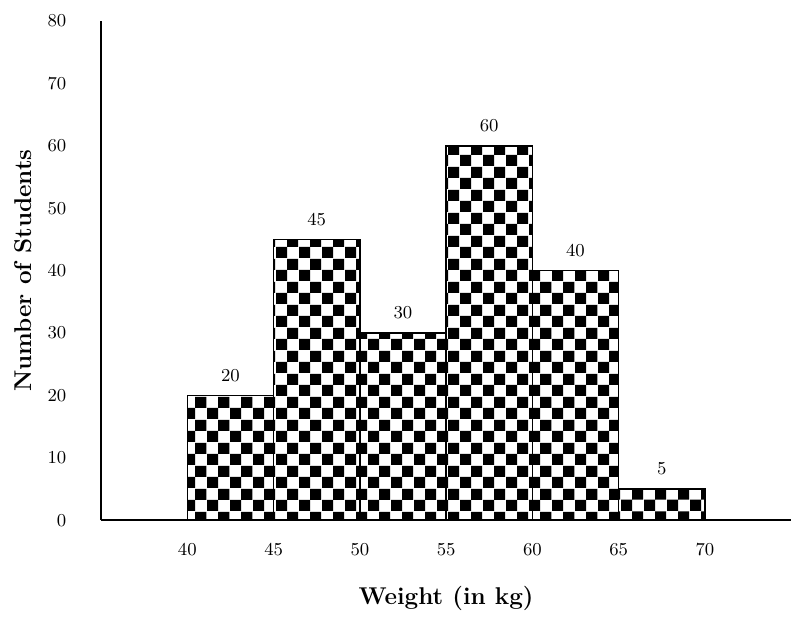
The following histogram shows the weights of students of class X in a school on a particular day. Total number of students enrolled in class X = 200

The number of students weighing less than 55 kg is what percentage less than the number of students weighing 55 kg to 65 kg ?

  1. AOption (a)

    10%

  2. BOption (b)

    8%

  3. COption (c)

    5%

  4. DOption (d)

    7%

View answer & explanation

Correct answer

Answer: (c)C.

5%

Why this answer is correct

Given:

The number of students weigh less than 55 kg and the number of students weight 55 kg to 65 kg

Concept Used:

Concept of percentage, it is calculated on the base of 100

For example, x% means x out of 100

Calculation:

The number of students weight less than 55 kg is (20 + 45 + 30)

⇒ 95

The number of students weight from 55 kg to 65 kg is (60 + 40)

⇒ 100

The required percentage of students {(100 - 95)/100} × 100

⇒ 5%

∴ The number of students weighing less than 55 kg is 5% percent less than the number of students weighing 55 kg to 65 kg.

SSC CPO Tier- I Previous Year Paper (Held On: 25 November 2020 Shift 1)·Quantitative Aptitude
View full paper

Question 1983

SSC CPO 2020• Quantitative Aptitude• Quantitative Aptitude

The given pie chart represents the popularity of ice-cream flavours in the year 2005.

In 2005, if 40% of the 'other' category is mix fruit flavour and 1570 people surveyed preferred mix fruit flavour, then how many people were surveyed?

  1. AOption (a)

    25,000

  2. BOption (b)

    50,000

  3. COption (c)

    75,000

  4. DOption (d)

    10,000

View answer & explanation

Correct answer

Answer: (a)A.

25,000

Why this answer is correct

Given:

Ice-cream FlavourPercentage of people
Strawberry18.9%
Butter Scotch10.8%
Chocolate32.7%
Vanilla21.9%
Other15.7%

40% of other category is mix flavour

People preferred mix fruits = 1570

Calculation:

Let the total number of people be x

People eating other flavoured ice cream = 15.7% of x

⇒ People eating other flavoured ice cream = 0.157x

People having mix flavoured ice cream = 40% of 0.157x

⇒ People having mix flavoured ice cream = 0.0628x

According to question 0.0628x = 1570

⇒ x = 1570 ÷ 0.0628

⇒ x = 25000

∴ Total people surveyed are 25,000

SSC CPO Tier- I Previous Year Paper (Held On: 25 November 2020 Shift 1)·Quantitative Aptitude
View full paper

Question 1984

SSC CPO 2020• Quantitative Aptitude• Quantitative Aptitude

Two numbers are in the ratio 7 : 11. If their HCF is 28, then sum of the two numbers is:

  1. AOption (a)

    112

  2. BOption (b)

    308

  3. COption (c)

    504

  4. DOption (d)

    196

View answer & explanation

Correct answer

Answer: (c)C.

504

Why this answer is correct

Shortcut Trick

Ratio of the two numbers = 7 : 11

Sum of the ratio parts = 7 + 11 = 18 units

Since HCF is the common factor, 1 unit = HCF = 28

Total sum of the numbers = 18 × 28 = 504

∴ The correct answer is 504.

Alternate Method

Given:

Ratio of numbers = 7 : 11

HCF of numbers = 28

Formula Used:

If two numbers are in the ratio a : b and their HCF is x, then the numbers are ax and bx.

7 Units (Number 1)
11 Units (Number 2)

Sum = 7 + 11 = 18 Units
Common Factor (HCF) = 28

Calculations:

⇒ Let the first number be 7x and the second number be 11x.

⇒ HCF of 7x and 11x is x (since 7 and 11 are co-prime).

⇒ x = 28

⇒ Sum of the numbers = 7x + 11x = 18x

⇒ Sum = 18 × 28

⇒ Sum = 504

∴ The correct answer is 504.

Additional Information

Relationship between Numbers, HCF and Ratio

If HCF of two numbers is H and they are in ratio a:b, then the numbers are aH and bH, and their LCM = a × b × H.

Product of Numbers

Product of two numbers = HCF × LCM. For the given problem, Product = (7 × 28) × (11 × 28).

Co-prime Numbers

Numbers that have only 1 as their common factor (HCF = 1) are called co-prime numbers. In a reduced ratio a:b, a and b are always co-prime.

SSC CPO Tier- I Previous Year Paper (Held On: 25 November 2020 Shift 1)·Quantitative Aptitude
View full paper

Question 1985

SSC CPO 2020• Quantitative Aptitude• Quantitative Aptitude

If each side of a square is decreased by 17%, then by what percentage does its area decrease ?

  1. AOption (a)

    25%

  2. BOption (b)

    30.79%

  3. COption (c)

    44.31%

  4. DOption (d)

    31.11%

View answer & explanation

Correct answer

Answer: (d)D.

31.11%

Why this answer is correct

Given:

Decrease percent = 17%

Concept used:

Using the concept of percentage

Area of square = (Side)2

Calculation:

Let the original side be 10.

Area of original square = (Side)2

⇒ Original area = 102

New side = (100 – 17)% of 10

⇒ New side = 83/100 × 10

⇒ New side = 8.3

New area = (New side)2

⇒ New area = (8.3)2

⇒ New area = 68.89

Percent decrease in area = (Original area – New area)/(Original area) × 100

⇒ Percent decrease in area = (100 – 68.89)/100 × 100

⇒ Percent decrease in area = 31.11%

∴ The percentage decrease in area is 31.11%.

Shortcut TrickDecreasing(%) in area = - x - x + (- x × - x)/100

Decreasing(%) in area = - 17 - 17 + (- 17 × - 17)/100

⇒ - 34 + 2.89 = - 31.11

∴ The percentage decrease in area is 31.11%

SSC CPO Tier- I Previous Year Paper (Held On: 25 November 2020 Shift 1)·Quantitative Aptitude
View full paper

Question 1986

SSC CPO 2020• Quantitative Aptitude• Quantitative Aptitude

A and B can do a job in 10 days and 5 days, respectively, They worked together for two days, after which B was replaced by C and the work was finished in the next three days. How long will C alone take to finish 40% of the job?

  1. AOption (a)

    15 days

  2. BOption (b)

    12 days

  3. COption (c)

    18 days

  4. DOption (d)

    10 days

View answer & explanation

Correct answer

Answer: (b)B.

12 days

Why this answer is correct

Given:

A can do work in 10 days

B can do work in 5 days

A and B worked for 2 days

A works for 5 days

B works for 2 days

C works for 3 days

Concept used:

If a person can do a piece of work in x days, then the person will complete 1/x work in 1 day.

Calculation:

Total work = 10 unit

AB
Efficiency12


Total efficiency = 3

Two days of work of A and B = 3 × 2 = 6 unit

Remaining work = 10 - 6 = 4 unit

According to question

\(\frac{4}{1 + c}\) = 3

⇒ 1 + c = 4/3

⇒ c = 1/3

∴ C can complete 40% work =\(\frac{10 \times 40}{100\times 1/3}\)  = 12 days

SSC CPO Tier- I Previous Year Paper (Held On: 25 November 2020 Shift 1)·Quantitative Aptitude
View full paper

Question 1987

SSC CPO 2020• Quantitative Aptitude• Quantitative Aptitude

A sum amounts to Rs. 7,562 in 4 years and to Rs. 8,469.44 in 5 years. at a certain rate percent per annum when the interest is compounded yearly. If Rs. 10,000 at the same rate of interest is borrowed for two years, then what will be the compound interest (in Rs.) ?

  1. AOption (a)

    1,965

  2. BOption (b)

    1,736

  3. COption (c)

    2,764

  4. DOption (d)

    2,544

View answer & explanation

Correct answer

Answer: (d)D.

2,544

Why this answer is correct

Given:

Amount after 4 years (A4) = Rs. 7,562

Amount after 5 years (A5) = Rs. 8,469.44

Principal (P) = Rs. 10,000

Formula used:

CI = P × [(1 + R/100)n – 1]

Where CI is compound interest, P is principal, R is rate percent, and n is time in years

Calculation:

Let the rate of interest be R%

CI for fifth year = A5 – A4 = 8,469.44 – 7562

⇒ CI for fifth year = 907.44

CI for fifth year = R% of A4 

⇒ 907.44 = (R/100) × 7562

⇒ R = 90744/7562

⇒ R = 12%

CI = 10,000 × [(1 + 12/100)2 – 1]

⇒ CI = 10000 × 0.2544

∴ CI is Rs. 2,544

SSC CPO Tier- I Previous Year Paper (Held On: 25 November 2020 Shift 1)·Quantitative Aptitude
View full paper

Question 1988

SSC CPO 2020• Quantitative Aptitude• Quantitative Aptitude

Three successive discounts of 12%, 13% and 11% are equivalent to an approximate single discount of:

  1. AOption (a)

    32%

  2. BOption (b)

    42%

  3. COption (c)

    40%

  4. DOption (d)

    35%

View answer & explanation

Correct answer

Answer: (a)A.

32%

Why this answer is correct

Given:

Three successive discounts are 12%, 13% and 11%

Concept Used:

Concept of percentage. It is calculated on the base of 100

For example, x% means x out of 100

Calculation:

Let, the actual value is 100

After 1st discount value becomes (100 - 12) = 88

In 2nd discount given 13%

Discount = (13 × 88)/100

⇒ 11.4

After 2nd discount value becomes (88 - 11.4) = 76.6

3rd discount is 11%

Discount = (11 × 76.6)/100

⇒ 8.4

Overall single discount (12 + 11.4 + 8.4) = 32.8% = 32% (approximate)

∴ Three successive discounts of 12%, 13% and 11% are equivalent to an approximate single discount of 32%

Shortcut TrickSuccessive discount = {x + y - (x × y)/100}%

Successive discount = {12 + 13 - (12 × 13)/100}%

⇒ (25 - 1.56)% = 23.44%

Again,

Successive discount = {23.44 + 11 - (23.44 × 11)/100}%

⇒ (34.44 - 2.5784)%

⇒ 31.8616% = 32% (approximate)

∴ Three successive discounts of 12%, 13% and 11% are equivalent to an approximate single discount of 32%

SSC CPO Tier- I Previous Year Paper (Held On: 25 November 2020 Shift 1)·Quantitative Aptitude
View full paper

Question 1989

SSC CPO 2020• Quantitative Aptitude• Quantitative Aptitude

Pipes A and B can fill a tank in 16 hours and 24 hours, respectively, whereas pipe C can empty the full tank in 40 hours.

All three pipes are opened together, but pipe C is closed after 10 hours. After how many hours will the remaining part of the tank be filled ?

  1. AOption (a)

    5 hours

  2. BOption (b)

    \(2 \frac{1}{2}\) hours

  3. COption (c)

    2 hours

  4. DOption (d)

    \(5 \frac{1}{2}\) hours

View answer & explanation

Correct answer

Answer: (c)C.

2 hours

Why this answer is correct

Calculation:

Pipe A, B, and C can fill in 1 hour

⇒ 15 + 10 - 6

⇒ 19

(A + B + C) can fill in 10 hours

⇒ 19 × 10

⇒ 190

Remaining empty tank

⇒ 240 - 190

⇒ 50

Remaining empty tank filled by A and B

⇒ 50/25

⇒ 2 hours

∴ Time taken to fill remaining tank is 2 hours.

SSC CPO Tier- I Previous Year Paper (Held On: 25 November 2020 Shift 1)·Quantitative Aptitude
View full paper

Question 1990

SSC CPO 2020• Quantitative Aptitude• Quantitative Aptitude

The perimeter of a square is half the perimeter of a rectangle. The perimeter of the square is 40 m. If its breadth is two­-thirds of its length, then what is the area (in m2) of the rectangle ?

  1. AOption (a)

    384

  2. BOption (b)

    321

  3. COption (c)

    196

  4. DOption (d)

    400

View answer & explanation

Correct answer

Answer: (a)A.

384

Why this answer is correct

Given:

The perimeter of a square is half the perimeter of a rectangle. The perimeter of the square is 40 m. If its breadth is two­-thirds of its length.

Concept Used:

The perimeter of a square = 4 × length of the sides

The perimeter of a rectangle = 2 × (Length + Breadth)

Area of rectangle = Length × Breadth

Calculation:

The perimeter of the square is 40 m

The perimeter of a square is half the perimeter of a rectangle.

⇒ The perimeter of the rectangle is 2 × 40 = 80 m

Let, the length of the rectangle be x

⇒ The breadth of the rectangle is 2x/3

Accordingly,

2 × ( x + 2x/3) = 80

⇒ 5x/3 = 40

⇒ x = 24

Length of the rectangle is 24 m and breadth is (2/3) × 24 = 16 m

Area of the rectangle is (24 × 16) = 384 m2

∴ The area of the rectangle is 384 m2

SSC CPO Tier- I Previous Year Paper (Held On: 25 November 2020 Shift 1)·Quantitative Aptitude
View full paper

Question 1991

SSC CPO 2020• Quantitative Aptitude• Quantitative Aptitude

The given pie chart represents the popularity of ice-cream flavours in the year 2015.

In 2015, if the total sale of chocolate flavours is for Rs. 5,160, then the total sale (in Rs.) for vanilla flavour is:

  1. AOption (a)

    3,300

  2. BOption (b)

    4,120

  3. COption (c)

    4,100

  4. DOption (d)

    5,160

View answer & explanation

Correct answer

Answer: (a)A.

3,300

Why this answer is correct

Given:

Total sale of chocolate flavour = 25.8% of the total sale

Total sale of vanilla flavour = 16.5% of the total sale

Total sale of chocolate flavours is for Rs. 5,160

Calculation:

Let the total sale of all flavours be Rs.

x. Total sale of chocolate flavours = Rs. 5160

⇒ 25.8% of x = 5160

⇒ x = (5160/25.8) × 100

Total sale of vanilla flavor = 16.5% of x

⇒ Total sale of vanilla = (16.5/100) × (5160/25.8) × 100

⇒ Total sale of vanilla = Rs. 3300

∴ The sale of vanilla is Rs. 3300.

SSC CPO Tier- I Previous Year Paper (Held On: 25 November 2020 Shift 1)·Quantitative Aptitude
View full paper

Question 1992

SSC CPO 2020• Quantitative Aptitude• Quantitative Aptitude

In a ΔABC, the bisector of ∠B and ∠C meet at O in the triangle. If ∠BOC = 134°, then the measure of ∠A is:

  1. AOption (a)

    88°

  2. BOption (b)

    52°

  3. COption (c)

    116°

  4. DOption (d)

    104°

View answer & explanation

Correct answer

Answer: (a)A.

88°

Why this answer is correct

Given:

BO and CO are bisectors of ∠B and ∠C

∠BOC = 134°

Concept used:

If in a given ΔABC, If BO and CO are angle bisectors then ∠BOC = 90° + ∠A/2

The angle formed by the 

Calculation:

As, BO and CO are angle bisectors of ∠B and ∠C

∠BOC = 90° + ∠A/2

⇒ 134° = 90° + ∠A/2

⇒ ∠A = 2 × 44° 

∴ ∠A is 88°

SSC CPO Tier- I Previous Year Paper (Held On: 25 November 2020 Shift 1)·Quantitative Aptitude
View full paper

Question 1993

SSC CPO 2020• Quantitative Aptitude• Quantitative Aptitude

If x + y + z = 19, x2 + y2 + z2 = 133 and xz = y2, x > z > 0, what is the value of (x - z) ?

  1. AOption (a)

    -2

  2. BOption (b)

    -5

  3. COption (c)

    5

  4. DOption (d)

    0

View answer & explanation

Correct answer

Answer: (c)C.

5

Why this answer is correct

Given:

x + y + z = 19, x2 + y2 + z2 = 133 and xz = y2, 

Formula used:

(x + y + z)2 = x2 + y2 + z2 + 2(xy + yz + zx)

Calculation:

(x + y + z)2 = x2 + y2 + z2 + 2(xy + yz + zx)

⇒ (19)2 = 133 + 2(xy + yz + y2)

⇒ 133 + 2[y(x + y + z)] = 361

⇒ 2y(19) = 361 - 133

⇒ y = 6

x + y + z = 19

⇒ x + z = 13

The possible value of x and z is 9 and 4.

x - z

⇒ 9 - 4

⇒ 5

∴ The value is 5.

SSC CPO Tier- I Previous Year Paper (Held On: 25 November 2020 Shift 1)·Quantitative Aptitude
View full paper

Question 1994

SSC CPO 2020• Quantitative Aptitude• Quantitative Aptitude

If 4(cosec2 57 - tan2 33) - cos 90 + y × tan2 66 × tan2 24 = y/2, then the value of y is:

  1. AOption (a)

    8

  2. BOption (b)

    -4

  3. COption (c)

    4

  4. DOption (d)

    -8

View answer & explanation

Correct answer

Answer: (d)D.

-8

Why this answer is correct

Given:

4(cosec2 57 - tan2 33) - cos 90 + y × tan2 66 × tan2 24 = y/2

Formula used:

(i) cosec(90 - θ) = secθ

(ii) tan(90 - θ) = cotθ

(iii) sec2θ - tan2θ = 1

(iv) tanθ = 1/cotθ 

Calculations:

4(cosec2 (90 - 33) - tan2 33) - cos 90 + y × tan2 66 × tan2 (90 - 66) = y/2

⇒ 4(sec2 33 - tan2 33) - cos 90 + y × tan2 66 × cot2 66 = y/2

⇒ 4 × 1 - 0 + y × tan2 66 × 1/tan2 66 = y/2

⇒ 4 + y = y/2

⇒ y - y/2 = -4

⇒ y/2 = -4

⇒ y = -8

∴ The value of y is -8.

SSC CPO Tier- I Previous Year Paper (Held On: 25 November 2020 Shift 1)·Quantitative Aptitude
View full paper

Question 1995

SSC CPO 2020• Quantitative Aptitude• Quantitative Aptitude

If A's salary is 30% more than B's salary, then by what percentage is B's salary less than that of A ? (correct to one decimal place)

  1. AOption (a)

    17.5%

  2. BOption (b)

    19.7%

  3. COption (c)

    23.1%

  4. DOption (d)

    25%

View answer & explanation

Correct answer

Answer: (c)C.

23.1%

Why this answer is correct

Given:

Salary of A is 30% more than salary of B.

Calculations:

Let the salary of B be 100x.

Salary of A  = 100x + 100x × 30%

⇒ 130x

Percentage Difference = {(130x - 100x)/130x} × 100

⇒ (30x/130x) × 100

⇒ 23.07% ≈ 23.1%

∴ B's salary is 23.1% less than that of A

Shortcut Trick

BA
100130


Percentage Difference = \(\frac{130-100}{130}\) × 100

⇒ 300/100

⇒ 23.07% ≈ 23.1%

∴ B's salary is 23.1% less than that of A

SSC CPO Tier- I Previous Year Paper (Held On: 25 November 2020 Shift 1)·Quantitative Aptitude
View full paper

Question 1996

SSC CPO 2020• Quantitative Aptitude• Quantitative Aptitude

What is the sum of the digits of the least number which when divided by 15, 18 and 36 leaves the same remainder 9 in each case and is divisible by 11 ?

  1. AOption (a)

    17

  2. BOption (b)

    15

  3. COption (c)

    18

  4. DOption (d)

    16

View answer & explanation

Correct answer

Answer: (c)C.

18

Why this answer is correct

Given:

The number when divided by 15, 18 and 36 and leaves the same remainder 9.

The number is also divisible by 11.

Calculations:

The least number which will be completely divisible by the 15, 18 and 36 will be the LCM of 15, 18 and 36.

⇒ LCM of 15, 18 and 36 = 180

The least number will be completely divisible by the 15, 18 and 36 and leaves remainder 9 = 180k + 9

Where,

k = natural number

when k = 1

⇒ 189

Here 189 is not divisible by 11.

When k = 1, 2, 3, 4, 5. The number is not divisible by 11.

Now, k = 6

Number = 180 × 6 + 9

⇒ Number = 1089

The number 1089 is divisible by 11.

Sum of digits = 1 + 0 + 8 + 9

⇒ 18

∴ The sum of the digits of the least number which when divided by 15, 18 and 36 leaves the same remainder 9 in each case and is divisible by 11 is 18.

SSC CPO Tier- I Previous Year Paper (Held On: 25 November 2020 Shift 1)·Quantitative Aptitude
View full paper

Question 1997

SSC CPO 2020• Quantitative Aptitude• Quantitative Aptitude

One side of a rhombus is 13 cm and one of its diagonals is 24 cm. What is the area (in cm2) of rhombus ?

  1. AOption (a)

    30

  2. BOption (b)

    90

  3. COption (c)

    120

  4. DOption (d)

    60

View answer & explanation

Correct answer

Answer: (c)C.

120

Why this answer is correct

Given:

Side of rhombus = 13 cm

D1 (Diagonal) = 24 cm

Concept and Formula used:

Diagonals of a rhombus bisect each other at 90° 

Area of rhombus = 1/2 × (D1 × D2)

Where D1 and D2 are diagonals of the rhombus

Calculation:

Let the length of the other diagonal (D2) be 2x cm

As, diagonals of rhombus bisect each other at 90° 

AB = 24/2 = 12 cm

BC = 2x/2 = x cm

In ΔABC, ∠ABC = 90° 

AC2 = AB2 + BC2 

⇒ 132 = 122 + x2 

⇒ 169 – 144 = x2 

⇒ x = 5 cm

D2 = 2x = 10 cm

Area of rhombus = 1/2 × (D1 × D2) = 1/2 × (10 × 24)

∴ Area of rhombus is 120 cm2

SSC CPO Tier- I Previous Year Paper (Held On: 25 November 2020 Shift 1)·Quantitative Aptitude
View full paper

Question 1998

SSC CPO 2020• Quantitative Aptitude• Quantitative Aptitude

If a nine-digit number 785x3678y is divisible by 72, then the value of (x + y) is:

  1. AOption (a)

    5

  2. BOption (b)

    12

  3. COption (c)

    10

  4. DOption (d)

    20

View answer & explanation

Correct answer

Answer: (c)C.

10

Why this answer is correct

Given:

Nine digit number = 785x3678y

Concept used:

The Law of Divisibility by 8 is the last three digits must be divisible by 8.

The Sum of digits should be divisible by 9.

Calculation:

785x3678y

If the number is divisible by 72 (8 × 9) then it must be divisible by 8 and 9.

Divisible by 8

Law of Divisibility by 8 is last three digits must be divisible by 8

⇒ 78y = 780 + y

⇒ 97 × 8 + ( 4 + y ) is divisible by 8

So value of 4 + y = 8

⇒ y = 4

Divisible by 9

Sum of digits should be divisible by 9

⇒ 7 + 8 + 5 + x + 3 + 6 + 7 + 8 + 4

⇒ 48 + x

⇒ x = 6

x + y

⇒ 6 + 4

⇒ 10

∴ The value of (x + y) is 10.

SSC CPO Tier- I Previous Year Paper (Held On: 25 November 2020 Shift 1)·Quantitative Aptitude
View full paper

Question 1999

SSC CPO 2020• Quantitative Aptitude• Quantitative Aptitude

The sides of a triangle are 24 cm, 26 cm and 10 cm. At each of its vertex, circles of radius 4.2 cm are drawn. What is the area (in cm2) of the portion covered by the three sectors of the circle ? (π = 22/7)

  1. AOption (a)

    27.72

  2. BOption (b)

    92.28

  3. COption (c)

    105.86

  4. DOption (d)

    120

View answer & explanation

Correct answer

Answer: (a)A.

27.72

Why this answer is correct

Given: 

The sides of the triangle are 24 cm, 26 cm, and 10 cm. The radius of those circle at the vertex is 4.2 cm

Concept Used:

The area made by three circles in three vertices of a triangle of the same radius will be half the area of the circle.

Calculation:

The radius of the circle in three vertices is 4.2 cm

The total angle created in three circles in the vertices is 180°  [∵ Sum of three angles of a triangle is 180°]

The area of the triangle which are covered by three sectors of the circle is (1/2) π (4.2)2

⇒ 27.72 cm2

∴ The area of the portion covered by the three sectors of the circle is 27.72 cm2.

SSC CPO Tier- I Previous Year Paper (Held On: 25 November 2020 Shift 1)·Quantitative Aptitude
View full paper

Question 2000

SSC CPO 2020• Quantitative Aptitude• Quantitative Aptitude

The average weight of A, B and C is 65 kg. If the average weight of C and B is 61.5 kg, and the average weight of A and C is 68.5 kg, then the weight of C (in kg) is:

  1. AOption (a)

    65

  2. BOption (b)

    68

  3. COption (c)

    67

  4. DOption (d)

    60

View answer & explanation

Correct answer

Answer: (a)A.

65

Why this answer is correct

Given:

Average weight of A, B and C = 65 kg

Average weight of C and B = 61.5 kg

Average weight of A and C = 68.5 kg

Formula used:

Average = sum of weights/No of persons

Calculation:

Weight of A, B and C

⇒ (A + B + C)/3 = 65

⇒ A + B + C = 195

Weight of C and B

⇒ (C + B)/2 = 61.5

⇒ C + B = 123

Weight of A and C

⇒ (A + C)/2 = 68.5

⇒ A + C = 137

Weight of A

⇒ 195 - 123

⇒ 72

Weight of C

A + C = 137

⇒ C = 137 - 72

⇒ 65 Kg

∴ The weight of C is 65 Kg.

Previous PagePage 100 of 100Next

How should I prepare for Quantitative Aptitude in SSC CPO?

Solving previous year questions by topic helps identify recurring concepts, question patterns, and frequently asked sub-topics. Attempt each question, review the step-by-step explanation, and note down key formulas or facts for quick revision before the exam.