SSC CPO · Topic Collection

Quantitative Aptitude PYQs

Arithmetic, number systems, percentages, ratios, profit and loss, time and work, algebra, geometry, mensuration, and trigonometry.

3100 Total Questions62 Official PapersYears: 2017–2025Search in Quantitative Aptitude
Showing questions 1941–1960 of 3100Page 98 of 100
SSC CPO Tier- I Previous Year Paper (Held On: 24 November 2020 Shift 2)·Quantitative Aptitude
View full paper

Question 1941

SSC CPO 2020• Quantitative Aptitude• Quantitative Aptitude

PQRS is a cyclic quadrilateral. If ∠P is 4 times ∠R, and ∠S is 3 times ∠Q, then the average of ∠Q and ∠R is:

  1. AOption (a)

    45.7°

  2. BOption (b)

    81°

  3. COption (c)

    90°

  4. DOption (d)

    40.5°

View answer & explanation

Correct answer

Answer: (d)D.

40.5°

Why this answer is correct

Given:

**∠**P = 4 × ∠R

∠S = 3 × ∠Q

Concept Used:

Sum of the opposite angles in a cyclic quadrilateral is 180°

∠P + ∠R = 180° 

∠Q + ∠S = 180° 

Formula Used:

Average = sum of numbers/Total numbers

Calculation:

According to question

⇒ ∠P = 4 × ∠R 

⇒ ∠P : ∠R = 4 : 1

By using the property 

⇒ ∠P + ∠R = 180° 

⇒ 4x + x = 180° 

⇒ 5x = 180° 

⇒ x = 36° 

⇒ ∠R = 36° 

Now,

⇒ ∠S = 3 × ∠Q

⇒ ∠S : ∠Q = 3 : 1

⇒ 3y + y = 180°

⇒ 4y = 180° 

⇒ y = 45° 

⇒ ∠Q = 45° 

Average of ∠R and ∠Q is

⇒ (∠R + ∠Q)/2

⇒ (36° + 45°)/2

⇒ 81°/2 = 40.5° 

∴ The average of ∠R and ∠Q is 40.5°

SSC CPO Tier- I Previous Year Paper (Held On: 24 November 2020 Shift 2)·Quantitative Aptitude
View full paper

Question 1942

SSC CPO 2020• Quantitative Aptitude• Quantitative Aptitude

A boy increases his speed to \(\frac{9}{5}\) times of his original speed. By doing this, he reaches his school 40 minutes before the usual time. How much time (in minutes) does he take usually?

  1. AOption (a)

    120

  2. BOption (b)

    30

  3. COption (c)

    45

  4. DOption (d)

    90

View answer & explanation

Correct answer

Answer: (d)D.

90

Why this answer is correct

Given:

TIme difference = 40 min

Formula Used:

Speed(S) = Distance(D)/Time(T)

Calculation:

Let the speed of the boy be x km/h

Distance = d

Intial time = t

New time = t1

Speed = Distance/TIme

⇒ x = d/t

⇒ t = d/x

New speed = x × (9/5) ⇒ 9x/5

⇒ 9x/5 = d/t2

⇒ t2 = 5d/9x

The difference between the time is 40mins

⇒ t - t1 = 40

⇒ (d/x) - (5d/9x) = 40

⇒ (9d-5d)/9x = 40

⇒ 4d/9x = 40

⇒ d/x = 40 × (9/4)

times = distance/speed

⇒ t = 90 

∴ The usual time take by the boy to go school is 90mins

We use ratio method 

Let initial speed be s1 and new speed be s2

and initial time be t and new time be t1

⇒ s1 × (9/5) = s2

⇒ s1 : s2 = 5 : 9

As the distance is constant the reverse of the ratio speed will give as ratio of time

⇒ t : t1 = 9 : 5

⇒ t - t1 = 40

⇒ 9x - 5x = 40 

⇒ 4x = 40 ⇒ x = 10

⇒ initial time = t = 9x = 9 × 10

∴ The usual time take by the boy to go school is 90mins

Alternate Method  

Let the normal time taken by him = X

as he increases his speed by 9/5 times the time taken decreases by 5/9 times

New time taken = 5/9X

⇒ X - 5/9X = 4/9X = 40 min

⇒ X = 90 mins

∴ The usual time taken by the boy to go to school is 90mins

SSC CPO Tier- I Previous Year Paper (Held On: 24 November 2020 Shift 2)·Quantitative Aptitude
View full paper

Question 1943

SSC CPO 2020• Quantitative Aptitude• Quantitative Aptitude

The average temperature for Monday, Wednesday and Friday was 41°C.  The average for Wednesday, Friday and Thursday was 42°C. If the temperature on Thursday was 43°C, then the temperature on Monday was:

  1. AOption (a)

    41°C

  2. BOption (b)

    42°C

  3. COption (c)

    43°C

  4. DOption (d)

    40°C

View answer & explanation

Correct answer

Answer: (d)D.

40°C

Why this answer is correct

Formula used:

Average = Sum of observations ÷ Number of observations 

Calculation:

Average temperature on Monday, Wednesday, and Friday is 41°C

⇒ M + W + F = 41 × 3 = 123       -----(1)

Average temperature on Wednesday, Friday, and Thursday is 42°C

⇒ W + F + T = 42 × 3 = 126        -----(2)

According to the question,

Temperature on Thursday = 43°C

⇒ W + F = 126 - 43 = 83       [From Equation(2)]

⇒ M + 83 = 123                     [From Equation(1)]

⇒ M = 123 -83 = 40

∴ The temperature on Monday is 40°C.

SSC CPO Tier- I Previous Year Paper (Held On: 24 November 2020 Shift 2)·Quantitative Aptitude
View full paper

Question 1944

SSC CPO 2020• Quantitative Aptitude• Quantitative Aptitude

The area of a square and rectangle are equal. The length of the rectangle is greater than the length of a side of a square by 10 cm and the breadth is less than 5 cm. The perimeter (in cm) of the rectangle is:

  1. AOption (a)

    40

  2. BOption (b)

    50

  3. COption (c)

    80

  4. DOption (d)

    100

View answer & explanation

Correct answer

Answer: (b)B.

50

Why this answer is correct

Shortcut Trick

Equating areas of square (side a) and rectangle (L = a + 10, B = a − 5):

⇒ a2 = (a + 10) × (a − 5) ⇒ a2 = a2 + 5a − 50

⇒ 5a = 50 ⇒ a = 10 cm

⇒ Perimeter = 2 × (L + B) = 2 × (20 + 5) = 50 cm

∴ The correct answer is 50 cm.

Alternate Method

Given:

Area of square = Area of rectangle

Length of rectangle (L) = Side of square (a) + 10

Breadth of rectangle (B) = Side of square (a) − 5

Area = a²
a
a

Area = L × B
L = a + 10
B = a − 5

=

Perimeter = 2 × (L + B)

Formula Used:

Area of square = a2

Area of rectangle = L × B

Perimeter of rectangle = 2 × (L + B)

Calculations:

⇒ a2 = (a + 10) × (a − 5)

⇒ a2 = a(a − 5) + 10(a − 5)

⇒ a2 = a2 − 5a + 10a − 50

⇒ a2 = a2 + 5a − 50

⇒ 5a = 50

⇒ a = 10 cm

Now, calculate the dimensions of the rectangle:

⇒ Length (L) = 10 + 10 = 20 cm

⇒ Breadth (B) = 10 − 5 = 5 cm

Calculate the perimeter of the rectangle:

⇒ Perimeter = 2 × (20 + 5)

⇒ Perimeter = 2 × 25 = 50 cm

∴ The correct answer is 50 cm.

Additional Information

Rectangle Properties

Area = Length × Breadth | Perimeter = 2 × (Length + Breadth) | Diagonal = √(L2 + B2).

Square Properties

Area = a2 | Perimeter = 4a | Diagonal = a√2, where a is the side length.

Relationship between Area and Perimeter

For a given constant perimeter, a square will always enclose the maximum possible area compared to any other rectangle. For a given constant area, a square has the minimum possible perimeter.

SSC CPO Tier- I Previous Year Paper (Held On: 24 November 2020 Shift 2)·Quantitative Aptitude
View full paper

Question 1945

SSC CPO 2020• Quantitative Aptitude• Quantitative Aptitude

In ΔABC, ∠A = 68°. If I is the incentre of the triangle, then the measure of ∠BIC is:

  1. AOption (a)

    124°

  2. BOption (b)

    68°

  3. COption (c)

    54°

  4. DOption (d)

    148°

View answer & explanation

Correct answer

Answer: (a)A.

124°

Why this answer is correct

Given:

In ΔABC,

∠A = 68°

Formula Used:

As we know incentre is the meet point of all the angle bisectors

 Incentre of a triangle = 90° + ∠A/2

Calculation:

Substituting the values in the formula 

 ∠BIC= 90°  + 68/2

⇒ ∠BIC = 124°

∴ ∠BIC = 124°

SSC CPO Tier- I Previous Year Paper (Held On: 24 November 2020 Shift 2)·Quantitative Aptitude
View full paper

Question 1946

SSC CPO 2020• Quantitative Aptitude• Quantitative Aptitude

The value of -7 ÷ [5 + 1 ÷ 2 - {4 + (4 of 2 ÷ 4) + (4 ÷ 4 of 2)}] is:

  1. AOption (a)
    • 7
  2. BOption (b)

    \(- \frac{7}{2}\)

  3. COption (c)

    7

  4. DOption (d)

    \( \frac{7}{2}\)

View answer & explanation

Correct answer

Answer: (c)C.

7

Why this answer is correct

Concept used:

Calculation:

  • 7 ÷ [5 + 1 ÷ 2 - {4 + (4 of 2 ÷ 4) + (4 ÷ 4 of 2)}]

⇒ - 7 ÷ [5 + 1 ÷ 2 - {4 + (8 ÷ 4) + (4 ÷ 8)}]

⇒ - 7 ÷ [5 + 1 ÷ 2 - {4 + 2 + 1/2)}]

⇒ - 7 ÷ [5 + 1/2 - 6.5]

⇒ - 7 ÷ [5.5 - 6.5]

⇒ -7/-1

∴ Answer is 7

SSC CPO Tier- I Previous Year Paper (Held On: 24 November 2020 Shift 2)·Quantitative Aptitude
View full paper

Question 1947

SSC CPO 2020• Quantitative Aptitude• Quantitative Aptitude

The value of \(\frac{{4.35 \times 4.35 \times 4.35 + 3.25 \times 3.25 \times 3.25}}{{43.5 \times 43.5 + 32.5 \times 32.5 - 43.5 \times 32.5}}\) is:

  1. AOption (a)

    0.76

  2. BOption (b)

    0.0076

  3. COption (c)

    7.6

  4. DOption (d)

    0.076

View answer & explanation

Correct answer

Answer: (d)D.

0.076

Why this answer is correct

Formula used:

a3 + b3 = (a + b) × (a2 + b2 – a × b)

Calculation:

[(4.35)3 + (3.25)3]/[(43.5)2 + (32.5)2 – 43.5 × 32.5]

⇒ [(4.35 + 3.25) × {(4.35)2 +(3.25)2 - (4.35 × 3.25)}]/[100 × {(4.35)2 + (3.25)2 – (4.35 × 3.25)}]

⇒ [4.35 + 3.25]/100

⇒ 7.6/100

⇒ 0.076

∴ The answer is 0.076

SSC CPO Tier- I Previous Year Paper (Held On: 24 November 2020 Shift 2)·Quantitative Aptitude
View full paper

Question 1948

SSC CPO 2020• Quantitative Aptitude• Quantitative Aptitude

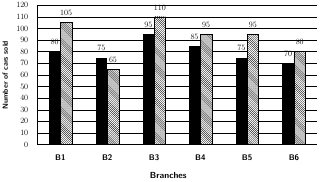
The given bar graph shows the sales of cars from six branches of a dealer B1, B2, B3, B4, B5, B6, during two consecutive years 2018 and 2019. Blue color corresponds to the year 2018 and the light blue color corresponds to the year 2019.

The total sale of cars from all the branches in the year 2018 is what percentage less than the total sales of cars from all the branches in the year 2019? (correct to one decimal place)

  1. AOption (a)

    14.3%

  2. BOption (b)

    13.5%

  3. COption (c)

    12.7%

  4. DOption (d)

    11.9%

View answer & explanation

Correct answer

Answer: (c)C.

12.7%

Why this answer is correct

Total number of cars in 2018 

80 + 75 + 95 + 85 + 75 + 70 = 480

Total number of cars in 2019

110 + 105 + 65 + 95 + 95 + 80 = 550

Different between 2018 and 2019 

550 - 480 = 70 

Percentage less than the total sales cars from all the branches in the 2019 

⇒ \(\frac{{70}}{{550}} \times 100\)

⇒ 12.7

SSC CPO Tier- I Previous Year Paper (Held On: 24 November 2020 Shift 2)·Quantitative Aptitude
View full paper

Question 1949

SSC CPO 2020• Quantitative Aptitude• Quantitative Aptitude

Pipes A, B and C can fill a tank in 15, 30 and 40 hours, respectively. Pipes A, B and C are opened at 6 a.m., 8 a.m. and 10 a.m., respectively, on the same day. When will the tank be full?

  1. AOption (a)

    11:20 p.m.

  2. BOption (b)

    3:20 p.m.

  3. COption (c)

    7:20 p.m.

  4. DOption (d)

    5:20 p.m.

View answer & explanation

Correct answer

Answer: (b)B.

3:20 p.m.

Why this answer is correct

Shortcut Trick

Total Capacity (LCM of 15, 30, 40) = 120 units.

Efficiency: A = 8, B = 4, C = 3.

Work done by A (6 am to 10 am = 4 hrs) = 8 × 4 = 32 units.

Work done by B (8 am to 10 am = 2 hrs) = 4 × 2 = 8 units.

Remaining work at 10 am = 120 − (32 + 8) = 80 units.

Time from 10 am = 80 ÷ (8 + 4 + 3) = 80 ÷ 15 = 5 hours 20 minutes → 3:20 p.m.

∴ The correct answer is 3:20 p.m.

Alternate Method

Given: Filling times: A = 15 hrs, B = 30 hrs, C = 40 hrs. Opening times: A = 6 a.m., B = 8 a.m., C = 10 a.m.

Formula Used: Work = Time × Efficiency | Efficiency = Total Work ÷ Individual Time

PersonDaysTotal WorkEfficiency
Pipe A151208
Pipe B304
Pipe C403

⇒ Between 6 a.m. and 8 a.m. (2 hrs), only A is open.

⇒ Work done by A = 8 × 2 = 16 units.

⇒ Between 8 a.m. and 10 a.m. (2 hrs), A and B both are open.

⇒ Work done by A + B = (8 + 4) × 2 = 12 × 2 = 24 units.

⇒ Total work completed by 10 a.m. = 16 + 24 = 40 units.

⇒ Remaining work to be done after 10 a.m. = 120 − 40 = 80 units.

⇒ After 10 a.m., all three pipes A, B and C are open. Combined efficiency = 8 + 4 + 3 = 15 units/hr.

⇒ Additional time taken = 80 ÷ 15 = 5.33 hours = 5 hours (0.33 × 60) mins = 5 hours 20 minutes.

⇒ Final time = 10:00 a.m. + 5 hours 20 minutes = 3:20 p.m.

∴ The correct answer is 3:20 p.m.

Additional Information

Pipes and Cisterns - Negative Work

If an outlet pipe (leak) is present, its efficiency is taken as negative. Total efficiency = ∑(Filling efficiencies) − ∑(Emptying efficiencies).

Alternate Filling

If pipes are opened for 1 hour each in turn, calculate the work done in one full cycle (sum of efficiencies) and then find the number of cycles to reach total work.

Total Capacity Rule

Taking the LCM of individual times as the total capacity of the tank simplifies calculations by converting fractional work into whole number units of efficiency.

Fractional Time Conversion

To convert decimal or fractional hours to minutes, multiply the fractional part by 60. Example: 0.33 hours = 1/3 × 60 = 20 minutes.

SSC CPO Tier- I Previous Year Paper (Held On: 24 November 2020 Shift 2)·Quantitative Aptitude
View full paper

Question 1950

SSC CPO 2020• Quantitative Aptitude• Quantitative Aptitude

If x + y + z = 13, x2 + y2 + z2 = 133 and x3 + y3 + z3 = 847, then the value of \(\sqrt[3]{{xyz}}\) is:

  1. AOption (a)

    -9

  2. BOption (b)

    -6

  3. COption (c)

    7

  4. DOption (d)

    8

View answer & explanation

Correct answer

Answer: (b)B.

-6

Why this answer is correct

GIven

x + y + z = 13,

x2 + y2 + z2 = 133

x3 + y3 + z3 = 847

Formula used :

 x3 + y3 + z3 - 3xyz = (x + y + z) ( x2 + y2 + z2 - (xy + yz + zx) )      ----(1)

 (x + y + z)2 = x2 + y2 + z2+ 2(xy + yz + zx)      ----(2)

Calculation:

From Equation (2) 

⇒ 132 = 133 + 2(xy + yz + zx)  

⇒ 169 - 133 = 2(xy + yz+ zx)

⇒ (xy + yz + zx) = 36/2

⇒ (xy + yz + zx) = 18

Put all the values in Equation (1); 

 x3 + y3 + z3 - 3xyz = (x + y + z) ( x2 + y2 + z2 - (xy + yz + zx) ) 

⇒ 847 - 3xyz = 13(133 - 18)

⇒ 847 - 115×13 = 3(xyz)

⇒ - 648 = 3(xyz)

⇒ - 216 = xyz 

⇒ - (216)1/3 = (xyz)1/3

⇒ - (216)1/3 = ∛xyz

 So, the value of   ∛xyz = - 6

SSC CPO Tier- I Previous Year Paper (Held On: 25 November 2020 Shift 1)·Quantitative Aptitude
View full paper

Question 1951

SSC CPO 2020• Quantitative Aptitude• Quantitative Aptitude

The value of \(\frac{{5.35 \times 5.35 \times 5.35 + 3.65 \times 3.65 \times 3.65}}{{53.5 \times 53.5 + 36.5 \times 36.5 - 53.5 \times 36.5}}\) is:

  1. AOption (a)

    9

  2. BOption (b)

    0.9

  3. COption (c)

    90

  4. DOption (d)

    0.09

View answer & explanation

Correct answer

Answer: (d)D.

0.09

Why this answer is correct

Identity used:

(a3 + b3) = (a + b) × (a2 + b2 – ab)

Calculation:

\(\frac{{5.35 × 5.35 × 5.35 + 3.65 × 3.65 × 3.65}}{{53.5 × 53.5 + 36.5 × 36.5 - 53.5 × 36.5}}\)

\(\frac{({5.35 × 5.35 × 5.35 + 3.65 × 3.65 × 3.65)}}{{(53.5 × 53.5 + 36.5 × 36.5 - 53.5 × 36.5)}}\)

\(\frac{({5.35 × 5.35 × 5.35 + 3.65 × 3.65 × 3.65)}}{{(53.5 × 53.5 + 36.5 × 36.5 - 53.5 × 36.5)}}\)

\(⇒ {\frac{{(5.35 )^3 + (3.65)^3}}{{((53.5)^2 + (36.5)^2 - 53.5 × 36.5)}}}\)

\(⇒ \frac{{ {(5.35 : + :3.65) \times [(5.35)^2 + (3.65)^2 - 5.35 × 3.65}]}}{{100 \times [(5.35)^2 + (3.65)^2 - 5.35 × 3.65}]}\)

⇒ (5.35 + 3.65)/100

⇒ 9/100

∴ 0.09

SSC CPO Tier- I Previous Year Paper (Held On: 25 November 2020 Shift 1)·Quantitative Aptitude
View full paper

Question 1952

SSC CPO 2020• Quantitative Aptitude• Quantitative Aptitude

A ladder leaning against a wall makes an angle θ with the horizontal ground such that tan θ = 12/5. If the height of the top of the ladder from the wall is 24 m., then what is the distance (in m) of the foot of the ladder from the walI ?

  1. AOption (a)

    19.5

  2. BOption (b)

    10

  3. COption (c)

    18

  4. DOption (d)

    7.5

View answer & explanation

Correct answer

Answer: (b)B.

10

Why this answer is correct

Given:

The ladder leaning against the wall making an angle θ with the horizontal ground such that tan θ = 12/5. The height of the top of the ladder from the wall is 24 m

Concept Used:

tanθ = Height/Base

Calculation:

Accordingly,

Let the base = x that means the distance of the foot of the ladder from the wall is x

tanθ = 12/5

⇒ 24/x = 12/5

⇒ x = 10

∴ The distance of the foot of the ladder from the wall is 10 m

SSC CPO Tier- I Previous Year Paper (Held On: 25 November 2020 Shift 1)·Quantitative Aptitude
View full paper

Question 1953

SSC CPO 2020• Quantitative Aptitude• Quantitative Aptitude

In ΔABC, BD ⊥ AC at D, E is a point on BC such that ∠BEA = x°. If ∠EAC = 62° and ∠ EBD = 60°, then the value of x is:

  1. AOption (a)

    78°

  2. BOption (b)

    76°

  3. COption (c)

    92°

  4. DOption (d)

    68°

View answer & explanation

Correct answer

Answer: (c)C.

92°

Why this answer is correct

Given:

BD ⊥ AC at D.

E is a point on BC such that ∠BEA = x°

∠EAC = 62°

∠ EBD = 60°

Calculations:

In ΔAOD,

∠AOD + ∠ADO + ∠DAO = 180°

⇒ ∠AOD + 90° + 62° = 180°

⇒ ∠AOD = 180° - 152°

⇒ ∠AOD = 28°

∵ ∠AOD and ∠EOB are vertical opposite angles,

∠AOD = ∠EOB = 28°

In ΔBOE,

∠BEO + ∠EOB + ∠OBE = 180°

⇒ x° + 28° + 60° = 180°

⇒ x° = 180° - 88°

⇒ x° = 92°

∴ The value of x is 92°.

SSC CPO Tier- I Previous Year Paper (Held On: 25 November 2020 Shift 1)·Quantitative Aptitude
View full paper

Question 1954

SSC CPO 2020• Quantitative Aptitude• Quantitative Aptitude

The radius of the base of a cylinder of a cylinder is 14 cm and its volume is 6160 cm3. The curved surface area (in cm2) is:

(take π = 22/7)

  1. AOption (a)

    880

  2. BOption (b)

    778

  3. COption (c)

    940

  4. DOption (d)

    660

View answer & explanation

Correct answer

Answer: (a)A.

880

Why this answer is correct

Given:

Radius = 14 cm

Volume = 6160 cm3

Formula used:

(i) Volume of cylinder = π × r2 × h

(ii) Curved surface area = 2 × π × r × h

Calculation:

Volume = π × r2 × h

⇒ 6160 = (22/7) × (14)2 × h

⇒ h = (6160 × 7)/(22 × 196)

⇒ h = 10 cm

Curved surface area = 2 × π × r × h

⇒ 2 × (22/7) × 14 × 10

⇒ 2 × 22 × 2 × 10

⇒ 880 cm2

∴ The curved surface area is 880 cm2

SSC CPO Tier- I Previous Year Paper (Held On: 25 November 2020 Shift 1)·Quantitative Aptitude
View full paper

Question 1955

SSC CPO 2020• Quantitative Aptitude• Quantitative Aptitude

The average of twelve numbers is 39. The average of the last five numbers is 35, and that of the first four numbers is 40. The fifth number is 6 less than the sixth number and 5 more than the seventh number. The average of the sixth and seventh numbers is:

  1. AOption (a)

    47.5

  2. BOption (b)

    50

  3. COption (c)

    44.5

  4. DOption (d)

    39

View answer & explanation

Correct answer

Answer: (c)C.

44.5

Why this answer is correct

Given:

Average of twelve numbers = 39

Average of last five numbers = 35

Average of first four numbers = 40

Fifth number = sixth number - 6

Fifth number = seventh number + 5

Formula used:

Average = (Sum of values)/(Number of values)

Calculations:

Let twelve numbers be x1, x2, x3, x4, x5, x6, x7, x8, x9, x10, x11, x12.

x5 = x6 - 6      ----(i)

x5 = x7 + 5      ----(ii)

Average of first four numbers,

(x1 + x2 + x3 + x4)/4 = 40

⇒ (x1 + x2 + x3 + x4) = 160

Average of last five numbers,

(x8 + x9 + x10 + x11 + x12)/5 = 35

⇒ (x8 + x9 + x10 + x11 + x12) = 175

Average of twelve numbers,

(x1 + x2 + x3 + x4 + x5 + x6 + x7 + x8 + x9 + x10 + x11 + x12)/12 = 39

⇒ (x1 + x2 + x3 + x4 + ​x5 + x6 + x7 + x8 + x9 + x10 + x11 + x12) = 468

⇒ (160 + ​x5 + x6 + x7 + 175) = 468

⇒ ​x5 + x6 + x7 = 468 - 160 - 175

⇒ ​x5 + x6 + x7 = 133      ----(iii)

Putting value of x5 from equation (i),

⇒ x6 - 6 + x6 + x7 = 133

⇒ 2x6 + x7 = 139

⇒ x7 = 139 - 2x6      ----(iv)

Putting value of x5 from equation (ii),

x7 + 5 + x6 + x7 = 133

⇒ 2x7 + x6 = 128

⇒ 2(139 - 2x6) + x6 = 128

⇒ 278 - 4x6 + x6 = 128

⇒ 3x6 = 150

⇒ x6 = 50

Putting the value of x6 in equation (iv),

x7 = 139 - 2x6

⇒ x7 = 139 - 2(50)

⇒ x7 = 139 - 100

⇒ x7 = 39

Average of x6 and x7 = (50 + 39)/2

⇒ 89/2

⇒ 44.5

∴  The average of the sixth and seventh numbers is 44.5

Alternate MethodSum of values = Avg × Number of values

Sum of 12 numbers = 39 × 12 = 468

Sum of last 5 numbers = 35 × 5 = 175

Sum of first 4 numbers = 40 × 4 = 160

Sum of 9 numbers = 175 + 160 = 335

Sum of 5th + 6th + 7th numbers = Sum of 12 numbers - Sum of 9 numbers

⇒ 468 - 335

⇒ 133

According to the question,

Let 5th number be x.

Then, 6th number = x + 6, and 7th number = x - 5

Sum of 5th + 6th + 7th numbers = 133

⇒ x + x + 6 + x - 5 = 133

⇒ 3x = 133 - 1

⇒ x = 132/3 = 44

Average of 6th number + 7th number = (x + 6 + x - 5)/2 

⇒ (2x + 1)/2

⇒ (2 × 44 + 1)/2

⇒ 89/2

⇒ 44.5

∴  The average of the sixth and seventh numbers is 44.5
SSC CPO Tier- I Previous Year Paper (Held On: 25 November 2020 Shift 1)·Quantitative Aptitude
View full paper

Question 1956

SSC CPO 2020• Quantitative Aptitude• Quantitative Aptitude

If 4 - 2sin2θ - 5cosθ = 0, 0°< θ < 90°, then the value of cosθ - tanθ is:

  1. AOption (a)

    \(\frac{{1 + 2\surd 3}}{2}\)

  2. BOption (b)

    \(\frac{{2 - \surd 3}}{2}\)

  3. COption (c)

    \(\frac{{2 + \surd 3}}{2}\)

  4. DOption (d)

    \(\frac{{1 - 2\surd 3}}{2}\)

View answer & explanation

Correct answer

Answer: (d)D.

\(\frac{{1 - 2\surd 3}}{2}\)

Why this answer is correct

Given:

4 - 2sin2θ - 5cosθ = 0

Formula used:

sin2θ + cos2θ = 1

Calculation:

4 - 2sin2θ - 5cosθ = 0

⇒ 4 - 2(1 - cos2θ ) - 5cosθ = 0

⇒ 4 - 2 + 2cos2θ - 5cosθ = 0

⇒ 2cos2θ - 5cosθ + 2 = 0

⇒ cosθ = [5 ± √(25 - 16)]/4

⇒ cosθ = (5 ± 3)/4

⇒ cosθ = 2 or 1/2

cosθ can't more than 1, cosθ = 1/2

tanθ = √3

cosθ - tanθ

⇒ (1/2) - √3

⇒ \(\frac{{1 - 2\surd 3}}{2}\)

∴ The value is \(\frac{{1 - 2\surd 3}}{2}\).

SSC CPO Tier- I Previous Year Paper (Held On: 25 November 2020 Shift 1)·Quantitative Aptitude
View full paper

Question 1957

SSC CPO 2020• Quantitative Aptitude• Quantitative Aptitude

The given bar graph shows the number of students of two schools over a period of six years.

In the bar graph, what is the ratio of the students taken for years the 2008, 2012, 2013 together from school A to the students taken for the years 2009, 2010, 2011 together from school B ?

  1. AOption (a)

    229 : 217

  2. BOption (b)

    217 : 229

  3. COption (c)

    118 : 251

  4. DOption (d)

    251 : 118

View answer & explanation

Correct answer

Answer: (a)A.

229 : 217

Why this answer is correct

Given:

Total student in 2008, 2012, 2013 together from school A = 640 + 900 + 750

Total student in 2009, 2010, 2011 together from school B = 820 + 600 + 750

Concept used:

Using the concept ratio

Calculation:

Total student in 2008, 2012, 2013 together from school A = 640 + 900 + 750

⇒ Required sum of A = 2290

Total student in 2009, 2010, 2011 together from school B = 820 + 600 + 750

⇒ Required sum of B = 2170

Required ratio = 2290 ∶ 2170

⇒ Required ratio = 229 ∶ 217

∴ The required ratio is 229 ∶ 217.

SSC CPO Tier- I Previous Year Paper (Held On: 25 November 2020 Shift 1)·Quantitative Aptitude
View full paper

Question 1958

SSC CPO 2020• Quantitative Aptitude• Quantitative Aptitude

The given histogram shows the height of the students.

The number of students whose height is in the class interval 165-170 is what percentage less than the number of students whose height is in the interval 150-155 ?

(correct to one decimal place)

  1. AOption (a)

    1.9%

  2. BOption (b)

    4.8%

  3. COption (c)

    5.5%

  4. DOption (d)

    6.7%

View answer & explanation

Correct answer

Answer: (d)D.

6.7%

Why this answer is correct

Given:

Height (in cm)Number of students
150-15515
155-16013
160-16510
165-17014
170-17512
175-1806

Calculation:

Number of students in the class interval 165-170 = 14

Number of students in the class interval 150-155 = 15

Difference = 15 – 14 = 1

Required percentage = (1/15) × 100

⇒ Required percentage ≈ 6.7%

∴  The number of students in the class interval 165-170 is 100/15 = 6.7% less than the number of students in class interval of 150-155

SSC CPO Tier- I Previous Year Paper (Held On: 25 November 2020 Shift 1)·Quantitative Aptitude
View full paper

Question 1959

SSC CPO 2020• Quantitative Aptitude• Quantitative Aptitude

If two successive discounts, each of 20% on the marked price of an article, are equal to a single discount of Rs. 331.20, then the marked price (in Rs.) of the article is:

  1. AOption (a)

    750

  2. BOption (b)

    1,200

  3. COption (c)

    645

  4. DOption (d)

    920

View answer & explanation

Correct answer

Answer: (d)D.

920

Why this answer is correct

Given:

Each discount = 20%

Single discount = Rs. 331.20

Concept used:

Using the concept of percentage.

Calculation:

Let the MP is Rs.

x. 1st discount at MP = (100 – 20)% of x

⇒ 1st discount = 80% of x

⇒ 1st dicount = 80/100 × x

⇒ 1st dicount = 0.8x

2nd discount = (100 – 20)% of 0.8x

⇒ 2nd discount = 80% of 0.8x

⇒ 2nd dicount = 80/100 × 0.8x

⇒ 2nd dicount = 0.8 × 0.8x

⇒ 2nd dicount = 0.64x

Equivalent discount = x – 0.64x

⇒ 331.20 = 0.36x

⇒ x = 331.20/0.36

⇒ x = Rs. 920

∴ The marked price of an article is Rs. 920.

SSC CPO Tier- I Previous Year Paper (Held On: 25 November 2020 Shift 1)·Quantitative Aptitude
View full paper

Question 1960

SSC CPO 2020• Quantitative Aptitude• Quantitative Aptitude

A Person was standing on a road near a mall. He was 1215 m away from the mall and able to see the top of the mall from the road in such a way that the top of a tree, which is in between him and the mall, was exactly in line of sight with the top of the mall. The tree height is 20 m and it is 60 m away from him. How tall (in m) is the mall ?

  1. AOption (a)

    405

  2. BOption (b)

    375

  3. COption (c)

    300

  4. DOption (d)

    250

View answer & explanation

Correct answer

Answer: (a)A.

405

Why this answer is correct

Given:

Distance between mall and person = 1215 m

Distance between tree or person = 60 m 

Height of tree = 20 m

Concept used:

Using the concept of trigonometric ratios

tanθ = (Perpendicular)/(Base)

Calculation:

Let the height of mall be AB

In ΔDEC,

tanθ = DE/CE

⇒ tanθ = 20/60

⇒ tanθ = 1/3

In ΔABC,

tanθ = AB/BC

⇒ 1/3 = AB/1215

⇒ AB = 405 m

∴ The height of mall is 405 m.

How should I prepare for Quantitative Aptitude in SSC CPO?

Solving previous year questions by topic helps identify recurring concepts, question patterns, and frequently asked sub-topics. Attempt each question, review the step-by-step explanation, and note down key formulas or facts for quick revision before the exam.