SBI Probationary Officer (PO) · Topic Collection

Quantitative Aptitude PYQs

Arithmetic, number systems, percentages, ratios, profit and loss, time and work, algebra, geometry, mensuration, and trigonometry.

1345 Total Questions41 Official PapersYears: 2018–2025Search in Quantitative Aptitude
Showing questions 701–720 of 1345Page 36 of 68
SBI PO Prelims Memory Based Paper (Held On: 4 November 2023 Shift 2) (Previous Year Paper)·Quantitative Aptitude
View full paper

Question 701

SBI Probationary Officer (PO) 2023• Quantitative Aptitude• Quantitative Aptitude

Directions: The following caselet shows the information about the number of persons who participated in three different games: swimming , fencing and skating.

Number of persons who participated in only swimming and only fencing are in the ratio 4: 3. Number of persons who participated in only skating is 2 less than the number of persons who participated in only fencing.Number of persons who participated in all the three is 5 which is 5 less than the number of persons who participated in both swimming and fencing but not skating. Number of persons who participated in both fencing and swimming but not skating and the number of persons who participated in swimming and skating but not fencing are in the ratio 2 : 3. Number of persons who participated in both fencing and skating but not swimming is 80% of the number of persons who participated in swimming and skating but not fencing. Total number of persons who participated in only swimming, only fencing and only skating is 98.

 If the number of males to females who  participate only in skating are in the ratio 4: 3 and the total number of females who participate in only skating and only swimming is 22. Find the difference between the number of males participating in only skating and only swimming.

  1. AOption (a)

    20

  2. BOption (b)

    16

  3. COption (c)

    18

  4. DOption (d)

    14

  5. EOption (e)

    22

View answer & explanation

Correct answer

Answer: (d)D.

14

Why this answer is correct

General solution:

Number of persons who participated in only swimming and only fencing are in the ratio 4x: 3x

Number of persons who participated in only skating is 2 less than the number of persons who participated in only fencing = (3x - 2)

Number of persons who participated in all the three = 5

Number of persons who participated in both swimming and fencing but not skating =  (5 + 5) = 10

Number of persons who participated in both fencing and swimming but not skating and the number of persons who participated in swimming and skating but not fencing are in the ratio 2 : 3

Number of persons who participated in swimming and skating but not fencing = 10/2 ×  3 = 15

Number of person who participated in both fencing and skating but not swimming is 80% of the number of persons who participated in swimming and skating but not fencing.

Number of person who participated in both fencing and skating but not swimming  =15 ×  (80/100) = 12

Total number of persons who participated in only swimming , only fencing and only skating is 98.

(4x + 3x + 3x - 2) = 98

10x = 100

x = 10

Number of persons who likes swimming only = 40

Number of persons who likes fencing only = 30

Number of persons who likes skating = (30 - 2) = 28

Solution:

Number of males to females who participated only skating = 28

Number of males participated  only skating = 28/7 × 4 = 16

Number of females participated only in skating = (28 - 16) = 12

Number of females participated only swimming = 22 - 12 = 10

Number of males participated only swimming = (40 - 10) = 30

Required difference = (30 - 16) = 14

SBI PO Prelims Memory Based Paper (Held On: 4 November 2023 Shift 2) (Previous Year Paper)·Quantitative Aptitude
View full paper

Question 702

SBI Probationary Officer (PO) 2023• Quantitative Aptitude• Quantitative Aptitude

Directions: The following caselet shows the information about the number of persons who participated in three different games: swimming , fencing and skating.

Number of persons who participated in only swimming and only fencing are in the ratio 4: 3. Number of persons who participated in only skating is 2 less than the number of persons who participated in only fencing.Number of persons who participated in all the three is 5 which is 5 less than the number of persons who participated in both swimming and fencing but not skating. Number of persons who participated in both fencing and swimming but not skating and the number of persons who participated in swimming and skating but not fencing are in the ratio 2 : 3. Number of persons who participated in both fencing and skating but not swimming is 80% of the number of persons who participated in swimming and skating but not fencing. Total number of persons who participated in only swimming, only fencing and only skating is 98.

Number of persons who participated in skating and fencing but not swimming is what percentage of the number of persons who participated in only swimming.

  1. AOption (a)

    35%

  2. BOption (b)

    20%

  3. COption (c)

    30%

  4. DOption (d)

    25%

  5. EOption (e)

    15%

View answer & explanation

Correct answer

Answer: (c)C.

30%

Why this answer is correct

General solution:

Number of persons who participated in only swimming and only fencing are in the ratio 4x: 3x

Number of persons who participated in only skating is 2 less than the number of persons who participated in only fencing = (3x - 2)

Number of persons who participated in all the three = 5

Number of persons who participated in both swimming and fencing but not skating =  (5 + 5) = 10

Number of persons who participated in both fencing and swimming but not skating and the number of persons who participated in swimming and skating but not fencing are in the ratio 2 : 3

Number of persons who participated in swimming and skating but not fencing = 10/2 ×  3 = 15

Number of person who participated in both fencing and skating but not swimming is 80% of the number of persons who participated in swimming and skating but not fencing.

Number of person who participated in both fencing and skating but not swimming  =15 ×  (80/100) = 12

Total number of persons who participated in only swimming , only fencing and only skating is 98.

(4x + 3x + 3x - 2) = 98

10x = 100

x = 10

Number of persons who likes swimming only = 40

Number of persons who likes fencing only = 30

Number of persons who likes skating = (30 - 2) = 28

Solution:

Number of persons who participated in skating and fencing but not swimming = 12

Number of persons who participated in only swimming = 40

Required percentage = 12/40 ×  100 = 30%

SBI PO Prelims Memory Based Paper (Held On: 4 November 2023 Shift 2) (Previous Year Paper)·Quantitative Aptitude
View full paper

Question 703

SBI Probationary Officer (PO) 2023• Quantitative Aptitude• Quantitative Aptitude

Directions: The following caselet shows the information about the number of persons who participated in three different games: swimming , fencing and skating.

Number of persons who participated in only swimming and only fencing are in the ratio 4: 3. Number of persons who participated in only skating is 2 less than the number of persons who participated in only fencing.Number of persons who participated in all the three is 5 which is 5 less than the number of persons who participated in both swimming and fencing but not skating. Number of persons who participated in both fencing and swimming but not skating and the number of persons who participated in swimming and skating but not fencing are in the ratio 2 : 3. Number of persons who participated in both fencing and skating but not swimming is 80% of the number of persons who participated in swimming and skating but not fencing. Total number of persons who participated in only swimming, only fencing and only skating is 98.

Find the difference between total persons who participated in swimming and the total persons who participated in fencing.

  1. AOption (a)

    17

  2. BOption (b)

    16

  3. COption (c)

    13

  4. DOption (d)

    10

  5. EOption (e)

    15

View answer & explanation

Correct answer

Answer: (c)C.

13

Why this answer is correct

General solution:

Number of persons who participated in only swimming and only fencing are in the ratio 4x: 3x

Number of persons who participated in only skating is 2 less than the number of persons who participated in only fencing = (3x - 2)

Number of persons who participated in all the three = 5

Number of persons who participated in both swimming and fencing but not skating =  (5 + 5) = 10

Number of persons who participated in both fencing and swimming but not skating and the number of persons who participated in swimming and skating but not fencing are in the ratio 2 : 3

Number of persons who participated in swimming and skating but not fencing = 10/2 ×  3 = 15

Number of person who participated in both fencing and skating but not swimming is 80% of the number of persons who participated in swimming and skating but not fencing.

Number of person who participated in both fencing and skating but not swimming  =15 ×  (80/100) = 12

Total number of persons who participated in only swimming , only fencing and only skating is 98.

(4x + 3x + 3x - 2) = 98

10x = 100

x = 10

Number of persons who likes swimming only = 40

Number of persons who likes fencing only = 30

Number of persons who likes skating = (30 - 2) = 28

Solution:

Number of persons who participated in swimming = (40 + 15 + 5+ 10) = 70

Number of persons who participated in fencing = (30 + 10 + 5 + 12) = 57

Required difference  = (70 - 57) = 13

SBI PO Prelims Memory Based Paper (Held On: 4 November 2023 Shift 2) (Previous Year Paper)·Quantitative Aptitude
View full paper

Question 704

SBI Probationary Officer (PO) 2023• Quantitative Aptitude• Quantitative Aptitude

Himanshu decided to donate 25% of his income to a fund for making arrangements for oxygen cylinders to COVID patients. On the day of donation he changed his mind and donated Rs. 4250 which was 85% of what he had decided earlier. How much is Himanshu's income per month?

  1. AOption (a)

    Rs. 21450

  2. BOption (b)

    Rs. 20,000

  3. COption (c)

    Rs. 30000

  4. DOption (d)

    Rs. 25,000

  5. EOption (e)

    None of these 

View answer & explanation

Correct answer

Answer: (b)B.

Rs. 20,000

Why this answer is correct

Shortcut Trick

Let Total Income be 100%.

Planned Donation = 25% of Income.

Actual Donation = 85% of 25% = 21.25% of Income.

21.25% → ₹4250

100% → (4250 ÷ 21.25) × 100 = 200 × 100 = ₹20,000.

∴ The correct answer is ₹20,000.

Alternate Method

Given:

Actual donation = ₹4250

Actual donation = 85% of Planned donation

Planned donation = 25% of Monthly Income

Calculations:

⇒ 85% of Planned donation = ₹4250

⇒ Planned donation = (4250 × 100) ÷ 85

⇒ Planned donation = 50 × 100 = ₹5000

⇒ Now, 25% of Monthly Income = ₹5000

⇒ Monthly Income = (5000 × 100) ÷ 25

⇒ Monthly Income = ₹20,000

∴ The correct answer is ₹20,000.

Additional Information

Percentage Change

To find the original value from a percentage part, use: Original = (Given Value ÷ Percentage) × 100.

Successive Percentages

If a value is changed by a% and then b%, the effective percentage of the original is (a × b) ÷ 100.

Income and Savings

Total Income is always treated as the base (100%) when calculating components like expenditure, savings, or donations.

SBI PO Prelims Memory Based Paper (Held On: 4 November 2023 Shift 2) (Previous Year Paper)·Quantitative Aptitude
View full paper

Question 705

SBI Probationary Officer (PO) 2023• Quantitative Aptitude• Quantitative Aptitude

In a mixture of 280 liters, the ratio of the milk and water is 5:2. If the x liters of the mixture is taken out and the x liters of water is added to the resultant mixture, then the ratio of milk to water in the resultant mixture becomes 5:3, find the quantity of the water in the final mixture?

  1. AOption (a)

    75 liters 

  2. BOption (b)

    90 liters

  3. COption (c)

    105 liters

  4. DOption (d)

    120 liters

  5. EOption (e)

    135 liters

View answer & explanation

Correct answer

Answer: (c)C.

105 liters

Why this answer is correct

Shortcut Trick

In the final mixture, the milk and water ratio is 5 : 3.

Total volume remains constant at 280 liters because x liters are removed and x liters are added.

Total units in final mixture = 5 + 3 = 8 units.

8 units = 280 liters ⇒ 1 unit = 35 liters.

Water in final mixture = 3 units = 3 × 35 liters = 105 liters.

∴ The correct answer is 105 liters.

Alternate Method

Given: Initial volume = 280 liters, Initial Ratio (M:W) = 5:2, Final Ratio (M:W) = 5:3.

Formula: Ratio × constant = Actual Value.

⇒ When x liters of mixture is removed, the ratio of milk and water remains 5:2.

⇒ When x liters of water is added, the ratio becomes 5:3.

⇒ Since only water is added, the milk quantity stays constant (5 units in both cases).

⇒ Total volume of final mixture = Initial volume = 280 liters.

⇒ Final ratio sum = 5 + 3 = 8 units.

⇒ 8 units = 280 liters.

⇒ 1 unit = 280 ÷ 8 = 35 liters.

⇒ Water in final mixture = 3 units = 3 × 35 = 105 liters.

∴ The correct answer is 105 liters.

Additional Information

Mixture Removal Property

When a part of a mixture is removed, the ratio of components in the remaining mixture stays the same as the original ratio.

Replacement Concept

If x liters are removed and x liters of a single component are added, the total volume of the mixture remains unchanged.

Ratio Balancing

To solve replacement problems, keep the component that was not added constant in the ratio calculations.

SBI PO Prelims Memory Based Paper (Held On: 4 November 2023 Shift 2) (Previous Year Paper)·Quantitative Aptitude
View full paper

Question 706

SBI Probationary Officer (PO) 2023• Quantitative Aptitude• Quantitative Aptitude

A person invested a sum of ₹ x at simple interest at 10% per annum for 7 years. If he had invested ₹ (x + 10,100) at simple interest at 15% per annum for 8 years, then, simple interest would have been ₹ 34,620 more than the other one. Then, what is the value of x?

  1. AOption (a)

    45,000

  2. BOption (b)

    42,000

  3. COption (c)

    40,000

  4. DOption (d)

    48,000

  5. EOption (e)

    None of these

View answer & explanation

Correct answer

Answer: (a)A.

45,000

Why this answer is correct

Shortcut Trick

Total interest % in first case = 10% × 7 = 70% of x.

Total interest % in second case = 15% × 8 = 120% of (x + 10,100).

Difference: 120% of (x + 10,100) − 70% of x = 34,620.

⇒ 1.2x + 12,120 − 0.7x = 34,620 ⇒ 0.5x = 22,500.

⇒ x = 45,000.

∴ The correct answer is ₹45,000.

Alternate Method

Given: Rate1 = 10%, Time1 = 7 yrs, Principal1 = x. Rate2 = 15%, Time2 = 8 yrs, Principal2 = x + 10,100.

Formula Used: Simple Interest (SI) = (P × R × T) ÷ 100

⇒ SI1 = (x × 10 × 7) ÷ 100 = 0.7x

⇒ SI2 = [(x + 10,100) × 15 × 8] ÷ 100 = 1.2 × (x + 10,100)

⇒ SI2 − SI1 = 34,620

⇒ 1.2x + 12,120 − 0.7x = 34,620

⇒ 0.5x = 34,620 − 12,120

⇒ 0.5x = 22,500

⇒ x = 22,500 ÷ 0.5 = 45,000

∴ The correct answer is ₹45,000.

Additional Information

Simple Interest Concept

Simple interest is calculated only on the principal amount. SI = P×R×T/100, where P is Principal, R is Rate per annum, and T is Time in years.

Amount Calculation

The total Amount (A) after T years is the sum of Principal and Interest: A = P + SI = P(1 + RT/100).

Effective Rate of Interest

For simple interest, the effective rate for the entire duration is simply (R × T)%. This allows for direct percentage-based comparisons between different investment scenarios.

SBI PO Prelims Memory Based Paper (Held On: 4 November 2023 Shift 2) (Previous Year Paper)·Quantitative Aptitude
View full paper

Question 707

SBI Probationary Officer (PO) 2023• Quantitative Aptitude• Quantitative Aptitude

Directions: The following table graph shows the percentage trousers sold out of total trousers and shirts sold in the five different shops A, B, C, D and E.


Total number of trousers and shirts sold in all the shops is = 6950


Name of the shopsTotal number of trousers and shirts soldPercentage of trousers sold
A1200(70 - x)%
B50x(x + 30)%
C(40x + 50)(2x + 20)%
D(2x + 10)% of 200071.42%
E160030%

Number of trousers sold in shop D and E is approximately  what percentage of the total number of shirts sold in all the shops A, B, C, D and E.

  1. AOption (a)

    49%

  2. BOption (b)

    62%

  3. COption (c)

    56%

  4. DOption (d)

    48%

  5. EOption (e)

    52%

View answer & explanation

Correct answer

Answer: (d)D.

48%

Why this answer is correct

General solution:


Total number of trousers and shirts sold in all the shops = 6950

(1200 + 50x + 40x + 50 + (2x + 10)/100 ×  2000 + 1600) = 6950

(1200 + 200 + 50 + 1600 + 130x ) = 6950

130x = 3900

x = 30


Shop A:

Total number of shirts and trousers sold = 1200

Number of trousers sold = 1200 ×  (70 - 30)/100 = 480

Number of shirts sold = (1200 - 480) = 720


Shop B:

Total number of shirts and trousers sold = 50 ×  30 = 1500

Number of trousers sold = 1500 ×  (30 + 30)/100 = 900

Number of shirts sold = (1500 - 900) = 600


Shop C:

Total number of shirts and trousers sold = (40 ×  30 + 50) = 1250

Number of trousers sold = 1250 ×  (2 ×  30 + 20)/100 = 1000

Number of shirts sold = (1250 - 1000) = 250


Shop D:

Total number of shirts and trousers sold = (2x + 10)% of 2000 = (2 ×  30 + 10) % of 2000 = 1400

Number of trousers sold = 1400 ×  (71.42/100) = 1000 (approx)

Number of shirts sold = (1400 - 1000) = 400


Shop E:

Total number of shirts and trousers sold = 1600

Number of trousers sold = 1600 ×  30/100 = 480

Number of shirts sold = (1600 - 480) = 1120


ShopNumber of trousers soldNumber of shirts sold
A480720
B900600
C1000250
D1000400
E4801120


Solution:

Number of trousers sold in shop D = 1000

Number of trousers sold in shop E = 480

Total shirts sold in all the shops A, B, C, D and E = (720 + 600 + 250 + 400 + 1120) = 3090

Required percentage = (1480)/3090 ×  100 = 47.89% ~ 48%

SBI PO Prelims Memory Based Paper (Held On: 4 November 2023 Shift 2) (Previous Year Paper)·Quantitative Aptitude
View full paper

Question 708

SBI Probationary Officer (PO) 2023• Quantitative Aptitude• Quantitative Aptitude

Directions: The following table graph shows the percentage trousers sold out of total trousers and shirts sold in the five different shops A, B, C, D and E.


Total number of trousers and shirts sold in all the shops is = 6950


Name of the shopsTotal number of trousers and shirts soldPercentage of trousers sold
A1200(70 - x)%
B50x(x + 30)%
C(40x + 50)(2x + 20)%
D(2x + 10)% of 200071.42%
E160030%

If 20% , 30% of the number of trousers sold in shop C and Shop D respectively are cotton and 60% and 70% of the number of shirts sold in shop C and D respectively are fabrics then find the total number of cotton trousers and fabric shirts sold in shop C and D.

  1. AOption (a)

    970

  2. BOption (b)

    890

  3. COption (c)

    930

  4. DOption (d)

    910

  5. EOption (e)

    950

View answer & explanation

Correct answer

Answer: (c)C.

930

Why this answer is correct

General solution:


Total number of trousers and shirts sold in all the shops = 6950

(1200 + 50x + 40x + 50 + (2x + 10)/100 ×  2000 + 1600) = 6950

(1200 + 200 + 50 + 1600 + 130x ) = 6950

130x = 3900

x = 30


Shop A:

Total number of shirts and trousers sold = 1200

Number of trousers sold = 1200 ×  (70 - 30)/100 = 480

Number of shirts sold = (1200 - 480) = 720


Shop B:

Total number of shirts and trousers sold = 50 ×  30 = 1500

Number of trousers sold = 1500 ×  (30 + 30)/100 = 900

Number of shirts sold = (1500 - 900) = 600


Shop C:

Total number of shirts and trousers sold = (40 ×  30 + 50) = 1250

Number of trousers sold = 1250 ×  (2 ×  30 + 20)/100 = 1000

Number of shirts sold = (1250 - 1000) = 250


Shop D:

Total number of shirts and trousers sold = (2x + 10)% of 2000 = (2 ×  30 + 10) % of 2000 = 1400

Number of trousers sold = 1400 ×  (71.42/100) = 1000

Number of shirts sold = (1400 - 1000) = 400


Shop E:

Total number of shirts and trousers sold = 1600

Number of trousers sold = 1600 ×  30/100 = 480

Number of shirts sold = (1600 - 480) = 1120


ShopNumber of trousers soldNumber of shirts sold
A480720
B900600
C1000250
D1000400
E4801120


Solution:

Number of cotton trousers sold in shop C =  1000 ×  (20/100) = 200

Number of cotton trousers sold in shop D =  1000 ×  (30/100) = 300

Number of fabric shirts sold in the shop C = 250 ×  (60/100) = 150

Number of fabric shirts sold in the shop D = 400 ×  (70/100) = 280

Required sum = (200 + 300 + 150 + 280) = 930

SBI PO Prelims Memory Based Paper (Held On: 4 November 2023 Shift 2) (Previous Year Paper)·Quantitative Aptitude
View full paper

Question 709

SBI Probationary Officer (PO) 2023• Quantitative Aptitude• Quantitative Aptitude

Directions: The following table graph shows the percentage trousers sold out of total trousers and shirts sold in the five different shops A, B, C, D and E.


Total number of trousers and shirts sold in all the shops is = 6950


Name of the shopsTotal number of trousers and shirts soldPercentage of trousers sold
A1200(70 - x)%
B50x(x + 30)%
C(40x + 50)(2x + 20)%
D(2x + 10)% of 200071.42%
E160030%

If number of trousers sold in shop D and E is increased by 20% and 25% respectively and the number of shirts sold in shop D and E is increased by 50% and 25% Find the ratio between the number of trousers sold in shop D and E to the number of shirts sold in shop D and E.

  1. AOption (a)

    13: 11

  2. BOption (b)

    12: 7

  3. COption (c)

    9: 10

  4. DOption (d)

    12: 11

  5. EOption (e)

    7: 9

View answer & explanation

Correct answer

Answer: (c)C.

9: 10

Why this answer is correct

General solution:


Total number of trousers and shirts sold in all the shops = 6950

(1200 + 50x + 40x + 50 + (2x + 10)/100 ×  2000 + 1600) = 6950

(1200 + 200 + 50 + 1600 + 130x ) = 6950

130x = 3900

x = 30


Shop A:

Total number of shirts and trousers sold = 1200

Number of trousers sold = 1200 ×  (70 - 30)/100 = 480

Number of shirts sold = (1200 - 480) = 720


Shop B:

Total number of shirts and trousers sold = 50 ×  30 = 1500

Number of trousers sold = 1500 ×  (30 + 30)/100 = 900

Number of shirts sold = (1500 - 900) = 600


Shop C:

Total number of shirts and trousers sold = (40 ×  30 + 50) = 1250

Number of trousers sold = 1250 ×  (2 ×  30 + 20)/100 = 1000

Number of shirts sold = (1250 - 1000) = 250


Shop D:

Total number of shirts and trousers sold = (2x + 10)% of 2000 = (2 ×  30 + 10) % of 2000 = 1400

Number of trousers sold = 1400 ×  (71.42/100) = 1000

Number of shirts sold = (1400 - 1000) = 400


Shop E:

Total number of shirts and trousers sold = 1600

Number of trousers sold = 1600 ×  30/100 = 480

Number of shirts sold = (1600 - 480) = 1120


ShopNumber of trousers soldNumber of shirts sold
A480720
B900600
C1000250
D1000400
E4801120


Solution:

Number of trousers sold in shop D = 1000

Number of trousers sold in shop E = 480

Number of trouser sold after 20% increase in shop D = 1000 ×  120/100 = 1200

Number of trouser sold after 25% increase in shop E = 480 ×  125/100 = 600

Number of shirts sold in shop D = 400

Number of shirts sold in shop E = 1120

Number of trouser sold after 50% increase in shop D = 400 ×  (150/100) = 600

Number of trouser sold after 25% increase in shop E = 1120 ×  (125/100) = 1400

Required ratio = (1200 + 600): (600 + 1400) = 1800: 2000 = 9: 10

SBI PO Prelims Memory Based Paper (Held On: 4 November 2023 Shift 2) (Previous Year Paper)·Quantitative Aptitude
View full paper

Question 710

SBI Probationary Officer (PO) 2023• Quantitative Aptitude• Quantitative Aptitude

Directions: The following table graph shows the percentage trousers sold out of total trousers and shirts sold in the five different shops A, B, C, D and E.


Total number of trousers and shirts sold in all the shops is = 6950


Name of the shopsTotal number of trousers and shirts soldPercentage of trousers sold
A1200(70 - x)%
B50x(x + 30)%
C(40x + 50)(2x + 20)%
D(2x + 10)% of 200071.42%
E160030%

If a%  numbers of trousers are sold in shop B and 2a% of shirts in shop B are sold for Rs. 120 and Rs. 180 respectively. If total revenue generated is Rs. 97200. Then find the value of a.

  1. AOption (a)

    40

  2. BOption (b)

    30

  3. COption (c)

    25

  4. DOption (d)

    35

  5. EOption (e)

    45

View answer & explanation

Correct answer

Answer: (b)B.

30

Why this answer is correct

General solution:


Total number of trousers and shirts sold in all the shops = 6950

(1200 + 50x + 40x + 50 + (2x + 10)/100 ×  2000 + 1600) = 6950

(1200 + 200 + 50 + 1600 + 130x ) = 6950

130x = 3900

x = 30


Shop A:

Total number of shirts and trousers sold = 1200

Number of trousers sold = 1200 ×  (70 - 30)/100 = 480

Number of shirts sold = (1200 - 480) = 720


Shop B:

Total number of shirts and trousers sold = 50 ×  30 = 1500

Number of trousers sold = 1500 ×  (30 + 30)/100 = 900

Number of shirts sold = (1500 - 900) = 600


Shop C:

Total number of shirts and trousers sold = (40 ×  30 + 50) = 1250

Number of trousers sold = 1250 ×  (2 ×  30 + 20)/100 = 1000

Number of shirts sold = (1250 - 1000) = 250


Shop D:

Total number of shirts and trousers sold = (2x + 10)% of 2000 = (2 ×  30 + 10) % of 2000 = 1400

Number of trousers sold = 1400 ×  (71.42/100) = 1000

Number of shirts sold = (1400 - 1000) = 400


Shop E:

Total number of shirts and trousers sold = 1600

Number of trousers sold = 1600 ×  30/100 = 480

Number of shirts sold = (1600 - 480) = 1120


ShopNumber of trousers soldNumber of shirts sold
A480720
B900600
C1000250
D1000400
E4801120


Solution:

Total number of trousers sold in shop B = 900

Total number of shirts sold in shop B = 600

a/100 ×  900 ×  120 + 2a/100 ×  600 ×  180 = 97200

1080a + 2160a = 97200

97200/3240 = a

a = 30

SBI PO Prelims Memory Based Paper (Held On: 4 November 2023 Shift 2) (Previous Year Paper)·Quantitative Aptitude
View full paper

Question 711

SBI Probationary Officer (PO) 2023• Quantitative Aptitude• Quantitative Aptitude

Directions: The following table graph shows the percentage trousers sold out of total trousers and shirts sold in the five different shops A, B, C, D and E.


Total number of trousers and shirts sold in all the shops is = 6950


Name of the shopsTotal number of trousers and shirts soldPercentage of trousers sold
A1200(70 - x)%
B50x(x + 30)%
C(40x + 50)(2x + 20)%
D(2x + 10)% of 200071.42%
E160030%

If 1/3rd of the trousers sold in shop A and 1/4 th of the shirts sold in shop A respectively are sold at the discount and the remaining are sold at marked price. If 1/8 th of the trousers sold at the marked price are branded and 1/3 of the shirts sold at the marked price are branded then find the number of branded shirts and trousers sold at marked price.

  1. AOption (a)

    320

  2. BOption (b)

    270

  3. COption (c)

    220

  4. DOption (d)

    240

  5. EOption (e)

    280

View answer & explanation

Correct answer

Answer: (c)C.

220

Why this answer is correct

General solution:


Total number of trousers and shirts sold in all the shops = 6950

(1200 + 50x + 40x + 50 + (2x + 10)/100 ×  2000 + 1600) = 6950

(1200 + 200 + 50 + 1600 + 130x ) = 6950

130x = 3900

x = 30


Shop A:

Total number of shirts and trousers sold = 1200

Number of trousers sold = 1200 ×  (70 - 30)/100 = 480

Number of shirts sold = (1200 - 480) = 720


Shop B:

Total number of shirts and trousers sold = 50 ×  30 = 1500

Number of trousers sold = 1500 ×  (30 + 30)/100 = 900

Number of shirts sold = (1500 - 900) = 600


Shop C:

Total number of shirts and trousers sold = (40 ×  30 + 50) = 1250

Number of trousers sold = 1250 ×  (2 ×  30 + 20)/100 = 1000

Number of shirts sold = (1250 - 1000) = 250


Shop D:

Total number of shirts and trousers sold = (2x + 10)% of 2000 = (2 ×  30 + 10) % of 2000 = 1400

Number of trousers sold = 1400 ×  (71.42/100) = 1000

Number of shirts sold = (1400 - 1000) = 400


Shop E:

Total number of shirts and trousers sold = 1600

Number of trousers sold = 1600 ×  30/100 = 480

Number of shirts sold = (1600 - 480) = 1120


ShopNumber of trousers soldNumber of shirts sold
A480720
B900600
C1000250
D1000400
E4801120


Solution:

Number of trousers sold in shop A = 480

Number of trousers sold in shop A at discount = 480/3 = 160

Number of trousers sold in shop A at marked price = (480 - 160) = 320

Number of branded trousers sold at marked price in shop A = 320/8 = 40

Number of shirts sold in shop A = 720

Number of shirts sold in shop A at discount = 720/4 = 180

Number of shirts sold in shop A at marked price = (720 - 180) = 540

Number of branded shirts sold at marked price in shop A = 540/3 = 180

Required total = (40 + 180) = 220

SBI PO Prelims Memory Based Paper (Held On: 4 November 2023 Shift 2) (Previous Year Paper)·Quantitative Aptitude
View full paper

Question 712

SBI Probationary Officer (PO) 2023• Quantitative Aptitude• Quantitative Aptitude

A certain sum of money invested at x% per annum simple interest for two years obtained the same interest as it would have if it had been invested (x – 2)% per annum compound interest over two years. Then, what would ₹ 3000 invested at (x – 7) % on a simple interest basis over five years become?

  1. AOption (a)

    ₹ 5200

  2. BOption (b)

    ₹ 5250

  3. COption (c)

    ₹ 5450

  4. DOption (d)

    ₹ 5550

  5. EOption (e)

    None of these

View answer & explanation

Correct answer

Answer: (b)B.

₹ 5250

Why this answer is correct

Shortcut Trick

For 2 years, Simple Interest (SI) = 2x% and Compound Interest (CI) = 2r + r2/100 where r = (x − 2).

Equating interest rates: 2x = 2(x − 2) + (x − 2)2/100 ⇒ 4 = (x − 2)2/100.

√400 = x − 2 ⇒ 20 = x − 2 ⇒ x = 22.

New rate = x − 7 = 15%. SI for 5 years = 15% × 5 = 75%.

Amount = Principal × (100 + 75)% = 3000 × 1.75 = ₹ 5250.

∴ The correct answer is ₹ 5250.

Alternate Method

Given: Principal (P) for both cases is same. Time (T) = 2 years. SI rate = x%. CI rate = (x − 2)%.

Formula Used: SI = (P × R × T)/100; CI = P[(1 + R/100)T − 1]

⇒ Interest from SI = (P × x × 2) / 100 = 2Px / 100

⇒ Interest from CI = P[(1 + (x − 2)/100)2 − 1]

⇒ 2x/100 = [1 + (x − 2)/100]2 − 1

⇒ 2x/100 + 1 = 1 + 2(x − 2)/100 + ((x − 2)/100)2

⇒ 2x/100 = 2x/100 − 4/100 + (x − 2)2/10000

⇒ 4/100 = (x − 2)2 / 10000 ⇒ (x − 2)2 = 400

⇒ x − 2 = 20 ⇒ x = 22

⇒ New principal = ₹ 3000, New rate = 22 − 7 = 15%, Time = 5 years

⇒ SI = (3000 × 15 × 5) / 100 = ₹ 2250

⇒ Amount = 3000 + 2250 = ₹ 5250

∴ The correct answer is ₹ 5250.

Additional Information

Effective rate of Compound Interest

For 2 years, the effective CI rate is given by the formula Reff = 2R + R2/100 %.

Simple Interest Amount

The final amount under SI is A = P(1 + RT/100), where R is the annual rate and T is time in years.

Difference between CI and SI

For a period of 2 years at the same rate R, the difference is CI − SI = P(R/100)2.

SBI PO Prelims Memory Based Paper (Held On: 4 November 2023 Shift 2) (Previous Year Paper)·Quantitative Aptitude
View full paper

Question 713

SBI Probationary Officer (PO) 2023• Quantitative Aptitude• Quantitative Aptitude

P and Q invested in a business with Rs. 16,000 and Rs. 20,000 respectively . After x months, R joined them with Rs. 24,000 while Q left x months before the end of the year. They decide to split the profits at the end of the year, If they split the profit in the following proportions: 48 : 35 : 42. What is the value of x?

  1. AOption (a)

    6

  2. BOption (b)

    4

  3. COption (c)

    7

  4. DOption (d)

    8

  5. EOption (e)

    5

View answer & explanation

Correct answer

Answer: (e)E.

5

Why this answer is correct

Shortcut Trick

Profit Ratio = (Capital × Time) ratio.

Ratio of P : Q : R Capitals = 16000 : 20000 : 24000 = 4 : 5 : 6.

Ratio of Time = 12 : (12 − x) : (12 − x).

Profit Ratio = (4 × 12) : 5(12 − x) : 6(12 − x) = 48 : 5(12 − x) : 6(12 − x).

Given Profit Ratio = 48 : 35 : 42.

Comparing Q's share: 5(12 − x) = 35 ⇒ 12 − x = 7 ⇒ x = 5.

∴ The correct answer is 5.

Alternate Method

Given: P's investment = Rs. 16,000 for 12 months; Q's investment = Rs. 20,000 for (12 − x) months; R's investment = Rs. 24,000 for (12 − x) months.
Formula: Profit Share = Investment × Time Period

⇒ Profit of P = 16,000 × 12 = 192,000.
⇒ Profit of Q = 20,000 × (12 − x).
⇒ Ratio P : Q = 192,000 : 20,000(12 − x) = 48 : 35.
⇒ 192,000 / [20,000(12 − x)] = 48 / 35.
⇒ 192 / [20(12 − x)] = 48 / 35.
⇒ 4 / (12 − x) = 4 / 7 (after dividing 192 by 48).
⇒ 12 − x = 7.
⇒ x = 12 − 7 = 5.

∴ The correct answer is 5.

Additional Information

Partnership Basics

In a partnership, the profit is distributed in the ratio of the product of Investment and Time Period.

Ratio Conversion

If Profit Ratio and Investment Ratio are given, Time Ratio = (Profit Ratio ÷ Investment Ratio).

SBI PO Prelims Memory Based Paper (Held On: 4 November 2023 Shift 2) (Previous Year Paper)·Quantitative Aptitude
View full paper

Question 714

SBI Probationary Officer (PO) 2023• Quantitative Aptitude• Quantitative Aptitude

A steamer can go 24 km in still water in 50 minutes. One day, it went 22.5 km upstream and returned the same distance downstream. If the difference between the time taken to travel upstream and downstream was 25 minutes, then what was the speed of the stream in km per hour?

  1. AOption (a)

    10.5 km/h

  2. BOption (b)

    7.2 km/h

  3. COption (c)

    9.8 km/h

  4. DOption (d)

    3.5 km/h

  5. EOption (e)

    10 km/h

View answer & explanation

Correct answer

Answer: (b)B.

7.2 km/h

Why this answer is correct

Shortcut Trick

Speed of Steamer (u) = 24 km ÷ (50/60) h = 28.8 km/h.

Using Difference in Time formula: [D × (2v)] ÷ (u2 − v2) = ΔT.

[22.5 × 2v] ÷ (28.82 − v2) = 25/60.

By testing Option (2): v = 7.2 km/h ⇒ (45 × 7.2) ÷ (829.44 − 51.84) = 324 ÷ 777.6 = 5/12 h = 25 minutes.

∴ The correct answer is 7.2 km/h.

Alternate Method

Given:

Distance (D) = 22.5 km

Speed of steamer in still water (u) = 24 ÷ (50/60) = 24 × 6/5 = 28.8 km/h

Time difference (ΔT) = 25/60 = 5/12 hours

Formula Used:

Time = Distance ÷ Speed

Upstream Speed = u − v | Downstream Speed = u + v

Calculations:

⇒ [22.5 / (28.8 − v)] − [22.5 / (28.8 + v)] = 5/12

⇒ 22.5 × [(28.8 + v − 28.8 + v) / (28.82 − v2)] = 5/12

⇒ 22.5 × [2v / (829.44 − v2)] = 5/12

⇒ 45v / (829.44 − v2) = 5/12

⇒ 9v × 12 = 829.44 − v2

⇒ v2 + 108v − 829.44 = 0

⇒ Solving quadratic equation or verification by options:

⇒ If v = 7.2, then 7.22 + 108(7.2) = 51.84 + 777.6 = 829.44

∴ The correct answer is 7.2 km/h.

Additional Information

Relative Speed in Water

Downstream speed is the sum (u + v) and Upstream speed is the difference (u − v) where u is boat speed and v is stream speed.

Average Speed for Round Trip

The average speed for a round trip in a river is [(u2 − v2) / u] which is always less than the speed in still water.

Time Difference Formula

Difference between Upstream and Downstream time ΔT = [2 × Distance × Stream Speed] ÷ [u2 − v2].

SBI PO Prelims Memory Based Paper (Held On: 4 November 2023 Shift 2) (Previous Year Paper)·Quantitative Aptitude
View full paper

Question 715

SBI Probationary Officer (PO) 2023• Quantitative Aptitude• Quantitative Aptitude

A is twice as efficient as B. A and B together do the same work in as much time as C and D can do together. The ratio of the number of alone working days of C  to D is 2 : 3 and if B worked 16 days more than C, then find the number of days for which A worked alone. 

  1. AOption (a)

    18 days 

  2. BOption (b)

    17 days 

  3. COption (c)

    16 days 

  4. DOption (d)

    14 days 

  5. EOption (e)

    None of these

View answer & explanation

Correct answer

Answer: (a)A.

18 days 

Why this answer is correct

Shortcut Trick

Efficiency A : B = 2 : 1 → Days A : B = 1 : 2. Let days be x and 2x.

Days C : D = 2 : 3. Combined efficiency (1/x + 1/2x) = (1/2y + 1/3y) where C = 2y, D = 3y.

3/2x = 5/6y ⇒ 18y = 10x ⇒ y = 5x/9.

Given B − C = 16 ⇒ 2x − 2y = 16 ⇒ 2x − 10x/9 = 16 ⇒ 8x/9 = 16 ⇒ x = 18.

∴ The correct answer is 18 days.

Alternate Method

Given: Efficiency of A is twice of B. Time taken by (A+B) = Time taken by (C+D). Ratio of days C : D = 2 : 3. B − C = 16 days.

PersonDaysTotal WorkEfficiency
Ax2x2
B2x1

⇒ Time taken by (A+B) = 2x ÷ 3.

⇒ For C and D, let days be 2y and 3y. Time taken by (C+D) = (2y × 3y) ÷ (2y + 3y) = 6y/5.

⇒ According to question: 2x/3 = 6y/5 ⇒ 10x = 18y ⇒ 5x = 9y ⇒ y = 5x/9.

⇒ Difference in days B − C = 16 ⇒ 2x − 2y = 16 ⇒ x − y = 8.

⇒ Substitute y: x − 5x/9 = 8 ⇒ 4x/9 = 8 ⇒ 4x = 72 ⇒ x = 18.

∴ The correct answer is 18 days.

Additional Information

Efficiency and Time Relationship

Efficiency is inversely proportional to the time taken to complete a work. If efficiency ratio is a : b, then time ratio is b : a.

Combined Work Formula

If two people take X and Y days respectively, they together take (X × Y) ÷ (X + Y) days to complete the work.

SBI PO Prelims Memory Based Paper (Held On: 1 November 2023 Shift 3) (Previous Year Paper)·Quantitative Aptitude
View full paper

Question 716

SBI Probationary Officer (PO) 2023• Quantitative Aptitude• Quantitative Aptitude

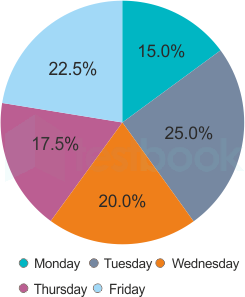
Directions: The given pie chart 1 shows the percentage distribution of the number of persons (Male + Female) visited park in five different days Monday, Tuesday, Wednesday, Thursday and Friday.

Total number of persons (Male + Female) = 1500

Pie chart 2 shows the percentage distribution of the number of males visiting the park on five different days Monday, Tuesday, Wednesday, Thursday and Friday.

Total number of males visiting park = 800


On Monday the number of males visited park in FN is 3/5 th out of total males visited and the rest of remaining visited AN. If the number of males visited FN have two wheelers and half of the males visited AN have four wheelers and remaining have two wheelers. Find the number of males having two wheelers visited on Monday. 

  1. AOption (a)

    84

  2. BOption (b)

    92

  3. COption (c)

    96

  4. DOption (d)

    98

  5. EOption (e)

    102

View answer & explanation

Correct answer

Answer: (c)C.

96

Why this answer is correct

General solution:


Monday:

Number of (males + females) visiting park = 1500 ×  (18/100) = 270

Number of males visiting parks = 800 ×  (15/100) = 120

Number of females visiting parks = (270 - 120) = 150


Tuesday:

Number of (males + females) visiting park = 1500 ×  (22/100) = 330

Number of males visiting parks = 800 ×  (25/100) = 200

Number of females visiting parks = (330 - 200) = 130


Wednesday:

Number of (males + females) visiting park = 1500 ×  (24/100) = 360

Number of males visiting parks = 800 ×  (20/100) = 160

Number of females visiting parks = (360 - 160) = 200


Thursday:

Number of (males + females) visiting park = 1500 ×  (16/100) = 240

Number of males visiting parks = 800 ×  (17.5/100) = 140

Number of females visiting parks = (240 - 140) = 100


Friday:

Number of (males + females) visiting park = 1500 ×  (20/100) = 300

Number of males visiting parks = 800 ×  (22.5/100) = 180

Number of females visiting parks = (300 - 180) = 120


DaysNumber of males visiting parkNumber of females visiting park
Monday120150
Tuesday200130
Wednesday160200
Thursday140100
Friday180120

Solution:

Number of males visited park in FN on Monday = 120 ×  3/5 = 72

Number of males visited park in AN on Monday = 120 - 72 = 48

Number of males having four wheelers AN on Monday = 48/2 = 24

Total having two wheelers visiting on Monday = (72 + 24) = 96

SBI PO Prelims Memory Based Paper (Held On: 1 November 2023 Shift 3) (Previous Year Paper)·Quantitative Aptitude
View full paper

Question 717

SBI Probationary Officer (PO) 2023• Quantitative Aptitude• Quantitative Aptitude

Directions: The given pie chart 1 shows the percentage distribution of the number of persons (Male + Female) visited park in five different days Monday, Tuesday, Wednesday, Thursday and Friday.

Total number of persons (Male + Female) = 1500

Pie chart 2 shows the percentage distribution of the number of males visiting the park on five different days Monday, Tuesday, Wednesday, Thursday and Friday.

Total number of males visiting park = 800


Number of females visited park on Saturday is 20% more than the number of females visited park on Monday. Out of total visited females on saturday 3/5 th of them are married then find the number of unmarried females visited park on saturday is what percentage of the total visited females on all five days.

  1. AOption (a)

    13.89%

  2. BOption (b)

    12.34%

  3. COption (c)

    15.64%

  4. DOption (d)

    10.28%

  5. EOption (e)

    21.89%

View answer & explanation

Correct answer

Answer: (d)D.

10.28%

Why this answer is correct

General solution:


Monday:

Number of (males + females) visiting park = 1500 ×  (18/100) = 270

Number of males visiting parks = 800 ×  (15/100) = 120

Number of females visiting parks = (270 - 120) = 150


Tuesday:

Number of (males + females) visiting park = 1500 ×  (22/100) = 330

Number of males visiting parks = 800 ×  (25/100) = 200

Number of females visiting parks = (330 - 200) = 130


Wednesday:

Number of (males + females) visiting park = 1500 ×  (24/100) = 360

Number of males visiting parks = 800 ×  (20/100) = 160

Number of females visiting parks = (360 - 160) = 200


Thursday:

Number of (males + females) visiting park = 1500 ×  (16/100) = 240

Number of males visiting parks = 800 ×  (17.5/100) = 140

Number of females visiting parks = (240 - 140) = 100


Friday:

Number of (males + females) visiting park = 1500 ×  (20/100) = 300

Number of males visiting parks = 800 ×  (22.5/100) = 180

Number of females visiting parks = (300 - 180) = 120


DaysNumber of males visiting parkNumber of females visiting park
Monday120150
Tuesday200130
Wednesday160200
Thursday140100
Friday180120

Solution:

Number of females visited park on Monday = 150

Number of females visited park on Saturday = 150 ×  (120/100) = 180

Number of married females visiting park on saturday = 180 ×  (3/5) = 108

Number of unmarried females = (180 - 108) = 72

Required percentage = 72/(700) ×  100 = 10.28%

SBI PO Prelims Memory Based Paper (Held On: 1 November 2023 Shift 3) (Previous Year Paper)·Quantitative Aptitude
View full paper

Question 718

SBI Probationary Officer (PO) 2023• Quantitative Aptitude• Quantitative Aptitude

Directions: The given pie chart 1 shows the percentage distribution of the number of persons (Male + Female) visited park in five different days Monday, Tuesday, Wednesday, Thursday and Friday.

Total number of persons (Male + Female) = 1500

Pie chart 2 shows the percentage distribution of the number of males visiting the park on five different days Monday, Tuesday, Wednesday, Thursday and Friday.

Total number of males visiting park = 800


 Find the difference between the number of males visited the park on Tuesday and Thursday and the number of female visited on Monday and Wednesday.

  1. AOption (a)

    30

  2. BOption (b)

    25

  3. COption (c)

    10

  4. DOption (d)

    15

  5. EOption (e)

    20

View answer & explanation

Correct answer

Answer: (c)C.

10

Why this answer is correct

General solution:


Monday:

Number of (males + females) visiting park = 1500 ×  (18/100) = 270

Number of males visiting parks = 800 ×  (15/100) = 120

Number of females visiting parks = (270 - 120) = 150


Tuesday:

Number of (males + females) visiting park = 1500 ×  (22/100) = 330

Number of males visiting parks = 800 ×  (25/100) = 200

Number of females visiting parks = (330 - 200) = 130


Wednesday:

Number of (males + females) visiting park = 1500 ×  (24/100) = 360

Number of males visiting parks = 800 ×  (20/100) = 160

Number of females visiting parks = (360 - 160) = 200


Thursday:

Number of (males + females) visiting park = 1500 ×  (16/100) = 240

Number of males visiting parks = 800 ×  (17.5/100) = 140

Number of females visiting parks = (240 - 140) = 100


Friday:

Number of (males + females) visiting park = 1500 ×  (20/100) = 300

Number of males visiting parks = 800 ×  (22.5/100) = 180

Number of females visiting parks = (300 - 180) = 120


DaysNumber of males visiting parkNumber of females visiting park
Monday120150
Tuesday200130
Wednesday160200
Thursday140100
Friday180120


Solution:

Number of males visited park on Tuesday = 200

Number of males visited park on Thursday = 140

Number of females visited park on Monday = 150

Number of females visited park on Wednesday = 200

Required difference = (350 - 340) = 10

SBI PO Prelims Memory Based Paper (Held On: 1 November 2023 Shift 3) (Previous Year Paper)·Quantitative Aptitude
View full paper

Question 719

SBI Probationary Officer (PO) 2023• Quantitative Aptitude• Quantitative Aptitude

Directions: The given pie chart 1 shows the percentage distribution of the number of persons (Male + Female) visited park in five different days Monday, Tuesday, Wednesday, Thursday and Friday.

Total number of persons (Male + Female) = 1500

Pie chart 2 shows the percentage distribution of the number of males visiting the park on five different days Monday, Tuesday, Wednesday, Thursday and Friday.

Total number of males visiting park = 800


If 1/3rd and 2/3rd of males visiting parks on Monday and Friday are below 30, the rest of them are above 30. If the total number of persons (Male + Female) whose age is above 30 visiting parks is 250. Find total females visiting the park age above 30.

  1. AOption (a)

    140

  2. BOption (b)

    130

  3. COption (c)

    120

  4. DOption (d)

    90

  5. EOption (e)

    110

View answer & explanation

Correct answer

Answer: (e)E.

110

Why this answer is correct

General solution:


Monday:

Number of (males + females) visiting park = 1500 ×  (18/100) = 270

Number of males visiting parks = 800 ×  (15/100) = 120

Number of females visiting parks = (270 - 120) = 150


Tuesday:

Number of (males + females) visiting park = 1500 ×  (22/100) = 330

Number of males visiting parks = 800 ×  (25/100) = 200

Number of females visiting parks = (330 - 200) = 130


Wednesday:

Number of (males + females) visiting park = 1500 ×  (24/100) = 360

Number of males visiting parks = 800 ×  (20/100) = 160

Number of females visiting parks = (360 - 160) = 200


Thursday:

Number of (males + females) visiting park = 1500 ×  (16/100) = 240

Number of males visiting parks = 800 ×  (17.5/100) = 140

Number of females visiting parks = (240 - 140) = 100


Friday:

Number of (males + females) visiting park = 1500 ×  (20/100) = 300

Number of males visiting parks = 800 ×  (22.5/100) = 180

Number of females visiting parks = (300 - 180) = 120


DaysNumber of males visiting parkNumber of females visiting park
Monday120150
Tuesday200130
Wednesday160200
Thursday140100
Friday180120

Solution:

Number of males visiting park below 30 = 120/3 = 40

Number of males visiting park above 30 = (120 - 40) = 80

Number of males visiting park below 30 = 180 ×  2/3 = 120 

Number of males visiting park above 30 = (180 - 120) = 60

Number of females visiting above = (250 - 140) = 110

SBI PO Prelims Memory Based Paper (Held On: 1 November 2023 Shift 3) (Previous Year Paper)·Quantitative Aptitude
View full paper

Question 720

SBI Probationary Officer (PO) 2023• Quantitative Aptitude• Quantitative Aptitude

Directions: The given pie chart 1 shows the percentage distribution of the number of persons (Male + Female) visited park in five different days Monday, Tuesday, Wednesday, Thursday and Friday.

Total number of persons (Male + Female) = 1500

Pie chart 2 shows the percentage distribution of the number of males visiting the park on five different days Monday, Tuesday, Wednesday, Thursday and Friday.

Total number of males visiting park = 800


Find the ratio between the number of males visiting the park on Tuesday and Wednesday to the number of females visiting the park on Thursday and Friday.

  1. AOption (a)

    12: 17

  2. BOption (b)

    13: 19

  3. COption (c)

    13: 11

  4. DOption (d)

    15: 17

  5. EOption (e)

    18: 11

View answer & explanation

Correct answer

Answer: (e)E.

18: 11

Why this answer is correct

solution:


Monday:

Number of (males + females) visiting park = 1500 ×  (18/100) = 270

Number of males visiting parks = 800 ×  (15/100) = 120

Number of females visiting parks = (270 - 120) = 150


Tuesday:

Number of (males + females) visiting park = 1500 ×  (22/100) = 330

Number of males visiting parks = 800 ×  (25/100) = 200

Number of females visiting parks = (330 - 200) = 130


Wednesday:

Number of (males + females) visiting park = 1500 ×  (24/100) = 360

Number of males visiting parks = 800 ×  (20/100) = 160

Number of females visiting parks = (360 - 160) = 200


Thursday:

Number of (males + females) visiting park = 1500 ×  (16/100) = 240

Number of males visiting parks = 800 ×  (17.5/100) = 140

Number of females visiting parks = (240 - 140) = 100


Friday:

Number of (males + females) visiting park = 1500 ×  (20/100) = 300

Number of males visiting parks = 800 ×  (22.5/100) = 180

Number of females visiting parks = (300 - 180) = 120


DaysNumber of males visiting parkNumber of females visiting park
Monday120150
Tuesday200130
Wednesday160200
Thursday140100
Friday180120

Solution:

Number of males visiting park on Tuesday = 200

Number of males visiting park on Wednesday = 160

Number of females visiting park on Thursday = 100

Number of females visiting park on Friday = 120

Required ratio = (200 + 160): (100 + 120) = 360: 220 = 18: 11

How should I prepare for Quantitative Aptitude in SBI Probationary Officer (PO)?

Solving previous year questions by topic helps identify recurring concepts, question patterns, and frequently asked sub-topics. Attempt each question, review the step-by-step explanation, and note down key formulas or facts for quick revision before the exam.