Previous Year Paper

SBI PO Prelims Memory Based Paper (Held On: 1 November 2023 Shift 3) (Previous Year Paper)

Held in 2023

100 questions60 minutes
With answers
Free

Paper last updated:

Practise under exam conditions

Take this paper as a timed mock test. Review your answers after you submit.

Attempt timed test

Questions & answers

Read the paper at your pace. Open an explanation when you need it.

English Language (30 questions)

Question 1

Directions

Each of the following sentences has a blank space and five words are given below. Click on the word you consider the most APPROPRIATE to fit the blank.

A special team was formed to _______ the lost fisherman who was stranded on the freezing lake after dark.

  1. AOption (a)

    Rescue

  2. BOption (b)

    Unpleasant

  3. COption (c)

    Meditate

  4. DOption (d)

    Speculate

  5. EOption (e)

    Revenue

View answer & explanation

Correct answer

Answer: (a)A.

Rescue

Why this answer is correct

The correct answer is 'Rescue.'

Key Points

  • The given sentence talks about a special team that was formed to save the lost fisherman who was trapped in the freezing lake after dark.
  • Therefore, the most appropriate word to be filled in the blank is 'Rescue'.
  • Also, the use of the word ''stranded'' in the sentence indicates the use of the word 'rescue' in the blank.
  • The word 'Rescue' means To save someone or something from a dangerous situation. (व्‍यकि्त या वस्‍तु को बचाना या का उद्घार करना)
  • Example: Firefighters were able to rescue all of the building’s residents but could not save a few of the pets.

Hence, the correct answer is option 1.

Complete Sentence: A special team was formed to rescue the lost fisherman who was stranded on the freezing lake after dark.

Additional Information

  • Let us explore the other options:
  • Unpleasant means Causing you to have a bad feeling; not nice. (अप्रीतिकर कटु भाव उत्‍पन्‍न करने वाला; अरुचिकर)
  • Meditate means To think carefully and deeply, especially for religious reasons or to make your mind calm. (ध्‍यानपूर्वक और गहराई से चिंतन करना, ध्‍यान लगाना)
  • Speculate means To guess something. (कुछ अनुमान लगाना; अटकल लगाना)
  • Revenue means The money generated from normal business operations, calculated as the average sales price times the number of units sold. (आय)

Question 2

Directions

Each of the following sentences has a blank space and five words are given below. Click on the word you consider the most APPROPRIATE to fit the blank.

If the media continues to _______ young black men as thugs and gangsters, the stereotype will continue to persist in society.

  1. AOption (a)
    Betray

  2. BOption (b)

    Deceive

  3. COption (c)

    Portray

  4. DOption (d)

    Request

  5. EOption (e)

    Console

View answer & explanation

Correct answer

Answer: (c)C.

Portray

Why this answer is correct

The correct answer is 'Portray.'

Key Points

  • The given sentence says if the media continues to characterize or describe young black men as thugs and gangsters, the standard image of such men will continue to exist in society.
  • Therefore, the most appropriate word to be filled in the blank is 'Portray'.
  • Also, the use of the word ''media'' in the sentence indicates the use of the word 'portray' in the blank.
  • The word 'Portray' means To describe somebody or something in a particular way. (किसी का विशेष प्रकार से वर्णन या चित्रण करना)
  • Example: The media is going to portray the killer as a victim of society’s avoidance of mental health issues.

Hence, the correct answer is option 3.

Complete Sentence: If the media continues to portray young black men as thugs and gangsters, the stereotype will continue to persist in society.

Additional Information

  • Let us explore the other options:
  • Betray means To hurt somebody who trusts you, especially by not being loyal or faithful to him or her. (विश्‍वासघात करना, धोखा देना, किसी के विश्‍वास को तोड़ना)
  • Deceive means To try to make somebody believe something that is not true. (बहकाना, भ्रमित करना)
  • Request means An act of asking for something. (किसी बात के लिए अनुरोध या निवेदन; प्रार्थना)
  • Console means To make somebody happier when he/she is very sad or disappointed. (दुःख या निराशा में धैर्य बाँधाना, दिलासा या सांत्‍वना देना)

Question 3

Directions

Each of the following sentences has a blank space and five words are given below. Click on the word you consider the most APPROPRIATE to fit the blank.

The police were able to _______ the woman’s stolen purse after they caught and arrested the thief who had taken it.

  1. AOption (a)

    Prefer

  2. BOption (b)

    Instruct

  3. COption (c)

    Refer

  4. DOption (d)

    Obstruct

  5. EOption (e)

    Recover

View answer & explanation

Correct answer

Answer: (e)E.

Recover

Why this answer is correct

The correct answer is 'Recover.'

Key Points

  • The given sentence is talking about how the police were able to find a woman’s stolen purse.
  • Therefore, the most appropriate word to be filled in the blank is 'Recover'.
  • Also, the use of the word ''stolen'' in the sentence indicates the use of the word 'recover' in the blank.
  • The word 'Recover' means To find or regain possession of something lost or taken. (खोयी हुई वस्‍तु को ढूँढ़ लेना या चोरी गई वस्‍तु को पुनः पा लेना)
  • Example: To recover her lost ID, Richa went to the school office to see if anyone had found it and turned it in.

Hence, the correct answer is option 5.

Complete Sentence: The police were able to recover the woman’s stolen purse after they caught and arrested the thief who had taken it.

Additional Information

  • Let us explore the other options:
  • Prefer means To choose something rather than something else; to like something better. (एक के स्‍थान पर दूसरे को चुनना; किसी वस्‍तु को अधिक पसंद करना)
  • Instruct means To give an order to somebody; to tell somebody to do something. (किसी व्‍यक्ति को आदेश देना; कुछ करने का निर्देश देना)
  • Refer means To mention or talk about somebody or something. (व्‍यक्ति या वस्‍तु के विषय में उल्‍लेख या चर्चा करना)
  • Obstruct means To stop something from happening or somebody or something from moving, either by accident or deliberately. (किसी के काम में अड़चन डालना या रुकावट पैदा करना)

Question 4

Directions

Select the most appropriate word to fill in the blank.**

The manager urged the team to avoid ________ evaluations and strive for thoroughness.

  1. AOption (a)

    cursory

  2. BOption (b)

    foolishness

  3. COption (c)

    precise

  4. DOption (d)

    attentive

  5. EOption (e)

    thorough

View answer & explanation

Correct answer

Answer: (a)A.

cursory

Why this answer is correct

The correct answer is 'cursory'.

Key Points

  • The given sentence talks about the manager urging his team to avoid mistakes and ensure thorough evaluations.
  • Therefore, the most appropriate word for the given blank would be 'cursory'.
  • 'Cursory' means something done hastily with minimal attention to detail. (सतही, स्पष्ट नहीं)
  • Example: Given the time constraints, she gave the report only a cursory glance.
  • Hence, the correct answer is 'Option 1'.

The complete sentence would be: The manager urged the team to avoid cursory evaluations and strive for thoroughness.

Additional Information Let's understand the meaning of the other given options:

  • Foolishness: Lack of good sense or judgment; acting without wisdom or prudence. (मूर्खता, अबुद्धिमत्ता)
  • Precise: Clearly expressed and accurate; exact in detail; definite or specific. (सटीक, निश्चित)
  • Attentive: Paying close attention; observant, considerate, and thoughtful. (सतर्क, ध्यानी)
  • Thorough: Exhaustive, complete, or detailed; covering all aspects; careful and comprehensive. (पूरा, विस्तृत)

Question 5

Directions

The given sentence is divided into four parts that are A, B, C, and D. Choose the part that contains an error as your answer. If the sentence is error-free, mark E i.e. No error as your answer.**

Everyone at the meeting (A) were surprised (B) when the CEO announced (C) his retirement. (D) No error (E)

  1. AOption (a)

    A

  2. BOption (b)

    B

  3. COption (c)

    C

  4. DOption (d)

    D

  5. EOption (e)

    E

View answer & explanation

Correct answer

Answer: (b)B.

B

Why this answer is correct

The correct answer is option 2. 

Key Points

  • "Everyone" is a singular subject and should be paired with a singular verb.
  • Thus, 'were' should be replaced with 'was' to be grammatically correct.

Additional Information

  • Subject-Verb Agreement In English, the form of the verb must match the form of the subject in terms of number (singular or plural) and person (first, second, or third). A singular subject should be paired with a singular verb, and a plural subject should be paired with a plural verb.
  • In the third sentence, "Everyone at the meeting were surprised," the subject "everyone" is actually singular, even though it refers to a group of people. It should therefore be paired with the singular form of the verb "to be." The correct phrase is "Everyone was surprised," not "Everyone were surprised." This stresses the importance of ensuring proper subject-verb agreement, regardless of whether the semantic meaning of a subject seems to suggest a group.

Question 6

Directions

The given sentence is divided into four parts that are A, B, C, and D. Choose the part that contains an error as your answer. If the sentence is error-free, mark E i.e. No error as your answer.**

Running through the park (A), a squirrel caught my attention (B) as it was darting up a tree (C) in search of its nest (D). No Error (E)

  1. AOption (a)

    A

  2. BOption (b)

    D

  3. COption (c)

    C

  4. DOption (d)

    B

  5. EOption (e)

    E

View answer & explanation

Correct answer

Answer: (a)A.

A

Why this answer is correct

The correct answer is Option 1.


Key Points

  • The error lies in part A because the introductory participial phrase "Running through the park" creates a dangling modifier.
  • A participial phrase should clearly modify the person or thing performing the action.
  • Here, the phrase incorrectly appears to modify "a squirrel", whereas the intended doer of the action is the narrator ("I").
  • Thus, the error originates from the introductory phrase in part A, making it the correct answer.

Therefore, the correct answer is A.


Correct Sentence: "While I was running through the park, a squirrel caught my attention as it was darting up a tree in search of its nest."


Additional Information

  • B: "a squirrel caught my attention" – This clause is grammatically correct and does not require any change.
  • C: "as it was darting up a tree" – This part correctly describes the squirrel's action.
  • D: "in search of its nest" – This phrase is grammatically correct and appropriately modifies the verb "darting."
  • No Error – This option is incorrect because the sentence contains a dangling modifier in part A.

Question 7

Directions

The given sentence is divided into four parts that are A, B, C, and D. Choose the part that contains an error as your answer. If the sentence is error-free, mark E i.e. 'No error' as your answer.**

As it is to be superior than (A) static graphics, animation is (B) being increasingly employed in (C) technology-based learning resources. (D) No error (E)

  1. AOption (a)

    A

  2. BOption (b)

    B

  3. COption (c)

    C

  4. DOption (d)

    D

  5. EOption (e)

    E

View answer & explanation

Correct answer

Answer: (a)A.

A

Why this answer is correct

The correct answer is option 1.

Key Points

Part A of the sentence i.e. 'As it is to be superior than' is erroneous.

  • Here, the preposition 'than' used after the adjective 'superior' is incorrect and it should be replaced with the preposition 'to'.
  • As per English Grammar rules, the adjectives inferior, superior, senior, junior, prior etc. take the preposition 'to' not 'than'.
  • For Example -
  • The air hostess asked all the passengers to fasten their seat belts prior to descent.
  • You can give this task to someone junior to you.
  • Hence, the correct answer is A.
  • The correct sentence would be - As it is to be superior to static graphics, animation is being increasingly employed in technology-based learning resources.

​

Additional Information

Let's understand the use of the prepositions 'to' and 'than' - 

To - 

  • It is used to indicate the place, person, or thing that someone or something moves toward, or the direction of something.
  • For Example -
  • We went to the shopping mall.
  • It is used to indicate a limit or an ending point.
  • For Example -
  • The clothes were piled up to the roof in the cupboard.
  • It is used to indicate the relationship between two things.
  • For Example -
  • Your time is very important to us.
  • It is also used to indicate a time or a period.
  • For Example -
  • I work from nine to five on weekdays.


Than - 

  • It is used used for comparing and to introduce the second part of a comparison.
  • For Example -
  • I like cake more than pie.

Question 8

Directions

The following sentence has been split into five segments. Identify the segment that contains a grammatical error. If there is no error, mark 'No error' as your answer.

Most investors would (A)/agree that there is (B)/no silver bullet (C)/for valuation companies.(D)/No error.(E)

  1. AOption (a)

    A

  2. BOption (b)

    B

  3. COption (c)

    C

  4. DOption (d)

    D

  5. EOption (e)

    E

View answer & explanation

Correct answer

Answer: (d)D.

D

Why this answer is correct

The correct answer is 'D'.

Key Points 

  • There is an error in Part D of the given sentence.
  • The word 'valuation' should be replaced by the v+ing form 'valuing'.
  • 'Valuation' is a noun but here we need a verb+ ing form because 'for' is used before that.
  • The idiom 'silver bullet' means a simple and seemingly magical solution to a complicated problem.
  • Hence, as per the context of the given sentence 'valuing' should be there in place of 'valuation'.
  • valuing means estimating the monetary worth of.
  • Example:- "his estate was valued at £45,000"
  • Correct sentence:- Most investors would agree that there is no silver bullet for valuing companies.

Hence, option 4 is the correct answer.

Additional Information

  • For -
  • It is used to indicate the use of something.
  • For Example -
  • You can use detergent for washing your dirty clothes.

Question 9

Directions

The following sentence has been split into five segments. Identify the segment that contains a grammatical error. If there is no error, mark 'No error' as your answer.

Technical innovation in India's (A)/ renewable energy policy (B)/ is deepening a high (C)/ uneven energy landscape (D)/No error. (E)

  1. AOption (a)

    A

  2. BOption (b)

    B

  3. COption (c)

    C

  4. DOption (d)

    D

  5. EOption (e)

    E

View answer & explanation

Correct answer

Answer: (c)C.

C

Why this answer is correct

The correct answer is 'C'.

Key Points 

  • There is an error in Part C of the given sentence.
  • The word 'high' should be replaced by the adjective 'highly'.
  • 'uneven energy landscape' is a complete noun in Part D.
  • 'uneven' is an adjective.
  • The word that gives more information about adjectives is an adverb.
  • Adverb should be there in the place of 'high'.
  • 'highly' is an adverb which means at or to a high degree or level. 
  • ​Example:- "a highly dangerous substance"
  • Correct sentence:- Technical innovation in India's renewable energy policy is deepening a highly uneven energy landscape

Hence, option 3 is the correct answer.

Directions: The following sentences form a paragraph. The rest of the sentences are marked as A, B, C, D, E and F. Sentence 'C' is in the correct place. The rest of the sentences are not given in their proper order. Read the sentences and answer the following questions.

A. Artificial Intelligence refers to the intelligence of machines.

B. Most noteworthy, Artificial Intelligence is the simulation of human intelligence by machines.

C. With Artificial Intelligence, machines perform functions such as learning, planning, reasoning and problem-solving.

D. Furthermore, many experts believe AI could solve major challenges and crisis situations.

E. This is in contrast to the natural intelligence of humans and animals.

F. It is probably the fastest-growing development in the World of technology and innovation.

Question 10

Based on Passage: View directions & passage

Which sentence should be the SECOND sentence in the paragraph?

  1. AOption (a)

    D

  2. BOption (b)

    A

  3. COption (c)

    F

  4. DOption (d)

    E

  5. EOption (e)

    B

View answer & explanation

Correct answer

Answer: (d)D.

E

Why this answer is correct

The correct answer is E.

Key Points

  • The given paragraph is about Artificial Intelligence (AI).
  • Sentence A is the first sentence as it introduces the topic of the paragraph 'Artificial Intelligence', the intelligence of machines.
  • Sentence E is the second sentence as it further explains that Artificial Intelligence is in disparity with the natural intelligence of humans and animals.
  • Sentence C is in the correct place and it's the third sentence as it explains different major functions of machines with AI.
  • Sentence B is the fourth sentence as it talks about the most interesting or significant Artificial Intelligence i.e. the simulation of human intelligence by machines.
  • Sentence F is the fifth sentence as it talks about the growth in the use of Artificial Intelligence all around the world.
  • Sentence D is the sixth sentence as it concludes the paragraph by saying that AI could be useful in solving major challenges and crisis situations.
  • The correct sequence is AECBFD.

Correct Paragraph: Artificial Intelligence refers to the intelligence of machines. This is in contrast to the natural intelligence of humans and animals. With Artificial Intelligence, machines perform functions such as learning, planning, reasoning and problem-solving. Most noteworthy, Artificial Intelligence is the simulation of human intelligence by machines. It is probably the fastest-growing development in the World of technology and innovation. Furthermore, many experts believe AI could solve major challenges and crisis situations.

Question 11

Based on Passage: View directions & passage

Which sentence should be the FOURTH sentence in the paragraph?

  1. AOption (a)

    F

  2. BOption (b)

    A

  3. COption (c)

    B

  4. DOption (d)

    D

  5. EOption (e)

    E

View answer & explanation

Correct answer

Answer: (c)C.

B

Why this answer is correct

The correct answer is B.

Key Points

  • The given paragraph is about Artificial Intelligence (AI).
  • Sentence A is the first sentence as it introduces the topic of the paragraph 'Artificial Intelligence', the intelligence of machines.
  • Sentence E is the second sentence as it further explains that Artificial Intelligence is in disparity with the natural intelligence of humans and animals.
  • Sentence C is in the correct place and it's the third sentence as it explains different major functions of machines with AI.
  • Sentence B is the fourth sentence as it talks about the most interesting or significant Artificial Intelligence i.e. the simulation of human intelligence by machines.
  • Sentence F is the fifth sentence as it talks about the growth in the use of Artificial Intelligence all around the world.
  • Sentence D is the sixth sentence as it concludes the paragraph by saying that AI could be useful in solving major challenges and crisis situations.
  • The correct sequence is AECBFD.

Correct Paragraph: Artificial Intelligence refers to the intelligence of machines. This is in contrast to the natural intelligence of humans and animals. With Artificial Intelligence, machines perform functions such as learning, planning, reasoning and problem-solving. Most noteworthy, Artificial Intelligence is the simulation of human intelligence by machines. It is probably the fastest-growing development in the World of technology and innovation. Furthermore, many experts believe AI could solve major challenges and crisis situations.

Question 12

Based on Passage: View directions & passage

Which sentence should be the SIXTH sentence in the paragraph?

  1. AOption (a)

    D

  2. BOption (b)

    E

  3. COption (c)

    F

  4. DOption (d)

    B

  5. EOption (e)

    A

View answer & explanation

Correct answer

Answer: (a)A.

D

Why this answer is correct

The correct answer is D.

Key Points

  • The given paragraph is about Artificial Intelligence (AI).
  • Sentence A is the first sentence as it introduces the topic of the paragraph 'Artificial Intelligence', the intelligence of machines.
  • Sentence E is the second sentence as it further explains that Artificial Intelligence is in disparity with the natural intelligence of humans and animals.
  • Sentence C is in the correct place and it's the third sentence as it explains different major functions of machines with AI.
  • Sentence B is the fourth sentence as it talks about the most interesting or significant Artificial Intelligence i.e. the simulation of human intelligence by machines.
  • Sentence F is the fifth sentence as it talks about the growth in the use of Artificial Intelligence all around the world.
  • Sentence D is the sixth sentence as it concludes the paragraph by saying that AI could be useful in solving major challenges and crisis situations.
  • The correct sequence is AECBFD.

Correct Paragraph: Artificial Intelligence refers to the intelligence of machines. This is in contrast to the natural intelligence of humans and animals. With Artificial Intelligence, machines perform functions such as learning, planning, reasoning and problem-solving. Most noteworthy, Artificial Intelligence is the simulation of human intelligence by machines. It is probably the fastest-growing development in the World of technology and innovation. Furthermore, many experts believe AI could solve major challenges and crisis situations.

Question 13

Based on Passage: View directions & passage

Which sentence should be the FIRST sentence in the paragraph?

  1. AOption (a)

    D

  2. BOption (b)

    A

  3. COption (c)

    B

  4. DOption (d)

    E

  5. EOption (e)

    F

View answer & explanation

Correct answer

Answer: (b)B.

A

Why this answer is correct

The correct answer is A.

Key Points

  • The given paragraph is about Artificial Intelligence (AI).
  • Sentence A is the first sentence as it introduces the topic of the paragraph 'Artificial Intelligence', the intelligence of machines.
  • Sentence E is the second sentence as it further explains that Artificial Intelligence is in disparity with the natural intelligence of humans and animals.
  • Sentence C is in the correct place and it's the third sentence as it explains different major functions of machines with AI.
  • Sentence B is the fourth sentence as it talks about the most interesting or significant Artificial Intelligence i.e. the simulation of human intelligence by machines.
  • Sentence F is the fifth sentence as it talks about the growth in the use of Artificial Intelligence all around the world.
  • Sentence D is the sixth sentence as it concludes the paragraph by saying that AI could be useful in solving major challenges and crisis situations.
  • The correct sequence is AECBFD.

Correct Paragraph: Artificial Intelligence refers to the intelligence of machines. This is in contrast to the natural intelligence of humans and animals. With Artificial Intelligence, machines perform functions such as learning, planning, reasoning and problem-solving. Most noteworthy, Artificial Intelligence is the simulation of human intelligence by machines. It is probably the fastest-growing development in the World of technology and innovation. Furthermore, many experts believe AI could solve major challenges and crisis situations.

Question 14

Based on Passage: View directions & passage

Which sentence should be the FIFTH sentence in the paragraph?

  1. AOption (a)

    E

  2. BOption (b)

    D

  3. COption (c)

    A

  4. DOption (d)

    B

  5. EOption (e)

    F

View answer & explanation

Correct answer

Answer: (e)E.

F

Why this answer is correct

The correct answer is F.

Key Points

  • The given paragraph is about Artificial Intelligence (AI).
  • Sentence A is the first sentence as it introduces the topic of the paragraph 'Artificial Intelligence', the intelligence of machines.
  • Sentence E is the second sentence as it further explains that Artificial Intelligence is in disparity with the natural intelligence of humans and animals.
  • Sentence C is in the correct place and it's the third sentence as it explains different major functions of machines with AI.
  • Sentence B is the fourth sentence as it talks about the most interesting or significant Artificial Intelligence i.e. the simulation of human intelligence by machines.
  • Sentence F is the fifth sentence as it talks about the growth in the use of Artificial Intelligence all around the world.
  • Sentence D is the sixth sentence as it concludes the paragraph by saying that AI could be useful in solving major challenges and crisis situations.
  • The correct sequence is AECBFD.

Correct Paragraph: Artificial Intelligence refers to the intelligence of machines. This is in contrast to the natural intelligence of humans and animals. With Artificial Intelligence, machines perform functions such as learning, planning, reasoning and problem-solving. Most noteworthy, Artificial Intelligence is the simulation of human intelligence by machines. It is probably the fastest-growing development in the World of technology and innovation. Furthermore, many experts believe AI could solve major challenges and crisis situations.

Question 15

Directions

In the following question, the given table has two columns (I and II) containing three phrases each. The phrases are labelled A, B, and C in the first column and P, Q, and R in the second column. A phrase from the first column may or may not connect with a phrase in the second column to make a grammatically and contextually meaningful sentence. Identify the correct option given below that gives the correct sequence in which one or more sentences can be formed. If none of the options make a meaningful sentence, mark 'None of these' as your answer.

Column IColumn II
(A) Sophie was born in France, but shortly thereafter(P) result in a greater reduction in employee numbers than we had.
(B) The recession blindsided a lot of lawyers who had previously(Q) taken for granted their comfortable income.
(C) About 23% of men and women aged 25 to 34 told researchers(R) her family moved to the United States.
  1. AOption (a)

    C-Q and B-P

  2. BOption (b)

    A-Q

  3. COption (c)

    A-R and B-Q

  4. DOption (d)

    C-P

  5. EOption (e)

    None of these

View answer & explanation

Correct answer

Answer: (c)C.

A-R and B-Q

Why this answer is correct

The correct answer is 'A-R and B-Q.'

Key Points

  • From the given options, only the combination of phrases 'A-R and B-Q' creates correct sentences.
  • Let's look at the sentences:
  • 'A-R' talks about Sophie who was born in France, but shortly after that her family moved (स्‍थान बदलना) to the United States.
  • 'Thereafter' means ''after that time''. (उसके बाद; तत्‍पश्‍चात)
  • 'B-Q' talks about the recession (मंदी) that blindsided (अंधा करना) a lot of lawyers who at earlier time had taken for granted (किसी चीज़ या किसी को बहुत हल्के में महत्व देना) their comfortable income.
  • 'Previously' means ''at a previous or earlier time; before''. (पहले, पूर्व में)

Hence, the correct answer is option 3.

Question 16

Directions

In the following question, the given table has two columns (I and II) containing three phrases each. The phrases are labelled A, B, and C in the first column and P, Q, and R in the second column. A phrase from the first column may or may not connect with a phrase in the second column to make a grammatically and contextually meaningful sentence. Identify the correct option given below that gives the correct sequence in which one or more sentences can be formed. If none of the options make a meaningful sentence, mark 'None of these' as your answer.

Column IColumn II
(A) You can hear people fall about laughing(P) conversant with basic scientific principles.
(B) Those in business are not, on the whole,(Q) once in a while to avoid product build-up.
(C) I think you should change your shampoo and conditioner(R) even if you are dieting, you can indulge yourself.
  1. AOption (a)

    B-Q

  2. BOption (b)

    B-P and C-Q

  3. COption (c)

    C-P and A-Q

  4. DOption (d)

    A-R

  5. EOption (e)

    None of these

View answer & explanation

Correct answer

Answer: (b)B.

B-P and C-Q

Why this answer is correct

The correct answer is 'B-P and C-Q.'

Key Points

  • From the given options, only the combination of phrases 'B-P and C-Q' creates correct sentences.
  • Let's look at the sentences:
  • 'B-P' talks about those who in business are not, generally, conversant (जानकार या परिचित) with basic scientific principles.
  • 'On the whole' means ''generally, but not true in every case''. (सामान्‍य रूप से)
  • 'C-Q' talks about someone who is giving advice to the other person to change shampoo and conditioner sometimes to avoid product build-up (समयावधि में हुई वृद्धि).
  • 'Once in a while' means ''sometimes but not often''. (कभी-कभी बार-बार नहीं)

Hence, the correct answer is option 2.

Question 17

Directions

In the following question, the given table has two columns (I and II) containing three phrases each. The phrases are labelled A, B, and C in the first column and P, Q, and R in the second column. A phrase from the first column may or may not connect with a phrase in the second column to make a grammatically and contextually meaningful sentence. Identify the correct option given below that gives the correct sequence in which one or more sentences can be formed. If none of the options make a meaningful sentence, mark 'None of these' as your answer.

Column IColumn II
(A) We suspect they are trying to hide something, hence(P) members of some group within society.
(B) The amount of Business Rate each local authority receives will bear(Q) we suspect they are trying to hide something
(C) He was jailed for 33 months to run concurrently(R) with a sentence he is already serving for burglary.
  1. AOption (a)

    A-P

  2. BOption (b)

    B-Q

  3. COption (c)

    A-Q and B-R

  4. DOption (d)

    C-R

  5. EOption (e)

    None of these

View answer & explanation

Correct answer

Answer: (d)D.

C-R

Why this answer is correct

The correct answer is 'C-R.'

Key Points

  • From the given options, only the combination of phrases 'C-R' creates the correct sentence.
  • Let's look at the sentences:
  • 'C-R' talks about someone who was jailed for 33 months simultaneously with a sentence (न्‍यायाधीश द्वारा अपराधी को दिया गया दंड) he is already serving (जेल में निश्चित अवधि के लिए अपराध की सज़ा काटना) for burglary (चोरी करने के उद्देश्य से गैर-क़ानूनी रूप से किसी इमारत में घुसने का अपराध).
  • 'Concurrently' means ''at the same time; simultaneously''. (समकालिक रूप से)

Hence, the correct answer is option 4.

Question 18

Directions

In the following question, the given table has two columns (I and II) containing three phrases each. The phrases are labelled A, B, and C in the first column and P, Q, and R in the second column. A phrase from the first column may or may not connect with a phrase in the second column to make a grammatically and contextually meaningful sentence. Identify the correct option given below that gives the correct sequence in which one or more sentences can be formed. If none of the options make a meaningful sentence, mark 'None of these' as your answer.

Column IColumn II
(A) Occasionally, primary hyperparathyroidism has been known to(P) evidently just come from the bathroom.
(B) On the contrary, the project will produce valuable reference(Q) with the regular legislative session beginning today.
(C) The man wore a bathrobe and had(R) material and should be lauded for its novelty and foresight.
  1. AOption (a)

    A-Q

  2. BOption (b)

    C-R and A-P

  3. COption (c)

    B-R and C-P

  4. DOption (d)

    C-Q

  5. EOption (e)

    None of these

View answer & explanation

Correct answer

Answer: (c)C.

B-R and C-P

Why this answer is correct

The correct answer is 'B-R and C-P.'

Key Points

  • From the given options, only the combination of phrases 'B-R and C-P' creates correct sentences.
  • Let's look at the sentences:
  • 'B-R' talks about a project that will instead produce valuable reference material and should be lauded (प्रशंसा करना) for its novelty (नयापन) and foresight (दूरदर्शिता).
  • 'On the contrary' means ''the opposite is true; certainly not'' used to intensify a denial of what has just been implied or stated by suggesting that the opposite is the case. (इसके विपरीत; बिलकुल नहीं)
  • 'C-P' talks about a man who wore a bathrobe (नहाने का चोगा) and clearly had just come from the bathroom.
  • 'Evidently' means ''in a way that is clearly seen or understood; obviously''. (स्‍पष्‍ट रूप से; जो आसानी से दिखाई दे या समझ में आए)

Hence, the correct answer is option 3.

Question 19

Direction: Select the phrase from the options below that should replace the underlined phrase in the sentence to make it grammatically and contextually correct. If the sentence is already correct, select 'No correction required' as your answer.

His behaviour with all his employees is so pleasing that everyone come forward for helping him.

  1. AOption (a)

    came towards him for help

  2. BOption (b)

    comes towards him for help

  3. COption (c)

    comes forward to help him

  4. DOption (d)

    comes forward for help him

  5. EOption (e)

    no correction required

View answer & explanation

Correct answer

Answer: (c)C.

comes forward to help him

Why this answer is correct

The correct answer is 'Option 3.'

Key Points

  • The error lies in the verb form used after "everyone." The subject "everyone" requires the singular form of the verb, which is "comes," not "come."
  • "Comes forward" indicates the action of stepping up or volunteering, which aligns with the context of offering help.
  • The infinitive "to help him" properly completes the action, indicating the purpose of coming forward.
  • Hence, the correct phrase is 'comes forward to help him'.

Therefore, the correct answer is 'Option 3'.

Additional Information

  • "came towards him for help": This option uses the past tense "came," which is incorrect because the sentence is in the present tense.
  • "comes towards him for help" maintains the present tense, it doesn't convey the sense of proactive action or volunteering that "comes forward" does.
  • "comes forward for help him": This option has a grammatical error; the preposition "for" is unnecessary and incorrect. It should be "to help him."

Question 20

Direction: Select the phrase from the options below that should replace the underlined phrase in the sentence to make it grammatically and contextually correct. If the sentence is already correct, select 'No correction required' as your answer.

The police commissioner burst into rage and ordered immediately suspension of the inspector.

  1. AOption (a)

    order immediately

  2. BOption (b)

    order immediate

  3. COption (c)

    ordered immediate

  4. DOption (d)

    ordering immediate

  5. EOption (e)

    no correction required

View answer & explanation

Correct answer

Answer: (c)C.

ordered immediate

Why this answer is correct

The correct answer is 'Option 3'.

Key Points

  • The error lies in the placement and form of the adjective "immediate" modifying "suspension."
  • "Immediate" should be used before the noun it modifies, so it should be "immediate suspension."
  • The verb "ordered" needs to agree in past tense with the rest of the sentence.
  • Hence, the correct phrase is 'ordered immediate'.

Therefore, the correct answer is 'Option 3.'

Additional Information

  • "order immediately": This option changes the structure of the sentence. "Order immediately suspension" is not grammatically correct because "immediately" should be modifying "suspension," not "order."
  • "order immediate": Similar to the previous option, "order immediate suspension" is grammatically incorrect. It lacks the past tense form of the verb "ordered" and also doesn't include "the" before "immediate suspension."
  • "ordering immediate": This option changes the verb tense to present participle form, which is not suitable in this context

Question 21

Directions

Select the phrase from the options below that should replace the underlined phrase in the sentence to make it grammatically and contextually correct. If the sentence is already correct, select 'No correction required' as your answer.**

Sub-zero temperatures throughout most of the Europe is increasing demand for gas, and several governments have issued calls for conservation.

  1. AOption (a)

    most of Europe were increased

  2. BOption (b)

    most of Europe are increasing

  3. COption (c)

    much of the Europe is increasing

  4. DOption (d)

    much of Europe have been increasing

  5. EOption (e)

    No correction required

View answer & explanation

Correct answer

Answer: (b)B.

most of Europe are increasing

Why this answer is correct

The correct answer is "Option 2".

Key Points

  • The correct phrase to be substituted in the above sentence is "most of Europe are increasing".
  • The given sentence is in the present tense.
  • The subject is "Sub-zero temperatures" (Plural Subject), so a plural verb will be used.
  • Hence, "most of Europe are increasing" is the correct phrase to be substituted.

Therefore, the correct answer is "Option 2".

Correct Sentence: "Sub-zero temperatures throughout most of Europe are increasing demand for gas, and several governments have issued calls for conservation."

Additional Information

  • "most of Europe were increased" is incorrect because it uses the past tense "were increased,".
  • "much of the Europe is increasing" is incorrect because it includes an unnecessary article "the" before "Europe," and it also uses "much of" instead of "most of."
  • "much of Europe have been increasing" is incorrect because it uses "much of" instead of "most of."

Directions: Read the given passage carefully to answer the following questions. Each question will have five alternatives as its answer. Choose the correct option as your answer.

In the evolving landscape of financial education, a new category of educators has emerged—financial advisory influencers. These individuals leverage social media platforms to disseminate knowledge and advice on various financial topics. Their expertise ranges from basic budgeting techniques to complex investment strategies, making finance more accessible to the general populace.

The influence of these financial gurus is substantial. They simplify the esoteric world of finance, which often seems intimidating to the uninitiated. By breaking down complex concepts into digestible chunks, they empower individuals to make informed decisions about their money. This democratization of financial knowledge is crucial in an era where economic literacy is paramount.

Moreover, financial advisory influencers often tailor their content to cater to diverse audiences. Whether it's a college student looking to manage student loans or a retiree planning their estate, there's something valuable for everyone. Their approachable style and practical advice have garnered them millions of followers who tune in for their insights and tips.

However, the rise of these influencers also presents challenges. The accuracy of the information they provide can vary, and their recommendations might not always be tailored to individual needs. Thus, while they play a pivotal role in financial education, it's essential for consumers to critically evaluate the advice given and consider consulting professional financial advisors for personalized guidance.

In summary, financial advisory influencers have transformed the way financial knowledge is consumed and understood. They serve as a bridge between the complex world of finance and the average person, contributing significantly to financial literacy. Nevertheless, the onus remains on the individual to verify the credibility of the information and adapt it to their personal financial situation.

Question 22

Based on Passage: View directions & passage

What is a synonym for "disseminate" as used in the passage?

  1. AOption (a)

    conceal

  2. BOption (b)

    distribute

  3. COption (c)

    withhold

  4. DOption (d)

    hide

  5. EOption (e)

    cover

View answer & explanation

Correct answer

Answer: (b)B.

distribute

Why this answer is correct

The correct answer is option B.

Key Points

  • To answer this question, let's first understand the meaning of the word "disseminate" in the context of the passage:
  • Disseminate - to spread or distribute information widely (फैलाना)
  • For Example -
  • The organization aims to disseminate health education in rural areas.
  • Now, let's consider the options:
  • Distribute - to give or deliver something to multiple people (वितरण करना)
  • For Example -
  • They distributed free meals to the homeless every Sunday.
  • Conceal, Withhold, Hide, and Cover all imply not spreading or sharing something, which is opposite of disseminating.
  • Therefore, the correct answer is "Distribute," which is synonymous with disseminate as both involve spreading something widely.

Question 23

Based on Passage: View directions & passage

What is a synonym for "empower" as mentioned in the passage?

  1. AOption (a)

    weaken

  2. BOption (b)

    enable

  3. COption (c)

    prevent

  4. DOption (d)

    prohibit

  5. EOption (e)

    disable

View answer & explanation

Correct answer

Answer: (b)B.

enable

Why this answer is correct

The correct answer is option B.

Key Points

  • Let's explore the meaning of "empower" in the context used in the passage:
  • Empower - to give someone the authority or power to do something (अधिकार देना)
  • For Example -
  • Education empowers individuals to make informed decisions about their lives.
  • Now, examining the options:
  • Enable - to make someone able to do something, or to make something possible (सक्षम करना)
  • For Example -
  • Technology enables quicker communication across long distances.
  • Weaken, Prevent, Prohibit, Disable are all terms that reduce power or capability, which are opposite to empowering.
  • Therefore, the correct synonym for empower in this context is "Enable."

Question 24

Based on Passage: View directions & passage

Which of the following statements is true based on the passage?

A) Financial advisory influencers primarily focus on selling their financial products.

B) Financial advisory influencers simplify complex financial concepts for the general public.

C) All financial advisory influencers provide legally binding financial advice

  1. AOption (a)

    Only A

  2. BOption (b)

    Only B

  3. COption (c)

    Only C

  4. DOption (d)

    Both A & B

  5. EOption (e)

    None of the above

View answer & explanation

Correct answer

Answer: (b)B.

Only B

Why this answer is correct

The correct answer is Option 2) Only B

Key Points

  • The passage highlights the role of financial advisory influencers in simplifying complex financial concepts for the general public. Specifically, it mentions that "They simplify the esoteric world of finance, which often seems intimidating to the uninitiated, by breaking down complex concepts into digestible chunks." This approach helps empower individuals to make informed decisions about their finances. Therefore, statement B is true.

Additional Information

  • Statement A is incorrect as the passage does not suggest that financial advisory influencers primarily focus on selling their products. Instead, it describes their role as educators who use social media to make financial knowledge more accessible.
  • Statement C is also inaccurate based on the passage, which notes the importance of consumers critically evaluating the advice since it may not always be tailored to individual needs or legally binding. The influencers' main role is to educate, not to provide formal financial advisement like certified professionals.

Question 25

Based on Passage: View directions & passage

What is the primary role of financial advisory influencers according to the passage?

  1. AOption (a)

    To promote their own financial products.

  2. BOption (b)

    To simplify complex financial concepts for the general public.

  3. COption (c)

    To provide legally binding financial advice.

  4. DOption (d)

     To replace professional financial advisors.

  5. EOption (e)

    To focus solely on wealthy clients.

View answer & explanation

Correct answer

Answer: (b)B.

To simplify complex financial concepts for the general public.

Why this answer is correct

The correct answer is option B.

Key Points

  • To answer this question, refer to the first and second paragraphs of the passage:
  • "These individuals leverage social media platforms to disseminate knowledge and advice on various financial topics. By breaking down complex concepts into digestible chunks, they empower individuals to make informed decisions about their money."
  • From this part of the passage, it's clear that the primary role of financial advisory influencers is to make complex financial information accessible and understandable to the general public, helping them make informed decisions.
  • Therefore, the correct answer is 'To simplify complex financial concepts for the general public.'

Question 26

Based on Passage: View directions & passage

Which of the following is NOT presented as a challenge associated with financial advisory influencers?

  1. AOption (a)

    Variability in the accuracy of the information provided.

  2. BOption (b)

    Their inability to reach a wide audience.

  3. COption (c)

     Their recommendations may not be tailored to individual needs.

  4. DOption (d)

    The potential for consumers to misinterpret the advice.

  5. EOption (e)

    Over-reliance on social media platforms for dissemination.

View answer & explanation

Correct answer

Answer: (b)B.

Their inability to reach a wide audience.

Why this answer is correct

The correct answer is option B.

Key Points

  • Refer to the fourth paragraph of the passage for information on the challenges:
  • "The accuracy of the information they provide can vary, and their recommendations might not always be tailored to individual needs."
  • The passage does not mention an inability to reach a wide audience as a challenge. Instead, it discusses the variability in information accuracy and the lack of tailored recommendations as challenges.
  • Therefore, the correct answer is 'Their inability to reach a wide audience.'

Question 27

Based on Passage: View directions & passage

What is an antonym for "complex" as used in the passage?

  1. AOption (a)

    intricate

  2. BOption (b)

    complicated

  3. COption (c)

    difficult

  4. DOption (d)

    simple

  5. EOption (e)

    convoluted

View answer & explanation

Correct answer

Answer: (d)D.

simple

Why this answer is correct

The correct answer is option D.

Key Points

  • Understanding the word "complex" as used in the passage:
  • Complex - consisting of many different and connected parts; not simple (जटिल)
  • For Example -
  • Quantum physics is a very complex subject.
  • Considering the options:
  • Simple - easily understood or done; presenting no difficulty (सरल)
  • For Example -</

Question 28

Based on Passage: View directions & passage

Based on the passage, why is it crucial for consumers to critically evaluate the advice provided by financial advisory influencers?

  1. AOption (a)

    Because the influencers often charge high fees for their services.

  2. BOption (b)

    Because the influencers' advice can be biased towards certain financial products.

  3. COption (c)

     Because the advice might not always be accurate or suitable for everyone.

  4. DOption (d)

    Because all financial influencers have a background in financial law.

  5. EOption (e)

    Because influencers are legally responsible for the financial outcomes of their followers.

View answer & explanation

Correct answer

Answer: (c)C.

 Because the advice might not always be accurate or suitable for everyone.

Why this answer is correct

The correct answer is option C.

Key Points

  • Refer to the fourth paragraph of the passage where it discusses evaluating advice:
  • "It's essential for consumers to critically evaluate the advice given and consider consulting professional financial advisors for personalized guidance."
  • This indicates that not all advice from influencers may be accurate or suitable for every individual, emphasizing the importance of critical evaluation to ensure it fits their personal financial circumstances.
  • Therefore, the correct answer is 'Because the advice might not always be accurate or suitable for everyone.'

Question 29

In the given sentence a word has been emboldened. Select the best alternative for the bold word from the given options. If none follows, select option 5 as your answer. 

Adrian expected Alyssa to resent him for his actions.

  1. AOption (a)

    Admire

  2. BOption (b)

    Agree

  3. COption (c)

    Dislike

  4. DOption (d)

    Welcome

  5. EOption (e)

    None of these

View answer & explanation

Correct answer

Answer: (c)C.

Dislike

Why this answer is correct

The correct answer is option 3 i.e. dislike.

Key Points

We have to choose the word which is similar to the emboldened word and replace it. 

  • Resent: Feel bitterness towards someone for what they did.
  • Dislike: Feel distaste or not like someone for what they did.

Additional Information

Let's take a look at the meaning and usage of all the words given in the question and options-

  • Admire: Regard someone with respect
  • Agree: To have the same opinion with someone about something
  • Welcome: Gladly receive someone

Therefore, from the given options, the best alternative for the emboldened word is 'dislike'.

Question 30

In the given sentence a word has been emboldened. Select the best alternative for the bold word from the given options. If none follows, select option 5 as your answer. 

Marissa was disappointed by her son's behaviour.

  1. AOption (a)

    Riled up

  2. BOption (b)

    Let down

  3. COption (c)

    Let go

  4. DOption (d)

    Give up

  5. EOption (e)

    None of these

View answer & explanation

Correct answer

Answer: (b)B.

Let down

Why this answer is correct

The correct answer is option 2 i.e. let down.

Explanation:

We have to choose the word which is similar to the emboldened word and can replace it. 

Let's take a look at the meaning and usage of all the words given in the question and options-

  • Disappointed: sad, upset and displeased because something didn't meet one's expectations
  • Riled up: irritated or annoyed
  • Let down: did not meet expectations; disappointed (someone)
  • Let go: allowed someone or something to escape or be free
  • Give up: stop making an effort

Therefore, from the given options, the best alternative for the 'emboldened' word is ‘let down'.

Quantitative Aptitude (35 questions)

Directions: The given pie chart 1 shows the percentage distribution of the number of persons (Male + Female) visited park in five different days Monday, Tuesday, Wednesday, Thursday and Friday.

Total number of persons (Male + Female) = 1500

Pie chart 2 shows the percentage distribution of the number of males visiting the park on five different days Monday, Tuesday, Wednesday, Thursday and Friday.

Total number of males visiting park = 800


Question 31

Based on Passage: View directions & passage

On Monday the number of males visited park in FN is 3/5 th out of total males visited and the rest of remaining visited AN. If the number of males visited FN have two wheelers and half of the males visited AN have four wheelers and remaining have two wheelers. Find the number of males having two wheelers visited on Monday. 

  1. AOption (a)

    84

  2. BOption (b)

    92

  3. COption (c)

    96

  4. DOption (d)

    98

  5. EOption (e)

    102

View answer & explanation

Correct answer

Answer: (c)C.

96

Why this answer is correct

General solution:


Monday:

Number of (males + females) visiting park = 1500 ×  (18/100) = 270

Number of males visiting parks = 800 ×  (15/100) = 120

Number of females visiting parks = (270 - 120) = 150


Tuesday:

Number of (males + females) visiting park = 1500 ×  (22/100) = 330

Number of males visiting parks = 800 ×  (25/100) = 200

Number of females visiting parks = (330 - 200) = 130


Wednesday:

Number of (males + females) visiting park = 1500 ×  (24/100) = 360

Number of males visiting parks = 800 ×  (20/100) = 160

Number of females visiting parks = (360 - 160) = 200


Thursday:

Number of (males + females) visiting park = 1500 ×  (16/100) = 240

Number of males visiting parks = 800 ×  (17.5/100) = 140

Number of females visiting parks = (240 - 140) = 100


Friday:

Number of (males + females) visiting park = 1500 ×  (20/100) = 300

Number of males visiting parks = 800 ×  (22.5/100) = 180

Number of females visiting parks = (300 - 180) = 120


DaysNumber of males visiting parkNumber of females visiting park
Monday120150
Tuesday200130
Wednesday160200
Thursday140100
Friday180120

Solution:

Number of males visited park in FN on Monday = 120 ×  3/5 = 72

Number of males visited park in AN on Monday = 120 - 72 = 48

Number of males having four wheelers AN on Monday = 48/2 = 24

Total having two wheelers visiting on Monday = (72 + 24) = 96

Question 32

Based on Passage: View directions & passage

Number of females visited park on Saturday is 20% more than the number of females visited park on Monday. Out of total visited females on saturday 3/5 th of them are married then find the number of unmarried females visited park on saturday is what percentage of the total visited females on all five days.

  1. AOption (a)

    13.89%

  2. BOption (b)

    12.34%

  3. COption (c)

    15.64%

  4. DOption (d)

    10.28%

  5. EOption (e)

    21.89%

View answer & explanation

Correct answer

Answer: (d)D.

10.28%

Why this answer is correct

General solution:


Monday:

Number of (males + females) visiting park = 1500 ×  (18/100) = 270

Number of males visiting parks = 800 ×  (15/100) = 120

Number of females visiting parks = (270 - 120) = 150


Tuesday:

Number of (males + females) visiting park = 1500 ×  (22/100) = 330

Number of males visiting parks = 800 ×  (25/100) = 200

Number of females visiting parks = (330 - 200) = 130


Wednesday:

Number of (males + females) visiting park = 1500 ×  (24/100) = 360

Number of males visiting parks = 800 ×  (20/100) = 160

Number of females visiting parks = (360 - 160) = 200


Thursday:

Number of (males + females) visiting park = 1500 ×  (16/100) = 240

Number of males visiting parks = 800 ×  (17.5/100) = 140

Number of females visiting parks = (240 - 140) = 100


Friday:

Number of (males + females) visiting park = 1500 ×  (20/100) = 300

Number of males visiting parks = 800 ×  (22.5/100) = 180

Number of females visiting parks = (300 - 180) = 120


DaysNumber of males visiting parkNumber of females visiting park
Monday120150
Tuesday200130
Wednesday160200
Thursday140100
Friday180120

Solution:

Number of females visited park on Monday = 150

Number of females visited park on Saturday = 150 ×  (120/100) = 180

Number of married females visiting park on saturday = 180 ×  (3/5) = 108

Number of unmarried females = (180 - 108) = 72

Required percentage = 72/(700) ×  100 = 10.28%

Question 33

Based on Passage: View directions & passage

 Find the difference between the number of males visited the park on Tuesday and Thursday and the number of female visited on Monday and Wednesday.

  1. AOption (a)

    30

  2. BOption (b)

    25

  3. COption (c)

    10

  4. DOption (d)

    15

  5. EOption (e)

    20

View answer & explanation

Correct answer

Answer: (c)C.

10

Why this answer is correct

General solution:


Monday:

Number of (males + females) visiting park = 1500 ×  (18/100) = 270

Number of males visiting parks = 800 ×  (15/100) = 120

Number of females visiting parks = (270 - 120) = 150


Tuesday:

Number of (males + females) visiting park = 1500 ×  (22/100) = 330

Number of males visiting parks = 800 ×  (25/100) = 200

Number of females visiting parks = (330 - 200) = 130


Wednesday:

Number of (males + females) visiting park = 1500 ×  (24/100) = 360

Number of males visiting parks = 800 ×  (20/100) = 160

Number of females visiting parks = (360 - 160) = 200


Thursday:

Number of (males + females) visiting park = 1500 ×  (16/100) = 240

Number of males visiting parks = 800 ×  (17.5/100) = 140

Number of females visiting parks = (240 - 140) = 100


Friday:

Number of (males + females) visiting park = 1500 ×  (20/100) = 300

Number of males visiting parks = 800 ×  (22.5/100) = 180

Number of females visiting parks = (300 - 180) = 120


DaysNumber of males visiting parkNumber of females visiting park
Monday120150
Tuesday200130
Wednesday160200
Thursday140100
Friday180120


Solution:

Number of males visited park on Tuesday = 200

Number of males visited park on Thursday = 140

Number of females visited park on Monday = 150

Number of females visited park on Wednesday = 200

Required difference = (350 - 340) = 10

Question 34

Based on Passage: View directions & passage

If 1/3rd and 2/3rd of males visiting parks on Monday and Friday are below 30, the rest of them are above 30. If the total number of persons (Male + Female) whose age is above 30 visiting parks is 250. Find total females visiting the park age above 30.

  1. AOption (a)

    140

  2. BOption (b)

    130

  3. COption (c)

    120

  4. DOption (d)

    90

  5. EOption (e)

    110

View answer & explanation

Correct answer

Answer: (e)E.

110

Why this answer is correct

General solution:


Monday:

Number of (males + females) visiting park = 1500 ×  (18/100) = 270

Number of males visiting parks = 800 ×  (15/100) = 120

Number of females visiting parks = (270 - 120) = 150


Tuesday:

Number of (males + females) visiting park = 1500 ×  (22/100) = 330

Number of males visiting parks = 800 ×  (25/100) = 200

Number of females visiting parks = (330 - 200) = 130


Wednesday:

Number of (males + females) visiting park = 1500 ×  (24/100) = 360

Number of males visiting parks = 800 ×  (20/100) = 160

Number of females visiting parks = (360 - 160) = 200


Thursday:

Number of (males + females) visiting park = 1500 ×  (16/100) = 240

Number of males visiting parks = 800 ×  (17.5/100) = 140

Number of females visiting parks = (240 - 140) = 100


Friday:

Number of (males + females) visiting park = 1500 ×  (20/100) = 300

Number of males visiting parks = 800 ×  (22.5/100) = 180

Number of females visiting parks = (300 - 180) = 120


DaysNumber of males visiting parkNumber of females visiting park
Monday120150
Tuesday200130
Wednesday160200
Thursday140100
Friday180120

Solution:

Number of males visiting park below 30 = 120/3 = 40

Number of males visiting park above 30 = (120 - 40) = 80

Number of males visiting park below 30 = 180 ×  2/3 = 120 

Number of males visiting park above 30 = (180 - 120) = 60

Number of females visiting above = (250 - 140) = 110

Question 35

Based on Passage: View directions & passage

Find the ratio between the number of males visiting the park on Tuesday and Wednesday to the number of females visiting the park on Thursday and Friday.

  1. AOption (a)

    12: 17

  2. BOption (b)

    13: 19

  3. COption (c)

    13: 11

  4. DOption (d)

    15: 17

  5. EOption (e)

    18: 11

View answer & explanation

Correct answer

Answer: (e)E.

18: 11

Why this answer is correct

solution:


Monday:

Number of (males + females) visiting park = 1500 ×  (18/100) = 270

Number of males visiting parks = 800 ×  (15/100) = 120

Number of females visiting parks = (270 - 120) = 150


Tuesday:

Number of (males + females) visiting park = 1500 ×  (22/100) = 330

Number of males visiting parks = 800 ×  (25/100) = 200

Number of females visiting parks = (330 - 200) = 130


Wednesday:

Number of (males + females) visiting park = 1500 ×  (24/100) = 360

Number of males visiting parks = 800 ×  (20/100) = 160

Number of females visiting parks = (360 - 160) = 200


Thursday:

Number of (males + females) visiting park = 1500 ×  (16/100) = 240

Number of males visiting parks = 800 ×  (17.5/100) = 140

Number of females visiting parks = (240 - 140) = 100


Friday:

Number of (males + females) visiting park = 1500 ×  (20/100) = 300

Number of males visiting parks = 800 ×  (22.5/100) = 180

Number of females visiting parks = (300 - 180) = 120


DaysNumber of males visiting parkNumber of females visiting park
Monday120150
Tuesday200130
Wednesday160200
Thursday140100
Friday180120

Solution:

Number of males visiting park on Tuesday = 200

Number of males visiting park on Wednesday = 160

Number of females visiting park on Thursday = 100

Number of females visiting park on Friday = 120

Required ratio = (200 + 160): (100 + 120) = 360: 220 = 18: 11

Question 36

The average weight of 20 contestants in a fashion show increased by 5.75 kg when one of the contestants left the show but when a new contestant joined the show then the average weight decreased by 2.75 kg. What is the difference between the weight of the new contestant who joined the show and the contestant who left the show?

  1. AOption (a)

    55.5 kg

  2. BOption (b)

    49.75 kg

  3. COption (c)

    51.5 kg

  4. DOption (d)

    Cannot be determined

  5. EOption (e)

    None of the above

View answer & explanation

Correct answer

Answer: (e)E.

None of the above

Why this answer is correct

Shortcut Trick

Let the initial average weight of 20 contestants be A.

Weight of contestant who left (L) = 20 × A − 19 × (A + 5.75) = A − 109.25

Weight of contestant who joined (J) = 20 × (A + 5.75 − 2.75) − 19 × (A + 5.75) = A − 49.25

Difference (J − L) = (A − 49.25) − (A − 109.25) = 109.25 − 49.25 = 60 kg.

∴ The correct answer is 60 kg.

Alternate Method

Given: Initial count = 20, Change when 1 left = +5.75 kg (on 19 people), Change when 1 joined = −2.75 kg (on 20 people).

⇒ Total initial weight = 20 × A

⇒ Total weight after 1 leaves = 19 × (A + 5.75) = 19A + 109.25

⇒ Weight of contestant who left (L) = 20A − (19A + 109.25) = A − 109.25

⇒ Total weight after new one joins = 20 × (A + 5.75 − 2.75) = 20 × (A + 3) = 20A + 60

⇒ Weight of contestant who joined (J) = (20A + 60) − (19A + 109.25) = A − 49.25

⇒ Difference = J − L = (A − 49.25) − (A − 109.25) = 109.25 − 49.25

⇒ Difference = 60 kg.

∴ The correct answer is 60 kg.

Additional Information

Average weight Change

When a person leaves, New Avg = (Total Sum − Left Weight) ÷ (n − 1). If the average increases, the person who left was lighter than the average.

Joiner Weight Formula

New Weight = Old Avg + (New count × Change in Avg). This helps in calculating the weight of a person entering a group.

Replacement Logic

If one leaves and one joins, New Weight − Old Weight = Total Strength × Total change in average.

Question 37

Mitul goes out to shop on a snowy day. He travels at a speed of a km/hr when it’s snowing and at 'a' speed of (a – 1) km/hr when it stops snowing. If his average speed for the journey is 6.4 km/hr. Find the fraction of the distance which he covered while it was snowing. Given, that 'a' is an integer.

  1. AOption (a)

    7/15

  2. BOption (b)

    7/16

  3. COption (c)

    1/4

  4. DOption (d)

    3/5

  5. EOption (e)

    None of the above

View answer & explanation

Correct answer

Answer: (b)B.

7/16

Why this answer is correct

Shortcut Trick Given average speed = 6.4 km/hr and speed a is an integer. Possible values for a must satisfy (a − 1) < 6.4 < a, so a = 7. Speeds are 7 km/hr (snowing) and 6 km/hr (not snowing). Let x be the fraction of distance covered while snowing: 6.4 = 1 / [x/7 + (1−x)/6]. Solving for x gives 7/16. ∴ The correct answer is 7/16. Alternate Method Given: Average speed = 6.4 km/hr, speeds are a and a − 1, where a is an integer. Formula Used: Average Speed = Total Distance ÷ Total Time ⇒ Since average speed (6.4) must lie between the two speeds: a − 1 < 6.4 < a ⇒ a = 7 km/hr and a − 1 = 6 km/hr ⇒ Let total distance be 1 unit and x be the fraction covered at 7 km/hr. ⇒ 6.4 = 1 ÷ [x/7 + (1 − x)/6] ⇒ 6.4 = 1 ÷ [(6x + 7 − 7x)/42] ⇒ 6.4 = 42 ÷ (7 − x) ⇒ 7 − x = 42 ÷ 6.4 ⇒ 7 − x = 420 ÷ 64 = 105 ÷ 16 ⇒ x = 7 − 105/16 = (112 − 105)/16 ⇒ x = 7/16 ∴ The correct answer is 7/16. Additional Information Average Speed Concept Average speed is the total distance divided by the total time. It always lies between the minimum and maximum speeds of the journey segments. Harmonic Mean If equal distances are covered, average speed is the harmonic mean of speeds: 2v1v2/(v1+v2). Integer Constraint When a value is specified as an integer, use the range of the average to narrow down possible values to the nearest whole numbers.

Question 38

What should come in place of the question mark '?' in the following number series?

12, 5.5, 6.5, 11, ?, 376

  1. AOption (a)

    49

  2. BOption (b)

    48

  3. COption (c)

    42

  4. DOption (d)

    53

  5. EOption (e)

    None of these

View answer & explanation

Correct answer

Answer: (b)B.

48

Why this answer is correct

Calculation:

The series follows the following pattern:

⇒ 12 × 0.5 – 0.5 = 5.5

⇒ 5.5 × 1 + 1 = 6.5

⇒ 6.5 × 2 – 2 = 11

⇒ 11 × 4 + 4 = 48

⇒ 48 × 8 – 8 = 376

∴ The value of ? is 48

Question 39

What should come in place of the question mark '?' in the following number series?

930, 812, 506, ?, 272, 156

  1. AOption (a)

    450

  2. BOption (b)

    342

  3. COption (c)

    225

  4. DOption (d)

    345

  5. EOption (e)

    375

View answer & explanation

Correct answer

Answer: (b)B.

342

Why this answer is correct

GIVEN:

930, 812, 506, ?, 272, 156

Calculation: 

⇒ 930 = 312 - 31

⇒ 812 = 292 - 29

⇒ 506 = 232 - 23

⇒ ? = 342 = 192 - 19

⇒ 272 = 172 - 17

⇒ 156 = 132 - 13

∴ The required value of "?" is 342.

Question 40

What should come in place of the question mark '?' in the following number series?

6000, ?, 3000, 4500, 9000, 22500

  1. AOption (a)

    2000

  2. BOption (b)

    1500

  3. COption (c)

    3500

  4. DOption (d)

    3000

  5. EOption (e)

    2500

View answer & explanation

Correct answer

Answer: (d)D.

3000

Why this answer is correct

Given:

6000, ?, 3000, 4500, 9000, 22500

Calculation:

⇒ 6000 × 0.5 = 3000

⇒ 3000 × 1 = 3000

⇒ 3000 × 1.5 = 4500

⇒ 4500 × 2 = 9000

⇒ 9000 × 2.5 = 22500

∴ ? = 3000

Question 41

What should come in place of the question mark '?' in the following number series?

1512, 1524, 1540, 1563, ?, 1642

  1. AOption (a)

    1525

  2. BOption (b)

    1524

  3. COption (c)

    1528

  4. DOption (d)

    1427

  5. EOption (e)

    1596

View answer & explanation

Correct answer

Answer: (e)E.

1596

Why this answer is correct

Calculation:

1512 + 12 = 1524

1524 + 16 = 1540

1540 + 23 = 1563

1563 + 33 = 1596

1596 + 46 = 1642

∴ ? = 1596

Question 42

What will come in the place of question mark in the following number series ?

290 , ? , 374 , 421 , 474 , 533

  1. AOption (a)

    341

  2. BOption (b)

    331

  3. COption (c)

    351

  4. DOption (d)

    347

  5. EOption (e)

    337

View answer & explanation

Correct answer

Answer: (b)B.

331

Why this answer is correct

Given:

290 , ? , 374 , 421 , 474 , 533 

Calculation:

Here the logic follows as,

The series follows the addition of prime numbers from 41

Then, The second term will be,

= 290 + 41 

= 331

∴\therefore The correct answer is 331.

Question 43

The interest received on a certain sum of money at 20% per annum compounded annually for 2 years is Rs. 4,600 more than compounded half yearly for 1 year. Find the sum of money.

  1. AOption (a)

    Rs. 20,000

  2. BOption (b)

    Rs. 32,000

  3. COption (c)

    Rs. 50,000

  4. DOption (d)

    Rs. 47,000

  5. EOption (e)

    Rs. 40,000

View answer & explanation

Correct answer

Answer: (a)A.

Rs. 20,000

Why this answer is correct

Shortcut Trick

Effective Rate of Interest for 2 years (compounded annually) = 20 + 20 + (20 × 20)/100 = 44%

Effective Rate of Interest for 1 year (compounded half-yearly) = 10 + 10 + (10 × 10)/100 = 21%

Difference in interest rates = 44% − 21% = 23%

23% of Sum = ₹4,600 → 1% = ₹200 → 100% = ₹20,000

∴ The correct answer is Rs. 20,000.

Alternate Method

Given: Rate (R) = 20% p.a., Difference in Interest = ₹4,600

Formula Used: CI = P[(1 + R/100)n − 1]

⇒ Case 1 (Annually, 2 yrs): CI1 = P[(1 + 20/100)2 − 1] = P[(1.2)2 − 1] = 0.44P

⇒ Case 2 (Half-yearly, 1 yr): R = 10%, n = 2; CI2 = P[(1 + 10/100)2 − 1] = P[(1.1)2 − 1] = 0.21P

⇒ Difference = 0.44P − 0.21P = 0.23P

⇒ 0.23P = 4600

⇒ P = 4600 / 0.23 = 20,000

∴ The correct answer is Rs. 20,000.

Additional Information

Effective Rate for Compounding

For two successive cycles of rate r%, the effective rate is [r + r + (r × r)/100]%. This applies to 2 years annually or 1 year half-yearly.

Compounding Half-yearly

When interest is compounded half-yearly, the Annual Rate is halved (R/2) and the Time period is doubled (2n).

Relationship between CI and SI

Difference between CI and SI for 2 years is P(R/100)2. For 1 year, CI and SI are equal if compounded annually.

Question 44

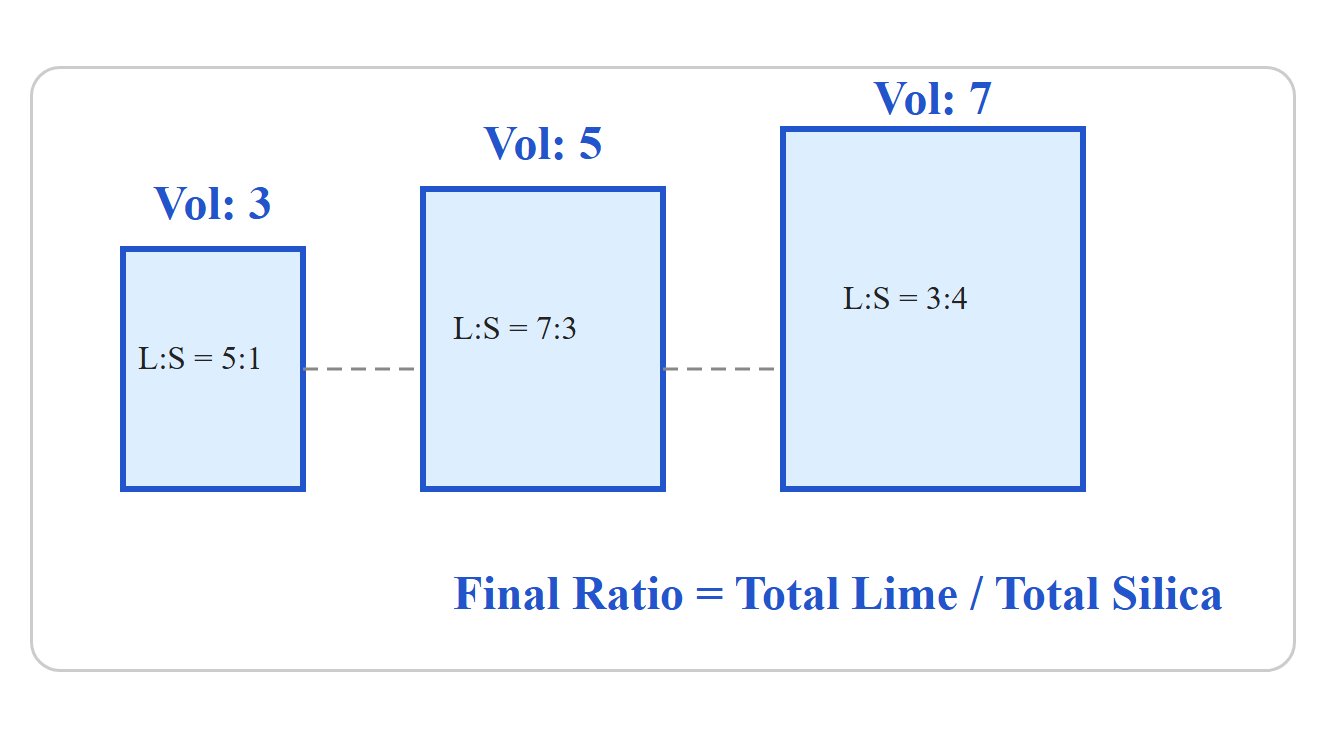
Three bags whose volumes are in the ratio of 3 : 5 : 7 are full of lime and silica. In the 1st bag the ratio of lime and silica is 5 : 1, in 2nd bag the ratio is 7 : 3 and in the 3rd bag the ratio is 3 : 4. All the three mixtures are mixed in another bag. Find the ratio of lime and silica in the final mixture.

  1. AOption (a)

    4 : 3

  2. BOption (b)

    3 : 2

  3. COption (c)

    3 : 4

  4. DOption (d)

    2 : 3

  5. EOption (e)

    2 : 1

View answer & explanation

Correct answer

Answer: (b)B.

3 : 2

Why this answer is correct

Shortcut Trick

Equate the total parts of each bag to their LCM (6, 10, 7) = 210, then scale by volume ratios 3 : 5 : 7.

Bag 1 (3 × 210): Lime = 3 × 175 = 525, Silica = 3 × 35 = 105

Bag 2 (5 × 210): Lime = 5 × 147 = 735, Silica = 5 × 63 = 315

Bag 3 (7 × 210): Lime = 7 × 90 = 630, Silica = 7 × 120 = 840

Total Lime : Total Silica = (525 + 735 + 630) : (105 + 315 + 840) = 1890 : 1260 = 3 : 2.

∴ The correct answer is 3 : 2.

Alternate Method

Given: Volume Ratio = 3 : 5 : 7. Ratios (L:S) = 5:1, 7:3, 3:4.

Formula: Total Lime = ∑ (Volumei × Fraction of Limei)

⇒ Total Lime = 3 × (5/6) + 5 × (7/10) + 7 × (3/7)

⇒ Total Lime = 15/6 + 35/10 + 3 = 2.5 + 3.5 + 3 = 9

⇒ Total Silica = 3 × (1/6) + 5 × (3/10) + 7 × (4/7)

⇒ Total Silica = 3/6 + 15/10 + 4 = 0.5 + 1.5 + 4 = 6

⇒ Final Ratio = 9 : 6 = 3 : 2

∴ The correct answer is 3 : 2.

Additional Information

Mixture Balancing

To mix quantities of different ratios, first equalize the total parts by taking the LCM of the sums of the ratio parts before applying the volume weights.

Alligation for Three Components

When three or more mixtures are combined, the final ratio is the sum of the weighted averages of each individual component's concentration.

Directions : Table given below shows the total population (male + female) in four different villages and the percentage of females out of total population in each of the villages . 

Total population in all the villages together is 15400.


VillagesTotal PopulationPercentage of females
A2400(50 - X)%
B5500(19.5 + X)%
C280X40.2%
D32000 of X%30%

Question 45

Based on Passage: View directions & passage

Out of total males in village D 28.57% of them are graduated and the rest are non graduated out of total graduated males 40% of them are job workers then find the difference between number of male job workers in village D and the number of non graduated males in the same village.

  1. AOption (a)

    1270

  2. BOption (b)

    1440

  3. COption (c)

    1540

  4. DOption (d)

    1680

  5. EOption (e)

    1260

View answer & explanation

Correct answer

Answer: (d)D.

1680

Why this answer is correct

General solution:

2400 + 5500 + 280X + 32000 ×  X/100 = 15400

2400 + 5500 + 280X + 320X = 15400

600X = 7500

X = 25/2


Village A:

Total population = 2400 

Percentage of females = (50 - 12.5) = 37.5%

Number of females = (2400×  37.5/100) = 900

Number of males = 2400 - 900 = 1500


Village B:

Total population = 5500 

Percentage of females= (19.5 + 12.5) = 32%

Number of females = 5500 ×  (32/100) = 1760

Number of males = (5500 - 1760) = 3740


Village C:

Total population = (280 × 12.5) = 3500

Percentage of females = 40.2%

Number of females = 3500 ×  (40.2/100) = 1407

Number of males = (3500 - 1407) = 2093


Village D: 

Total population = 32000 ×  (12.5/100) = 4000

Percentage of females = 30%

Number of females = 4000 ×  (30/100) = 1200

Number of males = (4000 - 1200) = 2800


VillagesNumber of malesNumber of females
A1500900
B37401760
C20931407
D28001200

Solution:

Total number of males in village D = 2800

Number of graduated males working = 2800 ×   2/7 = 800

Number of non graduated males working = 2800 - 800 = 2000

Number of male job workers = 800 ×  (40/100) = 320

Required difference = (2000 - 320) = 1680

Question 46

Based on Passage: View directions & passage

 If the number of females in village E is X% more than that in village B, then find the average number of females in village E and A together.

  1. AOption (a)

    1680

  2. BOption (b)

    1280

  3. COption (c)

    1440

  4. DOption (d)

    1320

  5. EOption (e)

    1760

View answer & explanation

Correct answer

Answer: (c)C.

1440

Why this answer is correct

General solution:

2400 + 5500 + 280X + 32000 ×  X/100 = 15400

2400 + 5500 + 280X + 320X = 15400

600X = 7500

X = 25/2


Village A:

Total population = 2400 

Percentage of females = (50 - 12.5) = 37.5%

Number of females = (2400×  37.5/100) = 900

Number of males = 2400 - 900 = 1500


Village B:

Total population = 5500 

Percentage of females= (19.5 + 12.5) = 32%

Number of females = 5500 ×  (32/100) = 1760

Number of males = (5500 - 1760) = 3740


Village C:

Total population = (280 × 12.5) = 3500

Percentage of females = 40.2%

Number of females = 3500 ×  (40.2/100) = 1407

Number of males = (3500 - 1407) = 2093


Village D: 

Total population = 32000 ×  (12.5/100) = 4000

Percentage of females = 30%

Number of females = 4000 ×  (30/100) = 1200

Number of males = (4000 - 1200) = 2800


VillagesNumber of malesNumber of females
A1500900
B37401760
C20931407
D28001200

Solution:

Number of females in village B = 1760

Number of females in village E = 1760 ×  9/8 = 1980

Average number of females in village E and A = (1980 + 900)/2 = 1440

Question 47

Based on Passage: View directions & passage

 Find the difference between the total number of males in Village B and Village C and total number of females in Village A and B

  1. AOption (a)

    4237

  2. BOption (b)

    2127

  3. COption (c)

    3889

  4. DOption (d)

    3173

  5. EOption (e)

    3457

View answer & explanation

Correct answer

Answer: (d)D.

3173

Why this answer is correct

General solution:

2400 + 5500 + 280X + 32000 ×  X/100 = 15400

2400 + 5500 + 280X + 320X = 15400

600X = 7500

X = 25/2


Village A:

Total population = 2400 

Percentage of females = (50 - 12.5) = 37.5%

Number of females = (2400×  37.5/100) = 900

Number of males = 2400 - 900 = 1500


Village B:

Total population = 5500 

Percentage of females= (19.5 + 12.5) = 32%

Number of females = 5500 ×  (32/100) = 1760

Number of males = (5500 - 1760) = 3740


Village C:

Total population = (280 × 12.5) = 3500

Percentage of females = 40.2%

Number of females = 3500 ×  (40.2/100) = 1407

Number of males = (3500 - 1407) = 2093


Village D: 

Total population = 32000 ×  (12.5/100) = 4000

Percentage of females = 30%

Number of females = 4000 ×  (30/100) = 1200

Number of males = (4000 - 1200) = 2800


VillagesNumber of malesNumber of females
A1500900
B37401760
C20931407
D28001200

Solution:

Number of  males in village B = 3740

Number of males in village C = 2093

Number of females in village A = 900

Number of females in village B = 1760

Required difference = (5833 - 2660) = 3173

Question 48

Based on Passage: View directions & passage

Total number of females in village D is 75% of the number of females in village F and the average number of males and females in village F is 1700. Find the number of males in the village F.

  1. AOption (a)

    1850

  2. BOption (b)

    1700

  3. COption (c)

    1600

  4. DOption (d)

    1800

  5. EOption (e)

    1750

View answer & explanation

Correct answer

Answer: (d)D.

1800

Why this answer is correct

General solution:

2400 + 5500 + 280X + 32000 ×  X/100 = 15400

2400 + 5500 + 280X + 320X = 15400

600X = 7500

X = 25/2


Village A:

Total population = 2400 

Percentage of females = (50 - 12.5) = 37.5%

Number of females = (2400×  37.5/100) = 900

Number of males = 2400 - 900 = 1500


Village B:

Total population = 5500 

Percentage of females= (19.5 + 12.5) = 32%

Number of females = 5500 ×  (32/100) = 1760

Number of males = (5500 - 1760) = 3740


Village C:

Total population = (280 × 12.5) = 3500

Percentage of females = 40.2%

Number of females = 3500 ×  (40.2/100) = 1407

Number of males = (3500 - 1407) = 2093


Village D: 

Total population = 32000 ×  (12.5/100) = 4000

Percentage of females = 30%

Number of females = 4000 ×  (30/100) = 1200

Number of males = (4000 - 1200) = 2800


VillagesNumber of malesNumber of females
A1500900
B37401760
C20931407
D28001200

Solution:

Number of females in village D = 1200

Number of females in village F is 1200/75 ×  100 = 1600

Total number of males and females in village F = 3400

Number of males in village F = (3400 - 1600) = 1800

Question 49

Based on Passage: View directions & passage

If 1/5 th of males in village B and 1/3 rd of the females in village A  are married then find the ratio between the number of unmarried females in village A to the number of unmarried males in village B.

  1. AOption (a)

    97: 78

  2. BOption (b)

    121: 154

  3. COption (c)

    129: 157

  4. DOption (d)

    75 : 374

  5. EOption (e)

    101: 147

View answer & explanation

Correct answer

Answer: (d)D.

75 : 374

Why this answer is correct

General solution:

2400 + 5500 + 280X + 32000 ×  X/100 = 15400

2400 + 5500 + 280X + 320X = 15400

600X = 7500

X = 25/2


Village A:

Total population = 2400 

Percentage of females = (50 - 12.5) = 37.5%

Number of females = (2400×  37.5/100) = 900

Number of males = 2400 - 900 = 1500


Village B:

Total population = 5500 

Percentage of females= (19.5 + 12.5) = 32%

Number of females = 5500 ×  (32/100) = 1760

Number of males = (5500 - 1760) = 3740


Village C:

Total population = (280 × 12.5) = 3500

Percentage of females = 40.2%

Number of females = 3500 ×  (40.2/100) = 1407

Number of males = (3500 - 1407) = 2093


Village D: 

Total population = 32000 ×  (12.5/100) = 4000

Percentage of females = 30%

Number of females = 4000 ×  (30/100) = 1200

Number of males = (4000 - 1200) = 2800


VillagesNumber of malesNumber of females
A1500900
B37401760
C20931407
D28001200


Solution:

Number of males in village B = 3740

Number of married males in village B = 1/5 × 3740 = 748/33

Number of unmarried males in village B = 3740 - 748 = 2992

Number of females in village A = 900

Number of married females in village A = 900/3 = 300

Number of unmarried females in village A = 900 - 300 = 600

Required ratio = 600 : 2992 = 75 : 374

Question 50

A and B entered into a business such that  the sum invested by A is 2/5th of the total sum invested by both of them and A invested his sum for 8 months. The profit received by B is 3/7th of total profit received by A and B together. Find the time for which B invested his sum?

  1. AOption (a)

    8 months

  2. BOption (b)

    4 months

  3. COption (c)

    6 months

  4. DOption (d)

    12 months

  5. EOption (e)

    None of these

View answer & explanation

Correct answer

Answer: (b)B.

4 months

Why this answer is correct

Shortcut Trick

Ratio of investments of A and B is 2 : (5 − 2) = 2 : 3.

Ratio of profits of A and B is (7 − 3) : 3 = 4 : 3.

Profit ratio = (Investment × Time) ratio.

4 : 3 = (2 × 8) : (3 × TB) ⇒ 4 : 3 = 16 : 3TB.

12TB = 48 ⇒ TB = 4 months.

∴ The correct answer is 4 months.

Alternate Method

Given → Investment of A = 2/5 of Total | Profit of B = 3/7 of Total | Time of A = 8 months. Formulas: ProfitA : ProfitB = (CapitalA × TimeA) : (CapitalB × TimeB)

⇒ Let total investment be 5 units. A's investment = 2 units, B's investment = 5 − 2 = 3 units. ⇒ Let total profit be 7 units. B's profit = 3 units, A's profit = 7 − 3 = 4 units. ⇒ According to partnership rule: (InvestmentA × TimeA) / (InvestmentB × TimeB) = ProfitA / ProfitB ⇒ (2 × 8) / (3 × TB) = 4 / 3 ⇒ 16 / 3TB = 4 / 3 ⇒ 3TB × 4 = 16 × 3 ⇒ 12TB = 48 ⇒ TB = 4 months.

∴ The correct answer is 4 months.

Additional Information

Partnership Basics

In a partnership, the profit sharing ratio is directly proportional to the product of capital invested and the time period of investment.

Variable Ratios

If profits are shared in ratio P1:P2 and investments are C1:C2, then the time ratio is (P1/C1) : (P2/C2).

Question 51

P alone can finish the work in 15 hours and Q alone can finish the work in 20 hours while R alone can finish the work in N hours. All three worked for 5 hours, after that P left the work and remaining work gets completed in 3 hours. Find the value of N.

  1. AOption (a)

    20

  2. BOption (b)

    30

  3. COption (c)

    25

  4. DOption (d)

    24

  5. EOption (e)

    12

View answer & explanation

Correct answer

Answer: (b)B.

30

Why this answer is correct

Shortcut Trick

Work done by P in 5 hours = 5/15 = 1/3

Work done by Q in (5 + 3) = 8 hours = 8/20 = 2/5

Work done by R in (5 + 3) = 8 hours = 1 − (1/3 + 2/5) = 1 − 11/15 = 4/15

Efficiency of R = (4/15) ÷ 8 = 1/30

∴ The correct answer is 30 hours.

Alternate Method

Given: P = 15 hours, Q = 20 hours, R = N hours. All worked 5 hrs; P left; Q and R worked 3 more hrs.

PersonDays/HoursTotal WorkEfficiency
P15604
Q203

⇒ Let efficiency of R be x units/hr.

⇒ Total work completed = 5 × (4 + 3 + x) + 3 × (3 + x) = 60

⇒ 5 × (7 + x) + 3 × (3 + x) = 60

⇒ 35 + 5x + 9 + 3x = 60

⇒ 44 + 8x = 60

⇒ 8x = 16

⇒ x = 2 units/hr

⇒ Time taken by R alone (N) = Total Work ÷ Efficiency of R

⇒ N = 60 ÷ 2 = 30 hours

∴ The correct answer is 30 hours.

Additional Information

Total Work Concept

Total Work is always assumed as the LCM of time taken by individual workers to simplify efficiency calculations.

Efficiency Formula

Efficiency = Total Work ÷ Time taken. Efficiency is inversely proportional to the time taken to complete the work.

Work Left/Remaining

When a person leaves, the remaining work must be divided by the combined efficiency of the remaining workers to find the extra time.

Question 52

The hemispherical pot of surface area 882π sq.cm is fulled with milk. The all milk is poured into the cylindrical can of same radius. The cylindrical can is completely filled with milk. Find the height of cylindrical can.

  1. AOption (a)

    16cm

  2. BOption (b)

    18cm

  3. COption (c)

    14cm

  4. DOption (d)

    21cm

  5. EOption (e)

    7cm

View answer & explanation

Correct answer

Answer: (c)C.

14cm

Why this answer is correct

Shortcut Trick

Curved Surface Area of Hemisphere = 2πr2 = 882π ⇒ r2 = 441 ⇒ r = 21 cm.

Volume of milk in Hemisphere = (2/3)πr3.

Since this fills the Cylinder completely: (2/3)πr3 = πr2h.

Since radii are same: h = (2/3)r = (2/3) × 21 = 14 cm.

∴ The correct answer is 14 cm.

Alternate Method

Given:

Surface area of Hemispherical pot = 882π cm2

Radius of Cylindrical can = Radius of Hemisphere (r)

Formula Used:

  1. Curved Surface Area of Hemisphere = 2πr2
  2. Volume of Hemisphere = (2/3)πr3
  3. Volume of Cylinder = πr2h

Calculations:

⇒ 2πr2 = 882π

⇒ r2 = 882 ÷ 2 = 441

⇒ r = √441 = 21 cm

As per the question, Volume of Hemisphere = Volume of Cylinder

⇒ (2/3)πr3 = πr2h

⇒ (2/3)r = h

⇒ h = (2/3) × 21

⇒ h = 14 cm

∴ The correct answer is 14 cm.

Additional Information

Total Surface Area of Hemisphere

The total surface area includes the curved part and the flat circular top, calculated as 3πr2.

Cylinder Surface Area

Curved Surface Area = 2πrh and Total Surface Area = 2πr(h + r).

Volume Conservation

When a liquid is poured from one container to another, the volume remains constant unless stated otherwise.

Question 53

What approximate value should come in the place of question mark (?) in the following question?

14.972 × 4.99 ÷ 44.78 + 299.99 ÷ √5624.98 × 12.93 = ?

  1. AOption (a)

    71

  2. BOption (b)

    68

  3. COption (c)

    77

  4. DOption (d)

    70

  5. EOption (e)

    None of These

View answer & explanation

Correct answer

Answer: (c)C.

77

Why this answer is correct

Concept Used:

Follow the BODMAS rule according to the table given below:

Calculation:

14.972 × 4.99 ÷ 44.78 + 299.99 ÷ √5624.98 × 12.93 = ?

⇒ 152 × 5 ÷ 45 + 300 ÷ √5625 × 13 = ?

⇒ 225 × 1 ÷ 9 + 300 ÷ 75 × 13 = ?

⇒ 25 + 4 × 13 = ?

⇒ 25 + 52 = ?

⇒ 77 = ?

∴ Required value of ? is 77.

Question 54

What approximate value will come in the place of the question mark '?' in the following question?

{12960.31 ÷ 79.79 × (9.75)2} ÷ 89.89 + √195.79 - 10.23 = ?

  1. AOption (a)

    184

  2. BOption (b)

    162

  3. COption (c)

    204

  4. DOption (d)

    211

  5. EOption (e)

    193

View answer & explanation

Correct answer

Answer: (a)A.

184

Why this answer is correct

Correct answer  is: 1


Concept used:

  1. If the digits after decimal in a given number is less than 5, then the digits after decimal are omitted and the rest number will be the approximate value.

  2. If the digits after decimal in a given number is more than 5, then the digits after decimal are omitted and the rest of the number is increased by 1. The obtained number will be the approximate value.

  3. The BODMAS rule should be followed to solve the question as per the given table:

Calculation:

{12960.31 ÷ 79.79 × (9.75)2} ÷ 89.89 + √195.79 - 10.23 = ?

⇒ {12960 ÷ 80 × 102} ÷ 90 + √196 - 10 = ?

⇒ (162 × 100) ÷ 90 + 14 - 10 = ?

⇒ 16200 ÷ 90 + 14 - 10 = ?

⇒ 180 + 14 - 10 = ?

⇒ ? = 184


∴ The value of ? is 184

Question 55

What approximate value will come in the place of the question mark '?' in the following question?

14.66 × 22.28 - 344.81 ÷ 23.38 + (11.73)2 - 68.87 = ?

  1. AOption (a)

    415

  2. BOption (b)

    270

  3. COption (c)

    331

  4. DOption (d)

    390

  5. EOption (e)

    175

View answer & explanation

Correct answer

Answer: (d)D.

390

Why this answer is correct

Correct  answer is: 4


Concept used:

  1. If the digits after decimal in a given number is less than 5, then the digits after decimal are omitted and the rest number will be the approximate value.

  2. If the digits after decimal in a given number is more than 5, then the digits after decimal are omitted and the rest of the number is increased by 1. The obtained number will be the approximate value.

  3. The BODMAS rule should be followed to solve the question as per the given table:

Calculation:

14.66 × 22.28 - 344.81 ÷ 23.38 + (11.73)2 - 68.87 = ?

⇒ 15 × 22 - 345 ÷ 23 + 122 - 69 = ?

⇒ 15 × 22 - 15 + 144 - 69 =?

⇒ 330 - 15 + 144 -69 =?

⇒ 474 - 84 = ?

⇒ ? = 390


∴ The value of ? is 390

Question 56

What approximate will come in the place of the question mark ‘?’ in the following question?

37.98% of 549.99 + √(49.02) ÷ ? = 7.99 × (2.97)3

  1. AOption (a)

    0

  2. BOption (b)

    1

  3. COption (c)

    2

  4. DOption (d)

    3

  5. EOption (e)

    4

View answer & explanation

Correct answer

Answer: (b)B.

1

Why this answer is correct

Given:

37.98% of 549.99 + √(49.02) ÷ ? = 7.99 × (2.97)3

Rules of Approximation:

  1. If a number has digits to the right of the decimal less than 5, then just drop the digits to the right of the decimal. The number so obtained will be the approximated value.
  2. If a number has digits to the right of the decimal more than 5, then just drop the digits to the right of the decimal and raise the remaining number by '1'.The number so obtained will be the approximated value.

Concept used:

Follow the BODMAS rule according to the table given below:

Calculation:

37.98% of 549.99 + √(49.02) ÷ ? = 7.99 × (2.97)3

⇒ 38% of 550 + √49 ÷ ? = 8 × 33

⇒ (38/100) × 550 + 7 ÷ ? = 8 × 27

⇒ 209 + 7 ÷ ? = 216

⇒ 7 ÷ ? = 7

⇒ ? = 1

∴ 1 should come in place of the question mark (?).

Question 57

What approximate will come in the place of the question mark ‘?’ in the following question?

9.78% of 79.94 + ?% of 9.67 = 10.94 × 2.99 + √100 × 2.98

  1. AOption (a)

    600

  2. BOption (b)

    550

  3. COption (c)

    580

  4. DOption (d)

    610

  5. EOption (e)

    None of these.

View answer & explanation

Correct answer

Answer: (b)B.

550

Why this answer is correct

Given:

9.78% of 79.94 + ?% of 9.67 = 10.94 × 2.99 + √100 × 2.98

Concept used:

Follow the BODMAS rule according to the table given below:

Calculation:

9.78% of 79.94 + ?% of 9.67 = 10.94 × 2.99 + √100 × 2.98

⇒ 10% of 80 + ?% of 10 = 11 × 3 + √100 × 3

⇒ (10/100) × 80 + (?/100) × 10 = 33 + 10 × 3

⇒ 8 + (?/10) = 33 + 30

⇒ 8 + (?/10) = 63

⇒ (?/10) = 63 - 8 

⇒ (?/10) = 55 

⇒ ? = 55 × 10 = 550

∴ The value of ? is 550.

Question 58

Directions

Two quantities I and II are given in the following questions. You have to find the value to both I and II by using your knowledge of mathematics and choose the most suitable relation between the magnitude of I and II from the given options.

Quantity I: On a mask SP is 425% more than the cost price. If cost price is increased by 5% then calculate new profit margin in percentage if selling price of mask remain the same.

Quantity II: A company is offering 80% discount on the marked price because of which selling price is equal to cost price. Calculate percentage mark up.

  1. AOption (a)

    Quantity I ≥ Quantity II

  2. BOption (b)

    Quantity I ≤ Quantity II

  3. COption (c)

    Quantity I > Quantity II

  4. DOption (d)

    Quantity I = Quantity II

  5. EOption (e)

    Quantity I< Quantity II

View answer & explanation

Correct answer

Answer: (d)D.

Quantity I = Quantity II

Why this answer is correct

Given:

Profit = 425%

C.P. = Increase is 5%

S.P. =Constant

Discount = 80% on mark up

Formula used :

Profit = S.P. – C.P.

Calculation:

Quantity I :

Assume the cost price = Rs 100

⇒ Selling price = 100 + 425

⇒ Selling price = 525

⇒ Profit from new C.P. increase = 525 – (100 + (0.05 × 100))

⇒ Profit from new C.P. increase = 525 – 105

⇒ Profit from new C.P. increase = 420%

⇒ New profit margin = (420/105) × 100

⇒ New profit margin % = 400%

Quantity II :

Let the marked price be Rs 100

Selling price = 100 – (0.80 × 100)

⇒ Selling price = 20

⇒ S.P. = C.P. = 20

⇒ Percentage markup = ((100 – 20)/20) × 100

⇒ Percentage markup = 400%

∴ Quantity I = Quantity II

Question 59

Given below are two quantities named A and B. Based on the given information, you have to determine the relationship between the two quantities. You should use the given data and your knowledge of Mathematics to choose between the possible answers.

Quantity A: A task of painting a house is given to A and B for Rs. 15000, with the help of C the task is completed in 6 days. had A alone done the task he would take 12 days. Had B alone done the task he would take 15 days. Find the share of C in the money given for the task?    

Quantity B: Rs 1500

  1. AOption (a)

    Quantity A > Quantity B

  2. BOption (b)

    Quantity A < Quantity B

  3. COption (c)

    Quantity A ≥ Quantity B

  4. DOption (d)

    Quantity A ≤ Quantity B

  5. EOption (e)

    Quantity A = Quantity B or No relation

View answer & explanation

Correct answer

Answer: (e)E.

Quantity A = Quantity B or No relation

Why this answer is correct

GIVEN:

Payment = Rs 15000

(A + B + C)'s time = 6 days

A's time = 12 days

B's time = 15 days

CONCEPT:

Wages are distributed in the ratio of efficiency.

For a unit work done efficiency is inversely proportional to the time taken.

CALCULATION:

Let the work be 1 unit

A's efficiency = 1/12

B's efficiency = 1/15

(A + B + C)'s efficiency = 1/6

C's efficiency = 1/6 - (1/12 + 1/15)

⇒ (10 - 5 - 4)/60 = 1/60

C's wages = [15000/1(/6)] × 1/60 = Rs 1500

∴ Quantity A = Quantity B

ALTERNATE SOLUTION:

Let the work be 60 (L.C.M of 6, 12, 15)

A's efficiency = 60/12 = 5

B's efficiency = 60/15 = 4

(A + B + C)'s efficiency = 60/6 = 10

C's efficiency = 10 - (5 + 4) = 1

C's wages = [15000/10] × 1 = Rs 1500

∴ Quantity A = Quantity B

Question 60

Given below are two quantities named A and B. Based on the given information, you have to determine the relationship between the two quantities. You should use the given data and your knowledge of Mathematics to choose between the possible answers.

Quantity A: In a 63 liters mixture of alcohol and water, the ratio of alcohol to water is 5 : 4. In order to make the ratio of alcohol to water 3 : 2, some quantity of alcohol is to be added to the mixture. The quantity of alcohol present in the new mixture is?

Quantity B: 43 l

  1. AOption (a)

    Quantity A > Quantity B

  2. BOption (b)

    Quantity A < Quantity B

  3. COption (c)

    Quantity A ≥ Quantity B

  4. DOption (d)

    Quantity A ≤ Quantity B

  5. EOption (e)

    Quantity A = Quantity B or No relation

View answer & explanation

Correct answer

Answer: (b)B.

Quantity A < Quantity B

Why this answer is correct

GIVEN:

Quantity = 63 l

Initial ratio (alcohol : water) = 5 : 4

Final ratio (alcohol : water) = 3 : 2

EXPLANATION:

Total mixture (ratio) = 5 + 4 = 9 ratio

9 ratio = 63 l

→ 1 ratio = 7 l

∴ Alcohol = 5 ratio = 35 l

and, water = 4 ratio = 28 l

Since the amount of water will remain same,

For final ratio, 2 ratio = 28 l

∴ 3 ratio = 42 l

So, alcohol quantity in the new mixture = 42 l

∴ Quantity A < Quantity B

Question 61

In the question, two quantities I and II are given. You have to solve both the quantities and establish the correct relation between Quantity - I and Quantity - II and choose the correct option accordingly.

Quantity I: Difference between the ages of Yash and Kush is 6 years. Three years later, the sum of their ages will be 40 years. How old was Yash 4 years ago?

Quantity II: Two years later, Viru's age will be two - third of Veer's age at that time. Sum of their present ages is 26 years. What is the present age of Viru?

  1. AOption (a)

    Quantity - I < Quantity - II

  2. BOption (b)

    Quantity - I > Quantity - II

  3. COption (c)

    Quantity - I ≥ Quantity - II

  4. DOption (d)

    Quantity - I ≤ Quantity - II

  5. EOption (e)

    Quantity - I =Quantity - II or No relation

View answer & explanation

Correct answer

Answer: (c)C.

Quantity - I ≥ Quantity - II

Why this answer is correct

Quantity I:

Let the present ages of Yash and Kush be 'Y' years and 'K' years respectively.

Difference between the ages of Yash and Kush is 6 years.

Therefore, either Y - K = 6 or K - Y = 6 ... (a)

Three years later, the sum of their ages will be 40 years.

Therefore, Y + 3 + K + 3 = 40

⇒ Y + K = 34 ...(b)

Case (i) when Y - K = 6 and Y + K = 34

Then, 2Y = 40

⇒ Y = 20

4 years ago Yash was = 20 - 4 = 16 years old  

Case (ii) when K - Y = 6 and Y + K = 34

Then, 2Y = 28

⇒ Y = 14

4 years ago Yash was = 14 - 4 = 10 years old  

∴ Quantity I = 16 years or 10 years

Quantity II:

Let the present age of Viru and Veer be 'x' years and 'y' years respectively.  

Two years later, Viru's age will be two - third of Veer's age at that time.  

Therefore, x + 2 = (2/3) × (y + 2)  

⇒ 3x + 6 = 2y + 4  

⇒ -3x + 2y = 2 ...(a) 

Sum of their present ages = 26 years  

So, x + y = 26 ...(b)  

From (a) and (b)  

-3x + 2 × (26 - x) = 2  

⇒ x = 10  

∴ Quantity II = 10 years

Hence, the correct answer is Quantity - I ≥ Quantity - II.

Question 62

There are three voting booths in a city. The number of voters in the first two booths is 52% and 46% of the third booth. The difference in the number of voters in the first booth and second booth is 7686, then find the total number of voters in all three booths.

  1. AOption (a)

    2,53,648

  2. BOption (b)

    2,53,658

  3. COption (c)

    2,53,638

  4. DOption (d)

    2,53,668

  5. EOption (e)

    None of these 

View answer & explanation

Correct answer

Answer: (c)C.

2,53,638

Why this answer is correct

Shortcut Trick

Let the third booth voters be 100 units.

First booth = 52 units, Second booth = 46 units.

Difference (52 − 46) = 6 units → 7686.

Total units = 52 + 46 + 100 = 198 units.

Total voters = (7686 ÷ 6) × 198 = 1281 × 198 = 2,53,638.

∴ The correct answer is 2,53,638 voters.

Alternate Method

Given:

Voters in Booth 3 = x

Voters in Booth 1 = 52% of x = 0.52x

Voters in Booth 2 = 46% of x = 0.46x

Calculations:

⇒ Difference = 0.52x − 0.46x = 7686

⇒ 0.06x = 7686

⇒ x = 7686 ÷ 0.06 = 1,28,100

⇒ Total voters = Booth 1 + Booth 2 + Booth 3

⇒ Total = 0.52x + 0.46x + x = 1.98x

⇒ Total = 1.98 × 1,28,100

⇒ Total = 2,53,638

∴ The correct answer is 2,53,638 voters.

Additional Information

Percentage Base Change

When multiple values are compared to a single base (the third booth here), they can be added or subtracted directly as long as the base remains constant.

Unitary Method

Value of 1 unit = (Given Difference) ÷ (Difference in units). Total Value = (1 unit value) × (Total sum of units).

Successive Percentage

If a value changes by a% and then b%, the net change is [a + b + (ab/100)]%. Note: This rule does not apply when values are independent parts of a whole.

Question 63

Amir bought the article at a discount of 20% on the Marked price and then He sold the article with a 10% loss on the cost price.What would have been the percentage loss had he bought it at the marked price?

  1. AOption (a)

    36%

  2. BOption (b)

    40%

  3. COption (c)

    28%

  4. DOption (d)

    46%

  5. EOption (e)

    None of the above.

View answer & explanation

Correct answer

Answer: (c)C.

28%

Why this answer is correct

Shortcut Trick

Assume Marked Price (MP) = 100.

Cost Price (CP) = 100 × (100 − 20)% = 80.

Selling Price (SP) = 80 × (100 − 10)% = 72.

If CP = MP = 100, then Loss = 100 − 72 = 28.

Loss% = (28 ÷ 100) × 100 = 28%.

∴ The correct answer is 28%.

Alternate Method

Given → Discount = 20% on MP | Loss = 10% on CP | Target = Loss% if CP = MP. Formulas: CP = MP × (100 − D%) ÷ 100 | SP = CP × (100 − L%) ÷ 100 | New Loss% = (MP − SP) ÷ MP × 100.

⇒ Let Marked Price = x. ⇒ Cost Price (CP) = x − 0.20x = 0.80x. ⇒ Selling Price (SP) = 0.80x − (10% of 0.80x) = 0.80x − 0.08x = 0.72x. ⇒ If article was bought at Marked Price, New CP = x. ⇒ Loss = New CP − SP = x − 0.72x = 0.28x. ⇒ Loss Percentage = (0.28x ÷ x) × 100 = 28%. ∴ The correct answer is 28%.

Additional Information

Marked Price & Discount

Discount is always calculated on the Marked Price. SP = MP × (100 − Discount%)/100.

Effective Loss/Gain

When multiple changes occur, the result depends on the sequence of successive percentages applied to the base value.

Question 64

Ramiya got married 8 years ago. Her present age is 6/5 times her age at the time of her marriage. Ramiya’s brother was 10 years younger than her at the time of her marriage. What is the ratio of Ramiya’s present age and her brother’s age at the time of her marriage?

  1. AOption (a)

    2 : 7

  2. BOption (b)

    7 : 9

  3. COption (c)

    4 : 7

  4. DOption (d)

    8 : 5

  5. EOption (e)

    None of the above

View answer & explanation

Correct answer

Answer: (d)D.

8 : 5

Why this answer is correct

Calculations:

Let Ramiya’s present age be x.

∴ her age at the time of her marriage is (x - 8) years.

⇒ x = 6/5(x - 8)

⇒ 5x = 6x – 48

⇒ x = 48 years

∴ Ramiya’s brothers age at the time of her marriage = (x – 8) – 10

⇒ 48 – 18

⇒ 30 years

∴ required ratio = 48 : 30

⇒ 8 : 5

The ratio of Ramiya’s present age and her brother’s age at the time of her marriage is 8 : 5.

Question 65

Two boats X and Y start towards each other from two different places, 300 km apart. The speed of the boat X and Y in still water are 8 km/hr and 7 km/hr respectively. If X proceeds down and Y up the stream, they will meet after.

  1. AOption (a)

    25 hours

  2. BOption (b)

    20 hours

  3. COption (c)

    15 hours

  4. DOption (d)

    5 hours

  5. EOption (e)

    10 hours

View answer & explanation

Correct answer

Answer: (b)B.

20 hours

Why this answer is correct

Shortcut Trick

When two boats move towards each other, one downstream and one upstream, the speed of the stream cancels out.

Relative Speed = Speed of X + Speed of Y = 8 + 7 = 15 km/hr.

Time = Total Distance ÷ Relative Speed = 300 ÷ 15 = 20 hr.

∴ The correct answer is 20 hr.

Alternate Method

Given: Distance = 300 km, Speed of X (uX) = 8 km/hr, Speed of Y (uY) = 7 km/hr.

Formula Used: Time = Distance ÷ Relative Speed; Downstream Speed = u + v; Upstream Speed = u − v.

⇒ Let the speed of the stream be v km/hr.

⇒ Speed of Boat X (downstream) = 8 + v km/hr.

⇒ Speed of Boat Y (upstream) = 7 − v km/hr.

⇒ Relative Speed = (8 + v) + (7 − v) = 15 km/hr.

⇒ Time taken to meet = Distance ÷ Relative Speed

⇒ Time = 300 ÷ 15 = 20 hr.

∴ The correct answer is 20 hr.

Additional Information

Relative Speed in Streams

When two boats move towards each other (one up and one down), the stream velocity always cancels out in the relative speed calculation.

Downstream and Upstream

Downstream Speed = u + v and Upstream Speed = u − v, where u is speed in still water and v is stream speed.

Time of Meeting

Time taken to meet = (Initial Distance) ÷ (Relative Speed in opposite direction).

Reasoning Ability (35 questions)

Direction: Read the following information carefully and answer the given questions.

Ten persons Lata, Uma, Gia, Sana, Tia, Pia, Kate, Hina, Noor, and Ruhi were born in ten different months January, March, April, May, June, July, August, September, October, and December but not necessarily in same order.

Tia was born in the month which has 30 days before August. Only four persons were born between Tia and Sana. Uma was born just before Sana. The number of persons born before Uma and after Noor are equal. Gia was born in a month which has 30 days only. Only one person was born between Ruhi and Lata. Ruhi was born before Lata. Only three persons were born between Pia and Gia. Pia was born before Gia. Less than three people were born between Lata and Hina.

Question 66

Based on Passage: View directions & passage

In which month Noor is born?

  1. AOption (a)

    March

  2. BOption (b)

    January

  3. COption (c)

    December

  4. DOption (d)

    October

  5. EOption (e)

    July

View answer & explanation

Correct answer

Answer: (a)A.

March

Why this answer is correct

Person: Lata, Uma, Gia, Sana, Tia, Pia, Kate, Hina, Noor, and Ruhi

Month: January, March, April, May, June, July, August, September, October, and December 

1) Tia was born in the month which has 30 days before August. Only four persons were born between Tia and Sana. Uma was born just before Sana. The number of persons born before Uma and after Noor are equal. 

Case 1Case 2
MonthsPersonsPersons
January(31 days)
March(31 days)Noor
April(30 days)Tia
May (31 days)Noor
June(30 days)Tia
July (31 days)
August(31 days)Uma
September( 30 days)Sana
October(31 days)Uma
December(31 days)Sana


2) Gia was born in a month which has 30 days only. Only three persons were born between Pia and Gia.

Case 1(a)Case 1(b)Case 2
MonthsPersonsPersonsPersons
January(31 days)
March(31 days)NoorNoor
April(30 days)GiaTia
May (31 days)PiaNoor
June(30 days)TiaTiaGia
July (31 days)
August(31 days)PiaUma
September( 30 days)GiaSana
October(31 days)UmaUmaPia
December(31 days)SanaSana


3) Pia was born before Gia. Only one person was born between Ruhi and Lata. Ruhi was born before Lata. Less than three people were born between Lata and Hina.

The condition that Pia was born before Gia cannot be fulfilled in Case 1(a) and Case 2.

The final arrangement is:

MonthsPersons
January(31 days)Ruhi
March(31 days)Noor
April(30 days)Lata
May (31 days)Pia
June(30 days)Tia
July (31 days)Hina
August(31 days)Kate
September( 30 days)Gia
October(31 days)Uma
December(31 days)Sana


Hence, Noor was born in the month of March.

Question 67

Based on Passage: View directions & passage

Who is born just after Pia is born?

  1. AOption (a)

    the one who is born in the month of September.

  2. BOption (b)

    Sana

  3. COption (c)

    the one who is born in the month of June.

  4. DOption (d)

    Hina

  5. EOption (e)

    the one who is born in the month of March.

View answer & explanation

Correct answer

Answer: (c)C.

the one who is born in the month of June.

Why this answer is correct

Person: Lata, Uma, Gia, Sana, Tia, Pia, Kate, Hina, Noor, and Ruhi

Month: January, March, April, May, June, July, August, September, October, and December 

1) Tia was born in the month which has 30 days before August. Only four persons were born between Tia and Sana. Uma was born just before Sana. The number of persons born before Uma and after Noor are equal. 

Case 1Case 2
MonthsPersonsPersons
January(31 days)
March(31 days)Noor
April(30 days)Tia
May (31 days)Noor
June(30 days)Tia
July (31 days)
August(31 days)Uma
September( 30 days)Sana
October(31 days)Uma
December(31 days)Sana


2) Gia was born in a month which has 30 days only. Only three persons were born between Pia and Gia.

Case 1(a)Case 1(b)Case 2
MonthsPersonsPersonsPersons
January(31 days)
March(31 days)NoorNoor
April(30 days)GiaTia
May (31 days)PiaNoor
June(30 days)TiaTiaGia
July (31 days)
August(31 days)PiaUma
September( 30 days)GiaSana
October(31 days)UmaUmaPia
December(31 days)SanaSana


3) Pia was born before Gia. Only one person was born between Ruhi and Lata. Ruhi was born before Lata. Less than three people were born between Lata and Hina.

The condition that Pia was born before Gia cannot be fulfilled in Case 1(a) and Case 2.

The final arrangement is:

MonthsPersons
January(31 days)Ruhi
March(31 days)Noor
April(30 days)Lata
May (31 days)Pia
June(30 days)Tia
July (31 days)Hina
August(31 days)Kate
September( 30 days)Gia
October(31 days)Uma
December(31 days)Sana


Hence, Tia (the one who is born in the month of June.) is born just after Pia.

Question 68

Based on Passage: View directions & passage

How many persons are born between Gia and Hina?

  1. AOption (a)

    Five

  2. BOption (b)

    Two

  3. COption (c)

    Seven

  4. DOption (d)

    Eight

  5. EOption (e)

    One

View answer & explanation

Correct answer

Answer: (e)E.

One

Why this answer is correct

Person: Lata, Uma, Gia, Sana, Tia, Pia, Kate, Hina, Noor, and Ruhi

Month: January, March, April, May, June, July, August, September, October, and December 

1) Tia was born in the month which has 30 days before August. Only four persons were born between Tia and Sana. Uma was born just before Sana. The number of persons born before Uma and after Noor are equal. 

Case 1Case 2
MonthsPersonsPersons
January(31 days)
March(31 days)Noor
April(30 days)Tia
May (31 days)Noor
June(30 days)Tia
July (31 days)
August(31 days)Uma
September( 30 days)Sana
October(31 days)Uma
December(31 days)Sana


2) Gia was born in a month which has 30 days only. Only three persons were born between Pia and Gia.

Case 1(a)Case 1(b)Case 2
MonthsPersonsPersonsPersons
January(31 days)
March(31 days)NoorNoor
April(30 days)GiaTia
May (31 days)PiaNoor
June(30 days)TiaTiaGia
July (31 days)
August(31 days)PiaUma
September( 30 days)GiaSana
October(31 days)UmaUmaPia
December(31 days)SanaSana


3) Pia was born before Gia. Only one person was born between Ruhi and Lata. Ruhi was born before Lata. Less than three people were born between Lata and Hina.

The condition that Pia was born before Gia cannot be fulfilled in Case 1(a) and Case 2.

The final arrangement is:

MonthsPersons
January(31 days)Ruhi
March(31 days)Noor
April(30 days)Lata
May (31 days)Pia
June(30 days)Tia
July (31 days)Hina
August(31 days)Kate
September( 30 days)Gia
October(31 days)Uma
December(31 days)Sana


Hence, One person is born between Gia and Hina.

Question 69

Based on Passage: View directions & passage

Which of the following statement is/are true?

  1. AOption (a)

    Lata was born in April.

  2. BOption (b)

    Pia was born before Sana.

  3. COption (c)

    Noor is born in the month which has 30 days.

  4. DOption (d)

    Both 1 and 2

  5. EOption (e)

    Both 2 and 3

View answer & explanation

Correct answer

Answer: (d)D.

Both 1 and 2

Why this answer is correct

Person: Lata, Uma, Gia, Sana, Tia, Pia, Kate, Hina, Noor, and Ruhi

Month: January, March, April, May, June, July, August, September, October, and December 

1) Tia was born in the month which has 30 days before August. Only four persons were born between Tia and Sana. Uma was born just before Sana. The number of persons born before Uma and after Noor are equal. 

Case 1Case 2
MonthsPersonsPersons
January(31 days)
March(31 days)Noor
April(30 days)Tia
May (31 days)Noor
June(30 days)Tia
July (31 days)
August(31 days)Uma
September( 30 days)Sana
October(31 days)Uma
December(31 days)Sana


2) Gia was born in a month which has 30 days only. Only three persons were born between Pia and Gia.

Case 1(a)Case 1(b)Case 2
MonthsPersonsPersonsPersons
January(31 days)
March(31 days)NoorNoor
April(30 days)GiaTia
May (31 days)PiaNoor
June(30 days)TiaTiaGia
July (31 days)
August(31 days)PiaUma
September( 30 days)GiaSana
October(31 days)UmaUmaPia
December(31 days)SanaSana


3) Pia was born before Gia. Only one person was born between Ruhi and Lata. Ruhi was born before Lata. Less than three people were born between Lata and Hina.

The condition that Pia was born before Gia cannot be fulfilled in Case 1(a) and Case 2.

The final arrangement is:

MonthsPersons
January(31 days)Ruhi
March(31 days)Noor
April(30 days)Lata
May (31 days)Pia
June(30 days)Tia
July (31 days)Hina
August(31 days)Kate
September( 30 days)Gia
October(31 days)Uma
December(31 days)Sana


Hence, Both 1 (Lata was born in April.) and 2( Pia was born before Sana.) are true statements.

Question 70

Based on Passage: View directions & passage

Which among the following combination is true?

  1. AOption (a)

    June-Gia

  2. BOption (b)

    October-Hina

  3. COption (c)

    August-Kate

  4. DOption (d)

    January-Pia

  5. EOption (e)

    March-Lata

View answer & explanation

Correct answer

Answer: (c)C.

August-Kate

Why this answer is correct

Person: Lata, Uma, Gia, Sana, Tia, Pia, Kate, Hina, Noor, and Ruhi

Month: January, March, April, May, June, July, August, September, October, and December 

1) Tia was born in the month which has 30 days before August. Only four persons were born between Tia and Sana. Uma was born just before Sana. The number of persons born before Uma and after Noor are equal. 

Case 1Case 2
MonthsPersonsPersons
January(31 days)
March(31 days)Noor
April(30 days)Tia
May (31 days)Noor
June(30 days)Tia
July (31 days)
August(31 days)Uma
September( 30 days)Sana
October(31 days)Uma
December(31 days)Sana


2) Gia was born in a month which has 30 days only. Only three persons were born between Pia and Gia.

Case 1(a)Case 1(b)Case 2
MonthsPersonsPersonsPersons
January(31 days)
March(31 days)NoorNoor
April(30 days)GiaTia
May (31 days)PiaNoor
June(30 days)TiaTiaGia
July (31 days)
August(31 days)PiaUma
September( 30 days)GiaSana
October(31 days)UmaUmaPia
December(31 days)SanaSana


3) Pia was born before Gia. Only one person was born between Ruhi and Lata. Ruhi was born before Lata. Less than three people were born between Lata and Hina.

The condition that Pia was born before Gia cannot be fulfilled in Case 1(a) and Case 2.

The final arrangement is:

MonthsPersons
January(31 days)Ruhi
March(31 days)Noor
April(30 days)Lata
May (31 days)Pia
June(30 days)Tia
July (31 days)Hina
August(31 days)Kate
September( 30 days)Gia
October(31 days)Uma
December(31 days)Sana


Hence, August-Kate is the correct combination.

Question 71

Direction: In the question below are given three statements followed by two conclusions numbered I and II. You have to take the given statements to be true even if they seem to be at variance with commonly known facts. Read all the conclusions and then decide which of the given conclusions logically follows from the given statements disregarding commonly known facts.

Statements:

Some story are real.

All fake are news.

No fake is real.

Conclusions:

I) Some story are not fake.

II) Some story can be fake.

  1. AOption (a)

    Only conclusion I follows

  2. BOption (b)

    Only conclusion II follows

  3. COption (c)

    Either conclusion I or II follows

  4. DOption (d)

    Neither conclusion I nor II follows

  5. EOption (e)

    Both conclusion I and II follows

View answer & explanation

Correct answer

Answer: (e)E.

Both conclusion I and II follows

Why this answer is correct

The least possible Venn diagram is :

Conclusions:

I) Some story are not fake → TRUE (As no real is fake and some part of real which is story also will not be fake, thus the conclusion follows)

II) Some story can be fake → TRUE (Some part of story that is real will be fake, but we don't have any information about the remaining part of story so the conclusion will be true).

Hence, "Both conclusion I and II follows".

Question 72

Direction: In the question below are given three statements followed by three conclusions I and II. You have to take the given statements to be true even if they seem to be at variance from commonly known facts, Read all the given conclusions and then decide which of the following conclusions logically follows from the given statements disregarding commonly known facts.

Statements:

Some door are fan.

No door is rose.

No fan is shelf.

Conclusions:

(I) All doors are shelf is a possibility.

(II) All shelf can be door.

  1. AOption (a)

    Only conclusion I follows

  2. BOption (b)

    Only conclusion II follows

  3. COption (c)

    Both conclusion I and II follows

  4. DOption (d)

    Neither conclusion I nor II follows

  5. EOption (e)

    Either conclusion I or II follows

View answer & explanation

Correct answer

Answer: (b)B.

Only conclusion II follows

Why this answer is correct

The least possible Venn diagram is:

Conclusions: 

(I) All doors are shelf is a possibility → FALSE (The possibility is false, as some fan can be shelf and some fan are not shelf, so possibility of all door to be shelf cannot be true).

(II) All shelf can be door → TRUE (the conclusion will be true, as there is no direct relation between door and shelf given).

Hence, "only conclusion II follows".

Question 73

Direction: In the question below are given three statements followed by two conclusions numbered I and II. You have to take the given statements to be true even if they seem to be at variance with commonly known facts. Read all the conclusions and then decide which of the given conclusions logically follows from the given statements disregarding commonly known facts.

Statements:

No sad is laugh.

No joy is sad.

No sorrow is joy.

Conclusions:

I. Some sad can be sorrow.

II. Some laugh is joy.

  1. AOption (a)

    ​Only I follows

  2. BOption (b)

    Neither I nor II follows

  3. COption (c)

    Only II follows

  4. DOption (d)

    Either I or II follows

  5. EOption (e)

    Both I and II follow

View answer & explanation

Correct answer

Answer: (a)A.

​Only I follows

Why this answer is correct

The least possible Venn diagram for the given statements is as follows -

Conclusions:

I. Some sad can be sorrow. → True (It is possible that Some Sad are Sorrow as there is no direct or negative relation given between them. Hene, it follows.)

II. Some laugh is joy. → False (It is possible but not definite as there is no direct relationship given between Laugh and Joy. Hence, it doesn't follow.)

Hence, the correct answer is Only I follows.

Direction: Read the following information carefully and answer the given questions.

Six boxes U, V, W, X, Y, and Z have different colors Maroon, Ivory, Purple, Lavender, Blush, and Aqua. The boxes are placed one above the other but not necessarily in the same order.

Two boxes are there between the Ivory and Maroon color boxes. The maroon color box is placed below the Ivory color box. Only one box is placed between Box W and the Ivory color box. No box was placed between the Z and Maroon color boxes. Z is not a Maroon color box. The box U was placed just above the lavender color box. Box U is neither an Ivory color nor a Blush color box. Box X is placed below the Lavender color box. Only three boxes were placed between box Y and the Blush color box. Box V is placed below both the Blush and Aqua color boxes.

Question 74

Based on Passage: View directions & passage

How many boxes are kept between U and Z?

  1. AOption (a)

    One

  2. BOption (b)

    Two

  3. COption (c)

    Five

  4. DOption (d)

    Three

  5. EOption (e)

    Four

View answer & explanation

Correct answer

Answer: (b)B.

Two

Why this answer is correct

Boxes: U, V, W, X, Y, and Z

Colors: Maroon, Ivory, Purple, Lavender, Blush, and Aqua.

1) Two boxes are there between the Ivory and Maroon color boxes. The maroon color box is placed below the Ivory color box. Only one box is placed between Box W and the Ivory color box.

Case 1Case 2Case 3Case 4
BoxesColorBoxesColorBoxesColorBoxesColor
IvoryW
Ivory
WIvoryIvory
MaroonW
MaroonW
MaroonMaroon


2) No box was placed between the Z and Maroon color boxes. Z is not a Maroon color box. The box U was placed just above the lavender color box. Box U is neither an Ivory color nor a Blush color box. Box X is placed below the Lavender color box. 

In Case 4, the condition that No box was placed between the Z and Maroon color boxes cannot be fulfilled. That is why Case 4 is eliminated.

Case 1(a)Case1(b)Case 2Case 3
BoxesColorBoxesColorBoxesColorBoxesColor
IvoryIvoryW
UUIvory
WLavenderWLavenderUIvory
XMaroonMaroonWLavenderU
ZZXMaroonZLavender
XZXMaroon


  1. Only three boxes were placed between box Y and the Blush color box. 

In Case 3, the given condition cannot be fulfilled which is why Case 3 is eliminated.

Case 1(a)Case1(b)Case 2
BoxesColorBoxesColorBoxesColor
YIvoryYIvory
UUYIvory
WLavenderWLavenderU
XMaroonMaroonWLavender
ZBlushZBlushXMaroon
XZBlush


4) Box V is placed below both the Blush and Aqua color boxes. In Case 1(b) and Case 2, the given condition cannot be fulfilled which is why Case 1(b) and Case 2 are eliminated.

The final arrangement is:

BoxesColor
YIvory
UAqua
WLavender
XMaroon
ZBlush
VPurple


Hence, Two boxes are placed between U and Z.

Question 75

Based on Passage: View directions & passage

Which of the box is kept exactly in the middle of the box which has a Maroon color, and the one which has a Purple color?

  1. AOption (a)

    Box Z

  2. BOption (b)

    Box U

  3. COption (c)

    Box X

  4. DOption (d)

    Box W

  5. EOption (e)

    Box V

View answer & explanation

Correct answer

Answer: (a)A.

Box Z

Why this answer is correct

Boxes: U, V, W, X, Y, and Z

Colors: Maroon, Ivory, Purple, Lavender, Blush, and Aqua.

1) Two boxes are there between the Ivory and Maroon color boxes. The maroon color box is placed below the Ivory color box. Only one box is placed between Box W and the Ivory color box.

Case 1Case 2Case 3Case 4
BoxesColorBoxesColorBoxesColorBoxesColor
IvoryW
Ivory
WIvoryIvory
MaroonW
MaroonW
MaroonMaroon


2) No box was placed between the Z and Maroon color boxes. Z is not a Maroon color box. The box U was placed just above the lavender color box. Box U is neither an Ivory color nor a Blush color box. Box X is placed below the Lavender color box. 

In Case 4, the condition that No box was placed between the Z and Maroon color boxes cannot be fulfilled. That is why Case 4 is eliminated.

Case 1(a)Case1(b)Case 2Case 3
BoxesColorBoxesColorBoxesColorBoxesColor
IvoryIvoryW
UUIvory
WLavenderWLavenderUIvory
XMaroonMaroonWLavenderU
ZZXMaroonZLavender
XZXMaroon


  1. Only three boxes were placed between box Y and the Blush color box. 

In Case 3, the given condition cannot be fulfilled which is why Case 3 is eliminated.

Case 1(a)Case1(b)Case 2
BoxesColorBoxesColorBoxesColor
YIvoryYIvory
UUYIvory
WLavenderWLavenderU
XMaroonMaroonWLavender
ZBlushZBlushXMaroon
XZBlush


4) Box V is placed below both the Blush and Aqua color boxes. In Case 1(b) and Case 2, the given condition cannot be fulfilled which is why Case 1(b) and Case 2 are eliminated.

The final arrangement is:

BoxesColor
YIvory
UAqua
WLavender
XMaroon
ZBlush
VPurple


Hence, Box Z  is kept exactly in the middle of the box which has a Maroon color, and the one which has a Purple color.

Question 76

Based on Passage: View directions & passage

As many boxes are kept above X as below_____.

  1. AOption (a)

    the box which has Blush color.

  2. BOption (b)

    Box U

  3. COption (c)

    the box which has Maroon color.

  4. DOption (d)

    Box Z

  5. EOption (e)

    the box which is placed immediately below the Aqua color box

View answer & explanation

Correct answer

Answer: (e)E.

the box which is placed immediately below the Aqua color box

Why this answer is correct

Boxes: U, V, W, X, Y, and Z

Colors: Maroon, Ivory, Purple, Lavender, Blush, and Aqua.

1) Two boxes are there between the Ivory and Maroon color boxes. The maroon color box is placed below the Ivory color box. Only one box is placed between Box W and the Ivory color box.

Case 1Case 2Case 3Case 4
BoxesColorBoxesColorBoxesColorBoxesColor
IvoryW
Ivory
WIvoryIvory
MaroonW
MaroonW
MaroonMaroon


2) No box was placed between the Z and Maroon color boxes. Z is not a Maroon color box. The box U was placed just above the lavender color box. Box U is neither an Ivory color nor a Blush color box. Box X is placed below the Lavender color box. 

In Case 4, the condition that No box was placed between the Z and Maroon color boxes cannot be fulfilled. That is why Case 4 is eliminated.

Case 1(a)Case1(b)Case 2Case 3
BoxesColorBoxesColorBoxesColorBoxesColor
IvoryIvoryW
UUIvory
WLavenderWLavenderUIvory
XMaroonMaroonWLavenderU
ZZXMaroonZLavender
XZXMaroon


  1. Only three boxes were placed between box Y and the Blush color box. 

In Case 3, the given condition cannot be fulfilled which is why Case 3 is eliminated.

Case 1(a)Case1(b)Case 2
BoxesColorBoxesColorBoxesColor
YIvoryYIvory
UUYIvory
WLavenderWLavenderU
XMaroonMaroonWLavender
ZBlushZBlushXMaroon
XZBlush


4) Box V is placed below both the Blush and Aqua color boxes. In Case 1(b) and Case 2, the given condition cannot be fulfilled which is why Case 1(b) and Case 2 are eliminated.

The final arrangement is:

BoxesColor
YIvory
UAqua
WLavender
XMaroon
ZBlush
VPurple


Hence, many boxes are kept above X as below the box which is placed immediately below the Aqua color box(W).

Question 77

Based on Passage: View directions & passage

If the position of box which has Purple color and Aqua color is interchanged then which of the following box is kept two box below Maroon?

  1. AOption (a)

    Box V

  2. BOption (b)

    Box X

  3. COption (c)

    Box Y

  4. DOption (d)

    Box U

  5. EOption (e)

    Box Z

View answer & explanation

Correct answer

Answer: (d)D.

Box U

Why this answer is correct

Boxes: U, V, W, X, Y, and Z

Colors: Maroon, Ivory, Purple, Lavender, Blush, and Aqua.

1) Two boxes are there between the Ivory and Maroon color boxes. The maroon color box is placed below the Ivory color box. Only one box is placed between Box W and the Ivory color box.

Case 1Case 2Case 3Case 4
BoxesColorBoxesColorBoxesColorBoxesColor
IvoryW
Ivory
WIvoryIvory
MaroonW
MaroonW
MaroonMaroon


2) No box was placed between the Z and Maroon color boxes. Z is not a Maroon color box. The box U was placed just above the lavender color box. Box U is neither an Ivory color nor a Blush color box. Box X is placed below the Lavender color box. 

In Case 4, the condition that No box was placed between the Z and Maroon color boxes cannot be fulfilled. That is why Case 4 is eliminated.

Case 1(a)Case1(b)Case 2Case 3
BoxesColorBoxesColorBoxesColorBoxesColor
IvoryIvoryW
UUIvory
WLavenderWLavenderUIvory
XMaroonMaroonWLavenderU
ZZXMaroonZLavender
XZXMaroon


  1. Only three boxes were placed between box Y and the Blush color box. 

In Case 3, the given condition cannot be fulfilled which is why Case 3 is eliminated.

Case 1(a)Case1(b)Case 2
BoxesColorBoxesColorBoxesColor
YIvoryYIvory
UUYIvory
WLavenderWLavenderU
XMaroonMaroonWLavender
ZBlushZBlushXMaroon
XZBlush


4) Box V is placed below both the Blush and Aqua color boxes. In Case 1(b) and Case 2, the given condition cannot be fulfilled which is why Case 1(b) and Case 2 are eliminated.

The final arrangement is:

BoxesColor
YIvory
UAqua
WLavender
XMaroon
ZBlush
VPurple


If the position of the box which has Purple color and Aqua color is interchanged. After the change in the positions arrangement is:

BoxesColor
YIvory
VPurple
WLavender
XMaroon
ZBlush
UAqua


Hence, Box U is kept two boxes below Maroon.

Question 78

Based on Passage: View directions & passage

Which of the following box is kept third from the top of the stack?

  1. AOption (a)

    the box which is kept immediately above F.

  2. BOption (b)

    the box which has Ivory color.

  3. COption (c)

    The one who likes Lavender color.

  4. DOption (d)

    Box U

  5. EOption (e)

    Box Z

View answer & explanation

Correct answer

Answer: (c)C.

The one who likes Lavender color.

Why this answer is correct

Boxes: U, V, W, X, Y, and Z

Colors: Maroon, Ivory, Purple, Lavender, Blush, and Aqua.

1) Two boxes are there between the Ivory and Maroon color boxes. The maroon color box is placed below the Ivory color box. Only one box is placed between Box W and the Ivory color box.

Case 1Case 2Case 3Case 4
BoxesColorBoxesColorBoxesColorBoxesColor
IvoryW
Ivory
WIvoryIvory
MaroonW
MaroonW
MaroonMaroon


2) No box was placed between the Z and Maroon color boxes. Z is not a Maroon color box. The box U was placed just above the lavender color box. Box U is neither an Ivory color nor a Blush color box. Box X is placed below the Lavender color box. 

In Case 4, the condition that No box was placed between the Z and Maroon color boxes cannot be fulfilled. That is why Case 4 is eliminated.

Case 1(a)Case1(b)Case 2Case 3
BoxesColorBoxesColorBoxesColorBoxesColor
IvoryIvoryW
UUIvory
WLavenderWLavenderUIvory
XMaroonMaroonWLavenderU
ZZXMaroonZLavender
XZXMaroon


  1. Only three boxes were placed between box Y and the Blush color box. 

In Case 3, the given condition cannot be fulfilled which is why Case 3 is eliminated.

Case 1(a)Case1(b)Case 2
BoxesColorBoxesColorBoxesColor
YIvoryYIvory
UUYIvory
WLavenderWLavenderU
XMaroonMaroonWLavender
ZBlushZBlushXMaroon
XZBlush


4) Box V is placed below both the Blush and Aqua color boxes. In Case 1(b) and Case 2, the given condition cannot be fulfilled which is why Case 1(b) and Case 2 are eliminated.

The final arrangement is:

BoxesColor
YIvory
UAqua
WLavender
XMaroon
ZBlush
VPurple


The one who likes the Lavender color (W) is kept third from the top of the stack.

Question 79

If odd digits in the given number "286354256" are increased by three and the even digit of the number is decreased by two, then what is the sum of all the digits of the number thus formed?

  1. AOption (a)

    40

  2. BOption (b)

    30

  3. COption (c)

    38

  4. DOption (d)

    35

  5. EOption (e)

    34

View answer & explanation

Correct answer

Answer: (c)C.

38

Why this answer is correct

Given number:- 286354256

If all the odd digits are increased by 3 and the even digit of the number is decreased by two, then

Numbers286354256
Odd (O) / Even (E)EEEOOEEOE
+3 if Odd, -2 if Even-2-2-2+3+3-2-2+3-2
Rearrangement064682084


The sum of all the digits of the number thus formed is 0+6+4+6+8+2+0+8+4 = 38.

Hence, the correct answer is 38.

Question 80

How many pairs of letters are there in the word "SOMETHING" each of which has as many letters between them in the word as in the English alphabetical series (both forward and backward direction)?

  1. AOption (a)

    One

  2. BOption (b)

    Two

  3. COption (c)

    Three

  4. DOption (d)

    More than three

  5. EOption (e)

    None

View answer & explanation

Correct answer

Answer: (d)D.

More than three

Why this answer is correct

Given word:- SOMETHING

Forward Pair - HI

Backward Pair - IM, GI, GM

Thus, there are four such pairs of letters in the word “SOMETHING” which has as many letters between them as in the English alphabetical series (both in forward and backward directions).

Hence, the correct answer is More than three.

Direction: Read the following information carefully and answer the given questions.

There are eight members P, Q, R, S, T, U, V, and I in the family. P is the sister of Q. Q and R are married. R and S is the only child of T. S is unmarried. V is the grandmother of U. U is the nephew of S. I is the daughter-in-law of V.

Question 81

Based on Passage: View directions & passage

How is P related to U?

  1. AOption (a)

    Mother

  2. BOption (b)

    Father

  3. COption (c)

    Sister

  4. DOption (d)

    Wife

  5. EOption (e)

    Aunt

View answer & explanation

Correct answer

Answer: (e)E.

Aunt

Why this answer is correct

We follow the given symbols to illustrate the relations:

1) P is the sister of Q. Q and R are married. R and S is the only child of T.

2) V is the grandmother of U. U is the nephew of S. S is unmarried. I is the daughter-in-law of V.

If we assume that V is the paternal grandmother of U then V is the wife of T and mother of R and S. But, It is also given that I is the daughter-in-law of V which contradicts the given condition that S is Unmarried. So, V is the maternal grandmother of U. Also, assume that V has a son whose wife is I.

Hence, the final arrangement is:

Hence, P is the Aunt of U.

Question 82

Based on Passage: View directions & passage

How is Q related to T?

  1. AOption (a)

    Son or daughter

  2. BOption (b)

    Son

  3. COption (c)

    Son-in-law

  4. DOption (d)

    daughter-in-law

  5. EOption (e)

    Son-in-law or daughter-in-law

View answer & explanation

Correct answer

Answer: (e)E.

Son-in-law or daughter-in-law

Why this answer is correct

We follow the given symbols to illustrate the relations:

1) P is the sister of Q. Q and R are married. R and S is the only child of T.

2) V is the grandmother of U. U is the nephew of S. S is unmarried. I is the daughter-in-law of V.

If we assume that V is the paternal grandmother of U then V is the wife of T and mother of R and S. But, It is also given that I is the daughter-in-law of V which contradicts the given condition that S is Unmarried. So, V is the maternal grandmother of U. Also, assume that V has a son whose wife is I.

Hence, the final arrangement is:

Hence, Q is either son-in-law or daughter-in-law of T.

Question 83

Based on Passage: View directions & passage

If K is married to I then what is the relation of K and P?

  1. AOption (a)

    K is the sister of P

  2. BOption (b)

    K is the father of P

  3. COption (c)

    K is the uncle of P

  4. DOption (d)

    K is the brother of P

  5. EOption (e)

    K is the son of P

View answer & explanation

Correct answer

Answer: (d)D.

K is the brother of P

Why this answer is correct

We follow the given symbols to illustrate the relations:

1) P is the sister of Q. Q and R are married. R and S is the only child of T.

2) V is the grandmother of U. U is the nephew of S. S is unmarried. I is the daughter-in-law of V.

If we assume that V is the paternal grandmother of U then V is the wife of T and mother of R and S. But, It is also given that I is the daughter-in-law of V which contradicts the given condition that S is Unmarried. So, V is the maternal grandmother of U. Also, assume that V has a son whose wife is I.

Hence, the final arrangement is:

If K is married to I, then this will be the arrangement.

Hence, K is the brother of P.

Direction: Read the following information carefully and answer the given questions.

Eight persons Varun, Pinku, Kabir, Fane, Avi, Seema, Rohan, and Ena are sitting in the circle some are facing the center and some are facing opposite to the center. Number of person facing center is less than the number of persons facing opposite to the center.

Seema is facing the center. Varun sits second to the right of Seema. Two persons sit between Varun and Pinku. Immediate neighbors of Pinku are facing the opposite direction to Pinku. Ena sits second to the left of Pinku. Ena is not an immediate neighbor of Varun. Rohan is not a neighbor of Pinku and Ena. Kabir sits second to the right of Rohan. Avi is not an immediate neighbor of Ena.

Question 84

Based on Passage: View directions & passage

Who sits to the immediate right of Kabir?

  1. AOption (a)

    Pinku

  2. BOption (b)

    The person who sits to the immediate left of Ena.

  3. COption (c)

    Avi

  4. DOption (d)

    The person who sits second to right of Rohan

  5. EOption (e)

    Fane

View answer & explanation

Correct answer

Answer: (b)B.

The person who sits to the immediate left of Ena.

Why this answer is correct

Person: Varun, Pinku, Kabir, Fane, Avi, Seema, Rohan, and Ena

Number of person facing center is less than the number of persons facing opposite to the center. This condition can only be fulfilled if the number of persons facing the center is less than or equal to three.

1) Seema is facing the center. Varun sits second to the right of Seema. Two persons sit between Varun and Pinku.


2) Immediate neighbors of Pinku are facing the opposite direction to Pinku. Ena sits second to the left of Pinku. Ena is not an immediate neighbor of Varun. 

In Case 1, the immediate neighbor of Pinku is Seema who is facing towards the center. So, Pinku faces away from the center because the immediate neighbors of Pinku are facing the opposite direction to Pinku. Then Ena will be an immediate neighbor of Varun which contradicts the given condition which is why Case 1 is eliminated.

3) As already three persons are facing the center all others will be facing opposite to the center. Rohan is not a neighbor of Pinku and Ena. Kabir sits second to the right of Rohan. Avi is not an immediate neighbor of Ena.

The final arrangement is:

Hence, The person who sits to the immediate left of Ena (Seema) sits to the immediate right of Kabir.

Question 85

Based on Passage: View directions & passage

Who sits exactly in between Varun and Fane when counted to the left of Varun?

  1. AOption (a)

    Rohan

  2. BOption (b)

    Ena

  3. COption (c)

    Pinku

  4. DOption (d)

    Kabir

  5. EOption (e)

    Avi

View answer & explanation

Correct answer

Answer: (e)E.

Avi

Why this answer is correct

Person: Varun, Pinku, Kabir, Fane, Avi, Seema, Rohan, and Ena

Number of person facing center is less than the number of persons facing opposite to the center. This condition can only be fulfilled if the number of persons facing the center is less than or equal to three.

1) Seema is facing the center. Varun sits second to the right of Seema. Two persons sit between Varun and Pinku.


2) Immediate neighbors of Pinku are facing the opposite direction to Pinku. Ena sits second to the left of Pinku. Ena is not an immediate neighbor of Varun. 

In Case 1, the immediate neighbor of Pinku is Seema who is facing towards the center. So, Pinku faces away from the center because the immediate neighbors of Pinku are facing the opposite direction to Pinku. Then Ena will be an immediate neighbor of Varun which contradicts the given condition which is why Case 1 is eliminated.

3) As already three persons are facing the center all others will be facing opposite to the center. Rohan is not a neighbor of Pinku and Ena. Kabir sits second to the right of Rohan. Avi is not an immediate neighbor of Ena.

The final arrangement is:

Hence, Avi sits between Varun and Fane when counted to the left of Varun.

Question 86

Based on Passage: View directions & passage

Who is sitting fourth to the right of the person who is sitting second to the right of Kabir?

  1. AOption (a)

    Rohan

  2. BOption (b)

    Ena

  3. COption (c)

    Fane

  4. DOption (d)

    Varun

  5. EOption (e)

    Pinku

View answer & explanation

Correct answer

Answer: (a)A.

Rohan

Why this answer is correct

Person: Varun, Pinku, Kabir, Fane, Avi, Seema, Rohan, and Ena

Number of person facing center is less than the number of persons facing opposite to the center. This condition can only be fulfilled if the number of persons facing the center is less than or equal to three.

1) Seema is facing the center. Varun sits second to the right of Seema. Two persons sit between Varun and Pinku.


2) Immediate neighbors of Pinku are facing the opposite direction to Pinku. Ena sits second to the left of Pinku. Ena is not an immediate neighbor of Varun. 

In Case 1, the immediate neighbor of Pinku is Seema who is facing towards the center. So, Pinku faces away from the center because the immediate neighbors of Pinku are facing the opposite direction to Pinku. Then Ena will be an immediate neighbor of Varun which contradicts the given condition which is why Case 1 is eliminated.

3) As already three persons are facing the center all others will be facing opposite to the center. Rohan is not a neighbor of Pinku and Ena. Kabir sits second to the right of Rohan. Avi is not an immediate neighbor of Ena.

The final arrangement is:

Ena is sitting second to the right of Kabir. Rohan is sitting fourth to the right of Ena. Hence, Rohan is sitting fourth to the right of the person who is sitting second to the right of Kabir.

Question 87

Based on Passage: View directions & passage

Which of the following statements is false according to the given arrangement?

I. Rohan is sitting second to the right of Pinku.

II. Kabir and Varun are facing the same direction.

III. The immediate neighbor of Avi is facing the same direction as Avi.

  1. AOption (a)

    Only I

  2. BOption (b)

    Both I and II

  3. COption (c)

    Only II

  4. DOption (d)

    Both II and III

  5. EOption (e)

    Only III

View answer & explanation

Correct answer

Answer: (e)E.

Only III

Why this answer is correct

Person: Varun, Pinku, Kabir, Fane, Avi, Seema, Rohan, and Ena

Number of person facing center is less than the number of persons facing opposite to the center. This condition can only be fulfilled if the number of persons facing the center is less than or equal to three.

1) Seema is facing the center. Varun sits second to the right of Seema. Two persons sit between Varun and Pinku.


2) Immediate neighbors of Pinku are facing the opposite direction to Pinku. Ena sits second to the left of Pinku. Ena is not an immediate neighbor of Varun. 

In Case 1, the immediate neighbor of Pinku is Seema who is facing towards the center. So, Pinku faces away from the center because the immediate neighbors of Pinku are facing the opposite direction to Pinku. Then Ena will be an immediate neighbor of Varun which contradicts the given condition which is why Case 1 is eliminated.

3) As already three persons are facing the center all others will be facing opposite to the center. Rohan is not a neighbor of Pinku and Ena. Kabir sits second to the right of Rohan. Avi is not an immediate neighbor of Ena.

The final arrangement is:

Immediate neighbors of Avi are facing opposite directions as Avi. Hence, **Only III (**The immediate neighbor of Avi is facing the same direction as Avi.) is a false statement.

Question 88

Based on Passage: View directions & passage

Four of the following five are alike in a certain way based on the given arrangement and hence form a group. Which of the following does not belong to that group?

  1. AOption (a)

    Rohan

  2. BOption (b)

    Ena

  3. COption (c)

    Seema

  4. DOption (d)

    Pinku

  5. EOption (e)

    Kabir

View answer & explanation

Correct answer

Answer: (c)C.

Seema

Why this answer is correct

Person: Varun, Pinku, Kabir, Fane, Avi, Seema, Rohan, and Ena

Number of person facing center is less than the number of persons facing opposite to the center. This condition can only be fulfilled if the number of persons facing the center is less than or equal to three.

1) Seema is facing the center. Varun sits second to the right of Seema. Two persons sit between Varun and Pinku.


2) Immediate neighbors of Pinku are facing the opposite direction to Pinku. Ena sits second to the left of Pinku. Ena is not an immediate neighbor of Varun. 

In Case 1, the immediate neighbor of Pinku is Seema who is facing towards the center. So, Pinku faces away from the center because the immediate neighbors of Pinku are facing the opposite direction to Pinku. Then Ena will be an immediate neighbor of Varun which contradicts the given condition which is why Case 1 is eliminated.

3) As already three persons are facing the center all others will be facing opposite to the center. Rohan is not a neighbor of Pinku and Ena. Kabir sits second to the right of Rohan. Avi is not an immediate neighbor of Ena.

The final arrangement is:

All are facing outside except Seema. Hence, Seema does not belong to that group.

Question 89

Five letter-clusters have been given, out of which four are alike in some manner and one is different. Select the letter-cluster that is different.

  1. AOption (a)

    IRYB

  2. BOption (b)

    LYGJ

  3. COption (c)

    MGHZ

  4. DOption (d)

    NCPV

  5. EOption (e)

    RYEF

View answer & explanation

Correct answer

Answer: (d)D.

NCPV

Why this answer is correct

The logic is:

IRYB → 9 + 18 + 25 + 2 = 54

LYGJ → 12 + 25 + 7 + 10 = 54

MGHZ → 13 + 7 + 8 + 26 = 54

NCPV → 14 + 3 + 16 + 22 = 55 (Different sum)

RYEF → 18 + 25 + 5 + 6 = 54

Hence, the correct answer is NCPV.

Question 90

Directions

In the following question assuming the given statements to be true, find which of the conclusion among the given conclusions is/ are definitely true and then give your answers accordingly

Statement: N > F > O ≤ M, O ≤ B > A

Conclusion: 

I) O < A

II) M ≤ O

  1. AOption (a)

    Only conclusion I is true

  2. BOption (b)

    Only Conclusion II is true

  3. COption (c)

    Either conclusion I or II is true

  4. DOption (d)

    Neither conclusion I or II is true

  5. EOption (e)

    Both conclusion I and II is true

View answer & explanation

Correct answer

Answer: (d)D.

Neither conclusion I or II is true

Why this answer is correct

Given statement: N > F > O ≤ M, O ≤ B > A

On Combining: N > F > O ≤ B > A, N > F > O ≤ M

Conclusion: 

I) O < A → FALSE (O ≤ B > A, thus the conclusion dose not follow )

II) M ≤ O → FALSE (M ≥ O, as it is clearly given in the conclusion O cannot be greater, thus the conclusion dose not follows).

Hence, "Neither conclusion I nor II follows".

Question 91

Direction: In the following question, assuming the given statement to be true, find which of the conclusion(s) among the given conclusions is/are definitely true, and then give your answers accordingly.

Statement:

T < U < X; U < W < Z = O; Z < N > M

Conclusions:

I. T > M

II. X < N

  1. AOption (a)

    Both I and II follow

  2. BOption (b)

    Neither I nor II follows

  3. COption (c)

    ​Only Il follows

  4. DOption (d)

    Only I follows

  5. EOption (e)

    Either I or II follows

View answer & explanation

Correct answer

Answer: (b)B.

Neither I nor II follows

Why this answer is correct

Given statements: T < U < X; U < W < Z = O; Z < N > M

On combining: T < U < W < Z = O < N > M; X > U < W < Z = O < N > M

Conclusions:

I. T > M → False (as T < U < W < Z = O < N > M, so no definite relationship can be determined between T and M.)

II. X < N → False (as  X > U < W < Z = O < N, so no definite relationship can be determined between X and N.)

There is no direct relation given between T & M and X & N so both the conclusions don't follow.

Hence, the correct answer is Neither I nor II follows.

Question 92

Direction: In this question, the relationship between different elements is shown in the statements. The statements are followed by two conclusions, study the conclusion based on the given statements and select the appropriate answer.

Statements: O ≤ Z > U > L > A; Z ≤ C ≤ N; L < Q

Conclusions:

I: O < N

 II: O = N

  1. AOption (a)

    Only conclusion I is true

  2. BOption (b)

    Only conclusion II is true

  3. COption (c)

    Both conclusions I and II are true

  4. DOption (d)

    Neither conclusion I nor II is true

  5. EOption (e)

    Either conclusion I or II is true

View answer & explanation

Correct answer

Answer: (e)E.

Either conclusion I or II is true

Why this answer is correct

Given Statement: O ≤ Z > U > L > A; Z ≤ C ≤ N; L < Q

On Combining: O ≤ Z > U > L > A; O ≤ Z ≤ C ≤ N; Q > L > A

Conclusions:

I: O < N → False (as O ≤ Z ≤ C ≤ N, N is greater than equal to O so alone only greater than will be considered as false.) 

II: O = N → False (as O ≤ Z ≤ C ≤ N, N is greater than equal to O so alone only equal to will be considered as false.)

Both the conclusion are false and the elements are the same so both make a complimentary pair.

Thus, Either I or II follows.

Direction: Read the following information carefully and answer the given questions.

Six friends Jeet, Kia, Amit, Rishu, Mishi, and Nia are seated in a line facing north. They like different types of books like Poetry, Horror, Memoir, Thriller, Biography, and Classics not necessarily in the same order.

Jeet is seated immediately right of Mishi who is third to the left of the one who likes Horror books. Mishi and the one who likes Poetry are seated at a gap of one person. Amit is sitting immediately right of the one who likes Poetry books. At least one person is sitting to the left of Mishi. Nia likes Classics books. Mishi and the one who likes Classics books are not immediate neighbors. Jeet and Rishu do not like Memoir books. Rishu does not like Poetry books and is not an immediate neighbor of Nia. The one who likes Thriller books is not sitting at the extreme ends.

Question 93

Based on Passage: View directions & passage

Who among the following likes Horror Books?

  1. AOption (a)

    Amit

  2. BOption (b)

    Mishi

  3. COption (c)

    Kia

  4. DOption (d)

    Nia

  5. EOption (e)

    Jeet

View answer & explanation

Correct answer

Answer: (a)A.

Amit

Why this answer is correct

Friend: Jeet, Kia, Amit, Rishu, Mishi, and Nia 

Book: Poetry, Horror, Memoir, Thriller, Biography, and Classics.

1) Jeet is seated immediately right of Mishi who is third to the left of the one who likes Horror books. At least one person is sitting to the left of Mishi.

2) Mishi and the one who likes Poetry are seated at a gap of one person. Amit is sitting immediately right of the one who likes Poetry books. 

3) Nia likes Classics books. Mishi and the one who likes Classics books are not immediate neighbors. 

4)Rishu does not like Poetry books and is not an immediate neighbor of Nia. Case 1(a) and Case 1(b) cannot satisfy the given condition which is why Case 1(a) and Case 1(b) are eliminated.

  1. Jeet and Rishu do not like Memoir books. The one who likes Thriller books is not sitting at the extreme ends.

The final arrangement is:

Hence, Amit likes Horror Books.

Question 94

Based on Passage: View directions & passage

Which of the following person is sitting third to the left of the person who is sitting at the exteme ends?

  1. AOption (a)

    Mishi

  2. BOption (b)

    The one who likes Thriller Books

  3. COption (c)

    The one who likes Memoir Books

  4. DOption (d)

    Amit

  5. EOption (e)

    The one who likes Classics books

View answer & explanation

Correct answer

Answer: (b)B.

The one who likes Thriller Books

Why this answer is correct

Friend: Jeet, Kia, Amit, Rishu, Mishi, and Nia 

Book: Poetry, Horror, Memoir, Thriller, Biography, and Classics.

1) Jeet is seated immediately right of Mishi who is third to the left of the one who likes Horror books. At least one person is sitting to the left of Mishi.

2) Mishi and the one who likes Poetry are seated at a gap of one person. Amit is sitting immediately right of the one who likes Poetry books. 


3) Nia likes Classics books. Mishi and the one who likes Classics books are not immediate neighbors. 

4)Rishu does not like Poetry books and is not an immediate neighbor of Nia. Case 1(a) and Case 1(b) cannot satisfy the given condition which is why Case 1(a) and Case 1(b) are eliminated.

  1. Jeet and Rishu do not like Memoir books. The one who likes Thriller books is not sitting at the extreme ends.

The final arrangement is:

Hence, The one who likes Thriller Books (Jeet)  is sitting third to the left of the person who is sitting at the exteme ends.

Question 95

Based on Passage: View directions & passage

Immediately between which of the following pairs of people Kia is sitting?

  1. AOption (a)

    Rishu and Mishi

  2. BOption (b)

    Jeet and Rishu

  3. COption (c)

    Nia and the one who likes Horror books

  4. DOption (d)

    the one who likes Thriller and the one who likes Biography.

  5. EOption (e)

    Jeet and Amit

View answer & explanation

Correct answer

Answer: (e)E.

Jeet and Amit

Why this answer is correct

Friend: Jeet, Kia, Amit, Rishu, Mishi, and Nia 

Book: Poetry, Horror, Memoir, Thriller, Biography, and Classics.

1) Jeet is seated immediately right of Mishi who is third to the left of the one who likes Horror books. At least one person is sitting to the left of Mishi.

2) Mishi and the one who likes Poetry are seated at a gap of one person. Amit is sitting immediately right of the one who likes Poetry books. 

3) Nia likes Classics books. Mishi and the one who likes Classics books are not immediate neighbors. 

4)Rishu does not like Poetry books and is not an immediate neighbor of Nia. Case 1(a) and Case 1(b) cannot satisfy the given condition which is why Case 1(a) and Case 1(b) are eliminated.

  1. Jeet and Rishu do not like Memoir books. The one who likes Thriller books is not sitting at the extreme ends.

The final arrangement is:

Hence, Kia is sitting between Jeet and Amit

Question 96

Based on Passage: View directions & passage

Which of the following statement is true with respect to Rishu?

  1. AOption (a)

    Rishu is sitting second to the right of Jeet.

  2. BOption (b)

    Rishu is not sitting at the extreme end of the row.

  3. COption (c)

    Rishu is sitting third to the left of Kia.

  4. DOption (d)

    Rishu is immediate neighbor of the one who likes Poetry.

  5. EOption (e)

    Rishu likes Horror Books.

View answer & explanation

Correct answer

Answer: (c)C.

Rishu is sitting third to the left of Kia.

Why this answer is correct

Friend: Jeet, Kia, Amit, Rishu, Mishi, and Nia 

Book: Poetry, Horror, Memoir, Thriller, Biography, and Classics.

1) Jeet is seated immediately right of Mishi who is third to the left of the one who likes Horror books. At least one person is sitting to the left of Mishi.

2) Mishi and the one who likes Poetry are seated at a gap of one person. Amit is sitting immediately right of the one who likes Poetry books. 

3) Nia likes Classics books. Mishi and the one who likes Classics books are not immediate neighbors. 

4)Rishu does not like Poetry books and is not an immediate neighbor of Nia. Case 1(a) and Case 1(b) cannot satisfy the given condition which is why Case 1(a) and Case 1(b) are eliminated.

  1. Jeet and Rishu do not like Memoir books. The one who likes Thriller books is not sitting at the extreme ends.

The final arrangement is:

Rishu is sitting second to the left of Jeet. Rishu is sitting at the extreme end. Rishu is not the immediate neighbor of the one who likes Poetry. Rishu likes Biography books. Hence, Rishu is sitting third to the left of Kia is the only true statement.

Question 97

Based on Passage: View directions & passage

Which book does the person sitting immediately right of Amit likes?

  1. AOption (a)

    Thriller

  2. BOption (b)

    Classics

  3. COption (c)

    Horror

  4. DOption (d)

    Biography

  5. EOption (e)

    Poetry

View answer & explanation

Correct answer

Answer: (b)B.

Classics

Why this answer is correct

Friend: Jeet, Kia, Amit, Rishu, Mishi, and Nia 

Book: Poetry, Horror, Memoir, Thriller, Biography, and Classics.

1) Jeet is seated immediately right of Mishi who is third to the left of the one who likes Horror books. At least one person is sitting to the left of Mishi.

2) Mishi and the one who likes Poetry are seated at a gap of one person. Amit is sitting immediately right of the one who likes Poetry books. 

3) Nia likes Classics books. Mishi and the one who likes Classics books are not immediate neighbors. 

4)Rishu does not like Poetry books and is not an immediate neighbor of Nia. Case 1(a) and Case 1(b) cannot satisfy the given condition which is why Case 1(a) and Case 1(b) are eliminated.

  1. Jeet and Rishu do not like Memoir books. The one who likes Thriller books is not sitting at the extreme ends.


The final arrangement is:

Hence, The person sitting immediately right of Amit (Nia) likes Classics books.

Direction: Read the following information carefully and answer the given questions.

Shyam starts walking from point E. After walking 5m in the north direction he reaches point F. From there he turns to the east direction and walks 6m to reach point G. From there he turns to the Southeast direction and walks 4m to reach point H. Then he turns in the east direction and walks 10m to reach point I. Then he starts walking in the north direction and walks 20m to reach point J. Then he turns in the west direction and walks 12m to reach point K. Then he turns Southwest direction and again walks 3m to reach point L. From L he walks 5m west to reach point M. Then he turns to the North and walks 7m to reach point N. Finally, he turned right and reached point O after walking 2m.

Question 98

Based on Passage: View directions & passage

What is the shortest distance between points J and H?

  1. AOption (a)

    15m

  2. BOption (b)

    20√ 5 m

  3. COption (c)

    25m

  4. DOption (d)

    30m

  5. EOption (e)

    10√ 5 m

View answer & explanation

Correct answer

Answer: (e)E.

10√ 5 m

Why this answer is correct

According to the given information in the question we can draw the following figure:

1)  After walking 5m in the north direction he reaches point F. From there he turns to the east direction and walks 6m to reach point G. From there he turns to the Southeast direction and walks 4m to reach point H. Then he turns in the east direction and walks 10m to reach point I. Then he starts walking in the north direction and walks 20m to reach point J. 


2) Then he turns in the west direction and walks 12m to reach point K. Then he turns Southwest direction and again walks 3m to reach point L. From L he walks 5m west to reach point M. Then he turns to the North and walks 7m to reach point N. Finally, he turned right and reached point O after walking 2m.

The final arrangement is:


According to the Pythagoras theorem,

JH = √ (HI) 2 + (IJ) 2         

JH = √ (10) 2 + (20) 2                                                             

JH = √ (100) + (400) 

JH = 10√ 5 m         

Hence, the shortest distance between points J and H is 10√ 5 m.

Question 99

Based on Passage: View directions & passage

Point N is in which direction with respect to point G?

  1. AOption (a)

    North

  2. BOption (b)

    South-West

  3. COption (c)

    North-West

  4. DOption (d)

    North-East

  5. EOption (e)

    South-East

View answer & explanation

Correct answer

Answer: (c)C.

North-West

Why this answer is correct

According to the given information in the question we can draw the following figure:

1)  After walking 5m in the north direction he reaches point F. From there he turns to the east direction and walks 6m to reach point G. From there he turns to the Southeast direction and walks 4m to reach point H. Then he turns in the east direction and walks 10m to reach point I. Then he starts walking in the north direction and walks 20m to reach point J. 


2) Then he turns in the west direction and walks 12m to reach point K. Then he turns Southwest direction and again walks 3m to reach point L. From L he walks 5m west to reach point M. Then he turns to the North and walks 7m to reach point N. Finally, he turned right and reached point O after walking 2m.

The final arrangement is:

Hence, Point N is in North-West direction with respect to point G.

Question 100

Based on Passage: View directions & passage

What is the total longest route, travelled by Shyam, from point H to M?

  1. AOption (a)

    53m

  2. BOption (b)

    50m

  3. COption (c)

    40m

  4. DOption (d)

    43m

  5. EOption (e)

    47m

View answer & explanation

Correct answer

Answer: (b)B.

50m

Why this answer is correct

According to the given information in the question we can draw the following figure:

1)  After walking 5m in the north direction he reaches point F. From there he turns to the east direction and walks 6m to reach point G. From there he turns to the Southeast direction and walks 4m to reach point H. Then he turns in the east direction and walks 10m to reach point I. Then he starts walking in the north direction and walks 20m to reach point J. 


2) Then he turns in the west direction and walks 12m to reach point K. Then he turns Southwest direction and again walks 3m to reach point L. From L he walks 5m west to reach point M. Then he turns to the North and walks 7m to reach point N. Finally, he turned right and reached point O after walking 2m.

The final arrangement is:

Hence, Shyam traveled 50m from point H to M.

100 questions in the full paper