Previous Year Paper

SBI PO Prelims Memory Based Paper (Held On: 4 November 2023 Shift 2) (Previous Year Paper)

Held in 2023

100 questions60 minutes
With answers
Free

Paper last updated:

Practise under exam conditions

Take this paper as a timed mock test. Review your answers after you submit.

Attempt timed test

Questions & answers

Read the paper at your pace. Open an explanation when you need it.

English Language (30 questions)

Directions: Read the given passage carefully to answer the following questions. Each question will have five alternatives as its answer. Choose the correct option as your answer.

<br>

Effective management of plantations is essential for balancing economic viability with environmental sustainability. Plantations, vast tracts of land dedicated to single crops like tea, rubber, or coffee, must navigate various challenges through innovative strategies.

A key aspect of successful plantation management is maintaining soil health. This is achieved through organic practices and nutrient replenishment, preventing the degradation associated with intensive agriculture. Efficient water management is also crucial, especially in regions facing water scarcity. Techniques like drip irrigation and rainwater harvesting ensure optimal water use while _______ resources.

Additionally, modern plantations employ advanced technology to monitor plant health and manage irrigation systems, allowing for swift, informed decision-making. This integration of technology helps address issues proactively, enhancing overall productivity.

Despite technological advances, ensuring fair labor practices keeps being easy. Plantations are often remote, requiring management to safeguard workers’ rights and improve living conditions, fostering a productive, harmonious work environment.

One afternoon, as the manager ran a final check on the new irrigation setup, she reflected on the progress towards sustainability. It underscored how traditional agriculture could adapt and thrive amidst evolving environmental and social demands. By embracing sustainable practices, technology, and ethical management, plantations can continue to be pillars of rural economies and contribute positively to global ecological balance.

Question 1

Which of the following words is similar in meaning to "ran" as used in the passage?

  1. AOption (a)

    Walked

  2. BOption (b)

    Managed

  3. COption (c)

    Oprerated

  4. DOption (d)

    Rushed

  5. EOption (e)

    Conducted

View answer & explanation

Correct answer

Answer: (e)E.

Conducted

Why this answer is correct

The correct answer is: Option 5 i.e., 'Conducted'.

Key Points

  • The word "ran" in this context means to perform an action or carry out a task. (काम को अंजाम देना)
  • Example: He ran a quick diagnostic check on the computer system before starting his work.
  • "Conducted" means to lead or direct a particular activity. (संचालित करना)
  • Example: The scientist conducted an experiment to test the hypothesis.
  • Hence, we can infer that "ran" in the given passage is synonymous with "conducted".

​Therefore, the correct answer is: Conducted.

Additional Information

Here are the other options explained along with their Hindi meanings and example sentences:

  • Walked (चला): Move at a regular pace by lifting and setting down each foot in turn.
  • Example: She walked to the store to buy some groceries.
  • Managed (प्रबंधित करना): Be in charge of an activity or work.
  • Example: She managed the entire project from start to finish.
  • Rushed (जल्दी करना): Move with urgent haste.
  • Example: They rushed to the hospital after hearing the news.
  • Operated (संचालित किया): Control the functioning of a machine, process, or system.
  • Example: He operated the machinery with great skill.
Question 2

What is the primary goal of sustainable plantation management as described in the passage?

  1. AOption (a)

    To increase the production of single crops like tea and coffee.

  2. BOption (b)

    To balance economic viability with environmental sustainability.

  3. COption (c)

    To implement technology in all farming activities.

  4. DOption (d)

    To focus solely on improving labor conditions.

  5. EOption (e)

    To expand the size of plantations.

View answer & explanation

Correct answer

Answer: (b)B.

To balance economic viability with environmental sustainability.

Why this answer is correct

The correct answer is Option 2.


Key Points

  • The passage states that the management of plantations is essential for balancing economic viability with environmental sustainability, highlighting the overarching goal of plantation management.
  • Sustainable practices are emphasized as critical not just for productivity but for maintaining the health of the ecosystem, thereby supporting the primary goal mentioned in Option 2.

Therefore, the correct answer is Option 2.

Question 3

Fill in the Blank: Techniques like drip irrigation and rainwater harvesting ensure optimal water use while __________ resources.

  1. AOption (a)

    expending

  2. BOption (b)

    depleting

  3. COption (c)

    conserving

  4. DOption (d)

    wasting

  5. EOption (e)

    ignoring

View answer & explanation

Correct answer

Answer: (c)C.

conserving

Why this answer is correct

The correct answer is 'conserving'.


Key Points

  • The word "conserving" means to protect from loss or harm; preserve. (संरक्षण)
  • The context refers to using water efficiently while protecting or saving resources from being depleted.
  • The other options: "expending," "depleting," "wasting," and "ignoring" do not fit the context as they imply the reduction or inefficient use of resources.

​Therefore, the correct answer is 'Option 3'.

Complete Sentence: Techniques like drip irrigation and rainwater harvesting ensure optimal water use while conserving resources.

Additional Information

  • Expending (व्यय): involves spending or using up a resource.
  • Depleting (कम होना): means reducing the quantity of something, especially resources.
  • Wasting (बर्बाद): means to use or expend carelessly, extravagantly, or to no purpose.
  • Ignoring (अनदेखा): means refusing to take notice of or acknowledge something.

Question 4

Which of the following words is similar in meaning to "crucial" as used in the passage?

  1. AOption (a)

    Vital

  2. BOption (b)

    Insignificant

  3. COption (c)

    Minor

  4. DOption (d)

    Optional

  5. EOption (e)

    Unnecessary

View answer & explanation

Correct answer

Answer: (a)A.

Vital

Why this answer is correct

The correct answer is: Option 1.

Key Points

  • In the passage, the word "crucial" is used to emphasize the importance of various management strategies for the success and sustainability of plantations. The word implies something that is critical or essential to achieving a specific outcome, which aligns closely with the meaning of "vital."

Additional Information

  • B) Insignificant: This term suggests something that is not important, which is the opposite of "crucial."
  • C) Minor: Refers to something of lesser importance, again opposite to what "crucial" implies.
  • D) Optional: Indicates that something is not mandatory, which contradicts the essential nature suggested by "crucial."
  • E) Unnecessary: Implies that something is not needed, which is contrary to the indispensable quality denoted by "crucial."

Question 5

According to the passage, what role does technology play in modern plantation management?

  1. AOption (a)

     It replaces the need for human labor.

  2. BOption (b)

    It is used to monitor plant health and manage irrigation systems effectively.

  3. COption (c)

    It is primarily used to communicate with remote plantation locations.

  4. DOption (d)

    Technology is not yet integrated into plantation management.

  5. EOption (e)

    It provides entertainment and comfort to the plantation workers.

View answer & explanation

Correct answer

Answer: (b)B.

It is used to monitor plant health and manage irrigation systems effectively.

Why this answer is correct

The correct answer is Option 2.


Key Points

  • According to the passage, technology plays a significant role in modern plantation management by helping to monitor plant health and manage irrigation systems more effectively.
  • This technological integration allows for swift, informed decision-making, which enhances overall productivity and sustainability.

Therefore, the correct answer is Option 2.

Question 6

Which of the following is/are TRUE according to the given passage?

A. Plantations often face challenges that require innovative strategies.

B. Efficient water management is crucial for plantations, especially those in water-scarce regions.

C. The passage states that technological advances have completely eliminated the need for traditional agricultural practices.

  1. AOption (a)

    Only A

  2. BOption (b)

    Both A and B

  3. COption (c)

    Only B

  4. DOption (d)

    Both B and C

  5. EOption (e)

    Only C

View answer & explanation

Correct answer

Answer: (b)B.

Both A and B

Why this answer is correct

The correct answer is 'Both A and B.'

Key Points

  • Statement A: "Plantations often face challenges that require innovative strategies."
  • The passage mentions, "Plantations... must navigate various challenges through innovative strategies." This indicates that the statement is true.
  • Statement B: "Efficient water management is crucial for plantations, especially those in water-scarce regions."
  • The passage states, "Efficient water management is also crucial, especially in regions facing water scarcity." This confirms that the statement is true.
  • Statement C: "The passage states that technological advances have completely eliminated the need for traditional agricultural practices."
  • The passage does not make such a claim. Instead, it emphasizes the integration of technology with traditional practices, indicating that both are necessary.

Thus, the correct answer is: Both A and B

Question 7

What challenge does the passage highlight about plantation management besides environmental concerns?

  1. AOption (a)

    The difficulty of planting single crops over vast areas.

  2. BOption (b)

    The challenge of managing large numbers of plantation workers.

  3. COption (c)

    Ensuring fair labor practices and adequate living conditions for workers.

  4. DOption (d)

    The high costs associated with organic farming practices.

  5. EOption (e)

     Dealing with the theft and security of plantation crops.

View answer & explanation

Correct answer

Answer: (c)C.

Ensuring fair labor practices and adequate living conditions for workers.

Why this answer is correct

The correct answer is Option 3.


Key Points

  • The passage highlights that ensuring fair labor practices and adequate living conditions for workers remains a significant challenge in plantation management.
  • It discusses the necessity of safeguarding workers’ rights and improving their living conditions as fundamental to fostering a productive work environment.

Therefore, the correct answer is Option 3.

Question 8

Which of the following is/are FALSE according to the given passage?

A. Drip irrigation and rainwater harvesting are methods used to ensure optimal water use in plantations.

B. Technology in plantations is only used to enhance worker productivity, not to manage irrigation systems.

C. Plantations strive to maintain soil health through organic practices and nutrient replenishment.

  1. AOption (a)

    Only A

  2. BOption (b)

    Both A and C

  3. COption (c)

    Only C

  4. DOption (d)

    Both B and C

  5. EOption (e)

    Only B

View answer & explanation

Correct answer

Answer: (e)E.

Only B

Why this answer is correct

**The correct answer is 5) Only B.

Key Points

  • Option B is false according to the passage. It states that technology in plantations is only used to enhance worker productivity and not to manage irrigation systems. However, the passage clearly mentions that modern plantations use advanced technology to monitor plant health and manage irrigation systems.
  • Options A and C are true based on the passage:
    • A is true as the passage mentions that drip irrigation and rainwater harvesting are techniques used to ensure optimal water use.
    • C is true as the passage states that plantations maintain soil health through organic practices and nutrient replenishment.

Question 9

Choose the phrase from the options below that should replace the underlined phrase in the sentence to make it grammatically and contextually correct. If the sentence is already correct, select 'No correction required' as your answer.

Despite technological advances, ensuring fair labor practices keeps being easy.

  1. AOption (a)

    continues to be a easy 

  2. BOption (b)

    are still challenging

  3. COption (c)

    persisting as a problem

  4. DOption (d)

    remains a challenge

  5. EOption (e)

    No correction required

View answer & explanation

Correct answer

Answer: (d)D.

remains a challenge

Why this answer is correct

The correct answer is: Option 4.

Key Points

  • The original phrase "keeps being easy" does not align with the context presented in the passage. The passage describes the ongoing difficulty of ensuring fair labor practices in remote plantation locations despite technological advances**. The correct phrase should reflect the ongoing challenges in managing labor practices effectively under these circumstances.**
  • The passage underscores the complexities and challenges of managing labor practices in plantation settings, where technological advancements alone are not sufficient to address all issues. The phrase "remains a challenge" concisely and accurately reflects the ongoing efforts needed to improve labor conditions, aligning with the broader themes of sustainable management and ethical practices in the plantation industry.
  • Option 4 (remains a challenge): This is the correct choice because it fits both grammatically and contextually. It properly reflects the ongoing struggle to ensure fair labor practices despite technological advances, matching the passage’s description of these efforts.

Additional Information

  • Option 1 (continues to be easy): This option is grammatically correct but does not fit the context as it suggests that ensuring fair labor practices is easy, which contradicts the passage's indication of ongoing challenges.
  • Option 2 (are still challenging): This choice, while contextually relevant, is grammatically incorrect due to the verb "are," which does not agree with the singular subject "ensuring."
  • Option 3 (persisting as a problem): This option, although it captures the ongoing nature of the issue, is grammatically awkward and does not smoothly integrate into the sentence structure.

Question 10

Directions

In the following question, a sentence is given with four words marked as (A), (B), (C), and (D). These words may or may not be placed in the correct order. Four options with different arrangements of these words have been provided. Mark the option with the correct arrangement as the answer. If no rearrangement is required, mark option (5) as your answer.

Despite what doctors described as ordeal**(A)** odds, the wounded(B) man survived(C) his insuperable**(D)**.

  1. AOption (a)

    A-D

  2. BOption (b)

    B-A

  3. COption (c)

    C-D

  4. DOption (d)

    D-B

  5. EOption (e)

    No change required

View answer & explanation

Correct answer

Answer: (a)A.

A-D

Why this answer is correct

The correct answer is 'A-D.'

Key Points

  • The given sentence talks about a wounded man who survived his painful or unpleasant experience despite what doctors described as hopeless or impossible odds.
  • Let us explore the meaning of the highlighted words:
  • Ordeal - A very unpleasant or difficult experience. (अत्‍यंत अप्रिय या कठिन अनुभव, अग्नि-परीक्षा)
  • Wounded - Inflicted with a wound; injured. (घायल, ज़ख्‍़मी)
  • Survived - To continue to live or exist, especially in spite of danger or hardship. (कठिन या संकटपूर्ण स्थिति में या उसके बाद जीवित या अस्तित्‍व में बने रहना)
  • Insuperable - A difficulty or obstacle impossible to overcome. (अजेय; असमाधेय)
  • Thus, (A) and (D) must be interchanged.

Hence, the correct answer is option 1.

Correct Sentence: Despite what doctors described as insuperable odds, the wounded man survived his ordeal.

Question 11

Directions

In the following question, a sentence is given with four words marked as (A), (B), (C), and (D). These words may or may not be placed in the correct order. Four options with different arrangements of these words have been provided. Mark the option with the correct arrangement as the answer. If no rearrangement is required, mark option (5) as your answer.

Even though the scrutiny(A) was passed**(B), the semi-finalist intense(C)** the elimination(D) round and took the crown.

  1. AOption (a)

    A-B

  2. BOption (b)

    B-D

  3. COption (c)

    C-B

  4. DOption (d)

    D-C

  5. EOption (e)

    No change required

View answer & explanation

Correct answer

Answer: (c)C.

C-B

Why this answer is correct

The correct answer is 'C-B.'

Key Points

  • The given sentence talks about the semi-finalist who cleared the elimination round and took the crown even though there was a strong careful examination.
  • Let us explore the meaning of the highlighted words:
  • Scrutiny - Critical observation or examination. (अति सावधानी से की गई जाँच; सूक्ष्‍म परीक्षण)
  • Passed - To achieve the necessary standard in an exam, test, etc. (परीक्षा में पास या सफल होना)
  • Intense - Very great, strong, or serious. (बहुत अधिक, उग्र या गंभीर)
  • Elimination - The exclusion of someone or something from consideration or further participation. (निकाल देना)
  • Thus, (C) and (B) must be interchanged.

Hence, the correct answer is option 3.

Correct Sentence: Even though the scrutiny was intense, the semi-finalist passed the elimination round and took the crown.

Question 12

Directions

In the following question, a sentence is given with four words marked as (A), (B), (C), and (D). These words may or may not be placed in the correct order. Four options with different arrangements of these words have been provided. Mark the option with the correct arrangement as the answer. If no rearrangement is required, mark option (5) as your answer.

Because of a barely**(A)** stomach virus, my stamina(B) is at an all-time low(C), and I can recent**(D)** walk to the bathroom.

  1. AOption (a)

    C-B

  2. BOption (b)

    D-A

  3. COption (c)

    A-C

  4. DOption (d)

    B-D

  5. EOption (e)

    No change required

View answer & explanation

Correct answer

Answer: (b)B.

D-A

Why this answer is correct

The correct answer is 'D-A.'

Key Points

  • The given sentence talks about someone whose strength or energy is at an all-time low because of a recent stomach virus and he can hardly walk to the bathroom.
  • Let us explore the meaning of the highlighted words:
  • Barely - Only just; almost not. (मुश्किल से, कठिनाई से)
  • Stamina - The ability to do something that involves a lot of physical or mental effort for a long time. (दम-ख़म, दम, ऊर्जस्विता; जीवट)
  • Low - Below the usual or normal level or amount. (सामान्‍य स्‍तर या मात्रा से कम)
  • Recent - Having happened, begun, or been done not long ago. (हालिया; कुछ ही देर पहले का, हाल का)
  • Thus, (D) and (A) must be interchanged.

Hence, the correct answer is option 2.

Correct Sentence: Because of a recent stomach virus, my stamina is at an all-time low, and I can barely walk to the bathroom.

Question 13

Directions

In the following question, a sentence is given with four words marked as (A), (B), (C), and (D). These words may or may not be placed in the correct order. Four options with different arrangements of these words have been provided. Mark the option with the correct arrangement as the answer. If no rearrangement is required, mark option (5) as your answer.

Determined**(A)** 100 words for my vocabulary exam puts me in a formidable(B) mood, but I am cramming**(C)** to succeed(D).

  1. AOption (a)

    A-D

  2. BOption (b)

    B-C

  3. COption (c)

    C-A

  4. DOption (d)

    D-B

  5. EOption (e)

    No change required

View answer & explanation

Correct answer

Answer: (c)C.

C-A

Why this answer is correct

The correct answer is 'C-A.'

Key Points

  • The given sentence talks about someone who is in a frightening mood due to studying intensively 100 words for his vocabulary exam, but he is firm about achieving success.
  • Let us explore the meaning of the highlighted words:
  • Determined - Having firmly decided to do something or to succeed, even if it is difficult. (कठिन होने के बावजूद किसी काम में सफलता प्राप्त करने का संकल्प, कृतसंकल्‍प, दृढ़निश्‍चयी)
  • Formidable - Inspiring fear. (डर पैदा करने वाला)
  • Cramming - To study intensively over a short period just before an examination. (रटना)
  • Succeed - To manage to achieve what you want; to do well. (सफल होना; कामयाब होना)
  • Thus, (C) and (A) must be interchanged.

Hence, the correct answer is option 3.

Correct Sentence: Cramming 100 words for my vocabulary exam puts me in a formidable mood, but I am determined to succeed.

Question 14

The question below contains five scattered segments of a sentence. Indicate the sequence which correctly assembles the segments and completes the sentence.

A. whenever someone

B. offers you

C. to be true

D. it is a warning sign.

E.  something too good

  1. AOption (a)

    BDCEA

  2. BOption (b)

    BCDEA

  3. COption (c)

    CDEAB

  4. DOption (d)

    ECDAB

  5. EOption (e)

    ABECD

View answer & explanation

Correct answer

Answer: (e)E.

ABECD

Why this answer is correct

The correct answer is ABECD.

Key Points

  • A is the part that establishes the subject of the matter i.e. 'someone'. Hence, it'll be the first part after rearrangement.
  • Part B talks about an offering done by that someone mentioned in A. Hence, B follows A.
  • Part E talks about something good which is offered. Hence, E follows B.
  • Part C talks about something which is so good that it is difficult to believe that it is true. So, C follows E.
  • Part D tells us that something which is hard to believe to be true must be considered as a warning sign. Hence, D follows C.

Correct rearrangement of segments is: Whenever someone offers you something too good to be true, it is a warning sign.

Hint

  • While solving jumbles, one must first look for any independent sentences/segments or the option which establishes the subject matter.
  • Then, one must look for connections between the sentences/segments.
  • Some sentences/segments might have some concluding notion. So those options will be always at the end.

Question 15

The question below contains five scattered segments of a sentence. Indicate the sequence which correctly assembles the segments and completes the sentence.  

A. and keep their bodies fit.

B. perform yoga 

C. to relax their minds

D. over the world

E. people from all

  1. AOption (a)

    ADBCE

  2. BOption (b)

    EBDCA

  3. COption (c)

    BCDEA

  4. DOption (d)

    CEBDA

  5. EOption (e)

    EDBCA

View answer & explanation

Correct answer

Answer: (e)E.

EDBCA

Why this answer is correct

The correct answer is EDBCA.

Key Points

  • E is the segment that establishes the subject matter i.e ‘People' who perform yoga. Hence, it'll be the first segment after rearrangement.
  • Segment D mentions the place i.e. 'world' from where the people come from. Hence, D follows E.
  • In segment B, it mentions Yoga which is performed by people all over the world which was mentioned in segment D and E**.** Hence**, B** follows D.
  • In segment C, it is explained the benefits of Yoga which was mentioned in segment B. Hence, C follows B.
  • Segment A explained more on the benefits of Yoga which is a continuation of segment C. Hence, A follows C.

Correct rearrangement of segments is:  People from all over the world perform yoga to relax their minds and keep their bodies fit.

Additional Information

  • Segments A, B, C are about Yoga.
  • Segment B says 'perform' which means there must be a subject before it. The subject in this sentence is 'People'. So, segment E is first.
  • Segment E and D are connected as it talks about the place where people perform Yoga.

Question 16

The question below contains five scattered segments of a sentence. Indicate the sequence which correctly assembles the segments and completes the sentence.

A. dealing with depression. 

B.  in comparison to someone

C. you never tell a person

D. with cancer to get over it

E. and that it’s all in their head

  1. AOption (a)

    DBCEA

  2. BOption (b)

    BDCEA

  3. COption (c)

    ABDCE

  4. DOption (d)

    ADBCE

  5. EOption (e)

    CDEBA

View answer & explanation

Correct answer

Answer: (e)E.

CDEBA

Why this answer is correct

The correct answer is CDEBA.

Key Points

  • C is the part that establishes the subject of the matter i.e. 'Telling a person about something'. Hence, it'll be the first part after rearrangement.
  • Part D talks about what a person must not tell others which is to get over cancer. Hence, D follows C.
  • Part E is a continuation of part D as 'it' talks about cancer mentioned in part D. It says that  Hence, D follows B.
  • Part B talks about a comparison that is made between cancer which is already made and depression in part A. Hence, B follows E and A follows B.

Correct rearrangement of segments is: For instance, you never tell a person with cancer to get over it and that it’s all in their head in comparison to someone dealing with depression. 

Hint

  • While solving jumbles, one must first look for any independent sentences/segments or the option which establishes the subject matter.
  • Then, one must look for connections between the sentences/segments.
  • Some sentences/segments might have some concluding notion. So those options will be always at the end.

Question 17

Directions

Select the phrase from the options below that should replace the underlined phrase in the sentence to make it grammatically correct. If the sentence is already correct, select 'No correction required' as your answer.**

In the pursuit of genuine sustainability, particular to the realm of biofuels, it is crucial to thoroughly assess strategies within the broader ecosystem to prevent unforeseen adverse outcomes.

  1. AOption (a)

    particularly from the realm of biofuels

  2. BOption (b)

    particularly in the realm of biofuels

  3. COption (c)

    particular from the realm of biofuels

  4. DOption (d)

    particularly to the realm in biofuels

  5. EOption (e)

    No correction required

View answer & explanation

Correct answer

Answer: (b)B.

particularly in the realm of biofuels

Why this answer is correct

The correct answer is option 2.

 Key Points The correct phrase is "particularly in the realm of biofuels."

  • The phrase "particular to the realm of biofuels" is grammatically incorrect because it doesn't convey the intended meaning. It suggests that the pursuit of sustainability is specific only to biofuels, which is not the intended idea.
  • The correct phrase, "particularly in the realm of biofuels," accurately conveys that sustainability efforts are focused within the broader context of biofuels.


Thus, the correct sentence after phrase replacement would be: "In the pursuit of genuine sustainability, particularly in the realm of biofuels, it is crucial to thoroughly assess strategies within the broader ecosystem to prevent unforeseen adverse outcomes."

Question 18

Directions

Select the phrase from the options below that should replace the underlined phrase in the sentence to make it grammatically correct. If the sentence is already correct, select 'No correction required' as your answer.**

To achieve food self-sufficiency and boost production, we need advanced crop varieties and hybrids with higher yields, adaptability, and reduced resource input demands.

  1. AOption (a)

    To achieving food self-sufficiency

  2. BOption (b)

    Achieving food self-sufficiency

  3. COption (c)

    For achieve food self-sufficiency

  4. DOption (d)

    In achieving food self-sufficiency

  5. EOption (e)

    No correction required

View answer & explanation

Correct answer

Answer: (e)E.

No correction required

Why this answer is correct

The correct answer is option 5.

 Key Points

  • The underlined phrase "To achieve food self-sufficiency" is grammatically and contextually correct.
  • The sentence is given in the present tense and it discusses the need for advanced crop varieties and hybrids that have increased yields, adaptability, and reduced resource requirements to achieve food self-sufficiency and enhance production.
  • Let's understand some important vocab given in the question:
  • Advanced - having been developed to a higher level; more sophisticated or improved (उन्नत)
  • For Example -
  • The advanced technology in the new smartphone allows for faster processing and better graphics.
  • Hybrid - a plant or animal resulting from a crossbreeding or mixture of different species or varieties 
  • For Example -
  • This tomato plant is a hybrid of two different tomato varieties, resulting in a more disease-resistant and productive crop.
  • Yield - the amount of a product or crop that is harvested or produced (पैदावार)
  • For Example -
  • The wheat field had a high yield this year, producing more grain than expected.
  • Adaptability - the ability to adjust or change in response to different conditions or circumstances (अनुकूलनशीलता)
  • For Example -
  • The success of this species lies in its adaptability to a wide range of environmental conditions.

Question 19

Directions

Select the phrase from the options below that should replace the underlined phrase in the sentence to make it grammatically correct. If the sentence is already correct, select 'No correction required' as your answer.**

In the past, our homes remained unlocked, trust in neighbours prevailed, and the sit-out served as a bustling hub for family needs, with elders often occupied it.

  1. AOption (a)

    with elders often occupying it

  2. BOption (b)

    with elders often occupied them

  3. COption (c)

    since often elders occupying it

  4. DOption (d)

    that elders often occupied it

  5. EOption (e)

    No correction required

View answer & explanation

Correct answer

Answer: (a)A.

with elders often occupying it

Why this answer is correct

The correct answer is option 1.

Key Points 

  • The correct phrase is "with elders often occupying it."
  • The phrase "with elders often occupied it" is grammatically incorrect because it uses the past tense "occupied" when it should use the present participle "occupying" to match the present tense implied by the word "often."
  • Thus, the correct sentence after phrase replacement would be: "In the past, our homes remained unlocked, trust in neighbours prevailed, and the sit-out served as a bustling hub for family needs, with elders often occupying it."

Question 20

Directions

Which of the phrases given in the options should replace the word/phrase that is underlined in the sentence to make it grammatically correct? If the sentence is correct as it is given and no correction is required, select ''No correction required'' as the answer.

The Indian football team is set to bear down the Asian Cup trophy for the first time.

  1. AOption (a)

    Is set to bear up

  2. BOption (b)

    Is set to bear out

  3. COption (c)

    Is set to bear with

  4. DOption (d)

    Is set to bear away

  5. EOption (e)

    No correction required

View answer & explanation

Correct answer

Answer: (d)D.

Is set to bear away

Why this answer is correct

The correct answer is "Is set to bear away".

Key Points

  • In the underlined segment, the phrasal verb 'bear down​' is incorrect.
  • The phrasal verb 'bear down' means to push or press downwards.
  • Example: The enemy warship tried to bear down on our small airboat.
  • The phrasal verb 'bear up' means to remain cheerful in the face of adversity.
  • Example: It's not easy to bear up under such circumstances.
  • The phrasal verb 'bear out' means to show that someone is right or that something is true.
  • Example: Close examination fails to bear out the argument.
  • The phrasal verb 'bear with' means to be patient with someone or something.
  • Example: If you will bear with me a little longer, I'll answer your question.
  • The phrasal verb 'bear away' which means to carry off in victory would be suitable in this context.
  • Example: The colonel gave the soldiers permission to bear away the spoils after winning the battle!
  • The underlined part hence must be replaced with ''is set to bear away'' to make it a grammatically correct sentence.

Hence, the correct answer is option 4.

Correct Sentence: The Indian football team is set to bear away the Asian Cup trophy for the first time.

Question 21

Directions

In the following sentence, a part of the sentence is underlined. Below are given alternatives to the underlined part, which may improve the sentence. Choose the correct alternative. In case no improvement is needed, choose the alternative that indicates 'No improvement'.

They have pulled out so many buildings around here it looks like a bomb site.

  1. AOption (a)

    Has pulled up

  2. BOption (b)

    Have pulled over

  3. COption (c)

    Has pulled out

  4. DOption (d)

    Have pulled down

  5. EOption (e)

    No improvement

View answer & explanation

Correct answer

Answer: (d)D.

Have pulled down

Why this answer is correct

The correct answer is 'Have pulled down.'

Key Points

  • In the underlined segment, the phrasal verb ''pulled out'' is incorrect.
  • The given sentence talks about so many demolished buildings.
  • The phrasal verb ''pulled out'' means (of a vehicle) move out from the side of the road, or from its normal position in order to overtake. (कार आदि का) सड़क के किनारे से आगे बढ़ जाना)
  • The phrasal verb ''pulled down'' means demolish a building. (एक इमारत को ध्वस्त करना)
  • Therefore, the phrasal verb ''pulled down'' should be used in place of the phrasal verb ''pulled out''.

Hence, the correct answer is option 4.

Correct Sentence: They have pulled down so many buildings around here it looks like a bomb site.

Additional Information

  • The phrasal verb ''pulled up'' means (to cause a car, etc.) to stop. (कार आदि को रोक देना)
  • The phrasal verb ''pulled over'' means (used about a vehicle or its driver) to slow down and move to the side of the road. (कार या उसके चालक का) गति मंद करते हुए सड़क के किनारे हो जाना

In the following passage, some of the words have been left out. Read the passage carefully and select the correct answer for the given blank out of the five alternatives.

There’s a ______ shift from the old way of doing business, when advertisers were far more dependent on individual _____ for reaching certain audiences, using people and paper to place those ads. Now, advertisers of all sizes can essentially _______ their money into a complex system of agencies and third-party networks, which often resembles a stock exchange, using data to reach potential customers across millions of websites.

The ______ of such systems came into _____ relief last year with a new national spotlight on the spread of fake news and hate speech, as people began searching for the financial backers of such content. Consumers and journalists started visiting offensive YouTube channels and websites, taking screenshots of ads from prominent brands in those places and circulating the images on social media, demanding responses from companies. It was a new breed of customer service complaint; suddenly, one misplaced banner ad out of millions in a day could mean serious trouble.

Question 22

There’s a _______ shift from the old way

  1. AOption (a)

    Unusual

  2. BOption (b)

    Exception

  3. COption (c)

    Radical

  4. DOption (d)

    Affluent

  5. EOption (e)

    Violent

View answer & explanation

Correct answer

Answer: (c)C.

Radical

Why this answer is correct

The correct answer is radical.

Key Points

The sentence suggests that there is has been an intrinsic change in doing business.

The word ‘radical’ means ‘affecting the fundamental nature of thing’ and hence, is the correct fit.

Additional Information

  • Unusual means not habitually or commonly occurring or done.
  • Exception means a person or a thing excluded from general consensus and non considered normal.
  • Affluent means wealthy; rich

Question 23

dependent on individual _______ for reaching certain

  1. AOption (a)

    Edifice

  2. BOption (b)

    Sanatorium

  3. COption (c)

    Mausoleum

  4. DOption (d)

    Inlets

  5. EOption (e)

    Outlets

View answer & explanation

Correct answer

Answer: (e)E.

Outlets

Why this answer is correct

The correct answer is outlets.

Key Points

The sentence suggests how individual owners use their channels to target a specific audience.

The word ‘outlets’ mean ‘pipes or canals through which water can escape or a channel’ and hence, is the correct fit.

Key Points

  • Edifice means a large and imposing building
  • Sanatorium means an institution for the treatment of people having chronic illnesses.
  • Inlet means a vent for the inward flow of a particular thing, especially water.

Question 24

can essentially _______ their money into a complex system

  1. AOption (a)

    Exhume

  2. BOption (b)

    Dispense

  3. COption (c)

    Forsake

  4. DOption (d)

    Islets

  5. EOption (e)

    Onset

View answer & explanation

Correct answer

Answer: (b)B.

Dispense

Why this answer is correct

The correct answer is dispense.

Key Points

The sentence suggests that how the different owners invest money in a complex system.

The word ‘Dispense’ means ‘to spend or distribute’ and hence, is the correct fit.

Additional Information

  • Exhume means to dig up something buried under the earth.
  • Forsake means abandon or leave
  • Islet means a small island
  • Onset means the beginning of something

Question 25

The _______ of such systems came

  1. AOption (a)

    Perils

  2. BOption (b)

    Impels

  3. COption (c)

    Foreboding

  4. DOption (d)

    Elucidations

  5. EOption (e)

    Console

View answer & explanation

Correct answer

Answer: (a)A.

Perils

Why this answer is correct

The correct answer is  perils.

Key Points

The sentence suggests that there are certain threats to the current system.

The word ‘Perils’ mean ‘dangers’ and hence, is the correct fit.

Additional Information

  • Impel means drive, force or urge someone to do something.
  • Foreboding means a feeling that something bad will happen.
  • Elucidations mean explanations which make something clear or easy to understand.
  • Console means comfort someone at the time of grief or pain.

Question 26

came into ________ relief last year

  1. AOption (a)

    Exquisite

  2. BOption (b)

    Rustic

  3. COption (c)

    Rubicund

  4. DOption (d)

    Stark

  5. EOption (e)

    Prominent

View answer & explanation

Correct answer

Answer: (d)D.

Stark

Why this answer is correct

The correct answer is stark.

Key Points

The sentence suggests that there has noticeable relief from previous dangers.

The word ‘stark’ means ‘complete or sheer’ and hence, is the correct fit.

Additional Information

  • Exquisite means extremely beautiful and delicate
  • Rustic means belonging to or related to a village/countryside; rural
  • Rubicund means having a ruddy facial complexion
  • Prominent means important or famous

Question 27

In each of the following questions, five options are given and you have to look for grammatical error in it. If in the question all the given four options are correct, choose option (e) All are correct as your answer

  1. AOption (a)

    Mr Singh's son has applied for the post of supervisor in a construction company.

  2. BOption (b)

    As compared to many developing countries, India and Bangladesh have a large number of educated workers.

  3. COption (c)

    In his opinion, every senior citizen will benefit from the taxation policy of the new government.

  4. DOption (d)

    Over fifty percent of people in the country may not be part of financial inclusion.

  5. EOption (e)

    All are correct.

View answer & explanation

Correct answer

Answer: (d)D.

Over fifty percent of people in the country may not be part of financial inclusion.

Why this answer is correct

The correct answer is option (1).

Key Points

  • Option 1-Mr Singh's son has applied to the post of supervisor in a construction company. Here in the place of "to" we will use "for" as for is always used with a noun and to is always used with a verb, so it is having an error.

  • Option 2-As compared to many developing countries, India and Bangladesh have a large number of educated workers. Here "as" preposition is used,  we use as with a noun to refer to the role or purpose of a person or thing hence grammatically correct. 

  • **Option 3-**In his opinion, every senior citizen will benefit from the taxation policy of the new government. Here "of" is used which usually shows a connection or belonging hence grammatically correct.

  • **Option 4-**Over fifty per cent of people in the country may not be part of financial inclusion. Here "of" is used which usually shows a connection or belonging hence grammatically correct.

  • **Option 5-**All are correct is not the right option.

Option (1) is the correct answer.

Question 28

In each of the following questions, five options are given and you have to look for grammatical error in it. If in the question all the given four options are correct, choose option (E) i.e. 'All are correct' as your answer.

  1. AOption (a)

    In recent years Government has failed to reignite the economy partly because of economic slowdown and partly due to failure of failure to raise the tax revenue.

  2. BOption (b)

    India is more reliant on Indirect Taxes instead of direct taxes compared to its peers.

  3. COption (c)

    Direct taxes are taxed on income so they hurt the poor less and are more progressive.

  4. DOption (d)

    GST was meant to be one good structural reform but even that has been plagued by implementation issues

  5. EOption (e)

    All are correct.

View answer & explanation

Correct answer

Answer: (a)A.

In recent years Government has failed to reignite the economy partly because of economic slowdown and partly due to failure of failure to raise the tax revenue.

Why this answer is correct

The correct answer is option 1.

Key Points

To answer this question, let's break down each sentence to identify the grammatically and contextually correct ones:

  • 1. In recent years Government has failed to reignite the economy partly because of economic slowdown and partly due to failure of failure to raise the tax revenue.
  • This sentence contains a grammatical error due to the unnecessary repetition of the phrase "failure of".
  • The sentence is erroneous.
  • The correct sentence would be: "In recent years, the Government has failed to reignite the economy partly because of the economic slowdown and partly due to the failure to raise tax revenue."
  • 2. India is more reliant on Indirect Taxes instead of direct taxes compared to its peers.
  • This sentence is grammatically acceptable.
  • Although "more reliant on... than" is stylistically better than "instead of", the sentence does not contain a grammatical error.
  • 3. Direct taxes are taxed on income so they hurt the poor less and are more progressive.
  • This sentence is grammatically correct.
  • It correctly conveys that direct taxes are imposed on income and are generally considered more progressive.
  • 4. GST was meant to be one good structural reform but even that has been plagued by implementation issues.
  • This sentence is grammatically and contextually correct.
  • Only sentence 1 contains a grammatical error, while sentences 2, 3, and 4 are grammatically correct.
  • Therefore, the correct answer is Option 1.

Question 29

In each of the following questions, five options are given and you have to look for grammatical error in it. If in the question all the given four options are correct, choose option (e) All are correct as your answer

  1. AOption (a)

    History is full of examples of successful personalities who displayed their gut feeling in the time of crisis.

  2. BOption (b)

    I must speak to the boss regarding the juniors as these days, they are making much noise about tea supply in the office.

  3. COption (c)

    When the bomb went off, the impact was powerful enough to break all of our windows and ceilings.

  4. DOption (d)

    The teacher asked, "why you are late for lecture?"

  5. EOption (e)

    All are correct

View answer & explanation

Correct answer

Answer: (d)D.

The teacher asked, "why you are late for lecture?"

Why this answer is correct

  • Option 1-History is full of examples of successful personalities who displayed their gut feeling in the time of crisis. This sentence is correct as "who" is used to ask questions and introduce relative clauses.
  • Option 2-I must speak to the boss regarding the juniors as these days they are making much noise about tea supply in the office. This sentence is also grammatically correct for juniors "they" pronoun is used in the second part of the sentence.
  • Option 3-When the bomb went off, the impact was powerful enough to break all of our windows and ceilings. This sentence is correct as "when" is used to mean at that time and the consequences are discussed in the next part.
  • Option 4- The teacher asked, "why you are late for the lecture?". Here the answer will be, "why are you late for the lecture". After why the auxiliary verb is used and why is used for asking questions hence it has the error.
  • Option 5-All are correct is not correct

Option (4) is the correct answer.

Question 30

In each of the following questions, five options are given and you have to look for grammatical error in it. If in the question all the given four options are correct, choose option (e) All are correct as your answer.

  1. AOption (a)

    Earlier this month, In his speech PM Modi claims that only 15 million Indians pay income tax.

  2. BOption (b)

    Data from budget document shows that the total amount under tax dispute has more than quadrupled from 11% to 46% from FY 08 to FY 19.

  3. COption (c)

    And within this, the bulk of the disputes centre around personal income and corporate income-tax issues.

  4. DOption (d)

    For addressing this issue, the government has announced a new amnesty scheme Vivad se Vishwas, seeking to dispose of nearly 5 lakh disputed cases.

  5. EOption (e)

    All are correct.

View answer & explanation

Correct answer

Answer: (a)A.

Earlier this month, In his speech PM Modi claims that only 15 million Indians pay income tax.

Why this answer is correct

Explanation:

  • Option 1- V1 form of verb is used shows the sentence is in simple present tense which is wrong as the sentence should be in simple past tense so we will use V2 form of the verb.
  • Option 2- Data from budget document shows that the total amount under tax dispute has more than quadrupled from 11% to 46% from FY 08 to FY 19. As this sentence is in simple present tense so correct form of verb show with s is used.
  • Option 3- And within this, the bulk of the disputes centre around personal income and corporate income-tax issues. This sentence is also in simple present tense so the verb dispute is used with s.
  • Option 4-For addressing this issue,the government has announced a new amnesty scheme Vivad se Vishwas, seeking to dispose of nearly 5 lakh disputed cases.Here present perfect tense is used so the verb is used in third form.
  • Option 5-All are correct is not correct.


Correct Sentence: "Earlier this month,In his speech PM Modi claimed that only 15 million Indians paid income tax. 

Since Option (1) has error so this is the correct option.

Quantitative Aptitude (35 questions)

Question 31

What should come in place of the question mark '?' in the following number series?

3, -11, 17, -39, 73, ?

  1. AOption (a)

    -157

  2. BOption (b)

    -162

  3. COption (c)

    -159

  4. DOption (d)

    -151

  5. EOption (e)

    -158

View answer & explanation

Correct answer

Answer: (d)D.

-151

Why this answer is correct

Calculation∶

The series follows following pattern

3 - 14 = -11

-11 + 28 = 17

17 - 56 = -39

-39 + 112 = 73

73 - 224 = -151

∴ The value of ? is -151

Question 32

What should come in place of the question mark '?' in the following number series?

?, 4000, 3500, 3250, 3125, 3062.5

  1. AOption (a)

    10000

  2. BOption (b)

    8000

  3. COption (c)

    6000

  4. DOption (d)

    5000

  5. EOption (e)

    2000

View answer & explanation

Correct answer

Answer: (d)D.

5000

Why this answer is correct

GIVEN:

?, 4000, 3500, 3250, 3125, 3062.5

Calculation:

The series follows the following pattern:

⇒ ? - 1000/1 = 4000

⇒ 4000 - 1000/2 = 3500

⇒ 3500 - 1000/4 = 3250

⇒ 3250 - 1000/8 = 3125

⇒ 3125 - 1000/16 = 3062.5

Value of ?:

⇒ ? - 1000/1 = 4000

⇒ ? = 4000 + 1000

⇒ ? = 5000

∴ The required value of "?" is 5000.


∴ The required value of "?" is 5000.

Question 33

What will come in place of question mark (?) in the following number series?

2, 5, 11, 23, 44, 77, ?

  1. AOption (a)

    48

  2. BOption (b)

    150

  3. COption (c)

    125

  4. DOption (d)

    92

  5. EOption (e)

    75

View answer & explanation

Correct answer

Answer: (c)C.

125

Why this answer is correct

Given:

Series is 2, 5, 11, 23, 44, 77, ?

Calculation:

Pattern of the given series can be explained as,

∴ 125 will come in the place of "?"

Question 34

What should come in place of the question mark '?' in the following number series?

 110, 121, 143, 176, ? , 275, 341

  1. AOption (a)

     210

  2. BOption (b)

     215

  3. COption (c)

     270

  4. DOption (d)

     218

  5. EOption (e)

     220

View answer & explanation

Correct answer

Answer: (e)E.

 220

Why this answer is correct

The correct answer is: 5

Given:

 110, 121, 143, 176, ? , 275, 341

Calculation:

The given series follows the following pattern:

 ⇒ 121 - 110 = 11

 ⇒ 143 - 121 = 22

 ⇒ 176 - 143 = 33

 ⇒ 220 - 176  = 44

 ⇒ 275 - 220 = 55

 ⇒ 341 - 275 = 66

 Hence, 220 will come in place of '?'.

Question 35

A series is given below, with one term missing. Choose the correct option from the given ones below that will complete the series

111.5, 105, 118, 111.5, 124.5, ?

  1. AOption (a)

    119

  2. BOption (b)

    118

  3. COption (c)

    115.5

  4. DOption (d)

    122

  5. EOption (e)

    None of the above

View answer & explanation

Correct answer

Answer: (b)B.

118

Why this answer is correct

Calculation:

The pattern of the given series is:

⇒ 111.5 - (1 × 6.5) = 105

⇒ 105 + (2 × 6.5) = 118

⇒ 118 - (1 × 6.5) = 111.5

⇒ 111.5 + (2 × 6.5) = 124.5

⇒ 124.5 - (1 × 6.5) = ? = 118

∴ the missing number in the series is 118.

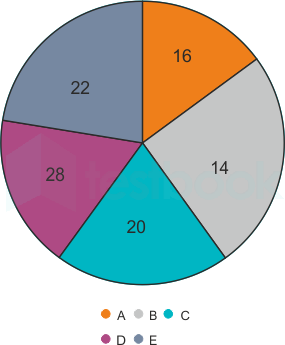
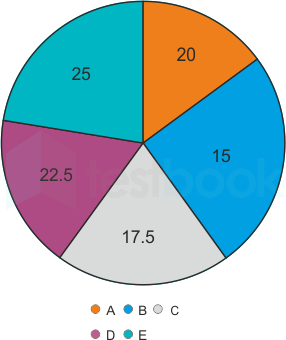
Directions: The given pie chart 1 shows the percentage distribution of the number of students studying in (Arts + Science) in five different colleges A, B, C, D and E.

Total number of students studying (Arts + Science) = 2000


Pie chart 2 shows the percentage distribution of the number of students studying Arts in five different colleges A, B, C, D and E.

Total number of students studying in Arts = 1200

Question 36

Number of students studying arts in college A and B is what percentage of the total number of students studying science in all the colleges A, B, C, D and E.

  1. AOption (a)

    45%

  2. BOption (b)

    40%

  3. COption (c)

    35%

  4. DOption (d)

    55%

  5. EOption (e)

    30%

View answer & explanation

Correct answer

Answer: (a)A.

45%

Why this answer is correct

General Solution:


College A:

Total number of students studying (Arts + Science) = 2000 ×  (20/100) = 400

Number of students studying Arts = 1200 ×  (16/100) = 192

Number of students studying Science = (400 - 192) = 208


College B:

Total number of students studying (Arts + Science) = 2000 ×  (15/100) = 300

Number of students studying Arts = 1200 ×  (14/100) = 168

Number of students studying Science = (300 - 168) = 132


College C:

Total number of students studying (Arts + Science) = 2000 ×  (17.5/100) = 350

Number of students studying Arts = 1200 ×  (20/100) = 240

Number of students studying Science = (350 - 240) = 110


College D:

Total number of students studying (Arts + Science) = 2000 ×  (22.5/100) = 450

Number of students studying Arts = 1200 ×  (28/100) = 336

Number of students studying Science = (450 - 336) = 114


College E:

Total number of students studying (Arts + Science) = 2000 ×  (25/100) = 500

Number of students studying Arts = 1200 ×  (22/100) = 264

Number of students studying Science = (500 - 264) = 236


Name of the collegeNumber of students studying ArtsNumber of students studying Science
A192208
B168132
C240110
D336114
E264236

Solution:

Number of students studying arts in college A and B = (192 + 168) = 360

Total number of students studying science in all the colleges = (2000 - 1200) = 800

Required percentage = 360/800 ×  100 = 45%.

Question 37

Number of students studying arts  in college F is 20 more than the average number of arts students studying in D and E. The number of students studying science in college F is 25 more than the average number of students studying science in college D and E. Find the ratio between the number of students studying arts in college F and the number of students studying science in college F.

  1. AOption (a)

    4: 3

  2. BOption (b)

    8: 5

  3. COption (c)

    7: 5

  4. DOption (d)

    12: 7

  5. EOption (e)

    13: 8

View answer & explanation

Correct answer

Answer: (b)B.

8: 5

Why this answer is correct

General Solution:


College A:

Total number of students studying (Arts + Science) = 2000 ×  (20/100) = 400

Number of students studying Arts = 1200 ×  (16/100) = 192

Number of students studying Science = (400 - 192) = 208


College B:

Total number of students studying (Arts + Science) = 2000 ×  (15/100) = 300

Number of students studying Arts = 1200 ×  (14/100) = 168

Number of students studying Science = (300 - 168) = 132


College C:

Total number of students studying (Arts + Science) = 2000 ×  (17.5/100) = 350

Number of students studying Arts = 1200 ×  (20/100) = 240

Number of students studying Science = (350 - 240) = 110


College D:

Total number of students studying (Arts + Science) = 2000 ×  (22.5/100) = 450

Number of students studying Arts = 1200 ×  (28/100) = 336

Number of students studying Science = (450 - 336) = 114


College E:

Total number of students studying (Arts + Science) = 2000 ×  (25/100) = 500

Number of students studying Arts = 1200 ×  (22/100) = 264

Number of students studying Science = (500 - 264) = 236


Name of the collegeNumber of students studying ArtsNumber of students studying Science
A192208
B168132
C240110
D336114
E264236

Solution:

Number of students studying arts in college D = 336

Number of students studying arts in college E = 264

Number of students studying arts in college F = (336 + 264)/2 = 300 + 20

Number of students studying science in college D = 114

Number of students studying science in college E = 236

Number of students studying science in college F = (350)/2 = 175 + 25

Required ratio = (320 : 200) = 8: 5

Question 38

If the number of students studying in arts from college B is increased by 25% and the number of students studying science in college  C Increased by y. Then the number of students studying arts in college B to the number of students studying science in college C are in the ratio 7: 4. Then find the value of y.

  1. AOption (a)

    15

  2. BOption (b)

    10

  3. COption (c)

    12

  4. DOption (d)

    18

  5. EOption (e)

    20

View answer & explanation

Correct answer

Answer: (b)B.

10

Why this answer is correct

General Solution:


College A:

Total number of students studying (Arts + Science) = 2000 ×  (20/100) = 400

Number of students studying Arts = 1200 ×  (16/100) = 192

Number of students studying Science = (400 - 192) = 208


College B:

Total number of students studying (Arts + Science) = 2000 ×  (15/100) = 300

Number of students studying Arts = 1200 ×  (14/100) = 168

Number of students studying Science = (300 - 168) = 132


College C:

Total number of students studying (Arts + Science) = 2000 ×  (17.5/100) = 350

Number of students studying Arts = 1200 ×  (20/100) = 240

Number of students studying Science = (350 - 240) = 110


College D:

Total number of students studying (Arts + Science) = 2000 ×  (22.5/100) = 450

Number of students studying Arts = 1200 ×  (28/100) = 336

Number of students studying Science = (450 - 336) = 114


College E:

Total number of students studying (Arts + Science) = 2000 ×  (25/100) = 500

Number of students studying Arts = 1200 ×  (22/100) = 264

Number of students studying Science = (500 - 264) = 236


Name of the collegeNumber of students studying ArtsNumber of students studying Science
A192208
B168132
C240110
D336114
E264236

Solution:

Number of students studying arts in college B = 168

If 25% of students studying arts in college B is increased = 168 ×  (125/100) = 210

If y numbers of students studying in college B studying science stream is increased by y = (110 + y)

Then the ratio becomes 7: 4.

To find the value of y

210/(110 + y) = 7/4

840 = 770 + 7y

70 = 7y

y = 10

Question 39

If 75% of the students studying arts in college C  and 4/11 of the students studying science in college C are attending the seminars. find the number of students from college C does not attend the seminar.

  1. AOption (a)

    142

  2. BOption (b)

    138

  3. COption (c)

    128

  4. DOption (d)

    130

  5. EOption (e)

    124

View answer & explanation

Correct answer

Answer: (d)D.

130

Why this answer is correct

General Solution:


College A:

Total number of students studying (Arts + Science) = 2000 ×  (20/100) = 400

Number of students studying Arts = 1200 ×  (16/100) = 192

Number of students studying Science = (400 - 192) = 208


College B:

Total number of students studying (Arts + Science) = 2000 ×  (15/100) = 300

Number of students studying Arts = 1200 ×  (14/100) = 168

Number of students studying Science = (300 - 168) = 132


College C:

Total number of students studying (Arts + Science) = 2000 ×  (17.5/100) = 350

Number of students studying Arts = 1200 ×  (20/100) = 240

Number of students studying Science = (350 - 240) = 110


College D:

Total number of students studying (Arts + Science) = 2000 ×  (22.5/100) = 450

Number of students studying Arts = 1200 ×  (28/100) = 336

Number of students studying Science = (450 - 336) = 114


College E:

Total number of students studying (Arts + Science) = 2000 ×  (25/100) = 500

Number of students studying Arts = 1200 ×  (22/100) = 264

Number of students studying Science = (500 - 264) = 236


Name of the collegeNumber of students studying ArtsNumber of students studying Science
A192208
B168132
C240110
D336114
E264236

Solution:

Number of students studying arts from college C = 240

Number of students studying arts from college C attending seminar = 240 ×  (75/100) = 180

Number of students studying arts from college C does not attend seminar = (240 - 180) = 60

Number of students studying science from college C attending seminar = 110 × 4/11 = 40

Number of students studying Science from college C does not attend seminar = (110 - 40) = 70

Required sum = (60 + 70) = 130

Question 40

If 1/3rd and 3/8 of the number of students studying in arts and science in college A respectively are boys and 25% of the boys studying arts from college A and 50% of the boys studying Science from college A are having two wheelers. Find the number of boys in college A having two wheelers.

  1. AOption (a)

    28

  2. BOption (b)

    40

  3. COption (c)

    36

  4. DOption (d)

    55

  5. EOption (e)

    68

View answer & explanation

Correct answer

Answer: (d)D.

55

Why this answer is correct

General Solution:


College A:

Total number of students studying (Arts + Science) = 2000 ×  (20/100) = 400

Number of students studying Arts = 1200 ×  (16/100) = 192

Number of students studying Science = (400 - 192) = 208


College B:

Total number of students studying (Arts + Science) = 2000 ×  (15/100) = 300

Number of students studying Arts = 1200 ×  (14/100) = 168

Number of students studying Science = (300 - 168) = 132


College C:

Total number of students studying (Arts + Science) = 2000 ×  (17.5/100) = 350

Number of students studying Arts = 1200 ×  (20/100) = 240

Number of students studying Science = (350 - 240) = 110


College D:

Total number of students studying (Arts + Science) = 2000 ×  (22.5/100) = 450

Number of students studying Arts = 1200 ×  (28/100) = 336

Number of students studying Science = (450 - 336) = 114


College E:

Total number of students studying (Arts + Science) = 2000 ×  (25/100) = 500

Number of students studying Arts = 1200 ×  (22/100) = 264

Number of students studying Science = (500 - 264) = 236


Name of the collegeNumber of students studying ArtsNumber of students studying Science
A192208
B168132
C240110
D336114
E264236

Solution:

Number of students studying Arts in college A = 192

Number of boys  studying arts in college A = 192/3 = 64

Number of boys studying arts in college A having two wheelers = 64 ×  (25/100) = 16

Number of students studying science in college A = 208 

Number of boys studying science in college A = 208 ×  3/8 = 78

Number of boys studying science in college A having two wheelers = 78 ×  (50/100) = 39

Required sum = (39 + 16) = 55

Question 41

The ratio of the perimeter of the square field to the perimeter of the rectangular field is 8: 11. If the length of the rectangular field is 30 m and the area of the rectangular field is 750 m2, then, find the cost of fencing the square field at the rate of Rs. 20 per m?

  1. AOption (a)

    Rs. 1600

  2. BOption (b)

    Rs. 1500

  3. COption (c)

    Rs. 1800

  4. DOption (d)

    Rs. 2000

  5. EOption (e)

    None of these

View answer & explanation

Correct answer

Answer: (a)A.

Rs. 1600

Why this answer is correct

Shortcut Trick

Breadth of rectangle = 750 ÷ 30 = 25 m.

Perimeter of rectangle = 2 × (30 + 25) = 110 m.

Ratio 11 units = 110 m ⇒ 1 unit = 10 m.

Perimeter of square = 8 units = 8 × 10 = 80 m.

Fencing cost = 80 × 20 = ₹1600.

∴ The correct answer is ₹1600.

Alternate Method

Given: Length (L) = 30 m, Area = 750 m2, Rate = ₹20/m, Ratio Ps:Pr = 8:11

Formula: Area = L × B | Perimeter = 2(L + B)

⇒ Breadth of rectangle (B) = Area ÷ L = 750 ÷ 30 = 25 m

⇒ Perimeter of rectangle (Pr) = 2(30 + 25) = 2 × 55 = 110 m

⇒ According to ratio, 11 units = 110 m

⇒ 1 unit = 10 m

⇒ Perimeter of square (Ps) = 8 units = 8 × 10 = 80 m

⇒ Total Cost of fencing = Perimeter × Rate = 80 × 20 = ₹1600

∴ The correct answer is ₹1600.

Additional Information

Square Properties

Perimeter = 4 × side, Area = side2. The diagonal of a square is side × √2.

Rectangle Properties

Perimeter = 2(length + breadth), Area = length × breadth. Diagonal = √(L2 + B2).

Fencing Cost

Fencing is always done along the boundary, so total cost = Perimeter × Rate per unit length.

Question 42

The length of the train is 180m and the length of platform is 25% more than the length of the train. The train crosses the platform in 32.4 seconds. If the speed of the train is increased by 33.33%, then, find the time taken by train to cross a tunnel of 200 m long?

  1. AOption (a)

    25.50 seconds

  2. BOption (b)

    20.50 seconds

  3. COption (c)

    22.8 seconds

  4. DOption (d)

    23.5 seconds

  5. EOption (e)

    None of these

View answer & explanation

Correct answer

Answer: (c)C.

22.8 seconds

Why this answer is correct

Shortcut Trick

Total distance (Train + Platform) = 180 + 1.25 × 180 = 180 + 225 = 405 m

Initial speed = 405 ÷ 32.4 = 12.5 m/s

New speed = 12.5 × (4/3) = 50/3 m/s (since 33.33% increase → 4/3 factor)

New distance (Train + Tunnel) = 180 + 200 = 380 m

Required time = 380 ÷ (50/3) = (380 × 3) ÷ 50 = 22.8 seconds

∴ The correct answer is 22.8 sec.

Alternate Method

Given:

Length of Train (L1) = 180 m

Length of Platform (L2) = 180 + 25% of 180 = 180 + 45 = 225 m

Length of Tunnel (L3) = 200 m

Formula Used:

Speed = Total Distance ÷ Total Time

Calculations:

⇒ Total Distance1 = L1 + L2 = 180 + 225 = 405 m

⇒ Initial Speed (S1) = 405 ÷ 32.4 = 12.5 m/s

⇒ New Speed (S2) = 12.5 + (33.33% of 12.5) = 12.5 + (1/3 × 12.5) = 12.5 × (4/3) = 50/3 m/s

⇒ Total Distance2 = L1 + L3 = 180 + 200 = 380 m

⇒ Required Time = 380 ÷ (50/3) = (380 × 3) ÷ 50

⇒ Required Time = 1140 ÷ 50 = 22.8 seconds

∴ The correct answer is 22.8 sec.

Additional Information

Train Crossing Stationary Object with Length

When a train crosses a platform, bridge, or tunnel, the total distance covered is the sum of the length of the train and the object.

Fractional Equivalent of Percentages

Memorizing 33.33% = 1/3 and 25% = 1/4 helps in faster calculation. An increase of 33.33% means multiplying by (1 + 1/3) = 4/3.

Unit Conversion

To convert km/hr to m/s, multiply by 5/18. To convert m/s to km/hr, multiply by 18/5.

Question 43

What approximate value will come in the place of question mark ‘?’ in the following question?

(27.02)% of 300.08 + 19% of 120 + 29.8% of 500 = ?

  1. AOption (a)

    234

  2. BOption (b)

    254

  3. COption (c)

    264

  4. DOption (d)

    274

  5. EOption (e)

    284

View answer & explanation

Correct answer

Answer: (b)B.

254

Why this answer is correct

Given:

(27.02)% of 300.08 + 19% of 120 + 29.8% of 500

Concept:

We have to follow the BODMAS rule

Calculation:

Taking the approximate values

27% of 300 + 19% of 120 + 30% of 500 = ?

⇒ 81 + 22.8 + 150 = ?

⇒ 253.8 = ?

⇒ ? ≈ 254

∴ The value of ? is 254.

Question 44

What approximate value will come in the place of question mark ‘?’ in the following question?

(43.12 × 6 ÷ 2 – 63) – {6.2 of 8 + 48.89 – (11)2 + 25} = ?

  1. AOption (a)

    55

  2. BOption (b)

    65

  3. COption (c)

    75

  4. DOption (d)

    85

  5. EOption (e)

    95

View answer & explanation

Correct answer

Answer: (b)B.

65

Why this answer is correct

Given:

(43.12 × 6 ÷ 2 – 63) – {6.2 of 8 + 48.89 – (11)2 + 25}

Concept used:

We have to follow the BODMAS rule

Calculation:

Taking the approximate values

(43 × 6 ÷ 2 – 63) – {6 of 8 + 49 – (11)2 + 25} = ?

⇒ (43 × 3 – 63) – {48 + 49 – 121 + 25} = ?

⇒ (129 – 63) – {122 – 121} = ?

⇒ 66 – 1 = 65

⇒ ? = 65

∴ The value of ? is 65.

Question 45

What approximate value will come in the place of question mark ‘?’ in the following question?

{(86.01)2 + (120.03)2 + (150.02) × 143}/300 = ?

  1. AOption (a)

    164

  2. BOption (b)

    174

  3. COption (c)

    144

  4. DOption (d)

    165

  5. EOption (e)

    175

View answer & explanation

Correct answer

Answer: (c)C.

144

Why this answer is correct

Given:

{(86.01)2 + (120.03)2 + (150.02) × 143}/300

Concept used:

We have to follow the BODMAS rule

Calculation:

Taking approximate values

{(86)2 + (120)2 + 150 × 143}/300

⇒ {7396 + 14400 + 21450}/300

⇒ 43246/300 = 144.15 ≈ 144

∴ The value of ? is 144.

Question 46

What approximate will come in the place of the question mark ‘?’ in the following question?

38.73 × 15.11 - 27.88 × 10.23 = (20 + ?) × 2 + 11.1 - 9.8

  1. AOption (a)

    132

  2. BOption (b)

    139

  3. COption (c)

    145

  4. DOption (d)

    162

  5. EOption (e)

    123

View answer & explanation

Correct answer

Answer: (a)A.

132

Why this answer is correct

Concept:

Calculation:

Giving expression is,

38.73 × 15.11 - 27.88 × 10.23 = ( 20 + ?) × 2 + 11.1 - 9.8

Taking approximate values as,

⇒ 39 × 15 - 28 × 10 = (20 + ?) × 2 + 11 - 10

⇒ 585 - 280 = 40 + 2? + 1

⇒ 305 = 41 + 2?

⇒ 264 = 2?

⇒ ? = 132

∴ Correct answer is 132

Question 47

What approximate value will come in the place of question mark ‘?’ in the following question?

12.12 – 8.11 + 2.99 × (14.28%) of 1190.1 ÷ 16.99 = ?

  1. AOption (a)

    38

  2. BOption (b)

    43

  3. COption (c)

    34

  4. DOption (d)

    24

  5. EOption (e)

    14

View answer & explanation

Correct answer

Answer: (c)C.

34

Why this answer is correct

Given:

12.12 – 8.11 + 2.99 × (14.28%) of 1190.1 ÷ 16.99 = ?

Concept used:

We have to follow the BODMAS rule

Calculation:

Taking approximate values

12.12 – 8.11 + 2.99 × (14.28%) of 1190.1 ÷ 16.99 = ?

⇒ 12 – 8 + 3 × (1/7) of 1190 ÷ 17 = ?

⇒ 12 – 8 + 3 × (1/7) of 1190 ÷ 17 = ?

⇒ 12 – 8 + 3 × 170 ÷ 17 = ?

⇒ 12 – 8 + 3 × 10 = ?

⇒ ? = 34

∴ The value of ? is 34.

Question 48

A shopkeeper marked the price of a product Rs. 900 more than its cost price and announced successive discounts of 25% and 20% on the marked price, but he suffered a loss of 10%. By what percent should he increase the marked price to earn a profit of Rs. 360 at the same discount?

  1. AOption (a)

    (50/7)%

  2. BOption (b)

    (100/7)%

  3. COption (c)

    (50/3)%

  4. DOption (d)

    (100/3)%

  5. EOption (e)

    25%

View answer & explanation

Correct answer

Answer: (d)D.

(100/3)%

Why this answer is correct

Shortcut Trick

Net discount = 25 + 20 − (25 × 20) ÷ 100 = 40%.

SP = MP × (100 − 40) ÷ 100 = 0.6 MP.

Since loss is 10%, SP = 0.9 CP ⇒ 0.6 MP = 0.9 CP ⇒ MP = 1.5 CP.

Given MP − CP = 900 ⇒ 0.5 CP = 900 ⇒ CP = 1800, MP = 2700.

To get Profit 360, new SP = 1800 + 360 = 2160. New MP × 0.6 = 2160 ⇒ New MP = 3600.

Increase in MP = (3600 − 2700) ÷ 2700 × 100 = 100 ÷ 3%.

∴ The correct answer is (100/3)%.

Alternate Method

Formulas: SP = CP × (100 − L%) ÷ 100 | MP = SP ÷ (1 − Total Discount) | Profit = SP − CP

⇒ Let Cost Price (CP) be x. Marked Price (MP) = x + 900. ⇒ Successive discounts of 25% and 20% ⇒ Single discount = 25 + 20 − (25 × 20)/100 = 40%. ⇒ Selling Price (SP) = (x + 900) × 0.6. ⇒ Loss of 10% means SP = 0.9x. ⇒ Equating SP: 0.6(x + 900) = 0.9x ⇒ 0.6x + 540 = 0.9x ⇒ 0.3x = 540 ⇒ x = 1800. ⇒ Initial MP = 1800 + 900 = 2700. ⇒ To earn Profit of Rs. 360, new SP = 1800 + 360 = 2160. ⇒ New MP = 2160 ÷ 0.6 = 3600. ⇒ % increase in MP = [(3600 − 2700) ÷ 2700] × 100 = (900 ÷ 2700) × 100 = 100/3 %.

∴ The correct answer is (100/3)%.

Additional Information

Successive Discounts

When two discounts a% and b% are given, the equivalent single discount is (a + b − ab/100)%.

Marked Price and Selling Price

SP is the price after applying the discount on MP. SP = MP × (100 − D%)/100.

Question 49

There are x boys and (x - 2) girls in a class. The average score of boys is 38 points and the average score of girls is 39 points and the average score of the whole class is 38.49 points. Then, what is the total number of students in the class?

  1. AOption (a)

    90

  2. BOption (b)

    80

  3. COption (c)

    100

  4. DOption (d)

    120

  5. EOption (e)

    92

View answer & explanation

Correct answer

Answer: (c)C.

100

Why this answer is correct

Shortcut Trick

Apply Alligation: Boys (38) and Girls (39) with Mixture Average (38.49).

Ratio of Boys to Girls = (39 − 38.49) : (38.49 − 38) = 0.51 : 0.49 = 51 : 49.

Difference in ratio parts = 51 − 49 = 2 units. Given difference (x − (x − 2)) = 2 students.

Total students = (51 + 49) units = 100 students.

∴ The correct answer is 100 students.

Alternate Method

Given: Boys = x, Girls = x − 2, Avg Boys = 38, Avg Girls = 39, Avg Class = 38.49.

Formula: Total Score = Average × Number of Students

⇒ 38x + 39(x − 2) = 38.49(x + x − 2)

⇒ 38x + 39x − 78 = 38.49(2x − 2)

⇒ 77x − 78 = 76.98x − 76.98

⇒ 77x − 76.98x = 78 − 76.98

⇒ 0.02x = 1.02

⇒ x = 102 ÷ 2 = 51

⇒ Total Students = x + (x − 2) = 51 + 49 = 100

∴ The correct answer is 100 students.

Additional Information

Alligation Rule

Quantity1 : Quantity2 = (Value2 − Mean) : (Mean − Value1). It is the fastest way to find ratios in mixtures.

Weighted Average

The average of a whole group is calculated as (n1A1 + n2A2) ÷ (n1 + n2).

Deviation Method

Total sum of deviations from the mean is always zero. This can be used to find missing values in a dataset.

Question 50

There are three members in a family a man his wife and their son. The age of the man is 250% of the age of the son and the wife is 6 years younger than the man. If the average age of the family is 30 years. Find the ratio of the ages of the man, his wife, and their son.

  1. AOption (a)

    20 : 17 : 8

  2. BOption (b)

    10 : 7 : 4

  3. COption (c)

    25 : 19 : 10

  4. DOption (d)

    15 : 13 : 6

  5. EOption (e)

    19 : 25 : 10

View answer & explanation

Correct answer

Answer: (a)A.

20 : 17 : 8

Why this answer is correct

Shortcut Trick

Let Son's age = 100 units → Man's age = 250 units → Ratio Man : Son = 5 : 2.

Total age = 30 × 3 = 90 years.

Substitute options: Check for ratio 5 : 2 (or 20 : 8) between Man and Son.

Only Option (1) 20 : 17 : 8 satisfies Man : Son = 20 : 8 = 5 : 2 and total sum 20+17+8=45 units, where 45 units = 90 years.

∴ The correct answer is 20 : 17 : 8.

Alternate Method

Given: Average age = 30, Man = 250% of Son, Wife = Man − 6.

Formula: Total Age = Average × Number of members

⇒ Let Son's age = x

⇒ Man's age = 2.5x

⇒ Wife's age = 2.5x − 6

⇒ Total Age = x + 2.5x + (2.5x − 6) = 30 × 3

⇒ 6x − 6 = 90

⇒ 6x = 96 → x = 16

⇒ Son = 16, Man = 2.5 × 16 = 40, Wife = 40 − 6 = 34

⇒ Ratio = 40 : 34 : 16 = 20 : 17 : 8

∴ The correct answer is 20 : 17 : 8.

Additional Information

Average Age Concept

The sum of ages of n members is Average × n. If each person's age increases by k years, the average also increases by k.

Ratio and Proportion

To find the ratio of three quantities A:B:C, ensure all values are in the same unit and simplify by dividing by their HCF.

Percentage to Ratio Conversion

250% can be written as 250/100 or 5/2. Thus, if the base is 2 parts, the resultant is 5 parts.

Directions: The following caselet shows the information about the number of persons who participated in three different games: swimming , fencing and skating.

Number of persons who participated in only swimming and only fencing are in the ratio 4: 3. Number of persons who participated in only skating is 2 less than the number of persons who participated in only fencing.Number of persons who participated in all the three is 5 which is 5 less than the number of persons who participated in both swimming and fencing but not skating. Number of persons who participated in both fencing and swimming but not skating and the number of persons who participated in swimming and skating but not fencing are in the ratio 2 : 3. Number of persons who participated in both fencing and skating but not swimming is 80% of the number of persons who participated in swimming and skating but not fencing. Total number of persons who participated in only swimming, only fencing and only skating is 98.

Question 51

 If the number of males to females who  participate only in skating are in the ratio 4: 3 and the total number of females who participate in only skating and only swimming is 22. Find the difference between the number of males participating in only skating and only swimming.

  1. AOption (a)

    20

  2. BOption (b)

    16

  3. COption (c)

    18

  4. DOption (d)

    14

  5. EOption (e)

    22

View answer & explanation

Correct answer

Answer: (d)D.

14

Why this answer is correct

General solution:

Number of persons who participated in only swimming and only fencing are in the ratio 4x: 3x

Number of persons who participated in only skating is 2 less than the number of persons who participated in only fencing = (3x - 2)

Number of persons who participated in all the three = 5

Number of persons who participated in both swimming and fencing but not skating =  (5 + 5) = 10

Number of persons who participated in both fencing and swimming but not skating and the number of persons who participated in swimming and skating but not fencing are in the ratio 2 : 3

Number of persons who participated in swimming and skating but not fencing = 10/2 ×  3 = 15

Number of person who participated in both fencing and skating but not swimming is 80% of the number of persons who participated in swimming and skating but not fencing.

Number of person who participated in both fencing and skating but not swimming  =15 ×  (80/100) = 12

Total number of persons who participated in only swimming , only fencing and only skating is 98.

(4x + 3x + 3x - 2) = 98

10x = 100

x = 10

Number of persons who likes swimming only = 40

Number of persons who likes fencing only = 30

Number of persons who likes skating = (30 - 2) = 28

Solution:

Number of males to females who participated only skating = 28

Number of males participated  only skating = 28/7 × 4 = 16

Number of females participated only in skating = (28 - 16) = 12

Number of females participated only swimming = 22 - 12 = 10

Number of males participated only swimming = (40 - 10) = 30

Required difference = (30 - 16) = 14

Question 52

Number of persons who participated in skating and fencing but not swimming is what percentage of the number of persons who participated in only swimming.

  1. AOption (a)

    35%

  2. BOption (b)

    20%

  3. COption (c)

    30%

  4. DOption (d)

    25%

  5. EOption (e)

    15%

View answer & explanation

Correct answer

Answer: (c)C.

30%

Why this answer is correct

General solution:

Number of persons who participated in only swimming and only fencing are in the ratio 4x: 3x

Number of persons who participated in only skating is 2 less than the number of persons who participated in only fencing = (3x - 2)

Number of persons who participated in all the three = 5

Number of persons who participated in both swimming and fencing but not skating =  (5 + 5) = 10

Number of persons who participated in both fencing and swimming but not skating and the number of persons who participated in swimming and skating but not fencing are in the ratio 2 : 3

Number of persons who participated in swimming and skating but not fencing = 10/2 ×  3 = 15

Number of person who participated in both fencing and skating but not swimming is 80% of the number of persons who participated in swimming and skating but not fencing.

Number of person who participated in both fencing and skating but not swimming  =15 ×  (80/100) = 12

Total number of persons who participated in only swimming , only fencing and only skating is 98.

(4x + 3x + 3x - 2) = 98

10x = 100

x = 10

Number of persons who likes swimming only = 40

Number of persons who likes fencing only = 30

Number of persons who likes skating = (30 - 2) = 28

Solution:

Number of persons who participated in skating and fencing but not swimming = 12

Number of persons who participated in only swimming = 40

Required percentage = 12/40 ×  100 = 30%

Question 53

Find the difference between total persons who participated in swimming and the total persons who participated in fencing.

  1. AOption (a)

    17

  2. BOption (b)

    16

  3. COption (c)

    13

  4. DOption (d)

    10

  5. EOption (e)

    15

View answer & explanation

Correct answer

Answer: (c)C.

13

Why this answer is correct

General solution:

Number of persons who participated in only swimming and only fencing are in the ratio 4x: 3x

Number of persons who participated in only skating is 2 less than the number of persons who participated in only fencing = (3x - 2)

Number of persons who participated in all the three = 5

Number of persons who participated in both swimming and fencing but not skating =  (5 + 5) = 10

Number of persons who participated in both fencing and swimming but not skating and the number of persons who participated in swimming and skating but not fencing are in the ratio 2 : 3

Number of persons who participated in swimming and skating but not fencing = 10/2 ×  3 = 15

Number of person who participated in both fencing and skating but not swimming is 80% of the number of persons who participated in swimming and skating but not fencing.

Number of person who participated in both fencing and skating but not swimming  =15 ×  (80/100) = 12

Total number of persons who participated in only swimming , only fencing and only skating is 98.

(4x + 3x + 3x - 2) = 98

10x = 100

x = 10

Number of persons who likes swimming only = 40

Number of persons who likes fencing only = 30

Number of persons who likes skating = (30 - 2) = 28

Solution:

Number of persons who participated in swimming = (40 + 15 + 5+ 10) = 70

Number of persons who participated in fencing = (30 + 10 + 5 + 12) = 57

Required difference  = (70 - 57) = 13

Question 54

Himanshu decided to donate 25% of his income to a fund for making arrangements for oxygen cylinders to COVID patients. On the day of donation he changed his mind and donated Rs. 4250 which was 85% of what he had decided earlier. How much is Himanshu's income per month?

  1. AOption (a)

    Rs. 21450

  2. BOption (b)

    Rs. 20,000

  3. COption (c)

    Rs. 30000

  4. DOption (d)

    Rs. 25,000

  5. EOption (e)

    None of these 

View answer & explanation

Correct answer

Answer: (b)B.

Rs. 20,000

Why this answer is correct

Shortcut Trick

Let Total Income be 100%.

Planned Donation = 25% of Income.

Actual Donation = 85% of 25% = 21.25% of Income.

21.25% → ₹4250

100% → (4250 ÷ 21.25) × 100 = 200 × 100 = ₹20,000.

∴ The correct answer is ₹20,000.

Alternate Method

Given:

Actual donation = ₹4250

Actual donation = 85% of Planned donation

Planned donation = 25% of Monthly Income

Calculations:

⇒ 85% of Planned donation = ₹4250

⇒ Planned donation = (4250 × 100) ÷ 85

⇒ Planned donation = 50 × 100 = ₹5000

⇒ Now, 25% of Monthly Income = ₹5000

⇒ Monthly Income = (5000 × 100) ÷ 25

⇒ Monthly Income = ₹20,000

∴ The correct answer is ₹20,000.

Additional Information

Percentage Change

To find the original value from a percentage part, use: Original = (Given Value ÷ Percentage) × 100.

Successive Percentages

If a value is changed by a% and then b%, the effective percentage of the original is (a × b) ÷ 100.

Income and Savings

Total Income is always treated as the base (100%) when calculating components like expenditure, savings, or donations.

Question 55

In a mixture of 280 liters, the ratio of the milk and water is 5:2. If the x liters of the mixture is taken out and the x liters of water is added to the resultant mixture, then the ratio of milk to water in the resultant mixture becomes 5:3, find the quantity of the water in the final mixture?

  1. AOption (a)

    75 liters 

  2. BOption (b)

    90 liters

  3. COption (c)

    105 liters

  4. DOption (d)

    120 liters

  5. EOption (e)

    135 liters

View answer & explanation

Correct answer

Answer: (c)C.

105 liters

Why this answer is correct

Shortcut Trick

In the final mixture, the milk and water ratio is 5 : 3.

Total volume remains constant at 280 liters because x liters are removed and x liters are added.

Total units in final mixture = 5 + 3 = 8 units.

8 units = 280 liters ⇒ 1 unit = 35 liters.

Water in final mixture = 3 units = 3 × 35 liters = 105 liters.

∴ The correct answer is 105 liters.

Alternate Method

Given: Initial volume = 280 liters, Initial Ratio (M:W) = 5:2, Final Ratio (M:W) = 5:3.

Formula: Ratio × constant = Actual Value.

⇒ When x liters of mixture is removed, the ratio of milk and water remains 5:2.

⇒ When x liters of water is added, the ratio becomes 5:3.

⇒ Since only water is added, the milk quantity stays constant (5 units in both cases).

⇒ Total volume of final mixture = Initial volume = 280 liters.

⇒ Final ratio sum = 5 + 3 = 8 units.

⇒ 8 units = 280 liters.

⇒ 1 unit = 280 ÷ 8 = 35 liters.

⇒ Water in final mixture = 3 units = 3 × 35 = 105 liters.

∴ The correct answer is 105 liters.

Additional Information

Mixture Removal Property

When a part of a mixture is removed, the ratio of components in the remaining mixture stays the same as the original ratio.

Replacement Concept

If x liters are removed and x liters of a single component are added, the total volume of the mixture remains unchanged.

Ratio Balancing

To solve replacement problems, keep the component that was not added constant in the ratio calculations.

Question 56

A person invested a sum of ₹ x at simple interest at 10% per annum for 7 years. If he had invested ₹ (x + 10,100) at simple interest at 15% per annum for 8 years, then, simple interest would have been ₹ 34,620 more than the other one. Then, what is the value of x?

  1. AOption (a)

    45,000

  2. BOption (b)

    42,000

  3. COption (c)

    40,000

  4. DOption (d)

    48,000

  5. EOption (e)

    None of these

View answer & explanation

Correct answer

Answer: (a)A.

45,000

Why this answer is correct

Shortcut Trick

Total interest % in first case = 10% × 7 = 70% of x.

Total interest % in second case = 15% × 8 = 120% of (x + 10,100).

Difference: 120% of (x + 10,100) − 70% of x = 34,620.

⇒ 1.2x + 12,120 − 0.7x = 34,620 ⇒ 0.5x = 22,500.

⇒ x = 45,000.

∴ The correct answer is ₹45,000.

Alternate Method

Given: Rate1 = 10%, Time1 = 7 yrs, Principal1 = x. Rate2 = 15%, Time2 = 8 yrs, Principal2 = x + 10,100.

Formula Used: Simple Interest (SI) = (P × R × T) ÷ 100

⇒ SI1 = (x × 10 × 7) ÷ 100 = 0.7x

⇒ SI2 = [(x + 10,100) × 15 × 8] ÷ 100 = 1.2 × (x + 10,100)

⇒ SI2 − SI1 = 34,620

⇒ 1.2x + 12,120 − 0.7x = 34,620

⇒ 0.5x = 34,620 − 12,120

⇒ 0.5x = 22,500

⇒ x = 22,500 ÷ 0.5 = 45,000

∴ The correct answer is ₹45,000.

Additional Information

Simple Interest Concept

Simple interest is calculated only on the principal amount. SI = P×R×T/100, where P is Principal, R is Rate per annum, and T is Time in years.

Amount Calculation

The total Amount (A) after T years is the sum of Principal and Interest: A = P + SI = P(1 + RT/100).

Effective Rate of Interest

For simple interest, the effective rate for the entire duration is simply (R × T)%. This allows for direct percentage-based comparisons between different investment scenarios.

Directions: The following table graph shows the percentage trousers sold out of total trousers and shirts sold in the five different shops A, B, C, D and E.


Total number of trousers and shirts sold in all the shops is = 6950


Name of the shopsTotal number of trousers and shirts soldPercentage of trousers sold
A1200(70 - x)%
B50x(x + 30)%
C(40x + 50)(2x + 20)%
D(2x + 10)% of 200071.42%
E160030%

Question 57

Number of trousers sold in shop D and E is approximately  what percentage of the total number of shirts sold in all the shops A, B, C, D and E.

  1. AOption (a)

    49%

  2. BOption (b)

    62%

  3. COption (c)

    56%

  4. DOption (d)

    48%

  5. EOption (e)

    52%

View answer & explanation

Correct answer

Answer: (d)D.

48%

Why this answer is correct

General solution:


Total number of trousers and shirts sold in all the shops = 6950

(1200 + 50x + 40x + 50 + (2x + 10)/100 ×  2000 + 1600) = 6950

(1200 + 200 + 50 + 1600 + 130x ) = 6950

130x = 3900

x = 30


Shop A:

Total number of shirts and trousers sold = 1200

Number of trousers sold = 1200 ×  (70 - 30)/100 = 480

Number of shirts sold = (1200 - 480) = 720


Shop B:

Total number of shirts and trousers sold = 50 ×  30 = 1500

Number of trousers sold = 1500 ×  (30 + 30)/100 = 900

Number of shirts sold = (1500 - 900) = 600


Shop C:

Total number of shirts and trousers sold = (40 ×  30 + 50) = 1250

Number of trousers sold = 1250 ×  (2 ×  30 + 20)/100 = 1000

Number of shirts sold = (1250 - 1000) = 250


Shop D:

Total number of shirts and trousers sold = (2x + 10)% of 2000 = (2 ×  30 + 10) % of 2000 = 1400

Number of trousers sold = 1400 ×  (71.42/100) = 1000 (approx)

Number of shirts sold = (1400 - 1000) = 400


Shop E:

Total number of shirts and trousers sold = 1600

Number of trousers sold = 1600 ×  30/100 = 480

Number of shirts sold = (1600 - 480) = 1120


ShopNumber of trousers soldNumber of shirts sold
A480720
B900600
C1000250
D1000400
E4801120


Solution:

Number of trousers sold in shop D = 1000

Number of trousers sold in shop E = 480

Total shirts sold in all the shops A, B, C, D and E = (720 + 600 + 250 + 400 + 1120) = 3090

Required percentage = (1480)/3090 ×  100 = 47.89% ~ 48%

Question 58

If 20% , 30% of the number of trousers sold in shop C and Shop D respectively are cotton and 60% and 70% of the number of shirts sold in shop C and D respectively are fabrics then find the total number of cotton trousers and fabric shirts sold in shop C and D.

  1. AOption (a)

    970

  2. BOption (b)

    890

  3. COption (c)

    930

  4. DOption (d)

    910

  5. EOption (e)

    950

View answer & explanation

Correct answer

Answer: (c)C.

930

Why this answer is correct

General solution:


Total number of trousers and shirts sold in all the shops = 6950

(1200 + 50x + 40x + 50 + (2x + 10)/100 ×  2000 + 1600) = 6950

(1200 + 200 + 50 + 1600 + 130x ) = 6950

130x = 3900

x = 30


Shop A:

Total number of shirts and trousers sold = 1200

Number of trousers sold = 1200 ×  (70 - 30)/100 = 480

Number of shirts sold = (1200 - 480) = 720


Shop B:

Total number of shirts and trousers sold = 50 ×  30 = 1500

Number of trousers sold = 1500 ×  (30 + 30)/100 = 900

Number of shirts sold = (1500 - 900) = 600


Shop C:

Total number of shirts and trousers sold = (40 ×  30 + 50) = 1250

Number of trousers sold = 1250 ×  (2 ×  30 + 20)/100 = 1000

Number of shirts sold = (1250 - 1000) = 250


Shop D:

Total number of shirts and trousers sold = (2x + 10)% of 2000 = (2 ×  30 + 10) % of 2000 = 1400

Number of trousers sold = 1400 ×  (71.42/100) = 1000

Number of shirts sold = (1400 - 1000) = 400


Shop E:

Total number of shirts and trousers sold = 1600

Number of trousers sold = 1600 ×  30/100 = 480

Number of shirts sold = (1600 - 480) = 1120


ShopNumber of trousers soldNumber of shirts sold
A480720
B900600
C1000250
D1000400
E4801120


Solution:

Number of cotton trousers sold in shop C =  1000 ×  (20/100) = 200

Number of cotton trousers sold in shop D =  1000 ×  (30/100) = 300

Number of fabric shirts sold in the shop C = 250 ×  (60/100) = 150

Number of fabric shirts sold in the shop D = 400 ×  (70/100) = 280

Required sum = (200 + 300 + 150 + 280) = 930

Question 59

If number of trousers sold in shop D and E is increased by 20% and 25% respectively and the number of shirts sold in shop D and E is increased by 50% and 25% Find the ratio between the number of trousers sold in shop D and E to the number of shirts sold in shop D and E.

  1. AOption (a)

    13: 11

  2. BOption (b)

    12: 7

  3. COption (c)

    9: 10

  4. DOption (d)

    12: 11

  5. EOption (e)

    7: 9

View answer & explanation

Correct answer

Answer: (c)C.

9: 10

Why this answer is correct

General solution:


Total number of trousers and shirts sold in all the shops = 6950

(1200 + 50x + 40x + 50 + (2x + 10)/100 ×  2000 + 1600) = 6950

(1200 + 200 + 50 + 1600 + 130x ) = 6950

130x = 3900

x = 30


Shop A:

Total number of shirts and trousers sold = 1200

Number of trousers sold = 1200 ×  (70 - 30)/100 = 480

Number of shirts sold = (1200 - 480) = 720


Shop B:

Total number of shirts and trousers sold = 50 ×  30 = 1500

Number of trousers sold = 1500 ×  (30 + 30)/100 = 900

Number of shirts sold = (1500 - 900) = 600


Shop C:

Total number of shirts and trousers sold = (40 ×  30 + 50) = 1250

Number of trousers sold = 1250 ×  (2 ×  30 + 20)/100 = 1000

Number of shirts sold = (1250 - 1000) = 250


Shop D:

Total number of shirts and trousers sold = (2x + 10)% of 2000 = (2 ×  30 + 10) % of 2000 = 1400

Number of trousers sold = 1400 ×  (71.42/100) = 1000

Number of shirts sold = (1400 - 1000) = 400


Shop E:

Total number of shirts and trousers sold = 1600

Number of trousers sold = 1600 ×  30/100 = 480

Number of shirts sold = (1600 - 480) = 1120


ShopNumber of trousers soldNumber of shirts sold
A480720
B900600
C1000250
D1000400
E4801120


Solution:

Number of trousers sold in shop D = 1000

Number of trousers sold in shop E = 480

Number of trouser sold after 20% increase in shop D = 1000 ×  120/100 = 1200

Number of trouser sold after 25% increase in shop E = 480 ×  125/100 = 600

Number of shirts sold in shop D = 400

Number of shirts sold in shop E = 1120

Number of trouser sold after 50% increase in shop D = 400 ×  (150/100) = 600

Number of trouser sold after 25% increase in shop E = 1120 ×  (125/100) = 1400

Required ratio = (1200 + 600): (600 + 1400) = 1800: 2000 = 9: 10

Question 60

If a%  numbers of trousers are sold in shop B and 2a% of shirts in shop B are sold for Rs. 120 and Rs. 180 respectively. If total revenue generated is Rs. 97200. Then find the value of a.

  1. AOption (a)

    40

  2. BOption (b)

    30

  3. COption (c)

    25

  4. DOption (d)

    35

  5. EOption (e)

    45

View answer & explanation

Correct answer

Answer: (b)B.

30

Why this answer is correct

General solution:


Total number of trousers and shirts sold in all the shops = 6950

(1200 + 50x + 40x + 50 + (2x + 10)/100 ×  2000 + 1600) = 6950

(1200 + 200 + 50 + 1600 + 130x ) = 6950

130x = 3900

x = 30


Shop A:

Total number of shirts and trousers sold = 1200

Number of trousers sold = 1200 ×  (70 - 30)/100 = 480

Number of shirts sold = (1200 - 480) = 720


Shop B:

Total number of shirts and trousers sold = 50 ×  30 = 1500

Number of trousers sold = 1500 ×  (30 + 30)/100 = 900

Number of shirts sold = (1500 - 900) = 600


Shop C:

Total number of shirts and trousers sold = (40 ×  30 + 50) = 1250

Number of trousers sold = 1250 ×  (2 ×  30 + 20)/100 = 1000

Number of shirts sold = (1250 - 1000) = 250


Shop D:

Total number of shirts and trousers sold = (2x + 10)% of 2000 = (2 ×  30 + 10) % of 2000 = 1400

Number of trousers sold = 1400 ×  (71.42/100) = 1000

Number of shirts sold = (1400 - 1000) = 400


Shop E:

Total number of shirts and trousers sold = 1600

Number of trousers sold = 1600 ×  30/100 = 480

Number of shirts sold = (1600 - 480) = 1120


ShopNumber of trousers soldNumber of shirts sold
A480720
B900600
C1000250
D1000400
E4801120


Solution:

Total number of trousers sold in shop B = 900

Total number of shirts sold in shop B = 600

a/100 ×  900 ×  120 + 2a/100 ×  600 ×  180 = 97200

1080a + 2160a = 97200

97200/3240 = a

a = 30

Question 61

If 1/3rd of the trousers sold in shop A and 1/4 th of the shirts sold in shop A respectively are sold at the discount and the remaining are sold at marked price. If 1/8 th of the trousers sold at the marked price are branded and 1/3 of the shirts sold at the marked price are branded then find the number of branded shirts and trousers sold at marked price.

  1. AOption (a)

    320

  2. BOption (b)

    270

  3. COption (c)

    220

  4. DOption (d)

    240

  5. EOption (e)

    280

View answer & explanation

Correct answer

Answer: (c)C.

220

Why this answer is correct

General solution:


Total number of trousers and shirts sold in all the shops = 6950

(1200 + 50x + 40x + 50 + (2x + 10)/100 ×  2000 + 1600) = 6950

(1200 + 200 + 50 + 1600 + 130x ) = 6950

130x = 3900

x = 30


Shop A:

Total number of shirts and trousers sold = 1200

Number of trousers sold = 1200 ×  (70 - 30)/100 = 480

Number of shirts sold = (1200 - 480) = 720


Shop B:

Total number of shirts and trousers sold = 50 ×  30 = 1500

Number of trousers sold = 1500 ×  (30 + 30)/100 = 900

Number of shirts sold = (1500 - 900) = 600


Shop C:

Total number of shirts and trousers sold = (40 ×  30 + 50) = 1250

Number of trousers sold = 1250 ×  (2 ×  30 + 20)/100 = 1000

Number of shirts sold = (1250 - 1000) = 250


Shop D:

Total number of shirts and trousers sold = (2x + 10)% of 2000 = (2 ×  30 + 10) % of 2000 = 1400

Number of trousers sold = 1400 ×  (71.42/100) = 1000

Number of shirts sold = (1400 - 1000) = 400


Shop E:

Total number of shirts and trousers sold = 1600

Number of trousers sold = 1600 ×  30/100 = 480

Number of shirts sold = (1600 - 480) = 1120


ShopNumber of trousers soldNumber of shirts sold
A480720
B900600
C1000250
D1000400
E4801120


Solution:

Number of trousers sold in shop A = 480

Number of trousers sold in shop A at discount = 480/3 = 160

Number of trousers sold in shop A at marked price = (480 - 160) = 320

Number of branded trousers sold at marked price in shop A = 320/8 = 40

Number of shirts sold in shop A = 720

Number of shirts sold in shop A at discount = 720/4 = 180

Number of shirts sold in shop A at marked price = (720 - 180) = 540

Number of branded shirts sold at marked price in shop A = 540/3 = 180

Required total = (40 + 180) = 220

Question 62

A certain sum of money invested at x% per annum simple interest for two years obtained the same interest as it would have if it had been invested (x – 2)% per annum compound interest over two years. Then, what would ₹ 3000 invested at (x – 7) % on a simple interest basis over five years become?

  1. AOption (a)

    ₹ 5200

  2. BOption (b)

    ₹ 5250

  3. COption (c)

    ₹ 5450

  4. DOption (d)

    ₹ 5550

  5. EOption (e)

    None of these

View answer & explanation

Correct answer

Answer: (b)B.

₹ 5250

Why this answer is correct

Shortcut Trick

For 2 years, Simple Interest (SI) = 2x% and Compound Interest (CI) = 2r + r2/100 where r = (x − 2).

Equating interest rates: 2x = 2(x − 2) + (x − 2)2/100 ⇒ 4 = (x − 2)2/100.

√400 = x − 2 ⇒ 20 = x − 2 ⇒ x = 22.

New rate = x − 7 = 15%. SI for 5 years = 15% × 5 = 75%.

Amount = Principal × (100 + 75)% = 3000 × 1.75 = ₹ 5250.

∴ The correct answer is ₹ 5250.

Alternate Method

Given: Principal (P) for both cases is same. Time (T) = 2 years. SI rate = x%. CI rate = (x − 2)%.

Formula Used: SI = (P × R × T)/100; CI = P[(1 + R/100)T − 1]

⇒ Interest from SI = (P × x × 2) / 100 = 2Px / 100

⇒ Interest from CI = P[(1 + (x − 2)/100)2 − 1]

⇒ 2x/100 = [1 + (x − 2)/100]2 − 1

⇒ 2x/100 + 1 = 1 + 2(x − 2)/100 + ((x − 2)/100)2

⇒ 2x/100 = 2x/100 − 4/100 + (x − 2)2/10000

⇒ 4/100 = (x − 2)2 / 10000 ⇒ (x − 2)2 = 400

⇒ x − 2 = 20 ⇒ x = 22

⇒ New principal = ₹ 3000, New rate = 22 − 7 = 15%, Time = 5 years

⇒ SI = (3000 × 15 × 5) / 100 = ₹ 2250

⇒ Amount = 3000 + 2250 = ₹ 5250

∴ The correct answer is ₹ 5250.

Additional Information

Effective rate of Compound Interest

For 2 years, the effective CI rate is given by the formula Reff = 2R + R2/100 %.

Simple Interest Amount

The final amount under SI is A = P(1 + RT/100), where R is the annual rate and T is time in years.

Difference between CI and SI

For a period of 2 years at the same rate R, the difference is CI − SI = P(R/100)2.

Question 63

P and Q invested in a business with Rs. 16,000 and Rs. 20,000 respectively . After x months, R joined them with Rs. 24,000 while Q left x months before the end of the year. They decide to split the profits at the end of the year, If they split the profit in the following proportions: 48 : 35 : 42. What is the value of x?

  1. AOption (a)

    6

  2. BOption (b)

    4

  3. COption (c)

    7

  4. DOption (d)

    8

  5. EOption (e)

    5

View answer & explanation

Correct answer

Answer: (e)E.

5

Why this answer is correct

Shortcut Trick

Profit Ratio = (Capital × Time) ratio.

Ratio of P : Q : R Capitals = 16000 : 20000 : 24000 = 4 : 5 : 6.

Ratio of Time = 12 : (12 − x) : (12 − x).

Profit Ratio = (4 × 12) : 5(12 − x) : 6(12 − x) = 48 : 5(12 − x) : 6(12 − x).

Given Profit Ratio = 48 : 35 : 42.

Comparing Q's share: 5(12 − x) = 35 ⇒ 12 − x = 7 ⇒ x = 5.

∴ The correct answer is 5.

Alternate Method

Given: P's investment = Rs. 16,000 for 12 months; Q's investment = Rs. 20,000 for (12 − x) months; R's investment = Rs. 24,000 for (12 − x) months. Formula: Profit Share = Investment × Time Period

⇒ Profit of P = 16,000 × 12 = 192,000. ⇒ Profit of Q = 20,000 × (12 − x). ⇒ Ratio P : Q = 192,000 : 20,000(12 − x) = 48 : 35. ⇒ 192,000 / [20,000(12 − x)] = 48 / 35. ⇒ 192 / [20(12 − x)] = 48 / 35. ⇒ 4 / (12 − x) = 4 / 7 (after dividing 192 by 48). ⇒ 12 − x = 7. ⇒ x = 12 − 7 = 5.

∴ The correct answer is 5.

Additional Information

Partnership Basics

In a partnership, the profit is distributed in the ratio of the product of Investment and Time Period.

Ratio Conversion

If Profit Ratio and Investment Ratio are given, Time Ratio = (Profit Ratio ÷ Investment Ratio).

Question 64

A steamer can go 24 km in still water in 50 minutes. One day, it went 22.5 km upstream and returned the same distance downstream. If the difference between the time taken to travel upstream and downstream was 25 minutes, then what was the speed of the stream in km per hour?

  1. AOption (a)

    10.5 km/h

  2. BOption (b)

    7.2 km/h

  3. COption (c)

    9.8 km/h

  4. DOption (d)

    3.5 km/h

  5. EOption (e)

    10 km/h

View answer & explanation

Correct answer

Answer: (b)B.

7.2 km/h

Why this answer is correct

Shortcut Trick

Speed of Steamer (u) = 24 km ÷ (50/60) h = 28.8 km/h.

Using Difference in Time formula: [D × (2v)] ÷ (u2 − v2) = ΔT.

[22.5 × 2v] ÷ (28.82 − v2) = 25/60.

By testing Option (2): v = 7.2 km/h ⇒ (45 × 7.2) ÷ (829.44 − 51.84) = 324 ÷ 777.6 = 5/12 h = 25 minutes.

∴ The correct answer is 7.2 km/h.

Alternate Method

Given:

Distance (D) = 22.5 km

Speed of steamer in still water (u) = 24 ÷ (50/60) = 24 × 6/5 = 28.8 km/h

Time difference (ΔT) = 25/60 = 5/12 hours

Formula Used:

Time = Distance ÷ Speed

Upstream Speed = u − v | Downstream Speed = u + v

Calculations:

⇒ [22.5 / (28.8 − v)] − [22.5 / (28.8 + v)] = 5/12

⇒ 22.5 × [(28.8 + v − 28.8 + v) / (28.82 − v2)] = 5/12

⇒ 22.5 × [2v / (829.44 − v2)] = 5/12

⇒ 45v / (829.44 − v2) = 5/12

⇒ 9v × 12 = 829.44 − v2

⇒ v2 + 108v − 829.44 = 0

⇒ Solving quadratic equation or verification by options:

⇒ If v = 7.2, then 7.22 + 108(7.2) = 51.84 + 777.6 = 829.44

∴ The correct answer is 7.2 km/h.

Additional Information

Relative Speed in Water

Downstream speed is the sum (u + v) and Upstream speed is the difference (u − v) where u is boat speed and v is stream speed.

Average Speed for Round Trip

The average speed for a round trip in a river is [(u2 − v2) / u] which is always less than the speed in still water.

Time Difference Formula

Difference between Upstream and Downstream time ΔT = [2 × Distance × Stream Speed] ÷ [u2 − v2].

Question 65

A is twice as efficient as B. A and B together do the same work in as much time as C and D can do together. The ratio of the number of alone working days of C  to D is 2 : 3 and if B worked 16 days more than C, then find the number of days for which A worked alone. 

  1. AOption (a)

    18 days 

  2. BOption (b)

    17 days 

  3. COption (c)

    16 days 

  4. DOption (d)

    14 days 

  5. EOption (e)

    None of these

View answer & explanation

Correct answer

Answer: (a)A.

18 days 

Why this answer is correct

Shortcut Trick

Efficiency A : B = 2 : 1 → Days A : B = 1 : 2. Let days be x and 2x.

Days C : D = 2 : 3. Combined efficiency (1/x + 1/2x) = (1/2y + 1/3y) where C = 2y, D = 3y.

3/2x = 5/6y ⇒ 18y = 10x ⇒ y = 5x/9.

Given B − C = 16 ⇒ 2x − 2y = 16 ⇒ 2x − 10x/9 = 16 ⇒ 8x/9 = 16 ⇒ x = 18.

∴ The correct answer is 18 days.

Alternate Method

Given: Efficiency of A is twice of B. Time taken by (A+B) = Time taken by (C+D). Ratio of days C : D = 2 : 3. B − C = 16 days.

PersonDaysTotal WorkEfficiency
Ax2x2
B2x1

⇒ Time taken by (A+B) = 2x ÷ 3.

⇒ For C and D, let days be 2y and 3y. Time taken by (C+D) = (2y × 3y) ÷ (2y + 3y) = 6y/5.

⇒ According to question: 2x/3 = 6y/5 ⇒ 10x = 18y ⇒ 5x = 9y ⇒ y = 5x/9.

⇒ Difference in days B − C = 16 ⇒ 2x − 2y = 16 ⇒ x − y = 8.

⇒ Substitute y: x − 5x/9 = 8 ⇒ 4x/9 = 8 ⇒ 4x = 72 ⇒ x = 18.

∴ The correct answer is 18 days.

Additional Information

Efficiency and Time Relationship

Efficiency is inversely proportional to the time taken to complete a work. If efficiency ratio is a : b, then time ratio is b : a.

Combined Work Formula

If two people take X and Y days respectively, they together take (X × Y) ÷ (X + Y) days to complete the work.

Reasoning Ability (35 questions)

Direction: Read the following information carefully and answer the given questions.

Nine persons Mehak, Piku, Neha, Kavita, Huma, Anu, Tony, Romi, and Sita are working in a bank in nine different designations i.e. Chairman, General Manager(GM), Deputy General Manager(DGM), Assistant General Manager(AGM), Senior Manager(SM), Bank Manager(BM), Assistant Manager(AM), Section Officer(SO) and Clerk but not necessarily in the same order. The Chairman is the senior most and Clerk is the junior most position and all mentioned positions in between are in senior to junior order.

 Mehak is senior to Tony. More than four persons have designation between Mehak and Tony, who is not junior to SO. Mehak is senior to Neha. One designation is between Piku and Kavita. Piku is senior to Kavita. Kavita is just senior to Sita. Tony is a senior to Anu. Sita is the Bank Manager. Romi is not junior to Neha. Neha is a senior to Huma. At least two persons are junior to Huma. More than two designations are there between Romi and Kavita.

Question 66

How many persons are senior to Neha?

  1. AOption (a)

    Five

  2. BOption (b)

    Two

  3. COption (c)

    Seven

  4. DOption (d)

    Three

  5. EOption (e)

    Four

View answer & explanation

Correct answer

Answer: (d)D.

Three

Why this answer is correct

1)  Mehak is senior to Tony. More than four persons have designation between Mehak and Tony, who is not junior to SO. Sita is the Bank Manager. 

Case 1Case 2Case 3
DesignationPersonsPersonsPersons
ChairmanMehakMehak
General Manager(GM)Mehak
Deputy General Manager(DGM)
Assistant General Manager(AGM)
Senior Manager(SM)
Bank Manager(BM)SitaSitaSita
Assistant Manager(AM)Tony
Section Officer(SO)TonyTony
Clerk


2) One designation is between Piku and Kavita. Piku is senior to Kavita. Kavita is just senior to Sita. 

Case 1Case 2Case 3
DesignationPersonsPersonsPersons
ChairmanMehakMehak
General Manager(GM)Mehak
Deputy General Manager(DGM)PikuPikuPiku
Assistant General Manager(AGM)
Senior Manager(SM)KavitaKavitaKavita
Bank Manager(BM)SitaSitaSita
Assistant Manager(AM)Tony
Section Officer(SO)TonyTony
Clerk


3) Mehak is senior to Neha. Romi is not junior to Neha. Neha is a senior to Huma. At least two persons are junior to Huma.

In Case 3, the given conditions do not follow. That is why Case 3 is eliminated.

Case 1Case 2
DesignationPersonsPersons
ChairmanRomiMehak
General Manager(GM)MehakRomi
Deputy General Manager(DGM)PikuPiku
Assistant General Manager(AGM)NehaNeha
Senior Manager(SM)KavitaKavita
Bank Manager(BM)SitaSita
Assistant Manager(AM)HumaHuma
Section Officer(SO)TonyTony
Clerk


  1. Tony is a senior to Anu.  More than two designations are there between Romi and Kavita.

In Case 2, the given conditions do not follow. That is why Case 2 is eliminated.

The final arrangement is:

DesignationPersons
ChairmanRomi
General Manager(GM)Mehak
Deputy General Manager(DGM)Piku
Assistant General Manager(AGM)Neha
Senior Manager(SM)Kavita
Bank Manager(BM)Sita
Assistant Manager(AM)Huma
Section Officer(SO)Tony
ClerkAnu


Hence, Three persons are senior to Kavita.

Question 67

Which of the following statement is not correct?

  1. AOption (a)

    Sita is senior to Anu

  2. BOption (b)

    Tony is the Deputy General Manager.

  3. COption (c)

    Piku is just junior to Mehak

  4. DOption (d)

    Kavita is Senior Manager

  5. EOption (e)

    Huma is junior to Romi

View answer & explanation

Correct answer

Answer: (b)B.

Tony is the Deputy General Manager.

Why this answer is correct

1)  Mehak is senior to Tony. More than four persons have designation between Mehak and Tony, who is not junior to SO. Sita is the Bank Manager. 

Case 1Case 2Case 3
DesignationPersonsPersonsPersons
ChairmanMehakMehak
General Manager(GM)Mehak
Deputy General Manager(DGM)
Assistant General Manager(AGM)
Senior Manager(SM)
Bank Manager(BM)SitaSitaSita
Assistant Manager(AM)Tony
Section Officer(SO)TonyTony
Clerk


2) One designation is between Piku and Kavita. Piku is senior to Kavita. Kavita is just senior to Sita. 

Case 1Case 2Case 3
DesignationPersonsPersonsPersons
ChairmanMehakMehak
General Manager(GM)Mehak
Deputy General Manager(DGM)PikuPikuPiku
Assistant General Manager(AGM)
Senior Manager(SM)KavitaKavitaKavita
Bank Manager(BM)SitaSitaSita
Assistant Manager(AM)Tony
Section Officer(SO)TonyTony
Clerk


3) Mehak is senior to Neha. Romi is not junior to Neha. Neha is a senior to Huma. At least two persons are junior to Huma.

In Case 3, the given conditions do not follow. That is why Case 3 is eliminated.

Case 1Case 2
DesignationPersonsPersons
ChairmanRomiMehak
General Manager(GM)MehakRomi
Deputy General Manager(DGM)PikuPiku
Assistant General Manager(AGM)NehaNeha
Senior Manager(SM)KavitaKavita
Bank Manager(BM)SitaSita
Assistant Manager(AM)HumaHuma
Section Officer(SO)TonyTony
Clerk


  1. Tony is a senior to Anu.  More than two designations are there between Romi and Kavita.

In Case 2, the given conditions do not follow. That is why Case 2 is eliminated.

The final arrangement is:

DesignationPersons
ChairmanRomi
General Manager(GM)Mehak
Deputy General Manager(DGM)Piku
Assistant General Manager(AGM)Neha
Senior Manager(SM)Kavita
Bank Manager(BM)Sita
Assistant Manager(AM)Huma
Section Officer(SO)Tony
ClerkAnu


Tony is a Section Officer. Hence, Tony is the Deputy General Manager is not correct.

Question 68

Who is just senior to Assistant General Manager?

  1. AOption (a)

    Huma

  2. BOption (b)

    Anu

  3. COption (c)

    Mehak

  4. DOption (d)

    Piku

  5. EOption (e)

    Kavita

View answer & explanation

Correct answer

Answer: (d)D.

Piku

Why this answer is correct

1)  Mehak is senior to Tony. More than four persons have designation between Mehak and Tony, who is not junior to SO. Sita is the Bank Manager. 

Case 1Case 2Case 3
DesignationPersonsPersonsPersons
ChairmanMehakMehak
General Manager(GM)Mehak
Deputy General Manager(DGM)
Assistant General Manager(AGM)
Senior Manager(SM)
Bank Manager(BM)SitaSitaSita
Assistant Manager(AM)Tony
Section Officer(SO)TonyTony
Clerk


2) One designation is between Piku and Kavita. Piku is senior to Kavita. Kavita is just senior to Sita. 

Case 1Case 2Case 3
DesignationPersonsPersonsPersons
ChairmanMehakMehak
General Manager(GM)Mehak
Deputy General Manager(DGM)PikuPikuPiku
Assistant General Manager(AGM)
Senior Manager(SM)KavitaKavitaKavita
Bank Manager(BM)SitaSitaSita
Assistant Manager(AM)Tony
Section Officer(SO)TonyTony
Clerk


3) Mehak is senior to Neha. Romi is not junior to Neha. Neha is a senior to Huma. At least two persons are junior to Huma.

In Case 3, the given conditions do not follow. That is why Case 3 is eliminated.

Case 1Case 2
DesignationPersonsPersons
ChairmanRomiMehak
General Manager(GM)MehakRomi
Deputy General Manager(DGM)PikuPiku
Assistant General Manager(AGM)NehaNeha
Senior Manager(SM)KavitaKavita
Bank Manager(BM)SitaSita
Assistant Manager(AM)HumaHuma
Section Officer(SO)TonyTony
Clerk


  1. Tony is a senior to Anu.  More than two designations are there between Romi and Kavita.

In Case 2, the given conditions do not follow. That is why Case 2 is eliminated.

The final arrangement is:

DesignationPersons
ChairmanRomi
General Manager(GM)Mehak
Deputy General Manager(DGM)Piku
Assistant General Manager(AGM)Neha
Senior Manager(SM)Kavita
Bank Manager(BM)Sita
Assistant Manager(AM)Huma
Section Officer(SO)Tony
ClerkAnu


Hence, Piku is just senior to the Assistant General Manager.

Question 69

Which of the following is correctly matched?

  1. AOption (a)

    Section Officer-Mehak

  2. BOption (b)

    Bank Manager-Huma

  3. COption (c)

    Senior Manager- Kavita

  4. DOption (d)

    Chairman-Piku

  5. EOption (e)

    Deputy General Manager - Romi

View answer & explanation

Correct answer

Answer: (c)C.

Senior Manager- Kavita

Why this answer is correct

1)  Mehak is senior to Tony. More than four persons have designation between Mehak and Tony, who is not junior to SO. Sita is the Bank Manager. 

Case 1Case 2Case 3
DesignationPersonsPersonsPersons
ChairmanMehakMehak
General Manager(GM)Mehak
Deputy General Manager(DGM)
Assistant General Manager(AGM)
Senior Manager(SM)
Bank Manager(BM)SitaSitaSita
Assistant Manager(AM)Tony
Section Officer(SO)TonyTony
Clerk


2) One designation is between Piku and Kavita. Piku is senior to Kavita. Kavita is just senior to Sita. 

Case 1Case 2Case 3
DesignationPersonsPersonsPersons
ChairmanMehakMehak
General Manager(GM)Mehak
Deputy General Manager(DGM)PikuPikuPiku
Assistant General Manager(AGM)
Senior Manager(SM)KavitaKavitaKavita
Bank Manager(BM)SitaSitaSita
Assistant Manager(AM)Tony
Section Officer(SO)TonyTony
Clerk


3) Mehak is senior to Neha. Romi is not junior to Neha. Neha is a senior to Huma. At least two persons are junior to Huma.

In Case 3, the given conditions do not follow. That is why Case 3 is eliminated.

Case 1Case 2
DesignationPersonsPersons
ChairmanRomiMehak
General Manager(GM)MehakRomi
Deputy General Manager(DGM)PikuPiku
Assistant General Manager(AGM)NehaNeha
Senior Manager(SM)KavitaKavita
Bank Manager(BM)SitaSita
Assistant Manager(AM)HumaHuma
Section Officer(SO)TonyTony
Clerk


  1. Tony is a senior to Anu.  More than two designations are there between Romi and Kavita.

In Case 2, the given conditions do not follow. That is why Case 2 is eliminated.

The final arrangement is:

DesignationPersons
ChairmanRomi
General Manager(GM)Mehak
Deputy General Manager(DGM)Piku
Assistant General Manager(AGM)Neha
Senior Manager(SM)Kavita
Bank Manager(BM)Sita
Assistant Manager(AM)Huma
Section Officer(SO)Tony
ClerkAnu


Kavita is the Senior Manager. Hence, Senior Manager- Kavita is the correct matched.

Question 70

Which of the following is the junior most person?

  1. AOption (a)

    Huma

  2. BOption (b)

    Anu

  3. COption (c)

    Kavita

  4. DOption (d)

    Sita

  5. EOption (e)

    Romi

View answer & explanation

Correct answer

Answer: (b)B.

Anu

Why this answer is correct

1)  Mehak is senior to Tony. More than four persons have designation between Mehak and Tony, who is not junior to SO. Sita is the Bank Manager. 

Case 1Case 2Case 3
DesignationPersonsPersonsPersons
ChairmanMehakMehak
General Manager(GM)Mehak
Deputy General Manager(DGM)
Assistant General Manager(AGM)
Senior Manager(SM)
Bank Manager(BM)SitaSitaSita
Assistant Manager(AM)Tony
Section Officer(SO)TonyTony
Clerk


2) One designation is between Piku and Kavita. Piku is senior to Kavita. Kavita is just senior to Sita. 

Case 1Case 2Case 3
DesignationPersonsPersonsPersons
ChairmanMehakMehak
General Manager(GM)Mehak
Deputy General Manager(DGM)PikuPikuPiku
Assistant General Manager(AGM)
Senior Manager(SM)KavitaKavitaKavita
Bank Manager(BM)SitaSitaSita
Assistant Manager(AM)Tony
Section Officer(SO)TonyTony
Clerk


3) Mehak is senior to Neha. Romi is not junior to Neha. Neha is a senior to Huma. At least two persons are junior to Huma.

In Case 3, the given conditions do not follow. That is why Case 3 is eliminated.

Case 1Case 2
DesignationPersonsPersons
ChairmanRomiMehak
General Manager(GM)MehakRomi
Deputy General Manager(DGM)PikuPiku
Assistant General Manager(AGM)NehaNeha
Senior Manager(SM)KavitaKavita
Bank Manager(BM)SitaSita
Assistant Manager(AM)HumaHuma
Section Officer(SO)TonyTony
Clerk


  1. Tony is a senior to Anu.  More than two designations are there between Romi and Kavita.

In Case 2, the given conditions do not follow. That is why Case 2 is eliminated.

The final arrangement is:

DesignationPersons
ChairmanRomi
General Manager(GM)Mehak
Deputy General Manager(DGM)Piku
Assistant General Manager(AGM)Neha
Senior Manager(SM)Kavita
Bank Manager(BM)Sita
Assistant Manager(AM)Huma
Section Officer(SO)Tony
ClerkAnu


Hence, Anu is the junior-most person.

Question 71

Directions

In the following question assuming the given statements to be true, find which of the conclusions among the given conclusions is/are true and then give your answers accordingly.

Statements:

Q ≤ L> Y= U ≥ R, Y ≥ I > O = W > P

Conclusion:

I. L < O

II. U > W

  1. AOption (a)

    Only II follows

  2. BOption (b)

    Either I or II follows

  3. COption (c)

    Both I and II follows

  4. DOption (d)

    Only I follows

  5. EOption (e)

    Neither I nor II follows

View answer & explanation

Correct answer

Answer: (a)A.

Only II follows

Why this answer is correct

Given Statements: Q ≤ L> Y= U ≥ R, Y ≥ I > O = W > P

Conclusions:

I. L < O → False ( L>Y≥ I > O, so, L>O)

II. U > W → True ( Y= U ≥ I > O = W ,so U > W)

Hence, Only II follows.

Question 72

Directions

In the following question assuming the given statements to be true, find which of the conclusions among the given conclusions is/are true and then give your answers accordingly.

Statements:

M ≥ N > O = P ≥ Q ≥ T, O < K ≤ J = I = W

Conclusion:

I. O > I

II. I ≥ O

  1. AOption (a)

    Only I

  2. BOption (b)

    Neither I nor II

  3. COption (c)

    Only II

  4. DOption (d)

    Either I or II

  5. EOption (e)

    Both I and II

View answer & explanation

Correct answer

Answer: (b)B.

Neither I nor II

Why this answer is correct

Given Statements: M ≥ N > O = P ≥ Q ≥ T, O < K ≤ J = I = W

Conclusion:

I. O > I  → False ( O < K ≤ J = I , So, O < I )

II. I ≥ O → False (  O < K ≤ J = I , So, O < I )

Hence, Neither I nor II follows.

Question 73

Directions

In the following question assuming the given statements to be true, find which of the conclusions among the given conclusions is/are true and then give your answers accordingly.

Statements:

A < B < D ≤ F=G < H = M, T > Y > U = I ≥ F

Conclusion:

I. Y > D

II. T > G

  1. AOption (a)

    Only I follows

  2. BOption (b)

    Only II follows

  3. COption (c)

    Either I or II follows

  4. DOption (d)

    Both I and II follow

  5. EOption (e)

    Neither I nor II follow

View answer & explanation

Correct answer

Answer: (d)D.

Both I and II follow

Why this answer is correct

Given Statements: A < B < D ≤ F=G < H = M, T > Y > U = I ≥ F

Conclusion:

I. Y > D → True ( Y > U = I ≥ F, D ≤ F .So, Y > D)

II. T > G → True ( T > Y > U = I ≥ F = G . So, T > G)

Hence, Both I and II follow.

Direction: Read the following information carefully and answer the given questions.

Twelve people are sitting in two parallel rows, six people in each row, in such a way that in the given seating arrangement each member seated in a row faces another member of the other row. In row 1, A B, C, D, E, and F are seated and all of them are facing North, and in row 2, P, Q, R, S, T, and U are sitting and all of them are facing South.

D sits third to the left of C. T does not face C. U sits at the extreme ends. Only three persons sit between U and T. C does not sit at the extreme end. Two persons are sitting between Q and R. P faces E. E is not an immediate neighbor of C. F is the immediate neighbor of B. Q is not facing A. Q is sitting immediately left of the one who faces B.

Question 74

Who among the following are the immediate neighbors of R?

  1. AOption (a)

    P and S

  2. BOption (b)

    S and T

  3. COption (c)

    T and P

  4. DOption (d)

    U and Q

  5. EOption (e)

    S and U

View answer & explanation

Correct answer

Answer: (a)A.

P and S

Why this answer is correct

1) U sits at the extreme ends. Only three persons sit between U and T. D sits third to the left of C. T does not face C. C does not sit at the extreme end.

2) Two persons are sitting between Q and R. P faces E. E is not an immediate neighbor of C.

Case 2 is eliminated as it does not satisfy the given conditions.

3)  F is the immediate neighbor of B. Q is not facing A. Case 3 is eliminated as it does not satisfy the given conditions.

  1. Q is sitting immediately left of the one who faces B.

The final arrangement is:

Hence, P and S are the immediate neighbors of R.

Question 75

Who among the following is facing Q?

  1. AOption (a)

    D

  2. BOption (b)

    F

  3. COption (c)

    B

  4. DOption (d)

    E

  5. EOption (e)

    A

View answer & explanation

Correct answer

Answer: (b)B.

F

Why this answer is correct

1) U sits at the extreme ends. Only three persons sit between U and T. D sits third to the left of C. T does not face C. C does not sit at the extreme end.

2) Two persons are sitting between Q and R. P faces E. E is not an immediate neighbor of C.

Case 2 is eliminated as it does not satisfy the given conditions.

3)  F is the immediate neighbor of B. Q is not facing A. Case 3 is eliminated as it does not satisfy the given conditions.

  1. Q is sitting immediately left of the one who faces B.

The final arrangement is:

Hence, F is facing Q.

Question 76

Which of the following statement is False regarding E?

  1. AOption (a)

    One person is sitting between E and C.

  2. BOption (b)

    D is an immediate neighbor of E.

  3. COption (c)

    E faces the one who is sitting immediately right of U.

  4. DOption (d)

    A is sitting immediate right of E.

  5. EOption (e)

    E is sitting to the right of D.

View answer & explanation

Correct answer

Answer: (c)C.

E faces the one who is sitting immediately right of U.

Why this answer is correct

1) U sits at the extreme ends. Only three persons sit between U and T. D sits third to the left of C. T does not face C. C does not sit at the extreme end.

2) Two persons are sitting between Q and R. P faces E. E is not an immediate neighbor of C.

Case 2 is eliminated as it does not satisfy the given conditions.

3)  F is the immediate neighbor of B. Q is not facing A. Case 3 is eliminated as it does not satisfy the given conditions.

  1. Q is sitting immediately left of the one who faces B.

The final arrangement is:

E faces the one who is sitting immediately left of U. Hence, E faces the one who is sitting immediately right of U is false statement regarding E.

Question 77

What is the position of S with respect to U?

  1. AOption (a)

    Second to the right

  2. BOption (b)

    Immediately left

  3. COption (c)

    Third to the right

  4. DOption (d)

    Third to the left

  5. EOption (e)

    Immediately right

View answer & explanation

Correct answer

Answer: (d)D.

Third to the left

Why this answer is correct

1) U sits at the extreme ends. Only three persons sit between U and T. D sits third to the left of C. T does not face C. C does not sit at the extreme end.

2) Two persons are sitting between Q and R. P faces E. E is not an immediate neighbor of C.

Case 2 is eliminated as it does not satisfy the given conditions

.

3)  F is the immediate neighbor of B. Q is not facing A. Case 3 is eliminated as it does not satisfy the given conditions.

  1. Q is sitting immediately left of the one who faces B.

The final arrangement is:

Hence, S is sitting third to the left of U.

Question 78

Four of the following five are alike in a certain way based on the given arrangement and hence form a group. Which of them does not belong to that group?

  1. AOption (a)

    Q

  2. BOption (b)

    D

  3. COption (c)

    F

  4. DOption (d)

    U

  5. EOption (e)

    P

View answer & explanation

Correct answer

Answer: (e)E.

P

Why this answer is correct

1) U sits at the extreme ends. Only three persons sit between U and T. D sits third to the left of C. T does not face C. C does not sit at the extreme end.

2) Two persons are sitting between Q and R. P faces E. E is not an immediate neighbor of C.

Case 2 is eliminated as it does not satisfy the given conditions.

3)  F is the immediate neighbor of B. Q is not facing A. Case 3 is eliminated as it does not satisfy the given conditions.

  1. Q is sitting immediately left of the one who faces B.

The final arrangement is:

All except P are sitting at the extreme ends. Hence, P does not belong to that group.

Question 79

Direction: Read the following information carefully and answer the given questions.

How many pairs of letters are there in the word “VACATION” each of which has as many letters between them as in the English alphabetical series (both forward and backward direction) as they have between them in the English alphabetical series?

  1. AOption (a)

    Three

  2. BOption (b)

    Four

  3. COption (c)

    One

  4. DOption (d)

    Two

  5. EOption (e)

    Five

View answer & explanation

Correct answer

Answer: (c)C.

One

Why this answer is correct

Given word:  “VACATION”

Forward Pairs: -

Backward Pairs: NO

Hence, One pair of letters is the correct answer.

Direction: Read the following information carefully and answer the given questions.

A certain number of persons are sitting in a linear row facing north. D is sitting second from the extreme end. Three persons are sitting between D and E. G sits immediately right of E. The number of persons sitting between G and H is the same as the number of persons sitting to the left of F. F is sitting third to the right of J. J is sitting at one of the extreme ends. H is not an immediate neighbor of D. E is sitting to the left of H. Not more than five persons are sitting to the right of E.

Question 80

Who sits exactly in between J and H?

  1. AOption (a)

    F

  2. BOption (b)

    Either F and D

  3. COption (c)

    G

  4. DOption (d)

    Either D or F

  5. EOption (e)

    E

View answer & explanation

Correct answer

Answer: (e)E.

E

Why this answer is correct

1) D is sitting second from the extreme end. Three persons are sitting between D and E. G sits immediately right of E. 

2)   J is sitting at one of the extreme ends.  F is sitting third to the right of J.

3) The number of persons sitting between G and H is the same as the number of persons sitting to the left of F. H is not an immediate neighbor of D. 

4) E is sitting to the left of H. Not more than five persons are sitting to the right of E.

In Case 2, E is sitting to the right of H which contradicts the given conditions. So, Case 2 is eliminated.

The Final arrangement is:

Hence, E sits exactly in between J and H.

Question 81

Which of the following statements is/are true?

I. Twelve persons are sitting in the row.

II. Three persons are sitting between G and H.

III. G is sitting immediately left of E.

  1. AOption (a)

    Only II

  2. BOption (b)

    Only II and III

  3. COption (c)

    Only I

  4. DOption (d)

    Only I and II

  5. EOption (e)

    Only III

View answer & explanation

Correct answer

Answer: (a)A.

Only II

Why this answer is correct

1) D is sitting second from the extreme end. Three persons are sitting between D and E. G sits immediately right of E. 

2)   J is sitting at one of the extreme ends.  F is sitting third to the right of J.

3) The number of persons sitting between G and H is the same as the number of persons sitting to the left of F. H is not an immediate neighbor of D. 

4) E is sitting to the left of H. Not more than five persons are sitting to the right of E.

In Case 2, E is sitting to the right of H which contradicts the given conditions. So, Case 2 is eliminated.

The Final arrangement is:

Eleven persons are sitting in a row. G is sitting immediately right of E. Hence, Only II statement is true.

Question 82

Who among the following person sits second to the left of F?

  1. AOption (a)

    the one who is sitting immediately left of H.

  2. BOption (b)

    G

  3. COption (c)

    The one who is sitting immediately right of J.

  4. DOption (d)

    H

  5. EOption (e)

    the one who is sitting immediately right of E.

View answer & explanation

Correct answer

Answer: (c)C.

The one who is sitting immediately right of J.

Why this answer is correct

1) D is sitting second from the extreme end. Three persons are sitting between D and E. G sits immediately right of E. 

2)   J is sitting at one of the extreme ends.  F is sitting third to the right of J.

3) The number of persons sitting between G and H is the same as the number of persons sitting to the left of F. H is not an immediate neighbor of D. 

4) E is sitting to the left of H. Not more than five persons are sitting to the right of E.

In Case 2, E is sitting to the right of H which contradicts the given conditions. So, Case 2 is eliminated.

The Final arrangement is:

Hence, The one who is sitting immediately right of J(D)sits second to the left of F.

Question 83

What is the position of H with respect to E?

  1. AOption (a)

    Fourth to the left

  2. BOption (b)

    Fifth to the right

  3. COption (c)

    Second to the right

  4. DOption (d)

    Fifth to the left

  5. EOption (e)

    Fourth to the right

View answer & explanation

Correct answer

Answer: (b)B.

Fifth to the right

Why this answer is correct

1) D is sitting second from the extreme end. Three persons are sitting between D and E. G sits immediately right of E. 

2)   J is sitting at one of the extreme ends.  F is sitting third to the right of J.

3) The number of persons sitting between G and H is the same as the number of persons sitting to the left of F. H is not an immediate neighbor of D. 

4) E is sitting to the left of H. Not more than five persons are sitting to the right of E.

In Case 2, E is sitting to the right of H which contradicts the given conditions. So, Case 2 is eliminated.

The Final arrangement is:

Hence, H sits fifth to the right of E.

Question 84

Direction: In the question below are given three statements followed by two conclusions numbered I and II. You have to take the given statements to be true even if they seem to be at variance with commonly known facts. Read all the conclusions and then decide which of the following conclusions logically follows from the given statements disregarding commonly known facts.

Statements:

Some Erasers are not pencils.

Only a few Pencil is Cutter.

No Cutter is Sharpner.

Conclusion:

I. Some erasers are sharpeners.

II. No Sharpener is an Eraser.

  1. AOption (a)

    Only II follows

  2. BOption (b)

    Either I or II follows

  3. COption (c)

    Neither I nor II follows

  4. DOption (d)

    Only I follows

  5. EOption (e)

    Both I and II follows

View answer & explanation

Correct answer

Answer: (b)B.

Either I or II follows

Why this answer is correct

The least possible Venn diagram for the given statement is as follows:

Conclusions:

I. Some erasers are sharpeners. → False ( No direct relation between Eraser and Sharpener can be established.)

II. No Sharpener is an Eraser. → False ( No direct relation between Eraser and Sharpener can be established.)

Both statements are false and are related to the same variables. If one statement is considered to be true then the other is false. That is why this is a Either or Case.

Hence, Either I or II follows.

Question 85

Direction: In the question below are given three statements followed by two conclusions numbered I and II. You have to take the given statements to be true even if they seem to be at variance with commonly known facts. Read all the conclusions and then decide which of the following conclusions logically follows from the given statements disregarding commonly known facts.

Statements:

Some chargers are Remote.

Some Laptops are Remote.

No Printer is Charger.

Conclusion:

I. All Laptop being Printer is a possibility

II. Only a few Remote are Chargers.

  1. AOption (a)

    Only I follows

  2. BOption (b)

    Only II follows

  3. COption (c)

    Both I and II follows

  4. DOption (d)

    Neither I and II follows

  5. EOption (e)

    Either I or II follows

View answer & explanation

Correct answer

Answer: (a)A.

Only I follows

Why this answer is correct

The least possible Venn diagram for the given statement is as follows:


Conclusions:

I. All Laptops being Printers is a possibility → True ( As no direct relation is given between Laptops and Printers. So, All Laptops being Printers could be a possibility.)

II. Only a few Remote are Chargers.→ False ( It is given that some chargers are remote. But no restriction is imposed on them. So, we cannot say that Only a few Remote are Chargers. )

Hence, Only I conclusion follows.

Question 86

Direction: In the question below are given three statements followed by two conclusions numbered I and II. You have to take the given statements to be true even if they seem to be at variance with commonly known facts. Read all the conclusions and then decide which of the following conclusions logically follows from the given statements disregarding commonly known facts.

Statements:

Only a few Designer is Painter.

No Painter is a Writer.

All Designer is Singer.

Conclusion:

I. Some painters being writers is a possibility.

II. Some Singer is not Writer.

  1. AOption (a)

    Both I and II follows

  2. BOption (b)

    Only I follows

  3. COption (c)

    Only II follows

  4. DOption (d)

    Neither I nor II follows

  5. EOption (e)

    Either I or II follows.

View answer & explanation

Correct answer

Answer: (c)C.

Only II follows

Why this answer is correct

The least possible Venn diagram for the given statement is as follows:

Conclusions:

I. Some Painters being Writers is a possibility.→ False ( As all painters are not writers is a given condition, it cannot be considered a possibility.)

II. Some Singer is not Writer.→ True ( Some Singers who are Painters are not Writers. As it is given that no painter is a Writer.)

Hence, Only II follows.

Question 87

Direction: Read the following information carefully and answer the given questions.

How many meaningful four-letter English words can be formed from the second, third, sixth, and seventh from the left end of the word "CATALYST"?

Note: The word should not end with the S alphabet.

  1. AOption (a)

    One

  2. BOption (b)

    Two

  3. COption (c)

    Five

  4. DOption (d)

    Three

  5. EOption (e)

    Four

View answer & explanation

Correct answer

Answer: (a)A.

One

Why this answer is correct

Given word: "CATALYST"

The second letter is 'A', the third letter is 'T', the sixth letter is 'Y', and the seventh letter is 'S' from the left end.

A meaningful four-letter English word without the S alphabet at the end is:

  1. STAY means to continue to be somewhere and not go away.

Thus, only one word can be formed.

Hence, the correct answer is One.

Direction: Read the following information carefully and answer the given questions.

Six persons Rahul, Vivek, Aakash, Hina, Lata, and Seema visited different theme amusement parks Splash, Essel World, Snow World, Mannat Park, Discount Panda, and Appu Ghar not necessarily in the same order in six different months( of the same year) namely March, April, May, June, July, and August. 

Hina visited the theme park in the month having thirty days. Two people have gone to the theme park between Hina and the one who visited Mannat Park. The number of people who visited the park before Mannat Park is the same as the number of people who visited the park after the one who visited Snow World. Between Rahul and the one who visited Discount Panda, two persons visited the park. The person who visited Discount Panda visited the park in the month immediately before the month a person visited Essel World. The person who visited Discount Panda and Essel World did not visit the theme park in April. Rahul does not visit Mannat Park and Snow World. Vivek visited the theme park just before the person who visited Splash. Seema visited the theme park before Lata and after Aakash.

Question 88

How many persons visited the theme park after the one who visited Snow World?

  1. AOption (a)

    Two

  2. BOption (b)

    Three

  3. COption (c)

    Four

  4. DOption (d)

    Five

  5. EOption (e)

    One

View answer & explanation

Correct answer

Answer: (c)C.

Four

Why this answer is correct

1) Hina visited the theme park in the month having thirty days. Two people have gone to the theme park between Hina and the one who visited Mannat Park. The number of people who visited the park before Mannat Park is the same as the number of people who visited the park after the one who visited Snow World.

Case 1Case 2
MonthsPersonsTheme ParksPersonsTheme Parks
March (31 days)Mannat Park
April(30 days)HinaSnow World
May (31 days)
June( 30 days)Hina
July (31 days)Mannat Park
August( 31 days)Snow World


2) The person who visited Discount Panda visited the park in the month immediately before the month a person visited Essel World. The person who visited Discount Panda and Essel World did not visit the theme park in April.

Case 1Case 2Case 3
MonthsPersonsTheme ParksPersonsTheme ParksPersonsTheme Parks
March (31 days)Mannat ParkMannat Park
April(30 days)HinaSnow World
May (31 days)Discount PandaDiscount Panda
June( 30 days)Essel WorldHinaEssel WorldHinaDiscount Panda
July (31 days)Mannat ParkEssel World
August( 31 days)Snow WorldSnow World


3)  Between Rahul and the one who visited Discount Panda, two persons visited the park.

Case 1Case 2Case 3
MonthsPersonsTheme ParksPersonsTheme ParksPersonsTheme Parks
March (31 days)Mannat ParkRahulMannat Park
April(30 days)HinaSnow World
May (31 days)Discount PandaDiscount Panda
June( 30 days)Essel WorldHinaEssel WorldHinaDiscount Panda
July (31 days)Mannat ParkEssel World
August( 31 days)RahulRahulSnow WorldSnow World


4) Rahul does not visit Mannat Park and Snow World. Vivek visited the theme park just before the person who visited Splash. 

Case 2 and Case 3 are not satisfying the given conditions. That is why Case 2 and Case 3 are eliminated.

MonthsPersonsTheme Parks
March (31 days)
April(30 days)HinaSnow World
May (31 days)Discount Panda
June( 30 days)Essel World
July (31 days)VivekMannat Park
August( 31 days)RahulSplash


5) Seema visited the theme park before Lata and after Aakash.

The final arrangement is:

MonthsPersonsTheme Parks
March (31 days)AakashAppu Ghar
April(30 days)HinaSnow World
May (31 days)SeemaDiscount Panda
June( 30 days)LataEssel World
July (31 days)VivekMannat Park
August( 31 days)RahulSplash


Hence, Four persons visited the theme park after the one who visited Snow World.

Question 89

Which of the following statement is true?

I. Vivek visited the theme park in the month of July.

II. The person who visited Discount Panda visited it in the month of August.

III. Aakash visited Appu Ghar.

  1. AOption (a)

    Only I and III

  2. BOption (b)

    Only I

  3. COption (c)

    Only II

  4. DOption (d)

    Only III

  5. EOption (e)

    Only I and II

View answer & explanation

Correct answer

Answer: (a)A.

Only I and III

Why this answer is correct

1) Hina visited the theme park in the month having thirty days. Two people have gone to the theme park between Hina and the one who visited Mannat Park. The number of people who visited the park before Mannat Park is the same as the number of people who visited the park after the one who visited Snow World.

Case 1Case 2
MonthsPersonsTheme ParksPersonsTheme Parks
March (31 days)Mannat Park
April(30 days)HinaSnow World
May (31 days)
June( 30 days)Hina
July (31 days)Mannat Park
August( 31 days)Snow World


2) The person who visited Discount Panda visited the park in the month immediately before the month a person visited Essel World. The person who visited Discount Panda and Essel World did not visit the theme park in April.

Case 1Case 2Case 3
MonthsPersonsTheme ParksPersonsTheme ParksPersonsTheme Parks
March (31 days)Mannat ParkMannat Park
April(30 days)HinaSnow World
May (31 days)Discount PandaDiscount Panda
June( 30 days)Essel WorldHinaEssel WorldHinaDiscount Panda
July (31 days)Mannat ParkEssel World
August( 31 days)Snow WorldSnow World


3)  Between Rahul and the one who visited Discount Panda, two persons visited the park.

Case 1Case 2Case 3
MonthsPersonsTheme ParksPersonsTheme ParksPersonsTheme Parks
March (31 days)Mannat ParkRahulMannat Park
April(30 days)HinaSnow World
May (31 days)Discount PandaDiscount Panda
June( 30 days)Essel WorldHinaEssel WorldHinaDiscount Panda
July (31 days)Mannat ParkEssel World
August( 31 days)RahulRahulSnow WorldSnow World


4) Rahul does not visit Mannat Park and Snow World. Vivek visited the theme park just before the person who visited Splash. 

Case 2 and Case 3 are not satisfying the given conditions. That is why Case 2 and Case 3 are eliminated.

MonthsPersonsTheme Parks
March (31 days)
April(30 days)HinaSnow World
May (31 days)Discount Panda
June( 30 days)Essel World
July (31 days)VivekMannat Park
August( 31 days)RahulSplash


5) Seema visited the theme park before Lata and after Aakash.

The final arrangement is:

MonthsPersonsTheme Parks
March (31 days)AakashAppu Ghar
April(30 days)HinaSnow World
May (31 days)SeemaDiscount Panda
June( 30 days)LataEssel World
July (31 days)VivekMannat Park
August( 31 days)RahulSplash


Hence, Only I and III statement is true.

Question 90

Who visited the theme park in the month of June?

  1. AOption (a)

    the one who visited Appu Ghar

  2. BOption (b)

    Lata

  3. COption (c)

    the one who visited Mannat Park

  4. DOption (d)

    the one who visited Splash

  5. EOption (e)

    Vivek

View answer & explanation

Correct answer

Answer: (b)B.

Lata

Why this answer is correct

1) Hina visited the theme park in the month having thirty days. Two people have gone to the theme park between Hina and the one who visited Mannat Park. The number of people who visited the park before Mannat Park is the same as the number of people who visited the park after the one who visited Snow World.

Case 1Case 2
MonthsPersonsTheme ParksPersonsTheme Parks
March (31 days)Mannat Park
April(30 days)HinaSnow World
May (31 days)
June( 30 days)Hina
July (31 days)Mannat Park
August( 31 days)Snow World


2) The person who visited Discount Panda visited the park in the month immediately before the month a person visited Essel World. The person who visited Discount Panda and Essel World did not visit the theme park in April.

Case 1Case 2Case 3
MonthsPersonsTheme ParksPersonsTheme ParksPersonsTheme Parks
March (31 days)Mannat ParkMannat Park
April(30 days)HinaSnow World
May (31 days)Discount PandaDiscount Panda
June( 30 days)Essel WorldHinaEssel WorldHinaDiscount Panda
July (31 days)Mannat ParkEssel World
August( 31 days)Snow WorldSnow World


3)  Between Rahul and the one who visited Discount Panda, two persons visited the park.

Case 1Case 2Case 3
MonthsPersonsTheme ParksPersonsTheme ParksPersonsTheme Parks
March (31 days)Mannat ParkRahulMannat Park
April(30 days)HinaSnow World
May (31 days)Discount PandaDiscount Panda
June( 30 days)Essel WorldHinaEssel WorldHinaDiscount Panda
July (31 days)Mannat ParkEssel World
August( 31 days)RahulRahulSnow WorldSnow World


4) Rahul does not visit Mannat Park and Snow World. Vivek visited the theme park just before the person who visited Splash. 

Case 2 and Case 3 are not satisfying the given conditions. That is why Case 2 and Case 3 are eliminated.

MonthsPersonsTheme Parks
March (31 days)
April(30 days)HinaSnow World
May (31 days)Discount Panda
June( 30 days)Essel World
July (31 days)VivekMannat Park
August( 31 days)RahulSplash


5) Seema visited the theme park before Lata and after Aakash.

The final arrangement is:

MonthsPersonsTheme Parks
March (31 days)AakashAppu Ghar
April(30 days)HinaSnow World
May (31 days)SeemaDiscount Panda
June( 30 days)LataEssel World
July (31 days)VivekMannat Park
August( 31 days)RahulSplash


Hence, Lata visited the theme park in the month of June.

Question 91

Which of the following combination is true?

  1. AOption (a)

    Aakash-Snow World

  2. BOption (b)

    Seema-Mannat Park

  3. COption (c)

    Hina- Splash

  4. DOption (d)

    Vivek- Discount Panda

  5. EOption (e)

    Lata-Essel World

View answer & explanation

Correct answer

Answer: (e)E.

Lata-Essel World

Why this answer is correct

1) Hina visited the theme park in the month having thirty days. Two people have gone to the theme park between Hina and the one who visited Mannat Park. The number of people who visited the park before Mannat Park is the same as the number of people who visited the park after the one who visited Snow World.

Case 1Case 2
MonthsPersonsTheme ParksPersonsTheme Parks
March (31 days)Mannat Park
April(30 days)HinaSnow World
May (31 days)
June( 30 days)Hina
July (31 days)Mannat Park
August( 31 days)Snow World


2) The person who visited Discount Panda visited the park in the month immediately before the month a person visited Essel World. The person who visited Discount Panda and Essel World did not visit the theme park in April.

Case 1Case 2Case 3
MonthsPersonsTheme ParksPersonsTheme ParksPersonsTheme Parks
March (31 days)Mannat ParkMannat Park
April(30 days)HinaSnow World
May (31 days)Discount PandaDiscount Panda
June( 30 days)Essel WorldHinaEssel WorldHinaDiscount Panda
July (31 days)Mannat ParkEssel World
August( 31 days)Snow WorldSnow World


3)  Between Rahul and the one who visited Discount Panda, two persons visited the park.

Case 1Case 2Case 3
MonthsPersonsTheme ParksPersonsTheme ParksPersonsTheme Parks
March (31 days)Mannat ParkRahulMannat Park
April(30 days)HinaSnow World
May (31 days)Discount PandaDiscount Panda
June( 30 days)Essel WorldHinaEssel WorldHinaDiscount Panda
July (31 days)Mannat ParkEssel World
August( 31 days)RahulRahulSnow WorldSnow World


4) Rahul does not visit Mannat Park and Snow World. Vivek visited the theme park just before the person who visited Splash. 

Case 2 and Case 3 are not satisfying the given conditions. That is why Case 2 and Case 3 are eliminated.

MonthsPersonsTheme Parks
March (31 days)
April(30 days)HinaSnow World
May (31 days)Discount Panda
June( 30 days)Essel World
July (31 days)VivekMannat Park
August( 31 days)RahulSplash


5) Seema visited the theme park before Lata and after Aakash.

The final arrangement is:

MonthsPersonsTheme Parks
March (31 days)AakashAppu Ghar
April(30 days)HinaSnow World
May (31 days)SeemaDiscount Panda
June( 30 days)LataEssel World
July (31 days)VivekMannat Park
August( 31 days)RahulSplash


Lata visited Essel World. Hence, Lata-Essel World is the correct combination.

Question 92

As per the given arrangement, Seema is related to Snow World and Vivek is related to Essel World following a certain pattern, which of the following is Hina related to following the same pattern? 

  1. AOption (a)

    Discount Panda

  2. BOption (b)

    Mannat Park

  3. COption (c)

    Appu Ghar

  4. DOption (d)

    Either Discount Panda or Splash

  5. EOption (e)

    Splash

View answer & explanation

Correct answer

Answer: (c)C.

Appu Ghar

Why this answer is correct

1) Hina visited the theme park in the month having thirty days. Two people have gone to the theme park between Hina and the one who visited Mannat Park. The number of people who visited the park before Mannat Park is the same as the number of people who visited the park after the one who visited Snow World.

Case 1Case 2
MonthsPersonsTheme ParksPersonsTheme Parks
March (31 days)Mannat Park
April(30 days)HinaSnow World
May (31 days)
June( 30 days)Hina
July (31 days)Mannat Park
August( 31 days)Snow World


2) The person who visited Discount Panda visited the park in the month immediately before the month a person visited Essel World. The person who visited Discount Panda and Essel World did not visit the theme park in April.

Case 1Case 2Case 3
MonthsPersonsTheme ParksPersonsTheme ParksPersonsTheme Parks
March (31 days)Mannat ParkMannat Park
April(30 days)HinaSnow World
May (31 days)Discount PandaDiscount Panda
June( 30 days)Essel WorldHinaEssel WorldHinaDiscount Panda
July (31 days)Mannat ParkEssel World
August( 31 days)Snow WorldSnow World


3)  Between Rahul and the one who visited Discount Panda, two persons visited the park.

Case 1Case 2Case 3
MonthsPersonsTheme ParksPersonsTheme ParksPersonsTheme Parks
March (31 days)Mannat ParkRahulMannat Park
April(30 days)HinaSnow World
May (31 days)Discount PandaDiscount Panda
June( 30 days)Essel WorldHinaEssel WorldHinaDiscount Panda
July (31 days)Mannat ParkEssel World
August( 31 days)RahulRahulSnow WorldSnow World


4) Rahul does not visit Mannat Park and Snow World. Vivek visited the theme park just before the person who visited Splash. 

Case 2 and Case 3 are not satisfying the given conditions. That is why Case 2 and Case 3 are eliminated.

MonthsPersonsTheme Parks
March (31 days)
April(30 days)HinaSnow World
May (31 days)Discount Panda
June( 30 days)Essel World
July (31 days)VivekMannat Park
August( 31 days)RahulSplash


5) Seema visited the theme park before Lata and after Aakash.

The final arrangement is:

MonthsPersonsTheme Parks
March (31 days)AakashAppu Ghar
April(30 days)HinaSnow World
May (31 days)SeemaDiscount Panda
June( 30 days)LataEssel World
July (31 days)VivekMannat Park
August( 31 days)RahulSplash


All are related to the theme park of the person who visited the theme park immediately before them. Hence, Hina related to Appu Ghar.

Direction: Read the following information carefully and answer the given questions.

Mr. Himanshu started walking towards the west for 15m from point A and reached point B. Then he takes two consecutive left turns and walks for 12m and 6m to reach points C and D respectively. From point D he walks 5m towards left to reach point E and then he turns right and walks for 17m to reach point F. Then he walks 20m towards north to reach point G and then he turns left and walks 16m to reach point H. Then finally he left and walks for 3m to reach point I.

Question 93

What is the total distance covered by Mr. Himanshu from point D to G?

  1. AOption (a)

    32m

  2. BOption (b)

    35m

  3. COption (c)

    45m

  4. DOption (d)

    37m

  5. EOption (e)

    42m

View answer & explanation

Correct answer

Answer: (e)E.

42m

Why this answer is correct

1) Mr. Himanshu started walking towards the west for 15m from point A and reached point B. Then he takes two consecutive left turns and walks for 12m and 6m to reach points C and D respectively. From point D he walks 5m towards left to reach point E and then he turns right and walks for 17m to reach point F. 

2)Then he walks 20m towards north to reach point G and then he turns left and walks 16m to reach point H. Then finally he left and walks for 3m to reach point I.

The final arrangement is:


Hence,  the total distance covered by Mr. Himanshu from point D to G is 42m.

Question 94

How far and in which direction is point I with respect to G?

  1. AOption (a)

    41m, South

  2. BOption (b)

    50m, North

  3. COption (c)

    5√265m, North West

  4. DOption (d)

    40m, West

  5. EOption (e)

    √265m, South West

View answer & explanation

Correct answer

Answer: (e)E.

√265m, South West

Why this answer is correct

1) Mr. Himanshu started walking towards the west for 15m from point A and reached point B. Then he takes two consecutive left turns and walks for 12m and 6m to reach points C and D respectively. From point D he walks 5m towards left to reach point E and then he turns right and walks for 17m to reach point F. 

2)Then he walks 20m towards north to reach point G and then he turns left and walks 16m to reach point H. Then finally he left and walks for 3m to reach point I.

The final arrangement is:


According to the question, we consider

IG = √ (HI) 2 + (HG) 2         

IG = √ (3) 2 + (16) 2       

IG = √ 9+ 256

IG = √ 9+ 256  

IG = √ 265 

Hence, I is in the √265 m far and in the SouthWest direction to G.

Question 95

In which direction C is with respect to G?

  1. AOption (a)

    North

  2. BOption (b)

    South West

  3. COption (c)

    North East

  4. DOption (d)

    North West

  5. EOption (e)

    South East

View answer & explanation

Correct answer

Answer: (b)B.

South West

Why this answer is correct

1) Mr. Himanshu started walking towards the west for 15m from point A and reached point B. Then he takes two consecutive left turns and walks for 12m and 6m to reach points C and D respectively. From point D he walks 5m towards left to reach point E and then he turns right and walks for 17m to reach point F. 

2)Then he walks 20m towards north to reach point G and then he turns left and walks 16m to reach point H. Then finally he left and walks for 3m to reach point I.

The final arrangement is:


Hence, C is in the southwest direction to G.

Direction: Read the following information carefully and answer the given questions.

Six people U, V, W, X, Y, and Z live on three different floors of a building but not necessarily in the same order. The ground floor is numbered 1, the floor above is numbered 2, and so on till the topmost floor is numbered 3. There are two flats on each floor- Flat P and Flat Q from west to east such that Flat P is west of Flat Q. Floor 2 of Flat P is exactly below Floor 3 of Flat P, and other floors are placed similarly. Everyone belongs to different cities Mumbai, Bangalore, Hyderabad, Delhi, Kolkata, and Chennai.

Y lives on a floor which is just above the floor of the person who belongs to Bangalore in the same Flat. Z lives on an even-numbered floor. Z lives to the right of the one who belongs to Chennai on the same floor. X and V live in the same flat. U who belongs to Delhi lives on one of the floors above the one who belongs to Kolkata in the same flat. W does not belong to Kolkata and Mumbai. X and Z do not belong to the same floor. V does not live to the west of the person who belongs to Bangalore. X does not belong to Bangalore.

Question 96

The number of floors above Z is the same as the number of floors below __.

  1. AOption (a)

    V

  2. BOption (b)

    X

  3. COption (c)

    Y

  4. DOption (d)

    U

  5. EOption (e)

    W

View answer & explanation

Correct answer

Answer: (c)C.

Y

Why this answer is correct

1) Z lives on an even-numbered floor. Z lives to the right of the one who belongs to Chennai on the same floor.  Y lives on a floor which is just above the floor of the person who belongs to Bangalore in the same Flat.

Case 1Case 2
Flat PFlat QFlat PFlat Q
FloorsPersonCityPersonCityPersonCityPersonCity
3Y
2YChennaiZChennaiZBangalore
1Bangalore


2) U who belongs to Delhi lives on one of the floors above the one who belongs to Kolkata in the same flat. 

Case 1(a)Case 1(b)Case 2
Flat PFlat QFlat PFlat QFlat PFlat Q
FloorsPersonCityPersonCityPersonCityPersonCityPersonCityPersonCity
3UDelhiUDelhiUDelhiY
2YChennaiZKolkataYChennaiZChennaiZBangalore
1BangaloreBangaloreKolkataKolkata


3)  X and V live in the same flat. X and Z do not belong to the same floor. X does not belong to Bangalore. 

Case 1(a)Case 1(b)Case 2
Flat PFlat QFlat PFlat QFlat PFlat Q
FloorsPersonCityPersonCityPersonCityPersonCityPersonCityPersonCity
3XUDelhiXUDelhiUDelhiY
2YChennaiZKolkataYChennaiZVChennaiZBangalore
1VBangaloreVBangaloreKolkataXKolkata


4) V does not live to the west of the person who belongs to Bangalore. W does not belong to Kolkata and Mumbai. 

In Case 3, V lives to the west of the person who belongs to Bangalore. This contradicts the given condition. So, Case 3 is eliminated. In Case 2, W would belong to Kolkata which contradicts the given condition. So, Case 2 is eliminated.

Hence, the final arrangement is:

Flat PFlat Q
FloorsPersonCityPersonCity
3XMumbaiUDelhi
2YChennaiZKolkata
1VBangaloreWHyderabad


Hence, The number of floors above Z is the same as the number of floors below Y.

Question 97

The person living on Floor 2 and Flat Q belongs to which city?

  1. AOption (a)

    Kolkata

  2. BOption (b)

    Delhi

  3. COption (c)

    Chennai

  4. DOption (d)

    Hyderabad

  5. EOption (e)

    Mumbai

View answer & explanation

Correct answer

Answer: (a)A.

Kolkata

Why this answer is correct

1) Z lives on an even-numbered floor. Z lives to the right of the one who belongs to Chennai on the same floor.  Y lives on a floor which is just above the floor of the person who belongs to Bangalore in the same Flat.

Case 1Case 2
Flat PFlat QFlat PFlat Q
FloorsPersonCityPersonCityPersonCityPersonCity
3Y
2YChennaiZChennaiZBangalore
1Bangalore


2) U who belongs to Delhi lives on one of the floors above the one who belongs to Kolkata in the same flat. 

Case 1(a)Case 1(b)Case 2
Flat PFlat QFlat PFlat QFlat PFlat Q
FloorsPersonCityPersonCityPersonCityPersonCityPersonCityPersonCity
3UDelhiUDelhiUDelhiY
2YChennaiZKolkataYChennaiZChennaiZBangalore
1BangaloreBangaloreKolkataKolkata


3)  X and V live in the same flat. X and Z do not belong to the same floor. X does not belong to Bangalore. 

Case 1(a)Case 1(b)Case 2
Flat PFlat QFlat PFlat QFlat PFlat Q
FloorsPersonCityPersonCityPersonCityPersonCityPersonCityPersonCity
3XUDelhiXUDelhiUDelhiY
2YChennaiZKolkataYChennaiZVChennaiZBangalore
1VBangaloreVBangaloreKolkataXKolkata


4) V does not live to the west of the person who belongs to Bangalore. W does not belong to Kolkata and Mumbai. 

In Case 3, V lives to the west of the person who belongs to Bangalore. This contradicts the given condition. So, Case 3 is eliminated. In Case 2, W would belong to Kolkata which contradicts the given condition. So, Case 2 is eliminated.

Hence, the final arrangement is:

Flat PFlat Q
FloorsPersonCityPersonCity
3XMumbaiUDelhi
2YChennaiZKolkata
1VBangaloreWHyderabad


Hence, The person living on Floor 2 and Flat Q belongs to Kolkata.

Question 98

What is the position of U with respect to W?

  1. AOption (a)

    Two floor below

  2. BOption (b)

    Immediately above

  3. COption (c)

    Immediately below

  4. DOption (d)

    Two floor above

  5. EOption (e)

    adjacent to each other

View answer & explanation

Correct answer

Answer: (d)D.

Two floor above

Why this answer is correct

1) Z lives on an even-numbered floor. Z lives to the right of the one who belongs to Chennai on the same floor.  Y lives on a floor which is just above the floor of the person who belongs to Bangalore in the same Flat.

Case 1Case 2
Flat PFlat QFlat PFlat Q
FloorsPersonCityPersonCityPersonCityPersonCity
3Y
2YChennaiZChennaiZBangalore
1Bangalore


2) U who belongs to Delhi lives on one of the floors above the one who belongs to Kolkata in the same flat. 

Case 1(a)Case 1(b)Case 2
Flat PFlat QFlat PFlat QFlat PFlat Q
FloorsPersonCityPersonCityPersonCityPersonCityPersonCityPersonCity
3UDelhiUDelhiUDelhiY
2YChennaiZKolkataYChennaiZChennaiZBangalore
1BangaloreBangaloreKolkataKolkata


3)  X and V live in the same flat. X and Z do not belong to the same floor. X does not belong to Bangalore. 

Case 1(a)Case 1(b)Case 2
Flat PFlat QFlat PFlat QFlat PFlat Q
FloorsPersonCityPersonCityPersonCityPersonCityPersonCityPersonCity
3XUDelhiXUDelhiUDelhiY
2YChennaiZKolkataYChennaiZVChennaiZBangalore
1VBangaloreVBangaloreKolkataXKolkata


4) V does not live to the west of the person who belongs to Bangalore. W does not belong to Kolkata and Mumbai. 

In Case 3, V lives to the west of the person who belongs to Bangalore. This contradicts the given condition. So, Case 3 is eliminated. In Case 2, W would belong to Kolkata which contradicts the given condition. So, Case 2 is eliminated.

Hence, the final arrangement is:

Flat PFlat Q
FloorsPersonCityPersonCity
3XMumbaiUDelhi
2YChennaiZKolkata
1VBangaloreWHyderabad


Hence, U is two floor above W,

Question 99

On which of the following floor does Z lives?

  1. AOption (a)

    Floor 1

  2. BOption (b)

    Floor 3

  3. COption (c)

    Either Floor 1 and Floor 2

  4. DOption (d)

    Floor 2

  5. EOption (e)

    Floor 2 and Floor 3

View answer & explanation

Correct answer

Answer: (d)D.

Floor 2

Why this answer is correct

1) Z lives on an even-numbered floor. Z lives to the right of the one who belongs to Chennai on the same floor.  Y lives on a floor which is just above the floor of the person who belongs to Bangalore in the same Flat.

Case 1Case 2
Flat PFlat QFlat PFlat Q
FloorsPersonCityPersonCityPersonCityPersonCity
3Y
2YChennaiZChennaiZBangalore
1Bangalore


2) U who belongs to Delhi lives on one of the floors above the one who belongs to Kolkata in the same flat. 

Case 1(a)Case 1(b)Case 2
Flat PFlat QFlat PFlat QFlat PFlat Q
FloorsPersonCityPersonCityPersonCityPersonCityPersonCityPersonCity
3UDelhiUDelhiUDelhiY
2YChennaiZKolkataYChennaiZChennaiZBangalore
1BangaloreBangaloreKolkataKolkata


3)  X and V live in the same flat. X and Z do not belong to the same floor. X does not belong to Bangalore. 

Case 1(a)Case 1(b)Case 2
Flat PFlat QFlat PFlat QFlat PFlat Q
FloorsPersonCityPersonCityPersonCityPersonCityPersonCityPersonCity
3XUDelhiXUDelhiUDelhiY
2YChennaiZKolkataYChennaiZVChennaiZBangalore
1VBangaloreVBangaloreKolkataXKolkata


4) V does not live to the west of the person who belongs to Bangalore. W does not belong to Kolkata and Mumbai. 

In Case 3, V lives to the west of the person who belongs to Bangalore. This contradicts the given condition. So, Case 3 is eliminated. In Case 2, W would belong to Kolkata which contradicts the given condition. So, Case 2 is eliminated.

Hence, the final arrangement is:

Flat PFlat Q
FloorsPersonCityPersonCity
3XMumbaiUDelhi
2YChennaiZKolkata
1VBangaloreWHyderabad


Hence, Z lives on Floor 2.

Question 100

Who among the following lives to the east of V?

  1. AOption (a)

    The one who belongs to Mumbai

  2. BOption (b)

    the one who lives on the floor immediately above Y.

  3. COption (c)

    the one who belongs to Chennai

  4. DOption (d)

    the one who lives immediately southwest of Z

  5. EOption (e)

    The one who belong to Hyderabad

View answer & explanation

Correct answer

Answer: (e)E.

The one who belong to Hyderabad

Why this answer is correct

1) Z lives on an even-numbered floor. Z lives to the right of the one who belongs to Chennai on the same floor.  Y lives on a floor which is just above the floor of the person who belongs to Bangalore in the same Flat.

Case 1Case 2
Flat PFlat QFlat PFlat Q
FloorsPersonCityPersonCityPersonCityPersonCity
3Y
2YChennaiZChennaiZBangalore
1Bangalore


2) U who belongs to Delhi lives on one of the floors above the one who belongs to Kolkata in the same flat. 

Case 1(a)Case 1(b)Case 2
Flat PFlat QFlat PFlat QFlat PFlat Q
FloorsPersonCityPersonCityPersonCityPersonCityPersonCityPersonCity
3UDelhiUDelhiUDelhiY
2YChennaiZKolkataYChennaiZChennaiZBangalore
1BangaloreBangaloreKolkataKolkata


3)  X and V live in the same flat. X and Z do not belong to the same floor. X does not belong to Bangalore. 

Case 1(a)Case 1(b)Case 2
Flat PFlat QFlat PFlat QFlat PFlat Q
FloorsPersonCityPersonCityPersonCityPersonCityPersonCityPersonCity
3XUDelhiXUDelhiUDelhiY
2YChennaiZKolkataYChennaiZVChennaiZBangalore
1VBangaloreVBangaloreKolkataXKolkata


4) V does not live to the west of the person who belongs to Bangalore. W does not belong to Kolkata and Mumbai. 

In Case 3, V lives to the west of the person who belongs to Bangalore. This contradicts the given condition. So, Case 3 is eliminated. In Case 2, W would belong to Kolkata which contradicts the given condition. So, Case 2 is eliminated.

Hence, the final arrangement is:

Flat PFlat Q
FloorsPersonCityPersonCity
3XMumbaiUDelhi
2YChennaiZKolkata
1VBangaloreWHyderabad


Hence, the one who belongs to Hyderabad(W) lives to the east of V.

100 questions in the full paper