SBI Probationary Officer (PO) · Topic Collection

Quantitative Aptitude PYQs

Arithmetic, number systems, percentages, ratios, profit and loss, time and work, algebra, geometry, mensuration, and trigonometry.

1345 Total Questions41 Official PapersYears: 2018–2025Search in Quantitative Aptitude
Showing questions 641–660 of 1345Page 33 of 68
SBI PO Prelims Memory Based Paper (Held On: 6 November 2023 Shift 1) (Previous Year Paper)·Quantitative Aptitude
View full paper

Question 641

SBI Probationary Officer (PO) 2023• Quantitative Aptitude• Quantitative Aptitude

A ship takes 15 hours for travelling D km downstream and (D + 15) km upstream. If the ship takes 13 hours for covering (D – 15) km downstream and (D + 10) km upstream and the speed of stream is 5 km/hr then, find time taken by the ship to cover (D + 60) km in downstream?

  1. AOption (a)

    5 hours

  2. BOption (b)

    6 hours

  3. COption (c)

    7 hours

  4. DOption (d)

    8 hours

  5. EOption (e)

    None of these

View answer & explanation

Correct answer

Answer: (c)C.

7 hours

Why this answer is correct

Shortcut Trick

Let Downstream speed = u and Upstream speed = v.

Case 1: D/u + (D+15)/v = 15 → (D/u + D/v) + 15/v = 15

Case 2: (D−15)/u + (D+10)/v = 13 → (D/u + D/v) − 15/u + 10/v = 13

Subtracting Case 2 from Case 1: 15/u + 5/v = 2. Since Speed of stream = 5, u − v = 10.

By trial/substitution: u = 15, v = 5 fits (15/15 + 5/5 = 2). Then D = 75 km.

Target Time = (75 + 60) ÷ 15 = 135 ÷ 15 = 9 hr. Check constraints or solve for D.

∴ The correct answer is 9 hr.

Alternate Method

Given: Speed of stream (y) = 5 km/hr. Let speed of ship in still water be x km/hr.

⇒ Downstream speed (u) = x + 5, Upstream speed (v) = x − 5.

Equation 1: D/(x+5) + (D+15)/(x−5) = 15

Equation 2: (D−15)/(x+5) + (D+10)/(x−5) = 13

⇒ Subtracting (2) from (1): [D − (D−15)]/(x+5) + [(D+15) − (D+10)]/(x−5) = 15 − 13

⇒ 15/(x+5) + 5/(x−5) = 2

⇒ 15(x−5) + 5(x+5) = 2(x2 − 25)

⇒ 15x − 75 + 5x + 25 = 2x2 − 50 ⇒ 20x − 50 = 2x2 − 50

⇒ 2x2 − 20x = 0 ⇒ 2x(x − 10) = 0 ⇒ x = 10 km/hr (since speed cannot be 0)

⇒ u = 10 + 5 = 15 km/hr and v = 10 − 5 = 5 km/hr.

⇒ Substitute x in (1): D/15 + (D+15)/5 = 15 ⇒ D + 3D + 45 = 225 ⇒ 4D = 180 ⇒ D = 45 km.

⇒ Target distance = D + 60 = 45 + 60 = 105 km.

⇒ Time = 105 ÷ 15 = 7 hr.

∴ The correct answer is 7 hr.

Additional Information

Downstream & Upstream Speeds

If boat speed is x and stream speed is y, then Downstream = x + y and Upstream = x − y.

Still Water Speed Calculation

Speed in still water (x) = (Downstream + Upstream) ÷ 2.

Stream Speed Calculation

Speed of stream (y) = (Downstream − Upstream) ÷ 2.
SBI PO Prelims Memory Based Paper (Held On: 6 November 2023 Shift 1) (Previous Year Paper)·Quantitative Aptitude
View full paper

Question 642

SBI Probationary Officer (PO) 2023• Quantitative Aptitude• Quantitative Aptitude

The age of a father 3 years ago is same as the age of a mother 3 years after, and the ratio of the ages of the father 2 years and son 4 years after is 10 ∶ 3. What is the ratio of age of the mother after 3 years and the son after 2 years if the present age of the mother is 4 times the age of the son?

  1. AOption (a)

    10 ∶ 3

  2. BOption (b)

    7 ∶ 2

  3. COption (c)

    6 ∶ 1

  4. DOption (d)

    9 ∶ 4

  5. EOption (e)

    Cannot be determined

View answer & explanation

Correct answer

Answer: (b)B.

7 ∶ 2

Why this answer is correct

Shortcut Trick

Let the present age of the son be S.

Present age of the mother = 4S.

Given: Father − 3 = Mother + 3 ⇒ Father = Mother + 6 = 4S + 6.

Ratio of Father 2 years ago to Son 4 years after: (4S + 4) ÷ (S + 4) = 10 ÷ 3 ⇒ 12S + 12 = 10S + 40 ⇒ 2S = 28 ⇒ S = 14 years.

Required ratio of Mother after 3 years and Son after 2 years = (4 × 14 + 3) ÷ (14 + 2) = 59 ÷ 16. However, checking if 'the ratio of the ages of the father 2 years [after/ago] and son 4 years after is 10 : 3' means father 2 years after: (4S + 8) ÷ (S + 4) = 10 ÷ 3 ⇒ 12S + 24 = 10S + 40 ⇒ 2S = 16 ⇒ S = 8 years.

Then, present age of mother = 4 × 8 = 32 years. Mother after 3 years = 35 years. Son after 2 years = 8 + 2 = 10 years. Required ratio = 35 : 10 = 7 : 2.

 ∴ The correct answer is 7 : 2.

Alternate Method

Let the present age of the son be S.

Present age of the mother M = 4S.

Given that: F − 3 = M + 3

⇒ F = M + 6

⇒ F = 4S + 6

Given ratio of father 2 years after and son 4 years after is 10 : 3:

⇒ (F + 2) ÷ (S + 4) = 10 ÷ 3

⇒ (4S + 6 + 2) ÷ (S + 4) = 10 ÷ 3

⇒ (4S + 8) ÷ (S + 4) = 10 ÷ 3

⇒ 3 × (4S + 8) = 10 × (S + 4)

⇒ 12S + 24 = 10S + 40

⇒ 2S = 16

⇒ S = 8 years

Present age of the mother = 4S = 4 × 8 = 32 years.

Age of mother after 3 years = 32 + 3 = 35 years.

Age of son after 2 years = 8 + 2 = 10 years.

Required ratio = 35 ÷ 10 = 7 : 2.

 ∴ The correct answer is 7 : 2.

Additional Information

Ages and Ratios

When solving problems on ages, represent all individual ages in terms of a single variable to simplify calculations.

Ratio Changes Over Time

If the age of a person is x years, then their age after n years is x + n and their age n years ago was x − n.

SBI PO Prelims Memory Based Paper (Held On: 6 November 2023 Shift 1) (Previous Year Paper)·Quantitative Aptitude
View full paper

Question 643

SBI Probationary Officer (PO) 2023• Quantitative Aptitude• Quantitative Aptitude

Directions

Each of the questions given below consists of a question and 2 statements numbered I and II. You have to decide whether the data is sufficient to answer the question. Read both Statements carefully and then answer the questions.**

Find the height of the cylinder.

Statement I. The curved surface area of the cylinder is 352 cm2 and the total surface area of the cylinder is 2 × 792 cm2.

Statement II. The radius of the cylinder is 1.5 cm more than 4 times the height of the cylinder.

  1. AOption (a)

    The data in statement II alone is sufficient to answer the question, while the data in statement I alone is not sufficient to answer the question.

  2. BOption (b)

    The data in statement I alone is sufficient to answer the question, while the data in statement II alone is not sufficient to answer the question.

  3. COption (c)

    The data in statement I alone or in statement II alone is sufficient to answer the question.

  4. DOption (d)

    The data in both statements I and II are not sufficient to answer the question.

  5. EOption (e)

    The data in both statements I and II together are necessary to answer the question.

View answer & explanation

Correct answer

Answer: (b)B.

The data in statement I alone is sufficient to answer the question, while the data in statement II alone is not sufficient to answer the question.

Why this answer is correct

Given:

For Statement I:

Curved Surface area of cylinder = 352 cm2

Total surface area of cylinder = 2 × 792 cm2

For Statement II:

Radius of cylinder = 1.5 cm more than 4 times height

Calculation:

For Statement I:

Let radius = r. height = h

Curved Surface area of cylinder = 352 cm2

⇒ 352 = 2 × 22 / 7 × r × h

⇒ r × h = 56

Total surface area of cylinder = 2 × 792 cm2

⇒ 2 × 792 = 2 × (22 /7) × (rh + r2)

⇒ rh + r2 = 252

⇒ 56 + r2 = 252

⇒ r2 = 252 - 56

⇒ r2 = 196

⇒ r = 14

⇒ r × h = 56

⇒ 14 × h = 56

⇒ h = 4 cm

Statement I is sufficient to answer the question.

For Statement II:

∴ r = 4h + 1.5

Statement II is not sufficient to answer the question.

The correct answer is option 2.

SBI PO Prelims Memory Based Paper (Held On: 6 November 2023 Shift 1) (Previous Year Paper)·Quantitative Aptitude
View full paper

Question 644

SBI Probationary Officer (PO) 2023• Quantitative Aptitude• Quantitative Aptitude

Directions

Each of the questions given below consists of a question and 2 statements numbered I and II. You have to decide whether the data is sufficient to answer the question. Read both Statements carefully and then answer the questions.**

What is the marked price of the scarf?

Statement I. A shopkeeper purchases 2 scarfs for Rs. 2200 and earns Rs. 55 per scarf after giving a 23% discount.

Statement II. A shopkeeper marks the price 36% more than the cost price and earns Rs. 200 after giving some discount.

  1. AOption (a)

    The data in statement I alone is sufficient to answer the question, while the data in statement II alone is not sufficient to answer the question.

  2. BOption (b)

    The data in statement II alone is sufficient to answer the question, while the data in statement I alone is not sufficient to answer the question.

  3. COption (c)

    The data in statement I alone or in statement II alone is sufficient to answer the question.

  4. DOption (d)

    The data in both statements I and II are not sufficient to answer the question.

  5. EOption (e)

    The data in both statements I and II together are necessary to answer the question.

View answer & explanation

Correct answer

Answer: (a)A.

The data in statement I alone is sufficient to answer the question, while the data in statement II alone is not sufficient to answer the question.

Why this answer is correct

Given:

For Statement I:

Cost price of 2 scarfs = Rs. 2200

Earns = Rs. 55 per scarf

Discount = 23%

For Statement II:

Marks up the C.P = 36%

Earns = Rs. 200

Calculation:

For Statement I:

The cost price of a shirt = Rs. 1100

Selling Price = 1100 + 55

⇒ Rs. 1155

Marked Price = 1155 / 77 × 100

⇒ Rs. 1500

Statement I is sufficient to answer the question.

For Statement II:

Let the cost price be x.

Marked Price = x × 136%

⇒ 1.36x%

Selling Price = x + 200

Statement II is not sufficient to answer the question.

The correct answer is option 1.

SBI PO Prelims Memory Based Paper (Held On: 6 November 2023 Shift 1) (Previous Year Paper)·Quantitative Aptitude
View full paper

Question 645

SBI Probationary Officer (PO) 2023• Quantitative Aptitude• Quantitative Aptitude

Direction: Each question below is followed by two statements I and II. You have to determine whether the data given in the statement is sufficient for answering the question. You should use the data and your knowledge of Mathematics to choose the best possible answer.

X, Y and Z together can do a piece of work in 19 days. Find in how many days Z alone can complete the work.

Statement

I. X and Y together can complete the work in 28.5 days and Y and Z together can complete the work in 38 days.

Statement

II. Y takes 29 days to complete the work alone.

  1. AOption (a)

    The statement I alone is sufficient to answer the question but, statement II alone is not sufficient.

  2. BOption (b)

    The statement II alone is sufficient to answer the question but, statement I alone is not sufficient.

  3. COption (c)

    Both the statements I and II together are needed to answer the question.

  4. DOption (d)

    Either statement I alone or statement II alone is sufficient to answer the question.

  5. EOption (e)

    Neither statement I nor statement II is sufficient to answer the question.

View answer & explanation

Correct answer

Answer: (a)A.

The statement I alone is sufficient to answer the question but, statement II alone is not sufficient.

Why this answer is correct

Concept Used:

Total work is LCM of work done by all the persons.

Formula Used:

Total Work = Efficiency × Time

Calculations: 

Statement

I. X, Y and Z together can do a piece of work in 19 days.

X and Y together can complete the work in 28.5 days

Y and Z together can complete the work in 38 days.

Total work = LCM of (19, 28.5, 38) = 114

Total Work = Efficiency × Time

114 = (X + Y + Z) × 19

⇒ (X + Y + Z) = 114/19 = 6      ----(1)

Similarly, 114 = (X + Y) × 28.5

⇒ (X + Y) = 114/28.5 = 4      ----(2)

Similarly, 114 = (Y + Z) × 38

⇒ (Y + Z) = 114/38 = 3      ----(3)

Adding (2) and (3) and subtracting (1) from it, we get

(X + 2Y + Z) – (X + Y + Z) = (4 + 3) – 6

⇒ Y = 1

Putting in Y (3), we get

Z = 3 – 1 = 2

Now, Total Work = Efficiency × Time

⇒ 114 = Z × Time

⇒ Time = 114/2 = 57 days

So, statement I alone is sufficient to answer.

Statement

II. Y takes 29 days to complete the work alone.

We cannot find efficiency of Z from this statement alone.

So, statement II alone is not sufficient to answer the question.

∴ The statement I alone is sufficient to answer the question but, statement II alone is not sufficient.

SBI PO Prelims Memory Based Paper (Held On: 4 November 2023 Shift 4) (Previous Year Paper)·Quantitative Aptitude
View full paper

Question 646

SBI Probationary Officer (PO) 2023• Quantitative Aptitude• Quantitative Aptitude

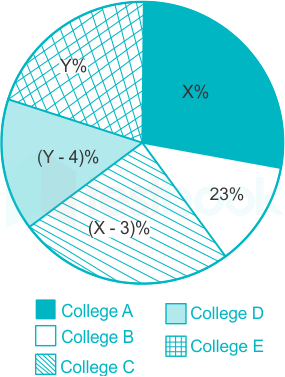
Directions:  Study the following directions shows the percentage distribution of the number of students (Male + Female) studying in five different colleges.


Total number of students (Male + Female) studying in college = 3000

Table shows the ratio between the number of males to females studying in the five different colleges A, B, C, D and E.


Name of the collegesRatio between number of males to females
A2: 1
B13: 10
C5: 4
D3: 2
E4: 1

Note:

i) Number of students studying in college E = 720

 If 60% and 80% of the males studying in college A and C respectively are form city P and remaining are from city Q. If 25% and 30% of the number of females studying in college A and C respectively are from city P. Find the number of students from college A and C are from city Q.

  1. AOption (a)

    420

  2. BOption (b)

    472

  3. COption (c)

    469

  4. DOption (d)

    458

  5. EOption (e)

    480

View answer & explanation

Correct answer

Answer: (c)C.

469

Why this answer is correct

General solution:

Number of students studying in college E = 720

Value of Y = 720/3000 ×  100 = 24%

To find the value of Y

(24% + (24 - 4)% + (X - 3)% + 23% +X%) = 100%

(64% + 2X%) = 100%

2X% = 36%

X = 18%

College A:

Number of students studying in college A = 3000 × (18/100) = 540

Number of males studying in college A = 540/3 ×  2 = 360

Number of females studying in college A = (540 - 360) = 180


College B:

Number of students studying in college B = 3000 × (23/100) = 690

Number of males studying in college B = 690/23 ×  13 = 390

Number of females studying in college B = (690 - 390) = 300


College C:

Number of students studying in college C = 3000 × (15/100) = 450

Number of males studying in college C = 450/9 ×  5 = 250

Number of females studying in college C = (450 - 250) = 200


College D:

Number of students studying in college D = 3000 × (20/100) = 600

Number of males studying in college D = 600/5 ×  3 = 360

Number of females studying in college D = (600 - 360) = 240


College E:

Number of students studying in college E = 3000 × (24/100) = 720

Number of males studying in college E = 720/5 ×  4 = 576

Number of females studying in college E = (720 - 576) = 144


Name of collegeNumber of male students studyingNumber of female students studying
College A360180
College B390300
College C250200
College D360240
College E576144

Solution:

Number of males studying in college A from city P = 360 ×  (60/100) = 216

Number of males studying in college A from city Q = (360 - 216) = 144

Number of males studying in college C from city P =250 ×  (80/100) = 200

Number of males studying in college C from city Q = (250 - 200) = 50

Number of females studying in college A from city P = 180 ×  (25/100) = 45

Number of females studying in college A from city Q = (180 - 45) = 135

Number of females studying in college C from city P = 200 ×  (30/100) = 60

Number of females studying in college C from city Q = 200 - 60 = 140

Required total = (144 + 50 + 135 + 140) = 469

SBI PO Prelims Memory Based Paper (Held On: 4 November 2023 Shift 4) (Previous Year Paper)·Quantitative Aptitude
View full paper

Question 647

SBI Probationary Officer (PO) 2023• Quantitative Aptitude• Quantitative Aptitude

Directions:  Study the following directions shows the percentage distribution of the number of students (Male + Female) studying in five different colleges.


Total number of students (Male + Female) studying in college = 3000

Table shows the ratio between the number of males to females studying in the five different colleges A, B, C, D and E.


Name of the collegesRatio between number of males to females
A2: 1
B13: 10
C5: 4
D3: 2
E4: 1

Note:

i) Number of students studying in college E = 720

If 1/3 rd of the males studying in college B and 1/6 th of the females from college B are cleared in distinction and from the remaining total number of students secured first class and second class if ratio between number of students studying first class to second class are in the ratio 2 :

  1. Find the number of students cleared in first class.
  1. AOption (a)

    390

  2. BOption (b)

    350

  3. COption (c)

    340

  4. DOption (d)

    320

  5. EOption (e)

    370

View answer & explanation

Correct answer

Answer: (c)C.

340

Why this answer is correct

General solution:

Number of students studying in college E = 720

Value of Y = 720/3000 ×  100 = 24%

To find the value of Y

(24% + (24 - 4)% + (X - 3)% + 23% +X%) = 100%

(64% + 2X%) = 100%

2X% = 36%

X = 18%

College A:

Number of students studying in college A = 3000 × (18/100) = 540

Number of males studying in college A = 540/3 ×  2 = 360

Number of females studying in college A = (540 - 360) = 180


College B:

Number of students studying in college B = 3000 × (23/100) = 690

Number of males studying in college B = 690/23 ×  13 = 390

Number of females studying in college B = (690 - 390) = 300


College C:

Number of students studying in college C = 3000 × (15/100) = 450

Number of males studying in college C = 450/9 ×  5 = 250

Number of females studying in college C = (450 - 250) = 200


College D:

Number of students studying in college D = 3000 × (20/100) = 600

Number of males studying in college D = 600/5 ×  3 = 360

Number of females studying in college D = (600 - 360) = 240


College E:

Number of students studying in college E = 3000 × (24/100) = 720

Number of males studying in college E = 720/5 ×  4 = 576

Number of females studying in college E = (720 - 576) = 144


Name of collegeNumber of male students studyingNumber of female students studying
College A360180
College B390300
College C250200
College D360240
College E576144

Solution:

Number of males studying in college B = 390

Number of males studying in college B secured distinction = 390 ×  1/3 = 130

Number of males secured first class and second class in college B  = (390 - 130) = 260

Number of females studying in college B = 300

Number of females studying in college B secured distinction = 300 ×  1/6 = 50

Number of females secured first class and second class in college B = (300 - 50) = 250

Total secured first class and second class = 260 + 250 = 510

Number of students secured first class = 510/3 ×  2 = 340

SBI PO Prelims Memory Based Paper (Held On: 4 November 2023 Shift 4) (Previous Year Paper)·Quantitative Aptitude
View full paper

Question 648

SBI Probationary Officer (PO) 2023• Quantitative Aptitude• Quantitative Aptitude

Directions:  Study the following directions shows the percentage distribution of the number of students (Male + Female) studying in five different colleges.


Total number of students (Male + Female) studying in college = 3000

Table shows the ratio between the number of males to females studying in the five different colleges A, B, C, D and E.


Name of the collegesRatio between number of males to females
A2: 1
B13: 10
C5: 4
D3: 2
E4: 1

Note:

i) Number of students studying in college E = 720

If exam fees for males in semester exams is Rs. 350 and females is Rs. 250 then find the total money collected for the number of students studying in the college D.

  1. AOption (a)

    Rs. 124000

  2. BOption (b)

    Rs. 164000

  3. COption (c)

    Rs. 186000

  4. DOption (d)

    Rs. 172000

  5. EOption (e)

    Rs. 196000

View answer & explanation

Correct answer

Answer: (c)C.

Rs. 186000

Why this answer is correct

General solution:

Number of students studying in college E = 720

Value of Y = 720/3000 ×  100 = 24%

To find the value of Y

(24% + (24 - 4)% + (X - 3)% + 23% +X%) = 100%

(64% + 2X%) = 100%

2X% = 36%

X = 18%

College A:

Number of students studying in college A = 3000 × (18/100) = 540

Number of males studying in college A = 540/3 ×  2 = 360

Number of females studying in college A = (540 - 360) = 180


College B:

Number of students studying in college B = 3000 × (23/100) = 690

Number of males studying in college B = 690/23 ×  13 = 390

Number of females studying in college B = (690 - 390) = 300


College C:

Number of students studying in college C = 3000 × (15/100) = 450

Number of males studying in college C = 450/9 ×  5 = 250

Number of females studying in college C = (450 - 250) = 200


College D:

Number of students studying in college D = 3000 × (20/100) = 600

Number of males studying in college D = 600/5 ×  3 = 360

Number of females studying in college D = (600 - 360) = 240


College E:

Number of students studying in college E = 3000 × (24/100) = 720

Number of males studying in college E = 720/5 ×  4 = 576

Number of females studying in college E = (720 - 576) = 144


Name of collegeNumber of male students studyingNumber of female students studying
College A360180
College B390300
College C250200
College D360240
College E576144

Solution:

Number of males studying in college D = 360

Number of females studying in college D = 240

Exam fees for males  semester exam = Rs. 350

Exam fees for females in semester exam = Rs. 250

Total fees collected = (360 ×  350 + 240 ×  250) = (126000 + 60000)

Total collected = Rs. 186000

SBI PO Prelims Memory Based Paper (Held On: 4 November 2023 Shift 4) (Previous Year Paper)·Quantitative Aptitude
View full paper

Question 649

SBI Probationary Officer (PO) 2023• Quantitative Aptitude• Quantitative Aptitude

Directions:  Study the following directions shows the percentage distribution of the number of students (Male + Female) studying in five different colleges.


Total number of students (Male + Female) studying in college = 3000

Table shows the ratio between the number of males to females studying in the five different colleges A, B, C, D and E.


Name of the collegesRatio between number of males to females
A2: 1
B13: 10
C5: 4
D3: 2
E4: 1

Note:

i) Number of students studying in college E = 720

Find the difference between the sum of the 1/3rd and 1/6 th of the number of males studying in college  D and E respectively and the sum of the 1/6 th and 1/8 th of the number of females studying in college D and E respectively.

  1. AOption (a)

    172

  2. BOption (b)

    124

  3. COption (c)

    156

  4. DOption (d)

    158

  5. EOption (e)

    154

View answer & explanation

Correct answer

Answer: (d)D.

158

Why this answer is correct

General solution:

Number of students studying in college E = 720

Value of Y = 720/3000 ×  100 = 24%

To find the value of Y

(24% + (24 - 4)% + (X - 3)% + 23% +X%) = 100%

(64% + 2X%) = 100%

2X% = 36%

X = 18%

College A:

Number of students studying in college A = 3000 × (18/100) = 540

Number of males studying in college A = 540/3 ×  2 = 360

Number of females studying in college A = (540 - 360) = 180


College B:

Number of students studying in college B = 3000 × (23/100) = 690

Number of males studying in college B = 690/23 ×  13 = 390

Number of females studying in college B = (690 - 390) = 300


College C:

Number of students studying in college C = 3000 × (15/100) = 450

Number of males studying in college C = 450/9 ×  5 = 250

Number of females studying in college C = (450 - 250) = 200


College D:

Number of students studying in college D = 3000 × (20/100) = 600

Number of males studying in college D = 600/5 ×  3 = 360

Number of females studying in college D = (600 - 360) = 240


College E:

Number of students studying in college E = 3000 × (24/100) = 720

Number of males studying in college E = 720/5 ×  4 = 576

Number of females studying in college E = (720 - 576) = 144


Name of collegeNumber of male students studyingNumber of female students studying
College A360180
College B390300
College C250200
College D360240
College E576144

Solution:

1/3rd of number of males studying in college D = 360 ×  1/3 = 120

1/4 th of the number of males studying in college E = 576 × 1/6 = 96

1/6 th of the number of females studying in college D = 240 ×  1/6 = 40

1/8 th of the number of females studying in college E = 144 × 1/8 =  18

Required difference = (120 + 96) - (40 + 18) = (216 - 58) = 158

SBI PO Prelims Memory Based Paper (Held On: 4 November 2023 Shift 4) (Previous Year Paper)·Quantitative Aptitude
View full paper

Question 650

SBI Probationary Officer (PO) 2023• Quantitative Aptitude• Quantitative Aptitude

Directions:  Study the following directions shows the percentage distribution of the number of students (Male + Female) studying in five different colleges.


Total number of students (Male + Female) studying in college = 3000

Table shows the ratio between the number of males to females studying in the five different colleges A, B, C, D and E.


Name of the collegesRatio between number of males to females
A2: 1
B13: 10
C5: 4
D3: 2
E4: 1

Note:

i) Number of students studying in college E = 720

Find the ratio between the number of males studying in college C and D to the number of females studying in college A and B.

  1. AOption (a)

    62: 13

  2. BOption (b)

    61 : 48

  3. COption (c)

    67`: 39

  4. DOption (d)

    75: 17

  5. EOption (e)

    58: 23

View answer & explanation

Correct answer

Answer: (b)B.

61 : 48

Why this answer is correct

General solution:

Number of students studying in college E = 720

Value of Y = 720/3000 ×  100 = 24%

To find the value of Y

(24% + (24 - 4)% + (X - 3)% + 23% +X%) = 100%

(64% + 2X%) = 100%

2X% = 36%

X = 18%

College A:

Number of students studying in college A = 3000 × (18/100) = 540

Number of males studying in college A = 540/3 ×  2 = 360

Number of females studying in college A = (540 - 360) = 180


College B:

Number of students studying in college B = 3000 × (23/100) = 690

Number of males studying in college B = 690/23 ×  13 = 390

Number of females studying in college B = (690 - 390) = 300


College C:

Number of students studying in college C = 3000 × (15/100) = 450

Number of males studying in college C = 450/9 ×  5 = 250

Number of females studying in college C = (450 - 250) = 200


College D:

Number of students studying in college D = 3000 × (20/100) = 600

Number of males studying in college D = 600/5 ×  3 = 360

Number of females studying in college D = (600 - 360) = 240


College E:

Number of students studying in college E = 3000 × (24/100) = 720

Number of males studying in college E = 720/5 ×  4 = 576

Number of females studying in college E = (720 - 576) = 144


Name of collegeNumber of male students studyingNumber of female students studying
College A360180
College B390300
College C250200
College D360240
College E576144

Solution:

Number of males studying in college C = 250

Number of males studying in college D = 360

Number of females studying in college A = 180

Number of females studying in college B = 300

Required ratio = (250 + 360): (180 + 300) = (610: 480) = 61 : 48

SBI PO Prelims Memory Based Paper (Held On: 4 November 2023 Shift 4) (Previous Year Paper)·Quantitative Aptitude
View full paper

Question 651

SBI Probationary Officer (PO) 2023• Quantitative Aptitude• Quantitative Aptitude

In a survey of prime membership users on four major platforms. It is found that out of the total prime members 20% are on Amazon Prime, 50% of the remaining are on Netflix premium and 30% of the rest are on Hotstar premium and rest 6300 are on Youtube premium. Then find the total number of prime members on these major platforms.

  1. AOption (a)

    32500

  2. BOption (b)

    17500

  3. COption (c)

    27000

  4. DOption (d)

    22500

  5. EOption (e)

    None of these

View answer & explanation

Correct answer

Answer: (d)D.

22500

Why this answer is correct

Shortcut Trick

Let total members be 100%.

Remaining after Amazon Prime (20%) = 80%.

Remaining after Netflix (50% of 80%) = 40%.

Remaining after Hotstar (30% of 40%) = 40% − 12% = 28%.

28% = 6300 ⇒ 1% = 225 ⇒ 100% = 22500.

∴ The correct answer is 22500 members.

Alternate Method

Let total members be x.

⇒ Amazon Prime users = 20% of x = 0.20x

⇒ Remaining after Amazon = x − 0.20x = 0.80x

⇒ Netflix users = 50% of 0.80x = 0.40x

⇒ Remaining after Netflix = 0.80x − 0.40x = 0.40x

⇒ Hotstar users = 30% of 0.40x = 0.12x

⇒ Remaining (Youtube) = 0.40x − 0.12x = 0.28x

⇒ 0.28x = 6300

⇒ x = 6300 ÷ 0.28 = 22500

∴ The correct answer is 22500 members.

Additional Information

Successive Percentage Decrease

When values are deducted from the 'remaining' part, it follows a successive pattern: Final Value = Initial Value × (1 − r1/100) × (1 − r2/100) × ...

Base Change in Percentages

Always identify the base of the percentage. If it says 'of the remaining', the previous balance becomes the new 100% for that specific step.

SBI PO Prelims Memory Based Paper (Held On: 4 November 2023 Shift 4) (Previous Year Paper)·Quantitative Aptitude
View full paper

Question 652

SBI Probationary Officer (PO) 2023• Quantitative Aptitude• Quantitative Aptitude

7 years ago, the ratio of the ages of Sophia and Ava was 7 : 9. The present age of Emma is 8 years less than the present age of Sophia. If the present age of Emma’s father is 45 years and 25 years more than his daughter. Then, the value of 50% of the present age of Ava is – 

  1. AOption (a)

    18 years

  2. BOption (b)

    17 years

  3. COption (c)

    21 years

  4. DOption (d)

    20 years

  5. EOption (e)

    None of these

View answer & explanation

Correct answer

Answer: (b)B.

17 years

Why this answer is correct

Shortcut Trick

Emma age = 45 − 25 = 20 years.

Sophia present age = 20 + 8 = 28 years.

Sophia age 7 years ago = 28 − 7 = 21 years (which is 7 units).

Ava age 7 years ago = 9 units = 27 years → Present age = 34 years.

50% of Ava present age = 34 ÷ 2 = 17 years.

∴ The correct answer is 17 years.

Alternate Method

Given: Ratio of Sophia and Ava (7 years ago) = 7 : 9. Emma age = Sophia − 8. Emma's father = 45 years and Emma + 25.

Formula: Age difference remains constant over time. Present age = Age (n years ago) + n.

⇒ Emma's father age = 45 years.

⇒ Emma's present age = 45 − 25 = 20 years.

⇒ Sophia's present age = 20 + 8 = 28 years.

⇒ Sophia's age 7 years ago = 28 − 7 = 21 years.

⇒ According to ratio 7 : 9, 7 units = 21 → 1 unit = 3.

⇒ Ava's age 7 years ago = 9 × 3 = 27 years.

⇒ Ava's present age = 27 + 7 = 34 years.

⇒ 50% of Ava's present age = 0.50 × 34 = 17 years.

∴ The correct answer is 17 years.

Additional Information

Age Ratio Concept

If the ratio of ages is a : b and n years pass, the new ratio is (ax+n) : (bx+n). The absolute difference between ages always remains constant.

Percentage Calculations

50% of a value is equivalent to dividing the value by 2 or multiplying by 1/2.

SBI PO Prelims Memory Based Paper (Held On: 4 November 2023 Shift 4) (Previous Year Paper)·Quantitative Aptitude
View full paper

Question 653

SBI Probationary Officer (PO) 2023• Quantitative Aptitude• Quantitative Aptitude

In the given question, two equations numbered l and II are given. Solve both the equations and mark the appropriate answer.

I. 2x2 – 9x + 9 = 0

II. 2y2 – 17y + 30 = 0

  1. AOption (a)

    x > y

  2. BOption (b)

    x < y

  3. COption (c)

    x ≥ y

  4. DOption (d)

    x ≤ y

  5. EOption (e)

    x = y or relationship between x and y cannot be established.

View answer & explanation

Correct answer

Answer: (e)E.

x = y or relationship between x and y cannot be established.

Why this answer is correct

I. 2x2 – 9x + 9 = 0

⇒ 2x2 – 3x – 6x + 9 = 0

⇒ x (2x – 3) – 3 (2x – 3) = 0

⇒ (2x – 3) (x – 3) = 0

⇒ x = 3/2, 3


II. 2y2 – 17y + 30 = 0

⇒ 2y2 – 12y – 5y + 30 = 0

⇒ 2y (y – 6) – 5 (y – 6) = 0

⇒ (2y – 5) (y – 6) = 0

⇒ y = 5/2, 6


Value of xValue of yRelation
3/25/2x < y
3/26x < y
35/2x > y
36x < y


Hence, relationship between x and y cannot be established.

SBI PO Prelims Memory Based Paper (Held On: 4 November 2023 Shift 4) (Previous Year Paper)·Quantitative Aptitude
View full paper

Question 654

SBI Probationary Officer (PO) 2023• Quantitative Aptitude• Quantitative Aptitude

In the given question, two equations numbered l and II are given. Solve both the equations and mark the appropriate answer.

I. x2 – 10x + 24 = 0

II. 2y2 – 29y + 105 = 0

  1. AOption (a)

    x > y

  2. BOption (b)

    x < y

  3. COption (c)

    x ≥ y

  4. DOption (d)

    x ≤ y

  5. EOption (e)

    x = y or relationship between x and y cannot be established.

View answer & explanation

Correct answer

Answer: (b)B.

x < y

Why this answer is correct

I. x2 – 10x + 24 = 0

⇒ x2 – 6x – 4x + 24 = 0

⇒ (x – 4) (x – 6) = 0

⇒ x =4, 6

II. 2y2 – 29y + 105 = 0

⇒ 2y2 – 15y – 14y + 105 = 0

⇒ (y – 7) (2y – 15) = 0

⇒ y = 7, 7.5  


Value of xValue of yRelation
47x < y
47.5x < y
67x < y
67.5x < y


Hence, x < y.

SBI PO Prelims Memory Based Paper (Held On: 4 November 2023 Shift 4) (Previous Year Paper)·Quantitative Aptitude
View full paper

Question 655

SBI Probationary Officer (PO) 2023• Quantitative Aptitude• Quantitative Aptitude

In the given question, two equations numbered l and II are given. Solve both the equations and mark the appropriate answer.

I. x2 – 42x + 440 = 0

II. y2 – 34y + 288 = 0

  1. AOption (a)

    x > y

  2. BOption (b)

    x < y

  3. COption (c)

    x ≥ y

  4. DOption (d)

    x ≤ y

  5. EOption (e)

    x = y or the relationship between x and y cannot be established.

View answer & explanation

Correct answer

Answer: (a)A.

x > y

Why this answer is correct

I. x2 – 42x + 440 = 0

⇒ x2 – 22x – 20x + 440 = 0

⇒ x(x – 22) – 20(x – 22) = 0

⇒ (x – 22) (x – 20) = 0

⇒ x = 22, 20


II. y2 – 34y + 288 = 0

⇒ y2 – 18y – 16y + 288 = 0

⇒ y(y – 18) – 16(y – 18) = 0

⇒ (y – 18) (y – 16) = 0

⇒ y = 18, 16


Value of xValue of yRelation
2218x > y
2216x > y
2018x > y
2016x > y


∴ x > y.

SBI PO Prelims Memory Based Paper (Held On: 4 November 2023 Shift 4) (Previous Year Paper)·Quantitative Aptitude
View full paper

Question 656

SBI Probationary Officer (PO) 2023• Quantitative Aptitude• Quantitative Aptitude

In the given question, two equations numbered l and II are given. Solve both the equations and mark the appropriate answer.

I. 25x2 – 30x + 8 = 0

II. 25y2 – 50y + 24 = 0

  1. AOption (a)

    x > y

  2. BOption (b)

    x < y

  3. COption (c)

    x ≥ y

  4. DOption (d)

    x ≤ y

  5. EOption (e)

    x = y or relationship between x and y cannot be established.

View answer & explanation

Correct answer

Answer: (d)D.

x ≤ y

Why this answer is correct

I. 25x2 – 30x + 8 = 0

⇒ 25x2 – 10x – 20x + 8 = 0

⇒ (5x – 4) (5x – 2) = 0

⇒ x =4/5, 2/5

II. 25y2 – 50y + 24 = 0

⇒ 25y2 – 20y – 30y + 24 = 0

⇒ (5y – 6) (5y – 4) = 0

⇒ y = 6/5, 4/5  


Value of xValue of yRelation
4/56/5x < y
4/54/5x = y
2/56/5x < y
2/54/5x < y


Hence, x ≤ y.

SBI PO Prelims Memory Based Paper (Held On: 4 November 2023 Shift 4) (Previous Year Paper)·Quantitative Aptitude
View full paper

Question 657

SBI Probationary Officer (PO) 2023• Quantitative Aptitude• Quantitative Aptitude

In the given question, two equations numbered l and II are given. Solve both the equations and mark the appropriate answer.

I. x2 – 44x + 483 = 0

II. y2 – 27y + 182 = 0

  1. AOption (a)

    x > y

  2. BOption (b)

    x < y

  3. COption (c)

    x ≥ y

  4. DOption (d)

    x ≤ y

  5. EOption (e)

    x = y or relationship between x and y cannot be established.

View answer & explanation

Correct answer

Answer: (a)A.

x > y

Why this answer is correct

I. x2 – 44x + 483 = 0

⇒ x2 – 21x – 23x + 483 = 0

⇒ x (x – 21) – 23 (x – 21) = 0

⇒ (x – 21) (x – 23) = 0

⇒ x = 21, 23


II. y2 – 27y + 182 = 0

⇒ y2 – 14y – 13y + 182 = 0

⇒ y (y – 14) – 13 (y – 14) = 0

⇒ (y – 14) (y – 13) = 0

⇒ y = 14, 13


Value of xValue of yRelation
2114x > y
2113x > y
2314x > y
2313x > y


Hence x > y

SBI PO Prelims Memory Based Paper (Held On: 4 November 2023 Shift 4) (Previous Year Paper)·Quantitative Aptitude
View full paper

Question 658

SBI Probationary Officer (PO) 2023• Quantitative Aptitude• Quantitative Aptitude

The volume of a cube and a cuboid are 216 cm3 and 480 cm3 respectively. If the length and breadth of cuboid are in the ratio 5 : 4 and the height of cuboid is equal to the length of side of cube, then find the ratio of diagonal of cube to the diagonal of cuboid.

  1. AOption (a)

    6√3 : 5√2

  2. BOption (b)

    4√3 : 10√2

  3. COption (c)

    7√3 : 5√2

  4. DOption (d)

    6√3 : 10√2

  5. EOption (e)

    4√3 : 5√ 2

View answer & explanation

Correct answer

Answer: (d)D.

6√3 : 10√2

Why this answer is correct

Shortcut Trick

Side of cube (a) = 3√216 = 6 cm. Height of cuboid (h) = 6 cm.

Base area of cuboid = 480 ÷ 6 = 80 cm2. Since ratio is 5 : 4, (5x) × (4x) = 80 ⇒ 20x2 = 80 ⇒ x = 2.

Dimensions of cuboid: L = 10 cm, B = 8 cm, H = 6 cm.

Ratio = (6 × √3) : √(102 + 82 + 62) = 6√3 : √200 = 6√3 : 10√2.

∴ The correct answer is 6√3 : 10√2.

Alternate Method

Given: Volume of cube = 216 cm3, Volume of cuboid = 480 cm3, L : B (cuboid) = 5 : 4, H (cuboid) = side of cube.

Formula Used: Volume of cube = a3, Diagonal of cube = a√3, Volume of cuboid = l × b × h, Diagonal of cuboid = √(l2 + b2 + h2).

⇒ a3 = 216 ⇒ a = 6 cm.

⇒ Height of cuboid (h) = 6 cm.

⇒ Let length (l) = 5x and breadth (b) = 4x.

⇒ 5x × 4x × 6 = 480 ⇒ 120x2 = 480 ⇒ x2 = 4 ⇒ x = 2.

⇒ l = 10 cm, b = 8 cm, h = 6 cm.

⇒ Diagonal of cube = 6√3 cm.

⇒ Diagonal of cuboid = √(102 + 82 + 62) = √(100 + 64 + 36) = √200 = 10√2 cm.

⇒ Required Ratio = 6√3 : 10√2.

∴ The correct answer is 6√3 : 10√2.

Additional Information

Cube properties

Total Surface Area = 6a2; Lateral Surface Area = 4a2.

Cuboid properties

Total Surface Area = 2(lb + bh + hl); Volume = lbh.

Diagonal length

The longest rod that can be placed inside a room is its space diagonal.

SBI PO Prelims Memory Based Paper (Held On: 4 November 2023 Shift 4) (Previous Year Paper)·Quantitative Aptitude
View full paper

Question 659

SBI Probationary Officer (PO) 2023• Quantitative Aptitude• Quantitative Aptitude

A person mixed milk and water in 2 containers in the ratio 3 : 4 and 5 : 6 respectively then he mixed both the mixture in the third container and the ratio of milk and water in the resultant mixture becomes 4 : 5. Total quantity of mixtures is 18 litres. Find the quantity of milk in the 1st container.

  1. AOption (a)

    7 L

  2. BOption (b)

    4 L

  3. COption (c)

    3 L

  4. DOption (d)

    5 L 

  5. EOption (e)

    none of these 

View answer & explanation

Correct answer

Answer: (c)C.

3 L

Why this answer is correct

Shortcut Trick

Milk concentration in Container 1 = 3/7 and in Container 2 = 5/11.

Resultant Milk concentration = 4/9.

Using Alligation (Milk): |5/11 − 4/9| : |3/7 − 4/9| ⇒ 1/99 : 1/63 ⇒ 7 : 11.

Total ratio parts = 7 + 11 = 18 units = 18 L ∴ 1 unit = 1 L.

Quantity of 1st mixture = 7 L. Milk in it = 7 × (3/7) = 3 L.

∴ The correct answer is 3 L.

Alternate Method

Given: Ratio 1 = 3:4, Ratio 2 = 5:6, Final Ratio = 4:5, Total Volume = 18 L.

Formula: Quantity1 × (C1 − Cm) = Quantity2 × (Cm − C2)

⇒ Let Q1 and Q2 be the volumes of the two containers.

⇒ Milk fraction: Q1(3/7) + Q2(5/11) = (Q1 + Q2)(4/9)

⇒ Q1(4/9 − 3/7) = Q2(5/11 − 4/9)

⇒ Q1(1/63) = Q2(1/99) ⇒ Q1/Q2 = 63/99 = 7/11

⇒ Total units = 7 + 11 = 18 → 18 L ∴ Q1 = 7 L

⇒ Milk in 1st container = 7 × (3 / (3 + 4)) = 7 × 3/7 = 3 L

∴ The correct answer is 3 L.

Additional Information

Alligation Rule

Used to find the ratio in which two ingredients at given prices/concentrations are mixed to produce a mixture of a mean price. Ratio = (Dearer − Mean) : (Mean − Cheaper).

Replacement Method

When a quantity is replaced repeatedly: Final Concentration = Initial Concentration × (1 − x/V)n, where x is replaced volume and V is total volume.

Multiple Mixtures

When mixing multiple containers, the total quantity of a component (milk) is the sum of quantities from each container: Σ(Ratio × Volume).

SBI PO Prelims Memory Based Paper (Held On: 4 November 2023 Shift 4) (Previous Year Paper)·Quantitative Aptitude
View full paper

Question 660

SBI Probationary Officer (PO) 2023• Quantitative Aptitude• Quantitative Aptitude

Directions: The given table shows the details about the number of orders received , Number of orders packed and number of orders shipped by five different companies A, B, C, D and E.


CompaniesTotal orders receivedPercentage of orders packedPercentage of orders shipped
A450(x + 10)%60%
B600(x + y)%30%
C700(2x - 5)%(y + 5)%
D-(1.5y + 5)%-
E400-(x - 5)%

Note:

i)Average of total received in all the companies is 530

ii)Total orders Received = Number of orders packed + Number of orders shipped

 If 1/5th of the orders packed in company E and 1/3rd of the orders shipped in company B are international orders and the remaining are national orders , find the sum of the 1/3rd of national orders packed in company E and 2/3rd of the national orders shipped in company B.

  1. AOption (a)

    180

  2. BOption (b)

    170

  3. COption (c)

    140

  4. DOption (d)

    160

  5. EOption (e)

    120

View answer & explanation

Correct answer

Answer: (d)D.

160

Why this answer is correct

General Solution:

To find the value of x

100% = (x + 10)% + 60%

x = 30%

Number of orders received in company A = 450

Number orders packed in company A = 450 ×  (30 + 10)/100 = 180

Number of orders shipped in company A = (450 - 180) = 270

To find the value of y 

100% = (30% + y + 30%)

y = 40%


Company B:

Number of orders received in company  = 600

Number of orders packed in company  = 600 ×  (70/100) = 420

Number of orders shipped in company  = (600 - 420) = 180


Company C:

Number of orders received in company  = 700

Number of orders packed in company  = 700 ×  (60 - 5)/100)) = 385

Number of orders shipped in company  = (700 - 385) = 315


Company D:

Number of orders received in company  = 2650 - (450 + 600 + 700 + 400) = 500

Number of orders packed in company  = 500 ×  (65/100) = 325

Number of orders shipped in company  = (500 - 325) = 175


Company E:

Number of orders received in company  = 400

Number of orders shipped in company  = 400 ×  25/100 = 100

Number of orders packed in company  = (400 - 100) = 300


CompaniesNumber of orders packedNumber of orders shipped
A180270
B420180
C385315
D325175
E300100

Solution:

Number of international orders packed in company E = 300/5 = 60

Number of national orders packed in company E = (300 - 60) = 240

Number of international shipped in company B = 180/3 = 60

Number of national orders shipped in company B = (180 - 60) = 120

Required sum = (240/3 + 120 ×  2/3) = 160

How should I prepare for Quantitative Aptitude in SBI Probationary Officer (PO)?

Solving previous year questions by topic helps identify recurring concepts, question patterns, and frequently asked sub-topics. Attempt each question, review the step-by-step explanation, and note down key formulas or facts for quick revision before the exam.