Previous Year Paper

SBI PO Prelims Memory Based Paper (Held On: 6 November 2023 Shift 1) (Previous Year Paper)

Held in 2023

100 questions60 minutes
With answers
Free

Paper last updated:

Practise under exam conditions

Take this paper as a timed mock test. Review your answers after you submit.

Attempt timed test

Questions & answers

Read the paper at your pace. Open an explanation when you need it.

English Language (30 questions)

Question 1

Directions

The question below has two blanks, each blank indicating that something has been omitted. Choose the set of words for each blank that best fit the meaning of the sentence as a whole.

The referees shall _______ the three players from the hockey game due to _______ a fight with the other team.

  1. AOption (a)

    entertain, lodge

  2. BOption (b)

    restrain, admit

  3. COption (c)

    annoy, subdue

  4. DOption (d)

    imitate, fabricate

  5. EOption (e)

    eject, instigating

View answer & explanation

Correct answer

Answer: (e)E.

eject, instigating

Why this answer is correct

The correct answer is 'eject, instigating.'

Key Points

  • The given sentence is talking about the referees taking action against the hockey players fighting with the other team.
  • ​Let us explore the words in the given options:
  • 'Eject' means to compel someone to leave a place.
  • 'Instigating' means inciting someone to do something, especially something bad.
<br>

Conclusion: The referees shall dismiss the players from the ground for their bad behaviour.

Hence, the correct answer is option 5.

Complete Sentence: The referees shall eject the three players from the hockey game due to instigating a fight with the other team.

Additional Information

  • The meaning of other options:
  • 'Entertain' means to interest and amuse somebody in order to please him or her.
  • 'Lodge' means to become firmly fixed or to make something do this.
  • 'Restrain' means to prevent somebody or something from doing something.
  • 'Admit' means to agree that something unpleasant is true or that you have done something wrong.
  • 'Annoy' means to make somebody angry or slightly angry.
  • 'Subdue' means to defeat somebody or something or bring somebody or something under control.
  • 'Imitate' means to copy the behavior of somebody or something.
  • 'Fabricate' means to invent something false in order to deceive people.
Question 2

Directions

The question below has two blanks, each blank indicating that something has been omitted. Choose the set of words for each blank that best fit the meaning of the sentence as a whole.

The cheerleaders offered a _______ of encouragement to _______ the team to score a touchdown.

  1. AOption (a)

    calm, troll

  2. BOption (b)

    pacify, trigger

  3. COption (c)

    chant, motivate

  4. DOption (d)

    appease, harmonize

  5. EOption (e)

    anger, vocalize

View answer & explanation

Correct answer

Answer: (c)C.

chant, motivate

Why this answer is correct

The correct answer is 'chant, motivate.'

Key Points

  • The given sentence is talking about something related to the cheerleaders encouraging the team to score a goal.
  • ​Let us explore the words in the given options:
  • 'Chant' means to say or shout repeatedly in a sing-song tone.
  • 'Motivate' means to cause someone to have an interest in or enthusiasm for something.
<br>

Conclusion: The cheerleaders with a repeated loud cheer motivated the team.

Hence, the correct answer is option 3.

Complete Sentence: The cheerleaders offered a chant of encouragement to motivate the team to score a touchdown.

Additional Information

  • The meaning of other options:
  • 'Calm' means not excited, worried, or angry; quiet.
  • 'Troll' means a deliberately offensive or provocative online post.
  • 'Pacify' means to make somebody who is angry or upset be calm or quiet.
  • 'Trigger' means to make something happen suddenly.
  • 'Appease' means to make somebody calmer or less angry by agreeing to what he/she wants.
  • 'Harmonize' means to produce a pleasant effect when seen, heard, etc. together.
  • 'Anger' means the strong feeling that you have when something has happened or somebody has done something that you do not like.
  • 'Vocalize' means to express a thought or emotion in words.

Question 3

Directions

The question below has two blanks, each blank indicating that something has been omitted. Choose the set of words for each blank that best fit the meaning of the sentence as a whole.

Bolt cannot _______ his speed in the marathon because he is experiencing _______ cramping.

  1. AOption (a)

    sustain, severe

  2. BOption (b)

    responsive, refuse

  3. COption (c)

    decline, willing

  4. DOption (d)

    amenable, abstain

  5. EOption (e)

    flexible, combat

View answer & explanation

Correct answer

Answer: (a)A.

sustain, severe

Why this answer is correct

The correct answer is 'sustain, severe.'

Key Points

  • The given sentence is talking about something related to Bolt's speed and some type of cramping.
  • ​Let us explore the words in the given options:
  • 'Sustain' means cause to continue for an extended period or without interruption.
  • 'Severe' means extremely bad or serious.
<br>

Conclusion: Bolt's slowing down in the marathon due to some extremely bad or serious cramping.

Hence, the correct answer is option 1.

Complete Sentence: Bolt cannot sustain his speed in the marathon because he is experiencing severe cramping.

Additional Information

  • The meaning of other options:
  • 'Responsive' means paying attention to somebody or something and reacting in a suitable or positive way.
  • 'Refuse' means to say or show that you do not want to do, give, or accept something.
  • 'Decline' means to refuse, usually politely.
  • 'Willing' means happy to do something; having no reason for not doing something.
  • 'Amenable' means happy to accept something; willing to be influenced by somebody or something.
  • 'Abstain' means to stop yourself from doing something that you enjoy.
  • 'Flexible' means something that can be changed easily.
  • 'Combat' means to fight against something; to try to stop or defeat something.

Question 4

Directions

The question below has two blanks, each blank indicating that something has been omitted. Choose the set of words for each blank that best fit the meaning of the sentence as a whole.

If you want to _______ your lawn, you will need to water it _______ so it stays nice and fresh.

  1. AOption (a)

    rare, ignore

  2. BOption (b)

    seldom, withdraw

  3. COption (c)

    perpetually, retract

  4. DOption (d)

    maintain, frequently

  5. EOption (e)

    constant, negotiate

View answer & explanation

Correct answer

Answer: (d)D.

maintain, frequently

Why this answer is correct

The correct answer is 'maintain, frequently.'

Key Points

  • The given sentence is talking about how to keep the lawn nice and fresh.
  • ​Let us explore the words in the given options:
  • 'Maintain' means to keep something in good condition by checking and repairing it regularly.
  • 'Frequently' means regularly or habitually; often.
<br>

Conclusion: To keep the lawn nice and fresh, you have to water it regularly.

Hence, the correct answer is option 4.

Complete Sentence: If you want to maintain your lawn, you will need to water it frequently so it stays nice and fresh.

Additional Information

  • The meaning of other options:
  • 'Rare' means not occurring very often.
  • 'Ignore' means to refuse to take notice of or acknowledge; disregard intentionally.
  • 'Seldom' means not often; rarely.
  • 'Withdraw' means to remove or take away something from a particular place or position.
  • 'Perpetually' means in a way that never ends or changes; constantly.
  • 'Retract' means to say that something you have said is not true.
  • 'Constant' means happening or existing all the time or again and again.
  • 'Negotiate' means to decide or agree on something by talking about it.

Directions: Rearrange the following five sentences (A), (B), (C), (D), and (E) in the proper sequence to form a meaningful paragraph, then answer the questions below them.

A. One of the most immediate and obvious consequences of global warming is the increase in temperatures around the world.

B. That year Earth's surface temperature was 0.99 degrees Celsius warmer than the average across the entire 20th century.

C. Before 2016, 2015 was the warmest year on record, globally.

D. The average global temperature has increased by about 0.8 degrees Celsius over the past 100 years.

E. Since record-keeping began in 1895, the hottest year on record worldwide was 2016, according to NOAA and NASA data.

Question 5

Which of these should be the SECOND sentence after rearrangement?

  1. AOption (a)

    C

  2. BOption (b)

    E

  3. COption (c)

    B

  4. DOption (d)

    A

  5. EOption (e)

    D

View answer & explanation

Correct answer

Answer: (e)E.

D

Why this answer is correct

The correct answer is 'D.'

Key Points

  • The correct sequence of the segments after rearrangement is ADEBC.
  • The sentence 'A' is independent of any other sentence as it is talking about one of the "consequences of global warming" i.e. the increase in temperatures around the world. Hence, 'A' is the first part.
  • Sentence D will come after A as it is giving information about the average increase in the global temperature over the past 100 years.
  • Sentence E will come after D as it talks about the hottest year (2016) since record-keeping began in 1895.
  • Sentence B will come after E as it further explains that in 2016 Earth's surface temperature was 0.99 degrees Celsius warmer than the average across the entire 20th century.
  • The sentence 'C' is the concluding or final part as it says before 2016, 2015 was the warmest year on record.
<br>

Hence, the correct answer is option 5.

Paragraph after rearranging the sentences: One of the most immediate and obvious consequences of global warming is the increase in temperatures around the world. The average global temperature has increased by about 0.8 degrees Celsius over the past 100 years. Since record-keeping began in 1895, the hottest year on record worldwide was 2016, according to NOAA and NASA data. That year Earth's surface temperature was 0.99 degrees Celsius warmer than the average across the entire 20th century. Before 2016, 2015 was the warmest year on record, globally.

Hint

  • Important Rules to Solve the Para Jumbles:
  • Read the sentences attentively and try to comprehend the idea or theme of the sentence and eliminate the irrelevant options.
  • Try to identify the opening (independent sentence) and closing sentences (concluding sentence).
  • Try to identify the mandatory pairs. Two sentences can be connected through various connectors and other determinants.

Question 6

Which of these should be the FOURTH sentence after rearrangement?

  1. AOption (a)

    E

  2. BOption (b)

    B

  3. COption (c)

    A

  4. DOption (d)

    C

  5. EOption (e)

    D

View answer & explanation

Correct answer

Answer: (b)B.

B

Why this answer is correct

The correct answer is 'B.'

Key Points

  • The correct sequence of the segments after rearrangement is ADEBC.
  • The sentence 'A' is independent of any other sentence as it is talking about one of the "consequences of global warming" i.e. the increase in temperatures around the world. Hence, 'A' is the first part.
  • Sentence D will come after A as it is giving information about the average increase in the global temperature over the past 100 years.
  • Sentence E will come after D as it talks about the hottest year (2016) since record-keeping began in 1895.
  • Sentence B will come after E as it further explains that in 2016 Earth's surface temperature was 0.99 degrees Celsius warmer than the average across the entire 20th century.
  • The sentence 'C' is the concluding or final part as it says before 2016, 2015 was the warmest year on record.
<br>

Hence, the correct answer is option 2.

Paragraph after rearranging the sentences: One of the most immediate and obvious consequences of global warming is the increase in temperatures around the world. The average global temperature has increased by about 0.8 degrees Celsius over the past 100 years. Since record-keeping began in 1895, the hottest year on record worldwide was 2016, according to NOAA and NASA data. That year Earth's surface temperature was 0.99 degrees Celsius warmer than the average across the entire 20th century. Before 2016, 2015 was the warmest year on record, globally.

Question 7

Which of these should be the FIRST sentence after rearrangement?

  1. AOption (a)

    C

  2. BOption (b)

    B

  3. COption (c)

    A

  4. DOption (d)

    D

  5. EOption (e)

    E

View answer & explanation

Correct answer

Answer: (c)C.

A

Why this answer is correct

The correct answer is 'A.'

Key Points

  • The correct sequence of the segments after rearrangement is ADEBC.
  • The sentence 'A' is independent of any other sentence as it is talking about one of the "consequences of global warming" i.e. the increase in temperatures around the world. Hence, 'A' is the first part.
  • Sentence D will come after A as it is giving information about the average increase in the global temperature over the past 100 years.
  • Sentence E will come after D as it talks about the hottest year (2016) since record-keeping began in 1895.
  • Sentence B will come after E as it further explains that in 2016 Earth's surface temperature was 0.99 degrees Celsius warmer than the average across the entire 20th century.
  • The sentence 'C' is the concluding or final part as it says before 2016, 2015 was the warmest year on record.
<br>

Hence, the correct answer is option 3.

Paragraph after rearranging the sentences: One of the most immediate and obvious consequences of global warming is the increase in temperatures around the world. The average global temperature has increased by about 0.8 degrees Celsius over the past 100 years. Since record-keeping began in 1895, the hottest year on record worldwide was 2016, according to NOAA and NASA data. That year Earth's surface temperature was 0.99 degrees Celsius warmer than the average across the entire 20th century. Before 2016, 2015 was the warmest year on record, globally.

Question 8

Which of these should be the FIFTH sentence after rearrangement?

  1. AOption (a)

    B

  2. BOption (b)

    A

  3. COption (c)

    E

  4. DOption (d)

    C

  5. EOption (e)

    D

View answer & explanation

Correct answer

Answer: (d)D.

C

Why this answer is correct

The correct answer is 'C.'

Key Points

  • The correct sequence of the segments after rearrangement is ADEBC.
  • The sentence 'A' is independent of any other sentence as it is talking about one of the "consequences of global warming" i.e. the increase in temperatures around the world. Hence, 'A' is the first part.
  • Sentence D will come after A as it is giving information about the average increase in the global temperature over the past 100 years.
  • Sentence E will come after D as it talks about the hottest year (2016) since record-keeping began in 1895.
  • Sentence B will come after E as it further explains that in 2016 Earth's surface temperature was 0.99 degrees Celsius warmer than the average across the entire 20th century.
  • The sentence 'C' is the concluding or final part as it says before 2016, 2015 was the warmest year on record.
<br>

Hence, the correct answer is option 4.

Paragraph after rearranging the sentences: One of the most immediate and obvious consequences of global warming is the increase in temperatures around the world. The average global temperature has increased by about 0.8 degrees Celsius over the past 100 years. Since record-keeping began in 1895, the hottest year on record worldwide was 2016, according to NOAA and NASA data. That year Earth's surface temperature was 0.99 degrees Celsius warmer than the average across the entire 20th century. Before 2016, 2015 was the warmest year on record, globally.

Question 9

Which of these should be the THIRD sentence after rearrangement?

  1. AOption (a)

    E

  2. BOption (b)

    C

  3. COption (c)

    D

  4. DOption (d)

    B

  5. EOption (e)

    A

View answer & explanation

Correct answer

Answer: (a)A.

E

Why this answer is correct

The correct answer is 'E.'

Key Points

  • The correct sequence of the segments after rearrangement is ADEBC.
  • The sentence 'A' is independent of any other sentence as it is talking about one of the "consequences of global warming" i.e. the increase in temperatures around the world. Hence, 'A' is the first part.
  • Sentence D will come after A as it is giving information about the average increase in the global temperature over the past 100 years.
  • Sentence E will come after D as it talks about the hottest year (2016) since record-keeping began in 1895.
  • Sentence B will come after E as it further explains that in 2016 Earth's surface temperature was 0.99 degrees Celsius warmer than the average across the entire 20th century.
  • The sentence 'C' is the concluding or final part as it says before 2016, 2015 was the warmest year on record.
<br>

Hence, the correct answer is option 1.

Paragraph after rearranging the sentences: One of the most immediate and obvious consequences of global warming is the increase in temperatures around the world. The average global temperature has increased by about 0.8 degrees Celsius over the past 100 years. Since record-keeping began in 1895, the hottest year on record worldwide was 2016, according to NOAA and NASA data. That year Earth's surface temperature was 0.99 degrees Celsius warmer than the average across the entire 20th century. Before 2016, 2015 was the warmest year on record, globally.

Question 10

Directions: Read the following sentences carefully, choose the one that is grammatically/contextually incorrect, and mark it as your answer.

  1. AOption (a)

    One of the keys to success is maintaining a positive attitude.

  2. BOption (b)

    Neither of the options are suitable for us.

  3. COption (c)

    We are looking forward to the upcoming seminar.

  4. DOption (d)

    The teacher asked a series of thought-provoking questions.

  5. EOption (e)

    Incorrect usage can lead to misunderstandings.

View answer & explanation

Correct answer

Answer: (b)B.

Neither of the options are suitable for us.

Why this answer is correct

The correct answer is option 2.

Key Points

To answer this question, let's have a look at all the given sentences as options:

  • Option 1: One of the keys to success is maintaining a positive attitude.
  • This sentence is grammatically and contextually correct.
  • Option 2: Neither of the options are suitable for us.
  • This sentence is incorrect because the subject 'Neither of the options' is singular, requiring a singular verb 'is' instead of 'are'.
  • The correct sentence would be: "Neither of the options is suitable for us."
  • Option 3: We are looking forward to the upcoming seminar.
  • This sentence is grammatically and contextually correct.
  • Option 4: The teacher asked a series of thought-provoking questions.
  • This sentence is grammatically and contextually correct.
  • Option 5: Incorrect usage can lead to misunderstandings.
  • This sentence is grammatically and contextually correct.

So, out of the given sentences, only option 2 is a grammatically/contextually incorrect sentence.

Therefore, the correct answer is "Neither of the options is suitable for us."

Question 11

Directions: Read the following sentences carefully, choose the one that is grammatically/contextually incorrect, and mark it as your answer.

  1. AOption (a)

    The committee has decided to postpone the  meeting to a later date.

  2. BOption (b)

    The teacher along with her students were excited about the field trip.

  3. COption (c)

    Investing in education yields long-term benefits for individuals and societies.

  4. DOption (d)

    A well-organized workspace can significantly enhance productivity.

  5. EOption (e)

    The colors of the sunset were truly breathtaking.

View answer & explanation

Correct answer

Answer: (b)B.

The teacher along with her students were excited about the field trip.

Why this answer is correct

The correct answer is option 2.

Key Points

To answer this question, let's have a look at all the given sentences as options:

  • Option 1: The committee has decided to postpone the  meeting to a later date.
  • This sentence is grammatically and contextually correct.
  • Option 2: The teacher along with her students were excited about the field trip.
  • This sentence is incorrect because the main subject 'The teacher' is singular. The verb should therefore also be singular: 'was' instead of 'were'.
  • The correct sentence would be: "The teacher along with her students was excited about the field trip."
  • Option 3: Investing in education yields long-term benefits for individuals and societies.
  • This sentence is grammatically and contextually correct.
  • Option 4: A well-organized workspace can significantly enhance productivity.
  • This sentence is grammatically and contextually correct.
  • Option 5: The colors of the sunset were truly breathtaking.
  • This sentence is grammatically and contextually correct.

So, out of the given sentences, only option 2 is a grammatically/contextually incorrect sentence.

Therefore, the correct answer is "The teacher along with her students was excited about the field trip."

Question 12

Directions: Read the following sentences carefully, choose the one that is grammatically/contextually incorrect, and mark it as your answer.

  1. AOption (a)

    Each of the players were given a medal for their performance.

  2. BOption (b)

    Reading scientific journals helps him stay updated on new research.

  3. COption (c)

    An apple a day keeps the doctor away.

  4. DOption (d)

    They have adapted well to the new regulations.

  5. EOption (e)

    Her understanding of the subject is evident in her discussions.

View answer & explanation

Correct answer

Answer: (a)A.

Each of the players were given a medal for their performance.

Why this answer is correct

The correct answer is option 1.

Key Points

To answer this question, let's have a look at all the given sentences as options:

  • Option 1: Each of the players were given a medal for their performance.
  • This sentence is incorrect because the subject 'Each of the players' is singular, and the verb should therefore be singular: 'was' instead of 'were'.
  • The correct sentence would be: "Each of the players was given a medal for their performance."
  • Option 2: Reading scientific journals helps him stay updated on new research.
  • This sentence is grammatically and contextually correct.
  • Option 3: An apple a day keeps the doctor away.
  • This sentence is grammatically and contextually correct.
  • Option 4: They have adapted well to the new regulations.
  • This sentence is grammatically and contextually correct.
  • Option 5: Her understanding of the subject is evident in her discussions.
  • This sentence is grammatically and contextually correct.

So, out of the given sentences, only option 1 is a grammatically/contextually incorrect sentence.

Therefore, the correct answer is "Each of the players was given a medal for their performance."

Below, a passage is given with Ten blanks labelled (A)-(E). Below the passage, five options are given for each blank. Choose the word that fits each blank most appropriately in the context of the passage, and mark the corresponding answer.

Today, we’re starting by looking at the issue of work: how the pandemic has _________ (A) remote work, and what that might mean. Will we go to the office again – and, if so, how often? What impact will a __________ (B) way of working have on how we communicate, connect and create? Will work-from-home be the great leveler in terms of gender equality and diversity? And what will work mean if our offices are ___________ (C) and we lose those day-to-day social interactions? While much of the focus seems to be on work from home, it actually works from anywhere. In the last 12-18 months, for example, I have worked from the office, from home, from hotels, coffee shops, a hospital, beaches, marriage halls, moving cars, and airplanes. We will get to a model where people could potentially work from anywhere based on the job that they do at a given point in time. It’s ____________ (D) if the pandemic itself would go away, say, in a couple of months. If we are talking about changes in work arrangements over the next two years, that’s a pretty long time for us to have a change in our work patterns. At least for the next two years, as we go through the cycle of lockdowns and containment, we will go in and out of work from home. What will happen once this is completely behind us? It’s a little bit hard to __________ (E), but yes, the possibility that some kinds of work can be done from home is nowhere to stay.

Question 13

Which of the following words most appropriately fits the blank labelled (A)?

  1. AOption (a)

    Normalized

  2. BOption (b)

    Complicated 

  3. COption (c)

    Unique

  4. DOption (d)

    Conventional

  5. EOption (e)

    None of the above

View answer & explanation

Correct answer

Answer: (a)A.

Normalized

Why this answer is correct

The correct option is option 1 

Key Points

  • The passage talks about how pandemic has affected work-life.
  • Option 1: normalised means to return to the usual or generally accepted situation
  • Example: They hope to normalise relations with the us.
  • This word fits the blank correctly and conveys a proper meaning that this pandemic has made working remotely a regular thing which was not the case before.

Question 14

​Which of the following words most appropriately fits the blank labelled (B)?

  1. AOption (a)

    Synthesis

  2. BOption (b)

    Hybrid

  3. COption (c)

    Merge

  4. DOption (d)

    persuade

  5. EOption (e)

    Impure

View answer & explanation

Correct answer

Answer: (b)B.

Hybrid

Why this answer is correct

The correct option is option 2

Key Points

  • The passage talks about how pandemic has affected work-life.
  • Option 2: hybrid means combining two different things
  • Example*: His choreography is described as "a hybrid mix of mime and circus tricks"*
  • This word fits the blank correctly and conveys a proper meaning that this pandemic might lead to a combination of in-office working and work from home/ working remotely.

Question 15

​Which of the following words most appropriately fits the blank labelled (C)?

  1. AOption (a)

    virtual

  2. BOption (b)

    Admit

  3. COption (c)

    Admire

  4. DOption (d)

    Potential

  5. EOption (e)

    None of the above

View answer & explanation

Correct answer

Answer: (a)A.

virtual

Why this answer is correct

The correct option is option 1

Key Points

  • The passage talks about how pandemic has affected work-life.
  • Option 1: virtual means not involving people physically going somewhere 
  • Example*: Before a virtual meeting, all participants should test the technology and make sure they are comfortable with the major features.*
  • The word fits the blank correctly and conveys a proper meaning that the offices might turn completely online and that all the office work would be carried out through the internet only without any physical interactions.

Question 16

​Which of the following words most appropriately fits the blank labelled (D)?

  1. AOption (a)

    Doubtful 

  2. BOption (b)

    Certain

  3. COption (c)

    Applicable

  4. DOption (d)

    Metropolitan

  5. EOption (e)

    None of the above

View answer & explanation

Correct answer

Answer: (a)A.

Doubtful 

Why this answer is correct

The correct option is option 1

Key Points

  • The passage talks about how pandemic has affected work-life.
  • Option 1: doubtful means "if you are doubtful about something, you are uncertain about it."
  • Example: The teacher is doubtful about having parents working as classroom assistants.
  • The word fits the blank correctly and conveys a proper meaning that there is still no surety of the pandemic coming to an end in the near future.

Question 17

​Which of the following words most appropriately fits the blank labelled (E)?

  1. AOption (a)

    Suburban

  2. BOption (b)

    Speculate

  3. COption (c)

    Establish

  4. DOption (d)

    Ignore

  5. EOption (e)

    None of the above

View answer & explanation

Correct answer

Answer: (b)B.

Speculate

Why this answer is correct

The correct option is option 2

Key Points

  • The passage talks about how pandemic has affected work-life.
  • Option 1: speculate means "to guess possible answers to a question when you do not have enough information to be certain."
  • Example: I don't know why she did it - I'm just speculating
  • The word fits the blank correctly and conveys a proper meaning that it is still hard to imagine or predict how the world would get affected once the pandemic ends.

Question 18

In the following sentence, four words are given in bold out of which one word is misspelt. Find the misspelt word.

The defeated(A) people could not satisfy the cupidity(B) of the conqurors(C), who demanded excessive(D) tribute.

  1. AOption (a)

    B

  2. BOption (b)

    C

  3. COption (c)

    A

  4. DOption (d)

    D

  5. EOption (e)

    No Error

View answer & explanation

Correct answer

Answer: (b)B.

C

Why this answer is correct

The correct answer is 'C'.

Key Points

  • The correct spelling is 'Conqueror'.
  • Let's explore the meaning and context of it.
  • Conqueror: Someone who is victorious by force of arms
  • Ex: The year 1570 brought yet another conqueror, the Ottoman Empire.
  • Thus, the correct answer is Option 2.

Additional Information 

  • Let's explore the meaning of other options as well.
  • Defeated: Disappointingly unsuccessful.
  • Cupidity: Extreme greed for material wealth.
  • Excessive: Beyond normal limits.

Question 19

In the following sentence, four words are given in bold out of which one word is misspelled. Find the misspelled word.

After the conflegration(A) had finally died(B) down, the city center was nothing but a mass of blackened(C) embers(D).

  1. AOption (a)

    B

  2. BOption (b)

    A

  3. COption (c)

    D

  4. DOption (d)

    C

  5. EOption (e)

    No Error

View answer & explanation

Correct answer

Answer: (b)B.

A

Why this answer is correct

The correct answer is 'A'.

Key Points

  • The correct spelling is 'Conflagration'.
  • Let's explore the meaning and context of it.
  • conflagration: a large fire that burns a lot of buildings, land, forests, etc.
  • Ex: The historic tavern burned to the ground in a horrible conflagration.
  • Thus the correct answer is Option 2.

Additional Information

  • Let's explore the meaning of other options as well.
  • Died: to pass from physical life
  • Blackened: coated with a mixture of spices (such as garlic powder and cayenne pepper) and fried over extremely high heat
  • Embers: a glowing fragment (as of coal) from a fire.

Question 20

In the following sentence, four words are given in bold out of which one word is misspelled. Find the misspelled word.

It was inevitable(A) that David chose to go to Harvard: he had several cogant(B) reasons for doing so, Inclusive(C) of a full-tuition scholarship(D).

  1. AOption (a)

    B

  2. BOption (b)

    D

  3. COption (c)

    A

  4. DOption (d)

    C

  5. EOption (e)

    No Error

View answer & explanation

Correct answer

Answer: (a)A.

B

Why this answer is correct

T he correct answer is 'B'.

Key Points 

  • The correct spelling is 'Cogent'.
  • Let's explore the meaning and context of it.
  • Cogent: strongly and clearly expressed in a way that influences what people believe.
  • Ex: a cogent argument/reason.
  • Thus the correct answer is Option 1.

Additional InformationLet's explore the meaning of other options as well.

  • Inevitable: that cannot be avoided or prevented from happening
  • Inclusive:  including or containing everything; including the thing mentioned
  • Scholarship: an amount of money that is given to a person who has passed an exam or won a competition.

Read the following passage and answer the question that follows:

​​​​The Shanghai Cooperation Organisation-Council of Heads of State meeting, hosted by Prime Minister Narendra Modi on Tuesday, marked the first time India chaired the summit of regional countries. India became a full SCO member in 2017, along with Pakistan. The government has held that joining the originally Eurasian group was important as member countries make up a third of the global GDP, a fifth of global trade, a fifth of global oil reserves, and about 44% of natural gas reserves. Also important is its focus on regional security and connectivity — areas key to India’s growth and making up its challenges, such as terrorism in Pakistan, and Chinese aggressions as well as the Belt and Road Initiative. Being “inside the tent” is important, especially as Pakistan is a member, even if that means conducting joint exercises under the SCO Regional Anti-Terrorist Structure. The SCO also gives India an _____ with Central Asian markets and resources. Finally, joining the SCO was a key part of India’s stated ambitions on “multi-alignment” and “strategic autonomy” while becoming a “balancing power” in the world, and it seems no coincidence that the Modi government joined the revived Quad with the U.S., Japan, and Australia in the same year that it took up the full SCO membership. Over the past year, this has become an economic necessity as India has chosen to be neutral in the Ukraine war, benefiting from fuel and fertilizer purchases from Russia.

Therefore, it was expected that India’s turn to chair the SCO this year would be a major event, rivaling the expected pomp around the G-20 meeting in September. In addition, given Russia’s and China’s blocks on the G-20 joint communiqué that India is keen to find consensus on, the SCO summit would have been a convenient venue for Mr. Modi to negotiate a resolution with his counterparts. However, India’s decision to postpone the SCO summit due to the Prime Minister’s U.S. State visit, and then to turn it into a virtual summit may have been a dampener on the SCO outcomes. India’s concerns with hosting Xi Jinping given the LAC hostilities, or Pakistan Prime Minister Sharif’s possible ‘grandstanding’, or even the optics of welcoming Russian President Vladimir Putin may have been factors. Whatever the reason, while the members hammered out a New Delhi declaration and joint statements on radicalization and digital transformation, the government was unable to forge consensus on other agreements including one on making English a formal SCO language, while India, despite being Chair, did not endorse a road map on economic cooperation, presumably due to concerns over China’s imprint. With its SCO chairpersonship ending, the government may now be feeling the law of diminishing returns over its SCO engagement — one that might make its task of hosting the G-20 even more difficult.

Question 21

What is the synonym of the word 'hostilities' as per the context in the passage?

  1. AOption (a)

    Friendship

  2. BOption (b)

    Cordiality

  3. COption (c)

    Cooperation

  4. DOption (d)

    Aggression

  5. EOption (e)

    Alliance

View answer & explanation

Correct answer

Answer: (d)D.

Aggression

Why this answer is correct

The synonym for 'hostilities' is d. Aggression.

Key Points

  • 'Hostilities' refers to acts of warfare or aggressive behavior, which aligns with the meaning of 'aggression'.

Additional Information

  • ​​​a. Friendship: This implies a state of being friends, which is the opposite of hostilities.
  • b. Cordiality: This refers to sincere affection and kindness, which is also contrary to hostilities.
  • c. Cooperation: This means the process of working together to achieve the same end, and is the opposite of hostilities.
  • d. Aggression: This is the correct answer. 'Hostilities' refers to acts of warfare or aggressive behavior, which aligns with the meaning of 'aggression'. In the passage, hostilities with China (LAC hostilities) are mentioned, referring to aggressive conflict.
  • e. Alliance: This means a union formed for mutual benefit, especially between countries, and is the opposite of hostilities.

Question 22

When did India become a full member of the Shanghai Cooperation Organisation (SCO)?

  1. AOption (a)

    2015

  2. BOption (b)

    2016

  3. COption (c)

    2017

  4. DOption (d)

    2018

  5. EOption (e)

    2019

View answer & explanation

Correct answer

Answer: (c)C.

2017

Why this answer is correct

Answer: c. 2017

Key Points

  • The passage states, "India became a full SCO member in 2017, along with Pakistan."

Question 23

Why is it important for India to be part of the SCO?

  1. AOption (a)

     It enhances India's global prestige

  2. BOption (b)

     It gives India access to Central Asian markets and resources

  3. COption (c)

     It enables India to balance power in the world and maintain strategic autonomy

  4. DOption (d)

    All of the above

  5. EOption (e)

    None of the above

View answer & explanation

Correct answer

Answer: (d)D.

All of the above

Why this answer is correct

Answer: d. All of the above

Key Points

  • The passage mentions multiple reasons why India's membership in the SCO is beneficial. It talks about the member countries making up a significant portion of global GDP, trade, and reserves of oil and natural gas.
  • Additionally, the SCO's focus on regional security and connectivity is also crucial for India's growth. Furthermore, joining the SCO was a significant part of India's ambitions on "multi-alignment" and "strategic autonomy".

Question 24

Why did India postpone the SCO summit?

  1. AOption (a)

    Because of a severe weather event

  2. BOption (b)

     Because of the Prime Minister's U.S. State visit

  3. COption (c)

    Because of an economic crisis

  4. DOption (d)

     Because of security concerns

  5. EOption (e)

    None of the above

View answer & explanation

Correct answer

Answer: (b)B.

 Because of the Prime Minister's U.S. State visit

Why this answer is correct

Answer: b. Because of the Prime Minister's U.S. State visit

Key Points

  • The passage says, "However, India’s decision to postpone the SCO summit due to the Prime Minister’s U.S. State visit."
  • This implies that the prime reason for the postponement was the Prime Minister's visit to the United States.

Question 25

What is one of the key focuses of the SCO that is critical to India's growth?.

  1. AOption (a)

    Climate change mitigation

  2. BOption (b)

     Free trade agreements

  3. COption (c)

     Regional security and connectivity

  4. DOption (d)

    Digital innovation

  5. EOption (e)

     Healthcare collaborations

View answer & explanation

Correct answer

Answer: (c)C.

 Regional security and connectivity

Why this answer is correct

Answer: c. Regional security and connectivity

Key Points

  • The passage mentions, "Also important is its focus on regional security and connectivity — areas key to India’s growth."

Question 26

What significant action did India take in the same year it joined the SCO as a full member?

  1. AOption (a)

     It joined the revived Quad with the U.S., Japan, and Australia

  2. BOption (b)

     It initiated the International Solar Alliance

  3. COption (c)

     It hosted the BRICS summit

  4. DOption (d)

    It signed the Paris Climate Agreement

  5. EOption (e)

     It launched the 'Make in India' initiative

View answer & explanation

Correct answer

Answer: (a)A.

 It joined the revived Quad with the U.S., Japan, and Australia

Why this answer is correct

Answer: a. It joined the revived Quad with the U.S., Japan, and Australia

Key Points

  • The passage states, "It seems no coincidence that the Modi government joined the revived Quad with the U.S., Japan, and Australia in the same year that it took up the full SCO membership."

Question 27

What is the synonym of the word 'consensus' as used in the passage?

  1. AOption (a)

    Discord

  2. BOption (b)

    Contention

  3. COption (c)

    Disagreement

  4. DOption (d)

    Agreement

  5. EOption (e)

    Dispute

View answer & explanation

Correct answer

Answer: (d)D.

Agreement

Why this answer is correct

The synonym for 'consensus' is d. Agreement.

Key Points

  • 'Consensus' refers to general agreement among a group of people.

Additional Information

  • a. Discord: This means a lack of agreement or harmony, which is the opposite of consensus.
  • b. Contention: This refers to heated disagreement, which is also contrary to consensus.
  • c. Disagreement: This is a state of having differing opinions, and again, is the opposite of consensus.
  • d. Agreement: This is the correct answer. 'Consensus' refers to a general agreement or unity of opinion. In the context of the passage, India is trying to find a consensus, or agreement, on certain issues with other SCO members.
  • e. Dispute: This means a disagreement or argument, the opposite of consensus.

Question 28

What is the antonym of the word 'revival' in the context of the passage?

  1. AOption (a)

    Rebirth

  2. BOption (b)

    Rejuvenation

  3. COption (c)

    Resurgence

  4. DOption (d)

    Demise

  5. EOption (e)

    Restoration

View answer & explanation

Correct answer

Answer: (d)D.

Demise

Why this answer is correct

The antonym for 'revival' is d. Demise.

Key Points

  • 'Revival' refers to the process of becoming active or popular again, while 'demise' means the end or failure of something.

Additional Information

  • a. Rebirth: This is a synonym of revival. Both imply a resurgence or renewal.
  • b. Rejuvenation: This also means becoming fresh or new again, similar to revival.
  • c. Resurgence: This is another synonym for revival, implying a renewed growth or rise.
  • d. Demise: This is the correct answer. 'Demise' refers to the end or death of something, making it an antonym of 'revival', which implies a resurgence or renewal. In the context of the passage, India joined the "revived" Quad, meaning the Quad that has been renewed or brought back to life.
  • e. Restoration: This is a synonym for revival, indicating the action of returning something to a former condition.

Question 29

Fill in the given blank as per the context of the passage: The SCO also gives India an _____ with Central Asian markets and resources.

  1. AOption (a)

    opportunity

  2. BOption (b)

    interface

  3. COption (c)

    confrontation

  4. DOption (d)

    discrepancy

  5. EOption (e)

    rivalry

View answer & explanation

Correct answer

Answer: (b)B.

interface

Why this answer is correct

The correct answer is: Interface.

Key Points

  • b. Interface: This is the correct answer. The passage explicitly states: "The SCO also gives India an interface with Central Asian markets and resources." In this context, 'interface' means a point where two systems or subjects meet and interact.

Additional Information

  • a. Opportunity: This word would mean that the SCO provides India with a chance to engage with Central Asian markets and resources. While the meaning could fit, it's not the exact word used in the passage.
  • c. Confrontation: This would mean that the SCO leads India into a conflict or hostile situation with Central Asian markets and resources, which does not align with the context of the passage.
  • d. Discrepancy: This implies a difference or inconsistency between two things, which does not fit into the context.
  • e. Rivalry: This would mean that the SCO initiates a competition or rivalry between India and Central Asian markets and resources, which is not implied in the passage

Question 30

"India's decision to join the Shanghai Cooperation Organisation (SCO) was crucial given the organization's focus on regional security, connectivity, and its rich reservoir of global resources including oil and natural gas." 

Is the given statement:

  1. AOption (a)

    True

  2. BOption (b)

    False

  3. COption (c)

    Partially True

  4. DOption (d)

    Not mentioned in the passage

  5. EOption (e)

    Cannot be determined from the passage

View answer & explanation

Correct answer

Answer: (a)A.

True

Why this answer is correct

Answer: 1) True

Key Points

  • The passage explicitly states that the Indian government held that joining the SCO was important because member countries of the organization account for a significant proportion of global GDP, trade, oil reserves, and natural gas reserves.
  • Additionally, the SCO's focus on regional security and connectivity are areas key to India’s growth and its challenges such as terrorism in Pakistan, Chinese aggressions, and the Belt and Road Initiative.
  • Therefore, the statement is true as per the information given in the passage.

Quantitative Aptitude (35 questions)

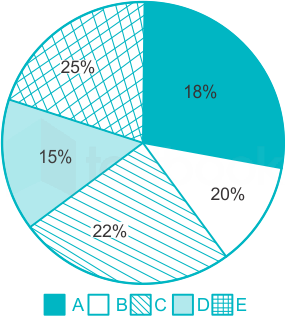
Directions: The following pie chart shows the percentage distribution of the number of population (Male + Female) living in the city A, B, C, D and E.

Total population in the city = 3000

Table shows the difference between the number of males and females living in the five different cities.


Name of the citiesDifference between males and females
A60
B100
C100
D50
E210


Note: 

Number of males in each cities is more than the number of females in all the cities

Question 31

 20%, and 25% of the males in city D and E respectively are below the age of 25 and 60% and 66.66% of females in city D and E respectively are above the age of 25. Find the total number of persons (Male + Female) below the age of 25.

  1. AOption (a)

    380

  2. BOption (b)

    340

  3. COption (c)

    310

  4. DOption (d)

    370

  5. EOption (e)

    320

View answer & explanation

Correct answer

Answer: (b)B.

340

Why this answer is correct

General solution:


City

Number of persons (Male + Female) living in city = 3000 ×  (18/100) = 540

Difference between number of (Male - Females) = 60

M + F = 540

M - F = 60

2M = 600

M = 300

F = 240


City B:


Number of persons (Male + Female) living in city = 3000 ×  (20/100) = 600

Difference between number of (Male - Females) = 100

M + F = 600

M - F = 100

2M = 700

M = 350

F = 250


City C:


Number of persons (Male + Female) living in city = 3000 ×  (22/100) = 660

Difference between number of (Male - Females) = 100

M + F = 660

M - F = 100

2M = 760

M = 380

F = 280


City D:


Number of persons (Male + Female) living in city = 3000 ×  (15/100) = 450

Difference between number of (Male - Females) = 50

M + F = 450

M - F = 50

2M = 500

M = 250

F = 200


City E:


Number of persons (Male + Female) living in city = 3000 ×  (25/100) = 750

Difference between number of (Male - Females) = 210

M + F = 750

M - F = 210

2M = 960

M = 480

F = 270


Name of the citiesNumber of malesNumber of females
A300240
B350250
C380280
D250200
E480270

Solution:

Number of males below the age of 25 in city D = 250 ×  (20/100) = 50

Number of males below the age of 25 in city E = 480 ×  (25/100) = 120

Number of females below the age of 25 in city D = 200 ×  (40/100) = 80

Number of females below the age of 25 in city E = 270 ×  (33.33/100) = 90

Required sum = (50 + 120 + 80 + 90) = 340

Question 32

If 3/7 of the males in the city B and 2/5 of the females in the city B are having two wheelers and remaining have four wheelers , Find the difference between the 4/5 of the number of males having four wheelers in city B and females having four wheelers in city B.

  1. AOption (a)

    20

  2. BOption (b)

    18

  3. COption (c)

    15

  4. DOption (d)

    10

  5. EOption (e)

    12

View answer & explanation

Correct answer

Answer: (d)D.

10

Why this answer is correct

General solution:


City A 

Number of persons (Male + Female) living in city = 3000 ×  (18/100) = 540

Difference between number of (Male - Females) = 60

M + F = 540

M - F = 60

2M = 600

M = 300

F = 240


City B:


Number of persons (Male + Female) living in city = 3000 ×  (20/100) = 600

Difference between number of (Male - Females) = 100

M + F = 600

M - F = 100

2M = 700

M = 350

F = 250


City C:


Number of persons (Male + Female) living in city = 3000 ×  (22/100) = 660

Difference between number of (Male - Females) = 100

M + F = 660

M - F = 100

2M = 760

M = 380

F = 280


City D:


Number of persons (Male + Female) living in city = 3000 ×  (15/100) = 450

Difference between number of (Male - Females) = 50

M + F = 450

M - F = 50

2M = 500

M = 250

F = 200


City E:


Number of persons (Male + Female) living in city = 3000 ×  (25/100) = 750

Difference between number of (Male - Females) = 210

M + F = 750

M - F = 210

2M = 960

M = 480

F = 270


Name of the citiesNumber of malesNumber of females
A300240
B350250
C380280
D250200
E480270

Solution:

Number of males living in city B = 350

Number of females living in city B = 250

Number of males having two wheelers in city B = 350 ×  3/7 = 150

Number of females having two wheelers in city B = 250 ×  2/5 = 100

Number of females having four wheelers in city B = (350 - 150) = 200

Number of females having four wheelers in city B = (250 - 100) = 150

Required difference = (200 ×  4/5 - 150) = (160 - 150) = 10

Question 33

If the number of males living in the city C is increased by x and the number of females living in the same city is increased by (x - 50) then then the ratio of males to females becomes 3: 2. Find the value of x.

  1. AOption (a)

    90

  2. BOption (b)

    85

  3. COption (c)

    70

  4. DOption (d)

    75

  5. EOption (e)

    80

View answer & explanation

Correct answer

Answer: (c)C.

70

Why this answer is correct

General solution:


City A 

Number of persons (Male + Female) living in city = 3000 ×  (18/100) = 540

Difference between number of (Male - Females) = 60

M + F = 540

M - F = 60

2M = 600

M = 300

F = 240


City B:


Number of persons (Male + Female) living in city = 3000 ×  (20/100) = 600

Difference between number of (Male - Females) = 100

M + F = 600

M - F = 100

2M = 700

M = 350

F = 250


City C:


Number of persons (Male + Female) living in city = 3000 ×  (22/100) = 660

Difference between number of (Male - Females) = 100

M + F = 660

M - F = 100

2M = 760

M = 380

F = 280


City D:


Number of persons (Male + Female) living in city = 3000 ×  (15/100) = 450

Difference between number of (Male - Females) = 50

M + F = 450

M - F = 50

2M = 500

M = 250

F = 150


City E:


Number of persons (Male + Female) living in city = 3000 ×  (25/100) = 750

Difference between number of (Male - Females) = 210

M + F = 750

M - F = 210

2M = 960

M = 480

F = 270


Name of the citiesNumber of malesNumber of females
A300240
B350250
C380280
D250200
E480270


Solution:

Number of males living in the city C = 380

Number of females living in the city C = 280

(380 + x)/(280 + (x - 50)) = 3/2

(760 + 2x) = ( 690 + 3x)

x = 70

Question 34

Number of males living in city F is 20 more than the average males living in city C and city E and the number of females living in city F is 40 more than the average females living in city A and C. Find the total persons living in the city F.

  1. AOption (a)

    850

  2. BOption (b)

    700

  3. COption (c)

    650

  4. DOption (d)

    750

  5. EOption (e)

    550

View answer & explanation

Correct answer

Answer: (d)D.

750

Why this answer is correct

General solution:


City A 

Number of persons (Male + Female) living in city = 3000 ×  (18/100) = 540

Difference between number of (Male - Females) = 60

M + F = 540

M - F = 60

2M = 600

M = 300

F = 240


City B:


Number of persons (Male + Female) living in city = 3000 ×  (20/100) = 600

Difference between number of (Male - Females) = 100

M + F = 600

M - F = 100

2M = 700

M = 350

F = 250


City C:


Number of persons (Male + Female) living in city = 3000 ×  (22/100) = 660

Difference between number of (Male - Females) = 100

M + F = 660

M - F = 100

2M = 760

M = 380

F = 280


City D:


Number of persons (Male + Female) living in city = 3000 ×  (15/100) = 450

Difference between number of (Male - Females) = 50

M + F = 450

M - F = 50

2M = 500

M = 250

F = 150


City E:


Number of persons (Male + Female) living in city = 3000 ×  (25/100) = 750

Difference between number of (Male - Females) = 210

M + F = 750

M - F = 210

2M = 960

M = 480

F = 270


Name of the citiesNumber of malesNumber of females
A300240
B350250
C380280
D250200
E480270


Solution:

Number of males living in city C = 380

Number of males living in city E = 480

Average number of males living in city C and E = (380 + 480)/2 = 430

Number of males living in city F = (430 + 20) = 450

Number of females living in city A = 240

Number of females living in city C = 280

Average number of females living in city A and C = (240 + 280)/2 = 260

Number of females living in city F = (260 + 40) = 300

Required sum = (450 + 300) = 750

Question 35

Find the ratio between the number of males living in city A and B to the number of females living in the city C and E.

  1. AOption (a)

    13: 12

  2. BOption (b)

    13: 11

  3. COption (c)

    12: 13

  4. DOption (d)

    17: 15

  5. EOption (e)

    11: 14

View answer & explanation

Correct answer

Answer: (b)B.

13: 11

Why this answer is correct

General solution:


City A 

Number of persons (Male + Female) living in city = 3000 ×  (18/100) = 540

Difference between number of (Male - Females) = 60

M + F = 540

M - F = 60

2M = 600

M = 300

F = 240


City B:


Number of persons (Male + Female) living in city = 3000 ×  (20/100) = 600

Difference between number of (Male - Females) = 100

M + F = 600

M - F = 100

2M = 700

M = 350

F = 250


City C:


Number of persons (Male + Female) living in city = 3000 ×  (22/100) = 660

Difference between number of (Male - Females) = 100

M + F = 660

M - F = 100

2M = 760

M = 380

F = 280


City D:


Number of persons (Male + Female) living in city = 3000 ×  (15/100) = 450

Difference between number of (Male - Females) = 50

M + F = 450

M - F = 50

2M = 500

M = 250

F = 150


City E:


Number of persons (Male + Female) living in city = 3000 ×  (25/100) = 750

Difference between number of (Male - Females) = 210

M + F = 750

M - F = 210

2M = 960

M = 480

F = 270


Name of the citiesNumber of malesNumber of females
A300240
B350250
C380280
D250200
E480270

Solution:

Number of males living in city A =300

Number of males living in city B = 350

Number of females living in city C = 280

Number of females living in city E = 270

Required ratio = (300 + 350): (280 + 270) = (650: 550) = 13: 11

Question 36

In each city, the literacy rate among males is 70%, and among females, it is 60%. Calculate the total number of literate people in each city and determine which city has the highest literacy rate (literate people as a percentage of the total population of the city).

  1. AOption (a)

    City E

  2. BOption (b)

    City A

  3. COption (c)

    City D

  4. DOption (d)

    City B

  5. EOption (e)

    City C

View answer & explanation

Correct answer

Answer: (a)A.

City E

Why this answer is correct

General solution:


City A 

Number of persons (Male + Female) living in city = 3000 ×  (18/100) = 540

Difference between number of (Male - Females) = 60

M + F = 540

M - F = 60

2M = 600

M = 300

F = 240


City B:


Number of persons (Male + Female) living in city = 3000 ×  (20/100) = 600

Difference between number of (Male - Females) = 100

M + F = 600

M - F = 100

2M = 700

M = 350

F = 250


City C:


Number of persons (Male + Female) living in city = 3000 ×  (22/100) = 660

Difference between number of (Male - Females) = 100

M + F = 660

M - F = 100

2M = 760

M = 380

F = 280


City D:


Number of persons (Male + Female) living in city = 3000 ×  (15/100) = 450

Difference between number of (Male - Females) = 50

M + F = 450

M - F = 50

2M = 500

M = 250

F = 150


City E:


Number of persons (Male + Female) living in city = 3000 ×  (25/100) = 750

Difference between number of (Male - Females) = 210

M + F = 750

M - F = 210

2M = 960

M = 480

F = 270


Name of the citiesNumber of malesNumber of females
A300240
B350250
C380280
D250200
E480270


Solution:

Number of literate people in each city if males = 70% and females = 60% literate in all cities.

City A: Literate Males = 210, Literate Females = 144,

Total Literate People = 354

City B: Literate Males = 245, Literate Females = 150,

Total Literate People = 395

City C: Literate Males = 266, Literate Females = 168,

Total Literate People = 434

City D: Literate Males = 175, Literate Females = 120,

Total Literate People = 295

City E: Literate Males = 336, Literate Females = 162,

Total Literate People = 498

Literacy rate in each city = Literate people as a percentage of the total population of the city

City A: Literacy Rate = 65.56%

City B: Literacy Rate = 65.83%

City C: Literacy Rate = 65.76%

City D: Literacy Rate = 65.56%

City E: Literacy Rate = 66.40%

City E has the highest literacy rate with approximately 66.40%.

Question 37

The perimeter of the semi-circular garden is equal to the perimeter of the rectangular field whose length and breadth is x m and (x – 12) m, respectively.  If the area of the rectangle field is 1260 m2. Then, find the cost of fencing of the semi-circular garden at the rate of Rs. 15 per m?

  1. AOption (a)

    Rs. 2200

  2. BOption (b)

    Rs. 2160

  3. COption (c)

    Rs. 2450

  4. DOption (d)

    Rs. 2340

  5. EOption (e)

    None of these

View answer & explanation

Correct answer

Answer: (b)B.

Rs. 2160

Why this answer is correct

Shortcut Trick

Area of rectangle = 1260 m2. Factors of 1260 with difference 12: 42 × 30.

Length (x) = 42 m, Breadth (x − 12) = 30 m.

Perimeter of rectangle = 2 × (42 + 30) = 144 m.

Cost of fencing = Perimeter × Rate = 144 m × ₹15 per m = ₹2160.

∴ The correct answer is ₹2160.

Alternate Method

Given: Area of rectangular field = 1260 m2, Length = x, Breadth = x − 12. Rate = ₹15/m.

Formula Used: Area = Length × Breadth; Perimeter of rectangle = 2(l + b).

⇒ x(x − 12) = 1260

⇒ x2 − 12x − 1260 = 0

⇒ x2 − 42x + 30x − 1260 = 0

⇒ (x − 42)(x + 30) = 0 ⇒ x = 42 m (Length), Breadth = 30 m

⇒ Perimeter of rectangular field = 2(42 + 30) = 144 m

⇒ Since Perimeters are equal, Fencing length of semi-circular garden = 144 m

⇒ Total Cost = 144 × 15 = ₹2160

∴ The correct answer is ₹2160.

Additional Information

Perimeter of Semi-circle

The total perimeter includes the curved arc and the diameter: P = πr + 2r or r(π + 2).

Cost of Fencing

Total Cost is calculated by multiplying the boundary length (Perimeter) by the rate per unit length.

Area of Semi-circle

The region enclosed is half that of a full circle: Area = (πr2) ÷ 2.

Question 38

A lent out Rs. 5000 and Rs. 'A' on compound interest for 3 years and 4 years respectively at the rate of interest of 10%. The difference between compound interest is Rs. 2986. Find the value of A.

  1. AOption (a)

    Rs. 10000

  2. BOption (b)

    Rs. 9000

  3. COption (c)

    Rs. 8000

  4. DOption (d)

    Rs. 15000

  5. EOption (e)

    Rs. 5000

View answer & explanation

Correct answer

Answer: (a)A.

Rs. 10000

Why this answer is correct

Shortcut Trick

Rate = 10%. Multiplying factors: 3 years = 1.331, 4 years = 1.4641.

CI1 = 5000 × (1.331 − 1) = 5000 × 0.331 = 1655.

CI2 = A × (1.4641 − 1) = 0.4641A.

Difference: 0.4641A − 1655 = 2986 ⇒ 0.4641A = 4641 ⇒ A = 10000.

∴ The correct answer is ₹10000.

Alternate Method

Given: Principal1 = ₹5000, Time1 = 3 years, Principal2 = ₹A, Time2 = 4 years, Rate = 10%.

Formula: CI = P[(1 + R/100)n − 1]

⇒ CI1 = 5000[(1 + 10/100)3 − 1]

⇒ CI1 = 5000[1.13 − 1] = 5000[1.331 − 1] = 5000 × 0.331 = 1655

⇒ CI2 = A[(1.1)4 − 1] = A[1.4641 − 1] = 0.4641A

⇒ CI2 − CI1 = 2986

⇒ 0.4641A − 1655 = 2986

⇒ 0.4641A = 2986 + 1655 = 4641

⇒ A = 4641 ÷ 0.4641 = 10000

∴ The correct answer is ₹10000.

Additional Information

Compound Interest Formula

The amount A = P(1 + r/100)n. Compound Interest CI = Amount − Principal.

Successive Percentage Method

For 10% rate: 2 years effective rate = 21%, 3 years = 33.1%, 4 years = 46.41%.

Difference between CI and SI

For 2 years, Difference = P(R/100)2. For 3 years, Difference = P(R/100)2 × (3 + R/100).

Question 39

What should come in the place of question mark '?' in the following number series ?

123, 187, 219, 235, 243, ?

  1. AOption (a)

    247

  2. BOption (b)

    245

  3. COption (c)

    249

  4. DOption (d)

    251

  5. EOption (e)

    None of these

View answer & explanation

Correct answer

Answer: (a)A.

247

Why this answer is correct

Considering the above series,

123, 184, 219, 235, 243, ?

The logic of the series can be explained as:

123 + (128/2 = 64) = 187

187 + (64/2 = 32) = 219

219 + (32/2 = 16) = 235

235 + (16/2 = 8) = 243

By observing the pattern, we can write

⇒ 243 + (8/2 = 4) = ?

⇒ ? = 247

∴ The value of ? is 247.

Question 40

What should come in the place of question mark '?' in the following number series ?

13, 13, 14, 18, 45, 61, ?

  1. AOption (a)

    180

  2. BOption (b)

    176

  3. COption (c)

    164

  4. DOption (d)

    186

  5. EOption (e)

    None of these

View answer & explanation

Correct answer

Answer: (d)D.

186

Why this answer is correct

Considering the above series,

13, 13, 14, 18, 45, 61, ?

The logic of the series can be explained as:

13 + 02 = 13

13 + 13 = 14

14 + 22 = 18

18 + 33 = 45

45 + 42 = 61

By observing the pattern, we can write

⇒ 61 + 53 = ?

⇒ ? = 186

∴ The value of ? is 186.

Question 41

What should come in place of the question mark '?' in the following number series?

10, 18, 34, ?, 130, 258

  1. AOption (a)

    32

  2. BOption (b)

    60

  3. COption (c)

    66

  4. DOption (d)

    68

  5. EOption (e)

    None of these

View answer & explanation

Correct answer

Answer: (c)C.

66

Why this answer is correct

Calculation:

The series follows following pattern:

⇒ 10 + (1 × 8) = 18

⇒ 18 + (2 × 8) = 34

⇒ 34 + (4 × 8) = 66

⇒ 66 + (8 × 8) = 130

∴ The value of ? is 66

Question 42

What should come in place of the question mark ‘?’ in the following number series?

144, 164, 194, 234, 284, ?

  1. AOption (a)

    400

  2. BOption (b)

    344

  3. COption (c)

    564

  4. DOption (d)

    356

  5. EOption (e)

    369

View answer & explanation

Correct answer

Answer: (b)B.

344

Why this answer is correct

Calculation:

The series follows following pattern:

⇒ 144 + 20 = 164

⇒ 164 + 30 = 194

⇒ 194 + 40 = 234

⇒ 234 + 50 = 284

By observing the pattern, we can write

284 + 60 = 344

⇒ ? = 344

∴ The value of ? is 344.

Question 43

What should come in place of question mark ‘?’ in the following number series?

500, 475, 426, 345, 224, ?

  1. AOption (a)

    51

  2. BOption (b)

    52

  3. COption (c)

    53

  4. DOption (d)

    54

  5. EOption (e)

    55

View answer & explanation

Correct answer

Answer: (e)E.

55

Why this answer is correct

Calculation:

Considering the above series,

500, 475, 426, 345, 224, ?

The logic of the series can be explained as,

500 – (5)2 = 475

475 – (7)2 = 426

426 – (9)2 = 345

345 – (11)2 = 224

By observing the pattern, we can write

224 – (13)2 = 55

⇒ ? = 55

∴ The value of ? is 55

Question 44

What should come in place of the question mark (?) in the following number series?

33, 321, 465, 537, 573, ?

  1. AOption (a)

    600

  2. BOption (b)

    591

  3. COption (c)

    585

  4. DOption (d)

    498

  5. EOption (e)

    None of these

View answer & explanation

Correct answer

Answer: (b)B.

591

Why this answer is correct

Calculation∶

The series follows the following pattern:

⇒ 33 + 288 = 321

⇒ 321 + 144 = 465 , [ 288/2=144]

⇒ 465 + 72 = 537    ,[144/2=72]

⇒ 537 + 36 = 573    ,[72/2=36]

⇒ 573 + 18 = 591    ,[36/2=18]

∴ The value of ? is 591

Note: Best way to approach this type of question is to find the difference from the end where gap between the number is less. here it can be 573 and 537.

Question 45

A man borrowed Rs.X at a simple interest of 35% per annum for 6 years and Rs.Y at a simple interest of 20% per annum for 6 years. If he had borrowed Rs. (X + Y) at a simple interest of 25% for 6 years, he would have paid the same interest. Find the ratio of X and Y.

  1. AOption (a)

    2 : 3

  2. BOption (b)

    1 : 2

  3. COption (c)

    3 : 4

  4. DOption (d)

    3 : 5

  5. EOption (e)

    2 : 5

View answer & explanation

Correct answer

Answer: (b)B.

1 : 2

Why this answer is correct

Shortcut Trick

Apply Alligation Method on the interest rates since the time period (6 years) is constant for all parts.

Rate 1 (X) = 35%, Rate 2 (Y) = 20%, Combined Rate (X+Y) = 25%.

Difference 1 (X - Combined) = 35 − 25 = 10.

Difference 2 (Combined - Y) = 25 − 20 = 5.

Ratio X : Y = 5 : 10 = 1 : 2.

∴ The correct answer is 1 : 2.

Alternate Method

Given: Principal X at 35%, Principal Y at 20%, Combined Principal (X+Y) at 25%, Time = 6 years.

Formula Used: SI = (P × R × T) ÷ 100

⇒ Total SI = SIX + SIY

⇒ [(X × 35 × 6) ÷ 100] + [(Y × 20 × 6) ÷ 100] = [(X + Y) × 25 × 6] ÷ 100

⇒ 35X + 20Y = 25(X + Y)

⇒ 35X + 20Y = 25X + 25Y

⇒ 35X − 25X = 25Y − 20Y

⇒ 10X = 5Y

⇒ X ÷ Y = 5 ÷ 10

⇒ X : Y = 1 : 2

∴ The correct answer is 1 : 2.

Additional Information

Simple Interest Property

When the time period is constant, the total interest earned is the sum of interest from individual parts: SItotal = SI1 + SI2.

Alligation in SI

Alligation can be used to find the ratio of investments (X and Y) when the overall effective rate of interest is known for a common time period.

Relationship of R and P

For a fixed SI and Time, the Principal and Rate are inversely proportional: P1 × R1 = P2 × R2.

Question 46

Two people A and B got different marks in 3 different subjects’ viz. Mathematics, English, and Science. If the total marks obtained by A is 20% more than the total marks of B and average marks obtained by B in all three subjects is 70 out of 100 and If A got 80 marks in science and 95 marks in Mathematics, then find the marks of A in English.

  1. AOption (a)

    75

  2. BOption (b)

    77

  3. COption (c)

    80

  4. DOption (d)

    67

  5. EOption (e)

    87

View answer & explanation

Correct answer

Answer: (b)B.

77

Why this answer is correct

Shortcut Trick

Total marks of B = 3 × 70 = 210.

Total marks of A = 1.20 × 210 = 252.

Marks of A in English = 252 − (80 + 95) = 252 − 175 = 77.

∴ The correct answer is 77 marks.

Alternate Method

Given:

Average marks of B in 3 subjects = 70

Total marks of A = 120% of B's total marks

Marks of A in Science = 80, Mathematics = 95

Calculations:

⇒ Total marks of B = 70 × 3 = 210

⇒ Total marks of A = 210 × (120/100) = 210 × 1.2 = 252

⇒ Total marks of A = Marks in (Maths + Science + English)

⇒ 252 = 95 + 80 + Marks in English

⇒ 252 = 175 + Marks in English

⇒ Marks in English = 252 − 175 = 77

∴ The correct answer is 77 marks.

Additional Information

Averages

Average = (Sum of all observations) ÷ (Total number of observations). Sum = Average × Count.

Percentage Increase

To increase a value by x%, multiply the original value by (100 + x)/100.

Question 47

A, B, and C are partners. A invested Rs. 20,000 in business for 't' months. B invested Rs. 30,000 for 4 months less than the period invested by A and C invested Rs. 60,000 for 2 months less than the period invested by B. Their profit sharing ratio is 2 : 2 : 3. Find the number of months for which each partner has invested in the business respectively.

  1. AOption (a)

    12, 8 and 6 months

  2. BOption (b)

    12, 6 and 6 months

  3. COption (c)

    12, 7 and 5 months

  4. DOption (d)

    12, 8 and 3 months

  5. EOption (e)

    12, 9 and 7 months

View answer & explanation

Correct answer

Answer: (a)A.

12, 8 and 6 months

Why this answer is correct

Shortcut Trick

Ratio of Investment × Time equals the Profit Ratio.

For A and B: (20,000 × t) ÷ (30,000 × (t − 4)) = 2 ÷ 2.

Simplified: 2t ÷ 3(t − 4) = 1 ⇒ 2t = 3t − 12 ⇒ t = 12 months.

Time for B = t − 4 = 12 − 4 = 8 months.

Time for C = (t − 4) − 2 = 8 − 2 = 6 months.

∴ The correct answer is 12, 8 and 6 months.

Alternate Method

Given: Investments of A, B, and C are Rs. 20,000, Rs. 30,000, and Rs. 60,000. Profit ratio is 2 : 2 : 3. Formula: Profit Ratio = (I1 × T1) : (I2 × T2) : (I3 × T3)

⇒ Let time for A be t. Then B is t − 4 and C is (t − 4) − 2 = t − 6. ⇒ Ratio of Profit (A:B) = (20,000 × t) : (30,000 × (t − 4)) = 2 : 2. ⇒ 2t ÷ (3t − 12) = 1 ⇒ 2t = 3t − 12 ⇒ t = 12. ⇒ Time for A = 12 months, B = 8 months, C = 6 months. ⇒ Check with C: (30,000 × 8) : (60,000 × 6) = 240,000 : 360,000 = 2 : 3 (Matches).

∴ The correct answer is 12, 8 and 6 months.

Additional Information

Partnership Ratios

In a partnership, profit is distributed based on the product of Capital and Time. If capitals are C1, C2 and times are T1, T2, then Profit Ratio P1:P2 = C1T1 : C2T2.

Time Calculation

If profit ratios and capitals are known, Time ratio can be found using T = P ÷ C.

Directions: The following table shows the average number of students (Boys + Girls) got graduation and fractional value of the number of girls who got graduation in four different colleges P, Q, R and S.


DepartmentsAverage number of (Boys + Girls) got graduationFractional value of number of girls got graduation
P1.5x2/5
Q250% of x2/5
R4003/8
S2x1/2


Note: Average number of girls got graduation in all the given colleges = 335

Question 48

If 3/5 of the boys graduated from department Q graduated with distinction and the remaining are first class and 5/8 of the girls from department Q got graduated with first class. Find the total number of students who graduated with the first class in department Q.

  1. AOption (a)

    430

  2. BOption (b)

    530

  3. COption (c)

    490

  4. DOption (d)

    320

  5. EOption (e)

    410

View answer & explanation

Correct answer

Answer: (c)C.

490

Why this answer is correct

General solution:

[2 ×  1.5x ×  (2/5) +2 ×  2.5x ×  (2/5) + 2 × 400 ×  (3/8) + 2 ×  2x ×  (1/2)] = 1340

[1.2x + 2x + 300 + 2x] = 1340

5.2x = 1040

x = 200

Department P:

Total students (Boys + Girls) got graduated = 1.5 ×  2 ×  200 = 600

Number of girls got  graduated = 600 ×  (2/5)= 240

Number of boys got graduated = (600 - 240) = 360


Department Q:

Total students (Boys + Girls) got graduated = (250 ×  x/100)  = 2.5 ×  2 ×  200 = 1000

Number of girls got  graduated = 1000 ×  (2/5)= 400

Number of boys got graduated = (1000 - 400) = 600


Department R:

Total students (Boys + Girls) got graduated = 400 ×  2 = 800

Number of girls got  graduated = 800 ×  (3/8)= 300

Number of boys got graduated = (800 - 300) = 500


Department S:

Total students (Boys + Girls) got graduated = 2 ×  2 ×  200 = 800

Number of girls got  graduated = 800 ×  (1/2) = 400

Number of boys got graduated = (800 - 400) = 400


DepartmentsNumber of boys graduatedNumber of girls graduated
P360240
Q600400
R500300
S400400

Solution:

Number of boys graduated form department Q = 600

Number of boys graduated from department Q with distinction = 600 ×  3/5 = 360

Number of boys graduated from department Q with first class = (600 - 360) = 240

Number of girls graduated from department Q with first class = (400 ×  5/8) = 250

Required total = (240 + 250) = 490

Question 49

If 30% and 40% of the boys graduated in department Q and R respectively are hostelers and remaining are day scholars. Total hostelers both boys and girls, graduated in department  Q  and R is 600. Find the number of girls graduated in  department Q and R, from the hostel.

  1. AOption (a)

    280

  2. BOption (b)

    260

  3. COption (c)

    230

  4. DOption (d)

    220

  5. EOption (e)

    240

View answer & explanation

Correct answer

Answer: (d)D.

220

Why this answer is correct

General solution:

[2 ×  1.5x ×  (2/5) +2 ×  2.5x ×  (2/5) + 2 × 400 ×  (3/8) + 2 ×  2x ×  (1/2)] = 1340

[1.2x + 2x + 300 + 2x] = 1340

5.2x = 1040

x = 200

Department P:

Total students (Boys + Girls) got graduated = 1.5 ×  2 ×  200 = 600

Number of girls got  graduated = 600 ×  (2/5)= 240

Number of boys got graduated = (600 - 240) = 360


Department Q:

Total students (Boys + Girls) got graduated = (250 ×  x/100)  = 2.5 ×  2 ×  200 = 1000

Number of girls got  graduated = 1000 ×  (2/5)= 400

Number of boys got graduated = (1000 - 400) = 600


Department R:

Total students (Boys + Girls) got graduated = 400 ×  2 = 800

Number of girls got  graduated = 800 ×  (3/8)= 300

Number of boys got graduated = (800 - 300) = 500


Department S:

Total students (Boys + Girls) got graduated = 2 ×  2 ×  200 = 800

Number of girls got  graduated = 800 ×  (1/2) = 400

Number of boys got graduated = (800 - 400) = 400


DepartmentsNumber of boys graduatedNumber of girls graduated
P360240
Q600400
R500300
S400400

Solution:

Number of boys graduated in department Q from hostel = 600 ×  (30/100) = 180

Number of girls  graduated in department R from hostel = 500 ×  (40/100) = 200

Total hostelers graduated from department Q and R = 600

Number of girls graduated in  department Q and R, from the hostel = 600 - (200 + 180) = 220

Question 50

Number of boys who graduated from department Q has increased by 20%. The number of boys who graduated from department Q is what percentage of the number of girls who graduated from all the four departments.

  1. AOption (a)

    48.89%

  2. BOption (b)

    41.90%

  3. COption (c)

    53.73%

  4. DOption (d)

    43.78%

  5. EOption (e)

    55.78%

View answer & explanation

Correct answer

Answer: (c)C.

53.73%

Why this answer is correct

General solution:

[2 ×  1.5x ×  (2/5) +2 ×  2.5x ×  (2/5) + 2 × 400 ×  (3/8) + 2 ×  2x ×  (1/2)] = 1340

[1.2x + 2x + 300 + 2x] = 1340

5.2x = 1040

x = 200

Department P:

Total students (Boys + Girls) got graduated = 1.5 ×  2 ×  200 = 600

Number of girls got  graduated = 600 ×  (2/5)= 240

Number of boys got graduated = (600 - 240) = 360


Department Q:

Total students (Boys + Girls) got graduated = (250 ×  x/100)  = 2.5 ×  2 ×  200 = 1000

Number of girls got  graduated = 1000 ×  (2/5)= 400

Number of boys got graduated = (1000 - 400) = 600


Department R:

Total students (Boys + Girls) got graduated = 400 ×  2 = 800

Number of girls got  graduated = 800 ×  (3/8)= 300

Number of boys got graduated = (800 - 300) = 500


Department S:

Total students (Boys + Girls) got graduated = 2 ×  2 ×  200 = 800

Number of girls got  graduated = 800 ×  (1/2) = 400

Number of boys got graduated = (800 - 400) = 400


DepartmentsNumber of boys graduatedNumber of girls graduated
P360240
Q600400
R500300
S400400
<br>

Solution:

Number of boys graduated from department Q = 600 ×  120/100 = 720

Total number of girls graduated from all the department = (240 + 300 + 400 + 400) = 1340

Required percentage = (720/1340) ×  100 = 53.73%

Question 51

 Find the difference between the average number of boys and girls graduated from all the given departments.

  1. AOption (a)

    150

  2. BOption (b)

    140

  3. COption (c)

    130

  4. DOption (d)

    120

  5. EOption (e)

    110

View answer & explanation

Correct answer

Answer: (c)C.

130

Why this answer is correct

General solution:

[2 ×  1.5x ×  (2/5) +2 ×  2.5x ×  (2/5) + 2 × 400 ×  (3/8) + 2 ×  2x ×  (1/2)] = 1340

[1.2x + 2x + 300 + 2x] = 1340

5.2x = 1040

x = 200

Department P:

Total students (Boys + Girls) got graduated = 1.5 ×  2 ×  200 = 600

Number of girls got  graduated = 600 ×  (2/5)= 240

Number of boys got graduated = (600 - 240) = 360


Department Q:

Total students (Boys + Girls) got graduated = (250 ×  x/100)  = 2.5 ×  2 ×  200 = 1000

Number of girls got  graduated = 1000 ×  (2/5)= 400

Number of boys got graduated = (1000 - 400) = 600


Department R:

Total students (Boys + Girls) got graduated = 400 ×  2 = 800

Number of girls got  graduated = 800 ×  (3/8)= 300

Number of boys got graduated = (800 - 300) = 500


Department S:

Total students (Boys + Girls) got graduated = 2 ×  2 ×  200 = 800

Number of girls got  graduated = 800 ×  (1/2) = 400

Number of boys got graduated = (800 - 400) = 400


DepartmentsNumber of boys graduatedNumber of girls graduated
P360240
Q600400
R500300
S400400

Solution:

Average number of girls graduated from the all the college = 335

Average number of all the boys graduated from the ll the departments = (360 + 600 + 500 + 400)/4 = 465

Required difference = (465 - 335) = 130

Question 52

Number of boys who graduated from department T is 50 more than the number of boys who graduated from department Q. Number of girls who graduated from department T is 60 more than the number of girls who graduated from department P. Find the difference between 2/5 of the number of boys who graduated from department T and 2/3 rd of the number of girls who graduated from department T.

  1. AOption (a)

    85

  2. BOption (b)

    90

  3. COption (c)

    80

  4. DOption (d)

    60

  5. EOption (e)

    75

View answer & explanation

Correct answer

Answer: (d)D.

60

Why this answer is correct

General solution:

[2 ×  1.5x ×  (2/5) +2 ×  2.5x ×  (2/5) + 2 × 400 ×  (3/8) + 2 ×  2x ×  (1/2)] = 1340

[1.2x + 2x + 300 + 2x] = 1340

5.2x = 1040

x = 200

Department P:

Total students (Boys + Girls) got graduated = 1.5 ×  2 ×  200 = 600

Number of girls got  graduated = 600 ×  (2/5)= 240

Number of boys got graduated = (600 - 240) = 360


Department Q:

Total students (Boys + Girls) got graduated = (250 ×  x/100)  = 2.5 ×  2 ×  200 = 1000

Number of girls got  graduated = 1000 ×  (2/5)= 400

Number of boys got graduated = (1000 - 400) = 600


Department R:

Total students (Boys + Girls) got graduated = 400 ×  2 = 800

Number of girls got  graduated = 800 ×  (3/8)= 300

Number of boys got graduated = (800 - 300) = 500


Department S:

Total students (Boys + Girls) got graduated = 2 ×  2 ×  200 = 800

Number of girls got  graduated = 800 ×  (1/2) = 400

Number of boys got graduated = (800 - 400) = 400


DepartmentsNumber of boys graduatedNumber of girls graduated
P360240
Q600400
R500300
S400400

Solution:

Number of boys graduated from department Q = 600

Number of boys graduated from department T = (600 + 50) = 650

Number of girls graduated from department P = 240

Number of girls graduated from department T = (240 + 60) = 300

Required difference = (650 ×  2/5 - 300 ×  2/3) = (260 - 200) = 60

Question 53

The cost price of a cricket bat is 25x and that of one ball is 5x. The marked price of the bat and ball is 20% and 100% more than the cost price, respectively. If the profit percentage on bat and ball is 10% and 50%, respectively, then, find the overall discount percentage?

  1. AOption (a)

    12%

  2. BOption (b)

    15.5%

  3. COption (c)

    12.5%

  4. DOption (d)

    16%

  5. EOption (e)

    None of these

View answer & explanation

Correct answer

Answer: (c)C.

12.5%

Why this answer is correct

Shortcut Trick

Total Marked Price (MP) = Bat MP + Ball MP = (25x × 1.2) + (5x × 2.0) = 30x + 10x = 40x.

Total Selling Price (SP) = Bat SP + Ball SP = (25x × 1.1) + (5x × 1.5) = 27.5x + 7.5x = 35x.

Total Discount = Total MP − Total SP = 40x − 35x = 5x.

Overall Discount % = (Total Discount ÷ Total MP) × 100 = (5x ÷ 40x) × 100 = 12.5%.

∴ The correct answer is 12.5%.

Alternate Method

Given: CP of Bat = 25x, CP of Ball = 5x. Formulas: MP = CP × (100 + Markup%) ÷ 100 | SP = CP × (100 + Profit%) ÷ 100 | Discount% = (MP − SP) ÷ MP × 100.

⇒ Bat MP = 25x + 20% of 25x = 25x + 5x = 30x. ⇒ Ball MP = 5x + 100% of 5x = 5x + 5x = 10x. ⇒ Total MP = 30x + 10x = 40x. ⇒ Bat SP = 25x + 10% of 25x = 25x + 2.5x = 27.5x. ⇒ Ball SP = 5x + 50% of 5x = 5x + 2.5x = 7.5x. ⇒ Total SP = 27.5x + 7.5x = 35x. ⇒ Discount = 40x − 35x = 5x. ⇒ Discount Percentage = (5x ÷ 40x) × 100 = 12.5%.

∴ The correct answer is 12.5%.

Additional Information

Marked Price and Discount

Marked Price is the price displayed on the tag, while Discount is always calculated on the MP to arrive at the Selling Price.

Profit and Cost Price

Profit is the extra amount earned over the Cost Price. Profit % = (SP − CP) ÷ CP × 100.

Question 54

In 60L of solution of insecticide, the ratio of chemicals and water is 11 : 4. It was decided later insecticide concentration must be further diluted to protect plants and soil. Then how much water should be added to the existing solution so that the ratio of chemical and water be 11: 6? 

  1. AOption (a)

    8 L

  2. BOption (b)

    6 L

  3. COption (c)

    4 L

  4. DOption (d)

    10 L

  5. EOption (e)

    12 L

View answer & explanation

Correct answer

Answer: (a)A.

8 L

Why this answer is correct

Shortcut Trick

Initial ratio of chemical to water = 11 : 4

Final ratio of chemical to water = 11 : 6

Since chemical remains constant (11 units), the increase in water = 6 − 4 = 2 units.

Total initial units = 11 + 4 = 15 units → 60 L.

1 unit = 4 L ∴ 2 units = 8 L.

∴ The correct answer is 8 L.

Alternate Method

Given: Total solution = 60 L, Ratio (C:W)initial = 11:4, Ratio (C:W)final = 11:6

Calculations:

⇒ Total initial parts = 11 + 4 = 15

⇒ Quantity of chemical = (11 ÷ 15) × 60 = 44 L

⇒ Quantity of water = (4 ÷ 15) × 60 = 16 L

⇒ Let water added be x L. New water = 16 + x

⇒ 44 ÷ (16 + x) = 11 ÷ 6

⇒ 11 × (16 + x) = 44 × 6

⇒ 16 + x = 4 × 6 = 24

⇒ x = 24 − 16 = 8 L

∴ The correct answer is 8 L.

Additional Information

Mixture Dilution Rule

When adding only one component to a mixture, the quantity of the other component remains constant. Always equate the constant component to find the new total volume.

Alligation Method

For dilution with pure water, the concentration of the second addition is 0% chemical or 100% water. (Q1 ÷ Q2) = (n2 − navg) ÷ (navg − n1).

Question 55

what approximate value should come in the place of question mark (?) in the following question? (You are not expected to calculate the exact value)

9.87% of [(299.96)2 + (20.24)2] = 999.99% of 4 + ?

  1. AOption (a)

    8990

  2. BOption (b)

    9899

  3. COption (c)

    9000

  4. DOption (d)

    9989

  5. EOption (e)

    N.O.T.

View answer & explanation

Correct answer

Answer: (c)C.

9000

Why this answer is correct

Rules of Approximation:

  1. If a number has digits to the right of the decimal less than 5, then just drop the digits to the right of the decimal. The number so obtained will be the approximated value.
  2. If a number has digits to the right of the decimal more than 5, then just drop the digits to the right of the decimal and raise the remaining number by '1'.The number so obtained will be the approximated value.

Concept:

In this type of question, we are expected to calculate approximate value (not exact value), so we can replace the given numbers by their nearest perfect places which makes the calculation easy.

9.87% of [(299.96)2 + (20.24)2] = 999.99% of 4 + ?

Taking approximate value, we get

10% of [(300)2 + (20)2] = 1000% of 4 + ?

Follow BODMAS rule to solve this question, as per the order given below,

Since, we need to find out the approximate value, we can write these values to their nearest integers.

Taking approximate value, we get

10% of [(300)2 + (20)2] = 1000% of 4 + ?

⇒ (10 ÷ 100) × (90000 + 400) = (1000 ÷ 100) × 4 + ?

⇒ (1 ÷ 10) × (90400) = 10 × 4 + ?

⇒ 9040 = 40 + ?

⇒ 9040 -40 = ?

∴ ? = 9000

∴ the approximate value of question mark (?) in the following question is 9000.

Question 56

What approximate value should come in place of ‘?’ in the following equation:

29.93% of 459.96 + 25.03% of 640.06 + 2.11 = ? × 6.08

  1. AOption (a)

    50

  2. BOption (b)

    300

  3. COption (c)

    49

  4. DOption (d)

    30

  5. EOption (e)

    None of these

View answer & explanation

Correct answer

Answer: (a)A.

50

Why this answer is correct

Solution:

Rules of Approximation:

  1. If a number has digits to the right of the decimal less than 5, then just drop the digits to the right of the decimal. The number so obtained will be the approximated value.
  2. If a number has digits to the right of the decimal more than 5, then just drop the digits to the right of the decimal and raise the remaining number by '1'.The number so obtained will be the approximated value.

Concept Used:       

Follow BODMAS rule to solve this question, as per the order given below,

Calculation:

30% of 460 + 25% of 640 + 2 = ? × 6

⇒ (30/100) × 460 + (25/100) × 640 + 2 = ? × 6

⇒ 3 × 46 + (640/4) + 2 = ? × 6

⇒ 138 + 160 + 2 = ? × 6

⇒ 300 = ? × 6

⇒ ? = 300/6

∴ ? = 50

Question 57

What approximate will come in the place of the question mark ‘?’ in the following question?

√1155.91 + √730 + (44.99 ÷ 8.97 - 0.99)0.49 = ?

  1. AOption (a)

    64

  2. BOption (b)

    36

  3. COption (c)

    49

  4. DOption (d)

    63

  5. EOption (e)

    72

View answer & explanation

Correct answer

Answer: (d)D.

63

Why this answer is correct

Solution:

We have to follow the BODMAS rule

Calculation:

√1155.91 + √730 + (44.99 ÷ 8.97 -  0.99)0.49

⇒ √1156 + √730 + (45 ÷ 9 – 1)0.5

⇒ √1156 + √730 + (5 – 1)1/2

⇒ √1156 + √730 + 41/2

⇒ √1156 + √730 + 2

⇒ 34 + 27 + 2

⇒ 63

∴ 63 will come in place of the question mark

Question 58

What approximate value should come in place of the question mark (?) in the following question? (You are not expected to calculate the exact value)

√3.98 + (√((2.22)2 + 4.85)) × 5.69 = 24.71% of ?

  1. AOption (a)

    60

  2. BOption (b)

    70

  3. COption (c)

    80

  4. DOption (d)

    90

  5. EOption (e)

    23

View answer & explanation

Correct answer

Answer: (c)C.

80

Why this answer is correct

Rules of Approximation:

  1. If a number has digits to the right of the decimal less than 5, then just drop the digits to the right of the decimal. The number so obtained will be the approximated value.
  2. If a number has digits to the right of the decimal more than 5, then just drop the digits to the right of the decimal and raise the remaining number by '1'.The number so obtained will be the approximated value.

Concept:

In this type of question, we are expected to calculate approximate value (not exact value), so we can replace the given numbers by their nearest perfect places which makes the calculation easy.

√3.98 + (√((2.22)2 + 4.85)) × 5.69 = 24.71% of ?

Taking approximate value, we get

√4 + (√(22 + 5)) × 6 = 25% of ?

Follow BODMAS rule to solve this question, as per the order given below, 

⇒ √4 + (√ (4 + 5)) × 6 = 25% of ?

⇒ √4 + (√9) × 6 = 25% of ?

⇒ 2 + 18 = 25% of ?

⇒ 2 + 18 = 25% of ? (∵ 1.73 ≈ 2)

⇒ 20 = (25/100) × ?

⇒ 20 × 100 / 25 = ?

? = 80

Question 59

What approximate value should come in place of the question mark (?) in the following question?

292 + 34.12 % of 700 ÷ ∛2744.21 = ? + ∛2197

  1. AOption (a)

    945

  2. BOption (b)

    855

  3. COption (c)

    895

  4. DOption (d)

    845

  5. EOption (e)

    865

View answer & explanation

Correct answer

Answer: (d)D.

845

Why this answer is correct

Rules of Approximation:

  1. If a number has digits to the right of the decimal less than 5, then just drop the digits to the right of the decimal. The number so obtained will be the approximated value.
  2. If a number has digits to the right of the decimal more than 5, then just drop the digits to the right of the decimal and raise the remaining number by '1'.The number so obtained will be the approximated value.

Concept:

In this type of question, we are expected to calculate approximate value (not exact value), so we can replace the given numbers by their nearest perfect places which makes the calculation easy.

292 + 34.12 % of 700 ÷ ∛2744.21 = ? + ∛2197

Taking approximate value, we get

292 + 34 % of 700 ÷ ∛2744 = ? + ∛2197

Follow BODMAS rule to solve this question, as per the order given below, 

⇒ 841 + (34 ÷ 100) × 700 ÷ 14 = ? + 13

⇒ 841 + (238 ÷ 14) = ? + 13

⇒ 841 + 17 = ? + 13

⇒ 858 = ? + 13

⇒ ? = 858 – 13

⇒ ? = 845

∴ The value of ? is 845

Question 60

Ram, Shyam, and Rohan working together then they can complete the work in 90 days. Find in how many days Rohan and Shyam can complete the 44.44% of work if the efficiency of ram is 20% more than Shyam and efficiency of Rohan is 16.66% less than ram.

  1. AOption (a)

    75

  2. BOption (b)

    16

  3. COption (c)

    64

  4. DOption (d)

    67

  5. EOption (e)

    None

View answer & explanation

Correct answer

Answer: (c)C.

64

Why this answer is correct

Shortcut Trick

Efficiency ratio Ram : Shyam = 6 : 5 (since 20% = 1/5)

Efficiency ratio Rohan : Ram = 5 : 6 (since 16.66% = 1/6)

Combined Efficiency Ram : Shyam : Rohan = 6 : 5 : 5

Total Work = 90 × (6 + 5 + 5) = 1440 units

Target Work = 44.44% of 1440 = 4/9 × 1440 = 640 units

Required Days = 640 ÷ (5 + 5) = 64 days

∴ The correct answer is 64 days.

Alternate Method

PersonEfficiency RatioNormalized Efficiency
Ram120% of Shyam6x
ShyamBase5x
Rohan(1 − 1/6) of Ram5x

Given: Time taken by (Ram + Shyam + Rohan) = 90 days.

Calculations:

⇒ Total Efficiency = 6x + 5x + 5x = 16x

⇒ Total Work = Efficiency × Time = 16x × 90 = 1440x

⇒ Required Work = 44.44% of Total Work = (4/9) × 1440x = 640x

⇒ Efficiency of (Shyam + Rohan) = 5x + 5x = 10x

⇒ Required Days = 640x ÷ 10x = 64 days

∴ The correct answer is 64 days.

Additional Information

Percentage to Fraction Conversion

Significant values used: 16.66% = 1/6 and 44.44% = 4/9. Converting percentages to fractions simplifies ratio calculations.

Work, Time, and Efficiency Relationship

Total Work = (Combined Efficiency of workers) × (Total Time taken). Efficiency is inversely proportional to time for a constant work.

Ratio Balancing

To find a combined ratio like A:B:C, ensure the common term has the same value in both individual ratios (A:B and B:C or A:C).

Question 61

A ship takes 15 hours for travelling D km downstream and (D + 15) km upstream. If the ship takes 13 hours for covering (D – 15) km downstream and (D + 10) km upstream and the speed of stream is 5 km/hr then, find time taken by the ship to cover (D + 60) km in downstream?

  1. AOption (a)

    5 hours

  2. BOption (b)

    6 hours

  3. COption (c)

    7 hours

  4. DOption (d)

    8 hours

  5. EOption (e)

    None of these

View answer & explanation

Correct answer

Answer: (c)C.

7 hours

Why this answer is correct

Shortcut Trick

Let Downstream speed = u and Upstream speed = v.

Case 1: D/u + (D+15)/v = 15 → (D/u + D/v) + 15/v = 15

Case 2: (D−15)/u + (D+10)/v = 13 → (D/u + D/v) − 15/u + 10/v = 13

Subtracting Case 2 from Case 1: 15/u + 5/v = 2. Since Speed of stream = 5, u − v = 10.

By trial/substitution: u = 15, v = 5 fits (15/15 + 5/5 = 2). Then D = 75 km.

Target Time = (75 + 60) ÷ 15 = 135 ÷ 15 = 9 hr. Check constraints or solve for D.

∴ The correct answer is 9 hr.

Alternate Method

Given: Speed of stream (y) = 5 km/hr. Let speed of ship in still water be x km/hr.

⇒ Downstream speed (u) = x + 5, Upstream speed (v) = x − 5.

Equation 1: D/(x+5) + (D+15)/(x−5) = 15

Equation 2: (D−15)/(x+5) + (D+10)/(x−5) = 13

⇒ Subtracting (2) from (1): [D − (D−15)]/(x+5) + [(D+15) − (D+10)]/(x−5) = 15 − 13

⇒ 15/(x+5) + 5/(x−5) = 2

⇒ 15(x−5) + 5(x+5) = 2(x2 − 25)

⇒ 15x − 75 + 5x + 25 = 2x2 − 50 ⇒ 20x − 50 = 2x2 − 50

⇒ 2x2 − 20x = 0 ⇒ 2x(x − 10) = 0 ⇒ x = 10 km/hr (since speed cannot be 0)

⇒ u = 10 + 5 = 15 km/hr and v = 10 − 5 = 5 km/hr.

⇒ Substitute x in (1): D/15 + (D+15)/5 = 15 ⇒ D + 3D + 45 = 225 ⇒ 4D = 180 ⇒ D = 45 km.

⇒ Target distance = D + 60 = 45 + 60 = 105 km.

⇒ Time = 105 ÷ 15 = 7 hr.

∴ The correct answer is 7 hr.

Additional Information

Downstream & Upstream Speeds

If boat speed is x and stream speed is y, then Downstream = x + y and Upstream = x − y.

Still Water Speed Calculation

Speed in still water (x) = (Downstream + Upstream) ÷ 2.

Stream Speed Calculation

Speed of stream (y) = (Downstream − Upstream) ÷ 2.

Question 62

The age of a father 3 years ago is same as the age of a mother 3 years after, and the ratio of the ages of the father 2 years and son 4 years after is 10 ∶ 3. What is the ratio of age of the mother after 3 years and the son after 2 years if the present age of the mother is 4 times the age of the son?

  1. AOption (a)

    10 ∶ 3

  2. BOption (b)

    7 ∶ 2

  3. COption (c)

    6 ∶ 1

  4. DOption (d)

    9 ∶ 4

  5. EOption (e)

    Cannot be determined

View answer & explanation

Correct answer

Answer: (b)B.

7 ∶ 2

Why this answer is correct

Shortcut Trick

Let the present age of the son be S.

Present age of the mother = 4S.

Given: Father − 3 = Mother + 3 ⇒ Father = Mother + 6 = 4S + 6.

Ratio of Father 2 years ago to Son 4 years after: (4S + 4) ÷ (S + 4) = 10 ÷ 3 ⇒ 12S + 12 = 10S + 40 ⇒ 2S = 28 ⇒ S = 14 years.

Required ratio of Mother after 3 years and Son after 2 years = (4 × 14 + 3) ÷ (14 + 2) = 59 ÷ 16. However, checking if 'the ratio of the ages of the father 2 years [after/ago] and son 4 years after is 10 : 3' means father 2 years after: (4S + 8) ÷ (S + 4) = 10 ÷ 3 ⇒ 12S + 24 = 10S + 40 ⇒ 2S = 16 ⇒ S = 8 years.

Then, present age of mother = 4 × 8 = 32 years. Mother after 3 years = 35 years. Son after 2 years = 8 + 2 = 10 years. Required ratio = 35 : 10 = 7 : 2.

 ∴ The correct answer is 7 : 2.

Alternate Method

Let the present age of the son be S.

Present age of the mother M = 4S.

Given that: F − 3 = M + 3

⇒ F = M + 6

⇒ F = 4S + 6

Given ratio of father 2 years after and son 4 years after is 10 : 3:

⇒ (F + 2) ÷ (S + 4) = 10 ÷ 3

⇒ (4S + 6 + 2) ÷ (S + 4) = 10 ÷ 3

⇒ (4S + 8) ÷ (S + 4) = 10 ÷ 3

⇒ 3 × (4S + 8) = 10 × (S + 4)

⇒ 12S + 24 = 10S + 40

⇒ 2S = 16

⇒ S = 8 years

Present age of the mother = 4S = 4 × 8 = 32 years.

Age of mother after 3 years = 32 + 3 = 35 years.

Age of son after 2 years = 8 + 2 = 10 years.

Required ratio = 35 ÷ 10 = 7 : 2.

 ∴ The correct answer is 7 : 2.

Additional Information

Ages and Ratios

When solving problems on ages, represent all individual ages in terms of a single variable to simplify calculations.

Ratio Changes Over Time

If the age of a person is x years, then their age after n years is x + n and their age n years ago was x − n.

Question 63

Directions

Each of the questions given below consists of a question and 2 statements numbered I and II. You have to decide whether the data is sufficient to answer the question. Read both Statements carefully and then answer the questions.**

Find the height of the cylinder.

Statement I. The curved surface area of the cylinder is 352 cm2 and the total surface area of the cylinder is 2 × 792 cm2.

Statement II. The radius of the cylinder is 1.5 cm more than 4 times the height of the cylinder.

  1. AOption (a)

    The data in statement II alone is sufficient to answer the question, while the data in statement I alone is not sufficient to answer the question.

  2. BOption (b)

    The data in statement I alone is sufficient to answer the question, while the data in statement II alone is not sufficient to answer the question.

  3. COption (c)

    The data in statement I alone or in statement II alone is sufficient to answer the question.

  4. DOption (d)

    The data in both statements I and II are not sufficient to answer the question.

  5. EOption (e)

    The data in both statements I and II together are necessary to answer the question.

View answer & explanation

Correct answer

Answer: (b)B.

The data in statement I alone is sufficient to answer the question, while the data in statement II alone is not sufficient to answer the question.

Why this answer is correct

Given:

For Statement I:

Curved Surface area of cylinder = 352 cm2

Total surface area of cylinder = 2 × 792 cm2

For Statement II:

Radius of cylinder = 1.5 cm more than 4 times height

Calculation:

For Statement I:

Let radius = r. height = h

Curved Surface area of cylinder = 352 cm2

⇒ 352 = 2 × 22 / 7 × r × h

⇒ r × h = 56

Total surface area of cylinder = 2 × 792 cm2

⇒ 2 × 792 = 2 × (22 /7) × (rh + r2)

⇒ rh + r2 = 252

⇒ 56 + r2 = 252

⇒ r2 = 252 - 56

⇒ r2 = 196

⇒ r = 14

⇒ r × h = 56

⇒ 14 × h = 56

⇒ h = 4 cm

Statement I is sufficient to answer the question.

For Statement II:

∴ r = 4h + 1.5

Statement II is not sufficient to answer the question.

The correct answer is option 2.

Question 64

Directions

Each of the questions given below consists of a question and 2 statements numbered I and II. You have to decide whether the data is sufficient to answer the question. Read both Statements carefully and then answer the questions.**

What is the marked price of the scarf?

Statement I. A shopkeeper purchases 2 scarfs for Rs. 2200 and earns Rs. 55 per scarf after giving a 23% discount.

Statement II. A shopkeeper marks the price 36% more than the cost price and earns Rs. 200 after giving some discount.

  1. AOption (a)

    The data in statement I alone is sufficient to answer the question, while the data in statement II alone is not sufficient to answer the question.

  2. BOption (b)

    The data in statement II alone is sufficient to answer the question, while the data in statement I alone is not sufficient to answer the question.

  3. COption (c)

    The data in statement I alone or in statement II alone is sufficient to answer the question.

  4. DOption (d)

    The data in both statements I and II are not sufficient to answer the question.

  5. EOption (e)

    The data in both statements I and II together are necessary to answer the question.

View answer & explanation

Correct answer

Answer: (a)A.

The data in statement I alone is sufficient to answer the question, while the data in statement II alone is not sufficient to answer the question.

Why this answer is correct

Given:

For Statement I:

Cost price of 2 scarfs = Rs. 2200

Earns = Rs. 55 per scarf

Discount = 23%

For Statement II:

Marks up the C.P = 36%

Earns = Rs. 200

Calculation:

For Statement I:

The cost price of a shirt = Rs. 1100

Selling Price = 1100 + 55

⇒ Rs. 1155

Marked Price = 1155 / 77 × 100

⇒ Rs. 1500

Statement I is sufficient to answer the question.

For Statement II:

Let the cost price be x.

Marked Price = x × 136%

⇒ 1.36x%

Selling Price = x + 200

Statement II is not sufficient to answer the question.

The correct answer is option 1.

Question 65

Direction: Each question below is followed by two statements I and II. You have to determine whether the data given in the statement is sufficient for answering the question. You should use the data and your knowledge of Mathematics to choose the best possible answer.

X, Y and Z together can do a piece of work in 19 days. Find in how many days Z alone can complete the work.

Statement I. X and Y together can complete the work in 28.5 days and Y and Z together can complete the work in 38 days.

Statement II. Y takes 29 days to complete the work alone.

  1. AOption (a)

    The statement I alone is sufficient to answer the question but, statement II alone is not sufficient.

  2. BOption (b)

    The statement II alone is sufficient to answer the question but, statement I alone is not sufficient.

  3. COption (c)

    Both the statements I and II together are needed to answer the question.

  4. DOption (d)

    Either statement I alone or statement II alone is sufficient to answer the question.

  5. EOption (e)

    Neither statement I nor statement II is sufficient to answer the question.

View answer & explanation

Correct answer

Answer: (a)A.

The statement I alone is sufficient to answer the question but, statement II alone is not sufficient.

Why this answer is correct

Concept Used:

Total work is LCM of work done by all the persons.

Formula Used:

Total Work = Efficiency × Time

Calculations: 

Statement I.

X, Y and Z together can do a piece of work in 19 days.

X and Y together can complete the work in 28.5 days

Y and Z together can complete the work in 38 days.

Total work = LCM of (19, 28.5, 38) = 114

Total Work = Efficiency × Time

114 = (X + Y + Z) × 19

⇒ (X + Y + Z) = 114/19 = 6      ----(1)

Similarly, 114 = (X + Y) × 28.5

⇒ (X + Y) = 114/28.5 = 4      ----(2)

Similarly, 114 = (Y + Z) × 38

⇒ (Y + Z) = 114/38 = 3      ----(3)

Adding (2) and (3) and subtracting (1) from it, we get

(X + 2Y + Z) – (X + Y + Z) = (4 + 3) – 6

⇒ Y = 1

Putting in Y (3), we get

Z = 3 – 1 = 2

Now, Total Work = Efficiency × Time

⇒ 114 = Z × Time

⇒ Time = 114/2 = 57 days

So, statement I alone is sufficient to answer.

Statement II.

Y takes 29 days to complete the work alone.

We cannot find efficiency of Z from this statement alone.

So, statement II alone is not sufficient to answer the question.

∴ The statement I alone is sufficient to answer the question but, statement II alone is not sufficient.

Reasoning Ability (35 questions)

Directions: Read the given information carefully and answer the following questions.

Six students Deep, Neel, Priya, Rama, Sejal, and Tina have seminars on the 3rd and 16th in August, November, and December. Each person is going to a class for one month and date only. They have seminars on Corruption, Diwali, Environment, Reading, Water, and Yoga. All the given information is not necessary in the same order. The seminar on Reading is on the even date of the month with 31 days. Three persons have a seminar in between Tina and the one who has a seminar on Reading. Rama is going to the seminar before Sejal but not just before. The seminar on the Environment is not in the month having 30 days. Two persons are going on a seminar between Priya and Deep, who has a seminar in the month 30 days. Priya has a seminar before Deep. Sejal has a seminar on Diwali. The seminar on the Environment is before Yoga and after the Corruption seminar. Rama does not have a seminar on Yoga.

Question 66

If Rama is related to November and Sejal is related to December, then who among the following person is related to August?

  1. AOption (a)

    the one who has a seminar on Yoga

  2. BOption (b)

    the one who has a seminar immediately after Deep

  3. COption (c)

    the one who has immediately before Neel

  4. DOption (d)

    the one who has a seminar on corruption.

  5. EOption (e)

    the one who has a seminar on Water.

View answer & explanation

Correct answer

Answer: (d)D.

the one who has a seminar on corruption.

Why this answer is correct

1)  The seminar on Reading is on the even date of the month with 31 days. Three persons have a seminar in between Tina and the one who has a seminar on Reading. 

Case 1Case 2
MonthsDatesPersonSeminarPersonSeminar
August(31 days)3
16TinaReading
November (30 days)3
16
December (31 days)3
16ReadingTina


2)  Two persons are going on a seminar between Priya and Deep, who has a seminar in the month 30 days. 

Case 1Case 2
MonthsDatesPersonSeminarPersonSeminar
August(31 days)3PriyaPriya
16TinaReading
November (30 days)3
16DeepDeep
December (31 days)3
16ReadingTina


3) Rama is going to the seminar before Sejal but not just before. Sejal has a seminar on Diwali. 

Case 1Case 2Case 3
MonthsDatesPersonSeminarPersonSeminarPersonSeminar
August(31 days)3PriyaPriyaPriya
16TinaReadingReading
November (30 days)3Rama
16DeepDeepDeep
December (31 days)3SejalDiwaliSejalDiwaliSejalDiwali
16ReadingTinaTina


4)  The seminar on the Environment is not in the month having 30 days. The seminar on the Environment is before Yoga and after the Corruption seminar. Rama does not have a seminar on Yoga. These conditions are not satisfied by Case 2 and Case 3. So, Case 2 and Case 3 are eliminated.

MonthsDatesPersonSeminar
August(31 days)3PriyaCorruption
16TinaEnvironment
November (30 days)3Rama
16DeepYoga
December (31 days)3SejalDiwali
16Reading


The final arrangement is:

MonthsDatesPersonSeminar
August(31 days)3PriyaCorruption
16TinaEnvironment
November (30 days)3RamaWater
16DeepYoga
December (31 days)3SejalDiwali
16NeelReading


Rama has a seminar in November. Sejal has a seminar in December. Priya has a seminar on Corruption in August. Hence, the one who has a seminar on corruption is related to August.

Question 67

How many person have a seminar between Rama and the one who has a seminar on Diwali?

  1. AOption (a)

    One

  2. BOption (b)

    Four

  3. COption (c)

    Three

  4. DOption (d)

    Five

  5. EOption (e)

    Two

View answer & explanation

Correct answer

Answer: (a)A.

One

Why this answer is correct

1)  The seminar on Reading is on the even date of the month with 31 days. Three persons have a seminar in between Tina and the one who has a seminar on Reading. 

Case 1Case 2
MonthsDatesPersonSeminarPersonSeminar
August(31 days)3
16TinaReading
November (30 days)3
16
December (31 days)3
16ReadingTina


2)  Two persons are going on a seminar between Priya and Deep, who has a seminar in the month 30 days. 

Case 1Case 2
MonthsDatesPersonSeminarPersonSeminar
August(31 days)3PriyaPriya
16TinaReading
November (30 days)3
16DeepDeep
December (31 days)3
16ReadingTina


3) Rama is going to the seminar before Sejal but not just before. Sejal has a seminar on Diwali. 

Case 1Case 2Case 3
MonthsDatesPersonSeminarPersonSeminarPersonSeminar
August(31 days)3PriyaPriyaPriya
16TinaReadingReading
November (30 days)3Rama
16DeepDeepDeep
December (31 days)3SejalDiwaliSejalDiwaliSejalDiwali
16ReadingTinaTina


4)  The seminar on the Environment is not in the month having 30 days. The seminar on the Environment is before Yoga and after the Corruption seminar. Rama does not have a seminar on Yoga. These conditions are not satisfied by Case 2 and Case 3. So, Case 2 and Case 3 are eliminated.

MonthsDatesPersonSeminar
August(31 days)3PriyaCorruption
16TinaEnvironment
November (30 days)3Rama
16DeepYoga
December (31 days)3SejalDiwali
16Reading


The final arrangement is:

MonthsDatesPersonSeminar
August(31 days)3PriyaCorruption
16TinaEnvironment
November (30 days)3RamaWater
16DeepYoga
December (31 days)3SejalDiwali
16NeelReading


Hence, One person has a seminar between Rama and the one who has a seminar on Diwali.

Question 68

Which of the month and date Tina has seminar?

  1. AOption (a)

    3rd November

  2. BOption (b)

    3rd December

  3. COption (c)

    3rd August

  4. DOption (d)

    16th November

  5. EOption (e)

    16th August

View answer & explanation

Correct answer

Answer: (e)E.

16th August

Why this answer is correct

1)  The seminar on Reading is on the even date of the month with 31 days. Three persons have a seminar in between Tina and the one who has a seminar on Reading. 

Case 1Case 2
MonthsDatesPersonSeminarPersonSeminar
August(31 days)3
16TinaReading
November (30 days)3
16
December (31 days)3
16ReadingTina


2)  Two persons are going on a seminar between Priya and Deep, who has a seminar in the month 30 days. 

Case 1Case 2
MonthsDatesPersonSeminarPersonSeminar
August(31 days)3PriyaPriya
16TinaReading
November (30 days)3
16DeepDeep
December (31 days)3
16ReadingTina


3) Rama is going to the seminar before Sejal but not just before. Sejal has a seminar on Diwali. 

Case 1Case 2Case 3
MonthsDatesPersonSeminarPersonSeminarPersonSeminar
August(31 days)3PriyaPriyaPriya
16TinaReadingReading
November (30 days)3Rama
16DeepDeepDeep
December (31 days)3SejalDiwaliSejalDiwaliSejalDiwali
16ReadingTinaTina


4)  The seminar on the Environment is not in the month having 30 days. The seminar on the Environment is before Yoga and after the Corruption seminar. Rama does not have a seminar on Yoga. These conditions are not satisfied by Case 2 and Case 3. So, Case 2 and Case 3 are eliminated.

MonthsDatesPersonSeminar
August(31 days)3PriyaCorruption
16TinaEnvironment
November (30 days)3Rama
16DeepYoga
December (31 days)3SejalDiwali
16Reading


The final arrangement is:

MonthsDatesPersonSeminar
August(31 days)3PriyaCorruption
16TinaEnvironment
November (30 days)3RamaWater
16DeepYoga
December (31 days)3SejalDiwali
16NeelReading


Hence, Tina has a seminar on 16th August.

Question 69

Who among the following person has seminar on 3rd December?

  1. AOption (a)

    Priya

  2. BOption (b)

    Deep

  3. COption (c)

    Tina

  4. DOption (d)

    Sejal

  5. EOption (e)

    Rama

View answer & explanation

Correct answer

Answer: (d)D.

Sejal

Why this answer is correct

1)  The seminar on Reading is on the even date of the month with 31 days. Three persons have a seminar in between Tina and the one who has a seminar on Reading. 

Case 1Case 2
MonthsDatesPersonSeminarPersonSeminar
August(31 days)3
16TinaReading
November (30 days)3
16
December (31 days)3
16ReadingTina


2)  Two persons are going on a seminar between Priya and Deep, who has a seminar in the month 30 days. 

Case 1Case 2
MonthsDatesPersonSeminarPersonSeminar
August(31 days)3PriyaPriya
16TinaReading
November (30 days)3
16DeepDeep
December (31 days)3
16ReadingTina


3) Rama is going to the seminar before Sejal but not just before. Sejal has a seminar on Diwali. 

Case 1Case 2Case 3
MonthsDatesPersonSeminarPersonSeminarPersonSeminar
August(31 days)3PriyaPriyaPriya
16TinaReadingReading
November (30 days)3Rama
16DeepDeepDeep
December (31 days)3SejalDiwaliSejalDiwaliSejalDiwali
16ReadingTinaTina


4)  The seminar on the Environment is not in the month having 30 days. The seminar on the Environment is before Yoga and after the Corruption seminar. Rama does not have a seminar on Yoga. These conditions are not satisfied by Case 2 and Case 3. So, Case 2 and Case 3 are eliminated.

MonthsDatesPersonSeminar
August(31 days)3PriyaCorruption
16TinaEnvironment
November (30 days)3Rama
16DeepYoga
December (31 days)3SejalDiwali
16Reading


The final arrangement is:

MonthsDatesPersonSeminar
August(31 days)3PriyaCorruption
16TinaEnvironment
November (30 days)3RamaWater
16DeepYoga
December (31 days)3SejalDiwali
16NeelReading


Hence, Sejal has a seminar on 3rd December.

Question 70

Who among the following person has a seminar immediately after Rama?

  1. AOption (a)

    Priya

  2. BOption (b)

    the one who has seminar on Reading

  3. COption (c)

    the one who has a seminar on Yoga

  4. DOption (d)

    Sejal

  5. EOption (e)

    Tina

View answer & explanation

Correct answer

Answer: (c)C.

the one who has a seminar on Yoga

Why this answer is correct

1)  The seminar on Reading is on the even date of the month with 31 days. Three persons have a seminar in between Tina and the one who has a seminar on Reading. 

Case 1Case 2
MonthsDatesPersonSeminarPersonSeminar
August(31 days)3
16TinaReading
November (30 days)3
16
December (31 days)3
16ReadingTina


2)  Two persons are going on a seminar between Priya and Deep, who has a seminar in the month 30 days. 

Case 1Case 2
MonthsDatesPersonSeminarPersonSeminar
August(31 days)3PriyaPriya
16TinaReading
November (30 days)3
16DeepDeep
December (31 days)3
16ReadingTina


3) Rama is going to the seminar before Sejal but not just before. Sejal has a seminar on Diwali. 

Case 1Case 2Case 3
MonthsDatesPersonSeminarPersonSeminarPersonSeminar
August(31 days)3PriyaPriyaPriya
16TinaReadingReading
November (30 days)3Rama
16DeepDeepDeep
December (31 days)3SejalDiwaliSejalDiwaliSejalDiwali
16ReadingTinaTina


4)  The seminar on the Environment is not in the month having 30 days. The seminar on the Environment is before Yoga and after the Corruption seminar. Rama does not have a seminar on Yoga. These conditions are not satisfied by Case 2 and Case 3. So, Case 2 and Case 3 are eliminated.

MonthsDatesPersonSeminar
August(31 days)3PriyaCorruption
16TinaEnvironment
November (30 days)3Rama
16DeepYoga
December (31 days)3SejalDiwali
16Reading


The final arrangement is:

MonthsDatesPersonSeminar
August(31 days)3PriyaCorruption
16TinaEnvironment
November (30 days)3RamaWater
16DeepYoga
December (31 days)3SejalDiwali
16NeelReading


Hence, the one who has a seminar on Yoga(Deep) has a seminar immediately after Rama.

Question 71

Direction: In the question below are given three statements followed by two conclusions numbered I and II. You have to take the given statements to be true even if they seem to be at variance with commonly known facts. Read all the conclusions and then decide which of the following conclusions logically follows from the given statements disregarding commonly known facts.

Statement:

Every Pendrive is a CD.

Some CDs are memory cards.

No Memory Card is USB.

Conclusion:

I. Some USB is Pendrive.

II. No Pendrive is USB.

  1. AOption (a)

    Only I

  2. BOption (b)

    Only II

  3. COption (c)

    Either I or II follows

  4. DOption (d)

    Neither I nor II

  5. EOption (e)

    Both I and II

View answer & explanation

Correct answer

Answer: (c)C.

Either I or II follows

Why this answer is correct

The least possible Venn diagram for the given statement is as follows:

Conclusion:

I. Some USB is Pendrive. → False ( No direct relation between Pendrive and USB is given.)

II. No Pendrive is USB. → False ( No direct relation between Pendrive and USB is given.)

Both conditions belong to the same variables. No statement is true individually. One statement is positive and the other is negative. If one is considered to be true then the other is false.

Hence, Either I or II follows.

Question 72

Direction: In the question below are given three statements followed by two conclusions numbered I and II. You have to take the given statements to be true even if they seem to be at variance with commonly known facts. Read all the conclusions and then decide which of the following conclusions logically follows from the given statements disregarding commonly known facts.

Statement:

Some glasses are cups.

Only a few Cup is Tray.

Some trays are not spoons.

Conclusion:

I. Some Spoons are Tray.

II. All Tray are Cup is a possibility.

  1. AOption (a)

    Only I follows

  2. BOption (b)

    Either I or II follows

  3. COption (c)

    Both I and II follows

  4. DOption (d)

    Neither I nor II follows

  5. EOption (e)

    Only II follows

View answer & explanation

Correct answer

Answer: (e)E.

Only II follows

Why this answer is correct

The least possible Venn diagram for the given statement is as follows:

Conclusion:

I. Some Spoons are Tray. → False ( We just have information that Some trays are not spoons we cannot say that some spoons are trays.)

Another possible Venn diagram:

II. All Tray are Cup is a possibility. → True ( It could be that all Tray are Cup and still some Cup is not Tray as given in the statement.) 

Another possible Venn diagram:

Hence, Only II follows.

Question 73

Direction: In the question below are given three statements followed by two conclusions numbered I and II. You have to take the given statements to be true even if they seem to be at variance with commonly known facts. Read all the conclusions and then decide which of the following conclusions logically follows from the given statements disregarding commonly known facts.

Statements:

No Camera is Mobile Phone

No Mobile Phone is a TV

All TV is Remote

Conclusion:

I. Some mobile phones being Remote is a possibility.

II. All TV being Camera is a possibility.

  1. AOption (a)

    Both I and II follow

  2. BOption (b)

    Neither I nor II follows

  3. COption (c)

    Only I follows

  4. DOption (d)

    Either I or II follows

  5. EOption (e)

    Only II follows

View answer & explanation

Correct answer

Answer: (a)A.

Both I and II follow

Why this answer is correct

The least possible Venn diagram for the given statement is as follows:

Conclusion:

I. Some mobile phones being Remote is a possibility. → True (Relation of no given between TV & Mobile phone but in case of mobile phone and remote there is no direct relation is given so that in case of possibility some mobile phone can be TV.)

II. All TV being Camera is a possibility. → True ( No direct relation between TV and Camera is given. So, it could be a possibility.)

Hence, Both I and II follow.

Directions: Read the given information carefully and answer the following questions.

Eight persons Ana, Diru, Tulsi, Chanda, Resham, Jasu, Golu, and Sia are sitting in a straight line equidistant from each other (but not necessarily in the same order). Some of them are facing south while some are facing north. Persons facing north are more than the person facing south. 

Sia sits third to the right of Tulsi. Tulsi faces North. One person sits between Tulsi and Diru. Jasu and Chanda face in the same direction. The person who sits at extreme end faces opposite directions to each other. Immediate neighbors of Golu face the same direction. Resham sits immediately left of Sia. One person is sitting between Ana and Sia. Ana is not an immediate neighbor of Tulsi. Chanda sits second to the left of Resham. Sia and Resham face opposite directions. Diru and Jasu are immediately left of each other. Jasu sits to the right of Golu.

Question 74

Which of the following statement is false with regard to Jasu?

  1. AOption (a)

    Jasu sits immediate left of Diru

  2. BOption (b)

    One person sits to the left of Jasu

  3. COption (c)

    Jasu sits at the extreme right end of the row.

  4. DOption (d)

    One person sits between Jasu and Golu

  5. EOption (e)

    Tulsi sits to the right Jasu

View answer & explanation

Correct answer

Answer: (c)C.

Jasu sits at the extreme right end of the row.

Why this answer is correct

1) Sia sits third to the right of Tulsi. Tulsi faces North. One person is sitting between Ana and Sia. Ana is not an immediate neighbor of Tulsi. 

2) One person sits between Tulsi and Diru. Diru and Jasu are immediately left of each other. 

3) Resham sits immediately left of Sia. Chanda sits second to the left of Resham. Sia and Resham face opposite directions.

Case 1, Case 2, and Case 3 do not satisfy the given conditions. So, Case 1, Case 2, Case 3 is eliminated.

4) Jasu and Chanda face in the same direction. The person who sits at extreme end faces opposite directions to each other.

  1. Immediate neighbors of Golu face the same direction. This condition is not satisfied by Case 4(a). So, Case 4(a) is eliminated. Jasu sits to the right of Golu.

Hence, Jasu sits at the extreme right end of the row is the false statement about Jasu.

Question 75

Which of the sits fourth to the right of Tulsi?

  1. AOption (a)

    Resham

  2. BOption (b)

    Golu

  3. COption (c)

    Ana

  4. DOption (d)

    Jasu

  5. EOption (e)

    Diru

View answer & explanation

Correct answer

Answer: (a)A.

Resham

Why this answer is correct

1) Sia sits third to the right of Tulsi. Tulsi faces North. One person is sitting between Ana and Sia. Ana is not an immediate neighbor of Tulsi. 

2) One person sits between Tulsi and Diru. Diru and Jasu are immediately left of each other. 

3) Resham sits immediately left of Sia. Chanda sits second to the left of Resham. Sia and Resham face opposite directions.

Case 1, Case 2, and Case 3 do not satisfy the given conditions. So, Case 1, Case 2, Case 3 is eliminated.

4) Jasu and Chanda face in the same direction. The person who sits at extreme end faces opposite directions to each other.

  1. Immediate neighbors of Golu face the same direction. This condition is not satisfied by Case 4(a). So, Case 4(a) is eliminated. Jasu sits to the right of Golu.

Hence, Resham sits fourth to the right of Tulsi.

Question 76

Who among the following sit on the immediate right of Chanda?

  1. AOption (a)

    The one who sits immediate right of Resham

  2. BOption (b)

    The one who sit immediate left of Golu

  3. COption (c)

    the one who sit second to the left of Ana

  4. DOption (d)

    the one who sit exactly between Jasu and Golu

  5. EOption (e)

    the one who sits to the immediate left of Diru

View answer & explanation

Correct answer

Answer: (c)C.

the one who sit second to the left of Ana

Why this answer is correct

1) Sia sits third to the right of Tulsi. Tulsi faces North. One person is sitting between Ana and Sia. Ana is not an immediate neighbor of Tulsi. 

2) One person sits between Tulsi and Diru. Diru and Jasu are immediately left of each other. 

3) Resham sits immediately left of Sia. Chanda sits second to the left of Resham. Sia and Resham face opposite directions.

Case 1, Case 2, and Case 3 do not satisfy the given conditions. So, Case 1, Case 2, Case 3 is eliminated.

4) Jasu and Chanda face in the same direction. The person who sits at extreme end faces opposite directions to each other.

  1. Immediate neighbors of Golu face the same direction. This condition is not satisfied by Case 4(a). So, Case 4(a) is eliminated. Jasu sits to the right of Golu.

Hence, the one who sits second to the left of Ana(Sia) sits on the immediate right of Chanda.

Question 77

How many persons are there between Jasu and Golu?

  1. AOption (a)

    Two

  2. BOption (b)

    Four

  3. COption (c)

    One

  4. DOption (d)

    Three

  5. EOption (e)

    Five

View answer & explanation

Correct answer

Answer: (c)C.

One

Why this answer is correct

1) Sia sits third to the right of Tulsi. Tulsi faces North. One person is sitting between Ana and Sia. Ana is not an immediate neighbor of Tulsi. 

2) One person sits between Tulsi and Diru. Diru and Jasu are immediately left of each other. 

3) Resham sits immediately left of Sia. Chanda sits second to the left of Resham. Sia and Resham face opposite directions.

Case 1, Case 2, and Case 3 do not satisfy the given conditions. So, Case 1, Case 2, Case 3 is eliminated.

4) Jasu and Chanda face in the same direction. The person who sits at extreme end faces opposite directions to each other.

  1. Immediate neighbors of Golu face the same direction. This condition is not satisfied by Case 4(a). So, Case 4(a) is eliminated. Jasu sits to the right of Golu.


Hence, One person sits between Jasu and Golu.

Question 78

Which of the following pairs sit at the extreme end of the row?

  1. AOption (a)

    Jasu and Tulsi

  2. BOption (b)

    Golu and Chanda

  3. COption (c)

    Sia and Resham

  4. DOption (d)

    Ana and Tulsi

  5. EOption (e)

    Diru and Ana

View answer & explanation

Correct answer

Answer: (e)E.

Diru and Ana

Why this answer is correct

1) Sia sits third to the right of Tulsi. Tulsi faces North. One person is sitting between Ana and Sia. Ana is not an immediate neighbor of Tulsi. 

2) One person sits between Tulsi and Diru. Diru and Jasu are immediately left of each other. 

3) Resham sits immediately left of Sia. Chanda sits second to the left of Resham. Sia and Resham face opposite directions.

Case 1, Case 2, and Case 3 do not satisfy the given conditions. So, Case 1, Case 2, Case 3 is eliminated.

4) Jasu and Chanda face in the same direction. The person who sits at extreme end faces opposite directions to each other.

  1. Immediate neighbors of Golu face the same direction. This condition is not satisfied by Case 4(a). So, Case 4(a) is eliminated. Jasu sits to the right of Golu.


Hence, Diru and Ana sit at the extreme end of the row.

Directions: Read the given information carefully and answer the following questions.

Six persons Kiku, Lina, Param, Raju, Sana, and Tanu have different heights. Only Param is taller than Tanu. Kiku is not the shortest. Raju's height is the average height of Lina and Param. Raju's height is 165 cm which is 2cm shorter than Sana's. Raju's height is not shorter than Kiku. Lina's height is 153 cm.

Question 79

Which of the following is the second tallest?

  1. AOption (a)

    Tanu

  2. BOption (b)

    Sana

  3. COption (c)

    Raju

  4. DOption (d)

    Lina

  5. EOption (e)

    Param

View answer & explanation

Correct answer

Answer: (a)A.

Tanu

Why this answer is correct

1) Only Param is taller than Tanu. Kiku is not the shortest. 

Case 1

Param > Tanu > ___ > ___ > Kiku > ____

Case 2

Param > Tanu > ___ > Kiku  > ___ > ____

Case 3

Param > Tanu > Kiku > ___ > ___ > ____

2) Raju's height is the average height of Lina and Param. Raju's height is 165 cm which is 2cm shorter than Sana's. 

Case 1

Param > Tanu > Sana (167) > Raju(165cm) > Kiku > Lina

Case 2

Param > Tanu > Sana(167cm) > Kiku  > Raju (165cm) > Lina

Case 3

Param > Tanu > Kiku > Sana(167 cm)> Raju (165 cm) > Lina 

3) Lina's height is 153 cm. Raju's height is not shorter than Kiku. This condition is not satisfied in Case 2 and Case 3. So, Case 2, and Case 3 are eliminated. 

The final arrangement is:

Param > Tanu > Sana (167) > Raju (165cm) > Kiku > Lina (153 cm)

Hence, Tanu is the second tallest person.

Question 80

Who is the shortest among all?

  1. AOption (a)

    Kiku

  2. BOption (b)

    Raju

  3. COption (c)

    Tanu

  4. DOption (d)

    Lina

  5. EOption (e)

    Sana

View answer & explanation

Correct answer

Answer: (d)D.

Lina

Why this answer is correct

1) Only Param is taller than Tanu. Kiku is not the shortest. 

Case 1

Param > Tanu > ___ > ___ > Kiku > ____

Case 2

Param > Tanu > ___ > Kiku  > ___ > ____

Case 3

Param > Tanu > Kiku > ___ > ___ > ____

2) Raju's height is the average height of Lina and Param. Raju's height is 165 cm which is 2cm shorter than Sana's. 

Case 1

Param > Tanu > Sana (167) > Raju(165cm) > Kiku > Lina

Case 2

Param > Tanu > Sana(167cm) > Kiku  > Raju (165cm) > Lina

Case 3

Param > Tanu > Kiku > Sana(167 cm)> Raju (165 cm) > Lina 

3) Lina's height is 153 cm. Raju's height is not shorter than Kiku. This condition is not satisfied in Case 2 and Case 3. So, Case 2, and Case 3 are eliminated. 

The final arrangement is:

Param > Tanu > Sana (167) > Raju (165cm) > Kiku > Lina (153 cm)

Hence, Lina is the shortest among all.

Question 81

What could be the height of Kiku?

  1. AOption (a)

    151 cm

  2. BOption (b)

    157 cm

  3. COption (c)

    166 cm

  4. DOption (d)

    150 cm

  5. EOption (e)

    152 cm

View answer & explanation

Correct answer

Answer: (b)B.

157 cm

Why this answer is correct

1) Only Param is taller than Tanu. Kiku is not the shortest. 

Case 1

Param > Tanu > ___ > ___ > Kiku > ____

Case 2

Param > Tanu > ___ > Kiku  > ___ > ____

Case 3

Param > Tanu > Kiku > ___ > ___ > ____

2) Raju's height is the average height of Lina and Param. Raju's height is 165 cm which is 2cm shorter than Sana's. 

Case 1

Param > Tanu > Sana (167) > Raju(165cm) > Kiku > Lina

Case 2

Param > Tanu > Sana(167cm) > Kiku  > Raju (165cm) > Lina

Case 3

Param > Tanu > Kiku > Sana(167 cm)> Raju (165 cm) > Lina 

3) Lina's height is 153 cm. Raju's height is not shorter than Kiku. This condition is not satisfied in Case 2 and Case 3. So, Case 2, and Case 3 are eliminated. 

The final arrangement is:

Param > Tanu > Sana (167) > Raju (165cm) > Kiku > Lina (153 cm)

The height of Kiku is between 165 cm and 153 cm.

Hence, 157cm could be the possible height of Kiku.

Question 82

Direction: Read the following information carefully and answer the given questions.

In a coded language, “DOCTOR” is coded as “OOCDRT”, and “BETTER” is coded as “EEBRTT”. Then how “RABBIT” will be written in the same language?

  1. AOption (a)

    IBBART

  2. BOption (b)

    RTIABB

  3. COption (c)

    ABBIRT

  4. DOption (d)

    IRTABB

  5. EOption (e)

    AIBBRT

View answer & explanation

Correct answer

Answer: (e)E.

AIBBRT

Why this answer is correct

Logic: First the vowels are arranged in alphabetical arrangement from the left side then the consonants are placed in alphabetical order after the vowels.

Vowels: A, E, I, O, U

DOCTOR → OOCDRT

BETTER → EEBRTT

RABBIT → AIBBRT

Hence,  “RABBIT” will be written in the same language as "AIBBRT".

Question 83

Direction: Read the following information carefully and answer the given questions.

How many pairs of letters are there in the word “RELATIVE” each of which has as many letters between them as in the English alphabetical series (both forward and backward direction) as they have between them in the English alphabetical series?

  1. AOption (a)

    Two

  2. BOption (b)

    More than Four

  3. COption (c)

    Three

  4. DOption (d)

    Four

  5. EOption (e)

    One

View answer & explanation

Correct answer

Answer: (d)D.

Four

Why this answer is correct

Given Word: RELATIVE

Forward Pairs: EI, AE, TV

Backward Pair: IL

Hence, Four is the correct option.

Question 84

Directions

In the following question assume the given statements to be true, find which of the conclusions among the given conclusions is/are true, and then give your answers accordingly.

Statement:

A > B = C = D ≤ E > F > G ≥ H

Conclusion:

I. B ≤ E

II. F > H

  1. AOption (a)

    Either I or II

  2. BOption (b)

    Both I and II

  3. COption (c)

    Only II

  4. DOption (d)

    Neither I nor II

  5. EOption (e)

    Only I

View answer & explanation

Correct answer

Answer: (b)B.

Both I and II

Why this answer is correct

Statement: A > B = C = D ≤ E > F > G ≥ H

Conclusion:

I. B ≤ E → True (B = C = D ≤ E)

II. F > H → True ( F > G ≥ H)

Hence, Both I and II are true.

Question 85

Directions

In the following question assume the given statements to be true, find which of the conclusions among the given conclusions is/are true, and then give your answers accordingly.

Statement:

Q > E < N < J ≤ O = R; I > N ≥ U > B

Conclusion:

I. J > I

II. U < O

  1. AOption (a)

    Only I

  2. BOption (b)

    Either I or II

  3. COption (c)

    Both I and II

  4. DOption (d)

    Only II 

  5. EOption (e)

    Neither I nor II

View answer & explanation

Correct answer

Answer: (d)D.

Only II 

Why this answer is correct

Statement: Q > E < N < J ≤ O = R; I > N ≥ U > B

Conclusion:

I. J > I → False (N < J,  I > N. No relation between J and I )

II. U < O → True (N ≥ U,  N < J ≤ O, So, U < O)

Hence, Only II is true.

Question 86

Directions

In the following question assume the given statements to be true, find which of the conclusions among the given conclusions is/are true, and then give your answers accordingly.

Statement: 

P < Q ≤ R < S < T = Y > I ≥ O ≥ M

Conclusion:

I. I > M

II. I = M

  1. AOption (a)

    Only II

  2. BOption (b)

    Neither I nor II

  3. COption (c)

    Only I

  4. DOption (d)

    Either I or II

  5. EOption (e)

    Both I and II

View answer & explanation

Correct answer

Answer: (d)D.

Either I or II

Why this answer is correct

Statement: P < Q ≤ R < S < T = Y > I ≥ O ≥ M

Conclusion:

I. I > M → False ( I ≥ O ≥ M, So, I ≥ M)

II. I = M → False ( I ≥ O ≥ M. So, I ≥ M)

As  I ≥ M, So, Either I > M or I = M.

Hence, Either I or II is true.

Directions: Read the given information carefully and answer the following questions.

Six persons namely Azad, Chirag, Dhruv, Jeet, Nimit, and Ojas have a performance in different cities namely, Agra, Bhuj, Delhi, Gaya, Indore, and Jaipur but not necessarily in the same order. Each person has a performance on different days of the week starting from Monday to Saturday. The one who has a performance in Bhuj has a performance immediately after the person who has a performance in Jaipur but not after Thursday. Jeet has a performance on Friday in Delhi. Only one person has a performance between Jeet and Azad. Two people have performances between Chirag and Ojas but Chirag doesnot have performances in Jaipur or in Bhuj. Nimit has performance immediately after the one who has performance in Indore. One person has a performance in between Nimit and the person who has a performance in Gaya. Chirag does not have a performance in Gaya.

Question 87

On Which of the following day Dhruv's performance is?

  1. AOption (a)

    Thursday

  2. BOption (b)

    Saturday

  3. COption (c)

    Wednesday

  4. DOption (d)

    Monday

  5. EOption (e)

    Friday

View answer & explanation

Correct answer

Answer: (b)B.

Saturday

Why this answer is correct

1) The one who has a performance in Bhuj has a performance immediately after the person who has a performance in Jaipur but not after Thursday. Jeet has a performance on Friday in Delhi. 

Case 1Case 2Case 3
DaysPersonCityPersonCityPersonCity
MondayJaipur
TuesdayBhujJaipur
WednesdayBhujJaipur
ThursdayBhuj
FridayJeetDelhiJeetDelhiJeetDelhi
Saturday


2) Only one person has a performance between Jeet and Azad. Two people have performances between Chirag and Ojas but Chirag does have performances in Jaipur or Bhuj.

Case 1Case 2Case 3
DaysPersonCityPersonCityPersonCity
MondayOjasJaipurChirag/OjasChirag
TuesdayBhujJaipur
WednesdayAzadAzadBhujAzadJaipur
ThursdayChiragOjas/ChiragOjasBhuj
FridayJeetDelhiJeetDelhiJeetDelhi
Saturday


3) Nimit has performance immediately after the one who has performance in Indore. One person has a performance in between Nimit and the person who has a performance in Gaya.

Case 1 and Case 3 do not satisfy the given conditions. So, Case 1 and Case 3 are eliminated.

DaysPersonCity
MondayChirag/OjasIndore
TuesdayNimitJaipur
WednesdayAzadBhuj
ThursdayOjas/ChiragGaya
FridayJeetDelhi
Saturday


4) Chirag does not have a performance in Gaya.

The final arrangement is: 

DaysPersonCity
MondayChiragIndore
TuesdayNimitJaipur
WednesdayAzadBhuj
ThursdayOjasGaya
FridayJeetDelhi
SaturdayDhruvAgra


Hence, Dhruv's performance is on Saturday.

Question 88

Who performed two days after the day on which Nimit performed?

  1. AOption (a)

    the one who is from Indore

  2. BOption (b)

    Jeet

  3. COption (c)

    Dhruv

  4. DOption (d)

    the one who has performed in Gaya

  5. EOption (e)

    the one who is from Bhuj

View answer & explanation

Correct answer

Answer: (d)D.

the one who has performed in Gaya

Why this answer is correct

1) The one who has a performance in Bhuj has a performance immediately after the person who has a performance in Jaipur but not after Thursday. Jeet has a performance on Friday in Delhi. 

Case 1Case 2Case 3
DaysPersonCityPersonCityPersonCity
MondayJaipur
TuesdayBhujJaipur
WednesdayBhujJaipur
ThursdayBhuj
FridayJeetDelhiJeetDelhiJeetDelhi
Saturday


2) Only one person has a performance between Jeet and Azad. Two people have performances between Chirag and Ojas but Chirag does have performances in Jaipur or Bhuj.

Case 1Case 2Case 3
DaysPersonCityPersonCityPersonCity
MondayOjasJaipurChirag/OjasChirag
TuesdayBhujJaipur
WednesdayAzadAzadBhujAzadJaipur
ThursdayChiragOjas/ChiragOjasBhuj
FridayJeetDelhiJeetDelhiJeetDelhi
Saturday


3) Nimit has performance immediately after the one who has performance in Indore. One person has a performance in between Nimit and the person who has a performance in Gaya.

Case 1 and Case 3 do not satisfy the given conditions. So, Case 1 and Case 3 are eliminated.

DaysPersonCity
MondayChirag/OjasIndore
TuesdayNimitJaipur
WednesdayAzadBhuj
ThursdayOjas/ChiragGaya
FridayJeetDelhi
Saturday


4) Chirag does not have a performance in Gaya.

The final arrangement is: 

DaysPersonCity
MondayChiragIndore
TuesdayNimitJaipur
WednesdayAzadBhuj
ThursdayOjasGaya
FridayJeetDelhi
SaturdayDhruvAgra


Hence, the one who has performed in Gaya performed two days after the day on which Nimit performed.

Question 89

The number of days after the day Ojas performed is the same as the number of days before on which ____ performed.

  1. AOption (a)

    Azad

  2. BOption (b)

    the one who performed in Agra

  3. COption (c)

    Nimit

  4. DOption (d)

    the one who performed in Gaya

  5. EOption (e)

    Jeet

View answer & explanation

Correct answer

Answer: (a)A.

Azad

Why this answer is correct

1) The one who has a performance in Bhuj has a performance immediately after the person who has a performance in Jaipur but not after Thursday. Jeet has a performance on Friday in Delhi. 

Case 1Case 2Case 3
DaysPersonCityPersonCityPersonCity
MondayJaipur
TuesdayBhujJaipur
WednesdayBhujJaipur
ThursdayBhuj
FridayJeetDelhiJeetDelhiJeetDelhi
Saturday


2) Only one person has a performance between Jeet and Azad. Two people have performances between Chirag and Ojas but Chirag does have performances in Jaipur or Bhuj.

Case 1Case 2Case 3
DaysPersonCityPersonCityPersonCity
MondayOjasJaipurChirag/OjasChirag
TuesdayBhujJaipur
WednesdayAzadAzadBhujAzadJaipur
ThursdayChiragOjas/ChiragOjasBhuj
FridayJeetDelhiJeetDelhiJeetDelhi
Saturday


3) Nimit has performance immediately after the one who has performance in Indore. One person has a performance in between Nimit and the person who has a performance in Gaya.

Case 1 and Case 3 do not satisfy the given conditions. So, Case 1 and Case 3 are eliminated.

DaysPersonCity
MondayChirag/OjasIndore
TuesdayNimitJaipur
WednesdayAzadBhuj
ThursdayOjas/ChiragGaya
FridayJeetDelhi
Saturday


4) Chirag does not have a performance in Gaya.

The final arrangement is: 

DaysPersonCity
MondayChiragIndore
TuesdayNimitJaipur
WednesdayAzadBhuj
ThursdayOjasGaya
FridayJeetDelhi
SaturdayDhruvAgra


Hence, The number of days after the day Ojas performed is the same as the number of days before on which Azad performed.

Question 90

How many performance are between the days on which cities Indore and Bhuj are visited for the performance?

  1. AOption (a)

    Two

  2. BOption (b)

    Four

  3. COption (c)

    Three

  4. DOption (d)

    Five

  5. EOption (e)

    One

View answer & explanation

Correct answer

Answer: (e)E.

One

Why this answer is correct

1) The one who has a performance in Bhuj has a performance immediately after the person who has a performance in Jaipur but not after Thursday. Jeet has a performance on Friday in Delhi. 

Case 1Case 2Case 3
DaysPersonCityPersonCityPersonCity
MondayJaipur
TuesdayBhujJaipur
WednesdayBhujJaipur
ThursdayBhuj
FridayJeetDelhiJeetDelhiJeetDelhi
Saturday


2) Only one person has a performance between Jeet and Azad. Two people have performances between Chirag and Ojas but Chirag does have performances in Jaipur or Bhuj.

Case 1Case 2Case 3
DaysPersonCityPersonCityPersonCity
MondayOjasJaipurChirag/OjasChirag
TuesdayBhujJaipur
WednesdayAzadAzadBhujAzadJaipur
ThursdayChiragOjas/ChiragOjasBhuj
FridayJeetDelhiJeetDelhiJeetDelhi
Saturday


3) Nimit has performance immediately after the one who has performance in Indore. One person has a performance in between Nimit and the person who has a performance in Gaya.

Case 1 and Case 3 do not satisfy the given conditions. So, Case 1 and Case 3 are eliminated.

DaysPersonCity
MondayChirag/OjasIndore
TuesdayNimitJaipur
WednesdayAzadBhuj
ThursdayOjas/ChiragGaya
FridayJeetDelhi
Saturday


4) Chirag does not have a performance in Gaya.

The final arrangement is: 

DaysPersonCity
MondayChiragIndore
TuesdayNimitJaipur
WednesdayAzadBhuj
ThursdayOjasGaya
FridayJeetDelhi
SaturdayDhruvAgra


Hence, One performance is between the days on which cities Indore and Bhuj are visited for the performance.

Question 91

Which of the following city is visited on Thursday for a performance?

  1. AOption (a)

    Jaipur

  2. BOption (b)

    Agra

  3. COption (c)

    Delhi

  4. DOption (d)

    Bhuj

  5. EOption (e)

    Gaya

View answer & explanation

Correct answer

Answer: (e)E.

Gaya

Why this answer is correct

1) The one who has a performance in Bhuj has a performance immediately after the person who has a performance in Jaipur but not after Thursday. Jeet has a performance on Friday in Delhi. 

Case 1Case 2Case 3
DaysPersonCityPersonCityPersonCity
MondayJaipur
TuesdayBhujJaipur
WednesdayBhujJaipur
ThursdayBhuj
FridayJeetDelhiJeetDelhiJeetDelhi
Saturday


2) Only one person has a performance between Jeet and Azad. Two people have performances between Chirag and Ojas but Chirag does have performances in Jaipur or Bhuj.

Case 1Case 2Case 3
DaysPersonCityPersonCityPersonCity
MondayOjasJaipurChirag/OjasChirag
TuesdayBhujJaipur
WednesdayAzadAzadBhujAzadJaipur
ThursdayChiragOjas/ChiragOjasBhuj
FridayJeetDelhiJeetDelhiJeetDelhi
Saturday


3) Nimit has performance immediately after the one who has performance in Indore. One person has a performance in between Nimit and the person who has a performance in Gaya.

Case 1 and Case 3 do not satisfy the given conditions. So, Case 1 and Case 3 are eliminated.

DaysPersonCity
MondayChirag/OjasIndore
TuesdayNimitJaipur
WednesdayAzadBhuj
ThursdayOjas/ChiragGaya
FridayJeetDelhi
Saturday


4) Chirag does not have a performance in Gaya.

The final arrangement is: 

DaysPersonCity
MondayChiragIndore
TuesdayNimitJaipur
WednesdayAzadBhuj
ThursdayOjasGaya
FridayJeetDelhi
SaturdayDhruvAgra


Hence, Gaya is visited on Thursday for a performance.

Question 92

Directions

Read the given information carefully and answer the following questions.

Point A is 15m towards the south of B. Point C is 8m towards East of Point B. Point D is 15m towards the south of Point C. Point E is 3m towards the west of D. Point F is 6m towards the south of Point E. Point G is 2m towards the east of F. What is the shortest distance between A and D?

  1. AOption (a)

    8m

  2. BOption (b)

    5m

  3. COption (c)

    6m

  4. DOption (d)

    9m

  5. EOption (e)

    3m

View answer & explanation

Correct answer

Answer: (a)A.

8m

Why this answer is correct

According to the information given in the question we can draw the figure given below: 


AD = BC = 8m

Hence, the shortest distance between A and D is 8m.

Directions: Read the given information carefully and answer the following questions.

A college has nine professors R, S, T, U, V, W, X, Y, and Z and they are divided into three groups, Electrical engineering, Mechanical engineering, and Aeronautical engineering. At least two and not more than four professors are on the same team. One member cannot be in more than one team. Z is on the Mechanical Engineering team. U and R are in the same team but not in the team of W. V and Y are not in the same team. S is in the group in which either W or U. U is neither with Z nor in the Aeronautical engineering team. T and Y belong to the same team but not to the team of Z and W. T does not belong to the Aeronautical team. V belongs to the same team as S.

Question 93

Which of the following statements is/are true?

I. Four persons belong to Electrical Engineering.

II. S belongs to Mechanical Engineering.

III. T and R belong to the same team.

  1. AOption (a)

    Only II

  2. BOption (b)

    Only I and II

  3. COption (c)

    Only I

  4. DOption (d)

    Only III

  5. EOption (e)

    Only I and III

View answer & explanation

Correct answer

Answer: (e)E.

Only I and III

Why this answer is correct

1) Z is on the Mechanical Engineering team. U is neither with Z nor in the Aeronautical engineering team. U and R are in the same team but not in the team of W. 

Case 1Case 2
TeamMembersMembers
ElectricalU, RU, R
MechanicalZ, WZ
AeronauticalW


2) T and Y belong to the same team but not to the team of Z and W. T does not belong to the Aeronautical team. 

Case 1Case 2
TeamMembersMembers
ElectricalU, R, T, YU, R, T, Y
MechanicalZ, WZ
AeronauticalW


3)  S is in the group in which either W or U. The group to which U belongs already has four members. So, S belongs to the group of W.

Case 1Case 2
TeamMembersMembers
ElectricalU, R, T, YU, R, T, Y
MechanicalZ, W, SZ
AeronauticalW, S


4) V and Y are not in the same team. V belongs to the same team as S. In Case 1, V will belong to the Mechanical Team but then the condition that there are not less than two people in a team will be violated. The Aeronautical team would have one member. So, Case 1 is eliminated.

The final arrangement is:

TeamMembers
ElectricalU, R, T, Y
MechanicalZ, X
AeronauticalW, S, V


Hence, Only I and III statements are true.

Question 94

Which of the following combination is correct?

  1. AOption (a)

    V-Aeronautical

  2. BOption (b)

    W-Mechanical

  3. COption (c)

    R-Mechanical

  4. DOption (d)

    S-Electrical

  5. EOption (e)

    T-Aeronautical

View answer & explanation

Correct answer

Answer: (a)A.

V-Aeronautical

Why this answer is correct

1) Z is on the Mechanical Engineering team. U is neither with Z nor in the Aeronautical engineering team. U and R are in the same team but not in the team of W. 

Case 1Case 2
TeamMembersMembers
ElectricalU, RU, R
MechanicalZ, WZ
AeronauticalW


2) T and Y belong to the same team but not to the team of Z and W. T does not belong to the Aeronautical team. 

Case 1Case 2
TeamMembersMembers
ElectricalU, R, T, YU, R, T, Y
MechanicalZ, WZ
AeronauticalW


3)  S is in the group in which either W or U. The group to which U belongs already has four members. So, S belongs to the group of W.

Case 1Case 2
TeamMembersMembers
ElectricalU, R, T, YU, R, T, Y
MechanicalZ, W, SZ
AeronauticalW, S


4) V and Y are not in the same team. V belongs to the same team as S. In Case 1, V will belong to the Mechanical Team but then the condition that there are not less than two people in a team will be violated. The Aeronautical team would have one member. So, Case 1 is eliminated.

The final arrangement is:

TeamMembers
ElectricalU, R, T, Y
MechanicalZ, X
AeronauticalW, S, V


Hence, V-Aeronautical is the correct combination.

Question 95

Which of the following belongs to Electrical Engineering?

  1. AOption (a)

    Z

  2. BOption (b)

    X

  3. COption (c)

    V

  4. DOption (d)

    W

  5. EOption (e)

    T

View answer & explanation

Correct answer

Answer: (e)E.

T

Why this answer is correct

1) Z is on the Mechanical Engineering team. U is neither with Z nor in the Aeronautical engineering team. U and R are in the same team but not in the team of W. 

Case 1Case 2
TeamMembersMembers
ElectricalU, RU, R
MechanicalZ, WZ
AeronauticalW


2) T and Y belong to the same team but not to the team of Z and W. T does not belong to the Aeronautical team. 

Case 1Case 2
TeamMembersMembers
ElectricalU, R, T, YU, R, T, Y
MechanicalZ, WZ
AeronauticalW


3)  S is in the group in which either W or U. The group to which U belongs already has four members. So, S belongs to the group of W.

Case 1Case 2
TeamMembersMembers
ElectricalU, R, T, YU, R, T, Y
MechanicalZ, W, SZ
AeronauticalW, S


4) V and Y are not in the same team. V belongs to the same team as S. In Case 1, V will belong to the Mechanical Team but then the condition that there are not less than two people in a team will be violated. The Aeronautical team would have one member. So, Case 1 is eliminated.

The final arrangement is:

TeamMembers
ElectricalU, R, T, Y
MechanicalZ, X
AeronauticalW, S, V


Hence, T belongs to Electrical Engineering.

Question 96

Which of the team X belongs to?

  1. AOption (a)

    Mechanical Engineering

  2. BOption (b)

    Electrical Engineering

  3. COption (c)

    Aeronautical Engineering

  4. DOption (d)

    Either Mechanical Engineering or Electrical Engineering

  5. EOption (e)

    Either Electrical Engineering or Aeronautical Engineering

View answer & explanation

Correct answer

Answer: (a)A.

Mechanical Engineering

Why this answer is correct

1) Z is on the Mechanical Engineering team. U is neither with Z nor in the Aeronautical engineering team. U and R are in the same team but not in the team of W. 

Case 1Case 2
TeamMembersMembers
ElectricalU, RU, R
MechanicalZ, WZ
AeronauticalW


2) T and Y belong to the same team but not to the team of Z and W. T does not belong to the Aeronautical team. 

Case 1Case 2
TeamMembersMembers
ElectricalU, R, T, YU, R, T, Y
MechanicalZ, WZ
AeronauticalW


3)  S is in the group in which either W or U. The group to which U belongs already has four members. So, S belongs to the group of W.

Case 1Case 2
TeamMembersMembers
ElectricalU, R, T, YU, R, T, Y
MechanicalZ, W, SZ
AeronauticalW, S


4) V and Y are not in the same team. V belongs to the same team as S. In Case 1, V will belong to the Mechanical Team but then the condition that there are not less than two people in a team will be violated. The Aeronautical team would have one member. So, Case 1 is eliminated.

The final arrangement is:

TeamMembers
ElectricalU, R, T, Y
MechanicalZ, X
AeronauticalW, S, V


Hence, X belongs to Mechanical Engineering.

Question 97

Which of the following pairs of people can be in the same group as W?

  1. AOption (a)

    X and Z

  2. BOption (b)

    T and U

  3. COption (c)

    R and Y

  4. DOption (d)

    V and S

  5. EOption (e)

    Z and Y

View answer & explanation

Correct answer

Answer: (d)D.

V and S

Why this answer is correct

1) Z is on the Mechanical Engineering team. U is neither with Z nor in the Aeronautical engineering team. U and R are in the same team but not in the team of W. 

Case 1Case 2
TeamMembersMembers
ElectricalU, RU, R
MechanicalZ, WZ
AeronauticalW


2) T and Y belong to the same team but not to the team of Z and W. T does not belong to the Aeronautical team. 

Case 1Case 2
TeamMembersMembers
ElectricalU, R, T, YU, R, T, Y
MechanicalZ, WZ
AeronauticalW


3)  S is in the group in which either W or U. The group to which U belongs already has four members. So, S belongs to the group of W.

Case 1Case 2
TeamMembersMembers
ElectricalU, R, T, YU, R, T, Y
MechanicalZ, W, SZ
AeronauticalW, S


4) V and Y are not in the same team. V belongs to the same team as S. In Case 1, V will belong to the Mechanical Team but then the condition that there are not less than two people in a team will be violated. The Aeronautical team would have one member. So, Case 1 is eliminated.

The final arrangement is:

TeamMembers
ElectricalU, R, T, Y
MechanicalZ, X
AeronauticalW, S, V


Hence, V and S are in the same group as W.

Directions: Read the given information carefully and answer the following questions.

In a family, there are nine members J, K, L, M, N, O, P, Q, and R. L is the brother of N, N is the sister of Q. O is the daughter of P’s son. J is the son of M. M is the wife of Q. N is unmarried. R is K’s mother-in-law. N is K’s sister-in-law. L has a child.

Question 98

How many female members are there in the family?

  1. AOption (a)

    Two

  2. BOption (b)

    Four

  3. COption (c)

    One

  4. DOption (d)

    Three

  5. EOption (e)

    Five

View answer & explanation

Correct answer

Answer: (e)E.

Five

Why this answer is correct

We follow the given symbols to illustrate the relations:

1) J is the son of M. M is the wife of Q. N is the sister of Q.

2)  L is the brother of N. N is K’s sister-in-law. N is unmarried.

3)  R is K’s mother-in-law.  L has a child. O is the daughter of P’s son. 

Hence, Five female members are there in the family.

Question 99

If T is the brother of O, then how is K related to T?

  1. AOption (a)

    Father

  2. BOption (b)

    Son

  3. COption (c)

    Grandfather

  4. DOption (d)

    Daughter

  5. EOption (e)

    Mother

View answer & explanation

Correct answer

Answer: (e)E.

Mother

Why this answer is correct

We follow the given symbols to illustrate the relations:

1) J is the son of M. M is the wife of Q. N is the sister of Q.

2)  L is the brother of N. N is K’s sister-in-law. N is unmarried.

3)  R is K’s mother-in-law.  L has a child. O is the daughter of P’s son. 

If T is the brother of O. We get, 

Hence, K is the mother of T.

Question 100

How is L related to O?

  1. AOption (a)

    Mother

  2. BOption (b)

    Brother-in-law

  3. COption (c)

    Father

  4. DOption (d)

    Mother- in -law

  5. EOption (e)

    Sister

View answer & explanation

Correct answer

Answer: (c)C.

Father

Why this answer is correct

We follow the given symbols to illustrate the relations:

1) J is the son of M. M is the wife of Q. N is the sister of Q.

2)  L is the brother of N. N is K’s sister-in-law. N is unmarried.

3)  R is K’s mother-in-law.  L has a child. O is the daughter of P’s son. 


Hence, L is the father of O.

100 questions in the full paper