Previous Year Paper

SBI PO Prelims Memory Based Paper (Held On: 4 November 2023 Shift 4) (Previous Year Paper)

Held in 2023

100 questions60 minutes
With answers
Free

Paper last updated:

Practise under exam conditions

Take this paper as a timed mock test. Review your answers after you submit.

Attempt timed test

Questions & answers

Read the paper at your pace. Open an explanation when you need it.

English Language (30 questions)

Question 1

Directions

Choose the most appropriate word to fill in the given blank.**

Attackers are using technology to defraud users, steal their identity, and to engage in various other _______ activities like phone scams and posting fake videos on social media platforms.

  1. AOption (a)

    encouraging

  2. BOption (b)

    ethical

  3. COption (c)

    scrambled

  4. DOption (d)

    regressive

  5. EOption (e)

    illegal

View answer & explanation

Correct answer

Answer: (e)E.

illegal

Why this answer is correct

The correct answer is option 5.

Key Points

  • The given sentence talks about attackers using technology to engage in various activities such as phone scams and posting fake videos on social media platforms that are against the law.
  • Therefore, the most appropriate word for the given blank would be 'illegal'.
  • Also, the word 'defraud' indicates the use of the word 'illegal' in the given blank.
  • 'illegal' means contrary to or forbidden by law, especially criminal law. (गैरकानूनी)
  • For Example -
  • It is illegal to intercept radio messages.
  • Hence, the correct answer is 'illegal'.

​

The complete sentence would be - Attackers are using technology to defraud users, steal their identity, and to engage in various other illegal activities like phone scams and posting fake videos on social media platforms.

 Additional Information

Let's understand the meanings of the other given options -

  • Encouraging means giving someone support or confidence; supportive. (उत्साहजनक)
  • Ethical means to be morally good or correct. (नैतिक)
  • Scrambled means to struggle or compete with others for something in an eager or uncontrolled and undignified way. (संघर्ष)
  • Regressive means returning to a former or less developed state; characterized by regression. (प्रतिगामी)


Question 2

Directions

Choose the most appropriate word to fill in the given blank.**

Prime Minister Narendra Modi urged global investors to explore investment opportunities in the country’s energy sector, saying India is the most _______ place at present.

  1. AOption (a)

    exquisite

  2. BOption (b)

    forbidden

  3. COption (c)

    opportune

  4. DOption (d)

    permitted

  5. EOption (e)

    ambiguous

View answer & explanation

Correct answer

Answer: (c)C.

opportune

Why this answer is correct

The correct answer is option 3.

Key Points

  • The given sentence talks about PM Modi urging global investors to explore investment opportunities in India.
  • Therefore, the most appropriate word for the given blank would be 'opportune'.
  • Also, the word 'opportunities' indicates the use of the word 'opportune' in the given blank.
  • 'Opportune' means to be especially convenient or appropriate for a particular action or event. (समयानुकूल)
  • For Example -
  • She was waiting for an opportune moment to ask for help.
  • Hence, the correct answer is 'opportune'.


The complete sentence would be - Prime Minister Narendra Modi urged global investors to explore investment opportunities in the country’s energy sector, saying India is the most opportune place at present.


Additional Information

Let's understand the meanings of the other given options -

  • Exquisite means to be extremely beautiful and delicate. (उत्कृष्ट)
  • Forbidden means to be not allowed; banned. (निषिद्ध)
  • Permitted means to officially allow (someone) to do something. (अनुमति है)
  • Ambiguous means to be open to more than one interpretation; not having one obvious meaning. (अस्पष्ट)

Question 3

Directions

Choose the most appropriate word to fill in the given black.**

The Budget aims to fulfil the long-term _______ goals of the country along with being the world’s fastest-growing large economy.

  1. AOption (a)

    implausible

  2. BOption (b)

    challenging

  3. COption (c)

    obnoxious

  4. DOption (d)

    sustainable

  5. EOption (e)

    untenable

View answer & explanation

Correct answer

Answer: (d)D.

sustainable

Why this answer is correct

The correct answer is option 4.

Key Points

  • The given sentence talks about the budget aiming to fulfil the long-term goals of India and being the world’s fastest-growing large economy.
  • Therefore, the most appropriate word for the given blank would be 'sustainable'.
  • 'Sustainable' means able to be maintained at a certain rate or level. (दीर्घकालिक)
  • For Example -
  • The government is working on making the energy sector sustainable.
  • Hence, the correct answer is 'sustainable'.


The complete sentence would be - The Budget aims to fulfil the long-term sustainable goals of the country along with being the world’s fastest-growing large economy. 

Additional Information

Let's understand the meanings of the other given options -

  • Implausible means not seeming reasonable or probable; failing to convince. (अकल्पनीय)
  • Challenging means testing one's abilities; demanding. (चुनौतीपूर्ण)
  • Obnoxious means to be extremely unpleasant. (घृणित)
  • Untenable means not able to be maintained or defended against attack or objection. (अस्थिर, असमर्थनीय)

Question 4

Directions

Choose the most appropriate word to fill in the given blank.**

He is an arrogant businessman and he likes to ______ his net worth, it makes him seem like he has a lot of money in his bank account.

  1. AOption (a)

    exaggerate

  2. BOption (b)

    propel

  3. COption (c)

    compensate

  4. DOption (d)

    understate

  5. EOption (e)

    trivialize

View answer & explanation

Correct answer

Answer: (a)A.

exaggerate

Why this answer is correct

The correct answer is option 1.

Key Points

  • The given sentence talks about the subject (He) being arrogant and making people feel like he has a lot of money in his bank account.
  • Therefore, the most appropriate word for the given blank would be 'exaggerate'.
  • 'Exaggerate' means to represent (something) as being larger, better, or worse than it really is. (अतिशयोक्ति)
  • For Example -
  • He always exaggerates his accomplishments.
  • Hence, the correct answer is 'exaggerate'.

The complete sentence would be - He is an arrogant businessman and he likes to exaggerate his net worth, it makes him seem like he has a lot of money in his bank account.

Additional Information

Let's understand the meanings of the other given options -

  • Propel means to drive or push something forwards. (प्रेरित करना)
  • Compensate means to give (someone) something, typically money, in recognition of loss, suffering, or injury incurred; recompense. (मुआवजा देना)
  • Understate means to describe or represent (something) as being smaller or less good or important than it really is. (कम बतलाना)
  • Trivialize means to make (something) seem less important, significant, or complex than it really is. (महत्वहीन)

Question 5

Directions

In each of the questions given below, four words are given in bold. These four words may or may not be in their correct positions. The sentence is then followed by options with the correct combination of words that should replace each other in order to make the sentence grammatically and contextually correct. Find the correct combination of words that replace each other. If the sentence is correct as it is, select '5' as your option.

The world-famous heritage (A) sites of Ajanta and Ellora, and other officials (B) spots in the district will also remain shut on Saturdays and Sundays, while marriages (C) will not be allowed to be held in function halls during the lockdown period, tourist (D) said.

  1. AOption (a)

    B-D

  2. BOption (b)

    A-C

  3. COption (c)

    B-C

  4. DOption (d)

    C-D

  5. EOption (e)

    No rearrangement

View answer & explanation

Correct answer

Answer: (a)A.

B-D

Why this answer is correct

The correct answer is B-D.

Key Points

  • The sentence talks about how the world-famous heritage sites of Ajanta and Ellora, and other tourist spots in the district will remain shut on Saturdays and Sundays, while marriages will not be allowed to be held in function halls during the lockdown period.
  • Looking at the sentence, we can find that:
  • In part B, 'officials' spot is inappropriate. Instead, 'tourist' from part D seems more inappropriate in this part of the sentence.
  • In part D, we can assume that only officials are in a place to issue statements and not tourists. Therefore, 'officials' will replace 'tourists' in part D.
  • 'and other tourists' and 'officials said' are both grammatically and contextually correct.
  • Therefore B replaces D and vice-versa.
  • Thus, the correct answer is option 1.

The correct answer is: The world-famous heritage sites of Ajanta and Ellora, and other tourist spots in the district will also remain shut on Saturdays and Sundays, while marriages will not be allowed to be held in function halls during the lockdown period, officials said.

Question 6

Directions

In the question given below, four words are given in bold. These four words may or may not be in their correct positions. The sentence is then followed by options with the correct combination of words that should replace each other in order to make the sentence grammatically and contextually correct. Find the correct combination of words that replace each other. If the sentence is correct as it is, select '5' as your option.

Students (A) professional development is necessary (B) to innovate and engage (C) creatively with their continuing. (D)

  1. AOption (a)

    A-B

  2. BOption (b)

    A-D

  3. COption (c)

    B-C

  4. DOption (d)

    C-D

  5. EOption (e)

    No replacement

View answer & explanation

Correct answer

Answer: (b)B.

A-D

Why this answer is correct

The correct answer is A-D.

Key Points

  • Looking at the sentence, we can see that
  • If A were correct, it should have been 'students''- the possessive form in place of 'students'. Therefore, 'students' is incorrect in part A.
  • 'Continuing' is a verb. So, 'continuing' will not fit in part D. Instead, it has to be replaced with a noun i.e 'student
  • 'Continuing professional development' and 'creatively with their students' are both grammatically and contextually correct.
  • Therefore, A will replace D and vice-versa.
  • Thus, the correct answer is option 2.

 The correct sentence is: Continuing professional development is necessary to innovate and engage creatively with their students.

Question 7

Directions

In each of the questions given below, four words are given in bold. These four words may or may not be in their correct positions. The sentence is then followed by options with the correct combination of words that should replace each other in order to make the sentence grammatically and contextually correct. Find the correct combination of words that replace each other. If the sentence is correct as it is, select '5' as your option.**

A well-known adage in the teacher (A) world is that technology (B) cannot replace a teacher but a education (C) who uses technology will replace (D) one who does not.

  1. AOption (a)

    C-D

  2. BOption (b)

    B-C

  3. COption (c)

    A-B

  4. DOption (d)

    A-C

  5. EOption (e)

    No rearrangement

View answer & explanation

Correct answer

Answer: (d)D.

A-C

Why this answer is correct

The correct answer is A-C

Key Points

  • The sentence talks about how a well-known adage in the education world is that technology cannot replace a teacher but a teacher who uses technology will replace one who does not*.*
  • Looking at the sentence, we can find that:
  • In part A, 'teacher world' doesn't sound correct. Therefore, we can see in part C, that the word 'education' can replace 'teacher' perfectly.
  • In part C, we can see that the article 'a' doesn't go with 'education'. Therefore, we can replace 'education' with 'teacher' and it will make sense
  • Therefore, 'adage in the education world' and 'but a teacher who uses' are both grammatically and contextually correct.
  • Therefore, A replaces C and vice-versa.
  • Thus the correct answer is option 4.


The correct sentence is: A well-known adage in the education world is that technology cannot replace a teacher but a teacher who uses technology will replace one who does not.

Question 8

In the following question, a sentence is given with four words marked as (A), (B), (C) and (D). These words may or may not be placed in their correct order. Four options with different arrangements of these words have been provided. Mark the option with the correct arrangement as the answer. If no rearrangement is required, mark option (5) as your answer. 

The study also different (A) the effect (B) of Head Start programs that use a examined (C) educational approach (D).

  1. AOption (a)

    B-D

  2. BOption (b)

    B-C

  3. COption (c)

    A-C

  4. DOption (d)

    A-D

  5. EOption (e)

    No rearrangement

View answer & explanation

Correct answer

Answer: (c)C.

A-C

Why this answer is correct

The correct answer is A- C.

Key Points

  • Let us look at the given sentence in the following manner - 
  • The study also ____ (A) the ____ (B) of Head Start programs that use a ____ (C) educational ____ (D).
  • To understand which word belongs in which blank we need to know its meaning as enlisted below -
WordMeaning
differentdistinct; separate.
effecta change that is a result or consequence of an action or other cause.
examinedinspect (someone or something) thoroughly in order to determine their nature or condition.
approacha way of dealing with a situation or problem.
  • From the above meanings it is clear that
  • the study also different is an incorrect phrase.
  • As 'examined' starts with a vowel, it cannot come after the article 'a'.
  • So, A and C should be interchanged to make the sentence correct.

Therefore the correct sentence is - The study also examined the effect of Head Start programs that use a different educational approach.

Question 9

In the following question, a sentence is given with four words marked as (A), (B), (C) and (D). These words may or may not be placed in their correct order. Four options with different arrangements of these words have been provided. Mark the option with the correct arrangement as the answer. If no rearrangement is required, mark option (5) as your answer. 

In the rural concern (A), there was less areas (B) with traffic, although an occasional (C) farm dog forced him to practice (D) his sprints.

  1. AOption (a)

    A - B

  2. BOption (b)

    B - C

  3. COption (c)

    C - D

  4. DOption (d)

    D - A

  5. EOption (e)

    No rearrangement

View answer & explanation

Correct answer

Answer: (a)A.

A - B

Why this answer is correct

The correct answer is A-B.

Key Points

  • Let us look at the given sentence in the following manner -

In the rural ____ (A), there was less ____ (B) with traffic, although an ____ (C) farm dog forced him to ____ (D) his sprints.

  • To understand which word belongs in which blank we need to know its meaning as enlisted below -
WordMeaning
concernsomething that causes worry or is regarded as important
areasplural form of 'area' which means a region or part of a town, a country, or the world.
occasionaloccurring, appearing, or done infrequently and irregularly.
practicerepeated exercise in or performance of an activity or skill so as to acquire or maintain proficiency in it.


  • From the above meanings it is clear that
  • the rural concern is an incorrect phrase.
  • Individually the phrase 'was less areas' might sound correct. But in context of the given sentence it does not fit.
  • So, A and B should be interchanged to make the sentence correct.

Therefore the correct sentence is - In the rural areas, there was less concern with traffic, although an occasional farm dog forced him to practice his sprints.

Confusion Points

  • The phrase 'there was less areas with traffic' might sound conceptually correct.
  • But grammatically it is wrong.
  • It voids subject-verb agreement. Was is singular while areas is plural.

Question 10

Directions

The given sentence is divided into four parts that are A, B, C, and D. Choose the part that contains an error as your answer. If the sentence is error-free, mark E i.e. 'No error' as your answer.**

When I went wine tasting (A) with my friends the other (B) day I had the most tastiest (C) wine that I have ever had. (D) No error (E)

  1. AOption (a)

    A

  2. BOption (b)

    B

  3. COption (c)

    C

  4. DOption (d)

    D

  5. EOption (e)

    E

View answer & explanation

Correct answer

Answer: (c)C.

C

Why this answer is correct

The correct answer is option 3.

Key Points

Part C of the sentence i.e. 'day I had the most tastiest' is erroneous.

  • In part C of the sentence, the use of the adverb 'most' before the adjective 'tastiest' is superfluous.
  • The adjective 'taste' is already given in its superlative form i.e. tastiest and does not need to be preceded by 'most'.
  • Hence, the correct answer is C.
  • The correct sentence would be - When I went wine tasting with my friends the other day I had the tastiest wine that I have ever had.

​

Additional Information

Difference between adjectives and adverbs - 

  • Adjective - An adjective is a word that modifies or describes a noun or pronoun. Adjectives can be used to describe the qualities of someone or something independently or in comparison to something else.
  • For Example -
  • She wore a beautiful dress at her birthday party.
  • Adverb - An adverb is a word that modifies (describes) a verb (he sings loudly), an adjective (very tall), another adverb (ended too quickly), or even a whole sentence (Fortunately, I had brought an umbrella). Adverbs often end in –ly, but some (such as fast) look exactly the same as their adjective counterparts.
  • For Example -
  • She was beautifully dressed at her birthday party.

Question 11

Directions

The given sentence is divided into four parts that are A, B, C, and D. Choose the part that contains an error as your answer. If the sentence is error-free, mark E i.e. 'No error' as your answer.**

As it is to be superior than (A) static graphics, animation is (B) being increasingly employed in (C) technology-based learning resources. (D) No error (E)

  1. AOption (a)

    A

  2. BOption (b)

    B

  3. COption (c)

    C

  4. DOption (d)

    D

  5. EOption (e)

    E

View answer & explanation

Correct answer

Answer: (a)A.

A

Why this answer is correct

The correct answer is option 1.

Key Points

Part A of the sentence i.e. 'As it is to be superior than' is erroneous.

  • Here, the preposition 'than' used after the adjective 'superior' is incorrect and it should be replaced with the preposition 'to'.
  • As per English Grammar rules, the adjectives inferior, superior, senior, junior, prior etc. take the preposition 'to' not 'than'.
  • For Example -
  • The air hostess asked all the passengers to fasten their seat belts prior to descent.
  • You can give this task to someone junior to you.
  • Hence, the correct answer is A.
  • The correct sentence would be - As it is to be superior to static graphics, animation is being increasingly employed in technology-based learning resources.

​

Additional Information

Let's understand the use of the prepositions 'to' and 'than' - 

To - 

  • It is used to indicate the place, person, or thing that someone or something moves toward, or the direction of something.
  • For Example -
  • We went to the shopping mall.
  • It is used to indicate a limit or an ending point.
  • For Example -
  • The clothes were piled up to the roof in the cupboard.
  • It is used to indicate the relationship between two things.
  • For Example -
  • Your time is very important to us.
  • It is also used to indicate a time or a period.
  • For Example -
  • I work from nine to five on weekdays.


Than - 

  • It is used used for comparing and to introduce the second part of a comparison.
  • For Example -
  • I like cake more than pie.

Question 12

Directions

The given sentence is divided into four parts that are A, B, C, and D. Choose the part that contains an error as your answer. If the sentence is error-free, mark E i.e. 'No error' as your answer.**

The transition to a circular economy (A) depend on how individuals and (B) organisations learn to innovate and apply (C) what they have learned in the real world. (D) No error (E)

  1. AOption (a)

    A

  2. BOption (b)

    B

  3. COption (c)

    C

  4. DOption (d)

    D

  5. EOption (e)

    E

View answer & explanation

Correct answer

Answer: (b)B.

B

Why this answer is correct

The correct answer is option 2.

Key Points

Part B of the sentence i.e. 'depend on how individuals and' is erroneous.

  • Here, the verb 'depend' is given in its base form while it should be used with an 's' at the end of it.
  • As per English Grammar rules, In the simple present tense, the verb with the third-person singular subject is used with s/es at the end of it.
  • For Example -
  • He cooks his breakfast every morning.
  • Hence, the correct answer is B.
  • The correct sentence would be - The transition to a circular economy depends on how individuals and organisations learn to innovate and apply what they have learned in the real world.

​

Additional Information

Sentence structure of the present simple tense - 

Singular subject -

  • Subject + Verb in its base form + s/es + Object 
  • For Example -
  • He cooks dinner every day.

Plural subject - 

  • Subject + Verb in its base form + Object 
  • For Example -
  • They usually wake up early in the morning

Question 13

Directions

The given sentence is divided into four parts that are A, B, C, and D. Choose the part that contains an error as your answer. If the sentence is error-free, mark E i.e. 'No error' as your answer.

This was only possible because India (A) has made financial inclusion a priority, (B) investing in a digital ID system called Aadhaar (C) and creating innovation platforms for digital banking. (D) No error (E)

  1. AOption (a)

    A

  2. BOption (b)

    B

  3. COption (c)

    C

  4. DOption (d)

    D

  5. EOption (e)

    E

View answer & explanation

Correct answer

Answer: (e)E.

E

Why this answer is correct

The correct answer is option 4.

Key Points

Part D of the sentence i.e. 'and creating innovation platforms for digital banking' is erroneous.

  • The noun 'innovation' given before the noun 'platforms' is incorrect and it should be replaced with the adjective 'innovative'.
  • Adjective - Adjectives are words that come before nouns to describe the the qualities or states of being of nouns. 
  • For Example -
  • Your have a very beautiful collection of clothes.
  • Hence, the correct answer is D.
  • The correct sentence would be - This was only possible because India has made financial inclusion a priority, investing in a digital ID system called Aadhaar and creating innovative platforms for digital banking.

​

Additional Information

Difference between noun and adjective - 

  • Noun - A noun is a word that represents a person, place, thing, or idea. It can function as a subject, object, or complement in a sentence. Examples of nouns include - dog, house, book, etc.
  • Adjective - An adjective, on the other hand, is a word that describes or modifies a noun or pronoun. It provides additional information about the noun by indicating its quality, size, colour, or other characteristics. Examples of adjectives include - red, beautiful, happy, etc.


To see the difference between a noun and an adjective in action, consider the following sentences -

  • The dog barked at the mailman. (dog is a noun)
  • The brown dog barked at the mailman. (brown is an adjective that modifies the noun dog)

In the first sentence, the noun dog is the subject of the sentence, while in the second sentence, the adjective brown provides additional information about the dog's color.

Question 14

Directions

The following sentence has been split into five segments. Identify the segment that contains a grammatical error. If there is no error, mark 'No error' as your answer.

Among the government's earliest attempts (A) /to transform household energy consumption (B)/was the solar cooker fabricated in the early 1950s, (C)/amid great uncertainty in food security and energy self-sufficiency. (D)/No error (E)

  1. AOption (a)

    A

  2. BOption (b)

    B

  3. COption (c)

    C

  4. DOption (d)

    D

  5. EOption (e)

    E

View answer & explanation

Correct answer

Answer: (e)E.

E

Why this answer is correct

The correct answer is 'No error'.

Key Points 

  • There is no error in the given sentence.
  • The verb "was" in segment (C) is correct, as it refers back to the singular "the solar cooker".
  • If it were referring to multiple cookers, we would use "were".
  • 'to transform household energy consumption' is additional information.
  • 'fabricated' is a verb which means construct or manufacture (an industrial product), especially from prepared components. 
  • ​Example:- "you will have to fabricate an exhaust system"
  • The use of subject-verb agreement is absolutely correct.
  • Hence, the given sentence is correct.

Hence, option 5 is the correct answer.

Confusion Points

  • Amid and Amidst are two words that look very similar. Believe it or not, these words mean the same thing.
  • Both mean to be in the middle of something or surrounded by something.
  • Although these two words are interchangeable, the word amid is more commonly used.

Rearrange the following five sentences/group of sentences (A), (B), (C), (D), and (E) in the proper sequence to form a meaningful paragraph; then answer the questions given below them.

A. All of these have of late been areas of concern for the regulator.

B. At the meetings, governor Shaktikanta Das asked banks to strengthen their capital and provisioning positions.

C. The other issues discussed in the meeting included an assessment of the current economic situation and outlook.

D. The meetings were also attended by deputy governors of RBI.

E. The governor of the Reserve Bank of India held meetings with the chiefs of public sector banks and some private banks.

Question 15

Based on Passage: View directions & passage

Which of the following should be the FIRST sentence after the arrangement?

  1. AOption (a)

    E

  2. BOption (b)

    B

  3. COption (c)

    C

  4. DOption (d)

    A

  5. EOption (e)

    D

View answer & explanation

Correct answer

Answer: (a)A.

E

Why this answer is correct

The correct answer is E.

Key Points

  • The first sentence is E as it is introducing the topic by mentioning about a meeting.
  • The second sentence is D as it mentions that the deputy government also attended the meeting.
  • The third sentence is B as it mentions what was said at the meeting.
  • The fourth sentence is C. It informs that some other issues were also discussed at the meeting.
  • The last sentence is A as it is concluding the passage by mentioning the purpose behind the discussion of these issues.
  • Thus the correct sequence is EDBCA.
  • The first sentence is E.

Additional Information

Concern: to relate to or to worry

Regulator: a person or body that supervises a certain industry

Assessment: evaluation or judgement

Question 16

Based on Passage: View directions & passage

Which of the following should be the THIRD sentence after the arrangement?

  1. AOption (a)

    A

  2. BOption (b)

    C

  3. COption (c)

    B

  4. DOption (d)

    D

  5. EOption (e)

    E

View answer & explanation

Correct answer

Answer: (c)C.

B

Why this answer is correct

The correct answer is B.

  • The first sentence is E as it is introducing the topic by mentioning about a meeting.
  • The second sentence is D as it mentions that the deputy government also attended the meeting.
  • The third sentence is B as it mentions what was said at the meeting.
  • The fourth sentence is C. It informs that some other issues were also discussed at the meeting.
  • The last sentence is A as it is concluding the passage by mentioning the purpose behind the discussion of these issues.
  • Thus the correct sequence is EDBCA.
  • The third sentence is B.

Concern: to relate to or to worry

Regulator: a person or body that supervises a certain industry

Assessment: evaluation or judgement

Question 17

Based on Passage: View directions & passage

Which of the following should be the FOURTH sentence after the arrangement?

  1. AOption (a)

    B

  2. BOption (b)

    D

  3. COption (c)

    C

  4. DOption (d)

    A

  5. EOption (e)

    E

View answer & explanation

Correct answer

Answer: (c)C.

C

Why this answer is correct

The correct answer is C.

  • The first sentence is E as it is introducing the topic by mentioning about a meeting.
  • The second sentence is D as it mentions that the deputy government also attended the meeting.
  • The third sentence is B as it mentions what was said at the meeting.
  • The fourth sentence is C. It informs that some other issues were also discussed at the meeting.
  • The last sentence is A as it is concluding the passage by mentioning the purpose behind the discussion of these issues.
  • Thus the correct sequence is EDBCA.
  • The fourth sentence is C.

Concern: to relate to or to worry

Regulator: a person or body that supervises a certain industry

Assessment: evaluation or judgement

Question 18

Based on Passage: View directions & passage

Which of the following should be the FIFTH sentence after the arrangement?

  1. AOption (a)

    C

  2. BOption (b)

    D

  3. COption (c)

    A

  4. DOption (d)

    B

  5. EOption (e)

    E

View answer & explanation

Correct answer

Answer: (c)C.

A

Why this answer is correct

The correct answer is A.

  • The first sentence is E as it is introducing the topic by mentioning about a meeting.
  • The second sentence is D as it mentions that the deputy government also attended the meeting.
  • The third sentence is B as it mentions what was said at the meeting.
  • The fourth sentence is C. It informs that some other issues were also discussed at the meeting.
  • The last sentence is A as it is concluding the passage by mentioning the purpose behind the discussion of these issues.
  • Thus the correct sequence is EDBCA.
  • The fifth sentence is A.

Concern: to relate to or to worry

Regulator: a person or body that supervises a certain industry

Assessment: evaluation or judgement

Question 19

Based on Passage: View directions & passage

Which of the following should be the SECOND sentence after the arrangement?

  1. AOption (a)

    B

  2. BOption (b)

    E

  3. COption (c)

    C

  4. DOption (d)

    D

  5. EOption (e)

    A

View answer & explanation

Correct answer

Answer: (d)D.

D

Why this answer is correct

The correct answer is D.

  • The first sentence is E as it is introducing the topic by mentioning about a meeting.
  • The second sentence is D as it mentions that the deputy government also attended the meeting.
  • The third sentence is B as it mentions what was said at the meeting.
  • The fourth sentence is C. It informs that some other issues were also discussed at the meeting.
  • The last sentence is A as it is concluding the passage by mentioning the purpose behind the discussion of these issues.
  • Thus the correct sequence is EDBCA.
  • The second sentence is D.

Concern: to relate to or to worry

Regulator: a person or body that supervises a certain industry

Assessment: evaluation or judgement

Question 20

Directions

Given below is a word, followed by three sentences that consist of that word. Identify the sentence(s) that best express(es) the meaning of the word. Choose option 5 'None of the above' if the word is not suitable in any of the sentences.

INTIMIDATING

A. The state court refused to intimidating the local court’s decision.

B. Learning to use a computer was intimidating for the retiree as she was afraid she wouldn't be able to understand the new technology.

C. As the stormy weather began to worsen, the airplane began to intimidating back and forth.

  1. AOption (a)

    Only C

  2. BOption (b)

    Both A and C

  3. COption (c)

    Only A

  4. DOption (d)

    Only B

  5. EOption (e)

    None of the above

View answer & explanation

Correct answer

Answer: (d)D.

Only B

Why this answer is correct

The correct answer is 'Only B.'

Key Points

  • The given word 'Intimidating' means to frighten or threaten somebody, often in order to make him or her do something. (डराने वाला, धमकी भरा, अभित्रासकीय)
  • Let us explore the given sentences:
  • The word 'revert' should be used in the first sentence as it talks about the state court's refusal to change back the local court’s decision.
  • The word 'revert' means to return to a previous state, practice, topic, etc. (पूर्व दशा या क्रिया में लौट जाना)
  • The word 'intimidating' is used correctly in the second sentence as it talks about how learning to use a computer was frightening for the retiree.
  • Example: Government officials accused the rebels of intimidating voters.
  • The word 'jerk' should be used in the third sentence as it talks about the sudden movement of the airplane due to stormy weather.
  • The word 'jerk' means a sharp, sudden movement. (झटका)
  • Therefore, only sentence B best expresses the meaning of the given word.

Hence, the correct answer is option 4.

Sentence A: The state court refused to revert the local court’s decision.

Sentence B: Learning to use a computer was intimidating for the retiree as she was afraid she wouldn't be able to understand the new technology.

Sentence C: As the stormy weather began to worsen, the airplane began to jerk back and forth.

Question 21

Directions

Given below is a word, followed by three sentences that consist of that word. Identify the sentence(s) that best express(es) the meaning of the word. Choose option 5 'None of the above' if the word is not suitable in any of the sentences.

OPTIMISTIC

A. Optimistic about the future, the recent graduate just knew that he would find a job soon.

B. The effects of the drought were so optimistic that everyone was without clean water.

C. Though we haven’t won a game all year, our team is still optimistic that today we will win.

  1. AOption (a)

    Only A

  2. BOption (b)

    Both A and C

  3. COption (c)

    Only B

  4. DOption (d)

    Both B and C

  5. EOption (e)

    None of the above

View answer & explanation

Correct answer

Answer: (b)B.

Both A and C

Why this answer is correct

The correct answer is 'Both A and C.'

Key Points

  • The given word 'Optimistic' means hopeful and confident about the future. (स्थितियों की अनुकूलता या प्रयत्‍नों में सफलता की आशा करने वाला; आशापूर्ण, आशान्वित)
  • Let us explore the given sentences:
  • The word 'optimistic' is used correctly in the first sentence as it talks about a graduate who is hopeful that he will find a job soon.
  • Example: I am very optimistic about our chances of success.
  • The word 'drastic' should be used in the second sentence as it talks about the extreme or very strong effects of the drought.
  • The word 'drastic' means extreme, and having a sudden very strong effect. (अत्‍यधिक और भरपूर असरदार, उग्र, प्रचंड)
  • The word 'optimistic' is used correctly in the third sentence as it talks about a team that is confident about winning the game.
  • Example: Despite all the difficulties, he still remains optimistic.
  • Therefore, both A and C best express the meaning of the given word.

Hence, the correct answer is option 2.

Sentence A: Optimistic about the future, the recent graduate just knew that he would find a job soon.

Sentence B: The effects of the drought were so drastic that everyone was without clean water.

Sentence C: Though we haven’t won a game all year, our team is still optimistic that today we will win.

Question 22

Direction: Evaluate the following word, accompanied by three sentences containing it. Determine the sentence(s) that accurately convey the meaning of the given word.

INCENTIVE

A. Consider taking a break to gain a fresh incentive on the problem.

B. The company offers a cash incentive to employees who meet their sales targets.

C. The company conducted incentive market research to understand customer preferences.

  1. AOption (a)

    Only A

  2. BOption (b)

    Only C

  3. COption (c)

    Only B

  4. DOption (d)

    All A, B & C

  5. EOption (e)

    None of these

View answer & explanation

Correct answer

Answer: (c)C.

Only B

Why this answer is correct

The correct answer is option 3.

Key Points

  • To answer this question, let's first understand the meaning of the given word -
  • Incentive - (Noun) - a thing that motivates or encourages someone to do something, a payment or concession to stimulate greater output or investment (प्रोत्साहन)
  • For Example -
  • Students receive a certificate as an incentive for their outstanding academic performance.
  • After understanding the meaning of the given word, we can conclude that "incentive" is used correctly in only sentence B (as a noun), while both sentences A and C are incorrect.
  • Sentence A - Consider taking a break to gain a fresh incentive on the problem.
  • This sentence is incorrect because "incentive" is not the right word here. "Incentive" means motivation, whereas the context requires "perspective," which means a fresh way of looking at something.
  • Sentence C - The company conducted incentive market research to understand customer preferences.
  • This sentence is incorrect because "incentive" implies motivation or rewards, which doesn't fit the context. We should replace it with "extensive" to convey the intended meaning of comprehensive market research.
  • Therefore, the correct answer is "Only B."

Question 23

Direction: Evaluate the following word, accompanied by three sentences containing it. Determine the sentence(s) that accurately convey the meaning of the given word.

DISPATCH

A. Please dispatch these documents to the client as soon as possible.

B. The swift dispatch of the paramedics saved a life.

C. Can you dispatch this email to the entire team?

  1. AOption (a)

    Only A

  2. BOption (b)

    Only C

  3. COption (c)

    Only B

  4. DOption (d)

    Both A & B

  5. EOption (e)

    All A, B & C

View answer & explanation

Correct answer

Answer: (e)E.

All A, B & C

Why this answer is correct

The correct answer is option 5.

Key Points

  • To answer this question, let's first understand the meaning of the given word -
  • Dispatch - (Noun) - the sending of someone or something to a destination or for a purpose, promptness and efficiency, an official report on state or military affairs (भेजना)
  • For Example -
  • The dispatch of the urgent message reached the recipient within minutes.
  • Dispatch - (Verb) - send off to a destination or for a purpose
  • For Example -
  • It's essential to dispatch these tasks efficiently to meet our deadlines.
  • After understanding the meaning of the given word, we can conclude that "dispatch" is used correctly in all three sentences.
  • Therefore, the correct answer is "All A, B & C."

Directions: Read the given passage carefully to answer the following questions. Each question will have five alternatives as its answer. Choose the correct option as your answer.

A recent study on the impact of diet on health has highlighted the profound influence that our food choices have on our overall well-being. This study, conducted over several years and encompassing a diverse group of participants, underscores the importance of balanced nutrition. The research shows that diets rich in fruits, vegetables, and lean proteins can significantly reduce the risks of chronic diseases such as heart disease, diabetes, and obesity. The findings also suggest that incorporating a variety of foods, and avoiding excessive amounts of processed foods and sugars, is crucial for maintaining optimal health.

The study delves deeper into how different types of diets affect various demographics. For instance, younger adults showed remarkable improvements in energy levels and mental health by following a Mediterranean-style diet, which is rich in olive oil, fish, and whole grains. On the other hand, older adults benefited greatly from a diet low in sodium and high in potassium, which helped in managing hypertension and enhancing muscle strength. These tailored dietary recommendations highlight the need for personalized diet plans that cater to individual health requirements and lifestyle preferences.

Moreover, the research also addressed the psychological aspects of eating habits, suggesting that diet not only affects physical health but also mental well-being. Participants who consumed a balanced diet reported feeling more positive and less prone to depression and anxiety. This connection between diet and mental health is paving the way for integrative dietary approaches that encompass not only physical but also mental health components. The study advocates for more educational programs that inform the public about the mental health benefits of a nutritious diet, thereby encouraging a holistic approach to health that integrates both mind and body wellness.

Question 24

Based on Passage: View directions & passage

What does the word profound most likely mean in the context of the passage?

  1. AOption (a)

    Insignificant

  2. BOption (b)

    Superficial

  3. COption (c)

    Deep

  4. DOption (d)

    Unnoticeable

  5. EOption (e)

    Sudden

View answer & explanation

Correct answer

Answer: (c)C.

Deep

Why this answer is correct

The correct answer is option C.

Key Points

  • The word profound is used in the passage to describe the effects that dietary habits have on health.
  • In English, "profound" typically means very great or intense. In the context of the passage, it refers to deep and significant effects.
  • Profound in Hindi: गहरा (Gahra)
  • The provided options were:
  • A. Insignificant - नगण्य (Naganya)
  • B. Superficial - सतही (Satahi)
  • C. Deep - गहरा (Gahra)
  • D. Unnoticeable - अदृश्य (Adrishya)
  • E. Sudden - अचानक (Achanak)
  • Given the context, option C (Deep - गहरा) is the correct translation and meaning of "profound."

Question 25

Based on Passage: View directions & passage

In the passage, the term holistic is used to describe an approach to health. What does "holistic" mean?

  1. AOption (a)

    Comprehensive

  2. BOption (b)

    Fragmented

  3. COption (c)

    Focused on a single aspect

  4. DOption (d)

    Traditional

  5. EOption (e)

    Quick-fix

View answer & explanation

Correct answer

Answer: (a)A.

Comprehensive

Why this answer is correct

The correct answer is option A.

Key Points

  • The term holistic in the passage is used to describe an approach to health that considers all aspects of a person's life.
  • होलिस्टिक (Holistic) means encompassing the whole of something, or the complete systems rather than with their parts.
  • Holistic in Hindi: समग्र (Samagra)
  • The provided options were:
  • A. Focused on a single aspect - एकल पहलू पर केंद्रित (Ekal Pehlu Par Kendrit)
  • B. Fragmented - खंडित (Khandit)
  • C. Comprehensive - समग्र (Samagra)
  • D. Traditional - पारंपरिक (Paramparik)
  • E. Quick-fix - त्वरित समाधान (Twarit Samadhan)
  • Option A (Comprehensive - समग्र) correctly reflects the meaning of holistic in the context used within the passage.

Question 26

Based on Passage: View directions & passage

What is the primary focus of the passage on diet studies?

  1. AOption (a)

    The effectiveness of low-carb diets

  2. BOption (b)

    The impact of diet on overall health

  3. COption (c)

    The popularity of vegan diets

  4. DOption (d)

    The best sources of dietary protein

  5. EOption (e)

    How to cook healthy meals

View answer & explanation

Correct answer

Answer: (b)B.

The impact of diet on overall health

Why this answer is correct

The correct answer is option B.

Key Points

  • The passage extensively discusses the profound effects that dietary habits have on individual health, indicating that the focus is on understanding the broader impacts of diet.
  • Options A, C, D, and E mention specific aspects or types of diets, which the passage does not focus on in detail.
  • Therefore, the most comprehensive and fitting answer is B, highlighting the general impact of diet on health.

Question 27

Based on Passage: View directions & passage

According to the passage, why is it important to consider a holistic approach to diet?

  1. AOption (a)

     To focus solely on physical health

  2. BOption (b)

     To incorporate various health aspects, including mental and emotional well-being

  3. COption (c)

    To promote weight loss

  4. DOption (d)

     To improve cooking skills

  5. EOption (e)

    To increase the consumption of vitamins

View answer & explanation

Correct answer

Answer: (b)B.

 To incorporate various health aspects, including mental and emotional well-being

Why this answer is correct

The correct answer is option B.

Key Points

  • The passage mentions a holistic approach to health, suggesting that all factors, including physical, mental, and emotional, should be considered in dietary choices.
  • This comprehensive approach aligns directly with option B.
  • Other options are either too specific or unrelated to the holistic theme discussed in the passage.

Question 28

Based on Passage: View directions & passage

What role do dietary fibers play according to the passage?

  1. AOption (a)

     They are irrelevant to holistic health

  2. BOption (b)

    They help in only weight management

  3. COption (c)

     They contribute to various aspects of health including digestion and heart health

  4. DOption (d)

    They are harmful in large quantities

  5. EOption (e)

    They are only found in meat products

View answer & explanation

Correct answer

Answer: (c)C.

 They contribute to various aspects of health including digestion and heart health

Why this answer is correct

The correct answer is option C.

Key Points

  • The passage highlights the importance of a balanced diet that includes necessary nutrients like dietary fibers.
  • While specific roles of fibers are not detailed in the provided text, generally, dietary fibers are known to support digestion and cardiovascular health, aligning with a statement about contributing to various health aspects.
  • Options A, D, and E are incorrect based on general nutritional knowledge, and B is too narrow in scope compared to what is implied in the passage.

Question 29

Based on Passage: View directions & passage

Which of the following statements is TRUE according to the passage?

  1. AOption (a)

     A high-carb diet is ideal for all.

  2. BOption (b)

    Nutritional science supports a one-size-fits-all diet approach.

  3. COption (c)

    Diets should balance carbohydrates, proteins, and fats.

  4. DOption (d)

     Nutrients have no impact on mental health.

  5. EOption (e)

    Diet plans should exclude all fats.

View answer & explanation

Correct answer

Answer: (c)C.

Diets should balance carbohydrates, proteins, and fats.

Why this answer is correct

The correct answer is option C.

Key Points

  • Statement A: "A high-carb diet is ideal for all." This statement is false as the passage emphasizes the need for a balanced diet that includes not just carbohydrates but also proteins, fats, and other nutrients, highlighting that diet needs are individual and should be tailored.
  • Statement B: "Nutritional science supports a one-size-fits-all diet approach." This statement is false; the passage clearly supports the idea that dietary needs vary among individuals, and nutritional science favors personalized diet plans based on individual health needs and lifestyle factors.
  • Statement C: "Diets should balance carbohydrates, proteins, and fats." This is true and directly supported by the passage, which advocates for a balanced diet that includes a variety of nutrients to maintain overall health and support different body functions.
  • Statement D: "Nutrients have no impact on mental health." This statement is false according to the passage, which links diet not only to physical health but also to mental and emotional well-being, underscoring the impact of nutrients like omega-3 fatty acids on brain health.
  • Statement E: "Diet plans should exclude all fats." This statement is false; the passage indicates the importance of including healthy fats in the diet, which are vital for various bodily functions and maintaining overall health.

Question 30

Based on Passage: View directions & passage

Which of the following statements is FALSE according to the passage?

  1. AOption (a)

    Dietary habits significantly influence individual health.

  2. BOption (b)

    A balanced diet should include a variety of nutrients.

  3. COption (c)

    All diets should primarily focus on weight loss.

  4. DOption (d)

    Dietary fibers contribute to health.

  5. EOption (e)

    A holistic diet approach is beneficial for overall well-being.

View answer & explanation

Correct answer

Answer: (c)C.

All diets should primarily focus on weight loss.

Why this answer is correct

The correct answer is option C.

Key Points

  • Statement A: "Dietary habits significantly influence individual health." This statement is true as the passage discusses the various impacts of diet on different aspects of health, emphasizing that diet is a key component of maintaining good health.
  • Statement B: "A balanced diet should include a variety of nutrients." This is true according to the passage, which notes the importance of a well-rounded diet incorporating different nutrients to support overall health.
  • Statement C: "All diets should primarily focus on weight loss." This statement is false in the context of the passage. The passage promotes a holistic approach to dieting that considers physical, mental, and emotional health, not solely weight loss.
  • Statement D: "Dietary fibers contribute to health." True, as indicated in the passage, dietary fibers play a significant role in maintaining health, supporting digestion, and other functions.
  • Statement E: "A holistic diet approach is beneficial for overall well-being." This statement is true and mirrors the passage's central theme that a diet should be comprehensive and consider various health dimensions.

By analyzing the given statements with reference to the passage, it becomes clear that the only statement not aligned with the passage's emphasis on a comprehensive dietary approach is option C. It incorrectly focuses solely on weight loss, whereas the passage advocates for a broader perspective on health.

Quantitative Aptitude (35 questions)

Directions:  Study the following directions shows the percentage distribution of the number of students (Male + Female) studying in five different colleges.


Total number of students (Male + Female) studying in college = 3000

Table shows the ratio between the number of males to females studying in the five different colleges A, B, C, D and E.


Name of the collegesRatio between number of males to females
A2: 1
B13: 10
C5: 4
D3: 2
E4: 1

Note: 

i) Number of students studying in college E = 720

Question 31

Based on Passage: View directions & passage

 If 60% and 80% of the males studying in college A and C respectively are form city P and remaining are from city Q. If 25% and 30% of the number of females studying in college A and C respectively are from city P. Find the number of students from college A and C are from city Q.

  1. AOption (a)

    420

  2. BOption (b)

    472

  3. COption (c)

    469

  4. DOption (d)

    458

  5. EOption (e)

    480

View answer & explanation

Correct answer

Answer: (c)C.

469

Why this answer is correct

General solution:

Number of students studying in college E = 720

Value of Y = 720/3000 ×  100 = 24%

To find the value of Y

(24% + (24 - 4)% + (X - 3)% + 23% +X%) = 100%

(64% + 2X%) = 100%

2X% = 36%

X = 18%

College A:

Number of students studying in college A = 3000 × (18/100) = 540

Number of males studying in college A = 540/3 ×  2 = 360

Number of females studying in college A = (540 - 360) = 180


College B:

Number of students studying in college B = 3000 × (23/100) = 690

Number of males studying in college B = 690/23 ×  13 = 390

Number of females studying in college B = (690 - 390) = 300


College C:

Number of students studying in college C = 3000 × (15/100) = 450

Number of males studying in college C = 450/9 ×  5 = 250

Number of females studying in college C = (450 - 250) = 200


College D:

Number of students studying in college D = 3000 × (20/100) = 600

Number of males studying in college D = 600/5 ×  3 = 360

Number of females studying in college D = (600 - 360) = 240


College E:

Number of students studying in college E = 3000 × (24/100) = 720

Number of males studying in college E = 720/5 ×  4 = 576

Number of females studying in college E = (720 - 576) = 144


Name of collegeNumber of male students studyingNumber of female students studying
College A360180
College B390300
College C250200
College D360240
College E576144

Solution:

Number of males studying in college A from city P = 360 ×  (60/100) = 216

Number of males studying in college A from city Q = (360 - 216) = 144

Number of males studying in college C from city P =250 ×  (80/100) = 200

Number of males studying in college C from city Q = (250 - 200) = 50

Number of females studying in college A from city P = 180 ×  (25/100) = 45

Number of females studying in college A from city Q = (180 - 45) = 135

Number of females studying in college C from city P = 200 ×  (30/100) = 60

Number of females studying in college C from city Q = 200 - 60 = 140

Required total = (144 + 50 + 135 + 140) = 469

Question 32

Based on Passage: View directions & passage

If 1/3 rd of the males studying in college B and 1/6 th of the females from college B are cleared in distinction and from the remaining total number of students secured first class and second class if ratio between number of students studying first class to second class are in the ratio 2 : 1. Find the number of students cleared in first class.

  1. AOption (a)

    390

  2. BOption (b)

    350

  3. COption (c)

    340

  4. DOption (d)

    320

  5. EOption (e)

    370

View answer & explanation

Correct answer

Answer: (c)C.

340

Why this answer is correct

General solution:

Number of students studying in college E = 720

Value of Y = 720/3000 ×  100 = 24%

To find the value of Y

(24% + (24 - 4)% + (X - 3)% + 23% +X%) = 100%

(64% + 2X%) = 100%

2X% = 36%

X = 18%

College A:

Number of students studying in college A = 3000 × (18/100) = 540

Number of males studying in college A = 540/3 ×  2 = 360

Number of females studying in college A = (540 - 360) = 180


College B:

Number of students studying in college B = 3000 × (23/100) = 690

Number of males studying in college B = 690/23 ×  13 = 390

Number of females studying in college B = (690 - 390) = 300


College C:

Number of students studying in college C = 3000 × (15/100) = 450

Number of males studying in college C = 450/9 ×  5 = 250

Number of females studying in college C = (450 - 250) = 200


College D:

Number of students studying in college D = 3000 × (20/100) = 600

Number of males studying in college D = 600/5 ×  3 = 360

Number of females studying in college D = (600 - 360) = 240


College E:

Number of students studying in college E = 3000 × (24/100) = 720

Number of males studying in college E = 720/5 ×  4 = 576

Number of females studying in college E = (720 - 576) = 144


Name of collegeNumber of male students studyingNumber of female students studying
College A360180
College B390300
College C250200
College D360240
College E576144

Solution:

Number of males studying in college B = 390

Number of males studying in college B secured distinction = 390 ×  1/3 = 130

Number of males secured first class and second class in college B  = (390 - 130) = 260

Number of females studying in college B = 300

Number of females studying in college B secured distinction = 300 ×  1/6 = 50

Number of females secured first class and second class in college B = (300 - 50) = 250

Total secured first class and second class = 260 + 250 = 510

Number of students secured first class = 510/3 ×  2 = 340

Question 33

Based on Passage: View directions & passage

If exam fees for males in semester exams is Rs. 350 and females is Rs. 250 then find the total money collected for the number of students studying in the college D.

  1. AOption (a)

    Rs. 124000

  2. BOption (b)

    Rs. 164000

  3. COption (c)

    Rs. 186000

  4. DOption (d)

    Rs. 172000

  5. EOption (e)

    Rs. 196000

View answer & explanation

Correct answer

Answer: (c)C.

Rs. 186000

Why this answer is correct

General solution:

Number of students studying in college E = 720

Value of Y = 720/3000 ×  100 = 24%

To find the value of Y

(24% + (24 - 4)% + (X - 3)% + 23% +X%) = 100%

(64% + 2X%) = 100%

2X% = 36%

X = 18%

College A:

Number of students studying in college A = 3000 × (18/100) = 540

Number of males studying in college A = 540/3 ×  2 = 360

Number of females studying in college A = (540 - 360) = 180


College B:

Number of students studying in college B = 3000 × (23/100) = 690

Number of males studying in college B = 690/23 ×  13 = 390

Number of females studying in college B = (690 - 390) = 300


College C:

Number of students studying in college C = 3000 × (15/100) = 450

Number of males studying in college C = 450/9 ×  5 = 250

Number of females studying in college C = (450 - 250) = 200


College D:

Number of students studying in college D = 3000 × (20/100) = 600

Number of males studying in college D = 600/5 ×  3 = 360

Number of females studying in college D = (600 - 360) = 240


College E:

Number of students studying in college E = 3000 × (24/100) = 720

Number of males studying in college E = 720/5 ×  4 = 576

Number of females studying in college E = (720 - 576) = 144


Name of collegeNumber of male students studyingNumber of female students studying
College A360180
College B390300
College C250200
College D360240
College E576144

Solution:

Number of males studying in college D = 360

Number of females studying in college D = 240

Exam fees for males  semester exam = Rs. 350

Exam fees for females in semester exam = Rs. 250

Total fees collected = (360 ×  350 + 240 ×  250) = (126000 + 60000)

Total collected = Rs. 186000

Directions:  Study the following directions shows the percentage distribution of the number of students (Male + Female) studying in five different colleges.


Total number of students (Male + Female) studying in college = 3000

Table shows the ratio between the number of males to females studying in the five different colleges A, B, C, D and E.


Name of the collegesRatio between number of males to females
A2: 1
B13: 10
C5: 4
D3: 2
E4: 1

Note: 

i) Number of students studying in college E = 720

Question 34

Based on Passage: View directions & passage

Find the difference between the sum of the 1/3rd and 1/6 th of the number of males studying in college  D and E respectively and the sum of the 1/6 th and 1/8 th of the number of females studying in college D and E respectively.

  1. AOption (a)

    172

  2. BOption (b)

    124

  3. COption (c)

    156

  4. DOption (d)

    158

  5. EOption (e)

    154

View answer & explanation

Correct answer

Answer: (d)D.

158

Why this answer is correct

General solution:

Number of students studying in college E = 720

Value of Y = 720/3000 ×  100 = 24%

To find the value of Y

(24% + (24 - 4)% + (X - 3)% + 23% +X%) = 100%

(64% + 2X%) = 100%

2X% = 36%

X = 18%

College A:

Number of students studying in college A = 3000 × (18/100) = 540

Number of males studying in college A = 540/3 ×  2 = 360

Number of females studying in college A = (540 - 360) = 180


College B:

Number of students studying in college B = 3000 × (23/100) = 690

Number of males studying in college B = 690/23 ×  13 = 390

Number of females studying in college B = (690 - 390) = 300


College C:

Number of students studying in college C = 3000 × (15/100) = 450

Number of males studying in college C = 450/9 ×  5 = 250

Number of females studying in college C = (450 - 250) = 200


College D:

Number of students studying in college D = 3000 × (20/100) = 600

Number of males studying in college D = 600/5 ×  3 = 360

Number of females studying in college D = (600 - 360) = 240


College E:

Number of students studying in college E = 3000 × (24/100) = 720

Number of males studying in college E = 720/5 ×  4 = 576

Number of females studying in college E = (720 - 576) = 144


Name of collegeNumber of male students studyingNumber of female students studying
College A360180
College B390300
College C250200
College D360240
College E576144

Solution:

1/3rd of number of males studying in college D = 360 ×  1/3 = 120

1/4 th of the number of males studying in college E = 576 × 1/6 = 96

1/6 th of the number of females studying in college D = 240 ×  1/6 = 40

1/8 th of the number of females studying in college E = 144 × 1/8 =  18

Required difference = (120 + 96) - (40 + 18) = (216 - 58) = 158

Question 35

Based on Passage: View directions & passage

Find the ratio between the number of males studying in college C and D to the number of females studying in college A and B.

  1. AOption (a)

    62: 13

  2. BOption (b)

    61 : 48

  3. COption (c)

    67`: 39

  4. DOption (d)

    75: 17

  5. EOption (e)

    58: 23

View answer & explanation

Correct answer

Answer: (b)B.

61 : 48

Why this answer is correct

General solution:

Number of students studying in college E = 720

Value of Y = 720/3000 ×  100 = 24%

To find the value of Y

(24% + (24 - 4)% + (X - 3)% + 23% +X%) = 100%

(64% + 2X%) = 100%

2X% = 36%

X = 18%

College A:

Number of students studying in college A = 3000 × (18/100) = 540

Number of males studying in college A = 540/3 ×  2 = 360

Number of females studying in college A = (540 - 360) = 180


College B:

Number of students studying in college B = 3000 × (23/100) = 690

Number of males studying in college B = 690/23 ×  13 = 390

Number of females studying in college B = (690 - 390) = 300


College C:

Number of students studying in college C = 3000 × (15/100) = 450

Number of males studying in college C = 450/9 ×  5 = 250

Number of females studying in college C = (450 - 250) = 200


College D:

Number of students studying in college D = 3000 × (20/100) = 600

Number of males studying in college D = 600/5 ×  3 = 360

Number of females studying in college D = (600 - 360) = 240


College E:

Number of students studying in college E = 3000 × (24/100) = 720

Number of males studying in college E = 720/5 ×  4 = 576

Number of females studying in college E = (720 - 576) = 144


Name of collegeNumber of male students studyingNumber of female students studying
College A360180
College B390300
College C250200
College D360240
College E576144

Solution:

Number of males studying in college C = 250

Number of males studying in college D = 360

Number of females studying in college A = 180

Number of females studying in college B = 300

Required ratio = (250 + 360): (180 + 300) = (610: 480) = 61 : 48

Question 36

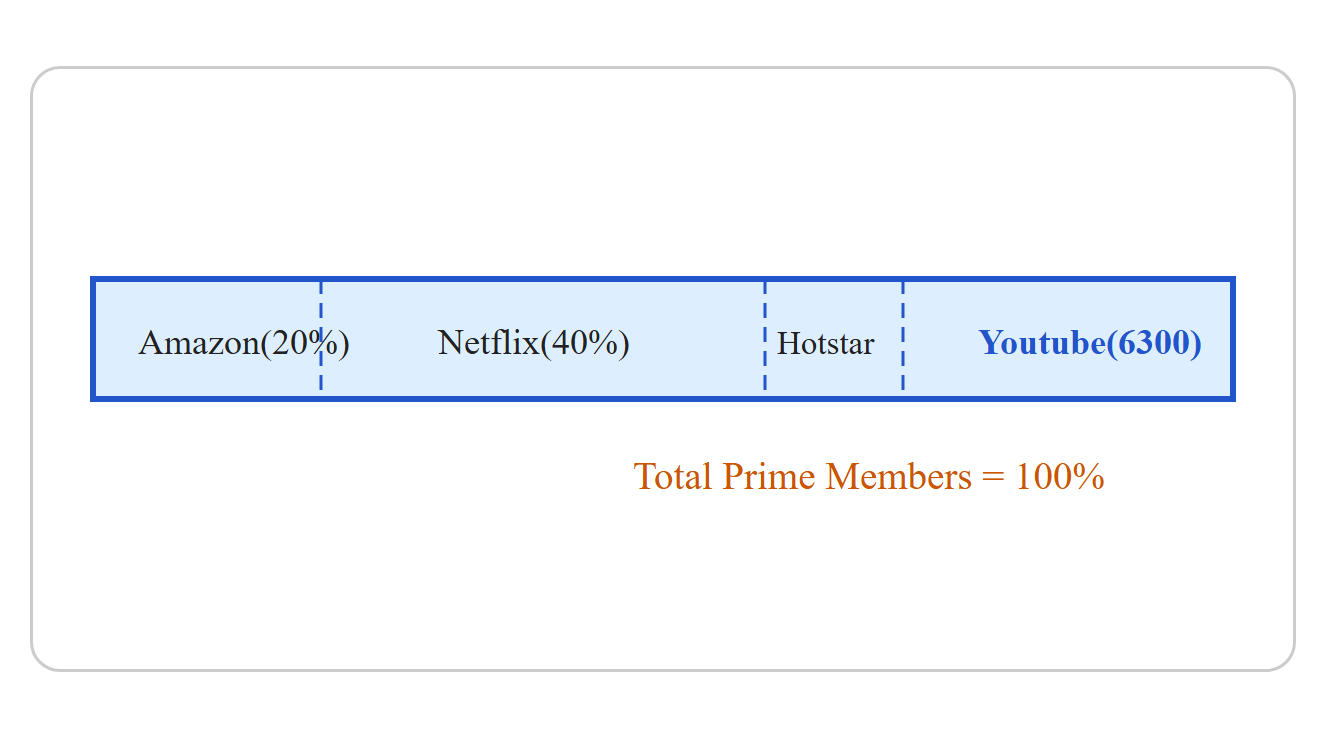
In a survey of prime membership users on four major platforms. It is found that out of the total prime members 20% are on Amazon Prime, 50% of the remaining are on Netflix premium and 30% of the rest are on Hotstar premium and rest 6300 are on Youtube premium. Then find the total number of prime members on these major platforms.

  1. AOption (a)

    32500

  2. BOption (b)

    17500

  3. COption (c)

    27000

  4. DOption (d)

    22500

  5. EOption (e)

    None of these

View answer & explanation

Correct answer

Answer: (d)D.

22500

Why this answer is correct

Shortcut Trick

Let total members be 100%.

Remaining after Amazon Prime (20%) = 80%.

Remaining after Netflix (50% of 80%) = 40%.

Remaining after Hotstar (30% of 40%) = 40% − 12% = 28%.

28% = 6300 ⇒ 1% = 225 ⇒ 100% = 22500.

∴ The correct answer is 22500 members.

Alternate Method

Let total members be x.

⇒ Amazon Prime users = 20% of x = 0.20x

⇒ Remaining after Amazon = x − 0.20x = 0.80x

⇒ Netflix users = 50% of 0.80x = 0.40x

⇒ Remaining after Netflix = 0.80x − 0.40x = 0.40x

⇒ Hotstar users = 30% of 0.40x = 0.12x

⇒ Remaining (Youtube) = 0.40x − 0.12x = 0.28x

⇒ 0.28x = 6300

⇒ x = 6300 ÷ 0.28 = 22500

∴ The correct answer is 22500 members.

Additional Information

Successive Percentage Decrease

When values are deducted from the 'remaining' part, it follows a successive pattern: Final Value = Initial Value × (1 − r1/100) × (1 − r2/100) × ...

Base Change in Percentages

Always identify the base of the percentage. If it says 'of the remaining', the previous balance becomes the new 100% for that specific step.

Question 37

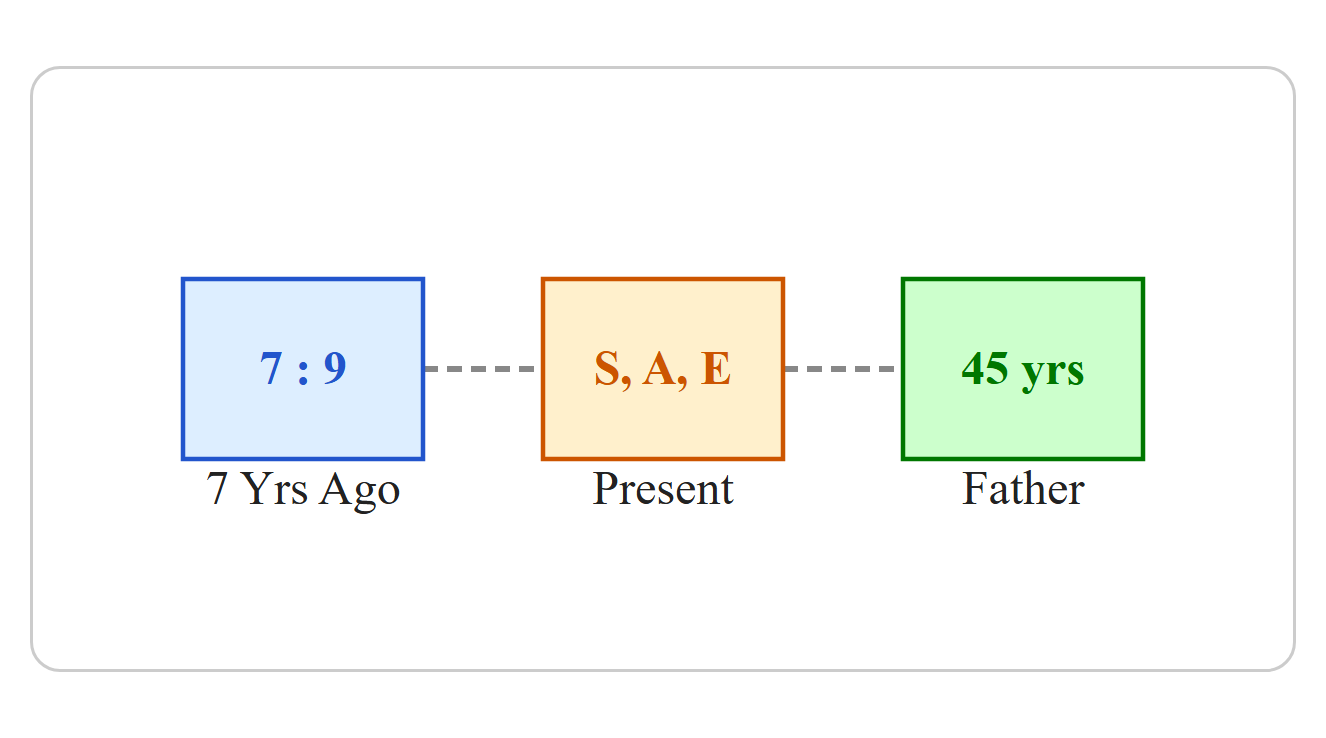
7 years ago, the ratio of the ages of Sophia and Ava was 7 : 9. The present age of Emma is 8 years less than the present age of Sophia. If the present age of Emma’s father is 45 years and 25 years more than his daughter. Then, the value of 50% of the present age of Ava is – 

  1. AOption (a)

    18 years

  2. BOption (b)

    17 years

  3. COption (c)

    21 years

  4. DOption (d)

    20 years

  5. EOption (e)

    None of these

View answer & explanation

Correct answer

Answer: (b)B.

17 years

Why this answer is correct

Shortcut Trick

Emma age = 45 − 25 = 20 years.

Sophia present age = 20 + 8 = 28 years.

Sophia age 7 years ago = 28 − 7 = 21 years (which is 7 units).

Ava age 7 years ago = 9 units = 27 years → Present age = 34 years.

50% of Ava present age = 34 ÷ 2 = 17 years.

∴ The correct answer is 17 years.

Alternate Method

Given: Ratio of Sophia and Ava (7 years ago) = 7 : 9. Emma age = Sophia − 8. Emma's father = 45 years and Emma + 25.

Formula: Age difference remains constant over time. Present age = Age (n years ago) + n.

⇒ Emma's father age = 45 years.

⇒ Emma's present age = 45 − 25 = 20 years.

⇒ Sophia's present age = 20 + 8 = 28 years.

⇒ Sophia's age 7 years ago = 28 − 7 = 21 years.

⇒ According to ratio 7 : 9, 7 units = 21 → 1 unit = 3.

⇒ Ava's age 7 years ago = 9 × 3 = 27 years.

⇒ Ava's present age = 27 + 7 = 34 years.

⇒ 50% of Ava's present age = 0.50 × 34 = 17 years.

∴ The correct answer is 17 years.

Additional Information

Age Ratio Concept

If the ratio of ages is a : b and n years pass, the new ratio is (ax+n) : (bx+n). The absolute difference between ages always remains constant.

Percentage Calculations

50% of a value is equivalent to dividing the value by 2 or multiplying by 1/2.

Question 38

In the given question, two equations numbered l and II are given. Solve both the equations and mark the appropriate answer.

I. 2x2 – 9x + 9 = 0

II. 2y2 – 17y + 30 = 0

  1. AOption (a)

    x > y

  2. BOption (b)

    x < y

  3. COption (c)

    x ≥ y

  4. DOption (d)

    x ≤ y

  5. EOption (e)

    x = y or relationship between x and y cannot be established.

View answer & explanation

Correct answer

Answer: (e)E.

x = y or relationship between x and y cannot be established.

Why this answer is correct

I. 2x2 – 9x + 9 = 0

⇒ 2x2 – 3x – 6x + 9 = 0

⇒ x (2x – 3) – 3 (2x – 3) = 0

⇒ (2x – 3) (x – 3) = 0

⇒ x = 3/2, 3


II. 2y2 – 17y + 30 = 0

⇒ 2y2 – 12y – 5y + 30 = 0

⇒ 2y (y – 6) – 5 (y – 6) = 0

⇒ (2y – 5) (y – 6) = 0

⇒ y = 5/2, 6


Value of xValue of yRelation
3/25/2x < y
3/26x < y
35/2x > y
36x < y


Hence, relationship between x and y cannot be established.

Question 39

In the given question, two equations numbered l and II are given. Solve both the equations and mark the appropriate answer.

I. x2 – 10x + 24 = 0

II. 2y2 – 29y + 105 = 0

  1. AOption (a)

    x > y

  2. BOption (b)

    x < y

  3. COption (c)

    x ≥ y

  4. DOption (d)

    x ≤ y

  5. EOption (e)

    x = y or relationship between x and y cannot be established.

View answer & explanation

Correct answer

Answer: (b)B.

x < y

Why this answer is correct

I. x2 – 10x + 24 = 0

⇒ x2 – 6x – 4x + 24 = 0

⇒ (x – 4) (x – 6) = 0

⇒ x =4, 6

II. 2y2 – 29y + 105 = 0

⇒ 2y2 – 15y – 14y + 105 = 0

⇒ (y – 7) (2y – 15) = 0

⇒ y = 7, 7.5  


Value of xValue of yRelation
47x < y
47.5x < y
67x < y
67.5x < y


Hence, x < y.

Question 40

In the given question, two equations numbered l and II are given. Solve both the equations and mark the appropriate answer.

I. x2 – 42x + 440 = 0

II. y2 – 34y + 288 = 0

  1. AOption (a)

    x > y

  2. BOption (b)

    x < y

  3. COption (c)

    x ≥ y

  4. DOption (d)

    x ≤ y

  5. EOption (e)

    x = y or the relationship between x and y cannot be established.

View answer & explanation

Correct answer

Answer: (a)A.

x > y

Why this answer is correct

I. x2 – 42x + 440 = 0

⇒ x2 – 22x – 20x + 440 = 0

⇒ x(x – 22) – 20(x – 22) = 0

⇒ (x – 22) (x – 20) = 0

⇒ x = 22, 20


II. y2 – 34y + 288 = 0

⇒ y2 – 18y – 16y + 288 = 0

⇒ y(y – 18) – 16(y – 18) = 0

⇒ (y – 18) (y – 16) = 0

⇒ y = 18, 16


Value of xValue of yRelation
2218x > y
2216x > y
2018x > y
2016x > y


∴ x > y.

Question 41

In the given question, two equations numbered l and II are given. Solve both the equations and mark the appropriate answer.

I. 25x2 – 30x + 8 = 0

II. 25y2 – 50y + 24 = 0

  1. AOption (a)

    x > y

  2. BOption (b)

    x < y

  3. COption (c)

    x ≥ y

  4. DOption (d)

    x ≤ y

  5. EOption (e)

    x = y or relationship between x and y cannot be established.

View answer & explanation

Correct answer

Answer: (d)D.

x ≤ y

Why this answer is correct

I. 25x2 – 30x + 8 = 0

⇒ 25x2 – 10x – 20x + 8 = 0

⇒ (5x – 4) (5x – 2) = 0

⇒ x =4/5, 2/5

II. 25y2 – 50y + 24 = 0

⇒ 25y2 – 20y – 30y + 24 = 0

⇒ (5y – 6) (5y – 4) = 0

⇒ y = 6/5, 4/5  


Value of xValue of yRelation
4/56/5x < y
4/54/5x = y
2/56/5x < y
2/54/5x < y


Hence, x ≤ y.

Question 42

In the given question, two equations numbered l and II are given. Solve both the equations and mark the appropriate answer.

I. x2 – 44x + 483 = 0

II. y2 – 27y + 182 = 0

  1. AOption (a)

    x > y

  2. BOption (b)

    x < y

  3. COption (c)

    x ≥ y

  4. DOption (d)

    x ≤ y

  5. EOption (e)

    x = y or relationship between x and y cannot be established.

View answer & explanation

Correct answer

Answer: (a)A.

x > y

Why this answer is correct

I. x2 – 44x + 483 = 0

⇒ x2 – 21x – 23x + 483 = 0

⇒ x (x – 21) – 23 (x – 21) = 0

⇒ (x – 21) (x – 23) = 0

⇒ x = 21, 23


II. y2 – 27y + 182 = 0

⇒ y2 – 14y – 13y + 182 = 0

⇒ y (y – 14) – 13 (y – 14) = 0

⇒ (y – 14) (y – 13) = 0

⇒ y = 14, 13


Value of xValue of yRelation
2114x > y
2113x > y
2314x > y
2313x > y


Hence x > y

Question 43

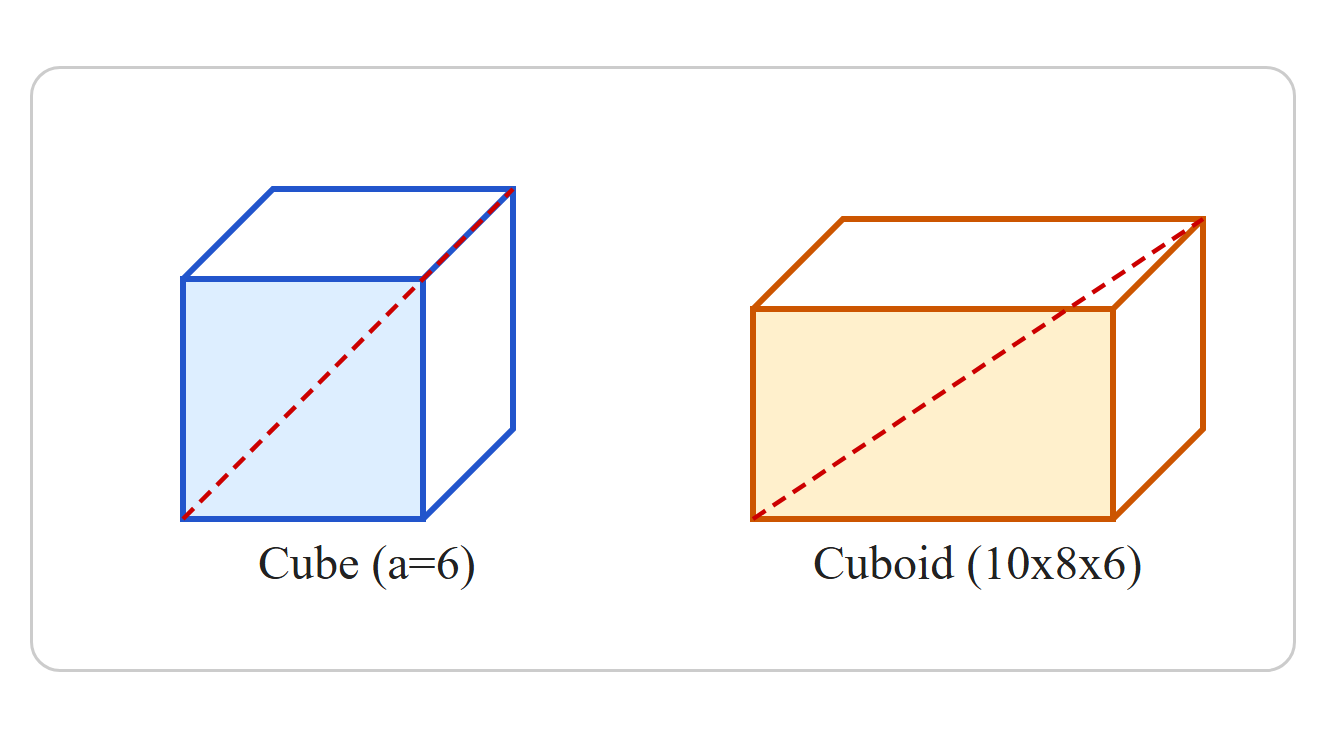
The volume of a cube and a cuboid are 216 cm3 and 480 cm3 respectively. If the length and breadth of cuboid are in the ratio 5 : 4 and the height of cuboid is equal to the length of side of cube, then find the ratio of diagonal of cube to the diagonal of cuboid.

  1. AOption (a)

    6√3 : 5√2

  2. BOption (b)

    4√3 : 10√2

  3. COption (c)

    7√3 : 5√2

  4. DOption (d)

    6√3 : 10√2

  5. EOption (e)

    4√3 : 5√ 2

View answer & explanation

Correct answer

Answer: (d)D.

6√3 : 10√2

Why this answer is correct

Shortcut Trick

Side of cube (a) = 3√216 = 6 cm. Height of cuboid (h) = 6 cm.

Base area of cuboid = 480 ÷ 6 = 80 cm2. Since ratio is 5 : 4, (5x) × (4x) = 80 ⇒ 20x2 = 80 ⇒ x = 2.

Dimensions of cuboid: L = 10 cm, B = 8 cm, H = 6 cm.

Ratio = (6 × √3) : √(102 + 82 + 62) = 6√3 : √200 = 6√3 : 10√2.

∴ The correct answer is 6√3 : 10√2.

Alternate Method

Given: Volume of cube = 216 cm3, Volume of cuboid = 480 cm3, L : B (cuboid) = 5 : 4, H (cuboid) = side of cube.

Formula Used: Volume of cube = a3, Diagonal of cube = a√3, Volume of cuboid = l × b × h, Diagonal of cuboid = √(l2 + b2 + h2).

⇒ a3 = 216 ⇒ a = 6 cm.

⇒ Height of cuboid (h) = 6 cm.

⇒ Let length (l) = 5x and breadth (b) = 4x.

⇒ 5x × 4x × 6 = 480 ⇒ 120x2 = 480 ⇒ x2 = 4 ⇒ x = 2.

⇒ l = 10 cm, b = 8 cm, h = 6 cm.

⇒ Diagonal of cube = 6√3 cm.

⇒ Diagonal of cuboid = √(102 + 82 + 62) = √(100 + 64 + 36) = √200 = 10√2 cm.

⇒ Required Ratio = 6√3 : 10√2.

∴ The correct answer is 6√3 : 10√2.

Additional Information

Cube properties

Total Surface Area = 6a2; Lateral Surface Area = 4a2.

Cuboid properties

Total Surface Area = 2(lb + bh + hl); Volume = lbh.

Diagonal length

The longest rod that can be placed inside a room is its space diagonal.

Question 44

A person mixed milk and water in 2 containers in the ratio 3 : 4 and 5 : 6 respectively then he mixed both the mixture in the third container and the ratio of milk and water in the resultant mixture becomes 4 : 5. Total quantity of mixtures is 18 litres. Find the quantity of milk in the 1st container.

  1. AOption (a)

    7 L

  2. BOption (b)

    4 L

  3. COption (c)

    3 L

  4. DOption (d)

    5 L 

  5. EOption (e)

    none of these 

View answer & explanation

Correct answer

Answer: (c)C.

3 L

Why this answer is correct

Shortcut Trick

Milk concentration in Container 1 = 3/7 and in Container 2 = 5/11.

Resultant Milk concentration = 4/9.

Using Alligation (Milk): |5/11 − 4/9| : |3/7 − 4/9| ⇒ 1/99 : 1/63 ⇒ 7 : 11.

Total ratio parts = 7 + 11 = 18 units = 18 L ∴ 1 unit = 1 L.

Quantity of 1st mixture = 7 L. Milk in it = 7 × (3/7) = 3 L.

∴ The correct answer is 3 L.

Alternate Method

Given: Ratio 1 = 3:4, Ratio 2 = 5:6, Final Ratio = 4:5, Total Volume = 18 L.

Formula: Quantity1 × (C1 − Cm) = Quantity2 × (Cm − C2)

⇒ Let Q1 and Q2 be the volumes of the two containers.

⇒ Milk fraction: Q1(3/7) + Q2(5/11) = (Q1 + Q2)(4/9)

⇒ Q1(4/9 − 3/7) = Q2(5/11 − 4/9)

⇒ Q1(1/63) = Q2(1/99) ⇒ Q1/Q2 = 63/99 = 7/11

⇒ Total units = 7 + 11 = 18 → 18 L ∴ Q1 = 7 L

⇒ Milk in 1st container = 7 × (3 / (3 + 4)) = 7 × 3/7 = 3 L

∴ The correct answer is 3 L.

Additional Information

Alligation Rule

Used to find the ratio in which two ingredients at given prices/concentrations are mixed to produce a mixture of a mean price. Ratio = (Dearer − Mean) : (Mean − Cheaper).

Replacement Method

When a quantity is replaced repeatedly: Final Concentration = Initial Concentration × (1 − x/V)n, where x is replaced volume and V is total volume.

Multiple Mixtures

When mixing multiple containers, the total quantity of a component (milk) is the sum of quantities from each container: Σ(Ratio × Volume).

Directions: The given table shows the details about the number of orders received , Number of orders packed and number of orders shipped by five different companies A, B, C, D and E.


CompaniesTotal orders receivedPercentage of orders packedPercentage of orders shipped
A450(x + 10)%60%
B600(x + y)%30%
C700(2x - 5)%(y + 5)%
D-(1.5y + 5)%-
E400-(x - 5)%

Note:

i)Average of total received in all the companies is 530

ii)Total orders Received = Number of orders packed + Number of orders shipped

Question 45

Based on Passage: View directions & passage

 If 1/5th of the orders packed in company E and 1/3rd of the orders shipped in company B are international orders and the remaining are national orders , find the sum of the 1/3rd of national orders packed in company E and 2/3rd of the national orders shipped in company B.

  1. AOption (a)

    180

  2. BOption (b)

    170

  3. COption (c)

    140

  4. DOption (d)

    160

  5. EOption (e)

    120

View answer & explanation

Correct answer

Answer: (d)D.

160

Why this answer is correct

General Solution:

To find the value of x

100% = (x + 10)% + 60%

x = 30%

Number of orders received in company A = 450

Number orders packed in company A = 450 ×  (30 + 10)/100 = 180

Number of orders shipped in company A = (450 - 180) = 270

To find the value of y 

100% = (30% + y + 30%)

y = 40%


Company B:

Number of orders received in company  = 600

Number of orders packed in company  = 600 ×  (70/100) = 420

Number of orders shipped in company  = (600 - 420) = 180


Company C:

Number of orders received in company  = 700

Number of orders packed in company  = 700 ×  (60 - 5)/100)) = 385

Number of orders shipped in company  = (700 - 385) = 315


Company D:

Number of orders received in company  = 2650 - (450 + 600 + 700 + 400) = 500

Number of orders packed in company  = 500 ×  (65/100) = 325

Number of orders shipped in company  = (500 - 325) = 175


Company E:

Number of orders received in company  = 400

Number of orders shipped in company  = 400 ×  25/100 = 100

Number of orders packed in company  = (400 - 100) = 300


CompaniesNumber of orders packedNumber of orders shipped
A180270
B420180
C385315
D325175
E300100

Solution:

Number of international orders packed in company E = 300/5 = 60

Number of national orders packed in company E = (300 - 60) = 240

Number of international shipped in company B = 180/3 = 60

Number of national orders shipped in company B = (180 - 60) = 120

Required sum = (240/3 + 120 ×  2/3) = 160

Directions: The given table shows the details about the number of orders received , Number of orders packed and number of orders shipped by five different companies A, B, C, D and E.


CompaniesTotal orders receivedPercentage of orders packedPercentage of orders shipped
A450(x + 10)%60%
B600(x + y)%30%
C700(2x - 5)%(y + 5)%
D-(1.5y + 5)%-
E400-(x - 5)%

Note:

i)Average of total received in all the companies is 530

ii)Total orders Received = Number of orders packed + Number of orders shipped

Question 46

Based on Passage: View directions & passage

If packing cost for each order in company A is Rs. 15 and shipping cost for the each orders in the same company is Rs. 30. Find the total amount collected for 1/5th of the packed orders and 2/3rd of the shipped orders.

  1. AOption (a)

    5120

  2. BOption (b)

    5780

  3. COption (c)

    5940

  4. DOption (d)

    5430

  5. EOption (e)

    5760

View answer & explanation

Correct answer

Answer: (c)C.

5940

Why this answer is correct

General Solution:

To find the value of x

100% = (x + 10)% + 60%

x = 30%

Number of orders received in company A = 450

Number orders packed in company A = 450 ×  (30 + 10)/100 = 180

Number of orders shipped in company A = (450 - 180) = 270

To find the value of y 

100% = (30% + y + 30%)

y = 40%


Company B:

Number of orders received in company  = 600

Number of orders packed in company  = 600 ×  (70/100) = 420

Number of orders shipped in company  = (600 - 420) = 180


Company C:

Number of orders received in company  = 700

Number of orders packed in company  = 700 ×  (60 - 5)/100)) = 385

Number of orders shipped in company  = (700 - 385) = 315


Company D:

Number of orders received in company  = 2650 - (450 + 600 + 700 + 400) = 500

Number of orders packed in company  = 500 ×  (65/100) = 325

Number of orders shipped in company  = (500 - 325) = 175


Company E:

Number of orders received in company  = 400

Number of orders shipped in company  = 400 ×  25/100 = 100

Number of orders packed in company  = (400 - 100) = 300


CompaniesNumber of orders packedNumber of orders shipped
A180270
B420180
C385315
D325175
E300100

Solution:

Number orders packed in company A = 180

Number of orders shipped in company A = 270 

Cost for packing each orders = Rs. 15

Cost for shipping each orders = Rs. 30

Total amount = (180 ×  1/5 ×  15 + 270 ×  2/3 ×  30) = (540 + 5400) = (5940)

Question 47

Based on Passage: View directions & passage

Find the ratio between the number of orders packed in company A and E respectively to the number of orders shipped in the company A and E.

  1. AOption (a)

    49: 53

  2. BOption (b)

    51: 53

  3. COption (c)

    48: 37

  4. DOption (d)

    13: 17

  5. EOption (e)

    43: 53

View answer & explanation

Correct answer

Answer: (c)C.

48: 37

Why this answer is correct

General Solution:

To find the value of x

100% = (x + 10)% + 60%

x = 30%

Number of orders received in company A = 450

Number orders packed in company A = 450 ×  (30 + 10)/100 = 180

Number of orders shipped in company A = (450 - 180) = 270

To find the value of y 

100% = (30% + y + 30%)

y = 40%


Company B:

Number of orders received in company  = 600

Number of orders packed in company  = 600 ×  (70/100) = 420

Number of orders shipped in company  = (600 - 420) = 180


Company C:

Number of orders received in company  = 700

Number of orders packed in company  = 700 ×  (60 - 5)/100)) = 385

Number of orders shipped in company  = (700 - 385) = 315


Company D:

Number of orders received in company  = 2650 - (450 + 600 + 700 + 400) = 500

Number of orders packed in company  = 500 ×  (65/100) = 325

Number of orders shipped in company  = (500 - 325) = 175


Company E:

Number of orders received in company  = 400

Number of orders shipped in company  = 400 ×  25/100 = 100

Number of orders packed in company  = (400 - 100) = 300


CompaniesNumber of orders packedNumber of orders shipped
A180270
B420180
C385315
D325175
E300100

Solution:

Number of orders packed in company A = 180

Number of orders packed in company E = 300

Number of orders shipped in company A = 270

Number of orders shipped in company E = 100

Required ratio = (180 + 300): (270 + 100) = (480: 370) = 48: 37

Question 48

Based on Passage: View directions & passage

 If the number of orders packed in company D is increased by 20% and the number of orders shipped in company D is increased by x%. Total orders packed and shipped in company D is  635, then find the value of x.

  1. AOption (a)

    20%

  2. BOption (b)

    25%

  3. COption (c)

    30%

  4. DOption (d)

    40%

  5. EOption (e)

    35%

View answer & explanation

Correct answer

Answer: (d)D.

40%

Why this answer is correct

General Solution:

To find the value of x

100% = (x + 10)% + 60%

x = 30%

Number of orders received in company A = 450

Number orders packed in company A = 450 ×  (30 + 10)/100 = 180

Number of orders shipped in company A = (450 - 180) = 270

To find the value of y 

100% = (30% + y + 30%)

y = 40%


Company B:

Number of orders received in company  = 600

Number of orders packed in company  = 600 ×  (70/100) = 420

Number of orders shipped in company  = (600 - 420) = 180


Company C:

Number of orders received in company  = 700

Number of orders packed in company  = 700 ×  (60 - 5)/100)) = 385

Number of orders shipped in company  = (700 - 385) = 315


Company D:

Number of orders received in company  = 2650 - (450 + 600 + 700 + 400) = 500

Number of orders packed in company  = 500 ×  (65/100) = 325

Number of orders shipped in company  = (500 - 325) = 175


Company E:

Number of orders received in company  = 400

Number of orders shipped in company  = 400 ×  25/100 = 100

Number of orders packed in company  = (400 - 100) = 300


CompaniesNumber of orders packedNumber of orders shipped
A180270
B420180
C385315
D325175
E300100

Solution:

Number of orders packed in company D = 325

Number orders shipped in company D = 175

If number of orders packed increased by 20% and number of orders shipped increased by x%, 

325 ×  120/100 = 390

Total orders packed and shipped after increased = 635

635 - 390 = 245

To find the value of x

x = (245 - 175)/175 ×  100 = 70/175 ×  100 = 40%

Question 49

Based on Passage: View directions & passage

Number of orders packed in company F is 25 more than the number of orders packed in company D and number of orders shipped in company F is 20 more than the number of orders shipped in company B. Then find the difference between the number of orders packed and the number of orders shipped by the company F.

  1. AOption (a)

    190

  2. BOption (b)

    130

  3. COption (c)

    180

  4. DOption (d)

    150

  5. EOption (e)

    160

View answer & explanation

Correct answer

Answer: (d)D.

150

Why this answer is correct

General Solution:

To find the value of x

100% = (x + 10)% + 60%

x = 30%

Number of orders received in company A = 450

Number orders packed in company A = 450 ×  (30 + 10)/100 = 180

Number of orders shipped in company A = (450 - 180) = 270

To find the value of y 

100% = (30% + y + 30%)

y = 40%


Company B:

Number of orders received in company  = 600

Number of orders packed in company  = 600 ×  (70/100) = 420

Number of orders shipped in company  = (600 - 420) = 180


Company C:

Number of orders received in company  = 700

Number of orders packed in company  = 700 ×  (60 - 5)/100)) = 385

Number of orders shipped in company  = (700 - 385) = 315


Company D:

Number of orders received in company  = 2650 - (450 + 600 + 700 + 400) = 500

Number of orders packed in company  = 500 ×  (65/100) = 325

Number of orders shipped in company  = (500 - 325) = 175


Company E:

Number of orders received in company  = 400

Number of orders shipped in company  = 400 ×  25/100 = 100

Number of orders packed in company  = (400 - 100) = 300


CompaniesNumber of orders packedNumber of orders shipped
A180270
B420180
C385315
D325175
E300100

Solution:

Number of orders packed in company D = 325

Number of orders packed in company F = (325 + 25) = 350

Number of orders shipped in company B = 180

Number of orders shipped in company F = (180 + 20) = 200

Required difference = (350 - 200) = 150

Question 50

A sum distributed between A, B and C in the ratio of 7 : 13 : 17. If A’s share is x more than 1/3rd of A’s share. B’s share is y more than 1/2nd of B’s share and C’s share is z more than 2/3rd of C’s share. Find the ratio of x : y : z?

  1. AOption (a)

    28 : 39 : 14

  2. BOption (b)

    28 : 39 : 34

  3. COption (c)

    28 : 29 : 34

  4. DOption (d)

    26 : 29 : 34

  5. EOption (e)

    27 : 31 : 45

View answer & explanation

Correct answer

Answer: (b)B.

28 : 39 : 34

Why this answer is correct

Shortcut Trick

Let the shares be A = 7k, B = 13k, and C = 17k.

x = (2/3) × A, y = (1/2) × B, z = (1/3) × C.

x : y : z = (2/3 × 7) : (1/2 × 13) : (1/3 × 17) = 14/3 : 13/2 : 17/3.

Multiply by LCM 6 → 28 : 39 : 34.

∴ The correct answer is 28 : 39 : 34.

Alternate Method

Given: Ratio of A : B : C = 7 : 13 : 17

Calculations:

⇒ A = 7k, B = 13k, C = 17k

⇒ x = A − (1/3)A = (2/3)A = (2/3) × 7k = 14k/3

⇒ y = B − (1/2)B = (1/2)B = (1/2) × 13k = 13k/2

⇒ z = C − (2/3)C = (1/3)C = (1/3) × 17k = 17k/3

⇒ x : y : z = (14/3) : (13/2) : (17/3)

⇒ Multiply by LCM(2, 3) = 6: (14/3 × 6) : (13/2 × 6) : (17/3 × 6)

⇒ x : y : z = 28 : 39 : 34

∴ The correct answer is 28 : 39 : 34.

Additional Information

Ratio and Proportion

To simplify fractional ratios, multiply each term by the LCM of all denominators to obtain an integer ratio.

Compound Ratio

The compound ratio of (a : b) and (c : d) is (ac : bd), used when multiple ratios interact in a product form.

Question 51

Two traders Ram and Shyam buy two goods for Rs. 1000 and Rs. 2000 respectively. Ram marks his goods up by x%, while Shyam marks his goods up by 2x% and offers the discount of x%. If both make the same profit, then find the value of x?

  1. AOption (a)

    12%

  2. BOption (b)

    12.5%

  3. COption (c)

    25%

  4. DOption (d)

    30%

  5. EOption (e)

    10%

View answer & explanation

Correct answer

Answer: (c)C.

25%

Why this answer is correct

Shortcut Trick

Profit of Ram = 1000 × (x ÷ 100) = 10x.

Net profit % of Shyam = 2x − x − (2x × x ÷ 100) = x − (x2 ÷ 50).

Profit of Shyam = 2000 × [x − (x2 ÷ 50)] ÷ 100 = 20x − 0.4x2.

Equating profits: 10x = 20x − 0.4x2 ⇒ 0.4x2 = 10x ⇒ 0.4x = 10.

x = 10 ÷ 0.4 = 25.

∴ The correct answer is 25%.

Alternate Method

Given: CPRam = Rs. 1000, CPShyam = Rs. 2000. Ram markup = x%. Shyam markup = 2x%, Discount = x%.

Formulas: Profit = SP − CP | SP = CP × (100 + Markup%) ÷ 100 × (100 − Discount%) ÷ 100

⇒ Profit of Ram = 1000 × (x ÷ 100) = 10x.

⇒ Selling Price of Shyam = 2000 × (100 + 2x) ÷ 100 × (100 − x) ÷ 100.

⇒ SPShyam = 2000 × (10000 − 100x + 200x − 2x2) ÷ 10000 = (10000 + 100x − 2x2) ÷ 5 = 2000 + 20x − 0.4x2.

⇒ Profit of Shyam = SP − CP = (2000 + 20x − 0.4x2) − 2000 = 20x − 0.4x2.

⇒ Since Profits are equal: 10x = 20x − 0.4x2.

⇒ 0.4x2 − 10x = 0 ⇒ x(0.4x − 10) = 0.

⇒ x = 10 ÷ 0.4 = 25.

∴ The correct answer is 25%.

Additional Information

Marked Price and Markup

Markup is the amount added to the Cost Price to arrive at the Marked Price. Markup% = (Markup ÷ CP) × 100.

Successive Percentage Change

When an item is marked up by a% and then a discount of b% is given, the net profit% is given by the formula: a − b − (ab ÷ 100).

Question 52

In each of the following number series, the wrong number is given, find out that number.

8, 17, 35, 71, 145, 287, 575

  1. AOption (a)

    145

  2. BOption (b)

    35

  3. COption (c)

    575

  4. DOption (d)

    287

  5. EOption (e)

    71

View answer & explanation

Correct answer

Answer: (a)A.

145

Why this answer is correct

In the number series 8, 17, 35, 71, 145, 287, 575

We observe the relation

8 × 2 + 1 = 17

17 × 2 + 1 = 35

35 × 2 + 1 = 71

71 × 2 + 1 = 143   (wrong)

143 × 2 + 1 = 287

287 × 2 + 1 = 575

Thus, we get that 145 is the wrong number in the series

Question 53

Find the wrong number in the following series.

210, 206, 197, 181, 156, 121, 71

  1. AOption (a)

    71

  2. BOption (b)

    121

  3. COption (c)

    181

  4. DOption (d)

    156

  5. EOption (e)

    206

View answer & explanation

Correct answer

Answer: (b)B.

121

Why this answer is correct

In the above series 210, 206, 197, 181, 156, 121, 71

210 - 22 = 206

206 - 32 = 197

197 - 42 = 181

181 - 52 =  156

156 - 62 = 120

120 - 72 = 71 

Thus, 121 is the wrong number.

Question 54

In each of the following number series, a wrong number is given, find out that number.

3, 4, 4.5, 11, 25, 80, 269.5

  1. AOption (a)

    4

  2. BOption (b)

    4.5

  3. COption (c)

    11

  4. DOption (d)

    80

  5. EOption (e)

    269.5

View answer & explanation

Correct answer

Answer: (d)D.

80

Why this answer is correct

The series follows the following pattern

⇒ 3 × 1 + 1 = 4

⇒ 4 × 1.5 – 1.5 = 4.5

⇒ 4.5 × 2 + 2 = 11

⇒ 11 × 2.5 – 2.5 = 25

⇒ 25 × 3 + 3 = 78

⇒ 78 × 3.5 – 3.5 = 269.5

∴ The wrong number in the series is 80.

Question 55

Direction: In the following number series, a wrong number is given. Find out the wrong number.

16, 17, 38, 123, 510, 2565

  1. AOption (a)

    17

  2. BOption (b)

    2565

  3. COption (c)

    38

  4. DOption (d)

    510

  5. EOption (e)

    123

View answer & explanation

Correct answer

Answer: (d)D.

510

Why this answer is correct

16 × 1 + 12 = 17

17 × 2 + 22 = 38

38 × 3 + 32 = 123

123 × 4 + 42 = 508

508 × 5 + 52 = 2565

∴ Wrong term in given number series is 510.

Question 56

Direction: In the following number series, a wrong number is given. Find out the wrong number.

6, 7, 11, 38, 54, 179, 214

  1. AOption (a)

    179

  2. BOption (b)

    214

  3. COption (c)

    54

  4. DOption (d)

    38

  5. EOption (e)

    11

View answer & explanation

Correct answer

Answer: (b)B.

214

Why this answer is correct

6 + 13 = 7

7 + 22 = 11

11 + 33 = 38

38 + 42 = 54

54 + 53 = 179

179 + 62 = 215

∴ Wrong number in given number series is 214.

Question 57

Mohan invested Rs. 5000 at x% simple interest for 2 years. After 2 years, he noticed that if he has given the money on compound interest then he would have got Rs. 72 more as interest. Find the rate of interest?

  1. AOption (a)

    10%

  2. BOption (b)

    15%

  3. COption (c)

    12%

  4. DOption (d)

    20%

  5. EOption (e)

    None of these 

View answer & explanation

Correct answer

Answer: (c)C.

12%

Why this answer is correct

Shortcut Trick

For 2 years, the difference between CI and SI is given by: D = P × (r/100)2.

⇒ 72 = 5000 × (x/100)2

⇒ 72 = 5000 × (x2 / 10000)

⇒ 72 = x2 / 2 ⇒ x2 = 144 ⇒ x = 12%.

∴ The correct answer is 12%.

Alternate Method

Given: Principal (P) = ₹5000, Time (T) = 2 years, Difference (D) = ₹72.

Formula Used: Difference (D) = P(r/100)2

⇒ 72 = 5000 × (x/100) × (x/100)

⇒ 72 = 5000 × x2 / 10000

⇒ 72 = x2 / 2

⇒ x2 = 72 × 2 = 144

⇒ x = √144 = 12

∴ The correct answer is 12%.

Additional Information

CI and SI Difference for 3 years

The formula for the difference between CI and SI for 3 years is D = P(r/100)2 × (3 + r/100).

Effective Rate Method

For 2 years, effective SI rate is 2r% and effective CI rate is (2r + r2/100)%. The difference is always (r2/100)% of Principal.

Question 58

A boat can travel 40 km upstream in the same time as it travels 60 km downstream. It can travel 10 km each in upstream and downstream in 25/12 hours. Find the time required to travel 24 km each in upstream and downstream.

  1. AOption (a)

    5 hours

  2. BOption (b)

    3 hours

  3. COption (c)

    2.5 hours

  4. DOption (d)

    10 hours

  5. EOption (e)

    8 hours

View answer & explanation

Correct answer

Answer: (a)A.

5 hours

Why this answer is correct

Shortcut Trick

Let Upstream speed be U and Downstream speed be D.

Ratio of distances D : U = 60 : 40 = 3 : 2 (Time is constant, so speed ratio = distance ratio).

Given: 10/U + 10/D = 25/12 ⇒ 10/(2x) + 10/(3x) = 25/12 ⇒ (15 + 10)/3x = 25/12 ⇒ 25/3x = 25/12 ⇒ x = 4.

So, U = 8 kmph and D = 12 kmph.

Required Time = 24/8 + 24/12 = 3 + 2 = 5 hours.

∴ The correct answer is 5 hr.

Alternate Method

Given:

⇒ Time for 40 km Upstream = Time for 60 km Downstream

⇒ 40/U = 60/D ⇒ D = 1.5U

Condition 2:

⇒ 10/U + 10/D = 25/12 hours

⇒ 10/U + 10/(1.5U) = 25/12

⇒ 10/U + 20/(3U) = 25/12

⇒ (30 + 20) / 3U = 25/12

⇒ 50 / 3U = 25/12 ⇒ 2/U = 1/4 ⇒ U = 8 kmph

⇒ D = 1.5 × 8 = 12 kmph

Final Calculation:

⇒ Required Time = 24/U + 24/D

⇒ Time = 24/8 + 24/12 = 3 + 2 = 5 hr

∴ The correct answer is 5 hr.

Additional Information

Upstream and Downstream Speed

Downstream Speed (D) = Speed of boat (u) + Speed of stream (v); Upstream Speed (U) = Speed of boat (u) − Speed of stream (v).

Boat Speed in Still Water

Speed of boat in still water (u) = (D + U) ÷ 2.

Speed of Stream

Speed of the current/stream (v) = (D − U) ÷ 2.

Question 59

Amit develops 10 questions a week and is given Rs.70 for one question. Vishal develops 2 questions per day and is paid Rs. 80 for one question. If both of them worked for 2 weeks, what will be the total amount paid to them?

  1. AOption (a)

    Rs. 3650

  2. BOption (b)

    Rs. 3240

  3. COption (c)

    Rs. 3140

  4. DOption (d)

    Rs. 3640

  5. EOption (e)

    Rs. 3680

View answer & explanation

Correct answer

Answer: (d)D.

Rs. 3640

Why this answer is correct

Shortcut Trick

Amit: 10 questions × ₹70 × 2 weeks = ₹1400

Vishal: (2 questions/day × 7 days) × ₹80 × 2 weeks = ₹2240

Total: ₹1400 + ₹2240 = ₹3640

∴ The correct answer is ₹3640.

Alternate Method

Given:

Questions by Amit per week = 10; Rate = ₹70/question

Questions by Vishal per day = 2; Rate = ₹80/question

Time period = 2 weeks (14 days)

Calculations:

⇒ Total questions by Amit in 2 weeks = 10 × 2 = 20 questions

⇒ Amount for Amit = 20 × 70 = ₹1400

⇒ Total questions by Vishal in 2 weeks = 2 × 14 = 28 questions

⇒ Amount for Vishal = 28 × 80 = ₹2240

⇒ Total amount = 1400 + 2240 = ₹3640

∴ The correct answer is ₹3640.

Additional Information

Unitary Method

Total Earning = (Quantity of Work done per unit time × Total Time) × Rate per unit of work.

Time Conversion

Always ensure the time units are consistent (e.g., converting weeks to days if the rate is given per day). 1 standard week = 7 days.

Question 60

Direction: The following question is accompanied by two statements (I) and (II). You have to determine which statements(s) is/are sufficient/necessary to answer the questions.

Find the average number of both males and females in the company if 60% of the total male and 40% of the total female participated in an event.

Statement I: The number of female participated in the event is 120. There is more than 300 male in the company.

Statement II: The number of females in the company is 25% more than the number of males who participated in the event.

  1. AOption (a)

    The statement I alone is sufficient to answer the question, but the statement II alone is not sufficient.

  2. BOption (b)

    The statement II alone is sufficient to answer the question, but the statement I alone is not sufficient.

  3. COption (c)

    Both the statements I and II together are needed to answer the question. 

  4. DOption (d)

    Either statement I alone or statement II alone is sufficient to answer the question. 

  5. EOption (e)

    Neither statement I nor statement II is sufficient to answer the question.

View answer & explanation

Correct answer

Answer: (c)C.

Both the statements I and II together are needed to answer the question. 

Why this answer is correct

Shortcut Trick

From Statement I: 40% of Females = 120 ⇒ Total Females = 300.

From Statement II: Total Females (300) = 1.25 × (60% of Males).

300 = 1.25 × 0.6 × Males ⇒ 300 = 0.75 × Males ⇒ Total Males = 400.

Average = (300 + 400) ÷ 2 = 350. Both statements are required.

∴ The correct answer is 350.

Alternate Method

Given: Participated Males = 60% of M; Participated Females = 40% of F.

From Statement I:

⇒ 40% of F = 120

⇒ F = (120 × 100) ÷ 40 = 300

⇒ Total Females = 300. (M is unknown, only M > 300 is given).

From Statement II:

⇒ F = 125% of (Participated Males)

⇒ F = 1.25 × (60% of M)

Combining I and II:

⇒ 300 = 1.25 × 0.60 × M

⇒ 300 = 0.75 × M

⇒ M = 300 ÷ 0.75 = 400

⇒ Average = (300 + 400) ÷ 2 = 350

∴ The correct answer is 350.

Additional Information

Data Sufficiency approach

Always check if a unique value can be determined. If two variables (M and F) are present, you generally need two independent linear equations.

Percentage to Fraction Conversion

25% more means a multiplier of 1.25 or 5/4. 60% means 3/5 and 40% means 2/5.

Average Formula

The average of two quantities A and B is calculated as (A + B) ÷ 2.

Question 61

Directions

Each of the following questions consists of 3 statements A, B, and C. You have to determine that which of the following statement/statements are not necessary to answer the question.

Find the two-digit number xy.

I. The number obtained by interchanging the digits of the number is less than the original number by 18.

II. The sum of the digits is 8.

III. The difference of digit is 2.

  1. AOption (a)

    Only statement I

  2. BOption (b)

    Statement I and statement III

  3. COption (c)

    Either I or III

  4. DOption (d)

    Statement II and statement III

  5. EOption (e)

    Data insufficient

View answer & explanation

Correct answer

Answer: (c)C.

Either I or III

Why this answer is correct

Number = 10x + y

From statement I:

(10x + y) – (10y + x) = 18

⇒ x – y = 2     ----(i)

From statement II:

x + y = 8     ----(ii)

From statement III:

x – y = 2      ----(iii)

By the help of equation (i) or (iii) and (ii)

⇒ x = 5 and y = 3

Number = 53

∴ Either statement I or statement III is not necessary to answer the question

Question 62

The following question is accompanied by two statements (I) and (II). You have to determine which statement(s) is/are sufficient/necessary to answer the questions.

In how many days will A complete the work?

I. Ratio of efficiency of A, B and C is 5 : 6 : 9. A takes 8 days more than C to finish the work

II. A and B working together can complete the work in 10 days, C is twice efficient than A

  1. AOption (a)

    The data in both the statements I and II together are necessary to answer the question

  2. BOption (b)

    The data in statement I alone or in statement II alone is sufficient to answer the question.

  3. COption (c)

    The data in both statements I and II together are not sufficient to answer the question.

  4. DOption (d)

    The data in statement II alone is sufficient to answer the question, while the data in I alone is not sufficient to answer the question.

  5. EOption (e)

    The data in statement I alone is sufficient to answer the question, while the data in II alone is not sufficient to answer the question.

View answer & explanation

Correct answer

Answer: (e)E.

The data in statement I alone is sufficient to answer the question, while the data in II alone is not sufficient to answer the question.

Why this answer is correct

Calculation:

From statement I

Ratio of efficiency of A and C is 5 : 9

Ratio of time taken by A and C is 9 : 5

A takes 8 days more than C to finish the work

⇒ (9 – 5) units = 8 days

⇒ 4 units = 8 days

⇒ 1 unit = 2 days

∴ A will complete the work in = 9 × 2 = 18 days

From statement II

A and B working together can complete the work in 10 days

⇒ 1/A + 1/B = 1/10

C is twice efficient than A

∴ The data in statement I alone is sufficient to answer the question, while the data in II alone is not sufficient to answer the question.

Question 63

Direction: "The following question is accompanied by two statements (I) and (II). You have to determine which statements(s) is/are sufficient/necessary to answer the questions.

What will be the length of Train A?

Statement I: The Train A crosses a man running at the speed of 10 m/s in the opposite direction in 10 sec and the speed of the train is x m/s.

Statement II: Train B which has double the speed of Train A and crosses the pole in 5 sec and the length of the Train B is 500 m.

  1. AOption (a)

    The statement I alone is sufficient to answer the question, but the statement II alone is not sufficient.

  2. BOption (b)

    The statement II alone is sufficient to answer the question, but the statement I alone is not sufficient.

  3. COption (c)

    Both the statements I and II together are needed to answer the question.

  4. DOption (d)

    Either statement I alone or statement II alone is sufficient to answer the question. 

  5. EOption (e)

    Neither statement I nor statement II is sufficient to answer the question.

View answer & explanation

Correct answer

Answer: (c)C.

Both the statements I and II together are needed to answer the question.

Why this answer is correct

Formula used:

Length of a train = Speed of the train × time taken to cross a pole

Length of a train = Relative Speed (St + Sm) × Time taken to cross a man

Calculation:

Let the Length of the Train A be Lt

Statement I

Speed of a train (St) = x m/s

Speed of a man (Sm) = 10 m/s

Time Taken = 10 sec

Length of the Train A (Lt) = Relative Speed (St + Sm) × Time taken to cross a man

Length of the Train A (Lt) = (x + 10) × 10

As you can see Speed of the train is needed to find the answer, let’s check the other statement

Statement II

Speed of Train B = 2 × Speed of Train A

Speed of Train B = 2x

Time Taken to cross a Pole = 5 sec

Length of Train B = 500 m

Length of the Train = Speed of Train × Time taken to cross a pole

500 = 2x × 5

x = 500/10

x = 50 m/s

From Statement II, we get the Speed of  Train A, and put it in statement I

Length of Train A (Lt) = (50 + 10) × 10 = 60 × 10

Length of Train A (Lt) = 600 m

∴ Statement I and II together are necessary to answer the questions.

Question 64

The average weight of x number of people is 33 kg. The weights of all x number of people are in arithmetic progression. If the weight of the lightest is 5 kg and the weight of the heaviest is x kg, then find the value of x.

  1. AOption (a)

    59

  2. BOption (b)

    63

  3. COption (c)

    67

  4. DOption (d)

    61

  5. EOption (e)

    65

View answer & explanation

Correct answer

Answer: (d)D.

61

Why this answer is correct

Shortcut Trick

In an Arithmetic Progression (AP), the Average is always the mean of the first term and the last term.

Average = (Lightest + Heaviest) ÷ 2

33 = (5 + x) ÷ 2

66 = 5 + x ⇒ x = 61

∴ The correct answer is 61.

Alternate Method

Given: Average weight = 33 kg, Number of people = x, Lightest weight (a) = 5 kg, Heaviest weight (l) = x kg.

Formula Used: Sum of AP (Sn) = (n ÷ 2) × (a + l); Average = Sum ÷ n

⇒ Average = [(x ÷ 2) × (5 + x)] ÷ x

⇒ 33 = (5 + x) ÷ 2

⇒ 66 = 5 + x

⇒ x = 66 − 5

⇒ x = 61

∴ The correct answer is 61.

Additional Information

Properties of AP Average

For any Arithmetic Progression, the Average is equivalent to the middle term (if n is odd) or the mean of the two middle terms (if n is even).

Sum of n terms in AP

Sn = n/2 × [2a + (n−1)d], where a is the first term, d is the common difference, and n is the number of terms.

Question 65

A and B started a business with the capital of Rs. 70000 and Rs. 20000 respectively. They decided to use 5% of the total profit for Charity and they equally add 5% of the total profit in their investment. Remaining profit is distributed among them as per their investment ratio. If they earn Rs. 10000 in the first year and Rs. 8044.44 in the second year, then find the total profit of A.

  1. AOption (a)

    10540

  2. BOption (b)

    13260

  3. COption (c)

    12620

  4. DOption (d)

    13456

  5. EOption (e)

    None of the above

View answer & explanation

Correct answer

Answer: (c)C.

12620

Why this answer is correct

Shortcut Trick

Total profit in the first year = Rs. 10000, and in the second year = Rs. 8044.44.

Total profit for both years combined = 10000 + 8044.44 = Rs. 18044.44.

For each year, 5% is allocated to Charity, and 5% is added equally to their investments (2.5% each). The remaining 90% is divided in the investment ratio.

Since the initial investment ratio is 70000 : 20000 = 7 : 2, and the 5% addition is equal (2.5% of total profit each), A receives his share from the 2.5% equal distribution plus his proportion of the 90% remaining profit.

In the first year, investment is in the ratio 7 : 2. After adding 5% of profit (Rs. 500 equally, i.e., Rs. 250 each), the new investments for the second year become Rs. 70250 and Rs. 20250, which is approximately the same ratio (70.25 : 20.25 ≈ 7 : 2).

A's total share ≈ 2.5% of Total Profit + 7/9 × 90% of Total Profit = 2.5% + 70% = 72.5% of the total profit.

Total Profit of A ≈ 72.5% of 18044.44 ≈ Rs. 12620.

∴ The correct answer is Rs. 12620.

Alternate Method

Given:

Initial capital of A = Rs. 70000, Initial capital of B = Rs. 20000

First year profit = Rs. 10000, Second year profit = Rs. 8044.44

Formulas:

Profit Distribution = Charity (5%) + Equal addition to investment (5%) + Remaining profit distributed in investment ratio (90%)

Step-by-step Solution:

⇒ First Year Profit Distribution:

⇒ Total profit = Rs. 10000

⇒ Charity (5%) = Rs. 500

⇒ Added to Investment (5%) = Rs. 500 (Rs. 250 each to A and B)

⇒ Remaining profit (90%) = Rs. 9000. Divided in the ratio of initial investments (70000 : 20000 = 7 : 2).

⇒ A's share from remaining profit = 9000 × (7 ÷ 9) = Rs. 7000

⇒ Total profit received by A in the 1st year = Rs. 250 (equal addition) + Rs. 7000 = Rs. 7250

⇒ New Investments at the start of the 2nd year: A = 70000 + 250 = Rs. 70250, B = 20000 + 250 = Rs. 20250

⇒ Second Year Profit Distribution:

⇒ Total profit = Rs. 8044.44

⇒ Added to Investment (5%) = 5% of 8044.44 = Rs. 402.22 (Rs. 201.11 each to A and B)

⇒ Remaining profit (90%) = 90% of 8044.44 = Rs. 7240

⇒ Remaining profit divided in the new investment ratio (70250 : 20250 = 281 : 81). Sum of ratio parts = 281 + 81 = 362.

⇒ A's share from remaining profit = 7240 × (281 ÷ 362) = 20 × 281 = Rs. 5620

⇒ Total profit received by A in the 2nd year = Rs. 201.11 + Rs. 5620 = Rs. 5821.11

⇒ Total Profit of A:

⇒ Total Profit of A = Profit of 1st Year + Profit of 2nd Year = 7250 + 5821.11 ≈ Rs. 13071.11 (without considering equal addition as part of personal withdrawal profit) or if the 5% added to investment is considered part of the total profit accumulated by A: 7250 + 5821.11 ≈ 13071.11. Let's recalculate if the 5% added to investment is NOT accumulated as profit payout, but only the 90% remaining is distributed: 1st Year = 7000, 2nd Year = 5620. Total = 7000 + 5620 = 12620.

⇒ In business partnership questions, the portion reinvested is part of capital and the distributed profit is from the 90% split, plus potentially the 5% equal addition. If only the remaining profit is distributed, A's profit = 7000 + 5620 = Rs. 12620.

∴ The correct answer is Rs. 12620.

Additional Information

Partnership Profit Distribution

In a partnership, unless specified otherwise, profits are distributed in the ratio of the product of the capital invested and the time period of investment: Profit Ratio = (C1 × T1) : (C2 × T2).

Reasoning Ability (35 questions)

Directions: Read the given information carefully and answer the following questions.

Six persons Hema, Nina, Keshav, Rani, Sam, and Tabu are sitting in a linear row. They all like different games Battlefield, Combat, Duty, Free Fire, Minecraft, and Pubg. All of them are facing north direction. Nina likes Minecraft and not more than two persons are sitting to the left of Nina. One person sits between Nina and Hema.  The person who likes Pubg is sitting to the immediate right of Keshav. The number of persons sitting between Rani and Keshav is one less than the number of persons sitting to the right of Hema. Keshav and the person who like Pubg are not sitting at the extreme end. The person who likes Duty is sitting immediately right of Sam. Two persons sit between the person who likes Combat and Duty.  The person who likes Free Fire is not an immediate neighbor of the one who likes Duty.

Question 66

Based on Passage: View directions & passage

Which of the following statement is not true?

  1. AOption (a)

    Two persons are sitting between the one who likes Pubg and Free fire

  2. BOption (b)

    Hema is an immediate neighbor of the one who likes Free fire

  3. COption (c)

    Tabu likes Duty

  4. DOption (d)

    Sam is an immediate neighbor of the one who likes Duty.

  5. EOption (e)

    Nina and the one who likes Combat are immediate neighbors.

View answer & explanation

Correct answer

Answer: (b)B.

Hema is an immediate neighbor of the one who likes Free fire

Why this answer is correct

1) Nina likes Minecraft and not more than two persons are sitting to the left of Nina. One person sits between Nina and Hema. 

2) The number of persons sitting between Rani and Keshav is one less than the number of persons sitting to the right of Hema. Keshav and the person who like Pubg are not sitting at the extreme end. The person who likes Pubg is sitting to the immediate right of Keshav. 

Cases 1 and 2 cannot satisfy the given conditions. That is why, Cases 1 and 2 are eliminated.

3) The person who likes Duty is sitting immediately right of Sam. This condition is not satisfied in Case 3(b). That is why Case 3(b) is eliminated.

4) Two persons sit between the person who likes Combat and Duty. The person who likes Free Fire is not an immediate neighbor of the one who likes Duty. This condition is not satisfied in Case 4. That is why Case 4 is eliminated.

The final arrangement is:

Two persons are sitting between Hema and the person who likes Free fire. Hence, Hema is an immediate neighbor of the one who likes Free fire is not true.

Question 67

Based on Passage: View directions & passage

Which of the following combination is true?

  1. AOption (a)

    Tabu - Free fire

  2. BOption (b)

    Sam - Duty

  3. COption (c)

    Hema - Battlefield

  4. DOption (d)

    Keshav - combat

  5. EOption (e)

    Rani- Pubg

View answer & explanation

Correct answer

Answer: (d)D.

Keshav - combat

Why this answer is correct

1) Nina likes Minecraft and not more than two persons are sitting to the left of Nina. One person sits between Nina and Hema. 

2) The number of persons sitting between Rani and Keshav is one less than the number of persons sitting to the right of Hema. Keshav and the person who like Pubg are not sitting at the extreme end. The person who likes Pubg is sitting to the immediate right of Keshav. 

Cases 1 and 2 cannot satisfy the given conditions. That is why, Cases 1 and 2 are eliminated.

3) The person who likes Duty is sitting immediately right of Sam. This condition is not satisfied in Case 3(b). That is why Case 3(b) is eliminated.

4) Two persons sit between the person who likes Combat and Duty. The person who likes Free Fire is not an immediate neighbor of the one who likes Duty. This condition is not satisfied in Case 4. That is why Case 4 is eliminated.

The final arrangement is:

Keshav likes Combat. Hence, Keshav-Combat is the correct combination.

Question 68

Based on Passage: View directions & passage

Who will be immediately right of the person who likes Minecraft, if Rani takes place of Keshav, Keshav takes place of Tabu and Tabu takes place of Rani(the game they like remains the same even after rearrangement)?

  1. AOption (a)

    Tabu

  2. BOption (b)

    Rani

  3. COption (c)

    Sam

  4. DOption (d)

    Keshav

  5. EOption (e)

    Hema

View answer & explanation

Correct answer

Answer: (b)B.

Rani

Why this answer is correct

1) Nina likes Minecraft and not more than two persons are sitting to the left of Nina. One person sits between Nina and Hema. 

2) The number of persons sitting between Rani and Keshav is one less than the number of persons sitting to the right of Hema. Keshav and the person who like Pubg are not sitting at the extreme end. The person who likes Pubg is sitting to the immediate right of Keshav. 

Cases 1 and 2 cannot satisfy the given conditions. That is why, Cases 1 and 2 are eliminated.

3) The person who likes Duty is sitting immediately right of Sam. This condition is not satisfied in Case 3(b). That is why Case 3(b) is eliminated.

4) Two persons sit between the person who likes Combat and Duty. The person who likes Free Fire is not an immediate neighbor of the one who likes Duty. This condition is not satisfied in Case 4. That is why Case 4 is eliminated.

The final arrangement is:

if Rani takes the place of Keshav, Keshav takes place of Tabu and Tabu takes place of Rani, the rearrangement is:

Hence, Rani is immediately right of the person who likes Minecraft.

Question 69

Based on Passage: View directions & passage

How many persons are sitting between the one who likes Duty and Rani?

  1. AOption (a)

    One

  2. BOption (b)

    Either one or two

  3. COption (c)

    Two

  4. DOption (d)

    Four

  5. EOption (e)

    Three

View answer & explanation

Correct answer

Answer: (d)D.

Four

Why this answer is correct

1) Nina likes Minecraft and not more than two persons are sitting to the left of Nina. One person sits between Nina and Hema. 

2) The number of persons sitting between Rani and Keshav is one less than the number of persons sitting to the right of Hema. Keshav and the person who like Pubg are not sitting at the extreme end. The person who likes Pubg is sitting to the immediate right of Keshav. 

Cases 1 and 2 cannot satisfy the given conditions. That is why, Cases 1 and 2 are eliminated.

3) The person who likes Duty is sitting immediately right of Sam. This condition is not satisfied in Case 3(b). That is why Case 3(b) is eliminated.

4) Two persons sit between the person who likes Combat and Duty. The person who likes Free Fire is not an immediate neighbor of the one who likes Duty. This condition is not satisfied in Case 4. That is why Case 4 is eliminated.

The final arrangement is:

Hence, Four persons are sitting between the one who likes Duty and Rani.

Question 70

Based on Passage: View directions & passage

Which of the following person sit immediately to the right of the person who likes Combat?

  1. AOption (a)

    Hema

  2. BOption (b)

    Tabu

  3. COption (c)

    Rani

  4. DOption (d)

    Nina

  5. EOption (e)

    Keshav

View answer & explanation

Correct answer

Answer: (a)A.

Hema

Why this answer is correct

1) Nina likes Minecraft and not more than two persons are sitting to the left of Nina. One person sits between Nina and Hema. 

2) The number of persons sitting between Rani and Keshav is one less than the number of persons sitting to the right of Hema. Keshav and the person who like Pubg are not sitting at the extreme end. The person who likes Pubg is sitting to the immediate right of Keshav. 

Cases 1 and 2 cannot satisfy the given conditions. That is why, Cases 1 and 2 are eliminated.

3) The person who likes Duty is sitting immediately right of Sam. This condition is not satisfied in Case 3(b). That is why Case 3(b) is eliminated.

4) Two persons sit between the person who likes Combat and Duty. The person who likes Free Fire is not an immediate neighbor of the one who likes Duty. This condition is not satisfied in Case 4. That is why Case 4 is eliminated.

The final arrangement is:

Hence, Hema sits immediately to the right of the person who likes Combat.

Question 71

Directions

Read the given information carefully and answer the following questions.

If 2 is added to each of the odd digits,3 is subtracted from each of the even digits and we eliminate the second and third terms from the right side in the number '754846813', then the sum of prime numbers is.

  1. AOption (a)

    17

  2. BOption (b)

    20

  3. COption (c)

    15

  4. DOption (d)

    12

  5. EOption (e)

    18

View answer & explanation

Correct answer

Answer: (b)B.

20

Why this answer is correct

Given Number754846813
Operations+2+2-3-3-3-3-3+2+2
Output971513535


If we eliminate the second and third terms from the right side of the number. 

Hence, the sum of prime numbers is 20(7+5+3+5).

Question 72

Direction: Read the following information carefully and answer the given questions.

If it is possible to make a meaningful four-letter English word from the third, fifth, sixth, and eighth from the left end of the word "DIABETES", then which of the following will be the second letter of that word from the right end? If more than one such word can be made then give 'Z' as the answer and if no such word can be formed then give 'X' as the answer.

  1. AOption (a)

    S

  2. BOption (b)

    A

  3. COption (c)

    E

  4. DOption (d)

    X

  5. EOption (e)

    Z

View answer & explanation

Correct answer

Answer: (e)E.

Z

Why this answer is correct

Given word: "DIABETES"

The third letter is 'A', the fifth letter is 'E', the sixth letter is 'T', and the Eighth letter is 'S' from the left end.

A meaningful four-letter English word is:

  1. East the direction you look towards to see the sunrise.

  2. Seat means something that you sit on.

More than one word could be formed. Hence, Z is correct option.

Direction: Read the following information carefully and answer the given questions.

Eight persons are sitting at the circle table. Four persons are facing inside and four outside. P is sitting second to the right of Q. F is sitting third to the left of P. The neighbors of F are facing outward. Three persons are sitting between R and S. F is to the immediate left of G. The neighbors of T are facing the same direction. More than two persons are sitting between Q and T when counting from the left of T. The neighbors of S are facing opposite directions. U and the one who is sitting immediately right of S is facing inward direction.

Question 73

Based on Passage: View directions & passage

Which of the following statement is true with respect to the seating arrangement?

  1. AOption (a)

    T is facing inside.

  2. BOption (b)

    F and G are facing same directions.

  3. COption (c)

    Q and S are immediate neighbors.

  4. DOption (d)

    R is sitting second to the right of U.

  5. EOption (e)

    Immediate neighbors of Q are facing same directions.

View answer & explanation

Correct answer

Answer: (d)D.

R is sitting second to the right of U.

Why this answer is correct

Eight persons are sitting at the circle table. Four persons are facing inside and four outside. 

1) P is sitting second to the right of Q. F is sitting third to the left of P. The neighbors of F are facing outward. 

2) Three persons are sitting between R and S. F is to the immediate left of G. This condition is not satisfied in Case 2. So, Case 2 is eliminated.

3) The neighbors of T are facing the same direction. In Case 3, already three persons are facing outside. So, the immediate neighbors of T will face inside.

4) More than two persons are sitting between Q and T when counting from the left of T. This condition is not satisfied in Case 3, So, Case 3 is eliminated.

  1. The neighbors of S are facing opposite directions. U and the one who is sitting immediately right of S is facing inward direction.

  1. Already four persons are facing inside. So, R will face outside the center.

The final arrangement is:

Hence, R is sitting second to the right of U is the true statement.

Question 74

Based on Passage: View directions & passage

What is T's position with respect to P?

  1. AOption (a)

    Second to the left

  2. BOption (b)

    Immediate right

  3. COption (c)

    Immediate left

  4. DOption (d)

    Second to the right

  5. EOption (e)

    Third to the right

View answer & explanation

Correct answer

Answer: (a)A.

Second to the left

Why this answer is correct

Eight persons are sitting at the circle table. Four persons are facing inside and four outside. 

1) P is sitting second to the right of Q. F is sitting third to the left of P. The neighbors of F are facing outward. 

2) Three persons are sitting between R and S. F is to the immediate left of G. This condition is not satisfied in Case 2. So, Case 2 is eliminated.

3) The neighbors of T are facing the same direction. In Case 3, already three persons are facing outside. So, the immediate neighbors of T will face inside.

4) More than two persons are sitting between Q and T when counting from the left of T. This condition is not satisfied in Case 3, So, Case 3 is eliminated.

  1. The neighbors of S are facing opposite directions. U and the one who is sitting immediately right of S is facing inward direction.

  1. Already four persons are facing inside. So, R will face outside the center.

The final arrangement is:

Hence, T's position is second to the left of P.

Question 75

Based on Passage: View directions & passage

Who amongst the following sits exactly between G and Q( and is also their neighbor)?

  1. AOption (a)

    P

  2. BOption (b)

    U

  3. COption (c)

    F

  4. DOption (d)

    T

  5. EOption (e)

    R

View answer & explanation

Correct answer

Answer: (e)E.

R

Why this answer is correct

Eight persons are sitting at the circle table. Four persons are facing inside and four outside. 

1) P is sitting second to the right of Q. F is sitting third to the left of P. The neighbors of F are facing outward. 

2) Three persons are sitting between R and S. F is to the immediate left of G. This condition is not satisfied in Case 2. So, Case 2 is eliminated.

3) The neighbors of T are facing the same direction. In Case 3, already three persons are facing outside. So, the immediate neighbors of T will face inside.

4) More than two persons are sitting between Q and T when counting from the left of T. This condition is not satisfied in Case 3, So, Case 3 is eliminated.

  1. The neighbors of S are facing opposite directions. U and the one who is sitting immediately right of S is facing inward direction.

  1. Already four persons are facing inside. So, R will face outside the center.

The final arrangement is:

Hence, R sits exactly between G and Q( and is also their neighbor).

Question 76

Based on Passage: View directions & passage

How many persons are seated between F and R( counting to the right of R)?

  1. AOption (a)

    Five

  2. BOption (b)

    Three

  3. COption (c)

    Two

  4. DOption (d)

    One

  5. EOption (e)

    Four

View answer & explanation

Correct answer

Answer: (a)A.

Five

Why this answer is correct

Eight persons are sitting at the circle table. Four persons are facing inside and four outside. 

1) P is sitting second to the right of Q. F is sitting third to the left of P. The neighbors of F are facing outward. 

2) Three persons are sitting between R and S. F is to the immediate left of G. This condition is not satisfied in Case 2. So, Case 2 is eliminated.

3) The neighbors of T are facing the same direction. In Case 3, already three persons are facing outside. So, the immediate neighbors of T will face inside.

4) More than two persons are sitting between Q and T when counting from the left of T. This condition is not satisfied in Case 3, So, Case 3 is eliminated.

  1. The neighbors of S are facing opposite directions. U and the one who is sitting immediately right of S is facing inward direction.

  1. Already four persons are facing inside. So, R will face outside the center.

The final arrangement is:

Hence, Five persons are seated between F and R.

Question 77

Based on Passage: View directions & passage

Who is sitting second to the left of S?

  1. AOption (a)

    F

  2. BOption (b)

    T

  3. COption (c)

    U

  4. DOption (d)

    Q

  5. EOption (e)

    G

View answer & explanation

Correct answer

Answer: (a)A.

F

Why this answer is correct

Eight persons are sitting at the circle table. Four persons are facing inside and four outside. 

1) P is sitting second to the right of Q. F is sitting third to the left of P. The neighbors of F are facing outward. 

2) Three persons are sitting between R and S. F is to the immediate left of G. This condition is not satisfied in Case 2. So, Case 2 is eliminated.

3) The neighbors of T are facing the same direction. In Case 3, already three persons are facing outside. So, the immediate neighbors of T will face inside.

4) More than two persons are sitting between Q and T when counting from the left of T. This condition is not satisfied in Case 3, So, Case 3 is eliminated.

  1. The neighbors of S are facing opposite directions. U and the one who is sitting immediately right of S is facing inward direction.

  1. Already four persons are facing inside. So, R will face outside the center.

The final arrangement is:

Hence, F sits second to the left of S.

Question 78

Directions

In the following question assuming the given statements to be true, find which of the conclusions among the given conclusions is/are true and then give your answers accordingly.

Statement:

T ≥ L ≥ N < I =V ≤ M ≤ Q ≤ B

Conclusions:

I. N > V

II. B ≥ I

  1. AOption (a)

    Only I

  2. BOption (b)

    Neither I nor II

  3. COption (c)

    Only II

  4. DOption (d)

    Both I and II

  5. EOption (e)

    Either I or II

View answer & explanation

Correct answer

Answer: (c)C.

Only II

Why this answer is correct

Given Statement: T ≥ L ≥ N < I =V ≤ M ≤ Q ≤ B

Conclusions:

I. N > V → False (N < I =V. So, N<V)

II. B ≥ I → True ( I =V ≤ M ≤ Q ≤ B)

Hence, Only II follows.

Question 79

Directions

In the following question assuming the given statements to be true, find which of the conclusions among the given conclusions is/are true and then give your answers accordingly.

Statement:

Y > O > W = I  ≥  S > N = X ≤ P

Conclusions:

I. P > N

II. O ≥ S

  1. AOption (a)

    Either I or II 

  2. BOption (b)

    Only I

  3. COption (c)

    Only II

  4. DOption (d)

    Both I and II 

  5. EOption (e)

    Neither I nor II

View answer & explanation

Correct answer

Answer: (e)E.

Neither I nor II

Why this answer is correct

GivenStatement: Y > O > W = I  ≥  S > N = X ≤ P

Conclusions:

I. P > N → False ( N = X ≤ P. So, N ≤ P)

II. O ≥ S → False ( O > W = I  ≥  S. So, O > S)

Hence, Neither I nor II is true.

Question 80

Directions

In the following question assuming the given statements to be true, find which of the conclusions among the given conclusions is/are true and then give your answers accordingly.

Statement:

T < Y < I = U ≥ P > Q = M < R

Conclusions:

I. I < R

II. R ≤ I

  1. AOption (a)

    Only II

  2. BOption (b)

    Neither I nor II

  3. COption (c)

    Both I and II

  4. DOption (d)

    Only I

  5. EOption (e)

    Either I or II

View answer & explanation

Correct answer

Answer: (e)E.

Either I or II

Why this answer is correct

GivenStatement: T < Y < I = U ≥ P > Q = M < R

Conclusions:

I. I < R → False ( I = U ≥ P > Q = M < R.Relation between I and R cannot be inferred)

II. R ≤ I → False (  I = U ≥ P > Q = M < R. Relation between I and R cannot be inferred)

Both the variables in the conclusions are the same. One conclusion is opposite to the other. Both the conclusions are wrong individually. Therefore, it is a Either or Case.

Hence, Either I or II follows.

Direction: Read the following information carefully and answer the given questions.

There are six boxes P, Q, R, S, T, and U they have different colors Red, yellow, black, white, green, and violet but not necessarily in the same order. They are kept one above another in the stack. There is one box between Box P and the one with a Yellow color. The box which has Red is immediately below the box which has a yellow color. There is one box between the boxes with Red color and Box Q. There are as many boxes above one with White color as the below Box S. Box S is below white. The one which has Green color is immediately above the one which has Violet but immediately below Box T. Three boxes are between Box U and the one which has Black color. Box Q does not have a Violet color.

Question 81

Based on Passage: View directions & passage

Which of the following statements is/are true?

I. Box T is yellow in color.

II. The one that has a Black color is adjacent to Box Q.

III. Two boxes are above the one that has the Red color.

  1. AOption (a)

    Only II

  2. BOption (b)

    Only III

  3. COption (c)

    Both I and II

  4. DOption (d)

    Only I

  5. EOption (e)

    Both II and III

View answer & explanation

Correct answer

Answer: (b)B.

Only III

Why this answer is correct

1) There is one box between Box P and the one with a Yellow color. The box which has Red is immediately below the box which has a yellow color. There is one box between the boxes with a Red color and Box Q.

Case 1Case 2Case 3Case 4Case 5
BoxColorBoxColorBoxColorBoxColorBoxColor
PPYellow
QPRed
YellowYellowQPP
RedRedYellowQQ
RedYellow
QRed


Case 6Case 7Case 8Case 9Case 10
BoxColorBoxColorBoxColorBoxColorBoxColor
Q
YellowYellowQ
RedYellowRedYellowQ
PRedPRedYellow
QPPRed
QP


2)  The one which has Green color is immediately above the one which has Violet but immediately below Box T.

Case 1Case 2Case 3Case 4(a)Case 4(b)Case 5
BoxColorBoxColorBoxColorBoxColorBoxColorBoxColor
PPTTYellow
QPGreenGreenTTRed
YellowYellowQVioletPVioletPGreenPGreen
TRedTRedYellowQQVioletQViolet
GreenGreenRedYellowYellow
QVioletVioletRedRed


Case 6Case 7Case 8Case 9Case 10
BoxColorBoxColorBoxColorBoxColorBoxColor
QT
YellowYellowQGreen
TRedYellowTRedYellowQViolet
PGreenTRedPGreenTRedYellow
QVioletPGreenVioletPGreenRed
QVioletVioletP


  1. Box Q does not have a Violet color. There are as many boxes above one with White color as the below S. S is below white. Cases 1, 3, 4(b), 5, 6, 7, and 10 are not satisfying the given condition. That is why they are eliminated.
Case 2(a)Case 2(b)Case 4(a)Case 8Case 9
BoxColorBoxColorBoxColorBoxColorBoxColor
PWhitePTWhiteQWhiteWhite
QQWhiteGreenYellowQ
YellowYellowPVioletTRedYellow
TRedTRedQPGreenTRed
GreenSGreenYellowVioletPGreen
SVioletVioletSRedSSViolet


4) Three boxes are between Box U and the one which has Black color. Cases 2(a), Case 2(b), Case 4(a), and Case 9 are not satisfying the given condition. That is why they are eliminated. 

BoxColor
QWhite
UYellow
TRed
PGreen
Violet
SBlack


The final arrangement is:

BoxColor
QWhite
UYellow
TRed
PGreen
RViolet
SBlack


Box T has a Red color. The one that has Black is not adjacent to Box Q. Hence, Only III (Two boxes are above the one that has the Red color.) is true.

Question 82

Based on Passage: View directions & passage

How many boxes are between the one that has Red color and Box S?

  1. AOption (a)

    Three

  2. BOption (b)

    One

  3. COption (c)

    Two

  4. DOption (d)

    Four

  5. EOption (e)

    Five

View answer & explanation

Correct answer

Answer: (c)C.

Two

Why this answer is correct

1) There is one box between Box P and the one with a Yellow color. The box which has Red is immediately below the box which has a yellow color. There is one box between the boxes with a Red color and Box Q.

Case 1Case 2Case 3Case 4Case 5
BoxColorBoxColorBoxColorBoxColorBoxColor
PPYellow
QPRed
YellowYellowQPP
RedRedYellowQQ
RedYellow
QRed


Case 6Case 7Case 8Case 9Case 10
BoxColorBoxColorBoxColorBoxColorBoxColor
Q
YellowYellowQ
RedYellowRedYellowQ
PRedPRedYellow
QPPRed
QP


2)  The one which has Green color is immediately above the one which has Violet but immediately below Box T.

Case 1Case 2Case 3Case 4(a)Case 4(b)Case 5
BoxColorBoxColorBoxColorBoxColorBoxColorBoxColor
PPTTYellow
QPGreenGreenTTRed
YellowYellowQVioletPVioletPGreenPGreen
TRedTRedYellowQQVioletQViolet
GreenGreenRedYellowYellow
QVioletVioletRedRed


Case 6Case 7Case 8Case 9Case 10
BoxColorBoxColorBoxColorBoxColorBoxColor
QT
YellowYellowQGreen
TRedYellowTRedYellowQViolet
PGreenTRedPGreenTRedYellow
QVioletPGreenVioletPGreenRed
QVioletVioletP


  1. Box Q does not have a Violet color. There are as many boxes above one with White color as the below Box S. Box S is below white. Cases 1, 3, 4(b), 5, 6, 7, and 10 are not satisfying the given condition. That is why they are eliminated.
Case 2(a)Case 2(b)Case 4(a)Case 8Case 9
BoxColorBoxColorBoxColorBoxColorBoxColor
PWhitePTWhiteQWhiteWhite
QQWhiteGreenYellowQ
YellowYellowPVioletTRedYellow
TRedTRedQPGreenTRed
GreenSGreenYellowVioletPGreen
SVioletVioletSRedSSViolet


4) Three boxes are between Box U and the one which has Black color. Cases 2(a), Case 2(b), Case 4(a), and Case 9 are not satisfying the given condition. That is why they are eliminated. 

BoxColor
QWhite
UYellow
TRed
PGreen
Violet
SBlack


The final arrangement is:

BoxColor
QWhite
UYellow
TRed
PGreen
RViolet
SBlack


Hence, Two boxes are between the one that has Red color and Box S.

Question 83

Based on Passage: View directions & passage

How many boxes are kept above box of the one that has Violet color?

  1. AOption (a)

    Two

  2. BOption (b)

    Three

  3. COption (c)

    One

  4. DOption (d)

    Five

  5. EOption (e)

    Four

View answer & explanation

Correct answer

Answer: (e)E.

Four

Why this answer is correct

1) There is one box between Box P and the one with a Yellow color. The box which has Red is immediately below the box which has a yellow color. There is one box between the boxes with a Red color and Box Q.

Case 1Case 2Case 3Case 4Case 5
BoxColorBoxColorBoxColorBoxColorBoxColor
PPYellow
QPRed
YellowYellowQPP
RedRedYellowQQ
RedYellow
QRed


Case 6Case 7Case 8Case 9Case 10
BoxColorBoxColorBoxColorBoxColorBoxColor
Q
YellowYellowQ
RedYellowRedYellowQ
PRedPRedYellow
QPPRed
QP


2)  The one which has Green color is immediately above the one which has Violet but immediately below Box T.

Case 1Case 2Case 3Case 4(a)Case 4(b)Case 5
BoxColorBoxColorBoxColorBoxColorBoxColorBoxColor
PPTTYellow
QPGreenGreenTTRed
YellowYellowQVioletPVioletPGreenPGreen
TRedTRedYellowQQVioletQViolet
GreenGreenRedYellowYellow
QVioletVioletRedRed


Case 6Case 7Case 8Case 9Case 10
BoxColorBoxColorBoxColorBoxColorBoxColor
QT
YellowYellowQGreen
TRedYellowTRedYellowQViolet
PGreenTRedPGreenTRedYellow
QVioletPGreenVioletPGreenRed
QVioletVioletP


  1. Box Q does not have a Violet color. There are as many boxes above one with White color as the below Box S. Box S is below white. Cases 1, 3, 4(b), 5, 6, 7, and 10 are not satisfying the given condition. That is why they are eliminated.
Case 2(a)Case 2(b)Case 4(a)Case 8Case 9
BoxColorBoxColorBoxColorBoxColorBoxColor
PWhitePTWhiteQWhiteWhite
QQWhiteGreenYellowQ
YellowYellowPVioletTRedYellow
TRedTRedQPGreenTRed
GreenSGreenYellowVioletPGreen
SVioletVioletSRedSSViolet


4) Three boxes are between Box U and the one which has Black color. Cases 2(a), Case 2(b), Case 4(a), and Case 9 are not satisfying the given condition. That is why they are eliminated. 

BoxColor
QWhite
UYellow
TRed
PGreen
Violet
SBlack


The final arrangement is:

BoxColor
QWhite
UYellow
TRed
PGreen
RViolet
SBlack


Hence, Four boxes are kept above the box of the one that has the Violet color.

Question 84

Based on Passage: View directions & passage

Which of the following combination is true?

  1. AOption (a)

    Q-White

  2. BOption (b)

    P-Red

  3. COption (c)

    S- Violet

  4. DOption (d)

    T- Black

  5. EOption (e)

    U- Green

View answer & explanation

Correct answer

Answer: (a)A.

Q-White

Why this answer is correct

1) There is one box between Box P and the one with a Yellow color. The box which has Red is immediately below the box which has a yellow color. There is one box between the boxes with a Red color and Box Q.

Case 1Case 2Case 3Case 4Case 5
BoxColorBoxColorBoxColorBoxColorBoxColor
PPYellow
QPRed
YellowYellowQPP
RedRedYellowQQ
RedYellow
QRed


Case 6Case 7Case 8Case 9Case 10
BoxColorBoxColorBoxColorBoxColorBoxColor
Q
YellowYellowQ
RedYellowRedYellowQ
PRedPRedYellow
QPPRed
QP


2)  The one which has Green color is immediately above the one which has Violet but immediately below Box T.

Case 1Case 2Case 3Case 4(a)Case 4(b)Case 5
BoxColorBoxColorBoxColorBoxColorBoxColorBoxColor
PPTTYellow
QPGreenGreenTTRed
YellowYellowQVioletPVioletPGreenPGreen
TRedTRedYellowQQVioletQViolet
GreenGreenRedYellowYellow
QVioletVioletRedRed


Case 6Case 7Case 8Case 9Case 10
BoxColorBoxColorBoxColorBoxColorBoxColor
QT
YellowYellowQGreen
TRedYellowTRedYellowQViolet
PGreenTRedPGreenTRedYellow
QVioletPGreenVioletPGreenRed
QVioletVioletP


  1. Box Q does not have a Violet color. There are as many boxes above one with White color as the below Box S. Box S is below white. Cases 1, 3, 4(b), 5, 6, 7, and 10 are not satisfying the given condition. That is why they are eliminated.
Case 2(a)Case 2(b)Case 4(a)Case 8Case 9
BoxColorBoxColorBoxColorBoxColorBoxColor
PWhitePTWhiteQWhiteWhite
QQWhiteGreenYellowQ
YellowYellowPVioletTRedYellow
TRedTRedQPGreenTRed
GreenSGreenYellowVioletPGreen
SVioletVioletSRedSSViolet


4) Three boxes are between Box U and the one which has Black color. Cases 2(a), Case 2(b), Case 4(a), and Case 9 are not satisfying the given condition. That is why they are eliminated. 

BoxColor
QWhite
UYellow
TRed
PGreen
Violet
SBlack


The final arrangement is:

BoxColor
QWhite
UYellow
TRed
PGreen
RViolet
SBlack


Box Q is White color. Hence, Q-White is true.

Question 85

Based on Passage: View directions & passage

Which of the following box is kept on the bottommost position?

  1. AOption (a)

    P

  2. BOption (b)

    The one who has black color

  3. COption (c)

    Q

  4. DOption (d)

    The one who has Red color

  5. EOption (e)

    T

View answer & explanation

Correct answer

Answer: (b)B.

The one who has black color

Why this answer is correct

1) There is one box between Box P and the one with a Yellow color. The box which has Red is immediately below the box which has a yellow color. There is one box between the boxes with a Red color and Box Q.

Case 1Case 2Case 3Case 4Case 5
BoxColorBoxColorBoxColorBoxColorBoxColor
PPYellow
QPRed
YellowYellowQPP
RedRedYellowQQ
RedYellow
QRed


Case 6Case 7Case 8Case 9Case 10
BoxColorBoxColorBoxColorBoxColorBoxColor
Q
YellowYellowQ
RedYellowRedYellowQ
PRedPRedYellow
QPPRed
QP


2)  The one which has Green color is immediately above the one which has Violet but immediately below Box T.

Case 1Case 2Case 3Case 4(a)Case 4(b)Case 5
BoxColorBoxColorBoxColorBoxColorBoxColorBoxColor
PPTTYellow
QPGreenGreenTTRed
YellowYellowQVioletPVioletPGreenPGreen
TRedTRedYellowQQVioletQViolet
GreenGreenRedYellowYellow
QVioletVioletRedRed


Case 6Case 7Case 8Case 9Case 10
BoxColorBoxColorBoxColorBoxColorBoxColor
QT
YellowYellowQGreen
TRedYellowTRedYellowQViolet
PGreenTRedPGreenTRedYellow
QVioletPGreenVioletPGreenRed
QVioletVioletP


  1. Box Q does not have a Violet color. There are as many boxes above one with White color as the below Box S. Box S is below white. Cases 1, 3, 4(b), 5, 6, 7, and 10 are not satisfying the given condition. That is why they are eliminated.
Case 2(a)Case 2(b)Case 4(a)Case 8Case 9
BoxColorBoxColorBoxColorBoxColorBoxColor
PWhitePTWhiteQWhiteWhite
QQWhiteGreenYellowQ
YellowYellowPVioletTRedYellow
TRedTRedQPGreenTRed
GreenSGreenYellowVioletPGreen
SVioletVioletSRedSSViolet


4) Three boxes are between Box U and the one which has Black color. Cases 2(a), Case 2(b), Case 4(a), and Case 9 are not satisfying the given condition. That is why they are eliminated. 

BoxColor
QWhite
UYellow
TRed
PGreen
Violet
SBlack


The final arrangement is:

BoxColor
QWhite
UYellow
TRed
PGreen
RViolet
SBlack


Hence, the one who has the Black color(S) lives in the bottommost position.

Question 86

Direction: In the question below are given three statements followed by two conclusions numbered I and II. You have to take the given statements to be true even if they seem to be at variance with commonly known facts. Read all the conclusions and then decide which of the following conclusions logically follows from the given statements disregarding commonly known facts.

Statements:

Maximum Bulb is Tubelight

No Tubelight is a Lamp

Some Lamp is headlight.

Conclusion:

I. Some Headlight is not Tubelight.

II. Some Bulb is not Lamp

  1. AOption (a)

    Only II follows

  2. BOption (b)

    Either I or II follows

  3. COption (c)

    Neither I nor II follows

  4. DOption (d)

    Only I follows

  5. EOption (e)

    Both I and II follows

View answer & explanation

Correct answer

Answer: (e)E.

Both I and II follows

Why this answer is correct

The least possible Venn diagram for the given statement is as follows:

Conclusion:

I. Some Headlight is not Tubelight. → True ( Some Headlight that is part of the Lamp is not Tubelight.)

II. Some Bulb is not Lamp → True (Some Bulb that is part of Tubelight is not Lamp.)

Hence, Both I and II follow.

Question 87

Direction: In the question below are given three statements followed by two conclusions numbered I and II. You have to take the given statements to be true even if they seem to be at variance with commonly known facts. Read all the conclusions and then decide which of the following conclusions logically follows from the given statements disregarding commonly known facts.

Statements:

Only AC is Cooler.

Only a few ACs are fans.

Some Fan is not Fridge.

Conclusions:

I. Some Fridge is not Fan.

II. Some Cooler being Fridge is a possibility.

  1. AOption (a)

    Only II follows

  2. BOption (b)

    Both I and II follows

  3. COption (c)

    Neither I nor II follows

  4. DOption (d)

    Either I or II follows

  5. EOption (e)

    Only I follows

View answer & explanation

Correct answer

Answer: (c)C.

Neither I nor II follows

Why this answer is correct

The least possible Venn diagram for the given statement is as follows:

Conclusions:

I. Some Fridge is not Fan. → False ( It could be that all Fridge are Fan and still some portion of Fan is not Fridge.)

II. Some Cooler being Fridge is a possibility. →  False ( As it is given that Only AC is Cooler. That is why, All or some Cooler cannot be Fridge.)

Hence, Neither I nor II follows.

Question 88

Direction: In the question below are given three statements followed by two conclusions numbered I and II. You have to take the given statements to be true even if they seem to be at variance with commonly known facts. Read all the conclusions and then decide which of the following conclusions logically follows from the given statements disregarding commonly known facts.

Statements:

Some Doctors are not Scientist

Some Scientists are Pilots.

Only a few Lawyers are Doctors

Conclusion:

I. Some Scientists are doctors.

II. Some Lawyers being Pilots is a possibility.

  1. AOption (a)

    Both I and II follows

  2. BOption (b)

    Only I follows

  3. COption (c)

    Neither I or II follows

  4. DOption (d)

    Only II follows

  5. EOption (e)

    Either I or II follows

View answer & explanation

Correct answer

Answer: (d)D.

Only II follows

Why this answer is correct

The least possible Venn diagram for the given statement is as follows:

Conclusion:

I. Some Scientists are doctors. → False ( It is given that Some Doctors are not Scientists but we cannot say that some scientists are doctors.)

The possible diagram could be this also:

II. Some Lawyers being Pilots is a possibility. → True ( No direct relation between Lawyers and Pilots can be inferred. So, Some Lawyers being Pilots is a possibility.)

Hence, Only II follows.

Question 89

Direction: Read the following information carefully and answer the given questions.

How many pairs of letters are there in the word “BETRAYAL” each of which has as many letters between them as in the English alphabetical series (both forward and backward direction) as they have between them in the English alphabetical series?

  1. AOption (a)

    Two

  2. BOption (b)

    None

  3. COption (c)

    One

  4. DOption (d)

    Three

  5. EOption (e)

    Four

View answer & explanation

Correct answer

Answer: (b)B.

None

Why this answer is correct

Given Word: BETRAYAL 

BETRAYAL
252018125112


Forward Pair: None

Backward Pair: None

Hence, No pairs of letters are there in the word “BETRAYAL” each of which has as many letters between them as in the English alphabetical series.

Direction: Read the following information carefully and answer the given questions.

A certain number of people are sitting in a straight horizontal row, facing to the north direction. Seven persons are sitting between W and Q. W sits at the extreme end of the row. The number of persons sitting between W and C is double the number of persons sitting between C and P. K is sitting fifth to the left of P. Three persons are sitting between T and K. T and P are not immediate neighbors. Two persons are sitting between C and F. F is the immediate neighbor of M. C is sitting to the immediate right of Q. Two persons are sitting to the left of T. F is not an immediate neighbor of P and Q. Not more than two persons are sitting between Q and M.

Question 90

Based on Passage: View directions & passage

How many persons are sitting between W and C?

  1. AOption (a)

    Four

  2. BOption (b)

    Two

  3. COption (c)

    Six

  4. DOption (d)

    Eight

  5. EOption (e)

    Ten

View answer & explanation

Correct answer

Answer: (c)C.

Six

Why this answer is correct

1) Seven persons are sitting between W and Q. W sits at the extreme end of the row. C is sitting to the immediate right of Q. 

2) The number of persons sitting between W and C is double the number of persons sitting between C and P. K is sitting fifth to the left of P. In Case 1, Eight persons are sitting between W and C. So, four persons would be sitting between C and P(Either from the left or right of C). However, the condition that K is sitting fifth to the left of P cannot be fulfilled in Case 1. So, Case 1 is eliminated.

3)  Three persons are sitting between T and K. T and P are not immediate neighbors

4) Two persons are sitting between C and F. F is the immediate neighbor of M. Two persons are sitting to the left of T.  F is not an immediate neighbor of P and Q.

5) F is the immediate neighbor of M.  Not more than two persons are sitting between Q and M.

The final arrangement is:

Hence, Six persons are sitting between W and C.

Question 91

Based on Passage: View directions & passage

Who among the following sits third to the right of the ninth person from the right end?

  1. AOption (a)

    the person who is an immediate neighbor of C.

  2. BOption (b)

    the one who is an immediate neighbor of F.

  3. COption (c)

    the one who is sitting second to the left of Q

  4. DOption (d)

    the one who is sitting second to the right of T.

  5. EOption (e)

    the one who is sitting exactly in the middle of P and M.

View answer & explanation

Correct answer

Answer: (b)B.

the one who is an immediate neighbor of F.

Why this answer is correct

1) Seven persons are sitting between W and Q. W sits at the extreme end of the row. C is sitting to the immediate right of Q. 

2) The number of persons sitting between W and C is double the number of persons sitting between C and P. K is sitting fifth to the left of P. In Case 1, Eight persons are sitting between W and C. So, four persons would be sitting between C and P(Either from the left or right of C). However, the condition that K is sitting fifth to the left of P cannot be fulfilled in Case 1. So, Case 1 is eliminated.

3)  Three persons are sitting between T and K. T and P are not immediate neighbors

4) Two persons are sitting between C and F. F is the immediate neighbor of M. Two persons are sitting to the left of T.  F is not an immediate neighbor of P and Q.

5) F is the immediate neighbor of M.  Not more than two persons are sitting between Q and M.

The final arrangement is:

Q is sitting ninth from the right end and M is sitting third to the right of Q. Hence, the one who is an immediate neighbor of F(M) sits third to the right of the ninth person from the right end.

Question 92

Based on Passage: View directions & passage

How many persons are sitting in a row?

  1. AOption (a)

    21

  2. BOption (b)

    19

  3. COption (c)

    20

  4. DOption (d)

    23

  5. EOption (e)

    17

View answer & explanation

Correct answer

Answer: (d)D.

23

Why this answer is correct

1) Seven persons are sitting between W and Q. W sits at the extreme end of the row. C is sitting to the immediate right of Q. 


2) The number of persons sitting between W and C is double the number of persons sitting between C and P. K is sitting fifth to the left of P. In Case 1, Eight persons are sitting between W and C. So, four persons would be sitting between C and P(Either from the left or right of C). However, the condition that K is sitting fifth to the left of P cannot be fulfilled in Case 1. So, Case 1 is eliminated.

3)  Three persons are sitting between T and K. T and P are not immediate neighbors

4) Two persons are sitting between C and F. F is the immediate neighbor of M. Two persons are sitting to the left of T.  F is not an immediate neighbor of P and Q.

5) F is the immediate neighbor of M.  Not more than two persons are sitting between Q and M.

The final arrangement is:

Hence, Twenty-three(23) persons are sitting in a row.

Direction: Read the following information carefully and answer the given questions.

Ten persons Amar, Bhumi, Dia, Gia, Kia, Mahi, Neha, Puspa, Romi, and Suman live in the apartment which contains five floors but not necessarily in the same order. Each floor has two flats ie; Flat A and Flat B from west to east. Five floors are considered as Floor 1, Floor 2, Floor 3, and so on from bottom to top. One person lives in each flat. Flat A of Floor 1 is exactly below Flat A of Floor 2 and Flat A of Floor 1 is to the immediate left of Flat B of Floor 1 and so on.

Two floors are between the Kia and Dia floors. Suman lives two floors above Dia and both live in the same flat. Bhumi lives to the west of Puspa on the odd floor number. Romi lives on Floor 4 of Flat A. Neha does not live in the same flat as Bhumi not on the same floor as Kia, who lives two floors above Gia in the same flat. Amar does not live on Flat A. Amar does not live adjacent to the floors of Gia.

Question 93

Based on Passage: View directions & passage

​Four of the following five are in the same group, who among the following person is not belongs to that group? 

  1. AOption (a)

    Pushpa

  2. BOption (b)

    Neha

  3. COption (c)

    Amar

  4. DOption (d)

    Gia

  5. EOption (e)

    Suman

View answer & explanation

Correct answer

Answer: (d)D.

Gia

Why this answer is correct

1) Romi lives on Floor 4 of Flat A. Suman lives two floors above Dia and both live in the same flat. Two floors are between the Kia and Dia floors. 

Case 1Case 2Case 3Case 4
FloorFlat AFlat BFlat AFlat BFlat AFlat BFlat AFlat B
5KiaKia
4RomiKiaRomiKiaRomiSumanRomiSuman
3SumanSuman
2DiaDia
1DiaDia


2)  Kia, who lives two floors above Gia in the same flat.

Case 1Case 2Case 3Case 4
FloorFlat AFlat BFlat AFlat BFlat AFlat BFlat AFlat B
5KiaKia
4RomiKiaRomiKiaRomiSumanRomiSuman
3SumanSumanGiaGia
2GiaGiaDiaDia
1DiaDia


3) Bhumi lives west of Puspa on the odd floor number. Neha does not live in the same flat as Bhumi not on the same floor as Kia.

Cases 2 and 3 are eliminated as it does not follow the given conditions.

Case 1(a)Case 1(b)Case 4
FloorFlat AFlat BFlat AFlat BFlat AFlat B
5BhumiPushpaBhumiPuspaKia
4RomiKiaRomiKiaRomiSuman
3SumanNehaSumanGiaNeha
2GiaGiaDia
1DiaDiaNehaBhumiPushpa


4) Amar does not live on Flat A. Amar does not live adjacent to the floors of Gia. Case 1(a) and Case 1(b) are eliminated as it does not satisfy the given conditions.

FloorFlat AFlat B
5KiaAmar
4RomiSuman
3GiaNeha
2Dia
1BhumiPushpa


The final arrangement is:

FloorFlat AFlat B
5KiaAmar
4RomiSuman
3GiaNeha
2MahiDia
1BhumiPushpa


All except Gia live in Flat B. Gia is living in Flat A. Hence, Gia is the odd one out.

Question 94

Based on Passage: View directions & passage

How many Floors are there in between Bhumi and Kia?

  1. AOption (a)

    One

  2. BOption (b)

    Either Two or Three

  3. COption (c)

    Two

  4. DOption (d)

    Either One or Two

  5. EOption (e)

    Three

View answer & explanation

Correct answer

Answer: (e)E.

Three

Why this answer is correct

1) Romi lives on Floor 4 of Flat A. Suman lives two floors above Dia and both live in the same flat. Two floors are between the Kia and Dia floors. 

Case 1Case 2Case 3Case 4
FloorFlat AFlat BFlat AFlat BFlat AFlat BFlat AFlat B
5KiaKia
4RomiKiaRomiKiaRomiSumanRomiSuman
3SumanSuman
2DiaDia
1DiaDia


2)  Kia, who lives two floors above Gia in the same flat.

Case 1Case 2Case 3Case 4
FloorFlat AFlat BFlat AFlat BFlat AFlat BFlat AFlat B
5KiaKia
4RomiKiaRomiKiaRomiSumanRomiSuman
3SumanSumanGiaGia
2GiaGiaDiaDia
1DiaDia


3) Bhumi lives west of Puspa on the odd floor number. Neha does not live in the same flat as Bhumi not on the same floor as Kia.

Cases 2 and 3 are eliminated as it does not follow the given conditions.

Case 1(a)Case 1(b)Case 4
FloorFlat AFlat BFlat AFlat BFlat AFlat B
5BhumiPushpaBhumiPuspaKia
4RomiKiaRomiKiaRomiSuman
3SumanNehaSumanGiaNeha
2GiaGiaDia
1DiaDiaNehaBhumiPushpa


4) Amar does not live on Flat A. Amar does not live adjacent to the floors of Gia. Case 1(a) and Case 1(b) are eliminated as it does not satisfy the given conditions.

FloorFlat AFlat B
5KiaAmar
4RomiSuman
3GiaNeha
2Dia
1BhumiPushpa


The final arrangement is:

FloorFlat AFlat B
5KiaAmar
4RomiSuman
3GiaNeha
2MahiDia
1BhumiPushpa


Hence, Three floors are there in between Bhumi and Kia.

Question 95

Based on Passage: View directions & passage

​ If Gia is related to Dia and Romi is related to Neha. In that same way, who is related to Pushpa? 

  1. AOption (a)

    Mahi

  2. BOption (b)

    Amar

  3. COption (c)

    Kia

  4. DOption (d)

    Neha

  5. EOption (e)

    Bhumi

View answer & explanation

Correct answer

Answer: (a)A.

Mahi

Why this answer is correct

1) Romi lives on Floor 4 of Flat A. Suman lives two floors above Dia and both live in the same flat. Two floors are between the Kia and Dia floors. 

Case 1Case 2Case 3Case 4
FloorFlat AFlat BFlat AFlat BFlat AFlat BFlat AFlat B
5KiaKia
4RomiKiaRomiKiaRomiSumanRomiSuman
3SumanSuman
2DiaDia
1DiaDia


2)  Kia, who lives two floors above Gia in the same flat.

Case 1Case 2Case 3Case 4
FloorFlat AFlat BFlat AFlat BFlat AFlat BFlat AFlat B
5KiaKia
4RomiKiaRomiKiaRomiSumanRomiSuman
3SumanSumanGiaGia
2GiaGiaDiaDia
1DiaDia


3) Bhumi lives west of Puspa on the odd floor number. Neha does not live in the same flat as Bhumi not on the same floor as Kia.

Cases 2 and 3 are eliminated as it does not follow the given conditions.

Case 1(a)Case 1(b)Case 4
FloorFlat AFlat BFlat AFlat BFlat AFlat B
5BhumiPushpaBhumiPuspaKia
4RomiKiaRomiKiaRomiSuman
3SumanNehaSumanGiaNeha
2GiaGiaDia
1DiaDiaNehaBhumiPushpa


4) Amar does not live on Flat A. Amar does not live adjacent to the floors of Gia. Case 1(a) and Case 1(b) are eliminated as it does not satisfy the given conditions.

FloorFlat AFlat B
5KiaAmar
4RomiSuman
3GiaNeha
2Dia
1BhumiPushpa


The final arrangement is:

FloorFlat AFlat B
5KiaAmar
4RomiSuman
3GiaNeha
2MahiDia
1BhumiPushpa


All are related to the person living on the Floor immediately below the floor in which they live but in a different flat. Puspa is living immediately below the floor of Mahi but in a different flat. Hence, Mahi is related to Pushpa.

Question 96

Based on Passage: View directions & passage

What is the position of Mahi?

  1. AOption (a)

    Floor 3 of Flat B

  2. BOption (b)

    Floor 5 of Flat A

  3. COption (c)

    Floor 4 of Flat B

  4. DOption (d)

    Floor 2 of Flat A

  5. EOption (e)

    Floor 1 of Flat B

View answer & explanation

Correct answer

Answer: (d)D.

Floor 2 of Flat A

Why this answer is correct

1) Romi lives on Floor 4 of Flat A. Suman lives two floors above Dia and both live in the same flat. Two floors are between the Kia and Dia floors. 

Case 1Case 2Case 3Case 4
FloorFlat AFlat BFlat AFlat BFlat AFlat BFlat AFlat B
5KiaKia
4RomiKiaRomiKiaRomiSumanRomiSuman
3SumanSuman
2DiaDia
1DiaDia


2)  Kia, who lives two floors above Gia in the same flat.

Case 1Case 2Case 3Case 4
FloorFlat AFlat BFlat AFlat BFlat AFlat BFlat AFlat B
5KiaKia
4RomiKiaRomiKiaRomiSumanRomiSuman
3SumanSumanGiaGia
2GiaGiaDiaDia
1DiaDia


3) Bhumi lives west of Puspa on the odd floor number. Neha does not live in the same flat as Bhumi not on the same floor as Kia.

Cases 2 and 3 are eliminated as it does not follow the given conditions.

Case 1(a)Case 1(b)Case 4
FloorFlat AFlat BFlat AFlat BFlat AFlat B
5BhumiPushpaBhumiPuspaKia
4RomiKiaRomiKiaRomiSuman
3SumanNehaSumanGiaNeha
2GiaGiaDia
1DiaDiaNehaBhumiPushpa


4) Amar does not live on Flat A. Amar does not live adjacent to the floors of Gia. Case 1(a) and Case 1(b) are eliminated as it does not satisfy the given conditions.

FloorFlat AFlat B
5KiaAmar
4RomiSuman
3GiaNeha
2Dia
1BhumiPushpa


The final arrangement is:

FloorFlat AFlat B
5KiaAmar
4RomiSuman
3GiaNeha
2MahiDia
1BhumiPushpa


Hence, Mahi lives on Floor 2 of Flat A.

Question 97

Based on Passage: View directions & passage

Which of the following person lives to the east of Romi?

  1. AOption (a)

     Bhumi

  2. BOption (b)

    Suman

  3. COption (c)

    Mahi

  4. DOption (d)

    Kia

  5. EOption (e)

    Gia

View answer & explanation

Correct answer

Answer: (b)B.

Suman

Why this answer is correct

1) Romi lives on Floor 4 of Flat A. Suman lives two floors above Dia and both live in the same flat. Two floors are between the Kia and Dia floors. 

Case 1Case 2Case 3Case 4
FloorFlat AFlat BFlat AFlat BFlat AFlat BFlat AFlat B
5KiaKia
4RomiKiaRomiKiaRomiSumanRomiSuman
3SumanSuman
2DiaDia
1DiaDia


2)  Kia, who lives two floors above Gia in the same flat.

Case 1Case 2Case 3Case 4
FloorFlat AFlat BFlat AFlat BFlat AFlat BFlat AFlat B
5KiaKia
4RomiKiaRomiKiaRomiSumanRomiSuman
3SumanSumanGiaGia
2GiaGiaDiaDia
1DiaDia


3) Bhumi lives west of Puspa on the odd floor number. Neha does not live in the same flat as Bhumi not on the same floor as Kia.

Cases 2 and 3 are eliminated as it does not follow the given conditions.

Case 1(a)Case 1(b)Case 4
FloorFlat AFlat BFlat AFlat BFlat AFlat B
5BhumiPushpaBhumiPuspaKia
4RomiKiaRomiKiaRomiSuman
3SumanNehaSumanGiaNeha
2GiaGiaDia
1DiaDiaNehaBhumiPushpa


4) Amar does not live on Flat A. Amar does not live adjacent to the floors of Gia. Case 1(a) and Case 1(b) are eliminated as it does not satisfy the given conditions.

FloorFlat AFlat B
5KiaAmar
4RomiSuman
3GiaNeha
2Dia
1BhumiPushpa


The final arrangement is:

FloorFlat AFlat B
5KiaAmar
4RomiSuman
3GiaNeha
2MahiDia
1BhumiPushpa


Hence, Suman lives to the east of Romi.

Direction: Read the following information carefully and answer the given questions.

Car T starts from point A and travels towards the south for 10 KM and reaches point B. From B it takes a left turn and travels for 15 KM to reach point C. From Point C it takes a left turn and travels for 8 KM to reach Point D. From D it turns left and travels 20 KM to reach a point E. From E it turns towards the left and reaches point F after traveling 11 KM. From F it takes a left turn and travels 10 KM to reach a point G. From G it takes a left turn and travels 7 KM to reach a point H. From H it takes a left turn and travels 3 KM to reach its final destination.

Question 98

Based on Passage: View directions & passage

In which direction point F is with respect to B?

  1. AOption (a)

    South West

  2. BOption (b)

    North

  3. COption (c)

    North West

  4. DOption (d)

    South

  5. EOption (e)

    South East

View answer & explanation

Correct answer

Answer: (a)A.

South West

Why this answer is correct

1) Car T starts from point A and travels towards the south for 10 KM and reaches point B. From B it takes a left turn and travels for 15 KM to reach point C. From Point C it takes a left turn and travels for 8 KM to reach Point D. 

2) From D it turns left and travels 20 KM to reach a point E. From E it turns towards the left and reaches point F after traveling 11 KM. From F it takes a left turn and travels 10 KM to reach a point G. 

3) From G it takes a left turn and travels 7 KM to reach a point H. From H it takes a left turn and travels 3 KM to reach its final destination.

According to the information given in the question we can draw the below figure:

Hence, F is in South West direction from B.

Question 99

Based on Passage: View directions & passage

What is the shortest distance between point E and G?

  1. AOption (a)

    ​√201

  2. BOption (b)

    ​√241

  3. COption (c)

    √270

  4. DOption (d)

    ​√221

  5. EOption (e)

    ​√220

View answer & explanation

Correct answer

Answer: (d)D.

​√221

Why this answer is correct

1) Car T starts from point A and travels towards the south for 10 KM and reaches point B. From B it takes a left turn and travels for 15 KM to reach point C. From Point C it takes a left turn and travels for 8 KM to reach Point D. 

2) From D it turns left and travels 20 KM to reach a point E. From E it turns towards the left and reaches point F after traveling 11 KM. From F it takes a left turn and travels 10 KM to reach a point G. 

3) From G it takes a left turn and travels 7 KM to reach a point H. From H it takes a left turn and travels 3 KM to reach its final destination.

According to the information given in the question we can draw the below figure:

(EG)2 = √ {(EF)2 + (FG)2}

          = √ {(11)2 + (10)2}

          = √(121+100)

          = √221

Hence, the shortest distance between E and G is √221.

Question 100

Based on Passage: View directions & passage

In which of the direction Point D is from point G?

  1. AOption (a)

    North 

  2. BOption (b)

    South

  3. COption (c)

    South West

  4. DOption (d)

    North East

  5. EOption (e)

    South East

View answer & explanation

Correct answer

Answer: (d)D.

North East

Why this answer is correct

1) Car T starts from point A and travels towards the south for 10 KM and reaches point B. From B it takes a left turn and travels for 15 KM to reach point C. From Point C it takes a left turn and travels for 8 KM to reach Point D. 

2) From D it turns left and travels 20 KM to reach a point E. From E it turns towards the left and reaches point F after traveling 11 KM. From F it takes a left turn and travels 10 KM to reach a point G. 

3) From G it takes a left turn and travels 7 KM to reach a point H. From H it takes a left turn and travels 3 KM to reach its final destination.

According to the information given in the question we can draw the below figure:

Hence, Point D is in North East direction from point G.

100 questions in the full paper