SBI Clerk · Topic Collection

Quantitative Aptitude PYQs

Arithmetic, number systems, percentages, ratios, profit and loss, time and work, algebra, geometry, mensuration, and trigonometry.

1495 Total Questions38 Official PapersYears: 2018–2025Search in Quantitative Aptitude
Showing questions 741–760 of 1495Page 38 of 75
SBI Clerk Mains Memory Based Paper (Held On: 25 Feb 2024 Shift 1) (Previous Year Paper)·Quantitative Aptitude
View full paper

Question 741

SBI Clerk 2024• Quantitative Aptitude• Quantitative Aptitude

A train takes t seconds to pass a pole and t + 12 seconds to pass a platform. The combined length of the train and the platform is 540 meters and the train's length is L meters. If the train's length is reduced by 30 meters, it then takes 17 seconds to cross a pole. Determine the value of t.

  1. AOption (a)

    23.5

  2. BOption (b)

    18.7

  3. COption (c)

    16.8

  4. DOption (d)

    20.5

  5. EOption (e)

    None of these

View answer & explanation

Correct answer

Answer: (b)B.

18.7

Why this answer is correct

Shortcut Trick

Let Speed of the train be S.

From Pole crossing: L = S × t.

From reduced length: L − 30 = S × 17.

Difference in distance = 30 m; Difference in time = t − 17 seconds.

Using Platform crossing: L + Platform = 540, which takes t + 12 seconds.

Speed (S) = 540 / (t + 12). Equating with speed from L and L − 30 gives t = 18.7.

∴ The correct answer is 18.7 seconds.

Alternate Method

Given: Total Length = 540 m, Train Length = L, Time to cross pole = t, Time to cross platform = t + 12.

Formula: Speed = Distance / Time

⇒ Speed S = L / t

⇒ Also, Speed S = 540 / (t + 12)

⇒ L / t = 540 / (t + 12) → L = 540t / (t + 12) ...

(i) ⇒ New length = L − 30, New time to cross pole = 17 s

⇒ Speed S = (L − 30) / 17 ...

(ii) ⇒ From (i) and (ii): L / t = (L − 30) / 17

⇒ 17L = Lt − 30t ⇒ L(t − 17) = 30t ⇒ L = 30t / (t − 17)

⇒ Equating L: 540t / (t + 12) = 30t / (t − 17)

⇒ 18 / (t + 12) = 1 / (t − 17)

⇒ 18t − 306 = t + 12

⇒ 17t = 318 ⇒ t = 18.705...

∴ The correct answer is 18.7 seconds.

Additional Information

Train Crossing a Pole

When a train crosses a stationary point object like a pole or a man, the distance covered is equal to the Length of the train.

Train Crossing a Platform

The distance covered to cross a platform or bridge is (Length of Train + Length of Platform).

Relative Speed

For two objects moving in the same direction, relative speed is S1 − S2; for opposite directions, it is S1 + S2.
SBI Clerk Mains Memory Based Paper (Held On: 25 Feb 2024 Shift 1) (Previous Year Paper)·Quantitative Aptitude
View full paper

Question 742

SBI Clerk 2024• Quantitative Aptitude• Quantitative Aptitude

The Series contains one wrong and one missing number.  

0.5, 5, 60, 480, 2880, 11520, x

What is the value of 'x -11809'?

  1. AOption (a)

    11000

  2. BOption (b)

    13245

  3. COption (c)

    11231

  4. DOption (d)

    12231

  5. EOption (e)

    14325

View answer & explanation

Correct answer

Answer: (c)C.

11231

Why this answer is correct

Shortcut Trick

Identify the multiplication pattern with decreasing even factors: ×12, ×10, ×8, ×6, ×4, ×2.

First term 0.5 × 12 = 6 (making 5 the wrong number).

Missing number x = 11520 × 2 = 23040.

Required value = 23040 − 11809 = 11231.

∴ The correct answer is 11231.

Alternate Method

Given: Series 0.5, 5, 60, 480, 2880, 11520, x

0.5 ×12 → 5 ×10 → 60 ×8 → 480 ×6 → 2880 ×4 → 11520 ×2 → 23040

Calculations:

⇒ Term 1: 0.5

⇒ Term 2: 0.5 × 12 = 6 (Wrong number given as 5)

⇒ Term 3: 6 × 10 = 60

⇒ Term 4: 60 × 8 = 480

⇒ Term 5: 480 × 6 = 2880

⇒ Term 6: 2880 × 4 = 11520

⇒ Term 7 (x): 11520 × 2 = 23040

⇒ Required value = x − 11809

⇒ Value = 23040 − 11809 = 11231

∴ The correct answer is 11231.

Additional Information

Multiplication Series

In a multiplication series, each term is derived by multiplying the previous term by a specific number, often following a pattern like consecutive even numbers or arithmetic progression.

Wrong Number Series

To find a wrong number, establish the logic using the majority of correct terms. Once the pattern (like ×12, ×10, ×8) is confirmed, the term that violates it is identified.

SBI Clerk Mains Memory Based Paper (Held On: 25 Feb 2024 Shift 1) (Previous Year Paper)·Quantitative Aptitude
View full paper

Question 743

SBI Clerk 2024• Quantitative Aptitude• Quantitative Aptitude

The Series contains one wrong and one missing number.  

0.5, 5, 60, 480, 2880, 11520, x

Find the wrong number of the given series.

  1. AOption (a)

    60

  2. BOption (b)

    5

  3. COption (c)

    2880

  4. DOption (d)

    480

  5. EOption (e)

    11520

View answer & explanation

Correct answer

Answer: (b)B.

5

Why this answer is correct

Shortcut Trick

The pattern is a multiplication series with decreasing even multipliers: ×12, ×10, ×8, ×6, ×4, ×2.

Starting with 0.5: 0.5 × 12 = 6 (instead of 5).

Verifying next: 6 × 10 = 60, which matches the series.

∴ The correct answer is 5.

Alternate Method

Given Series: 0.5, 5, 60, 480, 2880, 11520, x

0.5 ×12 → 5 ×10 → 60 ×8 → 480 ×6 → 2880 ×4 → 11520

The pattern follows a descending even number multiplication logic:

⇒ 1st term = 0.5

⇒ 2nd term = 0.5 × 12 = 6

⇒ 3rd term = 6 × 10 = 60

⇒ 4th term = 60 × 8 = 480

⇒ 5th term = 480 × 6 = 2880

⇒ 6th term = 2880 × 4 = 11520

⇒ Missing term (x) = 11520 × 2 = 23040

Observing the given series, the number 5 is provided instead of 6.

∴ The correct answer is 5.

Additional Information

Wrong Number Series Identification

To find the wrong number, always verify the pattern with the subsequent numbers in the series. If the pattern breaks and then resumes correctly with a substituted value, that substituted value is the wrong term.

Geometric/Multiplication Series

In these series, each term is multiplied by a constant or a systematic sequence (like consecutive even numbers, prime numbers, or squares) to obtain the next term.

SBI Clerk Mains Memory Based Paper (Held On: 25 Feb 2024 Shift 1) (Previous Year Paper)·Quantitative Aptitude
View full paper

Question 744

SBI Clerk 2024• Quantitative Aptitude• Quantitative Aptitude

In this question, two equations are given. Answer the questions based on given equations:

I. l, m, n, 607, 463, 527, 511

Il. k, k+18, 333, 351, 369, z

Which of the following are true?  

(a) Z = m + l

(b) z = 270+(⅓)n

(c) k + m = (½)z

  1. AOption (a)

    Only b

  2. BOption (b)

    Only c

  3. COption (c)

    Only a and c

  4. DOption (d)

    Only b and c

  5. EOption (e)

    All of these

View answer & explanation

Correct answer

Answer: (a)A.

Only b

Why this answer is correct

Shortcut Trick

Solve series I: 511 + 42 = 527; 527 − 82 = 463; 463 + 122 = 607; 607 − 162 = 351 (n); 351 + 202 = 751 (m); 751 − 242 = 175 (l).

Solve series II: Common difference is 18. 369 + 18 = 387 (z); 333 − 18 − 18 = 297 (k).

Check (b): 270 + (351 ÷ 3) = 270 + 117 = 387. Since z = 387, (b) is True.

∴ The correct answer is Only b.

Alternate Method

Given: Series I follows a pattern of ± squares of multiples of 4. Series II is an Arithmetic Progression with common difference 18.

Calculations for Series I:

⇒ 527 − 511 = 16 = 42

⇒ 527 − 463 = 64 = 82

⇒ 607 − 463 = 144 = 122

⇒ n = 607 − 162 = 607 − 256 = 351

⇒ m = 351 + 202 = 351 + 400 = 751

⇒ l = 751 − 242 = 751 − 576 = 175

Calculations for Series II:

⇒ Common difference (d) = 351 − 333 = 18

⇒ z = 369 + 18 = 387

⇒ k + 18 = 333 − 18 ⇒ k = 315 − 18 = 297

**Verifying

Statements:

**

⇒ (a) z = m + l → 387 = 751 + 175 (926). False.

⇒ (b) z = 270 + (1/3)n → 387 = 270 + (351 ÷ 3) = 270 + 117 = 387. True.

⇒ (c) k + m = (1/2)z → 297 + 751 (1048) = 387 ÷ 2 (193.5). False.

∴ The correct answer is Only b.

Additional Information

Arithmetic Progression (AP)

A sequence where the difference between consecutive terms is constant. General term an = a + (n−1)d.

Square Series Pattern

Logical series often involve addition or subtraction of squares (n2) or cubes (n3) of consecutive numbers or multiples.

Verification Method

Always solve for variables first before checking algebraic conditions to avoid calculation errors.

SBI Clerk Mains Memory Based Paper (Held On: 25 Feb 2024 Shift 1) (Previous Year Paper)·Quantitative Aptitude
View full paper

Question 745

SBI Clerk 2024• Quantitative Aptitude• Quantitative Aptitude

In this question, two equations are given. Answer the questions based on given equations:

I. l, m, n, 607, 463, 527, 511

Il. k, k+18, 333, 351, 369, z

If the sum of o + z = 476, then find the average of 'n' and 'o'.

  1. AOption (a)

    300

  2. BOption (b)

    270

  3. COption (c)

    220

  4. DOption (d)

    200

  5. EOption (e)

    250

View answer & explanation

Correct answer

Answer: (c)C.

220

Why this answer is correct

Shortcut Trick

Pattern I: Alternate square addition and subtraction of 242, 202, 162, 122, 82, 42.

Pattern II: Arithmetic progression with a common difference of +18.

From Series II: z = 369 + 18 = 387. Given o + 387 = 476 ⇒ o = 89.

From Series I: n = 607 − 162 = 607 − 256 = 351.

Average = (351 + 89) ÷ 2 = 220.

∴ The correct answer is 220.

Alternate Method

Given:

Series I: l, m, n, 607, 463, 527, 511

Series II: k, k+18, 333, 351, 369, z

Condition: o + z = 476

l +242 → m −202 → n +162 → 607 −122 → 463 +82 → 527 −42 → 511

⇒ n + 162 = 607

⇒ n + 256 = 607

⇒ n = 351

k +18 → k+18 +18 → 333 +18 → 351 +18 → 369 +18 → 387

⇒ z = 369 + 18 = 387

⇒ o + z = 476 ⇒ o + 387 = 476

⇒ o = 476 − 387 = 89

⇒ Average of n and o = (351 + 89) ÷ 2

⇒ Average = 440 ÷ 2 = 220

∴ The correct answer is 220.

Additional Information

Arithmetic Progression

A sequence where the difference between consecutive terms is constant (d). Term Tn = a + (n−1)d.

Mixed Series Patterns

Series can involve alternate operations like addition and subtraction of squares, cubes, or prime numbers.

Average Calculation

The average of two numbers x and y is calculated as (x + y) ÷ 2.

SBI Clerk Mains Memory Based Paper (Held On: 25 Feb 2024 Shift 1) (Previous Year Paper)·Quantitative Aptitude
View full paper

Question 746

SBI Clerk 2024• Quantitative Aptitude• Quantitative Aptitude

In this question, two equations are given. Answer the questions based on given equations:

I. l, m, n, 607, 463, 527, 511

Il. k, k+18, 333, 351, 369, z

Had 'l' been divided by the largest single digit prime number, then resultant would be....

  1. AOption (a)

    15

  2. BOption (b)

    28

  3. COption (c)

    25

  4. DOption (d)

    10

  5. EOption (e)

    20

View answer & explanation

Correct answer

Answer: (c)C.

25

Why this answer is correct

Shortcut Trick

From Series I: l = 175 (based on the square pattern −16, +64, −144, +256, −400, +576).

The largest single digit prime number is 7.

Resultant = 175 ÷ 7 = 25.

∴ The correct answer is 25.

Alternate Method

Given:

Series I: l, m, n, 607, 463, 527, 511

l +242 → m -202 → n +162 → 607 -122 → 463 +82 → 527 -42 → 511

Pattern Explanation: The series follows a pattern of alternating addition and subtraction of squares of multiples of 4 (4, 8, 12, 16, 20, 24).

⇒ 527 − 42 = 511 (Checked)

⇒ 463 + 82 = 463 + 64 = 527 (Checked)

⇒ 607 − 122 = 607 − 144 = 463 (Checked)

⇒ n + 162 = 607 ⇒ n = 607 − 256 = 351

⇒ m − 202 = 351 ⇒ m = 351 + 400 = 751

⇒ l + 242 = 751 ⇒ l = 751 − 576 = 175

Final Calculation:

⇒ Largest single digit prime number = 7

⇒ Required Resultant = l ÷ 7

⇒ Resultant = 175 ÷ 7 = 25

∴ The correct answer is 25.

Additional Information

Prime Numbers

A prime number is a natural number greater than 1 that has no positive divisors other than 1 and itself. Single digit primes are 2, 3, 5, and 7.

Number Series Patterns

Common patterns include Arithmetic (constant difference), Geometric (constant ratio), and Square/Cube based patterns where n2 or n3 is added or subtracted.

Alternating Series

In an alternating series, the operation changes (e.g., +, −, +, −) or two different logic sequences are interleaved.

SBI Clerk Mains Memory Based Paper (Held On: 25 Feb 2024 Shift 1) (Previous Year Paper)·Quantitative Aptitude
View full paper

Question 747

SBI Clerk 2024• Quantitative Aptitude• Quantitative Aptitude

3x2 - 26x + C = 0

Roots of the given equation are A and B, where, A > B and B = 8/3.

Which of the following/s is /are true?

  1. HCF of C and A is equal to 50% more than B

  2. Value of C is a perfect cube

  3. C is multiple of A

  1. AOption (a)

    Only I and Il

  2. BOption (b)

    Only III

  3. COption (c)

    Only ll

  4. DOption (d)

    Only I and III

  5. EOption (e)

    All of these

View answer & explanation

Correct answer

Answer: (b)B.

Only III

Why this answer is correct

Solution:

3x2 - 26x + C = 0

A and B are the roots of the equation.

B = 8/3

Put x = 8/3 in equation

3(8/3)2 - 26(8/3) + C = 0

3 × 64/9 - 26 × 8/3 + C = 0

C = 48

Products of roots = constant term/ coefficient of x

AB = 48/3

A × 8/3 = 48/3

A = 6

  1. HCF of C and A is equal to 50% more than B

HCF of C and A = HCF(48, 6) = 6

50% more than B = 8/3 × 1.5 = 4

This is incorrect.

  1. Value of C is a perfect cube

C = 48 which is not a perfect cube

This is incorrect.

  1. C is multiple of A

48 is a multiple of 6. This is correct.

SBI Clerk Mains Memory Based Paper (Held On: 25 Feb 2024 Shift 1) (Previous Year Paper)·Quantitative Aptitude
View full paper

Question 748

SBI Clerk 2024• Quantitative Aptitude• Quantitative Aptitude

In the question, two quantities (I) and (II) are given. You have to solve both quantities to establish the correct relation between Quantity (I) and Quantity (II) and choose the correct option.

x and y are integers

Quantity I: ∛216x3 - 2x4 + 51x such that 8 ≤ x ≤ 12

Quantity II: \(50y + 3^2\times \sqrt[y]64 \)  such that 2 ≤ y ≤ 4

  1. AOption (a)

    Quantity (I) > Quantity (II)

  2. BOption (b)

    Quantity (I) < Quantity (II)

  3. COption (c)

    Quantity (I) ≥ Quantity (II)

  4. DOption (d)

    Quantity (I) ≤ Quantity (II)

  5. EOption (e)

    Quantity (I) = Quantity (II) or No relation can be established

View answer & explanation

Correct answer

Answer: (b)B.

Quantity (I) < Quantity (II)

Why this answer is correct

Solution:

Quantity I: ∛216x3 - 2x4 + 51x such that 8 ≤ x ≤ 12

6x - 2x4 + 51x

57x - 2x4

Put x = 8, 9, 10, 11, 12

If x = 8, we get

57 × 8 - 2 × 84

= - 7736

If we put x = 9, 10, 11 and 12 we get bigger negative value.

Quantity II: \(50y + 3^2× \sqrt[y]64\) such that 2 ≤ y ≤ 4

Put y = 2

50 × 2 + 9 × 8

= 100 + 72 = 172

Put y = 3

50 × 3 + 9 × 4

= 150 + 36 = 186

Put y = 4

50 × 4 + 9 × 2.82

= 200 + 25.2 = 225.2

All the values of y is positive. 

Quantity I < Quantity II

SBI Clerk Mains Memory Based Paper (Held On: 25 Feb 2024 Shift 1) (Previous Year Paper)·Quantitative Aptitude
View full paper

Question 749

SBI Clerk 2024• Quantitative Aptitude• Quantitative Aptitude

Directions: In the following question, two statements are numbered as Quantity I and Quantity II. On solving these statements, we get quantities I and II respectively. Solve both quantities and choose the correct option.

Quantity I: Pipe A can fill a tank in 3 hours. Pipe B can fill the same in 4 hours while Pipe C can fill the same tank in 5 hours. What is the time taken when all of them works together?

Quantity II: Two pipes A and B can fill a tank in 8 hours. While Pipe B and Pipe C can fill the same in 10 hours. Pipe C and Pipe D fill the tank in 15 hours. Pipe A and Pipe D can fill the same tank in 30 hours. Find the time taken by them to fill the tank together.

  1. AOption (a)

    Quantity I > Quantity II

  2. BOption (b)

    Quantity I < Quantity II

  3. COption (c)

    Quantity I = Quantity II

  4. DOption (d)

    Quantity I ≤ Quantity II

  5. EOption (e)

    Quantity I ≥ Quantity II

View answer & explanation

Correct answer

Answer: (b)B.

Quantity I < Quantity II

Why this answer is correct

Solving for Quantity-I:

Given:

Time taken by A = 3 hours

Time taken by B = 4 hours

Time taken by C = 5 hours

Calculations:

Let the total capacity of tank = 60 units

Part of the tank filled by A in 1 hour = 60/3 units

⇒ 20 units/hour

Part of the tank filled by B in 1 hour = 60/4 units

⇒ 15 units/hour

Part of the tank filled by C in 1 hour = 60/5 units

⇒ 12 units/hour

Time taken by A, B and C when all of them working together = 60/(20 + 15 + 12)

⇒ 1.28 hours

Solving for Quantity II:

Given:

Time taken by A and B = 8 hours

Time taken by B and C = 10 hours

Time taken by C and D = 15 hours

Time taken by D and A = 30 hours

Calculations:

Let the total capacity of tank = 120 units

Part of the tank filled by A and B in 1 hour = 120/8 units

⇒ 15 units/hour

Part of the tank filled by B and C in 1 hour = 120/10 units

⇒ 12 units/hour

Part of the tank filled by C and D in 1 hour = 120/15 units

⇒ 8 units/hour

Part of the tank filled by A and D in 1 hour = 120/30 units

⇒ 4 units/hour

Time taken by A, B and C when all of them working together = 120 × 2/(15 + 12 + 8 + 4)

⇒ 6.15 hours

∴ Quantity I < Quantity II

SBI Clerk Mains Memory Based Paper (Held On: 25 Feb 2024 Shift 1) (Previous Year Paper)·Quantitative Aptitude
View full paper

Question 750

SBI Clerk 2024• Quantitative Aptitude• Quantitative Aptitude

Directions

Two quantities A and B are given in the following questions. You have to find the value to both A and B by using your knowledge of mathematics and choose the most suitable relation between the magnitude of A and B from the given options.

Quantity A - Perimeter of triangle cut. Of a square of side 20 cm, four isosceles triangles are cut from its four corners. Area of remaining part is 200 sq.cm. Take ✓2 = 1.4

Quantity B - Percentage increase in area of rectangle. Increase in length and breadth are 18% and 12% respectively.

  1. AOption (a)

    Quantity A ≥ Quantity B

  2. BOption (b)

    Quantity A ≤ Quantity B

  3. COption (c)

    Quantity A = Quantity B or no relationship can be established

  4. DOption (d)

    Quantity A > Quantity B

  5. EOption (e)

    Quantity A < Quantity B

View answer & explanation

Correct answer

Answer: (d)D.

Quantity A > Quantity B

Why this answer is correct

Quantity A -

Area of square = 20 × 20 = 400 sq.cm.

Area of triangles cut = 400 - 200 (remaining area) = 200 sq.cm.

Area of 1 triangle = 200 / 4 = 50 sq.cm.

For right angled isosceles triangle,

1 / 2 × side × side = 50

Side = 10

Perimeter = 10 + 10 + 10 × 1.4 (hypotenuse) = 34 cm

Quantity B -

Percentage increase in length = 18%

Percentage increase in breadth = 12%

Percentage increase in area = 18 + 12 + (18 × 12) / 100 = 32.16

Hence, Quantity A > Quantity B

SBI Clerk Mains Memory Based Paper (Held On: 25 Feb 2024 Shift 1) (Previous Year Paper)·Quantitative Aptitude
View full paper

Question 751

SBI Clerk 2024• Quantitative Aptitude• Quantitative Aptitude

Directions

Two quantities A and B are given in the following questions. You have to find the value to both A and B by using your knowledge of mathematics and choose the most suitable relation between the magnitude of A and B from the given options.

Average of A and B is 12, while the sum of B and C is 12. 14 ≥ (A, B) ≥ 8 and 10 ≥ B and C ≥ 2; Given A, B, C are integers

Quantity I: Value of AB - 45.

Quantity II: Value of (A + B) × C

  1. AOption (a)

    Quantity I ≥ Quantity II

  2. BOption (b)

    Quantity I ≤ Quantity II

  3. COption (c)

    Quantity I = Quantity II or no relationship can be established

  4. DOption (d)

    Quantity  > Quantity II

  5. EOption (e)

    Quantity I < Quantity II

View answer & explanation

Correct answer

Answer: (d)D.

Quantity  > Quantity II

Why this answer is correct

Solution:

Average of A and B is 12. 14 ≥ (A, B) ≥ 8

A + B = 24        ...........

(i) If we put A = 14 and B = 10 then the statement is satisfied.

Sum of B and C is 12.

B + C = 12

If we put B = 10, then C = 2.

Quantity I: Value of AB - 45

= 14 × 10 - 45 

= 140 - 45

= 95

Quantity II: Value of (A + B) × C

= (14 + 10) × 2

= 24 × 2 = 48

Hence, Quantity  > Quantity II

SBI Clerk Mains Memory Based Paper (Held On: 25 Feb 2024 Shift 1) (Previous Year Paper)·Quantitative Aptitude
View full paper

Question 752

SBI Clerk 2024• Quantitative Aptitude• Quantitative Aptitude

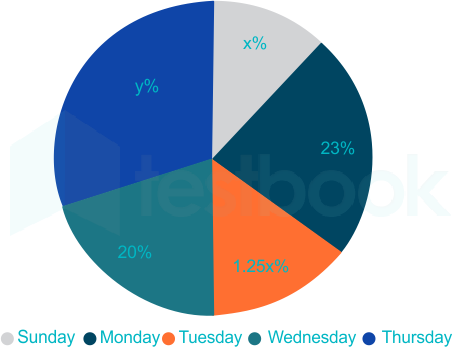
Directions: The  following pie chart shows the percentage distribution of the number of goods sold in a shop in five different days Sunday, Monday, Tuesday, Wednesday, and Thursday.

Total number of goods sold = 400


Note:

Difference between number of goods sold on Sunday and Tuesday is 12

Number of goods sold on Sunday and Monday is what percentage of the  number of goods sold on all the remaining days.

  1. AOption (a)

    56.87%

  2. BOption (b)

    50.78%

  3. COption (c)

    42.89%

  4. DOption (d)

    53.84%

  5. EOption (e)

    48.86%

View answer & explanation

Correct answer

Answer: (d)D.

53.84%

Why this answer is correct

General Solution:

(1.25x% - x%) = 12

0.25x% = 12

x% = 48

To find the percentage value of x

48/400 ×  100 = 12% = x

x% = 12

1.25x% = 12 ×  1.25 = 15

To find the value of y

(12 + 23 + 15 + 20 + y = 100)

y =(100 - 70)%

y = 30%

Number of goods sold on Sunday = 12/100 ×  400 = 48

Number of goods sold on Monday = 23/100 ×  400 = 92

Number of goods sold on Tuesday = 15/100 ×  400 = 60

Number of goods sold on Wednesday = 20/100 ×  400 = 80

Number of goods sold on Thursday = 30/100 ×  400 = 120


Solution:

Number of goods sold on Sunday and Monday = (48 + 92) = 140

Number of goods sold on Tuesday, Wednesday and Thursday = (60 + 80 + 120) = 260

Required percentage = 140/260 ×  100 = 53.84%

SBI Clerk Mains Memory Based Paper (Held On: 25 Feb 2024 Shift 1) (Previous Year Paper)·Quantitative Aptitude
View full paper

Question 753

SBI Clerk 2024• Quantitative Aptitude• Quantitative Aptitude

Directions: The  following pie chart shows the percentage distribution of the number of goods sold in a shop in five different days Sunday, Monday, Tuesday, Wednesday, and Thursday.

Total number of goods sold = 400


Note:

Difference between number of goods sold on Sunday and Tuesday is 12

If the cost of each goods on Thursday is Rs. a and cost of each goods on Wednesday is Rs. (a - 10) if the total cost earned by the shop by selling goods on the both the day is Rs. 9200. If the cost of each goods on Sunday's Rs. (a - 20). Find the total amount earned by the shop on selling goods on Sunday.

  1. AOption (a)

    1280

  2. BOption (b)

    1360

  3. COption (c)

    1440

  4. DOption (d)

    1560

  5. EOption (e)

    1270

View answer & explanation

Correct answer

Answer: (c)C.

1440

Why this answer is correct

General Solution:

(1.25x% - x%) = 12

0.25x% = 12

x% = 48

To find the percentage value of x

48/400 ×  100 = 12% = x

x% = 12

1.25x% = 12 ×  1.25 = 15

To find the value of y

(12 + 23 + 15 + 20 + y = 100)

y =(100 - 70)%

y = 30%

Number of goods sold on Sunday = 12/100 ×  400 = 48

Number of goods sold on Monday = 23/100 ×  400 = 92

Number of goods sold on Tuesday = 15/100 ×  400 = 60

Number of goods sold on Wednesday = 20/100 ×  400 = 80

Number of goods sold on Thursday = 30/100 ×  400 = 120


Solution:

Number of  goods sold on Thursday = 120

Number of goods sold on Wednesday = 80

To find the value of a

120 ×  a + 80 ×  (a - 10) = 9200

120a + 80a - 800 = 9200

200a = 10000

a = 50

Total amount earned by the shop on Sunday = (50 - 20) ×  48 = 1440

SBI Clerk Mains Memory Based Paper (Held On: 25 Feb 2024 Shift 1) (Previous Year Paper)·Quantitative Aptitude
View full paper

Question 754

SBI Clerk 2024• Quantitative Aptitude• Quantitative Aptitude

Directions: The  following pie chart shows the percentage distribution of the number of goods sold in a shop in five different days Sunday, Monday, Tuesday, Wednesday, and Thursday.

Total number of goods sold = 400


Note:

Difference between number of goods sold on Sunday and Tuesday is 12

Number of goods sold on Tuesday is 66.667% of the number of goods present in the shop on Tuesday initially and the Number of goods sold on Wednesday is 33.33% of the number of goods present in the shop initially. Find the ratio between the number of unsold goods on Tuesday and the number of unsold goods in the shop on wednesday.

  1. AOption (a)

    2: 9

  2. BOption (b)

    2: 13

  3. COption (c)

    3: 16

  4. DOption (d)

    3: 17

  5. EOption (e)

    5: 13

View answer & explanation

Correct answer

Answer: (c)C.

3: 16

Why this answer is correct

General Solution:

(1.25x% - x%) = 12

0.25x% = 12

x% = 48

To find the percentage value of x

48/400 ×  100 = 12% = x

x% = 12

1.25x% = 12 ×  1.25 = 15

To find the value of y

(12 + 23 + 15 + 20 + y = 100)

y =(100 - 70)%

y = 30%

Number of goods sold on Sunday = 12/100 ×  400 = 48

Number of goods sold on Monday = 23/100 ×  400 = 92

Number of goods sold on Tuesday = 15/100 ×  400 = 60

Number of goods sold on Wednesday = 20/100 ×  400 = 80

Number of goods sold on Thursday = 30/100 ×  400 = 120


Solution:

Number of goods sold in the shop on Tuesday = 60

Number of goods present in the shop initially on Tuesday  = 60 /(66.667) ×  100 = 90

Number of goods sold in the shop on Wednesday = 80

Number of goods present in the shop initially on Wednesday = 80 /(33.33) ×  100 = 240

Number of goods unsold on Tuesday = (90 - 60) = 30

Number of goods unsold on Wednesday = (240 - 80) = 160

Required ratio = 30: 160 = 3: 16

SBI Clerk Mains Memory Based Paper (Held On: 25 Feb 2024 Shift 1) (Previous Year Paper)·Quantitative Aptitude
View full paper

Question 755

SBI Clerk 2024• Quantitative Aptitude• Quantitative Aptitude

Directions: The  following pie chart shows the percentage distribution of the number of goods sold in a shop in five different days Sunday, Monday, Tuesday, Wednesday, and Thursday.

Total number of goods sold = 400


Note:

Difference between number of goods sold on Sunday and Tuesday is 12

Average number of goods sold on Sunday and Saturday is 8 less than the number of goods sold on Sunday and number of goods sold to unsold on Saturday are in the ratio 8: 5. Find the total number of goods unsold on Saturday.

  1. AOption (a)

    20

  2. BOption (b)

    25

  3. COption (c)

    35

  4. DOption (d)

    40

  5. EOption (e)

    None of these

View answer & explanation

Correct answer

Answer: (a)A.

20

Why this answer is correct

General Solution:

(1.25x% - x%) = 12

0.25x% = 12

x% = 48

To find the percentage value of x

48/400 ×  100 = 12% = x

x% = 12

1.25x% = 12 ×  1.25 = 15

To find the value of y

(12 + 23 + 15 + 20 + y = 100)

y =(100 - 70)%

y = 30%

Number of goods sold on Sunday = 12/100 ×  400 = 48

Number of goods sold on Monday = 23/100 ×  400 = 92

Number of goods sold on Tuesday = 15/100 ×  400 = 60

Number of goods sold on Wednesday = 20/100 ×  400 = 80

Number of goods sold on Thursday = 30/100 ×  400 = 120


Solution:

Number of goods sold on Sunday = 48

Average number of goods sold on Sunday and Saturday = (48 - 8) = 40

Number of goods sold on Saturday = (40× 2 - 48) = 32

Number of items unsold on Saturday = 32/8 × 5 = 20

SBI Clerk Mains Memory Based Paper (Held On: 25 Feb 2024 Shift 1) (Previous Year Paper)·Quantitative Aptitude
View full paper

Question 756

SBI Clerk 2024• Quantitative Aptitude• Quantitative Aptitude

Directions: The  following pie chart shows the percentage distribution of the number of goods sold in a shop in five different days Sunday, Monday, Tuesday, Wednesday, and Thursday.

Total number of goods sold = 400


Note:

Difference between number of goods sold on Sunday and Tuesday is 12

Difference between the goods sold on Sunday and Monday is twice the difference between the number of goods sold on Tuesday and Friday.If the ratio of number of goods sold to unsold on Friday is 19: 15. Then find the number of goods sold on Friday. (

Note:

Number of goods sold on Tuesday is more than the number of goods sold on Friday).

  1. AOption (a)

    52

  2. BOption (b)

    38

  3. COption (c)

    32

  4. DOption (d)

    44

  5. EOption (e)

    42

View answer & explanation

Correct answer

Answer: (b)B.

38

Why this answer is correct

General Solution:

(1.25x% - x%) = 12

0.25x% = 12

x% = 48

To find the percentage value of x

48/400 ×  100 = 12% = x

x% = 12

1.25x% = 12 ×  1.25 = 15

To find the value of y

(12 + 23 + 15 + 20 + y = 100)

y =(100 - 70)%

y = 30%

Number of goods sold on Sunday = 12/100 ×  400 = 48

Number of goods sold on Monday = 23/100 ×  400 = 92

Number of goods sold on Tuesday = 15/100 ×  400 = 60

Number of goods sold on Wednesday = 20/100 ×  400 = 80

Number of goods sold on Thursday = 30/100 ×  400 = 120

Solution:

Number of goods sold on Sunday = 48

Number of goods sold on Monday = 92

(92 - 48) = 44

Difference between number of goods sold on Tuesday and Friday = 44/2 = 22

T - F = 22

Number of goods sold on Tuesday = 60

Number of goods sold on Friday = 60 - F = 22 = 38

F = 38

SBI Clerk Mains Memory Based Paper (Held On: 25 Feb 2024 Shift 1) (Previous Year Paper)·Quantitative Aptitude
View full paper

Question 757

SBI Clerk 2024• Quantitative Aptitude• Quantitative Aptitude

Average weight of four friends A', 'B', 'C' and 'D' is x kg. When 'D' is replaced by 'E' then the average increases by 14.25 kg. When 'C' is replaced by 'E', average increases by 6.75kg. If the average weight of 'C', 'D' and 'E' is 74 kg then the weight of 'E' is how much percent more than that of 'C'?

  1. AOption (a)

    30%

  2. BOption (b)

    36%

  3. COption (c)

    42%

  4. DOption (d)

    45%

  5. EOption (e)

    Cannot be determined

View answer & explanation

Correct answer

Answer: (b)B.

36%

Why this answer is correct

Shortcut Trick

Change in sum = Number of items × Change in average.

When D is replaced by E: E − D = 4 × 14.25 = 57 kg.

When C is replaced by E: E − C = 4 × 6.75 = 27 kg.

Total weight (C + D + E) = 3 × 74 = 222 kg.

Substitute D = E − 57 and C = E − 27: (E − 27) + (E − 57) + E = 222 ⇒ 3E − 84 = 222 ⇒ 3E = 306 ⇒ E = 102 kg.

Weight of C = 102 − 27 = 75 kg. Required % = (27 ÷ 75) × 100 = 36%.

∴ The correct answer is 36%.

Alternate Method

Given: Average of (A, B, C, D) = x. Average of (A, B, E, D) [C replaced] = x + 6.75. Average of (A, B, C, E) [D replaced] = x + 14.25. Average of (C, D, E) = 74 kg.

Step 1: Find weight differences

⇒ (A + B + C + E) − (A + B + C + D) = 4 × (x + 14.25) − 4x

⇒ E − D = 57 kg

⇒ (A + B + E + D) − (A + B + C + D) = 4 × (x + 6.75) − 4x

⇒ E − C = 27 kg

Step 2: Use average of C, D, and E

⇒ C + D + E = 3 × 74 = 222 kg

⇒ (E − 27) + (E − 57) + E = 222

⇒ 3E − 84 = 222 ⇒ 3E = 306 ⇒ E = 102 kg

⇒ C = E − 27 = 102 − 27 = 75 kg

Step 3: Calculate percentage

⇒ Difference = E − C = 27 kg

⇒ Percentage = (27 ÷ 75) × 100 = 0.36 × 100 = 36%

∴ The correct answer is 36%.

Additional Information

Replacement Rule in Average

When one person is replaced by another, New Weight − Old Weight = Total Number × Change in Average.

Percentage Comparison

Percentage more = (Difference ÷ Base Value) × 100, where the base value is the quantity being compared against (after than).

SBI Clerk Mains Memory Based Paper (Held On: 25 Feb 2024 Shift 1) (Previous Year Paper)·Quantitative Aptitude
View full paper

Question 758

SBI Clerk 2024• Quantitative Aptitude• Quantitative Aptitude

The following questions are accompanied by three statements (I), (II), and (III). You have to determine which statements(s) is/are sufficient/necessary to answer the questions.

What is the present age of mother?

I. The difference between the ages of mother and daughter is 45 years.

II. The present age of daughter is 1/4th of the present age of the mother.

III. The sum of the ages of mother and daughter is 75 years.

  1. AOption (a)

    Any two of them

  2. BOption (b)

    Only I and III

  3. COption (c)

    Only I and II

  4. DOption (d)

    All I, II and III

  5. EOption (e)

    None of these

View answer & explanation

Correct answer

Answer: (a)A.

Any two of them

Why this answer is correct

From (II),

Let the mother’s age be x and daughter’s age be x/4

From (I) &(II),

x – x/4 = 45

3x/4 = 45

∴ x = 60 years.

From (II) & (III),

x + x/4 = 75

5x/4 = 75

∴ x = 60 years.

From (I) & (III),

x – y = 45 and x + y = 75

By solving will get the value of x i.e. the answer.

Hence Any two of I, II and III will give the answer

SBI Clerk Mains Memory Based Paper (Held On: 25 Feb 2024 Shift 1) (Previous Year Paper)·Quantitative Aptitude
View full paper

Question 759

SBI Clerk 2024• Quantitative Aptitude• Quantitative Aptitude

Directions

Each of the questions given below consists of a question and 2 statements numbered I and II. You have to decide whether the data is sufficient to answer the question. Read both Statements carefully and then answer the questions.**

If a wire is cut into three pieces of unequal lengths, what is the length of the longest of these pieces of wire?

Statement I. The combined length of the longer two pieces of wire is 25 meters.

Statement II. The combined length of the shorter two pieces of wire is 20 meters.

  1. AOption (a)

    The data in statement I alone is sufficient to answer the question, while the data in statement II alone is not sufficient to answer the question.

  2. BOption (b)

    The data in statement II alone is sufficient to answer the question, while the data in statement I alone is not sufficient to answer the question.

  3. COption (c)

    The data in statement I alone or in statement II alone is sufficient to answer the question.

  4. DOption (d)

    The data in both statements I and II are not sufficient to answer the question.

  5. EOption (e)

    The data in both statements I and II together are necessary to answer the question.

View answer & explanation

Correct answer

Answer: (d)D.

The data in both statements I and II are not sufficient to answer the question.

Why this answer is correct

Calculation:

From statement I:

Let the length of the longer piece, middle piece and, shorter piece be x, y, and z respectively.

From the information

⇒ x + y = 25

No other information is given

∴ Statement I alone is not sufficient.

From Statement II:

Let the length of the longer piece, middle piece and, shorter piece be x, y, and z respectively.

⇒ y + z = 20

No other information is given

∴ Statement II alone is not sufficient.

Both

Statements:

⇒ x + y = 25

⇒ y + z = 20

⇒ x - z = 5

No other information is given

∴ Statement I and II both are not sufficient.

SBI Clerk Mains Memory Based Paper (Held On: 25 Feb 2024 Shift 1) (Previous Year Paper)·Quantitative Aptitude
View full paper

Question 760

SBI Clerk 2024• Quantitative Aptitude• Quantitative Aptitude

Directions

Each of the questions given below consists of a question and 2 statements numbered I and II. You have to decide whether the data is sufficient to answer the question. Read both Statements carefully and then answer the questions.**

Two friends Anil and Mukesh together can complete a piece of work in 20 days. In how many days can Anil alone complete the piece of work?

Statement I. Mukesh alone completes half of the work in 25 days.

Statement II. The efficiency of Anil is 50% more than that of Mukesh.

  1. AOption (a)

    The data in statement I alone is sufficient to answer the question, while the data in statement II alone is not sufficient to answer the question.

  2. BOption (b)

    The data in statement II alone is sufficient to answer the question, while the data in statement I alone is not sufficient to answer the question.

  3. COption (c)

    The data in statement I alone or in statement II alone is sufficient to answer the question.

  4. DOption (d)

    The data in both statements I and II are not sufficient to answer the question.

  5. EOption (e)

    The data in both statements I and II together are necessary to answer the question.

View answer & explanation

Correct answer

Answer: (c)C.

The data in statement I alone or in statement II alone is sufficient to answer the question.

Why this answer is correct

Given:

Anil and Mukesh together can complete a piece of work in = 20 days

Calculation:

For Statement I:

We can conclude the number of days Anil alone will take to complete the work.

∴ Statement I alone is sufficient.

For Statement II:

Efficiency is given so it is easy to find the number of days A alone or B alone can do the work.

∴ Statement II alone is sufficient.

∴ Statement I alone or II alone is sufficient.

How should I prepare for Quantitative Aptitude in SBI Clerk?

Solving previous year questions by topic helps identify recurring concepts, question patterns, and frequently asked sub-topics. Attempt each question, review the step-by-step explanation, and note down key formulas or facts for quick revision before the exam.