SBI Clerk · Topic Collection

Quantitative Aptitude PYQs

Arithmetic, number systems, percentages, ratios, profit and loss, time and work, algebra, geometry, mensuration, and trigonometry.

1495 Total Questions38 Official PapersYears: 2018–2025Search in Quantitative Aptitude
Showing questions 481–500 of 1495Page 25 of 75
SBI Clerk Prelims Memory Based Paper (Held On: 20 September 2025 Shift 4) (Previous Year Paper)·Numerical Ability
View full paper

Question 481

SBI Clerk 2025• Numerical Ability• Numerical Ability

What will come in place of question mark (?) in the following equation?

120 ÷ 24 + 11 × 6 = ?

  1. AOption (a)

    61

  2. BOption (b)

    65

  3. COption (c)

    75

  4. DOption (d)

    71

  5. EOption (e)

    81

View answer & explanation

Correct answer

Answer: (d)D.

71

Why this answer is correct

Follow BODMAS rule to solve this question, as per the order given below, 

Step-1: Parts of an equation enclosed in 'Brackets' must be solved first, and in the bracket, 

Step-2: Any mathematical 'Of' or 'Exponent' must be solved next, 

Step-3: Next, the parts of the equation that contain 'Division' and 'Multiplication' are calculated, 

Step-4: Last but not least, the parts of the equation that contain 'Addition' and 'Subtraction' should be calculated 

120 ÷ 24 + 11 × 6 = ?

⇒ 5 + 66 = ?

∴ ? = 71
SBI Clerk Prelims Memory Based Paper (Held On: 20 September 2025 Shift 4) (Previous Year Paper)·Numerical Ability
View full paper

Question 482

SBI Clerk 2025• Numerical Ability• Numerical Ability

What will come in place of question mark (?) in the following equation?

112 + 44 – 122 + 22 = √?

  1. AOption (a)

    125

  2. BOption (b)

    5

  3. COption (c)

    625

  4. DOption (d)

    1625

  5. EOption (e)

    25

View answer & explanation

Correct answer

Answer: (c)C.

625

Why this answer is correct

Follow BODMAS rule to solve this question, as per the order given below, 

Step-1: Parts of an equation enclosed in 'Brackets' must be solved first, and in the bracket, 

Step-2: Any mathematical 'Of' or 'Exponent' must be solved next, 

Step-3: Next, the parts of the equation that contain 'Division' and 'Multiplication' are calculated, 

Step-4: Last but not least, the parts of the equation that contain 'Addition' and 'Subtraction' should be calculated 

112 + 44 – 122 + 22 = √?

⇒ 121 + 44 – 144 + 4 = √?

⇒ 165 – 140 = √?

⇒ 25 = √?

∴ ? = 625

SBI Clerk Prelims Memory Based Paper (Held On: 20 September 2025 Shift 4) (Previous Year Paper)·Numerical Ability
View full paper

Question 483

SBI Clerk 2025• Numerical Ability• Numerical Ability

A train 150 metres long crosses a pole in 10 seconds. Find the speed of the train in km/hr.

  1. AOption (a)

    45 km/hr

  2. BOption (b)

    50 km/hr

  3. COption (c)

    54 km/hr

  4. DOption (d)

    60 km/hr

  5. EOption (e)

    65 km/hr

View answer & explanation

Correct answer

Answer: (c)C.

54 km/hr

Why this answer is correct

Shortcut Trick

When a train crosses a pole, the distance covered is equal to the length of the train itself.

Speed in m/s = Length ÷ Time = 150 ÷ 10 = 15 m/s.

To convert m/s to km/hr, multiply by 18/5.

Speed in km/hr = 15 × (18/5) = 3 × 18 = 54 km/hr.

∴ The correct answer is 54 km/hr.

Alternate Method

Given:

Length of the train (Distance) = 150 m

Time taken to cross the pole = 10 seconds

Formula Used:

Speed = Distance ÷ Time

Speed (km/hr) = Speed (m/s) × (18/5)

Train (150m)   Pole Time = 10 seconds

Calculations:

⇒ Speed of train in m/s = 150 ÷ 10

⇒ Speed = 15 m/s

⇒ Now, converting m/s to km/hr:

⇒ Speed = 15 × (18/5) km/hr

⇒ Speed = 3 × 18 km/hr

⇒ Speed = 54 km/hr

∴ The correct answer is 54 km/hr.

Additional Information

Unit Conversion Rules

To convert speed from km/hr to m/s, multiply by 5/18. To convert m/s to km/hr, multiply by 18/5.

Crossing a Stationary Object with Length

When a train crosses a platform, bridge, or another stationary train, the total distance is (Length of train + Length of object).

Relative Speed Concept

If two trains are moving in the same direction, relative speed = S1 − S2. If they move in opposite directions, relative speed = S1 + S2.

SBI Clerk Prelims Memory Based Paper (Held On: 20 September 2025 Shift 4) (Previous Year Paper)·Numerical Ability
View full paper

Question 484

SBI Clerk 2025• Numerical Ability• Numerical Ability

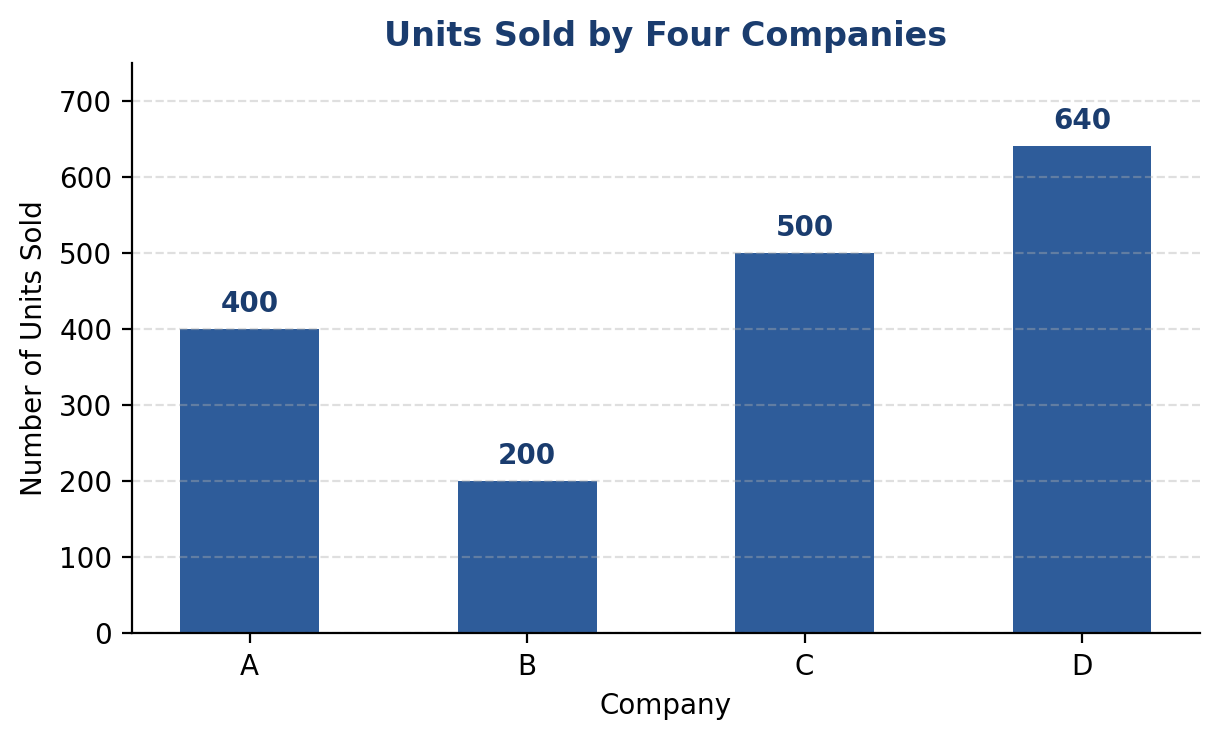
Directions: The bar graph shows the number of units sold by four companies A, B, C and D. The Selling Price (SP) per unit for company A is₹80 and for company B is₹120. 

25% of the units sold by A were returned, and 40% of the units sold by B were returned. Find the difference between the revenue (after returns) earned by A and B.

  1. AOption (a)

    ₹8,400

  2. BOption (b)

    ₹8,800

  3. COption (c)

    ₹9,200

  4. DOption (d)

    ₹9,600

  5. EOption (e)

    ₹10,000

View answer & explanation

Correct answer

Answer: (d)D.

₹9,600

Why this answer is correct

Common Calculation

CompanyUnits SoldSelling Price (SP) per unit
A400₹80
B200₹120
C500-
D640-


Given:

Units sold by A = 400

Return rate A = 25%

SP per unit A = ₹80

Units sold by B = 200

Return rate B = 40%

SP per unit B = ₹120

Formula Used:

Net units = Units sold − (Return % × Units sold)

Revenue = Net units × SP per unit

Difference = |Revenue A − Revenue B|

Calculation:

⇒ Net units sold by A = 400 − (25 / 100 × 400) = 400 − 100 = 300

⇒ Revenue earned by A = 300 × 80 = ₹24,000

⇒ Net units sold by B = 200 − (40 / 100 × 200) = 200 − 80 = 120

⇒ Revenue earned by B = 120 × 120 = ₹14,400

⇒ Difference = 24,000 − 14,400 = 9,600

∴ The correct answer is ₹9,600.

SBI Clerk Prelims Memory Based Paper (Held On: 20 September 2025 Shift 4) (Previous Year Paper)·Numerical Ability
View full paper

Question 485

SBI Clerk 2025• Numerical Ability• Numerical Ability

Directions: The bar graph shows the number of units sold by four companies A, B, C and D. The Selling Price (SP) per unit for company A is₹80 and for company B is₹120. 

A new company E sold 20% more units than the average number of units sold by A and B combined. If company E produced a total of 600 units, find the ratio of units sold to units unsold by E.

  1. AOption (a)

    2 : 3

  2. BOption (b)

    3 : 2

  3. COption (c)

    5 : 3

  4. DOption (d)

    3 : 5

  5. EOption (e)

    4 : 3

View answer & explanation

Correct answer

Answer: (b)B.

3 : 2

Why this answer is correct

Common Calculation

CompanyNumber of units sold
A400
B200
C500
D640


Given:

Units sold by A = 400

Units sold by B = 200

Total units produced by E = 600

Formula Used:

Average = (Sum of units) / 2

Units sold by E = Average × (1 + 20 / 100)

Units unsold by E = Total produced − Units sold

Ratio = Units sold : Units unsold

Calculation:

⇒ Average units sold by A and B = (400 + 200) / 2 = 600 / 2 = 300

⇒ Units sold by E = 300 + (20% of 300)

⇒ Units sold by E = 300 + 60 = 360

⇒ Units unsold by E = 600 − 360 = 240

⇒ Ratio = 360 : 240

⇒ Ratio = 3 : 2

∴ The correct answer is 3 : 2

SBI Clerk Prelims Memory Based Paper (Held On: 20 September 2025 Shift 4) (Previous Year Paper)·Numerical Ability
View full paper

Question 486

SBI Clerk 2025• Numerical Ability• Numerical Ability

Directions: The bar graph shows the number of units sold by four companies A, B, C and D. The Selling Price (SP) per unit for company A is₹80 and for company B is₹120. 

The number of units produced by company D was 40% more than the number of units sold by it. Find the combined number of unsold units of companies C and D.

  1. AOption (a)

    356

  2. BOption (b)

    371

  3. COption (c)

    381

  4. DOption (d)

    391

  5. EOption (e)

    401

View answer & explanation

Correct answer

Answer: (c)C.

381

Why this answer is correct

Common Calculation

CompanyNumber of Units SoldSelling Price (SP) per unit (₹)
A40080
B200120
C500−
D640−

Given:

Number of unsold units of company C = 125

Number of units sold by company D = 640

Number of units produced by company D = 40% more than units sold by it

Formula Used:

Unsold Units = Units Produced − Units Sold

Calculation:

⇒ Units produced by company D = 640 × (100 + 40) / 100

⇒ Units produced by company D = 640 × 140 / 100 = 896

⇒ Unsold units of company D = 896 − 640 = 256

⇒ Combined unsold units of C and D = 125 + 256

⇒ Combined unsold units of C and D = 381

∴ The correct answer is option 3) 381.

SBI Clerk Prelims Memory Based Paper (Held On: 20 September 2025 Shift 4) (Previous Year Paper)·Numerical Ability
View full paper

Question 487

SBI Clerk 2025• Numerical Ability• Numerical Ability

Directions: The bar graph shows the number of units sold by four companies A, B, C and D. The Selling Price (SP) per unit for company A is₹80 and for company B is₹120. 

The number of units produced by company C was 25% more than the number of units sold by it. How many units of C remained unsold?

  1. AOption (a)

    100

  2. BOption (b)

    110

  3. COption (c)

    120

  4. DOption (d)

    125

  5. EOption (e)

    130

View answer & explanation

Correct answer

Answer: (d)D.

125

Why this answer is correct

Common Calculation

CompanyNumber of Units SoldSelling Price (SP) per unit (₹)
A40080
B200120
C500−
D640−

Given:

Number of units sold by company C = 500

Number of units produced by company C = 25% more than units sold

Formula Used:

Units Produced = Units Sold × (100 + Percentage more) / 100

Unsold Units = Units Produced − Units Sold

Calculation:

⇒ Units produced by company C = 500 × (100 + 25) / 100

⇒ Units produced by company C = 500 × 125 / 100

⇒ Units produced by company C = 500 × 1.25 = 625

⇒ Unsold units = 625 − 500

⇒ Unsold units = 125

∴ The correct answer is option 4) 125.

SBI Clerk Prelims Memory Based Paper (Held On: 20 September 2025 Shift 4) (Previous Year Paper)·Numerical Ability
View full paper

Question 488

SBI Clerk 2025• Numerical Ability• Numerical Ability

Directions: The bar graph shows the number of units sold by four companies A, B, C and D. The Selling Price (SP) per unit for company A is₹80 and for company B is₹120. 

Company A produced a total of 550 units. How many units of A remained unsold?

  1. AOption (a)

    (a) 100

  2. BOption (b)

    (b) 125

  3. COption (c)

    (c) 150

  4. DOption (d)

    (d) 175

  5. EOption (e)

    (e) 200

View answer & explanation

Correct answer

Answer: (c)C.

(c) 150

Why this answer is correct

Common Calculation

CompanyNumber of Units SoldSelling Price (SP) per unit (₹)
A40080
B200120
C500-
D640-

Given:

Total units produced by Company A = 550

Total units sold by Company A = 400

Formula Used:

Unsold Units = Total Units Produced − Total Units Sold

Calculation:

⇒ Unsold Units = 550 − 400

⇒ Unsold Units = 150

∴ The correct answer is 150.

SBI Clerk Prelims Memory Based Paper (Held On: 20 September 2025 Shift 4) (Previous Year Paper)·Numerical Ability
View full paper

Question 489

SBI Clerk 2025• Numerical Ability• Numerical Ability

The area of a square is 196 sq. cm. Find the perimeter of a rectangle whose length is equal to the side of the square and breadth is 10 cm.

  1. AOption (a)

    40 cm

  2. BOption (b)

    44 cm

  3. COption (c)

    48 cm

  4. DOption (d)

    52 cm

  5. EOption (e)

    56 cm

View answer & explanation

Correct answer

Answer: (c)C.

48 cm

Why this answer is correct

Shortcut Trick

Side of square = √196 = 14 cm.

Length of rectangle = 14 cm, Breadth = 10 cm.

Perimeter = 2 × (14 + 10) = 48 cm.

∴ The correct answer is 48 cm.

Alternate Method

Given:

Area of square = 196 cm2

Breadth of rectangle (b) = 10 cm

Length of rectangle (l) = Side of square (a)

Formula Used:

Area of square = a2

Perimeter of rectangle = 2 × (l + b)

Square (Area=196) a = 14 Rectangle l = 14 b = 10 Perimeter = 2 × (14 + 10) = 48 cm

Calculations:

⇒ a2 = 196

⇒ a = √196

⇒ a = 14 cm

⇒ Length of rectangle (l) = 14 cm

⇒ Perimeter of rectangle = 2 × (l + b)

⇒ Perimeter = 2 × (14 + 10)

⇒ Perimeter = 2 × 24

⇒ Perimeter = 48 cm

∴ The correct answer is 48 cm.

Additional Information

Square Properties

Area = (side)2 and Perimeter = 4 × side. The diagonal of a square is side × √2.

Rectangle Properties

Area = length × breadth and Perimeter = 2 × (length + breadth). Diagonal = √(l2 + b2).

Equivalence of Shapes

If a square and a rectangle have the same perimeter, the square will always have a greater area.

SBI Clerk Prelims Memory Based Paper (Held On: 20 September 2025 Shift 4) (Previous Year Paper)·Numerical Ability
View full paper

Question 490

SBI Clerk 2025• Numerical Ability• Numerical Ability

A can complete a piece of work in 12 days and B can complete the same work in 18 days. In how many days will they complete the work together?

  1. AOption (a)

    6.5 days

  2. BOption (b)

    7 days

  3. COption (c)

    7.2 days

  4. DOption (d)

    7.5 days

  5. EOption (e)

    8 days

View answer & explanation

Correct answer

Answer: (c)C.

7.2 days

Why this answer is correct

Shortcut Trick

When two people A and B work together, time taken = (A × B) ÷ (A + B)

Given: A = 12 days, B = 18 days

Combined Time = (12 × 18) ÷ (12 + 18)

Combined Time = 216 ÷ 30 = 7.2 days

∴ The correct answer is 7.2 days.

Alternate Method

Given:

Time taken by A = 12 days

Time taken by B = 18 days

Formula Used:

Total Work = LCM of individual days

Efficiency = Total Work ÷ Time taken

PersonDaysTotal WorkEfficiency
A12363
B182

Calculations:

⇒ Total Efficiency of A and B = 3 + 2 = 5 units/day

⇒ Time taken to complete work together = Total Work ÷ Total Efficiency

⇒ Time = 36 ÷ 5

⇒ Time = 7.2 days

∴ The correct answer is 7.2 days.

Additional Information

Efficiency and Time Relationship

Efficiency is inversely proportional to the time taken to complete a task (Efficiency = 1 ÷ Time).

Work and Wages

In work and wages problems, the total wage is distributed among workers in the ratio of their individual efficiencies or the work done by them.

Pipes and Cisterns

This follows the same logic as Time and Work, where a filling pipe has positive efficiency and an outlet pipe (leak) has negative efficiency.

SBI Clerk Prelims Memory Based Paper (Held On: 20 September 2025 Shift 4) (Previous Year Paper)·Numerical Ability
View full paper

Question 491

SBI Clerk 2025• Numerical Ability• Numerical Ability

A person spends 40% of his monthly salary on rent and 30% of the remaining amount on food. If he is left with ■8,400, find his monthly salary.

  1. AOption (a)

    ■18,000

  2. BOption (b)

    ■20,000

  3. COption (c)

    ■22,000

  4. DOption (d)

    ■24,000

  5. EOption (e)

    ■25,000

View answer & explanation

Correct answer

Answer: (b)B.

■20,000

Why this answer is correct

Shortcut Trick

Successive remaining method: Total × (100 − 40)% × (100 − 30)% = 8,400

Total × 60% × 70% = 8,400

Total × 0.42 = 8,400

Total = 8,400 ÷ 0.42 = ₹20,000

∴ The correct answer is ₹20,000.

Alternate Method

Given:

Spending on rent = 40% of salary

Spending on food = 30% of the remaining amount

Savings (Amount left) = ₹8,400

Formula Used:

Final Value = Initial Value × (1 − r1/100) × (1 − r2/100)

 Total Salary (100%) Rent (40%) Food (18%) Savings (42% = ₹8,400)  Remaining (60%)  Salary = 8,400 ÷ 0.42 = ₹20,000

Calculations:

Let the total monthly salary be ₹x.

⇒ Amount spent on Rent = 40% of x = 0.40x

⇒ Remaining amount = x − 0.40x = 0.60x

⇒ Amount spent on Food = 30% of 0.60x = 0.18x

⇒ Final Savings = 0.60x − 0.18x = 0.42x

⇒ 0.42x = 8,400

⇒ x = 8,400 ÷ 0.42

⇒ x = 840,000 ÷ 42

⇒ x = 20,000

∴ The correct answer is ₹20,000.

Additional Information

Successive Percentage Change

When values change sequentially on the remaining balance, use the multiplying factor: Final = Initial × (1 ± r1/100) × (1 ± r2/100).

Percentage to Fraction Conversion

40% = 2/5 and 30% = 3/10. Remaining fractions are 3/5 and 7/10. Total Salary × (3/5) × (7/10) = Savings.

Effective Discount / Decrease

The single equivalent decrease for x% and y% is [x + y − (xy/100)]%. Here: 40 + 30 − (1200/100) = 58% total expenditure.

SBI Clerk Prelims Memory Based Paper (Held On: 20 September 2025 Shift 4) (Previous Year Paper)·Numerical Ability
View full paper

Question 492

SBI Clerk 2025• Numerical Ability• Numerical Ability

Find the compound interest on ₹8,000 at 10% per annum for 2 years, compounded annually.

  1. AOption (a)

    (a) ₹1,600

  2. BOption (b)

    (b) ₹1,680

  3. COption (c)

    (c) ₹1,700

  4. DOption (d)

    (d) ₹1,750

  5. EOption (e)

    (e) ₹1,800

View answer & explanation

Correct answer

Answer: (b)B.

(b) ₹1,680

Why this answer is correct

Shortcut Trick

Effective Rate for 2 years = x + y + (x × y)/100

Effective Rate = 10 + 10 + (10 × 10)/100 = 21%

Compound Interest = 21% of ₹8,000

CI = 0.21 × 8,000 = ₹1,680

∴ The correct answer is ₹1680.

Alternate Method

Given:

Principal (P) = ₹8,000

Rate (R) = 10% per annum

Time (n) = 2 years

  Year 0 Year 1 Year 2  Principal: ₹8,000  +10% (₹800)  +10% (₹880) Total CI = ₹800 + ₹880 = ₹1,680

Formula Used:

Amount (A) = P × (1 + R/100)n

Compound Interest (CI) = A − P

Calculations:

⇒ A = 8,000 × (1 + 10/100)2

⇒ A = 8,000 × (1 + 0.1)2

⇒ A = 8,000 × (1.1)2

⇒ A = 8,000 × 1.21

⇒ A = 9,680

⇒ CI = 9,680 − 8,000

⇒ CI = 1,680

∴ The correct answer is ₹1680.

Additional Information

Difference between CI and SI

For 2 years, the difference (D) is given by D = P × (R/100)2. For 3 years, D = P × (R/100)2 × (3 + R/100).

Half-Yearly Compounding

When interest is compounded half-yearly, the rate is halved (R/2) and the time is doubled (2n).

Effective Rate Formula

The net percentage change for two successive increments of x% and y% is [x + y + (xy/100)]%.

SBI Clerk Prelims Memory Based Paper (Held On: 20 September 2025 Shift 4) (Previous Year Paper)·Numerical Ability
View full paper

Question 493

SBI Clerk 2025• Numerical Ability• Numerical Ability

Directions: Study the table and answer the questions. The table shows the number of Hindi, English and German books sold by five shops A, B, C, D and E. The Selling Price (SP) of each English book is ₹150 and of each German book is ₹200.

ShopHindiEnglishGerman
A300500250
B400400300
C600500300
D250500450
E300750350

Find the average number of English books sold by all five shops together.

  1. AOption (a)

    490

  2. BOption (b)

    510

  3. COption (c)

    530

  4. DOption (d)

    550

  5. EOption (e)

    570

View answer & explanation

Correct answer

Answer: (c)C.

530

Why this answer is correct

Common Calculation

ShopHindi BooksEnglish BooksGerman Books
A300500250
B400400300
C600500300
D250500450
E300750350

Selling price (SP) of each English book = ₹150

Selling price (SP) of each German book = ₹200

Given:

Number of English books sold by shops: A = 500, B = 400, C = 500, D = 500, E = 750.

Formula Used:

Average = Sum of items / Number of items

Calculation:

⇒ Total English books = 500 + 400 + 500 + 500 + 750

⇒ Total English books = 2650

⇒ Average = 2650 / 5

⇒ Average = 530

∴ The correct answer is 530.

SBI Clerk Prelims Memory Based Paper (Held On: 20 September 2025 Shift 4) (Previous Year Paper)·Numerical Ability
View full paper

Question 494

SBI Clerk 2025• Numerical Ability• Numerical Ability

Directions: Study the table and answer the questions. The table shows the number of Hindi, English and German books sold by five shops A, B, C, D and E. The Selling Price (SP) of each English book is ₹150 and of each German book is ₹200.

ShopHindiEnglishGerman
A300500250
B400400300
C600500300
D250500450
E300750350

The total number of books sold by shop C is approximately what percent more than the total number of books sold by shop B?

  1. AOption (a)

    18.18%

  2. BOption (b)

    22.72%

  3. COption (c)

    27.27%

  4. DOption (d)

    31.81%

  5. EOption (e)

    36.36%

View answer & explanation

Correct answer

Answer: (c)C.

27.27%

Why this answer is correct

Common Calculation

ShopHindi BooksEnglish BooksGerman BooksTotal Books
A3005002501050
B4004003001100
C6005003001400
D2505004501200
E3007503501400

Given:

Total books sold by shop C = 1400

Total books sold by shop B = 1100

Formula Used:

Percentage More = [(Value 1 − Value 2) / Value 2] × 100

Calculation:

⇒ Total books sold by Shop C = 600 + 500 + 300 = 1400

⇒ Total books sold by Shop B = 400 + 400 + 300 = 1100

⇒ Difference = 1400 − 1100 = 300

⇒ Percentage More = (300 / 1100) × 100

⇒ Percentage More = 300 / 11

⇒ Percentage More ≈ 27.27%

∴ The correct answer is 27.27%.

SBI Clerk Prelims Memory Based Paper (Held On: 20 September 2025 Shift 4) (Previous Year Paper)·Numerical Ability
View full paper

Question 495

SBI Clerk 2025• Numerical Ability• Numerical Ability

Directions: Study the table and answer the questions. The table shows the number of Hindi, English and German books sold by five shops A, B, C, D and E. The Selling Price (SP) of each English book is ₹150 and of each German book is ₹200.

ShopHindiEnglishGerman
A300500250
B400400300
C600500300
D250500450
E300750350

Find the ratio of German books sold by shop A to Hindi books sold by shop B.

  1. AOption (a)

    5 : 8

  2. BOption (b)

    3 : 5

  3. COption (c)

    5 : 6

  4. DOption (d)

    4 : 7

  5. EOption (e)

    5 : 9

View answer & explanation

Correct answer

Answer: (a)A.

5 : 8

Why this answer is correct

Common Calculation

ShopHindi BooksEnglish BooksGerman Books
A300500250
B400400300
C600500300
D250500450
E300750350

Given:

German books sold by shop A = 250

Hindi books sold by shop B = 400

Formula Used:

Ratio = Value 1 / Value 2

Calculation:

⇒ Required Ratio = 250 / 400

⇒ Required Ratio = 25 / 40

⇒ Required Ratio = 5 / 8

∴ The correct answer is 5 : 8.

SBI Clerk Prelims Memory Based Paper (Held On: 20 September 2025 Shift 4) (Previous Year Paper)·Numerical Ability
View full paper

Question 496

SBI Clerk 2025• Numerical Ability• Numerical Ability

Directions: Study the table and answer the questions. The table shows the number of Hindi, English and German books sold by five shops A, B, C, D and E. The Selling Price (SP) of each English book is ₹150 and of each German book is ₹200.

ShopHindiEnglishGerman
A300500250
B400400300
C600500300
D250500450
E300750350

The number of German books sold by shop E is 50 more than that sold by shop B, and the total number of books sold by E equals the total number of books sold by shop C. Find the combined number of Hindi and English books sold by shop E.

  1. AOption (a)

    950

  2. BOption (b)

    1000

  3. COption (c)

    1050

  4. DOption (d)

    1100

  5. EOption (e)

    1150

View answer & explanation

Correct answer

Answer: (c)C.

1050

Why this answer is correct

Common Calculation

ShopHindi BooksEnglish BooksGerman BooksTotal Books
A3005002501050
B4004003001100
C6005003001400
D2505004501200
E3007503501400

Given:

Hindi books sold by shop E = 300

English books sold by shop E = 750

German books sold by shop E = 350

German books sold by shop B = 300

Total books sold by shop C = 1400

Formula Used:

Combined books = Number of Hindi books + Number of English books

Calculation:

⇒ Total books sold by E = 300 + 750 + 350 = 1400 (matches shop C total)

⇒ German books by E (350) − German books by B (300) = 50 (matches condition)

⇒ Combined Hindi and English books (E) = 300 + 750

⇒ 1050

∴ The correct answer is option 3) 1050.

SBI Clerk Prelims Memory Based Paper (Held On: 20 September 2025 Shift 4) (Previous Year Paper)·Numerical Ability
View full paper

Question 497

SBI Clerk 2025• Numerical Ability• Numerical Ability

Directions: Study the table and answer the questions. The table shows the number of Hindi, English and German books sold by five shops A, B, C, D and E. The Selling Price (SP) of each English book is ₹150 and of each German book is ₹200.

ShopHindiEnglishGerman
A300500250
B400400300
C600500300
D250500450
E300750350

What is the total revenue generated from English and German books sold by shops A and D combined?

  1. AOption (a)

    ₹2,60,000

  2. BOption (b)

    ₹2,75,000

  3. COption (c)

    ₹2,90,000

  4. DOption (d)

    ₹3,05,000

  5. EOption (e)

    ₹3,20,000

View answer & explanation

Correct answer

Answer: (c)C.

₹2,90,000

Why this answer is correct

Common Calculation

ShopHindi BooksEnglish BooksGerman Books
A300500250
B400400300
C600500300
D250500450
E300750350

Selling Price (SP) of each English book = ₹150

Selling Price (SP) of each German book = ₹200

Given:

English books sold by Shop A = 500

English books sold by Shop D = 500

German books sold by Shop A = 250

German books sold by Shop D = 450

SP of English book = ₹150

SP of German book = ₹200

Formula Used:

Total Revenue = (Total English books × SP per English book) + (Total German books × SP per German book)

Calculation:

⇒ Total English books (A + D) = 500 + 500 = 1000

⇒ Total German books (A + D) = 250 + 450 = 700

⇒ Revenue from English books = 1000 × 150 = ₹1,50,000

⇒ Revenue from German books = 700 × 200 = ₹1,40,000

⇒ Total Revenue = 1,50,000 + 1,40,000 = ₹2,90,000

∴ The correct answer is ₹2,90,000.

Verified Answer: option 3)  ₹2,90,000

SBI Clerk Prelims Memory Based Paper (Held On: 20 September 2025 Shift 4) (Previous Year Paper)·Numerical Ability
View full paper

Question 498

SBI Clerk 2025• Numerical Ability• Numerical Ability

A shopkeeper marks an article 40% above its cost price and then gives a discount of 10% on the marked price. Find his profit percentage.

  1. AOption (a)

    20%

  2. BOption (b)

    24%

  3. COption (c)

    26%

  4. DOption (d)

    28%

  5. EOption (e)

    30%

View answer & explanation

Correct answer

Answer: (c)C.

26%

Why this answer is correct

Shortcut Trick

Apply the effective percentage change formula: Net % = x + y + (xy/100)

Here, Markup (x) = +40 and Discount (y) = −10

Profit % = 40 − 10 + [40 × (−10) ÷ 100]

Profit % = 30 − 4 = 26%

∴ The correct answer is 26%.

Alternate Method

Given:

Markup % = 40%

Discount % = 10%

CP = 100 +40% Markup MP = 140 −10% Discount SP = 126 Profit = SP − CP = 126 − 100 = 26

Let the Cost Price (CP) be 100 units.

⇒ Marked Price (MP) = CP + 40% of CP

⇒ MP = 100 + 40 = 140 units

⇒ Discount = 10% of MP = 0.10 × 140 = 14 units

⇒ Selling Price (SP) = MP − Discount

⇒ SP = 140 − 14 = 126 units

⇒ Profit = SP − CP = 126 − 100 = 26 units

⇒ Profit % = (Profit ÷ CP) × 100

⇒ Profit % = (26 ÷ 100) × 100 = 26%

∴ The correct answer is 26%.

Additional Information

Effective Percentage Change

When a value is changed by x% and then by y%, the net change is given by [x + y + (xy/100)]%.

Marked Price and Discount

Discount is always calculated on the Marked Price (MP). SP = MP × [1 − (Discount % ÷ 100)].

Markup Percentage

Markup is the increase in price over the Cost Price. MP = CP × [1 + (Markup % ÷ 100)].

SBI Clerk Prelims Memory Based Paper (Held On: 20 September 2025 Shift 4) (Previous Year Paper)·Numerical Ability
View full paper

Question 499

SBI Clerk 2025• Numerical Ability• Numerical Ability

A invests ₹6,000 and B invests ₹9,000 in a business for the same period of time. If the total profit at the end of the year is ₹7,500, find A's share of the profit.

  1. AOption (a)

    (a) ₹2,500

  2. BOption (b)

    (b) ₹3,000

  3. COption (c)

    (c) ₹3,500

  4. DOption (d)

    (d) ₹4,000

  5. EOption (e)

    (e) ₹4,500

View answer & explanation

Correct answer

Answer: (b)B.

(b) ₹3,000

Why this answer is correct

Shortcut Trick

Profit Ratio (A : B) = Investment Ratio = 6000 : 9000 = 2 : 3

Total Profit parts = 2 + 3 = 5 parts

Value of 5 parts = ₹7,500 → 1 part = ₹1,500

A's share (2 parts) = 2 × 1,500 = ₹3,000

∴ The correct answer is ₹3,000.

Alternate Method

Given:

Investment of A = ₹6,000

Investment of B = ₹9,000

Total Profit = ₹7,500

Time period is same for both.

Formula Used:

Profit Ratio = (CapitalA × TimeA) : (CapitalB × TimeB)

A (₹6,000) B (₹9,000) Ratio Part: 2 units Ratio Part: 3 units Total Profit = ₹7,500 (5 units) A's Share = ?

Calculations:

⇒ Profit Ratio A : B = 6,000 : 9,000

⇒ Profit Ratio A : B = 2 : 3

⇒ Sum of ratio parts = 2 + 3 = 5

⇒ A's Share of profit = (A's ratio / Total ratio) × Total Profit

⇒ A's Share = (2 / 5) × 7,500

⇒ A's Share = 2 × 1,500

⇒ A's Share = ₹3,000

∴ The correct answer is ₹3,000.

Additional Information

Partnership Profit Ratio

The profit is always distributed in the ratio of (Investment × Time). If time is constant, profit ∝ investment.

Working vs Sleeping Partner

A working partner may receive an additional percentage of profit as salary before the remaining profit is divided in the investment ratio.

Change in Investment

If partners change their investment mid-year, calculate effective capital as ∑(Capital × Months) for each partner.

SBI Clerk Prelims Memory Based Paper (Held On: 20 September 2025 Shift 4) (Previous Year Paper)·Numerical Ability
View full paper

Question 500

SBI Clerk 2025• Numerical Ability• Numerical Ability

A boat covers 24 km downstream in 2 hours and covers the same distance upstream in 3 hours. Find the speed of the boat in still water.

  1. AOption (a)

    8 km/hr

  2. BOption (b)

    9 km/hr

  3. COption (c)

    10 km/hr

  4. DOption (d)

    11 km/hr

  5. EOption (e)

    12 km/hr

View answer & explanation

Correct answer

Answer: (c)C.

10 km/hr

Why this answer is correct

Shortcut Trick

Downstream Speed (D) = 24 ÷ 2 = 12 km/hr

Upstream Speed (U) = 24 ÷ 3 = 8 km/hr

Speed of boat in still water = (D + U) ÷ 2

Speed of boat = (12 + 8) ÷ 2 = 10 km/hr

∴ The correct answer is 10 km/hr.

Alternate Method

Given:

Distance covered downstream = 24 km in 2 hours

Distance covered upstream = 24 km in 3 hours

Formula used: Speed = Distance ÷ Time

 Downstream: 12 km/hr   Upstream: 8 km/hr Boat Speed in Still Water (u)  u

⇒ Downstream Speed (u + v) = 24 ÷ 2 = 12 km/hr ... (Eq. 1)

⇒ Upstream Speed (u − v) = 24 ÷ 3 = 8 km/hr ... (Eq. 2)

⇒ Adding (Eq. 1) and (Eq. 2):

⇒ (u + v) + (u − v) = 12 + 8

⇒ 2u = 20

⇒ u = 20 ÷ 2 = 10 km/hr

∴ The correct answer is 10 km/hr.

Additional Information

Speed of Stream (Current)

The speed of the stream or current (v) is calculated as half the difference between downstream and upstream speeds: v = (D − U) ÷ 2.

Relationship in Still Water

Speed in still water (u) is the arithmetic mean of downstream and upstream speeds: u = (D + U) ÷ 2.

Direction and Relative Speed

In downstream motion, the stream assists the boat (u+v), while in upstream motion, it opposes the boat (u−v).

Verified Answer: option 3 10 km/hr

How should I prepare for Quantitative Aptitude in SBI Clerk?

Solving previous year questions by topic helps identify recurring concepts, question patterns, and frequently asked sub-topics. Attempt each question, review the step-by-step explanation, and note down key formulas or facts for quick revision before the exam.