Official Paper

SBI Clerk Prelims Memory Based Paper (Held On: 20 September 2025 Shift 4) (Previous Year Paper)

100 questions · 60 minutes · with answers · free

English Language (30 questions)

1

Directions: In the following question, some part of the sentence may have an error. Find out which part of the sentence has an error and select the appropriate option. If a sentence is free from errors, select option 'No error'.

When people smoke cigarettes,(A)/ their health will suffer, (B)/ which can also lead to (C)/ lung cancer and heart attacks.(D)

  1. ((a))

    A

  2. ((b))

    B

  3. ((c))

    C

  4. ((d))

    D

  5. ((e))

    No error

Show Answer
Answer: ((b))

B

The correct option is option 2.

Key Points

  • The given sentence is a zero-conditional sentence.
  • Zero conditional sentences express general truths i.e., situations in which one thing always causes another. When we use a zero conditional, we are talking about a general truth rather than a specific instance of something.
  • When using the zero conditional, the correct tense to use in both clauses is the simple present tense.
  • If clause:- If + simple present  ;  Main clause:-  simple present
  • For example: If it rains, the grass gets wet.
  • In the given sentence, ‘their health will suffer’ is wrongly used instead of ‘their health suffers’ should be used in the main clause.
  • Hence, ‘their health will suffers’ should be replaced by ‘their health suffers’.

Correct sentence: “When people smoke cigarettes, their health suffers, which can also lead to lung cancer and heart attacks.” 

Additional Information

  • The words 'if' and 'when' can be used interchangeably in these zero conditional sentences. This is because the outcome will always be the same, so it doesn’t matter “if” or “when” it happens.

2

Directions: In the following question, some part of the sentence may have an error. Find out which part of the sentence has an error and select the appropriate option. If a sentence is free from errors, select option 'No error'

If you set your mind (A)/ to a goal and work (B)/ hard towards it, (C)/ you eventually achieve it. (D)

  1. ((a))

    A

  2. ((b))

    B

  3. ((c))

    C

  4. ((d))

    D

  5. ((e))

    No error

Show Answer
Answer: ((d))

D

The correct option is option 4.

Key Points

  • The given sentence is a first conditional sentence.
  • First conditional sentences are used to express situations in which the outcome is likely (but not guaranteed) to happen in the future.
  • We use the simple present tense in the if-clause and simple future tense in the main clause—that is, the clause that expresses the likely outcome.
Conditional word + subject + v1/v5 + object , subject + will/ shall/ may + v1 + object.
  • If clause:- If + simple present ; Main clause:- simple future
  • For example: If it rains today, you will get wet.
  • In the given sentence, ‘you eventually achieve it’ is wrongly used instead of ‘you will eventually achieve it’ should be used in the main clause.

Correct sentence: “If you set your mind to a goal and work hard towards it, you’ll eventually achieve it.”​ 

3

Directions: In the following question, some part of the sentence may have an error. Find out which part of the sentence has an error and select the appropriate option. If a sentence is free from errors, select option 'No error'.

If I inherit a billion (A)/ dollars, I would travel to (B)/ the exotic and adventurous (C)/ places of the world. (D)

  1. ((a))

    A

  2. ((b))

    B

  3. ((c))

    C

  4. ((d))

    D

  5. ((e))

    No error

Show Answer
Answer: ((a))

A

The correct option is option 1.

Key Points

  • The given sentence is a second conditional sentence.
  • Second conditional sentences are useful for expressing outcomes that are completely unrealistic or will not likely happen in the future.
  • Second conditional sentences use the simple past tense in the if-clause and an auxiliary modal verb (e.g., could, should, would, might) in the main clause (the one that expresses the unrealistic or unlikely outcome).
  • If + subject + v2 + object  ,  subject + would/ should/ could/ might + v1 + object.
  • For example: If you went to bed earlier, you would not be so tired. (but I'm not sure he would be tired or not)
  • In the given sentence, if clause should use V2 form of the verb.
  • Hence, ‘If I inherit a billion’ is wrongly used instead of ‘If I inherited a billion’ should be used in the if-clause.

Correct sentence:If I inherited a billion dollars, I would travel to the exotic and adventurous places of the world.” 

4

Which of the following phrases (1), (2), (3), (4) given below in the statement should replace the phrase printed in bold in the sentence to make it grammatically correct? If the sentence is correct as it is given and ‘No Correction is required’, mark (5) as the answer.

Seema worked hard for the presentation, how come she failed.

  1. ((a))

    How she failed

  2. ((b))

    However she failed

  3. ((c))

    If she failed

  4. ((d))

    Despite she failed

  5. ((e))

    No correction

Show Answer
Answer: ((b))

However she failed

The correct answer is Option 2.


Key Points

  • The original phrase "how come she failed" is an informal way of asking "why" and is grammatically incorrect when used to join two contrasting clauses in a statement.
  • The sentence presents a contrast: Seema put in hard work, but the result was failure.
  • "However" is a conjunctive adverb used to introduce a statement that contrasts with or contradicts something that has been said previously.
  • Thus, replacing the bold part with "however she failed" makes the sentence grammatically sound and logical.

Therefore, the correct answer is Option 2.


Correct Sentence: "Seema worked hard for the presentation, however she failed."


Additional Information

  • Option 1: "How she failed" – This refers to the manner or method of her failure, which does not fit the context of showing a result contrary to her hard work.
  • Option 3: "If she failed" – This introduces a conditional clause, which is logically incorrect as the failure is presented as a fact, not a possibility.
  • Option 4: "Despite she failed" – This is grammatically incorrect. The preposition "despite" should be followed by a noun, pronoun, or gerund (e.g., "despite her failure" or "despite failing"), not a subject-verb clause.
  • Option 5: "No correction" – This is incorrect because "how come" is used for informal questions and creates a run-on or comma splice error here.
5

Which of the following phrases (1), (2), (3), (4) given below in the statement should replace the phrase printed in bold in the sentence to make it grammatically correct? If the sentence is correct as it is given and ‘No Correction is required’, mark (5) as the answer.

She went to Mumbai after completing her graduation as fur as I know.

  1. ((a))

    As further as

  2. ((b))

    As farther as

  3. ((c))

    As far as 

  4. ((d))

    As well as

  5. ((e))

    No correction

Show Answer
Answer: ((c))

As far as 

The correct answer is Option 3.


Key Points

  • The primary error in the sentence is the use of the word "fur" instead of "far."
  • "Fur" refers to the short, fine, soft hair of certain animals, which is irrelevant to the context of the sentence.
  • The phrase "as far as" is a fixed idiomatic expression used to indicate the extent or degree of something (e.g., "as far as I know" means "to the extent of my knowledge").
  • Therefore, the bolded phrase should be replaced by "as far as" to make the sentence grammatically correct.

Therefore, the correct answer is Option 3.


Correct Sentence: "She went to Mumbai after completing her graduation as far as I know."


Additional Information

  • As further as: "Further" usually refers to metaphorical distance or additional depth, but the structure "as further as" is not a standard idiomatic comparison.
  • As farther as: "Farther" refers to physical distance, but like "further," it is not used in the fixed idiom "as far as I know."
  • As well as: This phrase means "in addition to" or "also," which does not fit the logical requirement of expressing the limits of the speaker's knowledge.
  • No correction: This is incorrect because "fur" is a spelling/word choice error in this context.
6

Which of the following phrases (1), (2), (3), (4) given below in the statement should replace the phrase printed in bold in the sentence to make it grammatically correct? If the sentence is correct as it is given and ‘No Correction is required’, mark (5) as the answer.

Each of the datasheet must be approved by the manager.

  1. ((a))

    Each datasheet

  2. ((b))

    Datasheet

  3. ((c))

    Every one of the datasheet

  4. ((d))

    Any of the datasheet

  5. ((e))

    No correction

Show Answer
Answer: ((a))

Each datasheet

The correct answer is Option 1.


Key Points

  • The original phrase "Each of the datasheet" is grammatically incorrect.
  • The construction "Each of the" must always be followed by a plural noun (e.g., "Each of the datasheets").
  • Alternatively, the word "Each" can be used directly with a singular countable noun without "of the" (e.g., "Each datasheet").
  • Option 1, "Each datasheet," provides the correct singular construction, making the sentence grammatically sound.

Therefore, the correct answer is Option 1.


Correct Sentence: "Each datasheet must be approved by the manager."


Additional Information

  • Option 2: "Datasheet" – This lacks a determiner, making the sentence structure incomplete in this context.
  • Option 3: "Every one of the datasheet" – Like "Each of the," the phrase "Every one of the" requires a plural noun ("datasheets").
  • Option 4: "Any of the datasheet" – This also requires a plural noun ("datasheets") to be grammatically correct.
  • No correction – This is incorrect because the original sentence contains a subject-modifier agreement error.

Directions: In the following passage, some words have been deleted. Select the most appropriate option to fill in each blank.

The human brain possesses an extraordinary capacity to process and interpret acoustic vibrations as structured musical compositions. When auditory stimuli enter the cochlea, specialized hair cells translate sound waves into electrical impulses that travel along neural pathways to the auditory cortex. This neurological mapping allows listeners to instinctively (A) ________ subtle variations in pitch, rhythm, and timbre. Engaging with complex harmonic progressions activates multiple neural networks simultaneously, which can (B) ________ intense emotional and physiological responses.

Beyond mere recreation, music therapy is increasingly utilized in clinical neuro-rehabilitation to treat cognitive and motor deficits. Rhythmic auditory stimulation enables stroke survivors to (C) ________ their gait by synchronizing bodily movements with external metronomic cues. Similarly, melodically structured singing can help individuals with expressive aphasia (D) ________ speech mechanisms that standard verbal therapies fail to engage. However, despite rapid advancements in neuroimaging, the precise neurochemical mechanisms driving musical memory remain remarkably (E) ________. Continued interdisciplinary research is essential to keep our understanding of auditory neurobiology (F) ________ and clinically actionable.

7

Which of the following is the most appropriate option to fill in the blank labelled as (A)?

  1. ((a))

    obfuscate

  2. ((b))

    disregard

  3. ((c))

    discern

  4. ((d))

    suppress

  5. ((e))

    confound

Show Answer
Answer: ((c))

discern

The correct answer is 'discern'.


Key Points

  • The sentence explains the perceptual capability of the human auditory system: "This neurological mapping allows listeners to instinctively (A) ________ subtle variations in pitch, rhythm, and timbre."
  • The verb in blank (A) follows the infinitive marker "to" (after "allows listeners to") and takes "subtle variations in pitch, rhythm, and timbre" as its direct object, requiring a word that means to detect, distinguish, recognize, or perceive clearly.
  • "Discern" means to perceive, recognize, or distinguish (something) with difficulty or precision, perfectly capturing the listener's ability to detect fine nuances in sound.
  • Other options ("obfuscate", "disregard", "suppress", "confound") mean to make obscure or unclear, ignore, forcibly put an end to or hold back, or cause surprise or confusion in someone, none of which fit the cognitive ability to recognize musical nuances.

Therefore, the correct answer is 'Option 3'.


Complete Passage: The human brain possesses an extraordinary capacity to process and interpret acoustic vibrations as structured musical compositions. When auditory stimuli enter the cochlea, specialized hair cells translate sound waves into electrical impulses that travel along neural pathways to the auditory cortex. This neurological mapping allows listeners to instinctively (A) discern subtle variations in pitch, rhythm, and timbre. Engaging with complex harmonic progressions activates multiple neural networks simultaneously, which can (B) ________ intense emotional and physiological responses. Beyond mere recreation, music therapy is increasingly utilized in clinical neuro-rehabilitation to treat cognitive and motor deficits. Rhythmic auditory stimulation enables stroke survivors to (C) ________ their gait by synchronizing bodily movements with external metronomic cues. Similarly, melodically structured singing can help individuals with expressive aphasia (D) ________ speech mechanisms that standard verbal therapies fail to engage. However, despite rapid advancements in neuroimaging, the precise neurochemical mechanisms driving musical memory remain remarkably (E) ________. Continued interdisciplinary research is essential to keep our understanding of auditory neurobiology (F) ________ and clinically actionable.


Additional Information

  • Obfuscate (अस्पष्ट करना/उलझाना): Make obscure, unclear, or unintelligible.
  • Disregard (उपेक्षा करना/अनदेखा करना): Pay no attention to; ignore.
  • Suppress (दबाना/रोकना): Forcibly put an end to; prevent the development, action, or expression of.
  • Confound (उलझन में डालना/हक्का-बक्का करना): Cause surprise or confusion in (someone), especially by acting against their expectations.
8

Which of the following is the most appropriate option to fill in the blank labelled as (B)?

  1. ((a))

    extinguish

  2. ((b))

    quell

  3. ((c))

    impede

  4. ((d))

    prevent

  5. ((e))

    elicit

Show Answer
Answer: ((e))

elicit

The correct answer is 'elicit'.


Key Points

  • The sentence explains how engaging with music evokes reactions in the listener: "Engaging with complex harmonic progressions activates multiple neural networks simultaneously, which can (B) ________ intense emotional and physiological responses."
  • The verb filling blank (B) follows the modal auxiliary "can" and takes "intense emotional and physiological responses" as its direct object, requiring a verb that means to evoke, generate, draw out, or stimulate.
  • "Elicit" means to evoke or draw out (a response, answer, or reaction) from someone, making "elicit intense emotional and physiological responses" the standard and contextually precise collocation.
  • Other options ("extinguish", "quell", "impede", "prevent") denote putting an end to, suppressing/subduing, obstructing/hindering, or stopping from happening, all of which contradict the idea of generating emotional responses through neural stimulation.

Therefore, the correct answer is 'Option 5'.


Complete Passage: The human brain possesses an extraordinary capacity to process and interpret acoustic vibrations as structured musical compositions. When auditory stimuli enter the cochlea, specialized hair cells translate sound waves into electrical impulses that travel along neural pathways to the auditory cortex. This neurological mapping allows listeners to instinctively (A) discern subtle variations in pitch, rhythm, and timbre. Engaging with complex harmonic progressions activates multiple neural networks simultaneously, which can (B) elicit intense emotional and physiological responses. Beyond mere recreation, music therapy is increasingly utilized in clinical neuro-rehabilitation to treat cognitive and motor deficits. Rhythmic auditory stimulation enables stroke survivors to (C) ________ their gait by synchronizing bodily movements with external metronomic cues. Similarly, melodically structured singing can help individuals with expressive aphasia (D) ________ speech mechanisms that standard verbal therapies fail to engage. However, despite rapid advancements in neuroimaging, the precise neurochemical mechanisms driving musical memory remain remarkably (E) ________. Continued interdisciplinary research is essential to keep our understanding of auditory neurobiology (F) ________ and clinically actionable.


Additional Information

  • Extinguish (बुझाना/समाप्त करना): Cause a fire or light to cease to burn or shine; put an end to.
  • Quell (शांत करना/दबाना): Put an end to a rebellion or other disorder, typically by the use of force; subdue or silence.
  • Impede (बाधा डालना/अड़चन डालना): Delay or prevent someone or something by obstructing them; hinder.
  • Prevent (रोकना/अवरोध करना): Keep something from happening or someone from doing something.
9

Which of the following is the most appropriate option to fill in the blank labelled as (C)?

  1. ((a))

    recalibrate

  2. ((b))

    derail

  3. ((c))

    stagnate

  4. ((d))

    forfeit

  5. ((e))

    compromise

Show Answer
Answer: ((a))

recalibrate

The correct answer is 'recalibrate'.


Key Points

  • The sentence explains how rhythmic auditory cues assist stroke rehabilitation: "Rhythmic auditory stimulation enables stroke survivors to (C) ________ their gait by synchronizing bodily movements with external metronomic cues."
  • The verb filling blank (C) follows the infinitive marker "to" (after "enables stroke survivors to") and takes "their gait" as its direct object, requiring a word that means to readjust, retrain, or restore balance and timing to motor movement.
  • "Recalibrate" means to adjust, correct, or standardize (a system or function) again, making "recalibrate their gait" the contextually and clinically precise phrase.
  • Other options ("derail", "stagnate", "forfeit", "compromise") denote throwing off course, ceasing to flow or develop, losing/surrendering, or weakening/damaging, all of which contradict the therapeutic recovery described in neuro-rehabilitation.

Therefore, the correct answer is 'Option 1'.


Complete Passage: The human brain possesses an extraordinary capacity to process and interpret acoustic vibrations as structured musical compositions. When auditory stimuli enter the cochlea, specialized hair cells translate sound waves into electrical impulses that travel along neural pathways to the auditory cortex. This neurological mapping allows listeners to instinctively (A) discern subtle variations in pitch, rhythm, and timbre. Engaging with complex harmonic progressions activates multiple neural networks simultaneously, which can (B) elicit intense emotional and physiological responses. Beyond mere recreation, music therapy is increasingly utilized in clinical neuro-rehabilitation to treat cognitive and motor deficits. Rhythmic auditory stimulation enables stroke survivors to (C) recalibrate their gait by synchronizing bodily movements with external metronomic cues. Similarly, melodically structured singing can help individuals with expressive aphasia (D) ________ speech mechanisms that standard verbal therapies fail to engage. However, despite rapid advancements in neuroimaging, the precise neurochemical mechanisms driving musical memory remain remarkably (E) ________. Continued interdisciplinary research is essential to keep our understanding of auditory neurobiology (F) ________ and clinically actionable.


Additional Information

  • Derail (पटरी से उतारना/भटकाना): Cause (a train or system) to run off its tracks; obstruct the progress of.
  • Stagnate (ठहरना/अवरुद्ध होना): Cease developing; become inactive or dull.
  • Forfeit (गंवाना/खोना): Lose or give up as a penalty or consequence.
  • Compromise (समझौता करना/हानि पहुँचाना): Settle a dispute by mutual concession; weaken or expose to harm.
10

Which of the following is the most appropriate option to fill in the blank labelled as (D)?

  1. ((a))

    unlock

  2. ((b))

    stifle

  3. ((c))

    repress

  4. ((d))

    terminate

  5. ((e))

    abolish

Show Answer
Answer: ((a))

unlock

The correct answer is 'unlock'.


Key Points

  • The sentence explains how melodic singing therapy helps patients recover speech: "Similarly, melodically structured singing can help individuals with expressive aphasia (D) ________ speech mechanisms that standard verbal therapies fail to engage."
  • The verb filling blank (D) follows the causative/helping structure "help individuals with expressive aphasia (D) ________" and takes "speech mechanisms" as its direct object, requiring a verb that means to open access to, activate, release, or make available.
  • "Unlock" means to make accessible, release, or activate something that was previously inaccessible or hindered, fitting the therapeutic context of accessing speech pathways in aphasia patients.
  • Other options ("stifle", "repress", "terminate", "abolish") mean to suppress/smother, restrain by force, bring to an end, or formally eliminate, all of which represent obstruction or destruction rather than clinical recovery.

Therefore, the correct answer is 'Option 1'.


Complete Passage: The human brain possesses an extraordinary capacity to process and interpret acoustic vibrations as structured musical compositions. When auditory stimuli enter the cochlea, specialized hair cells translate sound waves into electrical impulses that travel along neural pathways to the auditory cortex. This neurological mapping allows listeners to instinctively (A) discern subtle variations in pitch, rhythm, and timbre. Engaging with complex harmonic progressions activates multiple neural networks simultaneously, which can (B) elicit intense emotional and physiological responses. Beyond mere recreation, music therapy is increasingly utilized in clinical neuro-rehabilitation to treat cognitive and motor deficits. Rhythmic auditory stimulation enables stroke survivors to (C) recalibrate their gait by synchronizing bodily movements with external metronomic cues. Similarly, melodically structured singing can help individuals with expressive aphasia (D) unlock speech mechanisms that standard verbal therapies fail to engage. However, despite rapid advancements in neuroimaging, the precise neurochemical mechanisms driving musical memory remain remarkably (E) ________. Continued interdisciplinary research is essential to keep our understanding of auditory neurobiology (F) ________ and clinically actionable.


Additional Information

  • Stifle (दबाना/दम घोंटना): Restrain (a reaction) or stop oneself from acting on (an emotion); prevent or constrain.
  • Repress (दबाना/रोकना): Subdue someone or something by force; restrain or prevent the expression of.
  • Terminate (समाप्त करना/अंत करना): Bring to an end.
  • Abolish (समाप्त करना/उन्मूलन करना): Formally put an end to (a system, practice, or institution).
11

Which of the following is the most appropriate option to fill in the blank labelled as (E)?

  1. ((a))

    transparent

  2. ((b))

    elusive

  3. ((c))

    pedestrian

  4. ((d))

    elementary

  5. ((e))

    self-evident

Show Answer
Answer: ((b))

elusive

The correct answer is 'elusive'.


Key Points

  • The sentence introduces a contrast using "despite": "However, despite rapid advancements in neuroimaging, the precise neurochemical mechanisms driving musical memory remain remarkably (E) ________."
  • The adjective filling blank (E) follows the linking structure "remain remarkably" and modifies "mechanisms", requiring a word that indicates something difficult to fully identify, isolate, understand, or pin down.
  • "Elusive" means difficult to find, catch, achieve, or grasp, accurately conveying that the underlying biochemical pathways are still not fully comprehended despite modern neuroimaging tools.
  • Other options ("transparent", "pedestrian", "elementary", "self-evident") denote clear/obvious, dull/ordinary, basic/simple, or obvious without proof, all of which contradict the contrast introduced by "despite rapid advancements".

Therefore, the correct answer is 'Option 2'.


Complete Passage: The human brain possesses an extraordinary capacity to process and interpret acoustic vibrations as structured musical compositions. When auditory stimuli enter the cochlea, specialized hair cells translate sound waves into electrical impulses that travel along neural pathways to the auditory cortex. This neurological mapping allows listeners to instinctively (A) discern subtle variations in pitch, rhythm, and timbre. Engaging with complex harmonic progressions activates multiple neural networks simultaneously, which can (B) elicit intense emotional and physiological responses. Beyond mere recreation, music therapy is increasingly utilized in clinical neuro-rehabilitation to treat cognitive and motor deficits. Rhythmic auditory stimulation enables stroke survivors to (C) recalibrate their gait by synchronizing bodily movements with external metronomic cues. Similarly, melodically structured singing can help individuals with expressive aphasia (D) unlock speech mechanisms that standard verbal therapies fail to engage. However, despite rapid advancements in neuroimaging, the precise neurochemical mechanisms driving musical memory remain remarkably (E) elusive. Continued interdisciplinary research is essential to keep our understanding of auditory neurobiology (F) ________ and clinically actionable.


Additional Information

  • Transparent (पारदर्शी/स्पष्ट): Easy to perceive or detect; allowing light to pass through.
  • Pedestrian (साधारण/नीरस): Lacking inspiration or excitement; dull.
  • Elementary (प्राथमिक/सरल): Relating to the rudimentary aspects of a subject; straightforward and uncomplicated.
  • Self-evident (स्वतः स्पष्ट): Not needing to be demonstrated or explained; obvious.
12

Which of the following is the most appropriate option to fill in the blank labelled as (F)?

  1. ((a))

    obsolete

  2. ((b))

    precarious

  3. ((c))

    stagnant

  4. ((d))

    dynamic

  5. ((e))

    dormant

Show Answer
Answer: ((d))

dynamic

The correct answer is 'dynamic'.


Key Points

  • The concluding sentence emphasizes the necessity of sustained scientific research: "Continued interdisciplinary research is essential to keep our understanding of auditory neurobiology (F) ________ and clinically actionable."
  • The adjective filling blank (F) is coordinated with "clinically actionable" via the conjunction "and", requiring a positive word describing scientific knowledge that is actively progressing, evolving, and vibrant.
  • "Dynamic" means characterized by constant change, activity, or progress, perfectly describing an actively advancing and updated body of scientific understanding.
  • Other options ("obsolete", "precarious", "stagnant", "dormant") denote out of date, unstable/insecure, inactive/motionless, or temporarily inactive/asleep, all of which represent undesirable states that scientific research actively aims to prevent.

Therefore, the correct answer is 'Option 4'.


Complete Passage: The human brain possesses an extraordinary capacity to process and interpret acoustic vibrations as structured musical compositions. When auditory stimuli enter the cochlea, specialized hair cells translate sound waves into electrical impulses that travel along neural pathways to the auditory cortex. This neurological mapping allows listeners to instinctively (A) discern subtle variations in pitch, rhythm, and timbre. Engaging with complex harmonic progressions activates multiple neural networks simultaneously, which can (B) elicit intense emotional and physiological responses. Beyond mere recreation, music therapy is increasingly utilized in clinical neuro-rehabilitation to treat cognitive and motor deficits. Rhythmic auditory stimulation enables stroke survivors to (C) recalibrate their gait by synchronizing bodily movements with external metronomic cues. Similarly, melodically structured singing can help individuals with expressive aphasia (D) unlock speech mechanisms that standard verbal therapies fail to engage. However, despite rapid advancements in neuroimaging, the precise neurochemical mechanisms driving musical memory remain remarkably (E) elusive. Continued interdisciplinary research is essential to keep our understanding of auditory neurobiology (F) dynamic and clinically actionable.


Additional Information

  • Obsolete (अप्रचलित/पुराना): No longer produced or used; out of date.
  • Precarious (अनिश्चित/असुरक्षित): Not securely held or in position; dangerously likely to fall or collapse.
  • Stagnant (स्थिर/ठहरा हुआ): Showing no activity and no development or advancement.
  • Dormant (निष्क्रिय/सुप्त): Having normal physical functions suspended or slowed down for a period of time; in or as if in a deep sleep.
13

Directions: In the following sentence, four words, marked as A, B, C, and D, are given in bold, out of which one word may or may not be misspelt. Identify the misspelt word and mark it as your answer. If all the highlighted words are correctly spelt, mark "All are correctly spelt" as your answer.


The chef prepared a dezicious (A) meal, showcasing his culinary (B) skills to the delighted (C) guests who savoured (D) each bite.

  1. ((a))

    A

  2. ((b))

    B

  3. ((c))

    C

  4. ((d))

    D

  5. ((e))

    All are correctly spelt

Show Answer
Answer: ((a))

A

The correct answer is option 1.

Key Points

The misspelled word is 'dezicious'.

  • The correct spelling would be 'delicious'.
  • The word 'delicious' is an adjective which means 'highly pleasant to the taste'. (स्वादिष्ट)
  • For Example -
  • The dessert she made was absolutely delicious.

Therefore, the correct answer would be 'dezicious'.

Additional Information

Let's understand the meanings of the other marked words - 

  • Culinary - related to cooking or the kitchen (खाना पका��े से संबंधित)
  • Delighted - feeling or showing great pleasure (प्रसन्न)
  • Savoured - enjoyed the taste of something slowly and completely (स्वाद लेना)
14

Directions: In the following sentence, four words, marked as A, B, C, and D, are given in bold, out of which one word may or may not be misspelt. Identify the misspelt word and mark it as your answer. If all the highlighted words are correctly spelt, mark "All are correctly spelt" as your answer.

The scientists (A) remained optimistic (B) despite the numerous (C) challenges faced during their experimantal (D) research.

  1. ((a))

    A

  2. ((b))

    B

  3. ((c))

    C

  4. ((d))

    D

  5. ((e))

    All are correctly spelt

Show Answer
Answer: ((d))

D

The correct answer is option 4.

Key Points

The misspelled word is 'experimantal'.

  • The correct spelling would be 'experimental'.
  • The word 'experimental' is an adjective which means 'based on untested ideas or techniques and not yet established or finalized'.

Therefore, the correct answer would be 'experimantal'.

Additional Information

Let's understand the meanings of the other marked words - 

  • Scientists - A person who is studying or has expert knowledge of one or more of the natural or physical sciences.
  • Optimistic - Hopeful and confident about the future.
  • Numerous - Great in number; many.
15

Directions: In the following sentence, four words, marked as A, B, C, and D, are given in bold, out of which one word may or may not be misspelt. Identify the misspelt word and mark it as your answer. If all the highlighted words are correctly spelt, mark "All are correctly spelt" as your answer.

The artist's controversal (A) exhibition, featuring avant-garde (B) sculptures and provocative (C) paintings, drew a polarized (D) reaction from critics.

  1. ((a))

    A

  2. ((b))

    B

  3. ((c))

    C

  4. ((d))

    D

  5. ((e))

    All are correctly spelt

Show Answer
Answer: ((a))

A

The correct answer is option 1.

Key Points

The misspelled word is 'controversal'.

  • The correct spelling would be 'controversial'.
  • The word 'controversial' is an adjective which means 'giving rise or likely to give rise to public disagreement'. (विवादास्पद)
  • For Example -
  • The artist's controversial exhibition attracted a lot of media attention.

Therefore, the correct answer would be 'controversal'.

Additional Information

Let's understand the meanings of the other marked words - 

  • Avant-garde - new and unusual or experimental ideas, especially in the arts, or the people introducing them (अग्रणी)
  • Provocative - causing annoyance, anger, or another strong reaction, especially deliberately (उत्तेजक)
  • Polarized - divided into sharply opposed groups (ध्रुवीकृत)
16

Directions: In the following sentence, four words, marked as A, B, C, and D, are given in bold, out of which one word may or may not be misspelt. Identify the misspelt word and mark it as your answer. If all the highlighted words are correctly spelt, mark "All are correctly spelt" as your answer.


The gorgeous (A) sunset cast a scintillating (B) array of colors across the sky, creating an ephemereal (C) yet unforgettable (D) moment.

  1. ((a))

    A

  2. ((b))

    B

  3. ((c))

    C

  4. ((d))

    D

  5. ((e))

    All are correctly spelt

Show Answer
Answer: ((c))

C

The correct answer is option 3.

Key Points

The misspelled word is 'ephemereal'.

  • The correct spelling would be 'ephemeral'.
  • The word 'ephemeral' is an adjective which means 'lasting for a very short time'. (क्षणभंगुर)
  • For Example -
  • His fame turned out to be ephemeral; it didn't last long.

Therefore, the correct answer would be 'ephemereal'.

Additional Information

Let's understand the meanings of the other marked words - 

  • Gorgeous - very beautiful or attractive (खूबसूरत)
  • Scintillating - sparkling or shining brightly (झिलमिलाता)
  • Unforgettable - impossible to forget; very memorable (अविस्मरणीय)
17

Directions: Given below are five scattered segments of a sentence. Indicate the correct sequence that correctly assembles the segments and makes a coherent sentence.

<br>

A. that could destabilize the entire developing region.

B. have severely compromised this year's expected crop yields,

C. in a desperate attempt to avert a catastrophic food shortage

D. Persistent and prolonged droughts across the primary agricultural belt

E. prompting international relief organizations to quickly mobilize their resources

  1. ((a))

    ACBED

  2. ((b))

    CABDE

  3. ((c))

    DBECA

  4. ((d))

    CDEAB

  5. ((e))

    DAEBC

Show Answer
Answer: ((c))

DBECA

The correct answer is Option 3.

Key Points

  • The given question requires arranging the scattered segments into a coherent sentence.
  • The correct sequence is determined by understanding the logical flow of the sentence and the context of each fragment.
  • Sentence D is the first sentence because it introduces the problem of persistent and prolonged droughts affecting the primary agricultural belt.
  • Sentence B logically follows as it describes the impact of the droughts on crop yields.
  • Sentence E comes next as it explains the response of international relief organizations mobilizing resources.
  • Sentence C follows as it discusses the desperate attempt to avert a catastrophic food shortage.
  • Sentence A is the concluding segment as it highlights the potential destabilizing effects on the entire developing region.
  • The correct sequence is DBECA.

Coherent sentence after rearrangement:

"Persistent and prolonged droughts across the primary agricultural belt have severely compromised this year's expected crop yields, prompting international relief organizations to quickly mobilize their resources in a desperate attempt to avert a catastrophic food shortage that could destabilize the entire developing region."

18

Directions: Given below are five scattered segments of a sentence. Indicate the correct sequence that correctly assembles the segments and makes a coherent sentence.

A. that expertly explores the profound psychological ramifications of war

B. amidst a rapidly changing and unforgiving political landscape.

C. The celebrated author's latest critically acclaimed historical novel

D. on a small, tightly knit rural community struggling to survive

E. masterfully weaves a complex and emotionally resonant narrative tapestry

  1. ((a))

    CEADB

  2. ((b))

    CABDE

  3. ((c))

    CDEAB

  4. ((d))

    ACBED

  5. ((e))

    CDEBA

Show Answer
Answer: ((a))

CEADB

The correct answer is Option 1.

Key Points

  • The given question requires arranging the scattered segments of a sentence into a coherent and meaningful order.
  • Step 1: Identify the introductory part of the sentence that sets the context. In this case, Sentence C introduces the celebrated author and the novel, making it the opening sentence.
  • Step 2: Follow up with the sentence that elaborates on the narrative style of the author. Here, Sentence E describes how the author "masterfully weaves a complex and emotionally resonant narrative tapestry."
  • Step 3: Identify the sentence that explains the focus of the narrative. Sentence A fits here as it talks about the psychological ramifications of war.
  • Step 4: Add the sentence that provides the context of the community involved in the story. Sentence D mentions "a small, tightly knit rural community struggling to survive."
  • Step 5: Conclude with the sentence that sets the backdrop of the story. Sentence B talks about the "rapidly changing and unforgiving political landscape," which serves as the perfect ending.

Correct Sequence: CEADB

Additional Information

  • Step-by-step explanation:
  • Sentence C introduces the author and the novel: "The celebrated author's latest critically acclaimed historical novel."
  • Sentence E elaborates on the narrative style: "Masterfully weaves a complex and emotionally resonant narrative tapestry."
  • Sentence A explains the focus of the narrative: "That expertly explores the profound psychological ramifications of war."
  • Sentence D provides the community context: "On a small, tightly knit rural community struggling to survive."
  • Sentence B sets the political backdrop: "Amidst a rapidly changing and unforgiving political landscape."
  • The correct sequence forms a coherent and meaningful sentence.

Coherent Sentence After Rearrangement:

"The celebrated author's latest critically acclaimed historical novel masterfully weaves a complex and emotionally resonant narrative tapestry that expertly explores the profound psychological ramifications of war on a small, tightly knit rural community struggling to survive amidst a rapidly changing and unforgiving political landscape."

19

Directions: Given below are five scattered segments of a sentence. Indicate the correct sequence that correctly assembles the segments and makes a coherent sentence.

A. The sudden implementation of steep tariffs on imported raw materials

B. which ultimately forced domestic manufacturers to significantly raise their prices

C. the already financially strained average consumer.

D. triggered a cascading sequence of severe supply chain disruptions,

E. and pass the exorbitant operational costs directly onto

  1. ((a))

    CDEAB

  2. ((b))

    ACBED

  3. ((c))

    CABDE

  4. ((d))

    ADBEC

  5. ((e))

    AEDCB

Show Answer
Answer: ((d))

ADBEC

The correct answer is Option 4.

Key Points

  • The question requires arranging the given segments to form a coherent sentence.
  • Sentence A introduces the subject: "The sudden implementation of steep tariffs on imported raw materials."
  • Sentence D logically follows, as it describes the consequence of the tariffs: "triggered a cascading sequence of severe supply chain disruptions."
  • Sentence B continues the idea by explaining how manufacturers were impacted: "which ultimately forced domestic manufacturers to significantly raise their prices."
  • Sentence E explains the action taken by the manufacturers: "and pass the exorbitant operational costs directly onto."
  • Sentence C concludes the sentence by identifying the ultimate party affected: "the already financially strained average consumer."
  • Thus, the correct sequence is ADBEC.

Coherent sentence after rearrangement:

"The sudden implementation of steep tariffs on imported raw materials triggered a cascading sequence of severe supply chain disruptions, which ultimately forced domestic manufacturers to significantly raise their prices and pass the exorbitant operational costs directly onto the already financially strained average consumer."

20

Direction: Evaluate the following word, accompanied by three sentences containing it. Determine the sentence(s) that accurately convey the meaning of the given word.

Prey

A. The eagle swooped down to catch its prey.

B. The villagers became prey to a fraudulent scheme that promised quick profits.

C. The hunter decided to prey the deer before sunset.

  1. ((a))

    Only A

  2. ((b))

    Both A & B

  3. ((c))

    Only C

  4. ((d))

    Both A & C

  5. ((e))

    All A, B & C

Show Answer
Answer: ((b))

Both A & B

The correct answer is option 2.

Key Points

To answer this question, let's first understand the meanings of the word "Prey" used in different contexts:

  • Prey (Noun) - an animal that is hunted and killed by another for food. (शिकार)
  • For Example:
  • The lion stalked its prey through the tall grass.
  • Prey (Noun/Idiomatic) - a person who is easily deceived or harmed; a victim. (शिकार/पीड़ित)
  • For Example:
  • Elderly people are often the prey of telephone scammers.
  • Prey (Verb) - (usually followed by 'on' or 'upon') to hunt and kill for food, or to exploit/take advantage of someone. (शिकार करना/शोषण करना)
  • For Example:
  • Hawks prey on small rodents.


Now, let's break down the sentences to analyze which of them use the word "Prey" correctly:

  • A. The eagle swooped down to catch its prey.
  • The word "prey" is used correctly here. It functions as a noun referring to the animal being hunted by the eagle.
  • B. The villagers became prey to a fraudulent scheme that promised quick profits.
  • The word "prey" is used correctly here. It is used figuratively to mean that the villagers became victims of a scam.
  • C. The hunter decided to prey the deer before sunset.
  • The word "prey" is used incorrectly here. When used as a verb, "prey" requires the preposition "on" or "upon" (e.g., "prey on the deer"). Without the preposition, the sentence is grammatically incorrect. The correct verb to use in this specific structure would be "hunt."
  • So, out of the given sentences, only A and B use the word "prey" correctly.
  • Therefore, the correct answer is "Both A & B."

Read the comprehension and answer below:

Have you ever felt so hungry that you became very upset? People often use a special label for this feeling: "hangry," which means being hungry and angry at the same time. Recently, a scientist named Dr. Swami wanted to understand if this feeling is real. He did a study with 64 pupils from a local school. Over three weeks, the students recorded their feelings of hunger and anger on a phone app.

Dr. Swami's research showed a very strong link between hunger and anger. When the students were hungry, they reported feeling much more annoyed. Because their bodies lacked energy from food, it was harder for them to control their bad emotions.

This study helps us understand how food affects our mood. It is also important when we think about big world problems, like the Global Hunger Index. The Hunger Index is a tool that measures how many people do not have enough food in different countries around the world. If a lack of food makes people feel angry and stressed, we can guess that countries with a high Hunger Index might also have citizens who feel stressed and unhappy.

It is important for everyone to eat healthy meals. Eating well keeps us happy and gives us energy, as long as we eat healthy foods so we do not become obese. So, the next time you feel angry for no reason, check if you just need a healthy snack!

21

How did the students in the study keep track of their feelings?

  1. ((a))

    They wrote in a paper notebook.

  2. ((b))

    They told their parents every night.

  3. ((c))

    They used an app on a phone.

  4. ((d))

    They drew pictures for the scientist.

  5. ((e))

    They sent letters in the mail.

Show Answer
Answer: ((c))

They used an app on a phone.

The correct answer is 'Option 3'.


Key Points

  • They used an app on a phone.
  • This is the correct answer. The passage states that the 64 pupils recorded their feelings of hunger and anger on a phone app over three weeks.
  • They wrote in a paper notebook.
  • This is incorrect. The passage does not mention the students using paper notebooks to record their feelings.
  • They told their parents every night.
  • This is incorrect. The passage does not state that the students reported their feelings to their parents.
  • They drew pictures for the scientist.
  • This is incorrect. There is no information about the students drawing pictures for Dr. Swami.
  • They sent letters in the mail.
  • This is incorrect. The passage specifically mentions a phone app, not letters sent by mail.

Therefore, the correct answer is They used an app on a phone.


Additional Information

  • They wrote in a paper notebook: Incorrect because the passage states that a phone app was used.
  • They told their parents every night: Incorrect because the passage does not mention parents being involved.
  • They drew pictures for the scientist: Incorrect because no such activity is mentioned.
  • They sent letters in the mail: Incorrect because the students used a phone app instead.
22

Why does the author suggest you check if you need a snack the next time you feel angry?

  1. ((a))

    Because snacks are given out for free.

  2. ((b))

    Because eating some food might fix your bad mood.

  3. ((c))

    Because snacks will make you fall asleep quickly.

  4. ((d))

    Because you need to spend money on food.

  5. ((e))

     Because Dr. Swami sells snacks to students.

Show Answer
Answer: ((b))

Because eating some food might fix your bad mood.

The correct answer is 'Option 2'.


Key Points

  • Because eating some food might fix your bad mood.
  • This is the correct answer. The passage explains that hunger can make people feel angry or upset. Therefore, if someone feels angry for no clear reason, eating a healthy snack may help improve their mood by providing the body with the energy it needs.
  • Because snacks are given out for free.
  • This is incorrect. The passage does not state that snacks are free or that this is the reason for eating them.
  • Because snacks will make you fall asleep quickly.
  • This is incorrect. The passage discusses hunger, energy, and mood, but does not suggest that snacks make people fall asleep quickly.
  • Because you need to spend money on food.
  • This is incorrect. The passage does not suggest eating a snack because of spending money.
  • Because Dr. Swami sells snacks to students.
  • This is incorrect. The passage only mentions Dr. Swami's research and does not state that he sells snacks to students.

Therefore, the correct answer is Because eating some food might fix your bad mood.


Additional Information

  • Because snacks are given out for free: Incorrect because the passage does not mention free snacks.
  • Because snacks will make you fall asleep quickly: Incorrect because the passage does not connect snacks with sleep.
  • Because you need to spend money on food: Incorrect because spending money is not the reason given in the passage.
  • Because Dr. Swami sells snacks to students: Incorrect because there is no information about Dr. Swami selling snacks.
23

How many pupils took part in Dr. Swami's study?

  1. ((a))

    10

  2. ((b))

    24

  3. ((c))

    46

  4. ((d))

    64

  5. ((e))

    100

Show Answer
Answer: ((d))

64

The correct answer is 'Option 4'.


Key Points

  • 64
  • This is the correct answer. The passage clearly states that Dr. Swami conducted the study with 64 pupils from a local school. The students recorded their feelings of hunger and anger over three weeks.
  • 10
  • This is incorrect. The passage does not mention 10 pupils participating in the study.
  • 24
  • This is incorrect. The passage does not state that 24 pupils took part in the study.
  • 46
  • This is incorrect. The number of pupils mentioned in the passage is 64, not 46.
  • 100
  • This is incorrect. The passage specifies that 64 pupils participated in the study.

Therefore, the correct answer is 64.


Additional Information

  • 10: Incorrect because this number is not mentioned as the number of participants.
  • 24: Incorrect because the passage does not mention 24 pupils.
  • 46: Incorrect because the study involved 64 pupils.
  • 100: Incorrect because the passage states that 64 pupils participated.
24

Based on the passage, why is it harder to control our emotions when we are hungry?

  1. ((a))

    Our bodies do not have enough energy from food.

  2. ((b))

    We have way too much energy to sit still.

  3. ((c))

    We are too busy playing games on our phones.

  4. ((d))

    The weather outside makes us feel tired.

  5. ((e))

    We forget to drink enough water during the day.

Show Answer
Answer: ((a))

Our bodies do not have enough energy from food.

The correct answer is 'Option 1'.


Key Points

  • Our bodies do not have enough energy from food.
  • This is the correct answer. The passage explains that when people are hungry, their bodies lack energy from food. As a result, it becomes harder for them to control their negative emotions.
  • We have way too much energy to sit still.
  • This is incorrect. The passage states that hunger causes a lack of energy, not an excess of energy.
  • We are too busy playing games on our phones.
  • This is incorrect. The passage mentions a phone app used to record students' feelings, but it does not say that playing games affects emotional control.
  • The weather outside makes us feel tired.
  • This is incorrect. The passage does not mention weather as a reason for difficulty in controlling emotions.
  • We forget to drink enough water during the day.
  • This is incorrect. The passage focuses on the lack of energy caused by hunger and does not connect the issue with drinking water.

Therefore, the correct answer is Our bodies do not have enough energy from food.


Additional Information

  • We have way too much energy to sit still: Incorrect because hunger results in a lack of energy.
  • We are too busy playing games on our phones: Incorrect because the passage does not associate phone games with emotional control.
  • The weather outside makes us feel tired: Incorrect because weather is not discussed as a cause.
  • We forget to drink enough water during the day: Incorrect because the passage attributes the difficulty to insufficient energy from food.
25

Based on the passage, what can we infer about a country with a very high score on the Global Hunger Index?

  1. ((a))

    People there have too much food to eat.

  2. ((b))

    The citizens are probably very relaxed and happy.

  3. ((c))

    A lot of people there suffer from a lack of food.

  4. ((d))

    There are no schools or teachers in that country.

  5. ((e))

    Everyone in the country uses a phone app.

Show Answer
Answer: ((c))

A lot of people there suffer from a lack of food.

The correct answer is 'Option 3'.


Key Points

  • A lot of people there suffer from a lack of food.
  • This is the correct answer. The passage explains that the Global Hunger Index measures how many people do not have enough food in different countries. Therefore, a country with a very high score is associated with a serious lack of food among its population.
  • People there have too much food to eat.
  • This is incorrect. A high Hunger Index indicates a greater problem of insufficient food, not an excess of food.
  • The citizens are probably very relaxed and happy.
  • This is incorrect. The passage suggests that a lack of food may cause people to feel stressed, angry, and unhappy.
  • There are no schools or teachers in that country.
  • This is incorrect. The passage does not connect the Hunger Index with the availability of schools or teachers.
  • Everyone in the country uses a phone app.
  • This is incorrect. The phone app was used only by the students participating in Dr. Swami's study and has no connection with the Hunger Index.

Therefore, the correct answer is A lot of people there suffer from a lack of food.


Additional Information

  • People there have too much food to eat: Incorrect because a high Hunger Index indicates insufficient food.
  • The citizens are probably very relaxed and happy: Incorrect because food shortages may contribute to stress and unhappiness.
  • There are no schools or teachers in that country: Incorrect because the passage makes no such connection.
  • Everyone in the country uses a phone app: Incorrect because the app was used only for recording feelings in the study.
26

In the passage, what is the best synonym for the word "obese"?

  1. ((a))

    Very smart

  2. ((b))

    Very tired

  3. ((c))

    Very thin

  4. ((d))

    Very fat

  5. ((e))

    Very fast

Show Answer
Answer: ((d))

Very fat

The correct answer is 'Option 4'.


Key Points

  • Very fat
  • This is the correct answer. The word "obese" means extremely overweight or very fat. In the passage, it is used while advising people to eat healthy foods so that they do not become obese.
  • Very smart
  • This is incorrect. "Very smart" refers to intelligence and does not have the same meaning as "obese."
  • Very tired
  • This is incorrect. "Very tired" refers to a lack of energy, whereas "obese" refers to being extremely overweight.
  • Very thin
  • This is incorrect. "Very thin" has an opposite meaning to "obese."
  • Very fast
  • This is incorrect. "Very fast" describes speed and has no connection with the meaning of "obese."

Therefore, the correct answer is Very fat.


Additional Information

  • Very smart: It means highly intelligent or clever.
  • Very tired: It means extremely exhausted or lacking energy.
  • Very thin: It means having very little body fat or being slender.
  • Very fast: It means moving or happening at a high speed.
27

According to the text, what does the word "hangry" mean?

  1. ((a))

    Happy and hungry

  2. ((b))

    Hot and angry

  3. ((c))

    Heavy and angry

  4. ((d))

    Hungry and angry

  5. ((e))

    Healthy and angry

Show Answer
Answer: ((d))

Hungry and angry

The correct answer is 'Option 4'.


Key Points

  • Hungry and angry
  • This is the correct answer. The passage clearly states that "hangry" means being hungry and angry at the same time. The word combines the concepts of hunger and anger.
  • Happy and hungry
  • This is incorrect. "Hangry" describes a feeling of anger caused by hunger, not happiness.
  • Hot and angry
  • This is incorrect. The word "hangry" is related to hunger and does not refer to being hot.
  • Heavy and angry
  • This is incorrect. "Hangry" does not describe a person who is heavy and angry.
  • Healthy and angry
  • This is incorrect. "Hangry" specifically refers to the combination of hunger and anger, not health and anger.

Therefore, the correct answer is Hungry and angry.


Additional Information

  • Happy and hungry: Incorrect because "hangry" involves anger rather than happiness.
  • Hot and angry: Incorrect because "hangry" is not related to temperature.
  • Heavy and angry: Incorrect because the term does not refer to body weight.
  • Healthy and angry: Incorrect because the term specifically combines hunger and anger.
28

In the passage, what is the best synonym for the word "pupils"?

  1. ((a))

    Teachers

  2. ((b))

    Parents

  3. ((c))

    Students

  4. ((d))

    Scientists

  5. ((e))

    Games

Show Answer
Answer: ((c))

Students

The correct answer is 'Option 3'.


Key Points

  • Students
  • This is the correct answer. The word "pupils" means students or schoolchildren. In the passage, the 64 pupils were students from a local school who participated in Dr. Swami's study.
  • Teachers
  • This is incorrect. Teachers are people who teach students, whereas pupils are students who receive education.
  • Parents
  • This is incorrect. Parents are the adults responsible for raising children, while pupils are students.
  • Scientists
  • This is incorrect. Scientists conduct research and experiments, whereas pupils in the passage participated in the study as students.
  • Games
  • This is incorrect. Games are activities played for entertainment and are not people or students.

Therefore, the correct answer is Students.


Additional Information

  • Teachers: They are people who teach or educate students.
  • Parents: They are the mother, father, or guardians of a child.
  • Scientists: They are people who conduct scientific research and study.
  • Games: They are activities played for entertainment or competition.
29

What is the main idea of this passage?

  1. ((a))

    Phone apps are bad for children to use.

  2. ((b))

    Being hungry can cause people to feel angry.

  3. ((c))

    Everyone should eat a lot of junk food.

  4. ((d))

    Schools need to give students more homework.

  5. ((e))

    Dr. Swami is the smartest scientist in the world.

Show Answer
Answer: ((b))

Being hungry can cause people to feel angry.

The correct answer is 'Option 2'.


Key Points

  • Being hungry can cause people to feel angry.
  • This is the correct answer. The passage mainly explains the connection between hunger and anger. Dr. Swami's study found that when students were hungry, they reported feeling more annoyed because their bodies lacked energy to control their emotions.
  • Phone apps are bad for children to use.
  • This is incorrect. The phone app was only used by the students to record their feelings during the study. The passage does not suggest that phone apps are harmful to children.
  • Everyone should eat a lot of junk food.
  • This is incorrect. The passage recommends eating healthy meals and specifically warns against becoming obese.
  • Schools need to give students more homework.
  • This is incorrect. The passage does not discuss homework or suggest that schools should give students more homework.
  • Dr. Swami is the smartest scientist in the world.
  • This is incorrect. The passage only describes Dr. Swami's study and does not claim that he is the smartest scientist in the world.

Therefore, the correct answer is Being hungry can cause people to feel angry.


Additional Information

  • Phone apps are bad for children to use: Incorrect because the app was simply used to record the students' feelings.
  • Everyone should eat a lot of junk food: Incorrect because the passage recommends healthy food and warns against obesity.
  • Schools need to give students more homework: Incorrect because homework is not discussed in the passage.
  • Dr. Swami is the smartest scientist in the world: Incorrect because no such claim is made in the passage.
30

In the passage, what is the best synonym for the word "label"?

  1. ((a))

    Name

  2. ((b))

    Problem

  3. ((c))

    Doctor

  4. ((d))

    Food

  5. ((e))

    Animal

Show Answer
Answer: ((a))

Name

The correct answer is 'Option 1'.


Key Points

  • Name
  • This is the correct answer. In the passage, the word "label" refers to a name or term used to describe a particular feeling. The term "hangry" is used as a special name for the feeling of being hungry and angry at the same time.
  • Problem
  • This is incorrect. "Problem" refers to a difficulty or issue, whereas "label" in the passage means a name or term.
  • Doctor
  • This is incorrect. A doctor is a medical professional, while "label" means a name or term used to identify or describe something.
  • Food
  • This is incorrect. Food is something people eat, whereas "label" means a name or term.
  • Animal
  • This is incorrect. An animal is a living organism, while "label" refers to a name or term used to describe something.

Therefore, the correct answer is Name.


Additional Information

  • Problem: It means a difficulty or issue that needs to be dealt with.
  • Doctor: It means a person qualified to practise medicine.
  • Food: It means something that people or animals eat to obtain nourishment.
  • Animal: It means a living organism that is not a plant.

Numerical Ability (35 questions)

Directions: The number of males who visited a park on Tuesday was 25 more than the number of males who visited on Monday. The number of females who visited on Monday was 20 more than the number of males who visited on Tuesday. The total number of people (males + females) who visited the park on Monday was 115. The number of females who visited on Tuesday was 10% less than the number of males who visited on Tuesday.

31

What is the respective ratio of the number of males to the number of females who visited the park on Monday?

  1. ((a))

    5 : 11

  2. ((b))

    7 : 16

  3. ((c))

    3 : 8

  4. ((d))

    9 : 20

  5. ((e))

    None of these

Show Answer
Answer: ((b))

7 : 16

Common Calculation

Monday:

Given: Total visitors = 115; Males (Tue) = Males (Mon) + 25; Females (Mon) = Males (Tue) + 20

⇒ Females (Mon) = (Males (Mon) + 25) + 20 = Males (Mon) + 45

⇒ Males (Mon) + Females (Mon) = 115

⇒ Males (Mon) + (Males (Mon) + 45) = 115

⇒ 2 × Males (Mon) = 115 − 45

⇒ 2 × Males (Mon) = 70

⇒ Males (Mon) = 35

⇒ Females (Mon) = 35 + 45 = 80

∴ Monday: Males = 35, Females = 80

<br>

Tuesday:

Given: Males (Tue) = Males (Mon) + 25; Females (Tue) = 10% less than Males (Tue)

⇒ Males (Tue) = 35 + 25 = 60

⇒ Females (Tue) = 60 − (10 / 100) × 60

⇒ Females (Tue) = 60 − 6 = 54

∴ Tuesday: Males = 60, Females = 54

Given:

Number of males on Monday = 35

Number of females on Monday = 80

Formula Used:

Ratio = Number of males / Number of females

Calculation:

⇒ Required ratio = 35 / 80

⇒ Required ratio = 7 / 16

∴ The correct answer is 7 : 16.

32

How many males visited the park on Tuesday?

  1. ((a))

    45

  2. ((b))

    50

  3. ((c))

    55

  4. ((d))

    60

  5. ((e))

    65

Show Answer
Answer: ((d))

60

Common Calculation

Monday:

Given: Total visitors = 115; Males (Tue) = Males (Mon) + 25; Females (Mon) = Males (Tue) + 20

⇒ Females (Mon) = (Males (Mon) + 25) + 20 = Males (Mon) + 45

⇒ Males (Mon) + Females (Mon) = 115

⇒ Males (Mon) + (Males (Mon) + 45) = 115

⇒ 2 × Males (Mon) = 115 − 45

⇒ 2 × Males (Mon) = 70

⇒ Males (Mon) = 35

⇒ Females (Mon) = 35 + 45 = 80

∴ Monday: Males = 35, Females = 80

<br>

Tuesday:

Given: Males (Tue) = Males (Mon) + 25; Females (Tue) = 10% less than Males (Tue)

⇒ Males (Tue) = 35 + 25 = 60

⇒ Females (Tue) = 60 − (10 / 100) × 60

⇒ Females (Tue) = 60 − 6 = 54

∴ Tuesday: Males = 60, Females = 54


DayNumber of MalesNumber of Females
Monday3580
Tuesday6054

Given:

Number of males who visited the park on Monday = 35

Number of males on Tuesday was 25 more than Monday.

Formula Used:

Males (Tuesday) = Males (Monday) + 25

Calculation:

⇒ Males (Tuesday) = 35 + 25

⇒ Males (Tuesday) = 60

∴ The correct answer is 60.

33

What was the total number of visitors (males + females) on Tuesday?

  1. ((a))

    108

  2. ((b))

    110

  3. ((c))

    112

  4. ((d))

    114

  5. ((e))

    116

Show Answer
Answer: ((d))

114

Common Calculation

Monday:

Given: Total visitors = 115; Males (Tue) = Males (Mon) + 25; Females (Mon) = Males (Tue) + 20

⇒ Females (Mon) = (Males (Mon) + 25) + 20 = Males (Mon) + 45

⇒ Males (Mon) + Females (Mon) = 115

⇒ Males (Mon) + (Males (Mon) + 45) = 115

⇒ 2 × Males (Mon) = 115 − 45

⇒ 2 × Males (Mon) = 70

⇒ Males (Mon) = 35

⇒ Females (Mon) = 35 + 45 = 80

∴ Monday: Males = 35, Females = 80

<br>

Tuesday:

Given: Males (Tue) = Males (Mon) + 25; Females (Tue) = 10% less than Males (Tue)

⇒ Males (Tue) = 35 + 25 = 60

⇒ Females (Tue) = 60 − (10 / 100) × 60

⇒ Females (Tue) = 60 − 6 = 54

∴ Tuesday: Males = 60, Females = 54


DayNumber of MalesNumber of Females
Monday3580
Tuesday6054

Given:

Males (Tuesday) = 60

Females (Tuesday) = 54

Formula Used:

Total visitors = Males + Females

Calculation:

⇒ Total visitors (Tuesday) = 60 + 54

⇒ Total visitors (Tuesday) = 114

∴ The correct answer is 114.

34

Females who visited on Monday, as a percentage of the total number of visitors on Monday, is approximately:

  1. ((a))

    55.65%

  2. ((b))

    60.87%

  3. ((c))

    65.22%

  4. ((d))

    69.57%

  5. ((e))

    73.91%

Show Answer
Answer: ((d))

69.57%

Common Calculation

Monday:

Given: Total visitors = 115; Males (Tue) = Males (Mon) + 25; Females (Mon) = Males (Tue) + 20

⇒ Females (Mon) = (Males (Mon) + 25) + 20 = Males (Mon) + 45

⇒ Males (Mon) + (Males (Mon) + 45) = 115

⇒ 2 × Males (Mon) = 115 − 45

⇒ 2 × Males (Mon) = 70

⇒ Males (Mon) = 35

⇒ Females (Mon) = 35 + 45 = 80

∴ Monday: Males = 35, Females = 80, Total = 115

<br>

Tuesday:

Given: Males (Tue) = Males (Mon) + 25; Females (Tue) = 10% less than Males (Tue)

⇒ Males (Tue) = 35 + 25 = 60

⇒ Females (Tue) = 60 − (10 / 100) × 60

⇒ Females (Tue) = 60 − 6 = 54

⇒ Total (Tue) = 60 + 54 = 114

∴ Tuesday: Males = 60, Females = 54, Total = 114


DayNumber of MalesNumber of FemalesTotal Visitors
Monday3580115
Tuesday6054114

Given:

Females on Monday = 80

Total visitors on Monday = 115

Formula Used:

Percentage = (Part / Total) × 100

Calculation:

⇒ Required Percentage = (80 / 115) × 100

⇒ Required Percentage = (16 / 23) × 100

⇒ Required Percentage = 1600 / 23

⇒ Required Percentage = 69.5652...%

⇒ Required Percentage ≈ 69.57%

∴ The correct answer is 69.57%.

35

If the total number of people who visited the park on Wednesday was 20% more than the number of females who visited on Monday, find the total number of visitors on Wednesday.

  1. ((a))

    88

  2. ((b))

    92

  3. ((c))

    96

  4. ((d))

    100

  5. ((e))

    104

Show Answer
Answer: ((c))

96

Common Calculation

Monday:

Given: Total visitors = 115; Males (Tue) = Males (Mon) + 25; Females (Mon) = Males (Tue) + 20

⇒ Females (Mon) = (Males (Mon) + 25) + 20 = Males (Mon) + 45

⇒ Males (Mon) + (Males (Mon) + 45) = 115

⇒ 2 × Males (Mon) = 115 − 45

⇒ 2 × Males (Mon) = 70

⇒ Males (Mon) = 35

⇒ Females (Mon) = 35 + 45 = 80

∴ Monday: Males = 35, Females = 80, Total = 115

<br>

Tuesday:

Given: Males (Tue) = Males (Mon) + 25; Females (Tue) = 10% less than Males (Tue)

⇒ Males (Tue) = 35 + 25 = 60

⇒ Females (Tue) = 60 − (10 / 100) × 60

⇒ Females (Tue) = 60 − 6 = 54

⇒ Total (Tue) = 60 + 54 = 114

∴ Tuesday: Males = 60, Females = 54, Total = 114


DayNumber of MalesNumber of FemalesTotal Visitors
Monday3580115
Tuesday6054114

Given:

Number of females on Monday = 80

Visitors on Wednesday = 20% more than females on Monday

Formula Used:

Total visitors (Wednesday) = Females (Monday) × (1 + Percentage Increase / 100)

Calculation:

⇒ Total visitors (Wednesday) = 80 × (1 + 20 / 100)

⇒ Total visitors (Wednesday) = 80 × 1.20

⇒ Total visitors (Wednesday) = 96

∴ The correct answer is 96.

36

The ratio of the present ages of A and B is 3 : 5. After 8 years, the ratio of their ages will become 2 : 3. Find B's present age.

  1. ((a))

    32 years

  2. ((b))

    35 years

  3. ((c))

    40 years

  4. ((d))

    45 years

  5. ((e))

    48 years

Show Answer
Answer: ((c))

40 years

Shortcut Trick

Present ratio A : B = 3 : 5 (difference between parts = 2).

Future ratio (after 8 years) = 2 : 3 (difference between parts = 1).

To equate differences, multiply future ratio by 2: 2 : 3 → 4 : 6.

Increase in units for B = 6 − 5 = 1 unit.

As per question, 1 unit = 8 years.

B's present age = 5 units = 5 × 8 = 40 years.

∴ The correct answer is 40 years.

Alternate Method

Given:

Present ratio of A and B = 3 : 5

Ratio after 8 years = 2 : 3

A (3x) B (5x) Present + 8 Years New Ratio = 2 : 3

Formula used: Ratio Proportion (ax + k) / (bx + k) = m / n

⇒ Let the present age of A be 3x and B be 5x.

⇒ After 8 years, A's age = 3x + 8

⇒ After 8 years, B's age = 5x + 8

⇒ (3x + 8) / (5x + 8) = 2 / 3

⇒ 3 × (3x + 8) = 2 × (5x + 8)

⇒ 9x + 24 = 10x + 16

⇒ 10x − 9x = 24 − 16

⇒ x = 8

⇒ B's present age = 5x = 5 × 8 = 40 years.

∴ The correct answer is 40 years.

Additional Information

Constant Age Difference

The difference between the ages of two people remains constant throughout their lives. If A is 2 years older than B today, A will always be 2 years older than B.

Ratio Balancing

If the difference between ratio parts (3:5 diff is 2, 2:3 diff is 1) is not same, multiply the ratios by the other's difference to make the unit change uniform.

Cross Product Rule

For a ratio a:b becoming c:d after adding k to both, the common factor x is calculated as:

x = [k × (d − c)] ÷ (ad − bc).

37

A number, when divided by 15, leaves a remainder of 7. Find the remainder when the same number is divided by 5.

  1. ((a))

    0

  2. ((b))

    1

  3. ((c))

    2

  4. ((d))

    3

  5. ((e))

    4

Show Answer
Answer: ((c))

2

Shortcut Trick

If the first divisor (15) is a multiple of the second divisor (5), the new remainder is simply the remainder of (Old Remainder ÷ New Divisor).

New Remainder = 7 ÷ 5

7 = (5 × 1) + 2

The remainder is 2.

∴ The correct answer is 2.

Alternate Method

Given:

Number N ÷ 15 → Remainder = 7

New Divisor = 5

Formula Used:

Dividend = (Divisor × Quotient) + Remainder

Code
Multiple of 15 (15k) Remainder 7  5 2 Number N = 15k + 7 Since 15k is divisible by 5, remainder depends on 7 only.

⇒ Let the number be N. Then N = 15k + 7, where k is an integer.

⇒ We can rewrite 15k as (5 × 3k).

⇒ N = (5 × 3k) + 7

⇒ N = (5 × 3k) + (5 × 1 + 2)

⇒ N = 5(3k + 1) + 2

⇒ This is in the form N = 5q + r, where the remainder r = 2.

∴ The correct answer is 2.

Additional Information

Euclid Division Lemma

It states that for any two positive integers a and b, there exist unique integers q and r such that a = bq + r, where 0 ≤ r < b.

Property of Divisibility

If a divisor D1 is a multiple of another divisor D2, then the remainder when a number is divided by D2 is the same as the remainder when the first remainder R1 is divided by D2.

Remainder Range

The remainder of any division must always be non-negative and strictly less than the divisor.

38

A vessel contains 40 litres of milk and water in the ratio 3 : 1. Find the quantity of water that must be added to make the ratio of milk to water 3 : 2.

  1. ((a))

    5 litres

  2. ((b))

    8 litres

  3. ((c))

    10 litres

  4. ((d))

    12 litres

  5. ((e))

    15 litres

Show Answer
Answer: ((c))

10 litres

Shortcut Trick

Initial Ratio (Milk : Water) = 3 : 1 (Total = 4 units)

New Ratio (Milk : Water) = 3 : 2 (Milk stays same)

Increase in water parts = 2 − 1 = 1 unit

Initial total = 4 units = 40 litres → 1 unit = 10 litres

Water to be added = 1 unit = 10 litres

∴ The correct answer is 10 litres.

Alternate Method

Given:

Initial total mixture = 40 litres

Initial ratio (Milk : Water) = 3 : 1

Required ratio (Milk : Water) = 3 : 2

Formula Used:

Quantity of component = (Component ratio ÷ Total ratio) × Total mixture

Code
Milk: 30L Water: 10L Initial (40L)  + Water (x)   Milk: 30L Water: 20L Final (50L)

Calculations:

⇒ Sum of initial ratio parts = 3 + 1 = 4

⇒ Initial quantity of Milk = (3 ÷ 4) × 40 = 30 litres

⇒ Initial quantity of Water = (1 ÷ 4) × 40 = 10 litres

⇒ Let x litres of water be added to the mixture.

⇒ New ratio of Milk to Water = 30 ÷ (10 + x) = 3 ÷ 2

⇒ 30 × 2 = 3 × (10 + x)

⇒ 60 = 30 + 3x

⇒ 3x = 30

⇒ x = 10 litres

∴ The correct answer is 10 litres.

Additional Information

Constant Quantity Rule

When one component of a mixture is added or removed, the quantity of the other component remains unchanged. Use this constant to equate the initial and final states.

Ratio Balancing

Ratios can be multiplied by a common factor to make specific terms equal across different scenarios, facilitating direct comparison of the remaining parts.

Mixture Replacement Formula

If a certain quantity is replaced by water multiple times: Final Milk = Initial Milk × (1 − Replacement/Total)n.

39

What will come in the place of the question mark ‘?’ in the following question?

14.5 of 18 + 15.5 of 28 = 10 × ?

  1. ((a))

    86.7

  2. ((b))

    69.5

  3. ((c))

    89.3

  4. ((d))

    87.4

  5. ((e))

    85.9

Show Answer
Answer: ((b))

69.5

Given:

14.5 of 18 + 15.5 of 28 = 10 × ?

Concept Used:

Calculation:

14.5 of 18 + 15.5 of 28 = 10 × ?

⇒ 261 + 434 = 10 × ?

⇒ 695/10 = ? 

⇒ ? = 69.5

∴ The value of (?) is 69.5

40

What value should come in place of question mark(?) in the question?

25% of 900 ÷ 0.75 + √289 = ?

  1. ((a))

    200

  2. ((b))

    317

  3. ((c))

    300

  4. ((d))

    250

  5. ((e))

    330

Show Answer
Answer: ((b))

317

Concept Used:

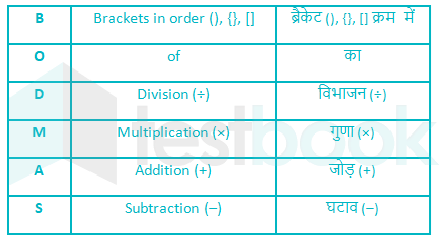
Follow BODMAS rule to solve this question, as per the order given below, 

Calculation:

25% of 900 ÷ 0.75 + √289 = ?

⇒ 25 × 9 ÷ 0.75 + 17 = ?

⇒ 25 × 9 × (4/3) + 17 = ?

⇒ 300 + 17 = ?

⇒ 317 = ?

∴ The value of ? is 317

41

What will come in the place of the question mark ‘?’ in the following question?

(25% of 32 × 3) ÷ 4 – 23  = ?

  1. ((a))

    15

  2. ((b))

    -17

  3. ((c))

    -20

  4. ((d))

    19

  5. ((e))

    30

Show Answer
Answer: ((b))

-17

Concept Used:

Follow BODMAS rule to solve this question, as per the order given below, 

Calculation:

(25% of 32 × 3) ÷ 4 – 23  = ?

⇒ [(25/100) × 32 × 3] ÷ 4 – 23  = ?

⇒ (8 × 3) ÷ 4 – 23  = ? 

⇒ 6 – 23  = ?

∴ The value of ? is -17.

42

What value should come in place of question mark(?) in the question? 

352 ÷ 4 – 108 + 17 × 4 = ?

  1. ((a))

    48

  2. ((b))

    35

  3. ((c))

    57

  4. ((d))

    64

  5. ((e))

    None of these

Show Answer
Answer: ((a))

48

Concept used:

Calculation:

Our equation is 352 ÷ 4 – 108 + 17 × 4

⇒ 88 – 108 + 17 × 4

⇒ 88 – 108 + 68

⇒ 156 – 108

⇒ 48

∴ The value of the given expression is 48

43

What will come in the place of the question mark ‘?’ in the following question? 

57.14% of 343 + 28.57% of 49 = ?

  1. ((a))

    140

  2. ((b))

    210

  3. ((c))

    280

  4. ((d))

    350

  5. ((e))

    420

Show Answer
Answer: ((b))

210

GIVEN:

57.14% of 343 + 28.57% of 49 = ?

FORMULA USED:

These types of questions, the knowledge of conversion from percentage to fraction should be known.

Fraction1/72/73/74/75/7
Percentage (%)14.2828.5742.8457.1471.43

Concept :

Follow BODMAS rule to solve this question, as per the order given below.

Step - 1: Parts of an equation enclosed in 'Brackets' must be solved first, and following BODMAS rule in the bracket -

Step - 2: Any mathematical 'Of' or 'Exponent' must be solved next.

Step - 3: Next, the parts of the equation that contain 'Division' and 'Multiplication' are calculated.

Step - 4: Last but not the least, the parts of the equation that contain 'Addition' and 'Subtraction' should be calculated.

CALCULATION:

57.14% of 343 = (4/7) × 343 = 4 × 49 = 196

28.57% of 49 = (2/7) × 49 = 2 × 7 = 14

Given expression is

57.14% of 343 + 28.57% of 49 = ?

⇒ 196 + 14 = ?

⇒ 210 = ?

∴ ? = 210

44

What will come in the place of the question mark ‘?’ in the following question?

72.5 × 4 – 300% of √6241 = √?

  1. ((a))

    2704

  2. ((b))

    2809

  3. ((c))

    3969

  4. ((d))

    3844

  5. ((e))

    3973

Show Answer
Answer: ((b))

2809

Follow BODMAS rule to solve this question, as per the order given below.

<br>

Step - 1: Parts of an equation enclosed in 'Brackets' must be solved first, and following BODMAS rule in the bracket -

<br>

Step - 2: Any mathematical 'Of' or 'Exponent' must be solved next.

<br>

Step - 3: Next, the parts of the equation that contain 'Division' and 'Multiplication' are calculated.

<br>

Step - 4: Last but not the least, the parts of the equation that contain 'Addition' and 'Subtraction' should be calculated.

<br>

Given expression is

72.5 of 4 – 300% of √6241 = √?

⇒ 290 – 3 × 79 = √?

⇒ 290 – 237 = √?

⇒ √? = 53

⇒ ? = 532

∴ ? = 2809

45

What will come in the place of the question mark ‘?’ in the following question?

 643 ÷ 16 ÷ 8 – 36 × 25 = 4 × ?

  1. ((a))

    307

  2. ((b))

    317

  3. ((c))

    270

  4. ((d))

    287

  5. ((e))

    300

Show Answer
Answer: ((d))

287

Given:

643 ÷ 16 ÷ 8 – 36 × 25 = 4 × ?

Concept:

Follow the BODMAS rule according to the table given below:

Calculation:

643 ÷ 16 ÷ 8 – 36 × 25 = 4 × ?

⇒ (26)3 × 1161\over16 × 181\over8 – 36 × 25 = 4 × ?

⇒ 218 × 1241\over2^4 × 1231\over2^3 – 36 × 25 = 4 × ?

⇒ 211 - 900 = 4 × ?

⇒ 2048 – 900 = 4 × ?

⇒ 4 × ? = 2048 – 900

⇒ ? = 1148/4 = 287

∴ The correct answer is 287.

46

What will come in place of question mark (?) in the following equation?

120 ÷ 24 + 11 × 6 = ?

  1. ((a))

    61

  2. ((b))

    65

  3. ((c))

    75

  4. ((d))

    71

  5. ((e))

    81

Show Answer
Answer: ((d))

71

Follow BODMAS rule to solve this question, as per the order given below, 

Step-1: Parts of an equation enclosed in 'Brackets' must be solved first, and in the bracket, 

Step-2: Any mathematical 'Of' or 'Exponent' must be solved next, 

Step-3: Next, the parts of the equation that contain 'Division' and 'Multiplication' are calculated, 

Step-4: Last but not least, the parts of the equation that contain 'Addition' and 'Subtraction' should be calculated 

120 ÷ 24 + 11 × 6 = ?

⇒ 5 + 66 = ?

∴ ? = 71

47

What will come in place of question mark (?) in the following equation?

112 + 44 – 122 + 22 = √?

  1. ((a))

    125

  2. ((b))

    5

  3. ((c))

    625

  4. ((d))

    1625

  5. ((e))

    25

Show Answer
Answer: ((c))

625

Follow BODMAS rule to solve this question, as per the order given below, 

Step-1: Parts of an equation enclosed in 'Brackets' must be solved first, and in the bracket, 

Step-2: Any mathematical 'Of' or 'Exponent' must be solved next, 

Step-3: Next, the parts of the equation that contain 'Division' and 'Multiplication' are calculated, 

Step-4: Last but not least, the parts of the equation that contain 'Addition' and 'Subtraction' should be calculated 

112 + 44 – 122 + 22 = √?

⇒ 121 + 44 – 144 + 4 = √?

⇒ 165 – 140 = √?

⇒ 25 = √?

∴ ? = 625

48

A train 150 metres long crosses a pole in 10 seconds. Find the speed of the train in km/hr.

  1. ((a))

    45 km/hr

  2. ((b))

    50 km/hr

  3. ((c))

    54 km/hr

  4. ((d))

    60 km/hr

  5. ((e))

    65 km/hr

Show Answer
Answer: ((c))

54 km/hr

Shortcut Trick

When a train crosses a pole, the distance covered is equal to the length of the train itself.

Speed in m/s = Length ÷ Time = 150 ÷ 10 = 15 m/s.

To convert m/s to km/hr, multiply by 18/5.

Speed in km/hr = 15 × (18/5) = 3 × 18 = 54 km/hr.

∴ The correct answer is 54 km/hr.

Alternate Method

Given:

Length of the train (Distance) = 150 m

Time taken to cross the pole = 10 seconds

Formula Used:

Speed = Distance ÷ Time

Speed (km/hr) = Speed (m/s) × (18/5)

Code
Train (150m)   Pole Time = 10 seconds

Calculations:

⇒ Speed of train in m/s = 150 ÷ 10

⇒ Speed = 15 m/s

⇒ Now, converting m/s to km/hr:

⇒ Speed = 15 × (18/5) km/hr

⇒ Speed = 3 × 18 km/hr

⇒ Speed = 54 km/hr

∴ The correct answer is 54 km/hr.

Additional Information

Unit Conversion Rules

To convert speed from km/hr to m/s, multiply by 5/18. To convert m/s to km/hr, multiply by 18/5.

Crossing a Stationary Object with Length

When a train crosses a platform, bridge, or another stationary train, the total distance is (Length of train + Length of object).

Relative Speed Concept

If two trains are moving in the same direction, relative speed = S1 − S2. If they move in opposite directions, relative speed = S1 + S2.

Directions: The bar graph shows the number of units sold by four companies A, B, C and D. The Selling Price (SP) per unit for company A is₹80 and for company B is₹120. 

49

25% of the units sold by A were returned, and 40% of the units sold by B were returned. Find the difference between the revenue (after returns) earned by A and B.

  1. ((a))

    ₹8,400

  2. ((b))

    ₹8,800

  3. ((c))

    ₹9,200

  4. ((d))

    ₹9,600

  5. ((e))

    ₹10,000

Show Answer
Answer: ((d))

₹9,600

Common Calculation

CompanyUnits SoldSelling Price (SP) per unit
A400₹80
B200₹120
C500-
D640-


Given:

Units sold by A = 400

Return rate A = 25%

SP per unit A = ₹80

Units sold by B = 200

Return rate B = 40%

SP per unit B = ₹120

Formula Used:

Net units = Units sold − (Return % × Units sold)

Revenue = Net units × SP per unit

Difference = |Revenue A − Revenue B|

Calculation:

⇒ Net units sold by A = 400 − (25 / 100 × 400) = 400 − 100 = 300

⇒ Revenue earned by A = 300 × 80 = ₹24,000

⇒ Net units sold by B = 200 − (40 / 100 × 200) = 200 − 80 = 120

⇒ Revenue earned by B = 120 × 120 = ₹14,400

⇒ Difference = 24,000 − 14,400 = 9,600

∴ The correct answer is ₹9,600.

50

A new company E sold 20% more units than the average number of units sold by A and B combined. If company E produced a total of 600 units, find the ratio of units sold to units unsold by E.

  1. ((a))

    2 : 3

  2. ((b))

    3 : 2

  3. ((c))

    5 : 3

  4. ((d))

    3 : 5

  5. ((e))

    4 : 3

Show Answer
Answer: ((b))

3 : 2

Common Calculation

CompanyNumber of units sold
A400
B200
C500
D640


Given:

Units sold by A = 400

Units sold by B = 200

Total units produced by E = 600

Formula Used:

Average = (Sum of units) / 2

Units sold by E = Average × (1 + 20 / 100)

Units unsold by E = Total produced − Units sold

Ratio = Units sold : Units unsold

Calculation:

⇒ Average units sold by A and B = (400 + 200) / 2 = 600 / 2 = 300

⇒ Units sold by E = 300 + (20% of 300)

⇒ Units sold by E = 300 + 60 = 360

⇒ Units unsold by E = 600 − 360 = 240

⇒ Ratio = 360 : 240

⇒ Ratio = 3 : 2

∴ The correct answer is 3 : 2

51

The number of units produced by company D was 40% more than the number of units sold by it. Find the combined number of unsold units of companies C and D.

  1. ((a))

    356

  2. ((b))

    371

  3. ((c))

    381

  4. ((d))

    391

  5. ((e))

    401

Show Answer
Answer: ((c))

381

Common Calculation

CompanyNumber of Units SoldSelling Price (SP) per unit (₹)
A40080
B200120
C500
D640

Given:

Number of unsold units of company C = 125

Number of units sold by company D = 640

Number of units produced by company D = 40% more than units sold by it

Formula Used:

Unsold Units = Units Produced − Units Sold

Calculation:

⇒ Units produced by company D = 640 × (100 + 40) / 100

⇒ Units produced by company D = 640 × 140 / 100 = 896

⇒ Unsold units of company D = 896 − 640 = 256

⇒ Combined unsold units of C and D = 125 + 256

⇒ Combined unsold units of C and D = 381

∴ The correct answer is option 3) 381.

52

The number of units produced by company C was 25% more than the number of units sold by it. How many units of C remained unsold?

  1. ((a))

    100

  2. ((b))

    110

  3. ((c))

    120

  4. ((d))

    125

  5. ((e))

    130

Show Answer
Answer: ((d))

125

Common Calculation

CompanyNumber of Units SoldSelling Price (SP) per unit (₹)
A40080
B200120
C500
D640

Given:

Number of units sold by company C = 500

Number of units produced by company C = 25% more than units sold

Formula Used:

Units Produced = Units Sold × (100 + Percentage more) / 100

Unsold Units = Units Produced − Units Sold

Calculation:

⇒ Units produced by company C = 500 × (100 + 25) / 100

⇒ Units produced by company C = 500 × 125 / 100

⇒ Units produced by company C = 500 × 1.25 = 625

⇒ Unsold units = 625 − 500

⇒ Unsold units = 125

∴ The correct answer is option 4) 125.

53

Company A produced a total of 550 units. How many units of A remained unsold?

  1. ((a))

    (a) 100

  2. ((b))

    (b) 125

  3. ((c))

    (c) 150

  4. ((d))

    (d) 175

  5. ((e))

    (e) 200

Show Answer
Answer: ((c))

(c) 150

Common Calculation

CompanyNumber of Units SoldSelling Price (SP) per unit (₹)
A40080
B200120
C500-
D640-

Given:

Total units produced by Company A = 550

Total units sold by Company A = 400

Formula Used:

Unsold Units = Total Units Produced − Total Units Sold

Calculation:

⇒ Unsold Units = 550 − 400

⇒ Unsold Units = 150

∴ The correct answer is 150.

54

The area of a square is 196 sq. cm. Find the perimeter of a rectangle whose length is equal to the side of the square and breadth is 10 cm.

  1. ((a))

    40 cm

  2. ((b))

    44 cm

  3. ((c))

    48 cm

  4. ((d))

    52 cm

  5. ((e))

    56 cm

Show Answer
Answer: ((c))

48 cm

Shortcut Trick

Side of square = √196 = 14 cm.

Length of rectangle = 14 cm, Breadth = 10 cm.

Perimeter = 2 × (14 + 10) = 48 cm.

∴ The correct answer is 48 cm.

Alternate Method

Given:

Area of square = 196 cm2

Breadth of rectangle (b) = 10 cm

Length of rectangle (l) = Side of square (a)

Formula Used:

Area of square = a2

Perimeter of rectangle = 2 × (l + b)

Square (Area=196) a = 14 Rectangle l = 14 b = 10 Perimeter = 2 × (14 + 10) = 48 cm

Calculations:

⇒ a2 = 196

⇒ a = √196

⇒ a = 14 cm

⇒ Length of rectangle (l) = 14 cm

⇒ Perimeter of rectangle = 2 × (l + b)

⇒ Perimeter = 2 × (14 + 10)

⇒ Perimeter = 2 × 24

⇒ Perimeter = 48 cm

∴ The correct answer is 48 cm.

Additional Information

Square Properties

Area = (side)2 and Perimeter = 4 × side. The diagonal of a square is side × √2.

Rectangle Properties

Area = length × breadth and Perimeter = 2 × (length + breadth). Diagonal = √(l2 + b2).

Equivalence of Shapes

If a square and a rectangle have the same perimeter, the square will always have a greater area.

55

A can complete a piece of work in 12 days and B can complete the same work in 18 days. In how many days will they complete the work together?

  1. ((a))

    6.5 days

  2. ((b))

    7 days

  3. ((c))

    7.2 days

  4. ((d))

    7.5 days

  5. ((e))

    8 days

Show Answer
Answer: ((c))

7.2 days

Shortcut Trick

When two people A and B work together, time taken = (A × B) ÷ (A + B)

Given: A = 12 days, B = 18 days

Combined Time = (12 × 18) ÷ (12 + 18)

Combined Time = 216 ÷ 30 = 7.2 days

∴ The correct answer is 7.2 days.

Alternate Method

Given:

Time taken by A = 12 days

Time taken by B = 18 days

Formula Used:

Total Work = LCM of individual days

Efficiency = Total Work ÷ Time taken

PersonDaysTotal WorkEfficiency
A12363
B182

Calculations:

⇒ Total Efficiency of A and B = 3 + 2 = 5 units/day

⇒ Time taken to complete work together = Total Work ÷ Total Efficiency

⇒ Time = 36 ÷ 5

⇒ Time = 7.2 days

∴ The correct answer is 7.2 days.

Additional Information

Efficiency and Time Relationship

Efficiency is inversely proportional to the time taken to complete a task (Efficiency = 1 ÷ Time).

Work and Wages

In work and wages problems, the total wage is distributed among workers in the ratio of their individual efficiencies or the work done by them.

Pipes and Cisterns

This follows the same logic as Time and Work, where a filling pipe has positive efficiency and an outlet pipe (leak) has negative efficiency.

56

A person spends 40% of his monthly salary on rent and 30% of the remaining amount on food. If he is left with ■8,400, find his monthly salary.

  1. ((a))

    ■18,000

  2. ((b))

    ■20,000

  3. ((c))

    ■22,000

  4. ((d))

    ■24,000

  5. ((e))

    ■25,000

Show Answer
Answer: ((b))

■20,000

Shortcut Trick

Successive remaining method: Total × (100 − 40)% × (100 − 30)% = 8,400

Total × 60% × 70% = 8,400

Total × 0.42 = 8,400

Total = 8,400 ÷ 0.42 = ₹20,000

∴ The correct answer is ₹20,000.

Alternate Method

Given:

Spending on rent = 40% of salary

Spending on food = 30% of the remaining amount

Savings (Amount left) = ₹8,400

Formula Used:

Final Value = Initial Value × (1 − r1/100) × (1 − r2/100)

Code
 Total Salary (100%) Rent (40%) Food (18%) Savings (42% = ₹8,400)  Remaining (60%)  Salary = 8,400 ÷ 0.42 = ₹20,000

Calculations:

Let the total monthly salary be ₹x.

⇒ Amount spent on Rent = 40% of x = 0.40x

⇒ Remaining amount = x − 0.40x = 0.60x

⇒ Amount spent on Food = 30% of 0.60x = 0.18x

⇒ Final Savings = 0.60x − 0.18x = 0.42x

⇒ 0.42x = 8,400

⇒ x = 8,400 ÷ 0.42

⇒ x = 840,000 ÷ 42

⇒ x = 20,000

∴ The correct answer is ₹20,000.

Additional Information

Successive Percentage Change

When values change sequentially on the remaining balance, use the multiplying factor: Final = Initial × (1 ± r1/100) × (1 ± r2/100).

Percentage to Fraction Conversion

40% = 2/5 and 30% = 3/10. Remaining fractions are 3/5 and 7/10. Total Salary × (3/5) × (7/10) = Savings.

Effective Discount / Decrease

The single equivalent decrease for x% and y% is [x + y − (xy/100)]%. Here: 40 + 30 − (1200/100) = 58% total expenditure.

57

Find the compound interest on ₹8,000 at 10% per annum for 2 years, compounded annually.

  1. ((a))

    (a) ₹1,600

  2. ((b))

    (b) ₹1,680

  3. ((c))

    (c) ₹1,700

  4. ((d))

    (d) ₹1,750

  5. ((e))

    (e) ₹1,800

Show Answer
Answer: ((b))

(b) ₹1,680

Shortcut Trick

Effective Rate for 2 years = x + y + (x × y)/100

Effective Rate = 10 + 10 + (10 × 10)/100 = 21%

Compound Interest = 21% of ₹8,000

CI = 0.21 × 8,000 = ₹1,680

∴ The correct answer is ₹1680.

Alternate Method

Given:

Principal (P) = ₹8,000

Rate (R) = 10% per annum

Time (n) = 2 years

Code
  Year 0 Year 1 Year 2  Principal: ₹8,000  +10% (₹800)  +10% (₹880) Total CI = ₹800 + ₹880 = ₹1,680

Formula Used:

Amount (A) = P × (1 + R/100)n

Compound Interest (CI) = A − P

Calculations:

⇒ A = 8,000 × (1 + 10/100)2

⇒ A = 8,000 × (1 + 0.1)2

⇒ A = 8,000 × (1.1)2

⇒ A = 8,000 × 1.21

⇒ A = 9,680

⇒ CI = 9,680 − 8,000

⇒ CI = 1,680

∴ The correct answer is ₹1680.

Additional Information

Difference between CI and SI

For 2 years, the difference (D) is given by D = P × (R/100)2. For 3 years, D = P × (R/100)2 × (3 + R/100).

Half-Yearly Compounding

When interest is compounded half-yearly, the rate is halved (R/2) and the time is doubled (2n).

Effective Rate Formula

The net percentage change for two successive increments of x% and y% is [x + y + (xy/100)]%.

Directions: Study the table and answer the questions. The table shows the number of Hindi, English and German books sold by five shops A, B, C, D and E. The Selling Price (SP) of each English book is ₹150 and of each German book is ₹200.

ShopHindiEnglishGerman
A300500250
B400400300
C600500300
D250500450
E300750350
58

Find the average number of English books sold by all five shops together.

  1. ((a))

    490

  2. ((b))

    510

  3. ((c))

    530

  4. ((d))

    550

  5. ((e))

    570

Show Answer
Answer: ((c))

530

Common Calculation

ShopHindi BooksEnglish BooksGerman Books
A300500250
B400400300
C600500300
D250500450
E300750350

Selling price (SP) of each English book = ₹150

Selling price (SP) of each German book = ₹200

Given:

Number of English books sold by shops: A = 500, B = 400, C = 500, D = 500, E = 750.

Formula Used:

Average = Sum of items / Number of items

Calculation:

⇒ Total English books = 500 + 400 + 500 + 500 + 750

⇒ Total English books = 2650

⇒ Average = 2650 / 5

⇒ Average = 530

∴ The correct answer is 530.

59

The total number of books sold by shop C is approximately what percent more than the total number of books sold by shop B?

  1. ((a))

    18.18%

  2. ((b))

    22.72%

  3. ((c))

    27.27%

  4. ((d))

    31.81%

  5. ((e))

    36.36%

Show Answer
Answer: ((c))

27.27%

Common Calculation

ShopHindi BooksEnglish BooksGerman BooksTotal Books
A3005002501050
B4004003001100
C6005003001400
D2505004501200
E3007503501400

Given:

Total books sold by shop C = 1400

Total books sold by shop B = 1100

Formula Used:

Percentage More = [(Value 1 − Value 2) / Value 2] × 100

Calculation:

⇒ Total books sold by Shop C = 600 + 500 + 300 = 1400

⇒ Total books sold by Shop B = 400 + 400 + 300 = 1100

⇒ Difference = 1400 − 1100 = 300

⇒ Percentage More = (300 / 1100) × 100

⇒ Percentage More = 300 / 11

⇒ Percentage More ≈ 27.27%

∴ The correct answer is 27.27%.

60

Find the ratio of German books sold by shop A to Hindi books sold by shop B.

  1. ((a))

    5 : 8

  2. ((b))

    3 : 5

  3. ((c))

    5 : 6

  4. ((d))

    4 : 7

  5. ((e))

    5 : 9

Show Answer
Answer: ((a))

5 : 8

Common Calculation

ShopHindi BooksEnglish BooksGerman Books
A300500250
B400400300
C600500300
D250500450
E300750350

Given:

German books sold by shop A = 250

Hindi books sold by shop B = 400

Formula Used:

Ratio = Value 1 / Value 2

Calculation:

⇒ Required Ratio = 250 / 400

⇒ Required Ratio = 25 / 40

⇒ Required Ratio = 5 / 8

∴ The correct answer is 5 : 8.

61

The number of German books sold by shop E is 50 more than that sold by shop B, and the total number of books sold by E equals the total number of books sold by shop C. Find the combined number of Hindi and English books sold by shop E.

  1. ((a))

    950

  2. ((b))

    1000

  3. ((c))

    1050

  4. ((d))

    1100

  5. ((e))

    1150

Show Answer
Answer: ((c))

1050

Common Calculation

ShopHindi BooksEnglish BooksGerman BooksTotal Books
A3005002501050
B4004003001100
C6005003001400
D2505004501200
E3007503501400

Given:

Hindi books sold by shop E = 300

English books sold by shop E = 750

German books sold by shop E = 350

German books sold by shop B = 300

Total books sold by shop C = 1400

Formula Used:

Combined books = Number of Hindi books + Number of English books

Calculation:

⇒ Total books sold by E = 300 + 750 + 350 = 1400 (matches shop C total)

⇒ German books by E (350) − German books by B (300) = 50 (matches condition)

⇒ Combined Hindi and English books (E) = 300 + 750

⇒ 1050

∴ The correct answer is option 3) 1050.

62

What is the total revenue generated from English and German books sold by shops A and D combined?

  1. ((a))

    ₹2,60,000

  2. ((b))

    ₹2,75,000

  3. ((c))

    ₹2,90,000

  4. ((d))

    ₹3,05,000

  5. ((e))

    ₹3,20,000

Show Answer
Answer: ((c))

₹2,90,000

Common Calculation

ShopHindi BooksEnglish BooksGerman Books
A300500250
B400400300
C600500300
D250500450
E300750350

Selling Price (SP) of each English book = ₹150

Selling Price (SP) of each German book = ₹200

Given:

English books sold by Shop A = 500

English books sold by Shop D = 500

German books sold by Shop A = 250

German books sold by Shop D = 450

SP of English book = ₹150

SP of German book = ₹200

Formula Used:

Total Revenue = (Total English books × SP per English book) + (Total German books × SP per German book)

Calculation:

⇒ Total English books (A + D) = 500 + 500 = 1000

⇒ Total German books (A + D) = 250 + 450 = 700

⇒ Revenue from English books = 1000 × 150 = ₹1,50,000

⇒ Revenue from German books = 700 × 200 = ₹1,40,000

⇒ Total Revenue = 1,50,000 + 1,40,000 = ₹2,90,000

∴ The correct answer is ₹2,90,000.

Verified Answer: option 3)  ₹2,90,000

63

A shopkeeper marks an article 40% above its cost price and then gives a discount of 10% on the marked price. Find his profit percentage.

  1. ((a))

    20%

  2. ((b))

    24%

  3. ((c))

    26%

  4. ((d))

    28%

  5. ((e))

    30%

Show Answer
Answer: ((c))

26%

Shortcut Trick

Apply the effective percentage change formula: Net % = x + y + (xy/100)

Here, Markup (x) = +40 and Discount (y) = −10

Profit % = 40 − 10 + [40 × (−10) ÷ 100]

Profit % = 30 − 4 = 26%

∴ The correct answer is 26%.

Alternate Method

Given:

Markup % = 40%

Discount % = 10%

CP = 100 +40% Markup MP = 140 −10% Discount SP = 126 Profit = SP − CP = 126 − 100 = 26

Let the Cost Price (CP) be 100 units.

⇒ Marked Price (MP) = CP + 40% of CP

⇒ MP = 100 + 40 = 140 units

⇒ Discount = 10% of MP = 0.10 × 140 = 14 units

⇒ Selling Price (SP) = MP − Discount

⇒ SP = 140 − 14 = 126 units

⇒ Profit = SP − CP = 126 − 100 = 26 units

⇒ Profit % = (Profit ÷ CP) × 100

⇒ Profit % = (26 ÷ 100) × 100 = 26%

∴ The correct answer is 26%.

Additional Information

Effective Percentage Change

When a value is changed by x% and then by y%, the net change is given by [x + y + (xy/100)]%.

Marked Price and Discount

Discount is always calculated on the Marked Price (MP). SP = MP × [1 − (Discount % ÷ 100)].

Markup Percentage

Markup is the increase in price over the Cost Price. MP = CP × [1 + (Markup % ÷ 100)].

64

A invests ₹6,000 and B invests ₹9,000 in a business for the same period of time. If the total profit at the end of the year is ₹7,500, find A's share of the profit.

  1. ((a))

    (a) ₹2,500

  2. ((b))

    (b) ₹3,000

  3. ((c))

    (c) ₹3,500

  4. ((d))

    (d) ₹4,000

  5. ((e))

    (e) ₹4,500

Show Answer
Answer: ((b))

(b) ₹3,000

Shortcut Trick

Profit Ratio (A : B) = Investment Ratio = 6000 : 9000 = 2 : 3

Total Profit parts = 2 + 3 = 5 parts

Value of 5 parts = ₹7,500 → 1 part = ₹1,500

A's share (2 parts) = 2 × 1,500 = ₹3,000

∴ The correct answer is ₹3,000.

Alternate Method

Given:

Investment of A = ₹6,000

Investment of B = ₹9,000

Total Profit = ₹7,500

Time period is same for both.

Formula Used:

Profit Ratio = (CapitalA × TimeA) : (CapitalB × TimeB)

A (₹6,000) B (₹9,000) Ratio Part: 2 units Ratio Part: 3 units Total Profit = ₹7,500 (5 units) A's Share = ?

Calculations:

⇒ Profit Ratio A : B = 6,000 : 9,000

⇒ Profit Ratio A : B = 2 : 3

⇒ Sum of ratio parts = 2 + 3 = 5

⇒ A's Share of profit = (A's ratio / Total ratio) × Total Profit

⇒ A's Share = (2 / 5) × 7,500

⇒ A's Share = 2 × 1,500

⇒ A's Share = ₹3,000

∴ The correct answer is ₹3,000.

Additional Information

Partnership Profit Ratio

The profit is always distributed in the ratio of (Investment × Time). If time is constant, profit ∝ investment.

Working vs Sleeping Partner

A working partner may receive an additional percentage of profit as salary before the remaining profit is divided in the investment ratio.

Change in Investment

If partners change their investment mid-year, calculate effective capital as ∑(Capital × Months) for each partner.

65

A boat covers 24 km downstream in 2 hours and covers the same distance upstream in 3 hours. Find the speed of the boat in still water.

  1. ((a))

    8 km/hr

  2. ((b))

    9 km/hr

  3. ((c))

    10 km/hr

  4. ((d))

    11 km/hr

  5. ((e))

    12 km/hr

Show Answer
Answer: ((c))

10 km/hr

Shortcut Trick

Downstream Speed (D) = 24 ÷ 2 = 12 km/hr

Upstream Speed (U) = 24 ÷ 3 = 8 km/hr

Speed of boat in still water = (D + U) ÷ 2

Speed of boat = (12 + 8) ÷ 2 = 10 km/hr

∴ The correct answer is 10 km/hr.

Alternate Method

Given:

Distance covered downstream = 24 km in 2 hours

Distance covered upstream = 24 km in 3 hours

Formula used: Speed = Distance ÷ Time

Code
 Downstream: 12 km/hr   Upstream: 8 km/hr Boat Speed in Still Water (u)  u

⇒ Downstream Speed (u + v) = 24 ÷ 2 = 12 km/hr ... (Eq. 1)

⇒ Upstream Speed (u − v) = 24 ÷ 3 = 8 km/hr ... (Eq. 2)

⇒ Adding (Eq. 1) and (Eq. 2):

⇒ (u + v) + (u − v) = 12 + 8

⇒ 2u = 20

⇒ u = 20 ÷ 2 = 10 km/hr

∴ The correct answer is 10 km/hr.

Additional Information

Speed of Stream (Current)

The speed of the stream or current (v) is calculated as half the difference between downstream and upstream speeds: v = (D − U) ÷ 2.

Relationship in Still Water

Speed in still water (u) is the arithmetic mean of downstream and upstream speeds: u = (D + U) ÷ 2.

Direction and Relative Speed

In downstream motion, the stream assists the boat (u+v), while in upstream motion, it opposes the boat (u−v).

Verified Answer: option 3 10 km/hr

Reasoning Ability (35 questions)

Direction: Study the following information carefully and answer the questions given below.

Eight persons – A, B, C, D, J, K, L and M are living in a building having four floors but not necessarily in the same order, where ground floor is numbered as 1, the floor above it is numbered as 2 and so on till the topmost floor which is numbered as 4. Each floor is having two flats i.e., Flat - 1 and flat – 2. Flat – 1 of floor – 2 is exactly above the flat – 1 of floor – 1 and exactly below the flat – 1 of floor – 3 and so on. Similarly flat – 2 of floor – 2 is exactly above the flat – 2 of floor – 1 and exactly below flat – 2 of floor – 3 and so on. Flat – 2 is in east of flat – 1.

J lives on the floor immediately above D. L lives on odd numbered flat. There are two floors between J and A and both lives on same flat. B lives in west of D. There is 1 floor between L and K and both live on different numbered flats. M does not live on an odd numbered flat. K lives on even flat. M lives on floor – 1.

66

Who among the following lives in flat – 2 of 4th floor?

  1. ((a))

    J

  2. ((b))

    B

  3. ((c))

    K

  4. ((d))

    D

  5. ((e))

    C

Show Answer
Answer: ((c))

K

  1. J lives on the floor immediately above D

  2. There are two floors between J and A and both lives on same flat.

  3. B lives in west of D.

Case 1Case 2
No. of floorsFlat – 1Flat – 2Flat – 1Flat – 2
4JJ
3BDBD
2
1AA


  1. M lives on floor – 1.

  2. M does not live on odd numbered flat so according to this Case 2 will get eliminated.

  3.  There is 1 floor between L and K and both live on different numbered flats.

  4. K lives on even flat so according to according to this, K will live on floor numbered 4.

8) L lives on odd numbered flat. 

Case 1
No. of floorsFlat – 1Flat – 2
4JK
3BD
2L
1AM


  1. Remaining person C will live in flat - 2 of floor - 2.

Final Arrangement:

No. of floorsFlat – 1Flat – 2
4JK
3BD
2LC
1AM


Hence, K lives in flat – 2 of 4th floor.

67

How many floors are there between B and M?

  1. ((a))

    One

  2. ((b))

    Two

  3. ((c))

    Three

  4. ((d))

    Four

  5. ((e))

    None of these

Show Answer
Answer: ((a))

One

  1. J lives on the floor immediately above D

  2. There are two floors between J and A and both lives on same flat.

  3. B lives in west of D.

Case 1Case 2
No. of floorsFlat – 1Flat – 2Flat – 1Flat – 2
4JJ
3BDBD
2
1AA


  1. M lives on floor – 1.

  2. M does not live on odd numbered flat so according to this Case 2 will get eliminated.

  3.  There is 1 floor between L and K and both live on different numbered flats.

  4. K lives on even flat so according to according to this, K will live on floor numbered 4.

8) L lives on odd numbered flat. 

Case 1
No. of floorsFlat – 1Flat – 2
4JK
3BD
2L
1AM


  1. Remaining person C will live in flat - 2 of floor - 2.

Final Arrangement:

No. of floorsFlat – 1Flat – 2
4JK
3BD
2LC
1AM


Hence, one floor there between B and M.

68

Who among the following lives on floor no. 2?

  1. ((a))

    L and D

  2. ((b))

    D and B

  3. ((c))

    K and L

  4. ((d))

    C and L

  5. ((e))

    C and A

Show Answer
Answer: ((d))

C and L

  1. J lives on the floor immediately above D

  2. There are two floors between J and A and both lives on same flat.

  3. B lives in west of D.

Case 1Case 2
No. of floorsFlat – 1Flat – 2Flat – 1Flat – 2
4JJ
3BDBD
2
1AA


  1. M lives on floor – 1.

  2. M does not live on odd numbered flat so according to this Case 2 will get eliminated.

  3.  There is 1 floor between L and K and both live on different numbered flats.

  4. K lives on even flat so according to according to this, K will live on floor numbered 4.

8) L lives on odd numbered flat. 

Case 1
No. of floorsFlat – 1Flat – 2
4JK
3BD
2L
1AM


  1. Remaining person C will live in flat - 2 of floor - 2.

Final Arrangement:

No. of floorsFlat – 1Flat – 2
4JK
3BD
2LC
1AM


Hence, C and L lives on floor no. 2.

69

Who lives immediately above M?

  1. ((a))

    B

  2. ((b))

    D

  3. ((c))

    C

  4. ((d))

    J

  5. ((e))

    A

Show Answer
Answer: ((c))

C

  1. J lives on the floor immediately above D

  2. There are two floors between J and A and both lives on same flat.

  3. B lives in west of D.

Case 1Case 2
No. of floorsFlat – 1Flat – 2Flat – 1Flat – 2
4JJ
3BDBD
2
1AA


  1. M lives on floor – 1.

  2. M does not live on odd numbered flat so according to this Case 2 will get eliminated.

  3.  There is 1 floor between L and K and both live on different numbered flats.

  4. K lives on even flat so according to according to this, K will live on floor numbered 4.

8) L lives on odd numbered flat. 

Case 1
No. of floorsFlat – 1Flat – 2
4JK
3BD
2L
1AM


  1. Remaining person C will live in flat - 2 of floor - 2.

Final Arrangement:

No. of floorsFlat – 1Flat – 2
4JK
3BD
2LC
1AM


Hence, C lives immediately above M.

70

Which of the following combinations is correct?

  1. ((a))

    J, Flat - 2

  2. ((b))

    B, Flat - 2

  3. ((c))

    L, Flat - 2

  4. ((d))

    K, Flat - 2

  5. ((e))

    A, Flat - 2

Show Answer
Answer: ((d))

K, Flat - 2

  1. J lives on the floor immediately above D

  2. There are two floors between J and A and both lives on same flat.

  3. B lives in west of D.

Case 1Case 2
No. of floorsFlat – 1Flat – 2Flat – 1Flat – 2
4JJ
3BDBD
2
1AA


  1. M lives on floor – 1.

  2. M does not live on odd numbered flat so according to this Case 2 will get eliminated.

  3.  There is 1 floor between L and K and both live on different numbered flats.

  4. K lives on even flat so according to according to this, K will live on floor numbered 4.

8) L lives on odd numbered flat. 

Case 1
No. of floorsFlat – 1Flat – 2
4JK
3BD
2L
1AM


  1. Remaining person C will live in flat - 2 of floor - 2.

Final Arrangement:

No. of floorsFlat – 1Flat – 2
4JK
3BD
2LC
1AM

Hence, combination of “K, Flat - 2” is correct.

71

If 1 is added to all even digits and 1 is subtracted from all odd digits of the number '296758427849' then what will be the sum of the 4th digit from the right end and the 7th digit from the left end after the rearrangement?

  1. ((a))

    10

  2. ((b))

    13

  3. ((c))

    12

  4. ((d))

    11

  5. ((e))

    14

Show Answer
Answer: ((d))

11

Given:- 296758427849

If 1 is added to all even digits and 1 is subtracted from all odd digits of the number then -

Numbers296758427849
Odd / EvenEOEOOEEEOEEO
+1 if even, -1 if odd+1-1+1-1-1+1+1+1-1+1+1-1
Rearrangement387649536958


The 4th digit from the right end is 6 and the 7th digit from the left end is 5.

Sum = 6 + 5 = 11.

Hence, the correct answer is 11.

Direction: On the basis of the alphabets given below, answer the following questions:

T R G S O I W P A Q D V E U X Z B Y C H F

72

How many such consonants are there in the above series, each of which is immediately preceded by a vowel and followed by a consonant?

  1. ((a))

    Three

  2. ((b))

    Two

  3. ((c))

    One

  4. ((d))

    Five

  5. ((e))

    Six

Show Answer
Answer: ((a))

Three

Given series: Left side   T R G S O I W P A Q D V E U X Z B Y C H F   Right side

Such consonants that are immediately preceded by a vowel and followed by a consonant are:

T R G S O I W P A Q D V E U X Z B Y C H F

Thus, three consonants are immediately preceded by a vowel and followed by a consonant.

Hence, Three is the correct answer.

73

In the above alphabets, if each letter starting from S, is represented by the day of the week starting from Sunday, then what is the position of first occurring Sunday from the right?

  1. ((a))

    Sixth

  2. ((b))

    Seventh

  3. ((c))

    Third

  4. ((d))

    Eighth

  5. ((e))

    Fourth

Show Answer
Answer: ((e))

Fourth

Let Sunday be represented by Su, Monday be Mo, Tuesday be Tu, Wednesday be We, Thursday be Th, Friday be Fr, Saturday be Sa in the following table.

Each letter starting from S is represented by the day of the week starting from Sunday:

AlphabetSOIWPAQDVEUXZBYCHF
DaySuMoTuWeThFrSaSuMoTuWeThFrSaSuMoTuWe


Hence, the position of first occurring Sunday from right is fourth.

74

How many such vowels are there in the above series, each of which is immediately preceded by a vowel and followed by a consonant?

  1. ((a))

    Three

  2. ((b))

    One

  3. ((c))

    Two

  4. ((d))

    Five

  5. ((e))

    Six

Show Answer
Answer: ((c))

Two

Given series: Left side   T R G S O I W P A Q D V E U X Z B Y C H F   Right side

Such vowels that are immediately preceded by a vowel and followed by a consonant are:

T R G S O I W P A Q D V E U X Z B Y C H F

Hence, two vowels are immediately preceded by a vowel and followed by a consonant.

75

If all the vowels are dropped from the above arrangement, which letter will be the fourth letter to the left of the ninth letter from the left end?

  1. ((a))

    P

  2. ((b))

    W

  3. ((c))

    A

  4. ((d))

    I

  5. ((e))

    S

Show Answer
Answer: ((b))

W

Given series: Left side   T R G S O I W P A Q D V E U X Z B Y C H F   Right side

If all the vowels are dropped, the new series will be:

Left side   T R G S W P Q D V X Z B Y C H F  Right side

The ninth letter from the left side is V.   T R G S W P Q D V X Z B Y C H F

The fourth letter to the left of V is W. T R G S W P Q D V

Hence, W is the correct answer.

76

In the following letter series, which will replace the question mark (?)?

PQD, IVQ, SUA, ?, FYW

  1. ((a))

    RSO

  2. ((b))

    TGS

  3. ((c))

    SPE

  4. ((d))

    RZP

  5. ((e))

    QUX

Show Answer
Answer: ((d))

RZP

Given series: Left side   T R G S O I W P A Q D V E U X Z B Y C H F   Right side

  1. First letters are forming different series:

P - 2 = I

I - 2 = S

S - 2 = R

R - 2 = F

  1. Secondletters are forming different series:

Q + 2 = V

V + 2 = U

U + 2 = Z

Z + 2 = Y

  1. Third letters are forming different series:

D - 1 = Q

Q - 1 = A

A - 1 = P

P - 1 = W

Hence, the word formed is RZP.

Direction: Read the following information carefully and answer the given question:

Eight friends - Komal, Ayesha, Aruba, Mary, Ritney, Tanmay, Rohit and Shubham, all are having exam in different month - January, March, April, June, July, August, October and December, but not necessarily in the same order.

Mary having an exam before Komal and one person having an exam between Mary and Shubham. Three people having exams between Aruba and Ayesha. Rohit having an exam one of the month which have 30 days. Ritney having an exam in one of the months which have less than 31 days. Shubham have an exam one of the month before Mary. Two people having exams between Ritney and Aruba. One person having an exam between Tanmay and Ritney.

77

Which of the following  combination is true?

  1. ((a))

    Komal - January

  2. ((b))

    Ritney - October

  3. ((c))

    Shubham - March

  4. ((d))

    Ayesha - July

  5. ((e))

    Aruba - August

Show Answer
Answer: ((e))

Aruba - August

Eight friends - Komal, Ayesha, Aruba, Mary, Ritney, Tanmay, Rohit and Shubham.

Month - January, March, April, June, July, August, October and December.

1) Two people having exams between Ritney and Aruba.

2)  Ritney having an exam in one of the months which have less than 31 days.

3) Three people having exams between Aruba and Ayesha.


MonthsPersonPersonPerson
Case 1Case 2aCase 2b
January (31)Aruba
March (31)Ayesha
April (30)RitneyAyesha
June (30)RitneyRitney
July (31)Ayesha
August (31)Aruba
October (31)Aruba
December (31)


4) Rohit having an exam one of the month which have 30 days. (Rohit have an exam either in April or June. So, Case 2b is invalid.)

5) One person having an exam between Tanmay and Ritney.

  1. One person having an exam between Mary and Shubham.

  2. Shubham have an exam one of the month before Mary.


MonthsPersonPerson
Case 1Case 2a
January (31)TanmayAruba
March (31)AyeshaTanmay
April (30)RitneyRohit
June (30)RohitRitney
July (31)ShubhamAyesha
August (31)ArubaShubham
October (31)MaryKomal
December (31)KomalMary


8) Mary having an exam before Komal.

(case 2b is invalid because in case 2b Mary having exam after Komal)


MonthsPerson
Case 1
January (31)Tanmay
March (31)Ayesha
April (30)Ritney
June (30)Rohit
July (31)Shubham
August (31)Aruba
October (31)Mary
December (31)Komal


Final Solution


MonthsPerson
Case 1
January (31)Tanmay
March (31)Ayesha
April (30)Ritney
June (30)Rohit
July (31)Shubham
August (31)Aruba
October (31)Mary
December (31)Komal


Komal - January → Komal's exam is in December. So, it is false.

Ritney - October → Ritney's exam is in April. So, it is false.

Shubham - March → Shubham's exam is in July. So, it is false.

Ayesha - July → Ayesha's exam is in March. So, it is false

Aruba - August → Aruba's exam is in August. So, it is true.

Hence, the answer is Aruba - August.

78

Who have exam in the month of July?

  1. ((a))

    Mary

  2. ((b))

    Shubham

  3. ((c))

    Aruba

  4. ((d))

    Rohit

  5. ((e))

    Ayesha

Show Answer
Answer: ((b))

Shubham

Eight friends - Komal, Ayesha, Aruba, Mary, Ritney, Tanmay, Rohit and Shubham.

Month - January, March, April, June, July, August, October and December.

1) Two people having exams between Ritney and Aruba.

2)  Ritney having an exam in one of the months which have less than 31 days.

3) Three people having exams between Aruba and Ayesha.


MonthsPersonPersonPerson
Case 1Case 2aCase 2b
January (31)Aruba
March (31)Ayesha
April (30)RitneyAyesha
June (30)RitneyRitney
July (31)Ayesha
August (31)Aruba
October (31)Aruba
December (31)


4) Rohit having an exam one of the month which have 30 days. (Rohit have an exam either in April or June. So, Case 2b is invalid.)

5) One person having an exam between Tanmay and Ritney.

  1. One person having an exam between Mary and Shubham.

  2. Shubham have an exam one of the month before Mary.


MonthsPersonPerson
Case 1Case 2a
January (31)TanmayAruba
March (31)AyeshaTanmay
April (30)RitneyRohit
June (30)RohitRitney
July (31)ShubhamAyesha
August (31)ArubaShubham
October (31)MaryKomal
December (31)KomalMary


8) Mary having an exam before Komal.

(case 2b is invalid because in case 2b Mary having exam after Komal)


MonthsPerson
Case 1
January (31)Tanmay
March (31)Ayesha
April (30)Ritney
June (30)Rohit
July (31)Shubham
August (31)Aruba
October (31)Mary
December (31)Komal


Final Solution


MonthsPerson
Case 1
January (31)Tanmay
March (31)Ayesha
April (30)Ritney
June (30)Rohit
July (31)Shubham
August (31)Aruba
October (31)Mary
December (31)Komal


Shubham have exam in the month of July.

Hence, the answer is Shubham.

79

In a certain way, Tanmay is related to Rohit and Komal is related to Shubham then Aruba is related to whom?

  1. ((a))

    Komal

  2. ((b))

    Ayesha

  3. ((c))

    Rohit

  4. ((d))

    Mary

  5. ((e))

    Ritney

Show Answer
Answer: ((e))

Ritney

Eight friends - Komal, Ayesha, Aruba, Mary, Ritney, Tanmay, Rohit and Shubham.

Month - January, March, April, June, July, August, October and December.

1) Two people having exams between Ritney and Aruba.

2)  Ritney having an exam in one of the months which have less than 31 days.

3) Three people having exams between Aruba and Ayesha.


MonthsPersonPersonPerson
Case 1Case 2aCase 2b
January (31)Aruba
March (31)Ayesha
April (30)RitneyAyesha
June (30)RitneyRitney
July (31)Ayesha
August (31)Aruba
October (31)Aruba
December (31)


4) Rohit having an exam one of the month which have 30 days. (Rohit have an exam either in April or June. So, Case 2b is invalid.)

5) One person having an exam between Tanmay and Ritney.

  1. One person having an exam between Mary and Shubham.

  2. Shubham have an exam one of the month before Mary.


MonthsPersonPerson
Case 1Case 2a
January (31)TanmayAruba
March (31)AyeshaTanmay
April (30)RitneyRohit
June (30)RohitRitney
July (31)ShubhamAyesha
August (31)ArubaShubham
October (31)MaryKomal
December (31)KomalMary


8) Mary having an exam before Komal.

(case 2b is invalid because in case 2b Mary having exam after Komal)


MonthsPerson
Case 1
January (31)Tanmay
March (31)Ayesha
April (30)Ritney
June (30)Rohit
July (31)Shubham
August (31)Aruba
October (31)Mary
December (31)Komal


Final Solution


MonthsPerson
Case 1
January (31)Tanmay
March (31)Ayesha
April (30)Ritney
June (30)Rohit
July (31)Shubham
August (31)Aruba
October (31)Mary
December (31)Komal


There is two people gap between Tanmay and Rohit or Komal and Shubham. Similary, there is two people gap between Aruba and Ritney.

Hence, the answer is Ritney.

80

How many people have exam between Mary and Ayesha?

  1. ((a))

    Two

  2. ((b))

    Five

  3. ((c))

    Four

  4. ((d))

    One

  5. ((e))

    Three

Show Answer
Answer: ((c))

Four

Eight friends - Komal, Ayesha, Aruba, Mary, Ritney, Tanmay, Rohit and Shubham.

Month - January, March, April, June, July, August, October and December.

1) Two people having exams between Ritney and Aruba.

2)  Ritney having an exam in one of the months which have less than 31 days.

3) Three people having exams between Aruba and Ayesha.


MonthsPersonPersonPerson
Case 1Case 2aCase 2b
January (31)Aruba
March (31)Ayesha
April (30)RitneyAyesha
June (30)RitneyRitney
July (31)Ayesha
August (31)Aruba
October (31)Aruba
December (31)


4) Rohit having an exam one of the month which have 30 days. (Rohit have an exam either in April or June. So, Case 2b is invalid.)

5) One person having an exam between Tanmay and Ritney.

  1. One person having an exam between Mary and Shubham.

  2. Shubham have an exam one of the month before Mary.


MonthsPersonPerson
Case 1Case 2a
January (31)TanmayAruba
March (31)AyeshaTanmay
April (30)RitneyRohit
June (30)RohitRitney
July (31)ShubhamAyesha
August (31)ArubaShubham
October (31)MaryKomal
December (31)KomalMary


8) Mary having an exam before Komal.

(case 2b is invalid because in case 2b Mary having exam after Komal)


MonthsPerson
Case 1
January (31)Tanmay
March (31)Ayesha
April (30)Ritney
June (30)Rohit
July (31)Shubham
August (31)Aruba
October (31)Mary
December (31)Komal


Final Solution


MonthsPerson
Case 1
January (31)Tanmay
March (31)Ayesha
April (30)Ritney
June (30)Rohit
July (31)Shubham
August (31)Aruba
October (31)Mary
December (31)Komal


As we can see that there are four people having exams between Mary and Ayesha.

Hence, the answer is Four.

81

Four of the following are alike in a certain way, find the one which does not belong to that group.

  1. ((a))

    Mary

  2. ((b))

    Shubham

  3. ((c))

    Ayesha

  4. ((d))

    Ritney

  5. ((e))

    Komal

Show Answer
Answer: ((d))

Ritney

Eight friends - Komal, Ayesha, Aruba, Mary, Ritney, Tanmay, Rohit and Shubham.

Month - January, March, April, June, July, August, October and December.

1) Two people having exams between Ritney and Aruba.

2)  Ritney having an exam in one of the months which have less than 31 days.

3) Three people having exams between Aruba and Ayesha.


MonthsPersonPersonPerson
Case 1Case 2aCase 2b
January (31)Aruba
March (31)Ayesha
April (30)RitneyAyesha
June (30)RitneyRitney
July (31)Ayesha
August (31)Aruba
October (31)Aruba
December (31)


4) Rohit having an exam one of the month which have 30 days. (Rohit have an exam either in April or June. So, Case 2b is invalid.)

5) One person having an exam between Tanmay and Ritney.

  1. One person having an exam between Mary and Shubham.

  2. Shubham have an exam one of the month before Mary.


MonthsPersonPerson
Case 1Case 2a
January (31)TanmayAruba
March (31)AyeshaTanmay
April (30)RitneyRohit
June (30)RohitRitney
July (31)ShubhamAyesha
August (31)ArubaShubham
October (31)MaryKomal
December (31)KomalMary


8) Mary having an exam before Komal.

(case 2b is invalid because in case 2b Mary having exam after Komal)


MonthsPerson
Case 1
January (31)Tanmay
March (31)Ayesha
April (30)Ritney
June (30)Rohit
July (31)Shubham
August (31)Aruba
October (31)Mary
December (31)Komal


Final Solution


MonthsPerson
Case 1
January (31)Tanmay
March (31)Ayesha
April (30)Ritney
June (30)Rohit
July (31)Shubham
August (31)Aruba
October (31)Mary
December (31)Komal


Except Ritney, all are having exam in a month which have 31 days.

Hence, the answer is Ritney.

82

How many such pairs of digits are there in the number ‘6358427’, each of which has as many digits between them in the number (both forward and backward direction) as they have between them in the Numeric Series?

  1. ((a))

    None

  2. ((b))

    One

  3. ((c))

    Two

  4. ((d))

    Three

  5. ((e))

    More than three

Show Answer
Answer: ((b))

One

Only one such pair is there in the number ‘6358427’, each of which has as many digits between them in the number (both forward and backward direction) as they have between them in the Numeric Series.

Direction: Study the following information carefully and answer the given questions.

In a certain code language,

‘su qi ki te’ means ‘Aman is running fast’,

‘ga qi ue’ means ‘He is late’,

‘su bo pa’ means ‘Aman met clients’,

‘pa ru ki ue’ means ‘clients are running late’.

83

What does ‘ga bo su’ mean in that code language?

  1. ((a))

    clients are fast

  2. ((b))

    He met clients

  3. ((c))

    He is running

  4. ((d))

    He met Aman

  5. ((e))

    Aman is fast

Show Answer
Answer: ((d))

He met Aman

‘su’ means ‘Aman’

‘qi’ means ‘is’

‘ki’ means ‘running’

‘te’ means ‘fast’

‘ga’ means ‘He’

‘ue’ means ‘late’

‘bo’ means ‘met’

‘pa’ means ‘clients’

‘ru’ means ‘are’

Hence, ‘He met Aman’ is the meaning of ‘ga bo su’.

84

If ‘He is running with clients’ is coded as ‘ga qi ki mo pa’, what would be the code for ‘Aman is with clients’?

  1. ((a))

    su qi mo pa

  2. ((b))

    su bo mo pa

  3. ((c))

    ga qi mo pa

  4. ((d))

    su qi mo ru

  5. ((e))

    su qi mo ue

Show Answer
Answer: ((a))

su qi mo pa

‘su’ means ‘Aman’

‘qi’ means ‘is’

‘ki’ means ‘running’

‘te’ means ‘fast’

‘ga’ means ‘He’

‘ue’ means ‘late’

‘bo’ means ‘met’

‘pa’ means ‘clients’

‘ru’ means ‘are’

Hence, ‘Aman is with clients’ is coded as ‘su qi mo pa’.

85

Which of the following means ‘fast’ in that code language?

  1. ((a))

    sa

  2. ((b))

    ji

  3. ((c))

    gi

  4. ((d))

    te

  5. ((e))

    ni

Show Answer
Answer: ((d))

te

‘su’ means ‘Aman’

‘qi’ means ‘is’

‘ki’ means ‘running’

‘te’ means ‘fast’

‘ga’ means ‘He’

‘ue’ means ‘late’

‘bo’ means ‘met’

‘pa’ means ‘clients’

‘ru’ means ‘are’

Hence, ‘fast’ is coded as ‘te’.

86

What would be the code for ‘met running clients’?

  1. ((a))

    ru bo pa

  2. ((b))

    bo ki pa

  3. ((c))

    pa ki te

  4. ((d))

    bo ga te

  5. ((e))

    su bo ru

Show Answer
Answer: ((b))

bo ki pa

‘su’ means ‘Aman’

‘qi’ means ‘is’

‘ki’ means ‘running’

‘te’ means ‘fast’

‘ga’ means ‘He’

‘ue’ means ‘late’

‘bo’ means ‘met’

‘pa’ means ‘clients’

‘ru’ means ‘are’

Hence, ‘met running clients’ are coded as ‘bo ki pa’

87

Which word is coded as ‘ru’ in the given language?

  1. ((a))

    He

  2. ((b))

    are

  3. ((c))

    clients

  4. ((d))

    late

  5. ((e))

    is

Show Answer
Answer: ((b))

are

‘su’ means ‘Aman’

‘qi’ means ‘is’

‘ki’ means ‘running’

‘te’ means ‘fast’

‘ga’ means ‘He’

‘ue’ means ‘late’

‘bo’ means ‘met’

‘pa’ means ‘clients’

‘ru’ means ‘are’

Hence, ‘are’ is coded as ‘ru’ in the given language

88

Directions: In these Questions Relationship among different elements is Shown. These elements are followed by 2 Conclusion. Mark your answer as Options given.

Statements : Z = C < E > D; B ≥ C > F

Conclusions:

I. B > D

II. Z > E

  1. ((a))

    Only conclusion (I) follows.

  2. ((b))

    Only conclusion (II) follows.

  3. ((c))

    Either conclusion (I) or conclusion (II) follows.

  4. ((d))

    Both conclusions (I) and (II) follows.

  5. ((e))

    None follows.

Show Answer
Answer: ((e))

None follows.

Answer: 5

Given statements: Z = C < E > D; B ≥ C > F

**On combining:**B ≥ C = Z > F; E > C > D

I. B > D → False (as given B ≥ C < E > D Opposite signs are there so this Conclusion Holds false)

II. Z > E → False (as given E > C = Z here Z > E)

Hence, the correct answer is none follows.

89

Directions: - Relationship between different elements is shown in the statements below. These Statements are followed by 2 Conclusions. Mark your answer on the basis of given statements and conclusions.

Statements: L ≥ M ≥ N > Q < R; N ≥ J ≥ P

Conclusions: 

i) L > J

ii) L = J

  1. ((a))

    Only conclusion i) follows

  2. ((b))

    Only conclusion ii) follows

  3. ((c))

    Either conclusion i) or conclusion ii) follows

  4. ((d))

    Both conclusions follow

  5. ((e))

    None follows

Show Answer
Answer: ((c))

Either conclusion i) or conclusion ii) follows

Correct Answer:- (3)

Given Statement: L ≥ M ≥ N > Q < R; N ≥ J ≥ P 

i) L > J : False ( L ≥ M ≥ N ≥ J ; Two possibilities are there L can be greater than or equals to J.)

ii) L = J : False ( L ≥ M ≥ N ≥ J ; Two possibilities are there L can be greater than or equals to J.)

Hence, subject and predict are same and both are false. so, it is complementary pair. Either conclusion I or II follows.

90

Directions:- Relationship between different elements is shown in the statements below. These statements are followed by 2 Conclusions. Mark your answer on the basis of the given statements and conclusions.

Statements: A < B ≤ C > D; C > E ≥ F

Conclusions:

i) A < F

ii) D < B

  1. ((a))

    Only i) follows

  2. ((b))

    Only ii) follows

  3. ((c))

    Either i) or ii) follows

  4. ((d))

    Both i) and ii) follows

  5. ((e))

    None follows

Show Answer
Answer: ((e))

None follows

Correct Answer:- (5)

Given Statement: A < B ≤ C > D; C > E ≥ F 

i) A < F → False ( A < B ≤ C > E ≥ F; No direct relation between A and F given so, we can not conclude anything.)

ii) D < B → False ( B ≤ C > D; No clear relation between B and D given, so we can not conclude anything.)

Hence**,** the correct answer is "None follows".

Directions: Study the information given below carefully and answer the questions that follow.

Eight people, P, Q, R, S, T, U, V, and W, are sitting around a circular table facing the centre. P is sitting third to the left of R. S is sitting opposite U. P is an immediate neighbor of S. Q is sitting second to the right of W. W is not an immediate neighbor of S. V is not sitting opposite R.

91

Who is sitting third to the right of W?

  1. ((a))

    P

  2. ((b))

    U

  3. ((c))

    V

  4. ((d))

    R

  5. ((e))

    T

Show Answer
Answer: ((e))

T

People = P, Q, R, S, T, U, V, and W

  1. P is sitting third to the left of R.

(As it is a circular arrangement, we can randomly select a seat for R and then place P accordingly.)

  1. S is sitting opposite U.

  2. P is an immediate neighbor of S.

(Clearly, we cannot place S to the immediate left of P as R is sitting opposite to that seat. Implies, S is sitting to the immediate right of P and U is sitting second to the right of R.)

  1. Q is sitting second to the right of W.

(There are two possibilities to place Q and W. In the first case we can place W to the immediate right of S and Q to the immediate right of R and in the second case we can place W to the immediate right of R and W to the immediate right of U.)

  1. W is not an immediate neighbor of S.

(Implies, the first case of the previous statement is not true. Thus, W is sitting to the immediate right of R and Q is sitting to the immediate right of U.)

  1. V is not sitting opposite R.

(If V is not sitting opposite R then he must be sitting to the immediate left of R as it is the only seat left. Also, now that only one person is left to be placed i.e. T, we can place T opposite R as it is the only seat left to be filled.)

Clearly, T is sitting third to the right of W.

92

How many people are sitting between V and T if we start counting from V in anti-clockwise direction?

  1. ((a))

    More than four

  2. ((b))

    Four

  3. ((c))

    Three

  4. ((d))

    Two

  5. ((e))

    Zero

Show Answer
Answer: ((b))

Four

People = P, Q, R, S, T, U, V, and W

  1. P is sitting third to the left of R.

(As it is a circular arrangement, we can randomly select a seat for R and then place P accordingly.)

  1. S is sitting opposite U.

  2. P is an immediate neighbor of S.

(Clearly, we cannot place S to the immediate left of P as R is sitting opposite to that seat. Implies, S is sitting to the immediate right of P and U is sitting second to the right of R.)

  1. Q is sitting second to the right of W.

(There are two possibilities to place Q and W. In the first case we can place W to the immediate right of S and Q to the immediate right of R and in the second case we can place W to the immediate right of R and W to the immediate right of U.)

  1. W is not an immediate neighbor of S.

(Implies, the first case of the previous statement is not true. Thus, W is sitting to the immediate right of R and Q is sitting to the immediate right of U.)

  1. V is not sitting opposite R.

(If V is not sitting opposite R then he must be sitting to the immediate left of R as it is the only seat left. Also, now that only one person is left to be placed i.e. T, we can place T opposite R as it is the only seat left to be filled.)

Clearly, four people are sitting between V and T if we start from V and move towards the anti-clockwise direction.

93

Who is sitting opposite P?

  1. ((a))

    V

  2. ((b))

    Q

  3. ((c))

    S

  4. ((d))

    W

  5. ((e))

    T

Show Answer
Answer: ((d))

W

People = P, Q, R, S, T, U, V, and W

  1. P is sitting third to the left of R.

(As it is a circular arrangement, we can randomly select a seat for R and then place P accordingly.)

  1. S is sitting opposite U.

  2. P is an immediate neighbor of S.

(Clearly, we cannot place S to the immediate left of P as R is sitting opposite to that seat. Implies, S is sitting to the immediate right of P and U is sitting second to the right of R.)

  1. Q is sitting second to the right of W.

(There are two possibilities to place Q and W. In the first case we can place W to the immediate right of S and Q to the immediate right of R and in the second case we can place W to the immediate right of R and W to the immediate right of U.)

  1. W is not an immediate neighbor of S.

(Implies, the first case of the previous statement is not true. Thus, W is sitting to the immediate right of R and Q is sitting to the immediate right of U.)

  1. V is not sitting opposite R.

(If V is not sitting opposite R then he must be sitting to the immediate left of R as it is the only seat left. Also, now that only one person is left to be placed i.e. T, we can place T opposite R as it is the only seat left to be filled.)

Clearly, W is sitting opposite P.

94

Who are the immediate neighbors of U?

  1. ((a))

    TQ

  2. ((b))

    PS

  3. ((c))

    WR

  4. ((d))

    VR

  5. ((e))

    QW

Show Answer
Answer: ((e))

QW

People = P, Q, R, S, T, U, V, and W

  1. P is sitting third to the left of R.

(As it is a circular arrangement, we can randomly select a seat for R and then place P accordingly.)

  1. S is sitting opposite U.

  2. P is an immediate neighbor of S.

(Clearly, we cannot place S to the immediate left of P as R is sitting opposite to that seat. Implies, S is sitting to the immediate right of P and U is sitting second to the right of R.)

  1. Q is sitting second to the right of W.

(There are two possibilities to place Q and W. In the first case we can place W to the immediate right of S and Q to the immediate right of R and in the second case we can place W to the immediate right of R and W to the immediate right of U.)

  1. W is not an immediate neighbor of S.

(Implies, the first case of the previous statement is not true. Thus, W is sitting to the immediate right of R and Q is sitting to the immediate right of U.)

  1. V is not sitting opposite R.

(If V is not sitting opposite R then he must be sitting to the immediate left of R as it is the only seat left. Also, now that only one person is left to be placed i.e. T, we can place T opposite R as it is the only seat left to be filled.)

Clearly, Q and W are the immediate neighbors of U.

95

Who is sitting to the immediate left of P?

  1. ((a))

    T

  2. ((b))

    U

  3. ((c))

    V

  4. ((d))

    W

  5. ((e))

    S

Show Answer
Answer: ((a))

T

People = P, Q, R, S, T, U, V, and W

  1. P is sitting third to the left of R.

(As it is a circular arrangement, we can randomly select a seat for R and then place P accordingly.)

  1. S is sitting opposite U.

  2. P is an immediate neighbor of S.

(Clearly, we cannot place S to the immediate left of P as R is sitting opposite to that seat. Implies, S is sitting to the immediate right of P and U is sitting second to the right of R.)

  1. Q is sitting second to the right of W.

(There are two possibilities to place Q and W. In the first case we can place W to the immediate right of S and Q to the immediate right of R and in the second case we can place W to the immediate right of R and W to the immediate right of U.)

  1. W is not an immediate neighbor of S.

(Implies, the first case of the previous statement is not true. Thus, W is sitting to the immediate right of R and Q is sitting to the immediate right of U.)

  1. V is not sitting opposite R.

(If V is not sitting opposite R then he must be sitting to the immediate left of R as it is the only seat left. Also, now that only one person is left to be placed i.e. T, we can place T opposite R as it is the only seat left to be filled.)

Clearly, T is sitting to the immediate left of P.

96

If it is possible to make only one meaningful English word with the 1st, 2nd, 3rd, 4th, 5th, and 6th letters of the word AEROPLANE, which of the following will be the fourth letter of that word? If no such word can be made give ‘X’ as the answer and if more than one such words can be made give ‘Y’ as the answer.

  1. ((a))

    A

  2. ((b))

    P

  3. ((c))

    O

  4. ((d))

    X

  5. ((e))

    Y

Show Answer
Answer: ((c))

O

Given WordA E R O P L A N E
Chosen lettersA, E, R, O, P, L
possible wordPAROLE
Fourth Letter of the wordO
<br>

Hence, the fourth letter of the word formed by chosen letters is ‘O’.

Directions: These questions are based on the following information. 

There are seven family members – P, Q, R, S, T, U, and V. R is the maternal grandmother of V. Q is the husband of R. S is the brother-in-law of Q. P is the nephew of S. T is the mother of V. U is the son-in-law of Q. There are four males in the family.

97

How is V related to P?

  1. ((a))

    Daughter

  2. ((b))

    Nephew

  3. ((c))

    Niece

  4. ((d))

    Son

  5. ((e))

    Cannot be determined

Show Answer
Answer: ((c))

Niece

From the given information,

(i) T is the mother of V. R is the grandmother of V.

(ii) Q is the husband of R. S is the brother-in-law of Q.

(iii) U is the son-in-law of Q. P is the nephew of S.

(iv) There are 4 males in the family. It means V is female.

Hence, V is the niece of P.

98

How is P related to Q?

  1. ((a))

    Daughter

  2. ((b))

    Son

  3. ((c))

    Nephew

  4. ((d))

    Son-in-law

  5. ((e))

    None of these

Show Answer
Answer: ((b))

Son

From the given information,

(i) T is the mother of V. R is the grandmother of V.

(ii) Q is the husband of R. S is the brother-in-law of Q.

(iii) U is the son-in-law of Q. P is the nephew of S.

(iv) There are 4 males in the family. It means V is female.

Hence, P is the son of Q.

99

Which of the following T's father?

  1. ((a))

    S

  2. ((b))

    R

  3. ((c))

    Q

  4. ((d))

    P

  5. ((e))

    U

Show Answer
Answer: ((c))

Q

From the given information,

(i) T is the mother of V. R is the grandmother of V.

(ii) Q is the husband of R. S is the brother-in-law of Q.

(iii) U is the son-in-law of Q. P is the nephew of S.

(iv) There are 4 males in the family. It means V is female.

Hence, Q is the father of T.

100

Find the odd one out.

  1. ((a))

    BEH

  2. ((b))

    HKN

  3. ((c))

    NPR

  4. ((d))

    TWZ

  5. ((e))

    KNQ

Show Answer
Answer: ((c))

NPR

Option 1: B + 3 = E, E + 3 = H

Option 2: H + 3 = K, K + 3 = N

Option 3: N + 2 = P, P + 2 = R

Option 4: T + 3 = W, W + 3 = Z

Option 5: K + 3 = N, N + 3 = Q

Hence, the correct answer is NPR.

Attempt this paper under real exam conditions

Timed interface, section switching, instant scoring, and question-by-question analytics — free.

Start Timed Attempt