SBI Clerk · Topic Collection

Quantitative Aptitude PYQs

Arithmetic, number systems, percentages, ratios, profit and loss, time and work, algebra, geometry, mensuration, and trigonometry.

1495 Total Questions38 Official PapersYears: 2018–2025Search in Quantitative Aptitude
Showing questions 441–460 of 1495Page 23 of 75
SBI Clerk Mains Memory Based Paper (Held On: 10 April 2025 Shift 1) (Previous Year Paper)·Quantitative Aptitude
View full paper

Question 441

SBI Clerk 2025• Quantitative Aptitude• Quantitative Aptitude

In the given question, two equations numbered l and II are given. Solve both the equations and mark the appropriate answer.

I. x2 - 36x + 320 = 0

II. y2 - 28y + 192 = 0

  1. AOption (a)

    x > y

  2. BOption (b)

    x < y

  3. COption (c)

    x ≥ y

  4. DOption (d)

    x ≤ y

  5. EOption (e)

    x = y or relationship between x and y cannot be established.

View answer & explanation

Correct answer

Answer: (c)C.

x ≥ y

Why this answer is correct

Calculations:

i. x2 - 36x + 320 = 0

⇒ x2 - 16x - 20x + 320 = 0

⇒ (x - 16) (x - 20) = 0

⇒ x = 16, 20


ii. y2 - 28y + 192 = 0

⇒ y2 - 12y - 16y + 192 = 0

⇒ (y - 12) (y - 16) = 0

⇒ y = 12, 16


Value of XValue of YRelation
1612x > y
1616x = y
2012x > y
2016x > y


Hence, x ≥ y.

SBI Clerk Mains Memory Based Paper (Held On: 10 April 2025 Shift 1) (Previous Year Paper)·Quantitative Aptitude
View full paper

Question 442

SBI Clerk 2025• Quantitative Aptitude• Quantitative Aptitude

Directions

Below question is followed by two statements labelled I and II. Decide if these statements are sufficient to conclusively answer the question. Choose the appropriate answer from the options given below:

Find the ratio of father's age to his son's age after 5 years using the statements below.

I. The ratio of present ages of father to son is 8:5 and 12 years before it was 13:7.

II. Father is 24 years older than his son and the product of their ages is 2560.

  1. AOption (a)

    Only I alone is sufficient

  2. BOption (b)

    Only II is sufficient

  3. COption (c)

    Either I or II alone is sufficient

  4. DOption (d)

    Both I and II together is sufficient 

  5. EOption (e)

    Neither I nor II is sufficient

View answer & explanation

Correct answer

Answer: (c)C.

Either I or II alone is sufficient

Why this answer is correct

Calculation:

Using Statement I only:

Let present ages be 8k (father) and 5k (son).

[8k – 12] / [5k – 12] = 13/7

From this we can get value k from value of k we get age of father and son. From age of Father and Son we can get ratio after 5 years.

Using Statement II only:

Let son = s, father = s + 24.

Given product: s(s + 24) = 2560

⇒ s2 + 24s - 2560 = 0.

from here we can also get value of s. from value of s we age of son and father also.

Conclusion:

either I or II alone is sufficient.

SBI Clerk Mains Memory Based Paper (Held On: 10 April 2025 Shift 1) (Previous Year Paper)·Quantitative Aptitude
View full paper

Question 443

SBI Clerk 2025• Quantitative Aptitude• Quantitative Aptitude

Directions

Below question is followed by two statements labelled I and II. Decide if these statements are sufficient to conclusively answer the question. Choose the appropriate answer from the options given below:

I. Sum of digits of a number is 21 and product of digits is 110.

II. Sum of digits is 5 and on reversing the digits of the original number, the new number obtained is 27 less than the original value.

  1. AOption (a)

    Statement II alone is sufficient.

  2. BOption (b)

    Statement I alone is sufficient.

  3. COption (c)

    Either I or II alone is sufficient 

  4. DOption (d)

    Neither I nor II is sufficient 

  5. EOption (e)

    Both I and II together is sufficient

View answer & explanation

Correct answer

Answer: (a)A.

Statement II alone is sufficient.

Why this answer is correct

Calculation:

Statement I analysis:

Let digits be t (tens) and u (units). t + u = 21 and t × u = 110.

So, statement I alone is not sufficient

Statement II analysis:

t + u = 5. When reversed, new number = 10u + t is 27 less than original: 10t + u - (10u + t) = 27

⇒ 9t - 9u = 27

⇒ t - u = 3.

Solve t + u = 5 and t - u = 3

⇒ add: 2t = 8

⇒ t = 4

⇒ u = 1.

Original number = 41.

Conclusion:

Statement II alone is sufficient.

SBI Clerk Mains Memory Based Paper (Held On: 10 April 2025 Shift 1) (Previous Year Paper)·Quantitative Aptitude
View full paper

Question 444

SBI Clerk 2025• Quantitative Aptitude• Quantitative Aptitude

The table shows the percentage or number of visas granted by country X out of the total number of visa applications received from A, B, and C. The table also shows the percentage of visas granted to males out of the total number of visas granted.

Country from which visa application receivedPercentage or number of visas granted out total number of visas receivedPercentage of visas granted to males out of the total number of visas granted.
A80%60%
B600060%
C900070%

Note:

Total number of applications received = Number of applications granted + Number of applications rejected

If the average of total number of visas granted in three countries is 15000, then find the number of female visas granted in country A.

  1. AOption (a)

    12000

  2. BOption (b)

    16000

  3. COption (c)

    14000

  4. DOption (d)

    11000

  5. EOption (e)

    13000

View answer & explanation

Correct answer

Answer: (a)A.

12000

Why this answer is correct

Calculation

Given:

  • Average granted in three countries (A, B, C) = 15000 → Total granted = 15000 × 3 = 45000

  • Granted B = 6000, Granted C = 9000 → Granted A = 45000 - (6000 + 9000) = 30000

  • In A, males are 60% of granted, females 40%

Calculation:

Female granted in A = 0.4 × 30000 = 12000

Answer: Female visas granted in A = 12,000.

SBI Clerk Mains Memory Based Paper (Held On: 10 April 2025 Shift 1) (Previous Year Paper)·Quantitative Aptitude
View full paper

Question 445

SBI Clerk 2025• Quantitative Aptitude• Quantitative Aptitude

The table shows the percentage or number of visas granted by country X out of the total number of visa applications received from A, B, and C. The table also shows the percentage of visas granted to males out of the total number of visas granted.

Country from which visa application receivedPercentage or number of visas granted out total number of visas receivedPercentage of visas granted to males out of the total number of visas granted.
A80%60%
B600060%
C900070%

Note:

Total number of applications received = Number of applications granted + Number of applications rejected

The ratio of number of male visas granted in country C and D is 3:4 and the number of female visas granted in country D is same as that in country B. The number of applications granted in country D is 60% of the total applications received. Find the number of rejected applications in country D.

  1. AOption (a)

    7450

  2. BOption (b)

    7020

  3. COption (c)

    7640

  4. DOption (d)

    7960

  5. EOption (e)

    7200

View answer & explanation

Correct answer

Answer: (e)E.

7200

Why this answer is correct

Calculation

Given:

  • Ratio of male granted in C : D = 3 : 4

  • Female granted in D = female granted in B

  • Visas granted in D = 60% of total applications in D

  • From table: Granted in C = 9000, males in C = 70% of 9000 = 6300

  • From B: granted B = 6000, males in B = 60% of 6000 = 3600, so females in B = 2400 (this equals female granted in D)

Let total applications in D = x. Then granted in D = 0.6x.

Female granted in D = 2400 → Male granted in D = 0.6x - 2400

Using male ratio C:D = 3:4 → 6300 : (0.6x - 2400) = 3 : 4

So, 6300 / (0.6x - 2400) = 3 / 4

3(0.6x - 2400) = 25200

1.8x - 7200 = 25200

1.8x = 32400 → x = 18000

Granted in D = 0.6 × 18000 = 10800

Rejected in D = 18000 - 10800 = 7200

Answer: Rejected applications in D = 7200.

SBI Clerk Mains Memory Based Paper (Held On: 10 April 2025 Shift 1) (Previous Year Paper)·Quantitative Aptitude
View full paper

Question 446

SBI Clerk 2025• Quantitative Aptitude• Quantitative Aptitude

The table shows the percentage or number of visas granted by country X out of the total number of visa applications received from A, B, and C. The table also shows the percentage of visas granted to males out of the total number of visas granted.

Country from which visa application receivedPercentage or number of visas granted out total number of visas receivedPercentage of visas granted to males out of the total number of visas granted.
A80%60%
B600060%
C900070%

Note:

Total number of applications received = Number of applications granted + Number of applications rejected

If the number of female visas granted in country A is 640 and the difference between the number of male visas granted and the number of female visas rejected is 600. Find the number of male visas rejected in country A.

  1. AOption (a)

    30

  2. BOption (b)

    90

  3. COption (c)

    44

  4. DOption (d)

    40

  5. EOption (e)

    60

View answer & explanation

Correct answer

Answer: (d)D.

40

Why this answer is correct

Calculation

Given:

  • Female visas granted in A = 640

  • Difference between male _granted and female _rejected = 600

  • From table: 80% of applications from A are granted, and 60% of granted are male.

Calculation:

Since males are 60% of granted, females are 40% of granted.

Female granted = 640 = 40% of total granted

→ Total granted in A = 640 / 0.4 = 1600

Male granted = 60% of 1600 = 960

Let female _rejected = f _rej.

Given: male _granted – female _rejected = 600

→ 960 – f _rej = 600

→ f _rej = 360

Total applications in A = total _granted / 0.8 = 1600 / 0.8 = 2000

Total rejected = 2000 - 1600 = 400

male _rejected = total _rejected – female _rejected = 400 - 360 = 40

SBI Clerk Mains Memory Based Paper (Held On: 10 April 2025 Shift 1) (Previous Year Paper)·Quantitative Aptitude
View full paper

Question 447

SBI Clerk 2025• Quantitative Aptitude• Quantitative Aptitude

The table shows the percentage or number of visas granted by country X out of the total number of visa applications received from A, B, and C. The table also shows the percentage of visas granted to males out of the total number of visas granted.

Country from which visa application receivedPercentage or number of visas granted out total number of visas receivedPercentage of visas granted to males out of the total number of visas granted.
A80%60%
B600060%
C900070%

Note:

Total number of applications received = Number of applications granted + Number of applications rejected

Ratio of male and female rejected visa in country B is 2:3 and the difference between total male and female rejected visa is 1600. Find the total number of applications received from country B.

  1. AOption (a)

    14600

  2. BOption (b)

    18700

  3. COption (c)

    13400

  4. DOption (d)

    14000

  5. EOption (e)

    19400

View answer & explanation

Correct answer

Answer: (d)D.

14000

Why this answer is correct

Calculation

Given:

  • Visas granted from B = 6000

  • % of visas granted to males = 60% → Male granted = 60% of 6000 = 3600

  • Ratio of male:female rejected visas in B = 2:3

  • Difference between male & female rejected visas = 1600

Calculation:

Let male _rejected = 2k, female _rejected = 3k.

Difference = k = 1600

→ k = 1600.

Male rejected = 2k = 3200

Female rejected = 3k = 4800

Total rejected = 3200 + 4800 = 8000

Total applications = granted + rejected = 6000 + 8000 = 14000

Answer: 14,000 applications received from country B.

SBI Clerk Mains Memory Based Paper (Held On: 10 April 2025 Shift 1) (Previous Year Paper)·Quantitative Aptitude
View full paper

Question 448

SBI Clerk 2025• Quantitative Aptitude• Quantitative Aptitude

The table shows the percentage or number of visas granted by country X out of the total number of visa applications received from A, B, and C. The table also shows the percentage of visas granted to males out of the total number of visas granted.

Country from which visa application receivedPercentage or number of visas granted out total number of visas receivedPercentage of visas granted to males out of the total number of visas granted.
A80%60%
B600060%
C900070%

Note:

Total number of applications received = Number of applications granted + Number of applications rejected

There are two types of visas granted from C, i.e., HB and HD. The ratio of HB to HD types of visas granted to males is 7:5, and the HD types of visas granted to females is one-fifth that of males. Find the ratio of the total HB types to total HD types of visas granted from R.

  1. AOption (a)

    17:5

  2. BOption (b)

    1:2

  3. COption (c)

    13:7

  4. DOption (d)

    11:4

  5. EOption (e)

    19:5

View answer & explanation

Correct answer

Answer: (c)C.

13:7

Why this answer is correct

Calculation

Total visas granted from C = 9000.

Males granted from C = 70% of 9000 = 0.70 × 9000 = 6300.

Females granted from C = 9000 − 6300 = 2700

Among males, HB:HD = 7:5.

HB (males) = [7/12] × 6300 = 3675.

HD (males) = [5/12] × 6300 = 2625

HD (females) = one-fifth of HD (males) = [1/5] × 2625 = 525

So HB (females) = total females − HD (females) = 2700 – 525 = 2175

Total HB = 3675 + 2175 = 5850

Total HD = 2625 + 525 = 3150

Ratio HB : HD = 5850:3150 = 13 : 7.

SBI Clerk Mains Memory Based Paper (Held On: 10 April 2025 Shift 1) (Previous Year Paper)·Quantitative Aptitude
View full paper

Question 449

SBI Clerk 2025• Quantitative Aptitude• Quantitative Aptitude

What approximate value should come in place of question mark?

125.12% of 59.920 - 5.103 × 16.1456 + 48.09% of 24.909 + 39.95 of 9.989% = ?

  1. AOption (a)

    11

  2. BOption (b)

    9

  3. COption (c)

    13

  4. DOption (d)

    21

  5. EOption (e)

    17

View answer & explanation

Correct answer

Answer: (a)A.

11

Why this answer is correct

Solution :

 Concept used :

 Follow the BODMAS rule to solve this question, as per the question is given below:

 Step 1: Parts of an equation enclosed in ' Brackets ' must be solved first and in the bracket,

 Step 2: Any mathematical ' of ' or 'exponent' must be solved next,

 Step 3: Next, The part of the equation that contains 'Division' and 'multiplication' are calculated,

 Step 4: Last but not least, the parts of the equation that contains 'Addition ' and 'Subtraction' should be calculated

 Given :

⇒ 125.12% of 59.920 - 5.103 × 16.1456 + 48.09% of 24.99 + 39.95 of 9.989% = ?

Approximate the number to its nearest digit 

⇒ 125% of 60 - 5× 16 + 48% of 25 + 40 of 10% = ?

⇒ 125 × 60 /100 - 80 + 48 × 25 / 100 + 40 × 10 /100 = ?

⇒ 75 - 80 + 12 + 4 = ?

⇒ 91 - 80 = ?

⇒ ? = 11

Hence 11 is the correct answer.

SBI Clerk Mains Memory Based Paper (Held On: 10 April 2025 Shift 1) (Previous Year Paper)·Quantitative Aptitude
View full paper

Question 450

SBI Clerk 2025• Quantitative Aptitude• Quantitative Aptitude

What approximate value should come in place of the question mark (?) in the following question?

16.09% of 350.01 + 3.25 x (?) = (14.99)2 - (27.01)2/3 - 11.82 + 83.11/1.34

  1. AOption (a)

    33

  2. BOption (b)

    50

  3. COption (c)

    55

  4. DOption (d)

    56

  5. EOption (e)

    65

View answer & explanation

Correct answer

Answer: (a)A.

33

Why this answer is correct

Concept used :

Follow the BODMAS rule to solve this question, as per the question is given below:

Step 1: Parts of an equation enclosed in ' Brackets ' must be solved first and in the bracket,

Step 2: Any mathematical ' of ' or 'exponent' must be solved next,

Step 3: Next, The part of the equation that contains 'Division' and 'multiplication' are calculated,

Step 4: Last but not least, the parts of the equation that contains 'Addition ' and 'Subtraction' should be calculated.

In approximation, we used the concept that if the digit after the decimal is 5 or more than 5  we increase the digit before the decimal by 1 but if the digit after the decimal is less than 5 we will not increase the digit before the decimal by 1.

Calculations:

16.09% of 350.01 + 3.25 x (?) = (14.99)2 - (27.01)2/3 - 11.82 + 83.11/1.34

(16/100) × 350 + 3(?)  = (15)2 - (27)2/3 - 122 + 83/1

56 + 3(?) = 225 - 9 - 144 + 83

3(?) = 216 - 56 - 144 + 83

3(?) =  99

(?) = 33  

The approximate value of (?) we get is 33.

SBI Clerk Mains Memory Based Paper (Held On: 10 April 2025 Shift 1) (Previous Year Paper)·Quantitative Aptitude
View full paper

Question 451

SBI Clerk 2025• Quantitative Aptitude• Quantitative Aptitude

What approximate value should come in place of the question mark (?) in the following question?

120.09 % of 34.92 + (?) = (13.66)2 - (6.8547 × 9.12345) + 96.4561/12.3789

  1. AOption (a)

    91

  2. BOption (b)

    87

  3. COption (c)

    89

  4. DOption (d)

    80

  5. EOption (e)

    99

View answer & explanation

Correct answer

Answer: (e)E.

99

Why this answer is correct

Concept used :

Follow the BODMAS rule to solve this question, as per the question is given below:

Step 1: Parts of an equation enclosed in ' Brackets ' must be solved first and in the bracket,

Step 2: Any mathematical ' of ' or 'exponent' must be solved next,

Step 3: Next, The part of the equation that contains 'Division' and 'multiplication' are calculated,

Step 4: Last but not least, the parts of the equation that contains 'Addition ' and 'Subtraction' should be calculated.

In approximation, we used the concept that if the digit after the decimal is 5 or more than 5  we increase the digit before the decimal by 1 but if the digit after the decimal is less than 5 we will not increase the digit before the decimal by 1.

Calculations:

120.09 % of 34.92 + (?)  =  (13.66)2 - (6.8547 × 9.12345) + 96.4561/12.3789

(120/100) 35 + (?) = (14)2  - (7 × 9)  + 8 

(12/10) × 35 + (?) = 196 - 63 + 8

(?) = 196 - 63 + 8 - 42 

(?) = 99

The approximate value we get is 99.

SBI Clerk Mains Memory Based Paper (Held On: 10 April 2025 Shift 1) (Previous Year Paper)·Quantitative Aptitude
View full paper

Question 452

SBI Clerk 2025• Quantitative Aptitude• Quantitative Aptitude

What approximate value should come in place of the question mark (?) in the following question?

[(728.990)1/3 + (1330.887)1/3] = (?) + 5.789 + (88.456/11.123) + 7.01

  1. AOption (a)

    5.5

  2. BOption (b)

    -1

  3. COption (c)

    -2

  4. DOption (d)

    3

  5. EOption (e)

    -4.5

View answer & explanation

Correct answer

Answer: (b)B.

-1

Why this answer is correct

Concept used :

Follow the BODMAS rule to solve this question, as per the question is given below:

Step 1: Parts of an equation enclosed in ' Brackets ' must be solved first and in the bracket,

Step 2: Any mathematical ' of ' or 'exponent' must be solved next,

Step 3: Next, The part of the equation that contains 'Division' and 'multiplication' are calculated,

Step 4: Last but not least, the parts of the equation that contains 'Addition ' and 'Subtraction' should be calculated.

In approximation, we used the concept that if the digit after the decimal is 5 or more than 5  we increase the digit before the decimal by 1 but if the digit after the decimal is less than 5 we will not increase the digit before the decimal by 1.

Calculations:

 [(728.990)1/3 + (1330.887)1/3] = (?) + 5.789  + (88.456/11.123) + 7.01

 ⇒ (729)1/3 + (1331)1/3 =  (?) + 6 + (88/11) + 7

 ⇒ 9 + 11 = (?) + 6 + 8 + 7

 ⇒  (?) = -1

The approximate value of (?) is -1.

SBI Clerk Mains Memory Based Paper (Held On: 10 April 2025 Shift 1) (Previous Year Paper)·Quantitative Aptitude
View full paper

Question 453

SBI Clerk 2025• Quantitative Aptitude• Quantitative Aptitude

In the question, two quantities I, and II are given. You have to solve both the quantities and establish the correct relation between Quantity - I, and Quantity - II and choose the correct option accordingly.

A bag contains x black marbles, x+10 white marbles and x+20 yellow marbles. The probability of drawing one white marble randomly is 1/6 more than the probability of drawing one black marble randomly.

Quantity I: Total number of yellow marbles in the bag

Quantity II: 40

  1. AOption (a)

    Quantity I > Quantity II

  2. BOption (b)

    Quantity II > Quantity I

  3. COption (c)

    Quantity I ≥ Quantity II

  4. DOption (d)

    Quantity I ≤ Quantity II

  5. EOption (e)

    Quantity I = Quantity II or no relation

View answer & explanation

Correct answer

Answer: (b)B.

Quantity II > Quantity I

Why this answer is correct

Calculation:

Total marbles = x + (x+10) + (x+20) = 3x + 30.

P(white) - P(black) = 1/6.

P(white) = (x + 10)/ (3x + 30). P(black) = x/(3x + 30).

Difference = [(x + 10) - x] / (3x + 30) = 10/(3x + 30) = 1/6.

Therefore 3x + 30 = 60

⇒ 3x = 30

⇒ x = 10.

Yellow marbles = x + 20 = 10 + 20 = 30.

Quantity I = 30,

Quantity II = 40

⇒ Quantity II

Quantity II > Quantity I.

SBI Clerk Mains Memory Based Paper (Held On: 10 April 2025 Shift 1) (Previous Year Paper)·Quantitative Aptitude
View full paper

Question 454

SBI Clerk 2025• Quantitative Aptitude• Quantitative Aptitude

In the question, two quantities I, and II are given. You have to solve both the quantities and establish the correct relation between Quantity - I, and Quantity - II and choose the correct option accordingly.

Given 'a' and 'b' are two distinct positive integers such that 4b + 2a = 24 and (6b - a)/7 = 4.

Quantity I: value of 2a

Quantity II: value of b

  1. AOption (a)

    Quantity I > Quantity II

  2. BOption (b)

    Quantity I < Quantity II

  3. COption (c)

    Quantity I ≥ Quantity II

  4. DOption (d)

    Quantity I ≤ Quantity II

  5. EOption (e)

    Quantity I = Quantity II or no relation

View answer & explanation

Correct answer

Answer: (b)B.

Quantity I < Quantity II

Why this answer is correct

Calculation:

From second equation: (6b - a)/7 = 4

⇒ 6b - a = 28

⇒ a = 6b - 28.

Substitute into first: 4b + 2a = 24

⇒ 4b + 2(6b - 28) = 24

⇒ 4b + 12b - 56 = 24

⇒ 16b = 80

⇒ b = 5.

Then a = 6(5) - 28 = 30 - 28 = 2.

2a = 4.

So, Quantity I = 4

Quantity II = 5

Quantity II > Quantity I.

SBI Clerk Mains Memory Based Paper (Held On: 10 April 2025 Shift 1) (Previous Year Paper)·Quantitative Aptitude
View full paper

Question 455

SBI Clerk 2025• Quantitative Aptitude• Quantitative Aptitude

In the question, two quantities I, and II are given. You have to solve both the quantities and establish the correct relation between Quantity - I, and Quantity - II and choose the correct option accordingly.

Four years ago, the ratio of ages of S and N was 5:7. 12 years hence, the ratio between the ratio of ages of S and N will be 9:11. The present age of S and N are X years and Y years respectively.

​Quantity I: X - (4Y/8)

Quantity II: 0.2Y + 0.3X​

  1. AOption (a)

    Quantity I > Quantity II

  2. BOption (b)

    Quantity I < Quantity II

  3. COption (c)

    Quantity I ≥ Quantity II

  4. DOption (d)

    Quantity I ≤ Quantity II

  5. EOption (e)

    Quantity I = Quantity II or no relation

View answer & explanation

Correct answer

Answer: (b)B.

Quantity I < Quantity II

Why this answer is correct

Calculation

Four years ago

[X−4]/[Y−4] = 5/7

Or, 7(X−4) = 5(Y−4)

Or, 7X – 28 = 5Y – 20

Or, 7X = 5Y + 8 ------(1)

[X + 12] [Y + 12] = 9/11

Or, 11(X + 12) = 9(Y + 12)

Or, 11X + 132 = 9Y + 108

11X = 9Y − 24 -------(2)

After solving above equation, we get Y = 32 and X = 24

Quantity I:

[X – (4Y/8)] = X – (Y/2) = 24 – 16 = 8

Quantity II:

Or, 0.2Y + 0.3X = 0.2(32) + 0.3(24) = 6.4 + 7.2 = 13.6

Quantity II > Quantity I.

SBI Clerk Mains Memory Based Paper (Held On: 10 April 2025 Shift 1) (Previous Year Paper)·Quantitative Aptitude
View full paper

Question 456

SBI Clerk 2025• Quantitative Aptitude• Quantitative Aptitude

In the question, two quantities I, and II are given. You have to solve both the quantities and establish the correct relation between Quantity - I, and Quantity - II and choose the correct option accordingly.

​Two roots of equation x2 - Px + 84 = 0 is 'a' and 'b', and a - b = 5.

Quantity I: Value of 2P

Quantity II: Value of b2 - a + 1​​

  1. AOption (a)

    Quantity I > Quantity II

  2. BOption (b)

    Quantity I < Quantity II

  3. COption (c)

    Quantity I ≤ Quantity II

  4. DOption (d)

    Quantity I ≥ Quantity II

  5. EOption (e)

    Quantity I = Quantity II or no relation

View answer & explanation

Correct answer

Answer: (e)E.

Quantity I = Quantity II or no relation

Why this answer is correct

Calculation

So , x2 – Px + 84 = 0

Roots: a and b

Given: a – b = 5

Sum: a + b=P

Product: ab=84

a=P + 52, b = P − 52

a⋅b = [P + 52]⋅[P – 52] = P2 – 254 = 84  

P2 – 25 = 336  

⟹   P2 =361 

 ⟹   P = 19

Quantity I: 2P= 38

Quantity II: b2  – a + 1 = 72 – 12 + 1 = 49 − 11=38

✅ Quantity I = Quantity II = 38

SBI Clerk Mains Memory Based Paper (Held On: 10 April 2025 Shift 1) (Previous Year Paper)·Quantitative Aptitude
View full paper

Question 457

SBI Clerk 2025• Quantitative Aptitude• Quantitative Aptitude

The average of three numbers P, Q, and R is 16, and another number S is 9 more than the average of Q and R. Find the value of 2S + P.

  1. AOption (a)

    80

  2. BOption (b)

    88

  3. COption (c)

    66

  4. DOption (d)

    72

  5. EOption (e)

    CND

View answer & explanation

Correct answer

Answer: (c)C.

66

Why this answer is correct

Shortcut Trick

Sum of P + Q + R = 16 × 3 = 48.

Value of S = (Q + R)/2 + 9.

Required value = 2S + P = 2[(Q + R)/2 + 9] + P = (Q + R) + 18 + P.

Rearranging, we get (P + Q + R) + 18 = 48 + 18 = 66.

∴ The correct answer is 66.

Alternate Method

Given:

Average of P, Q, R = 16

S = (Average of Q, R) + 9

Calculations:

⇒ (P + Q + R) ÷ 3 = 16

⇒ P + Q + R = 48 ...

(i) ⇒ S = (Q + R)/2 + 9

⇒ 2S = Q + R + 18 ...

(ii) ⇒ Required value = 2S + P

⇒ Substituting 2S from (ii): (Q + R + 18) + P

⇒ Reordering: (P + Q + R) + 18

⇒ From (i), P + Q + R = 48

⇒ 48 + 18 = 66

∴ The correct answer is 66.

Additional Information

Average Concept

The average is the sum of observations divided by the total number of observations. Sum = Average × Number of terms.

Algebraic Substitution

When solving for a combined expression like 2S + P, look for ways to substitute entire blocks of variables (like P + Q + R) to avoid solving for individual unknowns.

Weighted Average

If two groups have averages A1 and A2 with n1 and n2 terms, the combined average is (n1A1 + n2A2) ÷ (n1 + n2).

SBI Clerk Mains Memory Based Paper (Held On: 10 April 2025 Shift 1) (Previous Year Paper)·Quantitative Aptitude
View full paper

Question 458

SBI Clerk 2025• Quantitative Aptitude• Quantitative Aptitude

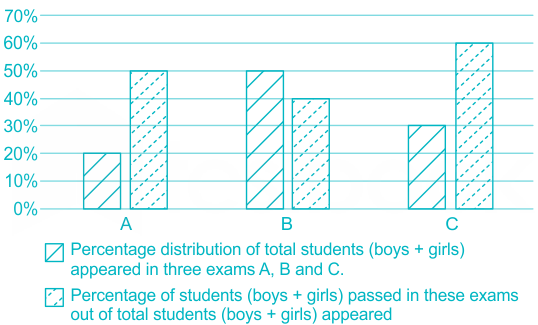
The bar graph given below shows percentage distribution of total students (boys + girls) appeared in three exams A, B and C. The bar graph also shows percentage of students (boys + girls) passed in these three exams out of total students (boys + girls) appeared in particular exam. Read the data carefully and answer the questions given below.

Note:

Total number of students appeared in three exams A, B and C = 900

Total number of students appeared in any exam = students passed + students did not pass.

The total number of students in school F is 20% more than that in C. The ratio of the number of boys to the number of girls in school F is 14:13. If the number of girls in schools F and E together is 193, then find the difference between the number of boys in schools E and F.

  1. AOption (a)

    10

  2. BOption (b)

    12

  3. COption (c)

    14

  4. DOption (d)

    16

  5. EOption (e)

    CND

View answer & explanation

Correct answer

Answer: (e)E.

CND

Why this answer is correct

Common Calculation

ExamNumber of students AppearedNumber of students Passed
A900×20/100 = 180180×50/100 = 90
B900×50/100 = 450450×40/100 = 180
C900×30/100 = 270270×60/100 = 162

Students who did not pass:

A: 180 − 90 = 90

B: 450 − 180 = 270

C: 270 − 162 = 108


Calculation:

Total students in C = 270

→ F = 270 × 1.2 =324

Ratio boys:girls = 14:13

→ total parts = 27

→ one part = 12

Boys in F = 14 × 12 = 168, Girls in F = 12 × 13 = 132

Girls in E = 193 – 132 = 61

Cannot calculate exact difference in boys without total students in E.

Answer: Not enough information to determine exact difference.

SBI Clerk Mains Memory Based Paper (Held On: 10 April 2025 Shift 1) (Previous Year Paper)·Quantitative Aptitude
View full paper

Question 459

SBI Clerk 2025• Quantitative Aptitude• Quantitative Aptitude

The bar graph given below shows percentage distribution of total students (boys + girls) appeared in three exams A, B and C. The bar graph also shows percentage of students (boys + girls) passed in these three exams out of total students (boys + girls) appeared in particular exam. Read the data carefully and answer the questions given below.

Note:

Total number of students appeared in three exams A, B and C = 900

Total number of students appeared in any exam = students passed + students did not pass.

Which of the following statement/s is or are correct?

I. Total number of students who did not pass the exam B are multiple of 9.

II. Total students who passed the exam A & B together > Total students who passed the exam B & C together

III. 50% of students who did not pass the exam A equal to 1/6th of number of students who did not pass the exam B

  1. AOption (a)

    Only I true

  2. BOption (b)

    Only II true

  3. COption (c)

    Only III true

  4. DOption (d)

    Only II and III true

  5. EOption (e)

    Only I and III true

View answer & explanation

Correct answer

Answer: (e)E.

Only I and III true

Why this answer is correct

Common Calculation

ExamNumber of students AppearedNumber of students Passed
A900×20/100 = 180180×50/100 = 90
B900×50/100 = 450450×40/100 = 180
C900×30/100 = 270270×60/100 = 162

Students who did not pass:

A: 180 − 90 = 90

B: 450 − 180 = 270

C: 270 − 162 = 108

Calculation:

Exam A: Appeared = 180, Passed = 90, Not passed = 90

Exam B: Appeared = 450, Passed = 180, Not passed = 270

Exam C: Appeared = 270, Passed = 162, Not passed = 108

Statement I: Not passed B = 270 → multiple of 9 ✅

Statement II: Passed A+B = 90 + 180 = 270, Passed B + C = 180 + 162 = 342  → 270<342 ❌

Statement III: 50% of not passed A = 0.5 × 90 = 45, 1/6 of not passed B = 270/6 = 45 → 45=45 ✅

Answer: Statements I and III are correct.

SBI Clerk Mains Memory Based Paper (Held On: 10 April 2025 Shift 1) (Previous Year Paper)·Quantitative Aptitude
View full paper

Question 460

SBI Clerk 2025• Quantitative Aptitude• Quantitative Aptitude

The bar graph given below shows percentage distribution of total students (boys + girls) appeared in three exams A, B and C. The bar graph also shows percentage of students (boys + girls) passed in these three exams out of total students (boys + girls) appeared in particular exam. Read the data carefully and answer the questions given below.

Note:

Total number of students appeared in three exams A, B and C = 900

Total number of students appeared in any exam = students passed + students did not pass.

What is the average number of students did not pass the examinations in A, B and C?

  1. AOption (a)

    124

  2. BOption (b)

    180

  3. COption (c)

    194

  4. DOption (d)

    156

  5. EOption (e)

    166

View answer & explanation

Correct answer

Answer: (d)D.

156

Why this answer is correct

Common Calculation

ExamNumber of students AppearedNumber of students Passed
A900×20/100 = 180180×50/100 = 90
B900×50/100 = 450450×40/100 = 180
C900×30/100 = 270270×60/100 = 162

Students who did not pass:

A: 180 − 90 = 90

B: 450 − 180 = 270

C: 270 − 162 = 108

Calculation:

Not passed A = 90, B = 270, C = 108

Average = (90 + 270 + 108)/3 = 468/3 = 156

Answer: 156 students

How should I prepare for Quantitative Aptitude in SBI Clerk?

Solving previous year questions by topic helps identify recurring concepts, question patterns, and frequently asked sub-topics. Attempt each question, review the step-by-step explanation, and note down key formulas or facts for quick revision before the exam.