IBPS RRB Office Assistant (Clerk) · Topic Collection

Quantitative Aptitude PYQs

Arithmetic, number systems, percentages, ratios, profit and loss, time and work, algebra, geometry, mensuration, and trigonometry.

1935 Total Questions49 Official PapersYears: 2018–2025Search in Quantitative Aptitude
Showing questions 61–80 of 1935Page 4 of 97
SBI Clerk Prelims Memory Based Paper (Held On: 22 February 2025 Shift 2) (Previous Year Paper)·Numerical Ability
View full paper

Question 61

IBPS RRB Office Assistant (Clerk) 2025• Numerical Ability• Numerical Ability

Difference between marked price and the cost price is 50% of the selling price. if the discount percentage is 20% , then find the ratio between marked price and cost price.

  1. AOption (a)

    5 : 3

  2. BOption (b)

    7 : 5

  3. COption (c)

    3 : 5

  4. DOption (d)

    7 : 11

  5. EOption (e)

    None

View answer & explanation

Correct answer

Answer: (a)A.

5 : 3

Why this answer is correct

Shortcut Trick

Assume Marked Price (MP) is 100.

Given Discount = 20%, so Selling Price (SP) = 100 − 20 = 80.

Difference (MP − CP) = 50% of SP = 0.5 × 80 = 40.

Since MP − CP = 40, then 100 − CP = 40 ⇒ Cost Price (CP) = 60.

Ratio MP : CP = 100 : 60 = 5 : 3.

∴ The correct answer is 5 : 3.

Alternate Method

Given: MP − CP = 0.5 × SP and Discount% = 20%

Formulas: SP = MP × (100 − D%) ÷ 100

⇒ Let Marked Price be M and Cost Price be C.

⇒ Selling Price (S) = M − 0.20M = 0.8M.

⇒ According to the question: M − C = 0.5 × S.

⇒ M − C = 0.5 × (0.8M) = 0.4M.

⇒ M − 0.4M = C ⇒ 0.6M = C.

⇒ M ÷ C = 1 ÷ 0.6 = 10 ÷ 6 = 5 ÷ 3.

∴ The correct answer is 5 : 3.

Additional Information

Marked Price and Discount

Marked Price (MP) is the price printed on an item. Discount is always calculated on the MP. SP = MP − Discount.

Relationship between CP, SP, and MP

Profit is SP − CP, whereas Discount is MP − SP. To find the ratio between MP and CP, we can use the formula MP ÷ CP = (100 + P%) ÷ (100 − D%) if profit percentage is known.
SBI Clerk Prelims Memory Based Paper (Held On: 22 February 2025 Shift 2) (Previous Year Paper)·Numerical Ability
View full paper

Question 62

IBPS RRB Office Assistant (Clerk) 2025• Numerical Ability• Numerical Ability

In x litres of a mixture contains water and milk in the ratio of 6: 7. If 15 litres of milk is added to the mixture so that the ratio of water and milk become 3: 5. What is the value of x?

  1. AOption (a)

    64

  2. BOption (b)

    65

  3. COption (c)

    60

  4. DOption (d)

    52

  5. EOption (e)

    48

View answer & explanation

Correct answer

Answer: (b)B.

65

Why this answer is correct

Shortcut Trick

Initial Ratio (Water : Milk) = 6 : 7

Final Ratio (Water : Milk) = 3 : 5. To make Water constant, multiply final ratio by 2 → 6 : 10.

Increase in Milk = 10 − 7 = 3 units. Given, 3 units = 15 litres → 1 unit = 5 litres.

Initial mixture x = (6 + 7) units = 13 units = 13 × 5 = 65 litres.

∴ The correct answer is 65 litres.

Alternate Method

Given: Initial ratio 6:7, added 15 litres milk, final ratio 3:5.

Formula Used: Ratio × constant = Quantity; Initial Value x = Sum of initial components.

⇒ Let water = 6k and milk = 7k. Total volume x = 13k.

⇒ 6k / (7k + 15) = 3 / 5

⇒ 5 × 6k = 3 × (7k + 15)

⇒ 30k = 21k + 45

⇒ 9k = 45 ⇒ k = 5

⇒ x = 13 × 5 = 65 litres.

∴ The correct answer is 65 litres.

Additional Information

Constant Variable Concept

When only one component is added or removed from a mixture, the quantity of the other component remains constant. Always equate its ratio units first.

Alligation Rule

Used to find the ratio in which two quantities are mixed to get a final concentration: (Higher value − Mean) / (Mean − Lower value).

Replacement Method

Final Quantity = Initial Quantity × (1 − amount replaced/total)n, where n is the number of times the process is repeated.

SBI Clerk Prelims Memory Based Paper (Held On: 22 February 2025 Shift 2) (Previous Year Paper)·Numerical Ability
View full paper

Question 63

IBPS RRB Office Assistant (Clerk) 2025• Numerical Ability• Numerical Ability

The given table shows the number of book issue in three library [P, Q, and R] to three person [ A, B and C].

LibraryABC
P182025
Q303510
R241632

Find the difference between total number of books issued to A and total number of books issued to C in all library together?

  1. AOption (a)

    11

  2. BOption (b)

    5

  3. COption (c)

    7

  4. DOption (d)

    8

  5. EOption (e)

    6

View answer & explanation

Correct answer

Answer: (b)B.

5

Why this answer is correct

Calculations:

Total number of books issued to A in all library together

⇒ 18 + 30 + 24 = 72

Total number of books issued to C in all library together

⇒ 25 + 10 + 32 = 67

So, required difference 72 – 67 = 5

SBI Clerk Prelims Memory Based Paper (Held On: 22 February 2025 Shift 2) (Previous Year Paper)·Numerical Ability
View full paper

Question 64

IBPS RRB Office Assistant (Clerk) 2025• Numerical Ability• Numerical Ability

The given table shows the number of book issue in three library [P, Q, and R] to three person [ A, B and C].

LibraryABC
P182025
Q303510
R241632

Ratio of between number of books issued to A and B in library Q is 6:x. Find the value of 9x?

  1. AOption (a)

    45

  2. BOption (b)

    30

  3. COption (c)

    63

  4. DOption (d)

    64

  5. EOption (e)

    88

View answer & explanation

Correct answer

Answer: (c)C.

63

Why this answer is correct

Calculations:

Number of books issued to A in library Q = 30

Number of books issued to B in library Q = 35

Required ratio 30 : 35 = 6: 7

So, x = 7 ⇒  9x = 9 × 7 = 63

SBI Clerk Prelims Memory Based Paper (Held On: 22 February 2025 Shift 2) (Previous Year Paper)·Numerical Ability
View full paper

Question 65

IBPS RRB Office Assistant (Clerk) 2025• Numerical Ability• Numerical Ability

The given table shows the number of book issue in three library [P, Q, and R] to three person [ A, B and C].

LibraryABC
P182025
Q303510
R241632

Number of books issued to D in library R is 12 more than the 25% of number of books issued to C in same library. Find the number of books issued to D in library R?

  1. AOption (a)

    45

  2. BOption (b)

    35

  3. COption (c)

    26

  4. DOption (d)

    20

  5. EOption (e)

    25

View answer & explanation

Correct answer

Answer: (d)D.

20

Why this answer is correct

Calculations:

Total number of books issued to C in library R = 32

Number of books issued to D in library R:

⇒ 32 × 25/100 + 12

⇒ 8 + 12 = 20

SBI Clerk Prelims Memory Based Paper (Held On: 22 February 2025 Shift 2) (Previous Year Paper)·Numerical Ability
View full paper

Question 66

IBPS RRB Office Assistant (Clerk) 2025• Numerical Ability• Numerical Ability

The given table shows the number of book issue in three library [P, Q, and R] to three person [ A, B and C].

LibraryABC
P182025
Q303510
R241632

Out of total book issued to A, 25% is friction book. Find number of books issued to A is friction book?

  1. AOption (a)

    26

  2. BOption (b)

    14

  3. COption (c)

    16

  4. DOption (d)

    12

  5. EOption (e)

    18

View answer & explanation

Correct answer

Answer: (e)E.

18

Why this answer is correct

Calculations:

Total Number of books issued to A = 18 + 30 + 24 = 72

Total Number of fiction books issued to A = 72 × (25 /100)

Total Number of fiction books issued to A = 18

SBI Clerk Prelims Memory Based Paper (Held On: 22 February 2025 Shift 2) (Previous Year Paper)·Numerical Ability
View full paper

Question 67

IBPS RRB Office Assistant (Clerk) 2025• Numerical Ability• Numerical Ability

The given table shows the number of book issue in three library [P, Q, and R] to three person [ A, B and C].

LibraryABC
P182025
Q303510
R241632

Total number of book issue in library P to all three people together is how less than the number of book issue in library Q to all three people together?

  1. AOption (a)

    26

  2. BOption (b)

    32

  3. COption (c)

    12

  4. DOption (d)

    14

  5. EOption (e)

    22

View answer & explanation

Correct answer

Answer: (c)C.

12

Why this answer is correct

Calculations:

Total number of book issue in library P to all three people together = [18 + 20 + 25] = 63

Total number of book issue in library Q to all three people together = [30 + 35 +10] = 75

So, Total number of book issue in library P to all three people together is 75 – 63 = 12 less than the number of book issue in library Q to all three people together.

SBI Clerk Prelims Memory Based Paper (Held On: 22 February 2025 Shift 2) (Previous Year Paper)·Numerical Ability
View full paper

Question 68

IBPS RRB Office Assistant (Clerk) 2025• Numerical Ability• Numerical Ability

In a Village the number of literate to illiterate is in the ratio 4: 1. 70%  of the literate are males and remaining are females and 20% of the illiterate are females and remaining are males.If the total number of females in the village is 56. Find the total number of males and females in the village.

  1. AOption (a)

    180

  2. BOption (b)

    230

  3. COption (c)

    200

  4. DOption (d)

    210

  5. EOption (e)

    190

View answer & explanation

Correct answer

Answer: (c)C.

200

Why this answer is correct

Shortcut Trick

Assume Total Population = 100 units.

Literates = 80 units, Illiterates = 20 units (Ratio 4 : 1).

Literate Females = 30% of 80 = 24 units | Illiterate Females = 20% of 20 = 4 units.

Total Females = 24 + 4 = 28 units → 56 (Given).

1 unit = 2 | Total population = 100 × 2 = 200.

∴ The correct answer is 200.

Alternate Method

Given: Ratio of Literate to Illiterate = 4 : 1. Total Females = 56.

Let Literate = 400x and Illiterate = 100x. Total Population = 500x.

⇒ Literate Females = 30% of 400x = 0.30 × 400x = 120x.

⇒ Illiterate Females = 20% of 100x = 0.20 × 100x = 20x.

⇒ Total Females = 120x + 20x = 140x.

⇒ 140x = 56

⇒ x = 56 ÷ 140 = 0.4

⇒ Total Population = 500 × 0.4 = 200.

∴ The correct answer is 200.

Additional Information

Ratio Distribution

To divide a quantity N in ratio a : b, the parts are [a/(a+b)] × N and [b/(a+b)] × N.

Percentage of a Group

If x% are males, then (100 − x)% are females, provided there are only two categories.

Unitary Method

Finding the value of a single unit (140 units = 56 → 1 unit = 0.4) to calculate the total required value.

SBI Clerk Prelims Memory Based Paper (Held On: 22 February 2025 Shift 2) (Previous Year Paper)·Numerical Ability
View full paper

Question 69

IBPS RRB Office Assistant (Clerk) 2025• Numerical Ability• Numerical Ability

If the sum of the length and breadth of a rectangle is equal to the diameter of a circle, which is 56 cm, then what is the ratio between the circumference of the circle and the perimeter of the rectangle?

  1. AOption (a)

    10 : 7

  2. BOption (b)

    11 : 7

  3. COption (c)

    4 : 7

  4. DOption (d)

    14 : 11

  5. EOption (e)

    7 : 11

View answer & explanation

Correct answer

Answer: (b)B.

11 : 7

Why this answer is correct

Shortcut Trick

Circumference of Circle = π × d = (22/7) × 56 = 176 cm.

Perimeter of Rectangle = 2 × (L + B). Given L + B = diameter = 56 cm.

⇒ Perimeter = 2 × 56 = 112 cm.

Ratio = 176 : 112 = 11 : 7 (dividing both by 16).

∴ The correct answer is 11 : 7.

Alternate Method

Given:

Diameter (d) of circle = 56 cm.

Sum of length (L) and breadth (B) of rectangle (L + B) = 56 cm.

Formula Used:

⇒ Circumference of circle (C) = π × d

⇒ Perimeter of rectangle (P) = 2 × (L + B)

Calculations:

⇒ C = (22/7) × 56

⇒ C = 22 × 8 = 176 cm

⇒ P = 2 × 56 = 112 cm

⇒ Ratio = C / P = 176 / 112

⇒ Ratio = (16 × 11) / (16 × 7) = 11 / 7

∴ The correct answer is 11 : 7.

Additional Information

Circle Properties

Area of circle = πr2 or (πd2)/4. Circumference = 2πr or πd.

Rectangle Mensuration

Area of rectangle = L × B. Diagonal = √(L2 + B2).

Standard π Values

For calculations involving 7 or its multiples, use π ≈ 22/7 for easier cancellation.

SBI Clerk Prelims Memory Based Paper (Held On: 22 February 2025 Shift 2) (Previous Year Paper)·Numerical Ability
View full paper

Question 70

IBPS RRB Office Assistant (Clerk) 2025• Numerical Ability• Numerical Ability

A bus is travelling at a speed of 25 km/h. It takes 10 hours for the bus to cover the distance from point A to point B. If the speed of the bus increases by 100%, how much time will the bus take to cover the same distance?

  1. AOption (a)

    2 Hours

  2. BOption (b)

    5 Hours

  3. COption (c)

    2 Hours and 30 Minutes

  4. DOption (d)

    7 Hours and 30 Minutes

  5. EOption (e)

    4 Hours

View answer & explanation

Correct answer

Answer: (b)B.

5 Hours

Why this answer is correct

Shortcut Trick

When distance is constant, time is inversely proportional to speed (T ∝ 1/S).

Initial speed = 100% → New speed = 100% + 100% = 200%.

Speed ratio = 1 : 2 ∴ Time ratio = 2 : 1.

2 units = 10 hours ⇒ 1 unit = 5 hours.

∴ The correct answer is 5 hr.

Alternate Method

Given: Initial Speed (S1) = 25 km/h, Initial Time (T1) = 10 hours.

Formula Used: Distance = Speed × Time

⇒ Total Distance = S1 × T1 = 25 × 10 = 250 km.

⇒ New Speed (S2) = 25 + (100% of 25) = 25 + 25 = 50 km/h.

⇒ New Time (T2) = Distance ÷ S2

⇒ T2 = 250 ÷ 50 = 5 hours.

∴ The correct answer is 5 hr.

Additional Information

Inverse Proportion Rule

If distance is constant, S1 × T1 = S2 × T2. This allows for quick calculation without finding the actual distance.

Percentage Increase in Speed

A 100% increase means the value doubles (New = Old × 2). Similarly, a 200% increase means the value triples.

Average Speed

For two equal distances covered at speeds x and y, Average Speed = (2 × x × y) ÷ (x + y).

SBI Clerk Prelims Memory Based Paper (Held On: 22 February 2025 Shift 3) (Previous Year Paper)·Numerical Ability
View full paper

Question 71

IBPS RRB Office Assistant (Clerk) 2025• Numerical Ability• Numerical Ability

Directions: Read the data carefully and answer the following questions. 

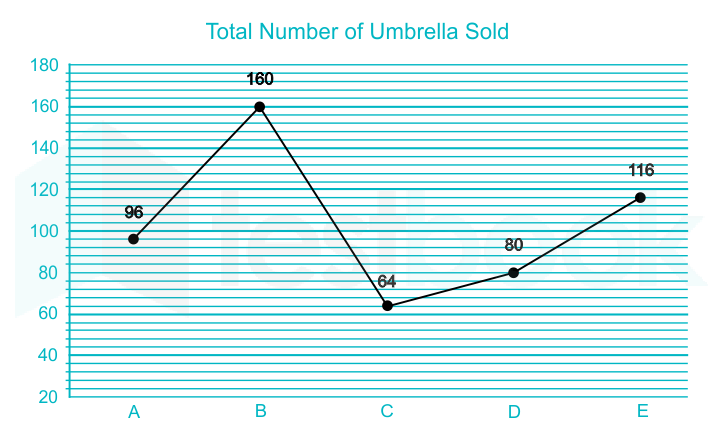
The line graph given below shows the total number of folded and unfolded umbrellas sold by five shops. 

Total number of umbrellas sold by shops C and D together is what percentage of the number of umbrellas sold by shop B?

  1. AOption (a)

    80%

  2. BOption (b)

    85%

  3. COption (c)

    90%

  4. DOption (d)

    95%

  5. EOption (e)

    None of these

View answer & explanation

Correct answer

Answer: (c)C.

90%

Why this answer is correct

From the data:

Shop C: 64 umbrellas

Shop D: 80 umbrellas

Total umbrellas sold by C and D:

Total C + D = 64 + 80 = 144

From the data:

Shop B: 160 umbrellas

Now, let's calculate the percentage.

We use the formula:

Percentage = Part / Whole × 100

Here:

Part = Total umbrellas sold by C and D = 144

Whole = Umbrellas sold by B = 160

Substitute the values:

Percentage = 144 / 160× 100

Simplify:

Percentage = 0.9 × 100 = 90%

Thus, the total number of umbrellas sold by shops C and D together is 90% of the number of umbrellas sold by shop B.

SBI Clerk Prelims Memory Based Paper (Held On: 22 February 2025 Shift 3) (Previous Year Paper)·Numerical Ability
View full paper

Question 72

IBPS RRB Office Assistant (Clerk) 2025• Numerical Ability• Numerical Ability

Directions: Read the data carefully and answer the following questions. 

The line graph given below shows the total number of folded and unfolded umbrellas sold by five shops. 

The ratio of total number of folded to unfolded umbrellas sold by shop A is 5:3. If 2/3 rd of unfolded umbrellas are black in colour and 3/4th of folded umbrellas are black in colour, then find the number of black colour umbrellas sold by shop A.

  1. AOption (a)

    45

  2. BOption (b)

    91

  3. COption (c)

    69

  4. DOption (d)

    57

  5. EOption (e)

    73

View answer & explanation

Correct answer

Answer: (c)C.

69

Why this answer is correct

Total umbrellas sold by Shop A.

From the data:

Total umbrellas sold by Shop A = 96

The ratio of folded to unfolded umbrellas is 5:3.

Let:

Folded umbrellas = 5x 

Unfolded umbrellas = 3x 

Total umbrellas:

5x + 3x = 8x

Given that the total umbrellas sold by Shop A is 96:

8x = 96

x = 12

Now:

Folded umbrellas = 5x = 5 × 12 = 60 

Unfolded umbrellas = 3x = 3 × 12 = 36 

3/4th of folded umbrellas are black.

Black folded umbrellas:

3/4 × 60 = 45

2/3th of unfolded umbrellas are black.

Black unfolded umbrellas:

2/3 × 36 = 24

Total black umbrellas sold by Shop A.

Total black umbrellas = Black folded umbrellas + Black unfolded umbrellas

Total black umbrellas = 45 + 24 = 69

Thus, the number of black umbrellas sold by Shop A is 69.

SBI Clerk Prelims Memory Based Paper (Held On: 22 February 2025 Shift 3) (Previous Year Paper)·Numerical Ability
View full paper

Question 73

IBPS RRB Office Assistant (Clerk) 2025• Numerical Ability• Numerical Ability

Directions: Read the data carefully and answer the following questions. 

The line graph given below shows the total number of folded and unfolded umbrellas sold by five shops. 

If the number of unfolded umbrellas sold by shop D are 55% of the total number of umbrellas sold by D and the total number of unsold folded umbrellas in shop D are 5/9 th of the total number of folded umbrellas sold by shop D, then find the total number of unsold folded umbrellas in shop D.

  1. AOption (a)

    10

  2. BOption (b)

    5

  3. COption (c)

    20

  4. DOption (d)

    15

  5. EOption (e)

    25

View answer & explanation

Correct answer

Answer: (c)C.

20

Why this answer is correct

From the data, the total number of umbrellas sold by Shop D is 80.

It is given that the number of unfolded umbrellas sold by Shop D is 55% of the total umbrellas sold by Shop D. 

Unfolded umbrellas sold by D = 55% × 80 = 0.55 × 80 = 44

The total umbrellas sold by Shop D consist of folded and unfolded umbrellas. Therefore:

Folded umbrellas sold by D = Total umbrellas sold by D - Unfolded umbrellas sold by D

Folded umbrellas sold by D = 80 - 44 = 36

It is given that the total number of unsold folded umbrellas in Shop D is 5/9 of the total number of folded umbrellas sold by Shop D. 

Unsold folded umbrellas in D = 5 / 9 × Folded umbrellas sold by D

Unsold folded umbrellas in D = 5 / 9 × 36 = 20

The total number of unsold folded umbrellas in Shop D is 20.

SBI Clerk Prelims Memory Based Paper (Held On: 22 February 2025 Shift 3) (Previous Year Paper)·Numerical Ability
View full paper

Question 74

IBPS RRB Office Assistant (Clerk) 2025• Numerical Ability• Numerical Ability

Directions: Read the data carefully and answer the following questions. 

The line graph given below shows the total number of folded and unfolded umbrellas sold by five shops. 

What is the average of total number of umbrellas sold by A, C and E together? 

  1. AOption (a)

    78

  2. BOption (b)

    92

  3. COption (c)

    60

  4. DOption (d)

    75

  5. EOption (e)

    80

View answer & explanation

Correct answer

Answer: (b)B.

92

Why this answer is correct

From the data:

Shop A: 96 umbrellas

Shop C: 64 umbrellas

Shop E: 116 umbrellas

Total umbrellas A + C + E = 96 + 64 + 116

Total umbrellas A + C + E = 276

The average is calculated by dividing the total number of umbrellas by the number of shops 3 in this case:

Average = (Total umbrellas A + C + E) / Number of shops

Average = 276 / 3 = 92

Thus, the average of the total number of umbrellas sold by shops A, C, and E is 92.

SBI Clerk Prelims Memory Based Paper (Held On: 22 February 2025 Shift 3) (Previous Year Paper)·Numerical Ability
View full paper

Question 75

IBPS RRB Office Assistant (Clerk) 2025• Numerical Ability• Numerical Ability

Directions: Read the data carefully and answer the following questions. 

The line graph given below shows the total number of folded and unfolded umbrellas sold by five shops. 

If the ratio of folded to unfolded umbrellas sold by Shop B is 3:5, and the ratio of folded to unfolded umbrellas sold by Shop D is 1:3, then the total number of folded umbrellas sold by Shop B and Shop D together is:

  1. AOption (a)

    80

  2. BOption (b)

    90

  3. COption (c)

    100

  4. DOption (d)

    120

  5. EOption (e)

    110

View answer & explanation

Correct answer

Answer: (a)A.

80

Why this answer is correct

Total umbrellas sold by Shop B = 160

Ratio of folded to unfolded umbrellas = 3:5

Let the number of folded umbrellas = 3x 

Let the number of unfolded umbrellas = 5x 

Total umbrellas = 3x + 5x = 8x 

So, 8x = 160 

Solving for x:

x = 160 / 8 = 20

Folded umbrellas sold by Shop B:

3x = 3 × 20 = 60

Total umbrellas sold by Shop D = 80

Ratio of folded to unfolded umbrellas = 1:3

Let the number of folded umbrellas = y 

Let the number of unfolded umbrellas = 3y 

Total umbrellas = y + 3y = 4y 

So, 4y = 80 

Solving for y:

y = 80 / 4 = 20

Folded umbrellas sold by Shop D:

y = 20

Folded umbrellas Shop B = 60

Folded umbrellas Shop D = 20

Total folded umbrellas:

60 + 20 = 80

Thus, the correct answer is 80.

SBI Clerk Prelims Memory Based Paper (Held On: 22 February 2025 Shift 3) (Previous Year Paper)·Numerical Ability
View full paper

Question 76

IBPS RRB Office Assistant (Clerk) 2025• Numerical Ability• Numerical Ability

The average of two numbers m and n is 36. The ratio of 80% of m to (n+13) is 9:10. Find the value of m.

  1. AOption (a)

    45

  2. BOption (b)

    50

  3. COption (c)

    55

  4. DOption (d)

    60

  5. EOption (e)

    65

View answer & explanation

Correct answer

Answer: (a)A.

45

Why this answer is correct

Shortcut Trick

Sum of m and n = 36 × 2 = 72. So, n = 72 − m.

Ratio equation: (0.8m) / (72 − m + 13) = 9/10.

8m = 9 × (85 − m) ⇒ 8m = 765 − 9m ⇒ 17m = 765.

m = 765 ÷ 17 = 45.

∴ The correct answer is 45.

Alternate Method

Given:

Average of m and n = 36

Ratio [80% of m] : [n + 13] = 9 : 10

Calculations:

⇒ (m + n) / 2 = 36

⇒ m + n = 72

⇒ n = 72 − m

⇒ 80% of m = 0.8m = 4m/5

⇒ (4m/5) / (n + 13) = 9/10

⇒ (4m/5) / (72 − m + 13) = 9/10

⇒ (4m) / [5 × (85 − m)] = 9/10

⇒ 40m = 45 × (85 − m)

⇒ 8m = 9 × (85 − m)

⇒ 8m = 765 − 9m

⇒ 17m = 765

⇒ m = 45

∴ The correct answer is 45.

Additional Information

Average Concept

Average is the sum of observations divided by the number of observations. For two numbers, Average = (m + n) ÷ 2.

Percentage to Fraction Conversion

To simplify calculations, convert percentages to fractions: 80% = 80/100 = 4/5 or 0.8.

Ratio and Proportion

If a:b = c:d, then a/b = c/d. This allows for cross-multiplication to solve for unknown variables.

SBI Clerk Prelims Memory Based Paper (Held On: 22 February 2025 Shift 3) (Previous Year Paper)·Numerical Ability
View full paper

Question 77

IBPS RRB Office Assistant (Clerk) 2025• Numerical Ability• Numerical Ability

X, Y, and Z entered into a partnership and invested their amounts for time periods in the ratio 3:4:6 respectively. The ratio of their investments was 4:6:5 respectively. If X's share out of the profit was Rs 18,000, what was the total profit?

  1. AOption (a)

    Rs 90,000

  2. BOption (b)

    Rs 96,000

  3. COption (c)

    Rs 99,000

  4. DOption (d)

    Rs 1,02,000

  5. EOption (e)

    Rs 1,06,000

View answer & explanation

Correct answer

Answer: (c)C.

Rs 99,000

Why this answer is correct

Shortcut Trick

Profit ratio is calculated as (Investment × Time).

Profit Ratio X : Y : Z = (4 × 3) : (6 × 4) : (5 × 6) = 12 : 24 : 30.

Simplified Profit Ratio = 2 : 4 : 5.

X's share (2 units) = Rs 18,000 ⇒ 1 unit = Rs 9,000.

Total profit (2 + 4 + 5 = 11 units) = 11 × 9,000 = Rs 99,000.

∴ The correct answer is Rs 99,000.

Alternate Method

Given → Investment ratio = 4 : 6 : 5 | Time ratio = 3 : 4 : 6 | X's profit = Rs 18,000. Formulas: Profit = Investment × Time | Total Profit = Sum of individual profit shares.

⇒ Calculate profit ratio for X, Y, and Z: (4 × 3) : (6 × 4) : (5 × 6) = 12 : 24 : 30. ⇒ Reducing the ratio by dividing by 6: 2 : 4 : 5. ⇒ Let the profit shares be 2k, 4k, and 5k. ⇒ Given X's share 2k = 18,000 ⇒ k = 9,000. ⇒ Total Profit = 2k + 4k + 5k = 11k. ⇒ Total Profit = 11 × 9,000 = 99,000.

∴ The correct answer is Rs 99,000.

Additional Information

Partnership Basics

In a partnership, the profit is distributed in the ratio of the product of Capital (Investment) and Time. If time is constant, profit is proportional to investment.

Ratio of Investments

If profits (P) and time (T) are known, the investment (I) ratio can be found using I = P ÷ T.

SBI Clerk Prelims Memory Based Paper (Held On: 22 February 2025 Shift 3) (Previous Year Paper)·Numerical Ability
View full paper

Question 78

IBPS RRB Office Assistant (Clerk) 2025• Numerical Ability• Numerical Ability

A shopkeeper marks up the cost price of an item by 50% and then gives a 20% discount on the marked price. If the profit earned by the shopkeeper is ₹660, what is the difference between the profit and the discount given?

  1. AOption (a)

    ₹440

  2. BOption (b)

    ₹540

  3. COption (c)

    ₹330

  4. DOption (d)

    ₹280

  5. EOption (e)

    None of these

View answer & explanation

Correct answer

Answer: (c)C.

₹330

Why this answer is correct

Shortcut Trick

Let the Cost Price (CP) be 100 units.

Marked Price (MP) = 100 + 50% of 100 = 150 units.

Selling Price (SP) = 150 − 20% of 150 = 150 − 30 = 120 units.

Profit = SP − CP = 120 − 100 = 20 units. Given 20 units = ₹660, so 1 unit = ₹33.

Discount = MP − SP = 150 − 120 = 30 units.

Difference between Discount and Profit = 30 − 20 = 10 units = 10 × 33 = ₹330.

∴ The correct answer is ₹330.

Alternate Method

Given: Markup% = 50%, Discount% = 20%, Profit = ₹660. Formulas: Profit = SP − CP | SP = MP × (100 − D%) ÷ 100 | MP = CP × (100 + Markup%) ÷ 100.

⇒ Let CP = x. Then MP = 1.5x and SP = 0.8 × 1.5x = 1.2x. ⇒ Profit = 1.2x − x = 0.2x. Given 0.2x = 660 ⇒ x = 3300. ⇒ Profit = 0.2 × 3300 = ₹660. ⇒ Discount = MP − SP = 1.5x − 1.2x = 0.3x = 0.3 × 3300 = ₹990. ⇒ Difference = 990 − 660 = ₹330.

∴ The correct answer is ₹330.

Additional Information

Markup and Profit Relationship

Net Profit% can be calculated using the successive percentage formula: Net% = m − d − (m × d)/100, where m is markup% and d is discount%.

Relation between CP and MP

The ratio of CP to MP is given by: CP/MP = (100 − Discount%)/(100 + Profit%).

SBI Clerk Prelims Memory Based Paper (Held On: 22 February 2025 Shift 3) (Previous Year Paper)·Numerical Ability
View full paper

Question 79

IBPS RRB Office Assistant (Clerk) 2025• Numerical Ability• Numerical Ability

A mixture initially contains 'x' liters of milk and 15 liters of water. 18 liters of milk are then added to the mixture. The resulting mixture has a milk to water ratio of 6:1.  What is the value of 'x'?

  1. AOption (a)

    60 litres

  2. BOption (b)

    72 litres

  3. COption (c)

    84 litres

  4. DOption (d)

    90 litres

  5. EOption (e)

    None of these

View answer & explanation

Correct answer

Answer: (b)B.

72 litres

Why this answer is correct

Shortcut Trick

Ratio of Milk to Water = 6 : 1

Given Water = 15 litres (1 unit = 15 litres)

Total Milk (final) = 6 × 15 = 90 litres

Initial Milk (x) = Final Milk − Added Milk = 90 − 18 = 72 litres

∴ The correct answer is 72 litres.

Alternate Method

Given:

Initial Milk = x litres, Initial Water = 15 litres

Milk added = 18 litres

Final Ratio (Milk : Water) = 6 : 1

Calculations:

⇒ (Initial Milk + Added Milk) ÷ Water = 6 ÷ 1

⇒ (x + 18) ÷ 15 = 6 ÷ 1

⇒ x + 18 = 15 × 6

⇒ x + 18 = 90

⇒ x = 90 − 18

⇒ x = 72

∴ The correct answer is 72 litres.

Additional Information

Ratio and Proportion

A ratio compares two quantities. If a : b = c : d, then product of extremes (a×d) equals product of means (b×c).

Mixture Problems

When only one component is added to a mixture, the quantity of the other component remains constant in terms of absolute units.

Unitary Method

Find the value of one unit by dividing the given total by its ratio share, then multiply to find other values.

SBI Clerk Prelims Memory Based Paper (Held On: 22 February 2025 Shift 3) (Previous Year Paper)·Numerical Ability
View full paper

Question 80

IBPS RRB Office Assistant (Clerk) 2025• Numerical Ability• Numerical Ability

Directions: Read the data carefully and answer the following questions. 

Three individuals, A, B, and C, were given a set of questions. They attempted some of them. The number of questions attempted by B is 50% of the total questions he was given. A was given 20 fewer questions than B. C was given 130 questions. The combined number of questions attempted by A and C is 145. The total number of questions given to all three is twice the total number of questions they attempted. Additionally, the number of questions attempted by B and C is the same.

Find the ratio of the number of questions attempted by A to the number of questions given to B.

  1. AOption (a)

    11:34

  2. BOption (b)

    13:35

  3. COption (c)

    12:29

  4. DOption (d)

    13:37

  5. EOption (e)

    11:36

View answer & explanation

Correct answer

Answer: (e)E.

11:36

Why this answer is correct

General Solution:

Let:

GA : Questions given to A

GB : Questions given to B

GC : Questions given to C

AA : Questions attempted by A

AB : Questions attempted by B

AC : Questions attempted by C

B attempted 50% of the questions he was given:

AB = 0.5 × GB

A was given 20 fewer questions than B:

GA = GB - 20

C was given 130 questions:

GC = 130

Combined questions attempted by A and C is 145:

AA + AC = 145

Total questions given to all three is twice the total questions they attempted:

GA + GB + GC = 2 × (AA + AB + AC)

Number of questions attempted by B and C is the same:

AB = AC

From Equation 1:

AB = 0.5 × GB

From Equation 3:

GC = 130

From Equation 2:

GA = GB - 20

From Equation 4:

AA + AC = 145

From Equation 5:

GA + GB + GC = 2 × (AA + AB + AC)

Substitute GA = GB - 20 and GC = 130 into Equation 5:

GB - 20 + GB + 130 = 2 × (AA + AB + AC)

Simplify:

2GB + 110 = 2 × (AA + AB + AC)

GB + 55 = AA + AB + AC

From Equation 4:

AA + AC = 145

From Equation 6:

AB = AC

Substitute AB = AC into GB + 55 = AA + AB + AC:

GB + 55 = AA + AB + AC

GB + 55 = AA + 2AC

From Equation 4:

AA = 145 - AC

Substitute AA = 145 - AC into GB + 55 = AA + 2AC:

GB + 55 = 145 - AC + 2AC

Simplify:

GB + 55 = 145 + AC

GB = 90 + AC

From Equation 1:

AB = 0.5 × GB

From Equation 6:

AB = AC

So:

AC = 0.5 × GB

Substitute AC = 0.5 × GB into GB = 90 + AC:

GB = 90 + 0.5 × GB

Subtract 0.5 × GB from both sides:

0.5 × GB = 90

GB = 180

Now, find AC:

AC = 0.5 × GB = 0.5 × 180 = 90

From Equation 6:

AB = AC = 90

From Equation 4:

AA = 145 - AC = 145 - 90 = 55

From Equation 2:

GA = GB - 20 = 180 - 20 = 160

From Equation 3:

GC = 130

Thus,

PersonGivenAttempted
A16055
B18090
C13090


Calculations:

Questions attempted by A: 55

Questions given to B: 180

The ratio of AA to GB is:

AA / GB = 55 / 180

Divide both numerator and denominator by 5 to simplify:

55 / 180 = 11 / 36

Thus, the ratio of the number of questions attempted by A to the number of questions given to B is: 11:36

How should I prepare for Quantitative Aptitude in IBPS RRB Office Assistant (Clerk)?

Solving previous year questions by topic helps identify recurring concepts, question patterns, and frequently asked sub-topics. Attempt each question, review the step-by-step explanation, and note down key formulas or facts for quick revision before the exam.